


Archive for dairy cattle breeding history

“I Was Wrong. They Were Better.” – The Glengarry Ayrshires That Beat the World

A 180-acre farm near Lancaster, Ontario. A Scottish cow bought with her best calf already inside her. And the bull who turned a half-dozen villages by the Quebec line into the source of the Ayrshire breed.

The telephone calls came the following year, and each one asked the same thing.

Ayrshire breeders across the American Northeast were ringing officials at Waterloo, Iowa — home of the National Dairy Cattle Congress, the show that mattered most on that side of the border until the dairy associations pulled their support in 1965 and took the big shows to Madison. The callers weren’t asking about entry deadlines or stall assignments.

Are the LaFranchis coming to Waterloo this year?

Yes, they are.

We won’t be there, then. What’s the use?

Grown men who’d given their lives to Ayrshire cattle, men whose prefixes carried real weight — Lippitt, Meredith, the staid old Northeastern establishments — deciding it wasn’t worth loading the truck. All because three brothers from Calistoga, California had come to Iowa the previous fall with Oak Ridge Farm and walked out with seven class winners and most of the grand championships.

Norman Nabholz, who wrote Millionaires in the Cornfields about the herds that dominated Waterloo and who never owned an Ayrshire in his life, said it about as plainly as anybody could: “Probably the finest group of dairy cattle that ever existed.”

Here’s the part nobody said out loud on those phone calls, because everybody already knew it.

The LaFranchis hadn’t invented those cattle. They’d bought the engine. Six of their herd sires were bred at one place — a farm in Glengarry County, Eastern Ontario, four miles northwest of the village of Lancaster, where people still spoke with Scottish burrs and the Ayrshire cow was, as the old accounts have it, religion. Some of their foundation females came from there too.

The prefix was Glengarry. And this is how a family of Scottish immigrants working 180 acres, hauling cows between two barns on a stoneboat behind a pair of Clydesdales, ended up supplying the genetics that emptied the trucks of an entire show circuit.

ACT I: THE SCOTS BY THE QUEBEC LINE

Livestock historian E.W. Morwick, who preserved most of what we know about this farm, heard the legend as a schoolboy in short pants. Somewhere down by the Quebec border, he was told, was a tight little community — half a dozen small villages — where all the good Ayrshires came from. Names got mentioned. Bonnie Brae. Burnside. Cherry Bank. Maple Crest. But the name he heard most was Glengarry.

Then, as a teenager hauling to the Canadian National Exhibition with Holstein show herds, he stopped to listen every time the Ayrshire results came over the public address. Selwood. Sanholm. Selwood again. Never Glengarry. Never Maple Crest.

So he said what any honest kid would say: maybe those herds down by the Quebec border aren’t as good as people claim.

His verdict, written decades later, runs three words. They were better.

Now, the thing about the Ayrshire in that era — you have to picture what these people actually had standing in the tie-stalls. This was the only major dairy breed to come out of the British Isles, developed in the county of Ayr in southwestern Scotland. Red and white, medium-framed, mature cows running just over a thousand pounds. Long, light horns with dark tips, back when nobody dehorned. Remarkably straight toplines carried level over the rump, and udders good enough that breeders bragged about them in print. Milk of fine curd texture that made first-rate cheese — which mattered enormously to Scottish farmers and, later, to the men shipping into Montreal.

Scottish settlers brought them over in the early 1800s. The Quebec importers organized in 1870, Ontario’s breeders in 1872, and the two amalgamated in 1898 into the association that still registers the breed today. So by the time this story starts, Canadian Ayrshire breeding had herd books, institutions, and a settled habit of going back to the old country for fresh blood.

John Cumming came out of Kintyre, Argyllshire, in 1825 and settled at Allan’s Corners near Ormstown, in the Châteauguay Valley southwest of Montreal. His son Donald was born there on April 18, 1844.

Donald’s name first appears in Volume 2 of the Ayrshire herd book, as owner of a female called Snowball 3854, born May 6, 1886, bought from James Cottingham of Ormstown. Volumes 3, 4, and 5 list many more.

About two decades after those first Ayrshires, Donald moved the whole outfit across the St. Lawrence into Glengarry County and took up 180 acres in the McLennan Settlement. Ten children. The eldest son was Malcolm — Mac to everyone. The youngest was Donald Jr.

Those two are where a good herd becomes a dynasty.

When the old man retired in 1915 — he’d die in 1927 at 83 — he split the farms and the herds between them. Donald Jr. took the home place. Mac set up on the next concession. Their father wanted two separate operations, and on paper that’s exactly what he got.

The brothers had other ideas.

They’d own the herd sires in partnership. Every calf born on either farm would be registered under the Glengarry prefix, bred by Cumming Bros., and anything shown at a fair went into the ring under that single name.

The milk went two ways. Malcolm’s farm sat close to the tracks, so his cans went onto the train for Montreal every day under contract. Donald, on the home place, ran Glengarry Dairy — pasteurizing and bottling on the farm and selling it door to door. He bought milk from three and sometimes four other Ayrshire herds to keep the route supplied, one of them a satellite herd the brothers set up on another farm they owned.

That business ran from the 1920s until the milk marketing board arrived and banned breed-specific milk, which shut it down in 1967. Forty-odd years of selling Ayrshire milk as Ayrshire milk, ended by a regulation.

One prefix. Two herds. Two milk cheques — and, for more than forty years, one bank account between the two farms.

Both farms had bulls. Both farms had milking cows. What they shared was the right to use each other’s sires — and when a brother wanted a particular bull, Cherry Bank Brown Bomber or Edgerstounes Sir Oliver, the cow went down the road to wherever that bull was standing. On a stoneboat, the flat sled farmers dragged over bare ground or snow, behind a team of Clydesdales.

And then there was the harder decision, the one that came around every autumn.

They showed one string. One. Picked out of two barns.

Think about what that means between brothers. Every fall, two men who kept separate herds had to agree on which cows were good enough to carry the family name into the ring — and which ones, from either barn, weren’t. Nobody got a sentimental pass because the cow came out of his own tie-stalls.

That’s a standard enforced at the one place standards usually collapse: where saying no costs you something personal. Everything Glengarry became grew out of that decision, made once a year, for decades.

And don’t mistake Mac for the junior partner in the argument. He held the presidency of the local Ayrshire club from 1931 to 1948, the better part of two decades, and by 1941 he was standing in the middle of the ring at the CNE as the man placing the Ayrshire classes — the same show where young Morwick had listened in vain for the Glengarry name. Think about the endorsement buried in that. The breeder who got sent home from his brother’s barn door was the breeder Canada’s biggest fair trusted to sort everybody else’s cattle.

Two men with the eye, then. Neither one folding.
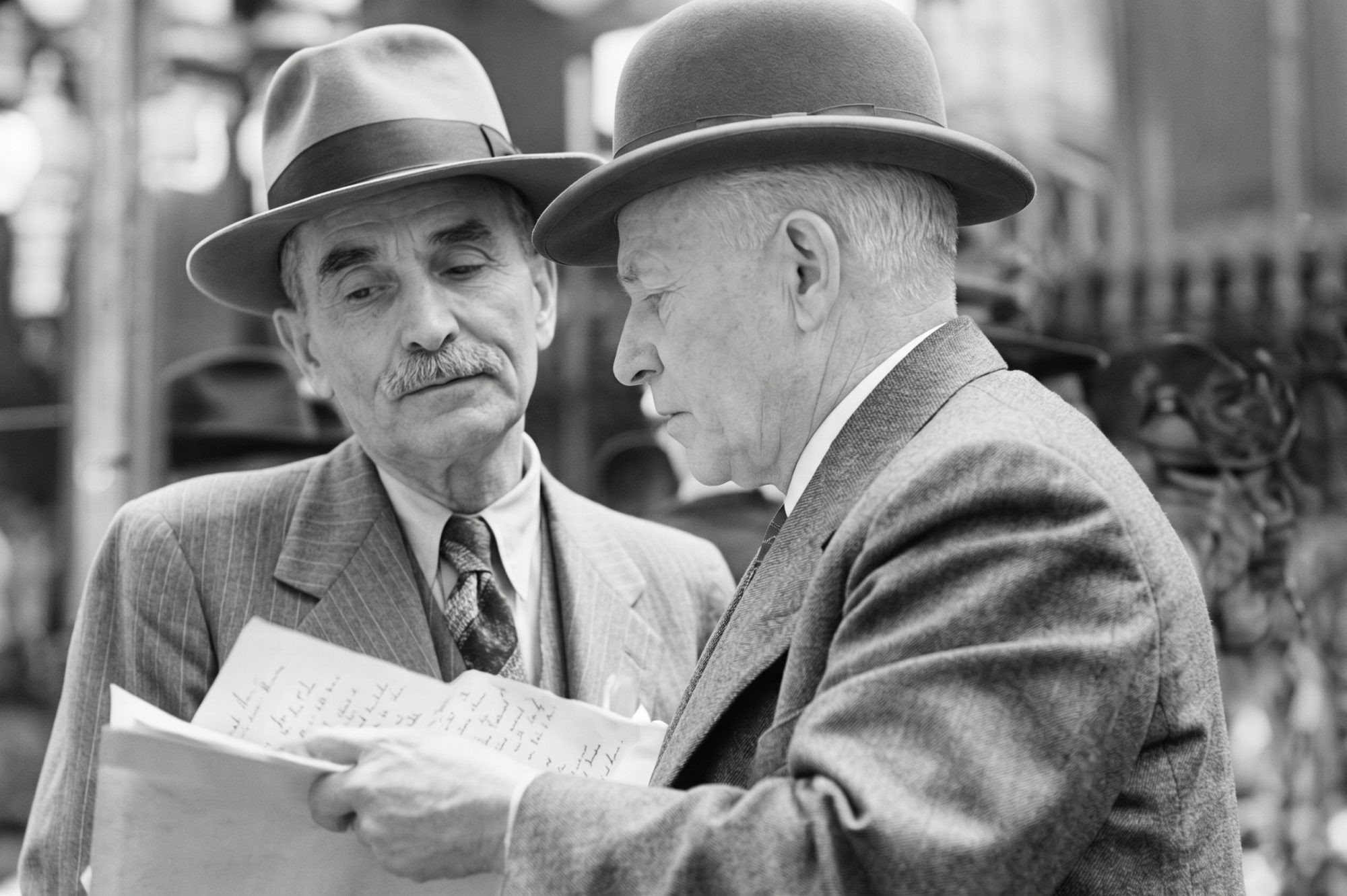
Mac Cumming, Ayrshire judge at the Canadian National Exhibition, with Holstein fieldman Bob Holtby, 1941. Morwick spent his teenage years at this fair waiting to hear Glengarry called over the public address, and never did. What he missed was the man in the middle of the ring, deciding who won.

One thing the record gets wrong, and the family has heard it repeated for years. There was never a Belgian on the place. This was Scots Glengarry, and a continental horse was not welcome in it. The Cummings kept world-class Clydesdales — good enough that by their own farm books in the 1930s, a stallion standing at stud was netting about as much as the cattle. Friends who knew exactly how the brothers felt used to ask, straight-faced, how the Belgians were coming along. Somewhere along the way the joke got written down as fact.

The Scottish Pipeline

What separates Glengarry from a hundred other capable farms is that the Cummings never settled for the genetics that happened to be nearby. Year after year, they imported from Scotland themselves or bought out of other men’s shipments.

Understand what an import meant then. No semen tank, no embryo, no genomic test to tell you what you’d bought. You paid for a living animal, put her on a ship, and prayed. Sometimes she carried the next generation inside her, and that gamble was the whole point.

Their 1927 shipment brought in Dalfibble Narcissus. In 1928 she made 22,050 pounds of milk on yearly test — the highest cow in Canada that year, any breed. Ayrshire herd averages of that era ran nearer 10,000 pounds over a full lactation, so she was better than double her breed’s ordinary. Townhead Julia and Hobsland Nancy came over in the same lot, and both founded families that mattered. Her grandfather milked her four times a day, by hand, for that lactation. The production trophy is still in Ian Cumming’s house.

But the cow who paid for that whole era a thousand times over came later, and she reached Glengarry by a roundabout road through one of the great Canadian herds.
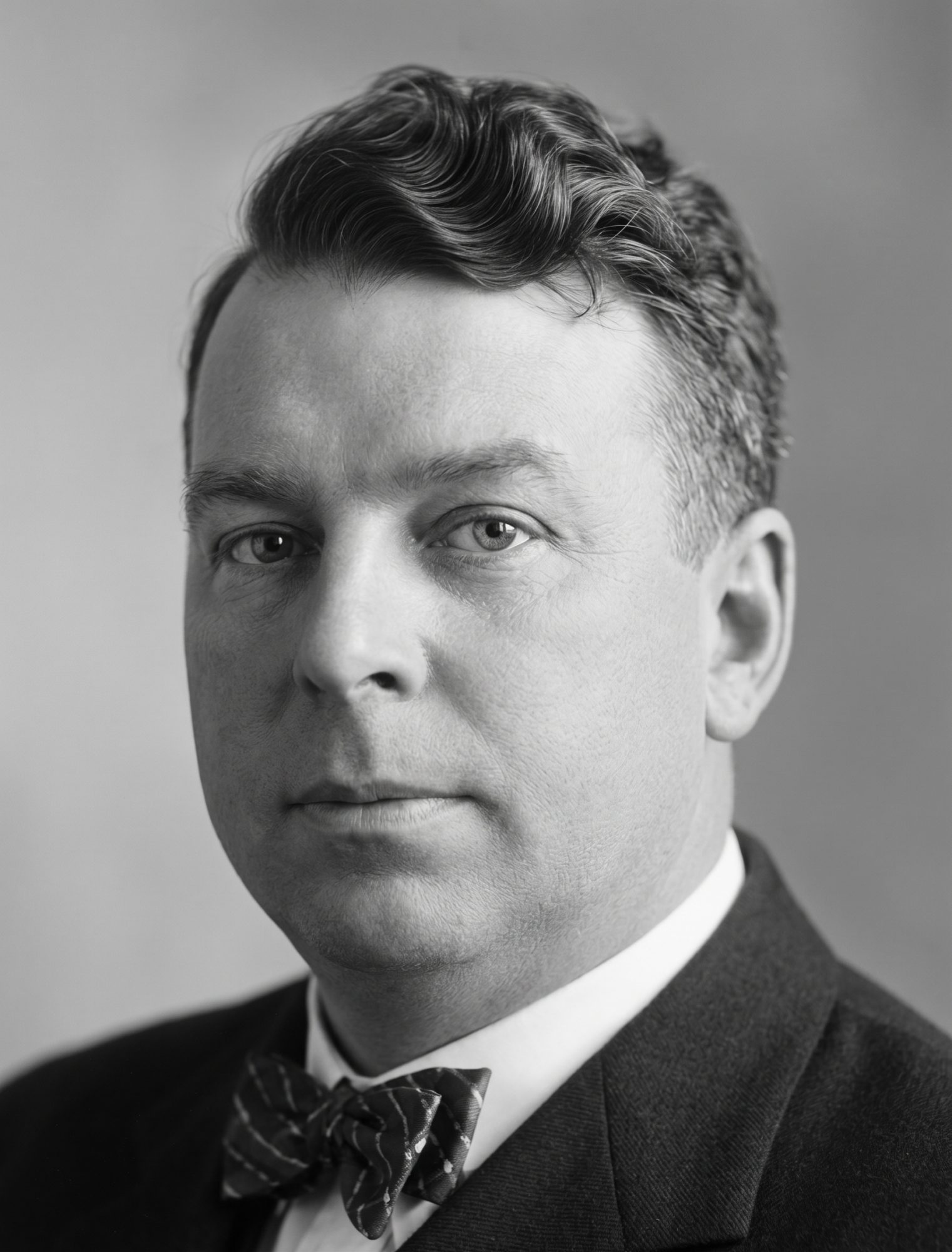
The Honourable Frank C. Biggs, proprietor of Glen Campbell Farm near Dundas, and Ontario’s Minister of Public Works and Highways from 1919 to 1923. His 1936 order for a dozen Scottish heifers is what sent Adam Montgomerie into the Threave barnyard. Biggs never owned the yearling he found there — the Cummings bought Threave Flirt 2nd when she landed.

Frank C. Biggs — the Honourable F.C. Biggs — served as Ontario’s Minister of Public Works and Highways in the Drury government from November 1919 to July 1923, the man under whose watch the province’s paved highway system got started. He kept Ayrshires at Glen Campbell Farm out past Dundas, and they were known on both sides of the line. His cow Ardgowan Valda, bought from her Scottish breeder Sir Hugh Shaw Stewart, took grand champion at the CNE in 1936 and then laid down 31,156 pounds of milk and 1,356 pounds of fat as an eight-year-old — a world championship Ayrshire record.
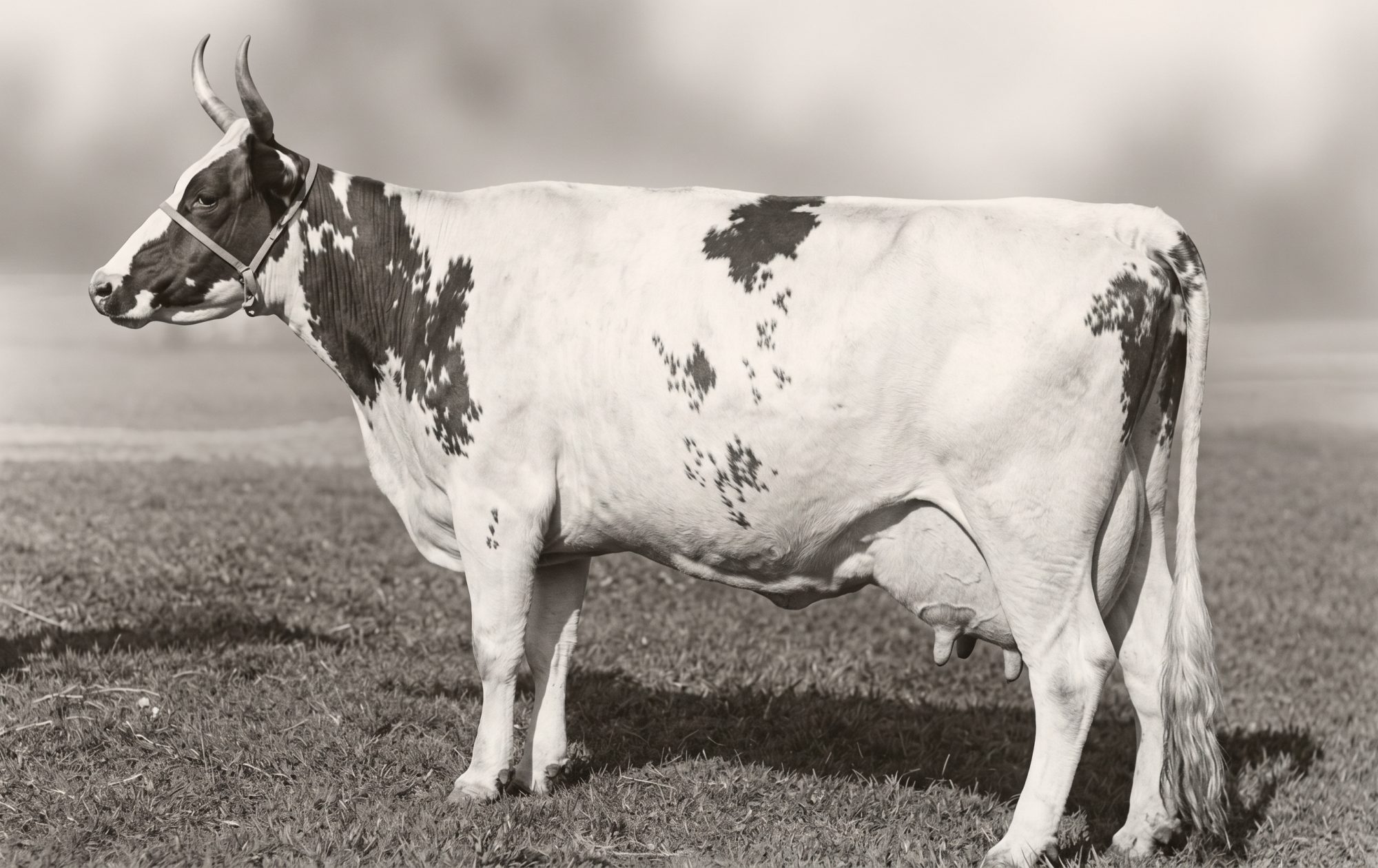
Ardgowan Valda, bought from her Scottish breeder Sir Hugh Shaw Stewart and shown by F.C. Biggs. Grand champion at the CNE in 1936, and in 1937 she recorded 31,156 pounds of milk and 1,356 pounds of fat as an eight-year-old — a world championship Ayrshire record, in an era when herd averages ran nearer 10,000. The same year she won at Toronto, Biggs ordered twelve more heifers out of Scotland.

Biggs sent his son Dick to Scotland to buy, and used agents there, too. One agent was Adam Montgomerie of Lessnessock, the man the Ayrshire world would eventually call the Laird — and then, simply, the Ayrshire King.

In 1936, Biggs ordered a dozen heifers. Montgomerie, hunting something above the ordinary, went first to Colonel Houldsworth’s Threave herd at Kirkmichael in South Ayrshire.

In that barnyard he stopped walking.

Style and dairyness — that’s all the record gives us for what pulled him up in front of a yearling heifer. It doesn’t say which line caught him first. But in a Scottish barnyard in 1936, dairyness meant an open, angular sort of femininity, a level top on an animal still growing into herself, and an udder attached high and tight enough to promise she’d still be sound at ten. Whatever he saw, he stood there long enough to ask about her breeding.

Her dam was Threave Flake 3rd, the herdsman told him, and her sire was Lessnessock Corra Boy — a bull Montgomerie had bred himself out of Linhead Cora Linn 2nd, one of the celebrated cows of the 1930s, by Lessnessock Sunny Jim.

Her name was Threave Flirt 2nd.

Montgomerie bought her. And while she stood waiting for her ship, he bred her to his own herd sire, Burton Atlantic, a son of Lessnessock Atlantic.

That mating was anything but casual. Sunny Jim was Flirt’s paternal grandsire, and Sunny Jim had also sired Lessnessock Atlantic — so the calf she’d carry across the Atlantic came with two crosses to one bull. Concentrated on purpose. Montgomerie’s own sale catalog spells out the thinking: line breeding to intensify a double cross of the great cow Friendlesshead Nannie White Legs and her three sons, of whom Sunny Jim was one. The catalog claimed that cow had wider influence on Ayrshires worldwide through her sons than any other female, living or dead.

Flirt landed in Canada. The Cummings bought her.

And in early 1937, in a Glengarry County barn, she dropped the bull calf she’d been carrying since Scotland.

They registered him as Glengarry Sir Burton.

Here’s a thing worth pausing on. The same year Montgomerie stood in that Threave barnyard, a Calistoga high-schooler named Henry LaFranchi bought two Ayrshire heifers for an FFA project. Neither had any way of knowing the other existed. Twenty-four years later, their two decisions collided in an Iowa show ring.

ACT II: TWO BULLS AND A SWEEP

Sir Burton wasn’t the first great bull those brothers owned. He was the second half of a one-two punch — and the first half had already taught them a lesson they paid for once and never forgot.

Edgerstounes Sir Oliver was born in 1925 in Princeton, New Jersey, on the farm of Mrs. John Winant. His sire was Hobsland Air Pilot. His dam, Garloff Miss Olive, had topped the three-year-old class at the parish show in Ayr before Winant imported her.

A Lancaster-born herdsman named Ray Watt was working at Edgerstoune then — the Watts were another Scottish family who’d come over about when the Cummings did, settled in Châteauguay County, then crossed the river and founded Maple Crest. The story that’s come down is that Watt pulled Mrs. Winant’s son off a runaway horse, and the grateful mother handed him the bull calf.

Watt brought him home and showed him in the yearling class at the 1926 Royal Winter Fair. Picture him leading that bull out afterward — a young herdsman with a staff in one hand and the best gift he’d ever been given on the other end of the lead, walking past the rail where two brothers from Glengarry County had stopped to watch.

They took him home after the show for $700 — serious money in 1926, split between two brothers who kept their milk cheques separate. Serious money in 1926, split between two brothers who kept their milk cheques separate. And understand what they were buying: a yearling bull with no daughters anywhere, judged entirely on how he looked walking in a ring. If he’d bred nothing worth keeping, there was no A.I. contract to bail them out and no way to spread the loss. They’d have paid a serious piece of a year’s milk money for a mistake and gone on milking.

Two years later, Sir Oliver stood senior and grand champion at that same Royal.
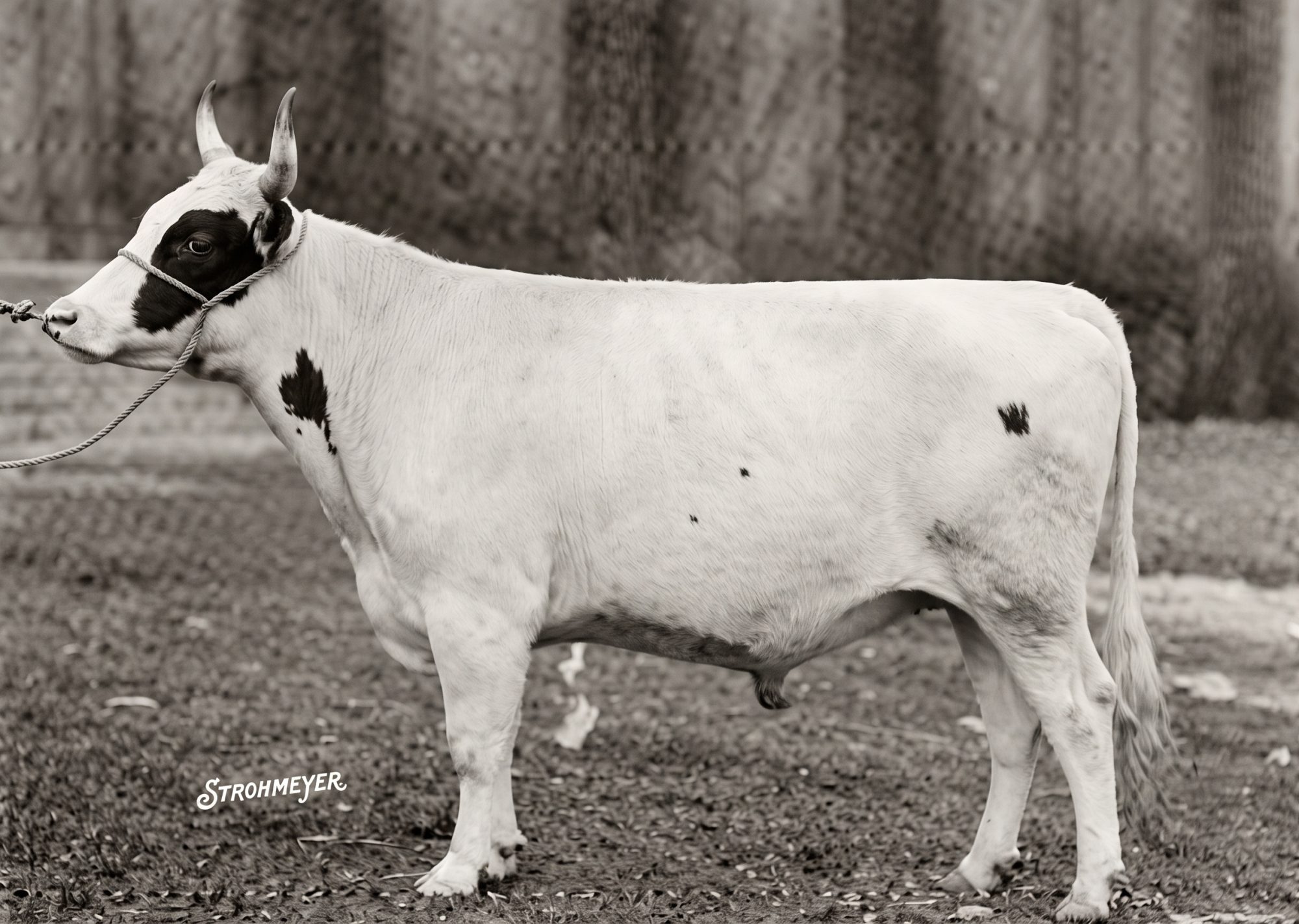
Edgerstoune’s Sir Oliver, foundation sire of the Glengarry herd. Mac and Donald Cumming bought him out of the yearling class at the 1926 Royal Winter Fair for $700, and he came back two years later senior and grand champion. His lasting mark was quieter: an inbred daughter, Glengarry Lady Cony, whose son by Glengarry Sir Burton fused the two lines the herd was built on.

But here’s the line that tells you what kind of breeders these were. Years afterward Donald said acquiring Sir Oliver “was a great boon for our herds” — then added, “but perhaps not so good for him.” Two earlier herd sires had left daughters that weren’t what they should have been, and Sir Oliver got mated to some of them. “Had he been mated with better cows,” Donald said, “he would have made an even better showing.”

A man crediting his bull and convicting himself in the same breath. You don’t hear that often, then or now.
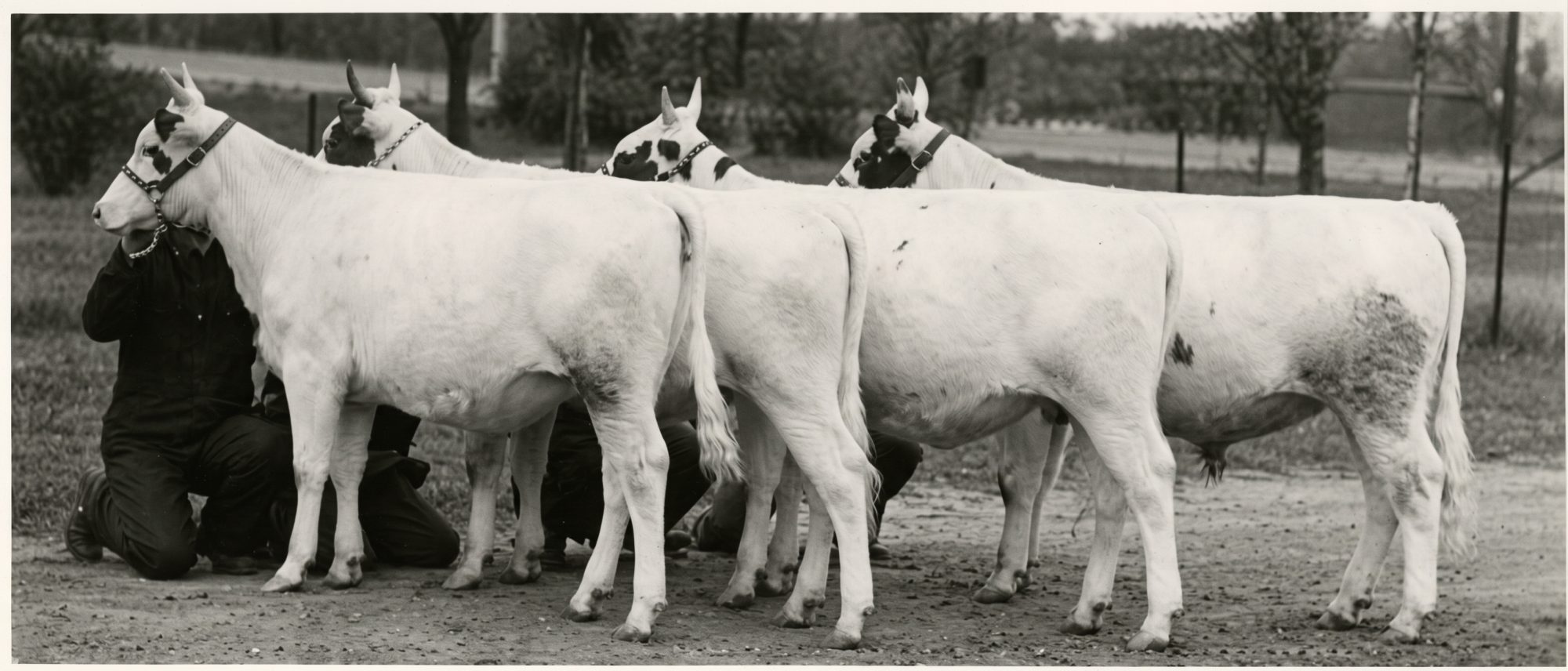
Get of Edgerstoune’s Sir Oliver — second prize at the 1929 Royal Winter Fair. From left: Glengarry Miss Julia, Glengarry Lady Cony, Glengarry Lou and Glengarry Fluffs Oliver. A get class asks one question, whether a sire repeats himself, and these four answered it. Second from the left is the one who changed the herd: Lady Cony, dam of Glengarry Conys Burton.

His daughters had presence anyway. Four of them stood second as a get of sire at the 1929 Royal — that’s the class where a bull is judged on a group of his daughters shown together, the oldest and most brutal test of whether a sire can repeat himself. One of those four was Glengarry Lady Cony, and she was inbred: her dam, Glengarry Olivers Cony, was another Sir Oliver daughter. Much of the Cumming reputation was built on her work.

So when Threave Flirt’s son came along, Glengarry had better cows waiting than Sir Oliver ever got. They’d learned it the expensive way.

Burton Earns a Ribbon, Then Earns His Name

As a senior calf, Glengarry Sir Burton placed second in a class of 17 at the 1937 Royal.
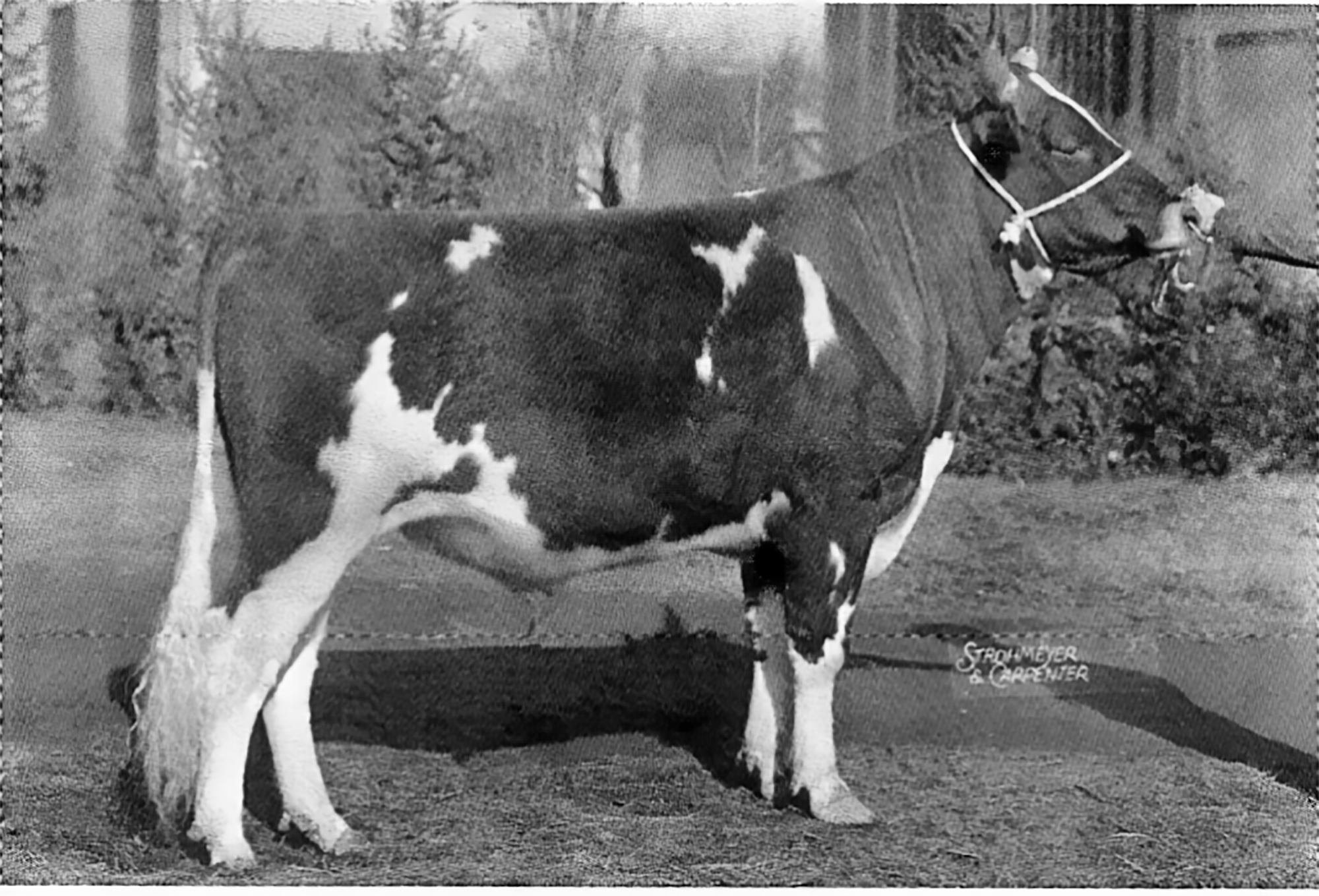
Glengarry Sir Burton — the calf Threave Flirt 2nd carried across the Atlantic. Note the level top and the depth through the barrel: the frame Ayrshire men were chasing in 1938, when he won the senior yearling class and stood reserve grand champion against 300 head at the Royal. Fifteen years later, his progeny took both grand championships, both reserves and the get of sire at that same show.

He came back the next fall, won the senior yearling class, and stood reserve grand champion at a show with 300 head of Ayrshires entered.

Three hundred. That one number tells you how deep this breed ran in Canada then, and how little a single banner proved.

Because a show bull wins for an afternoon. A breeding bull keeps winning long after he’s gone, through sons and grandsons and matings made by strangers who never laid eyes on him.

The cross that did it was Sir Burton on Glengarry Lady Cony, the inbred Sir Oliver daughter. Their son was Glengarry Conys Burton, and with him the two Glengarry sire lines fused into one.

This is what the old men meant by “nicking.” Not stacking good pedigrees and hoping. Finding two lines whose transmission patterns complete each other, one supplying exactly what the other lacks. Sir Oliver’s visual appeal and established female families, meeting Sir Burton’s concentrated Scottish inheritance.

It worked so well that Morwick called Sir Burton’s sons the most influential group of paternal brothers in Ayrshire history.

Conys Burton served at Glengarry first, then sold at maturity to the Stansell family’s Selwood Farm at Aylmer — Selwood, one of those prefixes young Morwick used to hear announced at the CNE while Glengarry went unmentioned. There he sired Selwood Gretas Burton and Selwood Coras Burton and a long line of heavy producers topped by Glengarry Betty Ann, dam of Selwood Bettys Commander. And because Commander’s sire was Selwood Coras Burton, that bull came out a Conys Burton double grandson.

Read that twice if you like. Glengarry cattle were now improving the herd that used to beat them.

Then there was Glengarry Bit O’Fashion, and breeders argued for years over whether he or Conys Burton was the better bull. Nobody ever settled it, partly because Bit O’Fashion went east instead of west. He saw heavy service in the leading Prince Edward Island herds and finished out his working life on Colonel F.I. Andrew’s farm — a Glengarry bull ending his days on Island soil, leaving daughters in barns a thousand kilometers from the stoneboat road.

And Glengarry Burton Prince sired Glen Campbell Lou Burton — Biggs’s cow — grand champion at Waterloo in 1949. First time a Glengarry bull sired a U.S. national winner.

Nobody in Iowa knew it yet. That was the opening shot.

Toronto, 1953

The Royal again. Sir Burton had last stood in that ring as a senior yearling back in 1938, fifteen years earlier, and his own showing days were long behind him.

His progeny hadn’t been idle.

When the judging finished, Sir Burton’s offspring had the grand championship in the male division. And the grand championship in the female division. Then both reserves. Then the get of sire.

Every summit in the show. One sire family.

You can read that as a ribbon count, and plenty did. But watch what a Canadian Ayrshire man would have done with the information on the drive home from Toronto. If one bull’s descendants have just swept the national show, next spring’s breeding decision isn’t complicated.

You get Burton blood, or you get beaten by it.

Which is precisely what happened. At the 1955 Royal, Conys Burton sired the winning senior get for Colonel S.C. Oland of the brewing family. White Pansys Burton, a Sir Burton grandson, was second in the senior get for Cumming Bros. and first in the junior get for S.S. Rose & Sons — and a substantial share of the individual class winners that day were Sir Burton grandsons and granddaughters.

At the 1956 Royal, Glengarry Pansys Burton — Sir Burton’s great-grandson, by White Pansys Burton — won his second grand championship in a row for Richard Bros. of Red Deer, Alberta. The same afternoon, he sired the junior and reserve junior champion males and the first-prize junior get, and he and three half-sisters made up his own sire’s winning senior get.

Alberta. Prince Edward Island. Ontario. And the American Midwest coming up fast.

Sir Burton had stopped being an animal in a pedigree. He’d become the frame the breed was being built on.

Foundation AnimalKey ProgenyLegacy / Modern Impact
Glengarry Sir BurtonGlengarry Conys Burton1953 Royal Sweep; transformed Selwood herd
Glengarry Dora (EX-93)Glengarry Lloyd Royal4,000 calves in Year 1 of ABS; 3x Waterloo Grand Champions
Glengarry Dora (EX-93)Glengarry Worthy ConquestShipped to Oak Ridge (CA); sire of Connie Kathleen
Oak Ridge Bruis BonniePalmyra Tri-Star Burdette-ET7x Premier Sire at World Dairy Expo (2013–2019)

The Cows Behind the Bulls

Sire dynasties get the headlines. Female families make them possible, and Threave Flirt 2nd wasn’t finished.

Bred back to her own grandson — Glengarry Nancys Burton — Flirt produced Glengarry Renee, classified Excellent. Renee gave three Excellent daughters — Excellent being the top grade a trained association classifier could award on conformation. And in an era when a classifier reached your farm maybe twice a year if you were lucky, an Excellent cow was a destination. Neighbors drove over to look at her.
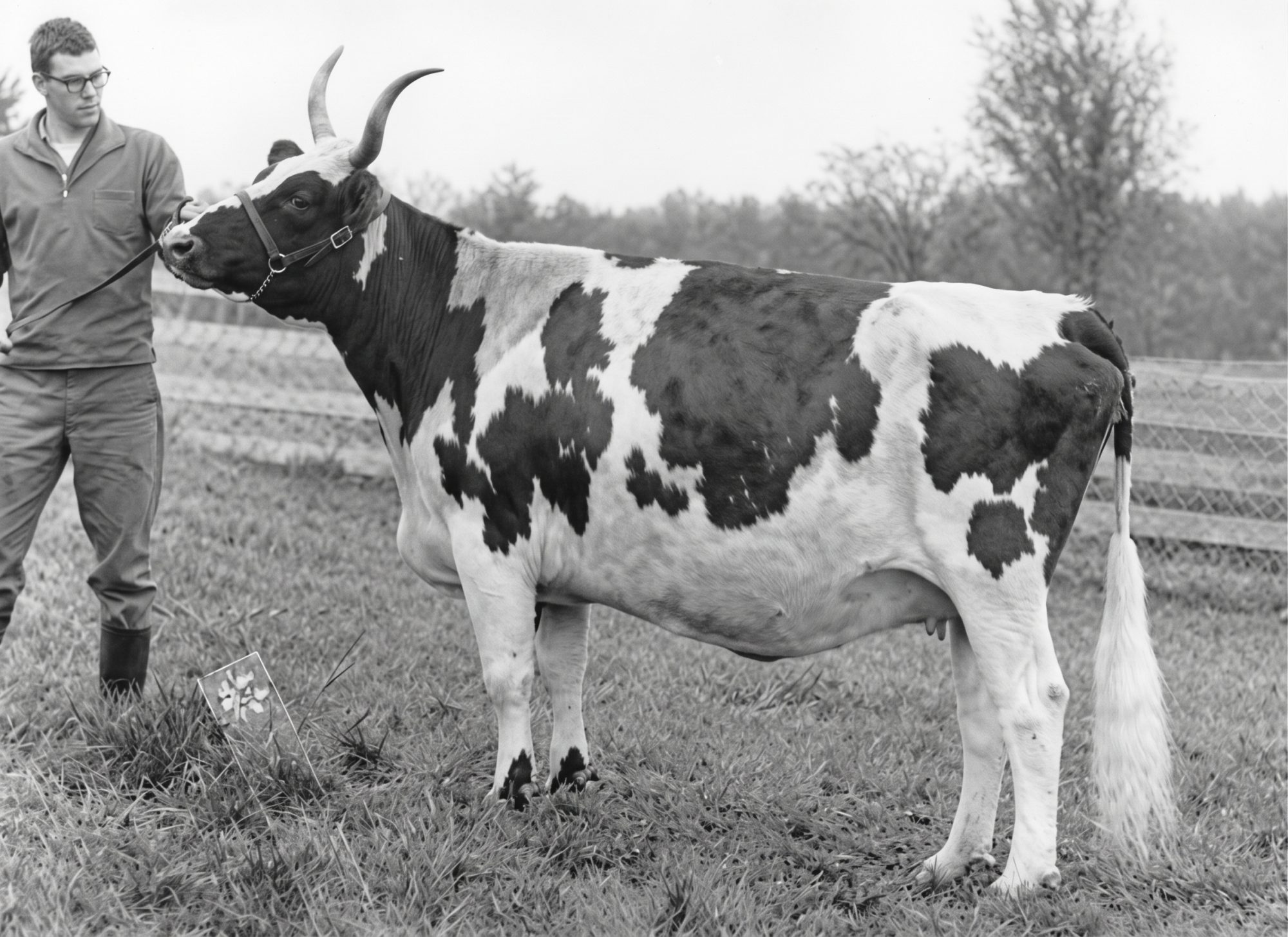
Glengarry Dora, EX-93 — Threave Flirt 2nd’s granddaughter, sired by Cherry Bank Brown Bomber. Two of her four sons took the family beyond Glengarry County: Lloyd Royal to American Breeders Service, where he sired 4,000 registered calves in his first Wisconsin year, and Worthy Conquest to Oak Ridge in California. Morwick credited the spread of the Flirt line to two animals — Glengarry Sir Burton, and this cow.

Renee’s best was Glengarry Dora, EX-93, sired by Cherry Bank Brown Bomber — a bull bred by A.E. McArthur of Howick, Quebec, who stood at Glengarry through the 1940s and left Dora, Glengarry Pearl Star and Kinnettles Bomber Alona of Selwood fame.A clipping in the Glengarry County Archives calls Dora the world’s highest lifetime milk producer. The family says that’s the wrong cow. The world’s lifetime record went to Middle Brook Fancy Madge, bought by Meredith Farms in Massachusetts — and she was sired by Glengarry Fancy Boy, another son of White Pansys Burton.

Which is worth stopping on, because Meredith was one of the herds that stayed home from Waterloo. The old Northeastern establishment that wouldn’t load the truck against Oak Ridge owned the world’s lifetime production record, sired out of the same Glengarry County barns.

She had four exceptional ones. Two changed the map.

Glengarry Lloyd Royal, by the imported Lessnessock Lloyd, started in Paul McDonald’s Mackayr herd in Illinois. Then his first sixteen classified daughters came in averaging 89.9 points. Nine Excellent, seven Very Good.

Sixteen for sixteen, not a poor one in the group. American Breeders Service bought him on the spot.

And here the whole story shifts gear, because artificial insemination had arrived. In his first year of service in Wisconsin, Lloyd Royal sired 4,000 registered offspring.

White Pansys Burton had other sons worth naming. Glengarry Fancy Boy went to Paul McDonald in Illinois, the same herd where Lloyd Royal started, and the two lines nicked — then Fancy Boy went into A.I. himself and sired the world’s lifetime production record holder.

And Glengarry Captain Carlson stayed home. A third of his daughters classified Excellent, and by the family’s account they lasted forever. Set that beside Shirley Ura, another Pansys Burton daughter still filling a pail at seventeen, and something is clearly running through that bull on the longevity side — decades before anyone had a term for it.

Four thousand. In twelve months. Out of a cow family that had been traveling between two brothers’ farms behind a team of horses thirty years earlier. His daughters won grand champion at Waterloo in 1969, 1971 and 1973.

Dora’s other great son was Glengarry Worthy Conquest, born November 12, 1953, by the imported East Raws Lucky Way.

He’s the one who went to California.

Calistoga

Massimino LaFranchi left Switzerland in 1888 at fourteen and milked cows around Sonoma County until he’d saved enough to buy land. In 1912 he bought 500 acres outside Calistoga, in Knights Valley, and named the place for the oaks on the hillsides. Horses, chickens, pigs, cattle. An ordinary farm of its time.

The Ayrshires started with the youngest boys. Henry bought his two heifers in 1936. His brothers Al and Nick joined him, and the three of them spent the next four decades building one of the most respected herds in the country — traveling to fairs and expositions by boxcar, of all things, and taking top honors wherever the boxcar stopped.

They also broke with tradition in a way that says something about them. The Ayrshire’s horns were the breed’s glory. Henry got hurt by a set of them, and Oak Ridge became one of the first herds anywhere to dehorn.

But the cattle themselves came largely from Canada. Six Glengarry herd sires. Glengarry Pearl Star as a foundation cow. Glengarry Bondsman — the Nancys Burton son — sired Oak Ridge Bonnie Bluebird, grand champion female at Waterloo in 1960.

Worthy Conquest came down from Canada in 1957, and the California paper that noticed him the following January described him the way a herdsman would: dark-colored and short-tempered. His most influential daughter was Oak Ridge Connie Kathleen, grand champion at Waterloo in 1962 — and look hard at her pedigree, because it’s the old nick running again. Her maternal grandsire was Oak Ridge Oracle, himself a grandson of Glengarry Conys Burton.

Mated to Oak Ridge Lightning, Connie Kathleen produced Oak Ridge Flashy Kathleen, Oak Ridge Flashy Klondike and Oak Ridge Flashy Kellogg. Pull up Klondike in a bull-search database this morning and there it still sits — Connie Kathleen as dam, Glengarry Worthy Conquest as maternal grandsire.

The recognition came before the ribbons. In 1959 the LaFranchis took the Constructive Breeder Award. In 1960 came another honor requiring excellence in both production and type — the fourth such award Oak Ridge had earned.

Then the fall of 1960 at Waterloo. Seven class winners. Most of the grand championships. Then the telephone calls.

And they weren’t done. In 1975, Oak Ridge Kellys Rosid became the first cow of any breed other than Holstein named Supreme Champion at World Dairy Expo. A red-and-white Ayrshire out of Knights Valley, standing above every cow in Madison.

ACT III: WHAT LASTED

Not everything here is ribbons, and the cow who proves it never set foot in Iowa.

Shirley Ura was a White Pansys Burton daughter the Cummings bought as a 17-month-old heifer. They went back later for her full sisters, Stella Ula and Burtons Barbara Ann.

Shirley Ura became the first Canadian Ayrshire to produce over 200,000 pounds of milk in her lifetime.
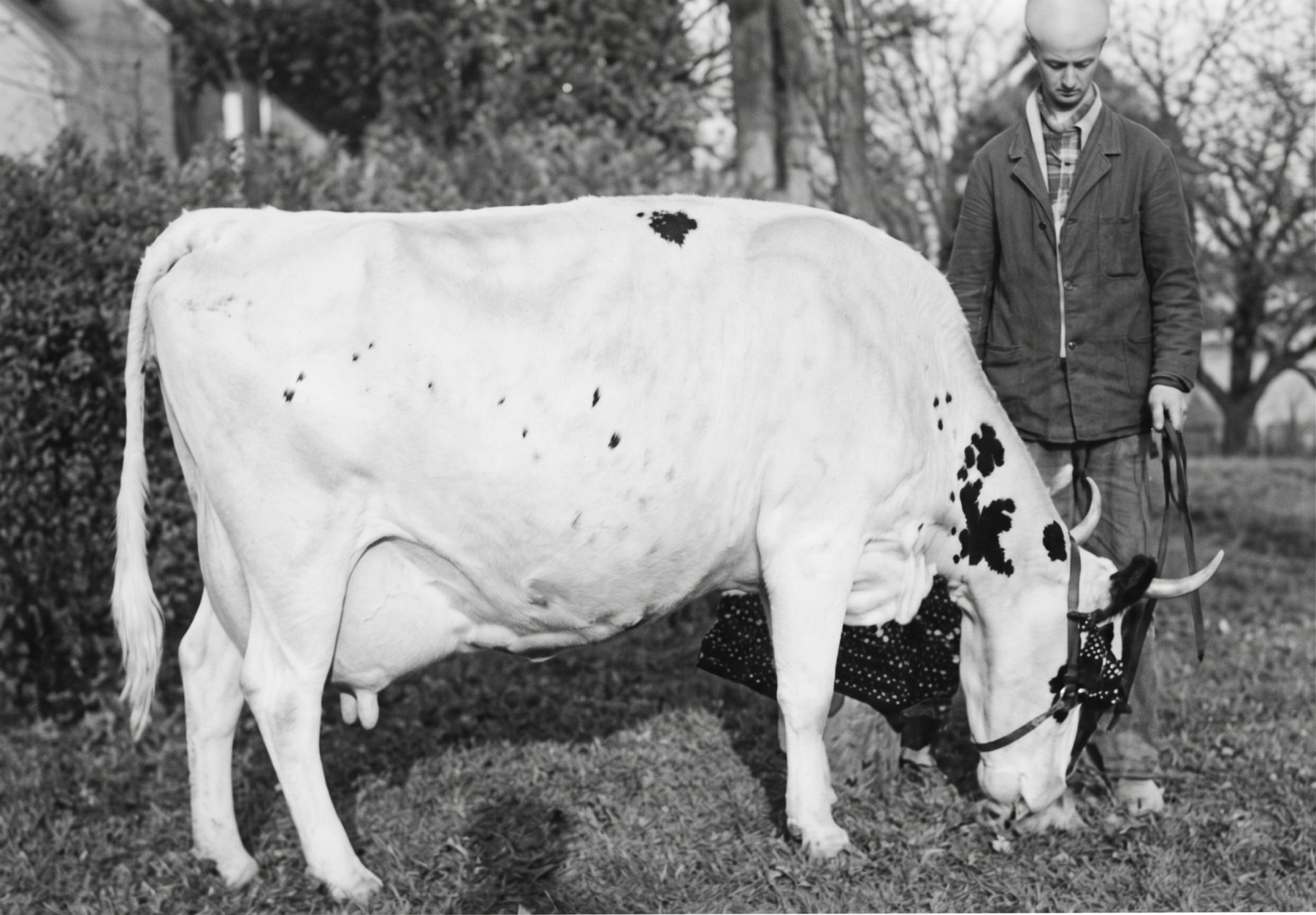
Shirley Ura — a White Pansys Burton daughter the Cummings bought as a 17-month-old heifer, and the first Canadian Ayrshire past 200,000 pounds of milk in a lifetime. At seventeen she was still turning in 21,978 pounds of milk and 840 of fat. No banner made her famous. She’s the other half of the Glengarry argument: the ideal that survives twenty winters in a working barn.

Her last record: 21,978 pounds of milk and 840 pounds of fat. At seventeen years of age. Family recollection says she was still calving at twenty. And she was milked by hand.

Picture what that looks like in a tie-stall barn — an old red-and-white cow rising hind end first the way they do, still filling a pail twice a day while heifers born after her granddaughters file past on the way to the water bowl. One imagines a hand running down that topline more often than strictly necessary.

Set her against the cows you culled at six because a foot or an udder quit. Show winners prove an ideal exists for one afternoon under one judge. Cows like Shirley Ura prove it survives twenty winters on real feed in a working barn. The Cummings bred both, and if you want the whole argument in one animal, she’s it.

They kept them like it mattered, too. In MacNaughton Cumming’s day two full-time hired men brushed the cows every day through the winter and washed tails every second day — which delighted the Montreal milk inspectors when they turned up unannounced.

The Man Who Told the Ayrshire King He Was Wrong

Adam Montgomerie — the Laird of Lessnessock, breeder of the bull who sired Threave Flirt and of the bull behind her calf, whose 1946 sale moved 49 bull calves at an average of 2,267 with a top of 8,176 in Scottish money — used to visit Glengarry Stock Farm.

MacNaughton Cumming, Mac’s son, was not overawed.

“He was a smart cattleman, no doubt,” MacNaughton said, “but not nearly as clever as he thought he was. Going down the row, he would point to cows he considered our best. But usually he was way off the mark.”

There it is. The most famous Ayrshire breeder on earth walks your barn, picks out your best cows, and a farmer from Glengarry County says he had the wrong ones.

Call that arrogance if you want. I’d call it the settled confidence of a family that had been reading these cattle for three generations and had the herd book to back it.

MacNaughton was that way about everything. He kept a Quebec milk quota while farming in Ontario, and justified it with a line his family never forgot: “If you own a Cadillac, you don’t switch to a Chevrolet.” He talked about free-stall housing before dairy leaders knew what he meant. He tile-drained every acre and got scorned for “burying good money in the ground” — then landed in the hospital with an ulcer from the stress of being the man who did it anyway.

When quota became the currency of Canadian dairying, he drove every month to a smoke-filled, French-speaking hall at Ste. Martine to bid. Farm leaders sneered to his kids about why their father bothered expanding when a man could make a fine living milking thirty.

At 86, standing in the bank in his barn clothes, out of patience with waiting, he hollered through a half-open door loud enough for the whole lobby: “We got the quota so we need $250,000.”

How long do you want me to term it?

“I’m 86. So I don’t give a damn.”

Somebody once asked him whether he ever went home regretting what he’d said at Ayrshire meetings. He thought about it. “No, but I’ve come home regretting not saying more.”

Three Endings

Malcolm Cumming died in 1967, and the herd he’d built with his brother didn’t carry on as one piece. When Donald and MacNaughton went their separate ways, the original Glengarry breeding operation stopped. MacNaughton started fresh under a prefix that carried his father’s name — Glen Malcolm — and that herd is still breeding Ayrshires today. The second unit, later run by Donald’s son Norman, sold as a going concern in the mid-1970s.

That’s how these things actually end. Not a dispersal poster and one dramatic afternoon, but farms dividing, prefixes pausing, brothers deciding.

The Biggs place had gone the other way, and faster. The Honourable F.C. Biggs died in the spring of 1942, and two years later his sons Dick and Tad dispersed Glen Campbell under advertising that called it Canada’s superior all-time Ayrshire herd dispersal. The 134 head averaged $385.50.
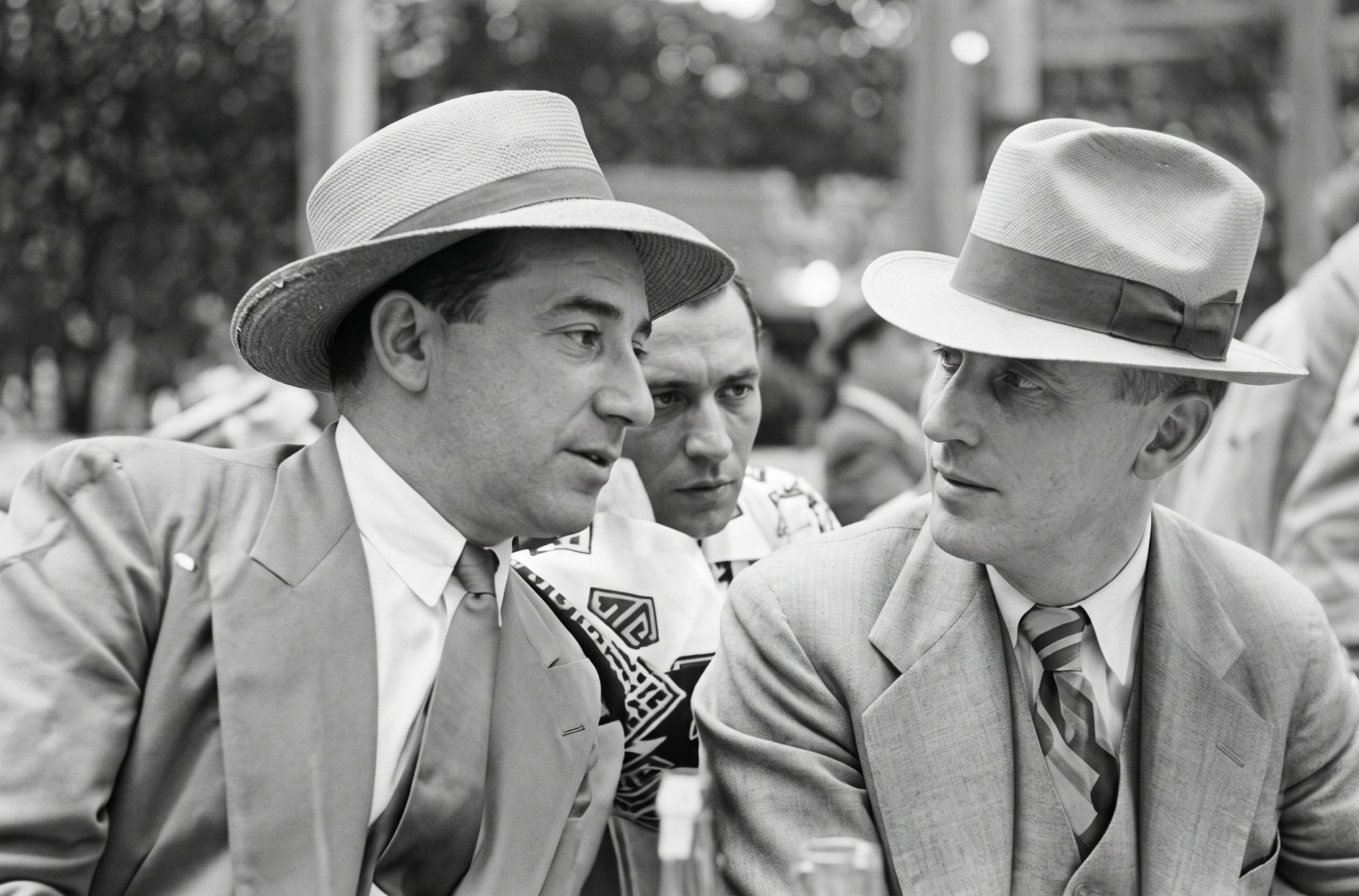
A pair of presidents compare notes: R.O. “Dick” Biggs, left, of the Canadian Ayrshire Breeders’ Association, with Ben Thomson of the Holstein Association, 1941. Three years later, Biggs and his brother Tad dispersed Glen Campbell — the herd their father built. By 1965 he was supervising Canada’s Holstein exhibition herd on a tour of Europe.

And Oak Ridge? On the first Saturday in August 1975 — the same year Kellys Rosid stood Supreme at Madison — the LaFranchi brothers held a dispersal and sold nearly all the Ayrshires. Beef cattle moved into those barns, mostly registered Black Angus, and they’re there yet. Think about that timing. The herd that had frightened the Northeast into staying home was sold at the very top.

Great herds are fragile that way. They last exactly as long as somebody keeps choosing to keep them.

Ian Cumming, MacNaughton’s son and, for years, a columnist in the Ontario Farmer, brought the Glengarry name back on a nearby farm. In 2010 he sold and moved to New York State — 23 miles, farm to farm — where his own son Mac took over.

In 2004, Ayrshire Canada handed MacNaughton a lifetime membership. On the night of that banquet, twenty minutes from Cornwall, better than 200 Ayrshire cows on three modern farms belonging to his three sons were being milked, with grandsons already coming on behind them.

He died at milking time on a Tuesday morning in December 2014, at 92, in the house his grandfather built — where he’d lived for 90 of those years, the first two in a whitewashed log cabin whose photograph hung on the wall. The barn was across the road. The lights came on that morning, as they always had.

His son wrote the plainest epitaph a farm family can write. Dad was a farmer.

Hagerstown, Maryland

Here’s where the thread comes out the other side.

Ralph Shank Sr. built his Ayrshire herd in western Maryland out of almost nothing — he and his brothers, short of funds, buying blemished cattle and the “behind the ring animals” that hadn’t sold. His father had started the farm’s Ginger family with a purchase back in the 1940s. Ralph Sr.’s ambitions weren’t modest, though: one of the largest Ayrshire herds in the country, a number one genetic bull and cow, and bulls sold to A.I.

In 1975 — the same year Oak Ridge dispersed — the family made what his daughter, Mary Shank Creek, still calls one of their best buys ever at the National Sale.

An Oak Ridge cow. Her name was Oak Ridge Bruis Bonnie.

“She made anything ‘B’ in the herd,” Mary says. “She made tremendous females and males, and is the foundation dam of Burdette.”

Three years later, Bruis Bonnie was standing senior and grand champion female for Palmyra Farm, and decades on, she still turns up on the roster of great cows in the All-American Dairy Show’s history. But it’s that last clause of Mary’s that matters.

Burdette. Palmyra Tri-Star Burdette-ET.

If you’ve stood at the Ayrshire ring at World Dairy Expo any time this century, you know the name. He was Premier Sire at Expo seven years running, 2013 through 2019, before another Palmyra bull, Palmyra Berkely Reagan, finally knocked him off.
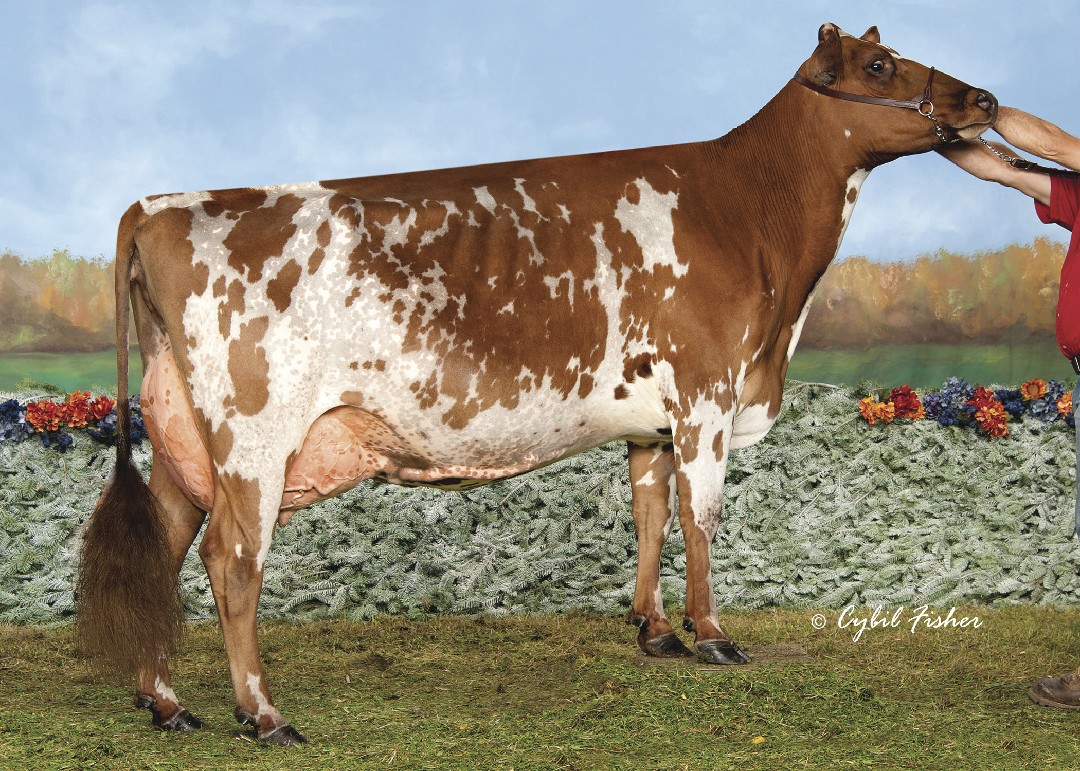
Mowry’s Burdette Summer, EX-95 — a daughter of Palmyra Tri-Star Burdette-ET, born July 2011, with records over 32,000 pounds of milk and named All-American Component Merit Cow in 2022. At World Dairy Expo in 2017 she took both the Total Performance and the Nasco Type and Production awards. This is the Glengarry line in colour: her sire traces to the Oak Ridge cow bought in 1975.

And the same family that bought that Oak Ridge cow bred Palmyra Berkely P Ruth-ET, EX-94. Grand Champion at World Dairy Expo in 2017 and again in 2018. Unanimous All-American both years. A record over 32,000 pounds of milk with 1,256 fat and 960 protein, and the number one Elite cow of the breed at the time. Nine of the fourteen closest animals in her pedigree were Palmyra-bred. Her daughter Ruthless took Grand Champion in 2022.

Add up what that farm has done and the numbers stop being ordinary: 83 Ayrshire bulls sent to A.I., 162 All-American nominations with 52 named All-American, thirteen Premier Breeder banners at Madison, ten cows ranked number one on the breed’s Elite list, the Ayrshire Master Breeder Award in 2011 and the Whitey McKown Master Breeder Award in 2022.

Now, I want to be straight about the limit here. Trace Bruis Bonnie back through Oak Ridge Bruis and the maternal lines of Knights Valley, and the Glengarry imprint isn’t hypothetical—it is cemented across generations of maternal strength that culminated in Burdette. What isn’t in question is where she was bred. She came out of the Oak Ridge herd, and the Oak Ridge herd was built on six Glengarry sires and Glengarry foundation females. Oak Ridge’s own people put it plainly years later: most Ayrshires from coast to coast carry some lineage back to that California herd.

So follow the chain. A yearling heifer in a Kirkmichael barnyard in 1936. A calf born in Glengarry County in 1937. Six bulls shipped to Knights Valley. A cow sold out of California in 1975 and hauled to Maryland. And a bull born in 2005 who owned the Premier Sire banner at Madison for seven straight years.

That’s not a coincidence. That’s a breeding program outliving three of the farms that carried it.

Where You’ll Find Them Now

So what’s left, beyond trophies jammed in a bookcase and curled black-and-white show photos in a drawer?

Start with what Morwick concluded after all his digging: most present-day Ayrshires trace back to Threave Flirt 2nd, through her son Glengarry Sir Burton and her granddaughter Glengarry Dora. One imported Scottish yearling, bought because an agent liked the way she was made, standing behind a breed.

But the part you can actually use is the method.

The Cummings linebred hard. Flirt to her own grandson. Sir Burton onto an inbred Sir Oliver daughter. Worthy Conquest onto a cow with Conys Burton stacked behind her. What they never did was linebreed without correcting, and they never bred a cow they didn’t respect — which is the whole reason Donald sent his own brother’s cows back down the road. Concentrate on what works. Cull without sentiment. Then find an outcross in Scotland when the herd needs one, and keep going back, right through the 1950s and 60s, when Ayrshire sale managers still wouldn’t dream of holding a major auction without a few imported animals in the catalog.

Look where that discipline left the breed. Among Canada’s four major dairy breeds, Ayrshire heifers born in 2025 carry the lowest average inbreeding — roughly 7.1 percent, against 10.3 percent in Holsteins. Ayrshire breeders kept the base wide while intensifying what worked. That’s the Glengarry playbook, running a century after two brothers wrote it on a farm road, whether the people using it know whose it is or not.

The tools have changed past recognition. Genomic evaluations. Herd books you can search from a phone in the parlor. Sires from three continents available before breakfast.

What hasn’t changed is what Donald Cumming was doing in that barn doorway in the 1920s. Somebody still has to decide which cow is good enough. No index has ever made that call for you.

Key Takeaways

  • Glengarry’s rule wasn’t linebreeding — it was linebreeding with a correction: Flirt bred back to her own grandson, then an imported outcross when the herd needed one. Concentrate what works, then fix what it costs.
  • Ayrshire heifers born in Canada in 2025 average roughly 7.1 percent inbreeding against 10.3 in Holsteins — a wide base with hard selection inside it, which is the trade the Cummings were making in 1937.
  • The herd chain is documented even where the pedigree isn’t: Glengarry sires built Oak Ridge, and an Oak Ridge cow bought at the 1975 National Sale is the foundation dam of Palmyra Tri-Star Burdette-ET.
  • Donald Cumming turned his own brother’s cows away at the barn door if they weren’t good enough. Every index since has priced that judgment; none has made it for you.

This isn’t Toronto or Waterloo

There’s a moment in this story I keep coming back to, and it isn’t Toronto or Waterloo.

It’s two brothers on a farm road in Glengarry County. Mac has hitched the Belgians, loaded a cow on the stoneboat, and driven her down to his brother’s yard because that’s where the bulls are kept. Donald comes out and looks her over. And if she isn’t good enough, she goes home unbred. Brother or no brother.

Everything else came out of that. The Scottish imports. The banners at the Royal. Shirley Ura still filling a pail at seventeen. A California show string that made hard men stay home. An old cow in Maryland who made everything with a B in her name. Four thousand calves in one Wisconsin year, from a cow family that used to travel by horse-drawn sled.

Take Glengarry out of the twentieth century, and the Ayrshire breed is measurably poorer. Oak Ridge is a good herd, not a great one. Waterloo in 1960 is just another show. The sire lines of the fifties and sixties lose their spine, and cows in barns on two continents carry a thinner pedigree.

They came out of Kintyre with nothing but a way of looking at cattle, and they handed a Scottish breed back to the world deeper and truer than they’d received it.

In the end, the Cummings left what every real breeder hopes to leave. Not a trophy. A standard. It’s still in the pedigrees, still in the show ring at Madison every fall, and it still asks the only question that ever mattered on that Glengarry County road:

Is she good enough?

Continue the Story

The Sunday Read Dairy Professionals Don’t Skip.

Every week, thousands of producers, breeders, and industry insiders open Bullvine Weekly for genetics insights, market shifts, and profit strategies they won’t find anywhere else. One email. Five minutes. Smarter decisions all week.

NewsSubscribe
First
Last
Consent

The Bull Who Changed Everything: The Johanna Rag Apple Pabst Story

Every Holstein on Earth traces back to one bull from a Wisconsin farm. Here’s how Johanna Rag Apple Pabst changed dairy genetics forever.

Johanna Rag Apple Pabst during his legendary show career in the mid-1920s, when he dominated Holstein competition across North America. The gentle giant from Hartford, Wisconsin, who went undefeated in 1924 and sold for the record price of ,000 in 1926, became the universal ancestor of every registered Holstein alive today—a genetic legacy that transformed an entire breed and continues to influence dairy farming worldwide nearly a century later.

The Western Union boy pedaled his bicycle through the crisp Quebec morning, telegraph wires humming overhead as spring awakened the countryside around Hudson Heights. When he finally turned up the winding, tree-shaded drive to Mount Victoria Farms, gravel crunching beneath his wheels, he carried fifteen words that would reshape Holstein history forever: “Johanna Rag Apple Pabst sold for $15,000. Congratulations. O.G. Clark.”

Inside the baronial estate overlooking Lake of Two Mountains, Thomas Bassett Macaulay carefully unfolded the telegram, his actuary’s mind already calculating the magnitude of what he’d just accomplished. The Montreal insurance magnate had just made the most expensive bull purchase in Holstein history, but this wasn’t about acquiring another champion. This was about capturing lightning in a bottle—the cornerstone of a vision so scientifically precise and audaciously ambitious that it bordered on the impossible.

What neither Macaulay nor anyone else at that legendary Wisconsin sale could have imagined was that the bull now making his way by rail to Canada carried within his genetic code something far more powerful than mere championship ribbons. Today, nearly a century later, step into any Holstein barn anywhere on Earth—from the rolling hills of Wisconsin to the green pastures of New Zealand, from the polders of Holland to the pampas of Argentina—and you’re witnessing the living legacy of that bull from Hartford, Wisconsin.

Every registered Holstein alive today traces back to Johanna Rag Apple Pabst. Every single one.

The Wisconsin Genesis

Johanna Rag Apple Pabst in his first photograph. The young bull who would become the genetic foundation of every Holstein alive today began his legendary journey on the modest Wisconsin show circuit, where his gentle demeanor and commanding presence first caught the attention of dairy enthusiasts across the Midwest.

Three miles north of Hartford, Wisconsin, winter was loosening its grip on the rolling farmland of Dodge County when change arrived at the Linker place. It was January 1921, and Philip Linker, at sixty-nine, was feeling the weight of nearly seven decades spent working the land. The 173-acre spread he’d built into a respected Holstein operation was gradually passing to younger hands—those of his son-in-law, Herbert Lepien, who’d married Linker’s daughter Della and brought fresh energy to the partnership.

The barn that morning was filled with the familiar sounds of a working dairy—the gentle lowing of cattle, the rhythmic swish of tails, the soft thud of hooves on the floor. But in one box stall, something extraordinary was taking shape. Princess Johanna Rag Apple Pontiac, barely two years old herself and heavy with her first calf, shifted restlessly in the deep straw bedding.

When her labor began, no one could have predicted they were witnessing the birth of a legend.

The calf that slipped into the world on January 24, 1921, was a bull—black and white, sturdy and alert, with eyes that seemed to hold unusual intelligence. In the dim-lit barn, as Herbert Lepien toweled the newborn dry and helped him to his unsteady feet, there was no fanfare, no proclamation of greatness. Just another Holstein calf taking his first breaths on a Wisconsin dairy farm.

But what happened next revealed the true measure of both cow and calf.

Fresh from delivering her son, Princess Johanna Rag Apple Pontiac stepped into the stall for her official test. In that week, as winter winds howled across the Wisconsin countryside, she produced twenty-six pounds of butter equivalent—a staggering performance for any cow, let alone a first-calf heifer. The numbers told a story that every cattleman understood: this young mother possessed something special, and if genetics held true, her bull calf might possess it, too.

Herbert Lepien had made the choices that led to this moment. Six months earlier, he’d hitched up the sleigh and made the fifteen-mile journey through the snow-covered countryside to Fred Pabst’s legendary operation. Pabst Farms was already famous throughout the dairy country, and its red barns and white fences marked it as one of Wisconsin’s premier breeding establishments. Lepien returned with Pabst Korndyke Star—a bull he registered in his own name, marking him as the true architect of what was to come.

The mating of this carefully chosen sire with the daughter of their previous herd bull, Rag Apple Pontiac Polkadot, was no accident. It was the result of careful thought, practical wisdom, and perhaps just a touch of that indefinable instinct that separates good cattlemen from merely competent ones.

Recognition and Destiny

Johanna Rag Apple Pabst as a two-year-old, circa 1923. The young bull who would reshape Holstein genetics worldwide displays the impressive frame and presence that caught Joe Piek's eye on the Linker farm. At this age, he was just beginning to demonstrate the show ring dominance that would make him a legend, but few could have imagined that every Holstein alive today would trace back to this promising Wisconsin calf. (Historical photograph courtesy of Holstein breeding archives)
Johanna Rag Apple Pabst as a two-year-old, circa 1923. The young bull who would reshape Holstein genetics worldwide displays the impressive frame and presence that caught Joe Piek’s eye on the Linker farm. At this age, he was just beginning to demonstrate the show ring dominance that would make him a legend, but few could have imagined that every Holstein alive today would trace back to this promising Wisconsin calf. (Historical photograph courtesy of Holstein breeding archives)

Eight months later, on a warm summer day when the corn stood tall in Wisconsin fields, county agent Milton Button paid a routine visit to the Linker-Lepien operation. Button’s job was to help farmers improve their herds, and his trained eye could spot potential where others saw only another calf. Something clicked when he watched the young bull move across the pasture—the way he carried himself, the width of his chest, the length of his stride.

“That’s a good bull,” Button told Herbert Lepien that day, words that would prove prophetic. “Someone should buy that calf.”

Six miles south of Hartford, Joe Piek was building dreams of his own. His farmhouse perched on a hillside southeast of town, looking out over the rolling countryside toward Holy Hill, the religious shrine that drew pilgrims from across the region. Piek had recently committed himself to Holstein cattle, purchasing fourteen heifer calves at a Fond du Lac sale—youngsters ranging from six weeks to eight months old, costing him anywhere from $60 to $150 each.

Like any beginning breeder worth his salt, Piek knew that his next decision would shape his entire program: selecting a herd sire. Feeling the weight of inexperience, he enlisted Milton Button’s guidance. Together, they canvassed the countryside, inspecting herds and evaluating prospects. When Button recommended the Lepien calf, Piek didn’t hesitate.

The young bull who arrived at Piek Spring Stock Farm that summer stepped into a world where excellence was the goal, and hard work was the only currency that mattered. In the farmhouse kitchen, nine-year-old Anna Piek was already mixing warm milk for calves on cold mornings, learning the rhythms of farm life that would shape her character. She had no way of knowing that one of those calves—the gentle giant following her around the barnyard like an oversized pet—would one day change the world.

Joe Piek had ambitious plans for his young bull. Each fall, he would rent a boxcar, outfit it with two-by-sixes screwed into the walls to secure the cattle, partition off stalls, and install water and feed barrels. This rolling barn would carry his hopes and dreams to county fairs across the upper Midwest, where cattle were judged not just on production records but on the indefinable quality called “type”—the visual embodiment of dairy perfection.

But first, the bull needed seasoning.

The Promise Fulfilled

Johanna Rag Apple Pabst in his prime during the legendary show career that would establish him as the most dominant Holstein bull of his generation. This photograph captures the massive frame and commanding presence that made him virtually unbeatable in the show ring, earning him three consecutive All-American titles from 1923-1925 before his record-breaking sale to Mount Victoria Farms in 1926.

At Walworth County Fair in 1922, as summer heat shimmered over the show rings and the air hung heavy with the scent of cattle and hay, Johanna Rag Apple Pabst made his public debut. Judge A.C. Oosterhuis examined the senior yearling class with the careful attention of a man who understood that his decisions could make or break a breeder’s dreams. When he pointed to the bull from Hartford, placing him first and naming him junior champion, Joe Piek felt the first flutter of vindication.

But the Wisconsin State Fair later that season brought humility. Fifth place in a class of seven—a showing that might have discouraged a lesser man. As Piek led his bull from the ring that day, his jaw set with determination, he turned to Herbert Lepien, whose own bull had placed second and made a declaration that would echo through Holstein history: “This is a good bull. I’ll get him in shape next year, and then I’ll show the boys a thing or two.”

True to his word, Piek transformed his bull into a phenomenon.

The 1923 season saw Johanna Rag Apple Pabst emerge as something unprecedented in Holstein circles. At the Illinois State Fair, as the orchestra played and spectators filled the grandstand, the massive bull from Wisconsin moved into the ring with surprising grace for his size. When the judge’s final decision came—grand champion—the crowd erupted. The same scene played out at the Waterloo Dairy Cattle Congress and the Pacific International Livestock Exposition.

The 1924 season brought something that had never been seen before in the Holstein competition: perfection. Johanna Rag Apple Pabst went undefeated in both class and grand championship competitions. Wisconsin State Fair, Illinois State Fair, Waterloo, the National Dairy Show—all fell before his supremacy like dominoes in a perfectly orchestrated game.

“Too thick in the pants,” his detractors muttered in the barns after the shows, but nobody seemed able to beat him. His consistency was remarkable—not just in winning but in his demeanor. While other bulls of his era were notorious for their unpredictable temperament, requiring skilled handlers and constant vigilance, “Pabst” had become the Piek family pet, as gentle with nine-year-old Anna as he was commanding in the show ring.

The 1925 season brought his third consecutive All-American title, placing him among the immortals of Holstein show history. But by then, whispers were spreading through dairy barns across the Midwest about something even more significant than show ring victories: his daughters were freshening, and their production records were creating sensations of their own.

The Production Promise

Johanna Rag Apple Pabst at twelve years of age in his final photograph, taken shortly before his death in late 1933. While this image captures the gentle giant in his twilight years at Mount Victoria Farms, his daughters across North America were already proving that his greatest legacy lay not in show ring victories, but in the revolutionary genetics he passed to the next generation—consistently producing the coveted four percent butterfat that would transform Holstein breeding forever.

While Johanna Rag Apple Pabst dominated show rings from Wisconsin to Oregon, his first daughters in Joe Piek’s modest herd quietly revolutionized expectations about what a bull could transmit to his offspring. Every daughter that freshened stepped into the test stall, and their performance was extraordinary: they averaged over 18 pounds of butter in seven days as junior two-year-olds, with two exceeding 25 pounds—figures that ranked among the very best of their time.

More significantly, these daughters consistently tested four percent butterfat or better, inheriting the remarkable trait from their grandam. Princess Johanna Rag Apple Pontiac’s own 4.18 percent test had marked her as exceptional, but seeing this trait transmitted so reliably to the next generation was something else entirely. In an era when most Holstein herds struggled to maintain butterfat percentages above 3.5 percent, four percent milk was like finding gold.

This combination of show ring dominance and proven transmitting ability created perfect market conditions. Bulls with such show credentials were rare. Bulls with daughters proving themselves in the test barn were rarer still. Bulls with both were virtually nonexistent.

Word spread through the Holstein community with the efficiency of a telegraph network. In farm kitchens across the dairy belt, breeders pored over Holstein-Friesian World and Farmers Advocate, studying the production reports and showing results that told the story of the bull from Hartford. They understood what they were seeing: a once-in-a-generation animal that could transmit both the visual excellence demanded by show rings and the practical performance required by commercial dairying.

This convergence of attributes caught the attention of a man four hundred miles northeast, whose vision for Holstein breeding was as methodical as it was ambitious.

The Vision of T.B. Macaulay

Thomas Bassett Macaulay (1860-1942) - The Montreal insurance magnate and Sun Life Assurance Company president who revolutionized Holstein breeding through scientific precision. Applying his actuarial expertise to genetics, Macaulay established Mount Victoria Farms in Quebec and developed the systematic breeding program that made Johanna Rag Apple Pabst the universal ancestor of all modern Holsteins.
Thomas Bassett Macaulay (1860-1942) – The Montreal insurance magnate and Sun Life Assurance Company president who revolutionized Holstein breeding through scientific precision. Applying his actuarial expertise to genetics, Macaulay established Mount Victoria Farms in Quebec and developed the systematic breeding program that made Johanna Rag Apple Pabst the universal ancestor of all modern Holsteins.

In the quiet evenings at Mount Victoria Farms, Thomas Bassett Macaulay could often be found in his study, lamplight illuminating the pages of Holstein Herd Books and back issues of agricultural publications. The Montreal insurance magnate approached his hobby with the same analytical precision that had made him president of Sun Life Assurance Company—one of North America’s largest financial institutions.

Outside his windows, the Quebec countryside stretched toward Lake of Two Mountains, where his estate’s 400 acres commanded a magnificent view. But Macaulay’s attention was focused on something far more complex than scenic beauty: the intricate mathematics of genetic improvement.

His experiments with corn breeding had opened his eyes to possibilities that most cattle breeders of his era couldn’t imagine. Between 1924 and 1928, Macaulay maintained between 100 and 170 separate corn plots annually, each planted with seed from a single selected ear, each carefully isolated to prevent cross-pollination. His methodical approach, grounded in Mendelian genetics, had convinced him that specific, predictable characteristics could be developed through strategic selection and inbreeding.

If it worked with corn, Macaulay reasoned with the logic of a mathematician, why not with cattle?

His vision was breathtaking in its precision: to develop a Holstein bloodline genetically pure for three crucial traits—superior show type, excellent udders, and a consistent butterfat test of four percent or better. This wasn’t the casual dream of a gentleman farmer; this was a scientifically designed project that would require the same methodical approach that had guided his insurance career.

Macaulay’s search for the perfect bull to anchor this project was exhaustive. In his study, surrounded by breeding charts and production records, he analyzed pedigrees with the precision of an actuary calculating mortality tables. A single, compelling conclusion emerged from months of research: Johanna Rag Apple Pabst possessed the exact combination of attributes his program required.

The bull’s exceptional show record proved his superior type. His high-producing, four percent testing dam suggested he could transmit both production and butterfat content. Most importantly, his own daughters were averaging four percent test under ordinary farm conditions—exactly what Macaulay’s mathematical breeding model required.

The Mission to Wisconsin

Joseph Piek (left) and Herbert Lepien (right), the two Wisconsin dairymen whose decisions shaped Holstein history. Lepien, farming in partnership with his father-in-law Philip Linker, selected Pabst Korndyke Star as herd sire and made the breeding decisions that produced Johanna Rag Apple Pabst. Piek recognized the calf's potential, purchased him at eight months old, developed his legendary show career, and ultimately sold him for the record price of $15,000 at Clark's Holstein Classic in 1926—setting in motion the genetic revolution that would transform the entire Holstein breed.
Joseph Piek (left) and Herbert Lepien (right), the two Wisconsin dairymen whose decisions shaped Holstein history. Lepien, farming in partnership with his father-in-law Philip Linker, selected Pabst Korndyke Star as herd sire and made the breeding decisions that produced Johanna Rag Apple Pabst. Piek recognized the calf’s potential, purchased him at eight months old, developed his legendary show career, and ultimately sold him for the record price of $15,000 at Clark’s Holstein Classic in 1926—setting in motion the genetic revolution that would transform the entire Holstein breed.

Macaulay dispatched Joseph I. Chandler to the modest farmstead near Hartford to evaluate Johanna Rag Apple Pabst firsthand. Chandler, whose business card read “Assistant to The President” at Sun Life, had recently been assigned as farm manager for Mount Victoria despite having no previous experience with Holstein cattle. However, he made up for what he lacked in cattle knowledge in business acumen and the ability to recognize excellence when he saw it.

Chandler’s train pulled into Hartford on a crisp Wisconsin morning, and the short drive to the Piek farm revealed the stark contrast between his urban Montreal background and this rural heartland. At Piek Spring Stock Farm, with its modest farmhouse overlooking the countryside, Chandler found himself face-to-face with the bull whose reputation had traveled over 1,000 miles.

What he discovered exceeded even Macaulay’s optimistic expectations.

Here was the top show bull of the day, barely five years old and fit for many more years of service. His massive frame spoke of masculine power, while his gentle demeanor revealed a temperament ideally suited for handling. But the data convinced Chandler’s business mind: upwards of a dozen daughters averaging four percent test on official work, all under ordinary farm conditions.

The bull’s sire, Pabst Korndyke Star, had already stamped his offspring with both type and productive ability—his first five daughters had created a sensation by averaging an unprecedented 720 pounds of fat as two-year-olds. The genetic mathematics were compelling: superior sire, exceptional dam, proven daughters. Everything aligned with Macaulay’s scientific breeding model.

Convinced beyond any doubt, Chandler hurried back to Montreal with his recommendations, then returned to Wisconsin for Colonel O.G. Clark’s Holstein Classic—the venue Joe Piek had chosen for his bull’s sale.

The Sale That Changed Everything

The stars of the sale that would make history: Colonel O.G. Clark (center) surrounded by the elite cattle that made his 1926 Holstein Classic the most talked-about auction of its era. On the left, Johanna Rag Apple Pabst poses as the All-American 2-year-old he had recently become, flanked by production powerhouses Crestmont Duchess Ormsby and former world champion Queen Bessie Pietertje Ormsby. The right side features Sir Triune Pansy—the yearling bull that expert Ray Arnold called "the nearest thing to perfection" he had ever seen—alongside record-breaking producer Aaggie Waconda 2d and influential sire Sir Bess Ormsby Fobes. At center, the portrait of May Walker Ollie Homestead, U.S. champion butter producer and dam of three All-American winners, presides over this assembly of genetic royalty. This promotional photograph captured the moment when Holstein breeding was about to change forever—when one bull's $15,000 sale price would echo through dairy history and establish a genetic legacy that flows through every Holstein alive today.
The stars of the sale that would make history: Colonel O.G. Clark (center) surrounded by the elite cattle that made his 1926 Holstein Classic the most talked-about auction of its era. On the left, Johanna Rag Apple Pabst poses as the All-American 2-year-old he had recently become, flanked by production powerhouses Crestmont Duchess Ormsby and former world champion Queen Bessie Pietertje Ormsby. The right side features Sir Triune Pansy—the yearling bull that expert Ray Arnold called “the nearest thing to perfection” he had ever seen—alongside record-breaking producer Aaggie Waconda 2d and influential sire Sir Bess Ormsby Fobes. At center, the portrait of May Walker Ollie Homestead, U.S. champion butter producer and dam of three All-American winners, presides over this assembly of genetic royalty. This promotional photograph captured the moment when Holstein breeding was about to change forever—when one bull’s $15,000 sale price would echo through dairy history and establish a genetic legacy that flows through every Holstein alive today.

Colonel O.G. Clark’s Holstein Classic was conceived as more than just an auction—it was the breed’s first major promotional extravaganza, designed to capture national attention and elevate the entire Holstein industry. With 450 head cataloged, it was the largest sale in volume to that time, averaging $391 per head in an era when many good cows sold for less than $200.

Clark himself was a force of nature in the livestock industry. Born in Georgia but headquartered in West Salem, Wisconsin, he possessed what contemporaries called “extraordinary nervous energy and driving power.” His reputation as a man “not afraid to take a chance” made him the perfect impresario for an event of this magnitude.

The sale venue buzzed with excitement as cattlemen gathered from across North America. Gourmet meals accompanied by orchestra music followed each day’s selling, creating an atmosphere reminiscent of a society gathering rather than a farm auction. But everyone understood what they were witnessing: history in the making.

Johanna Rag Apple Pabst had become the sale’s featured attraction, heavily advertised at Clark’s expense. When his moment came, the arena fell silent. The bidding began conservatively but quickly escalated as the significance of the moment became clear. When the hammer finally fell at $15,000, the assembled crowd rose as one, giving three lusty cheers for Canada. It was a record price that wouldn’t be matched until the wartime boom of 1942—equivalent to well over $200,000 in today’s currency.

But perhaps the most revealing moment came afterward, when twelve-year-old Elis Knutson, hired to care for cattle at the sale, overheard an exchange between Colonel Clark and Joe Piek. Ever the shrewd farmer, Piek suggested that Clark should reduce his commission because of the publicity the record price would generate.

Clark’s blunt response cut through any romantic notions about competitive bidding: “Nonsense… on the last five thousand dollars, Chandler and I were the only two bidding.”

Whether entirely accurate or embellished over decades of retelling, the story captures this pivotal moment’s human drama. When Western Union telegraphed the news across North America—”Johanna Rag Apple Pabst sold for $15,000″—it marked more than just a record price. It signaled the beginning of a new era in Holstein breeding.

The Mount Victoria Dynasty

The legacy of Johanna Rag Apple Pabst made manifest in his daughters. This 1936 photograph captures four of his most distinguished offspring, recognized as an All-American get of sire group. From left to right: Montvic Rag Apple Colantha Abbekerk (who would set a world record with 1,263 pounds of fat), Montvic Rag Apple Marion, Montvic Countess Rag Apple, and Montvic Rag Apple Bonheur (dam of the great Montvic Pathfinder). Together, these exceptional females embodied T.B. Macaulay's vision of genetic perfection—superior type, excellent udders, and consistent four percent butterfat production. Their uniformity and quality demonstrated that the bull from Hartford, Wisconsin, had indeed become the cornerstone of a Holstein dynasty that would transform the breed worldwide.
The legacy of Johanna Rag Apple Pabst made manifest in his daughters. This 1936 photograph captures four of his most distinguished offspring, recognized as an All-American get of sire group. From left to right: Montvic Rag Apple Colantha Abbekerk (who would set a world record with 1,263 pounds of fat), Montvic Rag Apple Marion, Montvic Countess Rag Apple, and Montvic Rag Apple Bonheur (dam of the great Montvic Pathfinder). Together, these exceptional females embodied T.B. Macaulay’s vision of genetic perfection—superior type, excellent udders, and consistent four percent butterfat production. Their uniformity and quality demonstrated that the bull from Hartford, Wisconsin, had indeed become the cornerstone of a Holstein dynasty that would transform the breed worldwide.

When the train carrying Johanna Rag Apple Pabst pulled into Hudson Heights station in April 1926, it carried more than just another expensive bull—it carried the future of the Holstein breed. The drive up the winding, tree-shaded road to Mount Victoria Farms took the bull from the railway to an estate unlike anything he’d known in Wisconsin.

Perched on its wooded plateau overlooking Lake of Two Mountains, Mount Victoria commanded a view that had captivated T.B. Macaulay when he first purchased the property in 1899. The elevation itself had been named Mount Victoria in honor of Queen Victoria, and now it would witness the beginning of a genetic revolution.

Macaulay had prepared for this moment with characteristic precision. The bull was housed in a special open-faced, two-story barn explicitly built for him, situated in a small paddock north of the main barnyard. From his quarters, Johanna Rag Apple Pabst could survey the rolling Quebec countryside like a monarch overseeing his domain—a fitting metaphor for what he would become.

The breeding strategy Macaulay implemented was as methodical as his corn experiments. The foundation females he had assembled—primarily of the Posch-Abbekerk strain tracing back to Prince Colanthus Abbekerk—were mated systematically with Johanna Rag Apple Pabst. Each resulting offspring was subjected to rigorous evaluation: production testing, show ring exhibition, classification for type, and strict culling based on predetermined standards.

Around the Mount Victoria cow stable, Macaulay could be seen with his trademark index cards, each containing numbers, flow charts, and diagrams pertaining to individual herd members. His actuarial background had taught him that complex problems required systematic data collection and analysis. He approached genetics like an insurance calculation, seeking to reduce risk by concentrating on proven genetics while tracking every variable that might affect outcomes.

The naming strategy alone revealed the scope of his vision. Offspring were collectively called “Rag Apples,” with individual names typically beginning with “Montvic Rag Apple” followed by a fourth name for specific identification. Before many years had passed, any Holstein breeder hearing “Rag Apple” would correctly assume the reference was to a descendant of Johanna Rag Apple Pabst.

His favorite quote from Beattie captured the philosophy driving this methodical approach: “What cannot art and industry perform, when science plans the progress of their toil.”

The Super Champion”: A 1931 advertisement for Johanna Rag Apple Pabst, the cornerstone sire of Mount Victoria Farms. This legendary bull, purchased for $15,000 in 1926, revolutionized Holstein breeding with his ability to consistently sire daughters with high butterfat percentages and excellent conformation. His influence on the breed was so profound that by the late 20th century, virtually every registered Holstein worldwide carried his blood.

The Super Champion”: A 1931 advertisement for Johanna Rag Apple Pabst, the cornerstone sire of Mount Victoria Farms. This legendary bull, purchased for $15,000 in 1926, revolutionized Holstein breeding with his ability to consistently sire daughters with high butterfat percentages and excellent conformation. His influence on the breed was so profound that by the late 20th century, virtually every registered Holstein worldwide carried his blood.

The Genetics of Greatness

What made Johanna Rag Apple Pabst genetically potent wasn’t an accident—it was the result of deliberate line breeding strategies employed by previous generations of Holstein breeders. His pedigree featured six crosses to the dominant sire Pontiac Korndyke and four crosses to another titan, Hengerveld DeKol. Additionally, he carried two crosses each to King Segis and Friend Hengerveld DeKol Butter Boy.

Approximately thirty-six percent of his genetic inheritance derived directly from these four exceptional sires—a concentration of proven genetics dramatically increased the likelihood that his offspring would inherit and transmit desirable traits. The mating of Pontiac Korndyke with daughters of Hengerveld DeKol was widely regarded as one of the most potent breeding combinations in Holstein history, and Johanna Rag Apple Pabst’s pedigree contained multiple instances of this golden cross.

This intensive line breeding represented the cutting-edge genetics of its era, comparable to today’s genomic selection in its attempt to concentrate superior genes while minimizing undesirable traits. Macaulay understood these principles intuitively, applying the same risk-assessment skills he used in the insurance industry to genetic improvement.

The results exceeded even his ambitious expectations. Daughter after daughter emerged with the combination of traits he sought: superior type, excellent udders, and four percent or better butterfat test. Sons proved equally valuable, with bulls like Montvic Pathfinder, Montvic Chieftain, and dozens of others carrying their sire’s genetic potency to herds across North America.

Mount Victoria’s 1927 Farmer’s Advocate ads showcase their prized bull Johanna Rag Apple Pabst and his offspring, highlighting the farm’s focus on superior genetics and high butterfat production. These ads reflect Thomas B. Macaulay’s ambitious vision to develop a strain of Holsteins consistently testing at 4% butterfat or higher.

Mount Victoria’s 1927 Farmer’s Advocate ads showcase their prized bull Johanna Rag Apple Pabst and his offspring, highlighting the farm’s focus on superior genetics and high butterfat production. These ads reflect Thomas B. Macaulay’s ambitious vision to develop a strain of Holsteins consistently testing at 4% butterfat or higher.

Tragedy and Transformation

Johanna Rag Apple Pabst’s life at Mount Victoria was productive but destined to be brief. After largely withdrawing from show competition following the 1926 season, he focused on the breeding duties defining his legacy. Macaulay couldn’t resist showing him again in 1928 at the Ottawa Winter Fair and Royal Winter Fair, where he added two more grand championships to his record, but his primary purpose was clear: building the herd to match the dream.

The end came suddenly in late 1933. At twelve years of age, while moving in his paddock overlooking the Quebec countryside he’d called home for seven years, the great bull broke his leg at the stifle. The injury was so severe that euthanasia was the only humane option. His death represented not just the loss of a valuable animal but the end of direct access to the genetic material that had been central to Macaulay’s vision.

By then, however, his influence was already spreading far beyond the borders of Mount Victoria. Sons and daughters were establishing themselves in herds across Canada and the United States, each carrying forward the genetic legacy that would eventually transform the entire Holstein breed.

When the Mount Victoria herd was dispersed in 1942, all but two of the 89 lots offered were home-bred descendants of Johanna Rag Apple Pabst. The dispersal, necessitated by Macaulay’s death earlier that year, scattered his progeny across North America like seeds from a rare plant, each with the potential to influence Holstein genetics for generations to come.

The Human Thread

Behind every great bull stands a network of human decisions, insights, and commitments that make greatness possible. Philip Linker’s dedication to quality bulls, even without formal testing programs. Herbert Lepien’s foresight in traveling to Pabst Farms and his eye for a superior sire. Milton Button’s recognition of exceptional potential in an eight-month-old calf.

Joe Piek’s relentless dedication to show ring excellence, his willingness to invest in fitting and travel, and his prophetic words about showing “the boys a thing or two.” His daughter Anna’s childhood memories of feeding a gentle giant who would follow her around the barnyard, never knowing she was caring for a future legend.

Most significantly, T.B. Macaulay’s revolutionary vision is an insurance man’s mathematical approach to genetics combined with unlimited resources and unwavering commitment to specific, measurable goals. His systematic pursuit of the four percent dream, tracked on index cards and guided by actuarial precision, created the foundation for every Holstein breeding program that would follow.

In farm kitchens across dairy country today, when a breeder opens her laptop to study genomic evaluations and plan matings for the next generation, she follows principles Macaulay pioneered with his corn plots and data cards. The tools have evolved—genomic testing has replaced visual appraisal, embryo transfer has expanded breeding possibilities, and artificial insemination has made superior genetics globally accessible—but the fundamental approach remains unchanged: identify the best, concentrate their genetics, measure the results, and build for the future.

The Universal Legacy

Historic Continuity at Mount Victoria: In this 1994 photograph, the legendary Holstein sire Hanoverhill Starbuck stands with Carl Saucier at Mount Victoria Farm in Hudson Heights, Québec—the same hallowed ground where his ancestor Johanna Rag Apple Pabst once resided. At 15 years old and still in active service, Starbuck displays the powerful frame that helped him sire over 200,000 daughters worldwide and distribute 685,000 semen doses across 45 countries. This image captures a profound moment of Holstein breeding continuity, connecting Starbuck’s revolutionary genetic impact with T.B. Macaulay’s pioneering breeding program that began seven decades earlier, symbolizing how generations of thoughtful selection transformed global dairy genetics.

In 1958, when T.B. Macaulay’s memory was honored by the dairy industry of the United States with the hanging of his portrait in the Pioneer Room at the Dairy Shrine Club, it was announced that over ninety percent of Canadian Holsteins were descendants of Mount Victoria breeding. That percentage, remarkable as it seemed then, was only the beginning.

Today, nearly a century after Johanna Rag Apple Pabst stepped off the train at Hudson Heights, the scope of his genetic influence defies comprehension. No registered Holstein exists anywhere on Earth that cannot be traced back to this bull. None. Not in the high-tech dairies of California’s Central Valley. Not in the grass-fed systems of New Zealand. Not in the ancient dairy regions of Europe where the breed originated. Not in the emerging dairy industries of Asia and South America.

This universal genetic dominance represents something unprecedented in livestock breeding—a single individual’s complete transformation of a global breed. In every barn, in every pasture, in every milking parlor where Holstein cattle convert feed to milk, the genetic essence of Johanna Rag Apple Pabst flows through their veins.

Walk into any modern dairy operation, and you’re witnessing the living fulfillment of T.B. Macaulay’s vision. The four percent butterfat that he pursued with such scientific dedication is now routine. The combination of type, udder quality, and production that seemed so ambitious in 1926 has become the baseline from which modern Holstein breeding programs advance toward even greater goals.

The production records that would astound dairymen of the 1920s—30,000 pounds of milk per lactation, 1,200 pounds of butterfat, five percent protein levels—are achieved by cows whose genetic makeup can be traced, line by line, back to that modest barn near Hartford where Princess Johanna Rag Apple Pontiac delivered her first calf on a cold January morning in 1921.

The Eternal Impact

Johanna Rag Apple Pabst, affectionately called 'Old Joe,' stands immortalized as a life-size sculpture on the site of the historic Mount Victoria farm in Hudson Heights, Quebec. Born on January 24, 1921, this legendary sire appears no less than 45 times in Hanoverhill Starbuck's pedigree, cementing his foundational influence on modern Holstein genetics. With 64 Montvic animals also contributing to Starbuck's lineage, 'Old Joe' remains a cornerstone of Canadian dairy breeding history. Pictured here in the summer of 2021, his legacy continues to inspire breeders worldwide.
Johanna Rag Apple Pabst, affectionately called ‘Old Joe,’ stands immortalized as a life-size sculpture on the site of the historic Mount Victoria farm in Hudson Heights, Quebec. Born on January 24, 1921, this legendary sire appears no less than 45 times in Hanoverhill Starbuck’s pedigree, cementing his foundational influence on modern Holstein genetics. With 64 Montvic animals also contributing to Starbuck’s lineage, ‘Old Joe’ remains a cornerstone of Canadian dairy breeding history. Pictured here in the summer of 2021, his legacy continues to inspire breeders worldwide.

In the basement office of a modern dairy farm, a young breeder studies genomic evaluations on her computer screen, making mating decisions with precision that would have amazed even T.B. Macaulay. The technology is revolutionary—SNP chips that read genetic code, computer algorithms that predict production potential, satellite-guided feed delivery systems, and robotic milking equipment that operates around the clock without human intervention.

Yet the fundamental principles that guide her decisions echo directly back to those index cards Macaulay carried around his cow stable: identify superior genetics, concentrate them through strategic breeding, measure the results, and build systematically toward clearly defined goals. The tools have evolved, but the vision remains remarkably consistent.

When she selects a sire for her best cows, she’s applying lessons learned from Johanna Rag Apple Pabst’s daughters. When she culls animals that don’t meet her standards, she’s following Macaulay’s relentless pursuit of genetic improvement. When she invests in genetic testing and superior sires regardless of cost, she’s channeling the same commitment to excellence that led Macaulay to pay $15,000 for a bull in 1926.

The four percent butterfat that dominated Macaulay’s breeding philosophy now seems almost quaint in an era where many Holsteins routinely exceed four and a half percent fat while producing volumes of milk that would have been unimaginable to earlier generations. However, the principle remains unchanged: genetic progress requires vision, commitment, measurement, and the courage to make difficult decisions based on long-term goals rather than short-term convenience.

In farm kitchens from Wisconsin to New Zealand and in breeding offices from Quebec to Queensland, the influence of Johanna Rag Apple Pabst continues. His story is not merely history—it’s the living foundation of modern dairy genetics, the genetic thread that connects every Holstein born today to a remarkable bull who changed everything.

From a modest Wisconsin farm to global genetic dominance, from a record-breaking $15,000 sale to influence worth billions in modern breeding programs, from one man’s scientific vision to an industry that feeds the world, the story of Johanna Rag Apple Pabst reminds us that sometimes the most profound changes begin with the simplest recognition of excellence.

“This is a good bull,” Joe Piek said after that disappointing fifth-place showing at the Wisconsin State Fair in 1922. In barns around the world today, as Holstein calves take their first steps and farmers plan their breeding programs for the next generation, that recognition continues. The genetic heart of Johanna Rag Apple Pabst—his influence on modern dairy production, his role in shaping the breed that feeds the world, his place as the universal ancestor of every Holstein alive today—beats on in every black and white calf born anywhere on Earth.

That’s the true measure of a bull who didn’t just change Holstein breeding—he became Holstein breeding itself, the genetic cornerstone upon which a global industry was built and continues to thrive. In an age of artificial intelligence and gene editing, robotic milking, and precision agriculture, the legacy of a bull born in a simple Wisconsin barn nearly a century ago remains more relevant than ever: once recognized and properly developed, excellence has the power to transform the world.

Every Holstein alive today carries his blood. Every glass of milk, every slice of cheese, every dairy product consumed anywhere on Earth bears his influence. In the end, perhaps that’s the most remarkable aspect of this story—how one exceptional animal, identified by observant farmers and developed by a visionary breeder, became not just a part of Holstein history but the genetic foundation of every Holstein’s future.

The bull who changed everything continues to change everything, one generation at a time, one calf at a time, one farm at a time, his genetic legacy flowing through the veins of the breed that feeds the world.

Key Takeaways

  • Universal Genetic Legacy: Every registered Holstein alive worldwide today traces back to Johanna Rag Apple Pabst—an unprecedented genetic influence in livestock breeding history.
  • Record-Breaking Investment: The $15,000 sale price in 1926 (equivalent to over $200,000 today) demonstrated early recognition of exceptional genetic value and set the stage for modern high-value breeding programs.
  • Scientific Breeding Vision: T.B. Macaulay’s methodical approach to genetics—using data cards, systematic record-keeping, and specific breeding goals—pioneered principles still used in modern genomic selection programs.
  • Show Ring to Production Integration: The bull’s combination of undefeated show ring performance and daughters consistently producing four percent butterfat proved that type and production excellence could be successfully combined.
  • Transformative Power of Strategic Breeding: The story illustrates how identifying exceptional genetics, applying scientific methodology, and maintaining long-term vision can fundamentally transform an entire global industry.

Executive Summary

Johanna Rag Apple Pabst, born on a modest Wisconsin dairy farm in 1921, became the most influential Holstein bull in history through a combination of show ring dominance and exceptional genetic transmitting ability. After going undefeated in 1924 and siring daughters that consistently produced four percent butterfat milk, he was sold for the record price of $15,000 to Canadian insurance magnate T.B. Macaulay in 1926. Macaulay implemented a scientifically precise breeding program at his Mount Victoria Farms, using the bull to develop a Holstein bloodline genetically superior in type, udder quality, and butterfat production. Through strategic line breeding and systematic selection, Johanna Rag Apple Pabst’s offspring spread across North America and eventually worldwide. Nearly a century later, every registered Holstein on Earth traces back to this single bull, representing the complete genetic transformation of an entire breed. His legacy demonstrates how visionary breeding, scientific methodology, and recognition of exceptional genetics can create lasting change that feeds the world.

Learn more:

The Sunday Read Dairy Professionals Don’t Skip.

Every week, thousands of producers, breeders, and industry insiders open Bullvine Weekly for genetics insights, market shifts, and profit strategies they won’t find anywhere else. One email. Five minutes. Smarter decisions all week.

NewsSubscribe
First
Last
Consent
Send this to a friend




