






APHIS says EU, EFTA and UK collections from June 5, 2026 on aren’t eligible for U.S. import. Older lots still face Germany’s Nov 3, 2024–Mar 6, 2026 prohibition and other limits.
If your 2027 breeding plan leans on semen collected in Europe, whether for genomic outcrosses, red-and-white lines or show-ring type, your distributor’s pre-June 5 inventory of EU, EFTA and UK collections just became a fixed pool that can’t grow. USDA APHIS gives no reopening date for its European semen import restriction, so ask your distributor which eligible lots it can reserve and when those doses will reach your tank.
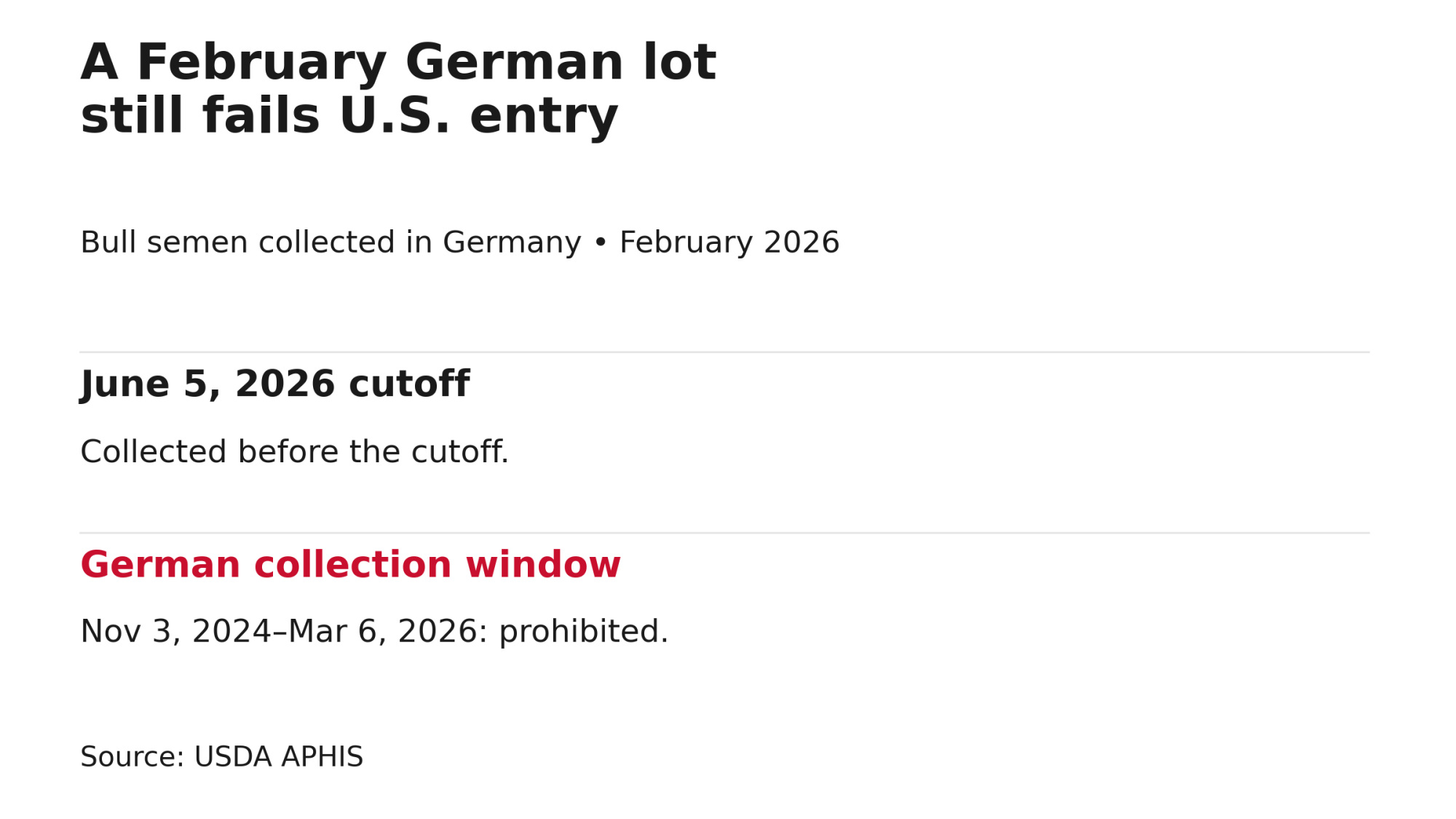
Buying pre-June 5 inventory isn’t an automatic green light either. A straw collected in Germany in February 2026 clears the Shamonda cutoff and still isn’t eligible under an older APHIS prohibition.
What did APHIS restrict?
APHIS’s cattle and bison germplasm import requirements, last modified November 13, tie the June 5 cutoff to Shamonda virus detections in Europe and extend it to bovine embryos, oocytes and cloning tissue. Have the importer check the permit instructions and the semen health certificate APHIS lists for the collection country.
The World Organisation for Animal Health reports transmission by biting midges and from dam to offspring. Collection country and date decide whether a lot falls under the cutoff. Neither establishes that an individual straw carries the virus.
The older restrictions still apply
A pre-June 5 lot still has to clear the older restrictions on the same APHIS page.
| Restriction | Scope on the APHIS page |
| Foot-and-mouth disease | Semen and embryo imports from Hungary, Slovakia, Cyprus and Greece currently prohibited |
| Germany | Semen and embryos collected Nov 3, 2024–Mar 6, 2026 prohibited, plus embryos produced with semen collected in Germany during that window |
| Lumpy skin disease | Bovine semen and embryos are ineligible if collected on or after the dates listed for Greece (Aug 4, 2015), Bulgaria (Mar 29, 2016), Croatia (Aug 8, 2016), Italy (Mar 6, 2025), France (Apr 30, 2025), Switzerland (Jul 19, 2025) and Spain (Aug 8, 2025) |
Why a bull’s proof can’t answer the eligibility question
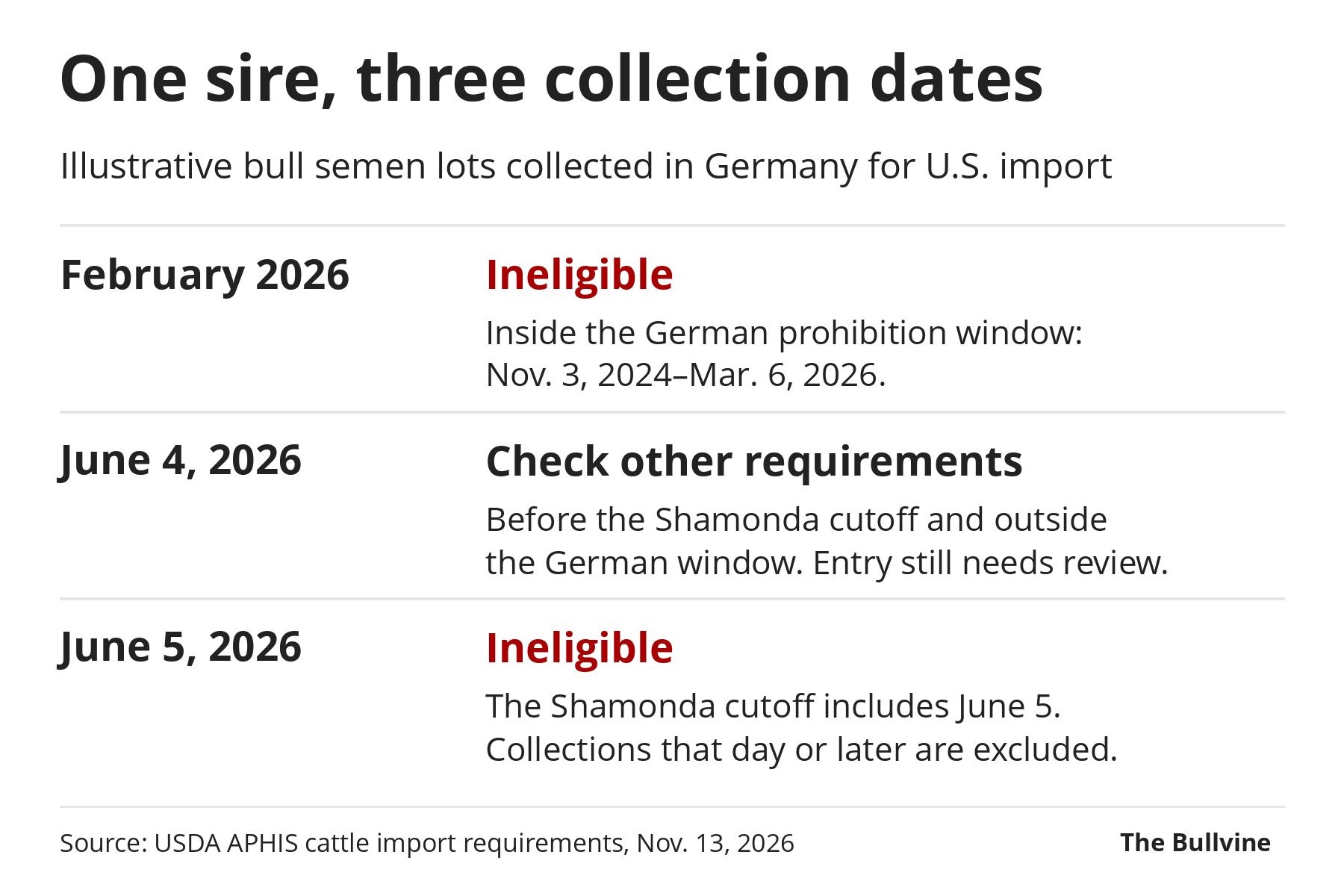
Two lots from the same bull at the same EU stud can fall on opposite sides of June 5. The sire proof is the same for both. Ask for the collection record of the specific lot on offer. The table below is Bullvine’s, built from the APHIS page.
| What the offered lot’s record shows | What to do |
| Collected in the EU, EFTA or UK on or after June 5, 2026 | Exclude these doses from planned U.S. imports. |
| Collected there before June 5, 2026 | Have the importer check the older restrictions and other entry requirements before counting the doses. |
| Documented collection outside the EU, EFTA and UK | This cutoff doesn’t apply. Check the requirements for the actual origin and destination. |
| The available record leaves the cutoff decision unresolved | Ask for the missing country or date. Leave the doses out of confirmed supply until the importer can document eligibility. |
Export rules run on the same kind of record. China’s top-10% semen rule shows the outbound version.
How many doses is the Q1 breeding sheet short?
Start with usable doses already in the herd’s U.S. tank and set aside for these matings. For incoming doses that still need U.S. entry, count only lots whose eligibility the importer confirms. Every incoming order needs the quantity reserved for the herd and the expected delivery date in writing.
Match delivery to the services that need those doses. An April delivery cannot cover March matings, but a February delivery can still cover later Q1 matings even if breeding started in January. Count each dose once. Each sire’s line on the breeding sheet then carries doses planned, usable doses set aside in the tank and eligible doses reserved for delivery in time.
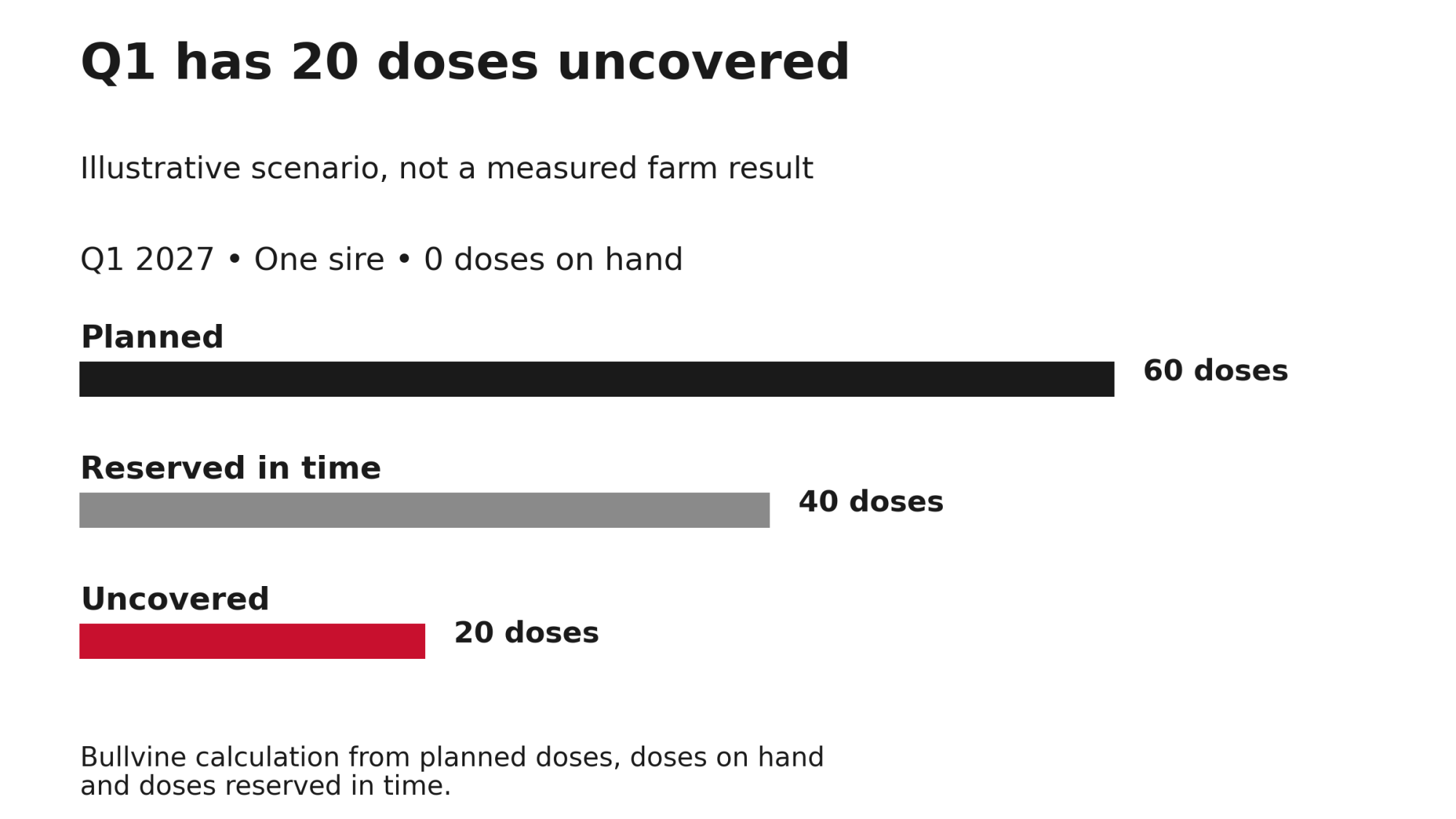
Take a straightforward example: say a herd budgets 60 Q1 doses from one European-collected sire and has none on hand. The importer confirms the offered lots are eligible for U.S. entry, and the supplier reserves 40 doses in writing for delivery before the matings that need them. That leaves 20 doses uncovered, whatever sits in a stud tank overseas.
An unconfirmed shipment can stall a donor flush or push high-value cows past their target breeding window. The first question for the supplier is whether another eligible lot from the same sire can fill the 20-dose gap. If it can’t, the fallback is a suitable North American-collected substitute or a revised mating schedule, settled before the matings that need those doses.
What goes in writing at the order desk
Ask the supplier to confirm, in writing and for each lot reserved for the herd, the lot ID, collection country and date, eligibility for the destination, doses reserved and expected delivery date, plus any detail still pending. The same note should carry the semen type, the reservation expiry and the cancellation terms. Any substitution needs the buyer’s approval first. Before approving a substitute, check its trait profile against the herd’s breeding goals, and its carrier status and relatedness against the females on the mating list. Recheck held lots whenever APHIS changes its requirements.
For delivery in Canada, the importer should check CFIA’s Automated Import Reference System (AIRS) for current origin requirements—and watch for updates, as APHIS says it is coordinating closely with Canada on Shamonda virus policy alignment. A U.S. breeder buying European-collected semen held in a Canadian stud or distributor tank can’t assume Canadian storage settles eligibility. Have the importer confirm the lot’s original collection country and date against U.S. entry requirements before booking it. Doses already in a U.S. tank belong on a separate inventory line, because the APHIS page sets import requirements and doesn’t address straws already in U.S. tanks.
Learn More
- CDCB August 2026 evaluation: don’t panic-cull your bull — Arms you with a zero-emotion protocol when substituting North American backup sires, exposing how CDCB rescaling—not genetic loss—shifted fertility proofs so you don’t dump profitable semen.
- The Punjab Pivot: Why $12 Semen Is Dead in India by 2031 — Follows the money on import-substitution genetics as local progeny testing threatens to undercut $12 imported straws by 80% over the next five years.
- Every Tuesday Dann Brady Throws Out Bulls He Likes. One of Them Wasn’t Logic PP — Dismantles conventional index-chasing after export limits pushed Ferme Blondin to build its own stud, revealing a one-weakness subtractive rule for screening replacement sires.
The Sunday Read Dairy Professionals Don’t Skip.

Every week, thousands of producers, breeders, and industry insiders open Bullvine Weekly for genetics insights, market shifts, and profit strategies they won’t find anywhere else. One email. Five minutes. Smarter decisions all week.