






Australia and Canada sent 92,573 straws by August. APHIS still lists the U.S. certificate as under negotiation. And China’s top-10% rule doesn’t say which index ranks your bull.
China is buying again, and genomic young sires are officially allowed through the door. But the rule leaves open two questions, and they decide whether a bull actually clears the top-10% bar: which index counts, and which bulls he’s ranked against.
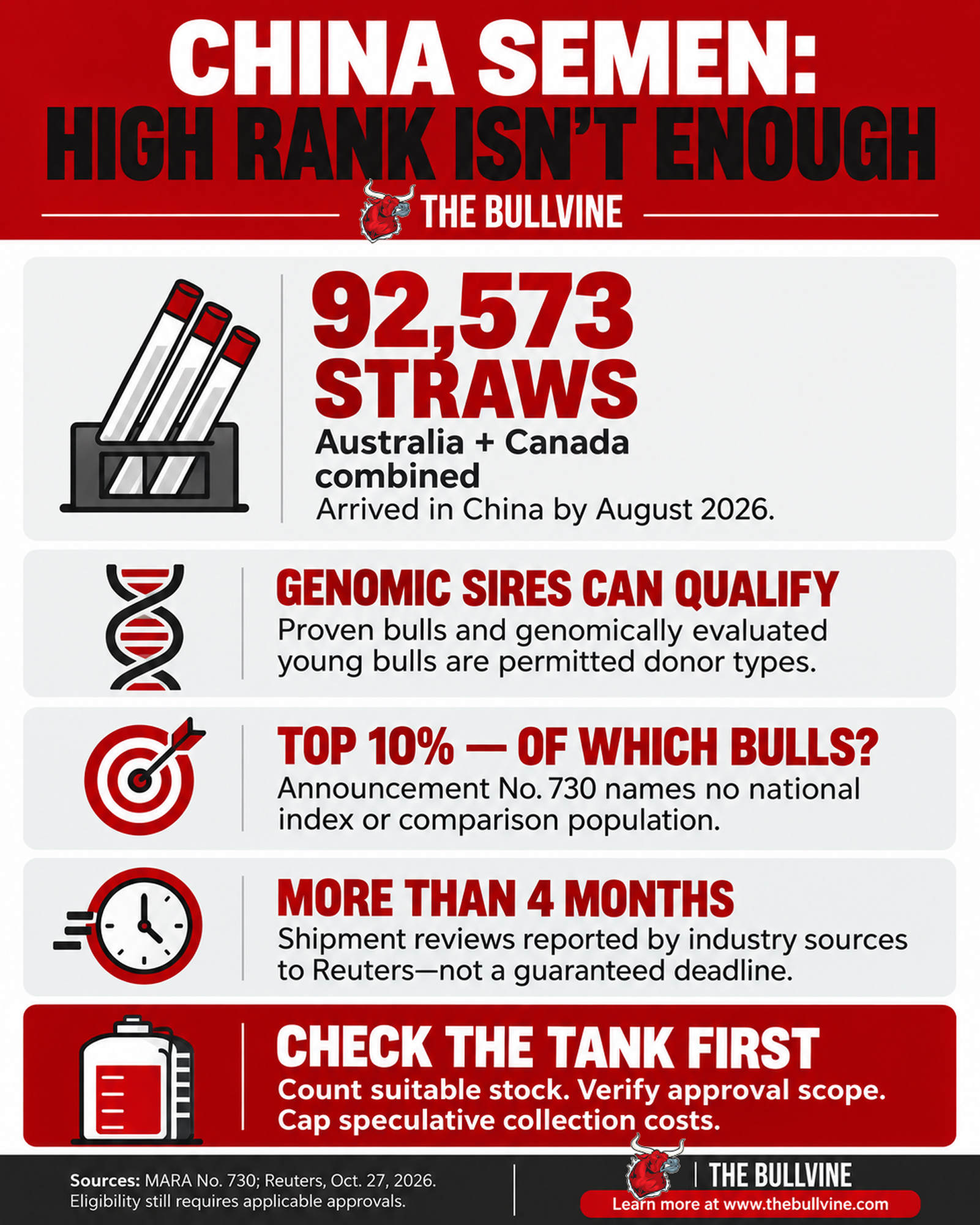
Australia and Canada are already shipping. Chinese customs data cited by Reuters show 92,573 straws worth around US$700,000 arrived from the two countries combined by the end of August. Before the curbs, Reuters says, China imported roughly 10 million straws a year. The reopening is still small next to the old trade, but it’s already growing.
The U.S. is still waiting. As of Oct. 27, 2026, the USDA APHIS page for exports to China lists both the bovine-semen protocol and the health certificate as “Under negotiation” and unavailable, with February 2025 labels. Industry players told Reuters the U.S. will be China’s dominant supplier, as it was before the trade froze. The U.S. accounts for around 55% of the half-billion-dollar global bull-semen trade, but its return to China is still a forecast. “Every day, our customers want to know when they can get US semen, and when the US market will reopen,” Rone Lane, the Canadian CEO of Beijing World Wide Sires, told Reuters.
| Country | Status | What it rests on |
| Australia | Shipping. A Chinese audit team checked the Camperdown facility last year | Reuters, Oct. 27, 2026 |
| Canada | Shipping. Confirm with CFIA that the current certificate applies to mainland China | Reuters; CFIA directory |
| United States | Protocol and certificate “Under negotiation” (February 2025 labels) | USDA APHIS, checked Oct. 27, 2026 |
To get a straw into China, a bull has to clear four hurdles set by Ministry of Agriculture and Rural Affairs Announcement No. 730, Attachment 2, in force since June 1, 2024:
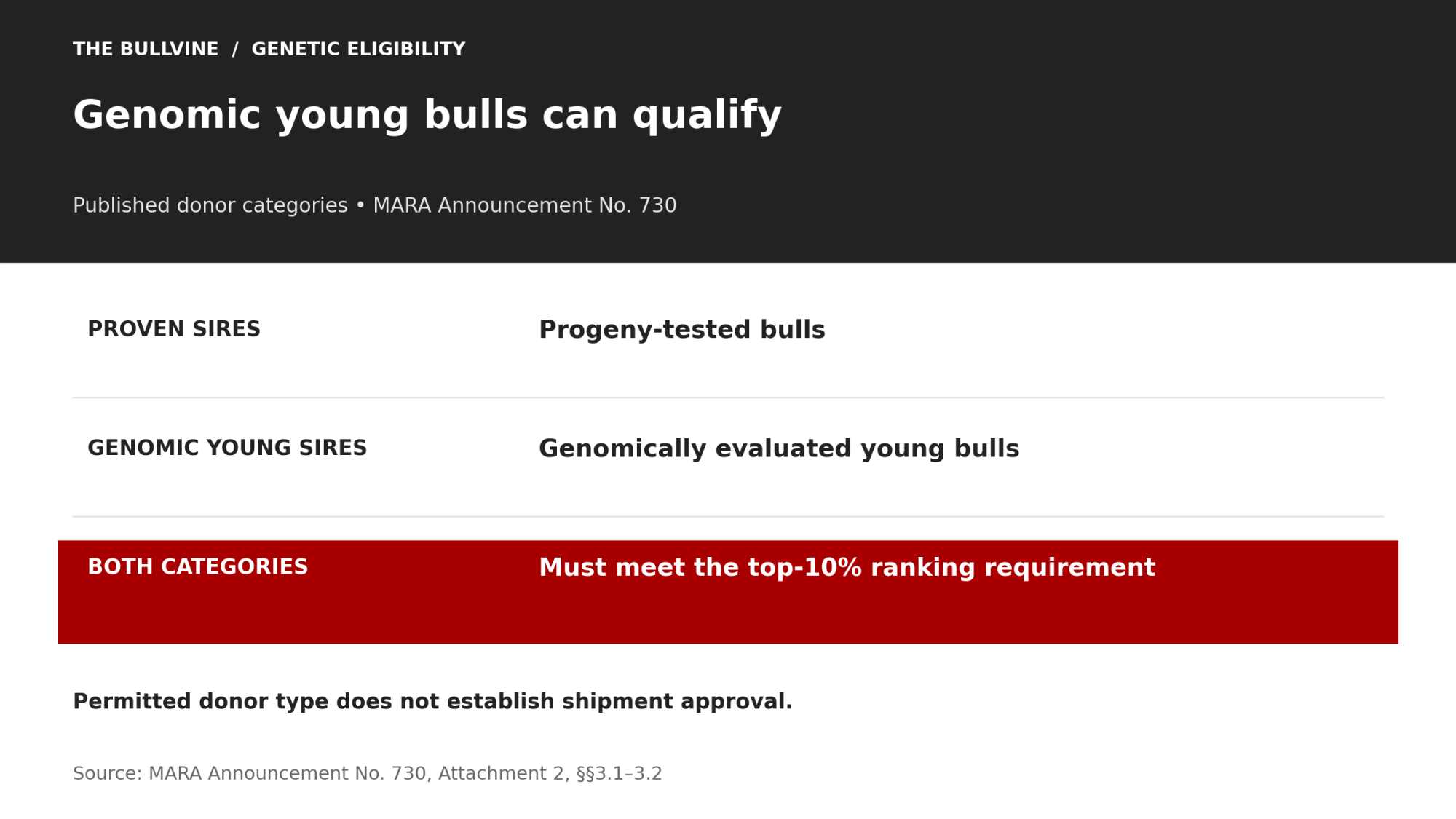
- Right kind of bull. He has to be a progeny-tested proven sire or a genomically evaluated young bull.
- Top 10%. His comprehensive breeding-value ranking has to be documented in the top 10% of his breed in the exporting country or region.
- Clean genetics on paper. He needs pedigree, non-carrier and parentage records.
- An open door. His semen has to meet China’s import access and quarantine rules (§1.5) and move on an export route that actually works.
The Top-10% Problem: Ranked Against Whom?
An index sets what a bull is ranked on. The denominator sets who he’s ranked against. No. 730 puts the bar at the top 10% of the breed in the exporting country or region. It doesn’t name TPI, NM$, LPI or BPI, and it doesn’t define the comparison population.
For a U.S. Holstein, “comprehensive breeding value” could mean TPI from Holstein Association USA, NM$ from CDCB’s evaluation, or something else. The top 10% could be cut from any of these pools:
- active AI sires
- every evaluated male
- an age cohort
- genomic and proven bulls ranked separately
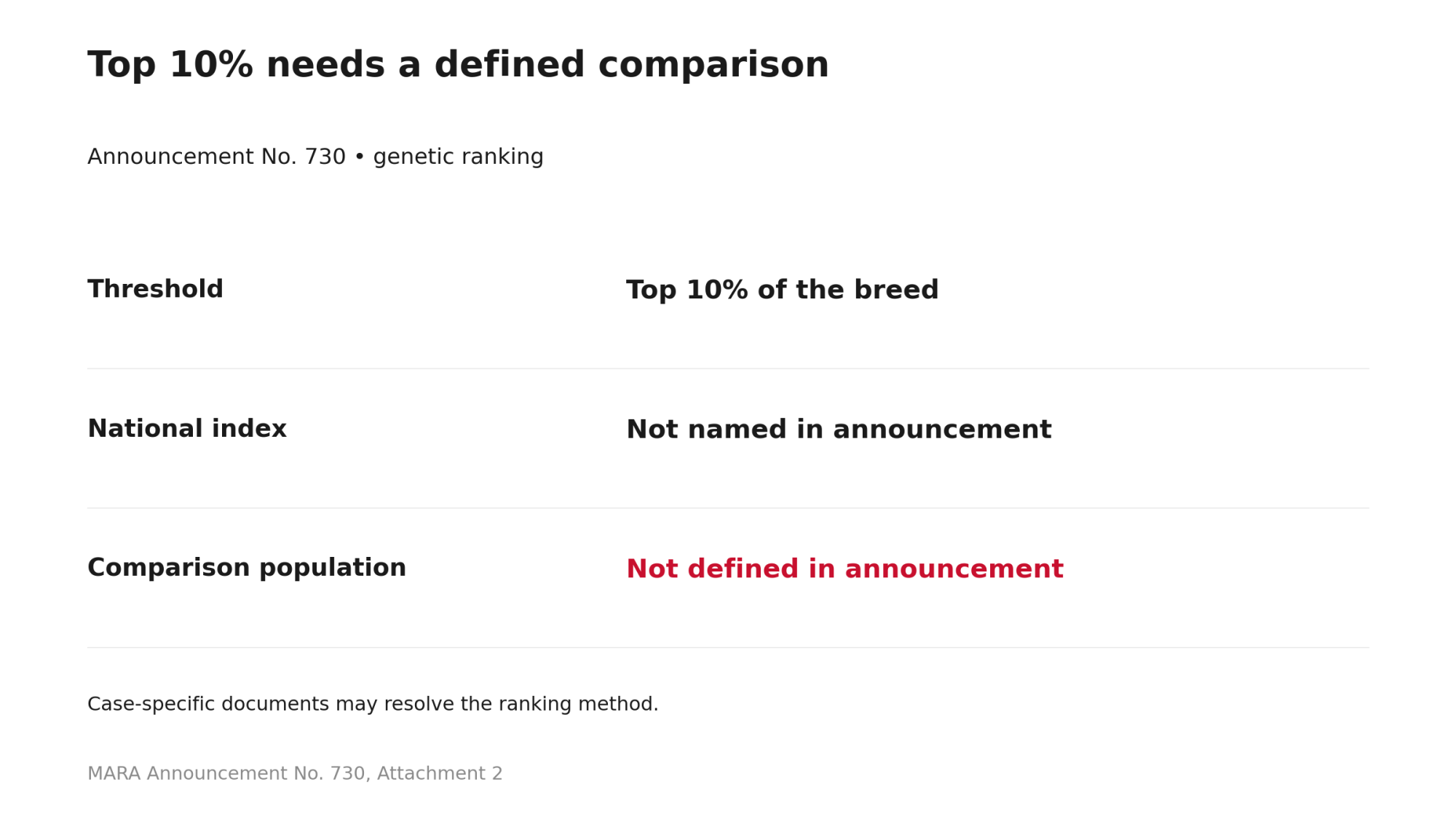
Each pool gives a different cutoff and a different list of bulls. The first 20 names on a Top 200 TPI list are the top tenth of a pre-filtered list, which isn’t necessarily the national top decile. And a TPI cutoff can’t be compared directly with an LPI or BPI cutoff, because they’re different national scales.
Exporters may already hold documents that settle this for a specific case. That could be a written interpretation from the responsible Chinese authority, or an authenticated approval for a particular bull, semen lot or consignment. Bullvine hasn’t seen one. Such a document supports a claim only within its own scope, and approval for one consignment doesn’t make the bull eligible for every future shipment.
The Fine Print Behind the Four Hurdles
Section 3.1 of Attachment 2 settles the genomic question. A frozen-semen donor can be a progeny-tested proven bull or a young bull evaluated through genomics. So a genomic young sire is a permitted donor, though he still has to clear the top-10% bar in Section 3.2. That section adds that the donor’s performance can be looked up on a breed-association or breeding-organization website in the exporting country or region.
The semen provisions add no reliability hurdle. The 90% reliability figure appears in Section 2.1, which covers live proven breeding bulls, and the semen sections don’t repeat it.
Section 1.4 requires non-carrier status, marked on the pedigree or written into the sales contract, so disclosing that a bull is a carrier doesn’t satisfy it.
Defects named in §1.4: CVM · BLAD · BS (brachyspina) · MF (mulefoot) · DUMPS · CD (cholesterol deficiency) · AS (arachnomelia). The list ends with “等” (“and others”), so treat it as examples rather than a complete list.
Attachment 2 also requires pedigree information back to the great-grandparents, parentage-marker genotypes for semen donors and compliance with China’s import access and quarantine rules.
The superseded Announcement No. 2460 already set a top-10% bar for semen donors and already allowed genomically evaluated young bulls. What’s new in 2026 is the reopening itself, plus a shipment-by-shipment screening that Reuters says hadn’t been reported before.
Four Months on the Clock
Genetics companies and diplomats quoted by Reuters say China runs each shipment through an expert-panel review lasting more than four months. Industry insiders told Reuters that some shipments were only partly approved after failing the standard.
“Semen is not a fine wine. It doesn’t age well. It’s an antique within a year.” — Ian Lahiffe, Beijing-based agricultural consultant, to Reuters
The metaphor overstates it, but the risk is real. During a long review, a bull’s relative ranking could change when national evaluations update, and buyer preferences and order timing can shift. A partial approval can leave semen unsold or force it to be redirected, and the commercial terms decide who absorbs that loss. No source says which evaluation run governs qualification, or whether a later run can change the outcome of a pending application.
The bar also runs breed by breed. Reuters reports that ABS Australia expects to ship around 200,000 straws to China over the coming year from Wagyu, Angus, Holstein and Jersey bulls. That’s a company forecast covering four breeds, and each one faces its own top-10% bar.
What Breeders Should Ask Before Signing
“China-eligible” in a sire catalogue is a claim about documents. Any spotlight that prints it should say what those documents cover: the bull, a semen lot or a consignment.
If you’re a breeder weighing a China-linked AI proposal for one of your bulls, ask:
- Guaranteed or conditional? Is the payment or collection commitment firm, or does it depend on approval?
- What triggers payment? Collection, approval, shipment or something else?
- What if China says no? What happens if approval is delayed or refused?
For commercial dairy producers, export qualification doesn’t make a sire the right fit for their herd’s breeding goals.
What Goes in the Bull’s File
Each candidate bull’s file starts with his permanent registration ID, breed, semen lots, collecting country and collection centre. That ties every item to the same animal and the same straws.
There are two ways to back up the genetic claim:
- A documented ranking method: the accepted index, the comparison population, the applicable evaluation date and evidence the bull meets the threshold.
- An applicable genetic approval: the issuing authority, the bull’s identification, and the approval’s scope, conditions and any validity limits. A facility approval or an unrelated administrative document doesn’t count.
Either route supports the genetic claim. Neither replaces any required regulatory review or shipment approval.
Phase 1: Before committing collection to a China order
- Genetic qualification through one of the two routes above
- Official evaluation record: run date, index value, reliability
- Pedigree, non-carrier and parentage records
- Current protocol and health-certificate availability to China
- Collecting centre’s eligibility under China’s inspection or approval conditions
- Donor collection and testing conditions under the certificate
- Buyer, product, price and quantity (commercial inputs)
Phase 2: Before allocating inventory to an order
- Eligible lots and quantities
- Buyer requirements
- Required approvals
Phase 3: Before shipment
- Final consignment documents
- Issued certificates, endorsements and permits
Each item gets one of five statuses:
- Confirmed: the evidence has been checked.
- Pending: a known process is still unfinished.
- Unverified: the evidence or its applicability hasn’t been established.
- Blocked: a known obstacle stops the action.
- Not applicable: the item doesn’t apply to this bull.
A shipment certificate can sit at Pending during the collection stage without holding up the collection decision. A route with no available protocol is Blocked, and neither status means the bull failed.
A written order isn’t a shipment-ready order. It backs collection only when the buyer’s written terms exist and spell out what’s still outstanding, such as approval, timing or financing, and until material approvals arrive the order stays conditional. Not every item has to be Confirmed before collection starts, but collecting earlier is a commercial bet, so the file should record the assumptions and the exposure.
Matching Collection to the Evidence
| Decision | The Scenario | The Playbook |
| Investigate the route | Most collection-stage evidence is Unverified | One owner, one deadline, a diligence budget |
| Preserve the opportunity | Strong candidate, but genetic evidence or the route is Pending or Unverified | A limited collection or retention extension with a cost cap and an expiry date |
| Build speculative inventory | The stud will eat the loss if China doesn’t open for this bull | A hard exposure limit, tested against a no-China-sale case with no assumed resale price |
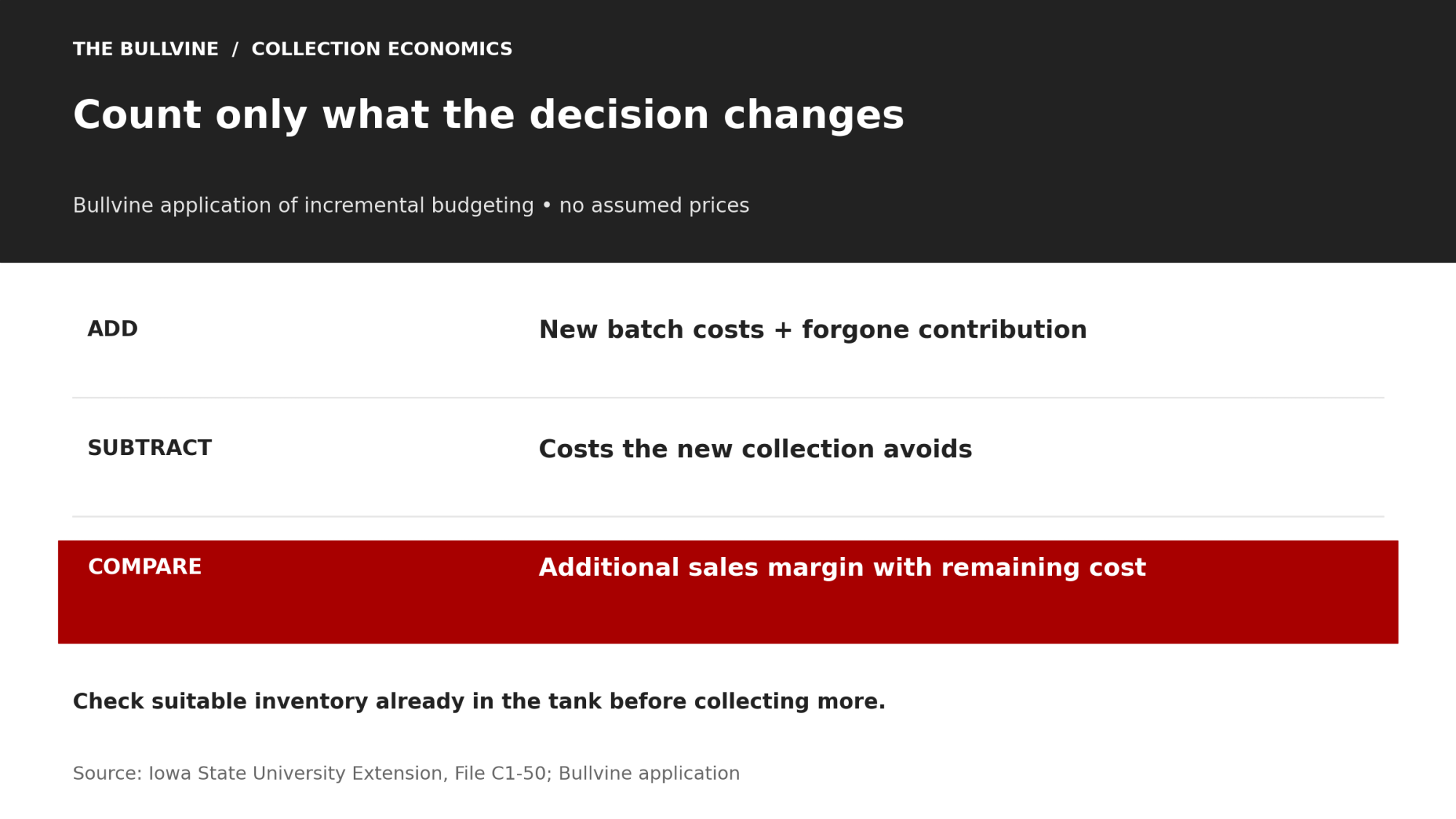
| Collect against a conditional order | Collection-stage evidence is Confirmed, and written terms identify what’s outstanding | Only the extra straws the order needs after counting suitable stock already in the tank |
For U.S.-collected bulls, the APHIS status makes China-driven collection a preserve-or-speculate decision until APHIS confirms a usable route. For Canadian- or Australian-collected bulls, the export side may be easier to document. The denominator problem applies in every country.
Break-even before collecting
- Add up everything a new batch costs: collection, processing, testing, storage, expected failed-batch losses, and what the bull or the lab would have earned doing something else.
- Subtract any costs the collection avoids.
- Divide by the margin per straw sold: the sale price minus any cost that only shows up when a straw sells.
The answer is the number of straws that have to sell to break even, rounded up.
- If that number is bigger than the batch can supply, the batch can’t break even.
- If the per-straw margin is zero or negative, more sales won’t cover the batch.
- Sales that semen already in the tank could fill don’t count toward the new batch.
What This Means for Your Operation
- Match the claim to the evidence. Without a documented ranking method or an applicable genetic approval, call the bull a “candidate under stated assumptions.”
- Check the tank first. Count suitable existing inventory before committing to more collection.
- Put a name on the blocker. Assign an owner to the unresolved item that drives the next decision, whether that’s the ranking population, the U.S. route or the Canadian certificate.
Two developments would move bulls between statuses. One is MARA, or exporters’ approval documents, showing how the ranking population is applied. The other is APHIS confirming a usable U.S. route. Until either one lands, a high national proof isn’t enough reason on its own to collect more for China.
Complete references and supporting documentation are available upon request by contacting the editorial team at editor@thebullvine.com.
Learn More
- CDCB August 2026 evaluation: don’t panic-cull your bull — While China obsesses over strict national rank, this piece arms you with a zero-emotion protocol for domestic proofs. Exposes how CDCB rescaling—not genetic loss—dropped your sire’s Pregnancy Rate, keeping you from prematurely dumping profitable semen.
- 99.84% of Holstein AI Bulls Trace to Just Two Fathers — Export limits aren’t your only genetic bottleneck. Follows the money on the 10% inbreeding tax quietly stacking up in your replacement pens, and delivers a hard-ceiling mating strategy to instantly diversify your service sire team.
- Every Tuesday Dann Brady Throws Out Bulls He Likes. One of Them Wasn’t Logic PP — Forget the top-10% math for a minute. Dismantles the habit of buying strictly on total merit index, breaking down a subtractive screening logic that caps candidates at one weakness before they ever reach your semen tank.
The Sunday Read Dairy Professionals Don’t Skip.

Every week, thousands of producers, breeders, and industry insiders open Bullvine Weekly for genetics insights, market shifts, and profit strategies they won’t find anywhere else. One email. Five minutes. Smarter decisions all week.