Two herds. Same 18% pregnancy rate. One’s missing heats, the other’s missing pregnancies — and the manager watching conception rate can’t tell which. The fix for one is the wrong move for the other.
Picture two herd managers at the same repro meeting, both staring at a 21-day pregnancy rate of 18%. Same number, same screen, same shrug. One of them is missing heats. The other is missing pregnancies. And neither one can see it, because they’re both watching conception rate instead.
That’s the trap. It quietly costs herds real money while the actual problem hides one column over — and the fix for one manager is the exact wrong move for the other.
The Number Everyone Quotes, and Few Actively Manage
Ask a herd manager for their conception rate, and you’ll get an answer before you finish the question. Ask for their 21-day pregnancy rate and watch them reach for the software. That gap tells you how the industry got trained.
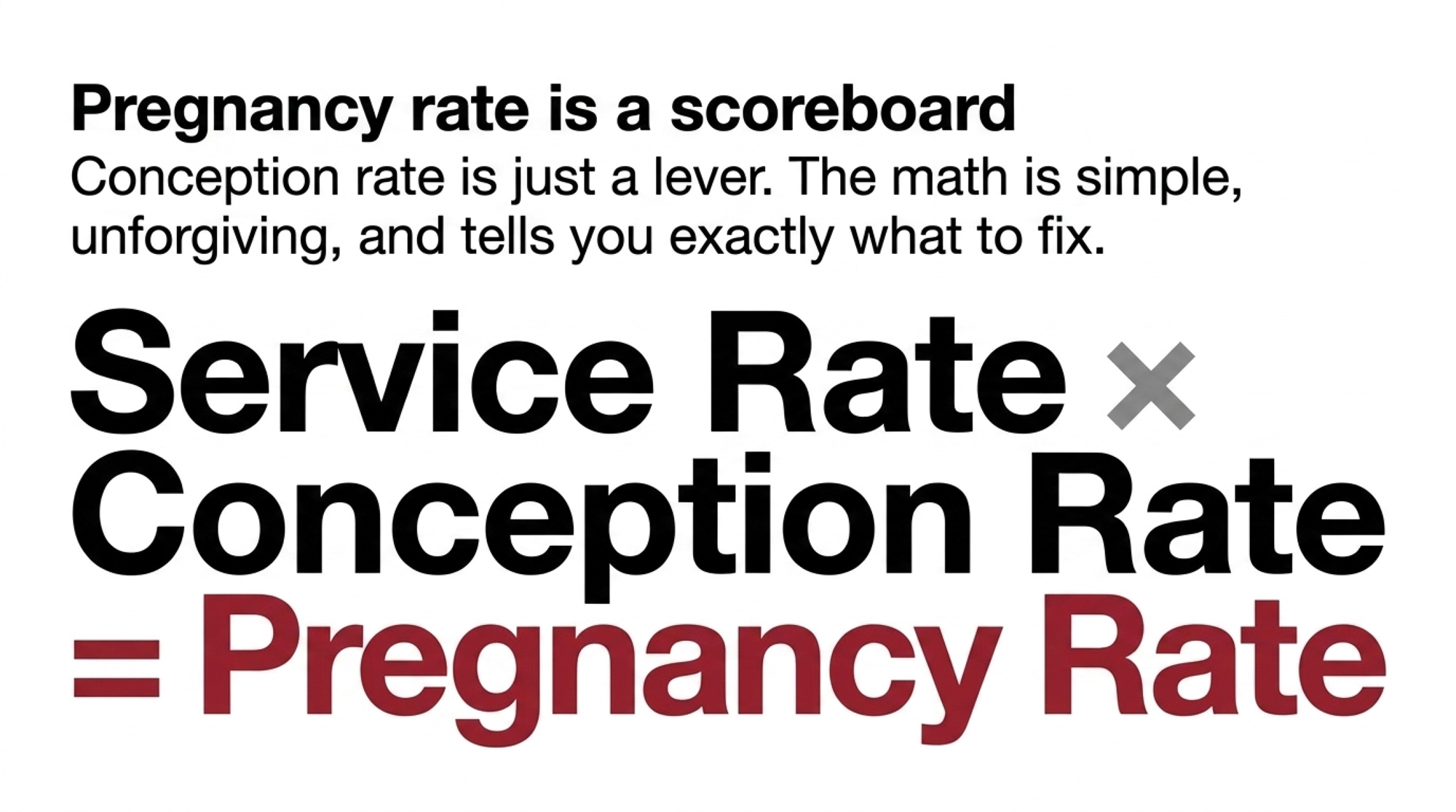
Conception rate is a fine number. It’s just answering the wrong question. It tells you how well a breeding worked — nothing about how many cows were even in the room when the breeding happened. Paul Fricke’s framing at the 1999 Western Canadian Dairy Seminar laid this out decades ago: pregnancy rate is the product of two levers — service rate (the share of eligible cows bred in a 21-day window) and conception rate (the share of those breedings that hold).
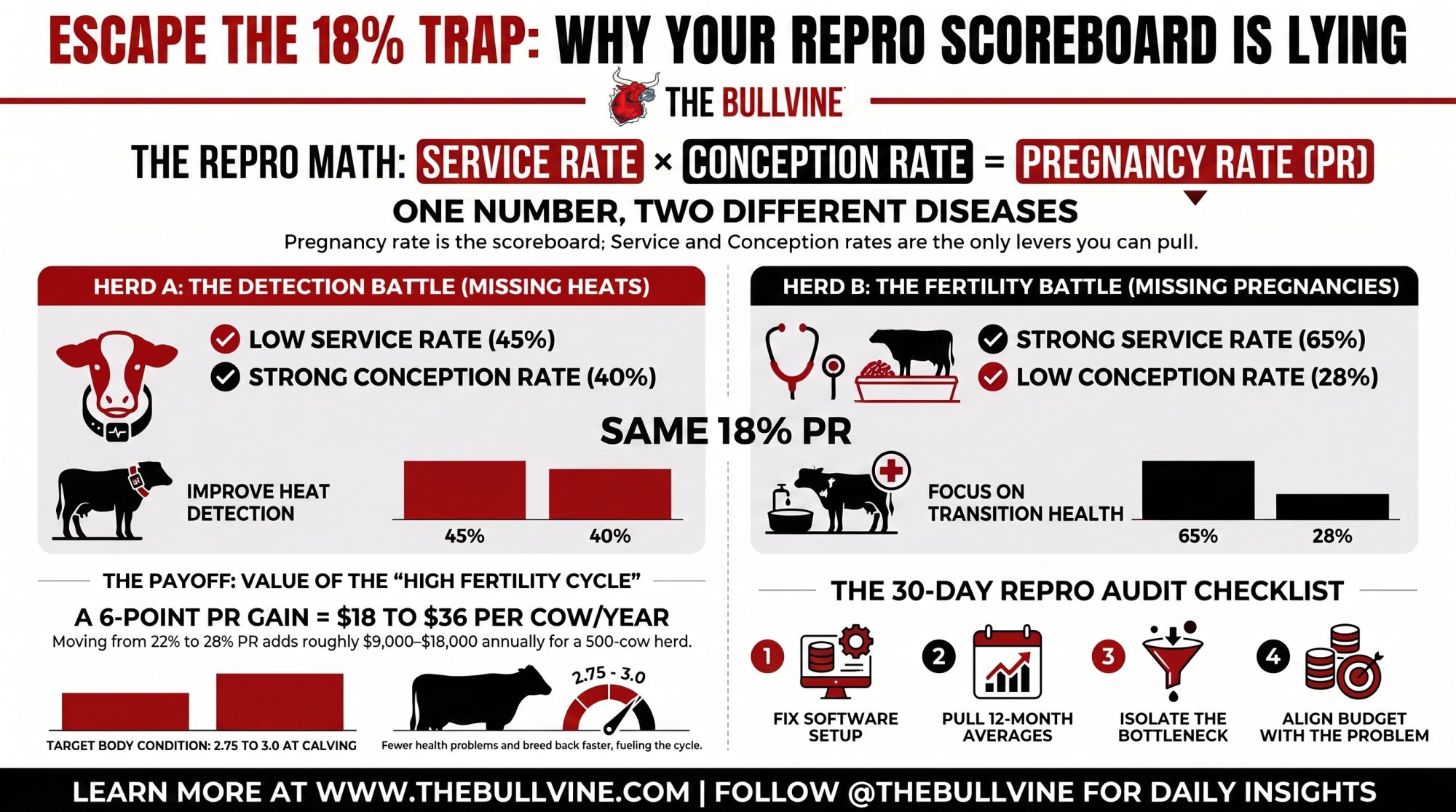
So the math is simple and unforgiving. Breed 40% of your eligible cows, get 50% of them pregnant, and your 21-day PR is 20%. Conception rate is a lever. Pregnancy rate is the scoreboard.
Here’s the piece worth sitting with. The whole ecosystem was built to celebrate the outcome of a single breeding, not the flow of cows from open to pregnant. The U.S. Council on Dairy Cattle Breeding’s Cow Conception Rate PTA is defined per-insemination. Extension bulletins teach it cow-by-cow — “two pregnant out of four bred, that’s 50%.” Even the ultrasound hands you a verdict on one animal at a time. It’s no surprise many managers think in cows, not in cycles.
Two Herds, One Number, Two Different Diseases
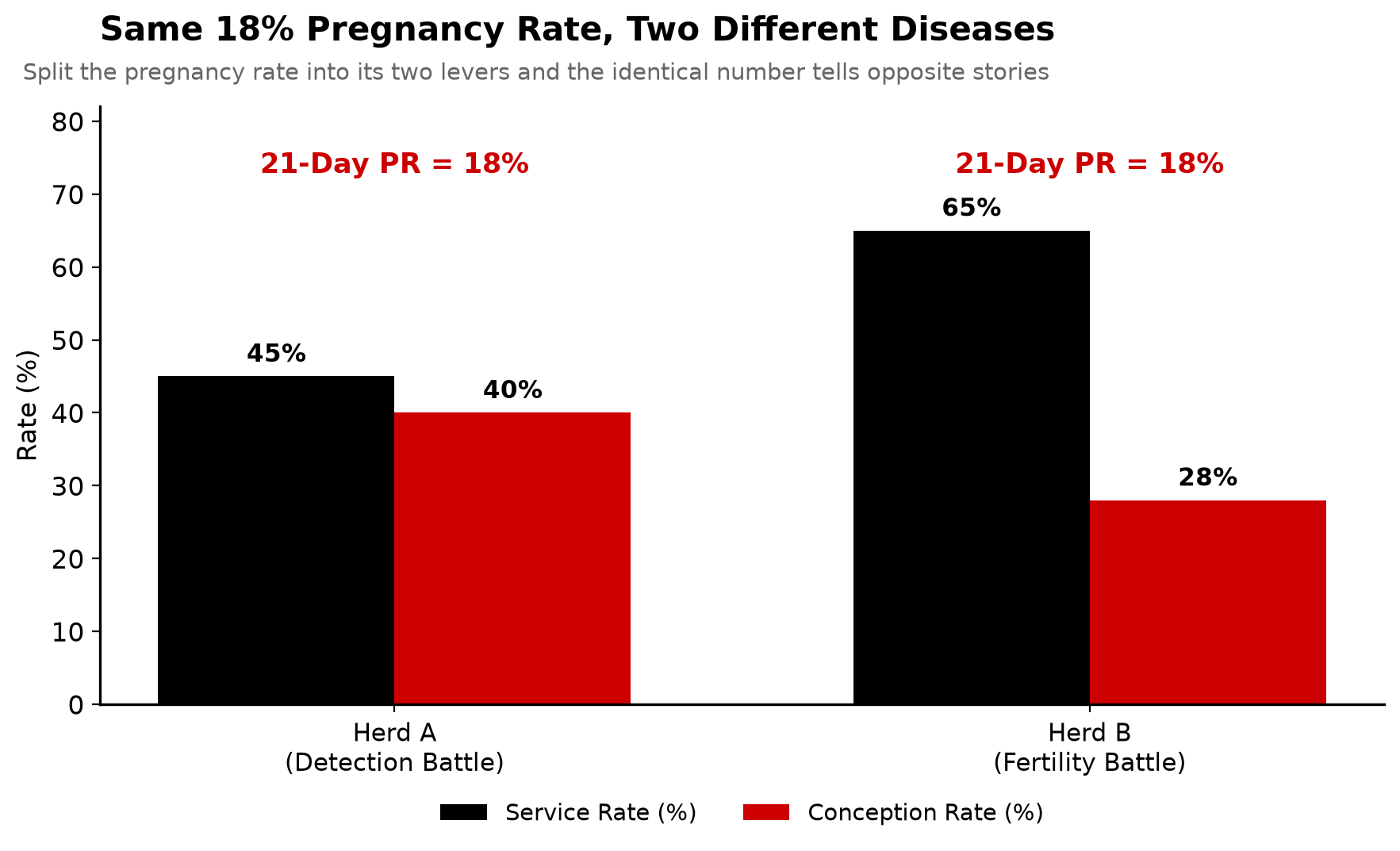
This is where the diagnostic gets clean once you know to look. Take those two 18% herds.
| Metric | Herd A (The Detection Battle) | Herd B (The Fertility Battle) |
| 21-Day Preg Rate | 18% | 18% |
| Service Rate | 45% (low) | 65% (strong) |
| Conception Rate | 40% (strong) | 28% (low) |
| The real disease | Missing heats (detection / rebreeding) | Missing pregnancies (transition / health) |
| The wrong move | Spending on Double-Ovsynch | Doubling down on heat detection |
Multiply the two levers and both herds land at 18%. Identical from the outside. Completely different problems underneath.
Herd A has a heat-detection problem — cows aren’t getting bred often enough. Herd B has a fertility problem — cows are getting bred plenty, but too few pregnancies stick.
The 18% is just the symptom. The two levers tell you where the disease actually lives.
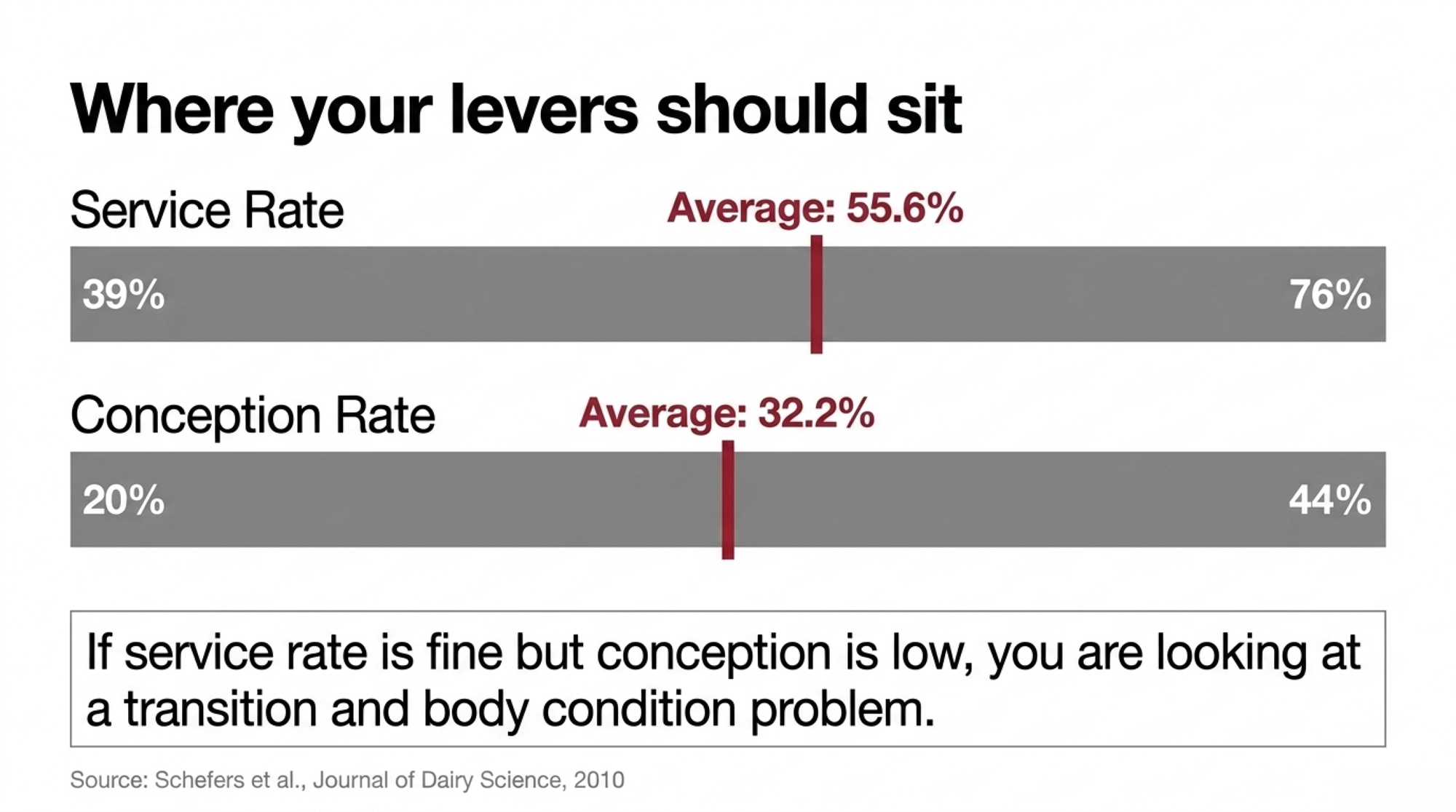
Schefers and colleagues (Journal of Dairy Science, 2010) put real ranges around this across 200 U.S. Holstein herds. Conception rates ran from 20% to 44%, averaging 32.2%. Service rates ranged from 39% to 76%, with an average of 55.6%. They also found that herds rebreeding quickly after a non-pregnant diagnosis pushed their service rate up — proof that one of these levers is a management decision, not a biological ceiling.
So when a repro report lands in front of you, split the PR back into its two parts and check each against those ranges. Service rate low, conception fine? You’ve got a detection and rebreeding problem. Service rate fine, conception low? Now you’re looking at transition health, body condition, and protocol design — a different barn, a different budget, a different conversation.
| Lever | Schefers Range (200 US Holstein herds) | Target Threshold | If You’re Below → The Real Fight |
| Service Rate | 39% – 76% (avg 55.6%) | Above ~55% | Under 50%: heat detection, rebreeding intervals, detection discipline |
| Conception Rate | 20% – 44% (avg 32.2%) | Above ~32% | Under 30%: transition health, bunk, body condition 2.75–3.0 |
| 21-Day Preg Rate | ~14% (2000s) → 21%+ today | 20%+ (60% of DRMS herds now clear it) | Split into the two levers above before spending a dollar |
| Value of +1 point PR | $3–$6/cow/yr (conventional) | Six-point gain ≈ $18–$36/cow/yr | Doing nothing is the expensive choice |
Where Do You Actually Pull These Numbers?
This is the part the textbooks skip. The diagnostic only works if you can get the two levers from your herd software, and the definitions have to be clean, or the whole thing lies to you.
In DairyComp 305, the workhorse command is BREDSUM\E — it runs the 21-day pregnancy rate and insemination (service) rate broken out by heat interval, with conception rate pulled from the same breeding analysis. In PCDART, it’s Standard Report 126, the Pregnancy Rate Summary, which calculates PR over 21-day intervals. Either way, use the rolling figure, not last week’s snapshot. A single 21-day cycle is too noisy to act on — a heat wave, a bad semen-tank week, one tech on vacation, and your PR bounces. Pull the trailing year and the signal steadies.
The trap is the eligibility definition. Service rate depends entirely on which cows the software counts as “eligible” in each 21-day window. If your voluntary waiting period is set incorrectly, or do-not-breed cows aren’t flagged, the service rate will read high or low for reasons unrelated to your heat detection. Before you trust either lever, confirm the VWP, the breeding cutoff, and the do-not-breed list are current.
The Cycle Most Managers Never See
Here’s the piece that runs underneath everything. Fixing pregnancy rate doesn’t just improve one lactation. It rewires the herd’s biology going forward.
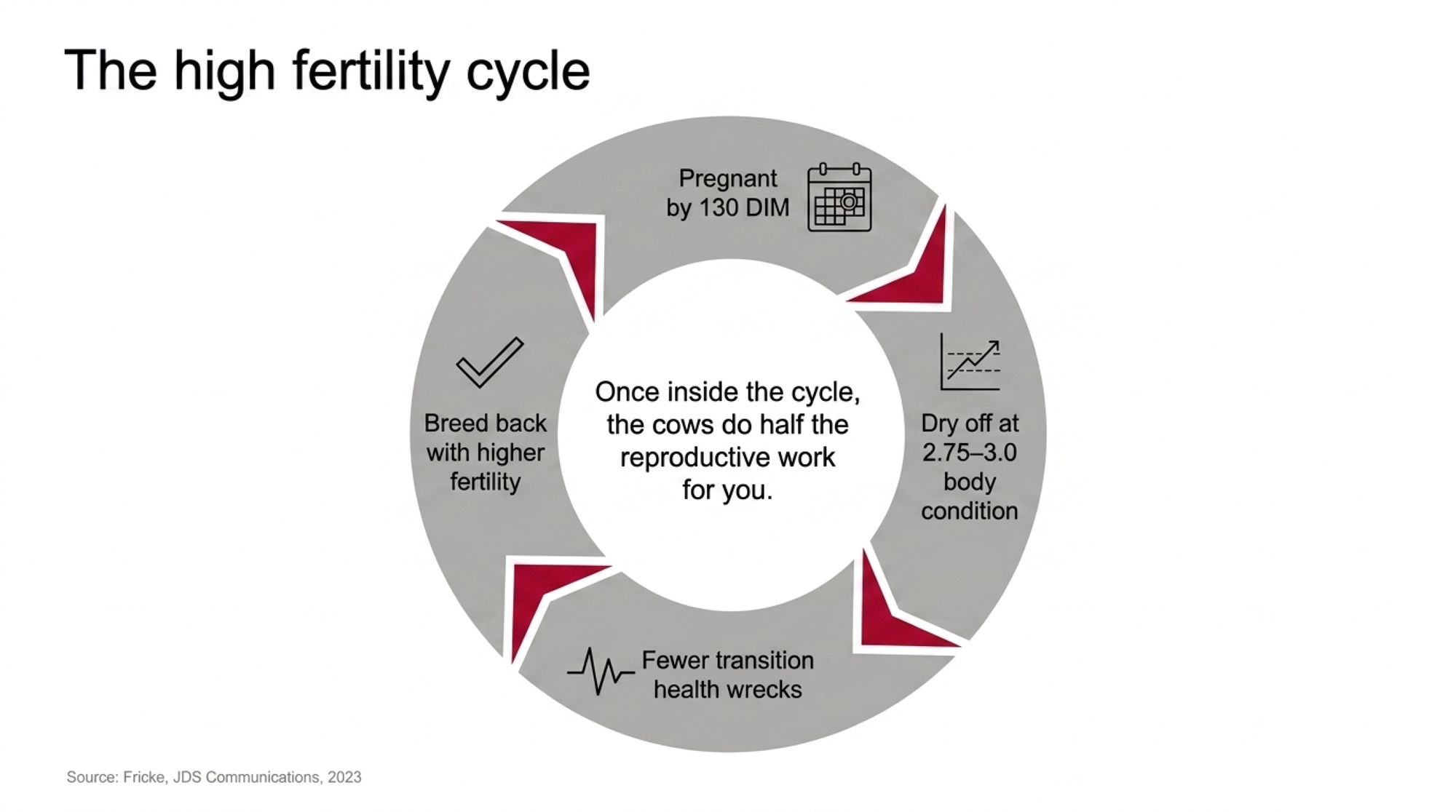
Fricke calls it the high fertility cycle, and his 2023 JDS Communications mini-review defines it precisely. Cows that establish pregnancy by 130 days in milk have shorter calving intervals, gain less body condition during the lactation, and dry off and calve at a lower body condition score — 2.75 to 3.0. After calving, those cows lose less condition, hit fewer health problems, breed back with greater fertility, and lose fewer early pregnancies, which lets them get pregnant again by 130 DIM.
That’s the loop. And it’s self-reinforcing in a way that makes it genuinely hard to break into from the outside. Middleton and colleagues (Journal of Dairy Science, 2019) tracked body condition change from a week before calving to 30 days after in 851 Holstein cows in a single herd, and the cows that held or gained condition bred back better with lower pregnancy loss.
Once a herd is inside that cycle, the cows are doing half the repro work for you. Good energy balance produces better embryos and fewer losses, resulting in more timely pregnancies and preventing cows from getting too fat at the tail end of lactation. The herds stuck outside it are fighting the reverse: long days open, over-conditioned cows, transition wrecks, poor fertility, more long days open.
The scale of the shift is real. Fricke’s UW-Madison Extension work on the high fertility cycle (updated August 2025) reports that the U.S. average 21-day pregnancy rate now exceeds 21%, with more than 60% of DRMS Holstein herds above 20% — a long way from the roughly 14% average of two decades ago, when 20% was a stretch goal few herds hit.
When Does Double-Ovsynch Actually Earn Its Keep?
This is where the protocol conversation gets sharp, because it’s really a sequencing problem. Too many farms reach for the most sophisticated tool first, before they’ve earned the right to use it.
The evidence for Double-Ovsynch is genuinely strong in the right herd. Nowicki’s 2017 review in the Journal of Veterinary Research reported final pregnancy rates of 49.7% for Double-Ovsynch versus 41.7% for Presynch-Ovsynch across the summarized trials, crediting the edge to better handling of anovular and inactive-ovary cows. A 2024 Frontiers in Veterinary Science study (Z. Li et al.) in high-producing cows found Double-Ovsynch cut follicular cysts to 0.8% (from 2.8%) and inactive ovaries to 0.2% (from 1.7%), with a numerically — though not statistically — higher pregnancy rate, 48.2% versus 41.8%.
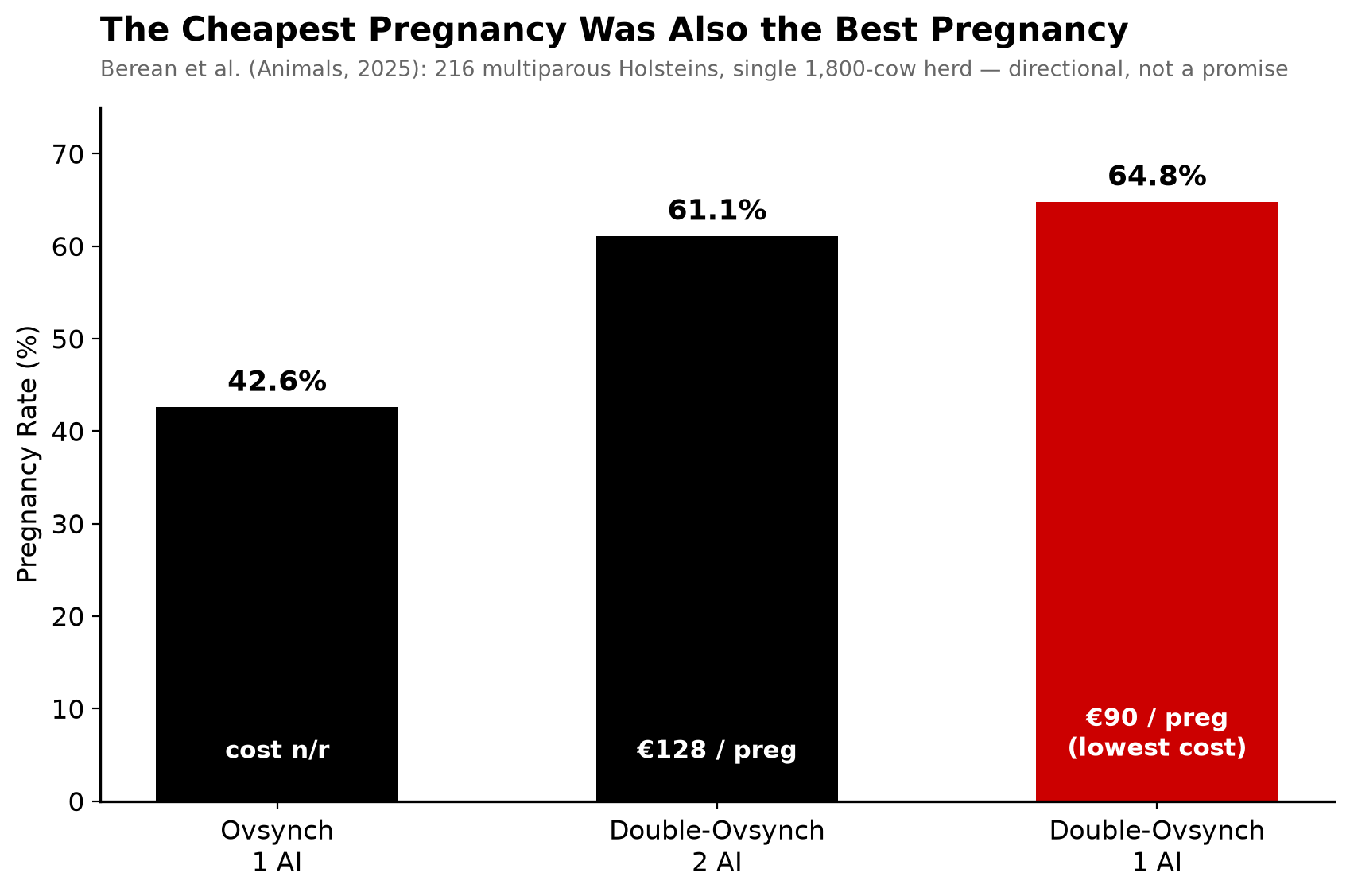
The most striking recent result comes from Berean and colleagues (Animals, 2025), who compared four protocols in 216 multiparous Holstein cows at a single 1,800-cow farm in Alba County, Romania, between October 2023 and May 2024. Double-Ovsynch with a single timed AI hit a 64.8% pregnancy rate — well ahead of standard Ovsynch with one AI at 42.6% — at the lowest cost per confirmed pregnancy, €89.51 (roughly $97 at the 2024 average euro-dollar rate). Adding a second insemination didn’t help. Double-Ovsynch with two AIs came in slightly lower at 61.1% and pushed cost per pregnancy up to €127.65 (about $138). One healthy-cow, single-herd result in one country. Read it as directional, not a promise for your barn.
The economics back it up where fertility is the true bottleneck. Ricci and colleagues (Journal of Dairy Science, 2020) modeled seven programs and found Double-Ovsynch+PGF more profitable than Presynch-Ovsynch — earning about $42 more profit per cow per year than one Presynch-Ovsynch variant — and calculated that U.S. hormone costs would need to run 5 to 14 times higher (2 to 6 times higher in the European market) before any Presynch program overtook it. Borchardt and colleagues (Journal of Dairy Science, 2021) pooled data from 9,735 cows across 11 studies and found that adding a second PGF dose during Ovsynch increased pregnancy per AI by 5.6 percentage points and was profitable in 95% of their scenarios.
The Seasonal Caveat: Why Those Returns Move With the Calendar
None of those economics hold still through the year. Heat stress hammers conception — cows in summer show weaker heats, more silent ovulations, and lower fertility to detected estrus. UW-Madison’s own DairyComp heat-stress work shows the pattern in hard numbers: one herd holding a 36% 21-day pregnancy rate in the cooler months dropped to 27.5% across June, July, and August.
That’s part of why the timed-AI advantage widens in hot months. When cows aren’t expressing strong heats, a program that breeds every eligible cow on schedule protects your service rate in the exact window when estrus detection falls apart. The Z. Li 2024 work pointing to fewer cysts and inactive ovaries under Double-Ovsynch matters most in the herds and seasons where ovarian function is already under strain. A protocol that looks like overkill in October can look like insurance in July.
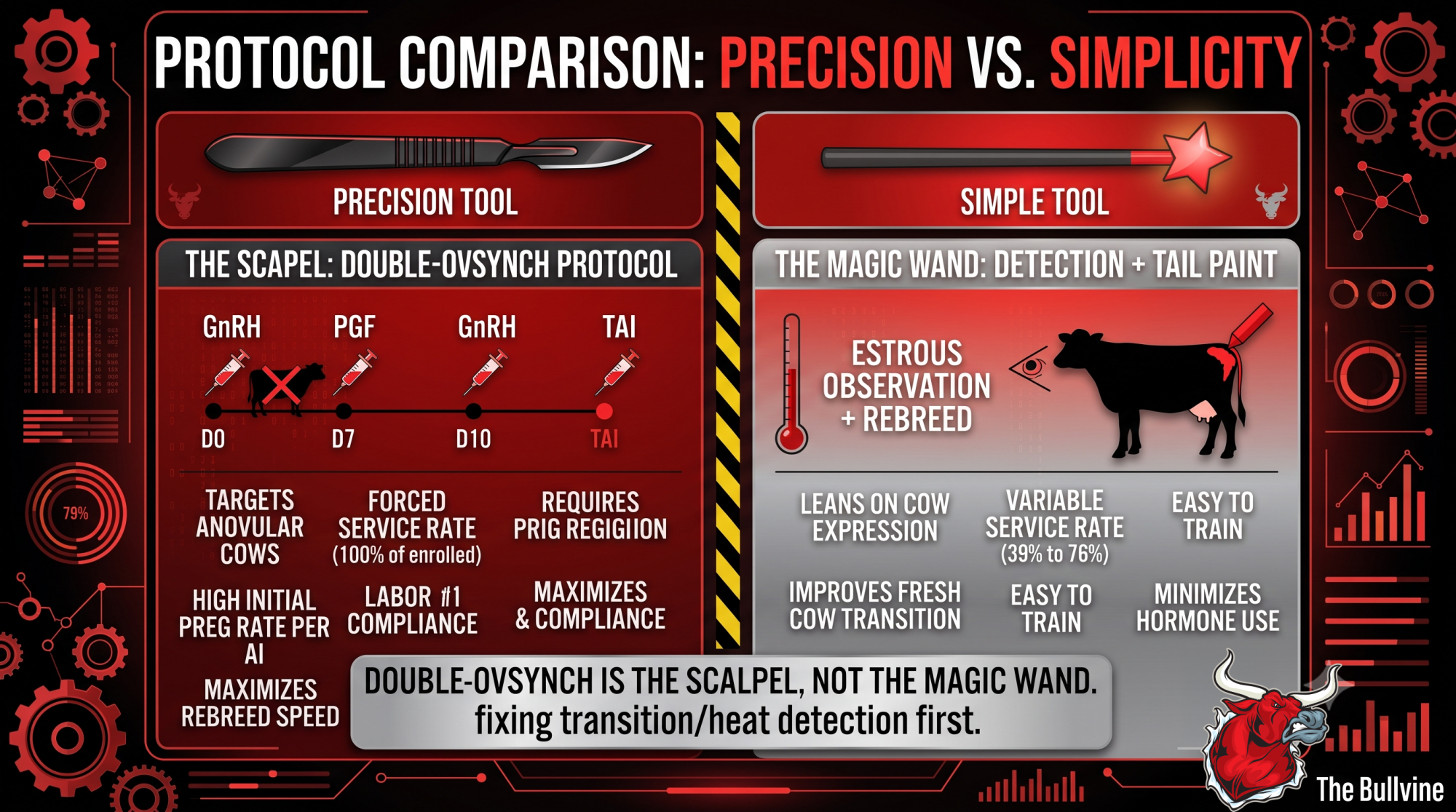
But none of that rescues a broken foundation. Double-Ovsynch is a scalpel, not a magic wand. If your service rate is stuck at 45% because heat detection is broken, more hormones won’t fix cows that never get bred. If your transition pens are throwing metritis and ketosis, and cows are dropping a full point in body condition, the protocol is decorating a problem that lives in the close-up pen. The honest sequence: fix body condition and transition, tighten detection and rebreeding, then reach for the scalpel.
The Barn Math That Stops the Shrug
At some point, a manager sitting at 22% PR decides that’s fine. Here’s the number that tends to change the conversation — a line item with a herd size attached, not a simulation.
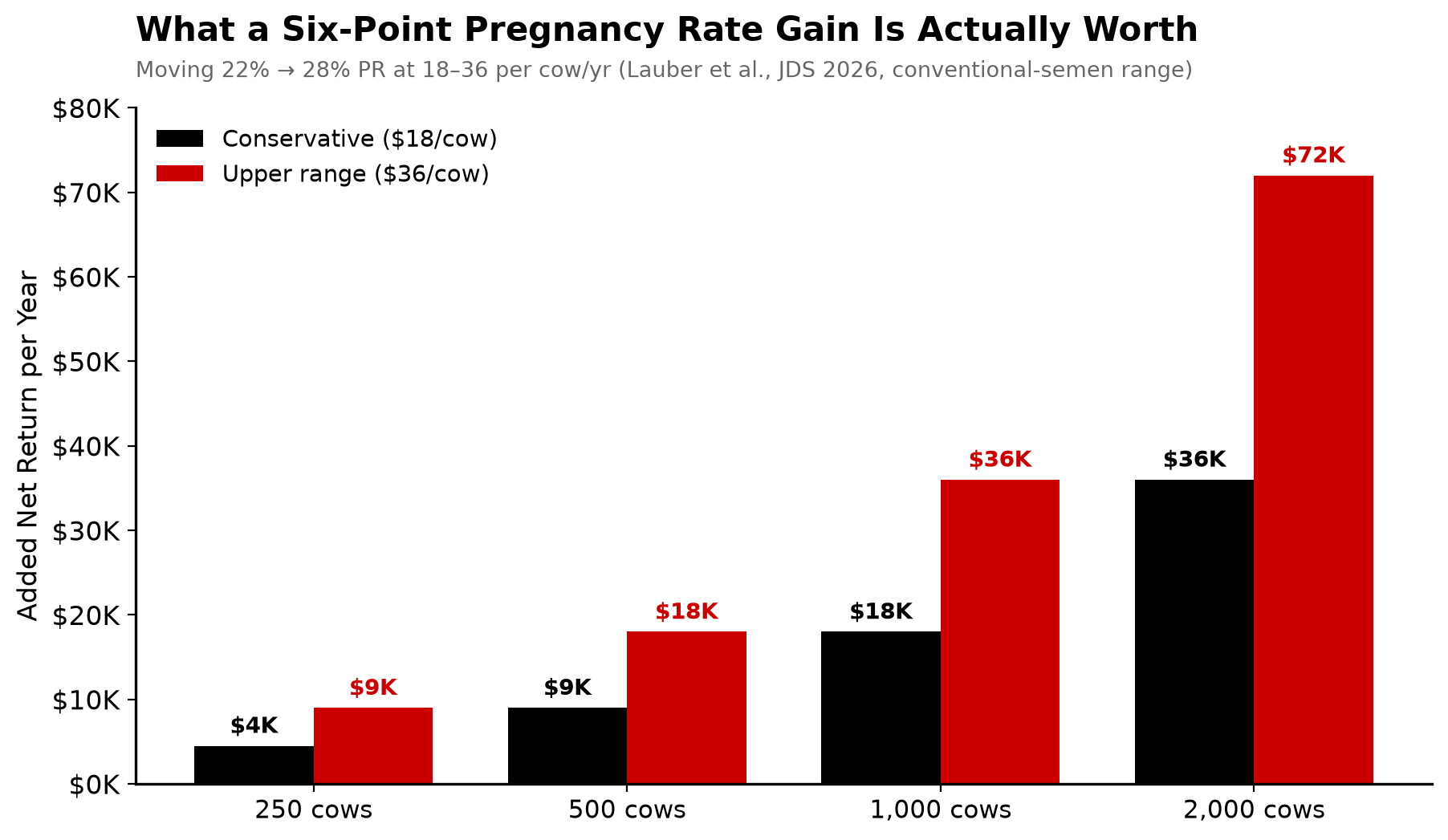
Lauber and colleagues (Journal of Dairy Science, 2026) modeled net return per one-percentage-point gain in 21-day PR: $3 to $6 per cow per year for conventional-semen herds, $2 to $7 for sexed-plus-beef scenarios, depending on the starting point. An earlier Lauber stochastic evaluation (Canadian Journal of Animal Science, 2015) pegged the gain from moving PR from 10% to 30% at roughly US$75 per cow per year, driven mostly by fewer days open and fewer reproductive culls.
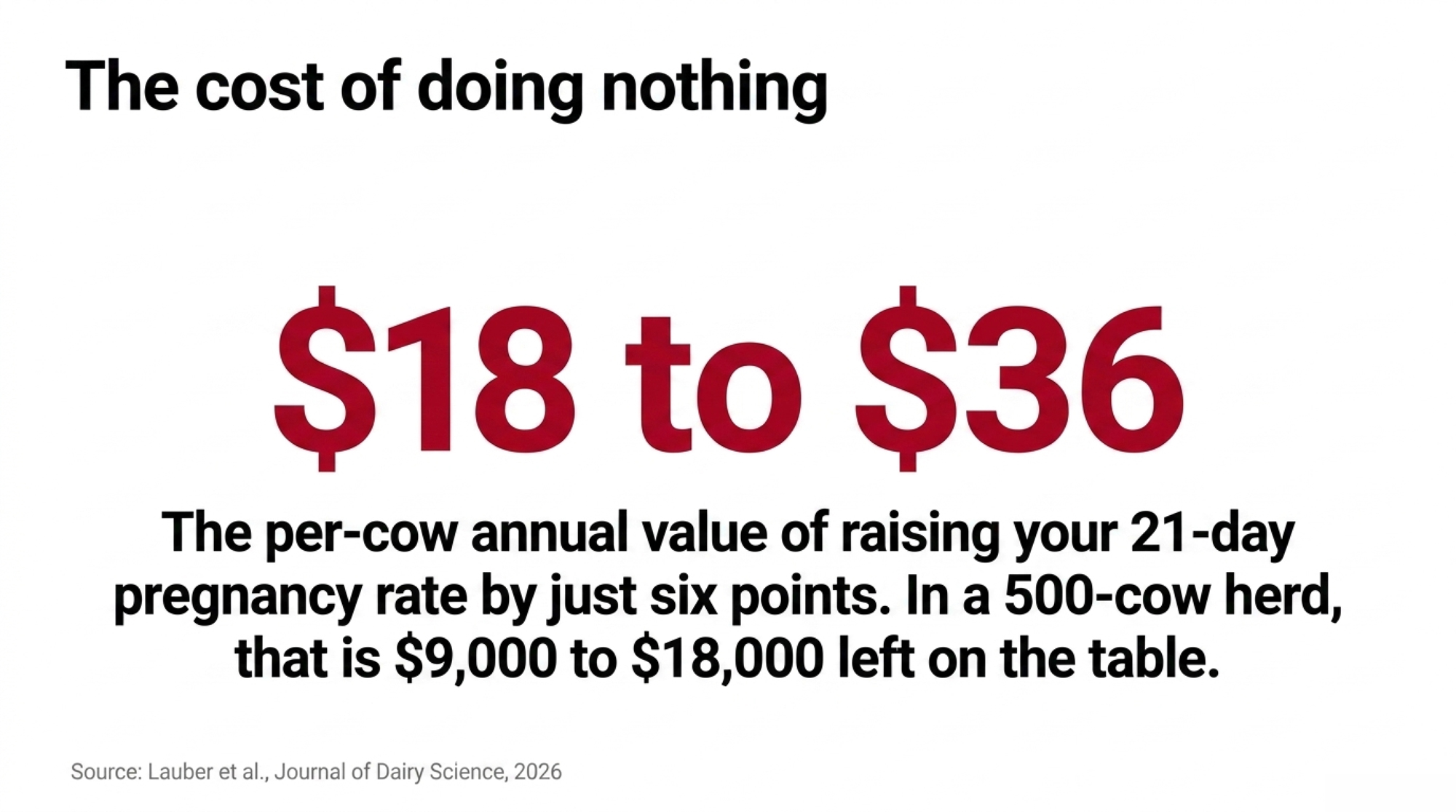
Run it on your own herd. A move from 22% to 28% PR — six points — lands somewhere near $18 to $36 per cow per year in Lauber’s 2026 framework. In a 500-cow herd, that’s roughly $9,000 to $18,000 a year. In a 1,000-cow herd, double it. And Cabrera’s reproductive economics work (Animal, 2014) puts the value of a single pregnancy in high-yielding confined herds at roughly $128 to $232 — so a few points of PR across hundreds of eligible cows is dozens of pregnancies you didn’t have before.
The sharp part isn’t the cost of doing something wrong. It’s the cost of doing nothing differently.
Your 30-Day Repro Audit Checklist
▢ Check the software setup first. Before running any numbers, confirm your voluntary waiting period (VWP), breeding cutoffs, and do-not-breed flags are accurate in DairyComp or PCDART — so your service-rate calculation isn’t lying to you.
▢ Pull the trailing 12-month average. Run BREDSUM\E or Report 126. Don’t act on a single 21-day cycle snapshot — it’s too noisy.
▢ Isolate your bottleneck. Compare your service and conception rates against the Schefers benchmarks (targets: service rate above ~55%, conception rate above ~32%).
▢ Align your checkbook with your bottleneck. If service rate is under 50%, fix heat detection, rebreeding intervals, and detection discipline (tail paint, activity monitors, whatever your barn runs) before buying more hormones. If the conception rate is under 30%, focus on fresh-cow transition, bunk management, and body condition (aim for 2.75 to 3.0 at calving) before implementing a complex timed AI protocol.
▢ Do the barn math. A six-point PR gain — say 22% up to 28% — is worth roughly $18 to $36 per cow per year on Lauber’s 2026 conventional-semen range. Multiply the low end by your herd size for a conservative budget — 500 cows × $18 = $9,000 a year just off the floor of the range — then use that figure to size your next protocol change.
When your next repro report lands, you’ll face a quiet choice most managers never notice they’re making: read the number the tech hands you, or read the two numbers your milk cheque is actually keeping score with. One of them tells you the herd is stuck. The other tells you where to dig. Which one are you going to manage to this breeding season?
Key Takeaways
- Conception rate tells you how well a breeding worked, not how many cows got bred. Split your 18% into service rate and conception rate before you spend a dollar — the number alone hides which problem you actually have.
- If service rate is under 50%, fix heat detection and rebreeding first; more hormones won’t get open cows bred. If conception rate is under 30%, the fight is in the close-up pen — transition, bunk, and body condition at 2.75–3.0.
- Double-Ovsynch earns its keep when fertility is the real bottleneck, especially through summer heat stress. It’s a scalpel, not a rescue for a barn that never gets cows bred.
- Pull your trailing 12-month BREDSUM\E or PCDART Report 126 this month, check both levers against the Schefers ranges, and a six-point PR gain is worth roughly $18–36 per cow a year on Lauber’s 2026 numbers.
Complete references and supporting documentation are available upon request by contacting the editorial team at editor@thebullvine.com.
Learn More
- Dairy herd health and reproduction 2026 benchmarks – The Bullvine — Deliver an immediate operational edge using concrete thresholds for blood BHB screening, Brix refractometer colostrum values, and Double-Ovsynch cost-per-pregnancy targets to eliminate fresh cow transition failures before breeding.
- Penn State’s $3,110 Heifer Trap: When “One More Lactation” Costs 3× More Than Replacing Her — Protect long-term margins by mapping current heifer replacement values against open cows past 200 days in milk, utilizing retention pay-off models to stop unprofitable animals from draining herd cash flow.
- Daughter Pregnancy Rate | The Bullvine — Uncover a hidden genetic bottleneck where subclinical heat stress at a THI of 60 silently cripples conception rates, allowing you to filter out vulnerable cow families and select sires built for hot-weather fertility.
 The Sunday Read Dairy Professionals Don’t Skip.
 The Sunday Read Dairy Professionals Don’t Skip.
Every week, thousands of producers, breeders, and industry insiders open Bullvine Weekly for genetics insights, market shifts, and profit strategies they won’t find anywhere else. One email. Five minutes. Smarter decisions all week.