

Of the $349.48 it took one Wisconsin herd to make a confirmed pregnancy, the embryo was $50. Cows that got one and didn’t conceive were $217.41. Only one of those has a salesperson attached.
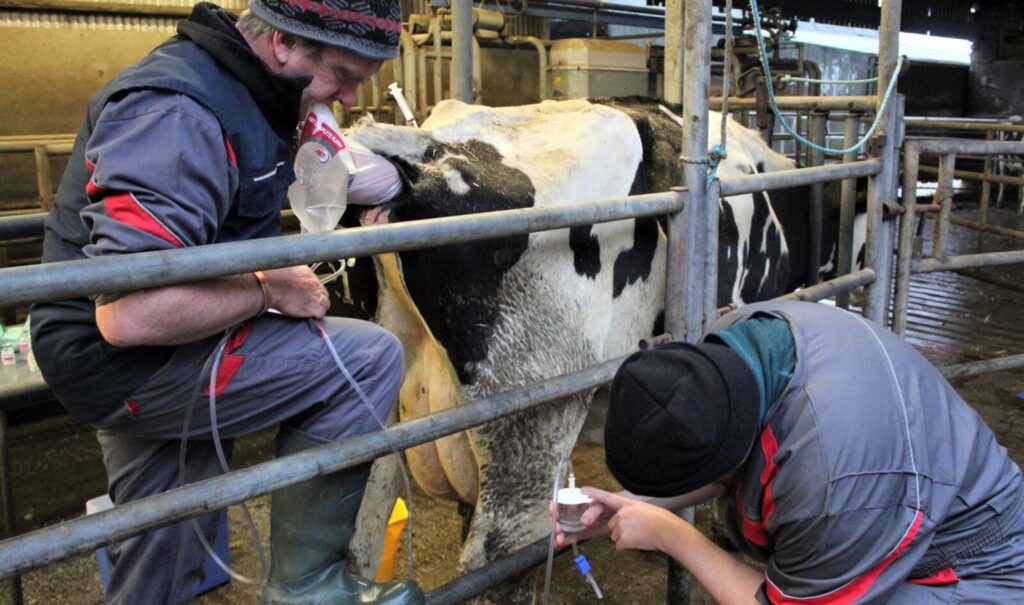
A 2,000-cow Jersey dairy in south-central Wisconsin ran two recipient protocols side by side across six months of 2022 — same barn, same embryos, same $400 calf contract. One cleared $1,465 on 100 recipients. The other lost $1,018. The embryo transfer cost per pregnancy came apart by $135.35, which is more than any discount you’ll negotiate this year, and nobody sold them a different embryo. It came down to which two days of the week the transfer window was open.
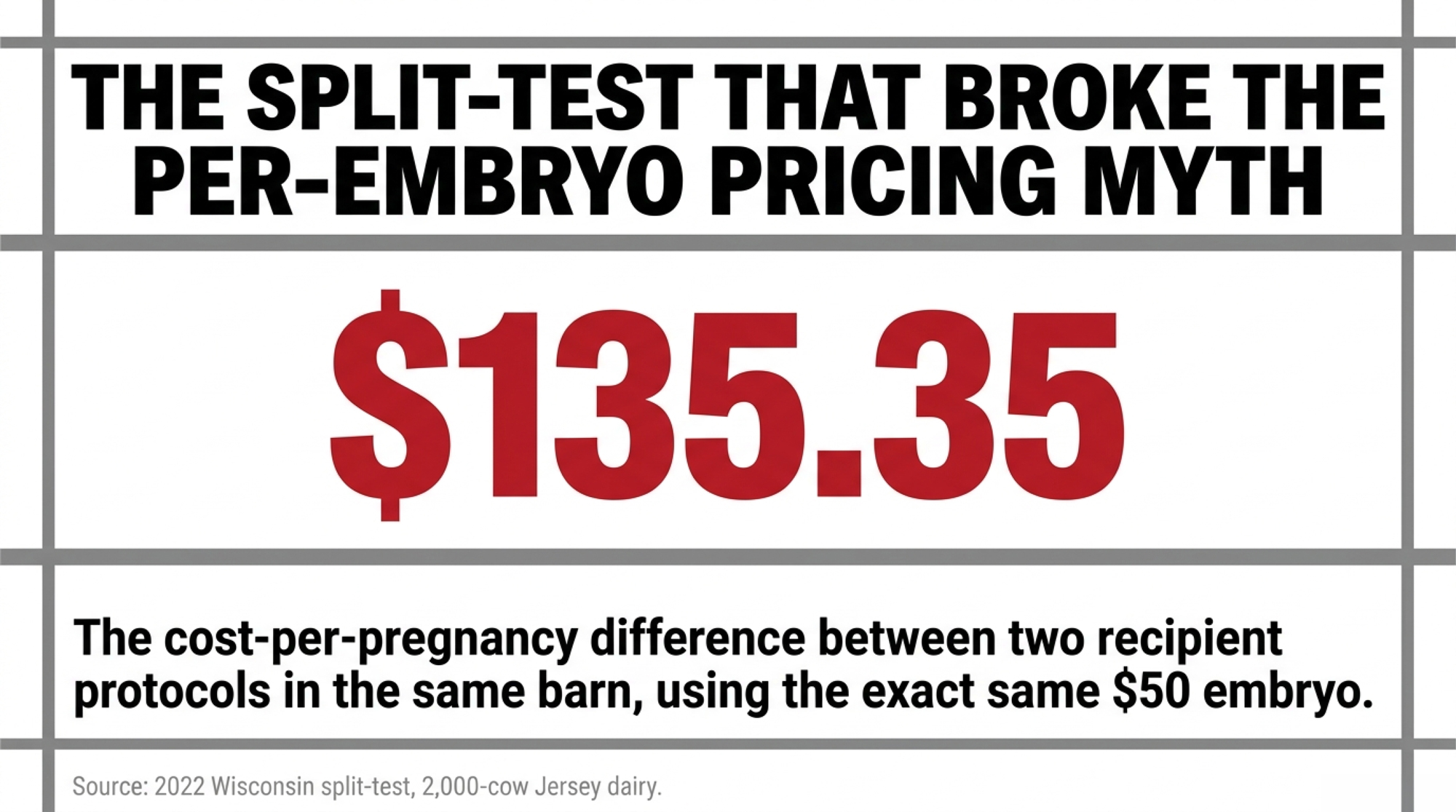
Natalia Hincapie went in chasing a narrow question about hCG. Working under Paul Fricke at the University of Wisconsin–Madison, her master’s project asked whether 2,500 IU at transfer would lift pregnancy outcomes in lactating Jerseys. It raised progesterone and luteal volume and did nothing for pregnancy per transfer. The farm — unnamed in the published paper, a condition of its participation — was running terminal Angus IVP embryos into those recipients to sell day-old crossbreds, not to build replacements.
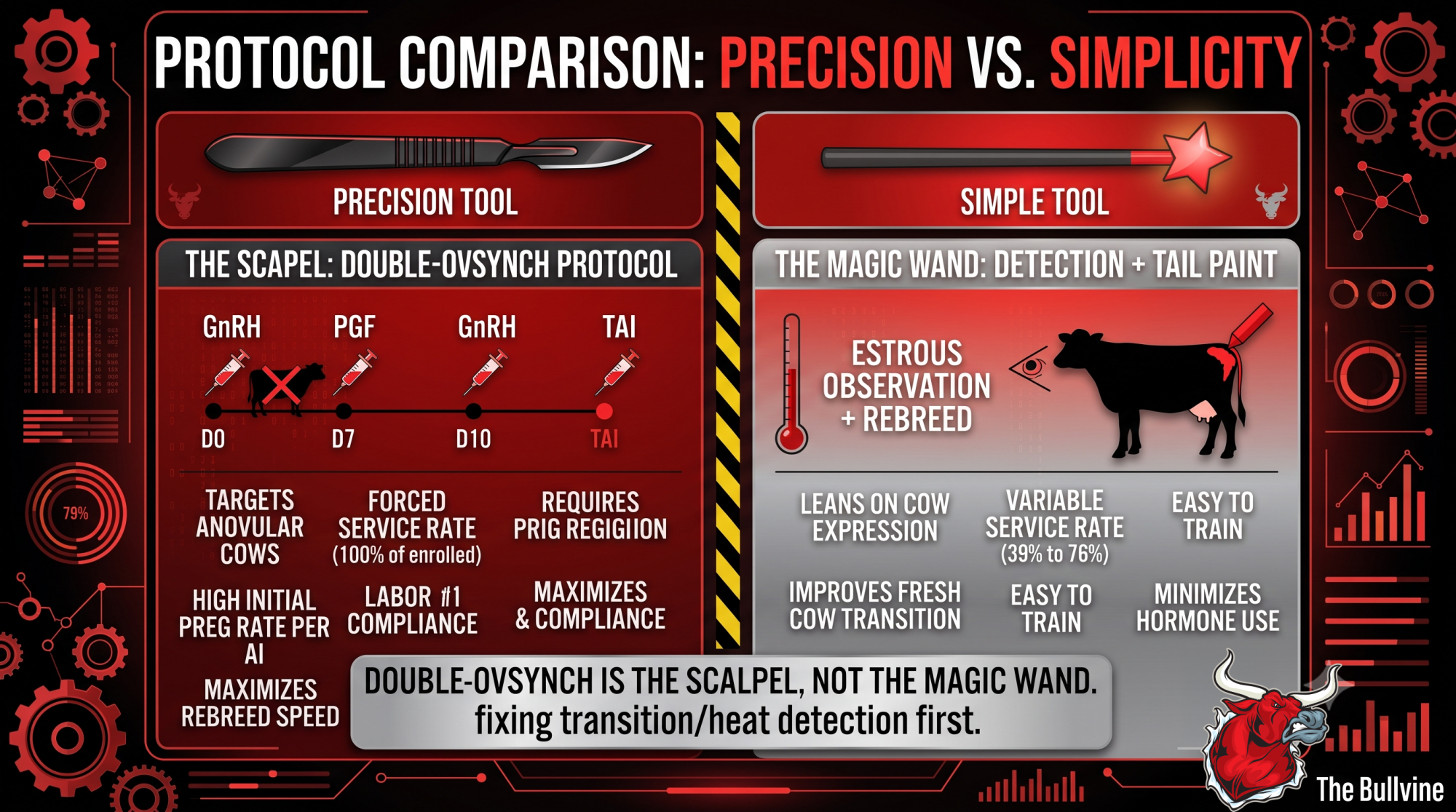
Two protocols ran side by side. Protocol A was Double-Ovsynch, every cow transferred on a fixed schedule after synchronized ovulation, no heat watching. Protocol B was synchronized estrus, transferred only once standing heat was observed. Estrus detection in that second arm ran at 74%, which sounds respectable right up until you check what happened to the cows that cycled on the wrong days.
The myth every embryo conversation starts with
| Cost line | Amount | Share of total | Has a sales rep? |
|---|---|---|---|
| Nonpregnant recipients | $217.41 | 62% | No |
| Embryo | $50.00 | 14% | Yes |
| Transfer (ET fee + ultrasound) | $40.00 | 11% | No |
| Hormonal treatments (incl. hCG $17.97) | $28.77 | 8% | No |
| Veterinary exams | $9.50 | 3% | No |
| Unutilized recipients | $3.80 | 1% | No |
Ask a producer what an embryo program costs and you’ll get a per-embryo number. Ask a rep and you’ll get a per-embryo number with a volume discount attached. That’s the frame — cost equals price, and price is negotiable.
The frame survives right up until somebody itemizes a real program. Then the negotiation everybody has turns out to be over the fourth-largest line on the invoice, and the largest line turns out not to be on the invoice at all.
Running the Numbers
On a 400-cow herd, enroll 100 cows as recipients. That’s a quarter of the herd, which is workable. On 200 cows it’d be half, which isn’t — scale the enrollment before you scale the conclusion.
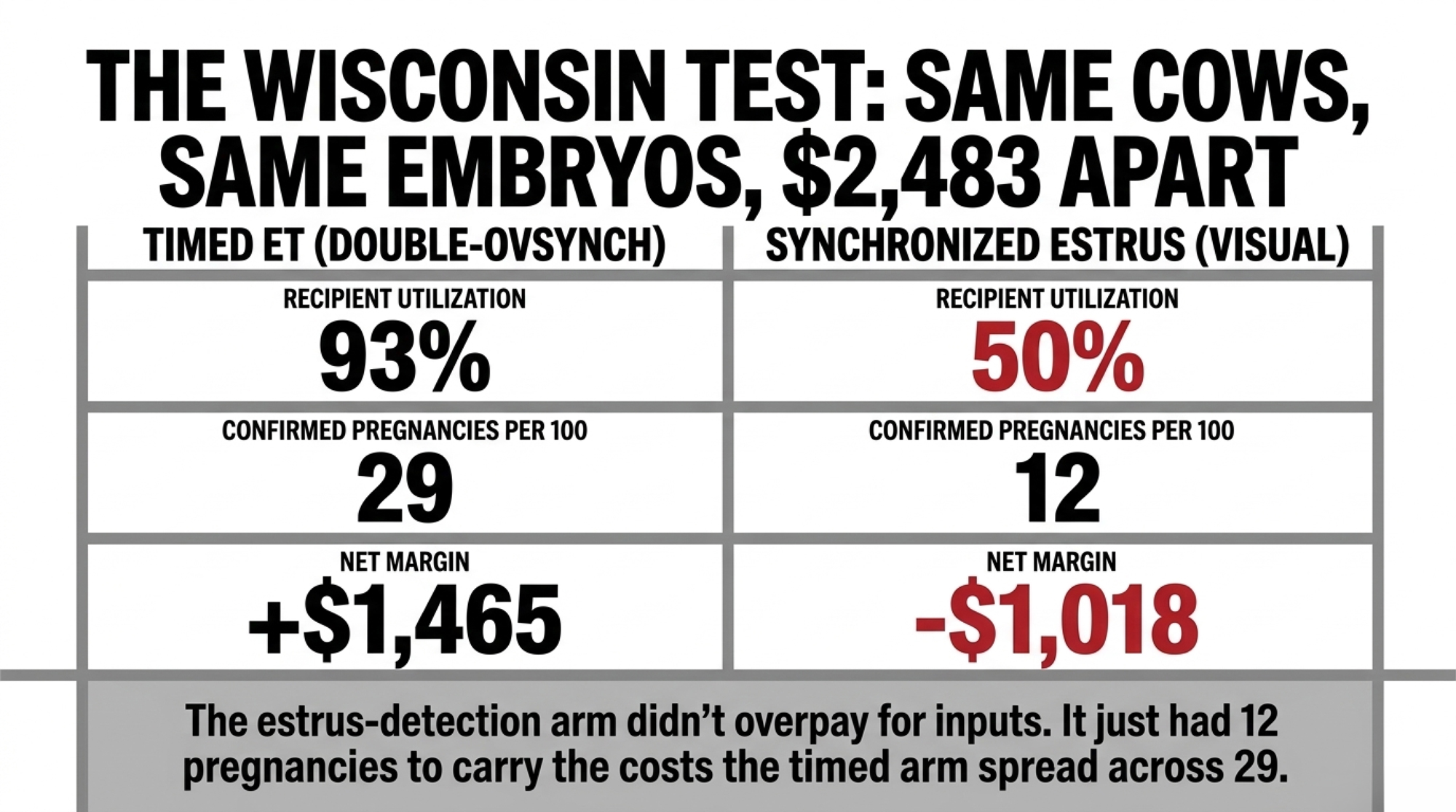
Run each protocol at the performance this herd actually recorded: 93% utilization and 31% pregnancies per transfer at day 61 for Double-Ovsynch, 50% and 24% for synchronized estrus. Substitute your own contract price and volume. The structure holds, the dollars won’t.
| Metric / Cost Component | Timed ET (Double-Ovsynch) | Synchronized Estrus (Visual Detection) |
| Recipient utilization | 93% | 50% |
| Pregnancy rate (day 61) | 31% | 24% |
| Transfers per 100 enrolled | 93 | 50 |
| Confirmed pregnancies | 29 | 12 |
| Cost per confirmed pregnancy | $349.48 | $484.83 |
| Total enrollment cost (100 cows) | $10,134.92 | $5,817.96 |
| Gross calf revenue ($400/head) | $11,600.00 | $4,800.00 |
| Net program margin | +$1,465.08 | −$1,017.96 |
Roughly $2,483 apart on the same 100 cows. Read the estrus-detection column carefully before you draw the wrong conclusion from it: that program spent less in total, because half those cows never received an embryo. Fewer transfers, fewer pregnancies, and every fixed cost landing on a smaller base.
What the table actually measures is a denominator. The estrus-detection arm didn’t overpay for a single input — it just had 12 pregnancies to carry costs the timed arm spread across 29. Cost per pregnancy isn’t a price you get quoted. It’s a quotient your calendar sets.
Now price the alternative you were actually considering. Knock 20% off your embryos and you save about $31 a pregnancy. The protocol difference was worth $135.35 — roughly four times the money, and none of it visible on a purchase order.
Where does the money actually go in a $349 pregnancy?
The full Double-Ovsynch stack behind one confirmed pregnancy:
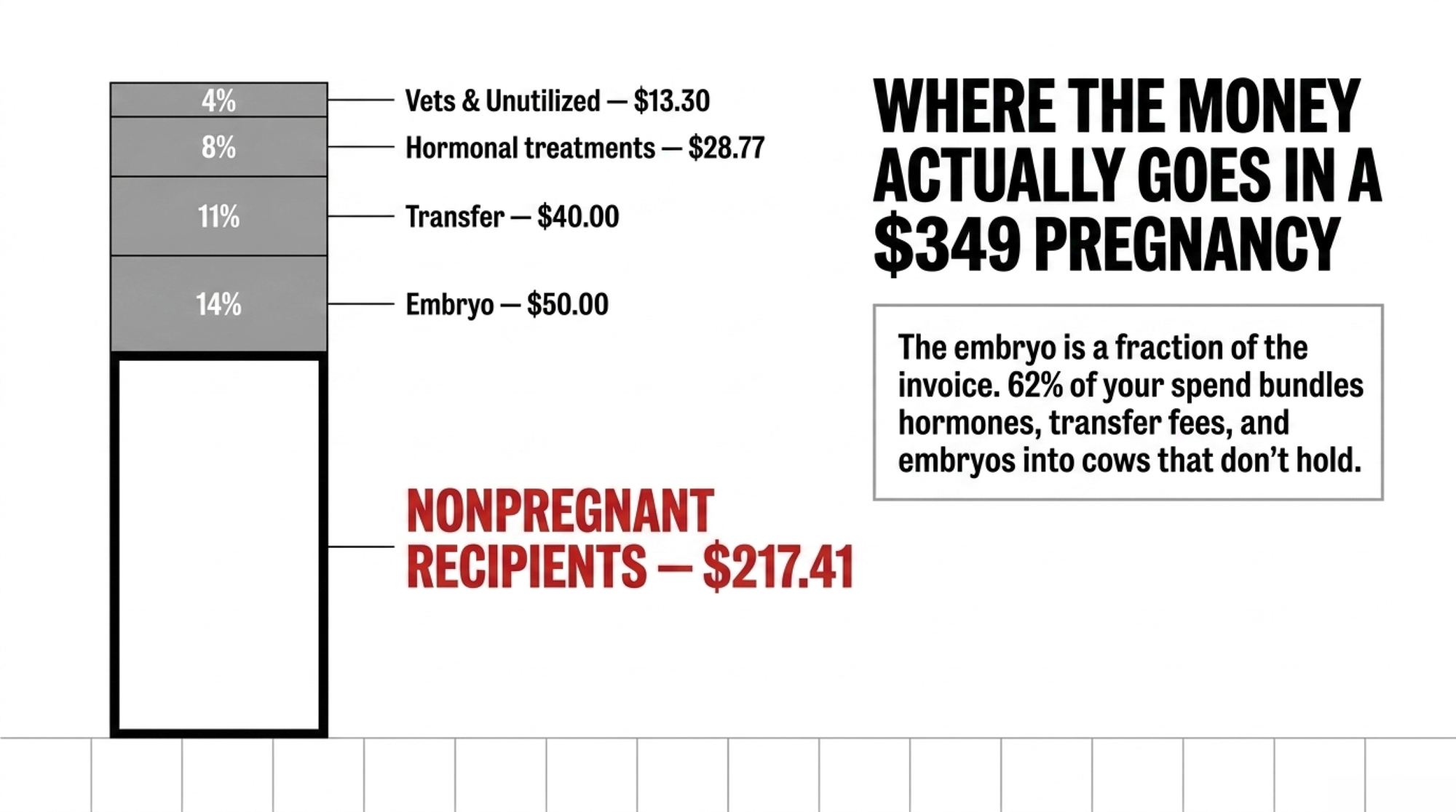
- Nonpregnant recipients — $217.41, 62%. Cows that received an embryo and didn’t hold.
- Embryo — $50.00, 14%. The list-price line, and the only one with a rep attached.
- Transfer — $40.00, 11%. A $35.25 ET fee plus a $4.75 recipient eligibility ultrasound.
- Hormonal treatments — $28.77, 8%. Of which $17.97 was hCG, against $10.80 for the protocol hormones alone.
- Veterinary examinations — $9.50, 3%. Pregnancy diagnosis and confirmation work.
- Unutilized recipients — $3.80, 1%. Cows synchronized but never transferred into.
(Dollar figures are the study’s. Percentages are Bullvine calculations against the $349.48 total and don’t sum to exactly 100 because of rounding.)
That $217.41 deserves a slow read, because it isn’t pure recipient waste. It bundles hormones, transfer fee, the day-33 pregnancy check and the embryo itself for all 103 cows that got one and didn’t conceive.
Count those embryos and your real embryo spend runs about $155 per pregnancy — roughly 44% of the total, not the $50 sitting on its own line. (Bullvine calculation derived from the study’s stated formula. That figure is ours, not the authors’.)
So the embryo isn’t the trivial cost some cost tables make it look like. It just isn’t the biggest lever either. There’s a difference, and the difference is worth $135.35.
Since the hCG didn’t move pregnancy per transfer, a herd skipping it is working from a lower stack than the published figure — call it $331.51 before you compare against your own contract.
Why couldn’t half those cows get an embryo?
Transfers were scheduled Thursdays and Fridays. That was the binding constraint on the entire program.
Cows expressing estrus four, five, six, or seven days after the final prostaglandin — 24% of that group, 44 head out of 180 — couldn’t be transferred into at all. Synchronized, checked, paid for, and then no window. The paper doesn’t say whether the two-day schedule reflected clinic routing, the farm’s own arrangement, or both. Only that cows cycling outside it were unusable.
The estrus-detection arm ran so poorly the farm’s management team wasn’t willing to continue with it. That’s how the partial budget came to exist in the first place.
Be precise about causation, though, because the short version of this story is too simple. The paper names two drivers: the utilization gap and fewer pregnancies per transfer among the estrus-detection cows, 24% against 31%. The narrow window drove the first. Together they built the $135.35 — and neither one is an embryo problem. Repro fundamentals come first, and they’re cheaper than any genetics purchase. The 6-day protocol getting herds to 60% heifer conceptionis the move most herds should try before they buy an embryo.
The Cost Stack in 2026: What Moves When You Leave Wisconsin
Everything above carries a date and a zip code. The cost analysis covers the preliminary experiment only — June through November 2022 — and every line item was priced by Jefferson Veterinary Clinic in Jefferson, Wisconsin, in June 2022. Four years on, two things have moved: the inputs themselves, and what a clinic somewhere else charges for them.
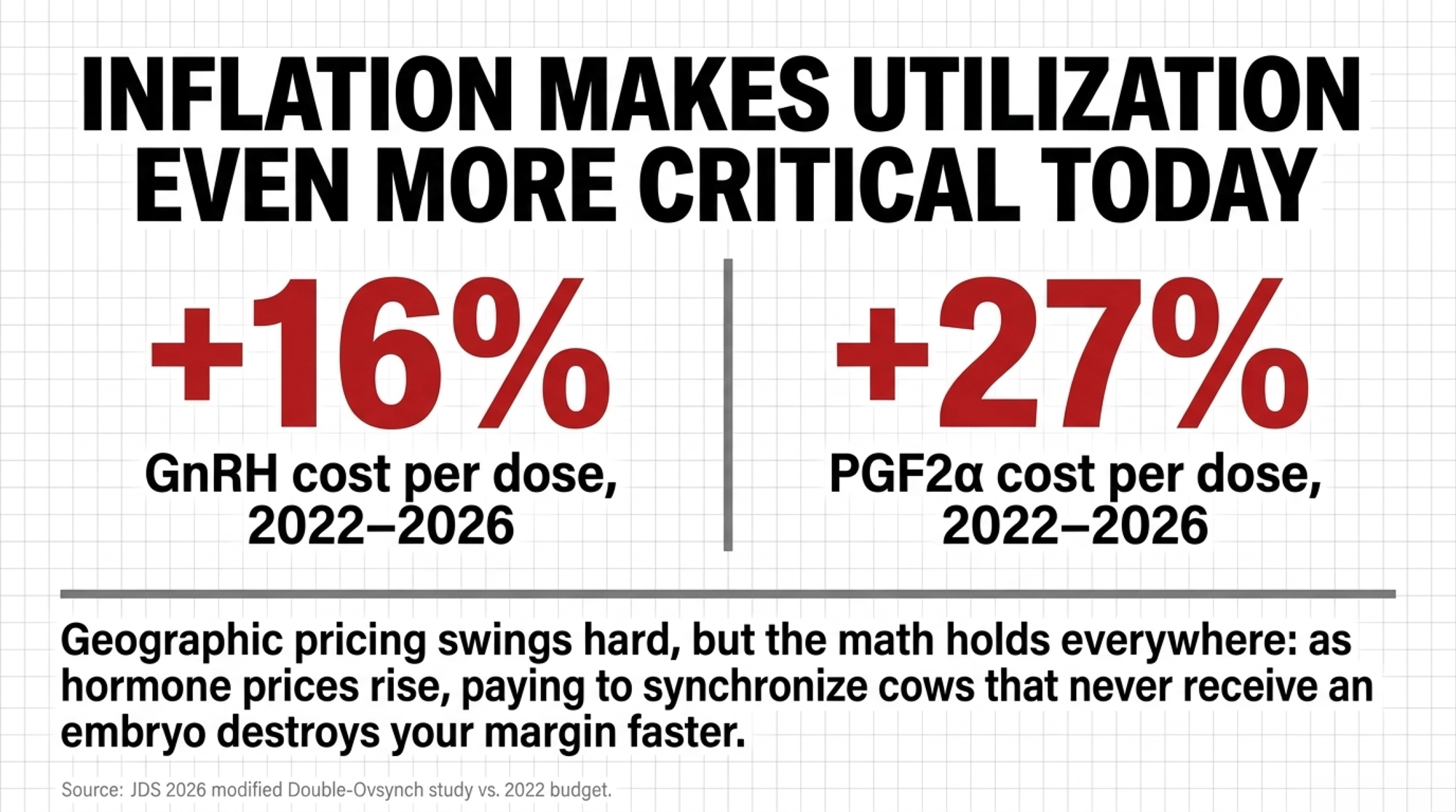
Start with the inputs. A modified Double-Ovsynch study published in the Journal of Dairy Science in January 2026 lists GnRH at $1.53 a dose and PGF2α at $2.34. Read those against Hincapie’s June 2022 budget as dollar figures from the same journal and that’s GnRH up roughly 16%, prostaglandin up 27%. (Bullvine calculation. Neither paper states a conversion, so treat those percentages as direction, not a benchmark.)
Then look at what market does to the same two molecules:
| Source / market | GnRH per dose | PGF2α per dose |
| Hincapie budget, Wisconsin, June 2022 | $1.32 | $1.84 |
| Modified Double-Ovsynch, JDS, January 2026 | $1.53 | $2.34 |
| 2025 economic evaluation of Double-Ovsynch | USD 2.60 | USD 2.60 |
| 2025 study, large Romanian commercial dairies | 4 EUR | 3 EUR |
Geography swings harder than four years of inflation did. The Romanian figures come off operations where veterinary services get contracted at scale for 50-plus animals per visit — volume that should push prices down, not up. For the wider protocol-cost picture, two herds solving the same pregnancy-rate problem in opposite directions runs the European comparisons alongside the US numbers.
The transfer line needs its own sanity check. Published commercial ET price lists put a bovine transfer somewhere between $65 and $80 per recipient depending on whether the embryo is fresh, direct-thaw, or vitrified, with IVF embryo production quoted from $55 to $140 an embryo depending on volume. Those are vendor list prices, not independently verified, and every company publishing them sells the service. They also sit well above the $35.25 the Wisconsin veterinarian charged, which may reflect a research-collaboration rate rather than a quote you’d get. Same story on the embryo: those were Angus IVP units carrying a $50 list price from J.R. Simplot Company, priced for volume rather than genetic merit. Nothing like what a dairy embryo selected on index costs.
Canadian readers get less to work with. No published equivalent to the Hincapie breakdown surfaced in a search for this piece, and CETA/ACTE doesn’t publish member pricing. North of the border the cost structure still holds — utilization still drives it — but you’ll need your own clinic’s numbers plus your own read on health-certificate and import requirements.
None of which makes this a boutique practice. AETA reported that in 2021, U.S. transfers of in vitro-produced embryos — 206,584 fresh and 156,261 frozen — ran well ahead of in vivo-derived transfers at 43,588 fresh and 75,720 frozen. Borrow the structure from Wisconsin. Price it yourself.
What the modeling says about paying more
Albert De Vries and Karun Kaniyamattam at the University of Florida put the break-even price for commercial IVP embryo transfer at $89, against their own 2017 base-case assumption of $165. In that scenario, straight AI beat a full embryo program by $185 per cow per year.
Their follow-up work, summarized in Animal Reproduction in 2020, tested 144 price combinations and found the optimal embryo share ranging anywhere from 3% to 100% of breedings. Only 6 of 24 scenarios favored going all-in, each requiring sub-$100 embryos and a premium paid for genetically superior calves. Their read isn’t that embryos never pay. It’s that some use is profitable across a fairly wide band, and the all-in case is narrow.
Nine-year-old modeling assumptions, so read them as direction rather than a current quote — and check them against what’s happening to genetics pricing right now.
Fresh versus frozen: what ships isn’t what performs
One clarification, because it’s easy to assume otherwise: the Wisconsin work wasn’t a heat-stress study. Nobody was testing summer fertility. The flip side is worth knowing though — that cost analysis ran June through November 2022, which means those pregnancy rates were earned partly through a Wisconsin summer. If anything, 31% may be conservative against a year-round program.
The fresh-versus-frozen question still lands on your invoice. Hansen’s 2020 synthesis in the Journal of Animal Scienceput a number on it: across all studies, pregnancy per transfer for cryopreserved embryos ran 7.4 percentage points below fresh. Frozen is what ships, what stores, and what the Wisconsin herd used. If a supplier leads with fertility performance, ask which product the number came from.
The 30/90/365-Day Playbook for Herds Running Recipients
30 days — audit your recipient utilization rate. Pull last year’s records and divide cows enrolled as recipients by cows that actually received an embryo. An afternoon and your repro software, no capital. Trigger: under 75% and you’re funding synchronization on cows that never get a shot at conceiving. Where it backfires: counting mid-protocol culls as scheduling failures will send you after the wrong fix — separate the health exits from the calendar misses before you conclude anything.
30 days — price your calf contract against the stack. Compare what you’re getting for a day-old crossbred against $349.48. Trigger: under roughly $350 and the Wisconsin 2022 cost structure wouldn’t have covered itself, and with hormone prices up double digits since, that line has drifted upward. Where it backfires: the $349.48 excludes on-farm labor for protocol administration, so treat it as a floor rather than a full accounting.
90 days — rebuild the calendar around the transfer window. Book synchronization to match technician availability instead of hoping heats land on the right days. Requires a conversation with your clinic and a willingness to run timed protocols over heat watching. Where it backfires: switching protocols while keeping a one-day-a-week window buys you the hormone cost and none of the gain. Hormone spend barely differed in Wisconsin — $28.77 against $30.15. The savings came entirely from utilization.
365 days — set your embryo share against your own break-even. Four inputs decide it: negotiated embryo price, surplus calf value, whether anyone pays you a genetic premium, and how wide your genetic gap actually runs against active sires — and remember the base change moved everyone’s numbers before you measure that gap. The published modeling puts the answer anywhere from 3% to 100%, and closer to zero more often than the pitch suggests. Opportunity signal: clear 90% utilization with a contract comfortably above $350 and you’re on the profitable side of the Pereira range — that 2024 JDS work modeled Jersey herds swinging from $52.90 to $232.90 per cow per year on embryo cost and beef calf price alone, so there’s real room above the threshold.
365 days — weigh terminal beef against replacement scarcity. Every recipient carrying a terminal beef embryo is a recipient not carrying a replacement dairy calf, and that trade got more expensive. USDA NASS reported 3.90 million dairy replacement heifers on January 1, 2026, with 2.50 million expected to calve against 9.57 million milk cows — a 26.1% ratio. Our read: run the terminal program on the cows you’d never keep a daughter from, and check what a replacement actually costs you now before you widen the share.
Key Takeaways
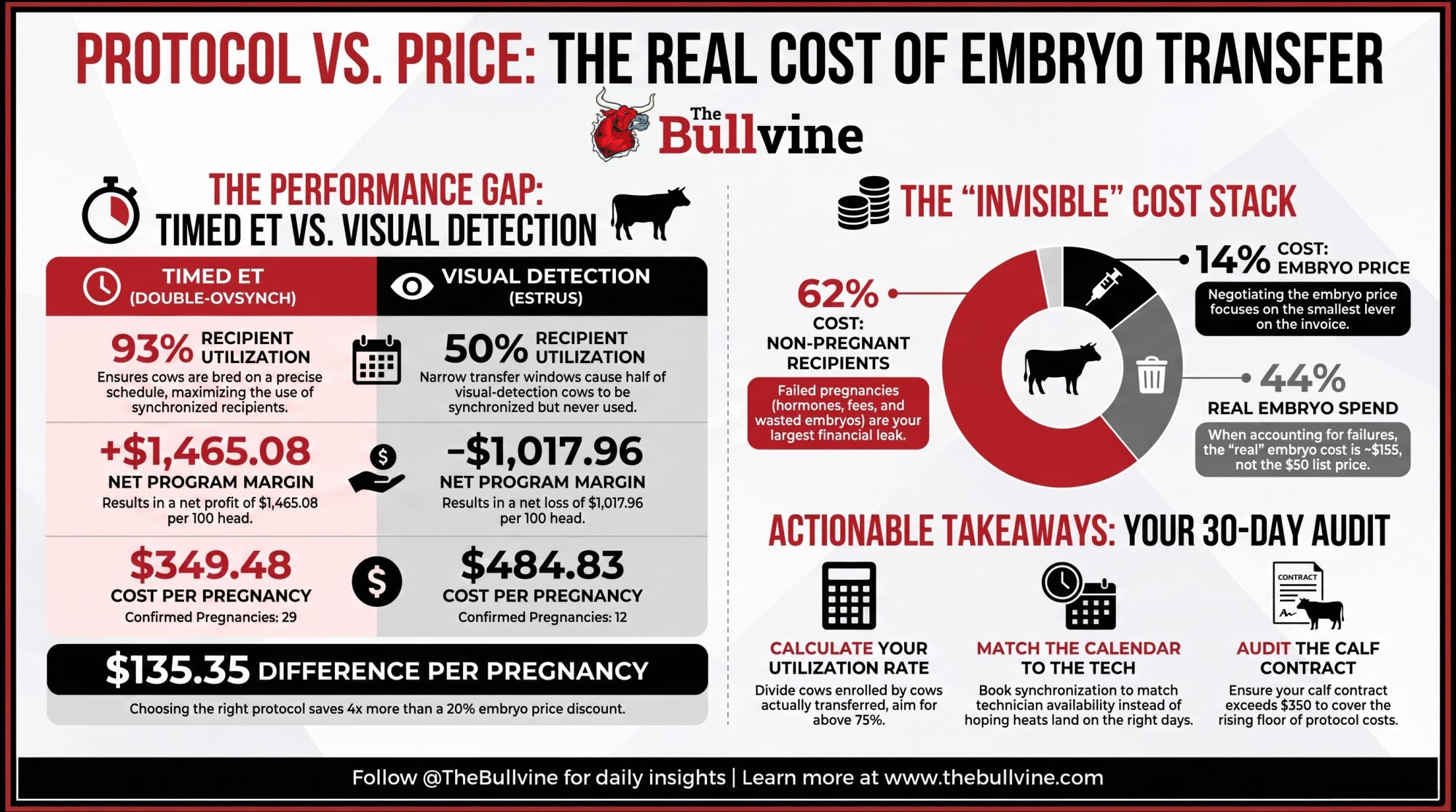
- Recipient utilization is the number that decides this, not embryo price. This herd ran 93% one way and 50% the other, and per 100 cows enrolled that split a $1,465 gain from a $1,018 loss.
- Price negotiation is the smallest lever on this board. Your calendar is the biggest, and no supplier will bring it up because there’s nothing in it for them.
- Pull the audit inside 30 days: cows you enrolled as recipients divided by cows that actually got an embryo. Under 75% and you’re paying full freight on synchronization for cows that never get a shot.
- These were $50 terminal Angus embryos sold as day-old crossbreds, priced June 2022, on a $400 contract. Borrow the cost structure, not the dollars — under roughly $350 a calf it didn’t cover itself.
The trade-off nobody prices
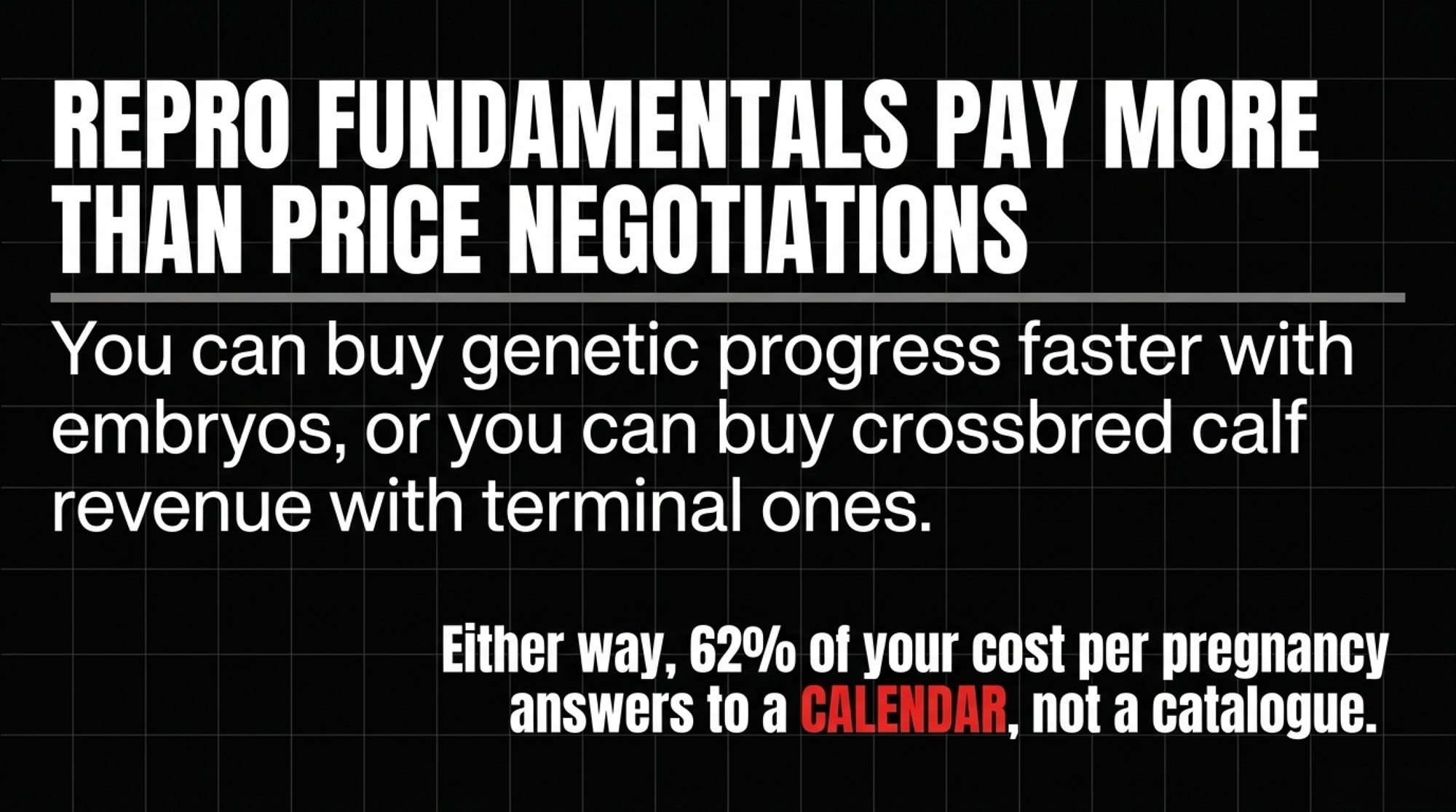
You can buy genetic progress faster with embryos, or you can buy crossbred calf revenue with terminal ones. Either way you hand 62% of your cost per pregnancy to whatever your recipient pen does next, and that pen answers to a calendar, not a catalogue.
The Wisconsin herd didn’t fail at genetics. It ran two protocols and one of them lost $1,017.96 per 100 enrolled cows on a scheduling conflict.
So pull the number that describes your barn instead of somebody else’s. What percentage of the cows you enrolled as recipients last year actually received an embryo — and what does that gap cost you against the calf contract you already signed?
Figures here are drawn from published research and public data as cited. This is journalism, not financial or veterinary advice — check your own numbers with your vet and your accountant.
Complete references and supporting documentation are available upon request by contacting the editorial team at editor@thebullvine.com.
Learn More
- Beef-on-Dairy’s $6215 Secret: Why 72% of Herds Are Playing It Wrong — Arms you with reproductive performance tiers showing why herds below a 20% pregnancy rate go broke chasing calf premiums, while 30% herds safely capture $6,215 monthly without starving heifer inventory.
- 211,000 More Dairy Cows. Bleeding Margins. The 2026 Math That Won’t Wait — Exposes the macro trap where four-figure calf checks keep low-producing cows in stalls, drying up replacement pipelines to 27 heifers per 100 cows as national milk margins deteriorate.
- How Dairy Farmers Can Benefit from Embryo Surrogacy — Follows the money on commercial operations leasing recipient uterus space directly to purebred beef breeders, turning surplus dairy recip pens into premium custom-calving revenue centers without buying embryos outright.
 The Sunday Read Dairy Professionals Don’t Skip.
 The Sunday Read Dairy Professionals Don’t Skip.
Every week, thousands of producers, breeders, and industry insiders open Bullvine Weekly for genetics insights, market shifts, and profit strategies they won’t find anywhere else. One email. Five minutes. Smarter decisions all week.