Thirty-five cows died on Blackburn Road in February. USDA prices the replacements at $3,230 a head. ISO’s farm form pays $2,000 — and that’s before depreciation and coinsurance.
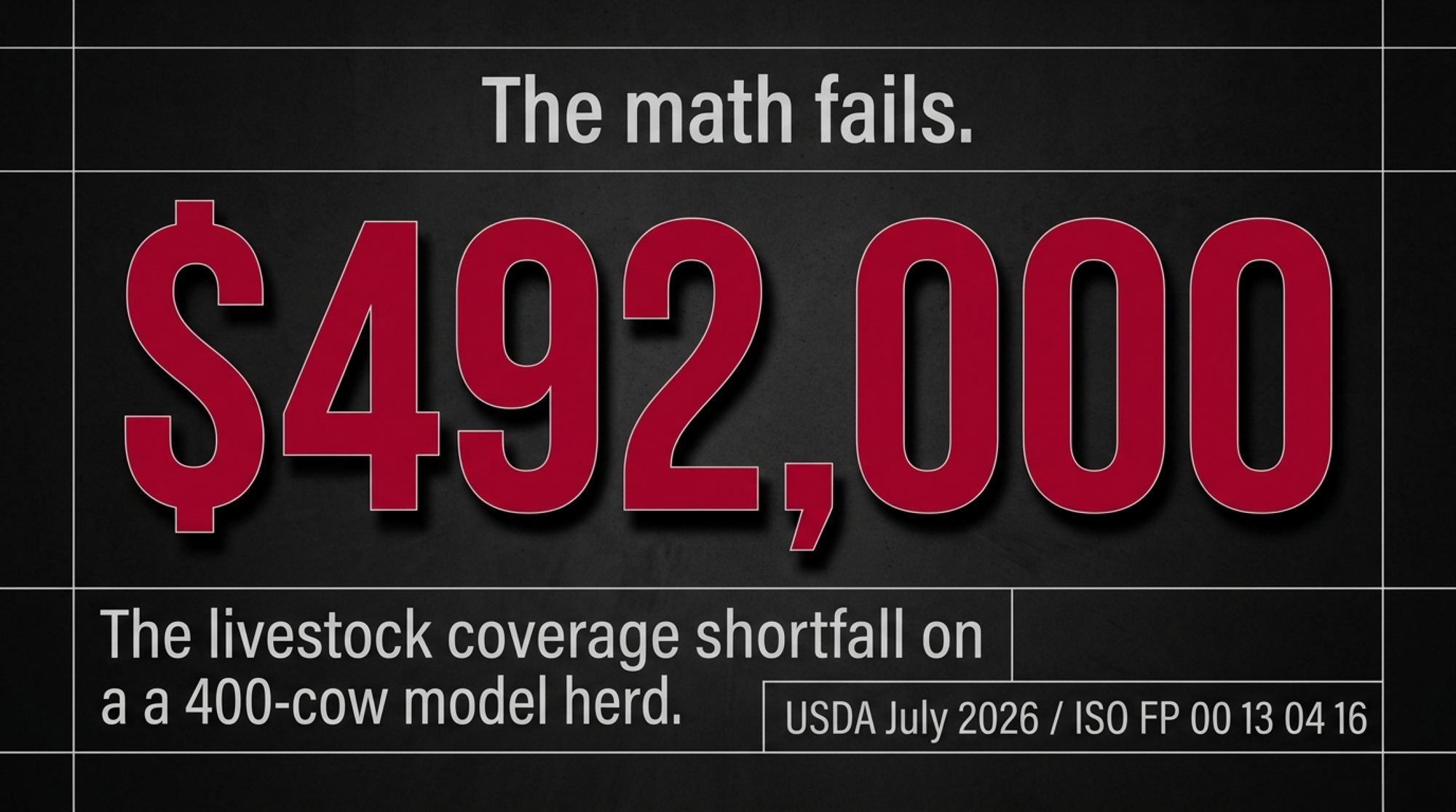
Executive Summary: The Bullvine built a dated 2026 U.S. dairy barn-fire ledger — three events cleared five inclusion gates, eight candidate reports failed at least one — then read ISO Farm Property form FP 00 13 04 16 and AAIS form FL-6 Ed 1.0 in full. The per-head livestock cap is one of three stacked reductions, alongside depreciated actual cash value and an 80% coinsurance test. On a modeled 400-cow Pennsylvania herd, the shortfall runs $492,000 against USDA NASS’s July 2026 state average. Herds carrying registered or high-genomic-merit cattle are most exposed, and raising the class limit past $666,667 adds nothing per animal.
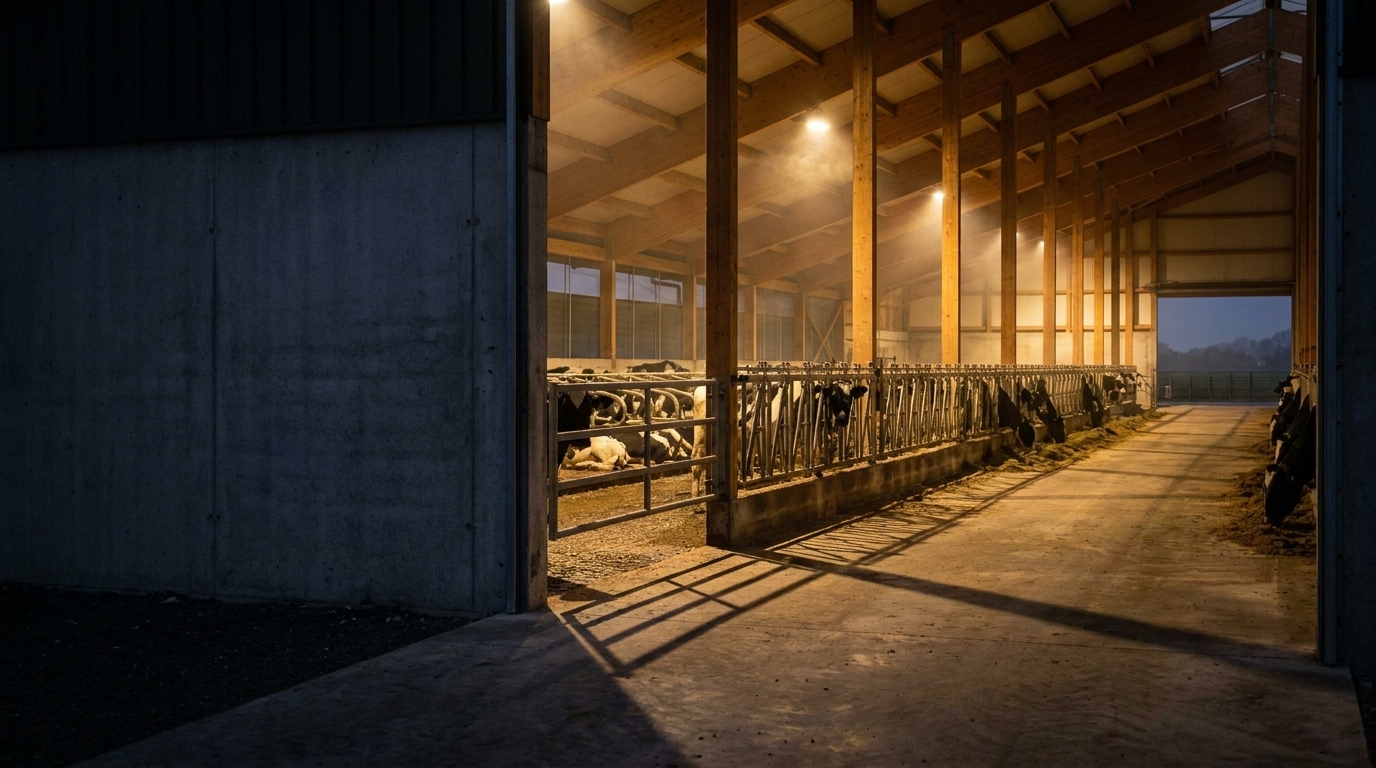
Thirty-five dairy cows died in a barn on Blackburn Road in Jordan Township, Clearfield County, Pennsylvania, on February 10. Fifteen got out. Dave O’Donnell, then deputy fire chief of the Irvona Fire Co., told Lancaster Farming in February that firefighters were alerted at 3:54 p.m. No cause has been published.
Price those 35 head against USDA National Agricultural Statistics Service’s Agricultural Prices, released August 31, 2026, and the animals alone come to $113,050. That uses Pennsylvania’s July 2026 average of $3,230 per head for cattle sold as dairy-herd replacements, USD per head, a survey-weighted state mean of producer sales to first buyers.
| Valuation measure | USD per mature cow | Difference from Pennsylvania July average | 35-cow value or recovery |
| Pennsylvania July 2026 dairy replacement average | $3,230 | Baseline | $113,050 |
| ISO Coverage F mature-livestock special limit | $2,000 | −$1,230/head (−38.1%) | $70,000 |
| AAIS Coverage G mature-livestock special limit | $2,500 | −$730/head (−22.6%) | $87,500 |
| ISO uncovered amount at the benchmark | $1,230 | 38.1% of replacement value | $43,050 |
| AAIS uncovered amount at the benchmark | $730 | 22.6% of replacement value | $25,550 |
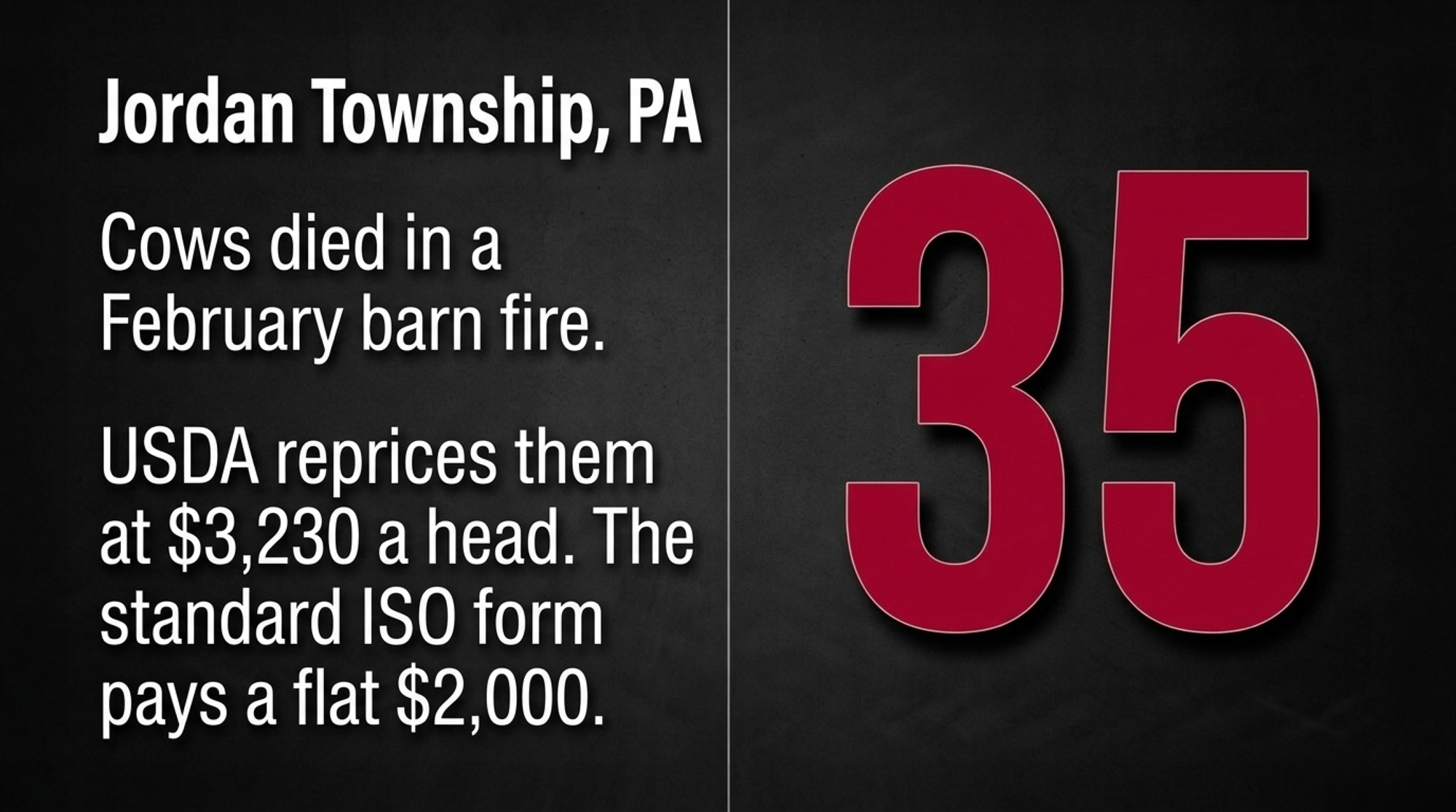
Now open the form most farm policies are built on. Under ISO’s Farm Property — Farm Personal Property Coverage Form FP 00 13 04 16, Coverage F covers unscheduled farm personal property, and its Special Limits are flat: $1,000 on any one horse, mule or head of cattle under one year of age, and $2,000 on any one head of livestock not included above. No proportional calculation, no adjustment for what she was actually worth.
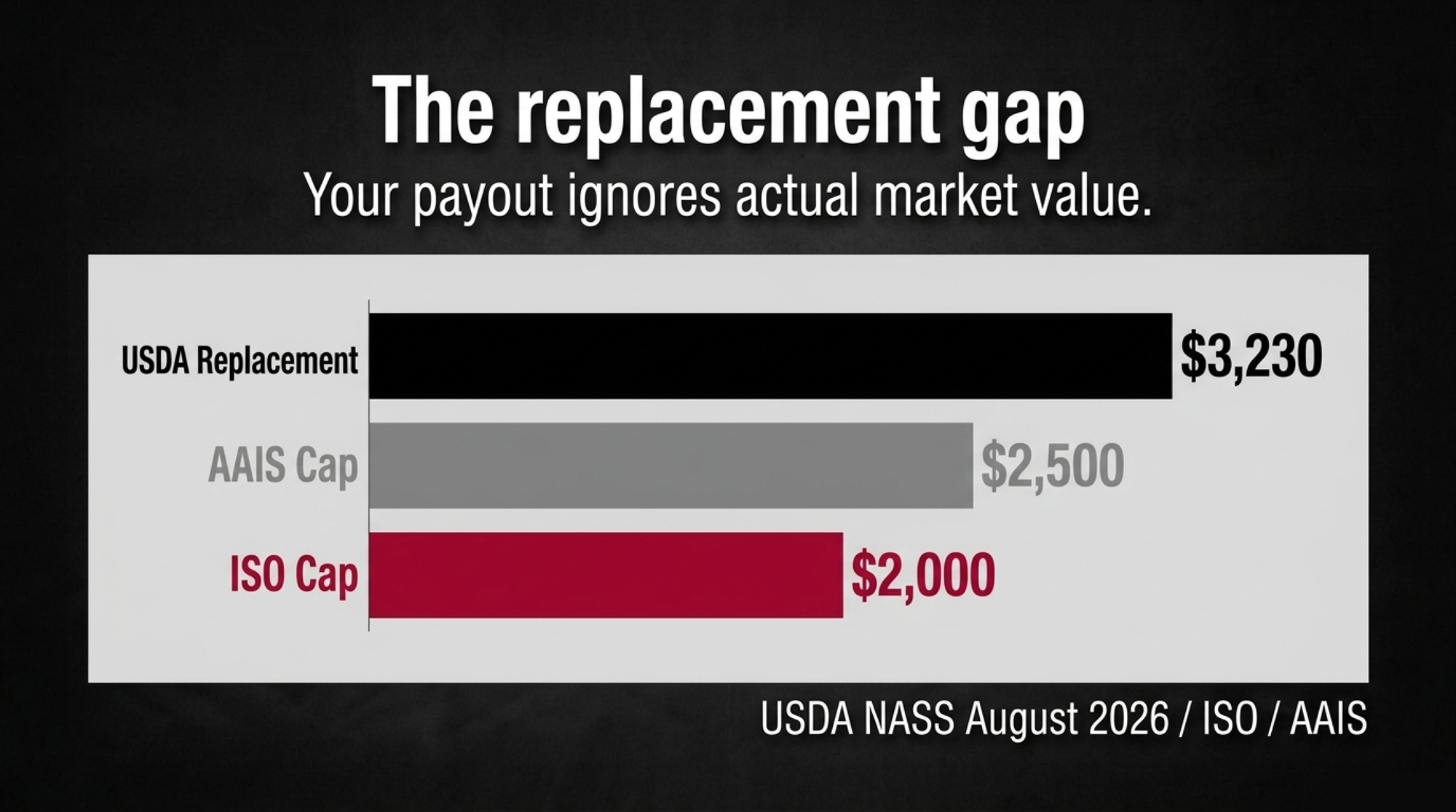
That’s a $1,230 gap per cow. On 35 head, it’s $43,050. AAIS runs the same architecture at a different number — form FL-6 Ed 1.0, Coverage G, pays the smaller of actual cash value, $2,500, or $1,000 for cattle under one year, which puts the gap at $730 a head and $25,550 across the same loss.
The cap is the first of three reductions, not the only one. And the fix is not more limit.
What cleared the 2026 ledger, and what got cut
No federal reporting stream captures dairy animal deaths in barn fires, so The Bullvine built this from fire-service records and news accounts naming the attending department. The search covered the United States only.
Five gates applied at once: calendar 2026, a dairy-cattle or dairy-goat operation, an animal death count recorded in the source, a named responding fire service, and a stated date and location. Three events cleared all five through September 15.
| Date | Location | Operation | Animals Lost | Responding Department |
| Jan. 26 | Tillamook County, OR | Dairy goats | 21 goat kids | Tillamook Fire District, Bay City Fire |
| Jan. 30 | South Wales, NY | Organic dairy cattle | More than 50 cows | South Wales Fire Co. |
| Feb. 10 | Jordan Township, PA | Dairy cattle | 35 cows | Irvona Fire Co. |
Recorded total: more than 85 dairy cattle and 21 dairy goats across three fires.
The animal count is the part that gets reported. It is not the part that decides whether an operation comes back. Tillamook crews worked that scene more than eight hours. In Farmington, Wisconsin, the barn that burned on August 28 contained the milking parlor, and 23 departments answered a four-alarm response at one rural address. A herd can be repriced at $3,230 a head. You can’t rebuy housing, parlor capacity, stored feed, or a milking routine in the same week, and the replacement cattle have to arrive somewhere.
Which points at the thing the numbers below cannot reach. The coverage parts in this article are property parts — they insure the animal, not the milk she would have shipped. Every figure here is an asset value, and the $492,000 shortfall on a 400-cow model counts cattle, not the milk check that stops while a parlor is rebuilt. Ask your broker which part of your policy, if any, responds to lost income during a rebuild, and for how long it pays. Don’t assume the barn limit carries the cash flow.
Eight candidate reports failed at least one gate. Six failed on dairy status — Bristol Township, Ohio recorded ten cows with the township department named, and Cherry Township, Pennsylvania recorded four calves with the attending department named in the Butler Eagle in March, but no qualifying source established either property as a commercial dairy.
The most instructive exclusion is a verified dairy. That Farmington barn was declared a total loss, and the Washington County Sheriff’s Office put damage above $1 million under case number 2026-31778, with the fire remaining under investigation and not believed to be suspicious. Every gate clears except one: the release says “several animals had to be euthanized.” It gives no number, and no other qualifying source published one, so the event is excluded rather than estimated.
What does your farm form actually pay for a dead dairy cow?
Bullvine calculation — repricing the recorded cattle loss
Published evidence. USDA NASS, Agricultural Prices, released August 31, 2026. July 2026 average price per head for cattle sold as dairy-herd replacements: Pennsylvania $3,230, New York $3,330, United States $3,260. USD per head, state averages, no range published at state level. Pennsylvania’s April 2026 average was $3,040, so the series moved 6.3% in one quarter.
| Fire | Cattle Lost | State Average | Value at Recorded Floor |
| South Wales, NY | More than 50 | $3,330 | $166,500 or more |
| Jordan Township, PA | 35 | $3,230 | $113,050 |
| Cattle total | More than 85 | — | $279,550 or more |
South Wales calculates at 50 head because that’s the published floor. The recorded loss is higher, so the figure understates.
Bullvine calculation — a 400-cow herd against four published limits
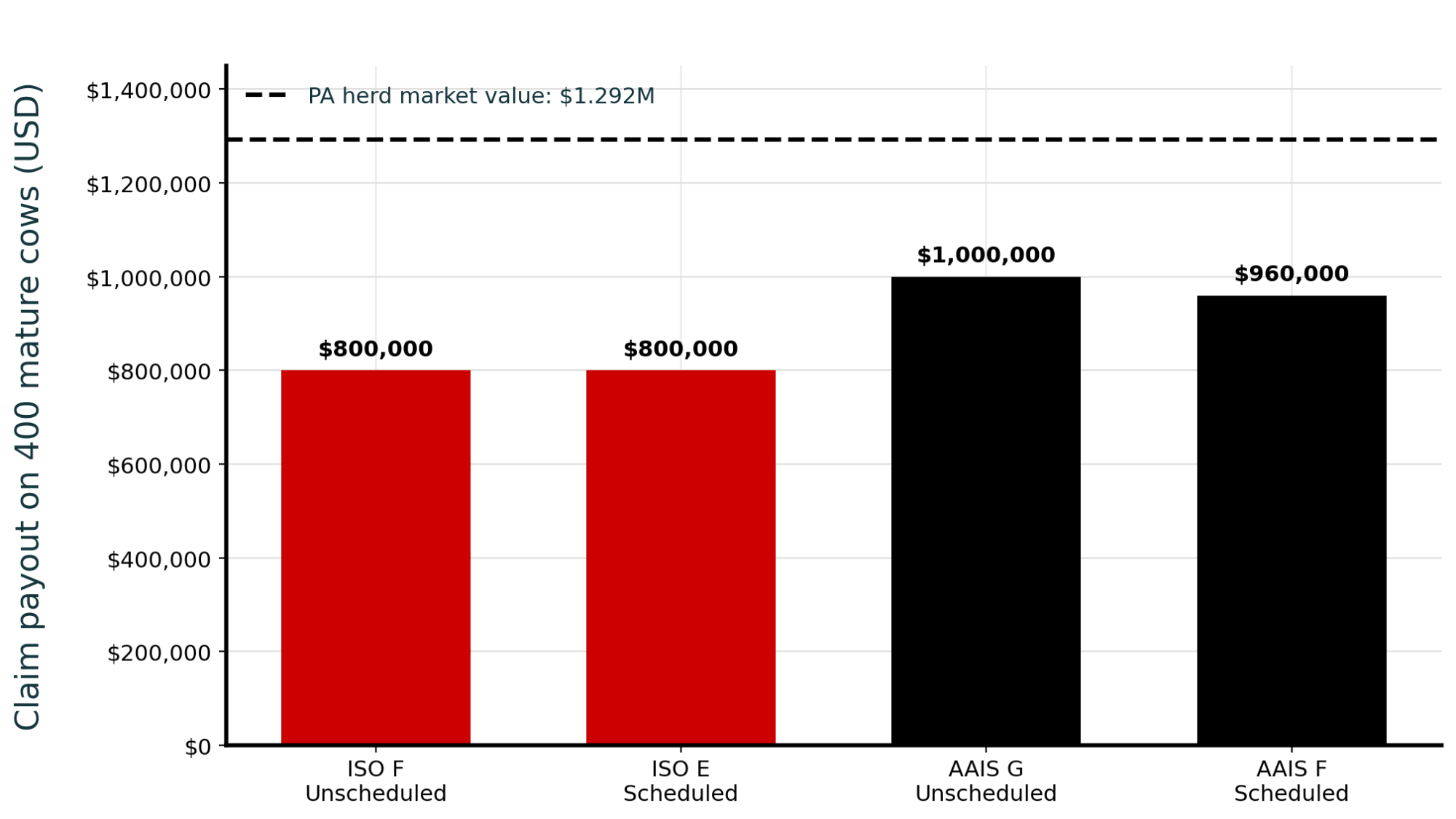
Stated assumptions, not source figures. A 400-cow Pennsylvania milking herd, all mature animals, with an $800,000 limit where a class limit is required. Herd market value at USDA’s July Pennsylvania average: 400 × $3,230 = $1,292,000.
Form language. ISO FP 00 13 04 16 puts the proportional test in Coverage E, scheduled — the least of 120% of the class limit divided by head count, actual cash value, or $2,000 — and counts each head of cattle under one year as half a head in that divisor. Coverage F, unscheduled, has no divisor at all. AAIS FL-6 Ed 1.0 mirrors the structure at $2,500, with the divisor in Coverage F scheduled and the flat limit in Coverage G unscheduled. Form text for FP 00 13 04 16 was obtained from a continuing-education presentation reproducing it with page citations, and the edition filed and in force varies by carrier and state.
| Coverage Form & Limit Type | Governing Cap Mechanism | Payout on 400 Head | Shortfall vs. Market ($1.29M) |
| ISO Coverage F, unscheduled | Flat $2,000/head cap | $800,000 | −$492,000 (−38.1%) |
| ISO Coverage E, scheduled with $800,000 class limit | Divisor yields $2,400; $2,000 cap binds | $800,000 | −$492,000 (−38.1%) |
| AAIS Coverage G, unscheduled | Flat $2,500/head cap | $1,000,000 | −$292,000 (−22.6%) |
| AAIS Coverage F, scheduled with $800,000 class limit | Divisor yields $2,400; binds below $2,500 | $960,000 | −$332,000 (−25.7%) |
Why buying more blanket limit stops working
On 400 head, the 120% divisor clears $2,000 once the class limit passes $666,667, and clears $2,500 once it passes $833,333. Past those points, the hard dollar ceiling governs, and every additional dollar of class limit adds nothing to what you collect per animal under the special limit.
The one mechanism both forms confirm. ISO and AAIS each exempt animals individually described and specifically covered from the special limit entirely. Itemized individual scheduling is the documented route around the cap, and it is the route that matters for registered, high-genomic-merit or flush-program animals whose defensible value sits well above $2,500.
The question to put to your broker in writing. Whether an agreed-amount or stated-value basis is available on your cattle, and on which form. Neither document reviewed here contains such an endorsement, so treat it as something to ask about rather than something to assume exists on your policy. Get the answer on paper either way.
Layer two — the settlement basis. Both forms settle unscheduled and class livestock at actual cash value as of the time of loss, and FL-6 states outright that actual cash value includes a deduction for depreciation, however caused. USDA’s $3,230 is a replacement price. A depreciated mature cow’s ACV can sit below it before any cap applies, which means the repricing above measures market value, not expected recovery.
Layer three — coinsurance. ISO Coverage F requires a limit equal to at least 80% of the actual cash value of all farm personal property. AAIS Coverage G pays no more than the proportion its limit bears to 80% of ACV. Carry less and a proportional reduction lands on top of the per-head cap.
Methodology note. Published evidence, stated assumptions, and Bullvine math are separated above. No double counting — the $800,000 covers animals only in this model, not barns, parlor, equipment, or feed, each of which sits under its own limit, and it contains no revenue line at all. Units are head and USD throughout. Treat these as two real published structures rather than the structure on your declarations page. No ledger farm’s actual coverage is known or implied. National averages may not reflect your region, herd size, management system, or carrier. If your declarations page shows a different structure or limit than the two forms described here, send it — we’ll report what the spread actually looks like across carriers. Corrections: editor@thebullvine.com.
Nobody publishes a current Pennsylvania replacement-cow benchmark to check any of this against. USDA AMS’s Pennsylvania Weekly Cattle Auction Summary, report 1919, issued September 14, 2026, for the week of September 6–12, reports dairy cattle only in slaughter classes. No springer, fresh, or replacement class appears. The quarterly NASS series is the only dated public authority, and a ceiling set at an earlier renewal is chasing a number that updates four times a year.
Rebuilding means buying into a consolidating market
USDA revised its 2024 Pennsylvania dairy baseline down by 170 herds in its February 20, 2026 Milk Productionrelease, which supersedes the 490-herd figure Bullvine published from the original 2024 vintage. Evaluating same-table data, Pennsylvania lost 320 net licensed dairy herds in 2025 — 6.8% of the state’s count and 30.9% of the national net decline of 1,036.
That figure measures consolidation, not cattle supply. The supply side is a separate dataset, and it points the same direction: USDA NASS’s January 2026 Cattle report counted 3.905 million dairy replacement heifers 500 lbs and over, and the 2026 swap math on a $2,340 cull cow against a $3,500-plus replacement shows what that scarcity does to a buy-sell decision. A Clearfield County producer rebuilding after a fire is buying into both conditions at once — fewer neighbours to buy from, and a national heifer pipeline running below its own ten-year norm.
Does community fundraising close a livestock gap?
South Wales drew the largest public response in the ledger. As of September 15, the campaign displayed $126,993 raised of a $130,000 goal from 947 donations, started by a family member rather than the producer.
Against the $166,500 floor value of 50 replacement cows at New York’s July average, that total covers 76.3% of the livestock line. Against the true recorded loss of more than 50 cows, it covers less.
The ratio is generous and incomplete by design. The campaign describes its purpose broadly — barn repairs, cattle care and day-to-day costs — so the total was never raised as a cattle-replacement fund, and it shouldn’t be read as one. KPTV reported on January 28, 2026, that more than $15,000 had been raised for the Tillamook producer within roughly 24 hours of 21 goat kids dying, which is a fast and real community response and not a barn.
Read these as publicly raised sums. They measure neighbours, not losses, and they say nothing about what any policy paid.
Dairy goats carry no dollar figure in this ledger. USDA publishes no dairy-goat replacement series, and inventing a per-head value to square the table would be fabrication.
Can you get a fire walkthrough before renewal?
Penn State Extension’s Fire Prevention in Barns, updated March 18, 2026 by extension educator Gregory Martin, is specific and costs nothing to act on. Maintain and inspect all wiring, junction boxes, and electrical panels yearly. Remove cobwebs and dust from lights, wiring, and heating sources. Install bulb covers on light fixtures. Cure baled hay outside before bringing it into storage structures, and monitor commodities for abnormal heating. Keep ABC multi-purpose fire extinguishers within 50 feet of any point inside the barn, and train employees annually in using them.
The pre-plan is the cheapest item on this list and the only one that requires nothing but paper. Extension recommends a written plan specific to the facility, including a farm map showing chemical storage, livestock housing, fuel tanks, and water sources available for use by the fire department, plus an emergency contact sheet with the farm name, address, directions, and phone numbers for whoever knows the buildings. Both documents go somewhere secure and known, and both get shared with local first responders. Extension also recommends inviting those departments to tour the farm, and keeping driveways well-marked and maintained for emergency vehicle access.
Farmington’s fire drew 23 departments to one rural address. Access is not a footnote in that arithmetic.
Extension points operations needing sprinklers or additional systems to NFPA 150, Fire and Life Safety in Animal Housing Facilities Code, which covers animal housing including commercial agricultural buildings. The Animal Welfare Institute, an animal-advocacy organization, reported in its Winter 2025 quarterly that the NFPA technical committee held a first draft meeting last fall to open the next revision cycle. Adoption varies by jurisdiction, so treat the code as a design benchmark rather than an automatic obligation on a Pennsylvania barn.
The 90-Day Playbook for Herds Carrying Livestock Under a Farm Form
30 days
- Pull the declarations page. Find the form number and edition — FP 00 13 04 16, FL-6 Ed 1.0, or whatever your carrier files — then find which coverage part your cattle sit under. Requires the policy itself, not a certificate of insurance. Red-flag trigger: livestock in an unscheduled part with a special limit below your state’s current NASS average moves this to the top of the list this month. Backfire risk: agents quote the class limit, which tells you nothing about the per-head cap.
- Run the divisor yourself if your cattle are scheduled: class limit ÷ head count × 1.20, then compare against the form’s dollar ceiling and USDA’s July state average. Whichever is smallest is what you collect.
- Find the settlement basis. If the form says actual cash value, expected recovery on a mature cow sits below USDA’s replacement price before any cap applies. Read the loss-settlement section, not the declarations.
- Check the coinsurance condition. Both forms tie recovery to carrying 80% of the actual cash value of all farm personal property. Urgent when: you’ve added cattle or equipment since the last renewal without raising the limit.
- Count heifer calves separately. Both forms cap cattle under one year at $1,000 and count them as half a head in the scheduled divisor.
- Write the pre-plan and the farm map, then hand a copy to your fire chief. One afternoon and a printer.
90 days
- Schedule your top animals individually. Both forms exempt animals individually described and specifically covered from the special limit — the documented route past the cap. Requires: current genomic or classification records and sale comparables. Threshold: any animal whose defensible value exceeds the ceiling. Backfire risk:premium rises, and documentation you can’t support at claim time is worse than none. Theft runs the same mechanism as fire, and what happened when Oakfield Corners Dairy lost 17 genotyped Holsteins overnight shows what generic valuation does to a claim on animals you can document.
- Stop buying class limit past the point it works. On 400 head, above $666,667 you’re in the ISO $2,000 hard cap and above $833,333 you’re in the AAIS $2,500 cap. More limit, same recovery per cow under the special limit.
- Ask about agreed-amount or stated-value basis in writing, and name the form when you ask. Neither document reviewed here contains such an endorsement, so the answer may be no. If it is no, keep going: ask what else the carrier can write on cattle, whether a separate scheduled livestock policy is available, and whether the account can be marketed to a specialty agricultural or surplus-lines underwriter. Get each answer in writing, and ask on what form and at what valuation basis.
- Book the annual electrical inspection with panels and junction boxes in scope, and have the lightning protection checked while the electrician is on site. A licensed electrician and about a day of access.
365 days
- Rebuild from your own pipeline rather than the purchase market. Opportunity signal: USDA Economic Research Service’s Livestock, Dairy, and Poultry Outlook, LDP-M-386 of August 18, 2026, records milk replacement heifers at 3.600 million head as of July 1, 2026, up 100,000 from July 1, 2025, against 9.650 million milk cows. That’s a 37% replacement-to-cow ratio, and ERS notes the ratio averaged about 42% across the past ten mid-year Cattle reports. The January 1 count of 3.905 million is a different reference date on the same semiannual series, not a contradiction — heifer inventories run higher in January. If you want to track your own position against the national picture, run it through the Bullvine Pipeline Index calculator. Rearing capacity added now is capacity you don’t buy at $3,230.
- Split the coverage review into four: animals, structures, equipment, and lost income. The first three are property questions with limits you can read off a page. The fourth is a different question with a different answer, and it isn’t answered by the per-head limits above. Requires: a broker willing to show the forms and say which one responds to a stopped milk check.
- Set one recurring annual date for the walkthrough, the electrical inspection, and the schedule reprice. Matters most in any year the state replacement average moves more than 10%.
The replacement heifer pipeline sits roughly five points below its ten-year mid-year ratio while your per-head ceiling sits wherever it sat at the last renewal. Only one of those two numbers is inside your control before your next renewal.
Pull the declarations page and check three lines:
- Coverage part. Are your milking cows unscheduled, scheduled as a class, or individually described? The middle one still runs into the divisor.
- The hard cap. Is the special limit per animal $2,000, $2,500, or something else your carrier files?
- Settlement terms. Does loss settlement say depreciated actual cash value, or replacement cost?
If your form caps a mature cow at $2,000 while Pennsylvania’s July average ran $3,230, more blanket coverage won’t close it — above $666,667 on 400 head the divisor stops helping and the hard ceiling takes over. Itemize your top genetic assets, ask for an agreed-value basis on paper, and find out what your carrier thinks your herd is worth before the trucks pull in.
Learn More
- Heifer Inventory Hits 20-Year Low: What It Means for Dairy Producers — Arms you with real cull-heifer price realities, showing how tight replacement supplies directly amplify the cash-flow hit if an unhedged barn fire forces you into the open auction ring.
- Dairy Farm Business Interruption Insurance: Are You Truly Covered? — Exposes why asset-only property checks leave cash flow paralyzed, breaking down how to write endorsement riders that replace lost milk revenue while a parlor sits offline.
- Genomic Testing Dairy Calves: Is the ROI Real or Just Hype? — Delivers the paper trail needed to bypass carrier class limits, demonstrating how backed genomic and parentage records convert commodity $2,000 blanket livestock caps into defensible, specifically scheduled asset values.
 The Sunday Read Dairy Professionals Don’t Skip.
 The Sunday Read Dairy Professionals Don’t Skip.
Every week, thousands of producers, breeders, and industry insiders open Bullvine Weekly for genetics insights, market shifts, and profit strategies they won’t find anywhere else. One email. Five minutes. Smarter decisions all week.