



Cows healthy, tank full, bills paid — and a 70-cow dairy still lost about $237,000 last year. At $16.92 per cwt for milk against Cornell’s $31/cwt, here’s the bill your milk check never shows you.
The dairy farmers in this scene aren’t real, but every number behind them is. Picture a family that’s milked 70 cows in the same tie-stall barn for 25 years, sitting across the kitchen table from an advisor who’s just run their numbers. They’re good farmers. Cows are healthy, the bulk tank’s full, the bills got paid last year. Then the spreadsheet says they lost money — real money — and the look on their faces is the whole problem with small commodity dairy in 2026.
They didn’t lie when they said “We paid our bills.” They did. But paying the bills and turning a profit are two different questions, and the gap between them is where small commodity dairies quietly bleed equity. At 60 to 150 cows shipping to a co-op with no premium, that gap can run well past $130,000 a year — and you can lose it without ever feeling the hit. This is the cost of production math nobody wants to run. It’s also the only math that tells you which of three paths you’re actually on.
What’s Changing and Why
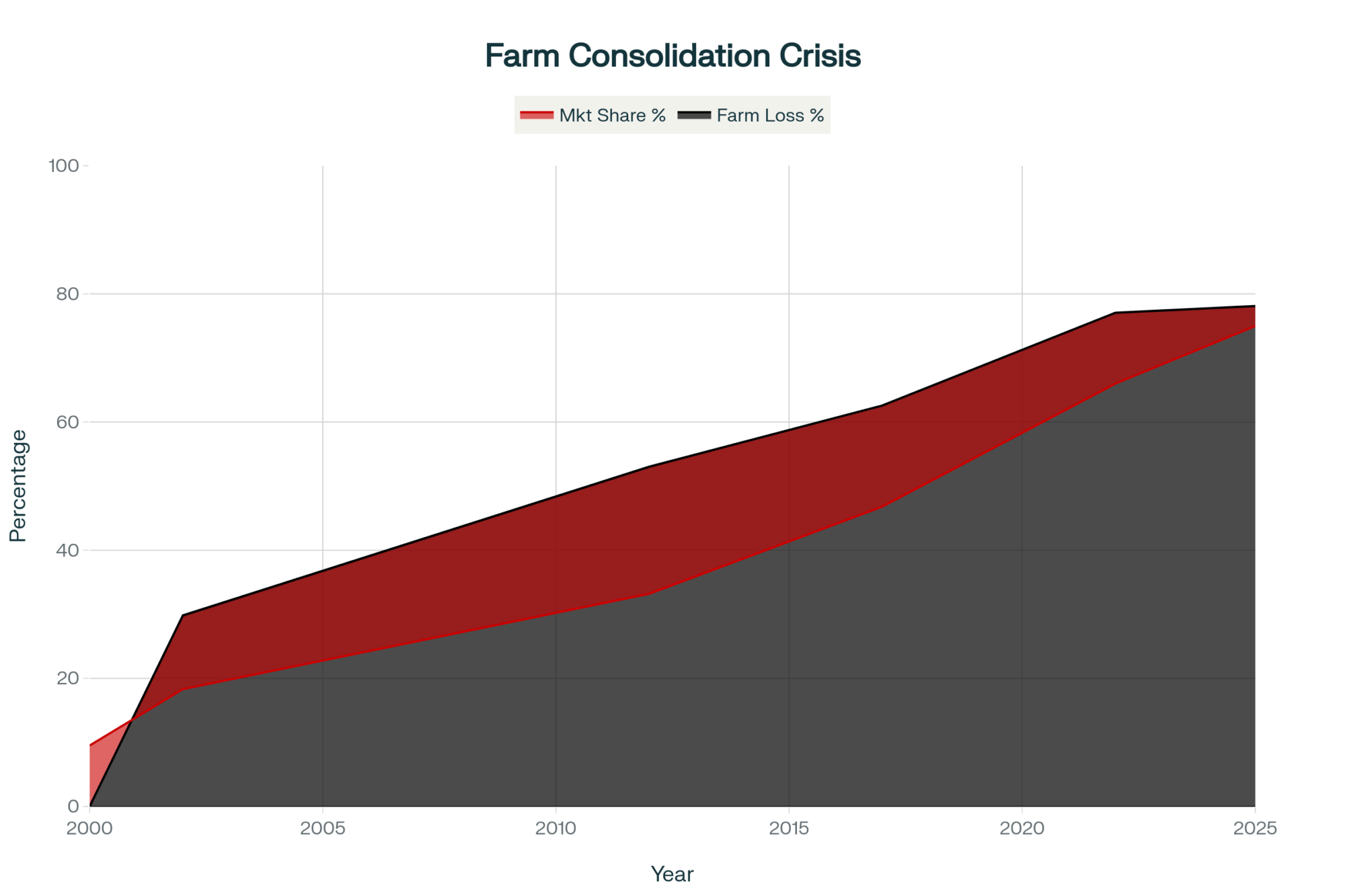
The structural numbers don’t leave much room for argument. USDA’s Economic Research Service reported in February 2026 that licensed U.S. dairy herds fell from 66,825 in 2004 to 24,811 in 2024 — a 63% drop — while total milk production climbed from 170.8 to 225.9 billion pounds over the same stretch. Fewer farms. More milk. And the herds that disappeared were overwhelmingly the small ones.
Look closer at which farms vanished and the pattern sharpens. Farmdoc’s read of the 2022 Census of Agriculture found the 20–49 cow class declined the most on a percentage basis, with 50–99 cow herds right behind — the exact bracket our 70-cow family sits in. In total, 39% fewer U.S. farms sold milk in 2022 than two decades earlier. The milk didn’t disappear with them. It moved to bigger barns.
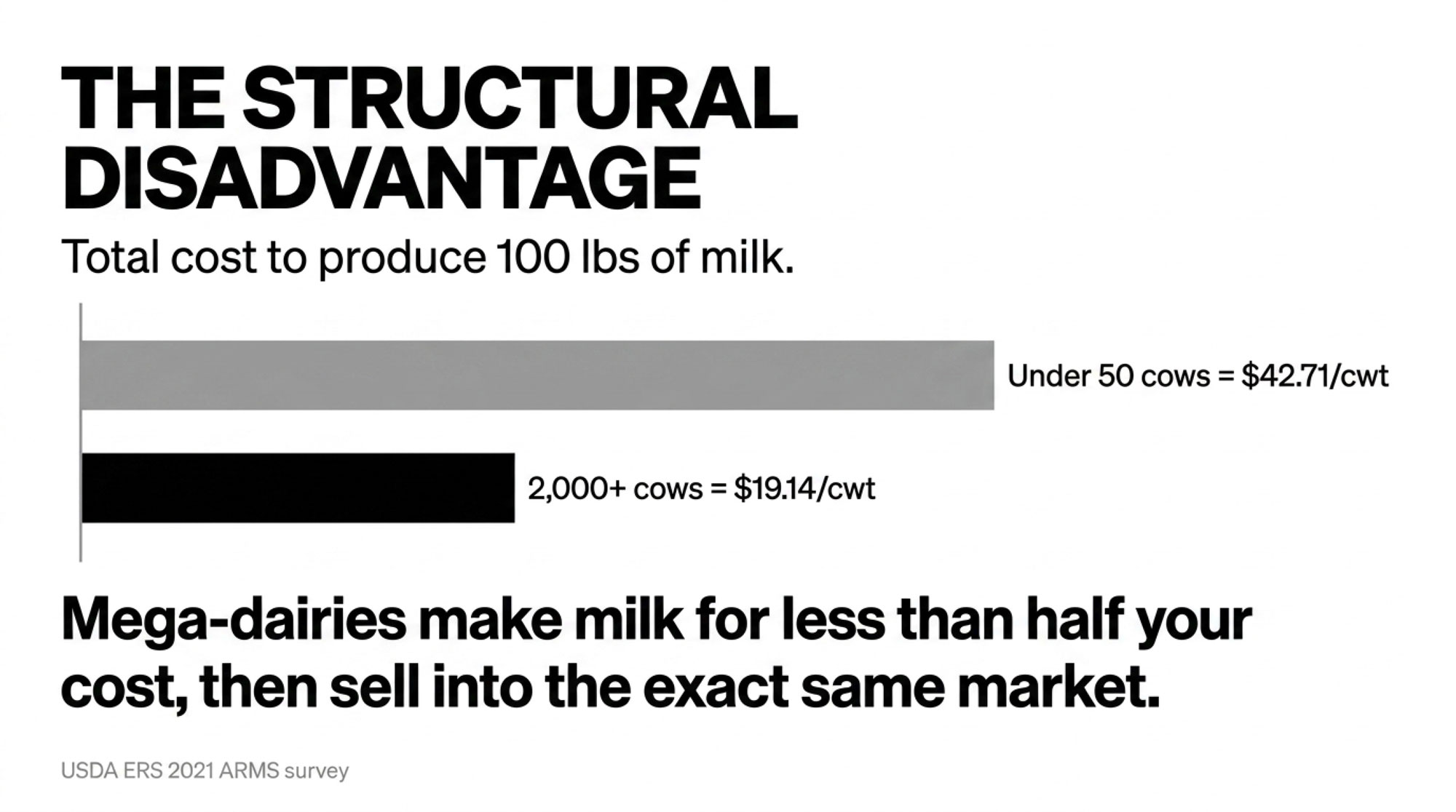
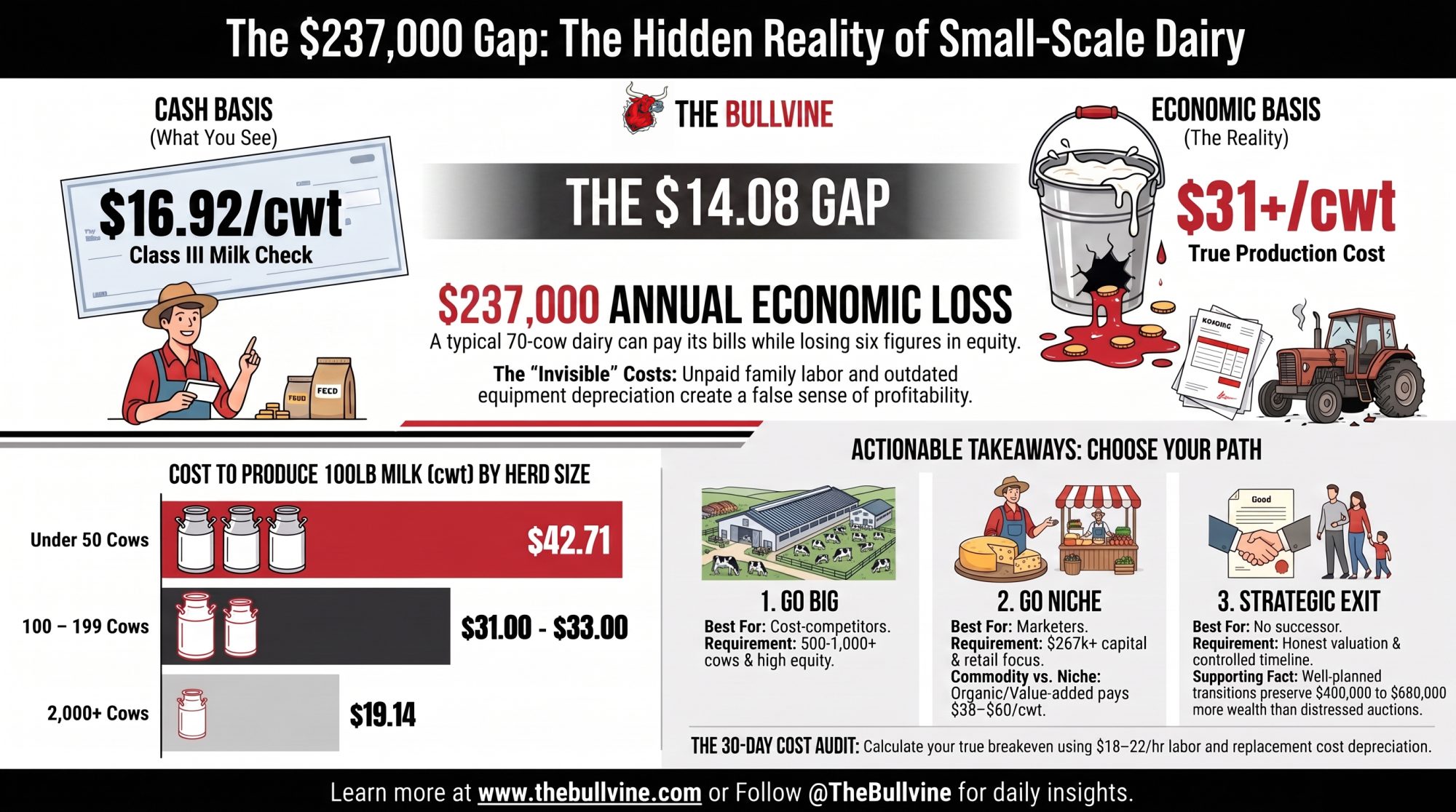
The cost gap is why. ERS data from its 2021 ARMS survey put the total cost to produce 100 pounds of milk at $42.71 per cwt for herds under 50 cows, against $19.14 for herds with 2,000 or more. That’s not a rough patch you outwork. It’s a roughly $23/cwt structural disadvantage built into scale itself, and it doesn’t care how hard you hustle in the parlor.
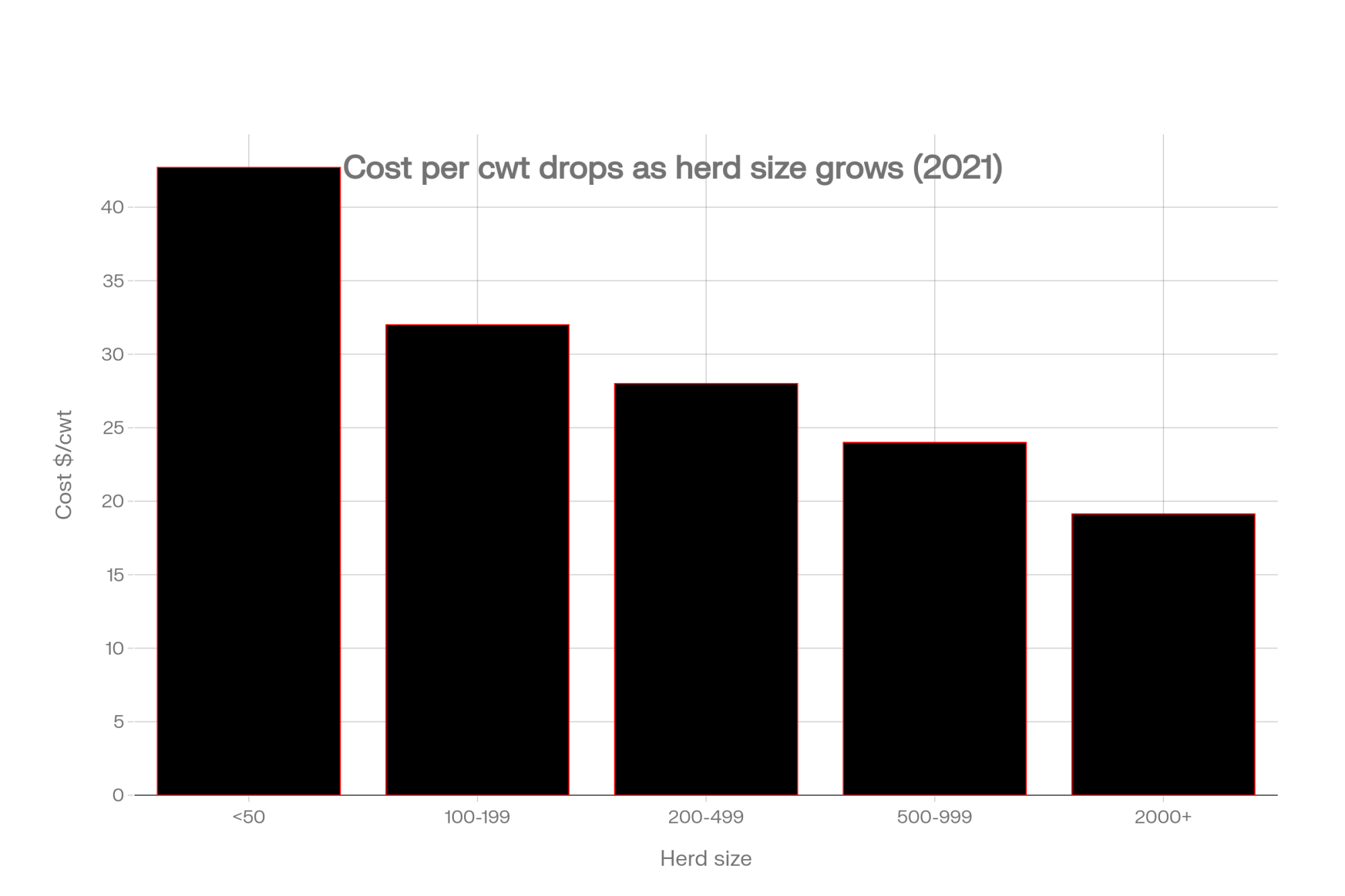
Our 70-cow family sits right in the teeth of it. So does anyone running 50 to maybe 500 cows, shipping bulk milk with no value-added product and no direct premium. You’re competing on cost against operations that make milk for less than half what you spend, then selling into the same market at the same price.
How a Profitable-Looking Farm Loses Six Figures
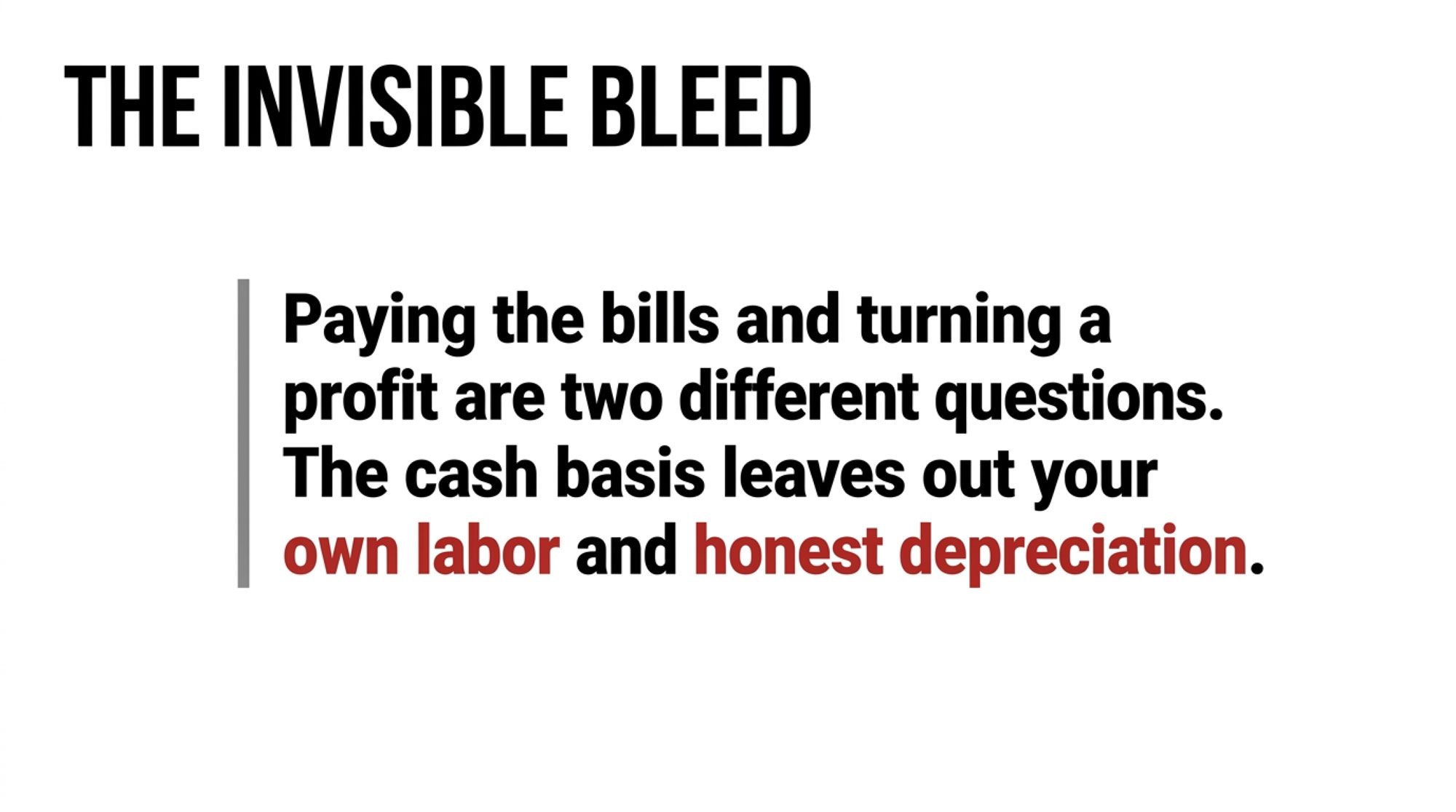
Here’s the part that blindsides families. On a cash basis, a small dairy can look fine — the milk check covers feed, the vet, the loan payment, and there’s something left to live on. But the cash basis leaves out two enormous costs: the family’s own labor and honest depreciation on barns and equipment bought decades ago. According to Illinois Farm Business Farm Management data released in December 2024, even farms with positive cash returns posted negative economic returns averaging –$686 per cow over five years, including –$758 per cow in 2023.
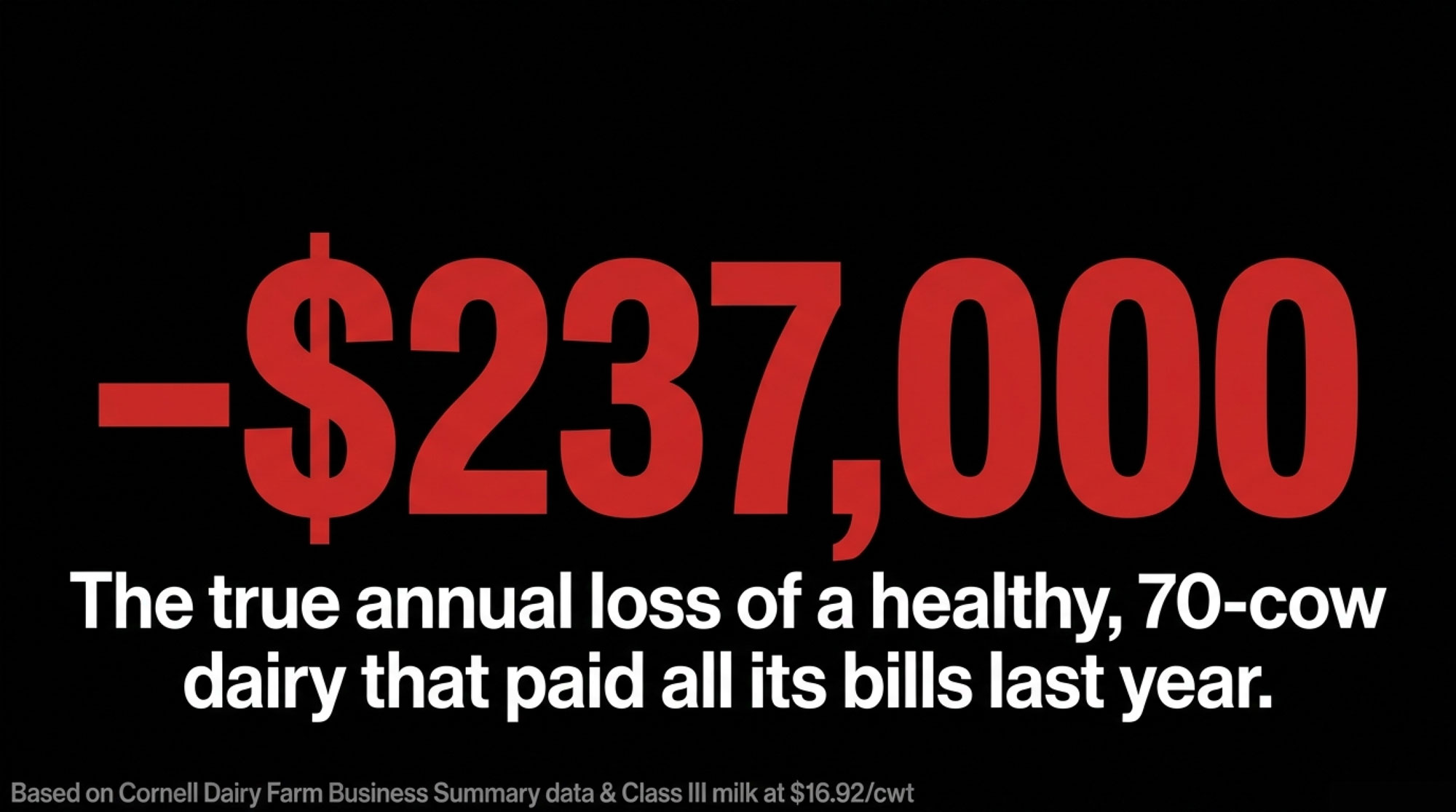
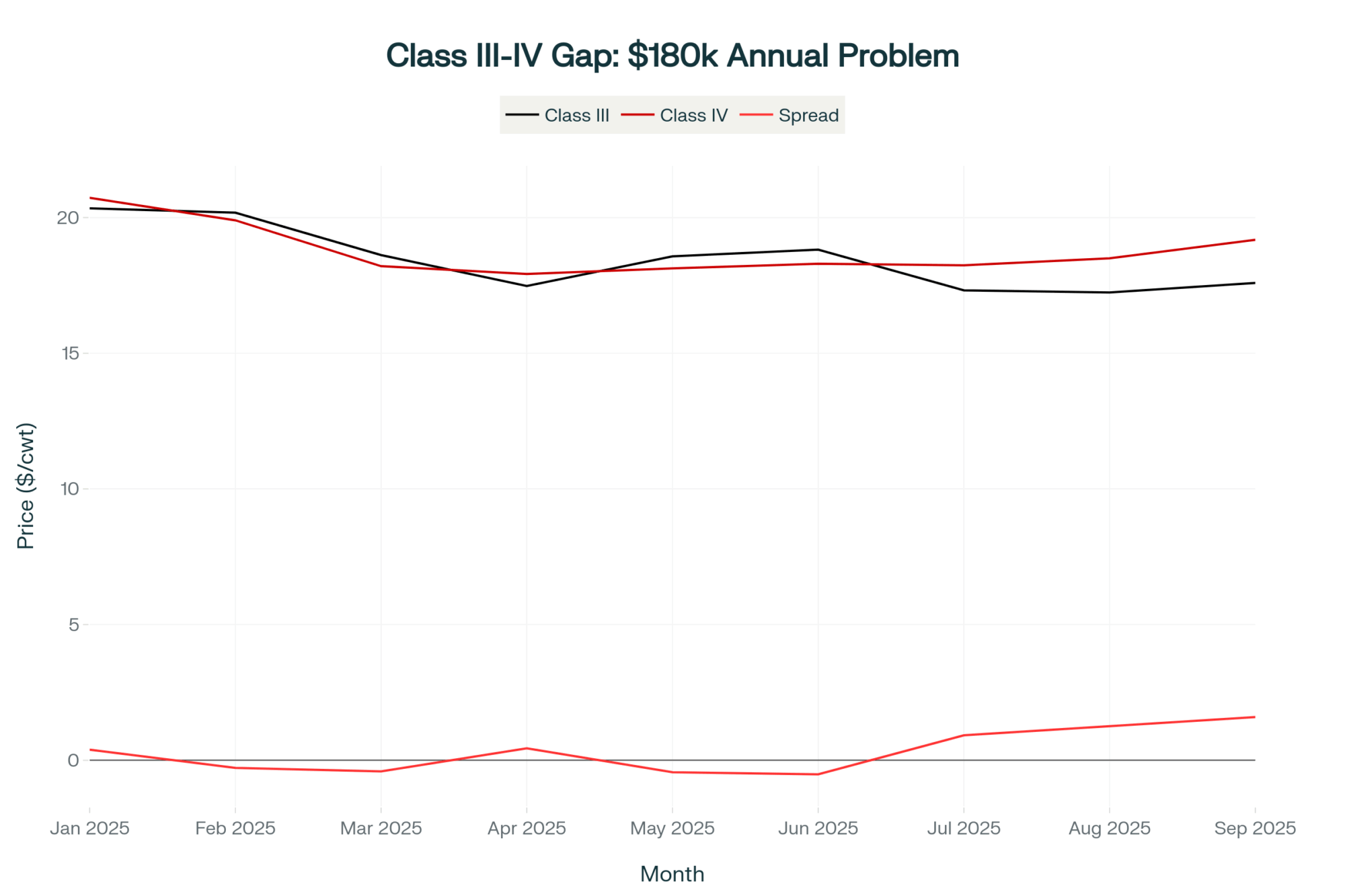
So run the barn math on that 70-cow family. At roughly 24,000 lbs per cow, they ship about 16,800 cwt a year. Anchor it to a real price: USDA’s Agricultural Marketing Service reported Class III milk closed May 2026 at $16.92/cwt — the number a cheese-market commodity shipper actually lives on, even as USDA’s headline all-milk forecast sat higher at $20.70. At $16.92, that’s about $284,000 in revenue. For full economic cost, use a real benchmark instead of a guess: Cornell’s Dairy Farm Business Summary puts the 100–199 cow class at $31–33/cwt once labor and capital are counted, and a 60–150 cow operation sits at or above the top of that band. Take the low end — $31/cwt — and this herd’s cost runs about $521,000. The hole is roughly $237,000 a year. Even at the rosier $20.70 forecast, you’re still down more than $170,000.
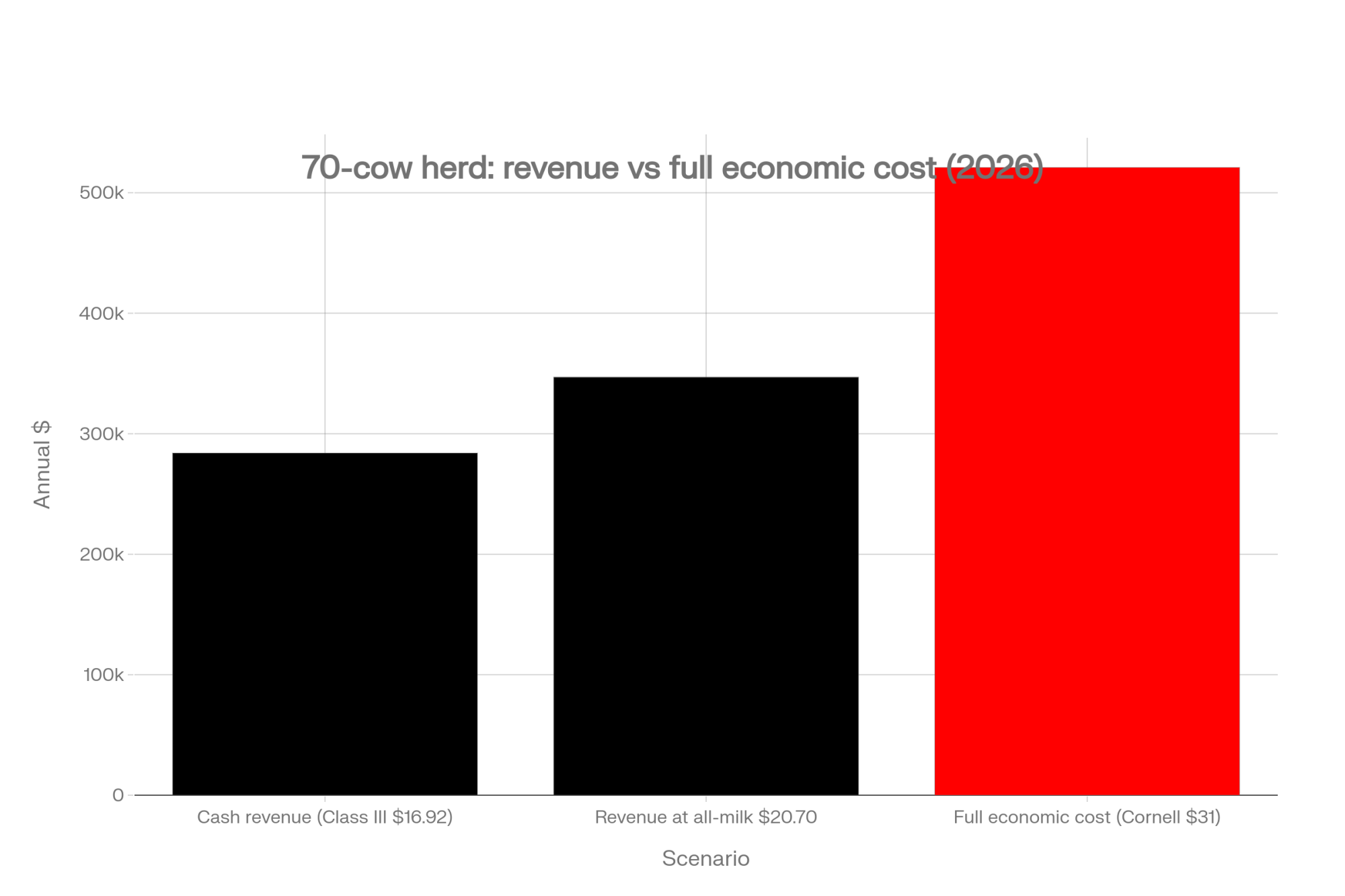
The number that trips up commodity operators: $20.70 is the forecast. $16.92 is the check. Now, all-milk and Class III aren’t a clean apples-to-apples subtraction — all-milk blends every class and folds in premiums. But the gut-check holds: if you budget your year on the price you actually get paid, not the forecast headline, you’re planning around roughly $3.78/cwt you may never see. On 16,800 cwt, that’s about $63,000 between the plan and the mailbox.
So why don’t they feel the loss? Nobody writes the family a paycheck at $18–22 an hour, and the barn’s still on the books at 1990s prices instead of today’s rebuild cost. The signs show up before the spreadsheet does. Deferred vet calls. Peeling paint on the milkhouse. A spouse’s town job quietly covering the feed bill some months.
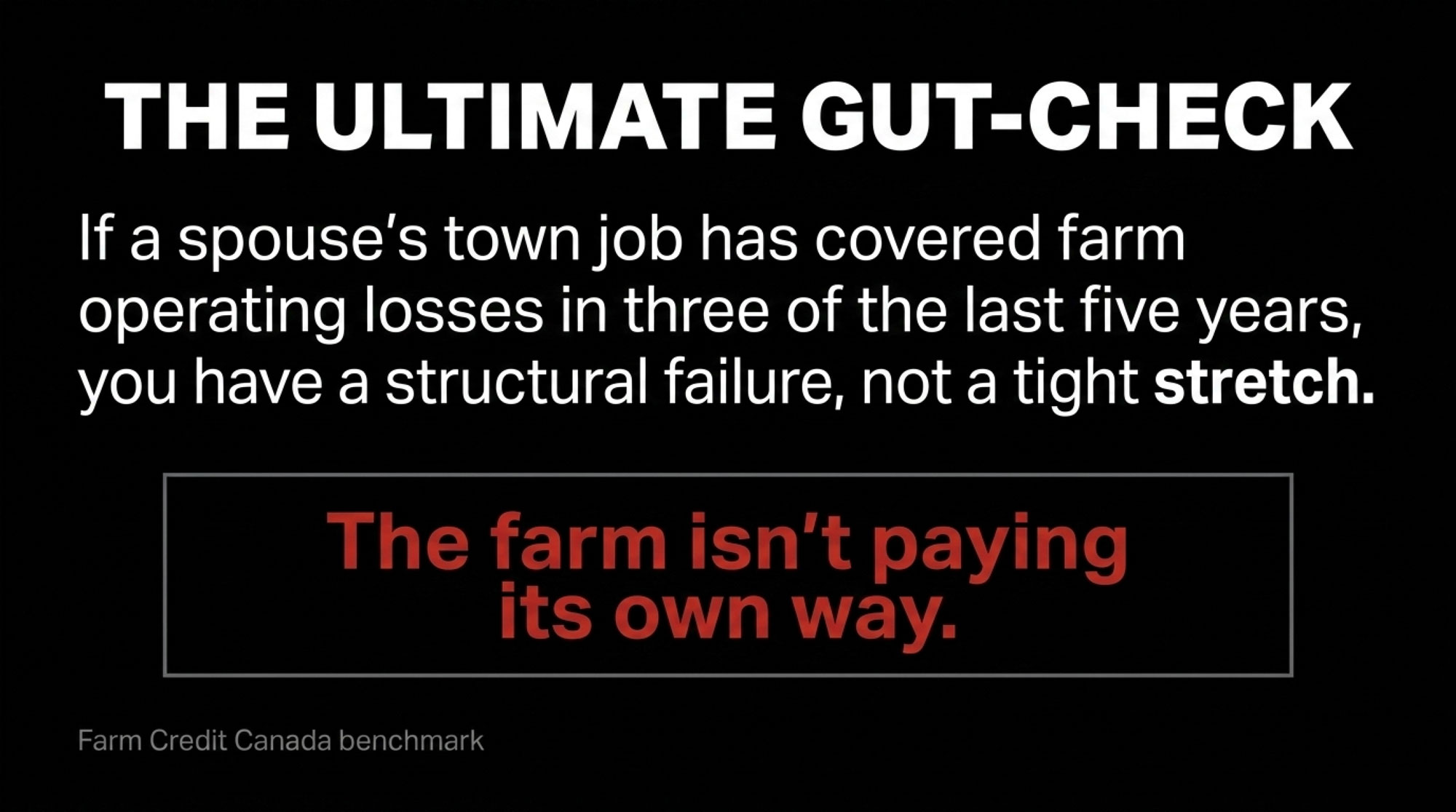
That last one is the clearest diagnostic there is. Farm Credit Canada’s BeefResearch.ca team flagged the gut-check back in September 2022: if off-farm income has covered farm operating losses in three or more of the last five years, you’re looking at a structural problem, not a tight stretch — the farm isn’t paying its own way. The benchmark is Canadian, but the logic crosses the border intact. A farm leaning on a town paycheck to cover operating losses, not just household groceries, isn’t carrying itself. That doesn’t make it worthless. Plenty of families decide, eyes open, to subsidize a life they love, and that’s a legitimate call when you make it on purpose. The trouble starts when the subsidy is invisible — when a farm runs a decade on borrowed equity while everyone at the table calls it “tight but okay.” Name it out loud, and the question shifts from “are we failing?” to “what do we actually want this to be?” That’s a far better question to answer while you’ve still got options on the board.
What Does the Same Barn Look Like at 40 Cows and a Cheese Vat?
Now flip the model. Take a 40-cow herd that never sees a co-op truck — every drop goes direct-to-consumer, into a cheese vat, or onto a farm-store shelf. Fewer cows, radically different math. At 24,000 lbs/cow, that’s 9,600 cwt a year, against the 70-cow herd’s 16,800. On commodity terms it’d be a rounding error. The point is that this farm isn’t selling a commodity.
Here’s where the numbers diverge hard. NODPA reported organic and grass-fed pay prices running $38–60/cwt this spring — more than double the $16.92 a conventional cheese shipper saw. Say half this herd’s milk — 4,800 cwt — moves as branded fluid or direct sales at an organic-grade $45/cwt: that’s about $216,000. Turn the other 4,800 cwt into farmstead cheese, and the leverage compounds, because roughly 10 lbs of milk makes 1 lb of cheese. That’s about 48,000 lbs of cheese; even at a conservative farm-store $12/lb, you’re looking at another $576,000 in gross sales off the same volume that would’ve fetched maybe $81,000 as bulk milk. (These 40-cow figures are illustrative, built on conservative assumptions — a 50/50 fluid-to-cheese split, mid-range NODPA organic pay price of $45/cwt, and $12/lb farm-store cheese — not a single sourced operation.)
But before anyone trades the parlor for a make-room, read the trade-off honestly. That cheese revenue isn’t margin — it’s gross, and the costs behind it are brutal. A Journal of Dairy Science study pegged artisan cheese plant startup at $267,248 to $623,874, and that’s a 2013 figure, so budget higher today. Then add the labor: aging, packaging, food-safety compliance, farmers’-market booths, and the website that drives the whole thing. You’re not adding a revenue stream. You’re bolting a second business — manufacturing and retail — onto a dairy farm, and plenty of operators discover they like cows a lot more than they like invoicing. The upside is real. So is the failure rate.
The Mechanics Behind the Outcomes
So why is the deck stacked this way for the commodity shipper? Part of it is plain scale economics. Bigger farms spread fixed costs across more cows and buy feed, semen, and supplies cheaper per unit. RaboResearch puts that edge at roughly $10/cwt for 2,000-plus-cow farms over 100–199 cow herds. But part of it is the pricing system itself, which shifted again in 2025 — and most farmers never saw it move.
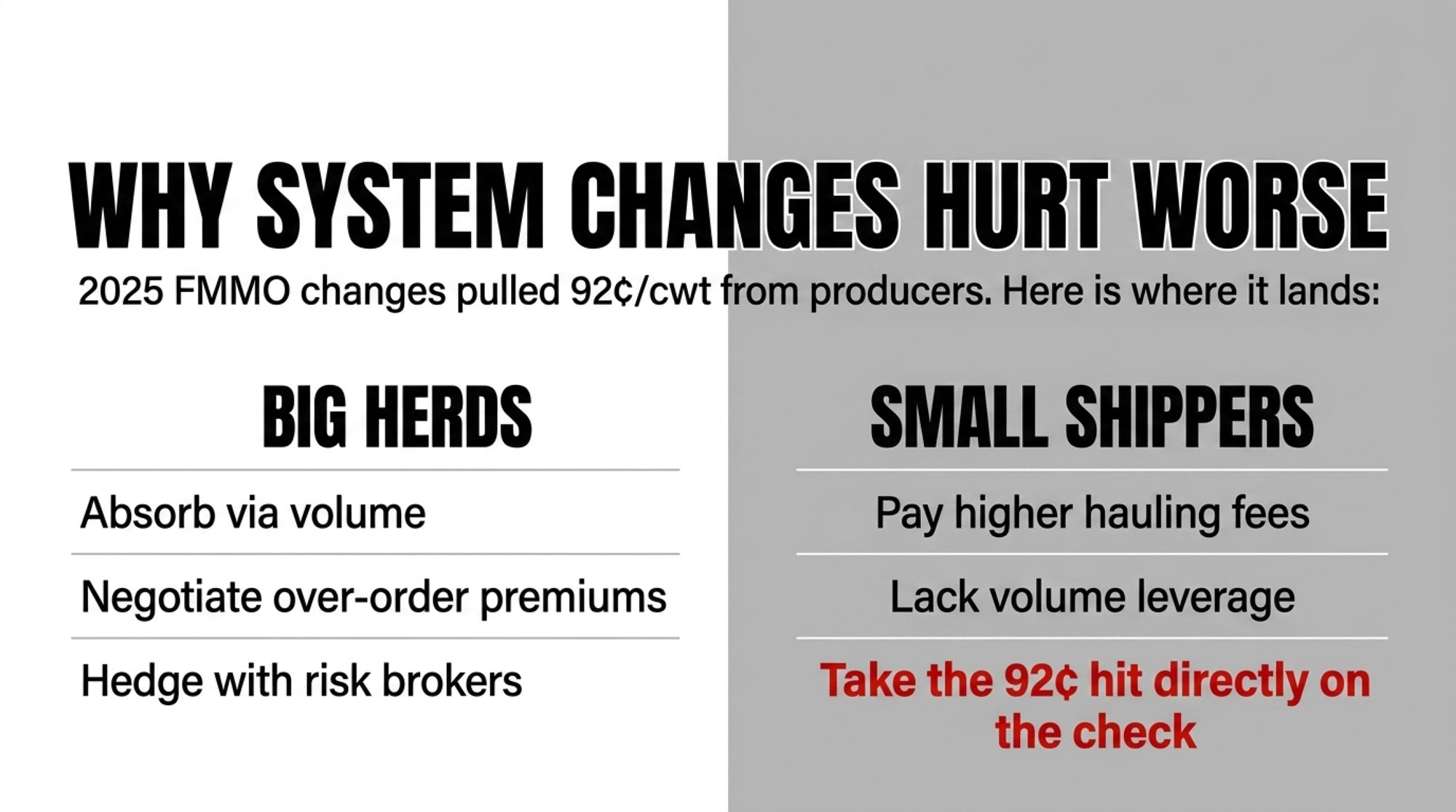
The Federal Milk Marketing Order changes that took effect June 1, 2025, raised the “make allowances” — the manufacturing-cost credits processors keep before paying for your milk’s components. The American Farm Bureau Federation calculated the change lowered Class III prices by 92¢/cwt in the first three months and pulled roughly $337 million out of producer pool revenues nationwide, per economist Daniel Munch’s September 2025 Market Intel analysis. On our 70-cow family’s 16,800 cwt, 92¢ is about $15,500 a year — gone, off a check that was already underwater.
Here’s why that 92¢ stings a small herd worse than a big one. The cut comes off everyone’s component price the same way — but large operations have buffers small shippers don’t. The Bullvine’s own market reporting notes smaller farms take disproportionate hits, and scattered producers routinely pay higher per-cwt hauling charges than the big routes. Volume herds negotiate over-order and quality premiums that claw back some of the loss; many small bulk shippers don’t have that leverage. And hedging tools like Class III futures or Dairy Revenue Protection can offset a price drop — but as risk-management firms like CIH lay out, they take a broker relationship, a written margin-management policy, and enough volume to make the contracts worthwhile. A 70-cow herd rarely has all three. So the same 92¢ that a mega-dairy partly absorbs or hedges away lands full-force on the small commodity shipper’s mailbox check.
And it arrived almost invisibly. The change came inside dense formula language and a single up-or-down producer vote on the whole order — so on most farms it showed up simply as a lower milk price, not as a line item anyone flagged. There’s no entry on a milk check that reads “this is the day margin moved from your bulk tank toward the plant.” The system keeps your eye on the gross price while the real action happens three layers down in the formula.
How Much Does Waiting Actually Cost?
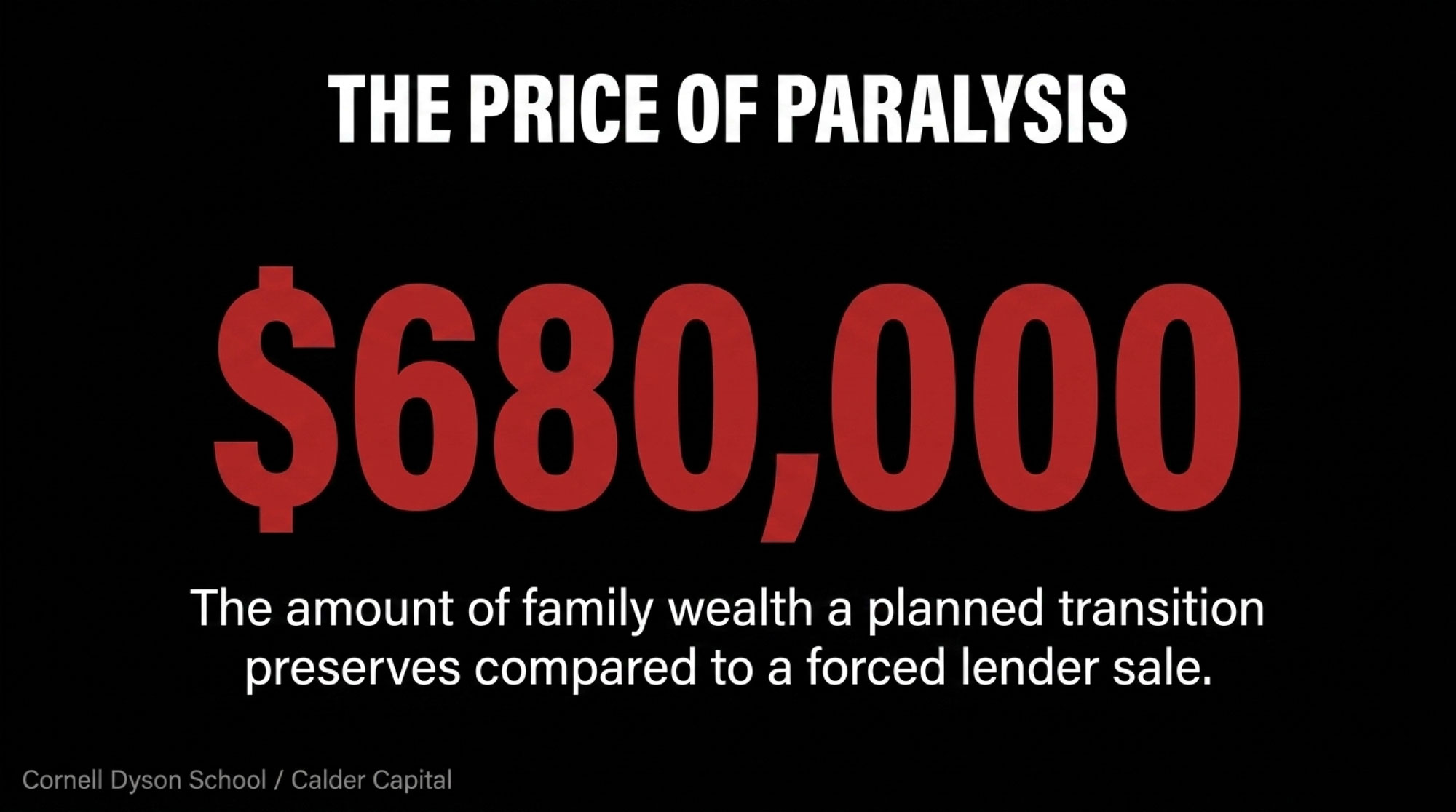
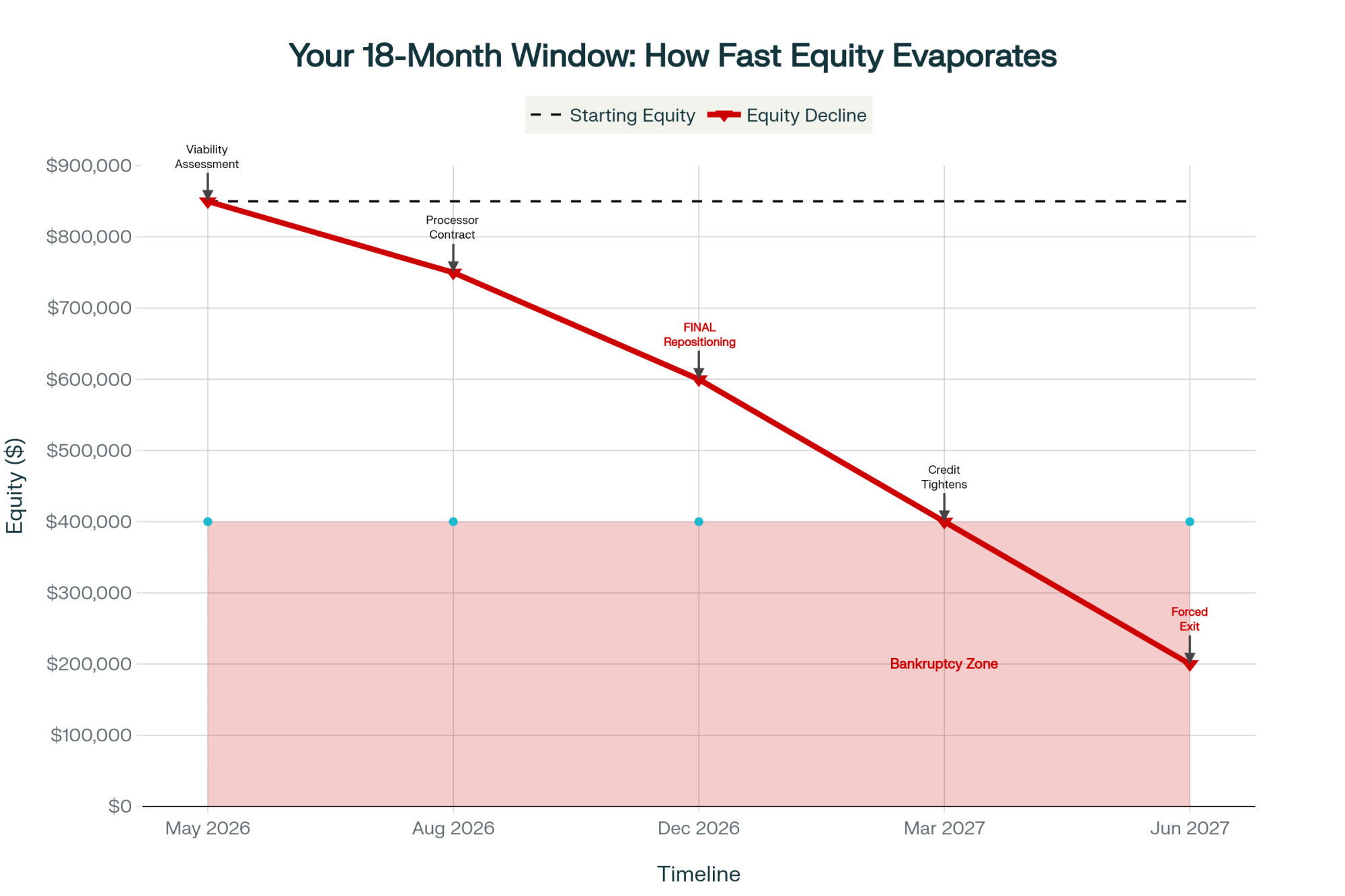
More than most families expect — and the meter runs whether you look at it or not. Cornell’s Dyson School research, as reported by The Bullvine in December 2025, found that well-planned transitions preserve $400,000 to $680,000 more wealth than distressed sales, and that delaying an exit by three years can destroy roughly $450,000 in family equity. Forced sales make it worse. When assets sell on a lender’s timeline instead of yours, Calder Capital’s March 2025 distressed-sale analysis pegs auction recovery at just 23–51% of fair market value, versus far more in an orderly going-concern sale.
There’s a quieter cost too. Farm advisors note that producers who have an exit plan — even one they never pull the trigger on — make calmer, sharper daily decisions, because the desperation’s gone. The plan isn’t a white flag. It’s a steering wheel you keep in your own hands instead of handing to the bank.
Staring at numbers like these and feeling the weight of them? You’re not the only one, and you don’t have to sort it out alone. Farm Aid (1-800-FARM-AID) and Do More Ag connect farm families with both financial and mental-health support.
So Which Path Are You Actually On?
There are three real paths here — not a fourth one where milk prices ride in and rescue a small commodity herd. Each one works for some operations and quietly destroys others. The honest part is matching the path to who you actually are. Read the prerequisite first: if it doesn’t describe you, that’s not your path.
| Path | Best for | Prerequisite to even start | What it requires | The risk |
| 1. Go big & efficient (commodity) | Operators who want to compete on cost at scale | A balance sheet that pencils well below the $20.70 forecast — extension economists advise stress-testing expansion against milk as low as $16/cwt | 500–1,000+ cows, strong equity, low cost per cwt | You stop being a “small dairy” entirely, and the debt is real the day milk drops |
| 2. Go radically niche (high margin, low cow count) | Operators near affluent/health-minded buyers who genuinely like marketing | $267,248–$623,874 in processing capital for modest artisan cheese volumes — and that’s a 2013 figure, so budget higher today (Journal of Dairy Science, 2013) | Brand work, regulatory know-how, and patience through years of thin returns | Premium transitions often lose money for years before they turn; the upside is real — organic and grass-fed ran $38–$60/cwt this spring per NODPA, against that $16.92 check |
| 3. Exit while you still have equity | Farms with no successor and a breakeven stuck above market | An honest valuation and a timeline you control, before the lender sets one for you | A real tax conversation and lead time | None, if done early — strategic exits have preserved $400,000–$680,000 more than forced liquidations (Bullvine, March 2026) |
Our 70-cow family at the kitchen table? On these numbers, with no off-farm buyer lined up and no appetite for building a brand, they’re a Path 3 candidate — unless someone’s willing to pay a premium for the story behind that milk, which moves them toward the 40-cow value-added model and Path 2. What they can’t be is Path 0: a commodity tie-stall that pays all the bills at $16.92. That option left the table years ago.
And the choice isn’t only about this year’s check. Each path carries a different forward bet. Path 1 is a bet that you can keep driving cost per cwt down faster than milk prices fall — RaboResearch’s $10/cwt scale gap says the big farms will keep pressing that advantage. Path 2 is a bet that the organic and direct-to-consumer premium holds; NODPA’s $38–60/cwt spread is real today, but it rides on consumer demand you don’t control. Path 3 is the only one that locks in what you’ve already built before the next down-cycle takes another bite. Pick the bet you can live with.
The 30-day move that fits all three: Calculate your true cost of production. Price your own labor at $18–22 an hour, depreciate the barn at replacement cost, and stack the result against the price you actually get paid — not the forecast headline. Cornell Cooperative Extension recommends a full production-and-financial analysis plus a sit-down with your lender as the first moves for farms under pressure. You can’t pick a path until you know which side of the line you’re standing on.
Key Takeaways
- If you can’t state your cost per cwt with your own labor priced in and depreciation at replacement cost, that’s your first 30-day project — Cornell pegs the 100–199 cow class at $31–33/cwt, so if your number is lower, prove it before you bank on it.
- If you’re budgeting off USDA’s $20.70 all-milk forecast instead of the Class III strip your check actually tracks ($16.92 in May 2026), rebuild the plan on the lower number before you commit a dollar.
- If off-farm income has covered farm operating losses in three or more of the last five years, treat it as a structural signal and run the full economic analysis, not just the cash flow.
- If niche is the dream, price the second business honestly — $267K-plus in processing capital plus the marketing and food-safety load — before you fall for the $38–60/cwt headline.
- If there’s no successor and equity’s sliding, get a valuation now — a planned exit can hold six figures that a forced sale at 23–51% of value won’t.
- If you’re staying commodity, book the lender conversation with real numbers before a covenant breach books it for you.

So where does your breakeven actually sit right now — not the cash version, the real one with your wage and your depreciation in it? That single number tells you whether you’re running a business, subsidizing a way of life, or slowly handing your equity to someone further up the chain. None of those three is wrong. But you ought to know which one you’ve chosen, instead of finding out when the bank does.
Complete references and supporting documentation are available upon request by contacting the editorial team at editor@thebullvine.com.
Learn More
- Small herd cost of production: the $20.70 milk trap — Arms you with a hard look at the structural barriers facing small dairies, proving why a family farm succession proxy like building an on-farm creamery rarely resolves underlying equity leaks.
- The $19 Milk Trap: How 2026 Prices Quietly Drain a 400‐Cow Dairy’s Equity — Exposes the deep structural asymmetries and processing plant mechanics that leave smaller herds exposed to intense margin squeezes, delivering an immediate financial stress-test playbook to protect your long-term balance sheet.
- $18.95 Milk, 8% Money: Nathan Kauffman’s 18‐Month Warning for the 10–15% of Dairies in Significant Stress — Dismantles the blind spot of cash-flow budgeting by calculating how repriced debt erosion impacts mid-sized operations, providing clear data to determine whether to exit cleanly or deploy beef-on-dairy premium hedges.
The Sunday Read Dairy Professionals Don’t Skip.

Every week, thousands of producers, breeders, and industry insiders open Bullvine Weekly for genetics insights, market shifts, and profit strategies they won’t find anywhere else. One email. Five minutes. Smarter decisions all week.