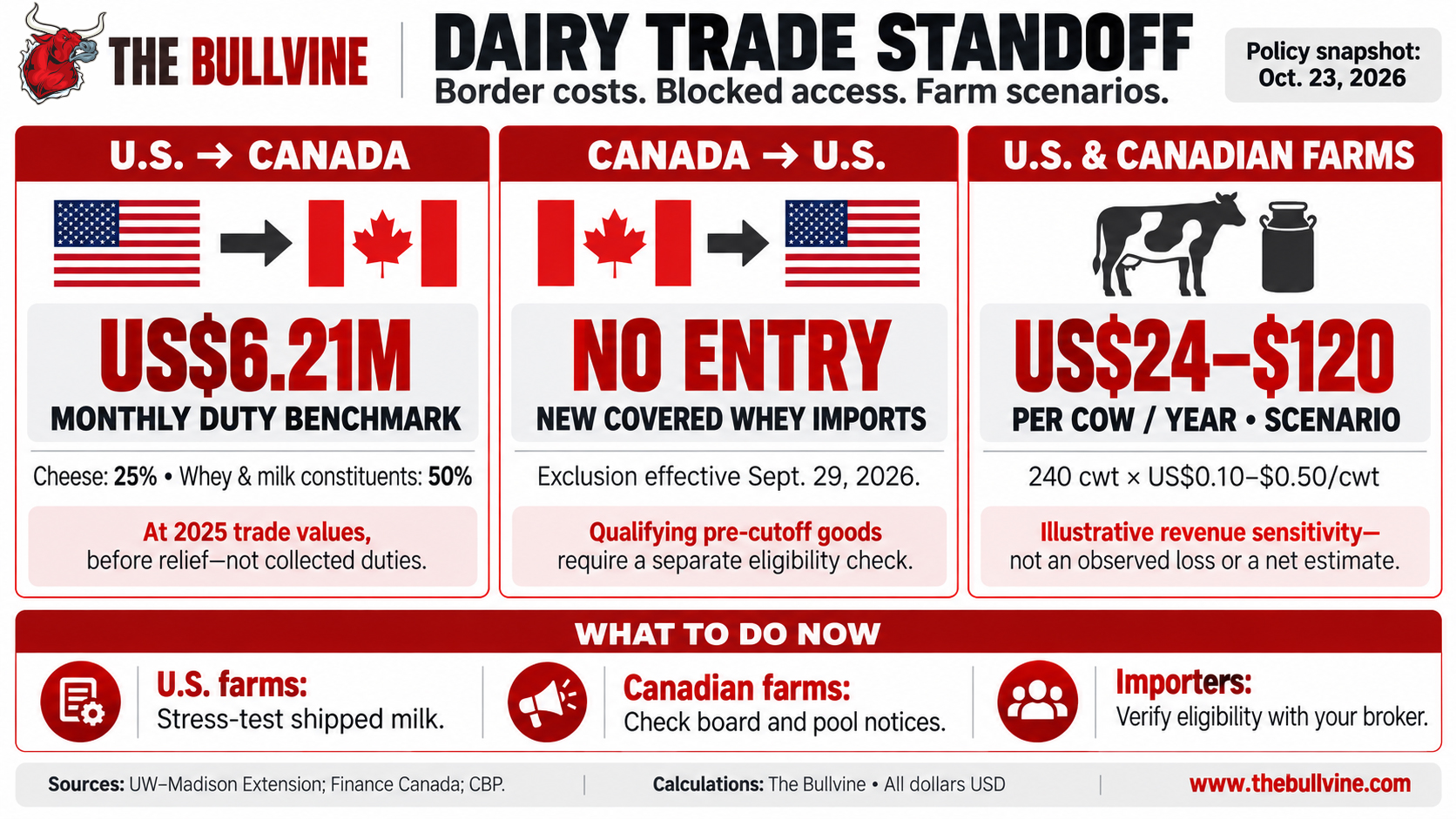
At 2025 volumes, Canada’s 25% and 50% surtaxes would cost U.S. cheese and whey exporters up to US$6.21 million a month in duty. Since Sept. 29, eight lines of Canadian whey can’t enter the U.S. at any price. Ottawa’s chief negotiator says there’s no date to restart talks.
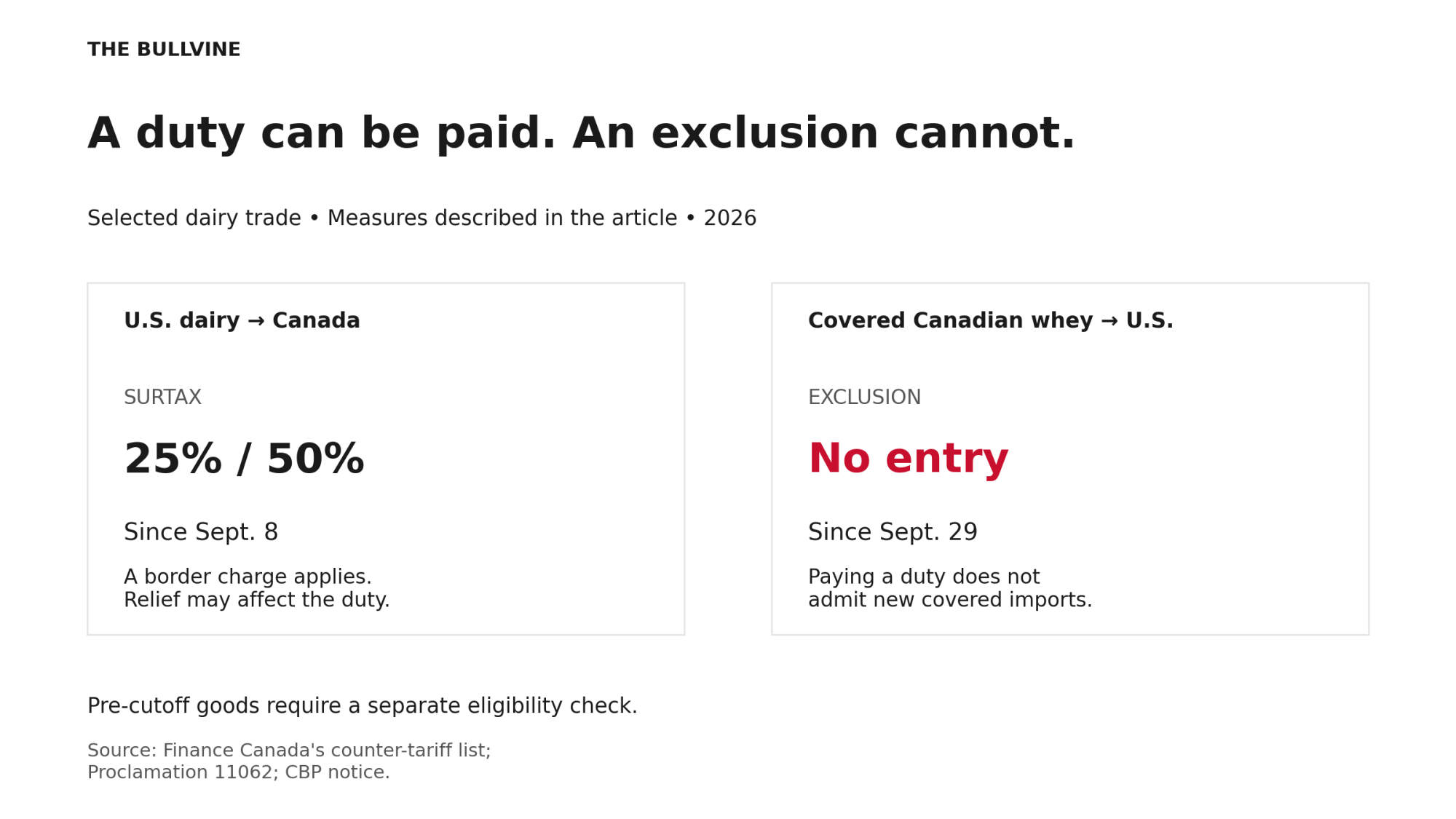
We don’t know exactly when that’s going to happen,” Canada’s chief trade negotiator Janice Charette said Oct. 22 of formal talks with Washington. That makes time the variable that matters. At 2025 trade volumes, Canada’s surtaxes would carry up to US$6.21 million a month in duty on U.S. cheese and whey, before any relief. Run from Sept. 8 through Oct. 31, that’s about US$11 million (Bullvine math). Washington’s measure on Canadian whey isn’t a rate at all. Since 12:01 a.m. Eastern on Sept. 29, eight covered whey lines can’t enter the U.S., and paying duty doesn’t change that.
Canada’s surtaxes have been in force since Sept. 8, with no end date and no date to restart talks. At 2025 volumes, that’s up to US$6.21 million a month in duty on U.S. cheese and whey. That’s about US$11 million through Oct. 31 (Bullvine math: 54 days at the monthly rate). Washington answered with a ban, not a rate. Since 12:01 a.m. Eastern on Sept. 29, covered Canadian whey can’t enter the U.S. at any price, and no duty payment changes that.
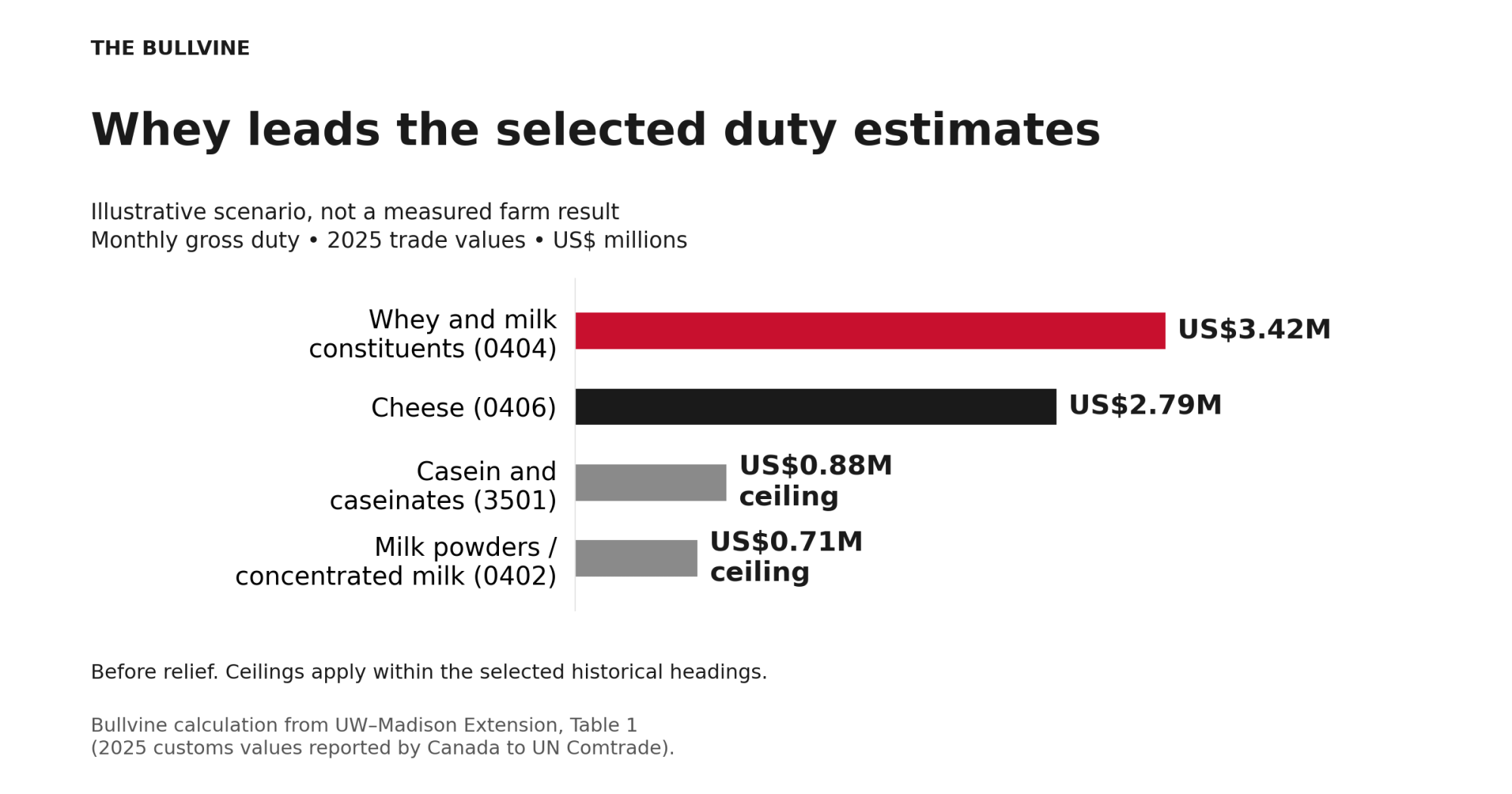
Canada’s Dairy Surtax Cost per Month
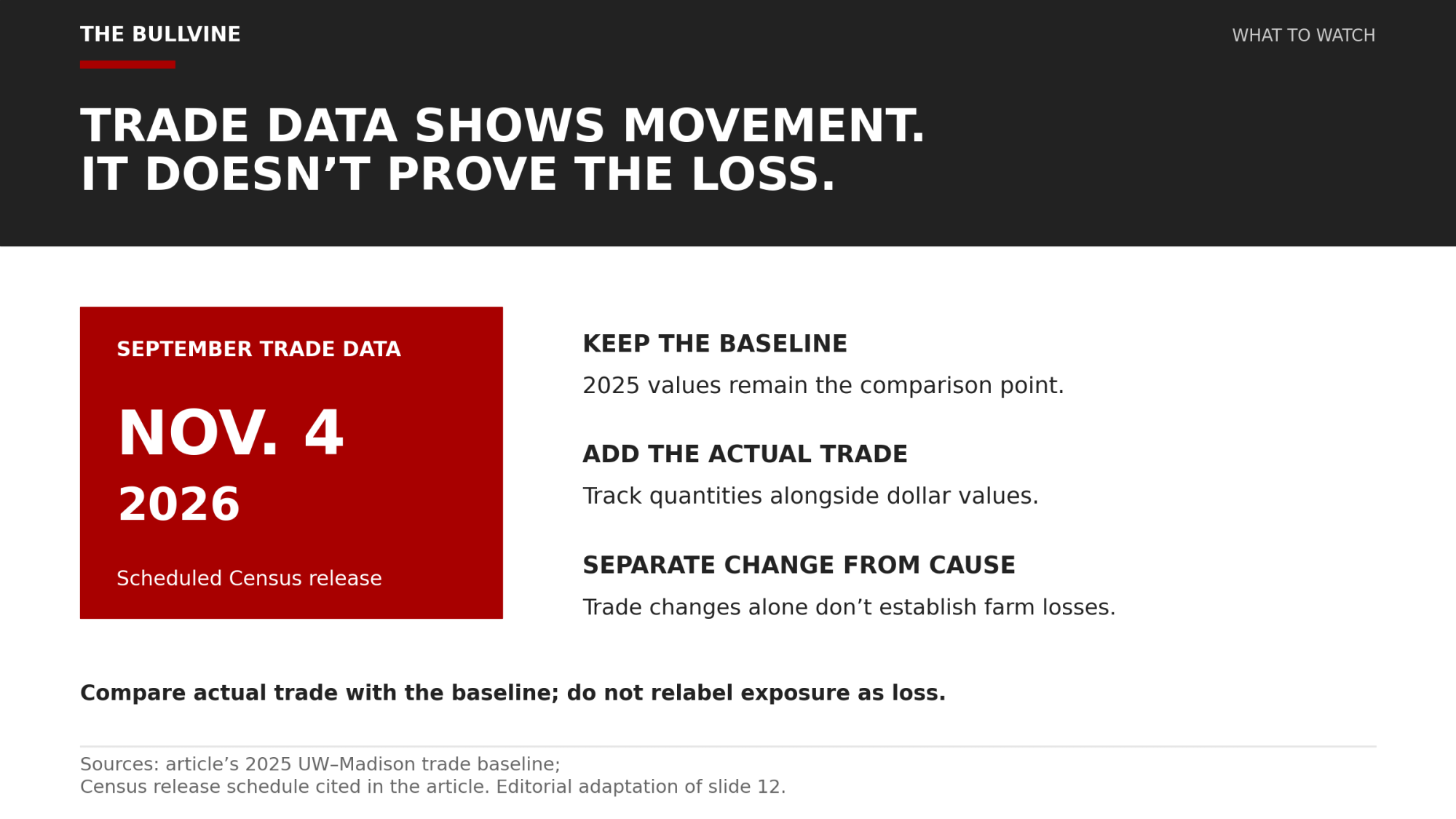
All trade values are in USD and show exposure, not realized loss. Census is scheduled to release September trade data on Nov. 4, 2026. Monthly customs data replaces these cells as each month posts.
U.S. dairy exports to Canada (Canadian surtax since Sept. 8)
Product (HS)
2025 monthly trade
Rate
Estimated monthly duty
Cheese (0406)
$11.17M
25%
$2.79M
Whey and milk constituents (0404)
$6.83M
50%
$3.42M
Casein and caseinates (3501)†
$1.75M
50%
$0.88M (ceiling)
Milk powders, concentrated milk (0402)†
$1.42M
50%
$0.71M (ceiling)
Selected headings subtotal
$21.17M
$7.79M
Source: UW–Madison Extension, Table 1 (2025 customs values reported by Canada to UN Comtrade), updated Sept. 30, 2026. Monthly figures and duties are Bullvine math: annual ÷ 12 × statutory rate, before any Duties Relief or Drawback.
Cheese and whey carry US$6.21 million of that (Bullvine math). “Whey” here means all of heading 0404, milk constituents included. Finance Canada’s list covers every 0404 and 0406 tariff item in Canada’s 2026 Customs Tariff. It covers only part of the casein and milk-powder headings. UW–Madison counts those two as fully tariffed, so Bullvine marks them as ceilings and keeps them out of the headline number.
The Canadian Dairy Exports the U.S. Banned
Canadian dairy exports to the U.S.
Product (HS)
2025 monthly trade
U.S. measure
Monthly exposure
Whey and modified whey (0404.10)
$2.92M [GATS: VERIFY]
Excluded since Sept. 29 (eight lines)
Up to $2.92M of trade blocked (ceiling)
Remaining 0404, incl. milk constituents/MPC
~$2.83M (Bullvine math)
50%
~$1.42M duty
Milk powders (0402)†
$0.67M
50% (per UW–Madison)
$0.33M duty
Quantified subtotal
$6.42M
Cheese (0406), not quantified
$7.58M
Unconfirmed (see below)
Not calculated
Whey line: USDA FAS GATS, U.S. imports from Canada, 2025, ÷ 12 (Bullvine math). Remaining 0404: UW–Madison’s US$69M for all of heading 0404 (Canada-reported) minus the GATS 0404.10 figure (U.S.-reported), ÷ 12. The two reporters don’t match, so treat it as approximate.
Proclamation 11062 bars eight eight-digit lines inside 0404.10, so US$2.92 million is a ceiling for the banned subset. Covered goods that landed before Sept. 29 but weren’t yet entered still pay the 50% duty. The proclamation says Canada “reneged on its commitment” on Aug. 21; that’s Washington’s claim, not a finding.
Cheese. UW–Madison reports the U.S. added Canadian cheese to its 50% list effective Sept. 15. CBP’s Sept. 11 guidance (CSMS 69851916) lists Sept. 15 changes under the alcohol and motor-vehicle proclamations only. It says there are “no changes” under heading 9903.03.13. Proclamation 11062 cites a separate Sept. 8 dairy scope proclamation, but Bullvine hasn’t found its annex (checked Oct. 23, 2026). Bullvine leaves cheese out of the count until that annex turns up.
What It Means for the U.S. Milk Check
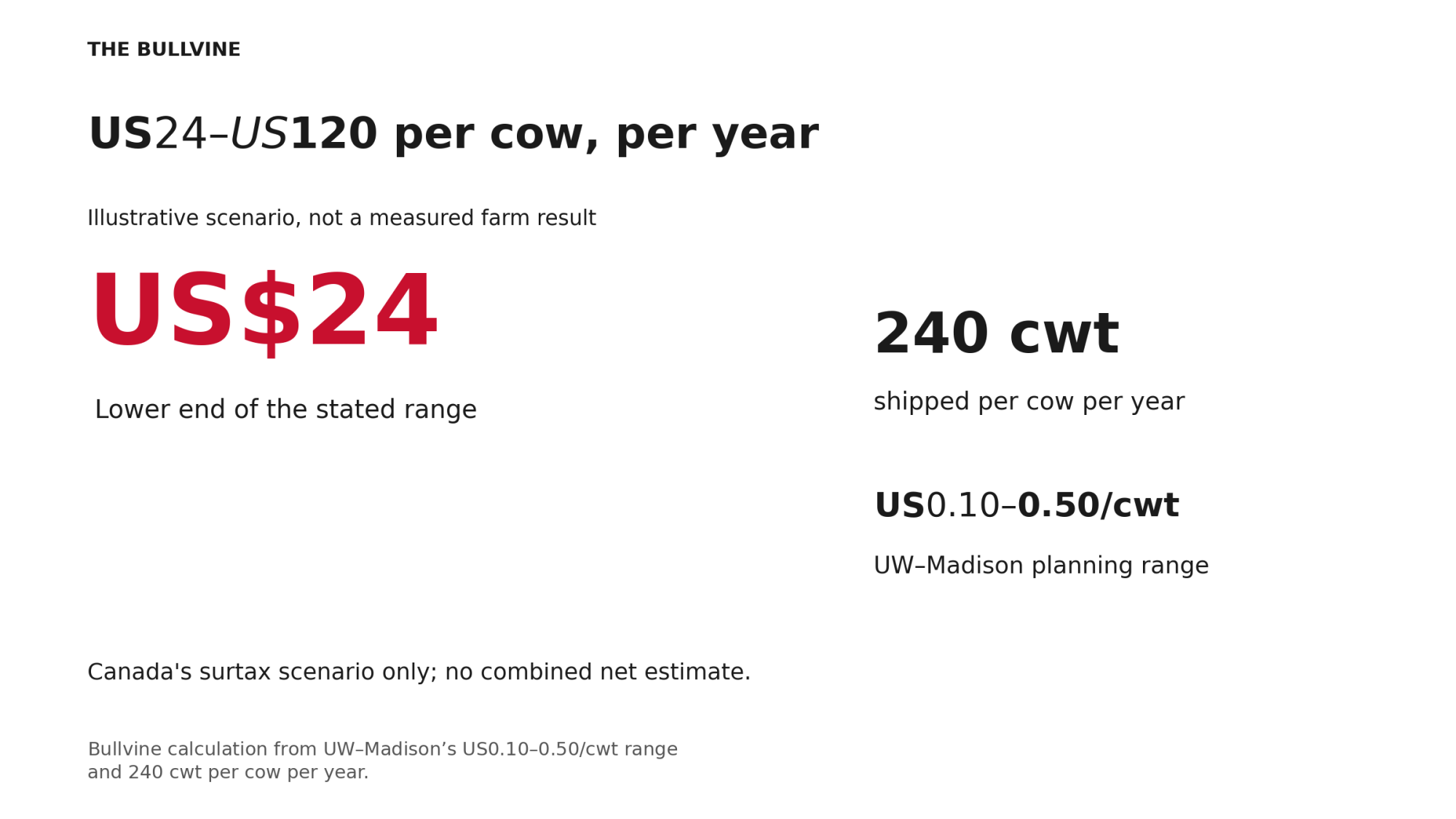
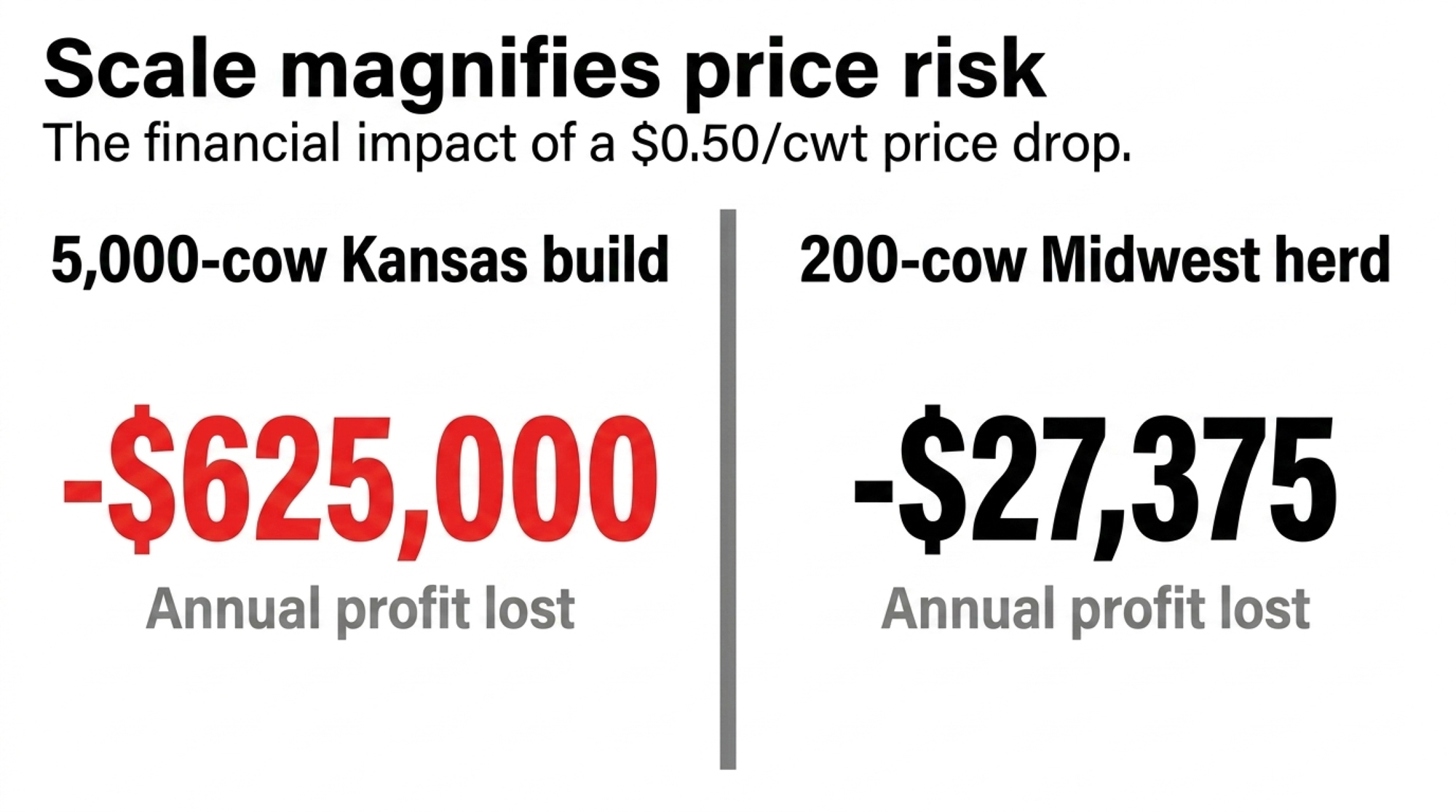
UW–Madison runs the effect through cheese and whey prices into Class III. Its anchor is roughly US$0.20–$0.35/cwt “for a sustained action,” inside a planning range of US$0.10–$0.50/cwt. On 240 cwt per cow a year, Bullvine’s math puts that at US$24–$120 per cow per year. That’s a different shipping basis from earlier Bullvine pieces.
That range covers Canada’s surtax alone. UW says the U.S. and Canadian whey measures “pull in opposite directions for U.S. prices” and doesn’t net them. Bullvine’s Sept. 14 modeling put the ban’s possible Class III lift at +11.9¢ to +59.6¢/cwt. Even the bottom of that could more than cover UW’s 10¢ low case. Nobody has published the net, so a budget that books the 10¢ hit as certain is booking only one side of the border.
The duty is customs dollars on trade crossing the border. A farm’s exposure is cwt shipped times the price change per cwt, and one number doesn’t convert into the other.
What to Do Now
U.S. producers: Run UW–Madison’s range against your own shipments, then check whether your budgeted milk price holds through the anchor band. A Class III or dry whey move doesn’t by itself prove the tariffs caused it.
Canadian producers: Watch upcoming board and pool settlements for changes to prices, incentives, production days or deductions. Also watch whether the board attributes any change to trade. No published source yet establishes a Canadian farm-gate effect, and the settlement statement is where one would show first.
Importers: Have your broker confirm whether any covered Canadian product you hold qualifies under the pre-Sept. 29 provisions. After the cutoff, CBP bars covered product from foreign-trade zones, bonded warehouses, in-bond moves and entry for consumption.
Lenders: Stress cash flow month by month at US$0.10/cwt and again across the anchor band.
Exporters and co-ops: Track quantities alongside values, since a drop in dollars can be price, volume or both. October is the first full month under the whey ban; September mixes three effective dates.
Key Takeaways
US$6.21M a month in Canadian duty on U.S. cheese and whey at 2025 volumes. That’s about US$11M from Sept. 8 through Oct. 31 (Bullvine math).
US$7.79M a month is a ceiling, not the bill, because casein and milk powders are only partly listed.
Up to US$2.92M a month of Canadian whey blocked outright since Sept. 29. That’s a ceiling for the eight banned lines.
The U.S. duty on Canadian cheese is unconfirmed. CBP’s Sept. 15 guidance doesn’t list a dairy scope change.
Run Your Numbers
Plug your monthly cwt and component tests into the Component Value Tracker to see UW–Madison’s $/cwt range on your own milk.
Milk Revenue Stress Test
Calculate your farm’s monthly revenue exposure based on the UW–Madison trade dispute price scenarios.
Monthly values and duties: Bullvine math (annual ÷ 12 × statutory rate), before any Duties Relief or Drawback.
Canadian rates and tariff items: Finance Canada’s counter-tariff list, with coverage checked against the CBSA Customs Tariff, Chapters 4 and 35 (2026), on Oct. 23, 2026.
U.S. measures: Federal Register 2026-18836 and CBP CSMS 69851916, both opened Oct. 23, 2026.
Ceiling: the full heading’s 2025 trade times the statutory rate, used where only part of the heading is listed. The true figure is lower.
† 0402 (U.S. exports to Canada): Finance Canada lists 10 of the 14 tariff items in the heading. 0402.29.11, .12, .21 and .22 aren’t listed.
† 3501 (U.S. exports to Canada): Only 3501.10.00 (casein) is listed. 3501.90.00 (caseinates and other) isn’t, but UW–Madison’s US$21M includes it.
† 0402 (Canadian exports to the U.S.): The 50% rate comes from UW–Madison. Bullvine hasn’t opened the Proclamation 11047 Annex II line list.
Timeline:
July 20: Proclamation 11047 sets 50% duties, effective Aug. 19.
Aug. 18: Proclamation 11056 suspends them for three days.
Aug. 22, 12:01 a.m. Eastern: the suspension lapses and the 11047 duties take effect.
Sept. 8: Canadian surtaxes take effect.
Sept. 15: CBP implements alcohol and vehicle scope changes. The dairy change is unconfirmed.
Sept. 29, 12:01 a.m. Eastern: the whey exclusion under Proclamation 11062 takes effect.
Learn More
New 25% Border Tax Hits Dairy Trade: What It Means For Your Farm — Breaks down the immediate financial shock of the $856 million cross-border disruption. Arms you with specific steps to track your Class III exposure, tighten your 2025 production costs, and shield your farm’s bottom line against impending market volatility.
USMCA 2026: The $200M Question – Why Only 42% of U.S. Dairy Access to Canada Gets Used — Exposes the hidden regulatory loopholes keeping over half of negotiated American export quotas completely empty. Connects the dots on how the upcoming trade review dictates processor expansion and what questions you must ask your co-op leadership right now.
Dairy Showdown: Canadian Quotas vs. American Free Market — Dismantles the prevailing myths dividing North America’s opposing agricultural systems. Contrasts the brutal margin volatility driving US mega-dairies toward massive automation against the stagnant innovation inside Canada’s protected quota fortress to reveal who actually survives the next decade.
The Sunday Read Dairy Professionals Don’t Skip.
Every week, thousands of producers, breeders, and industry insiders open Bullvine Weekly for genetics insights, market shifts, and profit strategies they won’t find anywhere else. One email. Five minutes. Smarter decisions all week.
Canada’s counter-tariffs are live. Extension puts Wisconsin at $51–$90 a cow. Ontario’s formula has no tariff line at all — which sounds like protection until you need the warning.
Executive Summary: Class III is built from cheese and dry whey — the two products Canada just tariffed at 25 and 50 per cent — and Federal Order 30 carries the thinnest pooling cushion in the country, 64 cents year-to-date against $3.54 in the Northeast. That’s why UW–Madison Extension’s $0.20 to $0.35/cwt estimate lands nearly whole on a Wisconsin cheque: $51 to $90 a cow, or $15,300 to $27,000 a year on a modelled 300-cow herd. Ontario’s number, through the pricing formula, is zero. Canada’s National Pricing Formula runs on cost of production and CPI with no tariff input anywhere — the P5 boards defend income by moving volume, so you’ll see fewer incentive days long before you ever see a lower base price. Two more U.S. measures land this month, a wider cheese list September 15 and an outright ban on Canadian dairy September 29, all resting on a 1930 statute nobody had ever used to impose tariffs and nobody has yet challenged in court. Pull your last three cheques, find your PPD and your statistical uniform price, then call your plant before the 15th.
Fifty-one to ninety dollars a cow a year. That’s what the University of Wisconsin–Madison Division of Extension estimates the Canada dairy tariffs now cost a Wisconsin herd, published September 7, 2026 — one day before Canada’s counter-tariffs took effect. On a modelled 300-cow herd, that’s $15,300 to $27,000 off the year. Cross into Ontario, and the same trade fight moves a P5 milk cheque by zero through the pricing formula.
Same tariffs. Same week. Two milk cheques that don’t feel it the same way at all.
Darin Von Ruden, president of the Wisconsin Farmers Union and a third-generation dairy farmer near Westby, told WEAU in late August that Wisconsin’s butter sector leans on Canadian buyers to move inventory the domestic market can’t absorb. He attached no dollar figure to it, and the syndicated version of his remarks says so plainly.
Butter sits on neither tariff list. Not Canada’s. Not the U.S. one. So the pressure he pointed at doesn’t travel through the tariff schedule at all — it travels through demand, which is a slower and quieter road.
Rates, dates, and litigation status are current as of September 9, 2026. Two further U.S. measures land September 15and September 29.
What Got Tariffed on September 8, and What’s Still Coming
Canada’s counter-tariffs went live at 12:01 a.m. on September 8, 2026. The dairy portion is specific: 50% on U.S. milk and cream powders, whey, casein, milk protein concentrates, and milk protein substances — and 25% on every named U.S. cheese, from cheddar and mozzarella through parmesan, gouda, brie, provolone, and blue.
Finance Canada describes it as matching the U.S. Section 338 tariffs dollar for dollar — 15, 25 and 50 per cent rates across C$27.6 billion in goods. For scale, the U.S. shipped US$333.6 billion north last year.
The U.S. move came first. Three presidential proclamations signed July 20, 2026 imposed a 50% ad valorem duty on Canadian goods including dairy, alcohol, motor vehicles, timber, and clothing. The dairy annex covers milk and cream, whey and whey protein concentrates, milk protein concentrates, casein and caseinates, milk albumin, lactose, and bakers’ mixes containing butterfat. Effective 12:01 a.m. Eastern on August 19, implemented August 22 — days after Prime Minister Mark Carney called off trade talks.
It didn’t stop there. In a flurry of proclamations issued Tuesday, September 8, the administration added a wider range of cheese to the Section 338 list, along with steel and aluminum products, mattresses, golf carts, printer paper, motorboats, and animal hides. Those take effect September 15 at 12:01 a.m. EDT. No outlet had published the line-level cheese codes at press time — check the annex itself, not the news summaries.
A separate set of measures goes further. The U.S. will ban Canadian dairy products, most alcoholic beverages, and motorcycles outright, effective September 29 at 12:01 a.m. EDT. A tariff becoming an import prohibition in five weeks. Different instrument, different math.
What’s Exempt — Both Directions
Not tariffed by either country: butter, fluid milk, cream, yogurt, ice cream (UW–Madison Extension, Sept 7, 2026)
Quota status doesn’t help: AgCanada reported Aug 26 that Canada’s counter-tariffs hit U.S. dairy in-quota and over-quota alike
Origin is a separate question: secondary reporting says Ottawa removed counter-tariffs on CUSMA-qualifying U.S. goods on September 1 — confirm how that interacts with the September 8 list through your customs broker rather than assuming it either way
Running the Numbers: A Modelled 300-Cow Wisconsin Herd
Extension’s model is the only published farm-level estimate from these tariffs. No second institution has released a competing or corroborating figure, so treat the range below as one land-grant model — documented and transparent, but not a consensus. It also predates the September 15 cheese expansion, which means it likely understates rather than overstates.
The trade base (UW–Madison Extension, September 7, 2026):
U.S. dairy sales to Canada, 2025: about $1.3 billion — second only to Mexico, roughly 14% of all U.S. dairy exports
U.S. dairy imports from Canada, 2025: $432.7 million, per Extension’s reading of customs data
Tariffed products with measurable customs value: about $255 million
The floor calculation — lost export value only, no price transmission:
$250 million ÷ 2.3 billion cwt of U.S. milk production = $0.11/cwt
On a modelled 300-cow herd at 25,600 lbs/cow/year: 76,800 cwt × $0.11 = $8,448/year
Across Wisconsin: about $35 million
That’s the floor. It spreads lost revenue across every hundredweight in the country and assumes no knock-on price effect.
The anchor estimate — price transmission into Class III, not just lost volume:
Class III effect: $0.20 to $0.35/cwt
Wisconsin statewide: $65 to $113 million/year
Per cow: $51 to $90/year, at Extension’s 25,600 lbs/cow assumption
Wider planning range: $0.10–$0.50/cwt, or $32 to $162 million statewide — $26 to $128 per cow
Now scale it to your barn. Your cows × your annual lbs/cow ÷ 100 = your cwt. Multiply by the range.
Cross-check on the per-cow method: 300 × $51 = $15,300 … 300 × $90 = $27,000 ✓
Call it $15,300 to $27,000 on the anchor for a 300-cow herd. Not catastrophic. Not nothing, either.
Why Order 30 Feels a Class III Move Harder Than Anywhere Else
That figure is a Class III number, not a mailbox number. What reaches your statement is the blend price — Class III plus your order’s producer price differential — and the PPD is where most tariff coverage stops paying attention.
Wisconsin milk pools mostly under Federal Order 30, the Upper Midwest. USDA AMS publishes every order’s PPD monthly, and Order 30’s 2026 run tells you something no other order’s does.
Federal Order
Jan
Feb
Mar
Apr
May
Jun
2026 YTD
Upper Midwest (30)
$0.46
$0.58
$0.50
$0.61
$0.69
$0.87
$0.64
Northeast (1)
$2.05
$2.37
$2.66
$3.43
$4.42
$6.22
$3.54
Mideast (33)
$1.33
$1.50
$1.58
$2.32
$3.01
$4.77
$2.35
Central (32)
$1.16
$1.39
$1.49
$2.10
$2.70
$3.59
$2.10
California (51)
$0.26
$1.10
$1.06
$1.46
$1.84
$2.66
$1.38
All markets combined
$1.14
$1.49
$1.48
$1.96
$2.44
$3.48
$2.02
Source: USDA AMS, “2026 Uniform Producer Price Differential — Monthly and Year-to-Date,” dollars per cwt, base zone. Order 30’s base zone is Cook County, Illinois. The Order 30 market administrator’s own February and March computation statements independently confirm $0.58 and $0.50.
Order 30 runs the smallest PPD of any federal order — 64 cents year-to-date against $3.54 in the Northeast, more than five times higher. That’s not a disadvantage. It’s a structural fact about a market that pools overwhelmingly into cheese.
And it cuts the way most people don’t expect. A small PPD means your blend price tracks Class III closely. Order 30’s June 2026 statistical uniform price came in at $16.85/cwt — Class III plus that 87-cent differential — down $0.76 from May and $2.25 below the year before.
The Class III Rule of Thumb
A 1¢/lb drop in cheese pulls Class III down roughly $0.10/cwt
A 1¢/lb drop in dry whey pulls Class III down roughly $0.06/cwt
Class III + PPD = your statistical uniform price. In Order 30 that PPD has run 46 to 87 cents all year, so Class III moves arrive nearly intact
The PPD is announced on or before the 14th day after month-end — a date most producers never put on a calendar
Extension’s range assumes a sustained tariff, and it was built before the September 15 expansion. Four-plus consecutive data points is the honest threshold before calling anything a trend
So a Wisconsin herd doesn’t get much cushion from the pool. A Northeast herd riding a $3.54 differential built on Class I utilization does. Same tariff, same Class III formula, different insulation — and Wisconsin has the least of it.
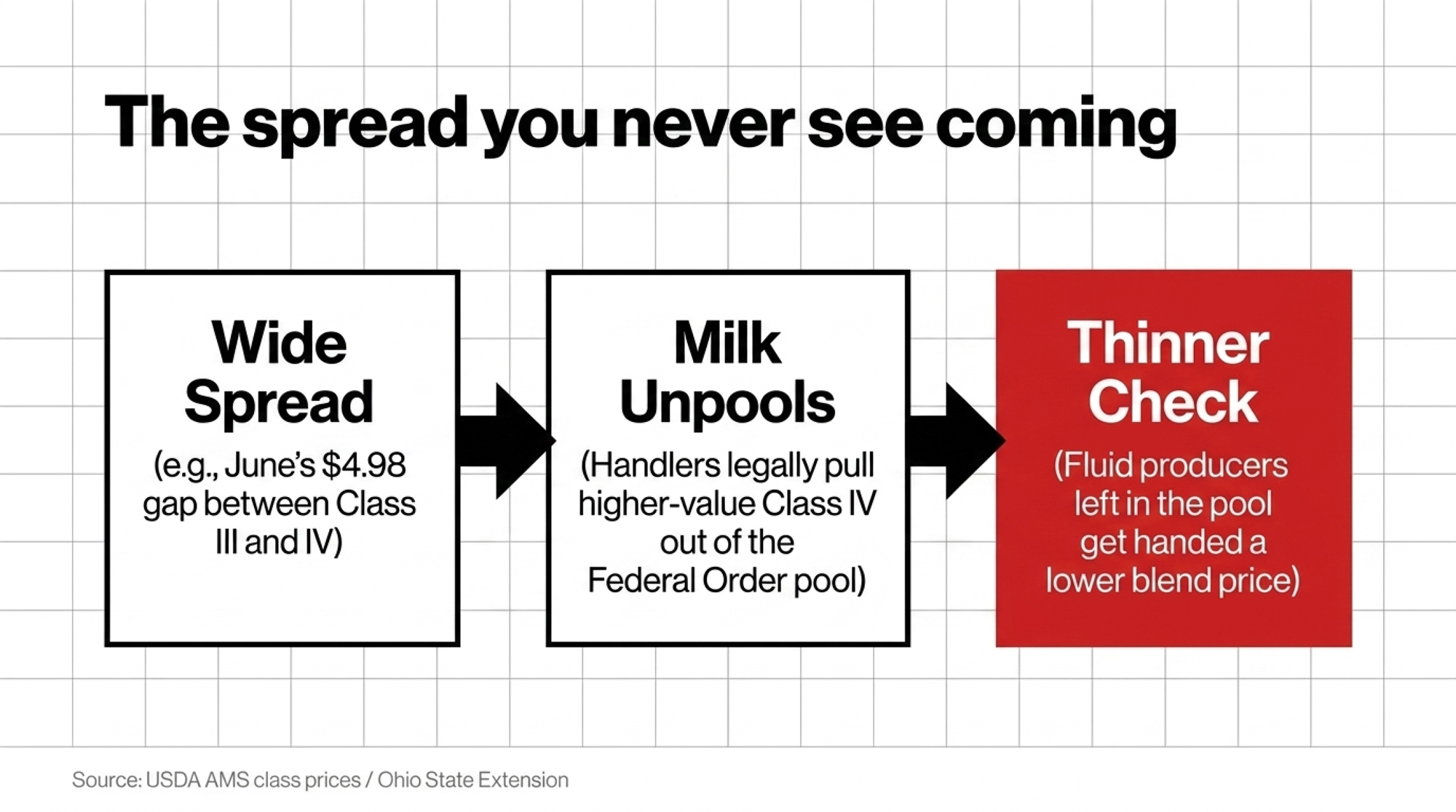
One thing complicates any single month: depooling. Manufacturing milk in Classes II, III and IV can be kept out of the pool under each order’s qualification rules, which distorts the differential. It’s real and active in 2026 — Iowa State Extension documented aggressive Class IV de-pooling in the Central order in March, where pooled volume fell to 1.35 billion pounds from more than 1.50 billion a year earlier. Different order than Wisconsin’s, same mechanism available.
What the whole thing costs you also depends on your balance sheet. A debt-free 300-cow operation absorbs $27,000 as a rough year. The same herd carrying a heifer barn and a robot note treats it as the difference between covering the payment and calling the lender.
Worth remembering too: cheese and whey prices move on Chinese demand, EU output, and CME activity — not just Canadian buying.
Why the Same Tariff Moves an Ontario Cheque by Zero
Everyone reading “dairy farmers hit by tariffs” assumes the hit lands symmetrically. It doesn’t, and the reason is plumbing, not politics.
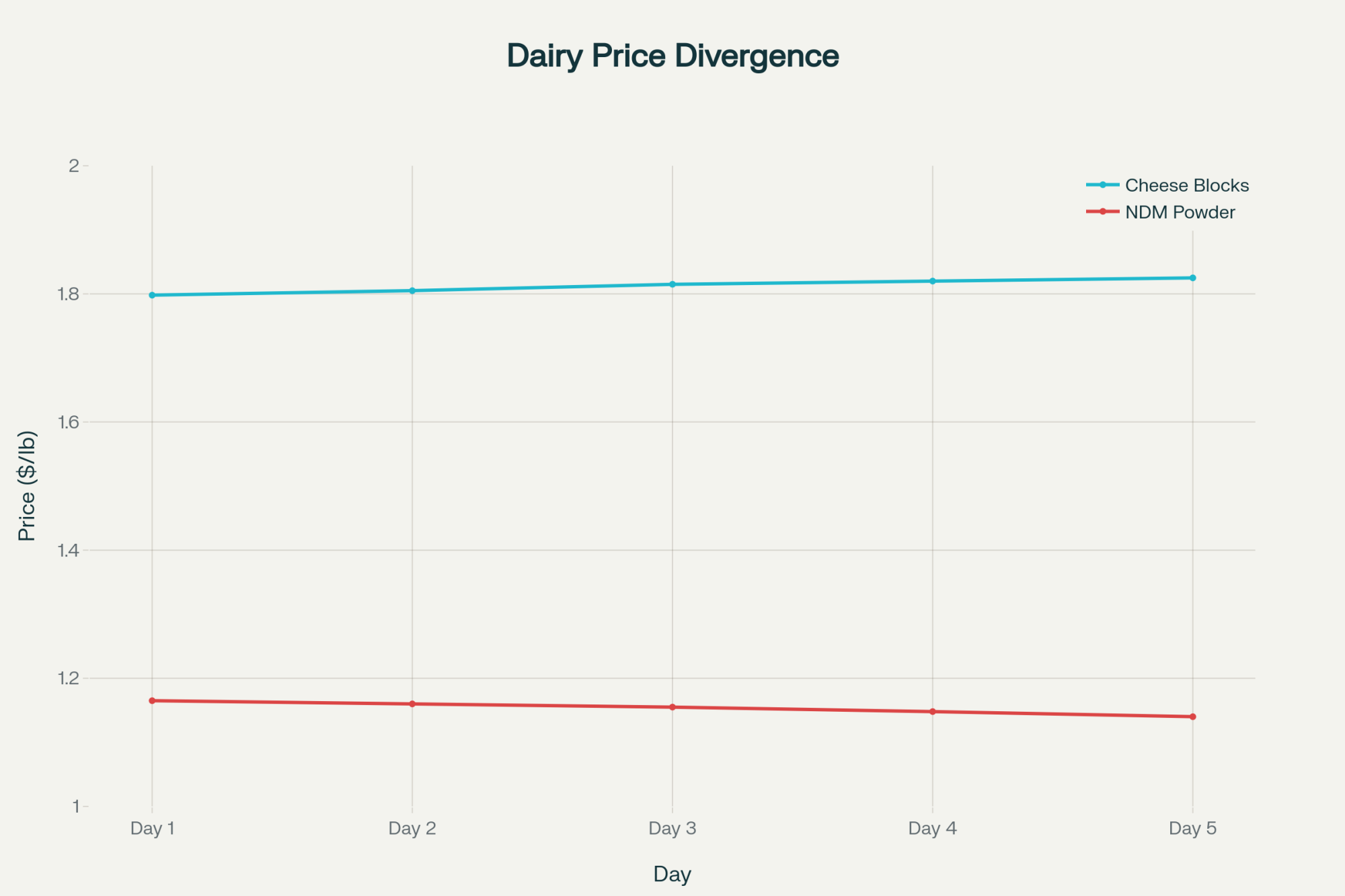
USDA’s National Dairy Products Sales Report put 40-pound cheddar blocks at $1.6140/lb for the week ending August 29, 2026 — down 1.1 cents from the prior week. Run that single week through the coefficient and you get about $0.11/cwt on Class III. That’s a coincidence of arithmetic, not the same figure as the floor calculation above — this one is a single week’s price move, arriving in an Order 30 cheque nearly whole. August 2026 Class III landed at $16.64/cwt, up $1.12 from July; Class IV at $17.36, down $0.98.
Canada’s farmgate price doesn’t work like that at all.
Running the Numbers: What Actually Reaches an Ontario Cheque Walk the Canadian Dairy Commission’s National Pricing Formula component by component and look for the tariff input:
Component 1: 50% of the change in cost of production, from a producer cost survey — no tariff input
Component 2: 50% of the change in the Consumer Price Index — no tariff input
Result, February 1, 2026:+2.33%, on a cost-of-production figure of $92.82 per standard hectolitre
Processor make allowance — the first place an import cost would register — held explicitly unchanged in the February 2026 butter support-price adjustment
There’s no line in that calculation where a processor’s import bill enters. The tariff cost sits with the processor. It doesn’t get an invitation into the room where your price gets set.
But don’t confuse a protected pricing formula with immunity. The P5 boards don’t defend producer income by moving the base price. They move volume — and volume is the lever that actually responds to a market shock.
Run it on a modelled 150-cow Ontario herd. At roughly 1.1 kg butterfat per cow per day, that’s 165 kg BF/day of quota. At the P5 policy cap of $24,000/kg BF, the quota asset alone carries about $3.96 million. None of that moves on a tariff. What moves is days.
The P5 boards announced conventional incentive days for fall 2026 on a non-cumulative basis — one day in each of August, September, October and November, explicitly to complement the SNF/butterfat payment policy change and pull more milk into a system short on protein (Milk Producer, Dairynomics, April 28, 2026). Four days. For that 165 kg BF/day herd, that’s 660 kg of butterfat in additional saleable production this fall.
The lever runs both directions. DFO waived Ontario’s over-quota penalty for April 2026 outright as protein demand outran supply, then reinstated it May 1. Right now the days point up — the system wants milk.
If the September 29 U.S. ban strands Canadian dairy that would otherwise have crossed south, the boards will pull back incentive days first. But watch the pool: any displaced volume forced into Class 4(m) or Class 5 surplus disposal erodes the P5 pooled blend price, taking pennies off your net payout without ever touching the CDC base price.
The trade at stake is small — $432.7 million moving south in 2025 against $1.3 billion coming north. But a ban is a different animal than a duty, and volume is where a Canadian producer should be watching.
Concentration — and USDA’s own production data shows it cleanly.
Metric
Figure
Source
U.S. total cheese output (July 2026)
1.26 billion lbs (+2.1% YoY)
USDA NASS
Wisconsin cheese output (July 2026)
308.9 million lbs (+2.4% YoY)
USDA NASS via Cheese Reporter
Wisconsin share of U.S. output
~24.5%
Calculated
Wisconsin ag/food exports to Canada (2025)
$1.38B of $3.99B global
Wisconsin DATCP
U.S. cheese exports to Canada (2025)
51.5 million lbs
USDEC / WCMA
Wisconsin leads the nation in cheese and makes roughly a quarter of all of it. Canada takes about 35 per cent of the state’s total agricultural export value. So when Canada put 25 per cent on cheese, it aimed at the product line carrying the bulk of Wisconsin’s milk, in the state that has the most of it — and, per that PPD table, in the order with the least pooling cushion. The September 15 expansion widens the same channel from the other direction.
One figure circulating this week deserves a caution flag before it reaches a lender conversation. DATCP reports $468 million in Wisconsin dairy exports for 2025, up 13.98 per cent from $406 million. Whether that’s Canada-only or all-destinations isn’t resolvable from the public page, which presents dairy in a product table and Canada in a separate country table. Confirm the destination breakdown with DATCP directly before you build anything on it.
Ohio’s $17.5 billion in 2025 exports to Canada gets cited in this fight too, and it’s real. But Ohio Capital Journal reporting from August 28, drawing on Scioto Analysis, a private economic consultancy, describes it as dominated by machinery and auto parts. It isn’t a dairy number.
How Solid Is the Legal Ground Under Any of This?
Thin, and that changes how hard you commit to the number.
The U.S. tariffs run on Section 338 of the Tariff Act of 1930 — the Smoot-Hawley Act. According to Georgetown legal scholars Peter Harrell and Jennifer Hillman, it has never actually been used to impose tariffs. It was last seriously considered against Spain in 1932 and China in 1949.
Ninety-six years on the books. No president had ever reached for it.
Ryan Majerus, a partner at King & Spalding and a former U.S. trade official, told the Associated Press in late August: “This law is literally a blank canvas because it’s never been litigated.”
Ilya Somin, a law professor at George Mason University who was involved in the litigation that overturned the IEEPA tariffs, told The Canadian Press on August 26 that a challenge is coming — “It’s just a matter of exactly when and by which groups.”
As of September 9, nobody has filed, and lawyers are still hunting for an importer with standing. Part of the reason is arithmetic: the Section 338 tariffs cover about 5 per cent of Canada’s exports to the U.S., far narrower than the 2025 worldwide tariffs, which means fewer companies can claim injury. The Liberty Justice Center, a libertarian legal advocacy group that won the IEEPA challenge, has been looking for businesses willing to sue.
Canada has also gone to the forums that exist for this — WTO consultations, with a CUSMA Chapter 31 panel still available.
You’re modelling an annual cost on a foundation nobody has tested in court. Plan around it. Don’t carve it into a five-year budget.
The 30/90/365-Day Playbook for Export-Exposed Herds
30-Day Actions
Put September 15 and September 29 on the wall. The cheese list widens on the 15th; the U.S. dairy import ban lands on the 29th. Requires: a call to your plant asking which of their SKUs sit on the expanded annex. Trigger: if your processor’s Canada-bound product appears on the September 15 additions, your exposure runs higher than Extension’s model captures. Where it backfires: annexes get amended — verify against the published list, not a news summary.
Find your PPD, then find your statistical uniform price. The market administrator publishes it on or before the 14th day after month-end. Requires: five minutes and your order number. Trigger: Order 30’s PPD ran 46 to 87 cents through June. If yours sits in that band, assume a Class III move reaches your cheque nearly whole and size the tariff range accordingly. At $3.54 year-to-date in the Northeast, discount it. Where it backfires: a depooling month badly distorts the differential. One reading isn’t a pattern.
Watch cheddar blocks against the August 29 print.Trigger: two consecutive weekly NDPSR reports with 40-pound blocks closing below $1.55 — roughly six cents under $1.6140 — is a signal worth acting on. Where it backfires: over-reading the first release. One data point isn’t a trend, and you’ll be tempted.
90-Day Actions
Ontario and Quebec producers: watch incentive days, not just the price announcement. The CDC held its 2025 pricing consultations on October 15 and announced the adjustment at 1 p.m. on October 31, effective February 1. Requires: tracking P5 board messages alongside the CDC release. Trigger: the fall schedule currently runs one non-cumulative conventional day in each of August through November. Any retraction of those days, or a tightened over-quota penalty, is your volume signal — and it moves before any base price does. Where it backfires: incentive days respond to protein demand as much as trade. Don’t attribute a change to tariffs without reading what the boards actually said.
Get the share of your plant’s volume that rides on tariffed lines. Neither country tariffs butter, fluid milk, cream, yogurt or ice cream; cheese, whey, powders and protein concentrates are all on the list. Requires: a conversation with your fieldman about product mix, not contract terms. Trigger: if more than half your plant’s throughput runs into cheese and whey, treat the Extension range as a floor rather than a midpoint — that’s the Order 30 profile, and it’s why Wisconsin sits where it does. Where it backfires: today’s exemption isn’t permanent. September 8 showed how fast a list grows.
365-Day Moves
Treat the legal fragility as a planning variable, not a reason to ignore the math. The tariffs are in force and costing money now, regardless of what a court eventually does. Requires: holding two ideas at once. Where it backfires: betting a capital decision on the assumption this gets struck down, on a timeline nobody has offered.
Watch for the opportunity signal. If blocks hold above $1.60 through both the October 5 and November 5 AMS releases while Class III stays within about fifty cents of the August $16.64 mark, this fight lived and died inside processor margins. That’s your cue to stop pricing tariff risk into next year’s capital plan. Requires: patience through two full release cycles. Where it backfires: mistaking two quiet months for a resolved dispute — the escalation pattern is running on a two-week clock.
Go back to the butter, because it’s the cleanest illustration of how this pressure actually moves.
The U.S. Dairy Export Council reported on February 24, 2026 that Canada remained the top U.S. butterfat buyer in 2025, with U.S. butterfat exports to Canada up 50 per cent — a gain of 14,225 metric tonnes. Over the same stretch, Canada’s share of total U.S. butterfat export volume fell from 62 per cent in 2024 to 35 per cent in 2025, as U.S. sellers moved product elsewhere. Rising volume into a shrinking share.
No duty was involved in any of that. Demand relationships shift before customs schedules do, and they don’t announce themselves in a Federal Register notice.
Which is the trade-off at the centre of this story. On the Wisconsin side you get a number you can calculate, arriving through the thinnest pooling cushion in the country — 64 cents year-to-date against $3.54 in the Northeast — sitting on a legal foundation nobody has tested in court. On the Ontario side you get a base price insulated by a formula that was never built to notice a tariff, defended by a volume lever that moves quietly and gets announced as days, not dollars.
You gain visibility on one side. You gain insulation on the other. Nobody gets both, and neither one is the same as protection.
So pull your last three milk cheques and find two numbers on them: your PPD, and your statistical uniform price. Then make the call you can still make before September 15 — does your plant ship cheese or whey into Canada, is any of it on the expanded annex, and what has that volume done since August 22?
Key Takeaways
Extension’s $51 to $90 a cow is a Class III number, not a mailbox number — but with Order 30’s PPD running 46 to 87 cents against $3.54 in the Northeast, Wisconsin gets less pooling cushion than anyone, so it arrives nearly whole.
Pull your PPD and statistical uniform price off your last three cheques. If your differential sits in that Order 30 band, size the tariff hit at the anchor range; if you’re riding a $3-plus differential, discount it hard.
Ontario’s zero is real but only through the pricing formula. The CDC runs on cost of production and CPI with no tariff line anywhere, so if pressure comes it shows up as fewer incentive days — not a lower base price, and not with any warning.
Two deadlines before month-end: the cheese list widens September 15 and the U.S. bans Canadian dairy September 29. Call your plant about Canada-bound cheese and whey volume before the 15th, not after.
Complete references and supporting documentation are available upon request by contacting the editorial team at editor@thebullvine.com.
Learn More
SNF butterfat ratio: $2/kg below 2.14 in P5 — Arms you with tactical ration adjustments to dodge the $2/kg financial hit when SNF-to-fat ratios slip below 2.14, preserving component revenue where formula prices can’t protect your milk cheque.
Beef Tariff Waiver 2026: Dairy Has 90 Days — Reveals a tightening 90-day regulatory window for dairy-beef cross programs, delivering commercial producers an aggressive margin buffer against soft milk markets before cross-border calf and feeder tariffs shut the gate.
The Sunday Read Dairy Professionals Don’t Skip.
Every week, thousands of producers, breeders, and industry insiders open Bullvine Weekly for genetics insights, market shifts, and profit strategies they won’t find anywhere else. One email. Five minutes. Smarter decisions all week.
Canada’s dairy tariffs land September 8: what the fight is actually worth on your herd — and what already cost you four times more
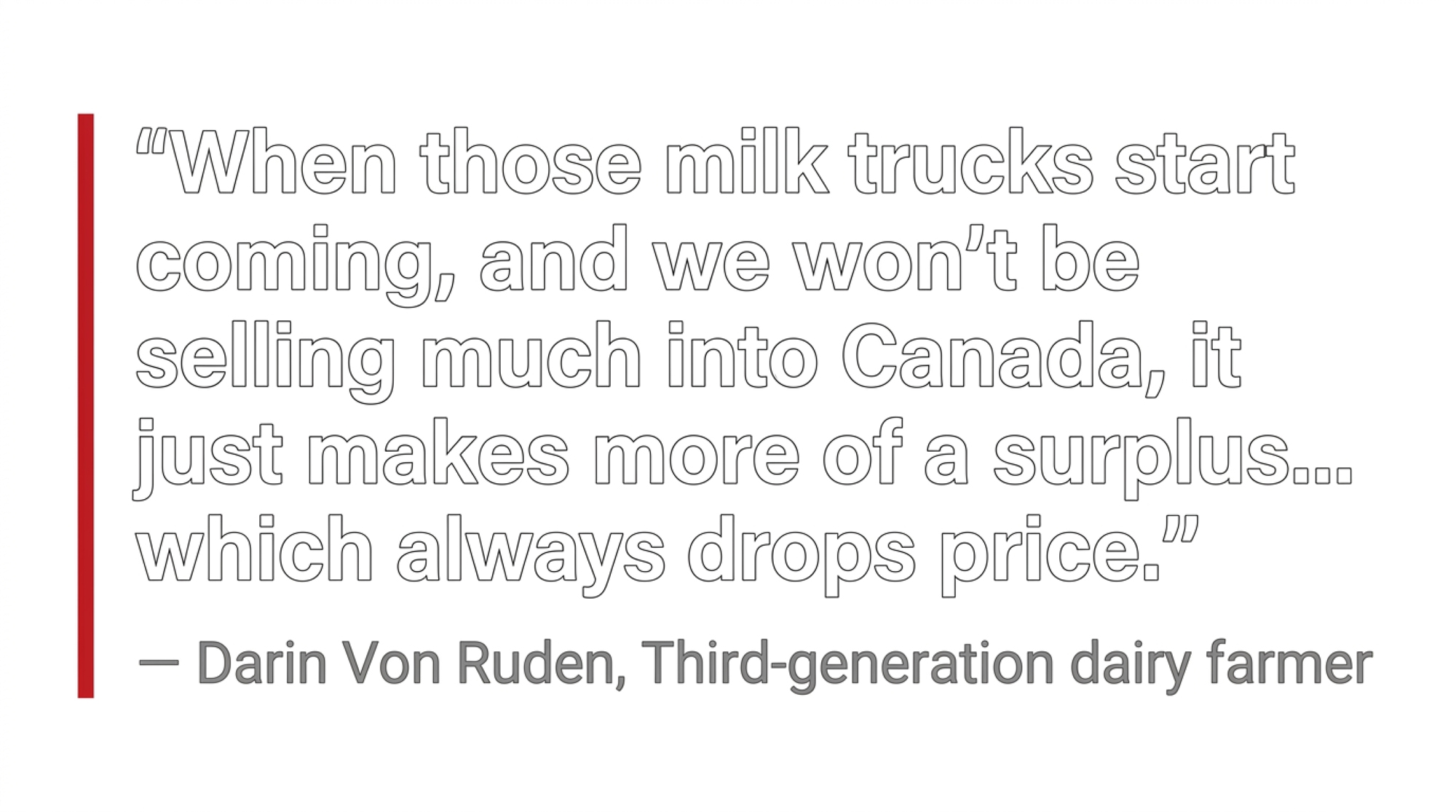
Darin Von Ruden is a third-generation dairy farmer near Westby, Wisconsin, and president of the Wisconsin Farmers Union, a producer advocacy group. On August 25, he told WEAU what he’s watching for, and it wasn’t the tariff itself. “A month from now, six weeks from now, when those milk trucks start coming, and we’re hit with that probability that we won’t be selling much dairy product into Canada, just makes more of a surplus in the United States, which always drops price.”
Surplus. That’s the mechanism, and it’s the part the trade headlines keep skipping. Canada’s counter-tariffs on U.S. dairy take effect at 12:01 a.m. on September 8, 2026 — 50% on milk and cream powders, whey and milk protein concentrates, casein; 25% on cheese and curd. And the Canadian market access the U.S. is fighting to open? Smaller than the headlines suggest.
What Actually Got Signed, and What It Covers
Three things stacked up this summer, and they don’t mean what the coverage implied.
The USMCA hit its first mandatory joint review on July 1, 2026, under Article 34.7. USTR Ambassador Jamieson Greer said the U.S. “did not agree to renew the USMCA in its current form.” That reads as the deal died. It didn’t — the agreement stays fully in force, with annual reviews now running through 2036, per White & Case’s client alert dated July 1, 2026. Nothing about your milk cheque changed that day.
On July 20, three proclamations followed under Section 338 of the Tariff Act of 1930. Proclamation 11047 is the dairy one, adding 50% duties on Canadian dairy ingredients — milk and cream powders, whey, milk protein concentrate, casein, lactose. Not retail milk. Not the cheese in a grocery cooler. Inputs. Those went live August 22 after a three-day delay, once talks in Washington collapsed on August 21.
Canada’s answer, published by the Department of Finance and updated August 26, matches dollar for dollar across $27.6 billion in U.S. goods — dairy alongside steel, appliances, agricultural equipment, pulp and paper, and electronics. The dairy lines are specific: HS 0402 milk and cream powders at 50%, HS 0404 whey and whey protein concentrate at 50%, HS 3501 casein at 50%, HS 3502.20 milk albumin and whey protein concentrates at 50%, HS 3504 milk protein substances at 50%, and every named cheese category under HS 0406 at 25% — cheddar, mozzarella, brie, gouda, parmesan, provolone, havarti, Swiss, gruyère, camembert, romano. Both within and over access commitment, on every one of them.
HS code
Product
Surtax
Who feels it first
0402
Milk and cream powders
50%
Powder plants and co-op marketing arms
0404
Whey and whey protein concentrate
50%
Cheese-plant whey streams, ingredient buyers
0406
All named cheeses (cheddar, mozzarella, gouda, Swiss)
25%
Cheese exporters — Canada’s largest U.S. dairy line
3501 / 3502.20
Casein; milk albumin, whey protein concentrates
50%
Ingredient processors on both sides of the line
3504
Milk protein substances
50%
MPC and protein-blend manufacturers
Not listed
Semen, embryos, livestock genetics
None
Confirm your own HS codes with a customs broker
How Much Is the Access Fight Actually Worth to You?
Here’s the math, assumptions on the table, because the number only means something if you can check it against your own herd.
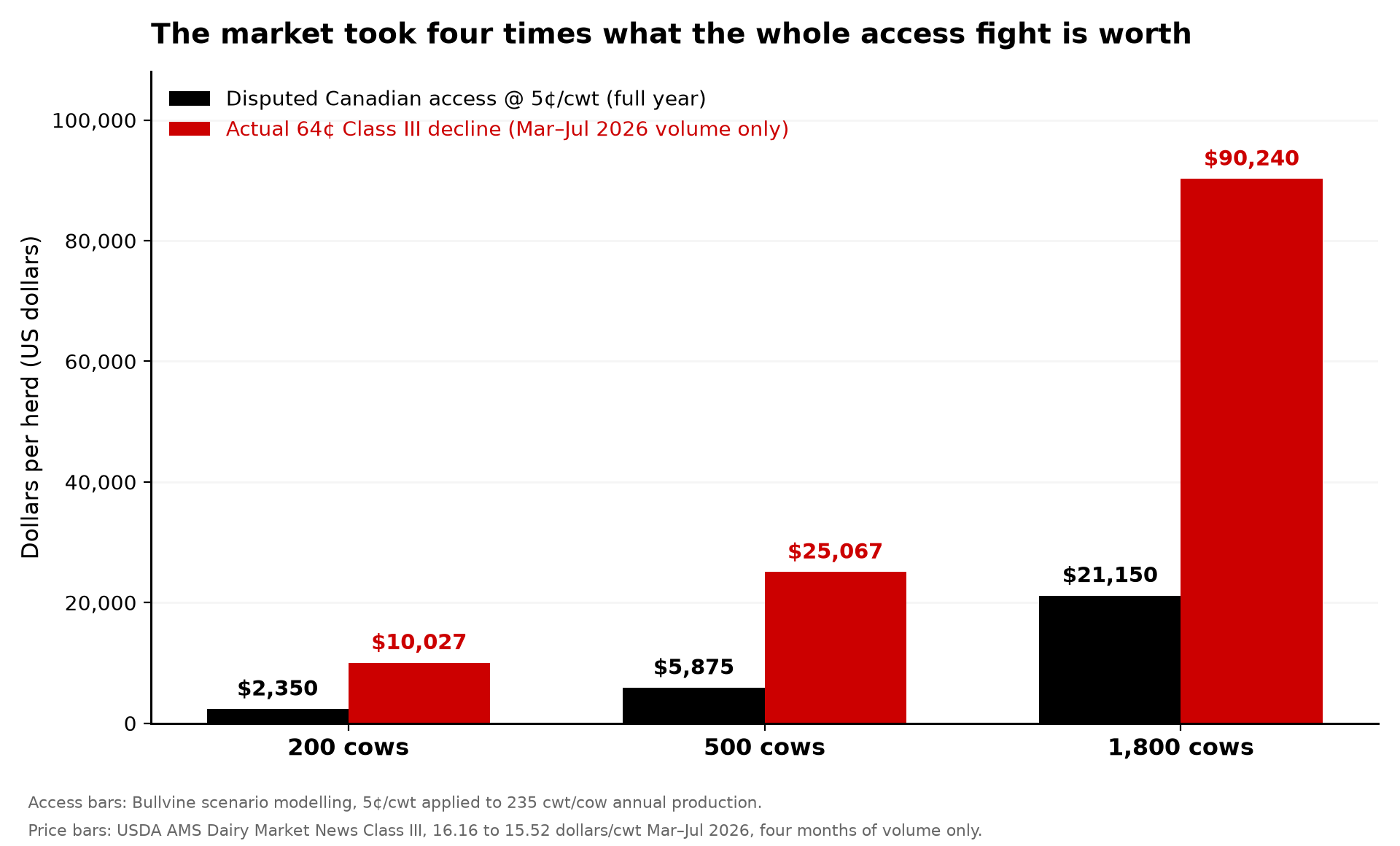
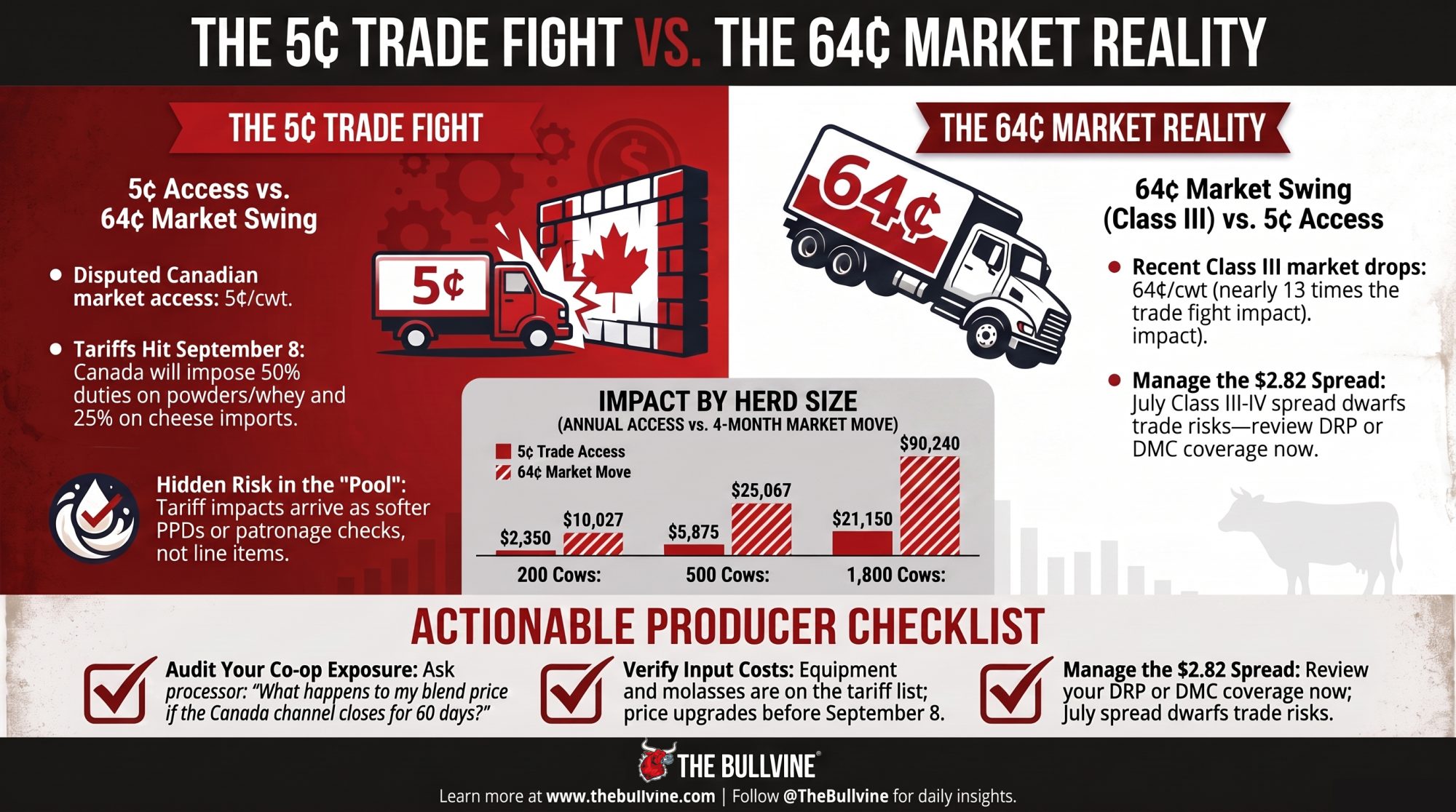
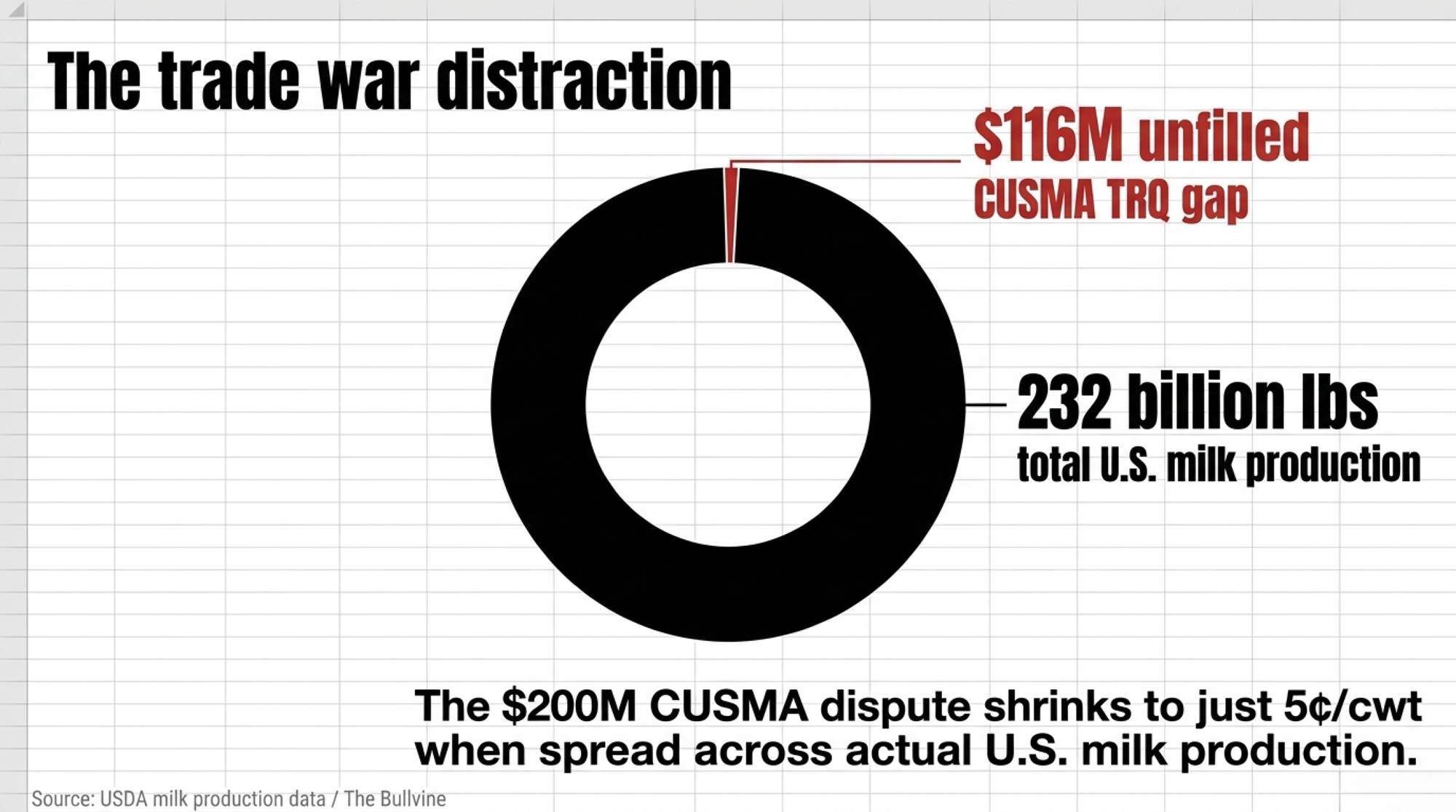
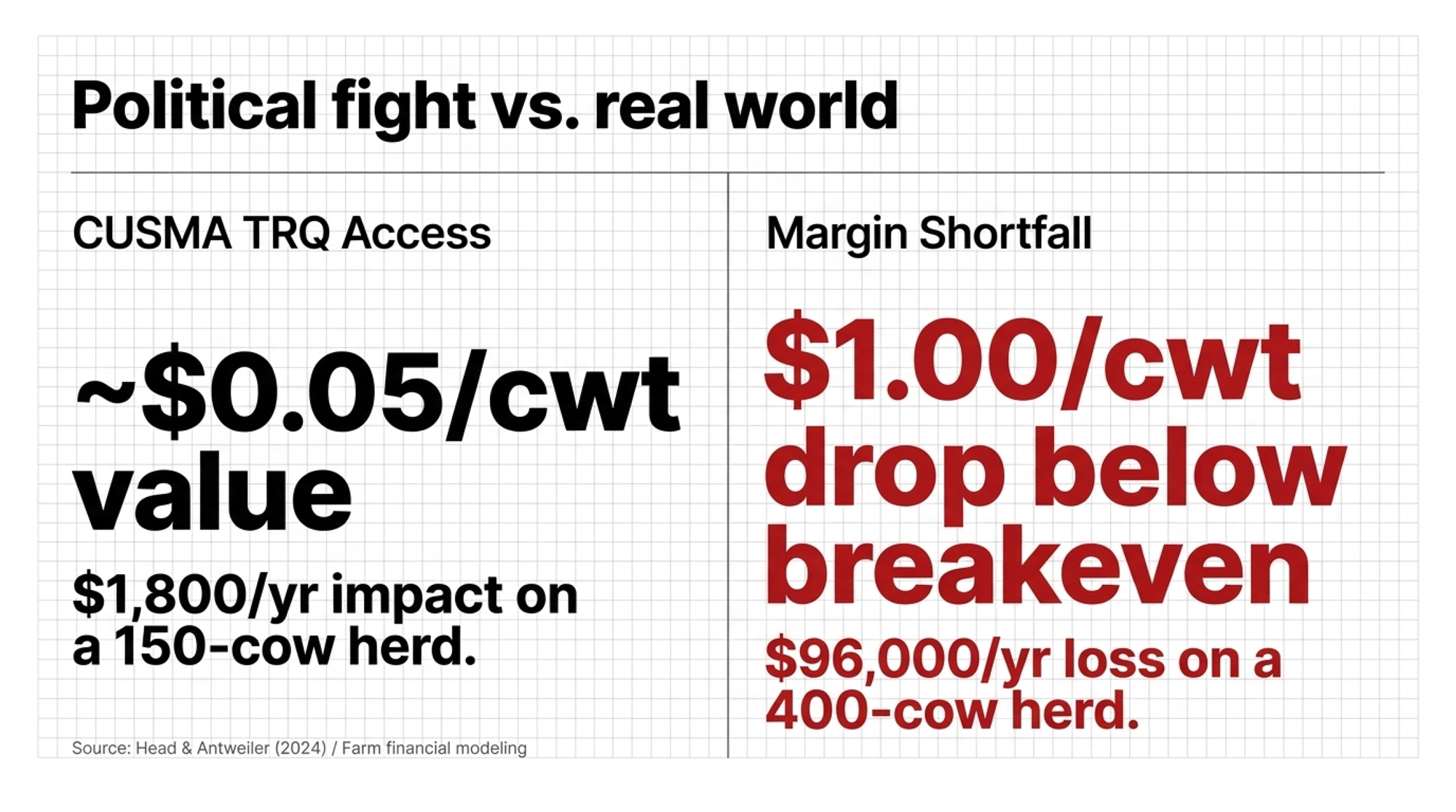
Using USDA Foreign Agricultural Service trade data, The Bullvine’s own scenario modelling puts the value of fully enforcing the disputed Canadian dairy access at roughly 5¢/cwt nationally. Model your herd at 235 cwt per cow annually — that’s our stated assumption, roughly 23,500 lbs, and you should substitute your own rolling herd average. Then set the disputed access beside what Class III actually did between March and July of this year: $16.16/cwt down to $15.52, a 64¢ drop over four months, per USDA AMS Dairy Market News.
Herd size
Annual production
Access @ 5¢/cwt (year)
Actual 64¢ Class III move (4 months)
200 cows
47,000 cwt
$2,350
$10,027 on 15,667 cwt
500 cows
117,500 cwt
$5,875
$25,067 on 39,167 cwt
1,800 cows
423,000 cwt
$21,150
$90,240 on 141,000 cwt
Per cwt
235 cwt/cow assumed
$0.05
$0.64 — 12.8x the access value
Access column: 5¢/cwt Bullvine scenario modelling applied to annual production at 235 cwt/cow. Price column: the actual 64¢ Class III decline applied to four months of production only — matching the window the price move covers, not annualized. Assumes even monthly production; real herds swing seasonally.
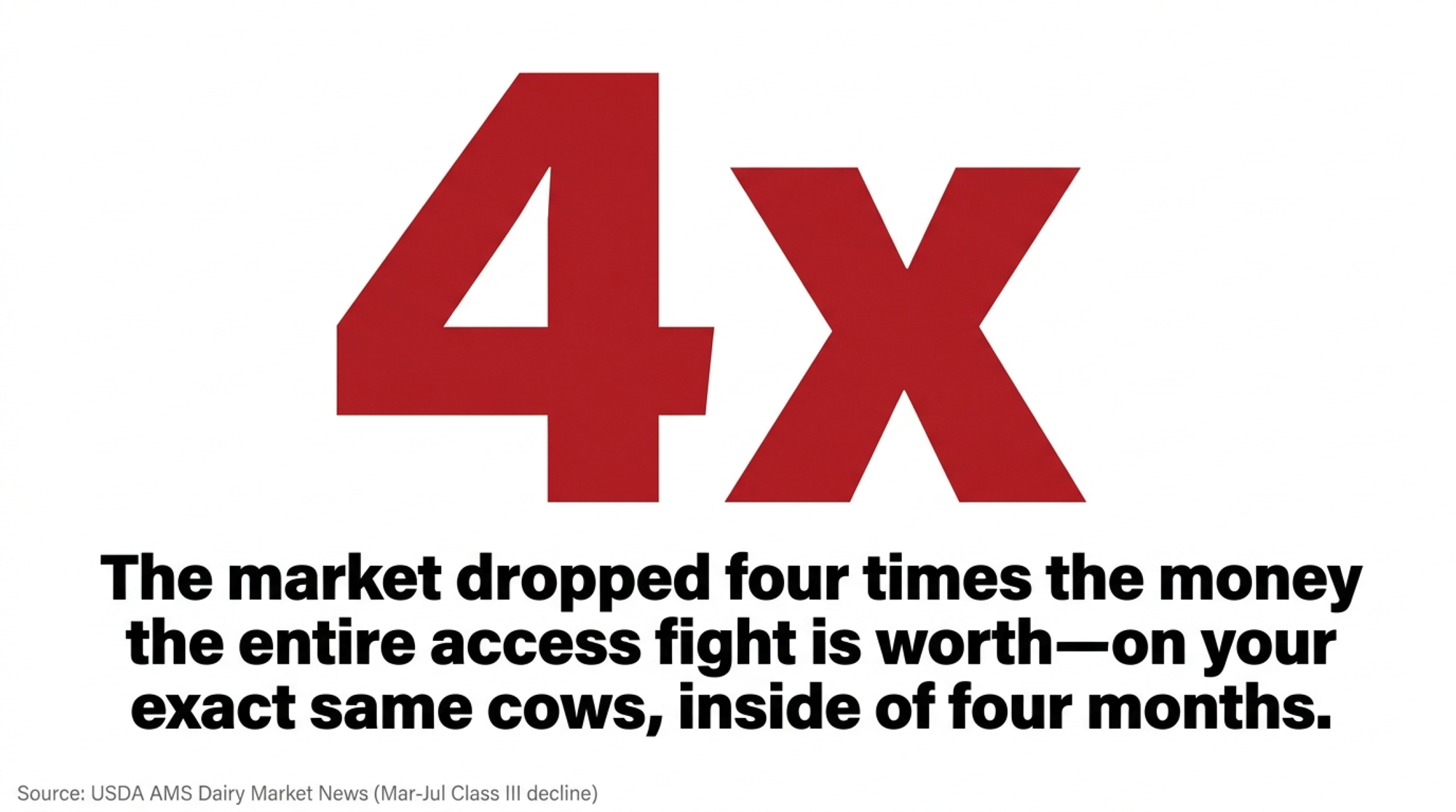
Read across any row. The market moved more than four times the money the entire access fight is worth, on the same cows, inside four months. Where does your breakeven sit right now? For most operations, the honest answer has very little to do with Canada.
That 5¢ figure is a scenario, not a published USDA number. We built it, and we’re labelling it. No government agency or land-grant university publishes a per-cwt dollar figure for unrealized USMCA dairy access, which is exactly why the number carries its label every time it appears.
One Law and One Clause Nobody’s Pricing In
Two structural facts explain why this won’t resolve the way the rhetoric implies.
The first is a statute. Bill C-282 — amending the Department of Foreign Affairs, Trade and Development Act — received Royal Assent June 26, 2025, per Parliament of Canada’s LEGISinfo record. It bars Canada’s Foreign Affairs Minister from committing to expand supply-managed dairy quotas or cut over-quota tariffs in trade negotiations. That’s not a posture a government softens under pressure. It’s a law Parliament would have to unwrite. U.S. producers waiting for Canadian negotiators to cave eventually are waiting on a law to change, not a mind.
The second is the retailer clause, and it’s the part that gets lost in the political coverage. Under Canada’s CETA agreement with the European Union, EU cheese enters through a retailer-eligible quota of roughly 16 to 17.7 million kilograms, per Global Affairs Canada’s TRQ notice. Under USMCA, U.S. cheese quota goes to processors and distributors — retailers excluded. The Globe and Mail reported July 20, 2026, that this asymmetry appears in Proclamation 11047’s own stated rationale. That gap is the actual legal complaint underneath the politics.
Access feature
U.S. cheese under USMCA
EU cheese under CETA
Why it matters at farm level
Eligible channel
Processors and distributors only
Retailer-eligible quota
Retail shelf access decides whether volume moves
Quota volume
6,250 t (2025) to 7,113 t by Year 19
About 16 to 17.7 million kg
The EU pool dwarfs the U.S. cheese TRQ
Over-quota tariff
About 245% MFN
Preferential under CETA
245% is a wall, not a price
Fill performance
Cheese ran 83% in 2024
Not directly comparable
All-category fill near 42% in 2022–23 — ask which product
Total market access
About 3.5% of Canada’s market
Larger and retail-facing
The whole fight is over a sliver
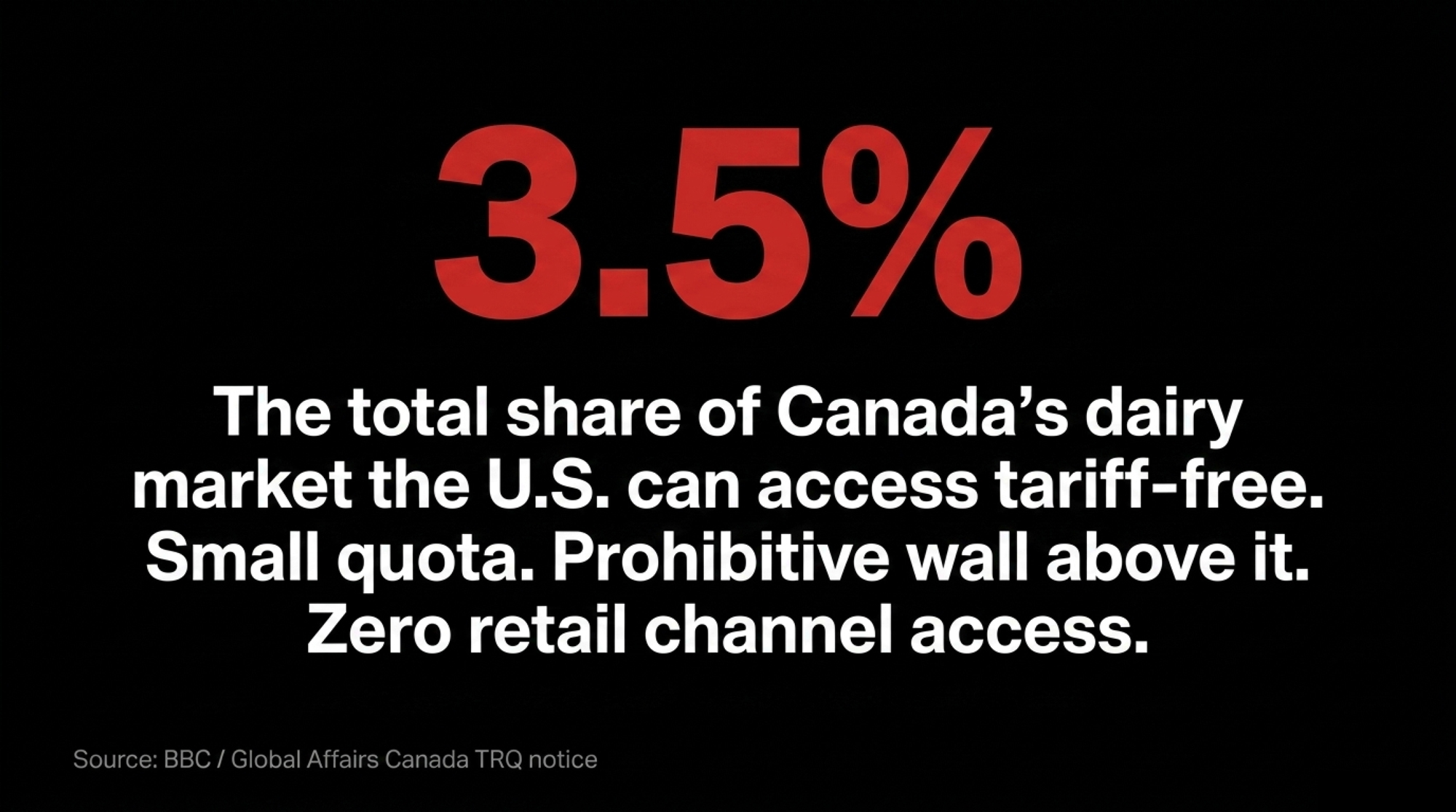
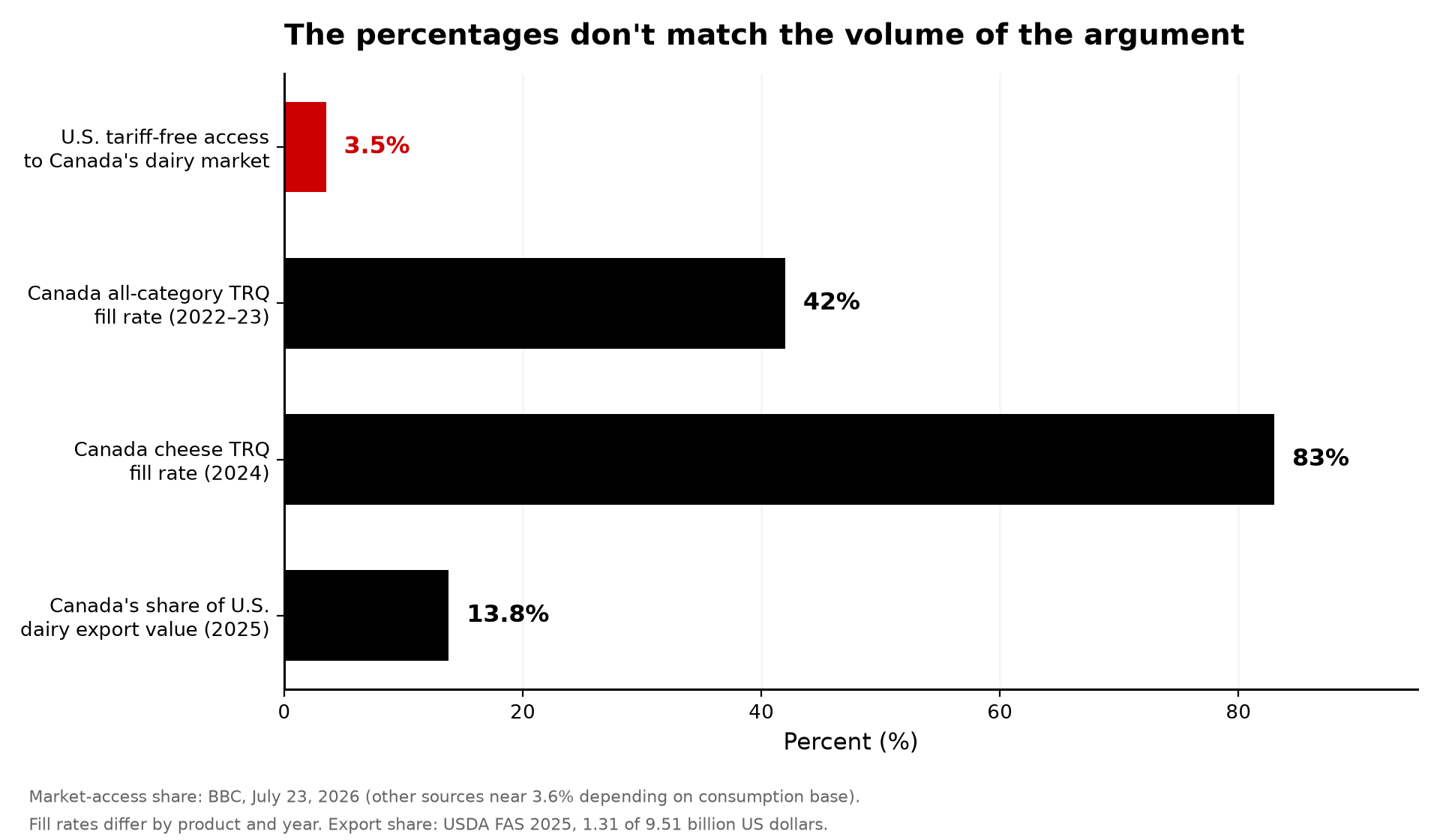
Scale tells you the rest. UW-Madison Extension puts the 2025 USMCA cheese TRQ for U.S. exports at 6,250 metric tonnes, rising to 7,113 tonnes by Year 19, with an over-quota MFN rate near 245%. BBC reported July 23, 2026, that U.S. producers hold tariff-free access to about 3.5% of Canada’s market — other sources put it nearer 3.6%, depending on the consumption base used. Small quota, prohibitive wall above it, no retail channel. That’s the architecture, and it also explains why you’ll see Canadian fill rates quoted two contradictory ways: cheese ran 83% in 2024, while the all-category average sat near 42% in 2022–23. Both real. Different products.
Is Your Real Risk Even Visible in Your Milk Cheque?
Probably not, and that’s the part worth sitting with.
Most U.S. milk moves through Federal Milk Marketing Order pooling before it reaches a processor. Your cheque reflects Class I–IV utilization in your marketing order — not where the finished cheese or powder eventually sells. Export exposure lives downstream, at the plant or the co-op’s marketing arm. So your milk cheque is pooled. Your risk isn’t.
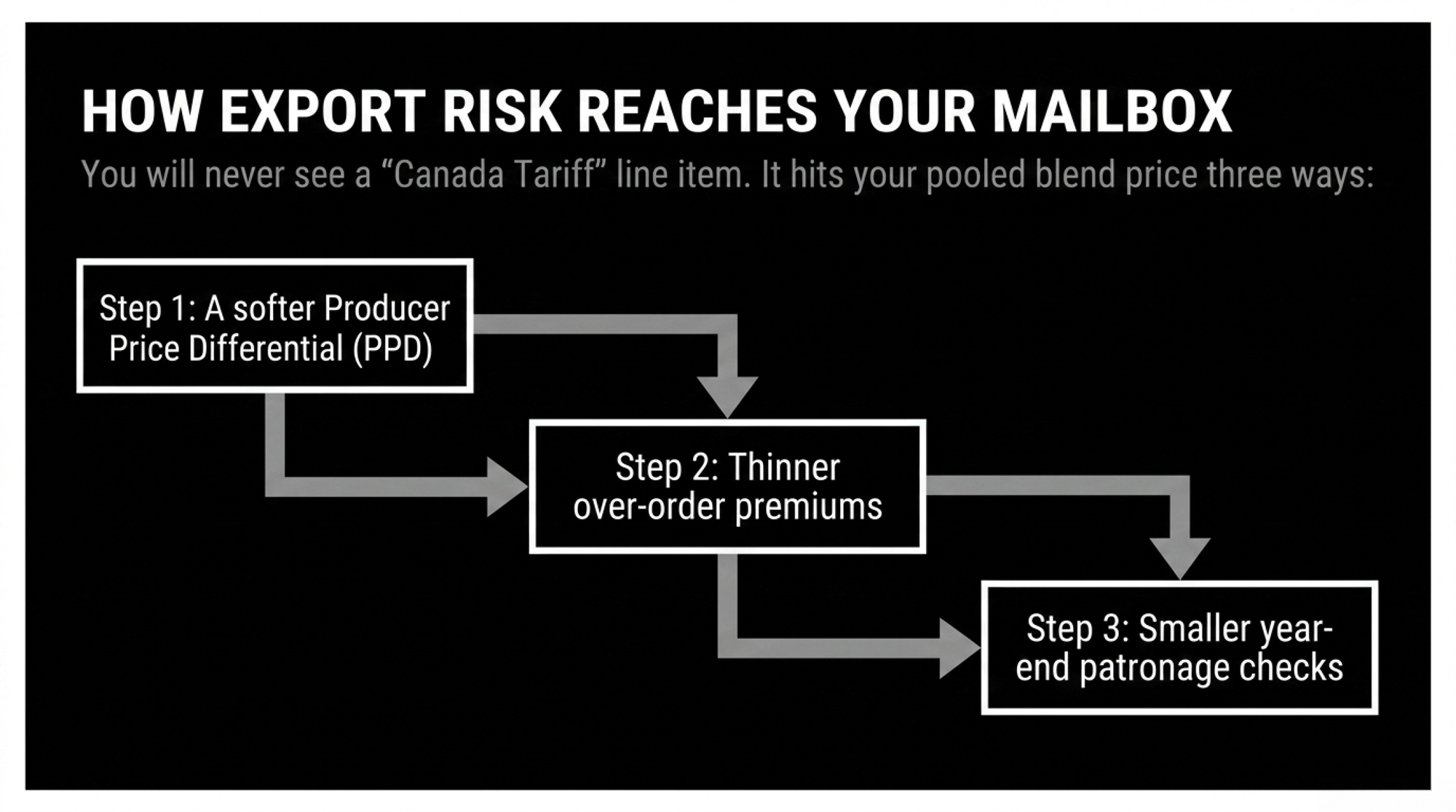
Here’s how that risk actually reaches your mailbox. You won’t see a line item that says “Canada tariff.” If your co-op takes a margin hit on powder or cheese it was moving north, that shows up in the blend — a softer Producer Price Differential, thinner over-order premiums, or a smaller patronage cheque at year-end. Same money, three degrees of separation, no label on it.
So ask your co-op or processor three things: how much of what you ship gets exported, how much of that goes to Canada, and what happens to your blend price if that channel closes for sixty days. No public dataset breaks this down at the plant level — we looked. That information sits in member communications, not government data, which means the only way to get it is to ask.
Options and Trade-Offs for Farmers
Pull the Finance Canada list and check your purchase orders—within 30 days. The document is public, free, and specific down to the tariff item. If you’re a Canadian producer buying U.S. cane molasses (HS 1703.10, 50%), polyethylene sacks and bags (HS 3923.21.90, 50%), or milk-protein inputs, it tells you exactly what changes on September 8. Costs you an hour and your purchase records. Here’s the part worth knowing: goods already in transit to Canada on September 8 are exempt, so what matters isn’t when you ordered — it’s whether the truck crosses before the clock runs out.
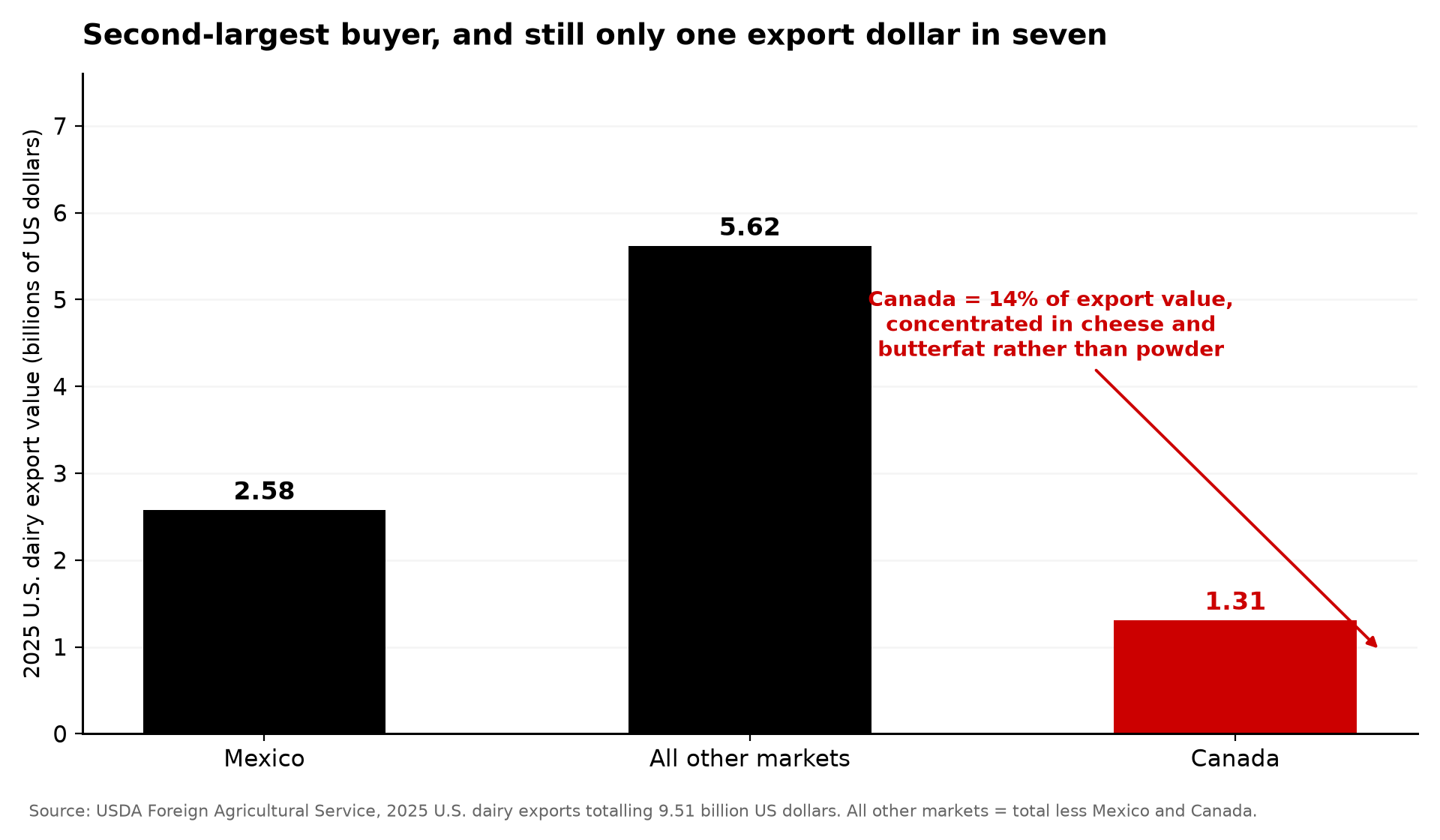
Quantify your Canada exposure before you react. Canada took $1.31 billion in U.S. dairy exports in 2025 out of $9.51 billion total, per USDA FAS — roughly 14%, second behind Mexico at $2.58 billion on the same dataset. Agriculture and Agri-Food Canada figures reported by the Western Producer on May 4, 2026 put butterfat and cheese at approximately CA$500 million of the CA$1.06 billion Canada recorded. So this concentrates in cheese and butterfat channels rather than spreading evenly across the industry. The catch is the pooling problem above — your own exposure isn’t visible in your own cheque.
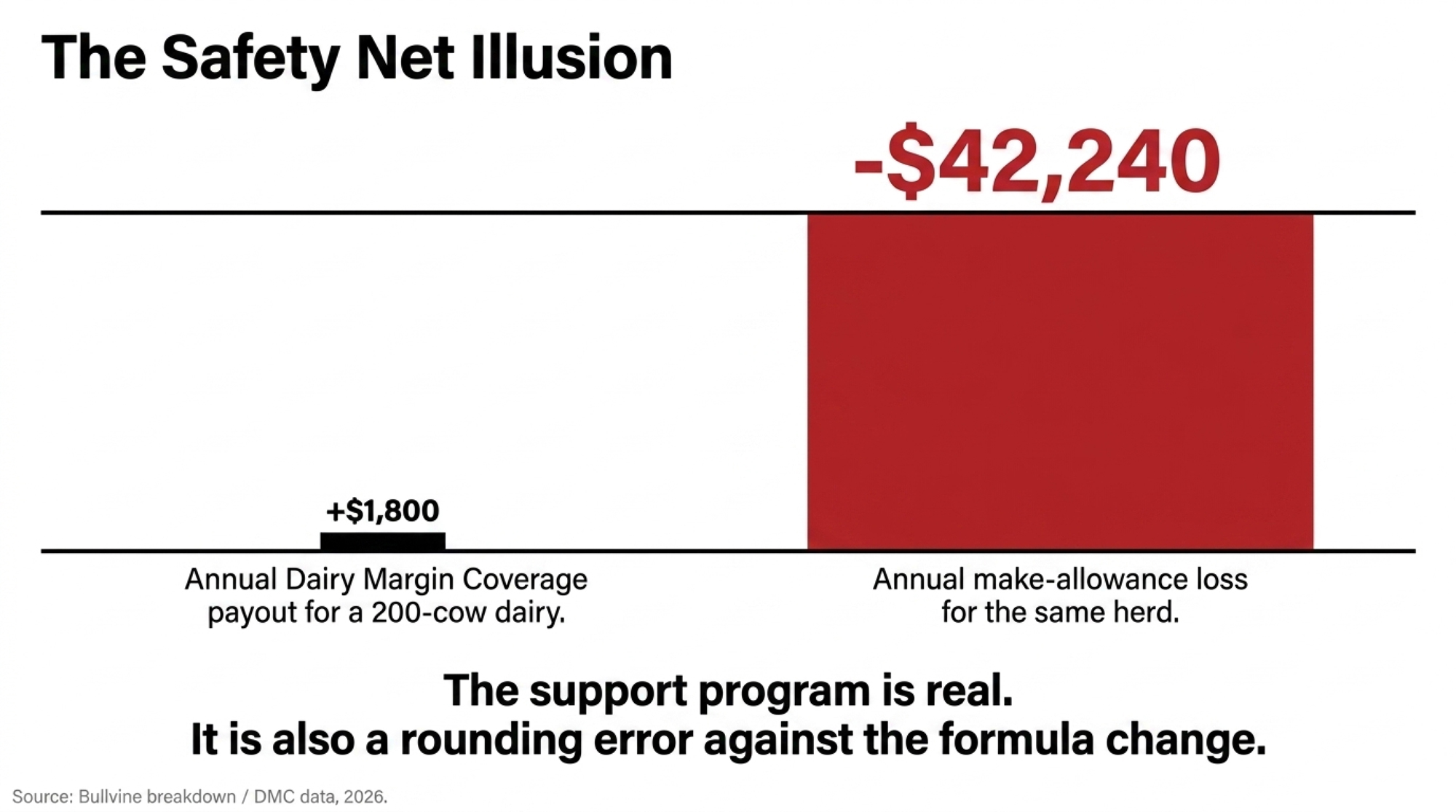
The Class III–IV spread ran $2.82/cwt in July 2026, which is the real argument for reviewing your DRP or DMC coverage. That volatility already dwarfs anything this dispute realistically moves. It’s also the argument against buying coverage in a panic — a conversation with your risk advisor beats a reaction to a headline. Where this path fails: coverage priced off a news cycle tends to cost more than it protects. And the squeeze runs both directions on a farm, which is the part Von Ruden put plainly: “It’s a double edged sword that farmers deal with all the time, knowing that our price is lower, but going to the grocery store, buying milk, cheese, butter, ice cream, and having to pay more for it than we did two months ago.”
Agricultural equipment is on Canada’s list, so if you’ve got a parlour upgrade or a mixer order pending, price it against September 8 before you sign. That’s the tighter clock of the two cross-border paths. Genetics look clearer — semen, embryos, and livestock genetics don’t appear anywhere in Canada’s surtax list, and Proclamation 11047 covers dairy ingredient lines rather than breeding stock. But get your customs broker to confirm your specific HS codes instead of assuming the exemption covers your product.
Key Takeaways
For U.S. producers — export exposure and risk
If you don’t know your co-op’s Canada-export share, that’s a phone call this week, not a headline to react to.
If your co-op moves powder or cheese north, ask specifically what a sixty-day closure does to your blend price — the hit arrives as a softer PPD or a thinner patronage cheque, never as a tariff line item.
If your annual cwt × 5¢ comes to less than one Class III swing on your own herd, the access fight isn’t where your margin is going. Look somewhere else.
If you haven’t looked at DRP or DMC since spring, the $2.82/cwt Class III–IV spread in July is the reason to — not the tariff.
For Canadian producers — inputs and equipment
If you buy any U.S. inputs, check your next 60 days of purchase orders against the Finance Canada list before September 8.
If an order is already moving, find out whether it crosses before September 8 — goods in transit that day are exempt, so the shipping date, not the order date, is what counts.
If you’ve got a parlour upgrade or mixer order pending, price it against the September 8 date before you sign. Agricultural equipment is on the list.
If you’re financing quota in Ontario or Quebec at the capped CA$24,000/kg BF, this dispute isn’t what moves that number — provincial cap policy and pooled revenue are.
For both sides of the line
If someone quotes you a single Canadian quota fill rate, ask which product category and which year before you act. Cheese ran 83% in 2024; the all-category average was near 42% in 2022–23.
If you ship genetics either direction, get your customs broker to confirm your HS codes rather than assuming the exemption holds for your specific product.
Structural decline arguments make for good op-eds and bad forward contracts. The C.D. Howe Institute — which advocates market liberalization in its published policy work, so read it as a position rather than neutral data — argued in April 2026 that Canada’s supply management will eventually disappear on economic grounds. No source attaches a date to that. The next USMCA joint review is 2027. That’s the only clock in this story with an actual number on it.
Von Ruden is watching milk trucks, not press conferences. That’s the right instinct, and it points to the two numbers worth chasing this week — neither of them a tariff rate. What share of your co-op’s volume actually goes to Canada, and where does your rolling herd breakeven sit today? Stop trading on trade-war headlines and get both. We’re running the full per-cwt model by herd size and province, with assumption tables visible, in next week’s Bullvine Weekly — that’s where the barn math lives.
THE BULLVINE BARN MATH TOOL
Custom Herd Exposure Calculator
See what the 5¢/cwt Canadian market access fight is worth on your herd vs. your actual Class III price exposure.
cows
lbs/yr
$/cwt
$/cwt
Annual Canadian Access Value (@ $0.05/cwt)
$5,875
On 117,500 total annual cwt
4-Month Market Move (@ $0.64/cwt)
$25,067
On 39,167 cwt (4-mo window)
⚡
The Bottom Line: Your 4-month Class III market volatility is
4.3x
larger than what the entire 12-month cross-border trade dispute moves on your cows.
Complete references and supporting documentation are available upon request by contacting the editorial team at editor@thebullvine.com.
Learn More
Class III Milk Price, DRP, and Your Spring 2026 Risk Plan — Arms you with a concrete framework to separate price-pool exposure from real margin risk, sorting your herd into actionable DRP coverage tiers to defend against five-figure monthly mailbox swings.
Dairy Showdown: Canadian Quotas vs. American Free Market — Exposes the structural divide between Canada’s capital-intensive quota fortress and America’s volume-driven export model, delivering the fundamental policy drivers behind ongoing trade friction and long-term producer competitiveness.
Every week, thousands of producers, breeders, and industry insiders open Bullvine Weekly for genetics insights, market shifts, and profit strategies they won’t find anywhere else. One email. Five minutes. Smarter decisions all week.
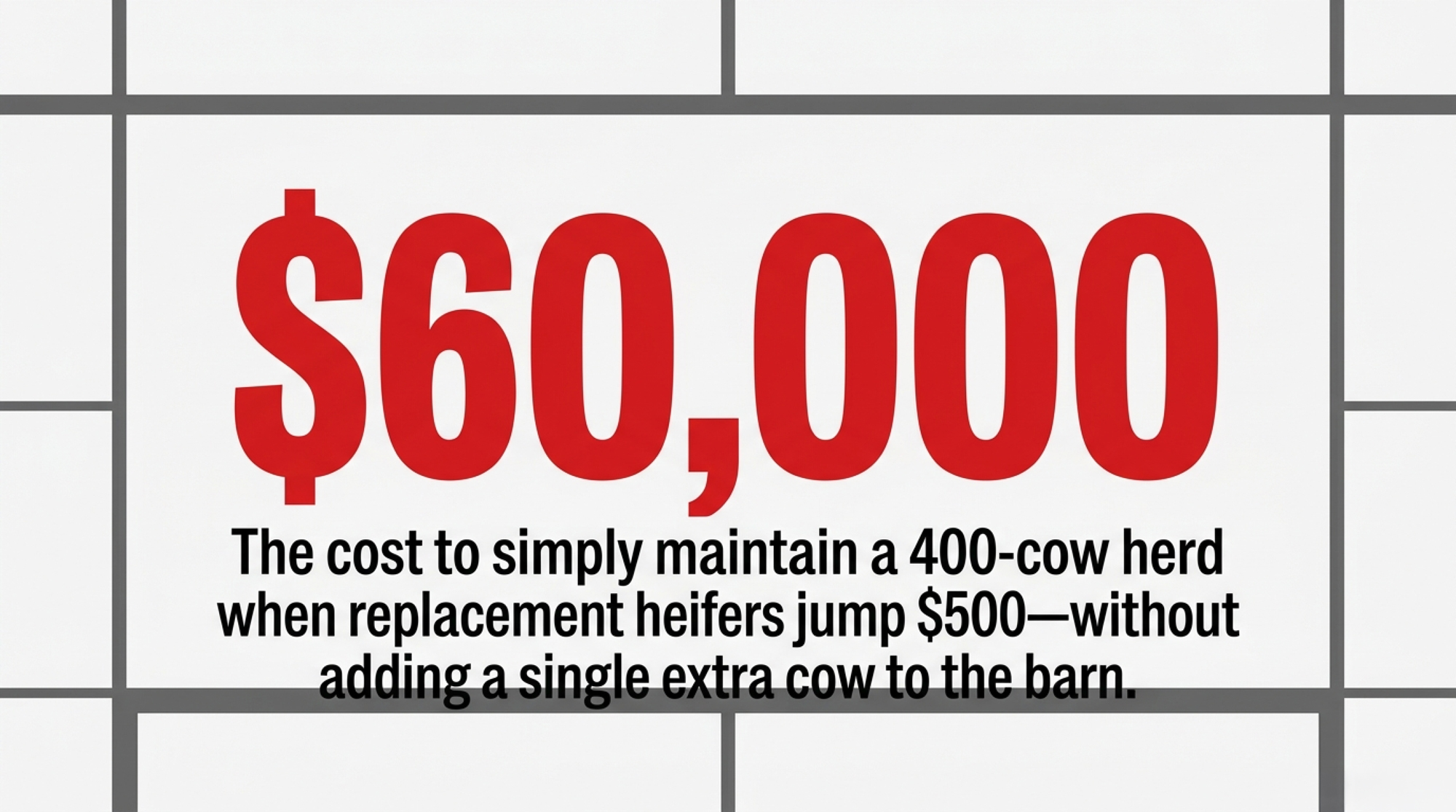
Cull thirty percent of four hundred cows and you’re buying 120 replacements a year. Every $500 the market moves costs you $60,000 — and not one extra cow in the barn.
EXECUTIVE SUMMARY
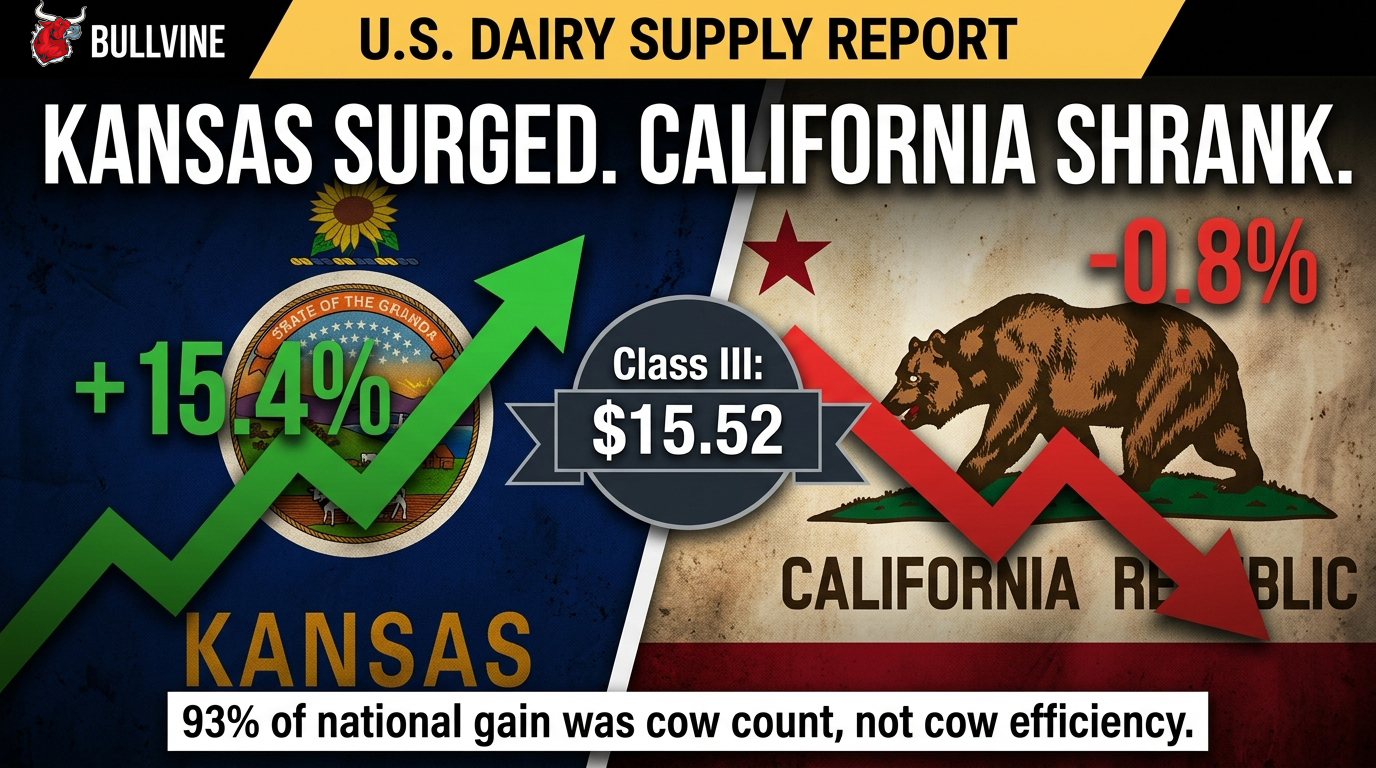
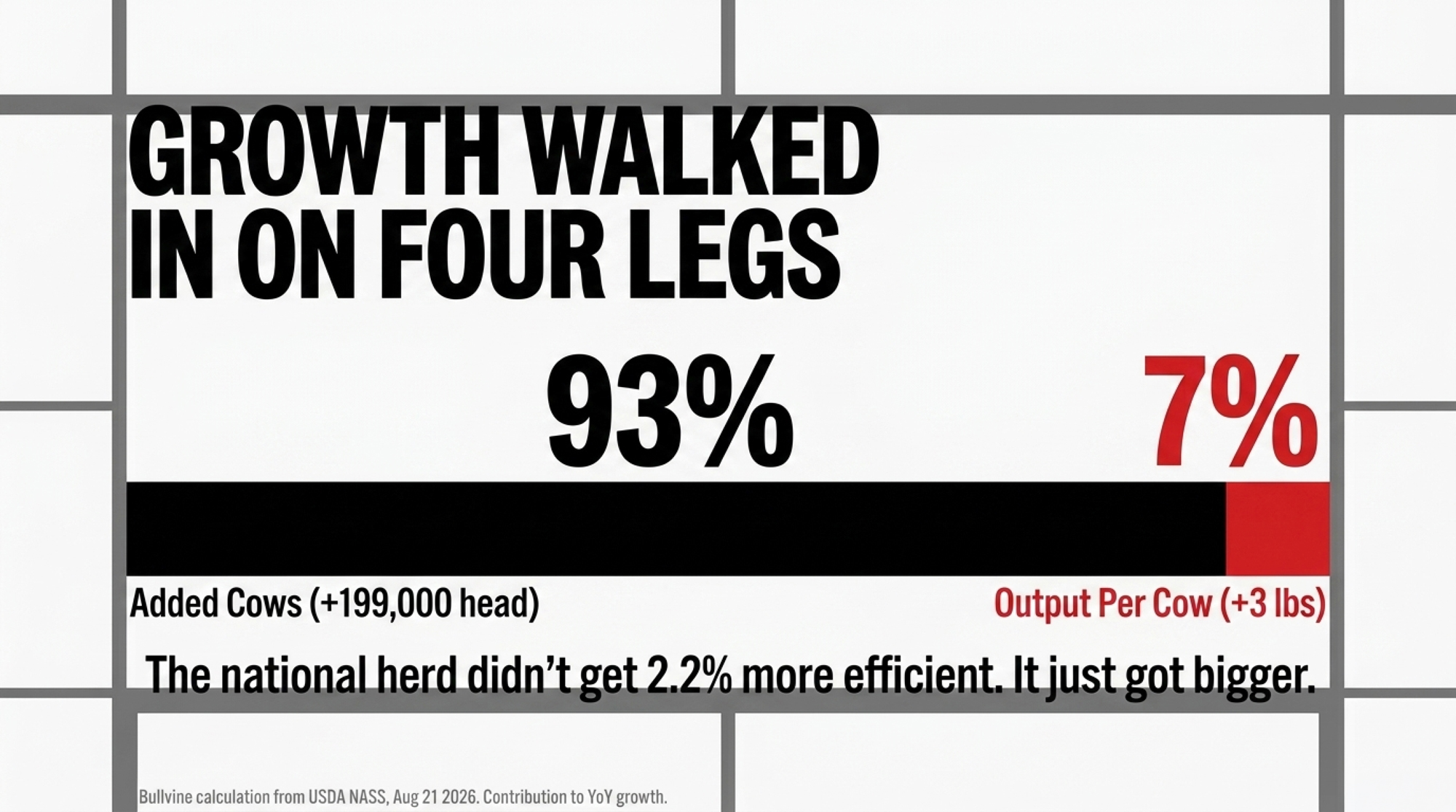
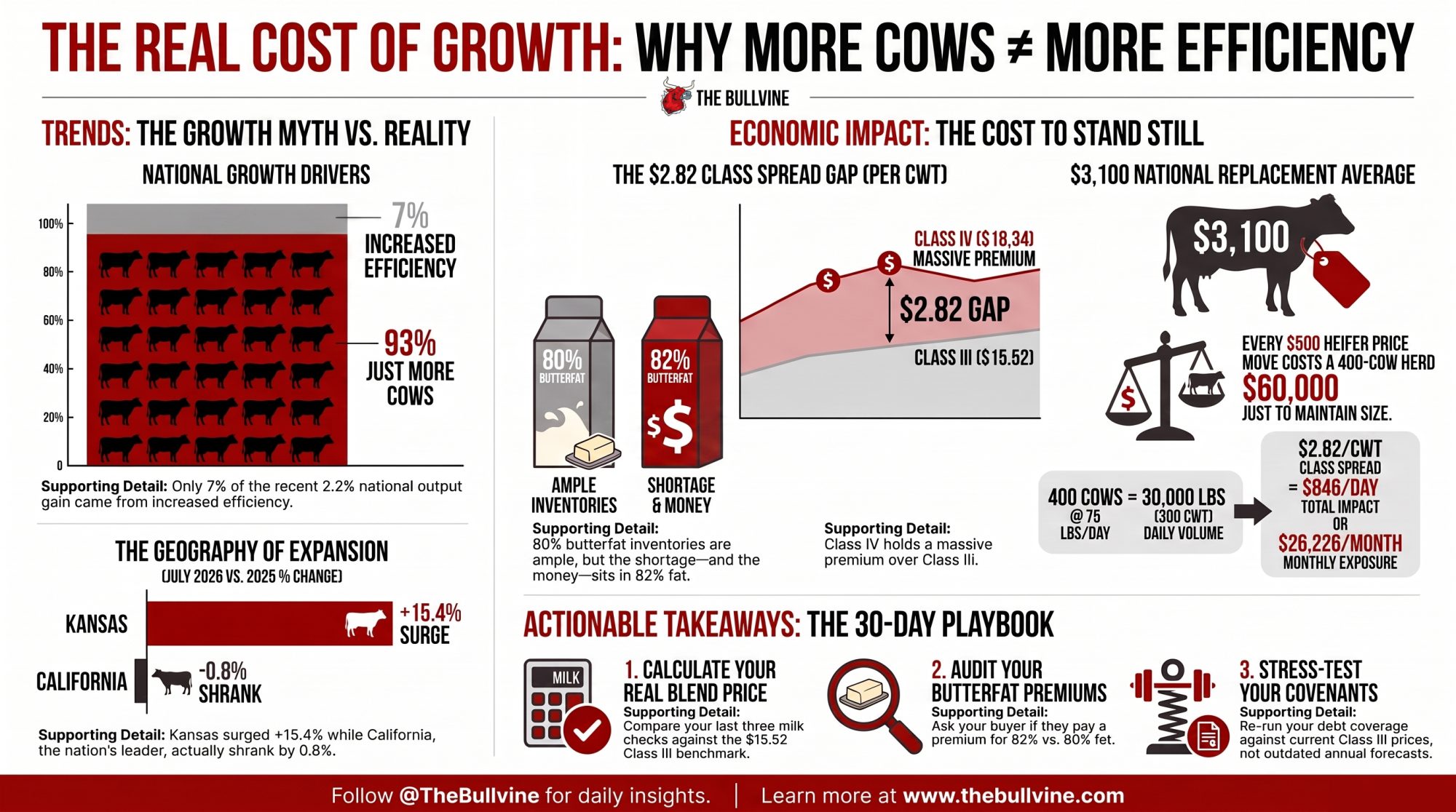
The growth was cows, not cows milking better. Output hit 20.1 billion pounds, up 2.2%, but per-cow output rose three pounds — 93% of the gain walked in on four legs. Kansas is the extreme case at 98% animals, and its growth already decelerated from 18.7% in June to 15.4% in July. California, the largest dairy state in the country, actually shrank 0.8%.
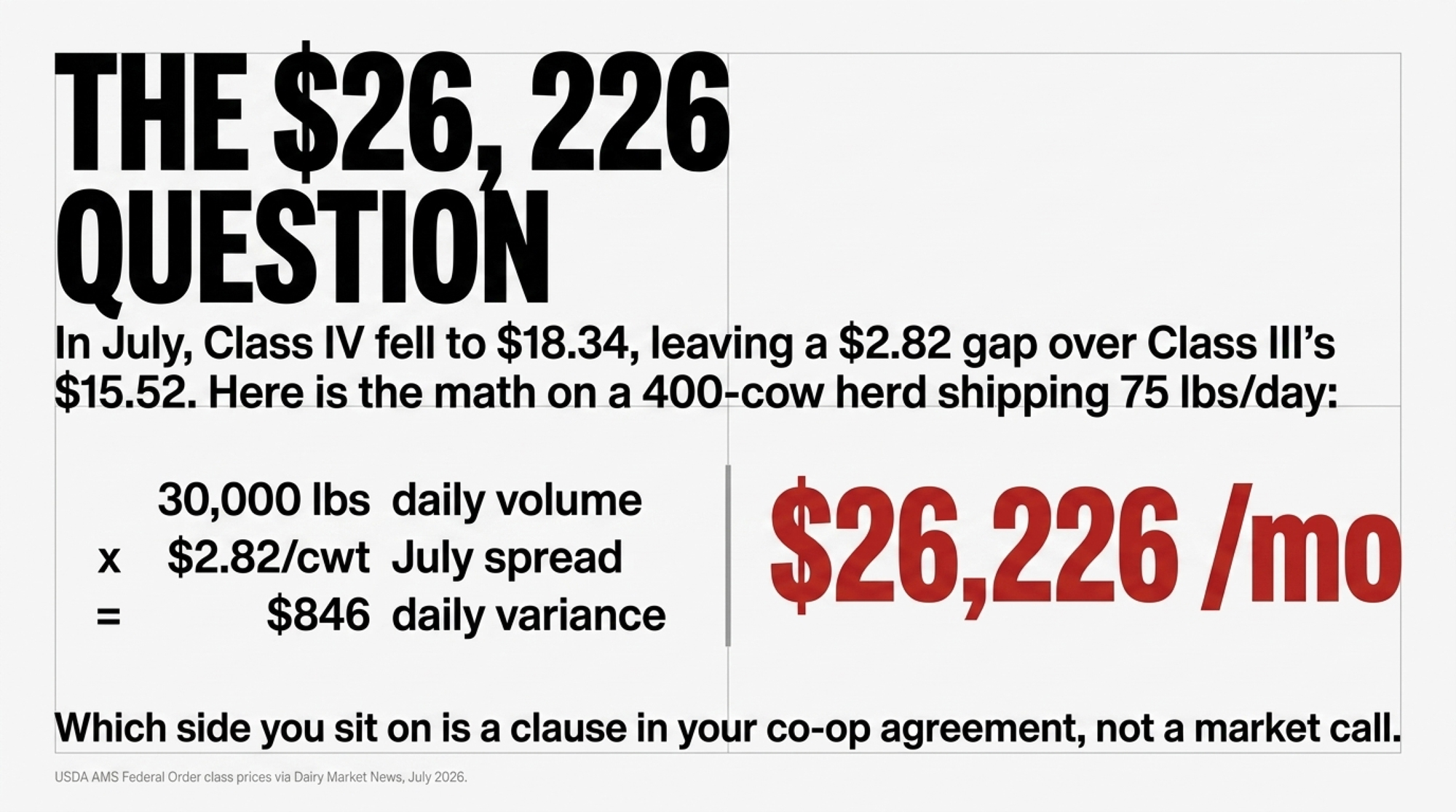
The class spread is the money question. Class IV fell to $18.34 in July, down $3.98 from May, leaving a $2.82 gap over Class III’s $15.52. On a 400-cow herd shipping 75 lbs, that’s roughly $26,226 a month of exposure — and which side you’re on is a clause in your co-op agreement, not a market call.
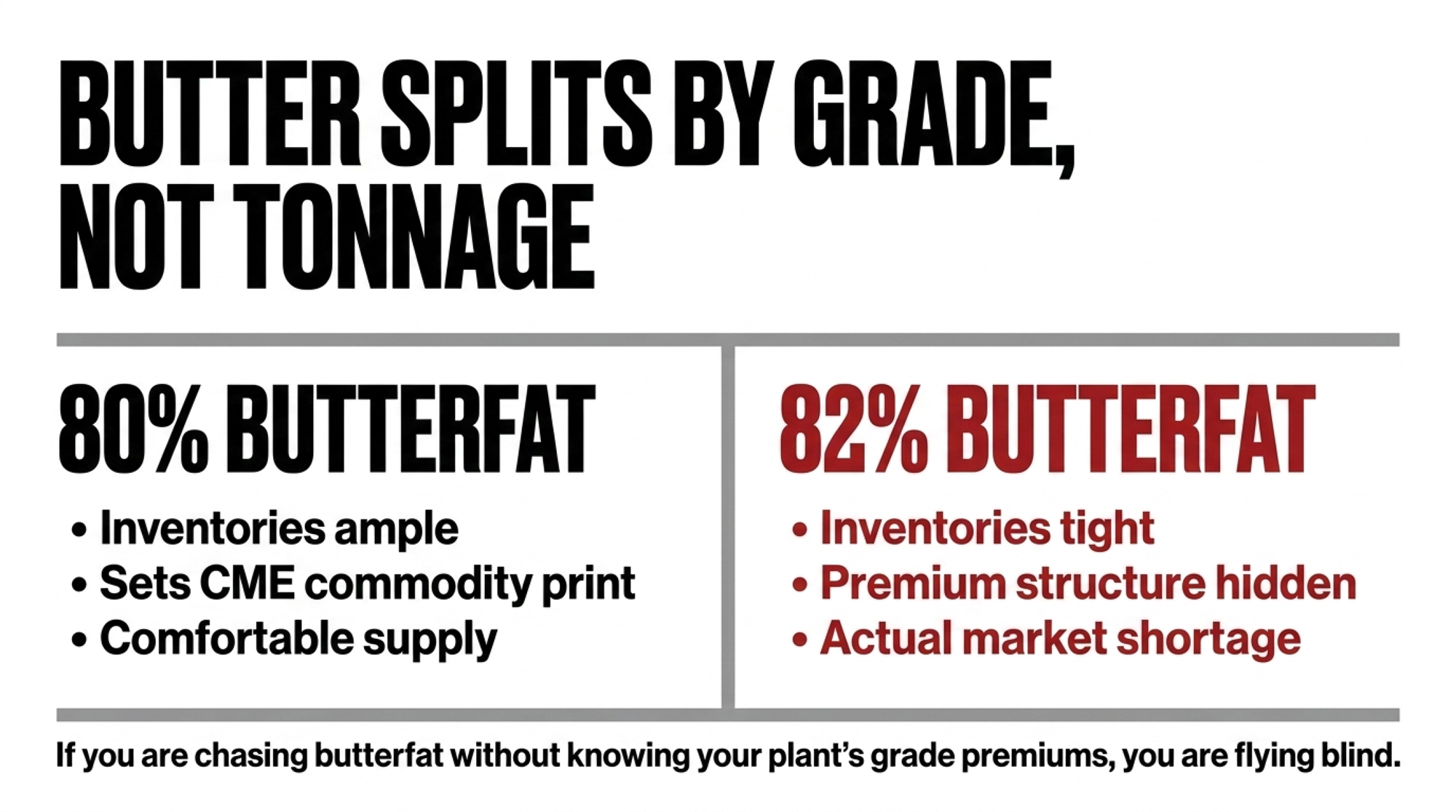
Butter’s paradox is a grade problem, not a tonnage problem. Prices kept sliding while the market read tight because 80% butterfat inventories are ample and 82% is where the shortage sits. Most premium structures don’t price that split.
Replacements decide whether expansion math still works. Springing heifers run $3,100 nationally and $3,400–$4,400 in Upper Midwest barns. Every $500 move costs a 400-cow herd about $60,000 just to hold size. If you financed stalls against an all-milk forecast instead of an actual Class III print, the next 90 days are a covenant conversation.
Class III milk settled at $15.52/cwt in July 2026 — down $1.40 from May’s peak and the second straight monthly decline. If you financed fresh stalls into that curve, explaining your 2026 margin over feed to your lender just got uncomfortable.
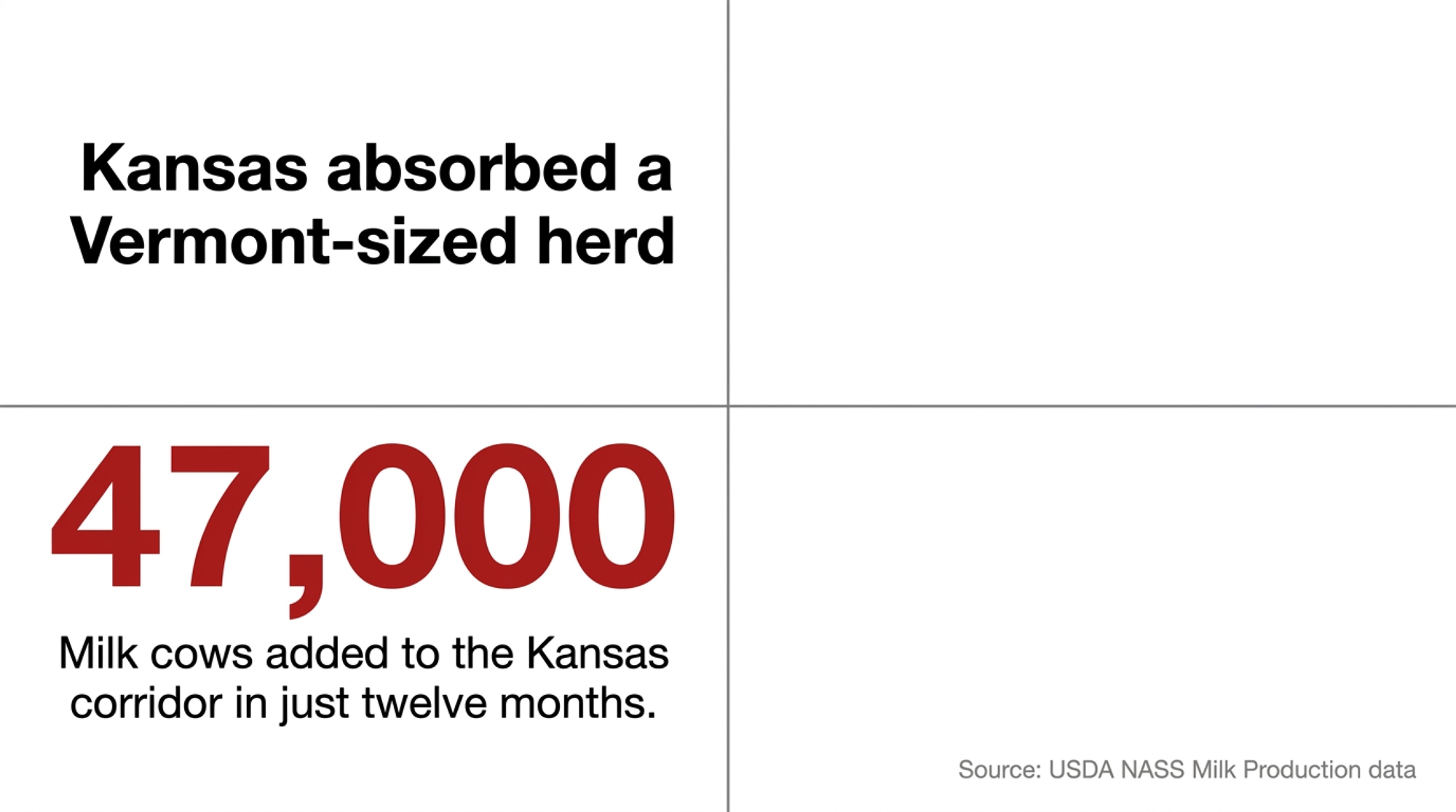
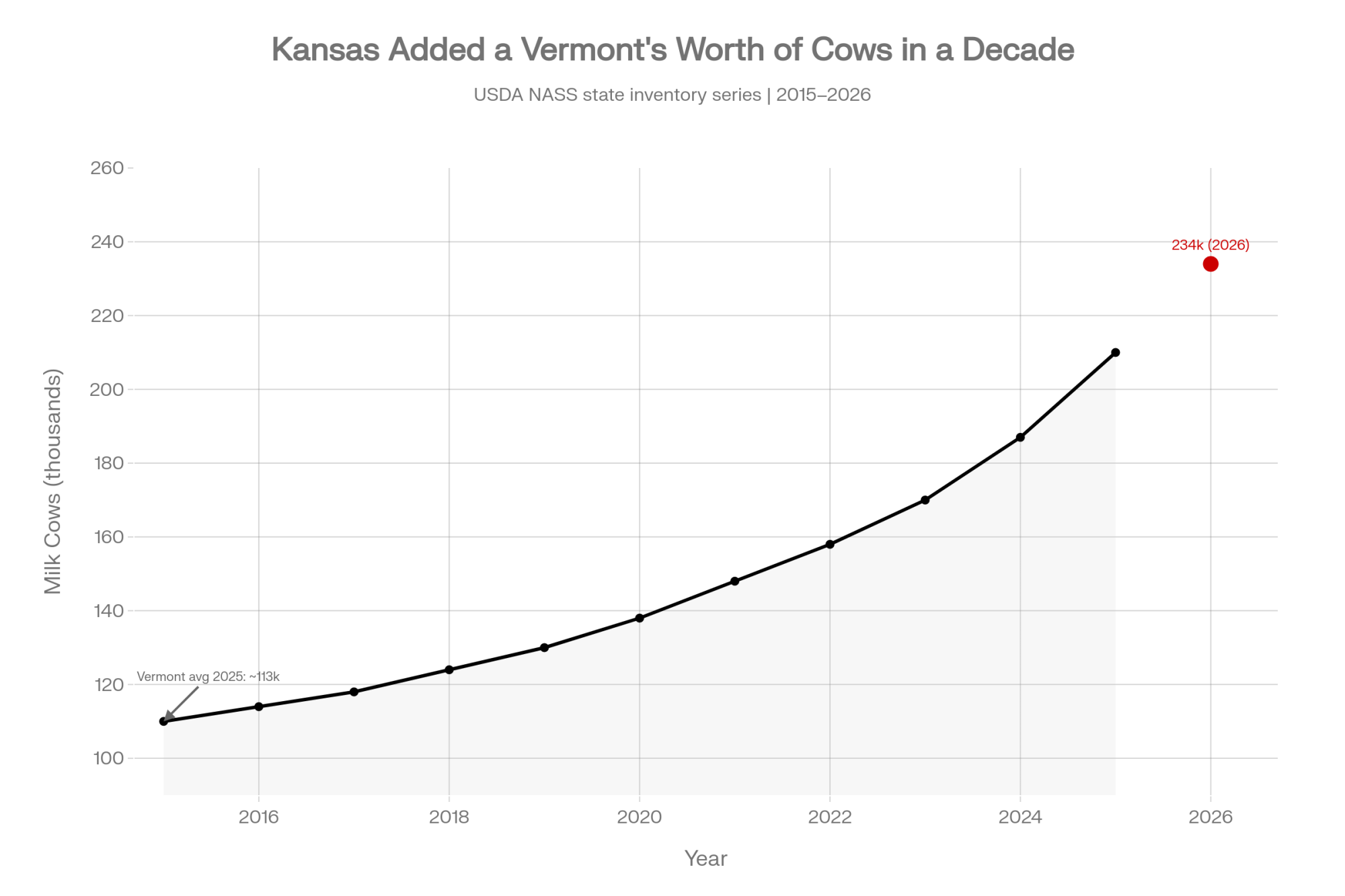
Kansas shipped 494 million pounds in July, up 15.4% year over year on a herd of 245,000 head. Twelve months earlier, that herd stood at 213,000. But Kansas grew 18.7% in June and 15.4% in July, and the state added roughly 1,000 head between those two months after adding 32,000 across the full year. That’s not acceleration. That’s a build winding down.
Nationally, output hit 20.1 billion pounds, up 2.2%, per USDA NASS Milk Production released August 21. The headline reads like productivity. It isn’t.
Which States Actually Shrank in July 2026?
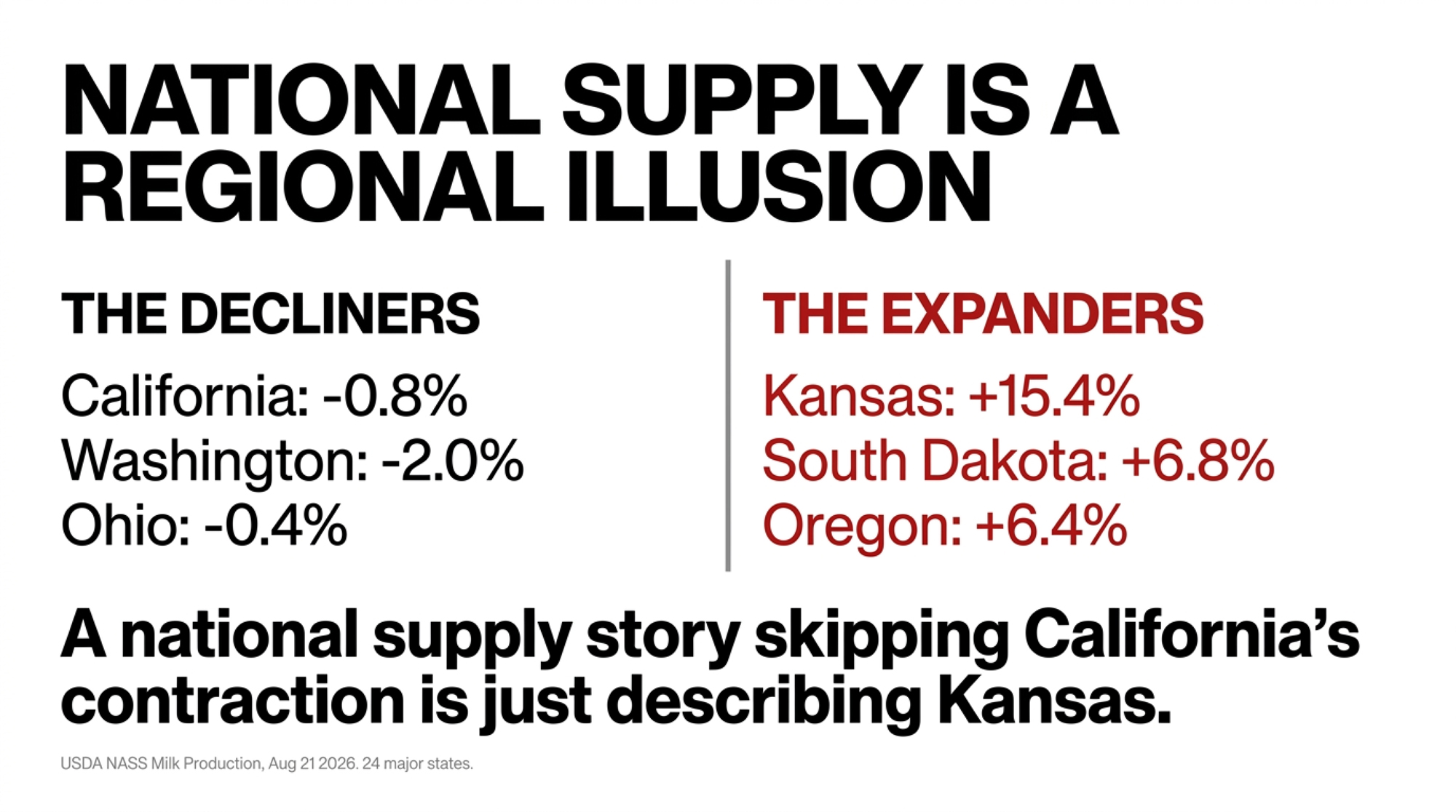
Three did, and one matters enormously. California fell 0.8%. The largest dairy state in the country produced less milk in July 2026 than a year earlier. Washington dropped 2.0%. Ohio slipped 0.4%. Pennsylvania and Vermont came in flat.
A national supply-growth story that skips California’s contraction isn’t describing national supply. It’s describing Kansas and Texas.
That’s the real geography here: growth concentrated in a few expanding states, offset by decline in established ones. National cow numbers held at 9,710,000 head from June to July — unchanged, after twelve months of building.
The 3 Pounds That Rewrite the Report
Production per cow rose from 2,072 to 2,075 pounds nationally. Three pounds. Across the 24 major states, 2,088 to 2,093. The herd, meanwhile, went from 9.511 million head to 9.710 million — up 199,000 cows.
Cow numbers grew 2.09%. Per-cow output grew 0.14%. By The Bullvine’s calculation from those NASS figures, cows account for roughly 93% of the year-over-year growth and per-cow output for about 7%. Those shares describe contribution to the gain, not share of total volume.
Everyone assumed 2.2% meant the national herd got more efficient. It got bigger.
Kansas is the purer case. Per-cow output there went from 2,010 to 2,015 pounds — five pounds, or 0.25%. Cow numbers rose 15.02%. Roughly 98% of Kansas’s growth came from animals, almost none from the cows already standing there.
And before anyone reads July as a turn: NASS revised June’s 24-state figure up by 124 million pounds, or 0.7%. One month is one data point, and this series is routinely rewritten. The next release lands mid-September.
Why Did Class III Fall While Class IV Fell Harder?
The two halves of the pool separated. Federal Order class prices for 2026:
Month (2026)
Class III ($/cwt)
Class IV ($/cwt)
Spread ($/cwt)
January
14.59
13.55
−1.04
February
14.94
16.29
1.35
March
16.16
18.94
2.78
April
16.82
20.22
3.40
May
16.92
22.32
5.40
June
15.98
20.96
4.98
July
15.52
18.34
2.82
Class III and Class IV are USDA AMS-announced Federal Order prices, per Dairy Market News, Vol. 93 Report 34, week of August 17–21, 2026. August prices had not yet been announced at the time of publication. Spread column calculated by The Bullvine.
The full-year series tells a different story than a four-month excerpt would. Class III climbed from January through May, then gave back $1.40 across June and July. Class IV ran harder in both directions — up nearly $9 from January to May, then down $3.98 in two months.
Watch the spread column. In January, Class III sat $1.04 above Class IV. By May, the gap had flipped and widened to $5.40. It’s narrowed in each of the two months since, to $2.82 in July. So the divergence is real, but it’s compressing — Class IV is falling toward Class III rather than the two pulling further apart.
Still $2.82, though. Which side you sit on isn’t a market view. It’s a clause in your co-op agreement.
Running the Numbers: The Class Spread on a 400-Cow Herd
Parameter
Calculation
Exposure
Daily shipped volume
400 cows × 75 lbs/day
30,000 lbs (300 cwt)
July class spread
$18.34 (Class IV) − $15.52 (Class III)
$2.82/cwt
Daily margin variance
300 cwt × $2.82/cwt
$846/day
31-day exposure
$846/day × 31 days
$26,226/month
That’s the gross gap between milk priced against butter-powder and milk priced against cheese-whey for one month, before producer price differential, hauling, or component adjustment. Your mailbox price won’t match either class cleanly — most producers receive a weighted blend. Read this as the scale of the exposure, not a cheque you lost.
Replacements compound it. Springing heifers ran about $3,100 a head nationally this spring, with Minnesota and Wisconsin barns pushing $3,400 to $4,400, per CoBank and USDA figures. The record monthly average hit $3,110 in October 2025. A 400-cow herd culling 30% needs 120 replacements a year — so every $500 move in heifer price shifts your cost to stand still by $60,000. Same herd. Same tank. Sixty thousand dollars.
Cull values give you a current read from the same week. Conventional cull cows averaged $150.94/cwt at a Pacific Northwest auction reported August 17–21, with the top ten at $187.19/cwt. On a 1,236-lb cow at that average, that’s roughly $1,866 walking out the door against a $3,100 replacement walking in — a gap near $1,234 on every turn, by our arithmetic, before you’ve improved a single thing about the herd.
The Canadian Takeaway
Ontario and Quebec readers: every price in this analysis is a U.S. Federal Milk Marketing Order figure or a CME settlement. None of it sets a Canadian farm-gate price, which runs through supply management and provincial board pricing rather than class utilization.
What transfers is the supply signal. U.S. output at 20.1 billion pounds a month, with cheese exports running at record pace, shapes the world price Canadian processors and exporters watch — and it shapes what imported product costs at the border. The useful takeaway isn’t the $15.52. It’s that U.S. supply growth is coming from animals rather than efficiency, and that the fat side of the U.S. market is softer than the protein side.
The Turn: Butter Splits by Grade, Not by Tonnage
Butter prices kept sliding through August while the market read tight. Dairy Market News explains why the two aren’t contradictory: 80% butterfat inventories remain ample, while 82% butterfat supplies are tighter. Central-region contacts put it the same way — 80 percent butterfat inventories high, 82 percent tight.
Be precise about what’s actually short. DMN reports cream inventories tight with spot availability varying by region, while butter inventories read stable in the West and are actively building in the East ahead of post-Labor Day retail promotions and holiday baking. So the tightness sits in cream and in the higher-fat grade. Commodity-grade butter — the stuff that sets the CME print — is comfortable.
That’s the whole puzzle. The fat surplus isn’t a tonnage story. It’s a grade story.
Butterfat Grade
Inventory Status
Market Signal
80% butterfat
Ample / high inventories
Prices sliding — surplus
82% butterfat
Tight supply
Read as “shortage” but rarely priced separately
CME Grade AA butter closed at $1.4625/lb on August 21, weekly average $1.4510, down 2.45 cents. Blocks closed at $1.5275 against a weekly average of $1.5620; barrels closed at $1.5650. Selected cold storage centers held 66,320 thousand pounds of butter on August 17, down 1% from August 1, while cheese holdings rose 5% to 86,020.
Three years of chasing butterfat on the assumption that fat is fat, and the grade line is where the money actually sits. DMN documents the split qualitatively — high 80% inventories against tight 82% supply — without publishing a price differential between the two grades. If you’re paid on component tests, that absence is itself worth a conversation with your field rep.
There’s a regional wrinkle. DMN reports the Mountain States — Idaho, Utah and Colorado — seeing decreased milk volumes from smoke, haze and high heat, with a noticeable drop in milkfat levels. Northwest plants are bringing in outside cream. Western churns run at full capacity with unsalted butter for export as the priority, because butter produced outside the U.S. trades at a significant premium to domestic product.
What the Futures Curve Says That July Doesn’t
As of the August 20 settlements, CME Class III futures stood at $16.80 for September and $17.13 for October. Class IV sat at $18.86 and $19.10. Nonfat dry milk for September ran 175.200 cents against 159.325 for August.
Every one of those sits above July’s actual print. The market was pricing recovery, not deterioration.
Read the week, though, not just the close. Class III September softened from $17.43 on August 14 to $16.80 by August 20, and October slid from $17.45 to $17.13 across the same five sessions. The curve still says recovery. It was also revising that recovery downward — worth knowing before you treat $16.80 as a floor, and worth re-checking against this week’s settlements before you act.
NDM was the loudest signal in the report. Grade A closed at $1.8000 on August 21, up 5.5 cents on the week, with the CME spot price gaining 11 cents since the prior Thursday. DMN attributes it to building domestic demand plus export interest from Southeast Asia and Mexico, with milk diverted to Class I for the school year leaving less for dryers.
September advanced Class I came in at $17.04, down $1.72, so near-term pressure is real. But if you’re making a twenty-year decision off a single Federal Order print — the most pessimistic number currently on the board — you’re using the wrong input.
Culling says producers are already sorting. Dairy cow slaughter through August 8 totaled 1,651,600 head against 1,581,700 a year earlier, up 4.4%. Herd growing, culling running ahead of last year. That’s a herd being rebuilt, not simply expanded. Whether your co-op’s base year lets that new milk earn blend or base is a separate question, and we broke down how base-year mechanics decide what your expansion milk actually earns this week.
Is the New Capacity Built for the Milk You’re Shipping?
Dairy processors have committed more than $11 billion across 19 states and 50-plus projects between 2025 and early 2028, tied to a projected 15 billion additional pounds of U.S. milk by 2030 — figures IDFA reported and Food Engineering carried in August 2026. New York leads at $2.8 billion, followed by Texas at $1.5 billion, Wisconsin at $1.1 billion, Idaho at $720 million, and Iowa at $701 million. Kansas herd growth clustered where that processing capacity gave the milk a buyer, which is the siting logic you’d expect.
An even path to 15 billion pounds implies roughly 2.5 billion pounds added per year from a 2025 baseline. July’s 2.2% pace on a 236-billion-pound base implies closer to 5 billion if sustained — that’s The Bullvine’s arithmetic on IDFA’s stated target, not an IDFA or USDA projection. The flat June-to-July cow count and Kansas’s deceleration are both real arguments the pace won’t hold.
IDFA’s public materials describe the buildout in aggregate. We couldn’t locate a project-level breakdown showing how much of that $11 billion processes butterfat versus cheese and protein, or which plants run now versus commission in 2027–2028.
Whey economics show where the capital is pointed. Whey protein isolate traded from $14 into the upper $14s in the week ending August 21, with contacts reporting demand outpacing supply. WPC 34% inventories are extremely tight, with manufacturers prioritizing higher-protein products — tight enough that some calf milk replacer makers have substituted nonfat dry milk. That’s the protein side of the buildout showing up in spot markets. Not the fat side.
Call it a collision course and you’re overclaiming. Call it a clean catch-up and you’re ignoring the half nobody’s published.
Kansas Water: Two Clocks, Different Speeds
Sixty percent of Kansas topsoil rated short or very short of moisture in the week ending August 18, per USDA Crop Progress data reported by RFD-TV. Check the current week’s Crop Progress before you treat that as today’s condition — but as a feed-cost signal right now, it’s live.
The longer clock runs independently of any single dry August. Kansas Geological Survey monitoring has documented multi-decade Ogallala decline across western Kansas, with annual rates varying sharply by groundwater management district and by year. A dry August can fix itself with a wet fall. Aquifer drawdown doesn’t reverse on one good year, or two. The input risk belongs to the producers carrying the notes — plants buy milk, they don’t carry the note or the water right — and the drop from 18.7% to 15.4% may be the first sign the build is finishing on its own, before either clock forces the question.
What About Demand?
Cheese exports ran up roughly 24% in the first half of 2026, on pace to top 700,000 metric tons and a third straight record year, according to USDEC and USDA FAS figures reported in trade coverage this month. That’s why the cheese side has somewhere to put additional milk.
Domestic is softer. Natural American cheese use fell to its lowest May level since 2022 on weak foodservice, and June domestic cheese disappearance dropped 1.5% year over year, per HighGround Dairy analysis. DMN adds that U.S. export interest persists but is limited by elevated domestic price points for premium cheeses, pushing offshore business toward lower-priced commodity styles — while European demand stays strong and European milk output declines on summer heat.
Central-region cheese contacts report good demand alongside high inventories from active production schedules. Spot milk moved lower on both ends, from $1.00 under to $3.00 over Class, with some loads trading below Class price on plant downtime.
Export strength is carrying cheese. That’s different durability than strong domestic demand, and it’s worth knowing which one your plant leans on.
The 30/90/365-Day Playbook for Herds Carrying Expansion Debt
Add cows and you buy volume, scale, and leverage with a plant that needs milk. You also lock in feed, labor, facility, and replacement costs that don’t flex when Class III gives back $1.40 in two months. Push components and you buy margin per hundredweight, adjustable inside a feed cycle — but the 80%/82% split shows not all fat gets paid the same, and a premium structure can shift without a single cow changing.
Kansas took the volume bet next to real processing capacity. Defensible. Whether it’s durable depends on inputs nobody controls — and the state’s own growth rate just slowed 3.3 points in a month, which may settle the question before the water does. If you want this math run against a single herd’s replacement pipeline, we worked through the $585-per-service breeding trap on a 500-cow herd.
30-Day Actions
Pull your last three milk checks and calculate your actual blend price per cwt, then set it against July’s $15.52 Class III and $18.34 Class IV. Find your real class weighting instead of assuming it. Requires statements and twenty minutes. Backfires if you use one month — pull three.
Ask your field rep what share of your milk went to Class III versus Class IV last quarter, and whether your plant pays differently on 80% versus 82% butterfat. One phone call. Watch for utilization shifting month to month, which makes a single quarter less useful than a trend.
Red-flag trigger: if your debt service coverage ratio has run under 1.20 for three consecutive months on your lender’s or CPA’s method, treat it as urgent rather than seasonal.
90-Day Actions
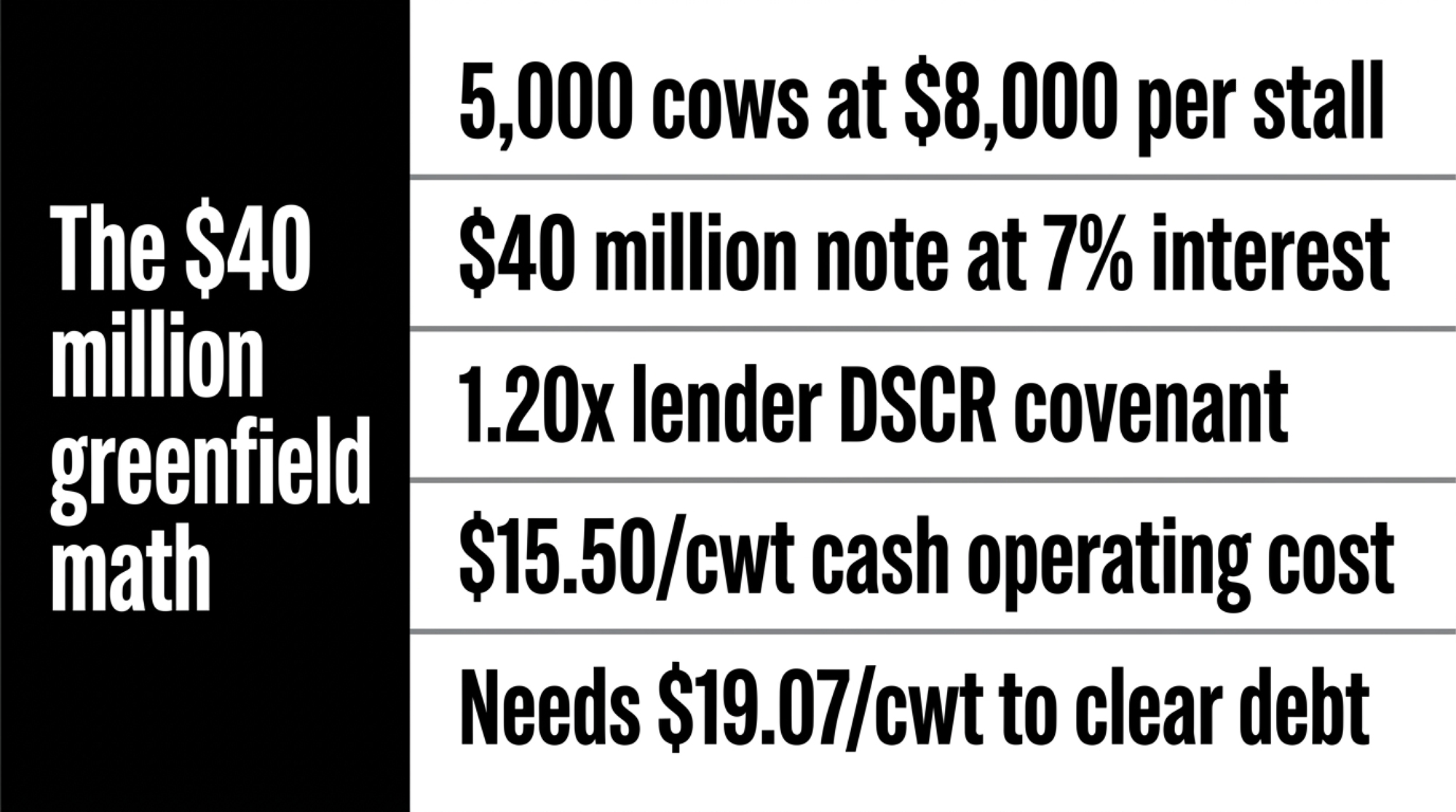
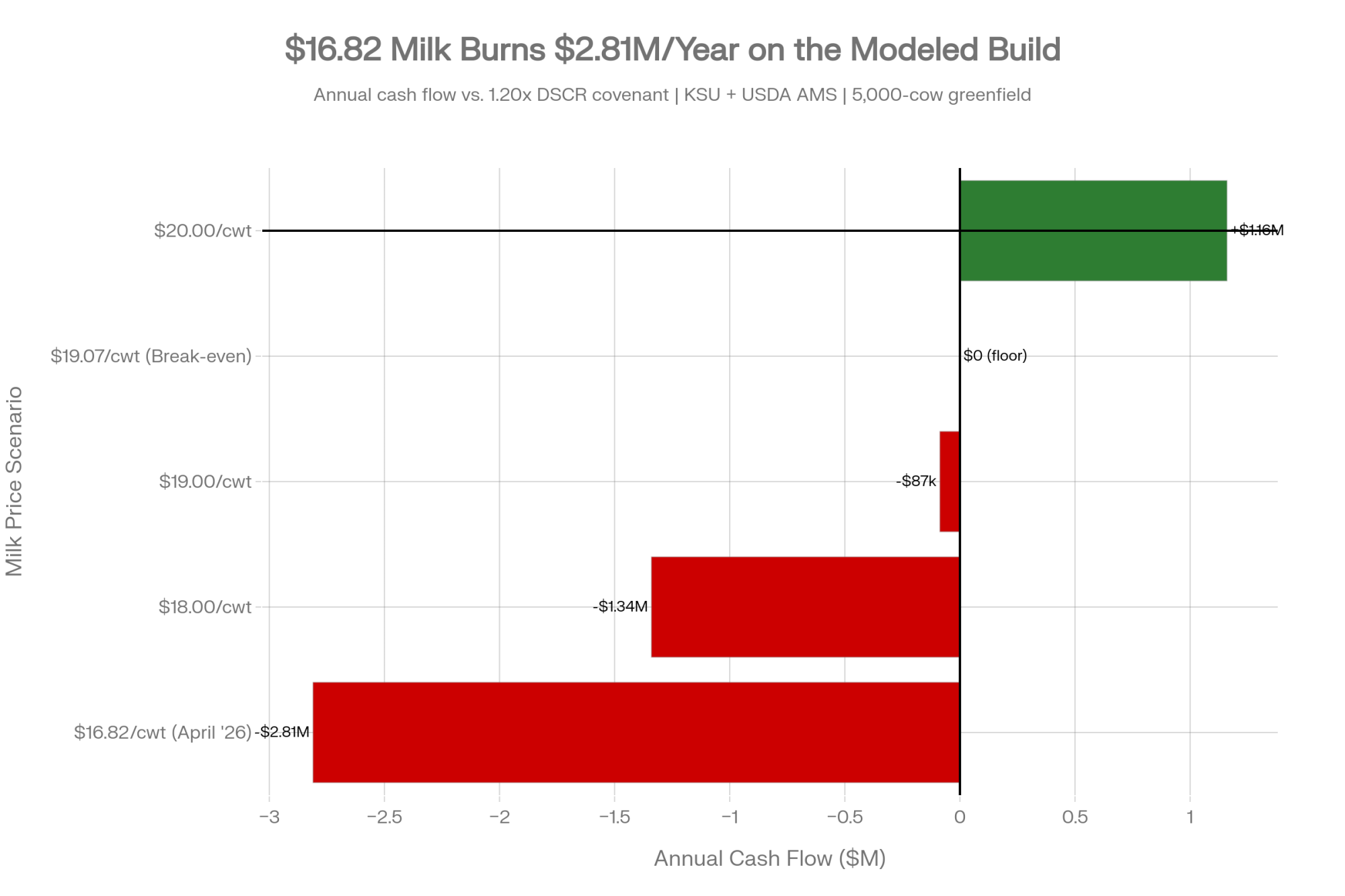
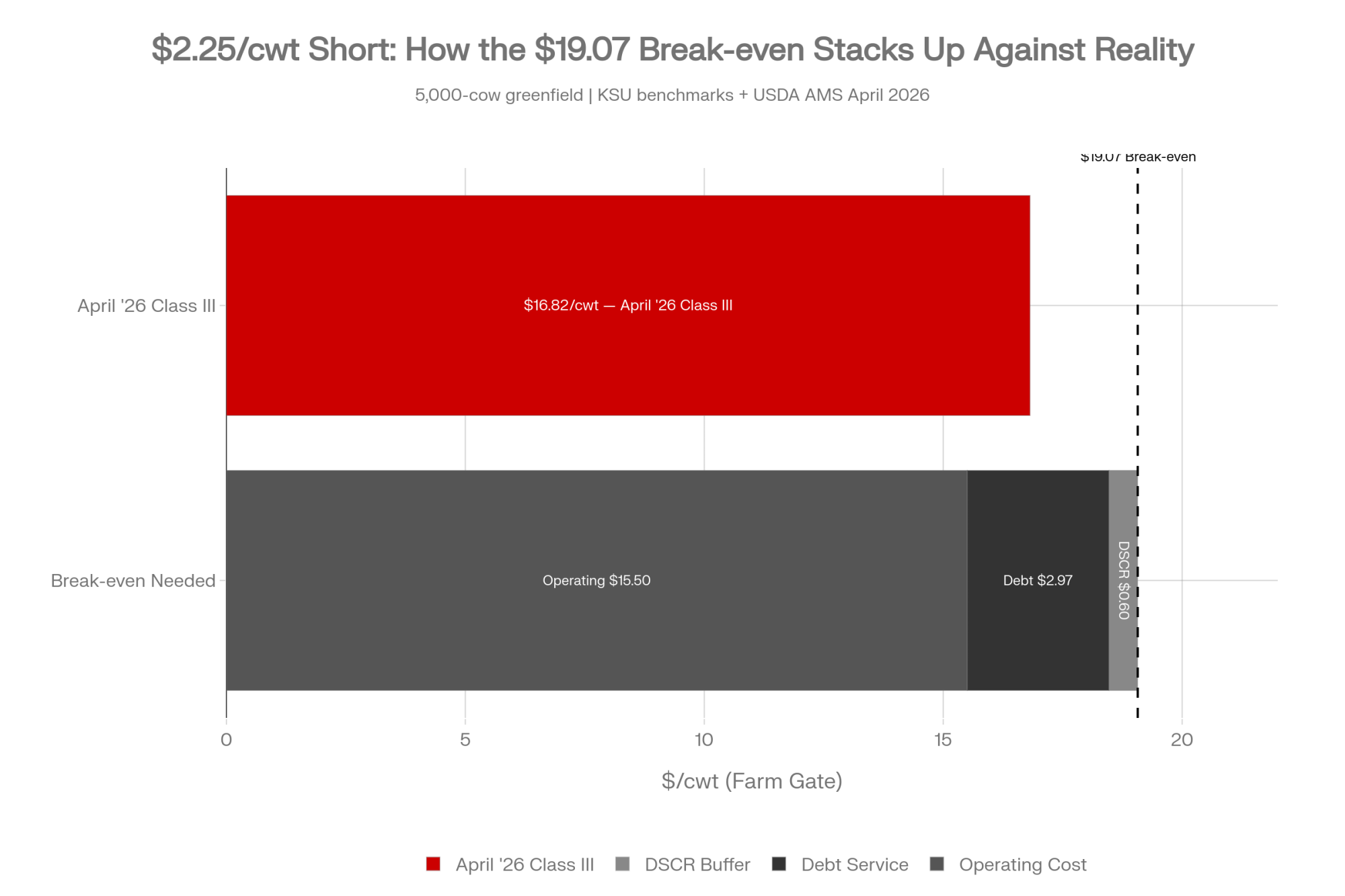
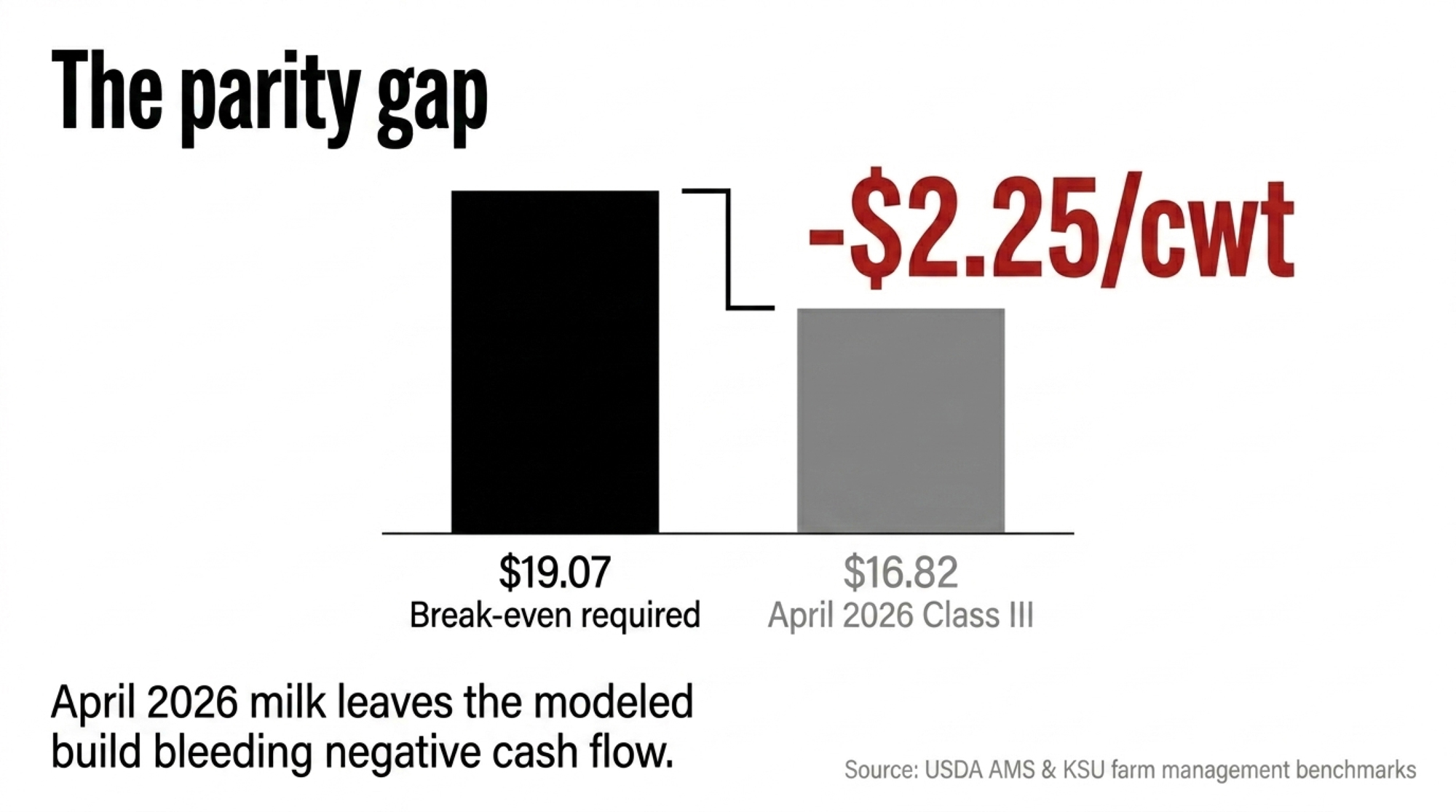
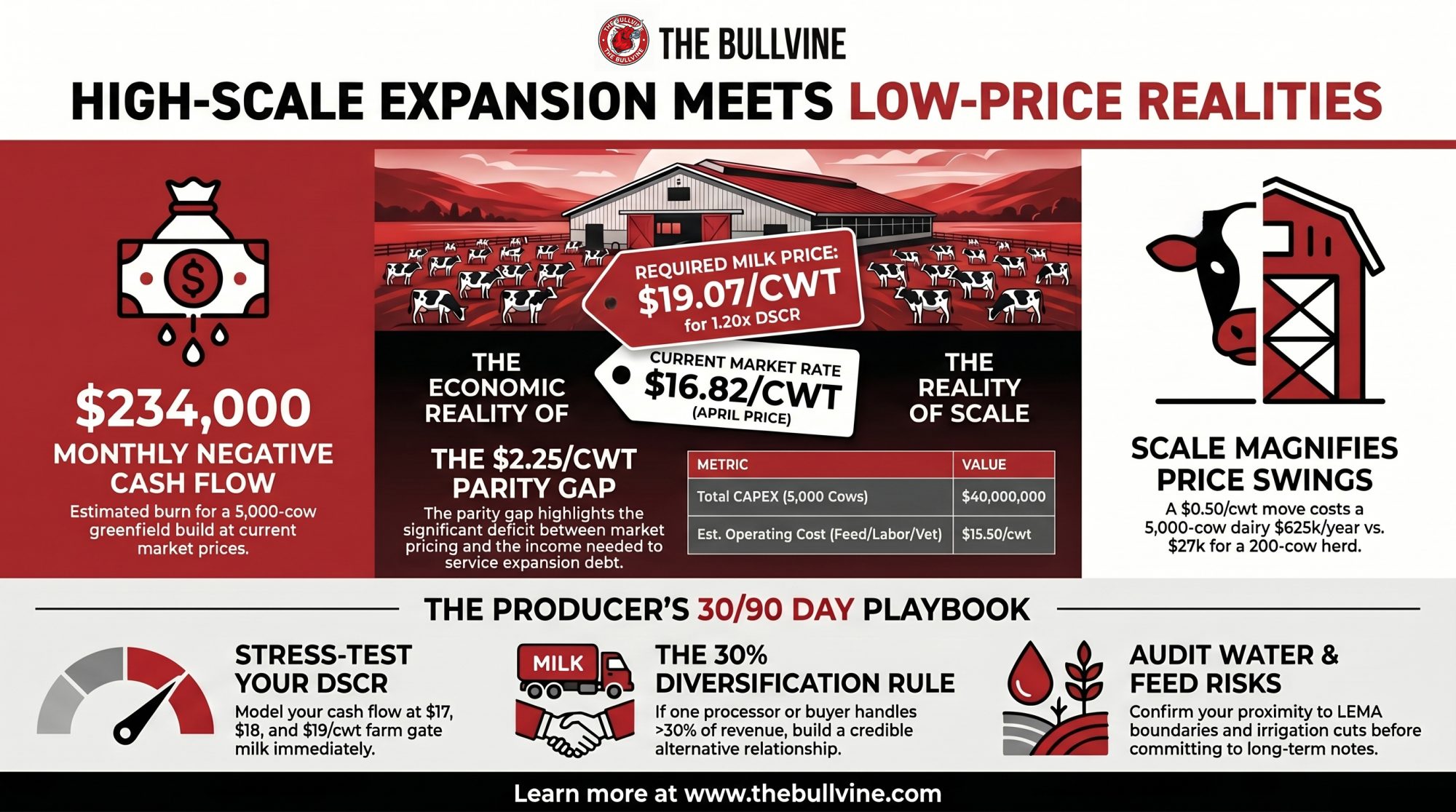
Re-run your covenant against $15.52 Class III, not the $19.85 all-milk annual forecast. A modeled 5,000-cow High Plains greenfield — $8,000/stall, $40M note, 7% over 20 years, 1.20x DSCR — needed farm-gate milk near $19.07/cwt to clear covenant against Class III near $16.82 in April. Class III has since fallen to $15.52. Those parameters are illustrative and don’t describe any specific operation, but the structure transfers. Requires your amortization schedule and current component data. Backfires if you only stress the downside — run the futures curve too.
Price replacements against current local quotes, not last year’s. At $3,100 nationally and $3,400–$4,400 in Upper Midwest barns, a 120-head annual replacement need spans roughly $372,000 to $528,000 depending on where you buy. Requires your actual cull rate and a real local quote. Watch for heifer prices moving faster than your budget cycle.
Get component data in front of your nutritionist alongside the grade question. Requires recent tests and a straight answer from your buyer on premium structure. Backfires if you chase specifications your plant doesn’t price differently.
365-Day Moves
Decide whether your next increment of milk comes from new cows or cows you already own. Nationally it was 93% animals; in Kansas, roughly 98%. Yours doesn’t have to be. Requires capital planning, facility assessment, honest per-cow benchmarking.
If you irrigate in the Ogallala footprint, pull your own groundwater management district’s annual water-level report rather than relying on state or regional averages. District-level rates diverge sharply, and the district you farm in matters more than the state trend. Watch for LEMA allocation changes arriving faster than your cropping plan.
Opportunity signal: if September and October Class III settle at or above the $16.80 and $17.13 the curve carried on August 20, and your margin over feed holds, July was the bottom. Confirm against actual settlements, not August’s curve — which softened 63 cents on the September contract in a single week.
So pull your statements. What’s your actual blend price per cwt this month versus 90 days ago, and what share of your milk did your co-op utilize in Class III? If that number isn’t at your fingertips, you don’t yet know whether July’s report was your problem or somebody else’s.
Key Takeaways
July’s 2.2% national gain was 93% more cows and 7% better cows. Kansas was 98% cows. Animal-driven growth locks in feed, labor, facility, and heifer costs that don’t flex when Class III gives back $1.40 in two months.
The July class spread was $2.82 — $18.34 Class IV against $15.52 Class III. On 400 cows at 75 lbs, that’s roughly $26,226 in a month, and which side you’re on is a clause in your co-op agreement, not a market call. Pull three milk checks and find your real weighting.
Butter kept sliding while the market read tight because 80% butterfat inventories are ample and 82% is where the shortage sits. Ask your buyer whether they actually pay differently on grade before you chase fat.
Springing heifers at $3,100 nationally and $3,400–$4,400 in Upper Midwest barns mean every $500 move costs a 400-cow herd about $60,000 to hold size. Price replacements locally in the next 30 days, not off last year’s number.
Complete references and supporting documentation are available upon request by contacting the editorial team at editor@thebullvine.com.
Learn More
Cull cow replacement cost: $2340 vs $3500 in 2026 — Dismantles the reflex of convenience-culling by exposing the $1,160 cash deficit between a $2,340 slaughter cheque and a $3,500 replacement, arming you with a clear scorecard to keep sound cows earning margin instead of buying expensive replacements.
$19.85 milk price forecast 2026: your base year decides — Follows the money on $11 billion in new plant construction to expose how cooperative base-year rules penalize expansion volume into discounted surplus tiers when USDA’s all-milk forecast slips below $20/cwt.
Cracking the Code: Behavioral Traits and Feed Efficiency — Delivers a sensor-driven roadmap linking wearable rumination and resting data to residual feed intake, showing how to engineer higher milk efficiency from existing cows rather than purchasing more stalls.
The Sunday Read Dairy Professionals Don’t Skip.
Every week, thousands of producers, breeders, and industry insiders open Bullvine Weekly for genetics insights, market shifts, and profit strategies they won’t find anywhere else. One email. Five minutes. Smarter decisions all week.
Your check says soft market. Hold June’s cheese, butter, powder, and whey flat, run both formulas, and $1.01/cwt is pure reform — permanent, and it doesn’t leave when cheese comes back.
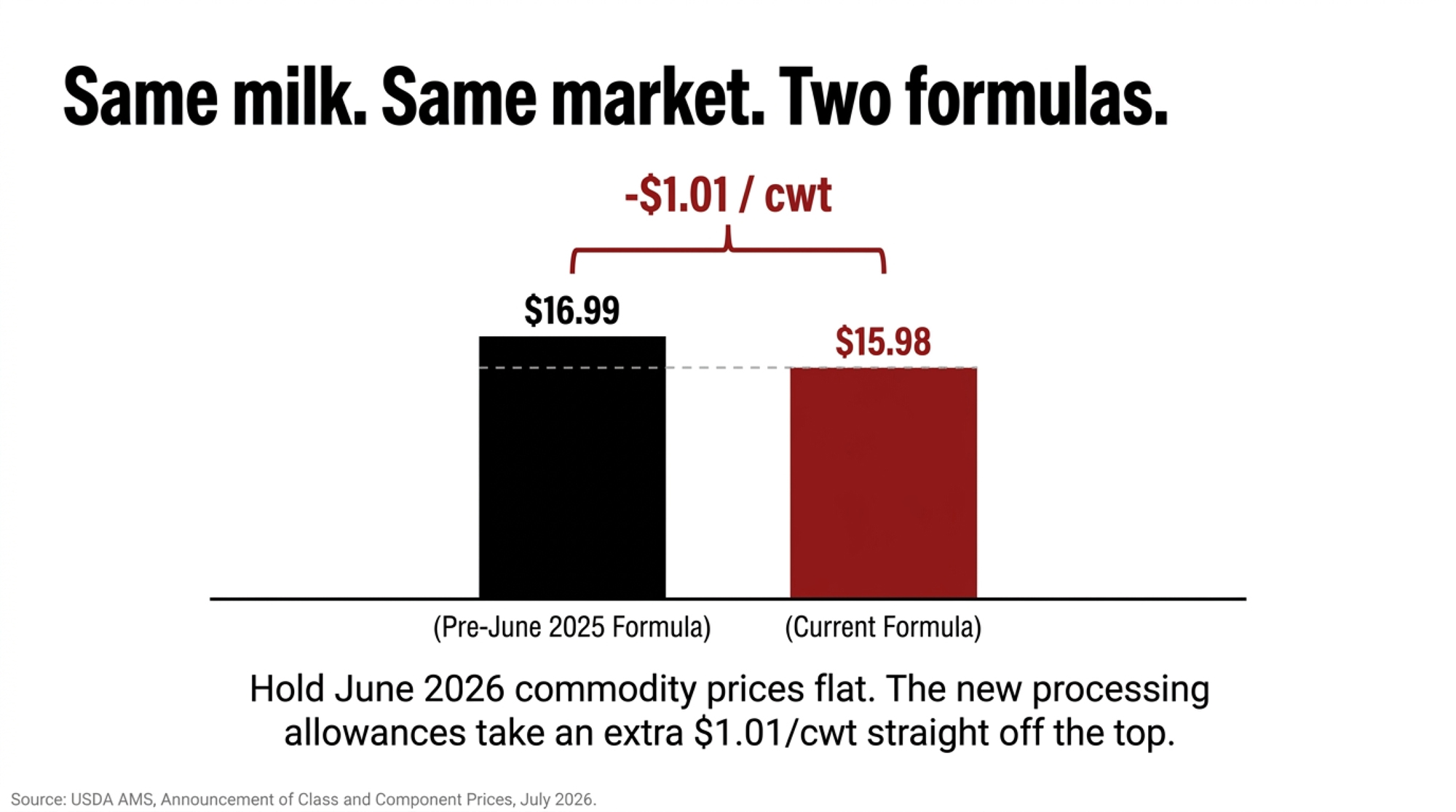
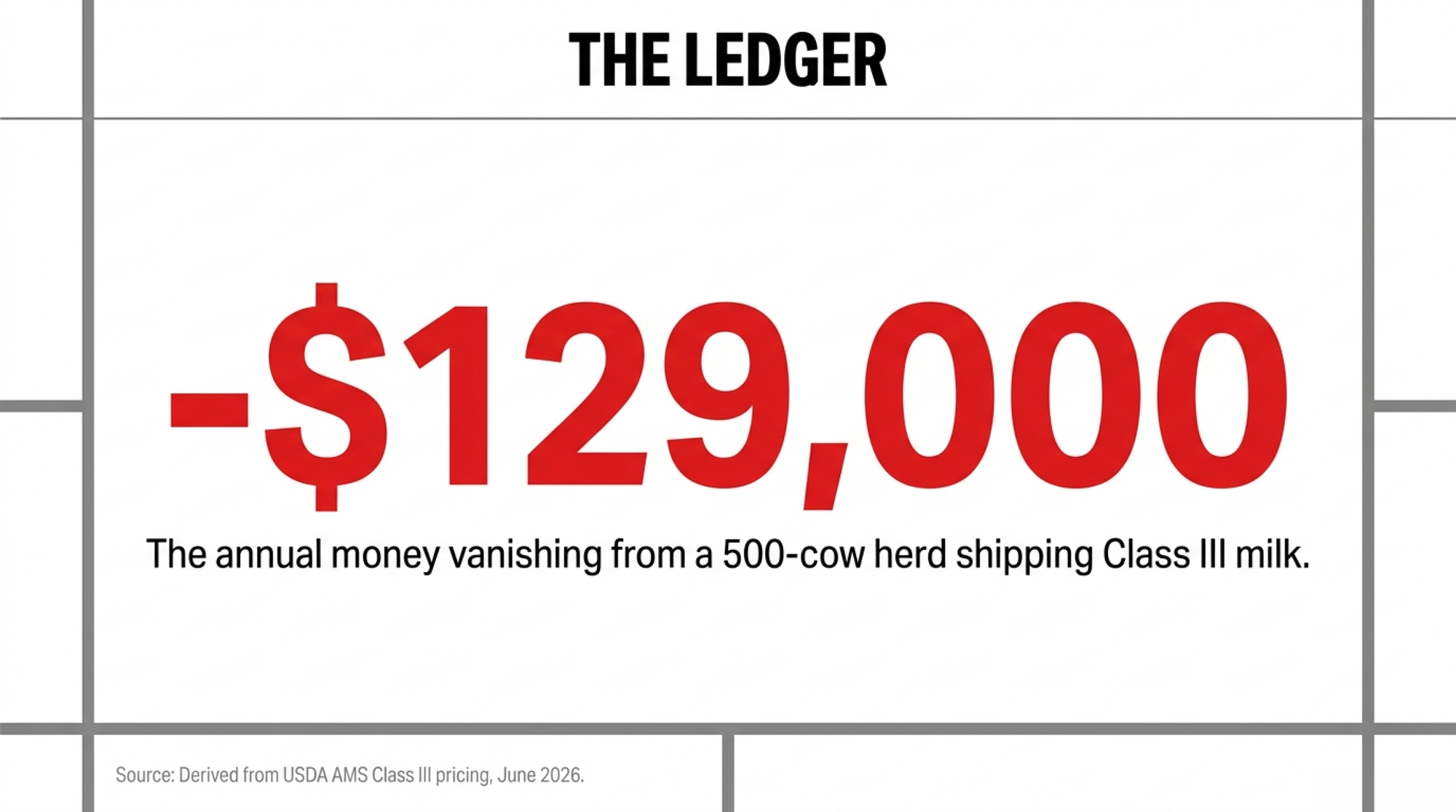
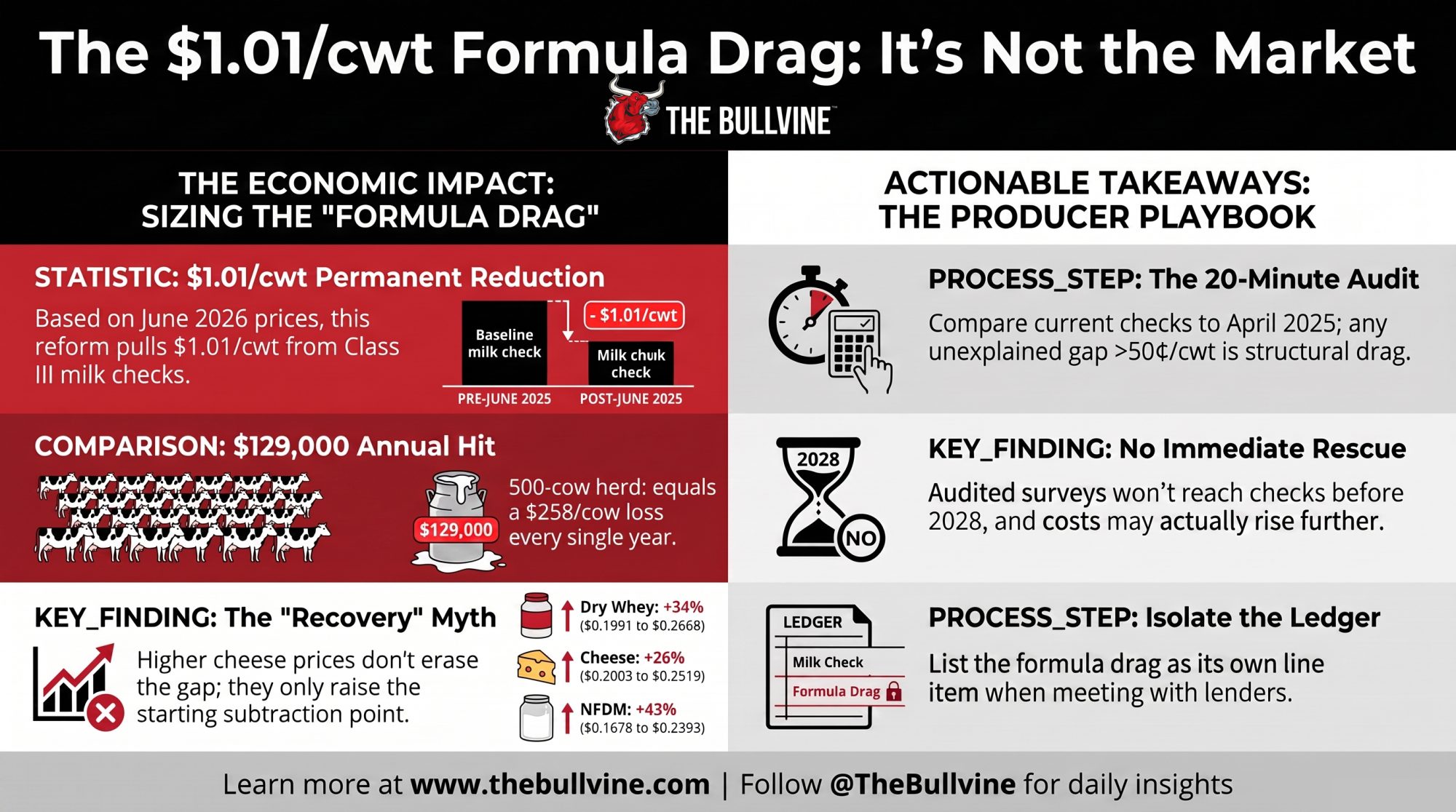
Executive Summary: At June 2026’s confirmed USDA prices, the June 2025 make-allowance reform is costing Class III $1.01/cwt — and that dollar is pure formula, not market. Hold the month’s butter, cheese, powder and whey flat, run them through the pre-June-2025 formula and the current one, and Class III comes out $16.99 the old way versus $15.98 today; the gap is the reform, isolated from every price swing you’ve been blaming. On a 500-cow herd shipping Class III, that’s about $258/cow and roughly $129,000 a year — permanent, and it doesn’t disappear when cheese recovers, because higher cheese raises the number the allowance gets subtracted from. If your blended price is down and you can’t fully explain it with Class III/IV and butter moves, run the 20-minute audit inside — anything unexplained north of 50¢/cwt is structural, and it belongs on its own line in front of your lender.
At the Wisconsin Farmers Union delegate session this March, WFU president Darin Von Ruden described a neighbor running 300 cows who watched roughly $50,000 disappear from his milk checks — same herd, same plant, same management (Brownfield Ag News, “Delegate session highlights dairy farmer losses under new Federal Milk Marketing Order,” March 9, 2026). “It’s hard for dairy farmers to recover from that,” Von Ruden said (Brownfield Ag News, March 9, 2026). His cows didn’t slip. The 2025 FMMO make-allowance change moved under him, and his milk check never spelled it out.
Here’s the number that explains that quarter. June 2026 Class III milk settled at $15.98/cwt (USDA AMS, Announcement of Class and Component Prices, CLS-0626, July 1, 2026). Hold that month’s exact butter, cheese, powder, and whey prices constant, then run them through the pricing formula as it stood on May 31, 2025 — the day before reform took effect. Class III comes out at $16.99. That $16.99 is the same June commodity prices run through the pre-June-2025 make allowances instead of the current ones; the component-by-component reconstruction is in our companion breakdown, The USDA Formula Change No Milk Check Explains (July 1, 2026). Same milk, same commodity prices, two formulas. The gap is $1.01/cwt.
That dollar isn’t market noise. It’s policy, and it’s permanent until Washington changes it again.
One boundary before the math: this is a U.S. Federal Milk Marketing Order mechanism. Canadian producers under supply management price milk a completely different way — read this as a look at your export competitors’ cost base, not your own check.
What Actually Changed on June 1, 2025
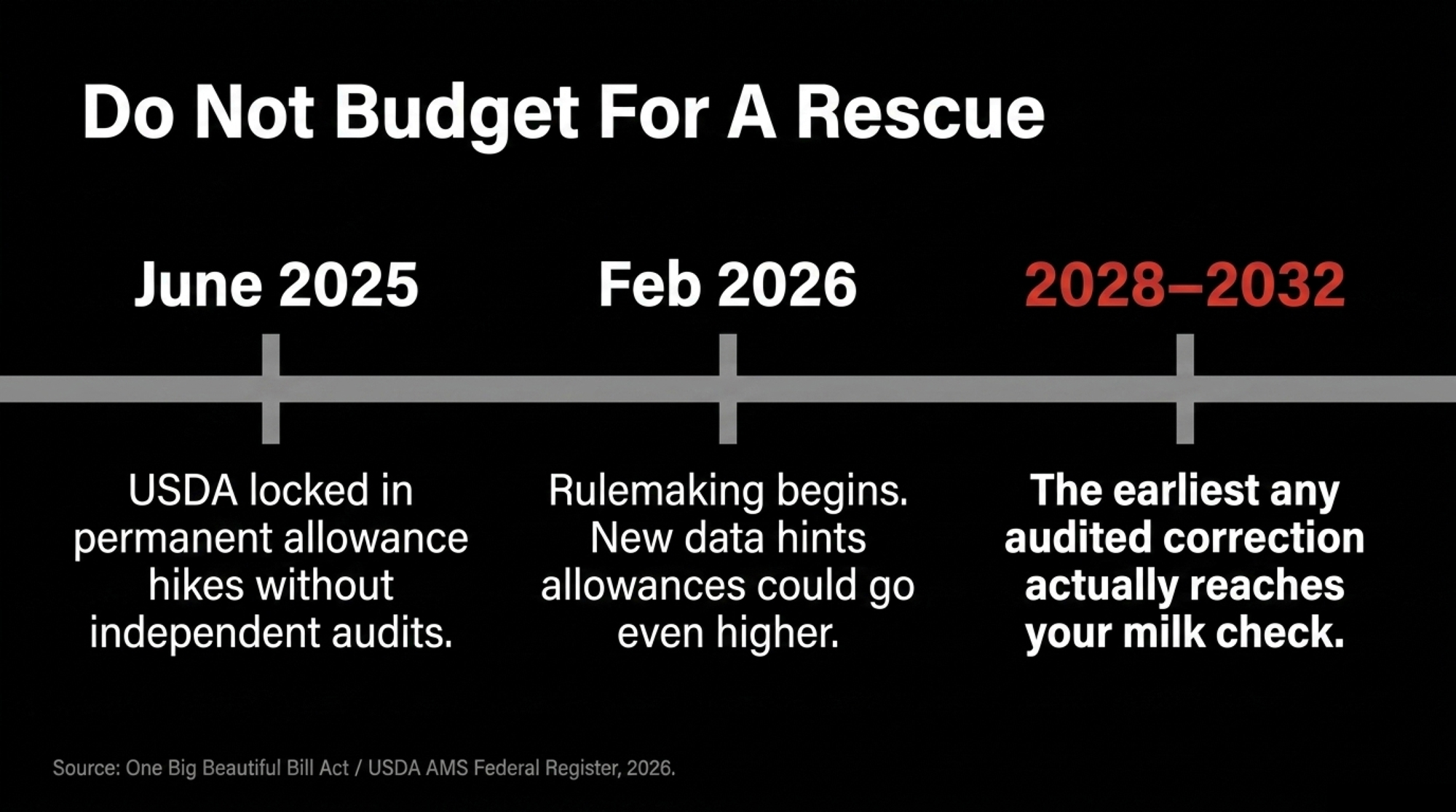
On June 1, 2025, USDA updated the make allowances inside the FMMO formulas for the first time since 2008 (Farm Credit Services of America, “New Federal Milk Marketing Order Rules Now Effective,” June 9, 2025). A make allowance is USDA’s assumed cost for a processor to turn your raw milk into cheese, butter, powder, or whey — subtracted before your component prices are set. Bigger subtraction, smaller check.
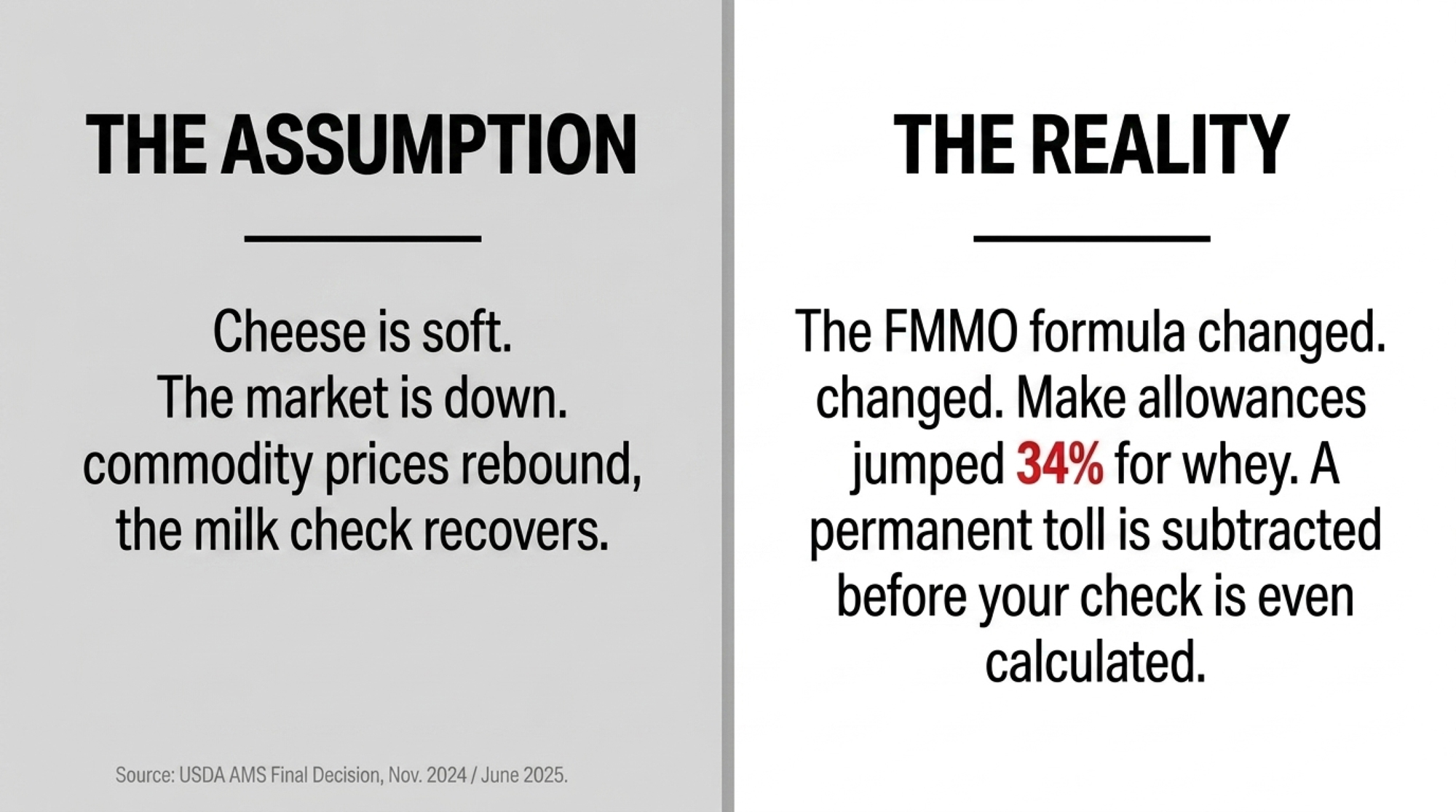
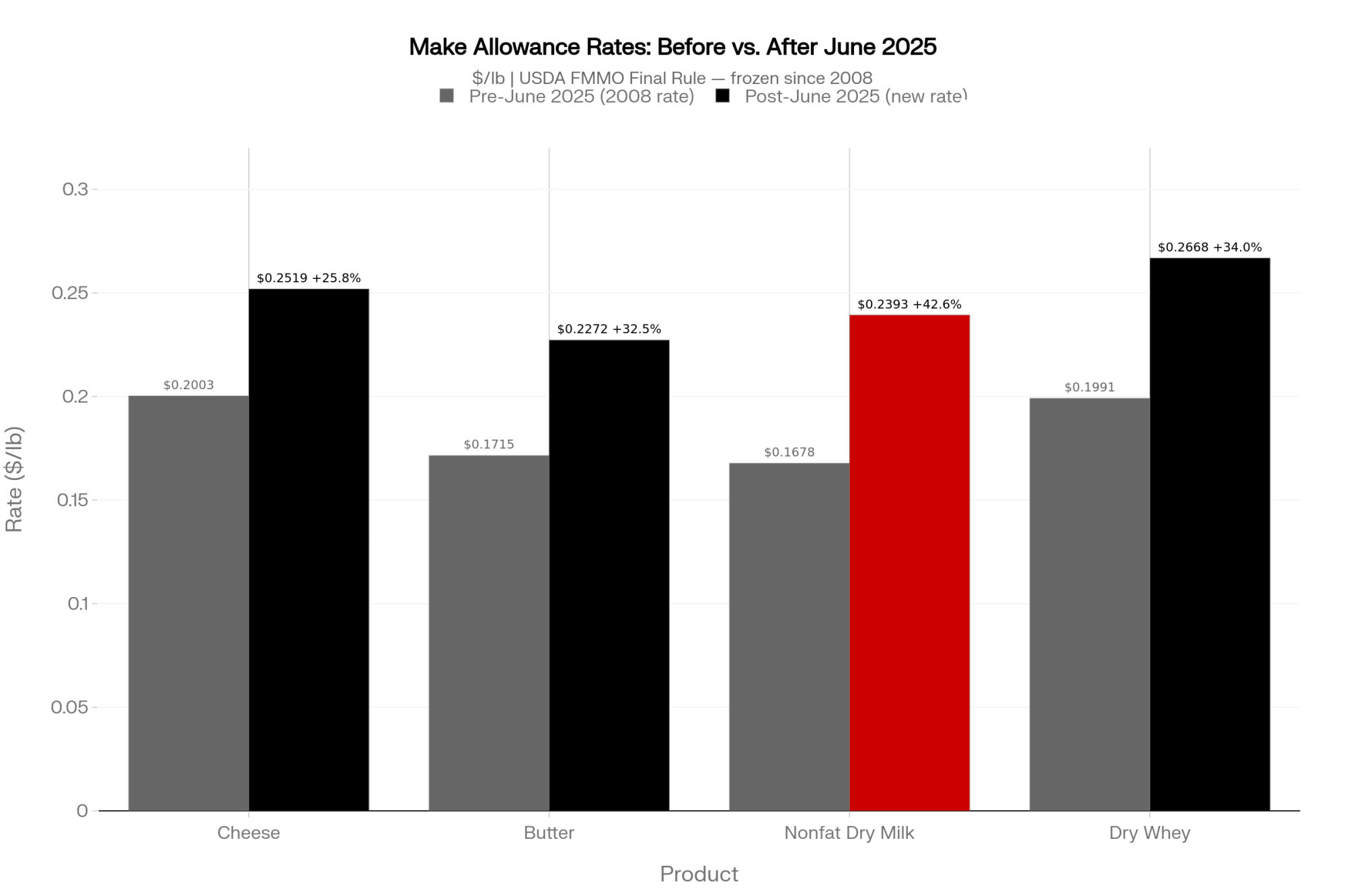
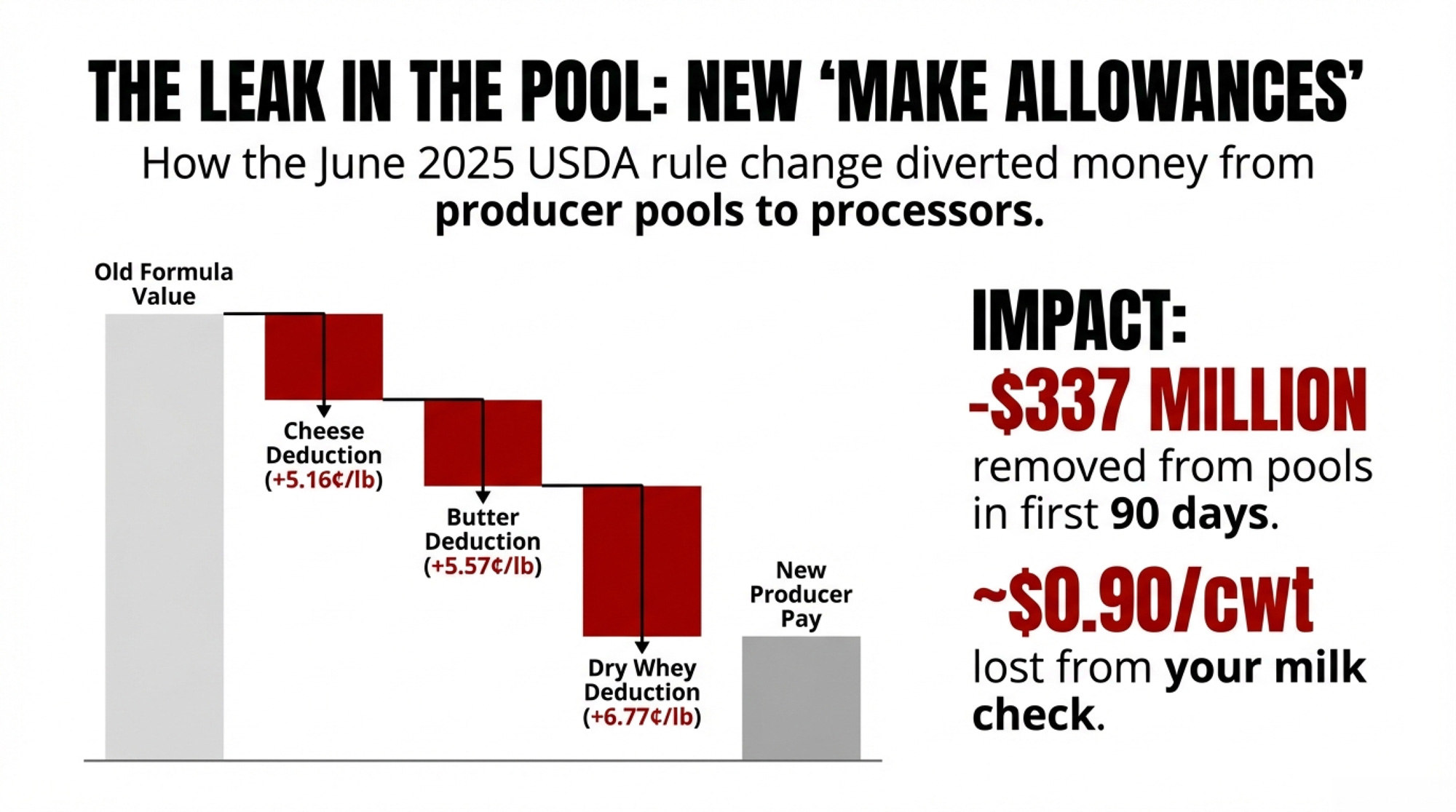
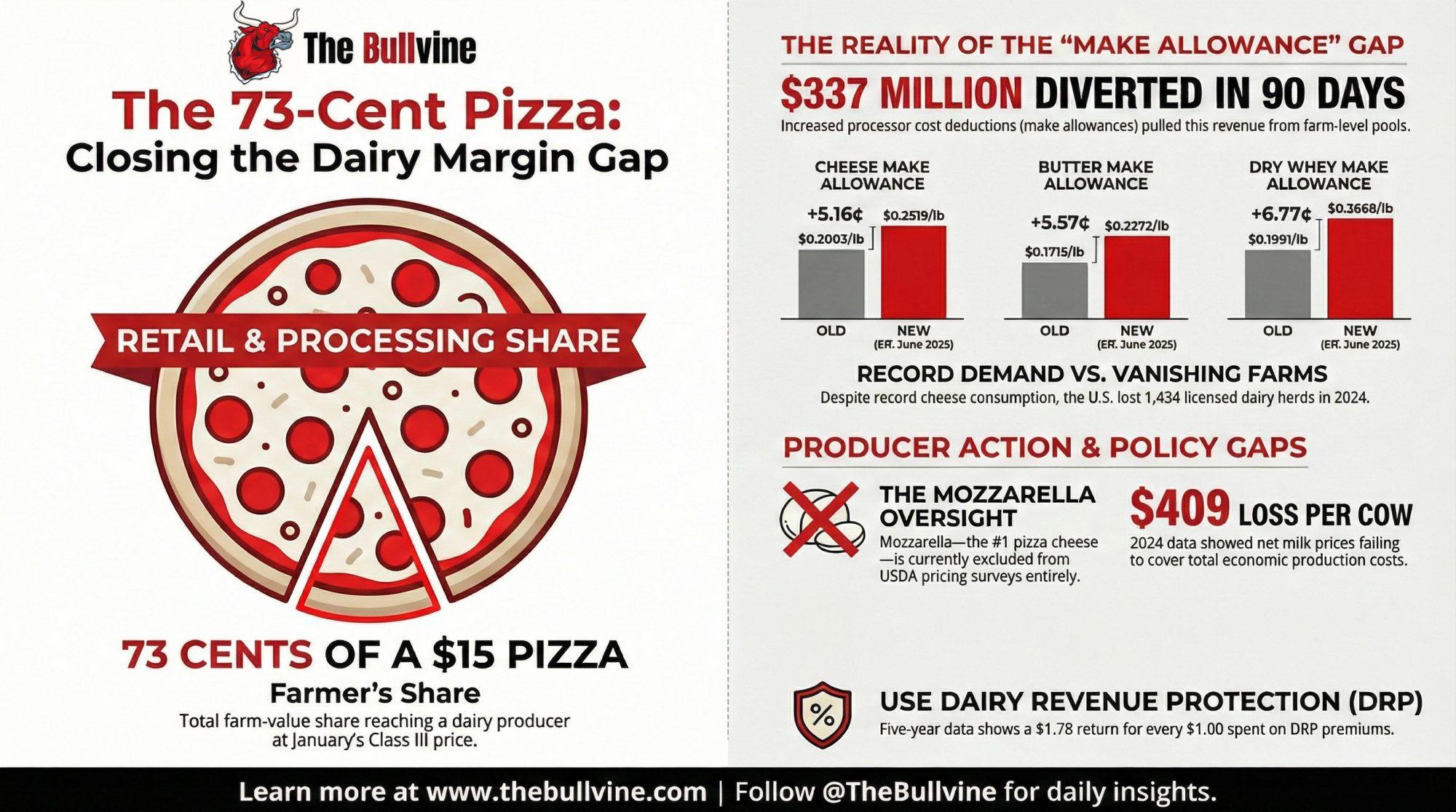
All four jumped at once: cheese to $0.2519/lb, butter to $0.2272, nonfat dry milk to $0.2393, dry whey to $0.2668 (USDA AMS Final Decision, Nov. 11, 2024; effective June 1, 2025). Dry whey took the steepest jump of the four — up 34%, from $0.1991 to $0.2668/lb (USDA AMS Final Decision, 2024). That single number is why this isn’t a cheese-shipper problem: whey feeds the other-solids price that touches every Class III check in the country.
The American Farm Bureau Federation ran the first published scoring. Over the reform’s first three months, the higher allowances cut Class III by 92¢/cwt and Class IV by 85¢/cwt — a gross hit of about $337 million to pool revenues in 90 days, with the deepest bites in the Upper Midwest, the Northeast, and California (AFBF Market Intel, “Three Months In,” Daniel Munch, Sept. 21, 2025). Net the reform’s offsetting pieces — higher Class I differentials and the return to the higher-of mover — and the number lands closer to $231.9 million on The Bullvine’s accounting of AFBF’s figures. Keep those two straight. The gross is the make-allowance damage; the net is what producers lost after the give-backs. Anyone quoting $337 million as the bottom line is skipping a step.
To be fair about it: USDA and processors argued the old allowances were nearly two decades stale, that real plant costs had climbed, and that updating them keeps processing capacity alive — the plants that buy your milk (Farm Credit Services of America, June 9, 2025). IDFA testified that the make allowance covers the costs manufacturers incur in turning raw milk into finished dairy products, and needed to reflect what those costs had actually become (IDFA testimony to USDA AMS, FMMO hearing record). That’s a real position. The fight isn’t whether costs rose. It’s how big the number should be, whether anyone checked it, and who’s carrying it.
Why Can’t You See This on Your Milk Check?
Here’s the trap. You get your check, see a smaller number, and hear the same line everybody hears: cheese was soft, the market was down. Both can be true at once. Class III did run well below its early-2025 levels — USDA’s February 2026 Class III component value worked out to about $15.46/cwt, down from $21.55 a year earlier, a $6.09/cwt drop (USDA AMS February 2026 component prices, at 3.8% fat / 3.2% protein / 5.7% other solids). That part is real market movement. But underneath the noise, a fixed piece keeps working. And it doesn’t leave when cheese comes back.
Everyone assumed a cheese rebound would wash the pain out. It won’t. Higher cheese prices don’t shrink the make-allowance subtraction — they raise the number it’s subtracted from. The dollar stays.
The 2026 Reality Check: The make allowance isn’t a line item on your statement. It’s subtracted inside the formula, before your check is ever calculated — so you never watch the dollar leave, because it was never on the page to begin with.
That’s how Von Ruden’s neighbor lost that money without a single line naming the cause. It’s the difference between riding out a normal price cycle and paying a fixed toll on every hundredweight, in good months and bad. For the human side of that gut punch, read Von Ruden’s full account of the 300-cow hit.
Running the Numbers: What $1.01/cwt Does to a 500-Cow Herd
The math is simpler than the formula that produces it. Here’s the drag on an illustrative 500-cow dairy — then plug in your own herd.
The 500-Cow Herd Impact (At a Glance)
Metric
Baseline Figure
Annual Impact
Herd Size
500 milking cows
—
Daily Production
~70 lbs / cow / day
—
Total Annual Milk
127,750 cwt
—
Formula Reform Drag
$1.01 / cwt
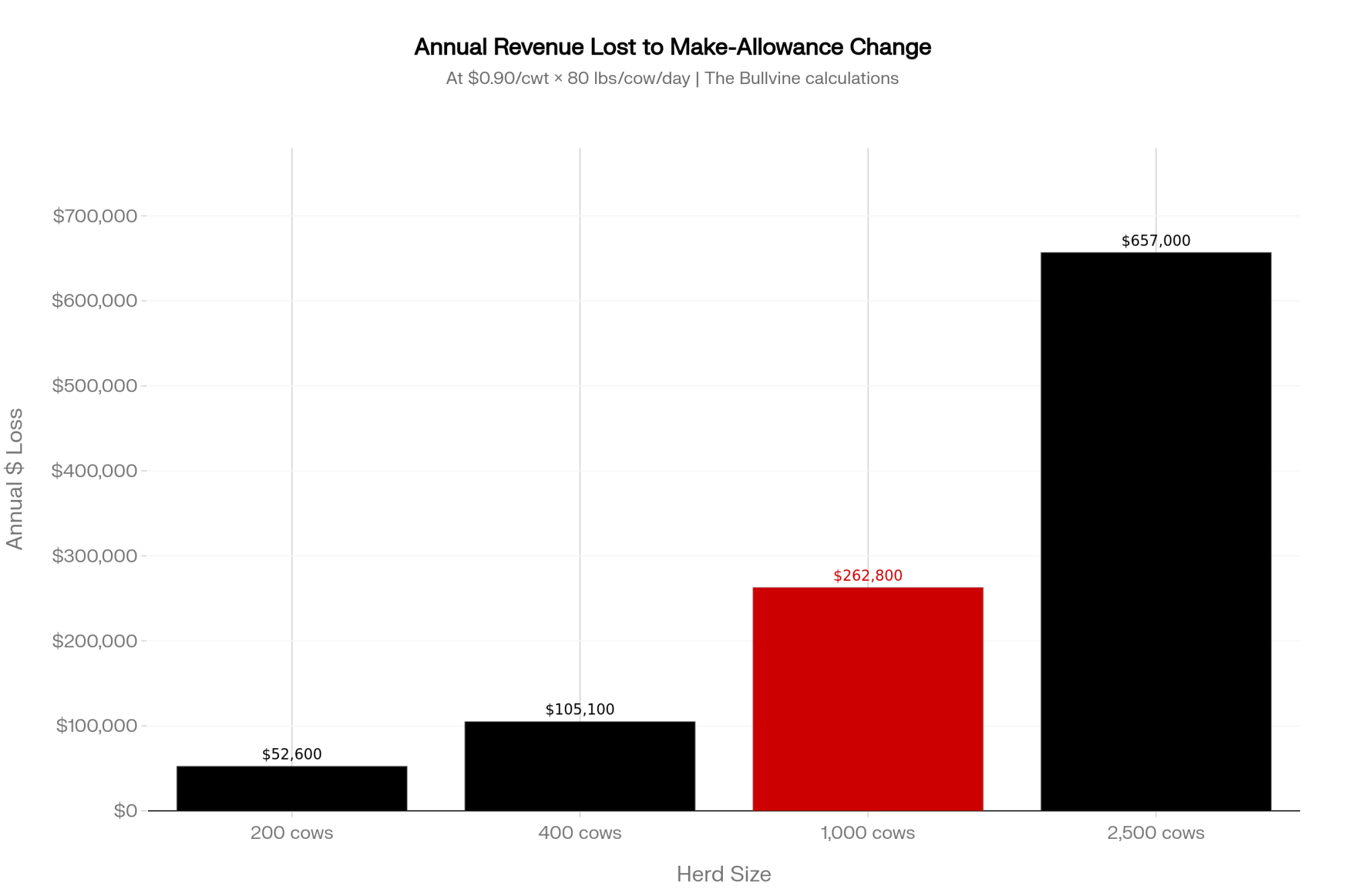
–$129,027 / year
Per-Cow Toll
—
–$258 / cow / year
Illustrative Class III herd only. Production assumption based on USDA NASS Milk Production (Jan. 2026, major states): 2,082 lbs/cow/month, roughly 68–69 lbs/day, so 70 is a fair working figure.
Adjust the pieces for your operation. A herd averaging 80 lbs/cow/day pushes the drag to about $147,000. Weight your utilization toward Class IV and the per-cwt hit eases toward 85¢. The exact figure isn’t the point. The point is that this is a five- to six-figure annual number for a mid-size dairy, hiding inside a price you’ve been calling “the market.”
Set that toll next to the safety net, and it stings worse. A Bullvine breakdown put a 200-cow dairy’s Dairy Margin Coverage payout at about $1,800 in a year against roughly $42,240 lost to make allowances — a 23-to-1 gap. The support program is real. It’s also a rounding error against the formula change.
Will the Mandatory Cost Survey Actually Lower Your Make Allowance?
This is where the story turns on the people waiting for Washington to fix it. Producers assumed the reform’s cost data would eventually get audited, corrected, and walked back. The first part is happening. The second might go the wrong way.
The 2026 Reality Check: The permanent, nationwide formula that did five figures in damage to mid-sized herds was built on voluntary processor cost surveys that USDA never independently audited before locking them in.
AFBF’s Munch called the increase “very disappointing because it’s based on voluntary processor cost-of-production surveys and doesn’t necessarily reflect the true cost of production” (Brownfield Ag News, July 8, 2024). A number doing that kind of damage was set without independent verification.
Congress agreed that wasn’t good enough. The One Big Beautiful Bill Act, signed on July 4, 2025, mandates biennial, audited processor cost surveys and allocates $9 million for them. USDA is moving — AMS issued an Advanced Notice of Proposed Rulemaking on Feb. 27, 2026, and released an updated 2021 processing-cost study covering 61 plants (USDA AMS; Federal Register, Feb. 27, 2026). As of July 12, 2026, the mandatory-survey rule wasn’t finalized.
Read the study before you cheer. It suggests costs have climbed enough that allowances on cheese, whey, and NFDM could go higher, not lower — only butter looks like it drops (AFBF Market Intel, Feb. 13, 2026). And on Munch’s read, any change is unlikely to reach milk checks before 2028, with the full hearing track pointing closer to 2031–2032. The audit is coming. It might raise your drag, and it won’t arrive fast. Plan around that, not around a rescue.
How Do You Size Your Own Loss in 20 Minutes?
You don’t need the full component math. Take your annual Class III cwt and multiply by roughly 90¢–$1.01 — that’s your working estimate of the yearly formula drag. Then check it against reality. Pull your blended $/cwt from April–May 2025 (before reform) and set it alongside July–September 2025. Strip out the known Class III/IV and butter moves. Whatever gap is left over and unexplained above about 50¢/cwt, treat as structural drag, not a bad month.
If the leftover is 50¢ or more, you’ve found the formula in your own statement. For most mid-size herds, this ranges from $80,000 to $130,000 per year. That’s expansion-decision money, not coffee-shop-gripe money.
Herd Size
Daily Production (lbs/cow)
Annual Class III cwt
Annual Formula Drag @ $1.01/cwt
200 cows
70
51,100 cwt
$51,611
400 cows
70
102,200 cwt
$103,222
500 cows
70
127,750 cwt
$129,027
500 cows (80 lbs/day)
80
146,000 cwt
$147,460
Size Your Loss — Pencil It InLine A — Your annual Class III milk: __________ cwt Line B — Your drag estimate: $0.90 to $1.01 per cwt Line C — Estimated annual formula drag: Line A × Line B = $__________ Gut check: Your blended $/cwt (Apr–May 2025) minus (Jul–Sep 2025), less known Class III/IV and butter moves = your unexplained gap. Over 50¢? That’s structural, not a bad month.
The 30/90/365-Day Playbook for Herds Like the Von Ruden Neighbor’s
30-Day Window — Urgent Checks
Pull your statements. Run the 20-minute audit above, comparing April–May 2025 to your recent 2026 checks.
The trigger: any unexplained gap over 50¢/cwt is your structural formula drag.
The danger: subtract genuine market and component moves first, or you’ll overstate it.
Isolate the cash flow. Put the drag on its own line in your ledger, separate from feed, DRP, or DMC.
The trigger: if your debt-service coverage has been below 1.2 for three straight months using your lender’s or CPA’s method, treat this as an operational emergency, not an academic one.
The danger: a lender who sees the number buried inside “market” can’t help you plan around it.
90-Day Window — Structural Adjustments
Take the number to the table. Bring your documented $/cwt drag into your next operating-loan and co-op conversation, in writing, with herd size and order attached.
The trigger: schedule it before your next renewal, not after.
The danger: a round guess instead of your real number kills your credibility fast.
Stress-test your mix. Review your class breakdown and whether component or manufacturing shifts change your exposure.
The trigger: if you’re heavily Class III in the Upper Midwest or Northeast, you’re carrying the top of the 85¢–$1.01 range.
The danger: don’t chase a class mix that wrecks your milk market or hauling economics to dodge a formula.
365-Day Window — Strategic Positioning
Get on the record. The mandatory-survey rulemaking is live now — comment with your herd size, order, and real drag.
The opportunity: this is a rare window in which a documented farm-level number carries weight. Anonymous aggregate losses don’t move USDA. Named math does.
The danger: comment periods close. Miss it, and you’re arguing after the number is locked.
Budget for no rescue. Plan your multi-year path as if relief doesn’t reach checks before 2028 — and could tilt against you if cheese, whey, and NFDM allowances rise.
The opportunity: if your margin over feed holds while your structural drag is fully accounted for, you’ve got room to make cull, expansion, or refinancing calls on real numbers instead of hope.
The danger: expanding on the assumption the audit walks the drag back. It may not.
👉 Companion Analysis: For the line-by-line version of that first check, see Surviving the $0.94/cwt Dairy Make Allowance Hit (April 19, 2026) — how a 400-cow dairy separates formula effects from component and market moves.
Is This a Temporary Dip or a Permanent Shift?
Not close. The loss is structural, and it stays until the allowances change through regulation — a process that, on Munch’s read, likely won’t affect your check before 2028 and could be pushed to 2031–2032. Every year you call this “a bad year” is a year you didn’t name the real problem. Name it, size it, build it into your plan. That’s the difference between Von Ruden’s neighbor knowing where his money went and just absorbing it.
Von Ruden has argued for years that U.S. producers need a more stable domestic price rather than chasing export volume (Wisconsin Public Radio, Jan. 9, 2024). You can agree or disagree with his fix. But the trade-off at the heart of this one is blunt. Processors got cost recovery; they say they needed it to keep plants running. You got a permanent per-cwt reduction built on cost figures nobody independently audited before they took effect. Both can be true — and only one of them shows up on your statement.
So before you accept anyone’s tidy explanation of why your check got smaller, run your own gap. Then ask the question that actually matters at your kitchen table: what’s your real margin over feed per cwt this month versus a year ago — and how much of that difference is the market, and how much is a formula you never got a vote on?
Key Takeaways
At June 2026 prices, the make-allowance reform is pulling $1.01/cwt out of Class III — about $258/cow and roughly $129,000 a year on a 500-cow herd. That’s formula, not market, and it’s permanent.
A cheese rebound won’t save you. Higher cheese raises the number the allowance gets subtracted from, so the dollar stays whether prices are up or down.
Run the 20-minute check: compare your blended $/cwt from April–May 2025 to recent 2026, back out the known Class III/IV and butter moves, and anything unexplained over 50¢/cwt is structural drag. Put it on its own line in front of your lender.
Don’t budget for a rescue. The audited cost survey won’t touch checks before 2028, maybe 2032, and could push cheese, whey, and NFDM allowances higher, not lower.
Run Your Numbers
Dairy Farm Corridor Score Calculator — This article gives you the $1.01/cwt make-allowance drag. The Corridor Score puts it in dollars for your operation, layers in your hauling cost, and flags whether your location is quietly turning that formula hit into a red-zone milk-check risk.
Complete references and supporting documentation are available upon request by contacting the editorial team at editor@thebullvine.com.
Every week, thousands of producers, breeders, and industry insiders open Bullvine Weekly for genetics insights, market shifts, and profit strategies they won’t find anywhere else. One email. Five minutes. Smarter decisions all week.
That border fight is worth about 5¢/cwt. The $96,000 hole already in your milk check is the one that decides if you’re still milking in 2030.
North Dakota once counted 1,810 dairy farms. By March 2025, Deputy Agriculture Commissioner Tom Bodine told state lawmakers just 23 permitted operations were left — one of them not even milking — running about 8,700 cows between them (North Dakota Monitor). That’s not a rough market cycle. That’s a state’s dairy industry going quiet, one processing plant and one lender conversation at a time.
Here’s the part that should stop you cold. While farms like those disappeared, the loudest fight in dairy policy has been about Canadian tariff quotas — a dispute that, run through the actual numbers, lands on your milk check as a nickel per hundredweight (USDA milk production data). The border fight has a flag and a villain. The thing pulling barns under has a spreadsheet and a month-end accounting entry. And it’s winning.
Do the Math on the $200 Million and It Shrinks to a Nickel
U.S. dairy groups say Canada owes them roughly $200 million a year in market access under CUSMA. Real money — until you spread it across the 232 billion pounds of milk this country produced in 2025. Divide the full $200 million across that production and you get about 8.6 cents per hundredweight. Because only 42% of the access actually gets used, though, roughly $116 million goes unfilled each year — and spread across production, that’s about a nickel per cwt.¹ (The Bullvine: North American dairy trade)
Economists Keith Head and Werner Antweiler said it plainly in a 2024 working paper: any remedy to the TRQ dispute “would likely result in only modest economic gains to the United States.” On a 150-cow dairy shipping around 24,000 pounds per cow, that nickel is worth roughly $1,800 a year (Head & Antweiler, SSRN 2024). That’s the fight burning political capital in Washington and Ottawa through the 2026 review.
Dimension
The Political Fight (CUSMA TRQ)
The Real-World Margin Pressure
Value per cwt
~$0.05/cwt
Class III drop to $14.59/cwt (Jan 2026)
Annual impact, 150-cow herd
~$1,800/yr
—
Annual impact, 400-cow herd
—
$96,000 lost on a $1/cwt shortfall
What it actually decides
Burns political capital in DC & Ottawa
Whether the bank pulls your credit line
Now hold that nickel next to what’s happening inside your own milk check.
Fewer Farms, More Milk — and No Column for the Ones That Vanish
From the outside, dairy looks healthy. U.S. exports hit a record $9.51 billion in 2025, up 15% over the year before, and production set its own record (IDFA). Zoom in and the story flips.
USDA’s Economic Research Service reports the number of licensed U.S. dairy herds fell 63% — from 66,825 in 2004 to 24,811 in 2024 — even as output climbed. The 2022 Census of Agriculture put the drop at 39% in just five years, with farms selling milk falling from about 39,000 in 2017 to 24,000 in 2022. Every herd size shrank except operations with 2,500 cows or more (USDA ERS). The dashboards driving dairy policy measure production, exports, and cost per unit — not how many families stay in business. ERS frames it as efficiency, and the numbers back that framing: in 2021, producing 100 pounds of milk cost $42.71 on herds under 50 cows versus $19.14 on farms with 2,000-plus. By that math, fewer, larger farms making more milk is a win. There’s just no line on the spreadsheet for North Dakota’s missing 1,787 dairies — where the consolidation curve is heading by 2035.
How This Plays Out on a Real Farm
A DSCR breach isn’t a number. It’s a sequence that lands on a real family over months.
What DSCR means: Your debt service coverage ratio is the cash your operation throws off measured against the loan payments you owe. At 1.0×, every dollar of margin goes straight back to the bank — you’re running the parlor to break even with the lender, nothing left over. Below 1.0×, the milk check no longer covers the debt, and you’re pulling from equity to make the payment. (FCC)
North Dakota shows the squeeze in real time. As local processing capacity thinned out, the January 2026 Class III price had already dropped to $14.59 per hundredweight — the lowest since April 2021 — leaving farms with fewer places to send milk at a workable price. It got tight enough that Dawson Holle, whose family runs the 1,000-cow Northern Lights Dairy near Mandan, told a House committee they’d researched building their own processing — after being forced to switch milk markets twice (North Dakota Monitor). That’s the trap: it isn’t always low prices alone. Sometimes it’s the buyer disappearing and stranding your milk.
Run the barn math on a herd that size. On a 400-cow dairy shipping roughly 96,000 hundredweight a year — that’s about 24,000 pounds per cow — a $1/cwt shortfall against your breakeven is about $96,000 gone in twelve months. Stack that against the nickel the TRQ fight might return. One of those numbers decides whether you re-amortize the parlor note. The other you’ll never feel — how North Dakota’s processing collapse played out.
The $4.98 Spread Most Producers Never See Coming
Here’s the mechanism almost nobody in the trade conversation talks about: depooling. It’s a legal, disclosed feature of how voluntary pooling works — and it’s where the structural pressure quietly builds, in plain sight.
Under Federal Milk Marketing Orders, fluid milk has to be pooled, but manufacturing milk — Classes II, III, and IV — is pooled voluntarily. When a manufacturing-class price climbs well above the order’s blend price, a handler can simply choose not to pool it. As Ohio State’s dairy economists put it, “A Class II, III, or IV price which exceeds the Uniform price signals reduced pooling of that class.” The call gets made at month’s end, once every price is known. (Ohio State Extension)
Watch what happens when the spread blows out. In June 2026, USDA announced Class III at $15.98/cwt and Class IV at $20.96/cwt — a spread of $4.98 (USDA AMS class prices). That gap is a green light for handlers to pull their higher-value Class IV milk out of the Order pool. And when that milk walks out the door, the money it would have contributed to the blend walks with it — so the fluid producers left in the pool get handed a thinner blend price and choppier basis they never voted on. The decision is lawful and routine. But it’s made quietly at month-end, and the first place you notice it is your own check — how depooling thins your blend price.
How Much Does the TRQ Fight Actually Change Your Bottom Line?
The answer is a hard no. Line up that political nickel against a real-world cost structure — Illinois FBFM pegged total economic cost, unpaid family labor and equity included, at $23.56/cwt for 2024, against a net milk price of $21.63, a loss of $409 per cow — with an all-milk price USDA now forecasts at $20.70/cwt for 2026 (American Ag Network). That gap is measured in dollars, not cents.
So if both sides “win” their version of the CUSMA review — full enforcement for the U.S., intact supply management for Canada — it doesn’t fix either farmer’s structural problem. It just decides who bleeds a little slower. Chasing the border fight while your own cost of production runs $3 over your milk price is a losing trade. Where does your breakeven actually sit right now?
Is Your Lender Already Seeing Trouble You Haven’t Named Yet?
Probably. Farm financial research shows lenders often see the strain building well before producers are ready to name it — they’re running rolling DSCR and margin models most farms aren’t (The Bullvine: The 18-Month Window). In that gap, the story a farmer tells himself is simple: we’ve milked through worse, we’ll milk through this. The bank’s spreadsheet already knows a multi-dollar structural gap doesn’t close with more hours in the parlor.
Metric
Healthy Position
Watch Zone
Distress / Act Now
DSCR (Cornell DFBS 2024)
2.95× (top group)
~1.0× breakeven
0.36× (lowest-profit group)
What the milk check covers
Debt + margin left over
Debt only, nothing left
Pulling from equity to pay
Total economic cost (IL FBFM 2024)
Below milk price
$23.56/cwt vs. $21.63 net
–$409 per cow
Lender response
Restructuring room
Stress test at $16 milk
Gets the letter, not the plan
Cornell’s Dairy Farm Business Summary shows how thin the bottom end runs. In the 2024 DFBS, the lowest-profit group averaged about 0.36× debt coverage — roughly a third of what a healthy loan needs — while the top group ran 2.95×. The farms that get restructuring room walk into the bank with a stress test at $16 milk and a real plan. The ones that get letters walk in saying “it’ll turn around.” Hope and identity run on a different clock than DSCR — and that gap is exactly where the equity bleeds out. Run your DSCR before your lender does.
Your Four-Step Survival Blueprint
Nobody’s hopeless here. But the farms that get flexibility show up with numbers, not hope. Work these in order.
1. Run a rolling DSCR stress-test — within 30 days. Calculate your honest 12-month cost per cwt, then re-run your last twelve milk checks against $20.70, $18.00, and $16.00 milk (USDA ERS dairy outlook). Pay close attention if you’ve recently repriced operating or term debt into 7–8% money. The number might rattle you — that’s the point. On a leveraged herd, acting now instead of six months from now can preserve well into six figures of equity, per Bullvine’s exit-timing analysis.
2. Audit your handler’s utilization reports — monthly. Ask your cooperative or independent handler exactly where your milk pools each month. Watch whether Class IV depooling is shaving your basis when the Class III–IV spread stretches past normal — it hit $4.98 in June (USDA AMS). You may not have leverage to change it, but you can’t manage what you can’t see.
3. Layer secondary margin protection — quarterly. Basic Dairy Margin Coverage offsets just 67–74% of total costs for many operations, leaving a quarter or more of your real economic cost exposed (Farm Bureau). Stack Dairy Revenue Protection or LGM underneath DMC to floor the balance during sustained down-cycles. Premiums cost money up front, and no TRQ win rescues a negative-margin farm — survival still comes down to cost control.
4. Set a hard balance-sheet threshold — strategic horizon. Not everyone should stay, and the worst exit is the one the bank times for you. Identify the exact equity floor where a structured, 12-to-24-month orderly exit preserves family wealth. If your models show DSCR sliding past 0.86× with no processing relief in sight, transition early rather than letting a forced liquidation dictate terms (The Bullvine: 18-month countdown).
Key Takeaways
If you haven’t run your DSCR at $20.70, $18.00, and $16.00 milk in the last 90 days, do it this week — that’s the number your lender is already watching.
If your blend price or basis has gotten erratic, ask your handler where your milk pools before you blame the market — the June III–IV spread hit $4.98.
If DMC is your only coverage, check whether it’s leaving a quarter of your costs uncovered, and whether DRP fills the gap.
If your stress test drops below 1.0× DSCR, treat it as urgent, not strategic — acting at month 8 instead of month 14 can save well into six figures of equity on a leveraged herd.
If you’re tracking CUSMA headlines closer than your own cost of production, you’re guarding the nickel and ignoring the $3/cwt hole.
Where’s Your Breakeven — Really?
North Dakota didn’t lose 1,787 dairies to a trade dispute. It lost them to processing that dried up, prices that ran under cost, and lenders who saw the math before the families were ready to name it. Even the Holles — a 1,000-cow operation with a legislator in the family and a state grant program on the books — looked at the cost of building their own plant and told The Bullvine, “We don’t know what we are going to do” (The Bullvine: From 1,810 Dairy Farms to 18). The 2026 review will keep making headlines. Your DSCR won’t make a single one.
A note on the count: North Dakota’s dairy tally varies by definition — Bodine’s March 2025 testimony cited 23 permitted operations, the Holles reported 18 Grade A farms in early 2026, and Dairy Star put the figure at 25 in mid-2025. All three describe the same collapse from a peak of 1,810. (North Dakota Monitor)
¹ Nickel math: $200M ÷ 232B lb = $200M ÷ 2.32B cwt ≈ $0.086/cwt. At 42% TRQ utilization, ~$116M goes unfilled, so the realized gap is roughly $0.05/cwt.
Learn More
Small herd cost of production: the $20.70 milk trap — Exposes the deep structural asymmetries and processing limitations that leave mid-sized herds highly vulnerable, delivering a clear framework to evaluate whether scaling up or a planned transition protects your family equity.
Class III Milk Price, DRP, and Your Spring 2026 Risk Plan — Reveals how identical 500-cow operations end up $15,000 apart in a single month based on pooling exposure, sorting your risk management into actionable defensive, balanced, or aggressive paths.
Every week, thousands of producers, breeders, and industry insiders open Bullvine Weekly for genetics insights, market shifts, and profit strategies they won’t find anywhere else. One email. Five minutes. Smarter decisions all week.
Cows healthy, tank full, bills paid — and a 70-cow dairy still lost about $237,000 last year. At $16.92 per cwt for milk against Cornell’s $31/cwt, here’s the bill your milk check never shows you.
The dairy farmers in this scene aren’t real, but every number behind them is. Picture a family that’s milked 70 cows in the same tie-stall barn for 25 years, sitting across the kitchen table from an advisor who’s just run their numbers. They’re good farmers. Cows are healthy, the bulk tank’s full, the bills got paid last year. Then the spreadsheet says they lost money — real money — and the look on their faces is the whole problem with small commodity dairy in 2026.
They didn’t lie when they said “We paid our bills.” They did. But paying the bills and turning a profit are two different questions, and the gap between them is where small commodity dairies quietly bleed equity. At 60 to 150 cows shipping to a co-op with no premium, that gap can run well past $130,000 a year — and you can lose it without ever feeling the hit. This is the cost of production math nobody wants to run. It’s also the only math that tells you which of three paths you’re actually on.
What’s Changing and Why
The structural numbers don’t leave much room for argument. USDA’s Economic Research Service reported in February 2026 that licensed U.S. dairy herds fell from 66,825 in 2004 to 24,811 in 2024 — a 63% drop — while total milk production climbed from 170.8 to 225.9 billion pounds over the same stretch. Fewer farms. More milk. And the herds that disappeared were overwhelmingly the small ones.
Look closer at which farms vanished and the pattern sharpens. Farmdoc’s read of the 2022 Census of Agriculture found the 20–49 cow class declined the most on a percentage basis, with 50–99 cow herds right behind — the exact bracket our 70-cow family sits in. In total, 39% fewer U.S. farms sold milk in 2022 than two decades earlier. The milk didn’t disappear with them. It moved to bigger barns.
The cost gap is why. ERS data from its 2021 ARMS survey put the total cost to produce 100 pounds of milk at $42.71 per cwt for herds under 50 cows, against $19.14 for herds with 2,000 or more. That’s not a rough patch you outwork. It’s a roughly $23/cwt structural disadvantage built into scale itself, and it doesn’t care how hard you hustle in the parlor.
Our 70-cow family sits right in the teeth of it. So does anyone running 50 to maybe 500 cows, shipping bulk milk with no value-added product and no direct premium. You’re competing on cost against operations that make milk for less than half what you spend, then selling into the same market at the same price.
How a Profitable-Looking Farm Loses Six Figures
Here’s the part that blindsides families. On a cash basis, a small dairy can look fine — the milk check covers feed, the vet, the loan payment, and there’s something left to live on. But the cash basis leaves out two enormous costs: the family’s own labor and honest depreciation on barns and equipment bought decades ago. According to Illinois Farm Business Farm Management data released in December 2024, even farms with positive cash returns posted negative economic returns averaging –$686 per cow over five years, including –$758 per cow in 2023.
So run the barn math on that 70-cow family. At roughly 24,000 lbs per cow, they ship about 16,800 cwt a year. Anchor it to a real price: USDA’s Agricultural Marketing Service reported Class III milk closed May 2026 at $16.92/cwt — the number a cheese-market commodity shipper actually lives on, even as USDA’s headline all-milk forecast sat higher at $20.70. At $16.92, that’s about $284,000 in revenue. For full economic cost, use a real benchmark instead of a guess: Cornell’s Dairy Farm Business Summary puts the 100–199 cow class at $31–33/cwt once labor and capital are counted, and a 60–150 cow operation sits at or above the top of that band. Take the low end — $31/cwt — and this herd’s cost runs about $521,000. The hole is roughly $237,000 a year. Even at the rosier $20.70 forecast, you’re still down more than $170,000.
The number that trips up commodity operators: $20.70 is the forecast. $16.92 is the check. Now, all-milk and Class III aren’t a clean apples-to-apples subtraction — all-milk blends every class and folds in premiums. But the gut-check holds: if you budget your year on the price you actually get paid, not the forecast headline, you’re planning around roughly $3.78/cwt you may never see. On 16,800 cwt, that’s about $63,000 between the plan and the mailbox.
So why don’t they feel the loss? Nobody writes the family a paycheck at $18–22 an hour, and the barn’s still on the books at 1990s prices instead of today’s rebuild cost. The signs show up before the spreadsheet does. Deferred vet calls. Peeling paint on the milkhouse. A spouse’s town job quietly covering the feed bill some months.
That last one is the clearest diagnostic there is. Farm Credit Canada’s BeefResearch.ca team flagged the gut-check back in September 2022: if off-farm income has covered farm operating losses in three or more of the last five years, you’re looking at a structural problem, not a tight stretch — the farm isn’t paying its own way. The benchmark is Canadian, but the logic crosses the border intact. A farm leaning on a town paycheck to cover operating losses, not just household groceries, isn’t carrying itself. That doesn’t make it worthless. Plenty of families decide, eyes open, to subsidize a life they love, and that’s a legitimate call when you make it on purpose. The trouble starts when the subsidy is invisible — when a farm runs a decade on borrowed equity while everyone at the table calls it “tight but okay.” Name it out loud, and the question shifts from “are we failing?” to “what do we actually want this to be?” That’s a far better question to answer while you’ve still got options on the board.
What Does the Same Barn Look Like at 40 Cows and a Cheese Vat?
Now flip the model. Take a 40-cow herd that never sees a co-op truck — every drop goes direct-to-consumer, into a cheese vat, or onto a farm-store shelf. Fewer cows, radically different math. At 24,000 lbs/cow, that’s 9,600 cwt a year, against the 70-cow herd’s 16,800. On commodity terms it’d be a rounding error. The point is that this farm isn’t selling a commodity.
Here’s where the numbers diverge hard. NODPA reported organic and grass-fed pay prices running $38–60/cwt this spring — more than double the $16.92 a conventional cheese shipper saw. Say half this herd’s milk — 4,800 cwt — moves as branded fluid or direct sales at an organic-grade $45/cwt: that’s about $216,000. Turn the other 4,800 cwt into farmstead cheese, and the leverage compounds, because roughly 10 lbs of milk makes 1 lb of cheese. That’s about 48,000 lbs of cheese; even at a conservative farm-store $12/lb, you’re looking at another $576,000 in gross sales off the same volume that would’ve fetched maybe $81,000 as bulk milk. (These 40-cow figures are illustrative, built on conservative assumptions — a 50/50 fluid-to-cheese split, mid-range NODPA organic pay price of $45/cwt, and $12/lb farm-store cheese — not a single sourced operation.)
But before anyone trades the parlor for a make-room, read the trade-off honestly. That cheese revenue isn’t margin — it’s gross, and the costs behind it are brutal. A Journal of Dairy Science study pegged artisan cheese plant startup at $267,248 to $623,874, and that’s a 2013 figure, so budget higher today. Then add the labor: aging, packaging, food-safety compliance, farmers’-market booths, and the website that drives the whole thing. You’re not adding a revenue stream. You’re bolting a second business — manufacturing and retail — onto a dairy farm, and plenty of operators discover they like cows a lot more than they like invoicing. The upside is real. So is the failure rate.
The Mechanics Behind the Outcomes
So why is the deck stacked this way for the commodity shipper? Part of it is plain scale economics. Bigger farms spread fixed costs across more cows and buy feed, semen, and supplies cheaper per unit. RaboResearch puts that edge at roughly $10/cwt for 2,000-plus-cow farms over 100–199 cow herds. But part of it is the pricing system itself, which shifted again in 2025 — and most farmers never saw it move.
The Federal Milk Marketing Order changes that took effect June 1, 2025, raised the “make allowances” — the manufacturing-cost credits processors keep before paying for your milk’s components. The American Farm Bureau Federation calculated the change lowered Class III prices by 92¢/cwt in the first three months and pulled roughly $337 million out of producer pool revenues nationwide, per economist Daniel Munch’s September 2025 Market Intel analysis. On our 70-cow family’s 16,800 cwt, 92¢ is about $15,500 a year — gone, off a check that was already underwater.
Here’s why that 92¢ stings a small herd worse than a big one. The cut comes off everyone’s component price the same way — but large operations have buffers small shippers don’t. The Bullvine’s own market reporting notes smaller farms take disproportionate hits, and scattered producers routinely pay higher per-cwt hauling charges than the big routes. Volume herds negotiate over-order and quality premiums that claw back some of the loss; many small bulk shippers don’t have that leverage. And hedging tools like Class III futures or Dairy Revenue Protection can offset a price drop — but as risk-management firms like CIH lay out, they take a broker relationship, a written margin-management policy, and enough volume to make the contracts worthwhile. A 70-cow herd rarely has all three. So the same 92¢ that a mega-dairy partly absorbs or hedges away lands full-force on the small commodity shipper’s mailbox check.
And it arrived almost invisibly. The change came inside dense formula language and a single up-or-down producer vote on the whole order — so on most farms it showed up simply as a lower milk price, not as a line item anyone flagged. There’s no entry on a milk check that reads “this is the day margin moved from your bulk tank toward the plant.” The system keeps your eye on the gross price while the real action happens three layers down in the formula.
How Much Does Waiting Actually Cost?
More than most families expect — and the meter runs whether you look at it or not. Cornell’s Dyson School research, as reported by The Bullvine in December 2025, found that well-planned transitions preserve $400,000 to $680,000 more wealth than distressed sales, and that delaying an exit by three years can destroy roughly $450,000 in family equity. Forced sales make it worse. When assets sell on a lender’s timeline instead of yours, Calder Capital’s March 2025 distressed-sale analysis pegs auction recovery at just 23–51% of fair market value, versus far more in an orderly going-concern sale.
There’s a quieter cost too. Farm advisors note that producers who have an exit plan — even one they never pull the trigger on — make calmer, sharper daily decisions, because the desperation’s gone. The plan isn’t a white flag. It’s a steering wheel you keep in your own hands instead of handing to the bank.
Staring at numbers like these and feeling the weight of them? You’re not the only one, and you don’t have to sort it out alone. Farm Aid (1-800-FARM-AID) and Do More Ag connect farm families with both financial and mental-health support.
So Which Path Are You Actually On?
There are three real paths here — not a fourth one where milk prices ride in and rescue a small commodity herd. Each one works for some operations and quietly destroys others. The honest part is matching the path to who you actually are. Read the prerequisite first: if it doesn’t describe you, that’s not your path.
Path
Best for
Prerequisite to even start
What it requires
The risk
1. Go big & efficient (commodity)
Operators who want to compete on cost at scale
A balance sheet that pencils well below the $20.70 forecast — extension economists advise stress-testing expansion against milk as low as $16/cwt
500–1,000+ cows, strong equity, low cost per cwt
You stop being a “small dairy” entirely, and the debt is real the day milk drops
2. Go radically niche (high margin, low cow count)
Operators near affluent/health-minded buyers who genuinely like marketing
$267,248–$623,874 in processing capital for modest artisan cheese volumes — and that’s a 2013 figure, so budget higher today (Journal of Dairy Science, 2013)
Brand work, regulatory know-how, and patience through years of thin returns
Premium transitions often lose money for years before they turn; the upside is real — organic and grass-fed ran $38–$60/cwt this spring per NODPA, against that $16.92 check
3. Exit while you still have equity
Farms with no successor and a breakeven stuck above market
An honest valuation and a timeline you control, before the lender sets one for you
A real tax conversation and lead time
None, if done early — strategic exits have preserved $400,000–$680,000 more than forced liquidations (Bullvine, March 2026)
Our 70-cow family at the kitchen table? On these numbers, with no off-farm buyer lined up and no appetite for building a brand, they’re a Path 3 candidate — unless someone’s willing to pay a premium for the story behind that milk, which moves them toward the 40-cow value-added model and Path 2. What they can’t be is Path 0: a commodity tie-stall that pays all the bills at $16.92. That option left the table years ago.
And the choice isn’t only about this year’s check. Each path carries a different forward bet. Path 1 is a bet that you can keep driving cost per cwt down faster than milk prices fall — RaboResearch’s $10/cwt scale gap says the big farms will keep pressing that advantage. Path 2 is a bet that the organic and direct-to-consumer premium holds; NODPA’s $38–60/cwt spread is real today, but it rides on consumer demand you don’t control. Path 3 is the only one that locks in what you’ve already built before the next down-cycle takes another bite. Pick the bet you can live with.
The 30-day move that fits all three: Calculate your true cost of production. Price your own labor at $18–22 an hour, depreciate the barn at replacement cost, and stack the result against the price you actually get paid — not the forecast headline. Cornell Cooperative Extension recommends a full production-and-financial analysis plus a sit-down with your lender as the first moves for farms under pressure. You can’t pick a path until you know which side of the line you’re standing on.
Key Takeaways
If you can’t state your cost per cwt with your own labor priced in and depreciation at replacement cost, that’s your first 30-day project — Cornell pegs the 100–199 cow class at $31–33/cwt, so if your number is lower, prove it before you bank on it.
If you’re budgeting off USDA’s $20.70 all-milk forecast instead of the Class III strip your check actually tracks ($16.92 in May 2026), rebuild the plan on the lower number before you commit a dollar.
If off-farm income has covered farm operating losses in three or more of the last five years, treat it as a structural signal and run the full economic analysis, not just the cash flow.
If niche is the dream, price the second business honestly — $267K-plus in processing capital plus the marketing and food-safety load — before you fall for the $38–60/cwt headline.
If there’s no successor and equity’s sliding, get a valuation now — a planned exit can hold six figures that a forced sale at 23–51% of value won’t.
If you’re staying commodity, book the lender conversation with real numbers before a covenant breach books it for you.
So where does your breakeven actually sit right now — not the cash version, the real one with your wage and your depreciation in it? That single number tells you whether you’re running a business, subsidizing a way of life, or slowly handing your equity to someone further up the chain. None of those three is wrong. But you ought to know which one you’ve chosen, instead of finding out when the bank does.
Complete references and supporting documentation are available upon request by contacting the editorial team at editor@thebullvine.com.
Learn More
Small herd cost of production: the $20.70 milk trap — Arms you with a hard look at the structural barriers facing small dairies, proving why a family farm succession proxy like building an on-farm creamery rarely resolves underlying equity leaks.
The $19 Milk Trap: How 2026 Prices Quietly Drain a 400‐Cow Dairy’s Equity — Exposes the deep structural asymmetries and processing plant mechanics that leave smaller herds exposed to intense margin squeezes, delivering an immediate financial stress-test playbook to protect your long-term balance sheet.
Every week, thousands of producers, breeders, and industry insiders open Bullvine Weekly for genetics insights, market shifts, and profit strategies they won’t find anywhere else. One email. Five minutes. Smarter decisions all week.
USDA reset make allowances June 1, 2025, and quietly pulled ~90¢/cwt from Class III/IV. On 1,000 cows, that’s about $262,000 a year — and no line on your check says so.
Executive Summary: On June 1, 2025, USDA reset FMMO make allowances for the first time since 2008, and that single formula change pulled roughly 90¢/cwt out of regulated Class III and IV prices — before global oversupply took a nickel. If your milk flows into cheese, butter, or powder across the Upper Midwest, Plains, or West, this hit you hardest, and nothing on your check spells it out. On a 1,000-cow herd shipping 80 lbs/day, that’s about $262,000 a year, gone; run your own pounds times 90¢, and the number scales straight up. AFBF’s Danny Munch clocked Class III down 86¢ and Class IV down 89¢ in the first three months, and here’s the part that stings: it’s structural, not cyclical, so it won’t bounce back when futures rally. Don’t count on shrinking global supply to bail you out either — Rabobank still has 2026 production up about 1%, and USDA has EU deliveries edging up 0.1%, not down. With 2026 all-milk forecast at $20.70, the real question is whether your operation can run 12 months at that number with 90¢ permanently baked into the floor. The move this month: run your DSCR without any DMC or Dairy-RP payments, and if it lands under 1.0x, that’s a lender conversation now — not at renewal.
Picture an Upper Midwest dairy milking 1,000 cows. Same parlor, same cows, same routine that penciled out fine in 2024.
Then the June 2025 milk check came back lighter. And it kept coming back lighter, month after month, with nothing new in the deductions column to point at. Nobody dried off the wrong cows. Nobody blew a ration. The math changed underneath them.
On June 1, 2025, a federal pricing formula quietly shifted. That one change pulled roughly $0.90/cwt out of regulated Class III and IV milk prices — before global supply moved a nickel.
That’s the make-allowance change. And it’s the part of the 2026 squeeze most producers felt in their gut but couldn’t name on paper.
What Actually Changed on June 1, 2025
A make allowance is the processing cost USDA subtracts from surveyed wholesale prices for cheese, butter, nonfat dry milk, and dry whey when it builds your Class III and IV milk prices. Raise that deduction, and the regulated milk price drops by the same amount — dollar for dollar, per pound of product.
It’s not a market force. It’s a formula input.
USDA’s final rule reset those allowances effective June 1, 2025: $0.2519/lb for cheese, $0.2272/lb for butter, $0.2393/lb for nonfat dry milk, and $0.2668/lb for dry whey. The old rates — frozen since October 2008 — were $0.2003 for cheese, $0.1715 for butter, $0.1678 for nonfat dry milk, and $0.1991 for dry whey, according to USDA Agricultural Marketing Service rulemaking.
Run the percentages and the jumps are steep: 25.8% on cheese, 32.5% on butter, 42.6% on nonfat dry milk, and 34.0% on dry whey. Those aren’t tweaks. The cheese number alone — a nickel a pound more carved out before the milk price is even set — is what does most of the damage to a III-heavy check, because cheese yield drives the Class III formula harder than anything else. The Bullvine has shown how thin the link already is between what your components are actually worth and what the formula pays you — and this rule widened that gap.
American Farm Bureau economist Danny Munch, tracking the first three months under the new rule, found average Class III prices fell about 86¢/cwt and Class IV about 89¢/cwt, with the make-allowance bump doing most of the damage, per American Farm Bureau Market Intel. The Bullvine’s own breakdown landed close by, at $0.94/cwt on Class III and $0.87 on Class IV.
The spread between those estimates comes down to method and which orders you weight — which is exactly why “roughly 90 cents” is the honest midpoint to plan around.
And who gets hit hardest? If your milk flows into cheese, butter, and powder — the Upper Midwest, the Plains, the West — your mailbox price leans on Class III and IV, so the haircut lands with full force. Fluid-heavy regions feel it less, because more of their value rides on Class I, which the same rule actually nudged higher in spots.
How This Plays Out in the Barn
Here’s what makes it so slippery: nothing on the check screams “USDA just took a dollar.” Class prices simply print lower.
So you blame exports, or China, or “the market” — and the formula change rides along invisible.
Run the math on that 1,000-cow herd. At about 80 lbs/cow/day — swap in your own average — you’re shipping roughly 292,000 cwt a year. A $0.90/cwt haircut works out to about $262,000 gone — every year — before a single cull cow leaves the yard or a futures contract moves.
The number scales cleanly with herd size, because it’s just pounds times 90 cents. Here’s the same math run across four herd sizes, all at 80 lbs/cow/day:
And it didn’t land in a vacuum. The rule took effect just as global milk surged through mid-2025, so the cut and the oversupply hit the same checks at the same time — but only the oversupply made headlines. USDA’s June 2026 WASDE lowered the 2026 all-milk forecast by 55¢ to $20.70/cwt — below 2025 and below full economic cost for a lot of mid-size herds.
Stack the structural cut on top of a soft market, and that “$1.25/cwt even when you do everything right” feeling stops being a complaint. It’s arithmetic.
The Mechanics Nobody Walked You Through
Why didn’t this register clearly? Because USDA bundled the bad news with some good.
The same rule package returned Class I to the “higher of” mover and raised Class I differentials in parts of the East — both lift fluid skim values. And there was a genuine offset for high-component herds: updated skim milk composition factors — protein assumptions raised from 3.1% to 3.3%, other solids from 5.9% to 6.0%, nonfat solids from 9.0% to 9.3% — that lift the calculated value of skim milk.
But that piece didn’t take effect until December 1, 2025, a full six months after the make-allowance cut had already been pulling cash out of checks.
DMC Tier 1 coverage raised to 6M lbs at $9.50 margin
2026 Farm Bill
Smaller herds (≤6M lbs production)
Large herds shipping 20M+ lbs — Tier 1 covers <25% of volume
Partial floor only
Net structural impact on Class III/IV mailbox price
Ongoing
—
All manufacturing-region producers
~−$0.90/cwt permanent
That staggered timing is what muddied the water. The big-picture message could stay neutral-to-positive even while the specific message for cheese-and-powder country was brutal: your core class prices just dropped almost a dollar.
Farm groups didn’t speak with one voice, either. Processors had pushed for higher make allowances for years, arguing real costs — energy, labor, packaging — had outrun rates frozen since 2008. That argument isn’t crazy on its face; nobody’s processing milk in 2026 at 2008 cost. But “the rate was stale” and “the producer should eat the entire catch-up in one step” are two very different conclusions, and the rule landed on the second one. Some producer groups swallowed the higher allowances as the price of getting “higher of” back. So the clean “you’re losing 90 cents” line got lost in the trade.
The distinction that matters: this isn’t cyclical. It doesn’t reverse when futures rally. The Bullvine put it bluntly — “that money is now legally reallocated from the farm to the plant.” It’s welded into the floor now.
Won’t Slowing Global Milk Bail Out Prices?
Every few weeks a hopeful headline lands: the global wall of milk is finally cresting. And there’s truth to it — Rabobank’s Q2 2026 Global Dairy Quarterly, released in June, has Big-7 output growth peaking and milk supply turning negative by the fourth quarter, down an estimated 1.6% year-on-year.
But here’s the catch most of those headlines skip. Rabobank still pegs full-year 2026 global production up about 1%, following a 3.1% surge in 2025. The slowdown is a Q4 story, not a 2026 story. A herd budgeting on a calendar-year basis won’t feel a fourth-quarter dip until the back end of the year — long after the spring and summer checks are already spent.
So why doesn’t your check recover? Because the milk’s still coming. The U.S. is forecast to keep growing for the full year, and even Europe isn’t pulling back the way the “shrinking EU herd” story suggests — USDA’s Foreign Agricultural Service, in its June 2026 update, actually has EU cows’ milk deliveries edging up 0.1% in 2026 to about 148.6 million metric tons. That’s not a contraction. That’s flat-to-higher from the one region everyone keeps expecting to ride to the rescue.
The wall doesn’t come down until production actually contracts and stays there — and Rabobank doesn’t see that holding until late 2026 into 2027.
This is the question worth sitting with at the kitchen table. On a 1,000-cow herd shipping about 24,000–25,000 cwt a month, a $1.00/cwt shortfall against what you budgeted is roughly $25,000 a month — just under $300,000 a year.
The Bullvine’s risk math frames the smaller version cleanly: on 9,000 cwt, every $1.00/cwt gap is $9,000 a month.
Dairy Margin Coverage helps — but know exactly where it stops. Tier 1 coverage rose from 5 to 6 million lbs for 2026, with subsidized protection up to a $9.50 margin. That’s a genuine lifeline on your first 6 million pounds.
But a 1,000-cow herd ships around 29 million pounds, which leaves roughly 23 million pounds with no Tier 1 net under it. DMC puts a floor under part of your milk. It doesn’t fix a model that’s underwater before debt service.
If you want the coverage tables and lane-by-lane strategy, the full 2026 risk playbook breaks it down.
What This Means for Your Operation
Strip away the policy talk and it comes down to three things you can do something about. First, the make-allowance cut is now part of your structural cost of doing business, the same way a higher haul rate or a tighter component schedule would be — so it belongs in your budget as a permanent line, not a bad-luck footnote you expect to bounce back.
Second, the size of the hit scales directly with how many pounds you ship, which means your highest-production strings are also where the formula takes the most. That’s not a reason to pull production. It is a reason to make sure every one of those pounds is either hedged, contracted, or priced into a margin you can actually live with.
Third, the relief everyone’s waiting on — shrinking global supply — is a late-2026-into-2027 event at best, and Europe isn’t even cooperating with the story yet. Budget for the world you’re milking in now, not the one the optimistic headlines keep promising. If your 2026 cash-flow plan assumes a second-half price rally, stress-test it against milk staying near $20.70 and see whether the year still closes in the black.
Is Your Breakeven Number Written Down — or Just a Feeling?
Here’s the one risk-management question most operators aren’t asking out loud: What’s the lowest mailbox price and margin over full cost you can ride for 12 straight months before you’re forced to cut cows, change the model, or get out — and what protection actually kicks in at that line?
Most producers can rattle off their rolling herd average from memory but can’t name that floor. The Bullvine said it plainly: “Your main question isn’t, ‘Where’s Class III going?’ It’s, ‘What’s the lowest mailbox price we can live with and still pay the bills and keep the lender comfortable?'”
Write the number down. Then tie specific hedges, DMC coverage, and cull triggers to it.
If you can’t name it, you’re not managing risk — you’re hoping the wall of milk spares your yard.
Options and Trade-Offs
Producers are handling this squeeze a few different ways. None is a silver bullet, and each one costs you something. Here’s how they stack up — scan the bold, then dig into the one that fits your operation:
Layer DMC and Dairy-RP together: This remains a no-brainer for 2026, especially with the 6-million-pound Tier 1 bump. Just remember: DMC only protects your first slice; Dairy-RP has to handle the rest without capping your upside too heavily if the market rallies.
Protection Tool
Coverage Trigger
Max Covered Volume
Approx. Annual Premium
Addresses Structural Cut?
Lender Comfort?
DMC Tier 1 (2026)
Margin < $9.50/cwt
6M lbs (~75 cows)
~$800–$1,200 subsidized
No — formula loss not a DMC trigger
Partial — floor on first slice only
DMC Tier 2
Margin < $9.50/cwt
Unlimited (unsubsidized)
Rises steeply above 6M lbs
No
Partial
Dairy-RP (Class III/IV floor)
Declared price < insured level
Up to ~100% of production
$0.05–$0.15/cwt depending on coverage %
Yes — if floor set below current prices
Yes — quantifiable hedge
DMC + Dairy-RP layered
Combined triggers
Full production volume
$0.08–$0.20/cwt combined
Best available
Strongest lender case
No program
—
—
$0
No
DSCR risk: <1.0x on many 1,000-cow herds
Futures hedge only
CBOT Class III
Variable
Basis risk + margin calls
Partial — doesn’t recover formula loss
Depends on structure
Run a “No-Program” DSCR Test within 30 days: Calculate your debt-service coverage ratio without any safety-net payments. If your herd sits below the 1.15x–1.25x benchmark your bank demands — The Bullvine’s 400-cow analysis found one at just 0.9x even after a $16,600 DMC “win” — you need a proactive conversation with your lender today, not at loan renewal.
Audit your basis and your buyer: This matters most in manufacturing regions, where plant closures or consolidation can widen basis $2–3/cwt. The risk you can’t hedge is the one to name out loud: a buyer that simply stops taking your extra milk.
Tighten breeding and replacement decisions before the cushions thin: Beef-on-dairy premiums and strong cull prices have been quietly masking the milk-margin problem — and both could face pressure by late 2026. The trade-off is real: more dairy replacements means giving up some beef-cross cash flow today.
Key Takeaways
If you ship to a Class III/IV-heavy order, treat roughly $0.90/cwt of your 2025–26 price drop as structural, not market — and build your cash flow as if it’s permanent.
Multiply your annual cwt by $0.90. If that number rattles you (a 1,000-cow herd: about $262,000; a 2,500-cow herd: north of $650,000), it belongs in your 2026 budget, not your blind spot.
Run your DSCR without program payments this month. If it’s under 1.0x, that’s a lender conversation now — not at renewal.
Don’t budget around a global supply rescue. Rabobank still has 2026 production up about 1%, and even the EU is edging up, not down — so the relief is a late-2026-into-2027 story at best.
Watch your cushions. If beef-on-dairy premiums or cull prices soften while milk stays flat, the margin you thought you had disappears fast.
Write down your 12-month floor — the lowest mailbox price you can survive — and attach a specific action to it before futures test that line.
So — Where Does Your Floor Actually Sit?
If milk holds near $20.70 and that make-allowance cut stays baked in, can your operation run 12 months at that number without leaning on the cushions? It’s not rhetorical. It’s the question your lender will ask at renewal, and the one your milk buyer is already modeling.
Pull last June’s milk check and this one, lay them side by side, and see how much of the gap you can actually explain. The part you can’t? Some of that is the formula.
Calculate Your Structural Make-Allowance Hit
Enter your herd size or annual milk volume to see the real impact of the USDA formula shift on your operation.
cows
lbs/day
cwt / year
Calculated Annual Shipped Vol.292,000 cwt
Estimated Annual Margin Loss$262,800
Monthly Cash Flow Hit:$21,900 / mo
*Based on a baseline structural loss midpoint of $0.90/cwt across Class III and Class IV pricing formulas following the June 1, 2025 FMMO modifications.
Editor’s Note: The 1,000-cow operation described below is a composite scenario, modeled from typical Upper Midwest herds shipping to Class III and IV markets. It does not represent any single real farm. The dollar figures are drawn from USDA, the American Farm Bureau, and published Bullvine calculations, as cited throughout.
Class III Milk Price, DRP, and Your Spring 2026 Risk Plan – The Bullvine — Arms you with a concrete risk-management playbook that outlines defensive, balanced, and aggressive positioning strategies to shield uncovered milk volume from devastating multi-thousand-dollar monthly margin swings.
Squeezed Out? A 12-Month Decision Guide for 300-1,000 Cow Dairies — Dismantles outdated breeding priorities by mapping out the fundamental structural pivot from butterfat to protein, proving how genetics selected two years ago are running directly into a vanishing market.
The Sunday Read Dairy Professionals Don’t Skip.
Every week, thousands of producers, breeders, and industry insiders open Bullvine Weekly for genetics insights, market shifts, and profit strategies they won’t find anywhere else. One email. Five minutes. Smarter decisions all week.
Kansas added ~47,000 milk cows in twelve months and now sits near 234,000. A modeled 5,000‑cow Edwards County build needs $19.07/cwt to clear DSCR. April Class III: $16.82.
Executive Summary: A modeled 5,000‑cow Edwards County–scale southwest Kansas greenfield ($8,000/stall, $40M note, 7% money over 20 years, 1.20x DSCR) needs farm gate milk near $19.07/cwt to clear covenant. USDA AMS’s April 2026 Class III printed near $16.82, a $2.25/cwt parity gap or roughly $234,000/month of negative cash flow. Kansas added ~47,000 milk cows in twelve months to reach 234,000 head. Each $0.50/cwt move is worth ~$625,000/year on the modeled 5,000‑cow build versus ~$27,375/year on a 200‑cow Midwest herd. The corridor’s break‑even is your contract pressure gauge for the next twelve months.
Editor’s note: Operational details below reflect publicly available Kansas Department of Agriculture (KDA) and Kansas Department of Health and Environment (KDHE) Livestock Waste permit data and company materials. This article makes no claims about any individual operation’s financial condition. The 5,000‑cow build modeled here is illustrative and is not the financials of any named operation referenced.
A representative Edwards County–scale southwest Kansas greenfield — 5,000 cows, $8,000 per stall, a $40,000,000 construction note — needs farm gate milk to average about $19.07/cwt to clear a 1.20x DSCR covenant on the math below. USDA AMS’s Class III milk price for April 2026 sits near $16.82/cwt, leaving the modeled build short roughly $2.25/cwt at parity, or about $234,000 a month in negative cash flow before the cows are at full capacity. That’s the margin over feed dairy 2026 problem in a single line: scale, plant access, and a banker’s blessing don’t override the milk check when the underlying Class III prints below break‑even.
A quick price hygiene note. Class III is the federal benchmark, not the milk check a Kansas greenfield actually deposits. The All‑Milk Price and farm gate net include regional basis, component premiums (butterfat, protein, other solids), volume incentives, and hauling deductions — and they can run above or below Class III depending on plant, region, and contract. Highly leveraged corridor builds are uniquely exposed to raw Class III when hedging coverage lapses, plant capacity caps premiums, or basis tightens, because every $0.50/cwt of give‑back hits the same DSCR line.
What lenders are watching at $16.82 Class III. Highly leveraged southwest Kansas greenfields with 7% money and a 1.20x DSCR covenant don’t have much room before refinancing requests, principal deferrals, or basis renegotiations move from “cycle conversation” to “covenant conversation.” The first place that pressure usually shows up isn’t a missed payment — it’s a quiet rework of contract terms with the processor or the lender, before the milk check tells the rest of the story.
What Margin Over Feed Looks Like for 5,000‑Cow Builds in 2026
USDA NASS data shows Kansas milk cow inventory near 234,000 head at the most recent quarterly Milk Production report, up from roughly 187,000 head a year earlier. That’s a gain of about 47,000 cows in twelve months. Stretched out, Kansas has moved from roughly 110,000 cows a decade ago to about 234,000 today — on the order of 124,000 cows over ten years, per USDA NASS state inventory series. Vermont, by comparison, averaged roughly 113,000 milk cows in 2025, per USDA NASS. Kansas has effectively absorbed an entire Vermont‑sized herd in a decade.
The growth is volume, not magic. Kansas cows produce about 2,025 lb/month, or roughly 24,300 lb/year — almost identical to the U.S. national average around 24,390 lb in 2025, per USDA NASS Milk Production data. The state’s production surge is being driven by adding mature cows, not by squeezing extra pounds out of each one.
The cows are landing in a tight band of southwest counties — Hamilton, Edwards, Thomas, Kearny, Haskell — where land is cheaper than coastal dairy states and big plants anchor demand. A major Hilmar cheese plant in Dodge City and a Danone supply pipeline through McCarty Family Farms’ Rexford unit, as publicly described in company materials, have pulled capital and cows into the corridor at industrial speed.
Five Operations Visible in the Public Permit Records
Operation
County
Permitted Head
Milking Cows
Parlor Type
Processor Partner
Model
Twin Circle Dairy (Blue Sky Farms)
Edwards
~23,700
~19,000
2× 120-cow rotary
Hilmar, Dodge City
Plant-integrated cheese supply
Rexford Dairy (McCarty Family Farms)
Thomas
~10,000
~10,000
Climate-controlled indoor
Danone, Fort Worth
Vertically integrated condensing
Lakin Dairy (Lakin Group)
Kearny
~3,900
~3,900
Double-37 parallel
—
Irrigation-linked expansion
Kendall Dairy (Lakin Group)
Hamilton
~1,800
~1,800
Double-25 parallel
—
Satellite freshening/dry cow unit
KDD Heifer Ranch (KS Dairy Development)
Kearny
~80,000 capacity
—
Heifer ranch
Internal corridor supply
In-corridor heifer self-sufficiency
Public KDA and KDHE Livestock Waste permit records describe five large operations active in the corridor:
Twin Circle Dairy (Blue Sky Farms, Edwards County): about 23,700 head permitted, roughly 19,000 milking, two 120‑cow rotaries milking around 1,750 cows/hour, direct‑shipping to Hilmar in Dodge City. A model for plant‑integrated cheese supply at scale.
Rexford Dairy Unit (McCarty Family Farms, Thomas County): about 10,000 cows in a climate‑controlled indoor unit with on‑farm condensing, processing up to roughly 2.2 million lb of raw milk daily for Danone in Fort Worth. A model for vertically integrated condensing supply.
Lakin Dairy (Lakin Group, Kearny County): about 3,900 cows on a double‑37 parallel parlor, supported by roughly 1,380 pivot‑irrigated acres. A model for irrigation‑linked expansion.
Kendall Dairy (Lakin Group, Hamilton County): about 1,800 cows on a double‑25 parallel parlor as the freshening and dry‑cow satellite. A model for satellite‑unit specialization.
KDD Heifer Ranch (Kansas Dairy Development, Kearny County): roughly 80,000‑head capacity, contract‑growing replacements from day one through pre‑calving springers. A model for in‑corridor heifer self‑sufficiency.
These aren’t ordinary dairies. They’re dedicated supply legs for specific cheese and condensing plants. A 3,000‑cow herd is a side conversation in this corridor. A 5,000‑ to 20,000‑cow herd is a contract.
Running the Numbers: A Modeled 5,000‑Cow Edwards County–Scale Greenfield at $16.82 Class III
This model is illustrative and is not the financials of any of the named operations referenced above. Inputs are benchmarks built on KSU farm management figures, USDA AMS milk price data, and KDA/KDHE permit records.
Inputs (Spring 2026)
Herd size: 5,000 cows.
Build cost: $8,000 per cow space, fully integrated SW Kansas greenfield (rotary parlors, manure dry stacks, wastewater retention), per KSU dairy construction cost benchmarks.
Total CAPEX: 5,000 × $8,000 = $40,000,000.
Loan: 7% interest, 20‑year amortization (commercial ag benchmark, current credit environment).
Lender DSCR covenant: 1.20x (standard ag bank minimum).
High Plains cash operating cost: $15.50/cwt (feed, labor, vet, fuel, crop inputs), per KSU 2025–2026 large‑herd dairy enterprise budget.
Milk price reference: USDA AMS Class III, April 2026 ≈ $16.82/cwt. Farm gate realized price will differ once basis, components, and hauling are netted.
Annual debt service. Standard amortization on $40,000,000 at 7% over 20 years ≈ $3,720,816/year($310,068/month). Per cow: $3,720,816 ÷ 5,000 = $744.16/cow/year in fixed capital cost.
DSCR‑adjusted cash flow requirement. $3,720,816 × 1.20 = $4,464,979/year of cash earmarked for debt coverage. Per cow: $4,464,979 ÷ 5,000 = $893/cow/year before anyone in the family draws a paycheck. Per cwt: $4,464,979 ÷ 1,250,000 = $3.57/cwt of milk shipped.
Break‑even farm gate milk price. Operating cost + DSCR coverage = $15.50 + $3.57 = $19.07/cwt realized at the farm gate. If basis to Class III runs roughly flat with neutral components, a Class III handle near $19.07 is the floor; with a +$0.50 basis and strong components, the Class III equivalent floor falls toward $18.57; if basis turns negative when corridor volumes flood the plant, the required Class III handle moves higher.
The gap at April 2026 prices. $16.82 − $19.07 = −$2.25/cwt at parity. Monthly volume: 1,250,000 ÷ 12 ≈ 104,167 cwt/month. Cash flow gap at parity: 104,167 × $2.25 ≈ −$234,375/month, or roughly −$2.81 million/year if April’s Class III holds and farm gate basis is neutral.
Sensitivity strip on this same modeled build (Class III parity assumed):
$18.00 milk → −$1.07/cwt → ≈ −$1.34 million/year.
$19.00 milk → −$0.07/cwt → ≈ −$87,000/year.
$20.00 milk → +$0.93/cwt → ≈ +$1.16 million/year.
Each $0.50/cwt move on this herd ≈ $625,000/year. Each $1.00/cwt move ≈ $1.25 million/year.
What it would take to close the $2.25/cwt gap. Drop CAPEX by $1,000/cow (from $8,000 to $7,000) and operating cost by $0.50/cwt (from $15.50 to $15.00), and the recomputed break‑even falls to about $18.13/cwt — still above April 2026 Class III, but a reachable target with a longer build cycle and tighter feed contracting. Push the amortization to 25 years and ease the DSCR covenant to 1.15x, and the break‑even gets closer to the high‑$17s. Anything less than that combination leaves the model dependent on milk averaging above $19 over the cycle, or on basis and component premiums doing the heavy lifting.
Scenario
Build Cost/Cow
Operating Cost/cwt
Amort.
DSCR Req.
Break-even Needed
Gap vs. $16.82
Annual Cash Flow
Base case (modeled)
$8,000
$15.50
20 yr
1.20×
$19.07
−$2.25
−$2.81M
Lower CAPEX + tighter ops
$7,000
$15.00
20 yr
1.20×
~$18.13
−$1.31
~−$1.36M
Extended amort + eased covenant
$8,000
$15.50
25 yr
1.15×
~$17.80–$18.00
~−$1.00
~−$1.25M
Both levers applied
$7,000
$15.00
25 yr
1.15×
~$17.20
−$0.38
~−$395k
Break-even scenario
$8,000
$15.50
20 yr
1.20×
$19.07
$0.00
$0
Profitable scenario
$8,000
$15.50
20 yr
1.20×
$20.00
+$0.93
+$1.16M
Why Are Plants and Lenders Still Saying Yes at $16.82 Milk?
Plant gravity is the first force at work. A major cheese plant doesn’t want pen pals. It wants pipelines — predictable, high‑solids milk under long‑term contracts with a handful of mega‑suppliers, not 100 small herd conversations a week. Scale isn’t just a strategy in the High Plains; it’s the price of admission to be a primary supplier.
Leverage with thin cushion is the second. A debt structure built on $15.50/cwt operating cost only really works when farm gate milk averages above $19/cwt over the cycle. There’s not much room between “just fine” and “covenant conversation” when each $1.00/cwt swing is worth roughly $1.25 million a year on the modeled 5,000‑cow build. Hedging programs and basis contracts are the lever most builders pull to bridge that gap — but those bridges narrow when plant capacity gets tight and processors trim component or volume premiums to manage their own intake.
The corridor’s quiet trade‑off. The same plant capacity that lets a 5,000‑cow build exist in the first place is what caps the upside. When intake fills, basis softens, premiums get rationed, and the builder’s margin gets squeezed from the price side at the worst possible moment for the debt side.
The aquifer is the force no one wants to mention at the kitchen table. Kansas Geological Survey data shows substantial Ogallala depletion in western Kansas, with saturated thicknesses dropping 25 to more than 200 feet in places since predevelopment and continued declines projected over the next 50 years. Some Groundwater Management Districts have implemented Local Enhanced Management Areas (LEMAs) that cut allowable irrigation, in some cases by roughly 10%, per KDA Division of Water Resources material. Senior water rights can drive cropland values from a Kansas average around $4,460/acre up to $6,000–$8,000/acre for parcels with irrigation, per USDA NASS Land Values and KSU AgManager benchmarks.
In Bullvine’s view, current corridor conditions reward volume and capital intensity over farm‑level profitability — that’s analysis, not a claim about any single operator’s decisions. Plants stay full. Lenders book big notes. The aquifer keeps the corridor running. The farm gate is where the slack disappears.
The Turn: A Plant‑Connected Greenfield Can Still Be Underwater on Paper
Here’s the myth this build math breaks. Everyone assumed that with national‑average production, a competitive High Plains operating cost near $15.50/cwt per KSU 2025–2026 large‑herd benchmarks, and a direct line to a Hilmar or Danone pipeline, scale would carry the math on its own. The modeled 5,000‑cow greenfield says otherwise. At April 2026’s $16.82 Class III, the modeled build is short $2.25/cwt at parity and burning roughly $234,000/month before any of the “upside levers” show up — and those upside levers (basis, components, volume premiums) only matter if hedging holds and plant capacity hasn’t clipped the premium ladder.
The Turn — what changes when you put it on paper. The build pencils on a slide deck and dies on a milk check. A 5,000‑cow note that needed $19+ Class III over the cycle to make sense looked fine in a 2022 model. At $16.82, every $0.50/cwt of basis or component give‑back is $625,000/year out of the same DSCR line your lender is staring at.
That changes the lens for mid‑size operators in Wisconsin, Pennsylvania, New York, Vermont, and Ontario who’ve been watching High Plains expansion with envy. They’ve absorbed structural Class III pressure from recent USDA AMS Federal Order make‑allowance rulemaking, felt commercial replacement rates push higher under tight credit, and watched heifer markets stay tight as commercial springer supply lags demand. None of that means the High Plains model is comfortably profitable today on the math we can see. The modeled build runs negative cash flow at the same milk price that’s squeezing your 400‑cow Wisconsin barn.
Does an Ontario or P5 Producer Need to Care About a Kansas Greenfield?
Yes — through the back door. Quota systems insulate Canadian producers from Class III swings, but corridor‑scale builds change the global cost curve, the heifer market, and the genetics demand pattern on both sides of the border. When a Kearny County heifer ranch with permitted capacity at this scale matures, the structural pull on Vermont, New York, and Ontario calf markets shifts whether or not any individual operation changes its sourcing.
Component pricing under P5 plus exposure to U.S.‑driven cheese, butter, and powder markets means an Ontario operator with a refinance or expansion decision in 2026 should still be reading the $19.07/cwt break‑even on the Kansas modeled build. It’s a useful pressure gauge for what your processor’s next contract conversation might look like — and what spec creep on butterfat, protein, or hauling could do to your own margin over feed.
The 30/90/365‑Day Playbook for Herds in This Corridor Story
This is structured for two reader types: a Kansas builder evaluating or already inside a $40M corridor bet, and a 200–500‑cow Midwest, Northeast, or Ontario operator deciding how to position around the shift.
30‑day actions (urgent checks)
Pull your last three milk checks and compute margin over feed per cwt at the farm gate, not Class III. Compare against the High Plains $15.50/cwt operating benchmark and your own land‑grant or DFO budget. If the gap is widening month over month, treat it as urgent. Backfire risk: running the test on outdated feed costs.
Stress‑test DSCR at $17, $18, and $19/cwt farm gate milk with current feed costs. Red‑flag trigger: if your DSCR has been under 1.20 for three consecutive months on your lender’s method, that’s the call to make this week, not next quarter. Backfire risk: assuming your historical basis holds when corridor volumes climb.
For Kansas builders or operators in the corridor: confirm with your Groundwater Management District where your feed base sits relative to the nearest LEMA boundary and the most recent allocation changes. Backfire risk: assuming today’s pumping rules hold for your full 20‑year note.
90‑day actions (structural adjustments)
Diversify your buyer concentration. If a single processor, heifer buyer, or co‑op accounts for more than ~30% of your annual revenue, build at least one credible alternative relationship inside this quarter. Requires: contract review, time, and willingness to leave a comfortable seat. Backfire risk: trading a known basis for a worse one without modeling it side‑by‑side.
Re‑run herd‑size targets against realistic 24‑month milk prices. For mid‑size herds, model what happens if you stay at 350 cows with lower debt per cow versus pushing to 600 cows on new debt at 7% money. Requires: your CPA, your nutritionist’s feed cost outlook, and a hard conversation with a successor. Backfire risk: building a 600‑cow business that only works above $20 milk.
For Kansas operations: re‑run the build at $7,000/cow and $9,000/cow, with $14.50, $15.50, and $16.50/cwt operating costs. Find the milk price band where DSCR clears 1.20x with a real cushion, not a bare pass.
365‑day moves (strategic positioning)
Pick a model and own it. Decide whether your operation is built for the corridor model, the diversified mid‑size model, or the “sell while it’s still bid” path. Each is legitimate. None of them is free.
For Vermont, Northeast, Upper Midwest, and Ontario herds losing High Plains heifer demand as Kearny County–scale heifer ranches mature: reposition breeding strategy around beef‑on‑dairy, components, or local replacement contracts. Requires: a 12–18‑month genetic plan, not a single semen order. See Bullvine’s pillar on positioning a 200–500‑cow herd for beef‑on‑dairy under tight heifer demand.
Opportunity signal for Kansas: if your basis to a corridor pipeline holds within a tight band while your margin over feed stays above your DSCR threshold for two full quarters, that’s the window to negotiate term, basis, or hauling concessions — not when you’re in a covenant call.
Key Takeaways
A modeled 5,000‑cow Edwards County build needs ~$19.07/cwt farm gate to clear a 1.20x DSCR, but April 2026 Class III printed $16.82 — that’s $2.25/cwt short, or ~$234,000/month bleeding before any “upside lever” kicks in.
Scale only protects you on the operating cost line; on the price line it works against you. Each $0.50/cwt move is ~$625,000/year on the modeled corridor build versus ~$27,375/year on a 200‑cow Midwest herd.
In the next 30/90 days, stress‑test DSCR at $17/$18/$19 farm gate milk on your real feed costs, and if any single processor or heifer buyer is north of 30% of revenue, start building a credible alternative this quarter.
Wisconsin, Pennsylvania, New York, Vermont, and Ontario operators should watch the corridor’s break‑even as a contract pressure gauge — basis, component premiums, and heifer demand on your side of the border move with what Hilmar and Danone’s Kansas pipelines do next.
Complete references and supporting documentation are available upon request by contacting the editorial team at editor@thebullvine.com.
Run Your Numbers
Dairy Profit Projector — Run your herd’s milk price, feed cost, and ration assumptions through the Dairy Profit Projector to pressure-test IOFC, breakeven milk price, and whole-herd margin before you sign a build note or stress a covenant. It puts the corridor’s $19.07 break-even on your own milk check, not someone else’s slide deck.
Robotic Milking Pays 13% More – After 7 Years of Red Ink — Dismantles the technology hype with hard cash-flow modeling, revealing that automated setups require an extra $1.05/cwt in performance gains or labor savings just to survive the initial seven-year capital repayment valley.
The Sunday Read Dairy Professionals Don’t Skip.
Every week, thousands of producers, breeders, and industry insiders open Bullvine Weekly for genetics insights, market shifts, and profit strategies they won’t find anywhere else. One email. Five minutes. Smarter decisions all week.
America eats 29 million pounds of cheese today — and the FMMO make allowance ensures your share keeps shrinking.
EXECUTIVE SUMMARY: Americans are tearing into an estimated 29 million pounds of cheese today — six times normal daily volume — and the dairy farmer’s cut of a $15 Super Bowl pizza is 73 cents at January’s Class III price of $14.59/cwt. USDA’s June 2025 make allowance increases widened that gap, diverting an additional 85–93 cents per hundredweight from producer pools to processors and pulling $337 million from farm-level revenue in the first 90 days alone, per the American Farm Bureau Federation’s analysis. The demand story is real; the margin story isn’t. Illinois FBFM data shows dairy operations lost $409 per cow in 2024 on a total economic cost basis — even with per capita cheese consumption hovering near all-time highs. Wisconsin producer Mike Yager calculated the make allowance hit on his 275-cow Mineral Point operation at roughly $55,868 per year in value that now stays with the processor, and says no new premiums have materialized to offset it. If your cash costs are above $17.50/cwt and your order’s blend is anywhere near Class III, your working capital is eroding monthly — and tonight’s pizza binge won’t change that. The lever that matters now: ensuring USDA’s mandatory biennial processor cost surveys — authorized under the One Big Beautiful Bill Act signed July 4, 2025 — launch on a concrete timeline and include mozzarella, the dominant Super Bowl cheese, which is currently excluded entirely from USDA pricing surveys.”
Right about now, Americans are tearing into an estimated 29 million pounds of cheese. That’s the number Dairy Farmers of Wisconsin — the checkoff-funded marketing organization funded by farmers themselves — projects for Super Bowl Sunday, roughly six times what the country consumes on a normal day. Enough mozzarella, cheddar, pepper jack, and queso to top 12.5 million pizzas, fill millions of nacho platters, and anchor every cheese board from Seattle to Miami. Instacart’s 2026 Super Bowl data shows just how dairy-heavy the day has become: queso orders surged 196% and buffalo sauce — the stuff that goes on wings destined for ranch and blue cheese dip — jumped 201% during game week.
Here’s the kicker: the same farmers who pay into that checkoff fund to promote cheese are getting about $0.73 of farm value on a $15 pizza when January’s Class III sits at $14.59 per hundredweight. If February futures hold near $15.92, that climbs to about 80 cents. Either way, the delivery driver’s tip is almost certainly larger. The FMMO formula is supposed to connect consumer demand with farm-gate value. Super Bowl Sunday is Exhibit A for why it doesn’t.
The Demand Is Real — the Margin Isn’t
That volume translates to real dollars at retail — just not at the farm gate. Wells Fargo’s Agri-Food Institute pegs the average 10-person Super Bowl party spread at about $140 in 2026, up just 1.6% from last year — below the 2.4% food-at-home CPI. Frozen pizza prices actually fell 0.6% year over year. For consumers, dairy-heavy game-day food is a bargain.
Those party-spread prices reflect a deeper pattern. Per capita total cheese consumption hit a record 40.54 pounds in 2023 — the third straight record year, according to USDA ERS data published in late 2024. Then, in 2024, it slipped to the lowest level since 2021, per the ERS’s January 2026 update — the first year-over-year decline since at least 2013. Even at record or near-record consumption, the economics at the farm gate keep tightening.
A note on the 29-million-pound figure: this is a promotional estimate from a checkoff-funded organization, not an independently audited figure. It’s been used for at least the 2024 and 2025 Super Bowls; no 2026-specific update had been published at the time of writing. Treat it as a credible industry estimate, not a USDA-verified statistic.
Following 73 Cents from the Pizza Box to the Bulk Tank
A standard large pizza uses roughly half a pound of mozzarella. Industry yield runs about 10 pounds of milk per pound of cheese. One pizza, therefore, requires approximately 5 pounds of milk — or 0.05 hundredweight.
0.05 cwt × $14.59/cwt (January 2026 Class III, USDA AMS) = $0.73
At 2024’s all-milk price of $22.55 per hundredweight (USDA ERS annual data), that same pizza returned about $1.13 to the farm — still under 8% of the retail price. As of January 2026, Class III levels are barely 5%.
USDA ERS published its 2024 farm-to-retail price spread data in June 2025. Nationally, the farm-value share of the dairy product basket was 25 percent, up from 23 percent in 2023. For cheddar specifically, the farm value was $1.80 per pound against a retail price of $5.66 — a 32 percent farm share. Butter fared better at 57 percent. But cheese — which is what’s disappearing tonight — sits squarely in that one-quarter-to-one-third zone.
The farmer’s share of a $15 Super Bowl pizza: 73 cents. The delivery driver’s tip is almost certainly larger.
How the FMMO Make Allowance Sets Your Price Before Game Day
On June 1, 2025, USDA raised the make allowances embedded in all 11 Federal Milk Marketing Orders—the first update since the FMMO system was consolidated in January 2000. These are the processing cost deductions that come off wholesale commodity prices before any value reaches producers.
The American Farm Bureau Federation’s Danny Munch calculated the early damage: class price reductions ranging from 85 to 93 cents per hundredweight, pulling roughly $337 million out of combined producer pool values in just the first 90 days (AFBF Market Intel, September 21, 2025). As Munch told RFD-TV: “Dairy farmers were most concerned about the impact of increased make allowances because they reduce the price farmers receive, and were based on incomplete data during the hearing process”.
Product
Old Make Allowance ($/lb)
New Make Allowance ($/lb)
Increase (¢/lb)
Impact
Cheese
$0.2003
$0.2519
5.16¢
Directly hits Super Bowl cheese
Butter
$0.1715
$0.2272
5.57¢
Record high costs
Nonfat Dry Milk
$0.1678
$0.2393
7.15¢
Highest increase
Dry Whey
$0.1991
$0.2668
6.77¢
Wings & dip tax
Source: USDA Final Rule on FMMO Amendments, effective June 1, 2025
Take cheese at $1.60 per pound on the CME. Under the old formula, $1.3997 per pound flowed into Class III component values ($1.60 minus $0.2003). Under the new formula, only $1.3481 does ($1.60 minus $0.2519). That extra 5.16 cents per pound never hits the pool—it stays with the processor as cost recovery.
Here’s a detail that should land hard on Super Bowl Sunday: mozzarella — the single most consumed cheese in America, the cheese on every one of those 12.5 million pizzas tonight — is currently excluded from USDA’s pricing surveys and formula pricing entirely. The cheese-making allowance was set using cheddar processing cost data. Processors testified during the FMMO hearing that mozzarella processing costs differ from cheddar, yet the USDA doesn’t track them separately. The dominant game-day cheese is priced off a formula that doesn’t account for how it’s actually made.
Processor costs are genuinely higher than they were in 2000 — energy, labor, and packaging all climbed. But AFBF argues the adjustments “must be grounded in comprehensive, mandatory and independently audited surveys” and warns there is “some likelihood that USDA’s changes will unfairly penalize dairy farmers by overstating processing costs”. The data the USDA used were self-selected and self-reported by processors and were not independently verified.
So when 29 million pounds of cheese disappear tonight, every pound carries that larger deduction. And every hundredweight behind it pays the farmer less than it did a year ago — even if the block price on the CME hasn’t moved.
How Pizza Chains Lock In Their Price While You Ride the Cycle
Domino’s, Pizza Hut, and the major frozen pizza brands don’t buy mozzarella on the spot market in February. They negotiate supply contracts months in advance — typically locking prices or establishing cost-plus formulas that insulate them from short-term CME volatility.
Tonight’s Super Bowl surge was priced into processor order books weeks or months ago. The demand spike is real, but it doesn’t create upward spot-market pressure that would flow back through Class III into your milk check. By the time 29 million pounds of cheese hits the coffee table, the price was already set. And by the time Americans order those 12.5 million pizzas tonight, Yager’s January milk check was already settled.
You’re selling milk into a Class III formula that resets monthly based on USDA commodity surveys. If CME blocks rally in February, you might see a modest lift in your March check. If they don’t, you won’t — regardless of how many pizzas Americans ordered tonight.
Record Cheese, Vanishing Farms: The Demand Paradox
Americans have never eaten more cheese over a sustained period than they did from 2021 through 2023 — three consecutive record years, peaking at 40.54 pounds per capita in 2023. And yet U.S. dairy farms keep closing at an accelerating rate.
The numbers are stark. USDA NASS data shows the U.S. lost 1,434 licensed dairy herds in 2024 alone — a 5.5% decline in a single year, bringing the national total to 24,811 farms. That’s down from 44,809 just a decade earlier — a 45% loss since 2014. And 86% of the 2024 decline was concentrated in the Midwest and Eastern states: Wisconsin lost 400 herds, Minnesota and New York shed a combined 315, and Pennsylvania dropped another 90.
Region
Farms Lost (2024)
% of National Loss
Impact
Wisconsin
400
27.9%
Worst hit
Minnesota
180
12.5%
Severe
New York
135
9.4%
Severe
Pennsylvania
90
6.3%
Major
Other Midwest/East
429
29.9%
Critical belt
Western States
200
14.0%
Growing regions
Total U.S.
1,434
100.0%
5.5% decline
The Bullvine reported in October 2025 that 1,420 American dairy farms had exited in the prior year. If that pace continued or accelerated, The Bullvine estimated the 2025 total could approach 2,800 closures — though the actual figure depends on how many operations secured financing versus being forced out. Cornell’s Dr. Andrew Novakovic put it bluntly: “What took ten years then is happening in two or three now” (The Bullvine, November 2025).
Processing capacity, meanwhile, is expanding in the opposite direction. Hilmar Cheese opened a $600 million facility in Dodge City, Kansas, in March 2025, specializing in American-style cheese in 40-pound commercial blocks and employing nearly 250 people. Great Lakes Cheese announced a $185 million expansion in Abilene, Texas, in 2024. These plants are designed to run for decades. And every one of them operates under the wider make allowances that took effect last June.
The View from Two Federal Orders
Mike Yager milks 275 Holsteins and grows feed crops near Mineral Point, Wisconsin — squarely in Federal Order 30, the Upper Midwest. When the make allowance increases hit last June, he did his own calculation: that additional 90 cents per hundredweight amounts to roughly $55,868 per year for an average-sized Wisconsin dairy in value that now stays with the processor instead of reaching the bulk tank. To estimate your own hit: multiply your total hundredweight shipped per year by $0.90. A 500-cow herd shipping around 110,000 cwt annually loses roughly $99,000 in pool value.
Herd Size
Annual Shipment (cwt)
Annual Loss from Make Allowance
Monthly Impact
Mike Yager (275 cows)
62,076
$55,868
$4,656
Average WI (500 cows)
110,000
$99,000
$8,250
Large (1,000 cows)
220,000
$198,000
$16,500
Mega (5,000 cows)
1,100,000
$990,000
$82,500
“We as dairy farmers don’t see it on our milk checks. But via the new make allowances, we are losing out on 90 cents per hundredweight additional money that the processors are now receiving.” — Mike Yager, Brownfield Ag News, November 2025
For his operation, that deficit is roughly equivalent to an employee’s salary. And so far, he says, no added premiums have materialized to offset the loss.
The regional numbers vary, but no federal order escaped the hit. In the Northeast, the Milk Dealers and Distributors Industry Association warned during FMMO hearings that reduced minimum prices would be “particularly problematic” amid “widespread and accelerating exit of Northeast dairy farmers” — and could push the milkshed past a point of no return. Calvin Covington estimated Southeast orders will see the largest net benefit from updated Class I differentials — an average $1.42/cwt increase, but only on Class I volume. For Upper Midwest producers like Yager, where the blend skews heavily toward Class III, the make allowance hit lands harder, and the Class I differential cushion is thinner.
Illinois Farm Business Farm Management data tells the broader story. The 2024 numbers showed an average net milk price of $21.63 per hundredweight against total economic costs of $23.56 — a loss of $1.93/cwt, or negative $409 per cow for the year. Feed costs averaged $11.64/cwt, and nonfeed costs hit a record $11.92/cwt. SDA ERS’s January 2026 Livestock, Dairy, and Poultry Outlook forecasts the 2026 all-milk price at $18.25 per hundredweight, down from $21.15 in 2025 — a decline of nearly $3.00/cwt, or roughly 14% . That’s a wider drop than feed cost savings can absorb.” This is the single most important factual correction in this draft.
If you’re on a component order running 4.0% butterfat and 3.3% protein, there is a premium above the Class III floor — but it’s thinner than you might assume. At January 2026 component prices (butterfat at $1.4525/lb, protein at $2.1768/lb, other solids at $0.4448/lb — per USDA AMS), a hundredweight at those test levels returns roughly $15.53in component value (assuming 5.7% other solids, standard for Holstein herds), about $0.94 above the $14.59 Class III. That’s real money. But the make allowance still comes off the top of every component calculation before those prices are set. High components help. They don’t fix the formula.
What This Means for Your Operation
This isn’t a guilt trip. It’s a math problem — and the math has specific levers you can pull.
Pull your last 12 months of milk checks and calculate your true net effective price — not the blend, not the gross, but what actually hit your account after deductions, hauling, and co-op assessments. USDA ERS data shows the national dairy farm-value share was 25% of the retail dollar in 2024. If your net is more than $1.50 below the FMMO blend minimum published by your order, you need to understand why.
Know your breakeven in Class III terms. Illinois FBFM data pegged total economic costs at $23.56/cwt for 2024, with feed and cash operating costs at $17.43/cwt. Your costs vary by region, herd size, and feed situation — but if your cash costs are above $17.50/cwt and January’s $14.59 Class III is anywhere near your order’s blend, your working capital is eroding monthly. That’s the conversation to have with your lender this month, not in May.
Talk to your crop insurance agent about Dairy Revenue Protection for Q2 and Q3 2026. HighGround Dairy’s five-year analysis found that for every $1.00 spent on DRP premiums, producers received $1.78 in return on average — a net benefit of $0.23/cwt after premiums. Coverage booked three quarters out returned the highest average net benefit at $0.30/cwt, despite higher premiums. With February 2026 advanced cheese prices at $1.4078/lb and butter at $1.4201/lb (USDA AMS, February 4, 2026), markets are signaling continued softness — exactly the environment where DRP has historically paid off. The trade-off is real: DRP premiums are a cash cost that hits quarterly, whether you need the coverage or not, and if milk rallies above coverage levels, you’ve paid for protection you didn’t use. But at current futures, the odds favor the buyer. If you haven’t locked Q3 2026 yet, that window is still open.
Push USDA to launch mandatory processor cost surveys—and include mozzarella. Congress has already acted: the One Big Beautiful Bill Act, signed July 4, 2025, mandates biennial cost-of-production surveys covering cheese, butter, and nonfat dry milk processors, with $9 million appropriated for the program. But AFBF’s Danny Munch warns the timeline remains unclear. “They’re going to have to set up a methodology. They’re going to have to have staff and researchers set aside for this,” Munch told Brownfield Ag News at World Dairy Expo. “I don’t expect it to happen anytime soon”. And even when data comes in, there’s no automatic adjustment — a full FMMO hearing would still be required to change make allowances. The gap to push on: the survey covers cheese, butter, and NFDM, but does not explicitly name mozzarella — the single largest-volume cheese in America and the backbone of tonight’s pizza consumption. Push your co-op and trade organization to demand that mozzarella be included in the USDA’s survey methodology before it’s finalized. USDA’s FMMO modernization referendum was approved across all 11 orders in January 2025, with pricing amendments effective June 1, 2025.
Request one competitive price comparison from an alternative buyer. If you ship to a large co-op, call an independent or a smaller cooperative and ask what they’d pay for your components. Yager’s experience is telling: the fear of being dropped keeps many farmers from asking tough questions about premiums. You don’t have to switch — switching carries real risk, including loss of hauling routes, potential basis penalties during transition, and relationship capital that’s hard to rebuild. But knowing you have options strengthens every negotiation you stay in. And if you’re exploring farmstead cheese or on-farm retail, start with no more than 10–20% of your production; the capital and compliance costs catch more operations than the margins do.
The Three Numbers That Matter Monday Morning
73 cents — the farm share of a $15 Super Bowl pizza at January’s Class III. Your actual loss from the make allowance increase scales with production: multiply your annual hundredweight shipped by $0.90. Nationally, the farm-value share of all dairy products at retail was 25% in 2024.
29 million pounds of cheese was priced into processor contracts weeks ago. Game-day demand doesn’t create spot-market pressure that flows back to your bulk tank. The consumption is real; the price signal to producers is at best muted.
Mozzarella — tonight’s dominant cheese — isn’t even in the USDA pricing survey. The make allowance was set on cheddar data. Until the survey includes the cheeses that actually drive demand, the formula will keep underpricing your contribution to the products consumers want most.
Beyond the Final Whistle
Seventy-three cents on a fifteen-dollar pizza. That’s the current system’s answer to record demand. It matters that dairy farmers built what’s on every table in America tonight — and it matters more that the pricing formula doesn’t reflect it.
Yager’s math is blunt: the make allowance increase alone costs an average-sized Wisconsin dairy enough to fund a full-time employee — and so far, no premiums have shown up to replace it. In the Northeast, state industry groups have warned that continued milkshed contraction threatens the infrastructure supporting all small-scale agriculture in rural New England. Novakovic says the consolidation cycle is compressing a decade into two or three years. Whether the system changes fast enough to slow that compression is the open question — and 2,800 farms may not get to wait for the answer.
Pull your numbers this week. If your net effective price is more than $1.50 below the published FMMO blend, call your field rep before March—and then call the people who claim to speak for you and ask one specific question: what are they doing to ensure USDA’s mandatory processor cost surveys include mozzarella and launch before the next make-allowance fight. The gap between what consumers pay and what you receive won’t close on its own.
Complete references and supporting documentation are available upon request by contacting the editorial team at editor@thebullvine.com.
2,800 Farms Will Close in 2025: Here’s Why USDA’s ‘Golden Age’ Isn’t Saving Them – Expose the structural flaws driving record-breaking consolidation. This deep dive reveals why federal safety nets are failing to protect family-sized operations and helps you position your business to weather the industry’s most aggressive contraction cycle.
Same Milk, Different Payday: How Your Processor’s Product Mix Shapes Your Future – Stop shipping commodity milk and start targeting specific premiums. This breakdown reveals how aligning your herd’s genetic profile with your processor’s specific end-product mix creates a defensive margin advantage that FMMO make allowances simply cannot touch.
The Sunday Read Dairy Professionals Don’t Skip.
Every week, thousands of producers, breeders, and industry insiders open Bullvine Weekly for genetics insights, market shifts, and profit strategies they won’t find anywhere else. One email. Five minutes. Smarter decisions all week.
Same cows, same milk, $15,000 apart. This spring, Class III won’t decide your future—your DRP and risk plan will.
Executive Summary: Class III and Class IV price swings are quietly putting five‑figure gaps between herds that look almost identical on paper. Using current USDA class prices and the latest 2026 milk production forecast, this piece shows how the same 500‑cow herd can end up roughly $10,000–$15,000 apart in a month, just on pooling and price exposure.It then sorts risk management into three simple lanes—defensive, balanced, and aggressive—with practical DRP and Class III options ideas, suggested coverage ranges, and clear cheese/Class III triggers for when to act. The article also walks through five numbers you’ll want on paper before you call your DRP agent: production, components, basis, utilization mix, and break‑even. If you’re planning for Spring 2026, it’s built to help you move from watching Class III to running a risk plan that actually fits your herd.
You know that feeling when Class III is up on the screen, but your milk check sure doesn’t look like it got the memo? You’re not alone. A lot of 400–800 cow herds are finding that when the Class III/Class IV spread opens up, two 500‑cow dairies with very similar cows, butterfat levels, and fresh cow management can still end up thousands of dollars apart each month, just because their milk is pooled and used differently.
What I want to walk through here is a simple, practical playbook for Spring 2026: three risk “lanes,” five numbers you need in front of you, and some Dairy Revenue Protection (DRP) timing and price triggers that actually help you decide, not just worry.
How the Class III/Class IV Spread Quietly Moves Your Milk Check
Let’s start with what the numbers really look like. USDA’s own class price reports make it pretty clear the spread between Class III and Class IV moves around more than most of us would like. For example, in February 2025, the USDA reported Class III and Class IV milk prices of 20.18 and 19.90 dollars per hundredweight, respectively. So in that month, Class III had a small edge.
By October 2025, those class prices had shifted again. USDA’s Announcement of Class and Component Prices shows a Class III price of 16.02 dollars per hundredweight and a Class IV price of 14.30 dollars per hundredweight, giving Class III about a 1.72‑dollar advantage. So the story isn’t “Class IV always wins” or “Class III always wins.” The point is that the relationship between the two can change within a year, and your pay price rides on how your milk is used.
Here’s an easy way to picture it. Say you’ve got a 500‑cow Holstein herd averaging about 60 pounds per cow per day. That’s roughly:
500 cows × 60 lb = 30,000 lb per day
30,000 lb × 30 days ≈ 900,000 lb per month
900,000 lb ÷ 100 = 9,000 cwt per month
Now imagine two different pools:
One is effectively 70% cheese (Class III) and 30% butter‑powder (Class IV).
The other is closer to 25% Class III and 75% Class IV.
If Class III is a couple of dollars higher than Class IV for a stretch, that cheese‑heavy pool is going to capture a lot more of that value. A 2‑dollar spread on 9,000 cwt is 18,000 dollars on paper. Even if only part of that makes it into your final mailbox price because of pooling and adjustments, you can see why it’s realistic for two similar 500‑cow herds, sitting in two different utilization situations, to be ten‑plus thousand dollars apart in some months. The cows don’t know it, but the blend sure does.
Uniform prices tell the same story in a different way. USDA’s 2025 uniform milk price tables show that the monthly uniform price at 3.5% butterfat can differ by more than a dollar per hundredweight between some Federal Orders, depending on class utilization and the month. Industry coverage of those uniform prices in late 2025 noted that when class prices fell together, all 11 orders saw lower uniform prices, but the actual level on the milk check still varied by order and utilization mix. On 9,000 cwt, a 1‑dollar uniform price gap is 9,000 dollars before you even talk about premiums or penalties.
And here’s something that’s easy to miss: the FMMO numbers are useful, but they’re still averages. Your co‑op’s monthly statement will often show how your specific pool and plant mix are behaving, and that’s the document you really want to study alongside the federal reports.
The bottom line: you don’t control the spread. You don’t control how your co‑op pools. But you do control how much of your business is exposed to that spread, and that’s where this risk “lane” idea comes in.
Three Risk Lanes: Which One Looks Most Like You?
What I’ve found, sitting at kitchen tables in Wisconsin and the Northeast, is that most herds don’t need a PhD in futures. They need an honest look at their balance sheet and a simple way to decide how much downside they can live with. When you do that, most 400–1,000 cow dairies fall into one of three lanes:
Defensive: “We really can’t afford a bad quarter.”
Balanced: “Let’s protect the downside, but don’t cap all the upside.”
Aggressive: “Feed’s lined up, equity’s good, we’ll ride more risk.”
Here’s an illustrative snapshot for that 500‑cow, 2.7‑million‑lb‑per‑quarter herd:
Strategy
Production Covered
Premium Commitment*
Floor Strength
Upside Exposure
Best Fits
Defensive
65–70%
Higher
Near sustainable break‑even
~30–35%
Tight cash, higher leverage
Balanced
40–50%
Moderate
Good, but not maximum
~50–55%
Moderate leverage, modest reserves
Aggressive
20–25%
Low
Disaster‑only
~75–80%
Strong equity, feed locked, higher risk
*Premium commitment here is total premiums over several months as a rough share of gross milk revenue, not a quote.
A quick way to check your lane:
Defensive herds have less than 6 months of cash cushion, debt-to-asset ratios around 50–60%, and a genuinely scary outlook if one quarter goes badly.
Balanced herds have six to twelve months of operating cushion, manageable debt, and enough breathing room to absorb a tough quarter without the banker reaching for the restructuring file.
Aggressive herds have strong equity, feed covered through the next harvest at tolerable prices, and enough cash flow to ride out a bad quarter or two without forced cow sales.
What’s interesting is that no lane is “right” or “wrong.” They just come with different trade‑offs. More coverage buys stability but trims upside. Less coverage keeps upside but magnifies the swings. In many cases, producers I work with aim to keep at least 15–20% of production covered with something—DRP, deep out‑of‑the‑money puts, or a mix—just as catastrophic protection. It’s the rest of the milk where the lane really shows up.
If You’re Defensive: “We Can’t Afford a Bad Quarter”
Let’s talk about the herd that’s built new facilities, maybe added robots, and is carrying more debt than they’re comfortable with. If one really bad quarter would have your lender asking hard questions, you’re in the defensive lane, whether you feel like a risk‑taker or not.
You probably recognize yourself if:
Your cash cushion is under six months of expenses.
Debt‑to‑asset is 50–60% or more.
Your sustainable break‑even is at least in the mid‑15‑dollar range, once you account for all costs.
A quarter of low prices isn’t just “tight,” it’s a survival issue.
In this lane, it generally makes sense to cover about 65–70% of your projected production. For that 500‑cow herd producing about 2.7 million pounds a quarter, that’s roughly 1.8–1.9 million pounds insured in some way.
A practical defensive toolkit often includes:
DRP at around 90% coverage using Class Pricing that leans toward Class III if your plant is largely cheese‑focused.
At‑the‑money or slightly out‑of‑the‑money Class III put options on part of that same milk to pull your effective floor closer to your sustainable break‑even once you factor in basis and component premiums.
The catch with going defensive:
DRP coverage is more expensive, net, at higher coverage levels because subsidy percentages are smaller.
You’re deliberately giving up some upside in exchange for a tighter floor.
You’ll feel the premium cost in a good year—but you’ll sleep better in a bad one.
What DRP materials and risk‑management guides consistently show is that premium subsidies are relatively larger at lower coverage levels and smaller at higher coverage levels, so an 80% policy usually has a larger subsidy share than a 95% policy. That’s why your out‑of‑pocket cost per insured hundredweight rises as you push coverage closer to 95%.
What I’ve seen in many Wisconsin and Minnesota operations is that herds who accept the premium cost and stick to a consistent DRP and options plan tend to have calmer conversations at the bank when cheese and class prices fall than those who keep riding everything on the cash market. The year might still be tough, but the floor does its job.
If that sounds like you, here’s what this means in practical terms:
Your main question isn’t, “Where’s Class III going?” It’s, “What’s the lowest mailbox price we can live with and still pay the bills and keep the lender comfortable?”
If your sustainable break‑even is around 16 dollars per hundredweight and a quarter, and a 14‑dollar Class III would put you in real trouble, then your structures need to focus on keeping realized prices above that danger zone, not chasing every rally.
Once Q2 Class III futures sit 1.50–2.00 dollars above your sustainable break‑even for a while, you can justify easing off new coverage on part of your milk and letting some upside run. Until then, your priority is staying in business, not maximizing upside.
If You’re Balanced: “Protect the Downside, Don’t Miss the Rally”
A lot of progressive herds fall into this middle lane. You’ve tightened costs, you know your numbers, and your debt and cash position give you room, but you’re not interested in gambling.
You’re probably here if:
You’ve got six to twelve months of operating cushion.
Debt service fits comfortably into your cash flow most years.
You accept that you won’t call the top or the bottom.
You want real downside protection, but also want to participate when Class III runs.
In this lane, covering about 40–50% of your projected production often makes sense. For that same 500‑cow example, that’s roughly 1.1–1.4 million pounds hedged, with 1.3–1.6 million pounds left open.
The balanced toolkit usually has two pieces:
Slightly out‑of‑the‑money Class III puts—say, in the mid‑15 to low‑16‑dollar range if Q2 futures are in the mid‑16s—on around one‑third to two‑fifths of your milk. That way, a 1.50–2.00‑dollar slide in Class III starts to trigger protection, but you still fully enjoy a strong rally.
DRP at 80–85% coverage on another slice of milk as a safety net. Because DRP subsidies are generally more generous at these coverage levels than at 90–95%, the net cost per hundredweight on that insured volume is more manageable.
In this setup, the options tend to do the heavy lifting for routine price swings, while DRP is there for the really ugly quarters.
For your herd, this lane means:
You’re trading moderate premiums for a decent floor and lots of upside.
A bad quarter still hurts, but it doesn’t put the whole operation at risk.
It helps to define a couple of simple triggers, so you’re not guessing in the heat of the moment:
If CME block cheddar sits under roughly 1.30–1.35 dollars per pound for several trading sessions, that’s usually a sign the cheese market is under real stress. In that situation, many balanced or aggressive herds add another 15–25% coverage via DRP or puts.
If front‑month Class III slips under about 15.00 dollars per hundredweight, that’s a reasonable point to shift your posture a little more defensive and protect more of your production.
If You’re Aggressive: “Feed’s Locked, We’ll Ride It”
Then there are the herds that have built equity and efficiency over time and are in a position to withstand more volatility. In these dairies, feed is often locked at a decent price, the cows are producing well, and the balance sheet can take a punch without panic.
You’re in this camp if:
Your equity position is strong, and leverage is modest.
Feed costs are locked in through the next crop year at levels that still leave a margin.
You can live through a bad quarter or two without emergency financing, forced cow sales, or putting off critical maintenance.
You genuinely think the current weakness in cheese and Class III is overdone and want more upside exposure.
In this lane, you’re often only covering about 20–25% of projected production, leaving 75–80% to float with the market. For our 500‑cow example, that’s around 500,000–700,000 pounds covered and 2 million pounds uncovered.
The typical aggressive toolkit:
A modest DRP policy at 80% coverage on a slice of milk as “disaster insurance.” Because this is the lowest coverage level, it tends to carry a smaller net premium per hundredweight and still gives you something if prices collapse.
Deep out‑of‑the‑money Class III puts—maybe around 14.50–15.00 dollars per hundredweight—that don’t cost much and only kick in if we get a serious wreck.
The trade‑off is pretty straightforward. You’re spending less on premiums, you’ve got maximum upside, but you’re also accepting that a routine 1‑dollar slide in Class III will hit you harder. That only works if your equity, cash flow, and feed position can legitimately handle that risk.
So it’s worth being blunt here: if your balance sheet isn’t genuinely strong, this lane isn’t a badge of honor, it’s just unnecessary risk. Plenty of good operators have gotten hurt by trying to be aggressive when the books said they should’ve been balanced or defensive.
If you are in a position to ride in this lane, it really pays to write down your “I’m wrong” lines:
Maybe you decide that if block cheese breaks 1.35 dollars per pound and stays below there for a week, you immediately add 20–25% more coverage.
Or you say that if front‑month Class III trades under 15.00 dollars per hundredweight, you’ll move yourself back toward a balanced posture and start building floors.
What’s encouraging is that when aggressive herds set those lines in advance and stick to them, they’re not just guessing. They’re managing risk, even if it’s a higher‑octane version.
DRP and Class III Options: Different Tools, Same Job
It’s easy to get stuck in debates about DRP versus futures and options, almost like it’s a philosophical choice. In practice, they’re just two tools in the same box. The real question is which mix fits your risk lane and your comfort level.
Dairy Revenue Protection is a USDA‑backed insurance program that lets you insure quarterly milk revenue. You pick a coverage level—anywhere from 80% to 95%—and choose between Class Pricing and Component Pricing. Under Class Pricing, your guarantee is based on a mix of Class III and Class IV futures, as you choose. Under Component Pricing, it’s based on futures‑derived butterfat and protein values and your declared component levels.
Those guarantees are settled against published quarterly revenue indexes specific to your state or region. And because DRP is a federal program, premiums are partially subsidized. The key thing the program documents and industry overviews agree on is that subsidy percentages are higher at lower coverage levels and smaller at higher coverage levels, which is why an 80% policy usually has a lower net cost per insured hundredweight than a 95% policy.
Class III put options are different. When you buy a put, you’re buying the right (but not the obligation) to sell Class III futures at your chosen strike. There’s no subsidy, and you need a futures/options account, plus some discipline around margin and position management. But the flexibility is hard to beat: you pick the strike, you pick the months, and on that hedged milk you keep all the upside above your floor.
So in many Midwestern dairies, the practical split looks like this:
Use DRP—particularly at 80–85% coverage—as relatively simple, subsidized, disaster‑style coverage on at least part of your milk.
Layer in Class III puts for the portion where you want a clear floor but don’t want to give up upside, especially in the balanced and aggressive lanes.
Five Numbers You Really Want in Front of You
Here’s something you probably know already from dealing with lenders and nutritionists: the better your numbers, the better the advice you get. Risk management’s no different. Before you call your DRP agent or broker, having these five numbers written down changes the conversation.
1. Projected Quarterly Production
Look back at the last three to six milk checks and average your monthly pounds shipped. Multiply by three to get a starting point for the next quarter. Then adjust for what’s actually happening on your farm:
Are you freshening more heifers?
Did you change your transition period management?
Are you switching to or from a dry lot system?
Is a new robotic box coming online?
You don’t need to be exact, but you do need an honest estimate.
2. Butterfat and Protein Averages
Pull your last several milk checks or DHIA tests and take the average butterfat and protein levels. If you’re considering DRP Component Pricing, those declared component levels should reflect the milk you actually ship. DRP resources make it clear that indemnities under Component Pricing are based on futures‑derived component values and your declared quantities, so over‑declaring components can come back to bite you if you don’t hit those numbers in the tank.
High‑component herds that consistently run above the regional average often like Component Pricing because it lets them insure the value they’re producing. Herds with more variable components often lean toward Class Pricing because they’re not betting on precise tests every quarter.
3. Basis to Class III or Class IV
Basis is one of those words that makes people’s eyes glaze over, but it’s just the difference between the futures‑based price (Class III or IV) and your mailbox price.
For each of the last few months:
Take your net milk pay and divide by pounds shipped, then divide by 100 to get your mailbox price per hundredweight.
Look up the USDA Class III and Class IV prices for that month.
Subtract Class III (or IV) from your mailbox price.
If your mailbox price has been running, say, about 0.30 dollars per hundredweight over Class III, and you buy puts with a 16.00‑dollar strike, your “real” floor before premiums and fees is closer to 16.30 dollars. That basis number helps you judge whether the protection you’re buying lines up with your actual risk.
4. Class III/Class IV Utilization Mix
This one’s easy to overlook, but it matters. In the U.S. marketing orders, different plants and co‑ops have different utilization mixes—some are heavily cheese‑weighted, others lean more toward butter‑powder. Federal Order documents and policy briefs on current and proposed marketing order reforms spell out just how different those mixes can be between areas.
A simple call to your co‑op or plant rep with a question like, “Roughly what percentage of our pooled milk ends up in Class III products versus Class IV?” can give you a ballpark figure. And just as important, take a good look at your co‑op’s own monthly statement; that’s often the clearest picture of how your actual milk is being used and paid for, beyond the FMMO averages.
If your herd is effectively 65% Class III‑driven and you structure DRP as if you were a 50/50 Class III/Class IV herd, the policy won’t track your milk check as well as it could.
5. Break‑Even Milk Price
Finally, you need at least a rough survival break‑even and a sustainable break‑even.
Survival break‑even covers feed, power, essential repairs, and the minimum debt service to keep the doors open.
Sustainable break‑even adds in full debt service, family living, and enough capital replacement that the operation can keep going long term.
Herd Scenario
Sustainable Break-Even ($/cwt)
$1.00/cwt Drop = Monthly Loss
$2.00/cwt Drop = Monthly Loss
$3.00/cwt Drop = Monthly Loss
300-cow herd, 36 lbs/cow/day
$16.25 (RED)
$16,200/month
$32,400/month (RED)
$48,600/month
500-cow herd, 60 lbs/cow/day
$15.75 (RED)
$27,000/month
$54,000/month (RED)
$81,000/month
800-cow herd, 68 lbs/cow/day
$15.00
$36,480/month
$72,960/month
$109,440/month
Industry Median Break-Even (2024 USDA ERS)
$15.50
$25,920/month
$51,840/month
$77,760/month
A quick back‑of‑the‑envelope calculation is to total your annual cash costs and divide by your annual production (in cwt). It’s not perfect, but if it shows your sustainable break‑even is around 16 dollars per hundredweight, you now know that a 14‑dollar Class III “floor” isn’t really protection. It’s just a more predictable way to lose money.
In DRP and risk management meetings across the Midwest, it’s common to hear agents say that the producers who walk in with these five numbers tend to walk out with coverage structures that fit their lane. The ones who don’t bring numbers usually end up talking about feelings, not risk.
Timing and Triggers: Managing Spring 2026 Without Staring at the Screen All Day
If there’s one thing many of us have learned the hard way, it’s that risk management is as much about timing as it is about tools. You don’t have to watch the market all day. But you do want a few dates and signals written down so you can act on your plan, not your emotions.
How DRP Sales Windows Actually Work
DRP isn’t like corn insurance, where you have one big sales closing date. According to the 2026 DRP Basic Provisions, coverage is sold during specific “sales periods,” and sales are suspended on days when major USDA reports, such as Milk Production and Cold Storage, are released. That means you can buy coverage at multiple points, but not every single day.
Practically speaking:
Q2 2026 endorsements (April–June milk) will mostly be written in the late‑January to March window, outside of those report days.
Q3 2026 endorsements (July–September milk) will mostly be written in the April–June window, again avoiding report days.
So instead of waiting for a single “deadline,” you’re better off deciding in January and April what your lane is, how much milk you want covered, and what coverage levels make sense. Then it’s just a matter of working with your agent during an open sales period.
Watching USDA Production and Stocks
It’s worth noting that USDA’s January 2026 WASDE forecast bumped expected 2026 U.S. milk production up to about 234.3 billion pounds, roughly 3.2 billion pounds more than 2025, which works out to about 1.4% growth. On paper, that doesn’t sound huge, but as many of us have seen, an extra 1–2% milk floating around in a flat demand environment can put real pressure on prices.
When you pair that with the monthly Milk Production report and the Cold Storage report—especially for cheese and butter inventories—you get a reasonable sense of whether the market is starting to back up or tighten. That can help you decide when to be more defensive and when you can afford to lighten up.
Simple Price Triggers That Help You Act
Most of the herds I talk to don’t want a complicated market model. They just want a few lines in the sand that tell them when it’s time to add coverage or lock in more upside. Here are three that can work as a starting point:
Signal / Trigger
Level (Approx.)
Market Condition
DEFENSIVE Lane Action
BALANCED / AGGRESSIVE Lane Action
CME Block Cheddar
< $1.30–$1.35/lb for 3+ sessions
Cheese market in real stress
ADD 15–25% coverage immediately via DRP or Class III puts. Do not wait.
Monitor closely; consider 10–15% extra coverage if sustained below $1.33/lb.
Front-Month Class III Futures
< $15.00/cwt
Cash market under heavy pressure
SHIFT POSTURE DEFENSIVE on 20–30% of unprotected milk.Add DRP or puts without delay.
Tighten stops; add 15–25% coverage. This is your warning line.
Front-Month Class III Futures
> $18.00/cwt for 2+ weeks
Rally is real and sustained
Monitor for profit-taking. Keep current coverage. Let upside run.
Lock in a slice of gains; protect half your upside with tight stops or modest puts. Consider locking 10–15% at high prices.
USDA Milk Production Forecast
1.5%+ YoY growth; cheese stocks rising
Oversupply building
Assume downside risk increases Q2–Q3; add 20–30% coverage now while prices near seasonal highs.
Add 10–15% defensive coverage on forward Q3 milk. Plan for lower Q3 prices.
These aren’t magic numbers. They’re practical guardrails. The real key is writing down, ahead of time, what each of those triggers will mean for you so you’re not trying to invent a plan on a bad Monday morning.
So What Does This Actually Mean for Your Dairy?
USDA’s current outlook, as summarized in late‑January 2026, is a year with a bit more milk and lower average prices than 2025. At the same time, the official class price series shows that the Class III/Class IV relationship can swing enough within a year to move your milk check by meaningful amounts, especially if your herd is tied heavily to cheese or butter‑powder.
You don’t get to choose whether that spread exists. But you do get to choose how much of your herd’s future you leave riding on it.
If you’re in the defensive lane, your job this spring is to:
Get those five numbers—production, components, basis, utilization mix, and break‑even—on paper.
Work with your DRP agent to price 85–90% coverage on 60–70% of your Q2 milk, using Class Pricing that matches your actual exposure.
Layer in near‑the‑money Class III puts on part of that volume, so your effective floor comes closer to your sustainable break‑even.
If you’re in the balanced lane, your focus is to:
Use DRP at 80–85% coverage on 20–25% of your production as disaster coverage.
Use slightly out‑of‑the‑money Class III puts on another 20–30%, so you’ve got a reasonable floor with upside.
Put your cheese and Class III price triggers in writing and decide, ahead of time, how much extra coverage you’ll add when those lines get crossed.
If you’re in the aggressive lane and your numbers truly support it, you can:
Keep coverage lighter—say 20–25% of production with DRP at 80% or deep out‑of‑the‑money puts—to guard against a real crash.
Be honest about your “I’m wrong” lines on cheese and Class III and commit—with your family or business partners—to changing lanes if those lines are crossed.
And just as important, make sure your balance sheet is strong enough that you’re not turning your livelihood into a bet you can’t afford to lose.
And there’s one more step that’s worth taking this week, no matter which lane you’re in:
Pull your last six months of milk checks and calculate your basic basis and break‑even.
Put a ten‑minute weekly price check (cheese, Class III, Class IV) on your calendar.
Talk through your lane with whoever else has a stake in the dairy—family, partners, key employees—so everyone understands the plan.
In a 2025–26 world where USDA expects higher milk production and lower prices, and where the Class III/Class IV spread can change direction more than once a year, hoping the market behaves isn’t a strategy. Your balance sheet—not your opinion of cheese—is what should pick your lane.
The goal isn’t to guess exactly where Class III will be in June. It’s to decide what you can live with now, set your floors accordingly, and make sure the market doesn’t get the final say on whether your dairy makes it through the next year.
Key Takeaways
Same cows, big gap: Class III/IV spread and pooling differences alone can put two similar 500‑cow herds $10,000–$15,000 apart in a single month.
Pick your lane: defensive herds should cover 65–70% of production, balanced herds 40–50%, and aggressive herds 20–25%—based on cash, leverage, and risk tolerance, not feelings.
DRP at 80–85% coverage offers the best subsidy‑to‑protection trade‑off for most operations; add Class III puts when you want a tighter floor with upside intact.
Know your numbers: projected production, component averages, basis, utilization mix, and break‑even should be on paper before you call your DRP agent.
Set triggers, not hopes: decide now what cheese price and Class III levels will make you add protection—so you’re acting on a plan, not reacting to a bad Monday.
Complete references and supporting documentation are available upon request by contacting the editorial team at editor@thebullvine.com.
Learn More
The Great Dairy Divide: Why Your Feed’s Cheap but Your Milk Check Still Hurts – Reveals how identifying high-protein genetics can capture $4.00/cwt premiums while locking in DRP at 95% coverage shields your income. It delivers the immediate, line-item tactics needed to protect margins when feed costs and milk prices disconnect.
Every week, thousands of producers, breeders, and industry insiders open Bullvine Weekly for genetics insights, market shifts, and profit strategies they won’t find anywhere else. One email. Five minutes. Smarter decisions all week.
Warning: Today’s cheese collapse confirms what smart money already knows – milk’s heading for $16. Action plan inside.
Executive Summary: Today’s 8-cent cheese collapse to $1.5525 sent an unmistakable message: the U.S. dairy industry has entered a margin crisis that smart money says could stretch into 2027. With Europe undercutting our prices by 10 cents, Mexico pulling back orders, and domestic production inexplicably up 4.2%, we’re producing into a black hole. The numbers are sobering – Class III milk heading for $16.50 means your January check drops $3/cwt, translating to $7,500 less monthly revenue for a typical 300-cow operation. At these prices, even well-run dairies lose $1,500 daily. But here’s what 30 years in this industry has taught me: the operations that act decisively in the first 90 days of a crisis are the ones that survive. Those waiting for markets to ‘come back’ typically don’t make it. Your December milk check isn’t just a number anymore—it’s a referendum on whether your operation has what it takes to weather the storm ahead.
Today’s Market Summary Table
Product
Close
Change
Trading Activity
Cheese Blocks
$1.5525/lb
↓ $0.08
4 trades ($1.5775-$1.6275)
Cheese Barrels
$1.6450/lb
↓ $0.03
No trades
Butter
$1.5000/lb
Unchanged
3 trades ($1.49-$1.50)
NDM
$1.1575/lb
↑ $0.0025
No trades
Dry Whey
$0.7500/lb
Unchanged
No trades
You know that sinking feeling when you check the CME report and see red numbers everywhere? That’s exactly what happened today. Block cheese crashed 8 cents to close at $1.5525 per pound—and here’s what’s interesting, it happened on relatively heavy trading with four separate transactions recorded by the Chicago Mercantile Exchange spanning from $1.5775 to $1.6275, according to today’s CME cash market report. Barrels weren’t far behind, falling 3 cents to $1.6450, though notably without any recorded trades.
What I’ve found particularly telling is how butter stayed frozen at $1.50 with three trades in a tight range, while nonfat dry milk barely budged, climbing just a quarter-cent to $1.1575 with zero trading activity. Days like this tell us something important about where we’re headed. And honestly? It’s time we had a serious conversation about what this means for your December milk check.
Reading the Tea Leaves in Today’s Trading Patterns
Here’s something many of us miss when we just glance at the closing prices—the bid-ask spreads are telling a much bigger story. You probably know this already, but when the gap between what buyers are willing to pay and what sellers are asking widens dramatically, it usually means traders can’t agree on where prices should settle.
Today’s cheese block market saw those four trades bouncing between $1.5775 and $1.6275, but—and this is crucial—CME floor sources report that we had only one bid against one offer at the close. That’s not healthy price discovery; that’s a market running on uncertainty. In my experience working with Chicago traders, when you see heavy block volume with falling prices but no barrel activity, it often means processors are dumping inventory before year-end accounting.
The 8-Cent Collapse Captured: From $1.64 trading range into $1.55 settlement across four institutional block trades. This waterfall pattern signals that major traders are repricing dairy fundamentals downward—the classic setup for extended weakness.
The weekly totals back this up dramatically: 14 block trades this week versus zero for barrels, according to CME weekly volume data. You know what really concerns me? The order book shows just one bid each for blocks and barrels, creating virtually no floor under this market. Compare that to butter, where we’re seeing four offers—sellers everywhere, but buyers have vanished. It’s worth noting that this setup typically precedes another leg lower, especially when remaining buyers finally capitulate.
How Global Markets Are Boxing Us In
So here’s where things get complicated—and you’ve probably noticed this in your own export conversations if you’re dealing with cooperatives. European butter futures trading at €5,070 per metric ton on the European Energy Exchange work out to about $2.29 per pound at current exchange rates. That’s now competitive with our prices, and according to USDA Foreign Agricultural Service data, they’re capturing business we desperately need.
What I find particularly troubling is New Zealand’s positioning on the NZX futures exchange. Their whole milk powder at $3,440 per metric ton signals aggressive pricing to capture Asian market share, based on Global Dairy Trade auction results. And with EU skim milk powder at €2,075 per metric ton—that’s about $1.04 per pound—they’re undercutting our NDM by over 10 cents. In many cases, that’s enough to make a U.S. product completely uncompetitive globally.
Now, Mexico has traditionally been our safety net. USDA trade data shows they account for about 25% of U.S. dairy exports. But here’s what’s changed: the peso weakened by 8% against the dollar this quarter, and according to Conasupo (Mexico’s national food agency), domestic production is ramping up. Several processors I’ve talked with in Wisconsin report Mexican buyers are pulling back on November purchases.
Southeast Asia was supposed to pick up that slack, but USDA attaché reports from Vietnam and Indonesia indicate those markets are currently oversupplied with cheaper product from New Zealand and Europe. And the dollar… well, that’s another story entirely. Federal Reserve data shows it’s near 52-week highs, and research from the International Dairy Federation shows that every 1% rise in the dollar index typically drops our dairy exports by 2-3%.
Feed Markets: The Silver Lining Gets Thinner
Here’s one bright spot, though it’s getting dimmer by the day. According to CME futures settlements, December corn closed at $4.3550 per bushel, with March futures at $4.49. That’s manageable. Soybean meal’s recovery to $322 per ton from Monday’s $316.80 keeps feed costs somewhat reasonable, based on CBOT trading data.
But—and this is a big but—the milk-to-feed ratio is deteriorating fast. Cornell’s Dairy Markets and Policy program calculates that at current prices, income over feed costs could drop below $8 per hundredweight by January. University of Wisconsin Extension analysis confirms that for most operations, that’s below breakeven.
The regional differences are striking, too. USDA Agricultural Marketing Service basis reports show Midwest producers near corn country seeing sub-$4 local cash prices. Meanwhile, California Department of Food and Agriculture data indicates that West Coast producers are facing $5-plus delivered corn. For hay, USDA’s Agricultural Prices report puts the national average at $222 per ton, but Western Premium Alfalfa runs $280 and up according to the latest USDA hay market news.
Production Growth: The Numbers We Can’t Ignore
USDA’s National Agricultural Statistics Service finally released that delayed September milk production report on November 10th, and the numbers are… well, they’re sobering. Twenty-four state production hit 18.3 billion pounds, up 4.2% year-over-year. The national herd added 235,000 cows over the past year, while production per cow jumped 30 pounds to 1,999 pounds per month.
What’s really eye-opening is where this growth is concentrated. Kansas leads with 21.1% growth, South Dakota’s up 9.4%—those new processing plants that Dairy Foods magazine has been covering are pulling massive expansion. Looking at efficiency gains, Michigan State University Extension reports their state’s cows are averaging 2,260 pounds per month. That’s 260 pounds above the national average.
The 261-Pound Survival Gap: Michigan’s elite herds average 2,260 lbs/month while national average sits at 1,999. That efficiency gap translates to $15/day cost per marginal cow. When Class III drops to $16.50, every pound counts—operations with production per cow below 1,950 face economic extinction.
The combination of improved genetics—documented in Journal of Dairy Science studies—optimized nutrition protocols from land-grant university research, and modernized facilities, as tracked by Progressive Dairy, has pushed biological limits higher than we thought possible. Here’s the reality check from talking with nutritionists: when your neighbors are achieving these yields, you either match them or risk getting priced out.
Remember all those cheese plants that broke ground in 2023? Kansas Department of Agriculture confirms three major facilities, Texas Department of Agriculture lists two, and South Dakota’s Governor’s Office announced another two. We’ve added 10 billion pounds of annual processing capacity since 2023, according to estimates from the International Dairy Foods Association. These plants have 20-year USDA Rural Development financing that requires running near capacity—this structural oversupply won’t resolve quickly.
The Structural Trap: Four new cheese plants in 2023 plus six more in 2024-2025 added 10 billion pounds of capacity. These debt-financed facilities must operate near 95% utilization to service 20-year USDA Rural Development loans. Current market demand: 46 billion pounds. Result: 5+ billion pounds annual oversupply locked in through 2030. Price recovery impossible without facility closures—and that doesn’t happen voluntarily.
What This Means for Your December Check
Let’s talk straight about where Class III milk is headed. With November futures already at $17.16 on the CME and December futures implying further weakness according to today’s settlements, several dairy economists I respect are projecting $16.50 or lower by January.
December Check Reckoning: A 300-cow operation at $16.50 Class III faces $7,500 monthly revenue loss. That’s $900 daily. January will be worse.
At $16.50 Class III with current feed costs, the University of Minnesota’s dairy profitability calculator shows the average 100-cow dairy loses about $1,500 per day. If we hit spring flush with these prices… well, that’s going to force some tough culling decisions. Today’s spot prices, when run through USDA’s Federal Milk Marketing Order formulas, translate to January milk checks down $2.50 to $3.00 per hundredweight from October.
For a 300-cow dairy shipping 65,000 pounds daily, that’s $7,500 less monthly revenue. Farm Credit Services reports from the Midwest indicate banks are already tightening credit as dairy loan portfolios deteriorate. The Federal Reserve’s October Agricultural Credit Survey shows agricultural loan demand rising while repayment rates fall—if you haven’t locked in operating lines for 2026, today’s price action just made that conversation much harder.
What’s particularly concerning is that our traditional escape route isn’t available. USDA Foreign Agricultural Service data shows China’s imports down 18% year-over-year, Mexico’s pulling back, as I mentioned, and Southeast Asian markets are oversupplied. Without export demand absorbing 15-20% of production—which has been the historical average according to U.S. Dairy Export Council analysis—domestic markets face crushing oversupply through 2026.
Tomorrow Morning’s Practical Action Plan
So what do we do about all this? Here’s my thinking on practical steps based on conversations with risk management specialists and successful producers who’ve weathered previous downturns.
On the hedging front, if we get any bounce above $17.00 for Q1 2026 Class III, I’d seriously consider locking it in. Several commodity brokers I trust are recommending ratio spreads—selling two February $16 puts to buy one February $18 call, which limits your downside while maintaining upside potential. For feed, the consensus among grain merchandisers is to buy March corn under $4.40 and meal under $320 while you can.
Operationally, extension dairy specialists are unanimous: it’s time for aggressive culling. Penn State’s dairy management tools show that every marginal cow below 60 pounds per day is costing you money at these prices. Push breeding decisions to maximize beef-on-dairy premiums while they last—Superior Livestock Auction data shows those crossbred calves bringing $200 to $300 premiums.
Review every feed ingredient for substitution opportunities. University of Wisconsin research demonstrates that optimizing your grain mix can save $5 per ton without sacrificing production—that equals $50,000 annually for a 500-cow dairy. And here’s something many producers hesitate to do but really should: schedule that lender meeting now, before year-end financials force their hand.
Prepare cash flow projections showing survival through $16 milk—Farm Financial Standards Council guidelines suggest they need to see that you’ve faced reality. Several ag finance specialists recommend considering sale-leaseback arrangements on equipment to generate working capital before values drop further.
The 90-Day Reckoning: From November 12 market shock through February 10, every day counts. The red danger zone shows when critical decisions must occur. Operations that delay past December 15 face compromised options by January spring flush. Historical dairy downturns show: decisive action in days 1-90 determines survival probability. The clock started November 12.
The Bottom Line
You know, I’ve been through the 2009 crisis, the 2015-2016 downturn, and 2020’s volatility. What we’re seeing today isn’t just another cycle. Today’s 8-cent cheese collapse, combined with global oversupply data and production growth trends, confirms the U.S. dairy industry faces what could be a two-year margin squeeze.
Looking at the fundamentals—global markets oversupplied according to Rabobank’s latest dairy quarterly, domestic demand softening per USDA disappearance data, and production still growing at 3-4% annually—prices have further to fall before this corrects. The harsh reality, according to agricultural economists at several land-grant universities, is that we could see 5-10% of operations exit by the end of 2026.
Your December milk check has become more than a financial report—it’s a survival test. But here’s what’s encouraging from studying previous downturns: operations that adapt quickly, that make hard decisions now rather than hoping for recovery, those are the ones that emerge stronger. The question facing every producer tonight is simple but profound: will your operation be among the survivors?
What I’ve learned from 30 years of watching these cycles is that the difference between those who make it and those who don’t often comes down to acting decisively in moments like this. Tomorrow morning, when you’re doing chores, think about which camp you want to be in. Then act accordingly.
Key Takeaways
This isn’t a blip—it’s a reckoning: Today’s 8-cent cheese crash to $1.5525 with only one bid standing confirms we’re entering a 2-year margin squeeze. Class III hits $16.50 by January.
The world has turned against U.S. dairy: Europe’s 10 cents cheaper, Mexico’s pulling back, and our 4.2% production growth is flooding a shrinking market. Exports can’t save us this time.
Efficiency gaps will force consolidation: When Michigan averages 2,260 lbs/cow and you’re at 1,900, the math is fatal—every marginal cow costs you $15 daily at these prices.
Your banker already knows: Today’s CME report just flagged every dairy loan in America. Schedule that meeting now with realistic projections, not wishful thinking.
History’s lesson is clear: In 2009 and 2015, farms that acted decisively in the first 90 days survived. Those that waited for “normal” to return didn’t make it. Which will you be?
Learn More:
This Isn’t Your Normal Dairy Downturn – Here’s Your 60-Day Action Plan – This tactical guide provides the immediate 60-day survival plan for the crisis outlined in our report, detailing proven strategies for culling, financial tracking, and component optimization that are working for producers right now.
Every week, thousands of producers, breeders, and industry insiders open Bullvine Weekly for genetics insights, market shifts, and profit strategies they won’t find anywhere else. One email. Five minutes. Smarter decisions all week.
Cheese tanked. Buyers ghosted. Farmers bleeding. Welcome to Monday in dairy.
EXECUTIVE SUMMARY: You know something’s broken when cheese crashes 10¢ on just TWO trades—that’s exactly what happened today, taking $1/cwt straight out of December milk checks. But here’s what really hurts: the Class III-IV spread hit $3.19, meaning your neighbor shipping Class III is making $45,000 more annually than Class IV shippers on the same-sized farm. We’ve got 9.52 million cows out there—most since 1993—flooding a market where Europe’s selling cheese 37% cheaper and China’s buying less. At $13.90 Class IV against $320/ton feed, even efficient operations are bleeding $2/cwt. The farms that’ll survive are doing three things right now: locking any Class III over $17, cutting cow numbers 15%, and banking six months of operating capital—because this isn’t a correction, it’s a reckoning that’ll last into 2026.
What I’ve found is these aren’t just price moves anymore—they’re survival signals. Here’s what shifted at Chicago today:
Product
Today’s Close
Change
Farm Impact
Cheese Blocks
$1.6650/lb
-10.25¢
December checks drop ~$1.00/cwt
Cheese Barrels
$1.7500/lb
-5.50¢
Processors drowning in inventory
Butter
$1.5775/lb
-3.25¢
Class IV trapped at breakeven
NDM
$1.1300/lb
-0.25¢
Export competitiveness fading
Dry Whey
$0.7100/lb
No change
The only bright spot holding
Now, what’s really telling here—and you probably noticed this too—is the volume. Or lack thereof, I should say. Nine trades total across all products. Nine! I’ve seen more action at a Tuesday card game in Ellsworth.
November 3 CME dairy price collapse shows cheese blocks plummeting 10¢ on just two trades while seven sellers found no buyers—a market not trading but capitulating in a vacuum of demand.
When blocks drop a dime on just two trades, it means the price is falling without any real buying support. Those seven offers stacked up? That’s sellers lined up at the door with no buyers in sight. The market isn’t trading; it’s collapsing in a vacuum.
Why This Class Spread Breaks Farms
You know, I’ve been tracking these markets since the ’90s, and this $3.19 gap between Class III at $17.09 and Class IV at $13.90… it’s something else entirely. Three Wisconsin cooperative fieldmen I talked with this morning—all asking to stay anonymous, naturally—painted the same picture: their Class IV shippers are hemorrhaging cash.
“Members are culling anything that looks sideways,” one told me. And at $13.90, even efficient operations lose two bucks per hundred minimum.
Here’s what makes this worse than 2016’s collapse, if you can believe it: feed costs then were 40% lower. The CME futures data shows December corn at $4.3475 a bushel and soybean meal above $320 a ton. You do that math—it doesn’t work.
The $3.19/cwt Class III-IV spread translates to a staggering $45,000 annual income gap between identical 200-cow farms—same work, vastly different survival odds.
Regional Pain Points
Wisconsin’s Double Whammy: So Wisconsin’s most recent production data—this is for September, released in October—shows 2.76 billion pounds according to USDA NASS. But here’s the kicker: regional premiums flipped from plus 40¢ in January to minus 15¢ now. That’s a 55-cent swing nobody budgeted for. And meanwhile, local plants are running four-day weeks, while Texas adds 5 million pounds of daily capacity? That’s not a market; it’s a massacre.
Texas Keeps Growing: What’s encouraging for them—not so much for us up north—is that Texas grew 10.6% year-over-year with 50,000 new cows added by April 2025. Their breakeven point is around $14.50, which means they’re still profitable while Upper Midwest farms bleed out. Different labor costs, different feed sourcing… it’s almost like two separate industries now.
California’s H5N1 Factor: Nearly 1,000 confirmed dairy herd cases across 16 states according to USDA APHIS data, with California ground zero. Production down 1.4%—and ironically, that’s the only thing keeping cheese from hitting $1.50.
The Global Picture Nobody Wants to See
Looking at this from 30,000 feet, as they say, we’re seeing convergence of every bearish factor possible. New Zealand’s production is up 2.8% according to Fonterra’s latest data from the Weekly Global Dairy Market Recap. European cheese crashed 37% year-over-year—and when EU product trades at €2,088 per metric ton, why would anyone buy American?
Four converging crises—record production, collapsing exports, crushing feed costs, and new processing overcapacity—have pushed market pressure 10% beyond crisis threshold, with no relief until 2026 at earliest.
China’s pulling back too—total imports up just 6% through July, but that’s still 28% below their 2021 peaks. They’re cherry-picking what they need: whey up, everything else sideways or down. And Mexico, our biggest customer? They’ve been discussing dairy self-sufficiency targets for 2030. That could mean 230,000 metric tons of powder exports are potentially gone.
A StoneX trader told me Friday—and I think he nailed it—”The U.S. is the Cadillac in a world shopping for Chevys.”
Feed Markets: The Other Shoe Dropping
The milk-to-feed ratio tells the whole story: 1.48 right now. You need 2.0 for decent margins, generally speaking, and 1.8 to break even.
At 1.48 milk-to-feed ratio versus the 2.0 needed for profitability, dairy farmers are bleeding $2/cwt even before paying labor, vet bills, or utilities—a 26% shortfall with no end in sight.
December corn at $4.3475 offers no relief. Western Wisconsin hay dealers? They want $280 a ton delivered for decent mixed—if they’ll even quote you. The latest WASDE Report mentions the U.S.-China trade deal promising 25 million tonnes annually, but you know, that’s maybe next year, not this month’s certain.
Processing Plants Playing Different Games
So here’s what really gets me: three cheese plants just announced 400 million pounds of new capacity for 2026. Hilmar’s Texas facility cranks up in January—5 million pounds daily. Meanwhile, Wisconsin plants run four-day weeks, managing inventory.
How’s that make sense? Well, it doesn’t—unless you realize processors profit on volume, not price. They don’t really care if cheese is $1.60 or $2.10. They care about throughput. More milk equals more margin dollars even at lower percentages. But farmers? We need price, not volume. That fundamental disconnect… that’s what’s killing us.
What Smart Operations Do Now
Here’s what the survivors are telling me, and it’s worth noting these aren’t the guys complaining at the coffee shop—these are the ones actually making it work:
Lock anything over $17 for Class III immediately. One large Wisconsin producer locked 40% of his Q1 production last week at $17.20. As he put it, “I’m not swinging for fences anymore. Singles keep you in the game.”
Cull deep, cull strategically. With springers at $2,100, that third-lactation cow with feet issues? She’s worth more as beef. Several nutritionists report their clients running 15% lower numbers—on purpose.
Component premiums still matter. Dry whey holding at 71¢ means protein still pays. Farms maximizing components—and you know who you are—they’re seeing 30-40¢ more per hundredweight. Not huge, but it’s something.
Rethink expansion completely. Pete Johnson, who ships direct to a cheese plant, told me something interesting: “My neighbor’s co-op pays $1.40 more in premiums, but after deductions, we net about the same. Difference is, I can walk if needed.”
Cooperatives Scrambling for Answers
You know, DFA’s base-excess programs start December 1st, cutting deliveries 5% from last year. Land O’Lakes is paying 25¢ per somatic cell under 100,000—quality over quantity, finally.
What’s interesting is Cornell research shows non-co-op handlers paying 37% quality premiums versus co-ops at 29%. But co-ops counter with competitive premiums, keeping members from jumping. Mixed signals everywhere you look.
The Six-Month Survival Test
Let me be straight with you: if you’re shipping Class IV milk right now, you need at least 6 months of cash reserves. December checks—and I hate to be the bearer of bad news—will drop $1.00 to $1.50 per hundredweight from November based on current futures.
The Federal Order reform coming January 1st? It’ll shift maybe 30¢ from Class I to manufacturing. That’s like putting a Band-Aid on an amputation, honestly.
California’s methane rules adding 45¢ per hundredweight compliance costs starting July… USDA projecting 230 billion pounds production for 2025 in their October forecast… We don’t need more milk, folks. We need less.
The Bottom Line
You know, standing here looking at these numbers, I keep remembering what my dad used to say: “The cure for low prices is low prices.” Eventually, enough producers quit, supply tightens, and prices recover. But how many good families lose everything getting there?
Today’s 10¢ cheese crash wasn’t a correction—it was capitulation. Blocks at $1.67 with seven offers stacked and two lonely bids? That’s not a market; it’s a distress sale. The funds have bailed, end users are covered, and producers… well, we’re holding the bag.
If you’re planning an expansion, stop. Those new parlor dreams? Shelve them. With 9.52 million cows out there—the highest since 1993, according to USDA data—we’re looking at 6 to 12 months before any real relief.
The farms that’ll make it through are the ones acting now: cutting costs aggressively, optimizing components over volume, maintaining working capital for the storm ahead. Everyone else? Well, auction barns are busy again for a reason.
Your November milk check just got lighter—that’s the reality. Tomorrow morning in the parlor, before dawn breaks and that first cup kicks in, ask yourself this: Am I farming to live, or living to farm?
Because at these prices, you better know the answer.
KEY TAKEAWAYS:
Ghost Town Trading: Cheese crashed 10¢ on just TWO trades today—when seven sellers can’t find buyers, your December check loses $1/cwt
Tale of Two Farms: Identical 200-cow operations, but Class III shippers bank $45,000 more annually than Class IV neighbors—same work, vastly different pay
Perfect Storm Brewing: Record 9.52M U.S. cows flooding markets while EU cheese trades 37% cheaper and Mexico eyes dairy independence by 2030
The $2/cwt Bleed: At $13.90 Class IV milk vs $320/ton feed, even top-tier operations lose money before paying labor, vet, or utilities
Survival Playbook: Winners are doing three things NOW—locking any Class III over $17, strategically culling 15% of herds, and banking 6+ months operating capital for the long winter ahead
Complete references and supporting documentation are available upon request by contacting the editorial team at editor@thebullvine.com.
Every week, thousands of producers, breeders, and industry insiders open Bullvine Weekly for genetics insights, market shifts, and profit strategies they won’t find anywhere else. One email. Five minutes. Smarter decisions all week.
European cheese crashed 37% year-over-year, and the Class III-IV spread reached a farm-killing $3.50/cwt.
Executive Summary: Global dairy markets are in freefall. European cheese crashed 37% year-over-year, GDT auctions fell for the fifth straight week, and the Class III-IV spread exploded to a farm-killing $3.50/cwt—your Class III neighbor is now making $3,800 more per month than you. Milk production is surging everywhere (New Zealand +2.8%, UK +7.5%, U.S. herd at 32-year high) while demand craters, with only whey (+2.2%) and China’s premium dairy pivot offering hope. The Trump-Xi deal promises 25 million tonnes of annual soybean purchases to ease feed costs, but it won’t save commodity producers. Bottom line: If you’re shipping Class IV at $13.90 while others get $17.40 for Class III, you’re losing $45,000 annually. The farms that survive will be those that act now to lock in Class III, optimize components, and abandon the volume-at-any-cost mentality that’s driving this market into the ground.
Global dairy markets delivered another week of painful reality checks. European cheese posted annual declines of more than 30%. The fifth straight GDT auction decline confirmed what you already know—there’s too much milk chasing too few buyers. Meanwhile, the Class III-IV spread hit $3.50/cwt, meaning your neighbor shipping Class III milk is making $3,800 more per month than you are if you’re stuck in Class IV.
European Futures: Butter Holds, Everything Else Slides
Key Takeaway: European traders moved 2,620 tonnes last week, but the real story is powder weakness (-1.3%) while whey bucked the trend (+2.2%)—a clear signal that protein derivatives are the only bright spot.
EEX recorded 524 lots of trading activity, with Tuesday’s 925-tonne session marking the week’s peak. The breakdown tells you everything about market sentiment:
Butter futures only dropped 2.0% to €5,093/tonne
SMP futures weakened 1.3% to €2,161/tonne
Whey futures climbed 2.2% to €1,007/tonne
That whey strength? It’s your lifeline. Strong protein derivative demand for feed and nutrition applications is keeping values supported while everything else crumbles.
Singapore Exchange: New Zealand’s Spring Flush Hits Hard
Key Takeaway: SGX traders moved 17,020 tonnes, but WMP prices fell for the fifth straight week to $3,523/tonne—Fonterra’s 2.8% production increase is flooding the market.
The numbers paint a clear oversupply picture:
WMP: Down 0.7% to $3,523/tonne
SMP: Flat at $2,591/tonne
AMF: Up 0.2% to $6,677/tonne
Butter: Down 1.3% to $6,339/tonne
Here’s what matters for your operation: Fonterra’s September collections hit 179 million kgMS (+2.8% YoY), with season-to-date volumes running 3.0% ahead. When New Zealand pumps out milk like this, global prices have nowhere to go but down.
European Cheese Collapse: The 30% Massacre
European Cheese Markets in Historic Freefall
Key Takeaway: European cheese prices aren’t just weak—they’re in historic freefall. Every major variety is down 30%+ year-over-year, and buyers know more pain is coming.* The weekly damage was brutal:
Cheddar Curd: Crashed €113 to €3,388 (-33.6% YoY)
Mild Cheddar: Plunged €206 to €3,430 (-33.3% YoY)
Young Gouda: Trading at €2,909 (-37.2% YoY)
Mozzarella: Down €105 to €2,823 (-36.2% YoY)
Why should you care? Because European processors are bleeding cash—paying €520/tonne for milk while selling Gouda at €400/tonne. That math doesn’t work. Something’s got to give.
Key Takeaway: *The GDT Pulse auction delivered another gut punch—WMP at $3,560 and SMP at $2,530 represent 13-month lows. Buyers have zero urgency. The PA092 results confirmed what everyone fears:
WMP: $3,560/tonne (down $90 from two weeks ago)
SMP: $2,530/tonne (down $55 from prior pulse)
Total volume: Only 2,612 tonnes with 41 bidders
That’s five consecutive declines. The message? Global buyers are sitting on their hands, waiting for even lower prices.
Global Production: Everyone’s Making More Milk
Key Takeaway: From New Zealand (+2.8%) to Poland (+5.7%) to the UK (+7.5%), milk is flowing everywhere except where you need it—into buyer demand.
Southern Hemisphere Springs Forward
New Zealand: 316.3 million kgMS season-to-date (+3.0%)
Australia (Fonterra): 23.4 million kgMS YTD (+3.0%)
Argentina: September production surged 9.9% YoY
Northern Hemisphere Piles On
UK: September hit 1.28 million tonnes (+7.5% YoY)
Poland: 1.11 million tonnes in September (+5.7% YoY)
Ireland: November 2024 exploded 34% higher
USA: Herd at 9.52 million cows—highest since 1993
CME Markets: The Class Spread That’s Killing Farms
Historic Class III-IV Spread Creates $3,800 Monthly Winners and Losers
Key Takeaway: The $3.50/cwt Class III-IV spread isn’t just a number—it’s the difference between profit and loss for thousands of dairy farms.*Here’s your Friday closing reality check:
Winners:
Cheddar Barrels: $1.8050 (+3.5¢)
Dry Whey: $0.7100 (+2¢)—nine-month high
Class III November: $17.40/cwt
Losers:
NDM: $1.1325 (-2.75¢)
Butter: $1.6100 (barely holding)
Class IV November: $13.90/cwt
Do the math: If you’re shipping 3 million pounds monthly, that $3.50 spread means $3,800 less in your milk check compared to your Class III neighbor. That’s a new pickup truck disappearing every year.
Feed Markets: China Deal Sparks Soybean Rally
Key Takeaway: Soybeans hit $11/bushel on China’s promise to buy 12 million tonnes immediately plus 25 million tonnes annually—but will they follow through?
The Trump-Xi meeting delivered feed market fireworks:
Soybeans: Surged 60¢ to $11.00/bushel (15-month high)
Soybean Meal: Jumped $27 to $321.40/ton
Corn: Up 8¢ to $4.31/bushel
Treasury Secretary Bessent’s announcement sounds impressive, but here’s the reality: Those Chinese purchase commitments are still below pre-trade war levels. Don’t count your feed savings yet.
Trade Breakthroughs: Southeast Asia Opens Doors
Key Takeaway: New agreements with Malaysia, Cambodia, Thailand, and Vietnam eliminate dairy tariffs—finally giving U.S. exports a fighting chance against New Zealand and Australia.
President Trump’s Asian tour delivered real results:
Malaysia: Eliminates all dairy tariffs, recognizes U.S. standards
Cambodia: Zero tariffs on all U.S. dairy products
Thailand: Framework covers 99% of goods (dairy included)
Vietnam: Preferential access for substantially all dairy
Why this matters: Vietnam imported $668 million in dairy through August 2025, but U.S. suppliers captured only $22 million due to tariff disadvantages. These deals level the playing field.
China’s Premium Pivot: The $150,000 Opportunity
Key Takeaway: China’s 18% surge in premium dairy imports versus 12% declines in commodity products isn’t a blip—it’s a structural shift that rewards quality over quantity.
The numbers tell the story:
Cheese imports: +13.5% YoY
Butter imports: +72.6% YoY
Skim milk powder: Significant retreat
For a 500-cow operation optimized for components and premium channels, this shift could mean $150,000+ in additional annual revenue. The question is: Are you positioned to capture it?
The Bottom Line: Survival Mode Until Spring
Here’s your reality: Global milk production is overwhelming demand, and it’s not stopping. The Class III-IV spread is creating massive inequities between farms. European cheese markets are in freefall with no floor in sight. Your only bright spots? Whey strength and potential Chinese premium demand.
Three moves to make this week:
Lock in Class III if you can—that $3.50 spread won’t last forever
Review your component optimization—premium markets are your escape route
Don’t forward contract cheese—European prices prove there’s more pain coming
The market’s sending clear signals: Commodity dairy is dead money. Premium products and value-added channels are your survival strategy. The farms that adapt to this reality will still be here in 2027. The ones that don’t? They’ll be someone else’s expansion.
What’s your move? The clock’s ticking, and every month at $13.90, Class IV is another month closer to the edge.
Complete references and supporting documentation are available upon request by contacting the editorial team at editor@thebullvine.com.
Learn More:
Maximizing Milk Components: A Producer’s Guide to Boosting Fat and Protein – This guide provides actionable strategies for nutrition, herd management, and breeding that directly increase component percentages, helping you capture the higher Class III values and escape the commodity trap highlighted in this week’s market collapse.
Navigating the New Dairy Economy: Why Volume is No Longer King – This strategic analysis unpacks the economic forces driving the shift from volume to value. It provides a framework for rethinking your business model to align with premium market demand and ensure long-term profitability in a volatile global market.
The Genetic Key: Unlocking Higher Components Through Genomic Selection – Explore how to leverage modern genomics as a long-term solution to the market’s demands. This article demonstrates how to build a more resilient and profitable herd by selecting for genetics that naturally deliver higher-value milk components.
The Sunday Read Dairy Professionals Don’t Skip.
Every week, thousands of producers, breeders, and industry insiders open Bullvine Weekly for genetics insights, market shifts, and profit strategies they won’t find anywhere else. One email. Five minutes. Smarter decisions all week.
Two identical farms. One gets $17.81/cwt today. The other? $13.75. The ONLY difference: where their milk truck goes.
Executive Summary: Today’s dairy market delivered a brutal verdict: if your milk goes to cheese, you’re winning at $17.81/cwt – but if it’s heading to powder, you’re bleeding money at $13.75. This historic $4 gap means identical farms are now separated by $3,800 per 100 cows per month, and NDM’s collapse today (seven sellers, zero buyers) signals it’s getting worse. While cheese held firm above $1.82, powder crashed by 2.25 cents amid intensifying European competition and weakening global demand. Feed costs keep climbing – corn hit $4.35/bu, soybean meal $308/ton – squeezing everyone’s margins, but only cheese producers have the pricing power to survive. The industry’s geographic revolution accelerates as Texas adds 50,000 cows and builds massive new plants while California and Wisconsin struggle with regulations and aging infrastructure. Smart operators are locking in Q1 2026 Class III near $18 and making hard decisions about their future – because in this market, standing still means falling behind.
Let me tell you what’s happening in the dairy markets today —and, more importantly, what it means for your next milk check. We saw cheese prices hold steady above $1.82, which is good news if you’re shipping to a cheese plant. But if your milk’s going into powder? That 2.25-cent drop in NDM to $1.14 is going to sting. This growing divergence between Class III and Class IV prices — now nearly $4 per hundredweight — is creating clear winners and losers depending on where your tanker is unloaded.
Looking at today’s trading, what’s interesting here is the complete absence of action in cheese despite decent bid support. No trades in blocks or barrels isn’t unusual after a week-long rally, but the seven offers stacked up against zero bids in NDM? That tells you everything about where sentiment is heading for powder markets.
Two Identical Farms, One Brutal Verdict: The $3,800 monthly gap reveals how processor relationships now matter more than production efficiency—cheese-bound operations at $17.81/cwt are winning while powder-plant farmers bleed at $13.75/cwt.
Today’s Price Action — What These Numbers Mean for Your Farm
Product
Price
Today’s Move
Weekly Trend
Real Impact on Your Farm
Cheese Blocks
$1.8250/lb
Unchanged
Up 1.4%
Holding firm above $1.82 keeps Class III near $17.80
Cheese Barrels
$1.8200/lb
Unchanged
Up 1.4%
Steady demand supporting the cheese complex strength
Butter
$1.5725/lb
+1.75¢
Down 0.1%
Small bounce won’t offset NDM weakness for Class IV
NDM Grade A
$1.1400/lb
-2.25¢
Up 3.4%
Sharp drop pulls November Class IV below $14
Dry Whey
$0.7000/lb
Unchanged
Up 3.2%
Steady support for Class III other solids value
Market Sentiment Splits Violently: Cheese’s steady climb to $1.83 contrasts with NDM’s freefall to $1.14—today’s seven sellers against zero buyers signals powder markets haven’t found bottom yet, widening the Class III/IV chasm to historic levels.
The cheese market’s taking a breather after climbing steadily all week. With blocks and barrels both parked above $1.82, processors seem content with their inventory levels heading into the November holiday demand. That’s actually constructive for maintaining these price levels.
But here’s where it gets concerning — NDM dropping 2.25 cents on heavy offers and absolutely no buying interest. When you see seven sellers trying to unload product with no takers, that’s a market looking for a floor. This weakness directly hits anyone shipping to butter-powder plants, pulling that November Class IV price down toward $14 or potentially lower.
From the Trading Floor — Reading Between the Lines
Bid/Ask Dynamics Tell the Story
The order book today painted two very different pictures. Cheese showed balance with just two bids and two offers on blocks, nothing on barrels — that’s a market comfortable with current levels. But NDM? Zero bids against seven offers is about as bearish as it gets. As one Chicago floor trader told me this morning, “Nobody wants to catch a falling knife in powder right now.”
Trading volumes stayed extremely light — only two loads of butter actually changed hands. The lack of cheese trades doesn’t worry me; it’s normal consolidation. But NDM’s inability to attract even a single bid at progressively lower prices? That suggests we haven’t found the bottom yet.
Volume Patterns and Market Mechanics
What caught my attention was the timing of those NDM offers. They started appearing early and kept building throughout the session, with sellers growing increasingly anxious as the day wore on. The price had to drop 2.25 cents just to clear the board, and even then, no actual trades occurred — just a lower posted price trying to entice buyers who weren’t there.
Where We Stand Globally — And Why It Matters
You want to know why NDM’s struggling? Look at global prices. U.S. NDM at $1.14 per pound is now squeezed between New Zealand at roughly $1.15 and Europe, sitting around $1.00 (based on current exchange rates). That 14-cent premium over European powder is killing our competitiveness in key export markets like Mexico and Southeast Asia.
The real opportunity — and I’ve been saying this for weeks — is in butter. At $1.5725, we’re trading at a massive discount: 89 cents below Europe and $1.40 below New Zealand. Yet nobody’s stepping up to arbitrage this gap. Either U.S. butter is about to rally hard, or global prices are set for a major correction. Something’s got to give.
Market Inefficiency or Warning Signal? The $1.40 butter discount to New Zealand defies arbitrage logic—either U.S. prices are set to rally hard, or global markets face a major correction. Smart money is watching this gap obsessively.
According to Rick Naerebout, CEO of the Idaho Dairymen’s Association, “We’re seeing strong interest from international buyers for U.S. butter at these levels, but the logistics of securing a consistent supply through Q1 2026 is holding back larger commitments.”
Feed Costs Keep Creeping Higher
Your feed bills aren’t doing you any favors right now. December corn futures closed at $4.3450 per bushel, up 6.5 cents this week. December soybean meal hit $308.70 per ton, gaining $11.
For a typical Upper Midwest dairy running a standard TMR, you’re looking at an extra $0.15-0.25 per cow per day in feed costs from this week’s rally alone. With the milk-to-feed ratio barely treading water, these incremental cost increases are directly eating into your already thin margins.
Dr. Bill Weiss from Ohio State’s dairy nutrition program notes, “The projected feed cost index for 2025 sits at 92, suggesting an 8% decrease from 2024 levels, but current futures pricing indicates that relief may not materialize until late Q1 2026.”
Production Reality Check — Where the Milk’s Coming From
USDA’s latest projections have milk production at 230.0 billion pounds in 2025 and 231.3 billion pounds in 2026 — both revised upward from previous estimates. But here’s what matters: where that milk’s being produced and who’s got the processing capacity to handle it.
The geographic shift is striking. Texas posted a jaw-dropping 10.6% surge in April 2025, hitting 1.511 billion pounds. Idaho’s up 4.2% at 1.471 billion pounds. Meanwhile, California’s still recovering from H5N1 impacts, down 1.4%, and Wisconsin — the traditional dairy heartland — barely grew at 0.1%.
This isn’t just statistics; it’s a fundamental realignment of the U.S. dairy industry. Texas added 50,000 cows in the past year. Idaho gained 28,000. Kansas jumped 16,000. These states are building new processing capacity to match — Leprino’s massive cheese plant in Lubbock will process a million pounds daily when it opens in 2025.
The Geographic Revolution Is Here: Texas’s 50,000-cow expansion and Idaho’s 28,000 additions expose the brutal reality—dairy’s future belongs to states with water rights, minimal regulations, and new $11B processing infrastructure, not nostalgic traditions.
What’s Really Driving These Markets
Domestic Demand Dynamics
Holiday cheese demand is providing the floor under current prices. Retailers are actively building inventory for Thanksgiving promotions, keeping both block and barrel prices well-supported above $1.82. Food service demand remains steady, according to several major processors I spoke with this week.
But butter’s a different story. Inventories appear more than adequate for holiday baking needs. As one major retailer’s dairy buyer put it, “We’re covered through New Year’s at current consumption rates. No need to chase prices higher.”
Export Markets — The Pressure Points
U.S. Dairy Export Council data shows we’re in a knife fight with the EU for market share in Mexico. Today’s NDM price drop was necessary to stay competitive. But the bigger story is Southeast Asia, where demand continues to grow at 4-6% annually, according to recent USDEC reports.
The massive butter discount to global prices should be creating export opportunities, but logistics remain challenging. “We need consistent supply commitments through Q2 2026 to make these international contracts work,” notes a major exporter who requested anonymity.
Forward Markets and What They’re Telling Us
November Class III futures settled at $17.81 yesterday — today’s stable cheese market keeps that outlook intact. November Class IV at $14.02 faces more downward pressure after today’s NDM drop, potentially testing below $14.
Looking ahead, markets are pricing Class III around $17.30 for Q4 2025 and $16.85 for the first half of 2026. Class IV projections sit at $16.00 for Q4 and $15.75 for H1 2026. This persistent $1.50+ spread between Class III and Class IV isn’t going away anytime soon.
USDA’s all-milk price forecast for 2025 sits at $21.35 per hundredweight, with 2026 projected at $20.40 — both recently revised downward due to growing milk supplies and moderate demand growth.
From the Farm — Producer Perspectives
“We’re holding our own with these cheese prices, but barely,” says Jim Henderson, who milks 450 cows near New Glarus, Wisconsin. “Feed costs keep nibbling away at margins. If Class III drops below $17.50, we’ll have to make some hard decisions about culling.”
Down in Texas, the mood’s different. “We’re expanding,” states Maria Rodriguez, managing a 2,500-cow operation outside Dalhart. “With Leprino coming online next year, we need the milk ready. These prices work for us with our cost structure.”
In Pennsylvania, third-generation dairyman Tom Mitchell is more cautious: “I’m locking in 30% of my Q1 2026 milk at $18.85 Class III. After what we went through in 2023, I’m not taking chances. Better to know your margin than hope for higher prices.”
Regional Spotlight: The Changing Landscape
Wisconsin and Minnesota — The traditional dairy heartland is holding steady but not growing. Corn harvest is complete with good yields, helping stabilize the local feed basis. Cheese plants are operating at capacity due to holiday orders. Spot milk premiums remain steady, reflecting balanced supply-demand dynamics. The real concern? Younger producers are questioning long-term viability with these margins.
Texas and the Southwest — This is where the action is. With Cacique’s Amarillo facility now operational and Leprino’s Lubbock plant set to come online in 2025, processing capacity is finally catching up with production growth. Land values of $6,000-$8,000 per acre remain reasonable compared to traditional dairy regions. Water availability varies by location, but it hasn’t yet constrained growth.
California — Still recovering from H5N1 impacts and facing ongoing water challenges. The proposed Dairy Order requiring nitrogen discharge limits of 10 milligrams per liter will add costs. As dairy farmer John Silva near Tulare explains, “Between water regulations, air quality rules, and labor laws, it’s getting harder to compete. Some neighbors are selling to almond growers.”
Idaho — Continuing its steady expansion, with milk production up 4.2% year-over-year. The state now ranks fourth nationally, accounting for 7.5% of total U.S. production. Processing capacity remains the constraint, but several expansion projects are in the planning stages.
Three Market Scenarios for Next Week
Bull Case (25% probability): Cheese breaks above $1.85 on strong holiday orders, pulling Class III toward $18.50. Export buyers finally move on discounted butter, sparking a rally above $1.65. This scenario requires an unexpected surge in demand or a production disruption.
Base Case (60% probability): Cheese consolidates between $1.80 and $1.85. NDM continues sliding toward $1.10. Butter stays range-bound $1.55-1.60. Class III pays $17.50-18.00, while Class IV pays $13.75. Feed costs remain elevated.
Bear Case (15% probability): Cheese breaks below $1.80 on profit-taking. NDM accelerates decline toward $1.05. Growing milk supplies overwhelm demand. Class III drops toward $17, Class IV toward $13.50. This requires significant demand destruction or a major production surge.
What Farmers Should Do Now
Price Risk Management Lock in 25-30% of Q1 2026 milk production through Class III futures near $18. Use Dairy Revenue Protection for catastrophic coverage below $16. Consider collar strategies to maintain upside while protecting downside — buying $17 puts while selling $19 calls, for instance.
Feed Strategy Book 40-50% of Q1 2026 corn needs at current levels. Soybean meal showing concerning strength — if you lack coverage through winter, act before it breaks $320/ton. Watch South American weather closely; any production issues there will drive prices higher.
Operational Decisions With the massive Class III/IV spread, every percentage point of protein and fat matters. Work with your nutritionist to fine-tune rations. Consider genomic testing to identify your highest component producers. Cull decisions should factor in not just production but component quality.
Cash Flow Planning. That gap between Class III and Class IV means uneven milk checks depending on your plant’s utilization. Budget conservatively. Build working capital while cheese prices hold. Consider equipment purchases now rather than waiting for potentially tighter margins in 2026.
Industry Intelligence — What’s Coming Down the Pike
Federal Order Reform Impact The comment period for FMMO reform closes soon. Key proposals include updating milk component values, revising Class I pricing, and adjusting make allowances. “These changes could shift milk values by $1-2 per hundredweight once implemented,” notes Dr. Marin Bozic, dairy economist at the University of Minnesota.
Processing Capacity Expansion Beyond Leprino: In Texas, significant capacity is coming online. Chobani’s $500 million Idaho expansion, Select Milk’s powder facility upgrades, and multiple smaller cheese plants across the Midwest. The industry’s investing over $11 billion in new capacity through 2026, according to the International Dairy Foods Association.
Technology Adoption: Robotic milking systems are no longer just for small farms. Several 1,000+ cow operations are installing robots, citing labor savings and improved cow health. “The payback’s under five years at current milk prices,” reports one Wisconsin producer who installed 24 robots last year.
The Brutal Mathematics of Plant Relationships: That ‘small’ $3,800 monthly difference compounds into $45,600 annually—enough to fund expansion, hire workers, or justify switching processors. This chart is why powder-plant farmers are calling cheese plants this week.
The Bottom Line — Context for Today’s Market
Today was a pause day after cheese’s weeklong rally. That’s normal, healthy even. The stability above $1.82 suggests these levels are sustainable through holiday demand.
But NDM’s accelerating weakness is concerning. This isn’t just market noise — it reflects fundamental oversupply in global powder markets and weak demand from key importers. When you can’t find a single bid at progressively lower prices, more downside usually follows.
The growing spread between Class III and Class IV — now approaching $4 per hundredweight — creates distinct winners and losers. If you’re shipping to a cheese plant, you’re in decent shape. Butter-powder plants? That’s a different story entirely.
Compared to last October, we’re in a better position on cheese but significantly worse on powder and butter. This divergence isn’t resolving anytime soon. Success in this environment requires active management — of price risk, feed costs, and operational efficiency. The days of riding market waves without a strategy are over.
What’s clear is that the U.S. dairy industry is undergoing fundamental restructuring. Production is shifting to states with fewer regulatory constraints and newer infrastructure. Traditional dairy regions face mounting challenges. Processing capacity is playing catch-up to this geographic realignment.
Smart money’s positioning for this new reality. The question is: are you adapting fast enough to thrive in tomorrow’s dairy industry, or are you hoping yesterday’s strategies will somehow work in tomorrow’s markets?
Key Takeaways:
The $45,600 Question: Same milk, same work, but cheese-bound farms earn $17.81/cwt while powder operations bleed at $13.75 – your plant relationship now matters more than your production efficiency
NDM’s Zero-Bid Disaster: Today’s seven sellers vs zero buyers signals something darker – U.S. powder can’t compete with Europe’s $1.00/lb pricing, and the gap’s widening
Geographic Exodus Accelerates: Texas added 50,000 cows while California lost 8,000 – follow the milk to states with water rights, sane regulations, and new $11B in processing capacity
Feed Math That Kills: At $4.35 corn and $308 soy meal, you need $18+ milk to maintain 2019 margins – only cheese producers have a shot
Your 72-Hour Decision: Lock in 30% of Q1 2026 at $18+ Class III before smart money takes it all – standing still in this market means falling behind
Complete references and supporting documentation are available upon request by contacting the editorial team at editor@thebullvine.com.
Learn More:
11 Proven Strategies to Lower Feed Costs and Boost Efficiency on Your Dairy – This guide provides tactical methods for optimizing TMR and herd nutrition. It reveals actionable strategies to improve feed conversion, manage rumen health, and reduce waste, directly addressing the margin pressures from rising feed costs mentioned in our market report.
Who Speaks for Your Milk Check? The Push to Reform Dairy’s Voting Power – Delve into the high-stakes issue of Federal Order reform. This article explains how recent changes to make allowances impact your farm’s bottom line and outlines the critical debate around producer voting rights that will shape future milk pricing policy.
Every week, thousands of producers, breeders, and industry insiders open Bullvine Weekly for genetics insights, market shifts, and profit strategies they won’t find anywhere else. One email. Five minutes. Smarter decisions all week.
3.4% milk surge, but your check’s down $1.50. Here’s why.
EXECUTIVE SUMMARY: Listen, here’s what’s really going on with your milk check: July Class III dropped to $17.32/cwt—that’s $1.50 less than June, and butter just took a 13.5¢ dive in one day. Meanwhile, we’re pumping out 3.4% more milk than last year across the top 24 states… so yeah, there’s way more milk chasing fewer buyers. China’s playing a different game now—they’re buying smart, not desperate. Europe’s keeping more product at home because their internal prices are sky-high. What does this mean for you? Simple: how you hedge your bets and protect your feed costs just became make-or-break decisions. Time to get serious about locking in those income-over-feed margins before this gets worse.
KEY TAKEAWAYS
Watch those block prices like a hawk — when cheddar drops below $1.80, your protein payouts take a beating. Use this as your trigger for futures positions.
Stack your protection tools — combine Dairy Revenue Protection with CME options for 6-12 months out. It’s not optional anymore in this market.
The global game changed — U.S. milk up 3.4%, China buying selectively, Europe exporting less. These aren’t temporary blips—adjust accordingly.
Tighten up now, not later — every percentage point you gain in feed efficiency matters more when spot markets are sliding. Small improvements = big dollars.
Keep your banker happy — Rural Mainstreet Index is falling, covenants are tightening. Solid liquidity keeps you in the game when volatility hits.
That sinking feeling’s back. USDA locked July’s Class III price at $17.32/cwt, down $1.50 from June — a clear sign September checks are heading lower. Add a brutal week of market carnage, capped by a 13.5¢ plunge in butter, and the message for producers is stark: brace yourself.
The numbers that matter (and they’re not pretty)
On August 27, CME spot trading told a tough story: butter dropped to $2.05/lb, down 13.5 cents, and cheddar blocks slid to $1.76, down 5 cents. For farms working cheese-heavy contracts, this math is brutal. Blocks below $1.80 drag protein payouts down, and butter can only mop up so much.
Class III milk prices and spot butter prices from March to August 2025 showing recent downward trends
The supply story that’s keeping me up nights
June milk production from the 24 major dairy states hit 18.5 billion pounds, up 3.4% year-over-year—the biggest jump since 2021. Dairy cow inventories rose by 146,000 head, with much of the growth concentrated in Texas, Idaho, Kansas, and South Dakota, which added 140,000 head combined. That’s a flood of milk chasing thinner buyer demand.
June milk production by major US dairy states for 2024 and 2025 showing 3.4% overall increase
The global mess we can’t ignore
China used to be our safety valve, but the game has changed. Their import appetite hasn’t vanished—in fact, imports were up for five straight months to start 2025. The real story is a structural crisis in domestic production, leading to selective, strategic buying rather than panic purchases. They’re targeting specific needs, which means they’re no longer absorbing global oversupply the way they once did. USDA’s China Dairy Annual tells the story.
Europe isn’t easing the pressure. Although Brussels’ July outlook indicates that milk deliveries are holding steady, soaring internal prices have made European products less competitive on the global stage. However, butter and powder exports are forecasted to decline in 2025, resulting in more products staying close to home rather than easing global market pressure. The Brussels July Outlook has the details.
At the August 6 Global Dairy Trade auction, about 37,000 tons changed hands. Buyers acted with discipline, not panic.
Don’t bet the farm on butter
Industry analysts called the butter market “murky.” And the August 27 drop to $2.05 confirmed their concerns. Cream is abundant, churns are stable, and butter premiums just aren’t enough to prop up payouts when cheddar keeps sliding.
The banker conversation nobody wants
The Rural Mainstreet Index numbers continue to fall, reflecting growing lender caution. Covenants are tightening, and lenders are cutting slack. Hitting a $1.50 monthly drop in Class III milk and a sharp decline in butter rings loud warning bells.
While USDA’s ERS projects 2025 milk prices near $22.00/cwt, that forecast doesn’t reflect today’s mailbox realities.
What the smart money’s doing
The smart operators aren’t just relying on milk prices—they’re locking in income-over-feed margins. They’re layering Dairy Revenue Protection, LGM-Dairy, and CME options strategies to secure coverage for 6 to 12 months out.
One Wisconsin farmer said it best: “Blocks at $1.76 and butter at $2.05 don’t pencil like June. We hedged early and tightened shrink before the checks showed the damage.”
Your move
The best bet? Watch blocks stay above $1.80 and butter steady for several weeks. That’s your early sign that things might shift.
But the longer story is about patience. China’s strategic buying, Europe’s pricing challenges, and the U.S.’s milk surge signal a longer adjustment phase.
Defend your margins, trim waste, and maintain a close liquidity position.
The operations that survive this intact will be well-positioned to capitalize on the upside when things finally turn. The difference between thriving and surviving will be decided by the risk management decisions you make in the next 90 days. Make sure you’re on the right side of that divide.
Bottom line? September’s gonna be rough, but the smart money is already positioning for 2026. Don’t get caught flat-footed.
Time to make some calls and lock in those margins. Your future self will thank you.
Recovery? More likely a 2026 story than a late 2025 one.
Complete references and supporting documentation are available upon request by contacting the editorial team at editor@thebullvine.com.
Learn More:
Precision Feeding Strategies Every Dairy Farmer Needs to Know – This article provides tactical, actionable steps for improving feed efficiency. It details how to use data, forage analysis, and technology to immediately cut waste and directly combat the margin pressure discussed in the main piece.
Profit and Planning: 5 Key Trends Shaping Dairy Farms in 2025 – Looking toward the future, this article reveals how technology and genomics are creating a competitive divide. It offers an innovative perspective on making smart, forward-thinking investments in precision tech to build a more resilient and profitable operation.
The Sunday Read Dairy Professionals Don’t Skip.
Every week, thousands of producers, breeders, and industry insiders open Bullvine Weekly for genetics insights, market shifts, and profit strategies they won’t find anywhere else. One email. Five minutes. Smarter decisions all week.
To provide the best experiences, we use technologies like cookies to store and/or access device information. Consenting to these technologies will allow us to process data such as browsing behavior or unique IDs on this site. Not consenting or withdrawing consent, may adversely affect certain features and functions.
Functional
Always active
The technical storage or access is strictly necessary for the legitimate purpose of enabling the use of a specific service explicitly requested by the subscriber or user, or for the sole purpose of carrying out the transmission of a communication over an electronic communications network.
Preferences
The technical storage or access is necessary for the legitimate purpose of storing preferences that are not requested by the subscriber or user.
Statistics
The technical storage or access that is used exclusively for statistical purposes.The technical storage or access that is used exclusively for anonymous statistical purposes. Without a subpoena, voluntary compliance on the part of your Internet Service Provider, or additional records from a third party, information stored or retrieved for this purpose alone cannot usually be used to identify you.
Marketing
The technical storage or access is required to create user profiles to send advertising, or to track the user on a website or across several websites for similar marketing purposes.
To provide the best experiences, we and our partners use technologies like cookies to store and/or access device information. Consenting to these technologies will allow us and our partners to process personal data such as browsing behavior or unique IDs on this site and show (non-) personalized ads. Not consenting or withdrawing consent, may adversely affect certain features and functions.
Click below to consent to the above or make granular choices. Your choices will be applied to this site only. You can change your settings at any time, including withdrawing your consent, by using the toggles on the Cookie Policy, or by clicking on the manage consent button at the bottom of the screen.
Functional
Always active
The technical storage or access is strictly necessary for the legitimate purpose of enabling the use of a specific service explicitly requested by the subscriber or user, or for the sole purpose of carrying out the transmission of a communication over an electronic communications network.
Preferences
The technical storage or access is necessary for the legitimate purpose of storing preferences that are not requested by the subscriber or user.
Statistics
The technical storage or access that is used exclusively for statistical purposes.The technical storage or access that is used exclusively for anonymous statistical purposes. Without a subpoena, voluntary compliance on the part of your Internet Service Provider, or additional records from a third party, information stored or retrieved for this purpose alone cannot usually be used to identify you.
Marketing
The technical storage or access is required to create user profiles to send advertising, or to track the user on a website or across several websites for similar marketing purposes.