





Archive for dairy cost of production

Paul Tompkins Is Losing £1,500 a Day. His Processor Just Posted a Record Profit.

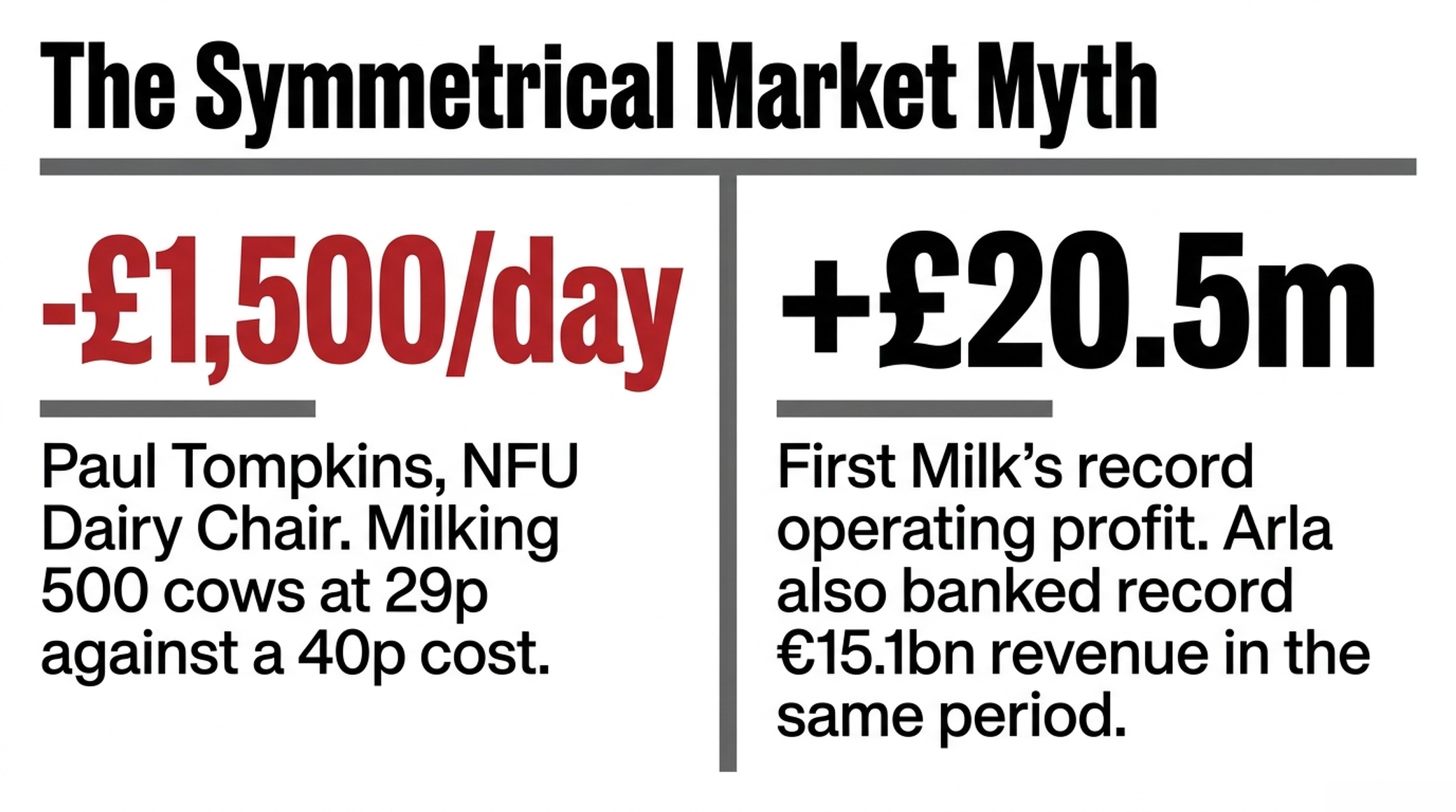
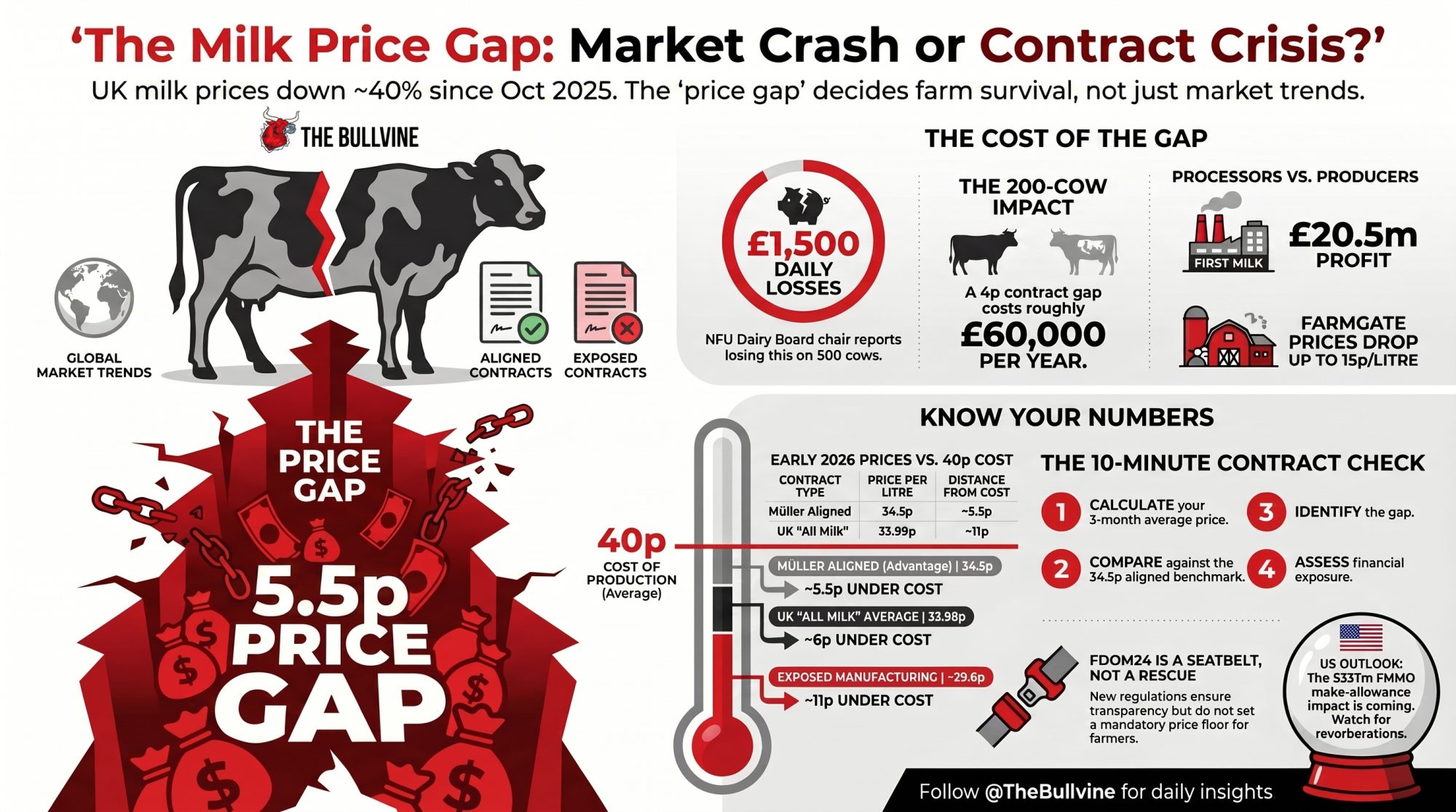
Tompkins chairs the NFU’s Dairy Board and milks 500 cows at 29p against a 40p cost. In its most recent results, First Milk booked a record £20.5m profit. The difference isn’t the market — it’s the contract.

Executive Summary: At 29p a litre against a 40p cost, NFU Dairy Board chair Paul Tompkins was losing more than £1,500 a day in January. Over the same broad period, First Milk posted a record £20.5m operating profit and Arla banked record €15.1bn revenue — so this isn’t symmetric pain, it’s a transfer. UK prices have fallen up to 40% since October 2025, but the number that actually decides your fate is the gap between an aligned contract and an exposed one: Müller’s Advantage holds 34.5p while manufacturing litres sit nearer 29–32p. On a 200-cow herd shipping 1.5m litres, a 4p contract gap is roughly £60,000 a year — and even the aligned farms are now under cost, so the real question is how fast you’re bleeding, not whether. FDOM24 makes your processor show its working, but it sets no price floor, so it’s a seatbelt, not a rescue. Pull your last three milk statements, run your average against the 34.5p aligned benchmark, and if you’re several pence short, the global market isn’t your problem — your contract is. U.S. readers should read it as a mirror: FMMO make allowances pulled $337m out of producer pools in 90 days while cheese prices never dropped.

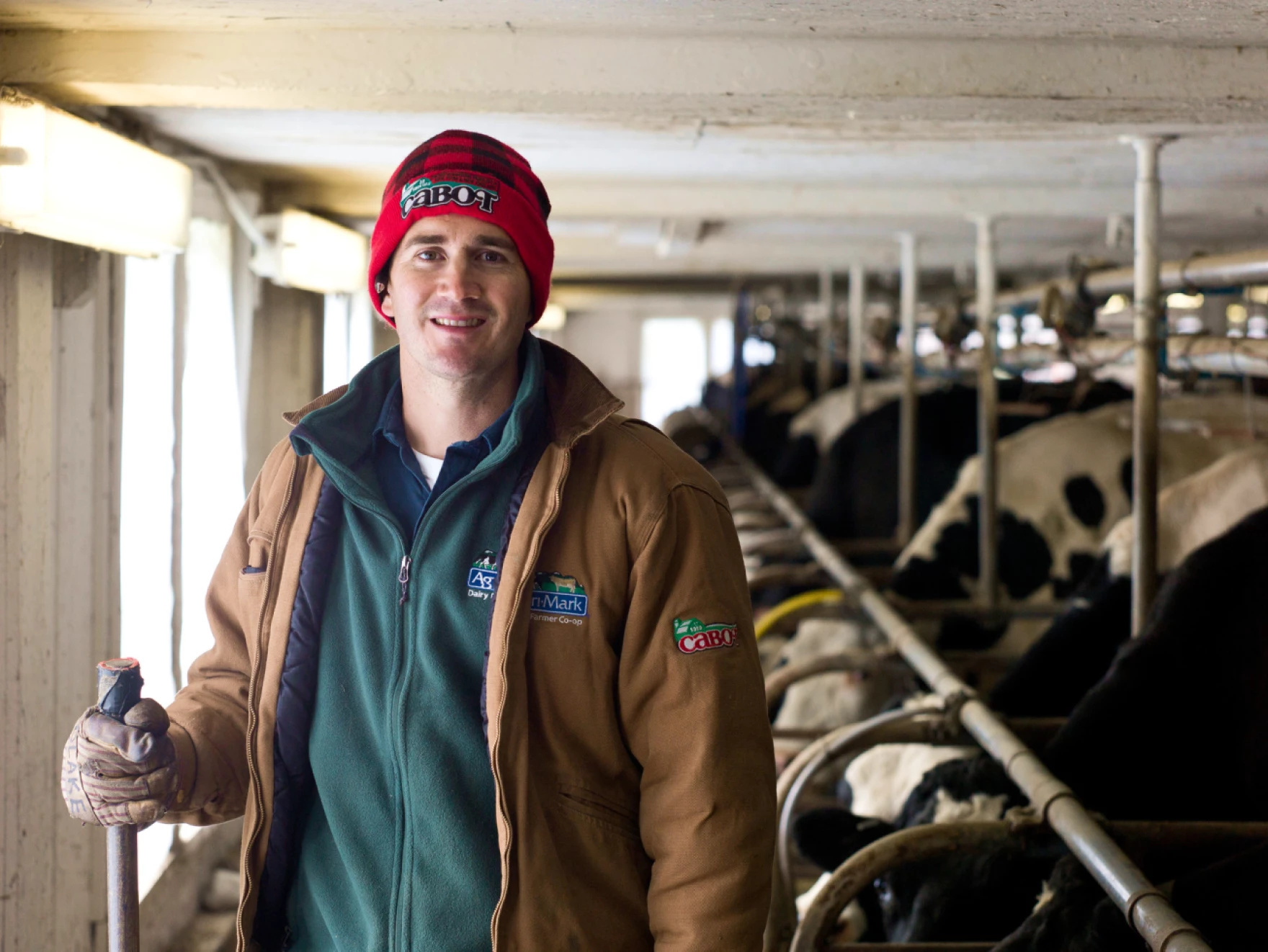
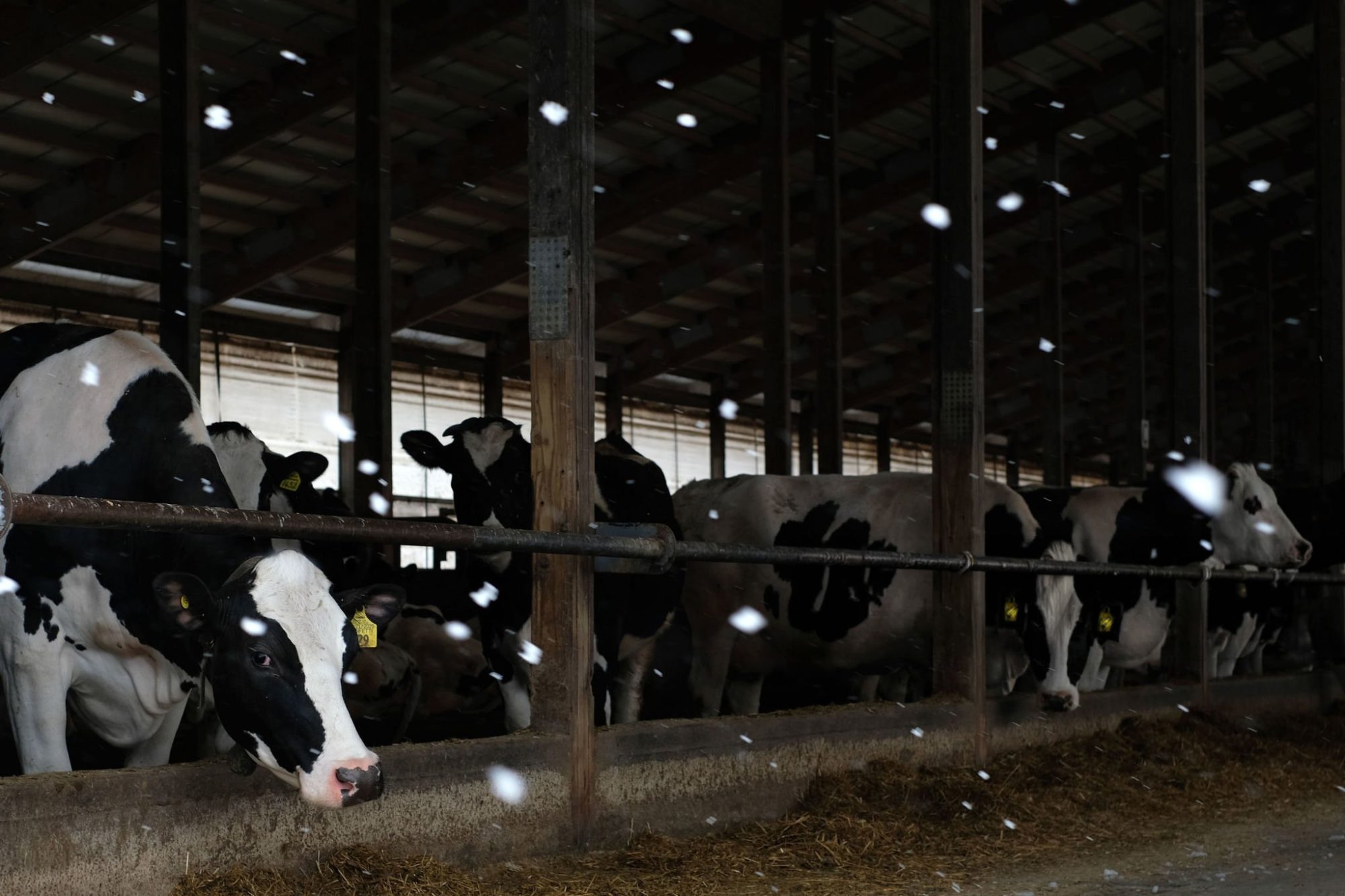
UK dairy farmer in freestall barn at milking, milk price contract crisis 2026

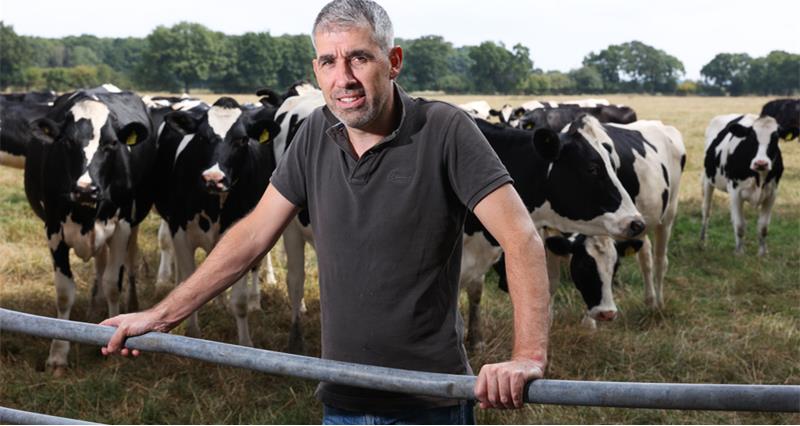
Paul Tompkins chairs the NFU’s Dairy Board, farms in the Vale of York, and milks a herd of around 500 Holsteins. He told broadcasters in January 2026 that his milk was fetching around 29p a litre against a cost of roughly 40p — leaving him, by his own account, losing more than £1,500 a day.

Sit with that for a second. The man who chairs the national dairy board — who knows milk contracts as well as anyone in the country — can’t price his way out of the hole. That’s not a story about one farmer making bad calls. It’s a story about a milk system where the gap between what you’re paid and what it costs you has become the line between staying in and getting out. And right now, the size of that gap depends largely on which contract you signed.

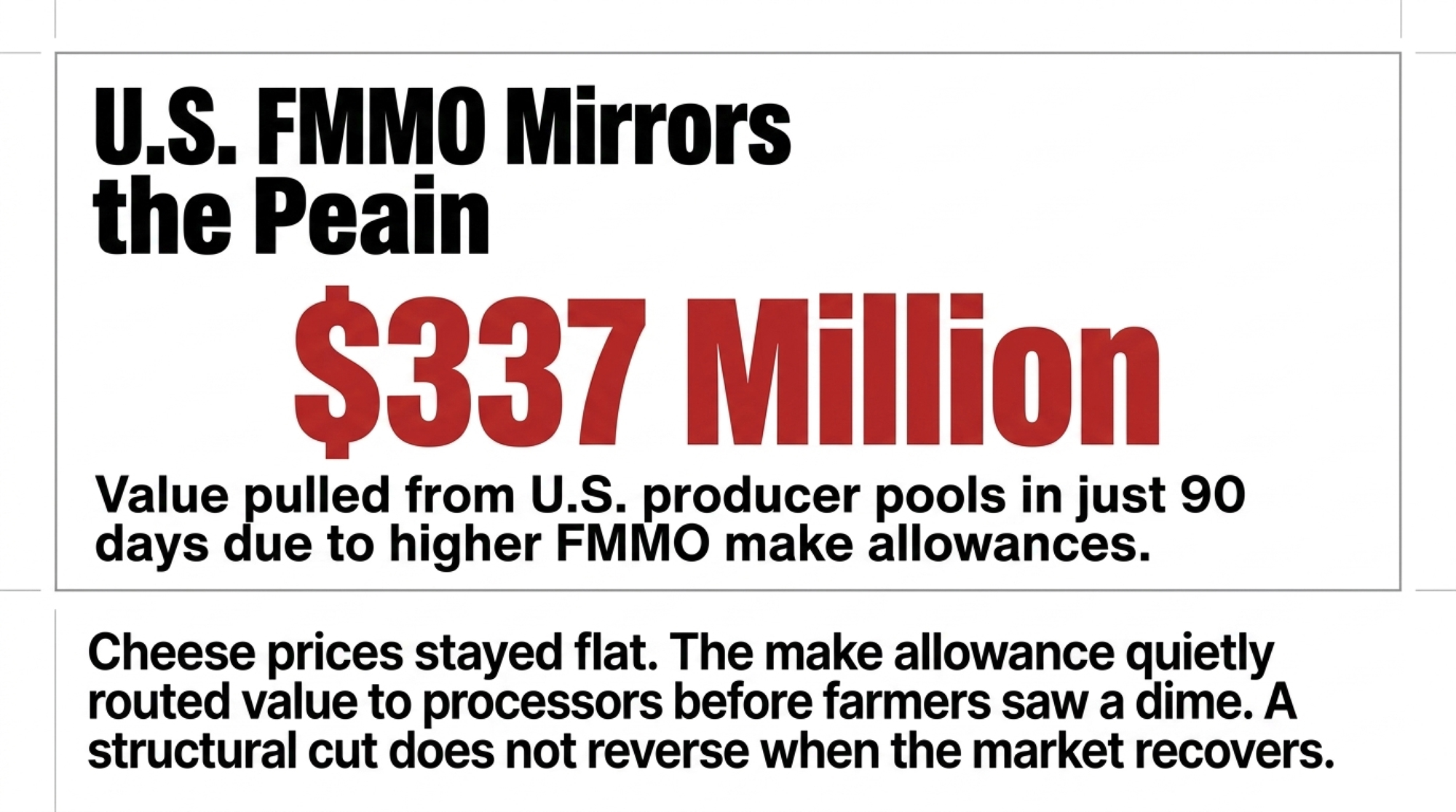
Why a U.S. reader should care about a UK milk price. This is a British case study, but read it as a crystal ball. The same structure — farmers absorbing the cut while processors hold their margin — is now baked into the 2026 FMMO modernization resets. Higher make allowances that took effect June 1, 2025, cut Class III prices by about 92¢/cwt and, according to AFBF’s modeling, pulled $337 million out of producer pools in 90 days, while cheese and butter prices never dropped. Manufacturing-heavy orders like the Upper Midwest and Central are taking the heaviest pool losses. Different country, different mechanism, identical question: who’s absorbing the loss, and who isn’t?

VariableUK Market (2025–26)US FMMO (2025–26)
Mechanism of lossContract gap: exposed farms paid 29–32p vs 40p costHigher make allowances cut Class III by ~92¢/cwt from June 2025
Who absorbs itIndividual farmer on manufacturing/B-litre contractProducers in manufacturing-heavy orders (Upper Midwest, Central)
Processor margin impactFirst Milk op. profit up to record £20.5m; Arla €415m netProcessor cost basis reduced; cheese/butter prices unchanged
Scale of transferUK “all milk” avg down ~22% YoY by April 2026$337m pulled from producer pools in 90 days (AFBF modeling)
Regulatory bufferFDOM24: transparency only, no price floorFMMO: make allowances are built into the formula, not negotiable
Farmer leverageSwitch contract if aligned buyer has capacityLimited — pool participation largely mandatory by order
Recovery triggerGlobal supply tightening + GDT price bounceClass III recovery requires cheese/butter to outpace make allowance drag
Bottom lineContract type decides your fate, not the marketMake allowances decide your take, not the commodity price

What’s Actually Changing

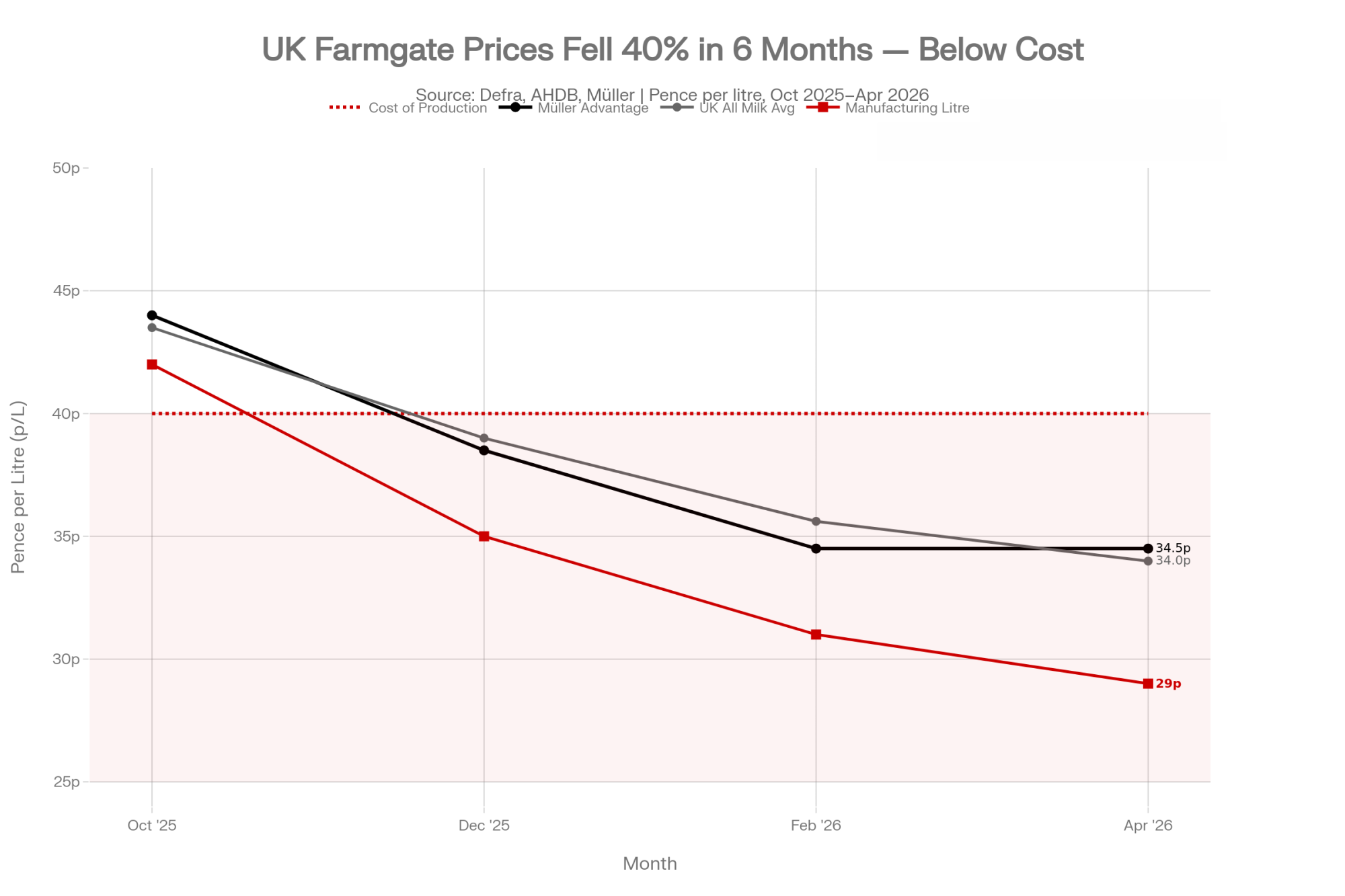
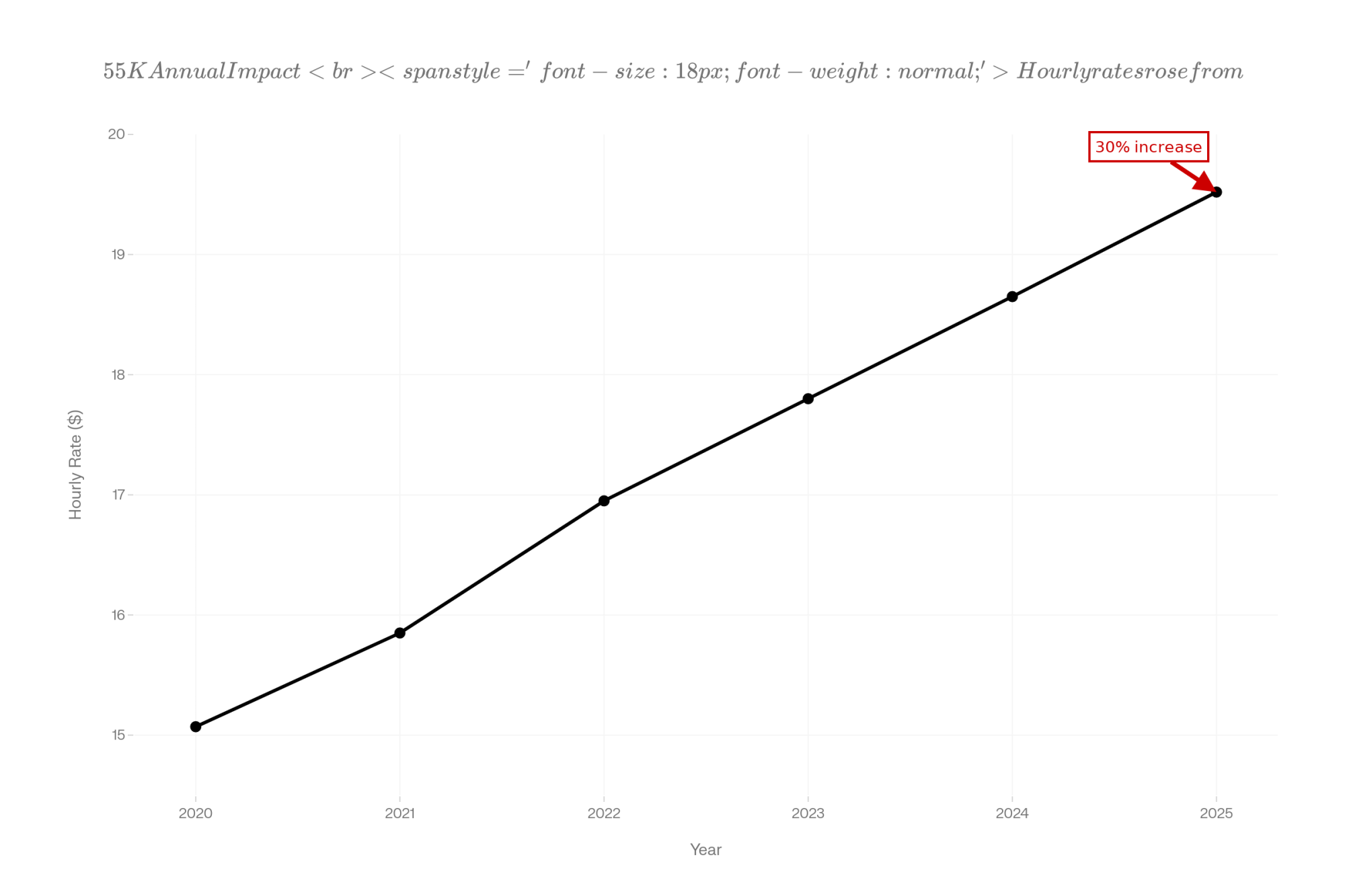
UK milk prices have fallen fast and hard. Processor payments to many farmers have dropped by up to 15p a litre — around 40% — since October 2025, according to Reuters, as a wave of global production has swamped the market. Some contracts that were paying 48p have fallen to 32p.

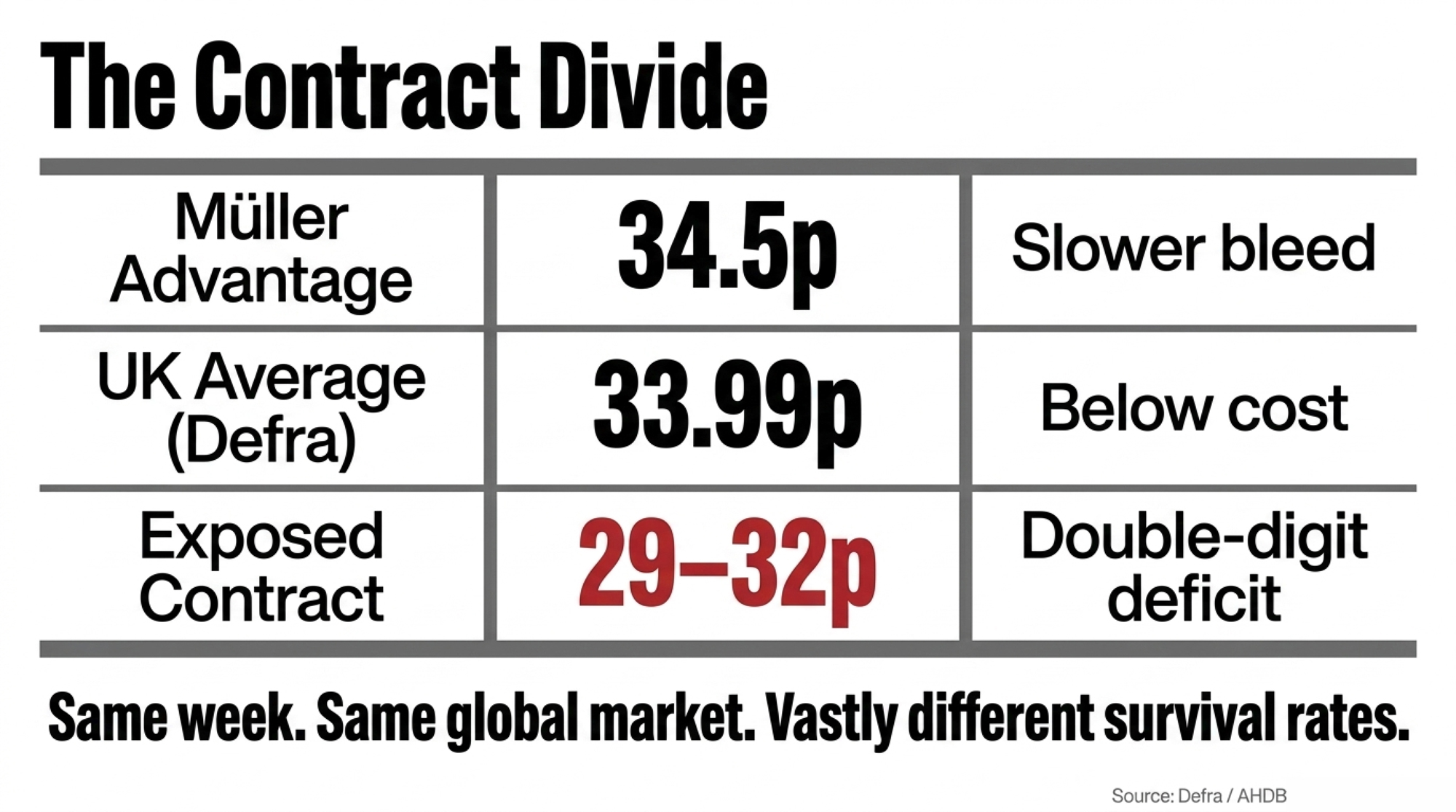
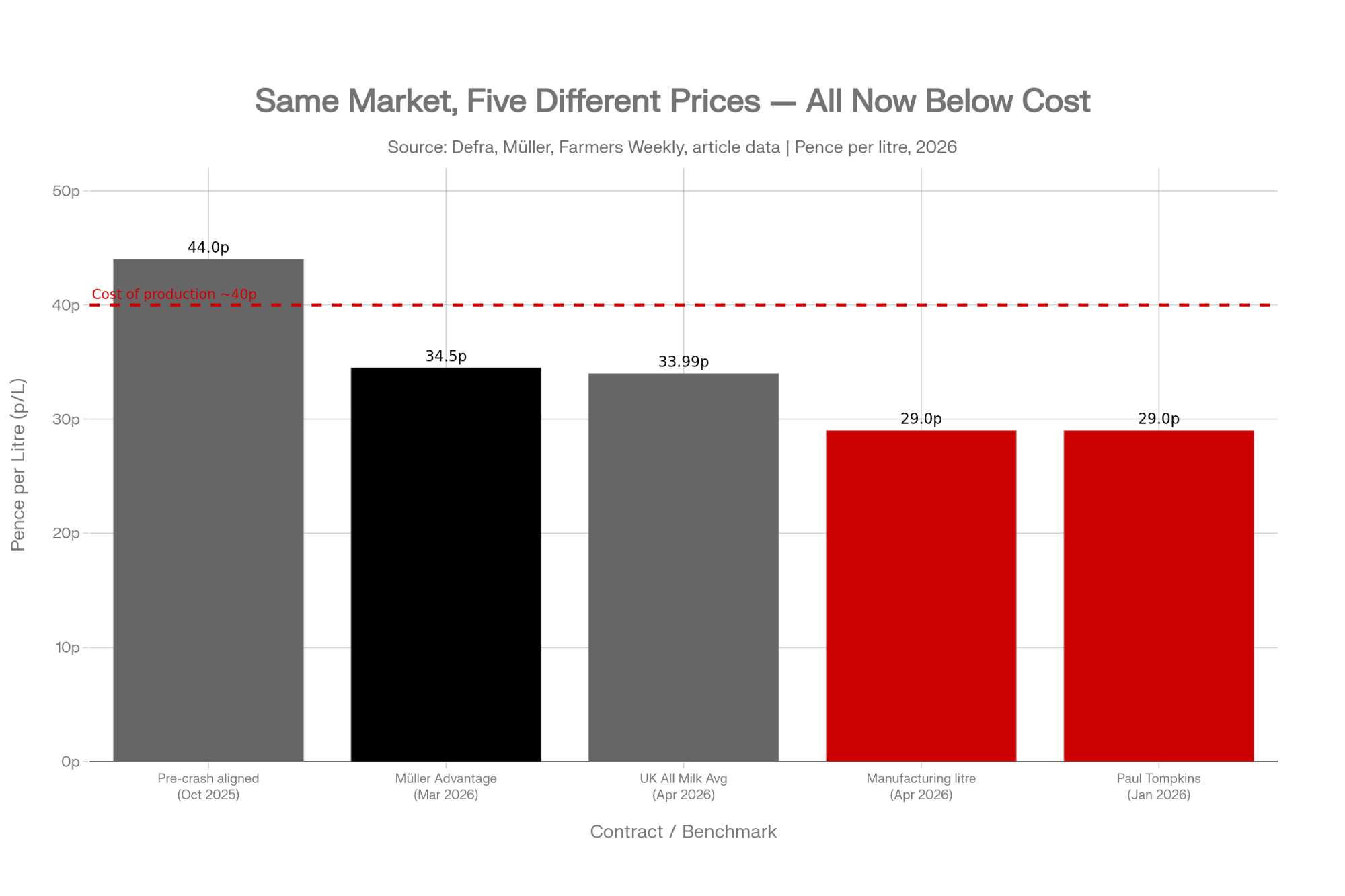
But the headline number hides the real story. Two farmers in the same county, milking similar cows, shipping similar volumes, can be living in completely different realities this spring. Arla cut its conventional price by 3.5p in December to 39.21p, and has since trimmed it further into the mid-30s by early 2026. Müller cut its aligned Advantage price to 34.5p from 1 March 2026. Manufacturing and B-litre contracts fell further and faster.

That divide is the whole game now. The spread between a held aligned price and an exposed manufacturing litre can run into double digits per litre — in the same week, in the same market. One farmer’s contract is cushioning the crash. The other is passing the whole thing straight through to the bank account.

Read more: The Contract Clause Deciding Which UK Dairies Survive 2026

How This Plays Out on Real Farms

Put the gap in barn terms, because that’s where it stops being abstract.

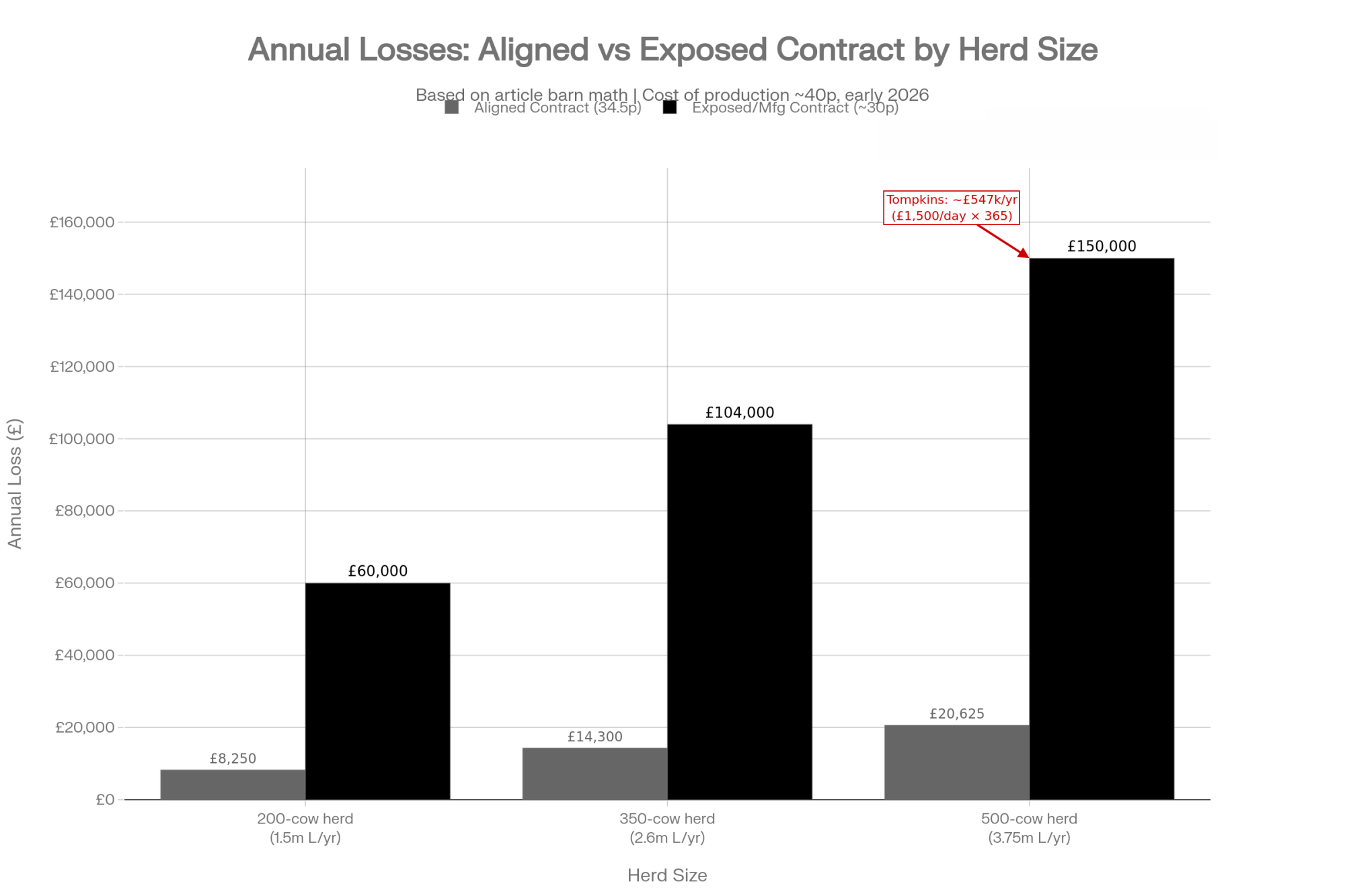
Tompkins reckons he’s losing more than £1,500 a day on around 500 cows. He’s not alone at that scale — Farmers Weekly reported some larger farms losing more than £1,000 a day as the collapse bit. Now scale it down to a 200-cow herd. Say you’re shipping around 1.5 million litres a year and your contract leaves you 10p short of cost. That’s £150,000 walking off the farm over twelve months — before a single other cost line moves.

And here’s why you can’t just turn the tap down to stop it. You can’t turn a dairy herd on a sixpence. Cut feed, and you risk yield, fertility, and next season’s performance. Sell cows, and you lose the genetics you spent years building — and you still owe on the buildings. The cost side is stubborn. When the milk price drops like a stone, nothing else politely shrinks to match.

The exits, when they come, come quietly — one family at a time. That’s the part that doesn’t show up in a market report until it’s already happened.

The Mechanics: Why the Same Market Pays Two Prices

Here’s the part that’s hard to swallow if you’re on the wrong side of it. The crash looks like a pure market event from the outside, and a lot of it is. The main driver is global oversupply — 2025 was a strong year for grass and for cows, and the extra milk had to go somewhere. GB production for the 2025/26 season hit a record, with December deliveries running several percent above the prior year, per AHDB.

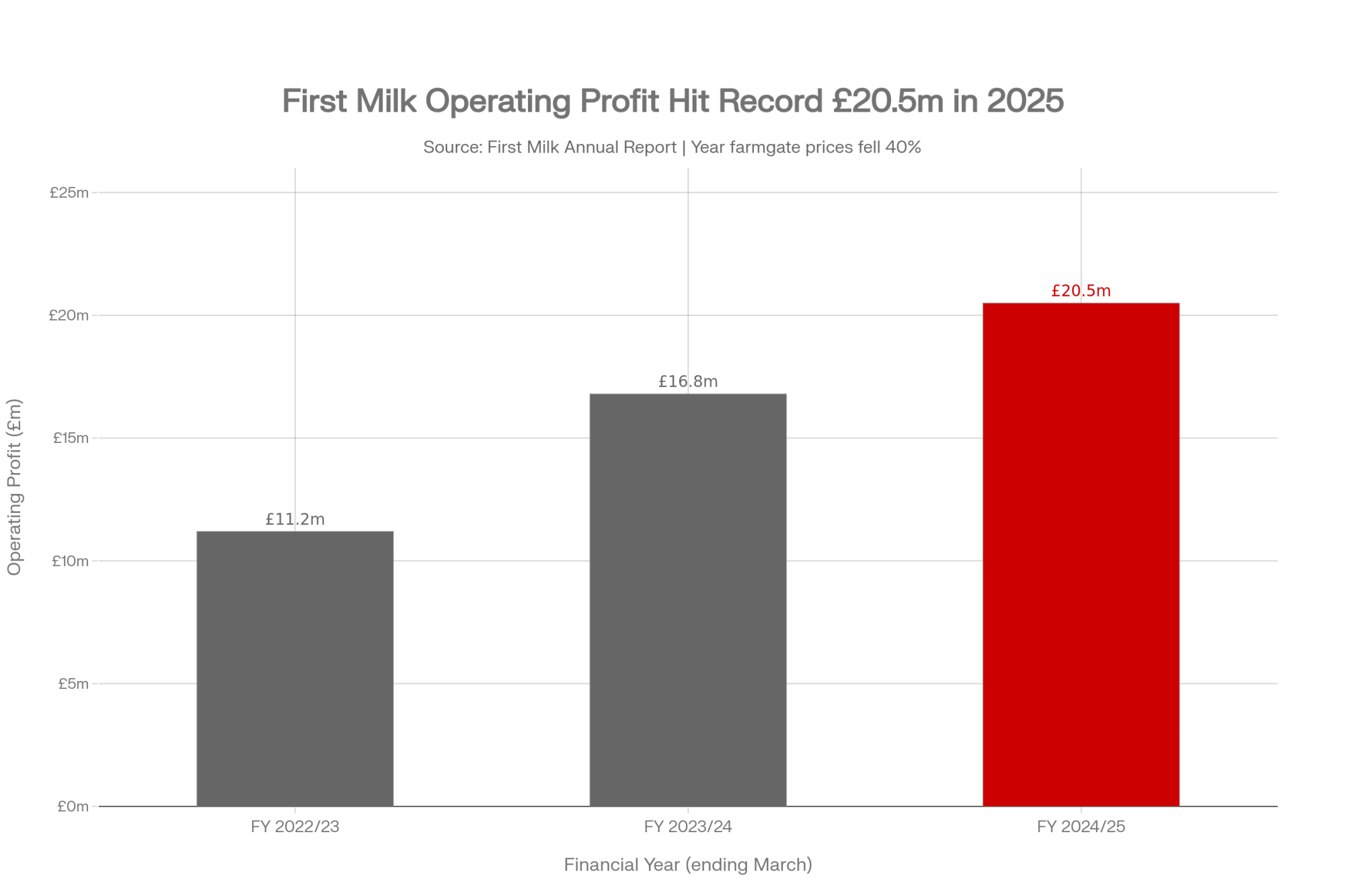
The same stretch that squeezed farmgate prices saw processors post strong results. First Milk, a farmer-owned co-op, reported its best year ever for the year to March 2025 — turnover up 20% to £570 million and operating profit climbing to £20.5 million, from £16.8 million. Arla reported record revenue of €15.1 billion for 2025 with net profit of €415 million. Both have publicly tied those results to factors such as strong ingredient and protein demand rather than to liquid-milk margins. As a co-op, First Milk’s profits also flow back to its farmer members.

So why do two farms in the same market end up so far apart? Strip it back, and the reason is structural, not a stitch-up. On an exposed contract, the farmgate price is contractually the most movable number in the chain, so it tends to adjust first when the market falls. A processor can lean on its ingredients arm or efficiency programs to protect its own margin; the individual farmer on a manufacturing litre doesn’t have those levers. If that mechanism sounds familiar to a U.S. reader, it should — it’s the same logic by which higher FMMO make allowances quietly route value to the processing side before the farmer sees a dime.

The price picture, in one place

Here’s the same crisis laid out as a handful of numbers on one page. This is the gap, in pence per litre, against a cost of production sitting near 40–49p depending on the system:

What you’re shipping onPrice per litre (early 2026)Position vs. cost of production
Müller aligned Advantage34.5p (from 1 March 2026)Several pence under cost
Arla conventionalMid-30s (after Dec + further cuts)Several pence under cost
UK “all milk” average (Defra)35.61p early 2026, 33.99p by April, down ~22% YoYBelow cost
Exposed manufacturing / standard litre~32p, some toward 29pDouble-digits under cost

Read that table against your own milk statement, and one thing jumps out. The top of the column and the bottom are separated by several pence a litre, and on a million-plus-litre operation, every penny is real money. The lower row isn’t a different market. It’s the same market, paid through a different contract. That’s the lever most of this debate ignores.

What Are the Aligned Farms Actually Getting?

This is where the “it’s just the market” story falls apart. Müller’s aligned Advantage farmers are sitting on 34.5p. A producer shipping on a manufacturing litre is looking at something nearer 29–32p. Same week, same wall of milk, same global oversupply — and a gap that can run 3–5p, sometimes more.

Now run that gap as barn math.

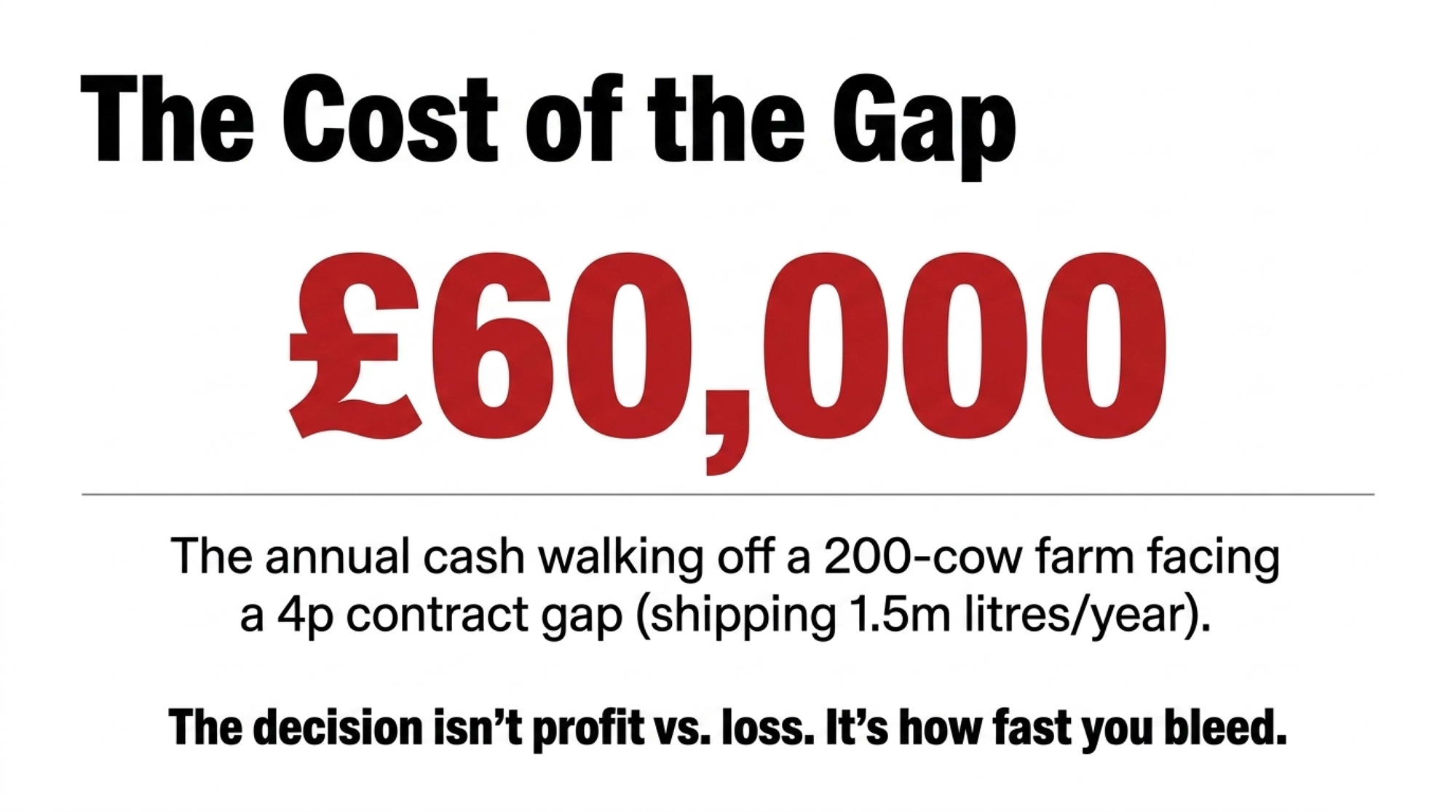
The contract gap, in money you’d recognize A 200-cow herd (~1.5m litres/year) with a 4p contract gap loses ~£60,000 a year. A 500-cow herd at Tompkins’ scale, on the same 4p gap, loses ~£150,000 a year. None of that turns on how well you milk cows. It’s the contract line on your statement.

Here’s the uncomfortable part: even the aligned farms are now at a loss. With production costs at 40p and beyond, a 34.5p Advantage price still loses money — it just bleeds more slowly. So the contract decision isn’t “profit versus loss” right now. It’s “how fast am I bleeding, and how long can I last at that rate?” For many farms, that’s the only question that matters this spring.

Read more: 28p vs. £300 Million: The 2025 Milk Price Gap Nobody’s Explaining

Does FDOM24 Actually Protect You?

The government’s answer was the Fair Dealing Obligations (Milk) Regulations 2024 — FDOM24 — with contracts required to comply by 9 July 2025. It forces processors to be transparent about how they set price changes and gives you clearer terms and notice. Genuine progress, and the NFU fought for it for more than a decade.

But it’s a seatbelt, not a rescue helicopter. FDOM24 makes a processor explain how it sets the number. It doesn’t set a floor under it. You’ll get a clearer paper trail showing exactly how your price was cut — which is useful at renewal, and cold comfort at the bank. Read the small print on notice periods and exclusivity before you assume the regulation has your back.

FDOM24 ProvisionWhat It DeliversWhat It Doesn’t DeliverRisk Level
Price change transparencyProcessor must explain how price is changedNo floor under the price itself🔴 HIGH
Notice periodsClearer advance warning of cutsDoesn’t prevent a cut from happening🔴 HIGH
Contract term clarityLegible terms at renewalDoesn’t stop exclusivity or volume lock-in🟡 MEDIUM
Dispute resolution pathwayFormal route to challenge a changeSlow; cold comfort mid-crisis🟡 MEDIUM
Aligned benchmark referenceSets a comparator for negotiationNot a contractual guarantee🟡 MEDIUM
Price floor mechanismNot included🔴 HIGH
Emergency minimum priceNot included🔴 HIGH

How Do You Tell If It’s the Market or Your Contract?

This is the question worth answering before your next milk cheque lands. You can do it tonight — three statements and a calculator, ten minutes at the kitchen table.

The 10-minute contract check. Step 1 — Pull your last three milk statements and work out your average received price per litre across them. One number. Step 2 — Find the published UK average: Defra put the UK “all milk” figure at 35.61p in early 2026, falling to 33.99p by April, down 22.3% year-on-year, and AHDB updates processor price changes regularly. Step 3 — Compare against an aligned benchmark: Müller’s Advantage sits at 34.5p today, roughly what a held contract is paying. Step 4 — Read the gap: if your number is several pence under that aligned benchmark, the global market isn’t your main problem. Your contract is.

One of those problems corrects when supply tightens. The other only corrects when you take action. (U.S. readers: the same test works on a milk check — print January 2025 and January 2026 statements, strip out the Class III, IV, and butter moves, and whatever gap is left is structural, not a bad month.)

What Does Doing Nothing Actually Cost?

There’s a perfectly rational way to ride this out — if your contract genuinely covers your costs and your relationship with your processor is solid, waiting for the cycle to turn is a real strategy. It has turned before. AHDB even noted firmer tones at the January Global Dairy Trade event, with most products ticking up a percent or two.

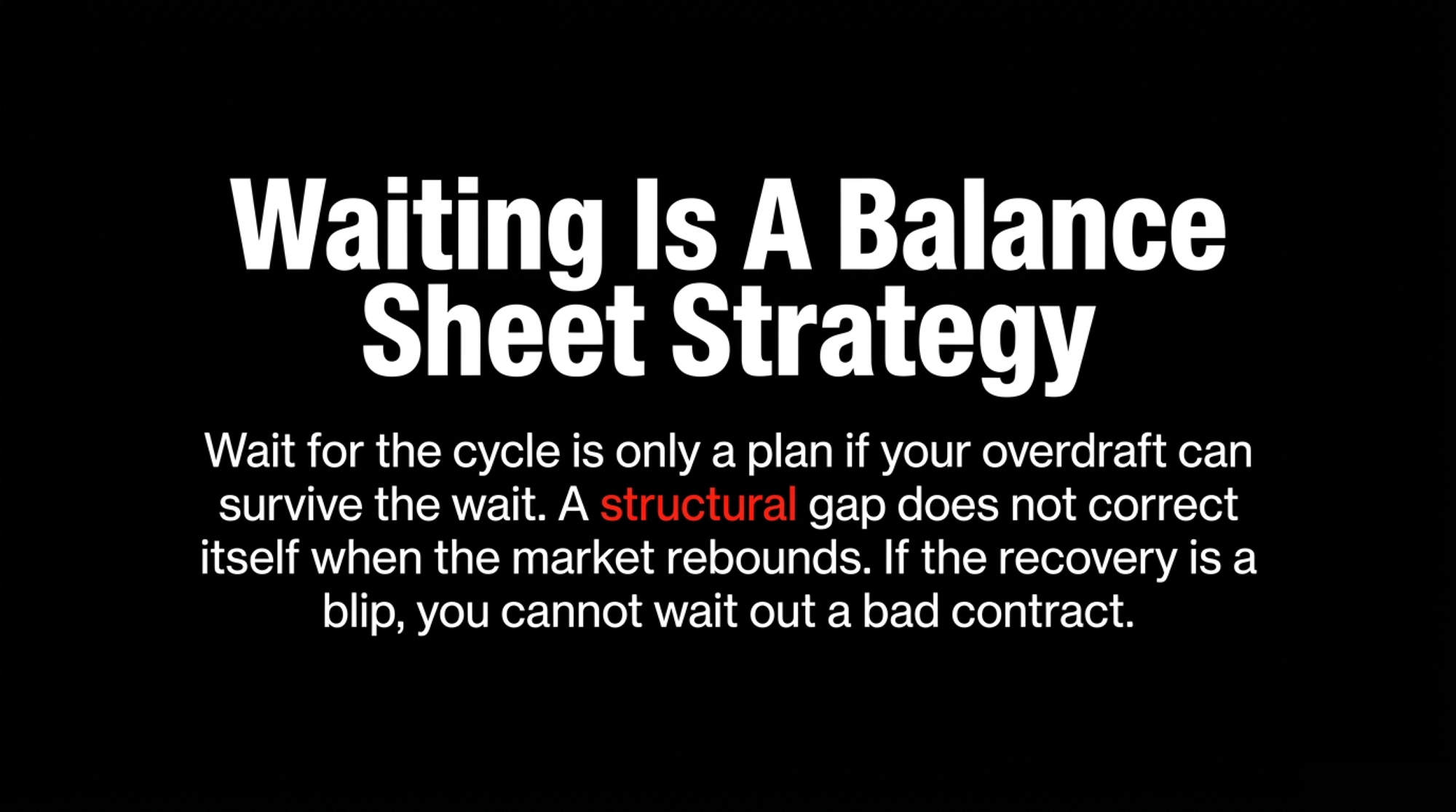
But “wait for recovery” is only a plan if your balance sheet survives the wait. AHDB cautioned the bounce could be a dead-cat blip, with record volumes flowing into the spring flush keeping prices under pressure. And the official average kept falling — Defra had the UK at 33.99p by April 2026. Run it against Tompkins’ own numbers: at more than £1,500 a day, even a few months’ wait is six figures gone. On a 200-cow herd losing 10p a litre, six more months is roughly £75,000. The question isn’t whether you believe in the cycle. It’s whether your overdraft does.

Options and Trade-Offs

Contract type isn’t carved in stone. But the better roads need you moving before the window shuts, not after.

Get onto a retail-aligned contract — start asking this month. Aligned pools held better than exposed contracts because they price off cost trackers rather than the spot market — Müller’s Advantage at 34.5p still beats a 29–32p manufacturing litre. Your 30-day move is finding out which aligned buyers are taking on supply, what they require, and where your farm fits. Works when: you’re a liquid milk producer with steady volume and quality. Risk: seats come with strings — volume commitments, exclusivity, specification, sometimes investment. You trade flexibility for a steadier price.

Look hard at direct vending — if you’ve got the footfall. On-farm vending is returning £1.20–£1.60 per litre against wholesale near 33p, with around 400 machines now operating nationally; a unit costs roughly £15,000–£30,000. Works when: you’re near consumer traffic or already run a farm shop. Risk: demand is local and finite — it’s a margin play on a slice of your milk, not a replacement for the underlying wholesale contract.

Run the organic numbers — but respect the lead time. Organic has held a wide premium over conventional — Arla’s organic price sat near 56p against conventional’s mid-30s in early 2026. Works when: you’ve got a financial runway and a buyer lined up. Risk: transition runs two to three years, with upfront costs, and the premium market has a ceiling — a wave of conversions could thin it out.

Key Takeaways

  • If your received price is more than 3–4p under what comparable aligned farms are getting today — Müller Advantage is at 34.5p — you’re not just riding the market. Your contract is the problem. That’s a call to your advisor this week, not next quarter.
  • On a 200-cow herd, a 4p contract gap is roughly £60,000 a year; a 10p shortfall to cost is about £150,000. If you’re on an exposed deal, find out which aligned buyers are taking supply inside 30 days.
  • FDOM24 upgraded your contract’s terms, not your price. Before you renew, know exactly what it does and doesn’t protect. It’s a seatbelt, not a rescue.
  • Even aligned farms are under cost right now. The question isn’t profit versus loss — it’s how fast you’re bleeding and how long you can last at that rate.
  • If you’re farming under a U.S. FMMO, run the same logic on your make-allowance drag: a ~92¢/cwt structural cut doesn’t reverse when the cheese price recovers.
  • “Wait for the cycle” is only a plan backed by a balance sheet. If the January GDT bounce proves to be a blip, can your overdraft carry you through to the real recovery?

The cycle will turn. It always does. The real question is whether your specific contract, your overdraft, and the recovery timeline are pointing the same way — or whether you’re carrying a structural gap that a market rebound won’t close on its own.

So pull the statements. Run your number against what your neighbor on an aligned contract is getting. Then decide whether you’re fighting the market or fighting your contract, because those are two different fights with two different exits. If you want the full breakdown — the contract-by-contract barn math by herd size, what the aligned-buyer applications actually demand, and where the real numbers sit — that’s what we’re laying out in this week’s Bullvine Weekly.

⚠️ Before you carry this one alone. If the numbers on your own statements are keeping you up at night, you don’t have to sit with it by yourself. This kind of pressure is heavy, and reaching out is the strong move, not the weak one. 
UK — RABI: free, confidential, 24/7 — 0800 188 4444
UK — Farming Community Network: 03000 111 999, answered in person 7am–11pm, every day of the year. 
US — 988 Suicide & Crisis Lifeline: call or text 988, 24/7. 
US — Farm Aid Farmer Hotline: 1-800-FARM-AID (1-800-327-6243), Mon–Fri 9am–9pm ET (Spanish line available). 
Canada — National Farmer Crisis Line: 1-866-FARMS01 (1-866-327-6701), 24/7, English and French.

Complete references and supporting documentation are available upon request by contacting the editorial team at editor@thebullvine.com.

Learn More

  • Coles and Brownes Just Exposed The $386000 Hole In Your Milk Contract — Arms you with a 90-day cash exposure protocol to stress-test your operation against hidden processor volume caps. Details the exact formula to calculate unpriced counterparty liability on automated milking infrastructure before your bank forces a debt covenant workout.
  • The $20 Milk Paradox: Solving 2026 Dairy Basis Risk — Delivers the strategic blueprint to navigate the widening gap between headline USDA price predictions and real-world regional clearing basis. Follows the money on the permanent class-price cuts triggered by recent federal order make-allowance amendments.
  • The $11 Billion Reality Check: Why Dairy Processors Are Banking on Fewer, Bigger Farms — Exposes the structural processing shift that has quietly pre-secured supply through mega-dairy exclusive agreements. Explains why a permanent cost-of-production variance forces rapid tier consolidation, rendering conventional commodity price cycles obsolete for independent operators.

The Sunday Read Dairy Professionals Don’t Skip.

Every week, thousands of producers, breeders, and industry insiders open Bullvine Weekly for genetics insights, market shifts, and profit strategies they won’t find anywhere else. One email. Five minutes. Smarter decisions all week.
NewsSubscribe
First
Last
Consent

The $19 Milk Trap: How 2026 Prices Quietly Drain a 400‑Cow Dairy’s Equity

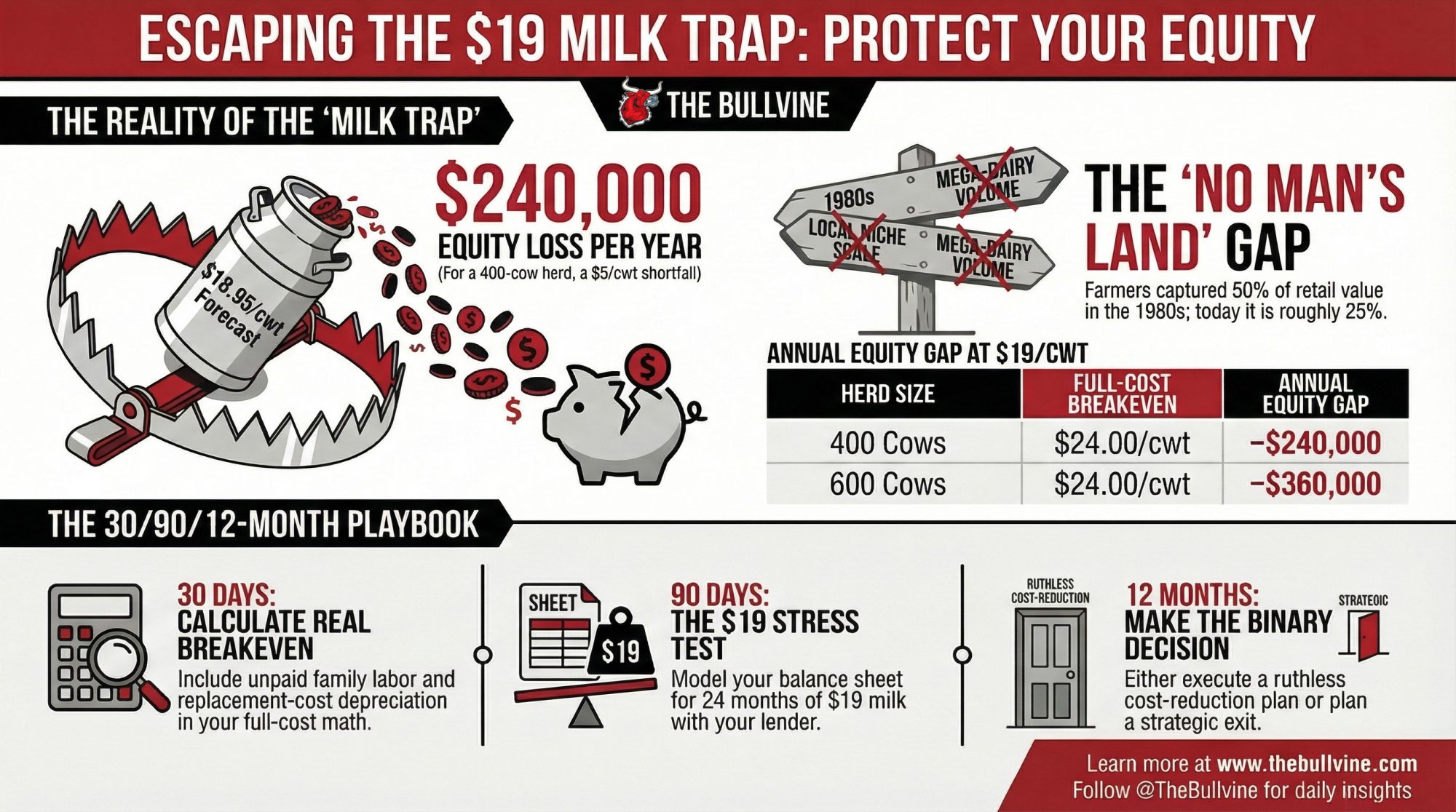
At $19 milk, a 400‑cow herd can watch $240,000 in equity vanish in 12 months. The kicker? Retail prices barely blink—and your co‑op’s plants keep humming.

Executive Summary: USDA’s February WASDE pegs 2026 all‑milk at .95/cwt while full costs for many 300–500 cow herds sit in the low‑ to mid‑s, creating a structural gap you can’t efficiency‑your‑way out of. For a 400‑cow herd shipping 120 cwt/cow, a $5/cwt shortfall is roughly $240,000 a year coming straight out of family equity, not your feed mill or co‑op. At the same time, farm‑value share of the total dairy basket has slid into the mid‑20s while processors and retailers capture the growth from cheese, yogurt, and value‑added products. A handful of big co‑ops now market most U.S. fluid milk, which means many mid‑size herds effectively have one practical buyer and an announced price, not a negotiated one. The article walks through the barn math, the processing and policy mechanics behind “cheap milk,” and why 400‑cow commodity herds are stuck in a no man’s land between direct‑to‑consumer scale and mega‑dairy leverage. It then lays out a 30/90/12‑month playbook to calculate your real breakeven, stress‑test $19 milk with your lender, and decide whether you’re staying, pivoting to a premium path, or planning a strategic exit while you still have equity.

$19 Milk Trap

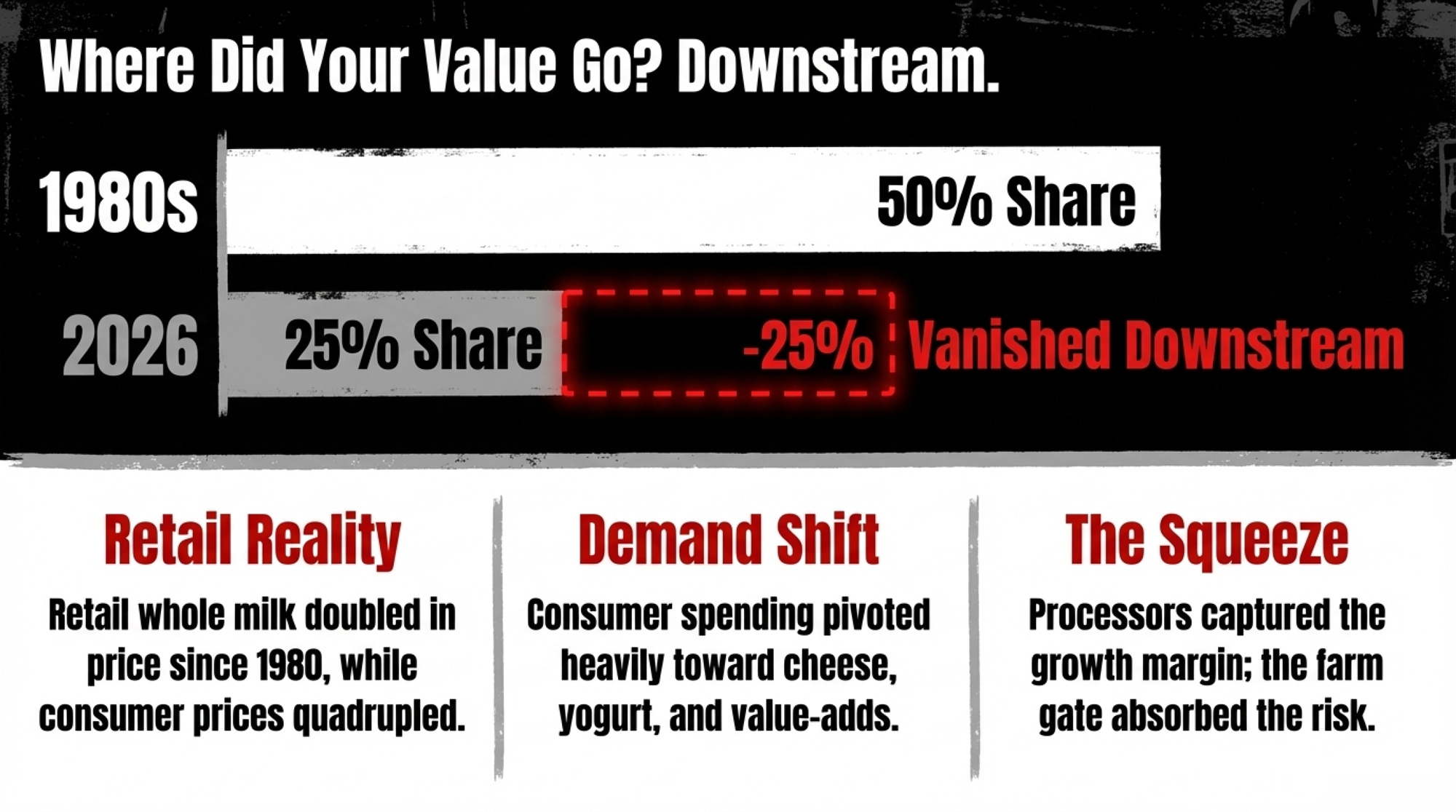
Blake Gendebien milks cows and runs for Congress in northern New York. Earlier this year, he told voters that milk prices “currently are no higher than they were in the 1980s.” PolitiFact dug into Bureau of Labor Statistics data and rated the claim Mostly True: since January 1980, the retail price of whole milk has roughly doubled — from about .03 to .03 per gallon — while overall consumer prices have more than quadrupled over the same period (U.S. national averages through early 2026).

Adjusted for inflation, milk is cheaper now than when many of your freestall barns were first poured.

If you’re a 400‑cow operator shipping into a commodity market, that “cheaper milk” story isn’t a win — it’s your pricing trap.

The Food Dollar: Where Did Your Share Go?

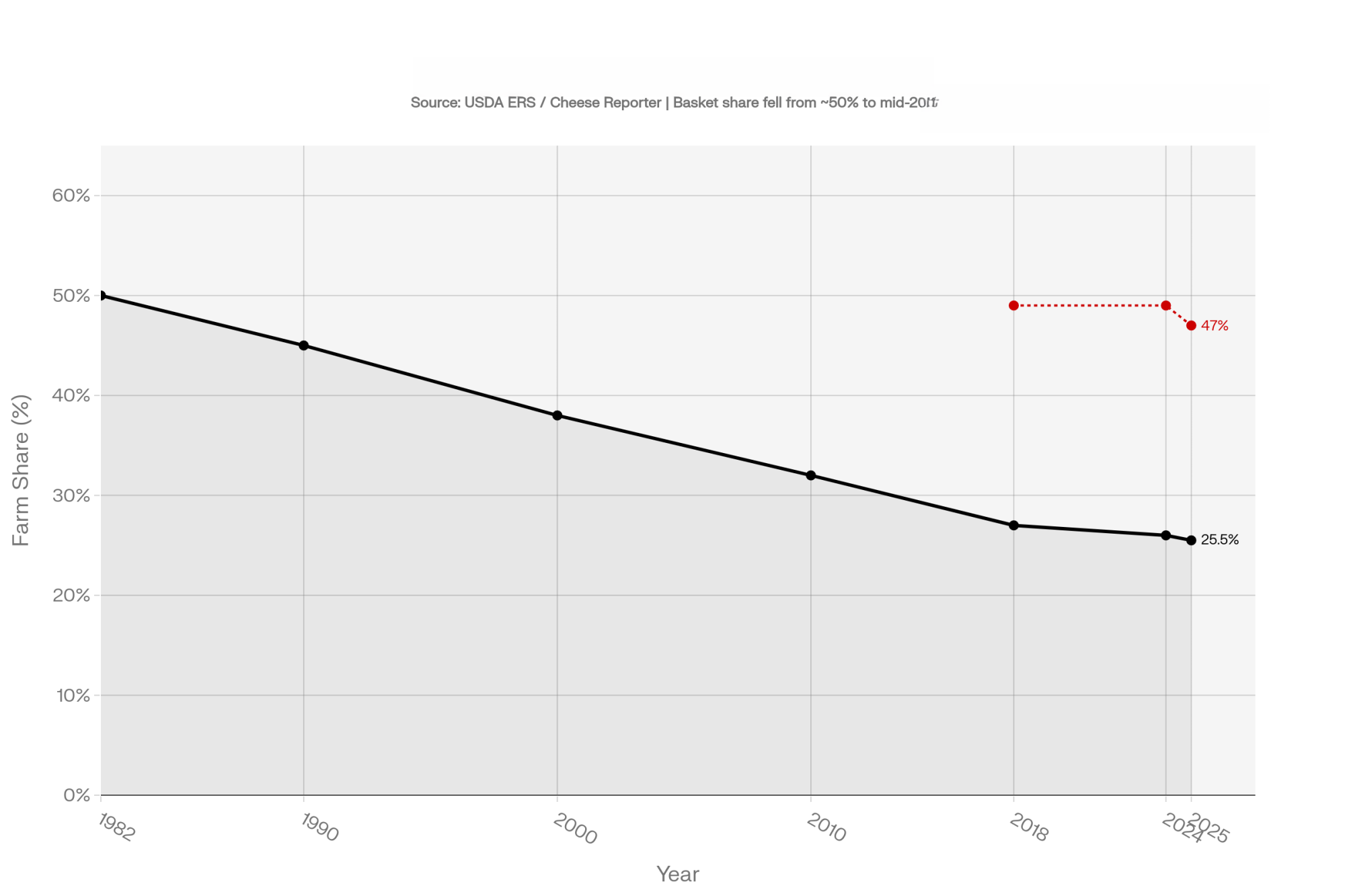
In the early 1980s, USDA Economic Research Service data and historical price‑spread estimates suggest U.S. dairy farmers captured on the order of half of the retail value of the average dairy product basket — milk, cheese, butter, yogurt, the whole cart. That’s based on food‑dollar farm‑share levels in the early 1980s plus reconstructed dairy price‑spreads, not a single official dairy‑basket point, so treat it as an informed estimate rather than a precise cent value.

By 2025, that farm‑value share across the dairy basket had dropped to about 25–26%, according to USDA ERS farm‑to‑retail price‑spread data summarized by Cheese Reporter in April 2026. In the same report, ERS data showed the farm share of a gallon of whole milk at 47%.

Two clarifications that matter for this conversation:

  • For fluid whole milk alone, USDA ERS data show the farmer still receives roughly half the retail price — the farm share for whole milk declined from 49% to 47% between 2024 and 2025.
  • For the total dairy product basket, where consumer spending has shifted heavily toward cheese, yogurt, ice cream, and other processed products, the farm‑value share has fallen into the mid‑20s — because the additional processing, marketing, and retail value in those products accrues downstream.

The system quietly shifted from paying you for milk to paying the chain for “dairy products” — and most of that extra value never came back up your lane.

The Global Reality: Prices Rise Fast, Fall Slow

A long run of academic work on dairy price transmission in Canada, parts of Europe, and other markets often finds the same pattern: retail prices tend to move up more quickly when farm‑gate prices rise than they move down when farm‑gate prices fall.

Some studies document several‑month lags before retail prices fully reflect lower farm prices, especially in markets where processing and retail are more concentrated. When your milk cheque drops fast, and the shelf price barely budges, that’s what you’re living.

That “up fast, down slow” pattern is the fingerprint of pricing power — and it’s on the processor/retail side, not in your parlor.

What Does $19 Milk Really Mean for a 400‑Cow Dairy?

Here’s the math that matters when you sit down with your lender.

USDA’s February 2026 World Agricultural Supply and Demand Estimates (WASDE‑668) put the 2026 all‑milk price forecast at $18.95/cwt, up from earlier projections but still below many farms’ full cost of production. For simplicity, we’re rounding that to $19/cwt as a working number for barn math.

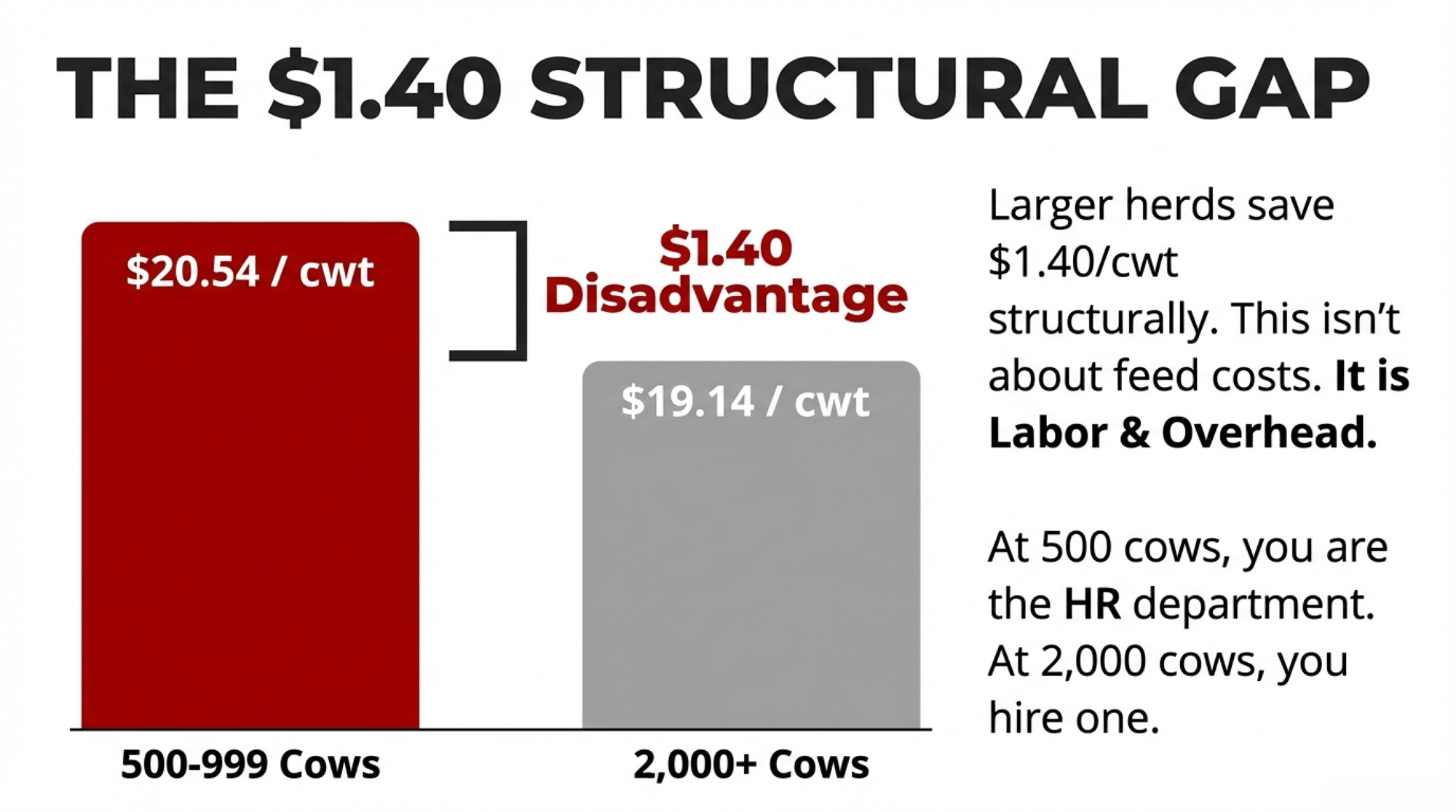
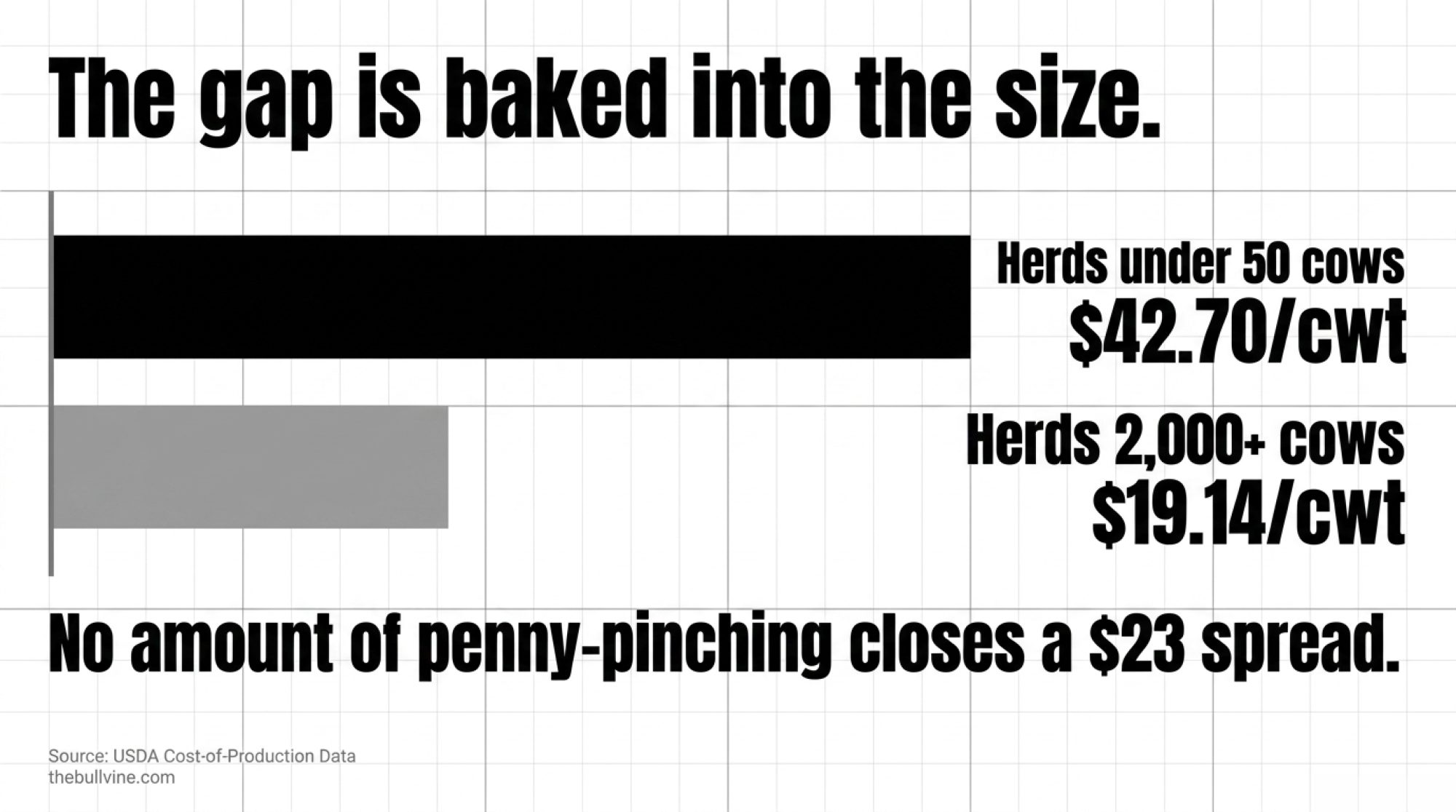
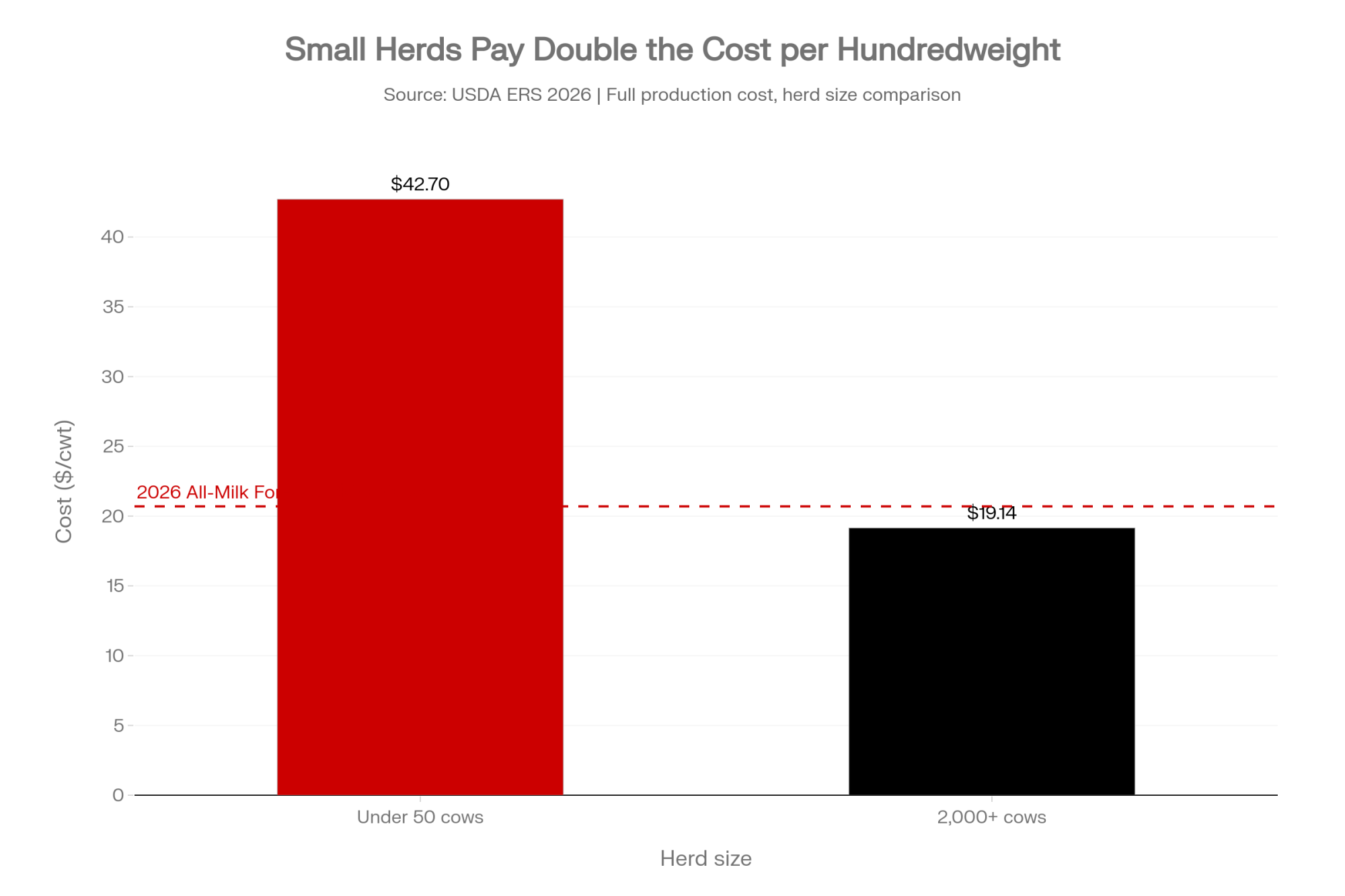
On the cost side, USDA ERS cost‑of‑production data and The Bullvine’s February 2026 analysis found full costs — including unpaid family labor valued at $18–22/hour and depreciation at replacement cost — near $19.14/cwt for 2,000‑plus cow herds, with smaller herds substantially higher. For 300–500 cow herds, that realistically puts full costs somewhere in the low‑ to mid‑$20s.

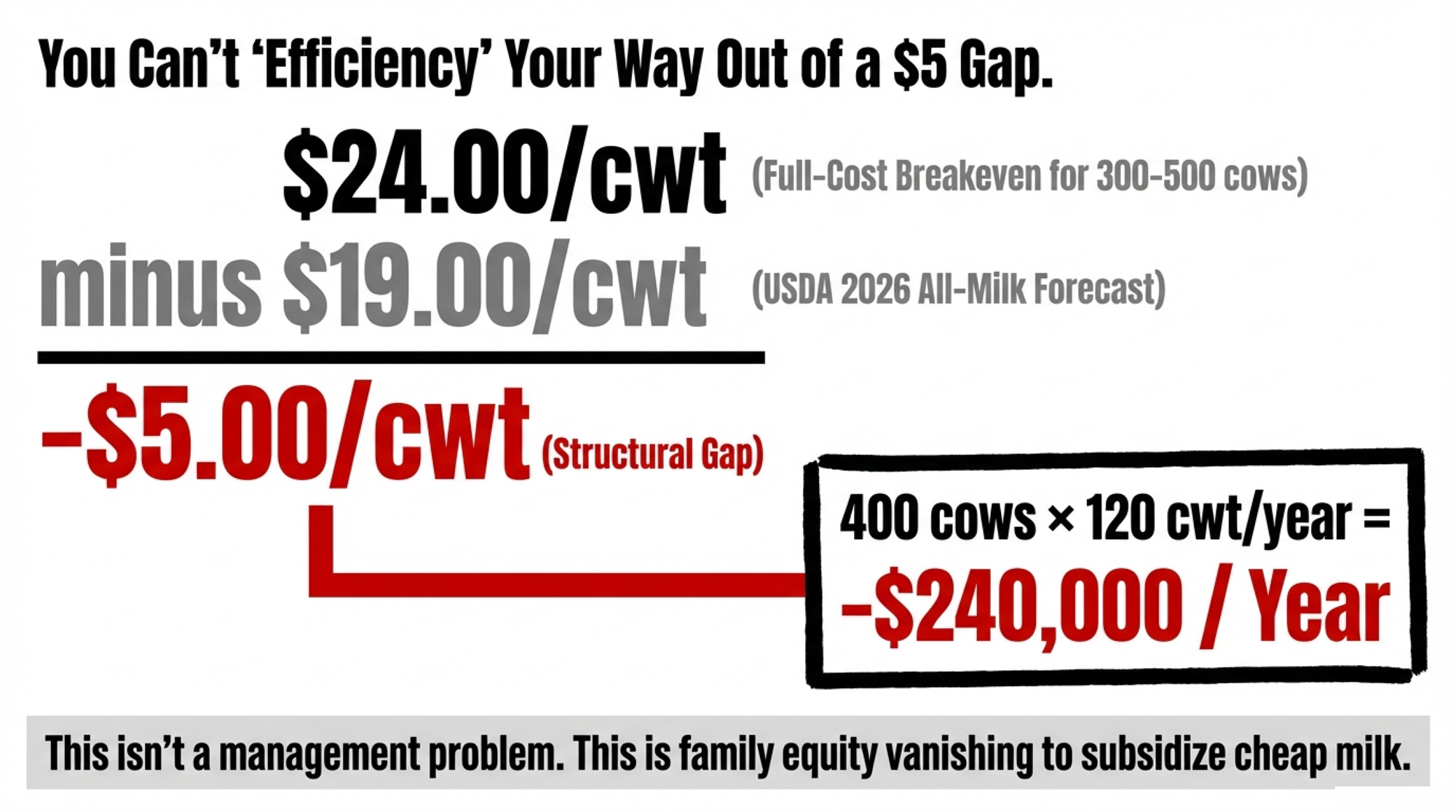
Split the difference. Use $24/cwt as a mid‑range full‑cost breakeven for a 400‑cow commodity herd.

Running the Numbers: Annual Gap at 400 Cows

  • Full‑cost breakeven (mid‑range): $24.00/cwt (300–500 cow herd, including unpaid labor and depreciation)
  • Projected 2026 all‑milk price: $19.00/cwt (USDA $18.95/cwt forecast, rounded)
  • Gap: −$5.00/cwt
  • Assume 120 cwt shipped per cow per year (~24,000 lbs)

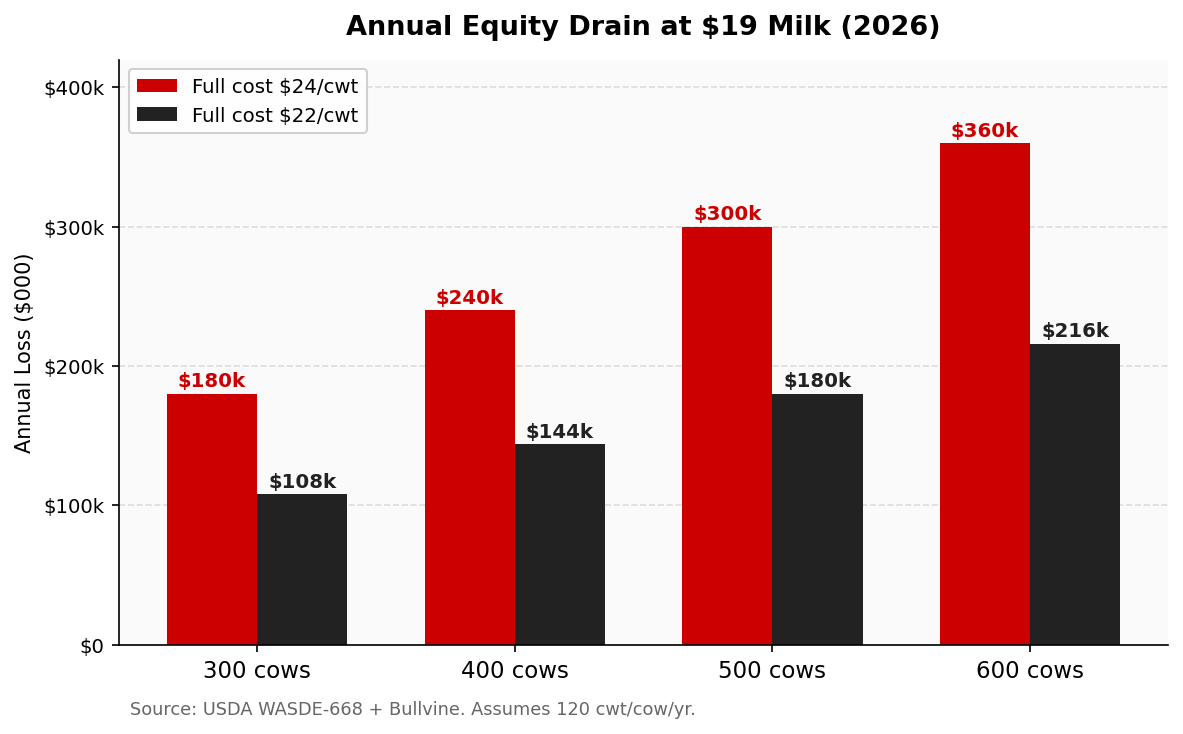
400 cows × .00/cwt × 120 cwt = −0,000/year 600 cows × .00/cwt × 120 cwt = −0,000/year

If your actual full‑cost breakeven is $22/cwt — leaner operation, lower debt — the gap shrinks but doesn’t vanish:

400 cows × $3.00/cwt × 120 cwt = −$144,000/year

This is the kind of barn math Gendebien is pointing at when he tells voters milk is “no higher than the 1980s.” He’s right about the price. He’s also describing why the farms behind that price are disappearing.

If your full cost sits above $19, you’re not “breaking even with belt‑tightening” — you’re bleeding equity, one cwt at a time.

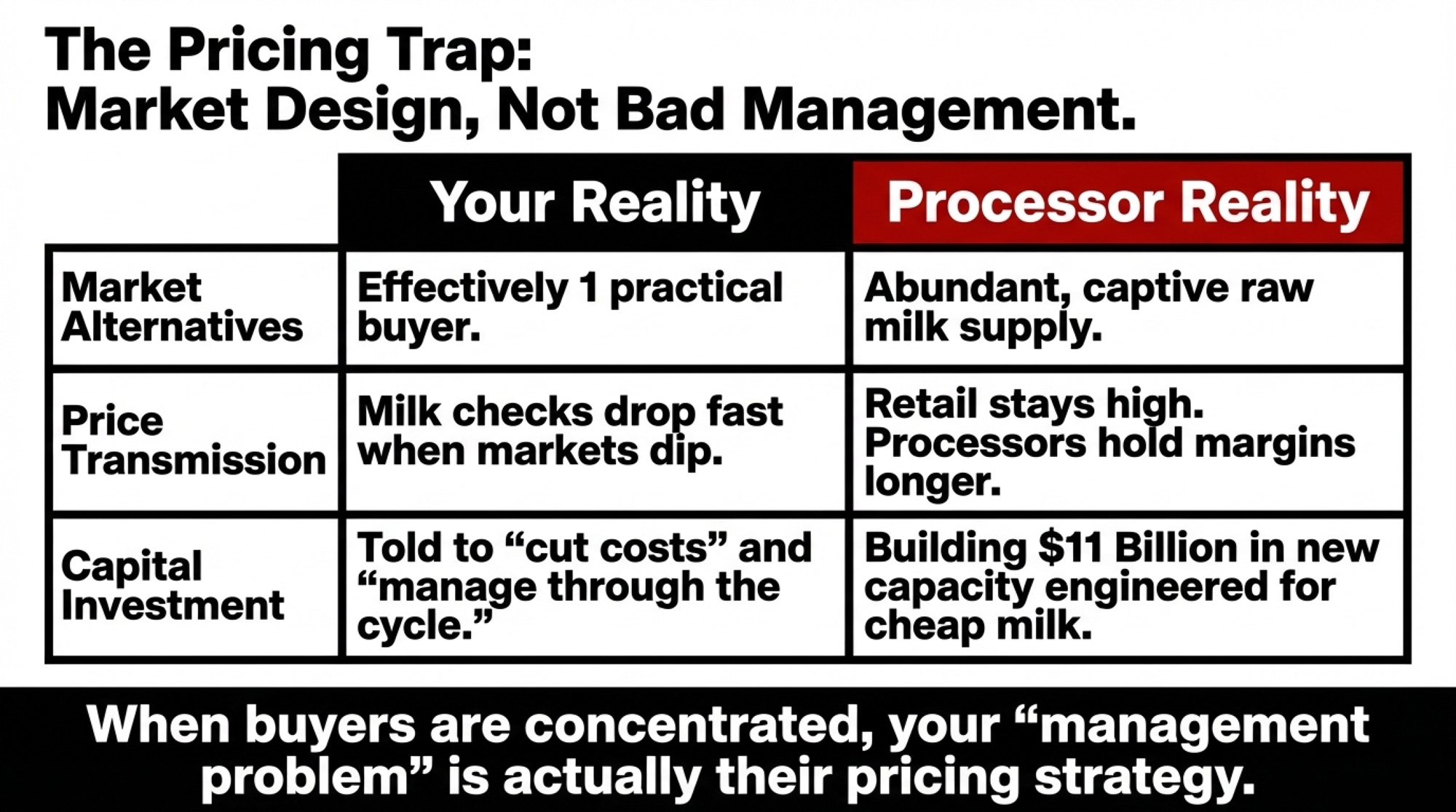
Now layer this on top: while you absorb that gap, Leprino Foods committed about $1 billion to its Lubbock, Texas, mozzarella complex, Hilmar Cheese announced a roughly $600 million facility in Dodge City, Kansas, and IDFA’s Michael Dykes has highlighted more than $11 billion in new or expanded U.S. dairy manufacturing investments across multiple states.

You’re told to “manage through the cycle” while processors invest billions into plants designed around abundant, relatively cheap milk. That isn’t a coincidence — it’s how their business model works when the supply side carries most of the price risk.

The Pricing Trap: Management Problem or Market Design?

Every time margins get thin, the message is the same: cut costs, tweak rations, adopt new tech, manage risk better. And if none of that works, the implication is clear — you just aren’t competitive enough.

International research on dairy supply‑chain bargaining tells a different story. Several studies across the EU, Iran, and other markets find that processors hold significantly more leverage than farmers when prices are set — and that this asymmetry can be more pronounced for smaller operations than for mega‑dairies. The structural tilt isn’t about your skills. It’s about how many buyers there are for your milk.

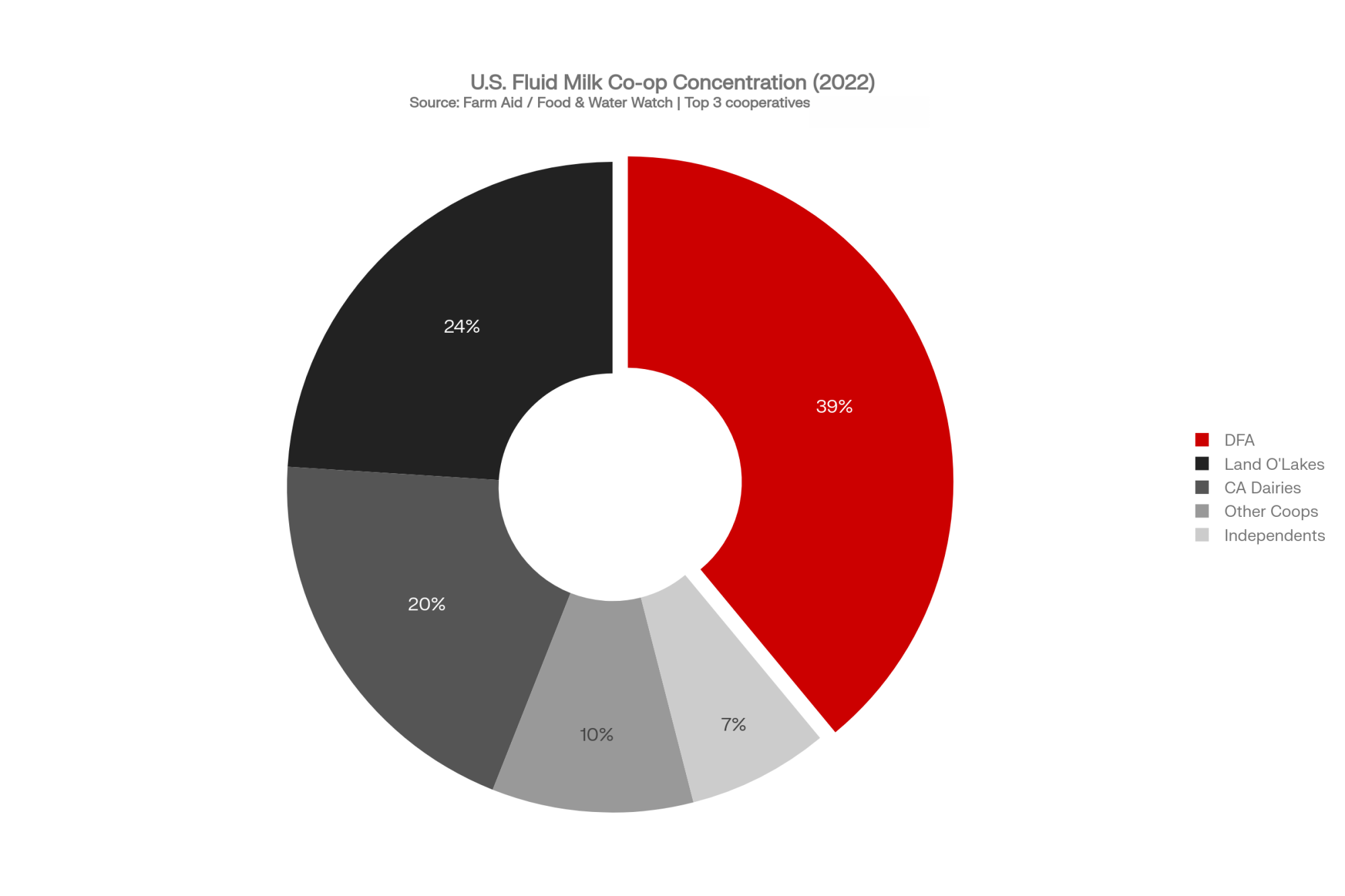
A 2023 Farm Aid analysis, citing Food & Water Watch’s The Dirty Dairy Racket report, noted that Dairy Farmers of America is the largest U.S. dairy cooperative, marketing about 39% of all fluid milk sales, and that in 2022 just three cooperatives — DFA, Land O’Lakes, and California Dairies — together marketed around 83% of all U.S. fluid milk. In a lot of U.S. milk sheds, producers say that once they factor in co‑op territories and hauling realities, they effectively have only one practical buyer if they want to stay in Grade A markets in their region.

When there’s effectively only one practical buyer in your area, and that buyer also owns processing plants, your leverage over price is limited. Under most Federal Order structures, producers are essentially working off an announced price plus premiums, not a fully negotiated one.

In July 2022, a federal class‑action lawsuit filed in Vermont alleged that DFA used its dominant Northeast position in ways that limited farmers’ marketing alternatives and kept farm‑gate prices lower to benefit its processing interests. DFA responded in a public statement that the allegations were “baseless and completely without merit,” and as of early 2026, the case remains pending before the court.

Separately, Dairy Farmers of America and Select Milk Producers have agreed to settle a Southwest price‑fixing case for a combined total of about $34 million. Reuters and other outlets report that DFA agreed to pay roughly $24.5 million and Select about $9.9 million, and coverage notes that the settlement allows the co‑ops to resolve the case without continuing litigation and without any findings of liability against them.

The more concentrated your buyers are, the more your “management problem” starts to look like their pricing strategy.

The Processing Paradox: $11 Billion in Plants Is a Warning Sign

On paper, billions in new dairy processing capacity sounds like a success story. New jobs, new export volume, and more demand for milk. That’s how it’s sold at ribbon cuttings.

For a 400‑cow commodity herd, it’s more complicated.

Those plants are engineered to run flat‑out. They’re built on the assumption that raw milk will stay plentiful and relatively cheap. Their investors win when:

  • Milk supply is reliable and abundant.
  • The spread between farm‑gate prices and wholesale/retail prices stays wide enough to cover costs and returns.
  • Price transmission lets them hold margin longer when your milk cheque drops.

When you see a new plant announced in your region, the right question isn’t “Will this save my dairy?” — it’s “How much of that investment depends on my milk staying cheap?”

The Canadian Contrast: Stability at a Price

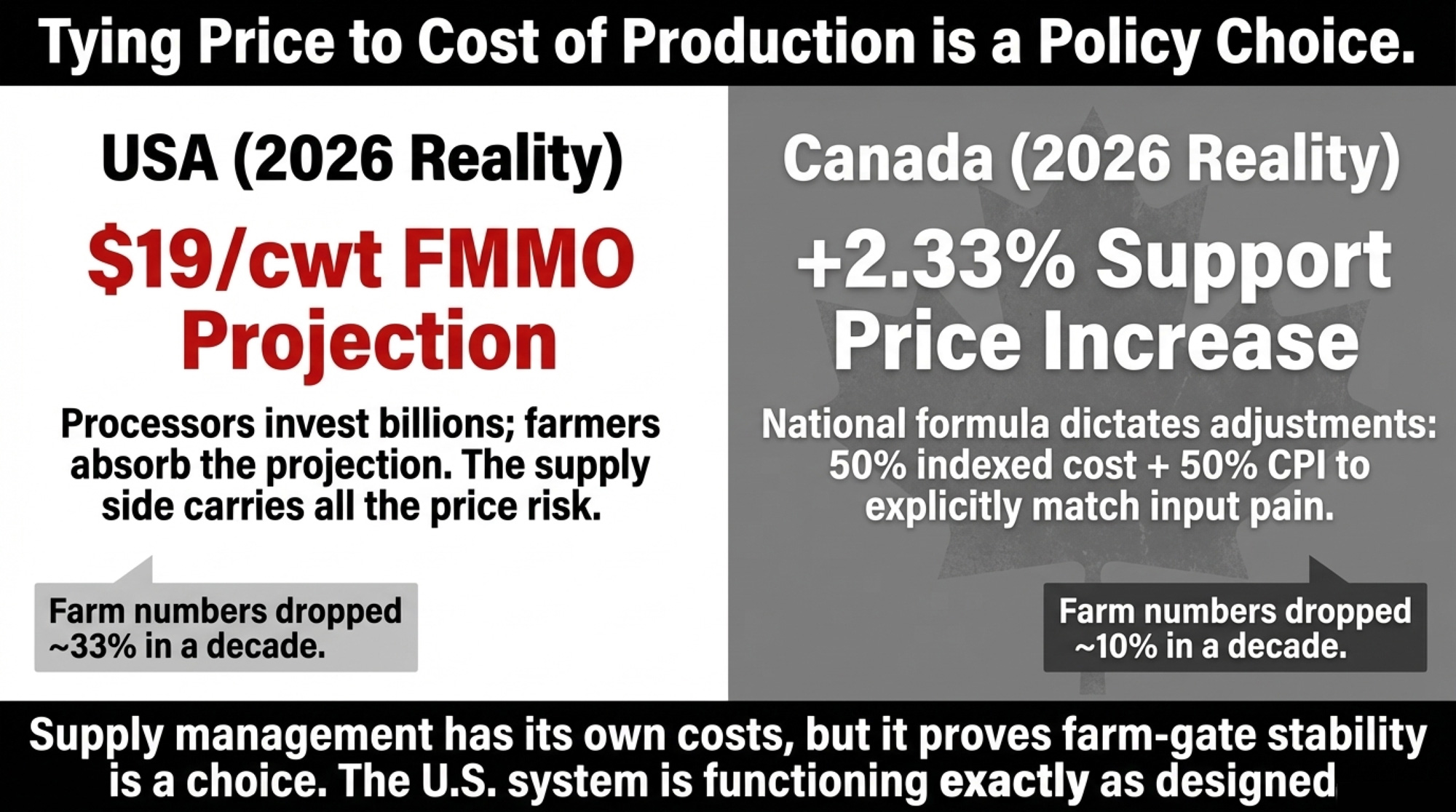
North of the border, Canada runs dairy on different rules. The Canadian Dairy Commission uses a national formula — built roughly on 50% indexed cost of production and 50% Consumer Price Index — to set annual farm‑gate adjustments for industrial milk. For 2026, that formula produced about a 2.33% increase in the support price effective February 1, based on a 2.7% increase in the cost of production and a 1.9% CPI rise. When input costs rise, part of that pain is explicitly built into what farmers receive.

Between the mid‑2010s and early 2020s, Canadian census and USDA data show dairy farm numbers dropping by roughly a tenth in Canada and by around a third in the U.S. Both countries are consolidating. The pace looks very different on the ground.

Stability has a bill. Multiple Canadian policy and think‑tank analyses estimate that supply management raises the average household’s annual cost for dairy, eggs, and poultry by roughly CAD $300–$450, compared to an open market. High quota values also create a steep barrier for young or new entrants — a different kind of problem than what U.S. operators face, but a real one.

During COVID, when U.S. producers dumped milk and scrambled for emergency payments, a 2020 Canadian policy paper found that supply‑managed sectors were “more resilient” because “producers are generally more financially stable, losses are pooled, and production and marketing efforts are coordinated.”

Canadian supply management isn’t a fantasy — it’s proof that tying farm‑gate prices to the cost of production is a policy choice, not an economic impossibility.

Factor🇨🇦 Canada (Supply Managed)🇺🇸 United States (Open Market)
Farm-gate price settingFormula: 50% cost of production + 50% CPIFMMO announced price + premiums; no cost-of-production link
2026 price adjustment+2.33% effective Feb. 1 (cost + CPI formula)USDA WASDE forecast: $18.95/cwt — below many farms’ full cost
Farm number decline (2015–2023)~10% reduction~33% reduction
COVID resilienceSupply-managed sectors “more resilient”; losses pooledU.S. producers dumped milk; emergency payments required
Consumer cost premium~CAD $300–$450/household/yr for dairy, eggs, poultryLower shelf price; cost burden shifted to farm balance sheets
New entrant barrierHigh quota values ($30,000–$40,000+/cow equivalent)Low entry barrier; market access not guaranteed
Processor relationshipCoordinated; farm price moves with input costsProcessors capture spread asymmetry; “up fast, down slow”
VerdictStable farms, high consumer cost, closed to growthCheap milk, consolidating farms, processor-advantaged pricing

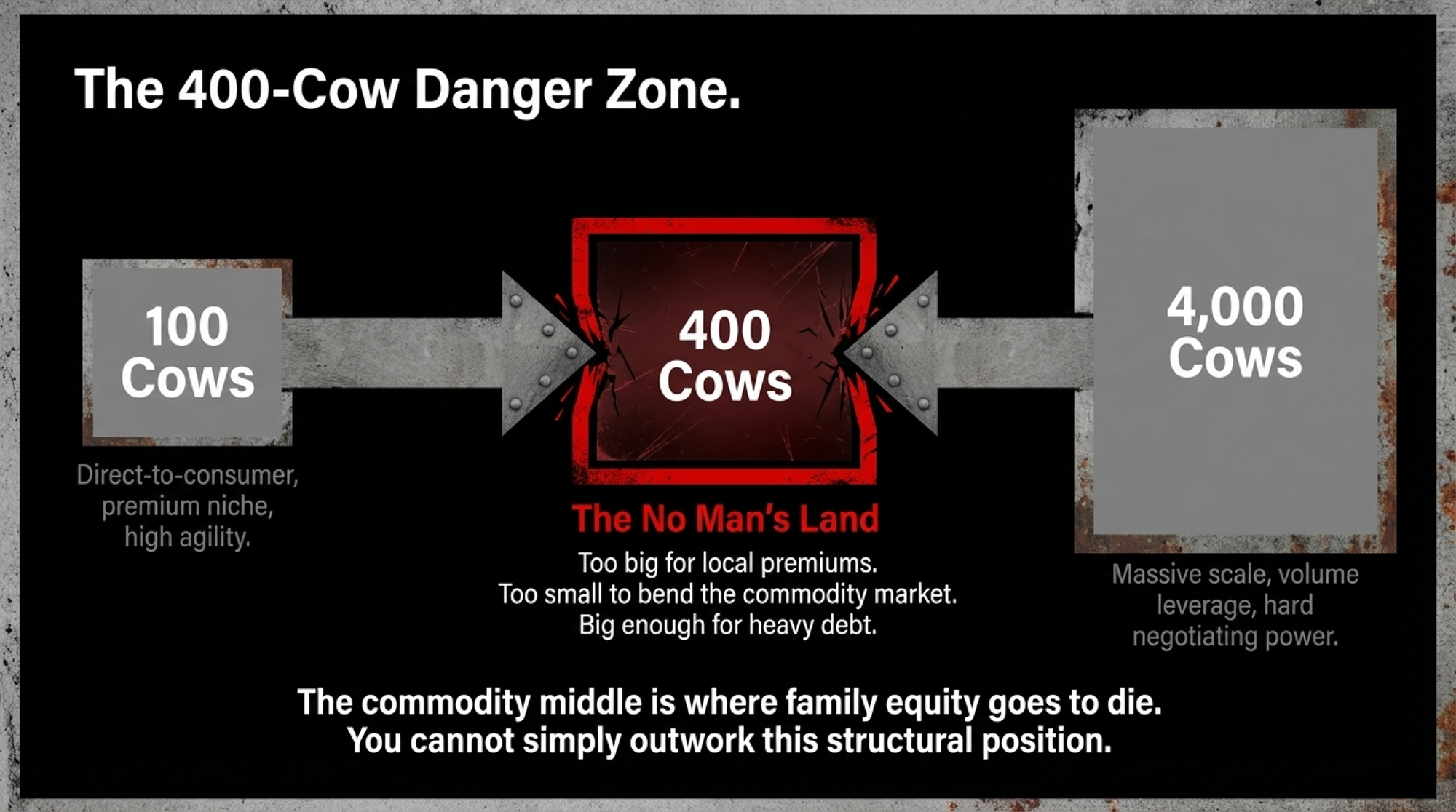
The 400‑Cow “No Man’s Land.”

A 100‑cow pasture dairy with low debt and a strong local brand might have a shot at direct‑to‑consumer or niche premiums. A 4,000‑cow desert unit has the volume, scale, and lender relationships to negotiate harder and spread fixed costs.

A 400‑cow commodity dairy? That’s the tough middle.

You’re often:

  • Too big for most local, direct‑to‑consumer plays to move the needle on total volume.
  • Too small to have the volume leverage, economies of scale, or bargaining power of the mega‑dairies.
  • Deep enough into capital investment that “just quitting” isn’t a simple decision, but not big enough to dictate terms.

The 400‑cow herd sits in dairy’s no man’s land: big enough to carry real debt and overhead, not big enough to bend the market.

The Playbook: What to Do Before Summer 2026

The system won’t be fixed in the next 12 months. Your job is to make decisions that assume it won’t — while keeping enough equity to benefit if it ever does.

Herd SizeFull Cost/cwt2026 All-MilkGap/cwtAnnual Equity Drain24-Mo Stress RiskAction Signal
300 cows$24.00$19.00–$5.00$180,000HIGHExit planning warranted
300 cows$22.00$19.00–$3.00$108,000MODERATEStress-test with lender
400 cows$24.00$19.00–$5.00$240,000HIGHExit planning warranted
400 cows$22.00$19.00–$3.00$144,000MODERATEStress-test with lender
500 cows$24.00$19.00–$5.00$300,000CRITICALRestructure conversation now
500 cows$22.00$19.00–$3.00$180,000HIGHExit planning warranted
600 cows$24.00$19.00–$5.00$360,000CRITICALRestructure conversation now
600 cows$22.00$19.00–$3.00$216,000HIGHExit planning warranted

In the Next 30 Days

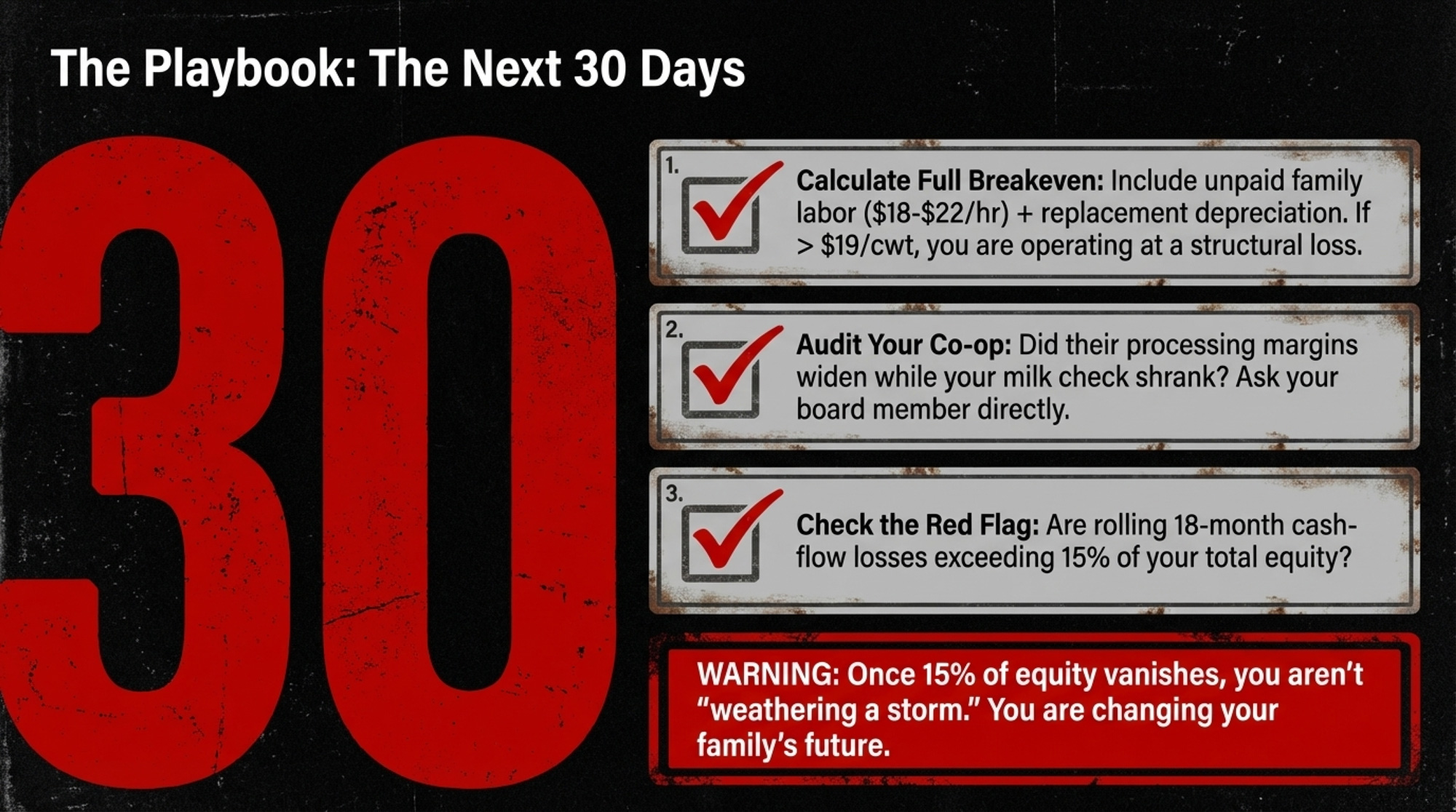
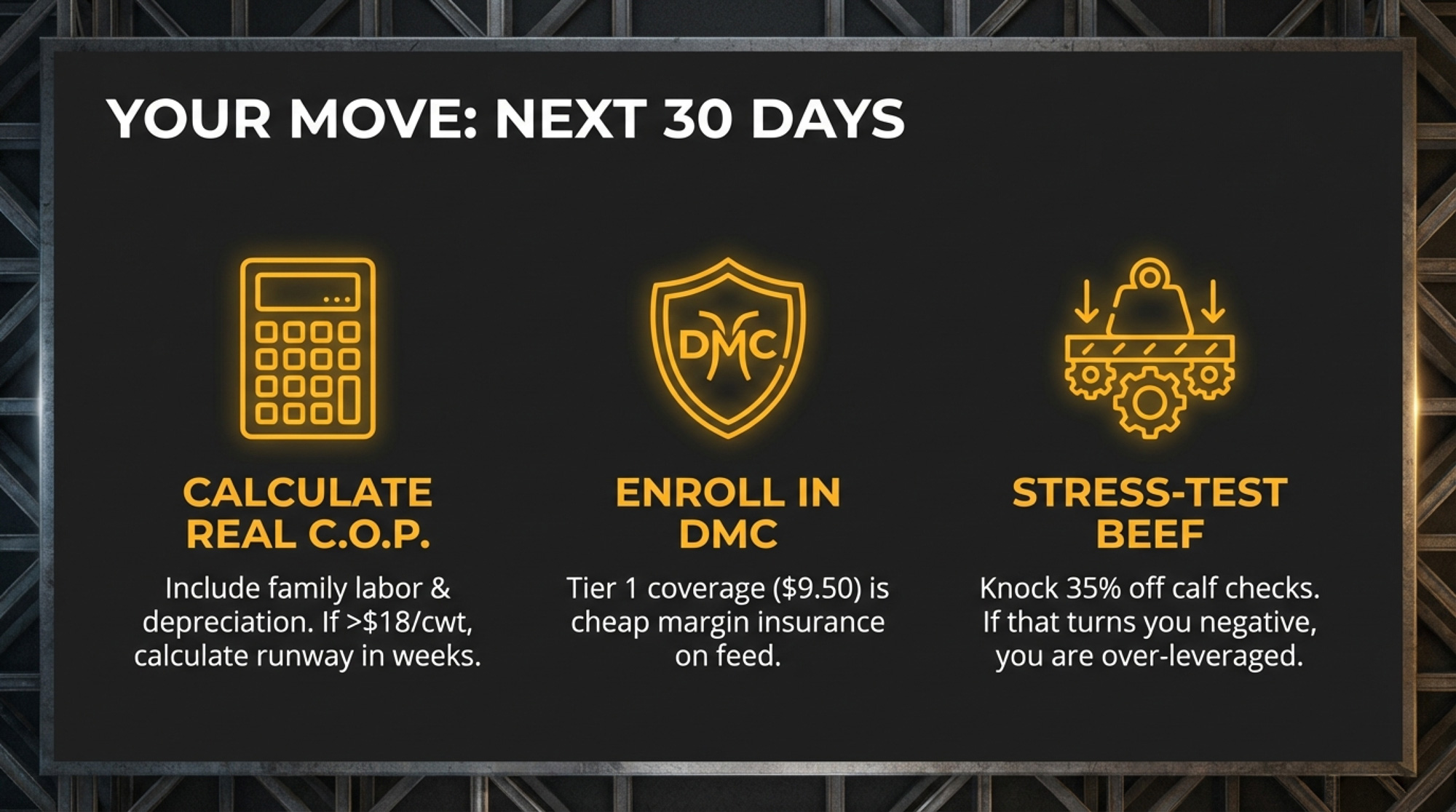
  • Calculate your real breakeven — not cash breakeven, full breakeven. Include unpaid family labor at $18–22/hour, depreciation at replacement cost, and a management return. If your full breakeven sits above the latest USDA all‑milk outlook (~$19/cwt), you’re running at a loss on a full‑cost basis. If your full‑cost breakeven is above $19, your first problem isn’t efficiency — it’s that you’re selling below cost.
  • Pull your co‑op’s latest annual report or financials. Look at their processing margins alongside the farm‑gate price they announced. Then ask yourself one question: Did that spread widen when milk prices fell? If it did, you’re looking at the asymmetry this article describes — happening in your own supply chain. Ask your co‑op board member directly: “How did processing margins change between 2022 and 2024 while my milk price moved?”
  • Red flag threshold: Your rolling 18‑month cash‑flow projection shows cumulative losses exceeding 15% of equityOnce 15% of your equity is gone to cover losses, you’re not “weathering a storm” — you’re changing the shape of your future.

In the Next 90 Days

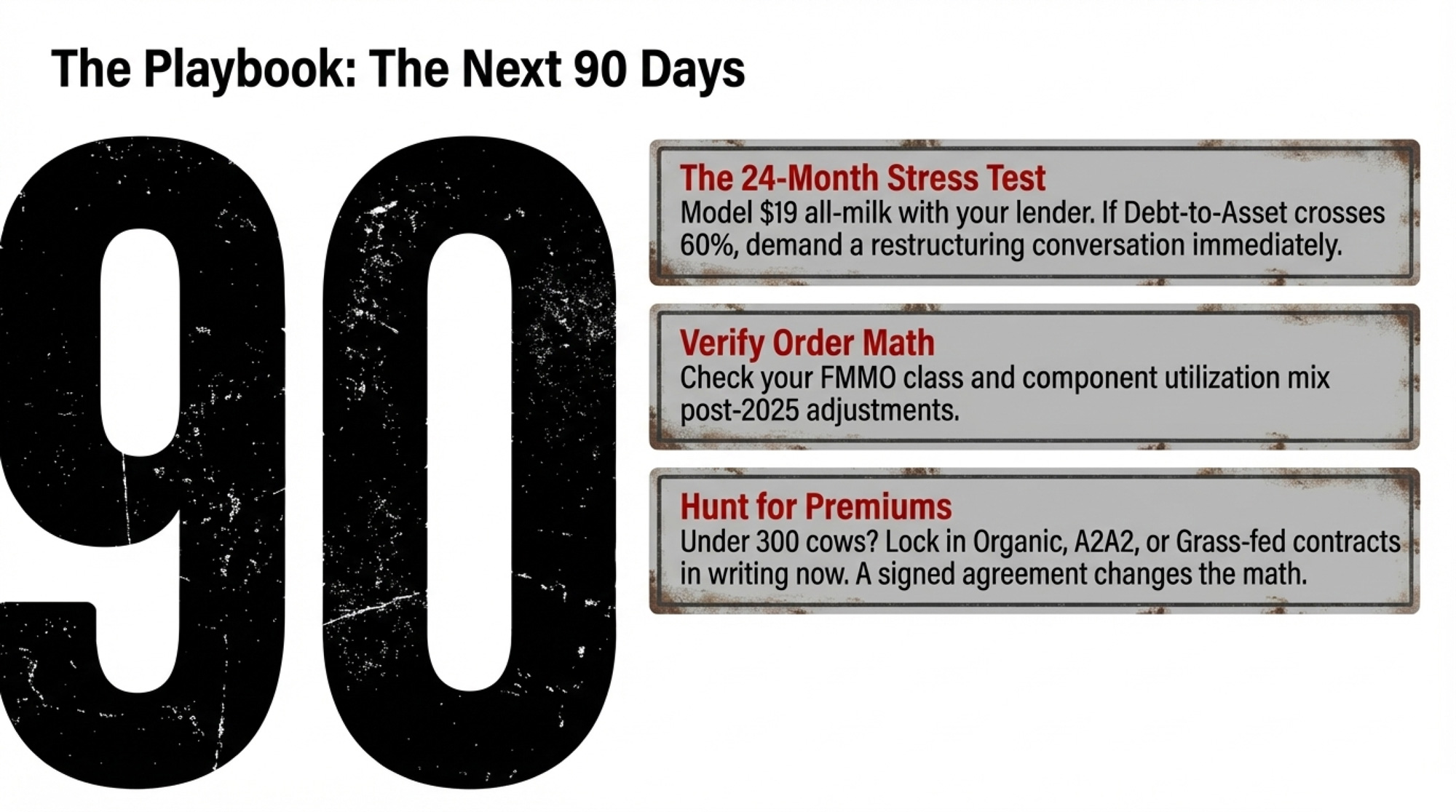
  • Run a $19 milk stress test with your lender. Model your balance sheet at 24 consecutive months of $19 all‑milk with your current cost structure. If your debt‑to‑asset ratio crosses 60% under that scenario, you need a restructuring conversation, not just a prayer for better prices.
  • Check your FMMO class and utilization mix. If you haven’t re‑read your order’s pricing rules and your co‑op’s pooling/premium structure since the 2025 adjustments, do it now. Component and class dynamics can move your net check more than you think.
  • If you’re under 300 cows with low debt and meaningful pasture, and a processor has expressed interest in organic, grass‑fed, or A2A2 supply at premium terms — get it in writing this quarter. Specialty contracts won’t magically fix your economics, but a signed agreement changes the math on whether a 3‑year transition is worth the pain.
  • If you’re 600+ cows with high leverage, your path is different: every dollar of overhead efficiency matters more, the margin for error on feed procurement is thinner, and your lender conversation is about debt‑service coverage, not expansion. Know your number.

Over the Next 12 Months

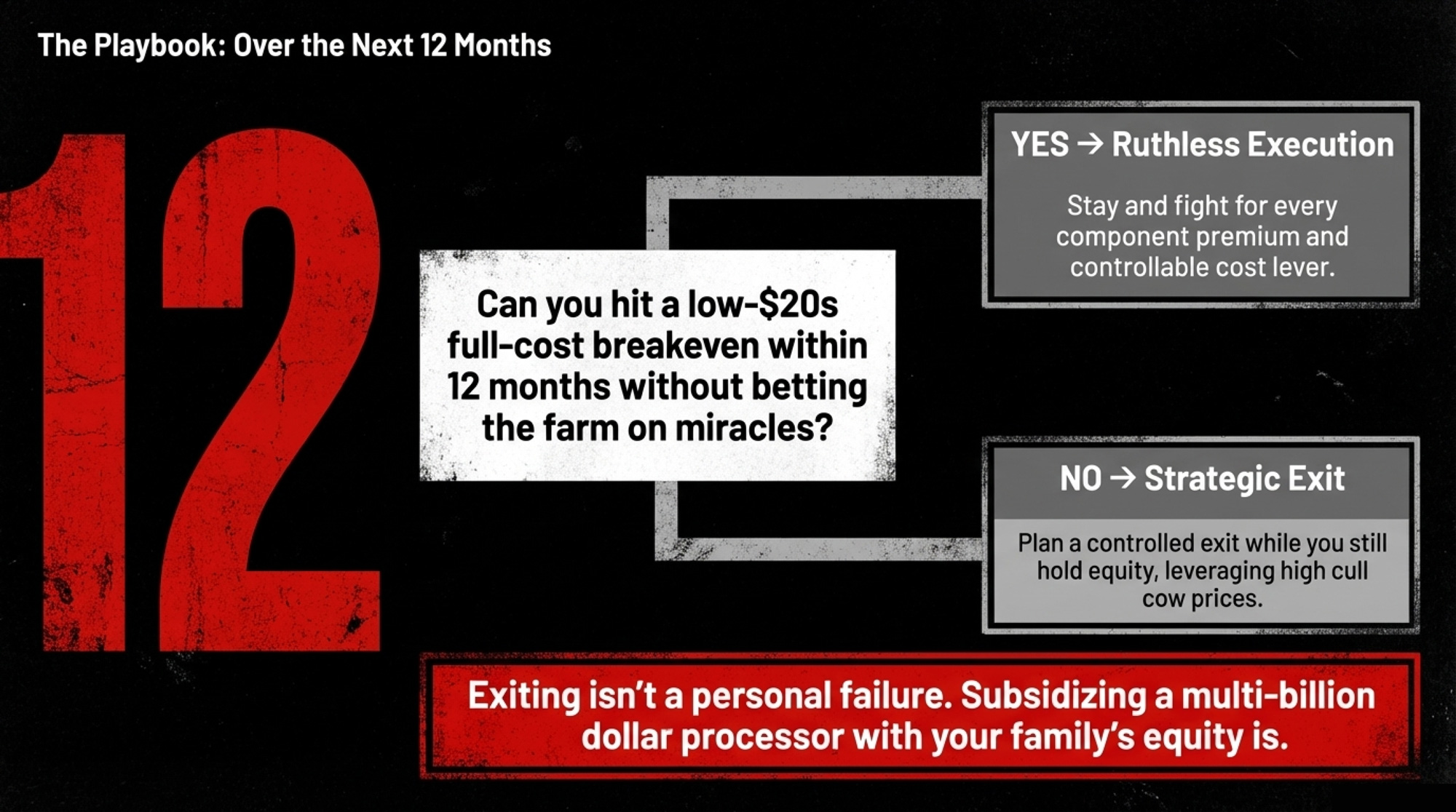
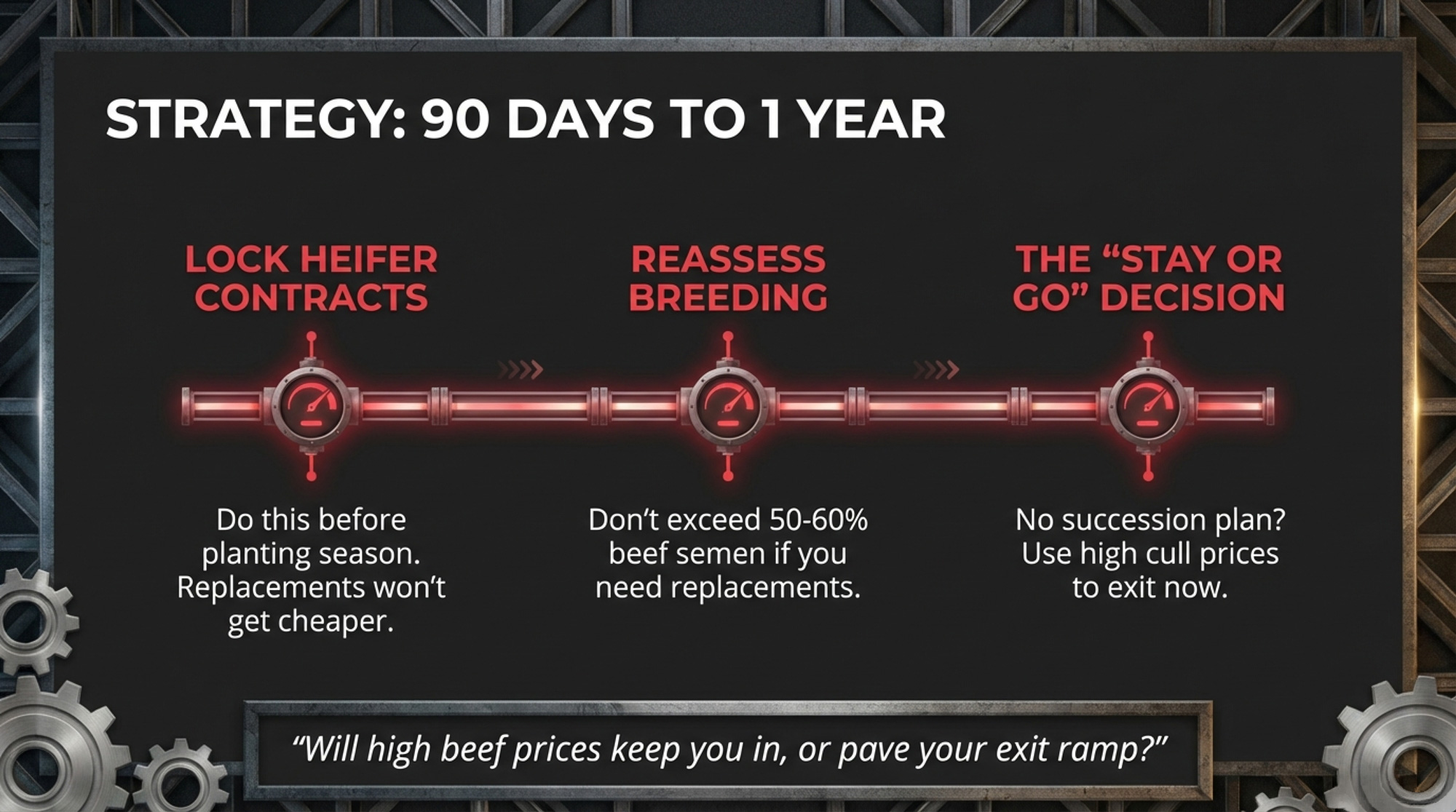
  • Make the binary decision. Can you realistically get your full‑cost breakeven into the low $20s within a year or two — without betting the operation on debt and miracles? If yes, execute ruthlessly on every controllable cost lever and fight for every cent of component premium. If no, plan a strategic exit while you still have equity, strong cull cow prices, and beef‑on‑dairy premiums to work with.
  • Audit your loyalty. Co‑op success — new plants, strong balance sheets, even healthy patronage checks at the organizational level — does not automatically translate into a higher milk check for you. Read your co‑op’s financials like you would a processor’s: how much value stays in the plant, and how much actually flows back to members?
  • The critical threshold: If your full cost of production stays above the projected all‑milk price for two consecutive years, the gap is effectively coming out of your family’s equity, while the processing side continues to benefit from relatively cheap raw milk. At that point, you’re no longer just “hanging on” — you’re actively funding someone else’s business plan.

What This Means for Your Operation

  • You’re not imagining the squeeze. Decades of farm‑share data, price‑transmission research, and bargaining‑power studies confirm that the dairy supply chain is structured so that most of the risk and price adjustment lands on your side.
  • Your efficiency gains work both ways. When you push more milk through the parlor, you help keep processors’ unit costs low and plant capacity full. Unless your contract structure captures some of that value, the benefit flows downstream.
  • Your co‑op is a partner and counterparty at the same time. A co‑op that runs plants and export programs has a real structural tension between paying you more and protecting its processing margin. That doesn’t make them villains — it means you should read their balance sheet with the same skepticism you’d apply to a private processor.
  • Canadian‑style supply management isn’t on the table this decade. But it proves that tying farm‑gate prices to the cost of production is a policy choice, not an economic impossibility.
  • Waiting for prices to recover is a bet, and recent USDA outlooks suggest it’s a risky one. Treat the $18.95/cwt forecast as a base case, not a worst case. If your full‑cost breakeven doesn’t work at that level, your job this year is to close that gap or decide when and how you’ll exit.
  • The most important number isn’t on the CME screen. It’s the ratio between what you’re paid per cwt and what a gallon of your milk sells for at retail in your nearest town.

Key Takeaways

  • If your full‑cost breakeven sits more than $3/cwt above the latest USDA all‑milk outlook and you don’t have a clear, executable plan to close that gap, strategic exit planning should be on the table — not taboo.
  • If your co‑op’s processing margins grew while your farm‑gate price lagged, that’s the bargaining‑power asymmetry at work — not bad management on your part. Stop treating a structural problem as a personal failure.
  • If you haven’t run a $19 milk stress test with your lender for a full 24‑month horizon, do it in the next 90 days. The outcome of that meeting should drive whether you’re doubling down, pivoting to a premium path, or quietly lining up your best exit window.

The Bullvine Bottom Line

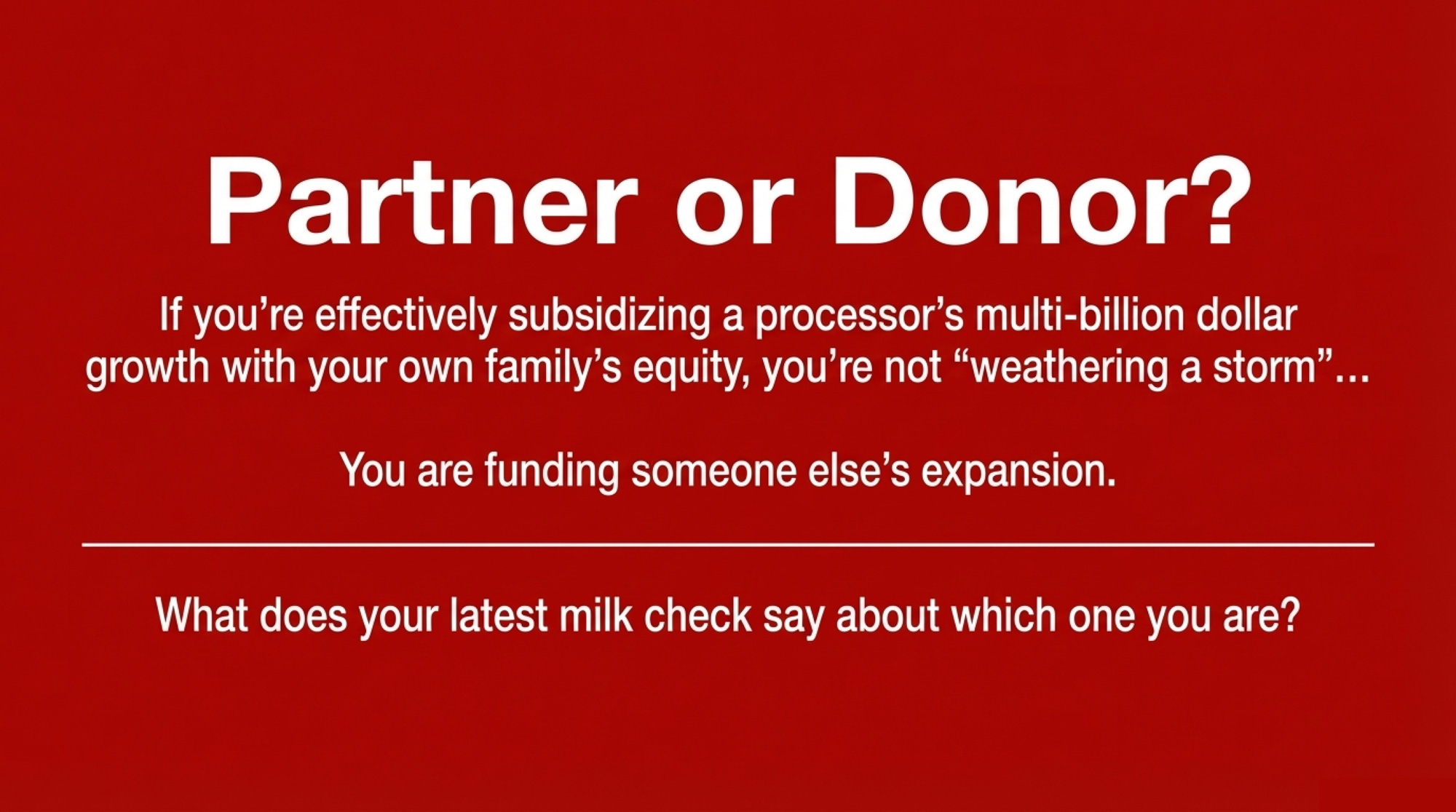
If you’re effectively subsidizing a processor’s growth with your own family’s equity, you’re not “weathering a storm” — you’re funding someone else’s expansion. It’s time to decide, with your own numbers in front of you, whether you’re truly a partner in that system — or just a donor.

What does your latest milk cheque say about which one you are?

Complete references and supporting documentation are available upon request by contacting the editorial team at editor@thebullvine.com.

Learn More

The Sunday Read Dairy Professionals Don’t Skip.

Every week, thousands of producers, breeders, and industry insiders open Bullvine Weekly for genetics insights, market shifts, and profit strategies they won’t find anywhere else. One email. Five minutes. Smarter decisions all week.
NewsSubscribe
First
Last
Consent

Pennsylvania to Texas: Fine Checks, Fading Herds – 2026’s 19.70 Kill Zone

Harrisburg dark Oct 6. 11 farms stranded, unpaid milk piling up. 19.70 $/cwt? $188k yearly bleed for 200‑cow herds. State scorecard + 30‑day paths inside.

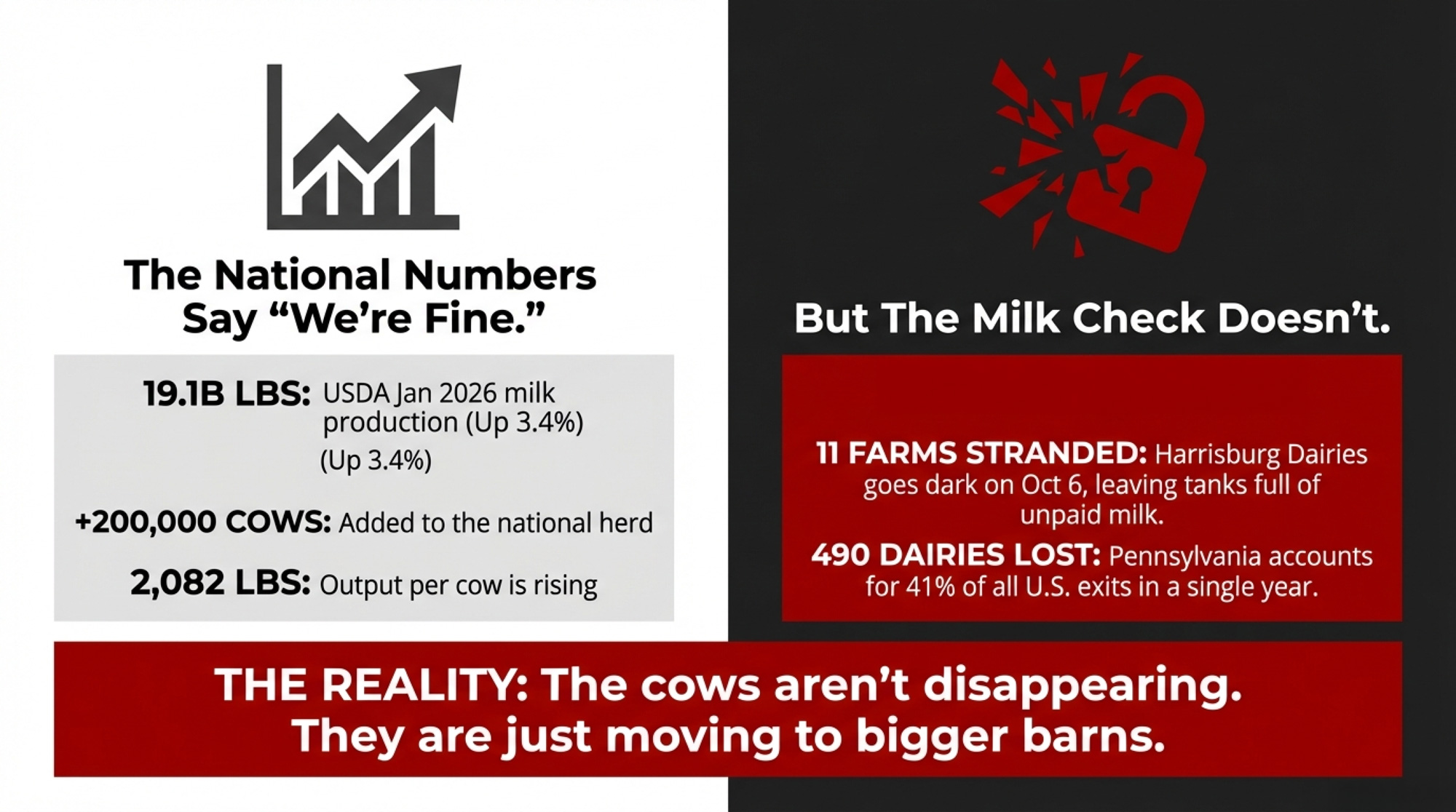
When Harrisburg Dairies shut down for good on October 6, 2025, the trucks just stopped coming. At least 11 or 12 family farms and their haulers were suddenly sitting on weeks of shipped milk with no check and no clear backup buyer. That was one regional bottler, one weekend — and a preview of what 19–20 $/cwt milk looks like when the math and the processor power both turn against you.

When the National Numbers Say “We’re Fine” — But Your Milk Check Doesn’t

In Canadian research led by the University of Guelph’s Dr. Andria Jones‑Bitton, roughly one in four farmers said they’d had thoughts of suicide in the previous 12 months, often during winter when stress, debt, and dark days all pile up. Now look at the U.S. scoreboard. USDA NASS says total farm numbers fell from 1,880,000 in 2024 to 1,865,000 in 2025 — that’s 15,000 farms gone in a single year across all sectors. At the same time, January 2026 milk production in the 24 major dairy states hit about 19.1 billion lb, up 3.4 % from a year earlier.

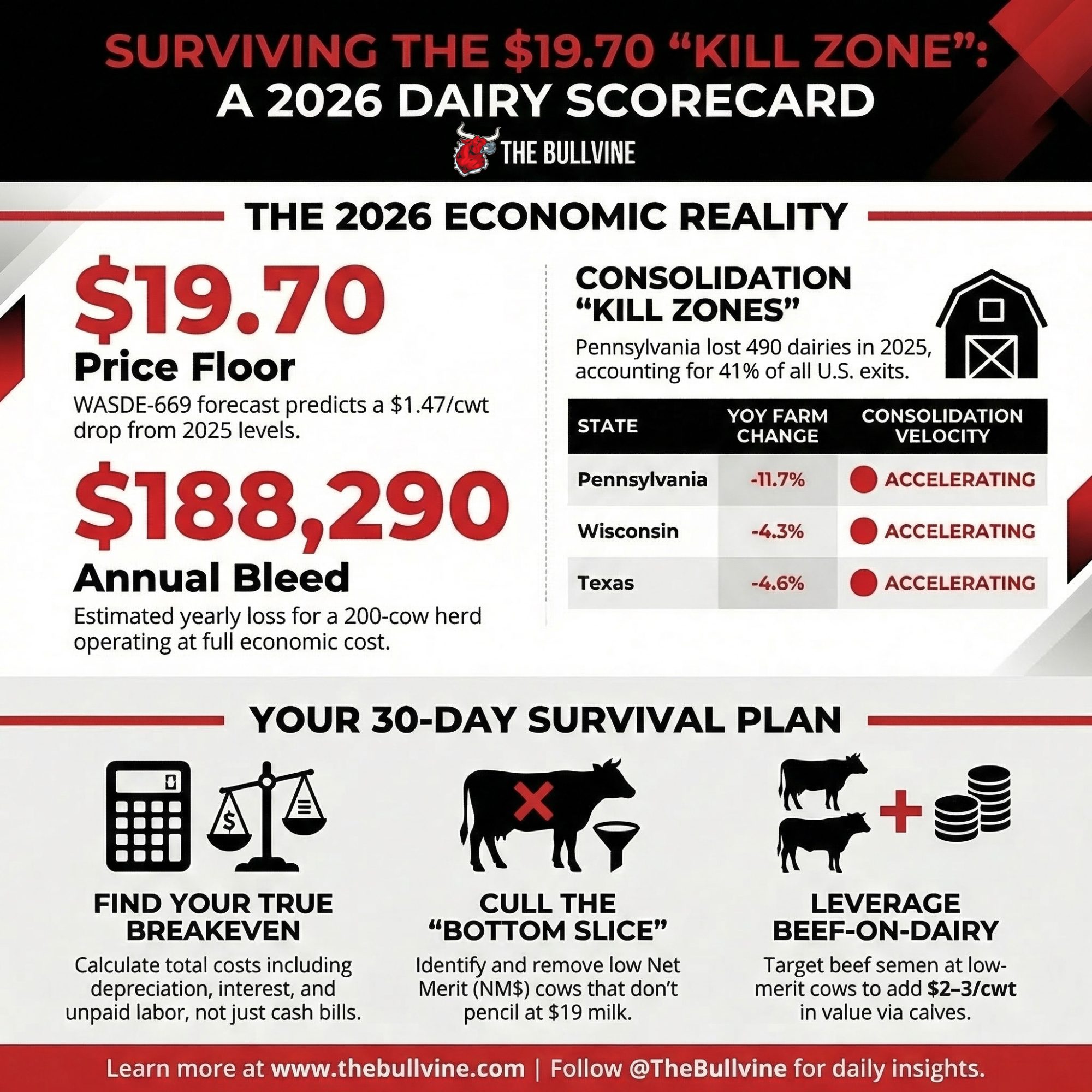
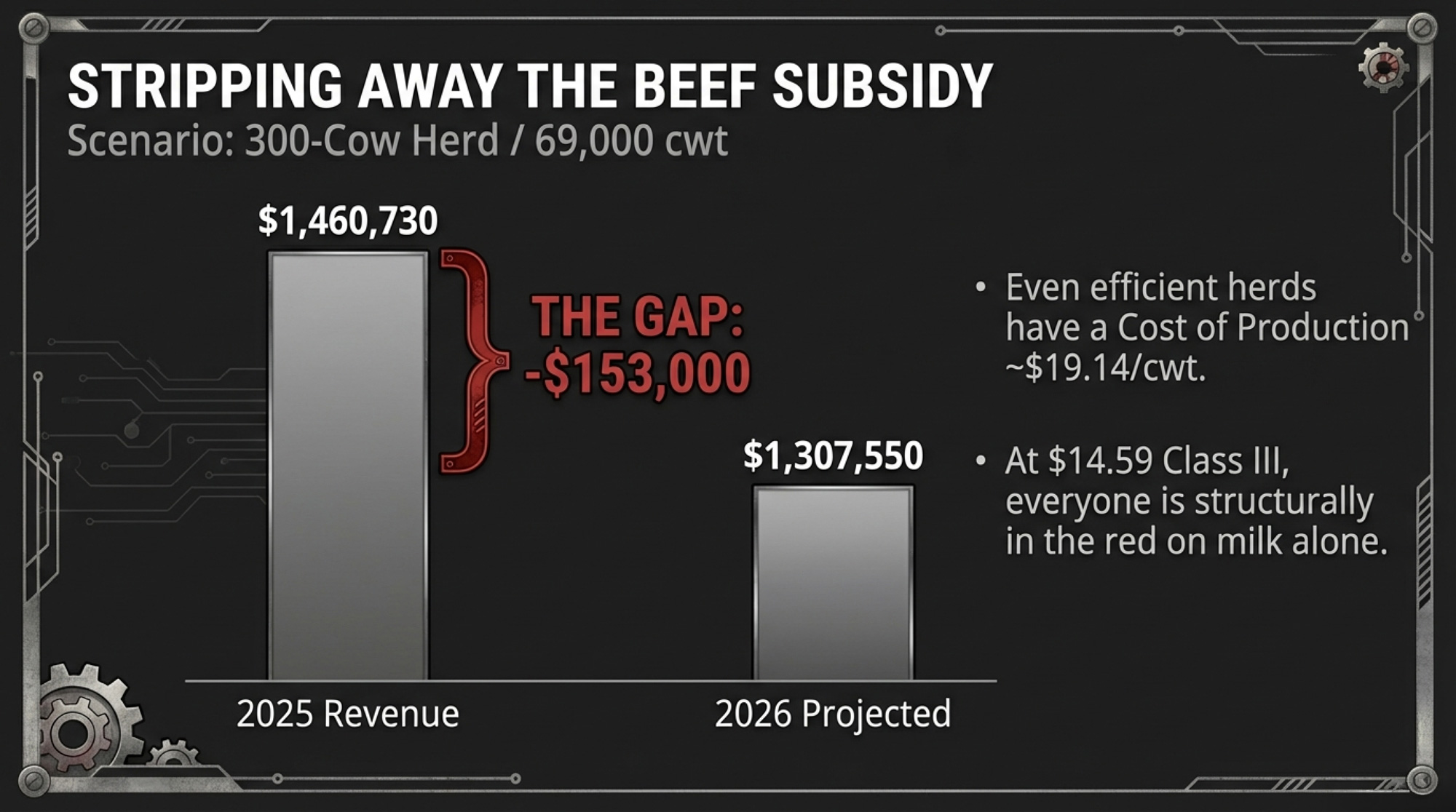
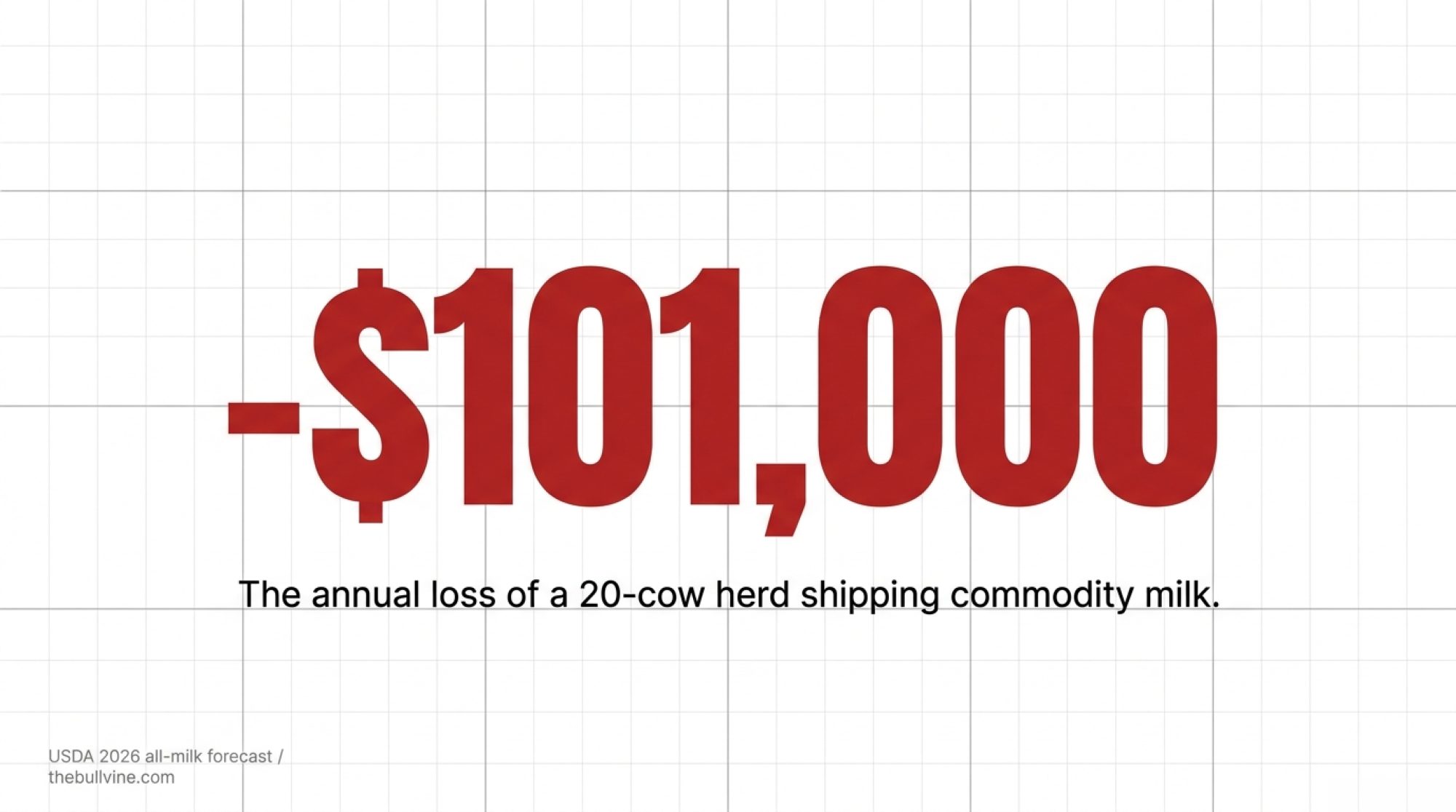
USDA ERS estimates 2025 U.S. milk production at around 231.5 billion lb, roughly 2.5% higher than 2024. WASDE‑669 then calls for a 2026 all‑milk price of 19.70 $/cwt, down from 21.17 $/cwt in 2025. On a 300‑cow herd shipping about 69,000 cwt/year, that 1.47 $/cwt drop alone carves roughly 101,000 $ out of your annual milk check before you do anything wrong. You feel that in every feed‑mill statement, every delayed repair, every time you tell yourself you’ll talk to the bank “after planting.”

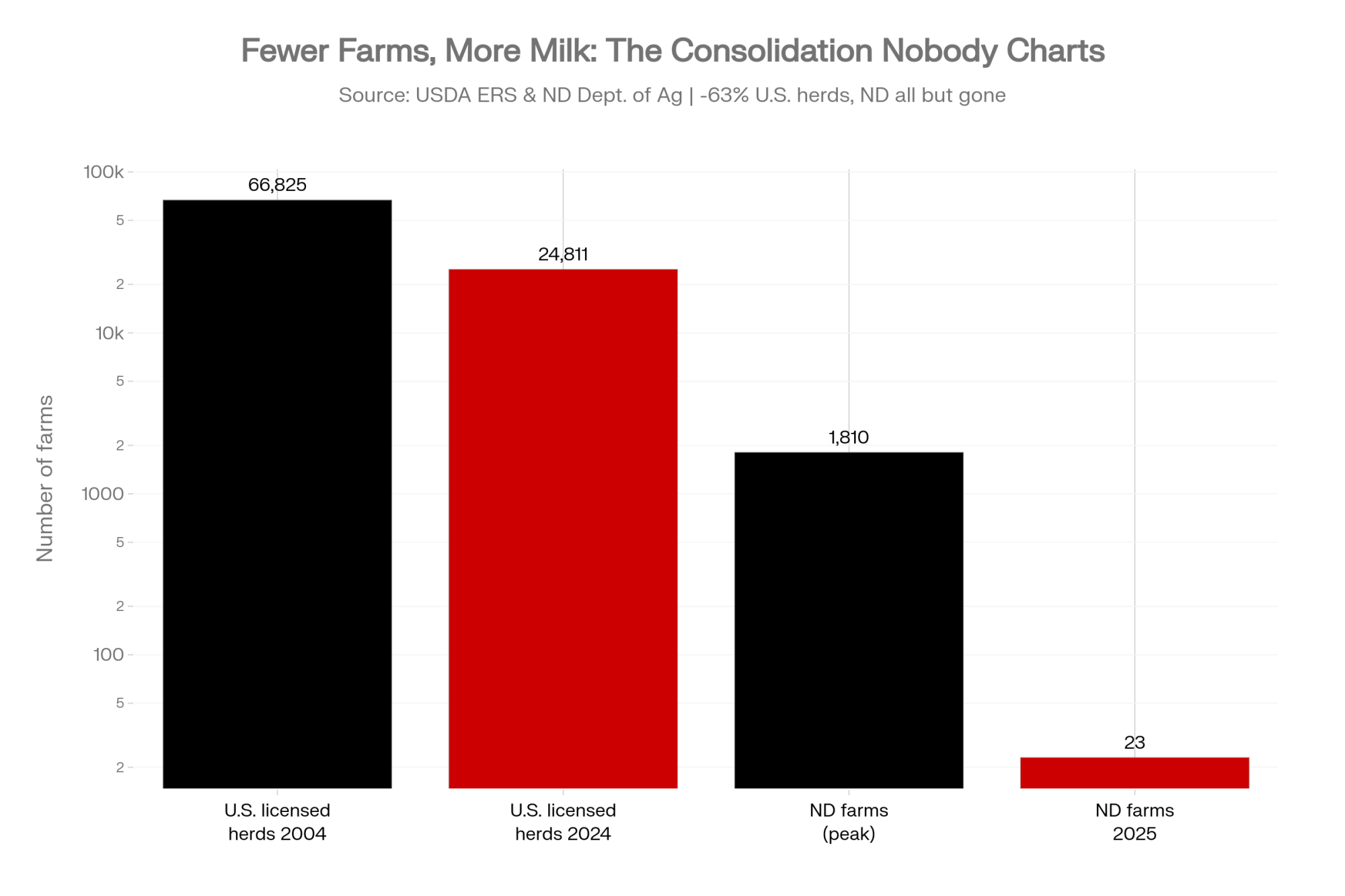
Meanwhile, the cows keep coming. In January 2026, the 24 major milk states reported about 9.15 million cows, roughly 200,000 head more than a year earlier. Average output hit 2,082 lb/cow for the month, 24 lb higher than January 2025. NASS licensed‑herd time series show dairy operations have fallen by well over half in two decades, yet national milk production is still climbing. The cows aren’t disappearing — they’re moving into big barns that can afford to live on 19‑dollar milk by spreading fixed costs and risk over thousands of stalls.

Add to the balance sheet. USDA ERS projects farm sector debt of around $ 624.7 billion for 2026, with interest expenses of $33 billion . Every tiny rate bump siphons a few more cents per cwt off your milk check and hands it to the bank before you pay feed, fuel, or yourself. That’s the backdrop to Harrisburg Dairies going dark — and the bigger question hanging over your yard: are you already in the kill zone at 19.70 $/cwt?

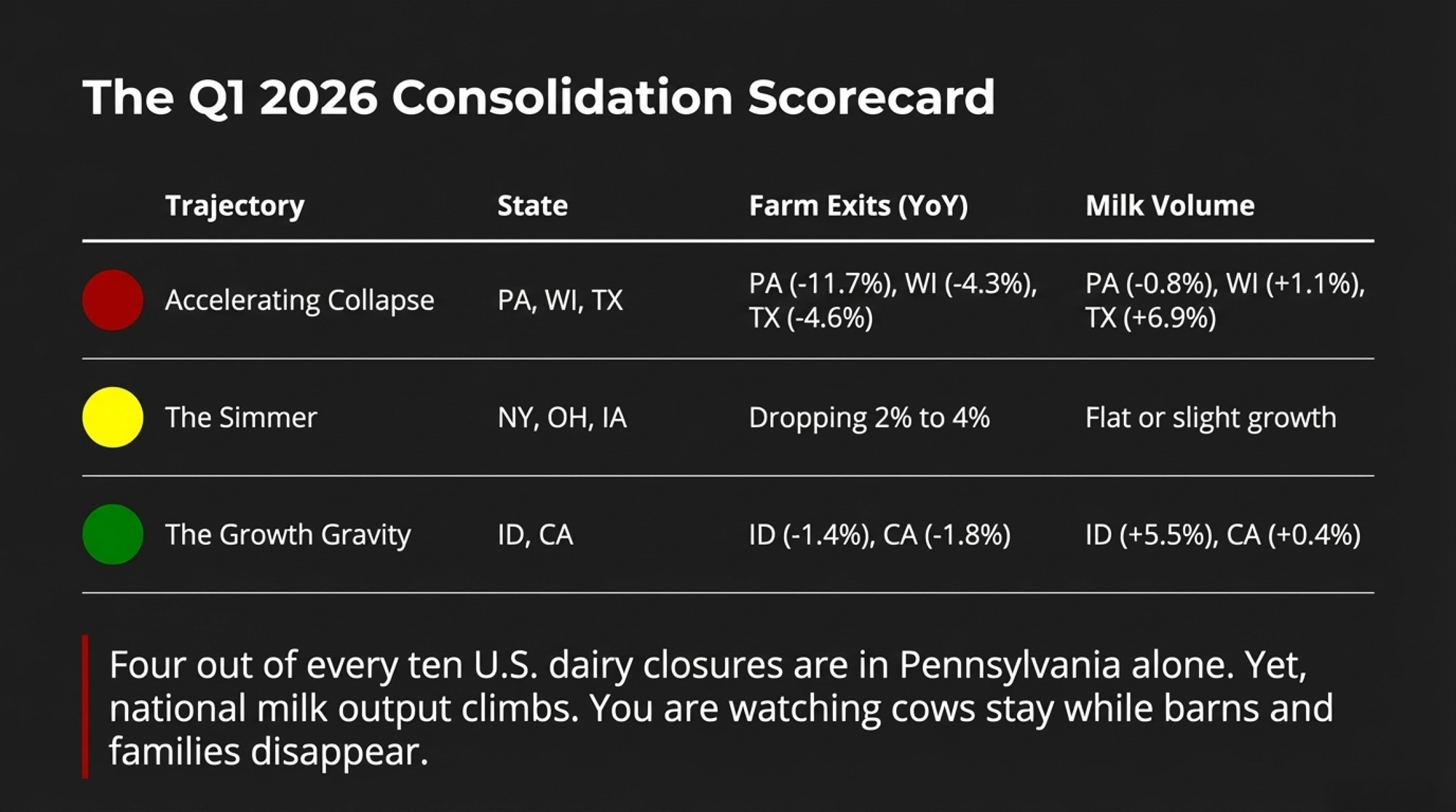
The Q1 2026 Dairy Consolidation Scorecard

The USDA’s 2025 “Farms and Land in Farms” summary provides total farm numbers by state. NASS Milk Production supplies state cow inventories and volumes. Put those together, and you can see where consolidation is running hot versus just simmering. Color codes here are based on annual dairy farm loss: RED = >4 %/year, YELLOW= 2–4 %/year, GREEN = <2 %/year. Farm counts are estimated from total farms and dairy cow numbers — directionally right, but not the same as the USDA’s licensed‑herd census.

ColorStateEst. Farms (2025)YoY Farm ChangeMilk Prod (B lb)YoY Prod ChangeAvg Herd SizeConsolidation Velocity
🟢California1,175-1.8%41.8+0.4%1,850STABLE
🔴Wisconsin5,580-4.3%31.8+1.1%245ACCELERATING
🟢Idaho345-1.4%18.2+5.5%1,680STABLE
🔴Texas310-4.6%18.2+6.9%4,000ACCELERATING
🟡New York2,390-3.9%15.8+1.2%260STABLE
🔴Michigan970-4.5%12.4+3.4%550ACCELERATING
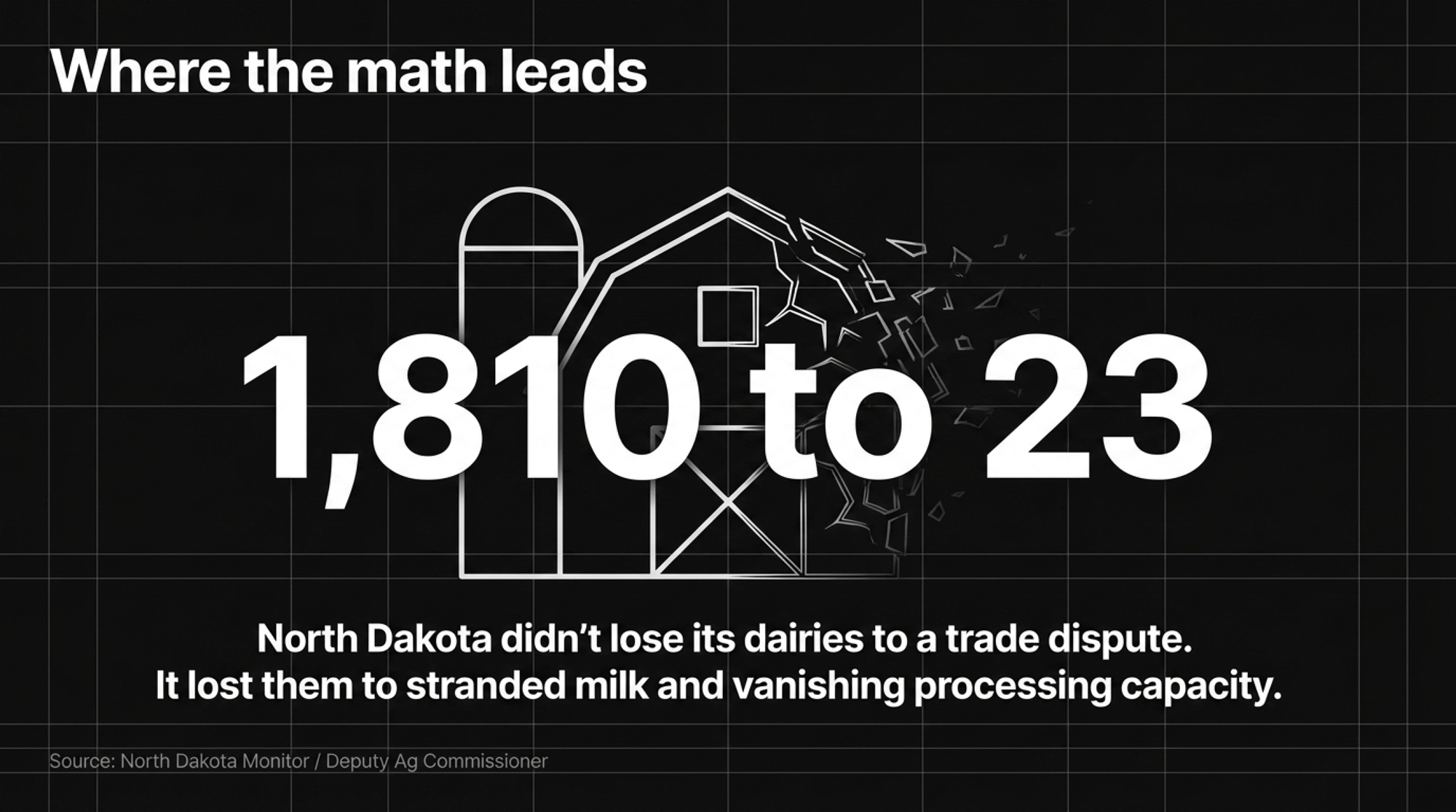
🔴Minnesota1,810-5.2%11.2+1.0%240ACCELERATING
🔴Pennsylvania~3,700-11.7% (41% of U.S. exits)10.1-0.8%~115ACCELERATING
🟢New Mexico110-2.2%7.7-1.0%2,100DECELERATING
🟡Washington275-2.6%6.8+1.1%920STABLE
🟡Ohio1,320-3.4%5.8+2.1%195STABLE
🟡Iowa790-2.5%5.7+0.7%275STABLE
🟡Kansas180-3.8%4.8+17.2%1,250ACCELERATING
🟡South Dakota140-2.9%4.5+9.5%1,300ACCELERATING
🟢Colorado105-1.9%5.4+3.9%1,550STABLE

Analysis of USDA’s licensed herd counts says the quiet part out loud: using USDA’s original 2024 baseline, the U.S. lost about 1,202 dairies in 2025, and 490 of them were in Pennsylvania — an 11.7 % drop that accounts for 41 % of all U.S. dairy exits. When four out of every ten closures are in one state and state milk still sits at near 10.1 billion lb, you’re not watching a gentle reshuffle. You’re watching cows stay while barns and families disappear.

Where Is the Processing Money Going — And What Does It Do to Your Milk Check?

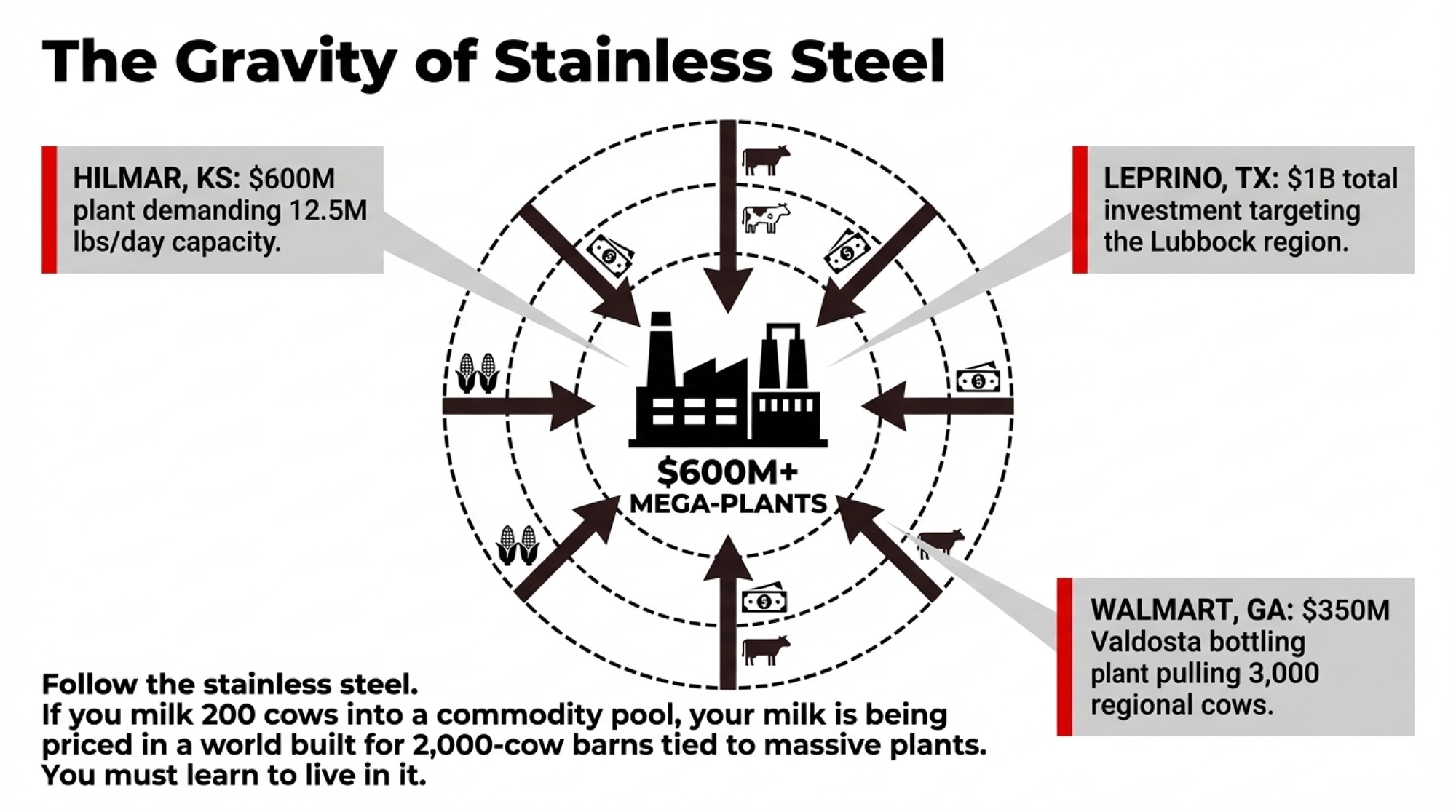
If you want to know where your future mailbox price is set, follow the stainless steel, not just the blend price.

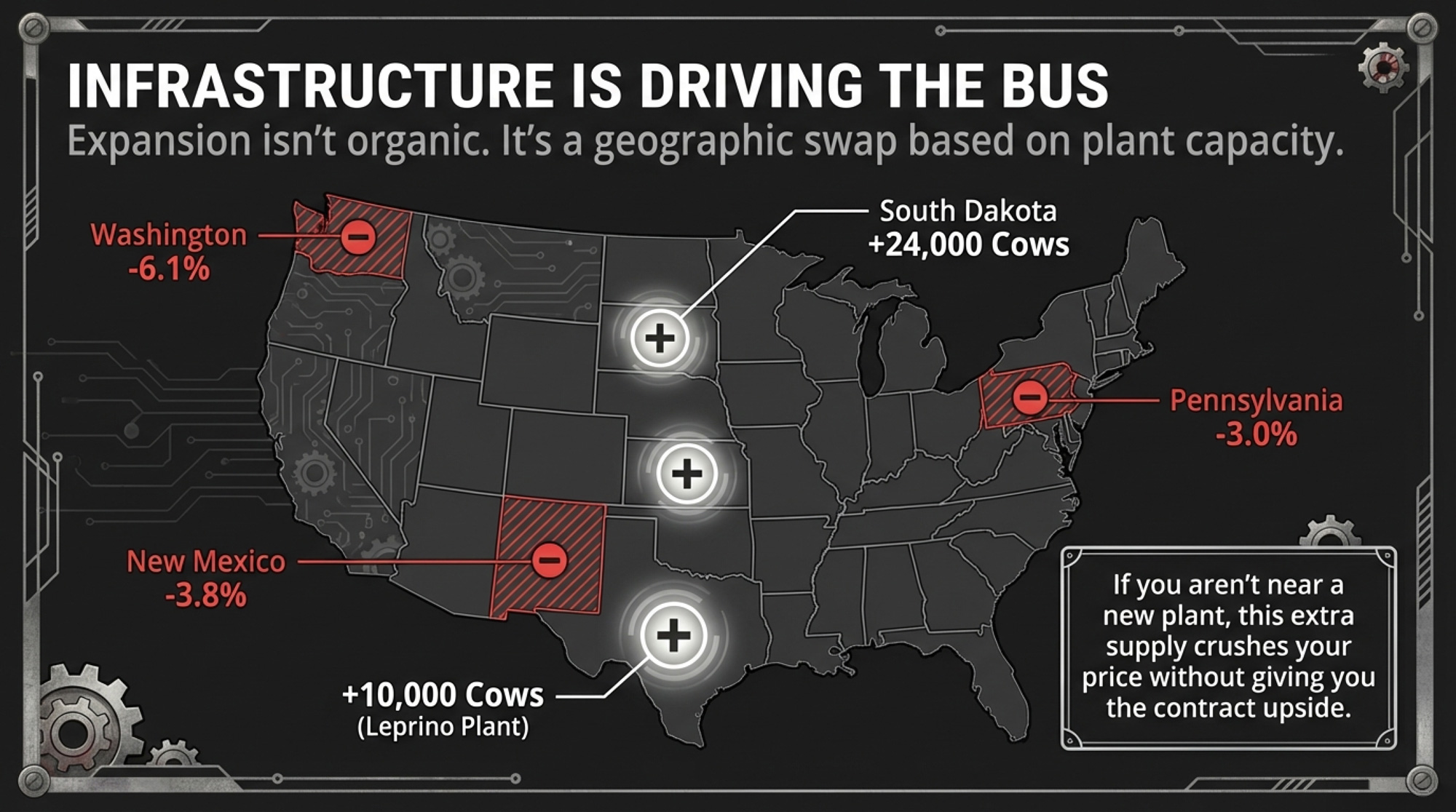
Kansas is the clearest example right now. NASS and ERS report Kansas milk output jumped roughly 17.2% in a single year, driven largely by Hilmar Cheese’s new plant in Dodge City. Hilmar has about $600 million sunk into that site, with a capacity of around 12.5 million lb/day when fully ramped, a level it essentially reached in early 2025. A plant like that doesn’t just “add capacity.” It creates gravity. Cows, corn silage, employees, and bankers all start orbiting Dodge City.

Texas and Idaho are locked in a fight for third place nationally. In 2025, Idaho’s roughly 350 dairies shipped about 18.26 billion lb, just ahead of Texas at 18.21 billion lb. But Texas has the bigger forward pipeline: Leprino’s Lubbock cheese complex — targeting roughly 1 billion $ in total investment — is phasing in through 2026, and Walmart’s fluid plant in Robinson, TX, is sourcing directly from regional farms for Great Value and Member’s Mark bottling. Those facilities want big, steady loads. That shapes what your co‑op can pay, even if your milk never hits their silos.

Up the I‑29 corridor, South Dakota shows how a single expansion can remake a region. State milk production is up around 9.5 %, tied heavily to Valley Queen’s expansion at Milbank, which doubled capacity to roughly 8 million lb/day and is expected to pull in another 25,000–30,000 cows over 2025–2026. Across the High Plains and mountain states, average herd sizes run from roughly 1,700 to more than 2,000 cows, with plenty of outfits milking 4,000 head in the Texas Panhandle.

If you’re milking 150–400 cows into a commodity pool, your milk is being priced in a world built for 2,000‑cow barns tied to 600‑million‑dollar plants. You may hate that. You still have to decide how you’re going to live in it.

Where Are Farms Bleeding Out Fastest — And Can Sub‑500‑Cow Herds Survive This Math?

While stainless steel moves west and south, the traditional milksheds are losing barns first and fastest.

NASS data for the Northeast/Mid‑Atlantic corridor (Maine through Maryland) show hundreds of dairy exits in 2025, and Farmshine’s breakdown of USDA-licensed herd numbers says that, using the original 2024 baseline, 41 % of all U.S. dairy exits were in Pennsylvania alone. That’s 490 dairies gone and an 11.7 % hit to the state’s dairy farm count in one year. State milk output only slipped about 0.8 % to roughly 10.1 billion lb, which tells you exactly what’s happening: cows are staying, they’re just changing barns and addresses.

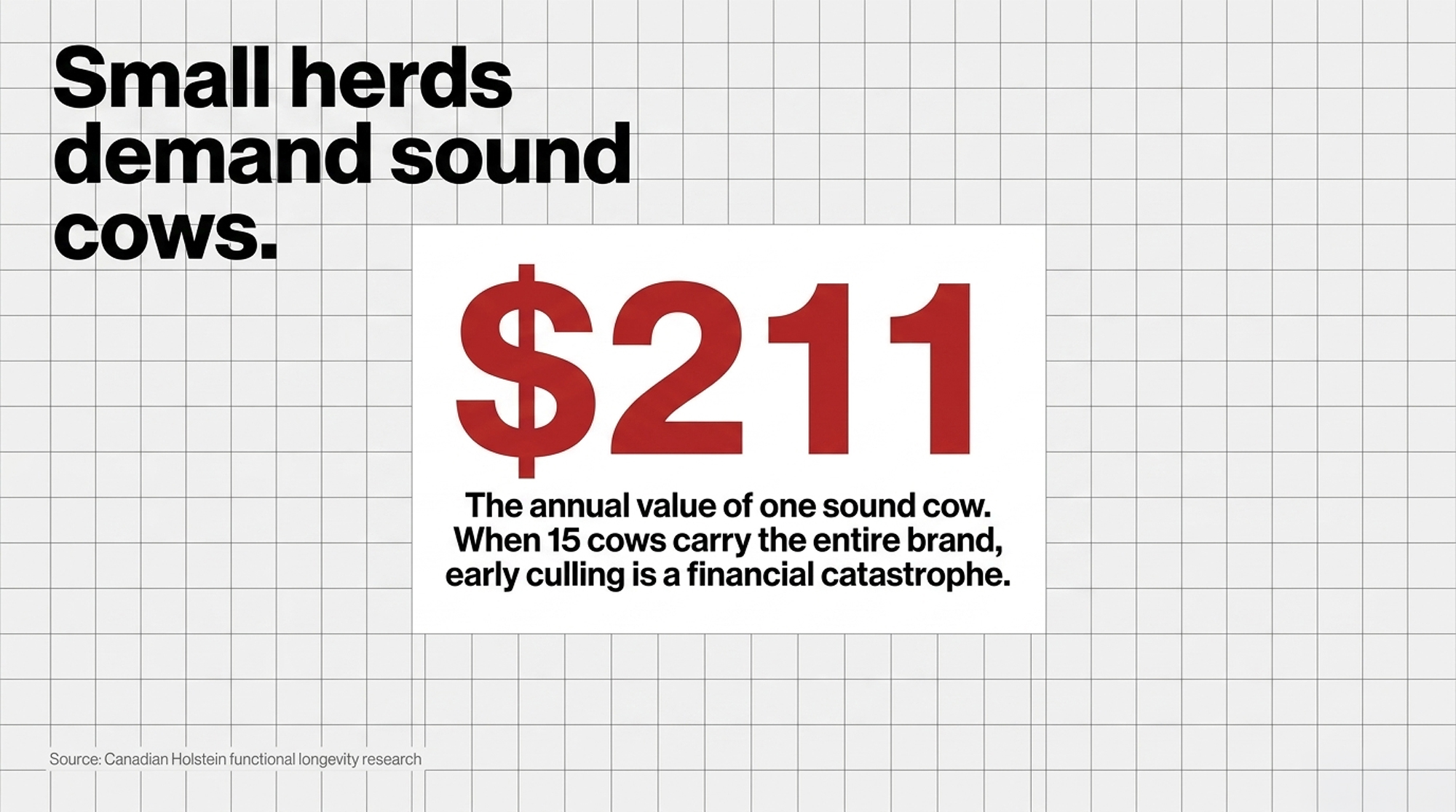
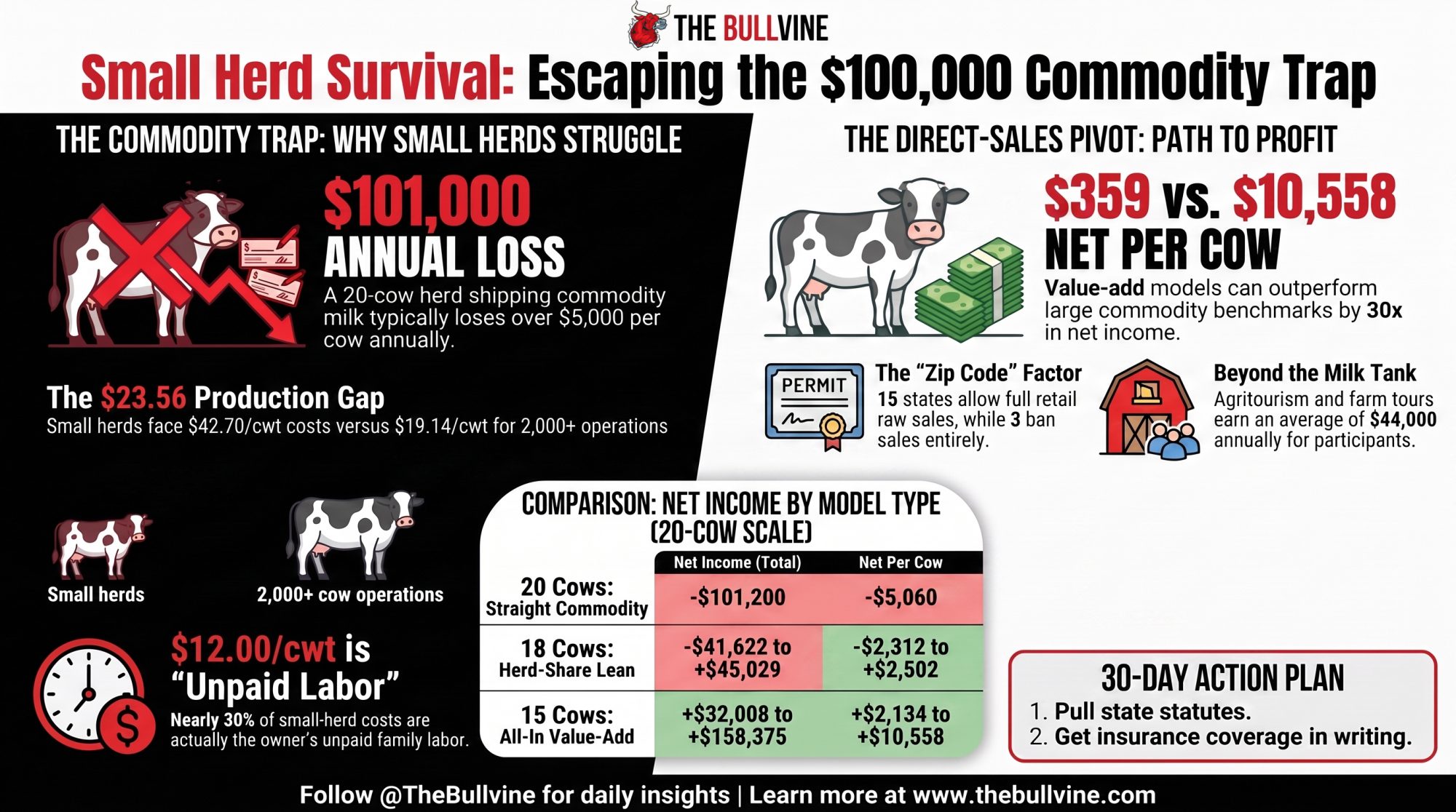
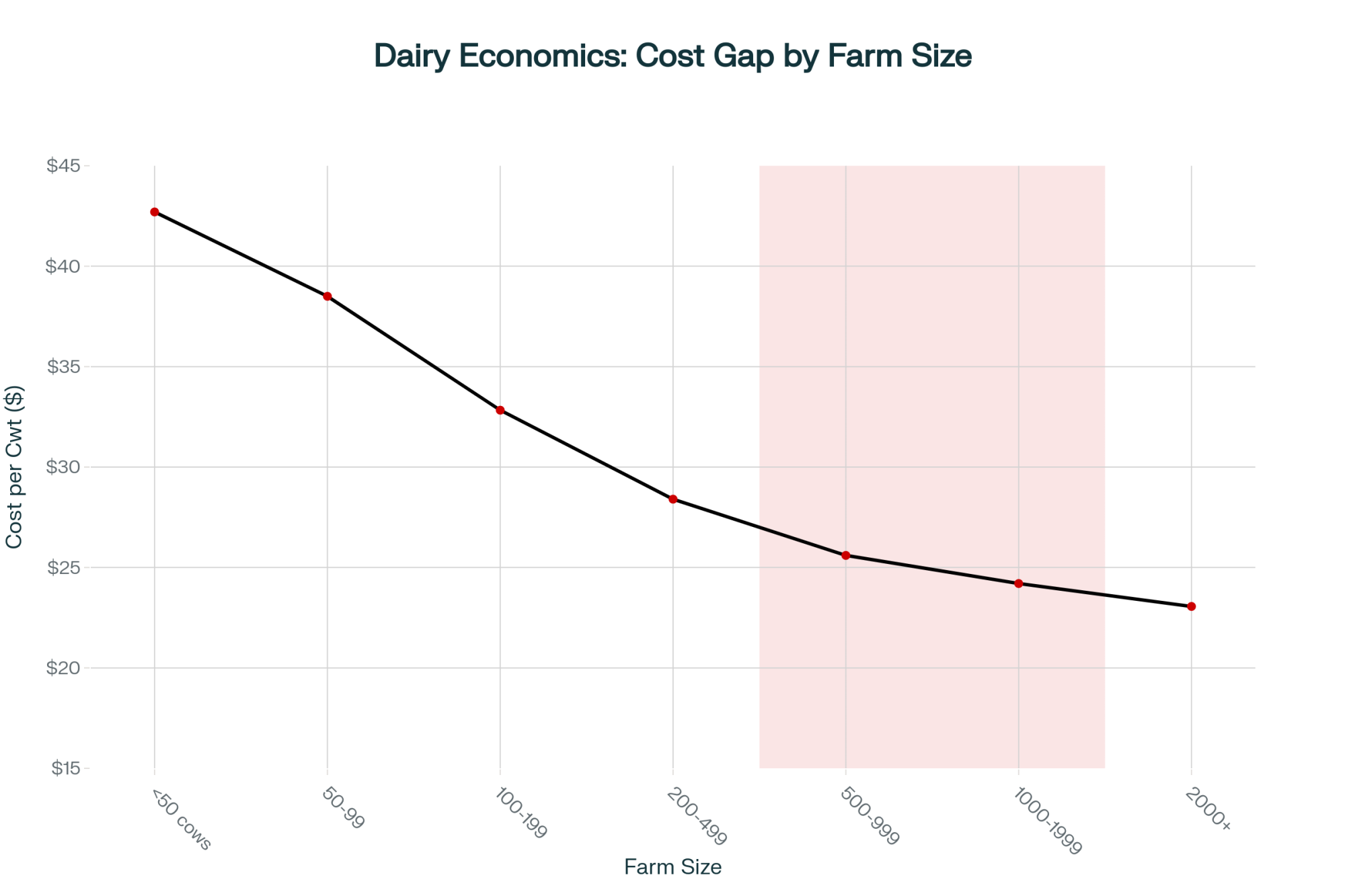
ERS’s February 2026 cost‑of‑production work (ERR‑334) explains why this is hitting smaller herds first. For herds under 50 cows, full economic cost — cash expenses plus depreciation, unpaid labor, and opportunity cost — sits above 42.70 $/cwt. In the 100–499‑cow bracket, total economic costs cluster roughly between 19 and 21 $/cwt once you count everything, not just the checks you write. At a 19.70 $/cwt all‑milk forecast, any mid‑size herd with a true breakeven near 21.00 is losing about 1.30 $/cwt, even if there’s still something left after paying feed and fuel.

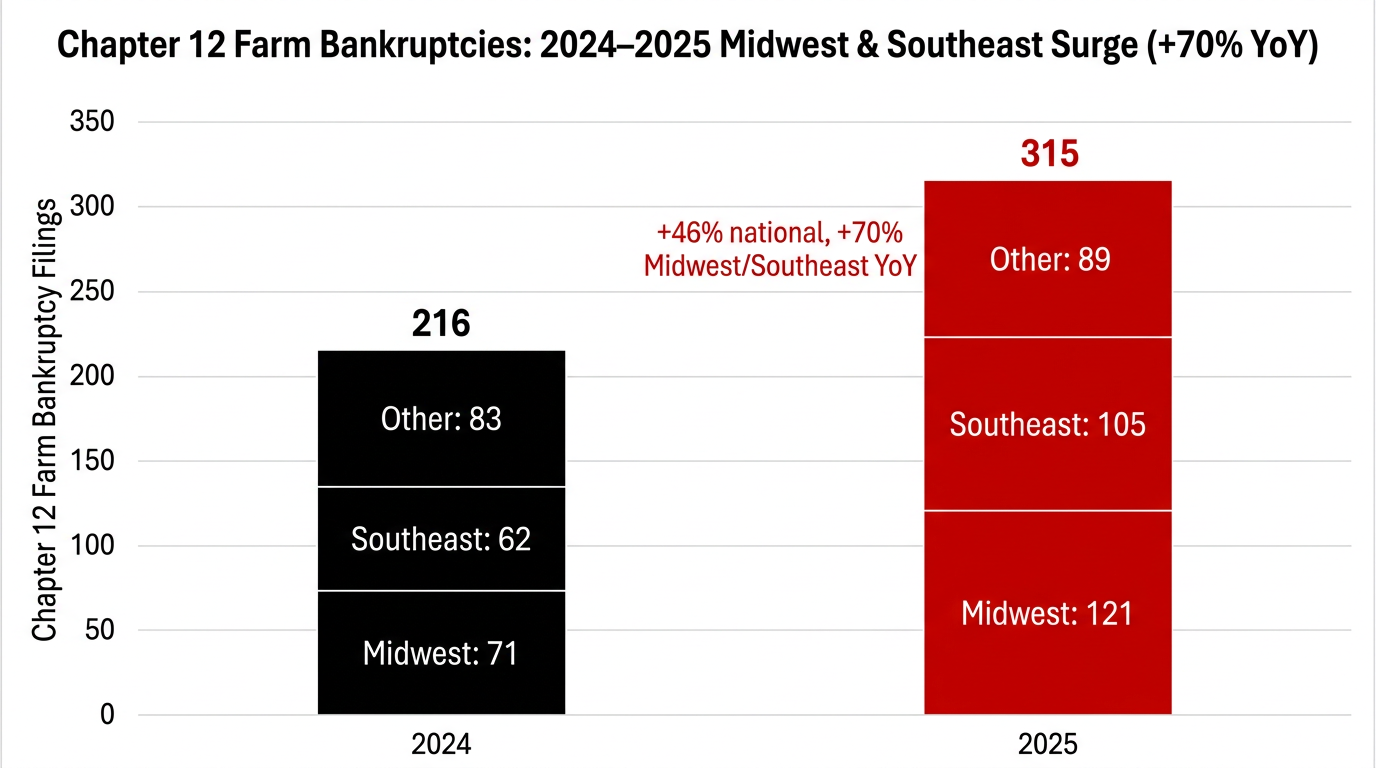
That pressure is showing up in the courts. According to U.S. Courts data summarized by the American Farm Bureau Federation and university analysts, 315 Chapter 12 farm bankruptcies were filed in 2025, up 46 % from 216 in 2024. The Midwest region logged 121 cases, while the Southeast recorded 105, and filings in both regions rose roughly 70 %year‑over‑year. When you hear neighbors say, “We just need one good year,” this is the backdrop — a lot of farms tried to wait that year out and met their lender and their lawyer instead.

Region2024 Filings2025 Filings
Midwest71121
Southeast62105
Other Regions8389
Total216315

The Hidden Story: Georgia’s Rise and New Mexico’s Floor

Not every growth story comes with sand and center‑pivots.

Georgia quietly led the Southeast in 2025. NASS numbers and extension analysis show the state adding around 3,000 cows and boosting milk output by about 7.8% to roughly 2.09 billion lb, while losing only five dairies. The anchor is Walmart’s 350‑million‑dollar bottling plant in Valdosta, which opened in December 2025 and now supplies more than 650 Walmart and Sam’s Club stores across the Southeast with private‑label milk sourced from regional farms. If you’re milking in Alabama or the Florida panhandle and telling yourself, “This region’s done for dairy,” Georgia is the counter‑example — the plant showed up, and the cows followed.

On the other side, New Mexico looks “stable” in the scorecard — small further farm loss, flat‑to‑slightly‑negative milk — but only because the hard part already happened. Years of contraction stripped out almost every sub‑1,000‑cow operation and left a landscape dominated by 2,000‑plus‑cow barns shipping into a handful of plants. If you’re a 200‑cow operator in Wisconsin or Pennsylvania, New Mexico isn’t an oddity. It’s a possible future — after your region has already done a lot of painful shrinking.

What Does 19.70 Milk Actually Look Like on Your Farm?

Let’s get out of the abstract and into numbers you can map onto your own herd.

Say you’re milking 200 cows in Wisconsin or Pennsylvania. USDA’s 2025 numbers say the average U.S. cow shipped about 24,390 lb — that’s 243.9 cwt per cow per year.

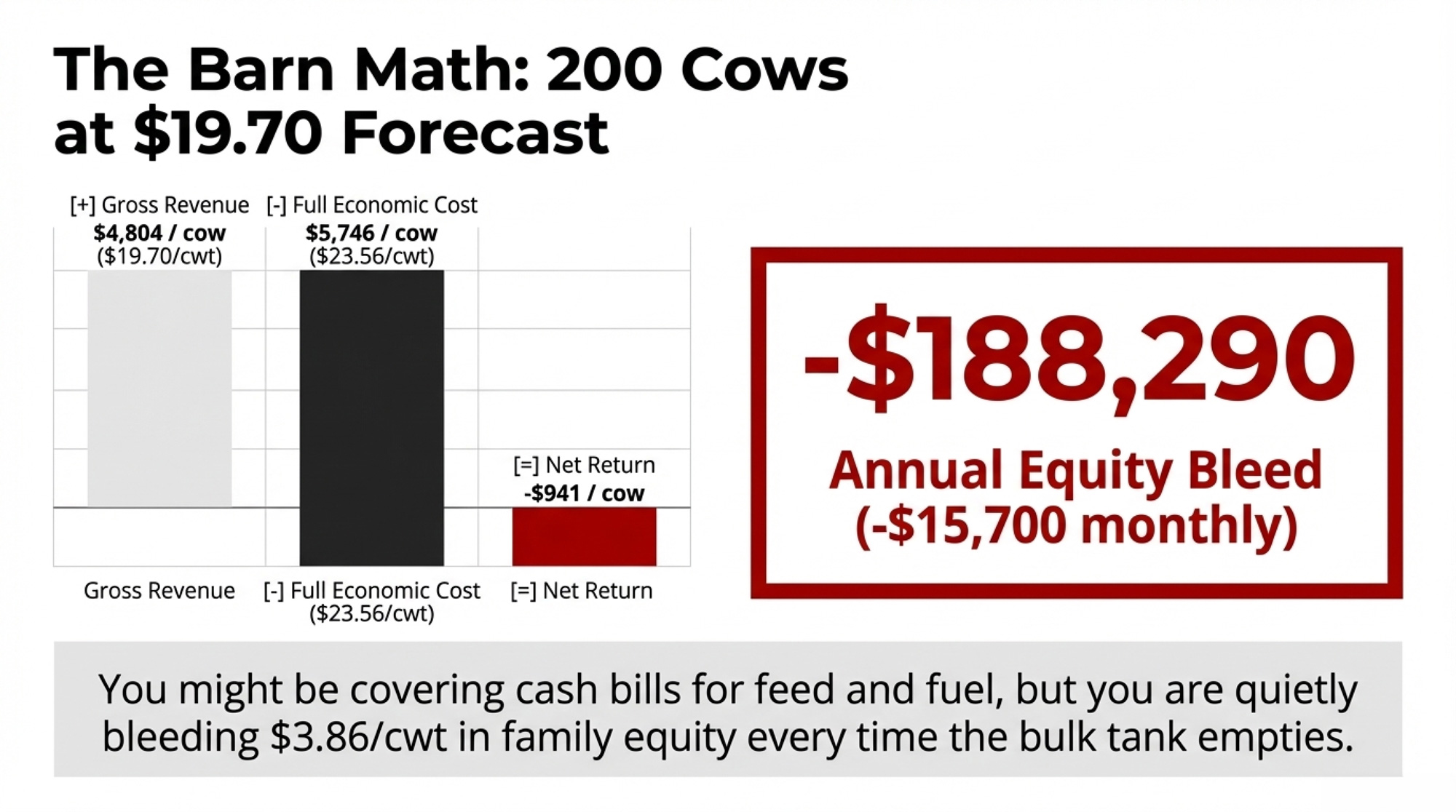
Barn Math: 200 Cows at 19.70 Milk

Revenue side (all‑milk forecast 19.70 $/cwt):

  • Milk per cow: 243.9 cwt
  • Gross revenue per cow: 243.9 × 19.70 = 4,804.83 $/cow
  • Total herd revenue (200 cows): 960,966 $

Cost side (full economic cost, ERS/Illinois FBFM example):

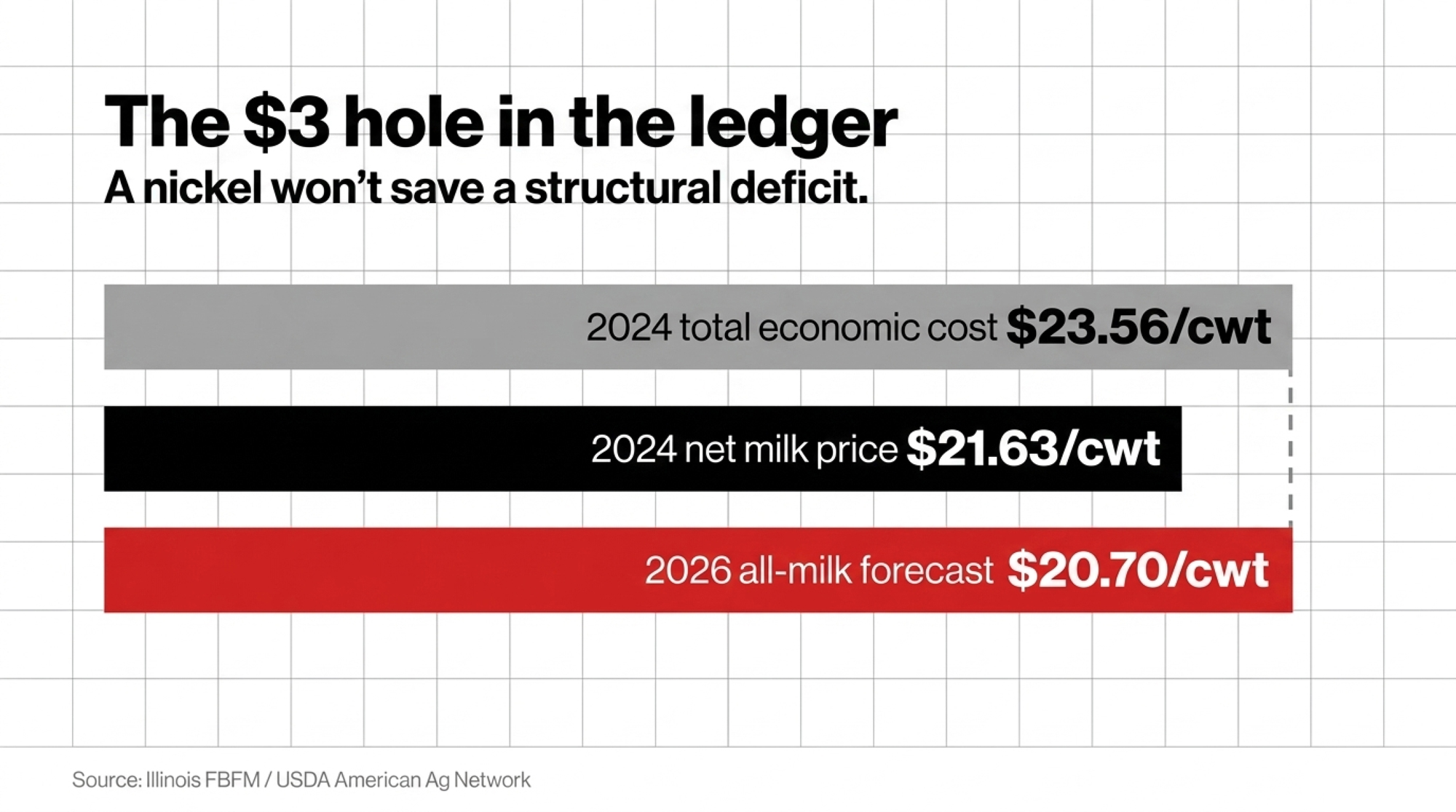
  • Total economic cost per cwt: 23.56 $/cwt
  • Total cost per cow: 23.56 × 243.9 = 5,746.28 $/cow
  • Total herd cost (200 cows): 1,149,257 $

Bottom line:

  • Net return per cow: 4,804.83 − 5,746.28 = –941.45 $/cow
  • Annual net loss: –188,290 $
  • Monthly equity bleed: about –15,700 $/month

That’s at 19.70 $/cwt. You’re probably covering cash bills for feed, fuel, and vet — ERS benchmarks often put cash operating costs in the mid‑to‑high teens per cwt. The grain mill gets paid. The TMR still runs. Maybe you chip away at some old payables.

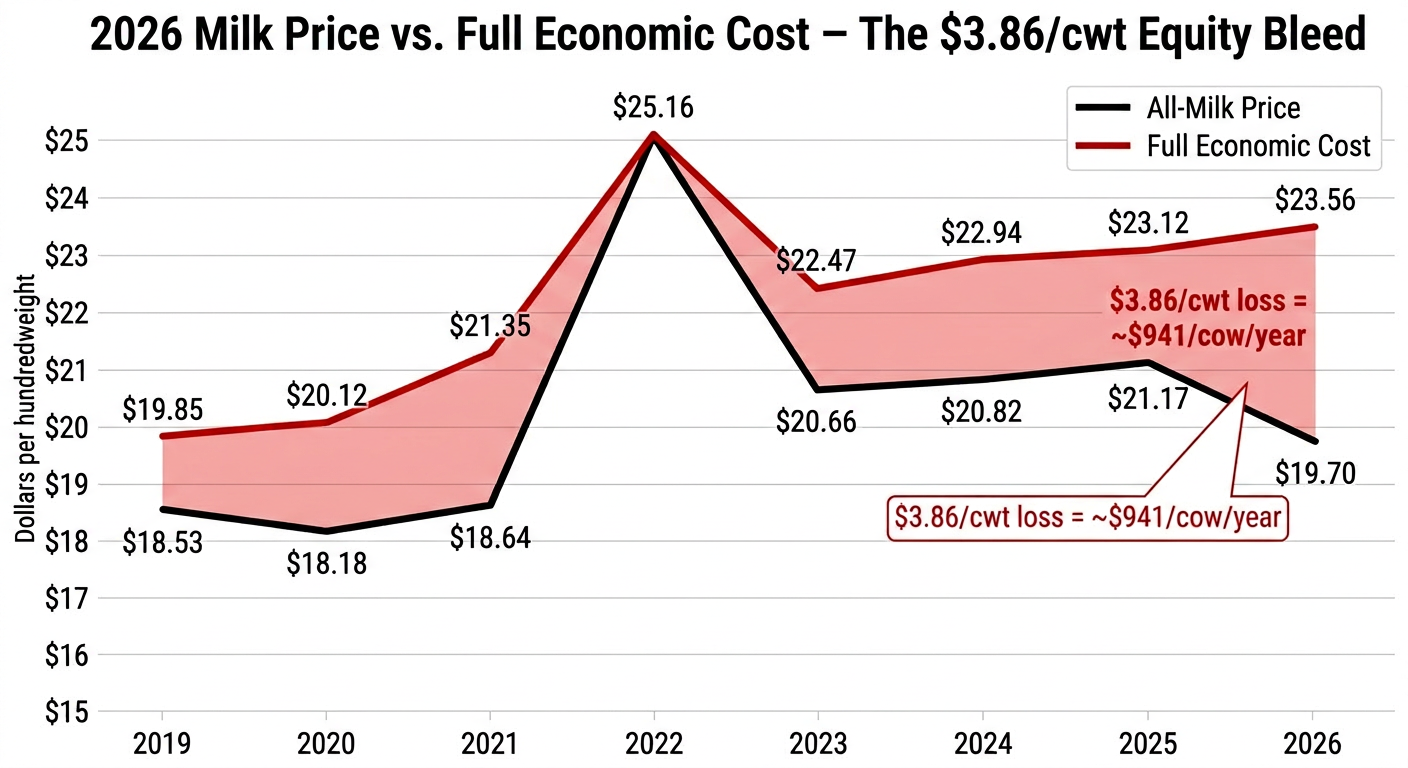
YearAll-Milk Price ($/cwt)Full Economic Cost ($/cwt)
201918.5319.85
202018.1820.12
202118.6421.35
202225.1624.89
202320.6622.47
202420.8222.94
202521.1723.12
202619.7023.56

But you’re not paying yourself a fair wage. You’re not truly replacing equipment. You’re not paying for the capital already sunk into cows and concrete. And you’re quietly moving about 3.86 $/cwt of value — the gap between full economic cost (23.56) and forecast price (19.70) — out of your equity column every time you ship a hundredweight.

Line ItemPer Cow ($/cow/year)200-Cow Herd ($/year)
REVENUE
Milk production (cwt/cow/year)243.9 cwt48,780 cwt
All-milk price ($/cwt)$19.70$19.70
Gross milk revenue$4,804.83$960,966
Cull cow & calf revenue$285$57,000
Total Revenue$5,089.83$1,017,966
COSTS (Full Economic)
Feed (purchased + homegrown)$2,850$570,000
Labor (paid + unpaid family)$1,125$225,000
Replacement heifers$620$124,000
Fuel, utilities, repairs$485$97,000
Vet, breeding, supplies$310$62,000
Interest & debt service$245$49,000
Depreciation (facilities, equipment)$385$77,000
Opportunity cost (equity, land)$526$105,200
Total Economic Cost$6,546.28$1,309,257
NET RETURN-$1,456.45-$291,290
Monthly equity bleed-$121/cow/month-$24,274/month

If your basis is weak or your SCC premiums are off by 0.25–0.50 $/cwt, the hole gets deeper. That “one good heifer every 23 days” image isn’t an exaggeration — this example is roughly burning that value, whether you see it on a statement or not.

Question-Style Subhead #1 — Economic/Decision Angle

Where Does Your Real Breakeven Sit — and How Long Can You Live Below It?

This is the question everything else hangs on. You can’t decide whether to scale, specialize, or exit until you know what a hundredweight actually costs you.

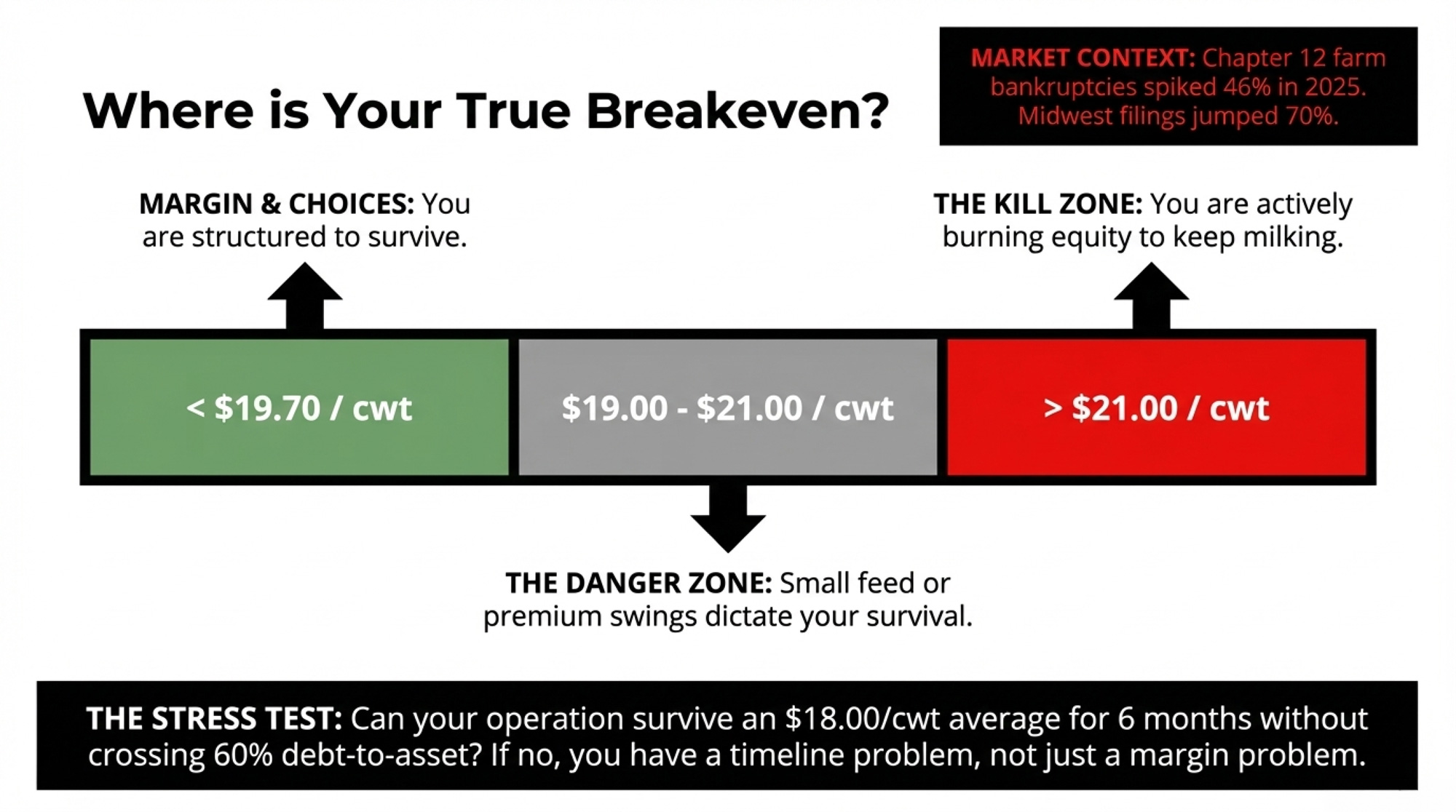
Pull the last 12 months of real numbers: feed (including home‑grown at market value), fuel, repairs, vet, breeding, interest, insurance, taxes, family living, and a realistic wage for your time. Divide by shipped cwt, not “produced” milk. If that all‑in number is:

  • Under 19.70 $/cwt — you have margin and choices.
  • Around 19–21 $/cwt — you’re in the gray zone where small changes in milk price or feed cost swing you from black to red.
  • Above 21 $/cwt — you’re already in kill‑zone territory. The longer you run like this, the more equity quietly disappears.

Then stress‑test at 18.00 $/cwt for six months. That’s not a fantasy — January 2026 Class III printed at 14.59 $/cwt, February only improved to 14.94, before basis, hauling, and deductions. At an 18‑dollar average for half a year, can your operation stay under about 60 % debt‑to‑asset and avoid burning more than 15 % of your equity? If the honest answer is “no,” you’ve got a timeline problem, not just a margin problem.

Question-Style Subhead #2 — Operational/Management Angle

What Can You Realistically Change in the Next 30 Days?

You don’t rebuild a cost structure overnight. You can absolutely change its trajectory in a month.

In the next 30 days, you can:

  • Sit down at the kitchen table for two hours with last year’s numbers and build your real cost per cwt on paper or with your advisor. That one session changes how you look at every other decision. 
  • Re‑draw your breeding plan so beef semen only hits cows you don’t want daughters out of, and your highest‑merit cows only see high‑profit dairy sires.
  • Mark cull candidates using both production and genetics — cows sitting in the bottom slice of NM$ who are also lagging in components or fertility.
  • Call your co‑op or plant rep and ask bluntly what basis, premiums, or volume commitments are likely to look like over the next 12–24 months in your exact area.

You don’t have to decide in 30 days whether to build a 500‑stall barn. You do have to decide whether you’re going to keep feeding cows that don’t pencil at 19‑dollar milk.

How Do You Use Beef‑on‑Dairy as a Tool, Not a Trap?

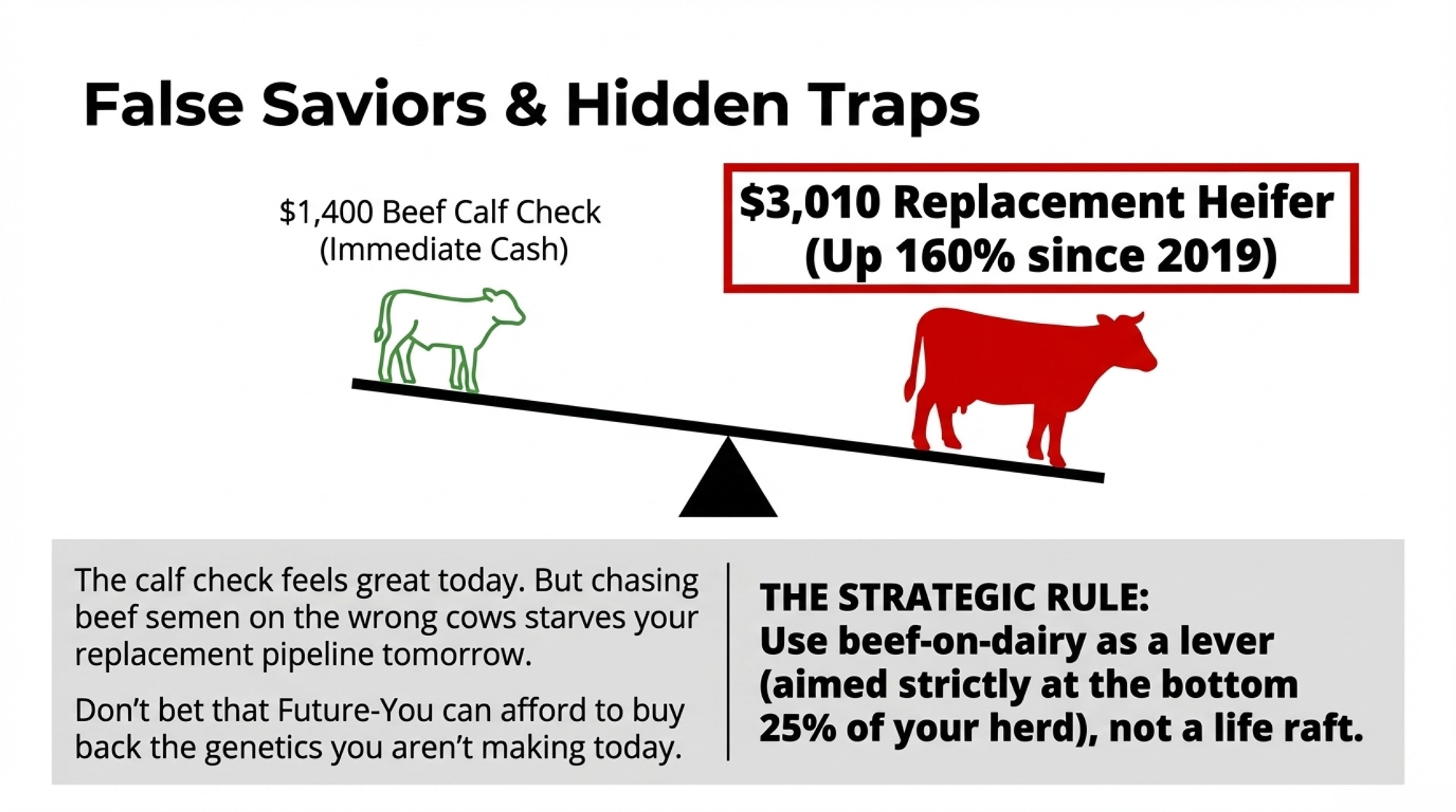
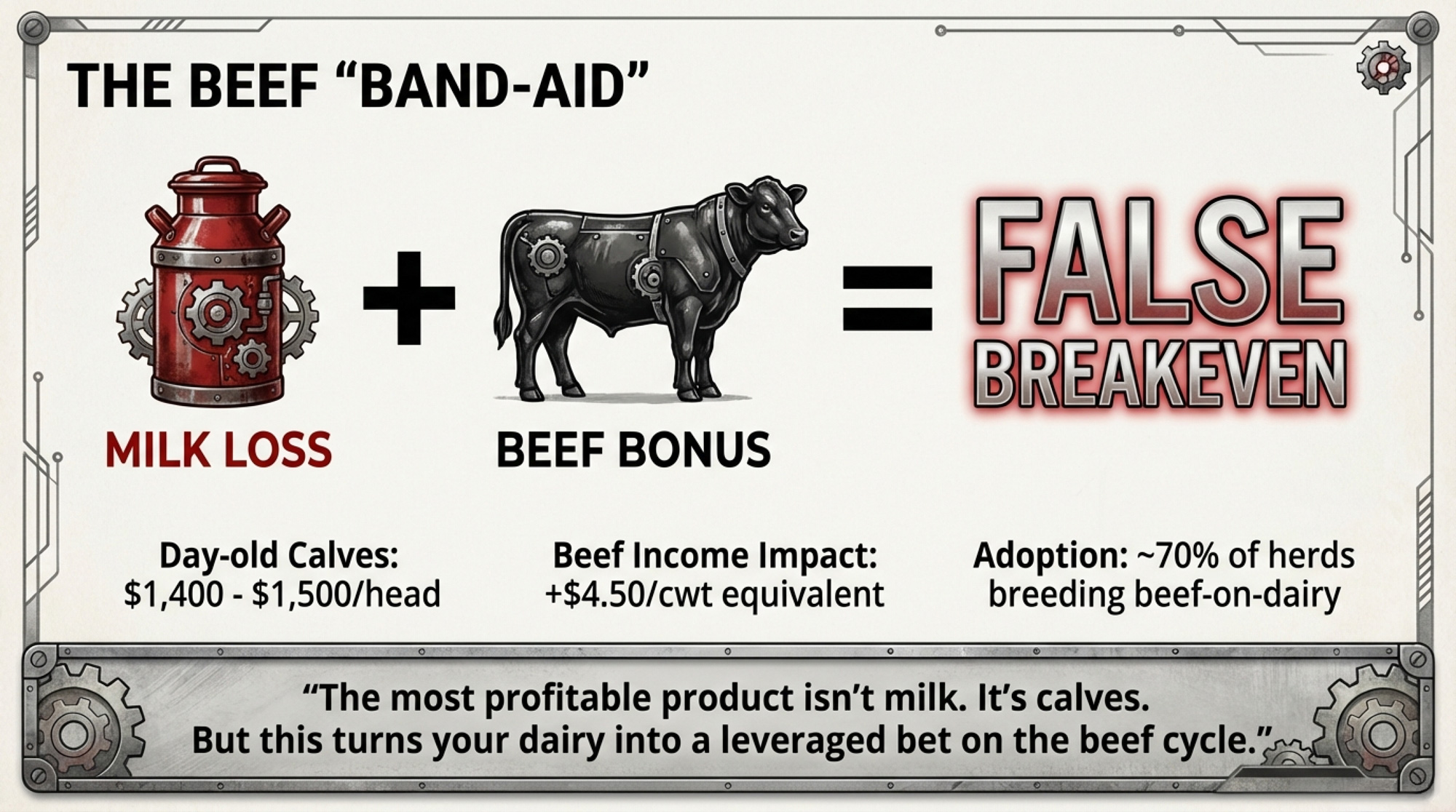
Beef‑on‑Dairy has been the hottest “extra margin” lever in a lot of parlors and robot rows. Trade and extension reports still talk about beef‑cross calves bringing up to around 1,400 $ a head in some programs when the genetics and weights are right. Spread across your total shipped cwt, that can effectively add 2–3 $/cwt worth of value if you’re consistent and disciplined.

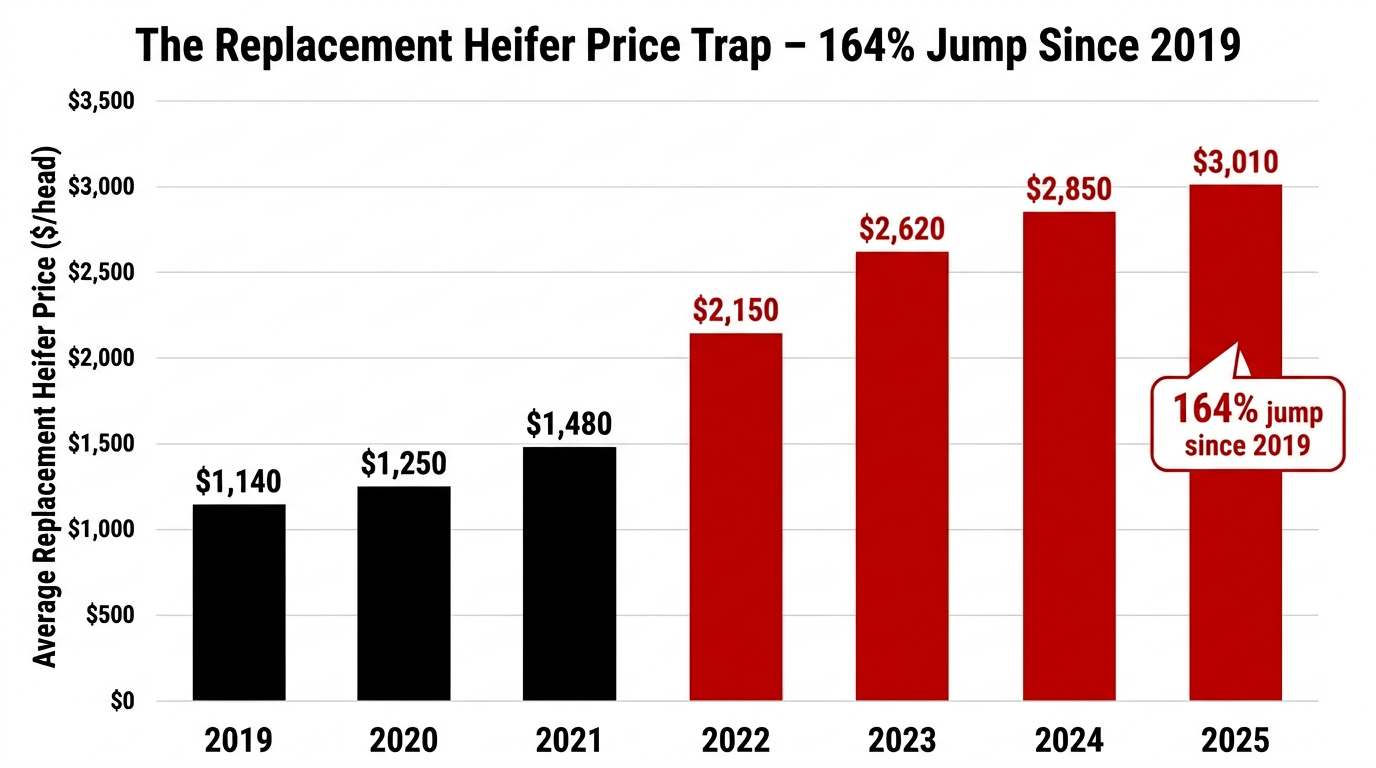
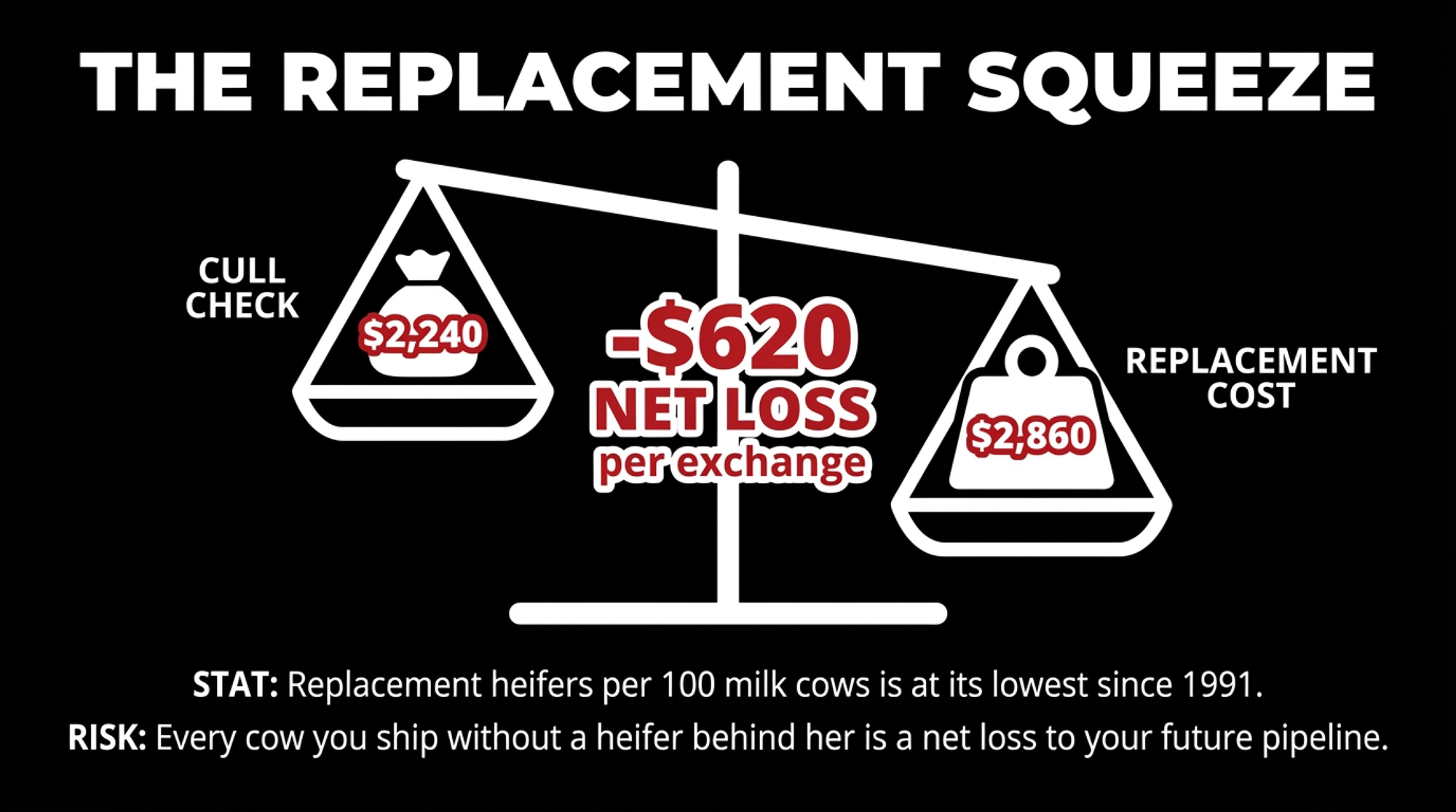
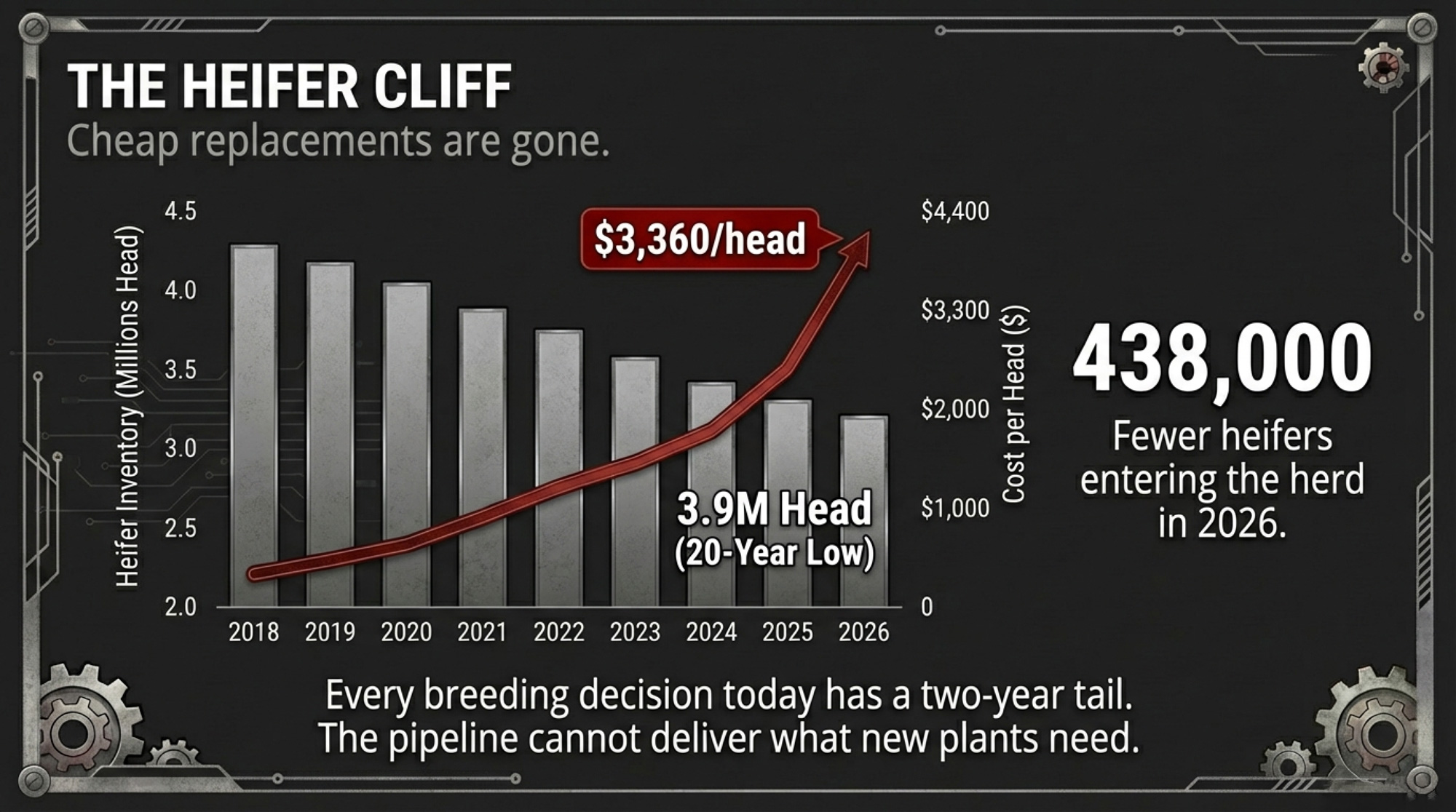
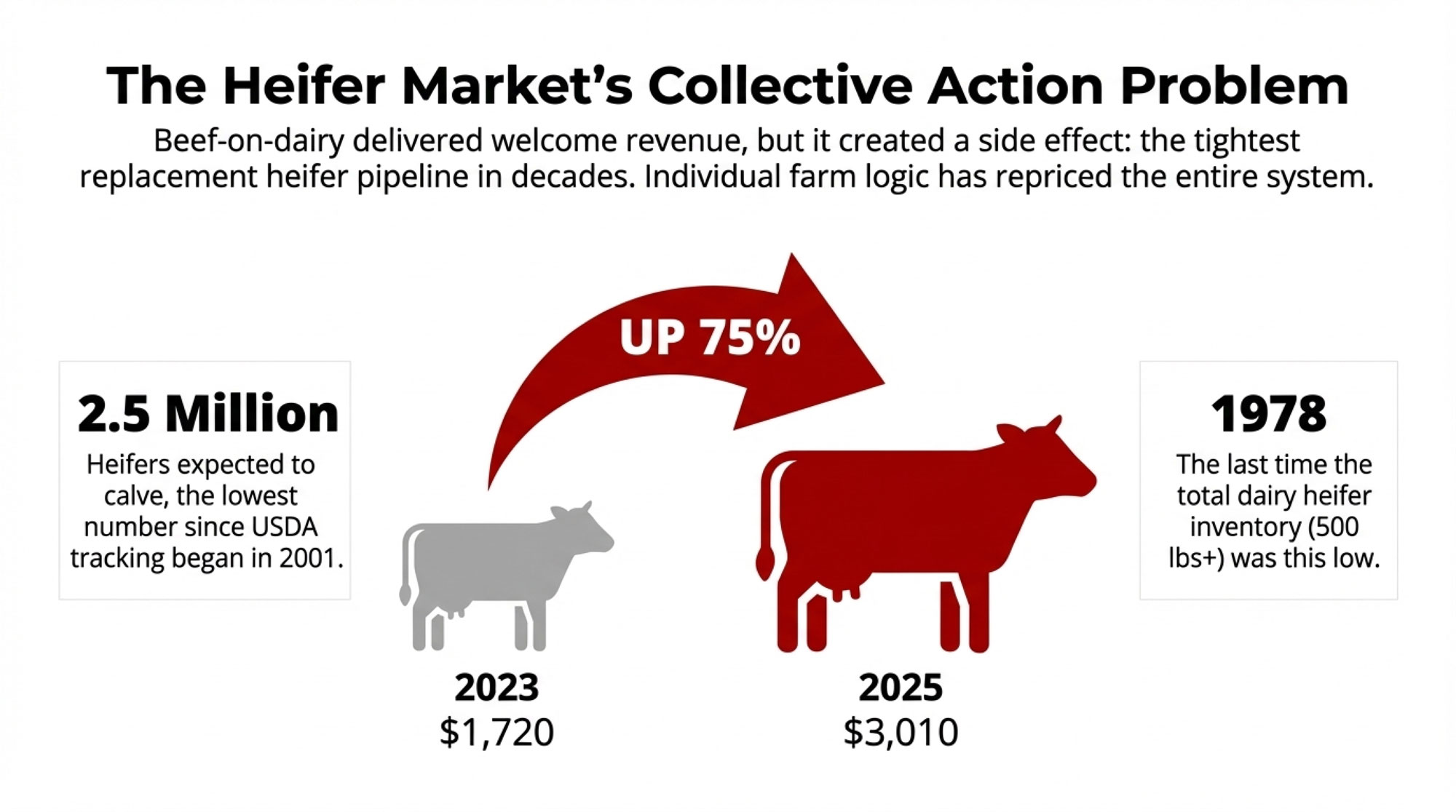
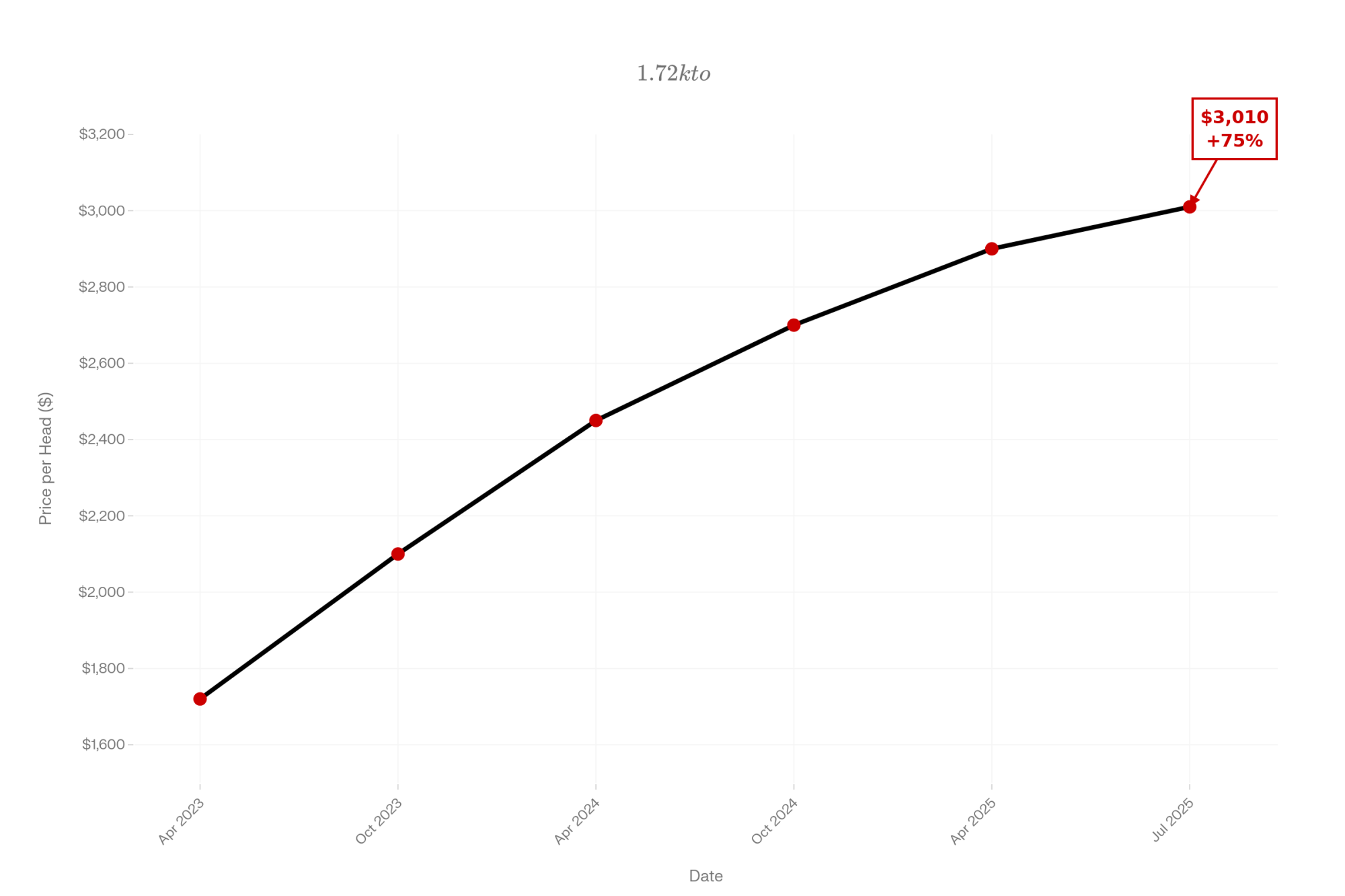
But there’s a hidden tax: replacements. USDA’s price series and industry coverage show dairy replacement heifers averaging around 3,010 $/head by mid‑2025, up from roughly 1,140 $ in 2019 — about a 160 % jump in six years. So every time you chase a high‑priced beef‑cross calf instead of a heifer, you’re betting that Future‑You can afford to buy back the genetics you’re not making today.

The smart way to play Beef‑on‑Dairy in a 19‑dollar world is as a lever, not a life raft:

  • Aim beef semen at your low‑merit cows first, not your best.
  • Keep beef to roughly a quarter to a third of your breedings so you don’t starve your replacement pipeline. 
  • Pair it with a genetics plan, not just a cash‑flow band‑aid.

The calf checks feel great. The real test is whether your replacement math still works 18–24 months from now when those heifers should be freshening.

Can Genetics Keep You Off the Auction Block?

Feed, bedding, and power hit every cow the same. Genetics is where you decide which cows deserve a spot on your TMR.

USDA‑ARS is blunt about Net Merit: NM$ is a measure of lifetime profit. It’s built to rank animals by net dollars they’re expected to return, not just yield. When you genomic test and line your cows and heifers up by NM$ or your co‑op’s profit index, you’re looking at who’s likely to pay their way — and who’s just eating.

At 19–20 $/cwt milk, you can’t afford to carry a long tail of passengers. Practical steps:

  • Sort your cows and heifers by NM$ or your chosen index and print the list. 
  • Circle the bottom slice — whatever percentage your gut can handle — and ask, cow by cow, “Does she justify another lactation, another breeding, or another year’s feed?”
  • Get especially honest about the heifers stuck in the bottom half of your genomic ranking. In this environment, raising a low‑merit heifer to calving is often worse than selling her and keeping the cash.

You don’t have to chase sky‑high GTPI or build a show string. You do have to stop feeding genetics that have no realistic shot at paying their way under the margins USDA is telling you to expect.

How Do You Use DMC and Risk Tools Without Fooling Yourself?

The 2026 Dairy Margin Coverage enrollment window ran from January 12 to February 26, 2026, so by now, you either locked it in or you didn’t. Under the updated rules, Tier I coverage now extends up to 6 million lb of production history per year — plenty to blanket a 200–500‑cow herd at realistic production levels.

ERS’s LDP‑M‑380 shows how quickly the DMC margin can move when feed and milk don’t play nice together. In late 2025, margins slid close to trigger levels as milk softened while feed costs remained stubbornly high. If you enrolled, those Tier I checks won’t magically turn a structurally unprofitable herd into a winner, but they can plug real holes when margins squeeze hard.

If you didn’t enroll, now’s the time to sit down with your lender and risk‑management advisor and talk about Dairy‑RP, forward contracts, or co‑op tools — not when your Class III mailbox price is already starting with a “1,” and your equity chart is pointed straight down.

What DMC and risk tools cannot do is change the basic fact that if your full cost sits above the price line, you’re selling equity every time the tank empties.

Options and Trade-Offs for Farmers

Here’s where the rubber meets the lane. There are only a few real paths. The math above is what each path is working against.

PathWhen It Makes SenseKey Actions (Next 30–90 Days)What You GainWhat You Give Up / Risk
1. Fix Cost StructureFull cost within 1–2 $/cwt of forecast price; solid facility; debt manageable; willing to cut ruthlessly– Run true cost/cwt with advisor- List specific cuts (rent, machinery, low-merit cows)- Hunt SCC/component premiums- Stress-test at $18/cwt for 6 monthsSurvival without major capital; preserve equity; keep optionality for next moveCan cut into burnout if you don’t know when to stop; only works if gap is ≤2 $/cwt
2. Scale or AlignIn growth corridor (TX, KS, SD, ID, Southeast); processor adding capacity; willing to leverage up or commit volume long-term– Contact plant/co-op for volume contracts- Model expansion to 500–1,000+ cows- Secure basis guarantees or premiums- Line up financing with lenderBetter basis, stable premiums, lower fixed cost/cwt; processor wants your milkLose flexibility; high leverage = faster pain if Class III tanks; stuck in contract even if milk crashes
3. Specialize & Strip OverheadRegion won’t support mega-scale; real niche demand (A2A2, grazing, on-farm bottling, local brand); you like marketing– Match genetics/cow type to niche- Cut anything not serving the premium- Build direct customer pipeline- Get comfortable with people, not just cowsSwap FMMO risk for niche margin; can feel like 22–23 $/cwt effective price; differentiation protects youCustomer risk replaces market risk; lose a key buyer = scramble; requires marketing skills most don’t have
4. Plan Strategic ExitFull cost clearly >21 $/cwt; worn out; no clear successor; equity preservation matters more than legacy– Price cows & heifers NOW (3,010 $ heifers, 1,800–2,000 $ cows vs. 1,400 $ distressed)- Model liquidation value vs. forced sale- Talk to family, lender, lawyer- Set timeline before bank sets it for youPreserve 30–40% more equity than distressed sale; protect family balance sheet; exit with dignityEmotional cost is brutal; end of generational identity; no second chance if you wait too long and values crash

Path 1: Fix the Cost Structure (Start in the Next 30 Days)

When it makes sense
You’ve got a solid facility, decent cow flow, and debt that isn’t already crushing you. You’re willing to cut pet expenses and sacred cows — literal and figurative — if the numbers say they should go.

What it takes
You do a full, honest cost‑of‑production run — no “back of the napkin,” no ignoring family living. You list specific cuts or changes: maybe it’s dropping one rented parcel that never pays, changing TMR ingredients, or burning down non‑productive machinery. You hunt for easy nickels: better components, SCC premiums, co‑op quality bonuses.

The limits
You can cut your way into survival. You can also cut your way into burnout if you don’t know where to stop. This path works best when your full cost is within 1–2 $/cwt of the forecast price and the barn math says you can close that gap.

Path 2: Scale or Align — If Your Region Wants More Milk

When it makes sense
You’re in a growth corridor — Texas Panhandle, I‑29, Idaho, parts of the Southeast — where processors are actively adding capacity and courting new milk.

The play
You either add cows significantly or tie your existing string into a long‑term supply relationship. That might be a direct contract with a cheese plant, a guaranteed‑volume arrangement through your co‑op, or a barn expansion that moves your average cost per cwt down as you fill stalls.

The catch
You gain a better basis and potentially more stable premiums. You give up flexibility and take on more fixed costs. If Class III spends another year flirting with the mid‑teens, highly leveraged big herds feel that pain faster and harder than smaller, lightly leveraged ones.

Path 3: Specialize and Strip Overhead

When it makes sense
You’re in a region where you’ll never out‑scale the 4,000‑cow outfits, but there’s real demand for something different — higher components, grazing‑based milk, A2A2, on‑farm processing, or a branded local product.

What it requires
You match your genetics, cow type, and farm layout to that niche. You cut anything in your cost stack that doesn’t feed the niche premium. You get comfortable with marketing and people, not just cows.

The trade‑off
You swap FMMO risk for customer risk. Lose a key buyer, and you’re scrambling. But if the niche is real — and if you execute — you can turn a 19‑dollar commodity environment into something that feels more like 22–23 $/cwt on your milk check.

Path 4: Plan an Exit While Cows and Heifers Are Still Worth Real Money

When it makes sense
Your full‑cost number is clearly above 20 $/cwt, you’re worn out, and the successor plan is blurry or non‑existent.

What it looks like
You look straight at the current replacement and cull values. In 2025, replacement heifers averaged around 3,010 $, and many good cows would bring 1,800–2,000 $; in a forced or distressed liquidation, those numbers can slide toward 1,400 $ for cows. That’s a 450 $/head swing. Across 300 cows, that’s roughly 135,000 $ that either lands in your bank account or disappears if you wait too long.

The hard part
Emotionally, this is the toughest path. Practically, it can be the one that protects the most family equity and gives the next generation the best footing — whether they farm or not.

Key Takeaways

  • If your full‑cost breakeven is above 21 $/cwt, 19.70 milk isn’t a rough patch — it’s a slow equity bleed. Either fix the cost, add a margin, or set a clear exit timeline before the bank or your health sets it for you.
  • If you’re in a processing growth zone and your true cost per cwt is competitive, scaling or aligning with a plant can turn 19‑dollar milk into a workable long‑term play — but only if you respect the leverage and build a genetics pipeline that keeps replacements affordable.
  • If your proof sheets show a long tail of low‑NM$ or low‑index cows and heifers, feeding them is a choice — culling the bottom slice and only raising replacements from the top half of your ranking is one of the cleanest ways to lift dollars per cwt without adding a single stall.
  • If you can’t run your own barn math in the next 30 days, you’re flying blind — the biggest risk to your operation isn’t the market, it’s not knowing exactly where your kill zone starts in dollars per cwt.

The Bottom Line

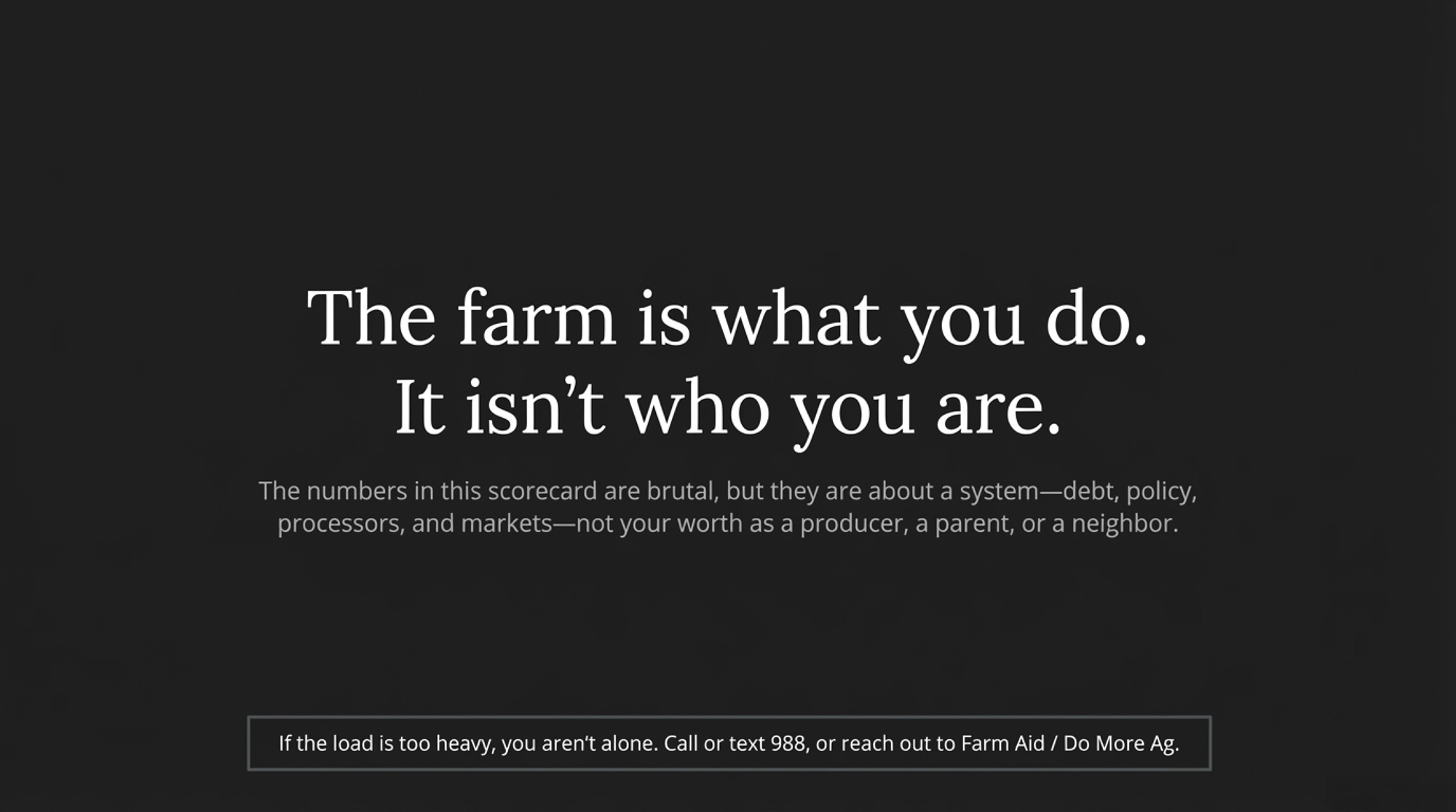
The farm is what you do; it isn’t who you are. The numbers in this scorecard are brutal, but they’re about a system — debt, policy, processors, and markets — not your worth as a producer, a parent, or a neighbor. If walking through this math makes your chest tight or your stomach knot up, that’s not weakness. That’s your body saying the load is heavy. Talk with someone you trust — spouse, vet, lender, neighbor. And if it feels like too much, you can call or text 988 in the U.S., or reach out to farm‑focused supports like Farm Aid or Do More Ag, and talk to someone who understands what you’re carrying.

Then, with your own cost per cwt and best‑guess 12‑month milk price written down in front of you, decide: are you going to fix, scale, specialize, or exit? And before six more milk checks hit the mailbox, what single move — cull list, genetics plan, risk‑management conversation, or succession step — are you willing to make so your herd doesn’t quietly slide deeper into the kill zone?

Complete references and supporting documentation are available upon request by contacting the editorial team at editor@thebullvine.com.

Learn More

  • Maximizing Your Milk Check: The 2025 Guide to Component Pricing – Stop leaving money in the parlor. This guide exposes the specific component thresholds required to outrun rising input costs and delivers a tactical roadmap for adjusting rations to capture every possible premium on your next check.
  • The Year of the Great Divide: Navigating Dairy Consolidation – Secure your operation’s future against aggressive structural shifts. This analysis breaks down the economic forces hollowing out the middle market, arming you with the long-term positioning strategies needed to survive the next five years.
  • Precision Breeding: Using NM$ to Outrun the Commodity Trap – Outrun the commodity trap with data-driven selection. This deep dive reveals how leveraging Net Merit (NM$) and genomic testing creates a high-efficiency herd, giving you a decisive competitive advantage in a low-margin environment.

The Sunday Read Dairy Professionals Don’t Skip.

Every week, thousands of producers, breeders, and industry insiders open Bullvine Weekly for genetics insights, market shifts, and profit strategies they won’t find anywhere else. One email. Five minutes. Smarter decisions all week.
NewsSubscribe
First
Last
Consent

$18.95 Milk & The 0.53x DSCR: Why Your Banker Is Already Moving Without You

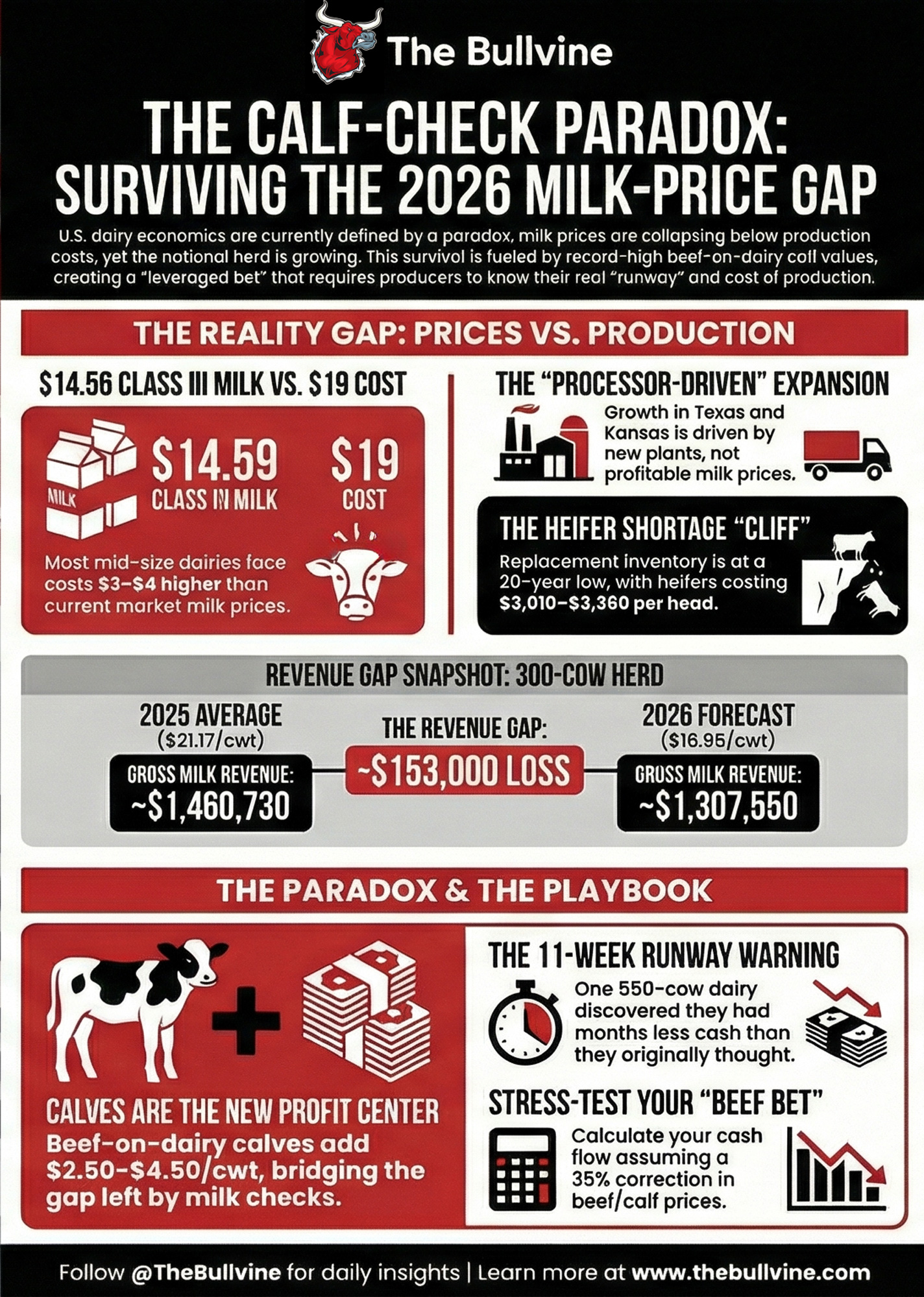
A 550-cow Wisconsin dairy had 11 weeks of cash left at $18–$19 costs and didn’t know it. When you run a real COP, how much runway do you actually have?

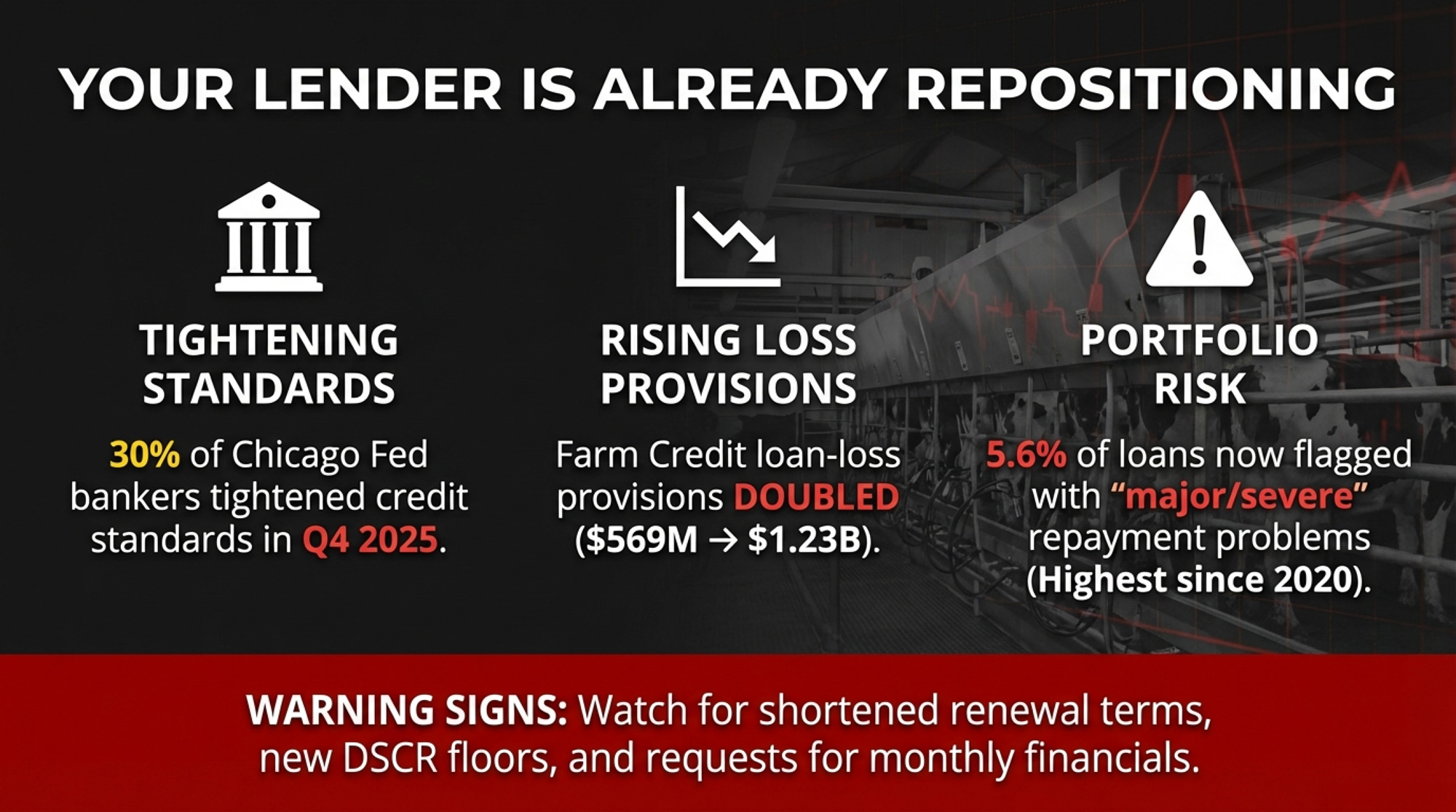
Executive Summary:  USDA’s 2026 all‑milk forecast of $18.95/cwt can knock a 400‑cow herd’s DSCR from 1.78x to 0.53x on paper — same cows, same debt, very different conversation with your lender. This piece walks you through that math, then shows how a 550‑cow Wisconsin dairy discovered an $18.75/cwt true cost of production and just 11 weeks of cash runway after a real COP review. It explains how bankers are already repositioning — from 30% tightening standards in the Chicago Fed’s district to Farm Credit more than doubling its loan‑loss provisions — and why that hits some regions harder than others. You see why Wisconsin and New York can add cows while Pennsylvania loses farms and processors, and what that geography shift means for your renewal odds. Most importantly, you get DSCR and breakeven thresholds you can plug into your own numbers, a three‑tier action plan by herd size, and a 30‑day checklist to run before you sit down with your lender. If you want one article to double-check whether you’re still comfortably bankable at $18.95 milk, this is it.

dairy debt service ratio

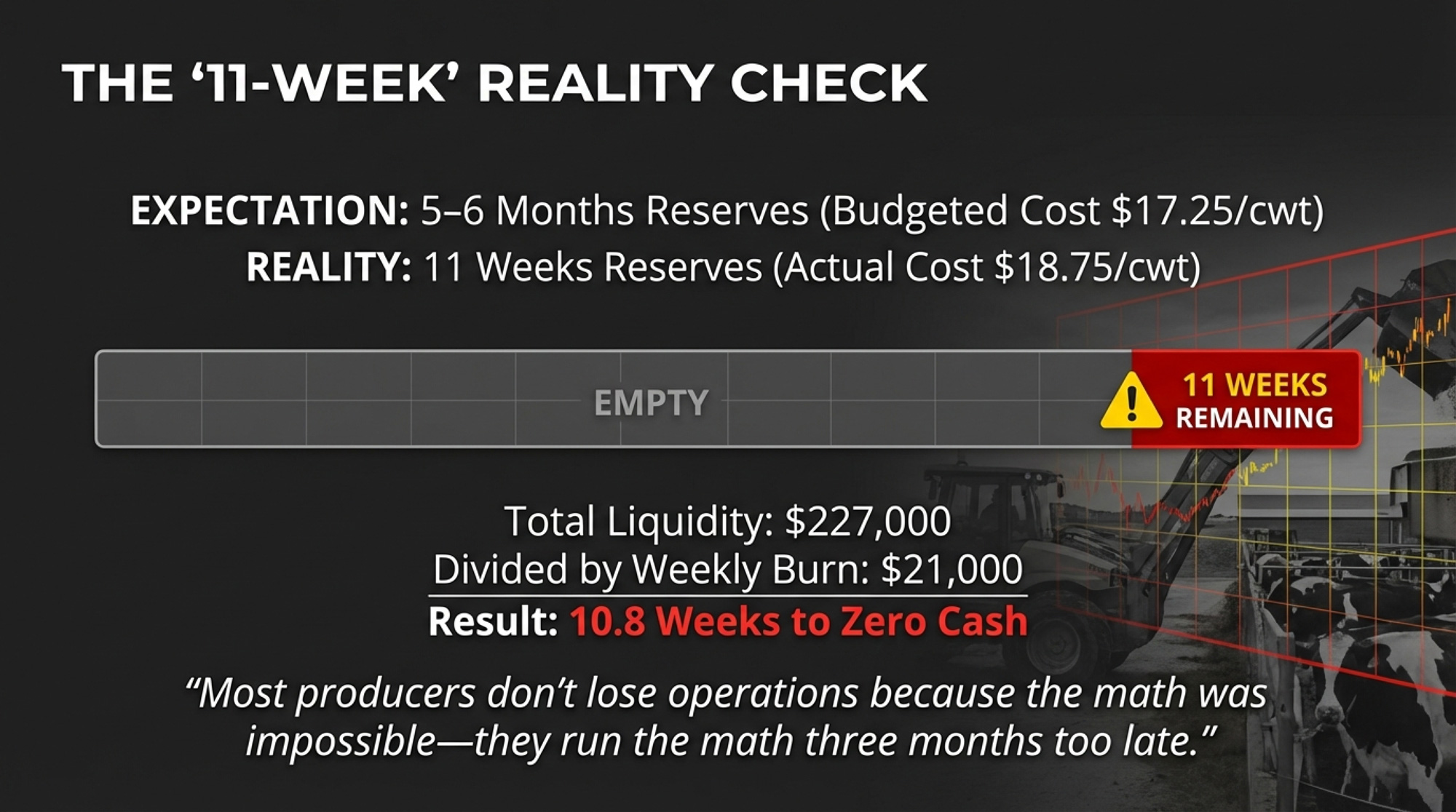
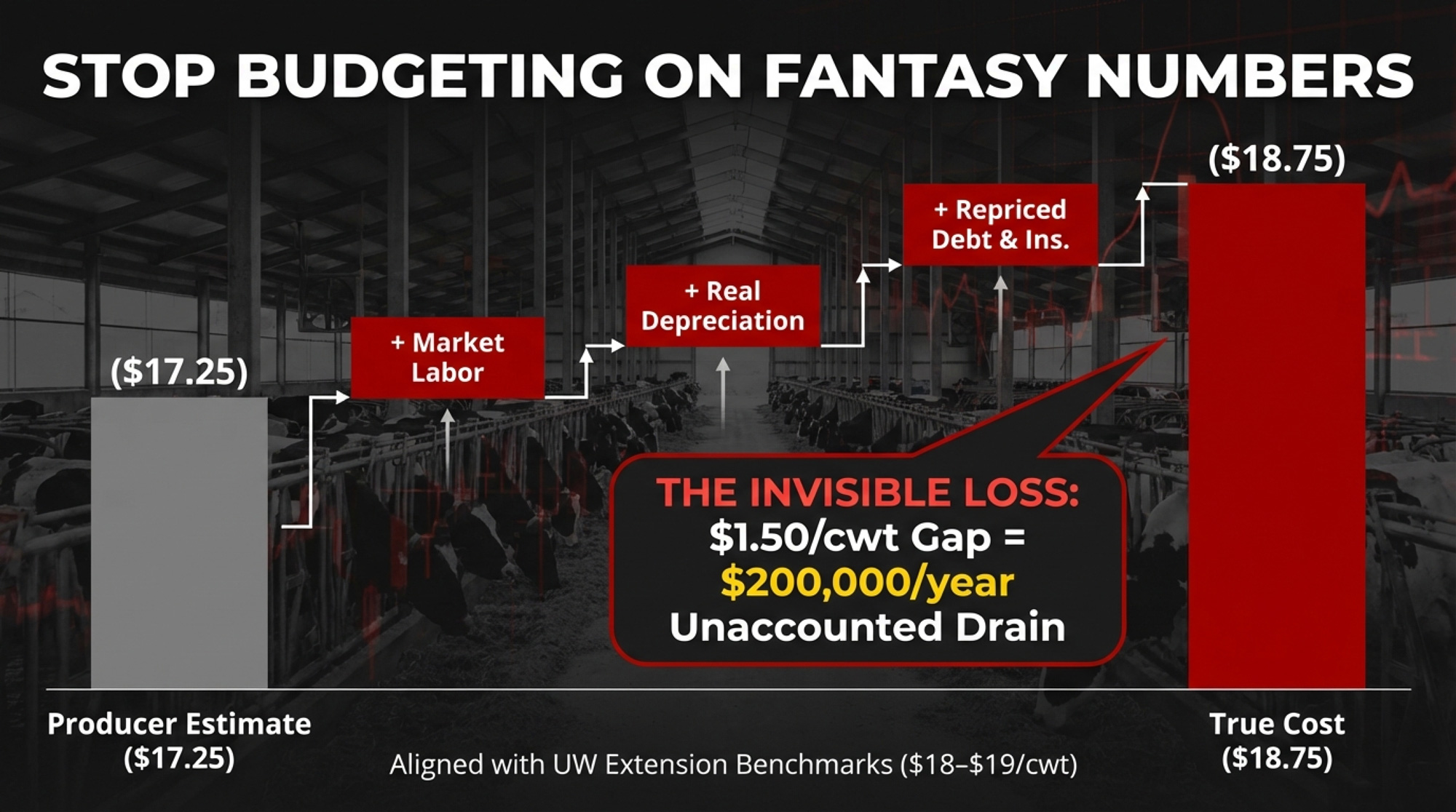
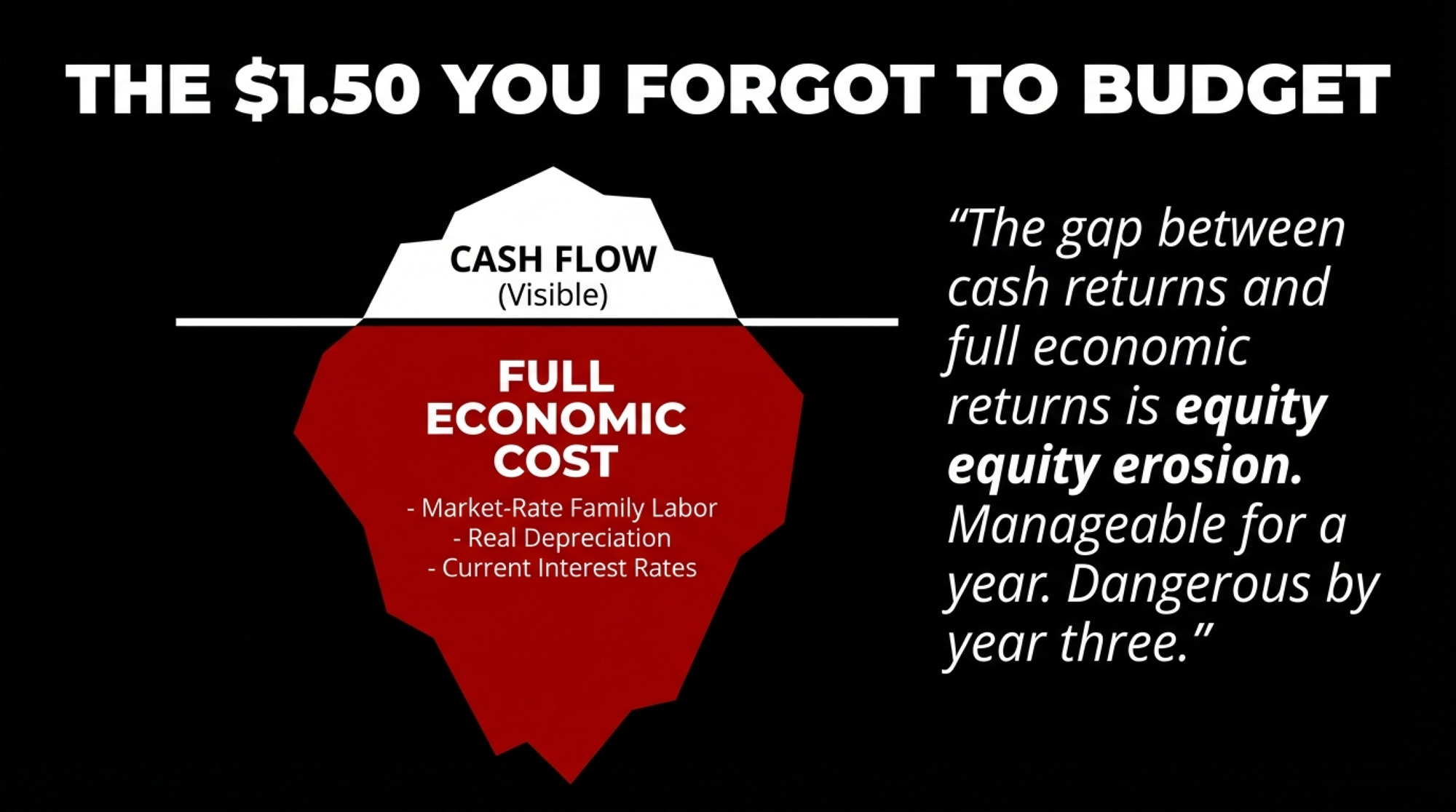
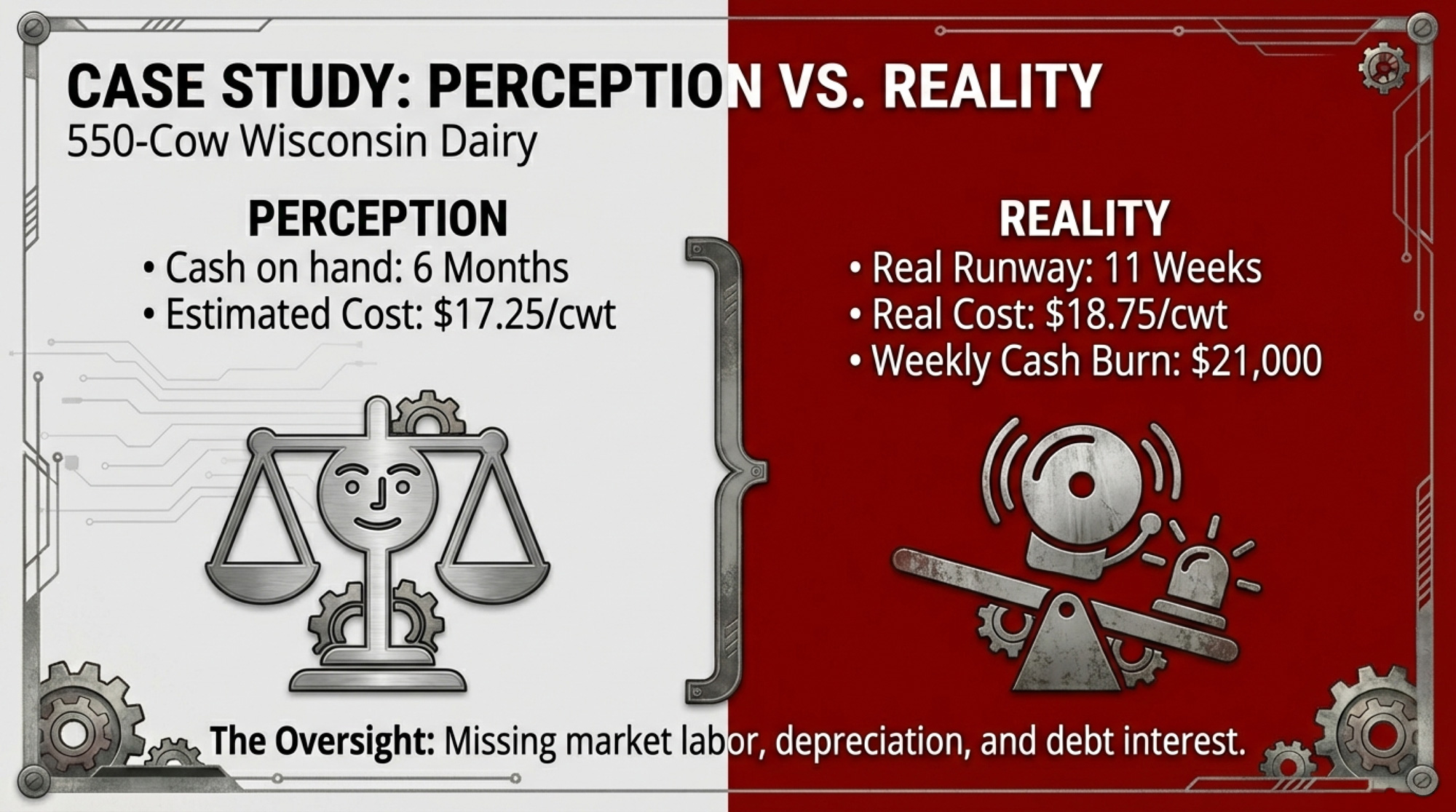
Earlier this year, a 550-cow Wisconsin dairy sat down with a farm financial counselor and pulled a full cost-of-production analysis. The details come from the farm financial counselor who conducted the engagement, as first reported in The Bullvine’s Calf-Check Paradox analysis (February 20, 2026), with the operation’s identity withheld at the counselor’s request. The producer had been budgeting around $17.25/cwt as his all-in cost. When the spreadsheet included market-rate family labor, real depreciation, repriced debt at current interest rates, and health insurance, the number came back to $18.75/cwt — right in line with UW Extension’s $18–$19/cwt benchmarks for mid-size Midwest herds.

That $1.50 gap represented roughly $200,000 in annual losses that the operation hadn’t been accounting for. Total liquidity: $227,000. Net weekly cash drain: about $21,000. Eleven weeks of runway — not the five or six months he’d been carrying in his head.

How Many Weeks of Runway Do You Actually Have?

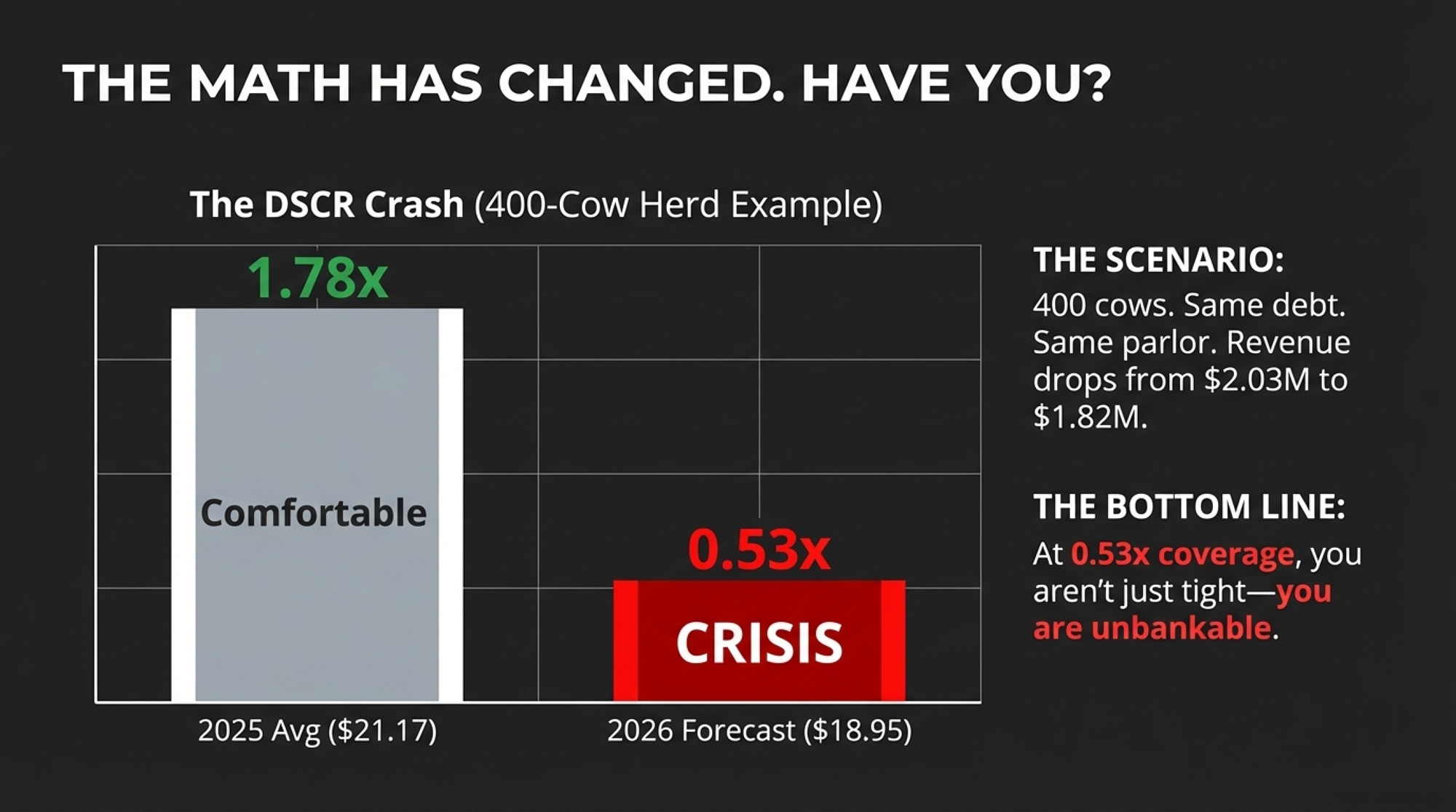
Multiply that math by every dairy operation in the country and drop the milk price from $21.17 to $18.95. That’s USDA’s February 2026 WASDE forecast for all-milk — a $2.22/cwt decline from the revised 2025 average. For a 400-cow herd shipping 96,000 cwt, that’s $213,120 in lost gross milk revenue. It turns a comfortable debt service coverage ratio into something your lender won’t ignore.

The Curve Accelerated — and the Geography Split Wide Open

The Wisconsin producer wasn’t the only one watching the numbers tighten. The structural consolidation trend that his counselor had flagged during their session was playing out nationally. The U.S. lost roughly half its dairy farms between the 2012 and 2022 USDA Censuses, while total production kept climbing. But the speed in 2025 — and where it concentrated — caught attention.

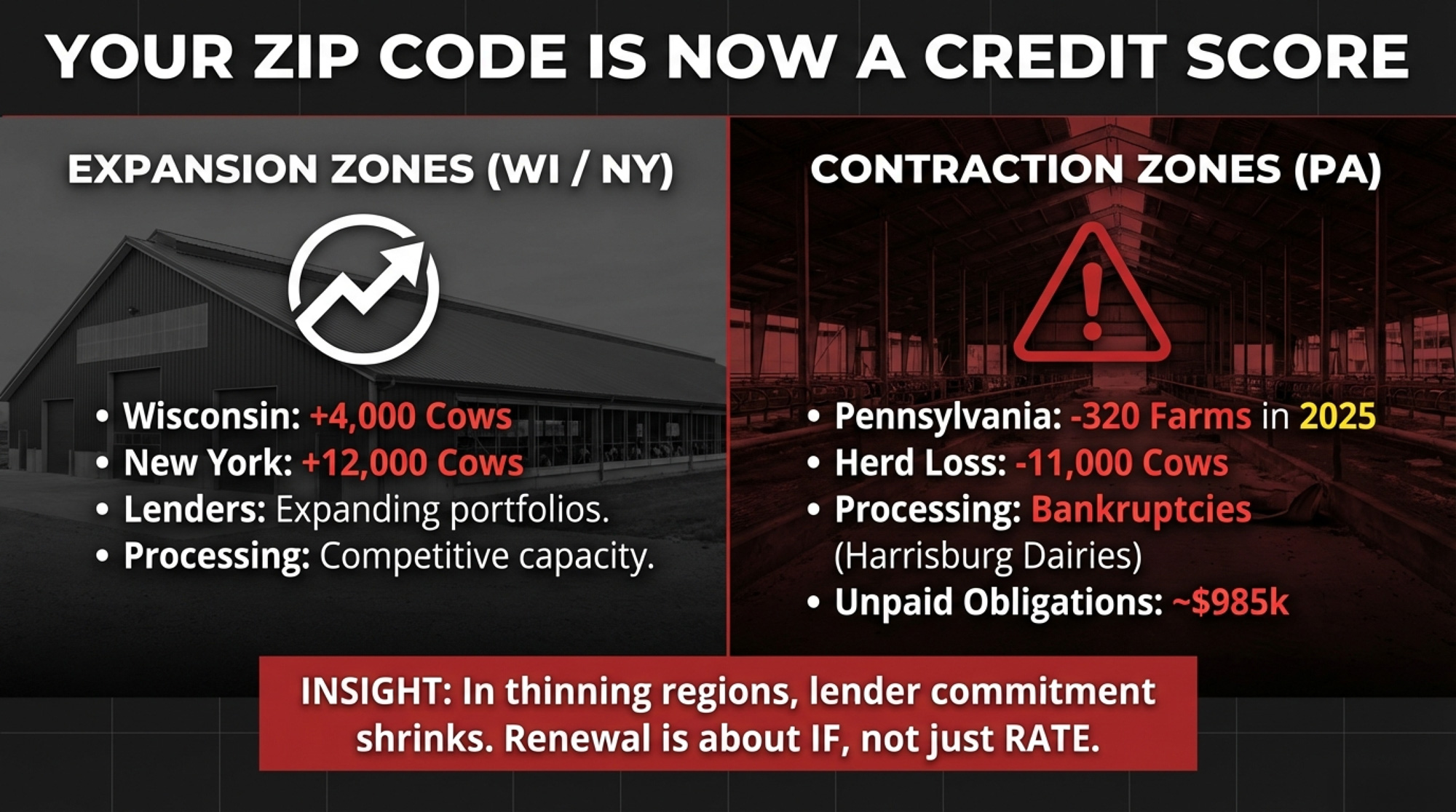
USDA reported 23,609 licensed dairies at year-end 2025, down 1,036. The top 10 states now produce about 74% of U.S. milk, per the NASS 2025 annual summary. Wisconsin added 4,000 cows and pushed output up 0.8% to 32.59 billion pounds — absorbing farm exits into fewer, larger operations. New York added 12,000 cows and boosted production 2.8% to 16.57 billion pounds, growth aligned with major new processing capacity in the state.

Pennsylvania went the other direction. Based on the originally published 2024 baseline, the state lost 490 farms—an 11.7% exit rate that accounts for nearly half of the 1,036 total U.S. dairy losses. This figure stems from a data discrepancy: the USDA revised Pennsylvania’s 2024 baseline downward by 166 farms without flagging the state-level change. Using the revised figure, PA’s 2025 loss was 320 farms. Both numbers tell the same story directionally. January 2026 deepened the gap: Pennsylvania milked 454,000 cows, down 11,000 from a year earlier, and produced 817 million pounds — 3.0% below January 2025, according to the NASS February 20, 2026 Milk Production report.

That divergence isn’t cyclical. It’s structural—and it’s reshaping how lenders view dairy portfolios.

30% of Bankers Tightened: The Lending Turn

In Q4 2025, 30% of bankers in the Chicago Fed’s Seventh District reported tightening lending standards for farm loans. Renewals and extensions kept climbing — the trend now spans multiple consecutive quarters. Fund availability kept falling, extending what the AgLetter has tracked as a multi-year decline.

The share of the District’s farm loan portfolio with major or severe repayment problems hit 5.6% — the highest since mid-2020, per the AgLetter’s February 2026 issue. And 3.8% of borrowers with operating credit were deemed unlikely to qualify for new operating loans in 2026.

The Farm Credit System is feeling it too. Nonaccrual loans rose from 0.74% at year-end 2024 to 0.91% at Q3 2025. Provisions for credit losses more than doubled, from $569 million to $1.23 billion, per the Farm Credit Investor Presentation dated February 20, 2026. Farm Credit’s own commodities outlook projected 2026 milk at $18.30/cwt — below even the USDA’s $18.95.

As one Illinois banker told the Chicago Fed’s Q4 survey: “2026 is going to be a challenge for many producers with higher input prices.” That’s the lending environment the Wisconsin dairy’s counselor was reading when he ran the real numbers.

What Does $18.95 Milk Do to Your DSCR?

Take a 400-cow dairy producing 24,000 lbs/cow/year — 96,000 cwt annually — carrying $1.2 million in term debt on a 10-year note. The Chicago Fed reported Seventh District operating loans at 7.11% and real estate loans at 6.63% in Q4 2025, so a 7.5% blended rate brackets most dairy debt. At standard monthly amortization, annual debt service on $1.2M at that rate runs $170,931.

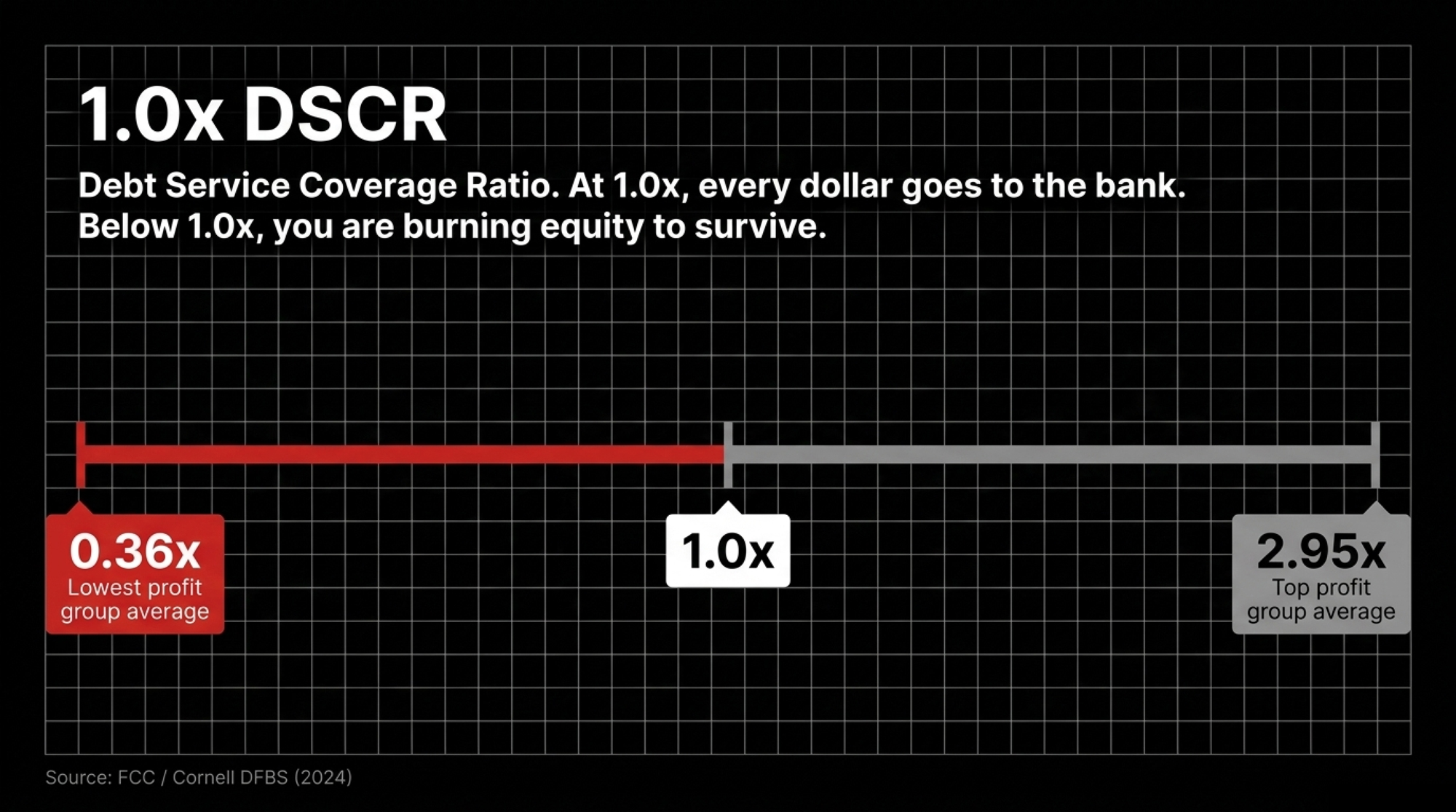
Debt Service Coverage Ratio — net cash income divided by annual debt service. Below 1.25x, lenders pay closer attention. Below 1.0x, the phone rings.

At $21.17/cwt (revised 2025 average, per USDA WASDE):
Revenue: $2,032,320. Cash costs at $18/cwt: $1,728,000. Net cash: $304,320.
DSCR: 1.78x — comfortable.

(That $18/cwt cost is illustrative — consistent with UW Extension benchmarks and close to the Wisconsin dairy’s actual $18.75. Plug in your real number.)

At $18.95/cwt (USDA’s 2026 forecast):
Revenue: $1,819,200. Same costs: $1,728,000. Net cash: $91,200.
DSCR: 0.53x.

From 1.78x to 0.53x. One price move. Same cows, same debt, same parlor.

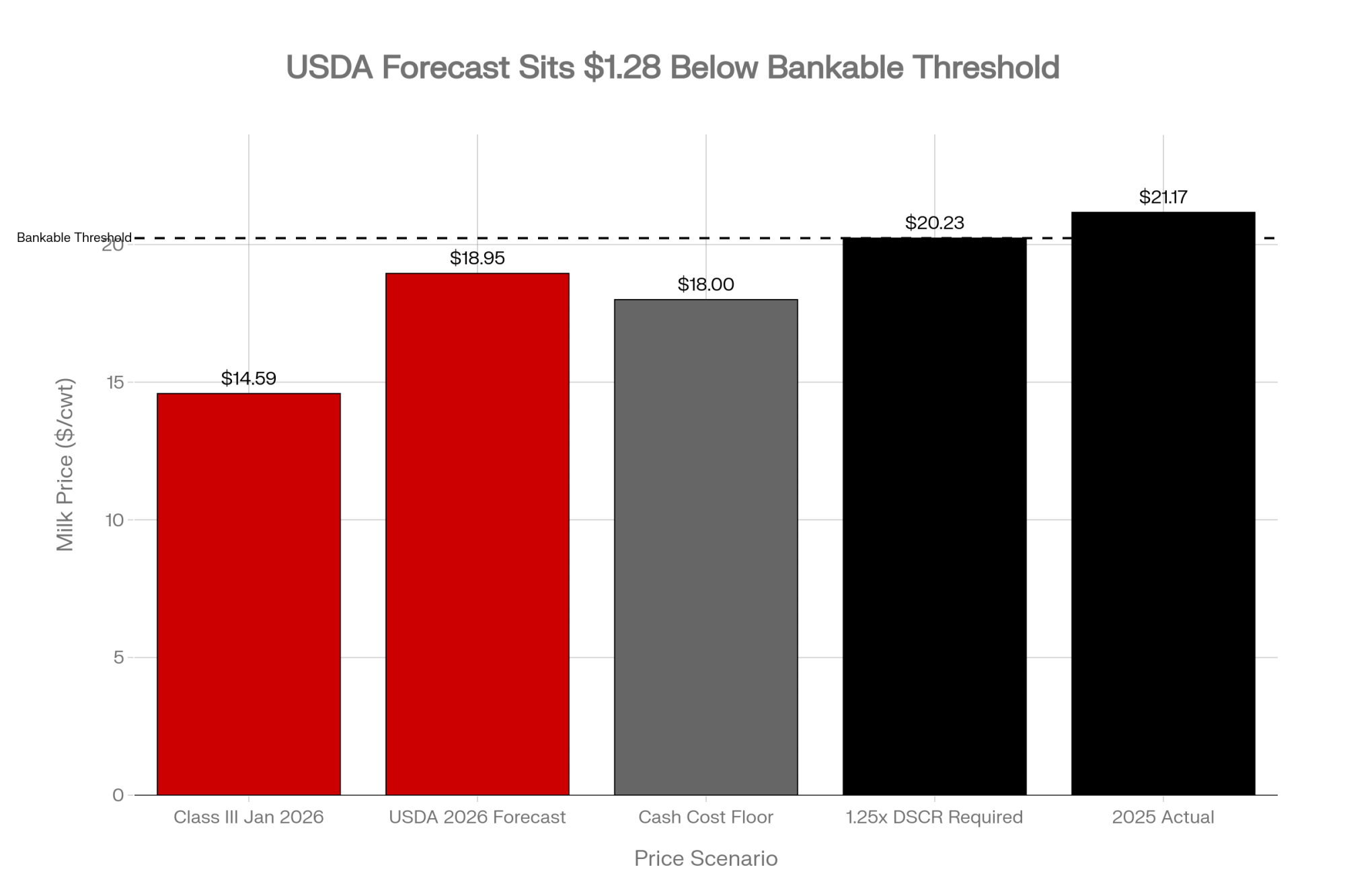
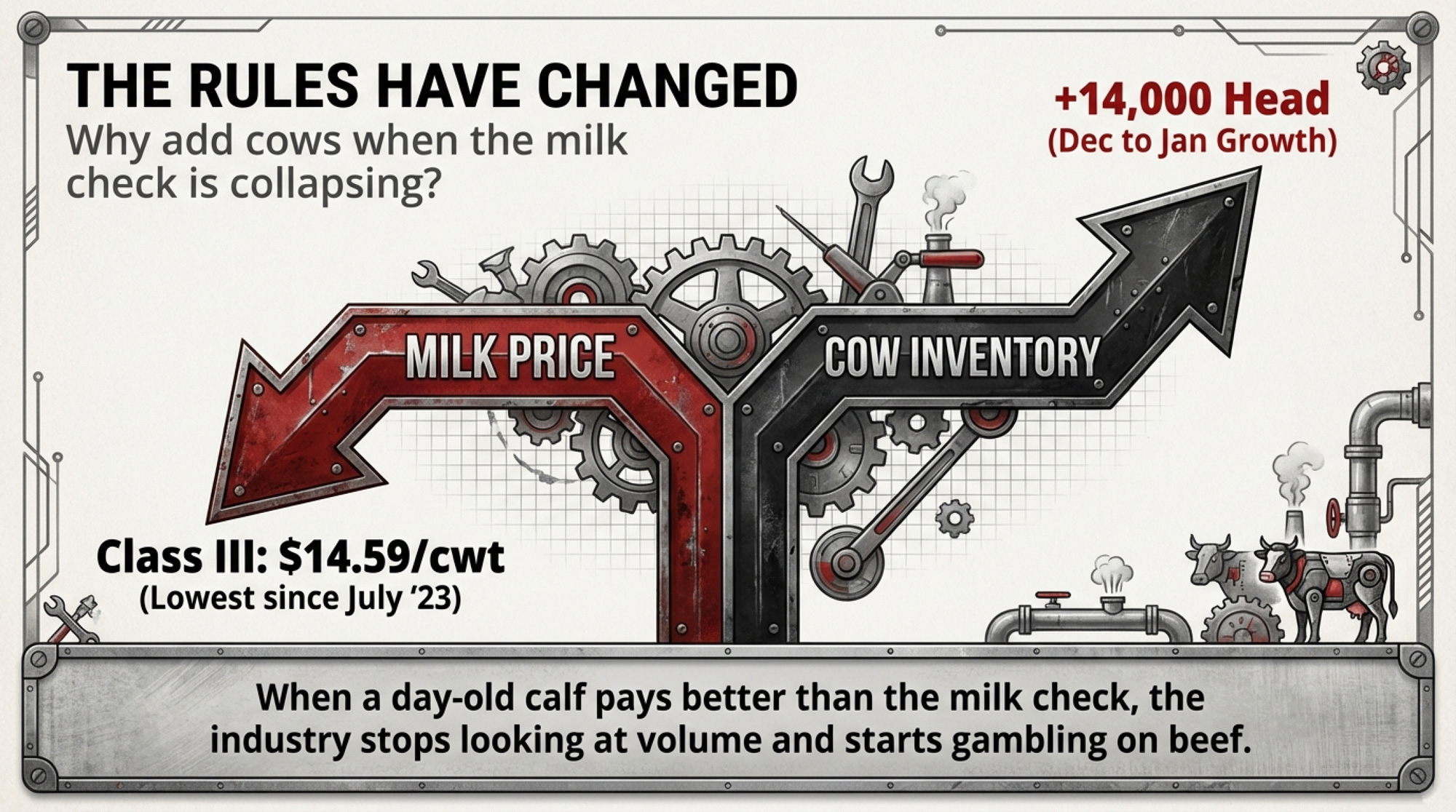
And $18.95 might be optimistic. January 2026’s Class III posted at $14.59/cwt. December was $15.86. The back half needs to do heavy lifting to deliver USDA’s annual average — and your budget can’t wait for the second half to show up.

The math works in reverse, too. If milk recovers above $21 in the second half — driven by export demand, tighter supply, or both — these DSCRs snap back fast. But your lender isn’t budgeting on a recovery that hasn’t started.

Breakeven milk price for a 1.25x DSCR at these cost and debt levels: $20.23/cwt. USDA’s forecast is $1.28 below that floor.

For context, USDA ERS puts the full economic cost of production at $19.14/cwt for herds with 2,000+ cows and $42.70/cwt for herds under 50 (2021 ARMS, updated August 2024). At $18.95, even the most efficient operations are near breakeven on a full-cost basis.

What the Wisconsin Dairy Did in 48 Hours

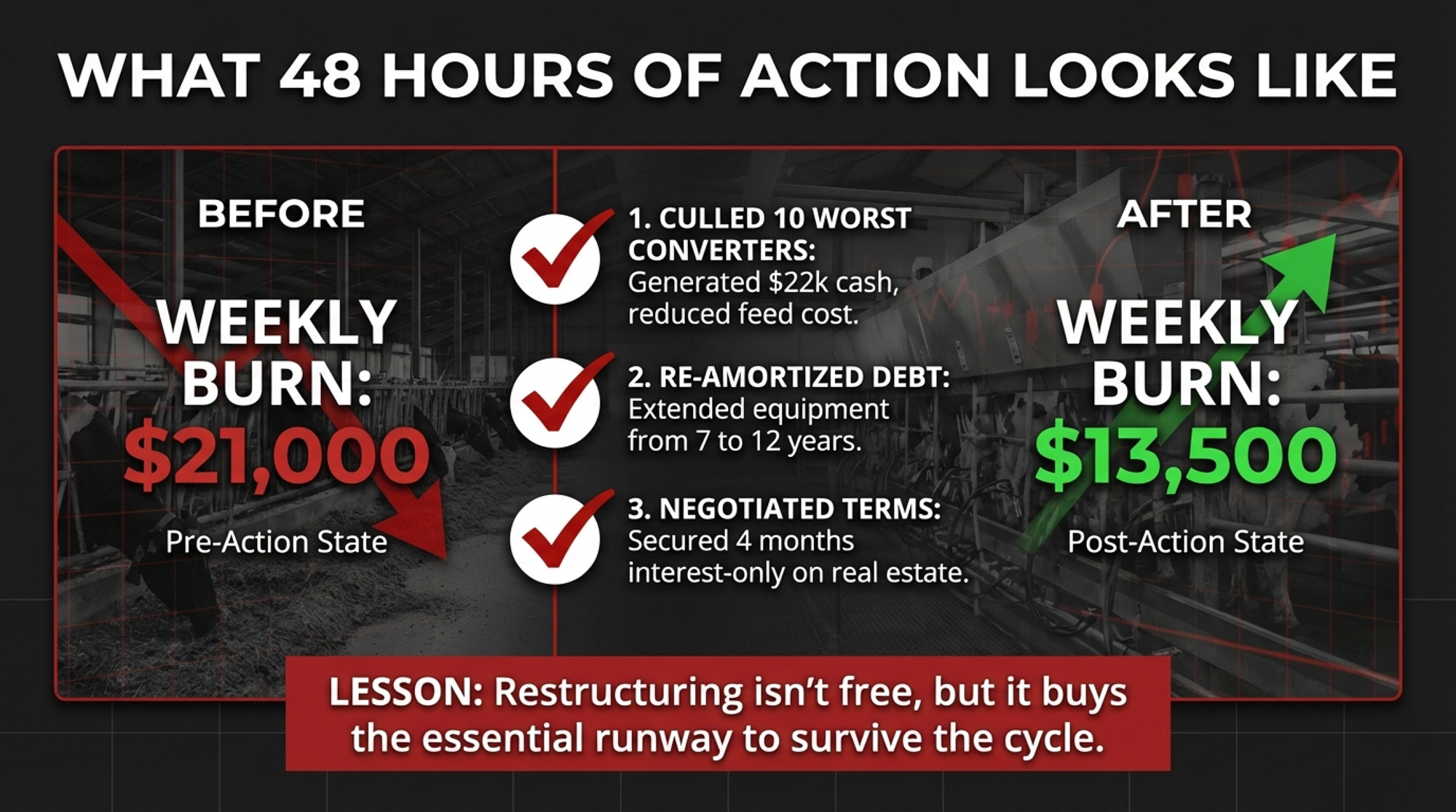
That 550-cow operation didn’t wait. According to the counselor’s account in The Bullvine’s Calf-Check Paradox reporting, within 48 hours of seeing the real numbers:

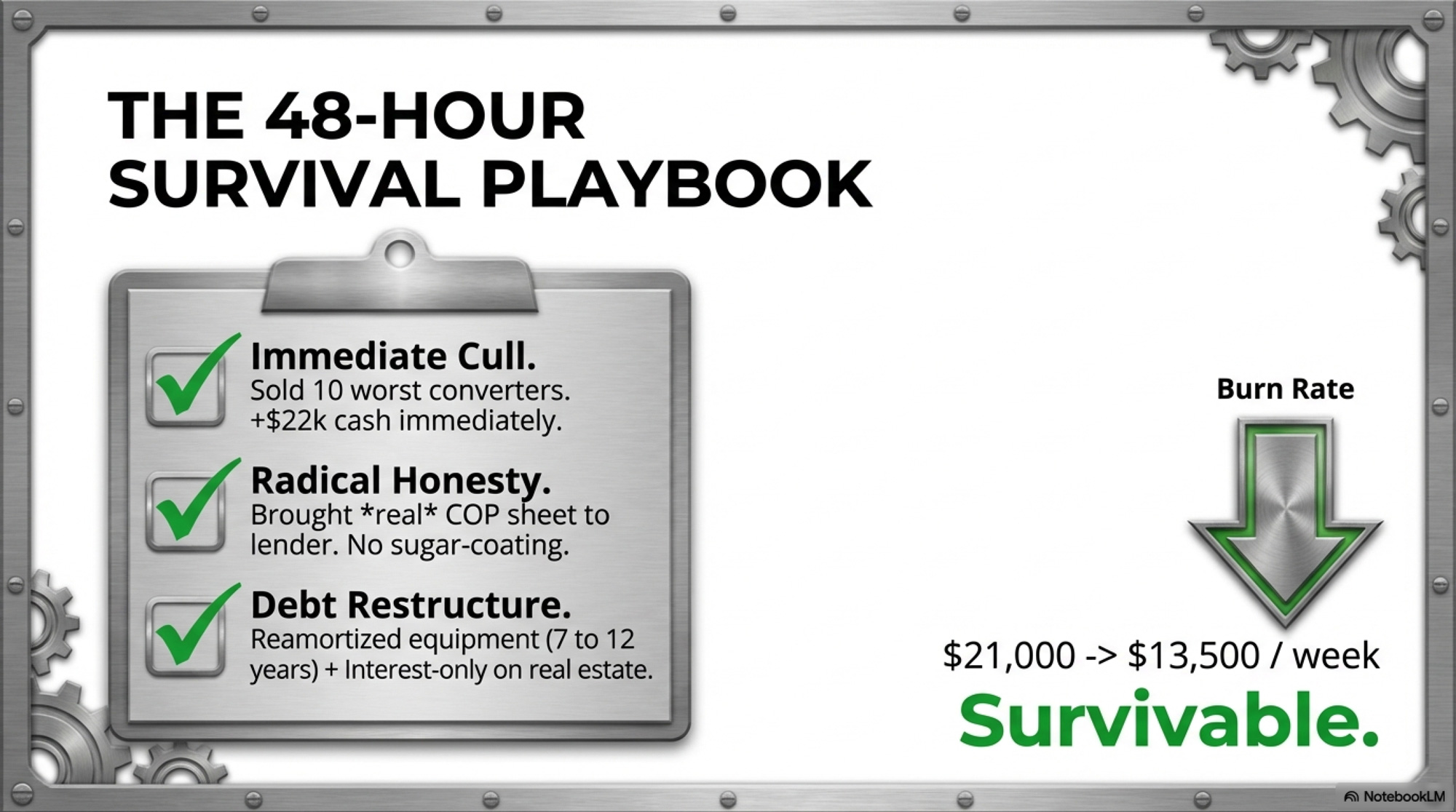
  • The producer culled his 10 worst feed-to-milk converters, generating roughly $22,000 in cash and cutting daily feed cost by about $85.
  • He walked into his lender’s office with a 12-month projection at $18/cwt milk and a real cost-of-production sheet — the one with market-rate labor and repriced debt.
  • He negotiated a reamortization of equipment debt (from seven to twelve years) and four months of interest-only on real estate.

The reamortization buys monthly breathing room, but it isn’t free — extending the note means more total interest paid and collateral tied up longer. The restructuring was approved. Weekly burn dropped from $21,000 to roughly $13,500. Same cows. Same parlor. New math.

That’s the template. Not new genetics. Not a magic ration. Just running the real numbers and moving before the runway disappears. Most producers who lose operations in a down cycle don’t lose them because the math was impossible — they ran the math three months too late.

The Geography of Risk

Your farm’s zip code now affects its creditworthiness as much as its per-cow production.

Picture two 500-cow operations. The Wisconsin one milks into a state where the average herd was 237 cows as of NASS’s 2024 count — and likely higher now — with multiple processors competing and Farm Credit deep in dairy expertise. That renewal is about rate and terms, not about whether.

The Pennsylvania operation milks into a state with a 106-cow average and is shrinking fast. Harrisburg Dairies ceased operations in October 2025 and filed for Chapter 11 bankruptcy on February 20, 2026. According to the PA Milk Board’s November 2025 consent order, the company admitted to failing to pay producers promptly, with $900,070 documented as owed to 16 producers for August and September advance payments. The Bullvine’s own reporting put total unpaid obligations at $985,012 across 15 farms as additional October amounts were added.

Community banks in the region have seen a significant share of their dairy borrowers exit in recent years. For those that remain, the renewal conversation increasingly includes questions about succession, off-farm income, and the value of dairy infrastructure without cows.

Same 500 cows. One banker is talking in expansion terms. The other is weighing whether the regional dairy portfolio still justifies the exposure. This isn’t about Wisconsin being “good” and Pennsylvania being “bad.” It’s about the lending infrastructure around your operation — processor competition, lender expertise, peer density, and regional trajectory. If you’re in a state where the ecosystem is thinning, you need to know it before your renewal.

Warning SignWhat It Looks LikeWhat It Really Means
Term Shortened5-year note renewed as 3-yearLender buying more frequent exit ramps—your risk rating changed
New Covenants AddedDSCR thresholds, working capital floors, monthly reporting requiredPortfolio committee wants tighter visibility into your cash position
Monthly Financials RequestedPreviously annual, now monthly submissionSomeone upstream flagged dairy sector exposure; you’re in enhanced monitoring
Relationship Banker LeftDairy specialist replaced with generalist or role eliminatedBank may be shifting resources away from dairy lending—your renewal leverage just dropped
Collateral Requirements IncreasedSame loan amount, more collateral pledgedYour internal risk rating deteriorated; bank pricing for higher default probability

Is Your Lender Already Repositioning?

The Wisconsin dairy’s playbook worked because the producer got ahead of the conversation. Here’s what to watch for if the conversation has started without you:

  • Renewal term shortened. Five years became three? Your lender is buying more frequent exit ramps.
  • New covenants appeared. DSCR thresholds, working capital floors, or monthly reporting that wasn’t in the prior agreement.
  • Monthly financials requested. Someone upstream wants tighter visibility into your cash position.
  • The relationship banker left and wasn’t replaced with a dairy specialist. That could be normal turnover — or it could signal your bank is shifting resources away from dairy lending. Either way, it changes your renewal dynamic.
  • Collateral requirements increased for the same loan amount. Your internal risk rating changed.

Two or three stacked up means the conversation has shifted. The Wisconsin producer walked in before any materialized. That’s the difference between asking for restructuring and being told the terms.

What This Means for Your Operation

Herd SizeCritical Actions (Next 30 Days)DSCR Threshold TriggerSurvival Strategy
Under 300 CowsRun DSCR at $18.95 milk; if below 1.25x, bring real COP sheet to lender within 30 days (not tax return); open exploratory talks with Farm Credit/FSA if community bank shows warning signsBelow 1.0x = immediate crisis; below 1.25x = enhanced monitoringSuccession clarity is your strongest lending signal—formalize timeline or lender assumes shorter horizon
300–1,500 CowsCalculate breakeven to penny; compare to $20.23/cwt floor; if renewal within 90 days, bring competing term sheets—leverage comes from options; stress-test feed bill volatilityBelow 1.0x = restructure now; below 1.25x = bring 12-month projection showing path to 1.4x+Document succession plan with timelines; hedge 30-50% of milk at $19+ if available; diversify lender relationships
1,500+ CowsStress-test at both $18.95 and $14.59 (January Class III); on 360k cwt, hedge 50% volume = $360k protected revenue annually; diversify beyond single lender—counterparty risk is real at $5M+ debtBelow 1.25x = immediate board-level discussion; below 1.5x = pricing/hedging reviewForward-contract feed and milk simultaneously; maintain 2+ lender relationships; formalize export market strategy if processing for specialty buyers

Under 300 cows:
Run your DSCR at $18.95 this week. Below 1.25x, your lender is watching. Below 1.0x, be in your lender’s office within 30 days with a real COP sheet, not last year’s tax return. Open exploratory conversations with Farm Credit or FSA if your community bank shows warning signs. Get honest about succession — a lender who sees no plan on a sub-300 dairy is pricing for a shorter horizon, and the data on generational transfer is sobering.

300–1,500 cows:
Know your breakeven to the penny. Compare it to the $20.23/cwt threshold calculated in this article. If renewal is within 90 days, bring competing term sheets — leverage comes from options, not hoping. Formalize succession if you’re transitioning; a documented plan with timelines is one of the strongest lending signals you can send.

1,500+ cows:
Stress-test at $18.95 — and at $14.59. Diversify lending relationships — counterparty risk is real at $5M+. On 1,500 cows producing 360,000 cwt, a $2/cwt hedge on half your volume protects $360,000 in annual revenue and directly improves your risk rating.

Your 30-Day Checklist

  • Run your actual DSCR at $18.95 milk using this year’s feed bill and current debt service. Below 1.25x = the zone this article describes.
  • Pull your loan covenants. Check for DSCR thresholds, working capital floors, or reporting requirements you may have overlooked.
  • Request your processor agreement. Confirm component premiums, volume commitments, and termination terms. Your lender will ask.
  • If your DSCR is below 1.0x at $18.95, schedule a lender meeting this month — before renewal, not during it. Bring a 12-month projection at $18/cwt. The Wisconsin dairy showed what happens when you lead that conversation.

Key Takeaways

  • If your debt-service coverage ratio drops below 1.25x at $18.95 milk, you’re in the danger band this article describes — that’s your cue to sit down with your numbers and your lender before renewal, not after.
  • If your breakeven sits more than $1/cwt above USDA’s $18.95 forecast, you’re burning equity every week you don’t adjust — culling, cost cuts, or refinancing are on the table, but each comes with trade-offs in flexibility and total interest cost.
  • If you’re milking in a thinning dairy region like Pennsylvania, your lender’s view of regional risk now matters as much as your cow performance — processor stability and peer density are part of your credit story, whether you like it or not.
  • If your current hedging or risk management plan doesn’t even model a $14–$16 Class III stretch, you’re effectively betting the farm on a second-half recovery your lender isn’t banking on.

The Bottom Line

  • The real question isn’t whether $18.95 milk is fair — it’s where your breakeven actually sits against that number, and how many weeks of runway you really have if Class III spends more time in the $14s than USDA’s annual average implies. The Wisconsin dairy that ran the real numbers bought itself time. Those who wait won’t get the same terms.

Complete references and supporting documentation are available upon request by contacting the editorial team at editor@thebullvine.com.

Learn More

The Sunday Read Dairy Professionals Don’t Skip.

Every week, thousands of producers, breeders, and industry insiders open Bullvine Weekly for genetics insights, market shifts, and profit strategies they won’t find anywhere else. One email. Five minutes. Smarter decisions all week.
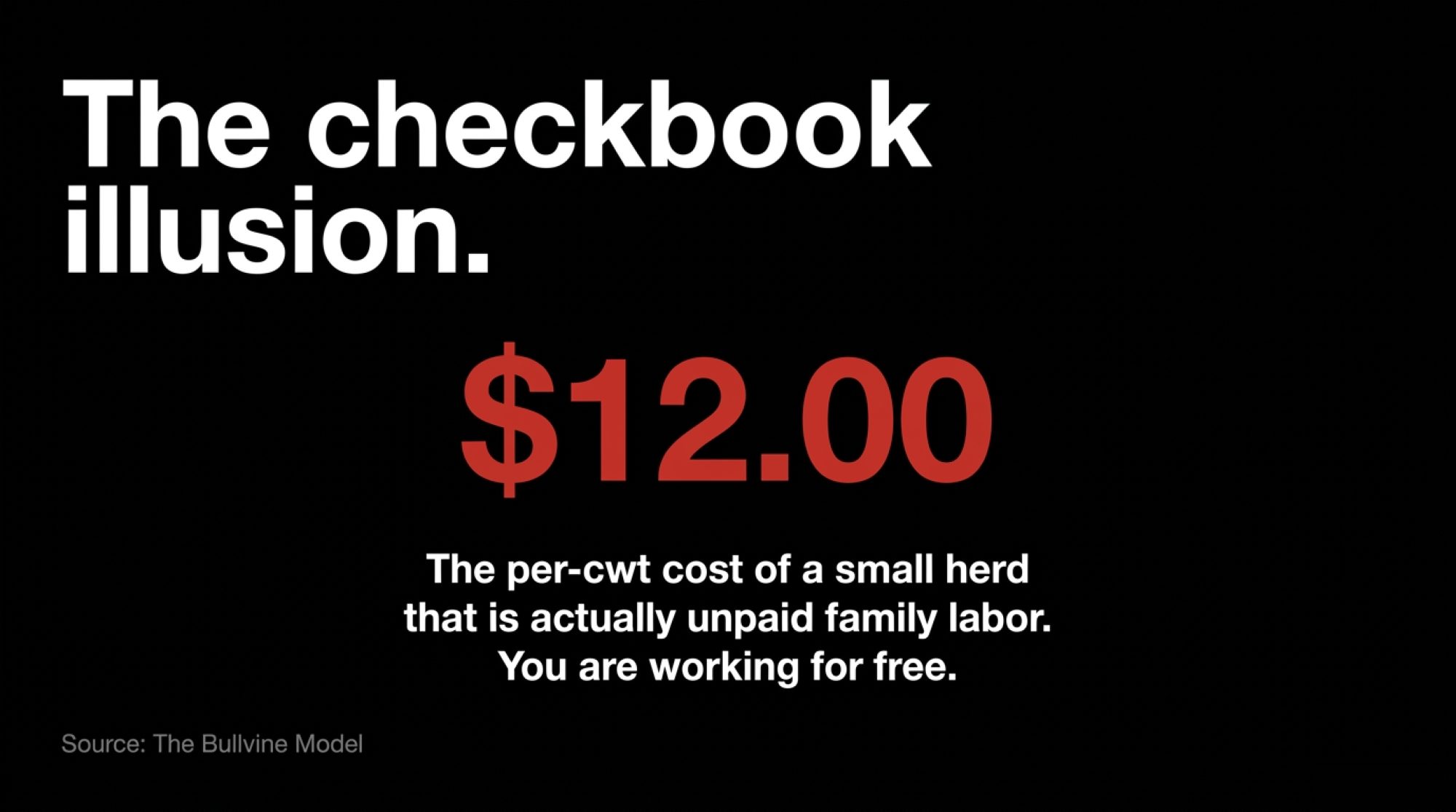
NewsSubscribe
First
Last
Consent

$14.59 Milk, $20.54 Costs: The $182,850 Margin Trap Squeezing 500‑Cow Herds

One 500‑cow Wisconsin herd found its ‘cost’ number was off by $1.50/cwt. That was $172,500 they weren’t seeing. How far off is yours?

Executive Summary: Mid‑size dairies are staring at barn math they can’t ignore: January Class III at $14.59/cwt against USDA full economic costs of $20.54/cwt for 500–999 cow herds, a $5.95 gap that means roughly $182,850 in red ink for a 500‑cow herd at 23,000 lbs. USDA’s 2026 all‑milk forecast sits at $18.95/cwt. The Class III futures strip has rallied — March through November now trades around $18.00–$18.46 — but January’s $14.59 and February’s ~$15.00 already dragged the strip-weighted annual average to roughly $17.65, still well below ERS full economic cost. ERS and Hoard’s data confirm what you feel in your own books: mid‑size herds carry about $1.40/cwt more cost than 2,000‑cow operations, and cheaper corn hasn’t erased that structural disadvantage. Butter and cheese prices are both down double digits, so income over feed is projected $1.50–$2.30/cwt lower than 2025, even with $4.15 corn, while cull cows look rich at $160/cwt and replacements still sit near $2,860–$3,110. The article walks through a full 500‑cow barn‑math example, then lays out five concrete moves: audit feed shrink, rerun true-cost-of-production, calculate your burn rate, rethink cull vs. replacement timing, and use fall Class III and risk tools only where the numbers actually pencil. You finish with practical thresholds — from months of burn‑rate runway to $18.50 lock‑in triggers — and one uncomfortable but useful question: if you plug in your own herd’s numbers, how long before your working capital runs out?

dairy cost of production

January 2026 Class III hit $14.59/cwt — the lowest since July 2023, per USDA AMS data released February 4. Three weeks later, USDA’s Economic Research Service published a structural report that pegged the full economic costs for herds of 500–999 cows at $20.54/cwt. That’s a $5.95 gap on every hundredweight. And the cheapest corn in five years isn’t going to close it.

Feed costs are down. Milk is down further. And the structural cost disadvantage that 500-cow herds carry — roughly $1.40/cwt more than operations running 2,000-plus cows, per the same ERS data — doesn’t move with commodity prices.

The $1.50 Nobody Budgets

A mid-size Wisconsin dairy recently ran a full cost-of-production analysis through a UW Extension-affiliated farm financial counseling program. The analysis put their actual all-in cost roughly $1.50/cwt higher than the figure the operation had been using for planning — a gap driven by market-rate family labor, real depreciation on aging equipment, interest repriced at current rates, and health insurance.

That gap is common. UW Extension benchmarks for mid-size Wisconsin herds land at $18–$19/cwt on a full economic cost basis. The ERS national figure is higher — $20.54 for 500–999 cows, drawn from the 2021 Agricultural Resource Management Survey, published February 22, 2026. That’s the most recent herd-size breakdown available; post-2021 inflation in input costs likely pushes current numbers higher.

Bradley Zwilling, vice president of data analysis at the Illinois Farm Business Farm Management Association, framed the tension in a January 2026 interview with Brownfield Ag News: “From an economics standpoint, we’ve got lots of negative numbers, but when we look at the cash side, we’re still able to squeak out a profit margin.” That was Zwilling’s read on Illinois dairy farms specifically, speaking with Brownfield’s Larry Lee. His underlying study — a December 2025 economic review of milk costs published through farmdoc daily — projects that economic costs will remain above total returns through 2026, even as cash margins stay barely positive.

The gap Zwilling describes — between cash returns and full economic returns — is equity erosion. Manageable for a year. Dangerous by year three.

David Kohl, professor emeritus of agricultural economics at Virginia Tech and a regular keynote speaker at PDPW conferences, offers a specific metric for gauging how long you can sustain it: your burn rate — working capital divided by monthly shortfall. “You’d like to have a burn rate of 3½ years or more,” he has told PDPW audiences. Below 2½ years, Kohl calls it the red-light zone.

Related: As we detailed when the February WASDE dropped, even the USDA’s upgraded $18.95 all-milk forecast doesn’t close this gap for the average mid-size operation.

Why Does It Cost $1.40 More Per Cwt to Run 500 Cows Than 2,000?

Herd SizeFull Economic Cost ($/cwt)
<50 cows$42.71
50–99 cows$32.18
100–199 cows$26.44
200–499 cows$22.89
500–999 cows$20.54
1,000–1,999 cows$19.67
2,000+ cows$19.14

The ERS data lay it out starkly. Full economic cost drops from $42.71/cwt for herds under 50 cows to $20.54 for 500–999 and $19.14 for 2,000-plus. That $1.40/cwt gap between mid-size and large is almost entirely structural.

Labor is the biggest driver. USDA’s 2020 consolidation report (ERR-274) documented total labor costs of $8.14/cwt for herds under 50 cows versus $1.85/cwt for herds above 2,500 — a $6.29 spread driven overwhelmingly by unpaid family labor in smaller operations. Hoard’s Dairyman benchmarks place commercial mid-size dairies in the $3–$4+/cwt range for total labor. Average hired dairy wages hit $19.52/hour as of May 2025, up 30% from $15.07 in April 2020.

At 500 cows, you’re the owner, the herd manager, the HR department, and the risk manager. At 3,000, those are four separate positions — and their combined salary is spread across six times the production.

Hoard’s data reinforces the broader point, too: operations with over 2,000 cows carry cash costs roughly $1.50/cwt below the all-size average, with most of that decline coming from non-feed expenses. But management quality still matters. Hoard’s has also reported that the best-managed small herds produce within $0.20/cwt of the best-managed large herds. That’s best-to-best, though. The average mid-size herd carries a measurable disadvantage that doesn’t disappear with cheaper grain.

Related: For more on how replacement costs and labor shifts compound these structural pressures, see why replacement costs are rewriting mid-size dairy economics.

What Does $16.50 Class III Look Like on a 500-Cow Herd?

Here’s the barn math. A 500-cow herd at 23,000 lbs/cow produces 115,000 cwt per year.

ScenarioMilk PriceAnnual Grossvs. $20.54 ERS Full Cost
Strip-weighted 2026 avg (~$17.65 Class III)$17.65/cwt$2,029,750–$332,350

Math: 500 cows × 23,000 lbs ÷ 100 = 115,000 cwt × price = gross. Subtract 115,000 × $20.54 ($2,362,100) for full economic cost. Divide the gap by 500 for the per-cow figure.

Even at USDA’s more optimistic $18.95 annual average, a 500-cow herd at national ERS cost runs $182,850 in the red for the year. The only scenario with positive returns? Last year’s prices. And USDA projects 1.3% more production in 2026 (234.5 billion lbs) from a January 1 herd of 9.568 million cows, up 188,000.

Plug in your own numbers. Replace 500 with your herd size, 23,000 with your rolling herd average, and $20.54 with your actual full economic cost. If you don’t know your full economic cost — including market-rate family labor, real depreciation, and current interest — that’s the first number to find.

Cheap Feed Won’t Close the $5.95 Gap.

Corn at $4.15/bushel, soybean meal at $319/ton, alfalfa hay at $177/ton — all near five-year lows. But income over feed costs for 2026 projects at roughly $10–$11.40/cwt, down $1.50–$2.30 from 2025. Feed dropped. Milk dropped faster.

The component breakdown shows why:

Commodity2025 Avg2026 ProjectedChange
Butter$2.22/lb$1.68/lb–24%
Cheese (blocks)$1.79/lb$1.60/lb–11%
Whey$0.60/lb$0.69/lb+15%
NDM$1.24/lb$1.32/lb+6.5%

Source: USDA 2026 Agricultural Outlook Forum, February 19, 2026

Butter and cheese drive your Class III check, and both are down double digits. National milk-fat tests averaged 4.32%in 2025, up from 4.24% in 2024 — more fat per pound of milk than the market can absorb. Lucas Sjostrom, executive director of Minnesota Milk, told the Red River Farm Network in January 2026: “Although milk is milk, it’s the components that we sell, and we’ve got all sorts of components on the market.”

Fat-heavy herds are losing more ground than protein-heavy herds right now. Pull your last three checks and compare fat revenue per cwt to the same months in 2025. If your herd tests fat-dominant, the 24% butter decline is hitting your check harder than national averages suggest. Protein-heavy herds are partially insulated. Your checks tell you which camp you’re in — USDA averages won’t.

Related: For how the widening Class III–IV spread compounds this pain, see the $3 milk trap and what it means for your 500-cow check.

USDA Says $18.95. The Futures Strip Finally Caught Up — Almost.

USDA’s February WASDE pegs 2026 all-milk at $18.95/cwt. When the article was first drafted in late February, the Class III strip was pricing $15.38 for February and $17.13 for March. By month-end, a sharp cheese rally — blocks surging past $1.86 — pulled March to $18.00 and lifted June through November above $18.00. USDA’s own quarterly projections from the Outlook Forum (February 19): Q1 at $17.90, climbing to Q4 at $19.90.

That $19.90 fourth quarter still has to do heavy lifting — but the gap between the strip and USDA’s forecast has narrowed sharply. The problem is January ($14.59) and February (~$15.00) are already in the books. Those two months drag the strip-weighted annual average to roughly $17.65, even with $18+ contracts the rest of the year.

For budgeting, the futures strip is where actual contract money trades. The strip now prices $18.00–$18.46 from March through December — much closer to USDA’s $18.95 than it was two weeks ago. But the damage from a $14.59 January and ~$15.00 February is already baked in. Your strip-weighted annual average sits closer to $17.65 than $18.95, and that’s before accounting for basis and actual mailbox discounts.

The Replacement Squeeze Making Culling Decisions Harder

The standard margin playbook says cull the bottom 5–8% and capture cash. Cull values are cooperating: CattleFax analyst Mary Kurzweil confirmed live-market support at $160/cwt in late February, with 90s trim projected into the mid-$440s. At $160 live, a 1,400-lb Holstein brings roughly $2,240 per head. Shipping 25–40 cows from a 500-cow herd generates $56,000–$90,000 in immediate cash.

ItemNational Average (Feb 2026)
Cull cow revenue (1,400 lb @ $160/cwt live)$2,240
Replacement cost (springer heifer, national avg)$2,860
Net cost per cow culled & replaced–$620

But replacements complicate that equation. Heifers hit a record $3,110/head nationally in October 2025. By January 2026, the average eased to $2,860 — but top springers at Pennsylvania’s Premier Livestock & Auctions still cleared $2,850–$4,050 at the February 18 sale. Net cost of culling and replacing at national averages: roughly $620 per cow. And dairy replacement heifers per 100 milk cows hit their lowest percentage since 1991 as of January 1, 2026.

Internal rearing runs roughly $2,034/head in Pennsylvania and $1,709 in the Midwest, per Penn State Extension data updated December 2025. That’s substantially cheaper than buying — but it takes 24–26 months to reach the milking string. If your beef-cross rate exceeds 40%, every cull today has pipeline consequences in 2028.

Five Moves That Pencil Out Right Now

Each has a verified dollar amount and a named source.

1. Audit feed shrink this month. Dr. Mike Brouk at Kansas State presented the math at the 2019 Vita Plus Dairy Summit, and it still holds: a 500-cow dairy running $7.50/cow/day in feed costs can capture roughly $50,000/year from a 4-point reduction in shrink. “Comparatively speaking, capturing $50,000 from milk price alone for a 500-cow herd would require an additional 32 cents per cwt for the year,” Brouk said. No capital required.

At scale, the payoff compounds. According to a 2018 Dairy Global profile, the Statz Brothers dairy — run by Joe Statz, his two sons, and cousins Troy and Wesley — milks 4,400 cows near Marshall, Wisconsin. They built a dedicated feed center and dropped shrink from around 10% to 2–3%. Todd Follendorf, then a nutritionist at Cornerstone Dairy Nutrition in Waunakee, described the rationale in that profile: “Shrink control has been the main reason why we built the whole facility. Before, we had shrink percentages of around 10% every single day. Now, we have reduced this to 2% to 3%.” At $8/cow/day feed cost and a 5-point reduction across 4,400 cows, the documented savings exceed $500,000 per year.

2. Cull strategically — but count your pipeline first. At $2,240/head cull revenue and $2,860 per replacement, every cow you ship without a heifer behind her costs more than the check you deposit. Run the math both ways before loading the trailer.

3. Lock fall production if Class III contracts clear $18.50. September–December contracts sat at $18.35–$18.46 in late February. That’s close to lockable. You give up upside if the market rallies past $19, but if you’re carrying significant debt service, certainty may matter more than optionality.

4. Review your component profile against current prices. Butter down 24%, cheese down 11%, whey up 15%. If your herd tests fat-dominant, your check is being hit harder than national averages suggest. Pull actual checks, not projections.

5. Talk to your lender before April — on your terms. If the operating note assumed $19+ milk, those assumptions broke in January. Build a revised projection off the futures strip (~$18.00–$18.46 March through fall) — but weight your annual average for the $14.59 January and ~$15.00 February already in the books. That pulls your working number closer to $17.65 than $18.95. Kohl’s burn-rate formula gives you the framing: working capital ÷ monthly shortfall = months of runway.

The Safety Net Covers Half — Maybe

DMC payouts above $1/cwt are projected for January through April 2026, with smaller payments through July. The Tier 1 coverage expansion to 6 million pounds helps mid-size herds. But a 500-cow dairy producing 11.5 million lbs annually gets coverage on about 52% of its milk. The other 48% rides exposed.

William Loux, senior vice president of global economic affairs at the National Milk Producers Federation, framed it in a January 2026 interview with Dairy Herd: “It’s good that DMC is paying out, but it’s almost always better for prices, and better for dairy farmers, if they don’t.”

Related: For a deeper comparison of DMC vs. DRP in the current price environment, see how DRP compares to DMC for spring 2026 risk management.

A Note for Canadian Readers

This analysis uses U.S. Federal Milk Marketing Order pricing, USDA cost data, and the DMC safety net — none of which apply directly under Canadian supply management. COP-based pricing, quota value, and a fundamentally different risk structure change the math. But the underlying question — do you know your actual full cost of production to within a dollar? — crosses the border. If your quota-adjusted breakeven hasn’t been stress-tested against current feed, labor, and interest costs, the same $1.50/cwt gap could be showing up in your numbers, too.

What This Means for Your Operation

  • Find your real breakeven this month — not the one in your head. The mid-size Wisconsin dairy that ran a full COP analysis found a $1.50/cwt gap between their working estimate and reality. At 115,000 cwt on a 500-cow herd, a gap that size means $172,500/year in costs you’re not tracking. Contact your Extension office, farm financial counselor, or lender’s ag team.
  • Calculate your burn rate this week. Working capital ÷ monthly cash shortfall = months of runway. Below 30 months is Kohl’s red-light zone — and at that point, you should be making active decisions, not waiting for the market.
  • Compare your actual component revenue to the same months in 2025. This tells you whether national averages apply to your check or whether the 24% butter decline is disproportionately eating your margin.
  • Run the cull-vs.-Replace math before shipping. Net cost of culling without pipeline: roughly $620/cow at current national averages. If your heifer inventory is already thin, aggressive culling generates cash today and creates a $2,860+/head problem in 2028.
  • Audit feed shrink before the end of March. Brouk’s math: roughly $50,000/year on 500 cows from a 4-point reduction. That’s the cheapest margin improvement available — no capital, no contract, no market recovery required.
  • Watch the September–December Class III strip. Above $18.50 = lockable protection on fall production. Below $17.50 = restructuring timeline accelerates.

Key Takeaways

  • If your full economic cost exceeds $18/cwt and your strip-weighted annual Class III averages ~$17.65, you’re eroding equity at roughly $2.89/cwt × your annual production. For a 500-cow herd: roughly $332,000/year. The strip has rallied from where it sat in mid-February — but $18+ contracts for the rest of the year can’t fully erase a $14.59 January.
  • The structural scale gap — $1.40/cwt between 500- and 2,000+-cow herds, per ERS — doesn’t change with corn prices. Cheap feed narrows the feed-cost piece slightly, but can’t close a gap built on labor, management overhead, and purchasing power.
  • Income over feed is down $1.50–$2.30/cwt from 2025 despite lower input costs. The market priced in more milk and softer demand for fat before it priced in cheaper corn.
  • The first 30-day move is free. A feed shrink audit and a full cost-of-production analysis cost time, not money — and they’re the only two things on this list that work regardless of what the market does next.

The Bottom Line

What’s your actual full economic cost per cwt — not the number you’ve been carrying in your head, but the one that survives a spreadsheet with market-rate family labor, real depreciation, and today’s interest rate? If you don’t know that number to within a dollar, it’s the most important thing you can find out before the next milk check arrives.

Complete references and supporting documentation are available upon request by contacting the editorial team at editor@thebullvine.com.

Learn More

The Sunday Read Dairy Professionals Don’t Skip.

Every week, thousands of producers, breeders, and industry insiders open Bullvine Weekly for genetics insights, market shifts, and profit strategies they won’t find anywhere else. One email. Five minutes. Smarter decisions all week.
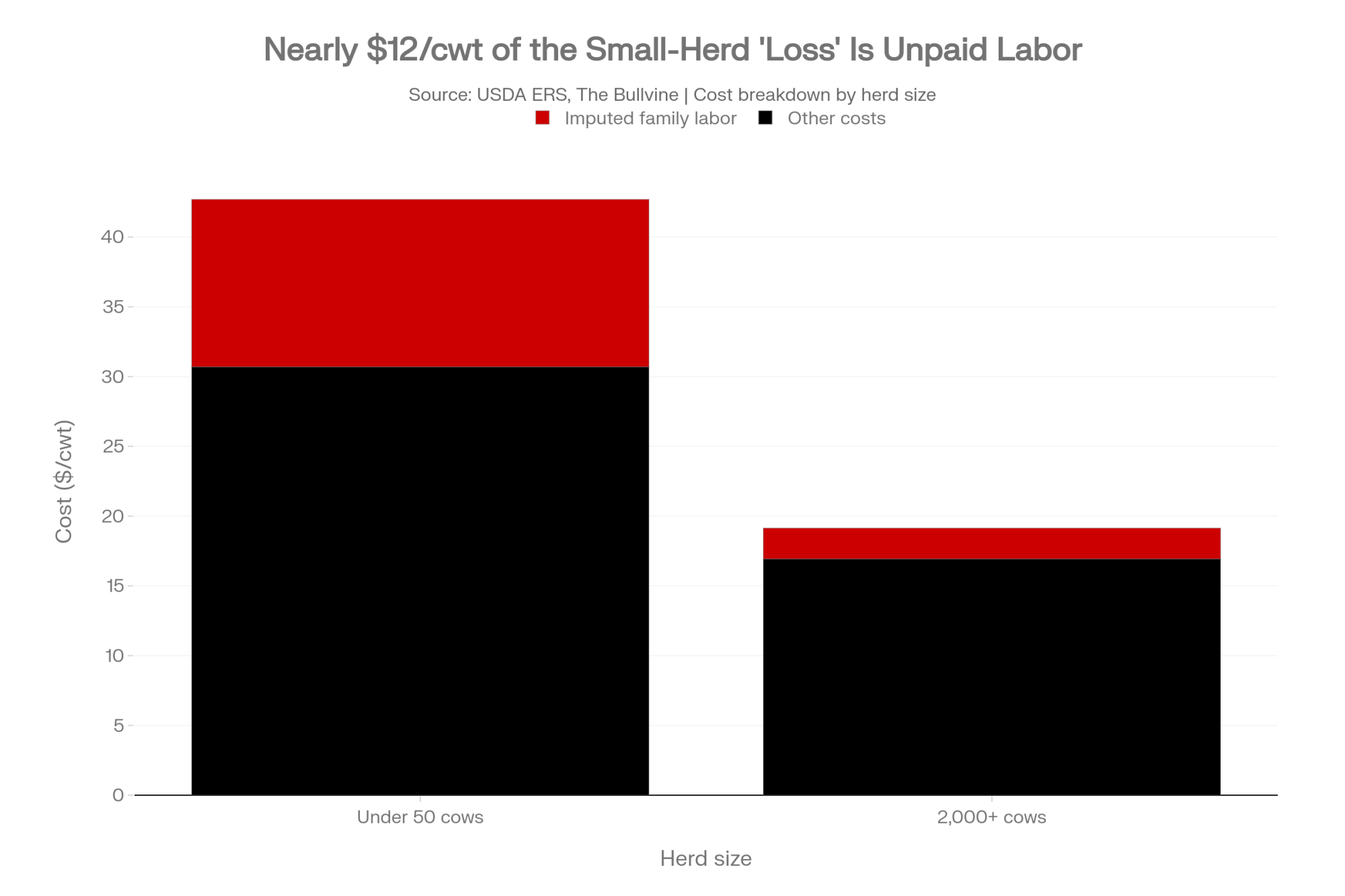
NewsSubscribe
First
Last
Consent

The Calf-Check Paradox: $14.59 Milk, 14,000 Extra Cows, and a 550-Cow Dairy Staring at an 11-Week Runway

When a day‑old calf pays better than the milk check, the rules change. The question isn’t volume anymore. It’s survival math.

Executive Summary: January’s USDA report exposed a deep disconnect in U.S. dairy economics: milk prices are collapsing while cow numbers and output still climb. Production was up 3.2% year‑over‑year with 14,000 more cows on line, even as Class III fell to $14.59/cwt and Class IV to $13.55/cwt against full costs that often sit near $18–$19/cwt. The missing margin is coming from cattle, with beef‑on‑dairy calf and cull checks routinely adding $3–$4.50/cwt, but that turns your dairy into a leveraged bet on the beef cycle. Using USDA and CoBank numbers, a 300‑cow herd faces roughly a $153,000 drop in milk revenue for 2026, and closer to $261,700 when you layer in a realistic 35% correction in calf values. At the same time, replacement heifers are at a 20‑year low, trading around $3,010–$3,360 per head, even as more than $11 billion in new processing capacity comes online and demands more milk. One 550‑cow Midwest dairy that thought it had six months of cash discovered it had just eleven weeks, then bought time by culling its worst converters and restructuring debt inside 48 hours. For your operation, the takeaway is blunt: treat calf income as volatile bonus money, know your real cost of production to the penny, and set 30‑, 90‑, and 365‑day plans that assume milk and beef could both move against you at the same time.

A 550-cow Wisconsin dairy sat down with a farm financial counselor earlier this month and pulled a full cost-of-production analysis. The producer thought his all-in cost was around $17.25/cwt. When the spreadsheet included market-rate family labor, real depreciation, current interest on all repriced debt, and health insurance, the number came back at $18.75/cwt — right in line with UW Extension’s cost-of-production benchmarks, which put average COP at $18–$19/cwt for mid-size Midwest dairies. Then he checked his liquidity: $227,000 total. Net weekly cash drain at current prices: about $21,000. That’s roughly eleven weeks of runway — not the five or six months he’d been carrying in his head. 

Cost CategoryNapkin MathMarket-Rate RealityDelta
Feed & Nutrition$7.50$7.80+$0.30
Labor (Family = $0)$2.00$3.10+$1.10 (red text)
Veterinary & Health$0.85$1.05+$0.20
Depreciation (Book)$1.80$2.20+$0.40
Interest (Pre-2022 Rates)$1.10$1.75+$0.65 (red text)
Utilities & Fuel$0.90$0.95+$0.05
Repairs & Maintenance$1.20$1.30+$0.10
Insurance & Taxes$0.60$0.90+$0.30
Miscellaneous$1.30$1.45+$0.15
TOTAL COP$17.25$18.75+$1.50 (red text, bold)

That producer’s math collided with today’s USDA NASS report. U.S. milk production came in at 19.81 billion poundsfor January — up 3.2% year-over-year but a clean miss against the +3.8% that StoneX had penciled in. January’s Class III price printed at $14.59/cwt, the lowest since July 2023, and $5.75 below a year ago. Class IV was even uglier: $13.55/cwt, the lowest in nearly five years, per the AMS announcement. And yet USDA says farmers added 14,000 head between December and January, pushing the national herd to 9.58 million — up 2.0% from last year. StoneX had modeled roughly 9,000 head of growth; the actual came in about 5,000 head hotter. 

When your milk check is falling that fast, and your cow numbers are still climbing, something other than milk economics is driving the bus.

Where Did 14,000 Cows Come From?

Of that 14,000-head surprise, about 10,000 appeared in Texas. The state’s inventory hit 715,000 head, and production jumped 7.6% year over year to 1.598 billion pounds. That’s not organic growth — it’s a direct response to Leprino Foods’ mozzarella facility in Lubbock. Phase 1 of the 850,000-square-foot plant began production in January 2025, with its formal opening ceremony in March. Phase 2 is slated for completion in early 2026. At full capacity, the facility is designed to handle roughly 200 milk trucks per day. 

Kansas tells an even bigger story. Production exploded 26.1% year-over-year — the largest jump of any state — on 45,000 additional head since January 2025. Hilmar’s $600 million Dodge City cheese plant is pulling milk into existence across the High Plains. South Dakota added 24,000 cows and saw production rise 10.9%. 

But flip to the other column. Washington dropped 6.1%. New Mexico fell 3.8%. Pennsylvania slipped 3.0%. The expansion isn’t national — it’s a geographic swap. And if you’re not near a new processing asset, this extra supply pushes your price down without giving you any contract upside. 

What Does $14.59 Class III Mean for a 300-Cow Dairy?

Here’s the barn math that should be taped to every office wall right now.

USDA’s February 10 WASDE projects the 2026 all-milk price at $18.95/cwt. That’s down $2.22/cwt from the revised 2025 average of $21.17/cwt. If the back half doesn’t rally, that number won’t hold. 

Take a 300-cow herd shipping roughly 69,000 cwt annually (at about 23,000 lbs/cow — below the national average of 24,390, which gets skewed upward by the largest herds): 

  • 2025 gross milk revenue (at $21.17/cwt): ~$1,460,730
  • 2026 gross milk revenue (at $18.95/cwt WASDE forecast): ~$1,307,550
  • The gap: roughly $153,000 in lost gross milk revenue

That’s before feed, labor, or debt service. ERS cost-of-production data puts a 2,000-plus-cow operation at $19.14/cwt— which means even the largest, most efficient herds are structurally in the red on a full-cost basis at current spot prices. That Wisconsin producer’s $18.75/cwt looked tight against $21 milk. Against $14.59 Class III, it looks like a countdown. 

As of mid-February, CME Class III futures had March at roughly $16.68 and April around $17.24, with the curve reaching $18 by November. There’s a path to USDA’s annual average, but it requires a back-half rally that hasn’t started yet. 

Why Per-Cow Output Missed — and Why Ration Cuts Are the Real Story

Nationally, per-cow production averaged 2,068 pounds in January — 10 pounds below StoneX’s 2,078 forecast. That 1.2% year-over-year gain is a real downshift from the stronger increases through mid-2025. 

The explanation is ration economics. When your December Class III drops to $15.86 — down $2.76 from the prior year  — you cut feed intensity. StoneX’s analysis notes these adjustments have “probably cut the fat content in the milk and slowed the growth in milk production per cow”. Component-adjusted production still rose 4.2%, with butterfat at 4.50% and protein at 3.45%, but the year-over-year gains are narrowing. 

January’s FMMO butterfat price came in at $1.4525/lb  — roughly 40% below the 2025 average of about $2.44/lb. Chasing components at those returns is a different proposition than it was a year ago. 

Dairy economist Bill Brooks of Stoneheart Consulting puts 2026 milk income over feed costs at $10.14/cwt — still above the $8/cwt threshold generally needed to maintain production, but $2.30/cwt below 2025. The cushion is thinning. 

The Real Profit Center: Calves, Not Milk

This is the paradox at the heart of today’s report. Milk prices are terrible. Farmers keep adding cows anyway.

The answer walks out the barn door on four legs. Nationally, day-old beef-on-dairy calves are bringing $1,400 to $1,500 per head — up from roughly $650 just three years ago. High Ground Dairy’s modeling shows that beef-on-dairy calf values surged by more than 533% between August 2022 and August 2025. In strong Wisconsin markets, premiums push that figure higher still. 

DFA’s Corey Gillins, the co-op’s chief milk marketing officer, estimates that about 70% of DFA’s dairy farmer members are now engaged in beef-on-dairy breeding, adding roughly $2.50 to $3.00/cwt in calf revenue alone. That’s a DFA membership estimate, not an independent industry audit, but it tracks with NAAB semen sales data. High Ground Dairy’s October 2025 modeling on a 1,000-cow operation (55% bred to beef, 28% annual cull rate) pegs total beef-related income — calves plus cull premiums — north of $4.50/cwt of milk shipped. 

On a 300-cow dairy shipping 69,000 cwt, that’s roughly $310,000 a year coming from the cattle market, not the milk market.

CattleFax’s outlook at CattleCon 2026 in Nashville forecast the average 2026 fed steer price at $224/cwt, roughly steady with 2025, and utility cows around $155/cwt. That suggests beef could stay supportive through 2026. But that’s not an excuse to skip the stress test. 

What If Beef and Milk Prices Drop at the Same Time?

Walk through it step by step for that same 300-cow herd:

  • 2025 total gross revenue: ~$1,460,730 (milk) + $310,000 (beef) = ~$1,770,730
  • 2026 if WASDE holds + beef holds: ~$1,307,550 + $310,000 = ~$1,617,550 — down ~$153,000
  • 2026 if WASDE holds + beef corrects 35%: ~$1,307,550 + ~$201,500 = ~$1,509,050 — down ~$261,700

That 35% correction in beef isn’t extreme — it’s within range for a normal cattle cycle turn. And the hit compounds because roughly $108,500 of your beef income disappears on top of the $153,000 milk gap you were already absorbing. If your total annual debt service is anywhere near $200,000, that second scenario puts you in the danger zone.

CoBank’s August 2025 analysis estimated that dairy producers held back roughly 611,600 cows from slaughter between Labor Day 2023 and mid-2025. But the dam is starting to crack. USDA data shows December 2025 dairy cow slaughter hit 248,400 head — up 10.6% from December 2024. And the uptick continued into January, with the week ending January 10 logging 60,300 head, up 8.8% year-over-year. If beef softens enough that everyone ships at once, those cows hit the rail together — and the cull market falls harder than the correction alone would suggest. 

The Heifer Cliff Behind the Beef Check

There’s a price for breeding the bulk of your herd to beef genetics.

The U.S. now has its lowest dairy heifer replacement inventory in more than two decades — about 3.9 million head as of January 1, 2026. CoBank’s Corey Geiger, in a September 2025 report, projected 300,000 fewer dairy animals entering the milking stream in 2025 and nearly 438,000 fewer in 2026 — the year we’re living through. A rebound of about 285,000 isn’t expected until 2027, but that comes after a cumulative 800,000-head deficit. 

YearHeifers Entering StreamChange vs. BaselineCumulative DeficitReplacement Cost/Head
2023~900,000 (baseline)~$2,100
2024~850,000–50,000–50,000~$2,400
2025~600,000–300,000 (red)–350,000 (red)$2,600–$2,850
2026~462,000–438,000 (red, bold)–788,000 (red, bold)$3,010–$3,360 (red)
2027(proj.)~615,000–285,000–1,073,000 (red)$3,200–$3,500 (est.)
2028(proj.)~775,000–125,000–1,198,000TBD

USDA’s January 2026 cattle inventory report pegs replacement heifer costs in the range of $3,010 to $3,360 per head. Wisconsin sits at the top of that range. These prices are up roughly 20–30% from a year ago, and the pipeline isn’t getting any fatter. 

More than $11 billion in new dairy processing capacity is scheduled to come online through 2028 (much of it in Texas and the High Plains). Every breeding decision you make this month has a two-year tail — and the replacement pipeline can’t deliver what those new plants need. 

The 48-Hour Playbook: What the Wisconsin Dairy Did

Remember that 550-cow operation with eleven weeks of cash? Here’s what happened next. 

Within 48 hours, the producer culled his 10 worst feed-to-milk converters, bringing in roughly $22,000 in cash and cutting daily feed costs by about $85. He walked into his lender’s office with a 12-month projection of $18/cwt milk and a real cost-of-production sheet—not the optimistic version, but the one with market-rate labor and repriced debt. Then he negotiated reamortization of equipment debt (from seven to twelve years) and four months of interest-only on real estate.

Weekly burn dropped from $21,000 to roughly $13,500. Same cows. Same parlor. New math. His runway went from eleven weeks to something survivable.

That’s what saved him. Not a magic ration. Not a unicorn contract. Just running the real numbers, believing what they told him, and moving before the runway disappeared.

What $14.59 Class III and $1,500 Calves Mean for Your 2026 Budget

In the next 30 days:

  • Pull your real cost of production — market-rate family labor, depreciation, repriced interest, and insurance. If your COP exceeds $18/cwt and your Class III check is printing $14–$16, you need to know your actual weekly burn and your runway in weeks, not months. That Wisconsin producer’s eleven-week wake-up call could be yours.
  • Enroll in DMC before February 26 if you’re eligible. At $9.50/cwt, Tier 1 on 6 million pounds is cheap margin insurance on the feed side. And if you commit to the full 2026–2031 enrollment window, OBBBA gives you a 25% premium discount — though that’s a six-year lock-in, so weigh it against your planning horizon. Keep in mind DMC covers milk-over-feed margin, not the milk price itself. If your problem is the milk price and feed costs are already low, DMC alone won’t bridge the gap. 
  • Stress-test your beef income. Take your last 12 months of calf and cull revenue per cwt. Knock it down 35%. If that single change swings your operation from positive to negative cash flow, you’re not just a dairy — you’re a leveraged beef play.

In the next 90 days:

  • Lock heifer grower contracts before the planting season, as feed and land compete for replacement heifers — replacements at $3,010-plus aren’t getting cheaper with 438,000 fewer heifers entering the pipeline this year.
  • Decide your fall AI breeding percentage. At current calf prices, the temptation is to beef at 70%+ or more. But every point above 50% further mortgages your replacement supply.
  • If your cash flow requires a lender conversation, have it now—with a full COP sheet and a 12-month projection at $18.95 all-milk, not $21. Early conversations are get restructuring. Late ones get foreclosure.

Over the next 12 months:

  • Reassess herd size against 2027 heifer availability and processor volume commitments. If you’re contracted to deliver a volume you can only hit by adding cows, price those cows at $3,010–$3,360 and run the payback against $16–$17 Class III.
  • If you’re a sub-200-cow operation without a succession plan, strong calf and cull values offer a historically good exit window. Phil Plourd of Ever.Ag Insights frames the question directly: will high beef prices keep producers in — keep the quasi-cow-calf thing going — or will they push them out, using high cattle prices to pave the exit ramp?  Put hard numbers on “stay” versus “go” before the market decides for you. 

Key Takeaways

  • If your operating costs exceed $17/cwt and you aren’t generating $4+/cwt in beef-related income, January’s $14.59 Class III puts you in cash-burn territory. Run the numbers before planting season locks in your feed costs.
  • The 14,000-head January herd expansion is processor-driven, not price-driven. Texas and Kansas accounted for the lion’s share. If you’re not near a new processing asset, this expansion adds supply that pressures your mailbox price without giving you contract upside. 
  • A 35% beef correction on top of the ~$153K milk revenue gap costs a 300-cow herd roughly $261,700 in total gross. That math is within normal cattle-cycle range. Check your debt service against that number.
  • Geiger’s CoBank modeling says 438,000 fewer replacement heifers enter the milking stream this year. Every breeding decision you make this month has a two-year tail — and replacements above $3,000 aren’t getting cheaper. 

The Bottom Line

The most profitable product on a lot of U.S. dairy farms right now isn’t milk. It’s calves. A Wisconsin producer with 550 cows and eleven weeks of runway learned that survival isn’t about which product pays best — it’s about knowing your real numbers and moving before the math moves you. Where does your operation sit if the cattle market and the milk check both soften in the same quarter?

Complete references and supporting documentation are available upon request by contacting the editorial team at editor@thebullvine.com.

The Sunday Read Dairy Professionals Don’t Skip.

Every week, thousands of producers, breeders, and industry insiders open Bullvine Weekly for genetics insights, market shifts, and profit strategies they won’t find anywhere else. One email. Five minutes. Smarter decisions all week.
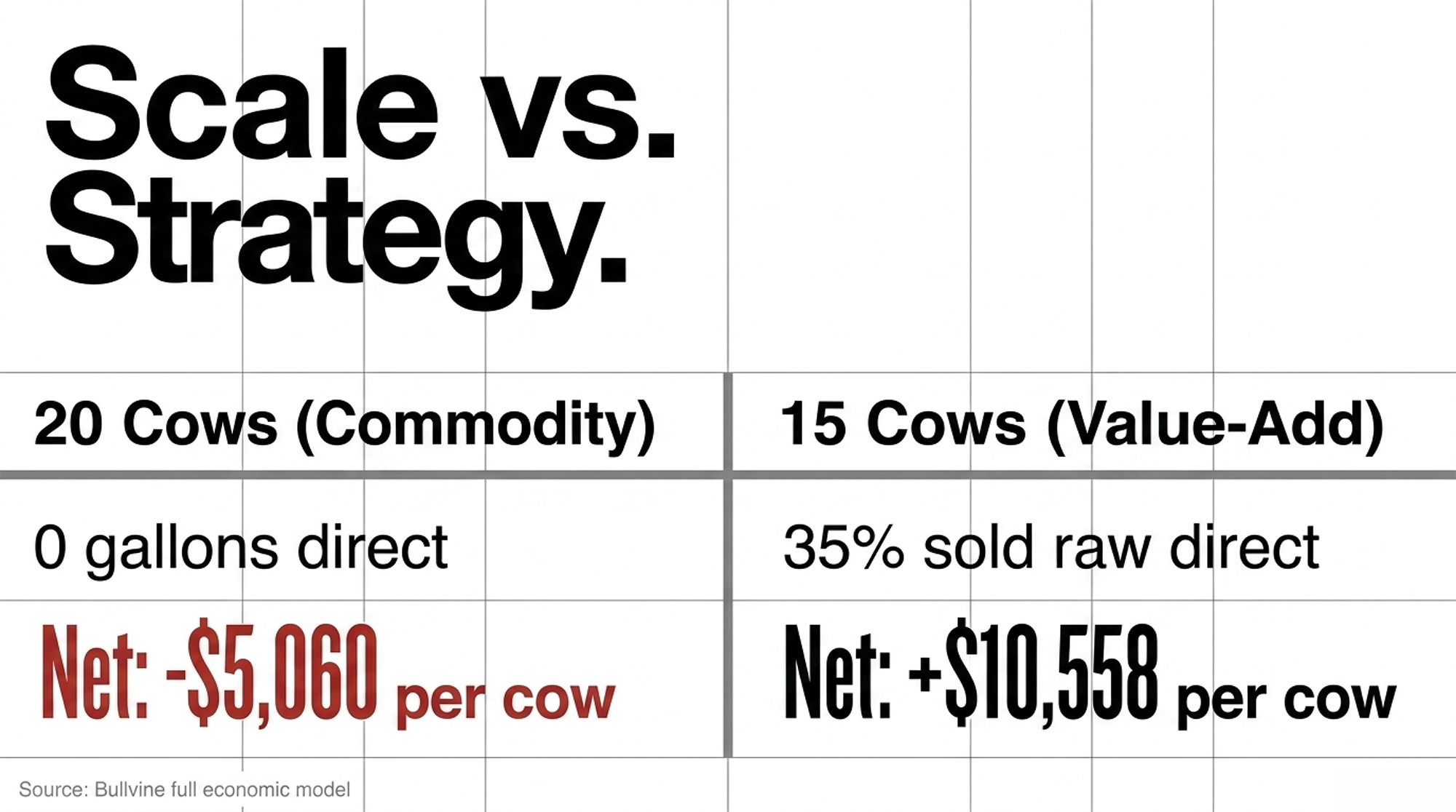
NewsSubscribe
First
Last
Consent

$3,010 Heifers, 30% Labor Jumps: The Mid-Size Dairy Survival Crisis

$3,010 heifers. 30% labor jump. A 650-cow Wisconsin dairyman told me: ‘The math that worked five years ago just doesn’t add up anymore.’ He’s right—and here’s the survival playbook for mid-size operations.

EXECUTIVE SUMMARY: The math that worked for mid-size dairies in 2019 doesn’t work anymore—and this isn’t a cyclical downturn waiting to correct itself. Replacement heifers hit $3,010 per head (up 75% since 2023), labor reached $19.52/hour (up 30% since 2020), and rate increases added $840,000 to the lifetime cost of typical barn financing. Operations milking 300-800 cows are stuck in the ‘mushy middle’: too large for family labor, too small for scale economics that make 1,000+ cow herds consistently profitable. Export tailwinds are fading—Mexico’s $4.1 billion domestic dairy investment and China’s 12% import drop signal permanent shifts. Three paths forward remain viable: scaling past 2,000 cows with strong balance sheets, premium positioning through organic or specialty programs, or partnership models sharing infrastructure costs. Operations missing three or more key benchmarks—cost under $17/cwt, labor efficiency of 50-60 cows/FTE, debt-to-asset under 40%—need strategic reassessment now, not later. The producers still hoping 2026 looks like 2019, risk becoming the cautionary tales others reference.

mid-size dairy survival

I had coffee with a producer friend in central Wisconsin a few weeks back. Runs about 650 cows, third generation, solid genetics, consistently good production numbers. He expanded his freestall barn in 2019—good timing, good financing, everything done right by the book.

But something he said stuck with me: “The math that worked five years ago just doesn’t add anymore. And I keep wondering if I’m missing something or if the whole game changed.”

He’s not missing anything. The game really did change.

As we look toward 2026, it’s becoming clear that we’re not simply weathering another cyclical downturn—the kind where you tighten the belt, wait for better prices, and emerge stronger on the back end. Several fundamental pillars of the traditional dairy business model have shifted, and understanding those shifts is essential for making sound decisions over the next few years.

“The math that worked five years ago just doesn’t add up anymore.” — Central Wisconsin dairy producer, 650-cow operation

Why Different Farms Are Having Such Different Experiences

Purdue University’s Ag Economy Barometer from August 2025 found that crop farms showed financial stress rates around 6.5%—nearly triple the rate reported by livestock operations. Sentiment surveys consistently show livestock farmers running more optimistic than their crop and dairy neighbors, sometimes in the very same counties.

Why the gap? Much of it traces back to how capital gets deployed.

Here’s the reality of dairy economics: a substantial majority of assets are tied up in specialized infrastructure—milking parlors, freestall barns, manure handling systems. These are illiquid, depreciating assets. Research from the Wisconsin Center for Dairy Profitability has shown this pattern repeatedly: as capital investment per cow climbs, return on assets tends to compress.

A cattle feeding operation under margin pressure can reduce placements, turn cattle more quickly, and adjust in real time. A dairy operation doesn’t have that flexibility. Once you’ve built infrastructure for 500 cows, you’re milking roughly 500 cows every single day, regardless of where prices sit.

What’s Really Happening with Costs

Good news first: feed costs have moderated meaningfully. USDA’s Agricultural Prices Report showed dairy feed costs at $9.38 per hundredweight this past August—the lowest monthly reading since late 2020. That’s genuine relief after several difficult years.

But here’s what concerns me. In previous downturns, nearly all input costs eventually moderated together. This cycle looks different. Feed came down, but most other major cost categories have reset to what appear to be permanently higher levels.

While feed costs moderated, every other major input permanently reset higher—heifers up 75%, interest rates up 71%, labor up 30%—this isn’t cyclical, and waiting for 2019 margins is a losing strategy

The Cost Reset at a Glance

Cost Category2020 Baseline2025 RealityStrategic Impact
Hired Labor$15.07/hr (USDA April 2020)$19.52/hr (USDA May 2025)Requires ~30% efficiency gain to offset
Interest Rates3.5% (historic lows)5.5-7.0% (commercial)Adds $840K to $1M mortgage over loan life
Replacement Heifers$1,720/head (April 2023)$3,010/head (July 2025)75% increase limits expansion speed
Machinery RepairIndex baseline 2020+41% (BLS 2025)Maintenance costs are permanently higher
Building Costs2021 baseline+25-40% (materials + codes)New construction ROI fundamentally changed

Sources: USDA Farm Labor Surveys (2020, 2025), USDA FSA rate schedules, CoBank Knowledge Exchange, Bureau of Labor Statistics

My Wisconsin friend’s 2019 expansion? Those interest rates look very different now. He locked in around 4%. Anyone evaluating the same project today faces rates pushing 6-7% on commercial loans.

These figures represent national averages. California operations typically face higher labor and regulatory costs. For Canadian operations, supply management creates a different dynamic entirely—quota values shift the strategic calculus in ways that don’t directly translate from U.S. benchmarks.

Labor illustrates this most clearly. The American Farm Bureau Federation’s analysis shows farm labor costs reaching record territory in 2025—USDA’s Economic Research Service projects labor expenses at $53.7 billion nationally. The May 2025 USDA Farm Labor Survey showed that operators paid $19.52 per hour on average, up 30% from $15.07 in April 2020.

Labor costs jumped 30% since 2020, adding $55,600 annually to a typical 500-cow operation—this isn’t reverting, and competing industries keep bidding wages higher

Anyone who’s tried hiring lately knows the challenge firsthand. Competing industries keep bidding up wages, and the workforce available today simply expects more than it did five years ago. That’s not a criticism—it’s market reality.

Interest rates fundamentally changed expansion economics. Analysis from the Daily Dairy Report illustrates the math starkly: on a 30-year mortgage of $1 million, moving from around 3.5% to over 7% increases monthly payments by more than $2,300. Over the loan’s life, that’s nearly $840,000 in additional interest expense.

Equipment and construction costs reset higher as well. Bureau of Labor Statistics data shows farm machinery repair costs spiked 41% since 2020 alone. Ontario operations are navigating new agricultural building codes in 2025 that are estimated to add 15-35% to construction costs.

The Export Landscape: Meaningful Shifts Underway

Export dynamics deserve attention because they’ve underpinned expansion assumptions for the past 15 years.

Mexico launched a significant self-sufficiency initiative. In April 2025, Xinhua News reported that the Mexican government announced a $4.1 billion investment program running through 2030 to increase domestic milk production. The Secretaría de Agricultura y Desarrollo Rural outlined specific projects—new pasteurization and milk drying facilities across multiple states.

Will Mexico achieve these ambitious targets? Honestly, that’s genuinely uncertain. Water scarcity and enormous productivity gaps between regions present challenges. But here’s the insight worth considering: Mexico doesn’t need full success to affect U.S. export volumes. Even partial achievement would meaningfully reduce demand.

China’s import patterns have shifted structurally. Customs data shows total Chinese dairy imports fell 12% to 2.6 million tonnes in 2023. Meanwhile, domestic production reached 41 million tonnes annually—up 28% from 2019according to the USDA Foreign Agricultural Service and AHDB analysis.

Export Market Risk Summary

Export Market2025 DevelopmentRisk Level for U.S. Dairy
Mexico$4.1B domestic investment through 2030Medium-High: Even partial success reduces demand
ChinaImports -12%; domestic production +28% since 2019High: Structural shift, not cyclical
DomesticFluid milk declining; yogurt/cottage cheese growingModerate: Growth can’t absorb 2.5-3% production increases

Beef-on-Dairy: Understanding the Complete Picture

Beef-on-dairy has delivered meaningful revenue for many operations. Day-old beef-cross calves command substantially higher prices than a few years ago, with some operations reporting six-figure annual revenue additions.

But a broader dynamic is developing.

As more operations breed to beef semen, the replacement heifer pipeline has tightened considerably. HighGround Dairy analysis shows heifers expected to calve totaled just 2.5 million head as of January 2025—the lowest since USDA began tracking in 2001. Total dairy heifers weighing 500 pounds or more reached only 3.914 million head, the smallest inventory since 1978, according to USDA data.

CoBank’s Knowledge Exchange division projects 357,490 fewer dairy heifers in 2025 compared to 2024, with an additional 438,844-head decline expected in 2026.

The 75% heifer price surge from $1,720 to $3,010 fundamentally changed expansion economics—this isn’t a cyclical spike, it’s a structural reset that makes traditional growth strategies obsolete for mid-size operations

The market response has been dramatic. USDA Agricultural Prices data tracked by CoBank shows replacement heifer prices moved from $1,720 per head in April 2023 to $3,010 by July 2025—a 75% increase in just over two years. Top dairy heifers at California and Minnesota auctions reached $4,000 per head by mid-2025.

This is a classic collective action situation. Each farm’s individual decision makes sense. But collectively, these decisions created a replacement shortage that’s repricing the entire system.

The “Mushy Middle” Reality Check

The Zisk profitability platform now monitors operations milking over 4.9 million cows—more than half the U.S. herd. Their data confirm that farms with 1,000 or more cows consistently outperform smaller operations in per-cow profitability.

So what does this mean for my Wisconsin friend with 650 cows? That operation is squarely in the danger zone by these metrics.

Half of all mid-size dairy operations fall into vulnerable or crisis zones with costs above $17.50/cwt—the ‘mushy middle’ at $17.50-19.00 faces the worst math: too large for family labor, too small for scale economics

The danger zone for mid-size operations involves several compounding factors:

  • Cost per hundredweight between $17.00-19.00—too high to compete on commodity margins, but without premium positioning
  • Debt-to-asset ratios above 45-50%—limited financial cushion
  • Herd size between 300-800 cows—too large for family labor alone, too small for full scale efficiencies
  • Single processor relationship—limited negotiating leverage
Performance TierCost per CwtCharacteristics
Top QuartileUnder $16.00Sustainable regardless of price cycles
Second Quartile$16.00-17.50Profitable in good years, vulnerable in downturns
Third Quartile$17.50-19.00The “mushy middle”—requires strategic change
Bottom QuartileAbove $19.00Unsustainable without premium pricing

For that 650-cow operation to stay competitive, the math suggests needing to hit at least three of these five benchmarks:

  1. Total cost of production under $17.00/cwt
  2. Labor efficiency in the 50-60 cows per FTE range
  3. Debt-to-asset ratio under 40% before expansion
  4. Milk price premium of at least $0.50-1.00/cwt
  5. Feed cost under $9.50/cwt
The new competitive threshold: mid-size operations need to hit at least three of these five benchmarks—miss three or more, and you’re not waiting out a cycle, you’re sliding toward the cautionary tale category

Miss three or more? That’s the signal that strategic repositioning deserves serious analysis.

Technology favors scale as well. Genomic testing pays outsized dividends for larger operations—making breeding decisions on $50 tests rather than waiting years for daughter proofs accelerates genetic progress while the per-test cost spreads efficiently across larger herds.

I don’t want to overstate this. Many mid-size operations remain profitable. The data simply suggests the “sweet spot” has narrowed.

Strategic Pathways: What’s Actually Working

The Scale Pathway

Operations growing to 2,000+ cows achieve meaningful cost advantages when they have the right foundation: debt-to-asset ratios well under 40% before expansion, substantial liquid reserves, land and nutrient management already permitted, and management depth beyond the founding family.

The Premium Positioning Pathway

Smaller operations are capturing substantial margins through differentiation. Organic programs through cooperatives like Organic Valley pay meaningful premiums. The most successful premium operations layer multiple strategies—specialty genetics, A2A2 certification, organic practices, and on-farm processing.

The Partnership Pathway

I’ve spoken with Upper Midwest producers running separate family operations who share feed mixing systems, manure handling, and collective purchasing. Individually, none could justify certain equipment investments. Split three ways, the economics work. Partnership success hinges on governance—formal LLCs with clear operating agreements, not handshake arrangements.

Looking Forward

When I asked my Wisconsin friend what he’s planning, he said he’s finally running the numbers on all three pathways. That kind of strategic clarity is available to anyone willing to ask difficult questions.

The producers I encounter who seem most comfortable with their choices—whether expanding aggressively, transitioning to premium markets, or planning thoughtful exits—share something in common: they’ve done the analysis and made intentional decisions rather than defaulting to continuation.

The producers still hoping 2026 will look like 2019 may be the ones writing the case studies that future articles reference as cautionary tales.

Key Takeaways

  • Cost structures have reset permanently higher in labor (+30% since 2020), interest rates, equipment, and construction—feed relief alone won’t restore historical margins
  • Export dynamics are evolving as Mexico invests $4.1 billion in domestic capacity, and China’s imports fell 12%
  • The “mushy middle” faces the toughest math—operations with costs between $17-19/cwt need strategic repositioning, not just better prices
  • Replacement heifer prices hit $3,010/head—up 75% since 2023, fundamentally changing expansion and beef-on-dairy calculations
  • Five benchmarks define competitive mid-size operations: cost under $17/cwt, labor efficiency near 50-60 cows/FTE, debt-to-asset under 40%, milk premium capture, and feed cost advantages
  • Multiple strategic pathways remain viable—scale, premium positioning, and partnerships each show success stories
  • Proactive strategic decisions outperform reactive ones—the optimal time for analysis precedes circumstances that narrow available options

Complete references and supporting documentation are available upon request by contacting the editorial team at editor@thebullvine.com.

Learn More

The Sunday Read Dairy Professionals Don’t Skip.

Every week, thousands of producers, breeders, and industry insiders open Bullvine Weekly for genetics insights, market shifts, and profit strategies they won’t find anywhere else. One email. Five minutes. Smarter decisions all week.
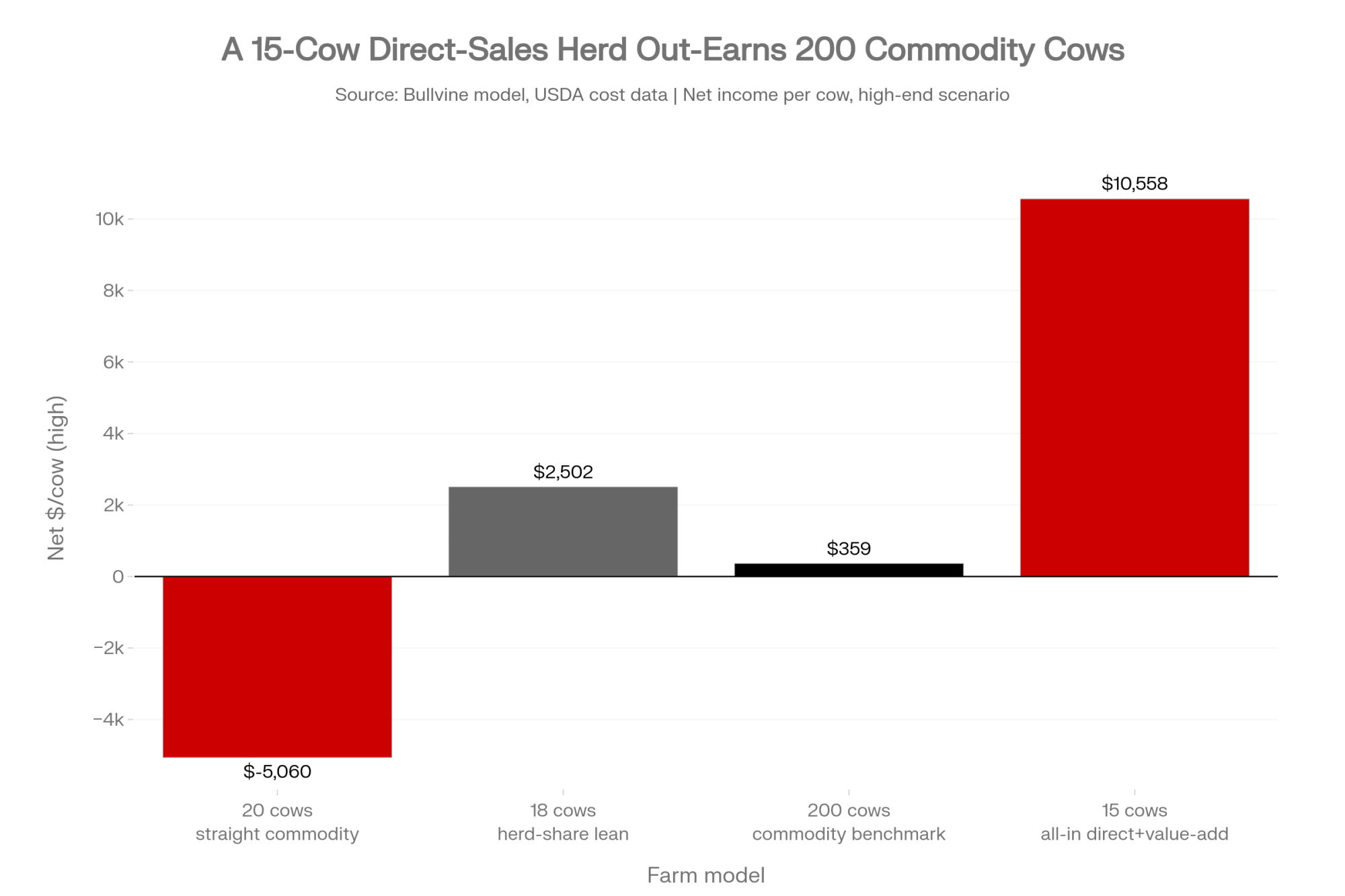
NewsSubscribe
First
Last
Consent

China’s 500,000-Cow Farms and Lab-Grown Milk: Your Dairy’s 18-Month Decision Window

Your grandfather milked 50. You milk 500. China milks 500,000. This ends one of three ways.

Having spent the better part of two decades analyzing dairy production trends, I can tell you that what we’re witnessing today represents a fundamental shift in how milk is produced globally. The International Farm Comparison Network’s latest 2024 data reveals something remarkable: five of the world’s ten largest dairy operations are now Chinese-owned. Modern Dairy, for instance, manages nearly half a million cows across 47 farms—a scale that would have been unimaginable just a generation ago.

What’s particularly noteworthy is Almarai’s achievement in Saudi Arabia. They’re consistently hitting 14 tonnes of milk per cow annually in desert conditions where summer temperatures routinely exceed 50°C. That level of production in such challenging conditions offers valuable lessons for operations everywhere, from California’s Central Valley to the arid regions of Arizona and even parts of Texas experiencing increasing drought pressure.

This transformation comes at a time when mid-sized dairy operations across North America are evaluating their strategic options. The conversations happening at farm meetings and extension workshops reflect genuine uncertainty about the path forward. Should an 800-cow operation expand to 2,500? Can family farms find sustainable niches in this changing landscape? These aren’t abstract questions—they’re daily realities for thousands of producers.

The Geographic Realignment of Global Dairy Production

Looking at this trend, what strikes me most is how quickly the center of gravity has shifted eastward. The 2024 data from IFCN paints a clear picture: China’s five largest operations—Modern Dairy with 472,480 cows, China Shengmu with 256,650, Yili Youran with 246,000, and Huishan with 200,000—represent impressive numbers. They reflect a deliberate national strategy.

Dr. Jiaqi Wang at the Chinese Academy of Agricultural Sciences provides important context here. Following the 2008 melamine incident that affected hundreds of thousands of infants, Chinese dairy companies fundamentally restructured their approach to prioritize supply chain control. This builds on what we’ve seen in other industries where food safety crises prompted systemic changes.

MetricChina EliteChina AvgUS MidwestUS Mega
Herd Size472k (Modern)8k-15k1k-5k10k-30k
Yield/Cow (t)9.5-12.09.611.0-13.011.8-13.4
Feed Conv Ratio1.4:11.6:11.5:11.4:1
Self-Suffic85% (170%)73%100%100%
Tech Invest LvlVery HighHighModerateVery High

China’s agricultural policy documents outline ambitious targets: achieving 70% milk self-sufficiency by 2030, with intermediate goals potentially pushing toward 75-85% over time. They’re also targeting annual yields exceeding 10 tonnes per cow—a significant leap from current averages. This aligns with their broader strategy of reducing import dependence across agricultural commodities.

Why does this matter for North American and European producers? Well, the USDA Foreign Agricultural Service reports that China’s dairy imports have exceeded $10 billion annually in recent years. As Rabobank’s 2024 quarterly analysis shows, China added 11 million metric tons of production between 2018 and 2023, already displacing approximately 240,000 tonnes of whole milk powder imports. For regions that have counted on Chinese demand as a growth driver—particularly New Zealand and Australia—this represents a significant market shift requiring strategic recalibration.

Understanding Productivity Variations Across Mega-Dairies

Desert dairy operation in Saudi Arabia achieves 82% higher productivity than China’s largest farm despite having 6x fewer cows—proving management beats scale in global dairy competition

One of the most intriguing findings from analyzing global mega-dairy performance is the substantial productivity variation even among the largest operations. Consider the range based on 2024-2025 company data: Almarai achieves 14.00 tonnes per cow annually; Rockview Dairies in California produces 11.80 tonnes; Modern Dairy in China averages 9.53 tonnes; and Huishan manages 7.70 tonnes.

This 82% productivity gap between the highest and lowest performers—both operating at massive scale with significant capital resources—challenges assumptions that scale automatically drives efficiency. What accounts for these differences?

Anthony King, who oversees operations at Almarai’s Al Badiah facility, shared insights at the International Dairy Federation’s 2024 World Dairy Summit about their management approach. The attention to detail is extraordinary: maintaining barn temperatures at 21-23°C year-round despite extreme external heat, providing 300 liters of water per cow daily, and implementing precision feeding protocols that optimize every nutritional variable.

The USDA Economic Research Service’s comprehensive 2023 analyses (their most recent full report) support what many progressive producers have long suspected: management sophistication and technological integration matter more than scale alone. Well-managed 500-cow operations implementing advanced protocols often outperform poorly-managed facilities ten times their size.

In Idaho, a 600-cow dairy was achieving 13,000 kilograms per cow through exceptional management, while a nearby 5,000-cow facility struggled to reach 11,000 kilograms. The difference? Attention to transition cow management, consistent fresh cow protocols, and meticulous record-keeping at the smaller operation.

The Economics Driving Industry Consolidation

The relentless math of consolidation: Smaller operations face $9.77/cwt higher costs than mega-dairies, translating to nearly $1 million in annual structural disadvantages for 1,000-cow farms that excellent management cannot overcome

What farmers are finding is that consolidation isn’t really about wanting to get bigger—it’s about the relentless mathematics of fixed costs. USDA’s 2024 cost of production data reveals the economics clearly: operations with 2,000+ cows average $23.06 per hundredweight in total costs, while farms with 100-199 cows face costs of $32.83—a difference of $9.77 per hundredweight.

What’s revealing here is the breakdown. The University of Wisconsin’s Center for Dairy Profitability research, led by Dr. Mark Stephenson, indicates that feed cost differences account for only about $2.50 of that gap. The remaining differential? It stems from spreading fixed infrastructure investments across production volume.

As Dr. Stephenson articulated in his January 2024 market outlook presentation: when fixed costs exceed variable costs in a commodity market, smaller operations face structural disadvantages regardless of management quality. For a representative 1,000-cow Upper Midwest operation producing 23 million pounds annually, this translates to $690,000 to $920,000 in additional costs compared to larger competitors—often exceeding total profit margins.

This economic reality helps explain why we’re seeing continued consolidation despite many producers’ preference for maintaining traditional farm sizes. The economics are pushing the industry in one direction, even as community ties, lifestyle preferences, and succession-planning challenges pull it in another.

Technology Adoption: Promise and Complexity

This development suggests that technology alone won’t solve dairy’s challenges—it’s how that technology is managed that matters. Beijing SanYuan exemplifies what’s possible, achieving 11,500+ kg per cow annually—matching Israel’s national average—through systematic adoption of Israeli dairy management systems since 2001, according to their published operational data.

But here’s the challenge. Professor Li Shengli at China Agricultural University identifies a critical constraint in his 2024 research published in the Journal of Dairy Science China: human capital. Chinese Ministry of Human Resources data from 2024 indicates that only about 7% of the country’s 200 million skilled workers possess the high-level capabilities needed to manage complex dairy systems effectively.

This creates an interesting paradox we see globally. Operations with capital for advanced technology often lack the expertise to optimize it, while highly skilled managers at smaller operations can’t access these tools. I know a manager in Pennsylvania running 600 cows who could likely double productivity with access to advanced monitoring systems and automated feeding technology. Meanwhile, I’ve toured 5,000-cow facilities with million-dollar technology packages operating well below potential due to management constraints.

Environmental Management: Challenges and Opportunities

The environmental dimension presents both challenges and unexpected opportunities—and it’s more nuanced than many discussions suggest. EPA calculations show that a 2,000-cow operation generates approximately 87.6 million pounds of manure annually—that’s 240,000 pounds daily, which require sophisticated management.

The World Resources Institute’s 2024 analysis highlights how scale affects these choices. Larger operations typically implement liquid storage systems for operational efficiency, but these generate substantially more methane than the daily-spread approaches common on smaller farms. This creates environmental trade-offs worth considering.

What’s encouraging is that at sufficient scale—typically around 5,000+ cows based on current feasibility analyses—biogas digesters become economically viable. These systems, which require investments of $2-5 million, can generate 5 million cubic meters of biogas annually. Youran Dairy in China operates nine such facilities, each producing approximately this volume according to their 2024 sustainability reports.

These operations are transforming waste management from a cost center into revenue through electricity generation, fertilizer sales, and carbon credit programs. The capital requirements mean this solution remains out of reach for most mid-sized operations, though, creating another scale-dependent advantage.

It’s worth noting explicitly that while larger farms may achieve better emissions intensity per unit of milk produced, smaller farms often have lower absolute emissions overall—a nuance that deserves more attention in environmental policy discussions. A 200-cow grass-based operation in Vermont creates different environmental impacts than a 10,000-cow facility in New Mexico, even if the per-gallon metrics favor the larger operation.

Strategic Options for Mid-Sized Operations

Three survival strategies for operations caught between mega-dairy economics and precision fermentation disruption—with Strategic Exit preserving 85-90% equity versus 20-30% in forced liquidation after prolonged losses

For the 500-2,000 cow operations that form the backbone of American dairy, three strategic paths show promise based on extension research and producer experiences:

Strategic Options for the Mid-Sized Dairy

PathPotential BenefitTimeline / Requirement
Cooperative Premium8-12% price advantage ($200k-$300k/yr for 1,000 cows)Requires strong co-op selection & management
Value-Added Path36-150% margin improvement (cheese, yogurt, direct sales)5-7 year development; high marketing & business skill
Strategic ExitPreserve 85-90% of farm equityRequires proactive timing before major losses

Maximizing Cooperative Benefits

Cornell’s Dyson School research from 2023, led by agricultural economist Dr. Andrew Novakovic, demonstrates that well-managed cooperatives deliver 8-12% price premiums through collective bargaining compared to independent sales to investor-owned processors. For a 1,000-cow operation, this represents $200,000 to $300,000 in additional annual revenue.

The key lies in cooperative selection. Strong downstream market positioning and professional management make the difference. Cornell’s pricing analysis found some underperforming cooperatives actually paying 3.5% less than investor-owned processors, underscoring the importance of due diligence.

Value-Added Diversification

European research examining 265 dairy farm diversification efforts, published in the Agricultural Systems journal, found compelling margins: cheese production generated €0.688 per liter more than fluid milk, while yogurt generated €1.518 more. Direct sales improved margins by an average of 36%.

These numbers look attractive, but Ireland’s Nuffield scholarship research from Tom Dinneen provides important context: approximately 95% of dairy farmers lack the marketing and business skills needed for successful value-added transitions. The typical path to profitability takes 5-7 years—requiring substantial patience and capital reserves.

Strategic Transition Planning

A Wisconsin dairy case study: Strategic exit today preserves $765k versus $255k after forced liquidation—that’s $510,000 destroyed by waiting for market conditions that won’t improve for mid-sized operations

Wisconsin Extension’s 2024 farm financial analyses, compiled by agricultural economist Dr. Paul Mitchell, reveal the importance of timing. Producers making strategic exit decisions while maintaining strong equity positions typically preserve 85-90% of their farm’s value. Waiting 12-18 months reduces this to 70-80%. Those forced to exit after several years of losses might retain only 20-30% of their equity.

Extension specialists share examples of successful transitions. One documented case from southern Wisconsin involved a producer with $850,000 in equity who transitioned strategically, preserving over $700,000 for retirement and new ventures. These aren’t failure stories—they’re examples of astute business management in changing markets.

The Precision Fermentation Revolution

With $840 million invested in 2024 and price parity projected for 2027-2028, precision fermentation threatens to capture 25% of commodity dairy protein markets by 2035—while you’re planning 20-30 year infrastructure investments

While consolidation reshapes current production, precision fermentation represents a potentially transformative disruption. The Good Food Institute’s 2025 market analysis tracks growth from $5.02 billion currently toward projected valuations of $36.31 billion by 2030—representing 48.6% annual growth.

Companies like Perfect Day already produce commercial-scale whey and casein proteins identical to dairy-derived versions. Consumers are purchasing products containing these proteins—Brave Robot ice cream, California Performance Co. protein powders, and even Nestlé’s new plant-based cheese line using precision fermentation proteins—often without realizing the proteins come from fermentation rather than cows.

Investment tracking from PitchBook and Crunchbase shows over $840 million from major investors, including Bill Gates’ Breakthrough Energy Ventures, flowing into these technologies, with $50+ billion projected across the sector by 2030. Cost curves suggest price parity with conventional dairy proteins by 2027-2028, potentially capturing 25% of commodity protein markets by 2035.

This doesn’t spell immediate doom for traditional dairy, but when you’re planning infrastructure investments with 20-30 year depreciation schedules, these technology trends deserve serious evaluation. I’ve noticed that younger producers are particularly attuned to these disruption risks when making expansion decisions.

International Regulatory Pressures

European developments offer insights into potential regulatory futures—and they’re moving faster than many realize. The EU’s Farm to Fork Strategy targets 25% organic production by 2030, while nitrate directives and evolving welfare requirements fundamentally alter production economics.

The Netherlands allocated €25 billion for livestock farm buyouts near environmentally sensitive areas—a scale of intervention that would have seemed impossible just years ago. German regulations now require specific space allocations (6 square meters indoor plus 4.5 square meters outdoor per cow) for certain certifications, fundamentally changing the economics of the confinement system.

These aren’t just European issues. Similar discussions around environmental impact, animal welfare, and production intensity are emerging across North America. California’s evolving regulations often preview broader U.S. trends. Whether through regulation or market pressure, these factors will likely influence future production systems globally.

Envisioning 2035: A Transformed Industry

Based on IFCN projections, FAO’s 2024 agricultural outlook, and technology trends, the 2035 dairy landscape will likely differ dramatically from today. Current projections suggest that approximately 40% of global production will come from 300-500 industrial mega-dairies, concentrated in the U.S., China, and the Middle East. Another 35% would come from South Asian smallholders—primarily the millions of households in India and Pakistan that maintain 2-5 animals. Precision fermentation might capture 25% of commodity protein production, with less than 5% from premium niche operations serving specialty markets.

The “missing middle”—operations between 500-2,000 cows—faces the greatest pressure in this scenario, unable to achieve mega-dairy economies or premium market positioning. This isn’t predetermined, but current trends point strongly in this direction.

Practical Considerations for Today’s Decisions

Looking at all this data and these trends, what should producers consider?

For operations under 500 cows, differentiation becomes essential. Whether through premium market positioning, exceptional management within strong cooperatives, or direct marketing, competing in commodity markets against mega-dairies appears increasingly challenging. I’ve seen success with A2 milk premiums (30-50% price advantage), grass-fed certification (40-60% premiums), and local brand development—but each requires commitment beyond production alone.

Operations in the 500-2,000 cow range face time-sensitive decisions. The window for strategic transitions that preserve equity is narrowing—probably 12-18 months based on current market dynamics. Waiting for ideal conditions that may never materialize risks substantial equity erosion.

Those considering expansion should carefully evaluate whether achieving a 2,500+ cow scale is realistic given capital and management resources. Partial expansions that don’t achieve efficient scale often compound problems rather than solving them. I’ve watched too many 1,500-cow expansions create more debt without solving the fundamental economic problems.

Everyone should monitor precision fermentation developments. This technology will impact commodity markets within the decade, requiring strategic adaptation across the industry.

Key Takeaways 

  • The 82% productivity gap proves scale doesn’t guarantee success: Saudi Arabia’s desert dairies outperform China’s mega-farms—it’s management and technology integration, not cow count, that wins
  • Mid-sized farms (500-2,000 cows) have three options, not four: Scale to 2,500+, find a $300K premium niche, or exit strategically—”staying the course” is slow-motion bankruptcy
  • Your equity has an expiration date: Exit now, preserving 85%, wait 18 months for 70%, or lose 60-80% fighting the inevitable—the clock started when you opened this article
  • Lab-grown milk isn’t a future threat—it’s a current reality: $840M invested, identical proteins in stores now, price parity by 2027—plan infrastructure accordingly
  • Winners already chose their lane: 300 mega-dairies will dominate commodities, 2,000 niche farms will own premiums, everyone else disappears—which are you?

EXECUTIVE SUMMARY: 

  • China’s Modern Dairy runs 472,480 cows, while Silicon Valley grows identical milk proteins without cows—your 800-cow operation is caught between these extremes. Mid-sized farms (500-2,000 cows) now face $9.77/cwt cost disadvantages that excellent management cannot overcome, translating to nearly $1 million in annual structural penalties. Three proven escape routes remain: joining strong cooperatives for immediate 8-12% premiums, developing value-added products for 36-150% margin improvements, or executing strategic exits that preserve 85% of equity versus 20% after prolonged losses. With precision fermentation achieving price parity by 2027 and China eliminating import markets, the decision window has narrowed to 18 months. The industry will split into 300 mega-dairies, 2,000 premium niche operations, and precision fermentation facilities—the 15,000 farms in between will vanish.

Complete references and supporting documentation are available upon request by contacting the editorial team at editor@thebullvine.com.

Learn More:

The Sunday Read Dairy Professionals Don’t Skip.

Every week, thousands of producers, breeders, and industry insiders open Bullvine Weekly for genetics insights, market shifts, and profit strategies they won’t find anywhere else. One email. Five minutes. Smarter decisions all week.
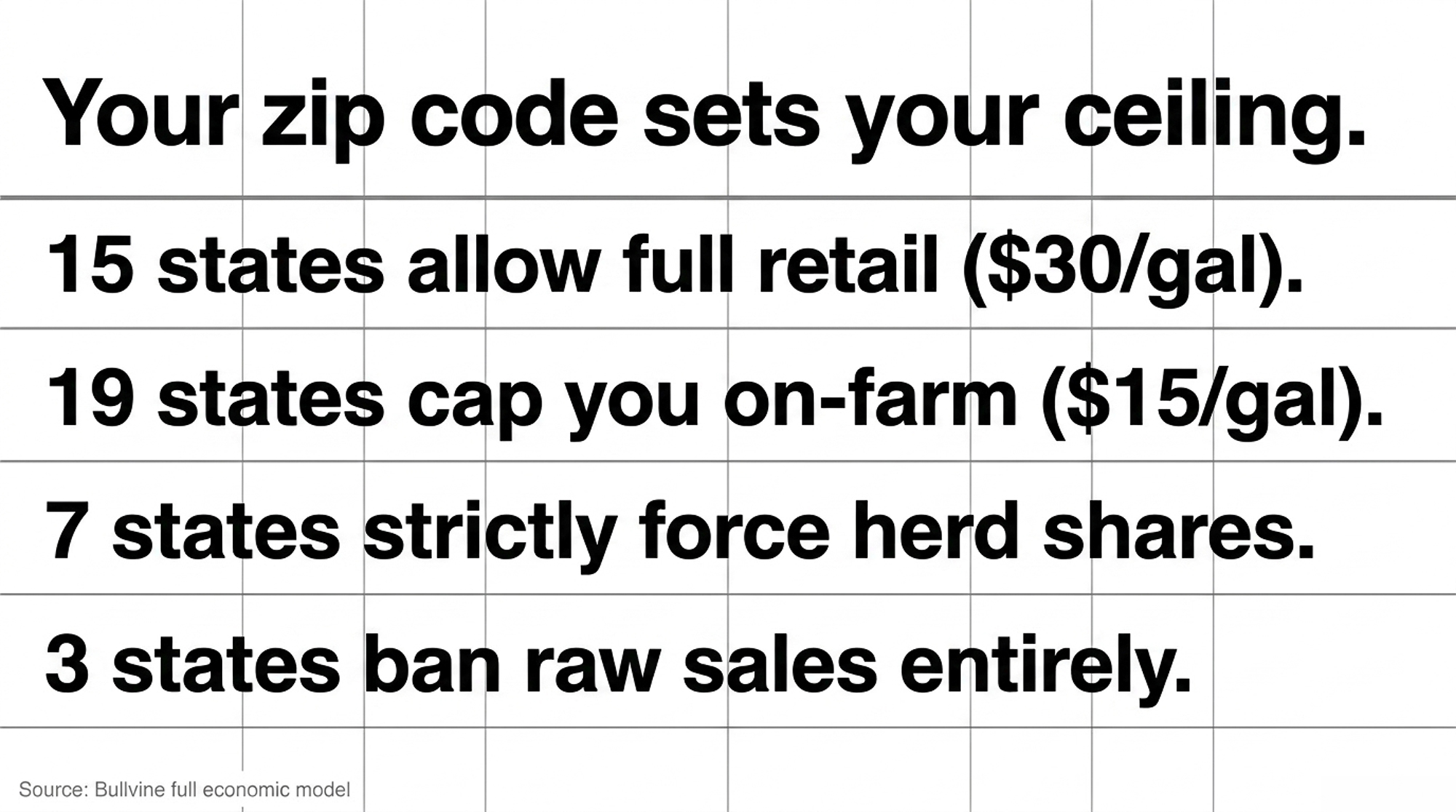
NewsSubscribe
First
Last
Consent

22% of Your Dairy Income Is Government Money- Time to Calculate Your Real Position

5% of dairies don’t need government money. 70% can’t survive without it. Which are you?

Executive Summary: Is that government check keeping you afloat? It’s costing you $6,250 a month in retirement income you’ll never get back. With payments now 22.4% of dairy income nationwide, our analysis of operations across the country reveals only 5-10% are genuinely profitable without support—while 60-70% just break even, and 20-30% lose money even with help. The math is simple but brutal: every month of losses converts retirement equity into operating expenses. Meanwhile, processors are betting $11 billion on milk supply that depends entirely on political decisions outside your control. The seven-step calculation in this article takes ten minutes and will show you exactly where you stand—and whether you’re building a business or managing a decline.

Dairy financial position

With FSA offices reopening and $3 billion in agricultural assistance flowing, what experienced dairy farmers are discovering about dependency ratios and strategic positioning

This morning brought a familiar sight to small towns across dairy country. Pickup trucks lined up at Farm Service Agency offices, farmers catching up on payments delayed by the recent three-week government shutdown.

Watching this scene unfold at our local FSA office, I couldn’t help but wonder… how many of these operations actually know what percentage of their income depends on these government programs?

For every $5 of dairy income, more than one dollar comes from Uncle Sam—not the market. That’s a fundamental shift in how U.S. milk is financed.

After talking with producers from Wisconsin’s rolling hills to the expansive operations in Texas this past week, something interesting is emerging. You know, USDA’s September 2025 Farm Income Forecast shows government payments are projected to make up 22.4% of net farm cash income this year. That’s not just a number—it’s telling us something important about where we are as an industry.

Rosy headlines can’t hide it: only 7.5% of dairy operations are truly profitable without government backing. Most are barely treading water—or actively sinking. The story the industry doesn’t want told.

Understanding Where Different Operations Stand

Had a fascinating conversation at our regional dairy conference last week. Several financial advisors were sharing what they’re seeing across different operations, and honestly, the picture’s more nuanced than you might expect.

Operations Achieving Market Independence

So here’s what’s interesting—when you look at Cornell’s Dairy Farm Business Summary along with data from other land-grant universities, the analysis suggests maybe 5-10% of dairy operations have reached that point where they’re consistently profitable without government support. We’re talking about dairies milking over 1,000 cows with production costs below $18 per hundredweight, or those who’ve successfully tapped into premium markets.

I was talking with a Wisconsin producer last week—runs about 1,800 Holsteins—and his perspective really stuck with me. “For us,” he said, “the government payments are opportunity capital, not survival money. We’re putting everything into genomic testing because even tiny improvements in protein percentage mean six figures at our volume.”

And that’s the thing, isn’t it? These larger operations aren’t using support payments just to keep the lights on. They’re using them to pull further ahead.

The Challenging Middle Ground

Now, based on Farm Credit data from various regions, it appears roughly 60-70% of dairy operations face what consultants are calling a structural challenge. These farms—typically between 200 and 800 cows—are facing production costs in that $20-24 per hundredweight range, according to benchmarking from places like Farm Credit East.

You probably know operations like this. Built their facilities back when the economics looked completely different.

As Mark Stephenson from UW-Madison’s Center for Dairy Profitability points out, they’re often too big for premium niches but too small for real commodity-scale efficiencies.

Think about it this way—imagine a 450-cow operation in Pennsylvania (and there are plenty like this). Without government payments, they might face monthly losses of $6,000. With payments? They break even. But breaking even doesn’t build equity, and it sure doesn’t set up the next generation.

Operations Under Severe Stress

This is the tough part to talk about. Kansas State’s ag economics department analysis, along with other farm management programs, suggests that maybe 20-30% of dairy farms are losing money even with government support.

These operations typically show debt-to-asset ratios over 60%, maxed credit lines… you know the signs.

Financial advisors working with dairy—and they understandably don’t want their names attached to this—tell me about clients who probably should have transitioned out a couple of years back. But the government payments keep them going month to month. It’s less farming at that point and more… well, managing decline.

The Development of Dependency: How We Got Here

From 15% to 56%: Trade wars and stalled Farm Bills turned support into lifelines. Even in 2025, median farm income is negative—subsidy or bust.

The University of Kentucky’s farm management program has been tracking the same group of farms since 2010, providing us with a unique window into how things have developed. Their data shows something remarkable—when government payments dropped in 2014 after the Farm Bill got delayed, net farm income didn’t just dip. It crashed 65% in one year.

By 2019, during all that trade disruption with China, those Kentucky farms were averaging $187,311 in government payments. Here’s what really gets me—that was 56% of their total net farm income. More than half their profitability came from Washington, not from selling milk.

And USDA’s latest Economic Research Service projections? They’re showing median farm income—not average, but median—at negative $1,189 for 2025. That means half of all farms would lose money just from farming. The $89,881 average off-farm income is what’s keeping many families afloat.

Strategic Approaches to Government Support

It’s decision time: Empire, decision-point, or decline? This isn’t just farm math—it’s your family’s future.

What I find really telling is how different operations use these payments. The patterns… they say a lot about who’s likely to be here in ten years.

Land Acquisition Strategies

Several larger producers I know in Idaho and Wisconsin keep careful tabs on neighboring operations. Not to be predatory, but to be ready.

As one explained at a recent field day, “We know who’s retiring, who’s struggling. When opportunities come up, we need to be positioned.”

Iowa State’s Beginning Farmer Center research shows that farmland in distressed sales typically sells for 15-20% less than in planned transitions. The financially strong operations? They know this. They keep cash ready.

Component Quality as Profit Center

Here’s something that’s changed—with cooperatives paying anywhere from 50 cents to over a dollar per hundredweight in component premiums —genetics isn’t just about better cows anymore. It’s a profit center.

Holstein Association USA’s 2025 Genetic Progress Report shows some impressive returns. Say you’ve got 900 cows and you bump protein by 0.08% through genomic selection. Doesn’t sound like much, right? But that could be $100,000 more annually. Pretty solid return on a $25,000-30,000 testing investment.

Technology Investment Discipline

The University of Minnesota’s dairy program research shows that successful operations won’t touch technology unless the projected ROI is at least 15%. That’s become kind of a benchmark.

Take robotic feed pushers—about $30,000. They eliminate a part-time position, improve feed efficiency. Wisconsin producers I know are seeing 60% first-year returns when you combine labor savings with better feed conversion.

Compare that to operations using government payments for emergency repairs on old equipment. Two different philosophies entirely.

The Financial Planning Reality Check

This is where that $6,250 monthly figure from our headline comes into focus. Cornell economists Loren Tauer and Christopher Wolf have done extensive work on farm exit timing, and their framework reveals exactly how each month of losses converts retirement security into operating capital.

Every month in the red eats away $6,250 in future income. Five years lost = $375,000 gone, $15,000 less for retirement—year after year after year.

Let me walk you through what this might look like for a typical 400-cow operation. Say you’ve got $1.5 million in equity right now. If you’re losing $75,000 annually without government payments, in five years you’re down to $1.125 million.

At a conservative 4% return, that’s $15,000 less annual retirement income. Forever.

As Dr. Tauer explained at a recent conference, “Every month of operating losses essentially converts $6,250 of retirement savings into operating capital.”

What concerns many of us in extension is how few producers have actually run these numbers. We don’t have comprehensive survey data, but informal polls at producer meetings suggest it’s pretty rare.

Your Quick Equity Assessment

Here’s the calculation to run tonight:

  1. Total assets (land, cattle, equipment): $_____
  2. Subtract all debts: $_____
  3. Current equity = #1 – #2: $_____
  4. Annual result without government payments: $_____
  5. Monthly impact = #4 ÷ 12: $_____
  6. Five-year projection = #4 × 5: $_____
  7. Retirement income impact (at 4%) = #6 × 0.04: $_____

Takes ten minutes. Could change your whole strategy.

“These payments don’t solve challenges—they reveal them. The question is how we use that information.” — Gary Sipiorski, Dairy Financial Consultant

International Comparisons: Why They’re Tricky

FactorsNew Zealand (1984)United States (2025)Advantage
Infrastructure Cost per Cow$500-1,000$4,000-7,000NZ by 7X
Avg Debt-to-Asset Ratio20-30%43% (avg), 60%+ (struggling)NZ by 2X
System TypePasture-basedConfinementNZ – flexible
Average Herd Size125 cows337 cows (70% from 5% of farms)US – more scale
Farm Count (1984/2025)~16,000~31,000US has more
Impact of Subsidy Removal~800 farms lost (1%)Unknown – catastrophic riskNZ – survived
Capital IntensityLowExtremeNZ – adaptable

Everyone brings up New Zealand’s 1984 subsidy elimination, but… the comparison’s challenging when you look closer.

New Zealand had about 16,000 dairy farms averaging 125 cows on pasture. Infrastructure investment was minimal—maybe $500-1,000 per cow. Debt-to-asset ratios typically ran 20-30%.

When subsidies ended overnight, about 800 farms faced forced sales. That’s roughly 1% of all their agricultural operations.

Now look at us:

  • USDA Census data shows: 70% of our milk comes from just 5% of farms
  • Infrastructure requirements: Modern confinement facilities need $4,000-7,000 per cow
  • Debt levels: Farm Credit analysis shows average debt-to-asset ratios around 43%, with struggling operations often over 60%

As Mark Stephenson from UW-Madison thoughtfully puts it, “Comparing New Zealand’s pasture system to our capital-intensive model is like comparing a bicycle to a freight train—both move, but the physics are completely different.”

Processing Capacity and Infrastructure Challenges

Here’s what adds complexity—the International Dairy Foods Association reports over $11 billion in new processing capacity under construction.

Major investments include:

  • Fairlife’s $650 million New York facility
  • Chobani’s $1.2 billion expansion
  • Multiple Texas projects from Leprino, Great Lakes Cheese, and others

All these investments assume milk supply stays stable. But if support programs changed dramatically and even 10,000 farms exited quickly? Several economists think that’s actually conservative. You’d have massive overcapacity issues.

Remember Dean Foods in 2019? Fifty-four plants, thousands of affected farms. The whole system shuddered until Dairy Farmers of America stepped in. That showed us how vulnerable the supply chain can be.

Regional Cost Variations That Matter

Geography really matters in this business. Farm Credit data from different regions shows distinct patterns worth understanding.

Northeast and Upper Midwest:

  • Production costs: $22-24 per hundredweight (Farm Credit East benchmarking)
  • Challenge: Developed when transportation limits created natural market protection
  • Reality: That advantage is long gone

Southwest (Texas and New Mexico):

  • Production costs: $19-21 per hundredweight (regional studies)
  • Challenge: Water access and environmental compliance eat up cost advantages
  • Critical issue: Ogallala Aquifer depletion forcing hard conversations

West Coast (California and Idaho):

  • Production costs: $16-18 per hundredweight for efficient operations (UC Davis cost studies)
  • Advantage: Geography plus scale creates a competitive position
  • Result: Clearest path to subsidy independence

Special Considerations for Different Farm Types

Smaller Operations (Under 200 cows)

Operations under 200 cows face particular challenges. Vermont extension data talks about a “triple squeeze”:

  • Not enough scale for commodity competition
  • Limited premium market access
  • Old infrastructure is uneconomical to modernize

Some smaller farms make it work through creative differentiation—farmstead cheese, agritourism, direct sales. But as economists point out, these require different skills and serve limited markets.

Value-Added Operations

Farms with existing value-added enterprises have more flexibility. These operations might use government payments to expand processing capacity or improve visitor facilities rather than covering operating losses.

It’s a different strategic position entirely.

Beginning Farmers

Young farmers entering now face unique challenges:

  • Land prices assume subsidies continue
  • Competition from operations with decades of equity
  • Making 30-year decisions without 5-year policy certainty

One recent dairy science graduate told me, “I run three scenarios—continued support, reduced support, no support. The spread between outcomes is huge.” That uncertainty makes traditional planning incredibly difficult.

Emerging Opportunities Worth Watching

Despite everything, there are some interesting developments.

The Innovation Center for U.S. Dairy’s 2025 report shows that carbon credits can generate $15-50 per cow annually for early adopters. Not game-changing yet, but it’s market-based income that doesn’t depend on politics.

Your processor relationship matters more than ever, too. Research on cooperative marketing shows that members typically get slightly lower prices, with much less volatility—often 40% less. When stability comes from government payments, that trade-off’s worth considering.

Practical Next Steps for Different Situations

If you’re already profitable without support: Use these payments strategically. Accelerate genetic programs with proven returns. Position for land acquisition at the right prices. Build processor relationships. But keep that 15% ROI discipline on technology.

If you’re in that structural challenge category: You’ve got decisions ahead. Can you realistically hit efficient scale? Are premium markets actually accessible with committed buyers? Would technology substantially cut labor costs?

Tough questions, but necessary ones.

If you’re struggling even with support: Time matters. Each month affects retirement security. Good agricultural financial advisors can help evaluate options while you still have them.

Resources to Help You Plan

Want to dig deeper? Here are specific tools that can help:

  • Cornell’s Dairy Farm Business Summary – Provides detailed benchmarking data (contact your local Cornell Cooperative Extension)
  • Penn State’s Center for Dairy Excellence – Offers free financial analysis tools, including FINPACK
  • University of Wisconsin’s Center for Dairy Profitability – Has online planning tools and consultants
  • Your local FSA office Can provide your operation’s historical payment data and dependency trends
  • Farm Credit associations – Many offer free financial planning consultations to members

Most land-grant universities have dairy specialists who can help run scenarios specific to your situation. Don’t hesitate to reach out—that’s what they’re there for.

Looking Forward with Clear Eyes

Those government payments flowing from reopened FSA offices mean different things to different operations. For some, it’s growth capital. For others, maybe a window for strategic transition while preserving equity.

With a dependency rate of 22.4% according to USDA, massive processing investments assuming stable supply, and ongoing political discussions about support… the planning environment keeps evolving.

Operations that honestly assess where they are—not where they wish they were—and act thoughtfully will likely be better positioned regardless of policy changes.

The calculations take maybe twenty minutes with good numbers. That time investment might provide more strategic value than months of hoping things improve. The question is whether we’ll do the analysis while options exist or wait until circumstances force decisions.

You know, driving through dairy country each day, passing farms that’ve operated for generations… these aren’t easy conversations. But agriculture has always evolved. What worked before might need adjustment for what’s coming.

Acknowledging that reality, while difficult, serves everyone better than avoiding it.

The support payments are arriving. The strategic questions remain. And the decisions—well, those belong to each operation based on their unique circumstances, goals, and honest assessment of where they stand in today’s dairy economy.

What’s clear is that understanding your true financial position—including that monthly equity impact—gives you the power to make informed choices rather than having them made for you.

And in this business, that might make all the difference.

Key Takeaways:

  • Your Monthly Reality: Every month you operate at a loss burns $6,250 of retirement income—that’s $375,000 over five years you’ll never recover
  • The 90% Problem: Only 1 in 10 dairy operations is genuinely profitable without government support; everyone else is either treading water (60-70%) or actively sinking (20-30%)
  • The Investment vs. Survival Test: Operations that’ll exist in 2035 use government payments for genetics, technology, and land acquisition—not monthly bills
  • The $11 Billion Question: Processors are betting massive capital on milk supply that depends entirely on political decisions—if payments end, who supplies that milk?
  • Your Next 10 Minutes: Use our seven-step equity calculation tonight—it’s the difference between knowing your position and discovering it when it’s too late


Complete references and supporting documentation are available upon request by contacting the editorial team at editor@thebullvine.com.

Learn More:

  • Pick Your Lane or Perish: The 18-Month Ultimatum Facing 800-1500 Cow Dairies – This critical guide targets the 60-70% of operations stuck in the middle ground, providing a concrete 18-month deadline and methods to optimize either for commodity scale or premium specialization. It directly supports the strategic decisions required to stop converting equity into operating losses.
  • AI and Precision Tech: What’s Actually Changing the Game for Dairy Farms in 2025? – Discover the real-world ROI of key technologies like precision feeding and automated health monitoring, which promise 2-4 year payback and up to $500 per cow in savings. This article provides the necessary financial benchmarks to invest government payments strategically for immediate, measurable efficiency gains.
  • Global Dairy Outlook 2025: Navigating a Buyer’s Market – Extend your strategic planning beyond domestic policy by understanding how international trade, tariffs, and global milk consumption trends are shaping prices in 2025. This analysis is vital for assessing the $11 billion processing bet and determining your long-term market risk exposure.

The Sunday Read Dairy Professionals Don’t Skip.

Every week, thousands of producers, breeders, and industry insiders open Bullvine Weekly for genetics insights, market shifts, and profit strategies they won’t find anywhere else. One email. Five minutes. Smarter decisions all week.
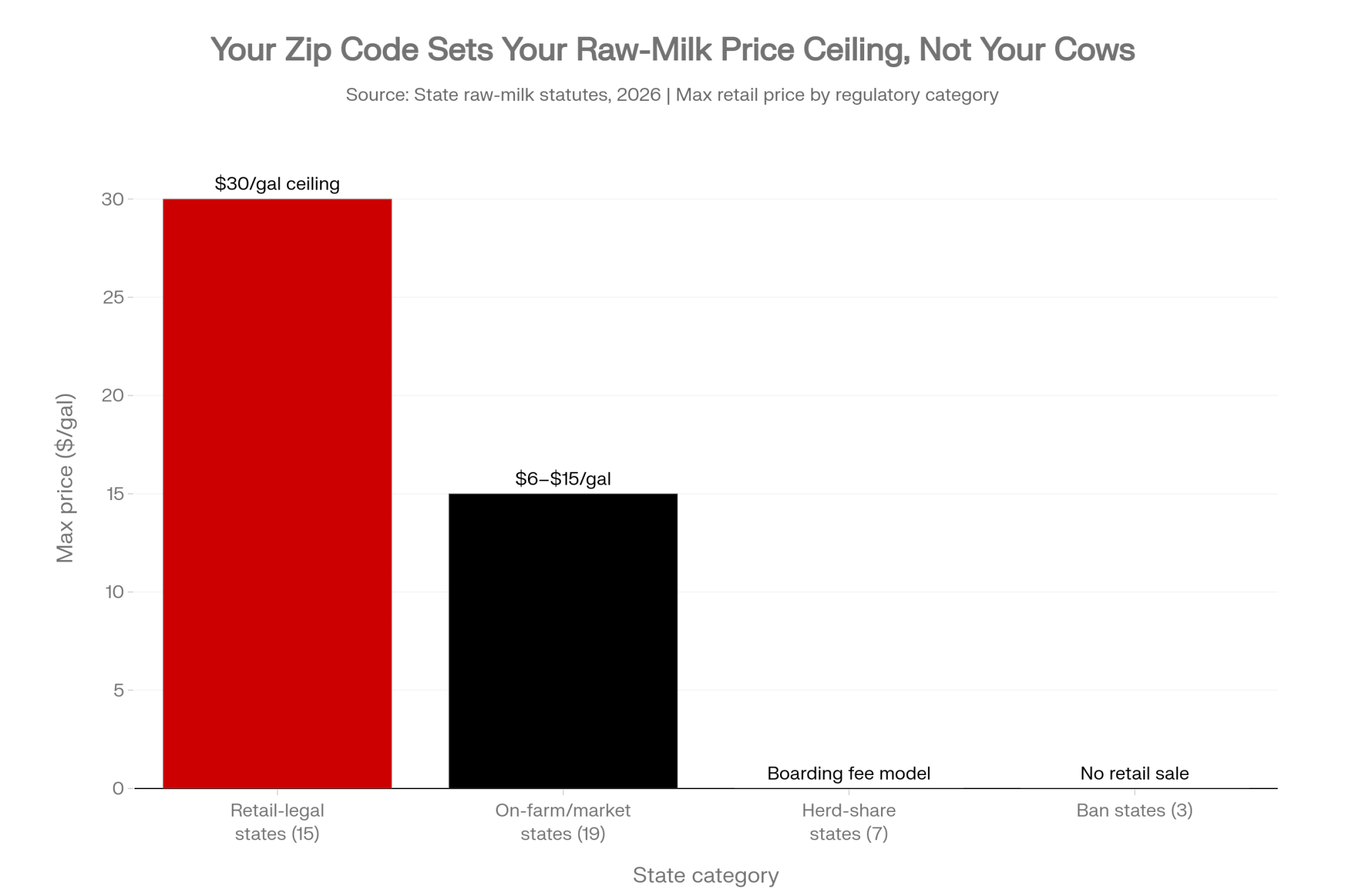
NewsSubscribe
First
Last
Consent
Send this to a friend