





Archive for Wisconsin dairy farming

$18.95 Milk & The 0.53x DSCR: Why Your Banker Is Already Moving Without You

A 550-cow Wisconsin dairy had 11 weeks of cash left at $18–$19 costs and didn’t know it. When you run a real COP, how much runway do you actually have?

Executive Summary:  USDA’s 2026 all‑milk forecast of $18.95/cwt can knock a 400‑cow herd’s DSCR from 1.78x to 0.53x on paper — same cows, same debt, very different conversation with your lender. This piece walks you through that math, then shows how a 550‑cow Wisconsin dairy discovered an $18.75/cwt true cost of production and just 11 weeks of cash runway after a real COP review. It explains how bankers are already repositioning — from 30% tightening standards in the Chicago Fed’s district to Farm Credit more than doubling its loan‑loss provisions — and why that hits some regions harder than others. You see why Wisconsin and New York can add cows while Pennsylvania loses farms and processors, and what that geography shift means for your renewal odds. Most importantly, you get DSCR and breakeven thresholds you can plug into your own numbers, a three‑tier action plan by herd size, and a 30‑day checklist to run before you sit down with your lender. If you want one article to double-check whether you’re still comfortably bankable at $18.95 milk, this is it.
dairy debt service ratio

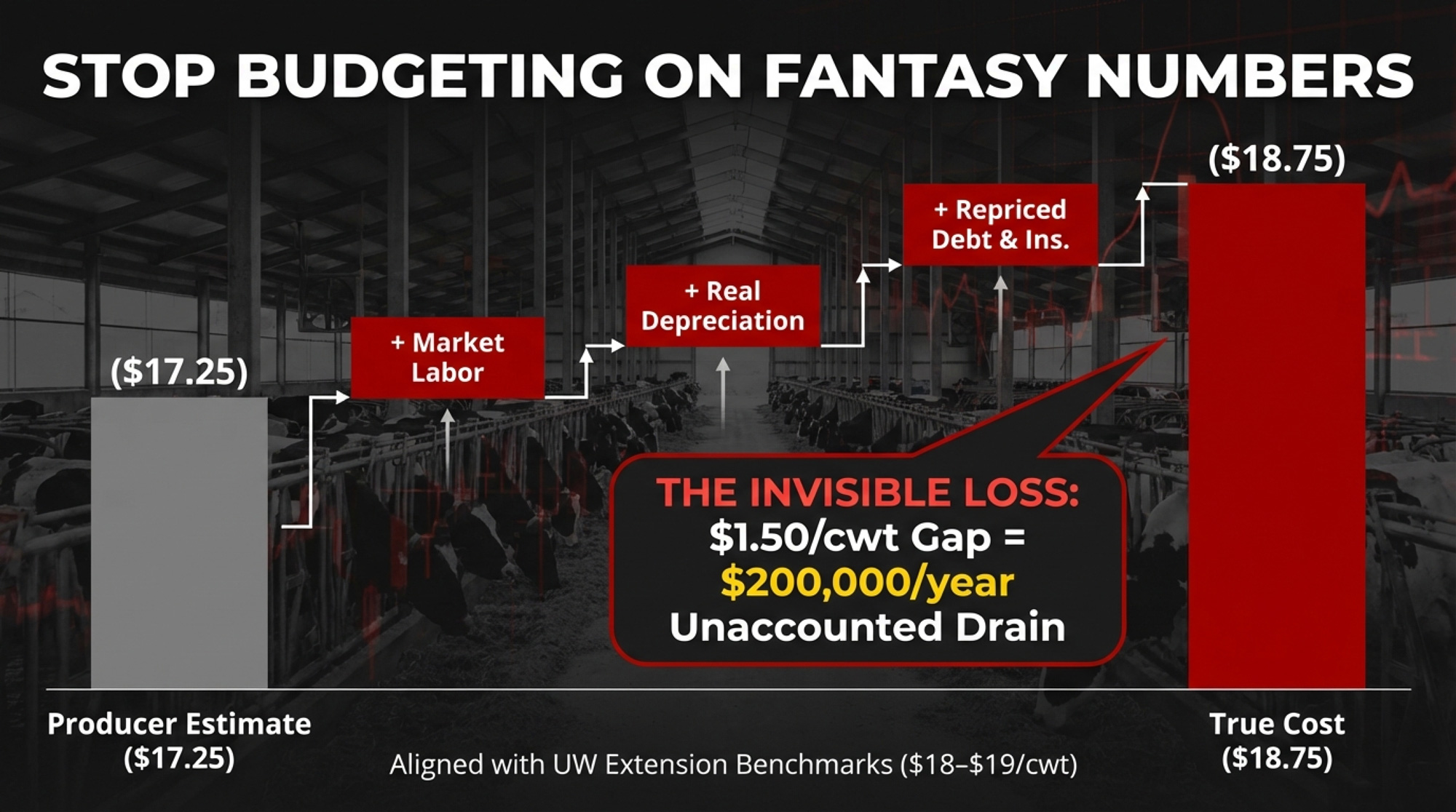
Earlier this year, a 550-cow Wisconsin dairy sat down with a farm financial counselor and pulled a full cost-of-production analysis. The details come from the farm financial counselor who conducted the engagement, as first reported in The Bullvine’s Calf-Check Paradox analysis (February 20, 2026), with the operation’s identity withheld at the counselor’s request. The producer had been budgeting around $17.25/cwt as his all-in cost. When the spreadsheet included market-rate family labor, real depreciation, repriced debt at current interest rates, and health insurance, the number came back to $18.75/cwt — right in line with UW Extension’s $18–$19/cwt benchmarks for mid-size Midwest herds.
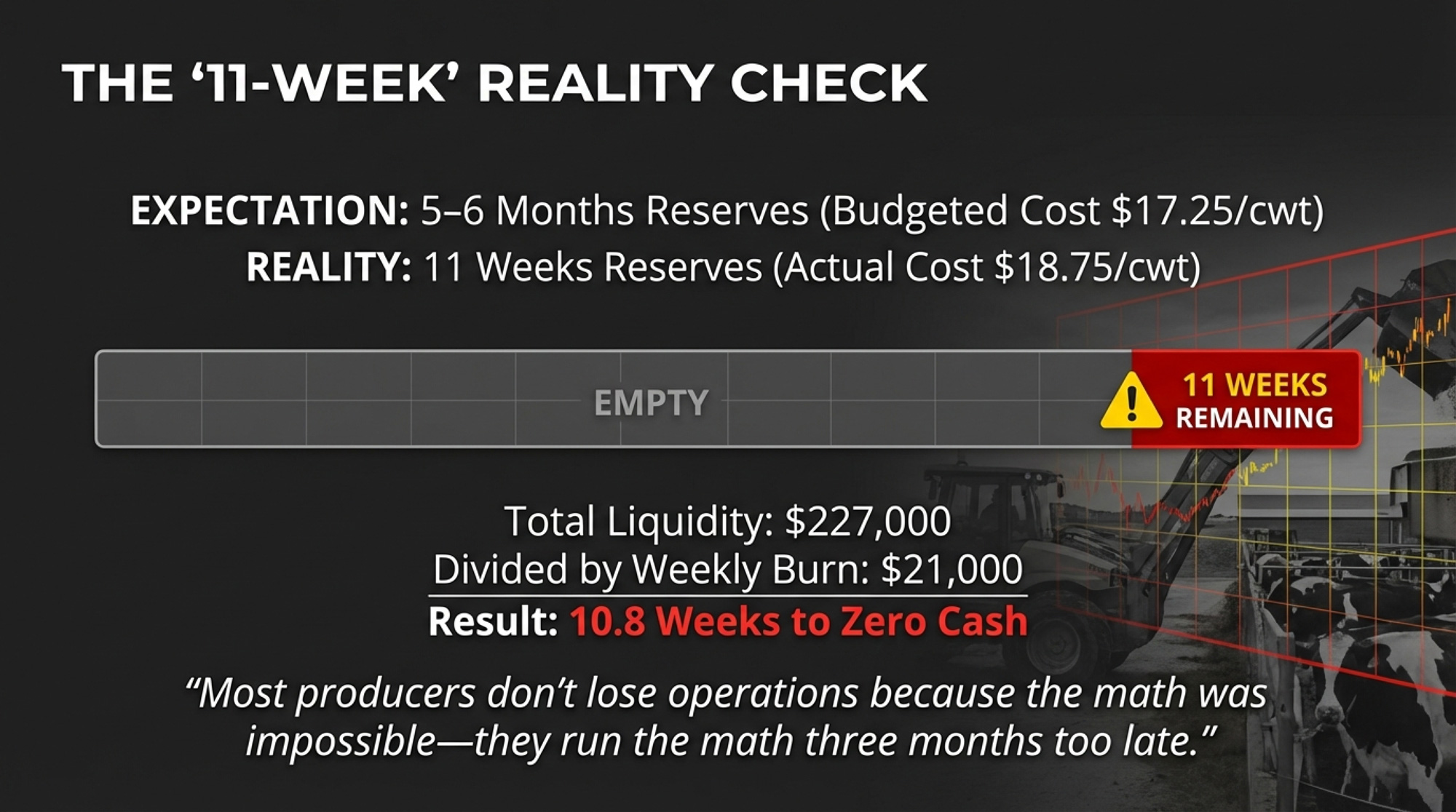
That $1.50 gap represented roughly $200,000 in annual losses that the operation hadn’t been accounting for. Total liquidity: $227,000. Net weekly cash drain: about $21,000. Eleven weeks of runway — not the five or six months he’d been carrying in his head.
How Many Weeks of Runway Do You Actually Have?

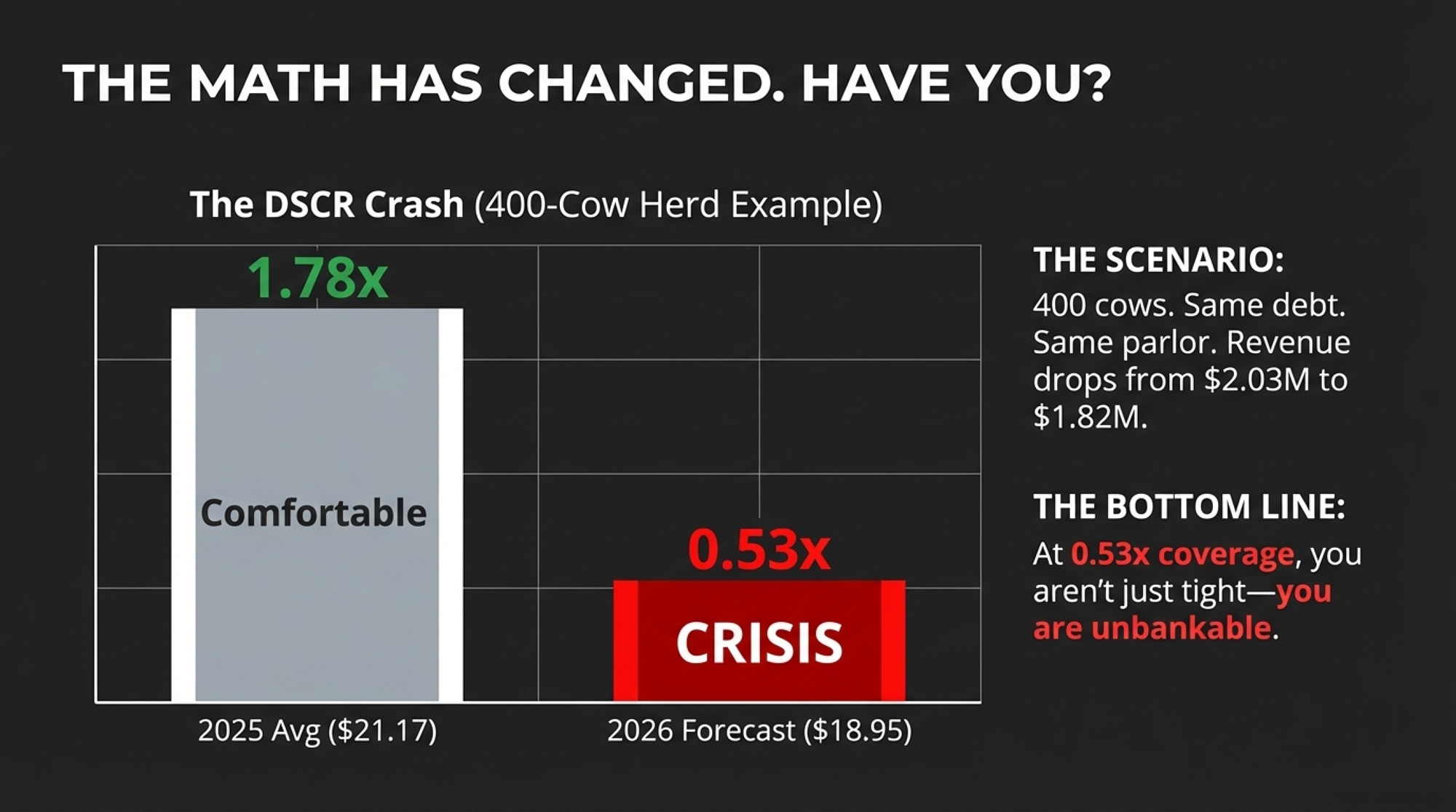
Multiply that math by every dairy operation in the country and drop the milk price from $21.17 to $18.95. That’s USDA’s February 2026 WASDE forecast for all-milk — a $2.22/cwt decline from the revised 2025 average. For a 400-cow herd shipping 96,000 cwt, that’s $213,120 in lost gross milk revenue. It turns a comfortable debt service coverage ratio into something your lender won’t ignore.
The Curve Accelerated — and the Geography Split Wide Open

The Wisconsin producer wasn’t the only one watching the numbers tighten. The structural consolidation trend that his counselor had flagged during their session was playing out nationally. The U.S. lost roughly half its dairy farms between the 2012 and 2022 USDA Censuses, while total production kept climbing. But the speed in 2025 — and where it concentrated — caught attention.
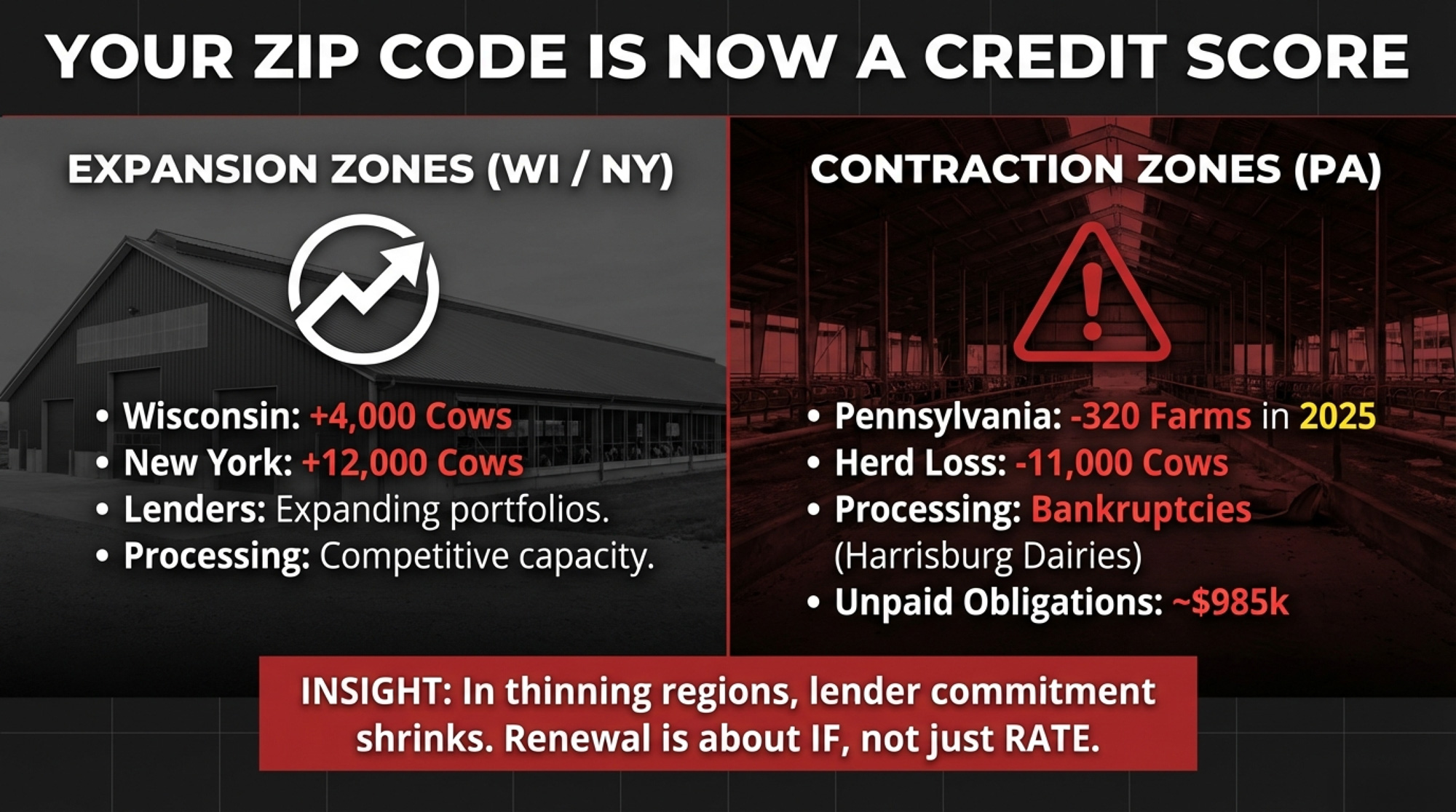
USDA reported 23,609 licensed dairies at year-end 2025, down 1,036. The top 10 states now produce about 74% of U.S. milk, per the NASS 2025 annual summary. Wisconsin added 4,000 cows and pushed output up 0.8% to 32.59 billion pounds — absorbing farm exits into fewer, larger operations. New York added 12,000 cows and boosted production 2.8% to 16.57 billion pounds, growth aligned with major new processing capacity in the state.

Pennsylvania went the other direction. Based on the originally published 2024 baseline, the state lost 490 farms—an 11.7% exit rate that accounts for nearly half of the 1,036 total U.S. dairy losses. This figure stems from a data discrepancy: the USDA revised Pennsylvania’s 2024 baseline downward by 166 farms without flagging the state-level change. Using the revised figure, PA’s 2025 loss was 320 farms. Both numbers tell the same story directionally. January 2026 deepened the gap: Pennsylvania milked 454,000 cows, down 11,000 from a year earlier, and produced 817 million pounds — 3.0% below January 2025, according to the NASS February 20, 2026 Milk Production report.

That divergence isn’t cyclical. It’s structural—and it’s reshaping how lenders view dairy portfolios.

30% of Bankers Tightened: The Lending Turn
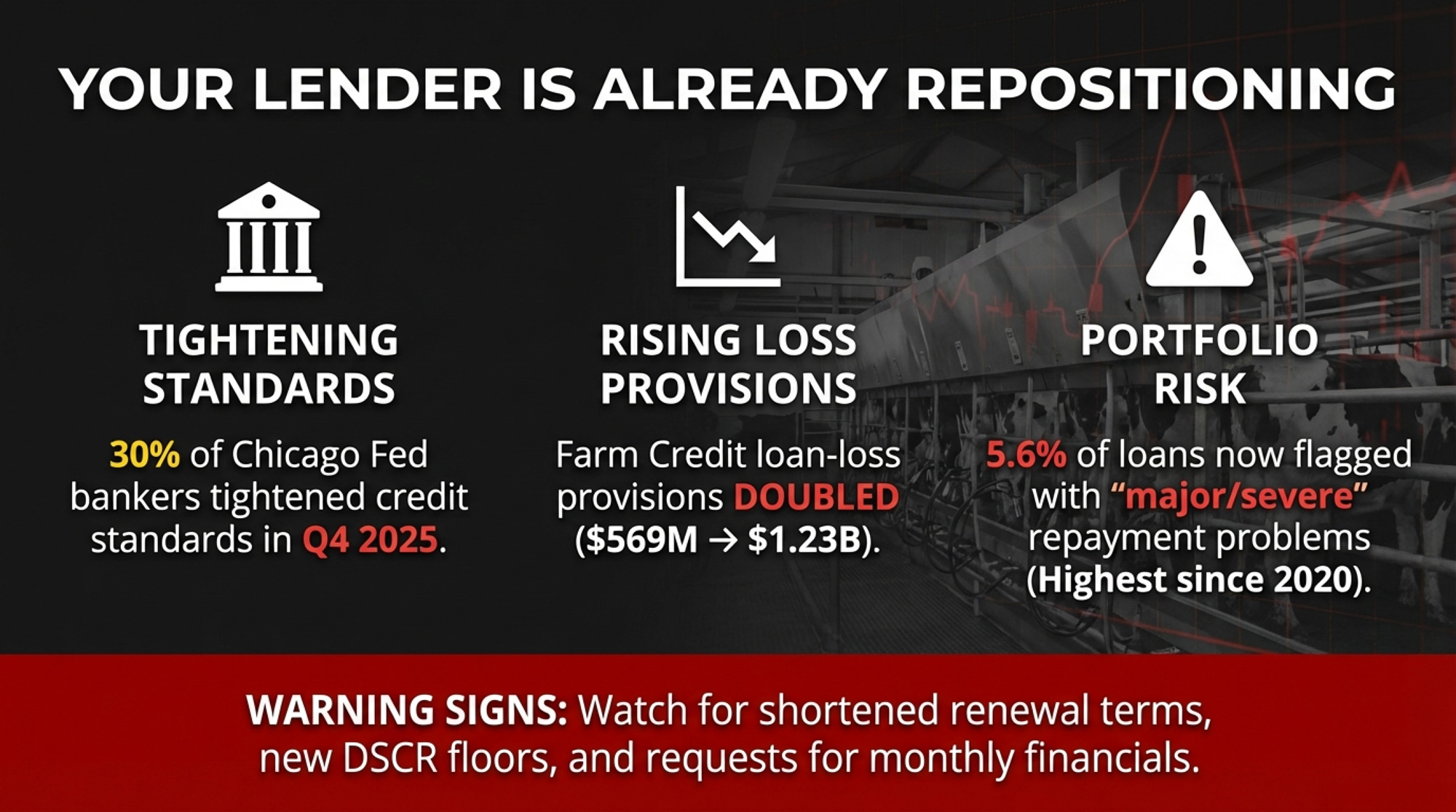
In Q4 2025, 30% of bankers in the Chicago Fed’s Seventh District reported tightening lending standards for farm loans. Renewals and extensions kept climbing — the trend now spans multiple consecutive quarters. Fund availability kept falling, extending what the AgLetter has tracked as a multi-year decline.

The share of the District’s farm loan portfolio with major or severe repayment problems hit 5.6% — the highest since mid-2020, per the AgLetter’s February 2026 issue. And 3.8% of borrowers with operating credit were deemed unlikely to qualify for new operating loans in 2026.

The Farm Credit System is feeling it too. Nonaccrual loans rose from 0.74% at year-end 2024 to 0.91% at Q3 2025. Provisions for credit losses more than doubled, from $569 million to $1.23 billion, per the Farm Credit Investor Presentation dated February 20, 2026. Farm Credit’s own commodities outlook projected 2026 milk at $18.30/cwt — below even the USDA’s $18.95.

As one Illinois banker told the Chicago Fed’s Q4 survey: “2026 is going to be a challenge for many producers with higher input prices.” That’s the lending environment the Wisconsin dairy’s counselor was reading when he ran the real numbers.

What Does $18.95 Milk Do to Your DSCR?

Take a 400-cow dairy producing 24,000 lbs/cow/year — 96,000 cwt annually — carrying $1.2 million in term debt on a 10-year note. The Chicago Fed reported Seventh District operating loans at 7.11% and real estate loans at 6.63% in Q4 2025, so a 7.5% blended rate brackets most dairy debt. At standard monthly amortization, annual debt service on $1.2M at that rate runs $170,931.

Debt Service Coverage Ratio — net cash income divided by annual debt service. Below 1.25x, lenders pay closer attention. Below 1.0x, the phone rings.

At $21.17/cwt (revised 2025 average, per USDA WASDE):
Revenue: $2,032,320. Cash costs at $18/cwt: $1,728,000. Net cash: $304,320.
DSCR: 1.78x — comfortable.

(That $18/cwt cost is illustrative — consistent with UW Extension benchmarks and close to the Wisconsin dairy’s actual $18.75. Plug in your real number.)

At $18.95/cwt (USDA’s 2026 forecast):
Revenue: $1,819,200. Same costs: $1,728,000. Net cash: $91,200.
DSCR: 0.53x.

From 1.78x to 0.53x. One price move. Same cows, same debt, same parlor.

And $18.95 might be optimistic. January 2026’s Class III posted at $14.59/cwt. December was $15.86. The back half needs to do heavy lifting to deliver USDA’s annual average — and your budget can’t wait for the second half to show up.

The math works in reverse, too. If milk recovers above $21 in the second half — driven by export demand, tighter supply, or both — these DSCRs snap back fast. But your lender isn’t budgeting on a recovery that hasn’t started.

Breakeven milk price for a 1.25x DSCR at these cost and debt levels: $20.23/cwt. USDA’s forecast is $1.28 below that floor.
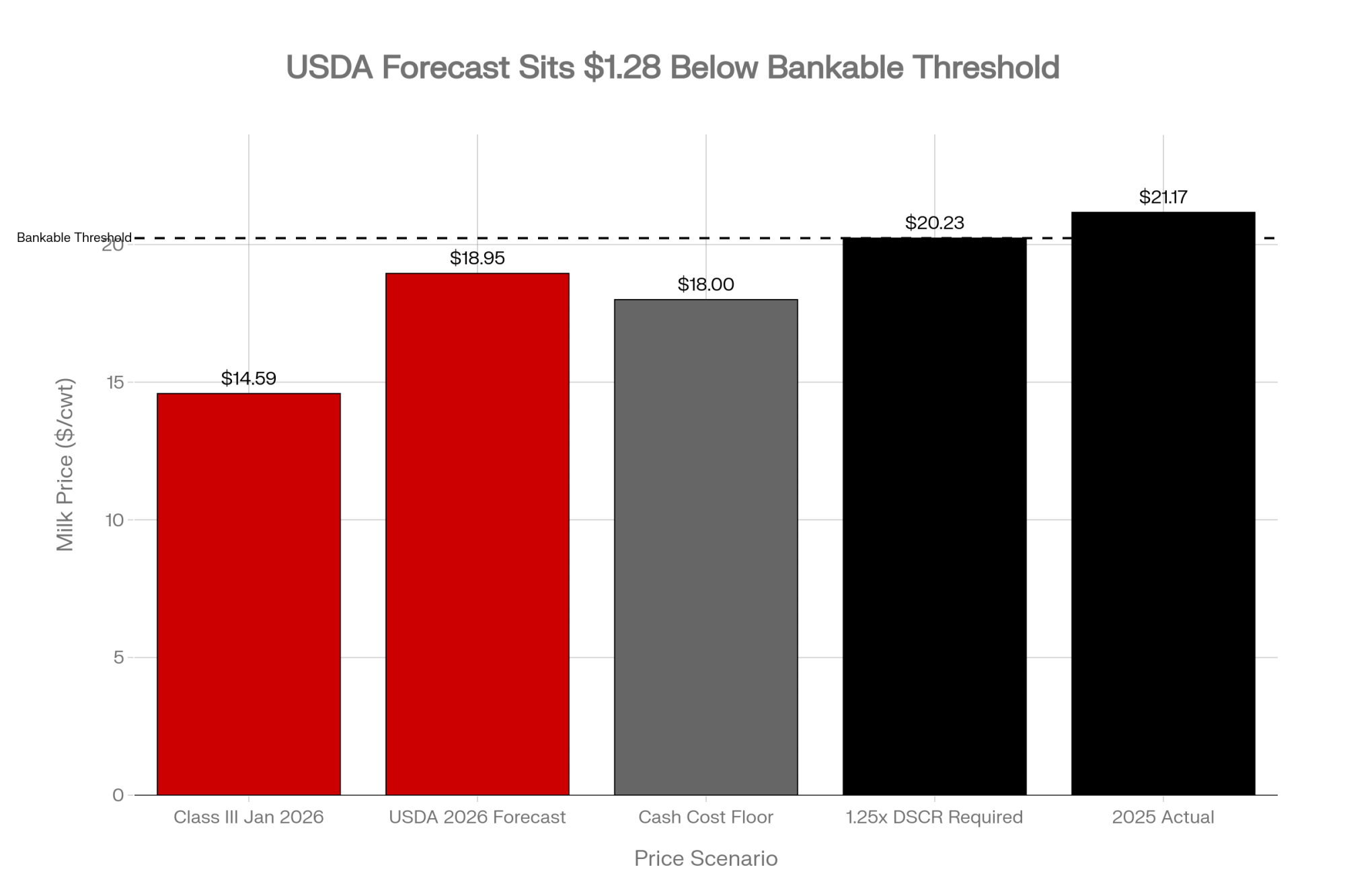
For context, USDA ERS puts the full economic cost of production at $19.14/cwt for herds with 2,000+ cows and $42.70/cwt for herds under 50 (2021 ARMS, updated August 2024). At $18.95, even the most efficient operations are near breakeven on a full-cost basis.

What the Wisconsin Dairy Did in 48 Hours

That 550-cow operation didn’t wait. According to the counselor’s account in The Bullvine’s Calf-Check Paradox reporting, within 48 hours of seeing the real numbers:

  • The producer culled his 10 worst feed-to-milk converters, generating roughly $22,000 in cash and cutting daily feed cost by about $85.
  • He walked into his lender’s office with a 12-month projection at $18/cwt milk and a real cost-of-production sheet — the one with market-rate labor and repriced debt.
  • He negotiated a reamortization of equipment debt (from seven to twelve years) and four months of interest-only on real estate.

The reamortization buys monthly breathing room, but it isn’t free — extending the note means more total interest paid and collateral tied up longer. The restructuring was approved. Weekly burn dropped from $21,000 to roughly $13,500. Same cows. Same parlor. New math.
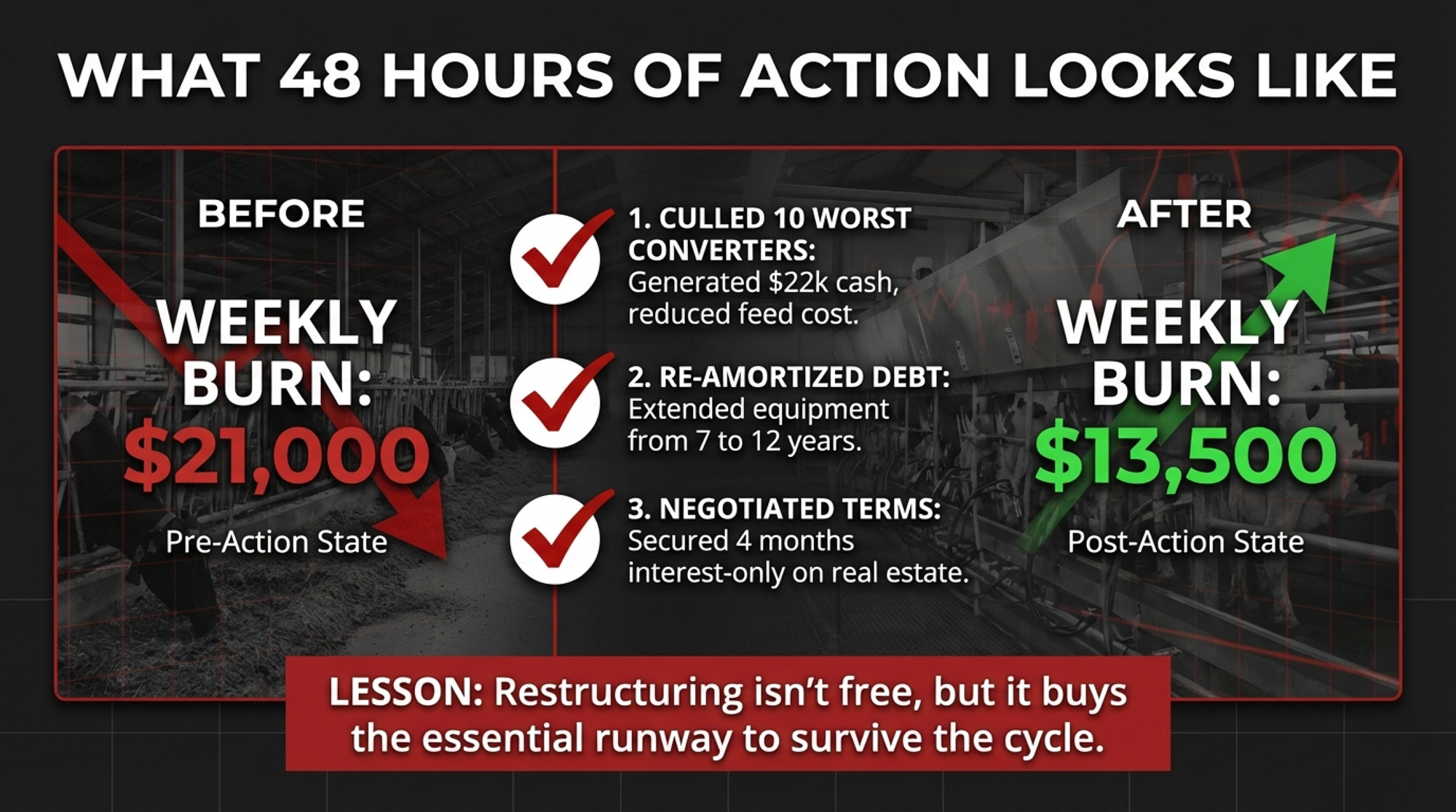
That’s the template. Not new genetics. Not a magic ration. Just running the real numbers and moving before the runway disappears. Most producers who lose operations in a down cycle don’t lose them because the math was impossible — they ran the math three months too late.

The Geography of Risk

Your farm’s zip code now affects its creditworthiness as much as its per-cow production.

Picture two 500-cow operations. The Wisconsin one milks into a state where the average herd was 237 cows as of NASS’s 2024 count — and likely higher now — with multiple processors competing and Farm Credit deep in dairy expertise. That renewal is about rate and terms, not about whether.

The Pennsylvania operation milks into a state with a 106-cow average and is shrinking fast. Harrisburg Dairies ceased operations in October 2025 and filed for Chapter 11 bankruptcy on February 20, 2026. According to the PA Milk Board’s November 2025 consent order, the company admitted to failing to pay producers promptly, with $900,070 documented as owed to 16 producers for August and September advance payments. The Bullvine’s own reporting put total unpaid obligations at $985,012 across 15 farms as additional October amounts were added.

Community banks in the region have seen a significant share of their dairy borrowers exit in recent years. For those that remain, the renewal conversation increasingly includes questions about succession, off-farm income, and the value of dairy infrastructure without cows.

Same 500 cows. One banker is talking in expansion terms. The other is weighing whether the regional dairy portfolio still justifies the exposure. This isn’t about Wisconsin being “good” and Pennsylvania being “bad.” It’s about the lending infrastructure around your operation — processor competition, lender expertise, peer density, and regional trajectory. If you’re in a state where the ecosystem is thinning, you need to know it before your renewal.

Warning SignWhat It Looks LikeWhat It Really Means
Term Shortened5-year note renewed as 3-yearLender buying more frequent exit ramps—your risk rating changed
New Covenants AddedDSCR thresholds, working capital floors, monthly reporting requiredPortfolio committee wants tighter visibility into your cash position
Monthly Financials RequestedPreviously annual, now monthly submissionSomeone upstream flagged dairy sector exposure; you’re in enhanced monitoring
Relationship Banker LeftDairy specialist replaced with generalist or role eliminatedBank may be shifting resources away from dairy lending—your renewal leverage just dropped
Collateral Requirements IncreasedSame loan amount, more collateral pledgedYour internal risk rating deteriorated; bank pricing for higher default probability

Is Your Lender Already Repositioning?

The Wisconsin dairy’s playbook worked because the producer got ahead of the conversation. Here’s what to watch for if the conversation has started without you:

  • Renewal term shortened. Five years became three? Your lender is buying more frequent exit ramps.
  • New covenants appeared. DSCR thresholds, working capital floors, or monthly reporting that wasn’t in the prior agreement.
  • Monthly financials requested. Someone upstream wants tighter visibility into your cash position.
  • The relationship banker left and wasn’t replaced with a dairy specialist. That could be normal turnover — or it could signal your bank is shifting resources away from dairy lending. Either way, it changes your renewal dynamic.
  • Collateral requirements increased for the same loan amount. Your internal risk rating changed.

Two or three stacked up means the conversation has shifted. The Wisconsin producer walked in before any materialized. That’s the difference between asking for restructuring and being told the terms.

What This Means for Your Operation
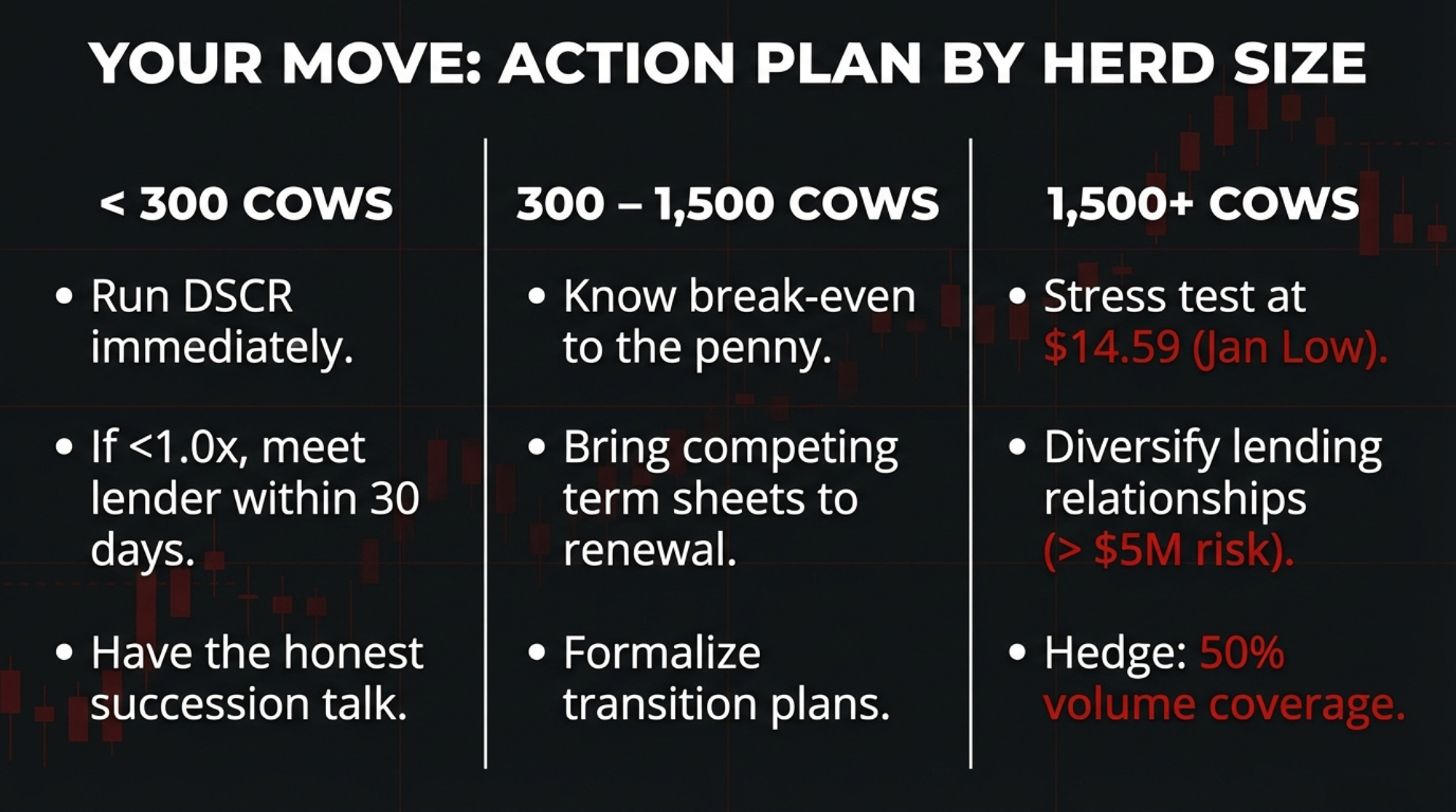
Herd SizeCritical Actions (Next 30 Days)DSCR Threshold TriggerSurvival Strategy
Under 300 CowsRun DSCR at $18.95 milk; if below 1.25x, bring real COP sheet to lender within 30 days (not tax return); open exploratory talks with Farm Credit/FSA if community bank shows warning signsBelow 1.0x = immediate crisis; below 1.25x = enhanced monitoringSuccession clarity is your strongest lending signal—formalize timeline or lender assumes shorter horizon
300–1,500 CowsCalculate breakeven to penny; compare to $20.23/cwt floor; if renewal within 90 days, bring competing term sheets—leverage comes from options; stress-test feed bill volatilityBelow 1.0x = restructure now; below 1.25x = bring 12-month projection showing path to 1.4x+Document succession plan with timelines; hedge 30-50% of milk at $19+ if available; diversify lender relationships
1,500+ CowsStress-test at both $18.95 and $14.59 (January Class III); on 360k cwt, hedge 50% volume = $360k protected revenue annually; diversify beyond single lender—counterparty risk is real at $5M+ debtBelow 1.25x = immediate board-level discussion; below 1.5x = pricing/hedging reviewForward-contract feed and milk simultaneously; maintain 2+ lender relationships; formalize export market strategy if processing for specialty buyers

Under 300 cows:
Run your DSCR at $18.95 this week. Below 1.25x, your lender is watching. Below 1.0x, be in your lender’s office within 30 days with a real COP sheet, not last year’s tax return. Open exploratory conversations with Farm Credit or FSA if your community bank shows warning signs. Get honest about succession — a lender who sees no plan on a sub-300 dairy is pricing for a shorter horizon, and the data on generational transfer is sobering.

300–1,500 cows:
Know your breakeven to the penny. Compare it to the $20.23/cwt threshold calculated in this article. If renewal is within 90 days, bring competing term sheets — leverage comes from options, not hoping. Formalize succession if you’re transitioning; a documented plan with timelines is one of the strongest lending signals you can send.

1,500+ cows:
Stress-test at $18.95 — and at $14.59. Diversify lending relationships — counterparty risk is real at $5M+. On 1,500 cows producing 360,000 cwt, a $2/cwt hedge on half your volume protects $360,000 in annual revenue and directly improves your risk rating.

Your 30-Day Checklist

  • Run your actual DSCR at $18.95 milk using this year’s feed bill and current debt service. Below 1.25x = the zone this article describes.
  • Pull your loan covenants. Check for DSCR thresholds, working capital floors, or reporting requirements you may have overlooked.
  • Request your processor agreement. Confirm component premiums, volume commitments, and termination terms. Your lender will ask.
  • If your DSCR is below 1.0x at $18.95, schedule a lender meeting this month — before renewal, not during it. Bring a 12-month projection at $18/cwt. The Wisconsin dairy showed what happens when you lead that conversation.

Key Takeaways

  • If your debt-service coverage ratio drops below 1.25x at $18.95 milk, you’re in the danger band this article describes — that’s your cue to sit down with your numbers and your lender before renewal, not after.
  • If your breakeven sits more than $1/cwt above USDA’s $18.95 forecast, you’re burning equity every week you don’t adjust — culling, cost cuts, or refinancing are on the table, but each comes with trade-offs in flexibility and total interest cost.
  • If you’re milking in a thinning dairy region like Pennsylvania, your lender’s view of regional risk now matters as much as your cow performance — processor stability and peer density are part of your credit story, whether you like it or not.
  • If your current hedging or risk management plan doesn’t even model a $14–$16 Class III stretch, you’re effectively betting the farm on a second-half recovery your lender isn’t banking on.

The Bottom Line

  • The real question isn’t whether $18.95 milk is fair — it’s where your breakeven actually sits against that number, and how many weeks of runway you really have if Class III spends more time in the $14s than USDA’s annual average implies. The Wisconsin dairy that ran the real numbers bought itself time. Those who wait won’t get the same terms.

Complete references and supporting documentation are available upon request by contacting the editorial team at editor@thebullvine.com.

Learn More

The Sunday Read Dairy Professionals Don’t Skip.

Every week, thousands of producers, breeders, and industry insiders open Bullvine Weekly for genetics insights, market shifts, and profit strategies they won’t find anywhere else. One email. Five minutes. Smarter decisions all week.
NewsSubscribe
First
Last
Consent

The $17,500 Dairy Margin Coverage Gamble: The 6‑Year Lock‑In Decision Most Farms Haven’t Run the Numbers On Yet

USDA’s 25% premium discount only pays off if margins stay compressed five of the next six years. That’s never happened.

Executive Summary: Wisconsin dairies are a week from the 2026 Dairy Margin Coverage deadline, and 68% still aren’t enrolled even though January’s projected DMC margin of $7.52/cwt would generate about $1,564 per million pounds — enough to cover a full year of Tier 1 premiums at $9.50. The article breaks down how the new 6‑year lock‑in, with its 25% premium discount, only comes out ahead if you’d enroll in at least five of the next six years, and how locking in anyway can turn into a $17,500 premium drag for a 200‑cow herd when margins stay strong in four of those years. ⚡ But that analysis comes with an important caveat: at $0.15/cwt, the enrollment hurdle is low enough that a rational producer looking at futures would likely have enrolled in most years — which makes the lock‑in more defensible than it first appears.  The article walks through full barn math for 200‑ and 500‑cow operations, shows how the 6‑million‑pound Tier 1 cap leaves half the milk on a 500‑cow herd uncovered, and puts 2023’s record $1.27 billion in DMC payouts — $63,633 per enrolled Wisconsin dairy — in context as the benchmark for what this program delivers when margins compress. Instead of generic advice, you get four specific paths — annual DMC, 6‑year lock‑in, lower‑tier coverage, or skipping DMC and leaning on DRP/LGM for the rest of your milk — with clear trade‑offs spelled out for each. The playbook is simple: pull your 2021–2023 milk marketings, run the USDA DMC calculator with your actual cwt, and call FSA by February 24, so you know exactly what you’re betting before you sign a contract that runs through 2031.

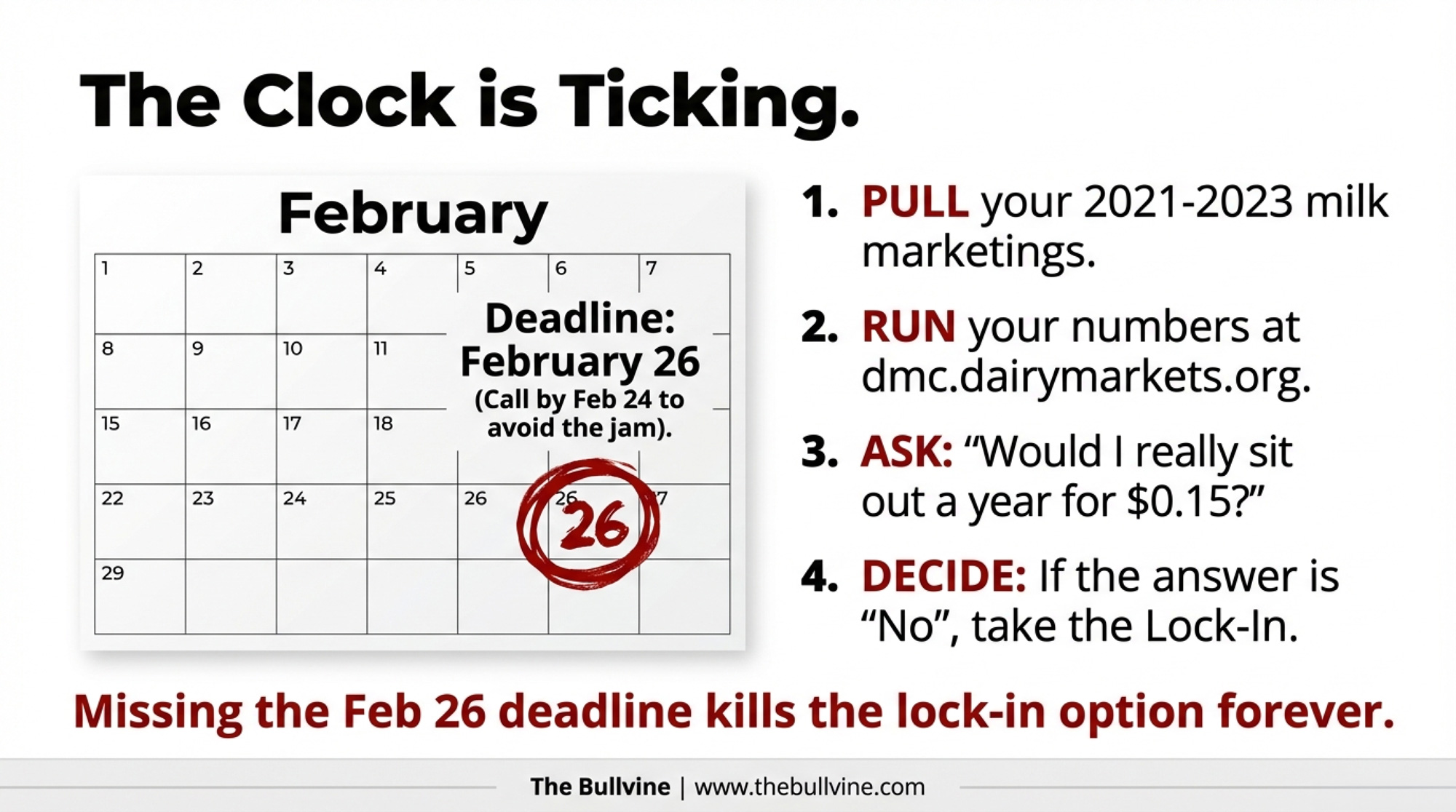
January 2026 Class III settled at $14.59/cwt — the weakest month since early 2024. And as of February 17, roughly 3,500 Wisconsin dairy operations still hadn’t enrolled in Dairy Margin Coverage for 2026. Katie Detra at Wisconsin’s Farm Service Agency shared that just 1,616 producers had completed DMC signup — only 31.5% of the state’s 5,116 licensed dairy farms. The deadline is February 26.

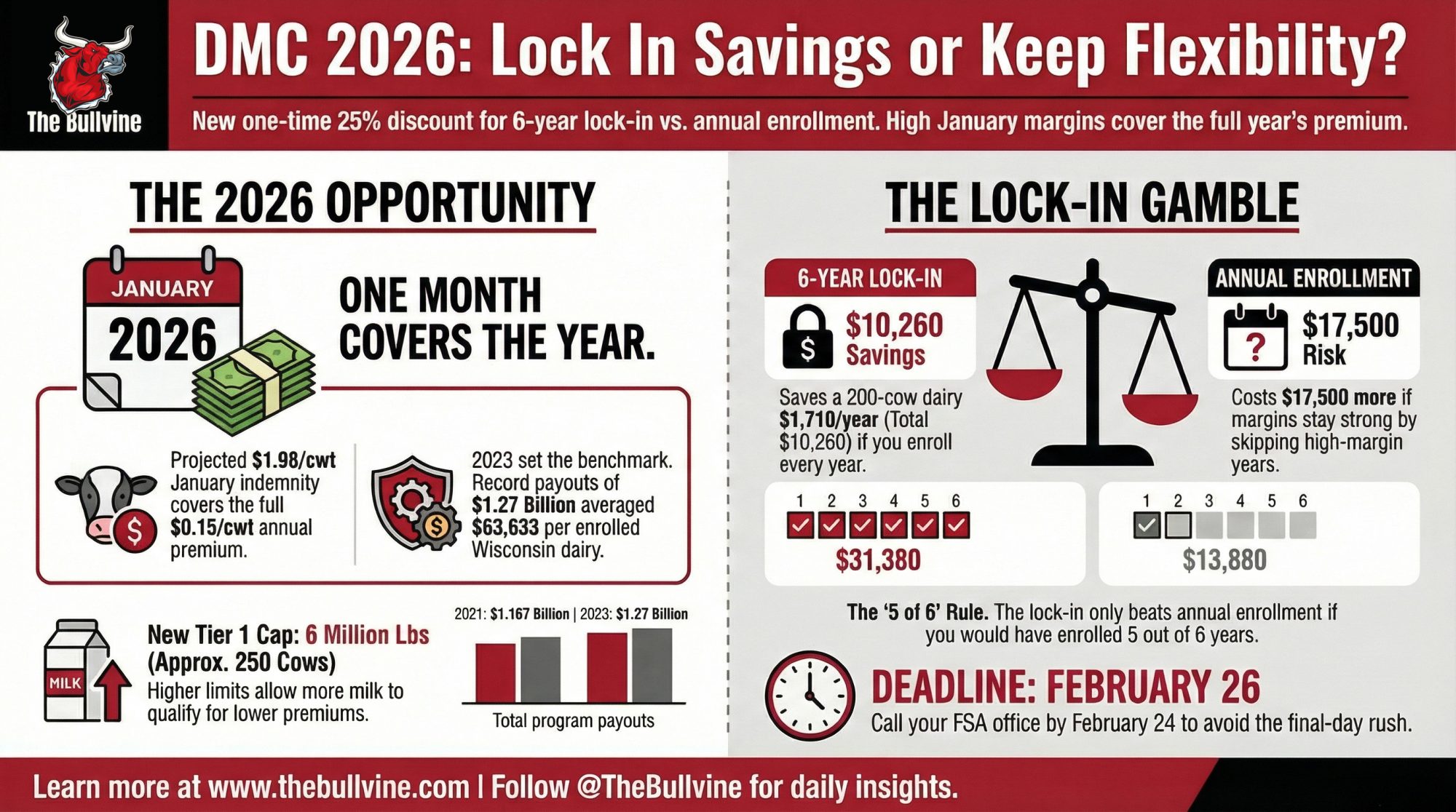
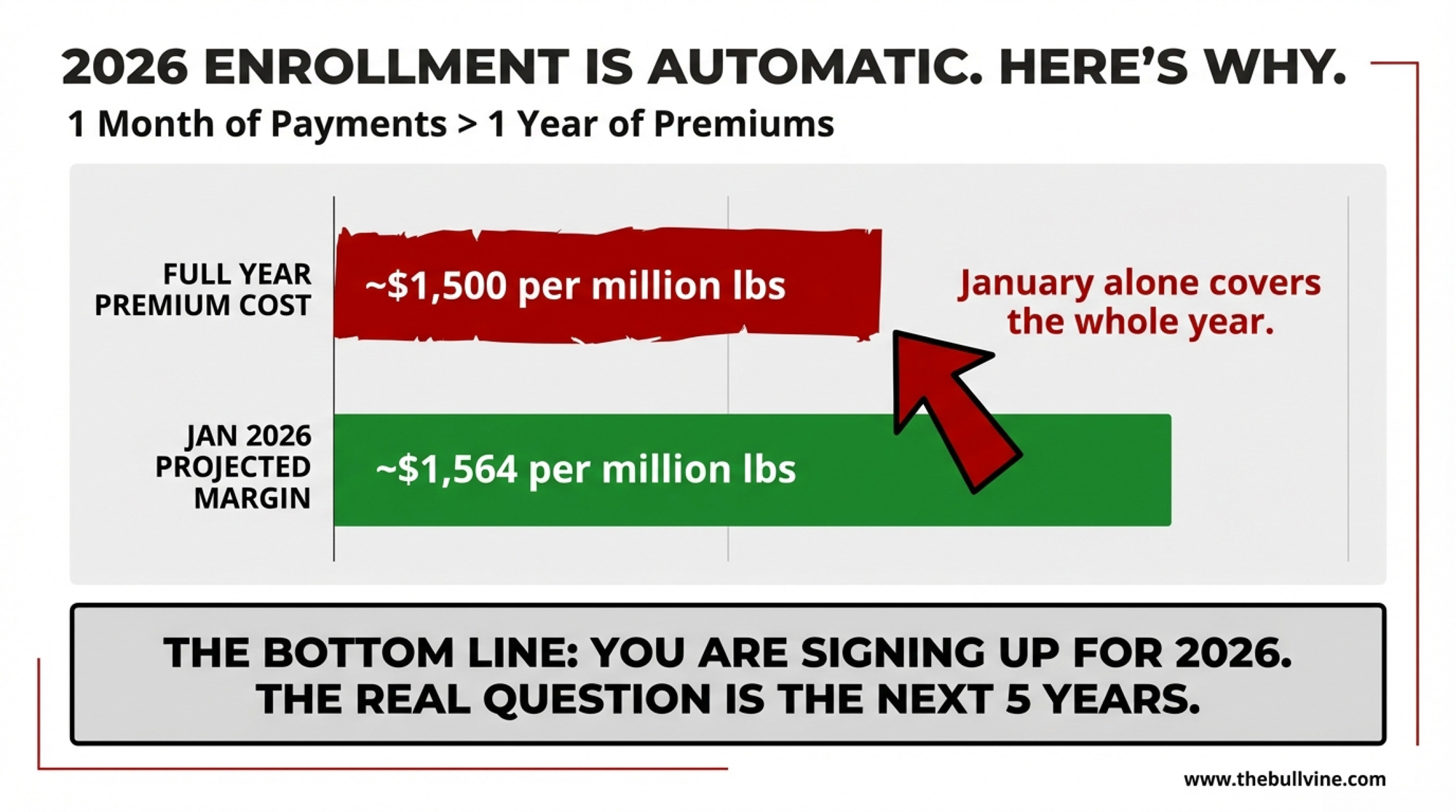
DMC doesn’t use Class III directly. The program’s margin formula takes the national All-Milk price and subtracts a standardized feed cost. But the pressure is running in the same direction. As of February 2, the Center for Dairy Excellence projected the January 2026 DMC margin at $7.52/cwt. At $9.50 coverage, that’s a $1.98/cwt indemnity — and CDE noted that January alone would produce “about $1,564 on a million pounds of production covered under Tier 1, which would cover premium costs” for the entire year.

One month’s payment covers your annual premium. For 2026, the enrollment decision is close to automatic. The six-year lock-in checkbox sitting next to it on the form? That’s a different conversation entirely—and nobody’s walking producers through the math.

From 80% to 31% — What Happened in Wisconsin?

Here’s the part that doesn’t add up. As of early 2024, 80 percent of Wisconsin dairy farmers were enrolled in DMC — the highest participation rate in the country, per Wisconsin Farm Bureau Federation. WFBF President Brad Olson called it “a critical farm safety net program during tough times.”

Fair warning on the comparison: that 80% figure was a final-year enrollment count. The current 31.5% is a mid-signup snapshot with six days left. Deadline rushes always close the gap. But even so, the pace is way off.

Some of the lag is structural. Wisconsin lost 545 dairy operations between January 2024 and today — down from 5,661 to 5,116. Some of those lost farms were DMC enrollees. Others are mid-transition, selling cows or passing the herd to the next generation, and a six-year commitment is the last thing they want. Still others have built hedging programs around Dairy Revenue Protection and see DMC as redundant on their first 6 million pounds.

But the margin picture has shifted underneath all of them. December 2025’s DMC margin came in at $9.42/cwt — just barely triggering the year’s first and only payment, a thin $0.08/cwt. That was the warm-up act. CDE’s January 14 outlook projects the full-year 2026 average margin at $8.51/cwt, starting at $7.37 in January and not climbing above $9.50 until November. If that forecast holds, ten months trigger payments — a total net indemnity of $8,300 per million pounds of Tier 1 covered production, after premiums but before sequestration.

Katie Burgess, director of risk management at Ever.Ag, projected “payouts of more than $1 per hundredweight for January through April, and then some smaller payments for May through July as well.” Mike North, also at Ever.Ag, as been blunt with producers: just “get it.” 

They’re right about 2026. The harder question is whether you should lock your elections through 2031.

What 2023 Should Remind Every Producer About DMC

Before digging into the lock-in math, it’s worth anchoring on what DMC actually delivers when margins compress hard — because the numbers aren’t theoretical.

In 2023, DMC triggered payments in 11 of 12 months at $9.The 50 coverage. At the level of average enrolled dairy, received indemnity payments of $2.80/cwt per month. Through the first nine months alone, total program payouts reached $1.27 billion — surpassing the previous annual record of $1.187 billion set in 2021. Wisconsin led all states at $272.2 million, averaging $63,633 per enrolled operation.

July 2023 hit the floor: a $3.52/cwt margin, the lowest in DMC history. At $9.50 coverage, that was a $5.98/cwt indemnity in a single month.

Put that in barn math for a 200-cow herd at 95% Tier 1: one month at $5.98/cwt on 3,800 covered cwt = roughly $22,724 from one month of milk. The annual premium was about $6,840. One July check covered three years of premiums.

Here’s the full payout history at $9.50 Tier 1 coverage:

YearMonths TriggeredTotal PayoutsAvg Per Enrolled Dairy
20197 of 12$451.6M$19,306
20205 of 12$234.0M$17,324
202111 of 12$1.187B$62,214
20222 of 12$83.7M$4,656
202311 of 12$1.27B+$74,553
2024~5 of 12$36.9M est.$2,356 est.
20251 of 12Minimal~$0.08/cwt (Dec only)

Two things jump out. First, the big-payment years are massive — 2021 and 2023 alone combined for roughly $2.46 billion in indemnities. A single year of compression can dwarf a decade of premiums. Second, the non-payment years (2022, 2024, 2025) are real. At $0.15/cwt, you’re not losing much in those years — but you are paying premiums for coverage that didn’t trigger.

That second point matters for the lock-in question. More on that below.

What Changed Under the New Law

The One Big Beautiful Bill Act, signed July 4, 2025, reauthorized DMC through 2031 with three changes that shift the math.

Tier 1 coverage went from 5 million to 6 million pounds. A 250-cow herd shipping 24,000 lbs/cow now fits entirely inside Tier 1. Every operation gets a fresh production history based on the highest annual marketings from 2021, 2022, or 2023. And the new wrinkle: lock your elections for all six years and get a 25% premium discount.

FSA program manager Doug Kilgore confirmed this lock-in is a one-time election — available only during 2026 enrollment. Skip it now, and it’s gone for the life of the program.

Sandy Chalmers, Wisconsin’s FSA State Executive Director, outlined the base case on February 17: “At $0.15 per hundredweight for $9.50 coverage, risk protection through Dairy Margin Coverage is a cost-effective tool to manage risk and provide added financial security for your operations.”

At fifteen cents a hundredweight, she’s right. That’s the easy part.

How Much Does DMC Actually Pay a 200‑Cow Dairy?

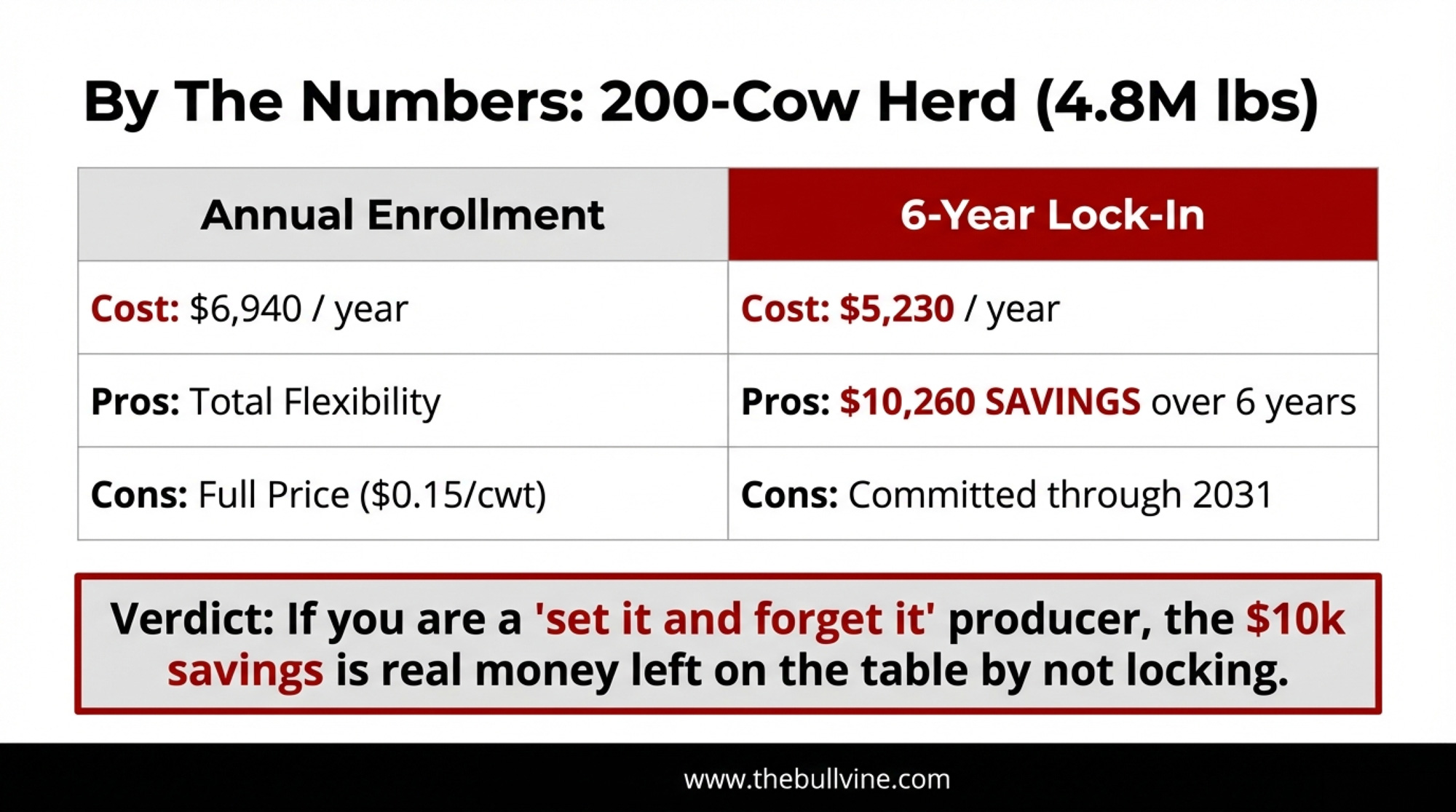
A 200-cow operation averaging 24,000 lbs/cow ships 4.8 million pounds — comfortably inside the 6-million-pound Tier 1 cap. At $9.50 coverage and 95% enrollment, the premium is $0.15/cwt.

Annual enrollment:

  • 4,800,000 lbs × 95% = 4,560,000 lbs = 45,600 cwt covered
  • 45,600 cwt × $0.15 = $6,840 + $100 admin fee = $6,940/year
  • You choose each year whether to re-enroll.

Six-year lock-in:

  • 45,600 cwt × $0.1125 (25% discount) = $5,130 + $100 = $5,230/year
  • Locked through 2031. No exit.

Annual savings from the lock-in: $1,710/year, or $10,260 over six years.

Now look at January alone. CDE’s $1.98/cwt projected indemnity on that 200-cow herd: 3,800 cwt of monthly covered production × $1.98 = roughly $7,524 on one month’s milk. That single payment exceeds the entire annual premium.

If margins track CDE’s January 14 forecast for the full year, total net indemnity on 4.56 million covered pounds would land around $37,800 for 2026. That’s a projection, not a guarantee — forecasts shift month to month. But it shows the scale of what’s sitting on the table.

And on a 500‑Cow Operation?

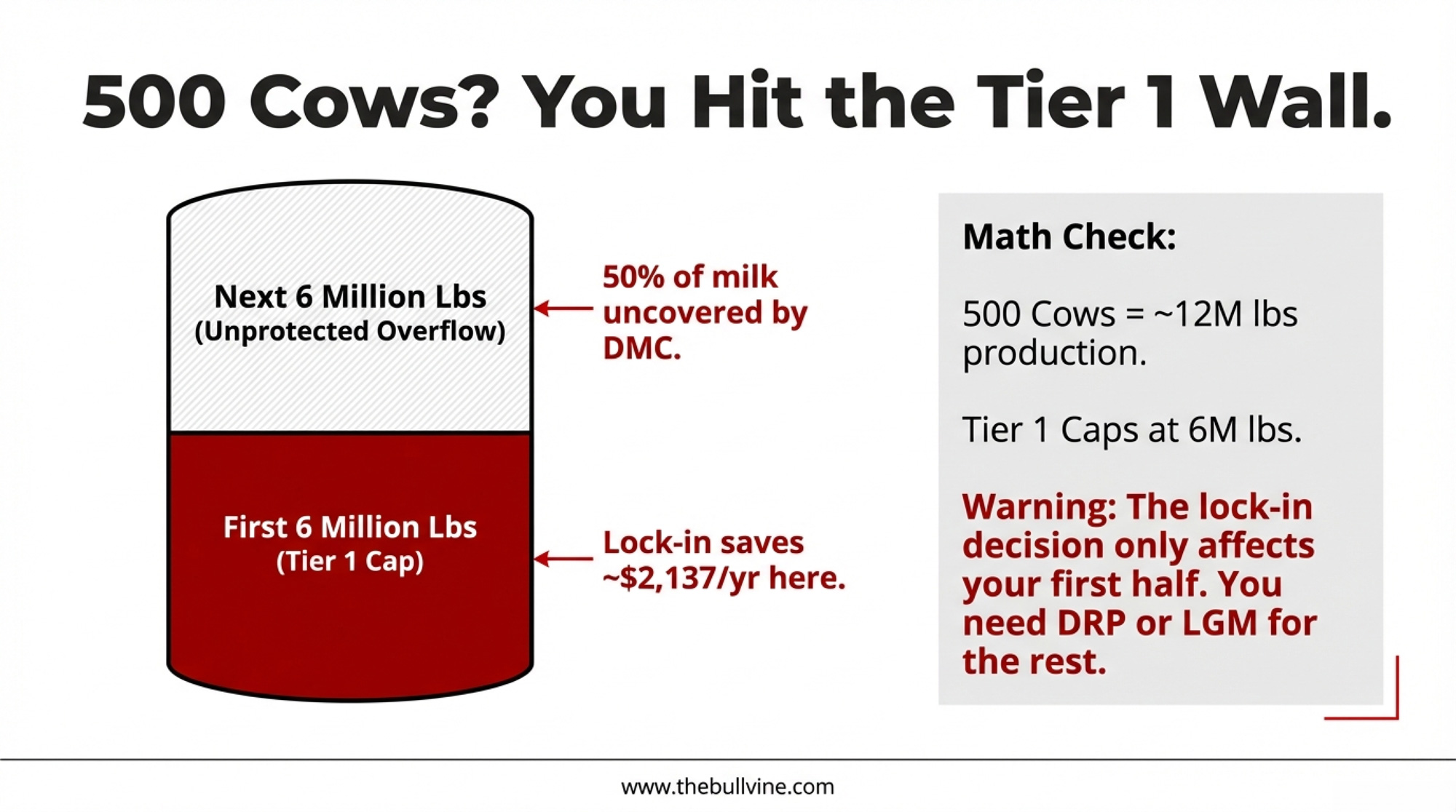
Scale up, but know where the wall is. A 500-cow dairy at 24,000 lbs/cow produces 12 million pounds. Tier 1 caps at 6 million. Half of your milk is unprotected.

Annual: 57,000 cwt × $0.15 = $8,550 + $100 = $8,650/year

Lock-in: 57,000 cwt × $0.1125 = $6,412.50 + $100 = $6,512.50/year — saving $2,137.50/year

January’s projected indemnity: 4,750 monthly cwt × $1.98 = $9,405. One month covers the premium. Scale CDE’s full-year projection the same way — $8,300 per million covered pounds × 5.7 million — and you’re looking at roughly$47,310 in net indemnity for 2026 on the Tier 1 portion alone.

But the other 6 million pounds? Nothing. Tier 2 premiums jump to a maximum of $8.00 coverage with rates running dramatically higher — that’s why most advisors treat DMC as a Tier 1 play and layer DRP on top for the rest.

William Loux, senior vice president of global economic affairs at the National Milk Producers Federation, put it this way: “The uncertainty in dairy markets is not going away anytime soon. So DMC, DRP — these are great programs to utilize.”

Should You Lock In DMC for 6 Years?

This is where the 25% discount starts to get complicated. Leonard Polzin, dairy markets and policy specialist at UW–Madison Extension, ran the margin history, and his numbers frame the decision.

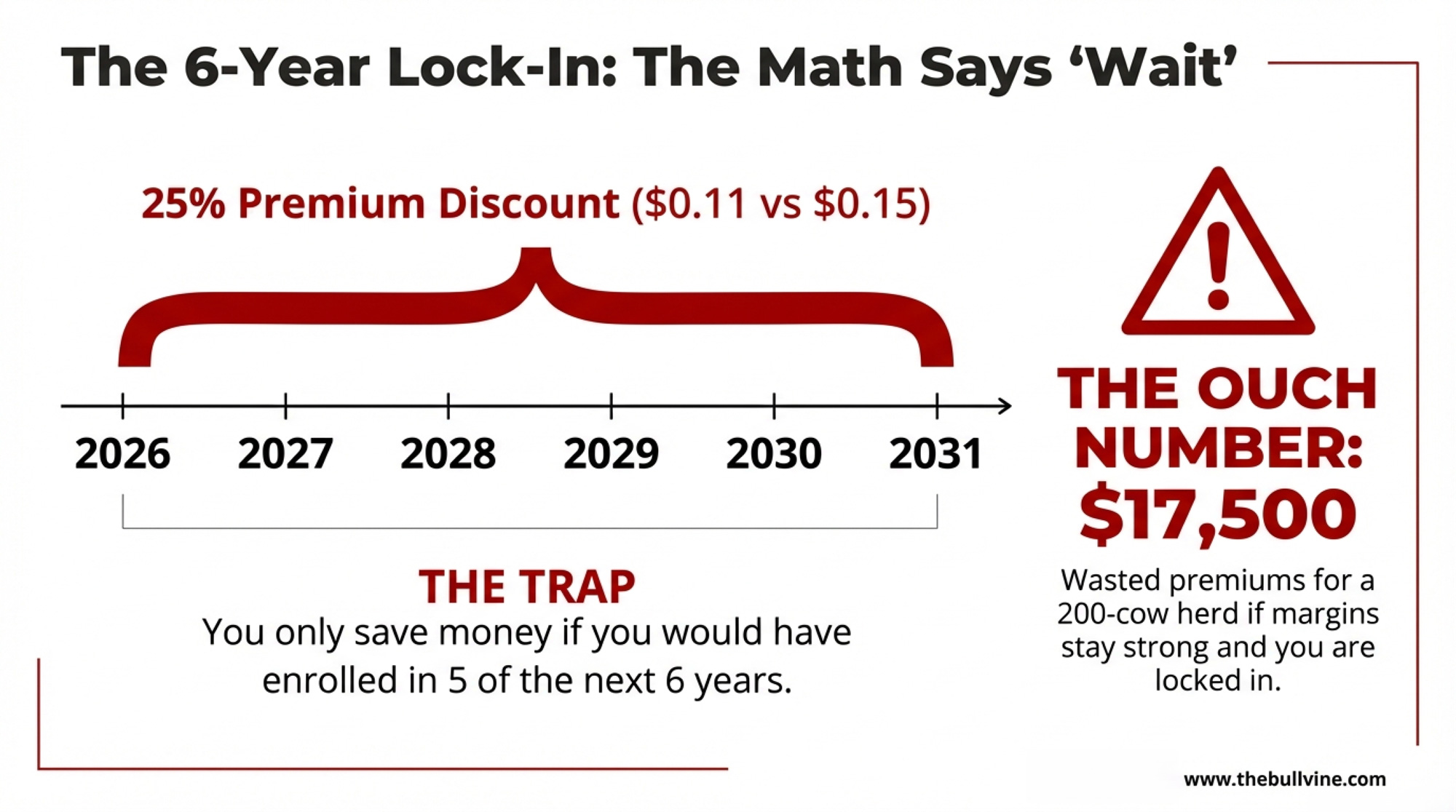
The lock-in only beats annual enrollment if you’d sign up in at least 5 of the 6 years. Here’s what that looks like for a 200-cow dairy:

ScenarioLock-In Cost (6 yrs)Annual CostDifferencefor 
Enroll all 6 years$31,380$41,640Lock-in saves $10,260
Enroll 5 of 6$31,380$34,700Lock-in saves $3,320
Enroll 3 of 6$31,380$20,820Annual savings are $10,560
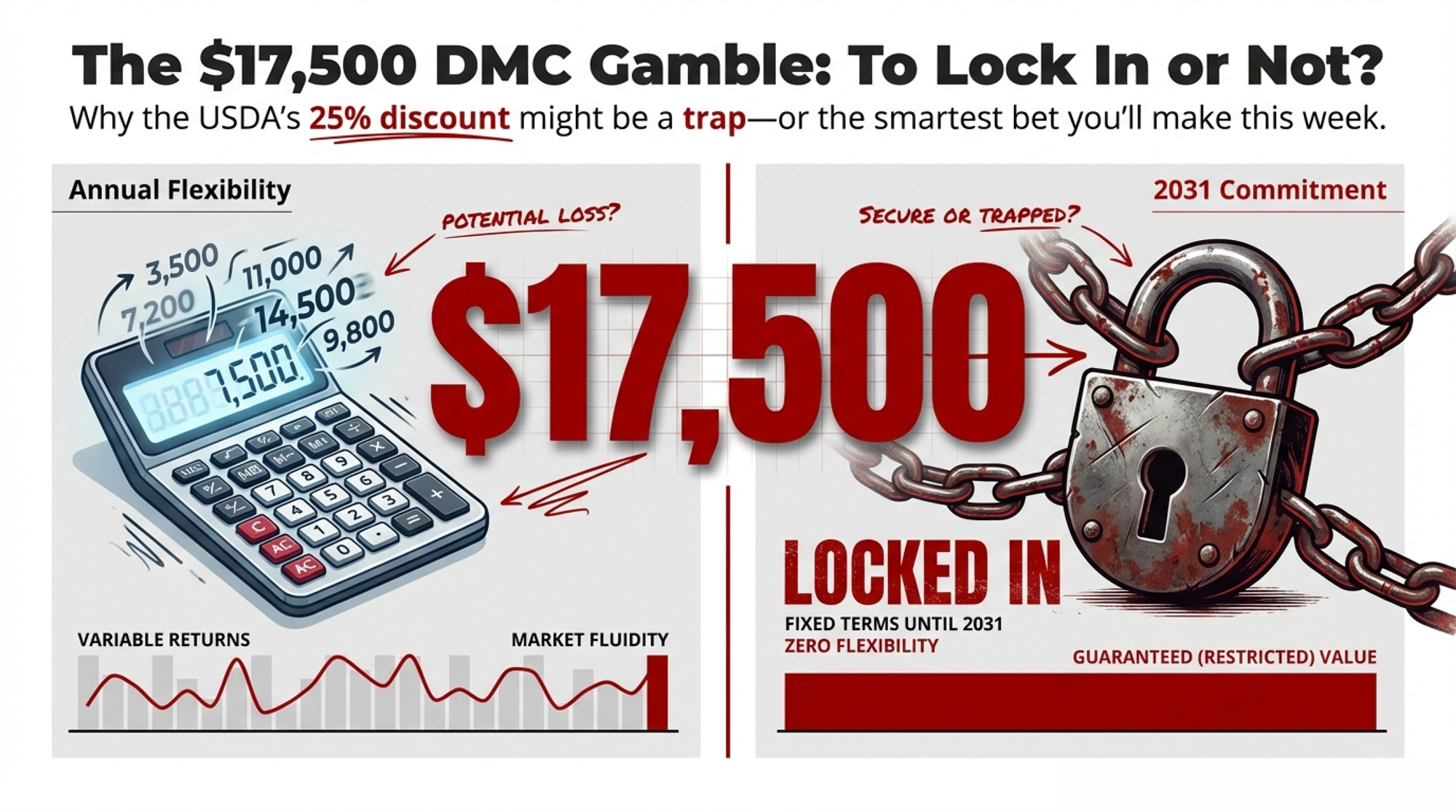
Enroll 2 of 6$31,380$13,880Annual saves $17,500

That bottom row. You’ve paid $17,500 in premiums for coverage that barely triggered.

So how often do margins actually compress for five or six straight years? Polzin checked. From 2019 through 2025, 39 of 84 months fell below $9.50. Payment runs averaged 4.88 months. Non-payment runs averaged 4.33 months. As his analysis notes, “margins tend to move in episodes rather than in isolated one-month shocks” — and “the relevant risk is frequently the duration of tight margins and the associated working-capital strain, not only whether a single-month payment occurs.”

The margin oscillates. It doesn’t stack up in neat multi-year compression streaks.

But Here’s the Honest Counterpoint: What Did Futures Show at Decision Time?

The table above assumes you’d skip enrollment in years when margins ended up running above $9.50. That’s hindsight. You don’t have hindsight at enrollment time — you have futures.

And here’s what producers actually knew at each deadline:

Enrollment YearDeadline WindowMarket Signal at SignupWould a Rational Producer Enroll?Actual Result
2019Early 2019Tight margins expectedYes7 months triggered; $19,306/op
2020Late 2019Uncertain; premium cheapProbably5 months; $17,324/op
2021Early 2021Feed costs risingYes11 months; $62,214/op
2022Late 2021Milk recovering, feed highUncertain — but $0.15/cwt is cheap insurance2 months; $4,656/op
2023Extended to January 31, 2023FSA Administrator: “early projections indicate payments are likely for the first eight months”Absolutely11 months; $74,553/op
2024February 28 – April 29, 2024Jan margin hit $8.48, first payment triggered before enrollment openedProbably~5 months; $2,356/op
2025January 29 – March 31, 2025Futures projected ~$12.50/cwt average marginsMaybe skip — but premium is just $0.15/cwt1 month; ~$0.08/cwt

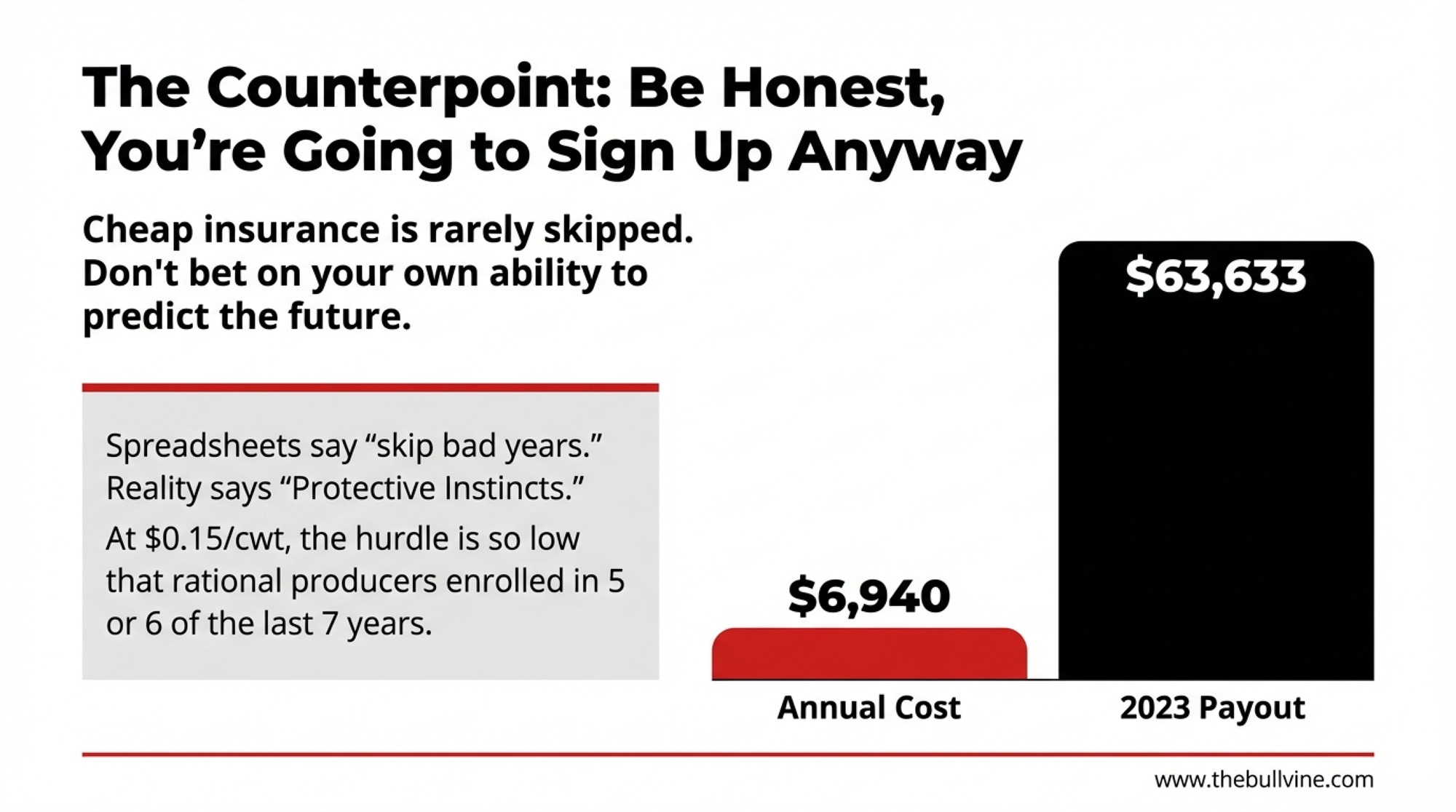
At $0.15/cwt, the enrollment hurdle is remarkably low. A 200-cow herd pays $6,940 for a full year of $9.50 coverage. In 2023, that $6,940 returned roughly $63,000. Even in the weakest year on record — 2022 — the premium amounted to about $1.44/cow/year. Most producers would enroll on cheap-insurance logic alone in all but the most obviously strong-margin years.

Look at that column honestly: a rational producer reviewing futures at each enrollment deadline would likely have enrolled in five or six of the last seven years. Only 2025 gave a clear “skip” signal — and even then, some producers enrolled because the premium was effectively a rounding error against downside protection.

That changes the lock-in math. If you’re the kind of operator who enrolls most years anyway — and the historical enrollment rate of 73–80% of eligible dairies suggests most producers are — the lock-in’s $10,260 in savings over six years is real money you’d leave on the table by staying annual.

The lock-in loses when you’re disciplined enough actually to skip enrollment in good-margin years. Polzin’s data shows that the years 2022, 2024, and 2025 all had weak or zero payouts. But the question isn’t whether good-margin years exist. It’s whether you’d actually sit out when the premium is $0.15/cwt and the downside is missing a 2023-style year.

Loux captured the tension: “It’s good that DMC is paying out, but it’s almost always better for prices, and better for dairy farmers, if they don’t.”

What Happens When Your Herd Outgrows Your History?

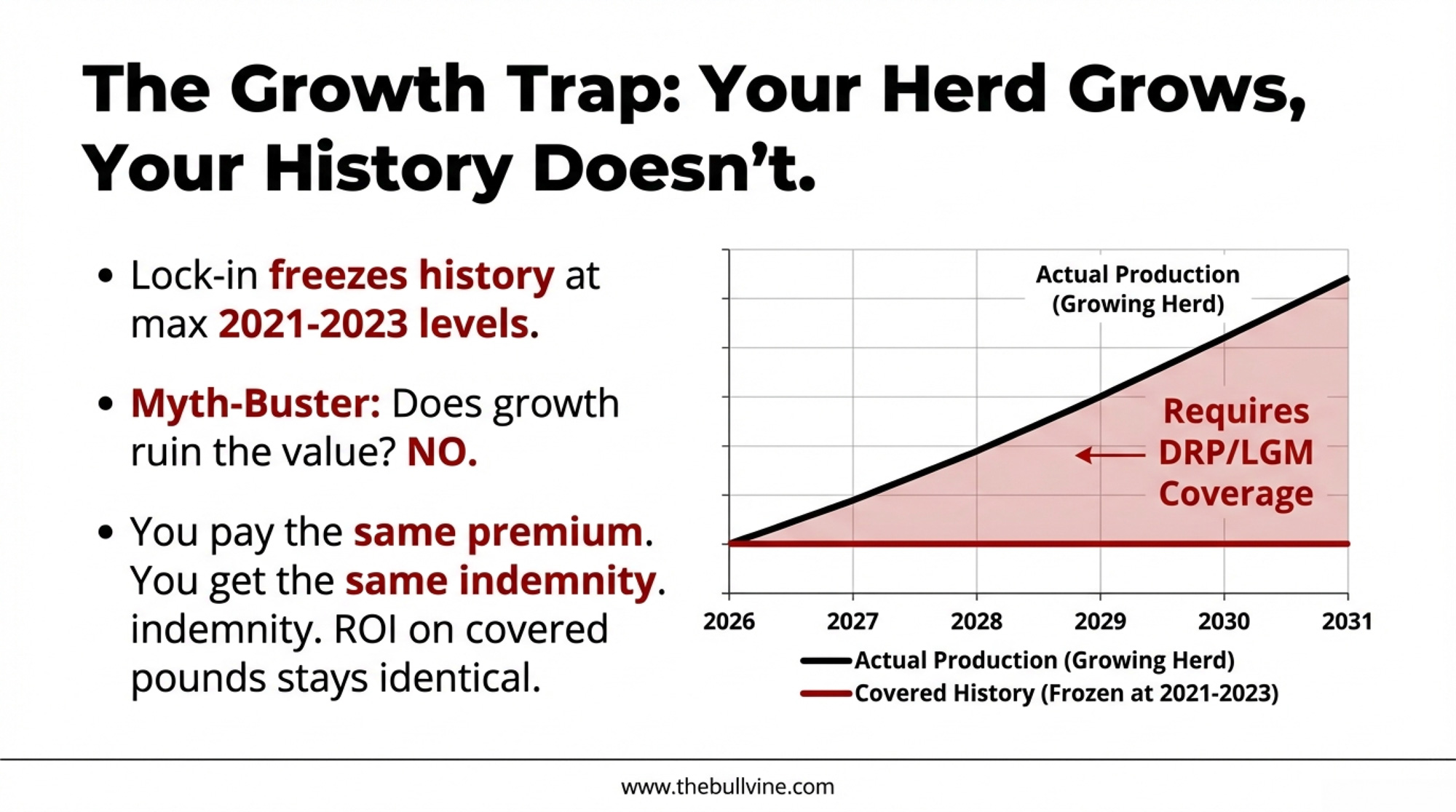
Lock in for six years, and your production history freezes at your best year between 2021 and 2023. Your herd doesn’t.

Say your best history year was 170 cows. You’re milking 200 now. That history — 4,080,000 lbs at 95% enrollment — gives you 3,876,000 covered pounds. Here’s the part that trips people up: the dollars don’t change as you grow. The premium stays the same. The indemnity payment stays the same. You’re buying coverage on a fixed number of pounds — same check out, same check in, regardless of what’s happening with your actual herd size.

What does change is the share of your total production that has margin protection underneath it:

YearActual ProductionCovered Lbs% CoveredAnnual PremiumIndemnity per $1/cwt Trigger
20264,800,000 (200 cows)3,876,00080.8%$5,914$38,760
20285,198,000 (217 cows)3,876,00074.6%$5,914$38,760
20315,845,000 (244 cows)3,876,00066.3%$5,914$38,760

Notice the last two columns — they’re identical every row. The DMC math on your covered pounds doesn’t erode. You pay the same premium. You get the same indemnity. The ROI on the covered portion is unchanged whether you’re milking 200 cows or 244.

The real issue is what’s growing outside that coverage. By 2031, a third of your actual production has zero margin protection. That milk generates revenue in good months and unprotected losses in bad ones. It’s not that DMC got worse — it’s that your unprotected exposure got bigger, and you need to manage it separately.

For a 500-cow herd, this gap exists from day one. You’re producing 12 million pounds and covering 6 million — half your milk is already outside DMC, regardless of herd growth.

The practical question isn’t “is my DMC eroding?” — it’s “what am I doing about the growing share of milk that DMC was never designed to cover?” That’s where DRP, LGM, or self-insurance need to enter the conversation. Kilgore confirmed: locked-in operations must pay premiums annually and certify they’re commercially marketing milk every year. There’s no pause button and no off-ramp — but the coverage you’re paying for delivers the same dollar protection it always did.

Four Paths Before February 26

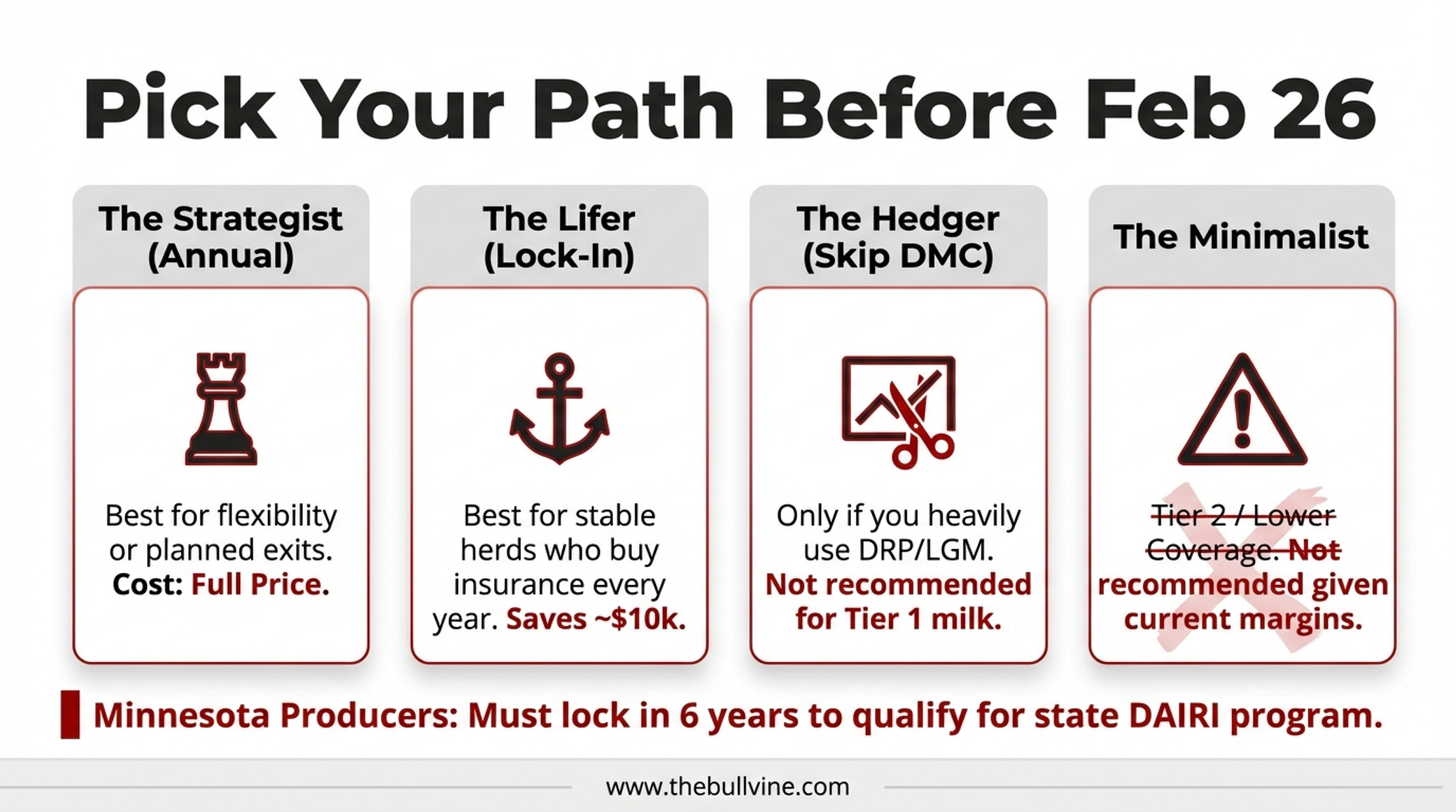
Path 1: Annual enrollment at $9.50, Tier 1. No lock-in. Best for growing herds, operations expecting margin recovery within 2–3 years, or anyone facing a major change before 2031. Cost: $6,940/year (200-cow) or $8,650/year (500-cow), paid only in the years you choose. You sacrifice $1,710–$2,137/year in premium savings. You keep full flexibility.

Path 2: The stable-herd lock-in. Fits operations that closely match their 2021–2023 history, plan to milk through 2031, and would realistically enroll most years anyway, which the enrollment history suggests is most producers. Savings: $10,260–$12,825 total. But it can’t be reversed. Premiums are due by September each year, regardless of conditions. If 2028 turns out to be a $12 margin year, you’re still writing that check. ⚡ 

Think you’ll weigh the lock-in decision next year? You won’t have the option. This election is only available during the 2026 enrollment. Miss it, and it’s gone permanently.

Path 3: Enroll at a lower coverage tier. Dropping from $9.50 to $8.00 cuts your Tier 1 premium and reduces your exposure if margins recover faster than expected. But it also slashes your indemnity in the months that matter most. Run both scenarios at dmc.dairymarkets.org with your actual production numbers before deciding.

Path 4: Skip DMC entirely. Only makes sense if you’re running active DRP or LGM hedging and are comfortable walking away from the cheapest margin protection available on your first 6 million pounds. Note: operations with unpaid 2025 premiums can’t get a 2026 contract until the balance clears.

Minnesota producers — one more variable. Your state’s DAIRI program requires a 6-year DMC commitment to qualify for state-level dairy assistance. That alone could tip the math.

What This Means for Your Operation

  • Pull your 2021–2023 milk marketings now. Your production history is the highest of those three years. If it sits well below current output, know that your DMC coverage on those pounds still delivers the same dollar protection — but you’ll need DRP or LGM for the uncovered portion. ⚡
  • Run the USDA DMC decision tool with your actual numbers: dmc.dairymarkets.org. Polzin’s full historical margin analysis is at UW–Madison’s farm management site.
  • Be honest about your enrollment behavior. How many of the last seven years would you have enrolled? Not in hindsight — looking at what futures showed at each enrollment deadline. At $0.15/cwt, most producers enrolled in five or six of seven. If that’s you, the lock-in’s $10,260 in savings is real. If you’re disciplined enough to skip when futures signal strong margins, annual gives you that optionality. 
  • Remember what 2023 delivered. Wisconsin dairies enrolled in the program averaged $63,633 in indemnity payments. Those that weren’t? Zero. At $0.15/cwt, the annual cost of not being covered in a compression year dwarfs a decade of premiums. 
  • Call your local FSA office by February 24—not the 26th. Phone lines jam on deadline day. Paperwork takes longer than you expect. Find your office at farmers.gov/service-locator.
  • DMC payments are taxable income and are subject to a 5.7% sequestration, per OMB’s FY2026 report. On a $1.98/cwt January indemnity, that shaves roughly $0.11/cwt before the check hits your account. Plan with your accountant.
  • Within 3–5 years of a transition? A six-year commitment may outlast your timeline. Annual enrollment preserves every option.

Key Takeaways

  • If you’d realistically enroll most years anyway — and at $0.15/cwt, the enrollment history suggests most producers would — the lock-in saves $10,260 on a 200-cow herd. The 25% discount represents genuine savings if your enrollment behavior aligns with historical norms. 
  • If you’re disciplined enough to skip enrollment when futures signal strong margins, annual enrollment preserves that optionality. Polzin’s data shows margins ran above $9.50 for all or most of 2022, 2024, and 2025 — skipping those years saves more than the lock-in discount. 
  • Growing herds don’t lose DMC value on covered pounds — same premium, same indemnity, same ROI. But the uncovered share of your total production continues to grow each year. If current production exceeds your 2021–2023 high by more than 15%, layer DRP or LGM on the exposed portion now. 
  • If your debt-service coverage ratio sits below 1.3, the lock-in’s predictable cost may matter more to your lender than flexibility. Have that conversation before the 26th.
  • The six-year election disappears after 2026 enrollment. Annual is the default. After February 26, the option is permanently gone.

The Bottom Line

Pull your milk statements. Plug your numbers into the USDA calculator — yours, not the ones in this article. And before you check that lock-in box, answer one question honestly: in the last seven years, how many times would you have sat out enrollment at $0.15/cwt? 

If the answer is one or two, the lock-in probably makes sense. If you’d have skipped three or more annual wins.

Make the call before February 24. When January’s official DMC margin drops, you’ll know exactly what your decision was worth.

We’ll have that scorecard next month.

Complete references and supporting documentation are available upon request by contacting the editorial team at editor@thebullvine.com.

Learn More

The Sunday Read Dairy Professionals Don’t Skip.

Every week, thousands of producers, breeders, and industry insiders open Bullvine Weekly for genetics insights, market shifts, and profit strategies they won’t find anywhere else. One email. Five minutes. Smarter decisions all week.
NewsSubscribe
First
Last
Consent

The $1,750 Calf: Is Your 2026 Breeding Plan Leaving $800 a Head on the Table?

Holstein bulls at $800. Beefondairy at $1,750. Same cow, same calving—double the cheque. Why are you still breeding everything Holstein?

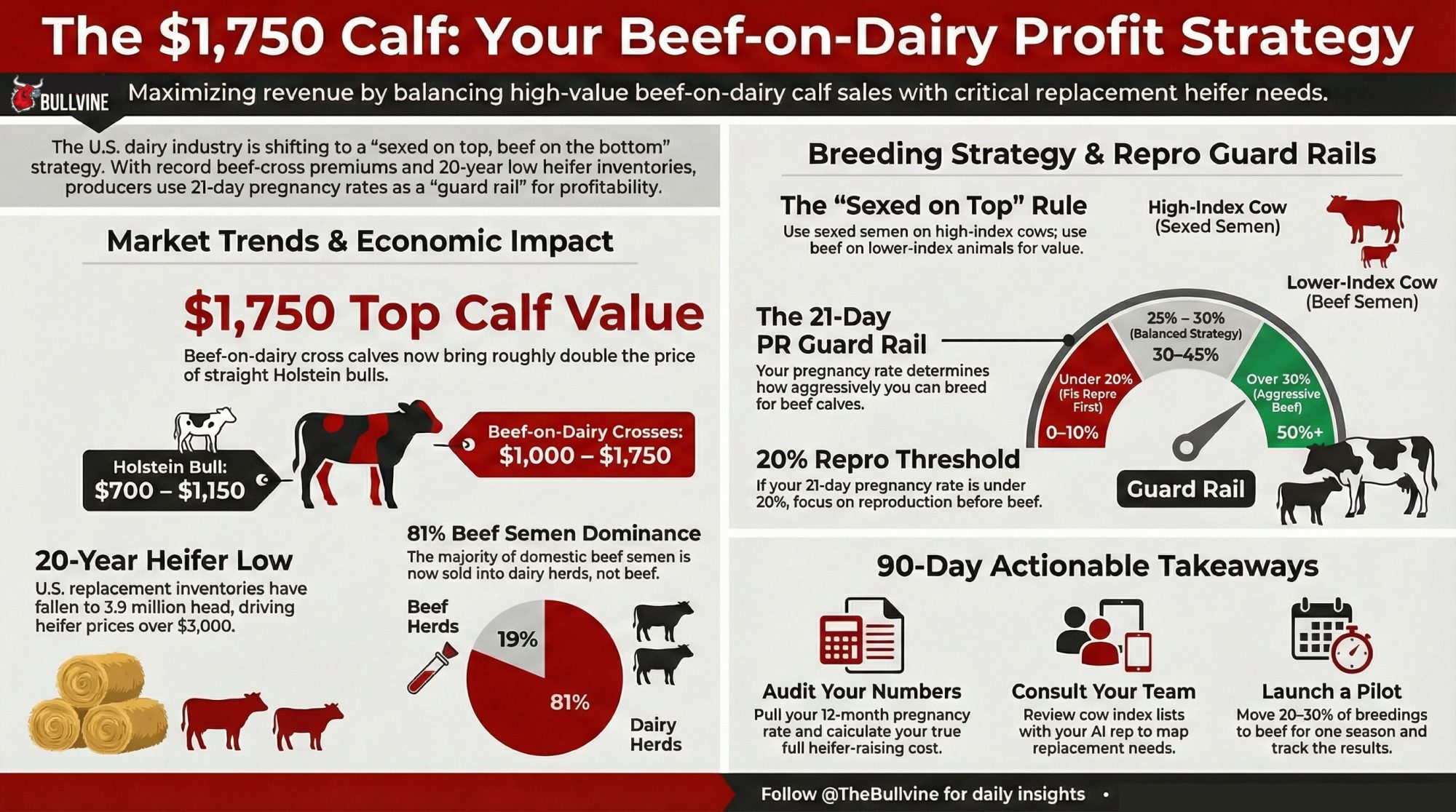
EXECUTIVE SUMMARY: In many U.S. sale barns today, Holstein bull calves that once brought $300–$450 are now commonly in the $700–$1,000 range in stronger markets, while well‑bred beef‑on‑dairy calves are cashing cheques up to about $1,750 in some auctions. At the same time, U.S. replacement heifer inventories have fallen to a 20‑year low near 3.9 million head as processors invest roughly $10 billion in new and expanded plants that will need milk to run. That combination has pushed 81% of domestic beef semen sales into dairy herds and made the “sexed on top, beef on the bottom” strategy hard to ignore. The catch is that it only pays long‑term if your 21‑day pregnancy rate stays above about 20% and you have heifers to spare, with herds in the 30–40% band able to run 50% or more of their breedings to beef while herds under 25% are usually better off fixing repro first. Three Wisconsin families—Hillview, Hiemstra, and Dornacker—show how registered Holsteins, a soil‑driven 170‑cow system, and a ProCROSS robot herd are all turning those same numbers into very different but profitable plans. By the end, you’ll know which of three breeding “paths” your own numbers put you in and what to do over the next 90 days to match sexed and beef semen to your repro, heifer, and calf markets.

beef-on-dairy breeding strategy

In strong Wisconsin markets, beef‑on‑dairy calves are bringing up to about $1,750 a head and Holstein bull calves are often in the $800–$1,000 range, with top sales in other regions breaking the $1,000 mark as well. U.S. milk replacement heifer inventories are down to roughly 3.9 million head as of January 1, 2026—a 20‑year low—with CoBank warning they could shrink another 800,000 head before 2027. At the same time, 81% of domestic beef semen now goes into dairy cows, not beef herds. If you’re breeding cows, managing heifers, or signing milk and cattle contracts in 2026, that mix isn’t background noise. It’s the math that decides whether your breeding program keeps you ahead of the curve or leaves you short of replacements when the processor wants more milk. 

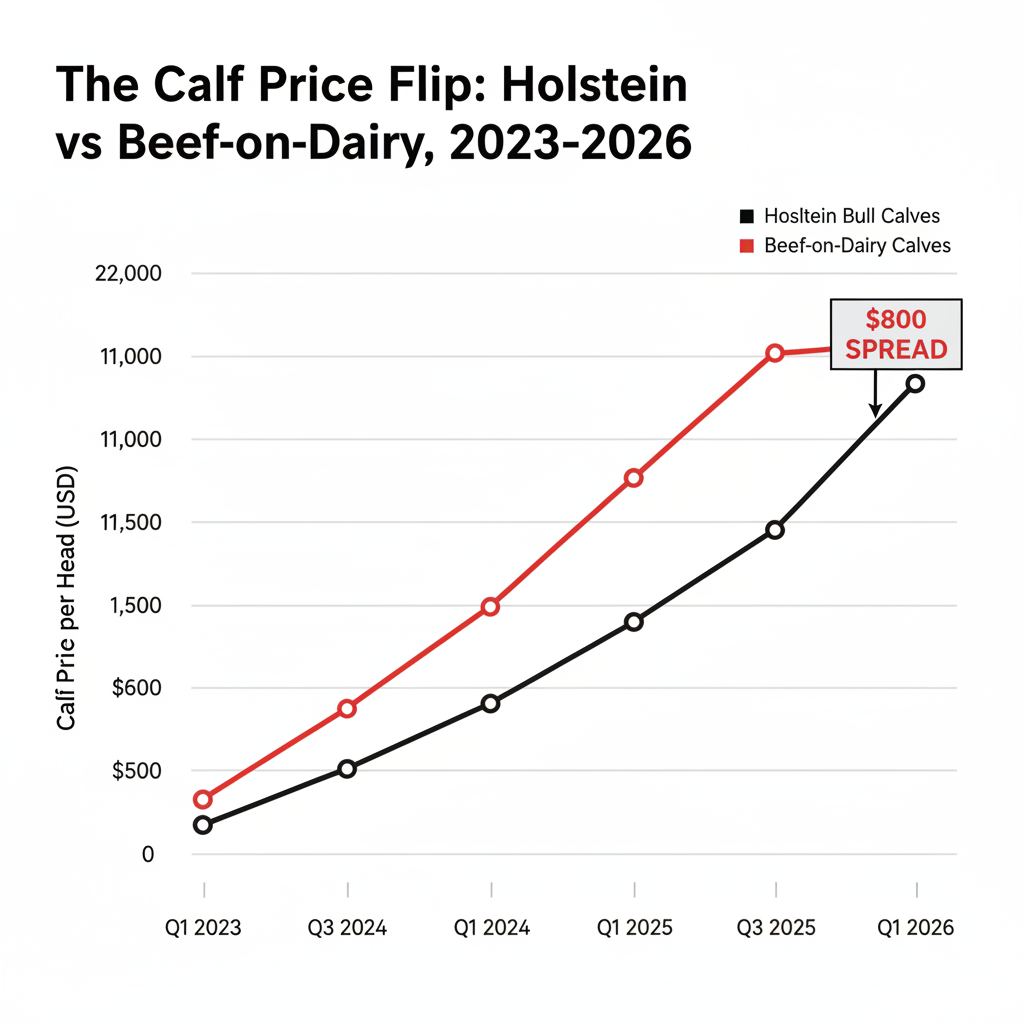
QuarterHolstein Bull Calf Price (USD)Beef-on-Dairy Calf Price (USD)Spread (USD)
Q1 2023$350$800$450
Q3 2023$450$1,100$650
Q1 2024$600$1,350$750
Q3 2024$750$1,500$750
Q1 2025$850$1,600$750
Q3 2025$900$1,700$800
Q1 2026$950$1,750$800

If you’re already selling calves, buying semen, and watching heifer checks climb, this is aimed squarely at you. The question isn’t “Should I try beef‑on‑dairy?” anymore. It’s: given your repro numbers and heifer pipeline, how hard can you lean into beef‑on‑dairy without blowing a hole in your future fresh pen?

The Beef‑on‑Dairy Premium You Can Actually See

For years, bull calves were the side hustle. They helped pay a bill or two but didn’t change your year.

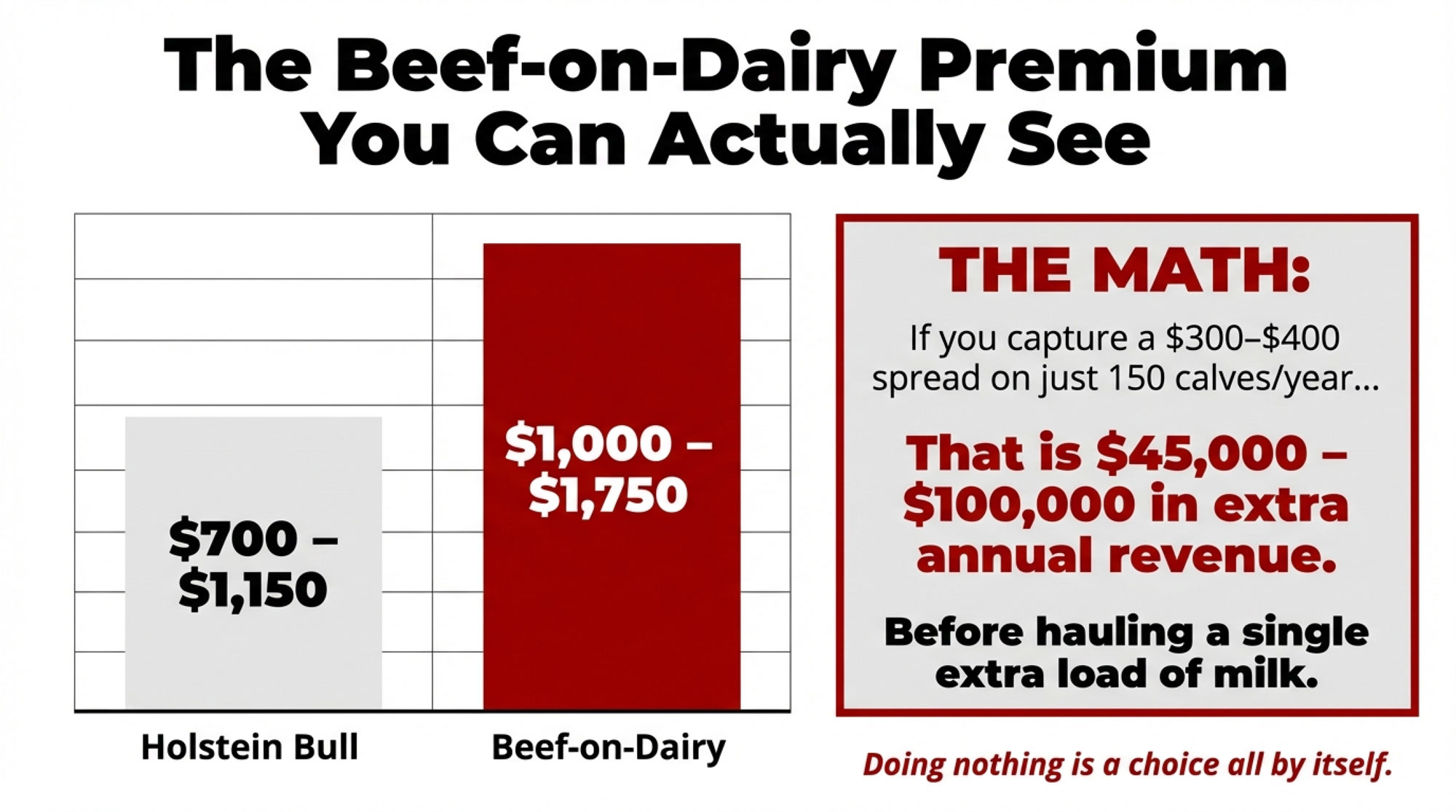
That flipped in late 2023 and into 2024. In sale barns across Wisconsin and Pennsylvania, newborn Holstein steer calves were bringing about $300–$450 per head, while beef‑cross calves hit as high as $1,750. Since then, a string of 2024–2025 market reports has pushed both numbers higher, with 2025 coverage noting newborn beef‑cross calves topping $1,500–$1,600 in Wisconsin and Premier’s January 2026 report listing beef‑dairy cross calves at $1,000–$1,750 and most Holstein bulls at $700–$1,150. 

Sale reports from central U.S. barns tell a similar story. At South Central Livestock Exchange in 2024, “baby calf” reports—a mix of dairy and dairy‑beef—showed ranges like $175–$875 and $200–$780 per head depending on quality and condition. You don’t even need a breed column to see the pattern: the top calves bring several hundred dollars more than the bottom tier. 

Since those 2023–2024 reports, national summaries from CattleFax‑linked analyses have pegged average day‑old beef‑on‑dairy calves around $1,400 in some U.S. markets, more than double levels from just a few years ago, while Holstein bull calves have also climbed. Exact numbers depend on your barn, your buyer, and this week’s market. The important part is the spread between plain Holsteins and well‑sired beef‑on‑dairy calves—and that spread has stayed real. 

Run that against your own numbers. If you can consistently capture even a $300–$400 per‑head spread on 150–250 calves a year by shifting from commodity Holstein bulls to well‑managed beef‑on‑dairy crosses, you’re talking roughly $45,000–$100,000 in extra annual revenue before you haul one extra load of milk. Your math will be different, but the dollars are big enough that “doing nothing” is a choice all by itself. 

How Hillview Turned Beef‑on‑Dairy Into a Revenue Engine

Jauquet’s Hillview Dairy in Luxemburg, Wisconsin, is the kind of place semen companies like to put on a brochure. They milk about 650 registered Holsteins in a cross‑ventilated freestall and have already been profiled for comfort, repro, and genetics. 

Herds like Hillview didn’t jump into beef‑on‑dairy for the novelty. They moved because the economics said they could get more per pregnancy. Their breeding pattern now looks a lot like what the economists have been running in their models: 

  • Sexed Holstein semen on the top of the herd—your highest‑index cows and heifers—to generate just the replacements you actually need. 
  • Beef semen on lower‑index cows and groups where making another heifer mostly adds cost, not value. 
  • A structured repro program (timed AI, close fresh‑cow work, and consistent heat detection) so expensive straws aren’t wasted on sloppy timing. 

An October 2021 paper in JDS Communications (“Economics of using beef semen on dairy herds”) found that once your 21‑day pregnancy rate hits roughly 20% or better, and once beef‑on‑dairy calves bring at least about 2x the price of straight Holstein bull calves, this “sexed on top, beef on the bottom” approach maximizes income from calves over semen cost—even when sexed semen is more than twice the price of conventional or beef semen. 

If your current repro and local calf markets look anything like that, you’re playing in the same lane as Hillview, whether you’ve admitted it yet or not.

Josh Hiemstra: Beef‑on‑Dairy as a Whole‑Farm System

Not every story here is about a big registered Holstein herd. Some are about getting every acre to pull its weight.

Hiemstra Dairy in Brandon, Wisconsin, milks about 170 cows and farms roughly 790 acres of owned and rented land in western Fond du Lac County. Josh Hiemstra farms with his family and has been profiled for his cover crops and soil‑health focus; he thinks in rotations and roots as much as in pounds and litres. 

In a 2024 Farm Progress feature, Josh laid out how beef‑on‑dairy fits his plan. He’d just sold a load of beef‑on‑dairy steers and heifers that averaged 1,400 pounds and brought $1.75 per pound—about $2,450 per head. Then came the line that stuck with a lot of dairymen: 

“I could have been smart and sold them as baby calves,” he admits. 

He didn’t, because on his farm:

  • He can push more corn through finishing cattle than through the milking herd. 
  • Older infrastructure—tower silos, a conventional parlor—fits a mixed dairy‑plus‑beef setup just fine. 
  • Cover crops and “odd” forages that don’t slot neatly into a high‑producing TMR fit nicely into beef rations. 

For Hiemstra, beef‑on‑dairy isn’t a side hustle bolted onto a dairy. It’s part of a whole‑farm plan to make soil, feed, facilities, and cattle all pull in the same direction.

Heifers at a 20‑Year Low and a $10 Billion Stainless Build‑Out

Calf cheques feel good. Realizing you’ve starved your heifer pipeline does not.

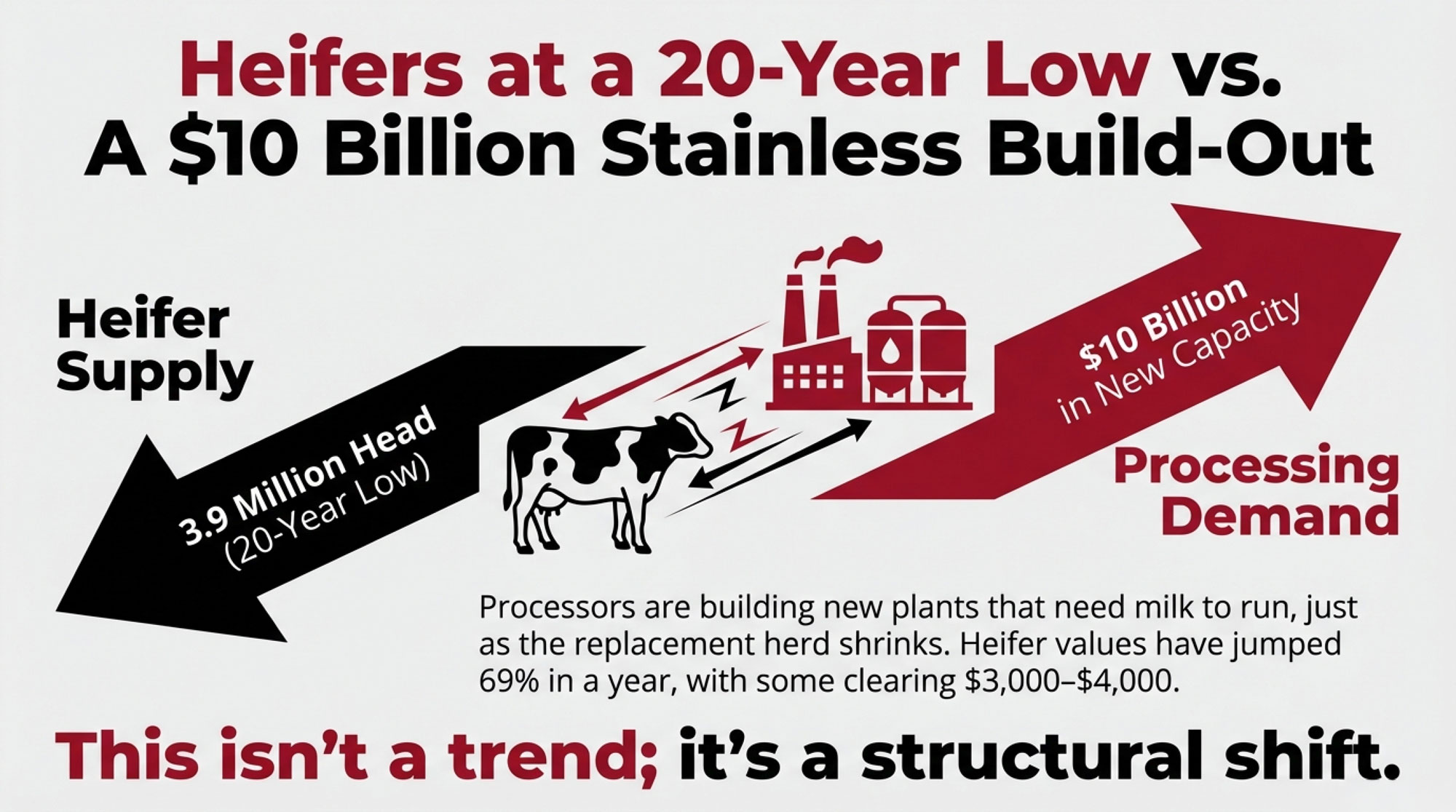
CoBank’s August 2025 report “Dairy Heifer Inventories to Shrink Further Before Rebounding in 2027” pegs U.S. dairy replacement heifer inventories at a 20‑year low and projects they’ll shrink by another 800,000 head before they regain ground in 2027. USDA’s January 1, 2026, cattle report backs that up, putting milk replacement heifers at about 3.9 million head

YearReplacement Heifer Inventory (million head)Cumulative Processing Capacity Investment ($ billion)
20204.8$0.5
20214.6$1.2
20224.4$2.5
20234.2$4.0
20244.0$6.5
20253.9$8.5
2026*3.7$10.0
2027*3.5$10.5

At the same time, CoBank highlights a “historic $10 billion” wave of new and expanded dairy processing capacity—cheese plants, ingredient plants, and value‑added facilities—set to come online through 2027. That’s a lot of new stainless chasing milk from a smaller pool of replacements.

On prices, CoBank’s Corey Geiger notes that heifer values “have reached record highs and could climb well above $3,000 per head.” Brownfield’s read on Wisconsin data shows replacement dairy animals jumping 69% in a year—from $1,990 in October 2023 to $2,850 in October 2024—with some Northwest sales “north of $4,000 per head.” Other 2025 coverage points to bred dairy heifers in many U.S. markets trading north of $3,000, with top strings clearing $4,000

Every heifer you raise—or decide not to—now drags a much bigger number behind her than she did just a few years ago.

What Heifers Really Cost You

None of that means the right answer is to quit raising heifers. It does mean you should know, cold, what yours cost.

A 2019 economic analysis of pre‑weaning strategies found that:

  • Feed typically accounts for about 46% of heifer‑raising costs. 
  • Pre‑weaning costs alone can range from roughly $259 to $583 per calf, depending on housing, milk program, and labour. 

Once that calf gets to freshening, many 2024–2025 North American budgets put full heifer‑raising costs in the low‑to‑mid $2,000s per head, once you count feed, labour, interest, facilities, and death loss. 

On the market side, CoBank and regional reports point to bred heifers trading around and above $3,000 per head, with special sales and select strings in some regions bringing over $4,000

If your true cost to raise a heifer is running $2,300–$2,600, and local bred heifers are selling for $2,800–$3,200 or more, it’s perfectly rational to question the old “raise everything” reflex. 

A simple rule of thumb: if your full heifer cost is consistently more than about 10–15% above the going price for solid bred heifers in your region, it’s time to pressure‑test a buy‑vs‑raise strategy with your adviser or lender instead of assuming raising is always the cheaper, safer play. 

81% of Beef Semen Now Goes Into Dairy Cows

If you still think beef‑on‑dairy is a niche play for a few “progressive” herds, the semen market disagrees.

NAAB’s 2024 data shows 81% of all domestic beef semen sales now go onto dairy cows and heifers. Sexed dairy units keep climbing. Conventional dairy semen is getting squeezed from both sides. 

The 2021 JDS Communications economics work predicts exactly that pattern. In its most profitable scenarios, herds: 

  • Use sexed Holstein semen on the top‑ranked cows and heifers to generate replacements with the genetics they want.
  • Use beef semen on lower‑ranked or surplus animals, assuming beef‑on‑dairy calves bring at least about 2x the price of straight Holstein bull calves. 

In other words, the semen sales chart already looks a lot like the recommended playbook: sexed for replacements, beef for value‑added calves, and conventional dairy semen steadily losing ground.

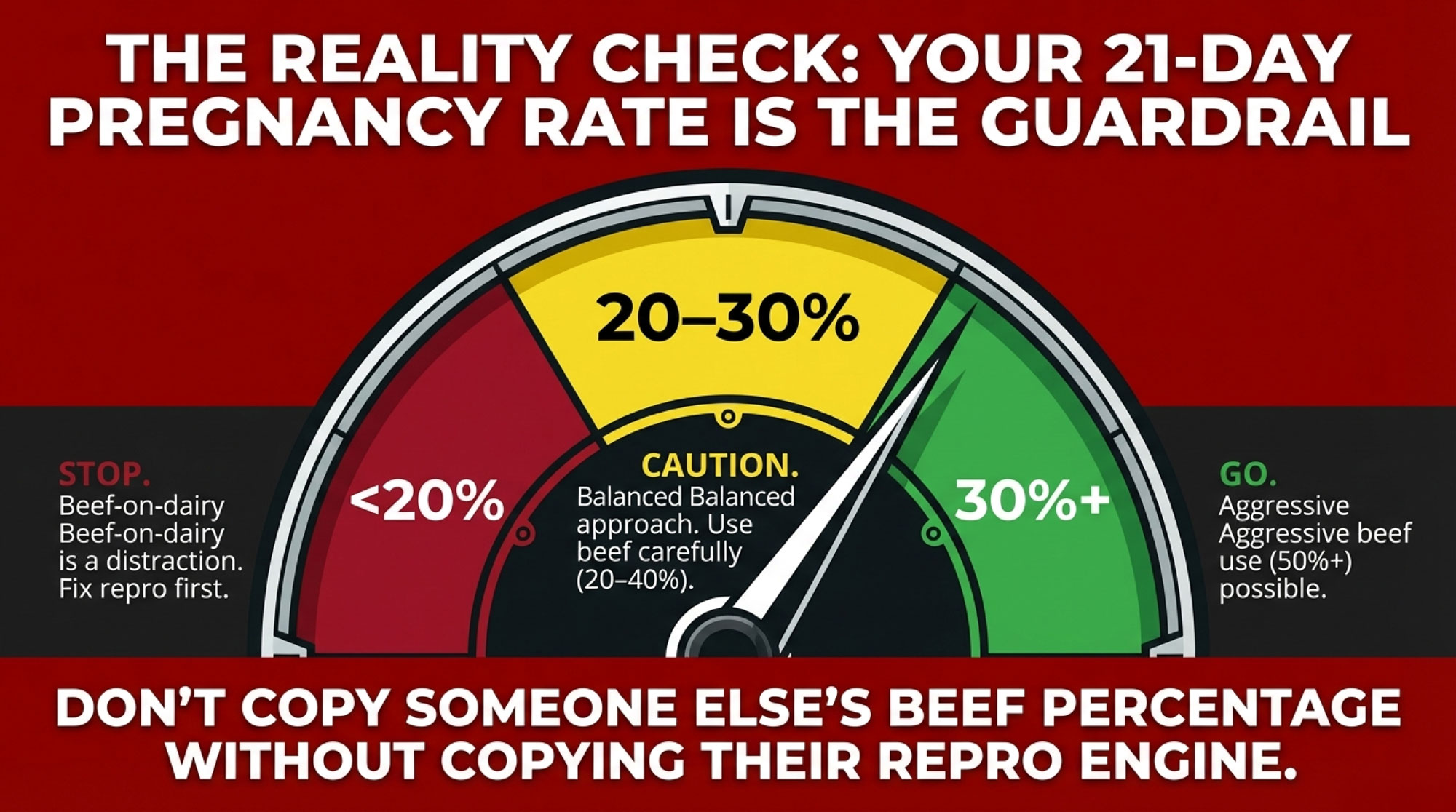
Your 21‑Day Pregnancy Rate Is the Guard Rail

Here’s where good herds quietly get themselves into trouble: copying someone else’s beef‑semen percentage without copying their repro engine.

UW–Extension work and the JDS Communications paper both land on the same idea: beef‑on‑dairy is a “spare pregnancy” business. You use pregnancies you don’t need for replacements to make higher‑value beef‑on‑dairy calves. If you’re short on pregnancies or short on heifers, chasing beef premiums can saw through your replacement pipeline fast. 

High‑performing herds recognized by the Dairy Cattle Reproduction Council (DCRC) often run 21‑day pregnancy rates in the mid‑30s to low‑40s. Those herds have room to be aggressive with beef semen and still sleep at night about replacements. 

If your 21‑day pregnancy rate is in the teens or low‑20s, you’re running a different race.

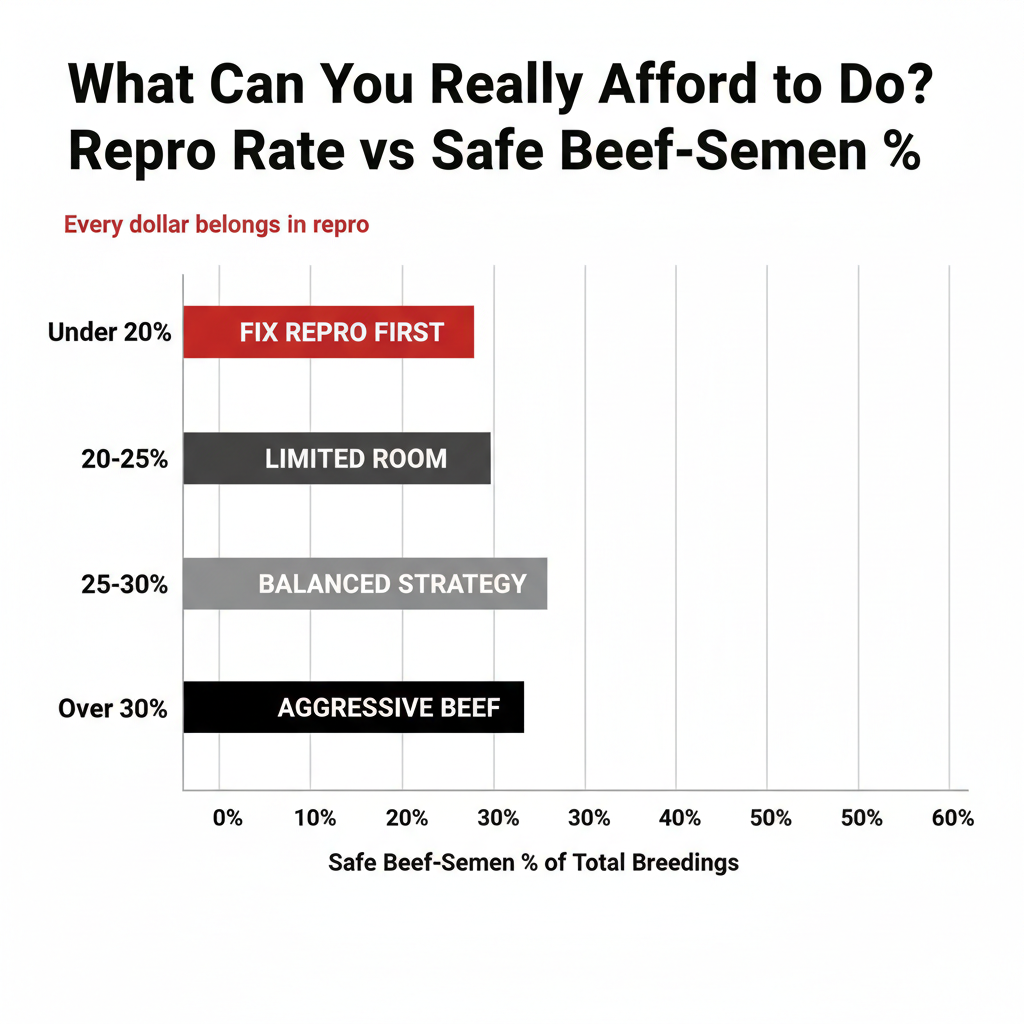
Here’s a simple frame based on the modelling and what the top repro herds actually do—not a law, but a practical starting point: 

21‑Day Pregnancy RateSuggested Beef % of BreedingsWhat That Really Means
Under 20%0–10%Beef‑on‑dairy is a distraction; every dollar belongs in repro first.
20–25%20–30%Limited room; focus on sexed semen on top cows; use beef carefully.
25–30%30–45%A balanced “both/and” beef‑plus‑sexed strategy is realistic.
Over 30%50%+Aggressive beef use can work if you tightly manage the heifer inventory.

Those ranges line up with what the JDS Communications paper found and what DCRC‑type herds live every day. They’re guard rails, not commandments—but if your 21‑day PR is in the teens, cranking beef semen to 60% isn’t a bold strategy. It’s rolling the dice on your own replacement line. 

Sexed Semen: The Old Knock vs the New Data

A lot of producers formed their opinions about sexed semen back when the technology was taking a 20‑point hit on conception. 2010 called. It wants those assumptions back.

A 2023 review in Animals pulled together results from multiple European and Irish studies on beef‑on‑dairy strategies. It found that modern sexed semen often hits 80–90% of conventional semen’s conception rates under good management, especially in heifers, not the steep penalty many people still quote from memory. 

Both that review and the 2021 JDS Communications economics paper land on the same play: 

  • Use sexed semen on higher‑index animals so more of your replacements come from the top of the herd.
  • Use beef semen on lower‑index animals to turn surplus pregnancies into calves with a better paycheque.

You may still see a few points lower conception with sexed vs conventional, depending on your handling and cow group. But if sexed semen lets you trim your heifer pipeline back to what you truly need—and frees up more pregnancies for beef‑on‑dairy calves that bring roughly double the Holstein price—the total calf‑plus‑semen line on your P&L can still climb. 

So the real question isn’t “Is sexed semen good or bad?” It’s: what’s your actual cost per pregnancy with sexed, conventional, and beef semen, using your own conception rates and prices?

The Dornacker Plan: Crossbreeding, Robots, and Beef‑Ready Cows

Not every future‑proof herd is pure Holstein or built around banners.

Dornacker Prairies in Wisconsin is a fifth‑generation dairy with about 360 cows on roughly 1,000 acres, and about 90% of those acres are used to feed their own herd. Allen and Nancy Dornacker farm alongside Allen’s parents, Ralph and Arlene, and their four kids. They’ve been profiled internationally for blending robots, crossbreeding, and composting into a single system that works for their land and family. 

Over the last decade, they’ve: 

  • Installed Lely A5 robots starting in 2018, expanding from three units to six, with room for nine.
  • Adopted ProCROSS crossbreeding (Holstein × VikingRed × Montbéliarde) beginning in 2016 to improve fertility, health, and longevity.
  • Implemented composting that’s cut fertilizer purchases by about 80%.

Their crossbred herd averages around 9,200 kg of milk per cow per year (about 20,000 lb), with components near 4.6% fat and 3.6% protein—numbers that stack up nicely on a component‑based paycheque. 

In a herd like that, beef‑on‑dairy is one more lever, not the whole story. Crossbred cows with stronger fertility give you more room to decide which lactations get beef vs sexed dairy semen. Moderate‑sized, robot‑friendly cows fit tighter breeding programs. Beef‑on‑dairy calf revenue stacks on top of genetics and facilities built around long‑term family ownership, not just next month’s cash flow. 

If your focus is banners and purebred marketing, this path comes with trade‑offs. If your focus is a resilient commercial herd your kids might actually want to run, it’s worth a serious look.

AttributeHillview Dairy (Luxemburg, WI)Hiemstra Dairy(Brandon, WI)Dornacker Prairies(Wisconsin)
Herd Size & Type~650 registered Holsteins~170 cows, mixed dairy-beef finishing~360 cows, 90% crossbred (ProCROSS)
Key InfrastructureCross-ventilated freestall, high-comfort housingTower silos, conventional parlor, 790 acres cropland6 Lely A5 robots (room for 9), on-farm composting
Breeding ApproachSexed Holstein on top 30% of herd + high-index heifers; beef on lower-index cowsBeef-on-dairy for finishing on-farm; corn pushed through cattle, not just milkProCROSS (Holstein × VikingRed × Montbéliarde) base; beef on select lactations
Beef-on-Dairy StrategyStructured AI program; calving-ease beef sires; sell calves at premiumFinish beef-cross steers/heifers to ~1,400 lb at $1.75/lb(~$2,450/head)Crossbred fertility gives “spare pregnancies”; beef semen on lower-value lactations
Why It Works for Them21-day PR 30%+(estimated); consistent heifer surplus; registered genetics pay premiumCover crops + “odd” forages fit beef rations; old infrastructure = low overheadRobot-friendly moderate-frame cows; strong fertility (crossbreeding); family succession plan
Main Constraint They ManageHeifer inventory—must keep sexed-semen conception highLand base & feed logistics (790 acres, finishing cattle on-site)Balancing milk components (4.6% fat, 3.6% protein) with beef-calf revenue

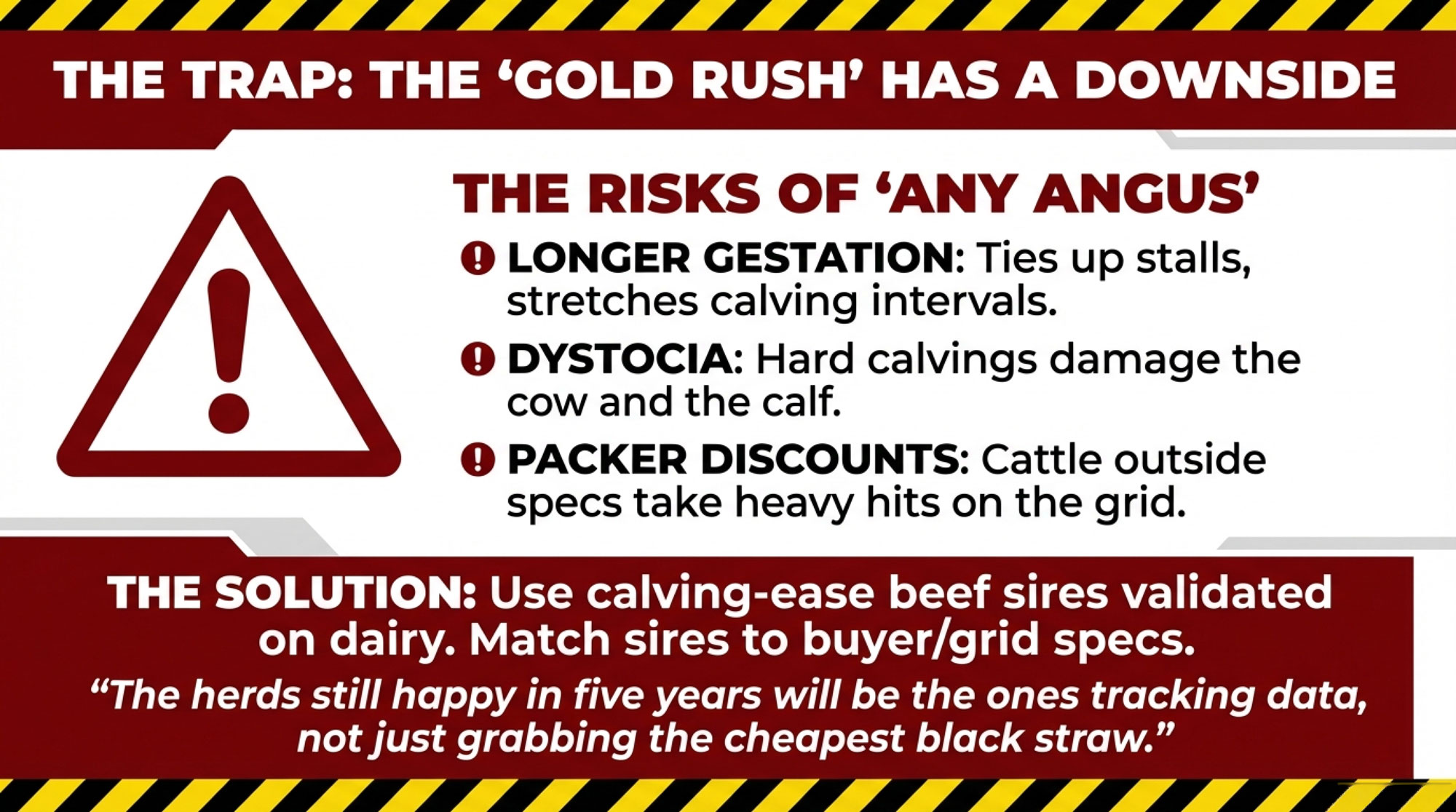
The Beef‑on‑Dairy Gold Rush Has a Downside

It’s easy to get starry‑eyed about $1,400 calf stories. Here’s the part that keeps you out of trouble.

The same 2023 Animals review that highlights beef‑on‑dairy’s upside also flags real risks when beef sires get sprayed across dairy cows without enough planning: 

  • Longer gestation with some beef breeds, stretching calving intervals, and tying up stalls. 
  • Higher dystocia and stillbirth rates in certain beef × Holstein crosses when calving ease isn’t prioritized. 
  • Welfare and marketing problems occur when calves don’t meet buyer expectations on growth, muscling, or carcass traits. 

On the fed‑cattle side, Kansas State’s grid‑pricing work shows that cattle outside packer specs on weight, yield, or quality take meaningful discounts. Poorly planned beef‑on‑dairy crosses—wrong frame, wrong fat cover, wrong muscling—are more likely to land in those discounted buckets. 

If you:

  • Chase beef‑on‑dairy premiums with sires that add too much birthweight or gestation,
  • Ignore calving‑ease and carcass traits when picking beef bulls for dairy cows, and
  • Don’t align your calves with what your buyer, feedlot, or packer actually wants,

you can watch the “gold rush” vanish into dead calves, extra days open, and grid deductions. 

The herds that will still be glad they leaned into beef‑on‑dairy five years from now are already:

  • Using calving‑ease beef sires validated on dairy crosses. 
  • Matching sires to specific buyer or grid specs, not just grabbing “any Angus” off the sheet. 
  • Tracking calf health, growth, and sale prices in their own records instead of assuming every beef‑cross calf lands at the top of the market. 

What This Means for Your Operation

Beef‑on‑dairy is not a yes‑or‑no question. It’s a strategy that has to fit your repro, heifers, feed base, and markets.

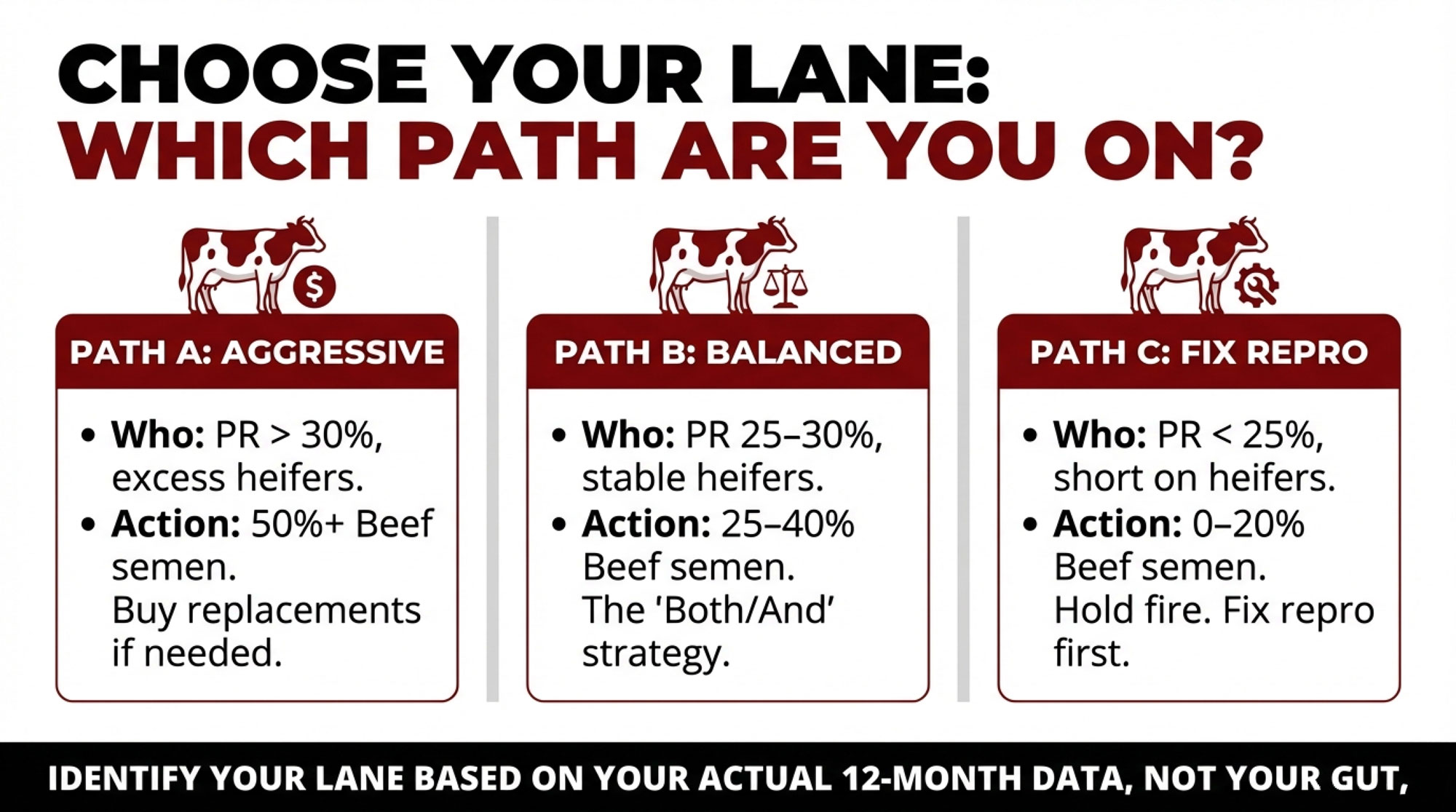
Most herds will land in one of three lanes.

Path A: Aggressive Beef (50%+ of Breedings)

You’re here if:

  • Your 21‑day pregnancy rate runs around 30% or higher
  • You’ve consistently had more heifers than you truly need. 
  • You have reliable outlets for beef‑on‑dairy calves or your own finishing capacity. 

What it looks like:

  • The top 20–30% of cows and most heifers get sexed Holstein semen, selected on Net Merit, DWP$, or your index of choice. 
  • The bottom 50–70% of cows receive beef semen from calving‑ease, dairy‑tested sires that meet buyer specs. 
  • You’re willing to buy replacements when the heifer market says that beats raising every last one yourself. 

Path B: Balanced Strategy (25–40% Beef)

You’re here if:

  • Your 21‑day pregnancy rate sits in the 25–30% band. 
  • You’re mostly okay on heifers—short in some years, long in others.
  • You have decent calf markets but no locked‑in premium contract. 

What it looks like:

  • The top 30–40% of cows and heifers get sexed dairy semen.
  • The bottom 25–40% of cows go to beef.
  • Conventional dairy semen still has a role where it wins on cost per pregnancy. 

A lot of 300–800‑cow herds are going to live here for a while as they keep nudging repro higher.

Path C: Fix Repro First (0–20% Beef)

You’re here if:

  • Your 21‑day pregnancy rate is under about 25%.
  • You’re short on heifers and stretching days‑in‑milk. 
  • Your risk budget feels pretty thin.

What it looks like:

  • Beef semen is used sparingly—older cows, obvious genetic culls, maybe a small test group.
  • Most of your cash goes into repro and cow performance: transition, heat detection, cow comfort, and vet work. 

If you’re in Path C, the smartest beef‑on‑dairy move may be to hold your fire. Get your repro into the mid‑20s or 30s first. The beef premiums will still be there when you’ve actually got pregnancies to spare.

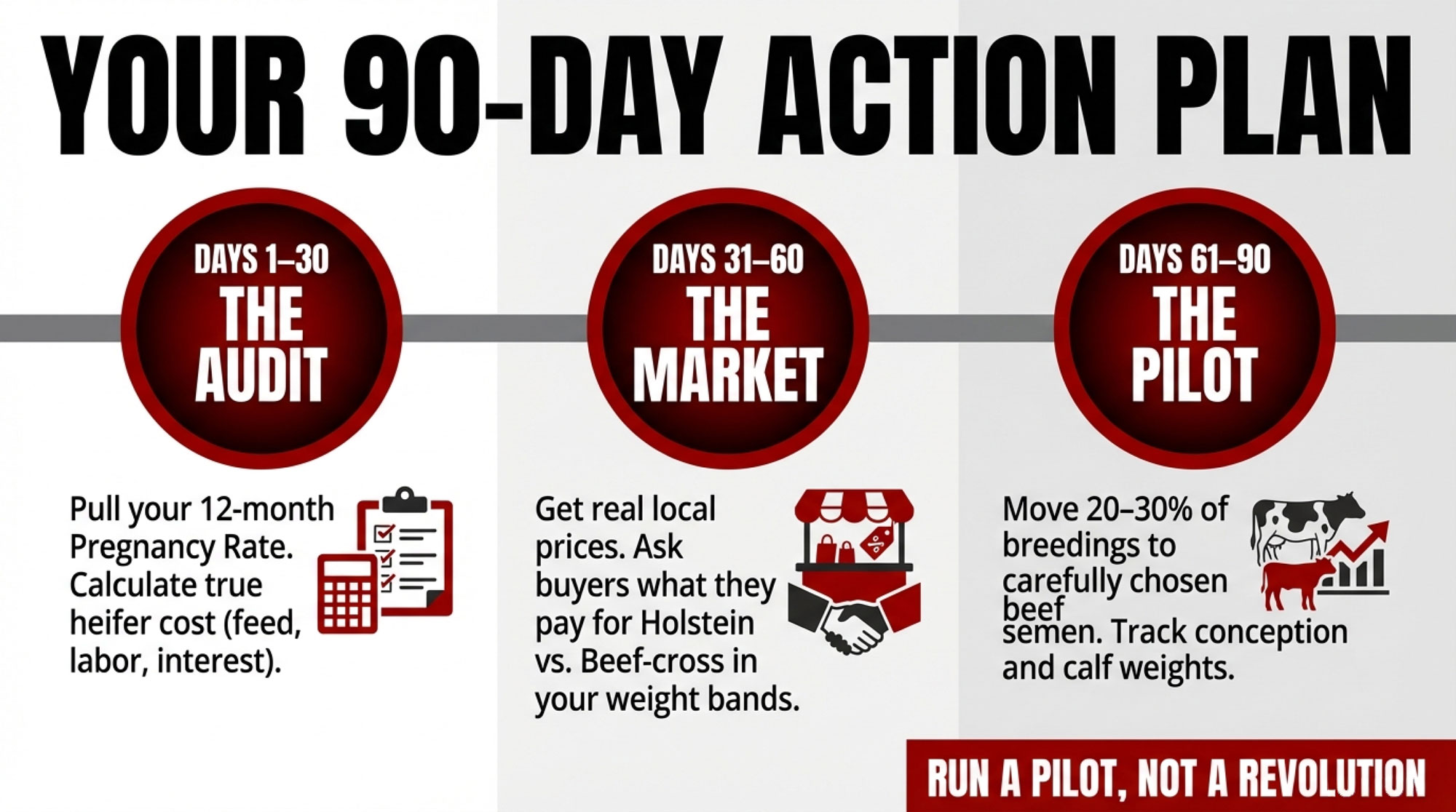
Your 90‑Day Action Plan

Here’s how you turn this from a good read into a working plan on your farm.

Next 30 days

  1. Pull your 12‑month 21‑day pregnancy rate.
    Use your herd software or DHI reports, not a guess. That number tells you if Path A, B, or C is even on the table. 
  2. Calculate your full heifer cost.
    Use your 2024 books—feed, labour, interest, bedding, facilities, and death loss. If you need a framework, start from a university heifer‑raising budget or sit down with your lender and walk through your numbers line by line. 

Next 60 days

  • Get real local calf price ranges.
    Talk directly to your sale barn or calf buyer. Ask what they’ve actually been paying for Holstein bull calves vs beef‑on‑dairy calves in your weight bands over the last 60–90 days. Use that spread—not coffee‑shop talk—as your baseline. 
  • Sit down with your AI and genetics rep.
    Bring cow and heifer index lists, cull data, and heifer counts. Map how many replacements you truly need, and which animals can shift to beef semen without starving your fresh pen 18–24 months from now. 

Next 90 days

  • Run a pilot, not a revolution.
    If your repro supports it, move 20–30% of breedings to carefully chosen beef semen for one breeding season. Track breedings, conceptions, calvings, calf weights, and sale prices. Let your own numbers, not somebody else’s story, tell you whether to ramp up or back off. 
  • Check your risk tools.
    USDA’s Livestock Risk Protection (LRP) program has expanded coverage options in recent years, including coverage tied to feeder cattle and calf prices in general. Talk with your insurance agent or extension specialist about whether any current LRP products fit the kind of calves you’re producing and how you market them. 

While you’re at it, read your milk cheque and the fine print of your contract. If your processor is paying for components, animal care, or specific beef‑on‑dairy traits, those lines belong in the same spreadsheet as semen prices and calf bids. 

TimelineAction StepWhat to Calculate or AskWhy It Matters
Next 30 Days(Step 1)Pull your 21-day pregnancy rateUse herd software or DHI—12-month rolling average, not a guessTells you if Path A, B, or C is even on the table; this number is your beef-semen budget
Next 30 Days(Step 2)Calculate your full heifer costFeed + labor + interest + facilities + death loss from 2024 booksIf your cost is >10–15% above local bred-heifer prices, raising every heifer is leaving money on the table
Next 60 Days(Step 3)Get real local calf pricesCall sale barn or buyer: What did Holstein bulls vs beef-cross calves actually bring in last 60–90 days?Use that spread—not coffee-shop gossip—as your baseline; if spread is <$300/head, beef-on-dairy math gets harder
Next 60 Days(Step 4)Sit down with AI/genetics repBring cow index lists, cull data, heifer counts; map how many replacements you truly needPrevents the classic mistake: copying someone else’s beef-% when their repro and heifer pipeline are 20 points stronger than yours
Next 90 Days(Step 5)Run a pilot, not a revolutionMove 20–30% of breedings to beef semen for one breeding season; track breedings, conceptions, calvings, calf weights, sale pricesLet your numbers tell you whether to ramp up or back off—not somebody else’s story at the sale barn
Next 90 Days(Step 6)Check your risk toolsTalk to insurance agent about USDA Livestock Risk Protection (LRP) for feeder cattle/calf price coverage; read milk contract fine print for component or beef-calf incentivesIf your processor pays for specific traits or your calf market swings hard, these lines belong in the same spreadsheet as semen prices

Key Takeaways

  • Beef‑on‑dairy calves are bringing several hundred dollars more per head than Holsteins in many U.S. markets—Holstein calves that used to bring $300–$450 are now commonly $700–$1,000 in strong markets, while beef‑cross calves are topping $1,500–$1,750 in parts of Wisconsin and over $1,000 in Pennsylvania and other key regions. 
  • Heifer economics have flipped fast. CoBank says inventories could shrink by another 800,000 head before 2027, while Wisconsin replacement values jumped 69% in a year, and many U.S.-bred heifers now sell north of $3,000, with some lots over $4,000
  • Beef‑on‑dairy works best long‑term when repro and heifer numbers are strong. Modelling shows the math starts to work above roughly 20% 21‑day PR and 2x calf price, with herds in the 30–40% band having the most flexibility. 
  • There’s a real downside if you pick the wrong beef sires or ignore carcass specs. Longer gestations, harder calvings, and packer grid discounts can erase calf‑price gains very quickly. 
  • The herds that will still be happy with beef‑on‑dairy in five years are matching sexed and beef semen to their own numbers—pregnancy rate, heifer needs, feed base, and actual buyers—not to the latest rumour at the sale barn. 

The Bottom Line

You don’t have to milk 650 cows in Luxemburg or farm 790 acres in Fond du Lac County to make this work. But, like those families, you do have to pick a lane and live with the math that comes with it. 

So when you look back on 2026, a year from now, do you want to say, “We finally lined up our breeding plan with our numbers,” or still be loading $700 Holstein bull calves while your buyer’s paying a lot more for the right beef‑on‑dairy cross?

Complete references and supporting documentation are available upon request by contacting the editorial team at editor@thebullvine.com.

Learn More

The Sunday Read Dairy Professionals Don’t Skip.

Every week, thousands of producers, breeders, and industry insiders open Bullvine Weekly for genetics insights, market shifts, and profit strategies they won’t find anywhere else. One email. Five minutes. Smarter decisions all week.
NewsSubscribe
First
Last
Consent

Cold Weather Dairy Herd Management: Essential Diet and Care Strategies for Optimal Productivity

Learn key ways to manage dairy herds in winter. How can you improve diets and care to enhance productivity and safeguard calf health?

Imagine a cold January morning at a dairy farm in Wisconsin. The icy wind bites the farmer as he takes care of his cows. He remembers learning that cows need about 10-20% more energy to stay warm in the cold, which affects their milk production and health. Ensuring cows’ comfort in winter is not only about warmth but also essential for their productivity. So, how do farmers handle this chilly challenge? Let’s explore ways to keep cows warm and produce milk effectively.

Temperature (°C / °F)Additional Feed Requirement (%)Expected Impact on Milk Production
0 / 3210%Minimal Reduction
-5 / 2312%Small Reduction
-10 / 1415%Moderate Reduction
-15 / 518%Significant Reduction
-20 / -420%Severe Reduction


Embracing Winter’s Challenges: Boosting Dairy Cows’ Energy and Well-Being

Cold weather brings unique challenges for dairy cows, making them adjust physically. As it gets colder, cows need more energy to stay warm, which is key for their health and productivity. They naturally eat more to get this extra energy. When temperatures drop, cows increase their dry matter intake, consuming more calories to help keep them warm. This extra energy is essential for warmth and functions like milk production and growth. 

The consequences of not meeting cows’ nutritional needs are significant. If cows don’t receive enough nutrients, they can become stressed, leading to a drop in milk yield. This not only affects the farm’s productivity and profits but also the well-being of the cows. It’s a reminder of the farmer’s responsibility to ensure that the cows’ nutritional needs are met, especially during winter. 

Farmers must adjust their diets by adding feeds rich in carbohydrates and fats, which help generate heat efficiently. They must also check barn conditions to ensure cows are well insulated and free from drafts, keeping them healthy and productive in winter. 

Tackling Winter’s Nutritional Demands: Customizing Dairy Cows’ Diets to Enhance Resilience and Performance 

Winter can be harsh on dairy cows, increasing their energy needs. Adjusting their diets can help keep them healthy and productive. Let’s explore some strategies to optimize cow health during the colder months. 

  • First, cows need more dry matter intake to keep warm. Dry matter intake refers to the amount of feed a cow consumes that is not water. This means they’ll eat more food, so providing plenty of high-quality forage is essential. Did you know lactating cows might eat up to 3.5% of their body weight in dry matter daily when it’s cold? (source)
  • We should also boost energy with fermentable carbs. Carbs give cows energy, and more fermentable ones can provide extra calories. However, be careful! Adding too many sugars and starches can upset their digestion and lead to issues like subacute ruminal acidosis, a condition where the pH of the rumen becomes too acidic. Dr. Heather Dann from the Miner Agricultural Research Institute warns about these risks (source).
  • Plus, introducing fats in the diet can help. Fats offer more than twice the energy per gram compared to carbs. Adding up to 5% fat can satisfy energy needs without increasing the feed quantity. 

While boosting energy is crucial, maintaining dietary balance is equally important. Farmers must ensure their cows’ diets include enough neutral detergent fiber to support good rumen function. This balance is not just about productivity but about the health and well-being of the cows, a responsibility that farmers must take seriously. Optimizing winter diets involves creating a balanced approach to herd health, even in the coldest weather. Every herd is different, so monitor them and make changes as needed.

Conquering the Freeze: Mastering Frozen Silage Management for Healthier Herds

Frozen silage is a big challenge during winter. When silage freezes, cows might eat less because they’re less interested in the meal. This can lead to loose stools and changes in digestion. So, what’s going on here? And how can we handle it to keep our herds healthy? 

The problem with frozen silage is its size. When large pieces end up in the feed, cows might pick through their meals and leave out parts they don’t want, affecting how much they eat and their diet’s nutrition. Keeping silage fresh and cutting it correctly helps cows digest better and stay productive. [source] 

Here’s how you can deal with this: 

  • Face Management: Keep the silage face smooth and cut daily to prevent freezing. In harsh winter months, remove six inches or more daily.
  • Defacing Tools: Use a silage defacer to break up frozen pieces. It helps prevent cows from picking through their feed.
  • Monitor Feed: Keep an eye on how much cows eat and the milk they produce. Change diets based on weather predictions to avoid problems. Check out our comprehensive guide, Top 7 Data Points to Track for Optimal Herd Performance, which provides detailed information on the key data points to monitor for maintaining herd health and productivity.Plastic Covers: Ensure silage covers are long enough to reduce exposure to rain or snow, which leads to freezing.

Handling frozen silage isn’t just about keeping production up—it’s about keeping our herds healthy. As an expert once said, “Consistency is key.” [source] 

These tips can reduce cold stress and help cows stay warm, productive, and happy even in chilly weather. 

Maximizing Barn Efficiency: Navigating Cold Weather Challenges in Dairy Barn Management 

As winter’s grip tightens, maintaining optimal barn conditions becomes essential for a thriving dairy herd. Investing time and effort into ensuring that your free stall facilities are up to par can make all the difference in combating the adverse effects that cold weather can impose on your operations. 

  • Ensuring Proper Ventilation: Proper ventilation prevents wind chill effects that can exacerbate cold stress in dairy cows. A well-ventilated barn facilitates air circulation while minimizing drafts that may sneak up on your cows and leave them shivering. Remember, the goal is to balance between avoiding stagnant air and not blowing chilly wind onto your herd. Metrics dictate that temperature fluctuations inside a regulated building should remain within a five-degree Celsius range to ensure comfort and productivity (source). Continual monitoring and adjustments can foster an environment where cows can perform optimally, even in the coldest months.
  • Managing Barn Temperatures: Minimizing the effects of wind chill requires a keen awareness of the barn’s temperature. Suspending chilly airflows might seem trivial, but it can promote comfort, improve milk yields, and reduce stress levels. Always be keen to fix any broken parts facilitating drafts, notably overhead doors, which can often become troublesome in inclement weather. 
  • Maintaining Equipment: Your barn’s efficiency relies on its components’ functionality. Farmers should focus on maintaining equipment like overhead doors, which are pivotal in controlling external cold air infiltrators. Regular checks and prompt repairs ensure equipment functions as needed, especially during cold snaps. It is crucial to keep everything tightly sealed and well-insulated to maintain barn efficiency.
  • Adjusting Feed Ingredients: When it comes to feeding, freezing molasses or other liquid supplements can be detrimental to dietary balance. Consider switching to winter-stable formulas to avoid such issues. An anecdote from a dairy farmer: “When we adjusted the molasses content, it became evident how a small change can avert larger problems in cold feeds.” For more insights on managing feed ingredients, check out this guide on feed solutions

Implementing these strategies can better position your dairy operation against winter’s frigid challenges. Continually assess your processes to refine your management approach and equip your herd for success year-round! 

Caring for Non-Lactating Animals: Meeting the Cold Weather Needs of Heifers and Calves 

As winter sets in, it’s crucial to focus on the needs of heifers and calves. Unlike cows, these young ones need special care to stay warm and healthy. 

  • Keeping Them Cozy with Bedding: One easy way to help heifers and calves is by giving them enough bedding. Bedding is key to keeping them warm. Using straw lets calves snuggle in for warmth. It’s essential to keep bedding dry, as snow can dampen it. A bedding depth of six inches is best, balancing warmth and cleanliness.  
  • Watching Hair Coat Changes: Heifers and calves grow thicker coats to stay warm as the weather gets colder. But if these coats get messy with mud or manure, they lose their ability to keep the animals warm. Keeping their environment clean and grooming them often helps maintain a clean coat. 
  • Feeding Newborn Calves Right: Newborn calves need more energy to fight the cold. Give them more milk or a nutrient-rich milk replacer to keep them warm. Increasing feedings from twice a day to three times can significantly improve their health. Studies show that extra feedings and warm shelters boost weight gain and reduce death rates in winter. Winter feeding isn’t just about surviving; it’s about making calves healthy and strong.

Focusing on heifer and calf care during winter helps prevent cold stress and keeps your herd healthy. Farmers can ensure their animals grow up strong and ready for the herd by providing cozy bedding, checking their coats, and adjusting feeding. 

Safeguarding Herd Vitality: The Critical Role of Health Vigilance Amid Winter’s Trials 

Keeping a close watch on the health of dairy cows during winter isn’t just a good idea—it’s a must. Regular health checks help catch the adverse effects of cold stress early on, allowing farmers to step in quickly to protect their herds. 

The body condition score (BCS) is valuable in these checks. Watching the BCS helps farmers see if cows have enough energy to fight off the cold. Ideally, a cow’s BCS falls between 2.5 and 3.5 on a 5-point scale. Any difference could mean the cows lack proper nutrition or have health problems (see Top 7 Data Points to Track for Optimal Herd Performance for more). 

It’s also crucial to look for signs of stress or discomfort. Cows huddled up and shaking might be very cold, and less milk production can be another sign of trouble. Cows can’t tell us when they’re cold, so we must watch for signs and pay attention to what they’re doing.

Besides watching the cows, farmers should check barn conditions, such as temperature and humidity. Tools like thermal cameras can help ensure the barn is comfortable for the cows, reducing such issues. 

Regular health monitoring helps farmers keep their cows’ barns running smoothly during coproduction. For more tips on keeping cows productive in different weather conditions, check out Recognizing and Preventing Heat Stress in Dairy Cattle: Proactive Measures for Hot Seasons.

Embracing Technology: Modern Innovations for Managing Winter’s Chill in Dairy Farming

As winter’s cold grip takes hold, dairy farmers are using modern technology to help their herds stay healthy in the cold. 

Temperature sensors are key to keeping barns warm. They give precise temperature readings, helping farmers adjust ventilation and heating systems. These sensors allow barns to stay warm, reducing cold stress and protecting milk production and cow health. 

Automated feeding systems are also changing winter herd care. They accurately and consistently provide feed, ensuring cows get the nutrients they need, even in harsh weather. These systems also have sensors that track feed use and update farmers in real-time. Studies show that automated systems can make feeding more efficient by up to 10%, boosting productivity (source). 

Research on SMART barn technology shows promise for winter care. These barns use the Internet of Things (IoT) to control climate, lighting, and feeding from one location. This improves cow comfort and lowers labor costs, enhancing farm efficiency. 

IoT integration in dairy farming isn’t about saving money and building sustainable and resilient farm operations. Farmers report lower energy costs and increased productivity with intelligent systems (source). 

Embracing technology in dairy management has challenges, like initial costs and training. However, the benefits to herd health and productivity, especially in winter, show the potential these tools offer innovative farmers.

The Bottom Line

We’ve discussed how to handle winter’s challenges, and it’s clear that being prepared is key to keeping dairy herds healthy. Adjusting diets and using new technology can boost productivity and health. We encourage you, as dairy farmers, to use these tips. Try the strategies and contact experts or other farmers if you need help. The community is here to support you with resources and encouragement during the colder months. Embrace these changes and join the movement towards improving your operations. Together, we can build a strong dairy industry that succeeds even in the cold.

Key Takeaways:

  • Cold stress can significantly impact dairy cows’ productivity and overall health during winter months.
  • Adjusting diets by increasing fermentable carbohydrates and monitoring structural carbohydrates is essential to help cows maintain energy levels.
  • Proper management of frozen silage, including effective face management and feedout practices, helps prevent feed quality issues.
  • Maintaining ventilation while protecting from drafts supports barn efficiency and prevents additional cold stress factors.
  • The care of non-lactating animals, particularly heifers and calves, requires attention to bedding, housing, and dietary adjustments to ensure their warmth and nutritional needs are met.
  • Health vigilance in winter includes protecting against illnesses that cold weather can exacerbate, with proactive health measures being critical.
  • Incorporating technology and modern innovations can aid in adapting to winter challenges in dairy farming.

Summary:

This article explores how dairy farmers can adjust herd diets and practices in winter to keep cows warm and healthy. Cows in Wisconsin need 10-20% more energy in the cold, affecting milk and health. Farmers should add carbs and fats, boost dry matter intake, and check barns, ensuring good ventilation and stable temperatures. Too many sugars and starches can cause digestive problems, so balance is key. Non-lactating cows, like heifers and calves, also need special care. Using modern tech can help tackle these winter issues.

Learn more:

Join the Revolution!

Bullvine Daily is your essential e-zine for staying ahead in the dairy industry. With over 30,000 subscribers, we bring you the week’s top news, helping you manage tasks efficiently. Stay informed about milk production, tech adoption, and more, so you can concentrate on your dairy operations. 

NewsSubscribe
First
Last
Consent
Send this to a friend