

Eight minutes, four strange cows, no notes, and a stranger who’ll push back on every word. That’s not a nightmare — it’s the best manager-training dairy has, and we’re defunding it.
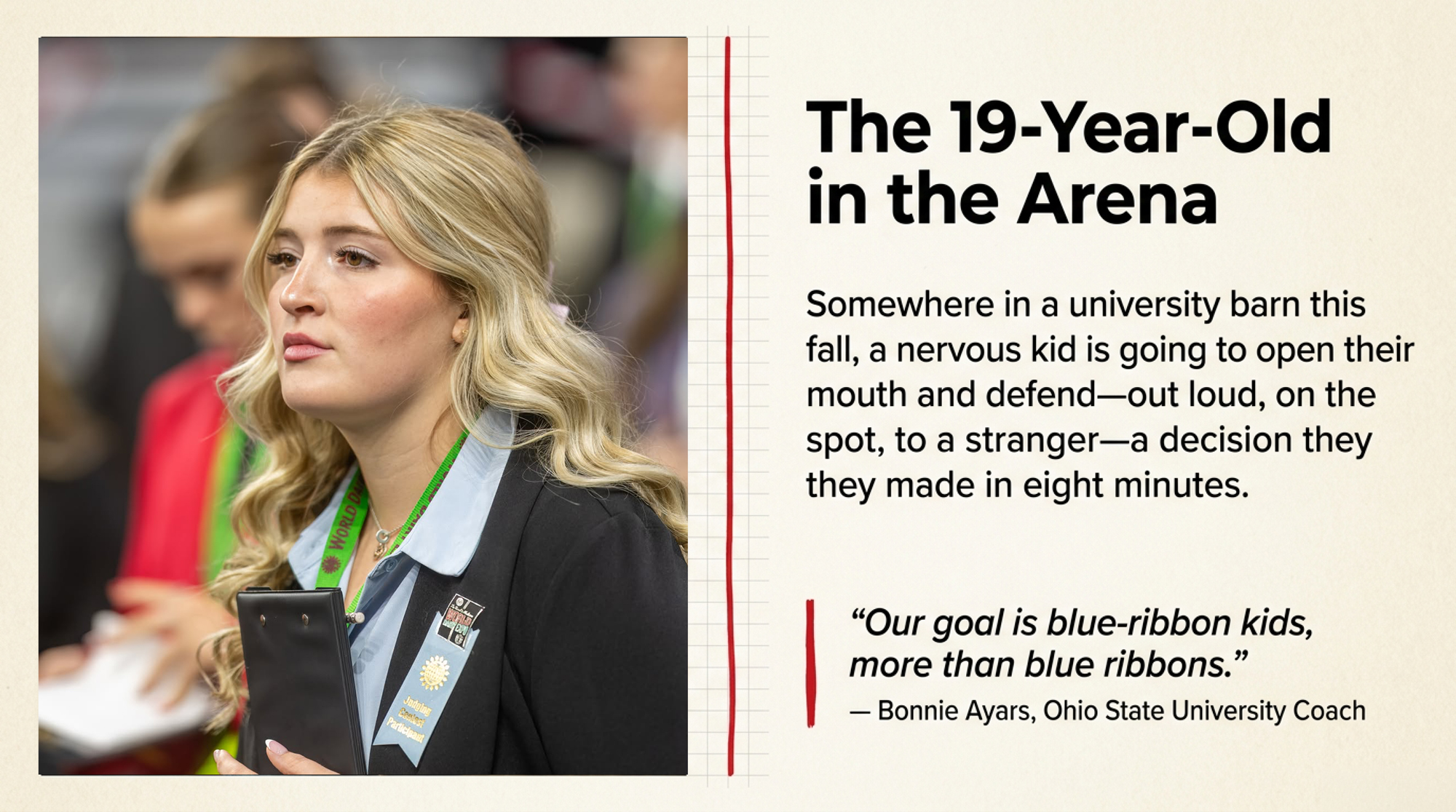
Somewhere in a university barn this fall, a nervous 19-year-old is going to open her mouth and defend — out loud, on the spot, in front of a stranger who knows more than she does — a decision she made in eight minutes about four cows she’d never seen before. She doesn’t know it yet. But that two-minute speech is worth more to her career than anything she’ll do in a lecture hall this semester.
There’s a workforce problem sitting at the heart of dairy right now, and it has nothing to do with genomics, robots, or milk price. It’s about people. Specifically, it’s about building confident individuals who can walk into any barn, any boardroom, any hard conversation, and hold their ground.
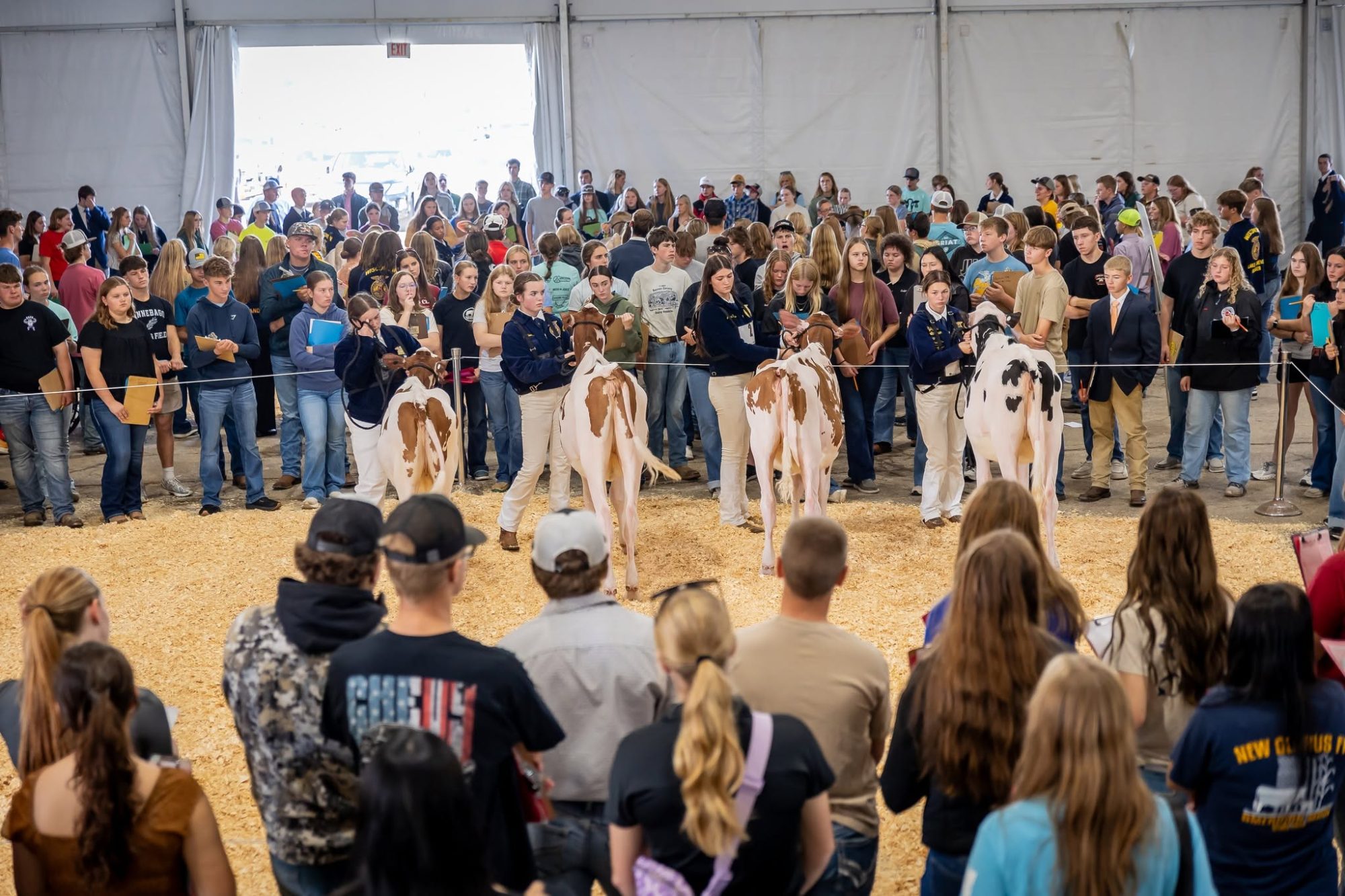
Dairy cattle judging has been quietly building exactly those people for over a century. The 104th National Intercollegiate Dairy Cattle Judging Contest ran at World Dairy Expo in September 2025, with 16 university teams competing for the title. But who won is almost beside the point. The story worth telling is where the participants end up — and once you follow that thread, you start to wonder why an industry this starved for talent treats its best development pipeline like an afterthought.
This Has Never Just Been About Cows
Ask serious dairy professionals how they got their start, and a remarkable share point back to a 4-H barn, an FFA chapter, or a college judging team. Breed association executives. AI company reps. Geneticists. Farm lenders. Classification managers. Extension educators. Veterinarians. The talent pipeline runs straight through the ring.
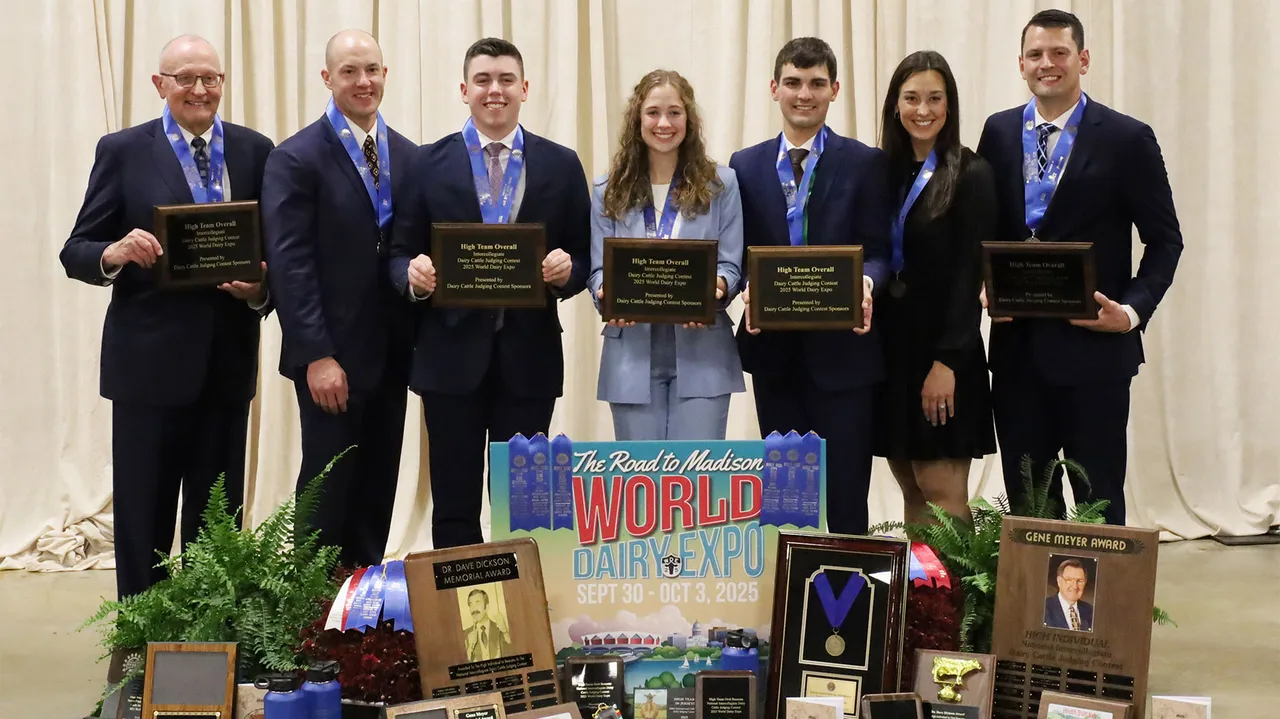
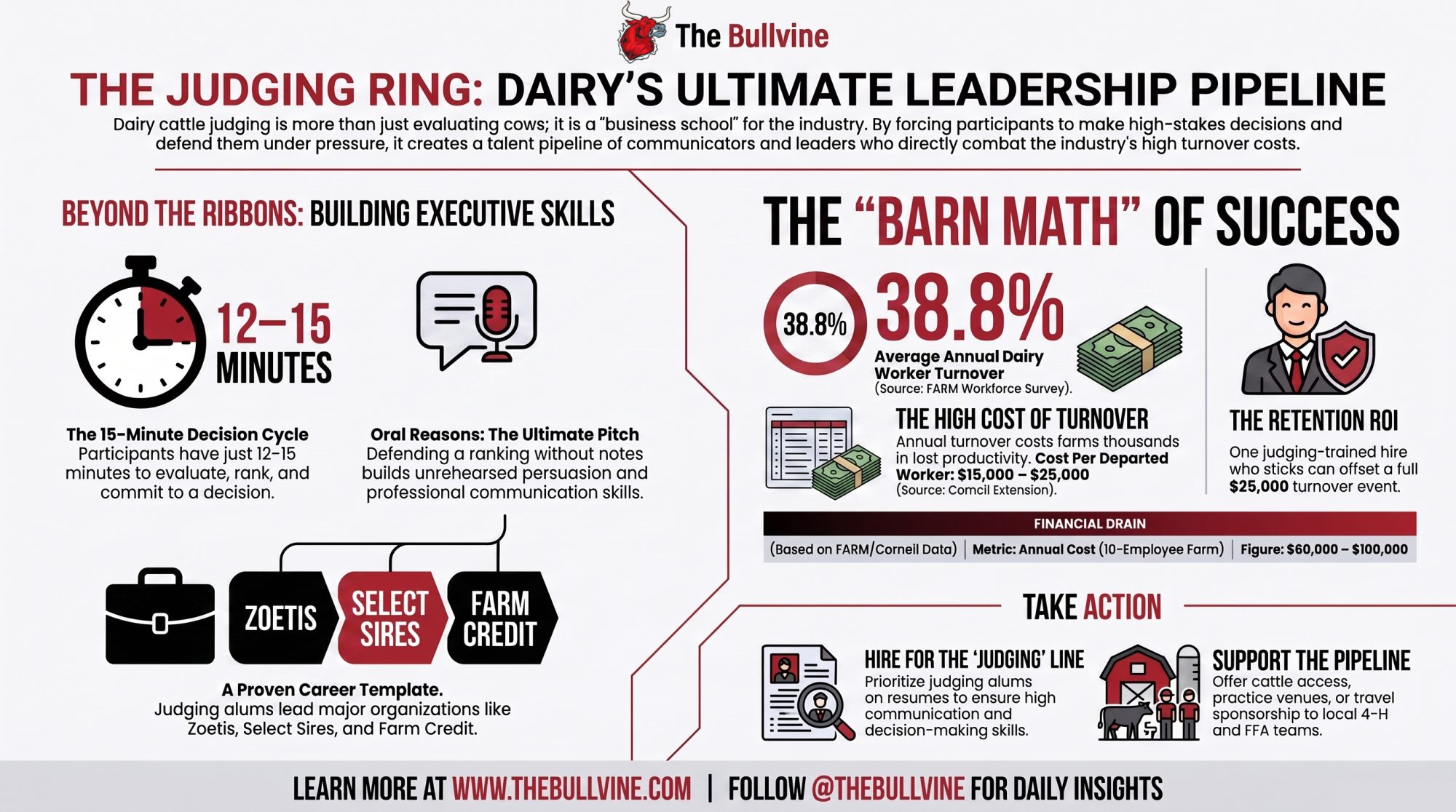
It’s not a coincidence you’ll find judging-team alums scattered across ABS, Select Sires, Farm Credit, Zoetis, and the breed associations — the same systematic evaluation process they drilled in the ring becomes a template for the complex decisions they make for the rest of their careers. Ask a university coach, and you’ll hear the same thing: judging-team alums are highly sought after by employers and graduate schools, and they land in leadership roles across the industry.
Three people who’ve spent their lives in and around the ring — longtime coaches Brian Kelly and Bonnie Ayars, and former competitor-turned-professor Madison Dyment — laid out exactly why on a recent Dairyvoice Podcast about dairy cattle judging. Their firsthand accounts anchor what the data underneath already shows.
Take Kelly. He’s coached the University of Wisconsin–Madison dairy judging team since 2010, but the ring built his own career first — eight years as a Holstein Association classifier, then Select Sires, and now a dairy production specialist role at Zoetis.
“Dairy judging, dairy shows, dairy cattle evaluation — you get to meet a lot of great people and see a lot of great cows. A lot of life lessons come with it.” — Brian Kelly, UW–Madison judging coach since 2010
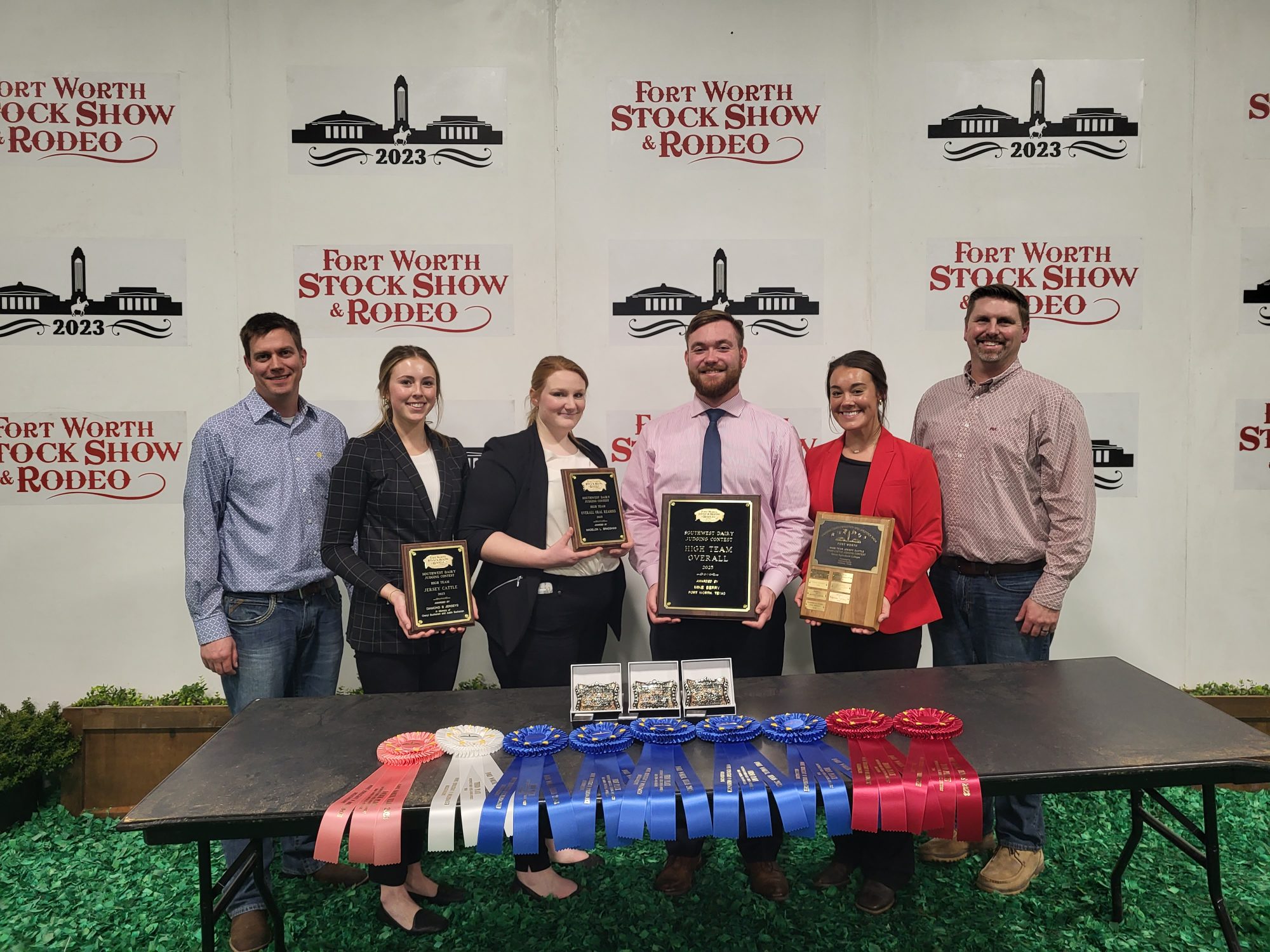
Coach Brian Kelly (far right) with his University of Wisconsin–Madison squad after taking High Team Overall at the Southwest Dairy Judging Contest, Fort Worth Stock Show & Rodeo, 2023. Kelly — a former Holstein classifier now with Zoetis — is exactly the kind of hiring manager who scans a résumé for judging: “That’s the line I always look at.”
The reason it works is structural, not sentimental. Judging forces a set of skills most career-prep programs never touch head-on — and it forces them young, under pressure, with something on the line.
What a Set of Oral Reasons Actually Teaches You
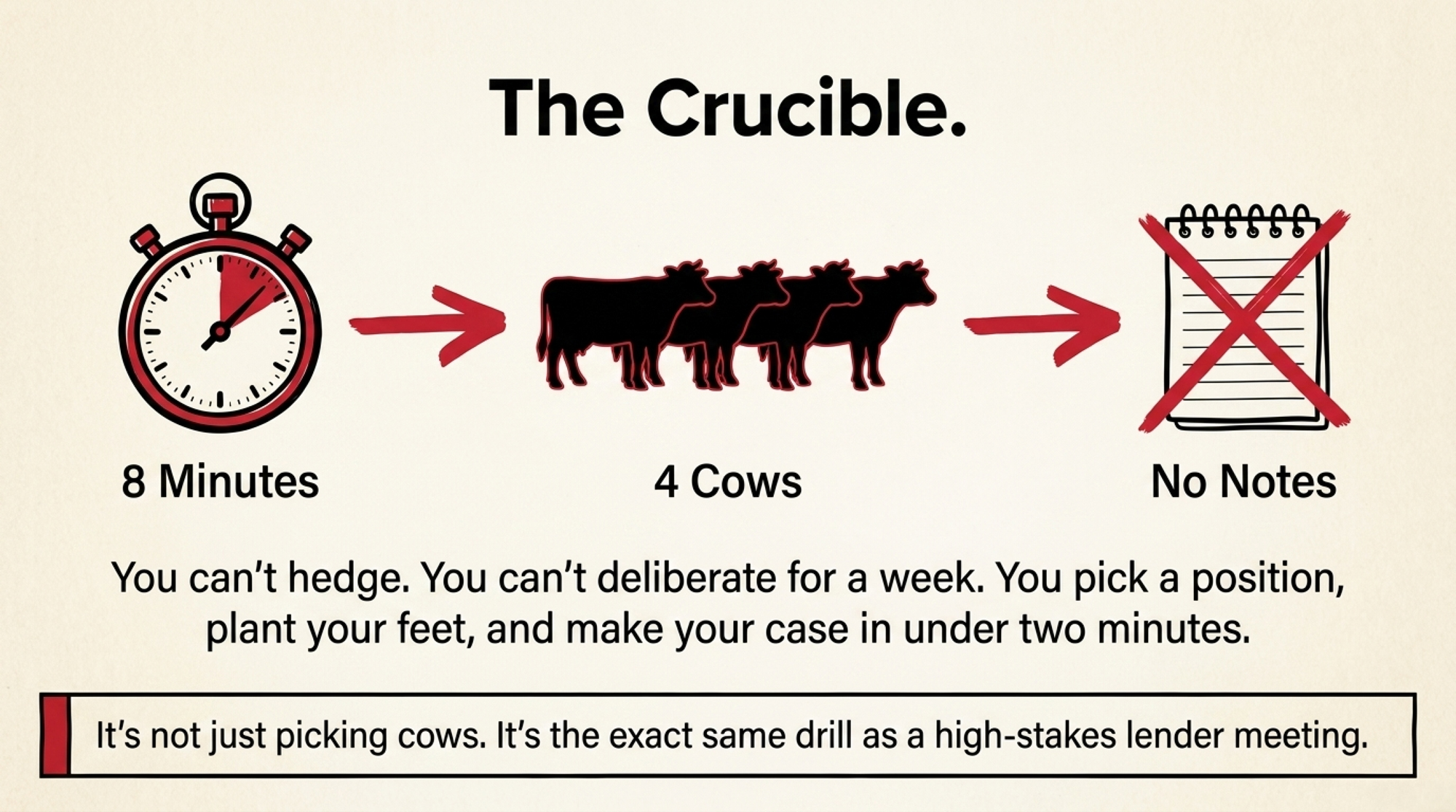
Here’s the mechanic that makes it work — and if you want the full technical version, The Bullvine has already mapped the systematic “assess, prioritize, decide, and explain” process elite judges run every time. The short version: you walk into the class. You get eight to ten minutes — a hard clock — to evaluate four animals you’ve never seen, rank them best to worst against a specific, learnable set of criteria, and get ready to defend that ranking to an official who will push on every claim you make. No notes when you deliver. No hedging. You pick a position, plant your feet, and make your case in under two minutes.
Kelly puts the value of that exercise bluntly. “Reasons are such a powerful impact, and one of the biggest life lessons you’ll get from dairy judging,” he says. “You’re always going to have to tell someone why you’re doing something, or defend your thought process throughout life.”
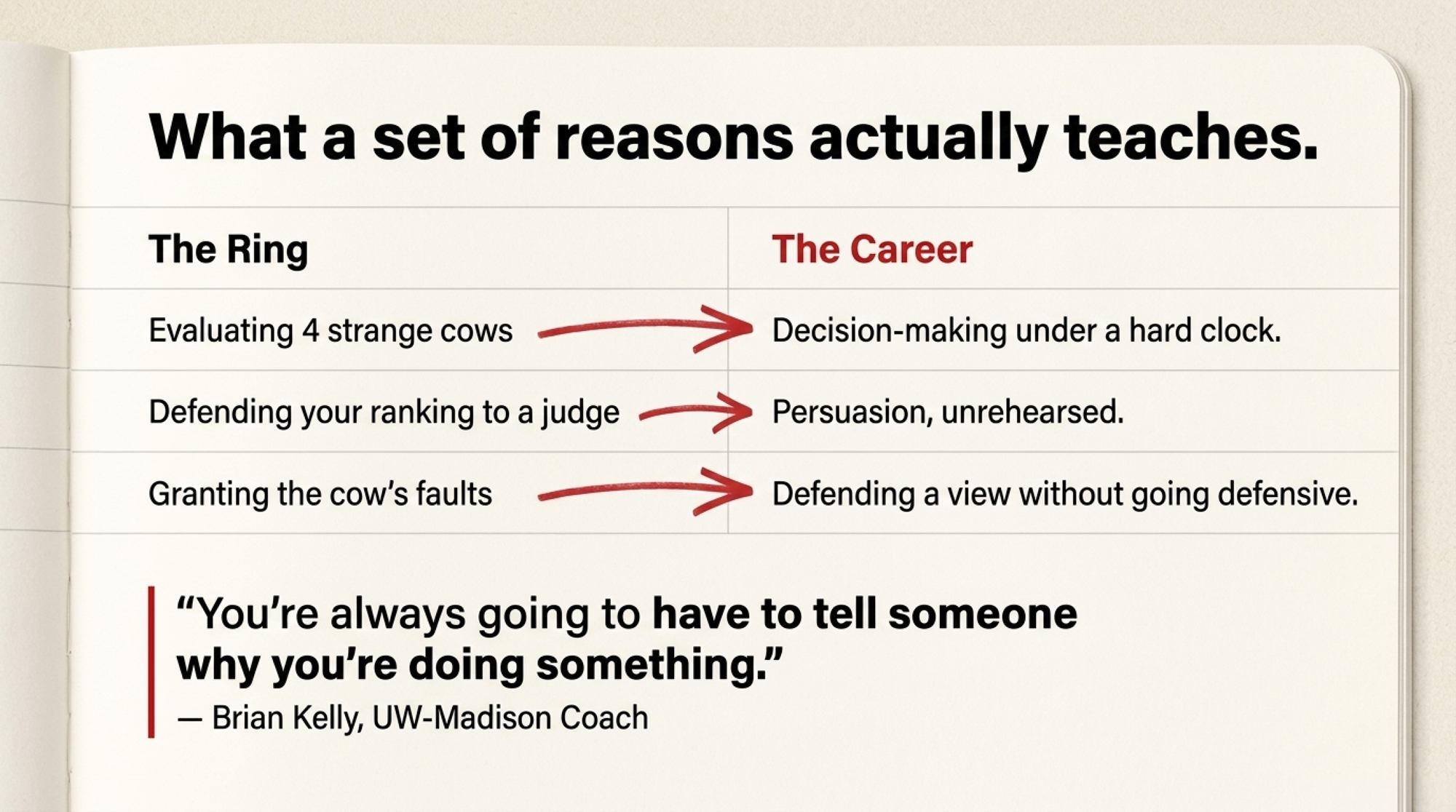
Watch what the drill actually builds:
Decision-making under a hard clock. You don’t get a week to deliberate. You gather what you can see, form a view, commit, and move. Bonnie Ayars, who’s held a staff appointment at Ohio State for 20 years, likes to point out just how little time the ring gives you. “You only get 12 to 15 minutes to make a choice on four cows,” she says — then, half-joking, compares it to picking a spouse. The point stands: it’s a system that teaches you to explain and justify a decision in a very limited timeframe.
“You only get 12 to 15 minutes to make a choice on four cows.” — Bonnie Ayars, The Ohio State University
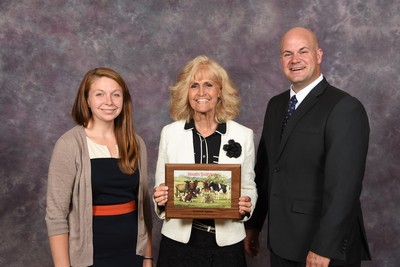
Bonnie Ayars, center, received the American Dairy Science Association’s Hoard’s Dairyman Youth Development Award in 2015, recognizing more than 40 years spent pulling kids into the dairy industry — the exact work this article is about. Hoard’s Dairyman’s Amanda Smith and Corey Geiger made the presentation. (Photo: Journal of Dairy Science)
Persuasion, unrehearsed. You’re not reading a script. You’re building a case live, in a room where the listener has the authority to disagree and the knowledge to smell a bluff. That’s a job interview. That’s a sales call. That’s every high-stakes conversation that actually moves a career. “You have to be able to communicate,” Ayars says. “And if you don’t think you need communication, don’t become a parent — because eventually they become teenagers.”
Using discomfort instead of freezing under it. The unofficial reasons score — the one no ribbon reflects — is the moment you stand in front of someone who knows more than you do, say your piece, and hold your ground when they push. For most young people, it’s genuinely terrifying. Ayars has watched it turn kids around one set at a time, describing students who arrived convinced they couldn’t give reasons at all, went to the contest, delivered several sets, and came back changed by having done the thing they feared. Her measure of success isn’t the placing — the goal, as she frames it, is blue-ribbon kids more than blue ribbons.
Defending a position without going defensive. There’s a precise line in oral reasons between confident and combative — and learning to walk it is the whole game.
A good set of reasons grants the opponent’s real strengths honestly, then explains why the placing still holds. The grant earns trust. The pivot wins the argument. Now run that exact structure through a hard performance review, a lender meeting, or a disagreement with a herdsman who doesn’t want to hear it. Same move.
It’s the same discipline the best show judges preach: say what you see, keep it positive, three reasons not ten.
A 1997 Journal of Dairy Science paper said it flat out: dairy judging teaches critical life skills that carry across industries. Nearly three decades on, that hasn’t aged out — and the more recent research on youth livestock programs backs it, tracing durable leadership and communication gains straight to the structured stress of competition. It’s also why oral reasons carry roughly half the score in a modern contest — the industry figured out long ago that the talking isthe skill.
Ask the People Who Lived It
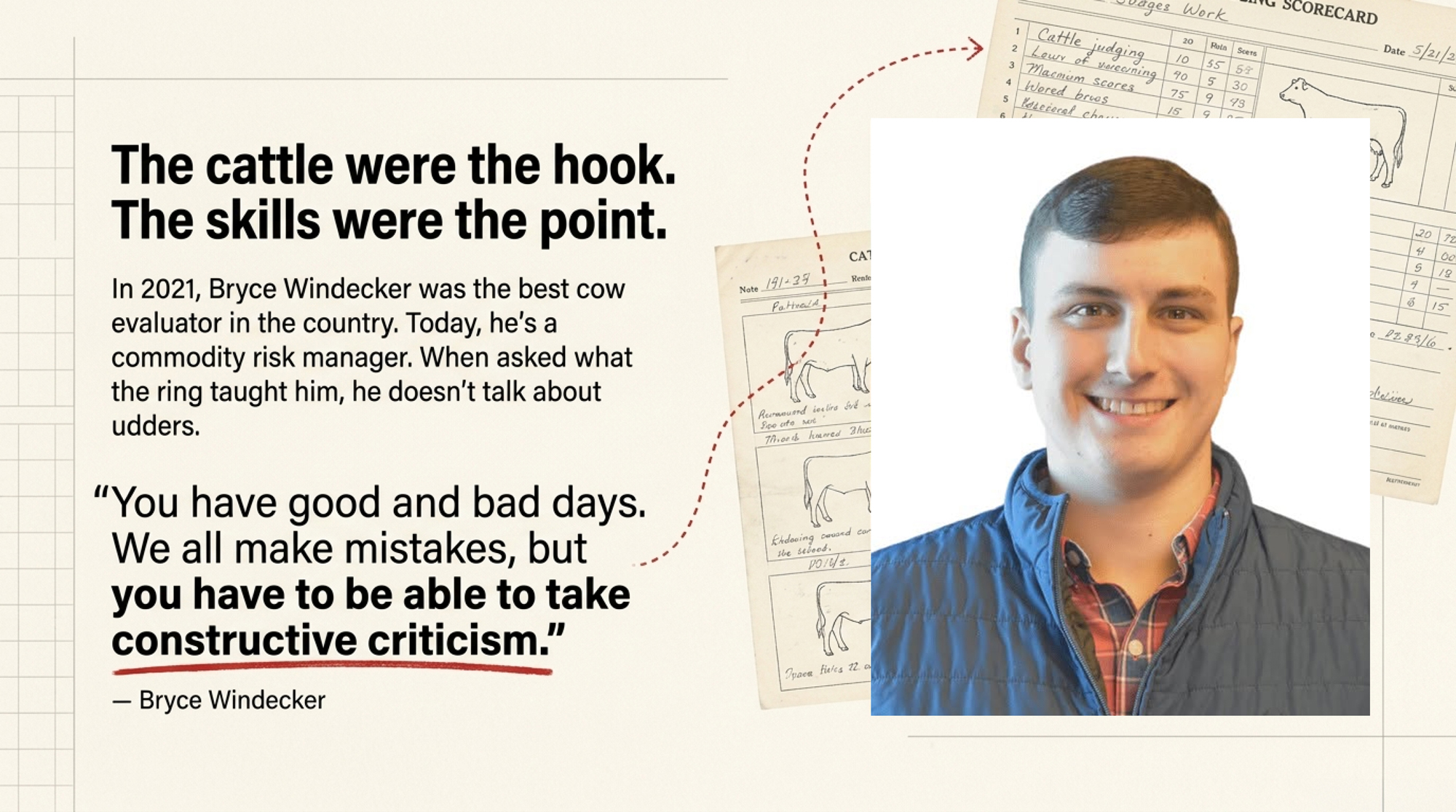
Bryce Windecker was named high individual at the 2021 National Intercollegiate Dairy Cattle Judging Contest — the best cow evaluator in the country that year. Ask him what it prepared him for, and he doesn’t talk about cattle. He talks about the bad days.
“You have good and bad days, and you have to take the bad days and learn from them. We all make mistakes, but you have to be able to take constructive criticism.” — Bryce Windecker, 2021 national high individual, now at ever.ag
He now works at ever.ag, a commodity brokerage and risk-management firm — a job that has nothing to do with picking the sharper udder and everything to do with the skills the ring drilled into him. “Talking and interacting with people, working with others, being a part of a team, having a boss or coach, working toward a common goal and getting a job done,” he told Progressive Dairy. “These skills are all developed in dairy judging.”
That’s the whole argument in one alum. The cattle were the hook. The transferable skills were the point.
The Team Dimension Nobody Fully Accounts For
Judging gets talked about as an individual skill. That misses half the value.
At the college level, teams run three to four deep and scores combine. Which means the result rides on everyone, not just the star. Somebody carries a rough day so the rest can score. Somebody watches a teammate post a personal best on the same class where they placed second — and celebrates it anyway.
“When we think about where we’re at right now, we’re in that team environment throughout the dairy industry — a lot of organizations are pushing that team environment,” Kelly says. “When you think about a judging team, there are relationships within that team. Combine that, and it’s just such a nice life lesson.” That dynamic — individual performance measured inside a shared result, week after week — is rare in structured training. Every dairy runs on it. So does every sire company, every co-op board, every management team. The judging contest is just the controlled environment where a kid rehearses it before the stakes get real.
The Networking Effect Is Bigger Than It Looks
For Madison Dyment, the ring wasn’t mainly about placings. It was about people.
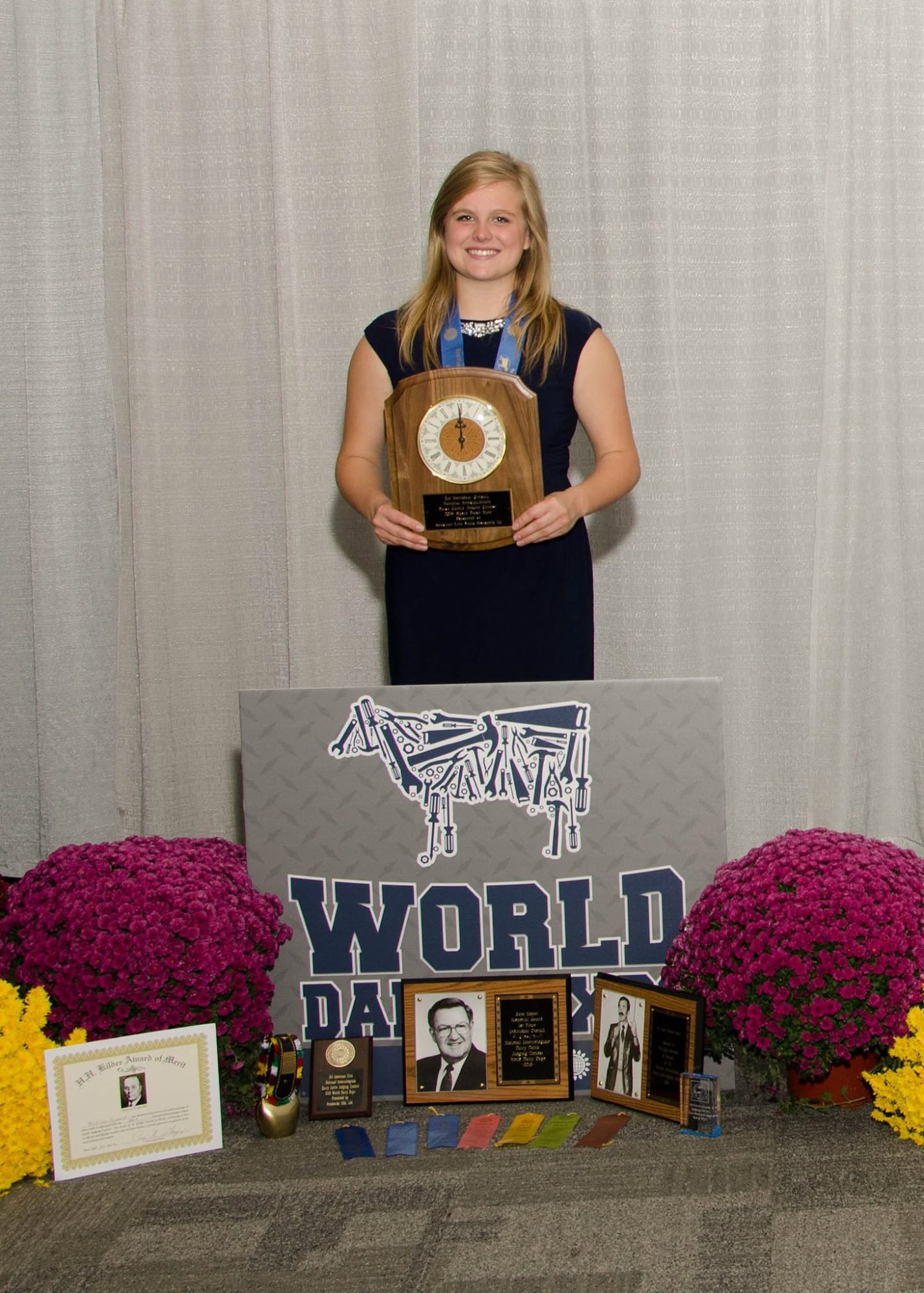
Madison Dyment competed for the University of Kentucky — a judging win there put her on Bonnie Ayars’ radar and set up the mentorship that led to grad school and, today, a professorship at New Mexico State. The ring built the network.
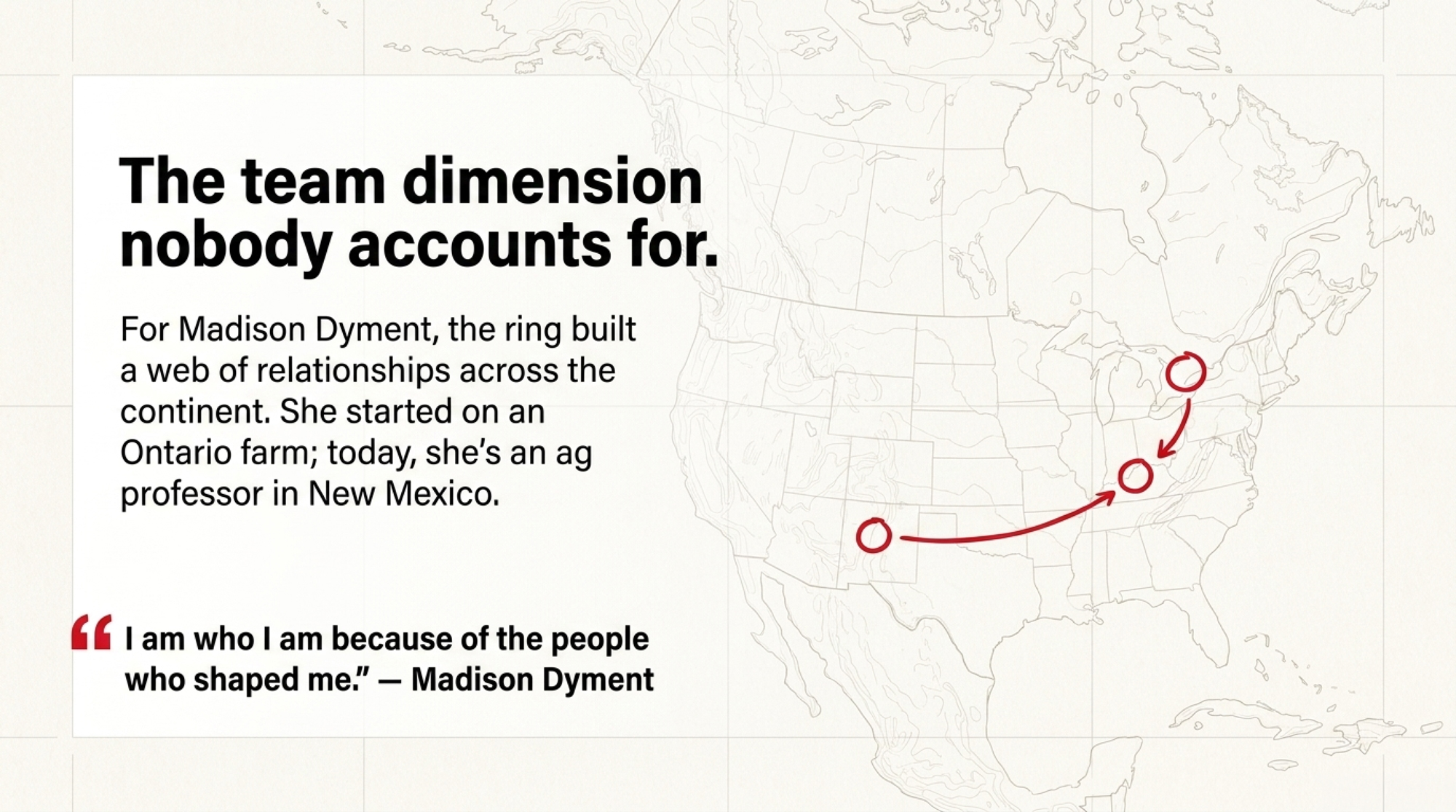
Dyment grew up in Burgessville, Ontario — “you can throw a stone in either direction and you’re probably going to hit a dairy farm” — competed for the University of Kentucky, and is now an assistant professor of agricultural communications at New Mexico State University. Her whole career traces back to a network the contests built. “One of the greatest things that I gained was access and networking with a lot of different people from all over the place,” she says. “You’re meeting kids from Illinois, from Ohio, from Wisconsin, California — for someone from Ontario, that was mind-blowing. These were people I wasn’t going to run across in my day-to-day life.” (Read more: From Calf to Classroom: Madison Dyment’s Journey to Impact Agricultural Communications in Canada)
That web of relationships is the part alums rank highest, and it compounds. “I can chalk up so many different opportunities to Bonnie alone — keeping me plugged in, mentioning me, encouraging me to go after things,” Dyment says of Ayars, who sought her out after she won at Kentucky and steered her toward grad school at Ohio State. “Ultimately, whenever I look at whatever success I’ve had, I am who I am because of the people who shaped me.”
Kelly draws the same line from the other side of the desk — as the guy doing the hiring. “I’ve hired some of them, I’ve managed some of them, I’ve worked with some of them,” he says of his former judging-team students. “When I’m looking at resumes, dairy judging is something I always look at, because I think they’re going to have those skill sets.” His advice to young people is disarmingly simple: ask questions. “If you can find someone that’s been successful and you want to follow that path, don’t be afraid to go up to them and start asking questions. You might develop a lifelong friendship.”
Ayars frames the payoff in language every operator should recognize.
“It’s not just like going to the bank and making a deposit. Dairy judging is an investment. It permeates every step of your life.” — Bonnie Ayars
The return horizon on that investment runs 10 to 30 years — compounding through every negotiation, every hard conversation, every hire a judging alum handles better than they otherwise would have.
The Barn Math on Not Building This
Now flip it. What does it cost the industry to not build this pipeline? That number isn’t theoretical.
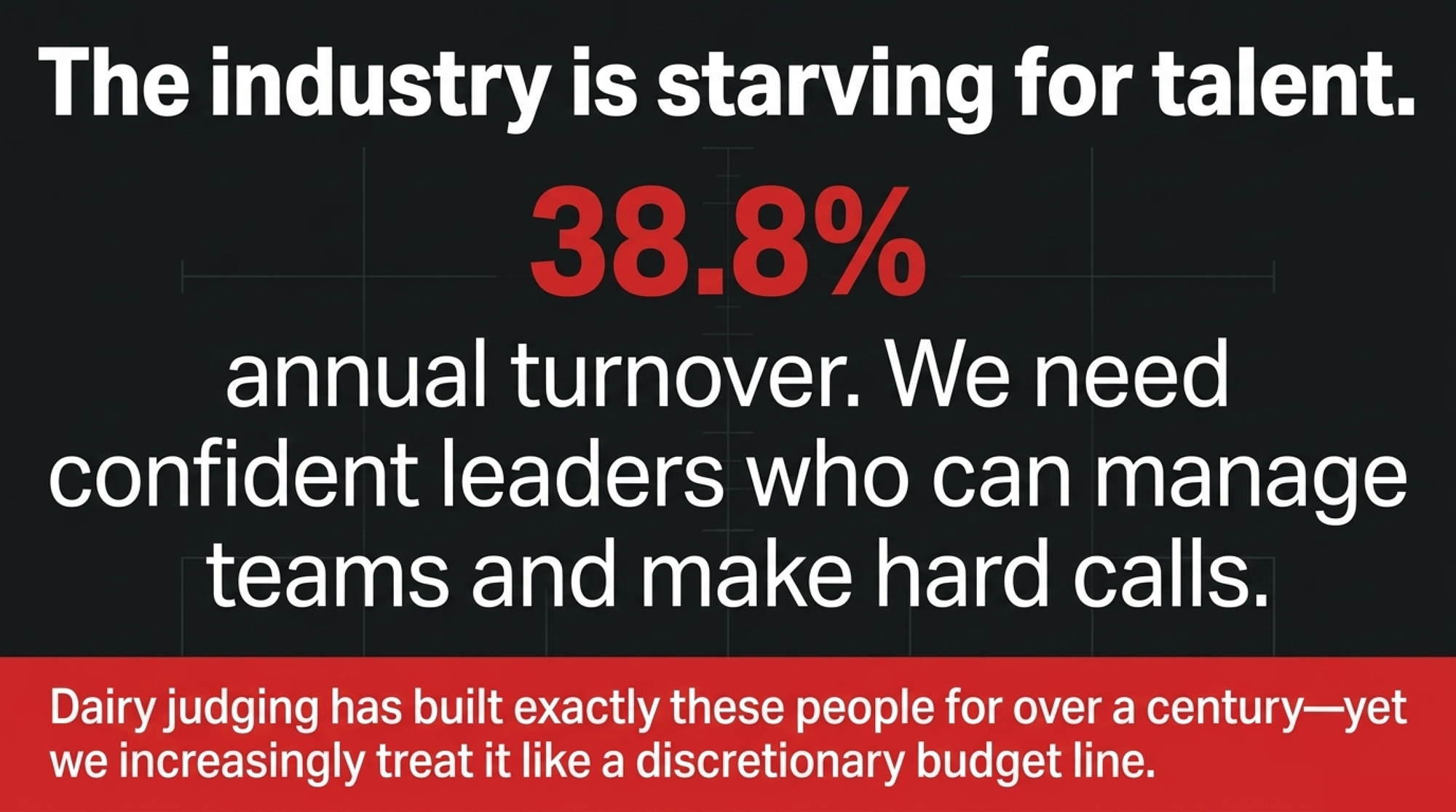
The average U.S. dairy runs turnover of 38.8% a year, according to the FARM Program’s Nationwide Dairy Labor Survey on Workforce Development — nearly four of every ten positions refilled annually. Cornell Extension’s cost framework puts each departed worker at $15,000 to $25,000 once you count recruiting, training, lost productivity, equipment damage, and quality slips. On a farm with 10 employees, that’s about four departures a year — $60,000 to $100,000 walking down the driveway, annually, a lot of it because people were hired without the communication skills, decision habits, and team instincts the job actually demands.
This is a leaking bucket. You can pour wages, benefits, and signing perks in the top, but if four of every ten hires walk out the bottom every year, you’re not staffing a dairy — you’re refilling a hole. And you plug that hole from the intake side: hiring and building people who can communicate, decide, and stick.
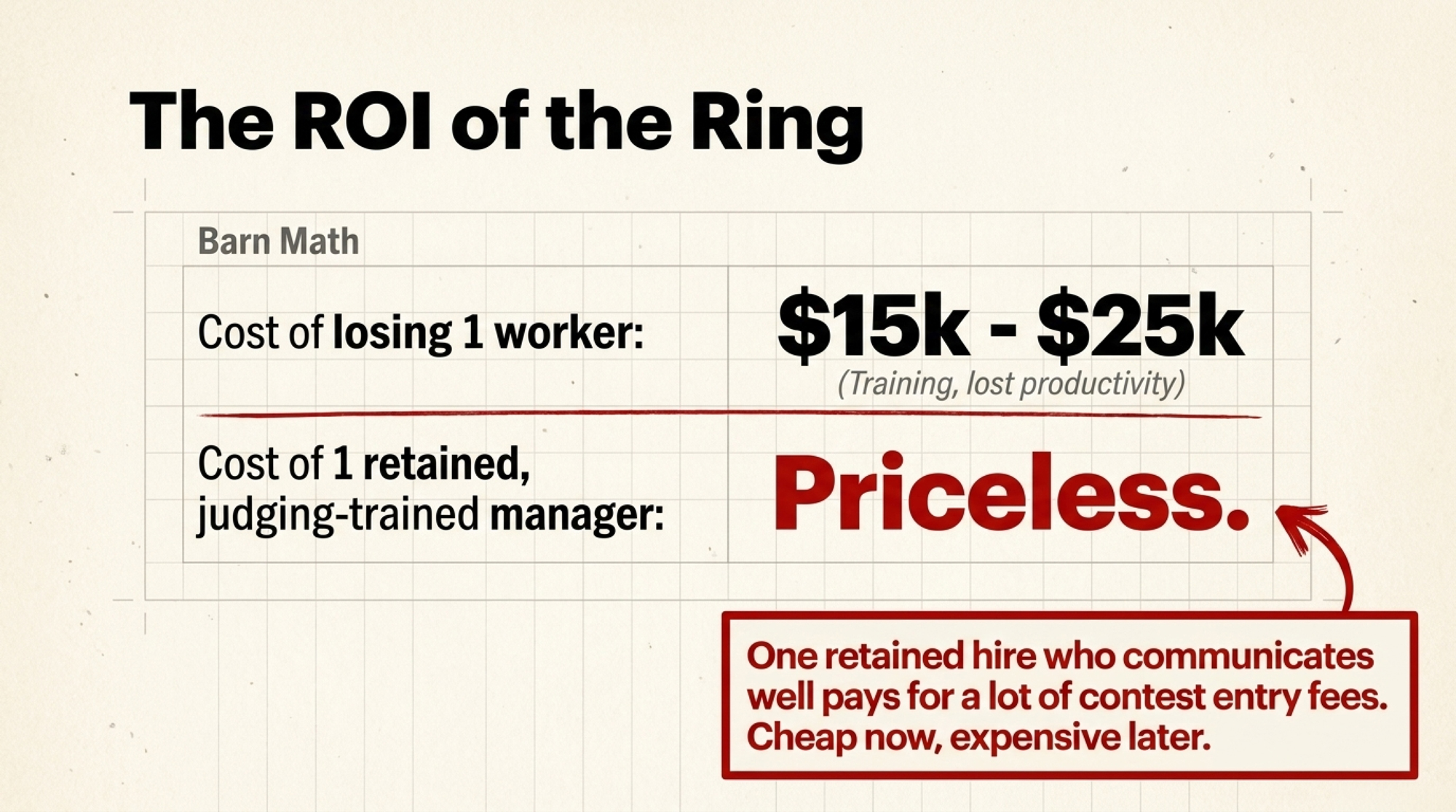
Here’s the ROI in one line: on that same farm, developing or hiring one judging-trained employee who sticks and leads well can offset an entire $15,000–$25,000 turnover event by itself. One retained hire pays for a lot of contest entry fees.
| The cost of the gap | Figure | Source |
| Average annual dairy worker turnover | 38.8% | FARM Workforce Development survey |
| Cost per departed worker | $15,000–$25,000 | Cornell Extension framework |
| Annual turnover cost, 10-employee farm | $60,000–$100,000 | Turnover rate × cost per worker |
| U.S. licensed herds, 2004 → 2024 | 66,825 → 24,811 (−63%) | USDA ERS |
Meanwhile the structural squeeze keeps tightening. U.S. licensed dairy herds fell 63% between 2004 and 2024 — from 66,825 to 24,811 — even as milk output climbed, according to the USDA Economic Research Service. Fewer, bigger operations mean each one runs more like a mid-size business and less like a family chore chart. Those businesses need managers who can lead people, defend a decision to a lender, and communicate under pressure.
That’s the exact skill set a judging kid spends years drilling. The industry is paying, right now, in six-figure turnover bills and thin management benches, for a talent shortage it has a proven, century-old answer to — and it’s under-investing in that answer anyway. Cheap now, expensive later. The bill shows up on a different line than you’d expect.
The Honest Catch
Here’s the part the cheerleaders skip: the pipeline is under strain at exactly the moment dairy needs it most. As ag colleges consolidate departments and squeeze budgets, funding a judging team — coaching stipends, travel, cattle access, entry fees — is increasingly treated as a discretionary line rather than a core one, and some smaller programs have quietly scaled back or dropped teams entirely. That’s the argument, not against it. If the machine that reliably produces communicators and decision-makers is being defunded while the workforce gap widens, the case for operators, breed associations, and alums to step in with sponsorship and access isn’t sentimental. It’s self-interested.
Seeing the Whole Industry Before Your Career Starts
Here’s something rarely said about judging contests: for a lot of participants, the first plane they ever board is for a judging trip.
Teams compete coast to coast — the All American in Harrisburg, Expo in Madison, Louisville, Fort Worth. The geographic reach isn’t incidental. It’s formative. A student who’s only ever seen big freestall Holsteins walks into a New England tiestall barn and starts to grasp that the industry is a spectrum, not a type. Dyment lived exactly that arc — Ontario, then Kentucky, now New Mexico, a state she was surprised to learn is one of the national leaders in cheese production. “People who are invested and passionate about dairy are everywhere,” she says, “even in the most unexpected places.”
She’s found a specific kind of talent in the places without award-winning herds down the road. “These folks have so much grit — a raw passion and determination, and they want to prove themselves,” she says of New Mexico’s dairy youth. “When I’m looking at kids I want to work with, I want the ones who are in it for the love of the game, not just because it was a family legacy expected of them.” Multiple farms, multiple breeds, multiple regions seen young — that compresses years of field exposure into a few contest seasons, and the graduate starts their career already fluent in an industry most people take a decade to see fully.
What the Canadian Model Gets Right
Ontario and Quebec youth programs are unusually strong feeders into elite judging and industry careers, and Dyment is a walking case study for why.
“I am so incredibly blessed to have been a byproduct of all of that youth programming,” she says. “You don’t really realize it until you’re gone from it, because it was just normal — it was what I did as a kid growing up. Once I was removed from it, you really come to appreciate how much investment is put in our dairy youth.” The Canadian model does two things better than most: it starts early, and it builds continuity across age cohorts instead of treating each year’s team as a blank slate. Holstein Canada’s Young Leaders program alone runs roughly 100 youth aged 12 to 21 through competitive judging, showmanship, and clipping every year, on top of 4-H programming that begins in childhood.
By the time a Canadian kid reaches the intercollegiate level, the reps are already banked — thousands of cows seen, hundreds of reasons given, contests lost and won and coached back from both times. That depth is why Canadian competitors routinely show up at U.S. contests and perform outside their home context. It isn’t talent alone. It’s a system that never lets a promising kid coast — the same 4-H leadership crucible The Bullvine has documented at events like the TD Canadian 4-H Dairy Classic, where the real lesson was never about the cattle.
The Coaching That Happens After the Contest
Experienced coaches will tell you, nearly to a person, that what happens after the contest matters more than the prep before it. The academic work agrees: youth livestock programs deliver their most durable benefits from the structured reflection and accountability that follow the competition, not from the competition itself.
A kid who won needs a different conversation than a kid who bombed. Both need a coach playing the long game — and both need someone willing to talk them out of their own fear first. “Most courage develops in fear,” Ayars says. “Nobody’s just courageous on their own.” She frames coaching as providing enough comfort for a scared kid to step out of a comfort zone — and describes education itself as a productive struggle, arguing that shielding students from that struggle robs them of its rewards.
Holding a group together through uneven outcomes, then pushing the scared kid out of the comfort zone anyway — that’s a leadership skill with a name in management research. In judging, it happens organically, repeatedly, under stakes that feel real to the kids living them, which is exactly why it sticks. A coach who does that well isn’t just producing judges. They’re producing managers, and the industry gets both.
The Ring That Builds Careers Is Still Open
There’s a skill gap in dairy that quietly worries serious people — not a gap in genomics knowledge or milking technology, but in the human pipeline. Fewer, larger operations need more managers who can communicate, decide under pressure, and lead a team, and the supply isn’t keeping pace.
Dairy cattle judging has been solving part of that problem for more than a hundred years. It’s proven. It’s everywhere. And measured against what it produces, it’s badly under-invested in by an industry that should know the difference between a deposit and a compounding return better than anyone.
The ring is open every fall. The only question is whether we fill it.
Your Next Move
- If you own or manage an operation: weigh dairy judging on the résumés that cross your desk — it’s the line coaches like Kelly scan for, and it predicts communication, decision-making, and the steadiness of someone who’s been wrong in public and recovered. Then go further: call the nearest university or 4-H program and offer what they’re short on — cattle access, a practice venue, travel sponsorship, or a paid summer role for a team member. Strong communication is one of the cheapest retention upgrades a dairy can make; hiring someone who already has it is cheaper still.
- If you have kids — or know one — curious about dairy: get them to the ring. FFA runs dairy judging in all 50 states, and the 2026 FFA Dairy Cattle Judging Contest at World Dairy Expo is set for Tuesday, September 29, with team registration open through September 11. The 4-H national contest runs the same week. It doesn’t matter whether they grew up on a farm — the non-farm kids with something to prove often go the furthest.
- If you coach or teach: keep hunting for the kid who won’t self-select in. As Kelly’s own roster proves, the payoff shows up in unlikely places — he once coached a business major who’d barely judged since her 4-H days into an All-American finish; she now works finance in downtown Chicago. Both the farm-raised and the newcomers have something to prove. That mix is why the programs work — Ayars, by her own account, recruits promising judges “from under a rock.”
The 2026 National 4-H and Intercollegiate Dairy Cattle Judging Contests run during World Dairy Expo in Madison, Wisconsin, September 26–29, 2026.
Key Takeaways
- Judging isn’t about ribbons — it builds the communication, fast decision-making, and defend-your-position skills that later show up in every lender meeting, sales call, and hard barn-aisle conversation.
- With turnover averaging 38.8% at $15,000–$25,000 a head, one judging-trained hire who sticks and leads can pay back a full turnover event by itself. Weight it on resumes.
- The pipeline that produces those people is getting defunded as colleges cut teams. If you run cattle, offer a program what it’s short on — access, a practice venue, or travel money.
- Get a kid to the ring this fall, farm-raised or not. FFA runs judging in all 50 states, and the non-farm kids with something to prove often go the furthest.
Related reading on The Bullvine: The Judge’s Eye: Mastering the Art & Science of Dairy Cattle Evaluation · Judge With Confidence: The Ultimate Playbook for Dairy Cattle Judging · Words That Win: How Elite Dairy Judges Master Oral Reasons
 The Sunday Read Dairy Professionals Don’t Skip.
 The Sunday Read Dairy Professionals Don’t Skip.
Every week, thousands of producers, breeders, and industry insiders open Bullvine Weekly for genetics insights, market shifts, and profit strategies they won’t find anywhere else. One email. Five minutes. Smarter decisions all week.
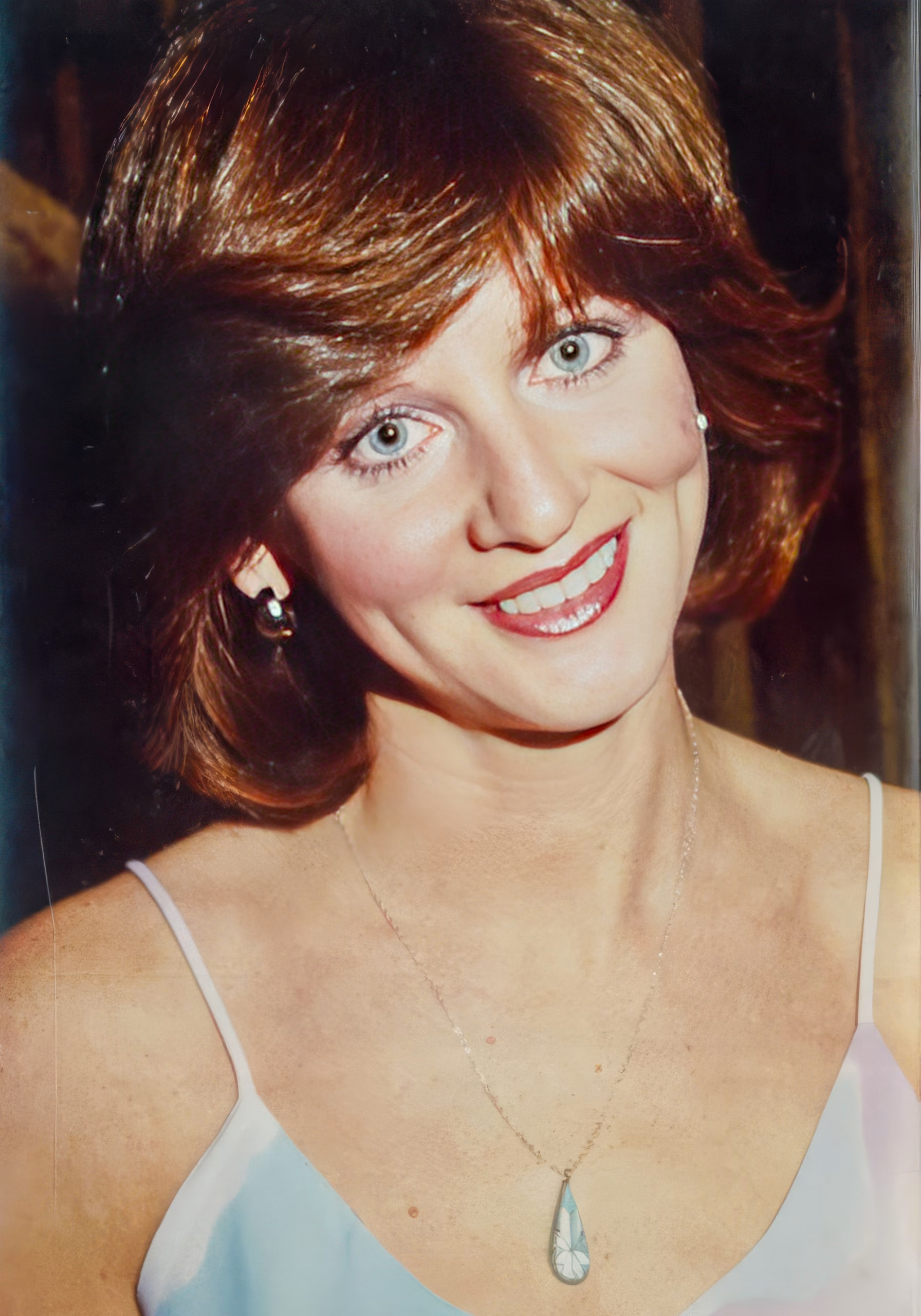 From her modest origins in Plain City, Ohio, Shirley Kaltenbach started a career that would make her a significant player in the artificial insemination business. As she prepares for retirement, her path shows diligence, commitment, and a relentless love of her industry and the people she works with. A lifelong learner, she has navigated several responsibilities at Select Sires over almost four decades, each adding to her remarkable legacy.