






Processors have tallied more than US$15 billion in new capacity. None of it tells you how many heifers to buy until your buyer puts the extra pounds and the first receiving date in writing.
Even at US$3,000 a head, below what top springers brought at Pipestone in August, a 100-head heifer order ties up US$300,000 in cattle alone. That money goes out before the buyer has said how much extra milk it will take or when the first load ships.
At the Aug. 20 dairy sale in Pipestone, Minnesota, the latest results the market has posted, the top 200 springing heifers sold for US$3,700 to US$4,175 a head. Jerseys and crossbreds at the same sale brought US$2,000 to US$3,000. The sale is a reference point. The budget number is a delivered quote for the cattle the farm actually needs.
The International Dairy Foods Association, the processors’ trade group, tallied more than US$15 billion across more than 85 projects in 23 states in October. The projects are planned or underway through 2030 and include new plants, expansions, added lines and modernization. Milk and cream carry the largest category share at $5.63 billion.
New York tops IDFA’s state list at $2.8 billion. Two of its plants show how far a capacity announcement gets a supplying farm, and where the buyer still owes it an answer.
Rome and Webster Add Up to 17 Million Pounds a Day. Neither Discloses Open Volume
Chobani’s planned Rome plant carries a US$1.2 billion investment and, according to New York’s April 2025 announcement, would process more than 12 million pounds of milk a day at full capacity. The announcement attached no date to reaching that intake.
Fairlife’s US$650 million Webster plant was in its initial production ramp-up in August, with projected intake starting at 5 million pounds a day, according to the state’s update. Fairlife said it was already sourcing milk daily from more than 40 local farms and expected full operations later in 2026. Its update gave no daily poundage and no volume still open to suppliers.
Taken together, the two announcements come to a conservative 17 million pounds a day: 12 million at Chobani’s full capacity and 5 million at the low end of fairlife’s projection. How many of those pounds a given buyer still has to fill is a separate number, and neither announcement gives it.
A farm planning to ship more milk needs three figures from its buyer for that month: the pounds it expects to take, the pounds already lined up, and the pounds it will commit to the farm. The first receiving date belongs in writing before the next group is bred to freshen.
A 1 Million-Pound Plant Can Need 3,125 Cow Equivalents or 12,500
Take a hypothetical plant that still needs 1 million pounds of milk a day, at 80 pounds per total herd cow with dry cows included. That yield is our assumption, not a USDA average. The cow count then turns on one input: the share of that milk that has to come from additional cows rather than redirected milk or higher output per cow.
| Bullvine scenario | Share requiring additional cows | Milk supplied by additional cows | Cow equivalents at 80 lb/day |
| Low additional-cow case | 25% | 250,000 lb/day | 3,125 |
| 50% additional-cow case | 50% | 500,000 lb/day | 6,250 |
| High additional-cow case | 100% | 1,000,000 lb/day | 12,500 |
The formula for a buyer’s supply area is the remaining daily milk requirement × the share supplied by additional cows ÷ the assumed daily yield per total herd cow. The three shares above are illustrative. A single farm’s order starts from the extra pounds its own buyer will take. The Bullvine Pipeline Index Calculator shows how much of that gap a herd’s own replacement pipeline can cover.
The same million pounds produces a fourfold spread between the low and high cases. Yield moves it too: at 70 pounds per total herd cow instead of 80, the high case climbs from 12,500 to about 14,290 cow equivalents. A plan that assumes every pound needs a new cow has picked the high case before any supply work is done.
Even 12,500 cow equivalents aren’t 12,500 heifers to buy. A replacement plan still has to net out cows retained or acquired, herd exits, expected freshenings and the date the milk is due.
July’s USDA Count Works Out to 37 Replacement Heifers per 100 Cows
On July 1, USDA counted 3.6 million heifers of at least 500 pounds for milk cow replacement, up from 3.5 million a year earlier, along with 9.65 million milk cows. Calves under 500 pounds sit in a separate category. That works out to about 37 replacement heifers per 100 milk cows (our math), before any are assigned to expansion.
A plant’s full-capacity figure and a July inventory measure different things. Matching them means lining up the year the milk is received with the animals due to freshen that year, after the replacements the existing herd needs just to hold steady.
CoBank’s June model projects a combined rebound of about 360,000 in dairy replacements entering herds in 2027 and 2028, after a projected combined decline of about 796,000 in 2025 and 2026. The rebound equals about 45% of the decline. CoBank built the projection on sexed dairy semen sales and national assumptions for conception, pregnancy loss, births and completion rates, and those assumptions vary by region.
At 45%, the rebuild is too small to count on cheap replacements and too large to ignore. A five-year expansion plan that holds today’s replacement squeeze constant is testing only one of the two cases.
Five Checks Before a 2027–28 Heifer Order
For a U.S. herd weighing expansion in 2027 or 2028, these checks run against the buyer’s actual terms before capital goes out. A buyer that won’t commit extra pounds or a receiving date ends the list at the first check.
- Before ordering heifers: written confirmation of the accepted volume, the first receiving date and the contracting party.
- Before matching freshenings to a ramp: price the calendar. At the same Aug. 20 Pipestone sale, short-bred heifers 1–3 months along brought US$2,800 a head, about US$900 under the low end of the top 200 springers. The cheaper animal freshens later, so the purchase has to fit the receiving date, not the price. The budget also needs another milk outlet and the cost of carrying animals through a delay. The plant doesn’t absorb that risk unless the contract says it does.
- Before counting on the milk check: proceeds after hauling, marketing deductions, required retains and any volume-related deductions in the actual offer, set against the farm’s extra production, financing and capital costs.
- Before using a replacement forecast: expected freshenings matched to planned exits and the contracted milk requirement, month by month. CoBank expects stronger replacement demand in New York, Texas, Wisconsin, Michigan, Idaho and parts of the I-29 corridor, so the budget runs on delivered quotes for the class of cattle needed, tested against quotes that rise before purchase.
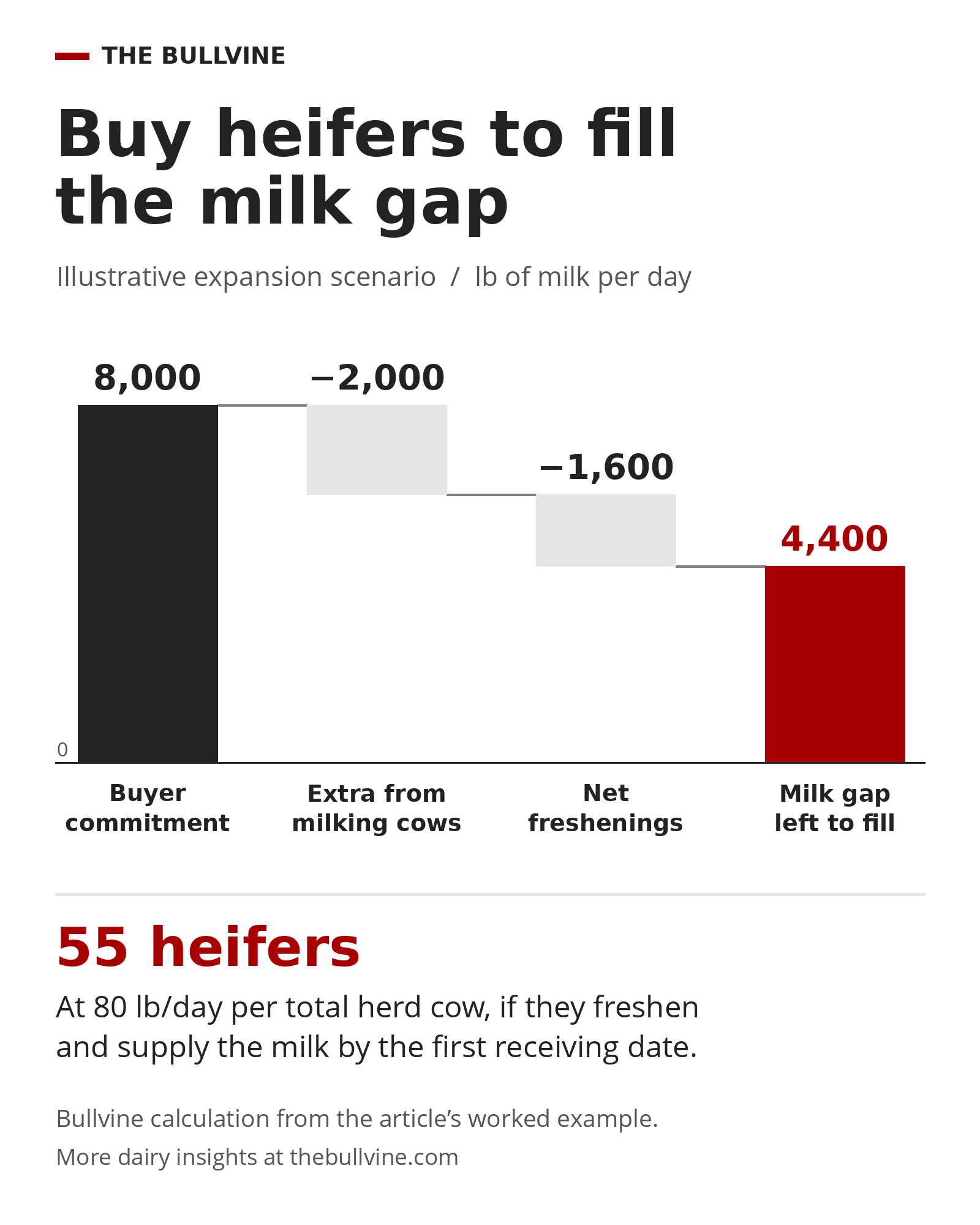
- Before approving expansion: the buyer’s committed extra pounds per day. In this example the buyer commits 8,000 extra pounds a day, and cows already milking supply 2,000 more through higher output. That leaves 6,000 pounds, or 75 cow equivalents at an assumed 80 pounds per total herd cow. Scheduled freshenings that add 20 cows after expected exits, shipping at the same rate by the first receiving date, cut the gap to 55. If 55 purchased heifers can freshen in time, cattle alone cost US$165,000 at US$3,000 a head and US$203,500 at Pipestone’s US$3,700 top-200 floor, a US$38,500 difference. Short-breds at US$2,800 bring the bill to US$154,000, US$49,500 less than the springer floor, but those animals won’t be milking by the same receiving date.
A 55-head order that cash-flows only on the first receiving date is too big for the contract behind it.
What’s this costing your herd?
Enter your plant’s volume requirement to see your cash exposure before signing the contract.
2. Cow Equivalents: Volume Gap ÷ Yield per cow (rounded up)
3. Heifers to Buy: Cow Equivalents − Scheduled net additions
4. Capital Cost: Heifers to Buy × Delivered heifer quote
Bullvine calculations, November 6, 2026: 100 head × US$3,000 (assumed price) = US$300,000; cow-equivalent scenarios (one million pounds a day; 80 and 70 pounds per total herd cow a day; 25%/50%/100% shares, all illustrative); 12M + 5M = 17M lb/day; 3.6M ÷ 9.65M ≈ 37 heifers per 100 cows; 360,000 ÷ 796,000 ≈ 45%; (8,000 − 2,000) ÷ 80 = 75 cow equivalents; 75 − 20 net additions from scheduled freshenings = 55. At US$3,000 per head, 55 head cost US$165,000; at Pipestone’s US$3,700 August top-200 low end, US$203,500 (+US$38,500); US$3,700 − US$2,800 (1–3-month short-breds) = US$900 a head; 55 × US$2,800 = US$154,000; US$203,500 − US$154,000 = US$49,500.
Learn More
- $585 a Straw: What Every Beef Service Really Costs Your Next Heifer — Stop bleeding replacement capital. The barn-level math exposes the hidden $585 net loss attached to every beef service used on eligible milk cows. Limit your beef matings based on pregnancy rates before $3,100 springers crush your cash flow.
- $3,010 Per Heifer. 800,000 Short. Your Beef-on-Dairy Bill Is Due. — Breaks down how the industry’s rush for crossbred premiums created an 800,000-head heifer shortage through 2026. Arms you with four concrete management paths — from strategic culling to processor lock-ins — to survive the long-term replacement squeeze.
- Net Merit Ranks the Females. Your Replacement Target Sets the Sexed-Semen Cutoff — Eliminating the financial drag of unplanned surplus heifers requires better breeding logic. Herd modeling dismantles the standard fixed-percentage sexed semen rule, proving how a target-driven Net Merit strategy saves a 500-cow dairy $5,200 in wasted semen and labor.
The Sunday Read Dairy Professionals Don’t Skip.

Every week, thousands of producers, breeders, and industry insiders open Bullvine Weekly for genetics insights, market shifts, and profit strategies they won’t find anywhere else. One email. Five minutes. Smarter decisions all week.