





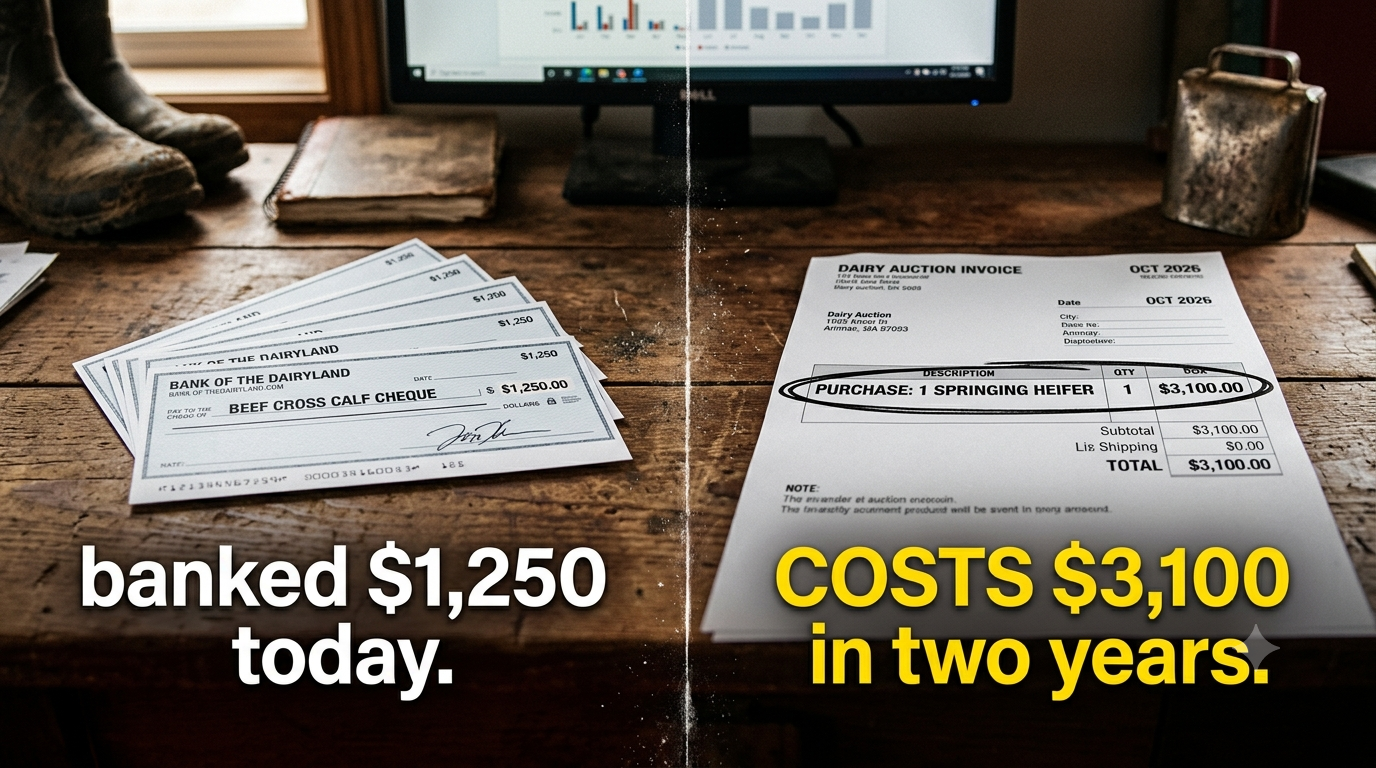
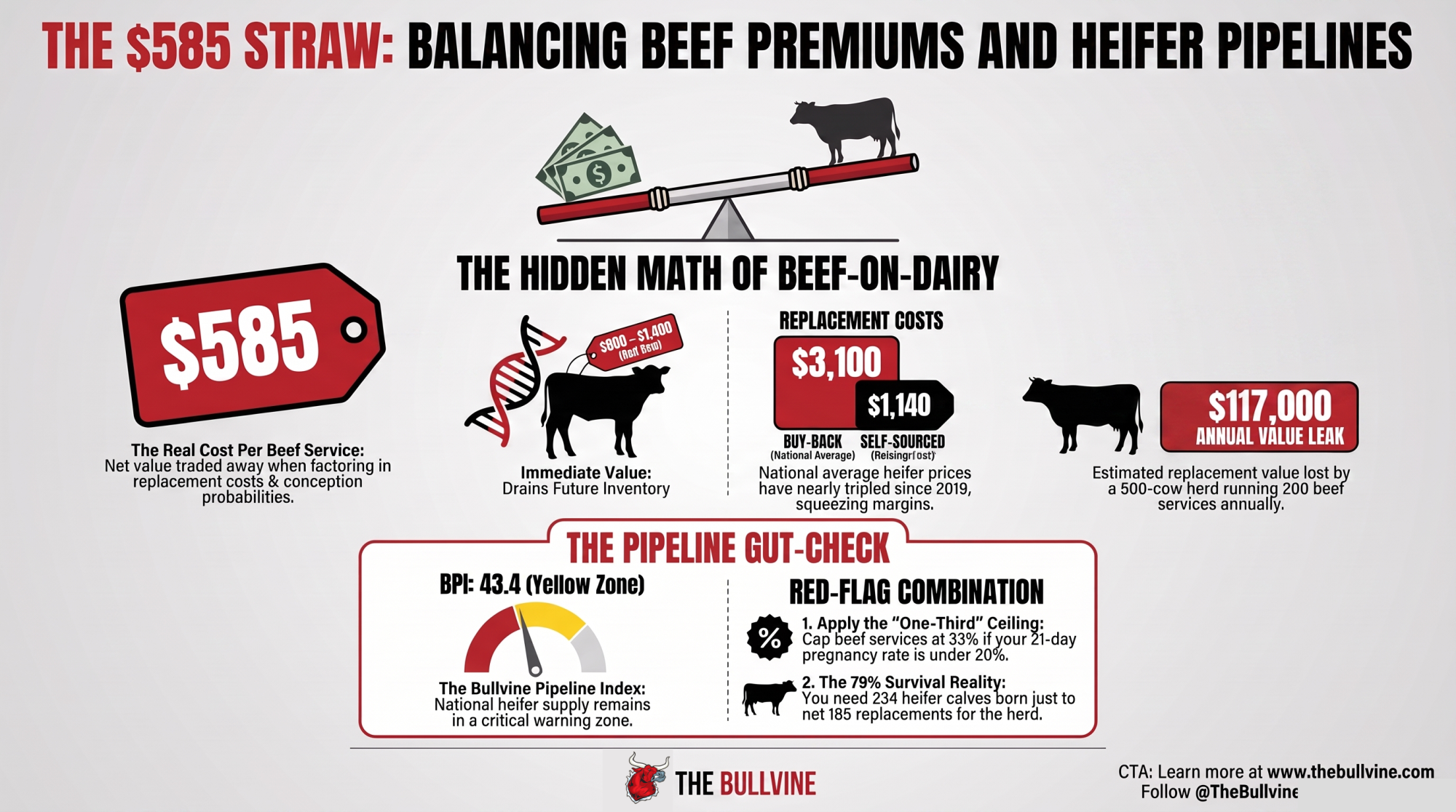
You banked $1,250 on that beef cross. Feels like a win — until you price the heifer you didn’t make. At $3,100 replacements, each beef service quietly costs about $585.
Executive Summary: Every beef straw you shot into a milk cow the last three years was the right call — a $1,250 crossbred calf beats a $150 Holstein bull every day of the week. But price the heifer you didn’t make, and each of those beef services quietly cost you about $585 in net replacement value, because springing heifers now run about $3,100 a head nationally and $3,400–$4,400 at Minnesota and Wisconsin barns this spring (CoBank/USDA; Bullvine market reporting). Run 200 of those services on a 500-cow herd and that’s roughly $117,000 in replacement value given away in a single year. The squeeze lands hardest on 200-to-700-cow operations buying springers back at market instead of raising their own — and The Bullvine’s own Pipeline Index (BPI) sits at 43.4, deep in the Yellow Zone, with CoBank’s projected 2027–28 rebuild lifting it just 5.3 points, never reaching Green. Meanwhile the calf premium that made the math work is wobbling — live cattle hit a record $251/cwt in May 2026, then posted 15 straight lower closes in July, and a premium cut in half erases most of that $585 edge. The gut-check for this week: pull your 21-day pregnancy rate and heifer inventory ratio, and if more than a third of your services are going to beef, the calf market doesn’t get a vote — your heifer pipeline does. Your upside can compress; your replacement bill won’t.
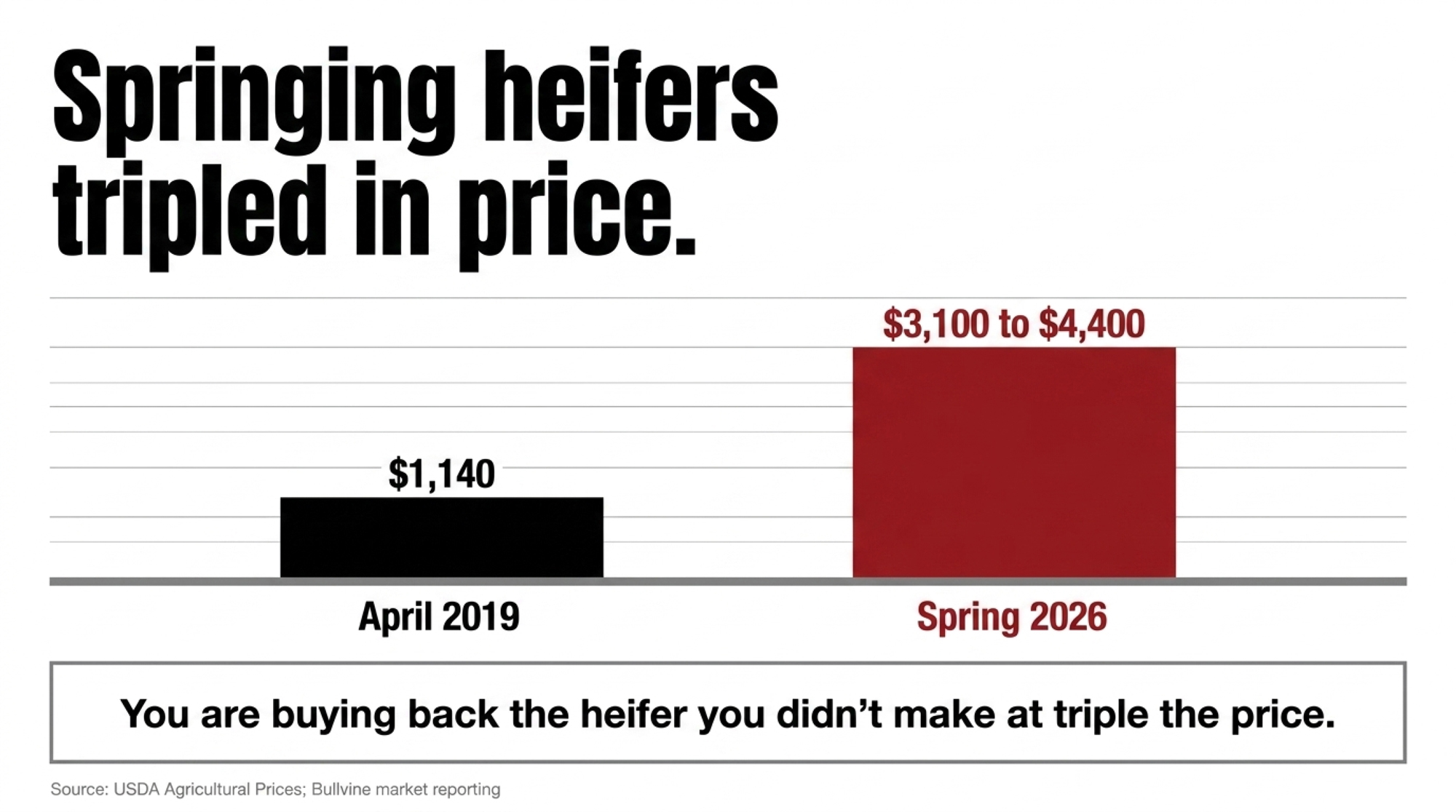
There’s a number CoBank’s lead dairy economist, Corey Geiger, calls an “unforeseen threshold.” Replacement dairy heifers now run about $3,100 a head nationally, and top-quality animals cleared $3,400 to $4,400 in Minnesota and Wisconsin markets this spring — a run that started from just $1,140 in April 2019, when a springing heifer was barely worth more than the beef in her (USDA Agricultural Prices; Bullvine market reporting). And a big piece of why traces straight back to a breeding decision hundreds of thousands of dairy operators made — correctly — over the last three years.
Here’s the setup. A dairy that went heavy on beef semen in 2022 and 2023 did the obvious math. A Holstein bull calf might bring $750 to $1,000 at the barn, while a well-marked beef-on-dairy cross cleared $1,250 — and in strong Wisconsin markets ran as high as $1,750 (Premier Livestock auction data, February 2026). That call was right. But every beef straw used on a cow that could’ve thrown a dairy heifer wasn’t only a calf decision. It was a replacement decision — and that half of the ledger stayed off the page.
“Your upside compresses. Your downside doesn’t.” — the whole beef-on-dairy bind in six words.
What’s Changing and Why
Beef-on-dairy didn’t creep in. It exploded. Beef-on-dairy semen sales grew 62% from 2020 to 2025, while gender-sorted dairy semen climbed 53.6% and conventional dairy semen collapsed 47.4% over the same window (CoBank/NAAB, June 2026). CattleFax pegs beef-on-dairy calf production climbing from about 50,000 head in 2014 to 3.22 million in 2024, with projections reaching 5 to 6 million head by 2026 (CattleFax, via Dairy Herd Management, February 2, 2026).
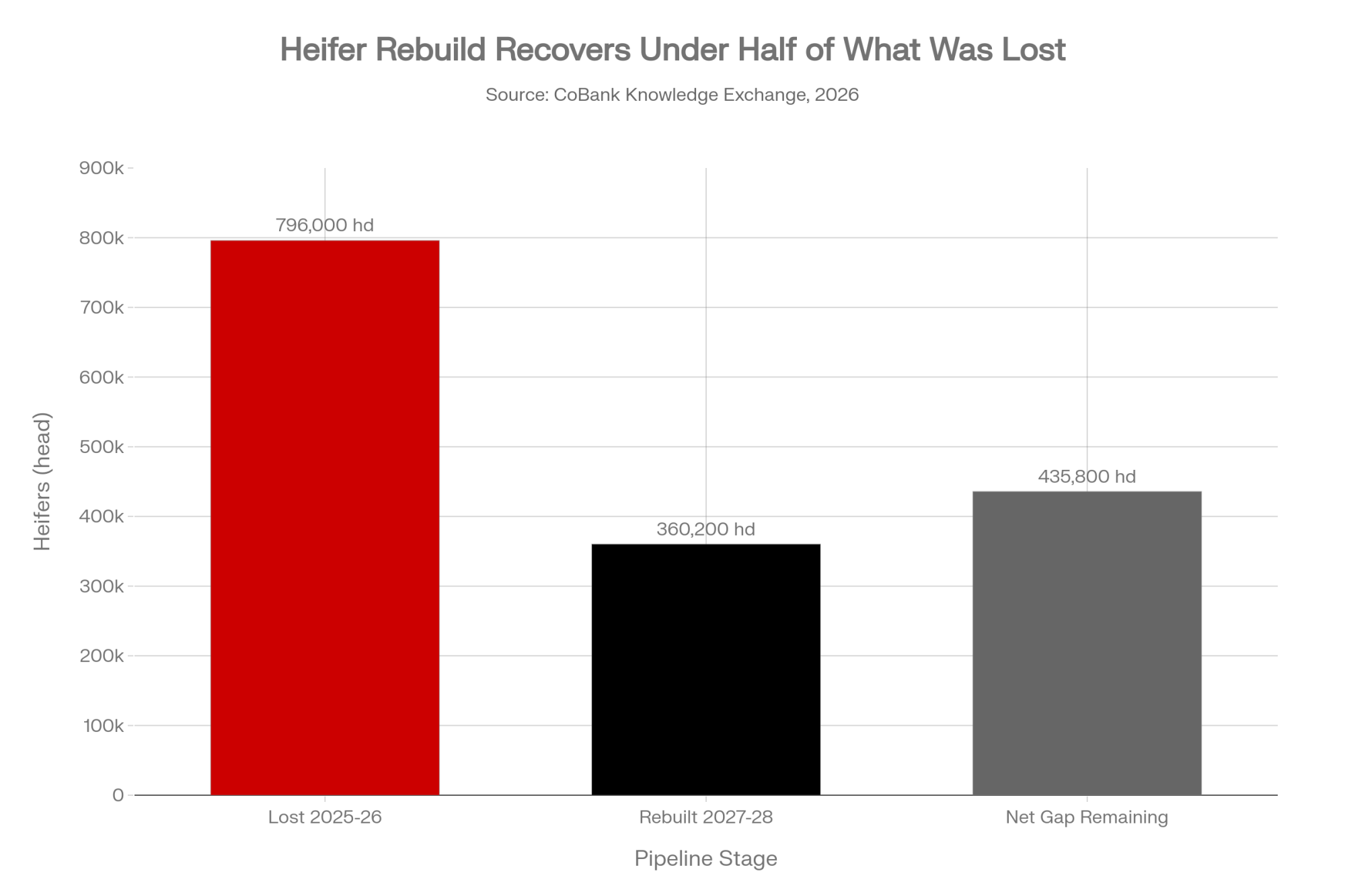
That flood of crossbred calves cut both ways. On the beef side, it helped refill feedlots while the U.S. beef cow herd sat at its lowest since 1961. On the dairy side, it quietly drained the heifer pipeline. Dairy replacements entering the milking herd shrink by a combined 796,000 head across 2025 and 2026 before any rebound starts, and CoBank’s projected rebuild — 360,200 head over 2027 and 2028 — gives back less than half of what got pulled out (CoBank Knowledge Exchange, 2026). You lost ground roughly twice as fast as you’re set to win it back.
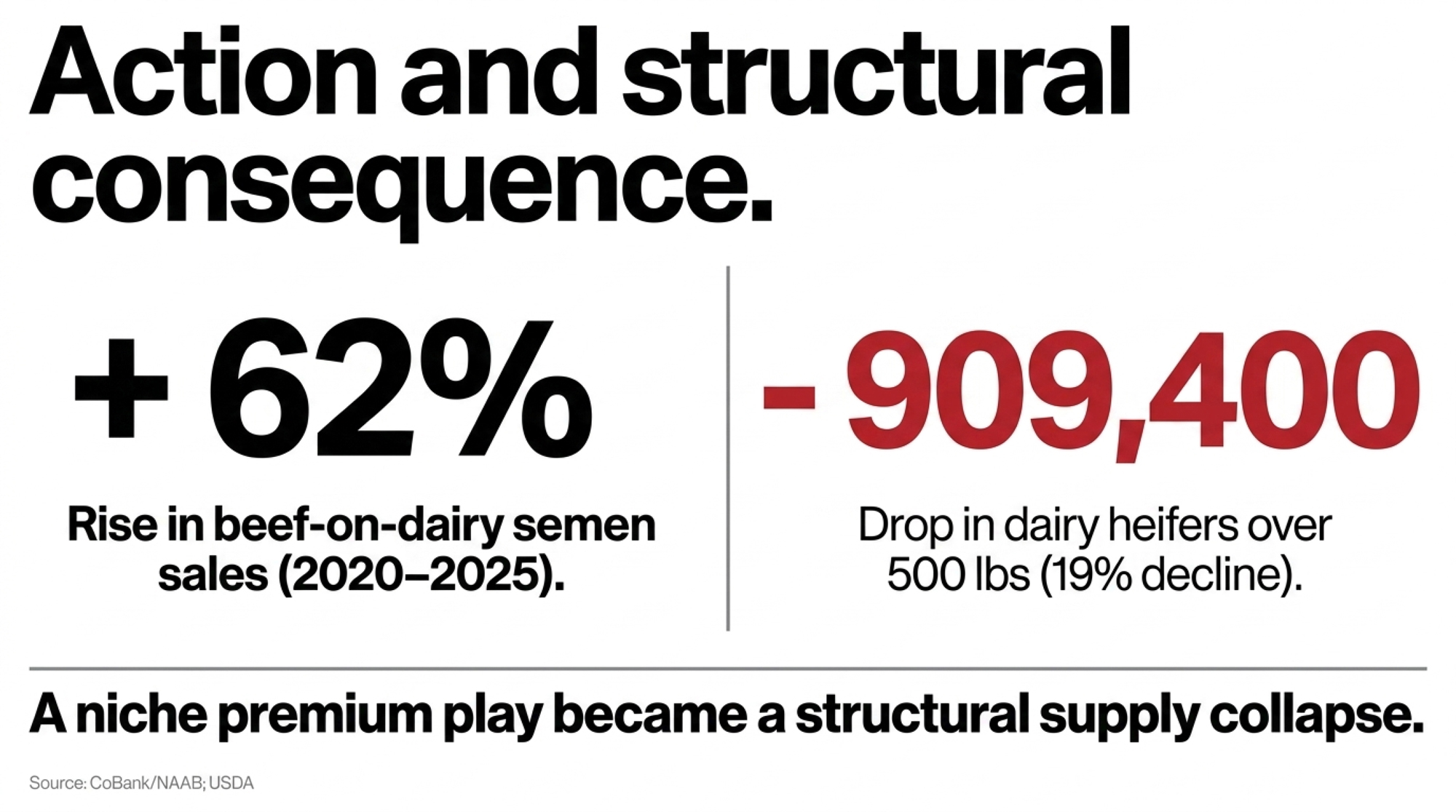
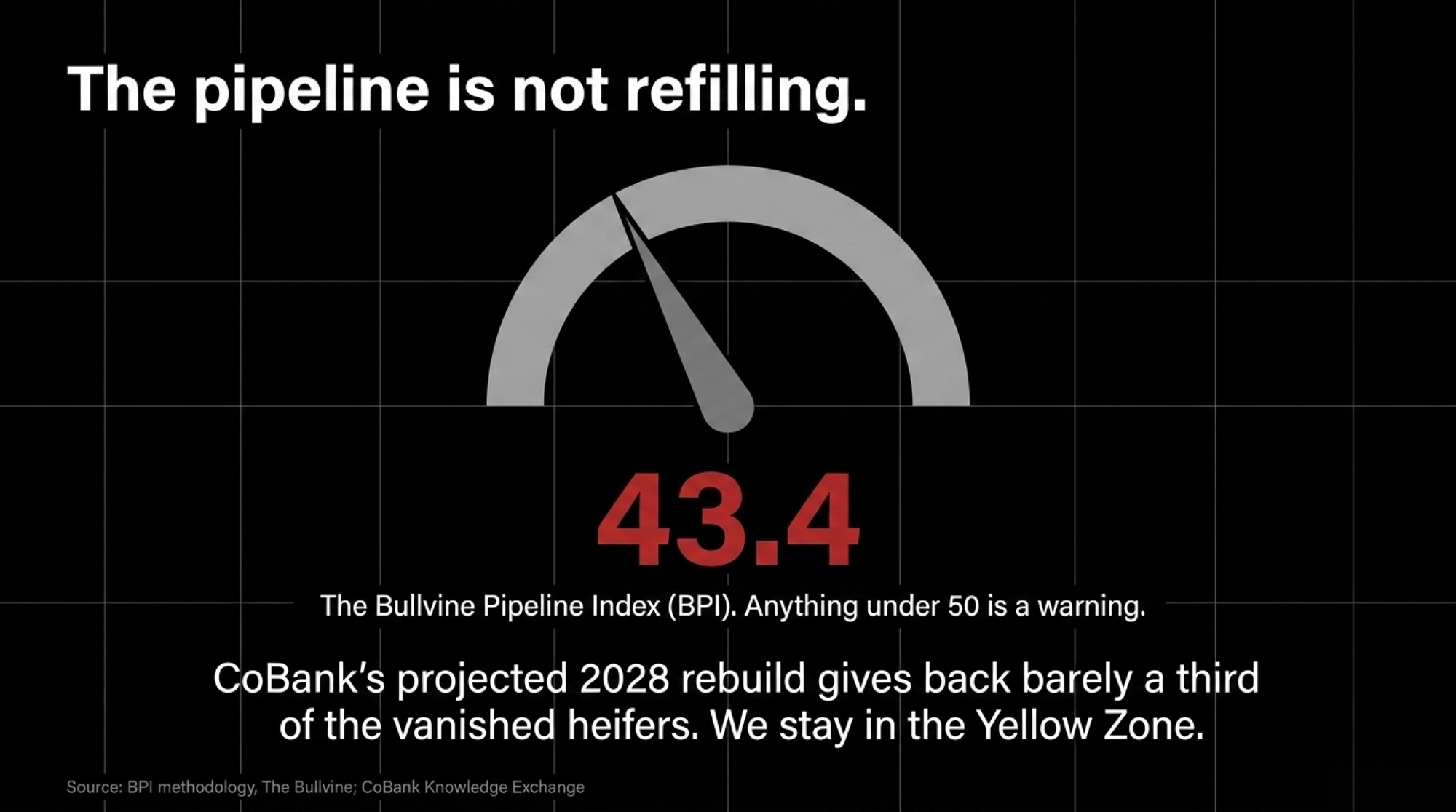
Put a number on how weak that recovery is. Run CoBank’s assumptions through The Bullvine’s Pipeline Index — our own composite that scores a replacement pipeline on heifer supply, culling pressure, price signal, and semen-mix momentum, on a 0-to-100 scale where anything under 50 is a Yellow-Zone warning — and the national dial reads 43.4 today (BPI methodology, The Bullvine). CoBank’s 2028 rebuild lifts it to just 48.7. That’s a 5.3-point crawl that never leaves Yellow and never touches Green. Stack it against the deeper hole — dairy heifers 500 pounds and over are down 909,400 head, a 19% drop from 2016 to 2026 — and the picture is blunt: CoBank’s 360,200-head rebuild gives back barely a third of the heifers that vanished over the decade. It dents the hole. It doesn’t close it.
Who feels it worst? Mid-size herds — roughly the 200-to-700-cow range — that leaned on beef premiums for margin relief but don’t have the scale or heifer-raising slack to absorb a replacement squeeze. When you’re buying springers back at market instead of raising your own, a $3,100 heifer stops being a headline and becomes a line on your operating loan.
📎 Go deeper: [The 800,000-Heifer Crisis: how the pipeline got drained →]([INSERT: pillar page URL — paste at upload]) — the full unwind behind the shortage, and how weak the 2027–28 rebuild really is.
How This Plays Out on Real Farms
The calf cheque was real money, and it still is. Day-old beef-on-dairy calves commonly brought $900 to $1,400 in 2025 and 2026, up from around $650 a few years earlier (Purina and auction summaries, via The Bullvine, 2026). And it’s not pocket change on the P&L anymore: five years ago, calf and cull sales ran about 5% of the dairy’s bottom line — today they’re 12–15%, and up near 20% on some operations (CoBank, June 2026). The beef check went from garnish to main course. Nobody made a dumb call here.
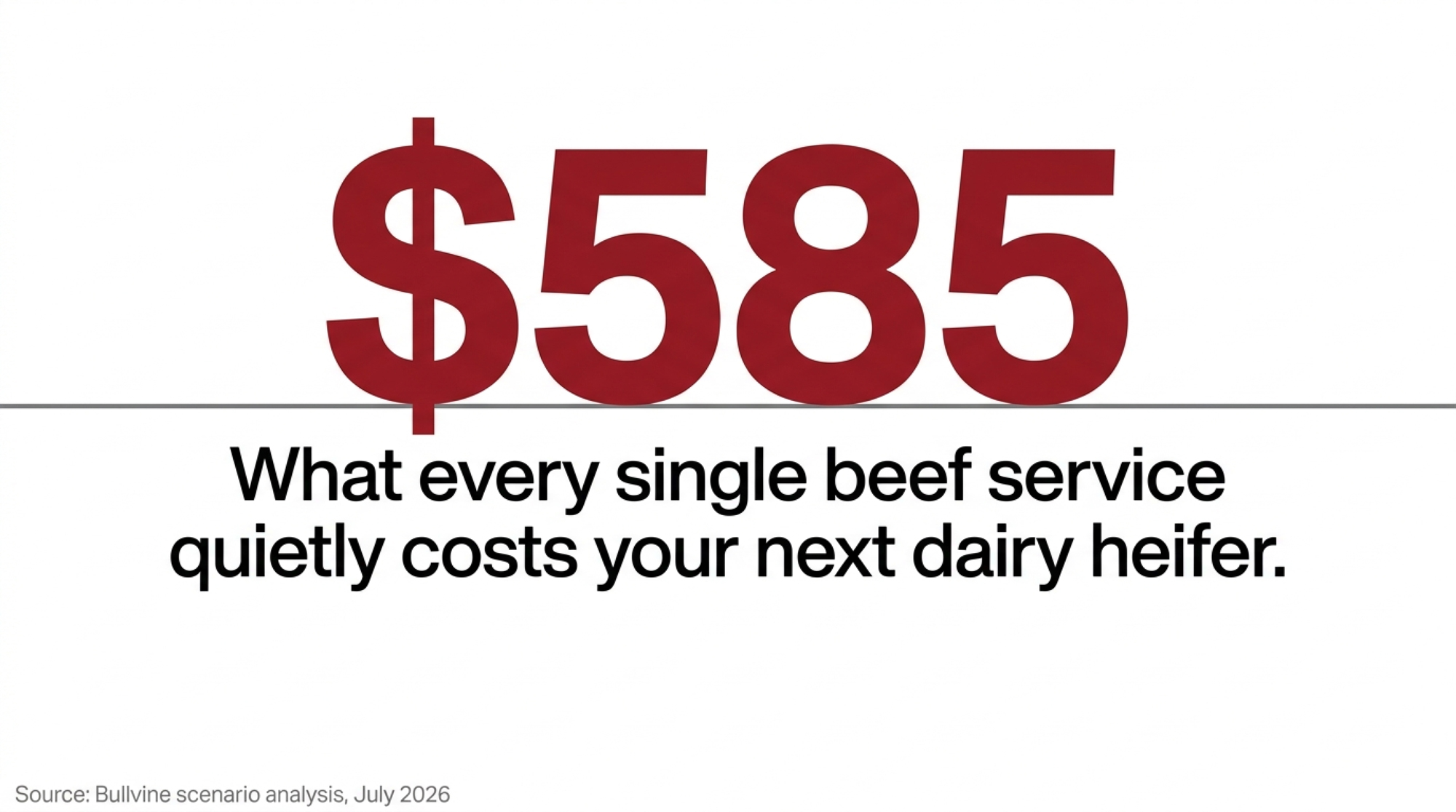
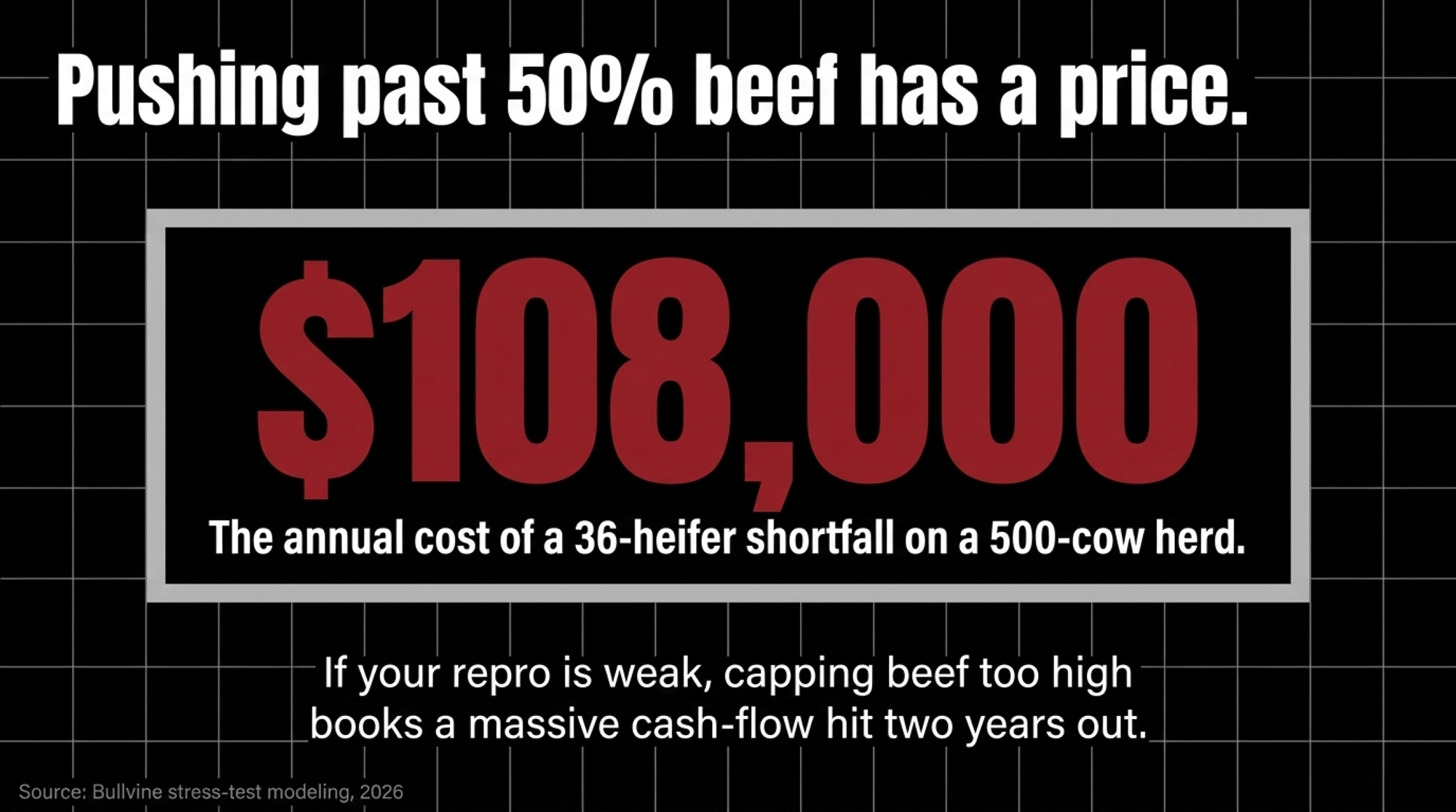
The trouble shows up two years later. Bullvine’s modeling — built on a $3,010 mid-2025 heifer value — puts the netyou trade away, after factoring conception odds and the 79% heifer completion rate, at roughly $585 per beef serviceon a replacement-eligible cow; at today’s $3,100 heifer it runs a touch higher (Bullvine scenario analysis, “$585 a Straw,” July 3, 2026). It’s not a straight $3,010-minus-$500 subtraction. It’s what that lost heifer is actually worth once you weight it for probability. Run 200 of those services a year on cows that could’ve made heifers, and you’ve handed off about $117,000 in replacement value — on a single 500-cow herd, in one year. Push beef past 50% of matings and a separate Bullvine stress-test pegs the damage near a 36-heifer shortfall, roughly $108,000 a year in bought replacements at $3,000 a head.
A CoBank dairy analyst put the replacement side plainly in the co-op’s Knowledge Exchange: “We’ve been in a very severe decline, fewer replacements are available, they’re coming in at record prices for those that can find them” (CoBank Knowledge Exchange, June 25, 2026). The upside and the downside were always inside the same breeding decision. The full ledger — the replacement side — is the half most breeding plans left off.
The Mechanics Behind the Outcomes
Why does this trap close so quietly? Because a beef-on-dairy calf is a one-time cheque today, and a dairy replacement is a two-year build. You feel the calf revenue this week. You don’t feel the missing heifer until she’s not there to freshen in 2027 — and by then, buying her back costs $3,100-plus instead of the $1,140 a comparable heifer ran in April 2019 (USDA Agricultural Prices).
Then there’s the part no single farm can see from its own barn. One operation going heavy on beef is a niche premium play. Tens of thousands doing it at once becomes a structural supply event — millions of crossbred calves piling into feedlots, hundreds of thousands of missing heifers on the dairy side. Neither shows up on your own profit-and-loss until the market reprices the premium you were counting on. And that repricing is now in motion: live cattle futures hit a record $251/cwt in May 2026, then posted 15 straight lower closes through July 17, dropping $2.65 in the final session alone for the longest losing streak since October (CME Group, July 17, 2026). The streak broke Monday, July 20, with contracts closing $2.10 to $3.10 higher — but the supply pressure behind it hasn’t gone anywhere.
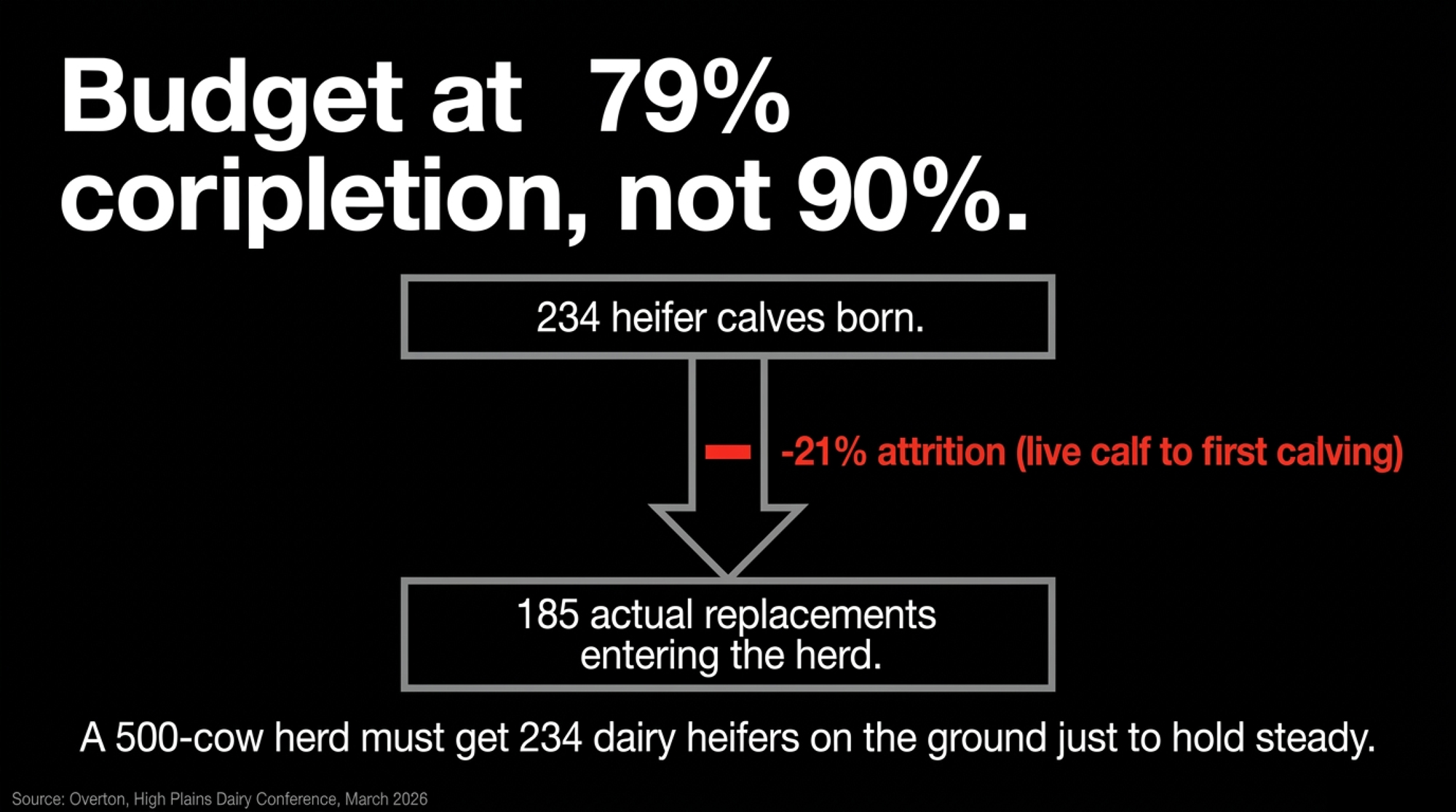
One more mechanic most breeding plans get wrong: heifer survival. Mike Overton’s study of 85 commercial U.S. herds found an average heifer completion rate — live heifer calf all the way to first calving — of just 79%, not the 90% many plans assume (Overton, High Plains Dairy Conference, March 3, 2026). Run that through a 500-cow herd needing about 185 replacements a year, and at 79% completion you need roughly 234 heifer calves born just to stand still — before any buffer. That gap is exactly what too much beef quietly eats into.
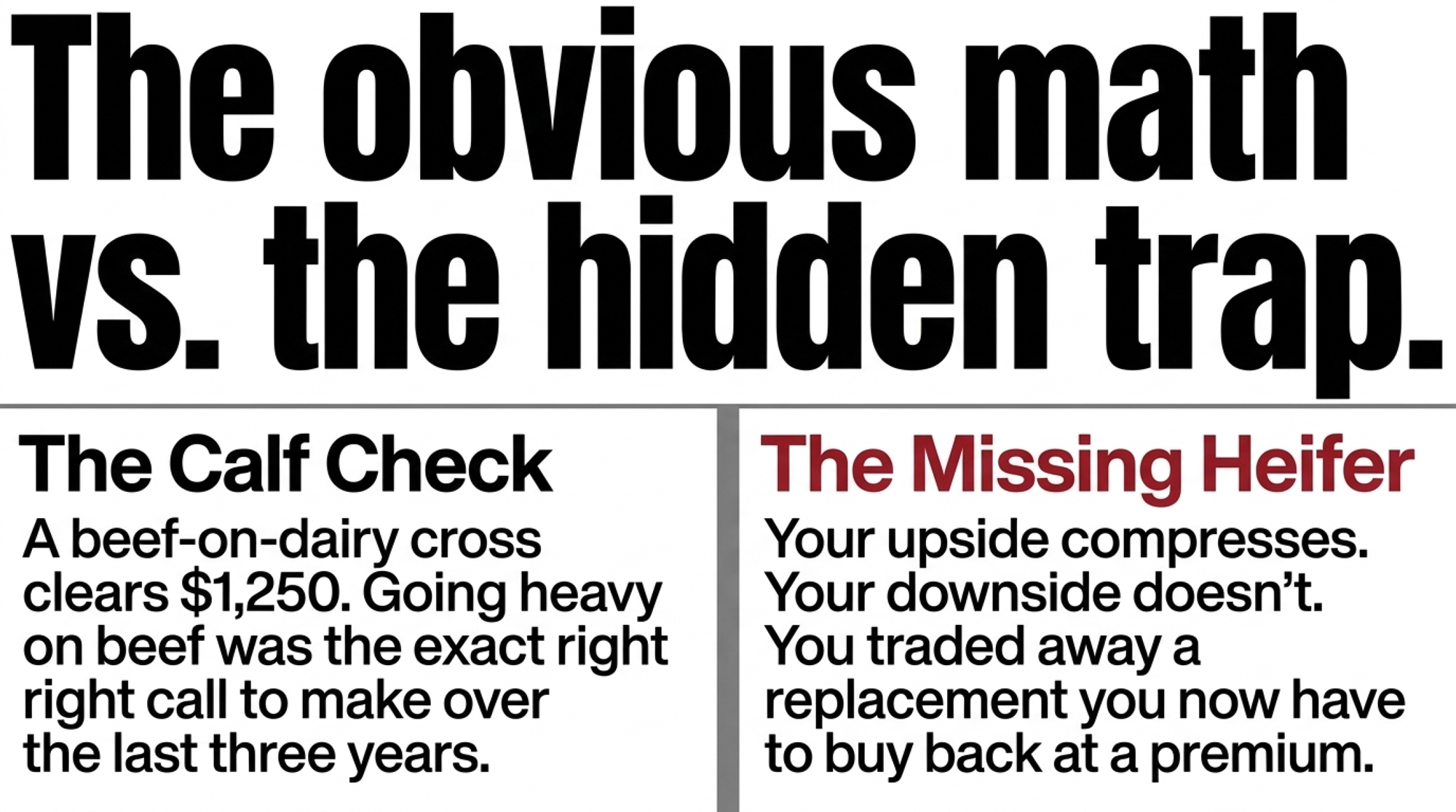
Is the Beef Premium Worth More Than the Heifer You Skip?
That’s the question the last three years never forced you to answer, because both sides paid. The calf cheque landed now and the replacement squeeze hadn’t arrived yet. Now it has, and the two halves point opposite directions.
Do the arithmetic on one cow. A beef service that hits gets you a crossbred calf worth $900–$1,400 today. A dairy service that hits — weighted for conception odds and that 79% completion rate — gets you a heifer worth about $2,500 net once you carry her to freshening. That’s the $585-per-service gap, and it only widens as heifer prices climb and calf prices soften. When both were rising, the question didn’t matter. It matters now.
Is Your Heifer Pipeline Already Behind?
Here’s a gut-check you can run this week. Three numbers tell you whether you’ve earned a beef program or quietly scheduled a heifer problem:
The red-flag combination:
- Pipeline ratio under 1.0
- 21-day pregnancy rate under 20%
- More than a third of services going to beef
Hit all three, and the calf market doesn’t get a vote. Your heifer pipeline does.
A herd humming at a 30%-plus pregnancy rate can pull real net calf income from beef. A herd under 20% is mostly borrowing against its own future replacements (UW-Madison/Cabrera modeling, via The Bullvine). Don’t run the national average and call it your answer — the BPI’s 43.4 is a story about everyone and nobody in particular. Your barn has its own number.
📎 Go deeper: [Run your own herd through the BPI Index Calculator →]([INSERT: calculator URL — paste at upload]) — plug in your cow count, cull rate, and semen mix, and see your zone.
Options and Trade-Offs for Farmers
There’s no villain here, and no single right answer. The whole game comes down to matching your beef use to what your heifer pipeline can actually carry. A few ways to play it:
1. Cap beef at what your pipeline supports — start this week.
- Do it now: Pull your 21-day pregnancy rate and heifer inventory ratio before your next breeding meeting.
- The ceiling: For most 500-cow herds with typical cull rates, the one-third-of-pregnancies-to-beef cap is a figure derived from Overton’s 79% completion data and standard cull rates — not the 50%-plus some plans assume (derived from Overton, 2026; Bullvine modeling).
- When it works: Nearly always, as baseline discipline.
- Where it fails: Set it too high with weak repro, and you’ve booked a heifer shortage two years out — the $108,000-a-year kind.
2. Put sexed dairy on your best animals, beef on the bottom.
- The lever: Gender-sorted dairy semen sales climbed 53.6% from 2020 to 2025 as herds leaned into exactly this play (CoBank/NAAB, June 2026).
- The play: Concentrate sexed dairy on top cows and heifers to lock in high-genetic replacements; reserve beef for clear bottom-end and late-lactation animals.
- What it takes: Reliable genomic ranking and solid heat detection.
- The risk: Sexed conception can lag conventional if timing or straw handling slips.
3. Treat the beef premium as a position, not a promise.
- The exposure: With futures off their May record, a premium cut in half — calves toward $450–700, which a market this soft can produce — erases most of that $585-per-service edge and pushes the beef case back onto clear culls only.
- The timeline: CoBank doesn’t expect a meaningful rebuild until 2027–2028, and even then the BPI barely moves off 43.4 — so your replacement cost stays high while your calf upside wobbles.
Key Takeaways
- If beef runs past a third of your services and your 21-day PR is under 20%, you’re financing next year’s heifer shortage — pull both numbers before the next breeding meeting and hold the cap at 30 to 35%.
- Don’t book another beef straw until you’ve priced the whole ledger — at today’s values each service on a replacement-eligible cow trades roughly $585 in net future heifer value, and pushing past 50% beef can run you around $108,000 a year in bought replacements.
- If you buy replacements instead of raising them, build $3,100-plus a head into your 2026–27 cash flow now — top Midwest animals clear $4,400, and the BPI says the pipeline stays in Yellow through 2028.
- Budget your heifer needs at 79% completion, not 90% — a 500-cow herd needing 185 replacements has to get about 234 heifer calves on the ground just to hold steady.
- Watch the live cattle board, not just the milk check. If futures fall 15%+ from that $251/cwt May record before Q1 2027, that’s your signal to shift breeding weight back to sexed dairy — the fastest lever you’ve got to refill the pipeline.
The individual decision was right. It might still be right on your farm today. But here’s the twist the market just handed everyone: the beef correction that’s hammering your calf cheque this month is also the one thing that could unstick your replacement costs. The Bullvine’s modeling shows the fastest path back to a full pipeline isn’t the patient triple play — it’s a beef futures crash that drags farmers back into making dairy heifers, sending the BPI to 52.5, the best scenario on the board. Same shift, both directions. The collapse that’s costing you now is the collapse that could save you later.
Run Your Numbers
Bullvine Pipeline Index Calculator — Plug in your herd size, heifer inventory, cull rate, replacement cost, and sexed-vs-beef semen split. It scores your pipeline 0–100, flags whether you’re Green, Yellow, or Red, and shows exactly where you stand against the national 43.4 — so the beef-ceiling call is your number, not the average.
Complete references and supporting documentation are available upon request by contacting the editorial team at editor@thebullvine.com.
Learn More
- $18% Trap: One Pregnancy Rate, Two Completely Different Diseases — Arm your reproductive protocol with DairyComp 305 diagnostics that isolate service rate failures from heat stress, unlocking a six-point pregnancy rate gain worth $18 to $36 per cow annually.
- Dairy Farm Economics 2026: Milk Pricing, Margins & Risk Playbook — Delivers a complete financial strategy to insulate your operation against Class III price haircuts, shifting component payment formulas, and rising non-feed costs over the next three to five years.
- AI and Precision Tech: What’s Actually Changing the Game for Dairy Farms in 2025? — Cuts through vendor hype to reveal how automated surveillance systems detect lameness with 85% accuracy and generate up to $500 per cow in real operational payback.
The Sunday Read Dairy Professionals Don’t Skip.

Every week, thousands of producers, breeders, and industry insiders open Bullvine Weekly for genetics insights, market shifts, and profit strategies they won’t find anywhere else. One email. Five minutes. Smarter decisions all week.