





It’s 6 a.m. The list says breed pen 4. Your best cow-man says two aren’t ready. Someone’s wrong—and on a $3,010-heifer market, being wrong twice a week adds up fast.
Executive Summary: The U.S. replacement dairy heifer hit $3,010 a head in July 2025 and pushed past $3,100 by October (USDA Agricultural Prices) — and that number is quietly eating the beef-on-dairy premium most herds think they’re banking. Switch 35% of the herd to beef semen and you might net ~$370 more per cross calf than a Holstein (Bullvine modeling), but if you’re short a replacement two years later, that calf cheque is just prepaying a $900-plus hole on the heifer you now have to buy. Nobody puts those two numbers on the same line, which is exactly the problem. The same blind spot shows up inside the barn: on data-heavy dairies, the leak isn’t the collars or the robots — it’s the handoff, the morning the breeding list says “breed her,” and the fifteen-year gut says “wait,” and nobody’s decided in advance who wins. Tighten conception timing enough to pull just 20 cows out of stale 250-plus-DIM territory in a 200-cow herd, and the IOFC math runs ~$45–$75 per cow a year, money that sits right alongside the beef premium once you spread it across the herd. The piece hands you a four-step, 90-day playbook — surface one buried signal, write one breeding rule (over 390 days and 55% of your own mature body weight), name one owner, and price the replacement cost on every semen decision. Read it before your next beef-vs-dairy semen order, because the calf cheque isn’t the win it looks like until the second line’s on the page.
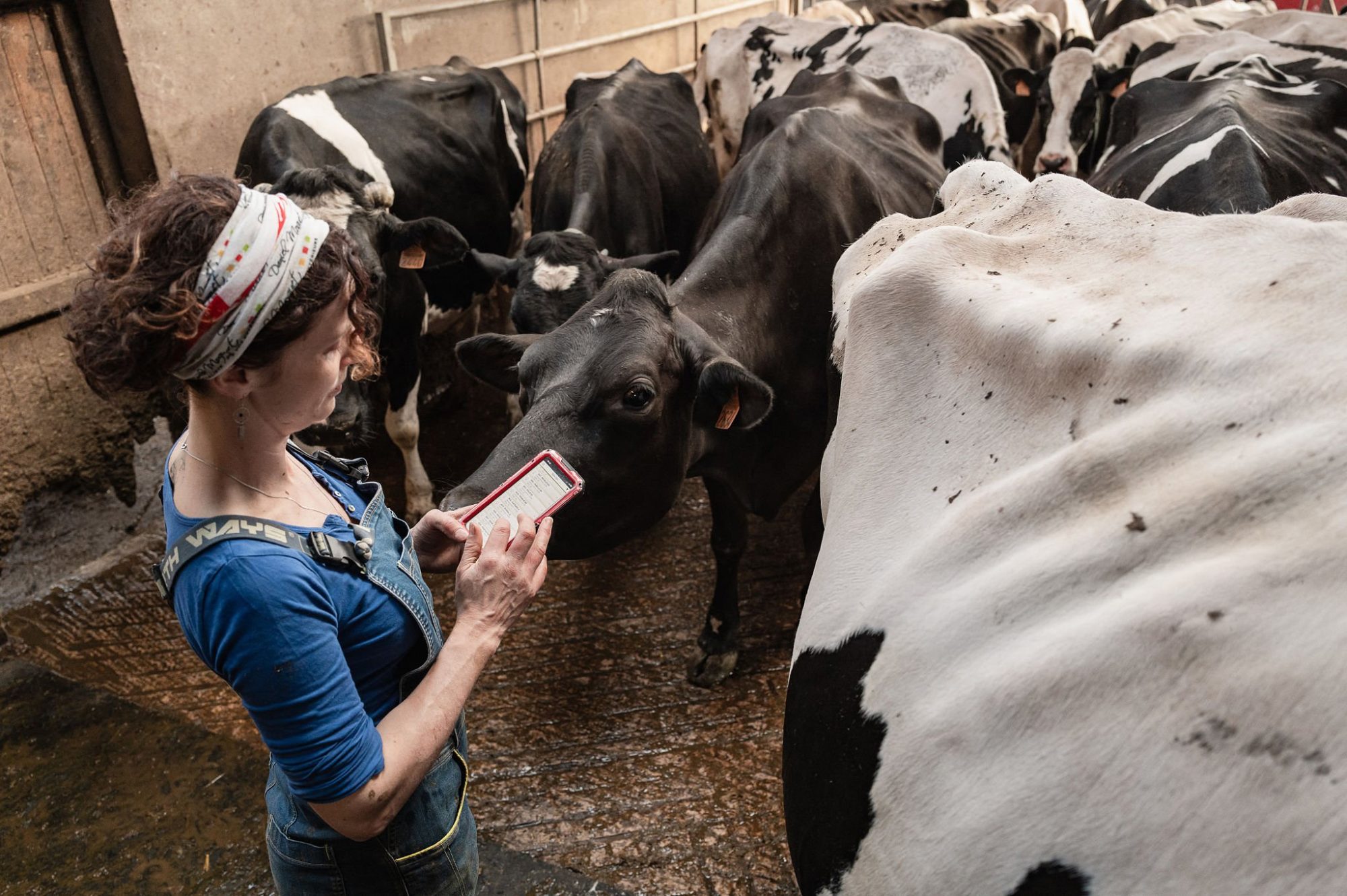
Picture a breeding tech in the heifer pen, phone in hand — a scene that plays out on data-equipped dairies every morning. The screen says breed her. His gut says she’s not ready yet. He pockets the phone and walks past, the way he’s done for fifteen years, reading frame at fifty feet.
That small moment, repeated across a herd, is where most dairies quietly leak money. Not in the sensors. Not in the software. In the handoff between what the data says and what the experienced person does next. And on a data-driven dairy, the bill almost never shows up the day the decision gets made.
The trap that shows up first and pays you later
Here’s the pattern that connects nearly every expensive miss on a modern dairy: the first-order number is loud and immediate, and the second-order consequence is invisible until it’s a bill.
Beef-on-dairy is the cleanest example anyone’s living through right now. The calf cheque shows up on sale day. The replacement problem shows up two years later, when there’s no heifer in the pipeline to take that cow’s place.
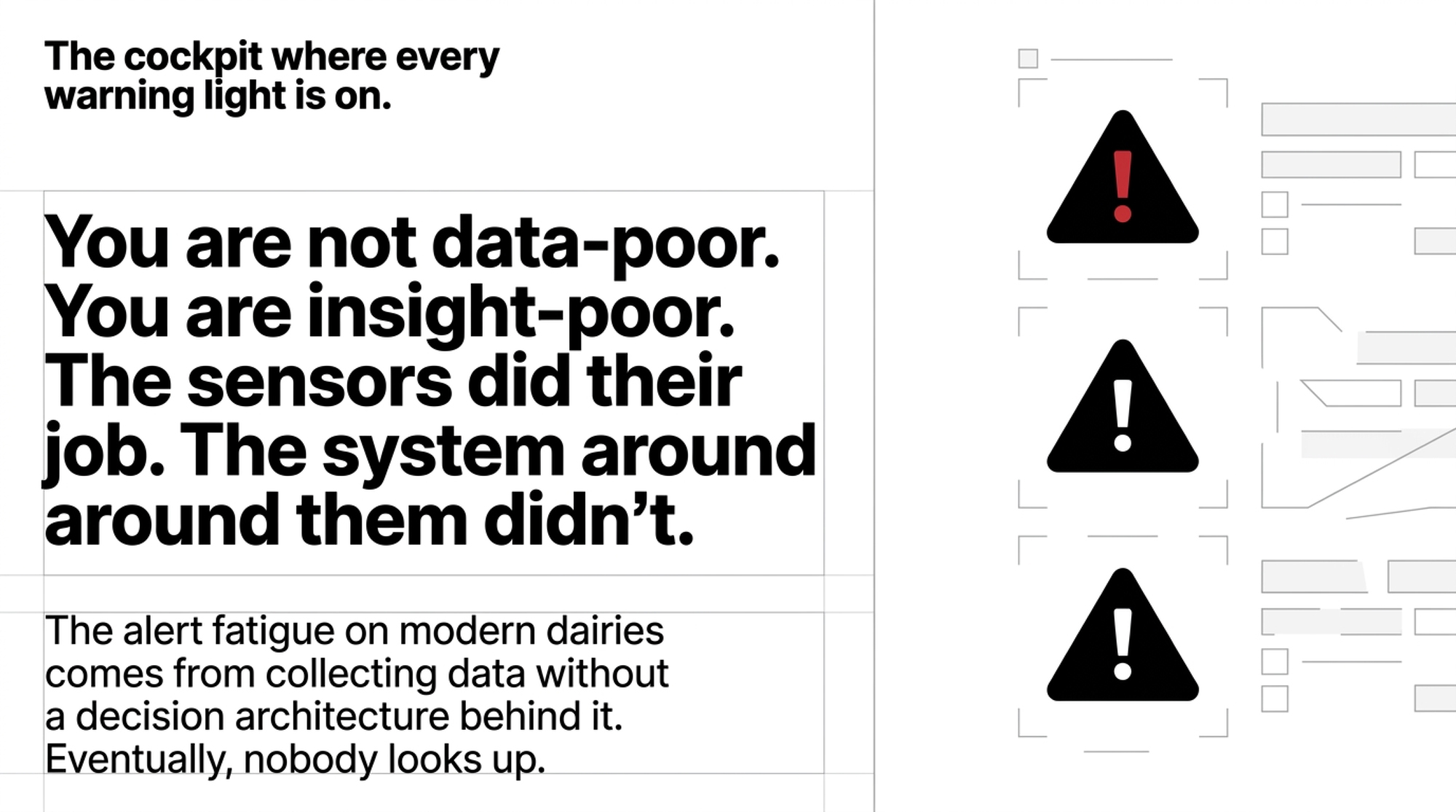
If you run a tech-heavy operation — collars, milk meters, genomic tests on every heifer calf, three pieces of software that don’t talk to each other — you’ll recognize yourself in this. You’re not data-poor. You’re insight-poor. The signals are everywhere. The bridge between signal and action is what’s missing.
The cockpit where every warning light is on
Walk into a lot of dairies and the data is everywhere and changing nothing. There’s a difference between recording what happened and deciding what to do next.
The 2026 Journal of Dairy Science invited review Milking the Data for Value-Driven Dairy Farming makes the point directly: the bottleneck isn’t sensor capability anymore — it’s the human capacity to interpret, prioritize, and act on multiple data streams in real time. The sensors did their job. The system around them didn’t.
European work on precision livestock farming (Hostiou et al., 2017; EU dairies) found the same thing from the farmers’ side: managing the flood of alarm warnings is itself a source of stress, and the researchers argue it’s essential to set priorities for which alerts actually require action. That’s alert fatigue — the tax you pay for collecting data without a decision architecture behind it. The alarm goes off enough times without meaning anything, and eventually nobody looks up.
On a bad day, a precision dairy looks like a cockpit where every warning light is on — and the pilot is still flying by habit.
Three ways the handoff actually breaks
The failure isn’t the sensor being wrong. It’s the moment between the data and the human who’s supposed to act on it. It shows up in three predictable places.
1. Heat detection
- Data said: Collars flag cows 17, 34, 112 for breeding, ~a day ahead (Penn State Extension, 2023).
- What happened: Nobody checks the list before morning. Cows get bred off chalk and visual signs, conception rate doesn’t move — and the collars take the blame.
2. Mastitis/health
- Data said: Robot logs a yield drop and conductivity spike on one quarter; flags likely mastitis (Univ. of Waterloo case study, ~2023, Canada).
- What happened: No one owns the weekend dashboard. The cow’s caught when she’s visibly sick days later — higher treatment cost, higher cull risk.
3. Feeding
- Data said: Precision-feeding software flags overfeeding in late-lactation pens; IOFC could improve by trimming offered dry matter.
- What happened: Ration still set by habit and a look at the bunk. The margin sits on the table.
Notice the common thread. In every case, the tech was right. The system around it — who checks, who acts, what the rule is — wasn’t built.
| System | What the Data Said | Where the Handoff Broke | Cost of the Gap |
|---|---|---|---|
| Heat detection (collars) | Flags cows ~1 day ahead of estrus | List unchecked each morning; bred off chalk/visual signs instead | Conception rate stagnant, collars wrongly blamed |
| Mastitis / robot health | Yield drop + conductivity spike flags likely mastitis | No owner on weekend dashboard shifts | Higher treatment cost + higher cull risk |
| Precision feeding | Flags overfeeding in late-lactation pens | Ration still set by habit, not by dashboard | Margin left on the table (IOFC erosion) |
What “crossing over” actually looks like
On farms where it works, the day doesn’t start with “what’s wrong with my herd?” It starts with “which ten cows does the system want me to look at today?”
Penn State Extension’s precision-technology purchasing guidance (2023–2024) frames the whole thing around assigned ownership: a named person has to be responsible for managing alerts, the system needs a written protocol for who acts and when, and the farm needs an actionable plan to turn that data into better herd performance — or the system never pays for itself. The sensor is the easy part. The protocol and the person are the job.
Michigan State Extension (2021) describes the labor shift the same way — precision tools are meant to move skilled people off routine pen-watching and onto the cows and decisions that actually need judgment. The University of Waterloo’s dairy robotics case study found the same pattern on robot herds: less manual labor, more time interpreting reports and managing exceptions, plus a new skill demand that’s “not always intuitive” for traditional managers.
And the people doing the work mostly buy in. A 2024 study of dairy employees and precision technology (Borchers et al.) found 95.6% comfortable with the tech they use and 91.8% saying they understand it — but that same work flags real friction, from language barriers to cold-weather and lighting limits in the barn. The difference between a data hoarder and a system designer is simple: the hoarder checks everything; the designer checks a few lists that already have a next step attached.
The cost nobody prices: becoming needed differently
But here’s the part the vendor demos skip. That transition costs a person something real, and it isn’t the software learning curve.
The operator who can read a cow at fifty feet built an identity around being the one who knows. The system doesn’t just ask them to learn a tool. It asks them to become someone who’s needed differently — to give up being the hero who walks into the barn and sees everything, and become the architect who builds a system where they’re not the only one who can.
The PLF research backs this up sideways. Hostiou’s farmers pushed back on the idea that a farm can run itself on precision tech alone — the know-how still matters; it just moves. The ones who cross over treat their own know-how as something to be coded and shared, not guarded. They’d rather build a system ten people can run than be the genius everyone’s waiting on. The ones who can’t make that trade fight the screen forever.
Turning gut feel into a rule the software can enforce
The heifer-breeding decision is the cleanest place to watch that happen. What used to live in one person’s gut becomes a rule the system can run.
The biology isn’t new. USDA APHIS, citing the 2001 Dairy NRC, recommends heifers be “pregnant by 55% of mature size and calve at 82% of mature size” — and the 2021 NASEM Dairy NRC carries the same target-bodyweight framework forward. University of Wisconsin Dairy Extension takes it further: define weight-based breeding eligibilityon weight relative to mature body weight and structural growth, and you can hit age-at-first-calving targets without short-changing the heifer. Their guidance is direct — “heifers reach 55% of mature body weight and 90% of mature structural growth… by the time you breed them.” Ontario’s ag ministry puts the same number in plain terms: a heifer’s ready at 55% of mature body weight, “which for most animals occurs by 14 months of age.”
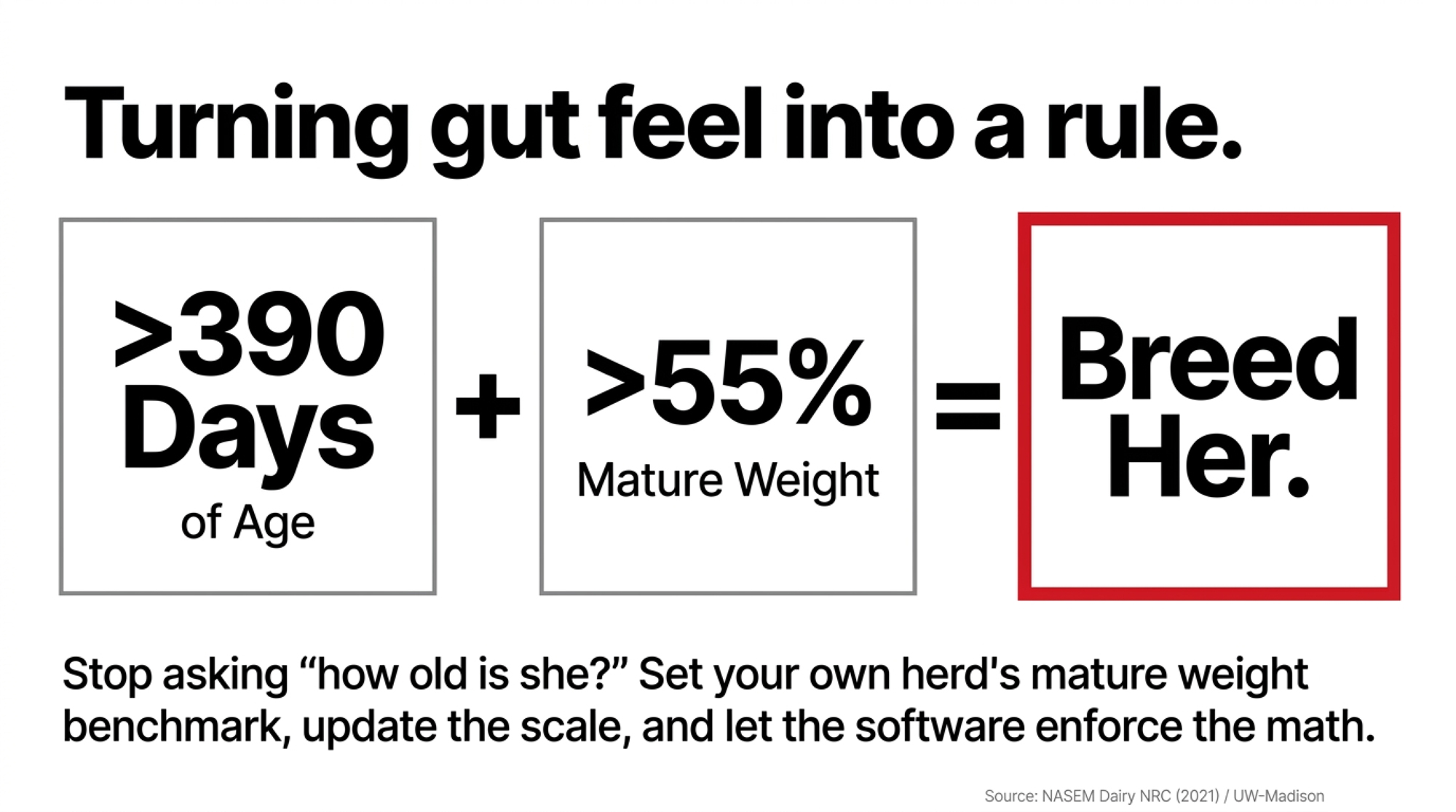
Here’s the build. Weigh a group of mature cows to set the herd’s mature body weight. Then, as BoviSync’s documentation describes it, define each heifer’s waiting period as “the greater of 390 days of age or date of achieving 55% of mature body weight,” with pen moves triggered 15–22 days ahead. Every weight you capture — weaning, six months, a vaccination day — updates her individual curve. The system stops asking “how old is she?” and starts asking “is she over 390 days and over 55% of mature weight?” Everything else is math.
| Trigger Condition | Threshold | Source | Action |
|---|---|---|---|
| Minimum age | Over 390 days | BoviSync breeding protocol | Eligible only if weight also cleared |
| Minimum weight | Over 55% of herd’s mature body weight | USDA APHIS / NASEM Dairy NRC 2021 | Eligible only if age also cleared |
| Pen move lead time | 15–22 days ahead of eligibility | BoviSync documentation | Triggers physical pen transition |
| Herd-specific mature weight benchmark | ~771 kg avg (Canadian Holsteins, 43-herd study) | Lactanet 2022 — do not borrow this number, set your own | Recalibrate rule per herd |
Where it breaks isn’t the algorithm. It breaks when the scale is wrong or the weight is never entered. It breaks when the rule was never tuned for that herd — Lactanet (2022, Canada), drawing on 43 Holstein herds, found average mature weights well above older references, around 771 kg, and stresses that every herd should set its own target rather than borrow a benchmark. And it breaks at the handoff, when the list gets ignored and frame-reading takes over again.
When the list and the gut disagree, who wins?
So when the screen says breed her and the experienced tech says she’s not ready — who should win?
If the rule is built on NRC targets and your own validated outcomes, it’s earned the right to be innocent until proven guilty. In a tie, the list should usually beat the gut. But the moment you say “the list always wins,” you’ve left science and entered religion. The PLF research warns that placing total confidence in the tech, without critical human oversight, can make decisions worse, not better.
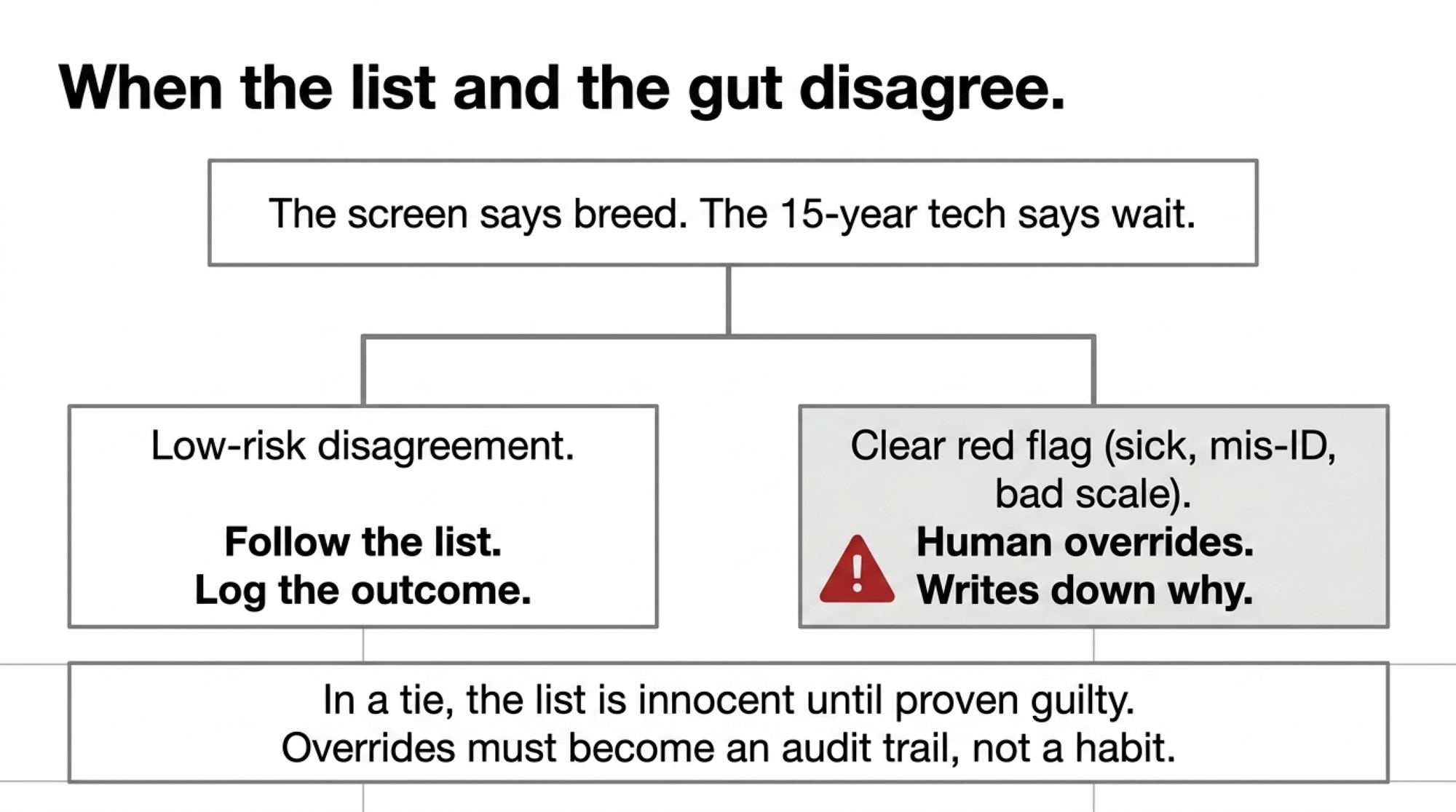
The real fix isn’t picking a winner. It’s a tiebreaker you agree on in advance. When the list and the experienced tech disagree, it should be a lab experiment, not a power struggle — you either just learned the rule is wrong, or you just learned the human bias is. Low-risk disagreement? Follow the list and log the outcome. Clear red flag — sick, mis-ID’d, scale error? The human overrides, and writes down why. Those overrides become the audit trail that improves the rule.
Can a tool own that role? Honestly, not yet
That conflict-resolution job — the person who reads the overrides, asks why, and decides whether the rule or the habit needs to change — doesn’t exist on most farms. So can an LLM fill it?
Help with it, yes. Own it, no. University of Wisconsin Extension (2025) is explicit that large language models don’t replace the need for human expertise; their review treats multi-modal models as a tool to support better decisions, not make them. The UW-Madison Dairy Brain project is building a “real-time, data-integrated, data-driven, continuous decision-making engine” — but the language is decision support, not decision maker. For more on where AI actually earns its keep in the barn, the line between support and autopilot is the whole game.
The reason for caution comes from higher-stakes fields. Recent assurance research on medical AI has found large language models still vulnerable to confidently stated but false outputs — so-called hallucinations — and that prompt-based guardrails reduce the problem without coming close to eliminating it. The dairy use case is lower-stakes, but the lesson carries: AI can be your lab assistant in that conflict, not your judge. If a pitch — from any vendor — is that the AI will decide for you, that’s not innovation; it’s abdication.
The math that proves the trap
Now run the beef-on-dairy numbers all the way through, because this is where the invisible second line gets expensive.
Purina’s 2024 Beef-on-Dairy Industry Report (U.S. survey) found most dairy farmers “realizing a premium approaching $200 a head, with some netting double or triple that advantage.” Bullvine’s August 2025 analysis of the real cost of the beef-on-dairy boom put a sharper number on the upside: switching about 35% of the herd to beef semen netted roughly $480 a head on cross calves — nearly $370 more than Holsteins in that scenario. That’s a modeled herd example, not a national average. Loud, immediate, real.
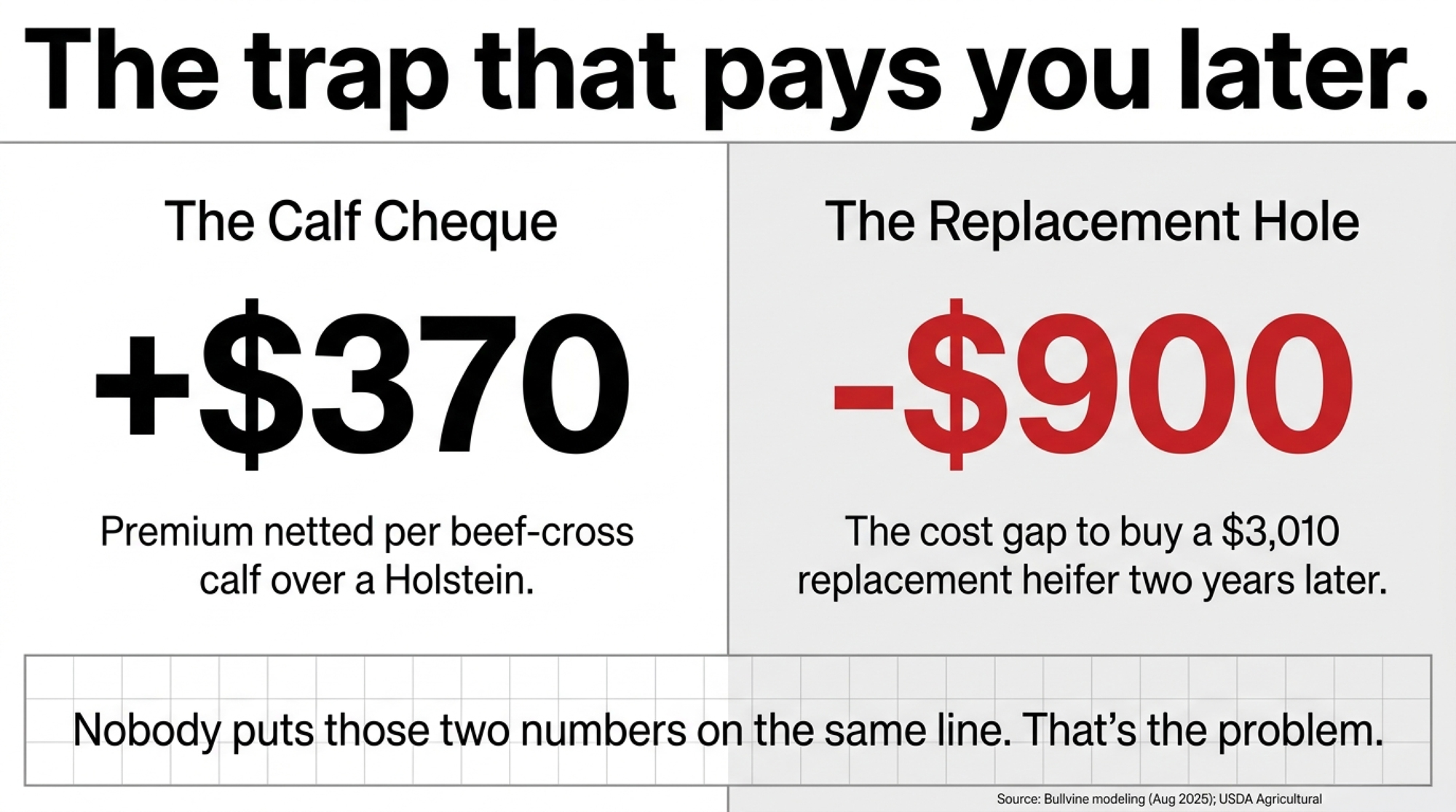
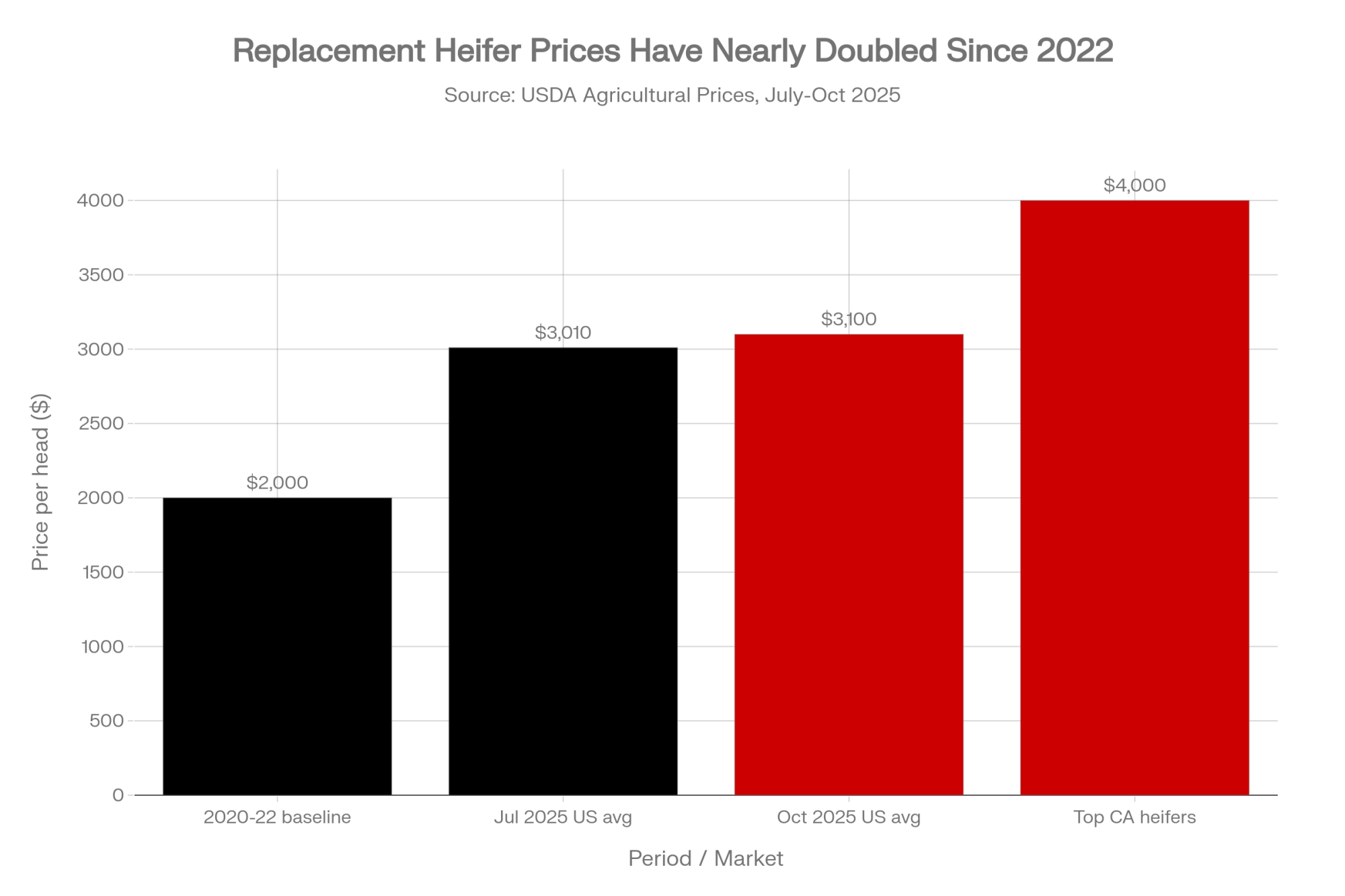
Now the second line. The U.S. replacement dairy heifer averaged $3,010 per head in July 2025 (USDA Agricultural Prices) — and climbed past $3,100 by that October — up sharply from a few years earlier, with top California heifers pushing $4,000+. Against an old baseline near $1,800–$2,200, that’s an $810–$1,210 swing per replacement. So in a lot of herds, the extra few hundred dollars on a beef calf is paying for the extra ~$900 on the replacement you now have to buy. You never see the two numbers on the same line.
| Metric | Old Baseline | 2025 Reality | Net Swing |
|---|---|---|---|
| Beef-on-dairy premium per calf | ~$110/head | ~$480/head (35% herd switch, Bullvine model) | +$370/head |
| Replacement heifer cost | $1,800–$2,200 | $3,010 (Jul 2025), $3,100+ (Oct 2025) | +$810–$1,210/head |
| Top-market heifers (California) | ~$2,500 | $4,000+ | +$1,500/head |
| Net position if short one replacement | Break-even to positive | Often net negative | -$430 to -$840/head |
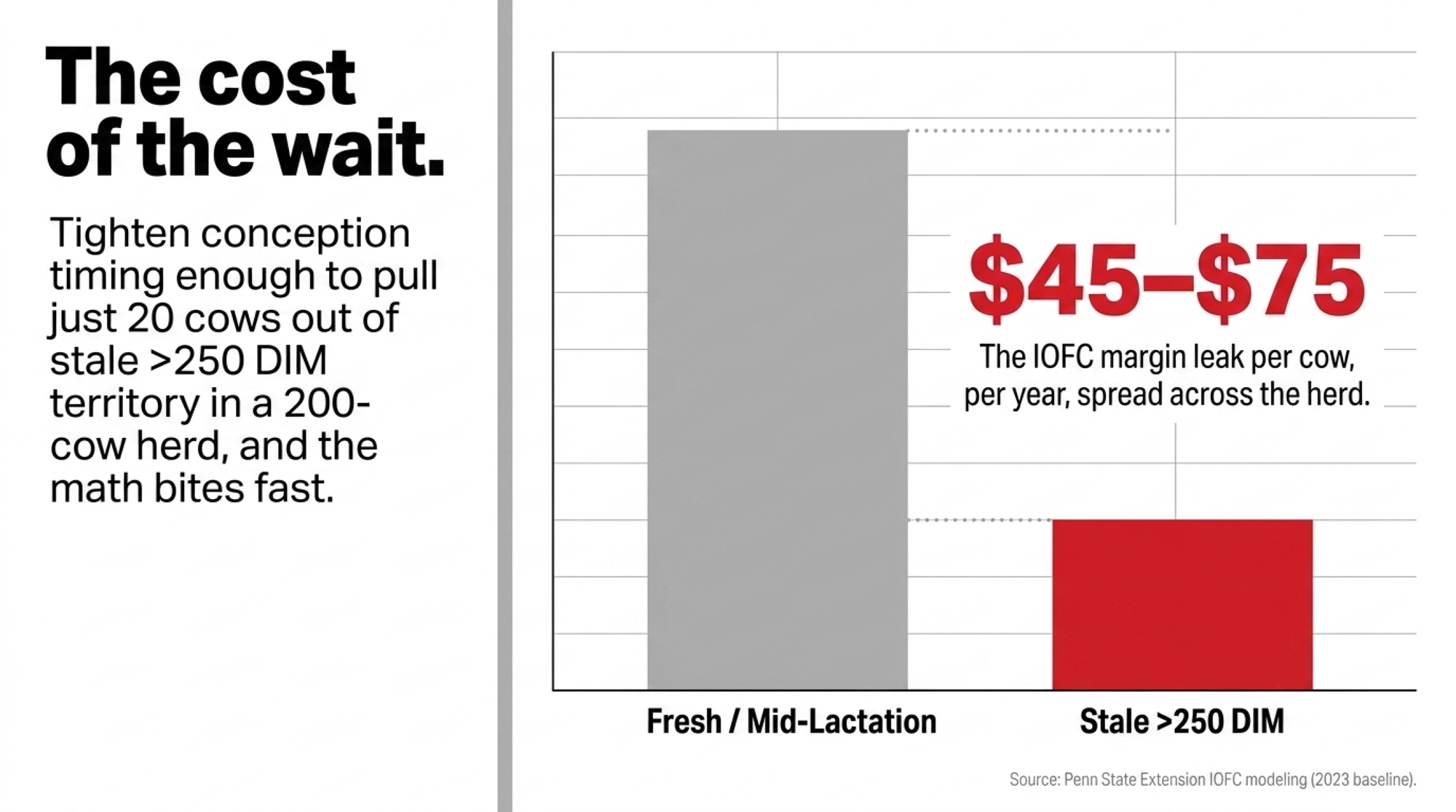
Here’s the IOFC piece in plain barn math. Overton notes income over feed cost “generally represents half or more of a dairy’s total profitability,” and Penn State’s 2023 example herds run around $8.31–$9.03/cow/day. Late-lactation cows typically sit below fresh and mid-lactation cows on that line. So take a 200-cow herd and shift just 20 cows — 10% — out of stale, 250-plus-DIM territory by tightening conception timing. At a modeled $1.25/cow/day IOFC gap, that’s 20 × $1.25 × 365 = about $9,100 a year, or roughly $45 per cow across the herd. Assume a wider $2.00/day gap, which some herds see between fresh and stale cows, and you’re closer to $75 per cow.
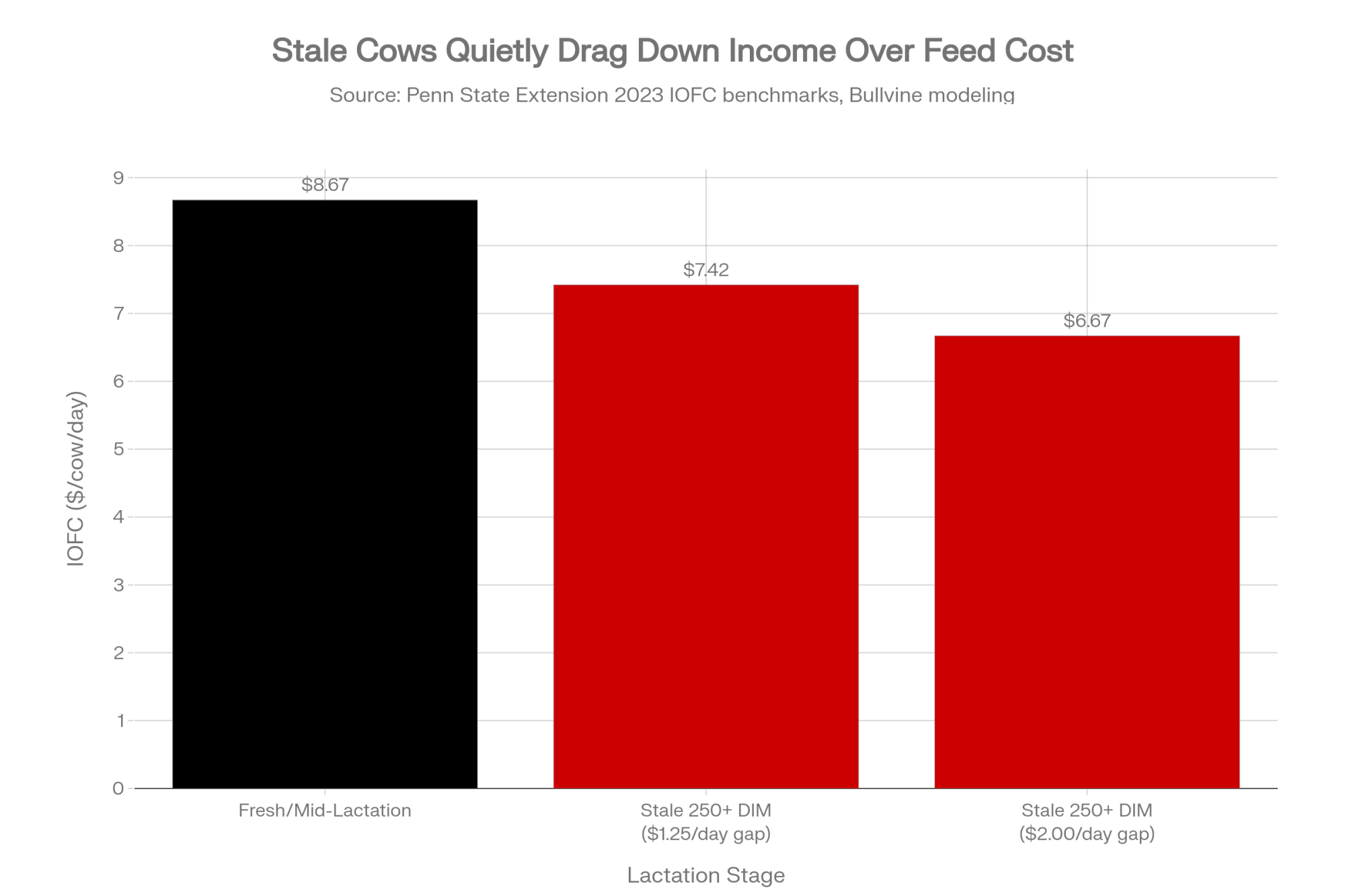
These are modeled figures, not a single herd’s audited result — the point is the order of magnitude. Run your own IOFC-by-DIM split before you trust the number; the gap between your fresh and stale pens is the figure that makes or breaks the comparison. Either way, that money sits right alongside, or above, the marginal beef premium once you spread it across every cow and subtract the replacement hole.
If this second-order math still lives in one consultant’s head and not in your breeding rules, you’re not running a management system — you’re running a series of bets.
Your move: a four-step roadmap for the next 90 days
Don’t try to fix the whole farm. Work the handoff in order — each step earns the right to the next.
Step 1 — This month: surface one buried signal. Pull the records you collect and never use — retained placentas, weights, heat-day data — and pick the single one that should be triggering a decision and isn’t. Decision check: Is there a record sitting in a file that, if acted on, would change an outcome? Start there.
Step 2 — Write one rule and name one owner. Turn that signal into a written rule — heifer breeding eligibility is the cleanest place to start (over 390 days and over 55% of your own mature body weight). Assign one person to own the daily list. Backfires when: the weights feeding the rule are sloppy — the curve is only as good as the scale behind it.
Step 3 — Set the tiebreaker before you need it. Decide now who wins when the list and the experienced hand disagree: follow the list on low-risk calls and log the result; let the human override on a clear red flag and write down why. Decision check: Are your overrides becoming an audit trail that improves the rule, or vanishing into habit?
Step 4 — Price the second line on every breeding call. Before the next beef-vs-dairy semen decision, put the calf premium and the current replacement-heifer cost on the same page, then layer in your own IOFC-by-DIM split. Threshold: if the beef premium is quietly funding a $900-plus replacement hole and a stale-cow margin drag, the calf cheque isn’t the win it appears to be.
And one rule that sits above all four: if a pitch — from any vendor — promises the AI will decide for you, read that as a warning label, not a feature. AI is your lab assistant in these calls, not your judge.
The breeding tech in that heifer pen isn’t wrong to trust his eye — he’s right more often than the sales pitch suggests. The question isn’t whether to replace his judgment. It’s whether your farm has built a place for the disagreement to teach you something, instead of disappearing every morning when the phone goes back in the pocket and the list goes unread. So which one runs your barn right now — the rule, or the habit?
Key Takeaways
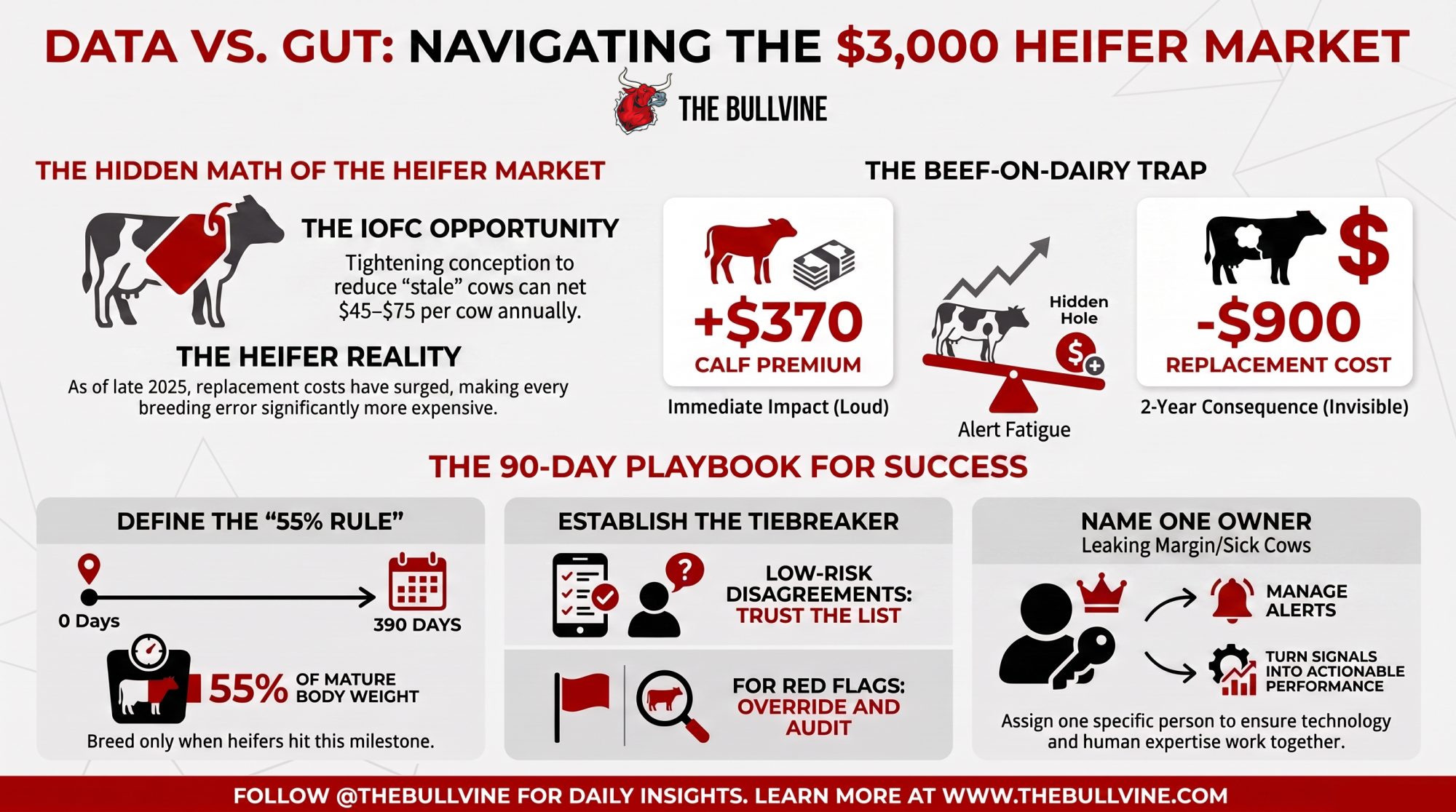
- The beef calf premium and the replacement heifer aren’t separate lines — with heifers at $3,010-plus, that extra ~$370 per cross calf is often just prepaying a $900 hole two years out. Price both together before your next semen order.
- On a tech-heavy dairy, the leak isn’t the collars or the robot. It’s the handoff — decide now who wins when the breeding list says “breed her” and your best cow-man says “wait,” and log every override so the rule actually gets smarter.
- Build one written breeding rule you can defend: over 390 days and over 55% of your own herd’s mature body weight, not a borrowed benchmark. The math only holds if the scale’s right and the weights get entered.
- Pulling 20 cows out of stale 250-plus-DIM territory in a 200-cow herd pencils near $45–$75 per cow a year in IOFC. Run your own IOFC-by-DIM split before you trust it — the gap between your fresh and stale pens is what makes or breaks the call.

Run Your Numbers
Bullvine Pipeline Index Calculator — Before your next beef-vs-dairy semen order, run your herd through the Pipeline Index. It scores heifer supply, replacement cost, culling pressure, and beef-on-dairy diversion into one number, and flags whether your pipeline is green, yellow, or already running dry.
Complete references and supporting documentation are available upon request by contacting the editorial team at editor@thebullvine.com.
Learn More
- $585 a Straw: What That ‘Free’ Beef Calf Really Costs — Identifies the exact $585 opportunity gap handed over per service when trading away future replacements for immediate calf revenue. This guide details how to calculate your herd’s specific pipeline ratio and rolling pregnancy rate thresholds before placing your next semen order.
- $3010 Per Heifer. 800000 Short. Your Beef-on-Dairy Bill Is Due. — Exposes the long-term structural reality of the nation’s 48-year low heifer inventory against surging processor demand. Learn how to navigate four concrete strategic paths to control herd turnover, manage somatic cell risks, and protect contract delivery terms.
- AI and Precision Tech: What’s Actually Changing the Game for Dairy Farms in 2025? — Delivers concrete financial baselines for automated systems, tracking how AI surveillance achieves 85% lameness accuracy and saves up to $500 per cow. This data-driven analysis maps out real investment payback timelines for precision feeding, virtual fencing, and automated health platforms.
The Sunday Read Dairy Professionals Don’t Skip.

Every week, thousands of producers, breeders, and industry insiders open Bullvine Weekly for genetics insights, market shifts, and profit strategies they won’t find anywhere else. One email. Five minutes. Smarter decisions all week.