


Archive for Dairy Cattle Judging

The Best Dairy Business School Isn’t a School — It’s the Judging Ring

Eight minutes, four strange cows, no notes, and a stranger who’ll push back on every word. That’s not a nightmare — it’s the best manager-training dairy has, and we’re defunding it.
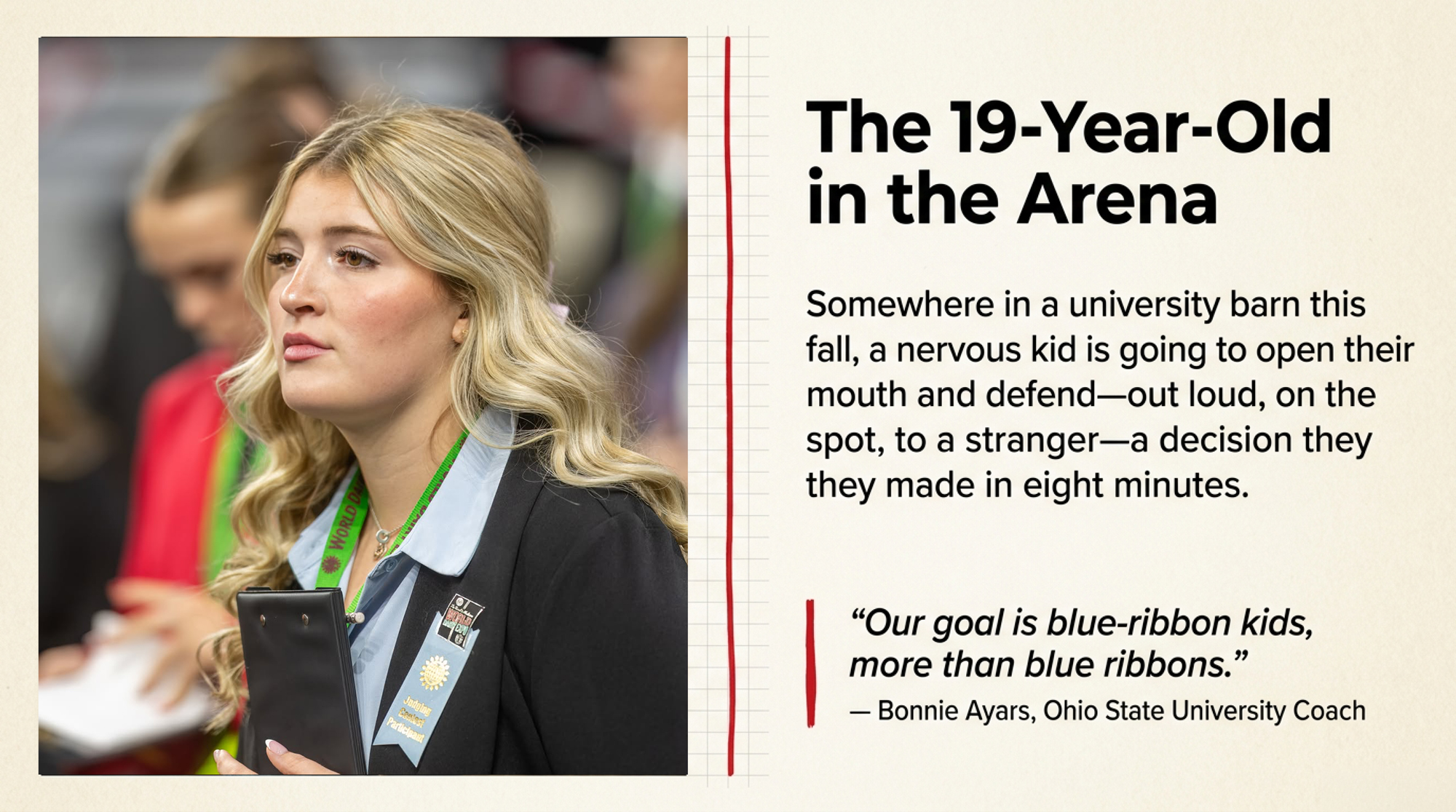
Somewhere in a university barn this fall, a nervous 19-year-old is going to open her mouth and defend — out loud, on the spot, in front of a stranger who knows more than she does — a decision she made in eight minutes about four cows she’d never seen before. She doesn’t know it yet. But that two-minute speech is worth more to her career than anything she’ll do in a lecture hall this semester.

There’s a workforce problem sitting at the heart of dairy right now, and it has nothing to do with genomics, robots, or milk price. It’s about people. Specifically, it’s about building confident individuals who can walk into any barn, any boardroom, any hard conversation, and hold their ground.
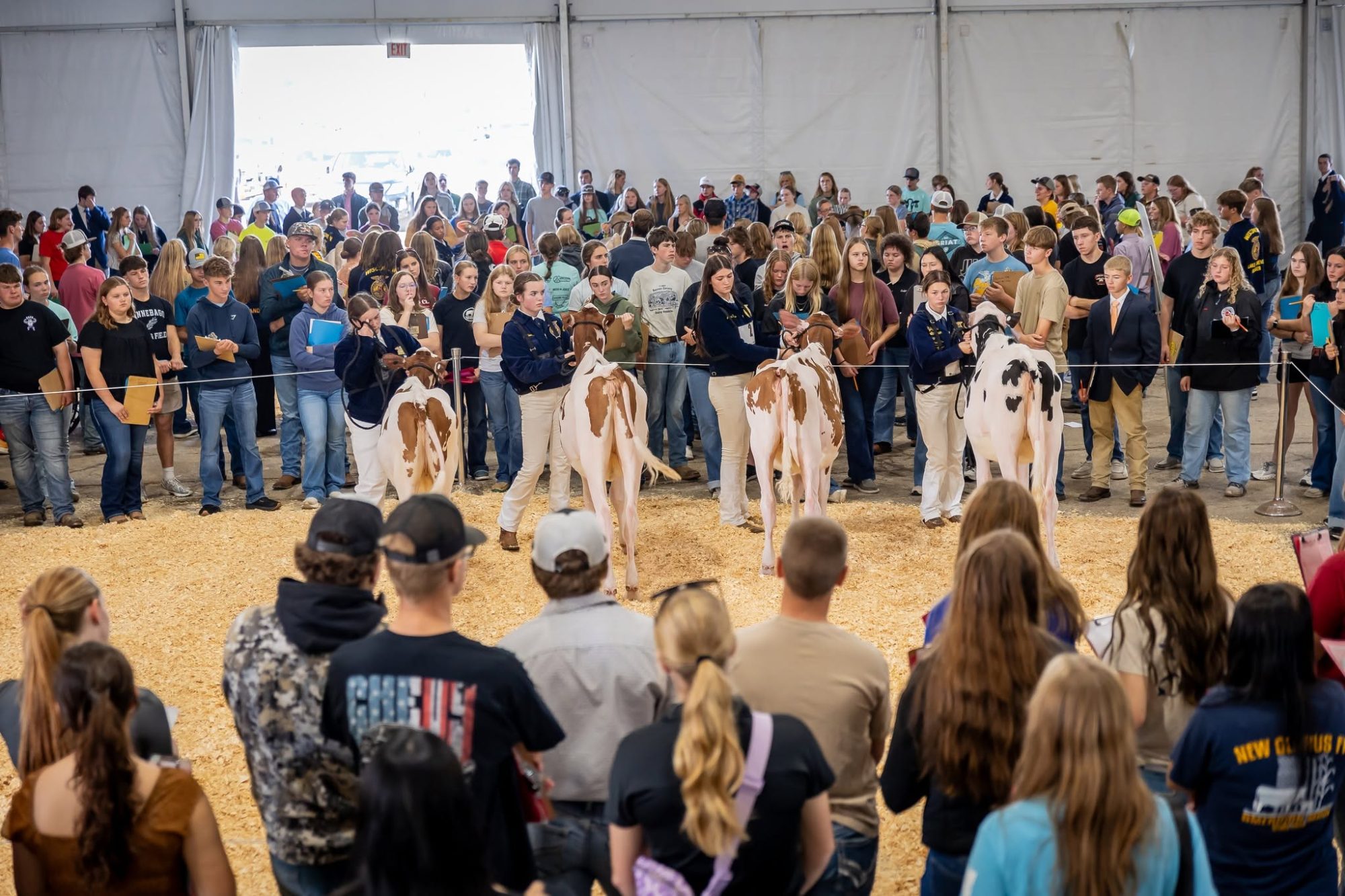
Clipboards out, four cows in the ring, and a wall of students working the class: more than 100 schools contested the FFA Dairy Cattle Judging Contest at World Dairy Expo in 2025. This is the crowd the industry keeps saying it can’t find — the communicators and decision-makers, still showing up coast to coast. 

Dairy cattle judging has been quietly building exactly those people for over a century. The 104th National Intercollegiate Dairy Cattle Judging Contest ran at World Dairy Expo in September 2025, with 16 university teams competing for the title. But who won is almost beside the point. The story worth telling is where the participants end up — and once you follow that thread, you start to wonder why an industry this starved for talent treats its best development pipeline like an afterthought.

Suits, laptops, notes in hand, and the Madison skyline behind them: collegiate competitors work the room at World Dairy Expo, 2025. This is the part no ribbon photo shows — where you stand up and defend the call you just made. Call it the best business school in dairy.

This Has Never Just Been About Cows

Ask serious dairy professionals how they got their start, and a remarkable share point back to a 4-H barn, an FFA chapter, or a college judging team. Breed association executives. AI company reps. Geneticists. Farm lenders. Classification managers. Extension educators. Veterinarians. The talent pipeline runs straight through the ring.
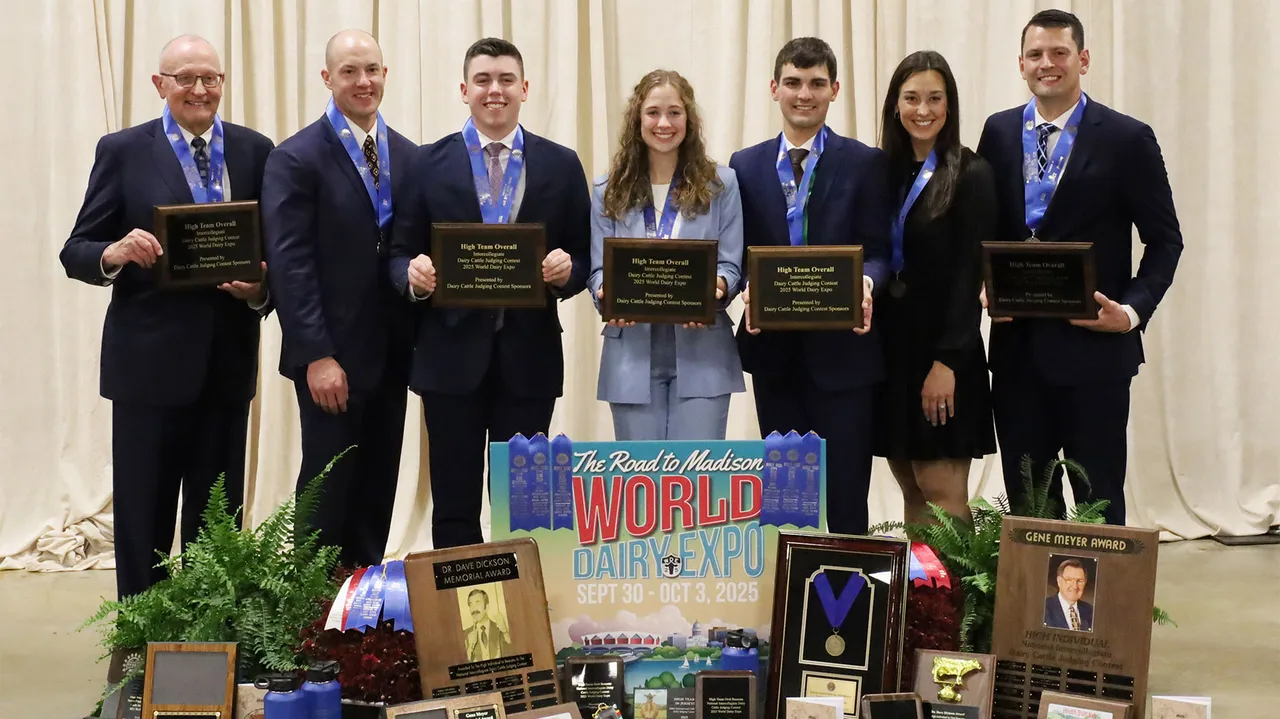
Sixteen university teams contested the 104th National Intercollegiate Dairy Cattle Judging Contest at World Dairy Expo in September 2025 — the University of Minnesota won for the third straight year. (Source: World Dairy Expo)

It’s not a coincidence you’ll find judging-team alums scattered across ABS, Select Sires, Farm Credit, Zoetis, and the breed associations — the same systematic evaluation process they drilled in the ring becomes a template for the complex decisions they make for the rest of their careers. Ask a university coach, and you’ll hear the same thing: judging-team alums are highly sought after by employers and graduate schools, and they land in leadership roles across the industry.

Three people who’ve spent their lives in and around the ring — longtime coaches Brian Kelly and Bonnie Ayars, and former competitor-turned-professor Madison Dyment — laid out exactly why on a recent Dairyvoice Podcast about dairy cattle judging. Their firsthand accounts anchor what the data underneath already shows.

Take Kelly. He’s coached the University of Wisconsin–Madison dairy judging team since 2010, but the ring built his own career first — eight years as a Holstein Association classifier, then Select Sires, and now a dairy production specialist role at Zoetis.

“Dairy judging, dairy shows, dairy cattle evaluation — you get to meet a lot of great people and see a lot of great cows. A lot of life lessons come with it.” — Brian Kelly, UW–Madison judging coach since 2010
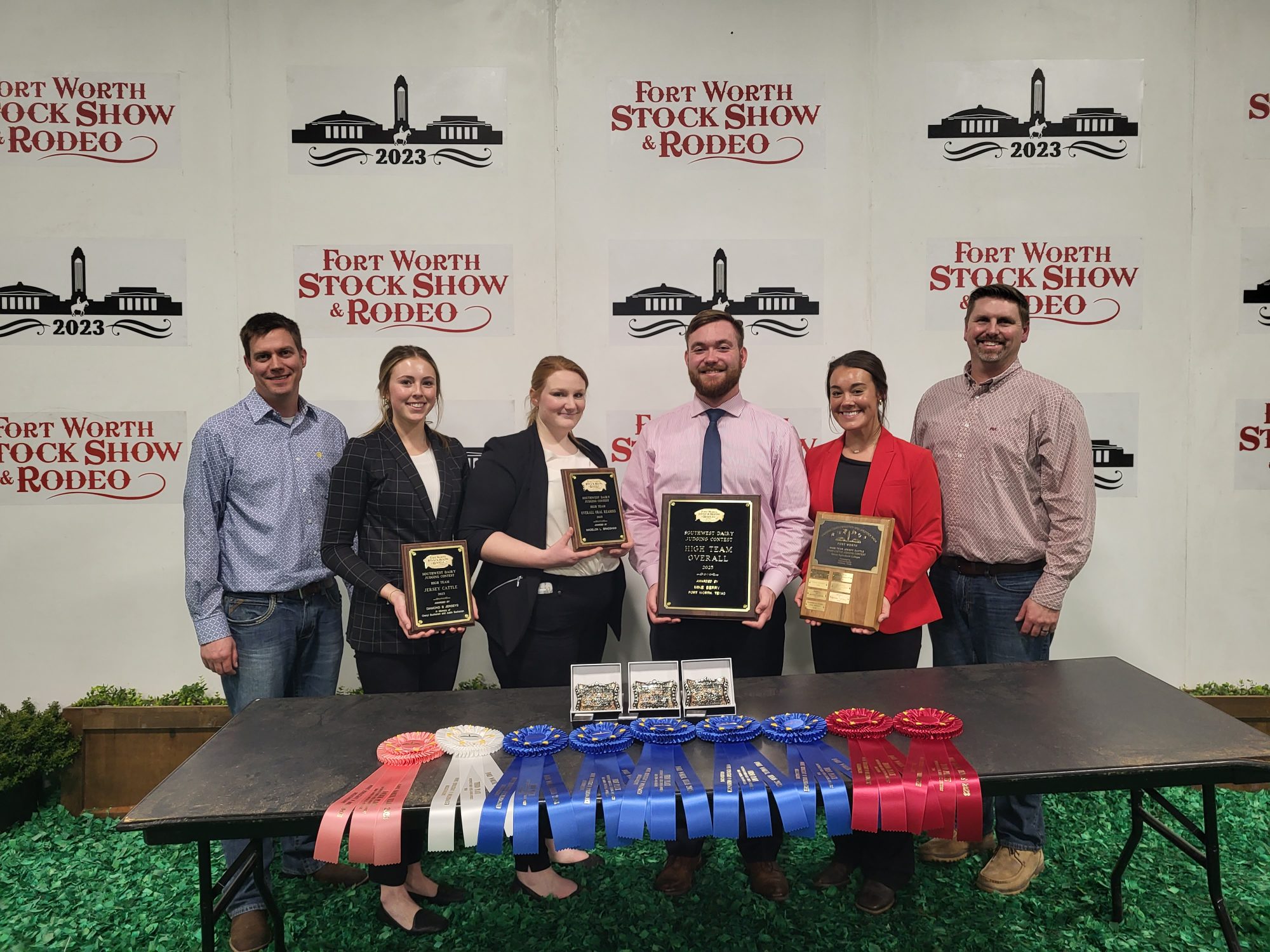
Coach Brian Kelly (far right) with his University of Wisconsin–Madison squad after taking High Team Overall at the Southwest Dairy Judging Contest, Fort Worth Stock Show & Rodeo, 2023. Kelly — a former Holstein classifier now with Zoetis — is exactly the kind of hiring manager who scans a résumé for judging: “That’s the line I always look at.” 

The reason it works is structural, not sentimental. Judging forces a set of skills most career-prep programs never touch head-on — and it forces them young, under pressure, with something on the line.

What a Set of Oral Reasons Actually Teaches You
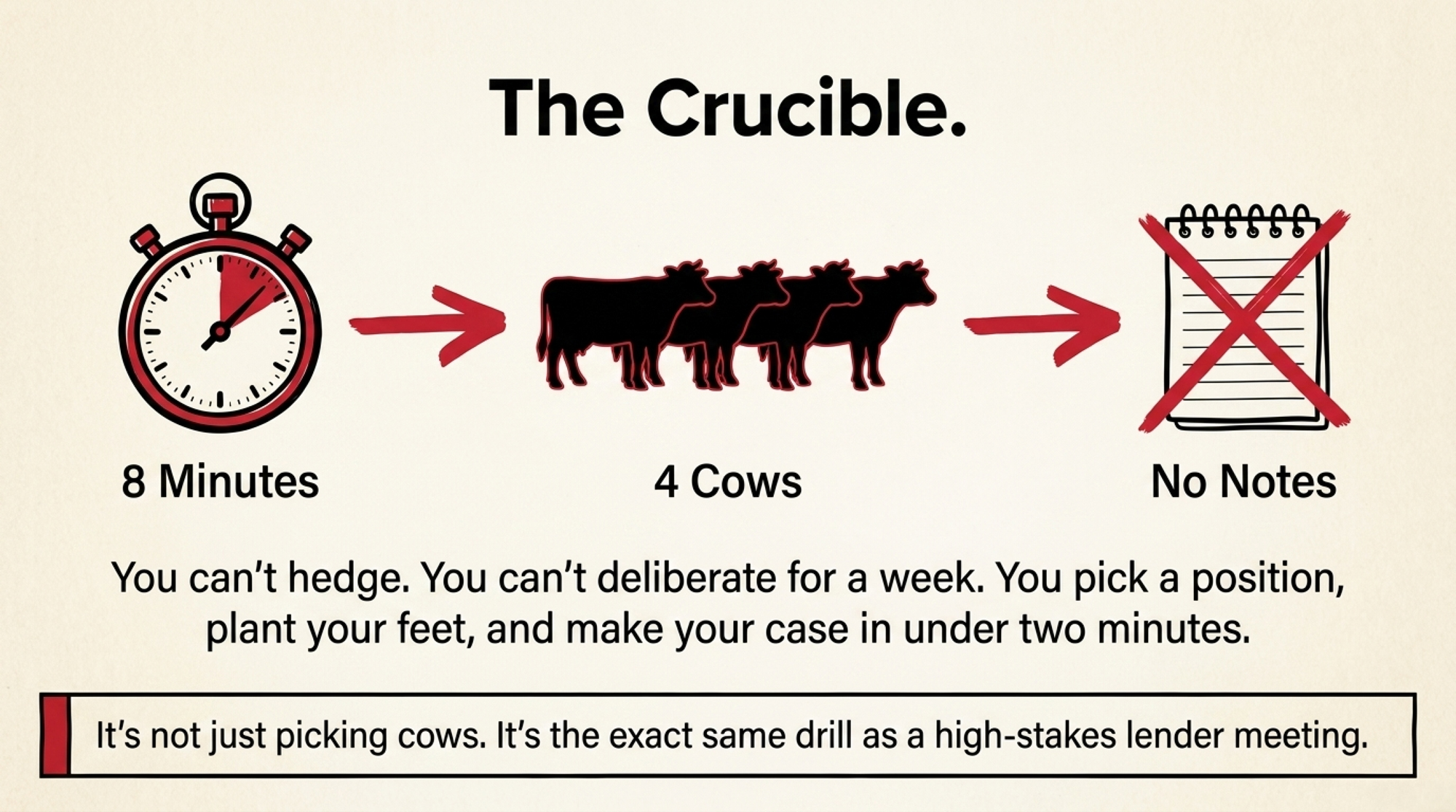
Here’s the mechanic that makes it work — and if you want the full technical version, The Bullvine has already mapped the systematic “assess, prioritize, decide, and explain” process elite judges run every time. The short version: you walk into the class. You get eight to ten minutes — a hard clock — to evaluate four animals you’ve never seen, rank them best to worst against a specific, learnable set of criteria, and get ready to defend that ranking to an official who will push on every claim you make. No notes when you deliver. No hedging. You pick a position, plant your feet, and make your case in under two minutes.

Kelly puts the value of that exercise bluntly. “Reasons are such a powerful impact, and one of the biggest life lessons you’ll get from dairy judging,” he says. “You’re always going to have to tell someone why you’re doing something, or defend your thought process throughout life.”
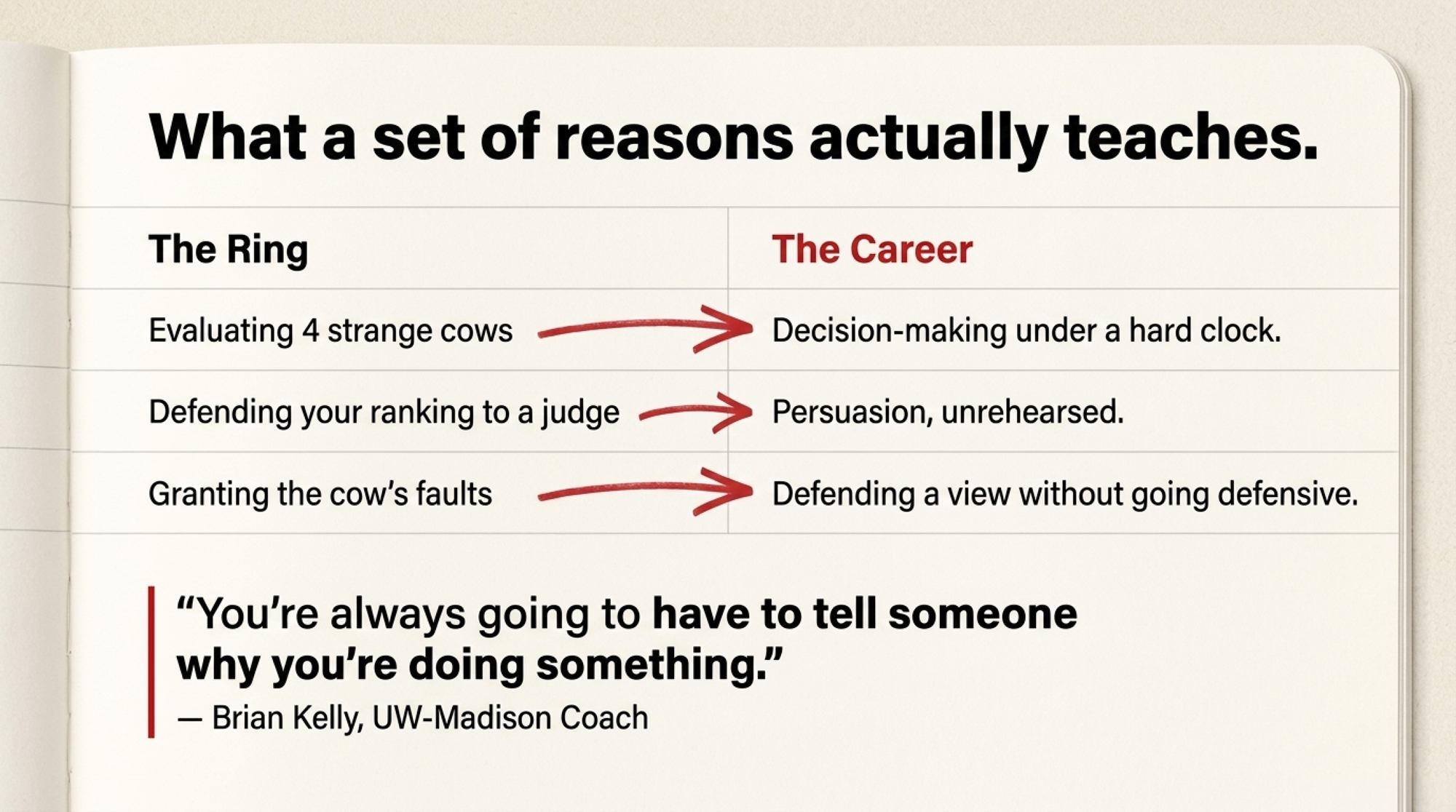
Watch what the drill actually builds:

Decision-making under a hard clock. You don’t get a week to deliberate. You gather what you can see, form a view, commit, and move. Bonnie Ayars, who’s held a staff appointment at Ohio State for 20 years, likes to point out just how little time the ring gives you. “You only get 12 to 15 minutes to make a choice on four cows,” she says — then, half-joking, compares it to picking a spouse. The point stands: it’s a system that teaches you to explain and justify a decision in a very limited timeframe.

“You only get 12 to 15 minutes to make a choice on four cows.” — Bonnie Ayars, The Ohio State University
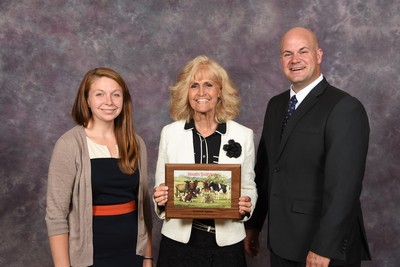
Bonnie Ayars, center, received the American Dairy Science Association's Hoard's Dairyman Youth Development Award in 2015, recognizing more than 40 years spent pulling kids into the dairy industry — the exact work this article is about. Hoard's Dairyman's Amanda Smith and Corey Geiger made the presentation. (Photo: Journal of Dairy Science)

Bonnie Ayars, center, received the American Dairy Science Association’s Hoard’s Dairyman Youth Development Award in 2015, recognizing more than 40 years spent pulling kids into the dairy industry — the exact work this article is about. Hoard’s Dairyman’s Amanda Smith and Corey Geiger made the presentation. (Photo: Journal of Dairy Science)

Persuasion, unrehearsed. You’re not reading a script. You’re building a case live, in a room where the listener has the authority to disagree and the knowledge to smell a bluff. That’s a job interview. That’s a sales call. That’s every high-stakes conversation that actually moves a career. “You have to be able to communicate,” Ayars says. “And if you don’t think you need communication, don’t become a parent — because eventually they become teenagers.”

Using discomfort instead of freezing under it. The unofficial reasons score — the one no ribbon reflects — is the moment you stand in front of someone who knows more than you do, say your piece, and hold your ground when they push. For most young people, it’s genuinely terrifying. Ayars has watched it turn kids around one set at a time, describing students who arrived convinced they couldn’t give reasons at all, went to the contest, delivered several sets, and came back changed by having done the thing they feared. Her measure of success isn’t the placing — the goal, as she frames it, is blue-ribbon kids more than blue ribbons.

Defending a position without going defensive. There’s a precise line in oral reasons between confident and combative — and learning to walk it is the whole game.

A good set of reasons grants the opponent’s real strengths honestly, then explains why the placing still holds. The grant earns trust. The pivot wins the argument. Now run that exact structure through a hard performance review, a lender meeting, or a disagreement with a herdsman who doesn’t want to hear it. Same move.

It’s the same discipline the best show judges preach: say what you see, keep it positive, three reasons not ten.

A 1997 Journal of Dairy Science paper said it flat out: dairy judging teaches critical life skills that carry across industries. Nearly three decades on, that hasn’t aged out — and the more recent research on youth livestock programs backs it, tracing durable leadership and communication gains straight to the structured stress of competition. It’s also why oral reasons carry roughly half the score in a modern contest — the industry figured out long ago that the talking isthe skill.

Ask the People Who Lived It
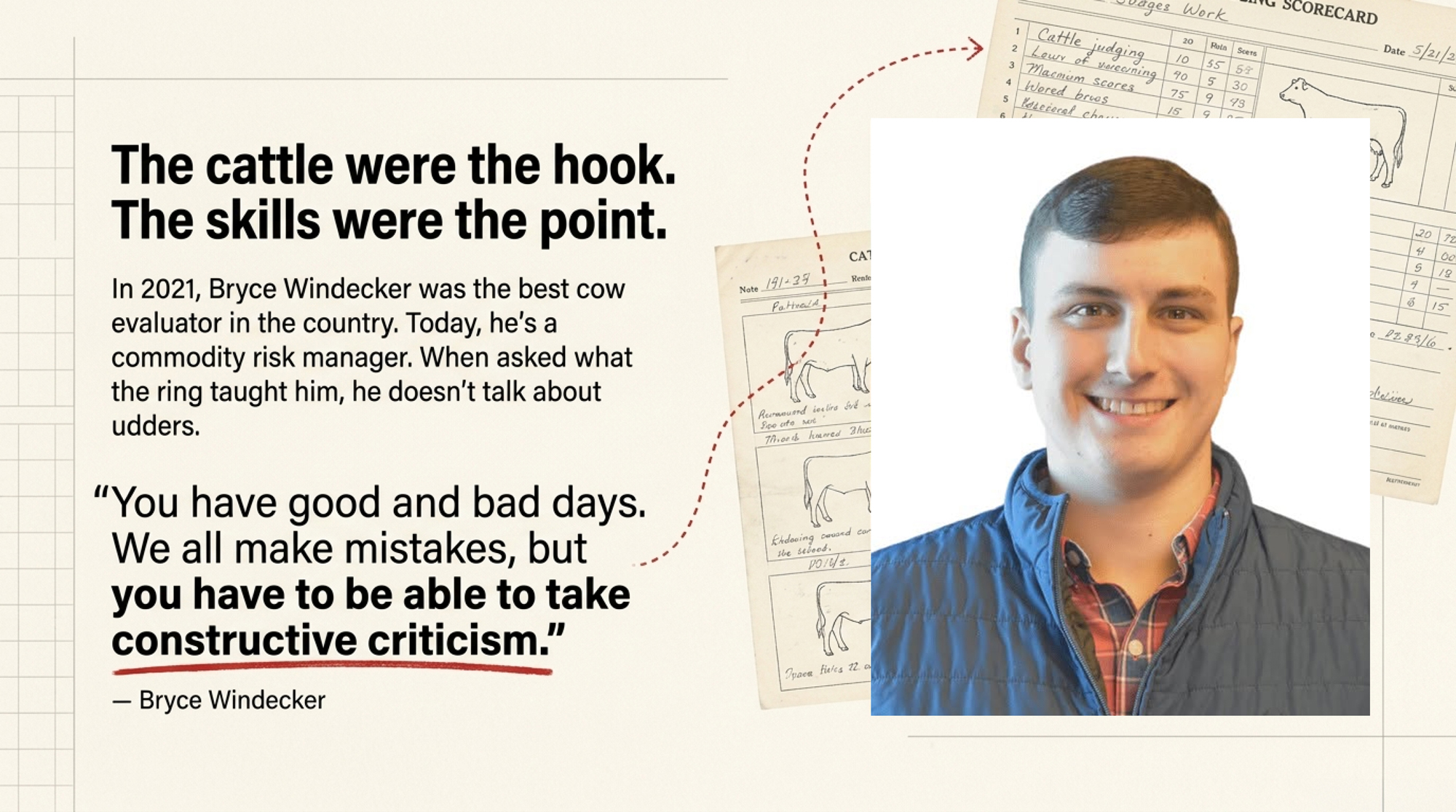
Bryce Windecker was named high individual at the 2021 National Intercollegiate Dairy Cattle Judging Contest — the best cow evaluator in the country that year. Ask him what it prepared him for, and he doesn’t talk about cattle. He talks about the bad days.

“You have good and bad days, and you have to take the bad days and learn from them. We all make mistakes, but you have to be able to take constructive criticism.” — Bryce Windecker, 2021 national high individual, now at ever.ag

He now works at ever.ag, a commodity brokerage and risk-management firm — a job that has nothing to do with picking the sharper udder and everything to do with the skills the ring drilled into him. “Talking and interacting with people, working with others, being a part of a team, having a boss or coach, working toward a common goal and getting a job done,” he told Progressive Dairy. “These skills are all developed in dairy judging.”

That’s the whole argument in one alum. The cattle were the hook. The transferable skills were the point.

The Team Dimension Nobody Fully Accounts For

Judging gets talked about as an individual skill. That misses half the value.

At the college level, teams run three to four deep and scores combine. Which means the result rides on everyone, not just the star. Somebody carries a rough day so the rest can score. Somebody watches a teammate post a personal best on the same class where they placed second — and celebrates it anyway.

“When we think about where we’re at right now, we’re in that team environment throughout the dairy industry — a lot of organizations are pushing that team environment,” Kelly says. “When you think about a judging team, there are relationships within that team. Combine that, and it’s just such a nice life lesson.” That dynamic — individual performance measured inside a shared result, week after week — is rare in structured training. Every dairy runs on it. So does every sire company, every co-op board, every management team. The judging contest is just the controlled environment where a kid rehearses it before the stakes get real.

The Networking Effect Is Bigger Than It Looks

For Madison Dyment, the ring wasn’t mainly about placings. It was about people.
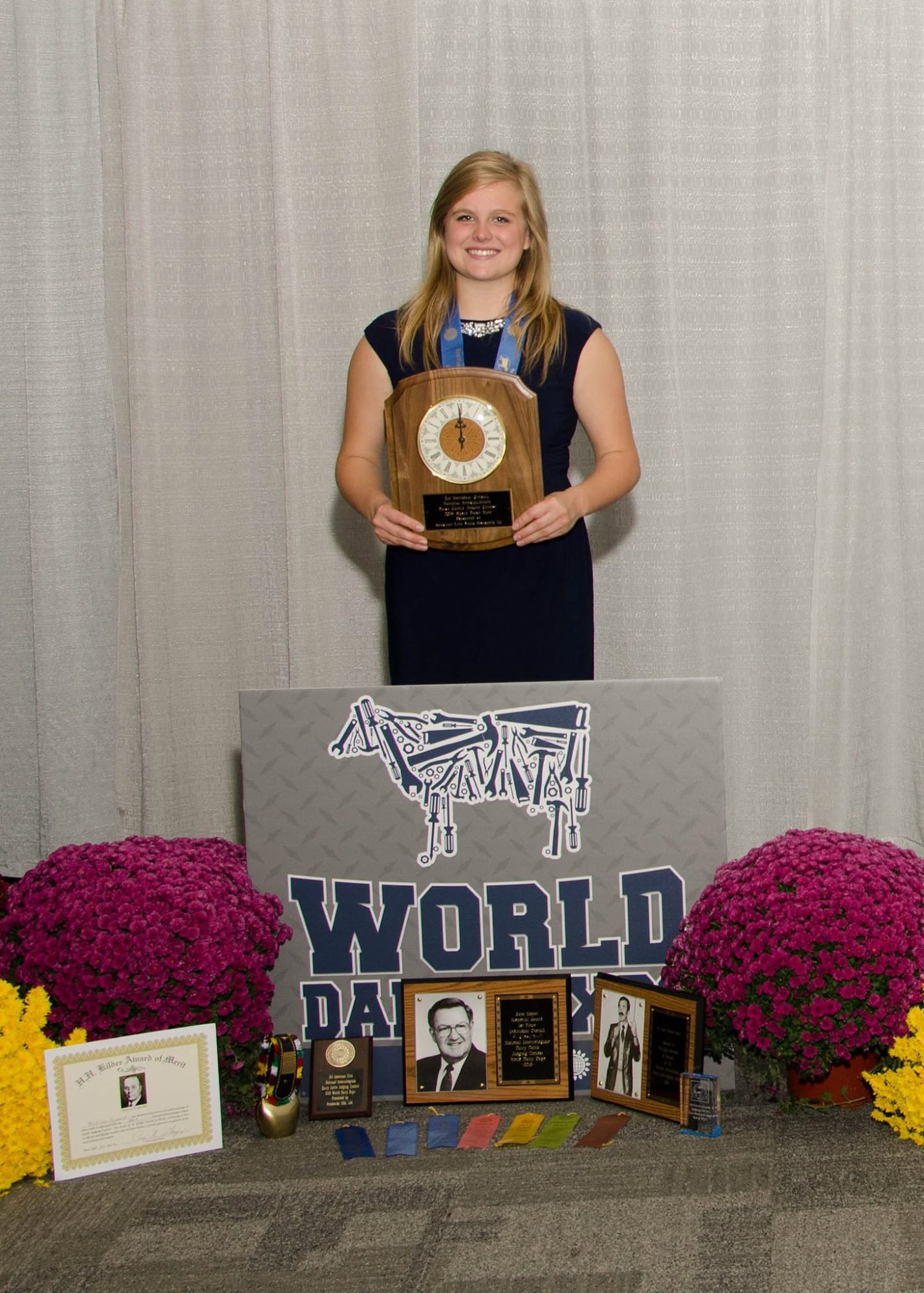
Madison Dyment competed for the University of Kentucky — a judging win there put her on Bonnie Ayars’ radar and set up the mentorship that led to grad school and, today, a professorship at New Mexico State. The ring built the network.

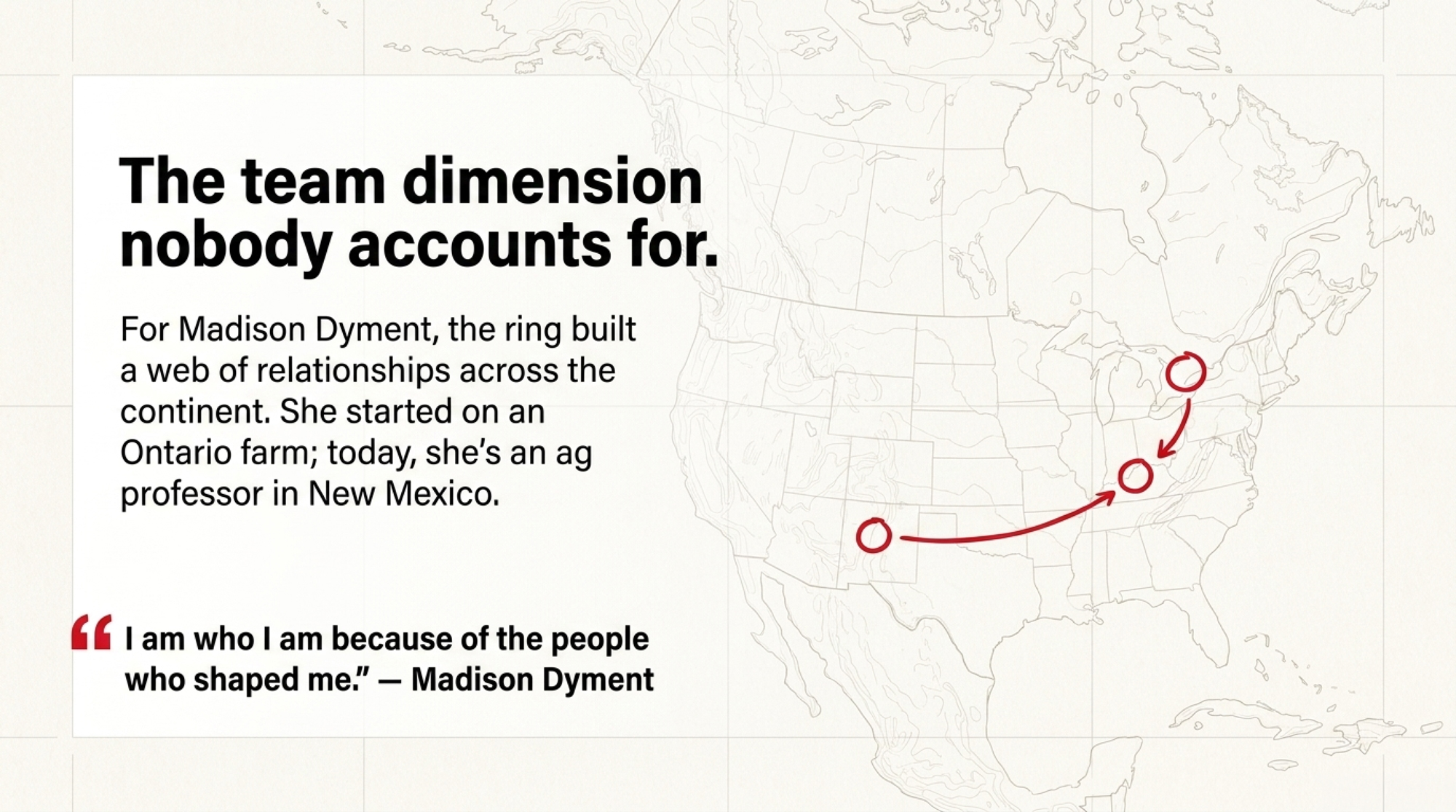
Dyment grew up in Burgessville, Ontario — “you can throw a stone in either direction and you’re probably going to hit a dairy farm” — competed for the University of Kentucky, and is now an assistant professor of agricultural communications at New Mexico State University. Her whole career traces back to a network the contests built. “One of the greatest things that I gained was access and networking with a lot of different people from all over the place,” she says. “You’re meeting kids from Illinois, from Ohio, from Wisconsin, California — for someone from Ontario, that was mind-blowing. These were people I wasn’t going to run across in my day-to-day life.” (Read more: From Calf to Classroom: Madison Dyment’s Journey to Impact Agricultural Communications in Canada)

That web of relationships is the part alums rank highest, and it compounds. “I can chalk up so many different opportunities to Bonnie alone — keeping me plugged in, mentioning me, encouraging me to go after things,” Dyment says of Ayars, who sought her out after she won at Kentucky and steered her toward grad school at Ohio State. “Ultimately, whenever I look at whatever success I’ve had, I am who I am because of the people who shaped me.”
Kelly draws the same line from the other side of the desk — as the guy doing the hiring. “I’ve hired some of them, I’ve managed some of them, I’ve worked with some of them,” he says of his former judging-team students. “When I’m looking at resumes, dairy judging is something I always look at, because I think they’re going to have those skill sets.” His advice to young people is disarmingly simple: ask questions. “If you can find someone that’s been successful and you want to follow that path, don’t be afraid to go up to them and start asking questions. You might develop a lifelong friendship.”

Ayars frames the payoff in language every operator should recognize.

“It’s not just like going to the bank and making a deposit. Dairy judging is an investment. It permeates every step of your life.” — Bonnie Ayars

The return horizon on that investment runs 10 to 30 years — compounding through every negotiation, every hard conversation, every hire a judging alum handles better than they otherwise would have.

The Barn Math on Not Building This

Now flip it. What does it cost the industry to not build this pipeline? That number isn’t theoretical.
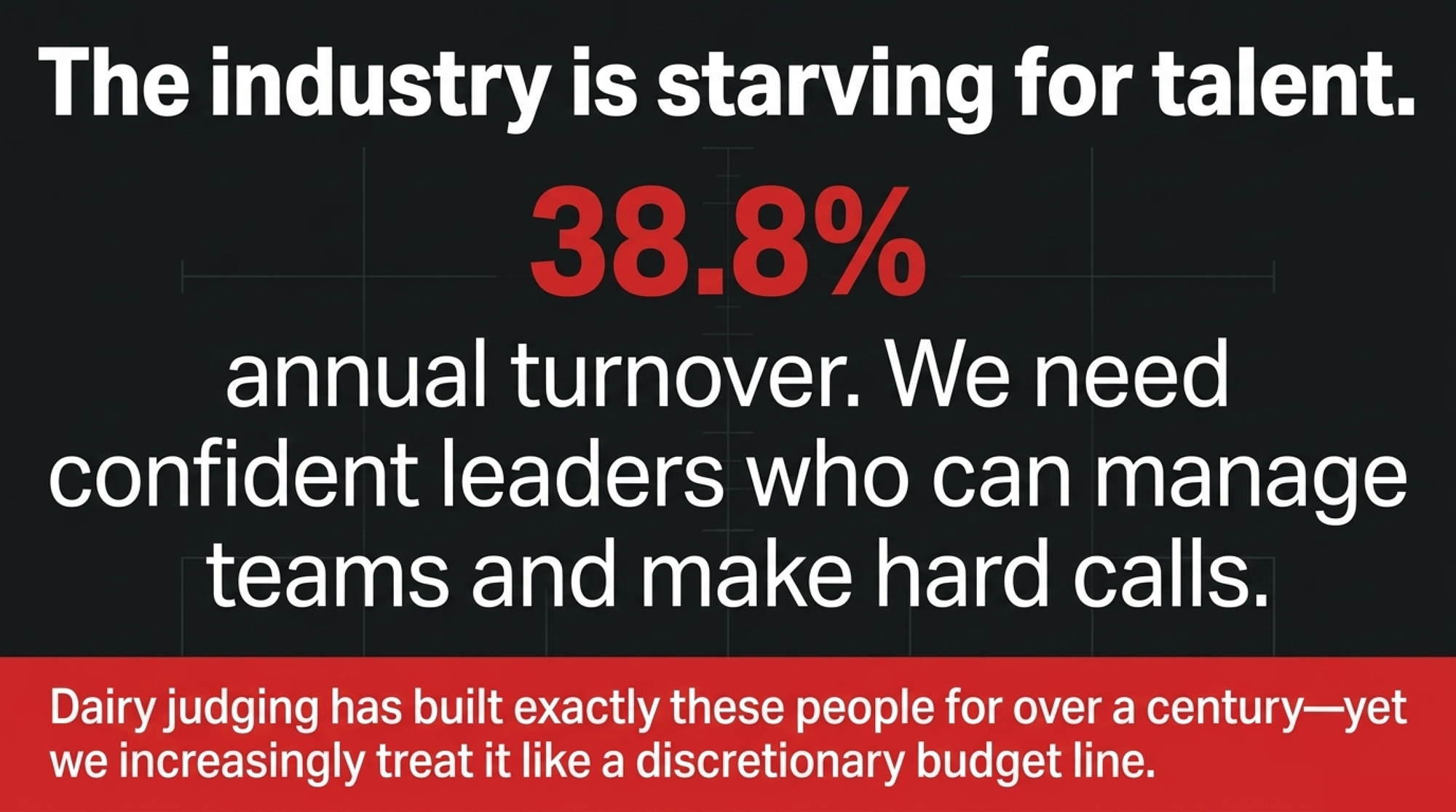
The average U.S. dairy runs turnover of 38.8% a year, according to the FARM Program’s Nationwide Dairy Labor Survey on Workforce Development — nearly four of every ten positions refilled annually. Cornell Extension’s cost framework puts each departed worker at $15,000 to $25,000 once you count recruiting, training, lost productivity, equipment damage, and quality slips. On a farm with 10 employees, that’s about four departures a year — $60,000 to $100,000 walking down the driveway, annually, a lot of it because people were hired without the communication skills, decision habits, and team instincts the job actually demands.

This is a leaking bucket. You can pour wages, benefits, and signing perks in the top, but if four of every ten hires walk out the bottom every year, you’re not staffing a dairy — you’re refilling a hole. And you plug that hole from the intake side: hiring and building people who can communicate, decide, and stick.
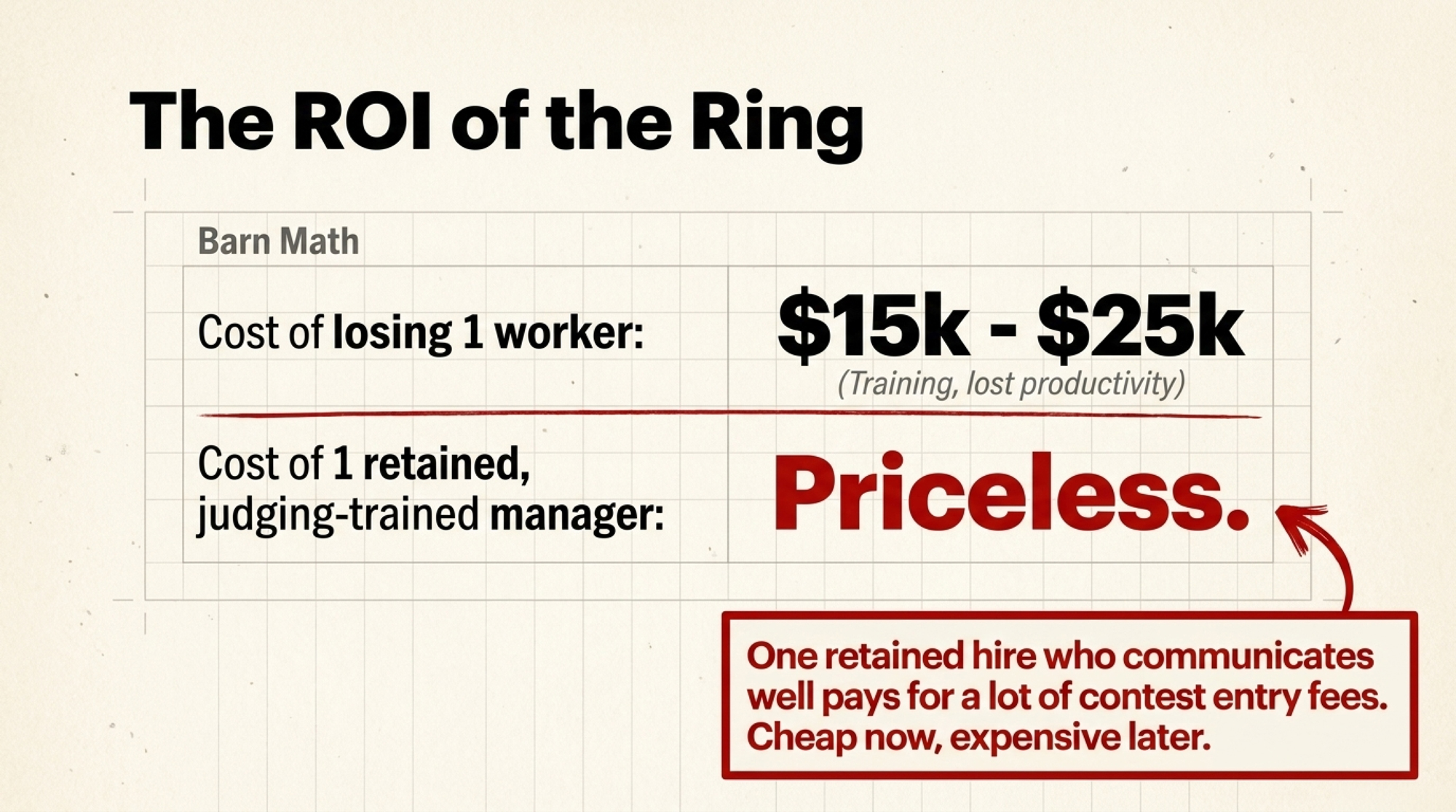
Here’s the ROI in one line: on that same farm, developing or hiring one judging-trained employee who sticks and leads well can offset an entire $15,000–$25,000 turnover event by itself. One retained hire pays for a lot of contest entry fees.

The cost of the gapFigureSource
Average annual dairy worker turnover38.8%FARM Workforce Development survey
Cost per departed worker$15,000–$25,000Cornell Extension framework
Annual turnover cost, 10-employee farm$60,000–$100,000Turnover rate × cost per worker
U.S. licensed herds, 2004 → 202466,825 → 24,811 (−63%)USDA ERS

Meanwhile the structural squeeze keeps tightening. U.S. licensed dairy herds fell 63% between 2004 and 2024 — from 66,825 to 24,811 — even as milk output climbed, according to the USDA Economic Research Service. Fewer, bigger operations mean each one runs more like a mid-size business and less like a family chore chart. Those businesses need managers who can lead people, defend a decision to a lender, and communicate under pressure.

That’s the exact skill set a judging kid spends years drilling. The industry is paying, right now, in six-figure turnover bills and thin management benches, for a talent shortage it has a proven, century-old answer to — and it’s under-investing in that answer anyway. Cheap now, expensive later. The bill shows up on a different line than you’d expect.

The Honest Catch

Here’s the part the cheerleaders skip: the pipeline is under strain at exactly the moment dairy needs it most. As ag colleges consolidate departments and squeeze budgets, funding a judging team — coaching stipends, travel, cattle access, entry fees — is increasingly treated as a discretionary line rather than a core one, and some smaller programs have quietly scaled back or dropped teams entirely. That’s the argument, not against it. If the machine that reliably produces communicators and decision-makers is being defunded while the workforce gap widens, the case for operators, breed associations, and alums to step in with sponsorship and access isn’t sentimental. It’s self-interested.

Seeing the Whole Industry Before Your Career Starts

Here’s something rarely said about judging contests: for a lot of participants, the first plane they ever board is for a judging trip.

Teams compete coast to coast — the All American in Harrisburg, Expo in Madison, Louisville, Fort Worth. The geographic reach isn’t incidental. It’s formative. A student who’s only ever seen big freestall Holsteins walks into a New England tiestall barn and starts to grasp that the industry is a spectrum, not a type. Dyment lived exactly that arc — Ontario, then Kentucky, now New Mexico, a state she was surprised to learn is one of the national leaders in cheese production. “People who are invested and passionate about dairy are everywhere,” she says, “even in the most unexpected places.”

She’s found a specific kind of talent in the places without award-winning herds down the road. “These folks have so much grit — a raw passion and determination, and they want to prove themselves,” she says of New Mexico’s dairy youth. “When I’m looking at kids I want to work with, I want the ones who are in it for the love of the game, not just because it was a family legacy expected of them.” Multiple farms, multiple breeds, multiple regions seen young — that compresses years of field exposure into a few contest seasons, and the graduate starts their career already fluent in an industry most people take a decade to see fully.

What the Canadian Model Gets Right

Ontario and Quebec youth programs are unusually strong feeders into elite judging and industry careers, and Dyment is a walking case study for why.

“I am so incredibly blessed to have been a byproduct of all of that youth programming,” she says. “You don’t really realize it until you’re gone from it, because it was just normal — it was what I did as a kid growing up. Once I was removed from it, you really come to appreciate how much investment is put in our dairy youth.” The Canadian model does two things better than most: it starts early, and it builds continuity across age cohorts instead of treating each year’s team as a blank slate. Holstein Canada’s Young Leaders program alone runs roughly 100 youth aged 12 to 21 through competitive judging, showmanship, and clipping every year, on top of 4-H programming that begins in childhood.

By the time a Canadian kid reaches the intercollegiate level, the reps are already banked — thousands of cows seen, hundreds of reasons given, contests lost and won and coached back from both times. That depth is why Canadian competitors routinely show up at U.S. contests and perform outside their home context. It isn’t talent alone. It’s a system that never lets a promising kid coast — the same 4-H leadership crucible The Bullvine has documented at events like the TD Canadian 4-H Dairy Classic, where the real lesson was never about the cattle.

The Coaching That Happens After the Contest

Experienced coaches will tell you, nearly to a person, that what happens after the contest matters more than the prep before it. The academic work agrees: youth livestock programs deliver their most durable benefits from the structured reflection and accountability that follow the competition, not from the competition itself.

A kid who won needs a different conversation than a kid who bombed. Both need a coach playing the long game — and both need someone willing to talk them out of their own fear first. “Most courage develops in fear,” Ayars says. “Nobody’s just courageous on their own.” She frames coaching as providing enough comfort for a scared kid to step out of a comfort zone — and describes education itself as a productive struggle, arguing that shielding students from that struggle robs them of its rewards.

Holding a group together through uneven outcomes, then pushing the scared kid out of the comfort zone anyway — that’s a leadership skill with a name in management research. In judging, it happens organically, repeatedly, under stakes that feel real to the kids living them, which is exactly why it sticks. A coach who does that well isn’t just producing judges. They’re producing managers, and the industry gets both.

The Ring That Builds Careers Is Still Open

There’s a skill gap in dairy that quietly worries serious people — not a gap in genomics knowledge or milking technology, but in the human pipeline. Fewer, larger operations need more managers who can communicate, decide under pressure, and lead a team, and the supply isn’t keeping pace.

Dairy cattle judging has been solving part of that problem for more than a hundred years. It’s proven. It’s everywhere. And measured against what it produces, it’s badly under-invested in by an industry that should know the difference between a deposit and a compounding return better than anyone.

The ring is open every fall. The only question is whether we fill it.

Your Next Move

  • If you own or manage an operation: weigh dairy judging on the résumés that cross your desk — it’s the line coaches like Kelly scan for, and it predicts communication, decision-making, and the steadiness of someone who’s been wrong in public and recovered. Then go further: call the nearest university or 4-H program and offer what they’re short on — cattle access, a practice venue, travel sponsorship, or a paid summer role for a team member. Strong communication is one of the cheapest retention upgrades a dairy can make; hiring someone who already has it is cheaper still.
  • If you have kids — or know one — curious about dairy: get them to the ring. FFA runs dairy judging in all 50 states, and the 2026 FFA Dairy Cattle Judging Contest at World Dairy Expo is set for Tuesday, September 29, with team registration open through September 11. The 4-H national contest runs the same week. It doesn’t matter whether they grew up on a farm — the non-farm kids with something to prove often go the furthest.
  • If you coach or teach: keep hunting for the kid who won’t self-select in. As Kelly’s own roster proves, the payoff shows up in unlikely places — he once coached a business major who’d barely judged since her 4-H days into an All-American finish; she now works finance in downtown Chicago. Both the farm-raised and the newcomers have something to prove. That mix is why the programs work — Ayars, by her own account, recruits promising judges “from under a rock.”

The 2026 National 4-H and Intercollegiate Dairy Cattle Judging Contests run during World Dairy Expo in Madison, Wisconsin, September 26–29, 2026.
Key Takeaways

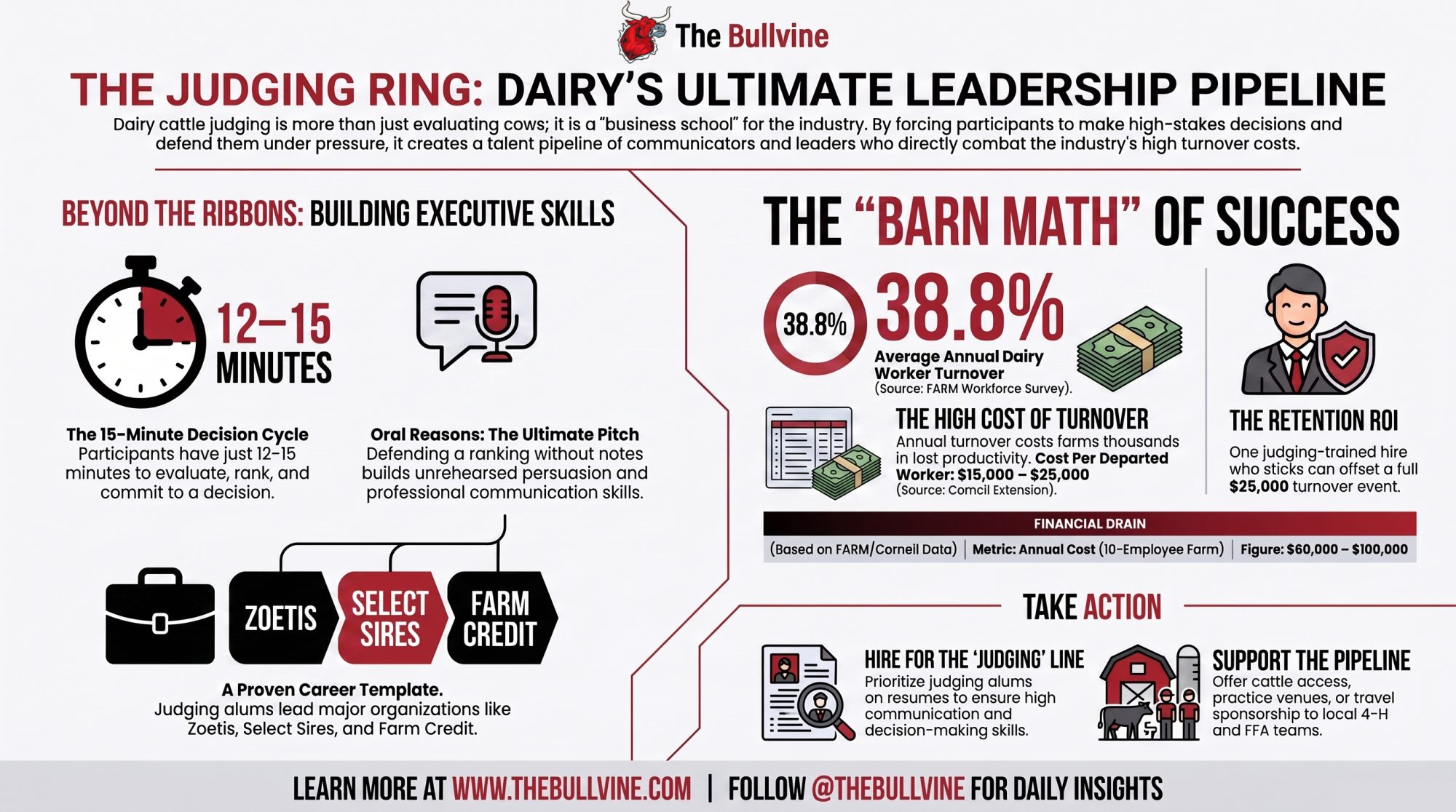
  • Judging isn’t about ribbons — it builds the communication, fast decision-making, and defend-your-position skills that later show up in every lender meeting, sales call, and hard barn-aisle conversation.
  • With turnover averaging 38.8% at $15,000–$25,000 a head, one judging-trained hire who sticks and leads can pay back a full turnover event by itself. Weight it on resumes.
  • The pipeline that produces those people is getting defunded as colleges cut teams. If you run cattle, offer a program what it’s short on — access, a practice venue, or travel money.
  • Get a kid to the ring this fall, farm-raised or not. FFA runs judging in all 50 states, and the non-farm kids with something to prove often go the furthest.

Related reading on The Bullvine: The Judge’s Eye: Mastering the Art & Science of Dairy Cattle Evaluation · Judge With Confidence: The Ultimate Playbook for Dairy Cattle Judging · Words That Win: How Elite Dairy Judges Master Oral Reasons

The Sunday Read Dairy Professionals Don’t Skip.
Every week, thousands of producers, breeders, and industry insiders open Bullvine Weekly for genetics insights, market shifts, and profit strategies they won’t find anywhere else. One email. Five minutes. Smarter decisions all week.
NewsSubscribe
First
Last
Consent

Judge With Confidence: The Ultimate Playbook for Dairy Cattle Judging

Judge the cow in front of you—not the crowd. Internationally renowned Judge Callum McKinven shares his no-nonsense ringcraft for young judges: move, see, decide, explain.

You know that feeling when you watch a master at work? That’s what happened in Ecuador this year when Callum McKinven stood in front of a room full of judges—some with decades under their belts, others just getting started. He was 19 when he walked into his first ring, with show organizers expecting a 40-year-old man. Fast-forward four decades and 32 countries later, and here’s what strikes me about his approach: it’s deceptively simple, brutally honest, and absolutely revolutionary in how it cuts through the politics that can poison a show ring.

The thing about confidence—real confidence—is that it’s not some mystical quality you’re born with. McKinven teaches that it’s discipline. Pure and simple. And after watching his system work everywhere from the formal protocols of English shows to the warm hospitality of South American venues, I can tell you this much: the industry’s top judge doesn’t drift around looking for approval from the bleachers. He doesn’t give past champions a free ride because they’ve been winning. And he certainly doesn’t stand there fumbling through memorized speeches when it’s time to give reasons.

What you’re getting here isn’t theory—it’s McKinven’s working playbook from that Ecuador clinic, the kind of stuff you can actually use this weekend at your county fair. Pre-show discipline that prevents public mistakes. Ringcraft that builds exhibitor trust instead of destroying it. His evaluation pattern that keeps you consistent whether you’re judging five animals or fifty. The reasons strategy that wins respect instead of starting arguments. His youth-class approach that actually builds the next generation. And yes… the ethics that let you sleep well on the plane home afterward.

Here’s the quiet part we’re saying out loud: the crowd isn’t your boss. McKinven proved it. Now let’s see how he does it.

“The farther back you are, the better you can see them,” McKinven teaches. Keep that in your back pocket. Trust me, we’ll circle back to it.

What does it take to judge with confidence? Callum McKinven, pictured here in Ecuador, shares his no-nonsense approach to ringcraft that cuts through the noise and focuses on the cow in front of you.

Show Up Ready, Not Lucky—Because Reputation Travels Faster Than Luggage

Look, we’ve all been there. You get the call to judge, say yes, then life happens, and suddenly you’re scrambling. McKinven’s refreshingly honest about this—he jokes that his wife is the only reason he makes it to shows because she’s the organized one who actually writes dates down. But here’s his non-negotiable fix, and I’ve seen too many careers damaged to ignore it: when you accept a judging assignment, write it down immediately. Not tomorrow. Not when you get home. Right then.

Missing shows isn’t an “oops”—it’s unprofessional. And in our industry, where your reputation travels faster than your luggage, you simply can’t afford that kind of mistake.

Here’s what’s interesting, though… most judging problems get solved before the first class walks in. McKinven emphasizes arriving at least 30 minutes early—more if you’re dealing with fairground parking and those gate delays we all know too well. Why? Because early gets you the things that prevent public embarrassment: a quick chat with ring stewards about traffic flow, a walk-through to figure out where you’ll stand for reasons, a mic test so you’re not chasing feedback squeals all day.

The World Dairy Expo Lesson Nobody Talks About

Speaking of embarrassment… McKinven learned about footwear the hard way. Picture this: World Dairy Expo, two breeds, 900 head to judge. He shows up in brand new shoes. By the end of the day, his wife had to pull those blister-inducing shoes off his feet. Now he tells everyone: “Wear something that looks proper but feels comfortable—you’re not going to be thinking about the animals if your feet are killing you.”

That story gets a laugh at clinics, but there’s a deeper point to it. The details matter. Dress like the judge—not because you need to wear suits in a stockyard, but because you need to be easily recognizable. McKinven’s judged everywhere from formal English shows (a tie is required) to relaxed South American venues, and the principle remains the same. Look the part. Look prepared.

The confidence piece? McKinven stresses being “confident but friendly”—especially with youth classes. Smile. Say good morning. Lower the temperature in the ring. You’re not the sheriff; you’re setting the standard. There’s a difference, and exhibitors feel it immediately.

“You want to be confident but don’t look cocky. Be yourself with the people, be nice with the people in the ring. Don’t give the impression that you’re this scary guy.” —Callum McKinven

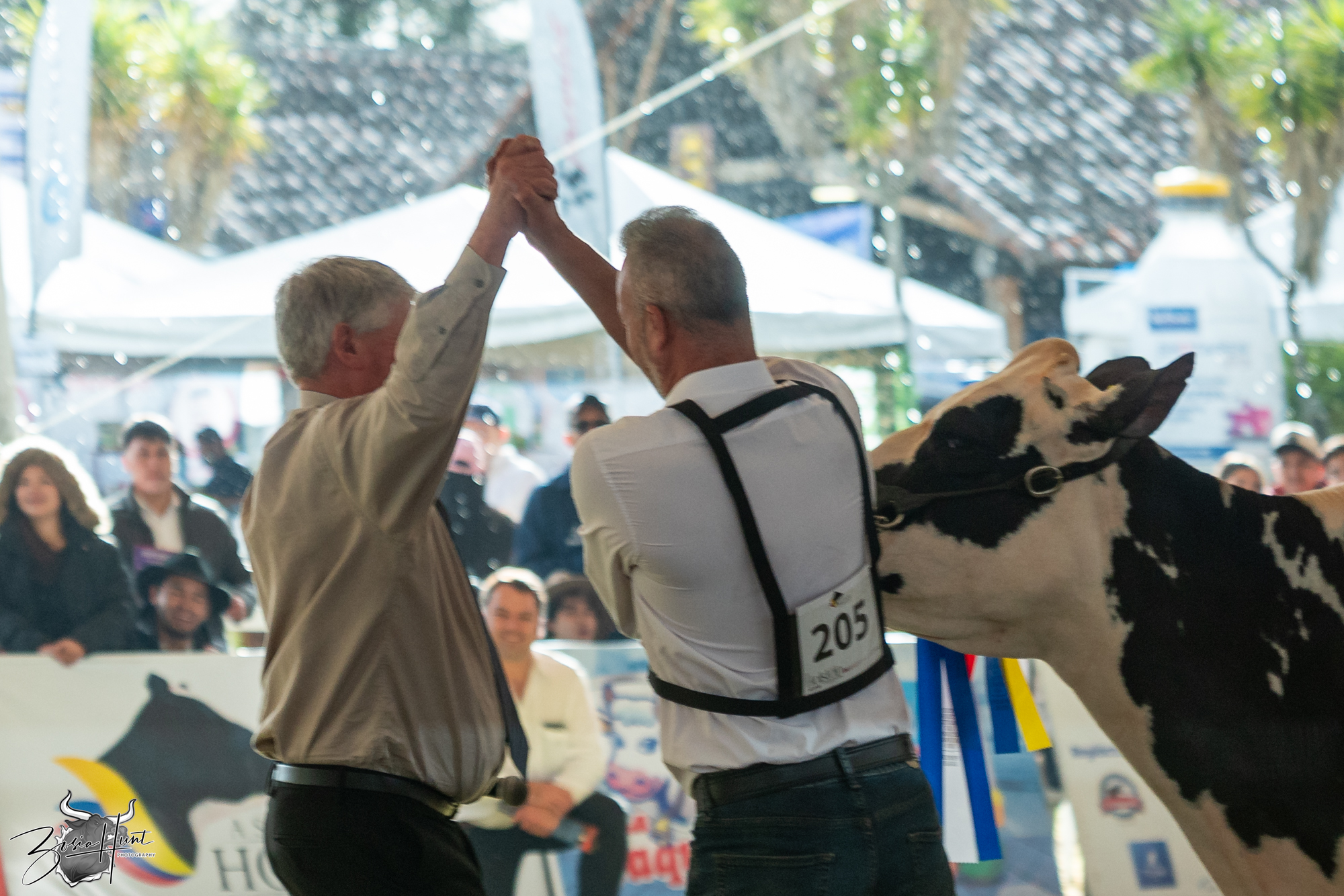
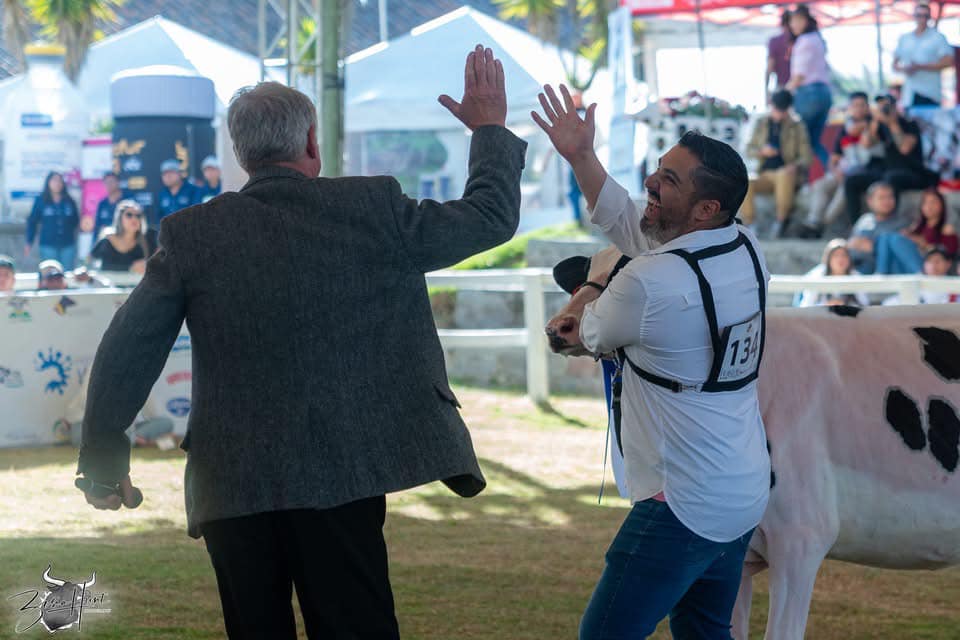
Ringcraft in action. A high-five seals the deal for the Junior Champion Holstein in Ecuador, demonstrating that a judge’s role includes not just placing cows, but building confidence and respect with exhibitors.

Keep the Ring Moving, Keep the Trust—Why Speed Is Everything

Here’s something McKinven learned from over 40 years in the ring that never fails: taking too long causes exhibitors to lose confidence in your process. Go too fast, and they won’t believe you actually looked. Finding that sweet spot is what separates good judges from great ones.

I remember McKinven telling the Ecuador group about his first show—36 animals in his class while an experienced judge in the next ring was still sorting five. He was done giving reasons while the other guy’s animals were still circling. Maybe he went too fast that day, but here’s what he figured out: scratching your head or hesitating reads like uncertainty to exhibitors, and uncertainty makes everything harder, especially when it’s time to give reasons.

What’s fascinating about McKinven’s distance approach is how simple it is. Start wide. The farther back you stand when animals enter, the better you’ll see balance, flow, and obvious outliers. It’s not dramatic—just effective. And this is crucial: let them move. Big classes are impossible to judge fairly if you don’t get motion, and McKinven insists on this.

The Ring Flow Reality Check

Here’s McKinven’s system broken down by class size—and this comes straight from watching him work:

Small class (5-10 animals)? Stand back and see them all. Sort decisively. No head-scratching. Keep reasons tight—three traits, done.

Medium class (10-20)? Get your top three or four in mind early, then work methodically without losing the rest. Create space to watch movement. Double-check borderline calls with one more circle.

Large class (20-30+)? This is where it gets tricky. Pre-plan traffic with the ring crew. Stage the first sort fast. Insist on motion—every animal needs to be seen moving at least once. Find the obvious last if it’s truly obvious, but don’t force it.

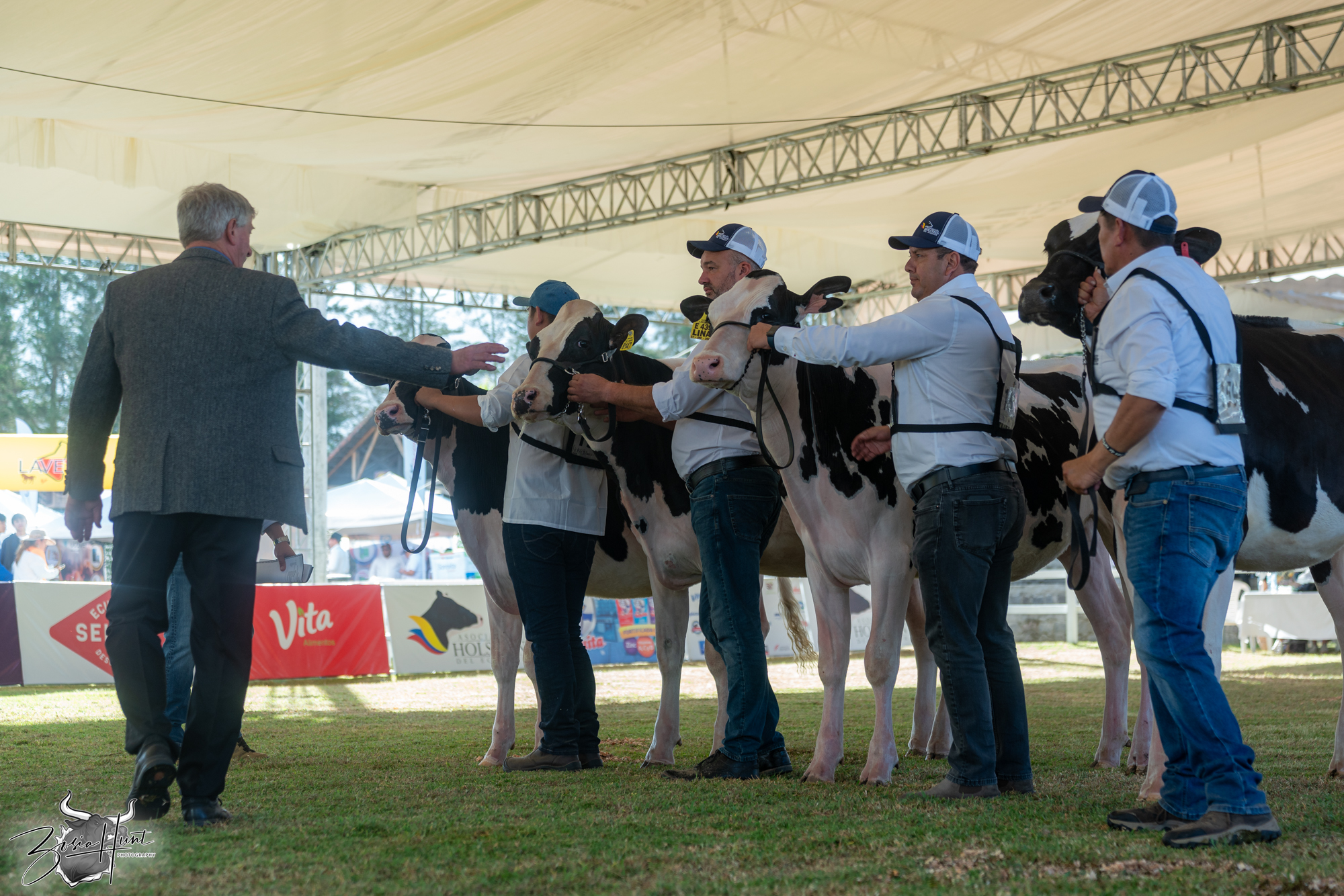
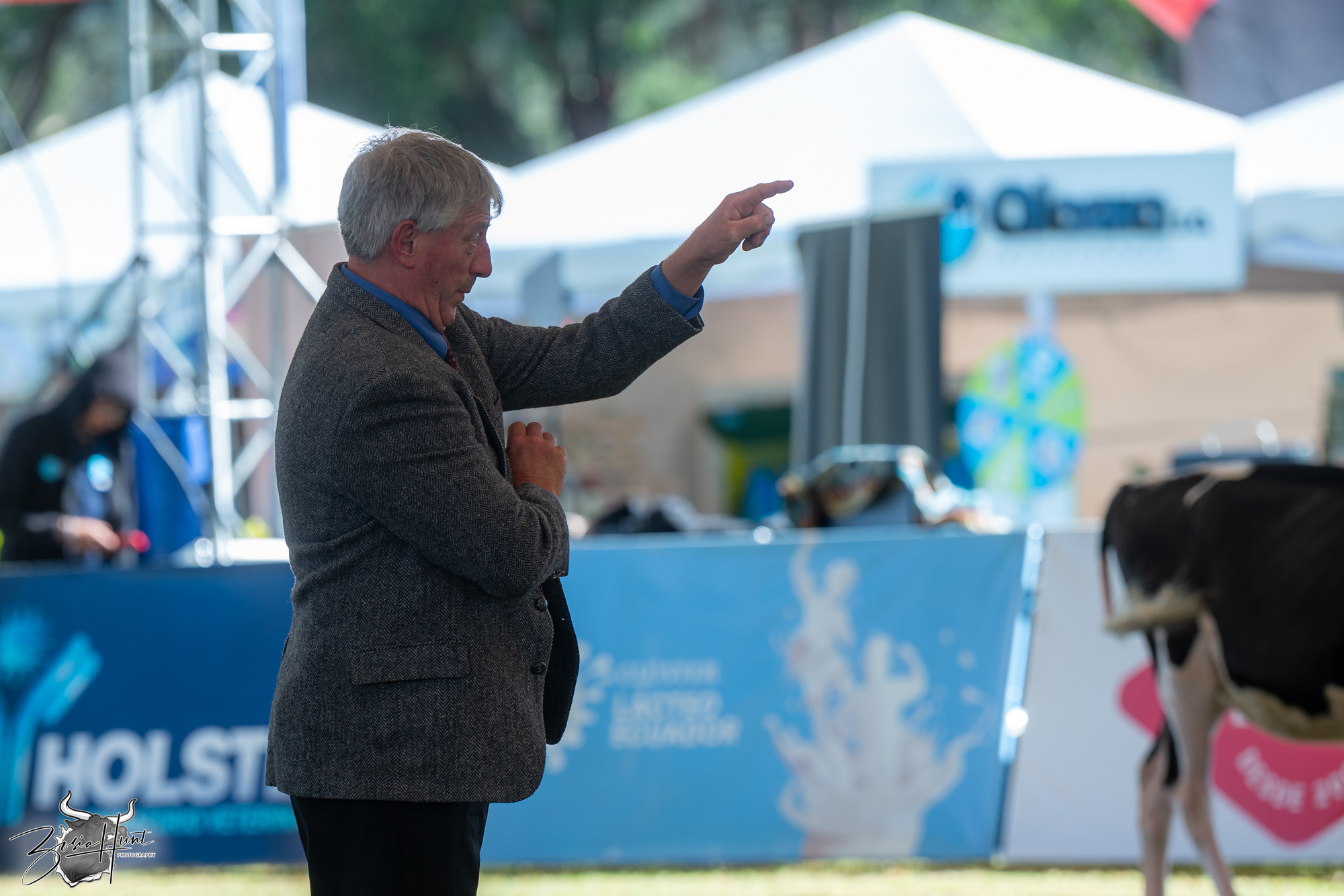
No room for doubt: McKinven’s emphatic point ensures exhibitors know exactly which animal is being asked to move, minimizing confusion and maintaining ring flow.

Point clearly when you pull. McKinven can’t stress this enough. If your gesture is vague, two cows step forward, and one shouldn’t be moving. That’s on you. And when you do miscue—because we all do—fix it fast and discreetly. Signal the mistaken one to hold without making a scene. The job is placing cows, not embarrassing people.

And here’s McKinven’s cardinal rule that separates him from judges who get caught up in politics: keep your eyes off the stands. It’s amazing how quickly a head shake from someone you respect can mess with your confidence. Don’t look. You’re judging today. You earned that center ring position—use it.

A Pattern You Can Repeat from Wisconsin to Ecuador

What strikes me about great judges—McKinven included—is how predictable their process is. Not their outcomes, but their approach. McKinven maintains a consistent pattern, so exhibitors learn what he values by the end of the day. That consistency builds trust, even when people disagree with individual placings.

I watched him work through this in Ecuador, pointing to a cow and saying, “Look at that chest—that’s a good example of what I want.” He’d already made his first read from distance: balance. Front-to-rear symmetry, nothing top-heavy, nothing sinking behind the shoulders. Then that chest width check. He told the group that he could immediately see whether a cow would do well if everything else held up.

McKinven’s Walk-Through Pattern (The Real Deal)

Here’s exactly how McKinven teaches it, and I’ve seen this work in rings from Ontario to New Zealand:

  • Side profile and topline: Length and straightness without stiffness. Dairy neck—long, clean, feminine head. No fuss, no exaggeration.
  • Feet and legs: Strong pasterns, good heel depth, tracking true. And here’s what separates McKinven from textbook judges—locomotion under pressure matters. Don’t just stand still and evaluate.
  • Rib structure: Spring and drop of the rib, with openness that avoids slab-sidedness. That angular “dairy” character shows up in more than one place—front end, rib, loin.
  • Bone quality: Flat bone, clean joints, not coarse. McKinven notes how bone reads under good skin tells you about longevity and efficiency (and yes, we all see more of this with cows on different rations).
  • Mammary system: Fore udder blending cleanly into the body wall, rear udder height and width, a clear median suspensory ligament, and square teat placement.

He’ll even note muzzle width as a positive signal for head width and overall strength. It’s one of those details you hear old-timers mention because they’ve watched it correlate with cattle that actually work and last.

The Regional Reality

Here’s the nuance I appreciate about McKinven’s approach—he adapts his lens without changing his standard. In some countries, you won’t see the same depth you’d expect from a North American spring pasture. Feed conditions, heat stress, forage availability… call it what it is. “I still look for the same pattern every country I go to,” McKinven explains, “but if it’s a country where the cows aren’t going to be as deep, I’m making the best of what I see”.

You still run your pattern, but you judge within that day’s reality. That’s dairy farming, not pageantry.

Stop Memorizing, Start Seeing—The Mic Moment That Changes Everything

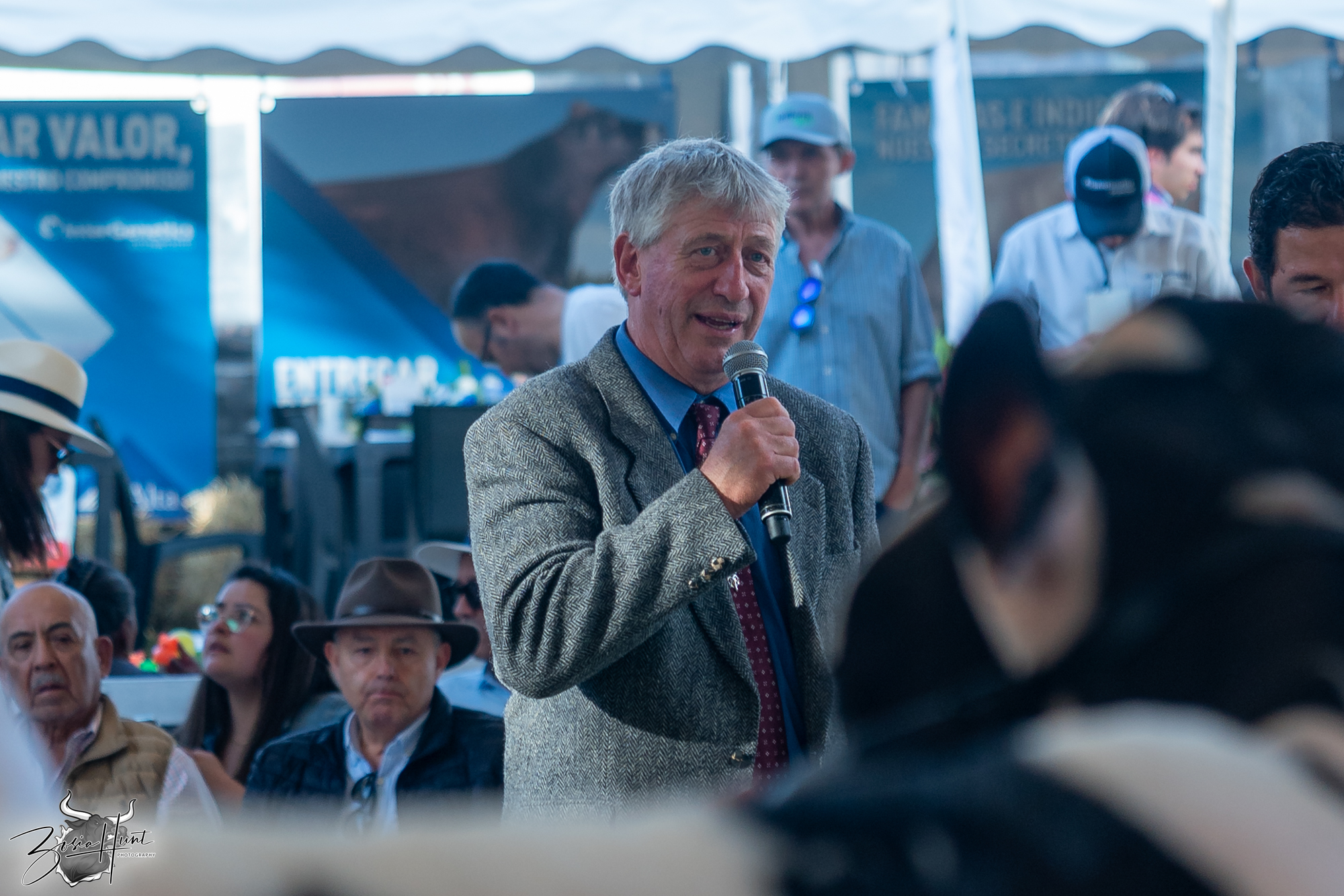
The moment of insight: Addressing the crowd in Ecuador, Callum McKinven prepares to deliver his reasons, a crucial part of the judging process he believes should be driven by visual assessment.

“Don’t try to memorize your reasons,” McKinven teaches, and this might be the most important sentence in this entire piece. “Your eyes tell you what to say when you judge those animals.” If you’ve ever blanked at the mic—and we all have—you know exactly why he puts it this way. He attempted to memorize early in his career. It backfired completely.

I love this story from his early days: first class, trying to remember his prepared speech, and he’s standing there like, “Oh, these first… six, nothing.” Goes to the mic, trying to remember what he was going to say instead of just looking at what was in front of him.

The fix is deceptively simple: look at what you’re talking about while you talk about it. McKinven insists on this. Your brain and eyes sync under pressure when the animal becomes your teleprompter. “When those animals come out, you’ll know she’s got flatter, nicer bone quality, she’s longer in her neck because she’s got a better fore attachment.”

The Language That Actually Works

McKinven’s approach eliminates lazy phrases that teach nobody anything. “Nicer legs” is meaningless. “Stronger pasterns, tracking truer on the turn, with flatter bone quality” is an honest and helpful description. “Better udder” tells exhibitors nothing. “Higher and wider at the rear attachment, stronger cleft, more secure fore udder blend to the body wall” tells them exactly what you valued.

Here’s McKinven’s framework you can steal today—and I mean literally write this down:

Frame it: “I place one over two for her advantage in [trait A], [trait B], and [trait C]…”

Trait bank: rear udder height/width; fore udder blend; teat placement; median suspensory strength; pastern strength; heel depth; tracking; spring and drop of rib; angularity; chest width; neck length; topline

Positive close: “I admire the dairy character of two and recognize her length, but today one carries the advantage in udder attachments and locomotion.”

McKinven keeps it to three reasons per animal. Not ten. Crisp, observable traits—no lengthy explanations. And here’s something he emphasizes that I wish more judges understood: keep it positive even when contrasting. You can acknowledge the second cow—”a very dairy cow” or note “her clean neck”—right before explaining why the first has the advantage.

The exhibitor standing at the bottom deserves to hear something good. They brought an animal, paid entry fees, and helped fill your class.

“You never talk bad about the cows, you talk positively about the cow. I always try to say something positive about every cow.” —Callum McKinven

Youth Classes—Where Futures Get Built or Broken

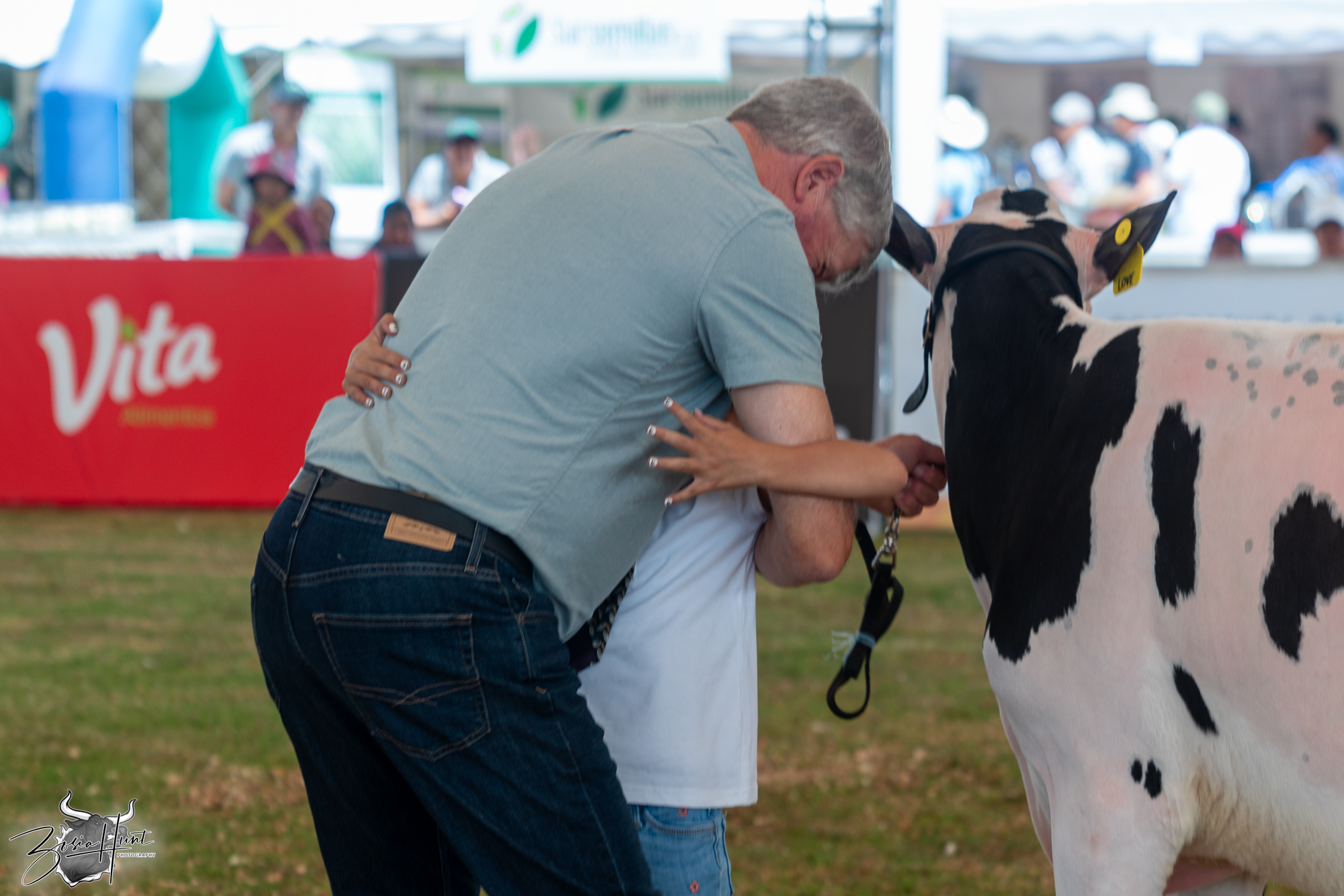
A moment of pure joy: After being named champion, a young exhibitor in Ecuador embraces Callum McKinven, who quickly secured her calf in a touching display of connection.

Walk into a youth class looking like security, and the kids shut down. McKinven’s learned this over four decades of working with young exhibitors. Try a smile and “Good morning.” It’s remarkable how quickly shoulders drop and eye contact returns.

Here’s a moment that stuck with me from the Ecuador clinic: McKinven talking about getting on his knee to talk eye-to-eye with really young kids. “If I see them start to cry, I make sure I say, ‘You did a great job, you could be up the line very easily, it’s just that little thing.’ I judge young people to make sure they don’t cry.”

That’s not going soft—that’s building the industry’s future. A harsh critique tears down a future exhibitor. Constructive guidance builds one up.

The “Bottom Six” Strategy That Changes Everything

For big youth classes—and we’re talking 25+ kids here—McKinven has a specific strategy that every judge should steal. Don’t leave one kid standing last, as if they’re wearing a scarlet letter. This is what he actually says: “Last six, just come on in, just come on in the middle.” Then he goes down and tells them, “You’re all equal here, you just need improvement on these things to be up the line so that one standing on the end doesn’t say ‘Well, I was last.'”

They heard you. Their parents did too. You just saved a family from a tough ride home and probably gained a fan for the show.

This takes time—even for judges known for speed like McKinven. But he makes time for kids because the payoff isn’t a ribbon today; it’s a ring full of confident, skilled handlers five years from now.

Judge the Cow That Walked In Today—Not Her Instagram Feed

“If you think she’s third place that day, or second place, and you can support it with reasons, you do it,” McKinven teaches. That line puts steel in your spine when a past grand champion walks in looking off her game.

I’ve watched this play out more times than I care to count. The famous cow enters. Maybe she’s won four or five shows in a row. Everyone knows her. The crowd’s watching for your reaction. Here’s where most judges either cave to pressure or overcompensate by beating her just to prove they can.

The handshake that matters. In a ring filled with top-tier cattle, Callum McKinven selects his Grand Champion Holstein, recognizing a cow that exemplifies breed character and functional excellence.

McKinven’s approach is different: you don’t beat her to make a point, but you also don’t float her to first on nostalgia. You judge the cow in front of you today. Reputation fills barns; it can’t place classes.

The Politics-Proof Protocol

Here’s how McKinven actually handles reputation pressure—and this comes from watching him navigate some pretty loaded situations:

  • Eyes on animals, ears tuned to your own pattern
  • When the barn wants to debate later, give them observable reasons
  • Walk them through udder attachments, locomotion, rib structure, and balance
  • Even people who disagree will understand they were judged, not performed for

“Don’t be intimidated,” McKinven tells judges, “because you might get asked to judge more shows when people recognize politics didn’t sway you—you just placed what you saw that day”.

Judging Across Borders—Fit the Culture, Keep the Standard

What’s fascinating about McKinven’s international experience—32 countries and counting—is how he adapts his approach while maintaining his core standards. This isn’t theory; it’s survival as a traveling judge.

England expects formality. Minimal socializing before the day, tight protocols, careful conduct. You might not see anyone except when you arrive to judge. Much of South America? Completely different. They want to take you to dinner, meet the exhibitors, and have a few drinks. It’s warmer, more social—the show starts the night before.

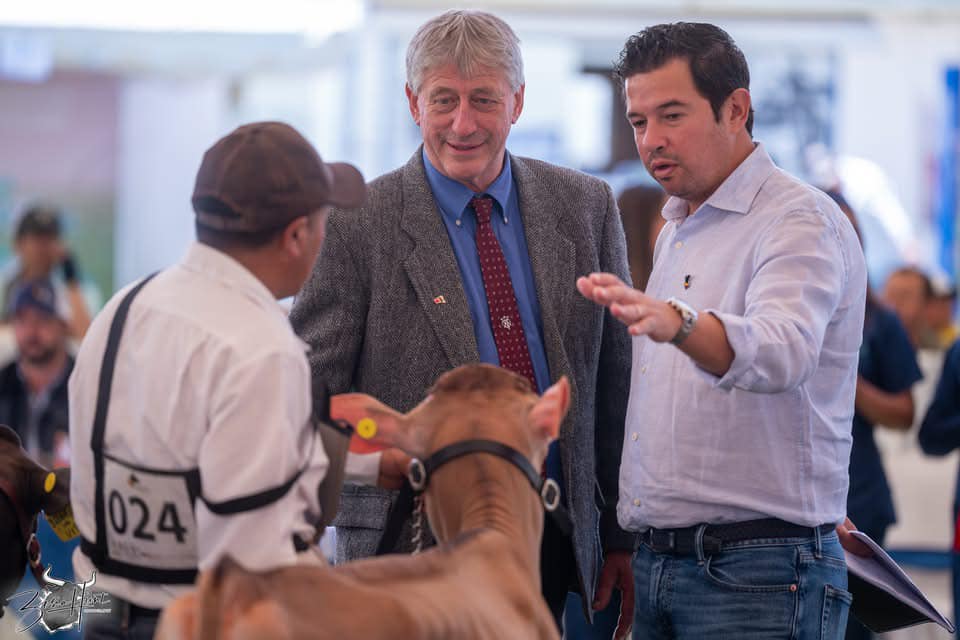
This is where trust is earned. Not just with a microphone, but in one-on-one conversations. Callum McKinven discusses the finer points with exhibitors, making every class a learning opportunity.

The Pre-Travel Protocol That Actually Works

McKinven’s learned to ask organizers upfront about local expectations. Here’s his actual checklist (and I’ve started using this myself):

  • Contact timeline: When to arrive, buffer time for traffic/delays
  • Dress expectations: Formal vs. casual, cultural considerations
  • Social obligations: Dinners, meet-and-greets, isolation protocols
  • Ring setup: PA systems, translator needs, photo opportunities
  • Show flow: Class sizes, timing, steward communication style

Set your pre-show routine regardless: arrive early, walk the ring, test the microphone, identify where you’ll pull animals, and deliver reasons. Adjust your demeanor to match the culture, but keep that evaluation pattern consistent so exhibitors quickly understand what you value.

In regions where environmental conditions affect cattle—such as heat stress, limited forage, and varying feeding systems—McKinven doesn’t penalize the animals for not meeting ideal conditions. He prioritizes function: feet and legs, udder structure, overall balance. Because that’s what works in the real world.

The Stuff That Actually Matters (And Why Most Judges Miss It)

McKinven learned at his father’s kitchen table—”give me a set of reasons” became a daily drill when he was eight years old, looking at magazine photos. Then he married into more mentorship through his father-in-law, who McKinven credits as one of the world’s best judges.

But here’s what separates his approach from the textbook stuff: the technical details matter more than you’d think. McKinven had to learn where to hold the microphone to prevent feedback and where to stand so the reasons came through clearly. That’s professionalism—respect for exhibitors trying to hear and learn from your decisions.

Practice Like Your Reputation Depends On It

Practice reasons in real life, McKinven suggests. You’re milking and comparing two cows? Say it out loud: “This cow’s got deeper rib, stronger pasterns. That cow’s better fore udder attachment.” When adrenaline hits in the ring, practiced language shows up exactly when you need it.

I started doing this after hearing McKinven talk about it, and honestly? It works. Your brain gets comfortable with the language of evaluation when it’s not under pressure.

The McKinven Method: Your Next-Show Playbook

Putting the method into practice: Callum McKinven guides a class in Ecuador, demonstrating the principles that form the basis of his practical “Next-Show Playbook.

Here is Callum McKinven’s complete system, consolidated into a single checklist you can use to prepare for your next show.

Part 1: The Preparation (Before You Leave Home)

  • Lock it Down: The moment you accept an assignment, write it down.
  • Do Your Homework: Contact the organizers to inquire about the dress code, cultural expectations, and the show’s schedule.
  • Pack Like a Pro: Pack broken-in, comfortable footwear and backup socks. Check the weather and pack appropriate attire.
  • Practice Your Language: Rehearse descriptive reasons during daily chores until it becomes automatic. Watch recorded shows to anchor the language to visuals.
  • Get Good Sleep: Don’t underestimate the power of being well-rested.

Part 2: The Arrival (The First 30 Minutes)

  • Arrive Early: Arrive at least 30 minutes before your scheduled start time.
  • Connect with Your Crew: Introduce yourself to the ring stewards and briefly discuss your ring flow and pointing style.
  • Walk the Ring: Check the footing, sight lines, and traffic patterns.
  • Do a Mic Check: Find the optimal position for giving reasons where you can be heard clearly without feedback.

Part 3: The Ringcraft (During the Show)

  • Start Wide: When a class enters, stand back to see the big picture—balance and flow.
  • Insist on Movement: Ensure every animal is seen in motion.
  • Find Your Rhythm: Don’t rush, but be decisive. Eliminate wasted motion and second-guessing. A confident rhythm builds exhibitor trust.
  • Point Clearly: Make your gestures unambiguous. If you make a mistake, correct it quickly and discreetly.
  • Follow the Pattern: Stick to your evaluation pattern (Distance → Chest → Profile → etc.) for consistency.
  • Use Your “Trait Bank”: Give a maximum of three specific, observable reasons. Use positive language, even for lower placings.
  • Judge Today’s Cow: Ignore reputations and crowd noise. Never look at the stands. Judge only the animal in front of you.

Part 4: The Youth Class Approach

  • Lower the Temperature: Smile, say good morning, and make eye contact.
  • Encourage and Teach: Take extra time to explain. Focus on specific, constructive improvements.
  • Use the “Bottom Six” Strategy: For large classes, group the bottom exhibitors and give them shared, positive feedback to avoid singling anyone out.
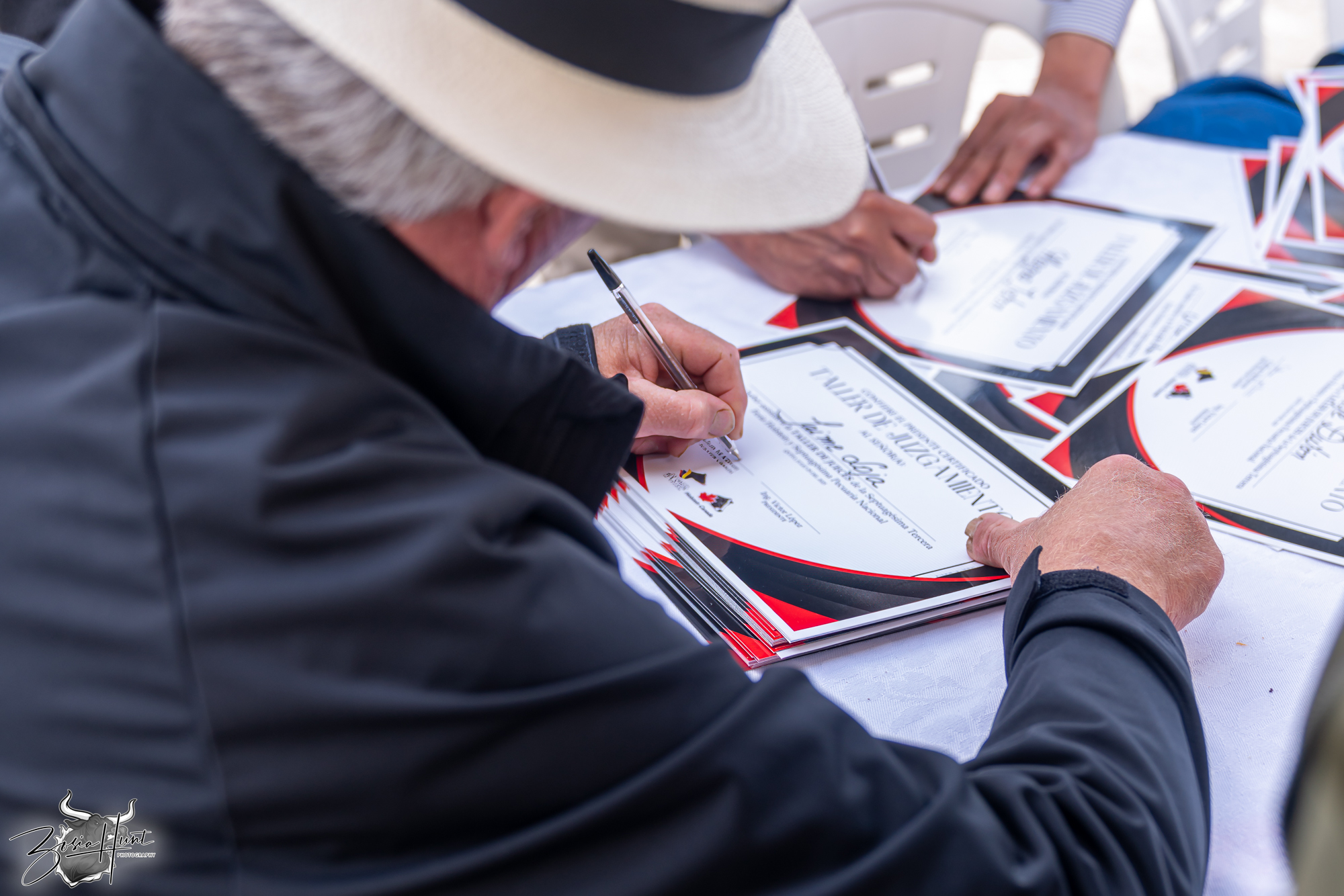
Sealing the knowledge: Callum McKinven signs certificates of completion, marking the culmination of the Ecuador judging clinic and empowering the next generation of dairy cattle judges.

The Bottom Line

Here’s the thing most people miss about judging: it shapes breeding decisions, and breeding decisions shape the industry we’re handing off. The ring sets standards whether we admit it or not.

When McKinven rewards balance, structural integrity, and functional mammary systems with clear, reasoned decisions, you feel it in bulk tanks six months later. Lower somatic cell counts. Better foot health. Cows that last longer and milk better. That’s not theory—that’s the downstream effect of ring work done right.

I’ve been watching this industry for long enough to see patterns. Farms that consistently show and breed for the traits McKinven prioritizes—balance, function, udder quality—tend to have better profit margins. Their replacement rates are lower. Their veterinary costs are more manageable. Their milk quality premiums are higher.

The Ecuador Effect

What struck me about that Ecuador clinic wasn’t just McKinven’s technical knowledge—it was his passion for getting this right. Because he understands something a lot of judges miss: every placement decision ripples outward. Every young exhibitor who walks away feeling confident might stay in the industry. Every reason given clearly and positively teaches someone something new.

McKinven’s approach wasn’t about tricks or shortcuts. It was about discipline. Start wide. Keep a consistent pattern. Move the ring with purpose. Speak about what you see. Build up young exhibitors. Judge today’s cow—period.

And on your best day, with a packed house and a sticky class at the end… that standard is what carries you through.

Key Takeaways:

  • Judge today’s cow, not her reputation: keep eyes on the ring, not the crowd; place off observable traits—udder attachments, locomotion, rib and balance.
  • Start wide and insist on movement: distance scan for balance, then work a repeatable pattern (chest → profile → legs/feet → rib/angularity → mammary) for every class size.
  • Stop memorizing; start seeing: give three concise, positive, trait-based reasons while looking at the animals—no vague “nicer/better” language.
  • Youth classes need calm leadership: smile, explain placements, and use the “bottom six” grouping in large classes to coach without embarrassment.
  • Professionalism builds trust: lock dates immediately, arrive 30 minutes or more early, dress professionally, wear well-fitted footwear, and coordinate ring flow and mic position with stewards.
Logo Holstein Logo Semex Logo Centro Agricola

A special thank you to the organizations that made this feature possible. The Bullvine’s coverage of the Ecuador National Show and judging clinic was proudly supported by Semex, the Association Holstein Del Ecuador, and the Centro Agropecuario Cantonal Ambato. We appreciate their commitment to advancing dairy genetics and judicial education.

The Sunday Read Dairy Professionals Don’t Skip.

Every week, thousands of producers, breeders, and industry insiders open Bullvine Weekly for genetics insights, market shifts, and profit strategies they won’t find anywhere else. One email. Five minutes. Smarter decisions all week.
NewsSubscribe
First
Last
Consent

Words That Win: How Elite Dairy Judges Master the Art and Impact of Oral Reasons

Master dairy judging’s make-or-break skill: Oral reasons decide 50% of scores. Transform technical precision into career-boosting communication.

The sun beats down on the fairgrounds as a young dairy judge steps into the reasons room, takes a confident stance, and begins to explain why she placed a class of Holstein four-year-olds the way she did. For the next two minutes, she delivers a clear, convincing argument that transforms what could be seen as subjective opinions into logical, evidence-based evaluations. Much like a seasoned herdsman explaining breeding decisions to a farm owner or a nutritionist justifying ration adjustments to a client, her comparative language is precise, her delivery poised, and her justifications compelling. In this moment, she’s not just competing—she’s developing skills that will serve her throughout her dairy career and beyond.

Yet we must ask ourselves: Are we truly maximizing the educational potential of oral reasons, or have we become so focused on the competitive formality that we’ve lost sight of their real-world application?

This scene plays out countless times at dairy judging contests across North America each year—from county fairs to the prestigious World Dairy Expo, from 4-H events to the National Intercollegiate Dairy Cattle Judging Contest. While casual spectators might focus solely on the placings, industry insiders know that oral reasons represent far more than a scoring component—they’re the breeding ground for the next generation of articulate, analytical, and confident dairy leaders.

Why Mastering Oral Reasons Is a Game-Changer for Your Dairy Career

Oral reasons are crucial for judges to explain and defend their decisions when placing a class of dairy cattle or heifers. In most contests, reasons account for 50% of a contestant’s overall score, equal in weight to the accuracy of the placings themselves. This equal emphasis reflects a fundamental truth about evaluation: knowing what you’re seeing is only half the battle; being able to articulate and defend your observations is equally valuable.

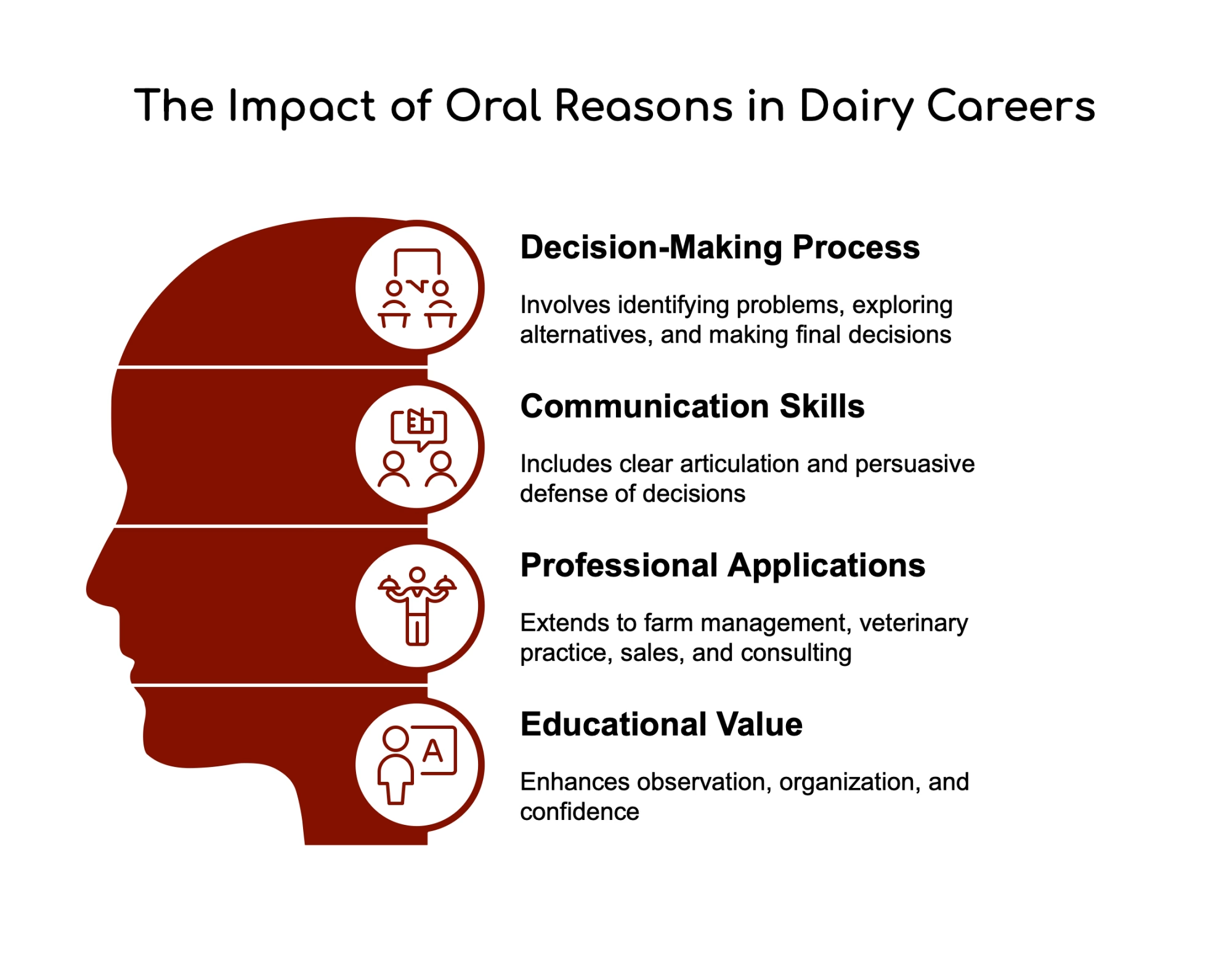
“Dairy judging teaches decision making better than anything else I know. Oral reasons are necessary for that decision-making process,” explains a veteran coach. “It’s a classic situation of identifying a problem, exploring alternatives, collecting information, and making a final decision.”

The skills developed through crafting and delivering compelling oral reasons extend well beyond the competition ring. Just as a skilled herd manager must communicate clearly with employees about cow management protocols or a dairy nutritionist must explain complex ration adjustments to producers, former judging team members consistently report that these abilities—making keen observations, organizing thoughts logically, speaking confidently under pressure, and persuasively defending decisions—have proven invaluable throughout their professional lives.

“Public speaking causes students to be concise and make a point,” notes Dr. Les Hansen. These skills translate directly to farm management, veterinary practice, sales, consulting, and virtually every other aspect of the dairy industry where clear communication is paramount.

The Elements of Excellence: What Separates Average Reasons from Outstanding Ones

Judges evaluating oral reasons typically focus on two primary components: content and delivery. While both matter, content carries greater weight—after all, even the most eloquent presentation can’t compensate for inaccurate observations or poor analysis, much like how a state-of-the-art milking parlor won’t overcome poor mastitis management practices.

Content That Convinces: The Foundation of Winning Reasons

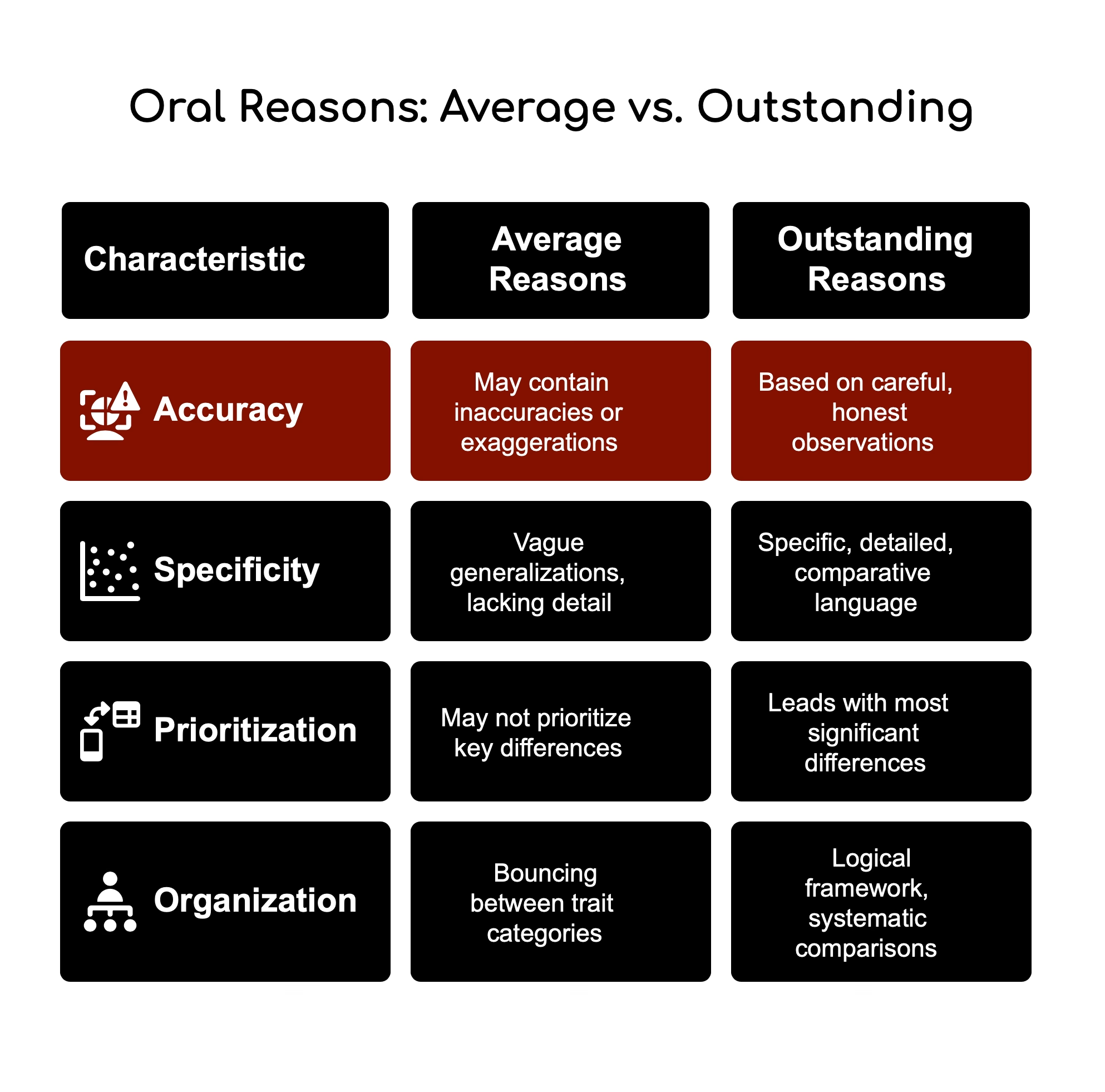
Accuracy Above All

The cardinal rule of oral reasons is absolute honesty—what many coaches bluntly call the “don’t lie” principle. Every statement must be based on actual, careful observations of the animals. If you didn’t see it, don’t say it. Like DHI records that reflect actual production rather than wishful thinking, this integrity is non-negotiable, as an experienced judge can quickly detect fabricated or exaggerated differences.

But here’s the uncomfortable truth: How many judges, particularly at youth levels, are fabricating differences they don’t actually observe because they feel pressured to fill their time allotment with “sufficient” detail?

Accuracy is the most essential thing in a reason set. Your credibility is shot when you mention traits that aren’t accurate for the animals.

Specific, Detailed, and Comparative

Vague generalizations like “better udder” or “nice dairy character” fail to demonstrate keen observation or understanding, similar to how a generic recommendation to “improve herd health” would be unhelpful to a dairy producer without specific protocols to implement. Elite judges use specific, comparative language that explains precisely how one animal differs from another.

Instead of saying “Cow 1 has a better udder than Cow 2,” compelling reasons might state: “1 shows a higher, wider rear udder attachment that’s more firmly attached, along with a stronger median suspensory ligament that creates more clearly defined halves, and a fore udder that blends more smoothly into the body wall compared to 2.”

This level of detail paints a vivid picture for the official, much like how a comprehensive genomic analysis provides specific trait data rather than just an overall ranking.

Prioritized by Importance

When comparing animals, leading with the most significant differences demonstrates sound judgment. While the PDCA Unified Scorecard assigns specific weightings to trait categories (Udder 40%, Dairy Strength 25%, Feet & Legs 20%, and Frame 15%), oral reasons should reflect the actual animals being evaluated—just as a herd manager must prioritize daily tasks based on immediate needs rather than following a rigid protocol.

“Within each pair, you must start with the most important and obvious difference between the two cows,” advises a successful coach. “If two cows have similar udders but one clearly excels in feet and legs, lead with that more apparent distinction rather than forcing an udder comparison.”

This isn’t to say scorecard priorities are ignored; instead, the initial attack on a pair focuses on the most glaring differences, while the overall emphasis given to traits like udder quality across the entire set of reasons should still reflect their fundamental importance.

We should ask this: Have we become so focused on the scorecard weightings that we’re creating artificial hierarchies for reasons that don’t reflect what we saw in the ring?

Organized for Clarity

Well-structured reasons follow a logical framework, similar to how a well-designed barn facilitates cow flow. The standard format includes an opening statement identifying the class and placing, systematic comparisons of each pair (1 over 2, 2 over 3, and 3 over 4), grants acknowledging where lower-placed animals excel, and a concise conclusion.

Within each pair comparison, address trait categories completely rather than bouncing between them. For instance, discuss all udder traits before moving to dairy strength or feet and legs. This organization makes it easier for the judge to follow your thought process. It evaluates your ability to organize information logically—a skill valued throughout the industry, whether developing breeding strategies or creating standard operating procedures for employees.

While this traditional structure provides an excellent foundation for learning, we must also ask if its rigid application always serves us best in developing the adaptable communication skills needed in today’s fast-paced dairy industry—a point we’ll explore further.

Breaking the Mold: When Traditional Approaches Fall Short

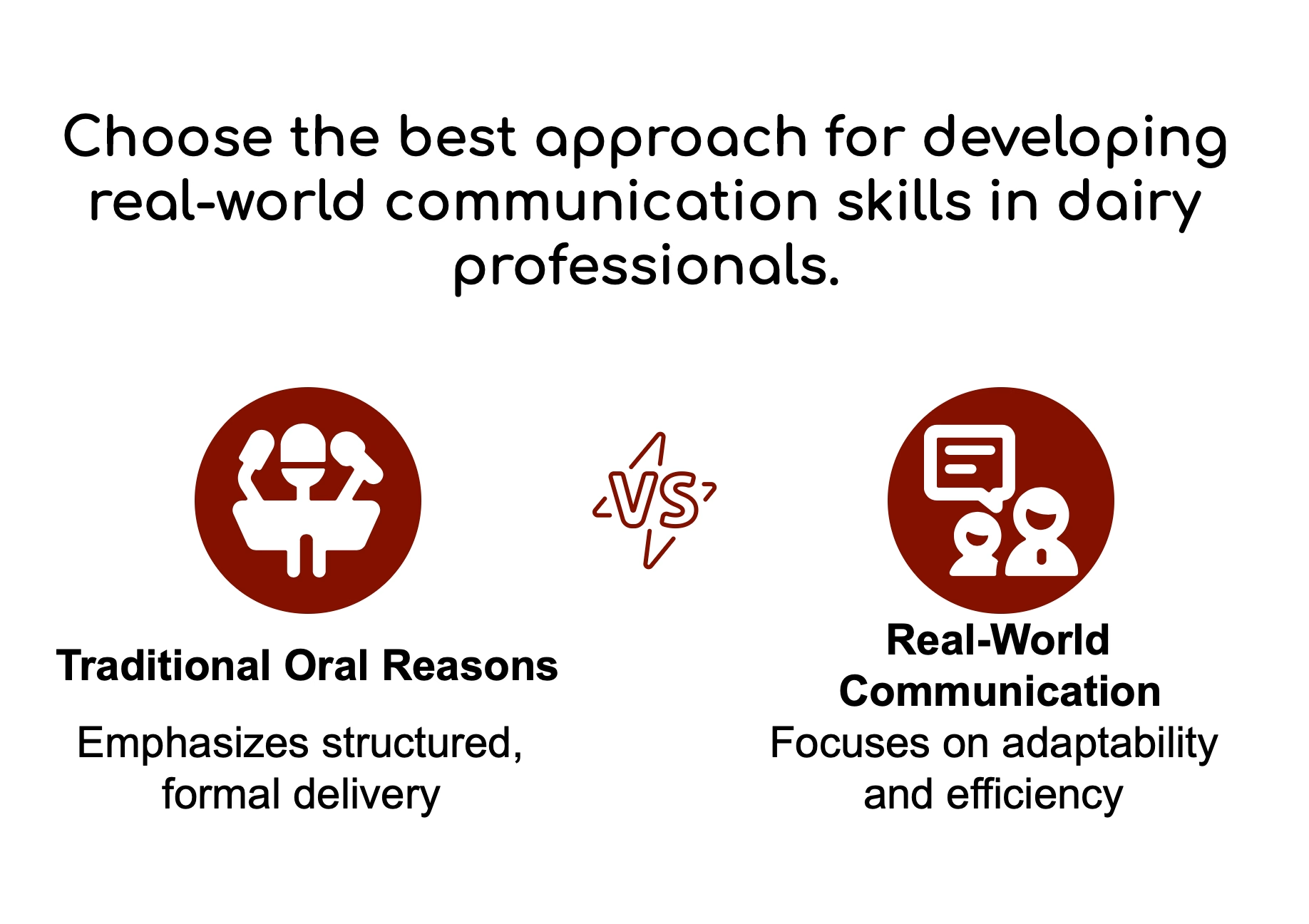
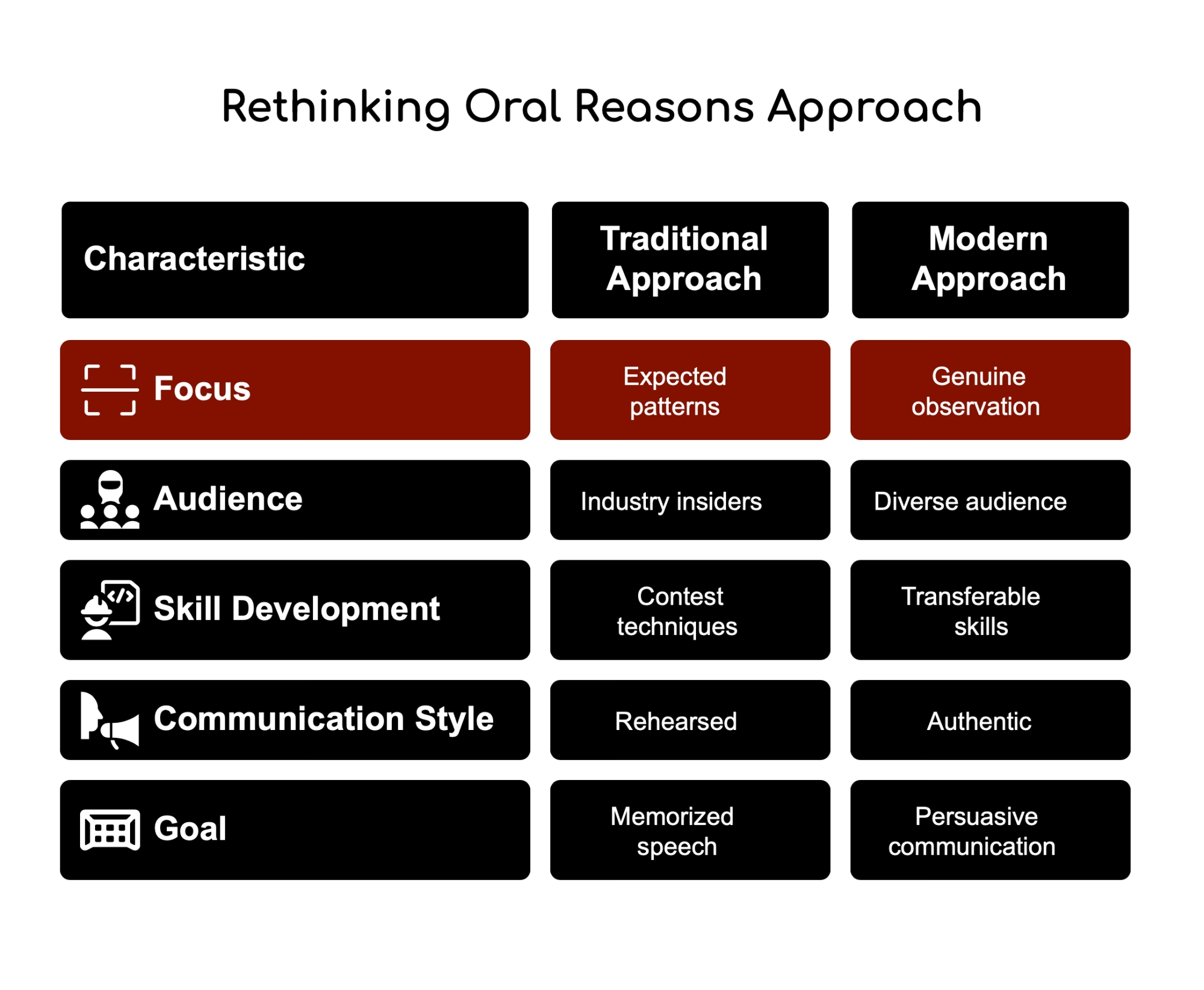
The tradition of highly structured, formal oral reasons has served the industry well for generations. But is this rigid format always the most effective way to develop real-world communication skills?

Professionals rarely have two minutes to deliver a perfectly structured comparison in the commercial dairy world. They need to make quick, incisive points that cut to the heart of the matter. A veterinarian explaining treatment options, a sire analyst justifying mating recommendations, or a nutritionist defending ration changes must be clear, persuasive, and efficient—often in less than 30 seconds.

Consider whether our emphasis on memorized structure sometimes produces contestants who can recite a perfect format but struggle to adapt their communication style to real-world scenarios. The most successful dairy professionals can adjust their approach based on the audience and situation, whether explaining complex concepts to fellow professionals or simplifying ideas for less technical listeners.

This doesn’t mean abandoning structure entirely. Instead, it suggests teaching students to understand the purpose behind the structure, so they can flexibly apply those principles in various professional contexts. Perhaps the next evolution in oral reasoning training should include practice scenarios that mimic real-world time constraints and audience needs.

Mastering the Language of Champions: Speaking in Dairy Terms

The dairy industry has developed a rich vocabulary for precisely describing cattle conformation. This specialized language allows judges to communicate subtle but significant differences that directly impact functional longevity and lifetime milk yield.

Comparative Language: The Heart of Effective Reasons

The fundamental rule of oral reasons is always comparing animals rather than merely describing them. This comparison provides necessary context and demonstrates evaluative judgment, much like how DHIR records are most valuable when viewed as comparisons within a herd rather than isolated numbers.

The simplest method for ensuring comparative language is using adjectives ending in “-er” (taller, wider, deeper, sharper, cleaner) or adding “more” when an “-er” form isn’t grammatically correct (more dairy, more capacious, more correct).

Avoid the general term “better,” which lacks specificity. Instead of saying “1 has a better udder than 2,” specify exactly how the udder is superior: “1 has a higher, wider rear udder attachment and a more strongly attached fore udder than 2.”

Essential Vocabulary for Each Scorecard Category

Udder Terminology (40% of scorecard) For discussing the most heavily weighted trait category, effective terms include:

  • “Stronger fore udder attachment with less bulging at the quarter junctions”
  • “Higher rear udder attachment with the secretory tissue starting well above the hock”
  • “Deeper crease in her udder indicating a stronger median suspensory ligament”
  • “Carries her udder higher above the hocks with more youthful suspension”
  • “More symmetry and balance of quarters with teats more centrally placed beneath each quarter”

Dairy Strength Terminology (25%) When evaluating a cow’s capacity for milk production and feed efficiency:

  • “More angularity with a longer, leaner neck transitioning smoothly into the shoulder”
  • “Cleaner about the head, neck, and withers with more defined bone structure”
  • “More open and well-sprung in her ribs with greater chest capacity”
  • “More incurving thigh providing evidence of adipose mobilization for milk production”
  • “Sharper over her topline while maintaining adequate width across the loin”

But let’s be honest: How often do we see significant differences in these traits that genuinely impact production, versus manufacturing differences to fit our predetermined placings?

Ringside to Reasons Room: The Critical Note-Taking Process

Effective note-taking forms the foundation of compelling oral reasons, serving as the critical bridge between evaluation in the ring and presentation in the reasons room. Without comprehensive, well-organized notes, even the most experienced judge will struggle to recall specific comparative details that substantiate their placings, just as a dairy producer without thorough herd records struggles to make informed management decisions.

Capturing What Matters Most

Strategic note-taking focuses on recording the key differences most significantly impacting placement decisions. Begin by noting any distinctive characteristics to help identify each animal (e.g., “the roan cow” or “tallest in class”).

Once a preliminary placing is determined, concentrate on documenting the major comparative differences between animals in each pair, prioritizing the most critical distinctions first. Be specific in recording details that support the main comparison points.

The hard truth many coaches won’t tell you: Great note-taking is often more valuable than a photographic memory. Even the most experienced judges can forget crucial details in the hour between viewing the class and delivering reasons. Your ability to capture the right observations in the moment often determines your success more than natural talent or speaking ability.

Delivering with Impact: The Performance Aspect of Oral Reasons

Even the most accurate and well-structured reasons can fall flat without effective delivery. The presentation style significantly influences how reasons are received and scored, much like how the same nutritional information can be received differently depending on whether a confident nutritionist or an uncertain feed representative delivers it.

Projecting Confidence Through Voice and Body Language

Non-verbal cues powerfully influence how oral reasons are perceived. Stand squarely on both feet, maintaining an upright posture approximately 5 to 8 feet from the judge. Many competitors choose to clasp their hands behind their backs to avoid distracting gestures.

Project a clear, distinct, and confident voice—strong enough to be easily heard without shouting. Maintain consistent eye contact with the judge throughout the presentation, as this conveys conviction and establishes a connection.

But we must confront an uncomfortable reality: We sometimes reward overly rehearsed, artificial delivery over genuine knowledge and passion. Are we teaching students to be theatrical performers rather than articulate professionals?

Training for Excellence: Practice Techniques That Create Champions

Mastering oral reasons requires dedicated practice using effective techniques that target both content development and delivery skills, not unlike how developing a high-producing herd requires both genetic selection and proper management.

Repeat Sets: The Power of Immediate Application

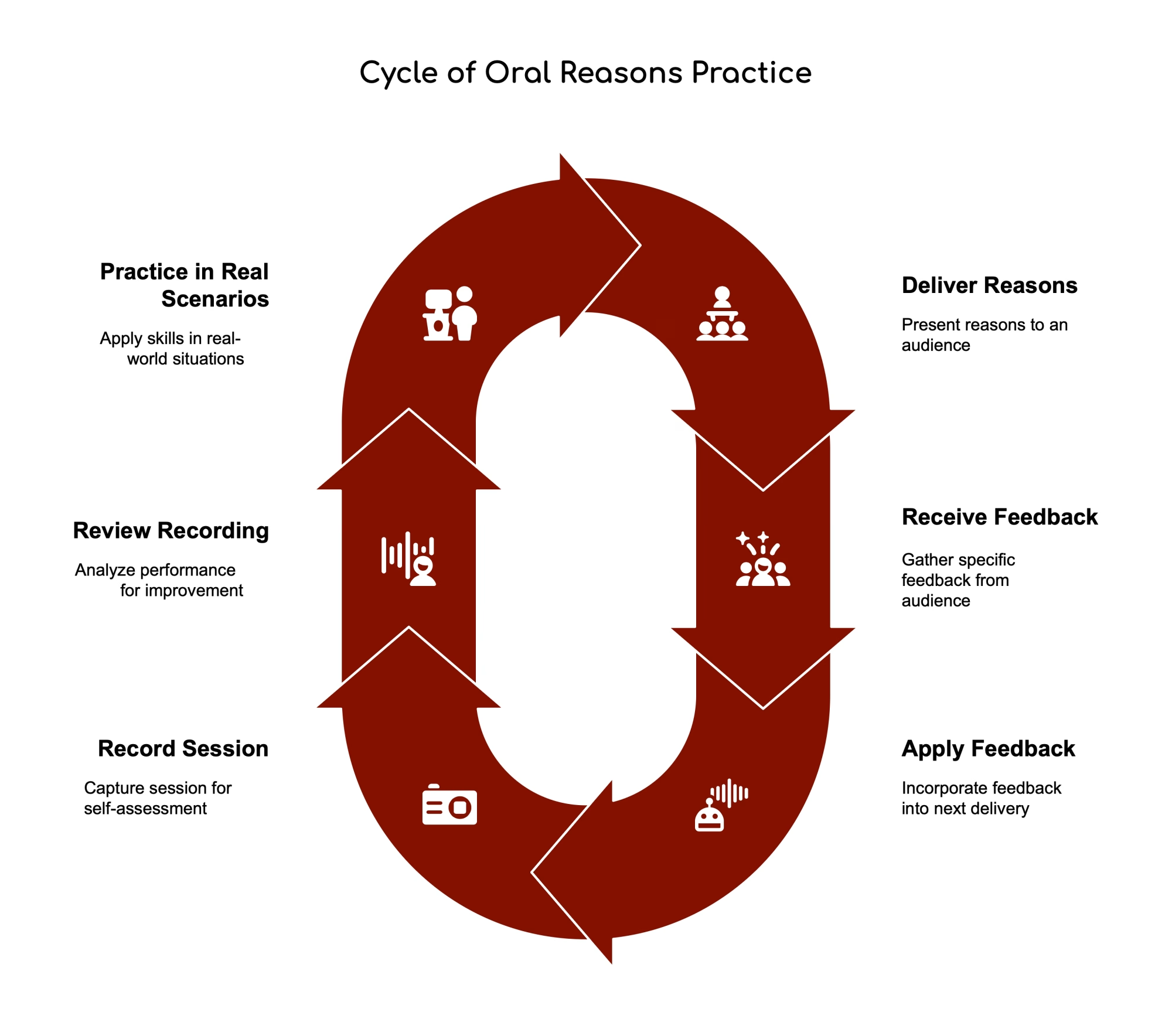
One particularly effective technique is “repeat sets,” where the speaker gives reasons for a class, receives specific feedback, and then immediately delivers the reasons again, incorporating the suggestions.

This iterative approach rapidly improves content and delivery, building confidence through tangible progress. The immediate application of feedback helps to reinforce correct techniques and correct errors before they become ingrained habits, similar to how immediate correction of milking technique prevents the development of bad habits that could lead to elevated somatic cell counts.

Recording for Self-Assessment

Video or audio recording practice sessions enable objective self-critique, allowing analysis of posture, eye contact, pacing, and terminology use. Many coaches recommend reviewing these recordings with specific focus areas in mind—first watching for content organization, then for delivery aspects like volume and enthusiasm, and finally for specific word choices and transitions.

This multi-layered review process helps isolate different components of the reasons for targeted improvement, much like how dairy farmers analyze milk components, reproductive performance, and health records separately to gain comprehensive insights into herd performance.

The practice technique most coaches overlook: Having students deliver reasons in real-world scenarios. Try having them explain a class to someone with no dairy background in just 30 seconds, or justify their decision to a skeptical farm owner who disagrees with their placing. These exercises develop adaptability that formal contest preparation often neglects.

Common Pitfalls and How to Avoid Them

Being aware of frequent mistakes helps judges at all levels refine their technique. Here are some of the most common errors and their solutions:

Using “Better” Without Specificity
Replace with specific comparative terms that detail exactly how one animal is superior (e.g., “1 is higher in the rear udder attachment” instead of “1 has a better rear udder”), just as specific breeding goals (“increasing component percentages”) are more actionable than general ones (“improving the herd”).

Describing Instead of Comparing
Always compare animals within a pair directly (e.g., “1 is taller than 2”) rather than describing one animal in isolation (e.g., “1 is a tall cow”), similar to how production records are most valuable when viewed comparatively within contemporary groups rather than as standalone numbers.

Disorganized Flow
Follow the standard structure (opening, pairs with grants, closing). Discuss one trait category completely before moving to another within a pair, just as milking protocols work best when followed in a consistent, logical sequence rather than haphazardly.

The most insidious pitfall of all: Going through the motions without genuine understanding. Too many contestants can recite perfect reasons without truly comprehending why the differences they’re describing matter functionally to a dairy cow‘s productivity and longevity. Are you explaining actual functional differences, or just regurgitating phrases you’ve been taught to use?

Beyond the Contest: How Oral Reasons Shape Industry Leaders

The process of mastering oral reasons develops a suite of transferable skills highly valued across academic, professional, and personal contexts. The structured decision-making required for placing a class and defending that placement cultivates critical thinking abilities applicable to countless real-world scenarios, from selecting replacement heifers to evaluating capital investments in farm infrastructure.

Creating the Complete Professional

The concise, persuasive communication demanded by the time-limited format builds public speaking confidence and articulation skills that serve individuals throughout their careers. As one industry professional notes, dairy judging teaches “talking and interacting with people, working with others, being part of a team, having a boss or coach, working toward a common goal and getting a job done”—all essential workplace competencies whether managing employees in a 5,000-cow operation or consulting with clients as a veterinarian.

Additionally, careful observation, methodical note-taking, and evidence-based reasoning form habits of mind that enhance problem-solving capabilities far beyond the judging arena. These skills prove invaluable when troubleshooting milk quality issues, reproductive performance challenges, or feed efficiency concerns on modern dairies.

A Call to Rethink Our Approach: Moving Forward

The time has come for a candid conversation about how we teach and evaluate oral reasons. While the traditional structure and approach have undeniable value, we must ensure we’re preparing students for the realities of modern dairy communication, not just competition success.

Ask yourself:

  • Are your reasons genuinely reflecting what you observed, or are you forcing observations to fit expected patterns?
  • Could you explain your dairy evaluation to someone outside the industry in a way they’d understand and find convincing?
  • Are you developing transferable communication skills, or just contest techniques?

I challenge every coach, judge, and contestant to incorporate these practical exercises into their reasons practice:

  1. Deliver a 30-second “elevator pitch” version of your reasons to someone with no dairy background. For instance, can you convey the essence of why your top cow won, focusing on just one or two key functional advantages, in the time it takes for an elevator ride? This hones your ability to be concise and impactful.
  2. Explain your placing to a skeptical producer who disagrees with your assessment
  3. Justify your evaluation without using any industry jargon whatsoever
  4. Record yourself giving reasons, then critically analyze whether you sound authentic or rehearsed

The dairy industry needs professionals who can communicate effectively in diverse contexts—not just those who excel in the artificial environment of a reasons room. By expanding our practice approaches and evaluation criteria, we can better prepare the next generation for real-world success while maintaining the valuable tradition of formal reasons.

The next time you step into a reasons room or coach a young judge, remember that the ultimate goal isn’t perfecting a two-minute memorized speech—it’s developing the ability to make sound decisions and communicate them persuasively in any setting. That’s the true legacy and value of the oral reasons tradition, and it’s up to all of us to ensure it remains relevant and effective for generations to come.

How will you transform your approach to oral reasons to better prepare yourself or your students for real-world dairy industry communication? The answer to that question may determine not just competitive success, but professional impact for years to come.

Key Takeaways:

  • 50% of judging scores hinge on oral reasons—prioritize accuracy, structure, and PDCA trait priorities (udder, dairy strength, feet/legs).
  • Comparative language > description: Use “-er” terms (e.g., “higher rear udder”) and grants to acknowledge lower-ranked strengths.
  • Notes are non-negotiable: Develop shorthand for real-time comparisons; organize by pair differences, not scorecard order.
  • Rethink tradition: Balance contest prep with adaptable communication drills (e.g., 30-second farm owner pitches).
  • Life skills payoff: Builds decision-making, public speaking, and persuasive clarity for leadership roles beyond the show ring.

Executive Summary:

Oral reasons—the ability to justify dairy cattle placings—are equally weighted with actual rankings in competitions, demanding technical accuracy, structured arguments, and persuasive delivery. Judges evaluate content (specific comparisons, PDCA scorecard alignment) and presentation (clarity, confidence), with note-taking and industry-specific terminology as foundational skills. The article challenges rigid traditional formats, urging adaptation for real-world scenarios like client consultations or herd management. By mastering comparative analysis and dynamic communication, competitors gain transferable skills in critical thinking and leadership, positioning oral reasons as both a competitive edge and career accelerator.

Learn more:

The Sunday Read Dairy Professionals Don’t Skip.

Every week, thousands of producers, breeders, and industry insiders open Bullvine Weekly for genetics insights, market shifts, and profit strategies they won’t find anywhere else. One email. Five minutes. Smarter decisions all week.
NewsSubscribe
First
Last
Consent

Remembering Dr. David Selner: A Heartfelt Reflection on His Passion and Influence in the Dairy Industry

In the expansive heartland of America, where fields unfurl beneath the boundless sky and the air carries the sweet aroma of fresh hay, a figure like Dr. David Selner stands as a steadfast pulse of the dairy industry. From humble beginnings on a Wisconsin dairy farm, he blossomed into a symbol of creativity and commitment, taking on roles that ranged from genetic consultant to beloved mentor. Dr. Selner, a beacon of dedication whose contributions reshaped the dairy landscape, has left a lasting legacy in an industry that sustains countless lives. Dr. Selner’s legacy resonates profoundly and is woven into the fabric of countless lives he impacted worldwide. In the wake of his recent passing on October 25, 2024, after a courageous fight against pancreatic cancer, we are left to contemplate the profound impact of his life’s work.
A Heritage Crafted in the Heart of Wisconsin’s Fields

Dr. David Selner’s roots are in a cherished Holstein dairy farm in Kewaunee County, Wisconsin, a legacy his family has nurtured since 1872. David’s deep love for the dairy industry blossomed in the field’s embrace and the gentle presence of the animals.

In his younger days, David ventured far beyond the farm’s boundaries. He shone brightly as a cherished member of 4-H and FFA, embodying a deep commitment and extraordinary talent for guiding others and embracing knowledge. His remarkable achievement as a leading team member and the High Individual at the National 4-H Judging Contest during the Chicago International Show in 1969 began an extraordinary journey.

David’s journey led him to the University of Wisconsin-Madison, where he blossomed and embraced new opportunities. Do you recognize the profound impact he left behind in that place? As a founding member of the Badger Dairy Club, he established the foundation of an organization and profoundly influenced his peers’ future. His participation in the Ag Student Council and the esteemed Saddle & Sirloin Club showcased his unwavering passion and commitment. Envision the deep sense of fulfillment that washed over him as he meticulously crafted the club’s inaugural yearbook.

David’s academic journey, culminating in his BS, MS, and Ph.D. in Dairy Science, reflects a profound commitment and remarkable intellect that inspires all who know him. In addition to his academic pursuits, he dedicated his time to coaching the university’s judging team and serving as a teaching assistant for several courses, passionately guiding future leaders in the field of dairy.

Profound Impact on Dairy Science

Dr. David Selner’s journey in dairy science is genuinely inspiring. With unwavering passion and dedication, he immersed himself in genetics and breeding, creating a legacy that forever changed the dairy industry. What is required to forge new paths? Dr. Selner’s journey started with transformative initiatives, such as the pioneering MOET program in the United States. This program transformed breeding methodologies and established new benchmarks in the field.

His sire analysis and genetic procurement roles beautifully highlighted his profound understanding and creative essence. Envision standing at the forefront of such vital endeavors. Dr. Selner didn’t merely envision; he triumphed, transforming the industry’s perspective on these profound ideas. Yet, his impact extended far beyond that.

In artificial insemination marketing, Dr. Selner shone brightly as a true pioneer. His remarkable contributions to crafting impactful marketing strategies and advertising media left a lasting impression nationally and internationally. Can you envision his seminars resonating around the world? Dr. Selner shared his wisdom across 27 countries, touching hearts and minds, transforming ‘genetics’ from a mere word into a profound understanding that resonated deeply with many.

His published works in major dairy journals reflect a profound dedication to education and a relentless pursuit of innovation. He connected with a worldwide audience through these publications, making dairy science accessible and ever-evolving. Dr. Selner’s career serves as a poignant reminder of the profound impact that one person’s unwavering commitment can have on an entire industry.

A Beacon of Inspiration in Dairy Cattle Judging and Youth Education

Dr. David Selner’s journey in dairy cattle judging reflects a profound commitment and remarkable skill that genuinely honors his legacy. His enduring commitment as the Superintendent of the National Intercollegiate Dairy Cattle Judging Contest was characterized by thoughtful choices that profoundly influenced the contest’s legacy. By selecting the first female officials and including the Red and White breed in the contest, Dr. Selner showcased a heartfelt dedication to fostering inclusivity and progress in the field.

Dr. Selner’s unwavering dedication to youth education shone brightly through his impactful contributions to the North American Intercollegiate Dairy Challenge. As one of its founders, he played a crucial role in shaping its operational framework and was honored to serve on the inaugural Board of Directors. This initiative united students from all corners of the continent, providing them with precious insights and hands-on experience in the dairy industry. Dr. Selner’s work in this area has profoundly touched many lives, igniting a passion in countless young individuals to embark on meaningful journeys in dairy science.

A Heartfelt Celebration of a Visionary’s Impact at the World Dairy Expo

Dr. David Selner’s impact on the World Dairy Expo is marked by unwavering commitment and profound insight. Dr. Selner was a remarkable presence on the Expo’s Cattle Exhibitors committee for over thirty years. This dedication reflects his deep love for the dairy industry. His remarkable leadership in developing and implementing the Show Ring Code of Ethics is a testament to his dedication and impact. This initiative was crucial in upholding fairness and integrity in dairy cattle competitions, reinforcing the Expo’s esteemed reputation as a just and honorable event.

Alongside his dedication to ethical standards, Dr. Selner held the esteemed role of official announcer for the Expo. This position showcased his remarkable talents and commitment. For over 25 years, his voice resonated deeply with the essence of the event. With the announcement of all seven breed shows, he became more than just a voice; he was the heartbeat of the event, weaving a rich tapestry of memories that resonated year after year. Unsurprisingly, he received the Friend of Expo Award in 1995, reflecting his steadfast dedication and invaluable contributions to the Expo.

Dr. Selner’s remarkable impact resonated deeply during his tenure as the Executive Director of the National Dairy Shrine from 2008 to 2021. Under his guidance, the Shrine experienced a profound transformation and flourishing. Dr. Selner was pivotal in expanding the scholarships available, opening doors for countless young individuals to follow their dreams in dairy sciences. He passionately transformed the National Dairy Shrine Museum, replacing old slide projectors with modern video monitors and lovingly digitizing cherished photo albums. His dedication captured the essence of dairy history through a remarkable collection of historical biographies, more than 100 heartfelt interviews, and the invaluable addition of unique stories to the National Dairy Hall of Fame’s archives.

Dr. Selner’s vision and leadership have profoundly shaped the dairy industry, leaving an enduring legacy through his impactful roles at the World Dairy Expo and the National Dairy Shrine. His lifelong work beautifully intertwined ethical standards, youth education, and historic preservation, leaving a profound impact that resonates far beyond the fields of Wisconsin.

Honoring a Legacy: Dr. Selner’s Unwavering Commitment to Retirement

Even in retirement, Dr. David Selner’s unwavering dedication to history and his community continues to shine brightly. With an insatiable curiosity and a profound connection to his heritage, he embarked on a heartfelt journey to explore the vibrant history of Czech immigrants in northeastern Wisconsin. Dr. Selner lovingly followed the path of his ancestors, documenting their heartfelt journey from Europe to the charming farms and villages that now grace the landscape. This project transcended the mere act of compiling dates and names; it wove together a heartfelt narrative of community resilience and the enduring spirit of cultural continuity.

At the same time, Dr. Selner shifted his focus to an intensely personal narrative—the legacy of his local church, established in 1864, which stands proudly as a symbol on the national historical register. Through his unwavering dedication, he ensured that this cornerstone of his community, intricately linked to its essence, would be preserved for future generations to cherish and understand.

A deep sense of pride in his roots fueled Dr. Selner’s unwavering commitment to these pursuits. He held the conviction that exploring our past transcends mere reflection; it is about grasping the strength and principles that define our present selves. His work was a heartfelt endeavor, a testament to his deep connection with a community that molded him, reflecting a life devoted to service and outstanding commitment. Dr. Selner’s unwavering dedication created a lasting impact, a poignant reminder to everyone who crossed his path about the significance of our roots and the narratives that connect us all.

A Cherished Family and an Enduring Memory

Dr. Selner was surrounded by a devoted family who held him in their hearts with profound affection. He is lovingly remembered by his sister Susan, his sister Mary Rose, who is married to Gerald Kudick, and his brother Steven, who is married to Kari Duescher. Dr. Selner is survived by five beloved nieces and nephews: Karen Tineo, Greg Kudick, Michael Kudick, and his wife Shannon, Emily Selner with Taylor Fritsch, and Madeline Selner, along with many cherished cousins. His family expresses heartfelt gratitude to the dedicated doctors and nurses at Bellin Oncology and Froedtert Hospital, whose exceptional care brought comfort during his final days.

Dr. Selner’s lasting impact on the dairy industry and his remarkable dedication to his community are unmatched. Through groundbreaking advancements in dairy science and a profound commitment to nurturing the next generation through education, his legacy resonates deeply, touching the industry and the souls of those he guided and uplifted. His unwavering commitment to service has profoundly impacted the agricultural community and his heritage, guaranteeing that his legacy will resonate with future generations.

Honoring Dr. David Selner’s Lasting Influence and Shaping Our Future

Dr. David Selner’s life exemplified his unwavering commitment to and deep love for the dairy industry. His journey, from humble beginnings on a Wisconsin dairy farm to becoming a pivotal figure in genetics and breeding, is a testament to his remarkable contributions, which have left an indelible mark on the field. His dedication to youth education and the World Dairy Expo highlighted his unwavering support for the future of dairy leadership. Selner’s passion for preserving heritage continued into retirement, embodying his deep connection to history and community.

Consider how a remarkable legacy can resonate throughout an entire industry—how it can elevate communities and ignite future creativity. Consider supporting scholarship programs for 4-H, FFA, or Junior Dairy Breed Association to honor his legacy and inspire future pioneers in his memory. As we reflect on Dr. Selner, let us contemplate the enduring impact of his legacy and the way it will guide future generations.

The family would like to thank the doctors and nurses at Bellin Oncology and Froedtert Hospital for their compassionate care. Family and friends may gather on Wednesday, October 30, 2024, at Cotter Funeral Home, 536 County Road R, Denmark, with a prayer service to begin the evening at 4:00 pm and visitation after until 7:00 pm. Visitation will continue on Thursday at St. Therese Catholic Parish, St. Lawrence Site, N2085 County Road AB, Denmark (Stangelville), from 9:00 am until 10:45, with the Mass of Christian Burial to follow at 11:00 am. Burial will take place in the church cemetery following Mass.

Instead of flowers, please send your memorial donations to your 4-H, FFA, Junior Dairy Breed Association scholarship programs or the Friends of St. Lawrence Inc. Foundation.

Don’t Judge a Cow by Its Picture

Recently the Bullvine posted a judging contest on Facebook to see how breeders would place these six animals based on their pictures alone (Read more:  Facebook image, entry form). The results were very interesting and raised the question “How well can you judge an animal from their picture?”

composite(s)

The animals selected, and more specifically, the pictures selected were all from photos that I have personally taken at shows.  So there was no doubt that the animals appear as they appeared in the show ring this year (Read more:  Introducing the Dairy Marketing Code of Conduct, Has Photo Enhancement Gone Too Far? and Dairy Cattle Photography – Over Exposed).

Of course we all know that No Cow is Perfect – Not Even in Pictures.  What we are trying to figure out, is if these animals would place differently with pictures as compared to how they would place if they were judged side by side.  The results were very interesting.  Most people placed the class C-F-A-D-B-E and our official placing was F-C-D-A-E-B.  F and C were a very very close placing, with only a slight split between them.  They were followed closely by A, and then there was a decent split to D.  The bottom pair of B and E could go either way.

results

The pictured placings were not too different, until you compare how these animals would place if you actually had them side by side.  In that case, you would see a very different result F-D-C-A-E-B.  F would take the class handily.  You see F is Valleyville Rae Lynn, and C is Desnette Alexia Roseplex.  These two cows have faced each other several times with the most recent time being at Ontario Summer Show (Read more:  Ontario Summer Show Holstein Results and The Shocking Speed of Social Media and the Dairy Industry) where Rae Lynn won the class and went on to be Intermediate and Reserve Grand Champion and Roseplex was 3rd in that class.  In the picture, Roseplex looks much deeper and more open of the rib.  In real life she may be pretty close, but there are two things that you greatly miss in the picture that you can only see in real life.  First is that Rae Lynn is just as deep and long. Since the leadsman of Roseplex is standing beside the cow instead of in front of her during this shot, we were able to crop in and so the cow appears that much larger.  The other factor that you cannot see in just a side shot compared to being able to have the cows side by side is that Rae Lynn possesses much more width throughout. She is a much longer cow (another reason the pictures look different) and has a higher and wider rear udder.

Valleyville Rae Lynn compare

Valleyville Rae Lynn
It’s interesting to see just how cropping of a picture can change the way the animal looks.


The placing of D over C is where many may start to wonder what happened.  We admit that in the pictures this is an easy placing of C over D, but if you had these in animals in the same ring at the same time, two factors would come into play.  First that D, Eastriver Gold Deb 850, is again wider of the chest, higher of the rear udder and cleaner throughout.  The second is that D would type in better with F (the class winner) and then would naturally follow her in the class.  Similar to how Raivue Sanchez Pamela did at Ontario Summer Show and hence Roseplex (C) was placed 3rd at Summer Show (Read more:  Ontario Summer Show Holstein Results).  Something that you are not able to tell when judging pictures is also the stage of lactation.  In this picture Deb 850 is fairly fresh where Roseplex is in mid lactation.

The other thing you would not realize in pictures, that you do when you see these cows, is that there is a size difference.  This comes to play in our next placing of C over A.  A, originally identified as Crater Indiana Goldwyn is actually Debeau Jasper December,  she is a very balanced dairy cow but,   with a live view, you would realize that she is not as much overall cow as the three above her.  Also her rump, slope to hooks to pins, as well as width of rear udder would limit her from placing higher in this class.

Huntshaven Deb Narobi Red It's amazing how much getting a lower perspective can change the appearance in a photograph.

Huntshaven Deb Narobi Red
It’s amazing how much getting a lower perspective can change the appearance in a photograph.

The last two cows (E and B) also bring some interest to the class and not just because they are red.  In this case, the difference is actually the quality of the picture.  In both pictures the cows are not set up perfectly or looking their best.  That was by design for this class.  You see we have better pictures of E, Huntshaven Deb Narobi Red, and B Deslacs Ritzy Greedy Red.  But what we wanted to point out here is just how animals can look very different depending on who is taking their photo.  Both these cows are much better than their pictures would indicate.  However, for me it is an easy placing putting E over B on the dairyness throughout and the quality of her fore udder.  Yes Rizty Greedy Red is a very deep opened ribbed cow, but Narobi, is cleaner of the leg, smoother of the fore udder and longer throughout.  The challenge you have with Narobi’s picture is that it is slightly over exposed here and so you cannot see her ribs as well as in Rizty Greedy Red’s picture.  We  intentionally used  a slightly darker picture of Rizty Greedy Red and a slightly over exposed picture of Narobi to prove our point about what over exposing pictures does (Read more: Dairy Cattle Photography – Over Exposed).

The Bullvine Bottom Line

Let’s sit back and think about how often we don’t get to see many of the great cows in the world in person.  Unless you are someone like Han Hopman (Read more: Han Hopman: Shooting Straight at Holstein International) or a select few that get the opportunity to get to the major shows around the world, you would never really be able to pick out exactly  how all these great cows compare to each other.  For example take Decrausaz Iron O’Kalibra *RC EX-96-SW (Read more: DECRAUSAZ IRON O’KALIBRA: Simply the Best).  Many who have seen her as well as the top cows in North America admit that she is an extremely balanced cow and that her udder is amazing, though they wonder would she be enough cow to contend with the likes of Hailey on the North American show circuit.  For those looking at both of them in pictures you could certainly go either way.  O’Kalibra takes amazing photos and it can sometimes be hard to get as good a picture of Hailey as she looks in real life.  And so the bottom line tells us it takes more than a picture to judge a cow.

Get original “Bullvine” content sent straight to your email inbox for free.


[related-posts-thumbnails]

Send this to a friend