





The state set the premium at 50¢/cwt. Espenshade’s March check showed 13. On July 1 even that vanishes — and most of your tank never qualified for it anyway. Go read your last statement.

Matt Espenshade told the Pennsylvania Milk Board this June that his March milk statement showed an over-order premium of about 13 cents per hundredweight (cwt). The state had set that premium at 50 cents. So where did the other 37 cents go?
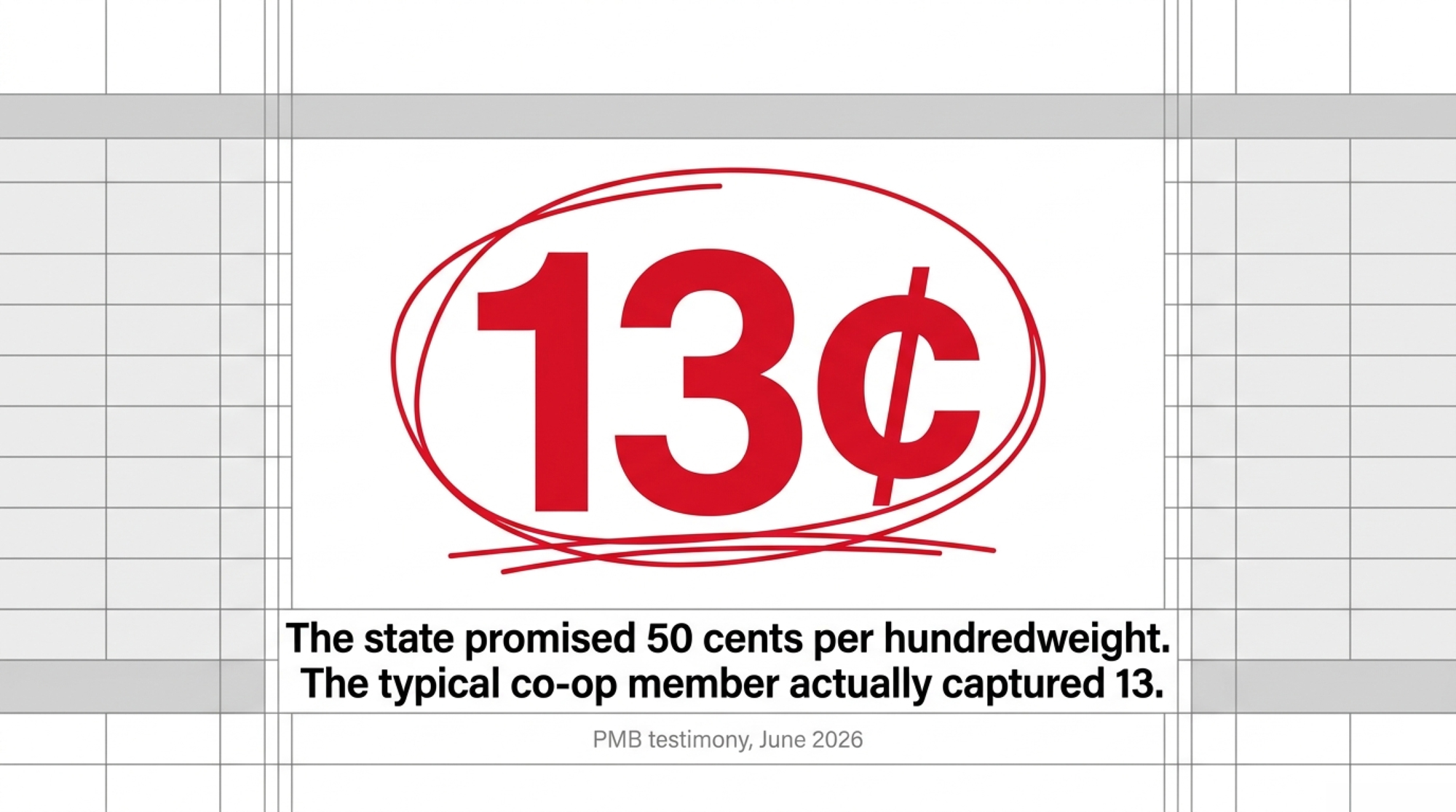
Espenshade runs the Pennsylvania State Grange and ships to a DFA-affiliated co-op, and he put that number on the record in sworn testimony. That gap — 50 cents promised, 13 delivered — is the whole story of Pennsylvania’s over-order premium in one line. And on July 1, 2026, even that 13 cents disappears. The Milk Board deadlocked and, as of the June 12 special sunshine meeting, signaled there will be no over-order premium after June 30, ending a program that’s ridden on Pennsylvania fluid milk since the 1988 drought. If you ship Class I milk in this state, that’s money coming off your check in less than two weeks.
What’s Changing and Why
The over-order premium — OOP, on your statement — is a state add-on that sits on top of the federal minimum for Class I milk: the drinking milk produced, processed, and sold inside Pennsylvania. That federal base ran $22.18/cwt for June 2026, up $2.03 from May; the state premium stacked on top. The program was born in 1988 to help farmers cover costs, and the Milk Board has renewed it by order every six months ever since.
For most of that recent stretch, the number didn’t move. The Board held the premium at a flat $1.00/cwt through 2022, 2023, 2024, and all the way to the end of 2025 — order A-1015, A-1017, A-1019, A-1020, A-1021, each one essentially rubber-stamping the last. Then in December 2025, it broke the pattern. General Order A-1022, published December 17 after a December 3 hearing, split the decision in two: $1.00/cwt for January through March, then halved to $0.50/cwt for April through June — the first sub-dollar premium since 2021. One board member, James Van Blarcom, dissented and pushed for zero, calling the whole system flawed. He didn’t get zero in December. He’s effectively getting it now.
Then June happened. The Board split at its hearing, no new order followed, and the program ran out of road. Lancaster Farming reported the premium is “likely to sunset July 1 because the Milk Board is deadlocked.” Farmshine’s Sherry Bunting put it flat after the June 12 meeting: “At this time, it appears there will be no over-order premium as of July 1, 2026. The farms on the hook are PA Class I shippers. But who actually felt that premium has always been a different question than who paid for it.
How This Plays Out on Real Farms
Here’s the part that stings. Most Pennsylvania farmers were never getting the full premium to begin with — and the Board said so in writing. In General Order A-1019, dated June 2024, it found that “none of the three producers who testified at this hearing receive even a quarter of the over-order premium.”
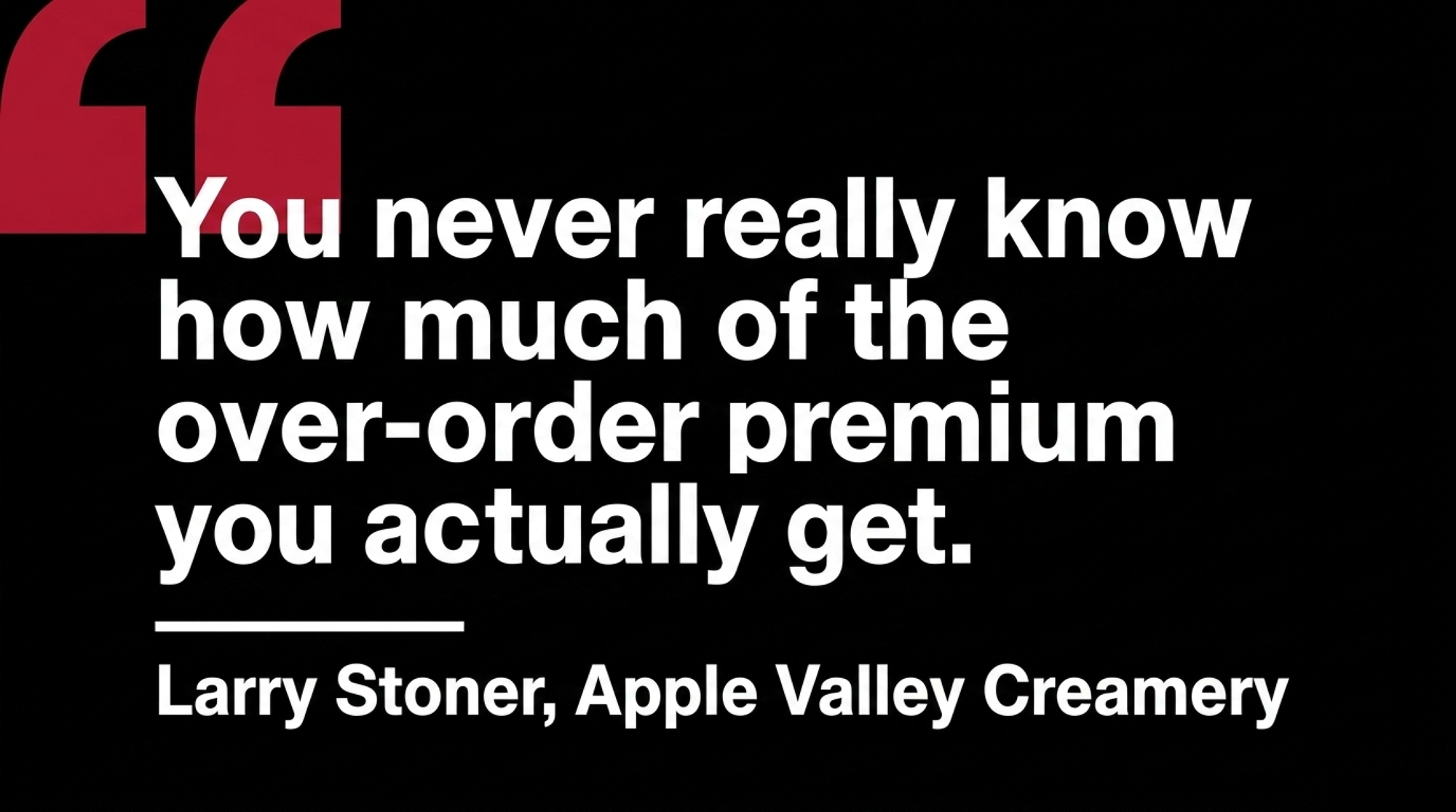
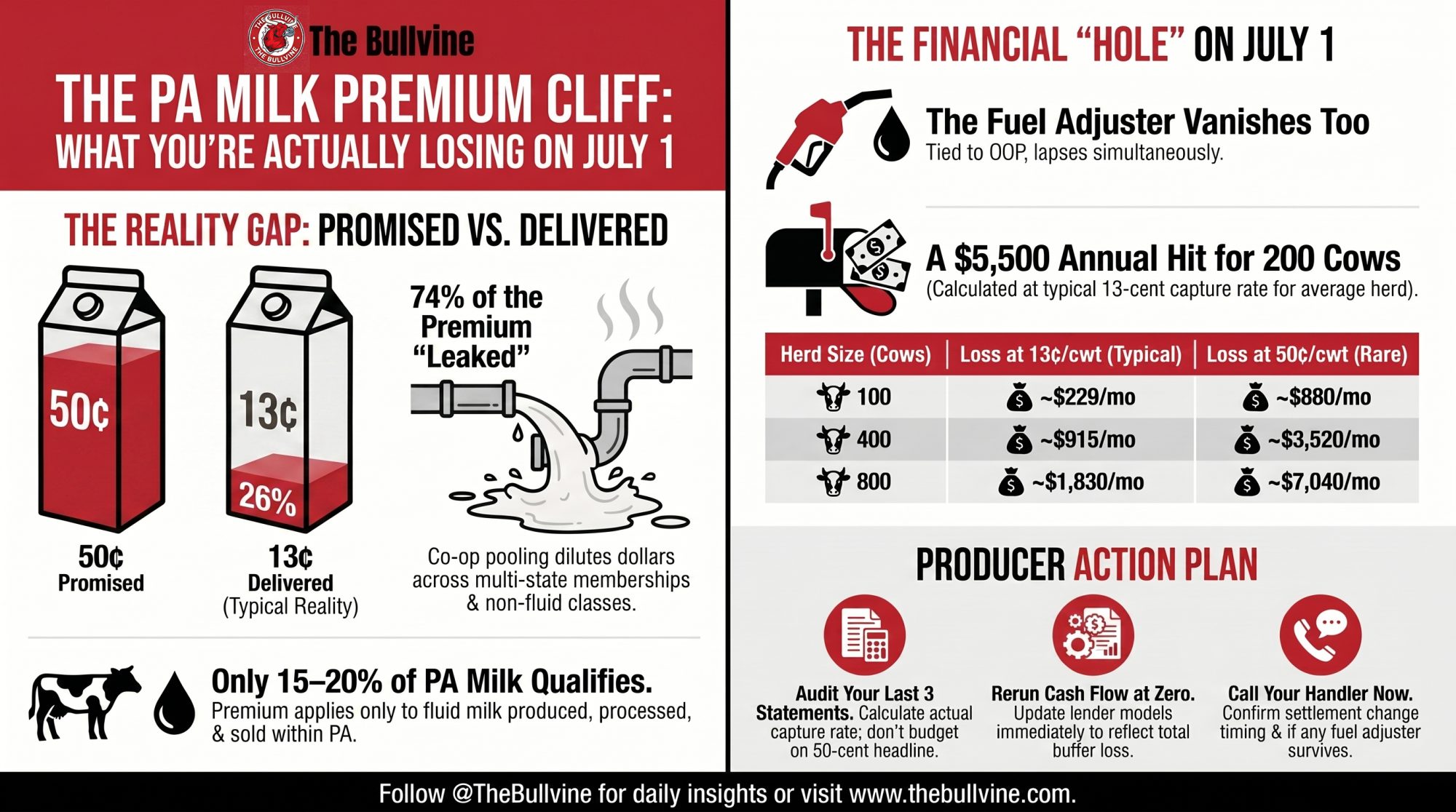
The June 2026 testimony backs that up with real checks. Espenshade reported about $0.13/cwt in over-order premium on his March statement against a 50-cent rate — roughly 26%. Paul Hartman, testifying for Farm Bureau off his Berks County operation shipping to Clover Farms Dairy, described the same gap between the stated premium and what actually reached his check. Same program, two farms, neither close to the headline. Larry Stoner, who runs Apple Valley Creamery, summed up the frustration in a January interview: “You never really know how much of the over-order premium you actually get.”
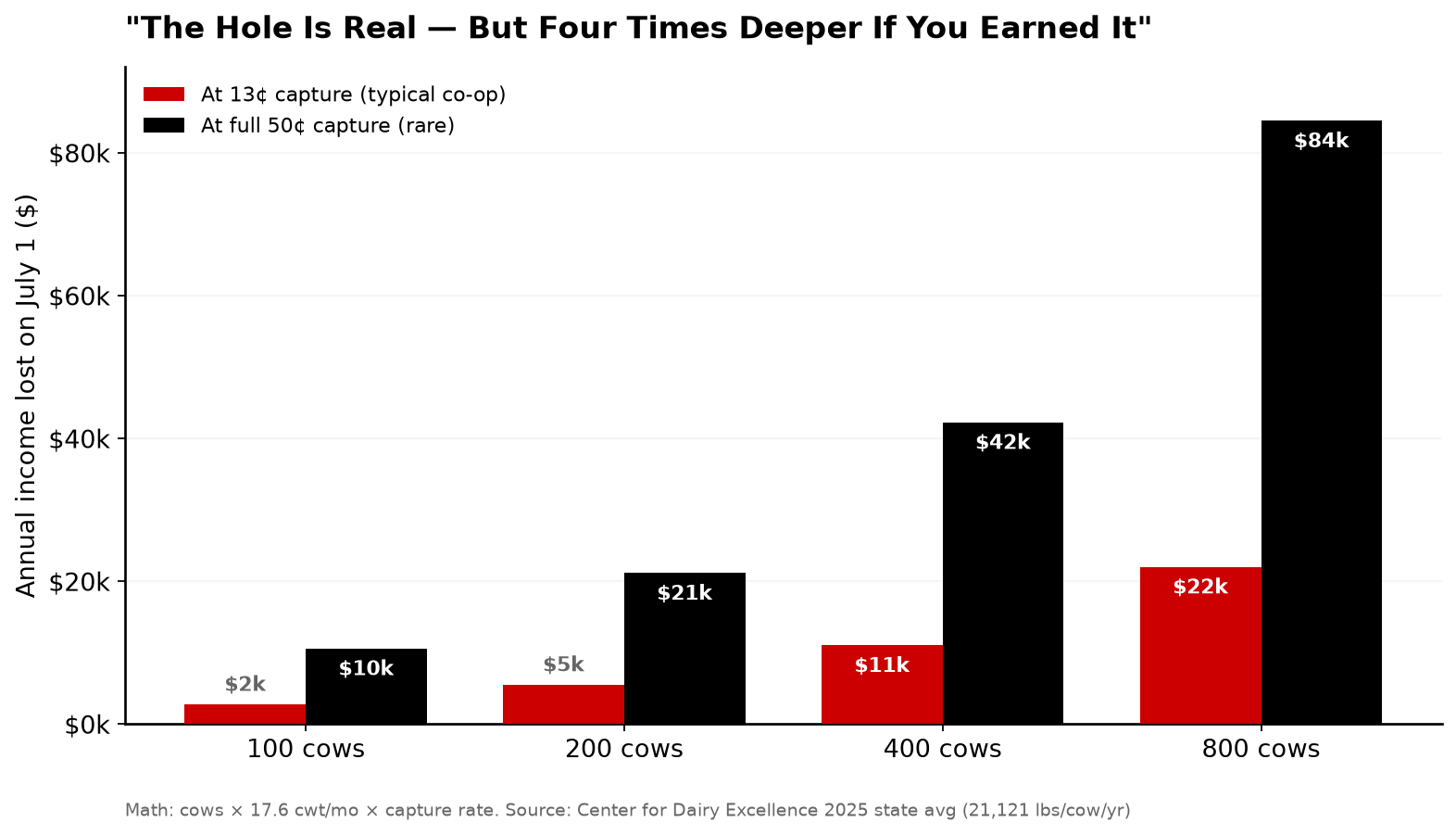
Now the barn math, because that’s what your banker cares about. Using the Center for Dairy Excellence’s 2025 state average — 21,121 lbs per cow per year, or about 17.6 cwt per cow per month — here’s the hole on July 1. At the 13-cent capture most co-op members actually saw, a 200-cow herd loses roughly $458 a month — about $5,500 a year. A 400-cow herd, about $915 a month, call it $11,000 a year. Were you one of the rare farms capturing the full 50 cents? Quadruple it. Run your own number against the table below.
Your July 1 Hole, By Herd Size
| Herd size | At 13¢/cwt capture (typical co-op) | At full 50¢/cwt (rare) |
| 100 cows | ~$229/mo · ~$2,750/yr | ~$880/mo · ~$10,560/yr |
| 200 cows | ~$458/mo · ~$5,500/yr | ~$1,760/mo · ~$21,120/yr |
| 400 cows | ~$915/mo · ~$11,000/yr | ~$3,520/mo · ~$42,240/yr |
| 800 cows | ~$1,830/mo · ~$22,000/yr | ~$7,040/mo · ~$84,480/yr |
The math: cows × 17.6 cwt/month × your capture rate. Pull your own capture rate off your last three statements — don’t use 50 cents unless your check proves you earned it.
The Realities of Multi-State Pooling
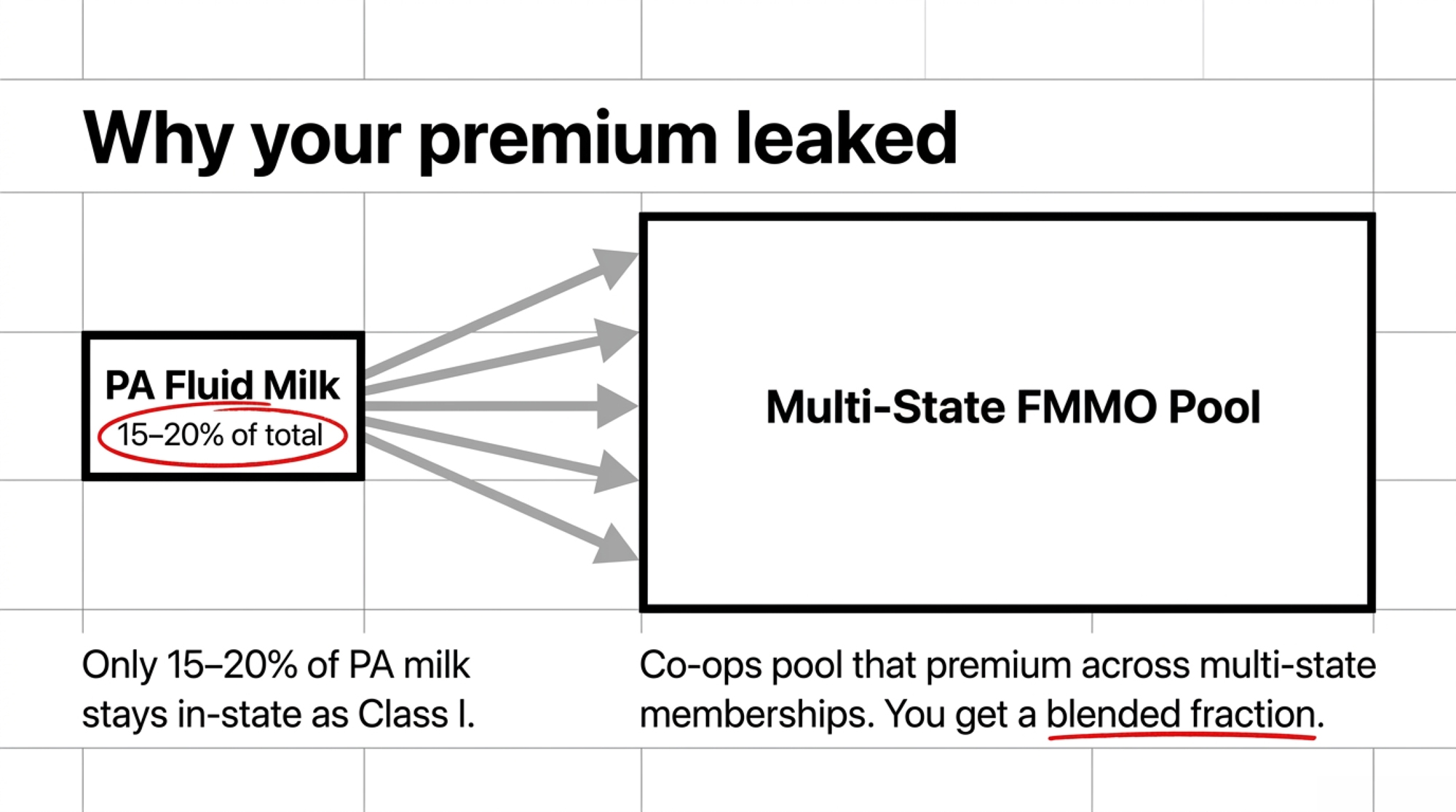
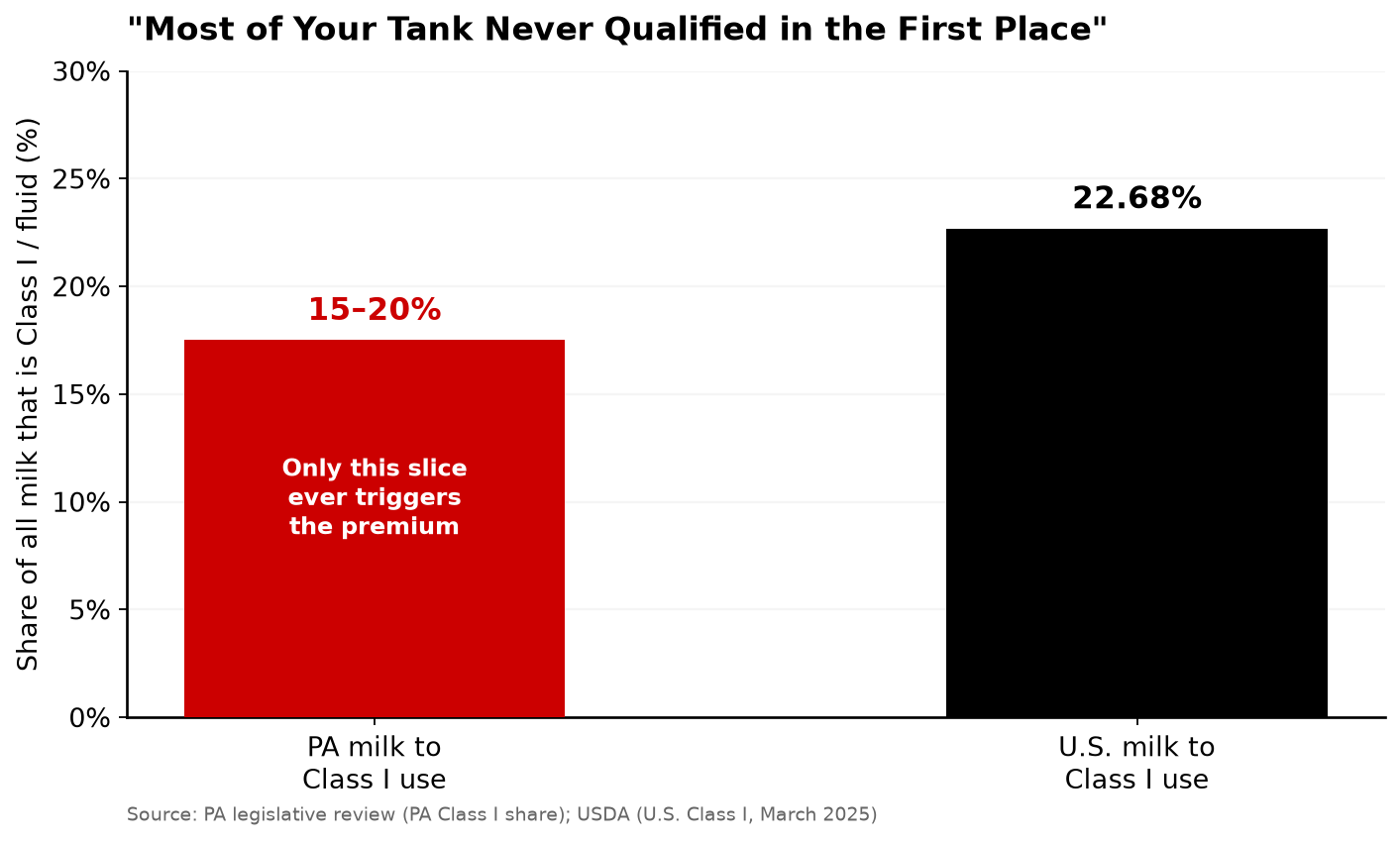
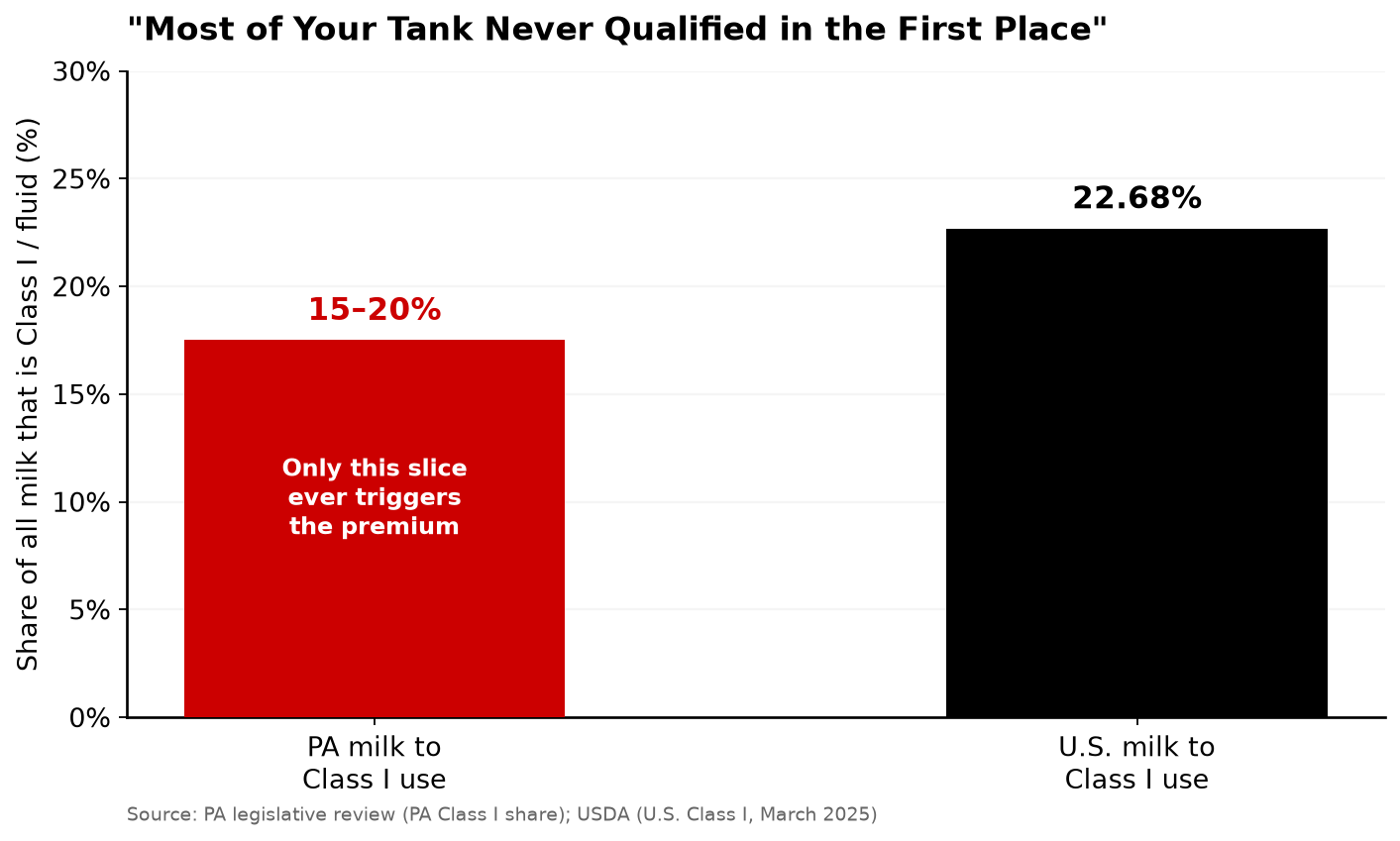
So why the leak? Two reasons. First, only a slice of the state’s milk ever qualifies. A Pennsylvania legislative review found just 15–20% of all Pennsylvania-produced milk goes to Class I use, and the OOP only rides on milk produced, processed, and sold as fluid inside the state. For national context, Class I ran about 22.68% of all U.S. milk as of March 2025 — fluid is a shrinking slice everywhere, and PA’s qualifying share sits below even that. Most of your tank never triggers the premium.
Second — and this is the one that surprises people — the co-op isn’t sitting on your money, it’s blending it. State law deems a cooperative a “producer,” so when a dealer pays the premium, it pays the co-op, which then settles with its members through the same pooling machinery that runs under the Federal Milk Marketing Orders. When DFA pools Pennsylvania Class I premium dollars across its entire Northeast Area — Federal Order 1 — those PA fluid dollars get spread across every hundredweight in the pool: Class II, III, and IV milk, and members in other states who never shipped a drop of PA Class I. DFA’s dairy economics manager Drew Frommelt acknowledged in the A-1019 hearing record that this pooling spreads the premium beyond the in-state fluid milk it was collected on.
That’s the mechanism, and it cuts both ways. Co-ops argue pooling spreads premium dollars and price risk evenly across a multi-state membership — your check is steadier because it isn’t riding on one state’s fluid utilization alone. Critics, including the dissent written into General Order A-1018, argue that every Pennsylvania consumer pays the premium at the dairy case while not every Pennsylvania farmer sees a direct benefit — which is how 50 cents on paper becomes 13 in the mailbox. Neither side is making it up. The dollars are real; they’re just diluted across a much bigger pool than the state line the premium was collected behind.
There’s a wrinkle that explains why some farmers can read their leak and others can’t. When a milk dealer pays a producer — including a co-op — the law requires the premium shown as a line item. But when a cooperative then pays its own members, that disclosure historically wasn’t required, which is exactly the gap the Board’s Regulation 47-20 “Cooperative Over-Order Premium Line Item” rulemaking set out to close. That’s why Espenshade and Hartman could read theirs and testify to what landed — and why plenty of co-op members still can’t.
None of this is a secret. Agriculture Secretary Russell Redding told the Board in December that replacement of the current over-order premium structure is overdue. Everybody named the leak years ago. Nobody plugged it before the program died. pa
What About the Fuel Adjuster Everybody Forgets?
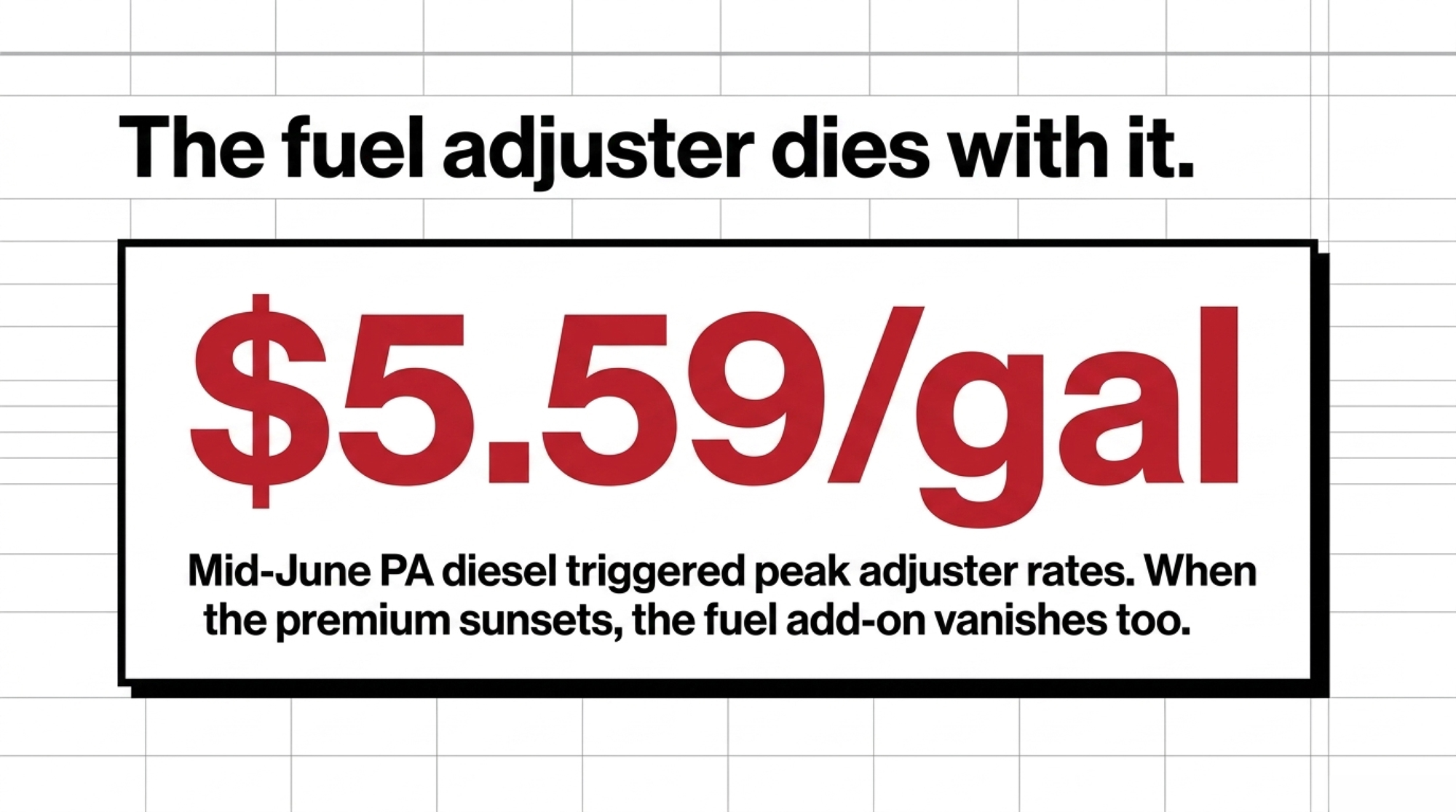
Tucked alongside the headline premium is a second piece most coverage skips: the diesel fuel add-on. Under General Order A-999, in place since 2017, the adjuster sits at $0.00/cwt while average diesel stays below $2.70/gallon, then climbs $0.02/cwt for every 10-cent jump in the monthly average price — $0.02 in the $2.70–$2.799 bracket, $0.04 at $2.80, and up the ladder from there. That’s not trivial in a high-fuel year. Pennsylvania’s on-highway diesel was running around $5.59/gallon in mid-June 2026, which puts the adjuster near the top of its range — real cents stacked on the premium. Back in April 2023, with diesel elevated, the add-on ran $0.44/cwt on top of the $1.00 premium.
Here’s the part that matters for July 1. The fuel adjuster has never been a standalone program — it’s renewed as part of the same over-order premium package and tied to the same dates. When Farm Bureau described the deal in 2023, it put the premium and the fuel adjuster in one breath, supporting “the existing over-order premium of $1.00 for the next six months, along with the fuel adjuster.” So if the base premium lapses at midnight June 30 with no successor order, the fuel add-on lapses with it — and at today’s diesel, that’s not pocket change you’re losing alongside the premium. Don’t bank on a quiet fuel line surviving the deadlock. Confirm it with your handler.
Who Actually Dropped the Ball Here?
If you’re hunting for one villain, you’ll be disappointed. The gap exists because three parts of the system each chose to wait. The Board knew the premium leaked — it wrote a dissent saying exactly that into General Order A-1018 back in 2023 — and still rolled the premium forward six months at a time rather than force a redesign. When the reform question finally hit the table this June, the Board deadlocked and let the calendar make the call.
The legislature had a fix in hand and parked it. Senators Elder Vogel and Judy Schwank introduced Senate Bill 689 in 2025 to let the state collect the premium at retail and distribute it directly to Pennsylvania producers — aimed squarely at the leak everyone keeps describing. It was laid on the table in June 2025 and never got a vote. And the co-ops operated within the FMMO pooling structure the law allows, where the per-farm share is set by co-op policy. Follow who could treat July 1 as an option instead of a deadline. The Board could. The legislature could. The co-ops could. The 400-cow family running on a $21 cost structure couldn’t.
How Much Does the July 1 Cliff Actually Cost Your Herd?
Map it to your own tank. Take your cows, times 17.6 cwt a month, times whatever capture rate your statements actually show. A direct shipper capturing the full 50 cents loses nearly four times what a pooled co-op member at 13 cents does — same cows, same milk, different marketing arrangement.
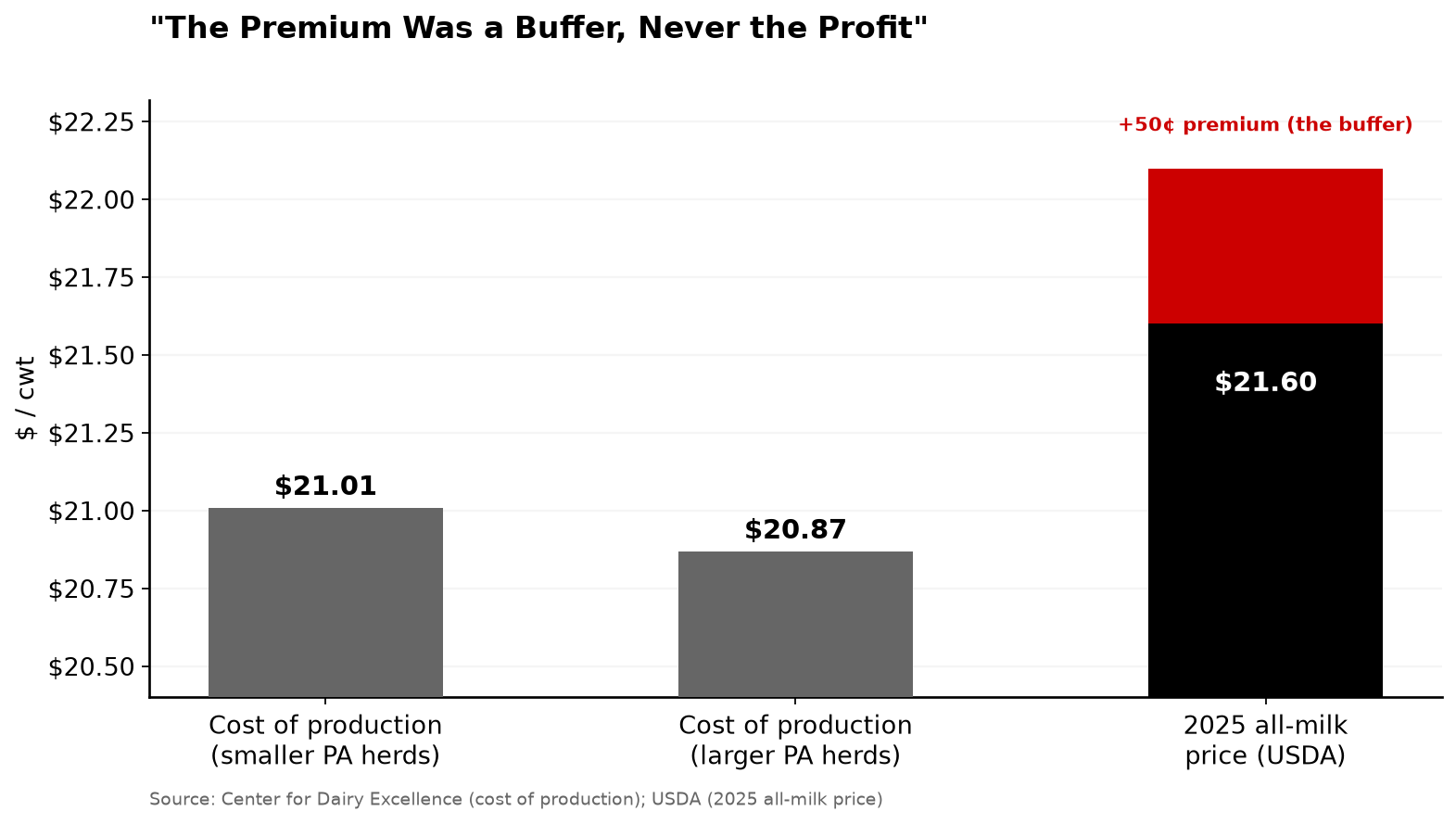
Here’s the honest framing, though. The Center for Dairy Excellence pegs net cost of production at $21.01/cwt for smaller PA herds and $20.87/cwt for larger ones — against an all-milk price USDA put near $21.60/cwt for 2025. That premium was never the thing making you profitable. It was a buffer. Losing it doesn’t kill a healthy farm. But for an operation already running on fumes, it’s the gust of wind that pushes a fire through the last fence line.
Is the Premium’s End the Cause — or Just the Reveal?
Pennsylvania lost 490 dairy farms in 2025. That’s an 11.7% drop in a single year, and it accounts for 41% of every U.S. dairy exit. That collapse was rolling long before this hearing, and the PA milk price story in 2026 is bigger than any single line item. The OOP sunset won’t be the headline cause of the next round of exits — milk prices stuck near cost of production will be.
But July 1 does something useful, in a hard way. It exposes which operations were quietly leaning on that buffer to make the loan payment. If your survival math depended on a premium where you captured 13 cents on the dollar, the real question isn’t aimed at the Milk Board. It’s whether the underlying business works without it.
Options and Trade-Offs
You can’t break the Board’s deadlock. You can control what you know about your own check before the cliff. Here’s what producers are doing.
- Confirm your real capture rate — this week. Pull your last three statements and find the PMB over-order premium line. If you ship to a dealer it’s required to be there; if you ship through a co-op it may not be, so ask for it in writing. Know whether you got 13 cents, something higher, or something lower. Costs you 20 minutes, risks nothing, and it’s the only way to size your actual exposure.
- Call your handler or co-op before June 30. Ask straight: is the premium continuing past June 30, does the fuel adjuster survive, and when does my settlement change? You may not love the answer. You’ll like a surprise in your July check even less.
- Rebuild your cash flow with the OOP line at zero. If your lender’s model assumed any premium income, update it now. For a leveraged operation sitting near a 1.0x debt-service coverage ratio, this is the difference between a planned conversation and a panicked one.
- Push on reform — the long game. SB 689 is the vehicle that would’ve fixed the leak, but it’s parked, and reviving it is a 2027 fight at the earliest. Worth your voice if you believe a fixed, transparent premium beats no premium. Don’t count on it for next month’s cash flow.
Key Takeaways
- If any over-order premium showed on your last statement, call your handler or co-op before June 30 and confirm exactly when and how your check changes on July 1 — and whether the fuel adjuster goes with it.
- If you haven’t checked your actual capture rate, do it this week — and if it came in under a quarter of the stated premium, you’re in the majority, losing less than the headline but losing it all the same.
- If your 2026 cash flow assumed any OOP income, rerun it at zero. If that drops your debt-service coverage below 1.0x, talk to your lender before August, not after.
- Use your own number: cows × 17.6 cwt/month × your capture rate. If you’re penciling in 50 cents without a statement to prove it, you’re budgeting on a premium you never got.
- If you want a fixed premium back, SB 689 is the only live path — but treat it as a 2027 conversation, not a July fix.
| Party | What they had in hand | What they did | Could’ve treated July 1 as a choice? |
| PA Milk Board | Its own A-1018 dissent naming the leak (2023) | Rolled premium forward 6 months at a time; deadlocked June 2026 | Yes |
| State legislature | SB 689 — collect at retail, pay producers directly | Laid on the table June 2025; never voted | Yes |
| Co-ops | FMMO pooling discretion; per-farm share is policy | Blended PA Class I dollars across the Northeast pool | Yes |
| The 400-cow family ($21 cost) | A milk check and a loan payment | Absorbs the loss with no lever to pull | No |
The premium’s gone either way. The question your statement answers in about 20 minutes is the one that matters: how much of it were you ever actually getting — and can your operation carry that loss at today’s feed costs without flinching? Where does your breakeven sit right now if the buffer’s gone?
If you want the full model — every capture rate, every herd size, run against current mailbox prices and the fuel adjuster — that’s the next piece. Our Tier 3 breakdown walks the whole calculation by operation size and marketing arrangement, and it’s worth your time before you sit down with your banker.
Run Your Numbers
Learn More
- Class III Milk Price, DRP, and Your Spring 2026 Risk Plan — Arms you with a defensive playbook to protect your mailbox price against widening pooling spreads, illustrating how two identical herds can drift thousands of dollars apart based purely on federal utilization.
- Harrisburg Dairies’ Bankruptcy Left $985012 in Unpaid Milk – And Put 15 Farms in a Clawback Trap. — Exposes the catastrophic structural limits of state security funds when fluid plants fold, delivering early warning signals and legal defenses to protect your cash flow from processor insolvency and bankruptcy clawbacks.
- Your Cows Are Comfortable. The Milk Check Doesn’t Know It Yet. — Dismantles the volume-only commodity treadmill by following the money to premium organic, regenerative, and grass-fed contracts that yield up to $50-plus per hundredweight, bypassing traditional federal pricing constraints completely.
The Sunday Read Dairy Professionals Don’t Skip.

Every week, thousands of producers, breeders, and industry insiders open Bullvine Weekly for genetics insights, market shifts, and profit strategies they won’t find anywhere else. One email. Five minutes. Smarter decisions all week.