








Texas, Idaho, and Utah confirmed fresh detections this spring. The science says the riskiest spot on your farm is the one place your crew protects least – the parlor.
A dairy in Cache County, Utah, shipped milk like any other morning this June. Then the bulk-tank test came back hot — confirmed by the Utah Department of Agriculture and Food on June 1, 2026, the first H5N1 in a Utah dairy herd since the eight-farm Cache County cluster back in October 2024. Nearly twenty months of quiet, and the virus walked right back in. Now the herd’s quarantined, the milk’s getting diverted, and the owner is doing exactly what you’d do: scrambling to figure out where it came from and who got exposed.
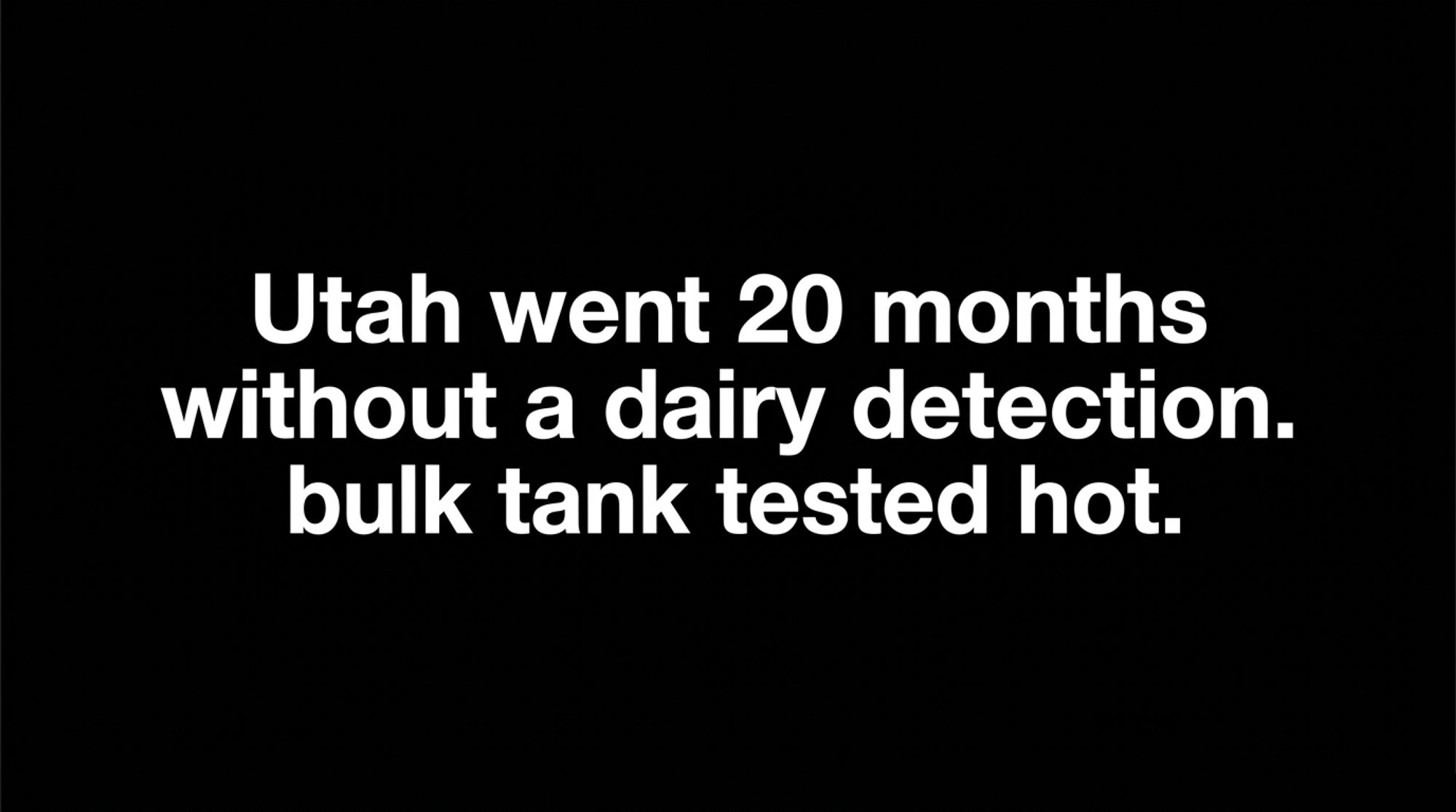
Here’s the part that should stop you cold. By the time that tank tested positive, the cows had likely been shedding virus for days — and most of them never looked sick. That’s the trap with H5N1 in dairy cattle right now. It’s quiet, it’s already moving, and the spot on your farm where it’s most dangerous to your people is the one place nobody’s geared up.
15 Herds in 30 Days Isn’t a Trend. It’s a Live Outbreak.
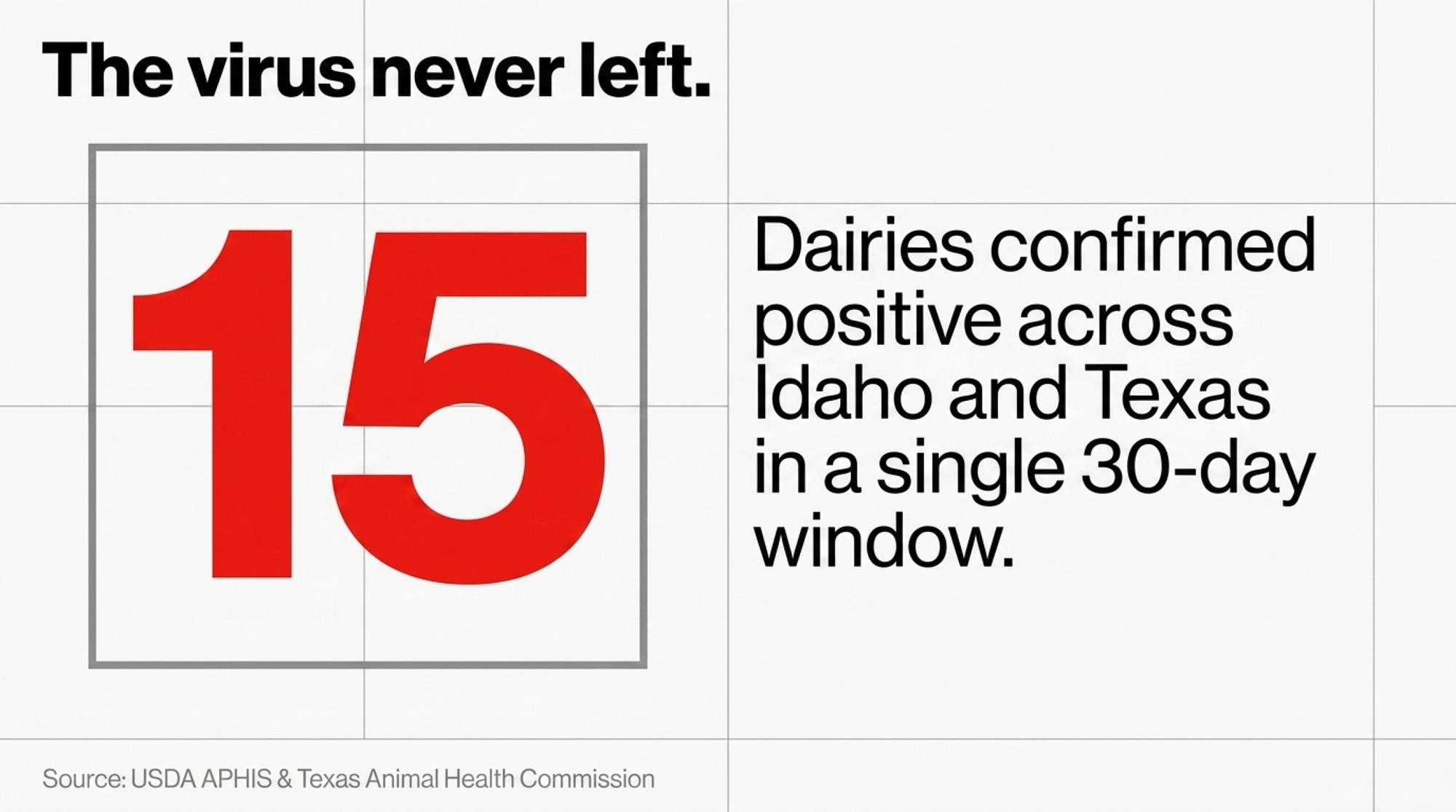
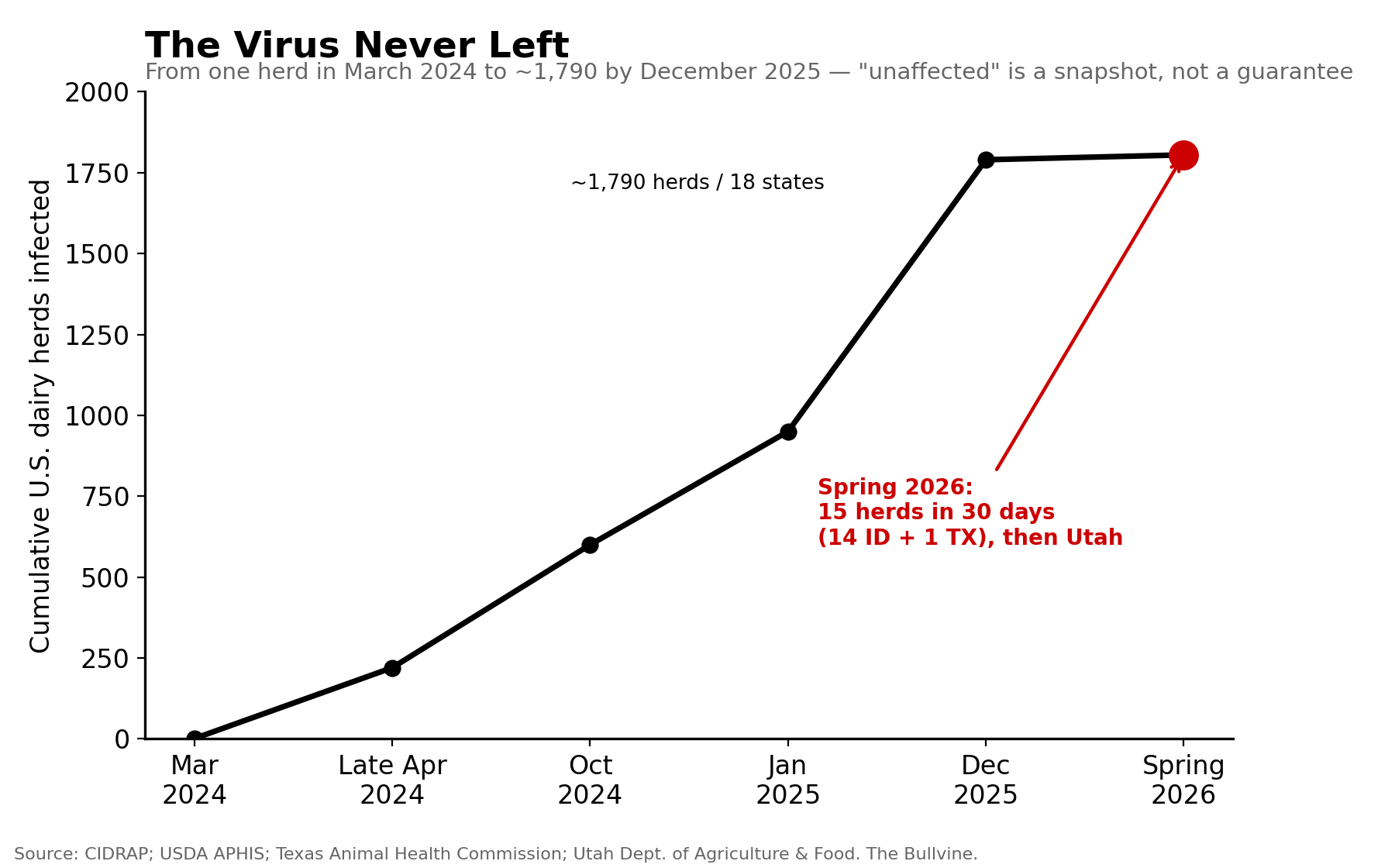
For the first time in 2026, H5N1 hit Texas dairy cattle again — confirmed by the Texas Animal Health Commission and USDA APHIS in late May. Idaho’s been the bigger story: APHIS tracked the virus through Idaho herds throughout May, and across both states, 15 dairies were confirmed positive in a single 30-day window (14 in Idaho, 1 in Texas). Utah’s Cache County case landed days later.
This isn’t new territory. H5N1 first appeared in U.S. dairy cattle in March 2024, and by December 2025, it had reached roughly 1,790 herds across 18 states, per CIDRAP. What the spring 2026 cluster tells you is simple: the virus never left, and “unaffected” status is a snapshot, not a guarantee. Utah went nearly twenty months between dairy detections — and still got hit again.
Quarantine and milk diversion are the standard playbook. When a herd tests positive, the operation goes under state quarantine, milk from affected animals gets diverted from the commercial tank or destroyed, and positive cattle can’t move interstate for 30 days. None of that milk reaches the store — but all of that disruption lands on the farm.
How Idaho Became the Epicenter
Idaho’s spring run didn’t come out of nowhere. The state has been a recurring H5N1 hotspot since 2024, and the 2026 cluster concentrated in its dense south-central dairy counties, where herds sit close together and equipment, trucks, and crews move between them constantly. That density is the accelerant. When operations share a milk hauler, a hoof trimmer, or a relief milker, the virus gets a ride from one bulk tank to the next without a single bird involved.
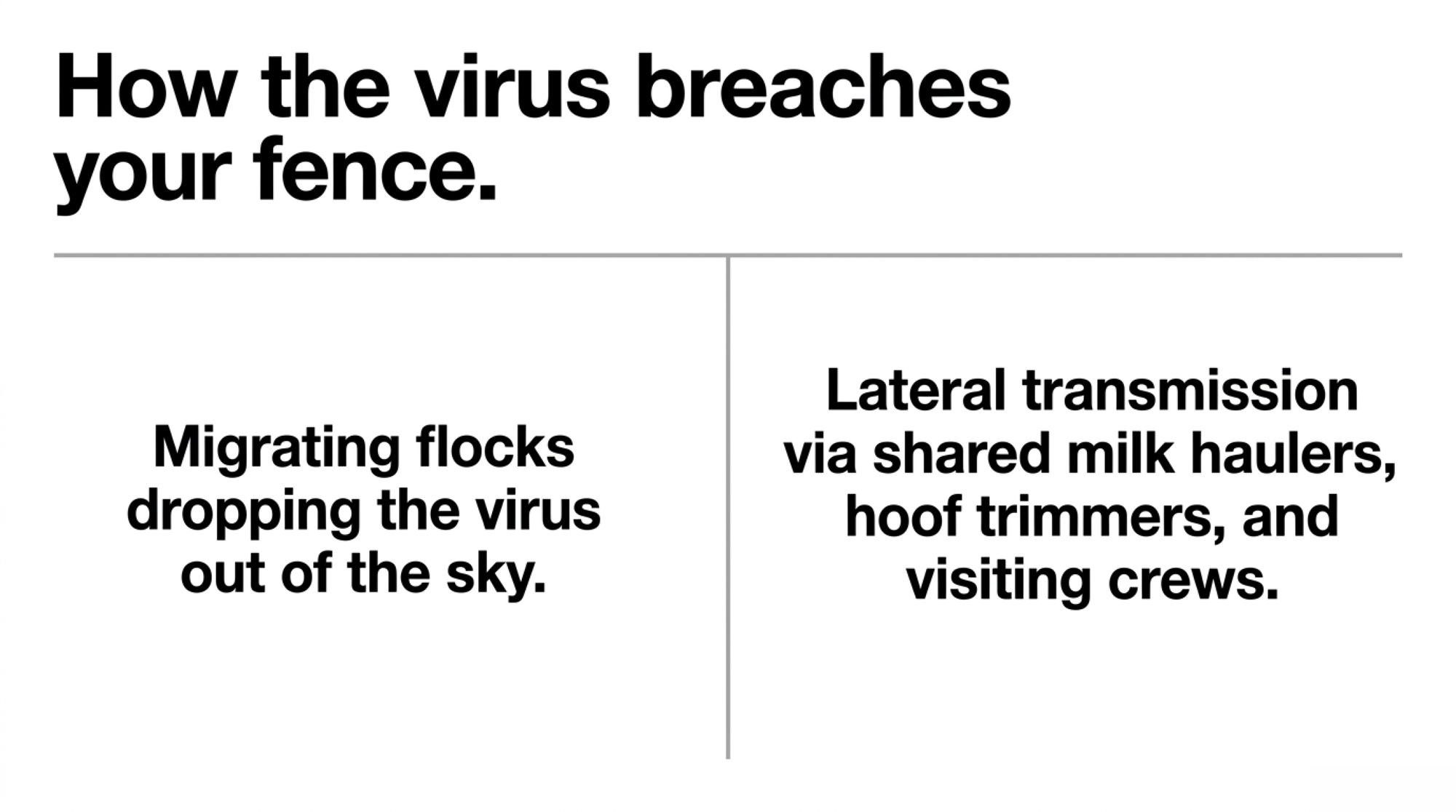
Investigators tracking earlier Idaho spread pointed to lateral transmission — cattle movement, shared milking equipment, and worker traffic between premises — as much as to wild birds. That matters to you because it rewires your mental model. Plenty of producers still picture H5N1 as something that drops out of the sky with a migrating flock. Sometimes it does. But once it’s in a region, the bigger threat is the truck backing up to your bulk tank and the contractor who was at a positive farm yesterday.
The takeaway from Idaho isn’t “be afraid of geese.” It’s “know who and what crossed your fence line this week.”
The Human Tally: Real, but Smaller Than the Headlines
The honest version of the human risk helps more than the panic version. The CDC reports 71 human H5 cases in the U.S. since 2024, with 41 tied specifically to dairy cattle exposure — most presenting as mild conjunctivitis. There have been two U.S. deaths over that period, and neither was linked to dairy cattle. The dairy-related cases clustered in California, Michigan, Colorado, Nevada, and Texas, almost entirely in workers with direct cow contact.
No sustained human-to-human spread has been detected, and the CDC still rates the general-public risk as Low. The people carrying real, moderate-to-high exposure risk are the ones in your parlor every day. That’s the honest scope: low for the public, not low for your crew.
One scientific wrinkle is worth watching, stated plainly because the data is still emerging. A peer-reviewed PLOS Biology surveillance study published in May 2026 found H5N1 in California parlor air and detected an HA mutation (position 189) in one air sample associated with better binding to human-type receptors. Whether that change actually improves the virus’s ability to infect people “remains to be determined,” the authors write. Emerging signal — not a reason to panic. But a reason to protect your people.
Is Pasteurized Milk Actually Safe — or Is That Just the Official Line?
Pasteurized milk is safe, and the data backing that is unusually strong. The FDA tested 464 retail dairy products and found no viable virus in a single sample. PCR did pick up viral fragments — dead genetic remnants — in retail milk at the peak: 36.3% of samples in late April 2024, dropping to 6.9% by the December 2024–January 2025 round, per Emerging Infectious Diseases. But the gold-standard egg-inoculation test grew no live virus from any of them.
Raw milk is the opposite story, and that’s where the science gets pointed. Infected cows shed enormous viral loads directly into their milk, which makes raw milk the primary vehicle for spreading H5N1 cow-to-cow and farm-to-farm. If you’re feeding raw waste milk or colostrum to calves, you’re potentially running a transmission line through your own herd. Heat-treat or pasteurize waste milk before it goes anywhere near a calf — and remember the public-health risk only stays Low when that raw line is closed.
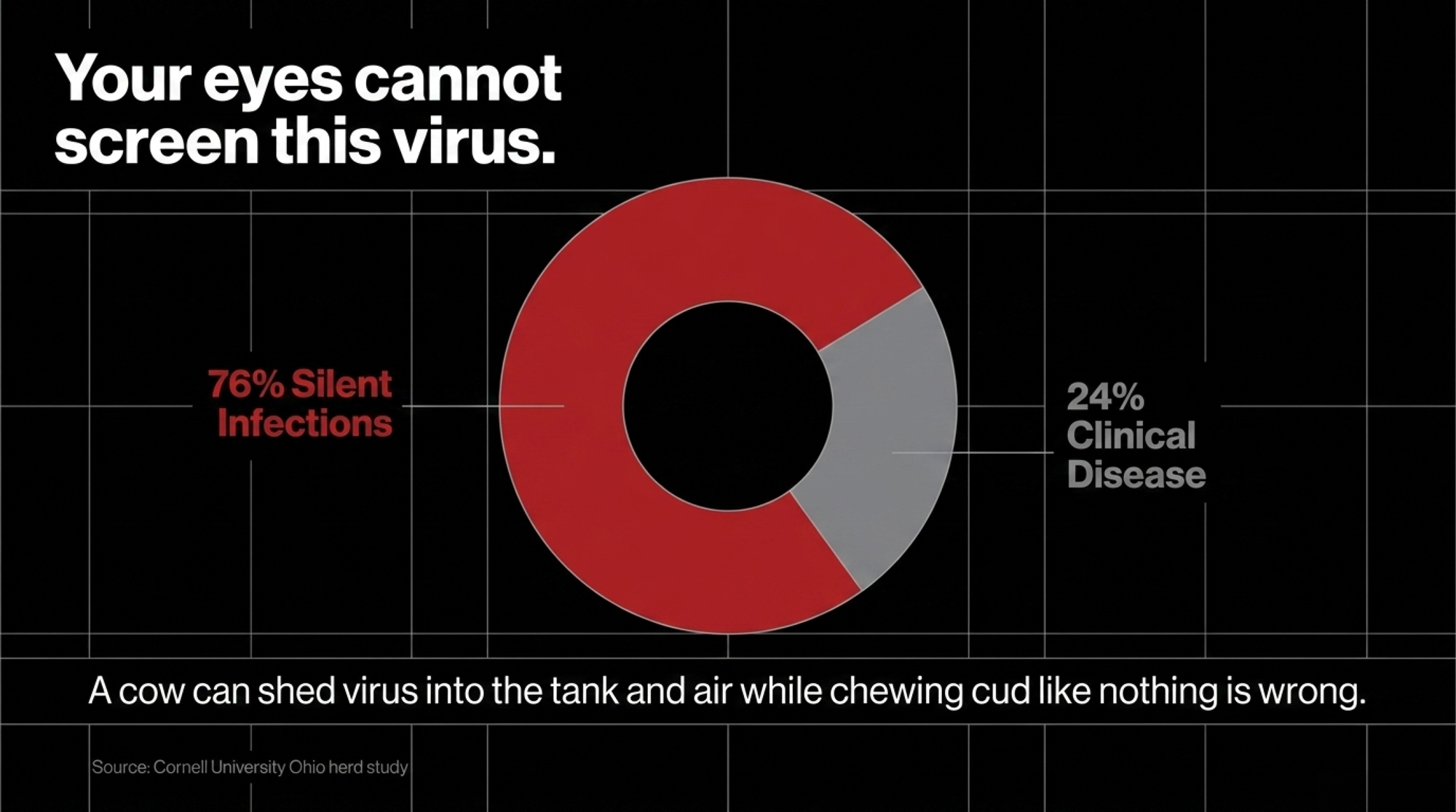
For the operations that learned this the hard way, the lesson lives in the bulk tank — and why 76% of infected cows show no symptoms at all breaks down how detection lags spread.
Why the Parlor Is the Riskiest Room on Your Farm
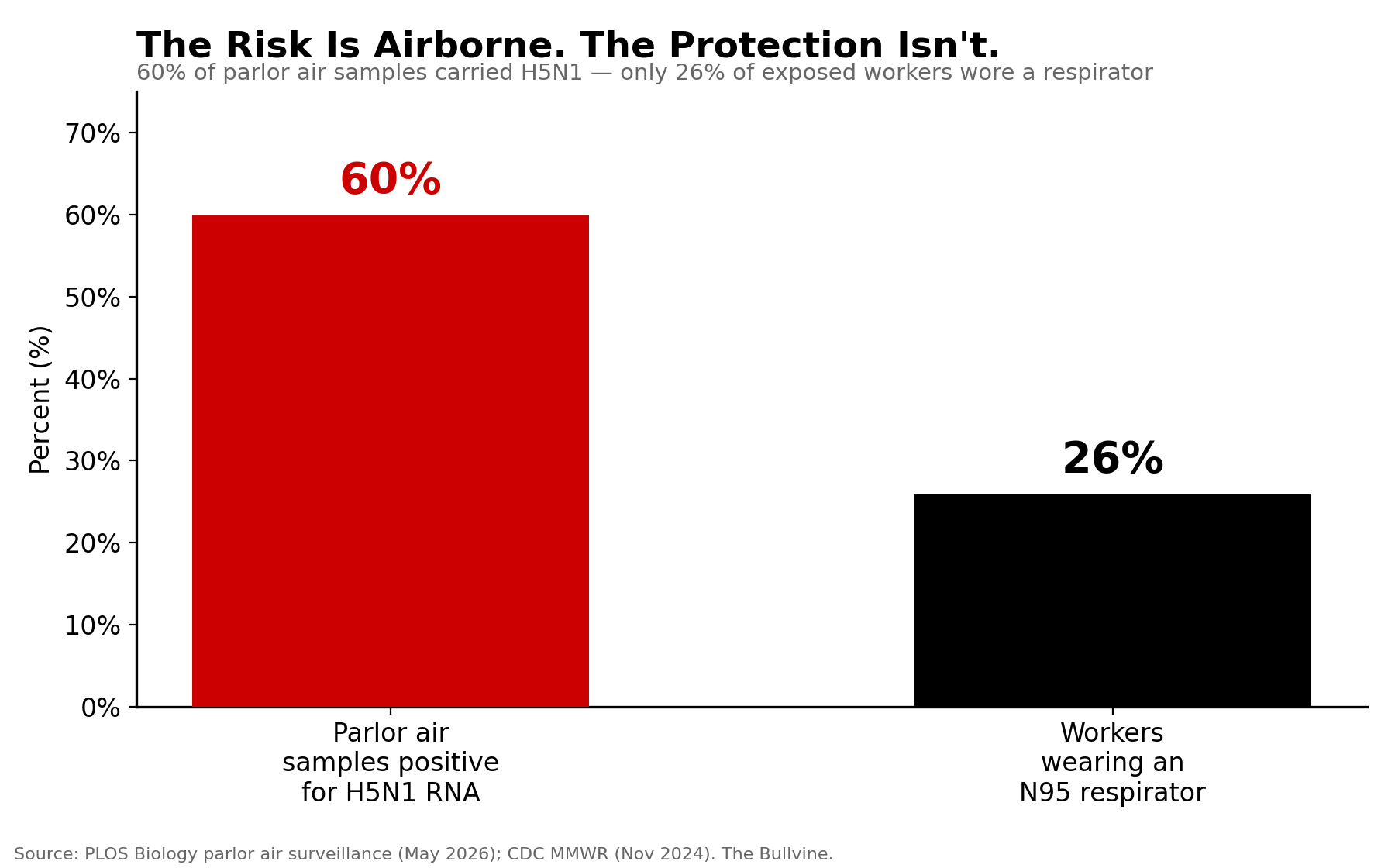
Here’s the finding that should reshape how you think about worker safety. In the PLOS Biology surveillance work across positive California farms, researchers found H5N1 viral RNA in 21 of 35 air samples taken in milking parlors — and confirmed live, infectious virus in four of them. The virus isn’t just on surfaces. It’s airborne, right where your crew is breathing.
Forestripping and routine milking aerosolize raw milk into fine droplets. The parlor’s usually enclosed, so those droplets hang and settle on faces, eyes, and equipment. Open-air housing pens were far lower risk — it’s the parlor that concentrates exposure. The same team also found infectious virus in farm wastewater and lagoons that migratory birds use, closing a loop right back to wild-bird reintroduction.
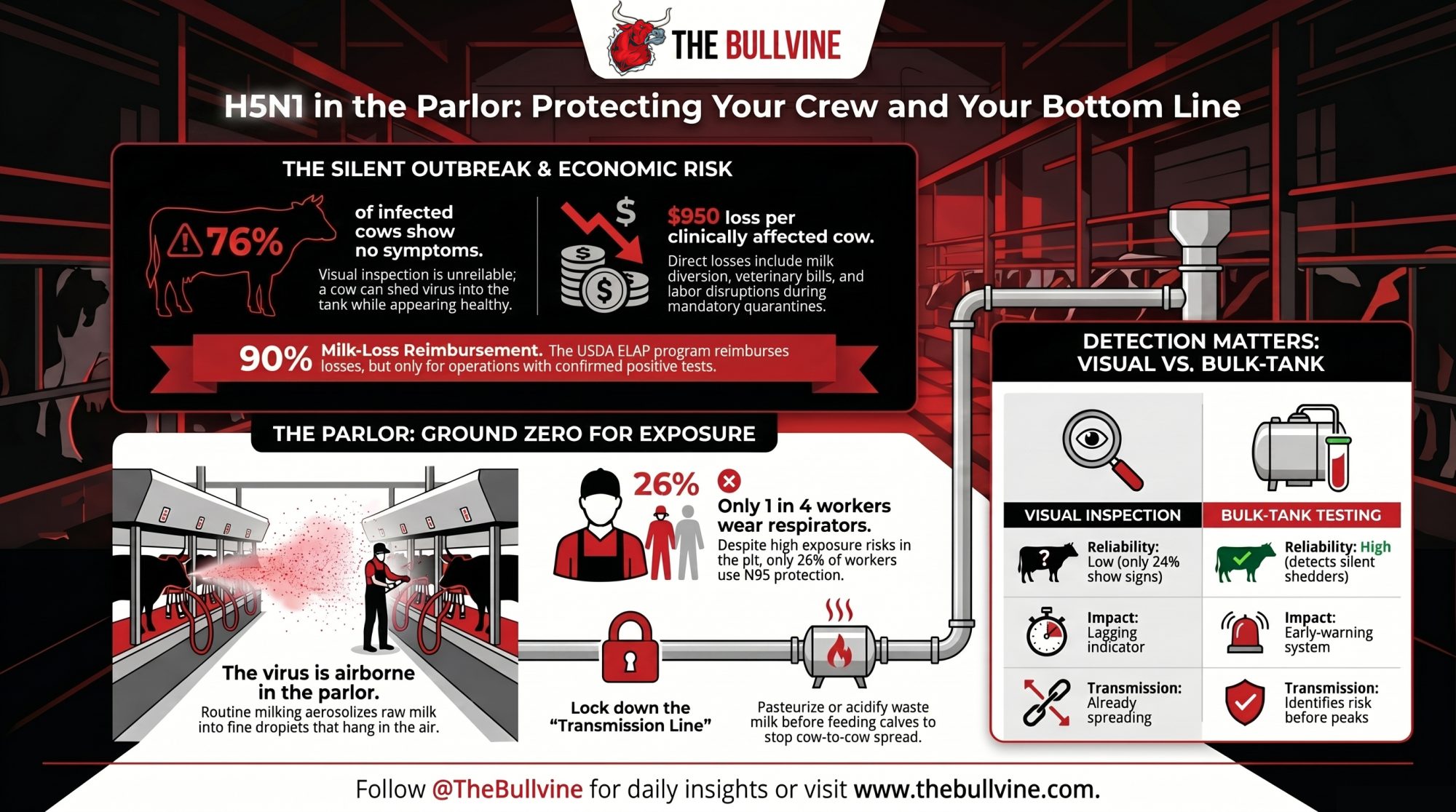
And the cows hiding it? The Cornell University team that studied a 3,876-cow Ohio herd saw clinical disease in only about 24% of cows, while roughly 76% of infections ran silent. So your eyes aren’t a screening tool. A cow can be shedding into the tank and into the air while chewing cud like nothing’s wrong.
| Population studied | Showed clinical signs | Ran silent / asymptomatic | What it means for you |
| Dairy cows (3,876-cow Ohio herd) | ~24% | ~76% infected, no signs | A cow can shed into the tank looking healthy |
| Exposed workers (MI & CO serology, n=115) | 4 of 8 recalled illness | 4 of 8 felt nothing at all | Half of infected workers never knew |
| Workers wearing an N95 | 26% | 74% unprotected | The exposed majority has no barrier |
| Retail pasteurized milk (FDA, n=464) | 0 viable virus | 6.9–36.3% PCR fragments (dead) | Store milk is safe; the farm is where it moves |
That’s exactly why Utah moved straight to mandatory weekly bulk-tank testing for every dairy in Cache County. State Veterinarian Daniel Christensen, DVM, has said mandatory surveillance and animal-movement restrictions are the key steps to stopping further spread. Visual inspection alone isn’t enough — by the time a herd shows a drop in production, the virus has usually been amplifying in the milking environment for days.
Getting Your Crew to Actually Wear the Gear
Here’s where good intentions go to die. You can stock every shelf with N95s and face shields, and compliance still slips by mid-shift — and it’s rarely about carelessness. A respirator gets hot under a hose-down. Fogged-up eye protection in a 100-cow parlor is a hazard in itself. And a crew running 14-hour days will shed anything that slows them down by the third turn.
Treat it as a systems problem, not a discipline problem. The farms that hold compliance tend to do a few unglamorous things: they fit-test respirators so they actually seal, they keep spares within arm’s reach of the pit, and they put one person in charge of restocking instead of hoping it happens. In parlor heat, some operations swap N95s for powered air-purifying respirators (PAPRs) and build in mask breaks so the gear stays on through the shift. The barn-floor truth is that PPE only protects the workers who’ll wear it through the last cow of the night — so the goal isn’t a one-day rollout, it’s a habit that survives a bad week.
How Much Does One Skipped Respirator Actually Cost You?
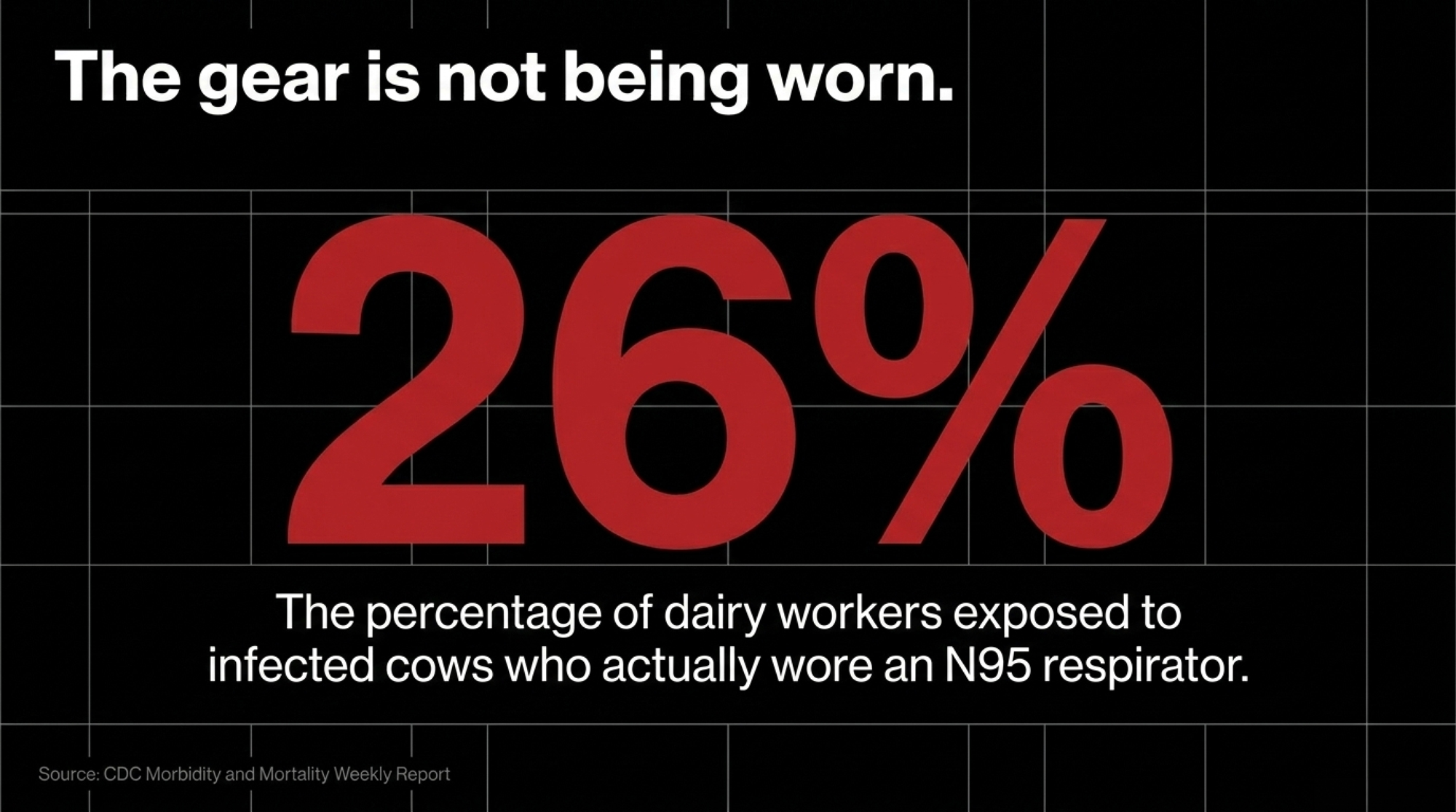
The exposure math is brutal in its simplicity. A CDC study published in Morbidity and Mortality Weekly Report(November 2024) found only 26% of dairy workers exposed to infected cows wore an N95 respirator — roughly one in four. A companion CDC serology study of 115 workers in Michigan and Colorado found 8 (7%) had antibodies showing recent H5N1 infection — and half of them, four of eight, didn’t recall feeling sick at all. Low PPE adherence and silent infection, side by side, in the same workforce.
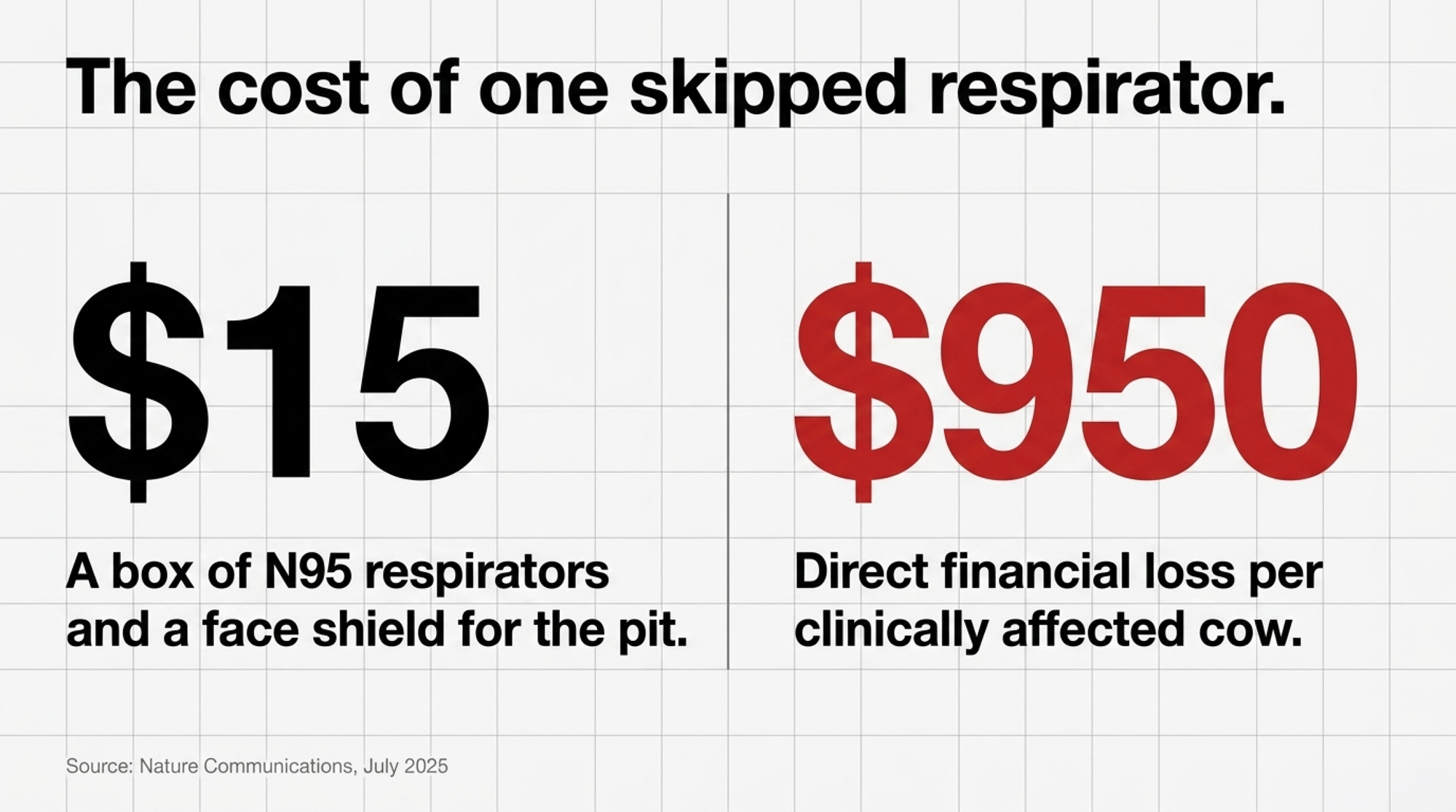
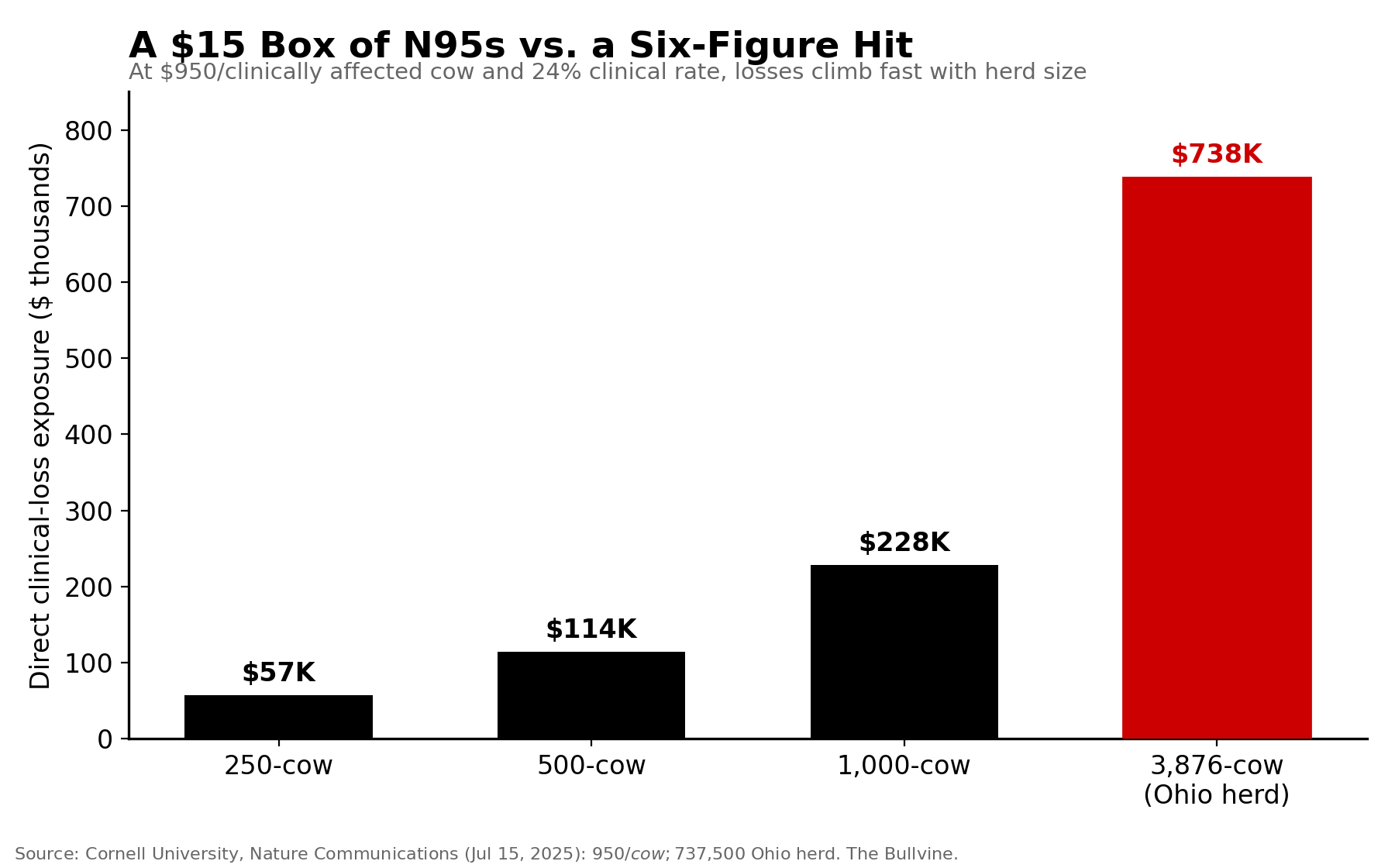
Now the dollars. Cornell University researchers, publishing in Nature Communications on July 15, 2025, pegged the loss at $950 per clinically affected cow — about $737,500 for the single Ohio herd they studied. On a 500-cow dairy, if 24% show clinical signs like that Ohio herd, that’s roughly 120 cows at $950 — about $114,000 in direct losses before you count labor, vet bills, and quarantine disruption. A $15 box of N95s and a face shield is the cheapest line item you’ll ever weigh against that. The full breakdown of the biosecurity math every dairy should run goes well past that first $950.
What Actually Happens When Your Tank Tests Positive?
Knowing the sequence ahead of time takes some of the panic out of the phone call. A confirmed detection triggers a state quarantine on the premises — your animals stay put, and lactating cows can’t move interstate until they test negative and clear the 30-day window. Milk from clinically affected cows gets diverted or dumped; milk entering the commercial supply still goes through pasteurization, which is why your detection doesn’t become a grocery-store problem.
Picture how that quarantine week actually runs on a herd like the Cache County operation. The milk check takes an immediate hit while affected cows are diverted. The state vet’s office wants samples, movement logs, and a list of every truck and contractor that crossed the yard. Your crew is nervous and asking questions you may not have answers to yet. And you’re still milking three times a day through it all, because the cows don’t care that you’re under quarantine. That’s the real shape of the disruption — not one dramatic event, but a couple of weeks of running your operation with one hand tied behind your back while the paperwork stacks up.
There’s money on the table to soften the blow, and many operators leave it there. USDA’s Emergency Assistance for Livestock, Honeybees, and Farm-raised Fish (ELAP) program reimburses 90% of the per-cow milk-loss rate, calculated using a 21-day no-production window plus 7 days at half production, paid once per cow during the 120-day window after your first positive test. You file a notice of loss within 30 days after the loss becomes apparent, and the application deadline runs through January 30 of the following year. To qualify, you need a confirmed positive test and documentation of eligible cows, so the time to understand the paperwork is before you’re standing in a quarantined parlor, not after. Producers who came through earlier outbreaks in better shape generally had two things going for them: a written response plan and a relationship with their state animal-health office before the call came.
Options and Trade-Offs: What You Can Actually Run This Week
You don’t need a biosecurity consultant to start. You need to pick the path that fits your operation and move on it.
| Move | Cost / effort | Where it fails | Run it if… |
| Gear up parlor crew (N95 + eye protection) | Low cost, high effort to sustain | Compliance craters when no one’s watching | Anyone forestrips or pulls units — do this first |
| Lock down the waste-milk line | Pasteurizer, or citric acid to pH 4.1 | Closes one route, not all | You feed raw waste milk/colostrum to calves |
| Tighten shared-equipment & vehicle hygiene | Moderate — slows the day | Busy operations skip the wash step | Trucks or crews move between sites |
| Bulk-tank surveillance over visual checks | Enroll in National Milk Testing Strategy | Confirms infection, doesn’t prevent it | Everywhere — silent infection makes eyes useless |
| Map ELAP eligibility before you need it | Paperwork, done in advance | No payout without a confirmed positive + docs | You want the 90% milk-loss reimbursement |
Gear Up the Parlor Crew — Your 30-Day Move
- Do this first: Eye protection and N95s on anyone forestripping or pulling units. Lowest cost, highest return, because the virus is airborne in the parlor.
- What it takes: A stocked PPE supply, fit-tested respirators, and a crew that’ll actually wear them.
- Where it fails: Compliance craters the second a supervisor looks away — treat it as a culture fix, not a supply order.
Lock Down the Waste-Milk Line
- When it makes sense: Any farm feeding raw waste milk or colostrum to calves — a documented cow-to-cow transmission route APHIS flags explicitly.
- What it takes: A pasteurizer or an acidification protocol — UC Davis showed citric acid to pH 4.1 inactivates H5N1 in six hours, a cheaper alternative for some operations.
- The limit: It closes one route, not all of them.
Tighten Shared-Equipment and Vehicle Hygiene
- When it makes sense: If trucks, feed equipment, or crews move between sites — the exact path that spread H5N1 across Idaho’s hotspot counties.
- What it takes: Power-wash and disinfect tires and equipment that cross on-farm vehicle paths; require clean, dedicated footwear.
- The trade-off: It slows your day, and busy operations skip that.
Lean on Bulk-Tank Surveillance Instead of Your Eyes
- When it makes sense: Everywhere — silent infection makes visual screening nearly useless.
- What it takes: Enrolling in the National Milk Testing Strategy sampling that already caught Nevada’s D1.1 outbreak; Utah now mandates it weekly for every dairy in Cache County.
- The catch: A positive tank confirms you’re already infected, so surveillance buys response time, not prevention.
Where’s this heading? Utah’s jump to mandatory weekly testing after one detection is the direction of travel — the early-warning system leans harder on bulk-tank surveillance every season, so the farms treating their tank data as a smoke detector, not a formality, are the ones that’ll catch the next spread early. And the ELAP backstop means the prevention spend isn’t all on you: document your biosecurity costs and milk losses now so you can recover them if the worst happens.
Key Takeaways: Decisions to Make This Week
- If anyone in your parlor forestrips or pulls units without eye protection and an N95, fix it before your next milking — the CDC found only 26% of exposed workers wearing one, and the virus is airborne in the parlor.
- If you’re feeding raw waste milk or colostrum to calves, stop until you can heat-treat, pasteurize, or acidify it — APHIS calls it a documented cow-to-cow transmission route.
- If you’re relying on spotting sick cows to gauge your herd’s status, recalibrate: only about 24% show clinical signs, so the tank tells you more than your eyes do.
- If trucks or crews move between your sites uncleaned, build in a power-wash and disinfection step now — shared equipment and worker movement drove spread across Idaho’s hotspot counties.
- If you haven’t mapped ELAP eligibility, do it before you need it — the 90% milk-loss reimbursement requires a confirmed positive test and documentation, and the notice-of-loss clock starts at 30 days.
- If you think 18 quiet months mean you’re clear, ask Cache County, Utah — it went nearly 20 months between dairy detections and still got hit again this June.
The Question Worth Asking at Tomorrow’s Milking
Walk into your parlor tomorrow morning. Count how many of your people are wearing eye protection and a respirator while the units are running. If the honest answer is “about one in four” — the exact number the CDC found in the field — then you already know where your weakest link is, and it isn’t your bulk tank.
The barn-level question isn’t whether H5N1 is coming back. Texas, Idaho, and Utah already answered that this spring. It’s whether your parlor crew is protected before it returns to your county — and whether your tank surveillance is a real early-warning system or just a box you check. The Wayne County safety playbook every operation should stealpairs with the full bulk-tank surveillance and parlor-PPE breakdown by herd size in the next Bullvine Weekly. That’s where the operational detail lives.
Run Your Numbers
Herd Health ROI Calculator — Before you decide a $15 box of N95s and tighter biosecurity isn’t worth the hassle, run the numbers. The calculator puts a per-cow dollar value on lower culling, fewer health losses, and the replacement cost an outbreak forces on you — so you can weigh prevention against the $950-a-cow hit before it lands.
Complete references and supporting documentation are available upon request by contacting the editorial team at editor@thebullvine.com.
Learn More
- Heat Kills Bird Flu: Are You Doing Enough to Protect Your Dairy Operation? — Arms you with critical parameters to sanitize the farm, showing how alternative lower-temperature heat treatments effectively eliminate raw milk pathogens before they threaten calves.
- How Canada Keeps Its Dairy Cows Free from Bird Flu — Delivers a blueprint for long-term biosecurity positioning, outlining the strict animal movement regulations, supply chain pressures, and national surveillance testing keeping international herds clean.
- Americans Unaware of Raw Milk Dangers: Survey Reveals Alarming Knowledge Gap — Exposes shifting consumer perceptions and processing realities as commercial herds face public scrutiny over unpasteurized consumption, illustrating why proactive on-farm pasteurization limits liability.
 The Sunday Read Dairy Professionals Don’t Skip.
 The Sunday Read Dairy Professionals Don’t Skip.
Every week, thousands of producers, breeders, and industry insiders open Bullvine Weekly for genetics insights, market shifts, and profit strategies they won’t find anywhere else. One email. Five minutes. Smarter decisions all week.




