



Archive for Holstein stature penalty

Holstein’s 60-Inch Rule: Why Breeders Are Backing It With 53%-vs-21% Math 

Two weeks after we broke down the May 2026 stature penalty, breeders answered back — and the sharpest reply wasn’t outrage. It was a heritability lesson.

Emeric Lebacle, a Quebec breeder, dropped it into our comment section almost as an afterthought, and it turned out to be the most important thing anyone said about Holstein’s new stature penalty. His point: stature inherits more than twice as reliably as feet and legs, so if you actually want to move a herd, you pull the lever that responds. That’s exactly what Holstein USA did in its May 2026 classification run — and if your bull lineup still leans tall, this is the number that should stop you cold.

StaturePoint deduction from Final Score
60″ and under0.00 (no penalty) 
61″−0.15 
62″−0.30 
64″−0.90 
65″−1.20 
68″−2.55 
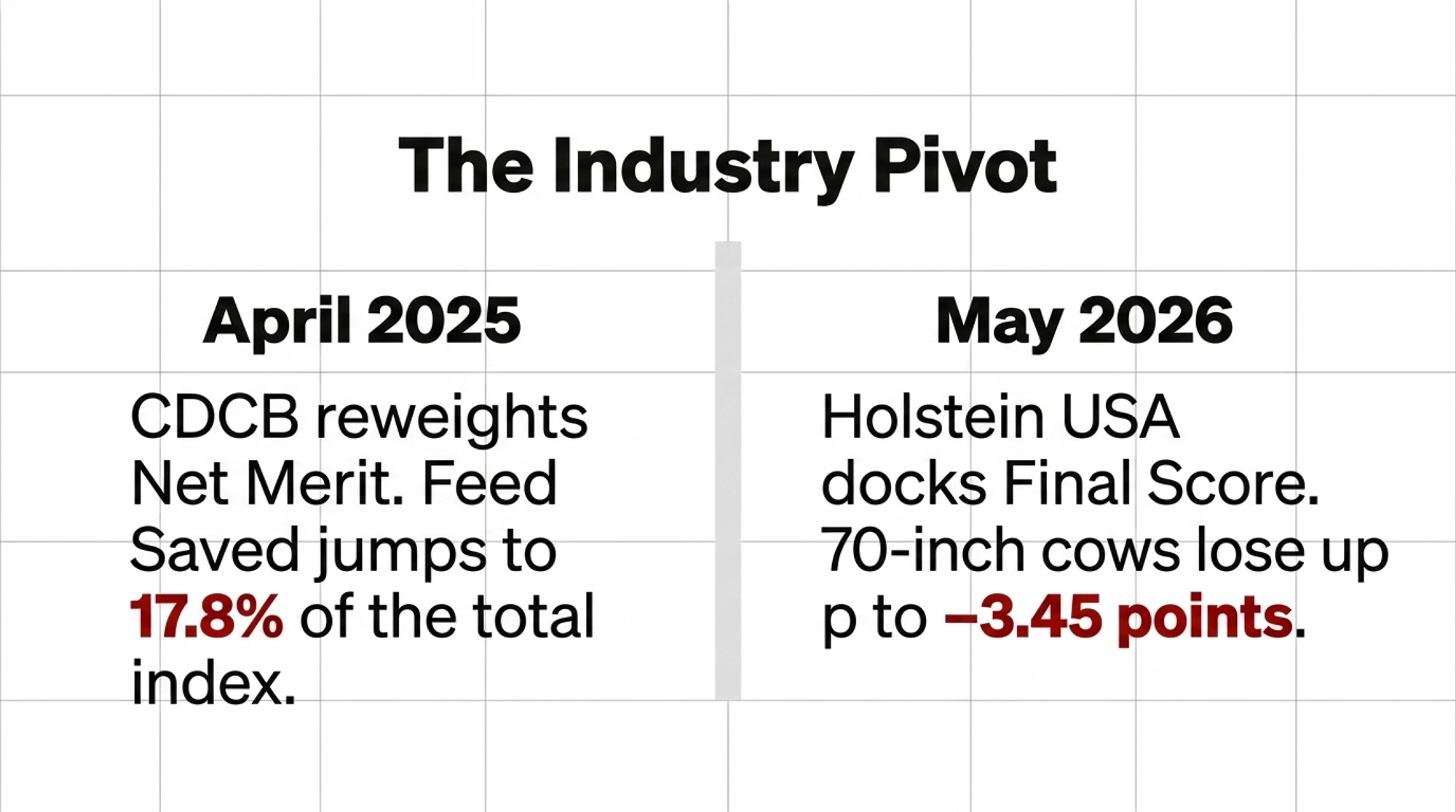
70″−3.45 

We figured the thread would split the usual way. Show people furious, commercial people cheering. That’s not what came back.

The One Number That Explains the Whole Penalty

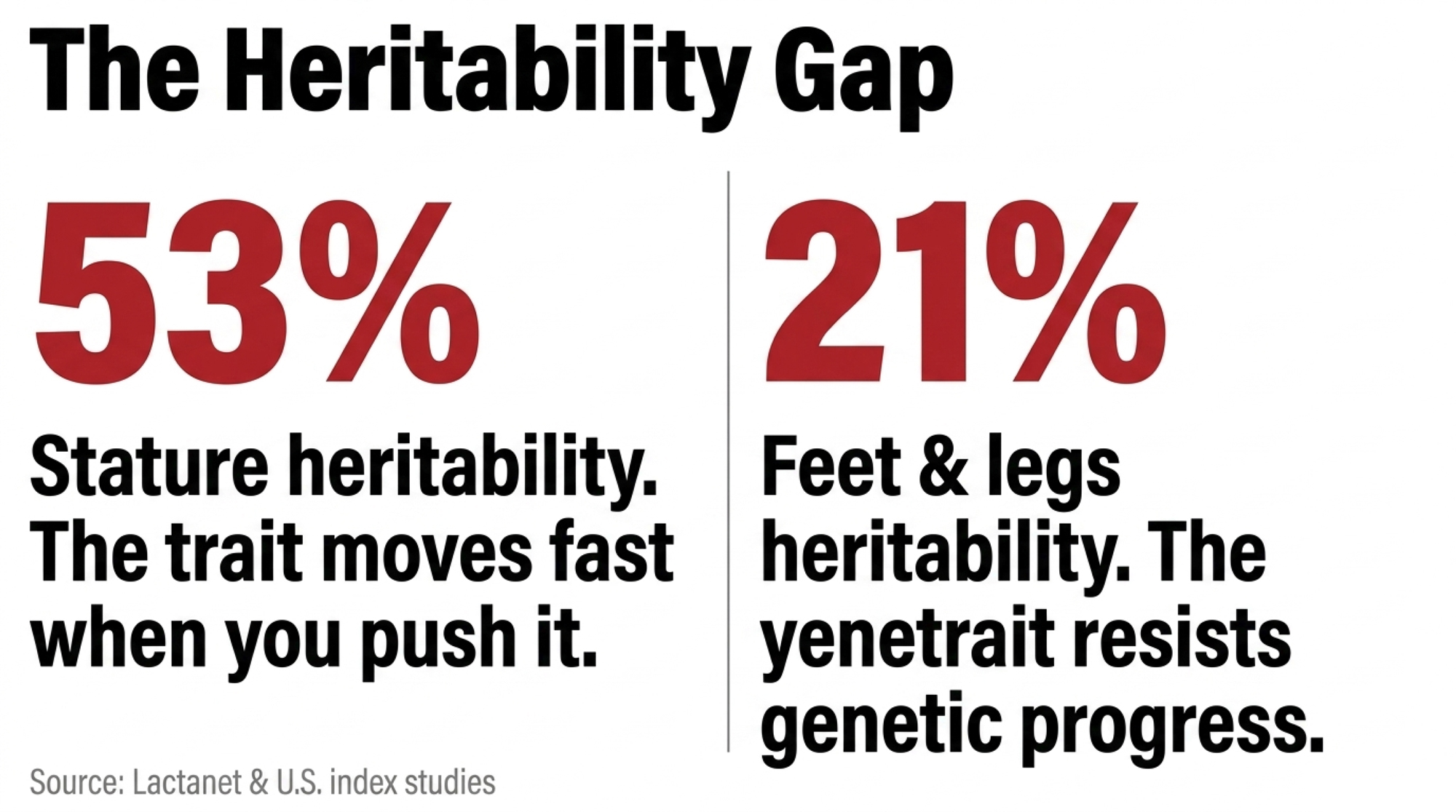
What came back was working breeders doing the genetics math the association never spelled out. Stature is one of the most heritable traits on the card. Feet and legs? Not close. And that gap is the whole argument.

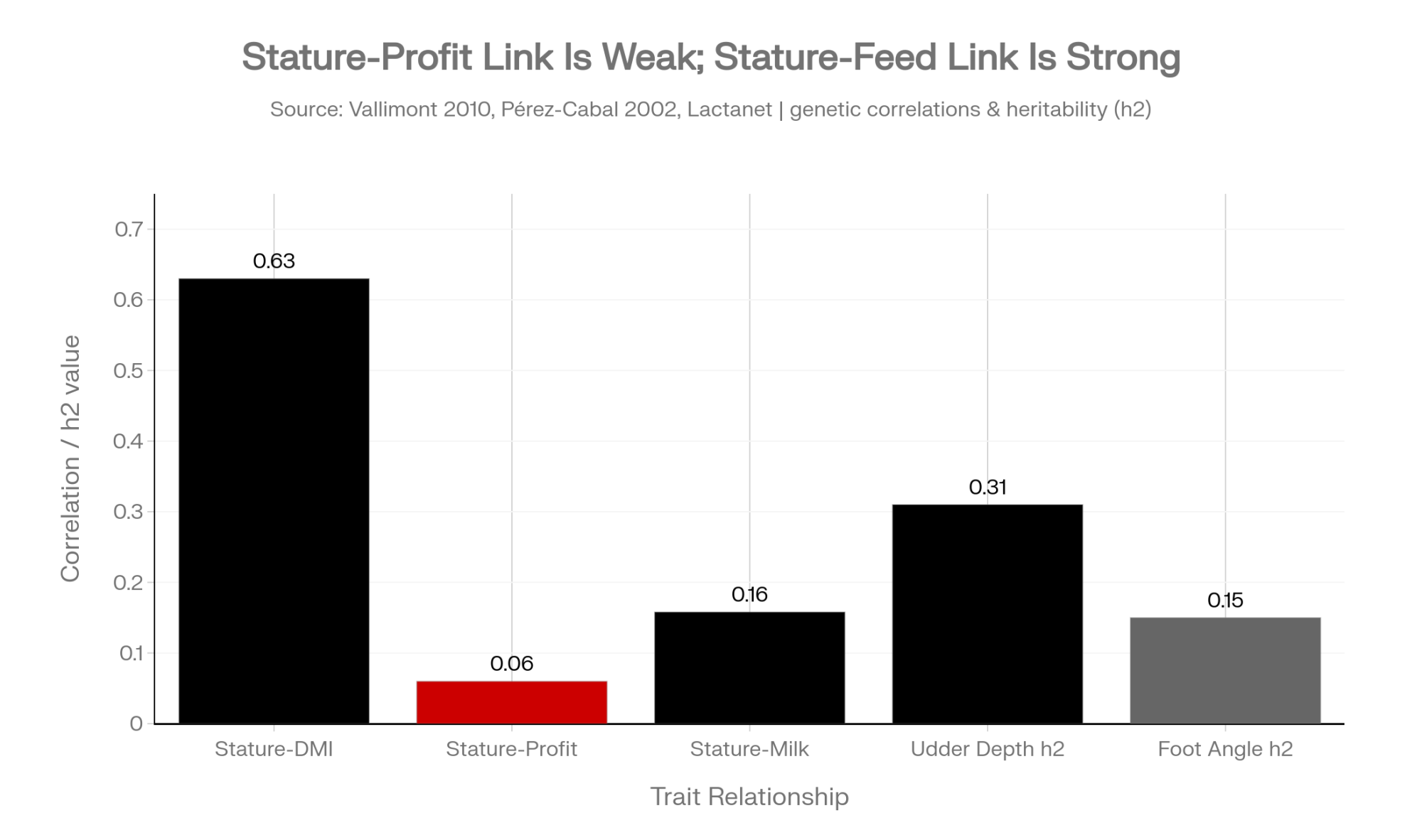
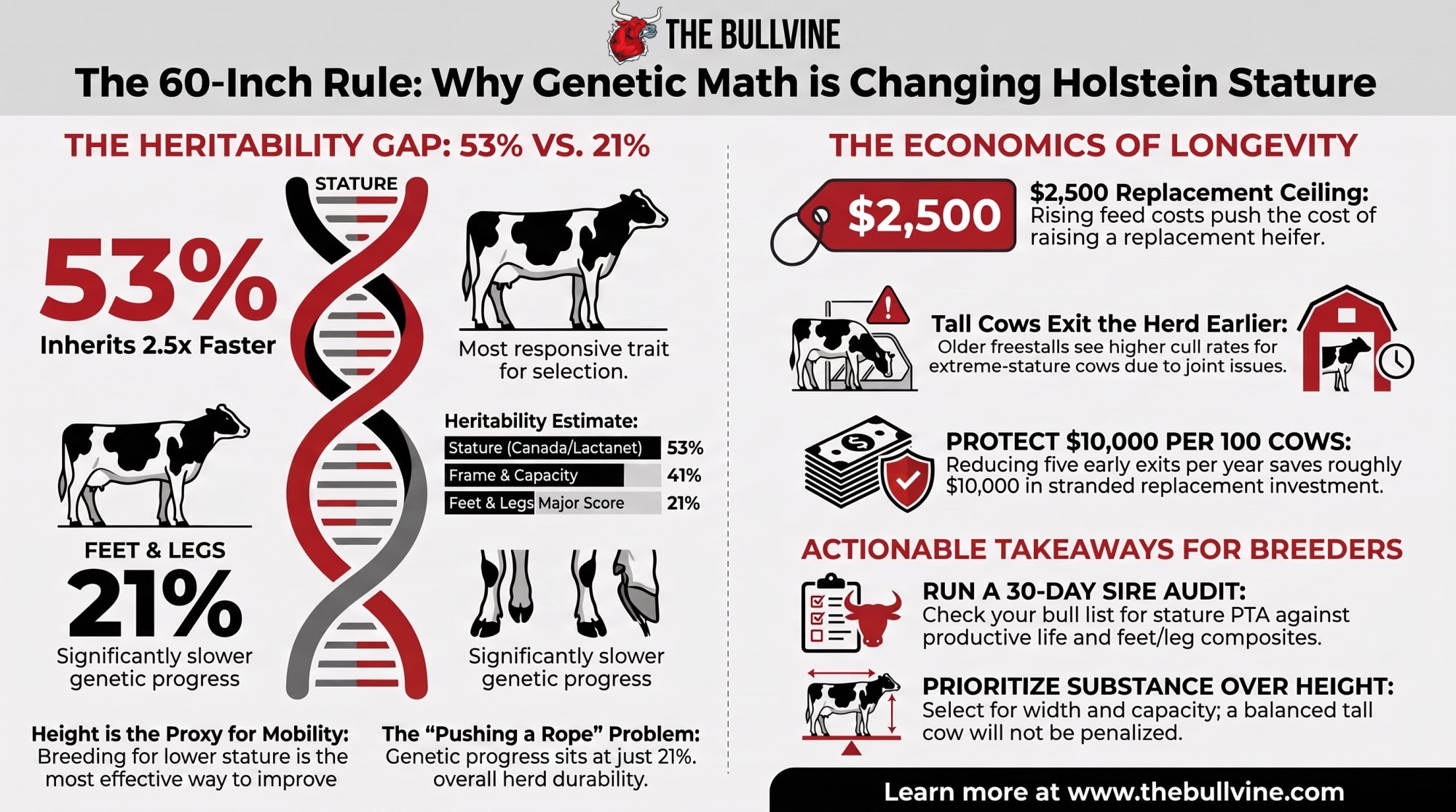
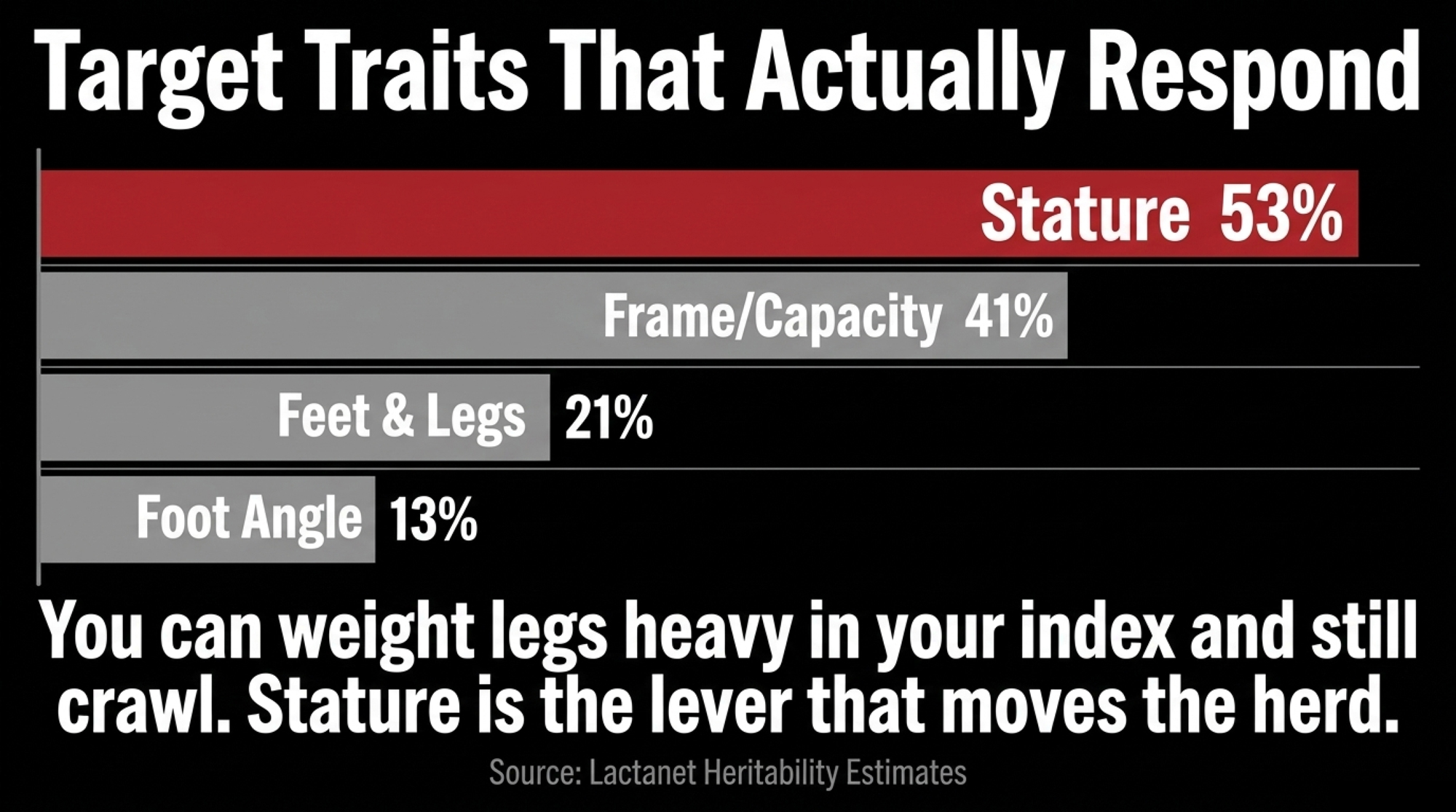
The data backs the Lebacle, hard. Lactanet pegs stature heritability at 53% — the highest of any Holstein type trait — with frame/capacity at 41%, while the Feet & Legs major score sits at just 21% and Foot Angle drops to 13%. Holstein USA runs the same direction: U.S. studies put stature in the low-to-mid 0.4 range, and the association states flatly that “it is difficult to make much genetic progress through selection and mating unless a trait has a heritability of .10 or higher”. This isn’t a 2026 discovery, either. Cassell reported back in 1973 that “stature showed the highest heritability while estimates for udder quality, hind legs, feet… were low”. 

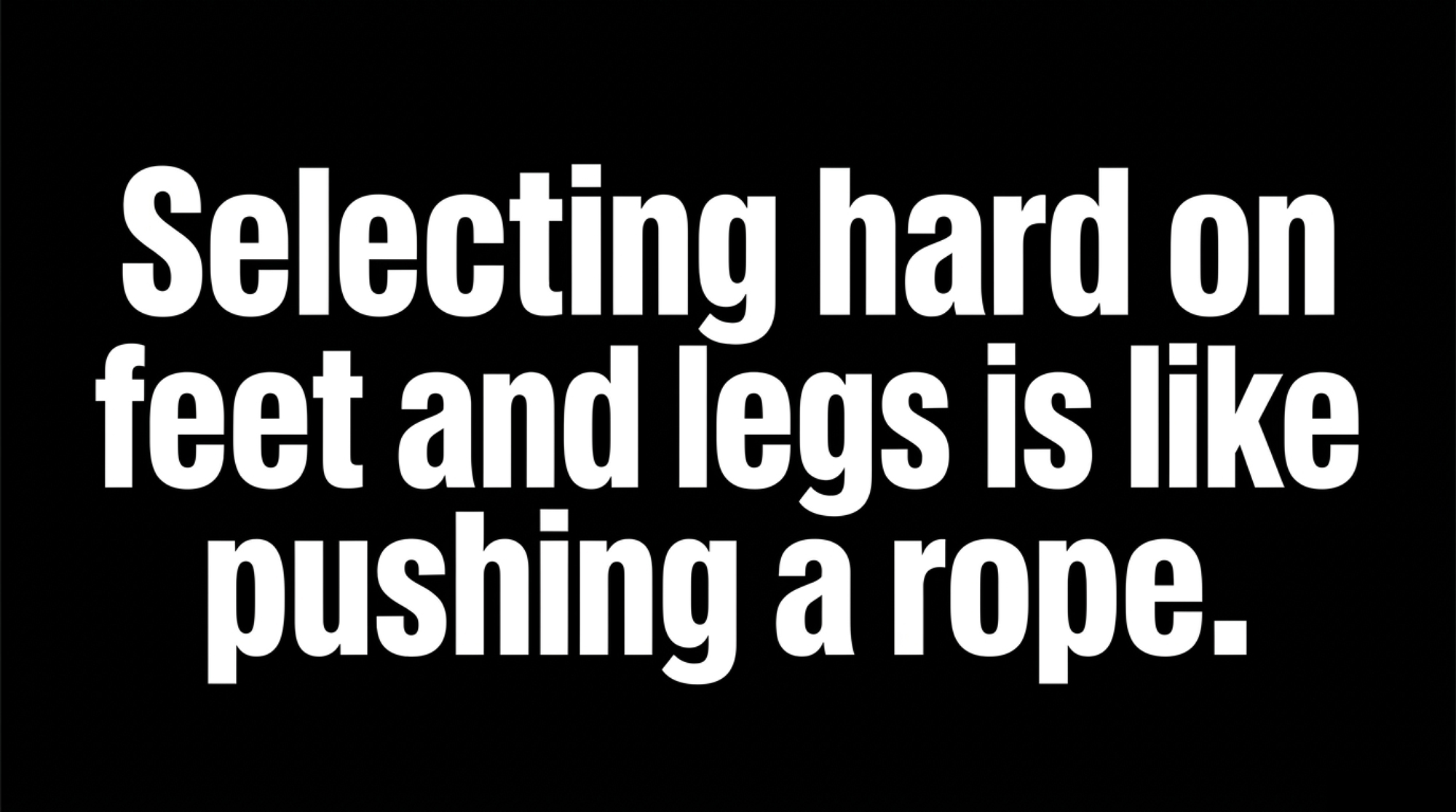
Keep the borders straight — Canada’s 53% and the U.S.’s low-0.4 range aren’t the same figure, but they tell the same story. Selecting hard on feet and legs is like pushing a rope. You can weight them heavy in your index and still crawl, because a 21% trait doesn’t inherit the way a 53% trait does. Stature does. So the association went after the trait that actually responds, knowing it drags a lot of correlated durability along with it.

TraitLactanet heritability (Canada)U.S. studies (Holstein USA)Selection response
Stature53% — highest of any type traitLow-to-mid 0.4 rangeFast — moves the herd
Frame / Capacity41%Comparable frame estimatesModerate
Feet & Legs (major score)21%Below statureSlow — like pushing a rope
Foot Angle13%Near the .10 floorBarely responds

Does the Penalty Punish a Good Tall Cow?

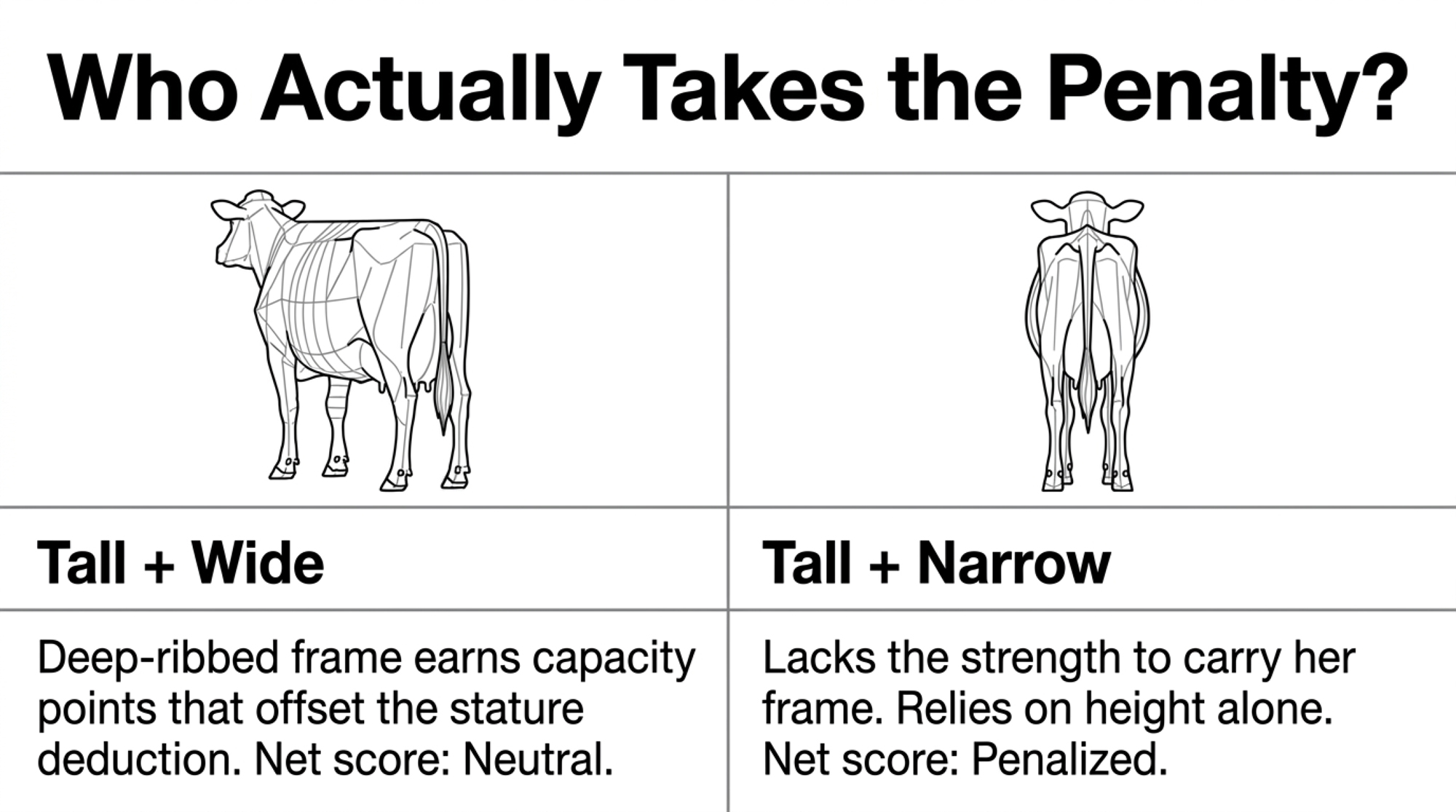
This was the loudest fear in the thread, and one farm answered it with a real classification result. A producer walked into this spring’s round braced for damage and didn’t get it. Her classifier docked stature — then handed it right back on front-end capacity and width. Her balanced cows came out neutral.

That’s one farm’s experience, not a controlled study. But it lines up with how Holstein USA actually builds its numbers. Both the Udder Composite and the Feet & Legs Composite carry a −0.20 weight on stature — on purpose, so breeders can “improve udders and feet & legs without making their cows taller”. The penalty isn’t anti-tall. It’s anti-tall-and-narrow. A wide, strong, deep-ribbed cow who happens to stand over 60 inches carries her frame, and the score shows it. The cow it’s aimed at is the narrow one riding on height alone. 

Another breeder made the same case from the skeptic’s chair. He doesn’t care how big a cow is, long as she’s got the width and strength to last — and frail, he noted, comes in every size. He’s right. And the penalty agrees with him. Height was never the disease. Height without substance is.

Is the Real Problem Height — or the Feet Nobody’s Culling?

The sharpest pushback deserves a full hearing, because it’s fair. One breeder’s argument: this penalty makes classifiers look political, and it’s aiming at the wrong target. Pull up the current top-GTPI list, he says, and look at the feet and legs on that group. Weak. Nobody’s thinning the sorry-walking bulls hard enough. So why chase height when the real durability killer is legs?

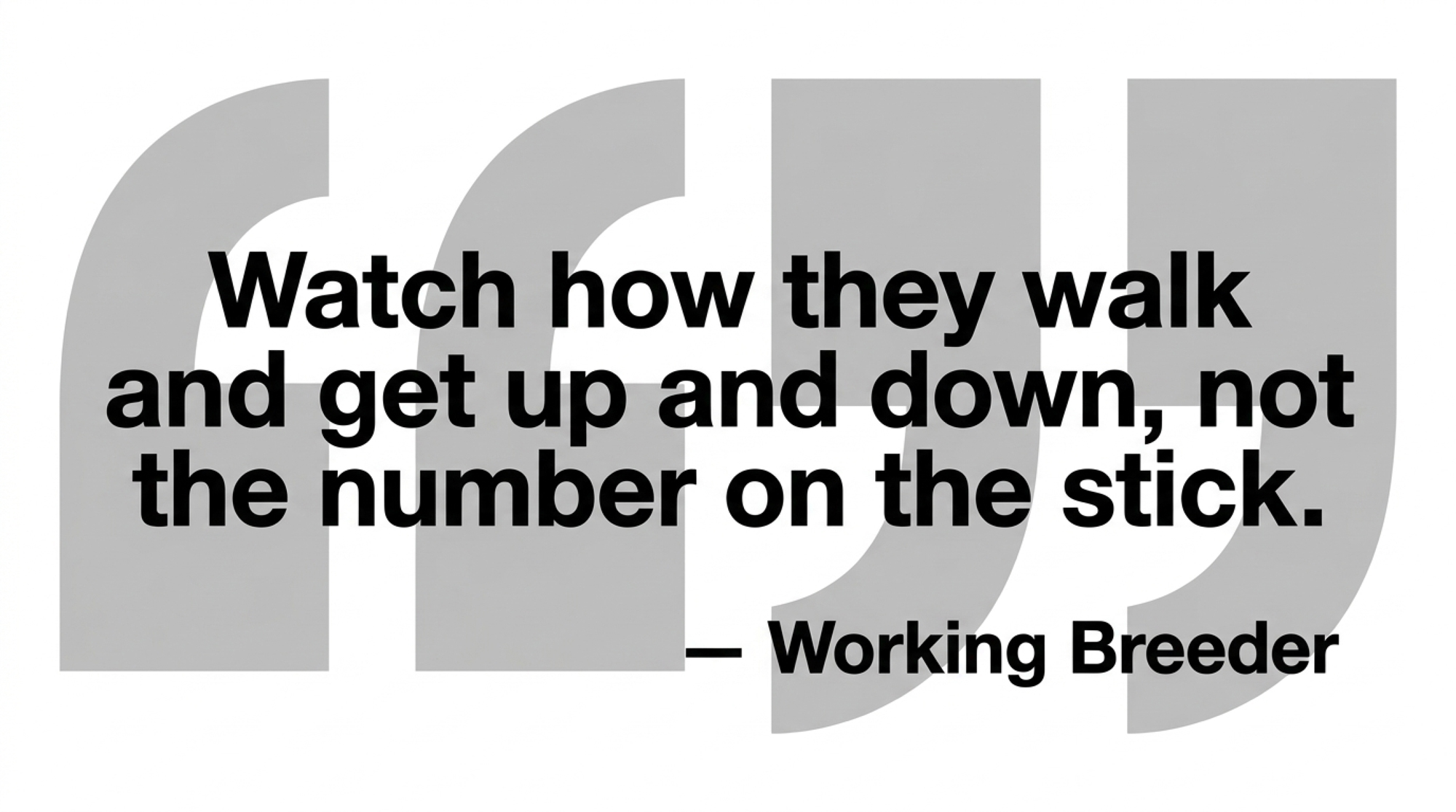
Here’s the honest answer, and it’s a “yes, and” — not a rebuttal. He’s right that top-GTPI feet and legs have slid; genomics chased production and type composites while feet and legs quietly eroded, a drift Holstein USA’s own million-cow conformation study laid bare. But the stature penalty and the feet-and-legs problem aren’t competing fixes. They’re the same fight. Height-for-height’s-sake breeding is part of what wrecked the legs in the first place — and at 53% against 21%, stature is the trait you can move fast. The lever this breeder wants pulled directly, feet and legs, responds less than half as well. So push both. Just don’t mistake the more-heritable tool for a distraction. “Watch how they walk and get up and down, not the number on the stick,” another put it — and he’s making the same point. Mobility is what matters. Height is the proxy the system can actually select on. 

The Barn-Floor Longevity File

You can argue heritability estimates all day. It’s harder to argue with a cull sheet. Several breeders volunteered the same pattern from their own alleys.

One producer runs an older freestall barn — shorter stalls, slatted floor. His read was blunt: tall cows leave earlier than short cows, so he now hunts for a minus on stature when he buys Holstein semen. That’s a breeder rewriting his own index based on what the stalls told him. Another gave the version with detail. Years back he had a cow that flirted with 70 inches — big producer, decent career, until her joints gave out. Her daughter, still tall but not as extreme, aged better and stayed athletic to the end. His verdict: somewhat-tall cows with good feet and legs generally weren’t the problem. Tall plus weak legs was. A third put it flatter — taller cows go down more, and they’re less likely to get back up.

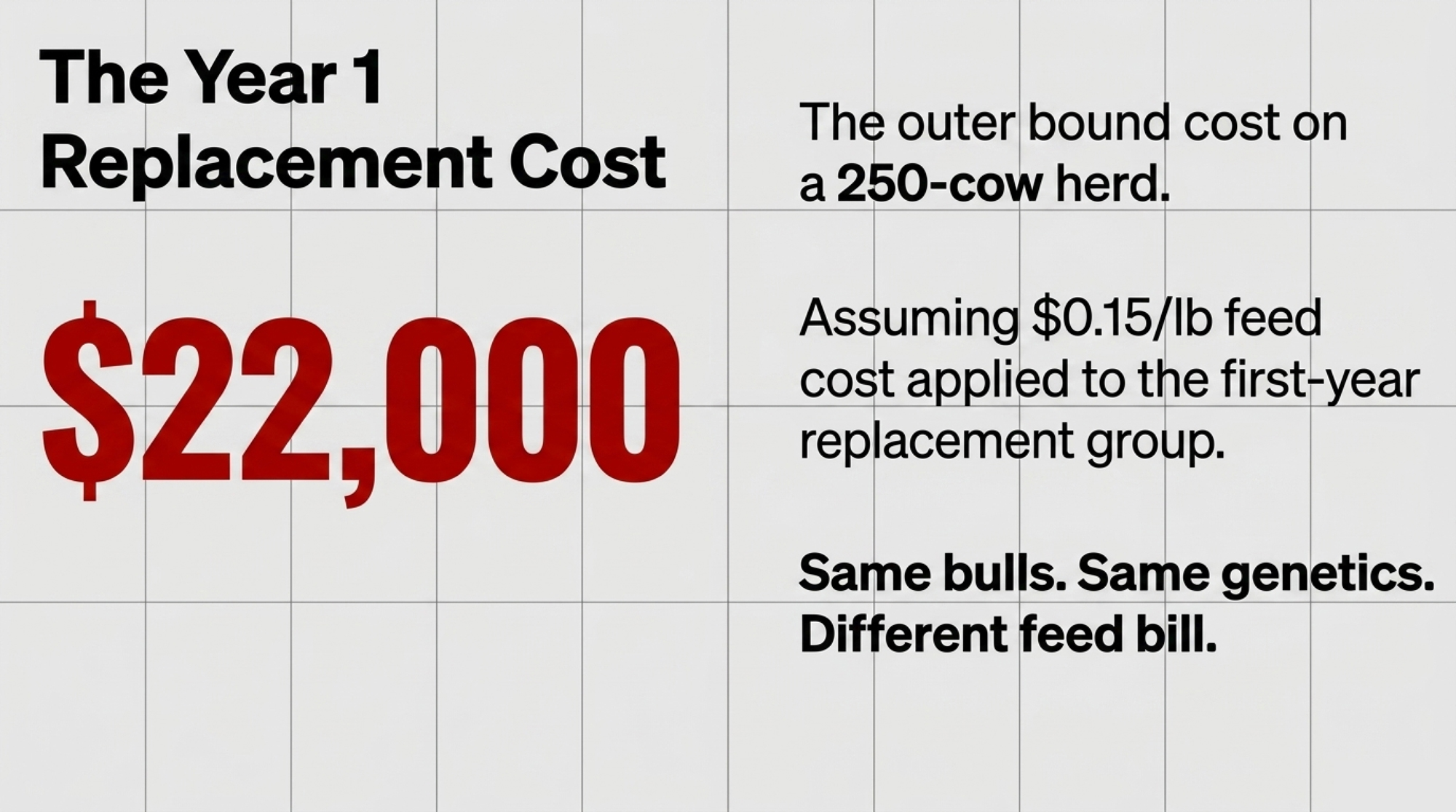
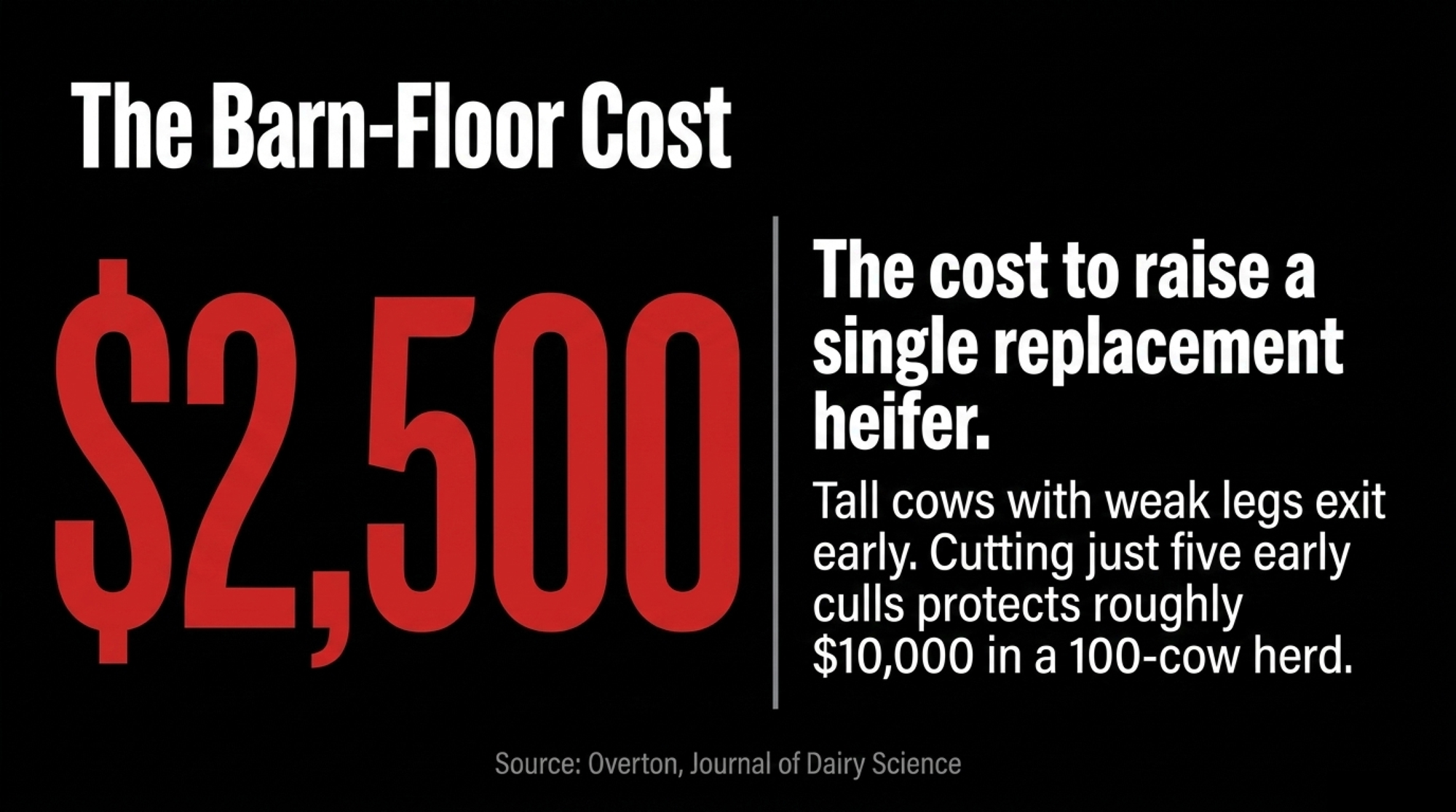
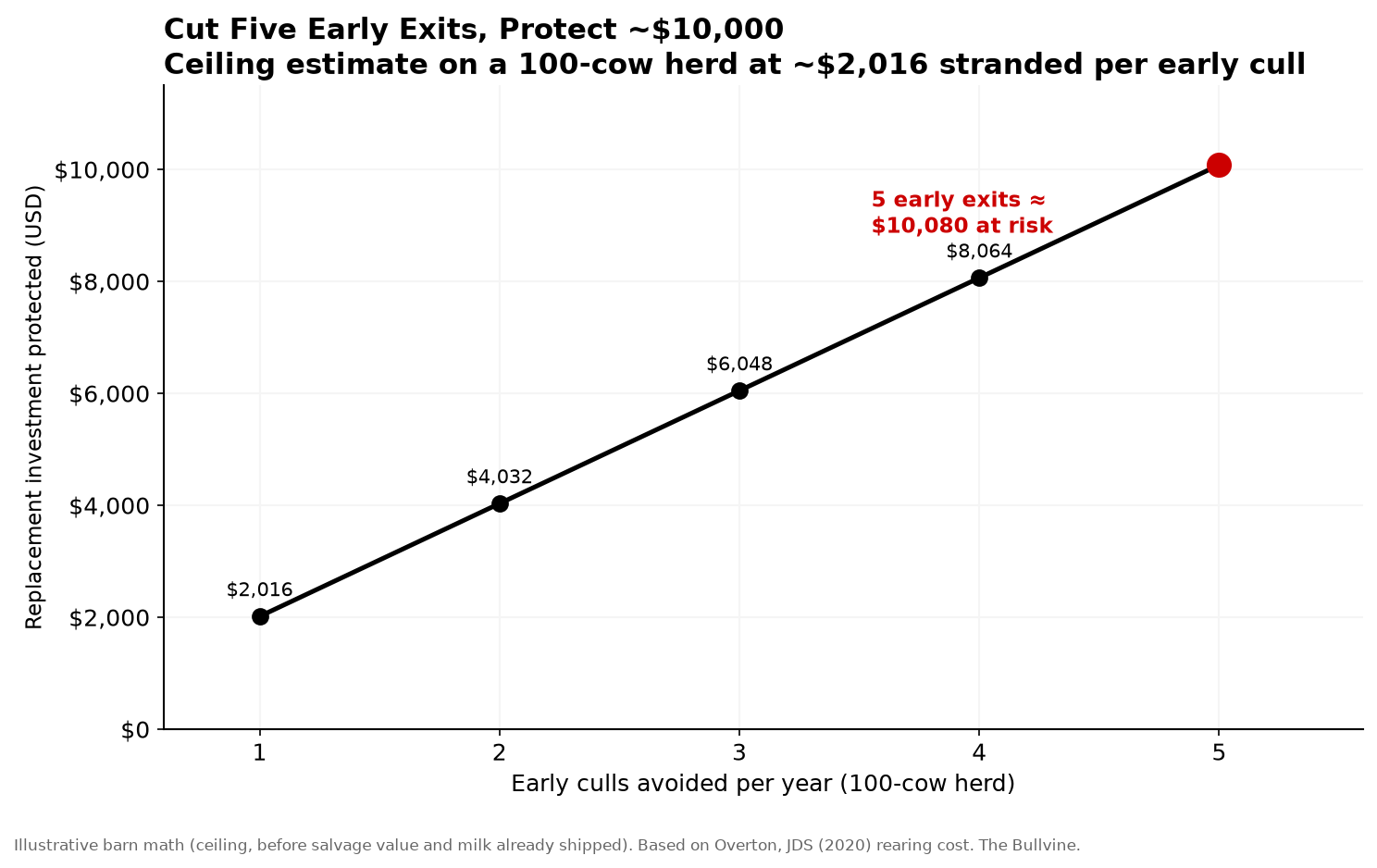
Now put a number on “they leave earlier.” Raising a Holstein replacement to calving runs about $2,016 in confinement, and anywhere from $1,700 to $2,400 depending on your setup (Overton, Journal of Dairy Science, 2020)  — and recent land-grant figures have crept to the $2,400–$2,500 range as feed costs climbed. A cow culled a full lactation early strands a chunk of that before she’s paid you back. On a 100-cow herd, cutting five early exits a year protects roughly $10,000 in replacement investment — call it the ceiling, not the take-home, since salvage value and the milk she already shipped claw some of it back. That’s why breeders in older, shorter stalls treat a stature minus as risk management, not fashion. None of these are studies. They’re decades of watching cows come and go, and they all point where the data already does. 

Don’t Blame the Ring

Here’s where this whole conversation usually goes sideways. The show ring gets blamed for every tall, narrow, fragile Holstein in the country. That’s too easy. And it lets everyone who actually built her off the hook.

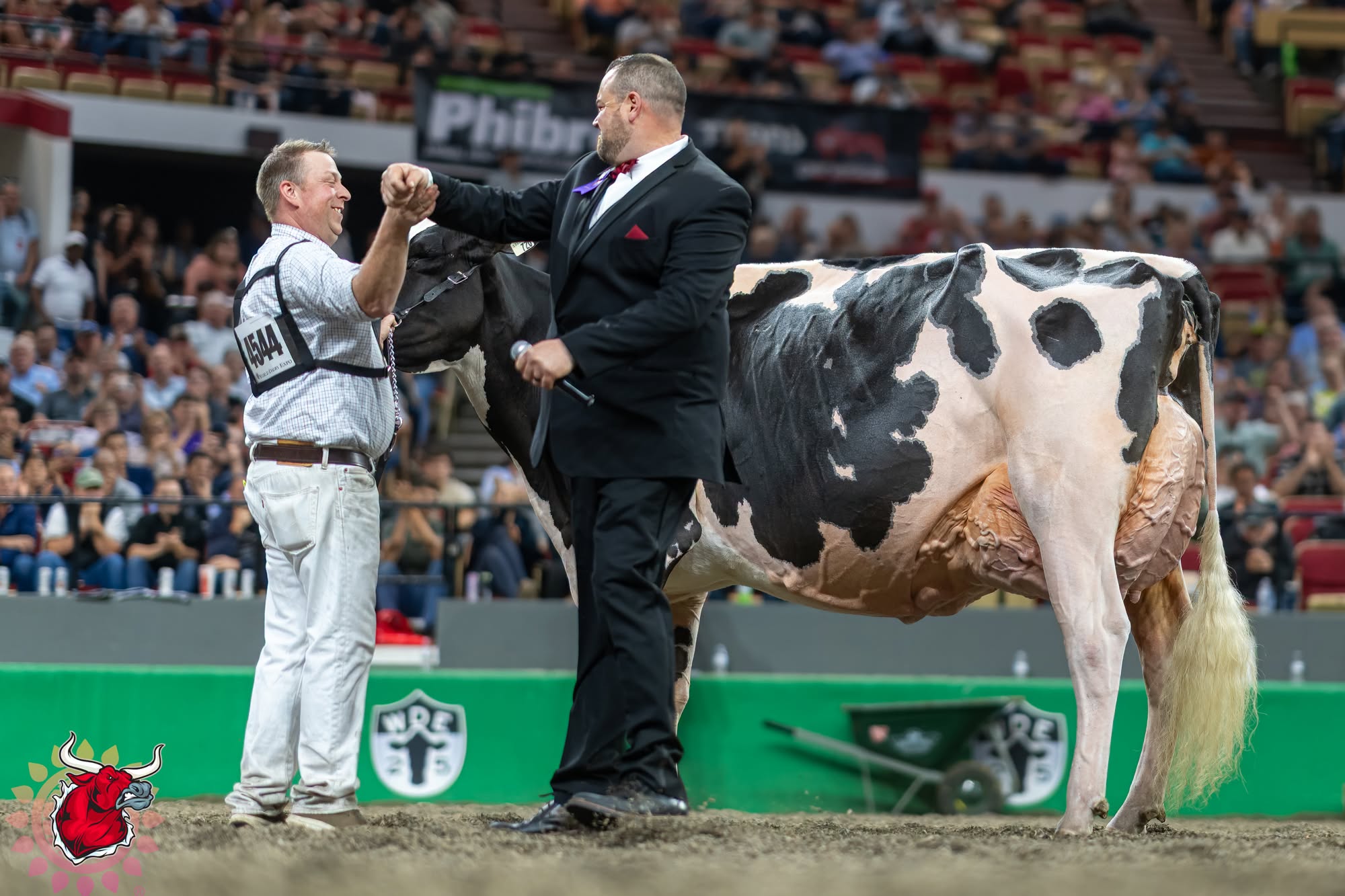
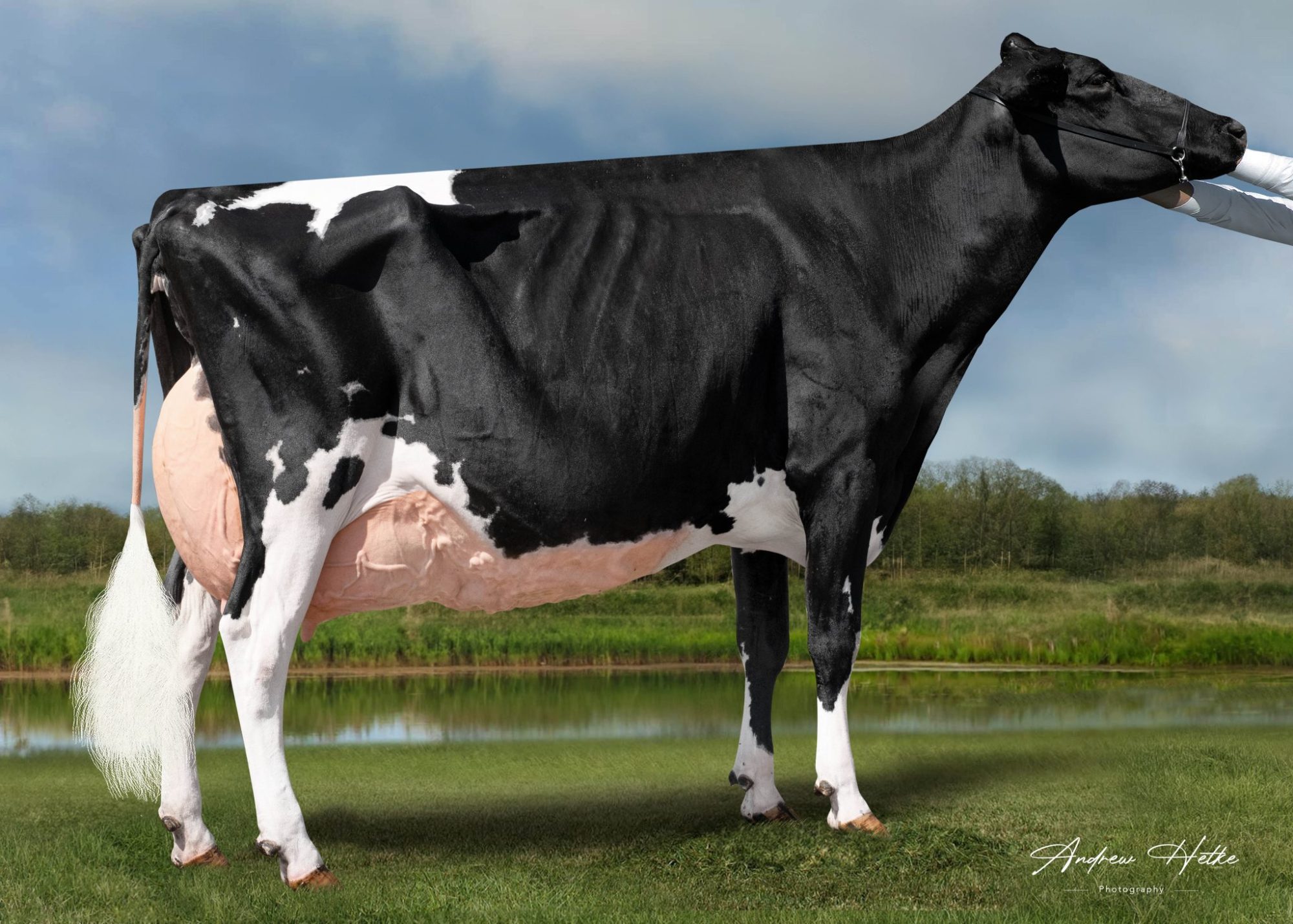
Lovhill Sidekick Kandy Cane takes Grand Champion at the Largest Dairy Show in the world— The ring is a mirror — it rewards the cow breeders, studs, and buyers chose to build. The only question that matters walking out: would she still be here in her fifth lactation?

The ring rewarded what breeders walked into it. Breed associations printed the scorecards. AI companies marketed the pedigrees. Commercial herds kept buying daughters of bulls that looked impressive at 24 months — before anyone asked how they’d hold up through three lactations. We chased bigger for 30 years, then the math caught up: big cows eat more just to exist, and the science flipped so hard the industry now docks stature and even built a whole trait, Feed Saved, to reward the opposite of what it rewarded for a generation. Same people. Opposite advice.

So don’t blame the ring. The ring is a mirror. It shows you exactly what you selected for — and the penalty is just the glass finally being honest.

The Cow That Still Stings

Then there’s the story that stopped the thread cold. A longtime breeder recalled hauling a cow to slaughter decades back — an 18-year-old downer, a small black cow, scored 88, with strength, width, and a beautiful udder. By his telling, she was among the first cows in Wisconsin to top 300,000 pounds of milk lifetime. Yet she never scored Excellent, he says, because she wasn’t tall enough. U.S. bull studs wanted nothing to do with a son of hers. That son went to Europe and did great things.

We couldn’t independently verify the record, so take it as one breeder’s memory, not documented history. But the shape of it rings true to anyone who bred cows in that era. One of the most productive cows in her state, denied the top score and shut out of the bull pipeline for a single reason — too short — back when short was the sin. The pendulum that beat her is the same one now swinging back to penalize the cows that replaced her. The trait didn’t change. The fashion did.

Options and Trade-Offs for Your Herd

The thread wasn’t just venting. Read together, your peers left a working playbook.

Your situationRecommended moveThe trade-off you acceptWarning flag
Weighting F&L hard, no progressPush stature (53%), work the cull sheet for legsLegs still improve slowly21% won’t move on its own
Older / shorter stalls, slatted floorTreat a stature minus as a featurePass on tall pedigreesTall cows leave earlier here
Want durability, no show hitBreed width, strength, capacity firstSkip flashy narrow-tall bullsBalanced tall scores neutral
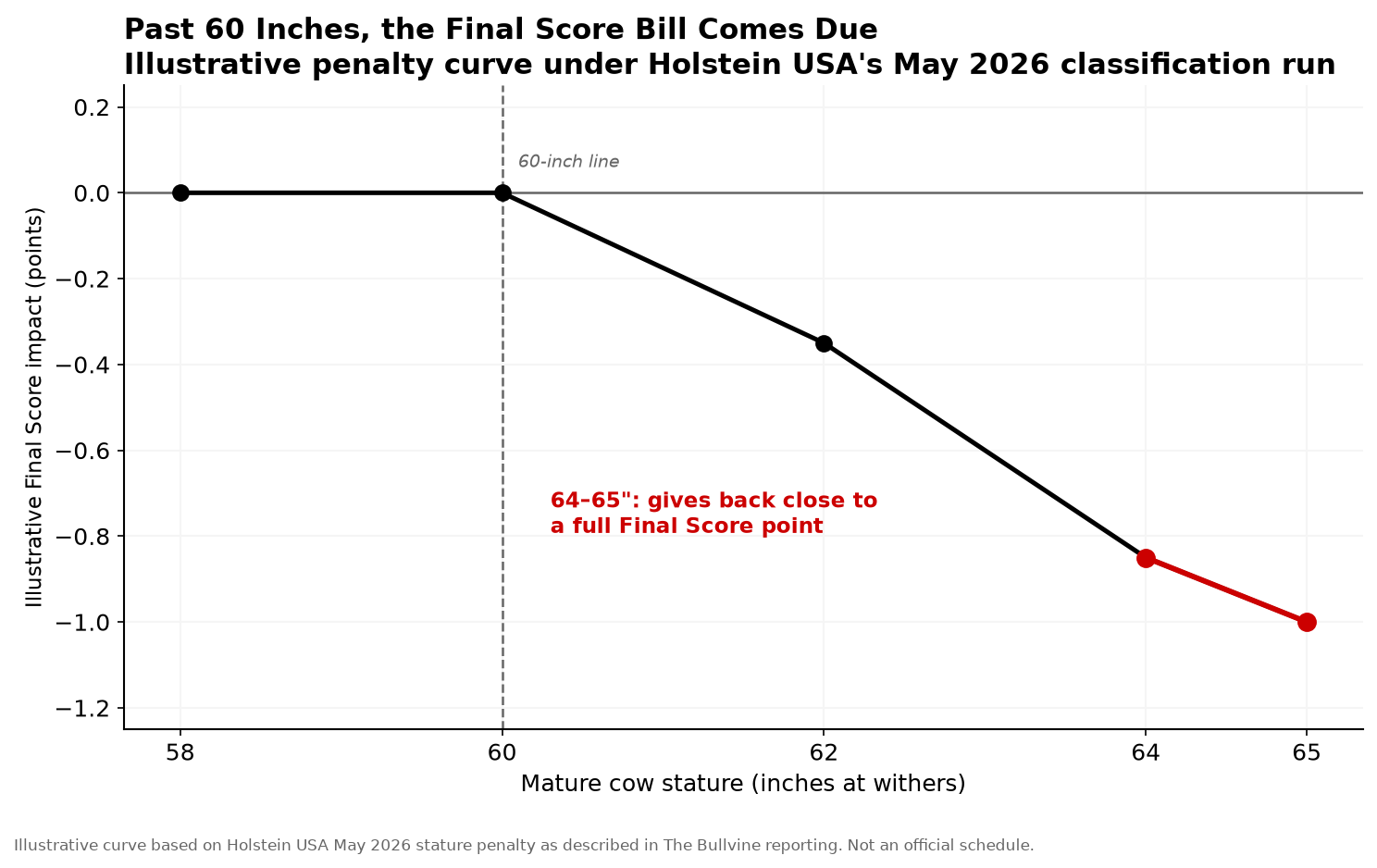
Breed show-typePrice the penalty before you commitRead linear traits, not just composites64–65″ ≈ −1 Final Score point

Run the 30-day sire audit — do this before your next semen order. Pull your bull list this month. Sort by stature PTA, and on your tallest transmitters check productive life and the Feet & Legs Composite too. If you’re in older, shorter stalls on slatted floors, do what that breeder did and treat a stature minus as a feature, not a flaw. Costs you an evening. It’s the fastest way to see whether your lineup is still ordering the cow the scorecard now penalizes.

Chase substance, let height fall where it lands. Best for herds that want durability without a show hit. Select for width, strength, and capacity first — a balanced tall cow scores neutral, as that spring classification proved. The trade-off is real: you’ll pass on flashy, narrow, tall pedigrees that still photograph like a magazine cover. 

Push feet and legs directly, too — the critics earned that. Don’t let the stature debate become an excuse to ignore legs. But know the catch going in: at 21% against stature’s 53%, progress comes slow, so lean on the composite and your own cull records rather than chasing one bull’s foot-angle number. 

If you breed show-type, price the change with your eyes open. A daughter at 64–65 inches now gives back close to a full point of Final Score she’d have kept a year ago. Read the individual linear traits, not just the composites, and decide the trade honestly.

Key Takeaways

  • If you’re weighting feet and legs hard and seeing no herd progress, that’s the heritability talking. F&L sits at 21%; stature runs 53% in Canada and low-0.4 in the U.S.. Push where it moves, and work the cull sheet for the rest. 
  • If you’re scared the penalty guts a good tall cow, breed width and strength and quit worrying. Both composites carry a −0.20 stature weight by design, so capacity earns back what height docks. 
  • If you run older or shorter stalls, treat a stature minus as risk management, not heresy. At roughly $2,000 a replacement, early exits are the expensive kind of tall. 
  • If your best-ever cow would’ve been too short for Excellent a generation ago, ask what today’s fashion is costing you that you can’t see yet. Fashions reverse. Function doesn’t.

What Fashion Is Your Herd Really Built For?

The best breeders can stand in front of a gorgeous cow and still ask the only question that pays the bills on Monday morning. So walk out to your tallest, flashiest heifer — the one that photographs like progress — and ask it straight: would you want 500 more of her in the milking string? If the answer’s no, that was never the ring’s mistake. It was yours.

Pull ten of your best cows this week and run the stick next to the cull history. See which fashion your herd is actually built for. We laid out the full penalty schedule and the Net Merit math in our earlier breakdown of Holstein’s 60-inch line — this piece was your answer to it, and the reply thread isn’t closed. Keep it coming.

Hold-to-Proof Cost Simulator

Calculate the structural retention balance of your replacement pipeline

% of annual culls leaving before Lactation 3 due to frame/leg weakness

Operational Capital Impact

Annual Replacement Pipeline Requirements: 175 heifers / year
Stature-Linked Early Exits: 9 animals / year
Stranded Heifer Investment: $18,144

Formula assumes early structural exits fail to fully amortize their initial $2,016 rearing asset cost prior to third lactation. Benchmark figures adapted from Overton & Dhuyvetter, Journal of Dairy Science.

Complete references and supporting documentation are available upon request by contacting the editorial team at editor@thebullvine.com.

Learn More

The Sunday Read Dairy Professionals Don’t Skip.
Every week, thousands of producers, breeders, and industry insiders open Bullvine Weekly for genetics insights, market shifts, and profit strategies they won’t find anywhere else. One email. Five minutes. Smarter decisions all week.
NewsSubscribe
First
Last
Consent

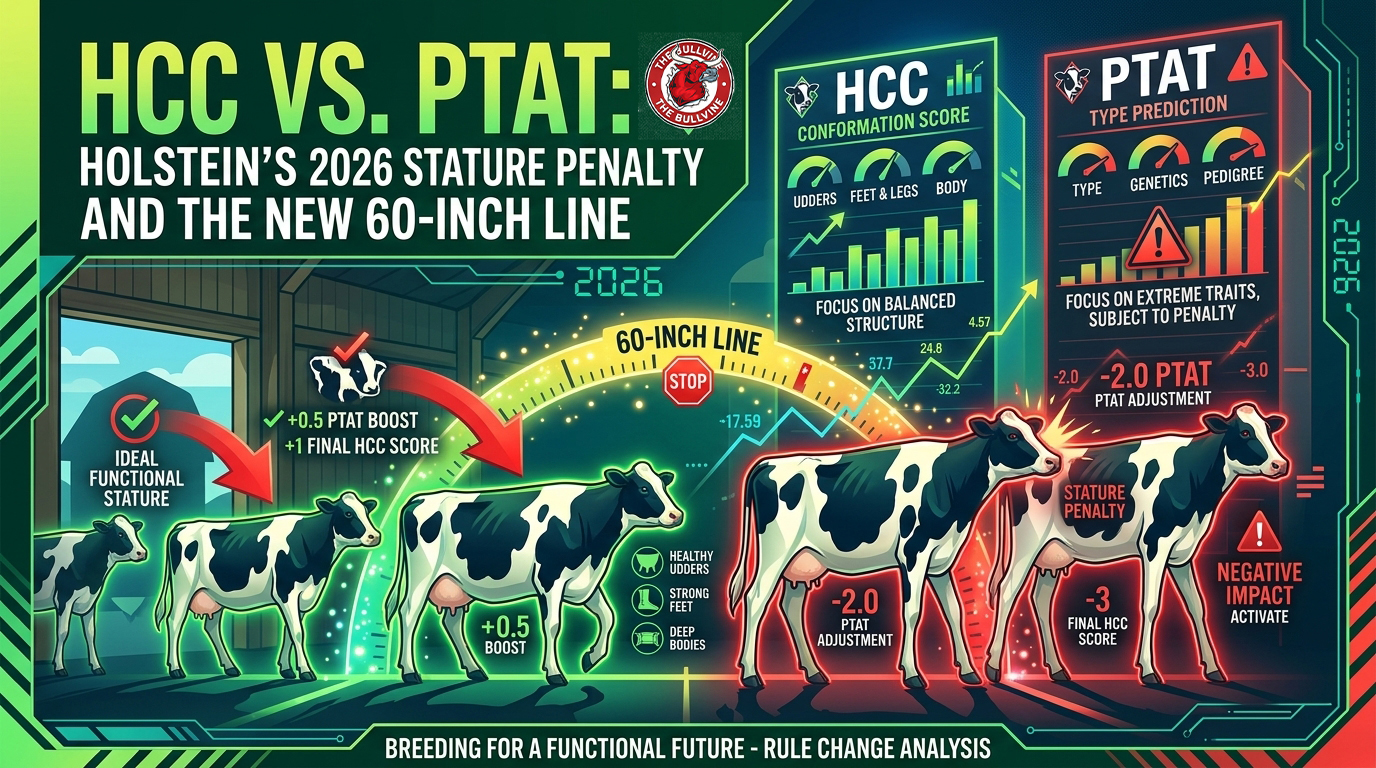
HCC vs. PTAT: Holstein’s 2026 Stature Penalty and the New 60-Inch Line

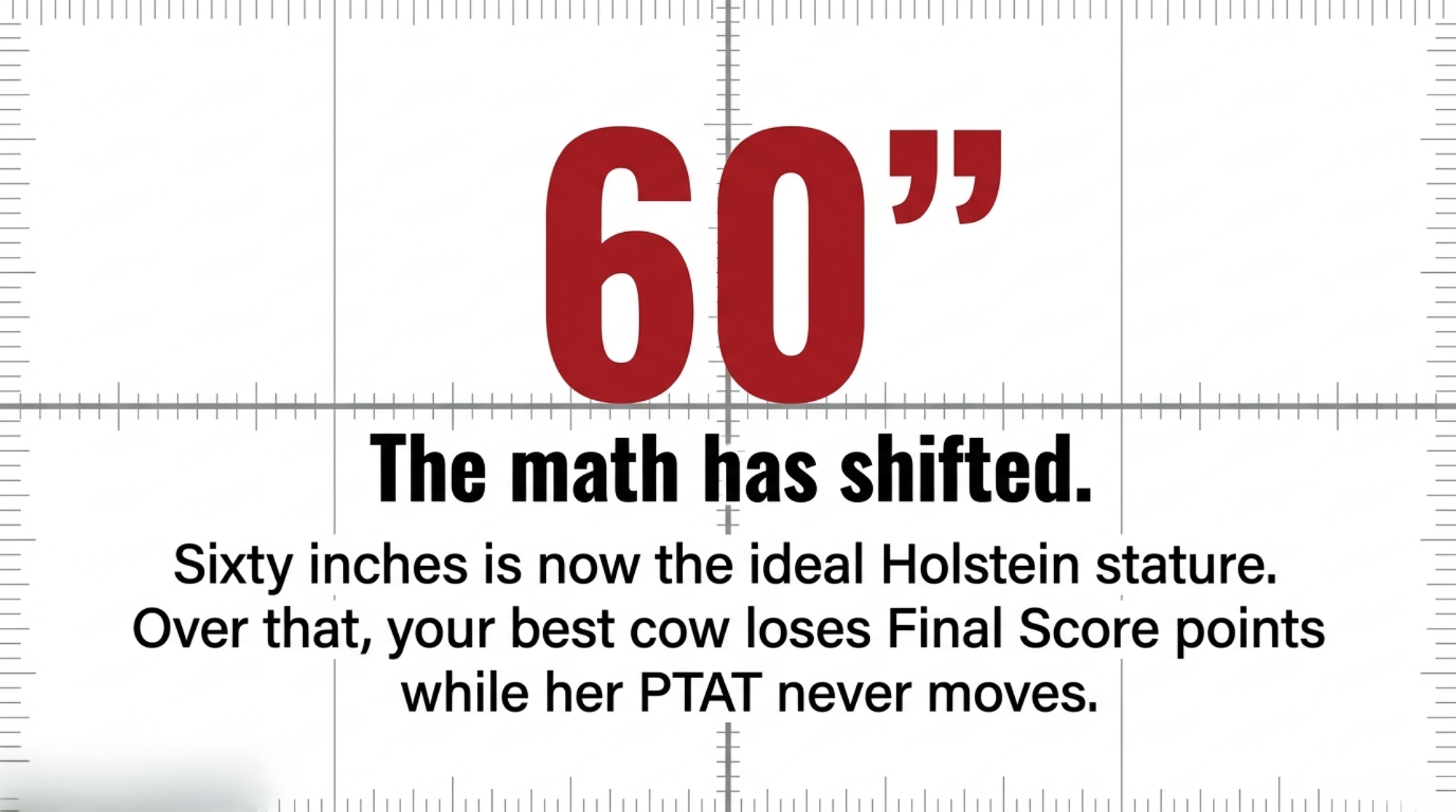
Sixty inches is the new line. Over it, your best show cow loses Final Score points — 0.15 at 61″, 1.20 at 65″ — while her PTAT never moves. Here’s the table, and why HCC reads what PTAT can’t.

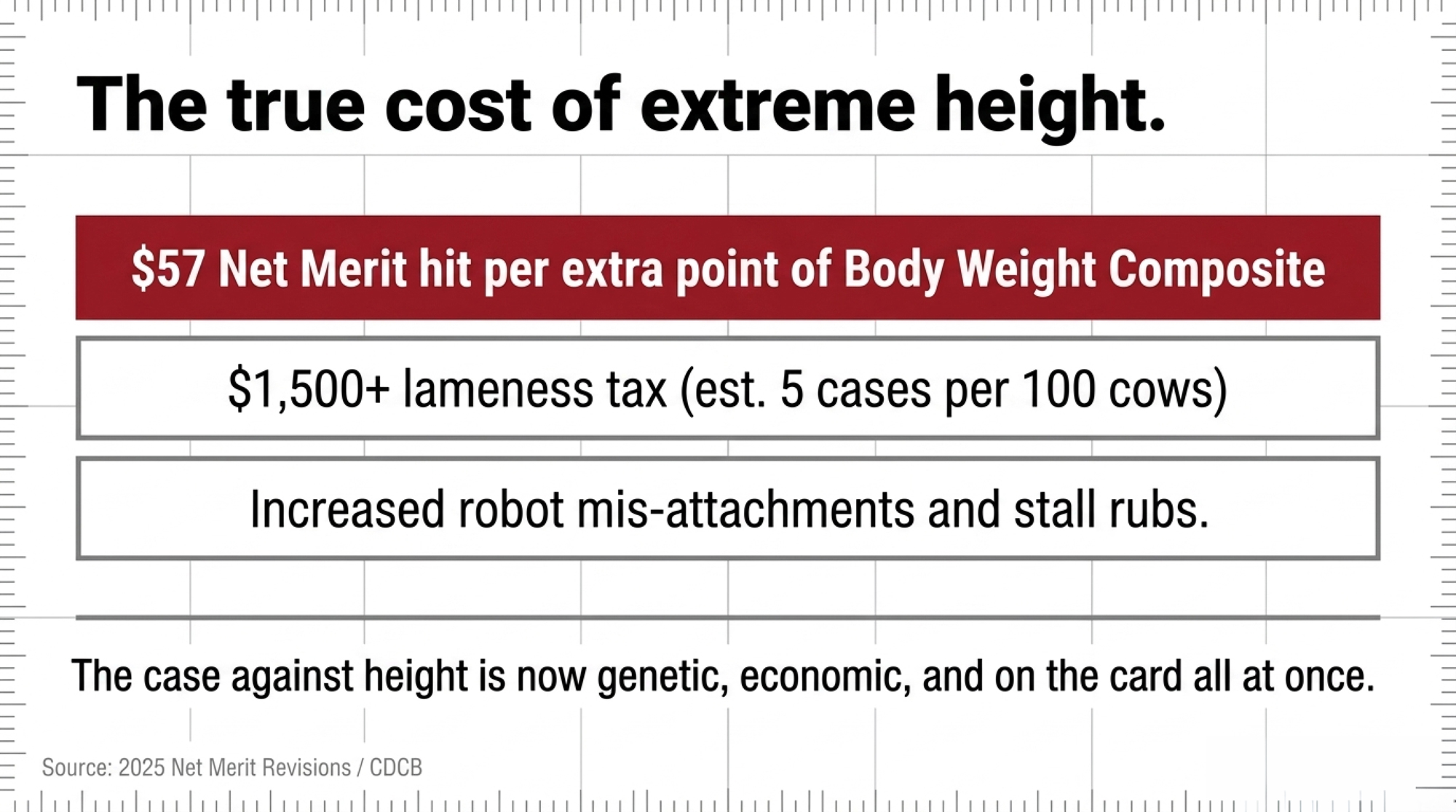
Executive Summary: Starting with the May 2026 classification run, Holstein USA made 60 inches the ideal stature — and every inch over it now docks Final Score, from 0.15 at 61″ to 1.20 at 65″ and 3.45 at 70″, pulled straight out of Front End & Capacity. Here’s the part that trips people up: the penalty applies only to the classification card. Your bull’s PTAT and stature PTA don’t move an inch, so if you’ve been buying high-PTAT, high-stature semen, your daughters can still grade down on the day the classifier puts the stick on them. The board paired it with two more changes — the new 18-trait Holstein Conformation Composite (HCC), which weights Stature highest but favors lower values and actually correlates positively with Productive Life where PTAT correlates negatively, and a BAA rule that only counts cows calved in the last 24 months. Stack the classification hit on the 2025 Net Merit math — about $57 off lifetime NM$ per extra point of Body Weight Composite — plus more lameness and robot misses in stalls built for average cows, and the case against extreme height is now genetic, economic, and on the card all at once. The tell? The 2025 Star of the Breed, Oakfield Solomon Sunset, was bred for width and correctness over height.

Holstein stature penalty

Picture the best-looking cow you’ve ever raised. The one that turned heads down the chute, framed up beautiful on the halter, filled the alley like she owned it. Now picture the classifier putting the stick on her in the May 2026 Holstein classification run — and knocking points off her card for the exact height you spent years breeding into her. This is the Holstein classification 2026 stature penalty in a sentence, and it changes your next mating decision. 

That’s the shift. At their March 2026 meeting, Holstein Association USA’s board approved a package of changes that all lean one way — away from extreme height, toward cows built to last. And it lands hardest on the animals a lot of show-focused programs spent twenty years building. Whether you halter cows or want them to last four lactations in a freestall, this one touches your next mating decision. 

What’s Really at Stake

Three changes arrived together out of the same March board meeting, and they reinforce each other. The centerpiece is a sliding-scale stature penalty, recommended by HAUSA’s Conformation Advisory Committee and approved by the board, setting 60 inches as the breed’s ideal stature for the first time — over that, cows take a progressive deduction on their classification score. Alongside it came the Holstein Conformation Composite (HCC), a new selection index built to identify animals with the combination of traits tied to balance, function, and longevity, rather than Final Score alone. And a quieter rule now ties Breed Age Average to cows that calved within the previous 24 months, so only currently productive animals count. 

Read this line twice, because it’s the one that trips people up: the penalty hits your classification score only. It doesn’t touch PTAT, stature PTA, or any genetic evaluation for stature or any other trait. Your bull’s numbers haven’t moved. What changed is what his daughters score the day the classifier puts the stick on them. 

If you breed for the ring, you’ll feel this most. If you’re a commercial breeder chasing durability, you’ll mostly nod — because the change is pushing toward the cow you already want.

What Does the Stature Penalty Actually Cost? (The Official Table)

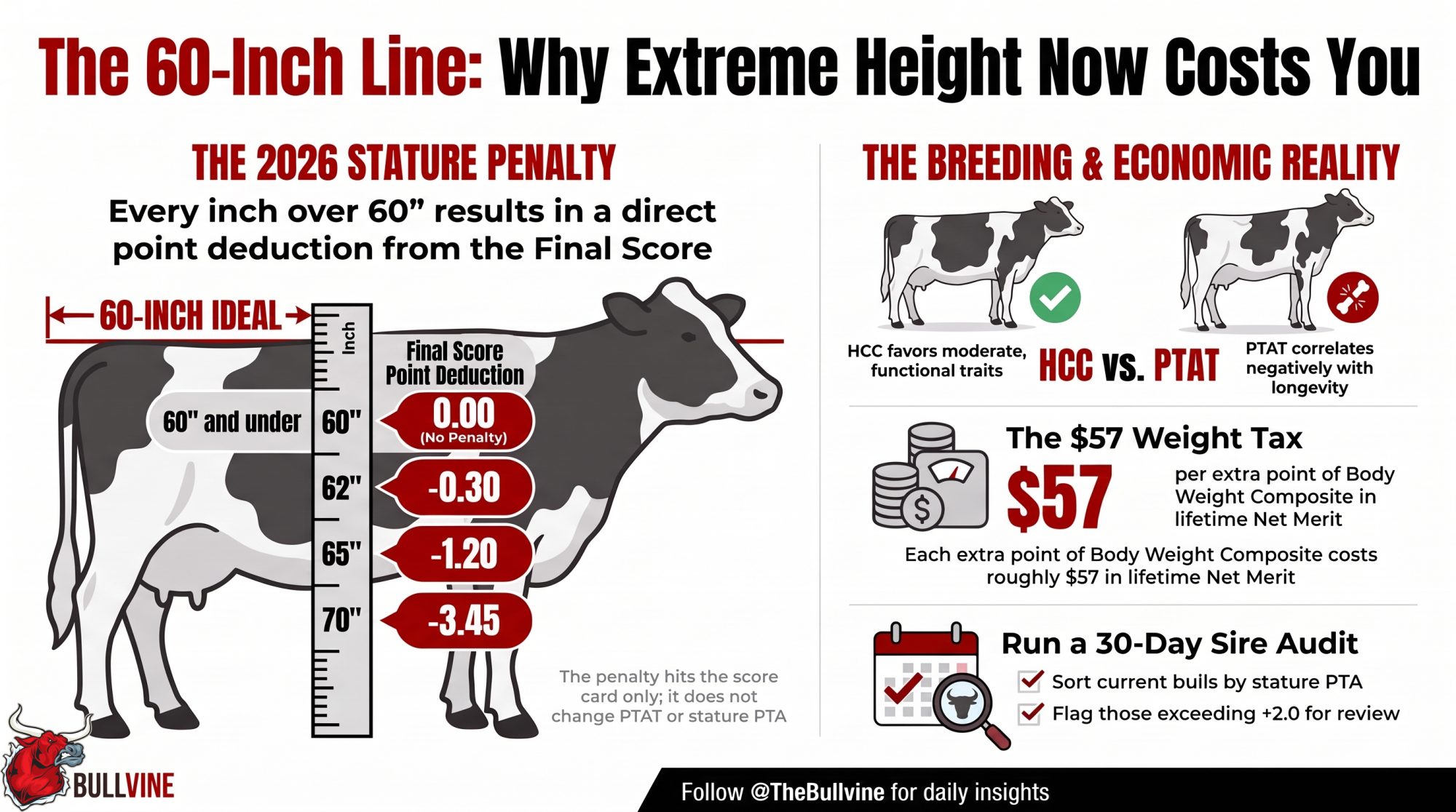
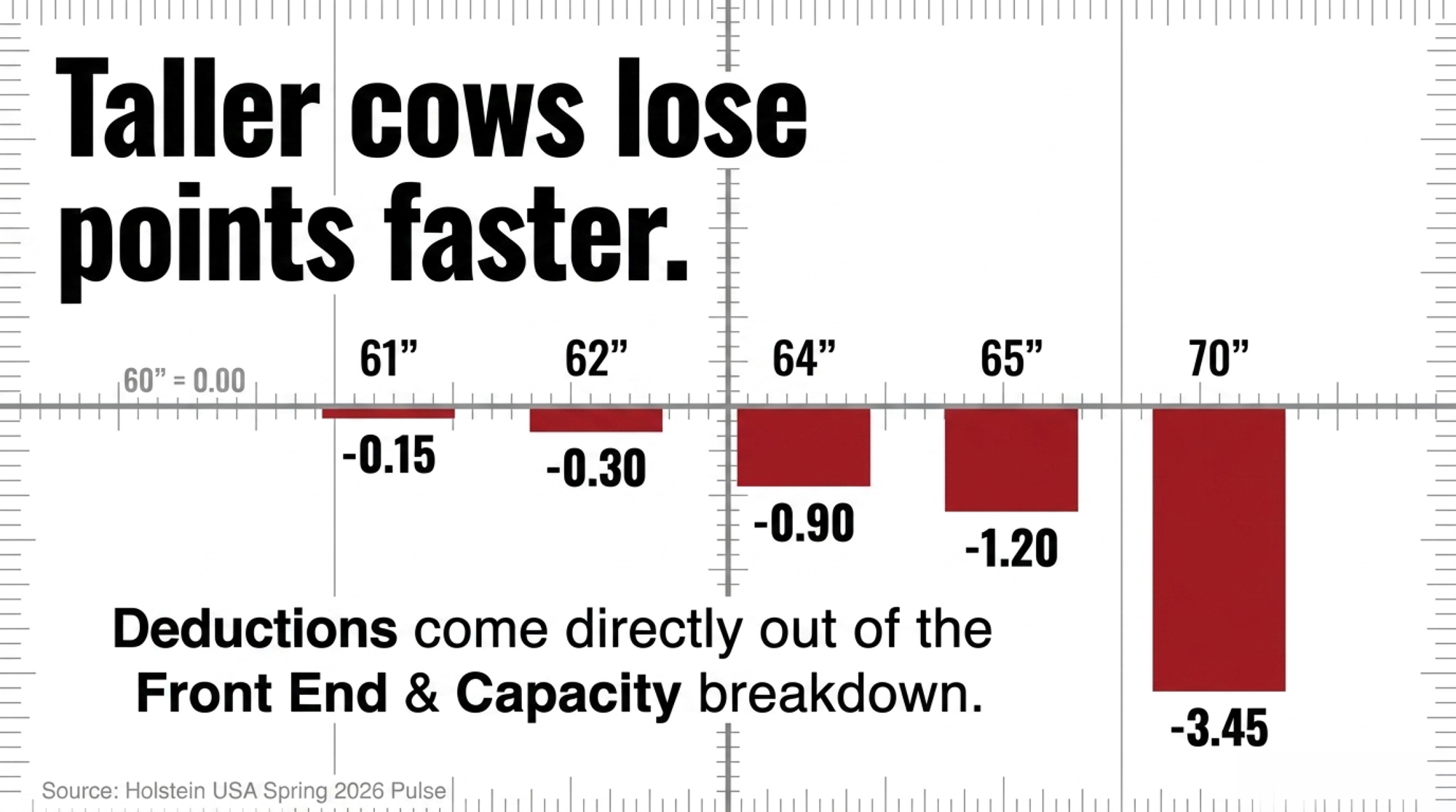
Here’s the part breeders keep asking about — the exact numbers, now published in Holstein USA’s Spring 2026 Pulse. Cows at or below 60 inches take no penalty. Stature is measured at the hips, top of the spine to the ground. Above 60″, the deduction comes out of the Front End and Capacity major breakdown, which is 15% of the final classification score. 

StaturePoint deduction from Final Score
60″ and under0.00 (no penalty) 
61″−0.15 
62″−0.30 
64″−0.90 
65″−1.20 
68″−2.55 
70″−3.45 

Notice the curve. At 61 inches it’s a rounding error — fifteen-hundredths of a point. But the penalty accelerates fast: by 65 inches you’re down more than a full point, and at the tall extremes it bites hard. For a cow sitting right on the VG/EX line, even a half-point can move her final designation. 

Don’t Confuse This With the 2024 Scale Change

Two different things happened, roughly a year apart, and breeders keep mixing them up at the coffee shop. So let’s split them clean.

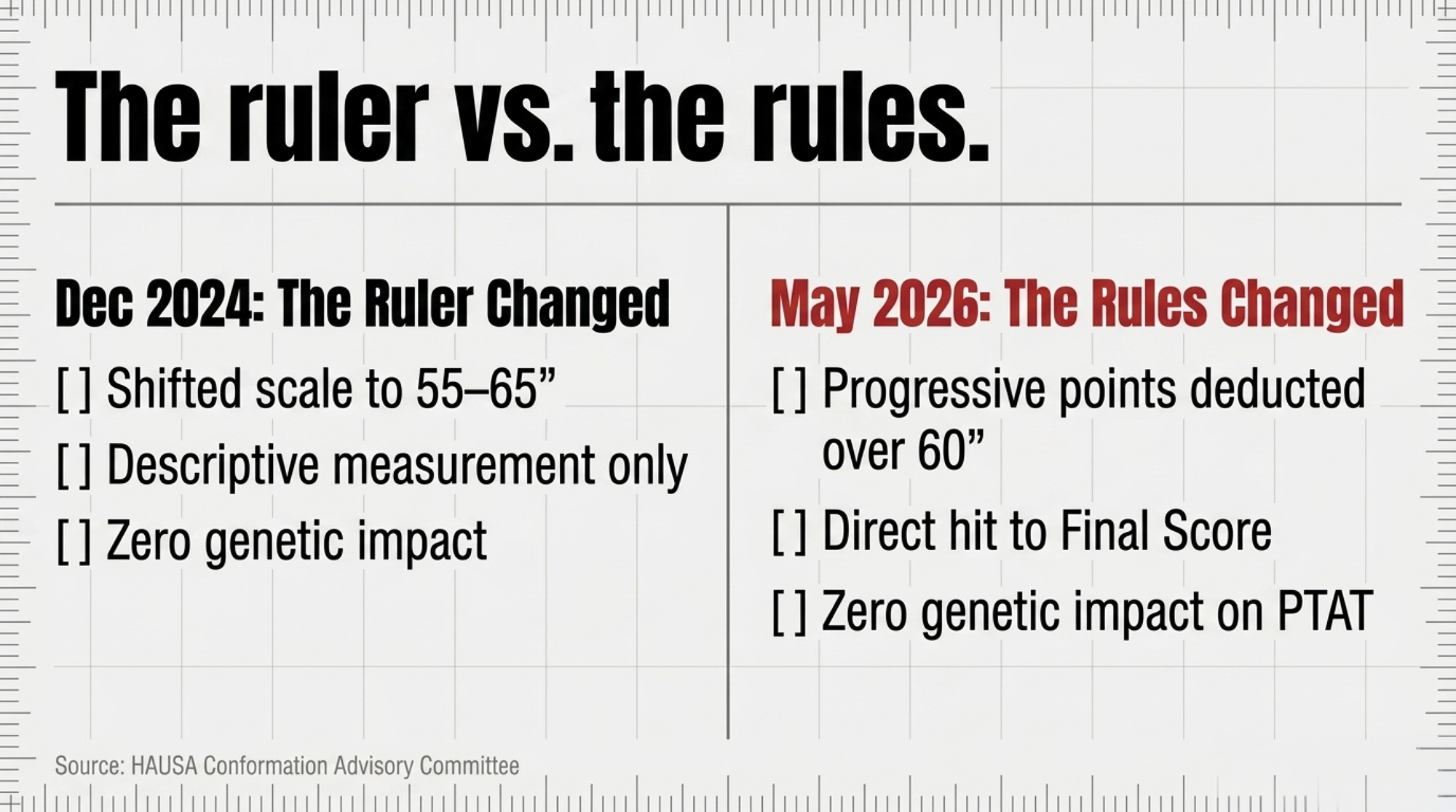
The December 2024 change was a measurement recalibration. After Dr. Jeffrey Bewley’s 2023 cow-measurement project found the breed had physically outgrown the old ruler, Holstein USA shifted the linear stature scale from the old 51-to-61-inch range to a new 55-to-65-inch range, effective December 1, 2024, with each inch worth five points on the linear scale. It didn’t punish anything. It just measured tall cows more honestly — 60″ now reads as 25 on the scale, 65″ as 50. 

The May 2026 change is a penalty — the first time excessive height actually costs points on the final card. One fixed the ruler. The other put a price on being tall. 

Feature / ChangeDecember 2024 Scale ShiftMay 2026 Stature Penalty
What it didShifted linear scale from 51–61″ to 55–65″ Progressive point deductions for cows over 60″ 
The impactDescriptive only; each inch = 5 linear points Direct deduction from Final Score, via Front End & Capacity 
Genetic impactNone — ruler calibration None on PTA stature or any trait; classification score only 

This Didn’t Come Out of Nowhere

The 2026 penalty is the loud version of a change the breed started making quietly years ago. Holstein USA has been restructuring how stature feeds into its evaluations for a while — pulling height back out of the numbers it had been quietly propping up, so a very tall bull couldn’t post shiny composite figures on frame alone. The 2026 penalty moves that logic onto the classification card itself, where every breeder can see it. 

There’s history worth naming here. For a generation, the tall, sharp, angular daughter was the ideal — and no bull embodied it like Braedale Goldwyn, the greatest type sire of his era, who became the first bull ever to produce 1,000 Excellent daughters in Canada. Goldwyn didn’t do anything wrong; he delivered exactly the phenotype the industry rewarded at the time. But the cow the new penalty docks is, in large part, the cow that era taught breeders to chase. That’s not an attack on the breeders who built those pedigrees — it’s the whole point. The target moved, and the scorecard just caught up to it. The industry keeps admitting, one step at a time, that cows were getting credit for being tall rather than being good. 

The Genetics and Economics Behind the Line

The move isn’t a hunch. Dr. Jeffrey Bewley’s “A Million Reasons Why Conformation Matters” project matched classification records against lifetime production data across the breed’s database, and HAUSA’s own internal research consistently shows that extremely tall cattle don’t last as long as more moderate-stature animals. The functional traits — udders, feet and legs, capacity — drove the biggest lifetime differences, not raw frame. Height for height’s sake was never what paid. That’s the whole logic of the 2026 direction. 

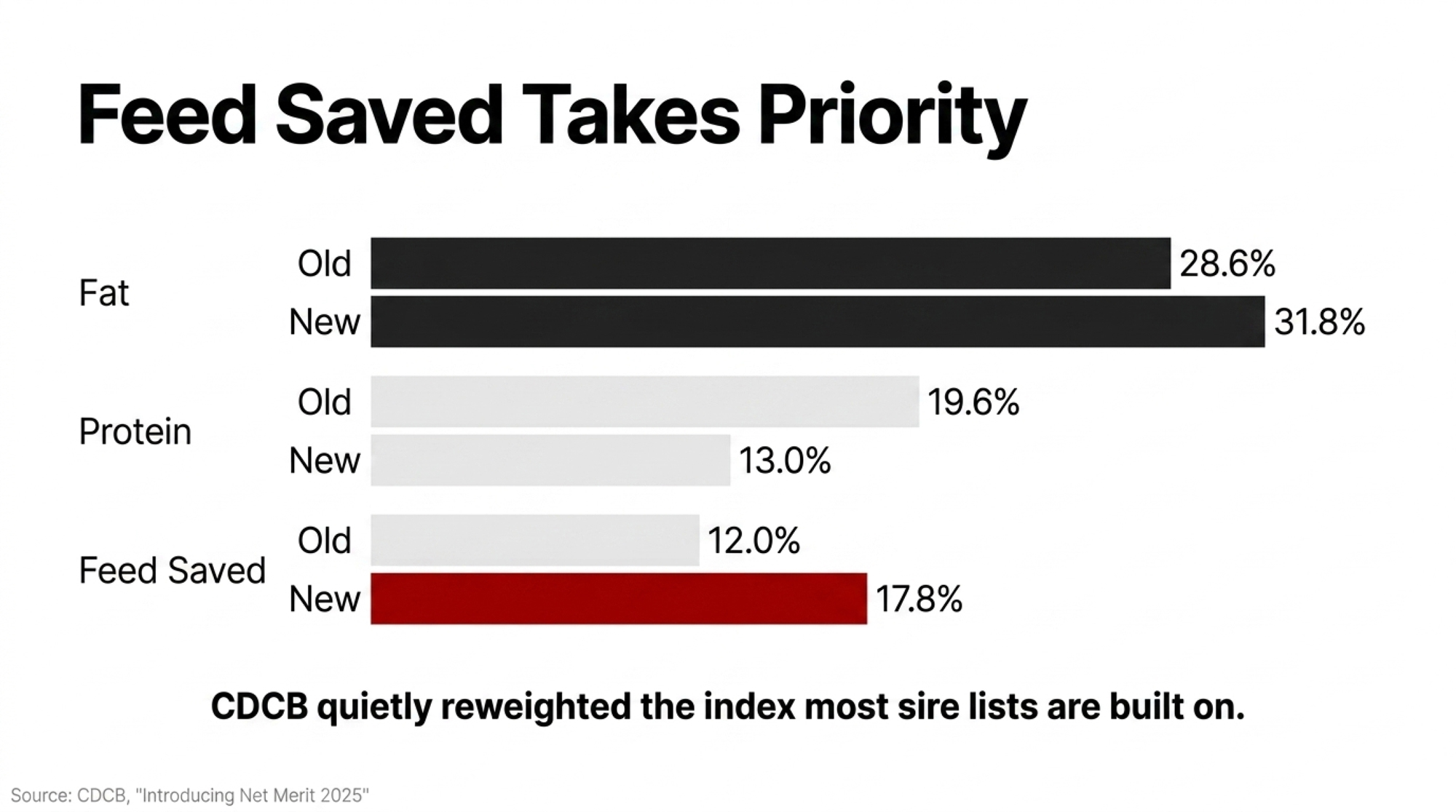
Where does a tall cow cost you before the classifier even arrives? Usually in the stalls and around the robot. Freestalls get sized for the typical mature Holstein. Push cows well past that, and you see more lameness, more hock rubs, more robot mis-attachments. Bigger cows also eat more to haul the extra frame — which is why the 2025 Net Merit revision cut Body Weight Composite to −11% and lifted Feed Saved, knocking roughly $57 off lifetime Net Merit for every extra point of Body Weight Composite

Try the barn math — an illustration, not a herd average. Run 100 cows and say oversized cows push your lameness rate up by 5 cases a year. At $300 a case — a conservative figure; real cases often run higher — that’s $1,500. Small on its own. But stack it on that $57-per-point weight tax, faster culling, and now a classification hit, and it’s the math you’ve been putting off.

Cost driverWhere it hitsIllustrative annual cost (100-cow herd)
Body Weight Composite tax (2025 NM$)Lifetime Net Merit, per extra BWC point−$57 per point, per cow
Added lameness (oversized cows)~5 extra cases/yr @ $300−$1,500
Classification deduction (65″ cow)Final Score → sale value−1.20 pts (can move VG/EX line)
Faster culling / robot missesProductive Life, throughputVariable, compounding

HCC vs. PTAT: What’s the New Composite Reading?

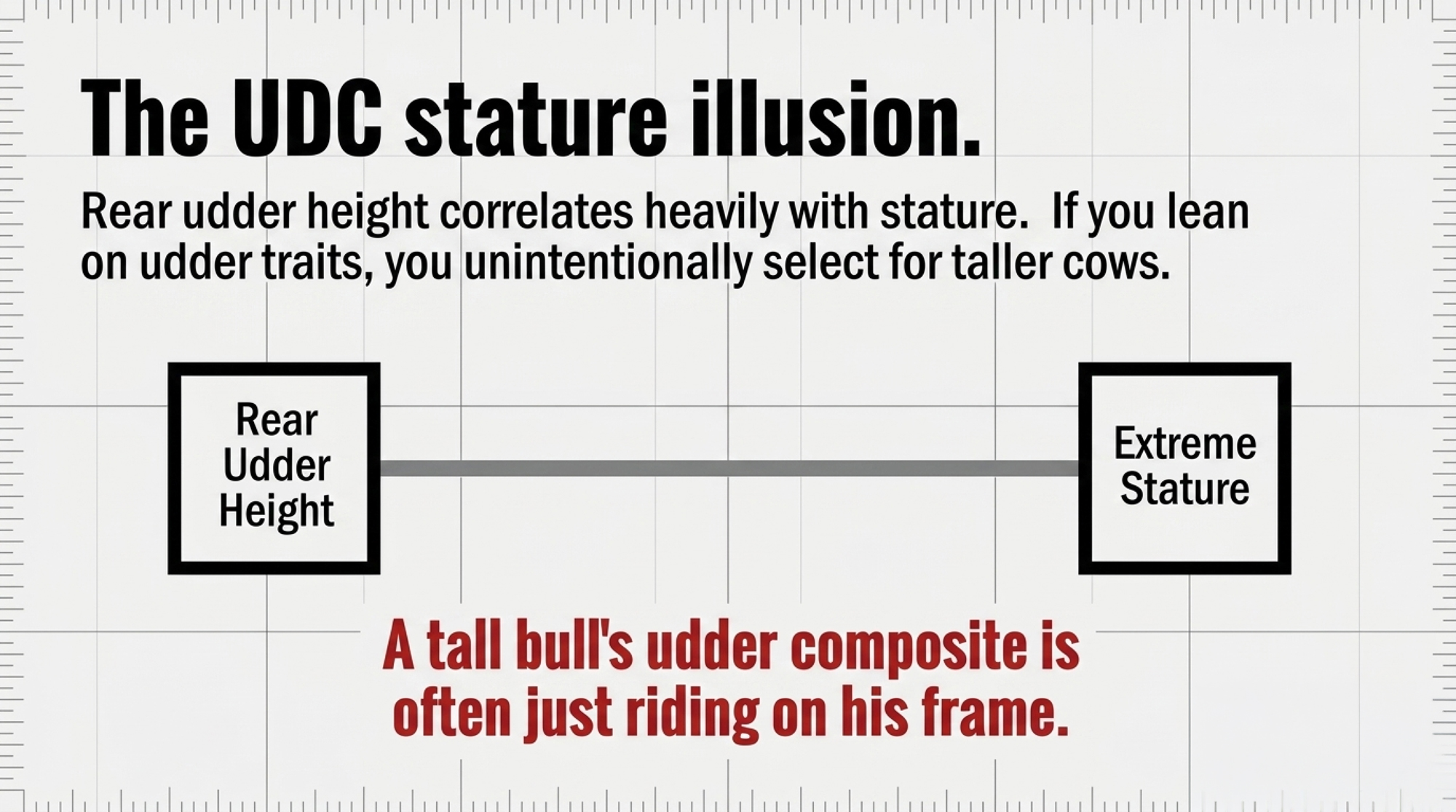
Tall bulls keep sneaking into mating plans because of how the numbers are built. Stature is highly heritable, so it moves to daughters reliably. And here’s the trap Holstein USA spelled out plainly: rear udder height and width carry a high genetic correlation with stature — so if you lean on those udder traits, you unintentionally select for taller cows. A very tall bull can post a flattering udder composite that’s riding on frame, not genuine udder quality. Read it as one number, and you’d miss it. 

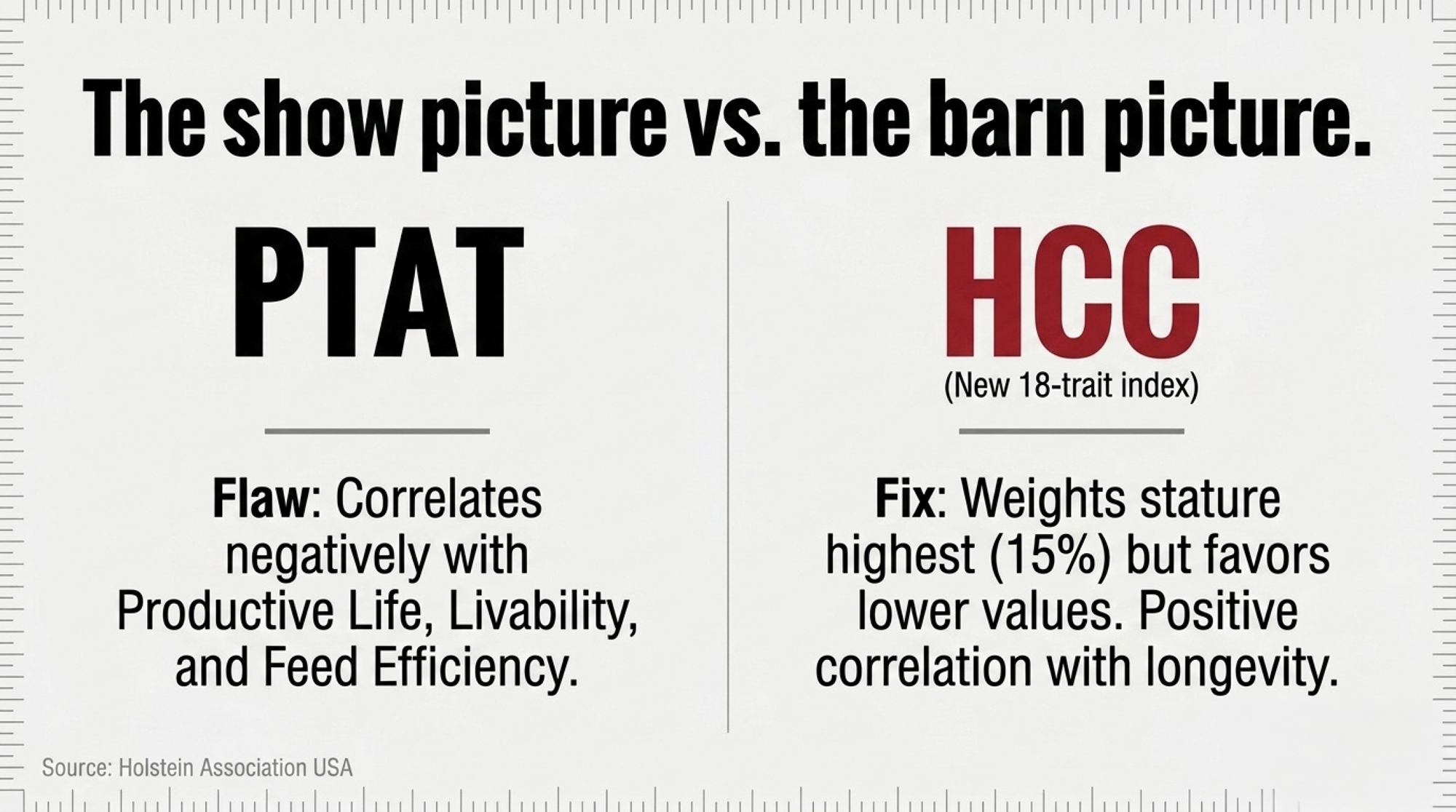
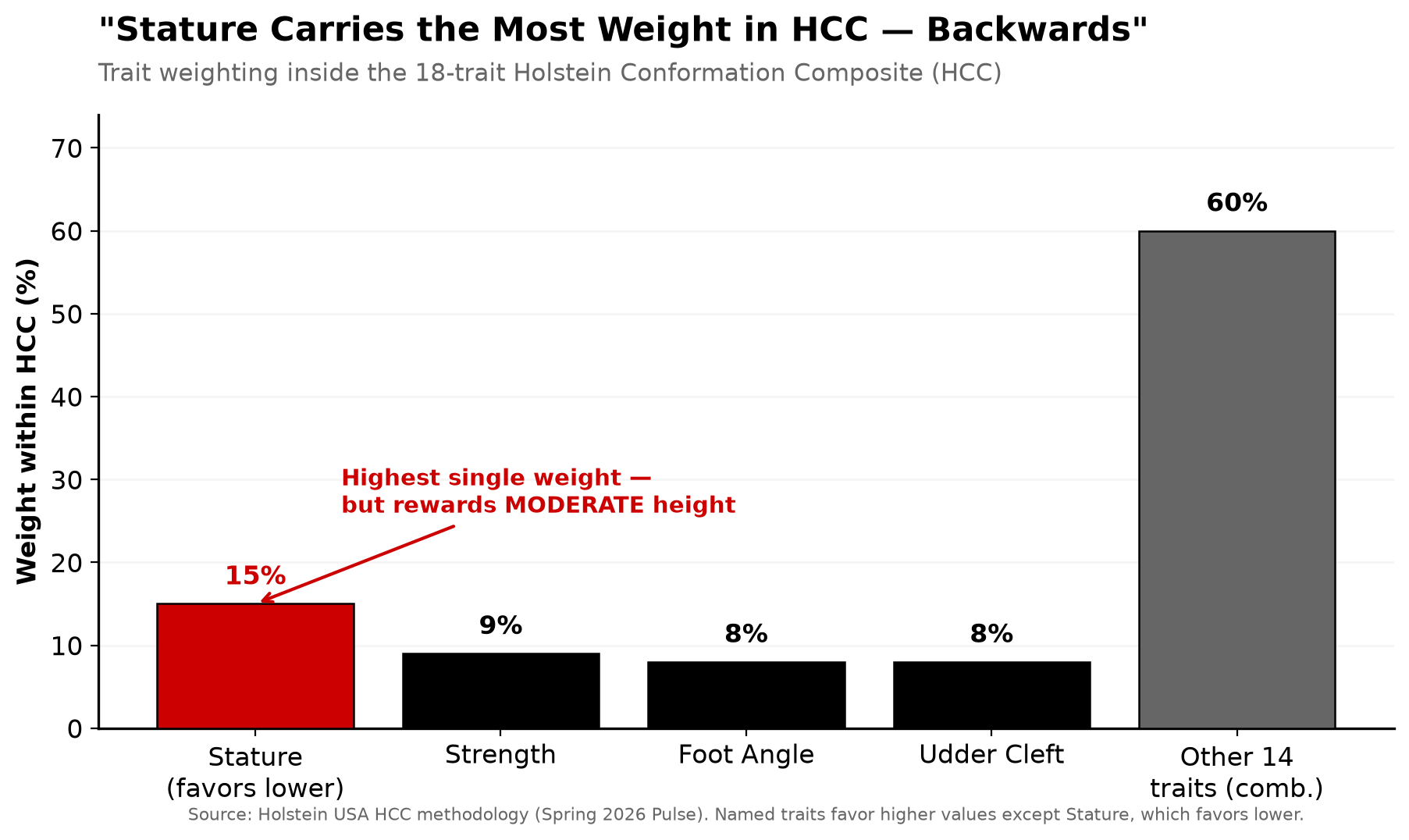
That’s the gap HCC is built to close, and the design is aggressive about it. HCC is a composite of 18 linear conformation traits, weighted by how each relates to functional balance and longevity — not by Final Score. Stature carries the single highest weight at 15%, but it favors lower values: a bull transmitting moderate or shorter stature scores higher on HCC, all else equal. Strength gets 9%, Foot Angle and Udder Cleft 8% each, all favoring higher values. 

The kicker is in the correlations. Holstein USA published that PTAT shows negative correlations with Productive Life, Livability, Feed Efficiency, and Cow Conception Rate — meaning the highest-type bulls, by the old measure, tend to work slightly against those functional traits. HCC shows near-zero to slightly positive correlations with the same traits. Put plainly: PTAT is the show picture, HCC is the barn picture. 

Two things to keep straight. HCC values for active AI bulls were published before July 1, 2026, alongside PTAT, UDC, FLC, and BWC — it’s an added lens, not a replacement. And its move into TPI is under consideration, not decided: the committees will evaluate HCC performance and weigh incorporating it into TPI later in 2026. Treat it as a compass, not gospel. (Full 18-trait weighting breakdown coming in a follow-up — watch for it.)

Rosy-Lane Holsteins in Wisconsin has run a version of this playbook for years. Their published breeding strategy sorts bulls by Net Merit first, then discriminates against any bull over +2.0 for Stature — a two-filter approach that lines up almost exactly with where classification is now heading.

The Show Ring Is Reading the Same Room

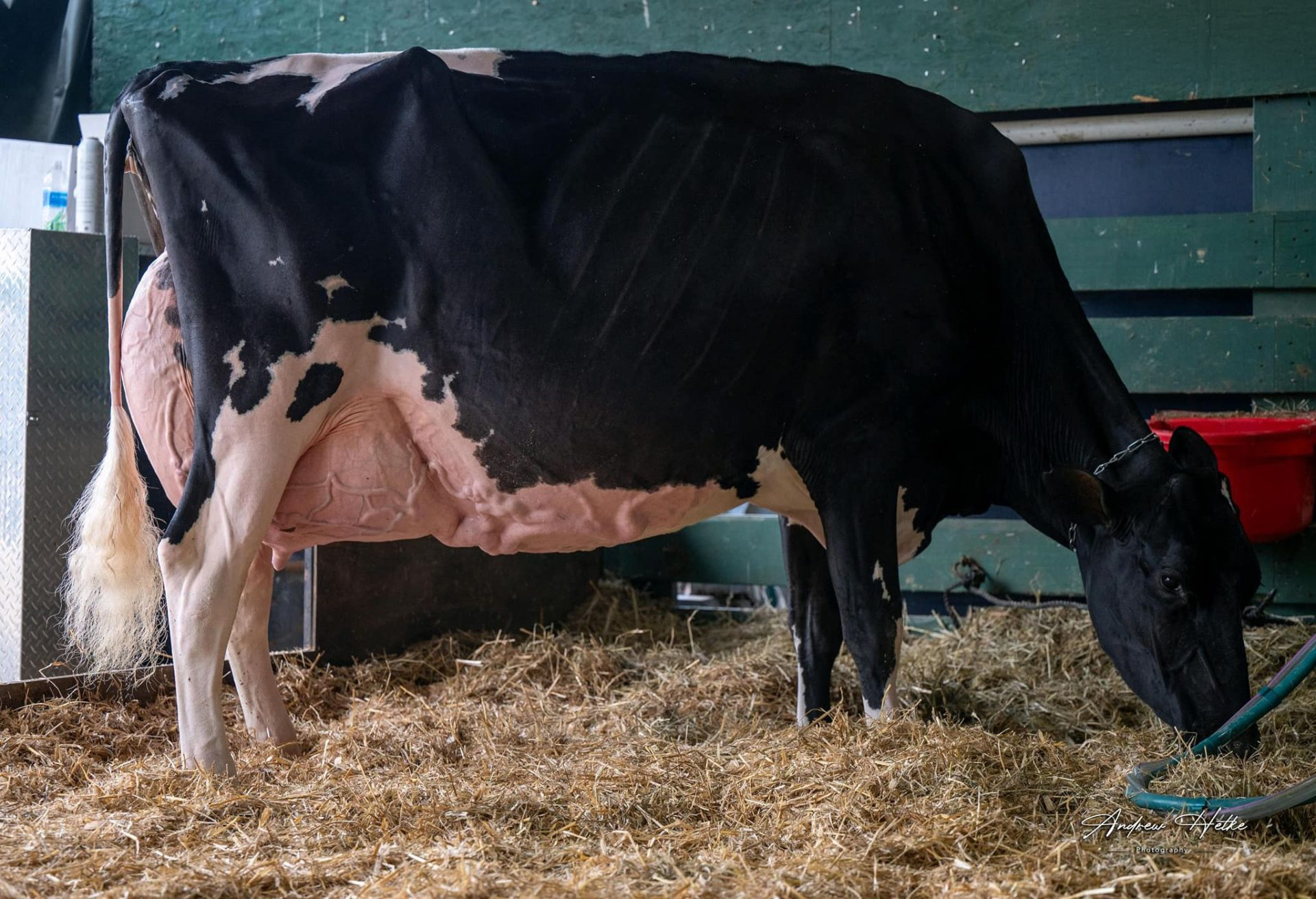
Oakfield Solomon Sunset-ET EX-96 2E — Holstein USA’s 2025 Star of the Breed, bred and owned by the Lamb family of Oakfield Corners Dairy. Look at the depth, the spring of rib, that mammary — power and width, not extreme height. A 51,710-lb five-year-old, and exactly the cow the 2026 stature penalty was written to reward. (Photo: Andrew Hetke Photography)

Here’s the tell that this isn’t just committee talk. Holstein USA’s 2025 Star of the Breed is Oakfield Solomon Sunset-ET EX-96 2E, bred and owned by Jonathan and Alicia Lamb of Oakfield Corners Dairy in New York — a cow the family describes in almost exactly the language the new rules reward. Her production backs it: a five-year-old record of 51,710 lbs milk, 2,087 lbs fat (4.0%), 1,674 lbs protein (3.2%) on 2x 365-day, with more than 178,000 lbs lifetime milk. 

Listen to how her breeders talk about her. “We don’t want to have the biggest, but we want to have the most correct — and we certainly want them to have plenty of width and power and strength,” Jonathan Lamb says. Her dam, Bella-Rosa GW Sara, wasn’t the prototypical tall show cow either — “she wasn’t super tall or extreme, but she was perfectly balanced, which is the kind we really appreciate,” per Alicia Lamb. That’s the breed’s highest type-and-production honor going to a cow explicitly bred for width and correctness over height. The award and the penalty are pointing the same direction. 

Lovhill Sidekick Kandy Cane takes the handshake — the Lamb family’s five-year-old, tapped Grand Champion at the 2025 World Dairy Expo. Judge Aaron Eaton’s reasoning leaned on maturity, added width and power, not sheer height — the same vocabulary the 2026 classification card and HCC are now built to reward. What she’d measure on the stick is anyone’s guess; the language crowning her isn’t.

The ring itself said much the same thing at Madison. The same Lamb family owned the 2025 World Dairy Expo Grand Champion, the five-year-old Lovhill Sidekick Kandy Cane, whom Judge Aaron Eaton put to the top on her added width, and power rather than sheer height. Here’s the honest caveat: Kandy Cane’s exact classification stature isn’t public, so nobody can say whether she’d trip the new penalty — that’s an open question, not a prediction. But the language a top judge reaches for to crown a champion — width, power, balance — is now the same language the classification card and HCC are built to reward. When the show ring and the formula start using the same adjectives, the direction isn’t in doubt. 

What Canada Already Figured Out

The Americans aren’t the first to draw a line on height. Canada’s classification system, run through Holstein Canada, has long treated its conformation composites so that extreme stature doesn’t buy its way into the score, and its evaluations are recognized worldwide for stability. If you sell semen or cattle across the border, or read Canadian proofs, you’ve already been living with a version of what the U.S. just adopted. 

That matters for two reasons. First, the 2026 U.S. change isn’t a lone experiment — it’s the American system catching up to a direction others validated a while back. Second, if you use Canadian genetics, the bulls that look moderate and balanced under that stature-neutral math are the ones most likely to throw daughters who clear the new 60-inch lens cleanly. The systems are converging, not diverging — a rare thing in an industry where cross-border index differences usually cause headaches, not alignment.

What This Means for Your Operation

None of this makes tall cows worthless, or the show ring wrong. It means the barns, the economics, and the profit indexes have all shifted. Here’s how different herds can play it.

  • Run a 30-day sire audit. This month, pull your current bull list, sort by stature PTA, flag the tallest transmitters, then check Body Weight Composite, Productive Life, and now HCC on the ones you flagged. Costs nothing but an evening. Works for any herd — the single most concrete step available right now. 
  • Gate on Net Merit, then cap stature. Best for commercial and dual-purpose herds chasing durability — the Rosy-Lane approach, essentially. It demands discipline to pass on a flashy tall bull. Where it backfires: pure show programs may find it narrows their pipeline of ring-competitive genetics. 
  • Keep breeding show-type — but go in with eyes open. Makes sense if marketing show cattle is your business. What it demands: accept that a daughter measuring 64–65 inches now gives back nearly a full point of Final Score she’d have kept a year ago, which can move a sale price. Read individual linear traits, not just composites, when PTAT and HCC disagree. 
  • Split your herd’s strategy. For larger operations, breed a show string one way and a commercial string another. It demands more record-keeping and a clear-eyed read of which cows earn their keep where.

The Big Picture: The steady stature decoupling in the evaluations, Canada’s long-standing “too-tall” stance, the 2024 scale shift, the 2025 Net Merit weight tax, the 2026 penalty, and a Star of the Breed bred for width over height are not separate events. They represent a decade of unified industry direction. Betting against it is a bet that economics and genetics will reverse course — and the data says they won’t. 

Your 2026 Pre-Classification Audit

Run these three checks before your classifier’s next visit.

  • [ ] Identify the UDC/stature illusion. Flag bulls that are both exceptionally tall and high for udder composite — because rear udder height and width correlate strongly with stature, that composite may be riding on frame. Inspect the individual linear traits, and cross-check HCC, before buying more semen. 
  • [ ] Recalculate your BAA expectations. Look at your aged, dry EX cows. Under the new 24-month rule (effective for May 2026 classifications and after), they’re temporarily out of your BAA calculation until they freshen again — expect a lower baseline herd figure. 
  • [ ] Run the penalty table against your tallest cows. Measure — or estimate from prior classification — where your biggest cows sit. A 62-incher gives back 0.30; a 65-incher, 1.20. Know it before the classifier does, so a designation surprise doesn’t cost you at sale time. 

One more if you buy across the border: lean on the stature-neutral Canadian proofs that already fit this direction. And if you’re already gating on Net Merit and capping stature, take the win — this is a tailwind, not a warning. 

Key Takeaways

  • If your ideal cow measures over 60 inches, she now costs you classification points — 0.15 at 61″, climbing to 1.20 at 65″ and 3.45 at 70″ — but not one point of PTAT or stature PTA. The show-card hit and the genetic value no longer move together. 
  • If you rely on PTAT and UDC alone, add HCC to the read. Holstein USA’s own data shows PTAT correlates negatively with Productive Life, Livability, and Feed Efficiency; HCC was built to flip that. Pull the individual linear traits when a tall bull’s udder composite looks great. 
  • If you already gate on Net Merit and cap stature (the Rosy-Lane +2.0 rule), you’re ahead of the change, not behind it — the 2025 weight tax and the 2026 penalty both reward that discipline. 
  • The show ring already moved. The 2025 Star of the Breed, Oakfield Solomon Sunset, was bred for width and correctness over height — the award and the penalty are pointing the same way. 

Beyond the Ruler

The tall, angular cow ruled North American type for a generation, and by the measures of that era — tie-stalls, show strings, Final Score — she delivered. What’s shifted is the environment around her, not the quality of the cow. The breeders who feel the 2026 changes least are the ones who already moved toward moderate, durable, functional cattle — the Lambs, the Rosy-Lanes, anyone who decided years ago they didn’t want to milk the biggest cow in the barn. So here’s the question worth chewing on this week: if you measured your ten best-looking cows tomorrow, how many would clear that 60-inch line — and are they the same cows staying longest in your herd?

Learn More

The Sunday Read Dairy Professionals Don’t Skip.

Every week, thousands of producers, breeders, and industry insiders open Bullvine Weekly for genetics insights, market shifts, and profit strategies they won’t find anywhere else. One email. Five minutes. Smarter decisions all week.
NewsSubscribe
First
Last
Consent
Send this to a friend