




Archive for cow longevity

At $3,010 a Heifer, Your Worst Cow Just Got a Reprieve

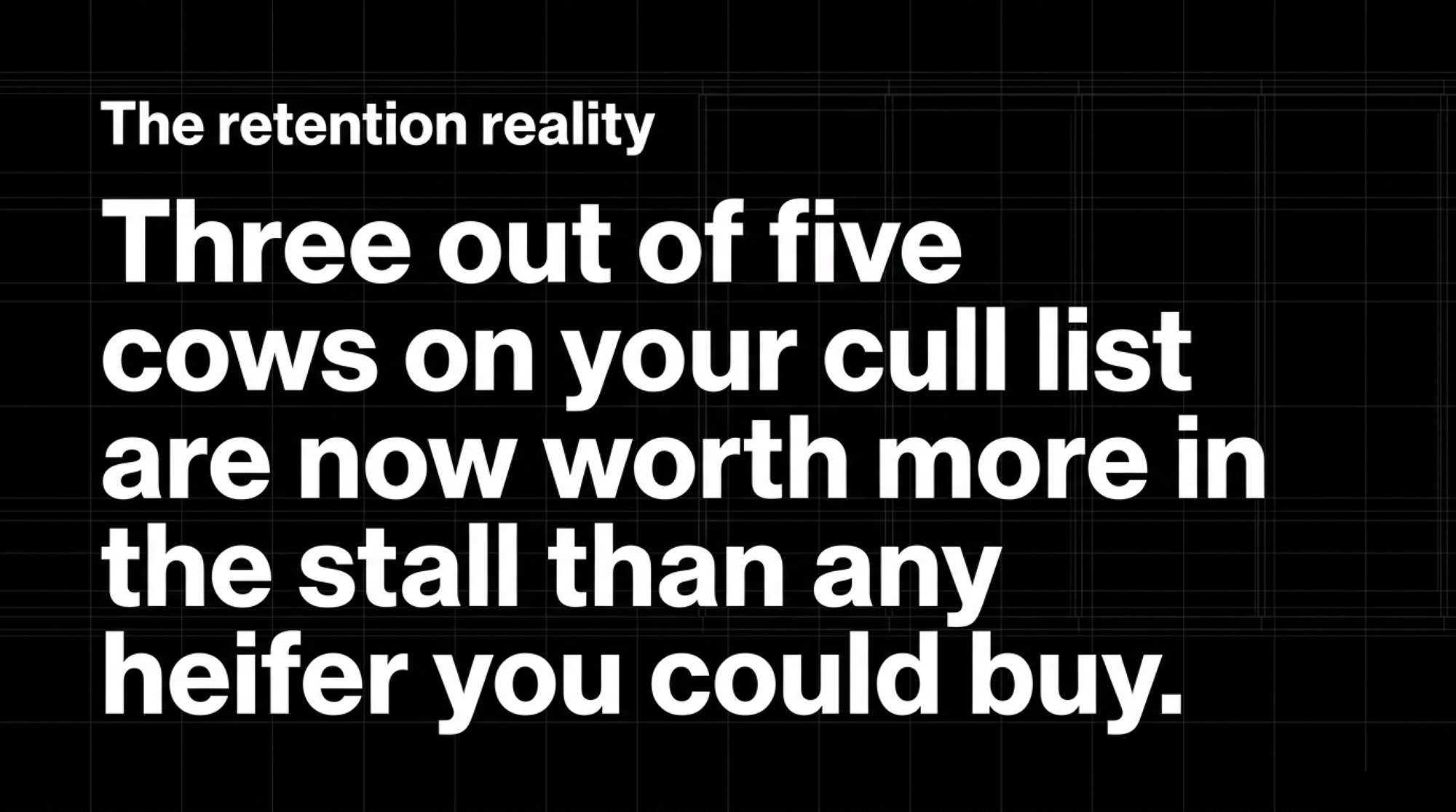
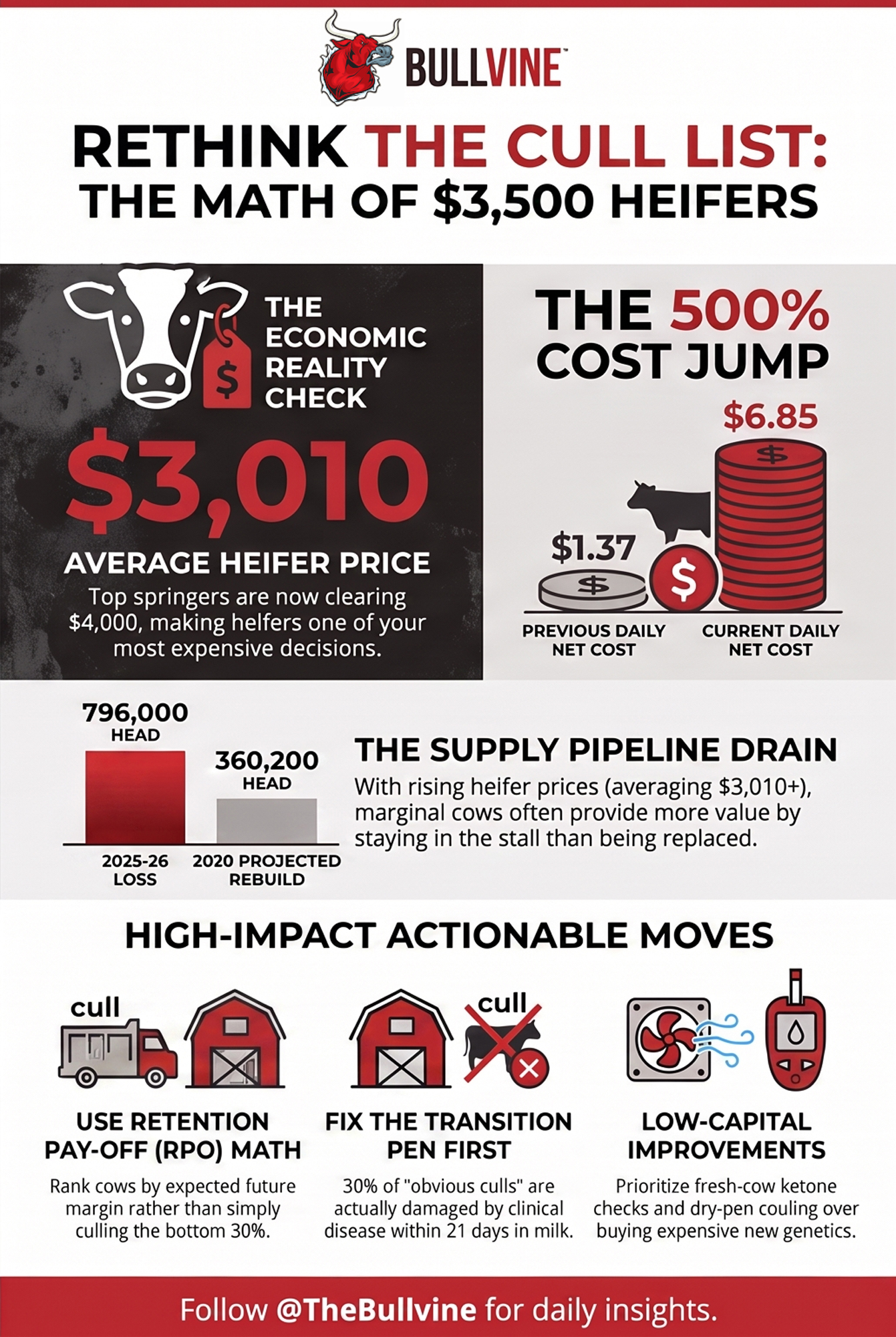
Five cows on the cull list this morning. Run the retention math at $3,010 a springer, and three of them are worth more in the stall than any heifer you could buy.

Executive Summary: At $3,010 a head — USDA’s July 2025 average, with top springers past $4,000 — the cheapest cow on most operations is the one already standing in the stall. Run Overton’s net replacement cost formula, and a heifer moving from $1,500 to $3,500 pushes your cost from about $1.37 a day to $6.85 on the same animal in the same slot, because the denominator never changed; that extra $5.48 a day is what a marginal cow now has to beat before she earns a trip to the plant. CoBank’s June 2026 numbers explain why this isn’t a one-year problem: 796,000 head drained from the pipeline across 2025-2026, against a rebuild of just 360,200 by 2028. Here’s the part that stings — retention pay-off models accurately rank damaged cows, and with 30% of cows hit by clinical disease inside 21 DIM (Carvalho et al., via UW-Madison Extension), a lot of your “obvious culls” were made in the fresh pen, not born that way. Cows with one clinical event drop 750 to 800 pounds over the lactation; dry-period heat stress costs another 5 kg/day through the next one (Tao et al., 2011). Fix the transition inputs before you trust any cull ranking, and the four moves that matter most — fresh-cow ketone checks, RPO-ranked cull lists, a lower replacement-rate target, dry-pen cooling — need labor and attention, not capital. The counterweight: Swiss data across 29 farms shows over-retention costs about three times more than culling early, roughly 161 CHF per farm per month, so this isn’t permission to keep passengers.
replacement heifer cost

Picture a manager standing at the head of the fresh pen with a list of five second-lactation cows he’s ready to sell. Annoying cows. Cows he’s tired of looking at. Then, for the first time, he runs them through a retention pay-off calculator — and three of the five come back worth more in place than any heifer he could realistically buy.

That’s the moment the math changes. Not in a boardroom, not in a journal — at chore time, with a $3,500 replacement price tag turning a gut-feel call into something expensive to get wrong. This is a story about a number that used to be background noise and is now the loudest figure on the balance sheet. And about producers learning, sometimes reluctantly, that on the economics, the most profitable cow in the barn often isn’t the biggest milk check on the board.
What’s Really at Stake

Replacement heifers used to be the cheapest fix on the farm, and now they’re one of the most expensive decisions you’ll make all year. For years, keep-or-replace was easy because it was cheap. A springer ran around $1,200, so culling the bottom of the herd and slotting in a fresh face barely moved the needle. You didn’t need a model. You needed a cull truck and a phone number.
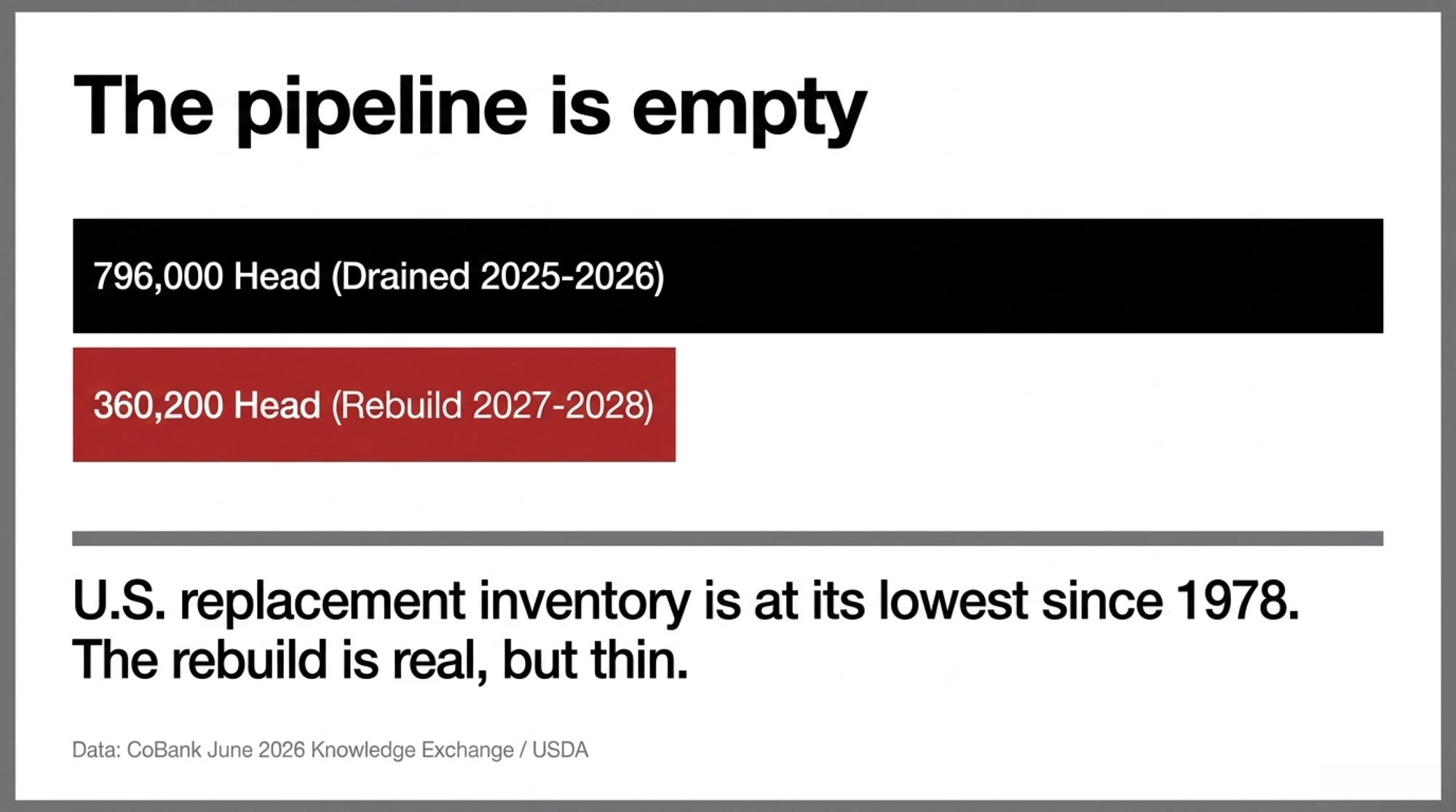
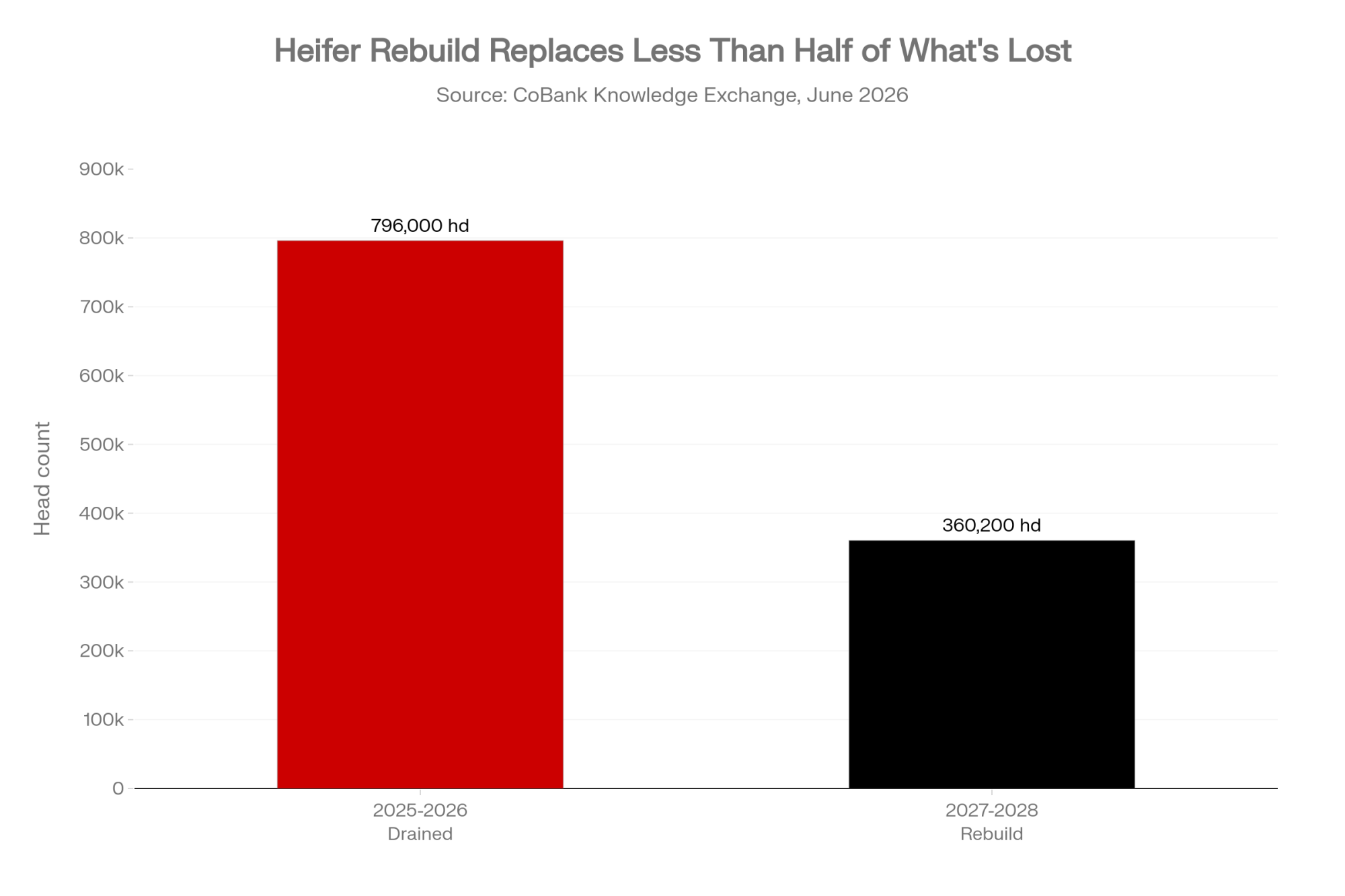
That world is gone. U.S. dairy replacement heifer inventory has fallen to its lowest level since 1978, and CoBank’s June 2026 Knowledge Exchange report projects supplies will keep shrinking — a combined 796,000 head drained from the pipeline across 2025 and 2026 — before a slow rebuild of about 360,200 head begins in 2027 and 2028. That rebuild is real but thin: roughly 3.75% of the herd against what the pipeline just lost. Average replacement prices hit $3,010 per head in USDA’s July 2025 Agricultural Prices data, and top springers in California and Minnesota auction barns have cleared $4,000.
Here’s why that reshuffles the whole decision. When a heifer was cheap, a marginal cow’s flaws were the only thing on the scale. Now there’s a $3,000-plus weight sitting on the other side. If you’re running 500 cows at a 35-38% replacement rate, this is your story whether you like it or not — that’s 175 to 190 head a year you’re either buying or growing, at a cost that’s tripled. The “just buy another heifer” reflex now carries a price that forces a harder question, one the best dairy systems in the world have been asking for years.

Why Dutch Herds Measure Value Per Cow Per Day

The Netherlands ranks its most profitable farms on value generated per cow per day of productive life — not peak milk, not herd average, but what she returns for every day she occupies a stall. It’s a deceptively simple metric, and it changes what “a good cow” means.
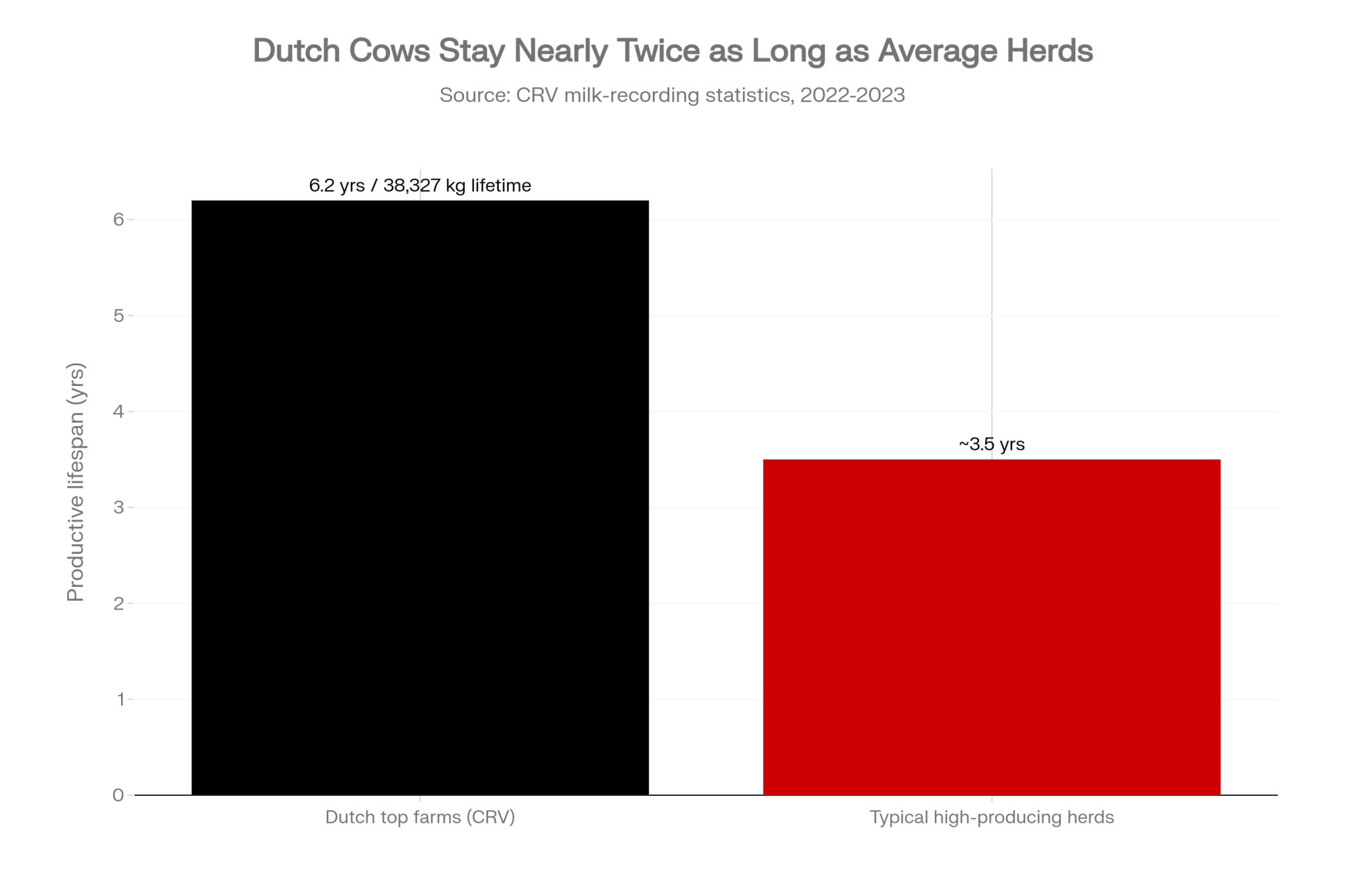
Look at what those top Dutch farms actually show. CRV’s milk-recording statistics for the 2022-2023 year put Dutch culled cows at an average of 2,255 days of age — just over six years — and 38,327 kilograms of lifetime milk. CRV has gone further and put a euro figure on it: extending lifespan by two years could mean 1,800 to 3,000 euros in additional lifetime margin per cow, depending on milk margin.

Now compare that to high-producing systems generally, where average productive lifespan still sits at roughly three to four years — a figure that’s barely budged despite decades of longevity research. The gap isn’t mostly genetic, though genetics carries its own quiet bill: rising Holstein inbreeding is already draining real money per cow, and two herds found different ways to stop that leak. The bigger gap is how the question gets asked. Dutch top farms ask, “How many euros does this cow deliver per day she stands in that stall?” Plenty of North American herds are still asking, “What’s my cull rate?”

It’s the difference between managing a percentage and managing a pipeline. One is a habit you inherited. The other is a strategy you choose. And the herds that chose it years ago are the ones least exposed to a $3,500 springer right now.

Inside the RPO Math: What Actually Moves the Needle

Retention pay-off math answers one question: does keeping this cow in this stall for another year beat replacing her? Crack open the calculation and it’s less intimidating than it sounds. It’s one question with receipts — do I make more from her, or from the heifer whose bill I’d be paying?

The concept traces to economic modeling by Dr. Victor Cabrera at the University of Wisconsin-Madison and Dr. Albert De Vries at the University of Florida. De Vries’s replacement-economics work framed the goal plainly: maximize the net return each stall — each “slot” — generates per year, not the milk any single cow gives today. The model’s job is to fill that slot with the cow that returns the most over time, not the one that looks best this Tuesday.

So what moves the needle? A handful of inputs do most of the work. The cow’s parity and where she sits on the lactation curve. Her pregnancy status — an open cow with three failed inseminations scores nothing like a confirmed pregnant one. Her current and expected milk yield. Then the price side: milk price, feed cost, cull cow value, and the big lever, replacement cost.

Most of us have seen this formula and never actually run it. Dr. Mike Overton, in his University of Guelph heifer-inventory work, boils net replacement cost down to one line you can write on a notepad:

Read that denominator again. When a heifer jumps from $1,500 to $3,500, it doesn’t change — she still takes the same number of days to grow up and produce. The numerator climbs hard. That single shift is what flips RPO from “always cull the bottom 30%” to “wait, this annoying second-calver might be the cheaper option.”

What That Looks Like in Dollars

Run Overton’s formula on a marginal cow. Say she’ll give you roughly 305 lactating days plus a 60-day dry period before her next decision point — call it 365 days in the slot. That denominator holds steady no matter what heifers cost.
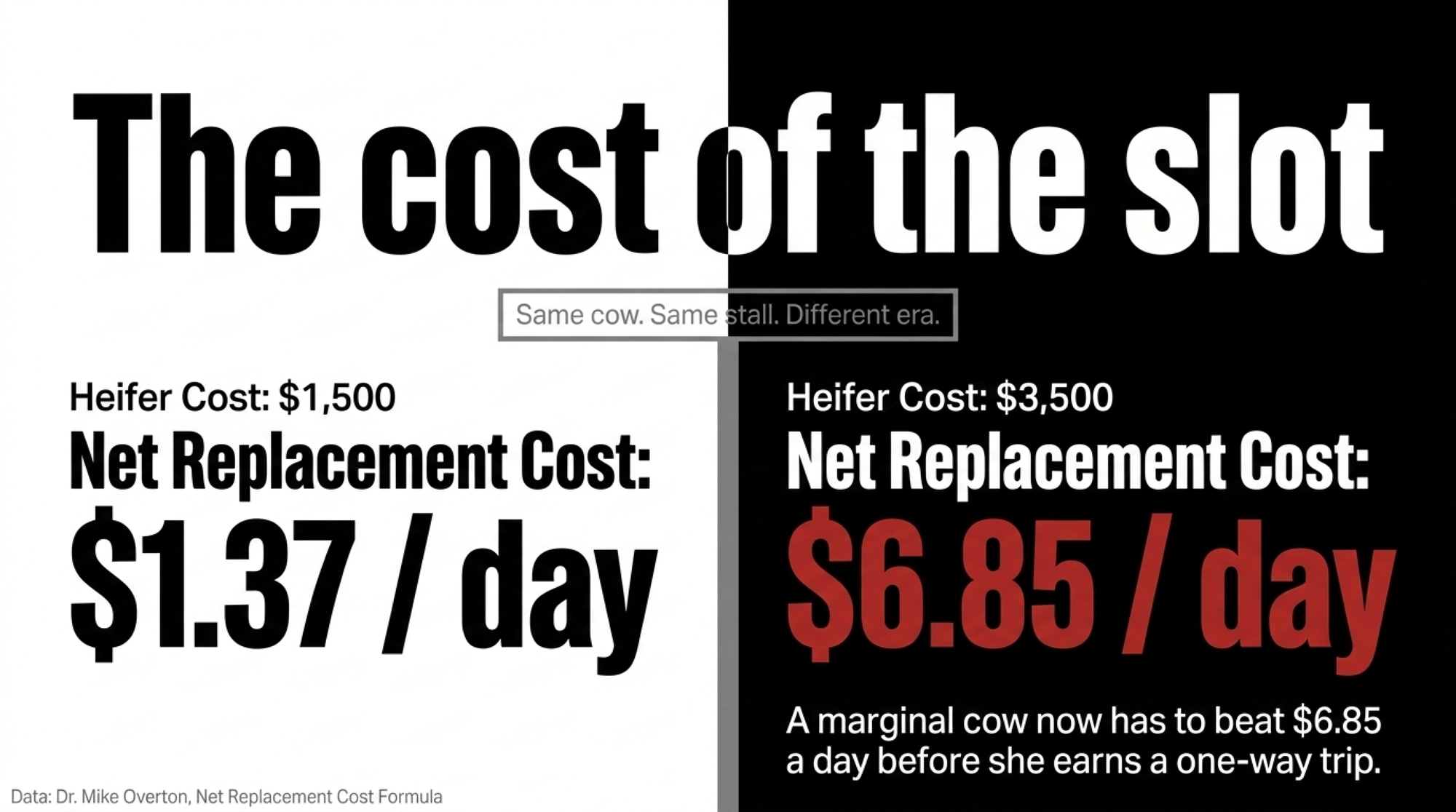
InputAt $1,500 HeiferAt $3,500 Heifer
Replacement heifer cost$1,500$3,500
Net salvage value (cull cow)$1,000$1,000
Days in slot (denominator)365365
Net replacement cost/day$1.37$6.85
Marginal cow must earn/day to justify cullingLow bar$5.48 more

Now plug in real numbers. Take a net salvage value of around $1,000 for a cull cow.* At a $1,500 replacement, your net replacement cost runs about $1.37 per day. Push the heifer to $3,500 and the same cow in the same stall jumps to roughly $6.85 per day — about a fivefold increase. Nothing about the cow changed. The cost of getting rid of her did. That extra $5.48 a day is what a low-end cow now has to beat before she earns a one-way trip, and plenty of cows you’d have culled on reflex two years ago clear that bar easily.
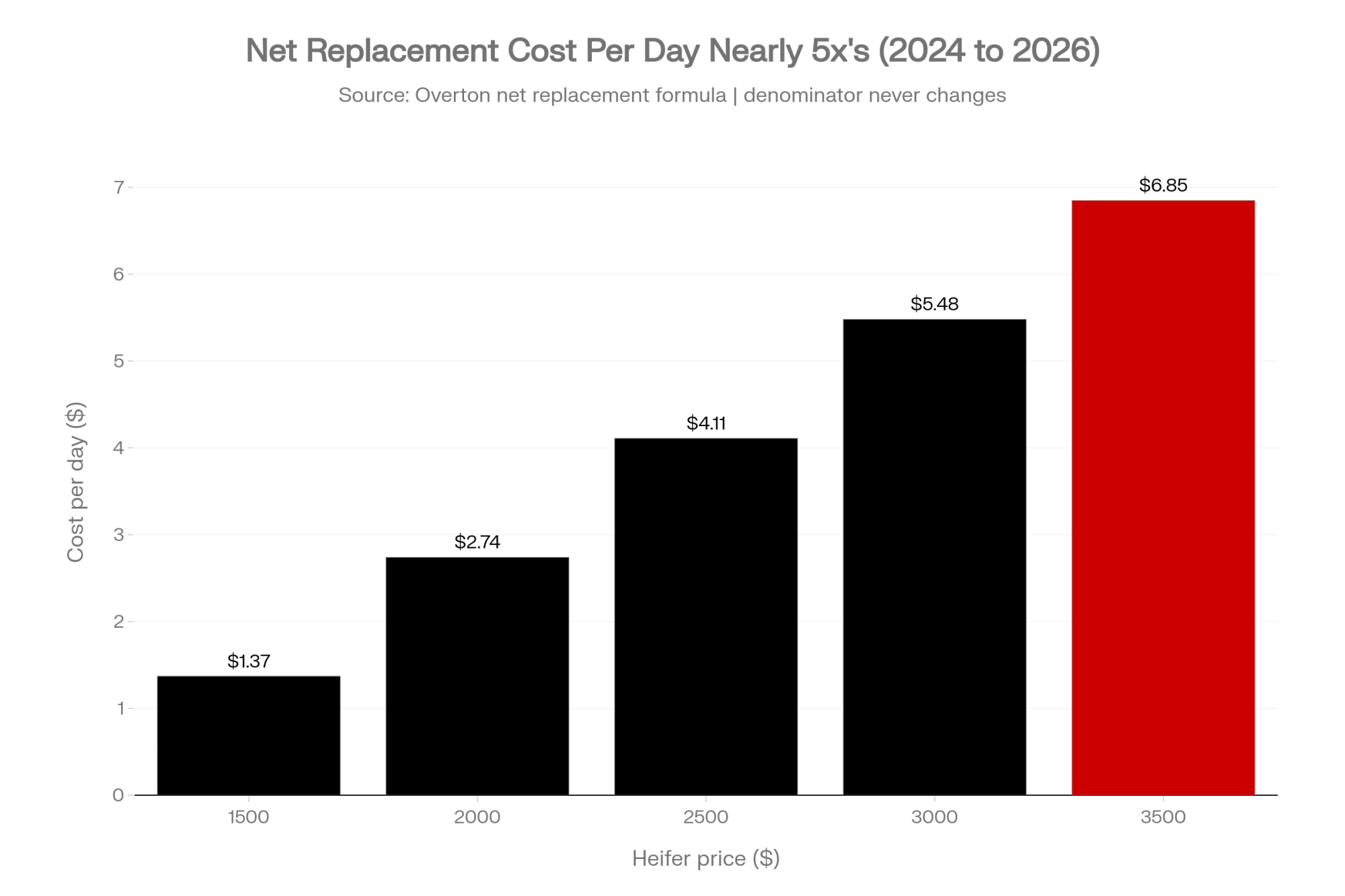
And here’s the twist record cull prices add: USDA pegged combined cull cow values at $162/cwt in October 2025, so a heavy cull can now salvage $2,000 or more. When the cull check climbs that high, the salvage side of the formula gets large enough that selling a productive older cow later — instead of dumping her early into a soft decision — can pencil out even harder in her favor. The cull check is real money, but it’s a one-time event. Her future margin compounds every day she’s in the stall.

That’s the whole game in one line. A cow’s value to you isn’t fixed — it’s relative to what it costs to replace her. And right now, that cost is the highest it’s been in two generations. If you’ve ever watched what happens when a family actually runs the real math on their own operation, you know the number on the page usually isn’t the number in your head.

*Net of hauling and commission, and conservative against today’s market; run your own cull weight × current $/cwt to re-pencil for your barn.

The Blind Spot That Survives the Spreadsheet

Now the uncomfortable part. RPO is only as honest as the cow you hand it. And on most farms, that cow’s “true potential” got quietly shaved off months earlier — in the transition pen.
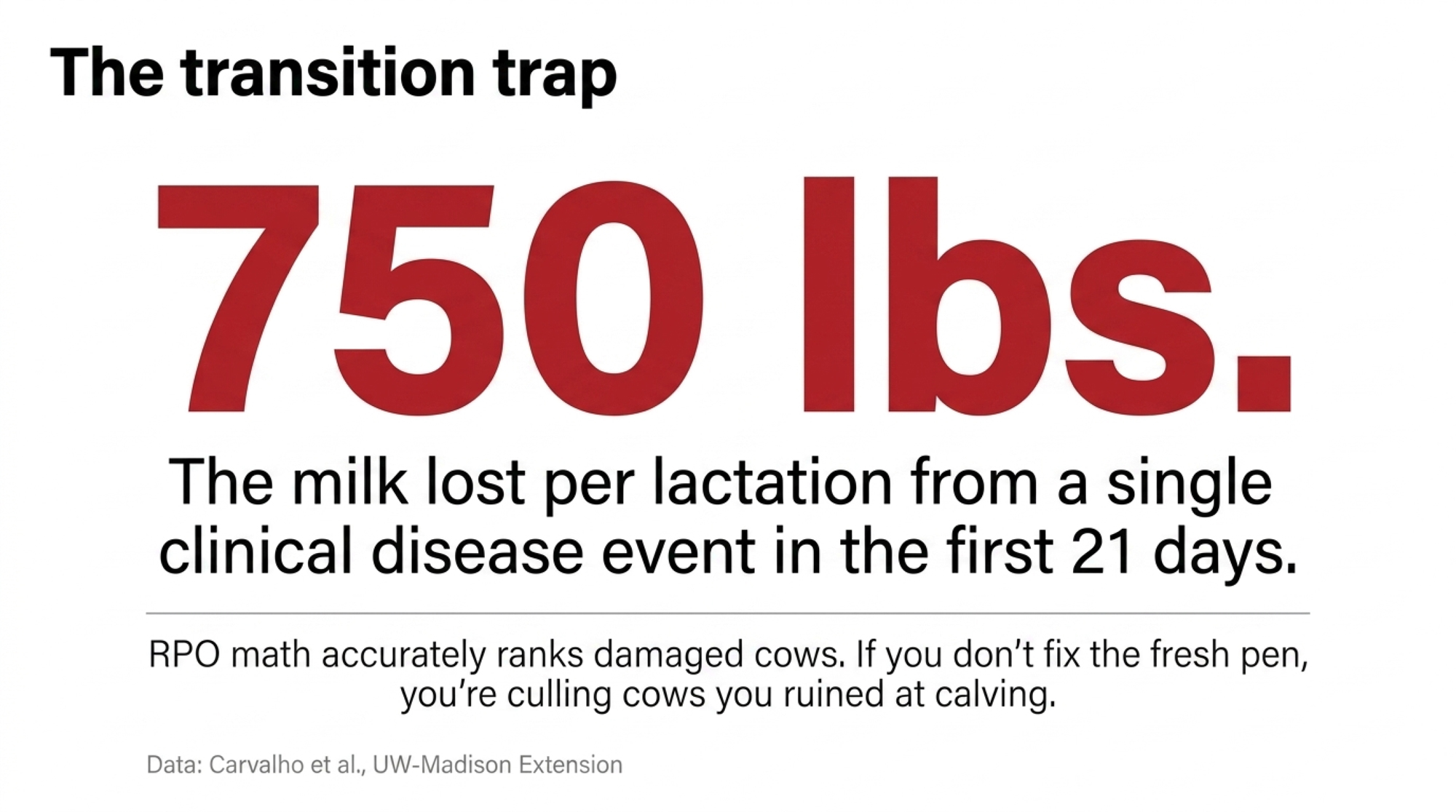
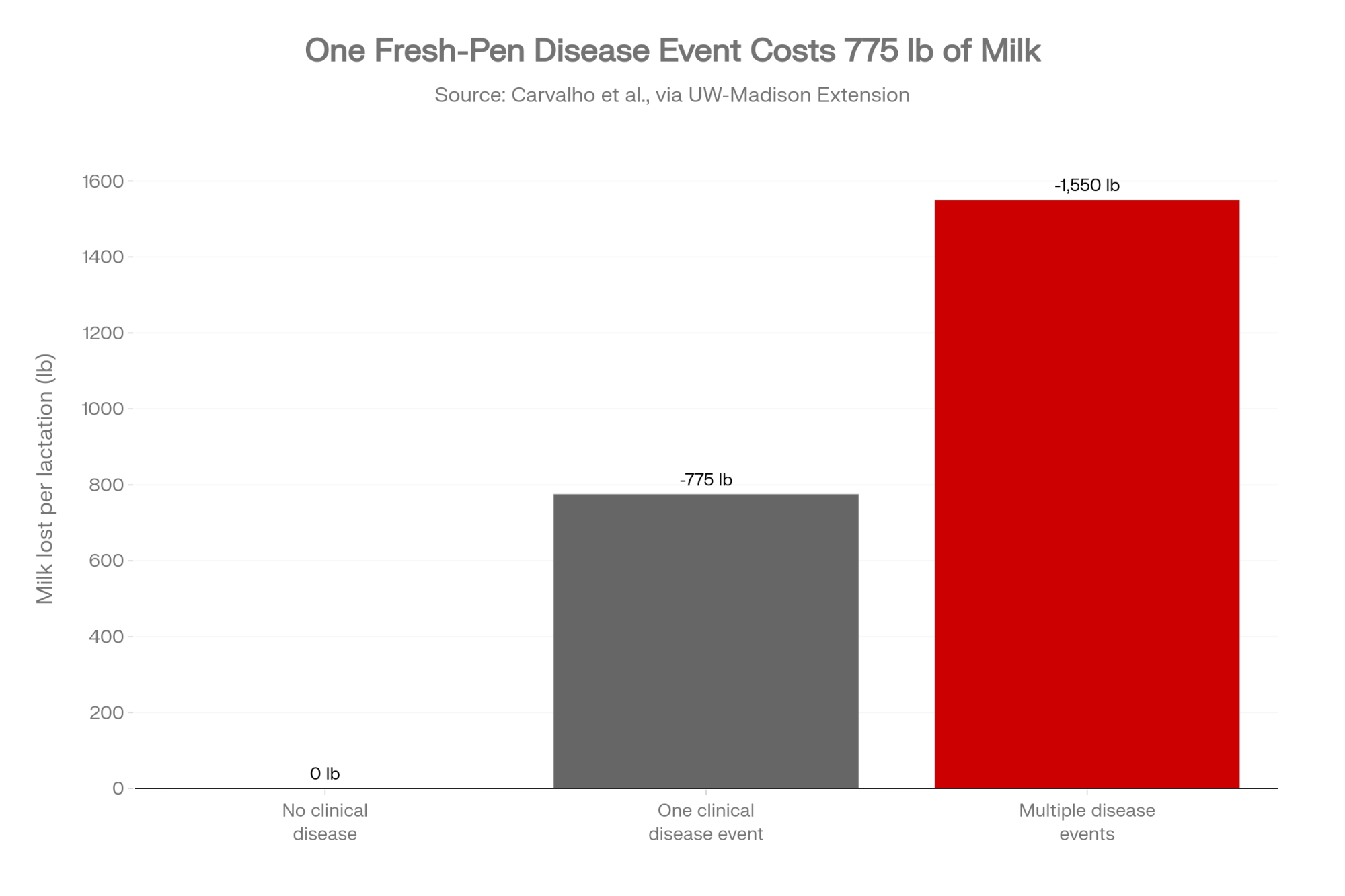
The transition period runs 60 days before calving through 30 days after, and University of Minnesota Extension is blunt about it: cows are at their greatest risk of disease and involuntary culling during this window. In a retrospective study of more than 5,000 cows by Carvalho et al., summarized by University of Wisconsin-Madison Extension, nearly 50% of cows experienced at least one clinical disease by 305 days in milk — 40% by 60 days, and 30% by just 21 days. Cows with one clinical disease lost roughly 750 to 800 pounds of milk over the lactation. Cows with multiple diseases lost about 1,550 pounds.
Subclinical ketosis tells the same story in miniature. A Canadian study (Duffield et al., Journal of Dairy Science) pegged the cost of an SCK case at about CAD $289, with prevalence of 15-30% common in many herds and roughly double the risk of early removal. University of Florida research (Tao et al., 2011) measured cows heat-stressed across the entire dry period producing about 5 kilograms per day less milk through the next lactation than cooled cows — milk you can’t claw back once she’s calved.

So here’s the line that stops people: RPO will happily tell you a cow is a bad bet — it just won’t tell you that you made her a bad bet at calving. Feed a damaged performance profile into the model and it calmly recommends replacing a cow who, managed properly, might have been one of your most profitable four-lactation animals. The math is complex. The fix is boring.

The Fix Is Boring. That’s the Point.

If half your fresh pen takes a transition hit, then half your RPO inputs are already corrupted. The model isn’t wrong — it’s ranking damaged cows accurately. It just can’t show you the cows you could have had. Which means the place to start fixing your cull list isn’t the cull list. It’s the feedbunk.

None of the Monday-morning moves require new capital. Check fresh cows for ketones in the first 7-14 days using a hand-held blood meter, treat the positives, and adjust the transition ration around body condition instead of habit. Don’t overstock the close-up and fresh pens — aim to keep cows lying 12 to 14 hours a day and out of the pen no more than three to three-and-a-half hours for milking and handling, because Miner Institute work ties each lost hour of lying time to 2 to 3.5 pounds of lost milk and more lameness. And hang fans and soakers in the dry pen, not just the milking string, because the heat stress you ignore in July shows up as lost milk and open cows next spring.

It doesn’t look like a longevity strategy. It looks like chores. But it’s the difference between an RPO score that reflects a cow’s real potential and one that reflects how badly she got managed in her first three weeks. At today’s heifer prices, that difference is no longer a rounding error — it’s the cost of a $3,500 springer you didn’t actually need to buy.

Four Paths That Don’t Need a Checkbook

None of these needs new capital. All of them need you to reorder what you pay attention to.

FixBest ForRisk If Done Wrong
Clean up transition inputsHerds with fresh-cow disease above 20% in first 21 DIMOne-time audit instead of daily routine
Make RPO the default cull list300+ cow herds with solid recordsData corrupted by untracked transition damage
Lower target replacement rate (39% → 35%)Herds rethinking beef-on-dairy/sexed-semen mixCutting heifer numbers before longevity actually improves
Hard-wire dry-pen heat abatementAny herd in a warm climateBackfires only through inaction — easiest to skip, easiest to regret

1. Clean Up the Transition Inputs

  • Best for: Herds where fresh-cow disease runs above the 20% benchmark in the first 21 days.
  • The action: Pull fresh-cow records this month; run daily fresh-cow checks and ketone testing.
  • The risk: Backfires if you treat it as a one-time audit instead of a hard-wired daily routine.

2. Make RPO the Default Cull List

  • Best for: 300-plus cow herds with decent records.
  • The action: Stop picking “the bottom 32%.” Rank cows by expected future margin and start at the bottom — with a bias to delay replacing low-value cows whose problem you’re actively fixing.
  • The risk: Backfires if the data feeding it is already corrupted by untracked transition damage.

3. Lower the Target Replacement Rate

  • Best for: Operations rethinking their sexed-semen and beef-on-dairy mix.
  • The action: Overton’s work shows dropping replacement rate from 39% to 35% keeps the average market cow about 100 days longer — build a multi-year youngstock plan to match.
  • The risk: Backfires if you cut heifer numbers before your longevity actually improves and you get caught short.

4. Hard-Wire Heat Abatement Into the Dry Pen

  • Best for: Any herd in a warm climate.
  • The action: Put fans and soakers in the close-up and fresh pens, not just the milking string — dry-period cooling protects the next lactation.
  • The risk: Backfires only through inaction; it’s the easiest investment to skip and the easiest to regret.

The forward signal worth watching: CoBank’s own numbers show the rebuild adding back just 360,200 head over 2027-2028 against 796,000 drained. The operations that come through intact won’t be the ones scrambling to source replacements. They’ll be the ones who don’t need as many — and in a decade where the honest question is who’s still milking at all, that distinction matters more than any single year’s cull rate.
Key Takeaways

  • If a heifer now costs $3,500 instead of $1,500, your net replacement cost per day roughly five-folds on the same animal in the same stall — which means cows you’d have culled on reflex two years ago may now pencil out as keepers.
  • If your fresh-cow disease rate is above 20% in the first 21 days, fix the transition pen before you trust any RPO ranking — you’re scoring damaged cows, not their real potential.
  • If you’re still managing to a cull percentage instead of value per cow per day, you’re using the metric many of the world’s most profitable herds have already moved past.
  • If you’re cooling only the milking string, you’re paying for dry-period heat stress next spring in lost milk and open cows — and you won’t see it coming on the spreadsheet.
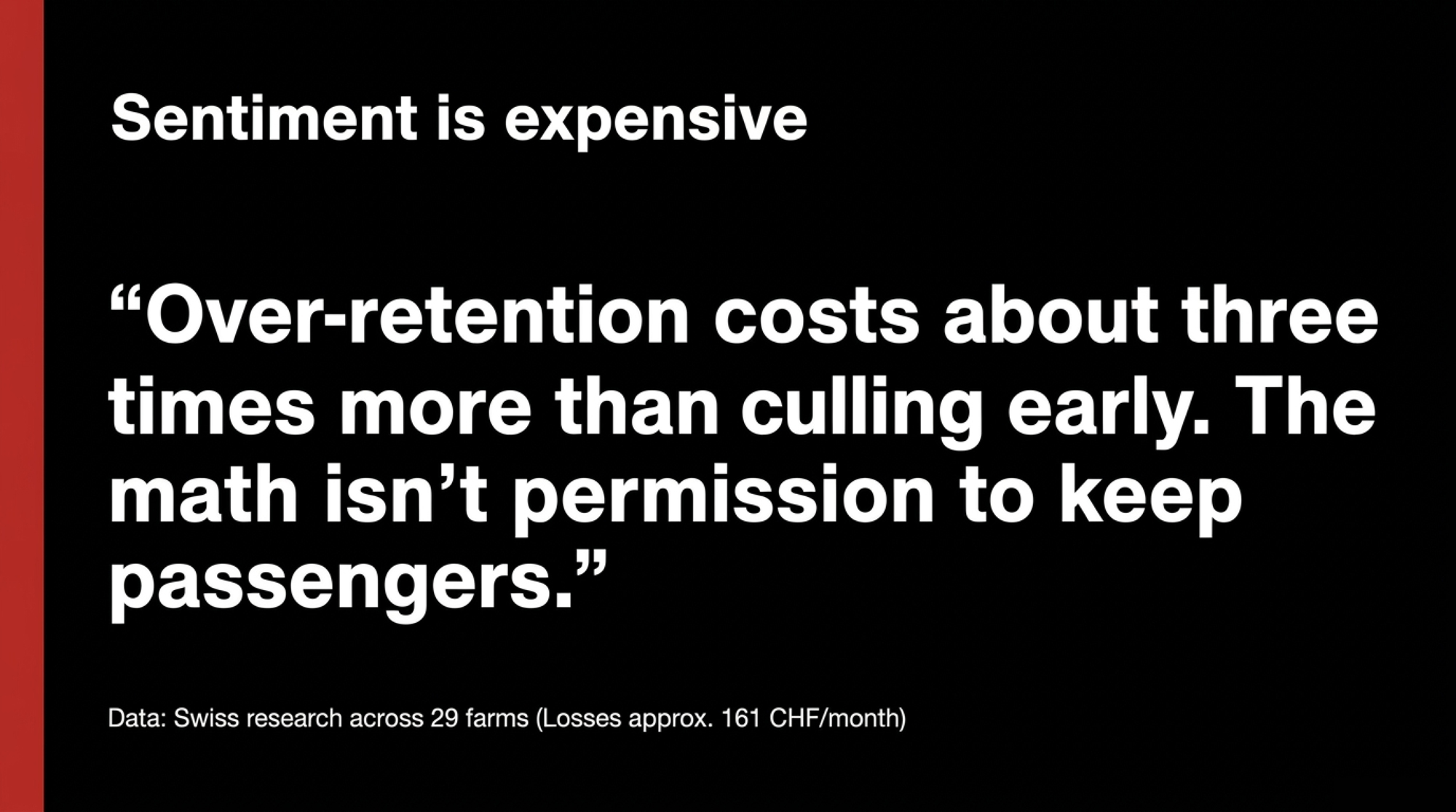
Here’s the trap waiting for the producers who do everything right. You fix the math. You clean up the fresh pen. You rebuild the policy. And then you overcorrect — you start keeping cows for the wrong reasons, just with better vocabulary. The Swiss research warns about exactly this from the other direction: in a study of replacement decisions across 29 farms, losses from retaining unprofitable cows ran about three times higher than losses from culling too early, averaging 161 Swiss francs per farm per month. Sentiment is expensive. So the question isn’t whether you can keep cows longer — it’s whether you’ll know the difference between a cow that’s earning her stall and a passenger you’re keeping out of habit.

Which one is standing in your fresh pen right now?

Run Your Numbers

Bullvine Pipeline Index Calculator — Six numbers off your herd software scores your replacement pipeline 0-100 and flags whether it’s green, yellow, or already red. It weighs heifer supply, your actual replacement cost, cull rate, and sexed-versus-beef semen mix, then plots you against the national trend and CoBank’s 2027-2028 rebuild.

Complete references and supporting documentation are available upon request by contacting the editorial team at editor@thebullvine.com.

Learn More

The Sunday Read Dairy Professionals Don’t Skip.

Every week, thousands of producers, breeders, and industry insiders open Bullvine Weekly for genetics insights, market shifts, and profit strategies they won’t find anywhere else. One email. Five minutes. Smarter decisions all week.
NewsSubscribe
First
Last
Consent

Holstein’s 60-Inch Rule: Why Breeders Are Backing It With 53%-vs-21% Math 

Two weeks after we broke down the May 2026 stature penalty, breeders answered back — and the sharpest reply wasn’t outrage. It was a heritability lesson.

Emeric Lebacle, a Quebec breeder, dropped it into our comment section almost as an afterthought, and it turned out to be the most important thing anyone said about Holstein’s new stature penalty. His point: stature inherits more than twice as reliably as feet and legs, so if you actually want to move a herd, you pull the lever that responds. That’s exactly what Holstein USA did in its May 2026 classification run — and if your bull lineup still leans tall, this is the number that should stop you cold.

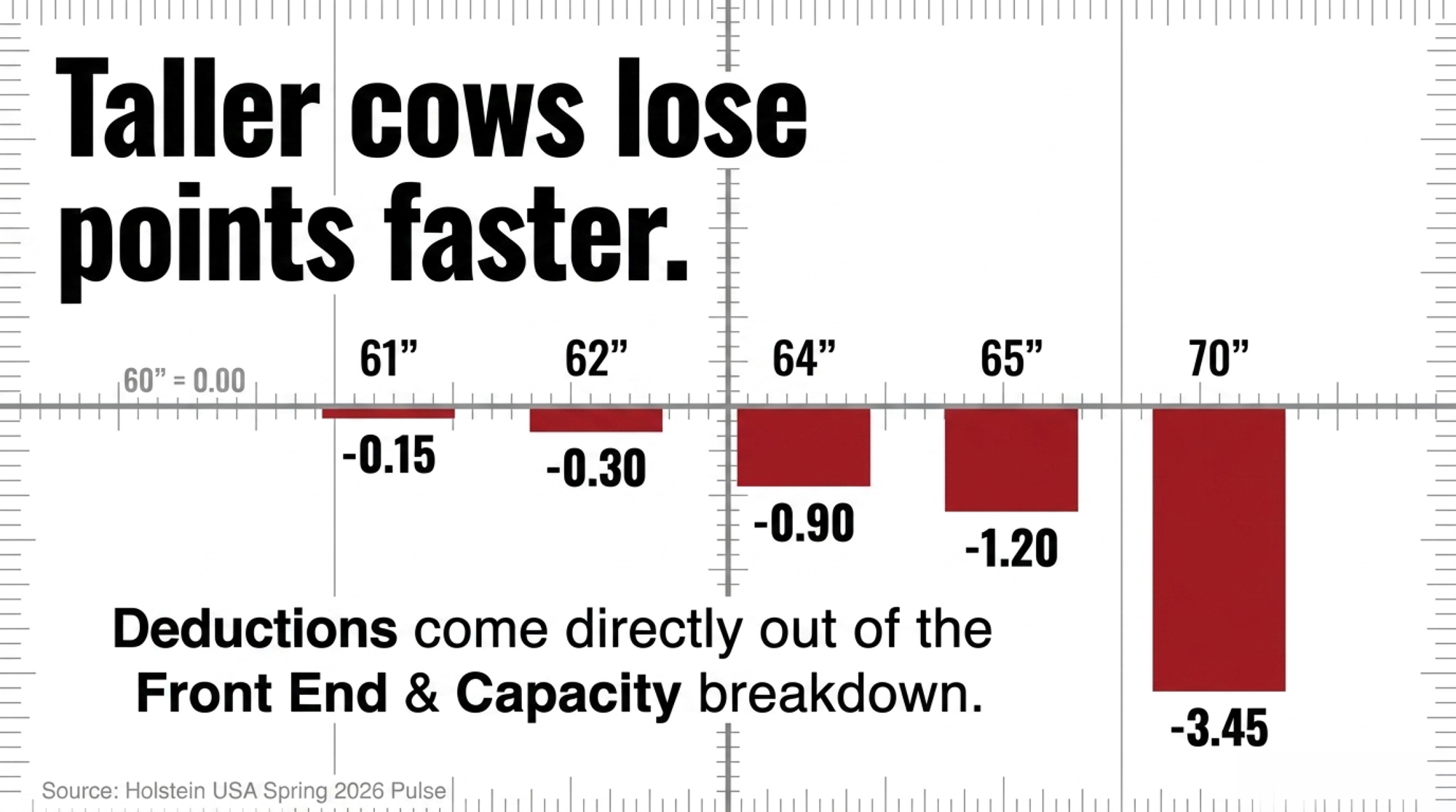
StaturePoint deduction from Final Score
60″ and under0.00 (no penalty) 
61″−0.15 
62″−0.30 
64″−0.90 
65″−1.20 
68″−2.55 
70″−3.45 

We figured the thread would split the usual way. Show people furious, commercial people cheering. That’s not what came back.

The One Number That Explains the Whole Penalty

What came back was working breeders doing the genetics math the association never spelled out. Stature is one of the most heritable traits on the card. Feet and legs? Not close. And that gap is the whole argument.

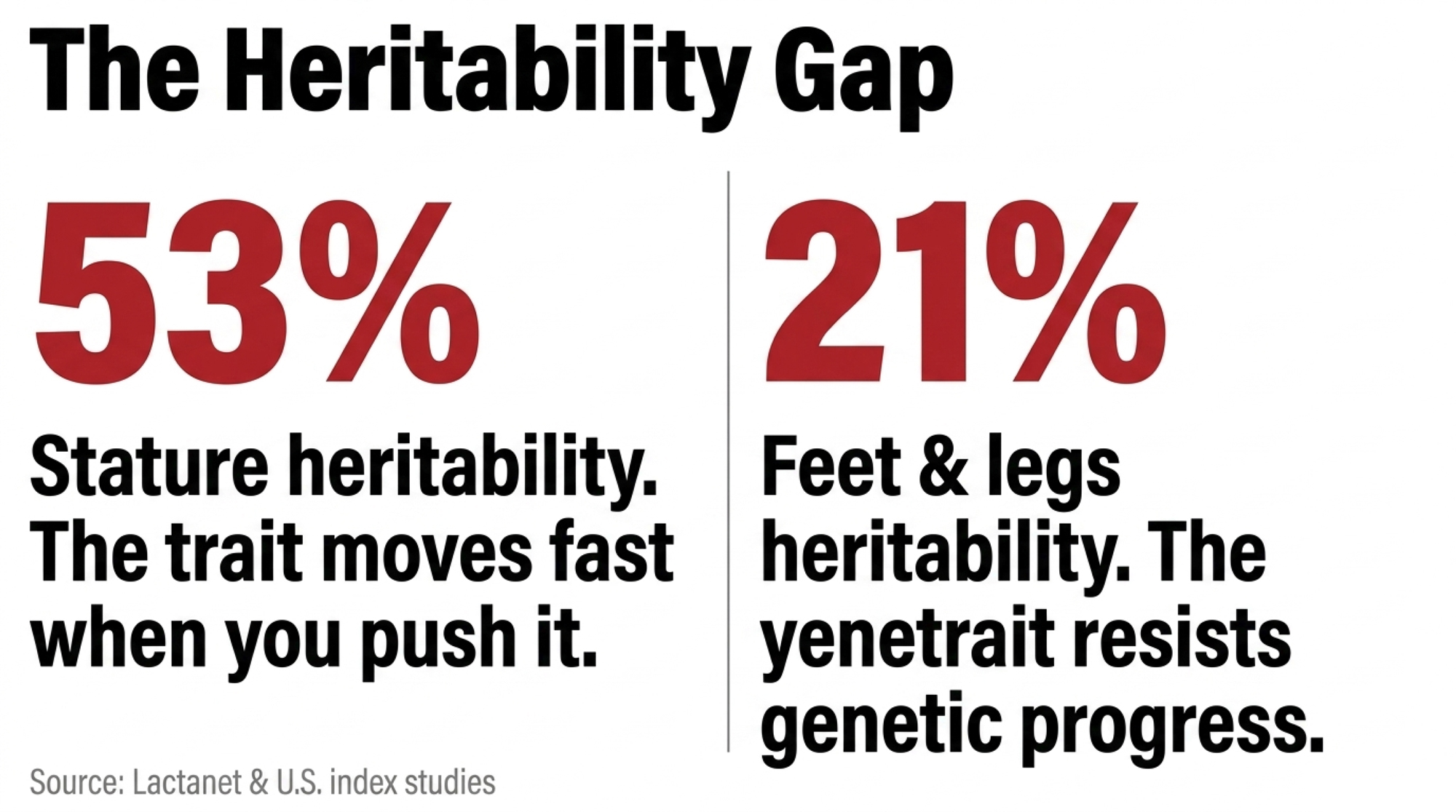
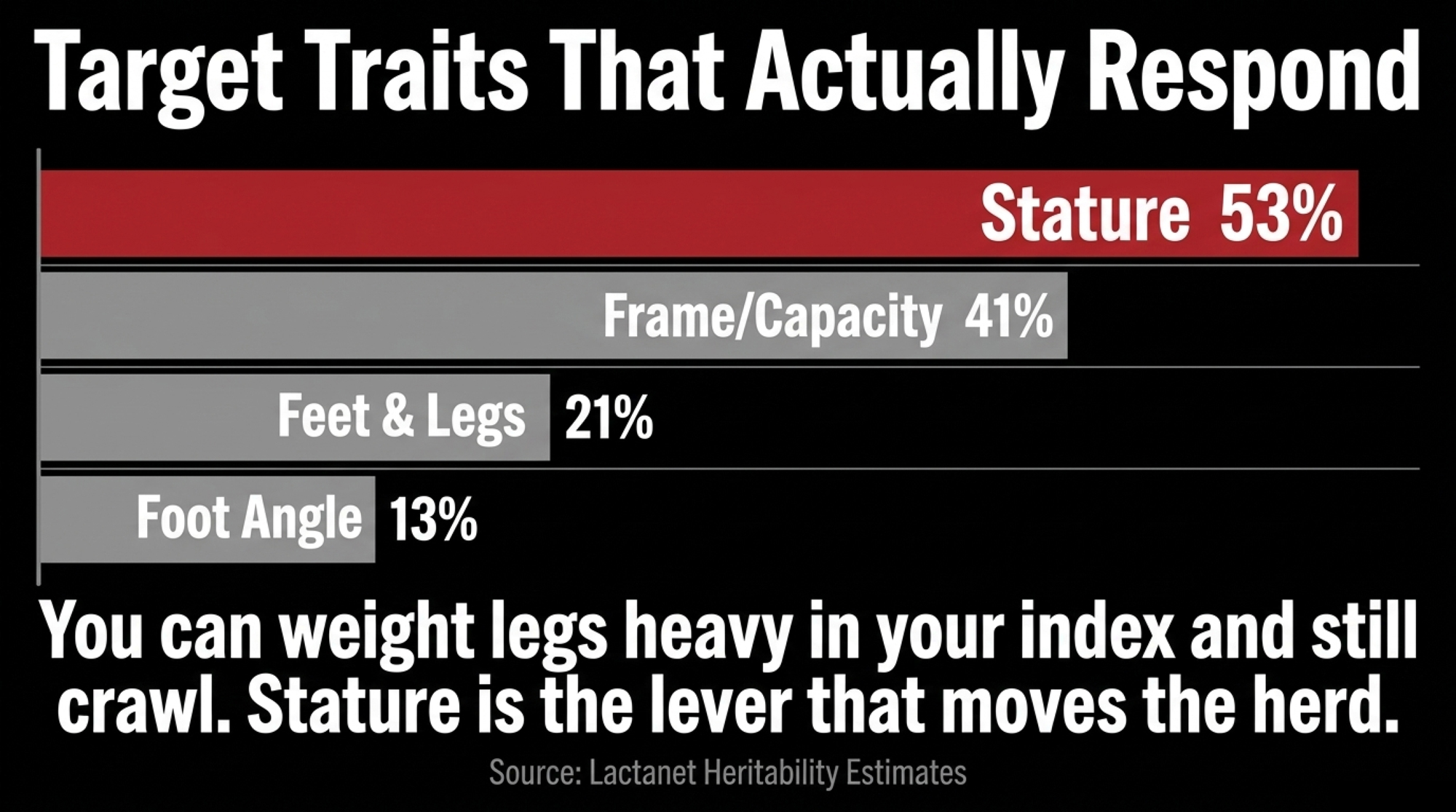
The data backs the Lebacle, hard. Lactanet pegs stature heritability at 53% — the highest of any Holstein type trait — with frame/capacity at 41%, while the Feet & Legs major score sits at just 21% and Foot Angle drops to 13%. Holstein USA runs the same direction: U.S. studies put stature in the low-to-mid 0.4 range, and the association states flatly that “it is difficult to make much genetic progress through selection and mating unless a trait has a heritability of .10 or higher”. This isn’t a 2026 discovery, either. Cassell reported back in 1973 that “stature showed the highest heritability while estimates for udder quality, hind legs, feet… were low”. 

Keep the borders straight — Canada’s 53% and the U.S.’s low-0.4 range aren’t the same figure, but they tell the same story. Selecting hard on feet and legs is like pushing a rope. You can weight them heavy in your index and still crawl, because a 21% trait doesn’t inherit the way a 53% trait does. Stature does. So the association went after the trait that actually responds, knowing it drags a lot of correlated durability along with it.

TraitLactanet heritability (Canada)U.S. studies (Holstein USA)Selection response
Stature53% — highest of any type traitLow-to-mid 0.4 rangeFast — moves the herd
Frame / Capacity41%Comparable frame estimatesModerate
Feet & Legs (major score)21%Below statureSlow — like pushing a rope
Foot Angle13%Near the .10 floorBarely responds

Does the Penalty Punish a Good Tall Cow?

This was the loudest fear in the thread, and one farm answered it with a real classification result. A producer walked into this spring’s round braced for damage and didn’t get it. Her classifier docked stature — then handed it right back on front-end capacity and width. Her balanced cows came out neutral.

That’s one farm’s experience, not a controlled study. But it lines up with how Holstein USA actually builds its numbers. Both the Udder Composite and the Feet & Legs Composite carry a −0.20 weight on stature — on purpose, so breeders can “improve udders and feet & legs without making their cows taller”. The penalty isn’t anti-tall. It’s anti-tall-and-narrow. A wide, strong, deep-ribbed cow who happens to stand over 60 inches carries her frame, and the score shows it. The cow it’s aimed at is the narrow one riding on height alone. 

Another breeder made the same case from the skeptic’s chair. He doesn’t care how big a cow is, long as she’s got the width and strength to last — and frail, he noted, comes in every size. He’s right. And the penalty agrees with him. Height was never the disease. Height without substance is.

Is the Real Problem Height — or the Feet Nobody’s Culling?

The sharpest pushback deserves a full hearing, because it’s fair. One breeder’s argument: this penalty makes classifiers look political, and it’s aiming at the wrong target. Pull up the current top-GTPI list, he says, and look at the feet and legs on that group. Weak. Nobody’s thinning the sorry-walking bulls hard enough. So why chase height when the real durability killer is legs?

Here’s the honest answer, and it’s a “yes, and” — not a rebuttal. He’s right that top-GTPI feet and legs have slid; genomics chased production and type composites while feet and legs quietly eroded, a drift Holstein USA’s own million-cow conformation study laid bare. But the stature penalty and the feet-and-legs problem aren’t competing fixes. They’re the same fight. Height-for-height’s-sake breeding is part of what wrecked the legs in the first place — and at 53% against 21%, stature is the trait you can move fast. The lever this breeder wants pulled directly, feet and legs, responds less than half as well. So push both. Just don’t mistake the more-heritable tool for a distraction. “Watch how they walk and get up and down, not the number on the stick,” another put it — and he’s making the same point. Mobility is what matters. Height is the proxy the system can actually select on. 

The Barn-Floor Longevity File

You can argue heritability estimates all day. It’s harder to argue with a cull sheet. Several breeders volunteered the same pattern from their own alleys.

One producer runs an older freestall barn — shorter stalls, slatted floor. His read was blunt: tall cows leave earlier than short cows, so he now hunts for a minus on stature when he buys Holstein semen. That’s a breeder rewriting his own index based on what the stalls told him. Another gave the version with detail. Years back he had a cow that flirted with 70 inches — big producer, decent career, until her joints gave out. Her daughter, still tall but not as extreme, aged better and stayed athletic to the end. His verdict: somewhat-tall cows with good feet and legs generally weren’t the problem. Tall plus weak legs was. A third put it flatter — taller cows go down more, and they’re less likely to get back up.

Now put a number on “they leave earlier.” Raising a Holstein replacement to calving runs about $2,016 in confinement, and anywhere from $1,700 to $2,400 depending on your setup (Overton, Journal of Dairy Science, 2020)  — and recent land-grant figures have crept to the $2,400–$2,500 range as feed costs climbed. A cow culled a full lactation early strands a chunk of that before she’s paid you back. On a 100-cow herd, cutting five early exits a year protects roughly $10,000 in replacement investment — call it the ceiling, not the take-home, since salvage value and the milk she already shipped claw some of it back. That’s why breeders in older, shorter stalls treat a stature minus as risk management, not fashion. None of these are studies. They’re decades of watching cows come and go, and they all point where the data already does. 

Don’t Blame the Ring

Here’s where this whole conversation usually goes sideways. The show ring gets blamed for every tall, narrow, fragile Holstein in the country. That’s too easy. And it lets everyone who actually built her off the hook.

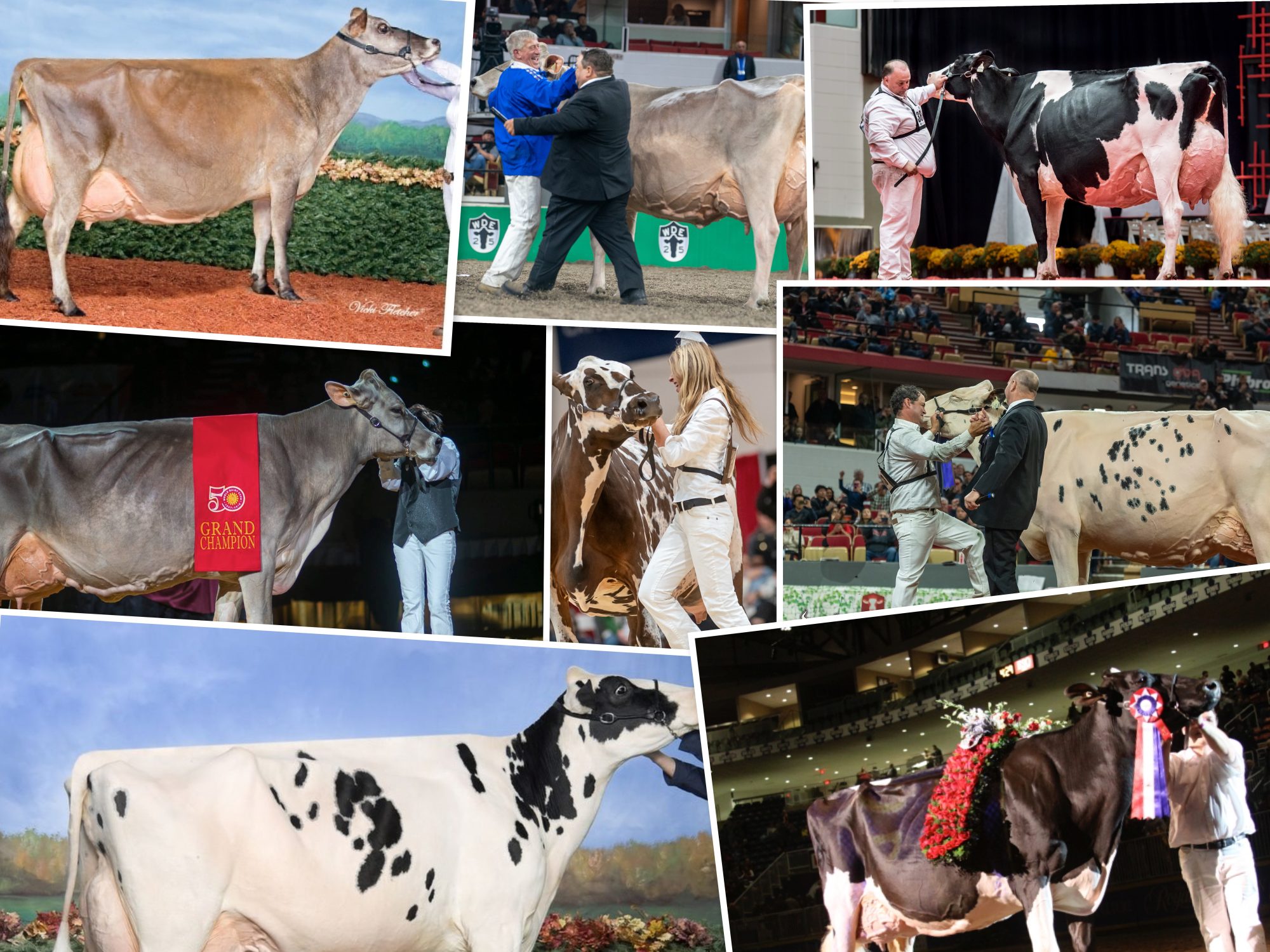
Lovhill Sidekick Kandy Cane takes Grand Champion at the Largest Dairy Show in the world— The ring is a mirror — it rewards the cow breeders, studs, and buyers chose to build. The only question that matters walking out: would she still be here in her fifth lactation?

The ring rewarded what breeders walked into it. Breed associations printed the scorecards. AI companies marketed the pedigrees. Commercial herds kept buying daughters of bulls that looked impressive at 24 months — before anyone asked how they’d hold up through three lactations. We chased bigger for 30 years, then the math caught up: big cows eat more just to exist, and the science flipped so hard the industry now docks stature and even built a whole trait, Feed Saved, to reward the opposite of what it rewarded for a generation. Same people. Opposite advice.

So don’t blame the ring. The ring is a mirror. It shows you exactly what you selected for — and the penalty is just the glass finally being honest.

The Cow That Still Stings

Then there’s the story that stopped the thread cold. A longtime breeder recalled hauling a cow to slaughter decades back — an 18-year-old downer, a small black cow, scored 88, with strength, width, and a beautiful udder. By his telling, she was among the first cows in Wisconsin to top 300,000 pounds of milk lifetime. Yet she never scored Excellent, he says, because she wasn’t tall enough. U.S. bull studs wanted nothing to do with a son of hers. That son went to Europe and did great things.

We couldn’t independently verify the record, so take it as one breeder’s memory, not documented history. But the shape of it rings true to anyone who bred cows in that era. One of the most productive cows in her state, denied the top score and shut out of the bull pipeline for a single reason — too short — back when short was the sin. The pendulum that beat her is the same one now swinging back to penalize the cows that replaced her. The trait didn’t change. The fashion did.

Options and Trade-Offs for Your Herd

The thread wasn’t just venting. Read together, your peers left a working playbook.

Your situationRecommended moveThe trade-off you acceptWarning flag
Weighting F&L hard, no progressPush stature (53%), work the cull sheet for legsLegs still improve slowly21% won’t move on its own
Older / shorter stalls, slatted floorTreat a stature minus as a featurePass on tall pedigreesTall cows leave earlier here
Want durability, no show hitBreed width, strength, capacity firstSkip flashy narrow-tall bullsBalanced tall scores neutral
Breed show-typePrice the penalty before you commitRead linear traits, not just composites64–65″ ≈ −1 Final Score point

Run the 30-day sire audit — do this before your next semen order. Pull your bull list this month. Sort by stature PTA, and on your tallest transmitters check productive life and the Feet & Legs Composite too. If you’re in older, shorter stalls on slatted floors, do what that breeder did and treat a stature minus as a feature, not a flaw. Costs you an evening. It’s the fastest way to see whether your lineup is still ordering the cow the scorecard now penalizes.

Chase substance, let height fall where it lands. Best for herds that want durability without a show hit. Select for width, strength, and capacity first — a balanced tall cow scores neutral, as that spring classification proved. The trade-off is real: you’ll pass on flashy, narrow, tall pedigrees that still photograph like a magazine cover. 

Push feet and legs directly, too — the critics earned that. Don’t let the stature debate become an excuse to ignore legs. But know the catch going in: at 21% against stature’s 53%, progress comes slow, so lean on the composite and your own cull records rather than chasing one bull’s foot-angle number. 

If you breed show-type, price the change with your eyes open. A daughter at 64–65 inches now gives back close to a full point of Final Score she’d have kept a year ago. Read the individual linear traits, not just the composites, and decide the trade honestly.

Key Takeaways

  • If you’re weighting feet and legs hard and seeing no herd progress, that’s the heritability talking. F&L sits at 21%; stature runs 53% in Canada and low-0.4 in the U.S.. Push where it moves, and work the cull sheet for the rest. 
  • If you’re scared the penalty guts a good tall cow, breed width and strength and quit worrying. Both composites carry a −0.20 stature weight by design, so capacity earns back what height docks. 
  • If you run older or shorter stalls, treat a stature minus as risk management, not heresy. At roughly $2,000 a replacement, early exits are the expensive kind of tall. 
  • If your best-ever cow would’ve been too short for Excellent a generation ago, ask what today’s fashion is costing you that you can’t see yet. Fashions reverse. Function doesn’t.

What Fashion Is Your Herd Really Built For?

The best breeders can stand in front of a gorgeous cow and still ask the only question that pays the bills on Monday morning. So walk out to your tallest, flashiest heifer — the one that photographs like progress — and ask it straight: would you want 500 more of her in the milking string? If the answer’s no, that was never the ring’s mistake. It was yours.

Pull ten of your best cows this week and run the stick next to the cull history. See which fashion your herd is actually built for. We laid out the full penalty schedule and the Net Merit math in our earlier breakdown of Holstein’s 60-inch line — this piece was your answer to it, and the reply thread isn’t closed. Keep it coming.

Hold-to-Proof Cost Simulator

Calculate the structural retention balance of your replacement pipeline

% of annual culls leaving before Lactation 3 due to frame/leg weakness

Operational Capital Impact

Annual Replacement Pipeline Requirements: 175 heifers / year
Stature-Linked Early Exits: 9 animals / year
Stranded Heifer Investment: $18,144

Formula assumes early structural exits fail to fully amortize their initial $2,016 rearing asset cost prior to third lactation. Benchmark figures adapted from Overton & Dhuyvetter, Journal of Dairy Science.

Complete references and supporting documentation are available upon request by contacting the editorial team at editor@thebullvine.com.

Learn More

The Sunday Read Dairy Professionals Don’t Skip.

Every week, thousands of producers, breeders, and industry insiders open Bullvine Weekly for genetics insights, market shifts, and profit strategies they won’t find anywhere else. One email. Five minutes. Smarter decisions all week.
NewsSubscribe
First
Last
Consent

The Classifier Behind Eight EX‑97s: Bruno Jubinville’s Lifetime Crusade for Balance

In 1997, Bruno Jubinville couldn’t order coffee in English — but he could read a cow. Today, his balance‑first gospel is shaping barns from Quebec to Brazil.

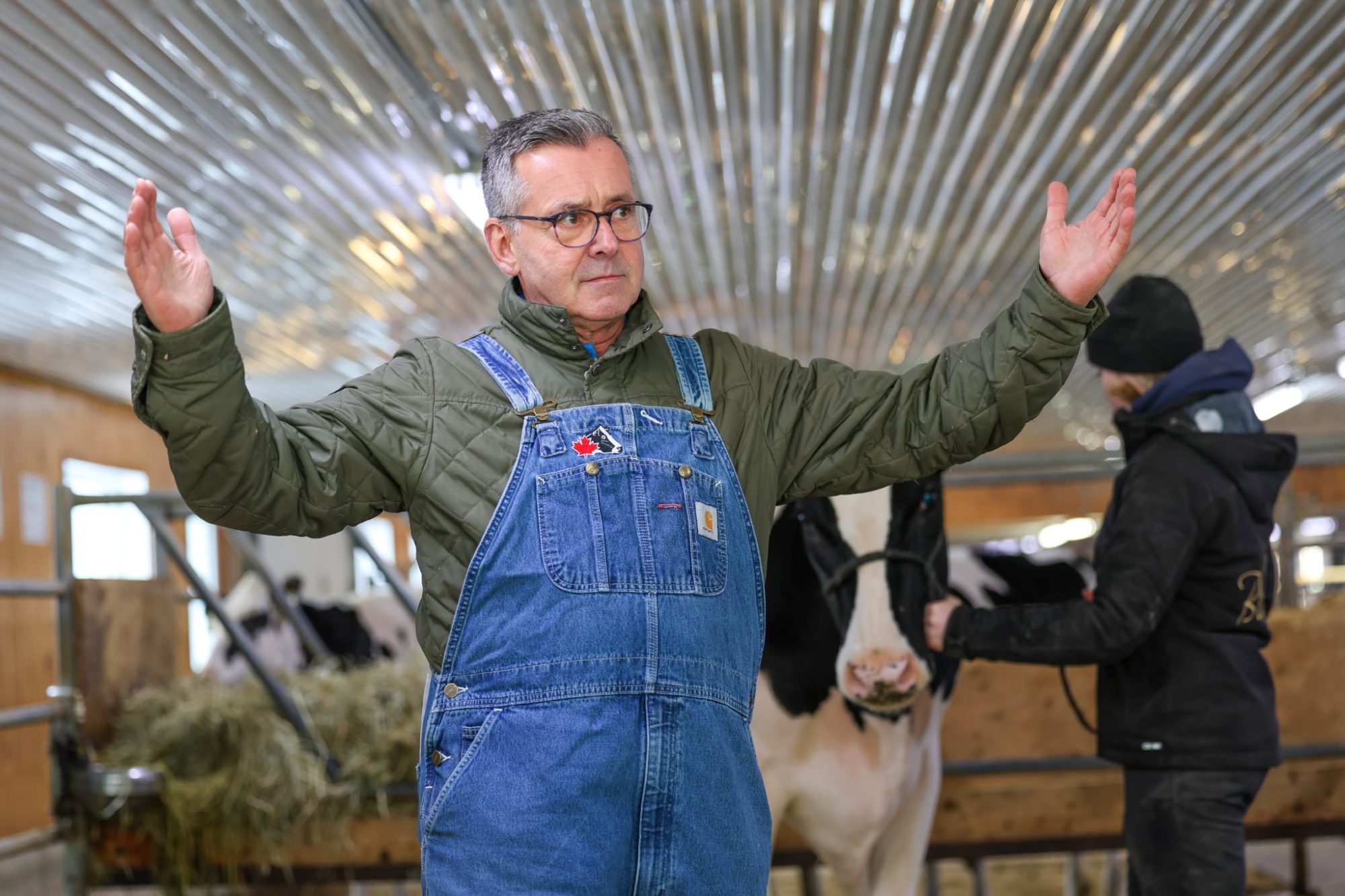
Bruno Jubinville demonstrates the gospel of balance to classifiers from 50 countries during an international training session at Blondin Sires in St. Placide, Quebec. Twenty-nine years of reading cows — distilled into two open hands and one message. 

The Purina truck was still running when Bruno Jubinville walked into the barn.

He wasn’t there to evaluate cows. He was dropping off bags of heifer feed — a fill-in job after the Master Breeder herd he’d worked at for nine years had dispersed. But the Holstein Canada classification crew had just wrapped up their visit, and the classifiers were still hanging around when Bruno came through with his delivery.

One of them — half joking, half challenging, the way dairy people do across barn aisles everywhere — turned to him. “How many points would you give those cows?”

Bruno glanced at the animals. He said it for the laugh, he’d later recall. “87, 86.”

Both scores matched exactly what the official classifiers had just recorded.

Within a week, Holstein Canada was on the phone. They needed a French-speaking classifier from Quebec. There was just one hitch. Bruno Jubinville didn’t speak a word of English.

Not one.

That was April 1997. He wouldn’t leave Holstein Canada for nearly twenty-nine years.

Concrete Foundations and Cow Foundations

Bruno grew up in Coaticook, a small agricultural town in Quebec’s Eastern Townships, about twenty minutes from the Vermont border. It’s deep agricultural country — the kind of place where kids absorb the rhythms of dairy whether they mean to or not.

By twelve or thirteen, he was doing summer work on local farms — not purebred operations, just regular hay-season labour that puts calluses on your hands before your voice changes. After school, he crossed the border to Manchester, New Hampshire, where he poured concrete foundations for houses. Hard, physical, good money.

But family reasons brought him back to Quebec, where he landed at Chacook Holstein — a Master Breeder herd where he’d spend the next eight or nine years doing something he never planned on: learning to read cattle.

“I learned everything there,” he says. “They were really good cowmen. They bought lots of cows, we sold them, and I learned a lot.”

No animal science degree. Nine years in a barn where the standard was Master Breeder or nothing — watching, handling, studying cows that had to be right. That’s probably the credential that matters most.

When Chacook herd was sold, Bruno took the Purina delivery job. Supposed to be temporary.

Turned out to be a runway.

“Chantal Translated for Me. They Gave Me the Job.”

After that barn-floor audition — truck still idling outside — things moved fast.

Holstein Canada needed a Quebec-based classifier, and Bruno was invited to a formal evaluation: score six cows in front of a board with senior staff and veteran classifiers. He drove there with Chantal Chalette, a perfectly bilingual colleague who’d been asked to come along for a very practical reason.

Bruno’s English was, by his own admission, “zero.”

Every time the board asked a question, Chantal translated. Every time Bruno gave his assessment, she relayed it back. At the end, she turned to him with a line that belongs in a movie: “I translated for you. They’re going to give you the job.”

Bruno wasn’t so sure. That night, the phone rang for both of them at the same time. He was in.

He spent his first two or three years classifying across Canadian provinces without being able to communicate directly with English-speaking breeders. He’d walk in, evaluate the cows, give the final score, and leave. The numbers did the talking.

But it gnawed at him.

“I said to Jay Shannon, I would like to have an English course,” Bruno recalls, “because I want to understand the people who speak English. I want to work with them better and understand what they do.”

He took the course. Think about that. Nobody asked him to. Nobody expected it. A guy already proving he could do the job across multiple provinces just decided the numbers weren’t enough — he wanted to connect with the breeders he served.

Sixty Cows a Day and the Dark Alberta Roads

Here’s something people outside the classification world don’t appreciate — what the job actually looks like, week in, week out.

You leave home on Monday morning. Early. If the first farm is five hours away, you’re scoring cows by 1:30 in the afternoon. If it’s closer, maybe 10 AM. Four to six herds a day. Around sixty cows. Some breeders want you there at 4 AM so the udders are full. Others are fine with 7. You try to finish by five. You don’t always.

The work itself is quieter than people think. You stand behind the cow. You read the rear legs — the set, the angle, the way she carries weight. You note the udder floor, the fore attachment, and the teat placement. You assess the loin width, the body depth, and the spring of the rib. Sixty times a day, five days a week. The good classifiers see it in seconds. The great ones see what it’ll look like in three lactations.

Then the phone calls. Monday nights, Tuesday nights, lunch breaks — you’re scheduling next week’s visits while still grinding through this week’s.

“It’s really, really important to give a good service to the breeder,” Bruno says. “And those team members are really, really passionate about what they’re doing. You need to be. Because you’re always by yourself on the road.”

The isolation is the part nobody talks about. Some nights, you come back to a hotel room after a breeder was unhappy with a score, and you sit with that alone. No colleague to debrief with. No team dinner. Just you, the ceiling, and the knowledge that you’ll do it all again at 7 AM.

And those Alberta winters in the late ’90s — before GPS was standard, classifiers navigated by written directions. Drive five miles, turn at the barn with the blue roof, look for the light. Six miles into the darkness without one? You’re lost.

“In BC, you score more cows per day. In Quebec or Ontario, more herds, fewer cows per stop,” Bruno explains. The geography shaped the grind differently across provinces. The grind was constant everywhere.

Five days a week. Every week. For twenty-nine years. In 1997, punching linear scores into an early handheld that was basically a glorified calculator. By 2021, doing it on Connexxion.

Tom Showed Him the Passion

Ask Bruno who shaped him, and three names come up right away: André Tardif, Gilbert, and Tom.

“André Tardif showed me to be professional — always — when I’m doing my job,” Bruno says. “Gilbert hired me. And Tom — Tom showed me the passion. He transferred to me his passion.”

Tom Byers. Thirty years at Holstein Canada — eventually rising to Head Classifier — he was originally from Scotland and classified more than 300,000 cows over his career. The Bullvine profiled Tom years ago, and if you know his work, you see his fingerprints all over Bruno’s approach — the emphasis on education, the refusal to let a final score substitute for actual understanding of an animal.

Bruno absorbed Tom’s philosophy completely. When he started doing international workshops for the World Holstein Friesian Federation, Bruno ranked second among the presenters his very first time out — a performance he credits directly to what Tom taught him.

Here’s the thing Tom drilled into him — the insight that became the backbone of Bruno’s entire professional worldview. “At the end, I don’t think the final score is really important,” Bruno says. “It’s the linear code. Every country, when they look at our genetics, they work with our linear codes — not with the final score.”

The score is for the breeder’s wall. The linear traits are for the breed’s future. If you’ve ever wondered why the classification number everyone obsesses over isn’t actually the data that moves the needle on genetic progress, there it is, straight from a man who spent three decades inside the system.

Friday at 7 AM. Two 97s. One Weekend to Madison.

In Holstein history, Canada has had 11 cows that scored 97 points. Bruno participated in classifying eight of them.

Eight 97s, three breeds, one eye. The cows Bruno Jubinville helped classify to EX‑97 across his 29-year career — Holsteins, a Jersey, a Brown Swiss, and an Ayrshire. “All of them have a little defect,” he says. “All of them.” That’s what makes 97 extraordinary, not perfect.

He rattles off the names the way other people name their kids: James Rose, Kendra, Hailey, Shakira — and then beyond the Holsteins, Gorgeous the Jersey, Brown Heaven Fantasy the Brown Swiss, and the Ayrshire, View Village Gentleman Joy. Each one carries a memory so vivid you can practically feel the barn humidity in his voice.

The morning that sticks out the most is a Friday at 7 AM at Pierre Boulet’s farm. Bruno and his colleague Daniel were there, and two cows — Thrulane James Rose and Bruynland Strom Kendra — both scored 97 on the same visit.

“We were really nervous,” Bruno recalls, “because we scored 97 for two of them, and that put a lot of pressure on us.”

Both cows left that same weekend for Madison — World Dairy Expo. Rose, who was actually sick and resting when people were debating which cow deserved what, would go on to change the direction of the show ring itself.

“Rose was really ahead of the breed at that time,” Bruno says. “She changed the show. Smaller cows, a little bit. Before, it was all Logic — the Duke, so big and tall and long. Then Rose arrived.”

And Bruno was right there at the inflection point, clipboard in hand.

When you ask him which 97 was the most complete, he doesn’t hesitate. “Shakira. She was the most complete 97 I scored. On her legs, mammary, dairy strength — I would like to see the rib structure just a tiny bit more. But she’s the most complete.”

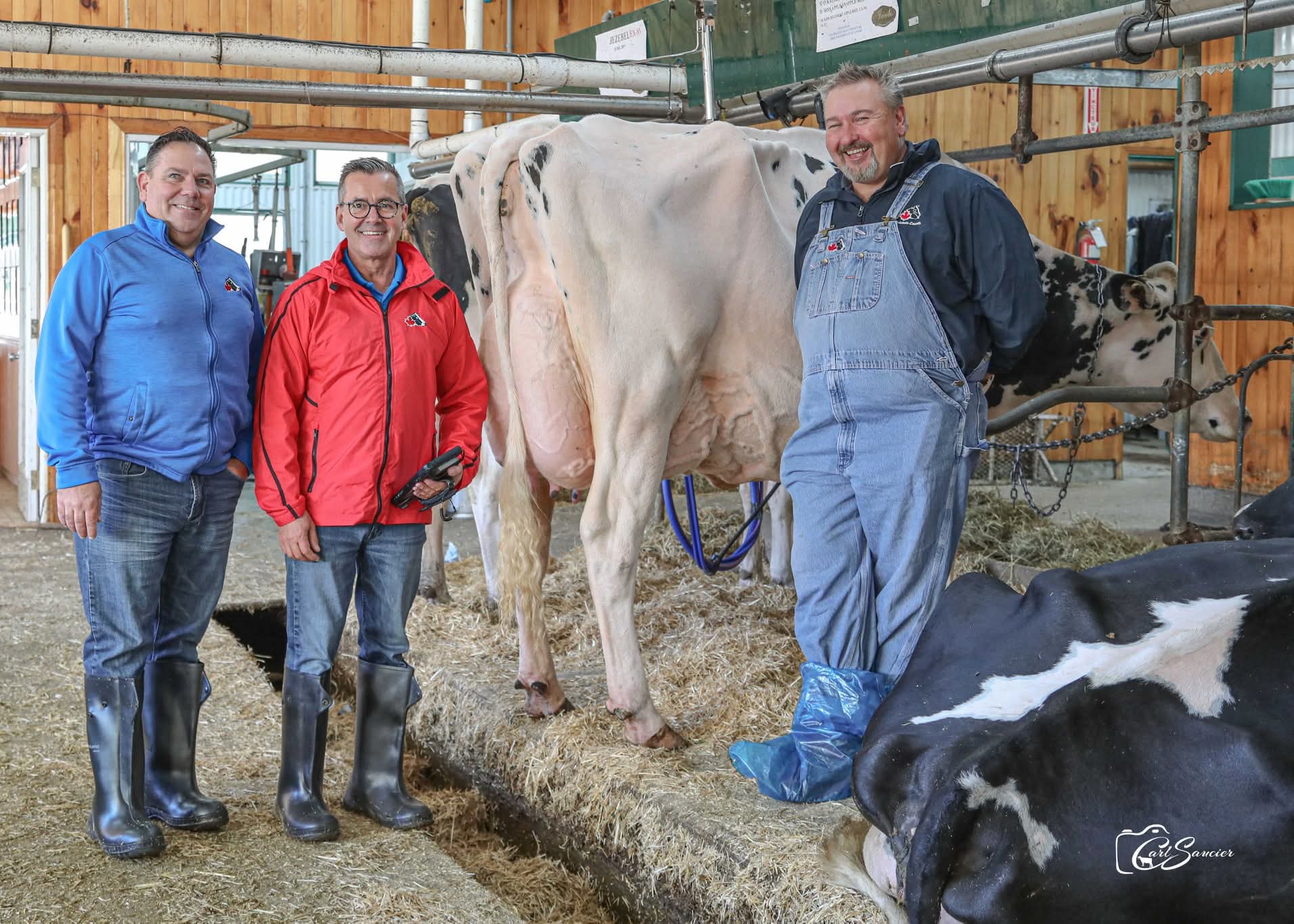
Remi Bernier, Bruno Jubinville, and Dave Weitzel with Erbacres Snapple Shakira EX‑97 — the cow Bruno calls “the most complete 97 I ever scored.” On her legs, mammary, dairy strength, she was as close to perfect as the system allows. Almost. (Photo: Carl Saucier)

Then he says the quiet part out loud — the thing that reveals how a great classifier actually thinks: “We need to understand — 97 points is not perfect. All of them have a little defect. All of them.”

He walks through the others with the reverence of a man who knows he’ll never see their like again. Vandenberg Amedeo Gorgeous — the Jersey — was a tank, the widest udder he’d ever laid eyes on. Hailey walked like a princess, so stylish that “when she arrived on the ring, nobody was talking.” And View Village Gentleman Joy — an Ayrshire he first scored as an 88 in first lactation, then 97 in a later round — remains “really special.”

His eye worked across breeds, not just Holsteins. He classified Brown Heaven Fantasy to 97 as a Brown Swiss, and scored another Brown Swiss — Iroquois Acres Jong Cali at Lookout Farm — to 97 alongside colleague Chantal Chalette. He also classified Goldwyn’s 1,000th Excellent daughter in Canada — Donar Pally Jo Goldwyn EX-90, a fourth-lactation cow with over 53,000 kg lifetime production at the time, bred and owned by Dorothea Beier and Horst Schulz in St. Cyrille, Quebec.

The Gospel of Balance

If there’s one word Bruno would stitch into the coveralls of every dairy farmer on the planet, it’s balance.

His favourite way of explaining it involves a football player he sat beside on a flight home from British Columbia. The guy was about 6’2″, over 300 pounds — a lineman who passed the ball to the quarterback. In the airplane seat, he looked enormous. Uncomfortable. Too big for the space.

“But when he started to walk at the airport, he was really functional,” Bruno says. “Strong and wide. The problem wasn’t that he was too big. The problem was that the seat was too small.”

Then the pivot: “That means every cow doesn’t fit everywhere. It depends on what kind of barn you have, what kind of installation you’ve got. Not every bull fits everywhere. Not every cow fits everywhere.”

It challenges a tendency that persisted in dairy breeding for generations — the pursuit of extremes. Extreme stature. Extreme frame. Extreme openness. Bruno watched that trend come, peak, and — finally — start to recede.

“When I started classifying, we’d sometimes finish herds at a 72 or 73 average,” he says. “Now we don’t see that anymore. It’s hard to find a heifer at 75 or 76. Most are 80 and over. We’re on the right path. I’m really, really happy about that.”

Walk into almost any Canadian herd today, and the spread among two-year-olds is maybe five or six points. That was unthinkable when he started. The consistency of modern cattle — driven by decades of genetic progress and the classification system’s increasing focus on functional traits — is something Bruno considers a genuine triumph.

But there’s a caveat, and it’s a big one.

The breed is now calving heifers at 22 to 24 months. Some of those heifers are milking 40 to 45 kilograms a day in first lactation. “It’s really hard for them,” Bruno says. “When a heifer is producing 45 kilos, the energy she needs — she’s running a marathon every day. She needs something behind her to produce and still stay in the barn.”

That “something behind her” is structural balance — the legs, the loin, the feet, the udder attachments that let a cow absorb the punishment of high early production and come back for second, third, fourth lactation. Without it, she’s a one-lactation wonder. And the industry can’t afford one-lactation wonders — not at today’s replacement costs.

His international presentations carried titles that doubled as manifestos — The Symmetry of a Cow and The Secret of Balance. Same message, delivered in barns from Southern Alberta to Cremona, Italy: you can have all the genetics in the world, but if the cow can’t stand on her feet and hold her frame together, the genetics don’t matter.

He’s got a dozen versions of the same teaching story, too. One breeder told him flat out: “I don’t like type. I don’t like type.” Bruno scored the herd — 81, 82, nothing special. Then he scored one cow 85. The breeder pointed right at her: “She’s my best. She gives lots of milk.” Bruno just smiled. “Yeah. But this is the type, you know.”

Locomotion: “My Baby”

If there’s one trait Bruno claims personal ownership of in the Canadian classification program, it’s locomotion.

“I always, always pushed to have locomotion,” he says. “For a long, long time. It was my goal before I left, to have locomotion evaluated. Because I think it’s really, really important.”

Canada’s challenge was unique. With a large proportion of tie-stall barns — particularly in Quebec — locomotion was harder to evaluate and harder to weigh properly compared to countries where cows walk an hour or more to the milking parlor every single day.

But Bruno’s international work opened his eyes to how critical the trait is once you step outside a tie-stall reality. In the Azores, cows walk through steep volcanic hills for one to two hours daily to reach the parlor. In New Zealand, they’re outside 99% of the time. And in England? The economic weighting on locomotion is enormous — because the data proves better-moving cows make more money.

“In England, the weighting of locomotion is really, really high,” Bruno explains. “They have numbers behind numbers. I mean money. When you have good locomotion, your cows make more money.”

He and colleague Jill Nelson developed a locomotion scoring video — a visual training tool scored on a 1-to-9 scale — that went out to classifiers across the country. It was one of the tangible tools Bruno left behind when he moved on.

Within Canada’s system, the three most important components for feet and legs are heel depth, side view of the rear legs, and rear leg rear view — all feeding into locomotion assessment. “I think we’re pretty good now,” he says. “I’m really happy.”

Getting Ten Countries to Agree on What a 7 Means

Classification harmonization — getting ten countries to agree on what a 7 for rear leg rear view actually means — sounds bureaucratic until you realize it determines which Canadian bulls get used in Colombia. Bruno sat on the WHFF Type Harmonization Working Group alongside representatives from the United States, France, Germany, Hungary, Italy, and New Zealand, meeting at international workshops to work through the painstaking details of making classification data comparable across borders. When he couldn’t make the most recent session in Cremona — he was sick — Carolin Turner stepped in. When semen from Canadian bulls flows to dozens of countries, and buyers in Brazil or Australia rely on Canadian linear data to make purchasing decisions, this harmonization work has real economic consequences.

Bruno also took the Canadian classification system directly to Colombia, running training courses for local classifiers. He worked across Australia, Brazil, and numerous other countries. And he wasn’t just exporting a system — he was learning.

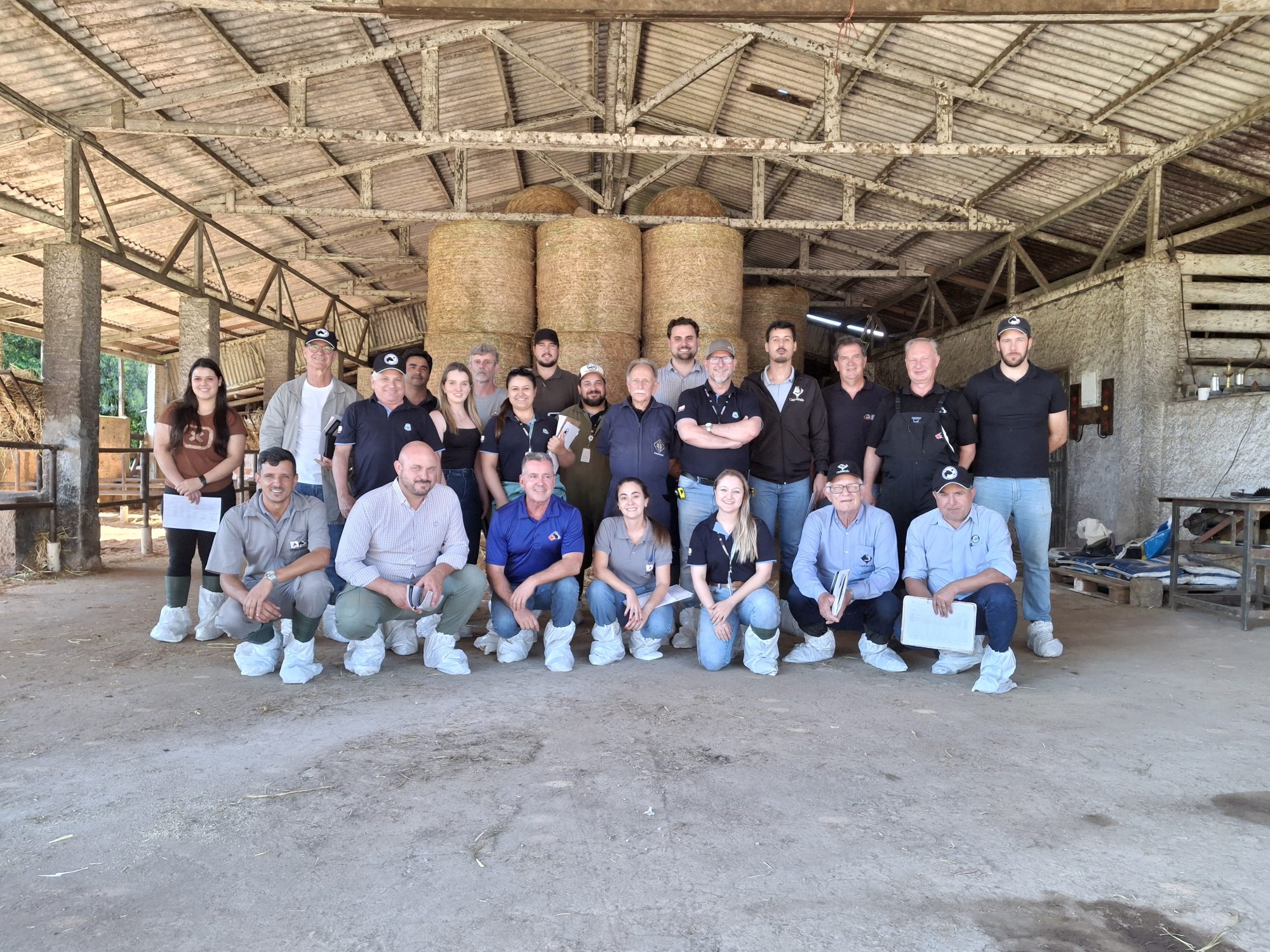
Bruno Jubinville (front row, centre) with Brazilian classifiers after a hands-on training session, November 2025. Different hemisphere, same language — balance.

“Every time, I love everywhere,” he says. “It’s so incredible how people like Canadian cows, how they like what we’re doing. They listen a lot, and they learn with us — and we learn too.”

Carolin Turner served as his co-coordinator for years at Holstein Canada, and when the CEO named Brad Eggink as Classification Manager back in 2017, he singled out Bruno and Carolin as “key leaders of our dedicated Classification Team” who would “take our Classification program to the next level.” That kind of endorsement doesn’t come from punching a clock.

Carolin Turner and Bruno Jubinville in their early Holstein Canada days. Nearly three decades later, when Bruno was too sick to make the WHFF session in Cremona, it was Carolin who stepped in — the kind of partnership that doesn’t need explaining

But Bruno pushes back on the nationalism that sometimes creeps into breeding conversations. “We talk about Canadian kind, Canadian kind. But I think everybody, every herd in the world, needs the same cows. Balance. This is where we are. The breeding is all around the world now.”

Still, when he sees balanced, functional cattle abroad, something sneaks in. “In my head, I always say, ‘This is a Canadian cow.’ I don’t know why. But it’s like — balance. We talk about balance.”

The Genomics Question

When genomic testing arrived, fear swept through the classification world. Bruno remembers it clearly.

“Classifiers were scared,” he says. “They said, ‘Genomics will take our jobs.’ People were saying we don’t need classification anymore.”

If you can predict a cow’s type traits from a DNA sample, why send a human to her barn? It wasn’t an unreasonable question. A lot of people in the industry were asking it.

Bruno’s answer is pragmatic: “Genomics is one of the best tools we’ve ever had. But it’s one tool in a box of tools. If genomics is so important, we need classification to prove the numbers. To improve reliability. You need classification.”

Tom Byers made the same point years earlier. “Any progress we’ve made is through classification and milk recording,” Tom shared in a 2018 interview. “Genomics wouldn’t exist without them.” Bruno and Tom — mentor and protégé — singing from the same hymnal on this one.

And they’re right. Genomic predictions are only as good as the phenotypic data they’re trained on. Without ongoing classification — without actual people evaluating actual cows — the reference population powering those predictions stagnates. Reliability drops. Breeding decisions get worse.

The proof is already showing up. Some genetic operations now have five, six, or seven generations with no classification or milk recording. The validation gap is growing. And the industry relying on those numbers hasn’t fully reckoned with what that means.

“When genomics arrived, some people totally forgot about family,” Bruno says. “They forgot about cow families. We always talk about bulls, bulls, bulls. But we need to talk about females. Both. We need both to improve the breed.”

That position has gained real traction lately, especially as breeders have seen genomic overreliance produce its own set of disappointments — bulls whose daughters don’t match the predictions, and cow families that fall apart after one flashy generation. The Bullvine’s own recent reporting on inbreeding trends and the Blondin Sires approach to deep-pedigree sire selection underscores just how relevant this concern has become. The pendulum is swinging back. Slowly.

First Out the Door With Connexxion

When Holstein Canada launched Connexxion in April 2021 — the new on-farm digital platform replacing a system in use since 2005 — they didn’t send a junior classifier to the debut. They sent Bruno. He headed to Peartome Holsteins for the first official classification visit using the new technology.

Classic Bruno. He asked for English courses when nobody expected him to. He championed locomotion when the tie-stall lobby pushed back. He adopted new tech when it improved service delivery. The thread connecting all of it? Whatever helps the breeder, do it.

Sandra at Véronamour, a brand-new Holstein Canada member when Bruno showed up for one of her early classification visits back in 2012, put it: “He provided us with so much information — he took the time to define each trait, the ideal traits that we should strive for in each animal, and why. It was a very informative visit for me; I use the information every day.”

That was fourteen years ago. The approach never changed.

The Part of the Cow Nobody Talks About

Before the interview wrapped, Bruno circled back to the thing he really wanted to say — the technical detail closest to his heart.

“Some countries still don’t evaluate loin,” he says, “but for me, it’s one of the most important parts of the cow.”

Most breeders think of the loin as the curvature of the topline. Bruno defines it differently. The loin — those vertebrae on top — needs to be strong and wide, side to side, because it supports the internal angle of the reproductive cavity. A strong loin keeps the fertility system at the proper angle. In the first lactation, you won’t notice a problem. But as a cow ages, a weak loin shifts that cavity angle, making her harder to breed, and shortens her productive life.

“We need to check inside the cow,” Bruno says. “When you look at a cow, not just outside. If she’s got a good loin, you can see that the internal angle of the cavity and the fertility system is right. This is why it’s so important for me.”

And then he delivers a line that might be the most provocative thing he said in the whole conversation: “I think the genetic potential is higher than what breeders can use right now because of management level. The genetics are pretty, pretty high now. I can’t imagine in the future we’ll have significantly better cows than this.”

He’s not saying we’ve hit the ceiling of genetic progress. He’s saying the gap between what genetics can deliver and what management practices currently capture is the real frontier. The cows are ready. The barns — the protocols, the transition management, the foot care, the facilities — aren’t always keeping up.

The Math That Makes Balance Pay

Bruno’s argument for balance and longevity isn’t just philosophical. Run the numbers, and it snaps into sharp focus.

Canada’s national average is roughly 2.5 to 2.7 lactations. At current replacement costs — CA$3,000 to $3,500 for a springing heifer — every additional lactation a cow completes is worth roughly $1,500 to $2,000 in avoided replacement cost alone, before you even count the peak production she gives in lactations three and four.

Here’s the math: push your herd from 2.7 to 3.5 average lactations on 100 cows — that’s 80 additional cow-lactations at roughly $1,750 in avoided replacement cost each. Call it $140,000.

That’s your robot payment. That’s your barn renovation. That’s the difference between scraping by and building equity.

And classification — the system Bruno championed for nearly three decades — exists for exactly this reason: to identify and reward the structural traits that let a cow last.

“After one hundred years of classification,” he says, “people still don’t know enough about why we classify. The program is built for two things: longevity and productivity. That’s the goal.”

“I Never Want to Stop Working With Cows”

After twenty-nine years at Holstein Canada — rising from field classifier to Manager of On-Farm Operations — Bruno made the move that surprised half the industry and made perfect sense to the other half. He joined Blondin Sires.

Not as a salesman. As an ambassador.

“I don’t want to sell semen,” he says bluntly. “I’m not a salesman. My role will be to educate people. What is a good cow? What is a balanced cow?”

The fit makes sense. Blondin Sires — owned by Simon Lalande, Dann Brady, and Nicolas Lalande out of St. Placide, Quebec — is built on exactly the philosophy Bruno has been preaching for three decades: deep pedigrees, functional type, and cow families you can actually trace back through generations of real milk records. Dann Brady co-founded Blondin Sires in part because he couldn’t find bulls backed by the kind of documented maternal lines he wanted in the major AI catalogues. That’s Bruno’s language. That’s balance.

“With my twenty-nine years,” Bruno says, “this is what I want to give — more follow-up to the breeders, more help with the breeding they do. Because it’s an investment, it’s really, really important.”

“It was hard for me to make the decision to leave, because I really love the team I work with,” he admits. That team — Carolin Turner and the classifiers he’d trained and mentored across every province — had been his professional family for the better part of three decades. Walking away from that takes a different kind of courage than walking into a barn at 4 AM.

But he’s got strong teammates at Blondin. Brian Carscadden, the Executive Senior Manager who brought more than 25 years of international sire analyst experience to the role, is deeply involved in the company’s growth strategy. And Dann Brady may have spent more time studying pedigrees and cow families than anyone in the Canadian industry — the kind of person Bruno can learn from while bringing his own three decades of type evaluation to the table.

“I still learn a lot about bulls and so many numbers,” Bruno says. “But I think it’s really important to help breeders with what they really need in the field. This is what I want to do.”

Still Learning

There’s a photograph floating around social media of Bruno at Mapleburn Farms during a classification visit. In the background, the farm kids are drawing cows on paper while he works.

That image says more than any career summary could.

“If we explain to them when they’re young,” Bruno says, “they will know in the future, when they’re on the farm, how important it is to have balanced cows and balanced herds. Because longevity — it’s the clue of the future.”

Bruno Jubinville spent his career inside one of Canada’s most important dairy industry programs. He scored eight of the eleven highest-classified cows in the country’s history. He pushed for locomotion when it wasn’t fashionable. He took the Canadian system to Colombia, to Brazil, to Cremona, and brought lessons home every time. He was the first to use Connexxion, the first classifier from Quebec to ask for English courses, and one of the last people you’d ever catch bragging about any of it.

“I never expected you would do an article on me like this, you know?” he says near the end of the conversation.

Twenty-nine years. Eight 97-point cows. A dozen countries. One word — balance — repeated so consistently that it became a career.

At Blondin, the barns are different. The conversations have shifted from linear scores to mating decisions. But the message won’t change. It hasn’t changed in three decades. It won’t start now.

Balance. Longevity. Respect the breeder. Love the cow.

And keep learning. Every single day.

Key Takeaways

  • A “joke” score from behind a feed truck turned into 29 years of classification, eight EX‑97 cows, and one of the most influential “eyes” in Canadian Holsteins.
  • Bruno’s bottom line: balance pays. Cows that last 3.5 lactations instead of 2.7 can put roughly $140,000 back into a 100‑cow herd in avoided replacements.
  • He helped drag locomotion, loin strength, and functional udders from the margins into the middle of the scorecard — exactly what 2025 robot barns and high‑yield fresh cows need.
  • Genomics, in his view, is just one tool in the box; without ongoing classification and cow-family data, the predictions drift, and inbreeding problems snowball.
  • At Blondin Sires, he’s taking that “classifier brain” straight into sire selection, focusing on deep cow families and balanced type instead of chasing the latest genomic rocket.

Continue the Story

The Sunday Read Dairy Professionals Don’t Skip.

Every week, thousands of producers, breeders, and industry insiders open Bullvine Weekly for genetics insights, market shifts, and profit strategies they won’t find anywhere else. One email. Five minutes. Smarter decisions all week.

NewsSubscribe
First
Last
Consent

The 3‑Lactation Trap: Are $3,010 Heifers Pushing You Toward Beef Checks Instead of Five‑Lactation Cows?

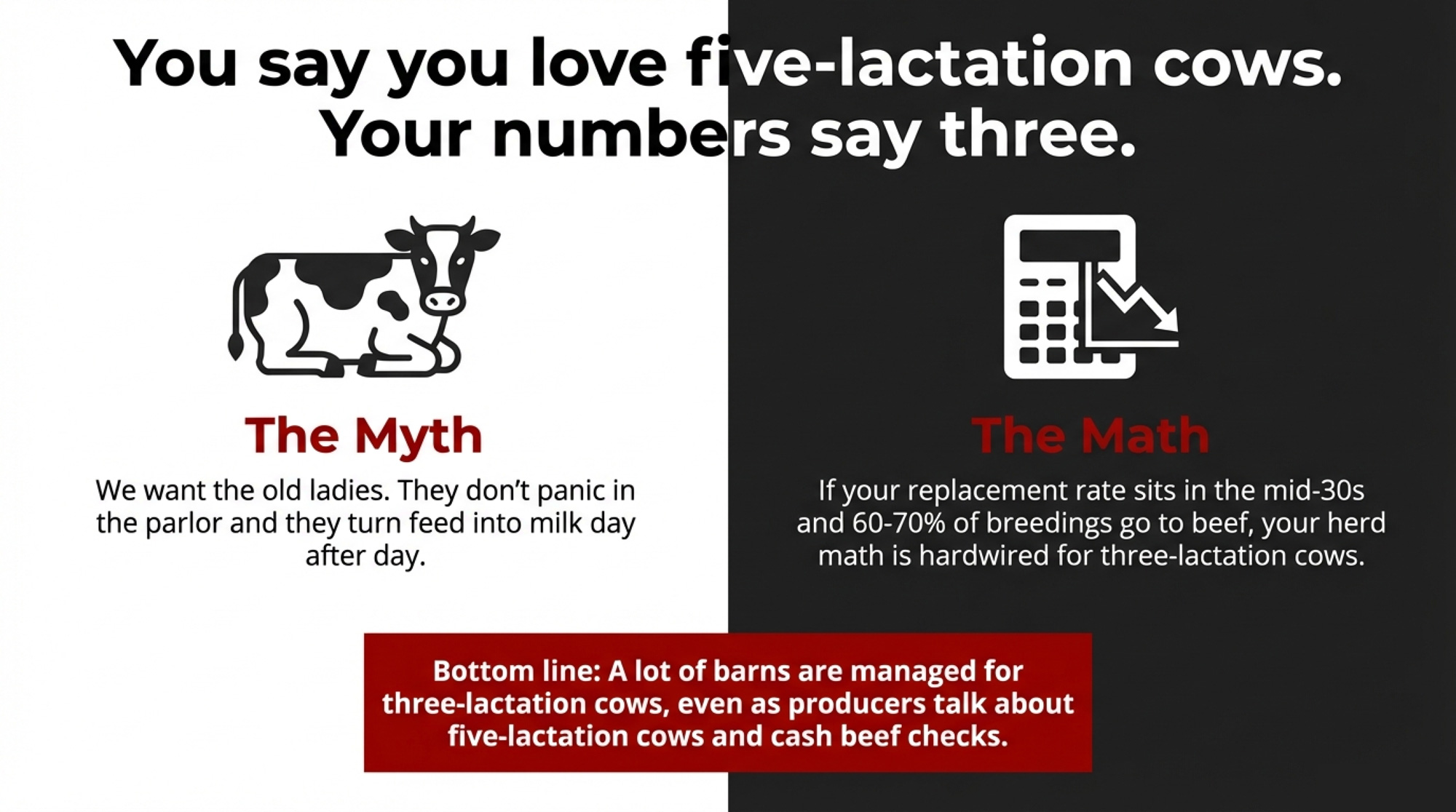
You say you love five‑lactation cows. Your numbers say three. Is your beef‑on‑dairy program and pen crowding killing your “old ladies” before they ever get there?

Metric3-Lactation System5-Lactation SystemImpact
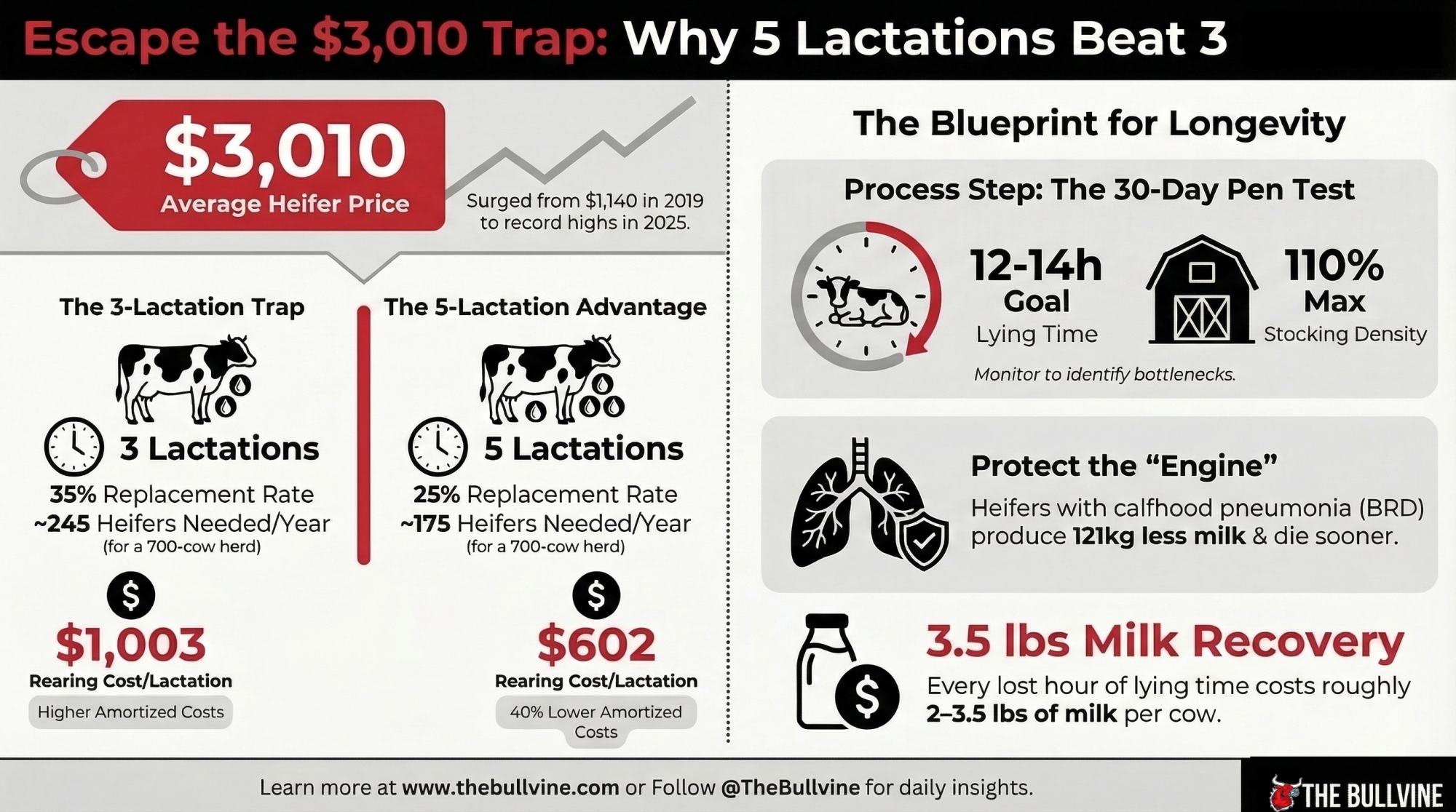
Rearing cost per heifer$3,010$3,010Same upfront investment
Amortized cost per lactation$1,003$602$401 less per lactation
Annual heifer needs (700 cows)245 heifers/year175 heifers/year70 fewer heifers
Total annual rearing cost$737,450$526,750$210,700 savings
Beef semen usage (typical)70% of breedings~35% of breedingsMore internal replacements

At Glacier Edge Dairy in Wisconsin, Kristen Metaf will tell you her favorite cows are the “old ladies” on their fifth or sixth lactation — the ones that don’t panic in the parlor and turn feed into milk, day after day. She says those fifth‑lactation cows are her moneymakers because they know the routine and don’t waste energy. She runs a herd that, like a lot of progressive dairies, breeds heavily to beef, lung‑scans calves at three to five weeks, and trims hooves three times a year to keep cows on their feet.

On that same World Dairy Expo panel, Pennsylvania herd manager Eric Grodigette shared that cameras over his pens showed fresh cows were spending more time out of the pen than he realized — a few “extra” minutes in the holding area, three times a day, added up to hours of lost rest and more third‑calvers heading to the cull string. Both of them say they want five‑ and six‑lactation cows. But like a lot of U.S. herds, they’re having to make those decisions in an industry where USDA’s January 2026 cattle report counted just 3.914 million dairy replacement heifers over 500 pounds — the lowest since 1978 — and CoBank projects roughly 800,000 fewer heifers over 2025–26 before numbers start to rebound closer to 2027. By mid‑2025, the national average replacement heifer price sat around $3,010 per head, up sharply from about $1,140 in 2019, with top springers in some Western and Upper Midwest auctions topping $4,000.

Bullvine’s analysis of NAAB’s 2024 semen report estimates that about 7.9 million units of beef semen were used in U.S. dairy herds, while NAAB’s own summary shows 9.9 million units of gender‑selected dairy semen, up 17.9% from 2023. Beef‑on‑dairy now supplies an estimated 2.6 million calves to U.S. feedlots, up from roughly 410,000 in 2018. Put bluntly: a lot of barns are managed for three‑lactation cows, even as producers talk about five‑lactation cows and cash beef checks.

What’s Changed — And Why It Hits You Now

For years, the default answer was simple: raise more heifers, milk more cows, keep the parlor full. Heifers were relatively cheap, custom‑grower slots were open, and processors wanted volume.

That world’s gone. USDA’s January 1, 2026, inventory pegged dairy replacements over 500 pounds at 3.914 million, down from 3.951 million the year before and the lowest since USDA reported 3.886 million in 1978. CoBank’s August 2025 outlook says those heifer numbers will shrink by roughly 800,000 head over 2025 and 2026, even as about $10 billion in new U.S. dairy processing capacity comes online through 2027 — all of it needing more milk and components.

Heifer values tell the same story. Hoard’s Dairyman and other market summaries show quarterly U.S. replacement prices around $1,140 per head in 2019, then climbing to the $2,800–3,010 range by mid‑2025. In Wisconsin, USDA and regional reports indicate replacement costs climbed about 69% from late 2023 to late 2024, landing in the mid‑$2,000s, while top springers in some California and Minnesota sales cleared $4,000.

On the calf side, beef‑on‑dairy keeps roaring. NAAB’s 2024 summary recorded 9.9 million units of gender‑selected dairy semen, up 17.9% from 2023, alongside very strong beef‑semen sales. Ever.Ag’s Mike North told Brownfield that newborn beef‑cross calves in early 2025 were “bringing as much as $1,000” in some markets, while Holstein bull calves often traded in the $500–1,000 band — a few‑hundred‑dollar per‑head premium for beef‑cross in many barns.

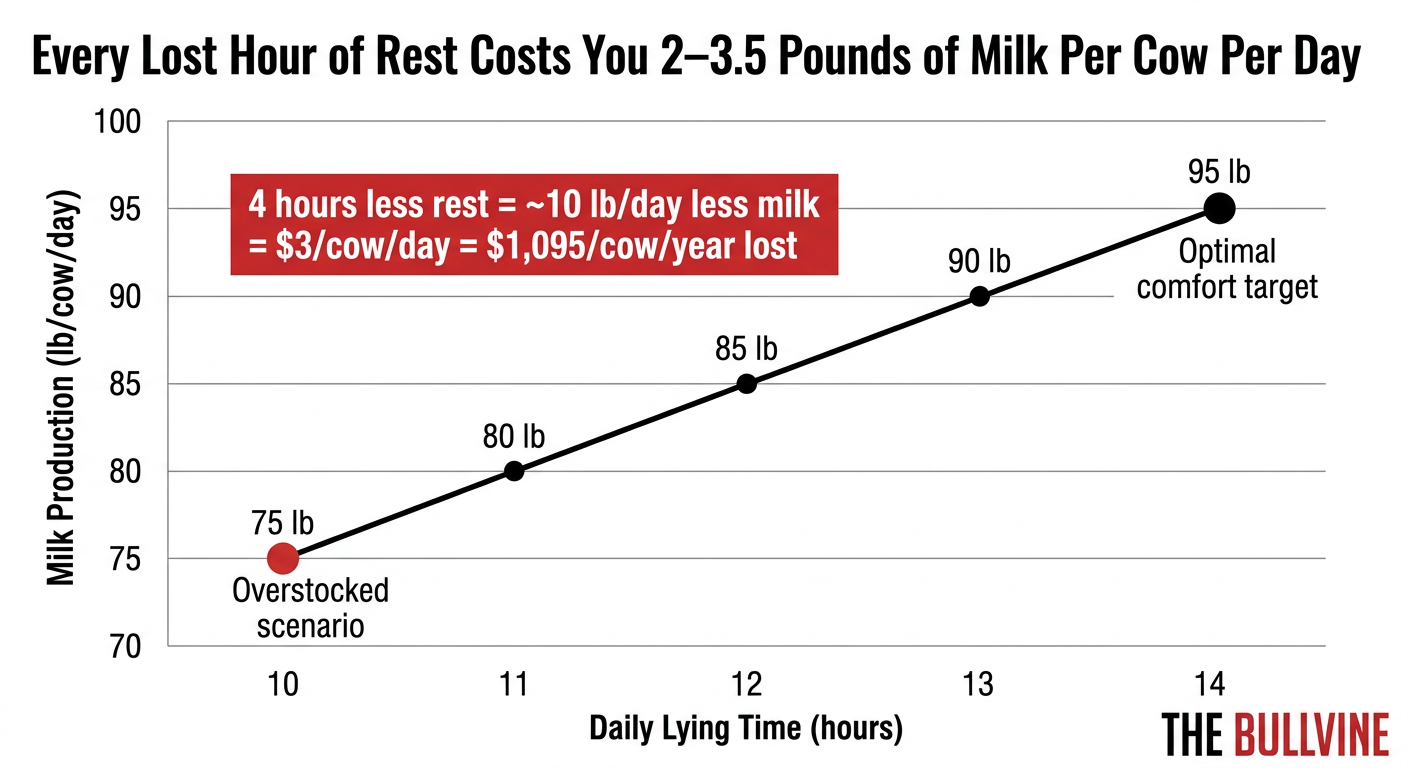
Now add cow time to the mix. Freestall work across North America and summaries from Wisconsin’s Dairyland Initiative show that when cows have roughly one usable stall per head and spend no more than about 3–3.5 hours per day out of the pen for milking and lock‑ups, they typically lie down 12–14 hours/day. Push stocking density into the 120–140% range and let time out of pen creep past 4 hours/day, and lying time commonly drops by 45–120 minutes/day, with more lameness, lower milk yield, softer components, and higher somatic cell counts. Miner Institute and related field work boil this into a simple rule: each lost hour of lying time is associated with roughly 2–3.5 pounds less milk per cow per day.

When herds run replacement rates in the mid‑30s, breed 60–70% of cows to beef, and crowd pens until cows only get 9–10 hours of rest — and a chunk of that is drowsy standing, not real lying — they’re effectively betting more of their future on expensive purchased heifers and very optimistic IVF performance. That’s the 3‑lactation trap.

What Happens When a 700‑Cow Herd Chases Beef and Longevity at the Same Time?

Busy producers think in pictures and quick comparisons. So let’s put the 700‑cow scenario you’re probably already running in your head into a simple table.

Rearing Payback: 3‑Lactation vs 5‑Lactation System (700‑Cow Herd)

Metric3‑Lactation System5‑Lactation SystemImpact
Rearing cost (est.)$3,010/heifer$3,010/heiferSame base investment
Amortized cost per lactation~$1,003 ($3,010 ÷ 3)~$602 ($3,010 ÷ 5)About $401 less rearing cost per lactation
Heifer needs (700 cows)700 × 0.35 = 245/year700 × 0.25 = 175/year70 fewer heifers to raise or buy
Beef semen usage (typical)High (70% beef matings)Moderate (~40% beef)More beef cash vs more internal replacements

Heifer inventory work from Michael Overton and others suggests many U.S. herds still sit in the low‑to‑mid 30% replacement band, even when owners say “about 30%.” At 35%, a 700‑cow herd needs 245 cows entering the parlor each year to hold head count. Factor in a realistic 15% loss from abortions, stillbirths, and pre‑fresh culls, and you actually need 245 ÷ 0.85 ≈ 288 dairy heifer calves born annually to stand still.

Now plug in a breeding pattern that’s become very common:

  • 70% of breedings to beef semen.
  • 30% to dairy semen (mix of sexed and conventional).
  • About a 50:50 bull‑to‑heifer ratio on dairy conceptions.

On roughly 700 conceptions per year:

  • 700 × 0.70 = 490 beef‑cross calves.
  • 700 × 0.30 = 210 dairy calves, about 105 heifers, and 105 bulls.

You need 288 dairy heifer calves; you’re only making about 105 from conventional dairy breedings. IVF embryos and sexed semen on your top end have to supply the other 180‑plus, or you have to buy heifers at $3,000–4,000 a head. And if IVF comes up short, conception dips, or a respiratory bug hits your “elite” heifer group, you’re forced into the market or into keeping cows and heifers you’d normally ship.

If a herd’s replacement rate slides toward 25% and average lactations move toward five, the math flips. You now need around 175 new cows a year, so 175 ÷ 0.85 ≈ 206 dairy heifer calves born — that’s roughly 82 fewer heifer calves per year compared to the 35% scenario. You can still run some beef, maybe 30–40% of matings, but you’re not mathematically forced into the heifer market or heavy IVF to replace early exits. Longevity and internal growth are finally pulling in the same direction.

That’s why the beef cap matters. In many replacement‑rate scenarios, holding beef semen usage in roughly the 20–35% band is a practical range for internal growth when your replacement rate is coming down, and your calf program is solid. At 70% beef, you’re essentially stating that you will buy heifers or lean heavily on expensive IVF to maintain herd size. There’s no way around the numbers.

The Mechanics Behind the Trap

When you strip the buzzwords away, three choices set the ceiling on average lactations: who you raise, how hard you push beef semen, and what you ask stalls and time budgets to carry.

Calves, Lungs, and the “Ollivett Effect”

Terri Ollivett at the University of Wisconsin–Madison has helped turn lung ultrasonography into a practical on‑farm tool and popularized the #WeanClean mindset — calves should arrive at weaning with healthy lungs, not just acceptable weight gains. Her extrapolation from USDA’s 2014 NAHMS survey is blunt: about 9.5% of U.S. dairy calves show clinical pneumonia, and for every clinical case, there are roughly two to four subclinical cases you only see on ultrasound. That puts preweaning BRD — clinical and subclinical — in the 30–50% range for many herds. North American studies report subclinical BRD prevalence between 23% and 67%, depending on farm and timing.

A 2021 systematic review and meta‑analysis found that heifers diagnosed with calfhood BRD had 2.85 times higher odds of dying and 2.3 times higher odds of herd removal before first calving, plus about 0.067 kg/day lower average daily gain and 121 kg less milk in their first lactation. Progressive Dairy and veterinary summaries add that chronic BRD cases often lead to heifers with limited lung capacity and decreased longevity. That’s the biological core of the longevity story: scar the lungs, and you shrink the “engine.” Those animals can still freshen and produce, but the data show they’re more likely to leave early and produce less, which makes it nearly impossible for them to reach the kind of fourth‑ or fifth‑lactation peaks you bred them for.

OutcomeHealthy Heifers (Baseline)BRD-Diagnosed Heifers
Odds of death before first calving1.0× (baseline)2.85× higher
Odds of herd removal before first calving1.0× (baseline)2.3× higher
Average daily gain (kg/day)Baseline-0.067 kg/day slower
First-lactation milk productionBaseline-121 kg (approx. -267 lb)

At Glacier Edge, every calf gets a 0–5 lung score at 3–5 weeks; larger or repeated lesions get aggressive treatment. That’s smart. But scanning without changing who you raise is just adding cost. The BRD meta‑analysis and Ollivett’s field work point in the same direction — calves with significant BRD damage are much more likely to die, to be culled before first calving, and to give less milk when they do freshen. The only way lung ultrasound really supports longevity is if you’re willing to say, “A calf with a score of 4 and two BRD treatments is never a replacement in this herd,” even when her pedigree looks great.

Genomics belongs in that same “decide who never gets a ticket” bucket. DWP, mastitis PTAs, lameness, and fertility traits give you a durability preview years before a cow hits the parlor. Glenn Klene has 13 years of genomic data at Yun Farms behind him and has seen high‑health‑index home‑breds outlast bought‑ins. But if low‑health‑index heifers with poor calf records still get raised as replacements, you’re paying for information you won’t act on.

What Happens to Your Numbers If You Actually Change?

You can rewrite a protocol in a week. You can’t rewrite your herd’s age structure in one turn of the calendar.

On a 700‑cow herd that truly commits — culling harder on weak young stock, dialing beef usage into that 20–35% range, and protecting rest time — you’re realistically signing up for a multi‑year project.

Year 1 — You change a lot, the numbers don’t

You:

  • Start lung‑scoring calves and mark some as “never replacements.”
  • Cap beef semen in the 20–35% range, aim sexed dairy only at truly top cows and heifers.
  • Pull your worst overstocked pen back toward 105–110% of stalls and keep time out of the pen under 3.5 hours/day.
  • Move from two to three hoof trims a year on higher‑risk pens.

You feel:

  • Short on heifers.
  • Like pens and heifer barns are “too empty.”
  • Pressure from partners or lenders who only see fewer cows in the parlor.

On paper, replacement rate and average lactations barely budge. You’re still milking cows bred and raised under the old rules.

Years 2–3 — The first “new rules” heifers hit second and third lactation

Now you start milking animals that never had wrecked lungs as calves, come from higher‑health genomic matings, and lived in slightly less crowded pens.

You see:

  • Fewer lame, open second‑calvers.
  • Fewer early mastitis train wrecks.
  • Replacement rate drifting from, say, 36% toward 30–32%, because fewer young cows fall out.

Average lactations might move from 3.0 to 3.3–3.5. That’s progress, but it still doesn’t “look” like a five‑lactation herd. And this is exactly where many herds quietly increase beef use again, cram pens back to 130%, or ease up on calf culls.

Years 4–5 — The herd actually looks different

Herds that stay the course usually report more 4th‑ and 5th‑lactation cows, fewer first‑lactation culls, and replacement rates in the 25–30% range. Average lactation at cull inches into the 3.8–4.2 area, with a meaningful tail of fifth and sixth-lactation cows. The payoff is both biological and financial: your “engines” are bigger because you protected lungs and legs early, and your rearing cost per lactation is hundreds of dollars lower because you spread that $3,010 over five lactations instead of three.

The question isn’t whether cows can get there. It’s whether you’ll still be running the hard rules when those years finally show up on your DHIA printout.

Is One Pen Stealing All Your Lactations?

You don’t need a five‑year plan to learn something useful this month. Start with one group.

Field work on time budgets and cow comfort suggests that when cows average around 12–14 hours of lying time per day and spend only about 3–3.5 hours out of the pen for milking and lock‑ups, they produce more milk and stay sound longer. Miner Institute research, echoed in multiple comfort case studies, puts a number on it: each lost hour of lying time is associated with roughly 2–3.5 pounds less milk per cow per day.

At Grodigette’s farm, cameras showed that fresh cows were being pulled to the holding area just a little too early for each milking — that “little” added up to 30 minutes or more of lost lying time a day and more standing on concrete. When they moved that group’s slot 10 minutes later three times a day and retrained movers, the lying time recovered. Using the Miner Institute rule, that kind of rest recovery represents roughly 3–5 pounds of previously “hidden” milk per cow per day that had been sacrificed to standing fatigue. They also saw fewer lame, open third‑calvers coming out of that pen.

Overstocking adds another layer. Work from the Dairyland Initiative, Michigan State, and others shows that stocking freestall pens much above 100–110% leads to more competition, less lying time, higher lameness, lower rumination, and reduced milk yield. When bunk space gets tight in an overstocked pen, cows tend to eat fewer, larger meals — classic slug feeding — which increases the risk of SARA, lower fat test, and laminitis‑type lameness. Those cows might still hit half‑decent first‑lactation numbers, but repeated bouts of SARA and sore feet keep chipping away at longevity. That’s the management face of the 3‑lactation trap.

30‑Day Pen Test: Is This Group Built for Three Lactations or Five?

Within the next 30 days, pick one pen — fresh, high, or the one you complain about the most. For 30–60 days, track:

  • Average lying time per cow per day (collars, cameras, or structured spot checks).
  • Total hours per day that the group spends out of the pen (walk, holding, lock‑ups).
  • Cows per usable stall.

If you see:

  • Lying time under 11.5 hours/day, or
  • Time out of pen over 3.5 hours/day, or
  • Stocking density over 110% of stalls,

treat it like a mastitis outbreak. Within 14 days:

  • Adjust milking order and lock‑up schedules until time out of the pen is ≤3.5 hours/day.
  • Move or ship enough cows to get that pen to about 100–110% of stalls.

Then run those conditions for 60 days and watch: lameness treatments from that pen, “low and open” culls, and milk per stall — not just per cow. If nothing changes, your bottleneck is probably stall design, bedding, or nutrition. If things improve, you’ve just proven with your own cows that overstocking and time budgets were quietly stealing cow years and milk checks.

Options and Trade‑Offs for Farmers

You don’t have to pick the “perfect” path. You do need to admit which game you’re actually playing.

Decision FactorLongevity-FirstBeef-Led Cash FlowHybrid with Guardrails
Beef semen usage20–35% of breedings60–70% of breedings30–50% (data-driven)
Replacement rate target25–28%33–36%28–32%
Average lactations (expected)4.2–5.03.0–3.33.5–4.2
Primary riskEmpty pens, partner pressureHeifer market squeeze, price spikesIVF/sexed semen underperformance
Heifer sourceInternal + selective purchaseHeavy purchase or contract growersInternal + IVF + selective purchase
What you’re betting onBRD control, rest time, genomicsBeef calf premiums, available heifersGenomic accuracy, IVF success
Discomfort you acceptFewer cows, slower growthHigh heifer costs, market volatilityComplex breeding rules, constant monitoring

Longevity First: Fewer Replacements, More Lactations

When it makes sense: You feel the heifer squeeze, you’re not keen on bidding $3,000–4,000 for replacements, and you’d rather cut replacement risk than chase every last beef‑calf premium.

What it requires:

  • Hold beef semen usage in that 20–35% band until your replacement math says you can push higher. At current prices and heifer inventories, 70% beef is basically a commitment to buying heifers or leaning heavily on IVF.
  • Use genomic health indexes and Ollivett‑style lung scores as disqualifiers: repeated BRD or high lung scores mean “never a replacement,” not “we’ll see how she does.”
  • Hard‑wire rest: “No lactating pen stays under 11.5 hours lying time for more than a week; if it does, we get stocking to ≤110% and time out of the pen to ≤3.5 hours/day within 14 days.”
  • Accept a 2–3 year lag before average lactations really move.

Risks and limits: The heifer barn and some pens will look “too empty” for a while. You may have some hard conversations with your banker about why you’re chasing fewer, older cows instead of more, younger cows.

Beef‑Led Cash Flow: Volume and Calf Checks First

When it makes sense: You’re expanding or heavily leveraged, beef‑cross calves in your area reliably bring strong checks, and you’ve got solid access to custom growers or purchased replacements.

What it requires:

  • A clear‑eyed acceptance that your herd will probably sit near 3.0–3.3 average lactations and mid‑30% replacement for the foreseeable future.
  • Firm relationships or contracts that secure enough replacement capacity before you need it, because both heifers and grower space are tight, and CoBank doesn’t see inventories rebounding before 2027.
  • A budget that can handle heifer price spikes beyond $3,010; that number isn’t guaranteed to hold.

Risks and limits: You’re exposed in two markets — beef calf and heifer — so policy, trade, or health hits can double up on you. Longevity stays mostly a story, not a driver of profit. This path isn’t automatically wrong. It just carries different risks than the longevity‑first play.

Hybrid With Guardrails: Beef and Longevity Under One Roof

When it makes sense: You want those beef checks, but you’re willing to let data — not habit — decide who gets beef versus dairy.

What it requires:

  • Broad genomic testing plus good calf and heifer records.
  • A written breeding rule; for example, top 30–40% on DWP + production + health get sexed dairy and IVF consideration; bottom 60–70% get beef semen every time.
  • A simple monthly replacement calculator: heifer calves needed = milking cows × target replacement rate ÷ 0.85. If projected dairy heifer calves (sexed + conventional) fall short, the next breeding round’s beef percentage comes down.

Risks and limits: It depends on IVF and sexed semen performing close to conservative conception assumptions, not the best‑case number in a brochure. And if calf health isn’t tight, even “elite” heifers can carry scarred lungs and fragile legs; your rules must let you bump them to the beef side without blowing up your replacement pipeline.

The 30‑Day Pen Test: A No‑Regrets Start

If you do nothing else in the next month, run that 30‑day pen test. It costs time and honesty, not capital.

When it makes sense: Pretty much always, any herd can learn something from it, whether you’re a 100‑cow tie‑stall or a 2,000‑cow freestall.

What it requires (within 30 days): Pick one pen: fresh, high, or the obvious lameness hot spot. Measure lying time, time‑out‑of‑pen, and stocking density for 30 days. If lying time <11.5 hours/day, time‑out‑of‑pen >3.5 hours/day, or stocking >110%, adjust stocking and schedules inside 14 days and hold that line for at least 60 days.

Risks and limits: You’ll likely move or ship a small group sooner than planned, and it might look “inefficient” on a whiteboard. If results don’t improve, your next step is to look at stalls, bedding, or ration — not to shrug and go back to 130% stocking.

What you gain: Hard numbers from your own barn about whether overstocking, lock‑up, and slug feeding are quietly stealing cow years and 3–5 lb of milk per cow per day. And a story you can tell to partners and lenders when you argue that fewer, better‑rested cows beat more, exhausted cows.

Key Takeaways

  • If your true replacement rate is well above 30%, pull 12 months of cull data and count how many cows are left in first or second lactation for lameness, mastitis, or reproduction. That’s where your “we love old cows” story leaks — and those early exits are exactly the animals BRD and SARA hit hardest.
  • If any lactation pen averages less than 11.5 hours of lying time for a week, treat it like any other health problem: within 14 days, get stocking down toward 100–110% of stalls and total time out of the pen under 3.5 hours/day, then watch lameness, SARA signs, and “low and open” culls from that group.
  • If you’re breeding more than about 35% of cows to beef semen without clear health and genomic cut‑offs,sit down and run the replacement math on paper. With CoBank projecting about 800,000 fewer heifers over 2025–26 and average heifers already at $3,010, heavy beef usage basically commits you to buying heifers or leaning hard on IVF.
  • If you’re lung‑scanning calves but still raising almost all heifers as replacements, add one written rule: lung score ≥4 or two BRD treatments = never a replacement here. The data suggest those heifers are much poorer candidates for five‑lactation careers.
  • If your average lactations haven’t moved in two years despite new tech, stop buying tools and change one structural decision instead — stocking density in one pen, beef percentage, or young‑stock cull thresholds — and give it long enough to show up on your DHIA printout.
  • If you’re serious about five‑lactation cows, pick one number — average lactations, replacement rate, or lying time — and agree that when it looks bad, you’ll change rules, not just stories.

Which Discomfort Are You Willing to Live With?

In the next 30 days, you can pick one pen and find out whether your barn is built for three‑lactation cows or five. In the next 90 days, you can write one non‑negotiable rule — about calves, beef usage, or rest time — and stick with it even when the heifer barn looks too empty. Over the next few years, you’ll see whether you’ve actually built a five‑lactation herd or just told yourself you had one.

Because the cows can do it, the question is whether you’d rather feel the discomfort of culling a few more weak calves and over‑conditioned third‑calvers now, or keep writing checks for an extra 40‑plus heifers a year at roughly $3,010 a head while overstocked, slug‑fed, BRD‑scarred cows quietly age out at three lactations.

Complete references and supporting documentation are available upon request by contacting the editorial team at editor@thebullvine.com.

Learn More

The Sunday Read Dairy Professionals Don’t Skip.

Every week, thousands of producers, breeders, and industry insiders open Bullvine Weekly for genetics insights, market shifts, and profit strategies they won’t find anywhere else. One email. Five minutes. Smarter decisions all week.
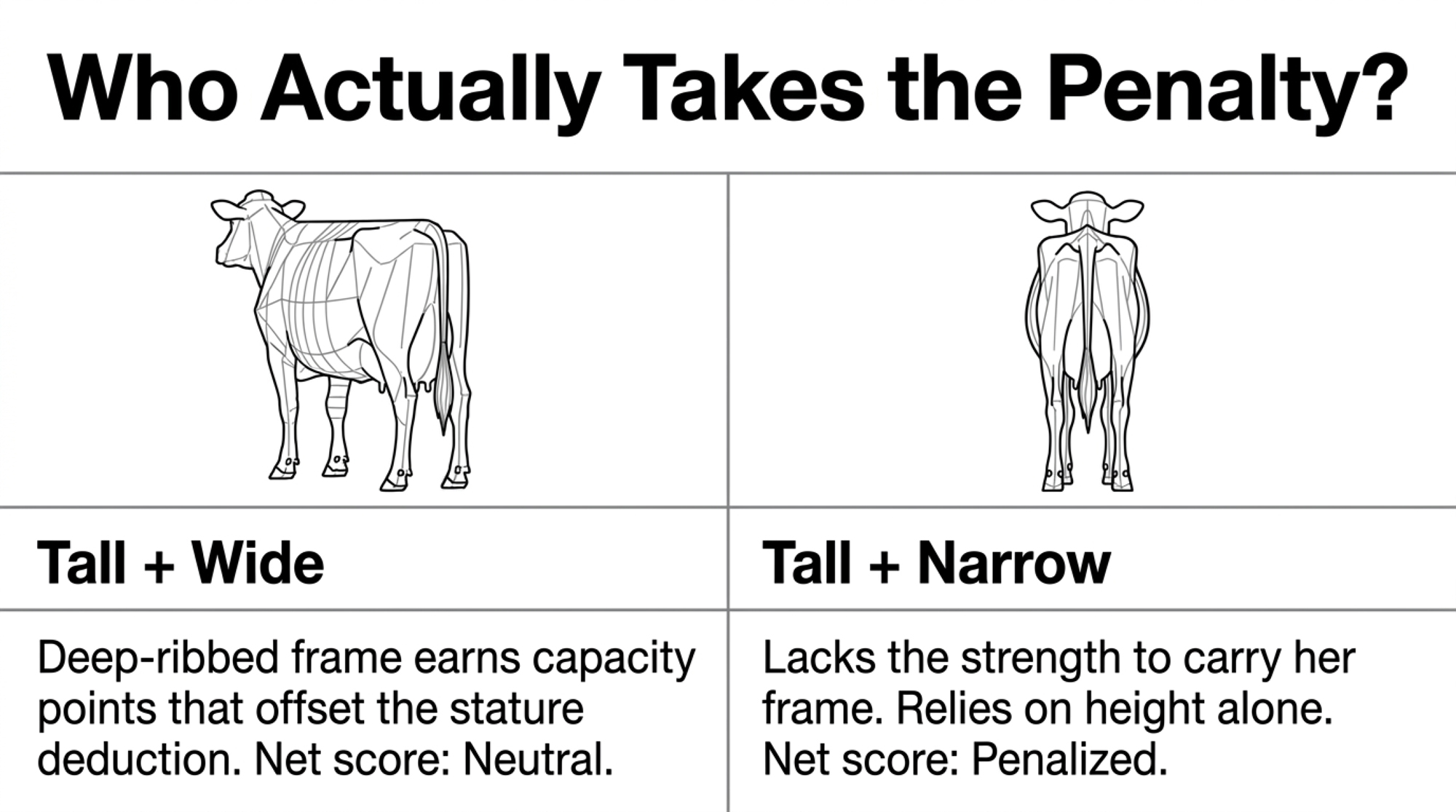
NewsSubscribe
First
Last
Consent

Cut Lameness 50% in 12 Months: The $95,000 Strategy Top Dairies Use (But 80% Still Ignore)

Your competition is turning $67,400 lameness losses into $348,000 gains. They’re using three strategies you’re probably ignoring.

EXECUTIVE SUMMARY: While the average dairy hemorrhages $67,400 annually from 20% lameness rates, top operations have cracked the code—transforming this drain into $348,000 in captured value through improved cow longevity, reproduction, and feed efficiency. The winning formula combines three proven strategies: a hybrid trimming model (professional expertise plus in-house response) that costs $62,700 but eliminates expensive treatment delays, strategic timing that generates an extra $308 per cow simply by trimming after 110 DIM, and—most powerfully—paying employees bonuses tied directly to lameness reduction. One Wisconsin operation invested $65,000 in a dedicated Hoof Health Coordinator position and saved $95,000 within 12 months by dropping lameness from 24% to under 10%. With modern Holsteins experiencing 50% longer recovery times than their 1990s predecessors and professional trimmers booked 3-4 months out, the economics are clear: operations modernizing their approach now will dominate, while the 80% clinging to “industry average” lameness face competitive extinction. The $37,000-45,000 first-year investment pays for itself within 8-12 months, making this the highest-ROI improvement available to dairy operations today.

We all know that number—$337 per case of lameness. The University of Wisconsin published this figure in their 2024 research, and it’s become almost a shorthand in our industry conversations. What’s particularly noteworthy, though, is how this familiar statistic represents just one dimension of a much larger economic picture.

I’ve been observing an interesting trend across dairy operations, from the established herds in Wisconsin to the larger facilities out West. A widening gap is developing between operations that have modernized their approach to hoof health and those that maintain traditional practices. And here’s what’s fascinating—this difference extends well beyond simple lameness rates. It’s actually shaping the fundamental competitiveness of these operations for years to come.

Let me share some insights from producers who’ve successfully transitioned from reactive to proactive hoof health management. Experiences from different regions—Wisconsin’s family operations, British Columbia’s progressive farms, even some of the larger-scale dairies in Idaho and New Mexico—offer valuable lessons for the rest of us.

Understanding the Complete Economic Picture

Looking at a typical 1,000-cow dairy operation in the Midwest—could be around Eau Claire, maybe closer to Green Bay—with the industry average 20% lameness rate, you’re facing direct annual costs of approximately $67,400 based on that Wisconsin research. These are the visible costs we track in our accounting systems.

Most dairies bleed money through lameness. Fix these five leaks and you’ll capture $348,000—while your competition’s still asking what hit them.

[Economic Impact Breakdown – 1,000 Cow Dairy]

Direct Costs (What You See):

  • Lameness treatment: $67,400/year
  • Based on 20% lameness rate × $337/case

Hidden Value Captured by Reducing Lameness to 10%:

  • Longevity gains: 2.8 → 4.8 lactations average
  • Reproduction improvement: 21-day pregnancy rate increases from 18% to 26%
  • Feed efficiency: 8% improvement from normalized eating patterns
  • Replacement savings: $280,000/year from reduced heifer purchases

Total Annual Opportunity: $348,000+

Now, what’s particularly interesting is how this breaks down. The latest Wisconsin research shows that the direct treatment savings alone from reducing lameness from 20% to 10% equals about $34,000 annually for a 1,000-cow herd (or $68,000 for a 2,000-cow operation). Initially, most of us think that’s the whole story—fewer vet bills, less medication, reduced labor. But that $34,000 in direct savings? It’s actually just the tip of the iceberg.

The real economic transformation—that full $348,000 opportunity—comes from several interconnected areas that you might not immediately consider:

Cow longevity shows remarkable improvement, extending from an average of 2.8 lactations in high-lameness herds to 4.8 lactations when lameness drops below 10%. Cornell’s PRO-DAIRY program has been documenting these patterns across multiple operations for years now.

Reproductive performance improves significantly—we’re talking 21-day pregnancy rates climbing from 18% to 26% when lameness is properly controlled. The University of Minnesota’s reproduction studies have consistently demonstrated this connection.

Feed efficiency gains of approximately 8% occur simply through normalized eating patterns. Think about it—when cows aren’t shifting weight off painful feet, they’re actually eating properly. Michigan State’s research provides compelling evidence on this relationship.

Perhaps most striking are the replacement cost savings—potentially $280,000 annually for a 1,000-cow operation, simply from reduced heifer purchase requirements at current market prices.

As industry consultants tracking outcomes across multiple operations report: “Operations approaching hoof health as an integrated system rather than isolated trimming events are discovering value streams they hadn’t recognized before. It’s essentially recovering losses they didn’t realize were occurring.”

CharacteristicTop 20% (Modernized Approach)Bottom 80% (Traditional Approach)Competitive Gap
Lameness Rate8-10%20-25%2.5x worse outcomes
Average Cow Longevity4.8 lactations2.8 lactations71% more productive life
Trimmer Response Time24 hours (hybrid model)3-4 months (professional wait)$180/cow/day × delays
Annual Lameness Costs$34,000 (1,000 cows)$67,400 (1,000 cows)$33,400 competitive disadvantage
Total Captured Value$348,000 annually$0 (unrealized)$348,000 advantage
Replacement Rate28% (longevity-driven)36-40% (forced culls)$280,000 annual savings
21-day Pregnancy Rate26%18%Faster herd turnover
Implementation Cost$37,000-45,000 first year$0 (but opportunity cost massive)8-12 month payback

Three Management Models in Practice

What farmers are finding is that three distinct management approaches have emerged as operations adapt to these economic realities. Each offers advantages, though I’ve noticed implementation quality determines outcomes more than model selection.

Management ModelAnnual Cost (1,500 cows)Key AdvantagesCritical Pitfalls
Professional Contract~$75,000–  Expert technique guaranteed-  No labor management required-  Consistent quality–  3-4 month booking delays-  $180/cow lost per day of delayed treatment-  No emergency response capability
In-House Program~$35,000–  Immediate response capability-  Lower direct costs-  Complete schedule control–  $15,000-30,000 equipment investment-  Failure rate when trimmer lacks protected time-  Risk of 50% lameness increase if poorly trained
Hybrid Model~$62,700–  Professional expertise for maintenance-  24-hour emergency response-  Reduces treatment delays by $180/case–  Requires strong coordination-  Need clear role definition-  Training investment essential

Professional Contract Services: The Traditional Approach

Most dairy operations continue to rely on professional trimmers who visit quarterly or monthly. Industry surveys indicate costs ranging from $15 to $40 per cow per trim. So for a 1,500-cow operation, annual investment typically reaches $75,000.

The emerging challenge—particularly in dairy-intensive regions like Wisconsin, Idaho, and California—isn’t actually cost. It’s availability. Professional trimming services report booking schedules extending 3-4 months, with many turning away multiple prospective clients for each new account they can accommodate.

Consider the practical implications here: you discover a lame cow on Tuesday morning, but your trimmer isn’t scheduled for three weeks. University of Minnesota research indicates this delay costs approximately $180 in lost production per affected cow. These costs accumulate quickly across even modest lameness rates.

In-House Programs: Promise and Pitfalls

Some operations figure they’ll internalize all trimming activities, anticipating cost savings. And theoretically, expenses can decrease to approximately $35,000 annually for that same 1,500-cow herd.

But here’s where it gets tricky. Successful execution presents significant challenges.

Professional-grade equipment requires an investment of $15,000 to $30,000 for quality hydraulic chutes from manufacturers like Riley Built or Comfort Hoof Care. Staff need proper Dutch 5-step method certification—and I mean comprehensive training costing $1,000 to $3,000, not informal learning.

The critical success factor that everyone overlooks? Protected time. At least 1-2 hours daily that absolutely cannot be redirected to other tasks. Training programs nationwide report the same pattern: in-house trimming programs most commonly fail when designated trimmers lack sufficient protected chute time. They’re constantly being pulled to help with breeding, fix equipment, or move cows.

Hybrid Models: Finding Balance

What’s really interesting is how successful operations are increasingly combining professional expertise with in-house response capabilities. For a 1,500-cow dairy, this approach typically costs $62,700 annually while delivering superior outcomes.

This model features monthly professional trimmer visits for maintenance and complex cases, supplemented by trained on-farm staff who can apply blocks, address digital dermatitis, and respond to emergencies within 24 hours.

Dr. Gerard Cramer’s extensive research at the University of Minnesota demonstrates that each 24-hour reduction in treatment response time saves approximately $180 per case. When your on-farm staff can apply a block on Tuesday afternoon rather than waiting three weeks, those savings directly impact profitability.

The Timing Revolution Nobody Saw Coming

This development still surprises experienced producers when I share it. Recent research challenges everything we thought we knew about optimal trimming schedules.

Traditional protocols recommended trimming at fresh check, typically 3-4 weeks post-calving. Makes sense, right? Cows are already restrained for health checks. But the production data reveals a completely different optimal approach.

Timing beats technique—trimming after 110 days unlocks +11 lbs/day and a $308/cow advantage, while old-school early trims lock in losses.

[Milk Production Impact of Trimming Timing]

Days in Milk at Trimming → Peak Milk Production Impact

  • Trimming < 110 DIM: -8 lbs at peak, losses persist through 200 DIM
  • Trimming > 110 DIM: +3 lbs at peak, advantage maintained throughout lactation
  • Net Difference: 11 lbs/day = $308 per cow per lactation

Based on converging research from Wisconsin, Minnesota, and Cornell universities

Converging research from Wisconsin, Minnesota, and Cornell demonstrates that cows trimmed after 110 days in milk produce significantly more milk than those trimmed earlier.

The differences are substantial:

Trimming before 110 DIM results in an 8-pound loss at peak milk, with impacts persisting through 200 DIM. Meanwhile, trimming after 110 DIM yields a 3-pound gain at peak and maintains this advantage throughout lactation. The net economic difference? $308 per cow simply through timing adjustment.

Why does timing matter so significantly? Well, it comes down to metabolic stress patterns. Research from Dr. Nigel Cook at Wisconsin demonstrates that fresh cows experiencing severe negative energy balance are already mobilizing 75-100 pounds of body tissue to support production. When you add trimming stress—which research shows increases cortisol levels 10-fold—during this vulnerable period, you’re compounding metabolic challenges that delay recovery.

I spoke with a reproduction manager operating near Kaukauna who adjusted protocols two years ago with notable results: “We extended our voluntary waiting period from 60 to 94 days specifically to avoid trimming during peak metabolic stress. First-service conception improved from 28% to 41%—that wasn’t what we expected, but we’ll certainly take it.”

Technology Integration: A Nuanced Decision

Let’s talk about those automated lameness detection systems prominently featured at every trade show. Manufacturers accurately claim their AI-powered cameras can identify lameness 23 days before visual detection, achieving 81-86% agreement with veterinary assessment.

And you know what? The technology actually performs as advertised. But whether it makes economic sense for your operation depends heavily on specific circumstances.

Systems from companies like CattleEye or IDA require an initial investment of $45,000 to $73,000, plus $8,000 to $12,000 in annual subscription fees.

The value proposition varies considerably:

Automation particularly benefits:

  • Operations with robotic milking systems, where individual cow movement eliminates natural observation points
  • Facilities exceeding 1,500 cows, where comprehensive visual observation becomes impractical
  • Herds with baseline lameness above 25% requiring systematic problem identification

Now consider this alternative perspective from a producer near Marshfield managing 800 cows. He reduced lameness from 24% to 14% investing just $7,200 in disciplined footbath protocols and strategic trimming, achieving $20,000 annual savings.

As he explained: “Technology vendors promoted cameras and sensors extensively. But our challenge wasn’t identifying lame cows—it was preventing lameness initially. That $7,200 investment in copper sulfate and consistent protocol implementation outperformed any $45,000 system for our situation.”

Training: The Foundation of Success

Here’s an uncomfortable reality that deserves discussion: operations using inadequately trained in-house trimmers can experience a 50% increase in lameness, resulting in $84,000 in additional annual losses compared to professional trimming. Think about that—inadequate training often produces worse outcomes than no trimming at all.

[The Dutch 5-Step Method – Critical Execution Points]

Step 1: Judge & Measure Inner Hind Claw

  • Target: 7.5-8cm toe length from the coronary band
  • Critical error: Measuring from the wrong reference point

Step 2: Trim Inner Claw to Correct Dimensions

  • Maintain a minimum 5mm sole thickness
  • Critical error: Over-trimming below safe threshold

Step 3: Model/Dish Out the Sole

  • Transfer weight from ulcer-prone zones to the wall/heel
  • Critical error: Creating a flat sole instead of a proper concavity

Step 4: Balance to Outer Claw

  • Match bearing surfaces for even weight distribution
  • Critical error: Using diseased outer claw as reference

Step 5: Remove Loose Horn & Apply Blocks if Needed

  • Clear all the undermined horn to prevent abscess formation
  • Critical error: Leaving loose horn creates infection pockets

Proper training requires 3-5 days of instruction + 6-12 months of supervised practice

Common critical errors I see repeatedly include:

  • Over-trimming soles below the 5mm safety threshold, essentially exposing sensitive tissue
  • Cutting toes shorter than 7.5cm, exposing the corium—that’s the living tissue within the hoof
  • Creating flat soles that concentrate pressure precisely where ulcers develop

Proper Dutch 5-step training—originally developed by Toussaint Raven and adapted for modern housed Holstein management—requires 3-5 days of intensive instruction plus 6-12 months supervised practice. This investment of $1,000 to $2,000, along with time, is essential.

Training programs consistently observe that well-intentioned but inadequately trained individuals can inadvertently create lameness through excessive trimming depth. Good intentions simply cannot compensate for technical skill deficits.

StepCritical ActionTarget SpecificationCommon Critical ErrorFinancial Impact of Error
1Judge & Measure Inner Hind Claw7.5-8cm toe length from coronary bandMeasuring from wrong reference pointFoundation failure – affects all subsequent steps
2Trim Inner Claw to Correct DimensionsMinimum 5mm sole thickness maintainedOver-trimming below 5mm thresholdExposes corium (living tissue) = immediate lameness
3Model/Dish Out the SoleTransfer weight from ulcer zones to wall/heelCreating flat sole instead of concavityConcentrates pressure exactly where ulcers develop
4Balance to Outer ClawMatch bearing surfaces for even distributionUsing diseased outer claw as referencePerpetuates imbalance and accelerates deterioration
5Remove Loose Horn & Apply BlocksClear all undermined horn completelyLeaving loose horn creates infection pocketsAbscess formation requires extended treatment
OUTCOMEProfessional Training vs. Inadequate Training3-5 days instruction + 6-12 months supervisedInformal learning without certification$84,000 annual difference: 8% vs 28% lameness

Integration: The Distinguishing Factor

What differentiates operations achieving 5% lameness from those accepting 25% isn’t superior equipment or newer facilities. It’s genuine integration—coordinated systems rather than periodic meetings.

Consider the contrast:

Typical farm communication: Monthly meetings where trimmers report “some sole ulcers,” veterinarians acknowledge concerns, nutritionists inquire about pen locations without specific data, and everyone agrees to monitor the situation.

Effective integration: Shared digital dashboards are updated in real time. When trimmers identify multiple sole ulcers in specific pens, automated alerts notify nutritionists who immediately analyze ration composition. Within 48 hours, they’ve identified and corrected nutritional imbalances.

Research comparing operations using integrated systems versus traditional communication found that the integrated farms achieved 35% better lesion identification accuracy and 48% faster treatment response. Most importantly, they prevented problems rather than simply accelerating treatment.

Biological Changes in Modern Dairy Cattle

This is crucial: today’s Holstein producing 95 pounds daily is fundamentally different from the 65-pound producer of 1995. The differences extend far beyond milk yield.

The biological adaptations are remarkable:

The digital cushion—that fat pad providing shock absorption beneath the pedal bone—now thins by 15-30% during early lactation compared to just 10-12% in the 1990s, as documented through UK ultrasound studies.

Negative energy balance now persists 100-140 days rather than the historical 60-80 days, according to metabolic research.

Chronic inflammation markers remain elevated throughout lactation, not merely during transition periods.

Genetic selection has inadvertently reduced digital cushion thickness (with heritability of 0.28-0.44) while pursuing production gains.

What required 21-28 days for healing in 1995 now takes 42-56 days, with some cows never achieving complete recovery. Even a perfect trimming technique must work within these biological constraints.

Biological Metric1990s Holstein2025 Modern HolsteinThe Critical Difference
Daily Milk Production65 lbs/day95 lbs/day+46% production
Digital Cushion Thinning (early lactation)10-12% loss15-30% loss2.5x worse shock absorption
Negative Energy Balance Duration60-80 days100-140 days75% longer metabolic stress
Healing Time for Hoof Lesions21-28 days42-56 days2x longer to heal (or never)
Chronic Inflammation DurationTransition period onlyThroughout lactationChronic inflammation = vulnerability

Creating Accountability for Results

Among all factors contributing to successful hoof health transformation, one stands out consistently: linking compensation directly to measurable lameness outcomes.

This means genuine financial accountability—not peripheral evaluation criteria or vague performance considerations, but direct compensation tied to specific results.

Successful implementations typically establish:

  • A Hoof Health Coordinator position with $45,000-55,000 base salary
  • Performance bonuses up to $20,000 based on quarterly lameness measurements
  • Clear performance scales: 18% lameness = $5,000 bonus, scaling to $20,000 at 8% lameness
  • Full authority over detection protocols, treatment coordination, and footbath management

One producer implementing this system reported: “Linking compensation directly to lameness outcomes transformed everything immediately. Footbaths operated precisely on schedule. Data entry became instantaneous. Early problem detection became standard. We invested $65,000 in the position and saved $95,000 through reduced lameness costs within twelve months.”

Practical Implementation Timeline

$65,000 is just the beginning—here’s when, where, and how the savings hit your bottom line in a single year.

For operations ready to modernize their approach, here’s what successful transitions typically look like based on observed implementations:

Months 1-2: Establish Baseline Reality

Comprehensive lameness scoring often reveals actual rates of 22-28% rather than the estimated 10%. Define responsibilities clearly and secure current trimmer support for transition plans.

Months 3-4: Infrastructure and Training

Budget $16,400-27,100 for equipment (quality used hydraulic chutes can reduce costs by 40%). Ensure designated staff receive proper Dutch 5-step certification and document all protocols comprehensively.

Months 5-6: Supervised Implementation

In-house staff work alongside professionals during each visit, building both skills and data systems while measuring all relevant metrics.

Total first-year investment typically ranges from $37,000 to $45,000, with most operations achieving break-even between months 8-12 as lameness decreases and savings accumulate.

Regional Adaptation Strategies

Successful protocols in Wisconsin may need to be modified for operations in New Mexico or Idaho. Climate variations, housing systems, and labor availability all influence optimal approaches.

California’s Central Valley operations manage heat stress that exacerbates lameness—cows stand longer attempting to cool, increasing pressure on compromised feet. Meanwhile, Northeast grazing operations might experience less concrete-related lameness but face increased challenges from infectious diseases due to higher moisture levels.

Labor availability varies dramatically, too. Wisconsin producers typically access trimmers within 50 miles, while Wyoming or Montana operations may require service calls of 200+ miles, fundamentally altering economic calculations.

Looking Ahead: The Widening Industry Gap

As we approach 2030, I’m seeing the dairy industry diverge into distinct operational tiers. And here’s what’s fascinating—it’s not about scale. I’ve observed 400-cow operations outperforming 4,000-cow facilities on lameness metrics. The distinction lies in management philosophy.

The 15-20% of operations modernizing their hoof health management are building compounding advantages: extended cow longevity (4.8 versus 2.8 lactations), reduced replacement costs, enhanced reproduction, and improved employee recruitment through professional operation standards.

The remaining 80% continue cycling through recurring problems, accepting 20-25% lameness as “industry standard” while costs escalate and competitors advance.

When producers ask about affording modernization of hoof care, I pose a different question: What’s the cost of maintaining the status quo? Each year of delay widens the competitive gap. This extends beyond the $337 per case—it determines competitive viability in five years.

Strategic Considerations for Your Operation

After observing numerous transitions, several principles emerge consistently:

The economics are compelling, but success requires systems thinking. That $337 per case represents merely the starting point—cascade benefits through reproduction, longevity, and efficiency create the real value.

Model selection should reflect operational constraints rather than theoretical preferences. Base decisions on trimmer availability, labor resources, and current lameness status.

Timing optimization can surpass technique perfection. Moving trimming after 110 DIM may improve outcomes more than flawless execution at suboptimal timing.

Professional training represents an essential investment. The difference between proper certification and informal learning literally separates 8% from 28% lameness rates.

Technology amplifies existing management quality but cannot remediate fundamental deficiencies. Establish solid foundations before pursuing technological solutions.

Most critically, linking compensation to outcomes drives genuine change. Other approaches merely hope for improvement.

Common Implementation Challenges and Solutions

What farmers are finding as they implement these changes:

Challenge: Protected time for the in-house trimmer is constantly compromised.
Solution: Schedule trimming as “first priority” morning task before other activities begin

Challenge: Data entry and tracking becomes inconsistent
Solution: Simple digital forms on tablets at chute-side, automatically syncing to management software

Challenge: Resistance from long-time employees to new protocols
Solution: Include them in training sessions, emphasize how changes make their jobs easier

Quick Start Checklist

For operations ready to begin:

☐ Score all cows for lameness to establish a true baseline
☐ Calculate your current cost per case (likely exceeding $337)
☐ Evaluate trimmer availability in your region
☐ Assess labor resources for potential in-house component
☐ Budget for equipment and training investment
☐ Define a clear accountability structure
☐ Document all protocols before implementation
☐ Establish measurement and tracking systems

The framework exists. Economic benefits are documented. Early adopters are already realizing returns. The question isn’t whether investment makes sense—it’s whether you’ll implement changes while maintaining a competitive position.

That $337 per case remains constant. But an increasing number of operations are discovering that transforming hoof health from an unavoidable cost to a managed system creates a sustainable competitive advantage.

Milk production continues regardless. The distinction lies in whether profits accumulate in your account or walk away on compromised feet.

We’d appreciate hearing about your experiences with hoof health programs—successes, challenges, and lessons learned. Please share your insights at editor@thebullvine.com to benefit the broader dairy community.

KEY TAKEAWAYS

  • The Hidden Goldmine: Every 1% reduction in lameness captures $17,400 in value. Top dairies achieving <10% lameness gain $348,000 annually through improved longevity (4.8 vs 2.8 lactations), reproduction (+8% pregnancy rate), and feed efficiency.
  • The Proven Formula: Hybrid model (monthly professional + daily in-house response) @ $62,700/year + Trimming after 110 DIM (+$308/cow) + Pay-for-performance bonuses = 50% lameness reduction in 12 months.
  • Fast Payback: Initial investment of $37,000-45,000 breaks even in 8-12 months. Wisconsin farm example: Spent $65,000 on a dedicated position, saved $95,000 in year one.
  • The 2030 Reality: With trimmers booked 3-4 months out and modern cows requiring 2x recovery time, the 20% of operations modernizing NOW will dominate. The 80% accepting “industry average” lameness face competitive extinction.
  • Your Starting Point: Score all cows (your “10%” is likely 22-28%), calculate your true cost (it’s 5x the $337 you think), then implement accountability-based compensation. This single change drives all others.

Learn More:

The Sunday Read Dairy Professionals Don’t Skip.

Every week, thousands of producers, breeders, and industry insiders open Bullvine Weekly for genetics insights, market shifts, and profit strategies they won’t find anywhere else. One email. Five minutes. Smarter decisions all week.
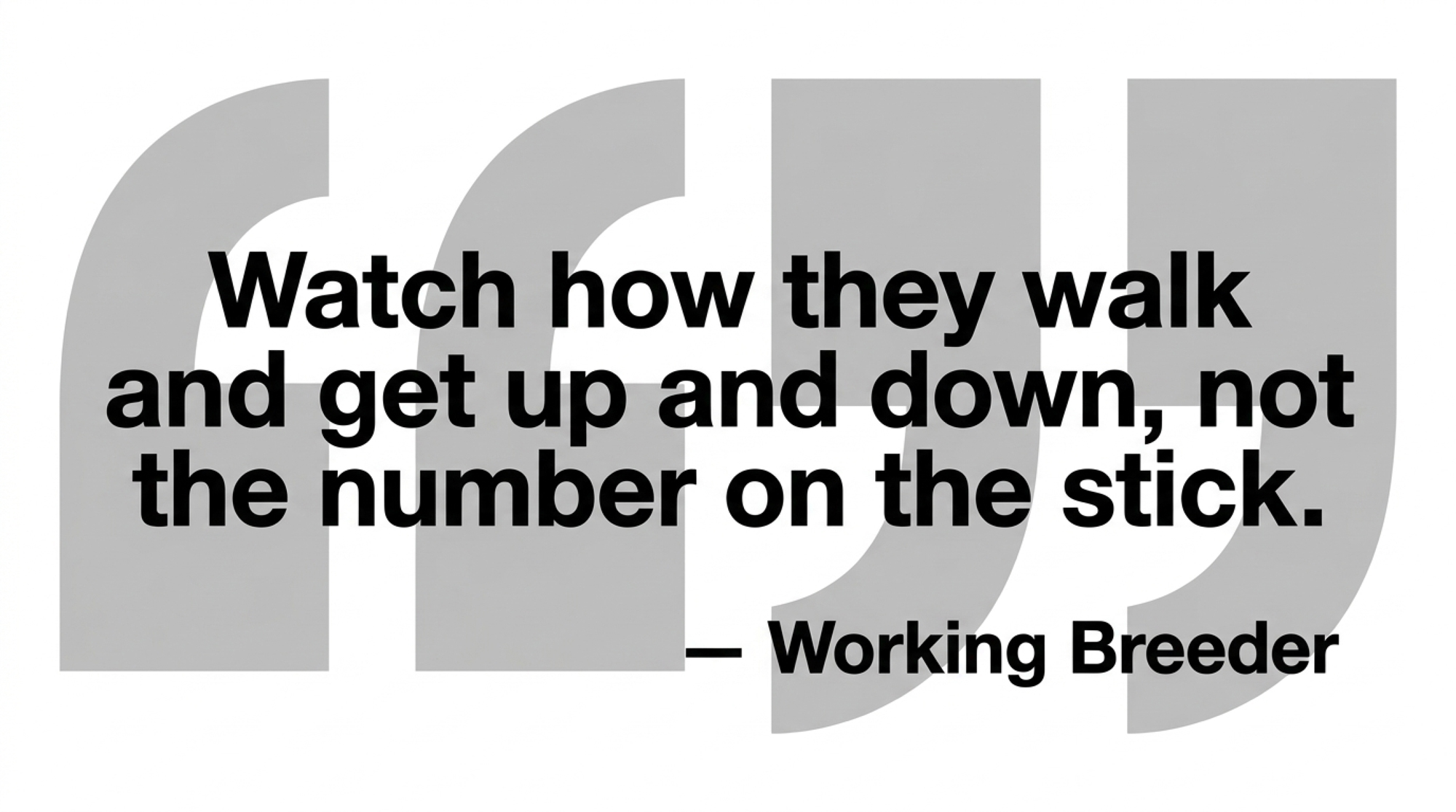
NewsSubscribe
First
Last
Consent

One Farmer’s ‘No’ Built a Dynasty: How Plushanski Chief Faith’s Genetics Add $1,500 to Your Bottom Line

1973: Charlie refuses to sell Faith. 2025: Her genetics add $1,500/cow. Between those years? A breeding revolution nobody saw coming.

Plushanski Chief Faith, the cow whose genetics would add $1,500 per cow to your bottom line. This is the remarkable Holstein Charlie Plushanski refused to sell in 1973, setting in motion a breeding revolution that continues to save farms today. Just look at that presence—the deep body, the wide front end, and that incredible udder that defied the odds of her Chief lineage

I’ll never forget when I first heard this story—about a decision that seemed impossible at the time, yet somehow created $1,500 worth of hope for every cow in your barn today.

The moment that changed everything came on an ordinary morning in 1973. I can still picture it, the way it’s been told to me by those who remember—Charlie Plushanski standing in his Kutztown, Pennsylvania barn, watching the morning light catch the dust motes as his five-year-old Holstein, Faith, shifted her weight in the stall.

What happened next still gives me chills…

Charlie Backus had driven up from Maryland that morning with an offer that would’ve saved most farmers from their worst fears. We’re talking about enough money to buy a decent farm in Berks County—the kind of offer that makes your hands shake when you hear it. And Charlie Plushanski? He’d survived World War II as a Marine, built his farm from nothing with his boxing earnings, and knew what it meant to struggle. Family stories say he’d even sparred with champions during the war, though like many stories from that generation, the details have softened with time.

Standing there in that barn doorway, Backus was pressing hard. “Charlie, you need to let her go,” he said, watching Plushanski Chief Faith—that remarkable cow who seemed to know her own worth.

Earlier that same day—and this is what moves me most about this story—Pete Heffering had made the same journey from Ontario, trying to buy this same cow for his Hanover Hill program. Two of the biggest names in Holstein breeding, both turned away by a farmer who saw something nobody else could see.

The Pedigree That Changed Everything

For those who love breeding history, let me paint the complete picture of what made Faith so special:

Plushanski Chief Faith EX-94 4E GMD (EX-MS 96)

  • Born: November 1968
  • Sire: Pawnee Farm Arlinda Chief
  • Dam: Ady Whirlhill Frona VG-86 (Whirlhill Kingpin daughter)
  • Lifetime Production: 242,863 lbs milk, 11,353 lbs fat

What set Faith apart wasn’t just her individual achievement—it was how she transmitted. In an era before genomics, before EPDs, before any of the tools we rely on today, Faith proved that some cows simply have “it”—that indefinable ability to pass on greatness generation after generation.

The Courage It Took to Say No

Mr. and Mrs. Charles Plushanski, the visionaries behind the Faith dynasty. Their partnership and shared conviction were the foundation of the courageous decision to keep Faith when the industry came calling. This photo captures the quiet strength of the couple who chose long-term legacy over a short-term sale, proving that the greatest breeding decisions are often family decisions.

What moved me most was understanding what Charlie was really facing that day. This wasn’t just about money. This was about believing in something when everyone thought you were crazy.

The breeding community of the early 1970s was divided. You were either breeding for Chief’s incredible production or Elevation’s balanced type and longevity. But here was Charlie, who had already taken the risk of combining Chief with Kingpin genetics—a corrective mating that most breeders wouldn’t have attempted.

Charlie looked at Faith and somehow knew—in that deep, gut-level way that real farmers understand—that she carried something special in her genetics. Something that couldn’t be bought or sold. Something that would outlive them all.

“It’s not about the money,” Charlie said, according to the stories that have been passed down through breeding records and family memories. And against all odds, he was right.

That Gold Medal Dam designation Faith would earn? In the 1970s, before genomics and computers, a GMD represented the pinnacle of breeding achievement—a cow whose offspring consistently exceeded expectations across multiple herds and breeding programs. It meant you had a cow that was one in ten thousand.

The Winter That Nearly Broke Everything

Here’s where the story gets even more remarkable for those who understand breeding history. In the fall of 1965, in one of those Pennsylvania winters when everything seemed impossible, Charlie’s brother Henry called about some yearling heifers down in Perry County. A dozen Whirlhill Kingpin daughters that most breeders wouldn’t touch because of their udder problems.

Charlie bought them all. Including one special heifer—Ady Whirlhill Frona.

Nobody could have prepared him for what came next. When it came time to breed Frona, Charlie made a choice that seemed almost reckless. He bred her to Pawnee Farm Arlinda Chief—a bull whose genetics would eventually influence almost 14% of all Holstein DNA today, according to UC Davis research. But Chief came with risks. His genetics carried a lethal mutation that would cause heartbreak across the industry—over half a million lost calves worldwide. (Read more: The $4,300 Gamble That Reshaped Global Dairy Industry: The Pawnee Farm Arlinda Chief Story and Bell’s Paradox: The Worst Best Bull in Holstein History)

Charlie didn’t know about the mutation then. He just knew that sometimes, to create something extraordinary, you have to risk everything.

The Four Daughters Who Carried the Dream Forward

But then something remarkable happened that even Charlie couldn’t have imagined. Faith didn’t just excel herself—she passed on her gifts through four extraordinary daughters that would reshape breeding programs worldwide:

Plushanski Valiant Fran EX-90 35* achieved something almost unheard of in the pre-embryo transfer era. The “star” designation meant her offspring significantly exceeded the breed average. Seven went on to score Excellent. Twenty-five scored Very Good. Her 365-day record of 36,920 pounds of milk proved you could have both beauty and production. Through Fran came the show line that would eventually produce Quality BC Frantisco—Grand Champion at the Royal Winter Fair in 2004 and 2005.

Quality B C Frantisco-ET EX-96-3E 18*, a daughter Plushanski Valiant Fran-ET. Frantisco’s multiple championships at the Royal Winter Fair and her recognition as International Cow of the Year highlight the continued influence of Faith’s bloodlines, even in subsequent generations.

Plushanski Job Fancy VG-88 GMD DOM became the commercial production matriarch. The DOM (Dam of Merit) designation meant she had sons entering AI service. Through her daughter, Plushanski Neil Flute VG-87, and granddaughter Plushanski Mark Fife VG-87, this branch would spread across the globe, with bulls like To-Mar D-Fortune carrying these genetics into thousands of herds.

Plushanski Neil Flute (VG-87), the crucial link in the global dynasty. As the daughter of brood cow matriarch Job Fancy and the dam of the influential Mark Fife, Flute embodied the exceptional udder quality and commercial durability that this branch became famous for. It was through powerful transmitters like her that Faith’s genetics quietly infiltrated thousands of herds, building the foundation for the longevity advantage we see today.

Plushanski Dawn Fayne and Plushanski Star Faith rounded out this remarkable quartet, each contributing their own unique genetic gifts to the breed.

What pedigree enthusiasts will appreciate is that each daughter seemed to capture a different aspect of Faith’s genetic package—Fran got the show-ring presence, Fancy got the commercial reliability, Flute got the udder quality, and Fife got the longevity. It’s as if Faith parceled out her gifts, ensuring her influence would touch every aspect of Holstein breeding.

Contemporary Competition and Context

To understand the magnitude of Charlie’s decision, you need to know what else was happening in Holstein breeding in 1973. This was the era of legendary cow families like:

  • The Romandale Reflection Marquis family
  • The Hanoverhill lines that Pete Heffering was building
  • The emerging Elevation daughters that were revolutionizing the type

Yet Faith would outlast and out-influence many of these contemporary families. While other great cows of the era produced individual champions, Faith created entire dynasties that adapted to different breeding goals worldwide.

The Global Explosion Nobody Saw Coming

What’s fascinating for breeding historians is how Faith’s genetics adapted to completely different breeding goals around the world:

The European Production Revolution

The modern embodiment of Faith’s commercial power: De Biesheuvel Javina 50 VG-87. She is the archetype of the Javina family, the European branch of the Faith dynasty that descended through Plushanski Job Fancy. While the Frantisco line chased show-ring glory, Dutch breeders selected this line with a relentless focus on what pays the bills: production, health, and efficiency. Today, her descendants like Willem’s Hoeve 3STAR Javina 2762 dominate European genomic indexes (gNVI and gRZG), producing the next generation of elite bulls for AI studs. This is the harvest of Charlie Plushanski’s vision, proving that Faith’s genetics could be adapted to create a profitable, index-topping powerhouse for the most demanding commercial systems in the world.

The Dutch breeders working with the Javina family (Faith’s European descendants through Job Fancy) focused intensively on commercial traits. De Biesheuvel Delta Javina and her daughters consistently top the Dutch NVI rankings. These aren’t just good cows—they’re the kind that define breeding programs for decades. When families consistently produce #1 NVI sons and daughters generation after generation, you’re witnessing genetic consistency that modern genomics still struggles to predict.

Canada’s Show Ring Dynasty

The show-ring culmination of the Faith dynasty: Quality B C Frantisco-ET EX-96-3E 18* A direct descendant of Faith through her daughter Plushanski Valiant Fran, Frantisco was the masterpiece developed by Paul Ekstein at Quality Holsteins. She dominated the Canadian show circuit, capturing Grand Champion honors at the Royal Winter Fair twice (2004 & 2005) and earning the title of 5-time All-Canadian. Her reign was so complete that one of the great “what ifs” in modern show history is how she would have fared against American champions at World Dairy Expo, a showdown prevented by BSE travel restrictions. Frantisco stands as the ultimate proof of the versatility of Faith’s genetics—creating a world-class show champion more than 30 years after her famous ancestor was born.

In Canada, Paul Ekstein’s work with the Frantisco line through Valiant Fran created a show dynasty. Quality BC Frantisco’s achievements—Grand Champion at the Royal Winter Fair in 2004 and 2005, five-time All-Canadian, International Cow of the Year 2005—prove that Faith genetics could compete at the highest levels decades after her death.

Australia’s Modern Application

Ray Kitchen at Carenda Holsteins demonstrates how Faith genetics remain relevant in 2025. Their Carenda Pemberton, with 606 daughters from 79 herds, shows how these genetics adapt to modern selection tools while maintaining their core strengths.

Why This Matters for Today’s Breeders

I recently talked with a producer in Wisconsin who discovered Faith genetics in his herd almost by accident while researching pedigrees. His Faith-line cows? They’re averaging 3.8 lactations compared to the industry’s 2.8. That extra lactation—worth an estimated $1,200 to $1,500 per cow in today’s market—is the difference between profitability and struggle.

With the nearly 800,000-heifer shortage CoBank reports, quality genetics have never been more valuable. When you see names like Big Gospell, Apina Fortune, or To-Mar D-Fortune in a pedigree, you’re looking at Faith’s legacy, refined through decades of selection.

The modern face of the Faith legacy: Big Delta Anecy 1, dam of the influential AI sire Big Gospell. A direct descendant of Faith through the commercially-focused Javina family, Anecy is the proof in the pudding. She showcases the deep-ribbed, high-capacity frame and exceptional udder quality that the Faith line has transmitted for over 50 years. When you see bulls like Gospell in a catalog, you’re not just buying modern genomics; you’re investing in decades of proven, real-world durability that started with one farmer’s courageous ‘no’ back in 1973.

What Charlie Knew in His Heart

Standing there in my own barn sometimes, I think about Charlie Plushanski in that moment in 1973. The breeding community was watching. The pressure was immense. The money would have solved immediate problems.

Instead, he made the harder choice. The one that required patience, vision, and something more—faith in genetics that would prove their worth across decades and continents.

Charlie passed away in 1991, but his son Cary kept the dream alive at the Kutztown farm until his own passing just this September. Three generations of a family who understood that sometimes the best breeding decisions aren’t about today’s milk check or tomorrow’s bills. Sometimes they’re about creating genetic legacies that outlast us all.

The Echo That Still Saves Farms

Every time a Faith descendant helps a farm survive another year, navigate another crisis, or build another generation’s future, the echo of Charlie’s “no” from 1973 quietly puts hope back in someone’s barn.

For pedigree enthusiasts, Faith represents something profound—proof that individual breeding decisions can reshape an entire breed. For historians, she’s a reminder that the greatest genetic influences often come from unexpected places. For today’s breeders, she offers both practical genetics and philosophical guidance.

When you’re planning your breeding for next year, when you’re looking at those catalogs and wondering which direction to go, remember Charlie Plushanski. Remember that sometimes the hardest choice—the one that seems impossible at the time—is the one that creates miracles down the road.

That $1,500 per cow advantage from longevity? That’s not just a number. That’s the difference between surviving and thriving, between keeping the farm and losing it, between passing something on to the next generation and watching it slip away.

And somewhere, in barns across the world, Faith’s descendants are still quietly making that difference. Still carrying forward the gift of one farmer’s impossible choice.

It might as well be in your barn, creating your own harvest of hope.

Key Takeaways:

  • The Bottom Line: Faith genetics add 1+ lactation (3.8 vs 2.8 average), worth $1,200-$1,500 per cow in today’s market
  • Find Them Today: Search your pedigrees for “Javina” (commercial power), “Frantisco” (show quality), or Faith’s four daughters’ names
  • Why Now: In an 800,000-heifer shortage, cows that last five lactations instead of 3 are pure profit
  • The Lesson: Sometimes saying “no” to quick money creates generational wealth—Charlie proved it in 1973

Executive Summary:

 In 1973, Charlie Plushanski turned down enough money to buy a farm—refusing to sell a cow that would reshape dairy genetics forever. Plushanski Chief Faith (EX-94 4E GMD) didn’t just produce 242,863 pounds of milk; she founded dynasties through four daughters whose genetics now run through millions of cows worldwide. Today, Faith bloodlines deliver the industry’s most overlooked advantage: an extra lactation worth $1,200-$1,500 per cow, achieved through 3.8 lactations versus the 2.8 average. With an 800,000-heifer shortage threatening dairy’s future, these 50-year-old genetics offer what no genomic gamble can: proven longevity across every climate, every system, every market condition. The supreme irony? While the industry obsesses over the latest genomic rankings, Charlie’s half-century-old decision is quietly adding $1,500 to bottom lines worldwide. His refusal reminds us that true genetic wealth isn’t built in a sales ring—it’s built by saying “no” to quick money and “yes” to generational vision.

This narrative draws from breeding records, Holstein Association documentation, and the enduring impact of these genetics on farms worldwide. Some conversations and personal details have been reconstructed to honor the significance of these breeding decisions and the families who made them. The author extends deep gratitude to all who preserve these important agricultural stories.

Learn More:

The Sunday Read Dairy Professionals Don’t Skip.

Every week, thousands of producers, breeders, and industry insiders open Bullvine Weekly for genetics insights, market shifts, and profit strategies they won’t find anywhere else. One email. Five minutes. Smarter decisions all week.
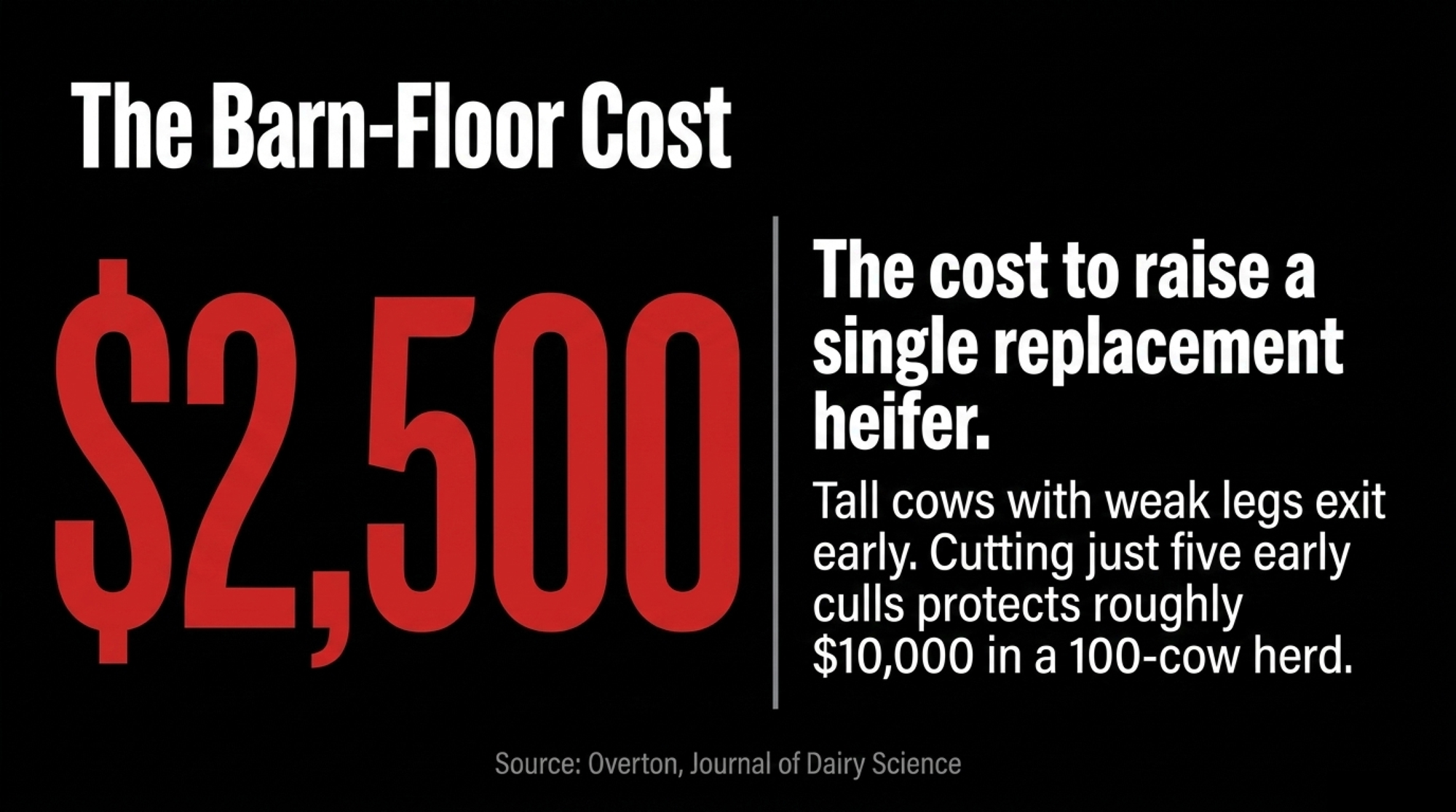
NewsSubscribe
First
Last
Consent

World Dairy Expo Day 4: 10-Year-Old Cow Stuns Industry with Second Grand Championship

What if your ‘old’ cows are actually your best cows? Yesterday’s WDE champion was 10 years old.

The colored shavings were still settling in the Coliseum when lightning struck twice yesterday afternoon. Not the kind that sends you running for cover, but the kind that makes 3,000 dairy farmers jump to their feet in disbelief.

Iroquois Acres Jong Cali
Grand Champion
International Brown Swiss Show 2025 World Dairy Expo
Brian Pacheco Kerman, CA

Iroquois Acres Jong Cali, a 10-year-old Brown Swiss in her seventh lactation, just claimed her second Grand Championship at World Dairy Expo. While most cows of her age are long retired, Cali’s still pumping out 60 kilos of milk daily and moving “like a three-year-old,” according to judge Allyn “Spud” Paulson.

The Partnership That Defied Geography

Here’s where yesterday’s story gets remarkable. Owner Brian Pacheco watched from the same spot where he stood during Cali’s first championship years ago—except he lives in California while Cali thrives 2,000 miles away in Canada.

“I knew early on if I’m going to hitch my saddle with somebody, he was the one,” Pacheco said of Callum, Cali’s caretaker. Their decade-long partnership, built on what Pacheco calls “honesty and integrity,” demonstrates that trust always prevails over proximity.

Callum’s hands shook slightly as he recalled the championship moment. “When I got pulled second, I’m like, I got to work extra hard here to try to get into first”. The traditional yodelers were singing, the pressure mounting. When judge Paulson finally shook his hand for the Grand Championship, Callum admitted: “I was pretty emotional, actually. It’s hard to explain the feeling”.

Wednesday’s Championship Roll Call

While Cali’s triumph dominated conversations, championships were decided across multiple rings yesterday :

International Brown Swiss Show (380+ head)

The morning started with cow classes that showcased unprecedented depth. Judge Paulson, mentored decades ago by Marty Simple when “Jades and Jetways were popular,” called it “truly amazing”. The four-year-old class alone had him and Associate Judge Brian experiencing “goosebumps.”

  • Grand Champion: Iroquois Acres Jong Cali (Brian Pacheco, Kerman, CA)
  • Reserve Grand: Robland Norwin Bermuda-ET (Tony Kohls/Goldfawn Farm)
  • Premier Sire: Hilltop Acres Daredevil (5th consecutive year for New Generation)
  • Premier Breeder: Jenlar Farm

International Red & White Show Heifer Classes

Wednesday afternoon saw the start of the International Red & White Show, with judge Adam Hodgins from Ontario placing the heifer classes. The quality was exceptional, with spring yearling Milksource Shay-Red-ET standing out from the crowd.

  • Junior Champion (Open Show): Milksource Shay-Red-ET (Architect), owned by Milk Source LLC & Jeremy Holthaus
  • Reserve Junior Champion: Ms Believe In Faith-Red-ET, owned by T & S Krohlow, William Schultz III, & Yvonne Preder

The Red & White cow classes continue this morning at 7:00 AM, with expectations running high after the quality displayed in yesterday’s heifer show. Several exhibitors mentioned the depth has never been stronger, with animals that would have won championships in previous years placing well down the line.

International Milking Shorthorn Show Heifer Classes

Lazy M Money Laundering-ET P
Junior Champion
International Milking Short Horn Show 2025 World Dairy Expo
Elizabeth Gunst & Jamie Gibbs Hartford, WI

Mike Maier and associate Josh Fairbanks spent Wednesday morning sorting through an impressive lineup of Milking Shorthorn heifers. The breed, experiencing a renaissance of sorts, showcased genetics that blend traditional characteristics with modern production demands.

  • Junior Champion (Open & Junior Show): Lazy M Money Laundering-ET P (Money), owned by Elizabeth Gunst & Jamie Gibbs
  • Reserve Junior Champion: Wincrest P Spring Special-EXP-ET, owned by Dylan & Cameron Ryan and Charlotte Wingert

The Milking Shorthorn cow classes resume this morning at 7:00 AM alongside the Red & Whites. Several longtime breeders noted yesterday that the heifer quality signals a bright future for the breed, with Money daughters, in particular, catching the judges’ eyes.

The Comeback Nobody Expected

Cali’s path to yesterday’s championship reads like dairy fiction. After being dry for an entire year while undergoing IVF treatments, she produced 58 quality embryos across three sessions.

“She got a little heavy because she was dry a long time,” Callum admitted. His worry peaked when she started bagging up this summer. Then came the miracle: “She didn’t have an issue. She didn’t even require a bottle of calcium”.

Now she’s bred back, potentially carrying her next generation while still dominating show rings. “It’s nothing fizzes her,” Callum said, describing how she transitions seamlessly from Canadian pastures to Madison’s spotlight.

The Genetics Revolution Nobody Saw Coming

Jake Hushen of New Generation Genetics couldn’t contain his excitement watching the winter calf class. “Seriously, Casey, like this is not when I was a kid. I mean, 30 was big. Now we’re at 60”.

New Generation dominated with 14 class winners from 10 different sires. But the real story was standing quietly beside them—Callise, a full-blooded embryo imported directly from Switzerland.

“Our goal is to expand the bloodlines by branching out with Europe,” Hushen explained. While genomics accelerates genetic progress, it can dangerously narrow the gene pool. This Swiss import program is their answer—bringing original genetics straight from the breed’s homeland.

The Quality Revolution

Brian Pacheco, wearing his hat as president of the Brown Swiss association, overheard the chatter that mattered. “In the past, there was five or six good cows. Now there’s 15 to 25 really good cows”.

This isn’t propaganda—it’s evolution. The breed has transformed from “more of just a show breed” to “an actual production breed,” Pacheco observed. Yesterday’s show proved it with Cali leading the charge—a cow that combines championship looks with 60-kilo daily production.

Judge Paulson faced the brutal side of this quality surge. “One of the toughest things,” he reflected, “looking somebody in the eye to put them 51st”. When state fair champions are placing in the twenties and thirties, excellence becomes relative.

The Human Moments That Mattered

Yesterday wasn’t just about genetics and milk production. It was about Spud Paulson honoring his mentor’s legacy while judging alongside his best friend, Brian, with whom he talks “almost every day” after midnight while hauling cattle.

It was about Callum taking that photo of Cali fresh after calving and watching people’s excitement build. About Brian Pacheco standing in his lucky spot, letting Callum’s expertise shine while his cow made history.

“You never know, maybe if things go right… we may be back next year,” Pacheco said with a grin. Someone mentioned another cow had just completed a three-peat. The possibility hung in the air like morning mist over Wisconsin pastures.

What Yesterday Means for Tomorrow

As crowds dispersed and exhibitors returned to evening chores, Wednesday’s lessons crystallized :

Age is an asset, not a liability, when genetics meet exceptional management. With replacement costs soaring and quality genetics scarce, Cali’s decade of productivity rewrites the culling playbook.

Distance dissolves with trust. The California-Canada partnership proves that in our connected world, expertise matters more than proximity.

Breed evolution accelerates. From 30 winter calves to 60, from show ring beauty to production powerhouse—the Brown Swiss transformation is real and remarkable. The Red & White and Milking Shorthorn shows demonstrated similar quality surges, with junior champions setting new standards.

Global genetics are local necessities. Importing Swiss embryos isn’t exotic—it’s essential for maintaining the genetic diversity that genomic threats pose.

The Bottom Line from the Colored Shavings

Yesterday at World Dairy Expo wasn’t just another Wednesday in October. It was the day a 10-year-old cow proved that longevity beats youth, trust beats contracts, and sometimes—just sometimes—lightning really does strike twice.

“It’s a feeling you just don’t soon forget,” Brian Pacheco said, and he’s right. Not because of the banner or trophy, but because yesterday reminded everyone why they fell in love with dairy cattle in the first place.

The champions have been crowned, the partnerships celebrated, and the genetics evaluated. But Cali’s story—backed by 60 kilos of daily milk and seven lactations of excellence—proves that in dairy’s modern era, the old rules no longer apply.

With Red & White and Milking Shorthorn cow classes continuing this morning, yesterday’s heifer champions have set the bar impossibly high. But if Wednesday taught us anything, it’s that impossible is just tomorrow’s baseline at World Dairy Expo.

Yesterday wasn’t just history. It was a prophecy.

The Sunday Read Dairy Professionals Don’t Skip.

Every week, thousands of producers, breeders, and industry insiders open Bullvine Weekly for genetics insights, market shifts, and profit strategies they won’t find anywhere else. One email. Five minutes. Smarter decisions all week.
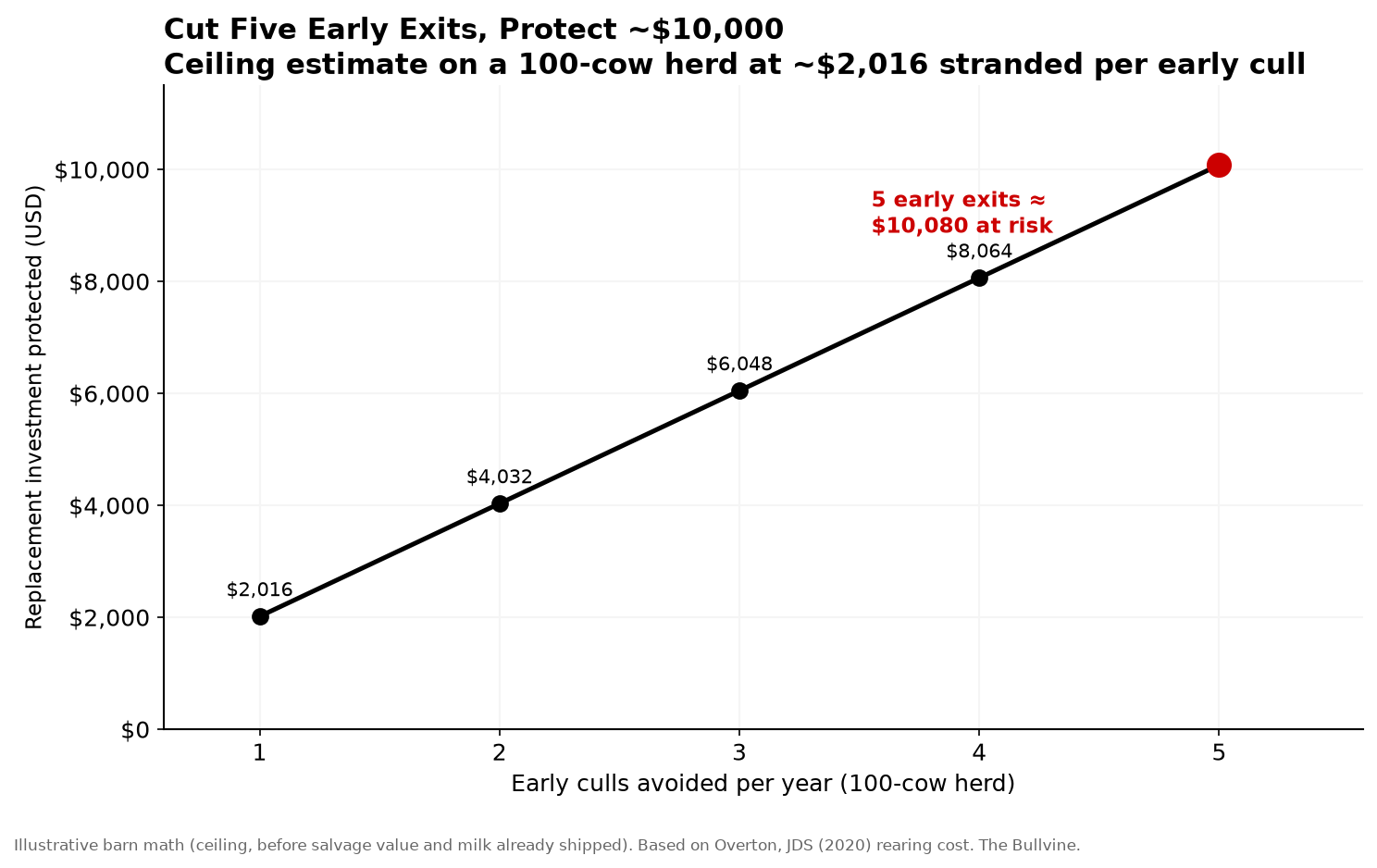
NewsSubscribe
First
Last
Consent

The $4,000 Heifer: Navigating America’s Worst Replacement Crisis in 47 Years

Ready to pay mortgage money for a springer? The heifer shortage is here, and it’s not going anywhere.

EXECUTIVE SUMMARY: The U.S. dairy replacement pipeline just hit the wall—we’re down to 3.914 million heifers, the lowest count since 1978. Meanwhile, $10 billion in new processing capacity is coming online, which will demand significantly more milk than we can currently supply. Here’s the kicker: replacement costs have more than doubled, and CoBank’s data shows we’ll lose another 800,000 heifers before any recovery starts in 2027. Farms that keep betting on cheaper replacements are playing with fire. The smart money’s on extending cow longevity by just one month to cut replacement needs by 2.8%—that’s $84 saved per cow annually at today’s prices. Add precision breeding with sexed semen (90% success rate beats the 50-50 gamble), and you’ve got a playbook that actually works. Based on USDA reports and university research, the farms implementing this three-pronged approach currently will own the market, while others struggle with yesterday’s math.

KEY TAKEAWAYS

  • Cut replacement costs 2.8% per extra month of cow longevity—focus on transition nutrition and repro management to save $84+ per cow annually while everyone else scrambles for expensive replacements
  • Deploy sexed semen strategically on your top 25% genetics—yes, it costs $15 more per straw, but that 90% female success rate beats conventional breeding’s coin flip when heifers cost $4,000+
  • Cash in on beef-cross calves from bottom-tier cows—those $1,000+ beef calves pay for your breeding program while you save dairy genetics for actual replacements
  • Budget $4,000+ per heifer through 2027—CoBank’s projections show no relief until then, so negotiate group purchases with neighbors and secure flexible credit lines now before cash flow gets tight
  • Start culling fewer cows immediately—operations reducing slaughter by 600,000+ head nationally are keeping milk flowing despite the heifer drought, and you need to join them before your competitors do
heifer replacement cost, dairy farm profitability, cow longevity, sexed semen strategy, dairy cattle prices

Walk into a cattle auction anywhere from Bakersfield to Green Bay these days and you’ll witness something that stings like a winter chill—springers hitting $4,200 or more. At a sale in Wisconsin last week, a seasoned dairyman shook his head, watching those prices climb. The young guy next to him just kept his paddle raised. “Either buy now or quit growing,” he said.

This isn’t just another bump in the road or a flash in the pan. The numbers don’t lie; this is a fundamental market reset.

The situation is stark: CoBank’s August 2025 report confirms we’re sitting with the smallest U.S. dairy replacement herd since 1978—3.914 million head as of January 2025. And with $10 billion being poured into new processing plants that demand milk through 2027, while heifer numbers continue to decline by another estimated 800,000 head, every dairy has to rethink its expansion and breeding strategy.

The numbers that change the game

Let’s break down the tough facts. USDA data shows an 18% drop in heifer inventories since 2018—from 4.77 million to just 3.914 million by early 2025. Looking even deeper, the number of heifers expected to calve this year is just 2.5 million—the lowest the USDA has seen in 24 years.

Prices? USDA’s July 2025 reports put the average replacement heifer at $3,010 nationwide—up a whopping 75% from April 2023. However, averages only tell half the story when premium springers are bringing $4,200 or more in Wisconsin or $4,500 or more in central California.

Consider a real-world example: an Eau Claire-area farm added 200 cows a few years ago, budgeting roughly $360K just for replacements. Today, that same addition would require more like $800K, and that’s without factoring in feed, labor, or facility costs.

CoBank doesn’t sugarcoat it—the forecast is for inventories to shrink even more over the next couple of years before any meaningful recovery in 2027.

How we dug this hole

Blame it on the beef market, if you will. When U.S. beef cattle numbers hit historic lows, beef-cross calves became a gold mine. Dairy farmers began breeding more bottom-tier animals to serve as beef sires, and as a result, calf prices soared while replacement heifer values lagged behind.

According to the National Association of Animal Breeders, dairy farmers snagged 7.9 million of the 9.7 million beef semen units sold in 2024—over 80% of all beef semen sales. That’s a far cry from just a few years ago, when beef semen was a small part of their breeding plan.

A good example comes from a Central Valley operation that increased its beef breeding from 20% of its herd in 2019 to nearly 65% by 2022, in an effort to chase calf revenue and stay afloat. Fast forward, and the farm grapples with a dwindling replacement herd and sky-high heifer prices.

The lesson? It wasn’t a conspiracy—it was a thousand individually smart but collectively expensive decisions. When everybody zigged into beef semen, the dairy replacement pipeline zagged.

The $10 billion squeeze: New plants demand milk that heifers aren’t here to make

Just when heifer numbers nose-dived, the industry bet big on new processing plants. Hilmar Cheese’s Dodge City facility is built to process approximately 8 million pounds of milk daily once fully operational. Chobani’s new Rome, NY, plant is targeting a massive 12 million pounds of production daily.

CoBank’s economist Corey Geiger puts it plainly: “Those plants need more milk and better components, especially butterfat and protein. To meet that demand, we need many more replacement heifers in the next few years than we have right now.”

Texas is feeling the heat especially hard. According to the Texas Dairy Association industry analysis, the state’s expanding processing capacity will require significant increases in regional milk supply, putting additional pressure on producers already dealing with tight heifer availability. However, with shrinking heifer inventories, finding those replacement animals is squeezing producers who are already juggling tight margins.

The new playbook: A three-pronged strategy for survival and growth

Prong 1: Master cow longevity

The farms weathering this storm best are pulling cow longevity into sharp focus. According to University of Wisconsin dairy management research, extending productive cow life significantly reduces annual replacement needs, with economic benefits of approximately $84 per cow per year in avoided replacement costs at current market prices.

For example, a dairy planning to add 800 cows might face an expansion cost soaring from $1.44 million in replacements five years ago to over $3.2 million today. Instead of scrapping growth plans, some farms are opting to keep more cows longer—raising the average productive life from 4.2 to 4.8 years and reducing replacement rates from 35% to 28% annually.

This strategy is catching on nationwide. Producers sent 611,600 fewer cows to slaughter than usual between late 2023 and mid-2025—a huge shift helping stabilize milk supply despite fewer heifers.

Prong 2: Leverage genetic horsepower

Many producers don’t realize we’ve been riding a genetics train that’s making the heifer shortage less painful than it could’ve been.

Since 2010, genetic improvement has accelerated, doubling the annual gains in Lifetime Net Merit from $40 to $ 80 per cow. Butterfat content climbed to 4.23% nationally in 2024—shattering decades-old ceilings. Protein jumped from 3.04% in 2004 to 3.29% in 2024.

USDA geneticist Paul VanRaden puts it simply: “A tenth-point bump in butterfat adds approximately $23 per cow per year at current component prices. Farms raising 850 cows just bumped their component premiums by close to $850 a month on the check.”

Prong 3: Execute a precision breeding strategy

Gender-sorted semen sales jumped 17.9% in 2024 to almost 10 million units, while conventional dairy semen slipped. The shift makes sense financially.

Dr. Jim Ferguson, Penn State Extension, notes: “Though sexed semen straws run $8-12 more and have slightly lower conception rates, the guaranteed outcome—90% female calves versus 50% conventional—makes them the most cost-effective heifer production strategy in today’s market.”

Here’s how a tiered breeding strategy looks in practice:

Quick Decision Matrix

Cow GroupStrategyStraw CostResult
Top 25% GeneticsGender-sorted semen$35-$4590% Heifer success
Middle 50%Conventional Dairy$20-$2550% Heifer success
Bottom 25%Premium Beef Sires$25-$30High-value beef calves

When can we expect relief?

CoBank’s modeling, considering 30 months from breeding to milking, shows that pressure will build through 2026, reaching a low point before a modest rebound begins in 2027.

Expect roughly 357,000 fewer fresh heifers in 2025 and 438,000 fewer in 2026. Recovery begins in 2027 as replacements bred in 2024 hit the milking herd, increasing numbers by about 285,000.

Regional winners and losers

Texas is building herds, while others are shrinking. The Lone Star State added 28,000 cows in early 2025 and benefits from lower land costs ($3,850/acre) than Wisconsin ($5,900/acre), along with fewer regulations to slow growth.

Wisconsin lost over 300 dairy farms in 2024, mostly smaller operations folding, but herd size overall stayed steady through consolidation.

In contrast, California’s environmental programs can add significant revenue for participating operations. LCFS credits can add $60-$75 per metric ton of CO2 reduced for qualifying dairies, and combined with renewable energy incentives, can add over $200 per cow annually to the check.

Regional Breakdown Table:

RegionLand Cost/AcreAvg Milk Price (July 2025)Regulation LevelKey Growth Driver / Challenge
Texas$3,850$19.20LowLower regulatory hurdles & land cost
Wisconsin$5,900$18.80MediumHigh land costs challenge consolidation
California$8,200$20.40HighLCFS credits & high milk price vs. strict regulation

What you can do today

Here’s a simple checklist to get you ready:

  • Calculate your replacement cost (likely well over $4,000 per heifer).
  • Segment your herd: Use sexed semen on your top cows and breed the rest to beef sires.
  • Focus on cow longevity: Nail transition cow nutrition, hoof care, and repro management.
  • Explore cooperative heifer-sharing or custom raising to spread risk.
  • Protect cash flow: Budget for longer-term heifer contracts and consider mortality insurance.

An important co-benefit

Fewer replacements mean fewer emissions. Cornell research shows cutting heifer numbers reduces methane emissions by over 12%. Meanwhile, keeping cows longer results in lower emissions per pound of milk, thanks to improved feed efficiency.

The Bottom Line

The $4,000 heifer isn’t a blip. It’s a full reset of dairy economics. If you’re waiting for prices to drop, you’re playing a dangerous game.

Get your cow longevity right, embrace precision breeding, and budget like replacements cost $4,000. The processors betting billions on increased milk production by 2027 aren’t waiting around.

Your breeding decisions today will have a significant impact on your milk situation in three years. It’s time to get serious.

Complete references and supporting documentation are available upon request by contacting the editorial team at editor@thebullvine.com.

Learn More:

The Sunday Read Dairy Professionals Don’t Skip.

Every week, thousands of producers, breeders, and industry insiders open Bullvine Weekly for genetics insights, market shifts, and profit strategies they won’t find anywhere else. One email. Five minutes. Smarter decisions all week.
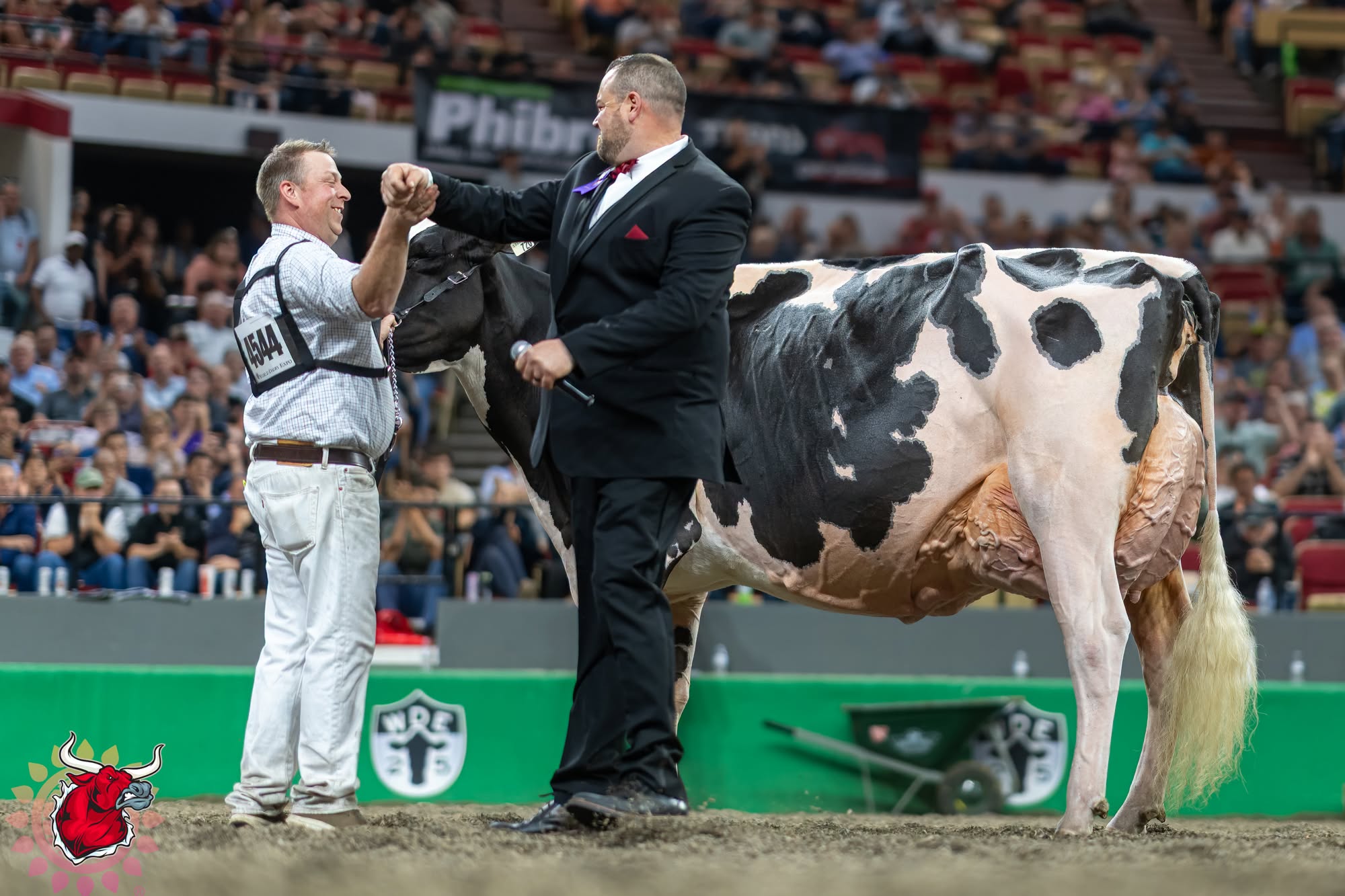
NewsSubscribe
First
Last
Consent

The Breeder Who Refused to Quit: How Japan’s Most Stubborn Farmer Created Japan’s Only EX-96 Holstein

Japan’s most stubborn farmer created history with one perfect Holstein cow.

The call came from Hokkaido on a cold March morning. Nobuo Sato had passed—and honestly? The dairy world felt a little emptier that day. Most folks outside serious dairy circles won’t recognize the name, but here’s what you need to know: Sato did something no one else in Japan has ever pulled off. He bred a cow that scored EX-96. In Japan’s dairy history, this event occurred exactly once. And it sure wasn’t luck.

When Rejection Becomes Rocket Fuel

Picture this: you’re 16 years old in 1965, engineering textbooks spread across your desk, when your older brother decides farming isn’t for him. Suddenly, you’re staring at a barn full of Holstein cows in Hokkaido—a place so dairy-focused the cattle outnumber humans four to one in towns like Toyotomi.

“I wanted to become an engineer,” Sato would tell people decades later. But duty called louder than dreams.

What happened next? The kid threw himself into learning everything about cattle with the kind of intensity that only comes from equal parts determination and… well, call it stubborn pride. Friends pushed him toward showing, which is where he discovered just how brutal that world could be.

“You’re not ready. Give your place to someone else.”

Can you imagine? He’d legitimately earned his spot at the Hokkaido state show, but the old guard wasn’t exactly rolling out welcome mats. Same story with the 4-H Club—flat rejection.

Here’s what separated Sato from every other wannabe, though: instead of packing it in, every “no” just fed this fire that would burn for five decades.

“I’ll prove myself one day.”

And boy, did he ever.

What Makes EX-96 So Special? Holstein classification scores five key areas: Udder (40%), Dairy Strength (20%), Feet & Legs (20%), Front End & Capacity (15%), and Rump (5%). The Excellent range runs 90-97 points, but EX-96 demands near-perfection across every category simultaneously. According to Holstein USA, approximately five cows are awarded EX-96 status annually across the entire United States. In Japan’s history? Just one.

The Philosophy That Changed Everything (And Why It Still Matters)

Early on, Sato developed what became his guiding principle—one simple question that shaped every decision: “How can cows live happily for their entire lives?”

Sounds sentimental? It wasn’t. It was a revolutionary business strategy disguised as common sense.

“My father used to say cows may seem dull, but they are in fact very sensitive,” his son Michihiro recalls in an interview for this article. “Feeding, milking, resting—always at the same times every day. He understood their nature deeply.”

Walk onto the L’Espoir farm in its heyday and you’d witness this approach in action. Barns immaculate, pastures pristine, feeding protocols followed with Swiss watch precision.

Here’s a scene that captures it: Sato would grab a handful of stemmy hay, shake it at visiting nutritionists, and challenge them: “You tell me—can you really make milk with this?” He understood the chain reaction—superior cows required superior nutrition, which in turn demanded superior forage, which necessitated superior soil management. No weak links allowed.

The genius was how he taught that successful showing was simply “an extension of everyday care.” While other farms singled out potential champions for special treatment, the L’Espoir approach maintained the entire herd at show condition daily.

That philosophy resonates differently in 2025, with replacement costs at $2,660 per head, according to USDA data, and longevity becoming increasingly valuable economically.

The Foundation Investment That Started It All

Foundation of Excellence: Tyro Hagen, the exceptional cow whose purchase marked a turning point for L’Espoir Holsteins and whose lineage significantly impacted dairy breeding across Japan.

Here’s where Sato’s story becomes familiar to anyone who has ever chased the perfect female. He earned a reputation as someone who’d “buy anything”—sound familiar? Most investments produced modest returns, but one purchase changed everything.

The cow that became the foundation of his Hagen line was the only animal he ever borrowed money to buy. That detail tells you everything about his confidence in her potential and the financial risk he was willing to take.

What happened next is every breeder’s dream. The Hagen bloodline didn’t just improve L’Espoir Holsteins—it influenced breeding programs across Japan. Informal networks of Hagen line breeders developed nationwide, gatherings that continued until Sato’s final meeting in November 2022.

The L’Espoir herd eventually became 100% Hagen. Now, conventional wisdom says that’s risky—where’s your genetic diversity? But Sato understood something we’re rediscovering: great bulls only produce transcendent daughters when matched with truly exceptional maternal lines.

The Heartbreak That Led to History

Perfection Realized: L’Espoir ReganStar Hagen EX-96, the only Holstein in Japan to achieve this prestigious score, pictured showcasing the exceptional traits that defined Nobuo Sato’s breeding philosophy.

This is where the story takes a dramatic turn—akin to something Hollywood would script.

L’Espoir Reganster Hagen’s show career started blazing: Reserve Intermediate Champion at the 2004 Hokkaido National Show, followed by Grand Champion titles in 2006 and 2007. Everything was clicking.

Then came the setback that tested everything Sato believed. After calving at nine, she failed to conceive for four years. Four years! Remaining dry while her contemporaries continued productive careers.

Most breeders would’ve culled her. Who keeps a dry cow for four years? Feed costs and opportunity costs—the economics don’t add up on paper.

But not Sato. He maintained her in pristine condition throughout those barren years, believing in her genetic value and trusting his management system.

“We longed to show her again,” Michihiro remembers. “When she finally qualified for the state show at age 14, we cried tears of joy—our first time ever crying at a regional win.”

The emotion wasn’t just about victory. It was a vindication of a philosophy that valued individual excellence over expedient replacements.

Her Grand Champion victory that year set the stage for history. The morning after, father and son shook hands silently in the barn—”That handshake remains one of my greatest memories,” Michihiro says.

At the National Show, she placed second only to the Honor Prize winner. Remarkable for a 14-year-old competing against animals in their prime. But the greatest honor was yet to come.

Picture the scene: the classifier’s pen moving across the scorecard, numbers adding up to something unprecedented in Japan. When those scores totaled 96, a new milestone was reached. The celebration at that Wakkanai hotel became the stuff of legend.

Swimming Against the Genomic Tide

Here’s what makes Sato’s achievement even more significant—how it runs counter to trends reshaping our industry right now.

Since 2009, the genomic revolution has transformed dairy genetics. DNA analysis and algorithms predicting merit at young ages, accelerating improvement for production traits. Incredibly powerful stuff, but here’s what’s concerning: this has led to alarming genetic concentration.

Research by Penn State geneticists reveals that the vast majority of Holstein males in North America can be traced back to just a few foundation sires from the 1960s. We’re talking extreme genetic bottleneck, increased inbreeding risks, and potentially compromised fertility and health.

This isn’t just academic theory—it’s happening in your herd whether you realize it or not.

Sato’s approach represents a deliberate counter-narrative. It prioritized functional type, longevity, and structural correctness—exactly the traits that can be compromised when chasing production numbers above all else.

The evidence keeps proving his approach. Recent Hokkaido show results still feature L’Espoir animals bearing the Hagen name winning major classes, demonstrating the power of masterful maternal line development decades later.

The Peaceful End of Perfection

A Father’s Love: Nobuo Sato holding his granddaughter. His dedication to his family was as profound as his passion for dairy farming.

Sato’s final months reflected the same thoughtfulness that characterized his entire career. Diagnosed with pancreatic cancer, he refused to let his condition disrupt his grandchildren’s school entrance exams—crucial in Japanese education.

“I can’t be a burden to them now,” he declared. After witnessing all three pass, he allowed himself to rest. On March 28, 2023, at the age of 74, he passed away peacefully at Toyotomi Hospital, surrounded by his family.

“He left with nothing undone,” Michihiro reflected. “He had accomplished everything he set out to do.”

That’s quite a statement about a man who achieved measurable perfection in an industry that rarely sees it.

Carrying the Torch: Michihiro Sato continues his father’s legacy at L’Espoir Holsteins, adapting to modern dairy practices while honoring a commitment to cow care and genetic excellence.

Today, L’Espoir Holsteins continues under Michihiro’s leadership, honoring his father’s legacy while adapting to modern realities. But the real legacy lives in every dairy producer who prioritizes cow comfort over convenience, chooses longevity over short-term gains, and approaches breeding as stewardship rather than just genetic manipulation.

Whether you’re milking 50 cows in Vermont or 5,000 in California, the fundamentals don’t change. Take care of your cows with Sato’s attention to detail. Maintain consistent routines. Invest in structural soundness alongside production. Keep your breeding vision longer than your loan terms.

Because at the end of the day, the happiest cow usually turns out to be the most profitable one, too. Sato proved that’s not just feel-good philosophy—it’s a measurable business strategy that creates lasting success.

Key Takeaways:

  • Persistence pays off in breeding excellence: Nobuo Sato’s relentless dedication led to breeding Japan’s only Holstein scored EX-96, proving that patience and precision can achieve legendary results even when facing early rejection and setbacks.
  • “Cow happiness” drives measurable success: Sato’s philosophy of prioritizing animal comfort, consistent routines, and superior care wasn’t sentiment—it was smart business strategy that created the foundation for achieving perfect classification scores.
  • Faith in genetics during adversity creates champions: L’Espoir Hagen’s story exemplifies the power of perseverance—despite a brutal four-year dry spell, Sato’s unwavering belief in her potential led to her triumphant return and historic EX-96 achievement.
  • Balanced breeding offers sustainable advantages: While modern genomic selection accelerates gains, Sato’s patient approach to developing exceptional maternal lines provides a blueprint for maintaining genetic diversity and long-term herd resilience.
  • Practical longevity strategies boost profitability: Today’s dairy producers can apply Sato’s methods through consistent nutrition protocols, systematic hoof care, genetic diversity monitoring, and targeting 2.8+ lactations per cow—all proven strategies for improving bottom-line results.

Executive Summary

This article tells the inspiring story of Nobuo Sato, a Japanese dairy breeder who achieved the unprecedented feat of breeding the only Holstein cow in Japan to receive an EX-96 classification—a score signifying near-perfect conformation and function. Despite early skepticism and setbacks, Sato’s unwavering dedication and philosophy centered on “cow happiness” reshaped Japanese dairy breeding standards. His approach emphasized meticulous care, sustainable practices, and a balanced genetic strategy prioritizing longevity over mere production numbers. The journey of his champion cow, L’Espoir Hagen, highlights her resilience as she overcomes a prolonged dry period to reclaim her top status. In the context of rising concerns about genomic bottlenecks, Sato’s legacy offers a blueprint for preserving genetic diversity and fostering sustainable herd management. The article connects these insights to current industry challenges, offering practical recommendations for improving profitability and resilience in modern dairy operations.

Learn More:

The Sunday Read Dairy Professionals Don’t Skip.

Every week, thousands of producers, breeders, and industry insiders open Bullvine Weekly for genetics insights, market shifts, and profit strategies they won’t find anywhere else. One email. Five minutes. Smarter decisions all week.
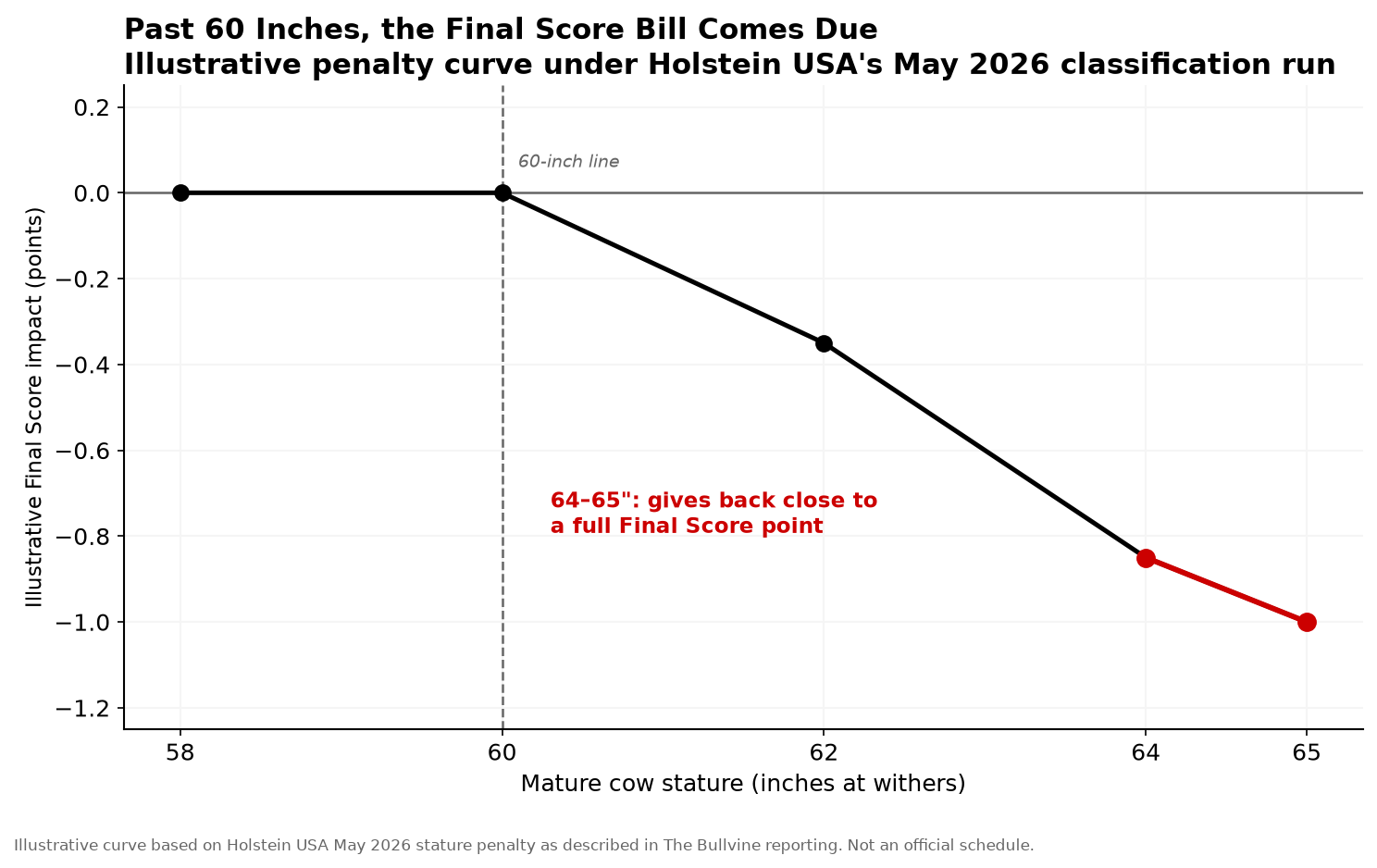
NewsSubscribe
First
Last
Consent

Calf Barn Decisions: Longevity or Milk? What Québec’s Latest Data Really Means for Your Bottom Line

Milk yield up, lifespan down? The latest Québec data says the average cow’s earning power jumps $240—but she only lasts 3.25 years.

EXECUTIVE SUMMARY: Alright, here’s what blew my mind—and might shake up your calf program too. Turns out, you can’t max out milk per cow and keep cows around forever. Québec researchers compared 1,600+ farms: old-school bucket calves on whole milk lasted 3.41 years, while “modern” pens with powder and auto-feeders only hung in 3.25 years. But hang on—those modern herds banked an extra 340kg of ECM and over $240 more per cow. That’s before you factor in 2025’s feed prices and the global push for feed efficiency and higher genomic merit. Bottom line? If you want more milk money (and you can handle faster turnover), it’s time to scrutinize how you raise those calves. Trust me, even a couple tweaks could fatten your milk check this season.

KEY TAKEAWAYS

  • Modern early-life systems = higher cash flow. Farms using group calf management and automated milk feeding made $8,008 per cow—up $240 compared to traditional setups.
    Try switching even part of your calf barn to automated feeders or group pens to see immediate productivity gains.
  • Less longevity, more liters. “Tech-forward” herds saw cows leave 0.16 years sooner—but pumped out 341kg more ECM per animal.
    Don’t cling to old culling targets—track your herd replacement rate alongside yield and make data-driven decisions.
  • Colostrum wins—no matter your system. Herds nailing fast, high-volume colostrum feeding lifted lifetime cow profits, regardless of milk source.
    Check your colostrum timing and quantity against current USDA and university extension benchmarks—tighten up if you’re lagging.
  • Calf feeding changes move the needle—fast. Early concentrate feeding and good group hygiene boost feed efficiency and milk value, right off the bat.
    Revisit your starter grain protocols and group-housing cleaning schedule this month—don’t let market volatility catch you napping.
  • Don’t follow “what’s always worked”—follow the ROI. Today’s industry winners blend genomic testing, herd-level economics, and hands-on management—don’t get left behind.
    Set aside an afternoon soon: review your DHI data and challenge just one thing about how calves are raised on your operation.

Here’s the thing about raising dairy calves today: every decision you make in the hutch or group pen sets the pace for future profit. And as new research from Québec shows, those decisions don’t just impact first lactation—they create a fundamental trade-off between a cow’s lifetime production and her longevity in the herd.

A deep-dive study out of Québec, surveying 1,658 herds, didn’t just ask about best intentions—it dug into what’s actually happening on real farms and then lined up those practices against hardcore numbers: years in production, kilograms in the tank, and dollars in the milk check. In this study, “traditional” meant calves raised individually, getting whole or waste milk by hand. “Modern” was defined as group housing with automated milk replacer feeders and all the labor-saving gadgets that are moving into more and more barns. The chart below illustrates the key management practices that defined these two distinct groups..

Adoption rates of key early-life management practices that define the Traditional (Trad) and Modern (Mod) farm clusters in the Québec study. Source: Dallago et al., JDS 2025.

The Trade-Off By the Numbers

MetricTraditional (n=600)Modern (n=1,058)
Productive Lifespan3.41 ± 0.03 yrs3.25 ± 0.02 yrs
Lifetime ECM11,090 ± 64 kg11,431 ± 48 kg
Lifetime Milk Value (CA$)7,769 ± 488,008 ± 36
% 3+ Lactations41.5 ± 0.341.6 ± 0.2

What strikes me most is that “traditional” setups—buckets, whole milk, solo pens—get you cows that last a bit longer. But those automation-heavy barns, with group housing and powdered replacer, are squeezing extra kilograms (and dollars) from each animal before they head down the lane. That might not seem earth-shattering—until you multiply by every cow that goes through your milking line this year, especially with input costs where they are now.

From Québec to Your Laneway: What This Means on the Farm

Let’s bring the numbers home. On one hand, you’ve got producers sticking with the tried-and-true—more hands-on, more hutches, more routine—and they do see cows round third or even fourth lactations more often. On the other? The neighbor who invested in automation, group pens, and instant milk powder… now he swears by the rapid gains in his heifers, but he’s trading off some longevity. Suddenly, average cull age is dropping by over six months.

This isn’t just a story about Québec, either. Out east, the tradition might stick around longer because labor is reliable. Out west, bigger herds and labor headaches push folks toward tech—and more risk if hygiene slips. The same patterns hold in the Midwest and upstate New York: regional differences matter, but the milk check ultimately tells the story.

What’s particularly noteworthy is that, as feed costs bounce and staff get scarcer, the appeal of automation is only growing. But the dollars and days lived by each cow still don’t move in the same direction.

Under the Hood: What Actually Moves the Needle?

Diving into the details, the “traditional” approach—whole or waste milk, buckets, solo housing—delivers on longevity. More mature cows, more productive lactations. But there’s a catch. According to Dallago and colleagues, the “modern” barn, with technology-driven group management and ample feed, yields higher lifetime milk and profit per animal. That’s what you see when you’re flipping through updated DHI reports.

Here’s something else the data made clear (and most vets or seasoned managers will back up): best-in-class colostrum management—meaning fast, clean, high-volume feedings—amplifies your chances regardless of the other system you’re running. There’s no one-size-fits-all solution, and not all “modern” is gold. Make a mess of hygiene in a big group pen, and you might be worse off than if you stuck with singles.

And let’s not overlook this next part: Disease and reproductive setbacks remain the wild cards. Even the best-managed, highest-yielding cows can crash out faster if transition or fresh-cow care gets sloppy. Barns with sharp protocols and strong staff? They consistently get closer to that sweet spot between yield and years.

Actionable Takeaways

  • Don’t just chase years or liters—balance your systems and track your outcomes. If you’re considering switching your milk feeding or housing approach, consider whether you have the necessary labor and management structure to maintain consistency. The shift to group housing or auto-feeders is only as effective as your vigilance in maintaining calf health and cleanliness.
  • Nail your colostrum protocol. Every credible study (and every older producer worth listening to) agrees: it’s about speed, cleanliness, and volume—not gadgets or flavorings.
  • For group/automated systems: Don’t skimp on daily monitoring and hygiene. Coughing up labor savings only to lose it in vet bills or higher youngstock losses is a rookie mistake—even seasoned teams get surprised by group challenges.
  • Culling for “maximum longevity” sounds great, but in some markets or barn set-ups, you may need to lean into yield. Either way, know your costs and margins, and revisit them regularly—especially if you’re shifting protocols or market prices fluctuate.

What’s Next for Progressive Producers?

Here’s my honest take: The data shows no perfect playbook. Some years, that extra $240 per cow could cover your feed cost spike, or help float you through a dry spell. Other times, extra months of production mean fewer replacement heifer dollars leaving your account. At the end of the day, you’ve got to keep your head up, work your plan (not just your neighbor’s), and get everyone on your team pulling in the same direction.

So, what have you seen in your own herd? Are you staying the course, or are you eyeing a shake-up in the calf barn? I’ll leave with this: The best operators blend the latest science with a heavy dose of barn-floor wisdom, testing, tweaking, and finding what really fits their herd and crew. And isn’t that what makes this industry so damn compelling right now?

Source: Based on the study “Early-life management practices and their association with dairy herd longevity, productivity, and profitability” by Dallago et al., Journal of Dairy Science, 2025.

Learn More:

  • The Ultimate Guide to Colostrum Management: From Birth to Brilliance – This guide provides the tactical steps for perfecting your colostrum program, from testing IgG quality to ensuring optimal intake. It reveals practical methods to build the resilient immune foundation that maximizes the potential of every calf, regardless of your system.
  • Dairy Profitability: Are you a Price Taker or a Profit Maker? – This article provides a strategic framework for analyzing costs and margins to improve your bottom line. It challenges you to decide whether the short-term milk value or long-term productive life discussed in the main article is the right economic choice.
  • Precision Technologies for Calves and Heifers: The Unseen Revolution – Looking beyond current automation, this piece explores the next wave of innovation in youngstock management. It demonstrates how new sensors and data analytics can enable early disease detection and optimize growth, showcasing the future of proactive, data-driven calf care.

The Sunday Read Dairy Professionals Don’t Skip.

Every week, thousands of producers, breeders, and industry insiders open Bullvine Weekly for genetics insights, market shifts, and profit strategies they won’t find anywhere else. One email. Five minutes. Smarter decisions all week.
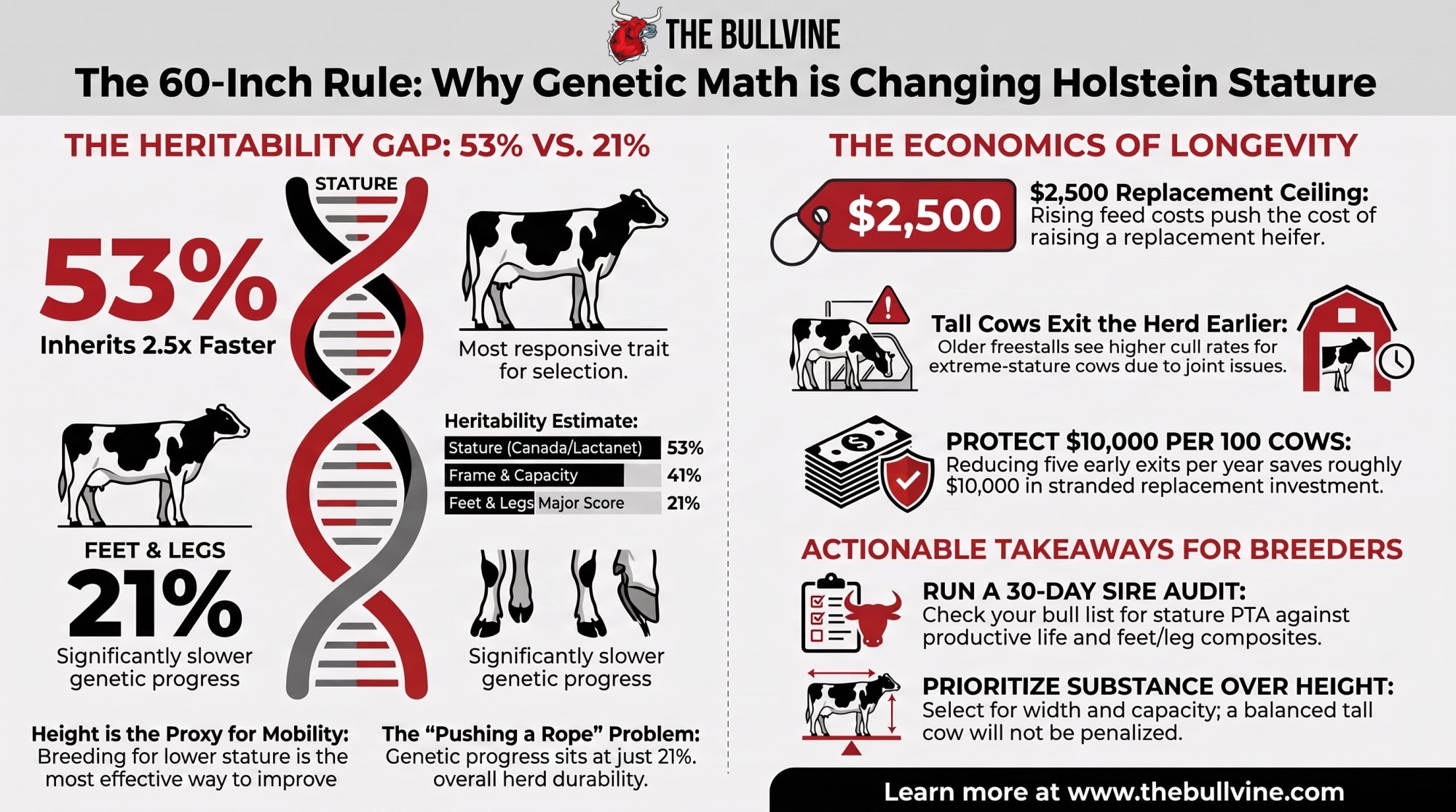
NewsSubscribe
First
Last
Consent

From Depression-Era Auction to Global Dominance: The Picston Shottle Legacy

The dairy industry’s obsession with young genetics got shattered by an “over-the-hill” 8-year-old Canadian cow whose son became Holstein royalty.

Picston Shottle, the speckled bull who defied every breeding convention to become the 7th most influential Holstein sire in history and the only European bull among the top 20 worldwide. Born at Picston Farm in the rolling Staffordshire countryside on July 23, 1999, from an 8-year-old dam deemed "too old" for modern AI breeding, Shottle would go on to sire 9,674 Excellent daughters globally—more than any bull in Holstein history—proving that genetic greatness often emerges from the most unexpected places.
Picston Shottle, the speckled bull who defied every breeding convention to become the 7th most influential Holstein sire in history and the only European bull among the top 20 worldwide. Born at Picston Farm in the rolling Staffordshire countryside on July 23, 1999, from an 8-year-old dam deemed “too old” for modern AI breeding, Shottle would go on to sire 9,674 Excellent daughters globally—more than any bull in Holstein history—proving that genetic greatness often emerges from the most unexpected places.

The barn was quiet that day in 1950, save for the soft shuffling of calves in their pens. Ed McLean called his seventeen-year-old son over to the side of the calf pen in their Barrie, Ontario barn, his weathered hands resting on the wooden rail. “There they are, son, pick one of ’em,” he said simply, gesturing toward the young heifers before them.

Just out of high school and standing at the threshold of his future, Don McLean studied the calves carefully. Something about one particular heifer caught his eye—perhaps it was her bearing or the name that would be registered on her papers. He chose Cranford Sovereign Marjorie, a decision that would ripple through generations and eventually reshape the global dairy industry in ways neither father nor son could have imagined.

“He always called her ‘Marge,'” the records note, and Don was particularly drawn to the “Sovereign” in her name, having heard the legendary stories of Montvic Rag Apple Sovereign that every dairy enthusiast knew by heart. This simple gift from father to son—intended to give the young man “a leg up in life”—would ultimately establish what pedigree expert Douglas Blair would later describe as “the best proof in the world today” and “a royal family whose ultimate expression was Picston Shottle.”

Don and Connie McLean at Condon Farm: The patient builders of a genetic dynasty. From a teenager's choice of a heifer in 1950, Don and his wife Connie would spend decades developing the cow families that would eventually produce Condon Aero Sharon, the dam of Picston Shottle. Their story begins with the empire that made it all possible.
Don and Connie McLean at Condon Farm: The patient builders of a genetic dynasty. From a teenager’s choice of a heifer in 1950, Don and his wife Connie would spend decades developing the cow families that would eventually produce Condon Aero Sharon, the dam of Picston Shottle. Their story begins with the empire that made it all possible.

The Empire That Started It All

To understand the magnitude of what began in that Ontario barn, we must first travel back to the Great Depression and the remarkable empire of Howard Crane. Born in 1895 in Tillsonburg, Ontario, Crane was the kind of entrepreneur who thrived when others struggled. By the 1930s, he had become “the most prominent and prosperous citizen” of Boston and Waterford, Ontario, building an agricultural empire that defied the economic devastation surrounding him.

Picture the morning symphony of Crane’s operation: the rhythmic pulse of milking machines drawing milk into 80-gallon cans, the satisfied lowing of 140 Holstein cows producing “over 23 cans of milk daily,” and the rumble of seven trucks carrying genetic gold to American farms. His success was built on an almost superhuman work ethic and business acumen. He acquired farms at the astonishing rate of one every two years over a decade, eventually owning a dozen properties. Four were dedicated to dairying, while another housed a flock of Shropshire sheep.

But Crane’s genius for cattle trading truly set him apart. “Howard Crane made his fortune by buying and selling dairy cows,” the records state. “All through the 1930s, he shipped 25 head each week to the U.S. alone”. Cows typically remained in his possession for only a day or two—a high-volume, lightning-fast operation that moved cattle through his farms like a river of genetic potential.

The Auction That Changed Everything

The original 1941 newspaper advertisement for Howard Crane's "unreserved auction sale"—the Depression-era dispersal that would unknowingly scatter the genetic foundation of future Holstein royalty. Among the 2,000+ attendees at this "commercial extravaganza" was Ed McLean, whose routine purchase of a three-year-old heifer named Cranford Elaine Burke would set in motion a genetic revolution culminating in Picston Shottle nearly six decades later.
The original 1941 newspaper advertisement for Howard Crane’s “unreserved auction sale”—the Depression-era dispersal that would unknowingly scatter the genetic foundation of future Holstein royalty. Among the 2,000+ attendees at this “commercial extravaganza” was Ed McLean, whose routine purchase of a three-year-old heifer named Cranford Elaine Burke would set in motion a genetic revolution culminating in Picston Shottle nearly six decades later.

In early 1941, Crane made a pivotal business decision. He wanted to purchase the Duncombe Coal and Feed Mill at Waterford and establish a transportation business. To focus on these new ventures, he decided to sell everything—all his farms, cattle, and equipment- in what would become one of Holstein’s most significant genetic dispersal events.

The auction, held on March 26-28, 1941, was advertised as “The largest sale of cattle and farm machinery ever held in Western Ontario.” What followed was nothing short of a “commercial extravaganza” that drew over 2,000 people from Ontario, Quebec, and New Jersey, and Pennsylvania.

The scene was almost carnival-like. Four auctioneers worked in relay, bleachers were erected around the auction ring, and the crowd was so vast that emergency orders for additional lunch supplies had to be dispatched. The air buzzed with excitement as prices soared—a grain separator brought over $1,000, a combine sold for over $600, and the top cow fetched $175.

Among the sea of buyers that day was Edgerton “Ed” McLean, an Elmvale farmer who made what seemed like a routine purchase: a three-year-old Holstein heifer named Cranford Elaine Burke. It was a transaction that would unknowingly lay the foundation for a genetic revolution decades in the making.

The Royal Family Begins

Two years later, Cranford Elaine Burke, now settled in McLean’s herd, gave birth to a heifer calf. Lacking his farm prefix, Ed McLean borrowed Crane’s renowned “Cranford” designation and registered the calf as Cranford Sovereign Marjorie. This was the heifer he would later offer to his teenage son as a gift that would change both their lives.

Don McLean treasured that gift. After helping on the home farm for four years, he eventually established his own operation—Condon Farm, combining his name with that of his wife, Connie. There, he began the patient, methodical work of building a dynasty around Marjorie and her descendants.

Cranford Sovereign Marjorie proved to be an extraordinary foundational cow. She produced four Very Good daughters, each establishing distinct family lines that Don would develop over decades. Her daughter Sovereign Stella Eglantiers became the matriarch of the Princess family, while Condon Texal Cora founded the Molly family, and Condon Citation Elsie established the Sally family.

But the most remarkable genetic story would unfold through the Sally family—specifically through Condon Citation Elsie. Seven generations later, this lineage would produce a heifer named Condon Aero Sharon, whose impact on global Holstein genetics would prove unprecedented.

The Gamble That Defied Convention

Condon Aero Sharon (EX-91) - The eight-year-old Canadian cow deemed "ancient by artificial insemination standards" whose breeding to Carol Prelude Mtoto defied every convention in the AI industry. When the Pickfords and Genus's Judges Choice program chose to "give excellence a chance" with this aging matriarch, they bet £10,000 on what would become "arguably the most powerful brood cow in United Kingdom history" - a gamble that produced Picston Shottle and revolutionized global Holstein genetics.
Condon Aero Sharon (EX-91) – The eight-year-old Canadian cow deemed “ancient by artificial insemination standards” whose breeding to Carol Prelude Mtoto defied every convention in the AI industry. When the Pickfords and Judges Choice program chose to “give excellence a chance” with this aging matriarch, on what would become “arguably the most powerful brood cow in United Kingdom history” – a gamble that produced Picston Shottle and revolutionized global Holstein genetics.

In 1991, Don McLean made the difficult decision to disperse his Condon herd. Among the animals offered was a nine-month-old heifer representing seven generations of careful breeding since his father’s gift. This was Condon Aero Sharon, carrying within her genetic code the accumulated wisdom of decades of selection.

J.E. Hale of England recognized something special in this young heifer and paid £4,400 to bring her across the Atlantic. Upon her arrival in England, Hale promptly offered her at auction, where she caught the attention of John and James Pickford of Picston Farm in Staffordshire, along with Anthony Brough of Tallent Farm in Cumbria. Together, they paid £10,000 for what they saw as an investment in “a genetic legacy that stretched back to Howard Crane’s Depression-era empire.”

Helen Pickford with her children Jonathan (at right), James, and Louise at Picston Farm in Staffordshire. The Pickford family's decision to invest £10,000 in an eight-year-old Canadian cow would prove to be one of the most consequential breeding decisions in Holstein history, ultimately producing Picston Shottle and revolutionizing global dairy genetics.
Helen Pickford with her children Jonathan (at right), James, and Louise at Picston Farm in Staffordshire. The Pickford family’s decision to invest £10,000 in an eight-year-old Canadian cow would prove to be one of the most consequential breeding decisions in Holstein history, ultimately producing Picston Shottle and revolutionizing global dairy genetics.

Sharon would prove to be “arguably the most powerful brood cow in United Kingdom history,” accumulating an impressive 60 brood cow points based on 37 daughters averaging 87 points and seven sons with a median score of 91 points. Her own production was equally impressive: 36,230 pounds of milk at 4.3% fat and 3.3% protein in a single 305-day lactation.

But Sharon’s age would become both a challenge and, ultimately, a triumph. When the Pickfords decided to breed her to Carol Prelude Mtoto, she was already over eight years old—an age considered “ancient by artificial insemination standards” and “too old for the marketing of AI sires.” Conventional wisdom suggests that “genetic progress moved too quickly to waste time on older dams.”

However, the Pickfords and the visionary St. Jacob’s Judges Choice program at ABS made a calculated wager. They chose to “give excellence a chance, even from an eight-year-old Canadian cow whose best years were supposedly behind her.” This decision would later be hailed as providing “an unrivalled service to global Holstein breeding.”

The Birth of a Legend

On July 23, 1999, amidst the tranquil Staffordshire countryside at Picston Farm, Condon Aero Sharon gave birth to a speckled bull calf. The Pickfords named him Picston Shottle, following their system of giving all of Sharon’s offspring names beginning with “S” and “H”—”My husband believed there was only one Sharon and she would remain unique,” Helen Pickford would later explain.

Nothing about this birth seemed extraordinary to outside observers. Yet this calf carried “an extraordinary genetic convergence destined to reach barns across six continents and redefine the very essence of a superior dairy cow.”

The mating that produced Shottle was itself a masterpiece of genetic planning. His sire, Carol Prelude Mtoto, was a highly influential bull known for transmitting “strong, functional type combined with low somatic cell counts.” In 2004, Mtoto was the number one sire of sons in the U.S., with 96 sons averaging impressive genetic merit. His pedigree traced back through legendary names: Prelude-Blackstar-Chief Mark-Bell-Elevation-Bootmaker, connecting him to the foundational genetics of the modern Holstein breed.

Crucially, both parents carried strong connections to Hanoverhill Starbuck, whose influence would permeate 83% of sequenced North American Holsteins by the 21st century. Sharon’s sire, Madawaska Aerostar, was a prominent Starbuck son, while Mtoto carried the Starbuck influence through his paternal line. The union was deliberately designed to create what breeders called a “Starbuck ambassador”—a bull carrying this legendary sire’s influence through both sides of his pedigree.

Breaking All the Rules

Shottle’s entry into artificial insemination might never have happened under conventional breeding programs. His advanced-age dam and unconventional pedigree would typically have eliminated him from consideration. However, The Judges Choice program specifically sought bulls with “alternative pedigrees” saw potential where others saw liability.

The gamble paid off spectacularly. Picture the scene that unfolded across the global dairy community on that January morning in 2008: geneticists in American AI studs doing double-takes at their screens, urgent phone calls buzzing between breeding cooperatives, and progressive dairy farmers in remote corners of the world immediately requesting semen from this unexpected European phenomenon. Shottle’s Total Performance Index (TPI) ranking had soared to an “unprecedented 2060,” a figure that “shattered the ceiling” and caused an immediate stir among geneticists worldwide.

A year later, his impact was further validated when his Lifetime Profit Index (LPI) in Canada reached an astonishing 3944—”a figure described as ‘never seen before'”—solidifying his position as Canada’s #1 LPI leader. These weren’t just numbers; they represented a new era of “balanced excellence” in breeding that promised to enhance dairy operation profitability for decades to come.

By December 2010, Shottle continued to dominate ABS sire summaries with impressive production figures: milk +1334, fat +63, protein +36, and an overall type rating of +2.95 across over 30,000 daughters in 7,276 herds, with semen commanding $100 per dose.

The Daughters That Transformed Daily Life

Huntsdale Shottle Crusade EX 95 3E, Nasco International Type and Production Award Winner at World Dairy Expo, exemplifies the revolutionary daughters that made Picston Shottle legendary—combining show ring excellence with the practical, trouble-free performance that transformed daily dairy operations worldwide.

However, Shottle’s true legacy lay not in statistics but in the quiet revolution he brought to dairy farming operations worldwide. His daughters didn’t just perform well on paper—they transformed the daily experience of working with cattle in ways that made farming more profitable, sustainable, and enjoyable.

Farmers began noticing something different about their Shottle daughters in milking parlors from Wisconsin to New Zealand. These weren’t just cattle that looked good at classification day—they were cows that made every day easier. They walked into the parlor with purpose, settled into their stalls without the nervous shifting that marked high-maintenance animals, and consistently delivered the kind of trouble-free performance that allowed farmers to focus on managing their operations rather than constantly treating problems.

Managing a 500-cow Holstein herd in Wisconsin, Tom captured what these numbers meant in practical terms: “I’d been in the dairy business for thirty years, and I’d never seen anything like those first Shottle daughters. They just did everything right—milked well, bred back easily, stayed sound. It was like having employees who never called in sick”.

Farmers quickly discovered that Shottle daughters averaged 18 days longer lifespan than their contemporaries—a seemingly small difference that translated directly into reduced replacement costs and maximized return on investment. These daughters possessed superior conformation that went far beyond show ring appeal. Their excellent mammary systems significantly reduced mastitis treatments, while their sound feet and legs virtually eliminated costly lameness issues. The result was a direct reduction in veterinary expenses and easier day-to-day management.

Fertility, that critical but often elusive trait, was another Shottle daughter strength. They bred back reliably on schedule, maintaining optimal calving intervals and ensuring consistent milk flow—the lifeblood of any dairy operation.

The daughters also adapted seamlessly to varied feeding and housing conditions, proving essential for diverse global dairy operations. And farmers consistently noted their “fantastic temperament,” which transformed routine chores into more pleasant experiences.

Global Domination

Geneticists witnessed something unprecedented in research centers across 15 countries where EX classifications were awarded. Picston Shottle had achieved 9,674 EX daughters worldwide, significantly surpassing other legendary bulls like Braedale Goldwyn (8,593) and Regancrest Elton Durham (5,515).

This achievement was particularly remarkable because it represented success across diverse countries and classification systems. In Great Britain, Shottle sired 4,979 EX daughters, and in Ireland, another 638, making him “by far the sire with the most EX daughters” in those regions. But his influence extended far beyond his home territory—he ranked 11th in the USA with 1,500 EX daughters and appeared near the top of lists in Canada, France, Italy, Germany, Spain, New Zealand, and Sweden.

This achievement was even more significant because Shottle accomplished it while being “used more intensively and on the best cows worldwide than Durham or Goldwyn.” From elite herds in Holstein, USA, to progressive farms in New Zealand, the world’s most discerning breeders made the same choice—when they wanted to breed their very best cows, they reached for Shottle straws.

Shottle’s global success story established him as “the proud nr. seven on the list of most influential Holstein sires ever”—remarkably, “the only European bull in the top 20, which North American sires otherwise dominate”.

A Legacy That Endures

Even as Shottle aged and eventually passed away in March 2015, his genetic influence continued to expand through an ever-growing network of descendants. Rather than diminishing his relevance, the genomic era amplified his impact by making identifying and propagating his superior genetics easier.

Larcrest Cosmopolitan, a direct daughter of Picston Shottle, achieved the coveted #1 GTPI position among US Holstein cows in the genomic era. Through her daughter Larcrest Crimson (Global Cow of the Year 2016), she launched an entire dynasty of influential AI sires including Calibrate, Camelot, Chavez, Conquest, Casual, and Cyclone—proving that Shottle's genetic revolution continues to reshape dairy barns worldwide, one generation at a time.
Larcrest Cosmopolitan, a direct daughter of Picston Shottle, achieved the coveted #1 GTPI position among US Holstein cows in the genomic era. Through her daughter Larcrest Crimson (Global Cow of the Year 2016), she launched an entire dynasty of influential AI sires including Calibrate, Camelot, Chavez, Conquest, Casual, and Cyclone—proving that Shottle’s genetic revolution continues to reshape dairy barns worldwide, one generation at a time.

A compelling example is the Larcrest Cosmopolitan family. Larcrest Cosmopolitan, a direct daughter of Shottle, achieved the coveted #1 GTPI position among US Holstein cows in the genomic era, launching an entire dynasty of influential AI sires, including Calibrate, Camelot, Chavez, Conquest, Casual, and Cyclone through her daughter Larcrest Crimson (Global Cow of the Year 2016).

Genus ABS continues to actively market semen from his grand sons and great-grandsons, ensuring his genetic blueprint remains active globally. His name frequently appears several generations back in modern genetic evaluations, underscoring his sustained contribution to breed improvement across decades.

Conservative estimates project that his 100,000 daughters will produce over £5 billion worth of milk over their lifetimes—enough revenue to fund thousands of farm expansions, pay for countless college educations for farmers’ children, and secure retirement plans for families who bet their futures on Holstein genetics.

The Shottle Standard: Practical Lessons for Today’s Breeders

For modern dairy farmers seeking to capture the economic advantages that made Shottle’s daughters legendary, his genetic contribution offers a proven template for sustainable breeding decisions. Understanding these principles can guide contemporary farmers toward more profitable, efficient operations:

Prioritize Longevity Over Peak Production: Shottle’s daughters consistently demonstrated that cows lasting an average of 18 days longer than contemporaries create significantly more value through reduced replacement costs and maximized return on investment. Modern breeders should select bulls with Shottle in their maternal lines when seeking to extend productive herd life.

Focus on Functional Conformation: The excellent mammary systems and sound feet and legs that characterized Shottle daughters translate directly to reduced veterinary expenses. Selecting for these traits minimizes common health issues like mastitis and lameness, creating healthier herds that require less intervention.

Select for Consistent Fertility: Shottle daughters’ ability to breed back reliably on schedule maintains optimal calving intervals and overall herd productivity. This trait becomes essential for maintaining consistent milk flow in an era where reproductive efficiency directly impacts profitability.

Choose Adaptable Genetics: Shottle’s daughters performed well across varied feeding and housing conditions, proving essential for diverse global dairy operations. This adaptability becomes increasingly valuable as farms face labor shortages and need cattle that thrive under different management systems.

Embrace Efficiency Over Extremes: The environmental responsibility demonstrated by Shottle daughters—producing more milk per unit of feed while reducing methane emissions and water usage—provides both economic and regulatory advantages. As environmental regulations tighten, these efficient genetics offer biological solutions for sustainable dairying.

Value Temperament: In today’s world where skilled dairy workers are scarce, Shottle daughters offer something invaluable—cattle that make inexperienced hands confident and veteran workers more efficient. Their “fantastic temperament” isn’t just nice—it’s essential for modern operations.

The Human Thread

Perhaps the most remarkable aspect of Shottle’s story is how it demonstrates the profound impact of human vision and courage in genetic improvement. At every critical juncture—Ed McLean’s gift to his son, Don McLean’s patient development of the Condon herd, the Pickfords’ investment in an aging Canadian cow, and ABS’s willingness to try an unconventional mating—individuals made decisions that defied conventional wisdom.

Douglas Blair, the respected pedigree expert who recognized Shottle’s exceptional breeding, captured this perfectly: “Picston Shottle has the best proof in the world today. I have never seen a modern pedigree with so many respected Canadian bulls and prefixes. The bulls: Prelude, Aerostar, Inspiration, Commissioner, Ormsby, Thornlea, and Citation R. The prefixes: Madawaska, Hanover Hill, Browndale, Spring Farm, Thornlea, and Rosafe, all in a row. And Springbank further back”.

This wasn’t an accident. It was the culmination of decades of patient selection, careful mating decisions, and the courage to recognize genetic potential wherever it appeared—even in a heifer offered to a teenager as “a leg up in life.”

The Crane Legacy Lives On

The story of Picston Shottle also represents the end of one era and the beginning of another. The Crane family, whose Depression-era dispersal started this genetic journey, gradually moved away from the cattle business over subsequent generations. Howard’s son Cecil became a prominent cattle dealer but faced legal challenges in the 1940s. Cecil’s son John continued as a cattle agent through the 1960s and ’70s but eventually transitioned to antiques and pony rides after the suicide of a major client.

“The Cranes were a very well-known and prosperous family and were basically quite honest. Good people. Too bad there aren’t any of them left,” the records lament. Yet, in a very real sense, the Crane legacy lives on in every Shottle daughter milking in barns around the world.

The Enduring Lesson

As the dairy industry continues to evolve with genomic selection, robotic milking, and precision agriculture, Shottle’s story offers timeless lessons about the fundamentals of genetic improvement. His success wasn’t built on following trends or chasing extreme production figures but on the patient accumulation of functional traits that make cows more profitable and sustainable over their entire lifetimes.

Modern breeders would do well to remember that efficiency and longevity are not merely abstract genetic ideals but “indispensable economic necessities for the viability and sustainability of modern dairy farming.” The seemingly small improvements Shottle’s daughters brought—milking a little better, lasting a little longer, requiring a little less intervention—when “multiplied across millions of animals, represent billions of dollars in enhanced productivity and sustainability.”

Today, when a dairy farmer in Wisconsin watches a Shottle granddaughter calmly enter the milking parlor or when a producer in New Zealand notices the exceptional feet and legs on his Shottle-influenced herd, they’re witnessing the culmination of a story that began with a seventeen-year-old’s choice in a Canadian barn more than seven decades ago.

The bull who should never have been born—the son of an eight-year-old cow deemed too old for modern breeding—became the seventh most influential Holstein sire in history. His story serves as a powerful reminder that “the most profound changes come not from following the crowd but from having the courage to recognize greatness in unexpected packages.”

In an industry built on the daily miracle of turning grass into milk, Picston Shottle’s legacy reminds us that the greatest genetic treasures often come not from following trends but from recognizing proven excellence wherever it appears. His influence continues through genomic evaluations that identify and amplify his superior genetics, ensuring that the vision of a teenager choosing a heifer in 1950 will shape dairy farming for generations to come.

The magic of genetic improvement lies not just in science and statistics but in the human stories of patient vision and unwavering belief that once recognized and nurtured, excellence can change the world—one daughter, one generation, one farm at a time.

KEY TAKEAWAYS

  • Longevity Trumps Youth: Shottle’s daughters from an 8-year-old dam averaged 18 days longer productive life, directly reducing replacement costs by $300-500 per cow while maximizing return on genetic investment in today’s $2,000+ heifer market.
  • Efficiency Equals Profitability: His daughters’ superior feed conversion ratios and milk-per-unit-feed efficiency addressed 2025’s dual challenges of environmental regulations and feed cost management, delivering both regulatory compliance and improved profit margins.
  • Health Traits Reduce Hidden Costs: Excellent mammary systems and sound feet/legs in Shottle daughters significantly reduced mastitis treatments and lameness issues, cutting veterinary expenses and labor intensity when skilled workers are increasingly scarce.
  • Global Genetic Democratization: As the only European bull in the top 20 most influential sires, Shottle proved that genetic excellence transcends geographical boundaries, offering progressive farmers alternatives to North American genetic monopolies.
  • Sustainable Production Model: With conservative estimates of £5 billion in milk value from his daughters, Shottle demonstrated that balanced genetics focusing on durability and efficiency create generational wealth while meeting 2025’s consumer demands for sustainable dairy practices.

EXECUTIVE SUMMARY

The dairy industry’s obsession with young genetics just got shattered by an “over-the-hill” 8-year-old Canadian cow whose son became Holstein royalty. Picston Shottle—born from a dam considered “ancient by AI standards”—defied every breeding convention to become the #7 most influential Holstein sire globally and the only European bull in the top 20. His 100,000 daughters generated over £5 billion in milk value while averaging 18 days longer productive life than contemporaries, delivering measurable ROI through reduced replacement costs and veterinary expenses. With 9,674 Excellent daughters worldwide (surpassing legends like Goldwyn and Durham), Shottle’s genetics proved that efficiency and longevity create more value than extreme production alone—producing more milk per unit of feed while reducing methane emissions and management intensity. In 2025’s challenging economic climate where sustainability regulations tighten and labor shortages persist, this story demands every progressive dairy farmer reevaluate their genetic selection priorities.

The Sunday Read Dairy Professionals Don’t Skip.

Every week, thousands of producers, breeders, and industry insiders open Bullvine Weekly for genetics insights, market shifts, and profit strategies they won’t find anywhere else. One email. Five minutes. Smarter decisions all week.
NewsSubscribe
First
Last
Consent

Maximize Your Dairy Farm’s Profit: Insights from the 2021 Nutrient Requirements Report

Discover how the 2021 Nutrient Requirements of Dairy Cattle can boost your farm’s profitability. Are you feeding your cows optimally for maximum milk yield and quality?

Imagine running a business where nearly 60% of your expenses come from one thing. Dairy farmers face this, with feed costs taking up a large part of their budget. But here’s the empowering part: understanding how feeding practices impact a dairy farm’s economic outcomes is not just essential, it’s a game-changer. By optimizing feed to boost milk quality and yield, and at the same time, managing costs, dairy farmers can significantly improve their farm profitability and sustainability. 

The dairy industry has transformed significantly over the past 20 years due to advancements in genetics, management practices, and nutritional research. Reflecting these changes, the National Academies of Science, Engineering, and Medicine (NASEM) released the eighth edition of the Nutrient Requirements of Dairy Cattle in December 2021. This update, succeeding guidelines from 2001, incorporates the latest scientific insights and innovations to enhance dairy cow health, productivity, and profitability.

Understanding the nutrient requirements of dairy cattle is crucial for optimizing feed efficiency, improving milk production quality, reducing environmental impact, and ultimately ensuring dairy operations’ overall profitability and sustainability.

The Evolution of Dairy Nutrition: Adapting to Genetic Enhancements and Technological Innovations 

YearAverage Milk Yield per Cow (liters/year)Average Butterfat Content (%)Average Protein Content (%)
20017,8003.63.2
20068,4003.73.3
20118,9003.83.3
20169,3003.93.4
20219,7004.03.5

Over the past two decades, the dairy industry has undergone significant transformations thanks to advancements in cow genetics, management practices, research, and productivity. These changes have deepened our understanding of dairy cow nutrition, making it more intricate but also more impactful on farm profitability and cow health. For instance, in the early 2000s, the focus was on increasing milk yield, but now, we’re also considering factors like cow health, environmental impact, and feed efficiency. 

Selective breeding has enhanced traits such as milk yield, disease resistance, and cow longevity. These genetic improvements have increased productivity and made herds more resilient. 

Management practices have evolved with technological innovations, such as precision farming tools, automated milking systems, and real-time health monitoring, which help optimize cow welfare and milk production. 

The research landscape has expanded, generating data translated into practical feeding strategies. This has led to sophisticated models that accurately predict outcomes, reflecting the complexity of dairy cow nutrition. 

Increased productivity necessitates a nuanced understanding of nutritional requirements. Modern cow diets must meet heightened metabolic demands while ensuring rumen health and overall well-being

The growing complexity of dairy cow nutrition underscores our need for precise feeding strategies. These strategies, when implemented effectively, can support and enhance the advanced genetic and productive capabilities of today’s dairy cows. They are not just tools, but a source of enlightenment and motivation for dairy farmers and nutritionists.

Navigating the Microbial Frontier: Insights into Rumen Function and Precision Feeding

Amidst the evolving landscape of dairy nutrition, our understanding of rumen microbial function has advanced significantly. Two decades ago, we had a rudimentary grasp of the microbial intricacies within the rumen. Today, our insights have deepened, highlighting the critical symbiosis between the cow and its rumen microbes for optimizing milk production and overall health. This understanding has led to the development of precision feeding strategies that take into account the cow’s specific microbial needs. 

Recent advancements in rumen microbial nutrition have revealed the complexities of microbial populations and their intricate interactions with dietary components. We now recognize the essential role of specific microbial communities in breaking down complex carbohydrates, fermenting fibers, and synthesizing vital volatile fatty acids. This nuanced understanding has shifted feeding practices towards precision feeding strategies, which involve tailoring the diet to the cow’s specific needs, thus optimizing feed utilization and cow health. 

The integration of predictive models has been pivotal. By simulating rumen fermentation processes, we can forecast nutrient outflow with greater accuracy, fine-tuning diets to meet the cow’s needs more effectively. This helps balance nutrition while mitigating issues like acidosis, thus safeguarding rumen health. 

These models factor in the degradability of dietary components, the interaction of forage fibers, and the impact of particle size on fermentation rates. This complexity provides a framework for nutritionists to precisely calibrate diets, enhancing milk yields without compromising health. Such advancements underscore the importance of improved rumen microbial function understanding in modern dairy farming. By adopting the NASEM guidelines, dairy farmers can feel reassured and confident in their farming practices, knowing that they are backed by the latest scientific research.

Redefining Dietary Fiber: The Critical Role of Physically Adjusted Neutral Detergent Fiber (paNDF) in Rumen Health 

The concept of physically adjusted neutral detergent fiber (paNDF) represents a significant leap in understanding fiber’s role in rumen health. It specifically addresses how fiber’s physical characteristics maintain the optimal rumen pH necessary for efficient digestion. In simpler terms, paNDF is a measure of the fiber’s physical properties, such as its size and how easily it breaks down, which are crucial for maintaining a healthy rumen environment. 

PaNDF factors in critical elements:

  • Forage NDF (fiber from forage)
  • Fiber fragility (ease of breakdown)
  • Particle size (interaction with rumen microbes)
  • Dietary starch content (impact on rumen pH)

Considering these, the paNDF model maintains a rumen pH of 6.0 to 6.1, fostering an environment for optimal microbial activity and digestion. In simpler terms, a healthy rumen is like a well-functioning digestive system in humans. It’s crucial for the cow’s overall health and efficient digestion of the feed. 

Dairy farmers and nutritionists need precise inputs on cow body weight, dietary forage NDF, and starch content. Tools like the Penn State Particle Separator measure these factors, particularly particle size, ensuring dietary adjustments to sustain the rumen environment. Though complex, the paNDF system ultimately allows dairy herd managers to optimize feed formulations, promoting cow health and efficient milk production.

Unveiling the Modern Energy Paradigm: Enhanced Maintenance Net Energy of Lactation (NEL) and Refined Non-Fiber Carbohydrates (NFC) Calculations

Component20 Years AgoCurrent Requirements
Maintenance Net Energy of Lactation (NEL)25%Increased by 25%
Non-Fiber Carbohydrates (NFC)General categorySeparated into starch and ROM
Digestibility of Supplemental Dietary Fatty Acids92%Reduced to 73%
Digestibility of NDF and StarchVariable based on dry matter intake (DMI)Refined with specific considerations

The recent energy requirement update shows a notable 25% increase in the maintenance net energy of lactation (NEL) requirement. This change highlights our growing understanding of the energy needs tied to today’s high-producing dairy cows. 

Another crucial adjustment is the division of non-fiber carbohydrates (NFC) into starch and residual organic matter (ROM). This allows for a more detailed examination of starch degradability and its influence on rumen fermentation. At the same time, ROM is considered 96% digestible. 

Advancements in digestibility calculations further enhance our predictive accuracy. Digestibility models, previously based solely on dry matter intake (DMI), are now more refined. For example, dietary fatty acid digestibility has been adjusted from 92% to 73%. NDF and starch digestibilities are tweaked based on intake levels, aligning dietary energy inputs with cow energy needs more precisely.

Revolutionizing Protein Nutrition: From Metabolizable Protein (MP) to Essential Amino Acids (EAA) in Dairy Cattle

Protein RequirementMetabolizable Protein (MP)Essential Amino Acids (EAA)
Maintenance500 g/day20 g/day
Lactation (30 kg milk/day)1,300 g/day60 g/day
Growth (500 g/day)950 g/day45 g/day
Pregnancy (6th to 9th month)700 g/day30 g/day

The recent NASEM report marks a significant shift in protein nutrition for dairy cattle by transitioning from metabolizable protein (MP) to essential amino acids (EAA). This change emphasizes precision in nutrient utilization to enhance dairy cow productivity and health. Previously, MP served as a broad measure of absorbed protein but fell short in predicting specific protein synthesis needs. In contrast, EAA provides a more accurate measure of the cow’s protein needs, allowing for more precise feeding strategies. 

The NASEM committee conducted an extensive review to identify the EAA requirements for synthesizing various proteins, including those in milk, urine, scurf, feces, tissue growth, and pregnancy. They established EAA needs through a thorough examination of research, focusing on the efficiency of EAA use, which varies by protein type. This approach allows for more accurate predictions of dietary protein conversion, enabling precise and cost-effective diet formulations. 

Adopting an EAA-centric model offers practical advantages. Nutritionists can now create diets with lower protein content while still meeting cows’ needs, reducing feed costs and environmental impacts from nitrogen excretion. As dairy nutrition advances, these improvements support more sustainable and economically viable farming practices.

Strategic Nutrition for Transition Cows: A Pivotal Aspect in Managing Post-Calving Health Risks

StageEnergy Needs (NEL, Mcal/day)Protein Needs (g/day)
Close-up Dry Period14 – 161,200 – 1,400
Fresh Period18 – 221,500 – 1,700
Peak Lactation22 – 281,700 – 2,000

The period around calving is crucial for dairy cow health and productivity, making transition cow management and feeding vital. Proper nutrition during this phase can mitigate post-calving disease risks. The NASEM 2021 report adopts a continuous function approach to predict energy and protein needs during gestation. Though more physiologic, this method challenges meeting nutritional requirements with a one-size-fits-all diet. 

Dry Matter Intake (DMI) predictions now factor in dietary Neutral Detergent Fiber (NDF) content to address this. As dietary NDF rises from 30% to 50%, DMI decreases, ensuring transition cows receive adequate fiber without overwhelming their digestive system. 

The report also doubles the dietary vitamin E requirement from 1,000 IU to 2,000 IU per day for close-up dry cows, boosting their immune function during this critical period. Additionally, dry cows’ trace mineral needs have been increased to prevent deficiencies as they prepare for lactation. Minimal changes were made for heifers and lactating cows, highlighting the unique nutritional needs during the transition period.

Embracing Nutritional Nuance: The NASEM 2021 Report’s Evolved Approach to Mineral and Vitamin Requirements

NutrientLactating Cows (mg/day)Dry Cows (mg/day)Heifers (mg/kg of DM)
Calcium10,0008,0006-12
Phosphorus6,2004,5003-7
Magnesium2,5001,8002-4
Sodium3,0002,5000.5-1.0
Potassium15,00012,00010-15
Vitamin A (IU)50,00030,00020,000-40,000
Vitamin D (IU)1,5001,000700-1,000
Vitamin E (IU)1,0002,000300-500

In addition to updated mineral and vitamin requirements, the NASEM 2021 report takes a nuanced approach to defining these essential nutrients. Unlike previous NRC guidelines focusing on specific production outcomes, the new report uses population mean values, moving away from a one-size-fits-all strategy. 

A notable change is the increase in dietary vitamin E for close-up dry diets, doubling from 1,000 IU to 2,000 IU per day. This adjustment aligns with recent research highlighting vitamin E’s role in disease prevention and cow health. Trace mineral requirements have also been revised, emphasizing their importance during the dry period, while changes for heifers and lactating cows remain minimal. 

The committee employs a factorial approach, utilizing data to calculate a population mean value instead of strict “requirements.” When data is sufficient, a safety factor is included. Due to limited data, the committee offers “adequate intake (AI)” recommendations rather than rigid requirements, allowing on-farm flexibility and adjustments tailored to specific herd conditions.

The Bottom Line

The new NASEM guidelines highlight pivotal updates reflecting two decades of advancements in dairy cows’ genetics, physiology, and nutrition. These guidelines equip dairy farmers with tools to fine-tune feeding strategies, emphasizing precise energy balance and a novel focus on essential amino acids for protein nutrition. Models like paNDF ensure optimal rumen health, which is crucial for maximizing feed efficiency

Incorporating these guidelines allows dairy farmers to manage feed costs more strategically without compromising cow health or productivity. Enhanced energy and protein calculations lead to balanced diets, potentially reducing feed expenses by minimizing waste. Focusing on nutrient bioavailability and adequate intake also streamlines mineral and vitamin supplementation, further optimizing costs. 

Adopting the NASEM guidelines offers significant practical benefits. They help farmers improve herd longevity and well-being, reducing veterinary costs and post-calving health risks. This boosts milk yields and enhances milk quality, leading to better market prices. By aligning feeding practices with the latest science, dairy farms can improve operational efficiency and profitability, ensuring a more sustainable and viable future for the industry.

Key Takeaways:

  • Feed costs remain a significant portion of production costs, ranging from 45% to nearly 60%, underscoring the need for efficient nutrient management.
  • The highest milk yield does not always equate to the best farm profitability; a balance between yield, composition, and quality is crucial.
  • The evolving understanding of rumen microbial function and nutrition guides precision feeding strategies.
  • Introduction of physically adjusted neutral detergent fiber (paNDF) to ensure rumen health by maintaining optimal rumen pH and efficient fiber digestion.
  • Significant updates in energy and protein requirements, including a 25% increase in maintenance net energy of lactation (NEL) and a shift from metabolizable protein (MP) to essential amino acids (EAA) for protein nutrition.
  • Continuous function approach in predicting the energy and protein needs of transition cows enhances disease risk management post-calving.
  • Revision of mineral and vitamin requirements with a focus on bioavailability and adequate intake (AI) rather than strict requirements.

Summary: The dairy industry has undergone significant changes in the past two decades due to genetics, management practices, and nutritional research. The National Academies of Science, Engineering, and Medicine (NASEM) released the eighth edition of the Nutrient Requirements of Dairy Cattle in December 2021, reflecting these changes. Understanding the nutrient requirements of dairy cattle is crucial for optimizing feed efficiency, improving milk production quality, reducing environmental impact, and ensuring profitability and sustainability. Selective breeding has enhanced traits like milk yield, disease resistance, and cow longevity, increasing productivity and resilience. Technological innovations have evolved management practices, such as precision farming tools, automated milking systems, and real-time health monitoring. The research landscape has expanded, generating data that has led to sophisticated models that accurately predict outcomes. Adhering to NASEM guidelines provides dairy farmers with confidence in their farming practices, backed by the latest scientific research. The NASEM 2021 report emphasizes strategic nutrition for transition cows, adopting a continuous function approach to predict energy and protein needs during gestation.

Robotic Milking: Is It the Right Choice for Your Dairy Farm?

Uncover whether robotic milking aligns with your dairy farm’s needs. Delve into the advantages, financial implications, and practical considerations in our detailed guide tailored for contemporary farmers.

What if you could reduce labor costs, improve milk yield, and enhance animal welfare simultaneously? Robotic milking systems offer these benefits, transforming traditional dairy farming into a high-tech operation.  But before you get too excited, let’s consider the potential drawbacks. These sophisticated systems utilize advanced robotics to automate the milking process, offering an enticing array of benefits, including enhanced efficiency, improved animal health, and optimized milk production. Yet, amidst the excitement and potential lies a critical question: Is robotic milking the right choice for your farm? As we delve into the intricacies and advantages of this transformative technology, we aim to shed light on whether embracing this automated approach aligns with your dairy farming goals and practices.

Understanding Robotic Milking: An Introduction

Robotic milking systems are revolutionizing dairy farming with their reliability, consistency, and operational efficiency. As labor costs rise and skilled workers become more challenging to find, these systems are being adopted rapidly, especially by farms milking under 1,000 cows. They offer numerous benefits, well beyond just labor savings. 

A key advantage is the extensive herd management data that these systems provide. For instance, automating the milking process means collecting valuable data on each cow’s production, health, and behavior. This data can help farmers make swift, informed decisions, such as adjusting feed rations or identifying health issues early. This data-driven approach boosts output per cow, improves pregnancy rates, increases milk quality payments, and enhances cow longevity. 

Francisco Rodriguez of Madison, Wisconsin, an expert in robotic milking, highlights the transformative impact of these systems. “We’ve seen remarkable improvements in herd health and productivity, along with easier management thanks to detailed analytics,” he notes. The return on investment for farmers using robotic milking systems can be significant, driven by improved efficiency and reduced labor costs. This potential for increased profitability should inspire optimism and hope for the future of your dairy farm.

Is Robotic Milking Right for Your Dairy Farm?

Determining if a robotic milking system (RMS) suits your dairy farm requires careful assessment of several critical factors. First, consider the scale of your operation. RMS is typically more beneficial and cost-effective for farms with fewer than 1,000 milking cows. The initial costs and logistical challenges might overshadow the advantages of larger farms. 

Labor dynamics are also crucial. The agricultural sector often struggles to find stable, skilled labor. RMS mitigates this by reducing dependency on human labor and providing consistent and reliable milking. Advanced analytics from RMS can enhance herd management, improve cow health, and boost production. 

Next, evaluate your existing infrastructure. Should you retrofit current barns or build new ones for RMS? Retrofitting may be less expensive but could compromise functionality. At the same time, new constructions can be optimized for RMS, enhancing workflow and cow comfort

Financially, while the initial setup costs for RMS are significant, the ROI can be realized through higher milk quality payments, increased yields, and improved cow longevity. RMS also promotes a quieter barn and better teat health, reducing stress for cows and farmers alike. 

Ultimately, transitioning to RMS demands a thorough analysis of benefits. To gather insights, engage with experts, review case studies, and visit farms with RMS.  By weighing these factors, dairy farmers can determine if robotic milking aligns with their long-term goals and capabilities. This emphasis on careful assessment should instill a sense of responsibility and diligence in your decision-making process.

Key Benefits of Robotic Milking Systems

CategoryBenefits
EfficiencyReliability, consistency, and efficiency in milking processes
Herd ManagementVolumes of herd management and analysis information
ProductionHigher production per cow and increased milk quality payments
ReproductionIncreased pregnancy rates and improved cow longevity
LaborLabor savings valued at $44,030 per year; decreased total milking labor
Cow HealthDecreased lameness; improved teat ends and reduced over-milking; increased rest and wellness
EnvironmentQuieter barn environment
Return on InvestmentPositive financial return due to various efficiencies and savings

Among the most compelling advantages of robotic milking systems is their remarkable reliability and consistency. Unlike human laborers, robots perform tasks with precision, directly translating to higher milk quality and more reliable production schedules.

The volume of herd management and analysis information these systems provide must be balanced. Advanced sensors and software continuously monitor each cow’s health, milking patterns, and overall well-being, delivering data that aids in making informed decisions. This oversight enhances herd management and fosters a proactive approach to animal health, potentially reducing illness rates and improving longevity.

Another critical benefit is higher production per cow. Optimized milking processes and better teat care adjust dynamically based on each cow’s requirements, minimizing over-milking and stress. This results in more comfortable cows that produce more milk over their lifetimes. Enhanced pregnancy rates and increased milk quality payments further the return on investment.

Labor savings can be substantial, valued at around $44,030 per year. Automating the milking process allows farmers to redirect human resources to strategic activities, reducing time and resources spent on hiring, training, and overseeing personnel, thereby lowering operational costs. This also mitigates labor shortages and turnover challenges.

Moreover, the reliability and consistency of robotic milking systems cannot be overstated. As one seasoned dairy farmer succinctly said, “Never had to pull a drunk robot out of the ditch.” This sentiment encapsulates the dependability and unwavering performance of robotics compared to the unpredictability of human labor, further underscoring their value in modern dairy farming.

Another advantage is the positive impact on cow health and well-being. Robotic milking systems, due to consistent and gentle handling, contribute to decreased lameness and increased rest and wellness for cows. Additionally, the quieter barn environment facilitated by these systems reduces stress levels, promoting a more productive setting. This emphasis on improved animal welfare should evoke feelings of compassion and care towards your livestock.

Potential Drawbacks to Consider

While the advantages of robotic milking systems (RMS) are compelling, dairy farmers must weigh these benefits against potential drawbacks. One primary concern is the substantial initial investment required. Procuring and installing an RMS can be significantly costlier than traditional methods. Despite long-term labor savings and potential increases in milk production, the upfront financial burden can be daunting for smaller or mid-sized farms

Another consideration is the complexity of the technology. A successful transition to an RMS requires a thorough understanding and proper maintenance. Inadequate training or poor maintenance can lead to downtime, jeopardizing animal health and milk quality. Thus, farmers must shift from hands-on milking to managing sophisticated machinery. 

Moreover, optimizing RMS performance often necessitates a well-designed barn layout. Retrofitting existing barns can be challenging and costly, potentially disrupting operations. Building a new barn tailored to RMS demands more financial commitment and planning. 

Labor dynamics also change with RMS adoption. While it reduces total milking labor, farmers must monitor and manage the robots, troubleshoot issues, and ensure smooth operations. This can necessitate a steep learning curve and adjustment period. 

Additionally, RMS can reduce cow lameness, but it might also decrease time spent on critical tasks like heat detection and individual cow health monitoring. Automation could lead to more isolated interaction with livestock, potentially impairing farmers’ understanding of cow behavior and health. 

Lastly, RMS profitability can fluctuate based on robot durability, daily milk yield per cow, and the labor market. Automated systems might seem appealing because they could reduce available immigrant labor, but this must be balanced against technological breakdowns and maintenance costs. 

Ultimately, a meticulous evaluation is essential. Asking fundamental questions like ‘Why do I want to buy robots?’ can help determine if these systems align with the farm’s long-term goals. The transition to RMS can be genuinely beneficial with careful planning, adequate training, and proactive management.

Cost Analysis: Is It Worth the Investment?

As you delve into the financial implications of adopting a robotic milking system (RMS), evaluating both the initial investment and long-term economic benefits is crucial. Purchasing and installing the robots can be substantial, often reaching hundreds of thousands of dollars. For a 180-cow farm, annual payments might be around $101,000 over two decades—a significant commitment that requires careful consideration. 

Nevertheless, the potential for cost savings and increased efficiency is promising. Tools like the one developed by the University of Minnesota allow farmers to gauge the economic impact of transitioning to an RMS. This tool compares traditional milking parlors and robotic systems based on variables like milking labor, feed costs, and robot durability. 

One key advantage of RMS is the potential reduction in feed costs, contributing to a lower cost of production. Robotic systems can help reduce waste and improve yields by optimizing feed allocation and monitoring cow health. Additionally, typically significant labor costs can be reduced as robots take over repetitive milking tasks, allowing workers to focus on other vital farm management areas. 

Insights from industry experts like Francisco Rodriguez underline the importance of understanding your motivations. Asking yourself, “Why do I want to buy robots?” and ensuring your barn is well-designed and managed can help assess if this technology aligns with your long-term goals. 

Retrofits add complexity, as profitability in these cases depends on current facilities, existing milking systems, and operation scale. Factors like daily milk production per cow, milking labor costs, and robotic system durability are critical. Achieving a short attachment time can enhance overall system efficiency and profitability. 

In conclusion, while the investment in robotic milking systems is substantial, the potential economic benefits can justify the cost for many dairy farms. By leveraging available economic tools and considering all variables, dairy farmers can make an informed decision that supports the long-term sustainability and productivity of their operations.

Choosing the Right Robotic Milking System

When exploring robotic milking systems, selecting the right technology is crucial for your dairy farm’s success. Evaluate these key factors to make an informed decision: 

1. Herd Size and Layout: These systems are ideal for dairy farms with fewer than 1,000 cows. Decide whether to retrofit existing barns or build new ones; retrofitting might save costs, but a new facility could improve efficiency and cow throughput. 

2. System Capabilities and Features: Examine the technological features, such as autonomy, data analytics, and software compatibility. Advanced systems offer detailed herd management insights, aiding in health, production, and management decision-making. 

3. Support and Maintenance Services: The system’s reliability depends on both its design and the quality of support services. To prevent costly downtimes, ensure you have access to efficient technical support and routine maintenance. Prioritize vendors with strong support networks. 

4. Financial Considerations: Though costs have decreased, robotic milking systems are a significant investment. Consider long-term benefits like increased milk quality, cow longevity, and potential higher production per cow. A comprehensive cost-benefit analysis ensures that the investment meets your financial goals. 

5. Adaptability and Future-Readiness: Agricultural technology evolves rapidly. Invest in scalable and adaptable systems that can accommodate future advancements, ensuring lasting value and safeguarding against obsolescence. 

In conclusion, carefully analyze your farm’s unique needs and objectives. Consider herd size, system features, support services, financial implications, and future adaptability to choose a system that meets your current needs and positions your dairy operation for future success.

Case Studies: Success Stories from Modern Farms

Exploring real-world applications of robotic milking systems offers valuable insights for dairy farmers considering this transition. A notable example is Green Pastures Dairy, which successfully integrated robotic milking into its operation. Investing in high-tech barns designed for cow comfort and labor efficiency has significantly increased milk production. 

Cows at Green Pastures Dairy thrive on carefully managed transition programs and high-quality forage, creating an optimal environment for health and productivity. Their strategic use of multiple robot feed supplements has improved individual cow yields, resulting in increased milk output, healthier cows, and a more balanced work-life for the farmers. 

Horizon Vista Dairy offers another illustrative case. This large-scale operation effectively retrofitted existing free-stall barns based on recommendations from a University of Minnesota study on RMS profitability. They automated milking without new construction, emphasizing maintenance and cleanliness to ensure peak robot efficiency. 

Robotic milking at Horizon Vista has led to more predictable schedules, benefiting both cows and workers. They leverage advanced data analytics to monitor cow performance and health, bridging technology and animal welfare. Achieving high production per cow and robot, Horizon Vista demonstrates RMS’s financial and operational feasibility in existing facilities. 

These case studies show that thoughtful planning and execution are crucial for realizing the full potential of robotic milking systems. Whether custom-built or strategically retrofitted, the success stories of Green Pastures Dairy and Horizon Vista Dairy offer a roadmap for others. Their willingness to embrace change and invest in the future underscores the game-changing potential of robotic milking in modern dairy farming.

Future Trends in Robotic Milking Technology

The trajectory of robotic milking technology is set to revolutionize dairy farming by seamlessly integrating precision, efficiency, and sustainability. One notable advancement on the horizon involves the evolution of artificial intelligence(AI) and machine learning. These technologies will enhance robotic milking systems, allowing for more precise routine milking tasks, data analysis to predict health issues, and optimized feeding schedules tailored to each animal. 

Moreover, integrating Internet of Things (IoT) devices with robotic milking systems promises real-time monitoring and interconnected farm management. IoT sensors can track cow movement, behavior, and barn conditions, providing farmers with a comprehensive view of their farm environment for more informed decision-making. 

Future developments also include advanced robotic arms and milking units designed to be more flexible and adaptable to various cow sizes and breeds. This improvement enhances the milking process and reduces animal stress and discomfort, potentially increasing milk yield and quality. 

Sustainability is another key aspect, with innovations focusing on reducing dairy farming’s environmental footprint. These include energy-efficient robotic systems, water recycling, and waste management solutions, offering farmers a competitive edge as consumers prioritize sustainable practices. 

Looking ahead, deeper integration of robotic milking systems with supply chain management and distribution networks is anticipated. Blockchain technology could support enhanced traceability, ensuring milk and dairy products are tracked from farm to table, promoting consumer transparency and trust while improving operational efficiency. 

In conclusion, the future of robotic milking technology is about creating a more innovative, connected, and sustainable dairy farming ecosystem. As these technologies advance, they promise to address critical challenges in dairy farming, ensuring the industry’s resilience and forward-looking nature.

The Bottom Line

Implementing robotic milking systems on your dairy farm requires a thorough evaluation of various critical factors. Key benefits such as improved labor efficiency and enhanced herd health come with potential drawbacks like initial costs and the need for technological proficiency. Financially, these systems can significantly impact your operations, especially with intensive use. Still, initial investments must be balanced against long-term savings and productivity boosts. 

Recommendations: 

  • Analyze your farm’s labor situation. Robotic systems are highly beneficial where labor efficiency and availability are significant issues.
  • Compare the initial and ongoing costs within your financial strategy. Ensure it aligns with your overall business goals.
  • Think about how robotic milking aligns with your goals for better herd health and nutrition management.
  • Research various robotic milking systems. Choose one that suits your farm’s size, breed, and operational needs.

Before transitioning, conduct comprehensive research and seek expert advice. Visit farms using robotic systems successfully and study their outcomes. This approach ensures an informed, strategic decision aimed at long-term success.

As you explore the intricacies of robotic milking systems, it can be invaluable to expand your understanding through related resources. To provide a well-rounded perspective, we recommend the following articles: 


Key Takeaways:

  • Understand what robotic milking systems are and their core functionalities.
  • Evaluate whether your dairy farm can benefit from transitioning to automated milking.
  • Examine the key benefits such as increased efficiency, improved animal health, and enhanced milk production.
  • Consider potential drawbacks like initial investment costs and system maintenance.
  • Analyze the cost-effectiveness and return on investment for implementing robotic milking systems.
  • Explore how to choose the right system tailored to your farm’s needs and infrastructure.
  • Learn from real-world case studies of farms that have successfully adopted robotic milking technology.
  • Stay informed about future trends and innovations in robotic milking technology.


Summary: Robotic milking systems are revolutionizing dairy farming by improving efficiency, animal health, and milk production. These systems are being adopted by farms with fewer than 1,000 cows due to rising labor costs and the difficulty in finding skilled workers. The extensive herd management data provided by these systems helps farmers make informed decisions, such as adjusting feed rations or identifying health issues early. This data-driven approach boosts output per cow, improves pregnancy rates, increases milk quality payments, and enhances cow longevity. The return on investment for farmers using robotic milking systems can be significant, driven by improved efficiency and reduced labor costs. To determine if a robotic milking system is suitable for your farm, consider factors such as the scale of your operation, labor dynamics, existing infrastructure, and the ROI on higher milk quality payments, increased yields, and improved cow longevity. To transition to RMS, engage with experts, review case studies, and visit farms with RMS. In conclusion, the future of robotic milking technology aims to create a more innovative, connected, and sustainable dairy farming ecosystem.

Send this to a friend