Reclassified under the four-tier standard, nearly 39% of U.S. heifer calves land in Fair or Poor — and the research suggests that gap follows them into first lactation.
The vet pulls blood from twelve healthy heifer calves, spins it, and runs each sample across a refractometer you already own. Nothing looks wrong. None of these calves are sick. They’re bright, they’re nursing, and they’d pass any eyeball test. Then the numbers come back — and the chart tells a different story than the calves do.
That’s the moment this whole thing turns. For twenty years, the standard said a calf either passed or failed at 10 g/L of serum IgG — and by that math, roughly 90% of calves in the USDA’s National Animal Health Monitoring System (NAHMS) Dairy 2014 study passed. A clean 90%. Sounds like a program that’s working. But it isn’t measuring what pays you back.
The Standard Quietly Changed, and Most Herds Didn’t Notice
In 2020, a group of calf experts led by Jason Lombard published consensus recommendations in the Journal of Dairy Science that retired the old pass/fail line. In its place: four tiers of passive transfer — Excellent, Good, Fair, and Poor — each with serum IgG, total protein, and Brix cut points you can read on-farm (Lombard et al., J. Dairy Sci.103:7611–7624, 2020, U.S. dairy calves).
Transfer category
Serum IgG (g/L)
Total protein (g/dL)
Brix (%)
Herd target (% of calves)
Excellent
≥ 25.0
≥ 6.2
≥ 9.4%
> 40%
Good
18.0 – 24.9
5.8 – 6.1
8.9% – 9.3%
≈ 30%
Fair
10.0 – 17.9
5.1 – 5.7
8.1% – 8.8%
≈ 20%
Poor
< 10.0
< 5.1
< 8.1%
< 10%
Now run the old NAHMS numbers through the new lens. When the Dairy 2014 data get reclassified into Lombard’s tiers, only about 35.5% of heifer calves land in Excellent, 25.7% in Good, 26.8% in Fair, and 12.0% in Poor (USDA APHIS, NAHMS Dairy 2014 info brief, U.S. national). It’s a decade-plus old, but it’s still the most recent USDA national passive-transfer survey we have. Same calves. Same blood. Nearly 39% of them are sitting in Fair or Poor.
The blood draw didn’t change. The question did. The old test asked, “Is this calf in danger?” The four-tier chart asks something harder: “Is this calf on track to pay back what she cost to raise?”
Why Is a Blood Value Really a Revenue Number?
Three separate studies point at the same target, and none of them are about scours.
Back in 1989, DeNise and colleagues followed roughly 1,000 Holstein heifers and found serum IgG measured shortly after birth was a real source of variation in first-lactation milk — a slope of 8.5 kg of mature-equivalent (ME) milk per 1 g/L of serum IgG (DeNise et al., J. Dairy Sci. 72:552–554, 1989). ME basis means the figure is standardized to a mature cow’s production, not a raw first-lactation tank weight. It’s an association from one cohort, not a guarantee. But it’s held up across the citations since, and it puts a number on a blood value most people file under “health.”
Then there’s growth. Soberon and colleagues reported that each 1 kg of preweaning average daily gain tracked with 850 kg more first-lactation milk in the Cornell herd, and 1,113 kg more in a commercial herd (Soberon et al., J. Dairy Sci.95:5254–5267, 2012). That early growth runs straight through the same colostrum window you’re testing.
And the cost of getting it wrong isn’t hypothetical. Raboisson’s 2016 meta-analysis pegged the mean total cost of a dairy calf with failure of passive transfer at about €60, with a prediction interval running to €109 (Raboisson et al., PLOS ONE, 2016). That’s before you count the milk you never make.
The Barn Math Nobody’s Running
Walk it through on one calf. Take a heifer sitting at 15 g/L — squarely mid-Fair, right where a big share of NAHMS calves live. Compare her to a herdmate at 25 g/L, the floor of Excellent. That’s a 10 g/L gap.
💸 The Leak on the Milk Check
A calf in Fair (15 g/L) instead of Excellent (25 g/L) sits at a 10 g/L deficit.
On DeNise’s 1989 slope, that gap tracks with roughly 85 kg — about 187 lbs — of lost first-lactation milk per calf, mature-equivalent (ME) basis.
Scale it: for every 25 heifers stuck in Fair that could’ve reached Excellent, that’s roughly 4,675 lbs of ME first-lactation milk you’d already paid to raise.
This is an association from one cohort, not a guaranteed yield — but it’s the direction, and it’s real.
That’s the whole tension. The math has existed since 1989. The levers are known. And on most farms it’s still filed next to the scours rate instead of next to pregnancy rate and feed conversion. A leak spread across a quarter of the heifer crop never shows up as a disaster — it shows up as a herd that’s “doing fine.”
How Do You Actually Read the Herd? The 12-Calf Scorecard
Here’s the tool. Have your vet pull serum from at least twelve clinically normal heifer calves at 24 to 48 hours of age — healthy ones, not the sick pen. Read each on a Brix or total-protein refractometer, the same one plenty of herds already use on colostrum. Sort them into the four tiers. Plot the distribution against the 40/30/20/10 target.
Tier
Serum IgG (g/L)
Herd Target (%)
Morin Benchmark
Action If Below Target
Excellent
≥25.0
>40%
—
Protocol is working; maintain
Good
18.0–24.9
≈30%
Combined Excellent+Good should exceed Morin’s 68% median
Check Brix consistency shift-to-shift
Fair
10.0–17.9
≈20%
—
Audit first-feeding volume (target ≥2.5 L).
Poor
<10.0
<10%
—
Trigger: audit volume, Brix, and timing on every calf for a month.
Two things matter here. First, sample the calves that look good, because a sick-calf test only tells you about that calf — a healthy-calf sample tells you what your whole system is producing. Second, do it early, before dehydration or illness muddies the reading. Twelve is a floor, not a ceiling; more calves sharpen the picture.
The first time a herd runs this, the chart usually looks a lot like NAHMS 2014 — about a third Excellent, a quarter Good, the rest stuck in Fair and Poor — unless they’ve already put real work into colostrum. That’s the “oh” moment. And it goes one of two ways.
Sponsored Post
What Separates the Farms That Move From the Ones That File It Away
The difference isn’t knowledge. It’s ownership. And the fixable levers aren’t complicated — they’re things that happen in the first hours after a calf hits the ground.
Morin’s herd-level work in Québec makes the levers concrete. Across 144 herds, the prevalence of adequate transfer of passive immunity ranged from 24% to 100%, with a median of 68% (Morin et al., J. Dairy Sci. 104:1122–1135, 2021). In the final model, only two things stayed significantly tied to a herd hitting adequate transfer: how consistently calves got enough colostrum volume at the first meal, and how consistently they got it fast.
Feature
Old Pass/Fail Standard (pre-2020)
Lombard Four-Tier Standard (2020)
Cut point
Single line at 10 g/L serum IgG
Four bands: <10, 10–17.9, 18–24.9, ≥25 g/L
% of NAHMS 2014 calves “adequate”
~90% pass
61.2% (Excellent + Good)
% flagged as a concern
~10% fail
38.8% (Fair + Poor)
What it actually predicts
Disease risk only
Disease risk AND first-lactation milk (ME)
Herd target
“Pass rate” — no upper tier goal
40/30/20/10 distribution across tiers
The companion calf-level study put odds on it. Calves had 2.6 times higher odds of adequate transfer when they got at least 2.5 L at the first feeding, 2.9 times higher odds with colostrum at 24.5% Brix or better, and 1.6 times higher odds when fed within three hours of birth (Morin et al., J. Dairy Sci. 104:4904–4918, 2021, Québec herds). Volume, quality, timing.
A 2025 European study drives home how much herds vary. Across 1,041 calves on 108 farms in six countries, an average of just 35.3% of calves hit Excellent — and only one country, Spain at 47.5%, cleared Lombard’s 40% bar. German herds in the study sat at 21.7% Excellent, French herds at 30.5%. Every extra liter of colostrum raised the odds of Excellent-instead-of-Poor by about 1.5 times (Fernandez-Novo et al., Front. Vet. Sci. 12:1515196, 2025; funded in part by Boehringer Ingelheim Vetmedica; per the paper’s disclosure, the funder was not involved in data analysis or interpretation). Same continent, same standard — a 26-point spread between the best and worst countries. The farms that don’t move tend to spread those levers across shifts and staff, with nobody owning the number.
Building the Dashboard: Owner, Target, Consequence
Pregnancy rate works because it has an owner, a target, and a consequence when it slips. Passive transfer distribution has none of that on most farms yet. You’d have to build it — and the science already hands you every piece.
The owner. The calf manager runs the twelve-calf sampling and the levers. The herd vet reads the chart against Lombard’s targets and connects it to health and growth. The owner owns the money side and decides what a drifting number is worth fixing.
The target. Short-term, beat Morin’s median of 68% adequate transfer, and keep Poor under 10%, Lombard’s herd standard. Medium-term, push the whole distribution toward more than 40% Excellent, around 30% Good, no more than 20% Fair.
The consequence. When Poor climbs past that 10% line, it isn’t just a health flag. Crannell and Abuelo’s retrospective cohort work found calves in the lower passive-immunity categories carried worse morbidity, mortality, and future performance than their better-transferred herdmates (Crannell & Abuelo, J. Dairy Sci. 106:2729–2738, 2023, single dairy herd). That’s your trigger to audit volume, Brix, and timing on every calf for a month.
None of this is new science. It’s a reshuffle — taking numbers that already exist and moving them into the room where the P&L conversation happens, instead of leaving them in the sick pen.
Options and Trade-Offs for Your Operation
Depending on where your herd sits, a few honest paths:
Option 1: Run the 12-Calf Scorecard This Month
Best for: Any herd that has only ever tested sick calves.
Requirement: One vet visit and about an hour of labor to pull serum from twelve clinically normal heifers at 24–48 hours, then classify each against the Lombard tiers.
Risk: None — the only exposure is discovering where the distribution actually sits.
Option 2: Lock Down the Shift-to-Shift Protocols
Best for: Herds where calf results swing depending on who worked the night shift.
Requirement: Enforcing 2.5–3 L within two to three hours, at 24.5% Brix or better (Morin et al., 2021). No capital — protocol discipline and staff buy-in.
Risk: Protocol fatigue if nobody is assigned direct ownership of the data; the chart won’t move and you’ll blame the wrong thing.
Option 3: Integrate Passive Transfer as a Boardroom KPI
Requirement: Percent Excellent-plus-Good and percent Poor on the dashboard, with a re-test schedule and a standing trigger to audit protocols whenever Poor exceeds 10%.
Risk: Treating the chart as an interesting report rather than an operational trigger.
What This Means for Your Operation
Have you ever tested passive transfer on healthy calves — or only the ones already in trouble?
What share of your last twelve heifers would land in Fair or Poor if you plotted them today?
Is your Poor category under 10%, and is your combined Excellent-plus-Good above Morin’s 68% median — the line between a working program and a coasting one?
Who on your farm actually owns the passive transfer number the way someone owns pregnancy rate?
Are your calves reliably getting 2.5–3 L of high-Brix colostrum inside the first two hours — on the night shift, not just the day shift?
When was the last time a colostrum decision showed up in a budget conversation instead of a health one?
Key Takeaways
If you’ve never sampled healthy calves, run the 12-calf scorecard this month — it’s the only way to see your real distribution instead of your assumed one.
If your Poor tier is over 10% or Excellent-plus-Good is under about 68%, treat it as a trigger to audit volume, Brix, and timing — not as a number to file.
If you can only fix one thing, fix first-feeding volume and speed: the European data showed each extra liter lifting the odds of Excellent by about 1.5 times.
If nobody owns the number, the chart won’t move — assign it to the calf manager, with the vet on interpretation and the owner on the money.
The uncomfortable part isn’t that this is hard. It’s that it’s easy — a couple of levers, a couple of hours, one refractometer — and it still slips through because it’s filed under the wrong heading. So before your next heifer crop hits the ground: if a calf leaves the maternity pen in Fair when she could’ve been Excellent, and it costs you milk two lactations out, whose job was it to catch that — and does that person know it’s their job yet?
Run Your Numbers
Complete references and supporting documentation are available upon request by contacting the editorial team at editor@thebullvine.com.
The High Cost of Raising Dairy Replacements — Exposes true per-heifer rearing costs and shows how early metabolic programming shortens the path to profitability by capturing more margin across the entire first lactation.
Every week, thousands of producers, breeders, and industry insiders open Bullvine Weekly for genetics insights, market shifts, and profit strategies they won’t find anywhere else. One email. Five minutes. Smarter decisions all week.
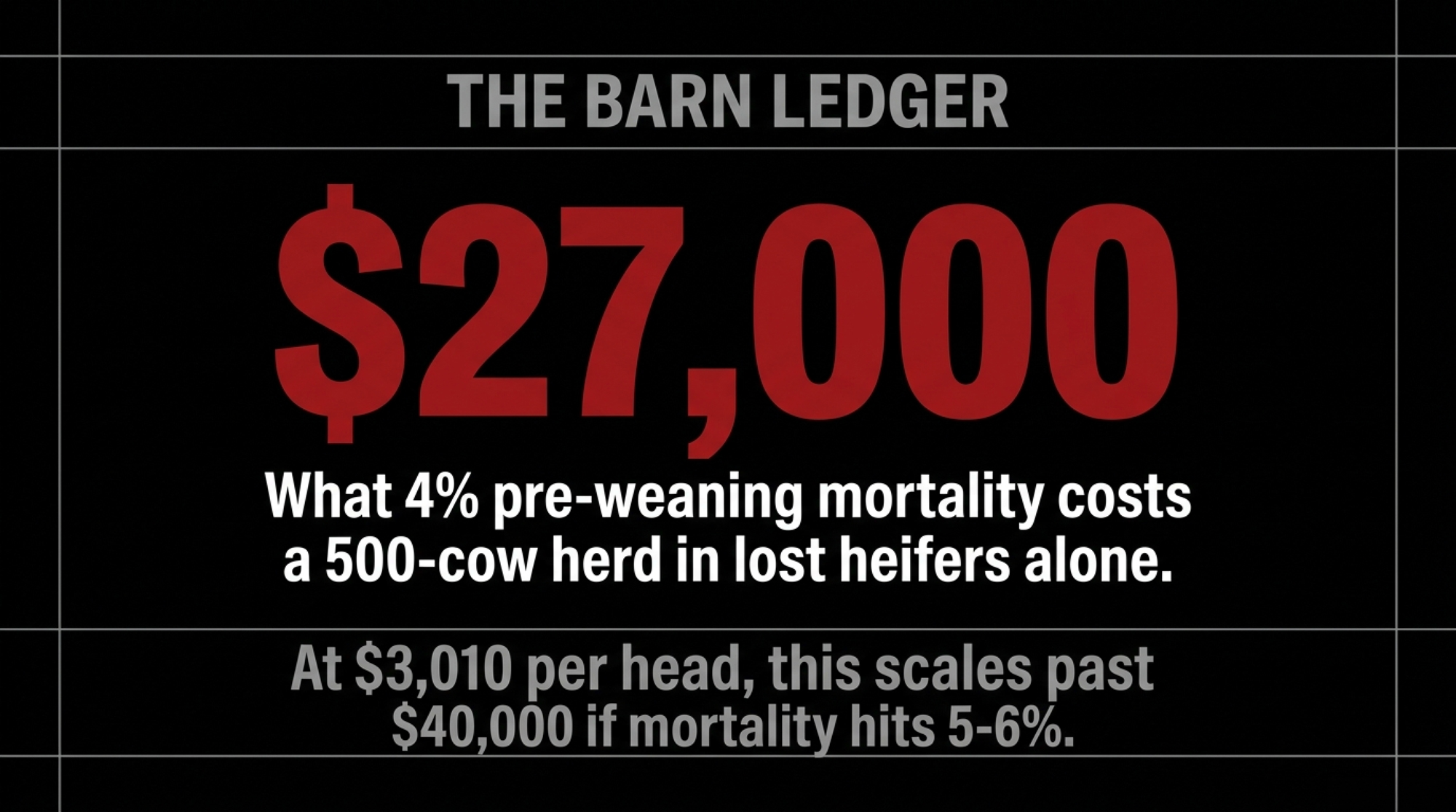
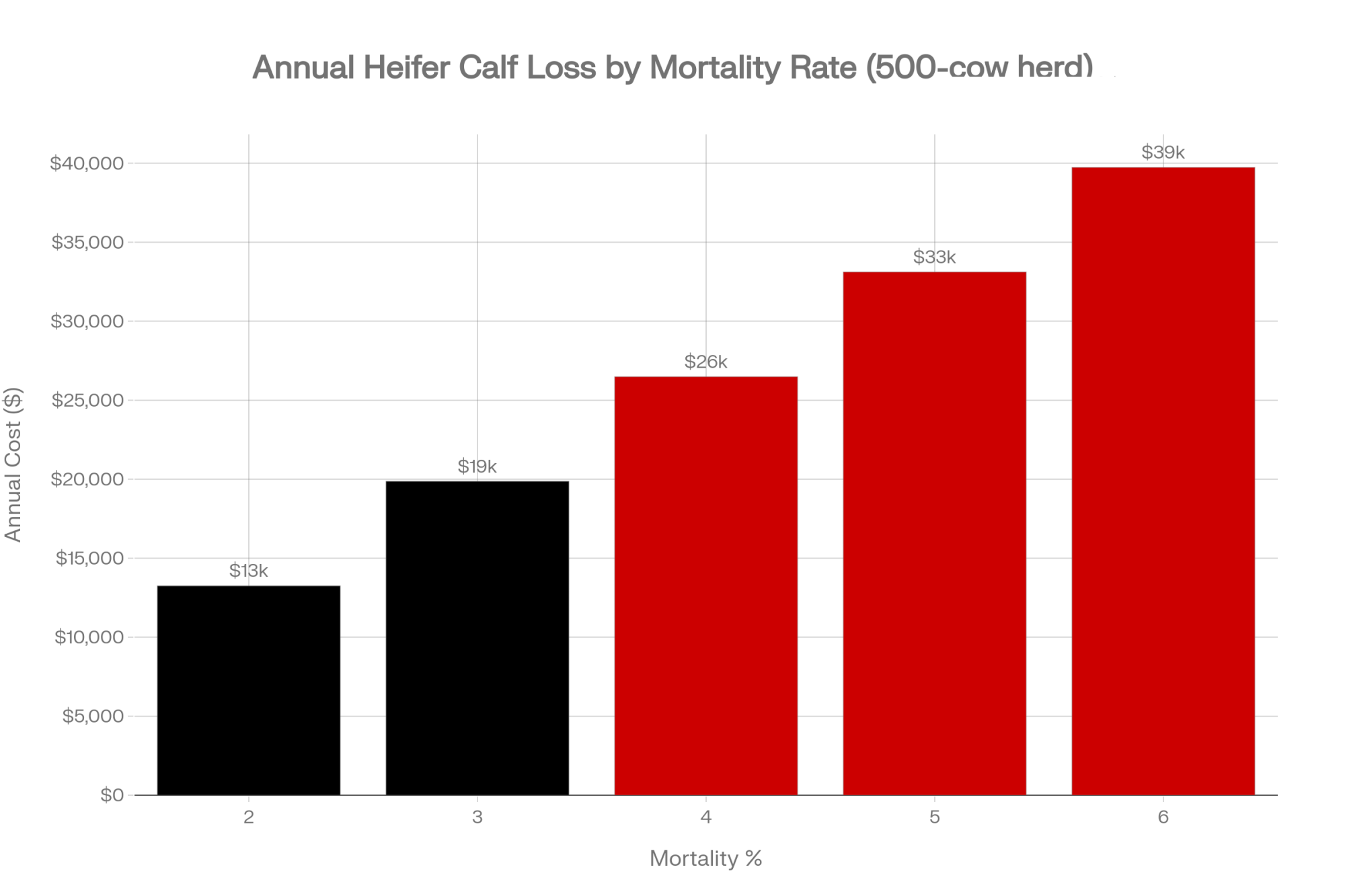
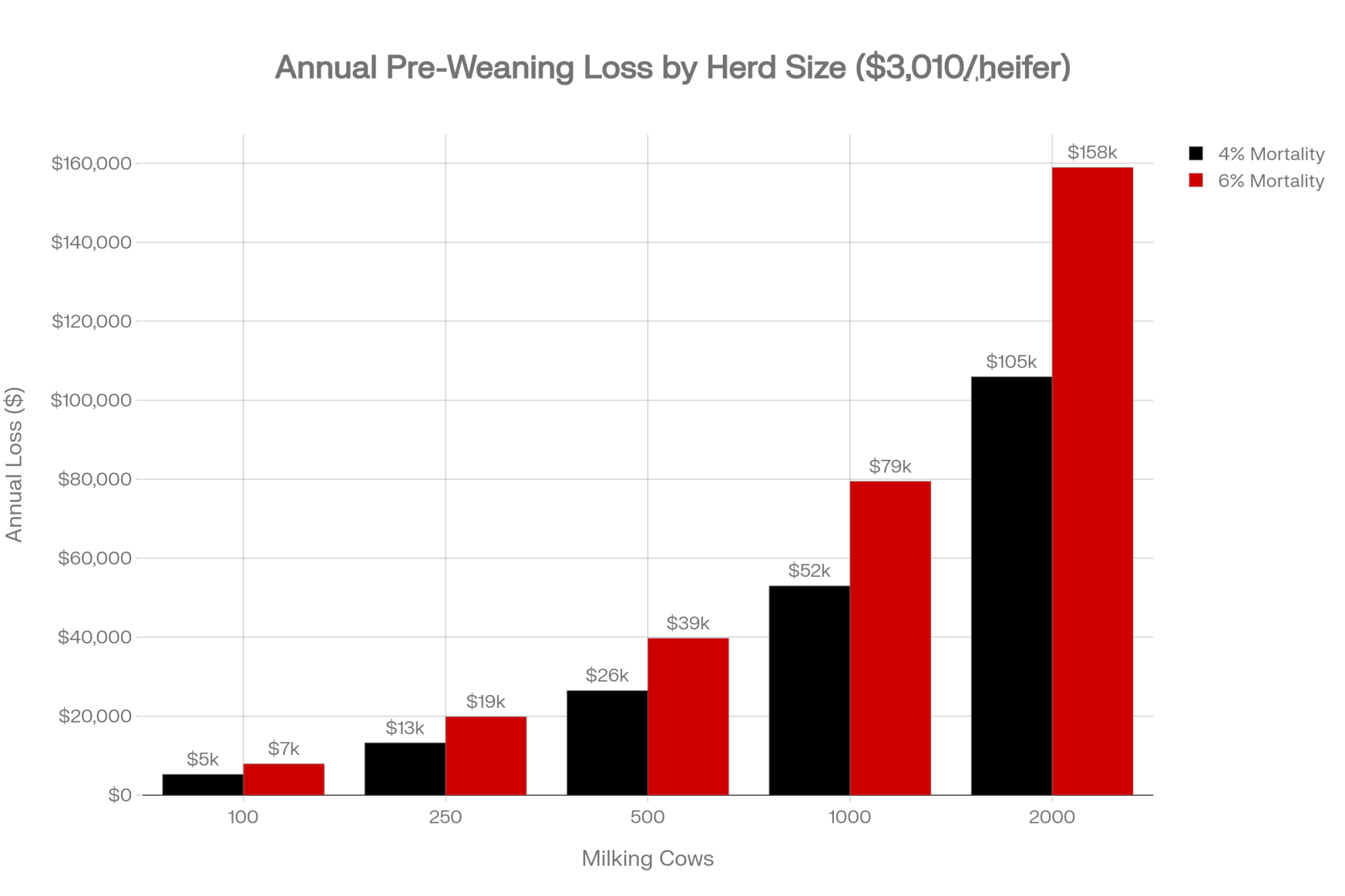
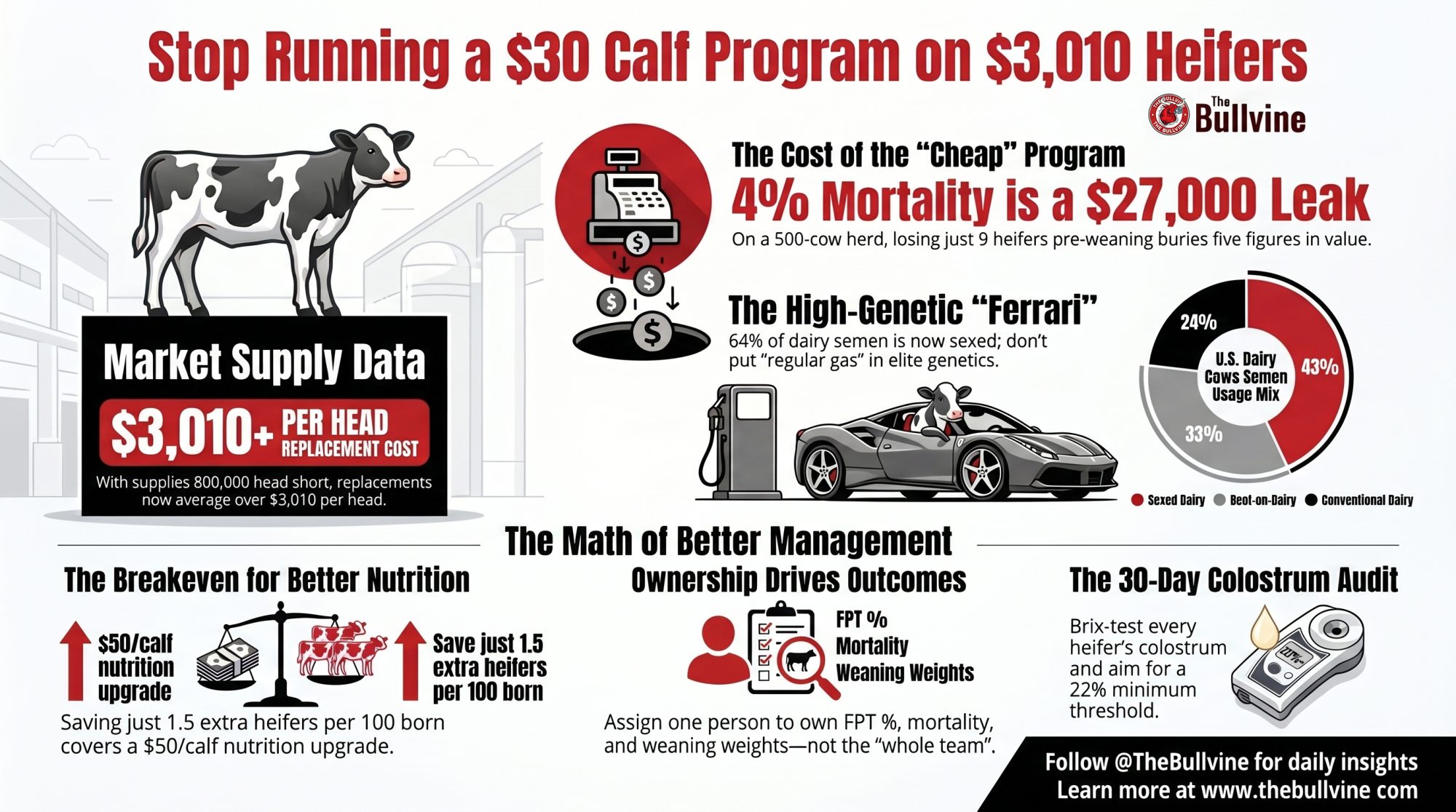
On a 500‑cow herd with 220 heifer calves a year, even 4% pre‑weaning mortality buries about $27,000 in lost heifers alone — at $3,010 per head, before genomics or sexed semen. At 5–6%, that same line item passes $40,000. Still think your $30 calf program is “good enough”?
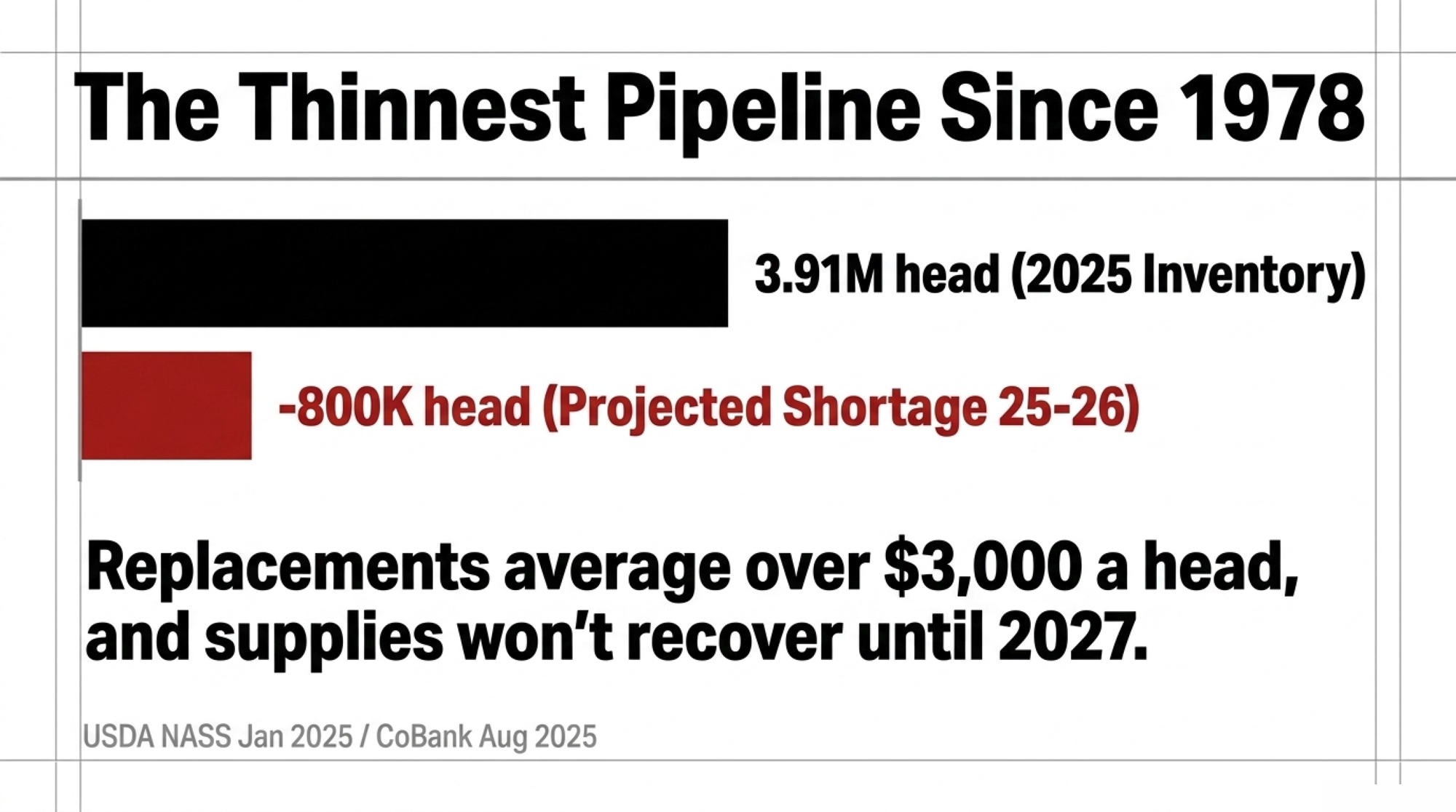
Replacement heifers are at their lowest U.S. inventory since 1978, and CoBank analyst Abbi Prins doesn’t expect supplies to really recover until 2027 — with replacements already averaging over $3,000 a head in many markets. Out by the hutch row, that doesn’t feel like a market report. It feels like a dead calf that suddenly got a whole lot more expensive. In a heifer market that’s roughly 800,000 head short over 2025–2026, every calf that dies in the hutch row isn’t bad luck. It’s a four‑figure hole in a pipeline you can’t easily refill.
We Built the Beef‑on‑Dairy Exit. Now We’re Paying for the Entrance Back In.
Ken McCarty of McCarty Family Farms in Colby, Kansas, still remembers standing by the loading chute when Holstein bull calves were “two for $5” and nobody wanted them. That kind of pain helps explain why so many U.S. dairies were quick to shift more cows to beef‑on‑dairy as calves started bringing $600, then $1,000, then $1,400 a head in some markets. For a while, the bottom‑tier “beef exit” finally worked — cash today, fewer problem calves tomorrow.
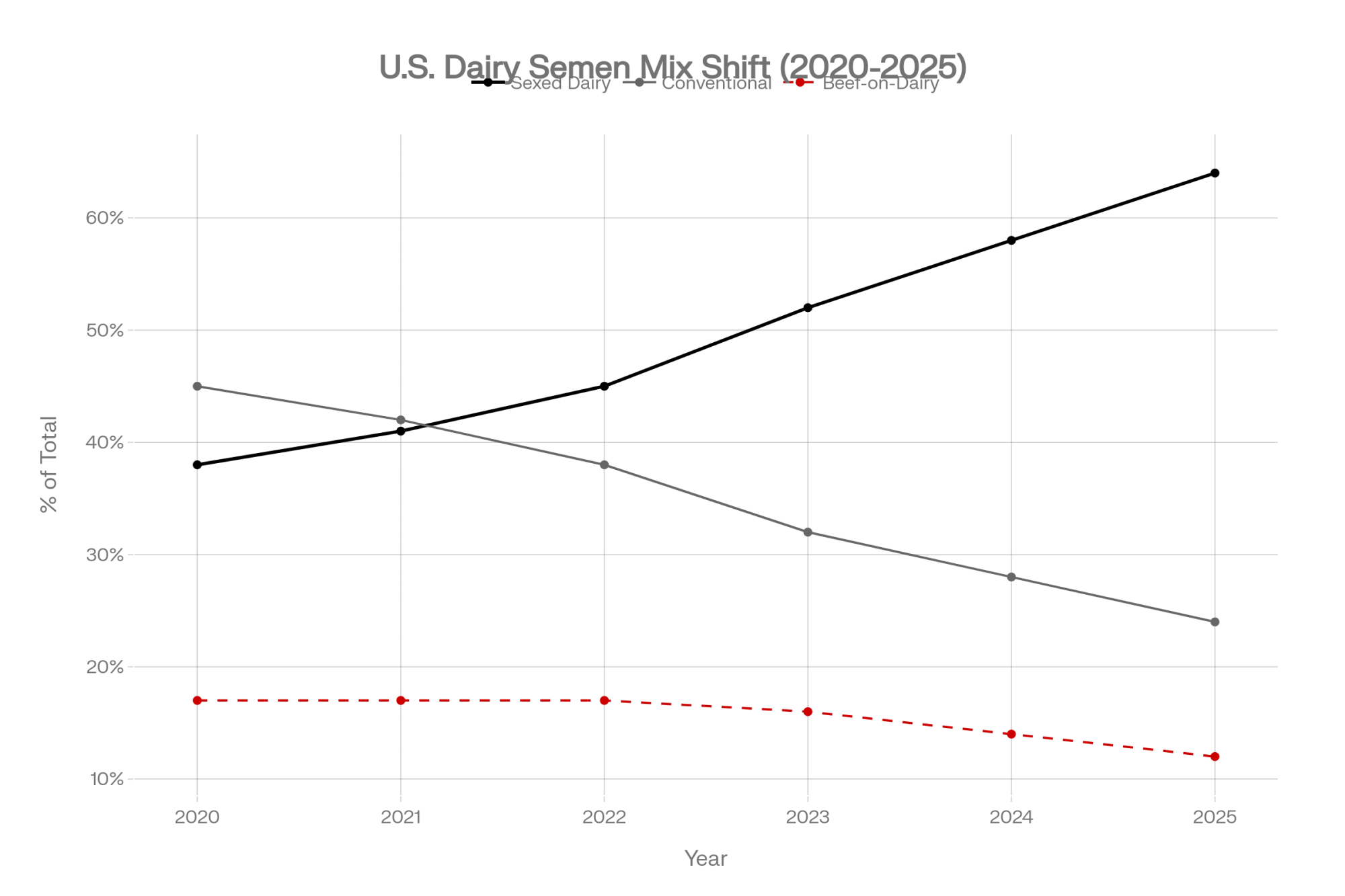
At the same time, sexed dairy semen quietly went from niche tool to default button on the better cows. NAAB’s 2024–2025 semen data — which The Bullvine unpacked in “NAAB’s $327.6 Million Semen Boom vs. $3,000 Heifers” — shows just under 66 million bovine semen units sold and $327.6 million in export value. Inside the roughly 16.5 million dairy units used on U.S. cows, the mix has flipped: about 10.6 million are gender‑selected dairy semen (64%of dairy units), around 6.0 million are conventional dairy, and about 8.1 million units are beef semen used on dairy cows. Put simply, you’re running roughly 43% sexed dairy, 24% conventional dairy, and 33% beef‑on‑dairy across all semen used on dairy cows in the U.S. today.
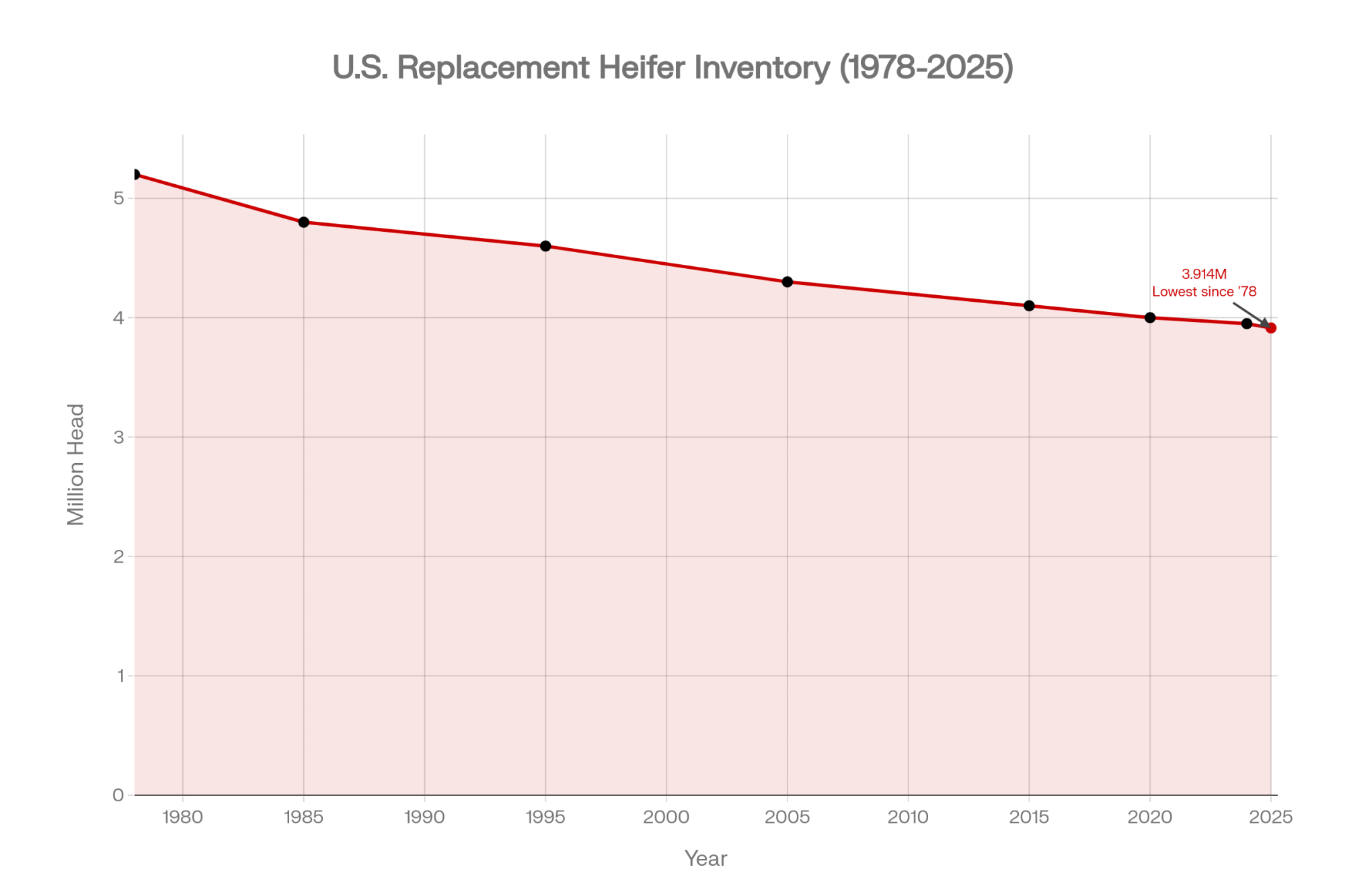
That cocktail made sense when replacement heifers were cheap and the pipeline was full. It doesn’t anymore. USDA NASS’s January 2025 Cattle report put U.S. dairy replacement heifers 500 pounds and over at 3.914 million head — down 0.9% from 2024 and the lowest level since 1978. CoBank’s August 2025 analysis projects inventories will shrink by an estimated 800,000 head over 2025–2026 before starting to rebound in 2027, with replacement prices likely to “climb well above $3,000 per head.”
McCarty’s “two for $5” bull calves are gone. The heifers replacing them are $3,010 animals riding on the thinnest replacement pipeline you’ve seen in your career. His generation gave away bull calves. Yours is leaking value in the heifer hutches — just more expensively. In that reality, you can’t afford to run a $30 calf program and call it good enough.
How $3,010 Heifers Die on $30 Calf Programs
Let’s put some barn math under the gut feeling.
Take a 500‑cow herd freshening about 220 heifer calves per year. NAHMS 2014, analyzed by Urie and colleagues, reported 5.0% pre‑weaning mortality in U.S. heifer calves nationally, with many real‑world herds today running closer to 3–5% when records are tight. Use 4% as a realistic working number for your operation. That’s about 9 dead heifer calves before weaning.
At $2,660 per head — the U.S. average replacement cow price in January 2025 — those 9 deaths represent about $24,000 in lost heifers. At $3,010–3,110 per head — mid‑ to late‑2025 averages in several U.S. markets — you’re burying roughly $27,000–28,000 in heifers alone. If your number drifts up toward 5–6%, that line item climbs past $33,000–40,000 quickly — and that’s the math behind this article’s headline.
And that’s just the heifer value. It doesn’t include:
$40–50 per heifer in genomic testing, with CLARIFIDE®‑type programs commonly around $43/head.
A $15–30 per straw premium for sexed semen over conventional, consistent with economic work and current semen price sheets.
IVF or ET on your top donors — often hundreds of dollars per live heifer calf after you spread donor, flush, lab, and recipient costs across pregnancies.
When a genomic‑tested, sexed semen heifer calf dies in the hutch at 19 days, you’re not just losing “a calf.” You’re losing a four‑figure replacement you can’t easily buy back — plus the semen and IVF bills stacked underneath her.
Investment Item
Cost per Calf
Running Total
Sexed Semen Premium
$15–$30
$15–$30
Genomic Test
$40–$50
$55–$80
IVF/ET (per live calf)
$200–$400
$255–$480
Subtotal (Genetics)
—
$255–$480
Extra Nutrition (Penn State)
$42–$50
$297–$530
TOTAL PER HEIFER CALF
—
$297–$530
The slower leak is the one that doesn’t show up in the dead loss column, but still costs you. Calves that survive scours or pneumonia but limp along on growth often freshen late, give less milk in early lactations, and leave the herd sooner. On a 500‑cow dairy, a couple dozen of those “almost fine” cows can flatten herd progress for years without ever making the problem list.
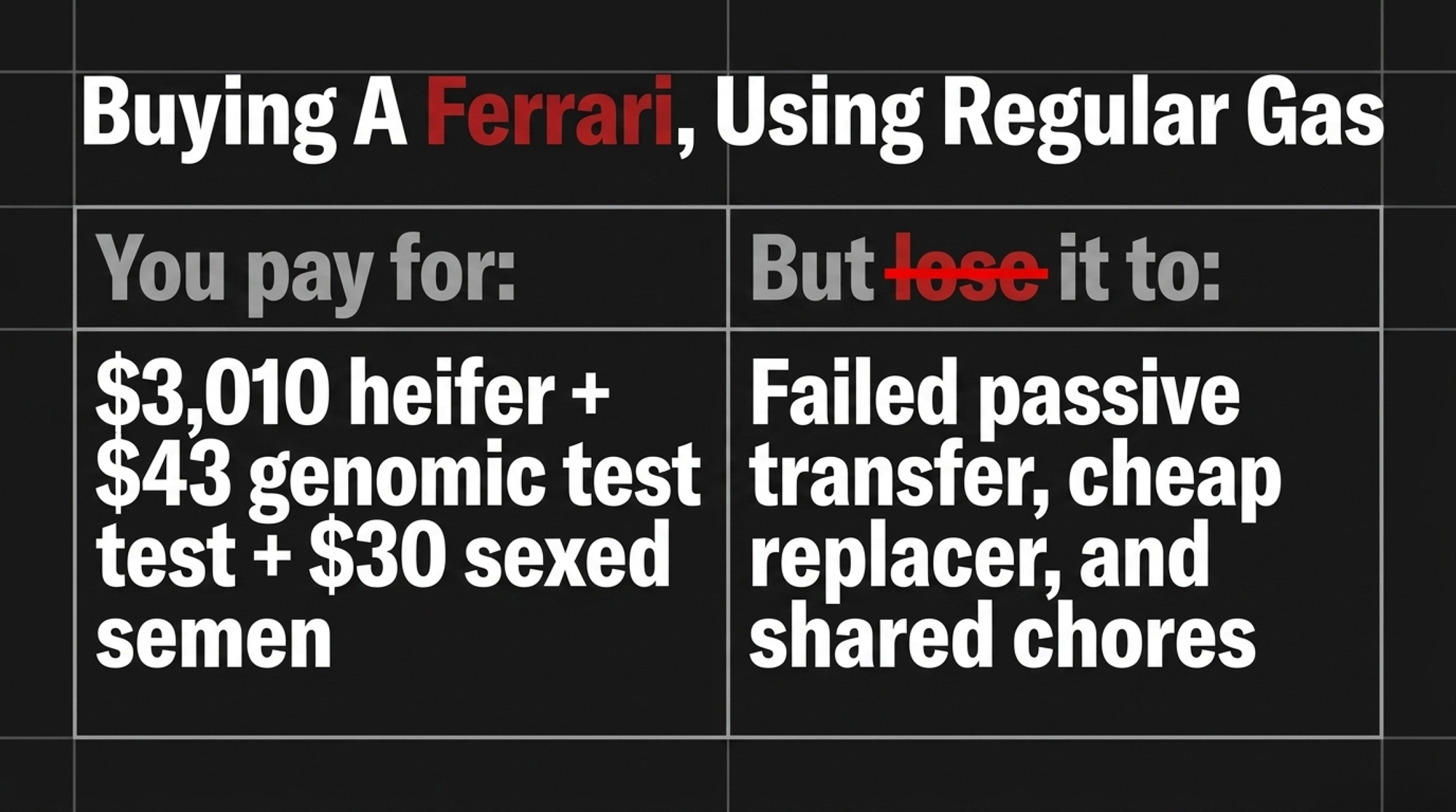
Buying the Ferrari, Using Regular Gas: The $30 Management Leak
You’re already paying for the Ferrari with sexed semen, genomic tests, and IVF on your best cows. The question is whether you’re still putting regular gas in it.
Colostrum and passive transfer. U.S. calf‑health work shows that on many dairy operations, 20–40% of calves still fail to achieve adequate passive transfer [VERIFY: cite Lombard et al. 2020 review or NAHMS Dairy 2014 — confirm exact source/date]. A major review of passive transfer failures found that these calves are about twice as likely to get sick or die early as calves that reach target IgG levels. The reasons are painfully familiar: first feeds drifting past the 2‑hour mark, “we got about two quarts in” instead of a full volume, and colostrum “quality” judged by color and cow parity instead of a Brix reading. A Brix refractometer costs less than one‑tenth of a dead heifer at $3,010.
Related Reading: [INTERNAL LINK: Bullvine calf-mortality-economics piece — hidden gem candidate] → Suggested anchor text: “The Critical Economics of Calf Mortality: Why Every Life Counts More Than Ever.”
Pre‑weaning nutrition. Soberon and Van Amburgh’s work pulled data from a Cornell research herd and a commercial herd. For each 1 kg/day increase in pre‑weaning average daily gain, first‑lactation milk yield increased by about 850 kg in the research herd and 1,113 kg in the commercial herd. A 2016 Journal of Dairy Science review confirmed that keeping average daily gain above 0.5 kg/day with adequate nutrients is linked to higher milk, fat, and protein yields in first lactation. But if that extra nutrition is going into dirty bottles, under‑bedded hutches, or calves that never got decent passive transfer, you’re just buying more expensive scours.
Disease pressure. Urie et al. reported that digestive and respiratory disease together account for a majority of pre‑weaning heifer deaths on U.S. dairies. Other studies have linked early‑life disease to reduced growth, higher treatment costs, and greater odds of early culling. In the “two for $5” bull‑calf era, you could absorb a handful of fragile replacements. In a market where USDA has heifer inventories at their lowest since 1978, every sick, slow‑growing calf is a capital asset you may never fully earn back.
Every weak link in the first 60 days turns a high‑genetic heifer into either a dead loss or a lower‑yield, shorter‑lived cow. That’s always been bad management. At $3,000‑plus per heifer, it’s pipeline suicide. The herds that flip those numbers don’t do it with a new binder — they do it by giving one person clear ownership of the hutch row, which is exactly what the I‑29 case in Option 3 below shows.
How Much Is “Cheap” Calf Nutrition Actually Saving You on $3,010 Heifers?
Here’s where the “we can’t afford a better replacer” argument starts to fall apart.
Penn State’s 2023 bulletin “Economics and Effects of Accelerated Calf Growth Programs” compared a standard 20:20 milk replacer at $80 per 50‑lb bag to a higher‑quality replacer at $100 per bag in a 56‑day feeding program (2023 prices — adjust to your current bag cost). In a scenario where calves moved from gaining 1.1 lb/day to 1.5 lb/day, feed cost increased by about:
$41.92 per calf on the $80/bag program.
$50.26 per calf on the $100/bag program.
Spread over 56 days, that works out to roughly:
$0.75 per calf per day extra on the cheaper program.
$0.90 per calf per day extra on the higher‑quality program.
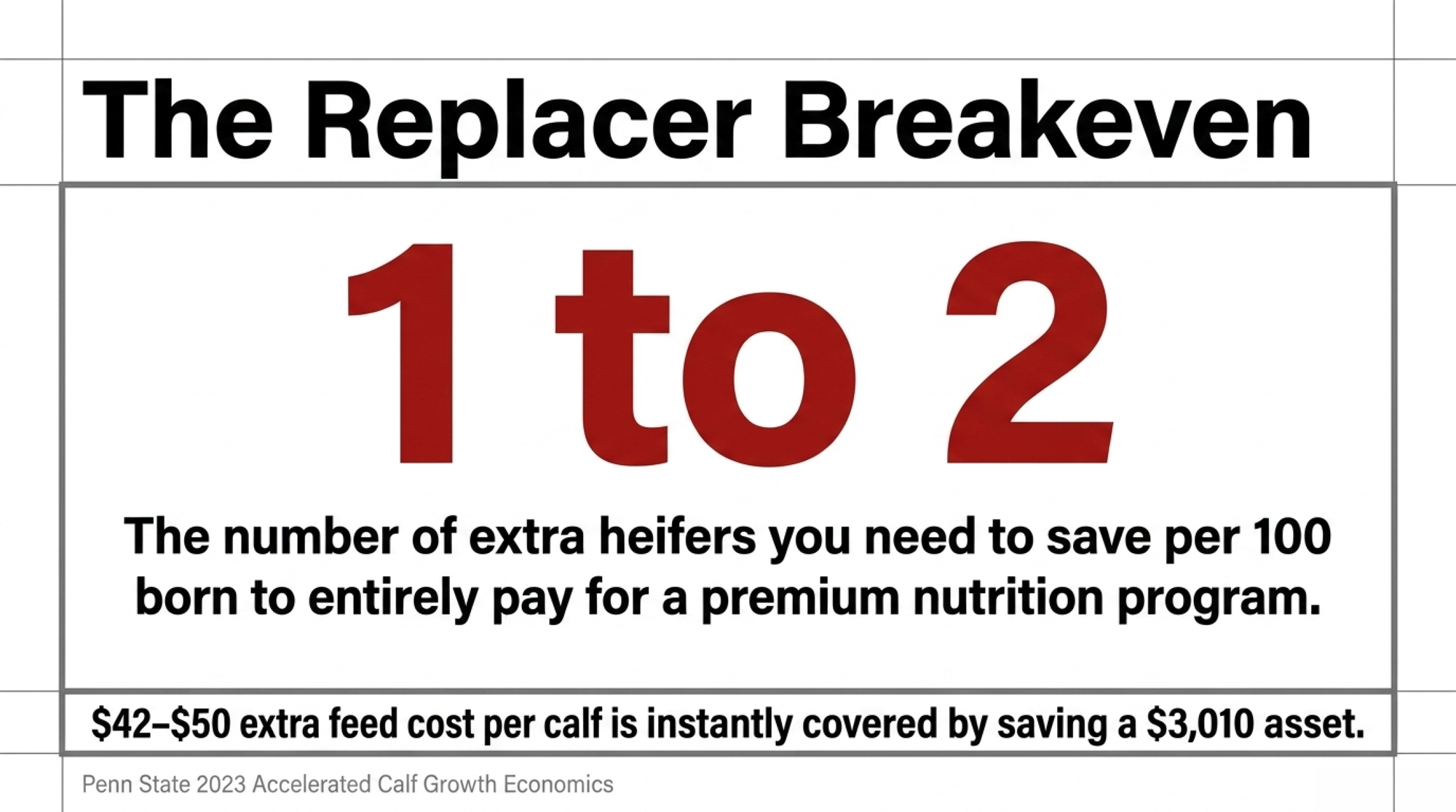
Round it, and you’re talking about $42–50 extra per calf to run a higher plane of nutrition. On 200 heifer calves a year, that’s an additional $8,400–10,000 in milk replacer cost.
Now put today’s heifer prices on the other side of the ledger. At $3,010 per head, if tightening up colostrum and stepping up nutrition together drop heifer calf mortality from 4% to 2% on those 200 heifers, that’s 4 extra heifers alive. Four at $3,010 is $12,040 — more than enough to cover the $8,400–10,000 in extra feed.
You don’t even need a full 2‑point drop to break even. If you spend $10,000 more on calf feed and each heifer is worth $3,010, you need to save about 3.3 heifers. On 200 heifers a year, that’s roughly 1.6 percentage points of mortality improvement. At the lower feed cost ($8,400), the breakeven is closer to 1.4 points. Either way, you’re still only aiming to save one to two extra heifers per 100 born.
Will every farm see that from a replacer change alone? No. Colostrum timing, housing, bedding, and people following the protocol all matter. But at current heifer values, the breakeven for a better calf program has moved much closer than it used to be.
What’s the Real Cost of Your Calf Program?
The easiest way to dodge this question is to say, “Our calf program is fine.” The harder way is to pull the numbers and see if it actually matches the genetics bill you’re paying.
Start with last year’s heifer calf crop. If you had 220 heifer calves born and lost 4% before weaning, that’s about 9 heifer calves dead. At your replacement value — anywhere from $2,660 in early 2025 to $3,110 by late 2025 — you’re looking at a $24,000–28,000 line item just for dead heifers. Then add in the extras: sexed semen premiums, genomic tests, and any IVF work you did on the cows those heifers came from. If that number doesn’t make you uncomfortable, check it again.
Now compare your calf program spend to that loss. Penn State’s math shows an extra $42–50 per calf in replacer cost on 200 heifer calves — call it $8,400–10,000 per year — can break even if you save just one or two extra heifers per hundred born at $3,010 each. Does your current calf program pass or fail that simple barn‑math test?
Who Really Owns the Hutch Row?
On paper, you might say, “Our calf team handles it.” In practice, that often means whoever finishes milking first or whoever drew the short straw that week.
Ask yourself one blunt question: if you walked into the office right now and asked, “Who owns calf outcomes here?” would you get one name in under five seconds — or a vague, “We all do”? Herds that win this game usually have a single person who owns colostrum, calves, and the key numbers: FPT %, heifer calf mortality, and weaning weights.
You don’t need a fancy HR plan to get there. You need to pick the person who notices calves first, give them clear authority over calf protocols, and put their numbers on the board every month next to pregnancy rate and SCC. When calf care is shared across whoever has time, even $3,010 heifers can quietly get less focused attention than they really need.
Metric
What It Measures
Target
Action Threshold
FPT %
Calves failing passive transfer (serum total protein <5.2 g/dL)
<10%
>15%
Pre-Weaning Heifer Mortality %
Heifer calves dead before weaning
<3%
>4%
Average Daily Gain (Pre-Weaning)
Pounds gained per day, birth to weaning
>1.5 lb/day
<1.1 lb/day
Weaning Weight
Average weight at 8 weeks
>200 lb
<180 lb
Days to First Calving
Age at first calving
<24 months
>26 months
Options and Trade‑Offs for Farmers
You don’t have to fix everything this month. But you do need to stop running a $30 calf program under a $3,010 heifer reality. Here are four paths, how they work, and where they can bite you.
1. Lock Down Colostrum — Your 30‑Day Action
If your heifer replacements are worth more than about $2,500 and your heifer calf mortality is over roughly 3–4%, that’s a strong signal that this is where you start.
In the next 30 days, pull the last 12 months of heifer‑calf data and calculate your actual pre‑weaning heifer mortality. Not a gut feel — the real number from your records. Brix‑test colostrum from every fresh cow for at least one full week and draw a hard line: nothing under 22% Brix goes into heifer calves. Then draw blood from every calf born during that week at 24–48 hours and run serum total protein. If more than 10–15% of those calves fall below the accepted passive‑transfer threshold, your most expensive pipeline leaks.
When this path makes sense: any time replacements are valuable, and you haven’t done a proper FPT audit in the last 12 months. What it requires: a Brix refractometer, some blood tubes, a small lab bill, and a willingness to change how quickly and how much colostrum gets fed. Where it fails: you collect the numbers and then write them off as “just a bad week” instead of changing milking‑fresh, storage, and first‑feeding routines.
2. Upgrade Calf Nutrition With Numbers, Not Hope
This path is for herds already investing in genomics and sexed semen but still seeing 4–5% heifer calf mortality and a thick treatment notebook.
You’re basically asking one question: does the extra $42–50 per calf Penn State lays out for a higher‑plane program pay off at $3,010 per heifer in your barn? Use their math as the backbone and plug in your own replacer price, mixing rate, and days on feed. Then compare that extra spend to what saving one or two extra heifers per hundred born is worth in your herd.
You’ll also need to tighten mixing accuracy, feeding schedule, and hygiene. A better bag doesn’t fix dirty bottles or inconsistent solids.
When this path makes sense: you’ve already got decent colostrum numbers but still see too many sick, slow‑growing calves. What it requires: shifting away from “whatever 20:20 is cheapest” toward a consistent, all‑milk‑protein replacer and enforcing protocol discipline. Where it fails: you upgrade the replacer but leave colostrum, housing, and staff training the same. That’s just a more expensive way to keep the same problems.
3. Put Real Ownership on the Calf Barn
On some dairies, the calf barn turns not because a consultant writes a binder, but because one person quietly decides, “These calves are mine.”
Maybe it’s the herdsman’s daughter who has a knack for spotting dull eyes and droopy ears. Maybe it’s the feeder who hates seeing the same calf on the treatment list twice. On one 600‑cow I‑29 herd a consultant works with, the turning point was simple: the owner told their sharpest young employee, “You own hutches and colostrum. I’ll measure you on FPT %, death loss, and weaning weights — and I’ll back you when you need changes.” Within a year, that farm’s heifer calf mortality had dropped, and the owner quit saying, “Our calves are just weaker.”
When this path makes sense: nobody in your place can answer “Who owns calf outcomes here?” without looking around. What it requires: giving one person clear authority over calf protocols and tying their success to three KPIs: FPT %, heifer calf mortality, and weaning weights. Then sitting down monthly to review those numbers alongside repro and SCC. Where it fails: you give someone the title but not the time, training, or authority. If calf chores are still what happens when people finish everything else, the numbers won’t move.
4. Benchmark Calves the Way You Benchmark Cows
With CoBank’s shortage timeline and beef‑on‑dairy locked in for 2026, flying blind on calf performance is the wrong gamble.
When this path makes sense: you genuinely don’t know how your calf metrics stack up against herds that look like yours. What it requires: pull a year of heifer‑calf data and break mortality into 0–3 days, 4–21 days, and 22 days to weaning. Add FPT % and weaning weights. Then work with your vet, nutritionist, or a university project to benchmark against peer herds. Where it fails: you see that your numbers sit in the bottom third and decide “our calves are just weaker” instead of changing something.
Key Takeaways
If your heifer replacement value is above roughly $2,500 and your heifer calf mortality is over 3–4%, stop treating that as background noise. Treat it like an economic leak. Multiply last year’s dead‑heifer count by $2,660–3,110 and ask whether you’d accept that line item if it showed up as a bill from your vet or semen rep.
If you’re running a high beef‑on‑dairy percentage without a locked‑in heifer plan, you’re stacking two bets: that beef calf premiums stay strong and that replacements will be there when you need them. CoBank’s 800,000‑head shortfall and USDA’s lowest‑since‑1978 inventory should make you nervous about the second part.
If you’re willing to spend about $43 per heifer on genomics and pay a $15–30 sexed‑semen premium,balking at an extra $42–50 per calf on a better colostrum and nutrition program doesn’t pencil. The breakeven is saving roughly one to two heifers per 100 born at $3,010 each.
If nobody on your farm “owns” calf outcomes with data, your calf program is still operating more like a chore than a managed system. Name a calf manager and give them three numbers to live by: FPT %, heifer calf mortality, and weaning weights.
If you haven’t Brix‑tested colostrum and run serum total protein on a batch of calves in the last 12 months, your colostrum program is still a story, not a fact. Make that your 30‑day project.
Your Calf Barn Checklist — Print This and Take It Outside
☐ The Brix Test: Is every gallon of colostrum for heifer calves testing at or above 22% Brix before it goes into a bottle?
☐ The 2‑Hour Rule: Are calves reliably getting their first colostrum within 2 hours of birth, or are there still “shift change” calves waiting longer?
☐ The FPT Audit: Have you checked serum total protein on the last 10 heifer calves born? What percentage cleared the passive‑transfer threshold?
☐ The Mortality Number: Can you write down your actual 12‑month pre‑weaning heifer calf mortality rate — not a guess, but the number from your records?
☐ The Cost‑Per‑Death: Take that mortality rate, multiply by your annual heifer calf crop, then by $3,010. That’s what lost heifers cost you last year — before you add in genomics, sexed semen, or IVF.
☐ The Replacer Math: How much does your current milk replacer cost per calf through weaning? What would an upgrade cost? How many extra heifers per 100 born would need to live for that to pay off at $3,010 per head?
☐ The Pipeline Check: How many bred heifers and springers do you have on hand right now, divided by how many replacements you actually need each year? If that ratio is under 1.0, you’re already short. Under 0.8, you’re in trouble if CoBank’s 2027 recovery timeline holds.
☐ The Owner Question: Is there one name — not “the team” — on this farm who owns those calf numbers?
Heifers aren’t about to get cheaper. USDA NASS’s January 2025 report and follow‑up analysis put replacement heifers at 3.914 million head, the lowest since 1978, and CoBank’s best‑case scenario has inventories just starting to recover in 2027. The genetics you’re putting into cows today are some of the most expensive you’ve ever bought. The calf barn is where you decide whether that money turns into cows or compost.
So here’s the real question: do your calf numbers match the genetics bill you’re paying — or are you still running a $30 program under a $3,010 heifer reality?
Run Your Numbers
Bullvine Pipeline Index Calculator — This free tool turns your heifer pipeline into a single 0–100 score and shows whether your current calf losses, beef-on-dairy use, and cull rate can actually support tomorrow’s herd. Use it to see if your $30 calf program matches your $3,010 heifer reality.
Learn More
Beef-on-Dairy Calf Profit: The $150 Leak Killing Your Premium — Arms you with precise weaning strategies and protocol adjustments to eliminate a hidden $130–$225 per head value leak. It details why feedlots slash bids on calves carrying subclinical health issues, protecting your immediate revenue.
Beef-on-Dairy’s $6,215 Secret: Why 72% of Herds Are Playing It Wrong — Delivers an unarguable reproductive matrix that proves why herds with under a 20% pregnancy rate capture zero net profit from beef crossbreeding. It dismantles generic breeding advice, forcing a rigorous re-evaluation of your sexed semen allocation.
The Sunday Read Dairy Professionals Don’t Skip.
Every week, thousands of producers, breeders, and industry insiders open Bullvine Weekly for genetics insights, market shifts, and profit strategies they won’t find anywhere else. One email. Five minutes. Smarter decisions all week.
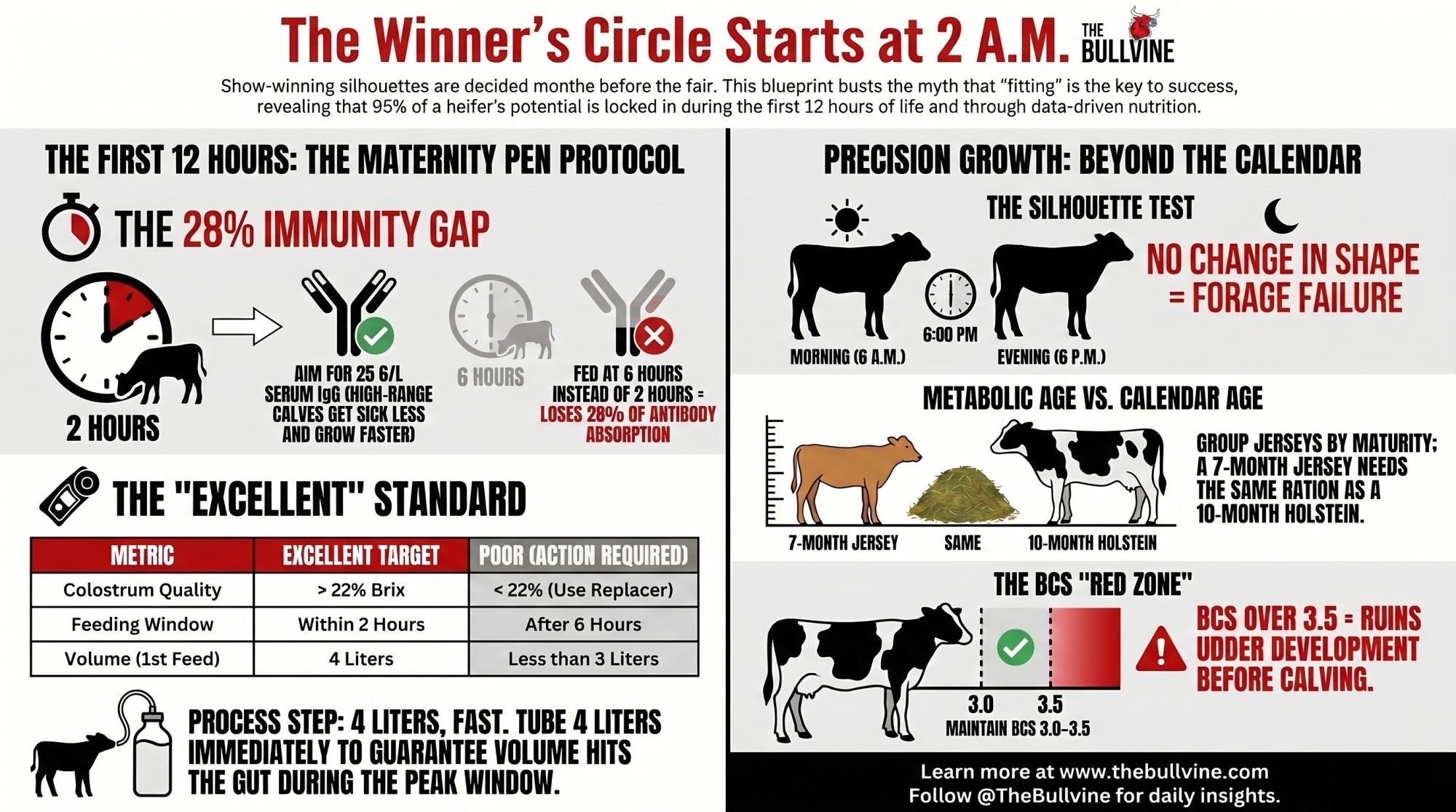
The judge’s first glance in September is shaped by decisions you made eight months earlier at 2 a.m. — and the research on why that’s true keeps getting harder to argue with.
Picture the walk-in at your county show next September. The judge takes three seconds per heifer on that first pass — silhouette, topline, the way she moves off the halter. By the time the ribbons get handed out, the class was basically decided long before anyone touched a clipper. It was decided in a maternity pen at 2 a.m. the previous January, when somebody either got up to catch that calf or didn’t.
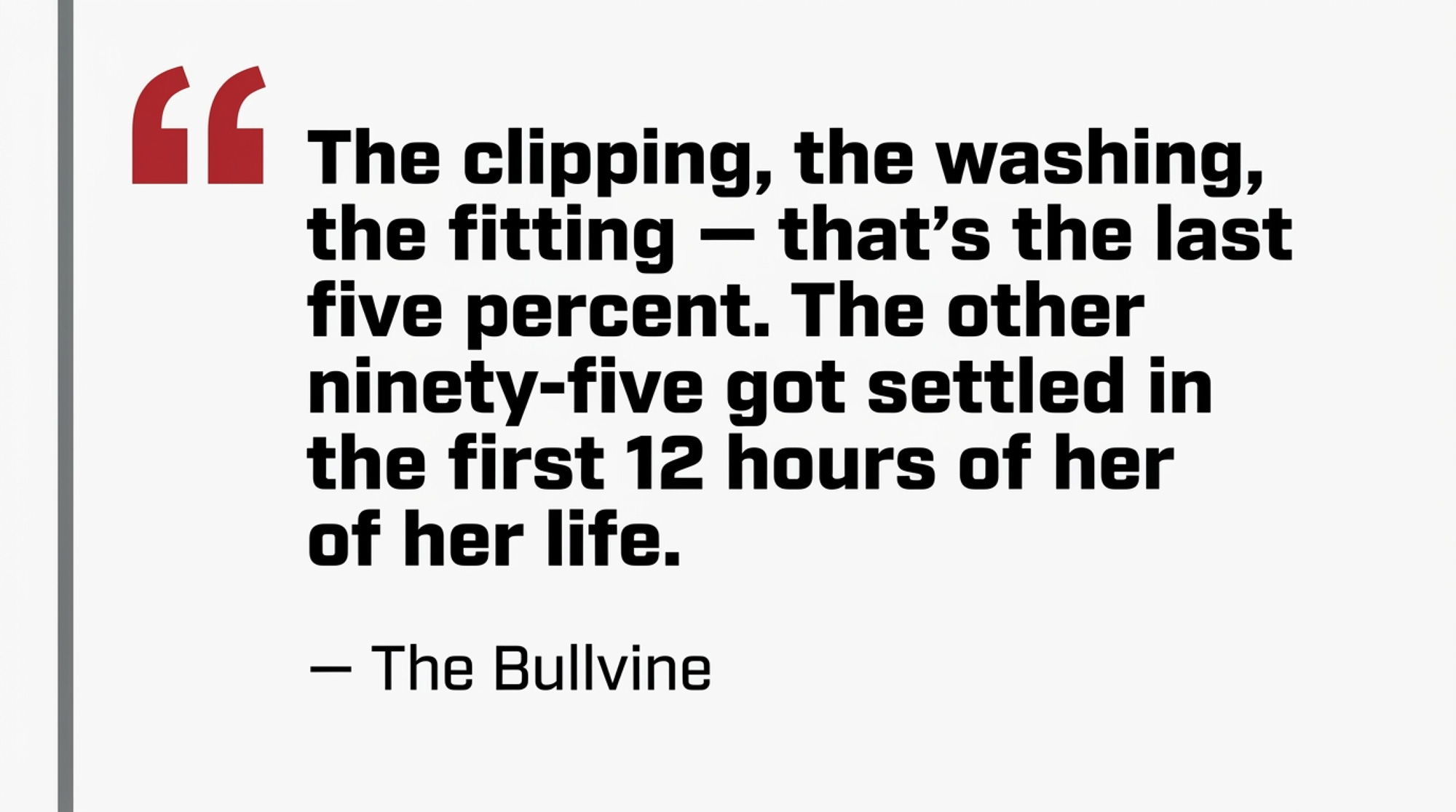
That’s the part nobody puts on a show poster. The clipping, the washing, the fitting — that’s the last five percent. The other ninety-five got settled in the first 12 hours of her life. Most show people know this is true. Running a real show heifer development program like you actually believe it is a whole different thing.
What’s Really at Stake Here
A show heifer is an athlete. Like any athlete, her ceiling gets set early. Miss a step in the first few weeks and you don’t just fall a little behind — you cap how good she can ever be. By the time she walks into the ring as a yearling, the work you did before she was a week old is what the judge is actually grading.
The people winning consistently on the 2026 circuit aren’t doing anything magical. They’re running a Brix refractometer on their colostrum. They’re weighing and measuring their heifers every month against a written target. They’re paying attention to what genomic tests say about how much feed each calf actually needs. They treat the whole thing — maternity pen through show day — as one connected system. Not a string of tricks they pull out the week before fair.
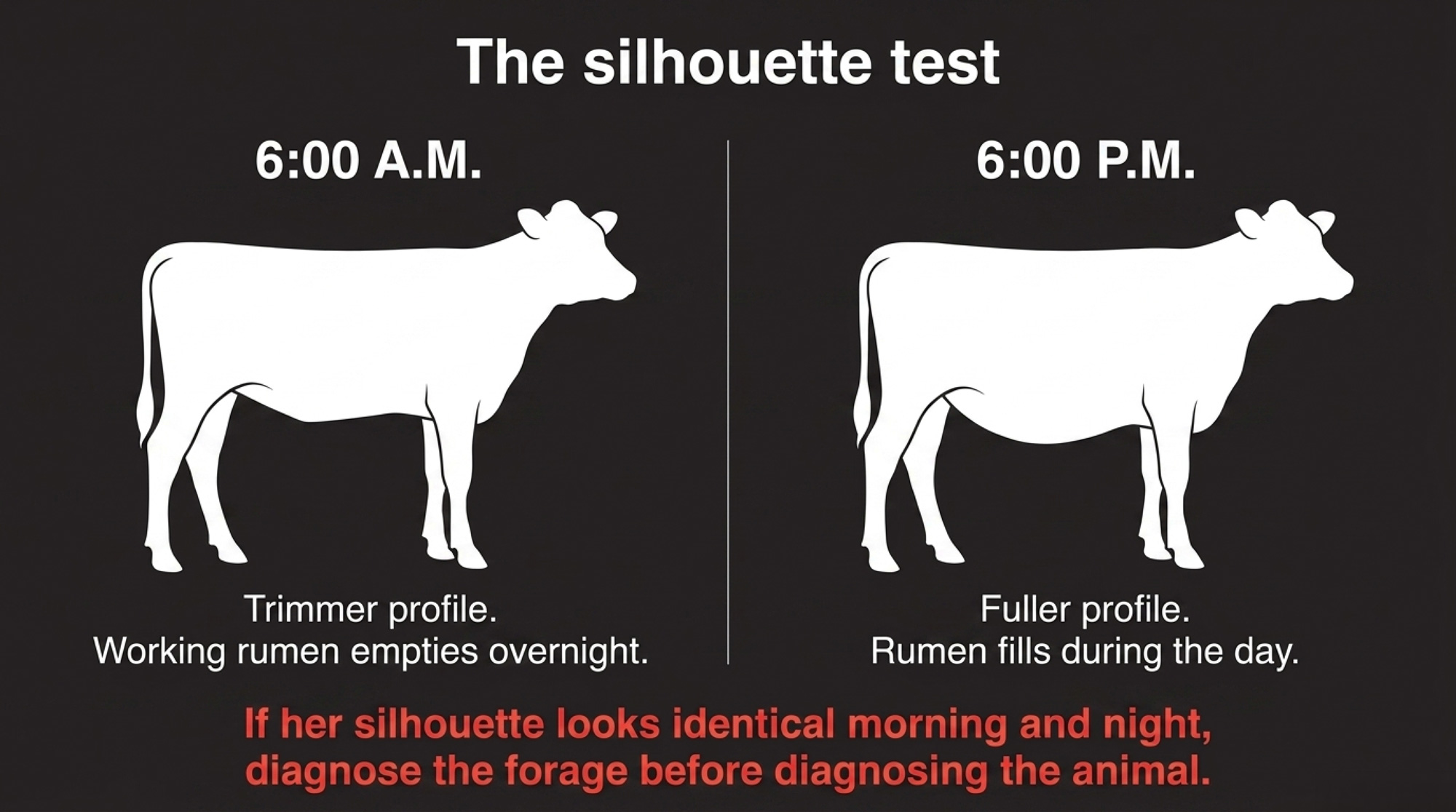
One simple trick before we go further: walk your heifers in the morning before they’ve eaten, then walk them again that evening after full feed. That silhouette should change. If it doesn’t, something’s off. We’ll come back to why.
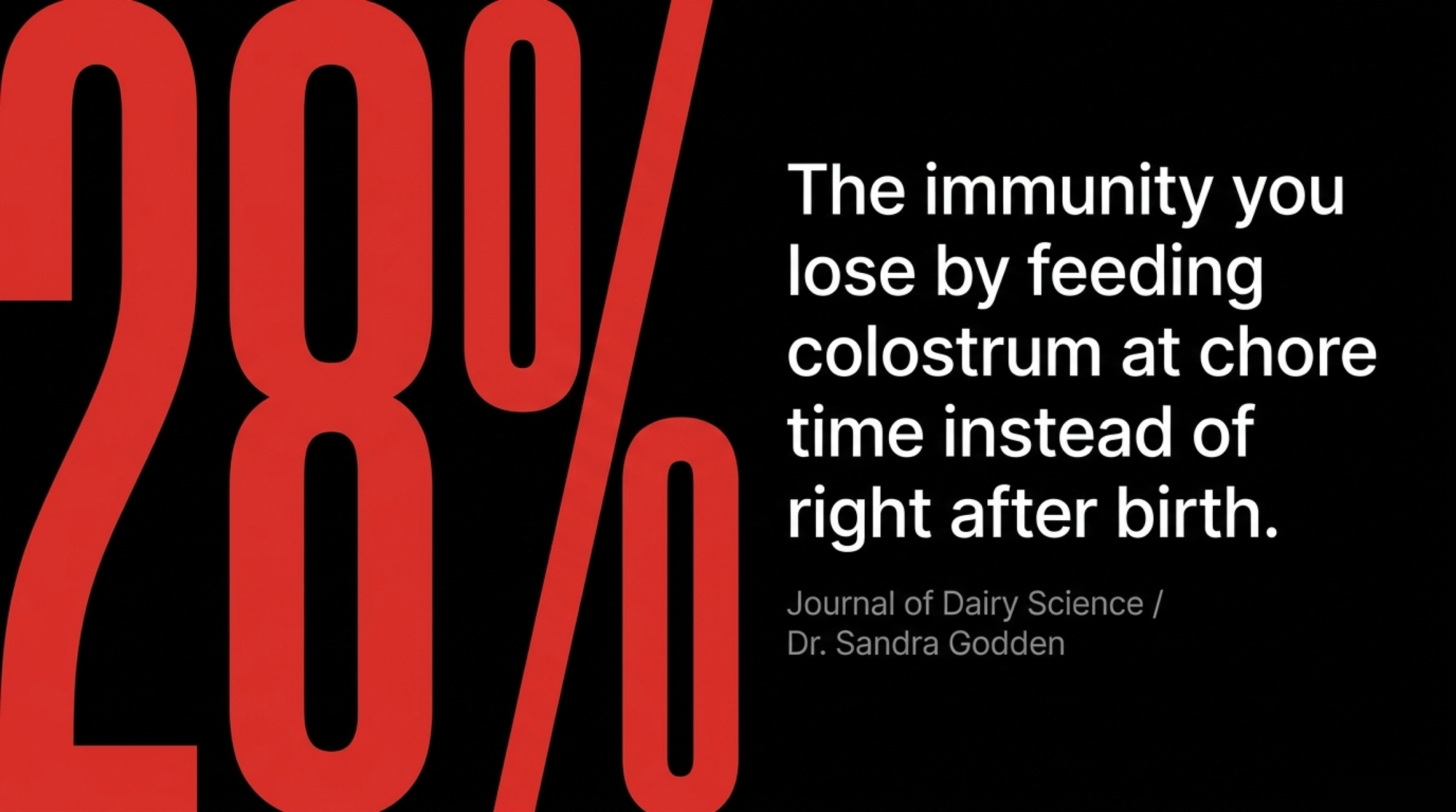
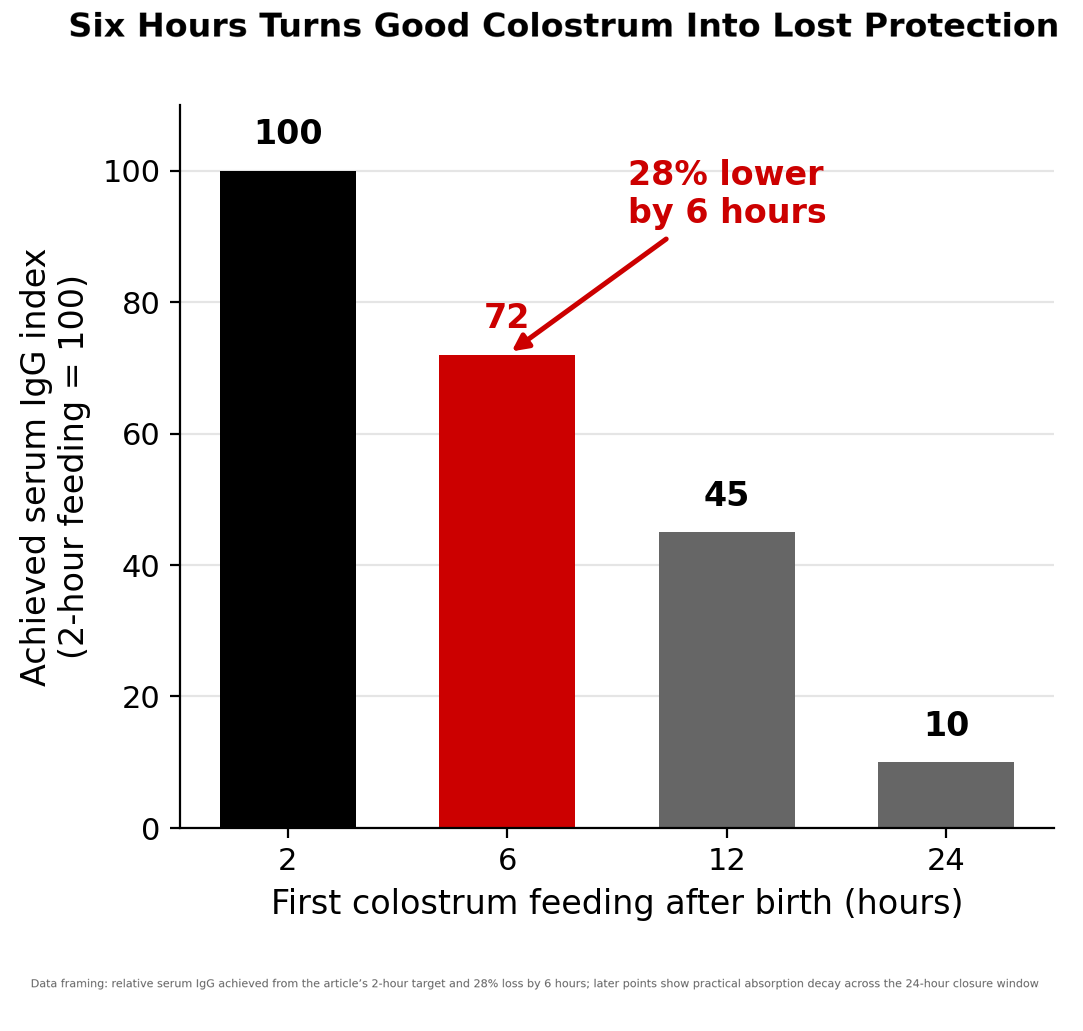
Why Does Waiting Six Hours Cost You 28% of Her Immunity?
Here’s the single most important thing a young showman can learn about calf care. Colostrum isn’t just “the first milk.” It’s a time-sensitive protection package — and the decay clock isn’t about the colostrum itself going bad in the bottle. The colostrum in the pitcher stays full of antibodies all morning. What collapses is her ability to absorb them.
That’s worth reading twice. The 28% loss is an absorption efficiency loss, not a quality loss. The calf is born with specialized cells in her small intestine that pull whole IgG antibodies out of colostrum and ship them into her bloodstream intact. Those cells close — gradually at first, then fast — over the first 24 hours of life. Feed her at two hours and those gates are wide open. Feed her at six hours and they’re already partly shut. Same colostrum, same volume, different destination. The antibodies that don’t make it into her blood don’t protect her.
Research from Dr. Sandra Godden at the University of Minnesota and colleagues, synthesized in the Journal of Dairy Science colostrum management literature and echoed in Morrill’s published calf nutrition work, shows that missing the early window cuts achieved serum IgG by roughly a quarter to a third. Not cuts colostrum quality. Cuts what ends up in her blood, which is the only thing that actually matters for protecting her.
Think about that. A quarter of her disease protection — gone. Not because you fed bad colostrum. Because you fed it at chore time instead of right after she calved.
The target has moved, too. The old benchmark was 10 mg/mL of IgG in her blood — the minimum to keep her from getting sick. The current standard, set by the 2020 Lombard consensus paper in Journal of Dairy Science and adopted by the Dairy Calf and Heifer Association, pushes way higher: you want at least 40% of your calves hitting 25 g/L or better, and fewer than 10% coming in below 10 g/L. Calves in that top “excellent” range get sick less and die less than calves in the merely “okay” range. For a show heifer, getting sick as a baby means growth stalls you can never get back. You build frame once, or you don’t.
The Colostrum Decision Table
Metric
“Excellent” Target
“Fair / Poor” — Action Required
Colostrum quality (Brix)
> 22% (roughly ≥ 50 g/L IgG)
< 22% — pull from freezer bank or use replacer
Serum IgG (calf blood, 24–48 hrs old)
> 25 g/L
< 10 g/L — failure of passive transfer
Feeding window from birth
Within 2 hours
After 6 hours — roughly 28% lower serum IgG achieved
Volume at first feeding
4 L (or 10% of body weight)
Less than 3 L — under-dosed
Second feeding
2 L by 12 hours
Skipped — missed top-up absorption
Pro tip — Tube vs. bottle, and why it’s not close. A slow bottle feeder can burn an hour of your peak absorption window. Research summarized by the DCHA and university extension guidance consistently shows that tubing 4 liters immediately is often superior to waiting for a “slow starter” to nurse it, because tubing guarantees the volume hits the gut during the 0–2 hour peak absorption window. You can always bottle-feed her the next meal once she’s built protection. You can’t re-open the absorption gates once they’ve closed.
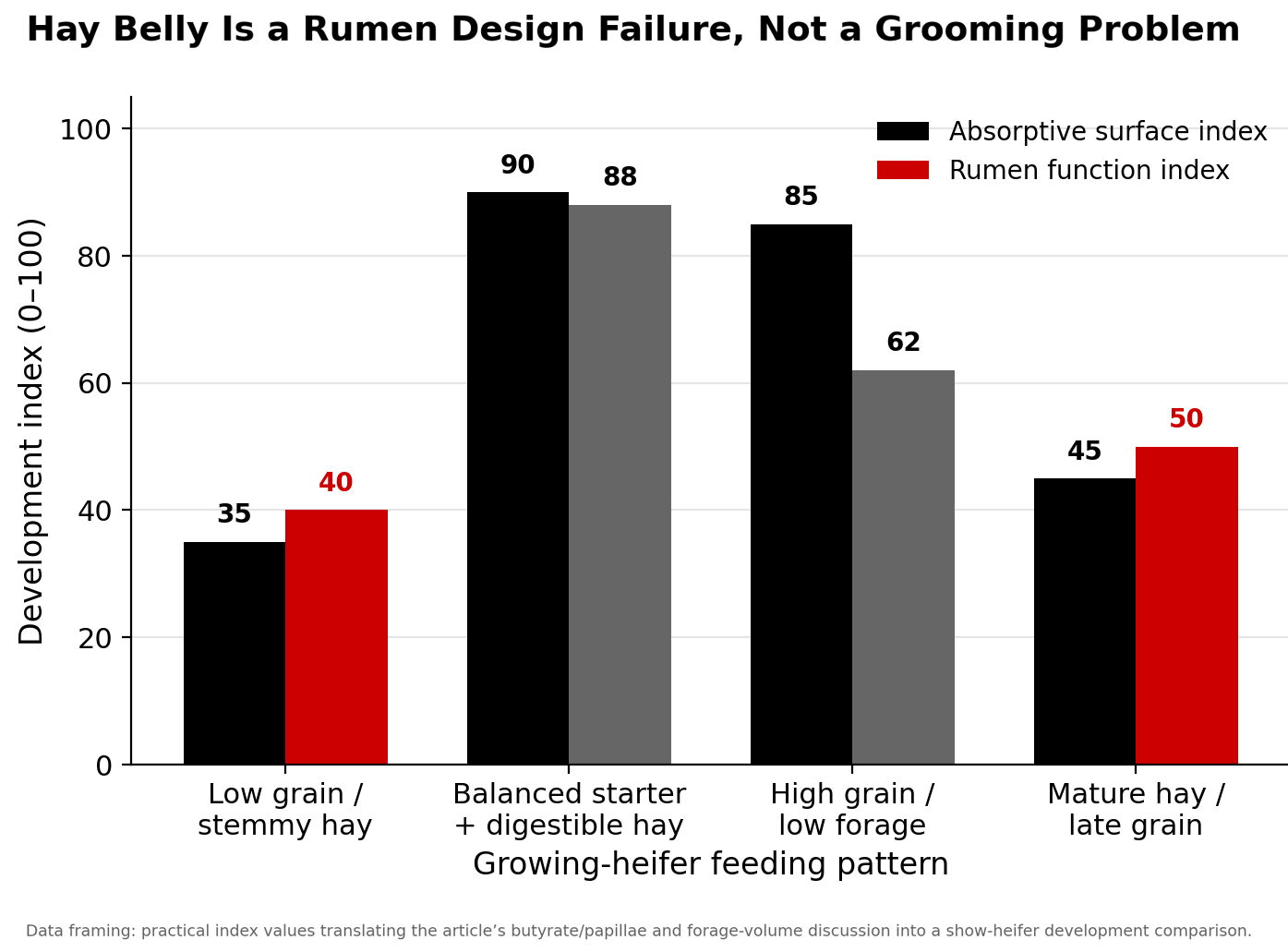
If you’ve ever heard a judge or a fitter complain that a heifer has “hay belly,” you’ve heard about a problem that starts with feed, not with looks. And it’s more interesting than most people realize.
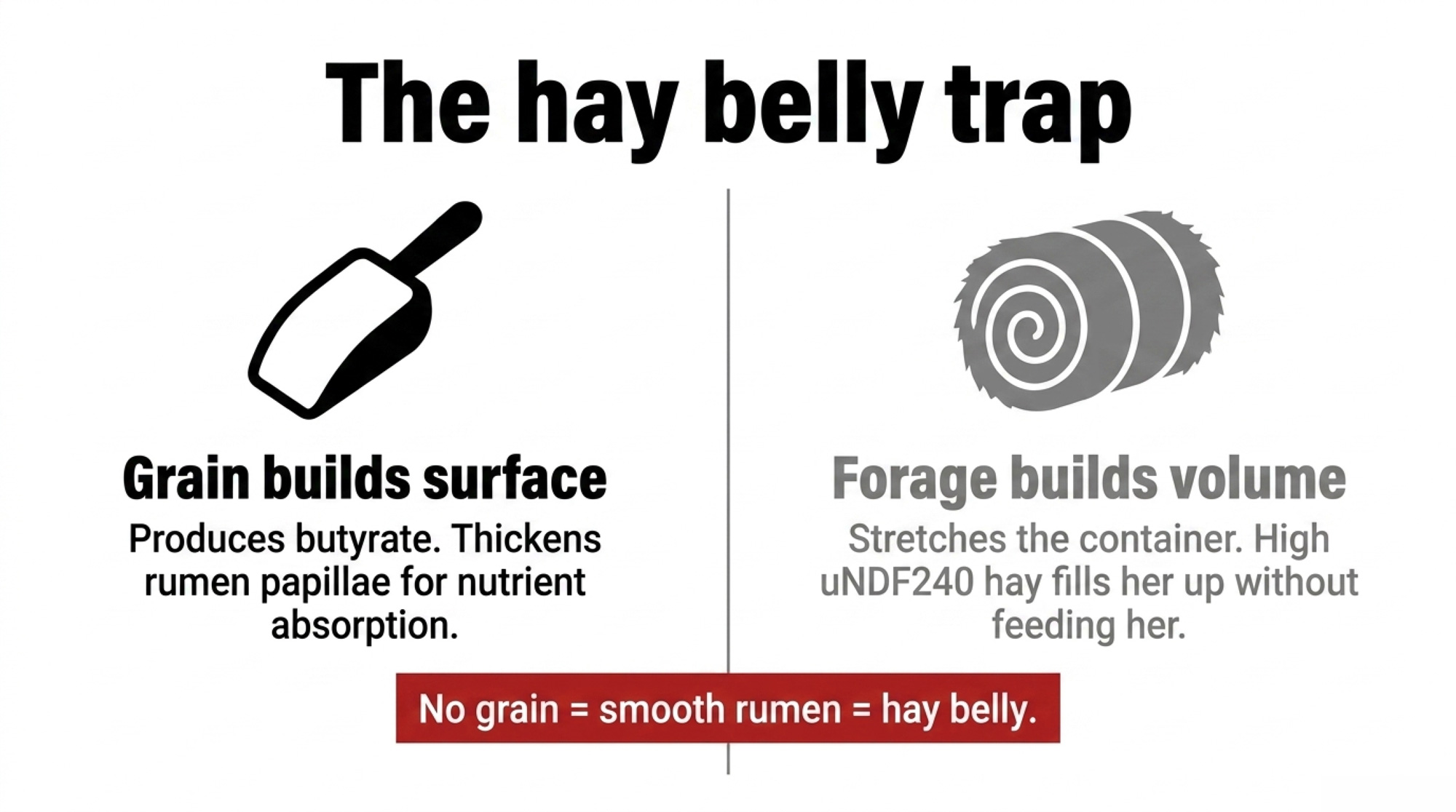
Her rumen — that big first stomach — has to grow in two ways at once. Picture the inside wall covered in thousands of tiny fingers called papillae, each one reaching into the rumen fluid to grab volatile fatty acids and pull them into her bloodstream. Grain fermentation produces butyrate, and butyrate is what makes those fingers grow longer and thicker. Think of it as building shag carpet on the inside of the rumen — more surface area, more nutrient uptake. On a calf fed almost no grain, that wall stays smooth and pale, like bathroom tile. Lots of room for feed. Almost no ability to absorb it.
Meanwhile, the rumen also needs muscular wall and volume, and that comes from forage stretching it out. So grain builds the absorption surface. Forage builds the container. Neither one alone gets you there.
Here’s the trap. Cheap, mature, stemmy hay has a lot of what we call uNDF240 — indigestible fiber that just sits in the rumen for up to ten days without breaking down. It fills her up without feeding her. She stops eating grain because she’s already full. No grain means no butyrate means no papillae. Now you’ve got a heifer with a smooth-walled, oversized container hanging forward off her barrel instead of tucking up like a dairy cow should.
The Silhouette Test: Chronic Fill vs. Real Growth
A real working rumen fills during the day and empties overnight. Morning: trimmer. Evening: fuller. Same animal, different silhouette. If your 6-month-old looks identical at 6 a.m. and 6 p.m., she’s got chronic fill, and the forage is the suspect.
If you run both breeds, you already know Jerseys are easier keepers. The why goes deeper than most people think, and it changes how you feed them.
Holsteins hit early lactation with a much deeper tissue energy deficit than Jerseys — roughly double at nadir on a body-reserve-mobilization basis, per the Journal of Dairy Science comparative metabolism literature — because they’re pulling milk out of their body reserves. So a Holstein heifer needs to come into calving with some condition to draw on. A Jersey at the same body condition score is already over-conditioned for what she’s actually going to need. She got there on less feed, because she converts feed to milk solids more efficiently than a Holstein does on an ECM/DMI basis.
In a commercial herd, that efficiency is a win. In a show heifer program, it’s a trap. Feed your Jersey yearling the same ration as your Holstein yearling of the same age, and your Jersey gets fat while your Holstein stays right. Fat Jerseys mean mushy udders at freshening. Mushy udders at freshening mean a mammary score that kills her in the ring at two years old.
Breed-Specific Management Cheat Sheet
Factor
Holstein
Jersey
Feed conversion efficiency (ECM/DMI)
Lower
Higher — gets same job done on less
Early-lactation tissue energy deficit
Deeper (roughly 2× at nadir)
Shallower
Over-conditioning risk on a shared ration
Lower
Higher — gets fat first
Clinical hypocalcemia rate
Lower
Measurably higher per JDS breed comparisons
Pre-calving anionic salt strategy
Standard DCAD
More aggressive DCAD, per Penn State / Wisconsin extension
Grouping rule
By metabolic age, not calendar age
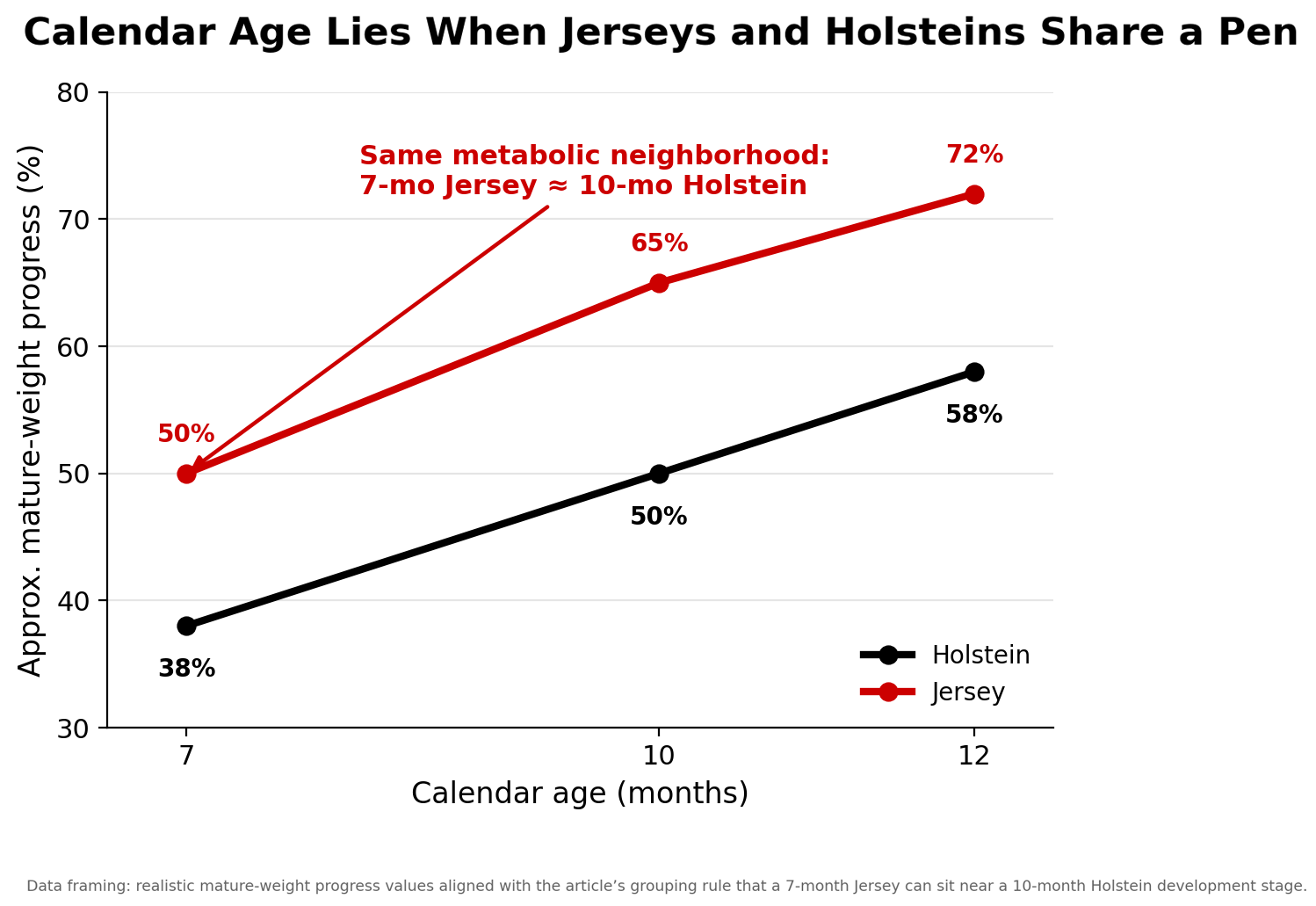
By metabolic age — a 7-mo Jersey ≈ a 10-mo Holstein
Jerseys also handle calcium differently at calving. They show measurably higher clinical hypocalcemia rates than Holsteins across multiple Journal of Dairy Science breed-comparison studies — a pattern attributed in part to differences in intestinal vitamin D receptor density — and you have to be more aggressive with anionic salts pre-calving than you would for a Holstein, per current Penn State and University of Wisconsin extension guidance.
The fix is simple once you see it. Don’t group Jerseys and Holsteins by calendar age. Group them by where they are in their growth. A 7-month-old Jersey and a 10-month-old Holstein sit at about the same spot on their growth curve. Put those two in the same pen on the same ration and you’re actually feeding them right. Calendar age is a trap with mixed breeds.
Why the Yearling Stretch Is Where Most Programs Leak
The ration that was right at 6 months is wrong at 12 months if nothing changes. NASEM 2021’s protein math shifts as she approaches mature size, because crude protein requirements for lean tissue accretion drop relative to her body weight as her growth curve flattens.
In plain English: the same ration that was building frame and muscle at 8 months starts laying down fat at 12 months. You didn’t change anything. She did.
Fat at 12 months means a yearling whose fore udder is getting laid down wrong, before she’s ever seen a milker. And the mammary system still carries the biggest single weighting on the PDCA unified scorecard. That one weighting is why an over-conditioned yearling costs you more ring points than any other single management miss.
The Ferrari Problem: What Feed Efficiency Actually Means in Your Barn
Lactanet’s Canadian Holstein evaluation publishes Feed Efficiency as a relative breeding value, and this is where genomic testing starts paying dividends beyond sire selection.
Here’s the practical framing. A heifer with a high Feed Efficiency breeding value is a Ferrari that runs on regular gas. Give her premium volume and she’s going to store it as fat faster than her pen mates — she’s literally bred to make more out of less. That’s a gift in the tank. It’s a liability in the show ring, where a BCS over 3.5 means she’s over-conditioned and her udder is getting laid down wrong.
The low-FE heifer in the same pen has the opposite problem. She needs the calories to hold condition. Feed them both the same ration and one ends up fat while the other ends up thin.
This is why genomic data shouldn’t end at sire selection. Pull Feed Efficiency RBVs on your replacement heifers. The high-FE tier needs less volume, lower energy density, or both. The low-FE tier needs what you’d consider a “normal” ration. Segmenting pays off fastest on bigger operations — small groups can’t justify the separate pens — but even a two-pen split on FE tier will save feed and protect udder development on your show prospects.
Here’s the part nobody tells 4-H kids often enough: if you don’t write it down, you don’t actually know.
Monthly weights. Monthly BCS. Monthly height measurements against the breed standard. Forage tests. Dates of every health event and every treatment. Not because the fair committee asked for it — because you literally cannot improve a program you aren’t measuring. Which heifers hit their target weights? Which ones drifted and when? Which batch of hay lined up with the hay belly problem in that pen? Which bull’s daughters are growing differently than the others?
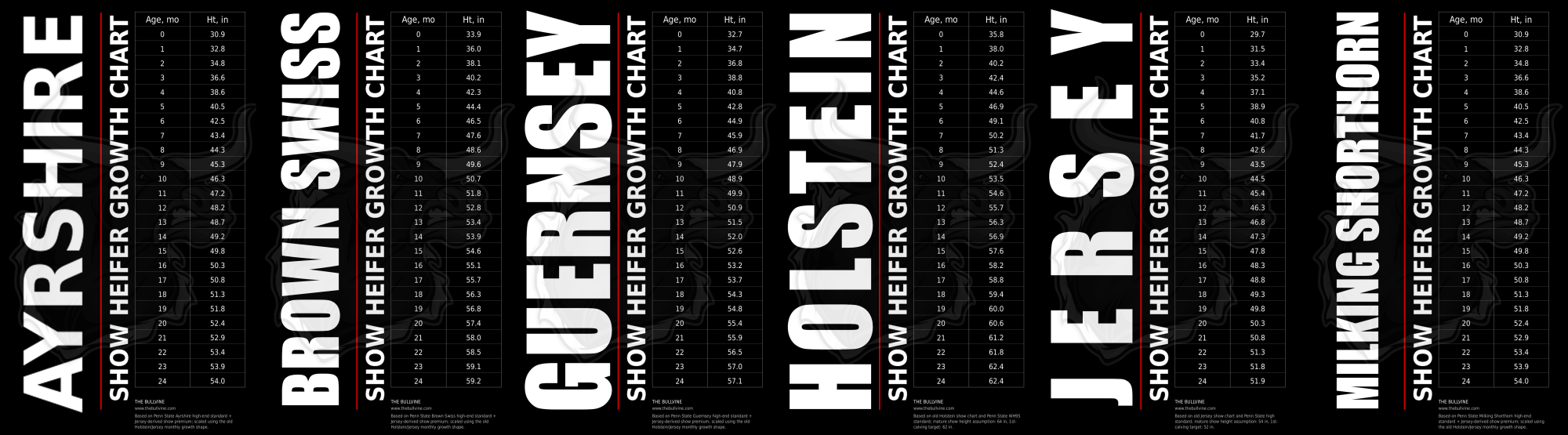
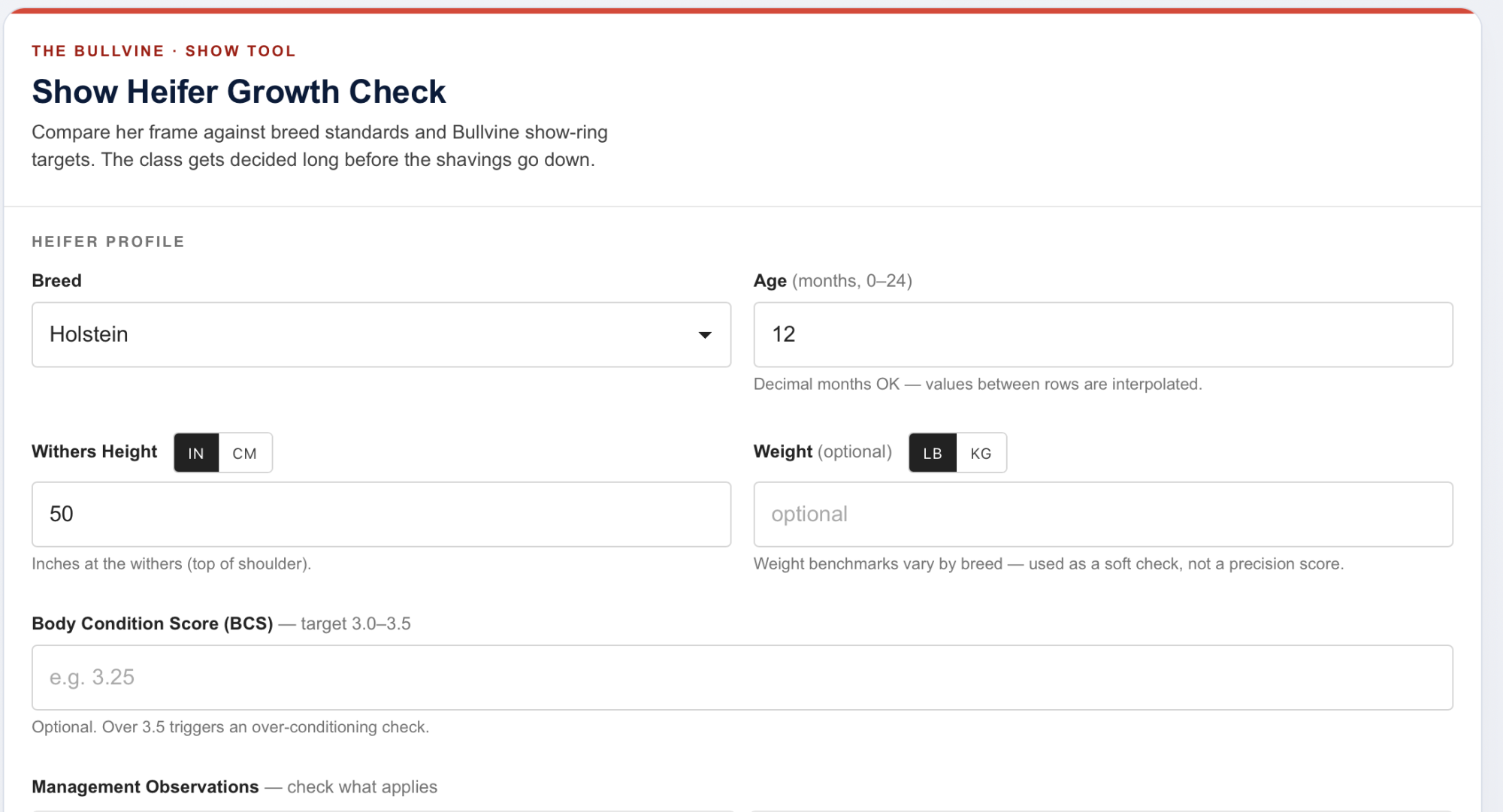
The 2026 Breed Benchmarks: Target show heights for all major dairy breeds from birth to 24 months. Use these curves to ensure your heifer is hitting her frame potential without over-conditioning. or check out our NEW Show Heifer Growth Check Tool
Run the maternity pen like a hospital. Refractometer on every batch. Four liters in the first two hours, tubed if she won’t nurse it. Two more liters at 12 hours. About $200 in gear and fifteen minutes of labor per calf gets you most of the way there. The one thing that can blow it all up: dirty equipment. Bacterial contamination undoes the whole protocol in one feeding, so wash and dry your gear every single time.
Use the genomic data you already paid for. If you’re genomic-testing, pull the Feed Efficiency values and segment your rations where group size supports it. Feed the Ferraris less. Feed the work trucks normal.
BCS your heifers every month. Same person. Same target: 3.0 to 3.5. Pre-commit to what you’ll do if she’s over — usually pull grain or switch pens. Here’s the part that’s hard: don’t break the rule because she’s your favorite or because the fair is in three weeks. Get somebody outside your family to eye her, too. Phones and photos help you see what you can’t see when you’re in the barn with her every day.
Have a written re-entry plan for show animals. Isolate returning animals for 7 to 14 days and watch them, consistent with AABP and university extension biosecurity guidance. A September show heifer who came home with a respiratory bug can set back your whole yearling pen through October if you don’t catch it.
What This Means for Your Operation
Are you actually testing your colostrum, or just hoping it’s good? If you’re not Brix-testing at harvest, you don’t actually know what you’re feeding.
Pull a forage test on your growing-heifer hay and check NDFD30 and uNDF240. High uNDF240 creates hay belly even when intake looks reasonable.
When did you last BCS your yearlings against a written target, with a non-family reviewer’s input? If the answer is “never” or “I don’t remember,” the emotional filter is running your program.
Are your Jerseys in the same pen as Holsteins of the same calendar age? If yes, your Jerseys are getting fat. Match them by metabolic age instead.
Walk them at 6 a.m. and again at 6 p.m. Does the silhouette change? If not, diagnose the forage before diagnosing the animal.
Do you know your heifers’ Feed Efficiency values? A high-FE daughter on the same ration as a low-FE pen mate is going to get fat first.
What’s your plan when a show animal comes home? If it’s informal, it’s a disease event waiting to happen.
Key Takeaways
If a calf isn’t fed colostrum within 2 hours of birth, her achieved serum IgG is already roughly 28% lower than it should be — and the rest of the program is working uphill from there.
If your heifers show the same silhouette at 6 a.m. and 6 p.m., your forage is failing before your grain program has a chance to succeed.
If you’re running one ration across Holsteins and Jerseys of the same calendar age, you’re over-conditioning one breed and under-fueling the other.
If your genomic data ends at sire selection and doesn’t inform ration design, your high-FE heifers are quietly getting fat on the ration that’s keeping your low-FE heifers right.
If BCS scores over 3.5 don’t trigger a pre-committed, automatic ration change, emotional bias is deciding your program — not the data.
📌 Your 30-Day Move
In the next month, sit down with your herd vet and set up a serum total protein check on the next 30 calves born on your place. That number tells you exactly how well your colostrum program is actually working — not how well you hope it’s working. You can’t fix what you aren’t measuring, and this is the highest-leverage window in the whole show heifer program. Full stop.
The 90-Day and 365-Day Plays
Next 90 days: Get a forage test on your growing-heifer hay and pull a BCS on every animal in the yearling pen. Put the numbers in writing. Buy the $200 refractometer if you don’t own one. Walk the morning-versus-evening silhouette check once a week.
Next 365 days: Pull your heifers’ genomic Feed Efficiency values if you’re testing. Start segmenting rations by FE tier if your group size supports it. Build a written post-show re-entry protocol, sign-off and all. And by the time this cycle closes, you should have month-over-month growth and BCS data on every single replacement — not a feeling, not a memory, a spreadsheet.
The Question That Decides the Class
The walk doesn’t lie. You can fit a mediocre heifer to look impressive standing still. You can’t fit her to move like a champion. That effortless, ground-covering stride is what comes out when everything was done right from day one. You either earn that walk in the maternity pen, or you don’t get it at all.
So here’s the one worth sitting with tonight. Of the calls you’re making this month — whether to get up for that 2 a.m. calving, whether to switch hay loads, whether to pull the grain on that heifer who’s looking a little thick — which one will you see in the ring next September? And which one are you going to wish you’d made differently?
The class gets decided a long time before the shavings go down. The only real question is whether your program runs like you know that.
Is She Big Enough?
Monitor whether your show heifers are on track to hit critical weight and height targets at each development stage using industry-validated benchmarks. This tool compares your heifer’s current measurements against breed-specific growth curves and mature body weight percentages, flagging whether she’s running ahead, on pace, or falling behind where she needs to be for optimal development and show ring readiness. Access the Show Heifer Growth Check
Learn More
Feed to Win: How to Maximize Your Dairy Show Heifers Potential — Secure your heifer’s growth trajectory with specific grain-to-forage ratios and monthly monitoring schedules that bridge the gap between baby calf health and yearling ring readiness. High-protein protocols prevent the growth stalls that cap ultimate frame.
The Ultimate Dairy Show Guide for 2026: Judging, Classification & Ring Craft — Align your breeding program with the massive 2026 PDCA scorecard overhaul, revealing why judges now penalize extreme stature and prioritize robot-ready teat placement over traditional height. Knowing these shifts secures your herd’s future classification rank.
Every week, thousands of producers, breeders, and industry insiders open Bullvine Weekly for genetics insights, market shifts, and profit strategies they won’t find anywhere else. One email. Five minutes. Smarter decisions all week.
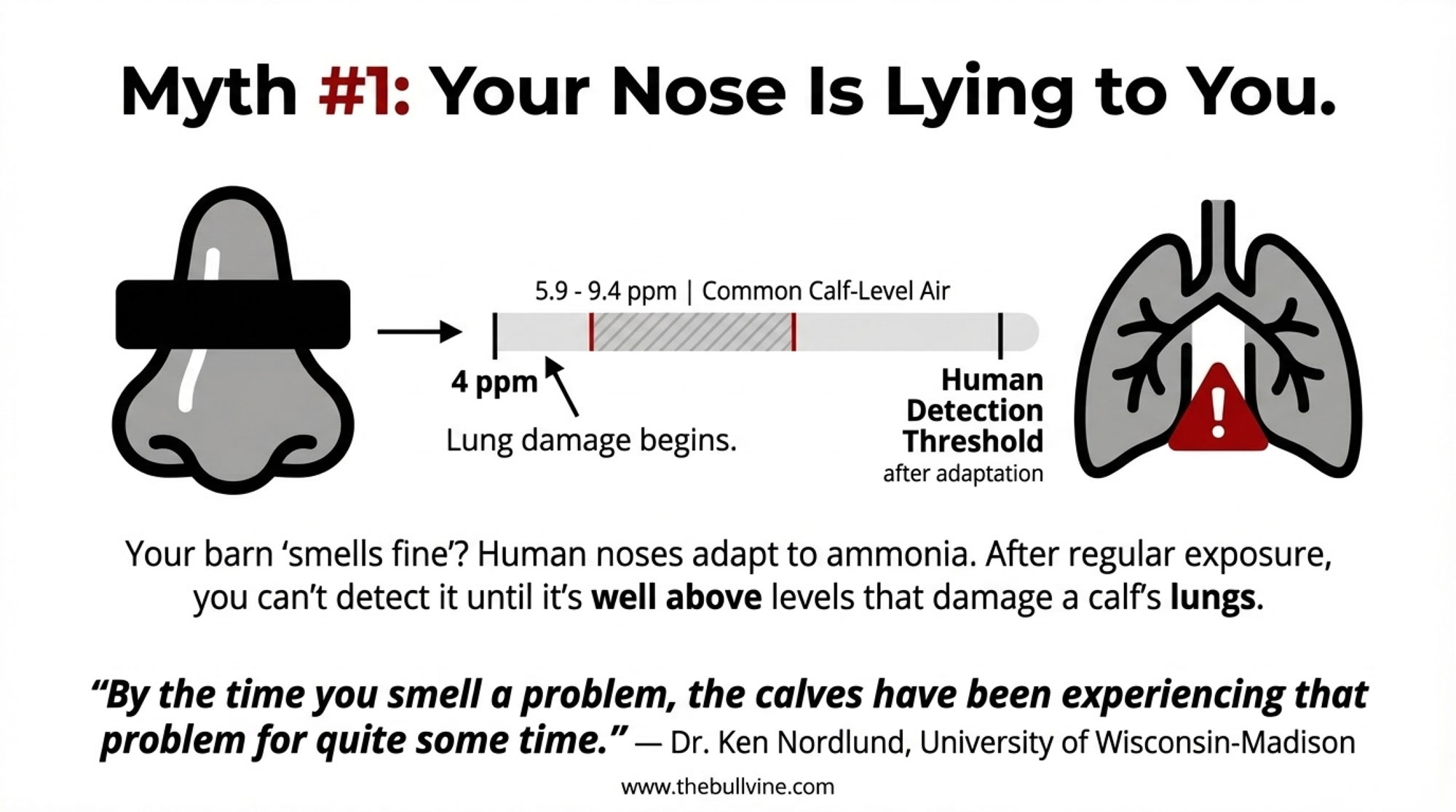
Your barn ‘smells fine’? At 8 ppm ammonia, you can’t detect it—but your calves’ lungs can. You’re not managing. You’re hoping. And it’s costing you.
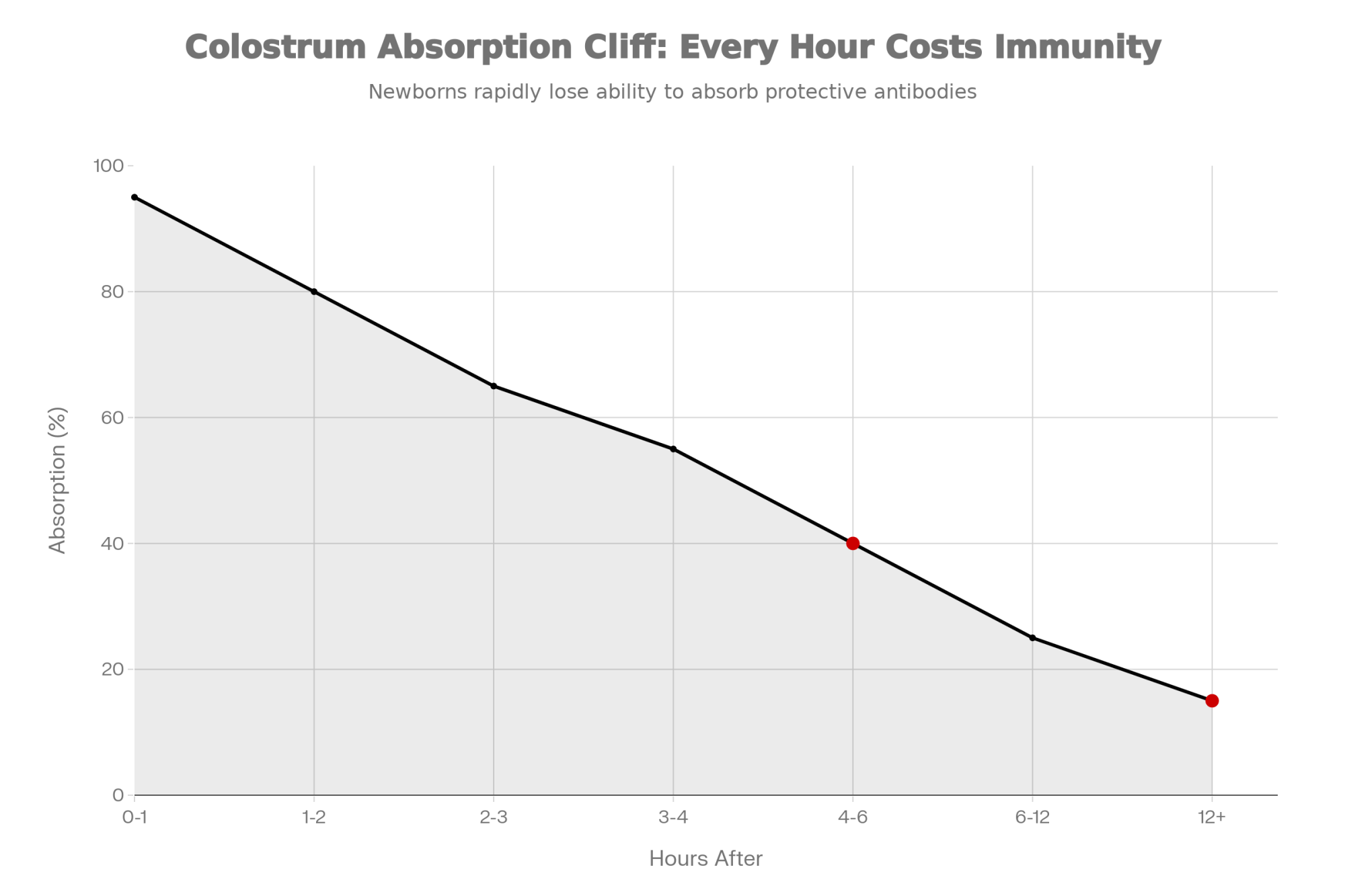
Executive Summary: The dairy industry finances $200,000 robots without blinking but ignores $100 interventions that cost 1,200 pounds of milk per heifer over a lifetime. Research from UC Davis, UW-Madison, and Lactanet (2019-2025) shows lung damage begins at 4 ppm ammonia—a level humans can’t detect after regular barn exposure—while colostrum absorption crashes from 95% at hour one to 50% by hour six. One-quarter of colostrum samples fail quality thresholds, and visual assessment is unreliable: thick golden colostrum sometimes tests worse than thin watery batches. The fixes cost almost nothing: a Brix refractometer runs under $100, bedding every 2-3 days cuts diarrhea risk 57%, and tightening colostrum timing requires only protocol discipline. With multiple component pricing placing nearly 90% of milk check value on butterfat and protein, early-life calf health compounds directly into first-lactation revenue. The math is brutal: maternity pen protocols pay back in weeks while that robot takes seven years.
Walk into any progressive dairy operation these days, and you’ll find precision feeding systems calibrated to the gram, genomic testing that predicts lifetime production potential, and automated milking technology that would have seemed like science fiction a generation ago. According to USDA data and industry reports—a single robotic milking unit now runs $150,000-$230,000, and farms are installing them by the thousands. We’ve embraced data-driven decision-making in remarkable ways.
Investment Decision
Upfront Cost
Annual Debt Service (7 years)
Calf Health Impact
First-Use Payback
Robotic milking unit
$150,000-$230,000
$21,000-$33,000/year
None
7 years
Brix refractometer + protocol
<$100
$0
Saves 1,200 lbs/heifer × heifers born
Immediate
But here’s what’s been catching my attention lately. A conversation has been building among veterinarians, extension specialists, and forward-thinking producers over the past few years. The question: What if the biggest opportunity for improvement isn’t in the milking string at all—but in the first 24 hours of a calf’s life?
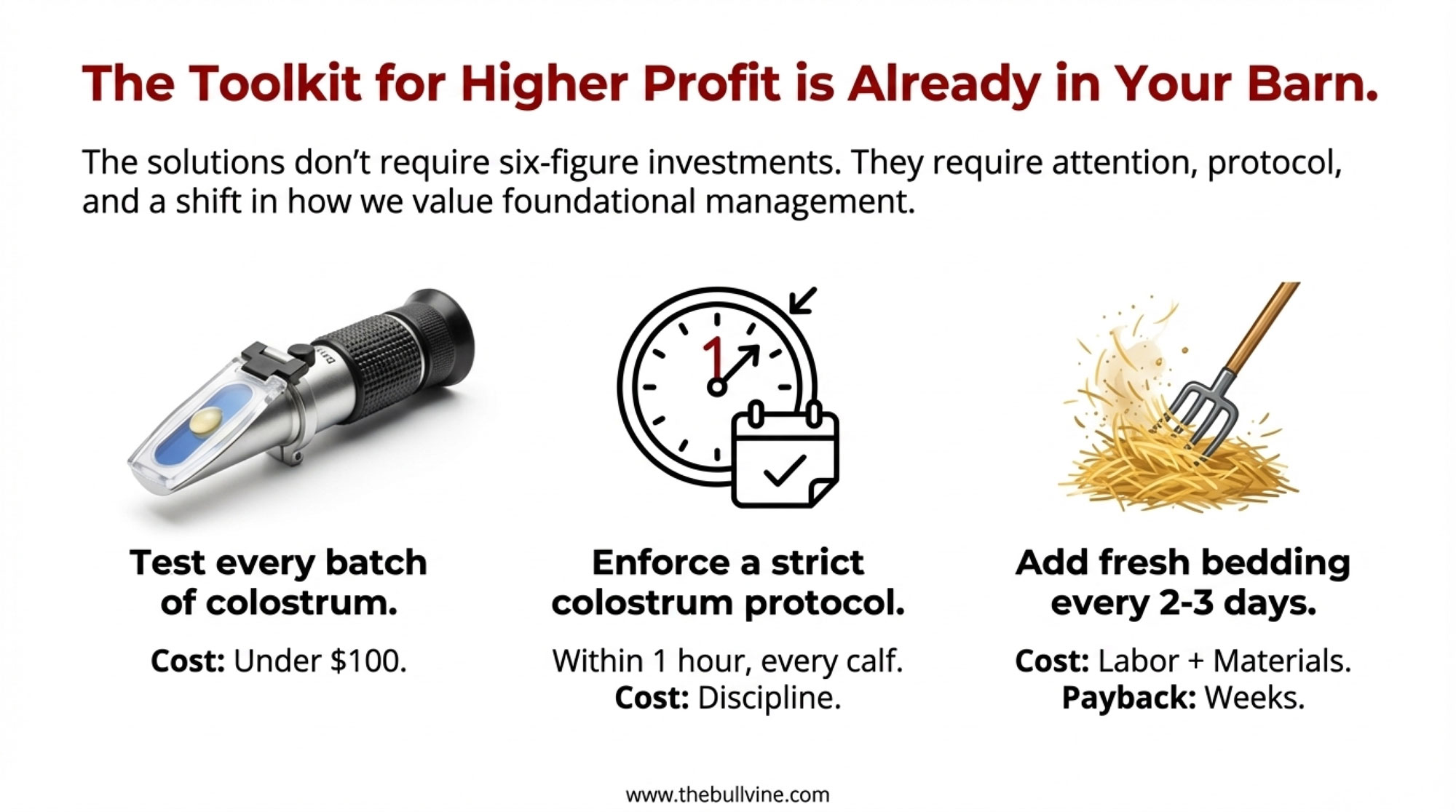
The emerging data from the University of California, the University of Wisconsin-Madison, and on-farm trials across North America reveals something worth considering. The maternity pen—often treated as a simple pass-through area where calves arrive and cows transition—may actually be one of the most underutilized profit centers on many farms. And the interventions that seem to move the needle most don’t require six-figure investments. They require attention, protocol, and a shift in how we think about foundational management.
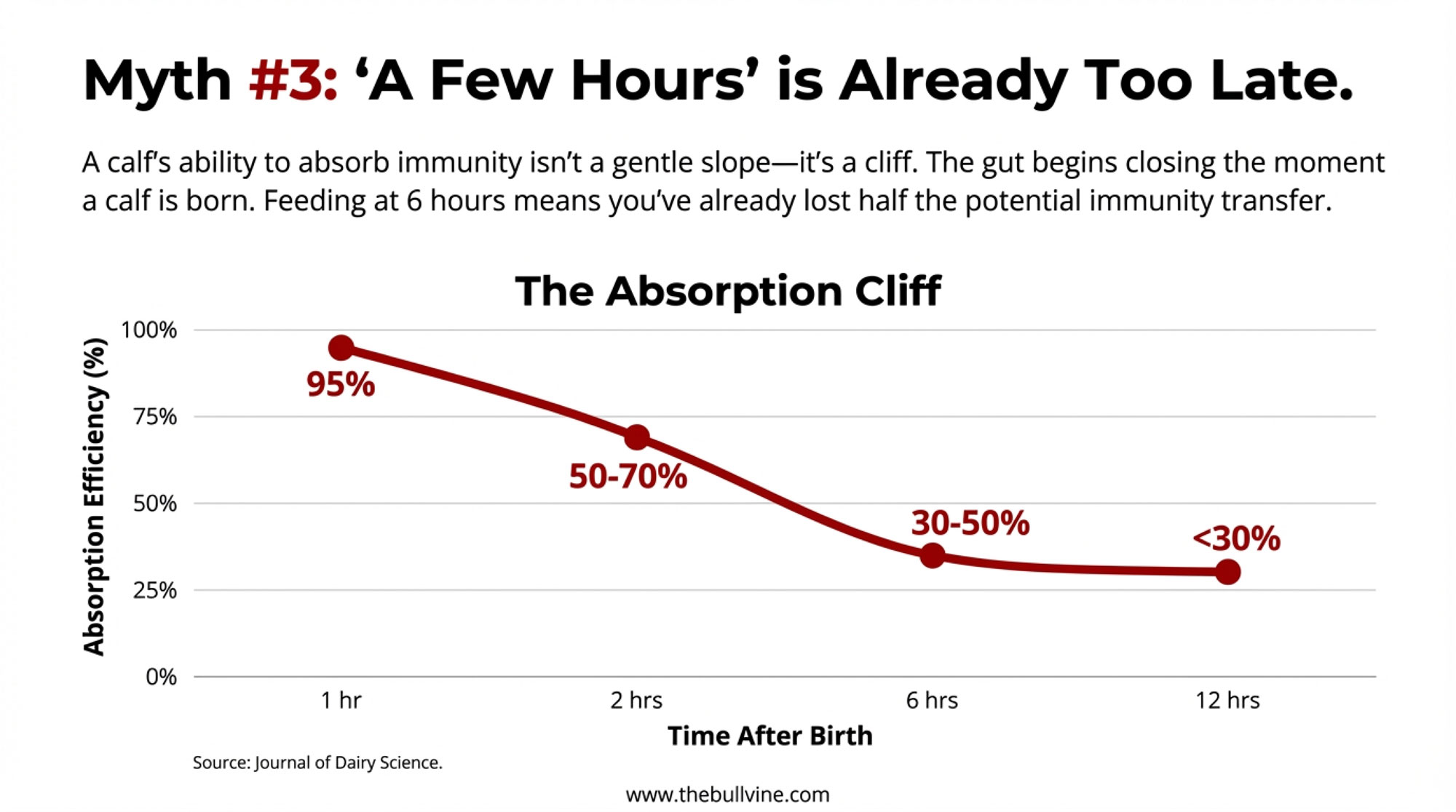
The Colostrum Absorption Cliff: Every Hour Costs You Immunity” – This line chart shows the dramatic decline in colostrum absorption efficiency after birth, illustrating why feeding within 1 hour achieves 95% efficiency while waiting 6 hours drops to just 25%
The Lifetime Value Calculation Worth Revisiting
When producers think about calf losses, they typically calculate the immediate cost: the value of a dead calf, maybe $150-200, depending on the market. But that calculation, it turns out, may significantly underestimate what’s really at stake.
Dr. Sheila McGuirk, Professor Emerita at the University of Wisconsin-Madison School of Veterinary Medicine, has spent decades researching calf health outcomes. Her work, along with research from UC Davis and other land-grant universities, points to a more complete economic picture that extends well beyond immediate mortality.
Consider a thought experiment with two genetically identical heifer calves born on the same farm, same day:
Calf A is born in a maternity pen with adequate but not optimal conditions—bedding changed weekly, moderate ammonia levels that nobody really notices, colostrum delivered within “a few hours” of birth.
Calf B is born in a well-managed environment—fresh bedding, clean air, and colostrum within 90 minutes of hitting the ground.
Both calves survive. Both eventually enter the milking string. But their lifetime trajectories can diverge in ways that compound over the years.
Research published in the Journal of Dairy Science and documented through USDA NAHMS surveys suggests that Calf A faces a series of potential disadvantages:
The growth consideration. Multiple studies show that calves with poor passive transfer or early respiratory disease tend to have lower average daily gain and reach breeding size later, adding weeks to the rearing period and increasing feed and housing costs. Penn State Extension’s 2023 summary of the research found clear links between passive transfer categories and growth outcomes—calves in lower categories simply don’t grow as efficiently.
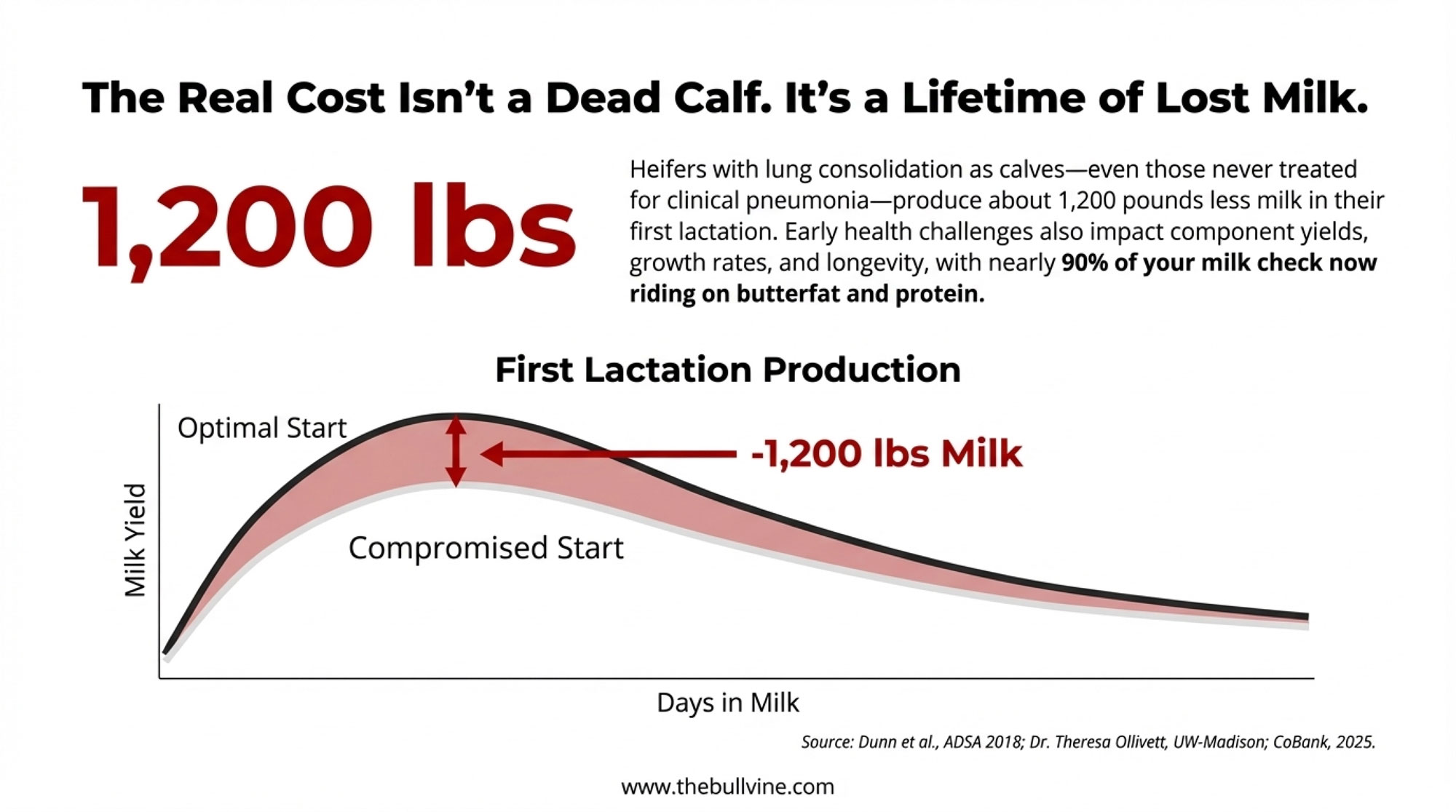
The lung capacity question. This one particularly caught my attention. Research from Dr. Theresa Ollivett at UW-Madison using thoracic ultrasound has documented that calves with lung consolidation—even those never treated for clinical pneumonia—often produce less milk in their first lactation.
The Hidden Milk Loss
A 2018 cohort study by Dunn and colleagues presented at ADSA found that heifers with at least 3 cm of lung consolidation as calves produced about 525 kg (1,150 lbs) less milk in their first 305-day lactation. Dr. Ollivett has noted in extension presentations that any heifer calf with a history of pneumonia tends to produce about 1,200 pounds less milk in her first lactation.
The longevity factor. NAHMS data and follow-up studies indicate that calves experiencing early health challenges have a higher risk of leaving the herd before completing their second lactation. They may be more likely to struggle with metabolic issues at first calving and less likely to breed back efficiently.
The component connection. Here’s something that doesn’t get discussed enough in the calf barn: early-life nutrition and health also affect component production. A 2024 study published in BMC Veterinary Research, tracking 220 heifer calves from eight herds, found that colostrum management and preweaning health measures significantly impacted not only total milk yield but also protein and fat yields in first lactation. Penn State Extension’s review of calf feeding research found that calves fed higher planes of nutrition produced more fat and protein on a daily basis and had higher 3.5% fat-corrected milk in first lactation. With multiple component pricing placing nearly 90% of the milk check value on butterfat and protein, according to CoBank’s 2025 analysis, those early-life investments compound directly into revenue.
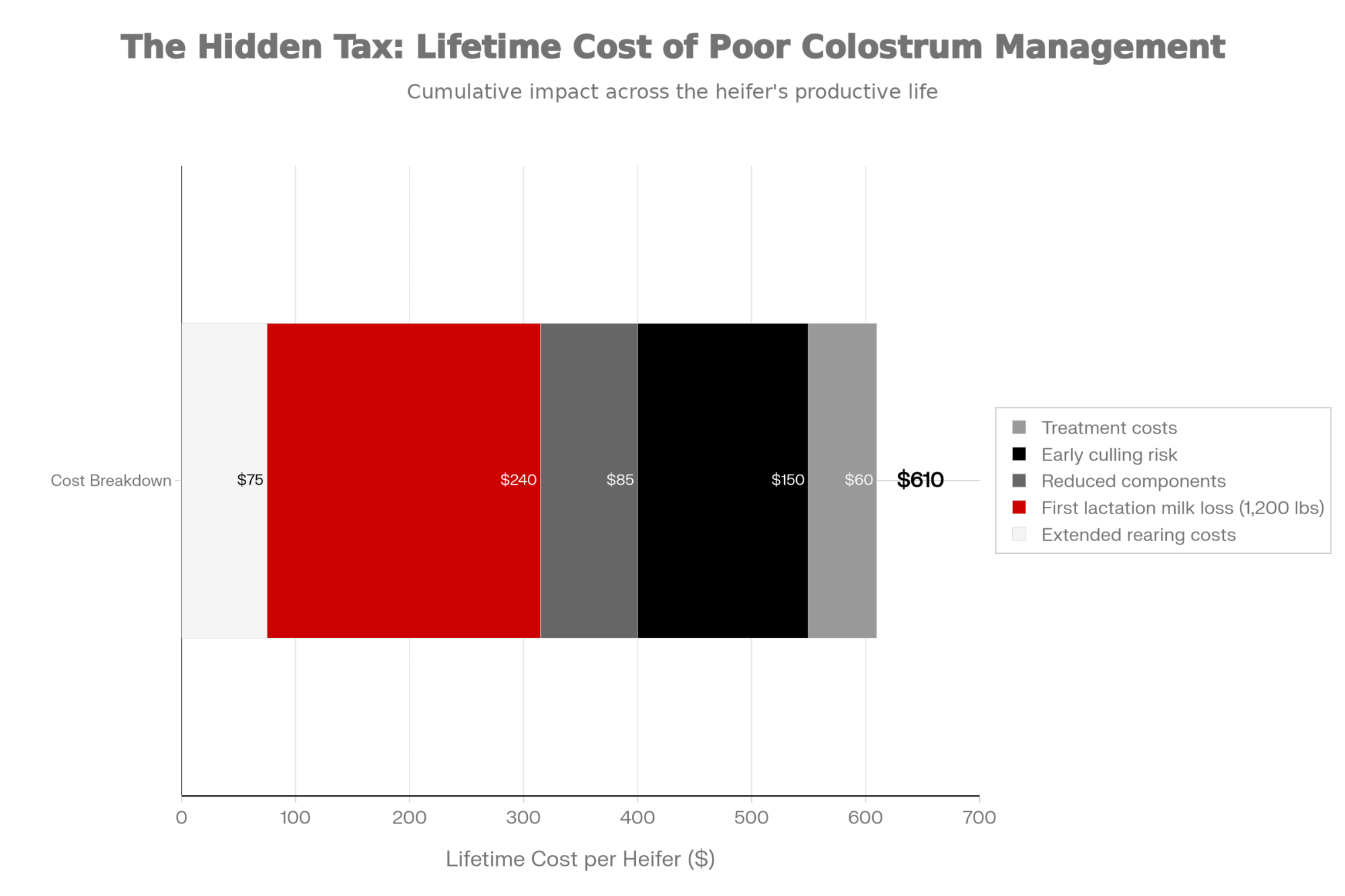
When you add these factors together—the extended rearing costs, the potential first-lactation milk loss, the component production impact, the increased culling probability—the lifetime economic impact can reach several hundred dollars per heifer, and in some scenarios more. A 2016 meta-analysis by Raboisson and colleagues, frequently cited by Dr. Sandra Godden at the University of Minnesota, estimated that failure of passive transfer alone costs at least $70 per calf in direct effects.
The Hidden Tax: Lifetime Cost of Poor Colostrum Management” – Every heifer with suboptimal passive transfer carries a $610 lifetime penalty. The red segment shows first-lactation milk loss alone costs $240—more than twice what you paid for that refractometer you don’t own
Worth considering as you evaluate where to focus improvement efforts.
The Bedding Research That’s Getting Attention
Perhaps no finding has generated more discussion among dairy consultants than what’s emerged about bedding management in recent years.
The BRD 10K study, published in the Journal of Dairy Science in 2019 by Dubrovsky and colleagues at UC Davis—including epidemiologist Dr. Sharif Aly—tracked 11,470 calves across six California dairies over a full year. The study examined dozens of management variables to identify which practices correlated with respiratory disease outcomes. What they found reinforced something that’s been gaining traction in calf housing guidance: cleaner, drier environments appear to matter considerably.
The Bedding Frequency Finding
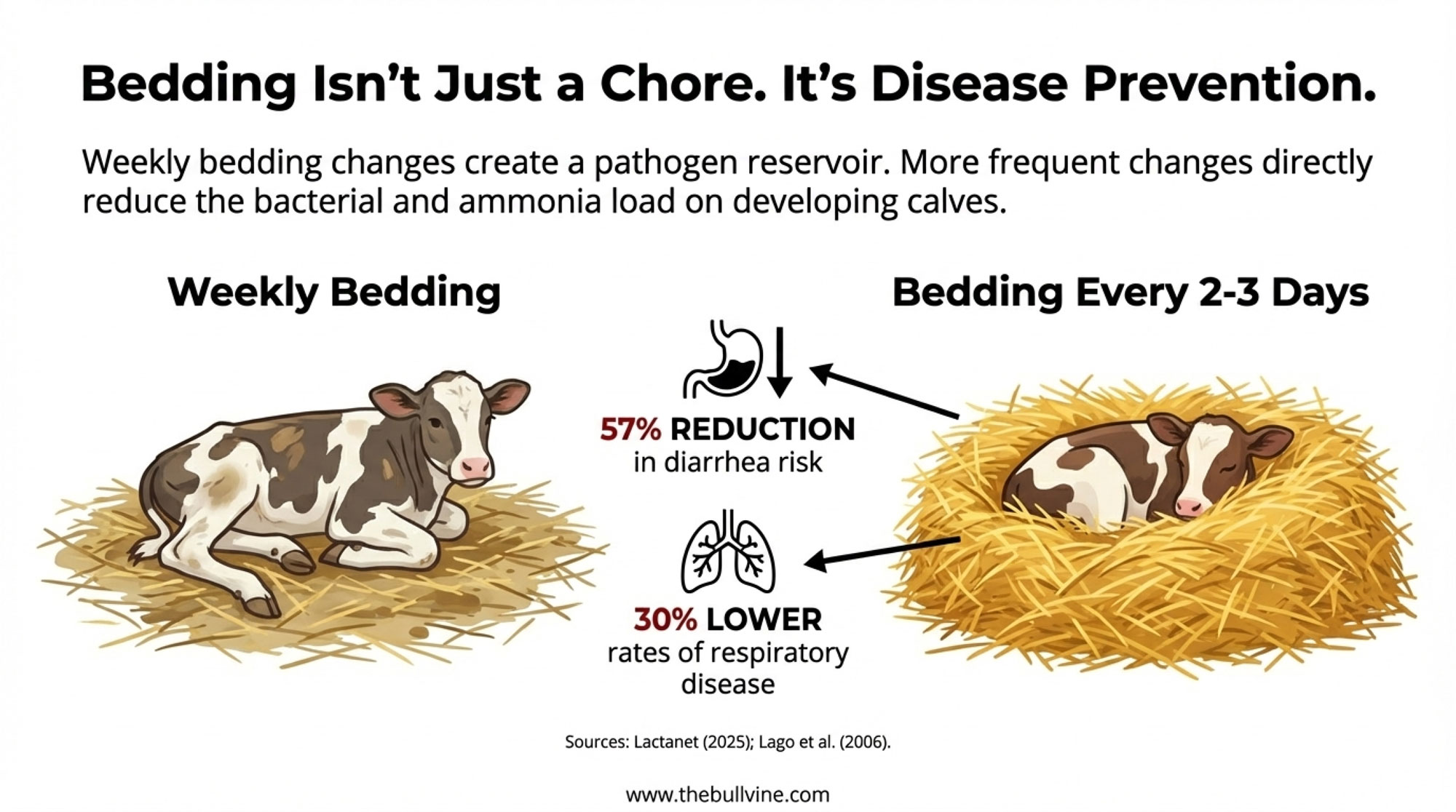
A February 2025 calf housing fact sheet from Lactanet, drawing on research by Medrano-Galarza and colleagues published in Journal of Dairy Science, found that adding fresh bedding every 2 to 3 days, compared with every 7 days or longer, was associated with a 57% reduction in diarrhea risk.
The same Lactanet summary, citing work by Lago and colleagues from 2006, found that calves fully nested in deep straw bedding had 30% lower rates of respiratory disease compared to those with legs visible while lying down.
More Straw, Less Scours: The Bedding Frequency Trade-off” – Bedding every 2-3 days cuts diarrhea risk by 57% and costs $4 per calf per week. Compare that to treating scours or losing 1,200 lbs of milk in first lactation
I recently spoke with a Wisconsin producer who implemented more frequent bedding changes last fall. His observation: the mindset shifted from reactive to preventive. They’re changing bedding before it becomes a problem rather than after noticing one. Within three weeks, he said, respiratory rates in his calf barn had dropped noticeably. Now, that’s one farm’s experience—but it aligns with what the research suggests.
The mechanism makes intuitive sense when you think about it. When bedding sits undisturbed for extended periods, bacterial populations grow in the moist environment. Ammonia accumulates from decomposing organic matter. By the end of a week, the bedding can become a pathogen reservoir—and every breath the calf takes delivers that load to developing lung tissue.
The economics vary by operation, of course. More frequent bedding changes mean more straw and more labor. Those aren’t trivial considerations, especially for operations already stretched thin. But on farms that have carefully tracked outcomes, the returns from reduced treatment costs, improved growth rates, and lower mortality have often exceeded the investment.
I want to be clear: these figures come from specific studies in specific contexts. Operations in the Upper Midwest face conditions different from those in California’s Central Valley or the humid Southeast. Pasture-based systems have their own considerations entirely. The principle seems sound—cleaner environments generally mean healthier calves—but the specific economics will vary based on your starting point, labor costs, and regional factors.
What the “Smell Test” Might Be Missing
Most dairy producers believe they can assess air quality by smell. If the barn doesn’t reek of ammonia, ventilation must be adequate. It’s a reasonable assumption, and I’ve relied on it myself over the years.
But the biology may tell a different story.
Research from Penn State Extension, corroborated by work at multiple land-grant universities, has documented that humans typically detect ammonia at fairly low concentrations—but here’s the thing: regular exposure creates what researchers call olfactory adaptation. Those of us who work in barns daily often don’t consciously register ammonia until concentrations are well above levels that may affect calves.
The four ppm Threshold
Finding
Source
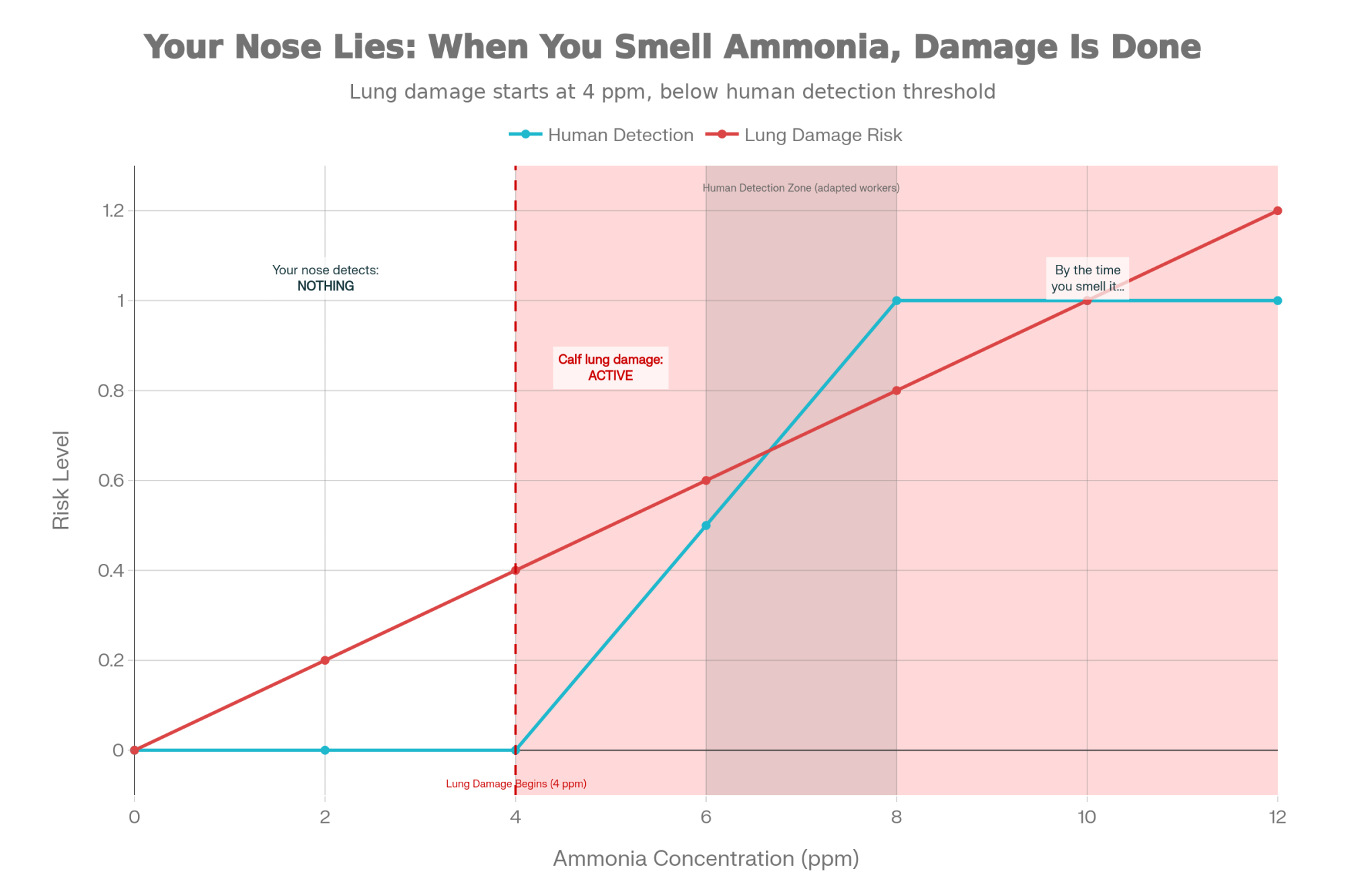
Ammonia exposure above four parts per million is significantly associated with lung consolidation (odds ratio 1.73)
Van Leenen et al., 2020, Preventive Veterinary Medicine
Four-hour maximum ammonia levels are commonly 5.9-9.4 ppm at calf level
Animals journal, 2024 (Swiss calf housing study)
Human nose adapts; calves’ lungs don’t
Multiple land-grant university extension publications
Dr. Ken Nordlund, who co-authored foundational calf housing recommendations now used through the Dairyland Initiative at UW-Madison, put it plainly:
“By the time you smell a problem, the calves have been experiencing that problem for quite some time.”
— Dr. Ken Nordlund, DVM, University of Wisconsin-Madison
Your Nose Lies: When You Smell Ammonia, the Damage Is Already Done” – The critical 4 ppm threshold where lung damage begins is invisible to workers with adapted noses. By the time you smell ammonia, your calves have been breathing damage for weeks
That’s worth thinking about. We walk through and think everything is fine. The calves may be experiencing something different.
Visual Checks That Can Help
What some farmers are discovering is that while human noses adapt, visual and behavioral indicators don’t. Several zero-cost assessments can reveal ventilation concerns before they show up in treatment records:
The eye check. Fresh cows and young calves with visible tearing, red or watery eyes, are showing mucosal irritation—potentially from ammonia exposure. The eyes don’t adapt the way noses do.
The bedding moisture test. In winter, if bedding shows heavy condensation or frost at calf nose height in the early morning, moisture may not be adequately exhausted from the barn. That trapped moisture creates favorable conditions for both pathogen growth and ammonia accumulation.
The breathing observation. This one takes a little practice, but it’s useful. Healthy calves at rest breathe effortlessly from the belly—what veterinarians call diaphragmatic breathing—at 20-30 breaths per minute. If you’re seeing visible flank movement, shoulders working, or labored breathing in resting calves, that’s worth investigating.
The rafter inspection. Water droplets forming on the underside of the barn roof indicate moisture is condensing rather than being ventilated out.
The 5-degree rule. According to Cobb et al. (2016), cited in The Dairy Site’s ventilation guidance, when the temperature difference between inside a calf shelter and outside exceeds 5°F, that’s indicative of a ventilation problem—the barn is too closed up.
These assessments take minutes and require no equipment. Just attention and a willingness to look.
The Colostrum Conversation
If there’s one area where the gap between “doing something” and “doing it optimally” is most evident, it’s colostrum management. You probably know most of this already—but the details matter, and I’ve found the research worth revisiting.
Most dairy operations believe they’re handling colostrum adequately because they feed it “within a few hours” of birth. The intention is right. But research from multiple institutions reveals several common gaps that can undermine even well-meaning protocols.
Why Timing Matters More Than We Thought
The calf’s ability to absorb immunoglobulin G from colostrum begins declining immediately after birth. This is intestinal physiology documented extensively in peer-reviewed research. The gut epithelium that allows large antibody molecules to pass into the bloodstream begins closing from the moment the calf is born.
The Absorption Clock
Time After Birth
Absorption Efficiency
Less than 1 hour
90-100%
1-2 hours
70-90%
2-6 hours
50-70%
6-12 hours
30-50%
Beyond 12 hours
Below 30%
Source: Journal of Dairy Science and multiple university extension summaries
What this means practically: every hour of delay has a cost. A farm that believes it’s feeding “within a few hours” but is actually reaching calves at 5-6 hours has already lost a substantial portion of potential immunity transfer.
Dr. Sandra Godden at the University of Minnesota has published extensively on colostrum management protocols. Her research suggests that “within a few hours” is too vague a target—specific timing protocols that ensure feeding within two hours, and ideally within one hour, tend to produce meaningfully different outcomes.
The Visual Assessment Question
One of the more interesting findings I’ve encountered comes from colostrum quality research conducted across multiple U.S. dairy operations.
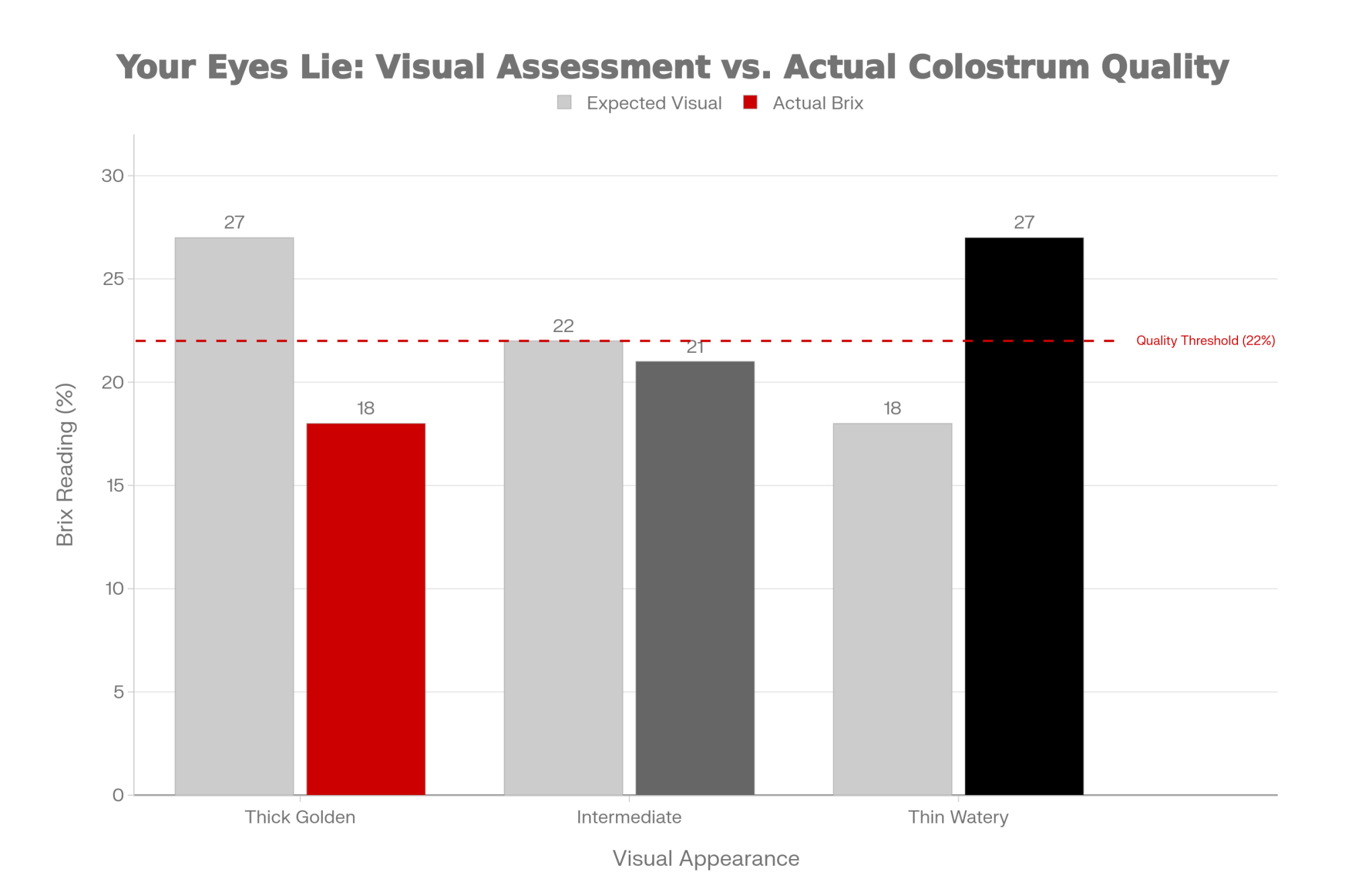
When researchers asked farmers to visually rank colostrum quality—thick and golden versus thin and watery—and then tested with a Brix refractometer, the results challenged conventional wisdom. As Hanne Skovsgaard Pedersen demonstrated, the first three first-milking colostrum batches harvested the same morning showed surprising results:
The thick, bright golden yellow batch: Brix reading of 18 (below threshold)
The intermediate-appearing batch: Brix reading of 21
The thin, nearly white batch: Brix reading of 27 (excellent quality)
True quality was the direct inverse of perceived quality based on visual assessment alone.
Yet walk through most dairy operations, and you’ll find colostrum assessment still relies primarily on appearance. And here’s the challenge—summaries of NAHMS data and herd-level testing cited in Hoard’s Dairyman suggest that around one-quarter of colostrum samples fall below the commonly used 50 g/L IgG cutoff. That’s approximately 22% on a Brix refractometer, according to the Dairy Calf and Heifer Association Gold Standards. Without testing, farms have limited ways of knowing which batches might be setting calves up for challenges.
Your Eyes Lie: Visual Assessment vs. Actual Colostrum Quality” – This chart exposes the dangerous disconnect between what farmers see and reality. The thick golden batch failed at Brix 18, while the thin watery sample tested excellent at 27
Visual Appearance
What You Think
Actual Brix Reading
Reality
Thick, bright golden yellow
“Excellent quality”
18
FAILED (below 22% threshold)
Intermediate color
“Probably OK”
21
Borderline
Thin, nearly white
“Poor quality”
27
EXCELLENT
The Affordable Solution
Penn State Extension confirms that a Brix refractometer costs between $100 and several hundred dollars, with many farm-suitable options at the low end of that range. Takes 30 seconds per batch. Compare that to $150,000-$230,000 for a milking robot—and ask yourself which investment has the faster payback.
The Contamination Variable
Even high-quality colostrum can be undermined by bacterial contamination—something that doesn’t always get the attention it deserves.
Research published in the Journal of Dairy Science and reviewed in Canadian Veterinary Journal articles demonstrates that heavy bacterial loads in colostrum can interfere with IgG absorption. The mechanism involves bacterial binding to antibodies, thereby reducing the amount available for uptake. High pathogen exposure may also trigger accelerated gut closure.
The practical result: a calf can receive colostrum with excellent Brix readings and still experience suboptimal passive transfer because contamination compromised absorption.
Sources of contamination include dirty teats at harvest, inadequately cleaned collection equipment, storage in contaminated containers, and direct pathogen shedding from infected mammary glands.
Research on colostrum pasteurization, including work from the University of Minnesota, has found higher serum IgG concentrations and fewer bacterial contaminants in calves receiving pasteurized versus raw colostrum. The heat treatment eliminates pathogens while preserving antibody function.
For operations with persistent passive transfer challenges despite good Brix scores, pasteurization may be worth investigating.
Putting This in Context: When Does This Apply?
I want to address something directly, because useful analysis requires acknowledging that not every farm faces the same situation.
Operations are already achieving strong outcomes. If your calf mortality is consistently below 3%, your serum total protein testing shows excellent passive transfer rates, and respiratory disease is minimal—your current protocols are working well. The improvements discussed here offer diminishing returns when baseline performance is already strong. Your resources may be better invested elsewhere.
Pasture-based and seasonal calving systems. The bedding and ventilation research cited here comes primarily from confined housing systems. Operations calving on pasture face different challenges—weather exposure, predation risk, monitoring difficulty—but also different advantages in terms of air quality and pathogen load. The colostrum timing principles apply broadly, but housing-specific recommendations need thoughtful adaptation.
Small-scale operations. The labor economics of twice-weekly bedding changes look different on a 50-cow dairy than on a 500-cow operation. The principles remain valid, but the implementation needs to align with your operation’s labor availability and management capacity. Sometimes “better” is more achievable than “optimal.”
Regional and seasonal variation. A barn in Wisconsin during February faces different ventilation dynamics than one in California in July. Humidity, temperature extremes, and baseline pathogen pressure all affect how these recommendations translate to specific operations.
International considerations. For producers in Canada, Europe, Australia, New Zealand, and elsewhere—regulatory environments, housing norms, and climate conditions vary considerably. The biological principles apply broadly, but specific protocols and cost structures need local adaptation.
“The research provides direction. Local adaptation provides results.”
Regional Protocol Adjustments: What the Research Says
Region
Primary Challenge
Critical Adjustment
Target Metric
Upper Midwest (WI, MN, MI)
Winter cold + moisture
Minimum 4 air changes/hour even in winter
<5°F temp difference inside vs outside
California / Western
Summer heat + dust
40-60 air changes/hour in summer
Shade + evaporative cooling
Southeast (GA, FL, TX Gulf)
High humidity
Moisture control paramount
Dew point management
Because ventilation and environment management looks different depending on where you farm, here’s what the research suggests for key regions:
The challenge in cold-climate barns is balancing fresh air with avoiding drafts. According to Dairy Global and extension guidance:
Minimum four air changes per hour, even in winter—closing up the barn completely is worse than cold
Target barn temperature of 40-50°F (4-10°C) in heated facilities; use heat as a ventilation tool to dry air, not primarily for warmth
Calves are comfortable down to 50°F with adequate nutrition and deep bedding; below that, they start using energy for warmth instead of growth
Positive pressure ventilation tubes are particularly valuable in winter—a system for a 40×100-foot calf barn costs approximately $1,500-2,000 to install, according to extension estimates
Watch for the 5°F rule: if the inside temperature exceeds the outside by more than 5 degrees, ventilation is inadequate
California & Western Dry Lot Systems — Summer Focus
Heat stress and dust present different challenges:
40-60 air changes per hour are needed in summer conditions
Shade and water access become critical; evaporative cooling, where feasible
Dry lot systems have natural ventilation advantages, but require careful attention to dust and bedding moisture management
Morning and evening feeding may help calves consume adequate nutrition during heat
Moisture control is paramount—humidity promotes bacterial and fungal growth in bedding
More frequent bedding changes may be necessary than in drier climates
Ventilation must address both temperature and humidity; dew point management matters
According to Dairy Herd Management, keeping dew points lower than external ambient temperature helps prevent condensation
What Getting Started Might Look Like
For farms considering improvements, the question of where to begin can feel daunting. Address bedding, ventilation, and colostrum simultaneously? That approach sometimes leads to implementation challenges—too many changes, unclear attribution of results, and staff feeling overwhelmed.
What seems to work better for many operations is a sequenced approach that builds confidence through visible progress.
Phase
Action
Timeline
Expected Outcome
Cost
Phase 1
Increase bedding frequency to every 2-3 days
Weeks 1-4
57% diarrhea reduction, visible calf health improvement
$4/calf/week
Phase 2
Add Brix testing to every colostrum batch
Weeks 5-6
Identify failing batches, improve protocol
<$100 one-time
Phase 3
Assess and upgrade ventilation
Months 3-6
Reduced ammonia, better lung health
$1,500-$2,000 for tube system
Payback
Measure first-lactation milk from improved cohort
24-30 months
+1,200 lbs milk per heifer
Revenue gain
Consider starting with the bedding protocol.
This isn’t necessarily the highest-impact intervention, but it’s often the most immediately visible. Move to more frequent bedding changes—every 2-3 days rather than weekly. Track two simple metrics: navel scores on a 1-3 scale and respiratory rates on a sample of 10 calves weekly.
Within a few weeks, many operations see measurable improvement. Navel scores drop. Respiratory rates normalize. The barn smells different. Staff notices calves seem healthier.
That visible progress builds confidence that change matters—and creates momentum for the next step.
Then consider adding colostrum testing.
Once bedding improvements show results, adding Brix testing feels like a natural progression. Invest in a refractometer. Test every batch for two weeks.
Many farms discover something uncomfortable: a meaningful percentage of batches fall below quality thresholds. This revelation typically triggers improvements to the protocol organically. Farmers want to address problems they can now see.
Then evaluate ventilation.
With foundational improvements in place, farms are better positioned to assess ventilation investments. Initial improvements—such as fan repositioning and curtain management adjustments—may be relatively modest. More substantial upgrades—such as positive-pressure tube systems and structural modifications—require a greater investment.
The timeline for seeing returns is longer here. But farms that have already experienced benefits from bedding and colostrum work are often more willing to make the investment and allow time for results.
The pattern I’ve observed: farms that sequence improvements tend to sustain them. Farms that attempt comprehensive change all at once sometimes abandon the effort when results are hard to attribute, and staff feels stretched.
The Bottom Line
Let’s be honest here.
Bedding calves every two to three days is a pain. It’s labor-intensive, and straw isn’t getting any cheaper. Testing every batch of colostrum adds another task to an already packed calving routine. And convincing your team that the barn “smells fine” isn’t actually fine? That’s a tough conversation.
Investment
Typical Cost
Payback Timeline
Impact on Milk Production
Robotic milking unit
$150,000-$230,000
5-7 years
Long-term efficiency
Positive pressure tube system
$1,500-$2,000
1-2 seasons
Respiratory health
Brix refractometer
Under $100
First use
1,200 lbs saved per heifer
More frequent bedding
Labor + materials
Weeks to months
57% diarrhea reduction
But here’s what I keep coming back to:
If you’re ignoring the 1,200 lbs of milk you’re leaving on the table because you wanted to save an hour of labor on a Tuesday, you aren’t managing a dairy—you’re managing a decline.
We’ll finance a $200,000 robot over seven years without hesitation. We’ll invest in automated feeding because it saves labor. We’ll pay for genomic testing to find the cows with the best production potential.
But then we’ll feed those genetically superior animals compromised colostrum because we didn’t want to spend $100 on a refractometer. We’ll house them in bedding that’s growing bacteria for a week because changing it more often “costs too much.” We’ll let them breathe eight ppm ammonia because we can’t smell it anymore.
The math doesn’t lie. The research is clear. The interventions are cheap compared to almost everything else we invest in.
Investment
Typical Cost
Payback Timeline
Robotic milking unit
$150,000-$230,000
5-7 years
Positive pressure tube system
$1,500-$2,000
1-2 seasons
Brix refractometer
Under $100 to several hundred
First use
More frequent bedding
Labor + materials
Weeks to months
The question isn’t whether you can afford to implement better maternity protocols. The question is whether you can afford not to.
Every calf born on your operation is either starting her career with a solid foundation—or starting it with a handicap she’ll carry to the bulk tank for years. The decisions you make in those first 24 hours echo through every lactation that follows.
This isn’t complicated. It’s not sexy. It won’t win you any awards at the equipment dealer’s open house.
But it might be the best return on investment you’ll make all year.
Quick Reference: The Three Thresholds That Matter
Parameter
Target
Why It Matters
Colostrum timing
Within 1 hour of birth
Absorption efficiency drops from 90-100% to below 70% after 2 hours
Colostrum quality
Brix ≥22% (50 g/L IgG)
~25% of samples fail this threshold; visual assessment unreliable
Ammonia levels
Below four ppm
Lung damage begins at levels humans can’t detect; your nose lies
Print this. Post it in the maternity area. Make it non-negotiable.
Key Takeaways:
$100 beats $200,000: A Brix refractometer (under $100) catches colostrum failures costing 1,200 lbs of milk per heifer. That robot takes seven years to pay back. This pays back on first use.
Your nose lies: Lung damage starts at 4 ppm ammonia—below human detection after regular barn exposure. By the time you smell it, your calves have been breathing damage for weeks.
Your eyes lie too: Thick golden colostrum: Brix 18, FAILED. Thin watery batch: Brix 27, EXCELLENT. 25% of samples fail thresholds you cannot see.
The absorption cliff: Hour 1 = 95%. Hour 6 = 50%. Hour 12 = 30%. Every hour you delay colostrum is immunity that never comes back—and milk that never hits the tank.
Cheap fixes, lifetime returns: Bedding every 2-3 days cuts diarrhea 57%. Colostrum within one hour costs only protocol discipline. With 90% of your milk check now riding on components, early-life health is first-lactation revenue.
For more information on maternity management protocols and calf health research, consult your herd veterinarian or regional extension dairy specialist. Resources are available through the Dairyland Initiative at the University of Wisconsin-Madison School of Veterinary Medicine, Cornell PRO-DAIRY, UC Davis Dairy Extension, and Lactanet in Canada.
Complete references and supporting documentation are available upon request by contacting the editorial team at editor@thebullvine.com.
Cornell Study Proves Less Is More: Why Modern Colostrum Needs Just 2.5 Liters, not 4 – Shatters the “4-liter rule” with 2024 research that actually improves antibody absorption while cutting labor. It delivers a precision feeding blueprint that optimizes gut health and prevents the colic symptoms currently dragging down your growth efficiency.
The Sunday Read Dairy Professionals Don’t Skip.
Every week, thousands of producers, breeders, and industry insiders open Bullvine Weekly for genetics insights, market shifts, and profit strategies they won’t find anywhere else. One email. Five minutes. Smarter decisions all week.
Consistency isn’t a suggestion—it’s biology. Same time, same temp, same quality = 2.6 lb ADG and $100+ more per calf.
Good calf growth starts with steady habits—consistent feeding, clean water, and careful observation. From birth through 120 days, the calf’s diet and environment change rapidly, and how those changes are managed determines strength, health, and efficiency later on. Success comes from small, repeated actions done right every day.
Philosophy in Practice
Calves grow on consistency. Steady feeding times, clean water, dry air, and no sudden ration changes are the foundation of every good calf program.
Consistency Drives Growth
Feed at the same times every day
Keep milk solids and milk temperature consistent
Replace the starter daily so it smells clean and fresh
Make ration changes gradually over 4–7 days
Quick Start Essentials:
□ Buy Brix refractometer ($30) □ Buy digital thermometer ($12) □ Set feeding times and stick to them □ Test first colostrum batch today □ Check milk temperature at next feeding
Birth to Day 3 — Immunity and Metabolic Activation
A newborn calf is born without immune protection in its bloodstream. All early protection comes from colostrum, which provides antibodies (IgG) and energy for warmth and early growth. If the calf doesn’t receive enough high-quality colostrum quickly, long-term health and gain are compromised.
What must happen in the first 24 hours:
Feed at least 4 quarts of clean, high-quality colostrum (Brix 24 or higher) within 2 hours of birth or 8.5%-10% of body weight
Provide another 2 quarts in the next 8–12 hours
Aim for 200+ grams of IgG total. A quick check is a Brix reading of 24% or higher
Dip the navel and provide deep, dry bedding
Offer warm water between liquid feedings
Keep calf temperature above 100°F
Research confirms that colostrum quality varies significantly between cows, with IgG concentrations ranging from less than 50 g/L to over 150 g/L. Using a Brix refractometer to test colostrum is now standard practice; readings of 22% or higher indicate good quality, and readings below 18% suggest the colostrum should not be used as the first meal. The 2024 National Animal Health Monitoring System (NAHMS) dairy study found that 29% of colostrum samples tested below minimum quality thresholds, while producers estimated only 8% was of poor quality.
Why Water Matters
Water and milk are not the same in the calf’s gut
Free-choice water helps rumen microbes begin developing early
No water equals weak fermentation, which equals slow rumen growth
Dump, clean, and refill water buckets daily
Water consumption is critical even in the first days of life. Unlike milk, which bypasses the rumen through the esophageal groove, drinking water enters the rumen directly and supports bacterial establishment and fermentation.
Days 3–21 — Rumen Initiation and Microbial Establishment
By day 3, the rumen is waking up. A good calf starter stimulates chewing and microbial activity. When microbes ferment starch, they produce volatile fatty acids (VFAs), especially butyrate, which signals the rumen lining to grow papillae—the structures that absorb energy later in life.
Feeding goals for this stage:
Feed milk replacer (20–24% CP, 20–22% fat) twice daily at consistent solids and temperature
Introduce textured starter by day 5 and keep it fresh
Provide clean, room-temperature water at all times
Maintain dry bedding and good airflow
Research demonstrates that VFA production, particularly butyrate and propionate, drives papillae development in young calves. Calves fed corn-based starters show improved rumen development compared to those fed barley or oats, with corn providing superior energy density and fermentability. Dr. Jud Heinrichs from Penn State, who’s been studying calf nutrition for 4 decades, emphasizes that these early days set the stage for lifelong digestive capacity.
Temperature consistency matters more than most realize. Research from Virginia Tech shows that milk temperature variations from 88 to 122°F within a single facility cause 40-65% more nutritional scours and 0.25-0.33 pounds of slower daily growth.
Temperature Consistency Drives Lifetime Value: Temperature swings from 88-122°F reduce ADG by 27% and cost $100+ per calf
Days 21–49 — Transition, Frame Growth, and Stable Fermentation
By week 3, calves transition from monogastric to ruminant digestion. Microbes multiply rapidly, and fermentation patterns shift toward propionate and butyrate production. These VFAs fuel lean growth and the development of rumen papillae.
Watch manure consistency for early feedback on rumen health
Studies show that calves consuming adequate starter during this period develop larger, more functional rumens with greater papillae surface area. The relationship between starter intake and rumen pH becomes more pronounced as calves increase dry feed consumption, though young calves appear more tolerant of lower pH than adult cattle.
Sponsored Post
Days 49–70 — The Weaning Window
Wean by intake, not age. Calves are ready for weaning when they consistently eat 3 lb of starter per day for three consecutive days and drink water freely. A premature milk pull can cause growth slumps that can take weeks to recover from.
Best practices for weaning:
Taper milk gradually over 5–7 days
Keep the same starter ration during taper and for 10–14 days after full wean
Ensure dry housing, strong airflow, and adequate bunk space
Calves should be at least 8 weeks old before weaning is completed
Research consistently shows that weaning based on starter intake (minimum 3 lbs for three consecutive days) rather than age alone reduces stress and maintains growth momentum. Dr. Emily Miller-Cushon at Florida found that calves weaned before adequate intake show 180-280% increases in muscle breakdown markers, literally catabolizing their own tissue to survive the energy deficit.
Days 70–120 — Early Grower Phase for Dairy-Beef Calves
Three Biological Windows Programming Lifetime Value: Each missed critical period creates permanent deficits that cascade through production
Once fully weaned, calves function as true ruminants. The goal now is frame and muscle growth without digestive upset. A balanced grower with moderate starch, digestible fiber, and proper minerals supports this phase.
Key management points:
Target ADG of 2.4–2.6 lbs/day
Maintain 12–15% NDF from digestible fiber
Keep feed fresh and bunks clean
Manage heat with shade and airflow
Research on dairy-beef crossbred calves shows they can achieve exceptional growth rates when appropriately managed, with some studies reporting ADG exceeding 5.5 lbs/day on high-energy diets post-weaning. The optimal NDF level for starter diets appears to be in the range of 12-20%, with higher levels (above 27%) potentially reducing intake and growth.
This period is critical for marbling development. Research from South Dakota State shows that marbling adipocytes—the cells that determine quality grade—primarily form between days 70 and 120. Miss this window with inadequate nutrition, and those cells simply don’t form, costing 16.2 percentage points in Choice grading at harvest.
Common Mistakes and How to Avoid Them
Weaning by age instead of intake
Changing feed and pulling milk in the same week
Letting water get dirty—calves notice first
Feeding dusty or inconsistent starter
Overcrowding pens and limiting bunk space
Feeding Benchmarks by Stage
Stage
Milk Replacer (lb./day) 13.5% Solids
Calf Starter (lb/day)
Water (qt/day)
Target ADG (lb/day)
Birth–3 days
1.12 – 1.68
—
2–4
0.8–1.0
3–21 days
1.68 (6 quarts)
0.25–1.0
4–6
1.2–1.6
21–49 days
1.68 (6 quarts)
1.5–3.0
6–8
1.6–2.0
49–70 days (wean)
—
5.0–6.0
8–10
2.0–2.4
70–120 days
—
6.0–8.0 (grower)
8–12
2.4–2.6
Use these benchmarks as general guides. If calves fall below expectations, check water, environment, and feed freshness before adjusting the ration.
Nutritional Specifications by Stage
Stage
CP (%)
Fat (%)
NDF (%)
Notes
Birth–3 days
—
—
—
Colostrum quality (Brix ≥24%), warmth, hydration
3–21 days
20–23
18–20
<5
Starter + water drive rumen start-up
21–49 days
18–20
3–5
6–8
Uniform texture; watch manure form
49–70 days
16–18
3–4
8–10
Wean by intake; avoid new feeds during taper
70–120 days
15–17
3–4
12–15
Manage heat, bunk space, and cleanliness
The Economic Impact
Morbidity Collapse: Precision Feeding Reduces Pre-weaning Disease by 60%
While high milk replacer programs promise rapid early gains, the economics tell a different story. Operations using this starter-focused, consistency-based approach typically see:
22% to 9% reduction in pre-weaning morbidity
26 kg heavier weaning weights
20 percentage point improvement in Choice grading
$100+ per calf additional value at harvest
The investment? A $30 Brix refractometer for colostrum testing, a $12 thermometer for milk temperature, and attention to daily details. These simple tools prevent the cascading failures that cost producers thousands in lost performance.
Economic Cascade: How Precision Practices Build $100+ Value Per Calf
Regional Considerations
Northeast operations dealing with harsh winters need insulated transport containers and pre-warmed feeding equipment when temperatures drop below zero.
Southwest producers face the opposite challenge—preventing milk from overheating when ambient temperatures exceed 100°F. Cooling systems and shaded feeding areas become essential.
Southeast operations must manage humidity’s impact on both heat stress and feed stability, requiring more frequent starter replacement and enhanced ventilation.
Putting It All Together
Healthy calves grow on predictability. If intakes or gains stall, start by checking basics: water, air, bedding, and space. When these fundamentals are right, calves stay on feed, develop strong rumens, and finish efficiently later in life.
The transition from colostrum-dependent newborn to functional ruminant represents one of the most critical developmental periods in a calf’s life. Research consistently demonstrates that calves receiving optimal early nutrition—including timely, high-quality colostrum, gradual increases in starter intake, and consistent access to clean water—show improved first-lactation milk production, reduced morbidity, and enhanced lifetime productivity.
For dairy-beef crossbred calves specifically, proper early management becomes even more critical as these animals represent an increasingly important segment of beef production. USDA data shows the dairy-beef sector expanded approximately 23% from 2021 to 2024. When managed with attention to the physiological transitions outlined here, dairy-beef calves can achieve growth rates and feed efficiencies that rival or exceed those of traditional beef calves while producing high-quality carcasses.
The key is consistency—the same times, same temperatures, same quality, every single day. Biology operates on its own schedule. Our job is to support that schedule with predictable, quality nutrition and management. Miss these critical windows in the first 120 days, and no feeding program can fully recover what’s been lost.
KEY TAKEAWAYS:
Consistency Drives Everything: Feed same time, same temp (102-105°F), same quality daily—variation of just 14°F causes 60% more scours and 0.3 lb/day slower growth
Three Windows Program Forever: Immunity (0-3 days), rumen development (3-21 days), marbling formation (70-120 days)—miss any window and lose 16% Choice grade permanently
Water From Day 3 Changes the Game: Clean, fresh water drives rumen microbes; no water = weak fermentation = compromised lifetime efficiency
Wean by Intake, Not Calendar: 3 lbs starter/day for three consecutive days signals readiness—force it at 8 weeks and watch calves cannibalize their own muscle
$42 Tools Prevent $100 Losses: Brix refractometer ($30) catches bad colostrum that looks good; thermometer ($12) prevents temperature swings killing performance
EXECUTIVE SUMMARY: The first 120 days determine everything—calves grow on consistency, not complexity —and missing critical windows creates permanent deficits that no feeding program can fix. From birth through weaning, success requires unwavering precision: colostrum within 2 hours (Brix ≥24%), milk at 102-105°F (not the 88-122°F range common on farms), clean water from day 3, and weaning based on intake (3 lbs/day), not calendar. Three biological windows program lifetime performance: immunity (days 0-3), rumen development (days 3-21), and marbling formation (days 70-120)—miss any one and lose 16% Choice grade, 500 kg lifetime milk equivalent, or worse. This guide provides exact feeding benchmarks and nutritional specifications for each stage, showing how to achieve 2.4-2.6 lb daily gains while reducing morbidity by 60%. The tools are simple ($30 refractometer, $12 thermometer), the schedule is specific, and the payoff is clear: $100+ more per calf through better health, heavier weights, and superior carcass quality.
Complete references and supporting documentation are available upon request by contacting the editorial team at editor@thebullvine.com.
The Beef-on-Dairy Wake-Up Call: What Some Farms Are Still Missing – Analyzes the critical market shift where beef semen now accounts for nearly 80% of sales, detailing the specific breeding and management strategies successful producers use to capture premium calf values that others leave on the table.
Every week, thousands of producers, breeders, and industry insiders open Bullvine Weekly for genetics insights, market shifts, and profit strategies they won’t find anywhere else. One email. Five minutes. Smarter decisions all week.
36% of your calves fail passive transfer. Each one loses marbling potential worth $200-300—permanently.
EXECUTIVE SUMMARY: That healthy-looking beef-cross calf that recovered from early sickness? It’s already lost $200-300 in value—permanently. Penn State’s new research tracking 143 calves proves early BRD reduces marbling by 7%, even after complete weight recovery. The stark reality: zero BRD calves achieved Prime grade, compared with seven healthy calves. The damage occurs during days 150-250 of life when marbling cells form; miss this window, and no amount of feeding can fix it. With 36% of calves failing passive transfer and beef-cross revenue reaching six figures annually, these hidden losses demand attention. Three simple interventions—$100 colostrum testing, holding calves for 7-10 days before shipping, and enhanced early nutrition—can save $5,000-7,500 per 100 calves per year.
You know that relief when a sick calf turns the corner—starts eating again, brightens up, begins gaining weight like nothing happened? It’s one of those moments that reminds us why we do what we do. But here’s what’s interesting: emerging research suggests these apparent recoveries might not tell the whole story.
I recently had the opportunity to review preliminary findings from Penn State University that made me rethink respiratory disease in beef-cross calves. Graduate student Ingrid Fernandes and her team tracked 143 calves from two Pennsylvania dairies all the way through to slaughter. What they found—presented at the 2024 American Dairy Science Association meeting and currently undergoing peer review—was that calves with early respiratory disease showed about 7% lower marbling scores at slaughter, even though they’d completely recovered their weight.
Now, I’ll be honest—this specific research is still awaiting publication. But what struck me is how it aligns with what we already know about inflammatory responses and fat cell development from decades of established science. The biological mechanisms make sense, and that’s worth considering as we think about managing these increasingly valuable calves.
The Current Reality with Beef-Cross Calves
Let’s talk about what’s happening on farms right now. If you’re like most producers I speak with—whether in California’s Central Valley or here in Wisconsin—beef-cross calves have become a pretty significant revenue stream. The transformation over the past five years has been remarkable.
According to industry reports, beef semen sales to dairy farms are up substantially year-over-year. Some regions are seeing beef semen used in 35% to 50% of breedings, with progressive operations pushing even higher. That’s a huge shift from where we were just a few years ago.
Beef-on-dairy has exploded from a $100 afterthought to a $1,400 revenue driver—but only producers with quality management capture top premiums
Think about it this way: a 500-cow dairy breeding 40% to beef generates roughly 100 crossbred calves annually. At current market values—and you know these prices better than anyone—we’re talking about revenue streams often reaching six figures. That’s meaningful money when margins are tight.
What concerns me is the potential for hidden losses we can’t see. The National Animal Health Monitoring System’s most recent dairy study shows respiratory disease affects somewhere between 22% and 37% of calves, depending on management and region. These percentages can vary significantly—operations in dry climates may see lower baseline BRD rates, while humid regions often struggle more.
With more than one in three calves failing passive transfer, dairy producers are unknowingly hemorrhaging thousands in hidden marbling losses before calves even leave the farm
When you combine that with emerging research on the impacts of marbling… well, the numbers add up quickly.
ECONOMIC IMPACT AT A GLANCEBased on Penn State preliminary findings and current market conditions:
For a 100-Calf Operation:
Assume 25% BRD incidence (25 calves affected)
Potential marbling loss: $200-300 per affected calf
Annual hidden loss: $5,000-7,500
Comprehensive Management Investment:
Enhanced colostrum protocols: $5/calf
Extended pre-transport holding: $40/calf
Improved nutrition program: $30-35/calf
Total investment: $7,500-8,000 per 100 calves
Break-even point: Preventing BRD in just 20-30% of at-risk calves
What We Know About the Biology
Here’s where the science gets interesting—and actually pretty well-established. Researchers like Dr. Min Du at Washington State University have spent years documenting how fat cells develop in cattle muscle. There’s this critical window, roughly 150 to 250 days of age, when intramuscular adipocytes—those are the fat cells that create marbling—are actually forming.
The marbling window (days 150-250) is beef-cross calves’ one shot at forming intramuscular fat cells—BRD during this period causes permanent, unfixable damage
After that window closes? You can make existing fat cells bigger through feeding, but you can’t create new ones. It’s a one-shot deal.
Now, what happens when a calf gets respiratory disease during this window? The inflammatory response—all those cytokines the immune system produces to fight infection—essentially shuts down fat cell formation. Even after the calf recovers, gains weight normally, looks perfect… those fat cells that should’ve formed during the illness just aren’t there.
The Penn State team documented exactly this pattern. Their BRD-affected calves initially lost about a third of a pound per day in growth through 80 days of age. Nothing surprising there. But by 238 days? They’d caught entirely up, actually weighed slightly more than healthy calves.
Every measure we use on-farm suggested complete recovery.
Yet at slaughter, 34% of healthy calves graded High Choice or Prime, while only 14% of BRD calves hit those grades. Seven healthy calves made Prime. Zero BRD calves achieved Prime. Not one.
Even after full weight recovery, BRD-affected beef-cross calves show devastating marbling losses—zero achieved Prime grade vs. seven healthy calves in Penn State study
The Technology That Could Help (But Mostly Isn’t)
What really caught my attention in the Penn State work was their use of thoracic ultrasound. They were finding lung consolidation in calves that looked perfectly healthy—no fever, eating fine, acting normal.
Dr. Theresa Ollivett and her team at the University of Wisconsin-Madison have been pioneering this approach for years. The same portable ultrasound that many vets already use for preg checks can scan lungs in under a minute. The accuracy is impressive—we’re talking about 88% to 94% sensitivity in published studies.
I understand the hesitation, though. Another technology, another investment, and right now the market isn’t paying premiums for “ultrasound-verified healthy” calves.
A portable unit runs $5,000 to $8,000, and scanning adds a few dollars per calf when you factor in time. Without clear economic returns, it’s a tough sell.
I realize many of you are dealing with labor shortages that make extra protocols challenging. But here’s what I’m seeing: some progressive operations are using it anyway, just to understand what’s really happening in their calf barns. One veterinarian in central Pennsylvania told me she’s finding subclinical lung lesions in about 30% of calves that would otherwise have gone undetected.
That’s… significant.
Management Approaches Worth Considering
So what can we actually do with this information? I’ve been talking with producers, trying different approaches, and a few things keep coming up.
Intervention
Investment per 100 Calves
Immediate Outcome
Return on Investment
Colostrum Testing (Brix Refractometer)
$100 (one-time equipment)
90% passive transfer success
Prevents 16+ FPT cases
Hold Calves 7-10 Days Pre-Shipping
$4,000-6,000 (holding costs)
Mortality drops from 4% to 2%
Saves 2 calves @ $1,000+ each
Enhanced Early Nutrition (High-Protein MR)
$3,000-3,500 ($30-35/calf)
Protects marbling development
$100-150 return per calf at harvest
Transportation Timing Matters More Than We Thought
Research from Dr. David Renaud’s group at the University of Guelph has been eye-opening. Calves transported at 7 to 19 days old consistently show better health outcomes than those moved at 2 to 6 days. Each extra day on the source farm seems to help.
Now, I get it—holding calves costs money. Extension budgets suggest about $5 to $6 per day. For a farm shipping 100 beef-cross calves annually, holding each an extra week adds up to real money.
But here’s what’s interesting: producers who’ve made the switch are seeing enough reductions in mortality and treatment costs to offset holding expenses nearly.
One Minnesota producer told me that going to a 10-day minimum shipping age dropped his mortality from over 4% to under 2%. Treatment costs fell by about $15 per calf. Not quite breaking even on the holding costs, but getting close.
And if there really is a long-term impact on marbling? That changes the math completely.
Getting Serious About Colostrum
This feels almost too basic to mention, but the data keeps pointing back to it. The NAHMS Dairy 2022 study found that 36.5% of calves don’t achieve adequate passive transfer. That’s more than a third of calves starting life immunologically compromised.
Testing colostrum with a Brix refractometer—you can get one for about $100—takes seconds. Operations that have implemented systematic testing and adjusted protocols based on results are seeing dramatic improvements.
One Pennsylvania dairy improved their passive transfer success rate from 75% to over 90%. Treatment costs dropped by a third in the first year.
What’s encouraging is that this pays off regardless of any future marbling considerations. Healthier calves that need fewer treatments… that’s immediate economic benefit.
Nutrition During the Critical Window
There’s growing interest in how pre-weaning nutrition might influence marbling development. The thinking—and it makes biological sense—is that adequate nutrition during that 150 to 250-day window when fat cells are forming could make a difference.
Some operations are moving to higher planes of nutrition, feeding 20% to 22% protein milk replacer at higher rates. It costs an extra $30 to $35 per calf, which isn’t trivial.
But producers implementing these programs are documenting everything. They’re thinking that when the market eventually recognizes quality differences, they’ll have the data to prove their approach works.
THE MARBLING WINDOW: CRITICAL TIMING FOR INTERVENTIONS
Days 0-100: Foundation Phase
Colostrum quality determines immune competence
Early BRD has maximum impact on future marbling
Focus: Disease prevention, early detection
Days 100-250: Active Development Phase
Intramuscular fat cells are actively forming
Nutrition becomes critical
Focus: Adequate protein/energy, minimize stress
Days 250+: Maturation Phase
Fat cell numbers fixed
Only size can increase
Focus: Traditional feeding for finish
Where This Is All Heading
You know, this situation reminds me of how Certified Angus Beef developed. When CAB launched in 1978, most people thought it was just marketing. We’ve all seen “revolutionary” programs come and go, but CAB was different.
Within a decade, CAB cattle were commanding clear premiums—ranging from $5 to $8 per hundredweight and rising to current levels of $15 to $20 per hundredweight. Today, it’s a massive program moving over 2 billion pounds annually.
I think we’re at a similar inflection point with beef-cross calves. The biology shows there are quality differences based on early management. Technology exists to verify and track health. What’s missing—but starting to develop—is a market structure that rewards better management.
As many extension specialists are noting in recent meetings, the beef industry’s increasing focus on quality grades will inevitably influence how beef-cross calves are valued. We’re moving toward a system where documentation matters, where operations that can prove their management practices will capture premiums.
Dr. Tara Felix, beef specialist at Penn State Extension, recently emphasized this shift at a producer meeting: “The packers are already tracking quality variation in beef-cross cattle. It’s only a matter of time before that information flows back to calf pricing.”
Industry sources indicate that AI organizations and major beef companies are reportedly working on programs to recognize quality in health management. The direction seems clear: documentation and quality management will eventually influence value.
The question isn’t really whether this happens, but when and how quickly it happens.
Practical Thoughts for Different Operations
What makes sense for your operation really depends on where you’re at currently.
If you’re just starting to think about this, maybe begin with documentation. Track colostrum quality, health events, and when calves ship. Even without changing management, having baseline data positions you well.
If you’re ready to make changes, pick one or two that fit your resources. Maybe it’s implementing colostrum testing, or holding calves a few extra days, or adjusting nutrition. The key is choosing what works within your constraints.
For those already doing advanced calf management, consider building relationships with buyers who value quality. As markets evolve, operations with documented quality management will likely capture early premiums.
The investment—potentially $60 to $80 per calf for comprehensive changes—doesn’t have guaranteed returns today. But if the biological mechanisms are real (and the science strongly suggests they are), we’re already experiencing hidden losses from respiratory disease.
The question becomes whether to address them proactively or wait for market signals.
Looking Forward
The beef-on-dairy story has been one of the real successes in our industry recently. But this emerging understanding about respiratory disease impacts adds an important dimension. Managing for things we can’t immediately see—subclinical disease, cellular-level development, long-term quality—might prove just as important as the metrics we track daily.
What strikes me is that this isn’t really about the Penn State study specifically, though their work is valuable. It’s about recognizing that the biological mechanisms underlying hidden-quality impacts are real and documented across multiple species and decades of research.
Whether their specific 7% marbling reduction holds up in peer review almost doesn’t matter—the underlying biology tells us there’s something here worth paying attention to.
I’ve noticed operations making even small changes—better colostrum management, holding calves a bit longer—are seeing health improvements that justify the effort regardless of future quality premiums. Maybe that’s where we start: doing things that make sense today while positioning ourselves for whatever market structures develop tomorrow.
What excites me is that even small improvements we make now could position us perfectly when markets evolve. The dairy industry has always been about continuous improvement, finding marginal gains that add up over time.
This might be another one of those opportunities—not revolutionary, but important enough to consider as we manage these valuable beef-cross calves.
We’re in an interesting position right now. The science is telling us something important about the hidden impacts of quality. The market hasn’t caught up yet, but history suggests it will. Those who start adapting now—even with small steps—will likely be glad they did.
Every operation is different. Work with your veterinarian and nutritionist to develop protocols that fit your facilities, labor, and markets. What works great in one situation might need adjusting for another. Regional differences matter too—what makes sense in Wisconsin might need tweaking for operations in New Mexico or Idaho.
KEY TAKEAWAYS
The Hidden Loss “Recovered” BRD calves permanently lose 7% marbling worth $200-300 per head—damage is invisible until slaughter
The 150-Day Window Marbling cells form ONLY between days 150-250; respiratory disease during this period causes irreversible damage
Your Current Risk: With 36% passive transfer failure rates, a 100-calf operation is likely losing $5,000-7,500 annually right now
Three Simple Solutions: Test colostrum with $100 refractometer (90% success rate achievable)
Hold calves 7-10 days before shipping (cuts mortality 50%)
Enhance early nutrition for $30/calf (protects marbling development)
Future Opportunity Start documenting health management today—quality premiums similar to CAB’s $15-20/cwt are coming within 2-3 years
Complete references and supporting documentation are available upon request by contacting the editorial team at editor@thebullvine.com.
What Separates Top Beef-on-Dairy Programs from Average Ones – Go beyond just raising crossbreds and learn what separates top programs. This analysis reveals the specific documentation protocols, sire selection criteria, and buyer feedback loops that premium operations use to capture maximum value.
The $2.5 Billion Heat Stress Crisis Hiding in Your Calf Program? – Just as subclinical BRD causes hidden loss, this article exposes the massive economic damage from heat stress. It provides a technology-driven game plan, from THI monitors to betaine, to prevent long-term damage.
The Sunday Read Dairy Professionals Don’t Skip.
Every week, thousands of producers, breeders, and industry insiders open Bullvine Weekly for genetics insights, market shifts, and profit strategies they won’t find anywhere else. One email. Five minutes. Smarter decisions all week.
EXECUTIVE SUMMARY: For 20 years, we’ve been overfeeding colostrum without realizing it—and it’s been hurting both calves and profits. Modern dairy genetics have quietly doubled colostrum antibody concentration from 50 to 90 grams per liter, but we’re still feeding volumes designed for our grandparents’ cows. Cornell’s groundbreaking 2024 study shows that feeding just 2.5 liters of today’s high-quality colostrum works better than 4 liters, improving absorption efficiency by 24% while eliminating painful colic symptoms in calves. The economics are compelling: precision feeding saves $20 per calf immediately and adds $300-350 through increased first-lactation milk production. Implementation couldn’t be simpler—a $200 refractometer and 30-second test tells you exactly what each cow produces, letting you bank excess premium colostrum while optimizing calf health. Smart producers are already making the switch, treating colostrum like the liquid gold it’s become. The science is clear: less really is more when you’re feeding modern colostrum.
You know how sometimes a piece of information hits you and suddenly everything makes sense? That’s exactly what happened to me at a University of Wisconsin extension meeting this fall. Dr. Donald Sockett—who’s been around calves longer than most of us have been farming—showed us data from the latest Cornell research that basically turned my understanding of colostrum feeding upside down.
What caught me off guard was this: we’re still feeding colostrum like it’s 2004, but our cows? They’re producing something completely different now. And some of the calves we thought were thriving… well, turns out they might actually be uncomfortable from what we’ve been doing to them.
The Quality Jump That Snuck Up on Us
The brutal truth about colostrum management: while dairy genetics quietly doubled antibody concentration from 50 to 90 g/L over four decades, we kept force-feeding calves volumes designed for cows that no longer exist. It’s like running premium fuel through a carburetor designed in 1980—wasteful, painful for calves, and economically stupid.
So I’ll admit it—I feel a bit foolish for not noticing this sooner. While we’ve all been focused on pushing production records, tracking genomic gains, watching butterfat levels climb… our cows have been quietly revolutionizing their colostrum quality right under our noses.
The numbers tell quite a story. Back when I started farming (and don’t ask me exactly when that was), average colostrum measured around 50 grams per liter of IgG. That’s what all the feeding guidelines were based on.
Today? Well, the data compiled by Wisconsin’s veterinary team, along with studies from Bielmann’s group and more recent work by Conneely, shows we’re routinely seeing 75 to 95 grams per liter.
Let that sink in for a minute. That’s nearly double the antibody concentration. Double.
Dr. Miriam Weber Nielsen from Michigan State put it perfectly when she told me that these modern cows aren’t just making more milk—they’re making fundamentally different colostrum. The whole biological system has upgraded.
What drove this change? A bunch of things came together, really.
You probably remember when genomic selection took off around 2009. The Council on Dairy Cattle Breeding’s data shows it basically doubled our rate of genetic gain. And what’s fascinating is that health traits improved right alongside production. Better udder health naturally means better antibody production. Makes sense when you think about it.
Then there’s dry period management. Remember when everyone was trying shortened dry periods or even continuous milking? Yeah, that didn’t work out so well. Canadian research confirmed what many of us learned the hard way—those traditional 50 to 60-day dry periods really do optimize antibody transfer. Most of us have gone back to standard dry periods, and wouldn’t you know it, colostrum quality improved.
Sandra Godden’s work has shown us something else, too—when you really dial in that dry cow nutrition, especially energy and protein balance, colostrum IgG concentration responds beautifully. Today’s TMR formulations have basically optimized this in ways we couldn’t achieve before.
And timing… oh boy, timing matters more than I realized. Research has documented that IgG concentration in colostrum can drop by about a third in the 14 hours after calving. Most of us now harvest within 2 to 6 hours. When I started, 12 to 24 hours was pretty normal. That change alone makes a huge difference.
When Cornell Proved We’ve Been Overdoing It
Alright, so the Cornell study—this is where things get really eye-opening. S.E. Frederick and Dr. Sabine Mann’s team fed 88 Holstein heifer calves colostrum at 6%, 8%, 10%, or 12% of their birth body weight. Really controlled conditions. And what they found in a recent Journal of Dairy Science paper (2024)? It challenges pretty much everything I was taught.
Cornell’s groundbreaking 2024 research reveals the shocking truth: feeding calves the traditional 4 liters (12% body weight) actually reduces IgG absorption efficiency by 24% compared to precision feeding at 6-8% body weight, while leaving more colostrum stuck in the stomach where it can’t be absorbed.
The calves getting 12% of body weight absorbed IgG at only 36.3% efficiency. The ones getting 6%? They hit 47.8% efficiency. So we’re literally getting less bang for our buck by feeding more.
But what really made me pay attention—and this is clever—they used acetaminophen as a marker to track how fast things moved through the gut. Eight hours after feeding, those high-volume calves still had 65.5% of that marker sitting in their abomasum. The lower-volume group? Only 50.4%.
That colostrum wasn’t even getting to the small intestine, where it needs to be absorbed.
And—this is the part that bothers me—those high-volume calves were clearly uncomfortable. The ones getting 10% and 12% of body weight showed abdominal kicking. Classic colic behavior. The 12% group kicked 40 times during observation. You know how many times the 6-8% groups kicked? Zero. Not once.
The hidden cost of “more is better”: Cornell researchers documented zero colic behavior in calves fed 6-8% of body weight, but calves force-fed the traditional 4 liters (12% BW) kicked 40 times in 12 hours—clear evidence of abdominal pain that’s been normalized for decades.
Dr. Ryan Breuer from Wisconsin explained it in a way that finally made it click for me: those intestinal cells that absorb IgG through pinocytosis? They’ve got limits. Feed more than they can handle, and you basically create a traffic jam in the gut. The IgG can’t get absorbed, the calf feels lousy, and you’ve wasted good colostrum.
Quality Wins Every Time
While Cornell was documenting the problems with overfeeding, the University of Montreal team was out there proving what actually works. Their 2021 study in the Canadian Journal of Animal Science followed 818 calves across 61 Quebec Holstein farms. Real farms, real conditions—not some pristine research facility.
Montreal researchers tracking 818 calves across 61 farms proved what we’ve been getting wrong: colostrum quality (easily measured with a $200 refractometer in 30 seconds) matters nearly twice as much as feeding more volume—yet most producers still focus on the wrong variable.
What they found was crystal clear: calves getting colostrum that tested at 24.5% Brix or higher were nearly three times more likely to achieve adequate passive transfer compared to calves getting lower-quality colostrum. Three times!
To put that in perspective, quality mattered more than anything else they looked at. Feeding more volume? That only gave you 2.6 times better odds. Earlier timing? 1.6 times. Bottle versus tube feeding? Just 1.4 times. Quality beat everything.
And this really made me think—those Quebec farms fed a median volume of just 2.8 liters at first feeding. That’s way less than the 4 liters we’ve been told to feed. Yet 68% of those calves achieved adequate passive transfer. Why? Because their median colostrum quality was 23.5% Brix, well above what we used to consider good enough.
A Producer’s Guide: Precision Colostrum Feeding
Stop feeding by tradition. Start feeding by science.
Calf Birth Wt
High Quality (≥25% Brix)
Medium Quality (22-24% Brix)
Traditional (outdated)
40 kg (88 lb)
✓ 2.5 L (6.3% body wt)
△ 3.4 L (8.5% body wt)
✗ 4.0 L (10.0% body wt)
35 kg (77 lb)
✓ 2.2 L (6.3% body wt)
△ 3.0 L (8.6% body wt)
✗ 4.0 L (11.4% body wt)
30 kg (66 lb)
✓ 1.9 L (6.3% body wt)
△ 2.6 L (8.7% body wt)
✗ 4.0 L (13.3% body wt)
Banking Tips:
Freeze in 1-liter bags for easy thawing
Label with date and Brix score
Use within 6 months for best quality
Making This Work on Real Farms
So you’re probably thinking what I thought: “Okay, interesting research, but how do I actually do this?” Fair question. Let me share what I’ve learned from folks who’ve successfully made the switch.
First thing—you’ve got to know what you’re working with. Get yourself a Brix refractometer. They run about $200 from most dairy suppliers. The digital ones are nice if you want to splurge, but honestly, the optical ones work just fine. Takes maybe 30 seconds to test once you get the hang of it.
And that brings me to banking, which I think is one of the most underutilized tools we have. When you test a cow at 28% Brix and only need to feed 2.5 liters to her calf, you might have 2 to 3 liters of premium colostrum left over. Freeze it! That’s your insurance for when a heifer freshens with poor colostrum or you get surprise twins.
Now, I’ll be honest—not everyone sees immediate benefits. A neighbor of mine with 60 cows tried this for three months and said the extra testing time didn’t pencil out for him. Fair enough. But most operations I’ve talked with find the time investment pays off pretty quickly, especially once employees get into the routine.
This past spring calving season really drove it home for me. We had two heifers freshen the same night with colostrum testing at 18% Brix—way below what we needed. But because we’d been banking all winter, we had plenty of high-quality colostrum ready to go. Those calves got what they needed, and both are thriving now.
The Economics Make Sense
Here’s why every dairy should own a refractometer: that $200 device pays for itself with the very first calf tested, then delivers $370 in returns per calf through immediate health savings, reduced replacer waste, and a whopping 626kg more milk in first lactation. The breakeven isn’t measured in months—it’s measured in hours.
Let’s talk money, because that’s what it comes down to for most of us. Current colostrum replacer runs $35 to $45 per bag—and that makes about 3 liters. So every liter of high-quality colostrum you bank is worth $12 to $15. Start banking 1.5 liters from 40% of your fresh cows, and it adds up fast.
Then there’s growth. Calves with optimal colostrum gain an extra 0.24 pounds per day preweaning. Doesn’t sound like much? Over 60 days, that’s 14 pounds. At a typical feed conversion, that’s another $20 per calf.
And this is what really gets me—those same calves produce 626 kilograms more milk in their first lactation. At current prices of around $21 to $24 per hundredweight, we’re talking $300 to $350 in additional revenue per animal. From decisions you made in the first 12 hours of life.
Though I should mention, labor is a consideration. Training employees takes time, and if you’re dealing with high turnover, that’s a real cost. Some operations find that factor alone makes traditional protocols more practical for them.
Extended Feeding: The Next Frontier
What’s got me really interested lately is what happens when you keep feeding colostrum or transition milk beyond that first day. Most of us switch calves straight to milk replacer or whole milk, but there’s growing evidence that this is leaving gains on the table.
Michigan State published fascinating work in 2020. Calves fed transition milk for just three days after colostrum weighed 6.6 pounds more at weaning. The extra energy in transition milk accounted for only about 1.5 pounds of that. The rest? Enhanced gut development.
An Iranian-German team took it further, supplementing calves with 700 grams of colostrum daily for two full weeks. They saw significantly fewer days with diarrhea, less respiratory disease, and better feed efficiency throughout the preweaning period. Published in the Journal of Dairy Science in 2020, and it’s got a lot of us rethinking our protocols.
For operations with automated calf feeders, this gets interesting. You can program different feeding curves based on colostrum quality scores. Some larger dairies are already doing this, though the complexity of the setup means it’s not for everyone.
Different Regions, Different Challenges
Looking at how this plays out across the country, implementation varies quite a bit depending on where you farm. Many Upper Midwest producers I’ve talked with notice higher colostrum quality during fall and winter—probably because there’s less heat stress during the dry period. Southern producers often report the opposite pattern, especially during those brutal August dry periods.
Out in California’s Central Valley, those large-scale operations have had to get creative with banking systems. Smaller bags for faster thawing, dedicated freezers in climate-controlled rooms. Makes sense when you’re dealing with their volumes and temperatures.
The grazing operations in the Northeast face their own challenges. Pasture-based dry cow management can produce exceptional colostrum quality, but volume tends to be more variable. These folks really benefit from having robust banking systems to buffer that natural variation.
And smaller operations—those milking under 100 cows—might actually have some advantages here. You know your cows better, can track individual quality easier, and have more flexibility in your protocols. When you’re only calving a few cows a week, building and managing a colostrum bank is pretty straightforward.
That said, some small producers tell me the return on investment just isn’t there for them. When you’re already achieving decent passive transfer rates and labor is tight, sticking with what works makes sense.
Common Mistakes to Avoid
I’ve watched quite a few farms try to make this transition, and there are definitely some pitfalls to watch out for.
The biggest mistake? Testing colostrum but not actually changing anything. I know it sounds ridiculous, but I’ve seen it happen multiple times. Farms buy the refractometer, test every batch, write down the numbers… and then keep feeding 4 liters because that’s what feels safe. The data just piles up on clipboards without driving any decisions.
Consistency is crucial, too. If your weekend crew is still doing things the old way, you won’t see the benefits. Make it visual—post a laminated chart showing exactly how much to feed based on Brix reading and calf size. Take the guesswork out of it.
And don’t forget about those smaller calves. Jersey calves, twins, that occasional small Holstein heifer—they need proportionally less. A 30-kilogram calf getting 4 liters is receiving 13% of its body weight. No wonder some of these calves look uncomfortable after feeding.
The Organic Angle
This precision approach is especially valuable for organic producers. With a limited treatment toolbox, the prevention provided by excellent passive transfer is critical, and many organic farms report substantial reductions in calf health issues after making the switch.
Where This Is All Heading
Looking ahead, I think precision colostrum management will likely follow the same path as genomic testing. Five years ago, plenty of folks were skeptical. Today? It’s just how we do things on progressive farms.
The Council on Dairy Cattle Breeding recently announced genomic evaluations for calf wellness. The heritability for calf serum total protein (a measure of passive transfer) is around 0.17—that’s workable for genetic selection. Some farms are already starting to select for colostrum quality.
And extended feeding protocols? I think that’s the next big shift. Once producers see the growth and health benefits from feeding transition milk for 3 to 7 days, it’ll likely become more common. We’re just scratching the surface there.
What’s interesting is how this connects to everything else we’re doing. Better genetics leading to better colostrum. Better colostrum management leading to healthier calves. Healthier calves are becoming more productive cows. It’s all connected, and we’re finally starting to see the whole picture.
The Bottom Line
Look, I get that change is hard. Especially when what you’ve been doing seems to work okay. But the thing is—the colostrum our cows produce today is fundamentally different from what it was 20 years ago. We’ve improved the genetics, nutrition, and management… but not the feeding protocols.
The research from Cornell, Montreal, and Michigan State—it’s all pointing in the same direction. Quality matters more than quantity. Precision beats volume. And what worked for 50 g/L colostrum just doesn’t make sense for 90 g/L colostrum.
You don’t have to change everything overnight. Start by testing your colostrum for a week. See what you’re actually dealing with—I’ll bet you’ll be surprised. Then gradually adjust volumes based on quality. Bank the excess. Track your results.
The tools are simple—a $200 refractometer and a scale for calves. The protocol is straightforward. And the payoff? Healthier calves, better growth, improved lifetime production, and a freezer full of insurance for when you really need it.
This isn’t about being revolutionary. It’s about good management catching up with good genetics. The cows changed. The colostrum changed. Maybe it’s time our feeding protocols caught up too.
And honestly? Once you see those calves thriving on less volume of better-quality colostrum, with none of that post-feeding discomfort we used to think was normal… you’ll wonder why we didn’t figure this out sooner.
KEY TAKEAWAYS
Modern colostrum is 2X stronger—Test quality with a Brix refractometer ($200, takes 30 seconds) to avoid overfeeding calves with volumes designed for 1990s genetics
Feed by quality, not tradition—High-quality colostrum (≥25% Brix): 2.5L | Medium (22-24% Brix): 3.3L | Low (<22% Brix): Don’t use for first feeding
Bank the surplus—When premium colostrum only needs 2.5L instead of 4L, freeze the excess as insurance for when heifers deliver poor-quality batches
The math is compelling—Precision feeding returns $20/calf immediately in health savings, plus $300-350 through 626kg more milk in first lactation
Implementation is simple—Most farms see ROI within 60 days using just a refractometer and a laminated feeding chart in the calf barn
Complete references and supporting documentation are available upon request by contacting the editorial team at editor@thebullvine.com.
Every week, thousands of producers, breeders, and industry insiders open Bullvine Weekly for genetics insights, market shifts, and profit strategies they won’t find anywhere else. One email. Five minutes. Smarter decisions all week.
Milk yield up, lifespan down? The latest Québec data says the average cow’s earning power jumps $240—but she only lasts 3.25 years.
EXECUTIVE SUMMARY: Alright, here’s what blew my mind—and might shake up your calf program too. Turns out, you can’t max out milk per cow and keep cows around forever. Québec researchers compared 1,600+ farms: old-school bucket calves on whole milk lasted 3.41 years, while “modern” pens with powder and auto-feeders only hung in 3.25 years. But hang on—those modern herds banked an extra 340kg of ECM and over $240 more per cow. That’s before you factor in 2025’s feed prices and the global push for feed efficiency and higher genomic merit. Bottom line? If you want more milk money (and you can handle faster turnover), it’s time to scrutinize how you raise those calves. Trust me, even a couple tweaks could fatten your milk check this season.
KEY TAKEAWAYS
Modern early-life systems = higher cash flow. Farms using group calf management and automated milk feeding made $8,008 per cow—up $240 compared to traditional setups. Try switching even part of your calf barn to automated feeders or group pens to see immediate productivity gains.
Less longevity, more liters. “Tech-forward” herds saw cows leave 0.16 years sooner—but pumped out 341kg more ECM per animal. Don’t cling to old culling targets—track your herd replacement rate alongside yield and make data-driven decisions.
Colostrum wins—no matter your system. Herds nailing fast, high-volume colostrum feeding lifted lifetime cow profits, regardless of milk source. Check your colostrum timing and quantity against current USDA and university extension benchmarks—tighten up if you’re lagging.
Calf feeding changes move the needle—fast. Early concentrate feeding and good group hygiene boost feed efficiency and milk value, right off the bat. Revisit your starter grain protocols and group-housing cleaning schedule this month—don’t let market volatility catch you napping.
Don’t follow “what’s always worked”—follow the ROI. Today’s industry winners blend genomic testing, herd-level economics, and hands-on management—don’t get left behind. Set aside an afternoon soon: review your DHI data and challenge just one thing about how calves are raised on your operation.
Here’s the thing about raising dairy calves today: every decision you make in the hutch or group pen sets the pace for future profit. And as new research from Québec shows, those decisions don’t just impact first lactation—they create a fundamental trade-off between a cow’s lifetime production and her longevity in the herd.
A deep-dive study out of Québec, surveying 1,658 herds, didn’t just ask about best intentions—it dug into what’s actually happening on real farms and then lined up those practices against hardcore numbers: years in production, kilograms in the tank, and dollars in the milk check. In this study, “traditional” meant calves raised individually, getting whole or waste milk by hand. “Modern” was defined as group housing with automated milk replacer feeders and all the labor-saving gadgets that are moving into more and more barns. The chart below illustrates the key management practices that defined these two distinct groups..
Adoption rates of key early-life management practices that define the Traditional (Trad) and Modern (Mod) farm clusters in the Québec study. Source: Dallago et al., JDS 2025.
The Trade-Off By the Numbers
Metric
Traditional (n=600)
Modern (n=1,058)
Productive Lifespan
3.41 ± 0.03 yrs
3.25 ± 0.02 yrs
Lifetime ECM
11,090 ± 64 kg
11,431 ± 48 kg
Lifetime Milk Value (CA$)
7,769 ± 48
8,008 ± 36
% 3+ Lactations
41.5 ± 0.3
41.6 ± 0.2
What strikes me most is that “traditional” setups—buckets, whole milk, solo pens—get you cows that last a bit longer. But those automation-heavy barns, with group housing and powdered replacer, are squeezing extra kilograms (and dollars) from each animal before they head down the lane. That might not seem earth-shattering—until you multiply by every cow that goes through your milking line this year, especially with input costs where they are now.
From Québec to Your Laneway: What This Means on the Farm
Let’s bring the numbers home. On one hand, you’ve got producers sticking with the tried-and-true—more hands-on, more hutches, more routine—and they do see cows round third or even fourth lactations more often. On the other? The neighbor who invested in automation, group pens, and instant milk powder… now he swears by the rapid gains in his heifers, but he’s trading off some longevity. Suddenly, average cull age is dropping by over six months.
This isn’t just a story about Québec, either. Out east, the tradition might stick around longer because labor is reliable. Out west, bigger herds and labor headaches push folks toward tech—and more risk if hygiene slips. The same patterns hold in the Midwest and upstate New York: regional differences matter, but the milk check ultimately tells the story.
What’s particularly noteworthy is that, as feed costs bounce and staff get scarcer, the appeal of automation is only growing. But the dollars and days lived by each cow still don’t move in the same direction.
Under the Hood: What Actually Moves the Needle?
Diving into the details, the “traditional” approach—whole or waste milk, buckets, solo housing—delivers on longevity. More mature cows, more productive lactations. But there’s a catch. According to Dallago and colleagues, the “modern” barn, with technology-driven group management and ample feed, yields higher lifetime milk and profit per animal. That’s what you see when you’re flipping through updated DHI reports.
Here’s something else the data made clear (and most vets or seasoned managers will back up): best-in-class colostrum management—meaning fast, clean, high-volume feedings—amplifies your chances regardless of the other system you’re running. There’s no one-size-fits-all solution, and not all “modern” is gold. Make a mess of hygiene in a big group pen, and you might be worse off than if you stuck with singles.
And let’s not overlook this next part: Disease and reproductive setbacks remain the wild cards. Even the best-managed, highest-yielding cows can crash out faster if transition or fresh-cow care gets sloppy. Barns with sharp protocols and strong staff? They consistently get closer to that sweet spot between yield and years.
Actionable Takeaways
Don’t just chase years or liters—balance your systems and track your outcomes. If you’re considering switching your milk feeding or housing approach, consider whether you have the necessary labor and management structure to maintain consistency. The shift to group housing or auto-feeders is only as effective as your vigilance in maintaining calf health and cleanliness.
Nail your colostrum protocol. Every credible study (and every older producer worth listening to) agrees: it’s about speed, cleanliness, and volume—not gadgets or flavorings.
For group/automated systems: Don’t skimp on daily monitoring and hygiene. Coughing up labor savings only to lose it in vet bills or higher youngstock losses is a rookie mistake—even seasoned teams get surprised by group challenges.
Culling for “maximum longevity” sounds great, but in some markets or barn set-ups, you may need to lean into yield. Either way, know your costs and margins, and revisit them regularly—especially if you’re shifting protocols or market prices fluctuate.
What’s Next for Progressive Producers?
Here’s my honest take: The data shows no perfect playbook. Some years, that extra $240 per cow could cover your feed cost spike, or help float you through a dry spell. Other times, extra months of production mean fewer replacement heifer dollars leaving your account. At the end of the day, you’ve got to keep your head up, work your plan (not just your neighbor’s), and get everyone on your team pulling in the same direction.
So, what have you seen in your own herd? Are you staying the course, or are you eyeing a shake-up in the calf barn? I’ll leave with this: The best operators blend the latest science with a heavy dose of barn-floor wisdom, testing, tweaking, and finding what really fits their herd and crew. And isn’t that what makes this industry so damn compelling right now?
The Ultimate Guide to Colostrum Management: From Birth to Brilliance – This guide provides the tactical steps for perfecting your colostrum program, from testing IgG quality to ensuring optimal intake. It reveals practical methods to build the resilient immune foundation that maximizes the potential of every calf, regardless of your system.
Dairy Profitability: Are you a Price Taker or a Profit Maker? – This article provides a strategic framework for analyzing costs and margins to improve your bottom line. It challenges you to decide whether the short-term milk value or long-term productive life discussed in the main article is the right economic choice.
Precision Technologies for Calves and Heifers: The Unseen Revolution – Looking beyond current automation, this piece explores the next wave of innovation in youngstock management. It demonstrates how new sensors and data analytics can enable early disease detection and optimize growth, showcasing the future of proactive, data-driven calf care.
The Sunday Read Dairy Professionals Don’t Skip.
Every week, thousands of producers, breeders, and industry insiders open Bullvine Weekly for genetics insights, market shifts, and profit strategies they won’t find anywhere else. One email. Five minutes. Smarter decisions all week.
65% of colostrum samples fail basic quality – costing you $65 per calf while milk yield suffers
EXECUTIVE SUMMARY: Look, I’ve been visiting farms from Wisconsin to Waikato, and here’s what’s keeping me up at night… most producers think they’ve got colostrum management figured out, but they’re bleeding $65 per failed calf without even knowing it. We’re talking 12-42% failure rates across operations – that’s potentially $7,800 walking out your door annually on a 400-calf operation. The kicker? Calves with proper passive transfer show 47% lower culling rates and pump out 2,607 kg more milk over their first two lactations. One Wisconsin producer I know is seeing $1,100 extra revenue per cow just from nailing his colostrum protocols. With 6-12 month payback periods and current margin pressures, this isn’t optional anymore – it’s survival.
KEY TAKEAWAYS
Ditch the 3-liter standard – Leading operations deliver 5.5-6 liters within 24 hours, achieving 22% weight gain vs 15% with old protocols. Start testing every batch with a $75-250 refractometer and hit that 22% Brix minimum.
Two-hour feeding window = 10% less illness – Every hour delay increases disease probability by 10%. With 2025’s tight labor markets, consistent timing protocols become your competitive edge against larger operations.
Pasteurization pays back in 2-3 years – Operations with 500+ calvings see $25-50 per calf in pathogen reduction benefits. Heat treatment at 60°C for 60 minutes maintains immunoglobulins while crushing bacterial loads.
Data tracking delivers 15-20% improvement – Simple systems tracking cow quality, calf outcomes, and passive transfer success rates show measurable gains within two years. Connect this to your genomic testing data for breeding decisions.
Regional adaptation matters for ROI – EU operations integrate this into Green Deal sustainability metrics, while North American farms use it for antimicrobial stewardship. Position your operation for whatever regulatory changes hit your market next.
You know what’s been eating at me after spending the last six months visiting farms from Wisconsin to Waikato? We’re still treating colostrum like it’s some kind of afterthought, when the reality is that poor colostrum management is quietly bleeding operations dry. And I’m not talking chump change here – we’re looking at real money walking out the barn door with every calf that doesn’t get proper passive transfer.
The thing is, most producers think they’ve got this dialed in. But when you actually dig into what’s happening on farms… well, that’s where it gets interesting.
What Poor Colostrum Management Actually Costs You
Let me be straight with you about the economics here, because I’ve seen way too many inflated figures floating around the industry. The real cost of failed passive transfer – and this comes from solid European research published in the Journal of Dairy Science – is around €60 per calf (that’s roughly $65 at current exchange rates). Now, that might not sound like the end of the world, but here’s where it gets ugly: we’re seeing failure rates of 12-42% across different operations.
Do the math on a 1,000-cow dairy with 400 calves annually… if you’re running a 30% failure rate, that’s 120 calves at $65 each. That’s $7,800 walking out your door every year. And that’s just the direct, measurable costs.
What really gets me fired up is the hidden stuff that doesn’t show up on your monthly P&L. Research from Dutch operations shows that calves with proper passive transfer have 47% lower culling rates before second lactation. When you factor in replacement costs, improved milk production, and reduced treatment expenses, the numbers start looking pretty serious.
I was talking to a producer outside Madison last month who’d been tracking his colostrum program for three years. His fresh cows were showing 2,607 kg more milk production over their first two lactations when he got the colostrum protocols right. At today’s butterfat and protein premiums? That’s real money – we’re talking over $1,100 per cow in additional revenue.
Here’s the thing, though… and this is where most producers are missing the boat entirely.
The Reality Check Nobody’s Talking About
What’s really bothering me is this massive variation in colostrum quality that we’re seeing across the industry. Recent work from Austrian scientists looking at over 1,000 colostrum samples found Brix values ranging from a pathetic 7.3% all the way up to 36.1%. That’s not just variation – that’s complete chaos.
And here’s the kicker – Dutch research published just last year shows only 65% of colostrum samples are actually meeting basic quality standards. Think about that for a second. One in three samples isn’t even making the grade, and we’re wondering why calf health programs aren’t delivering the results we expect?
What’s particularly frustrating is how wrong our visual assessment has been all these years. I’ve seen samples that looked thin and watery score 27% Brix, while thick, golden colostrum barely hit 18%. Goes against everything we were taught in ag school, right?
The Michigan guys have been doing some solid work on this – studies from 50 farms there showed that only 18 operations were hitting the industry goal of under 10% failure rates. The rest? They were leaving serious money on the table… and probably didn’t even know it.
What’s Working (And What Isn’t)
The operations that are absolutely crushing this have figured out what I call the new fundamentals. And honestly? They’re not the same fundamentals we were teaching five years ago.
Testing Every Single Batch: This is non-negotiable now. I don’t care if you’ve got the best-looking Holstein fresh cows in three counties – you test every batch. Digital Brix refractometers are running about $350-650, depending on what bells and whistles you want. Basic optical ones work fine for smaller operations at around $75-250.
The 22% Brix threshold is your absolute minimum. Anything below that, and you’re playing Russian roulette with calf health. What strikes me about this is how many producers are still eyeballing colostrum quality. That stopped working about… well, it never really worked.
Volume Matters Way More Than We Thought: The old 3-liter standard? Forget it. Leading operations are delivering 5.5-6 liters total within 24 hours. Research on high-volume protocols published in the Journal of Dairy Science shows that calves getting proper volumes achieve 22% weight gain versus 15% for those getting inadequate amounts.
Here’s what’s interesting – the farms getting the best results are doing that second feeding 6-12 hours after the first. It’s not just about getting colostrum into the calf; it’s about maximizing absorption during that critical window when gut closure is happening.
Timing Is Everything: Research from Alltech keeps confirming that every hour of delay increases illness probability by 10%. Feed within two hours of birth, no exceptions, no excuses.
The Technology That’s Actually Paying Off
I’ve been watching farms implement different approaches across three continents now, and honestly, it’s not the fancy automation that’s making the difference. It’s the basics done consistently, day after day.
Heat Treatment: For larger operations – and I’m talking 500+ calvings annually – pasteurization is starting to make real economic sense. The 60°C for 60 minutes protocol knocks down bacterial loads while keeping immunoglobulins intact. Recent research published in Animal – An International Journal of Animal Bioscience shows significantly higher serum IgG levels in calves getting pasteurized colostrum.
Break-even on pasteurization equipment typically happens within 2-3 years through reduced disease costs. We’re seeing pathogen reduction benefits worth $25-50 per calf on operations that implement this properly. The Canadian operations I’ve visited are particularly strong on this – they’re seeing it as part of their antimicrobial stewardship programs.
Storage Systems: Current research confirms that frozen colostrum holds its quality for about eight months. After that, you’re looking at an 8% decline in IgG and other key components. This timing becomes crucial if you’re doing seasonal calving – something I’m seeing more of as producers adapt to volatile feed costs and labor constraints.
Data Tracking: The farms that are really dialing this in are using simple data management systems. Nothing fancy – just tracking which cows produce quality colostrum, calf outcomes, and passive transfer success rates. These operations are seeing 15-20% improvements in success rates within two years. The progressive operations in places like Tulare County are leading the way on this.
Regional Differences That Actually Matter
What’s fascinating is how differently this plays out across different regions. The EU operations are adapting faster partly because of Green Deal pressures – they’re seeing colostrum management as part of their overall sustainability strategy, not just economics.
Australian producers are dealing with different seasonal challenges compared to us here in North America. Their calving patterns often align with pasture availability, which means they’re dealing with heat stress during critical colostrum collection periods. The Aussie approach to cooling systems around calving areas is something we should be paying attention to.
Heat stress is a significant factor that often receives insufficient attention in our industry publications. During those brutal July and August stretches here in the upper Midwest, first-lactation heifers are particularly vulnerable. Quality drops significantly during heat stress periods, which means testing becomes even more critical. The Wisconsin operations handle this better than most – they’ve figured out that enhanced cooling during the dry period pays serious dividends in colostrum quality.
Meanwhile, the Texas and California guys are implementing some sophisticated cooling strategies around calving areas. One operation outside Modesto showed me their setup last year – they’re maintaining 72°F in their maternity pens even when it’s hitting 105°F outside. The colostrum quality difference is remarkable.
Making It Work on Different Scales
Small Operations (Under 200 Calvings): You can’t justify the same investments as the big operations, but you can absolutely nail the basics. Focus on systematic testing, proper timing, and adequate volumes. That $75-250 investment in a basic refractometer pays for itself within the first month if you’re catching just two or three poor-quality samples.
Medium Operations (200-800 Calvings): This is where selective automation starts making real sense. Basic pasteurization systems and automated feeders provide a solid cost-benefit balance without full automation complexity. The family operations in this range often have the best consistency because they’re hands-on every day.
Large Operations (800+ Calvings): You can justify comprehensive systems, but I’m seeing that consistency matters more than sophistication. The farms winning this game are getting the fundamentals right every single time, not necessarily the ones with the fanciest equipment.
The Infrastructure Reality
Bob James from Virginia Tech (now with Down Home Heifer Solutions) puts it perfectly: “If it’s not right, we are going to have problems we have to deal with.” You’re looking at $750-2,500 per facility for proper maternity and newborn areas. Poor design creates systematic failures that compound over time.
The thing is, this isn’t just about the immediate colostrum feeding. It’s about creating systems that work consistently, even when you’re dealing with middle-of-the-night calvings, weekend emergencies, and the inevitable staff turnover that every operation faces.
Some of the best setups I’ve seen are actually pretty simple. Clean, well-lit maternity areas with easy access to testing equipment and proper storage. The fancy barns don’t always have better colostrum programs than the well-managed older facilities.
What the Numbers Really Tell Us
When you step back and look at the broader picture, the operations that master colostrum management are positioning themselves for everything that’s coming down the pike. Tighter margins, sustainability pressures, labor constraints – all of it makes efficiency gains like this more valuable.
The payback periods I’m seeing are typically 6-12 months for comprehensive programs. That’s not a long-term investment strategy – that’s immediate impact on your bottom line. In an industry where we’re measuring success in cents per hundredweight, finding gains that pay back in months is pretty remarkable.
What’s truly exciting is how this connects to other management areas. Proper colostrum protocols enhance overall herd health, reduce antibiotic use, and create more resilient animals. As we navigate changing consumer expectations and evolving regulatory environments, these fundamentals become even more crucial.
The Bottom Line
Look, I’ve been in enough barns to know that every operation is different. Climate, labor, facilities, herd size, management philosophy – it all matters. But the fundamentals of colostrum management? They’re universal, whether you’re milking 100 cows in Vermont or 5,000 in the Central Valley.
The farms that figure this out are going to be the ones still standing when the industry continues to consolidate. While others are arguing about genetics and debating feed formulations, smart operators are capturing real returns by getting the basics right.
This isn’t about the latest technology or the most expensive equipment. It’s about understanding that those first few hours of a calf’s life set the stage for everything that follows. When you nail colostrum management, you’re not just improving calf health – you’re improving your entire operation’s productivity and profitability.
The science is clear, the economics are compelling, and the tools are accessible. The question isn’t whether you can afford to implement proper colostrum protocols. The question is whether you can afford not to.
Complete references and supporting documentation are available upon request by contacting the editorial team at editor@thebullvine.com.
Colostrum: Stop Dumping Profits & Tap Your Dairy’s Liquid Gold! – Demonstrates how to monetize surplus colostrum in the $3.5 billion global market, providing step-by-step guidance for partnering with buyers and adding substantial diversified revenue streams to your operation.
Revolutionary Colostrum Protocol Adding $500 Per Heifer to Your Bottom Line – Explores cutting-edge extended colostrum feeding protocols from University of Guelph research, showing how transition milk strategies can boost lifetime milk production and reduce treatment costs through innovative calf nutrition approaches.
The Sunday Read Dairy Professionals Don’t Skip.
Every week, thousands of producers, breeders, and industry insiders open Bullvine Weekly for genetics insights, market shifts, and profit strategies they won’t find anywhere else. One email. Five minutes. Smarter decisions all week.
Boost profits with science-backed calf care: How pre-weaning ADG drives lifelong milk production
Pre-weaning calf performance isn’t just about raising healthy calves – it’s about building your dairy’s future profit engine. The research is crystal clear: what happens in those first 60 days shapes your herd’s productivity for years to come. Each pound of average daily gain (ADG) during the pre-weaning period can translate to over 1,000 pounds more milk in first lactation. From colostrum management to disease prevention, early nutrition decisions are literally worth thousands per animal. This comprehensive analysis breaks down the latest research on pre-weaning ADG and provides actionable strategies that can dramatically boost your dairy’s bottom line.
THE PRE-WEANING ADG REVOLUTION: WHERE YOUR PROFIT POTENTIAL EXPLODES
The connection between early calf growth and lifetime productivity isn’t just theory – it’s backed by hard numbers that should make every dairy producer sit up and take notice. Research has consistently demonstrated that investments in calf nutrition during those critical first weeks deliver returns that continue for years.
The Cornell Connection: Early Growth Equals Future Production
Cornell University researchers have documented a remarkable relationship between pre-weaning growth and future milk production potential. Their groundbreaking analysis found that for every 1 kg increase in average daily gain during the pre-weaning period, heifers produced a stunning 850 kg more milk during their first lactation. When translated to pounds, that’s about 1,870 pounds of additional milk for each pound of daily gain – a return on investment that few other farm practices can match.
In commercial settings, the results were even more dramatic, with every 1 kg increase in pre-weaning ADG correlating with 1,113 kg more milk in first lactation. These findings demonstrate that early growth isn’t merely important – it’s fundamentally reshaping our understanding of dairy economics. The researchers concluded that pre-weaning ADG alone accounts for approximately 22% of the variation in first-lactation milk yield. Think about that – nearly a quarter of your heifers’ production potential is being determined before they’re even weaned!
Beyond Milk: The Full Economic Impact of Optimal ADG
The financial implications extend well beyond just milk production. Calves with higher pre-weaning ADG enter the breeding program earlier, reducing age at first calving and lifetime raising costs. According to current research, calves that have experienced respiratory disease or scours are significantly more likely to be culled before reaching their productive potential. Specifically, calves treated for scours are nearly three times more likely to calve after 30 months of age, dramatically increasing rearing costs while delaying revenue generation.
The numbers tell the story: heifers that avoid respiratory disease have twice the likelihood of successful calving. When we look at specific growth metrics, the NAHMS Dairy study found that excellent preweaning growth should exceed 1.8 pounds (0.82 kg) daily gain. Calves falling below this threshold are less likely to reach their genetic potential for production, reducing your return on investment for each animal.
COLOSTRUM: NATURE’S PROFIT-BOOSTING POWERHOUSE
If there’s one factor that stands above all others in setting up calves for success, it’s proper colostrum management. This “liquid gold” does more than just provide passive immunity – it fundamentally programs metabolic and growth pathways that enhance lifetime productivity.
First Hours, Lifetime Impact: Critical Timing for Colostrum Feeding
The window for effective colostrum administration is incredibly narrow. Research shows that feeding one gallon of quality colostrum within the first 4 hours of life is essential for optimal passive transfer of antibodies. Calves should receive an additional 2 quarts at the second feeding, establishing a strong foundation for both health and growth.
Quality standards matter tremendously – colostrum should measure at least 22-23% Brix when assessed with a refractometer to ensure adequate immunoglobulin content. A recent study demonstrated that calves receiving a supplemental colostrum feeding 12-16 hours after birth showed higher serum protein levels (9.7% Brix) compared to control calves (9.2% Brix), indicating improved passive immune transfer. This additional immune protection creates a cascade of positive effects – healthier calves focus energy on growth rather than fighting disease.
The Double Benefit: Colostrum as Treatment and Prevention
One of the most exciting developments in calf management is the emerging evidence that colostrum may serve as both prevention and treatment for common calf ailments. Researchers have found that colostrum shows significant promise as a treatment for scours, potentially reducing reliance on antibiotics. This approach makes perfect sense given colostrum’s remarkable composition – it contains more than 100 times the disease-protecting immunoglobulins found in standard cow’s milk and is packed with essential vitamins A, D, E, and B, plus high levels of critical minerals.
The bioactive compounds in colostrum, including lactoferrin, have been shown to prevent sepsis in calves. Additionally, colostral oligosaccharides help calm intestinal inflammation and promote the development of beneficial gut bacteria, addressing the root causes of digestive disruption. This dual function of colostrum – prevention and treatment – represents a valuable management tool that’s readily available on every dairy farm.
HEALTH CHALLENGES: OVERCOMING PROFIT ROADBLOCKS
Disease challenges during the pre-weaning period create significant drags on growth and future productivity. Understanding these challenges and implementing effective prevention strategies is essential for maintaining optimal ADG.
The Scours Challenge: Prevention, Impact, and Treatment Options
Scours remains one of the most significant health challenges for young calves, causing 56% of pre-weaning illness and a devastating 32% of pre-weaning deaths. The economic impact extends far beyond the immediate treatment costs of approximately $50 per case. Research shows that heifers that experienced scours will have about 50 grams per day less average daily gain throughout their growth period, 10% lower milk production in their first lactation, and are three times more likely to calve after 30 months of age.
What’s particularly concerning is that approximately 75% of scours cases in the U.S. receive antibiotic treatment, despite many cases being caused by viruses or protozoa that won’t respond to antibiotics. This practice not only fails to address the underlying cause but potentially creates lasting alterations to the calf’s gut microbiota that may further impact growth and health.
The promising news is that colostrum-based approaches show significant potential as alternative treatments. When dried colostrum was added to milk replacer, researchers observed a reduction in antibiotic treatment needs by over half, with lower incidence of scours, respiratory disease, and navel ill. This approach aligns with consumer preferences for reduced antibiotic use while potentially delivering better outcomes for the calves themselves.
Respiratory Disease: The Silent Profit Killer
Respiratory challenges represent another major obstacle to achieving optimal ADG. A recent prospective cohort study revealed that 83.4% of male dairy calves developed lung consolidations of 1 cm or more during the observation period, with only 53.9% of these cases resolving with antimicrobial therapy. Calves with uncured or chronic pneumonia showed significantly reduced ADG (992 ± 174 g/d and 930 ± 146 g/d, respectively) compared to healthy calves (1,103 ± 156 g/d).
Perhaps most concerning is that 17.6% of calves arrived at the facility with existing lung consolidation, which significantly increased their odds of developing chronic pneumonia later (odds ratio = 4.2). These calves with lung consolidation upon arrival had lower ADG (981 ± 159 g/d vs. 1,045 ± 159 g/d) than healthy arrivals. This highlights the critical importance of respiratory health from birth and the need for early detection tools like quick thoracic ultrasonography (qTUS) to identify subclinical cases.
PRACTICAL STRATEGIES FOR BOOSTING PRE-WEANING ADG
Implementing effective strategies to maximize ADG requires attention to multiple factors, from feeding protocols to environmental management. Here’s what the latest research reveals about optimizing growth during this critical period.
Precision Feeding: Quantities, Timing, and Content
Feeding sufficient quantities of high-quality nutrition is fundamental to achieving target ADG. Research indicates that calves require 2.5 L of whole milk or 3.0 L of milk replacer containing 20 percent protein and 20 percent fat just to meet maintenance requirements – with no nutrients left for growth. Recommended feeding levels that support growth include 1 gallon twice daily or 3 quarts three times daily starting from day 2 of life.
The quality of feed matters tremendously. Calves fed whole milk gained 0.22 lb/day (0.1 kg/day) more than calves fed milk replacer. This difference is likely due to the typically higher nutritional content in whole milk compared to many replacers, particularly in fat content. When milk replacer is used, protein content becomes a critical factor – dietary protein is considered the rate-limiting nutrient for growth. Formulations containing closer to 25 percent protein outperform the standard 20 percent options when fed in equal quantities.
Pasteurization also plays a significant role in improving outcomes. Calves fed pasteurized milk showed a 0.066 lb/day (0.03 kg/day) increase in ADG compared to those receiving unpasteurized milk. This simple processing step delivers measurable growth benefits while reducing pathogen exposure.
Environmental Management: Temperature, Housing, and Bedding Factors
Environmental factors significantly impact a calf’s ability to convert nutrients into growth. The NAHMS Dairy study found that bedding type makes a measurable difference in ADG – calves provided with sand bedding or no bedding gained significantly less than calves given other bedding types like straw. This seemingly simple management factor has real implications for growth performance.
Temperature management becomes especially critical during winter months. Calves require additional calories to maintain body temperature during cold weather, with maintenance requirements increasing substantially as temperatures drop. Without increased feeding rates during cold periods, calves will divert nutrients from growth to heat production, resulting in slowed or stalled ADG.
Consistency in feeding schedules and preparation methods also plays a crucial role in supporting optimal growth. Routine changes or variations in milk temperature, concentration, or feeding times create digestive stress that reduces feed efficiency and increases disease risk. Implementing standardized protocols that ensure consistent delivery of nutrition supports steady growth trajectories and minimizes health challenges.
THE BOTTOM LINE: YOUR ROADMAP TO CALF RAISING SUCCESS
The evidence is compelling – what happens during those first 60 days of a calf’s life has profound implications for your dairy’s future profitability. By implementing a comprehensive approach to pre-weaning management, you’re not just raising calves – you’re building the foundation for future production success.
Start by establishing clear ADG targets for your operation. The research supports aiming to double birth weight by weaning, which translates to approximately 1.5-1.8 pounds of daily gain. Regularly measuring and tracking growth allows for timely adjustments to nutrition programs and early identification of health challenges.
Prioritize colostrum management as your first line of both defense and offense. The research is unequivocal – proper colostrum administration sets the stage for everything that follows. Consider building a colostrum bank from high-quality sources to ensure availability for both newborn feeding and potential therapeutic use with scours cases.
Implement feeding protocols that deliver sufficient nutrition for both maintenance and growth, adjusting for seasonal temperature changes. Remember that investment in higher quality nutrition during this period pays dividends throughout the animal’s productive life.
Finally, adopt a proactive approach to health management, focusing on early detection and intervention for both respiratory challenges and digestive disruptions. Consider emerging technologies like quick thoracic ultrasonography to identify subclinical respiratory issues before they affect growth.
The bottom line is clear – your pre-weaning calf program isn’t just a cost center, it’s one of your dairy’s most powerful profit drivers. By applying these research-backed strategies, you’re positioning your operation for improved production efficiency, reduced replacement costs, and ultimately, enhanced profitability for years to come.
Key Takeaways:
Higher pre-weaning ADG = More milk: Each pound gained early boosts lifetime production by 1,100+ lbs.
Colostrum is liquid gold: Proper timing and quality are non-negotiable for immune function and growth.
Feed smart, not hard: Precision nutrition (1 gal twice daily) and seasonal adjustments maximize growth potential.
Health is wealth: Scours and pneumonia slash ADG; colostrum-based interventions reduce antibiotic reliance.
Invest early, profit long-term: Doubling birth weight by weaning ensures healthier, more productive heifers.
Executive Summary: Pre-weaning average daily gain (ADG) is the linchpin of dairy profitability, directly influencing lifetime milk production. Research shows each pound gained early translates to over 1,100 lbs more milk in first lactation. Colostrum management is critical—feeding 1 gallon within 4 hours of birth and ensuring 22% Brix quality sets the stage for immune function and growth. Strategic feeding (1 gallon twice daily or 3 quarts thrice daily) and environmental adjustments (e.g., bedding, temperature) optimize nutrient conversion into growth. Health challenges like scours and pneumonia drastically reduce ADG; proactive measures, including colostrum-based treatments, minimize antibiotic use and disease impact. Prioritizing these practices doubles birth weight by weaning, ensuring healthier heifers and higher long-term returns.
8 Ways to Ensure Calves Remain Alive and Thrive Foundational guide covering critical early-life care: colostrum quality testing, proper drying, and sanitation protocols to prevent mortality.
The Sunday Read Dairy Professionals Don’t Skip.
Every week, thousands of producers, breeders, and industry insiders open Bullvine Weekly for genetics insights, market shifts, and profit strategies they won’t find anywhere else. One email. Five minutes. Smarter decisions all week.
Vaccines alone won’t save your calves! Poor management trumps even the best shots. Fix your program before losing $260+/heifer in milk.
EXECUTIVE SUMMARY: Calf vaccination programs often fail because producers treat vaccines as magic bullets while neglecting foundational management. Key issues include poor colostrum practices, mistimed vaccinations (ignoring maternal antibody interference), and generic protocols that don’t address farm-specific pathogens. Research shows disease-stressed calves produce 260+ lbs less milk in first lactation and face higher mortality. The fix? Integrate strategic dam/calf vaccination timing, rigorous colostrum management, and diagnostic-driven protocols. True herd resilience requires marrying vaccines with bulletproof management-neither works alone.
KEY TAKEAWAYS:
Colostrum is non-negotiable: Fail the “5 Qs” (Quality, Quantity, Quickness, Cleanliness, Temperature), and vaccines become wasted money.
Vaccine timing matters more than the vial: Maternal antibodies block early vaccines; intranasal options bypass this but require boosters.
Diagnostics > guesswork: Farm-specific pathogen testing prevents over-vaccinating while targeting real threats.
Silent carriers sink herds: 17-50% of calves born to Salmonella Dublin carriers get infected-vaccinate dams to cut risk 5x.
Integration beats innovation: Combine colostrum, housing, diagnostics, and strategic vaccination. No single solution fixes poor management.
The hard truth no one else will tell you: Your calf vaccine program is built on quicksand. Like putting premium semen in a cow with metritis, vaccination without rock-solid management is money wasted. Research proves calves struggling with pre-weaning disease produce 260 pounds less milk in first lactation, and thousands of dollars in lifetime revenue vanish. It’s time to demolish your failing approach and rebuild from the ground up.
“The solution to poor management usually does not come in a bottle. Vaccines are just one of the tools we must prevent diseases; they will not overcome poor management. They are not a magic bullet.”
Dr. Angel Abuelo of Michigan State University dropped this truth bomb at the Great Lakes Regional Dairy Conference. His statement cuts through the fog of misconception, costing dairy producers millions collectively in wasted vaccine spending and preventable calf losses.
Let’s face facts: despite decades of scientific advancement and increasingly sophisticated vaccines, the needle hasn’t moved much on calf health statistics. The National Animal Health Monitoring System reports calf morbidity and mortality rates stubbornly hovering around 33.9% and 5%, respectively. These numbers aren’t just disappointing – they’re a damning indictment of the industry’s approach to calf health.
Are you investing in premium vaccines while cutting corners on colostrum delivery, housing, or nutrition? If so, you’re essentially throwing money down the drain – like buying genomically elite embryos, then raising the resulting heifers on cheap commodity feed. The science is clear: vaccination effectiveness depends entirely on the foundation you’ve built through management.
The Hidden Cost of Calf Disease You Can’t Afford to Ignore
Here’s what should keep you up at night: heifers battling diarrhea or respiratory disease during those critical pre-weaning weeks are 10-14% less likely to reach their first calving, show 5% reduced conception rates, and produce approximately 260 pounds less milk during first lactation. With today’s milk prices hovering near $20/cwt, that’s a financial hit that compounds with every affected animal.
These aren’t just statistics – they represent real dollars walking out your freestall barn door. Even more concerning, these performance gaps aren’t temporary; they’re permanently etched into your herd’s future productivity, much like the genomic potential of your replacement heifers determines your herd’s genetic ceiling for years to come.
Why are we still accepting these losses as “normal” when they’re entirely preventable? The answer is uncomfortable: ingrained habits die hard, and questioning conventional wisdom takes courage.
The Immune System Reality Check: Why Timing Is Everything
Let’s demolish a dangerous myth perpetuated by decades of oversimplified recommendations: the notion that calves have functional immune systems at birth. While technically accurate that the components exist, the system is about as effective as a freshly assembled milking parlor with no pulsators or vacuum pump. The structure is there, but it simply can’t function.
Your calves are born with the immune system framework but lack something crucial: mature antibodies. They’re essentially immunological blank slates at birth, utterly dependent on the maternal antibodies you deliver through colostrum.
Here’s the developmental timeline nobody talks about:
Birth: Functional immune system structure, but zero mature antibodies
This creates a dangerous gap: maternal antibodies from colostrum typically protect for only about 21 days. After that, the calf operates with an immature immune system for months. This explains why traditional vaccination approaches often fall short – they’re fighting biology itself.
The Vaccination Challenge Most Farmers Miss
When you vaccinate too early, you’re fighting a two-front war:
The calf’s underdeveloped immune system can’t generate an adequate response
Maternal antibodies from colostrum actively neutralize vaccine components
This phenomenon, called Maternal Antibody Interference (MAI), means your expensive vaccines might trigger zero immunity if given at the wrong time. It’s like trying to seed alfalfa in a field where the residual herbicide prevents germination – you’ve wasted both the seed and the application. MAI varies by disease – maternal antibodies against some pathogens persist for months, blocking vaccine effectiveness long after you might expect.
Is your vaccination program aligned with immune system development, or are you blindly following outdated schedules? Hard question but answering it honestly could save you thousands.
Colostrum: Nature’s Original Vaccine Program
If you’re cutting corners on colostrum management while investing in premium vaccines, your priorities are dangerously backward. Even the most sophisticated vaccination strategy becomes meaningless without excellence in colostrum delivery.
The science is definitive: Dr. Abuelo’s retrospective cohort study of over 4,100 calf records revealed a clear pattern – as colostrum quality declined, diarrhea risk increased significantly, with pneumonia following a similar trajectory.
The industry has moved beyond the simplistic pass/fail approach to measuring colostrum transfer. New categories provide a more nuanced understanding:
Fair: 10-17.9 g/L IgG
Good: 18-24.9 g/L IgG
Excellent: ≥25 g/L IgG
The Five Critical Qs of Colostrum Management
Quality: High-quality colostrum contains >50 g/L IgG (or ≥22% Brix reading) – easily measured with a digital or analog Brix refractometer
Quantity: Calves need 10-12% of their body weight (typically 4 quarts for Holsteins) – measure with marked esophageal feeders or calibrated nipple bottles
Quickness: Feed within 1-2 hours of birth (absorption efficiency drops dramatically after 4-6 hours) – as crucial as prompt cooling of fresh milk
Squeaky Clean: Bacterial contamination not only introduces pathogens but directly interferes with IgG absorption, like trying to milk with dirty inflations
sQueaky-warm: Feed at body temperature (101-103°F) – use a dairy thermometer for precision
Get even one of these wrong, and you’ve compromised the foundation of your calf’s health. The hard truth? According to NAHMS data, roughly 40% of dairy operations still don’t measure colostrum quality before feeding. Are you one of them?
Strategic Dam Vaccination: The Timing Nobody Tells You About
For optimal colostrum antibody levels, vaccination timing is everything. In a two-dose program, giving the booster approximately one week before expected calving coincides with peak antibody production, while the first dose should be administered 3-4 weeks earlier. This should be synchronized with your transition cow protocols for maximum management efficiency.
However, most vaccination programs miss the part that this approach only works when paired with flawless colostrum management. The antibody-rich colostrum must be harvested promptly, stored correctly, and fed adequately within hours of birth. Even the most sophisticated dam vaccination program fails if the resulting antibodies never reach the calf’s system.
The Silent Carrier Threat
Let’s discuss a high-stakes disease that exemplifies why vaccination alone isn’t enough: Salmonella Dublin. This multi-drug-resistant pathogen causes devastating calf losses and carries serious human health risks.
Silent carriers in your herd show no clinical signs but shed bacteria in feces and colostrum or infect their fetuses. Dr. Abuelo’s research uncovered that 17% of calves born to identified carrier cows were infected, with other studies suggesting up to 50% of silent carriers pass the strain before birth.
The game-changer? Calves born to carrier cows vaccinated at dry-off were five times less likely to be infected than those from unvaccinated carriers. This targeted approach addresses vertical transmission, breaking a crucial link in the infection chain.
Is your herd harboring silent S. Dublin carriers? Have you implemented targeted vaccination strategies to protect the next generation? Most producers don’t know the answer to the first question and therefore can’t address the second.
The Vaccination Timing Master Class
Injectable versus Intranasal vaccines represent one of the most misunderstood aspects of calf vaccination programs. Let me break down the strategic advantages of each approach:
Intranasal Vaccines: The MAI Bypass Strategy
Intranasal vaccines offer a critical advantage for young calves – they largely sidestep maternal antibody interference. Applied directly to the nasal passages, they stimulate local immunity at the initial entry point for respiratory pathogens.
These vaccines generate immunoglobulins that attach to pathogens, preventing them from entering the calf’s system. While providing valuable protection, the immunity is relatively short-lived, typically reaching maximum effectiveness at about six weeks before beginning to decline, with protection lasting approximately 12 weeks.
Think of intranasal vaccines as specialized mastitis treatments that target the affected quarter directly rather than relying on systemic antibiotics to penetrate infected tissue from the bloodstream. They deliver protection where it’s needed most, when it’s needed most.
Strategic Booster Timing: The 3-Week Rule Nobody Follows
The booster dose timing represents perhaps the most underappreciated aspect of vaccination programs. While tradition places booster doses 2-3 weeks after initial vaccination, emerging immunological research suggests extending this interval to 3-4 weeks produces a superior memory response.
This longer interval allows for more complete development of the initial immune response, potentially generating higher-quality memory cells and more robust protection. However, this approach may conflict with label recommendations, which change slowly due to regulatory complexities.
Are you following outdated booster timing recommendations, or have you updated your protocols based on current immunological science? The difference could be measured in significantly improved protection and reduced illness.
Vaccine Types: Choosing Your Weapon
Each vaccine type offers distinct advantages and limitations. Understanding these differences is crucial for strategic deployment throughout your calf health program.
Feature
Modified-Live (MLV)
Killed/Inactivated
Intranasal (Usually MLV)
Immunity Duration
Longer
Shorter
Short (6-12 weeks)
Immune Response
Humoral & Cell-mediated
Primarily Humoral
Primarily Mucosal
Onset Speed
Faster (days)
Slower (weeks)
Rapid local immunity
Pregnancy Safety
May cause abortion
Generally safe
Generally safe
Handling Requirements
Strict temperature control
More stable
Temperature sensitive
MAI Susceptibility
Moderate (injectable)
High (injectable)
Low (bypasses circulating IgG)
Cost per Dose
Generally lower
Generally higher
Variable
Beyond BVDV: When Vaccination Isn’t Enough
Bovine Viral Diarrhea Virus (BVDV) perfectly illustrates why vaccination alone often fails to control high-impact diseases. Its ability to create persistently infected (PI) calves – seemingly healthy animals that shed massive virus quantities their entire lives – means that vaccination must be integrated with testing and removal strategies.
PI animals result when a susceptible dam is infected with BVDV during early-mid gestation (approximately days 30-125). These calves’ immune systems recognize the virus as “self,” preventing them from mounting an immune response. They become lifelong virus factories, infecting herdmates continuously.
The 3-Step BVDV Control Strategy
Test and Remove: Identify and eliminate all PI animals through ear-notch testing
Strategic Vaccination: Pre-breeding vaccination of females reduces the risk of PI calf formation
Biosecurity: Prevent entry of PI animals through testing of all purchased stock and maintaining separation from animals of unknown status
This integrated approach demonstrates why “shooting from the hip” with vaccines alone is a recipe for failure with complex diseases.
Have you tested your herd for PI animals, or are you still playing Russian roulette with BVDV? The cost of testing pales compared to the economic damage these silent shedders inflict.
Generic vaccination protocols are the equivalent of feeding the same TMR to every animal in your herd, regardless of production level or lactation stage – inefficient and potentially counterproductive. Farm-specific pathogen testing identifies the actual threats present in your operation, allowing for tailored, cost-effective programs that address relevant risks.
Dr. Abuelo recommends farm-specific diagnostic testing to determine which pathogens threaten your herd. This approach transforms vaccination from a generic preventive measure into a precision tool targeting verified threats.
Remember: vaccination carries costs beyond just the purchase price. Vaccines divert energy from growth or production toward immune response and carry a small risk of adverse reactions. These biological costs increase with excessive vaccination, making targeted programs more effective and economical.
Why This Matters for Your Bottom Line
Studies analyzing farm data have found a significant positive association between implementing practices like strategic vaccination with routine disease testing and improved farm profitability. One European study estimated an economic gain of €67-€103 per cow associated with these practices, which translates to roughly $75-$115 per cow in today’s dollars.
Just as DHIA data helps you manage production efficiently; diagnostic testing provides the information needed to optimize your health management investment. Both represent information systems that pay dividends far beyond their costs.
Are you still using a shotgun vaccination approach when a sniper rifle strategy would save money and improve results? The evidence suggests most operations are overusing some vaccines while missing critical threats specific to their herds.
The Bottom Line: Integration is the New Innovation
The path to optimal calf health requires integrating superior management with strategic vaccination. As the search for the perfect protocol continues, one reality remains clear: vaccination cannot compensate for fundamental management deficiencies.
The most effective approach combines:
Excellence in colostrum management is the non-negotiable foundation
Strategic dam vaccination to boost targeted antibodies in colostrum
Age-appropriate calf vaccination that respects immune development and MAI
Customized protocols based on farm-specific pathogen testing
Comprehensive biosecurity to prevent disease entry and spread
For too long, we’ve sought simple solutions to complex problems. True innovation in calf health comes not from new products but from the intelligent integration of existing tools, much like modern dairy nutrition, which has evolved beyond simply balancing crude protein to sophisticated ration formulation addressing amino acid profiles, fiber digestibility, and rumen health.
Your Call to Action: Rebuild Your Calf Health Program Today
Audit your colostrum program this week: Measure quality (Brix refractometer) and transfer success (serum total protein) on at least 12 calves. If you’re not hitting >80% success rates for adequate transfer, you’ve identified your priority.
Challenge conventional timing: Review your vaccination schedule with your vet and specifically ask how it addresses maternal antibody interference. If they can’t explain it clearly, it’s time to find someone who can.
Invest in diagnostics before more vaccines: Before buying another bottle of vaccine, spend that money on testing to identify which pathogens are present in your herd. The ROI on this knowledge will dwarf the return on blind vaccination.
Demand evidence, not tradition: Ask your advisors to provide scientific evidence for their recommendations. The “we’ve always done it this way” approach costs you money and compromises calf health.
Remember, the best protection doesn’t just come in a bottle – it comes from the comprehensive care systems we build around our animals. And that’s a prescription that pays dividends for generations to come, just like the genetic progress you’ve built through years of careful breeding decisions.
Will you continue pouring money into vaccine programs built on sandy foundations or commit to rebuilding your calf health program correctly? The choice is yours, but the consequences will be felt in your herd’s health, productivity, and your operation’s bottom line for years.
Every week, thousands of producers, breeders, and industry insiders open Bullvine Weekly for genetics insights, market shifts, and profit strategies they won’t find anywhere else. One email. Five minutes. Smarter decisions all week.
Save $1,300/calf! Discover AI monitoring, smart colostrum hacks, and aviation-style checklists slashing newborn deaths in 72 hours.
I’ve been thinking a lot about those first critical days after calving. You know what keeps me up at night? Those tiny, vulnerable calves that don’t make it past their first 72 hours. It’s heartbreaking—and expensive. Each lost calf costs us between 0 and 0 when you add up treatments, disposal, and all that future milk money walking out the door.
We’re right in the thick of spring calving season up here in the Northern Hemisphere, and honestly, I think it’s time we stopped accepting these losses as “just part of farming.” I’ve been digging into cutting-edge approaches beyond the basics we all learned in Dairy Management 101. Let me share what I’ve found—some of this has completely changed my thoughts about those first three days.
The Hidden Cost of Calf Mortality: What International Data Reveals
Have you ever wondered how our calf mortality rates stack up globally? I was shocked when I saw the numbers:
Country
Heifer Mortality (%)
Cow Mortality (%)
Definition Used
United States
12.1
8.0
Dead at birth
Norway
3.0
2.0
Death within 24 hours
Australia
10.8
5.1
Death within 48 hours
Netherlands
16.6
5.0
Death within 24 hours of singleton calving
Wait—Norway’s only losing 2-3% of their calves while we’re sitting at 8-12%? And Dutch heifers are losing over 16%? These vast differences tell me something important: these deaths aren’t inevitable. They’re manageable with the right approaches. That’s not just hopeful thinking—it’s data.
10 Powerful Ways Colostrum 2.0 Can Save Your Calves (And Your Bottom Line)
Let’s talk colostrum. Yeah, I know—you’ve heard it a million times. But trust me, this isn’t your grandpa’s colostrum lecture.
We’ve all been taught that getting colostrum into calves is essential, but what if I told you we’ve been thinking about it all wrong? It’s not just about whether they get colostrum—it’s about optimizing what’s in it.
What Every Producer Should Know About IgG Supplementation
I was visiting a farm in Wisconsin last month where they’d been struggling with calves from difficult births. The manager showed me they now enrich maternal colostrum with commercial replacers to ensure consistent IgG levels. It makes perfect sense—why leave something so critical to chance?
This approach is essential for those calves from assisted calves and C-sections. Poor little guys often struggle to stand and nurse effectively. You’re essentially giving them an immune system in a bottle by standardizing their IgG intake.
Proven Colostrum ROI: The Numbers Don’t Lie
Check out these results—they speak for themselves:
IgG Delivery Method
Serum IgG (24h)
Mortality Reduction
Cost/Calf
Maternal (22% Brix)
18.2 g/L
Baseline
$0
+50g Replacer
24.1 g/L
19%
$18
Heat-treated +100g Replacer
21.7 g/L
14%
$24
For $18 a calf, you can reduce mortality by 19%. That’s a no-brainer in my book. Think about it—you spend more than that on coffee each week.
The Heat Treatment Dilemma: What You’re Not Being Told
Here’s something that caught me off guard. We’ve all jumped on the heat-treatment bandwagon to kill those nasty bugs in colostrum. Smart move, right? Well, yes and no.
A meta-analysis I stumbled across showed that heat treatment increases viscosity (making it thicker and harder to feed) and—here’s the kicker—reduces IgG concentration by about 7.4 g/L. That’s like leaving 15% of your calves walking around with “Kick Me” signs for every pathogen in the barn.
Don’t get me wrong—I’m not saying stop heat treating. But maybe test your colostrum first, and if it’s already borderline, consider supplementing after treatment.
5 Essential Wearable Technologies That Detect Illness Before You Can
You know what drives me crazy? Walking into the calf barn, I suddenly realized a calf had been sick for who knows how long. If only they could tell us when they first start feeling bad!
Well, now they can—sort of.
Why Your Eyes Can’t Compete With These Smart Sensors
I tried one of these systems on my friend’s farm last year. The setup is straightforward—sensors attached to ear tags, halters, neck collars, or leg bands continuously monitor temperature, activity, and feeding behavior. Some even track rumination in older calves.
What blew me away wasn’t the technology itself (though it is pretty fabulous) but how much earlier it caught problems. Your eyes simply can’t compete with 24/7 monitoring that detects subtle behavioral changes.
Detect Disease 12 Hours Earlier: The Technology That’s Changing Everything
Here’s the game-changer: these systems can flag a sick calf up to 12 hours before you notice clinical signs. Think about that—it’s like finding a fire when it’s just a spark instead of when the barn’s already half-gone.
One tip I learned the hard way: placement matters. For temperature monitoring, you need to position sensors on the neck’s lateral side where there’s less hair and better blood flow. I put one on the top of the neck once and got readings that would have indicated the calf was already dead!
At around $45 per calf, it’s not cheap. However, the math works out with treatment costs averaging $43.95 per sick animal (not counting labor or lost growth), especially for high-risk calves from heifers or difficult births.
The Ultimate Guide to AI Video Monitoring: How Smart Cameras Are Saving Calves in 2025
I’m not usually a tech geek, but this next innovation had me texting pictures to everyone I know. Imagine having an extra set of eyes watching your calving pen 24/7, never getting tired, never missing a sign, and alerting you exactly when intervention is needed.
That’s what systems like Ever.Ag’s Maternity Warden is doing, and it’s mind-blowing.
What 17 Behavioral Markers Reveal About Imminent Calving
These systems use regular cameras connected to AI that’ve been trained to recognize 17 specific behaviors that indicate a cow is calving—things like tail arching, abdominal contractions, and position changes that might be subtle to the human eye at 3 AM when you’re exhausted.
The accuracy sold me—97.27% in predicting calving within a 5-hour window. That’s better than most experienced herdsmen I know (don’t tell them I said that).
Shocking Dystocia Statistics Every Producer Should Know
When I saw these numbers, I gasped:
Calving Factor
Mortality Increase
Economic Impact/Case
Stage II labor >2 hours
4.7x
$1,290
Mechanical puller use
3.2x
$890
Unassisted placental failure
5.1x
$1,430
A cow in stage II labor for more than two hours is 4.7 times more likely to lose her calf? And it costs nearly $1,300 per case? No wonder those middle-of-the-night checks are so important.
How Dutch Dairies Slashed Calf Deaths by 19% in One Season
You’ve got to hear about this Dutch dairy, Koepon Holdings. They installed this system and created dedicated calving response teams. The result? They cut their intervention time from 22 to 8 minutes after getting an alert. Their calf survival rate jumped 19% in one lactation cycle.
Yes, the upfront cost is steep—about $15,000–$25,000 per 100 cows. However, a Wageningen University analysis showed that it pays for itself within 14 months for herds with stillbirth rates above 4%. As one Wisconsin farmer told me, “It’s like having an extra skilled calving attendant working every shift—without the coffee breaks.”
Why Airplane Pilots Are Better at Calving Than Your Team (And How to Fix It)
Stay with me here—this might sound weird at first. What do airline pilots and calving have in common? More than you’d think.
Pilots don’t rely on memory or experience alone when lives are at stake—they use checklists for everything. And it works. So why aren’t we doing the same in the calving pen?
“Training reduced stillbirth incidence by nine percentage points – from 15.5% to 6.5% – proving knowledge truly is power in the calving pen.”
– Ohio State University Dairy Extension
That’s a 9% reduction just from proper training and protocols. Imagine combining that with standardized checklists.
7 Must-Have Items on Your Pre-Calving Checklist
I reorganized our whole calving protocol last year after a particularly rough season. Now we verify everything ahead of time:
Cow scanning and expected calving dates (with twins flagged)
Vaccination status for scours and other diseases
Dry minerals were administered for 6 weeks pre-calving
Body condition scoring (this one’s crucial—cows with BCS >3.5 have way more calving difficulties)
“The use of proven sires with ease of calving should be a top priority – this single decision impacts every subsequent calving event.”
– FAES Dairy Management Guidelines
This one hit home for me. We switched to using only proven calving-ease sires on our heifers three years ago, and it’s made a world of difference.
The VIGOR System: What Top Producers Are Using in 2025
Have you heard about the VIGOR scoring system? It’s like the Apgar score they use for human babies but adapted for calves. We laminated cards with the scoring criteria and hung them in the calving area. Now, everyone—even the new guy—assesses calves similarly.
Our processing checklist includes exact specs for the following:
Navel dipping (what product, what concentration, how to apply)
VIGOR assessment (with specific intervention thresholds)
Documentation requirements
We maintain 72-hour sterility protocols for all medical supplies, too. Seems excessive? Maybe. But our calf mortality has dropped by nearly a third.
Investing in the First 72 Hours: The ROI That’s Too Good to Ignore
Look, I get it. Farming margins are tight, and new technology isn’t cheap. But when I ran the numbers on these approaches, I was shocked at the return.
The Ultimate Comparison: Which Strategy Gives You the Biggest Bang for Your Buck?
Strategy
Cost/Calf
Mortality Reduction
ROI Timeframe
Colostrum 2.0
$20
25%
Immediate
Wearables
$45
40%
3-6 months
AI Video
$150-250
30-40%
14 months
Checklists
$5
30%
Immediate
Checklists cost nothing and reduce mortality by 30%? That’s the definition of low-hanging fruit.
3 Steps to Implement Today (Before You Lose Another Calf)
Here’s what I’d suggest:
Start with one strategy this week. I’d pick checklists if you haven’t implemented them yet. They’re practically free.
Track your 72-hour mortality rate before and after. Data doesn’t lie.
Calculate your actual ROI and scale up what works for your operation.
Waiting even a week could cost you dearly. Each preventable loss is $1,300 walking out the door. I’ve seen firsthand how these approaches can transform a calving season from a stressful nightmare into a manageable, even rewarding process. The calves that survive those first critical 72 hours don’t just live—they thrive, becoming your most productive, resilient herd members down the road.
So what do you think? Which of these strategies might work best in your operation? I’d love to hear what you’re already doing or planning to try this season. The future of your dairy starts in those first 72 hours—are you ready to revolutionize your approach?
ROI Varies: From immediate (checklists) to 14mo (AI) – pick your starting point
Executive Summary:
This guide reveals four proven strategies to dramatically reduce calf mortality during the critical first 72 hours. Cutting-edge approaches include AI video systems detecting calving distress (97% accuracy), IgG-boosted colostrum protocols (19% mortality reduction), wearable tech flagging illness 12 hours early, and aviation-inspired checklists standardizing care. With neonatal deaths costing $450-$750 per calf, these innovations offer immediate to 14-month ROIs—from $5 checklists to $250/calf AI systems. Practical implementation steps help producers protect their most vulnerable animals while improving herd productivity and welfare.
Every week, thousands of producers, breeders, and industry insiders open Bullvine Weekly for genetics insights, market shifts, and profit strategies they won’t find anywhere else. One email. Five minutes. Smarter decisions all week.
Uncover the pros and cons of individual and group calf housing. Which one enhances calf health and growth? Discover what works best for your dairy farm.
Summary: Are you still debating whether to stick with individual calf hutches or transition to group housing? This article dives deep into the pros and cons of both methods and introduces pair calf housing as a potential compromise. Individual hutches offer benefits like disease control and flexibility but present cons like social isolation and exposure to extreme temperatures. On the other hand, group housing provides increased work efficiency and better socialization with automated milk-feeding systems minimizing labor. Pair housing offers a middle ground with significant social interaction and growth advantages. To make informed decisions, evaluate your current system, research new methods, and consider factors like ventilation and colostrum management. The right choice can promote animal welfare and farm productivity.
Individual calf hutches help limit disease spread and offer management flexibility.
Challenges of individual hutches include social isolation and temperature extremes.
Group housing improves efficiency and calf socialization, with reduced labor due to automated systems.
Pair housing combines the benefits of both methods, enhancing social interaction and growth.
Key considerations: ventilation quality, colostrum management, and adaptability to new housing systems.
Evaluate your current practices and stay informed to boost animal welfare and farm productivity.
Have you ever pondered over the best housing strategy for your calves? The choice between individual calf hutches and group housing is more than just a matter of preference; it can impact everything from calf health to farm productivity. In the dynamic world of dairy farming, finding the most suitable housing approach for your calves is more crucial than ever. Do you know which strategy could be a game-changer for your farm?
Why Individual Calf Housing Stands the Test of Time
Do you ever wonder why so many dairy producers continue to use individual calf housing? Despite various innovative ways, individual calf hutches remain the most popular technique. Let’s look at the historical context and present appeal of this technique.
Individual calf hutches a method that has stood the test of time since their inception in the 1960s, have been the preferred choice. They revolutionized cattle farming by significantly reducing disease transmission. Their simplicity and effectiveness have made them popular across the United States and Canada. For many years, hutches have been considered the gold standard in calf housing.
Consider the instance of Chris, a dairy farmer in Wisconsin. He has utilized individual hutches for more than 30 years. “I’ve tried various approaches,” he admits, “but I always return to hutches. They’re just more dependable in disease control.” With all these advantages and practical examples, it’s no surprise that individual calf hutches are popular among dairy producers. However, is this the most excellent solution for your farm? Only you can make the decision.
Pros of Individual Calf Housing
Disease Control: Individual calf hutches reduce the transmission of illnesses such as diarrhea and pneumonia, which may be severe in group settings. Research shows that calves raised in individual housing had a decreased frequency of these disorders.
Flexibility: Individual housing enables calves to be readily transported, and the system may be expanded as required. This flexibility is a significant advantage for many manufacturers that value the capacity to adjust fast. Hutches provide unparalleled flexibility, particularly for increasing operations.
Reduced Suckling Between Calves: Individual housing prevents calves from indulging in unwanted habits like sucking on each other’s ears or navels, which may cause infections and other health problems. According to behavioral research, solitude reduces risk and improves health outcomes.
Cons of Individual Calf Housing
Isolation: Calves reared in separate hutches experience social isolation, which affects their general well-being. Calves are naturally sociable creatures, and peer contact promotes natural behavior and social learning. Isolating calves might lead to poor social skills and difficulty adjusting to group situations later.
Delayed Cognitive Development: Being reared in seclusion may impede cognitive development. When exposed to new challenges and circumstances in a social context, calves tend to adapt better and learn faster. Research shows calves raised in pairs have better cognitive performance and adaptability.
Exposure to Extreme Temperatures: Individual hutches may expose calves to adverse weather conditions. These hutches may get very hot in the summer and uncomfortably chilly in the winter.
Summer: Ventilation, such as laying bricks beneath hutches or building windows and air vents, may help reduce heat accumulation. Offering cover in outdoor places may help shield calves from direct sunlight.
Winter: Hutches placed inside shelters can protect calves from severe winds and extreme cold. Proper bedding and insulation may also help keep the interior temperature steady.
Why Group Calf Housing is Gaining Momentum
More dairy farms are moving to group calf housing, and this trend shows no signs of stopping. So, why is shared housing becoming so popular?
Cattle group living has numerous advantages, including increased work efficiency, faster development, and better socialization. Feeding and maintaining calves in groups may greatly minimize labor time, particularly with automated milk-feeding systems that enable calves to feed just when necessary, providing timely nourishment.
Calves kept in groups often exhibit robust development patterns. They grow weight more effectively and flourish in a social setting, with data revealing that they gain more weight daily than individuals living alone. Early social contact prepares calves for life in the herd, lowering stress levels later in development. When calves interact with their peers from an early age, they acquire the social skills required for group life.
Pros of Group Calf Housing
Labor Efficiency: Grouping calves may significantly minimize the work necessary to manage individual calves. Automated feeding systems help to simplify the procedure. Labor is decreased, and calves get milk when they are most in need of it.
Better Socialization: Calves in group housing demonstrate better social behavior, preparing them for group living later in life. The most prominent effect is increased social engagement. The calves play together and stimulate one another.
Automated Feeding Systems: These systems guarantee that calves get milk when required, reducing the need for human intervention and increasing efficiency. Thanks to automated milk-feeding devices that are now well-known and widely employed in the industry, feeding calves in groups has also become more accessible.
Strong Growth and Health Metrics: Calves in groups frequently have higher average daily growth and weaning weights. According to a University of Wisconsin-Madison research, group-housed calves outgrew individually-housed calves by a wide margin.
Cons of Group Calf Housing
Increased Disease Risk: When one calf becomes unwell, the illness swiftly spreads to others. This is a significant problem in group housing environments when contact is unavoidable.
Ventilation Challenges: Ensuring sufficient air quality is critical since poor ventilation may quickly spread respiratory problems. Calves lack the body heat to encourage adequate airflow, resulting in a stagnant environment prone to illness.
Temperature Control Issues: Without sufficient ventilation, stable temperatures are impossible to maintain, which has a severe influence on calf health, particularly during extreme weather conditions.
However, there are practical solutions to mitigate these issues:
Positive Pressure Tubes: Positive pressure ventilation systems may provide fresh air into the house while preventing drafts. Fans attached to tubes offer a continual flow of clean air, which improves air quality.
Multiple Small Buildings: Housing calves in numerous smaller, narrower buildings improves disease control. This method encourages an all-in/all-out management attitude, making it more straightforward to control breakouts and maintain proper ventilation.
Pair Housing: The Perfect Balance Between Individual Hutches and Group Pens
Pair housing is a practical compromise between individual calf hutches and group pens. This strategy has significant advantages over completely isolated or group-based systems. Farmers may encourage positive social contact in calves early on by placing them in pairs, which aids their cognitive and emotional development. This strategy enables the calves to interact with one another, which is vital for their well-being and social development.
Furthermore, findings show that calves housed in pairs had a higher average daily growth and weaning weight than their individually housed counterparts. This form of housing helps calves to consume more and gain weight more efficiently, better preparing them for the subsequent phases of development. Pairing calves may integrate effortlessly into current systems without requiring significant resource changes, making it a viable option for farmers.
Despite its benefits, pair dwelling has yet to reach widespread appeal. Producers may need to be made aware of the advantages of encouraging social behaviors or may still be concerned about calves suckling from one another despite evidence showing this is a minor problem when nutritional demands are addressed sufficiently. Pair housing as a feasible strategy might bridge the gap between the rigorous separation of individual housing and the complete management needs of group housing, resulting in a realistic and balanced approach to calf raising.
Let’s Talk Dollars and Cents: How Does Each Housing Method Stack Up Economically?
Let’s talk dollars and cents. How does each housing method stack up economically?
Initial Setup Costs
Individual Housing: Individual hutches often need more materials and land area, resulting in greater starting expenses. An essential calf hutch may cost between $250 and $500.
Group Housing: Although the initial investment in infrastructure, such as positive pressure tubes and automated feeds, may be significant, group housing systems benefit from economies of scale. A barn for group living may cost $1,000 to $3,000 per calf area. Still, it may accommodate many calves under one roof.
Pair Housing: Pair housing falls halfway in the middle, splitting expenditures between individual and group settings. The initial cost comprises customized pens or dual-purpose hutches priced between $400 and $700.
Ongoing Maintenance
Individual Housing: Maintenance expenditures here might quickly pile up. Each hutch must be cleaned and sanitized regularly, and the bedding should be replaced often. Individual feeding and care are labor-intensive, which might result in considerable labor expenditures.
Group Housing: Maintenance expenditures are often cheaper per calf. Automated feeding systems decrease labor, while centralized cleaning systems improve sanitation efficiency. However, modern ventilation systems may involve continuing running costs.
Pair Housing: Maintenance is often manageable. While it requires customized care, similar to hutches, having just two calves per unit allows for more efficient feeding and cleaning than individual setups.
Potential Financial Benefits and Drawbacks
Individual Housing: The primary economic advantage is illness control, which saves major veterinary expenditures. However, excessive labor and maintenance costs might reduce profit margins.
Group Housing: Group housing provides significant financial advantages, including lower labor costs and the possibility for higher growth rates owing to improved socialization. However, the potential of disease transmission might result in significant losses if not controlled appropriately.
Pair Housing: This strategy creates a balance by lowering labor while promoting improved calf growth and social development. While not as cost-effective as group housing, it may still provide a good return on investment by boosting overall calf health and growth rates.
The Verdict: Which Calf Housing Method Wins?
Housing Method
Pros
Cons
Economics
Individual Calf Housing
Good disease controlFlexibility in movementNo suckling between calves
Isolation delays cognitive developmentFeeding at specific timesExposure to extreme temperatures
Low initial setup costModerate ongoing maintenancePotential for lower vet bills due to reasonable disease control
Group Calf Housing
Labor efficiencyStrong growth and socializationAutomated feeding systems
Higher risk of diseaseRequires good ventilationMore complex management
High initial setup costLower labor costsPotential for higher health costs
Pair Housing
Better social interactionIncreased daily gainImproved weaning weight
Risk of sucklingNot as popularRequires proper management
Moderate initial setup costImproved health outcomesPotential for slightly increased feed costs
Harnessing Technology to Revolutionize Calf Housing: A Game Changer for Dairy Farmers
Technological improvements have considerably influenced calf housing in recent years, providing remedies to some of the conventional disadvantages of solo and group housing approaches. Let’s look at some of these technologies and how they may help your business.
Automated Feeding Systems
Precision and Consistency: Automated milk feeders guarantee that calves get accurate quantities of milk regularly, lowering the danger of malnutrition or overfeeding. This is particularly useful in group living, where tracking individual consumption might be problematic.
Labor Efficiency: Automating the feeding process may save farmers substantial time and effort, enabling them to concentrate on other vital activities. This may be a game changer for both individual and group living situations.
Health Monitoring: Many automatic feeders have integrated health monitoring systems that follow the calf’s eating habits and inform farmers of any discrepancies that might suggest a health problem. Early diagnosis allows for quick treatment, minimizing illness transmission in group situations.
Advanced Ventilation Solutions
Positive Pressure Ventilation: Positive pressure tube systems may bring fresh air into the dwelling area without causing drafts. This technique guarantees that air is circulated effectively, eliminating impurities and lowering the danger of respiratory disorders, which is critical in both individual hutches and group pens.
Climate Control: Advanced ventilation systems may be used with climate control technology to maintain ideal temperatures inside housing units. This is especially beneficial for managing high temperatures, typical in individual hutches exposed to the outside.
Air Quality Management: These devices can continually check air quality, ensuring that dangerous gasses like ammonia are preserved at acceptable levels, benefiting the calves’ general health and development rates.
Integrating these technology innovations into your calf housing systems may result in a more efficient, healthier, and productive environment for your livestock. Whether you choose individual hutches, group pens, or a mix, these technologies provide significant advantages that may improve your operations and calf care.
Ready to Make the Switch? Here’s How to Transition Smoothly to a New Calf Housing System
Evaluate Your Current System: Carefully analyze your living arrangements before adjusting. Identify your talents and shortcomings. Are sickness rates greater than you would prefer? Is labor efficiency a concern? Create a list of what works and what does not.
Research the New Method: Obtain extensive information regarding the new housing technique you’re considering. Watch webinars, read case studies, and talk to other farmers. The Dairyland Initiative at the University of Wisconsin-Madison provides suitable materials.
Plan the Layout: Consider how you will arrange pens to maximize airflow if transitioning from individual hutches to group living. Also, consider feeding stations, a water supply, and space available for each calf.
Start Small: Initially, test the new procedure on a smaller number of calves. This allows you to discover and address any abnormalities without jeopardizing the health of your whole herd.
Upgrade Your Ventilation System: Ensuring enough ventilation can prevent illness transmission in group situations. Positive pressure ventilation systems are an affordable solution.
Staff Training: Educate your staff about the new system. Proper handling, feeding regimens, and disease monitoring must be revised to accommodate the new housing type.
Monitor Health Closely: Transitional phases are crucial. Watch calves for any symptoms of stress or disease and set up a thorough health monitoring system.
Adjust Feeding Strategies: Automated methods are often used for group feeding. You may need to purchase or update feeders to ensure optimum milk delivery.
Keep Records: Link calf growth rates to health incidents. These statistics will help you understand the implications of the new housing system and make educated choices.
Anticipate Challenges: Expect early hitches, such as more labor during the changeover or higher upfront expenditures for new equipment. Preparing for these difficulties may help to lessen their effect.
Solicit Feedback: Regularly solicit opinions from your employees. They are on the front lines and may give crucial feedback on what works and needs to be changed.
Switching housing techniques may be difficult, but proper planning and progressive stages can make it easier and more successful.
FAQs: Navigating Calf Housing Choices
What are the main benefits of individual calf housing? Individual calf housing is ideal for disease management and individual feeding. It restricts calf-to-calf contact, decreasing disease transmission, and enables careful monitoring and control of each calf’s food and health.
Are there any significant drawbacks to individual calf housing? Yes, separate housing often causes delayed cognitive development and socialization concerns. Calves alone may struggle to adjust to new situations and experience stress during weaning and group integration.
How does group calf housing benefit calves? Group living encourages social connection and natural behavior, which may increase development rates. Because of greater exposure to mild diseases, calves acquire social signals and develop a stronger immune system.
What are the risks associated with group calf housing? Disease propagation is a significant worry in communal living. Proper ventilation and vigilant health monitoring are essential for preventing epidemics of respiratory infections and other disorders.
Is pair housing a viable compromise between individual and group housing? Absolutely. Pair housing provides the advantages of social connection while lowering illness risk compared to bigger groupings. Calves reared in pairs often exhibit increased development rates and social tendencies while avoiding the high illness risk of bigger groupings.
How do initial setup costs and ongoing maintenance compare across these housing methods? Individual and pair housing have cheaper initial setup costs than group housing since the infrastructure is simpler. However, continuing upkeep might vary, with group living potentially reducing labor via automated feeding systems but incurring greater healthcare expenditures.
Can automated feeding systems work well with all housing methods? Automated feeding systems may be tailored to solo, couple, and group habitation. These systems serve to maintain constant feeding and decrease labor requirements. Still, they need regular maintenance and monitoring of calf health.
What should I consider when transitioning to a new calf housing system? Consider your herd’s requirements, the architecture and setting of your facilities, and the resources available to teach employees. Gradual transitions and trial runs guarantee a seamless transition while reducing stress for calves and employees.
The Bottom Line
The issue of individual vs. group calf housing is multifaceted, combining tradition and innovation. Individual housing boasts a long history of disease control, while group living promotes efficiency and social connections. Pair housing strikes a balance, offering social benefits without overwhelming calves. Regardless of the chosen method, ventilation, colostrum management, and cleanliness must be prioritized. Ultimately, your decision should align with your farm’s needs, aiming to enhance calf health, growth, and operational efficiency. Consider which method, or combination, will best promote animal welfare and farm prosperity.
To provide the best experiences, we use technologies like cookies to store and/or access device information. Consenting to these technologies will allow us to process data such as browsing behavior or unique IDs on this site. Not consenting or withdrawing consent, may adversely affect certain features and functions.
Functional
Always active
The technical storage or access is strictly necessary for the legitimate purpose of enabling the use of a specific service explicitly requested by the subscriber or user, or for the sole purpose of carrying out the transmission of a communication over an electronic communications network.
Preferences
The technical storage or access is necessary for the legitimate purpose of storing preferences that are not requested by the subscriber or user.
Statistics
The technical storage or access that is used exclusively for statistical purposes.The technical storage or access that is used exclusively for anonymous statistical purposes. Without a subpoena, voluntary compliance on the part of your Internet Service Provider, or additional records from a third party, information stored or retrieved for this purpose alone cannot usually be used to identify you.
Marketing
The technical storage or access is required to create user profiles to send advertising, or to track the user on a website or across several websites for similar marketing purposes.
To provide the best experiences, we and our partners use technologies like cookies to store and/or access device information. Consenting to these technologies will allow us and our partners to process personal data such as browsing behavior or unique IDs on this site and show (non-) personalized ads. Not consenting or withdrawing consent, may adversely affect certain features and functions.
Click below to consent to the above or make granular choices. Your choices will be applied to this site only. You can change your settings at any time, including withdrawing your consent, by using the toggles on the Cookie Policy, or by clicking on the manage consent button at the bottom of the screen.
Functional
Always active
The technical storage or access is strictly necessary for the legitimate purpose of enabling the use of a specific service explicitly requested by the subscriber or user, or for the sole purpose of carrying out the transmission of a communication over an electronic communications network.
Preferences
The technical storage or access is necessary for the legitimate purpose of storing preferences that are not requested by the subscriber or user.
Statistics
The technical storage or access that is used exclusively for statistical purposes.The technical storage or access that is used exclusively for anonymous statistical purposes. Without a subpoena, voluntary compliance on the part of your Internet Service Provider, or additional records from a third party, information stored or retrieved for this purpose alone cannot usually be used to identify you.
Marketing
The technical storage or access is required to create user profiles to send advertising, or to track the user on a website or across several websites for similar marketing purposes.






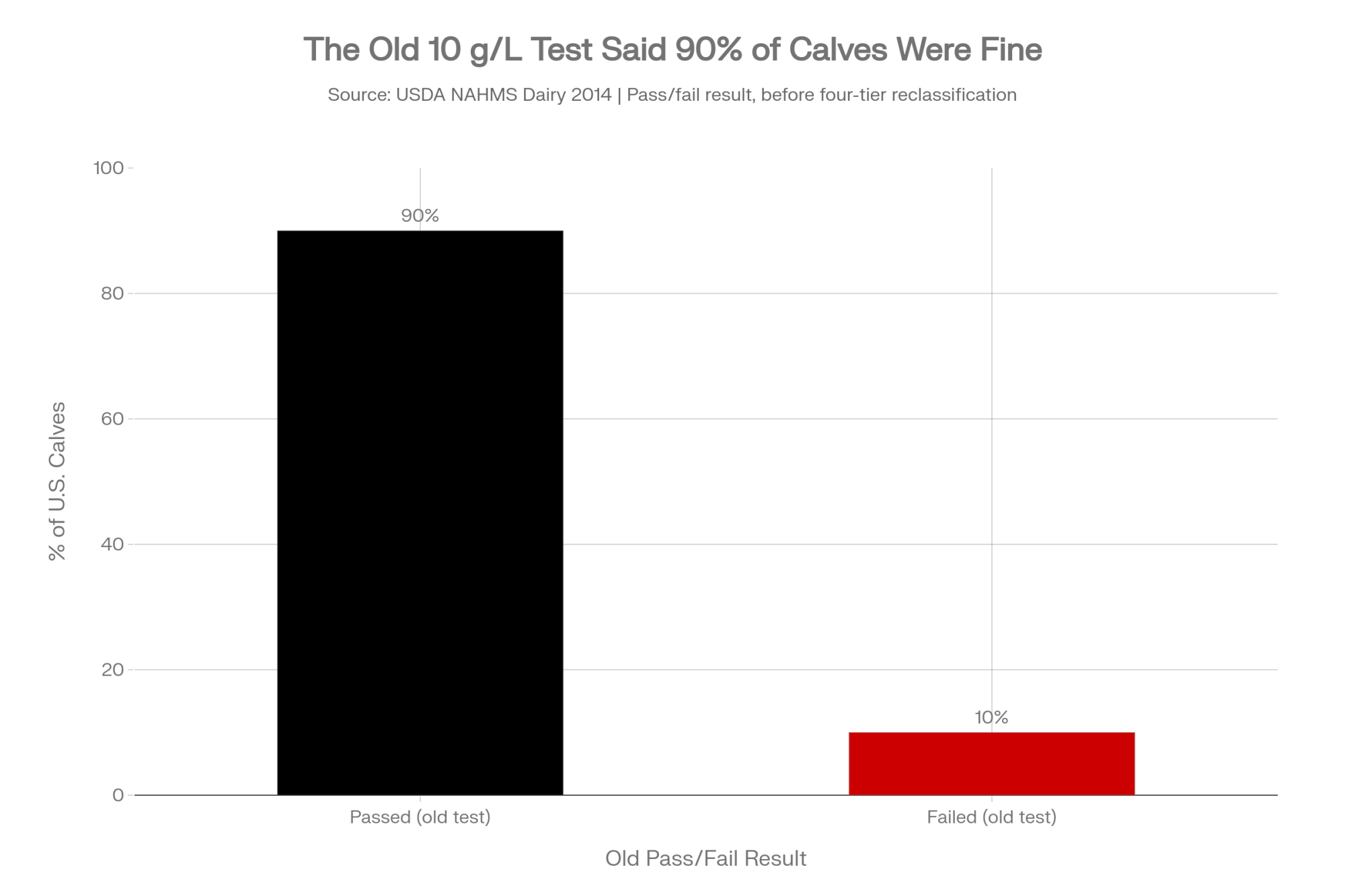
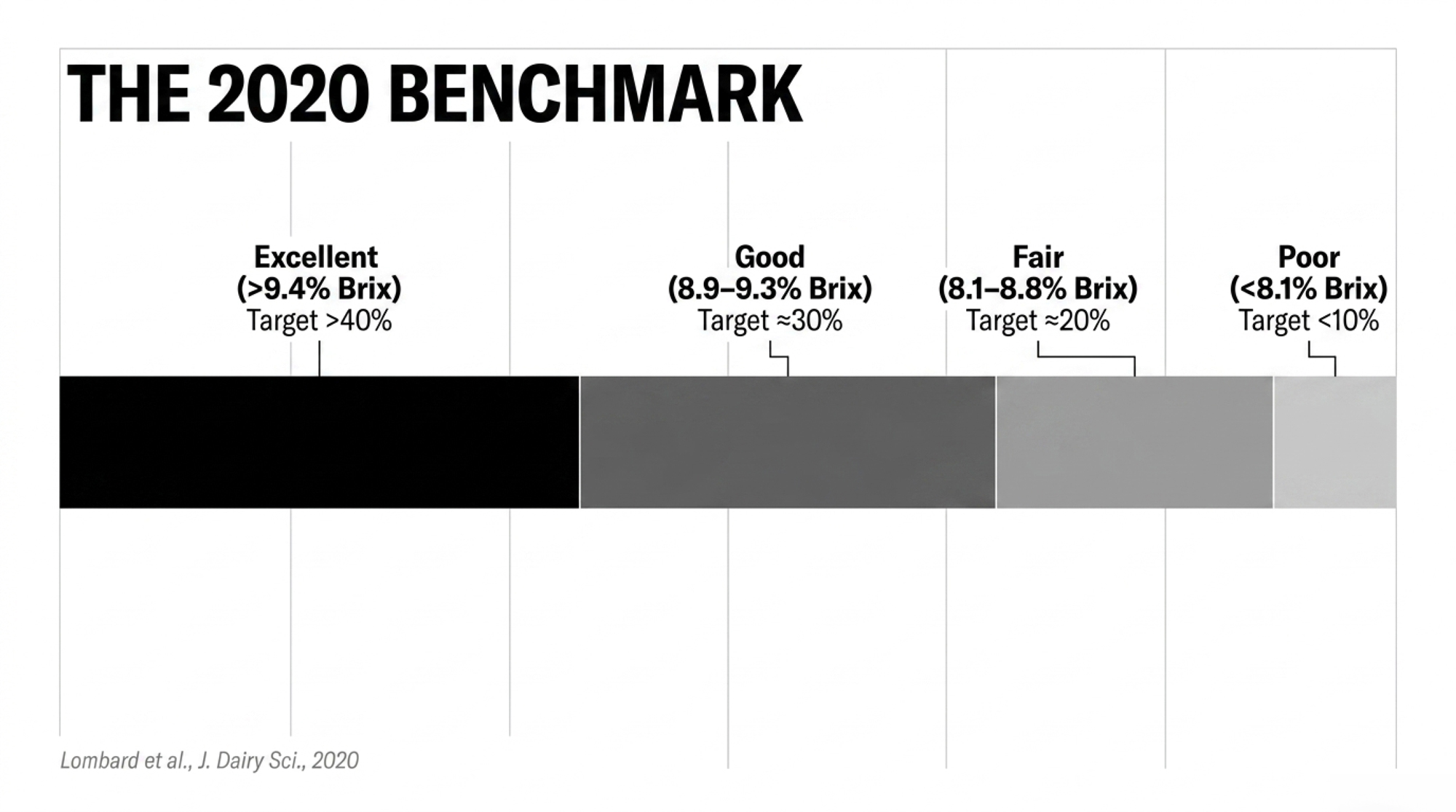
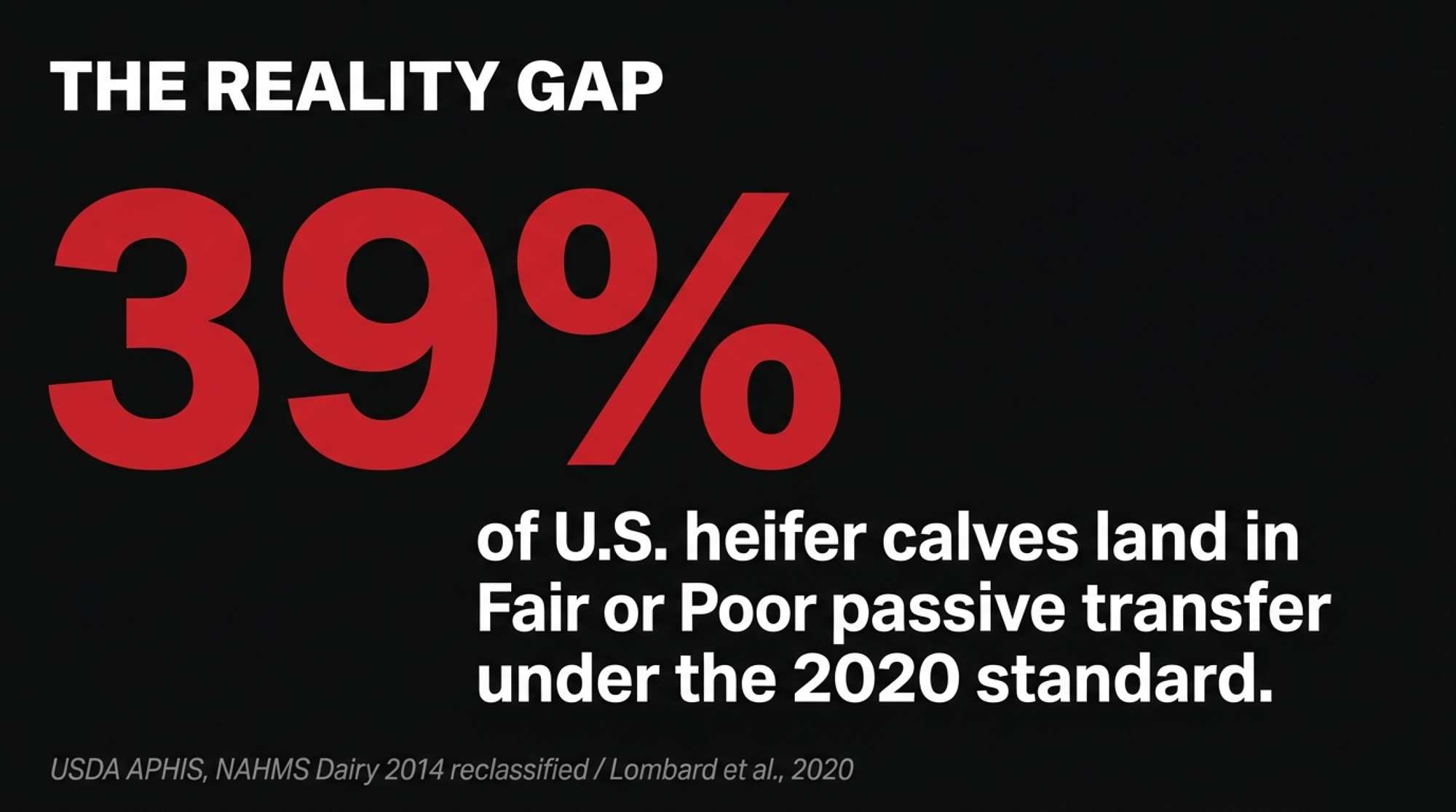
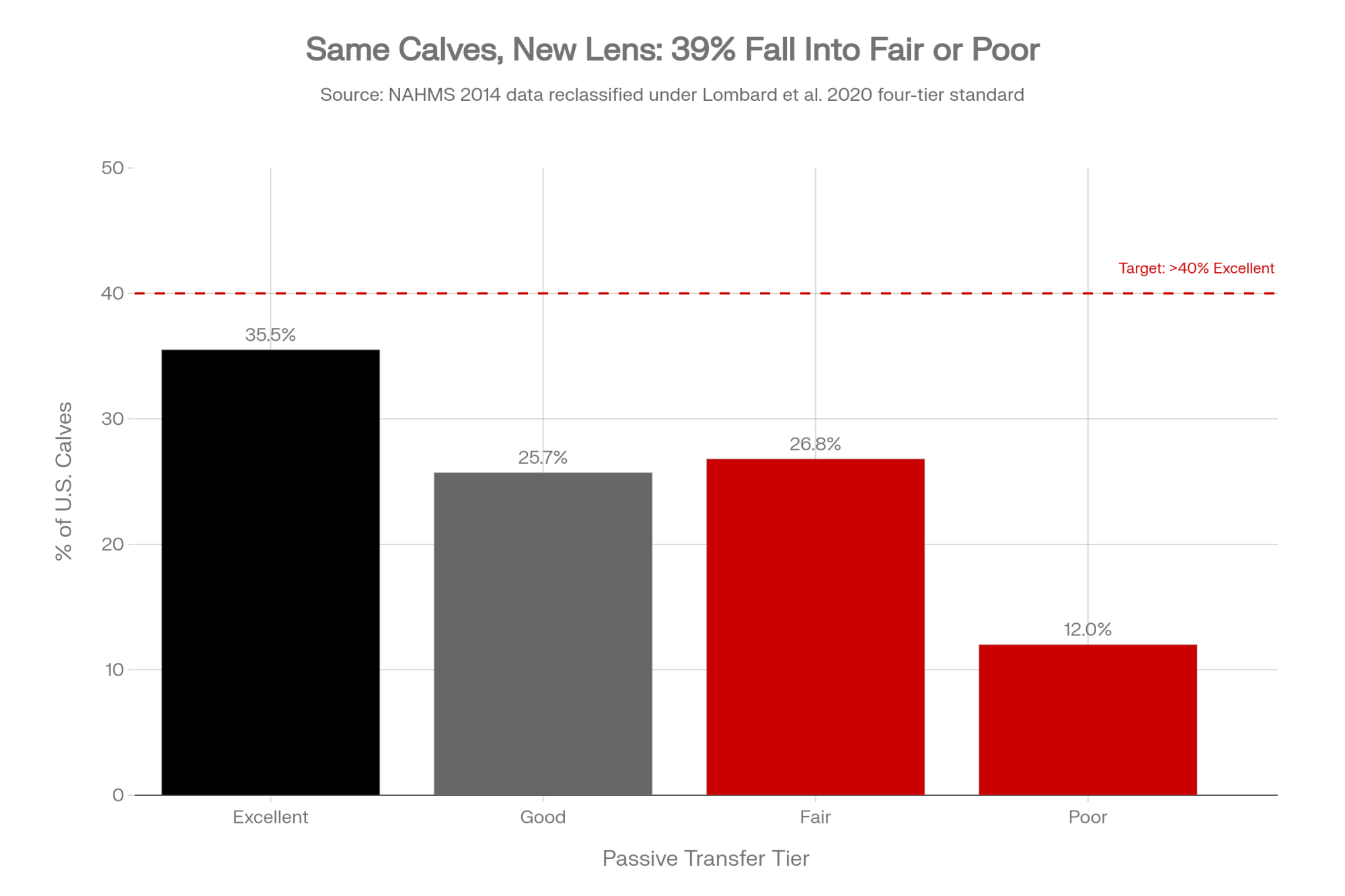

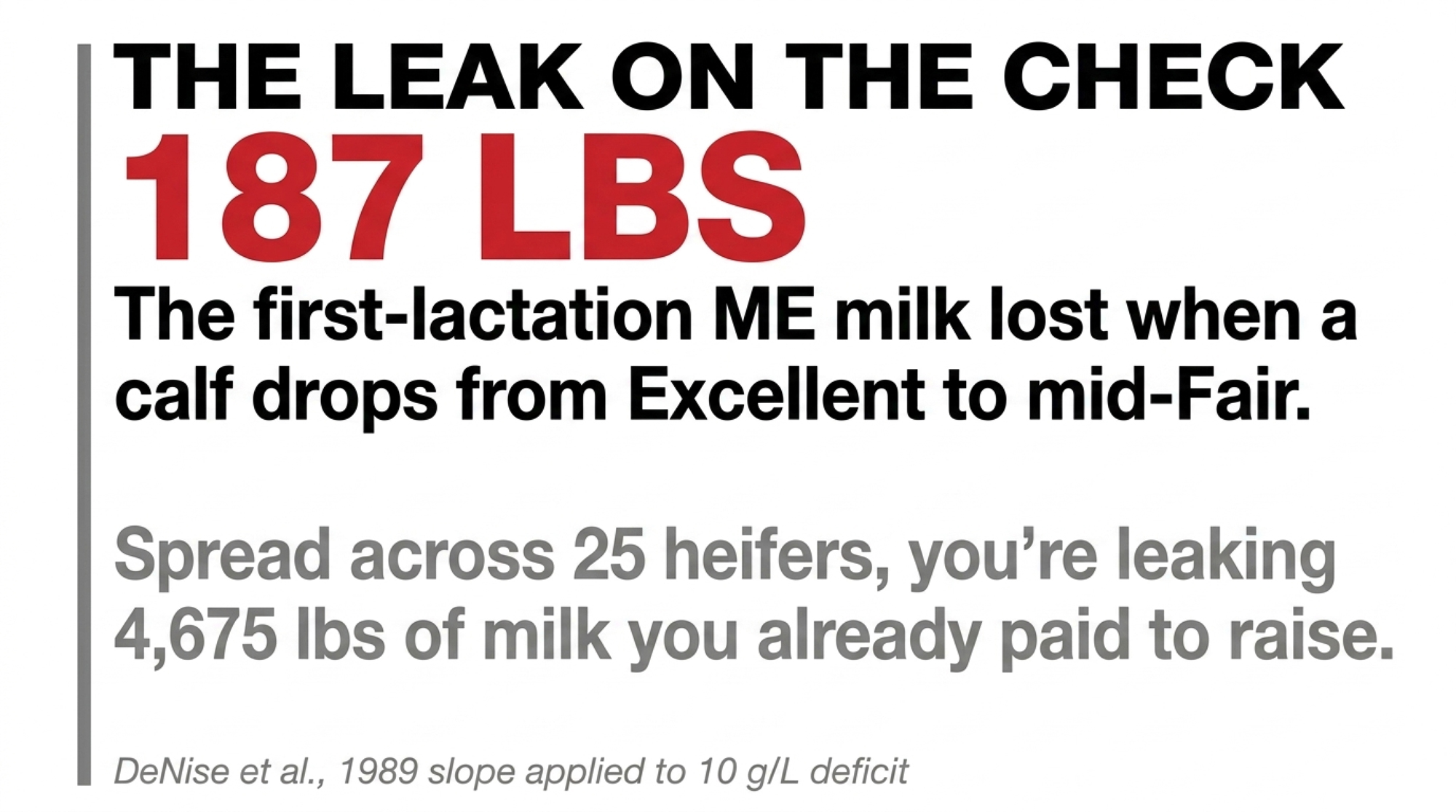
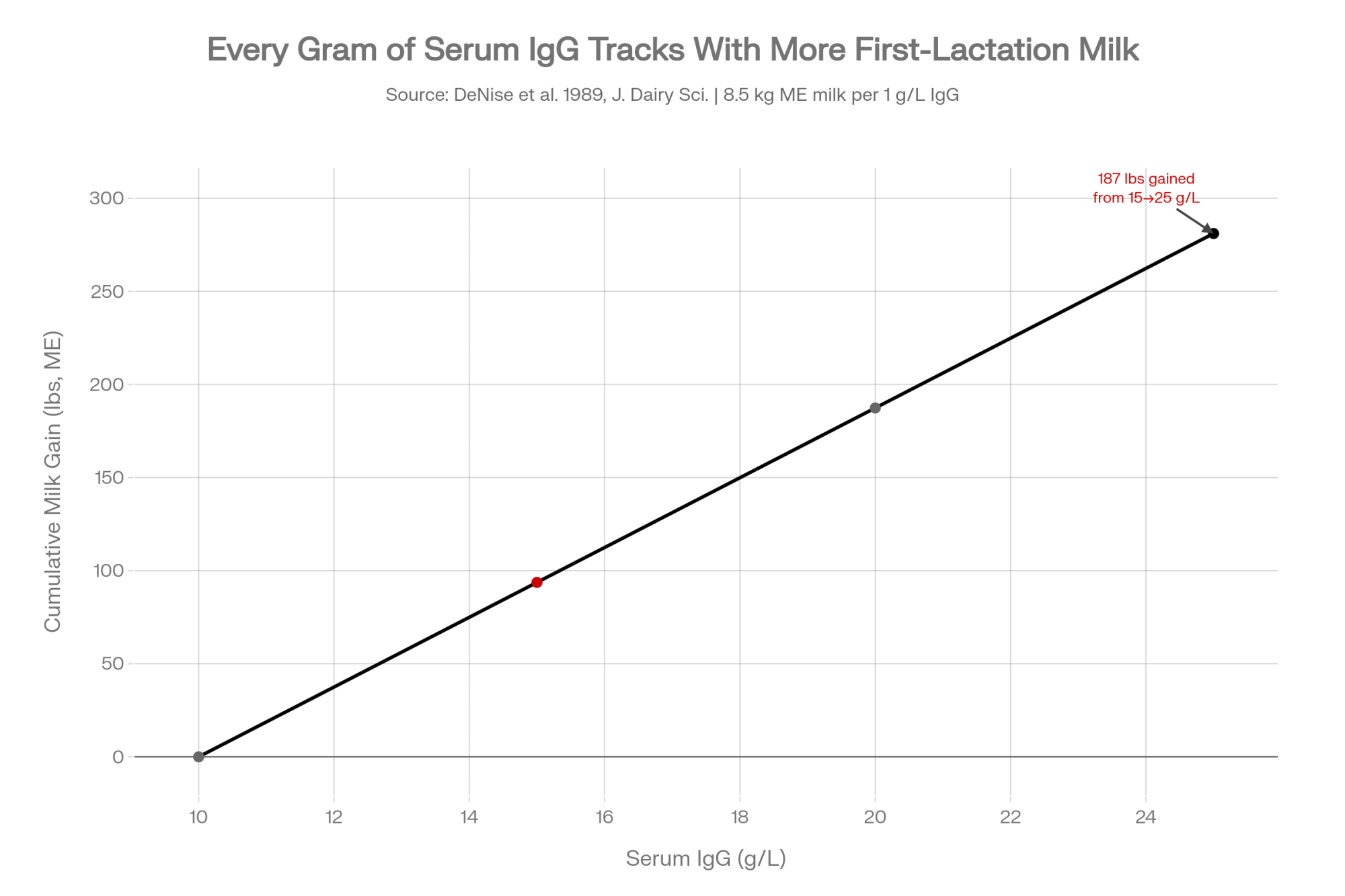
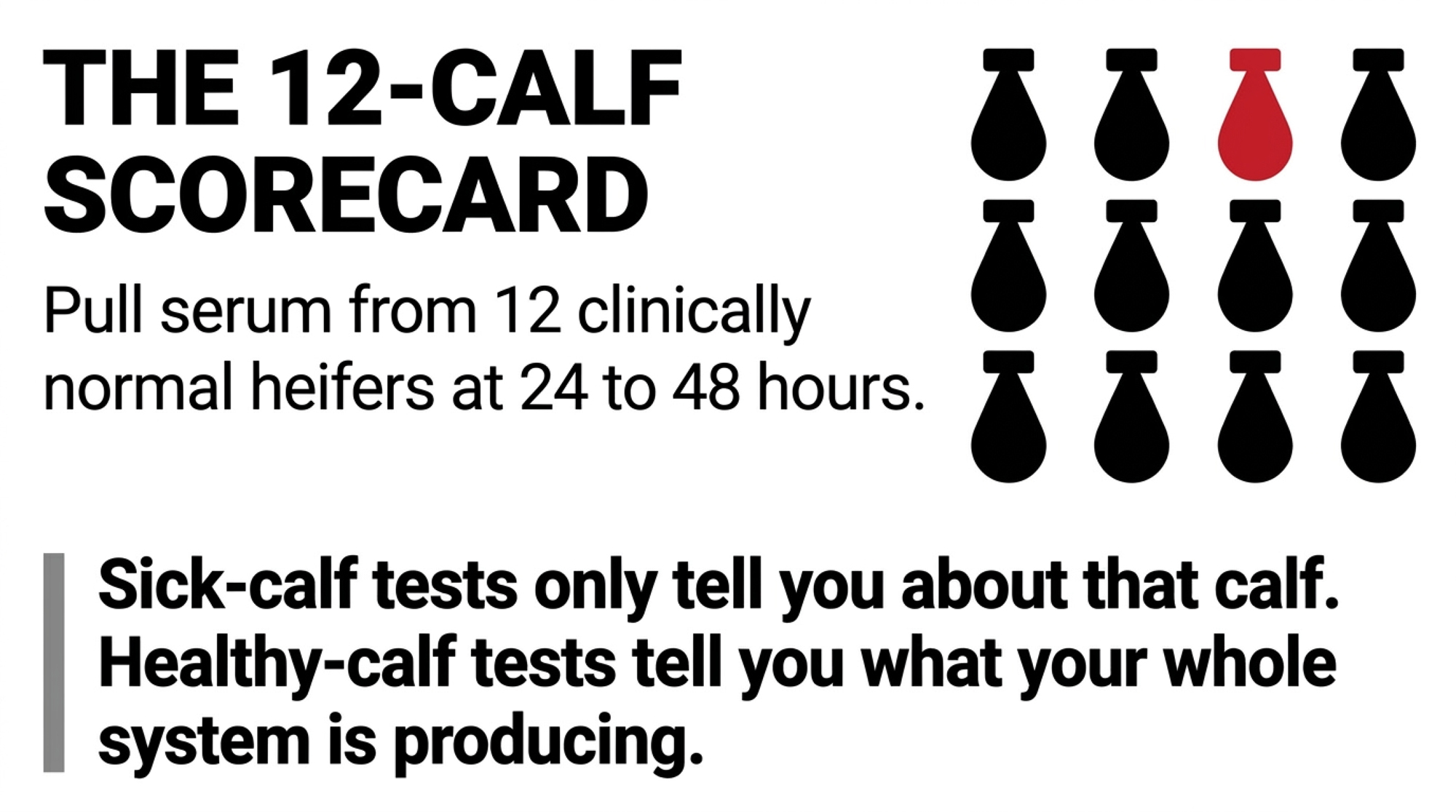
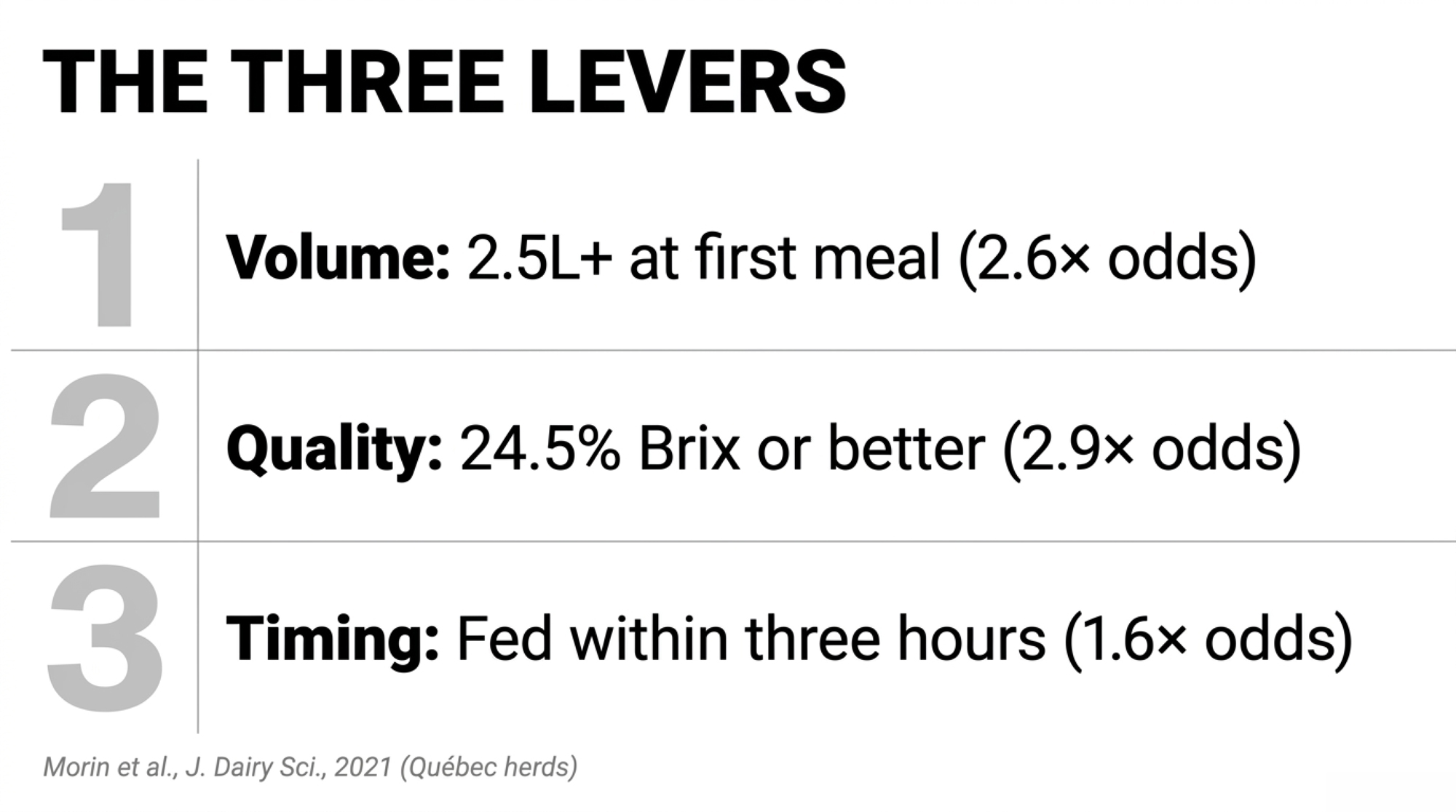
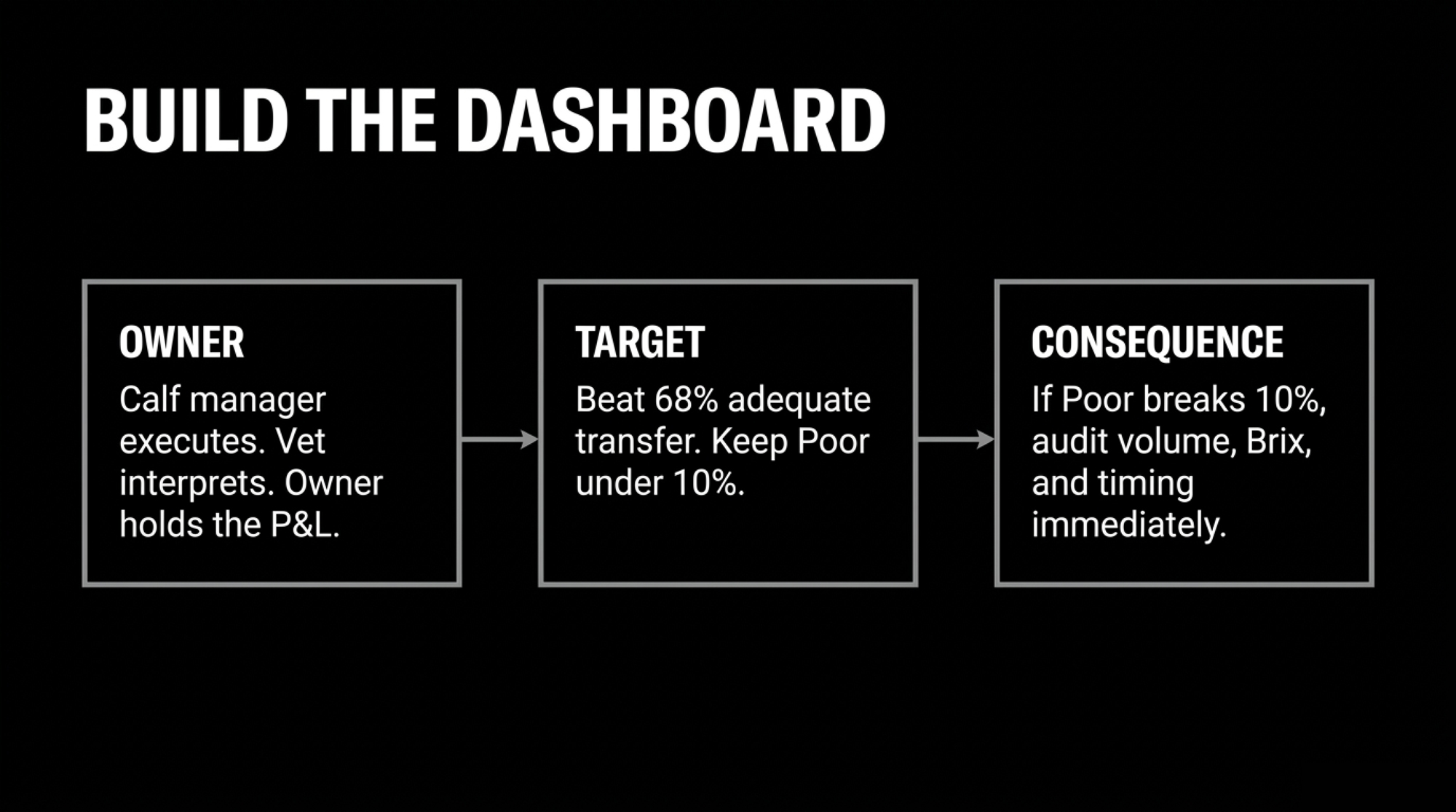
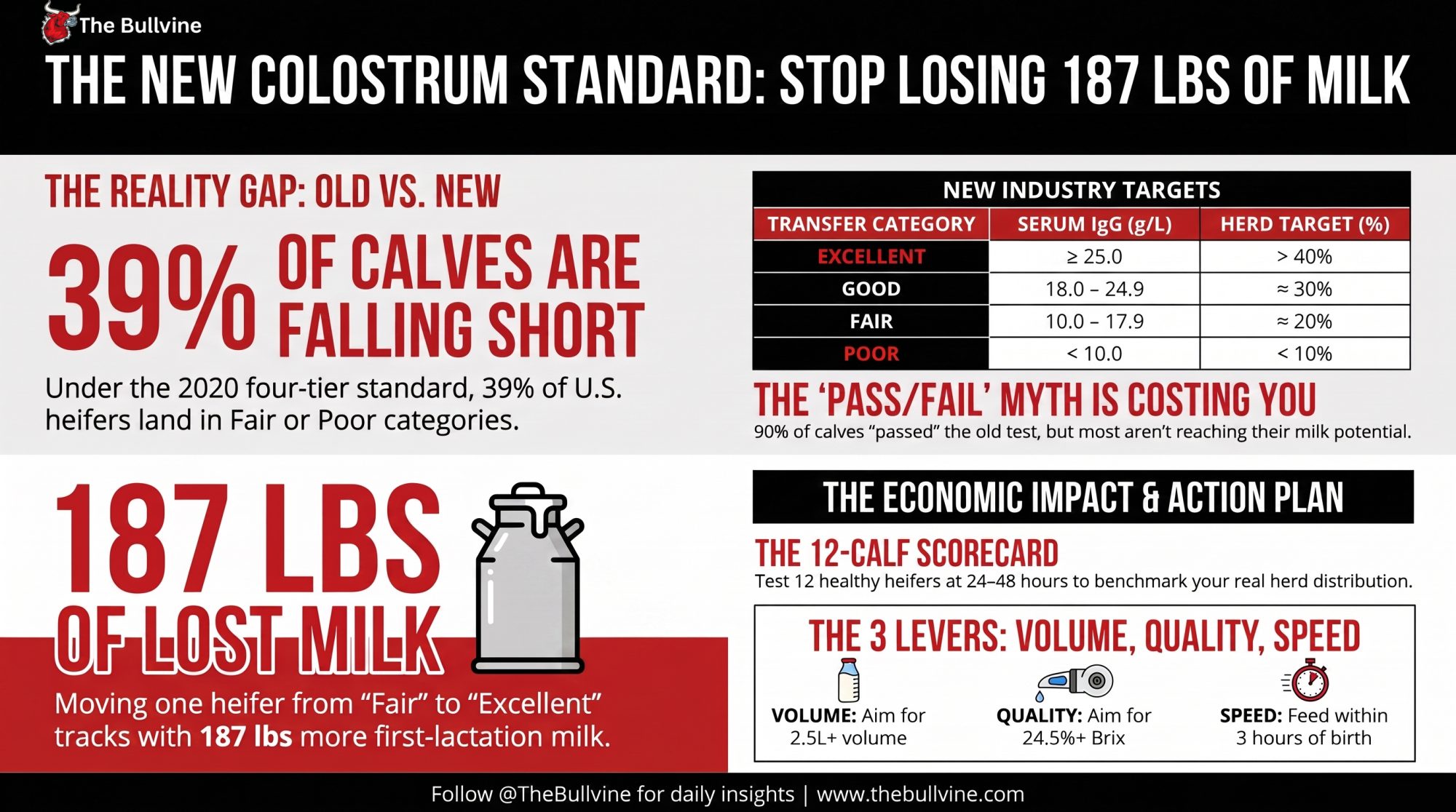
 The Sunday Read Dairy Professionals Don’t Skip.
 The Sunday Read Dairy Professionals Don’t Skip.