




Archive for barn math

$585 a Straw: What Every Beef Service Really Costs Your Next Heifer

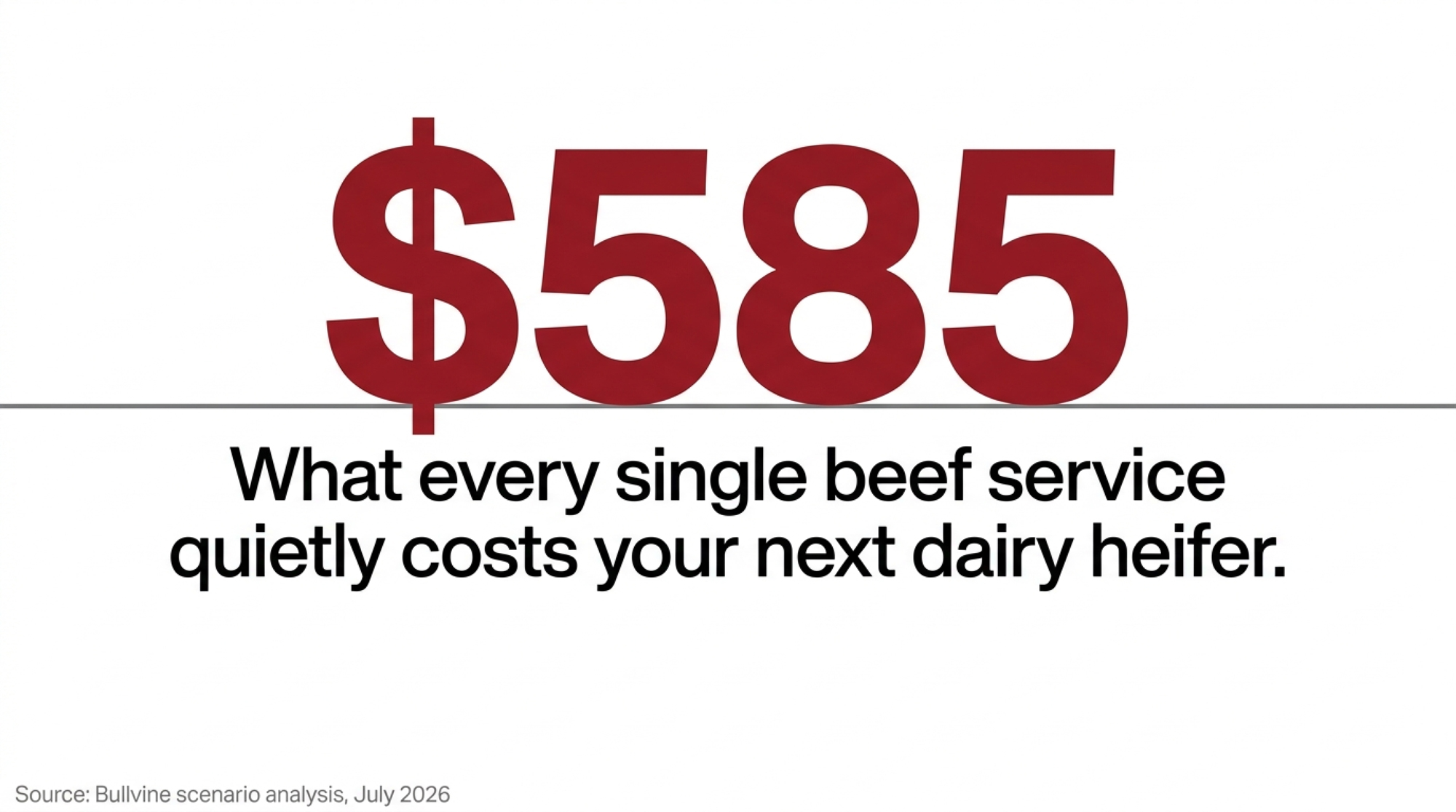
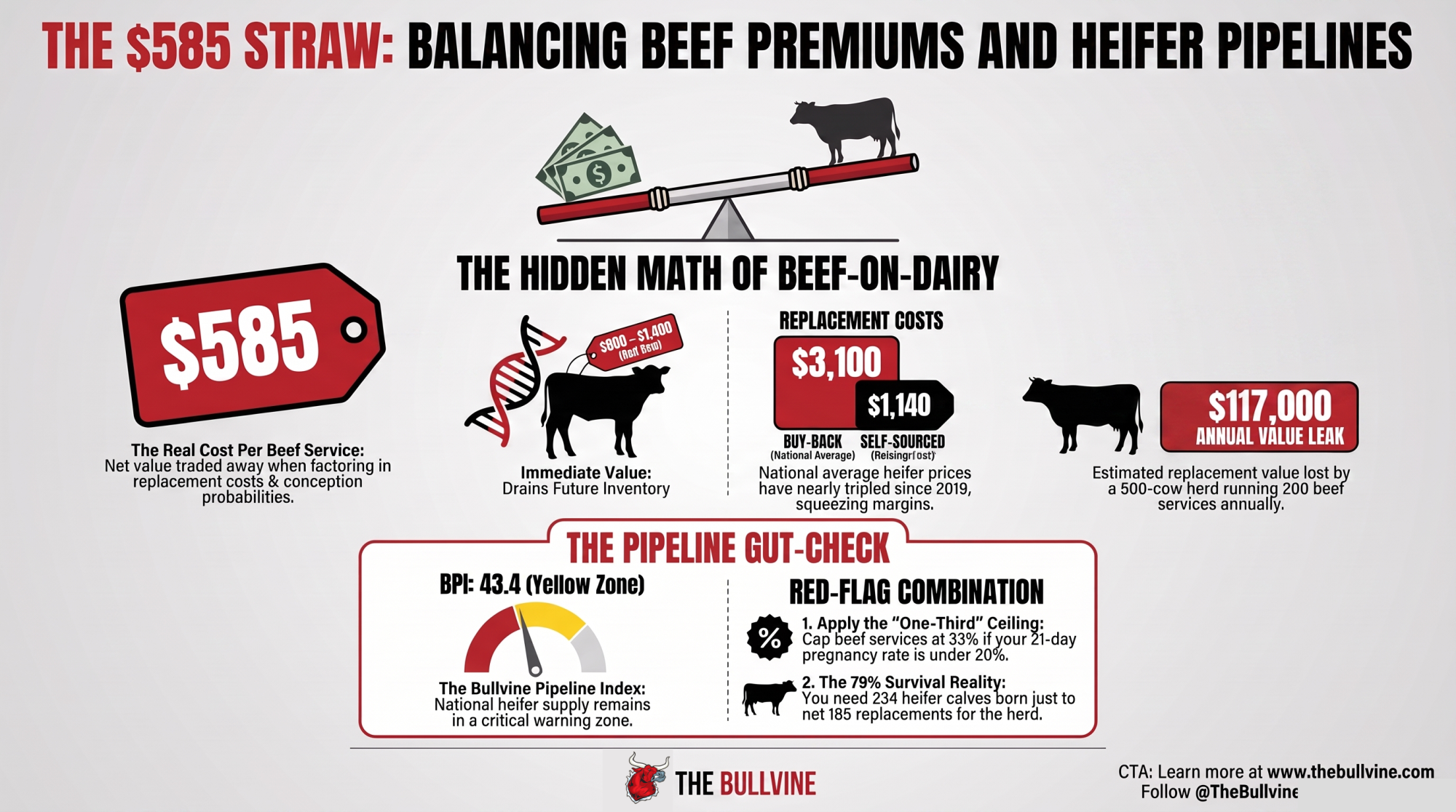
You banked $1,250 on that beef cross. Feels like a win — until you price the heifer you didn’t make. At $3,100 replacements, each beef service quietly costs about $585.

Executive Summary: Every beef straw you shot into a milk cow the last three years was the right call — a $1,250 crossbred calf beats a $150 Holstein bull every day of the week. But price the heifer you didn’t make, and each of those beef services quietly cost you about $585 in net replacement value, because springing heifers now run about $3,100 a head nationally and $3,400–$4,400 at Minnesota and Wisconsin barns this spring (CoBank/USDA; Bullvine market reporting). Run 200 of those services on a 500-cow herd and that’s roughly $117,000 in replacement value given away in a single year. The squeeze lands hardest on 200-to-700-cow operations buying springers back at market instead of raising their own — and The Bullvine’s own Pipeline Index (BPI) sits at 43.4, deep in the Yellow Zone, with CoBank’s projected 2027–28 rebuild lifting it just 5.3 points, never reaching Green. Meanwhile the calf premium that made the math work is wobbling — live cattle hit a record $251/cwt in May 2026, then posted 15 straight lower closes in July, and a premium cut in half erases most of that $585 edge. The gut-check for this week: pull your 21-day pregnancy rate and heifer inventory ratio, and if more than a third of your services are going to beef, the calf market doesn’t get a vote — your heifer pipeline does. Your upside can compress; your replacement bill won’t.

beef-on-dairy heifer cost

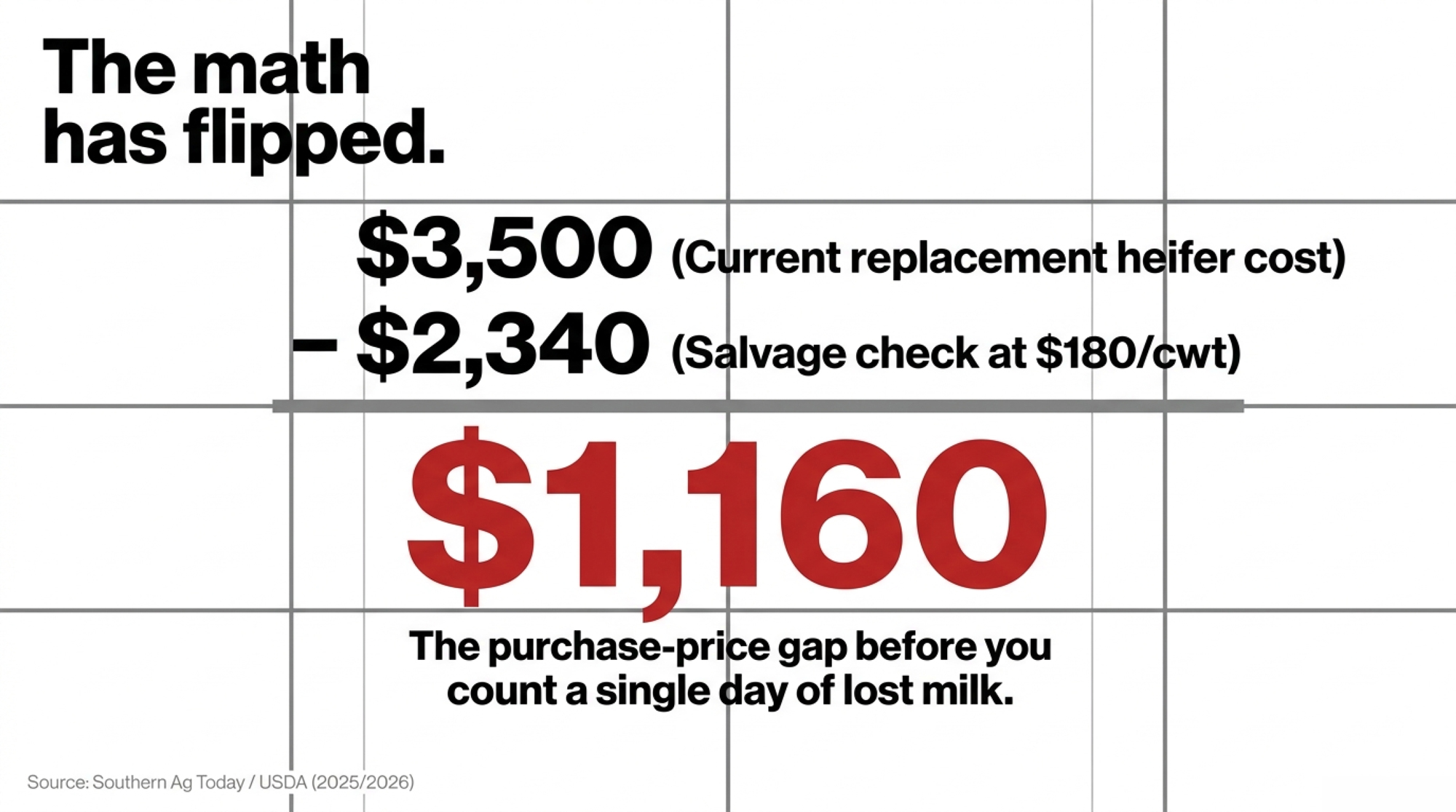
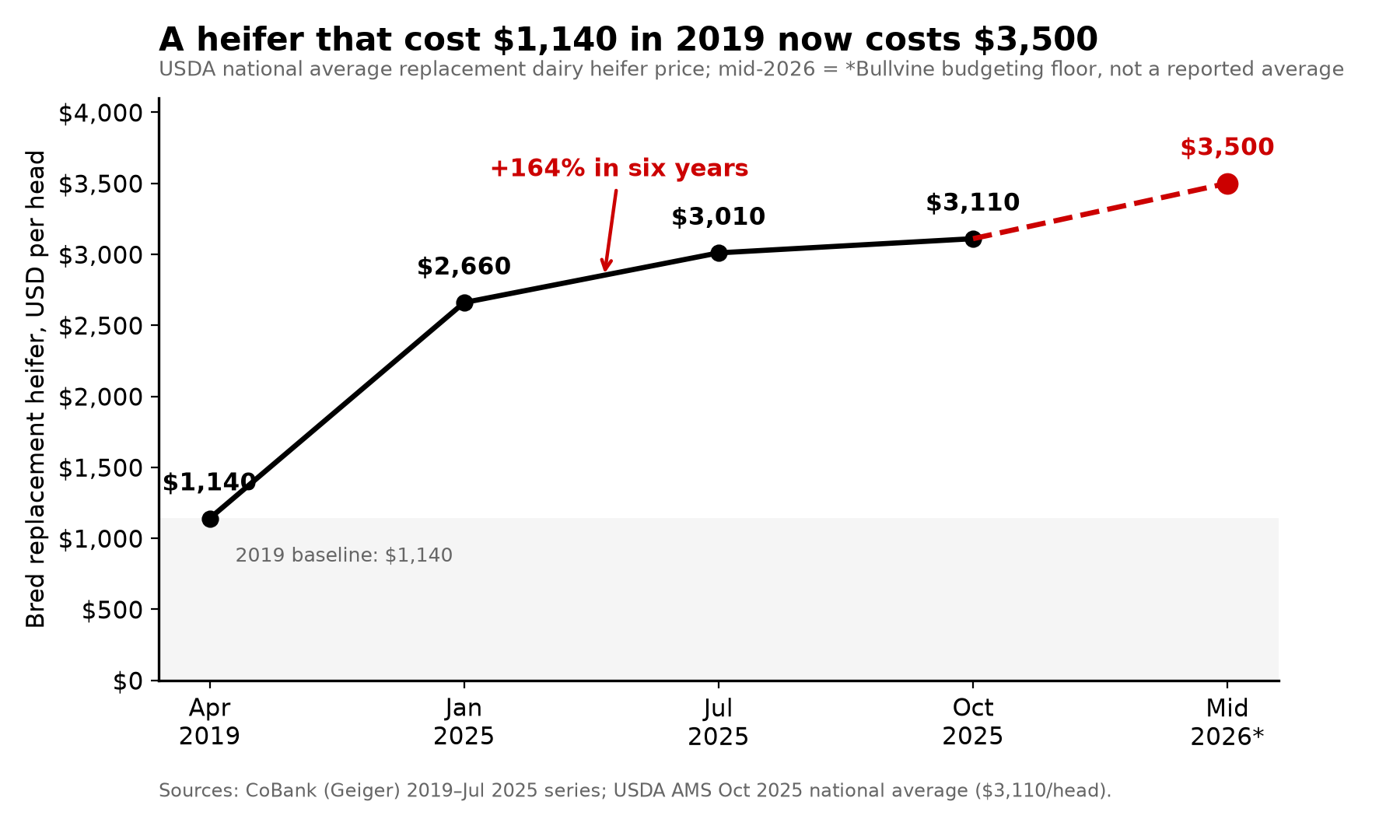
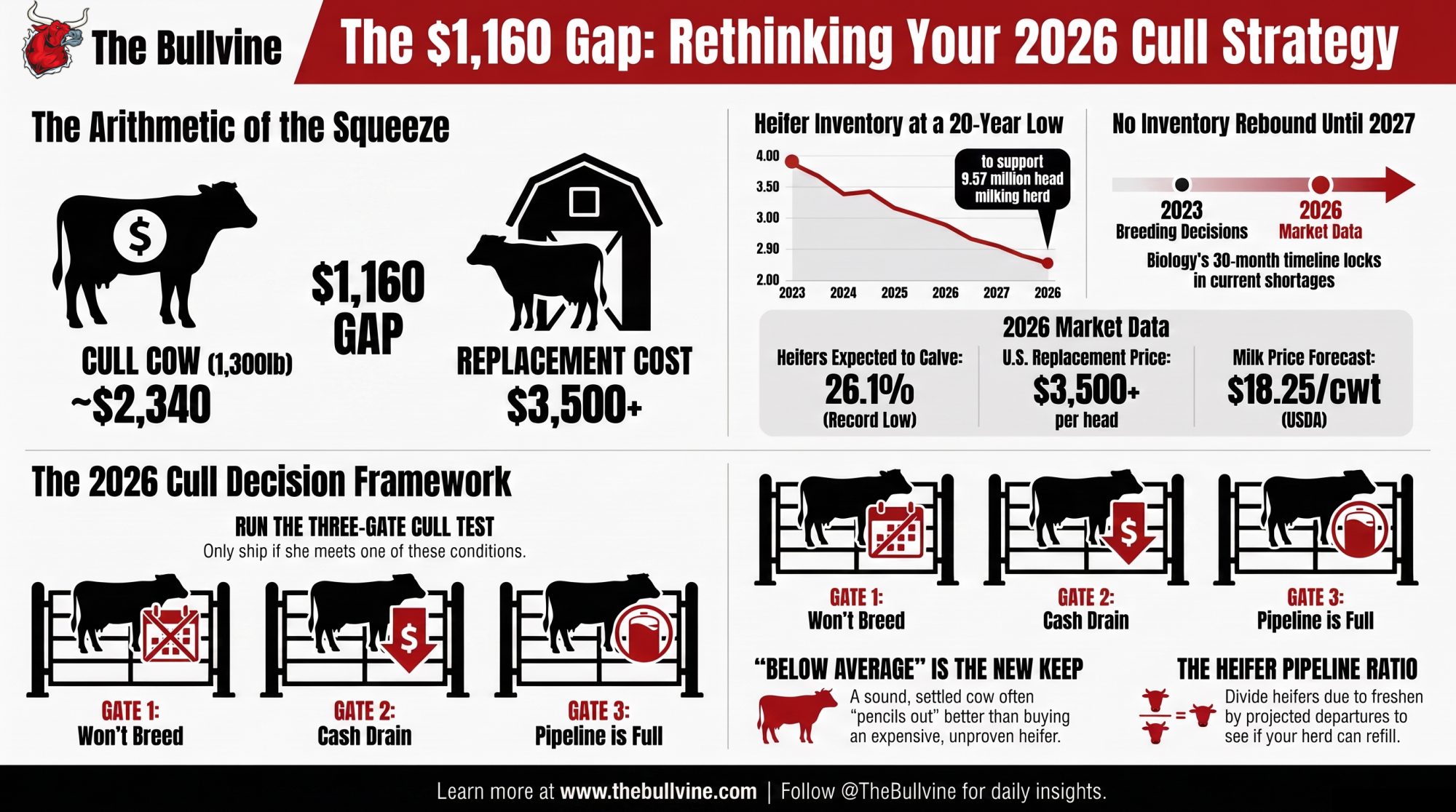
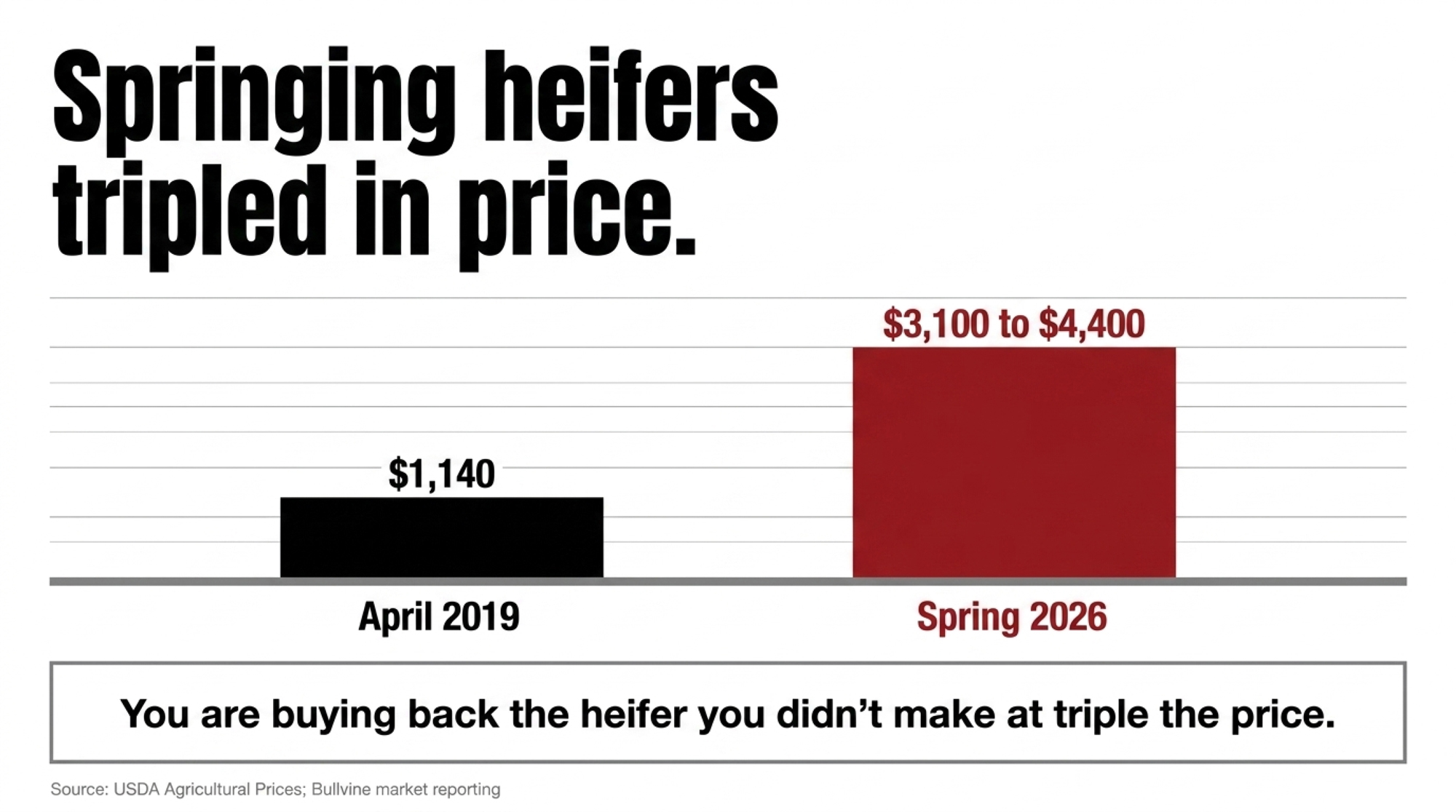
There’s a number CoBank’s lead dairy economist, Corey Geiger, calls an “unforeseen threshold.” Replacement dairy heifers now run about $3,100 a head nationally, and top-quality animals cleared $3,400 to $4,400 in Minnesota and Wisconsin markets this spring — a run that started from just $1,140 in April 2019, when a springing heifer was barely worth more than the beef in her (USDA Agricultural Prices; Bullvine market reporting). And a big piece of why traces straight back to a breeding decision hundreds of thousands of dairy operators made — correctly — over the last three years.

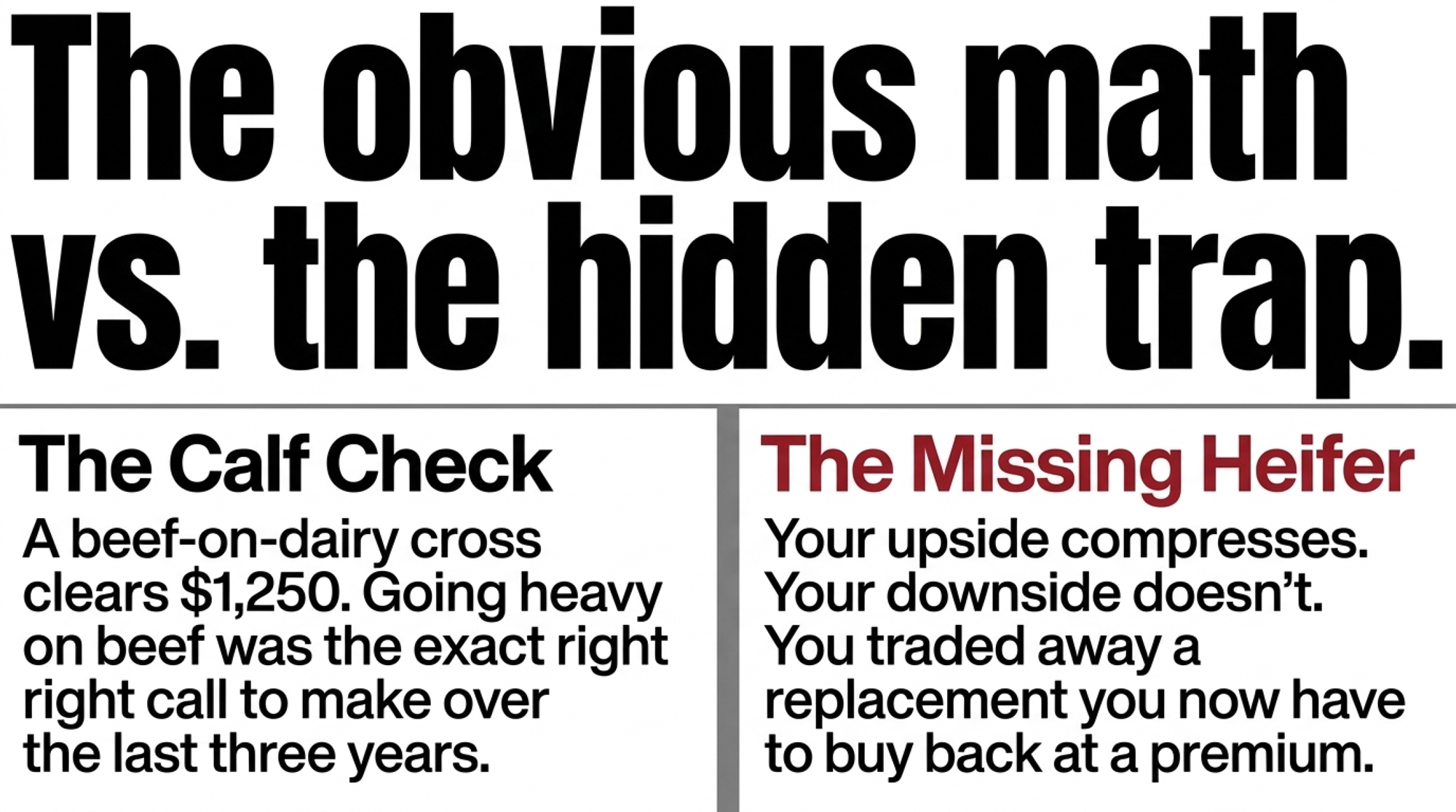
Here’s the setup. A dairy that went heavy on beef semen in 2022 and 2023 did the obvious math. A Holstein bull calf might bring $750 to $1,000 at the barn, while a well-marked beef-on-dairy cross cleared $1,250 — and in strong Wisconsin markets ran as high as $1,750 (Premier Livestock auction data, February 2026). That call was right. But every beef straw used on a cow that could’ve thrown a dairy heifer wasn’t only a calf decision. It was a replacement decision — and that half of the ledger stayed off the page.

“Your upside compresses. Your downside doesn’t.” — the whole beef-on-dairy bind in six words.

What’s Changing and Why

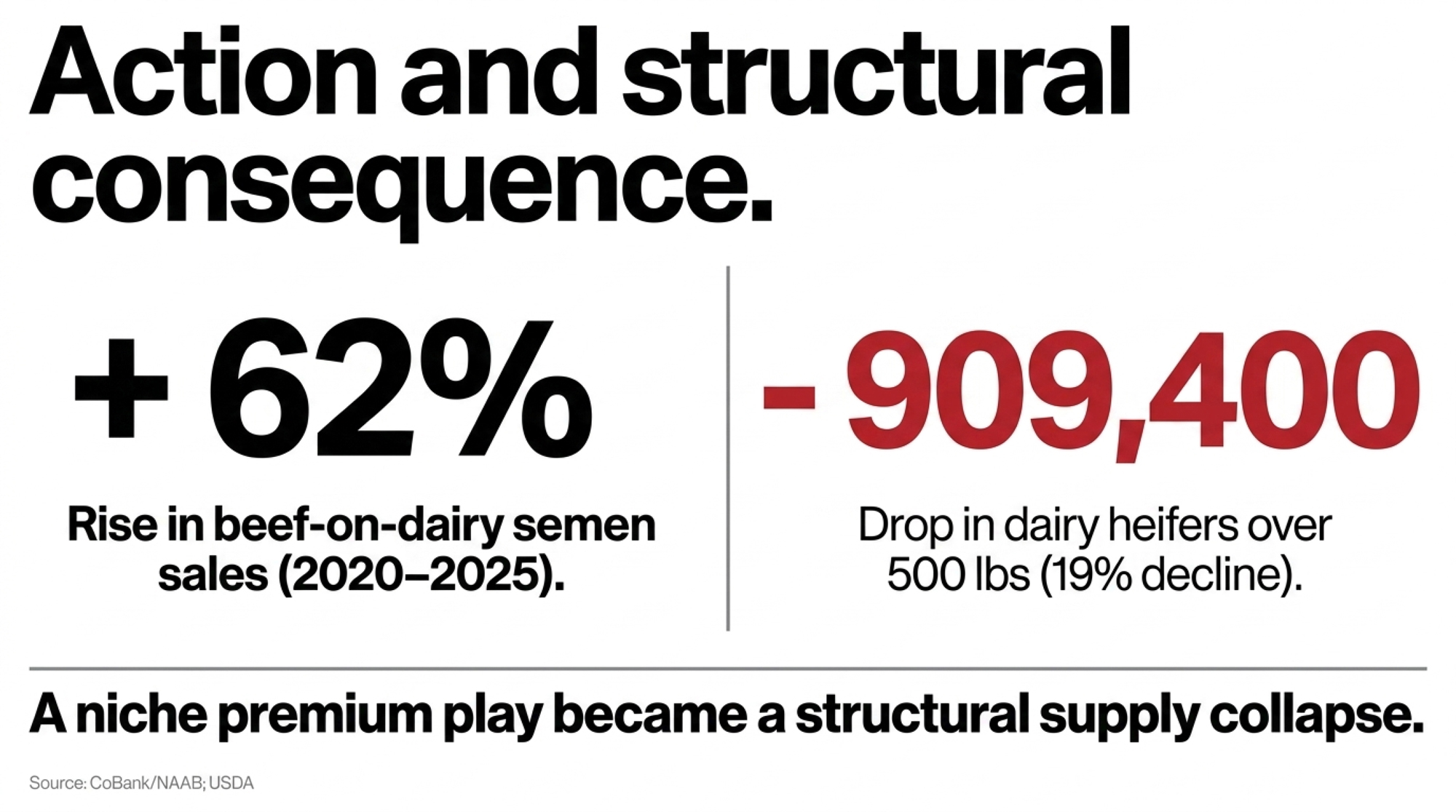
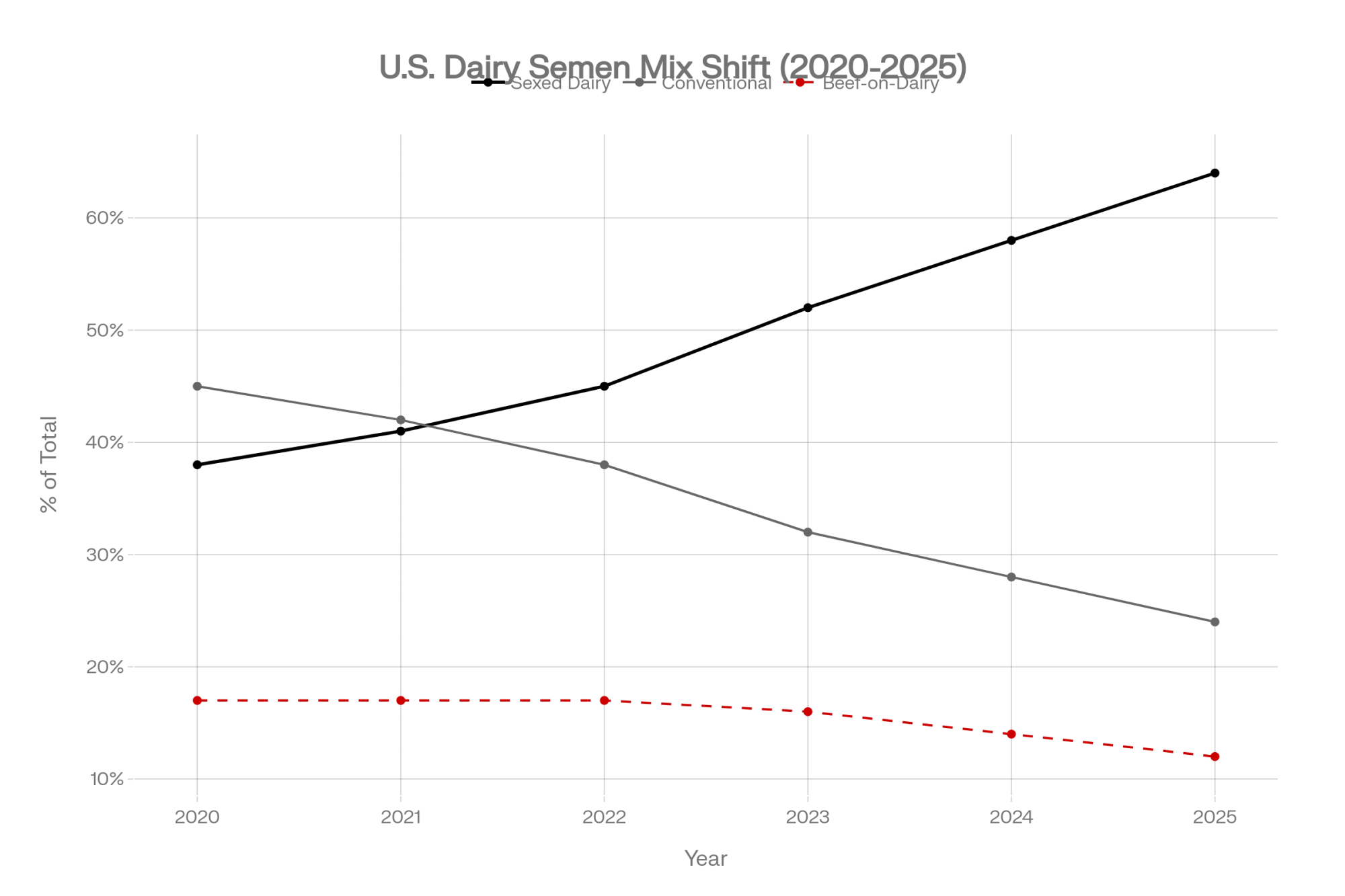
Beef-on-dairy didn’t creep in. It exploded. Beef-on-dairy semen sales grew 62% from 2020 to 2025, while gender-sorted dairy semen climbed 53.6% and conventional dairy semen collapsed 47.4% over the same window (CoBank/NAAB, June 2026). CattleFax pegs beef-on-dairy calf production climbing from about 50,000 head in 2014 to 3.22 million in 2024, with projections reaching 5 to 6 million head by 2026 (CattleFax, via Dairy Herd Management, February 2, 2026).

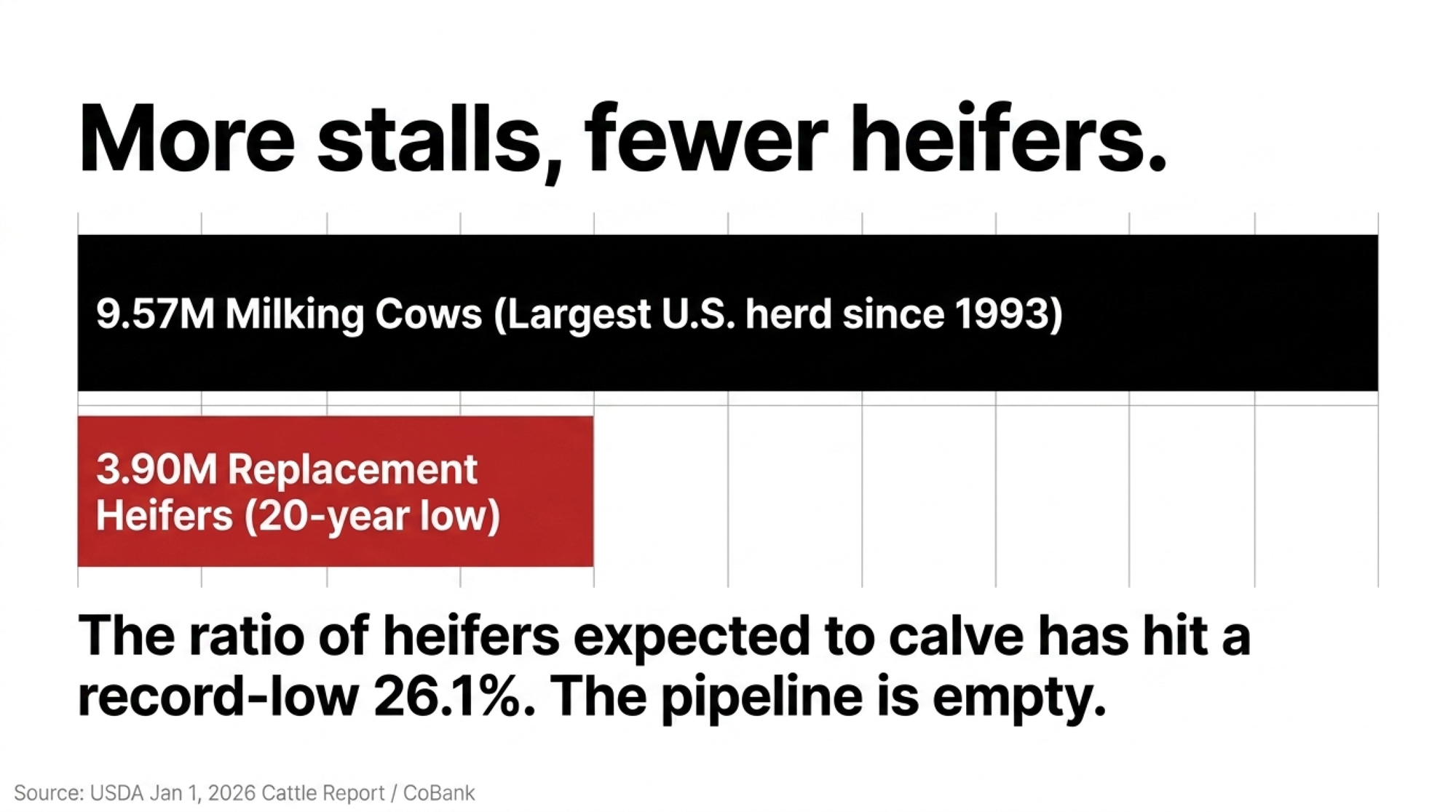
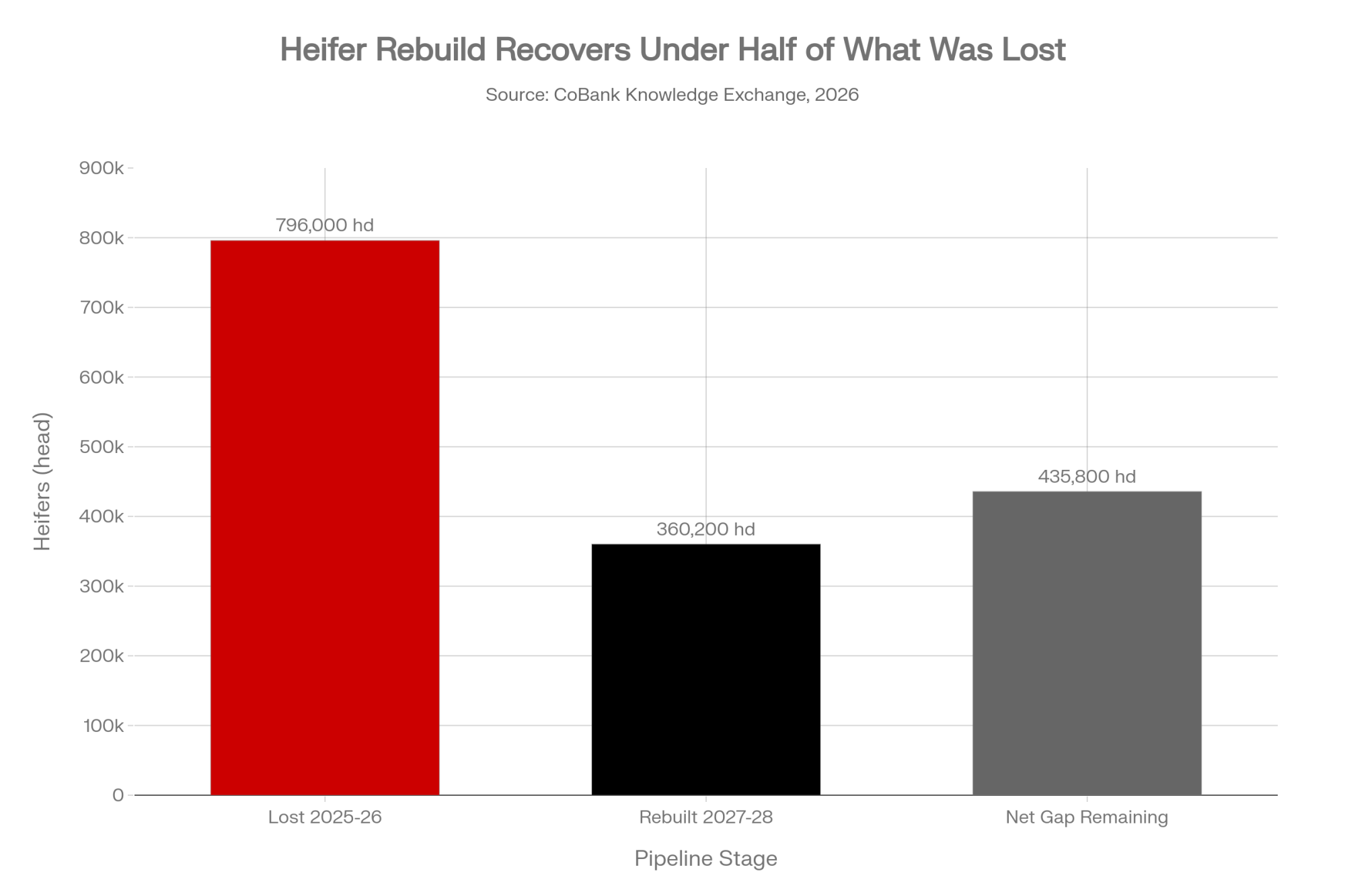
That flood of crossbred calves cut both ways. On the beef side, it helped refill feedlots while the U.S. beef cow herd sat at its lowest since 1961. On the dairy side, it quietly drained the heifer pipeline. Dairy replacements entering the milking herd shrink by a combined 796,000 head across 2025 and 2026 before any rebound starts, and CoBank’s projected rebuild — 360,200 head over 2027 and 2028 — gives back less than half of what got pulled out (CoBank Knowledge Exchange, 2026). You lost ground roughly twice as fast as you’re set to win it back.

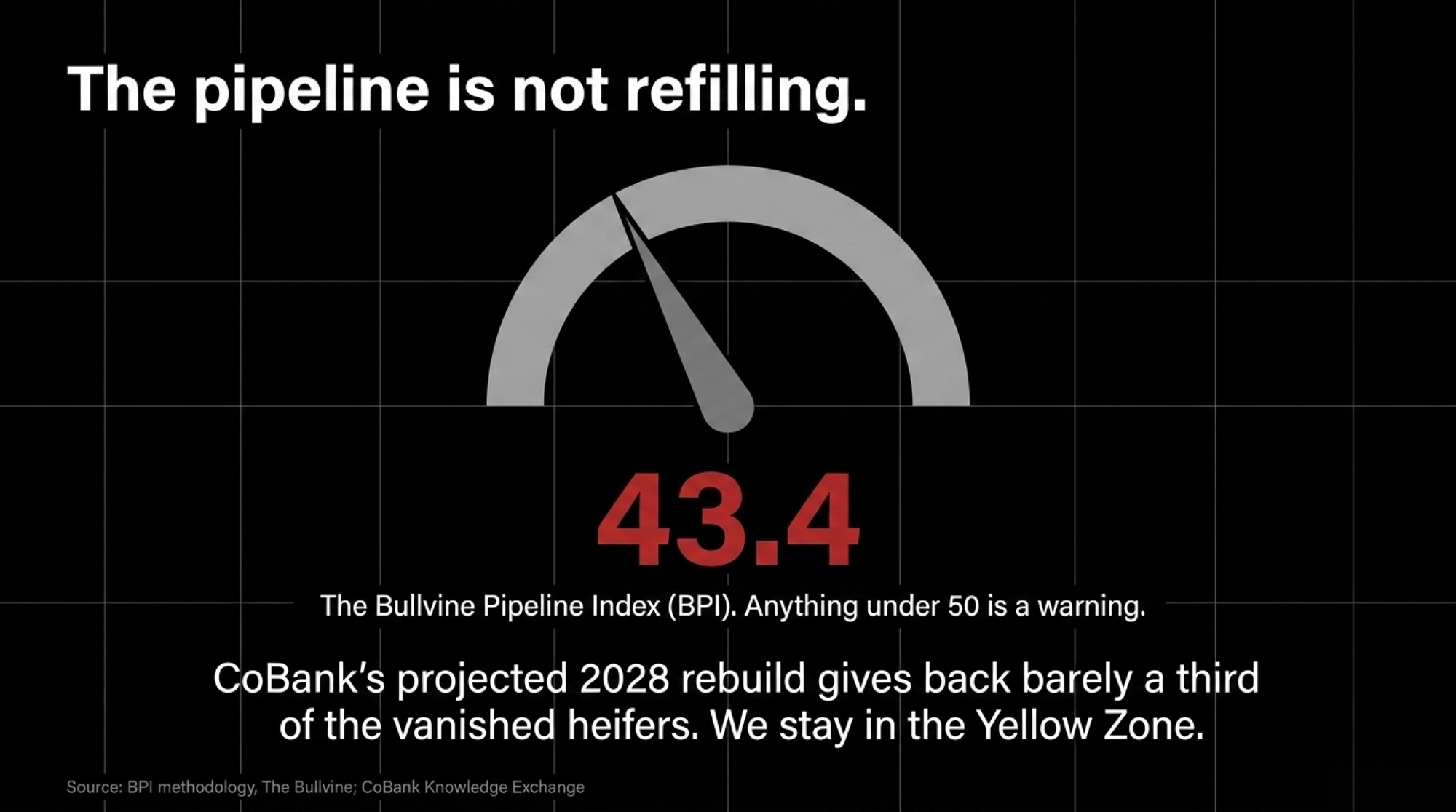
Put a number on how weak that recovery is. Run CoBank’s assumptions through The Bullvine’s Pipeline Index — our own composite that scores a replacement pipeline on heifer supply, culling pressure, price signal, and semen-mix momentum, on a 0-to-100 scale where anything under 50 is a Yellow-Zone warning — and the national dial reads 43.4 today (BPI methodology, The Bullvine). CoBank’s 2028 rebuild lifts it to just 48.7. That’s a 5.3-point crawl that never leaves Yellow and never touches Green. Stack it against the deeper hole — dairy heifers 500 pounds and over are down 909,400 head, a 19% drop from 2016 to 2026 — and the picture is blunt: CoBank’s 360,200-head rebuild gives back barely a third of the heifers that vanished over the decade. It dents the hole. It doesn’t close it.

Who feels it worst? Mid-size herds — roughly the 200-to-700-cow range — that leaned on beef premiums for margin relief but don’t have the scale or heifer-raising slack to absorb a replacement squeeze. When you’re buying springers back at market instead of raising your own, a $3,100 heifer stops being a headline and becomes a line on your operating loan.

📎 Go deeper: [The 800,000-Heifer Crisis: how the pipeline got drained →]([INSERT: pillar page URL — paste at upload]) — the full unwind behind the shortage, and how weak the 2027–28 rebuild really is.

How This Plays Out on Real Farms

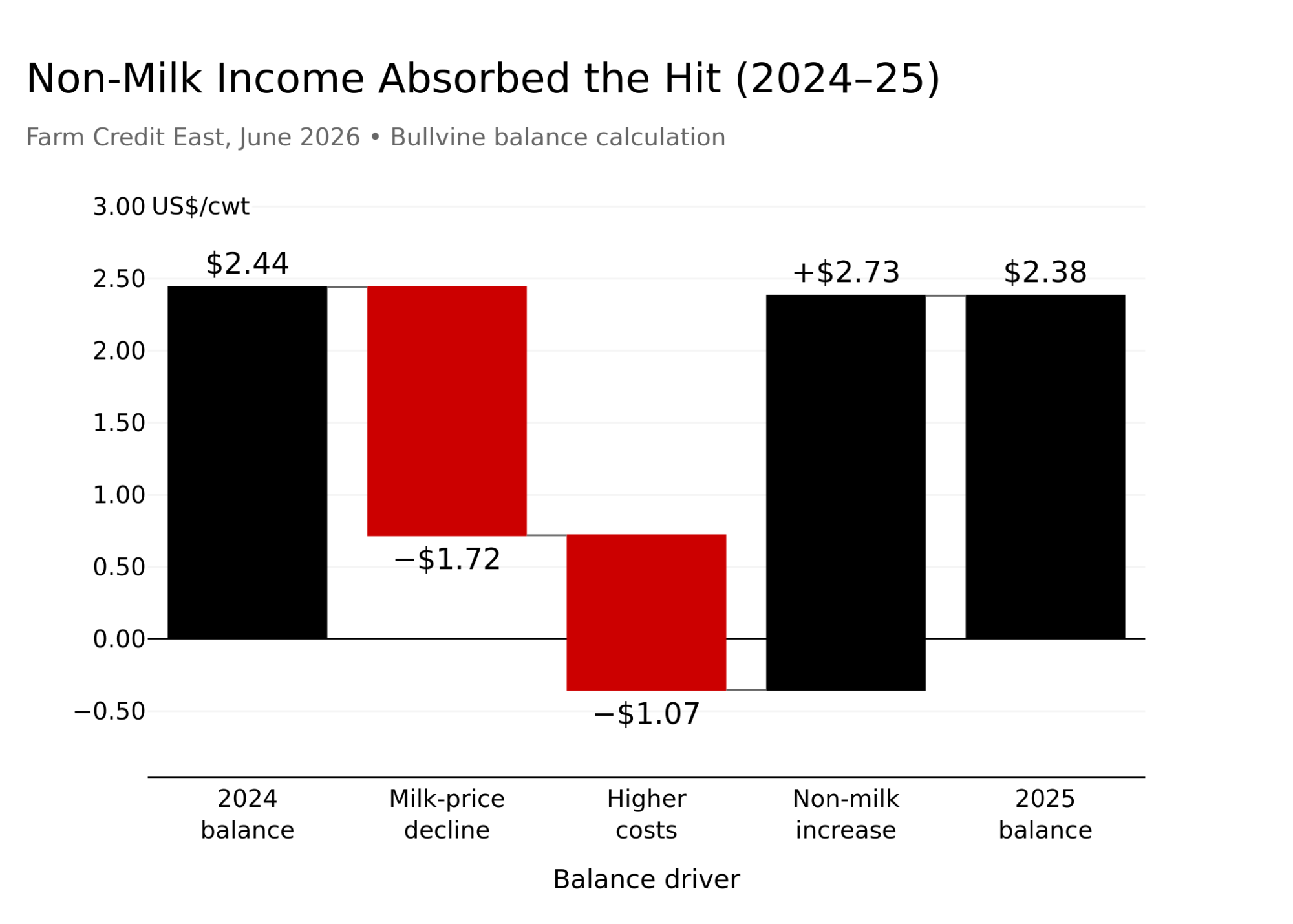
The calf cheque was real money, and it still is. Day-old beef-on-dairy calves commonly brought $900 to $1,400 in 2025 and 2026, up from around $650 a few years earlier (Purina and auction summaries, via The Bullvine, 2026). And it’s not pocket change on the P&L anymore: five years ago, calf and cull sales ran about 5% of the dairy’s bottom line — today they’re 12–15%, and up near 20% on some operations (CoBank, June 2026). The beef check went from garnish to main course. Nobody made a dumb call here.

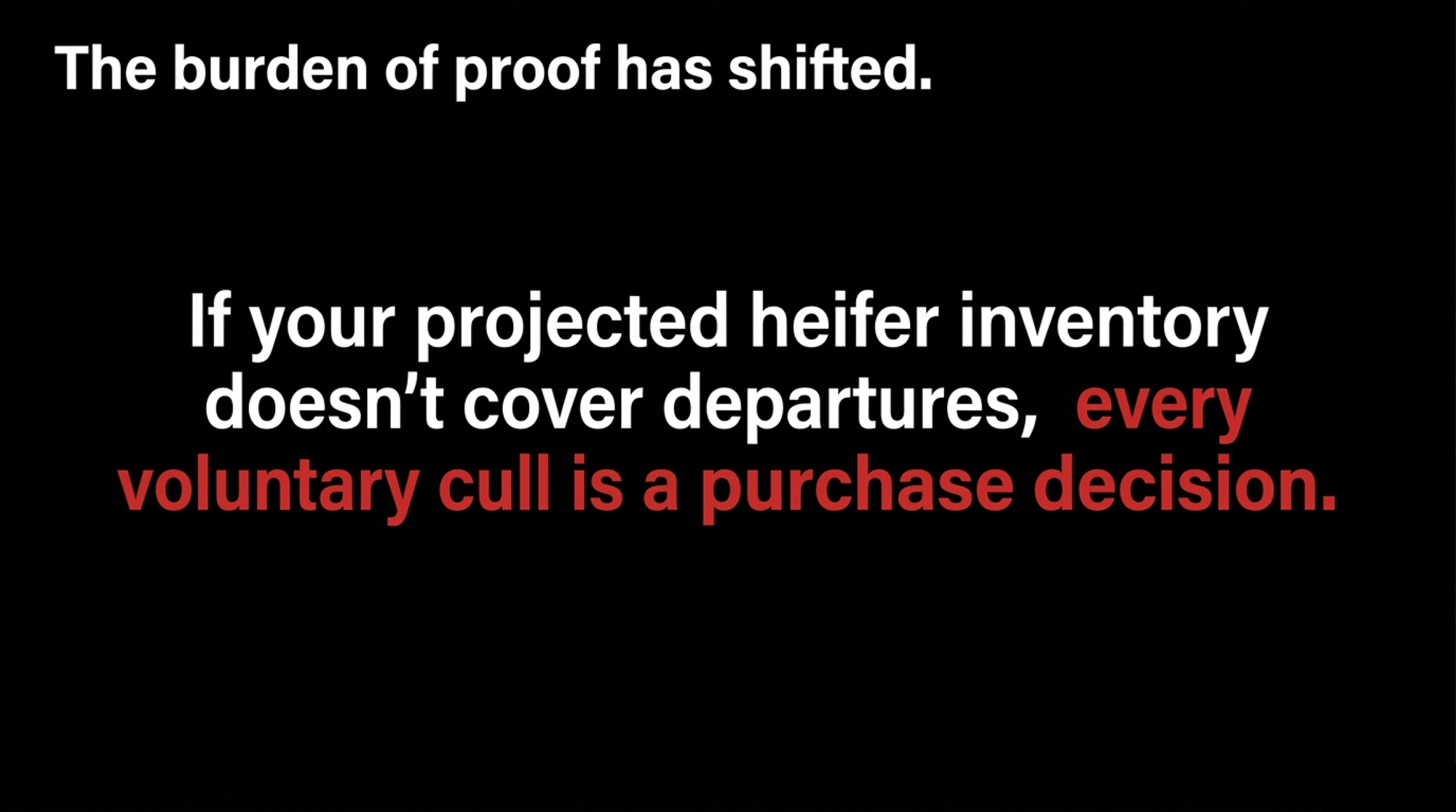
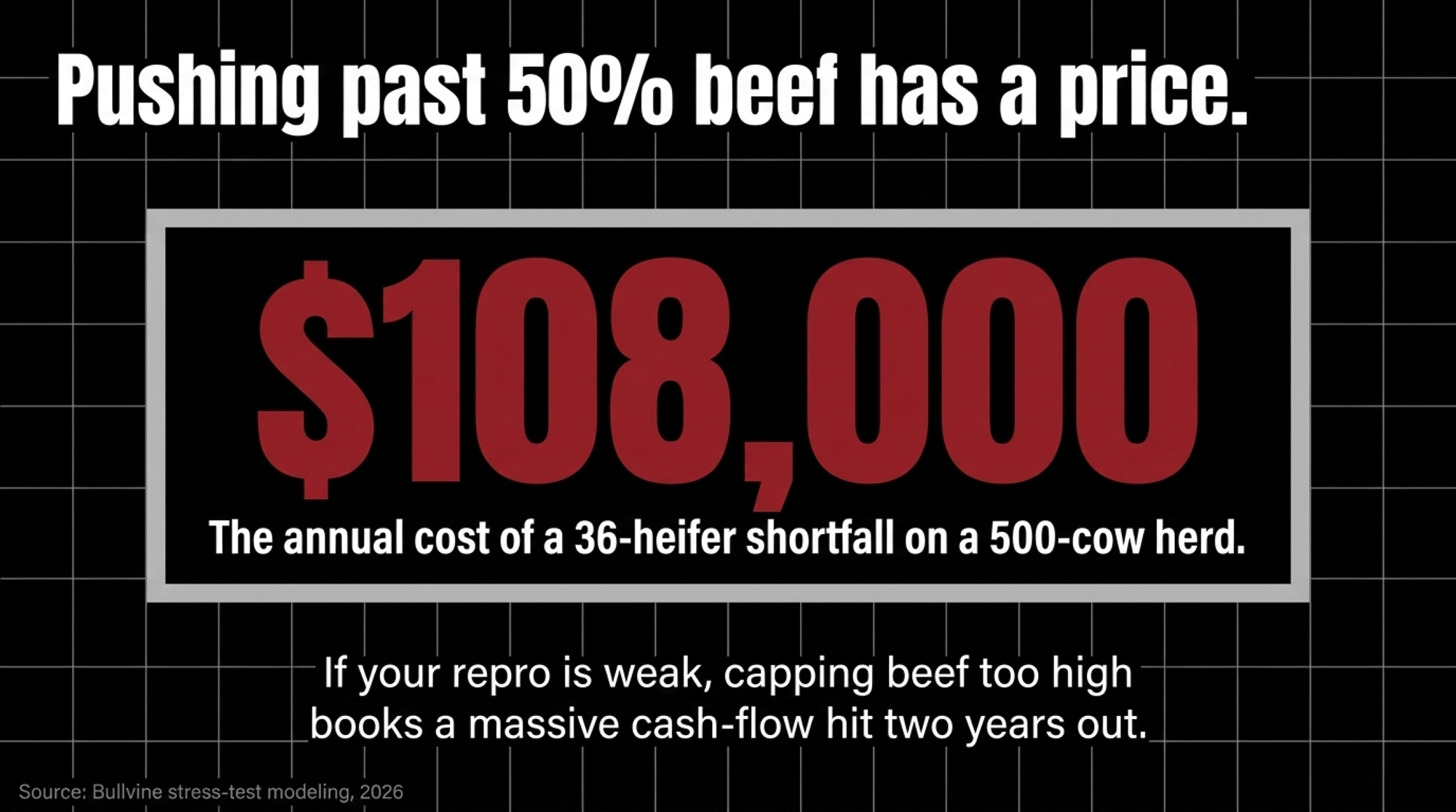
The trouble shows up two years later. Bullvine’s modeling — built on a $3,010 mid-2025 heifer value — puts the netyou trade away, after factoring conception odds and the 79% heifer completion rate, at roughly $585 per beef serviceon a replacement-eligible cow; at today’s $3,100 heifer it runs a touch higher (Bullvine scenario analysis, “$585 a Straw,” July 3, 2026). It’s not a straight $3,010-minus-$500 subtraction. It’s what that lost heifer is actually worth once you weight it for probability. Run 200 of those services a year on cows that could’ve made heifers, and you’ve handed off about $117,000 in replacement value — on a single 500-cow herd, in one year. Push beef past 50% of matings and a separate Bullvine stress-test pegs the damage near a 36-heifer shortfall, roughly $108,000 a year in bought replacements at $3,000 a head.

A CoBank dairy analyst put the replacement side plainly in the co-op’s Knowledge Exchange: “We’ve been in a very severe decline, fewer replacements are available, they’re coming in at record prices for those that can find them” (CoBank Knowledge Exchange, June 25, 2026). The upside and the downside were always inside the same breeding decision. The full ledger — the replacement side — is the half most breeding plans left off.

The Mechanics Behind the Outcomes

Why does this trap close so quietly? Because a beef-on-dairy calf is a one-time cheque today, and a dairy replacement is a two-year build. You feel the calf revenue this week. You don’t feel the missing heifer until she’s not there to freshen in 2027 — and by then, buying her back costs $3,100-plus instead of the $1,140 a comparable heifer ran in April 2019 (USDA Agricultural Prices).

Then there’s the part no single farm can see from its own barn. One operation going heavy on beef is a niche premium play. Tens of thousands doing it at once becomes a structural supply event — millions of crossbred calves piling into feedlots, hundreds of thousands of missing heifers on the dairy side. Neither shows up on your own profit-and-loss until the market reprices the premium you were counting on. And that repricing is now in motion: live cattle futures hit a record $251/cwt in May 2026, then posted 15 straight lower closes through July 17, dropping $2.65 in the final session alone for the longest losing streak since October (CME Group, July 17, 2026). The streak broke Monday, July 20, with contracts closing $2.10 to $3.10 higher — but the supply pressure behind it hasn’t gone anywhere.

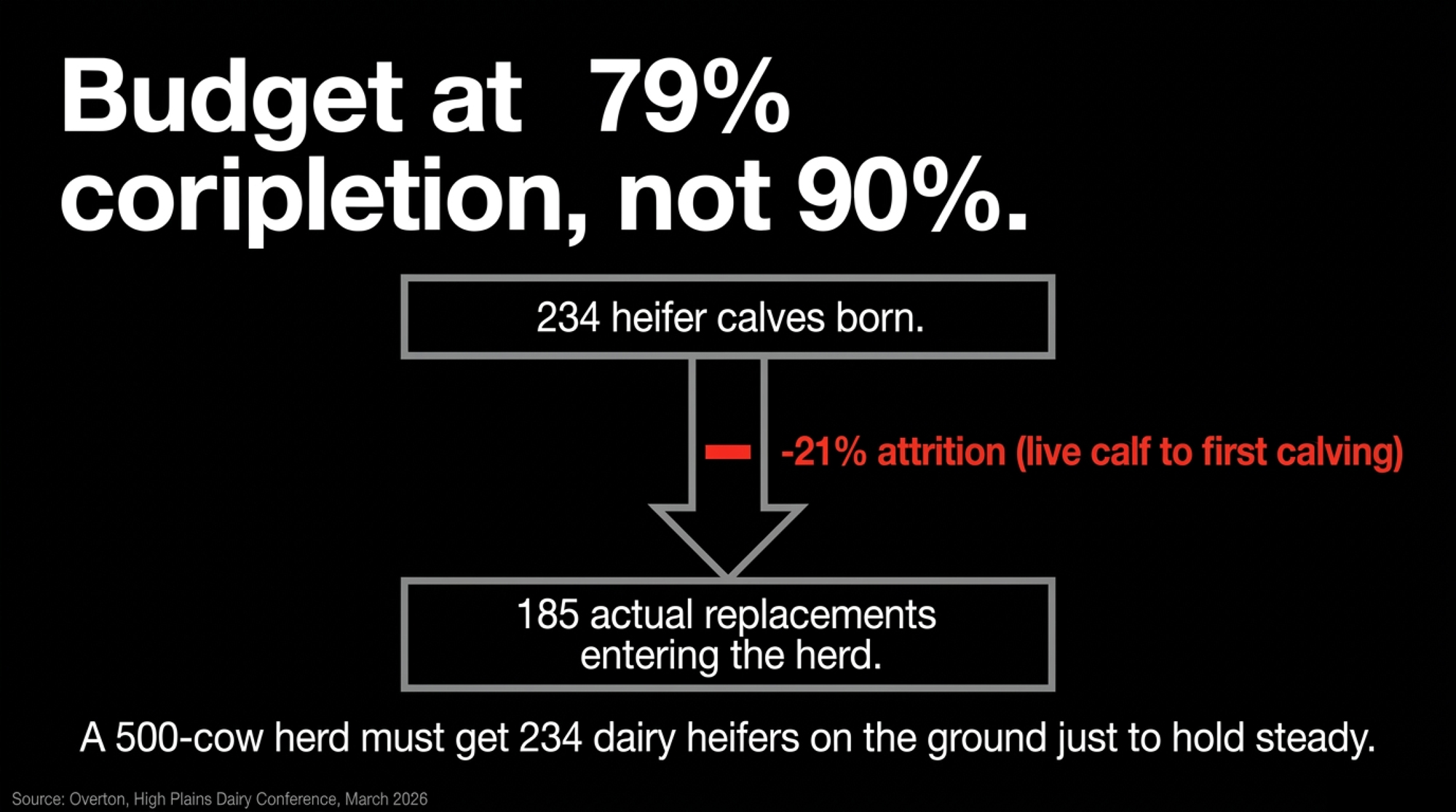
One more mechanic most breeding plans get wrong: heifer survival. Mike Overton’s study of 85 commercial U.S. herds found an average heifer completion rate — live heifer calf all the way to first calving — of just 79%, not the 90% many plans assume (Overton, High Plains Dairy Conference, March 3, 2026). Run that through a 500-cow herd needing about 185 replacements a year, and at 79% completion you need roughly 234 heifer calves born just to stand still — before any buffer. That gap is exactly what too much beef quietly eats into.

Is the Beef Premium Worth More Than the Heifer You Skip?

That’s the question the last three years never forced you to answer, because both sides paid. The calf cheque landed now and the replacement squeeze hadn’t arrived yet. Now it has, and the two halves point opposite directions.

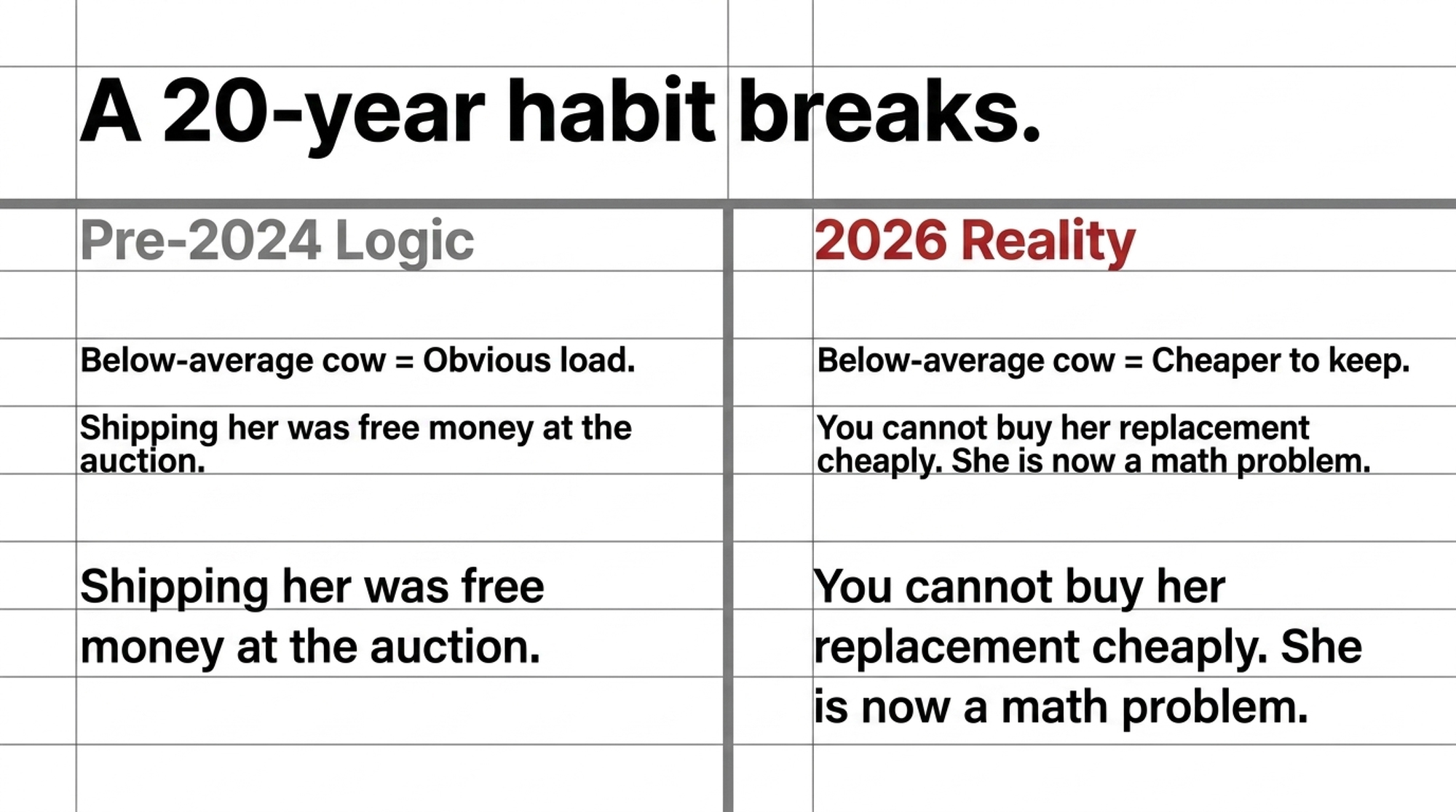
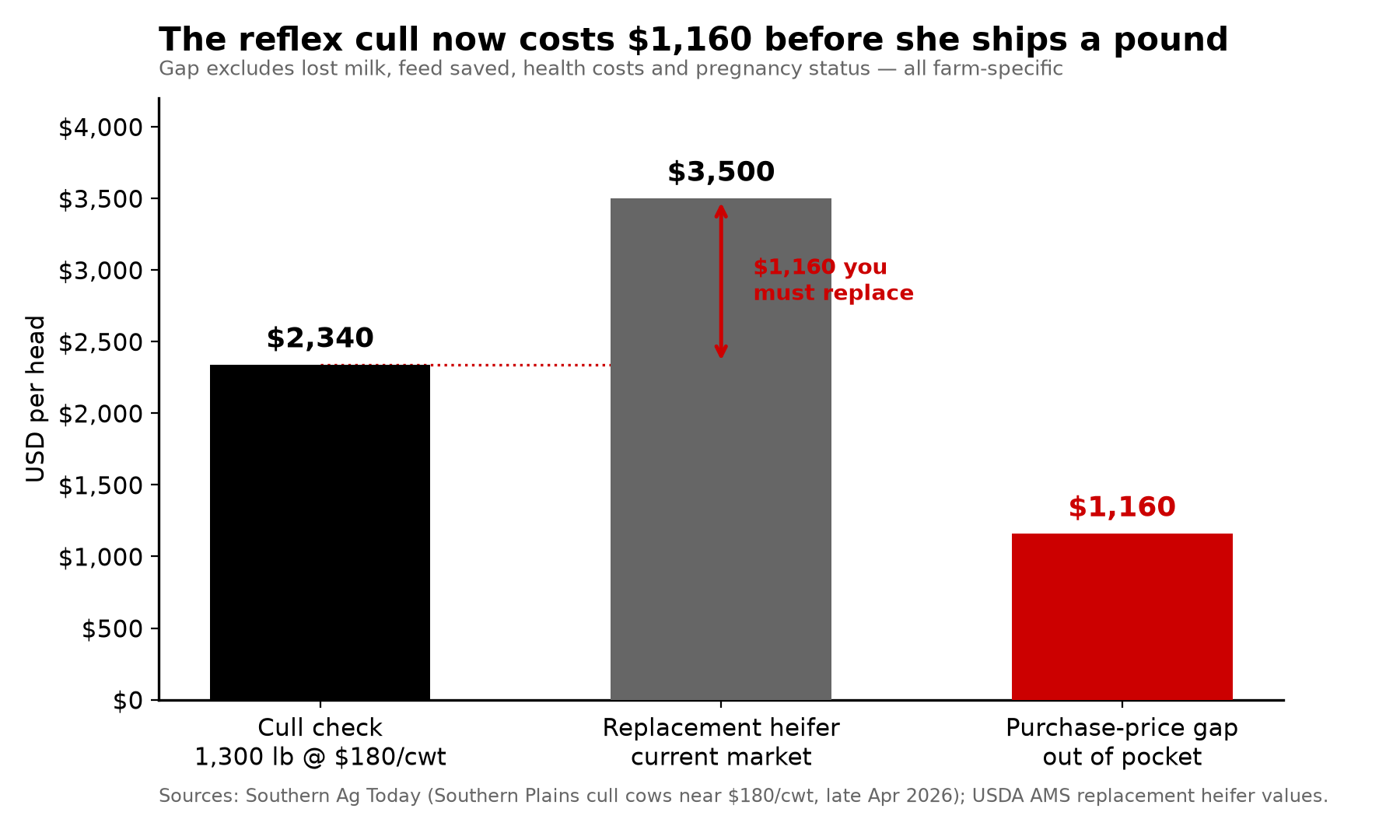
Do the arithmetic on one cow. A beef service that hits gets you a crossbred calf worth $900–$1,400 today. A dairy service that hits — weighted for conception odds and that 79% completion rate — gets you a heifer worth about $2,500 net once you carry her to freshening. That’s the $585-per-service gap, and it only widens as heifer prices climb and calf prices soften. When both were rising, the question didn’t matter. It matters now.

Is Your Heifer Pipeline Already Behind?

Here’s a gut-check you can run this week. Three numbers tell you whether you’ve earned a beef program or quietly scheduled a heifer problem:

The red-flag combination:

  • Pipeline ratio under 1.0
  • 21-day pregnancy rate under 20%
  • More than a third of services going to beef

Hit all three, and the calf market doesn’t get a vote. Your heifer pipeline does.

A herd humming at a 30%-plus pregnancy rate can pull real net calf income from beef. A herd under 20% is mostly borrowing against its own future replacements (UW-Madison/Cabrera modeling, via The Bullvine). Don’t run the national average and call it your answer — the BPI’s 43.4 is a story about everyone and nobody in particular. Your barn has its own number.

📎 Go deeper: [Run your own herd through the BPI Index Calculator →]([INSERT: calculator URL — paste at upload]) — plug in your cow count, cull rate, and semen mix, and see your zone.

Options and Trade-Offs for Farmers

There’s no villain here, and no single right answer. The whole game comes down to matching your beef use to what your heifer pipeline can actually carry. A few ways to play it:

1. Cap beef at what your pipeline supports — start this week.

  • Do it now: Pull your 21-day pregnancy rate and heifer inventory ratio before your next breeding meeting.
  • The ceiling: For most 500-cow herds with typical cull rates, the one-third-of-pregnancies-to-beef cap is a figure derived from Overton’s 79% completion data and standard cull rates — not the 50%-plus some plans assume (derived from Overton, 2026; Bullvine modeling).
  • When it works: Nearly always, as baseline discipline.
  • Where it fails: Set it too high with weak repro, and you’ve booked a heifer shortage two years out — the $108,000-a-year kind.

2. Put sexed dairy on your best animals, beef on the bottom.

  • The lever: Gender-sorted dairy semen sales climbed 53.6% from 2020 to 2025 as herds leaned into exactly this play (CoBank/NAAB, June 2026).
  • The play: Concentrate sexed dairy on top cows and heifers to lock in high-genetic replacements; reserve beef for clear bottom-end and late-lactation animals.
  • What it takes: Reliable genomic ranking and solid heat detection.
  • The risk: Sexed conception can lag conventional if timing or straw handling slips.

3. Treat the beef premium as a position, not a promise.

  • The exposure: With futures off their May record, a premium cut in half — calves toward $450–700, which a market this soft can produce — erases most of that $585-per-service edge and pushes the beef case back onto clear culls only.
  • The timeline: CoBank doesn’t expect a meaningful rebuild until 2027–2028, and even then the BPI barely moves off 43.4 — so your replacement cost stays high while your calf upside wobbles.

Key Takeaways

  • If beef runs past a third of your services and your 21-day PR is under 20%, you’re financing next year’s heifer shortage — pull both numbers before the next breeding meeting and hold the cap at 30 to 35%.
  • Don’t book another beef straw until you’ve priced the whole ledger — at today’s values each service on a replacement-eligible cow trades roughly $585 in net future heifer value, and pushing past 50% beef can run you around $108,000 a year in bought replacements.
  • If you buy replacements instead of raising them, build $3,100-plus a head into your 2026–27 cash flow now — top Midwest animals clear $4,400, and the BPI says the pipeline stays in Yellow through 2028.
  • Budget your heifer needs at 79% completion, not 90% — a 500-cow herd needing 185 replacements has to get about 234 heifer calves on the ground just to hold steady.
  • Watch the live cattle board, not just the milk check. If futures fall 15%+ from that $251/cwt May record before Q1 2027, that’s your signal to shift breeding weight back to sexed dairy — the fastest lever you’ve got to refill the pipeline.

The individual decision was right. It might still be right on your farm today. But here’s the twist the market just handed everyone: the beef correction that’s hammering your calf cheque this month is also the one thing that could unstick your replacement costs. The Bullvine’s modeling shows the fastest path back to a full pipeline isn’t the patient triple play — it’s a beef futures crash that drags farmers back into making dairy heifers, sending the BPI to 52.5, the best scenario on the board. Same shift, both directions. The collapse that’s costing you now is the collapse that could save you later.

Run Your Numbers

Bullvine Pipeline Index Calculator — Plug in your herd size, heifer inventory, cull rate, replacement cost, and sexed-vs-beef semen split. It scores your pipeline 0–100, flags whether you’re Green, Yellow, or Red, and shows exactly where you stand against the national 43.4 — so the beef-ceiling call is your number, not the average.

Complete references and supporting documentation are available upon request by contacting the editorial team at editor@thebullvine.com.

Learn More

The Sunday Read Dairy Professionals Don’t Skip.

Every week, thousands of producers, breeders, and industry insiders open Bullvine Weekly for genetics insights, market shifts, and profit strategies they won’t find anywhere else. One email. Five minutes. Smarter decisions all week.

NewsSubscribe
First
Last
Consent

$3,010 Heifers and the $40,000 Calf Program Math You’re Not Running

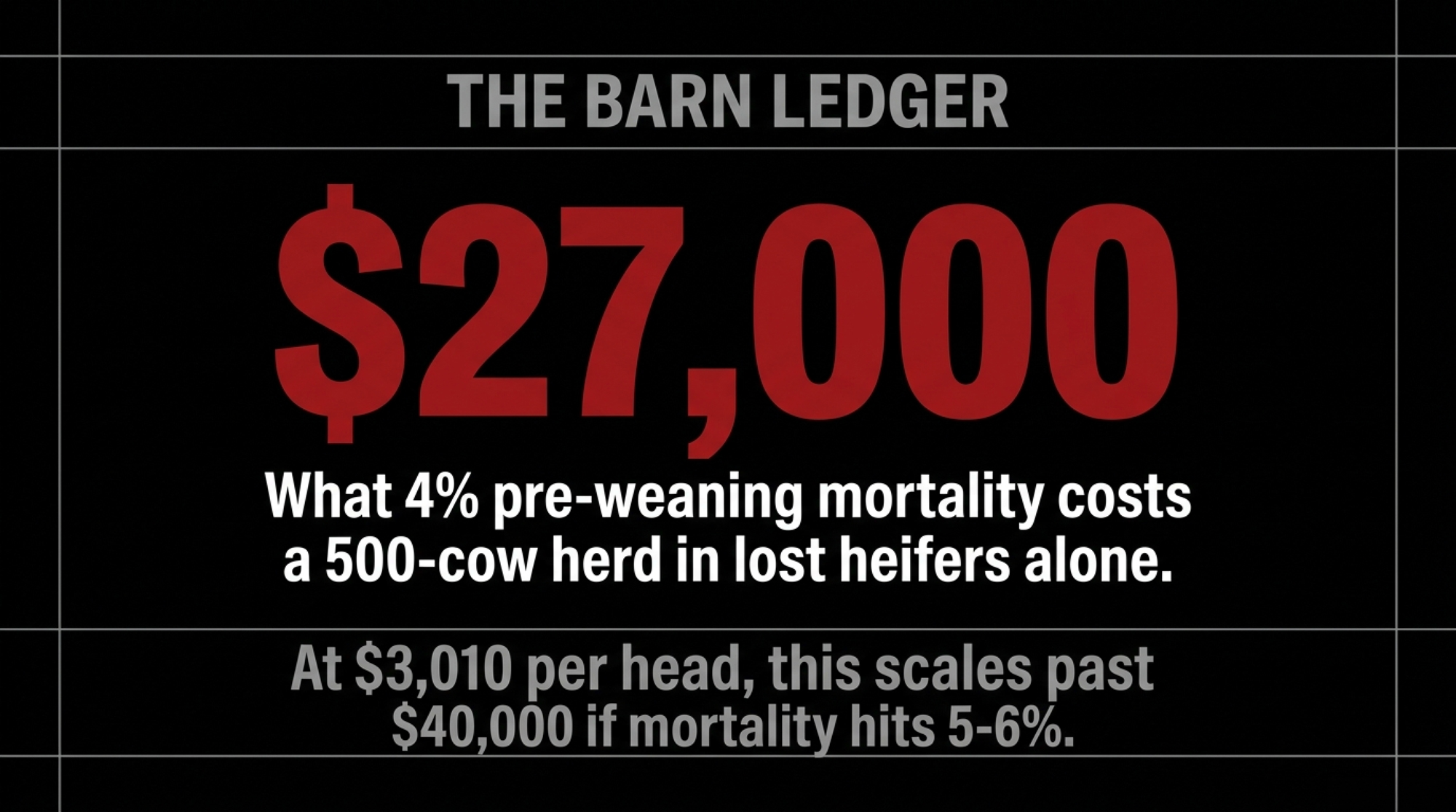
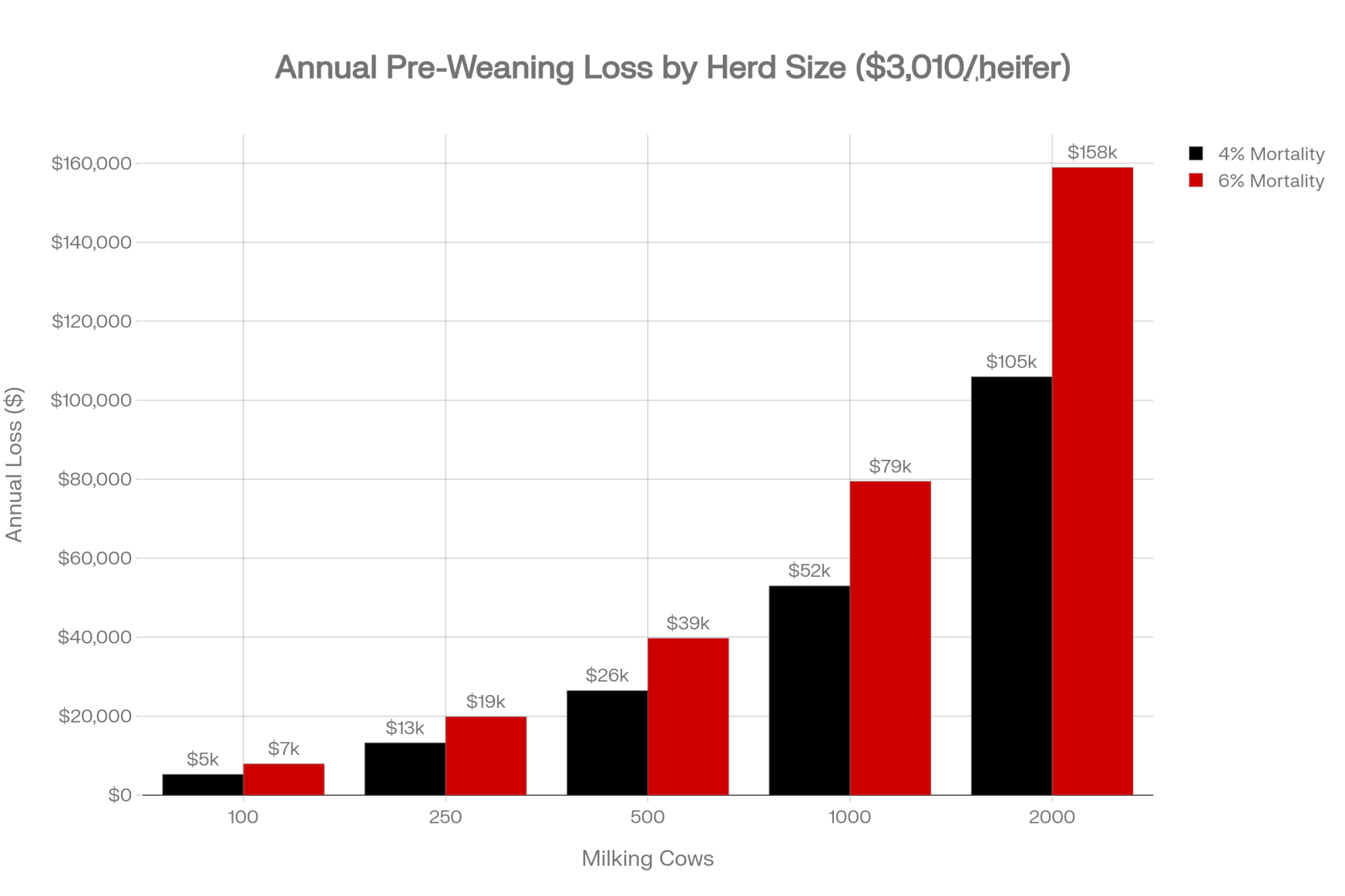
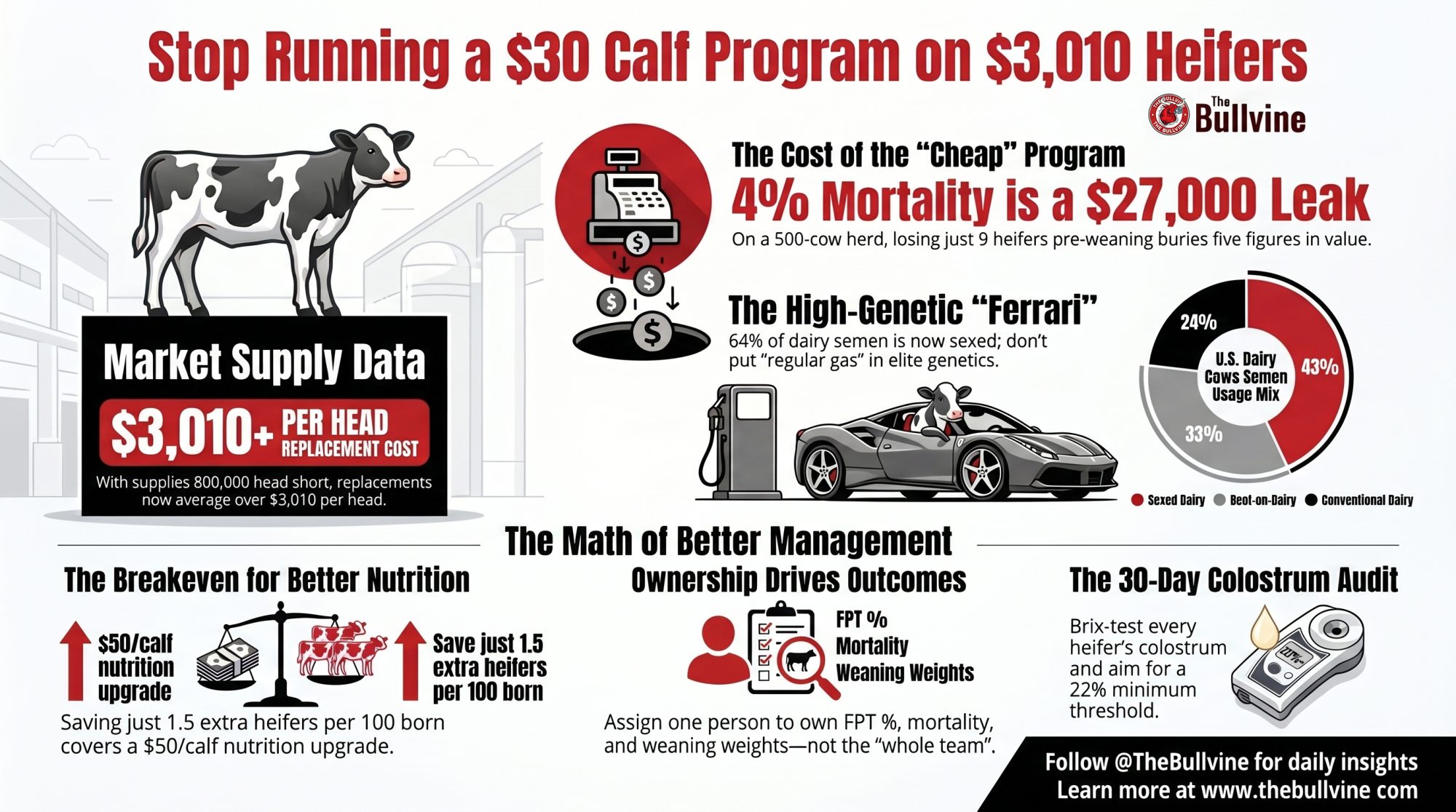
On a 500‑cow herd with 220 heifer calves a year, even 4% pre‑weaning mortality buries about $27,000 in lost heifers alone — at $3,010 per head, before genomics or sexed semen. At 5–6%, that same line item passes $40,000. Still think your $30 calf program is “good enough”?

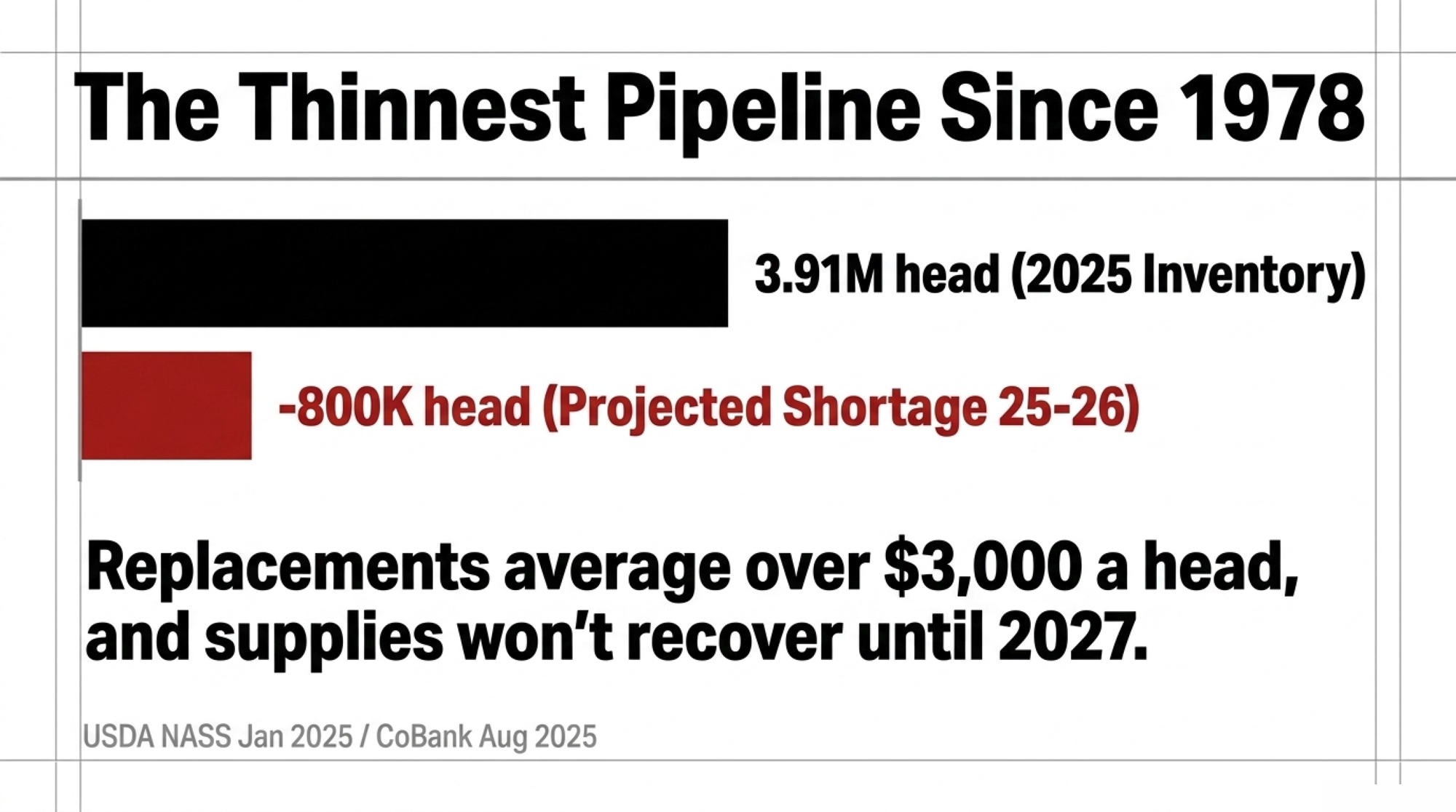
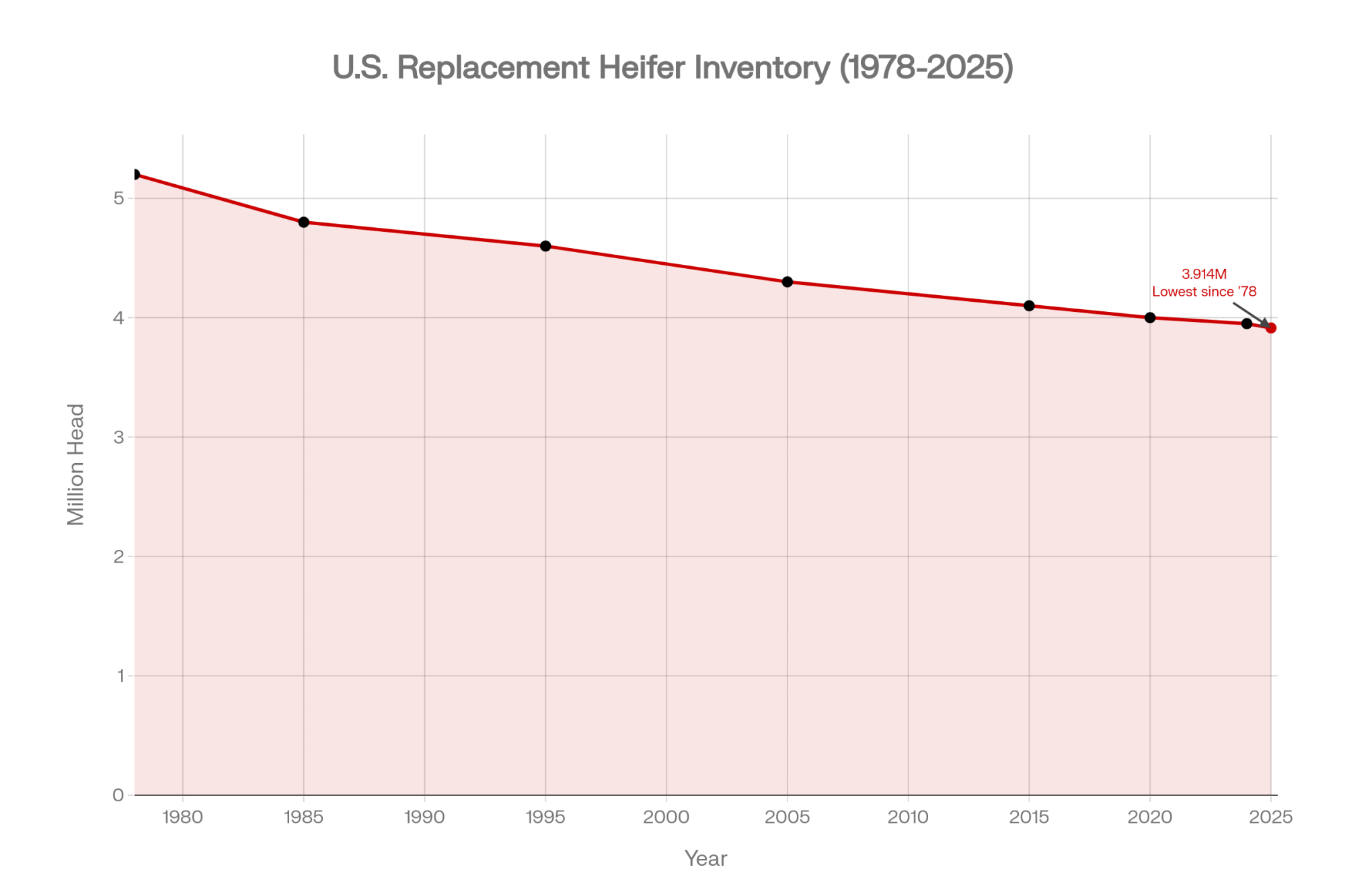
Replacement heifers are at their lowest U.S. inventory since 1978, and CoBank analyst Abbi Prins doesn’t expect supplies to really recover until 2027 — with replacements already averaging over $3,000 a head in many markets. Out by the hutch row, that doesn’t feel like a market report. It feels like a dead calf that suddenly got a whole lot more expensive. In a heifer market that’s roughly 800,000 head short over 2025–2026, every calf that dies in the hutch row isn’t bad luck. It’s a four‑figure hole in a pipeline you can’t easily refill.

We Built the Beef‑on‑Dairy Exit. Now We’re Paying for the Entrance Back In.

Ken McCarty of McCarty Family Farms in Colby, Kansas, still remembers standing by the loading chute when Holstein bull calves were “two for $5” and nobody wanted them. That kind of pain helps explain why so many U.S. dairies were quick to shift more cows to beef‑on‑dairy as calves started bringing $600, then $1,000, then $1,400 a head in some markets. For a while, the bottom‑tier “beef exit” finally worked — cash today, fewer problem calves tomorrow.

Related Reading: $3,010 Per Heifer. 800,000 Short. Your Beef‑on‑Dairy Bill Is Due.

At the same time, sexed dairy semen quietly went from niche tool to default button on the better cows. NAAB’s 2024–2025 semen data — which The Bullvine unpacked in “NAAB’s $327.6 Million Semen Boom vs. $3,000 Heifers” — shows just under 66 million bovine semen units sold and $327.6 million in export value. Inside the roughly 16.5 million dairy units used on U.S. cows, the mix has flipped: about 10.6 million are gender‑selected dairy semen (64%of dairy units), around 6.0 million are conventional dairy, and about 8.1 million units are beef semen used on dairy cows. Put simply, you’re running roughly 43% sexed dairy, 24% conventional dairy, and 33% beef‑on‑dairy across all semen used on dairy cows in the U.S. today.

That cocktail made sense when replacement heifers were cheap and the pipeline was full. It doesn’t anymore. USDA NASS’s January 2025 Cattle report put U.S. dairy replacement heifers 500 pounds and over at 3.914 million head — down 0.9% from 2024 and the lowest level since 1978. CoBank’s August 2025 analysis projects inventories will shrink by an estimated 800,000 head over 2025–2026 before starting to rebound in 2027, with replacement prices likely to “climb well above $3,000 per head.”

McCarty’s “two for $5” bull calves are gone. The heifers replacing them are $3,010 animals riding on the thinnest replacement pipeline you’ve seen in your career. His generation gave away bull calves. Yours is leaking value in the heifer hutches — just more expensively. In that reality, you can’t afford to run a $30 calf program and call it good enough.

How $3,010 Heifers Die on $30 Calf Programs

Let’s put some barn math under the gut feeling.

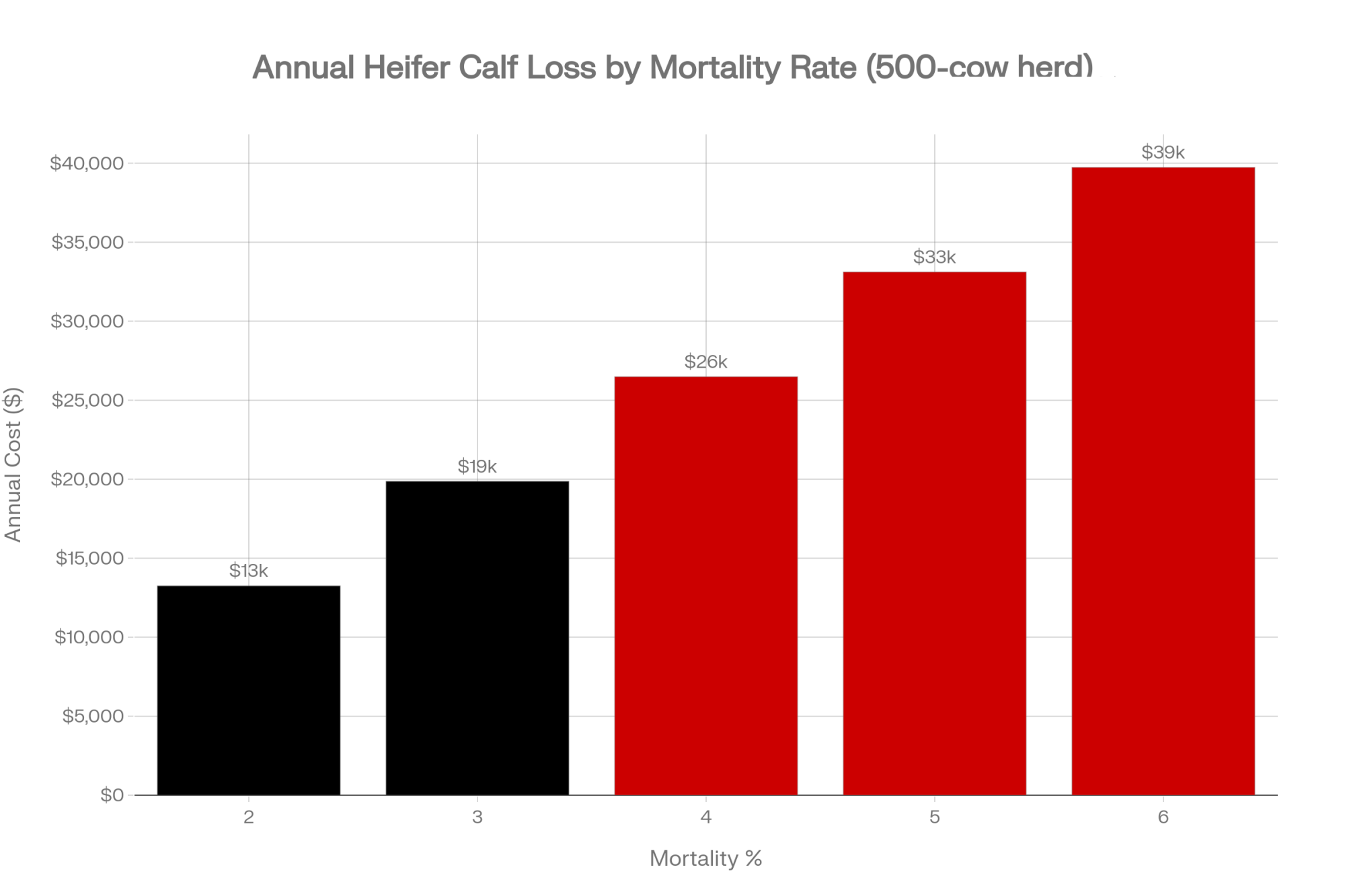
Take a 500‑cow herd freshening about 220 heifer calves per year. NAHMS 2014, analyzed by Urie and colleagues, reported 5.0% pre‑weaning mortality in U.S. heifer calves nationally, with many real‑world herds today running closer to 3–5% when records are tight. Use 4% as a realistic working number for your operation. That’s about 9 dead heifer calves before weaning.

At $2,660 per head — the U.S. average replacement cow price in January 2025 — those 9 deaths represent about $24,000 in lost heifers. At $3,010–3,110 per head — mid‑ to late‑2025 averages in several U.S. markets — you’re burying roughly $27,000–28,000 in heifers alone. If your number drifts up toward 5–6%, that line item climbs past $33,000–40,000 quickly — and that’s the math behind this article’s headline.

And that’s just the heifer value. It doesn’t include:

  • $40–50 per heifer in genomic testing, with CLARIFIDE®‑type programs commonly around $43/head.
  • $15–30 per straw premium for sexed semen over conventional, consistent with economic work and current semen price sheets.
  • IVF or ET on your top donors — often hundreds of dollars per live heifer calf after you spread donor, flush, lab, and recipient costs across pregnancies.

When a genomic‑tested, sexed semen heifer calf dies in the hutch at 19 days, you’re not just losing “a calf.” You’re losing a four‑figure replacement you can’t easily buy back — plus the semen and IVF bills stacked underneath her.

Investment ItemCost per CalfRunning Total
Sexed Semen Premium$15–$30$15–$30
Genomic Test$40–$50$55–$80
IVF/ET (per live calf)$200–$400$255–$480
Subtotal (Genetics)$255–$480
Extra Nutrition (Penn State)$42–$50$297–$530
TOTAL PER HEIFER CALF$297–$530

The slower leak is the one that doesn’t show up in the dead loss column, but still costs you. Calves that survive scours or pneumonia but limp along on growth often freshen late, give less milk in early lactations, and leave the herd sooner. On a 500‑cow dairy, a couple dozen of those “almost fine” cows can flatten herd progress for years without ever making the problem list.

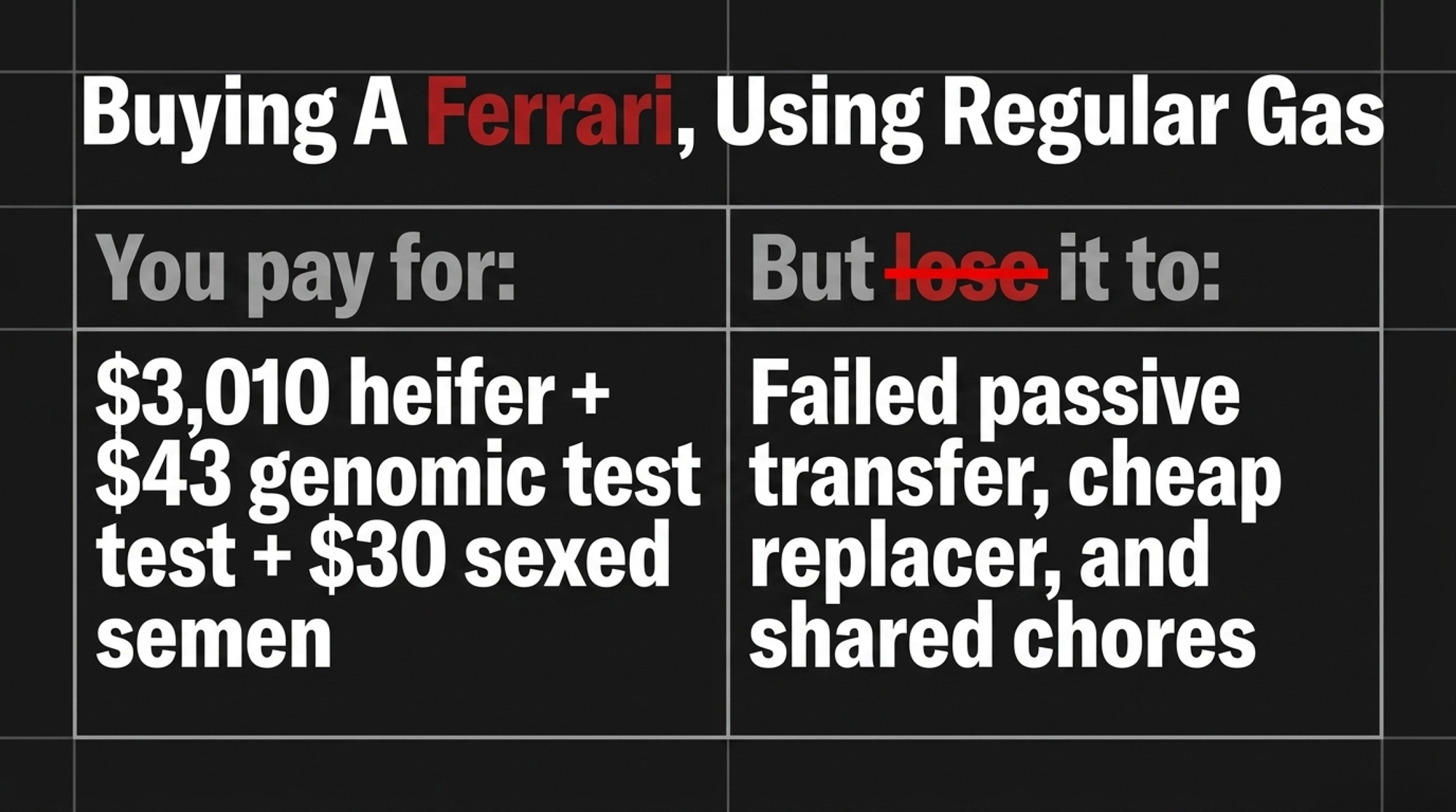
Buying the Ferrari, Using Regular Gas: The $30 Management Leak

You’re already paying for the Ferrari with sexed semen, genomic tests, and IVF on your best cows. The question is whether you’re still putting regular gas in it.

Colostrum and passive transfer. U.S. calf‑health work shows that on many dairy operations, 20–40% of calves still fail to achieve adequate passive transfer [VERIFY: cite Lombard et al. 2020 review or NAHMS Dairy 2014 — confirm exact source/date]. A major review of passive transfer failures found that these calves are about twice as likely to get sick or die early as calves that reach target IgG levels. The reasons are painfully familiar: first feeds drifting past the 2‑hour mark, “we got about two quarts in” instead of a full volume, and colostrum “quality” judged by color and cow parity instead of a Brix reading. A Brix refractometer costs less than one‑tenth of a dead heifer at $3,010.

Related Reading: [INTERNAL LINK: Bullvine calf-mortality-economics piece — hidden gem candidate] → Suggested anchor text: “The Critical Economics of Calf Mortality: Why Every Life Counts More Than Ever.”

Pre‑weaning nutrition. Soberon and Van Amburgh’s work pulled data from a Cornell research herd and a commercial herd. For each 1 kg/day increase in pre‑weaning average daily gain, first‑lactation milk yield increased by about 850 kg in the research herd and 1,113 kg in the commercial herd. A 2016 Journal of Dairy Science review confirmed that keeping average daily gain above 0.5 kg/day with adequate nutrients is linked to higher milk, fat, and protein yields in first lactation. But if that extra nutrition is going into dirty bottles, under‑bedded hutches, or calves that never got decent passive transfer, you’re just buying more expensive scours.

Disease pressure. Urie et al. reported that digestive and respiratory disease together account for a majority of pre‑weaning heifer deaths on U.S. dairies. Other studies have linked early‑life disease to reduced growth, higher treatment costs, and greater odds of early culling. In the “two for $5” bull‑calf era, you could absorb a handful of fragile replacements. In a market where USDA has heifer inventories at their lowest since 1978, every sick, slow‑growing calf is a capital asset you may never fully earn back.

Every weak link in the first 60 days turns a high‑genetic heifer into either a dead loss or a lower‑yield, shorter‑lived cow. That’s always been bad management. At $3,000‑plus per heifer, it’s pipeline suicide. The herds that flip those numbers don’t do it with a new binder — they do it by giving one person clear ownership of the hutch row, which is exactly what the I‑29 case in Option 3 below shows.

How Much Is “Cheap” Calf Nutrition Actually Saving You on $3,010 Heifers?

Here’s where the “we can’t afford a better replacer” argument starts to fall apart.

Penn State’s 2023 bulletin “Economics and Effects of Accelerated Calf Growth Programs” compared a standard 20:20 milk replacer at $80 per 50‑lb bag to a higher‑quality replacer at $100 per bag in a 56‑day feeding program (2023 prices — adjust to your current bag cost). In a scenario where calves moved from gaining 1.1 lb/day to 1.5 lb/day, feed cost increased by about:

  • $41.92 per calf on the $80/bag program.
  • $50.26 per calf on the $100/bag program.

Spread over 56 days, that works out to roughly:

  • $0.75 per calf per day extra on the cheaper program.
  • $0.90 per calf per day extra on the higher‑quality program.

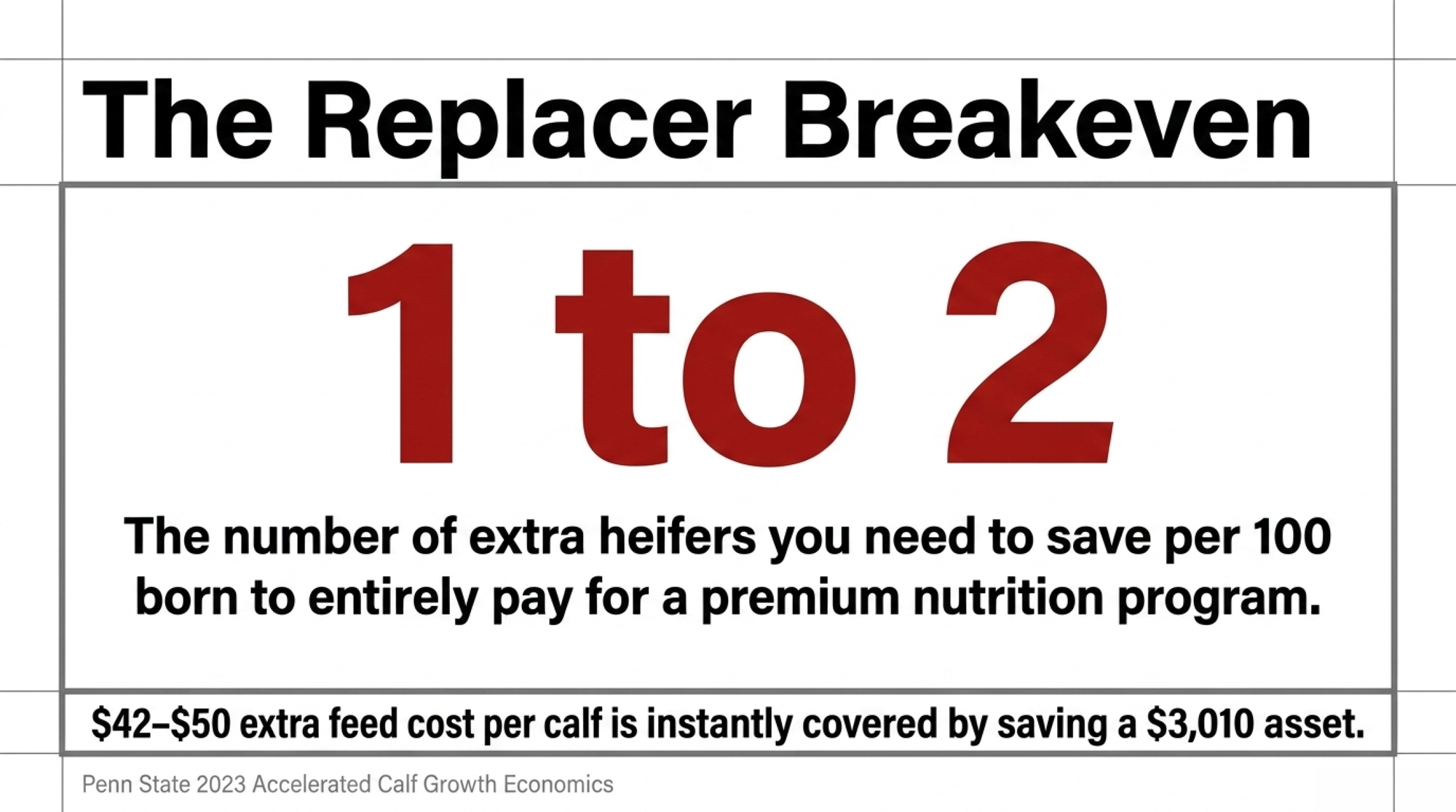
Round it, and you’re talking about $42–50 extra per calf to run a higher plane of nutrition. On 200 heifer calves a year, that’s an additional $8,400–10,000 in milk replacer cost.

Related Reading: 17–26x ROI: Why Top Dairies Stopped ‘Saving’ Calves and Started Preventing Loss.

Now put today’s heifer prices on the other side of the ledger. At $3,010 per head, if tightening up colostrum and stepping up nutrition together drop heifer calf mortality from 4% to 2% on those 200 heifers, that’s 4 extra heifers alive. Four at $3,010 is $12,040 — more than enough to cover the $8,400–10,000 in extra feed.

You don’t even need a full 2‑point drop to break even. If you spend $10,000 more on calf feed and each heifer is worth $3,010, you need to save about 3.3 heifers. On 200 heifers a year, that’s roughly 1.6 percentage points of mortality improvement. At the lower feed cost ($8,400), the breakeven is closer to 1.4 points. Either way, you’re still only aiming to save one to two extra heifers per 100 born.

Will every farm see that from a replacer change alone? No. Colostrum timing, housing, bedding, and people following the protocol all matter. But at current heifer values, the breakeven for a better calf program has moved much closer than it used to be.

What’s the Real Cost of Your Calf Program?

The easiest way to dodge this question is to say, “Our calf program is fine.” The harder way is to pull the numbers and see if it actually matches the genetics bill you’re paying.

Start with last year’s heifer calf crop. If you had 220 heifer calves born and lost 4% before weaning, that’s about 9 heifer calves dead. At your replacement value — anywhere from $2,660 in early 2025 to $3,110 by late 2025 — you’re looking at a $24,000–28,000 line item just for dead heifers. Then add in the extras: sexed semen premiums, genomic tests, and any IVF work you did on the cows those heifers came from. If that number doesn’t make you uncomfortable, check it again.

Now compare your calf program spend to that loss. Penn State’s math shows an extra $42–50 per calf in replacer cost on 200 heifer calves — call it $8,400–10,000 per year — can break even if you save just one or two extra heifers per hundred born at $3,010 each. Does your current calf program pass or fail that simple barn‑math test?

Who Really Owns the Hutch Row?

On paper, you might say, “Our calf team handles it.” In practice, that often means whoever finishes milking first or whoever drew the short straw that week.

Ask yourself one blunt question: if you walked into the office right now and asked, “Who owns calf outcomes here?” would you get one name in under five seconds — or a vague, “We all do”? Herds that win this game usually have a single person who owns colostrum, calves, and the key numbers: FPT %, heifer calf mortality, and weaning weights.

You don’t need a fancy HR plan to get there. You need to pick the person who notices calves first, give them clear authority over calf protocols, and put their numbers on the board every month next to pregnancy rate and SCC. When calf care is shared across whoever has time, even $3,010 heifers can quietly get less focused attention than they really need.

MetricWhat It MeasuresTargetAction Threshold
FPT %Calves failing passive transfer (serum total protein <5.2 g/dL)<10%>15%
Pre-Weaning Heifer Mortality %Heifer calves dead before weaning<3%>4%
Average Daily Gain (Pre-Weaning)Pounds gained per day, birth to weaning>1.5 lb/day<1.1 lb/day
Weaning WeightAverage weight at 8 weeks>200 lb<180 lb
Days to First CalvingAge at first calving<24 months>26 months

Options and Trade‑Offs for Farmers

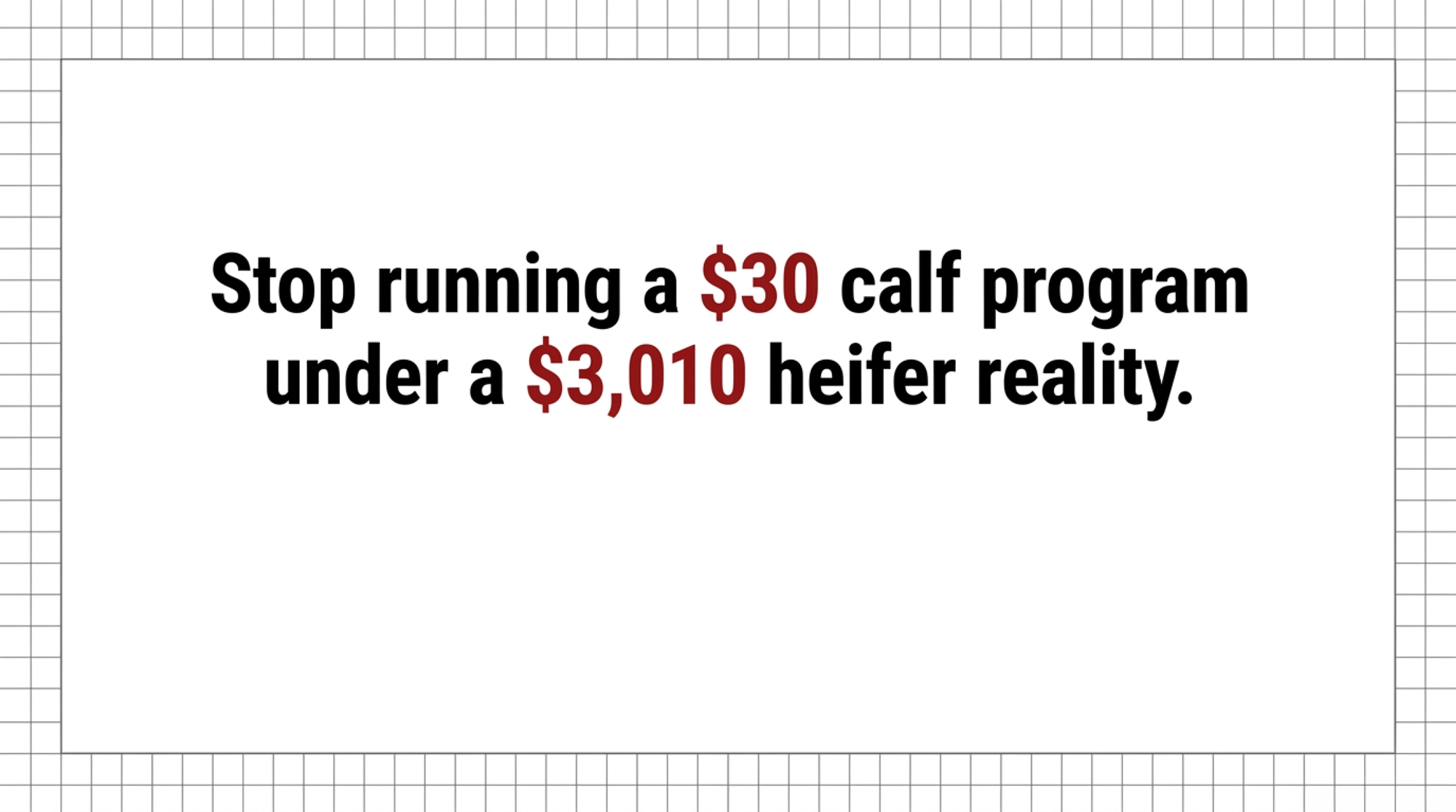
You don’t have to fix everything this month. But you do need to stop running a $30 calf program under a $3,010 heifer reality. Here are four paths, how they work, and where they can bite you.

1. Lock Down Colostrum — Your 30‑Day Action

If your heifer replacements are worth more than about $2,500 and your heifer calf mortality is over roughly 3–4%, that’s a strong signal that this is where you start.

In the next 30 days, pull the last 12 months of heifer‑calf data and calculate your actual pre‑weaning heifer mortality. Not a gut feel — the real number from your records. Brix‑test colostrum from every fresh cow for at least one full week and draw a hard line: nothing under 22% Brix goes into heifer calves. Then draw blood from every calf born during that week at 24–48 hours and run serum total protein. If more than 10–15% of those calves fall below the accepted passive‑transfer threshold, your most expensive pipeline leaks.

When this path makes sense: any time replacements are valuable, and you haven’t done a proper FPT audit in the last 12 months. What it requires: a Brix refractometer, some blood tubes, a small lab bill, and a willingness to change how quickly and how much colostrum gets fed. Where it fails: you collect the numbers and then write them off as “just a bad week” instead of changing milking‑fresh, storage, and first‑feeding routines.

2. Upgrade Calf Nutrition With Numbers, Not Hope

This path is for herds already investing in genomics and sexed semen but still seeing 4–5% heifer calf mortality and a thick treatment notebook.

You’re basically asking one question: does the extra $42–50 per calf Penn State lays out for a higher‑plane program pay off at $3,010 per heifer in your barn? Use their math as the backbone and plug in your own replacer price, mixing rate, and days on feed. Then compare that extra spend to what saving one or two extra heifers per hundred born is worth in your herd.

You’ll also need to tighten mixing accuracy, feeding schedule, and hygiene. A better bag doesn’t fix dirty bottles or inconsistent solids.

When this path makes sense: you’ve already got decent colostrum numbers but still see too many sick, slow‑growing calves. What it requires: shifting away from “whatever 20:20 is cheapest” toward a consistent, all‑milk‑protein replacer and enforcing protocol discipline. Where it fails: you upgrade the replacer but leave colostrum, housing, and staff training the same. That’s just a more expensive way to keep the same problems.

3. Put Real Ownership on the Calf Barn

On some dairies, the calf barn turns not because a consultant writes a binder, but because one person quietly decides, “These calves are mine.”

Maybe it’s the herdsman’s daughter who has a knack for spotting dull eyes and droopy ears. Maybe it’s the feeder who hates seeing the same calf on the treatment list twice. On one 600‑cow I‑29 herd a consultant works with, the turning point was simple: the owner told their sharpest young employee, “You own hutches and colostrum. I’ll measure you on FPT %, death loss, and weaning weights — and I’ll back you when you need changes.” Within a year, that farm’s heifer calf mortality had dropped, and the owner quit saying, “Our calves are just weaker.”

When this path makes sense: nobody in your place can answer “Who owns calf outcomes here?” without looking around. What it requires: giving one person clear authority over calf protocols and tying their success to three KPIs: FPT %, heifer calf mortality, and weaning weights. Then sitting down monthly to review those numbers alongside repro and SCC. Where it fails: you give someone the title but not the time, training, or authority. If calf chores are still what happens when people finish everything else, the numbers won’t move.

4. Benchmark Calves the Way You Benchmark Cows

With CoBank’s shortage timeline and beef‑on‑dairy locked in for 2026, flying blind on calf performance is the wrong gamble.

Sponsored Post

Related Reading: Updated NAAB Data Cuts CoBank’s Heifer Shortage Projection — The Barn Math Says It Doesn’t Matter Yet.

When this path makes sense: you genuinely don’t know how your calf metrics stack up against herds that look like yours. What it requires: pull a year of heifer‑calf data and break mortality into 0–3 days, 4–21 days, and 22 days to weaning. Add FPT % and weaning weights. Then work with your vet, nutritionist, or a university project to benchmark against peer herds. Where it fails: you see that your numbers sit in the bottom third and decide “our calves are just weaker” instead of changing something.

Key Takeaways

  • If your heifer replacement value is above roughly $2,500 and your heifer calf mortality is over 3–4%, stop treating that as background noise. Treat it like an economic leak. Multiply last year’s dead‑heifer count by $2,660–3,110 and ask whether you’d accept that line item if it showed up as a bill from your vet or semen rep.
  • If you’re running a high beef‑on‑dairy percentage without a locked‑in heifer plan, you’re stacking two bets: that beef calf premiums stay strong and that replacements will be there when you need them. CoBank’s 800,000‑head shortfall and USDA’s lowest‑since‑1978 inventory should make you nervous about the second part.
  • If you’re willing to spend about $43 per heifer on genomics and pay a $15–30 sexed‑semen premium,balking at an extra $42–50 per calf on a better colostrum and nutrition program doesn’t pencil. The breakeven is saving roughly one to two heifers per 100 born at $3,010 each.
  • If nobody on your farm “owns” calf outcomes with data, your calf program is still operating more like a chore than a managed system. Name a calf manager and give them three numbers to live by: FPT %, heifer calf mortality, and weaning weights.
  • If you haven’t Brix‑tested colostrum and run serum total protein on a batch of calves in the last 12 months, your colostrum program is still a story, not a fact. Make that your 30‑day project.

Your Calf Barn Checklist — Print This and Take It Outside

  • ☐ The Brix Test: Is every gallon of colostrum for heifer calves testing at or above 22% Brix before it goes into a bottle?
  • ☐ The 2‑Hour Rule: Are calves reliably getting their first colostrum within 2 hours of birth, or are there still “shift change” calves waiting longer?
  • ☐ The FPT Audit: Have you checked serum total protein on the last 10 heifer calves born? What percentage cleared the passive‑transfer threshold?
  • ☐ The Mortality Number: Can you write down your actual 12‑month pre‑weaning heifer calf mortality rate — not a guess, but the number from your records?
  • ☐ The Cost‑Per‑Death: Take that mortality rate, multiply by your annual heifer calf crop, then by $3,010. That’s what lost heifers cost you last year — before you add in genomics, sexed semen, or IVF.
  • ☐ The Replacer Math: How much does your current milk replacer cost per calf through weaning? What would an upgrade cost? How many extra heifers per 100 born would need to live for that to pay off at $3,010 per head?
  • ☐ The Pipeline Check: How many bred heifers and springers do you have on hand right now, divided by how many replacements you actually need each year? If that ratio is under 1.0, you’re already short. Under 0.8, you’re in trouble if CoBank’s 2027 recovery timeline holds.
  • ☐ The Owner Question: Is there one name — not “the team” — on this farm who owns those calf numbers?

Heifers aren’t about to get cheaper. USDA NASS’s January 2025 report and follow‑up analysis put replacement heifers at 3.914 million head, the lowest since 1978, and CoBank’s best‑case scenario has inventories just starting to recover in 2027. The genetics you’re putting into cows today are some of the most expensive you’ve ever bought. The calf barn is where you decide whether that money turns into cows or compost.

So here’s the real question: do your calf numbers match the genetics bill you’re paying — or are you still running a $30 program under a $3,010 heifer reality?

Run Your Numbers

Bullvine Pipeline Index Calculator — This free tool turns your heifer pipeline into a single 0–100 score and shows whether your current calf losses, beef-on-dairy use, and cull rate can actually support tomorrow’s herd. Use it to see if your $30 calf program matches your $3,010 heifer reality.

Learn More

The Sunday Read Dairy Professionals Don’t Skip.

Every week, thousands of producers, breeders, and industry insiders open Bullvine Weekly for genetics insights, market shifts, and profit strategies they won’t find anywhere else. One email. Five minutes. Smarter decisions all week.
NewsSubscribe
First
Last
Consent

Send this to a friend