




Archive for dairy replacement heifers

$3,010 Heifers and the $40,000 Calf Program Math You’re Not Running

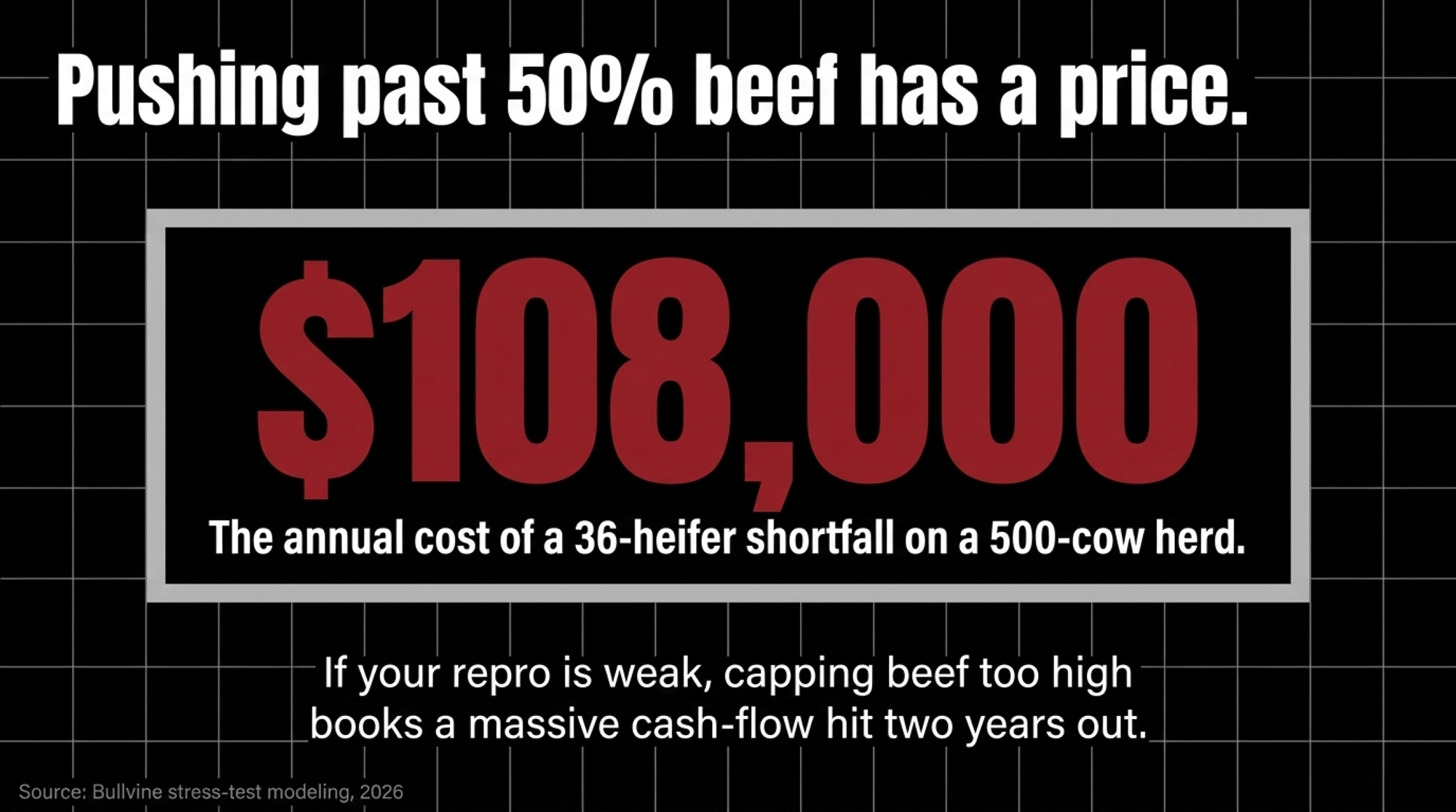
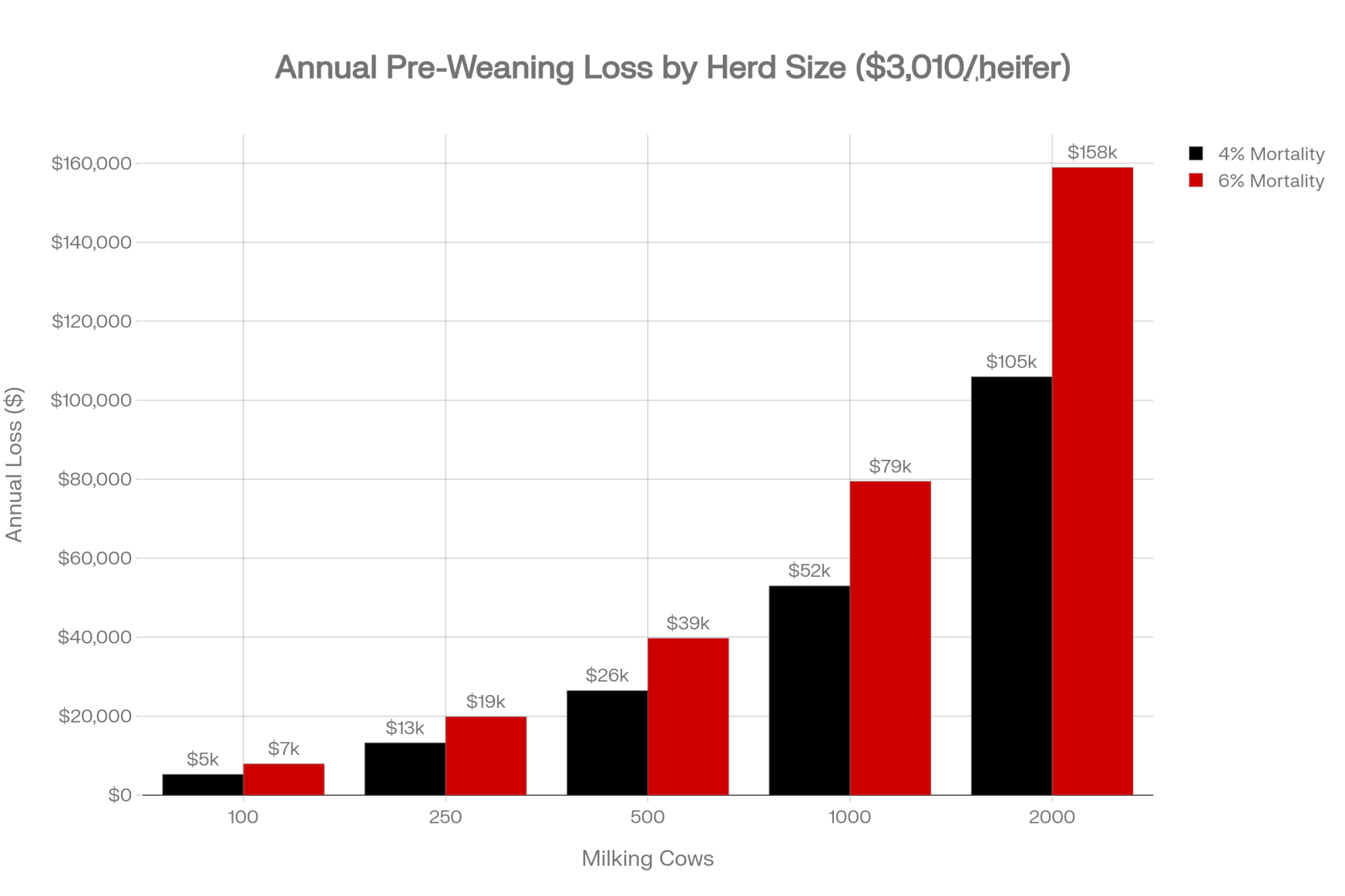
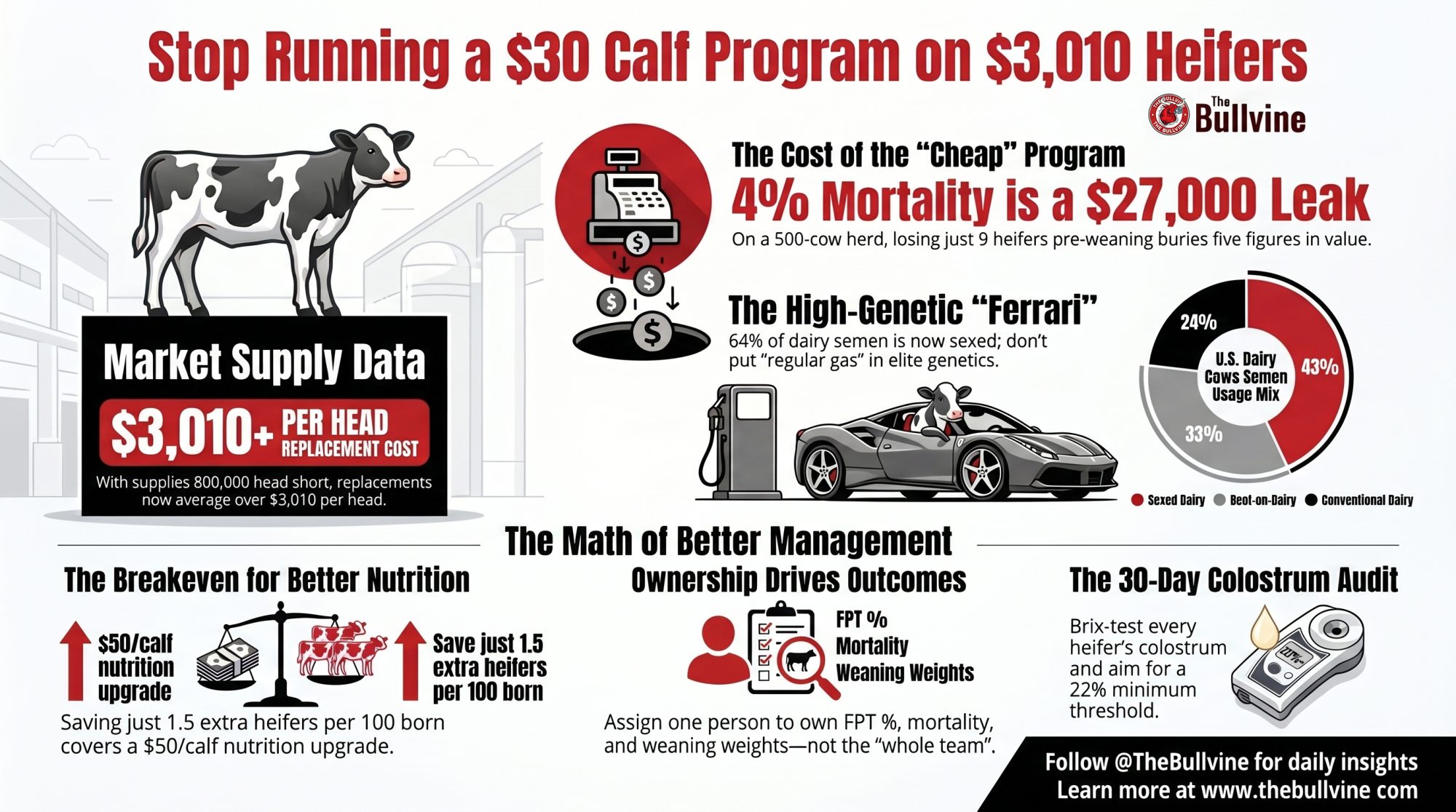
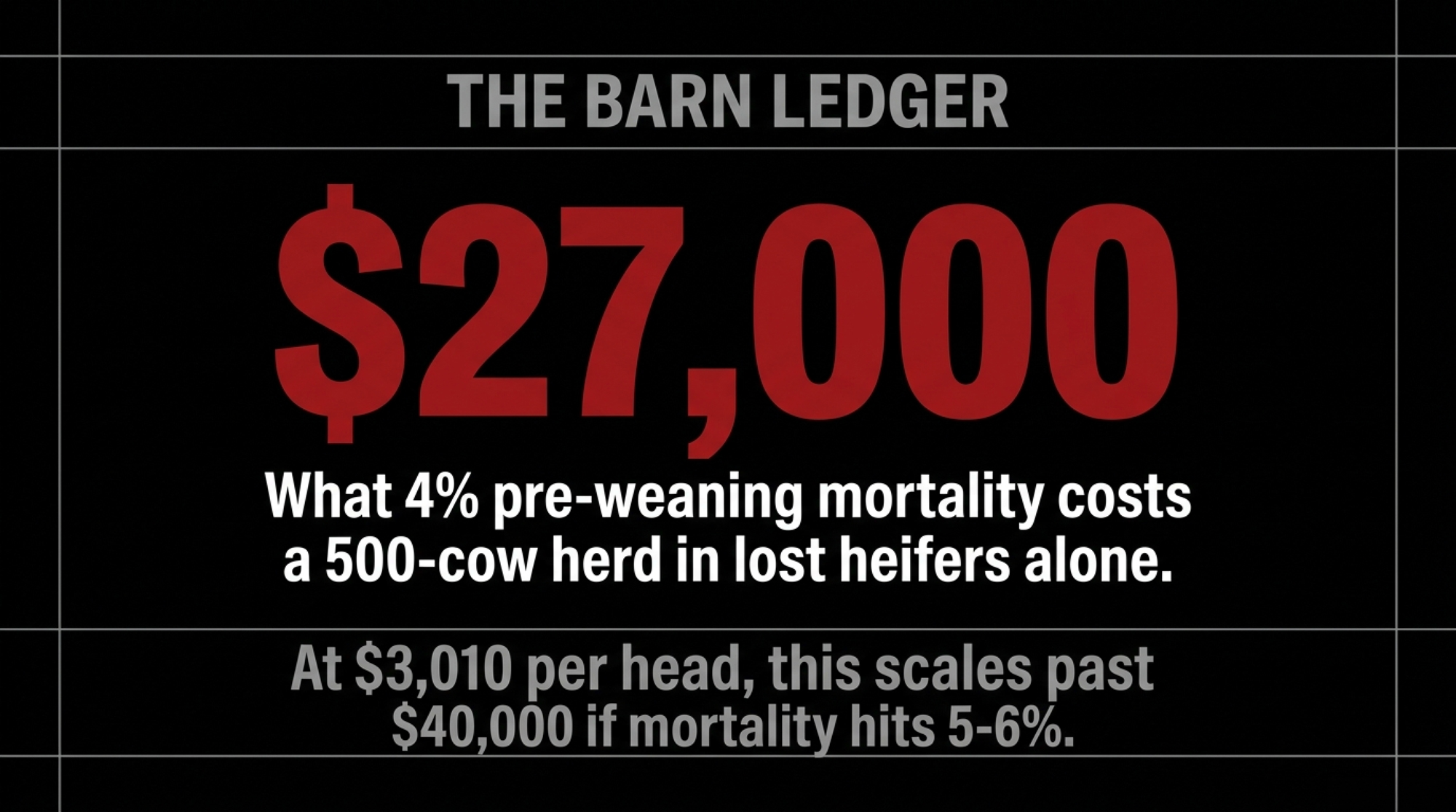
On a 500‑cow herd with 220 heifer calves a year, even 4% pre‑weaning mortality buries about $27,000 in lost heifers alone — at $3,010 per head, before genomics or sexed semen. At 5–6%, that same line item passes $40,000. Still think your $30 calf program is “good enough”?

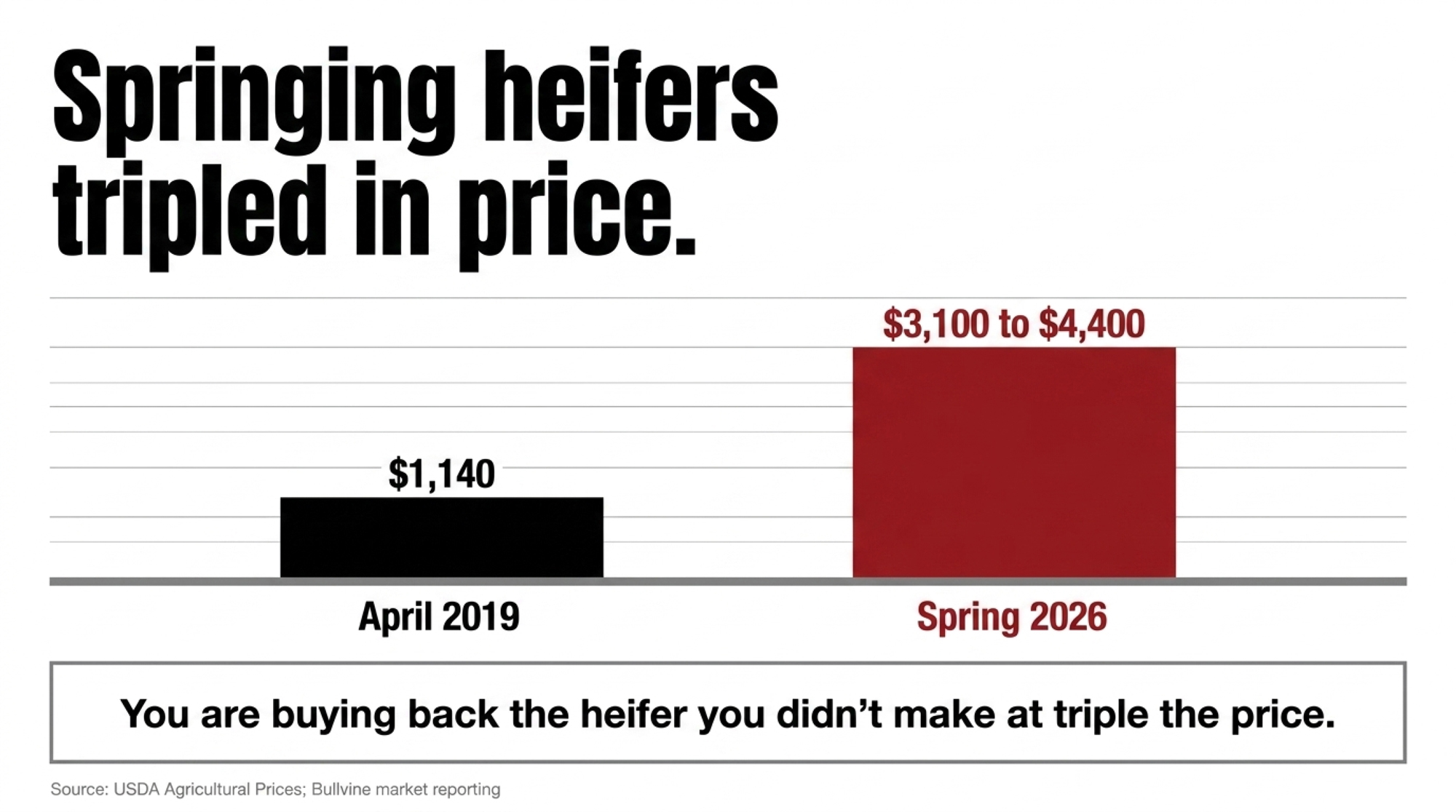
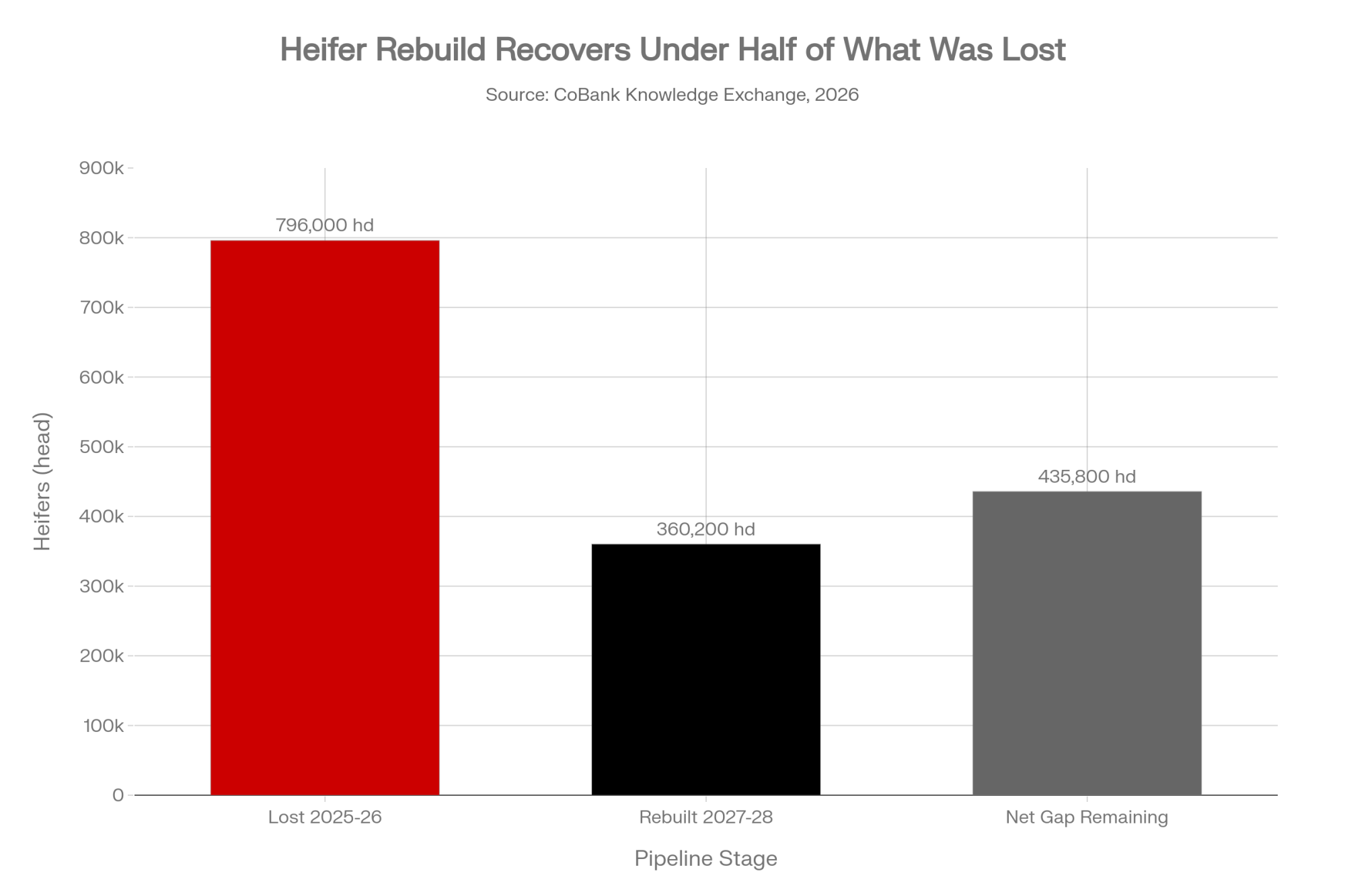
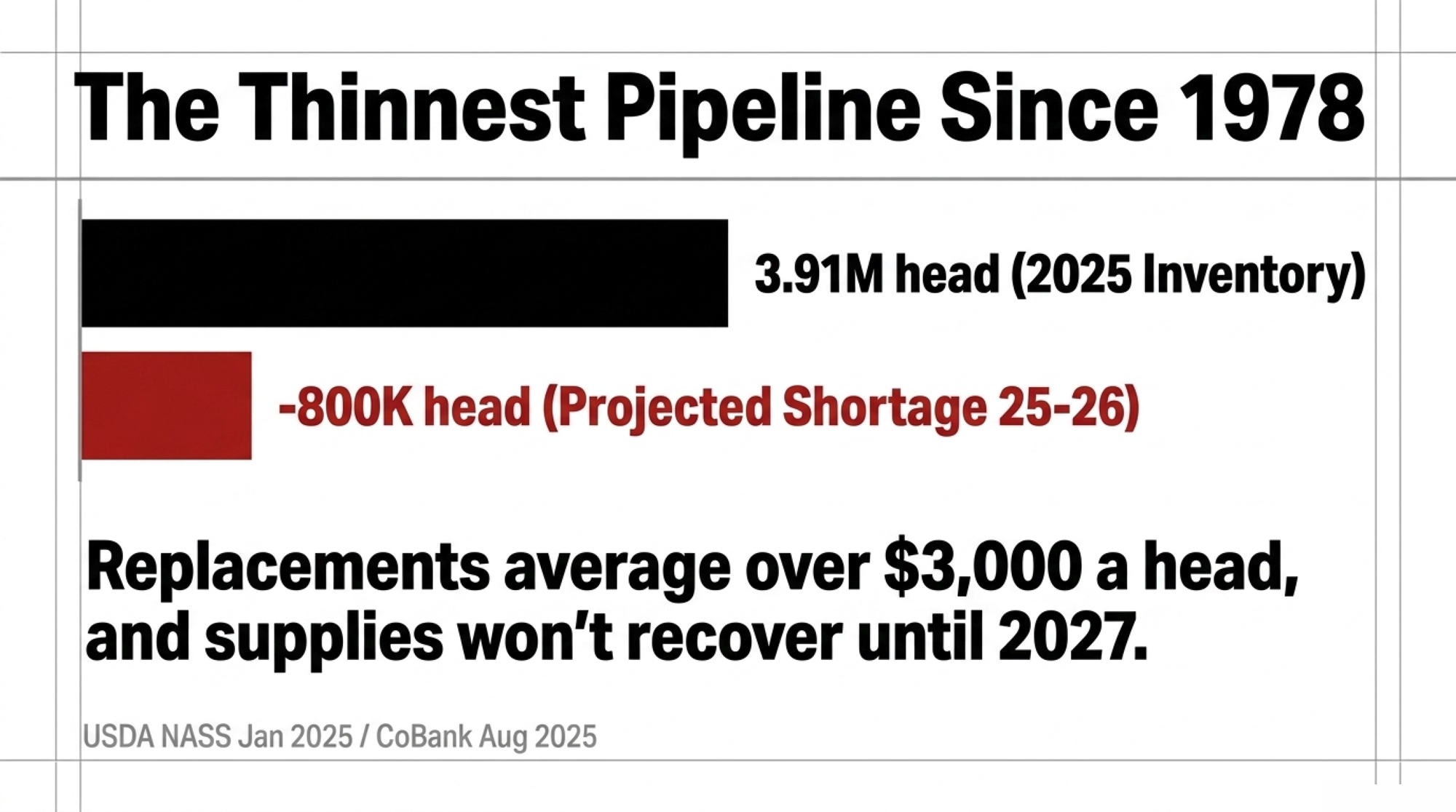
Replacement heifers are at their lowest U.S. inventory since 1978, and CoBank analyst Abbi Prins doesn’t expect supplies to really recover until 2027 — with replacements already averaging over $3,000 a head in many markets. Out by the hutch row, that doesn’t feel like a market report. It feels like a dead calf that suddenly got a whole lot more expensive. In a heifer market that’s roughly 800,000 head short over 2025–2026, every calf that dies in the hutch row isn’t bad luck. It’s a four‑figure hole in a pipeline you can’t easily refill.

We Built the Beef‑on‑Dairy Exit. Now We’re Paying for the Entrance Back In.

Ken McCarty of McCarty Family Farms in Colby, Kansas, still remembers standing by the loading chute when Holstein bull calves were “two for $5” and nobody wanted them. That kind of pain helps explain why so many U.S. dairies were quick to shift more cows to beef‑on‑dairy as calves started bringing $600, then $1,000, then $1,400 a head in some markets. For a while, the bottom‑tier “beef exit” finally worked — cash today, fewer problem calves tomorrow.

Related Reading: $3,010 Per Heifer. 800,000 Short. Your Beef‑on‑Dairy Bill Is Due.

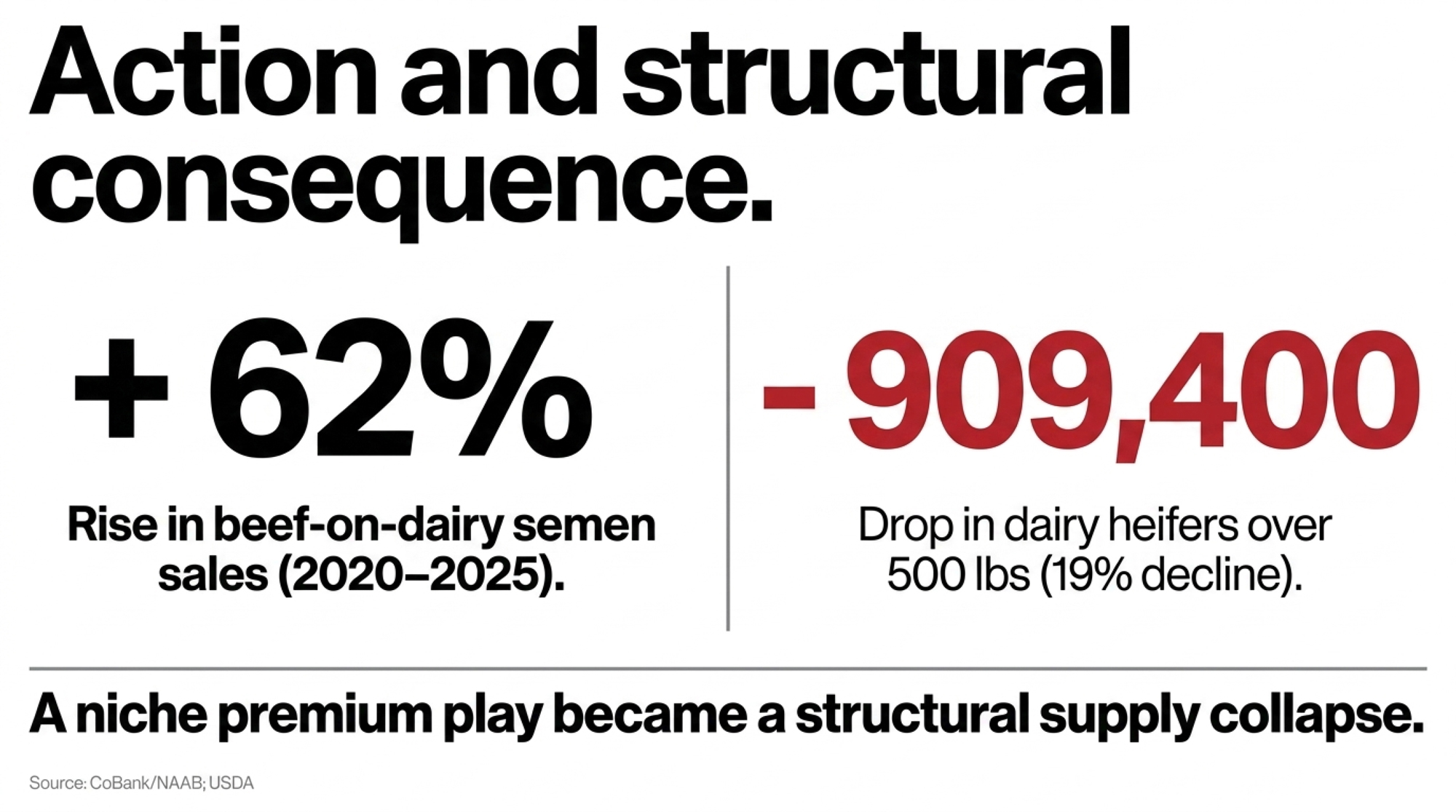
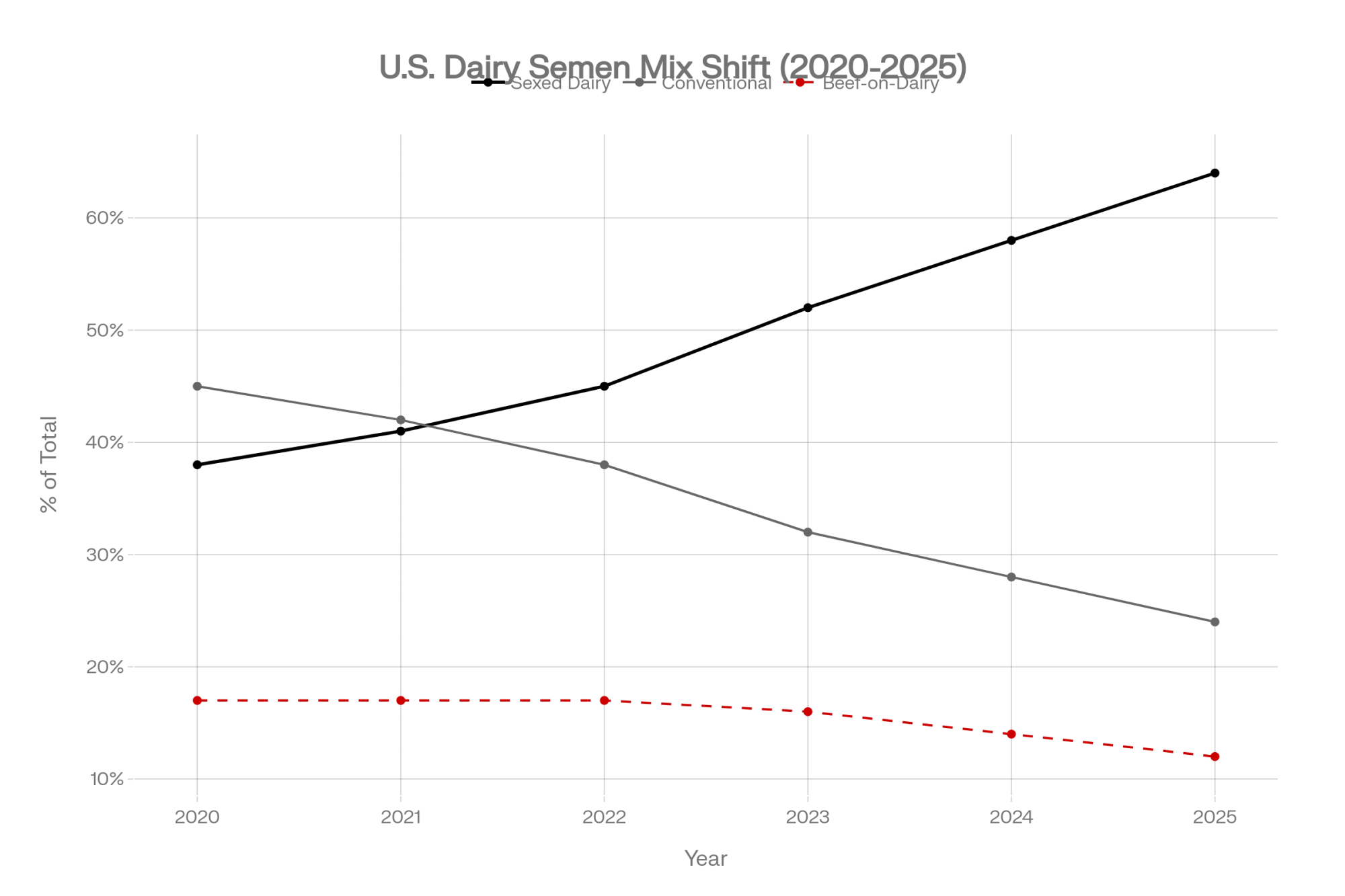
At the same time, sexed dairy semen quietly went from niche tool to default button on the better cows. NAAB’s 2024–2025 semen data — which The Bullvine unpacked in “NAAB’s $327.6 Million Semen Boom vs. $3,000 Heifers” — shows just under 66 million bovine semen units sold and $327.6 million in export value. Inside the roughly 16.5 million dairy units used on U.S. cows, the mix has flipped: about 10.6 million are gender‑selected dairy semen (64%of dairy units), around 6.0 million are conventional dairy, and about 8.1 million units are beef semen used on dairy cows. Put simply, you’re running roughly 43% sexed dairy, 24% conventional dairy, and 33% beef‑on‑dairy across all semen used on dairy cows in the U.S. today.

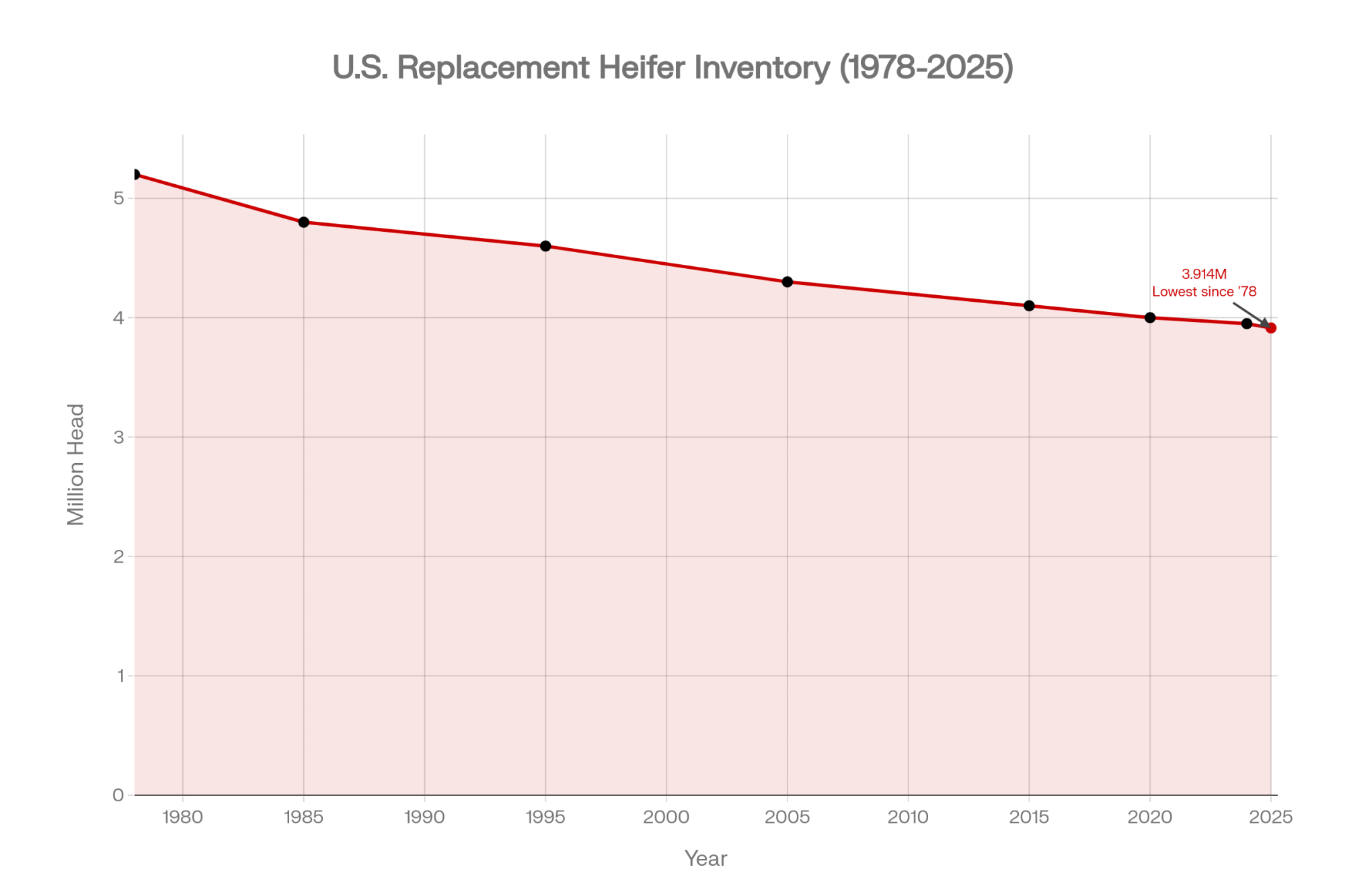
That cocktail made sense when replacement heifers were cheap and the pipeline was full. It doesn’t anymore. USDA NASS’s January 2025 Cattle report put U.S. dairy replacement heifers 500 pounds and over at 3.914 million head — down 0.9% from 2024 and the lowest level since 1978. CoBank’s August 2025 analysis projects inventories will shrink by an estimated 800,000 head over 2025–2026 before starting to rebound in 2027, with replacement prices likely to “climb well above $3,000 per head.”

McCarty’s “two for $5” bull calves are gone. The heifers replacing them are $3,010 animals riding on the thinnest replacement pipeline you’ve seen in your career. His generation gave away bull calves. Yours is leaking value in the heifer hutches — just more expensively. In that reality, you can’t afford to run a $30 calf program and call it good enough.

How $3,010 Heifers Die on $30 Calf Programs

Let’s put some barn math under the gut feeling.

Take a 500‑cow herd freshening about 220 heifer calves per year. NAHMS 2014, analyzed by Urie and colleagues, reported 5.0% pre‑weaning mortality in U.S. heifer calves nationally, with many real‑world herds today running closer to 3–5% when records are tight. Use 4% as a realistic working number for your operation. That’s about 9 dead heifer calves before weaning.

At $2,660 per head — the U.S. average replacement cow price in January 2025 — those 9 deaths represent about $24,000 in lost heifers. At $3,010–3,110 per head — mid‑ to late‑2025 averages in several U.S. markets — you’re burying roughly $27,000–28,000 in heifers alone. If your number drifts up toward 5–6%, that line item climbs past $33,000–40,000 quickly — and that’s the math behind this article’s headline.

And that’s just the heifer value. It doesn’t include:

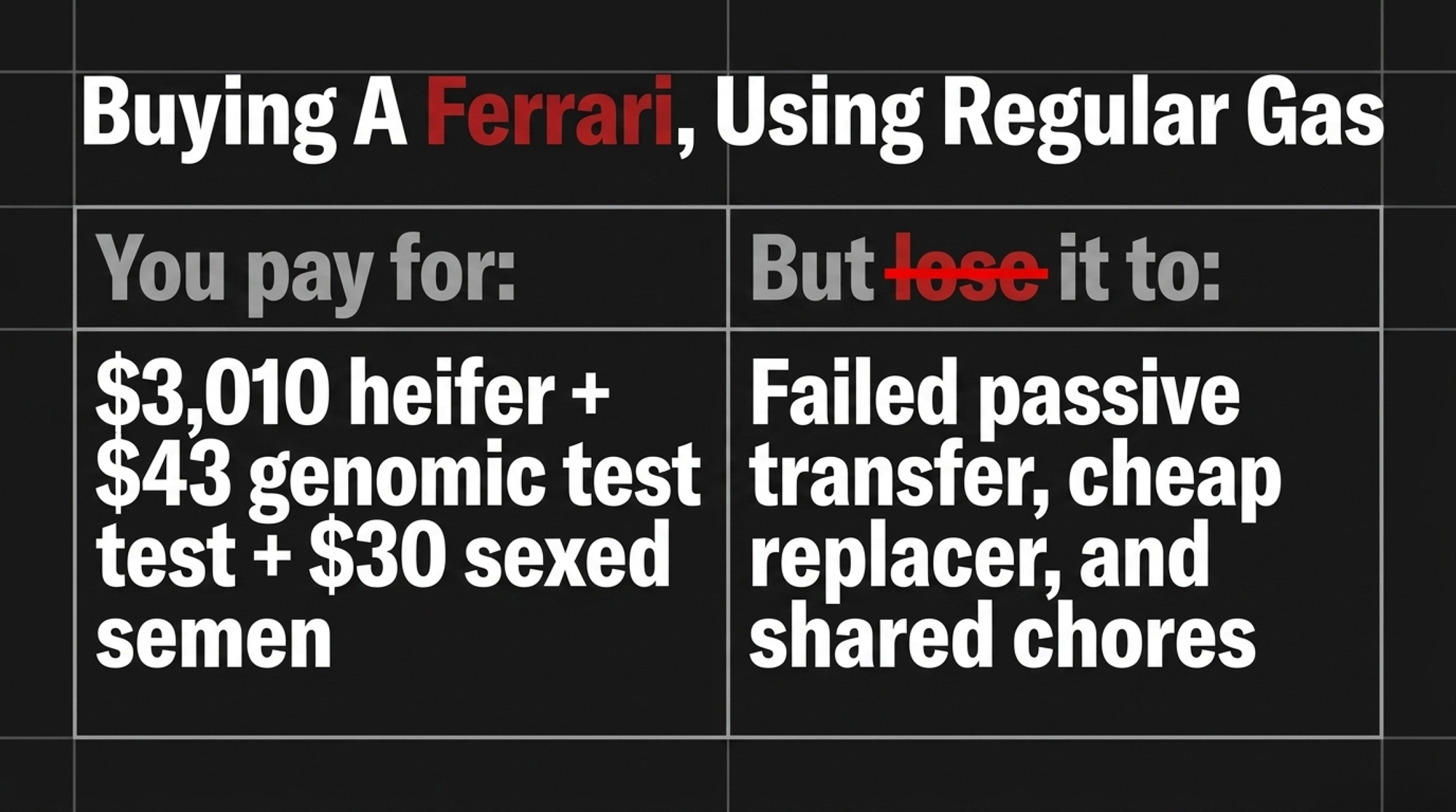
  • $40–50 per heifer in genomic testing, with CLARIFIDE®‑type programs commonly around $43/head.
  • $15–30 per straw premium for sexed semen over conventional, consistent with economic work and current semen price sheets.
  • IVF or ET on your top donors — often hundreds of dollars per live heifer calf after you spread donor, flush, lab, and recipient costs across pregnancies.

When a genomic‑tested, sexed semen heifer calf dies in the hutch at 19 days, you’re not just losing “a calf.” You’re losing a four‑figure replacement you can’t easily buy back — plus the semen and IVF bills stacked underneath her.

Investment ItemCost per CalfRunning Total
Sexed Semen Premium$15–$30$15–$30
Genomic Test$40–$50$55–$80
IVF/ET (per live calf)$200–$400$255–$480
Subtotal (Genetics)$255–$480
Extra Nutrition (Penn State)$42–$50$297–$530
TOTAL PER HEIFER CALF$297–$530

The slower leak is the one that doesn’t show up in the dead loss column, but still costs you. Calves that survive scours or pneumonia but limp along on growth often freshen late, give less milk in early lactations, and leave the herd sooner. On a 500‑cow dairy, a couple dozen of those “almost fine” cows can flatten herd progress for years without ever making the problem list.

Buying the Ferrari, Using Regular Gas: The $30 Management Leak

You’re already paying for the Ferrari with sexed semen, genomic tests, and IVF on your best cows. The question is whether you’re still putting regular gas in it.

Colostrum and passive transfer. U.S. calf‑health work shows that on many dairy operations, 20–40% of calves still fail to achieve adequate passive transfer [VERIFY: cite Lombard et al. 2020 review or NAHMS Dairy 2014 — confirm exact source/date]. A major review of passive transfer failures found that these calves are about twice as likely to get sick or die early as calves that reach target IgG levels. The reasons are painfully familiar: first feeds drifting past the 2‑hour mark, “we got about two quarts in” instead of a full volume, and colostrum “quality” judged by color and cow parity instead of a Brix reading. A Brix refractometer costs less than one‑tenth of a dead heifer at $3,010.

Related Reading: [INTERNAL LINK: Bullvine calf-mortality-economics piece — hidden gem candidate] → Suggested anchor text: “The Critical Economics of Calf Mortality: Why Every Life Counts More Than Ever.”

Pre‑weaning nutrition. Soberon and Van Amburgh’s work pulled data from a Cornell research herd and a commercial herd. For each 1 kg/day increase in pre‑weaning average daily gain, first‑lactation milk yield increased by about 850 kg in the research herd and 1,113 kg in the commercial herd. A 2016 Journal of Dairy Science review confirmed that keeping average daily gain above 0.5 kg/day with adequate nutrients is linked to higher milk, fat, and protein yields in first lactation. But if that extra nutrition is going into dirty bottles, under‑bedded hutches, or calves that never got decent passive transfer, you’re just buying more expensive scours.

Disease pressure. Urie et al. reported that digestive and respiratory disease together account for a majority of pre‑weaning heifer deaths on U.S. dairies. Other studies have linked early‑life disease to reduced growth, higher treatment costs, and greater odds of early culling. In the “two for $5” bull‑calf era, you could absorb a handful of fragile replacements. In a market where USDA has heifer inventories at their lowest since 1978, every sick, slow‑growing calf is a capital asset you may never fully earn back.

Every weak link in the first 60 days turns a high‑genetic heifer into either a dead loss or a lower‑yield, shorter‑lived cow. That’s always been bad management. At $3,000‑plus per heifer, it’s pipeline suicide. The herds that flip those numbers don’t do it with a new binder — they do it by giving one person clear ownership of the hutch row, which is exactly what the I‑29 case in Option 3 below shows.

How Much Is “Cheap” Calf Nutrition Actually Saving You on $3,010 Heifers?

Here’s where the “we can’t afford a better replacer” argument starts to fall apart.

Penn State’s 2023 bulletin “Economics and Effects of Accelerated Calf Growth Programs” compared a standard 20:20 milk replacer at $80 per 50‑lb bag to a higher‑quality replacer at $100 per bag in a 56‑day feeding program (2023 prices — adjust to your current bag cost). In a scenario where calves moved from gaining 1.1 lb/day to 1.5 lb/day, feed cost increased by about:

  • $41.92 per calf on the $80/bag program.
  • $50.26 per calf on the $100/bag program.

Spread over 56 days, that works out to roughly:

  • $0.75 per calf per day extra on the cheaper program.
  • $0.90 per calf per day extra on the higher‑quality program.

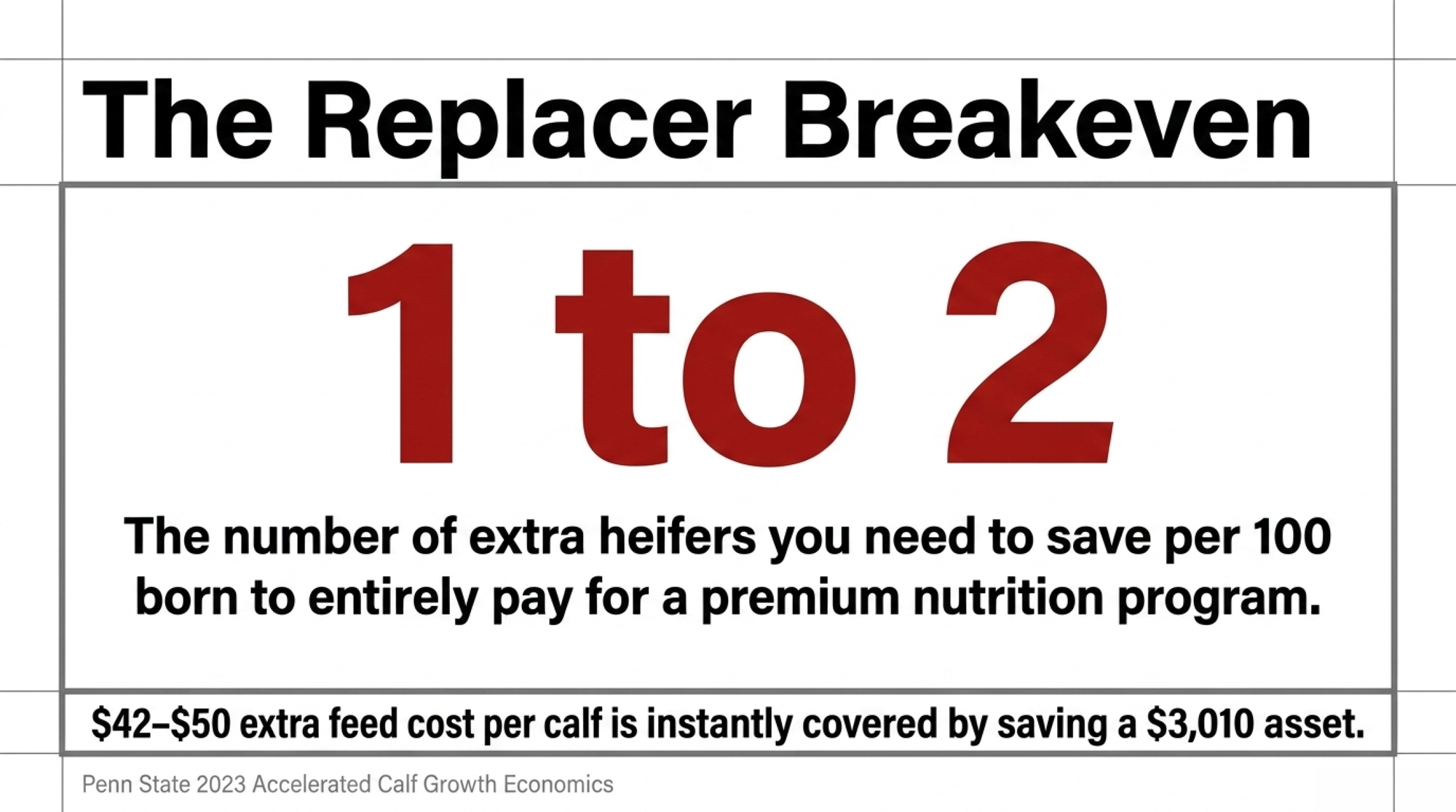
Round it, and you’re talking about $42–50 extra per calf to run a higher plane of nutrition. On 200 heifer calves a year, that’s an additional $8,400–10,000 in milk replacer cost.

Related Reading: 17–26x ROI: Why Top Dairies Stopped ‘Saving’ Calves and Started Preventing Loss.

Now put today’s heifer prices on the other side of the ledger. At $3,010 per head, if tightening up colostrum and stepping up nutrition together drop heifer calf mortality from 4% to 2% on those 200 heifers, that’s 4 extra heifers alive. Four at $3,010 is $12,040 — more than enough to cover the $8,400–10,000 in extra feed.

You don’t even need a full 2‑point drop to break even. If you spend $10,000 more on calf feed and each heifer is worth $3,010, you need to save about 3.3 heifers. On 200 heifers a year, that’s roughly 1.6 percentage points of mortality improvement. At the lower feed cost ($8,400), the breakeven is closer to 1.4 points. Either way, you’re still only aiming to save one to two extra heifers per 100 born.

Will every farm see that from a replacer change alone? No. Colostrum timing, housing, bedding, and people following the protocol all matter. But at current heifer values, the breakeven for a better calf program has moved much closer than it used to be.

What’s the Real Cost of Your Calf Program?

The easiest way to dodge this question is to say, “Our calf program is fine.” The harder way is to pull the numbers and see if it actually matches the genetics bill you’re paying.

Start with last year’s heifer calf crop. If you had 220 heifer calves born and lost 4% before weaning, that’s about 9 heifer calves dead. At your replacement value — anywhere from $2,660 in early 2025 to $3,110 by late 2025 — you’re looking at a $24,000–28,000 line item just for dead heifers. Then add in the extras: sexed semen premiums, genomic tests, and any IVF work you did on the cows those heifers came from. If that number doesn’t make you uncomfortable, check it again.

Now compare your calf program spend to that loss. Penn State’s math shows an extra $42–50 per calf in replacer cost on 200 heifer calves — call it $8,400–10,000 per year — can break even if you save just one or two extra heifers per hundred born at $3,010 each. Does your current calf program pass or fail that simple barn‑math test?

Who Really Owns the Hutch Row?

On paper, you might say, “Our calf team handles it.” In practice, that often means whoever finishes milking first or whoever drew the short straw that week.

Ask yourself one blunt question: if you walked into the office right now and asked, “Who owns calf outcomes here?” would you get one name in under five seconds — or a vague, “We all do”? Herds that win this game usually have a single person who owns colostrum, calves, and the key numbers: FPT %, heifer calf mortality, and weaning weights.

You don’t need a fancy HR plan to get there. You need to pick the person who notices calves first, give them clear authority over calf protocols, and put their numbers on the board every month next to pregnancy rate and SCC. When calf care is shared across whoever has time, even $3,010 heifers can quietly get less focused attention than they really need.

MetricWhat It MeasuresTargetAction Threshold
FPT %Calves failing passive transfer (serum total protein <5.2 g/dL)<10%>15%
Pre-Weaning Heifer Mortality %Heifer calves dead before weaning<3%>4%
Average Daily Gain (Pre-Weaning)Pounds gained per day, birth to weaning>1.5 lb/day<1.1 lb/day
Weaning WeightAverage weight at 8 weeks>200 lb<180 lb
Days to First CalvingAge at first calving<24 months>26 months

Options and Trade‑Offs for Farmers

You don’t have to fix everything this month. But you do need to stop running a $30 calf program under a $3,010 heifer reality. Here are four paths, how they work, and where they can bite you.

1. Lock Down Colostrum — Your 30‑Day Action

If your heifer replacements are worth more than about $2,500 and your heifer calf mortality is over roughly 3–4%, that’s a strong signal that this is where you start.

In the next 30 days, pull the last 12 months of heifer‑calf data and calculate your actual pre‑weaning heifer mortality. Not a gut feel — the real number from your records. Brix‑test colostrum from every fresh cow for at least one full week and draw a hard line: nothing under 22% Brix goes into heifer calves. Then draw blood from every calf born during that week at 24–48 hours and run serum total protein. If more than 10–15% of those calves fall below the accepted passive‑transfer threshold, your most expensive pipeline leaks.

When this path makes sense: any time replacements are valuable, and you haven’t done a proper FPT audit in the last 12 months. What it requires: a Brix refractometer, some blood tubes, a small lab bill, and a willingness to change how quickly and how much colostrum gets fed. Where it fails: you collect the numbers and then write them off as “just a bad week” instead of changing milking‑fresh, storage, and first‑feeding routines.

2. Upgrade Calf Nutrition With Numbers, Not Hope

This path is for herds already investing in genomics and sexed semen but still seeing 4–5% heifer calf mortality and a thick treatment notebook.

You’re basically asking one question: does the extra $42–50 per calf Penn State lays out for a higher‑plane program pay off at $3,010 per heifer in your barn? Use their math as the backbone and plug in your own replacer price, mixing rate, and days on feed. Then compare that extra spend to what saving one or two extra heifers per hundred born is worth in your herd.

You’ll also need to tighten mixing accuracy, feeding schedule, and hygiene. A better bag doesn’t fix dirty bottles or inconsistent solids.

When this path makes sense: you’ve already got decent colostrum numbers but still see too many sick, slow‑growing calves. What it requires: shifting away from “whatever 20:20 is cheapest” toward a consistent, all‑milk‑protein replacer and enforcing protocol discipline. Where it fails: you upgrade the replacer but leave colostrum, housing, and staff training the same. That’s just a more expensive way to keep the same problems.

3. Put Real Ownership on the Calf Barn

On some dairies, the calf barn turns not because a consultant writes a binder, but because one person quietly decides, “These calves are mine.”

Maybe it’s the herdsman’s daughter who has a knack for spotting dull eyes and droopy ears. Maybe it’s the feeder who hates seeing the same calf on the treatment list twice. On one 600‑cow I‑29 herd a consultant works with, the turning point was simple: the owner told their sharpest young employee, “You own hutches and colostrum. I’ll measure you on FPT %, death loss, and weaning weights — and I’ll back you when you need changes.” Within a year, that farm’s heifer calf mortality had dropped, and the owner quit saying, “Our calves are just weaker.”

When this path makes sense: nobody in your place can answer “Who owns calf outcomes here?” without looking around. What it requires: giving one person clear authority over calf protocols and tying their success to three KPIs: FPT %, heifer calf mortality, and weaning weights. Then sitting down monthly to review those numbers alongside repro and SCC. Where it fails: you give someone the title but not the time, training, or authority. If calf chores are still what happens when people finish everything else, the numbers won’t move.

4. Benchmark Calves the Way You Benchmark Cows

With CoBank’s shortage timeline and beef‑on‑dairy locked in for 2026, flying blind on calf performance is the wrong gamble.

Sponsored Post

Related Reading: Updated NAAB Data Cuts CoBank’s Heifer Shortage Projection — The Barn Math Says It Doesn’t Matter Yet.

When this path makes sense: you genuinely don’t know how your calf metrics stack up against herds that look like yours. What it requires: pull a year of heifer‑calf data and break mortality into 0–3 days, 4–21 days, and 22 days to weaning. Add FPT % and weaning weights. Then work with your vet, nutritionist, or a university project to benchmark against peer herds. Where it fails: you see that your numbers sit in the bottom third and decide “our calves are just weaker” instead of changing something.

Key Takeaways

  • If your heifer replacement value is above roughly $2,500 and your heifer calf mortality is over 3–4%, stop treating that as background noise. Treat it like an economic leak. Multiply last year’s dead‑heifer count by $2,660–3,110 and ask whether you’d accept that line item if it showed up as a bill from your vet or semen rep.
  • If you’re running a high beef‑on‑dairy percentage without a locked‑in heifer plan, you’re stacking two bets: that beef calf premiums stay strong and that replacements will be there when you need them. CoBank’s 800,000‑head shortfall and USDA’s lowest‑since‑1978 inventory should make you nervous about the second part.
  • If you’re willing to spend about $43 per heifer on genomics and pay a $15–30 sexed‑semen premium,balking at an extra $42–50 per calf on a better colostrum and nutrition program doesn’t pencil. The breakeven is saving roughly one to two heifers per 100 born at $3,010 each.
  • If nobody on your farm “owns” calf outcomes with data, your calf program is still operating more like a chore than a managed system. Name a calf manager and give them three numbers to live by: FPT %, heifer calf mortality, and weaning weights.
  • If you haven’t Brix‑tested colostrum and run serum total protein on a batch of calves in the last 12 months, your colostrum program is still a story, not a fact. Make that your 30‑day project.

Your Calf Barn Checklist — Print This and Take It Outside

  • ☐ The Brix Test: Is every gallon of colostrum for heifer calves testing at or above 22% Brix before it goes into a bottle?
  • ☐ The 2‑Hour Rule: Are calves reliably getting their first colostrum within 2 hours of birth, or are there still “shift change” calves waiting longer?
  • ☐ The FPT Audit: Have you checked serum total protein on the last 10 heifer calves born? What percentage cleared the passive‑transfer threshold?
  • ☐ The Mortality Number: Can you write down your actual 12‑month pre‑weaning heifer calf mortality rate — not a guess, but the number from your records?
  • ☐ The Cost‑Per‑Death: Take that mortality rate, multiply by your annual heifer calf crop, then by $3,010. That’s what lost heifers cost you last year — before you add in genomics, sexed semen, or IVF.
  • ☐ The Replacer Math: How much does your current milk replacer cost per calf through weaning? What would an upgrade cost? How many extra heifers per 100 born would need to live for that to pay off at $3,010 per head?
  • ☐ The Pipeline Check: How many bred heifers and springers do you have on hand right now, divided by how many replacements you actually need each year? If that ratio is under 1.0, you’re already short. Under 0.8, you’re in trouble if CoBank’s 2027 recovery timeline holds.
  • ☐ The Owner Question: Is there one name — not “the team” — on this farm who owns those calf numbers?

Heifers aren’t about to get cheaper. USDA NASS’s January 2025 report and follow‑up analysis put replacement heifers at 3.914 million head, the lowest since 1978, and CoBank’s best‑case scenario has inventories just starting to recover in 2027. The genetics you’re putting into cows today are some of the most expensive you’ve ever bought. The calf barn is where you decide whether that money turns into cows or compost.

So here’s the real question: do your calf numbers match the genetics bill you’re paying — or are you still running a $30 program under a $3,010 heifer reality?

Run Your Numbers

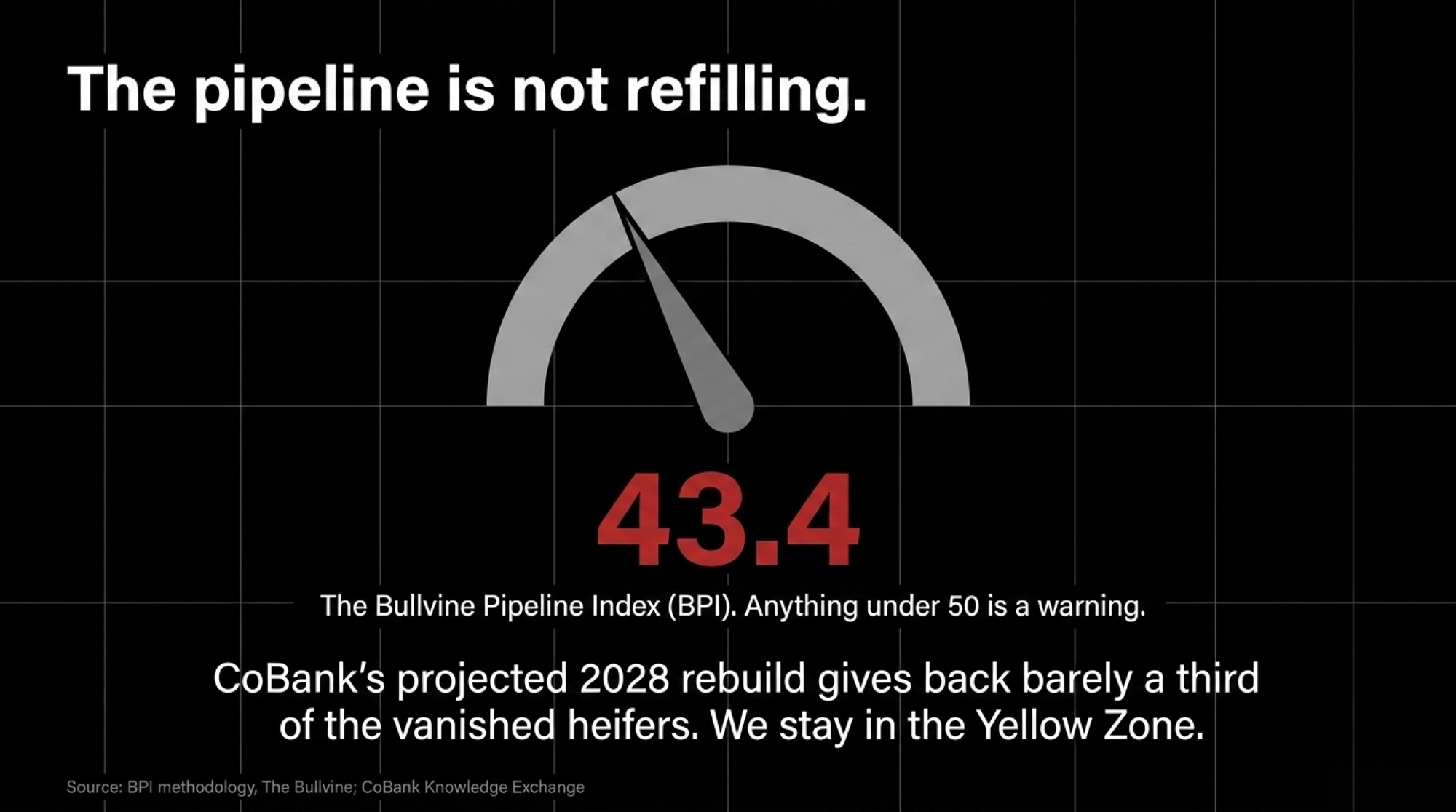
Bullvine Pipeline Index Calculator — This free tool turns your heifer pipeline into a single 0–100 score and shows whether your current calf losses, beef-on-dairy use, and cull rate can actually support tomorrow’s herd. Use it to see if your $30 calf program matches your $3,010 heifer reality.

Learn More

The Sunday Read Dairy Professionals Don’t Skip.

Every week, thousands of producers, breeders, and industry insiders open Bullvine Weekly for genetics insights, market shifts, and profit strategies they won’t find anywhere else. One email. Five minutes. Smarter decisions all week.
NewsSubscribe
First
Last
Consent

UW–Madison’s $51/Cow Beef‑on‑Dairy Trap: The Calf Cheque That Hides an $86K–$119K Heifer Bill

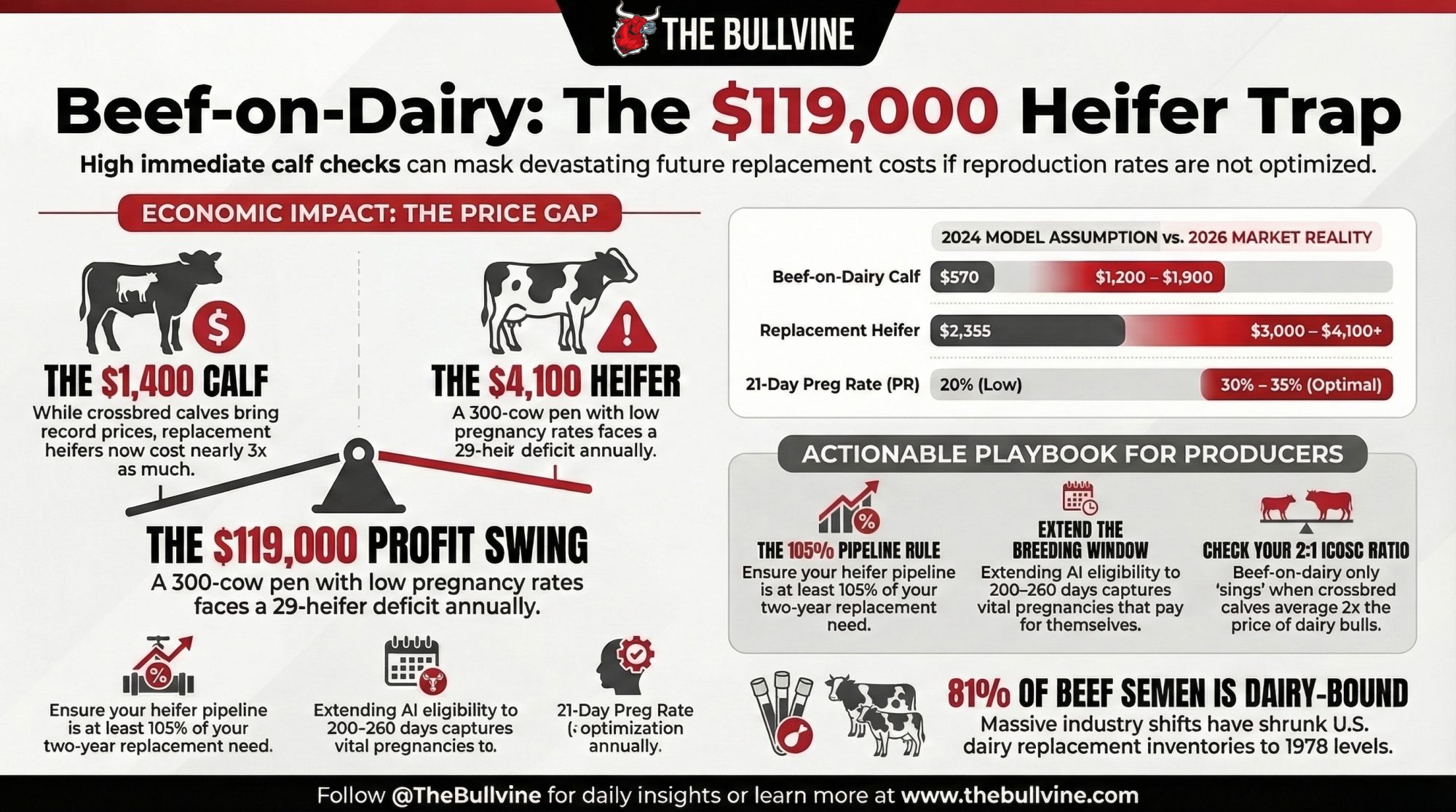
Beef‑on‑dairy made your calf cheque bigger. Did it also steal 29 heifers and $86K–$119K from your next two years?

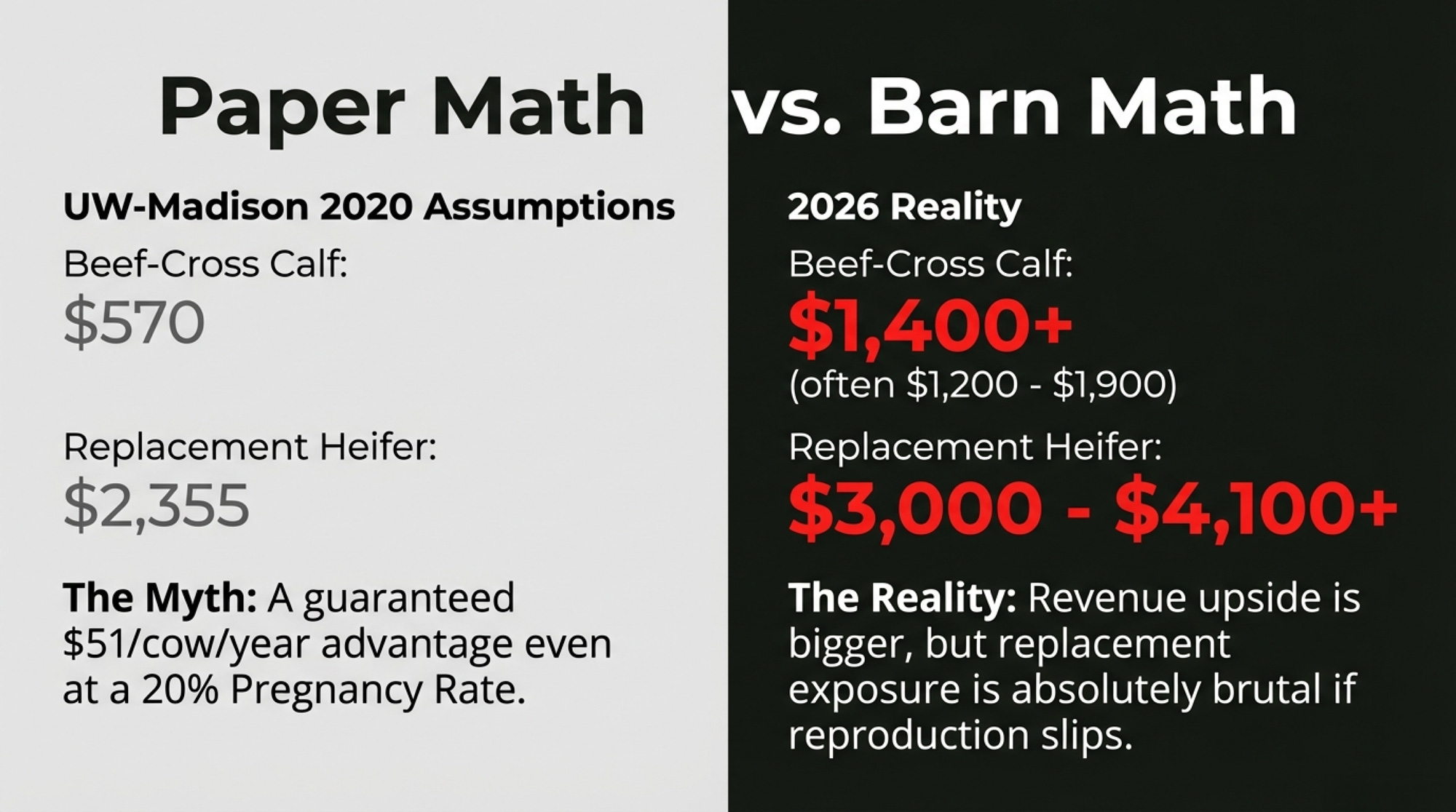
Executive Summary: UW–Madison’s beef‑on‑dairy simulation says a sexed‑plus‑beef program earns about $51/cow/year at 20% preg rate — but that’s built on $570 calves and $2,355 heifers, not today’s prices. In 2026, beef‑on‑dairy calves are bringing roughly $1,200–$1,900, while replacement heifers often cost $3,000–$4,100+, which means the model’s revenue upside is bigger — and the replacement bill is brutal if repro slips. Run the same tiered breeding strategy on a 300‑cow group, and you get two very different outcomes: a high‑PR herd with a 17‑heifer surplus, and a low‑PR herd that’s 12 heifers short — a 29‑head swing worth $86,000–$119,000 a year at current heifer prices. The core takeaway is simple: beef‑on‑dairy is a reproduction strategy first and a calf‑marketing strategy second, and the economics only really work when your 21‑day PR is closer to 30–35% with solid heifer survival. UW–Madison’s most uncomfortable insight is that the optimal insemination window under these calf prices stretches out to around 260 days in milk, so cutting cows at 150–180 days quietly throws away pregnancies and future replacements. The article finishes with a 30/90‑day playbook: pull your PR and 24‑month replacement inventory, check whether your beef‑on‑dairy calves actually average close to 2× your dairy bull calves, and decide how far you can lean into beef‑on‑dairy before you’re forced to buy back heifers at the top of the market.

beef-on-dairy replacement risk

A replacement heifer that cost $2,355 in UW–Madison’s 2024 assumptions is now a $3,000–$4,100 line item in real markets. The same model valued beef‑on‑dairy calves at $570 — calves that now commonly bring $1,200–$1,900 at major auctions. On paper, the strategy adds $51/cow/year at low pregnancy rates. In the barn, the wrong breeding plan can torch $86,000–$119,000 per 300‑cow pen in replacement costs.

Price ComponentUW–Madison Model (2024)Real Market (Early 2026)VarianceImpact
Beef × Dairy Calf$570$1,200–$1,900+111% to +233%Higher revenue (but see replacement crisis)
Dairy Bull Calf$385$900–$1,200+134% to +212%Narrows beef-on-dairy advantage vs. conventional
Replacement Heifer$2,355$3,000–$4,100+27% to +74%Replacement bill brutal if PR slips
Net Advantage (20% PR)$51/cow/year$264+/cow/year+418%Looks great—until you’re 12 heifers short
300-Cow Replacement Gap29-head swing assumed manageable29 heifers × new prices = $86K–$119K/yearThe bill the calf cheque doesn’t cover

The Industry Sprint Toward the Calf Cheque

Corey Geiger, lead dairy economist at CoBank, summed up the last five years of beef‑on‑dairy in one line: “What happened was we pivoted too hard, too quick.” The industry didn’t just pivot. It sprinted toward the calf cheque and tripped over the empty heifer pens.

Eighty‑one percent of all beef semen sold domestically now goes into dairy herds — 7.9 million units out of 9.7 million, according to NAAB’s 2024 year‑end report. Conventional dairy semen sales shrank 46.5% in that same window. USDA’s January 2026 Cattle report shows U.S. dairy replacement heifers at 3.905 million head, the lowest since 1978. CoBank projects inventories will shrink by 357,490 head in 2025 and another 438,844 head in 2026 before rebounding by 285,387 head in 2027.

Those numbers mean the calves you’re selling today, and the heifers you’re not making will collide in your barn, not just in a spreadsheet.

The $4,100 Heifer vs. the $1,400 Calf

UW–Madison’s economic simulation — published in Journal of Dairy Science in late 2025/early 2026 — modeled a 1,000‑cow dairy using a tiered breeding program: top cows to sexed semen, middle to conventional, bottom to beef. Their default economics looked like this:

  • Beef × dairy crossbred calf: $570 per head.
  • Dairy bull calf: $385.
  • Dairy heifer calf: $167.50.
  • Replacement heifer rearing cost: $2,355.

Using those inputs, a herd at 20% 21‑day pregnancy rate (PR) with a 170‑day insemination eligibility period (IEP)earned about $51 more per cow per year from a sexed‑plus‑beef strategy than from an all‑conventional program. That’s the famous $51.

Now line that up with what you’re seeing in early 2026:

  • Premier Livestock’s February 12, 2026, report lists beef‑dairy cross calves at $1,200–$1,910 per head. 
  • Abbotsford Stockyards’ January 14, 2026, report shows baby calves averaging $1,680 with a $500–$2,500 range and Holstein bull calves at $390–$680
  • USDA’s January 2026 National Dairy Comprehensive Report has No. 1 bull calves (0–14 days) averaging $1,187.42/cwt and No. 2 at $1,094.10/cwt nationally. 
  • CoBank’s heifer analysis and multiple auction summaries put replacement heifers consistently at $3,000–$4,000+, with some lots exceeding $4,100

So the calf UW assumed was worth $570 is now worth closer to $1,400. The heifer priced at $2,355 is now more like $3,000–$4,100. The per‑cow advantage is better than $51 at current prices. The replacement exposure is a lot worse.

UW–Madison’s Simulation vs. Your Barn Math

Dr. Victor Cabrera’s 2021 work clarified why beef‑on‑dairy looked like free money. He defined ICOSC — income from calves over semen costs — and showed that beef‑on‑dairy pencils when the beef‑cross calf brings roughly the dairy calf price in herds with at least a 20% 21‑day PR. That 2:1 ratio became gospel.

In 2026, the ratio’s not that clean:

  • Beef‑on‑dairy calves often bring $1,200–$1,900.
  • When you translate current cwt and regional reports, Holstein bull calves commonly sit at roughly $900–$1,200equivalent. 

Some weeks you’re well past 2:1. Others you’re barely at 1.3–1.5:1. ICOSC advantage has turned into a local, week‑by‑week math problem — not a guaranteed win.

M.R. Lauber, Cabrera, and Paul Fricke went further in their JDS paper, building a discrete Markov‑chain simulation that looked at herd size, semen types, IEP, PR bands from 20–40%, and heifer survival from 75–90%. When they raised the beef‑cross calf value in the model from $570 to $1,125, the net return advantage at 20% PR climbed from $51/cow/year to $264/cow/year. That fits current markets.

But there’s a catch you can’t solve by selling into a hot calf market: the number of dairy heifers the program actually produces.

The Math That Breaks: 300 Cows, Two PRs, One Ugly Gap

Run their logic on a 300‑cow group — something that actually looks like a pen on your place.

Baseline assumptions:

  • Herd size (group): 300 cows.
  • Annual replacement rate: 35% → 105 heifers/year needed from this group.
  • Breeding tiers: top 40% to sexed dairy (120 cows), middle 25% to conventional dairy (75 cows), bottom 35%to beef (105 cows). 

Now split that group into two herds: one with strong reproduction, one that’s slipped.

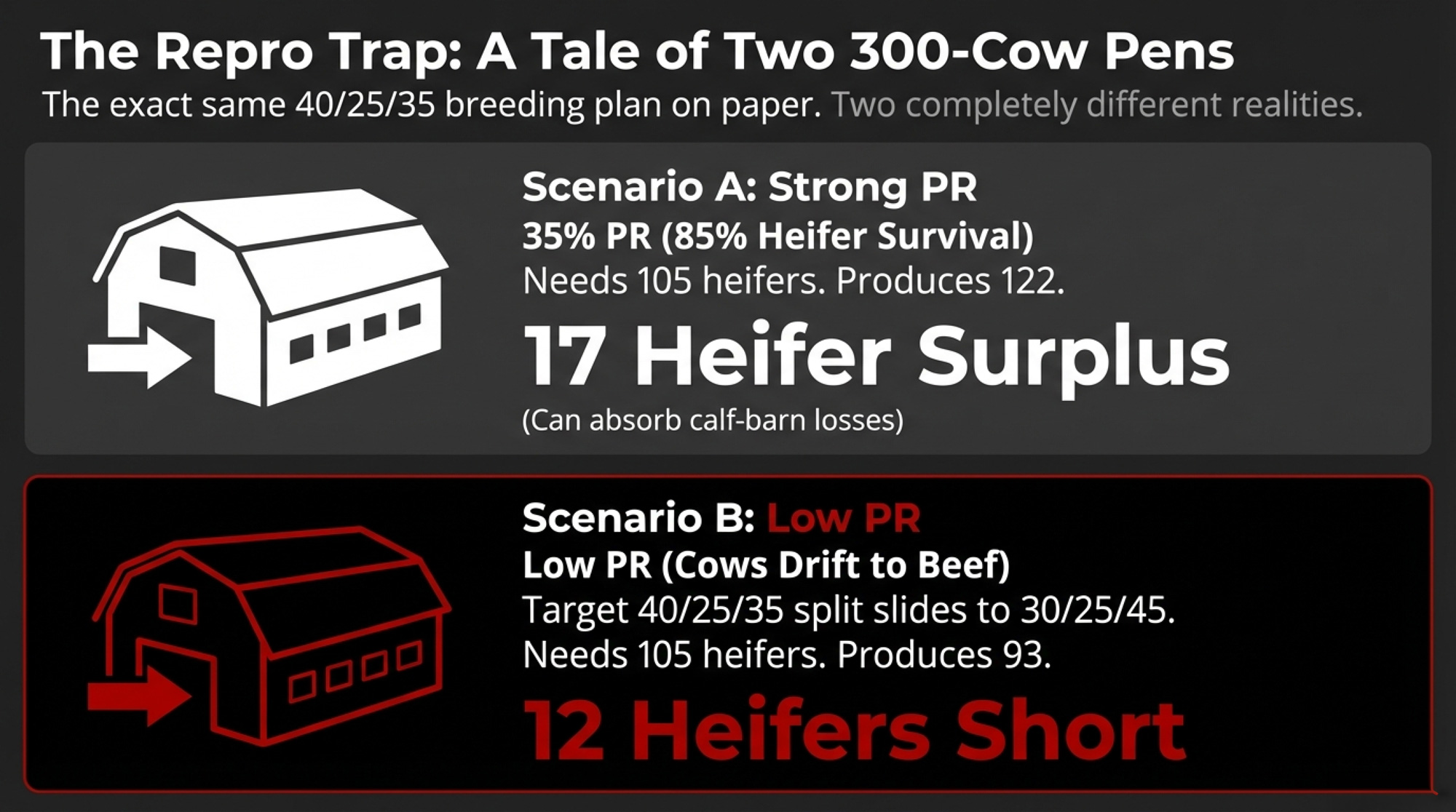
Scenario A — Strong‑PR Herd (35% PR, 85% Heifer Survival)

  • Sexed matings: 120 cows × 91.2% female = ~109 heifer calves (Lauber et al. 2020 sexed‑semen estimate). 
  • Conventional matings: 75 cows × 46.7% female = ~35 heifer calves (Silva del Río et al. 2007 conventional estimate). 
  • Beef matings: 105 calves = 0 replacements.

Total dairy heifers born: ~144.
After 85% survival: ~122 replacements available.

You need 105. You’ve got a 17‑heifer cushion. That pen can absorb some calf‑barn losses and still hold herd size.

Scenario B — Low‑PR Herd (More Cows Drift to Beef)

Drop the 21‑day PR and something ugly happens. Fewer cows conceive in that early sexed‑semen window. They cycle back, enter later services, and more of them get bred to beef.

Your neat 40/25/35 split slides toward 30/25/45.

  • Sexed matings: 90 cows × 91.2% female = ~82 heifer calves
  • Conventional matings: 75 cows × 46.7% female = ~35 heifer calves
  • Beef matings: 135 calves = 0 replacements.

Total dairy heifers born: ~117.
After 80% survival: ~93 replacements available.

You still need 105. Now you’re 12 heifers short. Every year. Same herd size. Same breeding plan on paper. The only difference is reproduction and survival.

The Dollar Hit

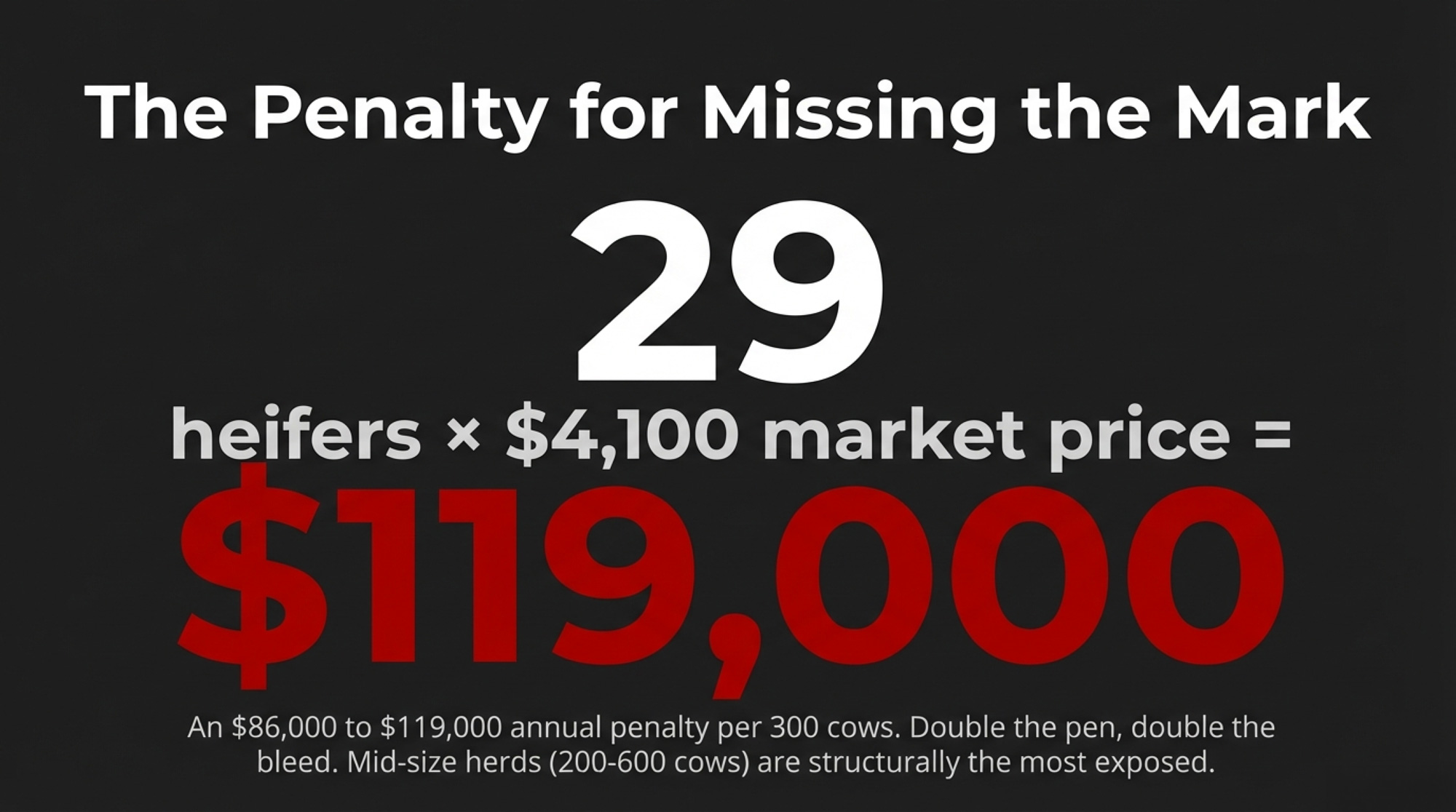
UW–Madison priced replacements at $2,355 based on 2020 rearing costs. CoBank and current sale data now peg them at around $3,000–$4,100. That 29‑heifer swing between Scenario A and Scenario B works out to:

  • 29 heifers × $3,000 = $87,000.
  • 29 heifers × $4,100 = $118,900.

Call it $86,000–$119,000 per year on a 300‑cow group. Double the group, double the bill.

That’s without counting lost milk from cows you culled sooner because you wouldn’t carry them open to 260 days, or the premium you’ll pay if you’re forced into the replacement market when everybody else is short, too.

Mid‑size herds — 200–600 cows running 33–36% replacement rates — are structurally more exposed than 3,000‑cow herds sitting closer to 28–31%. Same program, much less room to miss.

The Hidden Lever: 260‑Day IEP (The One Thing Most Herds Are Getting Wrong)

One of the quiet bombshells in Lauber, Cabrera, and Fricke’s modeling is their answer to a simple question: how long should a cow stay eligible for AI in a beef‑on‑dairy system? Not just “what’s your PR?” or “what semen are you using?” but “when do you stop trying?”

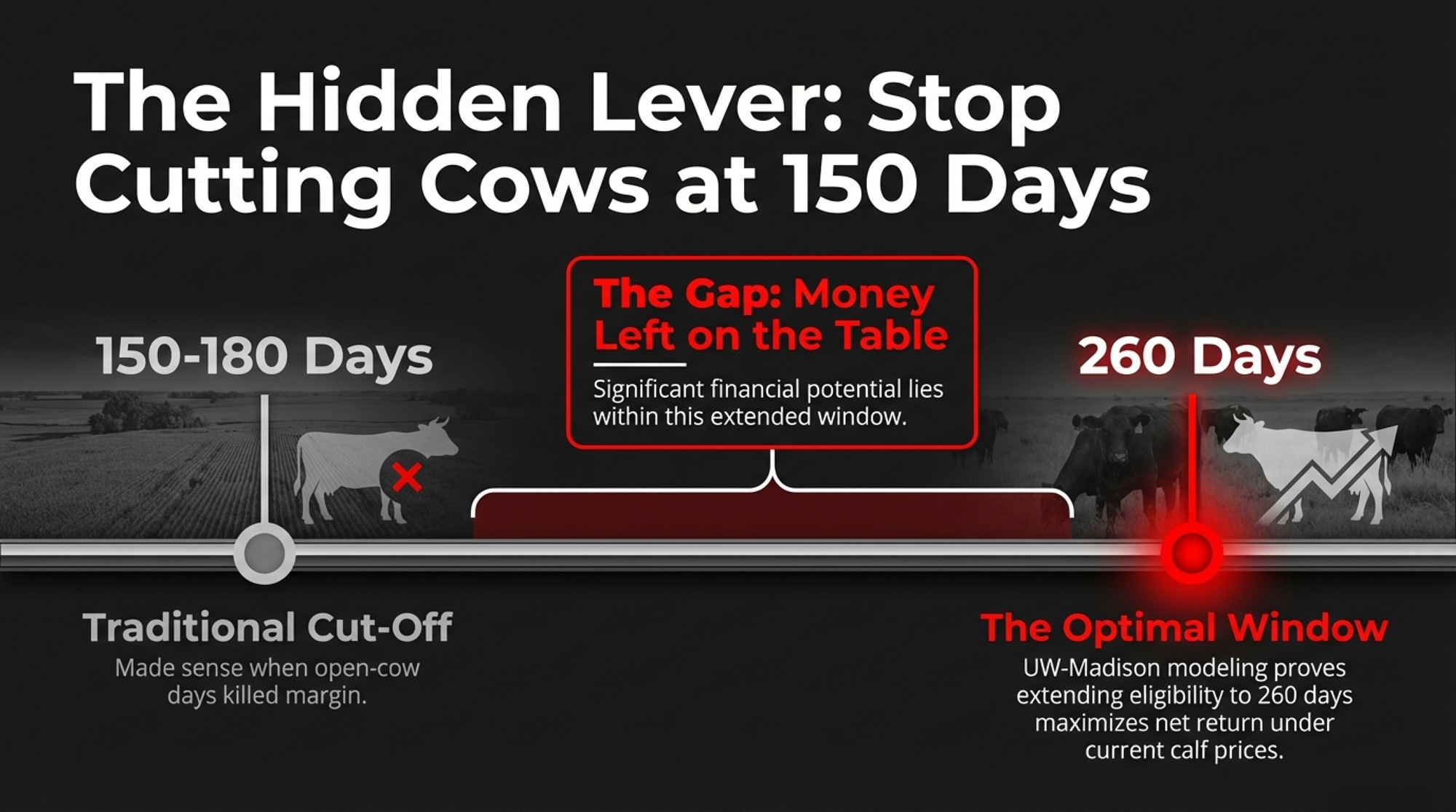
In their model, the optimal insemination eligibility period for sexed+beef herds typically sat around 200 days, and they tested windows all the way out to 260 days. The bigger message is that most herds are stopping far too early in a beef‑on‑dairy world.

Most of you are still removing cows from the breeding pool at 150–180 days in milk. That made sense when every extra breeding had limited upside and open‑cow days killed margin over feed. With beef‑on‑dairy in the mix, the upside of one more pregnancy looks very different.

Pro‑Tip: The 260‑Day Window

  • UW–Madison tested IEPs from 50 to 260 days and found that, at today‑equivalent calf values, extending eligibility beyond 170 days — often toward roughly 200 days for sexed+beef programs — moved net return up as long as replacement needs were covered.
  • Stopping at 170 days under a beef‑on‑dairy program leaves pregnancies — and replacement heifers — on the table.
  • The trade‑off is real: more open days means higher feed and housing costs per pregnancy. But at current beef‑cross prices, the model says those extra calves more than pay for the added days.

So if you’re obsessing over which beef bull to order while quietly chopping your IEP short, you’re probably solving the wrong problem.

Replacement Risk: The PR Table That Should Make You Pause

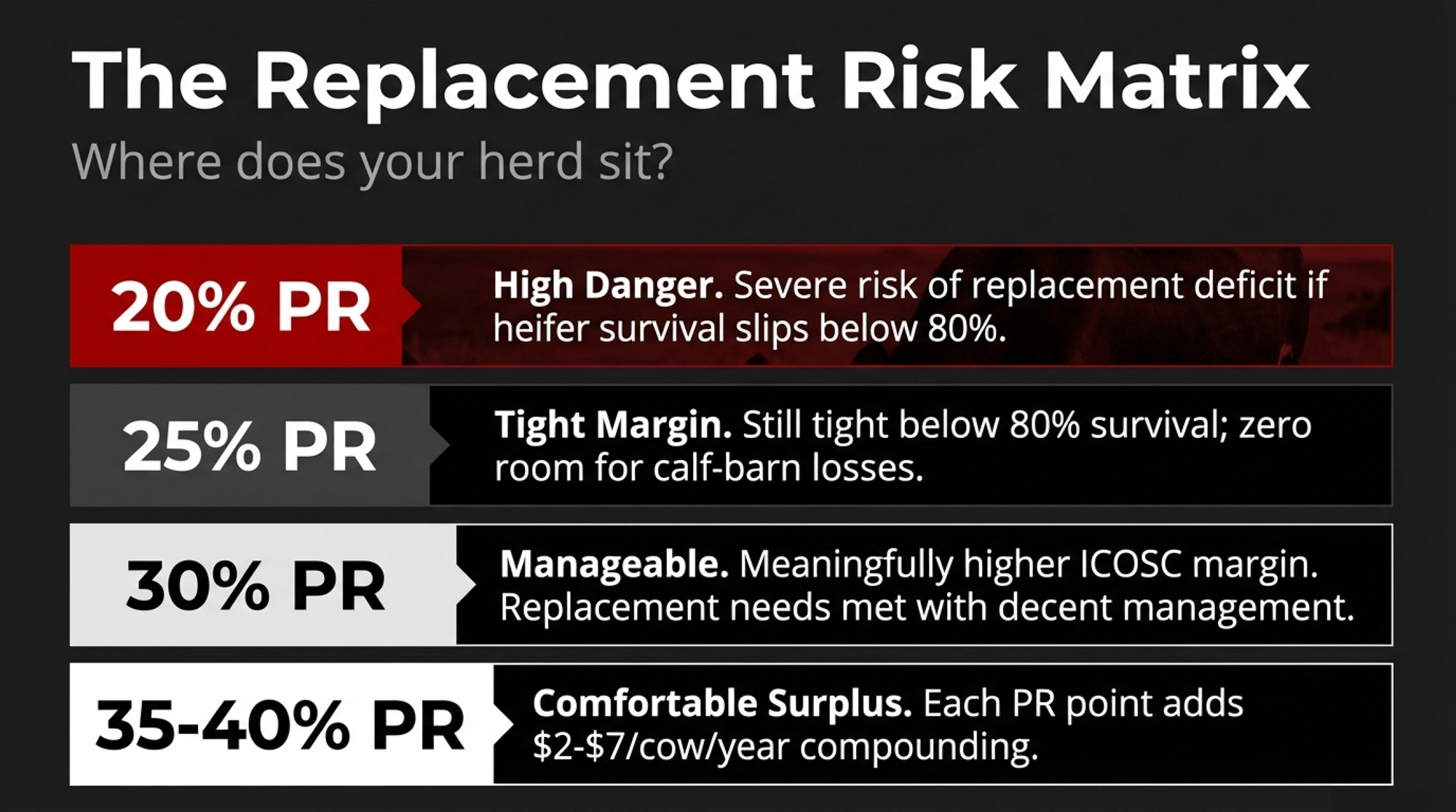
Strip away the modeling details, and what’s left is a simple grid: your 21‑day PR and how much replacement risk you’re buying.

Your 21‑Day PRNet Return Advantage (Sexed+Beef vs. Conventional)Replacement Risk
20% (low)$51/cow/yr at $570 calves; significantly higher at today’s $1,200–$1,900High risk of replacement deficit if heifer survival slips below 80%.
25% (below avg)~$51 + $10–$35/cow from better PR and tiered breedingsStill tight below 80% survival; little room for calf‑barn losses.
30% (average)Meaningfully higher ICOSC margin and calf revenueReplacement needs manageable with decent calf and heifer management.
35–40% (high)Substantially higher; each PR point adds $2–$7/cow/yr, compounding at herd levelComfortable surplus in most modeled scenarios, even with lower survival.

The punchline: beef‑on‑dairy is first a reproduction strategy and only then a calf‑marketing strategy. If you’re playing it at 20–24% PR, you’re taking a high‑wire act that the UW model already flagged as thin at old-heifer prices.

Has Beef‑on‑Dairy Already Peaked?

CattleFax projected beef‑on‑dairy calf production reaching 4–5 million head annually by 2026, putting it firmly into the core of the U.S. beef supply. Purina’s 2025 beef‑on‑dairy report suggests those volumes have “likely reached their peak,” with a gradual 300,000–400,000 head decline expected in the next few years.

Semen sales tell a similar story. CoBank’s August 2025 work shows beef semen sales essentially flat from 2023 to 2024, while gender‑sorted dairy semen sales jumped 17.9% — 1.5 million extra units in a single year. “Those calves hitting the ground will become milk cows in 2027,” Abbi Prins said. The replacement pipeline is refilling. Slowly.

USDA’s January 2026 National Dairy Comprehensive Report shows No. 1 bull calves at $1,187.42/cwt and No. 2 at $1,094.10/cwt. That $93/cwt spread tells you quality already matters in the calf barn — and some of the calves you’d love to ship are the ones you may need to keep.

What This Means for Your Operation

This is where the story stops being about “the industry” and starts being about your next breeding cycle.

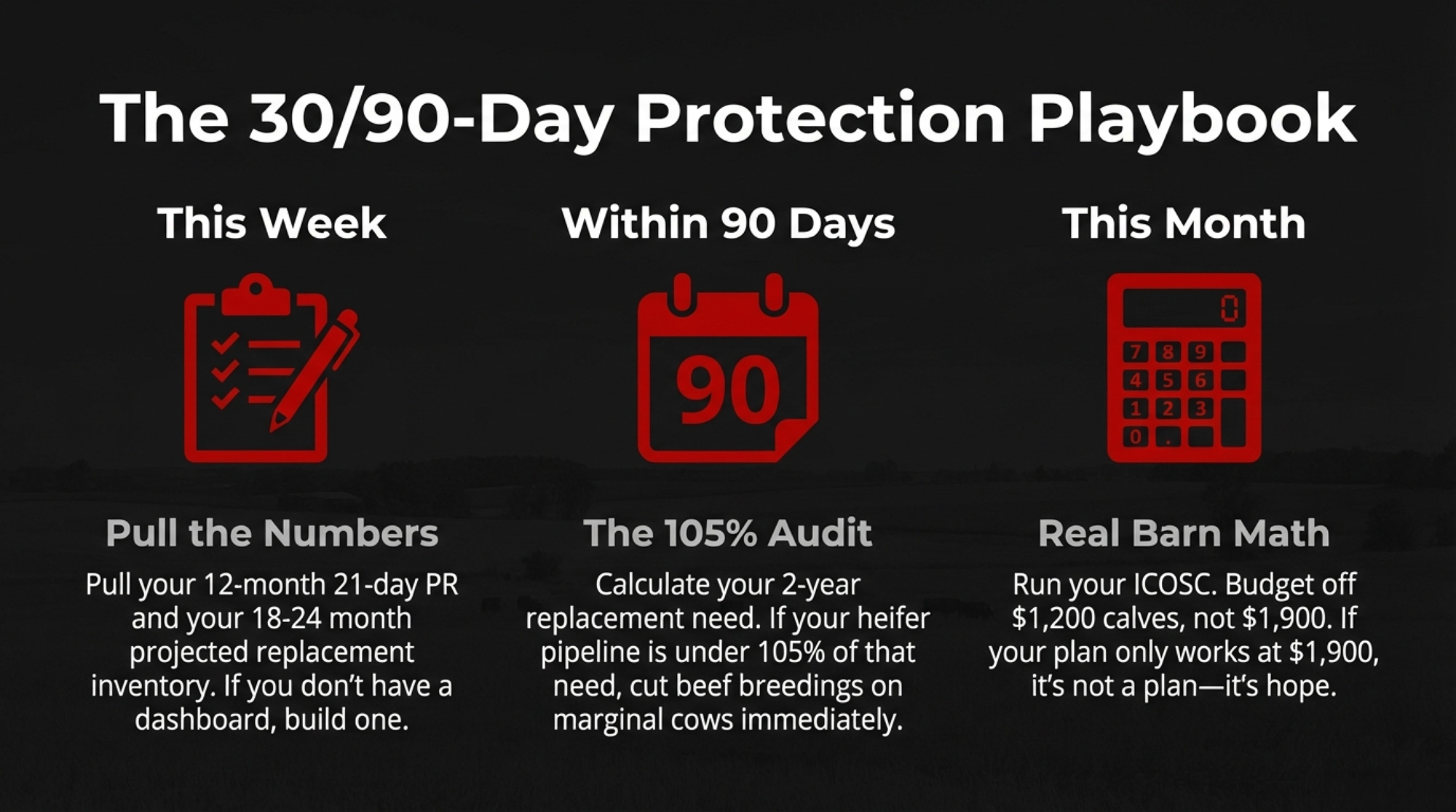
This week: Put PR and replacements on the same page.

Pull two reports:

  • Your rolling 12‑month 21‑day pregnancy rate.
  • Your projected replacement heifer inventory 18–24 months out (bred heifers + open heifers + heifer calves × your real survival rate).

If you can’t get both out of your herd software or records, that’s the first problem to fix. You’re running a replacement‑sensitive strategy without a dashboard. For a deeper management lens, come back to Bullvine’s beef‑on‑dairy management playbook.

Within 90 days: Run a 24‑month replacement audit.

  • Calculate your two‑year replacement need: herd size × (cull rate + death loss) × 2.
  • Stack that against your heifer pipeline: breds + opens + calves × survival.

If the pipeline is under 105% of your two‑year replacement need, that’s a yellow light. Under 100%, it’s red. Your next breeding round should cut beef breedings on marginal cows and push more sexed/conventional semen until the pipeline is back above that 105% buffer.

By your next annual breeding review: Put beef‑on‑dairy on a cash basis.

  • Add up 12 months of beef‑on‑dairy calf revenue.
  • Add up 12 months of replacement heifer costs (purchased and fully costed home‑raised, to first calving).
  • Subtract the heifer cost from the calf revenue.

That net number — not your best calf‑sale week — is what beef‑on‑dairy is actually earning your operation.

This month: Run your own ICOSC check.

  • Take actual dairy bull calf and beef‑on‑dairy calf prices from the last 12 months.
  • If your beef‑cross calves aren’t averaging close to  your dairy bull calves, the ICOSC advantage Cabrera modeled at 20% PR gets thinner for your herd. 

That doesn’t mean abandon beef‑on‑dairy. It just means the economics only really sing when reproduction has your back.

At your next repro strategy meeting: Talk about 260 days, not just “too many open cows.”

Ask your vet and nutritionist:

  • Which cows can realistically stay in the breeding pool to 260 DIM and still make sense in terms of production and health?
  • Which cows still need to leave earlier because of feet, legs, mastitis, or poor milk?

Model what happens if you extend the IEP from 170 to 220 to 260 days — how many pregnancies do you pick up, and what does that add in calf revenue vs. extra feed cost? UW’s model says the extra pregnancies pay at current prices; your numbers should verify that.

Budget off $1,200 calves, not $1,900.

If your plan only holds together when beef‑on‑dairy calves bring $1,800–$1,900, it’s not a plan — it’s hope. Build the math on $1,200 and let the good weeks be real upside.

Key Takeaways

  • If your 21‑day PR sits near 20%, beef‑on‑dairy is a high‑risk play. The UW model’s $51/cow/year advantage at 20% PR is based on $570 calves and $2,355 heifers. At today’s prices, the revenue is better — but the same model shows you can easily fall short on replacements if heifer survival sags or too many cows drift into beef breedings. 
  • If you’re above 30% PR, the question isn’t “should we?” It’s “how hard do we lean?” Each PR point adds $2–$ 7 per cow per year to the breeding‑strategy advantage. On a 500‑cow herd, a 10‑point PR jump is $10,000–$35,000/year from semen strategy alone. 
  • If you haven’t done a forward replacement count, you’re not managing beef‑on‑dairy — you’re hoping the bill isn’t too big. The same breeding plan can leave one 300‑cow group with a 17‑heifer surplus and another 12 heifers short, a 29‑head swing worth $86,000–$119,000 at current heifer prices. 
  • If you’re still cutting breeding eligibility off at 150–180 days, you’re almost certainly leaving pregnancies and heifers on the table. UW–Madison’s work points to an optimal 260‑day IEP under current calf values. You gain more calves and replacements; you give up some feed efficiency. The money is in deciding where that trade‑off lands on your farm. 

The Bottom Line

The calf cheque is immediate. The replacement bill is patient. Geiger’s warning about sprinting toward beef‑on‑dairy and Prins’s view that heifer prices haven’t peaked both land yet in the same place. UW–Madison, working off assumptions that now look cheap, still only found a $51/cow edge at low pregnancy rates.

You already know what your beef‑on‑dairy calves brought last week. The better question is simple and uncomfortable: how many heifers are you short 18–24 months from now, and what’s that really costing you?

Complete references and supporting documentation are available upon request by contacting the editorial team at editor@thebullvine.com.

Learn More

The Sunday Read Dairy Professionals Don’t Skip.

Every week, thousands of producers, breeders, and industry insiders open Bullvine Weekly for genetics insights, market shifts, and profit strategies they won’t find anywhere else. One email. Five minutes. Smarter decisions all week.
NewsSubscribe
First
Last
Consent

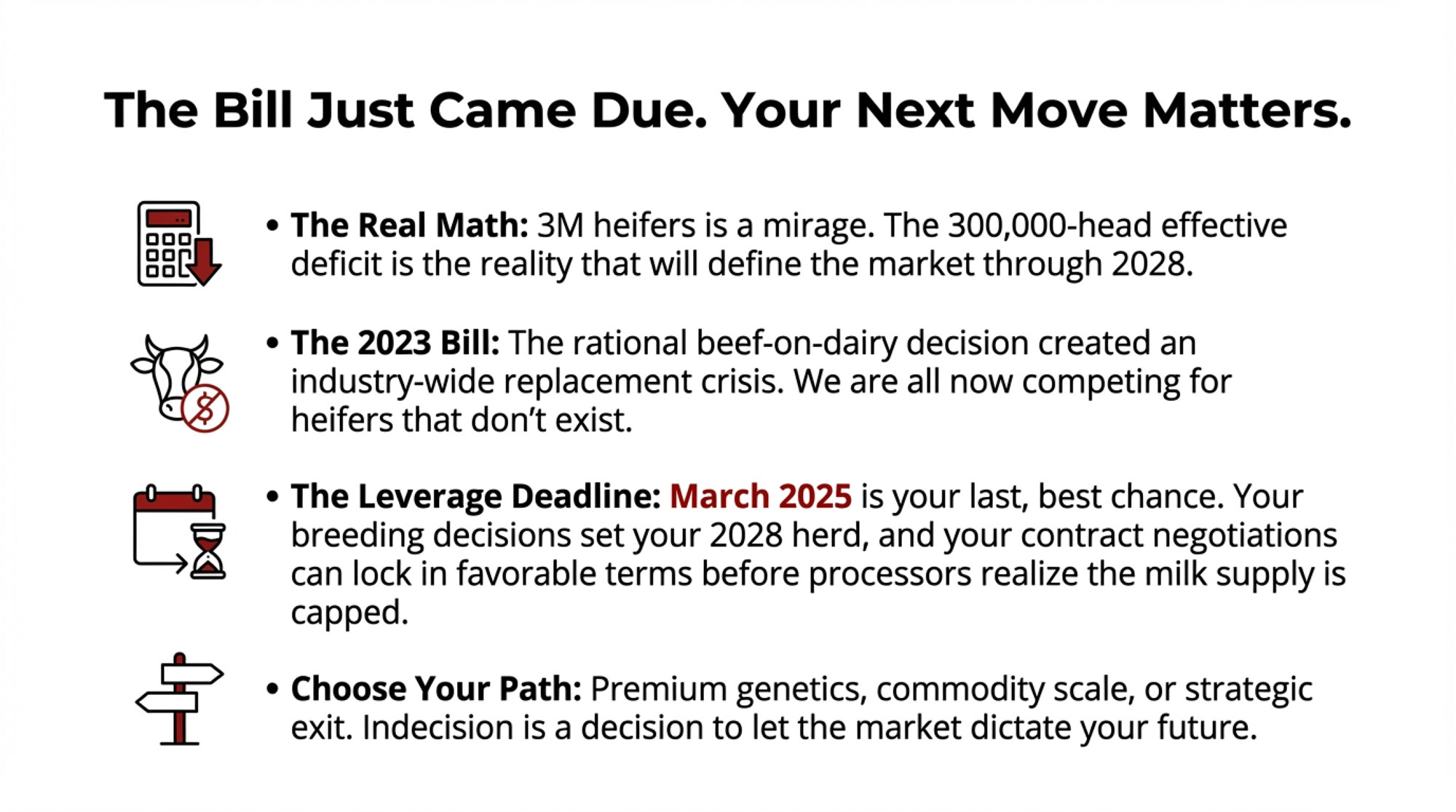
The Heifer Crisis Hiding in Plain Sight: Why Your Next 90 Days Determine Your 2028 Herd

Here’s what USDA’s numbers aren’t saying: we’re producing 2% more milk by keeping older cows longer, not breeding better replacements. Heifer inventory: 3M. Effective after losses: 2.5M. Need: 2.8M. Q1 2025 contract negotiations may be your last window for leverage.

Dairy Heifer Inventory Crisis

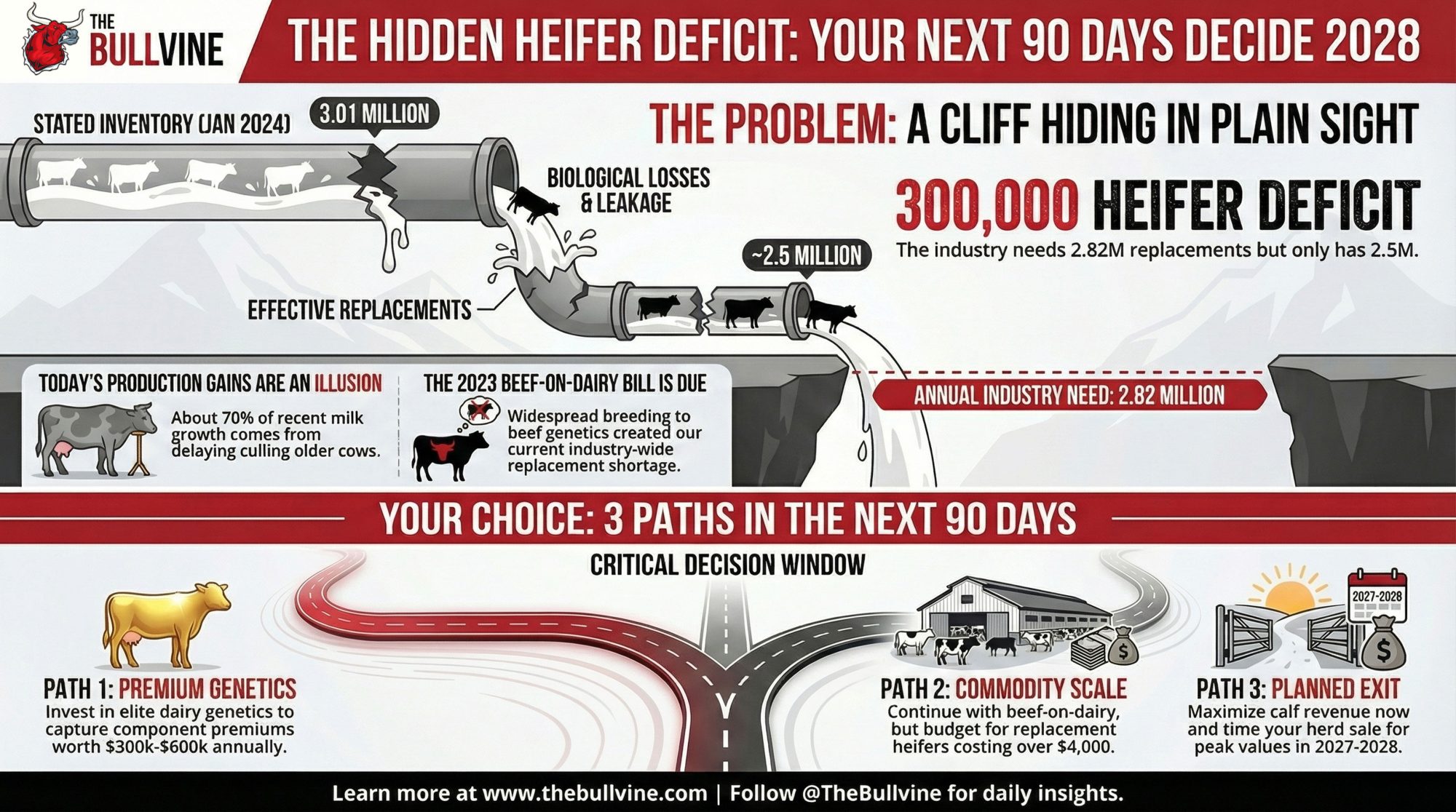
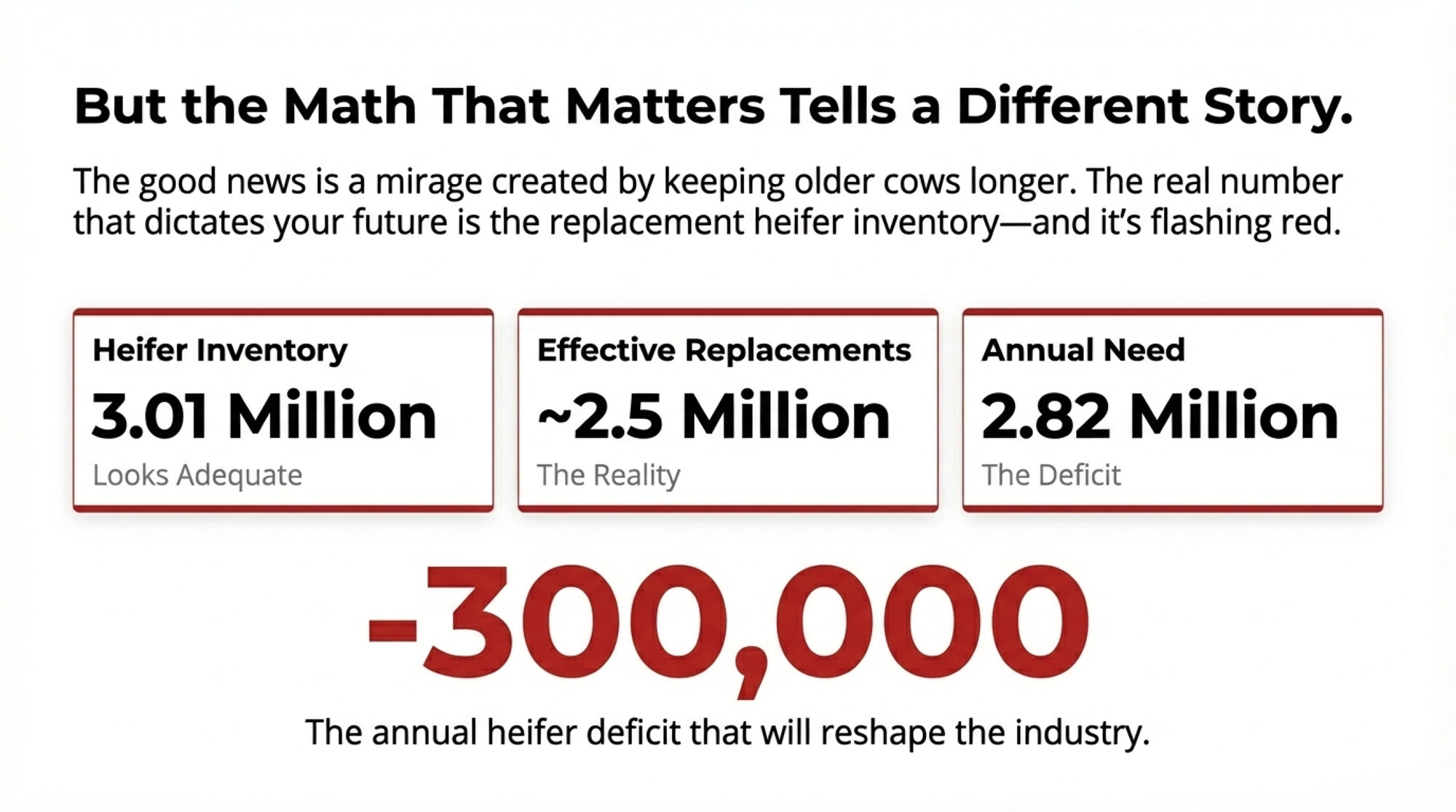
Executive Summary: The U.S. dairy industry’s 3 million replacement heifers look adequate—until you run the math. Biological losses reduce effective replacements to 2.5 million against 2.82 million needed, creating a 300,000-head deficit that determines who’s milking cows in 2028. This shortage traces directly to 2023’s margin crisis, when 50-60% of operations made individually rational decisions to breed beef genetics, creating a collective supply constraint. Recent production gains (+2% component-adjusted) mask this reality through delayed culling—essentially borrowing from future herd health to meet current demand. Producers face a critical 90-day convergence: breeding decisions made through March 2025 determine 2028 herds (a 30-month development cycle), while Q1 contract negotiations lock in multi-year positioning before processor leverage shifts mid-year. Three strategic paths remain viable—premium genetics targeting $300K-600K component premiums, commodity-scale operations, or planned exits that maximize 2027-2028 peak values—but only for farms committing to strategy before leverage evaporates. Delay means accepting substantially weaker competitive positioning.

The dairy production numbers coming out of USDA through fall 2024 have been encouraging—milk production trending up around 1% year-over-year, with component-adjusted growth looking even better at close to 2%. For those of us who’ve weathered some brutal margin pressure, volatile feed costs, and the ongoing industry consolidation, those figures feel like validation that our strategic shifts toward higher per-cow productivity and better component yields are finally paying dividends.

But there’s another number in those same USDA cattle inventory reports that tells a fundamentally different story about where we’re headed. And honestly, it’s the number that keeps me up at night more than any production statistic: we’re looking at around 3 million replacement heifers in the pipeline, and when you account for the biological realities of heifer development—the mortality, the breeding failures, the time lag—that number gets tight. Real tight.

Here’s what I mean by that.

The Fast Facts: Where We Stand Right Now

MetricCurrent EstimateRequired for StabilityStatus
Total US Dairy Herd9.4 Million Cows9.4 Million CowsNeutral
Replacement Heifer Inventory3.01 Million (Jan 2024)2.82 Million MinimumTight
Effective Replacements (After Losses)~2.5 Million2.82 MillionDeficit
Annual Heifer Mortality10-12% (300,000-360,000 head)Critical Loss
Breeding Failures5-8% (150,000-240,000 head)Critical Loss

Source: USDA NASS Cattle Inventory (January 2024); Penn State Extension; University of Wisconsin dairy economists

The Replacement Math Most Folks Aren’t Running

Let’s walk through the fundamentals here, because this is where the whole story starts to come together.

The U.S. dairy herd sits at roughly 9.4 million cows right now—that’s straight from USDA’s latest numbers. And if you’ve been in this business for any length of time, you know the biological reality: you need to replace somewhere between 25 and 30% of your herd annually just to maintain stable numbers.

That’s not bad management. That’s just dairy farming.

Cows age out, reproductive issues happen, injuries occur, and diseases strike. Penn State Extension puts typical culling rates at 25-35% annually, and Wisconsin Extension says 28-32% is common. It’s simply the nature of keeping a productive milking herd.

So do the math with me here: maintaining 9.4 million cows means you need somewhere between 2.35 and 2.82 million replacement heifers every year. Not to grow. Not to expand into new markets or add another parlor. Just to stay even.

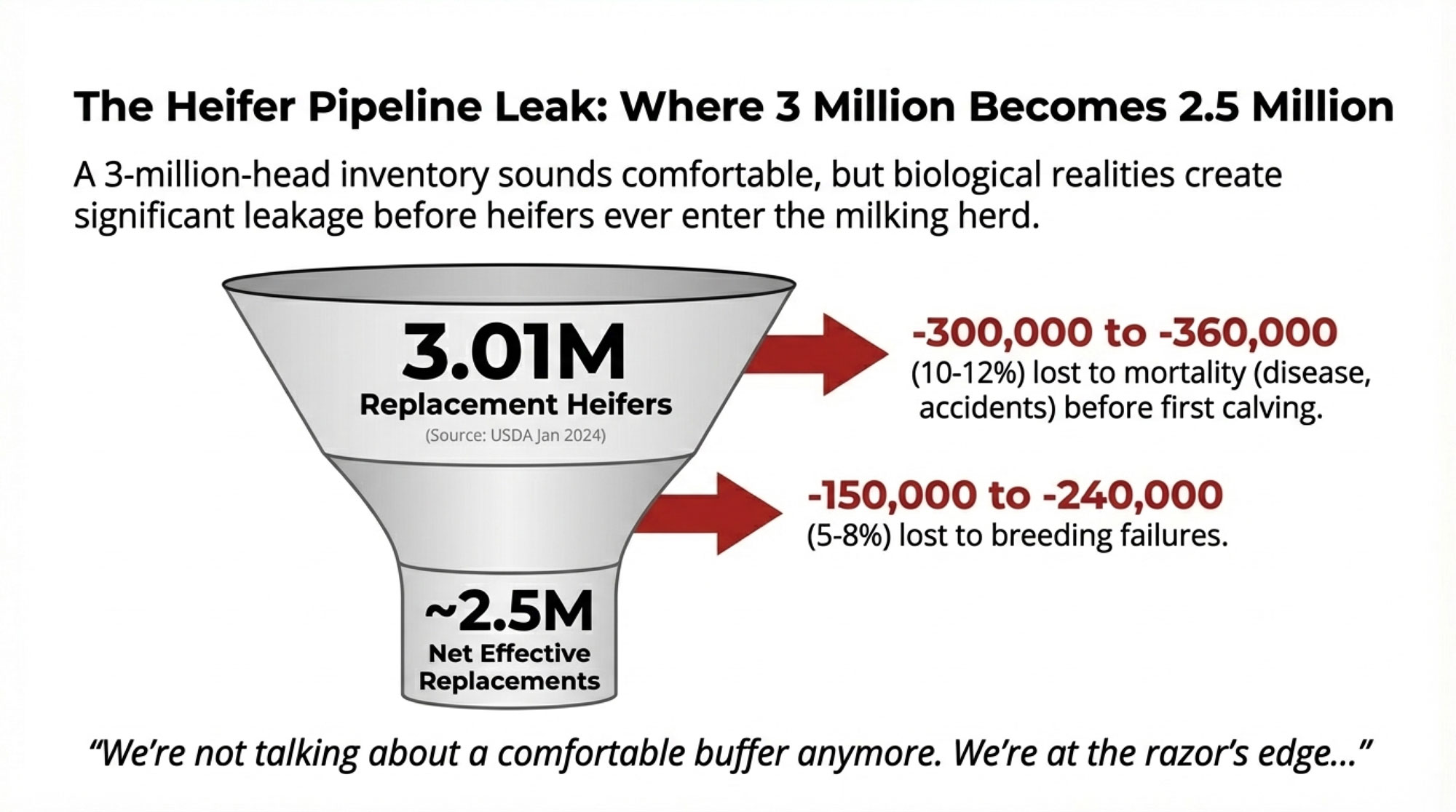
The Heifer Pipeline Leakage: Where 3 Million Becomes 2.5 Million

Now, looking at USDA’s January 2024 cattle inventory—the most recent complete data we’ve got—we’re seeing about 3.01 million dairy replacement heifers of all ages. That sounds comfortable at first glance. Maybe even pretty good compared to where we need to be.

But here’s where the biological constraints start biting us.

The Pipeline Breakdown:

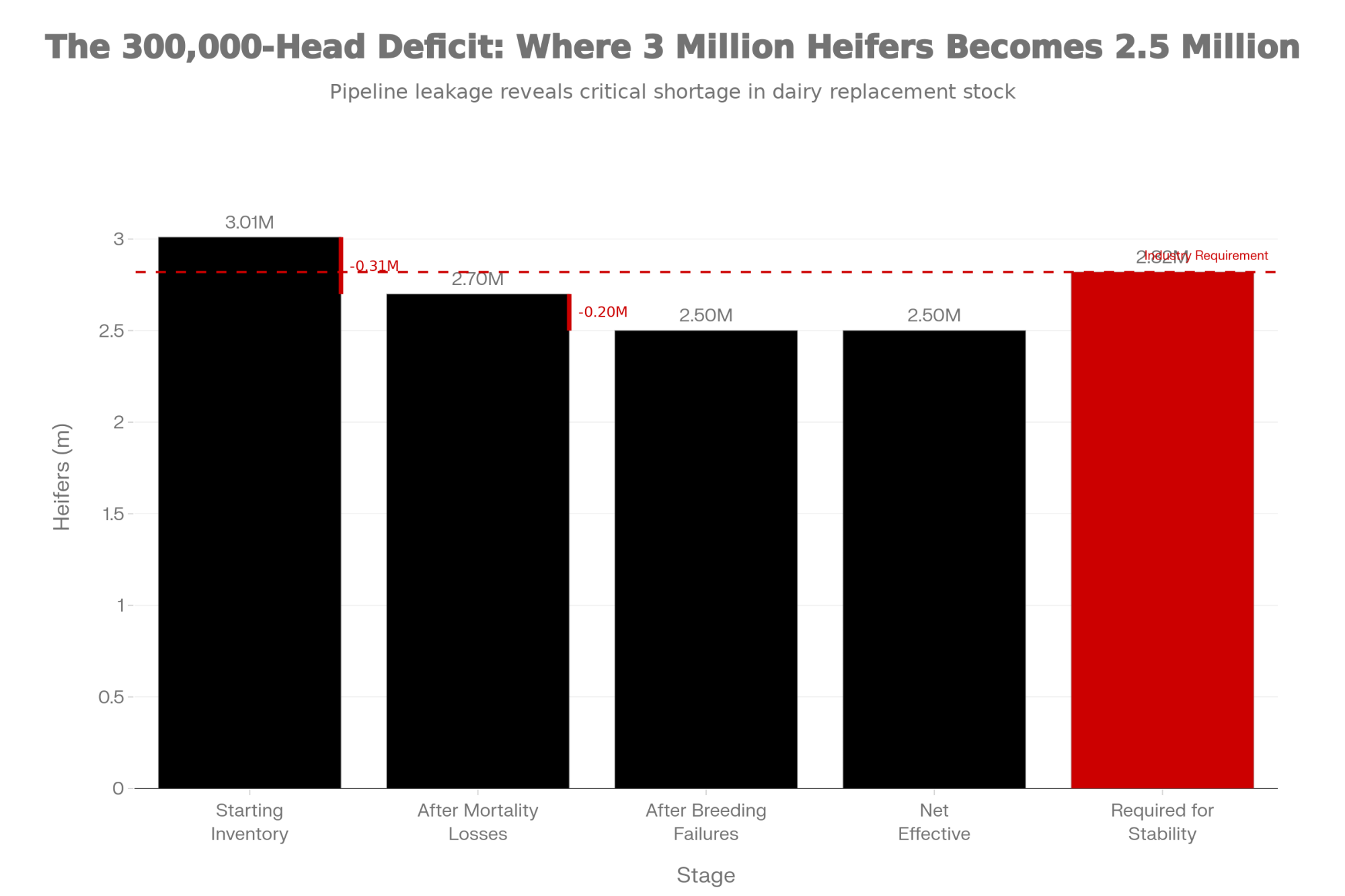
  • Starting inventory: 3.01 million replacement heifers (USDA Jan 2024)
  • Minus mortality losses (10-12%): -300,000 to -360,000 heifers lost to disease, accidents, developmental issues before first calving
  • Minus breeding failures (5-8%): -150,000 to -240,000 heifers that never successfully breed within acceptable timeframes
  • Net effective replacements: ~2.5 million heifers actually entering milking herds
  • Industry requirement: 2.35 to 2.82 million for herd maintenance
  • Buffer remaining: Essentially zero

Research from Wisconsin, Penn State, Cornell—pretty much every land-grant university that studies this—consistently shows that 10-12% of heifers don’t make it to first calving. We lose them to scours as calves, respiratory disease as weanlings, accidents, and developmental issues. The USDA’s own National Animal Health Monitoring System studies peg pre-weaning mortality around 5%, with another 5 to 7% lost between weaning and first calving.

“We’re not talking about a comfortable buffer anymore. We’re at the razor’s edge, with very little room for regional variation, disease outbreaks, or any of the hundred other things that can go sideways in livestock production.”

Then you’ve got breeding failures. And this is where I think a lot of optimistic projections fall short. Heifer conception rates typically run 55 to 65% per service according to the research, and while most heifers get bred successfully within a couple of services, you’re still looking at 5 to 8% that never successfully breed within acceptable timeframes. That’s another 150,000 to 240,000 heifers gone from productive use.

The 2025-2026 Outlook Gets Tighter

And here’s what makes this particularly concerning: CoBank’s agricultural economists—folks who study dairy markets for a living—are projecting that the heifer pipeline will continue to drop through 2025 before we see any meaningful recovery. They’re not expecting things to turn around until late 2026 or even 2027.

When the January 2025 inventory numbers come out in a few weeks, most industry watchers I talk to expect to see that replacement heifer number down even further from where we were in 2024.

Where That Production Growth Really Came From

This brings us back to those encouraging production numbers, and I think it’s worth looking at what’s actually driving them. Because if the replacement heifer supply is this constrained, how are we still seeing production gains?

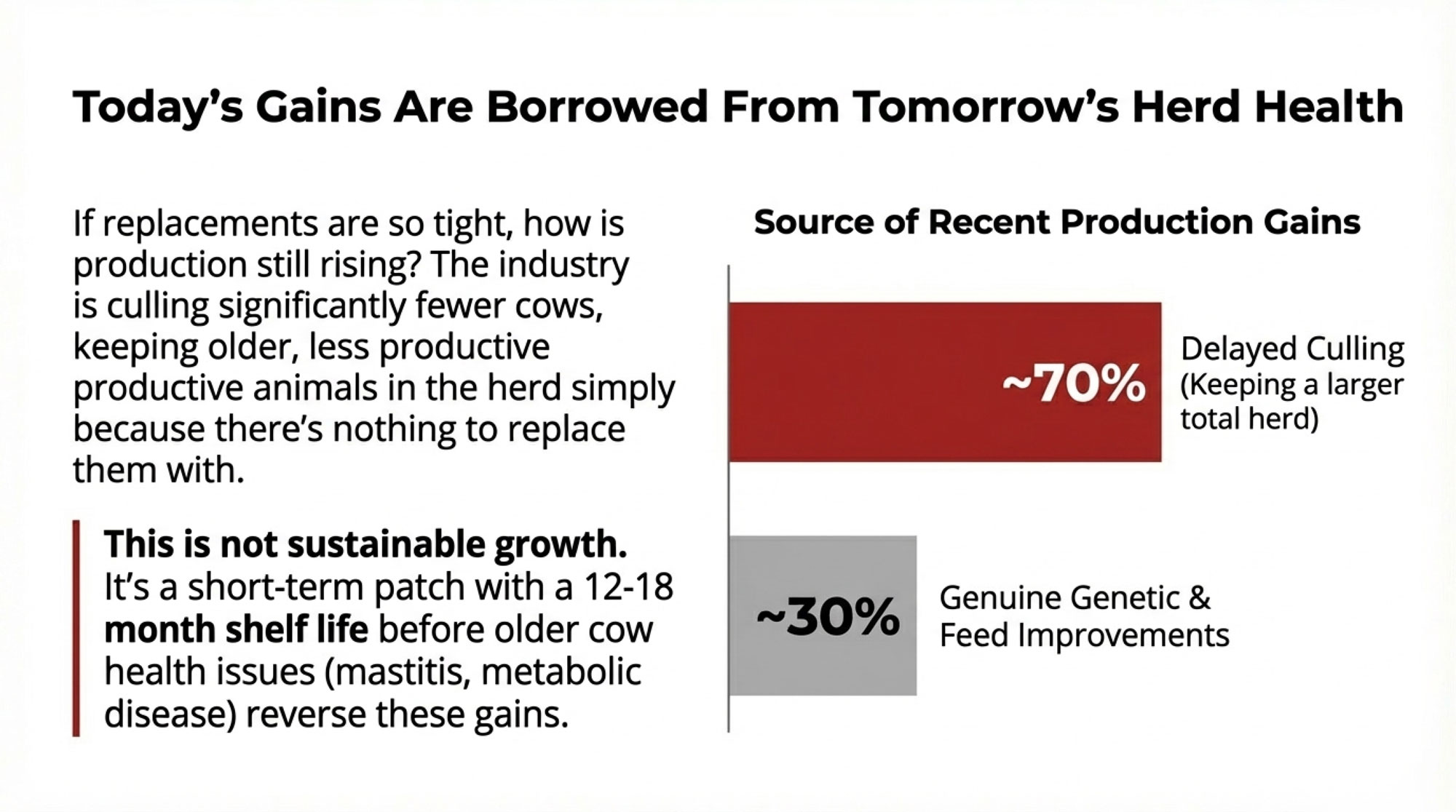
The answer—and you’ve probably noticed this on your own operation—is that we’re keeping older cows in production longer than we normally would. A lot longer, in some cases.

Delayed Culling: Borrowing From Tomorrow’s Herd Health

USDA’s data through 2024 shows dairy producers culled significantly fewer cows compared to 2023—we’re talking hundreds of thousands fewer culls across the industry. These are animals that, under normal circumstances, with adequate replacement availability, would’ve been sold or culled due to age, declining production, or health challenges. Instead, they’re staying in the barn because we simply don’t have enough young, high-producing replacements to take their place.

Dr. Marin Bozic—he’s a dairy economist many of you probably know from his market analysis work—has pointed out in his reports that this strategy has a definite shelf life. You can delay culling for a period, especially when milk prices justify keeping lower-producing cows. But eventually, and we’re seeing this now in some herds, the biological realities catch up. Older cows are more likely to develop metabolic disease, mastitis, and reproductive failure. Your herd’s overall efficiency starts degrading, and those production gains you achieved by maintaining more cows start reversing on you.

Production Gain Breakdown (Industry Analysis):

  • Economists estimate ~30% from genuine improvements (better component genetics, genomic selection, improved feed efficiency)
  • ~70% from delayed culling (maintaining larger total cow inventory by extending productive lives)

And that’s not sustainable growth. That’s borrowing from tomorrow’s herd health to hit today’s production targets.

How We Got Here: The Beef-on-Dairy Decision

The heifer shortage we’re dealing with now didn’t just appear out of nowhere. It’s the direct consequence of the breeding decisions most of us made two to three years ago—decisions that made perfect economic sense at the time but created the industry-wide squeeze we’re feeling now.

When the Math Favored Beef Genetics

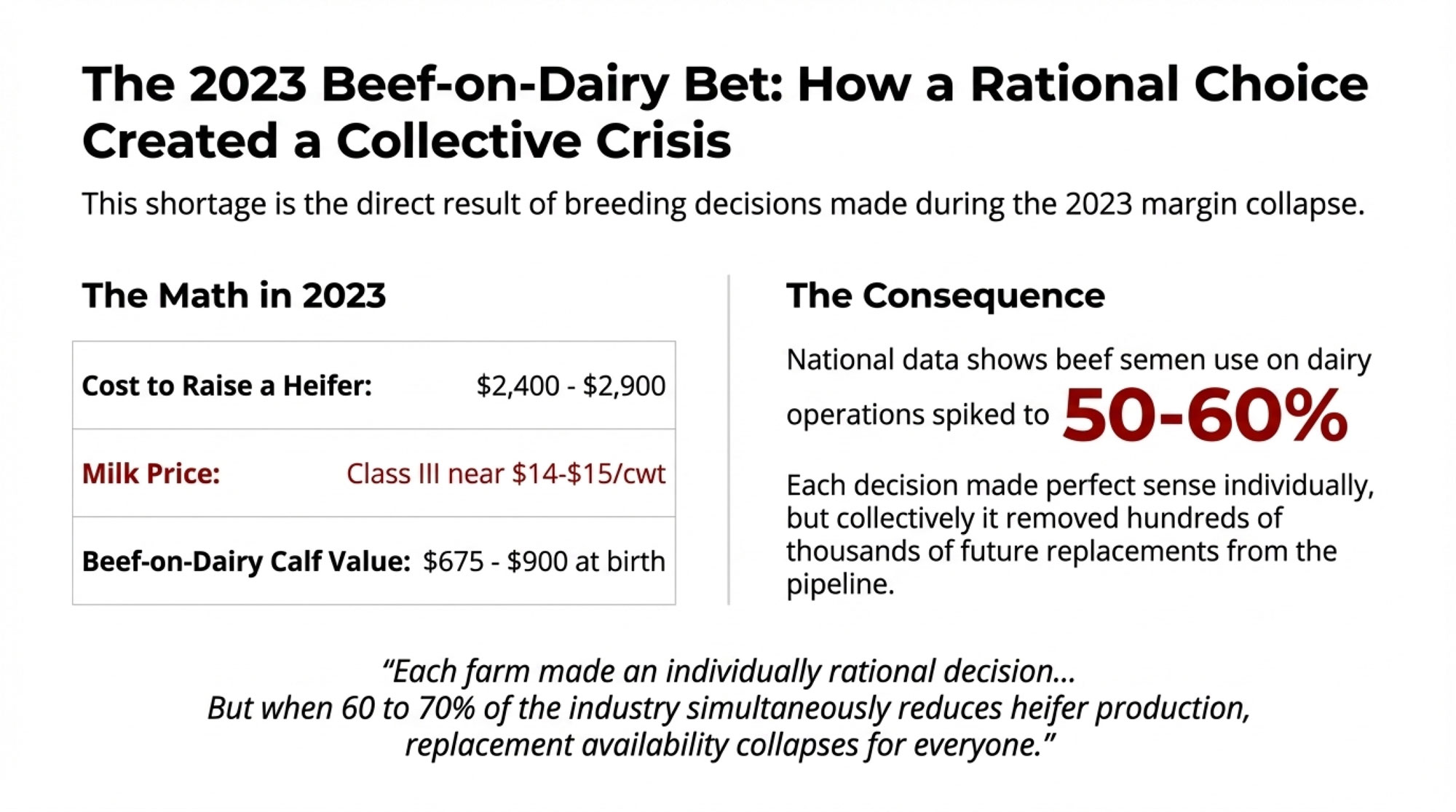
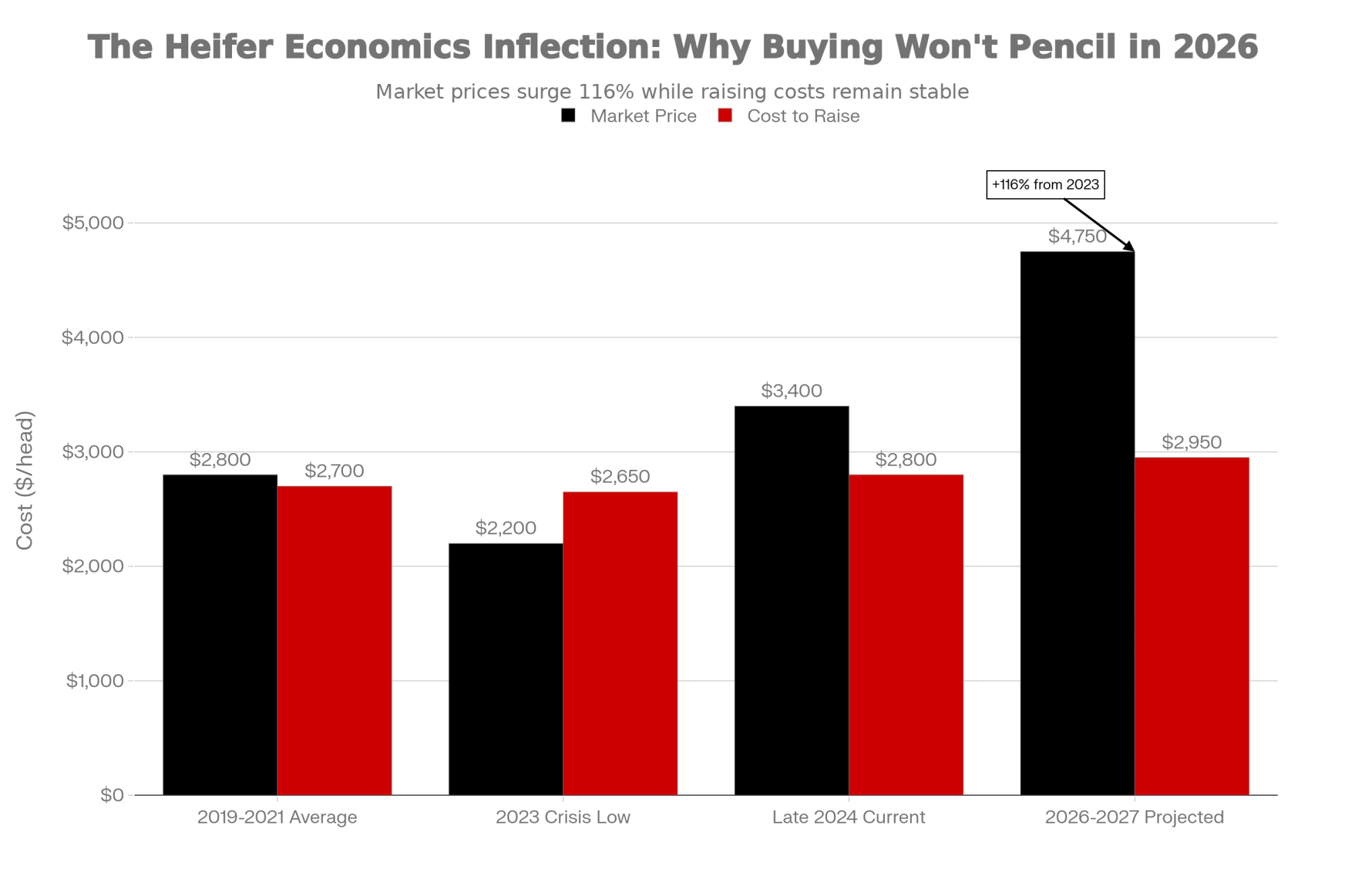
Do you remember where milk prices were in 2023? I mean, Class III hit lows near $14 to $15 per hundredweight in some months. Absolutely catastrophic margins for most operations. And at the same time, you’re looking at $2,400 to $2,900 to raise a replacement heifer from birth to first calving—that’s what the university budgets were showing. Penn State’s numbers, Wisconsin’s enterprise budgets, they all penciled out in that range.

Economic Factor2023 Crisis PeriodLate 2024 Current2026-2027 Projected
Beef-Dairy Calf Sale Value$675-900 per calf$725-950 per calf$800-1,100 per calf
Dairy Heifer Replacement Cost (2023)$2,000-2,500 (buying cheaper)
Dairy Heifer Replacement Cost (2024)$2,800-4,000 (buying costly)$4,500-5,000 (prohibitive)
Cost to Raise Own Heifer$2,400-2,650$2,700-2,900$2,850-3,100
Annual Calf Revenue (500 cows, 75% beef)$160K-180K$165K-195K$180K-220K

Meanwhile, beef-on-dairy breeding was offering an attractive alternative that a lot of us took advantage of:

  • Breed lower-ranking dairy cows to beef semen
  • Sell calves for $675 to $900 within days of birth
  • Buy replacement heifers from the market when needed at $2,000 to $2,500 (2023 pricing)

The math clearly favored beef-breeding, especially if you were watching cash flow. And it worked. Really well, actually, in the short term.

The Collective Impact Nobody Was Tracking

But here’s what happened at the industry level, and this is where nobody was really tracking the collective impact: National Association of Animal Breeders data through 2023 shows beef semen usage on dairy operations increased to somewhere around 50 to 60% of total breedings.

That’s a massive shift from historical patterns where we were breeding maybe 80 to 90% dairy genetics. Each one of those breeding decisions—multiply it across thousands of farms all making similar calls—meant one fewer potential replacement heifer entering the pipeline 30 months later.

“Each farm made an individually rational decision based on their economics. But when 60 to 70% of the industry simultaneously reduces heifer production, replacement availability collapses for everyone.”

The cumulative effect is what we’re seeing now. Hundreds of thousands of additional beef-on-dairy calves were produced compared to historical patterns. Those are animals that would’ve been dairy replacements, now permanently out of our genetic pipeline.

And what’s interesting—Penn State Extension folks have pointed this out in their recent analyses—is that this represents what economists call a tragedy of the commons. Each farm made an individually rational decision based on their economics. But when 60 to 70% of the industry simultaneously reduces heifer production, replacement availability collapses for everyone. Including the farms that kept breeding dairy genetics through the tight times.

The Regional Story: Why Some Areas Kept Breeding Dairy

Not everyone followed the beef-on-dairy path, though, and the regional variation tells you a lot about the structural factors at play here.

USDA’s state-level data shows Pennsylvania maintained or slightly increased replacement heifer inventory through 2024, while most of the country was reducing numbers. Wisconsin held relatively stable. Meanwhile, the big Western dairies in California, Texas, and Idaho saw significant heifer reductions.

Scale Makes the Difference

I’ve been talking with lenders, extension specialists, and economists across different regions, trying to understand what explains this split, and a few things have become pretty clear.

Farm scale makes a real difference. Pennsylvania’s dairy sector—according to their Center for Dairy Excellence reports—averages around 90 to 100 cows per farm. Compare that to the national average, which is pushing 350 to 380 cows.

Capital Requirements by Herd Size:

  • 95-cow operation: $67,000 to $81,000 annually for heifer raising (manageable with multi-generational equity)
  • 500-cow operation: $360,000 to $435,000 annually for adequate replacement raising (became nearly impossible during the 2023 margin collapse)

The Pasture Advantage

Geography matters, too, and folks sometimes overlook this. Regions with established pasture systems—Pennsylvania, upstate New York, parts of Wisconsin—have what turns out to be a substantial cost advantage for heifer raising.

Heifer Raising Cost Comparison:

  • Pasture-based systems: ~$1,336 per head
  • Confinement systems: ~$1,919 per head
  • Cost advantage: 43% difference driven by reduced feed costs, lower facility investment, and less labor intensity

Source: Penn State Extension, University of Wisconsin, Cornell dairy management research

So Pennsylvania farmers could raise their own replacements for less than market purchase prices even when beef-breeding looked economically superior to everyone else. The pasture advantage is structural—it doesn’t go away when milk prices improve.

Custom Heifer Raising Infrastructure

Pennsylvania and Wisconsin also developed something most other regions just don’t have: sophisticated custom heifer-raising operations. These are specialized businesses that contract with dairy farmers to raise heifers through the non-productive phase. When cash got tight in 2023, being able to contract out heifer raising at $1,900 to $2,100 per animal provided flexibility that regions without this infrastructure simply couldn’t access.

Here’s an important point the Wisconsin specialists emphasize: this wasn’t necessarily Pennsylvania farmers being smarter or more strategic than everyone else. They had structural advantages—lower scale requirements, existing pasture systems, access to custom raising—that made maintaining dairy breeding economically feasible when others couldn’t justify it.

Region/SystemCost per HeadPrimary Cost DriverHeifer Inventory Trend (2023-24)
Pennsylvania (Pasture)$1,336Low feed costsStable/Up
Wisconsin (Pasture)$1,425Pasture + custom raisingStable
Midwest (Confinement)$1,850Facility investmentDown 8-12%
Western US (Confinement)$1,919Labor + facility costsDown 15-18%
Texas/Southwest (Confinement)$1,975Heat stress + facilityDown 12-15%

The Component Gains: Real Progress on a Narrowing Base

Those component numbers from USDA through 2024 deserve a closer look, especially given what’s happening with the genetic foundation underlying them.

The Impressive Gains Are Real

The gains are real. Absolutely real:

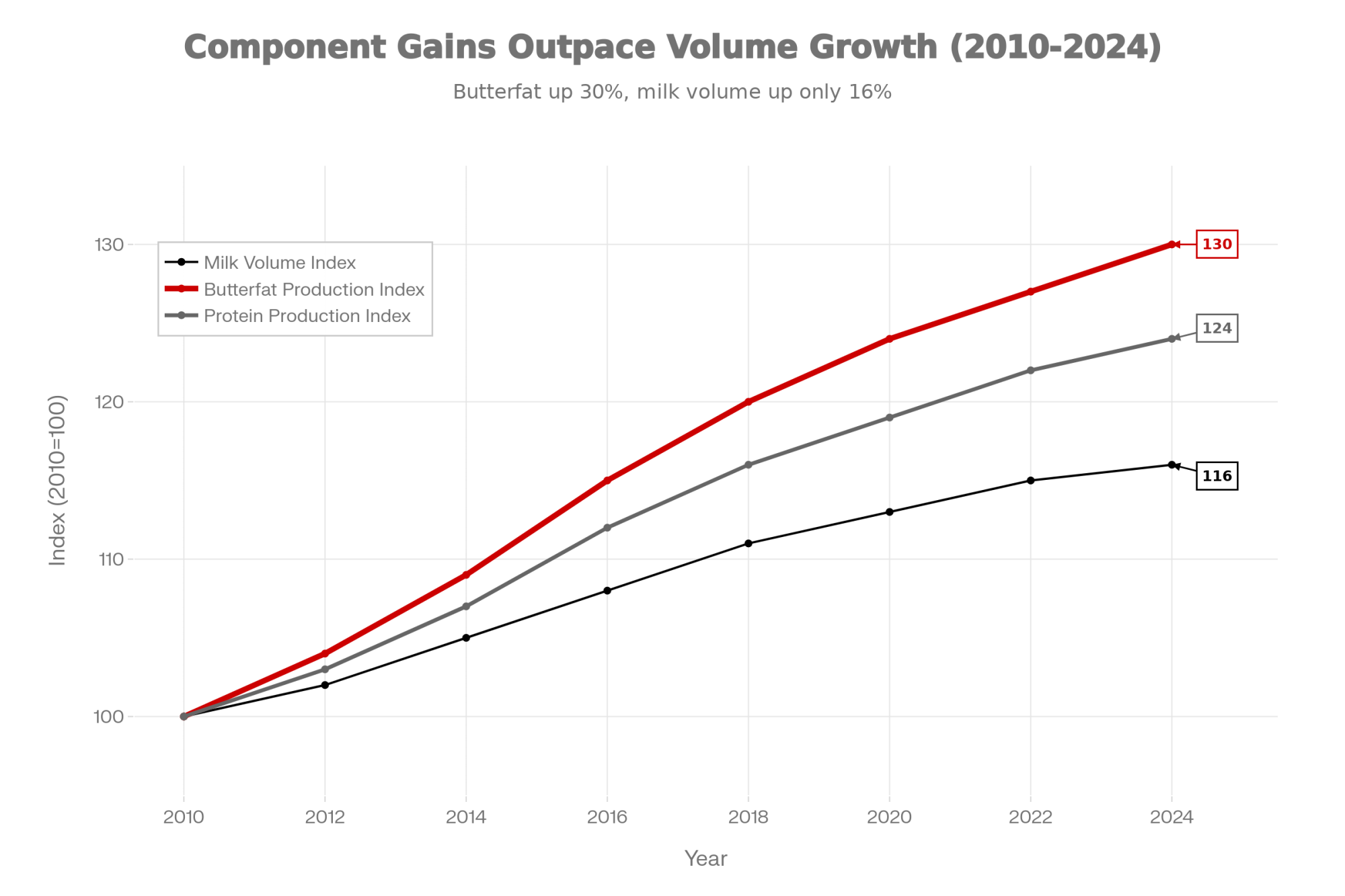
  • Butterfat production: Up ~30% since 2010 (milk volume grew only 15-16%)
  • Protein production: Up 23-24% over the same period
  • Current national averages: ~4.2% butterfat, ~3.3% protein (both record territory)

The Council on Dairy Cattle Breeding’s 2024 genetic evaluations show substantial base changes in butterfat in Holsteins compared to just five years ago. This represents genuine genetic progress driven by genomic selection, improved breeding strategies, and the industry’s intense focus on component traits.

And that focus makes economic sense—Multiple Component Pricing puts roughly 90% of your milk check value on butterfat and protein rather than volume.

But the Genetic Base Is Narrowing

But here’s what concerns the geneticists when you talk to them about long-term sustainability: the genetic base enabling this progress is simultaneously contracting because of those beef-on-dairy breeding patterns we just discussed.

When 50 to 60% of your dairy breedings are going to beef genetics, you’re systematically removing potential dairy females from the breeding population. Those aren’t just your bottom-tier animals, either. They’re your “genetically lower-ranking” cows within each herd, sure, but they’re still above-average dairy cattle compared to historical standards.

Dr. Kent Weigel at Wisconsin—he’s published extensively on breeding strategies over the years—has noted in his research that maintaining genetic diversity while pursuing component gains requires balancing selection intensity with population size. What we’re seeing now, with maybe 30% of farms maintaining intensive dairy genetics while 70% breed primarily to beef, creates what he calls a “two-tier genetic system” that could persist for years.

“Population geneticists call this ‘peak selection intensity.’ You get temporary acceleration in the traits you’re selecting for because you’re working with a smaller, more intensely selected population. But that acceleration isn’t indefinitely sustainable.”

The Processing Side: What Happens When Plants Realize Growth Isn’t Coming

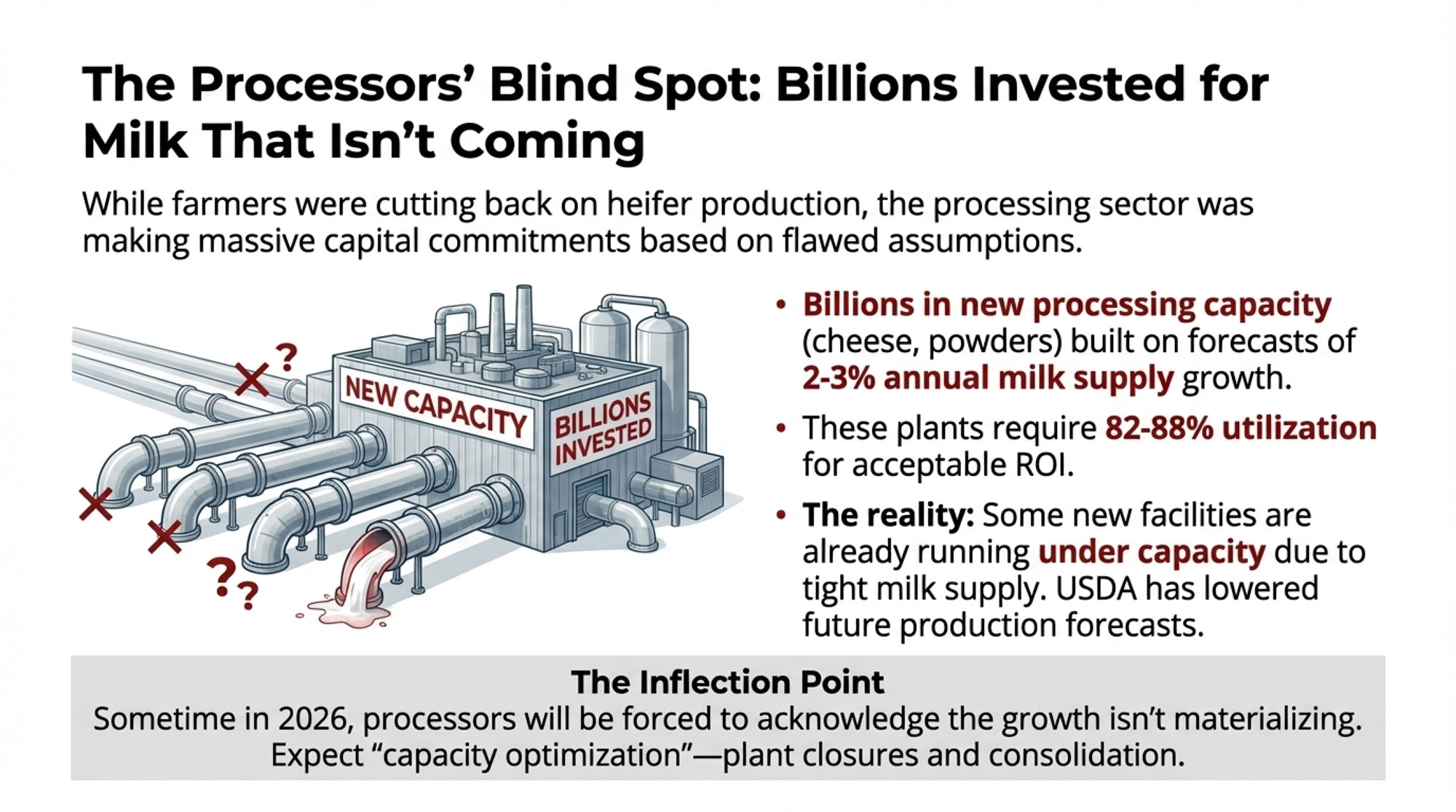
While we were all managing heifer inventories and breeding decisions based on individual farm economics, the processing sector was making massive capital commitments based on very different assumptions about future milk supply.

Billions Invested on 2-3% Growth Assumptions

Trade publications and industry reports through 2024 document several billion dollars in new dairy processing capacity either announced or under construction—most of it concentrated in cheese and milk powder production. You’ve got major projects in Kansas, Texas, Michigan, Wisconsin, and other core dairy regions.

These plants were financed through USDA Rural Development loans and private investment, based on forecasts of 2-3% annual growth in milk production. That’s been the historical assumption for feasibility studies.

Processing Plant Economics:

  • Required utilization: 82-88% of design capacity for acceptable ROI
  • Typical $500M cheese plant capacity: 1.8 billion pounds annually
  • Below-target utilization impact: Fixed costs spread across lower volume = compressed profitability per pound

The 2026 Inflection Point

Current reality appears to be telling a different story, though this isn’t widely published data. Industry observers watching the processing sector suggest some newer facilities are running at lower utilization rates than their models projected, constrained by available milk supply in their procurement areas.

And USDA’s most recent forecasts, released in late 2024, lowered its milk production expectations going forward despite projecting continued per-cow yield improvements. That’s essentially an admission that herd-size constraints are binding.

So what happens when processors start realizing the milk growth they financed their expansions around isn’t materializing? Industry folks watching processor earnings calls and capital markets are suggesting we might see an inflection point sometime in 2026. When you get multiple quarters showing milk production growth in the 0 to 2% range rather than the 3 to 4% that plant economics require, processor guidance is going to feature some significant adjustments.

Some analysts are already anticipating what they’re calling “capacity optimization”—industry-speak for plant closures, consolidation, and scaled-back operations.

Your Strategic Window: The Next 90 Days Matter

For producers reading these market signals, we’re looking at a compressed timeline for some critical decisions.

Why 90 Days? The Biology and the Contracts

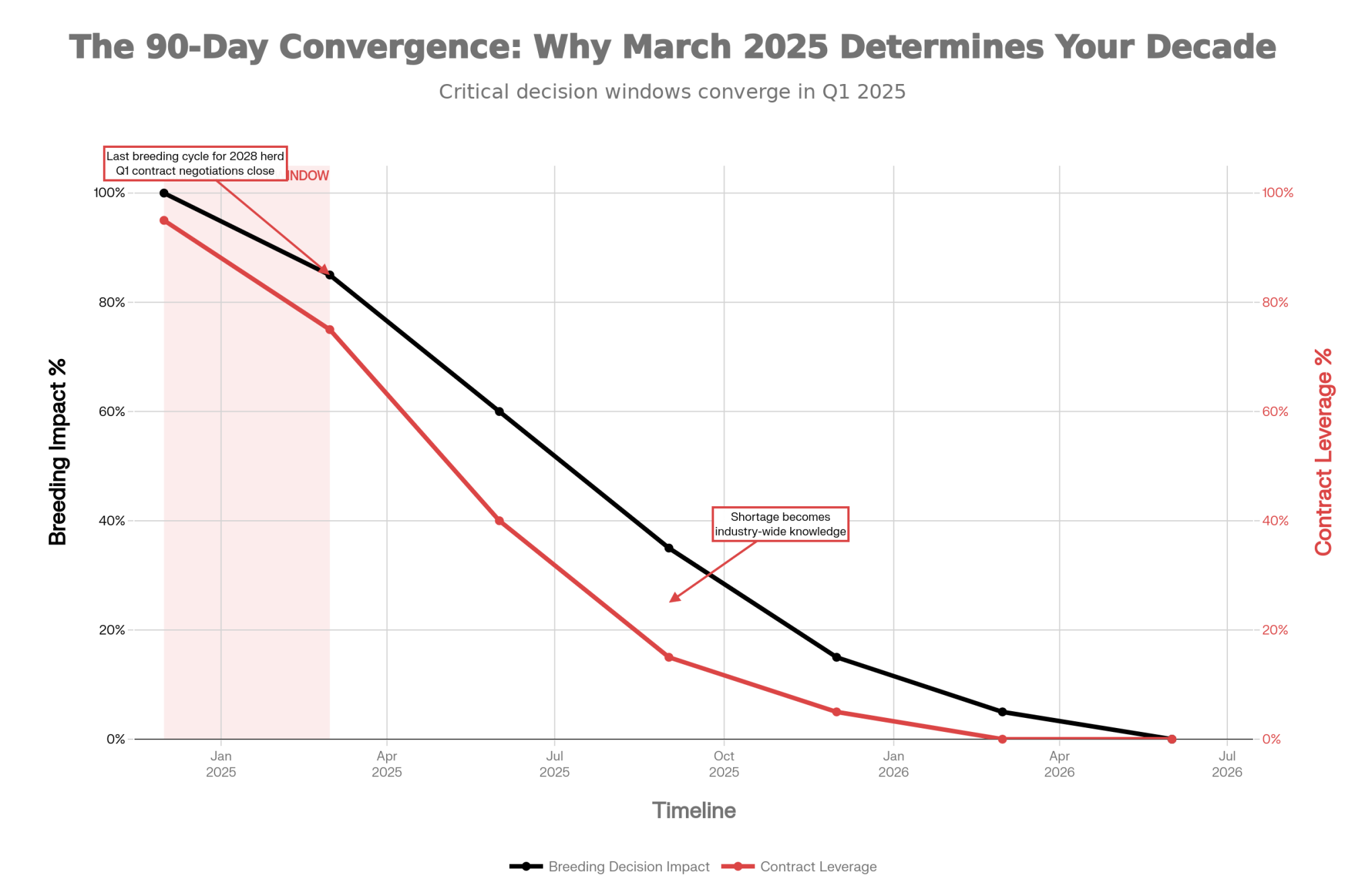
Here’s why the next 90 days—roughly late December 2024 through March 2025—are so critical:

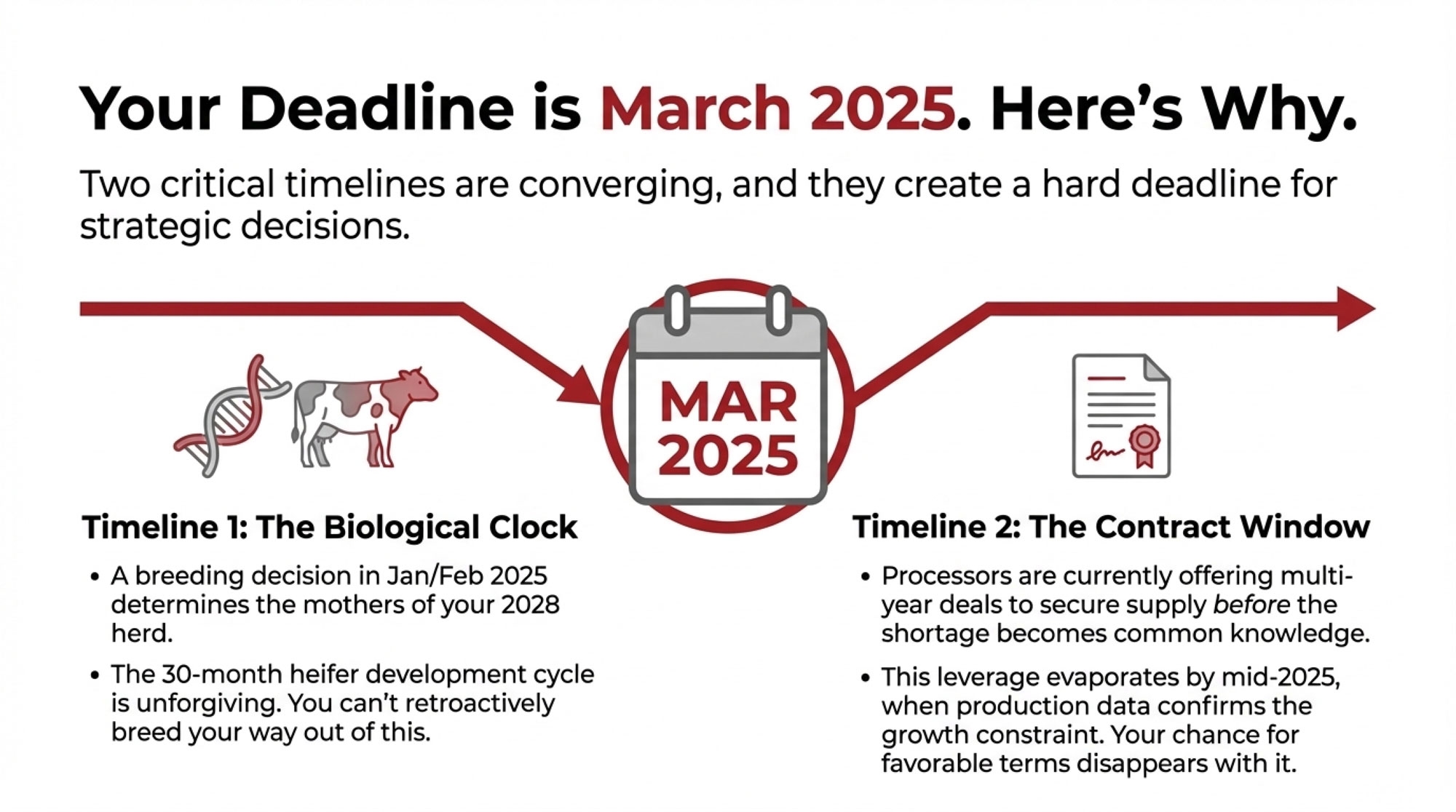
The Biological Reality: The 30-month heifer development cycle means breeding decisions you make between now and spring 2025 determine which cows become the mothers of your 2028 replacement heifers. A heifer bred in January 2025 calves in October 2025, and her heifer calf (if you breed dairy genetics) doesn’t freshen until spring 2028.

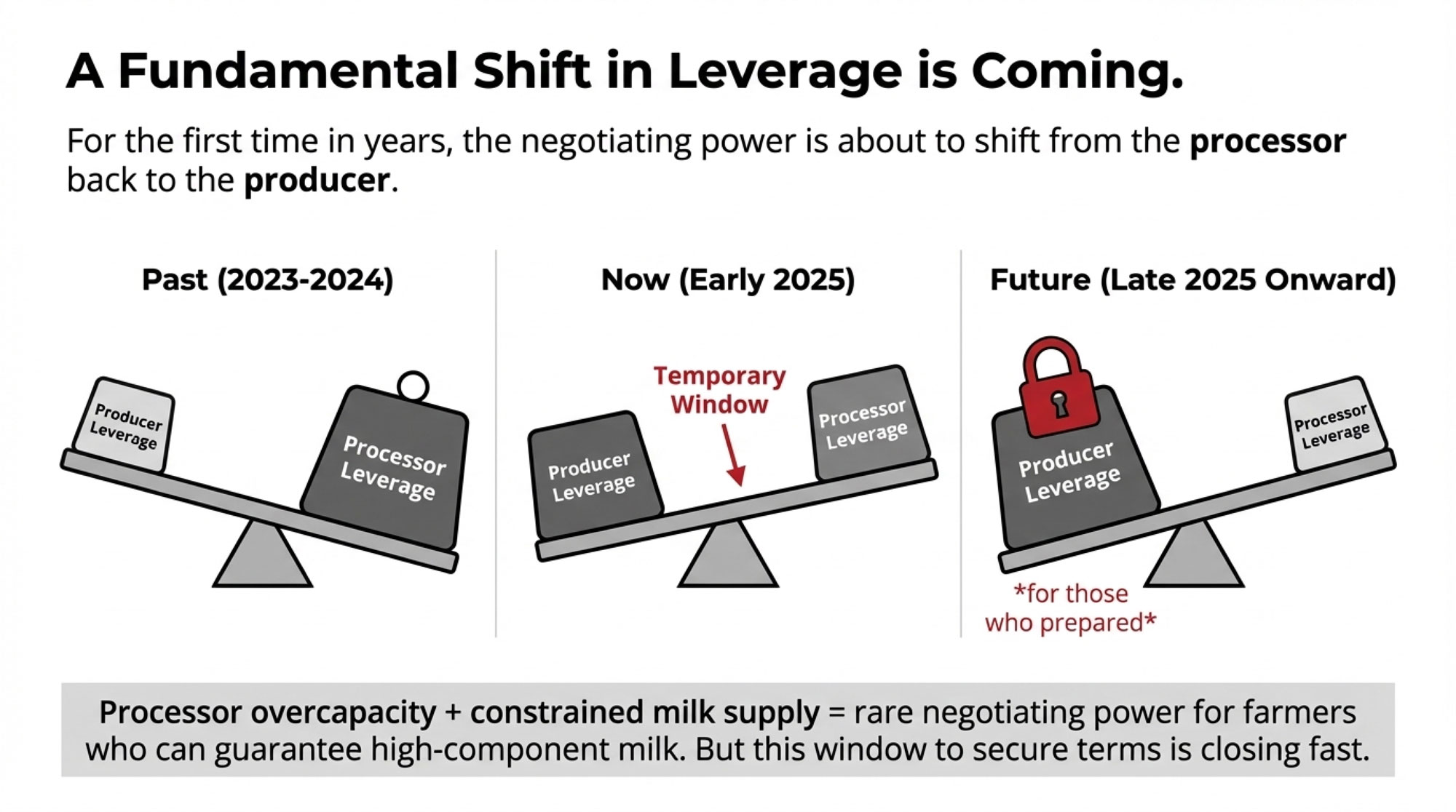
The Contract Window: Milk contracts for 2025-2027 are currently being negotiated. Processors are offering multi-year deals with premium component pricing while they’re uncertain about future supply. That negotiating leverage shifts dramatically by mid-2025 when production data confirms the heifer shortage is constraining growth.

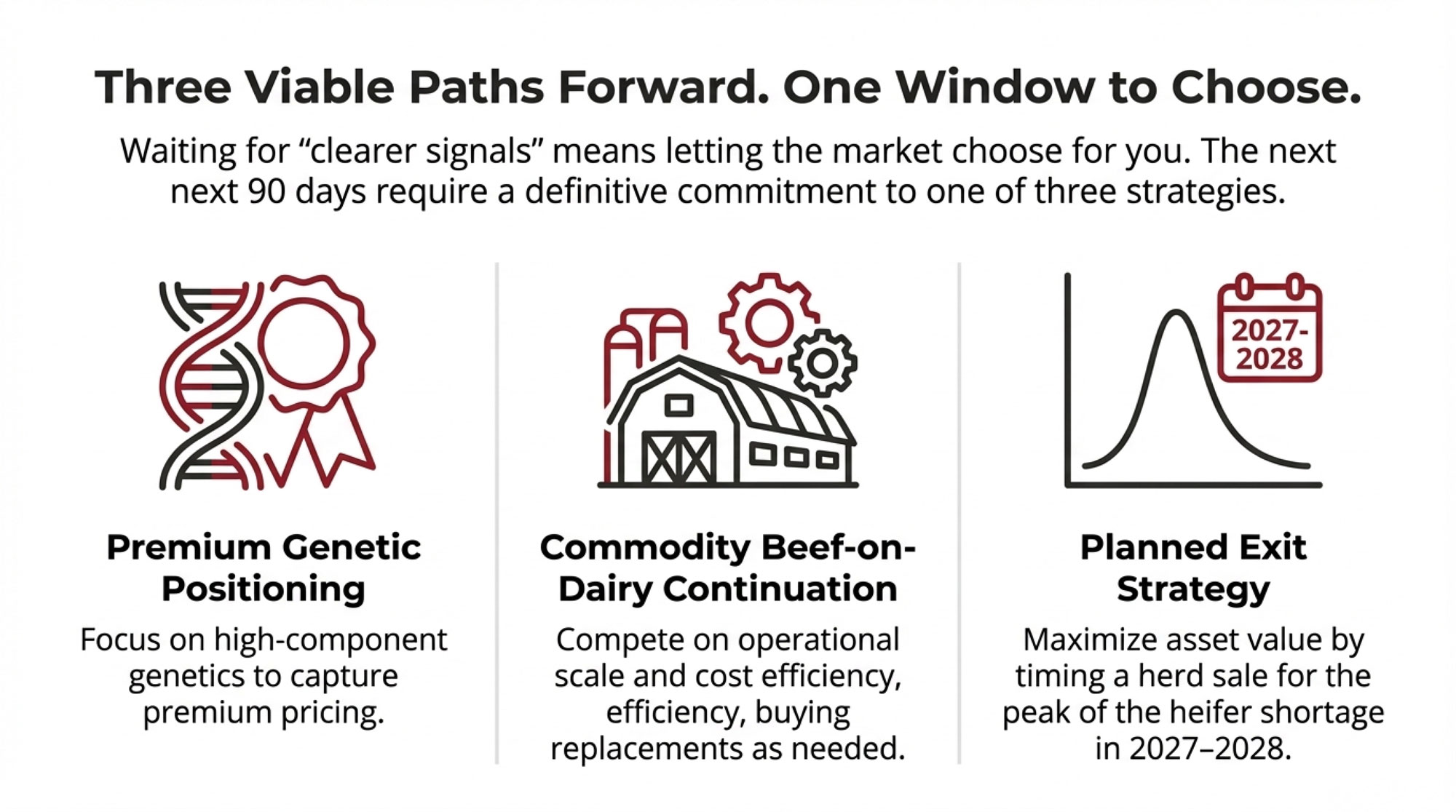
Three Viable Paths Forward

Let me walk through what I see as roughly three viable paths forward. Each requires some level of commitment in the next 90 days.

StrategyAnnual InvestmentReplacement Source2026-2028 Revenue ImpactRisk Level
Premium Genetic Positioning$25K-35K (semen + testing)Raise own (150-200/yr)+$300K-600K (component premiums)Medium (genetics execution)
Commodity Beef-on-Dairy$0-5K (maintaining current)Purchase market ($3,400-4,750)Commodity pricing (no premium)High (replacement cost escalation)
Planned Exit (Peak Value)$2K-8K (maximize beef revenue)Minimize/phase out+$450K-750K (peak herd sale)Low (planned timeline)

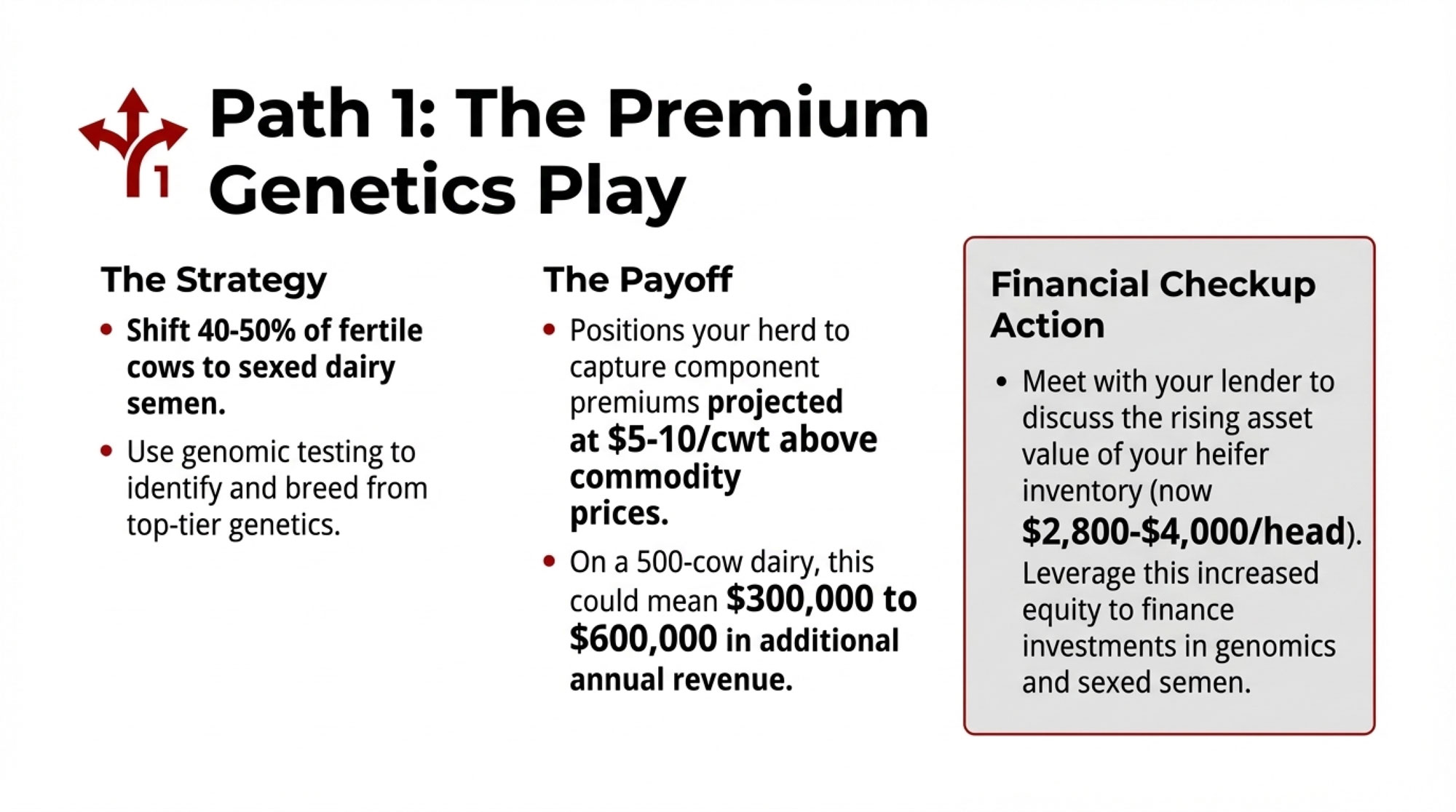
Path 1: Premium Genetic Positioning

The Strategy:

  • Shift 40-50% of fertile cows to sexed dairy semen
  • Implement genomic testing to identify the top genetics
  • Target 150-200 high-quality replacement heifers annually

The Investment:

  • Annual cost: $25,000 to $35,000 for semen and testing
  • Positions you for component premiums, analysts project could reach $5-10/cwt above commodity pricing in the coming years
  • On a 500-cow operation producing 12 million pounds: potential $300,000 to $600,000 additional annual revenue using conservative mid-range premium estimates

Financial Checkup Action: Meet with your lender specifically to discuss the rising asset value of your heifer inventory (currently $2,800-4,000 per head and climbing). Many operations can leverage this increased equity to finance genomic testing programs and investments in sexed semen without taking on significant additional debt.

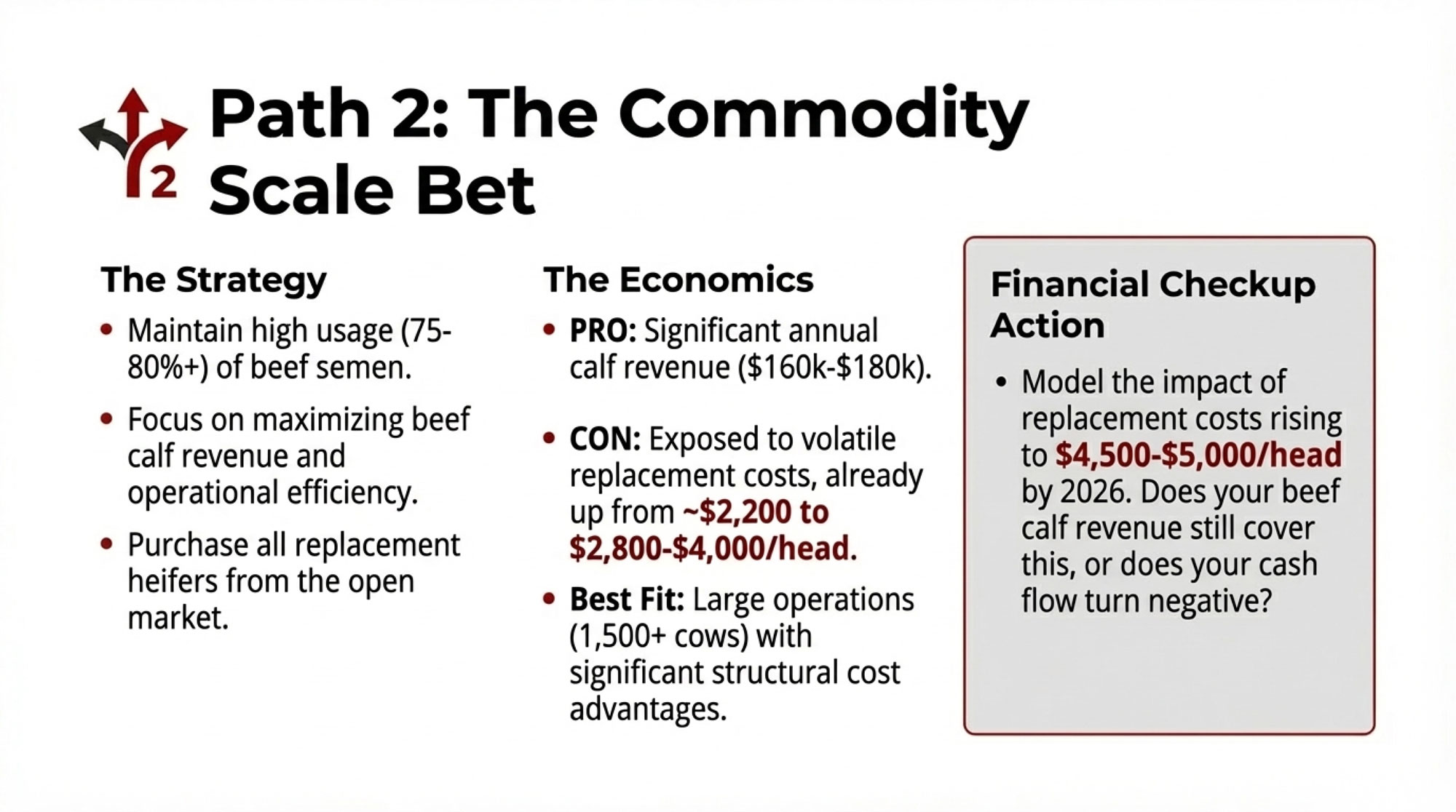
Path 2: Commodity Beef-on-Dairy Continuation

The Strategy:

  • Maintain current breeding patterns (75-80% beef semen)
  • Purchase replacements from the market as needed
  • Compete on cost efficiency and operational scale

The Economics:

  • Annual calf revenue: $160,000 to $180,000 based on current beef-dairy calf markets
  • Replacement purchase costs: $2,800-4,000 per head (current market, up from $2,000-2,500 in 2023)
  • Locks into commodity pricing structures without premium component access
  • Best fit: larger operations (1,500+ cows) with structural cost advantages

Financial Checkup Action: Work with your lender to model the impact of rising replacement heifer costs on your cash flow. If replacements continue climbing to $4,500-5,000 per head (as some project for 2026-2027), calculate whether beef calf revenue still pencils out favorably versus raising your own.

Path 3: Planned Exit Strategy

The Strategy:

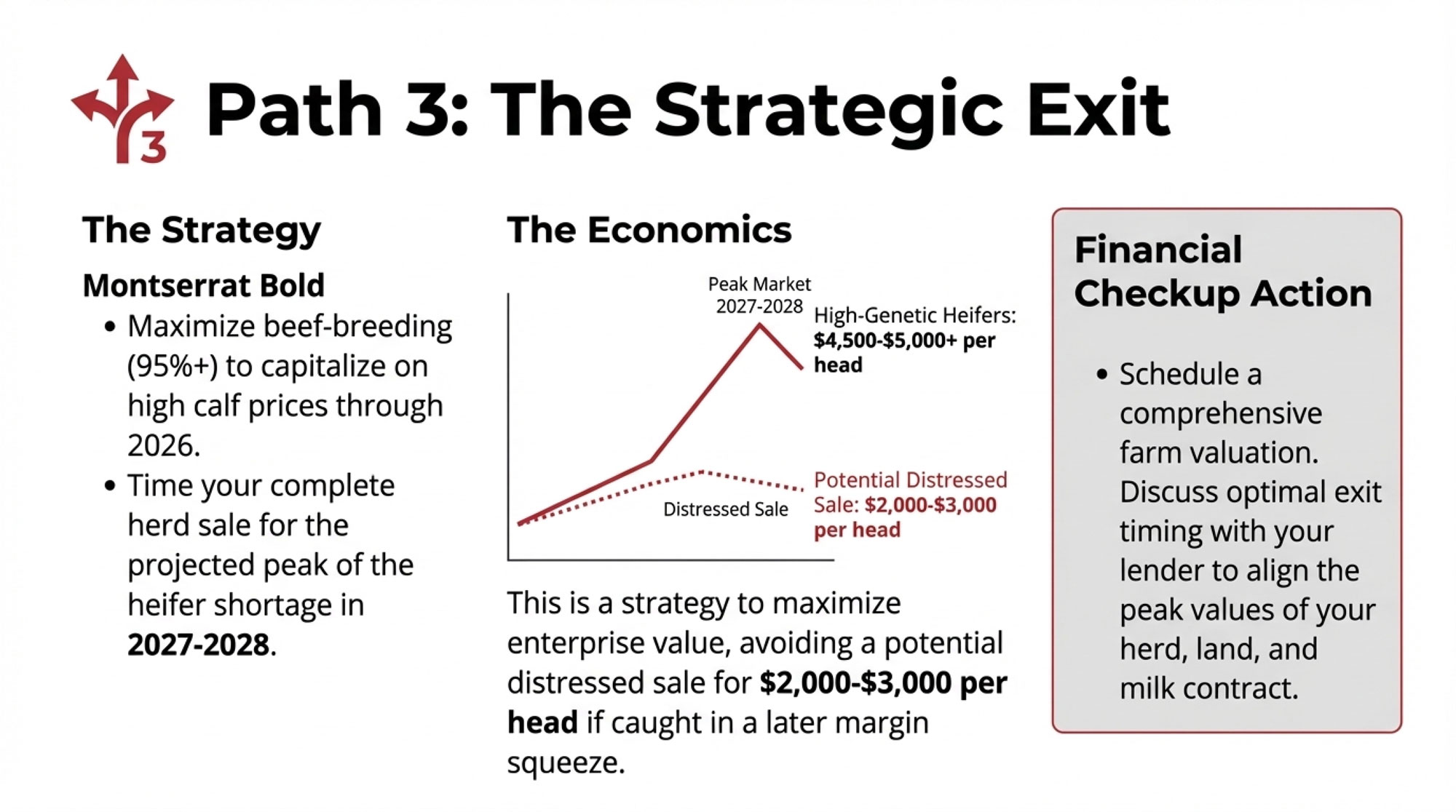
  • Maximize beef-breeding (95%+ beef semen) through 2025-2026
  • Capitalize on elevated calf prices
  • Time herd sale for 2027-2028, when heifer genetics values are projected to peak

The Economics:

  • Current replacement heifer market: $2,800 to $4,000 per head, depending on genetics and stage
  • Projected 2027-2028 peak: Potentially $4,500-5,000+ per head as shortage intensifies
  • Compare to potential distressed sales if caught in a margin squeeze: $2,000-3,000 per head
  • Capital redeployment options: service businesses for dairy farmers, land development, genetics operations, agritourism

Financial Checkup Action: Schedule a comprehensive farm valuation with your lender and discuss optimal exit timing. Your heifer inventory, land, facilities, and milk contract all have peak value windows. Understanding when those align—likely 2027-2028 based on market projections—helps you maximize enterprise value rather than being forced into a distressed sale.

The Contract Negotiation Window Is Open Now

Milk contract negotiations matter more right now than they have in years. Processors are offering multi-year contracts—3 to 5 years—with locked base pricing and component premium structures. These offers are driven by processor uncertainty about future milk availability. They’re trying to secure supply commitments before the shortage becomes industry-wide common knowledge and their negotiating leverage disappears.

What Producers Are Negotiating (Q4 2024 – Q1 2025):

  • Base pricing: Contracts being offered in the $17.50 to $18.50 per hundredweight range
  • Component premiums: $1.25 to $1.50 per hundredweight for high-testing milk (varies by processor)
  • Liability caps: Negotiate caps at one year’s milk revenue or $2.5 million maximum (unlimited liability clauses are becoming standard; insurance runs $50,000+ annually for mid-size operations)

By mid-2026, when production data confirms the heifer shortage is constraining growth, that leverage shifts dramatically. Farms locking in favorable terms in early 2025 will have substantial advantages over those accepting spot pricing or shorter contracts six months later, when terms probably worsen.

Contract ElementQ1 2025 Window (NOW)Q3 2025 ProjectedAdvantage
Base Milk Price ($/cwt)$17.50-18.50$16.80-17.80$0.70-1.00/cwt HIGHER
Component Premium ($/cwt)$1.25-1.50$0.85-1.15$0.35-0.40/cwt HIGHER
Contract Length Available3-5 years1-2 years2-3 years LONGER
Liability Cap TermsNegotiable ($2.5M cap)Unlimited (standard)Caps still possible
Processor LeverageLOW – Need supply commitmentsHIGH – Shortage confirmedProducer has power NOW

What This Means Going Forward

The biological reality here is pretty unforgiving. You can’t breed your way out of a heifer shortage retroactively. A heifer born today doesn’t freshen for 30 months. Decisions you make in the next 90 days determine your herd composition through 2027 and 2028. Operations waiting for “better conditions” or “clearer signals” will find their strategic options have narrowed substantially by mid-2025.

The Industry Is Bifurcating

The industry is splitting into distinct segments:

  • Premium component producers accessing specialized markets
  • Mega-dairies (1,500+ cows) competing on cost efficiency
  • A shrinking middle ground (500-700 cows) with limited competitive advantages

Farms making intentional choices about which segment to compete in have better odds than those maintaining status quo operations, hoping market conditions improve on their own.

The Temporary Leverage Window

Processor dynamics are creating unusual leverage for producers right now, but it’s temporary. Processing overcapacity combined with a tight milk supply creates rare negotiating power for dairy farmers willing to commit supply. But that window is open for only a limited time. Multi-year contracts with component premiums locked at current rates may represent opportunities that won’t be available once market realities become widely understood.

Genetic Investment Pays Differently Now

Component pricing puts 90% of your milk check value on butterfat and protein. Farms maintaining or enhancing dairy genetics through this shortage period—even at higher short-term cost—are positioning for substantial premiums when processing demand exceeds available supply of high-component milk.

Resources to Help You Decide

If you’re working through these decisions, extension resources can help:

  • Penn State Extension: Heifer raising cost calculators, enterprise budgets
  • Wisconsin’s Center for Dairy Profitability: Genomic selection ROI tools, contract analysis templates
  • Cornell’s dairy management program: Financial modeling for strategic path comparison

These tools are generally free or low-cost, and they’re worth using before you commit to a direction.

The Bottom Line

Recent production numbers tell an encouraging story about where the industry has been. But the heifer inventory numbers reveal something different about where we can realistically go. For those of us making decisions that’ll determine our operations’ viability through the rest of this decade, understanding that difference—and acting on it in the next few months—probably matters more than any single month’s production data.

Key Takeaways:

  • The Math That Matters: 3M Heifers → 2.5M Actual Replacements — Mortality and breeding failures eliminate 500,000 head before production. Industry needs 2.82M to maintain the current herd. That 300K shortfall determines who’s still milking in 2028.
  • The Beef-on-Dairy Bill Just Came Due — In 2023, 50-60% of farms made the rational call to breed beef genetics. That 30-month lag is now hitting—and we’re all competing for replacements that don’t exist.
  • Current Production Is Borrowed From Future Herd Health — Today’s 2% gains come from delaying culls, not improving genetics. This strategy has 12-18 months before older cow health issues force the reversal you can’t afford.
  • 90-Day Convergence: March 2025 Is Your Leverage Deadline — Breeding decisions now determine your 2028 herd composition. Contract negotiations now lock multi-year pricing. Both windows close when processors realize supply is tight—likely Q3 2025.
  • Three Paths Forward, One Window to Choose — Premium genetics: target $300K-600K in component premiums. Commodity scale: maximize beef calf revenue, buy replacements. Strategic exit: time sale for 2027-2028 peak. Decision deadline: March 2025.

Complete references and supporting documentation are available upon request by contacting the editorial team at editor@thebullvine.com.

Learn More

The Sunday Read Dairy Professionals Don’t Skip.

Every week, thousands of producers, breeders, and industry insiders open Bullvine Weekly for genetics insights, market shifts, and profit strategies they won’t find anywhere else. One email. Five minutes. Smarter decisions all week.
NewsSubscribe
First
Last
Consent

What Separates Top Beef-on-Dairy Programs from Average Ones

New data: 80% of dairy producers optimize beef sires for convenience, not value. It’s costing them $300/calf.

EXECUTIVE SUMMARY: Your beef-cross calves should be worth $1,400. If you’re getting $700, you’re not alone—but you’re fixable. After analyzing operations from Wisconsin to California, the pattern is clear: successful beef-on-dairy programs aren’t built on superior genetics but on three systematic differences—documentation protocols that add $300 per head, early nutrition investments that return 4:1, and buyer feedback loops that enable continuous improvement. The data is compelling: 20% of beef bulls that excel on beef cows fail on dairy, high-protein milk replacer ($25-40 investment) delivers $100-150 at harvest, and managing liver abscesses (50-60% in dairy crosses vs 30% in native beef) through adjusted feeding saves $50 per head. But here’s the critical warning: replacement heifers now cost $3,800-4,000, meaning over-aggressive beef breeding creates a three-year financial time bomb. This guide provides the exact 90-day implementation framework and performance benchmarks that separate operations earning $200,000+ annually from those barely covering costs.


I recently visited two dairy operations in south-central Wisconsin, both breeding beef-on-dairy calves, both using similar Angus genetics, both selling day-old calves. The first operation consistently receives $1,400 per calf. The second? They’re fortunate to clear $700—barely above straight Holstein bull prices.

This $700 gap has become one of the most discussed topics at producer meetings this year. After analyzing operations from the Central Valley to the Northeast, talking with feedlot buyers from Texas to Nebraska, and reviewing university research on crossbred performance, a pattern emerges. The operations capturing premiums approach to beef-on-dairy views it as a data-driven enterprise. Those settling for commodity prices treat it as a convenient alternative for breeding.

Understanding Today’s Beef-on-Dairy Market Dynamics

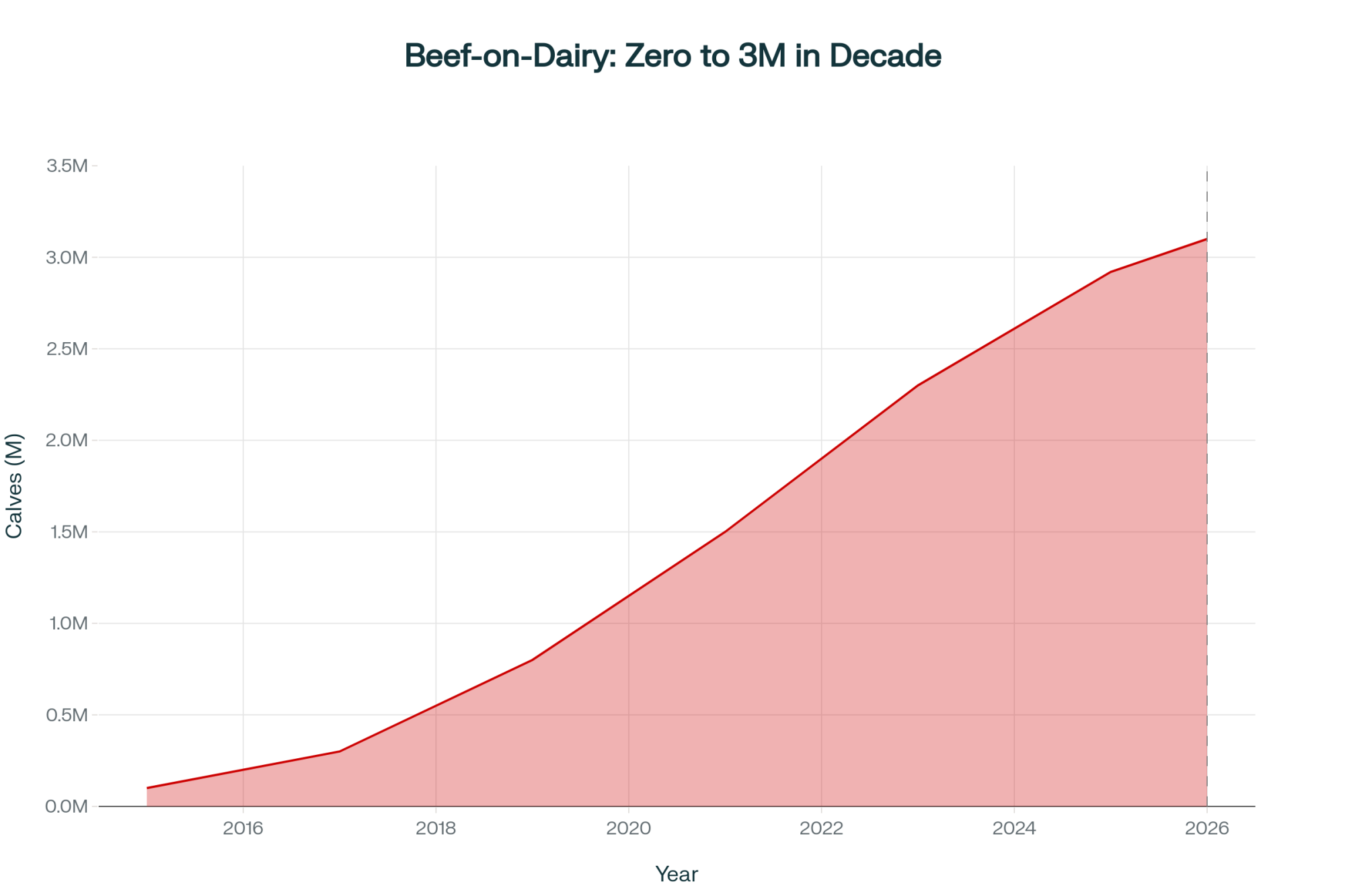
The Beef-on-Dairy Market Explosion charts a 3,000% growth trajectory from barely 100,000 calves in 2015 to 3.1 million projected for 2026, now representing 15% of fed cattle as the beef cow herd shrinks to 1960s levels—a fundamental industry transformation

The landscape for dairy-beef crosses has shifted dramatically. According to the USDA’s latest cattle inventory analysis, we’re producing 2.92 million dairy-beef calves in 2025, with industry projections suggesting continued strong growth exceeding 3 million by 2026. What’s particularly noteworthy is these animals now represent 12% to 15% of annual fed cattle slaughter—a remarkable transformation from virtually nothing a decade ago.

This growth coincides with historically low beef cow inventories. USDA’s National Agricultural Statistics Service reports the smallest beef herd since the early 1960s, while Rabobank’s global beef outlook indicates a roughly 1% decline in global beef supply this year. The beef industry needs these dairy-origin cattle to maintain supply.

Yet despite strong demand, price variation for seemingly comparable calves regularly exceeds 100%. At a recent Pennsylvania auction, I observed crossbred calves from different operations sell for $650 and $1,350 within the same hour. Why such disparity? The answer lies in documentation quality, genetic verification, and established performance history.

It’s also worth noting that seasonal patterns affect pricing. Spring calves typically command premiums of $50 to $100 over fall-born animals due to feedlot timing preferences. Gender matters too—steers generally bring $50 to $100 more than heifers in most markets, something to consider when using sorted semen.

Quick Reference: Key Numbers at a Glance

Premium Targets:

  • Beef calf premium: $700-900 per head
  • Revenue per cwt milk: $4.00-5.50
  • Beef income goal: 15-20% of total farm revenue

Investment Guidelines:

  • High-protein milk replacer (27-30%): +$25-40 per calf
  • Genomic testing: $40-60 per animal
  • Expected return on nutrition: $100-150 at harvest

Performance Benchmarks:

  • Difficult calvings: <3%
  • Pre-weaning mortality: <3%
  • Liver abscess target: 30-35% (down from 50-60%)
  • Documentation completion: >95%

Sire Selection: Where Value Creation Begins

Michigan State University’s October 2024 beef-on-dairy survey reveals an interesting disconnect. Most dairy producers prioritize conception rate (78% of respondents), calving ease (67%), and semen cost (58%) when selecting beef sires. These are certainly important considerations for dairy management. But the traits that create downstream value—ribeye area, marbling score, frame size, growth rate—receive far less attention. Only 22% consider the ribeye area. Just 14% evaluate marbling potential.

This focus on convenience over calf value represents a fundamental misalignment. As Wisconsin dairy specialists often observe, many producers are optimizing for dairy operational efficiency rather than beef chain requirements. That disconnect typically costs $200 to $300 per calf in lost premiums.

ABS Global’s Real World Data program, which analyzed over 50,000 beef-on-dairy calvings, uncovered something every producer should understand: approximately 20% of bulls performing well for calving ease in beef herds fail to meet acceptable thresholds when bred to dairy cows. The biological differences between beef and dairy females—particularly pelvic structure and gestation length—make dairy-specific performance data essential.

I spoke with a Central Valley dairyman who learned this lesson expensively. He’d selected an Angus bull with excellent traditional EPDs and strong calving ease predictions. After losing three Holstein heifers to calving difficulty within a month, he pulled that bull from the rotation. Those weren’t just calf losses—those were future productive cows eliminated from the herd.

The most successful beef-on-dairy programs I’ve studied work exclusively with AI organizations offering dairy-validated sire data. Companies including Select Sires (NxGEN program), Alta Genetics (BULLSEYE platform), and Semex (XSire portfolio) maintain databases tracking the actual performance of beef bulls on dairy females. This distinction matters more than many producers realize.

What’s encouraging is that beef breed associations are increasingly recognizing this need, developing dairy-specific EPDs and working with AI companies to validate performance on dairy females. This industry-wide collaboration benefits everyone. Some producers are also experimenting with SimAngus and even Charolais crosses for specific markets, though Angus remains the predominant choice for good reason—market acceptance and predictable performance.

Regional Market Variations Shape Opportunities

What works in California’s integrated systems may not translate directly to Midwest cooperative structures or Northeast family operations. Understanding these regional dynamics is crucial for program success.

California’s Central Valley features vertical integration, with established calf ranches maintaining direct relationships with dairies. These operations know their genetic preferences and pay accordingly for documented quality. Wisconsin and Minnesota producers often market through cooperative structures where calves are pooled. In these systems, individual documentation becomes even more critical for capturing premiums above pool averages.

Texas presents yet another model. Major feedlots, including Friona Industries and Cactus Feeders, operate procurement programs that contract directly with dairies, sometimes months before calves are born. These arrangements often specify genetic requirements and health protocols in exchange for premium pricing.

Smaller dairy regions—Vermont’s hillside farms, Idaho’s Magic Valley operations, New Mexico’s desert dairies—each face unique challenges. Vermont producers might focus on grass-finished programs for local markets. Idaho operations often integrate with nearby feedlots. New Mexico dairies face water constraints that affect their feeding strategies. Each region requires adapted approaches.

Even within regions, smaller operations are finding success. A 60-cow organic farm in Vermont recently told me they’re getting $1,200 for grass-fed beef-cross calves sold to local finishers—not quite the $1,400 conventional premium, but exceptional for their scale and market.

The Critical First Eight Months

Every calf has an 8-week biological window that closes permanently. Feed high-protein milk replacer ($40 extra cost) during this period and you’ve locked in 4.8 extra pounds that compound to 50-100 additional pounds at harvest—worth $100-150. Miss this window with standard nutrition and no amount of expensive finishing ration recovers the loss. Yet 80% of operations still feed beef-cross calves like unwanted Holstein bulls.

Here’s a biological reality that fundamentally shapes beef-on-dairy economics: muscle fiber numbers and intramuscular fat cell populations are established during the first eight months of life. After this developmental window closes, you’re working with what you’ve got. No amount of superior finishing nutrition can compensate for deficiencies during this critical period.

When beef-cross calves receive standard 20% to 22% protein dairy heifer milk replacer—the formulation most farms already stock—they’re being nutritionally shortchanged. Research from Texas Tech University’s animal science department demonstrates that calves fed 27% to 30% protein milk replacers gain an additional 4.8 pounds by eight weeks and develop 14% larger muscle fiber cross-sectional area. While 4.8 pounds may seem modest, this advantage compounds throughout the feeding period, translating to 50 to 100 pounds of additional carcass weight at harvest.

The economics are compelling. Higher-protein milk replacer costs approximately $25 to $40 more per calf based on current industry pricing from major manufacturers. Feedlot performance data suggests returns of $100 to $150 per head from improved muscling and marbling development—a strong return on investment.

Yet university surveys indicate only about 20% of operations use 28% or higher protein formulations for beef-cross calves. Most producers inadvertently limit genetic potential during the most critical developmental phase.

I should note that several successful operations achieve excellent results with standard protein levels by compensating through higher feeding rates (8 quarts daily vs. the standard 6), superior colostrum management, and comprehensive stress-reduction protocols. A Jersey operation in Oregon feeds standard protein but delivers 10 quarts daily in three feedings, achieving exceptional growth rates. Multiple pathways can lead to success, but the biological principle remains constant: early nutrition establishes lifetime performance potential.

Addressing the Liver Abscess Challenge

The Liver Abscess Crisis exposes dairy-beef crosses’ 55% abscess rate versus 30% in native beef—costing operations $45,000 annually per 1,000 head and risking $3,000-per-minute processing shutdowns until Kansas State research proved 45% forage diets solve the problem without sacrificing gains

Liver abscess incidence presents a significant yet often overlooked challenge in beef-on-dairy production. Dr. T.G. Nagaraja from Kansas State, with four decades of research in this area, reports native beef cattle typically show 30% abscess rates, while dairy-beef crosses reach 50% to 60%. Some operations experience rates approaching 70%.

Beyond direct economic losses from condemned organs and reduced performance (approximately $30 to $50 per head based on packer data from National Beef and Cargill), there’s operational risk at processing facilities. A ruptured abscess can contaminate equipment, requiring line shutdown and intensive cleaning. Based on industry estimates from multiple major processors, these stoppages cost approximately $3,000 per minute in lost throughput. The Packers remember which cattle sources cause these disruptions.

Recent findings from the USDA Agricultural Research Service’s Lubbock Livestock Issues Research Unit reveal that bacterial colonization pathways are more complex than previously understood. Dairy-influenced cattle appear particularly susceptible, possibly due to inherited differences in gut architecture—larger digestive capacity from Holstein genetics combined with lifetime exposure to high-concentrate diets.

Progressive feedlots have adapted their protocols accordingly. Rather than pushing traditional 90% concentrate rations to maximize gains, they’re incorporating 20% to 45% forage. They’re limiting starch to 45% to 55% rather than 60% or higher. They’re ensuring consistent provision of 10% to 12% effective fiber.

Kansas State research demonstrates that increasing corn silage from 15% to 45% of the ration significantly reduces abscess incidence without compromising performance—same daily gains, equivalent feed efficiency, healthier livers. This builds on what we’ve learned about the unique nutritional requirements of dairy-beef crosses.

External factors can complicate management, too. Drought conditions affecting forage quality, international trade disruptions impacting grain prices, and even weather extremes during the feeding period—all influence liver health outcomes. Successful operations build flexibility into their feeding programs to adapt to these variables.

Looking ahead, some operations are exploring carbon credit opportunities for efficiently raised beef-on-dairy cattle, particularly those with lower methane emissions from optimized feeding strategies. While still developing, this could add another revenue stream for well-managed programs.

The Replacement Heifer Cost Consideration

The Replacement Heifer Crisis shows how heifer costs exploded 164% from $1,140 to $3,900 while beef calf values declined, creating a devastating $2,860 per-head margin collapse that transformed profitable programs into financial disasters

Perhaps no factor has surprised more producers than replacement heifer economics. Many operations that aggressively shifted to beef breeding in 2022-2023, motivated by $1,400 crossbred calves and $1,140 replacement costs, now face what economists term a “replacement inventory crisis.”

USDA’s January data shows national heifer inventory at 3.914 million head—the lowest since 1978. California’s major auction markets, including Producers Livestock in Tulare and Overland Stockyards in Fresno, report springer heifer prices of $3,800 to $4,000. That represents a 164% increase over three years—a change few operations anticipated in their financial modeling.

I’ve worked with several 500-cow Midwest operations facing this reality. They projected $700 premiums per beef-cross calf with 65% of the herd bred to beef, assuming $2,200 replacement costs based on 2023 prices. They anticipated $210,000 in additional annual revenue.

Current reality? Replacement heifers at $3,800 represent an additional $1,600 per head. For 150 annual replacements, that’s $240,000 in unplanned expense. Net result: negative $29,000 rather than the projected profit.

Dr. Victor Cabrera from Wisconsin’s Center for Dairy Profitability recommends limiting beef revenue to 10% of total farm income, maintaining strategic heifer inventory through balanced breeding (typically 35% to 40% dairy genetics, 60% to 65% beef), and utilizing the USDA’s Livestock Risk Protection insurance now available for beef-on-dairy calves.

International factors add complexity. Export demand for U.S. beef, Mexican cattle import policies, and even global grain markets influence both beef calf values and replacement heifer costs. Producers must consider these macro factors when planning breeding strategies.

Building Performance Feedback Systems

What truly distinguishes operations capturing consistent premiums is their commitment to performance tracking and continuous improvement. These producers document comprehensive data from birth through harvest, share information with buyers to build premium relationships, and—critically—obtain feedlot and carcass performance data to refine their programs.

Consider Cogent’s UK Beef Breeding Programme, which partners with Pathway Farming to track calves from birth through retail placement. With over 318,000 data points collected since 2021, they’ve achieved remarkable results: average days to slaughter of 512 (versus 580+ UK average), 87.4% achieving target fat grades, and 97% meeting conformation standards. The program produced the top 11 Angus bulls for intramuscular fat in recent UK breed evaluations—all through systematic data collection and analysis.

Most U.S. operations lack this feedback loop. They breed, sell, and move forward without learning whether their genetic selections performed, which bulls consistently underperform, or why their calves command different prices than neighboring operations.

A Practical 90-Day Implementation Framework

For producers initiating or refining beef-on-dairy programs, the first 90 days establish the foundation for long-term success. Here’s what I’ve seen work across different operation sizes and regions.

Days 1-30: Strategic Planning

Begin with replacement heifer modeling. A 500-cow operation with 30% annual turnover requires 150 replacements. Calculate backwards to determine sustainable beef breeding percentages without creating future heifer shortages. Remember to factor in conception rate differences—beef semen typically runs 8% to 12% below conventional dairy semen.

Model financial scenarios, including worst-case projections. What happens if beef prices decline to $1,000 while heifer costs reach $4,500? Build sufficient financial reserves to weather market volatility. Consider the impacts of drought on feed costs, potential trade disruptions, and even local packing plant closures.

Establish buyer relationships before breeding. One California producer I know invested three weeks contacting calf ranches and feedlots, securing written pricing commitments from two buyers before ordering beef semen. When calves arrived nine months later, marketing was predetermined.

Complete genomic testing if it has not already been implemented. At $40 to $60 per animal through providers like Zoetis CLARIFIDE or Neogen Igenity, this investment identifies which females should produce replacements versus beef calves. Using top genetic females for beef production because they didn’t conceive to dairy semen reverses proper selection logic.

Days 31-60: Infrastructure Development

Source appropriate milk replacer formulations for beef-cross calves. The 27% to 30% protein products cost more but deliver measurable returns through improved muscle development—unless you’ve developed proven compensatory management systems.

Implement documentation systems, whether through existing software like DairyComp 305 or simple spreadsheets. Track sire identity, dam information, birth metrics, colostrum quality (invest in a Brix refractometer if you don’t have one), health interventions, and growth measurements. An Oregon producer recently showed me three years of data revealing conception rates, calving ease scores, and buyer feedback for every sire used.

Develop buyer documentation packages. Providing genetic background, health protocols, and performance data transforms commodity calves into documented products that command premiums of $200 to $300, according to Kansas State agricultural economics research.

Days 61-90: Strategic Execution

Select sires using dairy-validated performance data. Target bulls in the top third for calving ease (verified on dairy, not beef females), top 70% for marbling, positive ribeye area EPDs, and moderate frame scores. Consider seasonal breeding patterns—some producers use different sires for spring versus fall calvings based on anticipated marketing conditions.

Monitor all metrics systematically. Track conception rates by sire, document calving ease, and identify patterns. When bulls consistently underperform despite favorable EPDs, remove them from rotation. Your herd’s actual performance supersedes population predictions.

Benchmarks for Year Three Success

Well-executed programs demonstrate clear performance indicators by year three:

Financial metrics include consistent $700 to $900 calf premiums regardless of market cycles, $4.00 to $5.50 revenue per hundredweight of milk produced, beef income representing 15% to 20% of total farm revenue (enough to matter without creating dangerous dependency), and twelve months of operating reserves accumulated.

Production achievements show difficult calvings below 3% (versus 5% to 8% industry average per the National Association of Animal Breeders), pre-weaning mortality under 3%, quality grades of 80% to 85% Choice or better when receiving carcass data, and liver abscess rates reduced to 30% to 35% from initial 50% to 60% levels.

Operational excellence is demonstrated by 95% complete documentation for all calves, carcass performance data received for 80% of animals sold, and 60% to 80% of production committed through established buyer relationships.

The resilience test came in October 2025, when beef markets declined 7% following new tariff-rate quotas on Argentine beef imports, as reported by DTN livestock analyst ShayLe Hayes and confirmed by Farm Bureau reporting. Well-managed programs absorbed $30,000 to $50,000 impacts while continuing operations. Poorly positioned operations incurred substantial losses, casting doubt on the program’s viability.

Essential Principles for Success

Several key insights emerge from analyzing successful beef-on-dairy enterprises across diverse operational contexts:

Documentation creates more value than genetics alone. Average genetics with complete documentation consistently outsell superior genetics lacking paperwork by $300 per head. Every time.

Early nutrition establishes lifetime potential. The first eight weeks prove especially critical. Biological development windows close permanently—feed beef-cross calves as the premium products they represent, not as unwanted byproducts.

Liver abscesses respond to adjusted feeding strategies. Dairy-beef crosses require more forage, moderate starch levels, and gradual transitions. This reflects biological differences, not management preferences.

Replacement heifer planning cannot be deferred. Problems arise not from selecting incorrect sires but from overcommitting to beef breeding without modeling future replacement needs. The three-year lag between breeding decisions and heifer availability catches many operations unprepared.

Performance feedback enables continuous improvement. Each breeding cycle without carcass data represents a missed opportunity for refinement. Today’s leading programs resulted from three years of systematic improvement based on actual performance data, not theoretical projections.

Success requires adopting a beef producer mindset while maintaining dairy operational excellence. This shift from viewing calves as byproducts to managing them as products transforms every decision from genetics through marketing.

Looking Forward

The $700 premium gap between successful and struggling beef-on-dairy programs reflects systematic execution differences, not market luck. These crossbred animals require specialized management acknowledging their unique biology—neither purely dairy nor purely beef.

With beef cattle inventories at historic lows and dairy-origin cattle becoming a foundational part of the U.S. beef supply—exceeding 3 million head annually per USDA Economic Research Service projections—the opportunity remains substantial. However, easy premiums have disappeared. As more producers enter this market and buyers become increasingly selective, only operations with documented genetics, proven health protocols, optimized nutrition, and continuous improvement systems will capture maximum value.

The path forward is clear: invest 90 days building proper infrastructure before breeding, or spend three years wondering why neighbors receive double your calf prices. Having observed both approaches across numerous operations from small Vermont hillside farms to large New Mexico desert dairies, the successful path is evident.

Markets compensate documented, predictable, continuously improving performance—not good intentions or fortunate genetics. Producers understanding this principle generate $200,000 or more annually from beef-on-dairy enterprises. Others barely cover costs while blaming market conditions.

The framework exists. Research from land-grant universities supports it. Successful examples multiply monthly across every dairy region. As you plan next season’s breeding strategy, consider which approach aligns with your operational goals and risk tolerance.

Because ultimately, this isn’t about choosing between dairy and beef production—it’s about optimizing both within your unique operational context. The producers who understand this are building sustainable, profitable enterprises that strengthen both their operations and the broader beef supply chain.

KEY TAKEAWAYS

  • Documentation > Genetics: Complete health and breeding records add $300/head to any calf—superior genetics without paperwork sell at commodity prices
  • Invest $40 in the first 8 weeks, harvest $150 in value: High-protein milk replacer (27-30%) during early development creates permanent muscle and marbling advantages
  • Liver abscesses aren’t inevitable: Increase forage from 15% to 45% in finishing rations—same gains, 50% fewer condemned livers
  • The 65% Rule: Never breed more than 65% of your herd to beef—replacement heifers at $3,800-4,000 will destroy three years of premiums
  • No feedback = No improvement: Top operations track performance from birth to harvest and adjust quarterly; average operations repeat the same mistakes annually

Complete references and supporting documentation are available upon request by contacting the editorial team at editor@thebullvine.com.

Learn More:

The Sunday Read Dairy Professionals Don’t Skip.

Every week, thousands of producers, breeders, and industry insiders open Bullvine Weekly for genetics insights, market shifts, and profit strategies they won’t find anywhere else. One email. Five minutes. Smarter decisions all week.
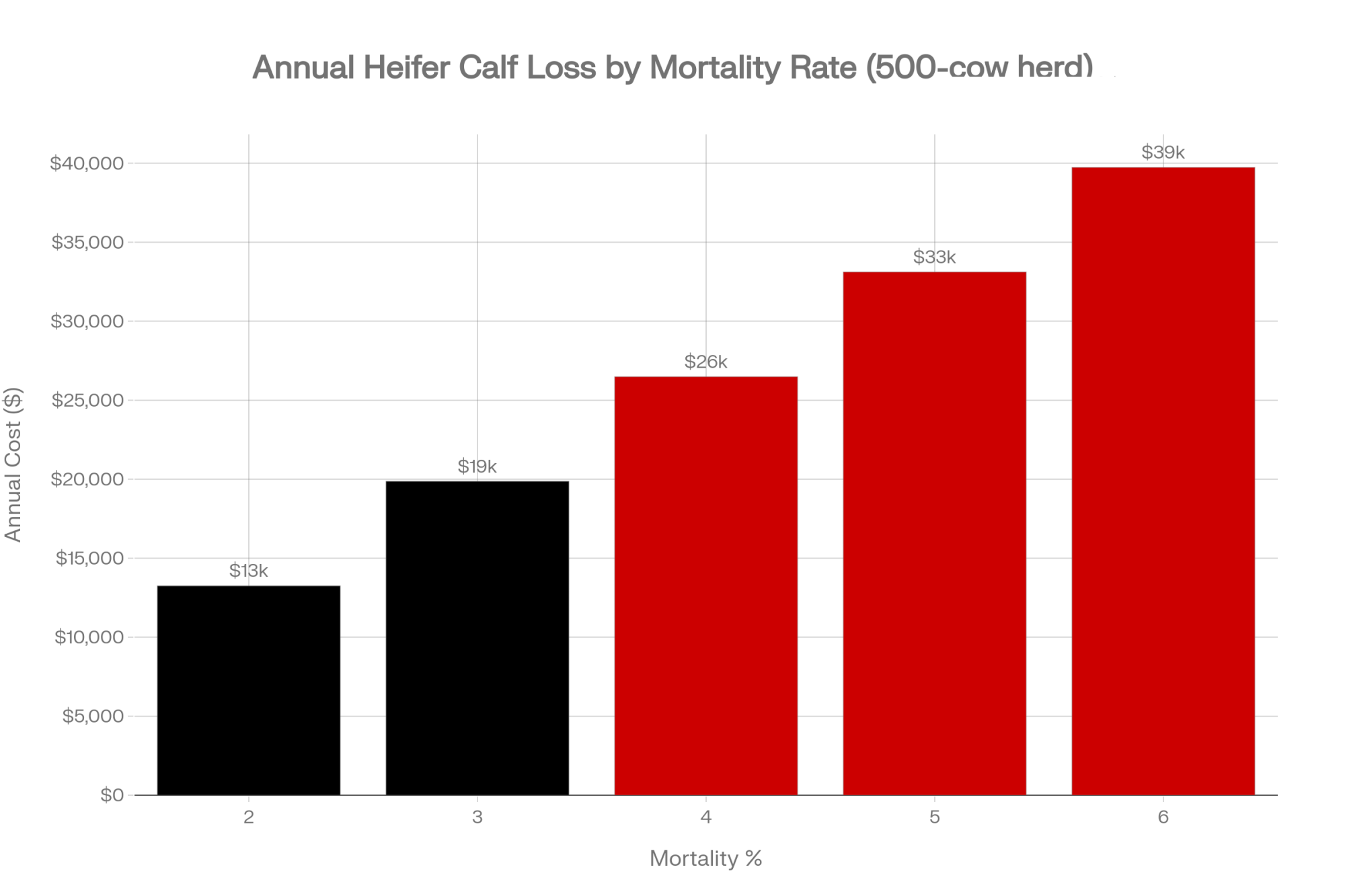
NewsSubscribe
First
Last
Consent
Send this to a friend