




Archive for Brix refractometer

The Colostrum Standard Moved — and 39% of Your “Passed” Calves Are Losing Milk

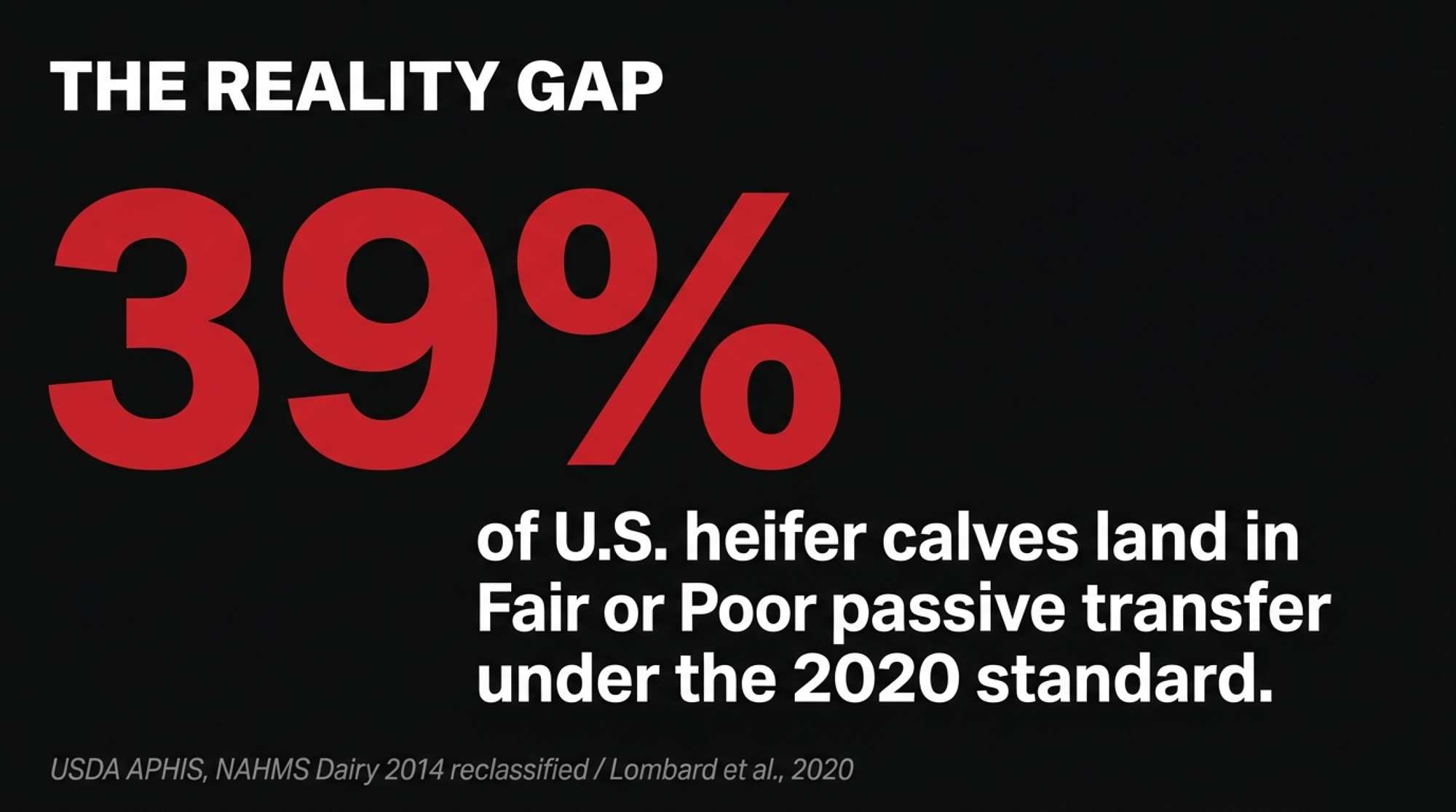
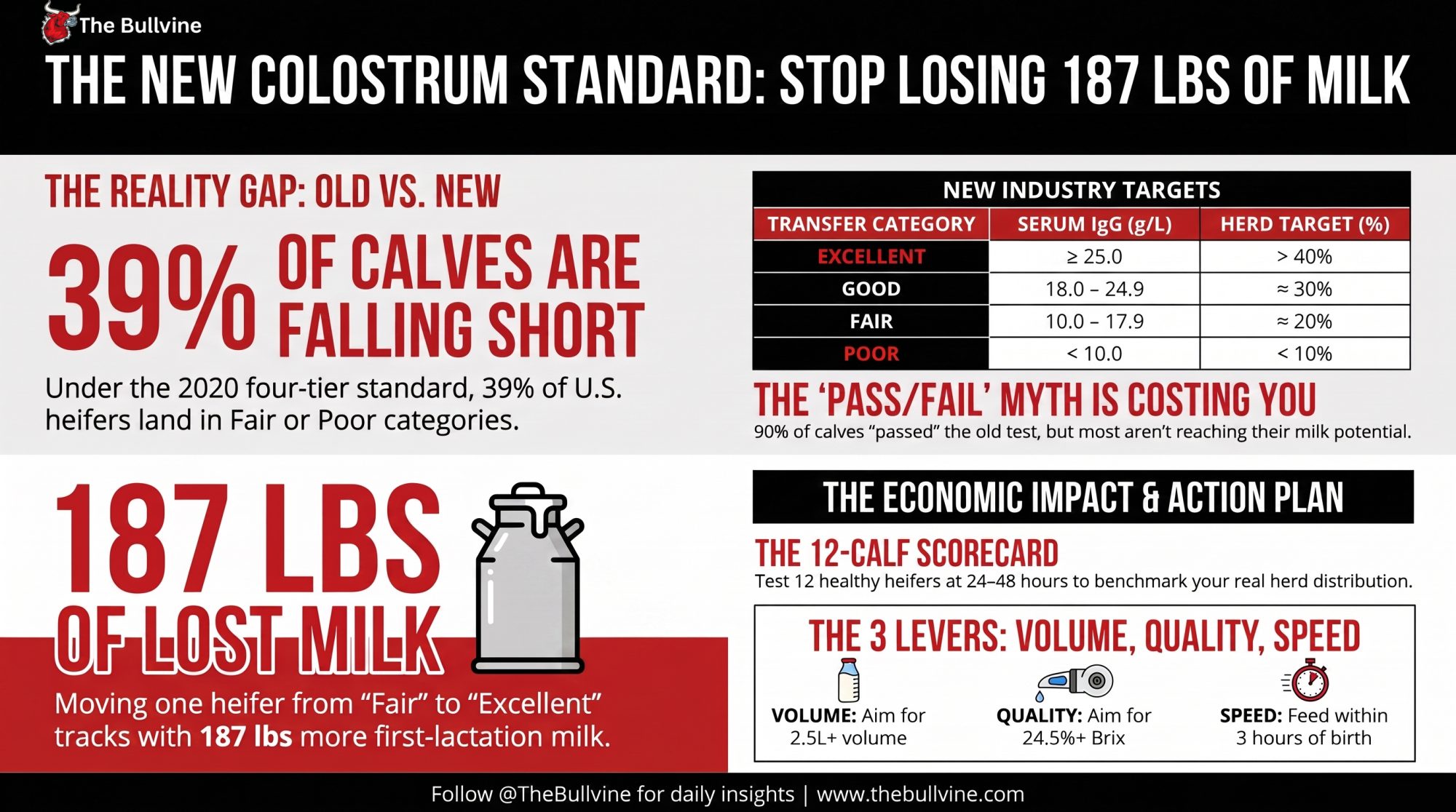
Reclassified under the four-tier standard, nearly 39% of U.S. heifer calves land in Fair or Poor — and the research suggests that gap follows them into first lactation.

The vet pulls blood from twelve healthy heifer calves, spins it, and runs each sample across a refractometer you already own. Nothing looks wrong. None of these calves are sick. They’re bright, they’re nursing, and they’d pass any eyeball test. Then the numbers come back — and the chart tells a different story than the calves do.
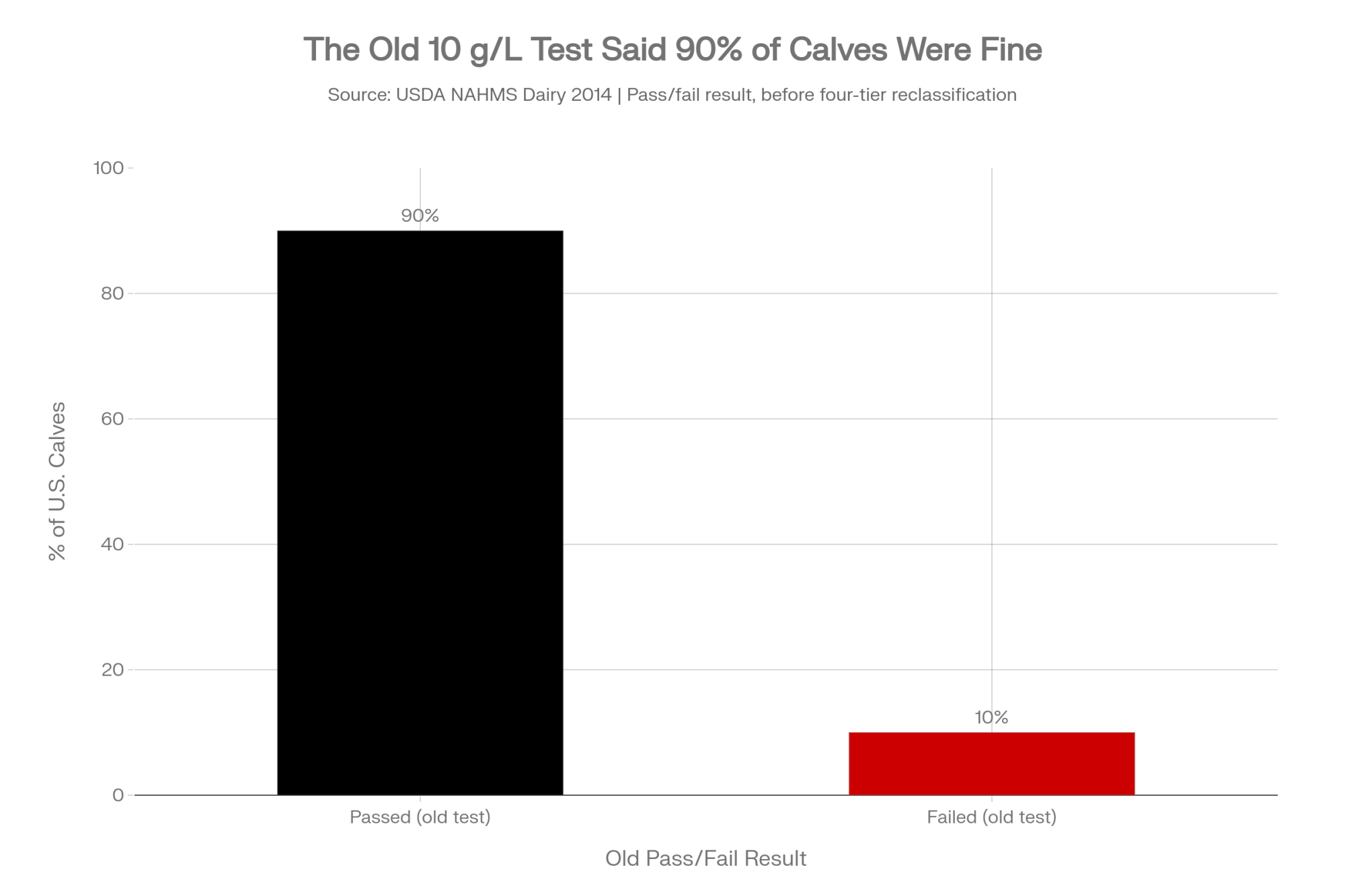
That’s the moment this whole thing turns. For twenty years, the standard said a calf either passed or failed at 10 g/L of serum IgG — and by that math, roughly 90% of calves in the USDA’s National Animal Health Monitoring System (NAHMS) Dairy 2014 study passed. A clean 90%. Sounds like a program that’s working. But it isn’t measuring what pays you back.

The Standard Quietly Changed, and Most Herds Didn’t Notice

In 2020, a group of calf experts led by Jason Lombard published consensus recommendations in the Journal of Dairy Science that retired the old pass/fail line. In its place: four tiers of passive transfer — Excellent, Good, Fair, and Poor — each with serum IgG, total protein, and Brix cut points you can read on-farm (Lombard et al., J. Dairy Sci.103:7611–7624, 2020, U.S. dairy calves).
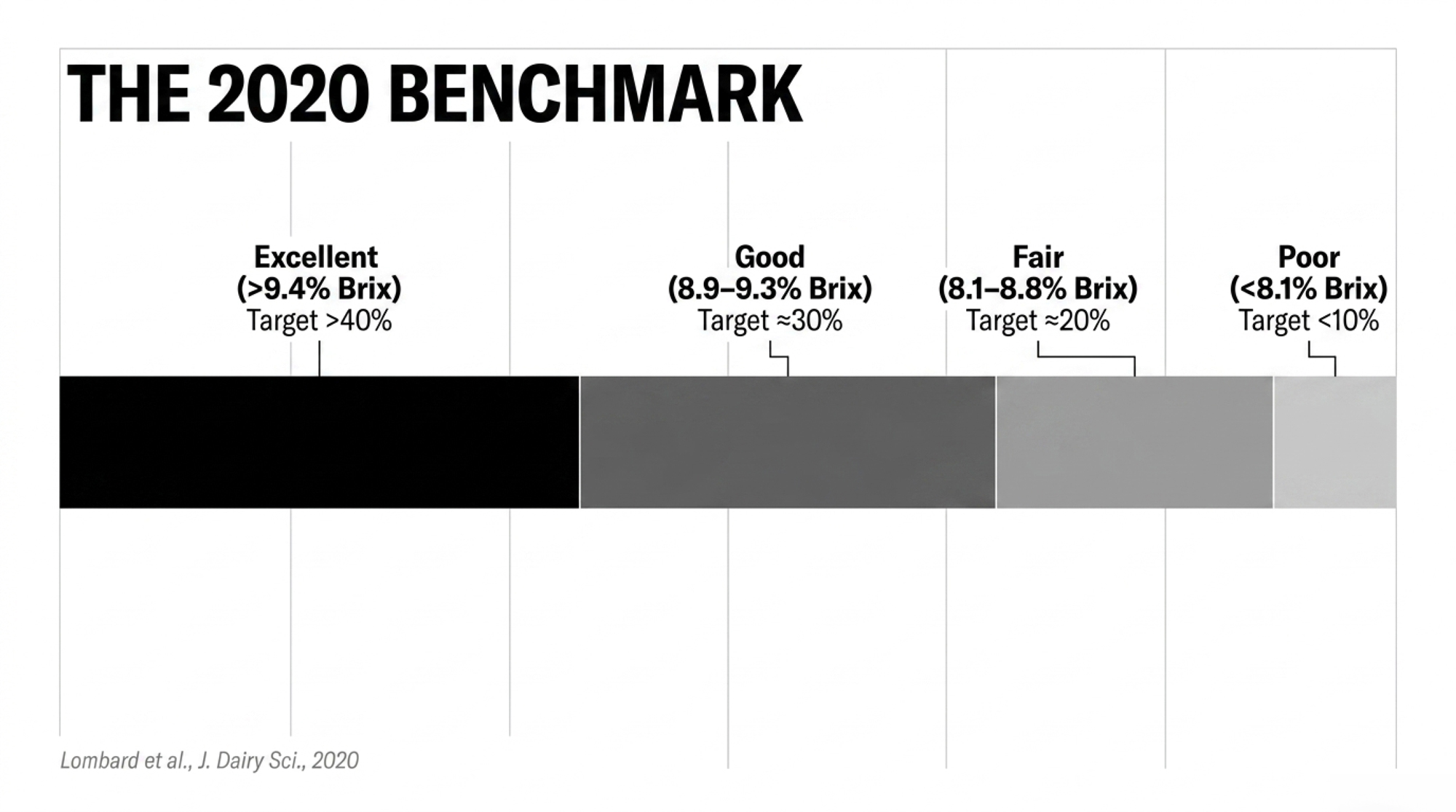
Transfer categorySerum IgG (g/L)Total protein (g/dL)Brix (%)Herd target (% of calves)
Excellent≥ 25.0≥ 6.2≥ 9.4%> 40%
Good18.0 – 24.95.8 – 6.18.9% – 9.3%≈ 30%
Fair10.0 – 17.95.1 – 5.78.1% – 8.8%≈ 20%
Poor< 10.0< 5.1< 8.1%< 10%

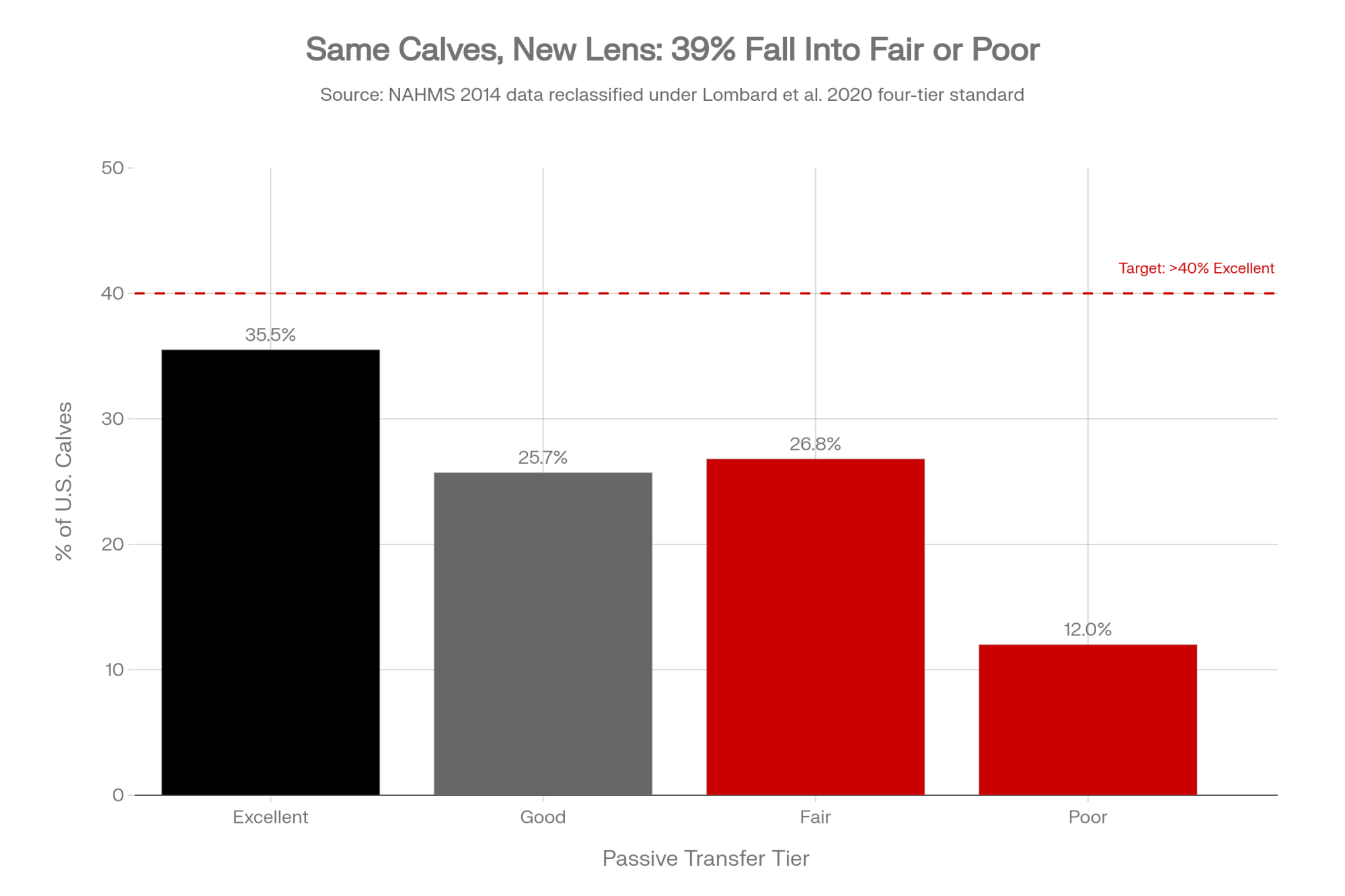
Now run the old NAHMS numbers through the new lens. When the Dairy 2014 data get reclassified into Lombard’s tiers, only about 35.5% of heifer calves land in Excellent, 25.7% in Good, 26.8% in Fair, and 12.0% in Poor (USDA APHIS, NAHMS Dairy 2014 info brief, U.S. national). It’s a decade-plus old, but it’s still the most recent USDA national passive-transfer survey we have. Same calves. Same blood. Nearly 39% of them are sitting in Fair or Poor.

The blood draw didn’t change. The question did. The old test asked, “Is this calf in danger?” The four-tier chart asks something harder: “Is this calf on track to pay back what she cost to raise?”

Why Is a Blood Value Really a Revenue Number?

Three separate studies point at the same target, and none of them are about scours.

Back in 1989, DeNise and colleagues followed roughly 1,000 Holstein heifers and found serum IgG measured shortly after birth was a real source of variation in first-lactation milk — a slope of 8.5 kg of mature-equivalent (ME) milk per 1 g/L of serum IgG (DeNise et al., J. Dairy Sci. 72:552–554, 1989). ME basis means the figure is standardized to a mature cow’s production, not a raw first-lactation tank weight. It’s an association from one cohort, not a guarantee. But it’s held up across the citations since, and it puts a number on a blood value most people file under “health.”

Then there’s growth. Soberon and colleagues reported that each 1 kg of preweaning average daily gain tracked with 850 kg more first-lactation milk in the Cornell herd, and 1,113 kg more in a commercial herd (Soberon et al., J. Dairy Sci.95:5254–5267, 2012). That early growth runs straight through the same colostrum window you’re testing.

And the cost of getting it wrong isn’t hypothetical. Raboisson’s 2016 meta-analysis pegged the mean total cost of a dairy calf with failure of passive transfer at about €60, with a prediction interval running to €109 (Raboisson et al., PLOS ONE, 2016). That’s before you count the milk you never make.

The Barn Math Nobody’s Running

Walk it through on one calf. Take a heifer sitting at 15 g/L — squarely mid-Fair, right where a big share of NAHMS calves live. Compare her to a herdmate at 25 g/L, the floor of Excellent. That’s a 10 g/L gap.

💸 The Leak on the Milk Check
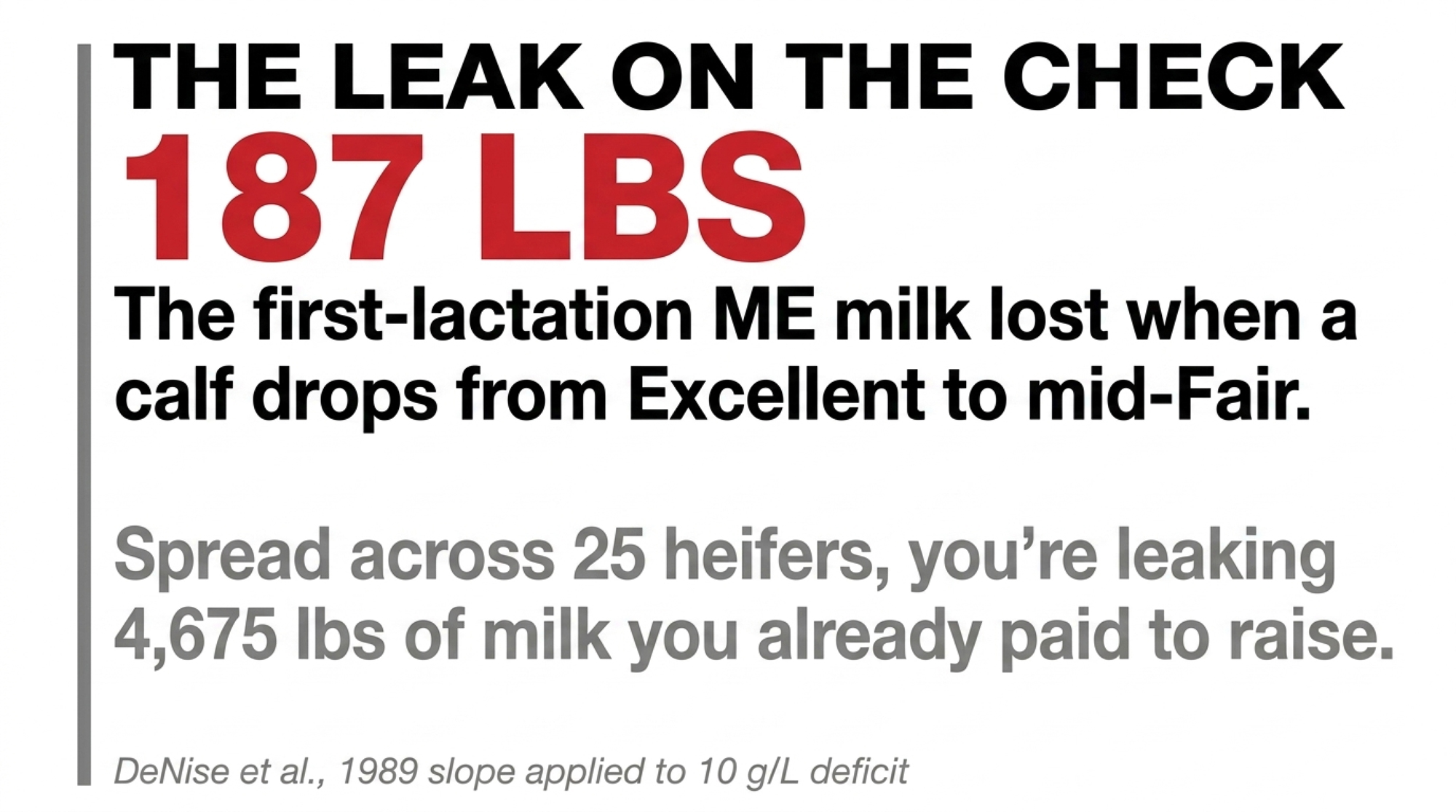
A calf in Fair (15 g/L) instead of Excellent (25 g/L) sits at a 10 g/L deficit.

On DeNise’s 1989 slope, that gap tracks with roughly 85 kg — about 187 lbs — of lost first-lactation milk per calf, mature-equivalent (ME) basis.
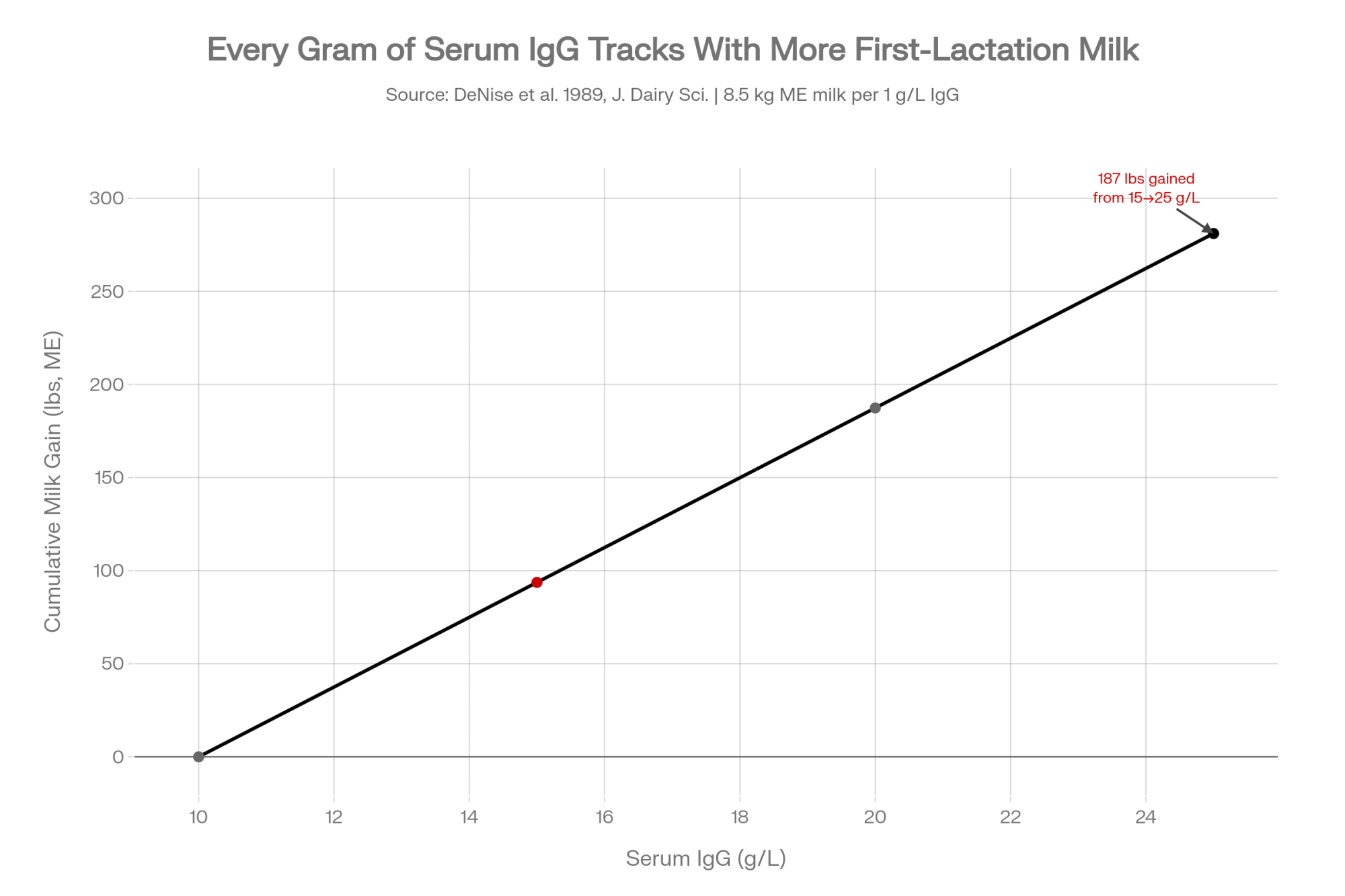
Scale it: for every 25 heifers stuck in Fair that could’ve reached Excellent, that’s roughly 4,675 lbs of ME first-lactation milk you’d already paid to raise.

This is an association from one cohort, not a guaranteed yield — but it’s the direction, and it’s real.

That’s the whole tension. The math has existed since 1989. The levers are known. And on most farms it’s still filed next to the scours rate instead of next to pregnancy rate and feed conversion. A leak spread across a quarter of the heifer crop never shows up as a disaster — it shows up as a herd that’s “doing fine.”

How Do You Actually Read the Herd? The 12-Calf Scorecard
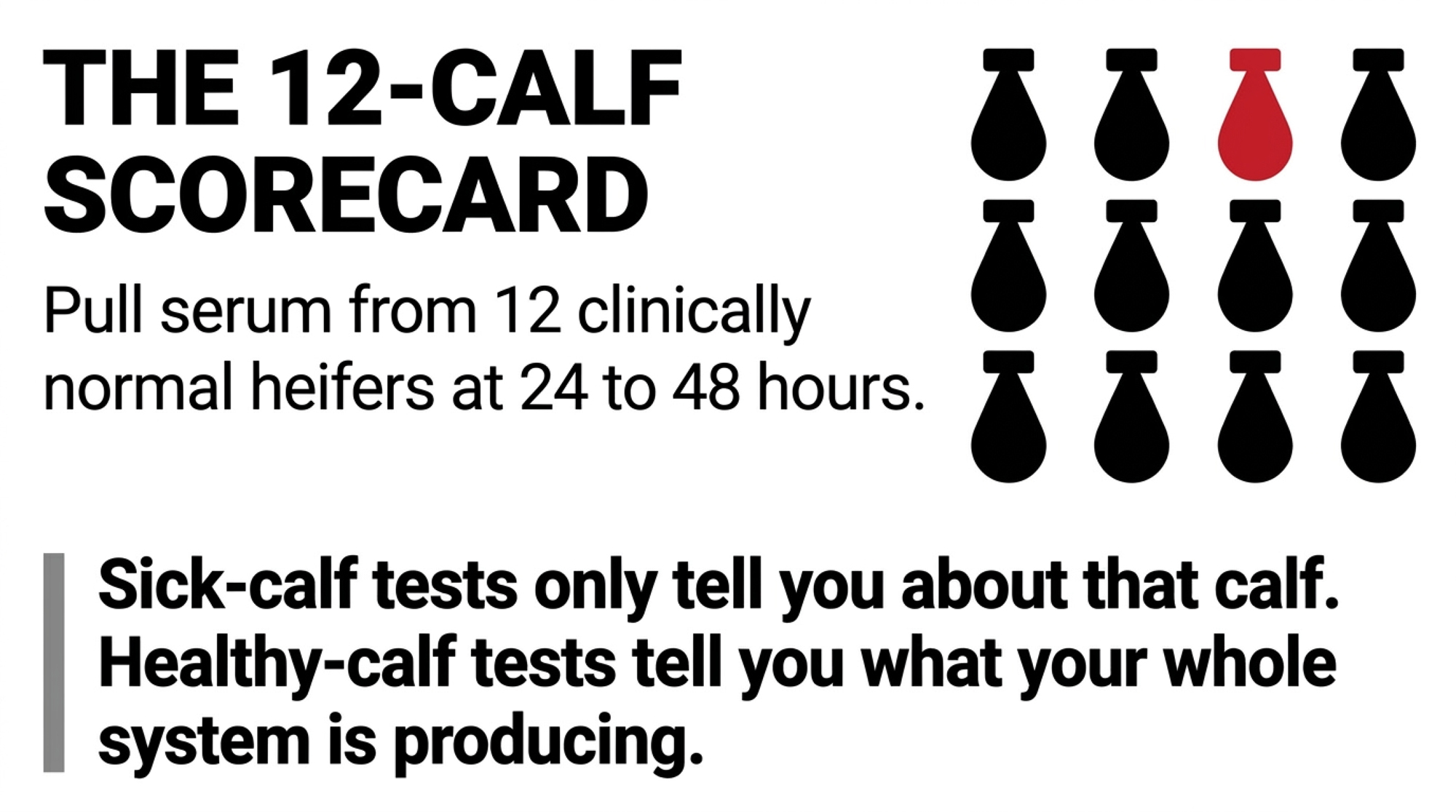
Here’s the tool. Have your vet pull serum from at least twelve clinically normal heifer calves at 24 to 48 hours of age — healthy ones, not the sick pen. Read each on a Brix or total-protein refractometer, the same one plenty of herds already use on colostrum. Sort them into the four tiers. Plot the distribution against the 40/30/20/10 target.

TierSerum IgG (g/L)Herd Target (%)Morin BenchmarkAction If Below Target
Excellent≥25.0>40%Protocol is working; maintain
Good18.0–24.9≈30%Combined Excellent+Good should exceed Morin’s 68% medianCheck Brix consistency shift-to-shift
Fair10.0–17.9≈20%Audit first-feeding volume (target ≥2.5 L).
Poor<10.0<10%Trigger: audit volume, Brix, and timing on every calf for a month.

Two things matter here. First, sample the calves that look good, because a sick-calf test only tells you about that calf — a healthy-calf sample tells you what your whole system is producing. Second, do it early, before dehydration or illness muddies the reading. Twelve is a floor, not a ceiling; more calves sharpen the picture.

The first time a herd runs this, the chart usually looks a lot like NAHMS 2014 — about a third Excellent, a quarter Good, the rest stuck in Fair and Poor — unless they’ve already put real work into colostrum. That’s the “oh” moment. And it goes one of two ways.
Sponsored Post

What Separates the Farms That Move From the Ones That File It Away

The difference isn’t knowledge. It’s ownership. And the fixable levers aren’t complicated — they’re things that happen in the first hours after a calf hits the ground.

Morin’s herd-level work in Québec makes the levers concrete. Across 144 herds, the prevalence of adequate transfer of passive immunity ranged from 24% to 100%, with a median of 68% (Morin et al., J. Dairy Sci. 104:1122–1135, 2021). In the final model, only two things stayed significantly tied to a herd hitting adequate transfer: how consistently calves got enough colostrum volume at the first meal, and how consistently they got it fast.

FeatureOld Pass/Fail Standard (pre-2020)Lombard Four-Tier Standard (2020)
Cut pointSingle line at 10 g/L serum IgGFour bands: <10, 10–17.9, 18–24.9, ≥25 g/L
% of NAHMS 2014 calves “adequate”~90% pass61.2% (Excellent + Good)
% flagged as a concern~10% fail38.8% (Fair + Poor)
What it actually predictsDisease risk onlyDisease risk AND first-lactation milk (ME)
Herd target“Pass rate” — no upper tier goal40/30/20/10 distribution across tiers

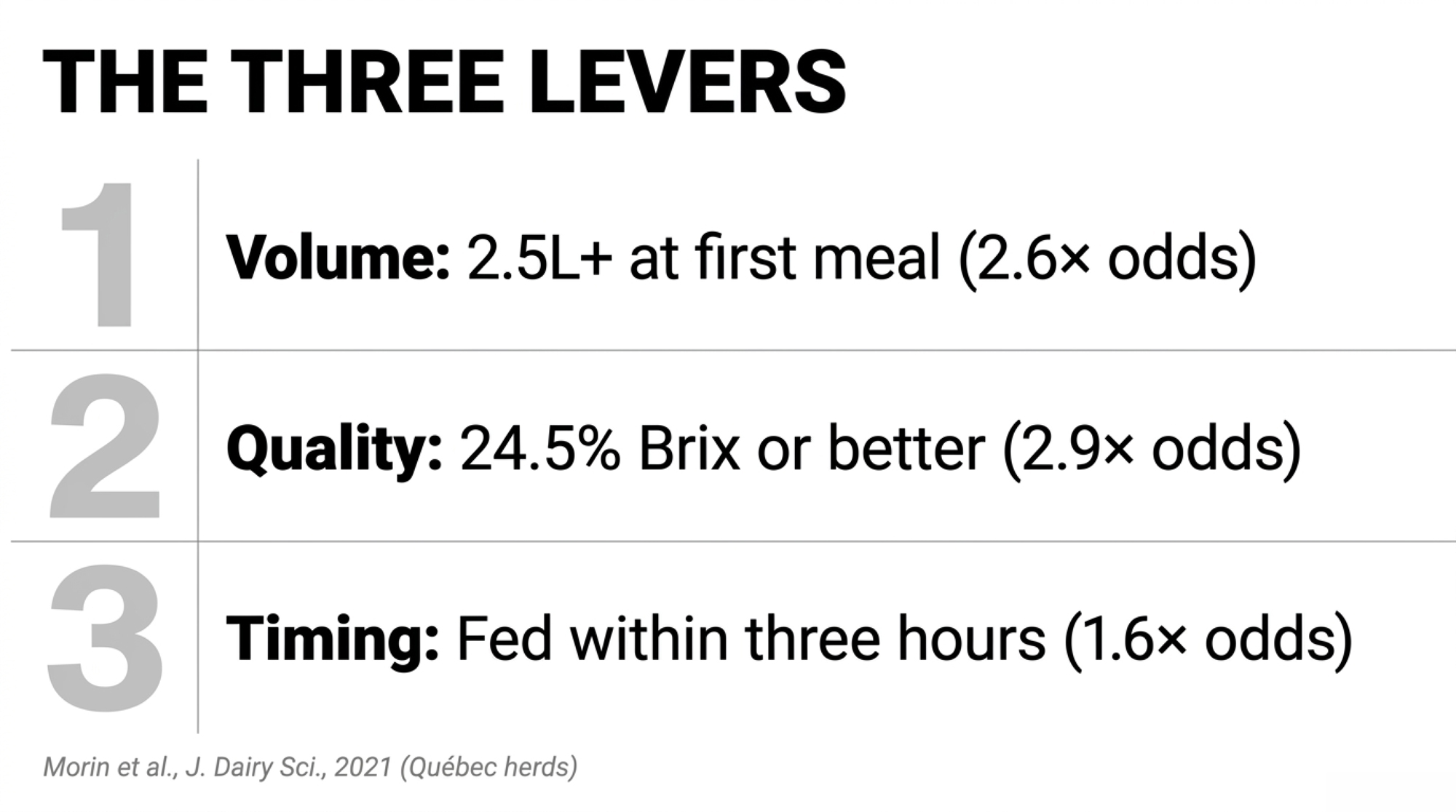
The companion calf-level study put odds on it. Calves had 2.6 times higher odds of adequate transfer when they got at least 2.5 L at the first feeding, 2.9 times higher odds with colostrum at 24.5% Brix or better, and 1.6 times higher odds when fed within three hours of birth (Morin et al., J. Dairy Sci. 104:4904–4918, 2021, Québec herds). Volume, quality, timing.

A 2025 European study drives home how much herds vary. Across 1,041 calves on 108 farms in six countries, an average of just 35.3% of calves hit Excellent — and only one country, Spain at 47.5%, cleared Lombard’s 40% bar. German herds in the study sat at 21.7% Excellent, French herds at 30.5%. Every extra liter of colostrum raised the odds of Excellent-instead-of-Poor by about 1.5 times (Fernandez-Novo et al., Front. Vet. Sci. 12:1515196, 2025; funded in part by Boehringer Ingelheim Vetmedica; per the paper’s disclosure, the funder was not involved in data analysis or interpretation). Same continent, same standard — a 26-point spread between the best and worst countries. The farms that don’t move tend to spread those levers across shifts and staff, with nobody owning the number.

Building the Dashboard: Owner, Target, Consequence
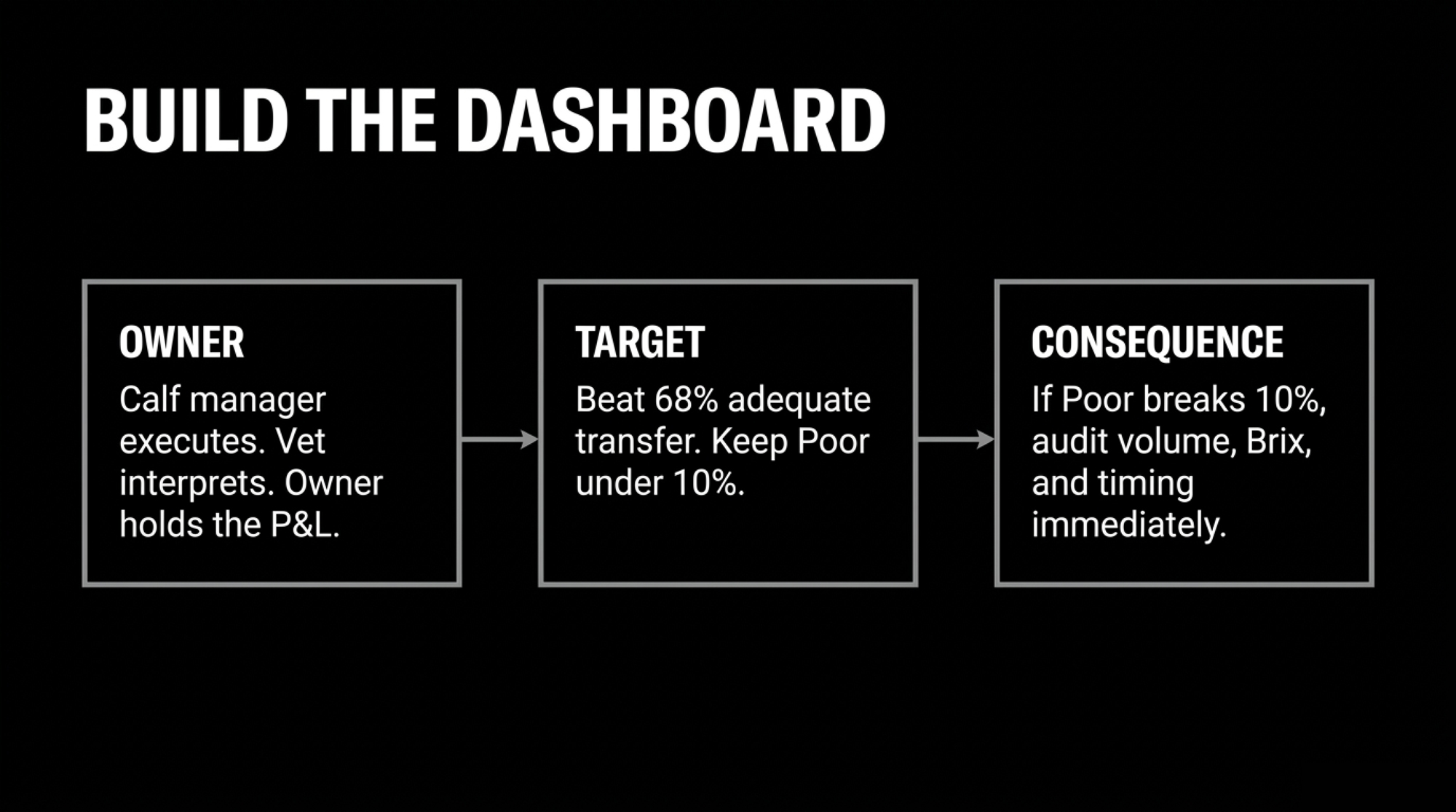
Pregnancy rate works because it has an owner, a target, and a consequence when it slips. Passive transfer distribution has none of that on most farms yet. You’d have to build it — and the science already hands you every piece.

The owner. The calf manager runs the twelve-calf sampling and the levers. The herd vet reads the chart against Lombard’s targets and connects it to health and growth. The owner owns the money side and decides what a drifting number is worth fixing.

The target. Short-term, beat Morin’s median of 68% adequate transfer, and keep Poor under 10%, Lombard’s herd standard. Medium-term, push the whole distribution toward more than 40% Excellent, around 30% Good, no more than 20% Fair.

The consequence. When Poor climbs past that 10% line, it isn’t just a health flag. Crannell and Abuelo’s retrospective cohort work found calves in the lower passive-immunity categories carried worse morbidity, mortality, and future performance than their better-transferred herdmates (Crannell & Abuelo, J. Dairy Sci. 106:2729–2738, 2023, single dairy herd). That’s your trigger to audit volume, Brix, and timing on every calf for a month.

None of this is new science. It’s a reshuffle — taking numbers that already exist and moving them into the room where the P&L conversation happens, instead of leaving them in the sick pen.

Options and Trade-Offs for Your Operation

Depending on where your herd sits, a few honest paths:

Option 1: Run the 12-Calf Scorecard This Month

  • Best for: Any herd that has only ever tested sick calves.
  • Requirement: One vet visit and about an hour of labor to pull serum from twelve clinically normal heifers at 24–48 hours, then classify each against the Lombard tiers.
  • Risk: None — the only exposure is discovering where the distribution actually sits.

Option 2: Lock Down the Shift-to-Shift Protocols

  • Best for: Herds where calf results swing depending on who worked the night shift.
  • Requirement: Enforcing 2.5–3 L within two to three hours, at 24.5% Brix or better (Morin et al., 2021). No capital — protocol discipline and staff buy-in.
  • Risk: Protocol fatigue if nobody is assigned direct ownership of the data; the chart won’t move and you’ll blame the wrong thing.

Option 3: Integrate Passive Transfer as a Boardroom KPI

  • Best for: Herds already reviewing monthly management dashboards alongside pregnancy rate.
  • Requirement: Percent Excellent-plus-Good and percent Poor on the dashboard, with a re-test schedule and a standing trigger to audit protocols whenever Poor exceeds 10%.
  • Risk: Treating the chart as an interesting report rather than an operational trigger.

What This Means for Your Operation

  • Have you ever tested passive transfer on healthy calves — or only the ones already in trouble?
  • What share of your last twelve heifers would land in Fair or Poor if you plotted them today?
  • Is your Poor category under 10%, and is your combined Excellent-plus-Good above Morin’s 68% median — the line between a working program and a coasting one?
  • Who on your farm actually owns the passive transfer number the way someone owns pregnancy rate?
  • Are your calves reliably getting 2.5–3 L of high-Brix colostrum inside the first two hours — on the night shift, not just the day shift?
  • When was the last time a colostrum decision showed up in a budget conversation instead of a health one?
Key Takeaways

  • If you’ve never sampled healthy calves, run the 12-calf scorecard this month — it’s the only way to see your real distribution instead of your assumed one.
  • If your Poor tier is over 10% or Excellent-plus-Good is under about 68%, treat it as a trigger to audit volume, Brix, and timing — not as a number to file.
  • If you can only fix one thing, fix first-feeding volume and speed: the European data showed each extra liter lifting the odds of Excellent by about 1.5 times.
  • If nobody owns the number, the chart won’t move — assign it to the calf manager, with the vet on interpretation and the owner on the money.

The uncomfortable part isn’t that this is hard. It’s that it’s easy — a couple of levers, a couple of hours, one refractometer — and it still slips through because it’s filed under the wrong heading. So before your next heifer crop hits the ground: if a calf leaves the maternity pen in Fair when she could’ve been Excellent, and it costs you milk two lactations out, whose job was it to catch that — and does that person know it’s their job yet?

Run Your Numbers

Complete references and supporting documentation are available upon request by contacting the editorial team at editor@thebullvine.com.

Learn More

The Sunday Read Dairy Professionals Don’t Skip.

Every week, thousands of producers, breeders, and industry insiders open Bullvine Weekly for genetics insights, market shifts, and profit strategies they won’t find anywhere else. One email. Five minutes. Smarter decisions all week.

NewsSubscribe
First
Last
Consent

Cornell Study Proves Less Is More: Why Modern Colostrum Needs Just 2.5 Liters, not 4

Testing colostrum takes 30 seconds. Saves $20/calf immediately. Adds $350 lifetime. Why isn’t everyone doing this?

EXECUTIVE SUMMARY: For 20 years, we’ve been overfeeding colostrum without realizing it—and it’s been hurting both calves and profits. Modern dairy genetics have quietly doubled colostrum antibody concentration from 50 to 90 grams per liter, but we’re still feeding volumes designed for our grandparents’ cows. Cornell’s groundbreaking 2024 study shows that feeding just 2.5 liters of today’s high-quality colostrum works better than 4 liters, improving absorption efficiency by 24% while eliminating painful colic symptoms in calves. The economics are compelling: precision feeding saves $20 per calf immediately and adds $300-350 through increased first-lactation milk production. Implementation couldn’t be simpler—a $200 refractometer and 30-second test tells you exactly what each cow produces, letting you bank excess premium colostrum while optimizing calf health. Smart producers are already making the switch, treating colostrum like the liquid gold it’s become. The science is clear: less really is more when you’re feeding modern colostrum.

Precision colostrum feeding

You know how sometimes a piece of information hits you and suddenly everything makes sense? That’s exactly what happened to me at a University of Wisconsin extension meeting this fall. Dr. Donald Sockett—who’s been around calves longer than most of us have been farming—showed us data from the latest Cornell research that basically turned my understanding of colostrum feeding upside down.

What caught me off guard was this: we’re still feeding colostrum like it’s 2004, but our cows? They’re producing something completely different now. And some of the calves we thought were thriving… well, turns out they might actually be uncomfortable from what we’ve been doing to them.

The Quality Jump That Snuck Up on Us

The brutal truth about colostrum management: while dairy genetics quietly doubled antibody concentration from 50 to 90 g/L over four decades, we kept force-feeding calves volumes designed for cows that no longer exist. It’s like running premium fuel through a carburetor designed in 1980—wasteful, painful for calves, and economically stupid.

So I’ll admit it—I feel a bit foolish for not noticing this sooner. While we’ve all been focused on pushing production records, tracking genomic gains, watching butterfat levels climb… our cows have been quietly revolutionizing their colostrum quality right under our noses.

The numbers tell quite a story. Back when I started farming (and don’t ask me exactly when that was), average colostrum measured around 50 grams per liter of IgG. That’s what all the feeding guidelines were based on.

Today? Well, the data compiled by Wisconsin’s veterinary team, along with studies from Bielmann’s group and more recent work by Conneely, shows we’re routinely seeing 75 to 95 grams per liter.

Let that sink in for a minute. That’s nearly double the antibody concentration. Double.

Dr. Miriam Weber Nielsen from Michigan State put it perfectly when she told me that these modern cows aren’t just making more milk—they’re making fundamentally different colostrum. The whole biological system has upgraded.

What drove this change? A bunch of things came together, really.

You probably remember when genomic selection took off around 2009. The Council on Dairy Cattle Breeding’s data shows it basically doubled our rate of genetic gain. And what’s fascinating is that health traits improved right alongside production. Better udder health naturally means better antibody production. Makes sense when you think about it.

Then there’s dry period management. Remember when everyone was trying shortened dry periods or even continuous milking? Yeah, that didn’t work out so well. Canadian research confirmed what many of us learned the hard way—those traditional 50 to 60-day dry periods really do optimize antibody transfer. Most of us have gone back to standard dry periods, and wouldn’t you know it, colostrum quality improved.

Sandra Godden’s work has shown us something else, too—when you really dial in that dry cow nutrition, especially energy and protein balance, colostrum IgG concentration responds beautifully. Today’s TMR formulations have basically optimized this in ways we couldn’t achieve before.

And timing… oh boy, timing matters more than I realized. Research has documented that IgG concentration in colostrum can drop by about a third in the 14 hours after calving. Most of us now harvest within 2 to 6 hours. When I started, 12 to 24 hours was pretty normal. That change alone makes a huge difference.

When Cornell Proved We’ve Been Overdoing It

Alright, so the Cornell study—this is where things get really eye-opening. S.E. Frederick and Dr. Sabine Mann’s team fed 88 Holstein heifer calves colostrum at 6%, 8%, 10%, or 12% of their birth body weight. Really controlled conditions. And what they found in a recent Journal of Dairy Science paper (2024)? It challenges pretty much everything I was taught.

Cornell’s groundbreaking 2024 research reveals the shocking truth: feeding calves the traditional 4 liters (12% body weight) actually reduces IgG absorption efficiency by 24% compared to precision feeding at 6-8% body weight, while leaving more colostrum stuck in the stomach where it can’t be absorbed.

The calves getting 12% of body weight absorbed IgG at only 36.3% efficiency. The ones getting 6%? They hit 47.8% efficiency. So we’re literally getting less bang for our buck by feeding more.

But what really made me pay attention—and this is clever—they used acetaminophen as a marker to track how fast things moved through the gut. Eight hours after feeding, those high-volume calves still had 65.5% of that marker sitting in their abomasum. The lower-volume group? Only 50.4%.

That colostrum wasn’t even getting to the small intestine, where it needs to be absorbed.

And—this is the part that bothers me—those high-volume calves were clearly uncomfortable. The ones getting 10% and 12% of body weight showed abdominal kicking. Classic colic behavior. The 12% group kicked 40 times during observation. You know how many times the 6-8% groups kicked? Zero. Not once.

The hidden cost of “more is better”: Cornell researchers documented zero colic behavior in calves fed 6-8% of body weight, but calves force-fed the traditional 4 liters (12% BW) kicked 40 times in 12 hours—clear evidence of abdominal pain that’s been normalized for decades.

Dr. Ryan Breuer from Wisconsin explained it in a way that finally made it click for me: those intestinal cells that absorb IgG through pinocytosis? They’ve got limits. Feed more than they can handle, and you basically create a traffic jam in the gut. The IgG can’t get absorbed, the calf feels lousy, and you’ve wasted good colostrum.

Quality Wins Every Time

While Cornell was documenting the problems with overfeeding, the University of Montreal team was out there proving what actually works. Their 2021 study in the Canadian Journal of Animal Science followed 818 calves across 61 Quebec Holstein farms. Real farms, real conditions—not some pristine research facility.

Montreal researchers tracking 818 calves across 61 farms proved what we’ve been getting wrong: colostrum quality (easily measured with a $200 refractometer in 30 seconds) matters nearly twice as much as feeding more volume—yet most producers still focus on the wrong variable.

What they found was crystal clear: calves getting colostrum that tested at 24.5% Brix or higher were nearly three times more likely to achieve adequate passive transfer compared to calves getting lower-quality colostrum. Three times!

To put that in perspective, quality mattered more than anything else they looked at. Feeding more volume? That only gave you 2.6 times better odds. Earlier timing? 1.6 times. Bottle versus tube feeding? Just 1.4 times. Quality beat everything.

And this really made me think—those Quebec farms fed a median volume of just 2.8 liters at first feeding. That’s way less than the 4 liters we’ve been told to feed. Yet 68% of those calves achieved adequate passive transfer. Why? Because their median colostrum quality was 23.5% Brix, well above what we used to consider good enough.

A Producer’s Guide: Precision Colostrum Feeding

Stop feeding by tradition. Start feeding by science.

Calf Birth WtHigh Quality (≥25% Brix)Medium Quality (22-24% Brix)Traditional (outdated)
40 kg (88 lb)✓ 2.5 L (6.3% body wt)△ 3.4 L (8.5% body wt)✗ 4.0 L (10.0% body wt)
35 kg (77 lb)✓ 2.2 L (6.3% body wt)△ 3.0 L (8.6% body wt)✗ 4.0 L (11.4% body wt)
30 kg (66 lb)✓ 1.9 L (6.3% body wt)△ 2.6 L (8.7% body wt)✗ 4.0 L (13.3% body wt)

Banking Tips:

  • Freeze in 1-liter bags for easy thawing
  • Label with date and Brix score
  • Use within 6 months for best quality

Making This Work on Real Farms

So you’re probably thinking what I thought: “Okay, interesting research, but how do I actually do this?” Fair question. Let me share what I’ve learned from folks who’ve successfully made the switch.

First thing—you’ve got to know what you’re working with. Get yourself a Brix refractometer. They run about $200 from most dairy suppliers. The digital ones are nice if you want to splurge, but honestly, the optical ones work just fine. Takes maybe 30 seconds to test once you get the hang of it.

And that brings me to banking, which I think is one of the most underutilized tools we have. When you test a cow at 28% Brix and only need to feed 2.5 liters to her calf, you might have 2 to 3 liters of premium colostrum left over. Freeze it! That’s your insurance for when a heifer freshens with poor colostrum or you get surprise twins.

Now, I’ll be honest—not everyone sees immediate benefits. A neighbor of mine with 60 cows tried this for three months and said the extra testing time didn’t pencil out for him. Fair enough. But most operations I’ve talked with find the time investment pays off pretty quickly, especially once employees get into the routine.

This past spring calving season really drove it home for me. We had two heifers freshen the same night with colostrum testing at 18% Brix—way below what we needed. But because we’d been banking all winter, we had plenty of high-quality colostrum ready to go. Those calves got what they needed, and both are thriving now.

The Economics Make Sense

Here’s why every dairy should own a refractometer: that $200 device pays for itself with the very first calf tested, then delivers $370 in returns per calf through immediate health savings, reduced replacer waste, and a whopping 626kg more milk in first lactation. The breakeven isn’t measured in months—it’s measured in hours.

Let’s talk money, because that’s what it comes down to for most of us. Current colostrum replacer runs $35 to $45 per bag—and that makes about 3 liters. So every liter of high-quality colostrum you bank is worth $12 to $15. Start banking 1.5 liters from 40% of your fresh cows, and it adds up fast.

Then there’s growth. Calves with optimal colostrum gain an extra 0.24 pounds per day preweaning. Doesn’t sound like much? Over 60 days, that’s 14 pounds. At a typical feed conversion, that’s another $20 per calf.

And this is what really gets me—those same calves produce 626 kilograms more milk in their first lactation. At current prices of around $21 to $24 per hundredweight, we’re talking $300 to $350 in additional revenue per animal. From decisions you made in the first 12 hours of life.

Though I should mention, labor is a consideration. Training employees takes time, and if you’re dealing with high turnover, that’s a real cost. Some operations find that factor alone makes traditional protocols more practical for them.

Extended Feeding: The Next Frontier

What’s got me really interested lately is what happens when you keep feeding colostrum or transition milk beyond that first day. Most of us switch calves straight to milk replacer or whole milk, but there’s growing evidence that this is leaving gains on the table.

Michigan State published fascinating work in 2020. Calves fed transition milk for just three days after colostrum weighed 6.6 pounds more at weaning. The extra energy in transition milk accounted for only about 1.5 pounds of that. The rest? Enhanced gut development.

An Iranian-German team took it further, supplementing calves with 700 grams of colostrum daily for two full weeks. They saw significantly fewer days with diarrhea, less respiratory disease, and better feed efficiency throughout the preweaning period. Published in the Journal of Dairy Science in 2020, and it’s got a lot of us rethinking our protocols.

For operations with automated calf feeders, this gets interesting. You can program different feeding curves based on colostrum quality scores. Some larger dairies are already doing this, though the complexity of the setup means it’s not for everyone.

Different Regions, Different Challenges

Looking at how this plays out across the country, implementation varies quite a bit depending on where you farm. Many Upper Midwest producers I’ve talked with notice higher colostrum quality during fall and winter—probably because there’s less heat stress during the dry period. Southern producers often report the opposite pattern, especially during those brutal August dry periods.

Out in California’s Central Valley, those large-scale operations have had to get creative with banking systems. Smaller bags for faster thawing, dedicated freezers in climate-controlled rooms. Makes sense when you’re dealing with their volumes and temperatures.

The grazing operations in the Northeast face their own challenges. Pasture-based dry cow management can produce exceptional colostrum quality, but volume tends to be more variable. These folks really benefit from having robust banking systems to buffer that natural variation.

And smaller operations—those milking under 100 cows—might actually have some advantages here. You know your cows better, can track individual quality easier, and have more flexibility in your protocols. When you’re only calving a few cows a week, building and managing a colostrum bank is pretty straightforward.

That said, some small producers tell me the return on investment just isn’t there for them. When you’re already achieving decent passive transfer rates and labor is tight, sticking with what works makes sense.

Common Mistakes to Avoid

I’ve watched quite a few farms try to make this transition, and there are definitely some pitfalls to watch out for.

The biggest mistake? Testing colostrum but not actually changing anything. I know it sounds ridiculous, but I’ve seen it happen multiple times. Farms buy the refractometer, test every batch, write down the numbers… and then keep feeding 4 liters because that’s what feels safe. The data just piles up on clipboards without driving any decisions.

Consistency is crucial, too. If your weekend crew is still doing things the old way, you won’t see the benefits. Make it visual—post a laminated chart showing exactly how much to feed based on Brix reading and calf size. Take the guesswork out of it.

And don’t forget about those smaller calves. Jersey calves, twins, that occasional small Holstein heifer—they need proportionally less. A 30-kilogram calf getting 4 liters is receiving 13% of its body weight. No wonder some of these calves look uncomfortable after feeding.

The Organic Angle

This precision approach is especially valuable for organic producers. With a limited treatment toolbox, the prevention provided by excellent passive transfer is critical, and many organic farms report substantial reductions in calf health issues after making the switch.

Where This Is All Heading

Looking ahead, I think precision colostrum management will likely follow the same path as genomic testing. Five years ago, plenty of folks were skeptical. Today? It’s just how we do things on progressive farms.

The Council on Dairy Cattle Breeding recently announced genomic evaluations for calf wellness. The heritability for calf serum total protein (a measure of passive transfer) is around 0.17—that’s workable for genetic selection. Some farms are already starting to select for colostrum quality.

And extended feeding protocols? I think that’s the next big shift. Once producers see the growth and health benefits from feeding transition milk for 3 to 7 days, it’ll likely become more common. We’re just scratching the surface there.

What’s interesting is how this connects to everything else we’re doing. Better genetics leading to better colostrum. Better colostrum management leading to healthier calves. Healthier calves are becoming more productive cows. It’s all connected, and we’re finally starting to see the whole picture.

The Bottom Line

Look, I get that change is hard. Especially when what you’ve been doing seems to work okay. But the thing is—the colostrum our cows produce today is fundamentally different from what it was 20 years ago. We’ve improved the genetics, nutrition, and management… but not the feeding protocols.

The research from Cornell, Montreal, and Michigan State—it’s all pointing in the same direction. Quality matters more than quantity. Precision beats volume. And what worked for 50 g/L colostrum just doesn’t make sense for 90 g/L colostrum.

You don’t have to change everything overnight. Start by testing your colostrum for a week. See what you’re actually dealing with—I’ll bet you’ll be surprised. Then gradually adjust volumes based on quality. Bank the excess. Track your results.

The tools are simple—a $200 refractometer and a scale for calves. The protocol is straightforward. And the payoff? Healthier calves, better growth, improved lifetime production, and a freezer full of insurance for when you really need it.

This isn’t about being revolutionary. It’s about good management catching up with good genetics. The cows changed. The colostrum changed. Maybe it’s time our feeding protocols caught up too.

And honestly? Once you see those calves thriving on less volume of better-quality colostrum, with none of that post-feeding discomfort we used to think was normal… you’ll wonder why we didn’t figure this out sooner.

KEY TAKEAWAYS 

  • Modern colostrum is 2X stronger—Test quality with a Brix refractometer ($200, takes 30 seconds) to avoid overfeeding calves with volumes designed for 1990s genetics
  • Feed by quality, not tradition—High-quality colostrum (≥25% Brix): 2.5L | Medium (22-24% Brix): 3.3L | Low (<22% Brix): Don’t use for first feeding
  • Bank the surplus—When premium colostrum only needs 2.5L instead of 4L, freeze the excess as insurance for when heifers deliver poor-quality batches
  • The math is compelling—Precision feeding returns $20/calf immediately in health savings, plus $300-350 through 626kg more milk in first lactation
  • Implementation is simple—Most farms see ROI within 60 days using just a refractometer and a laminated feeding chart in the calf barn

Complete references and supporting documentation are available upon request by contacting the editorial team at editor@thebullvine.com.

Learn More:

The Sunday Read Dairy Professionals Don’t Skip.

Every week, thousands of producers, breeders, and industry insiders open Bullvine Weekly for genetics insights, market shifts, and profit strategies they won’t find anywhere else. One email. Five minutes. Smarter decisions all week.

NewsSubscribe
First
Last
Consent
Send this to a friend