




Archive for replacement heifer costs

$7,700 Saved, $156,600 Lost: The Beef-on-Dairy Trap CoBank Warned You About

A 500-cow herd breeding 60% to beef at $8 a straw thinks they’re saving money. They’re $313 per cow underwater and 15 heifers short every year. The spreadsheet doesn’t lie.

Executive Summary: The gap between a cheap beef-on-dairy strategy and a disciplined one on a 500-cow Holstein herd is $156,600 a year — $313 per cow. Most of that margin vanishes into places nobody budgets for: a 15-heifer annual replacement shortfall at $3,010 each, higher calf mortality, and undocumented calves discounted $25–50 a head at the barn. CoBank’s heifer deficit data says the industry is 600,000–700,000 head short; every straw of unselected beef semen widens the hole on your farm while you think you’re pocketing ,700 in annual savings. Peer-reviewed carcass research shows well-selected beef × dairy crosses actually outmarble native beef — but random-sire crosses are sliding toward Holstein bull calf pricing. Three paths, three cost structures, and a 30/90/365-day audit that starts with one number: your real 21-day PR — not your target. If your replacement pipeline can’t survive your current beef percentage, that 6,600 gap isn’t a model. It’s your margin.
beef-on-dairy strategy

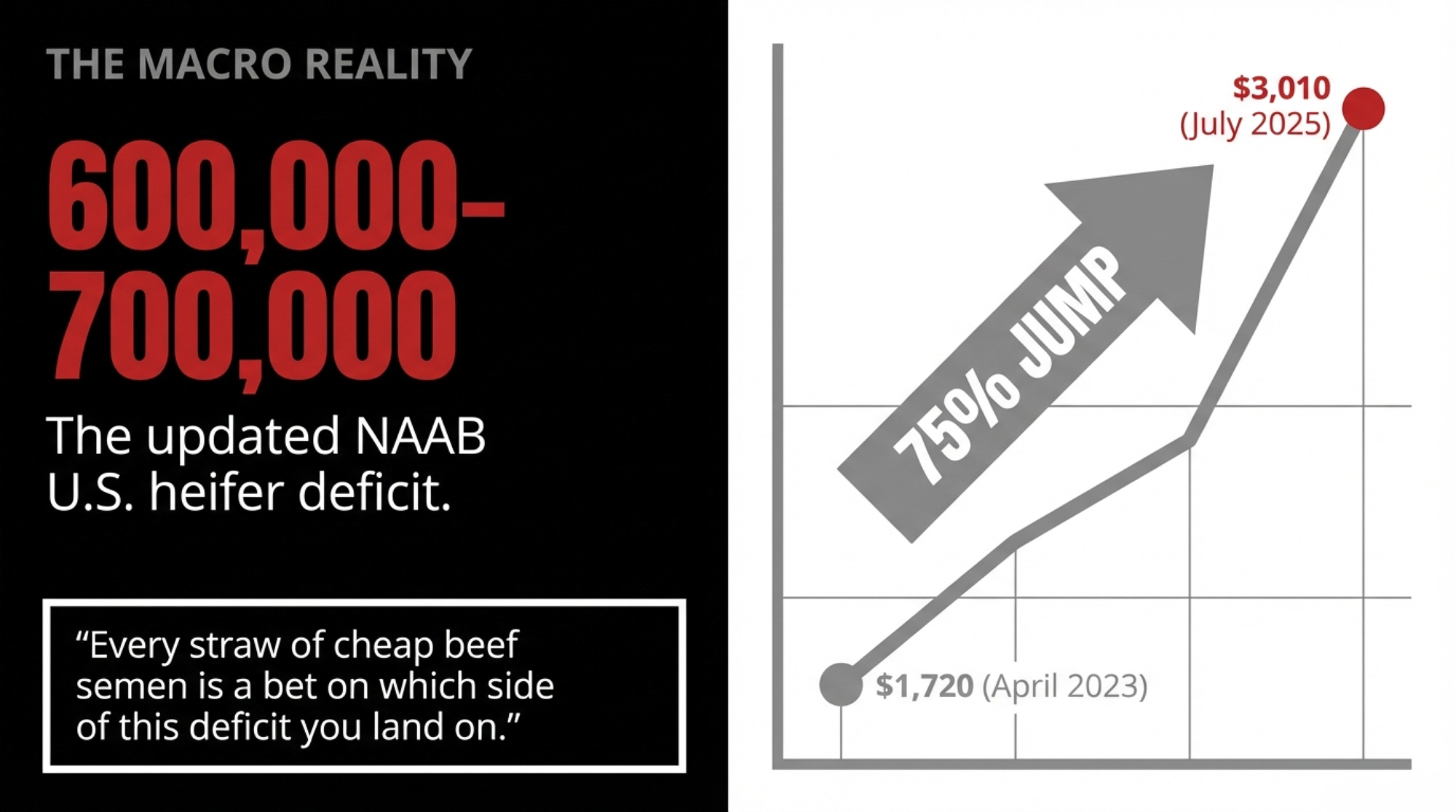
CoBank’s August 2025 analysis put a number on what a lot of producers already felt in their gut: the U.S. dairy industry was roughly 800,000 heifers short — a figure that updated NAAB year-end data released March 10, 2026, has since been revised closer to 600,000–700,000 head. The correction from sexed semen is running ahead of schedule. But the farm-gate math hasn’t softened, because replacement heifers tracked from $1,720 per head in April 2023 to $3,010 by July 2025 — a 75% jump in barely two years. And every straw of beef semen in your tank is a bet on which side of that deficit you land on.

So we modeled it. Three beef-on-dairy strategies run on an identical 500-cow Holstein herd in the Ontario/US Midwest market. Same parlor. Same turnover. Same pregnancy rate. The only variable: how seriously the operation treated the beef side of the business. The gap between the cheapest approach and the most disciplined one wasn’t a rounding error. It was $156,600 a year.
The Backdrop You Can’t Ignore

This isn’t a “should you use beef semen?” conversation. You already are. The question is whether those straws are building equity or quietly draining it — and whether there’s a genetic time bomb hiding in the fresh pen that you haven’t priced yet.
National cattle inventories sit at their lowest point since 1951 — just 86.2 million head as of the January 2026 USDA count. Dairy-origin cattle now account for an estimated 18–24% of U.S. commercial beef production when you combine finished steers, heifers, and cull cows, according to Beef Checkoff and university extension data tracking 2002 through 2018, and the share is almost certainly higher today given the explosive growth of beef-on-dairy breeding. Every genetic decision in the breeding pen is a marketing decision for 2027 and 2028.

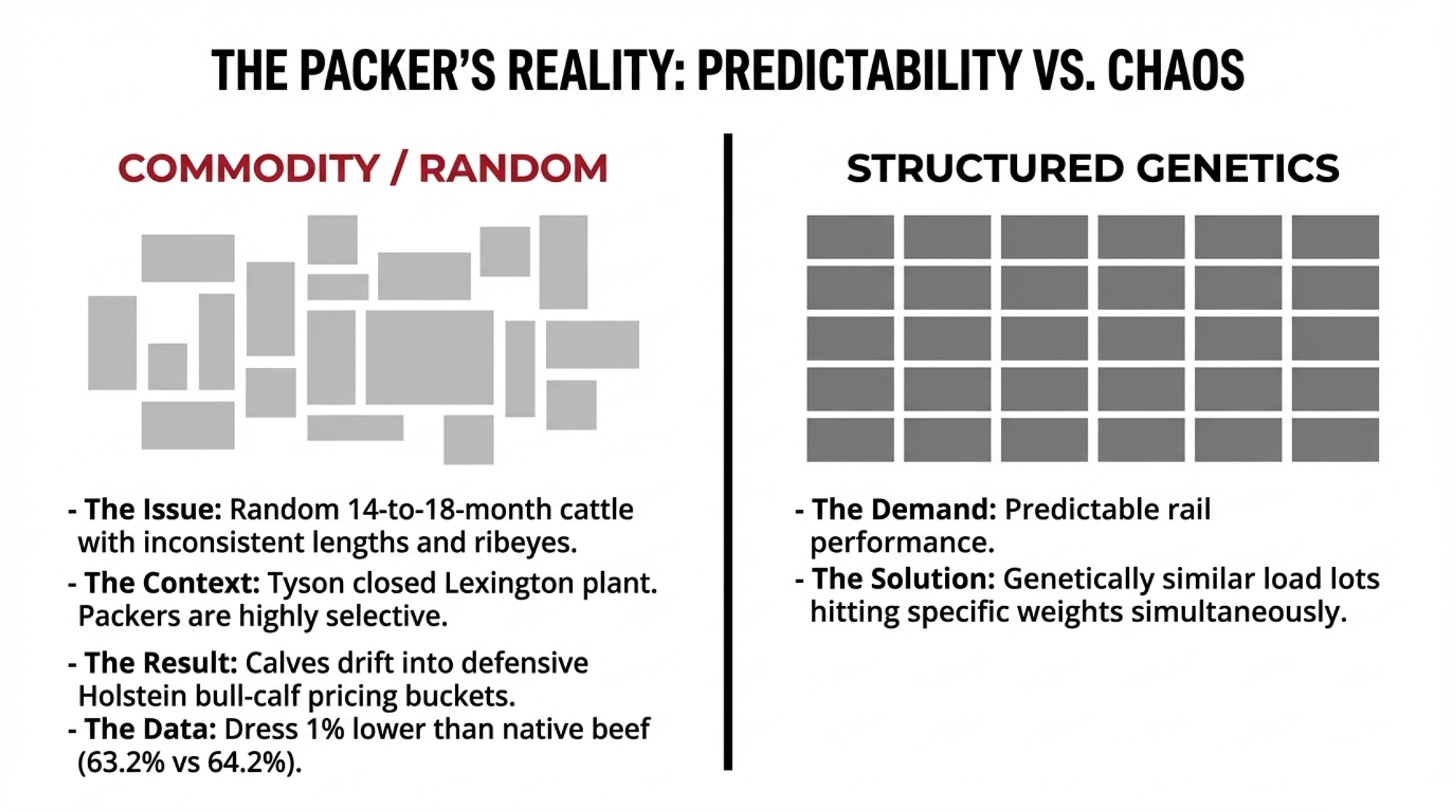
At the other end of the chain, the source analysis cites packers — including JBS — describing carcass conformation on early dairy-beef crosses as inconsistent: too narrow, undersized ribeyes, not enough muscling. Research from Texas Tech (Foraker et al., 2022) found that even well-selected beef × dairy crosses dressed about 1 percentage point lowerthan native beef (63.2% vs. 64.2%, P < 0.01) — and that’s with quality sires. Random or bottom-tier sire selection likely widens that gap further. Anonymous beef-on-dairy calves are drifting into the same pricing bucket Holstein bull calves used to occupy: commodity cattle, priced defensively.

The 500-Cow Showdown: Cheap vs. Disciplined

To make the economics concrete, the Beef-on-Dairy 2.0 analysis runs a modeled 500-cow Holstein herd through identical biological assumptions: 35% annual turnover, 30% 21-day pregnancy rate, and 79% heifer completion rate from birth to freshening.

One bull can reshape a breed’s trajectory over decades. In beef-on-dairy, one wrong sire decision reshapes your cash flow for 30 months. Here’s what that looks like at scale.

MetricPath A: “Cheap & Easy”Path C: “Integrated/Partnered”
Semen Cost$8/straw$25/straw
Annual Semen Spend (Beef)$4,800$12,500
Beef Conception Rate48%46%
Calf Sale Price$1,150 (at 5–7 days)$1,550 (at 21 days)
Calf Mortality to Sale5.0%2.5%
Beef Calves Sold/Year~285~293
Replacement Impact−$12,900 (15-head deficit)+$15,000 (surplus heifers sold)
Net Annual Income*$300,050$456,650
The Gap+$156,600

*Net includes semen cost plus estimated mortality-related rearing losses not separately itemized in the model.

Path A thinks it’s saving $7,700 on semen compared to Path C. It’s actually losing $156,600 in total opportunity — calf price, mortality, documentation premiums, and the avoided cost of buying replacements because the breeding strategy was sloppy. That’s $313 per cow-year. At 500 cows, it’s a tractor payment.

What Happens When 15 Heifers Don’t Show Up?

Path A’s modeled herd doesn’t just lose on calf price. It bleeds replacement heifers. With a 35% cull rate, 79% heifer completion, and beef semen pushed to 60% of the herd, the model shows a 15-heifer annual shortfall — costing ,900 per year at 2025 market prices to stand still.
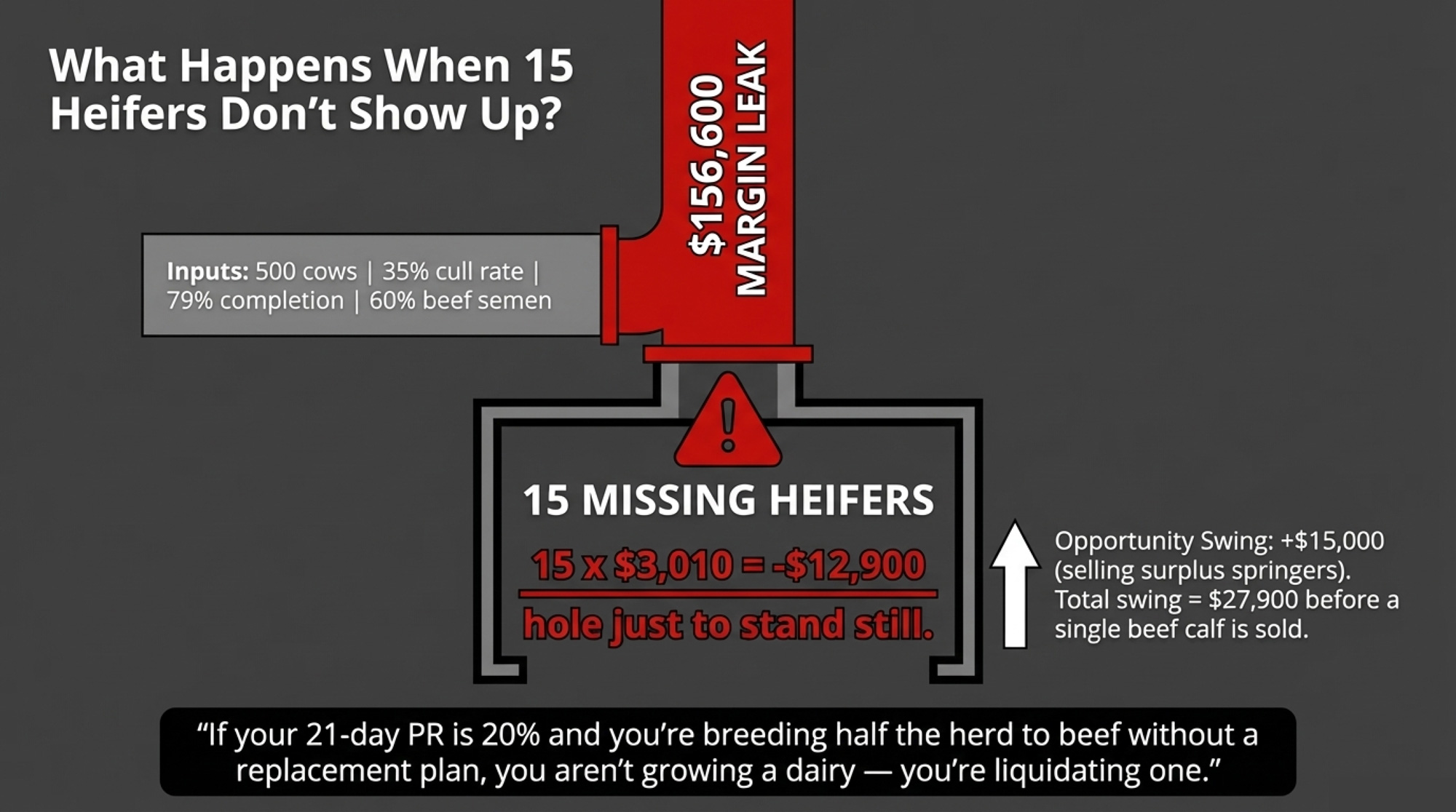
Path C flips that number. Precise use of sexed semen on the top 30% of cows covers all replacement needs and leaves surplus heifers to sell as premium springers — a +,000 credit. That’s a $27,900 swing on replacements alonebefore you even talk about what the calves brought at the barn.

And if your actual 21-day PR is sitting closer to 20% instead of 30%? The deficit deepens fast. Your heifer breeding strategy determines how many calves you can afford to send to beef, and a thin PR doesn’t leave room for guessing. The analysis models that scenario bluntly:

“If your 21-day PR is 20% and you’re breeding half the herd to beef without a replacement plan, you aren’t growing a dairy — you’re liquidating one.”

In November 2025, Tyson Foods announced the closure of its Lexington, Nebraska, beef plant — a facility processing about 5,000 head per day, roughly 4.8% of U.S. daily beef slaughter. With capacity coming offline and overall beef production contracting, packers can afford to be selective. They want “predictable rail performance”: load lots of genetically similar cattle that hit specific weights and grades at the same time.

A random mix of whatever beef bull was on sale creates pens that are the opposite — some cattle ready at 14 months, some at 18, with carcasses that don’t match in length, thickness, or ribeye. If you’re selling into that market with undocumented calves from unknown sires, you’re not competing. You’re just filling a spot.

What Are Structured Genetics and Documentation Actually Worth?
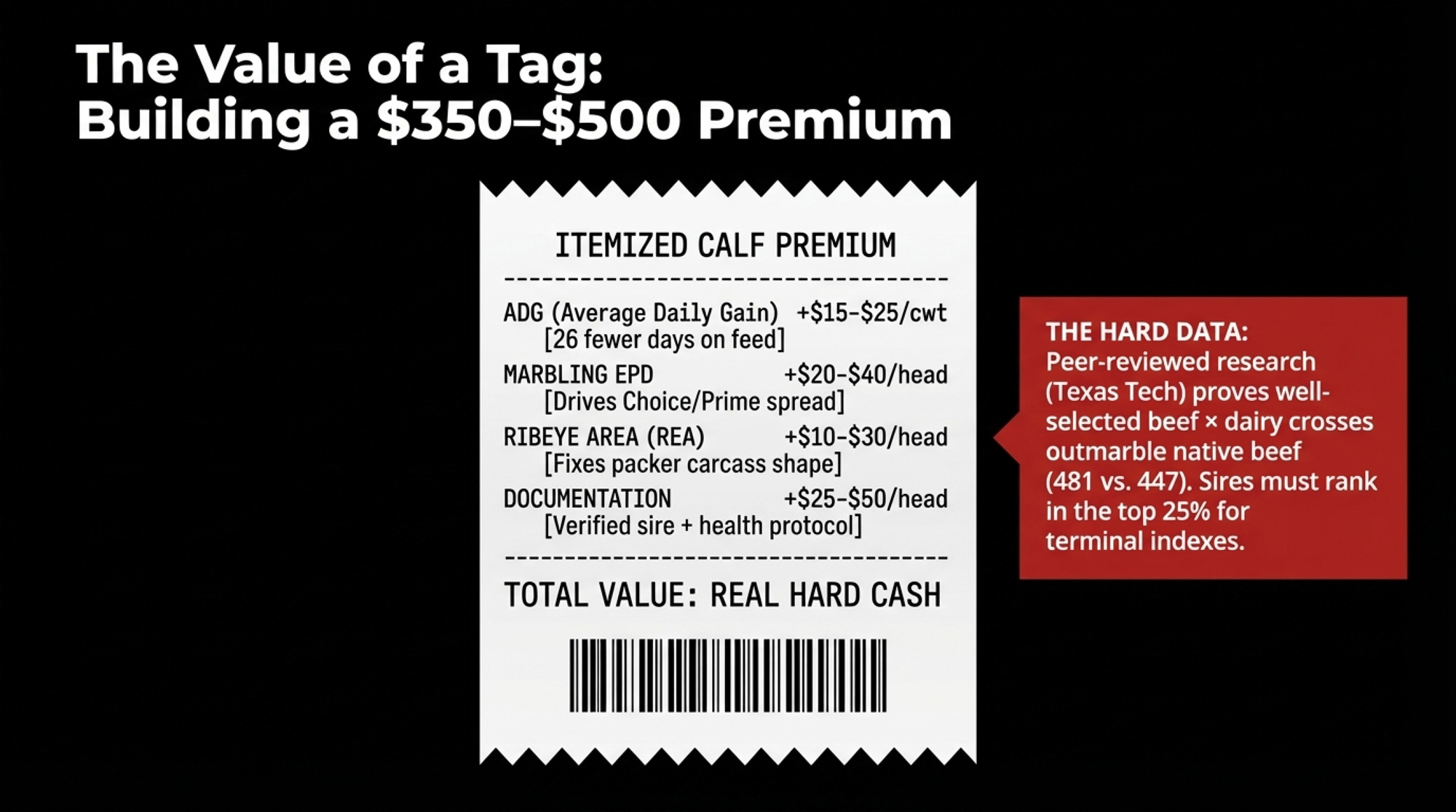
The source analysis breaks down what trait selection and calf documentation mean in buyer bids. These are model-derived estimates, but the direction aligns with independent data — The Bullvine’s own August 2025 reporting confirmed 0–500 per head premiums for documented beef-cross calves over straight Holsteins at Midwest sales. Actual premiums vary by buyer, region, and market conditions:

TraitRelevant IndexPremium/Calf (Est.)MechanismPath A Captures?Path C Captures?
Average Daily Gain$AxH, ITI$90/calf (26 fewer days on feed)Saves ~$15–25/cwt in yardage costs
Marbling EPD$AxH, HOLSim$20–40/headDrives Choice/Prime vs. Select spread
Ribeye Area (REA)ITI, HOLSim$10–30/headFixes carcass conformation for packers
Calf DocumentationAny program$25–50/headVerified sire + health records cut feedlot risk
Dress % (>63%)$AxH top 25%Avoided discountPrevents Holstein-bull-calf pricing at rail
Total potential premium~$145–210/calfvs. commodity Path A pricing$0~$180

The peer-reviewed data backs this up convincingly. In the Foraker et al. (2022) Texas Tech carcass study — 518 beef × dairy, 966 native beef, and 935 Holstein steers — well-selected beef × dairy crosses actually outmarbled native beef(marbling score 481 vs. 447, P < 0.05) while carrying 18% less back fat and 5% more ribeye area than straight Holsteins. Select Sires’ feedyard data tells a similar story: in well-managed yards, beef-on-dairy crosses are hitting more than 60% Prime and Choice.

The chasm between that outcome and the JBS “all over the board” complaint is almost entirely about sire selection and management. The analysis recommends filtering sires by terminal indexes — Angus-on-Holstein ($AxH), Igenity Terminal Index (ITI), or Holstein-Simmental (HOLSim) — using only bulls in the top 25% for carcass merit. If a bull can’t clear that bar, the math says he doesn’t belong in a terminal program even if the semen is free.

Which Path Is Your Herd Actually On?

You don’t have to become Path C overnight. But you need to decide which game you’re playing — especially when margins are already running to the bone.
MetricPath A: Cheap & EasyPath B: Structured SiresPath C: Integrated/Partnered
Beef sire selectionRandom / bottom-tierTop 25% on $AxH, ITI, or HOLSimFinisher-specified sires only
Semen cost/straw$8~$15–18$25
Annual semen spend$4,800~$9,000$12,500
Calf sale price$1,150~$1,350$1,550
Calf mortality to sale5.0%~3.5%2.5%
Documentation standardNoneBasic calf protocolFull sire ID + health records
Replacement impact−$12,900 (15-hd deficit)Breakeven+$15,000 (surplus sold)
Net annual income (500 cows)$300,050~$380,000$456,650
Packer relationshipCommodity / spotPreferred supplierNamed program partner
Data feedback loopNoneInternal onlyADG + carcass closeouts returned

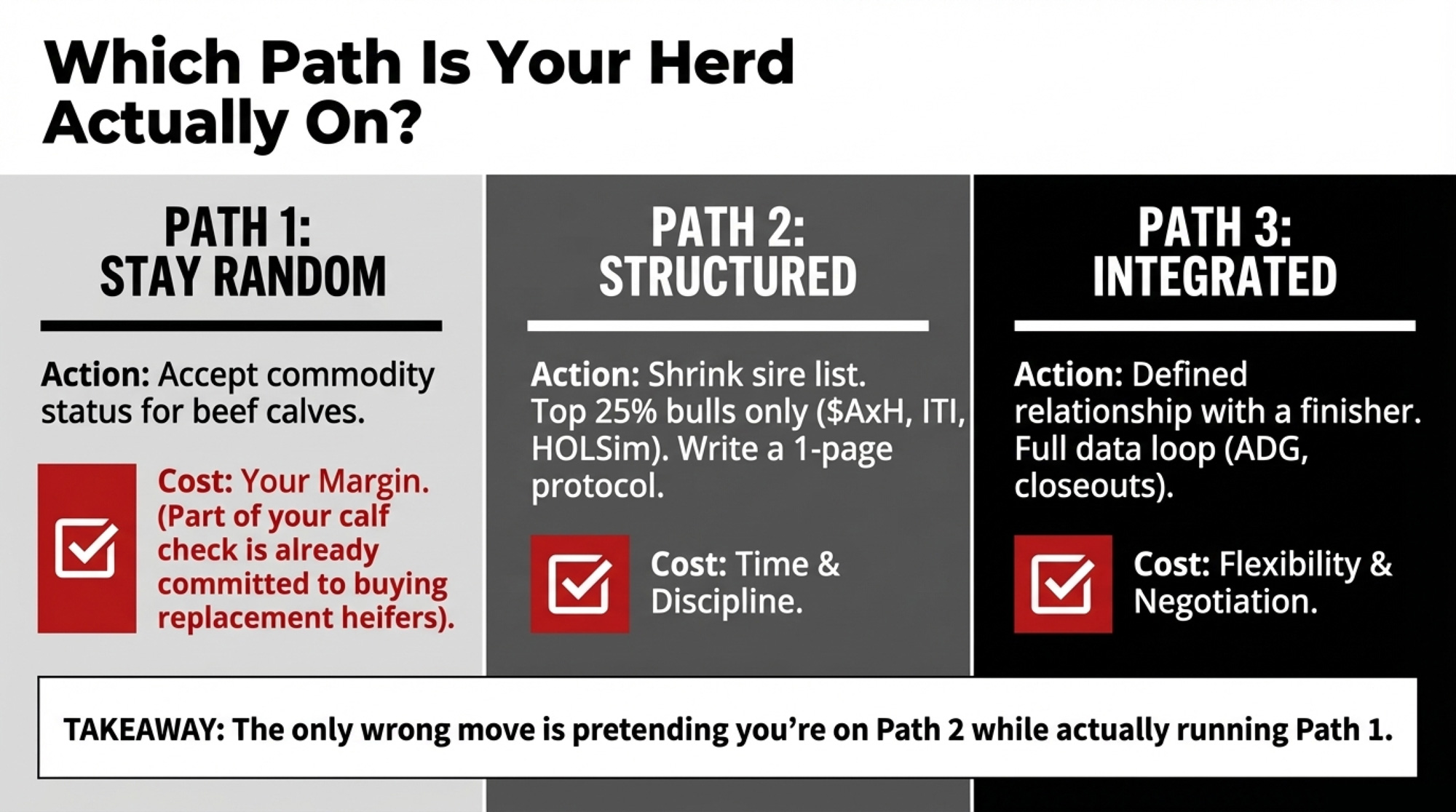
Path 1 — Stay Random, but Own the Trade-Off. You’re putting out bigger fires right now. Fine. Accept commodity status for your beef calves, and understand that part of your “good beef cheque” is already committed to future replacement purchases.

Path 2 — Structured Sires and Protocols (No Integration Yet). Shrink your beef sire list to 2–3 bulls for smaller herds, 3–5 for 500+ cows, all top-quartile on $AxH, ITI, or HOLSim. Write a one-page calf protocol. Use sexed dairy semen on your top 30% until your forward replacement model says you’re covered.

Path 3 — Integrated/Partnered (The Full Margin Engine). A defined relationship with one finisher or branded program. Full documentation on every calf. A data loop where you get ADG, days-on-feed, death loss, and carcass summaries back — and actually adjust sires and protocols based on those closeouts.

Each path has a cost. Path 1 costs you margin. Path 2 costs you time and discipline. Path 3 costs you flexibility and negotiation effort. The only wrong move is pretending you’re on Path 2 while actually running Path 1.

Your 30/90/365-Day Audit Checklist
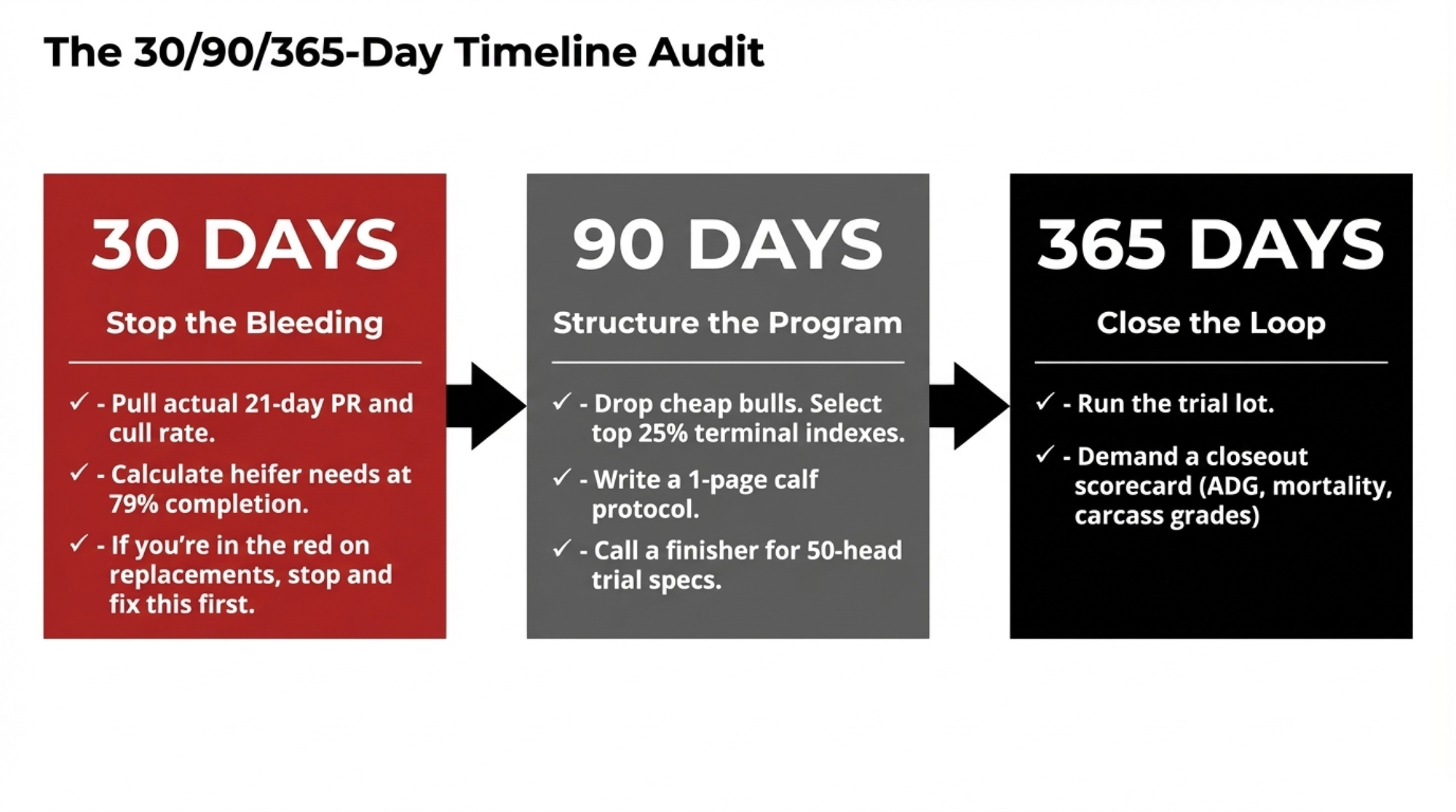
☐ Within 30 Days

  • [ ] Pull your last 12 months of cull rate and actual 21-day pregnancy rate — not your target, your real number. 
  • [ ] Calculate your annual heifer need using a 79% completion rate from birth to freshening at your current herd size. 
  • [ ] Overlay your current beef semen percentage and model whether you’re headed for surplus, balance, or deficit on a three-year horizon. 
  • [ ] If the model shows you in the red on replacements, stop and fix that before touching anything else.

☐ Within 90 Days

  • [ ] Tighten your beef sire list to the top 25% on a recognized terminal index ($AxH, ITI, or HOLSim). Drop every bull that’s only in the tank because he was cheap. 
  • [ ] Write a one-page beef-calf protocol: colostrum timing, vaccination schedule, minimum sale age, and weight. Make sure everyone on the team follows it. 
  • [ ] Call one serious calf buyer or finisher and ask what specs they’d want from a 50–100 head trial lot. You’ll learn more in that conversation than in a year of reading semen catalogues. 

☐ Within 365 Days

  • [ ] Run at least one group of 50–100 calves through that buyer or program under your tightened sire list and documented protocol. 
  • [ ] Get a basic closeout: ADG, days-on-feed, mortality, carcass weights/grades. That’s the only real scorecard for whether your genetics and management are earning a premium or just looking like they should. 
  • [ ] Use those results to decide: commit to full Path C integration, or tighten Path 2 further and shop for a better buyer. 

What This Means for Your Operation

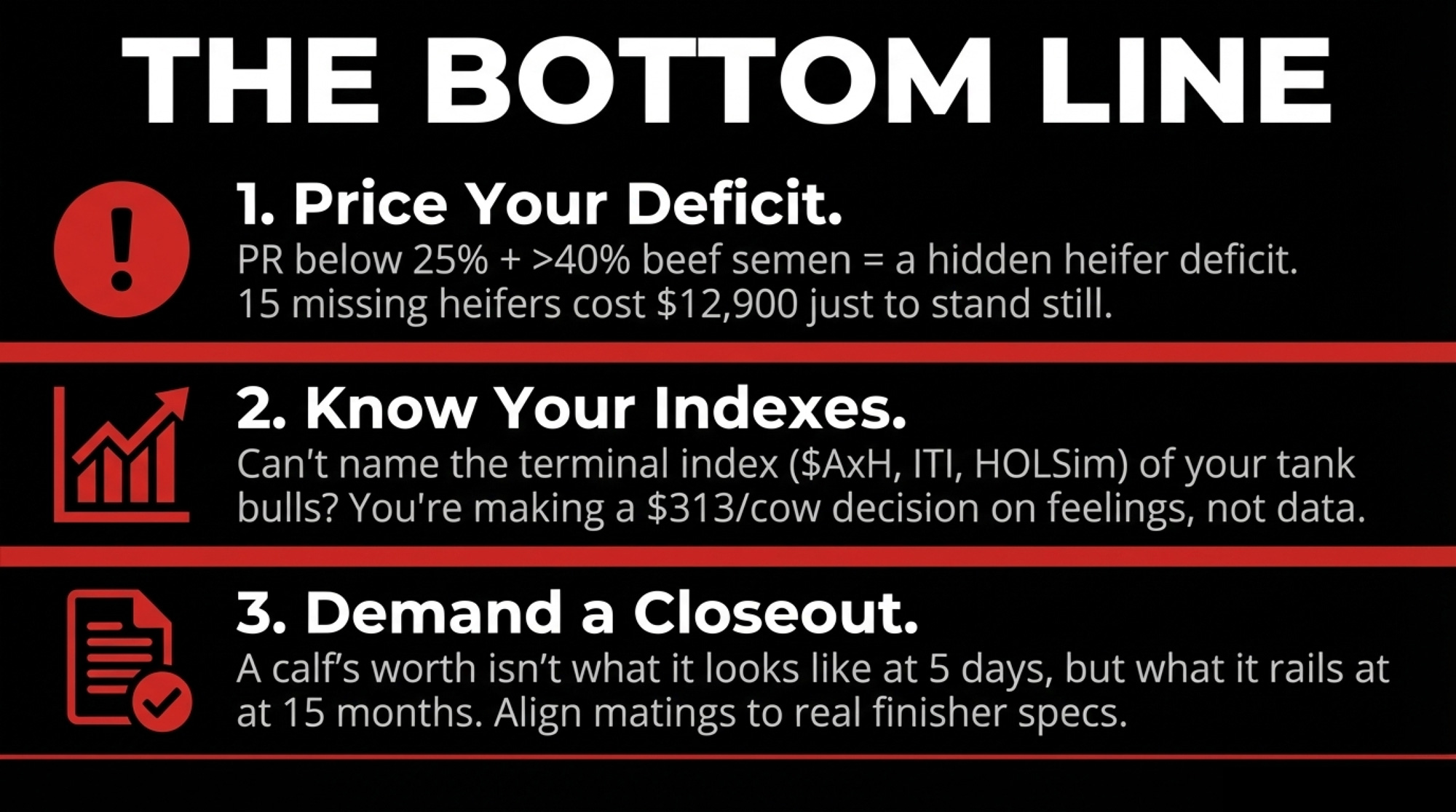
  • If your 21-day PR is below 25% and your cull rate is above 30%, run your replacement model before you order another tank of beef semen. The deficit might already be there — you just haven’t priced it yet. 
  • If you can’t name the terminal index ranking of every beef bull in your tank, you’re making a $313-per-cow decision on feel instead of data. 
  • If you’ve never seen a closeout for calves from your farm, your opinion of their performance is based on what they look like at five days — not what they’re worth at fifteen months. 
  • The $27,900 replacement swing between Path A and Path C happens before a single calf crosses the sale ring. That’s the hidden lever most operations never model. 
  • Running the real ROI math — the way Clark Farms did with their creamery — is the only way to know if your beef program is building equity or just moving money around. 
Key Takeaways

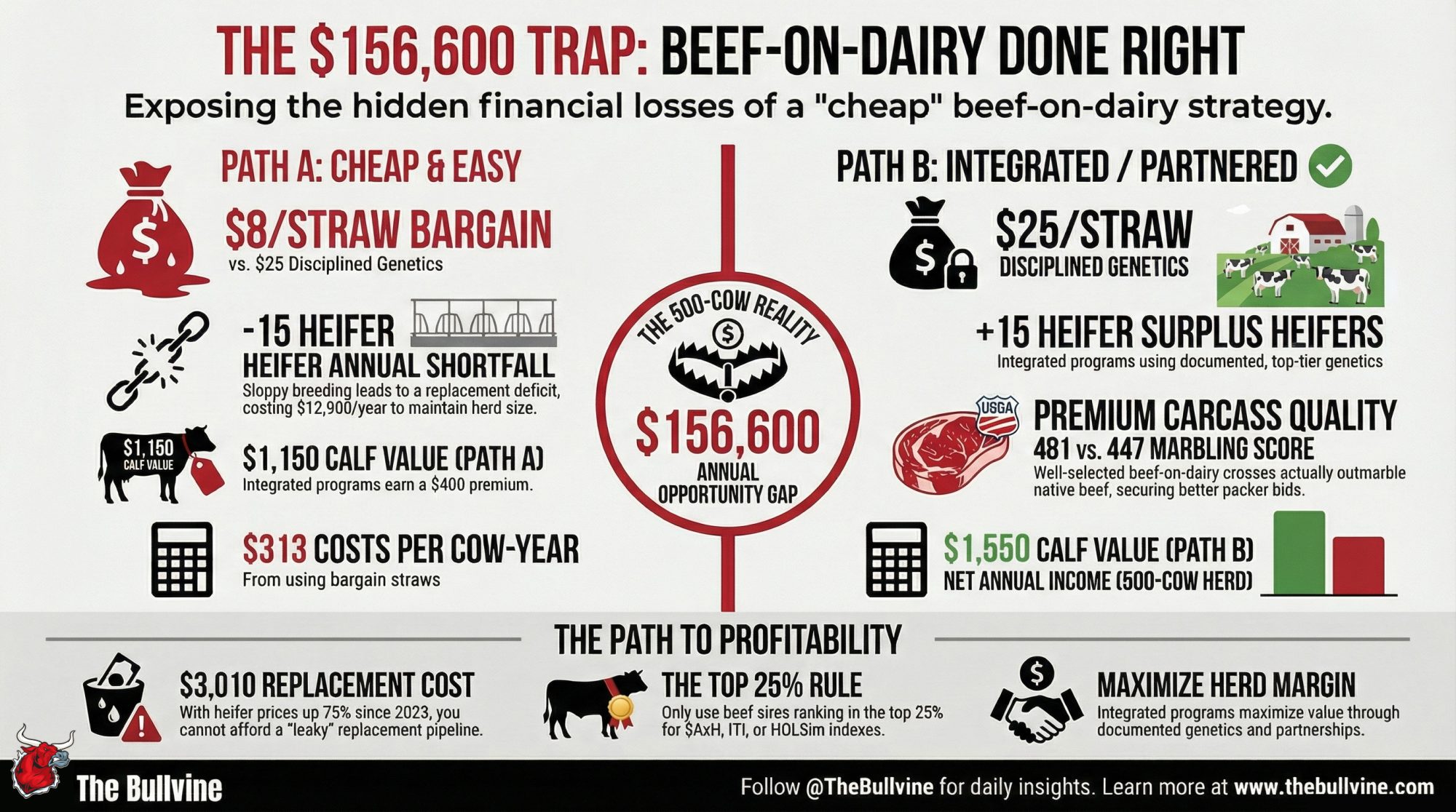
  • If your 21-day PR is below 25% and you’re breeding more than 40% to beef, you’re likely already in a heifer deficit you haven’t priced. Run the replacement model before you reorder semen — at $3,010 per head, 15 missing heifers cost $12,900 a year to stand still. 
  • Drop every beef sire that doesn’t rank in the top 25% on $AxH, ITI, or HOLSim — even free ones. Texas Tech carcass data shows well-selected beef × dairy crosses outmarble native beef at 481 vs. 447. Random-sire crosses are sliding toward commodity pricing. 
  • Call your top calf buyer this month and ask for their preferred sire list. If they can’t give you one, they’re a middleman. Aligning 80% of your beef matings to a real finisher’s specs is the fastest path from $1,150 calves to $1,550 calves. 
  • The $27,900 replacement swing between a cheap beef strategy and a disciplined one happens before a single calf crosses the sale ring. Your heifer pipeline — not your calf cheque — is the lever most operations never model. 
The Bottom Line

Don’t wait for your next replacement bill to find out you’re in the red. Start your 30-day audit today — pull your real PR, your real cull rate, and your real beef semen percentage. Put them on paper. If the numbers look more like Path A than Path C, that $156,600 gap isn’t a hypothetical. It’s the margin you’re leaving on someone else’s table.

Complete references and supporting documentation are available upon request by contacting the editorial team at editor@thebullvine.com.

Learn More

The Sunday Read Dairy Professionals Don’t Skip.

Every week, thousands of producers, breeders, and industry insiders open Bullvine Weekly for genetics insights, market shifts, and profit strategies they won’t find anywhere else. One email. Five minutes. Smarter decisions all week.

NewsSubscribe
First
Last
Consent

Overton’s 85-Herd Beef-on-Dairy Study: Why a 79% Heifer Completion Rate Limits Beef to About One-Third of Your Pregnancies

Overton’s 85-herd study found a 79% heifer completion rate. That math says most herds can only afford about one-third of pregnancies as beef-on-dairy.

Executive Summary: Beef-on-dairy has been a bright spot on many milk cheques, but new numbers show plenty of herds are quietly overbreeding to beef and starving their future heifer supply. In an 85-herd dataset presented at the 2026 High Plains Dairy Conference, Mike Overton found an average 79% heifer completion rate from liveborn heifer calf to first calving, not the 90% many breeding plans assume. Layer that on top of CoBank’s forecast that U.S. dairy heifer inventories will shrink by roughly 800,000 head before rebounding in 2027, and the room for error on replacement planning almost disappears. For a typical 500-cow herd using sexed and conventional semen, realistic math often limits beef-on-dairy to about one-third of pregnancies if the goal is to avoid buying springers back at record prices instead of producing them at home. This article walks you through that “Overton reality check” step by step, then shows how to audit breeding cards for parlor drift, tighten tier-based breeding rules, and reverse-engineer your beef sire lineup from your buyer’s cheque using tools like $AxH and HOLSim. It finishes with a 30-day beef-audit checklist and annual replacement-pipeline review so you can keep beef-on-dairy as a profit center without blowing a hole in your 2028 milking string.

Heifer Completion Rate

The breeding cards were supposed to confirm the plan.

A herd manager spread a week’s worth of cards across the office table, grabbed a red marker, and circled every beef mating. It didn’t take long before everyone in the room could see it: beef semen on cows that weren’t truly bottom‑third genetics, chronic mastitis cows bred again instead of marked DNB, and a lot more red circles than the “about 25% beef” the farm thought it was running.

That gap between the breeding plan in your head and the breeding cards in your hand is exactly where this story sits. In 2025–26, with heifer numbers tight and beef‑on‑dairy still hot, getting that gap wrong isn’t a rounding error — it’s a replacement pipeline problem waiting to surface right when you least want to be buying springers.

The 21% Leak: Why Your Heifer Pipeline Is Thirstier Than You Think

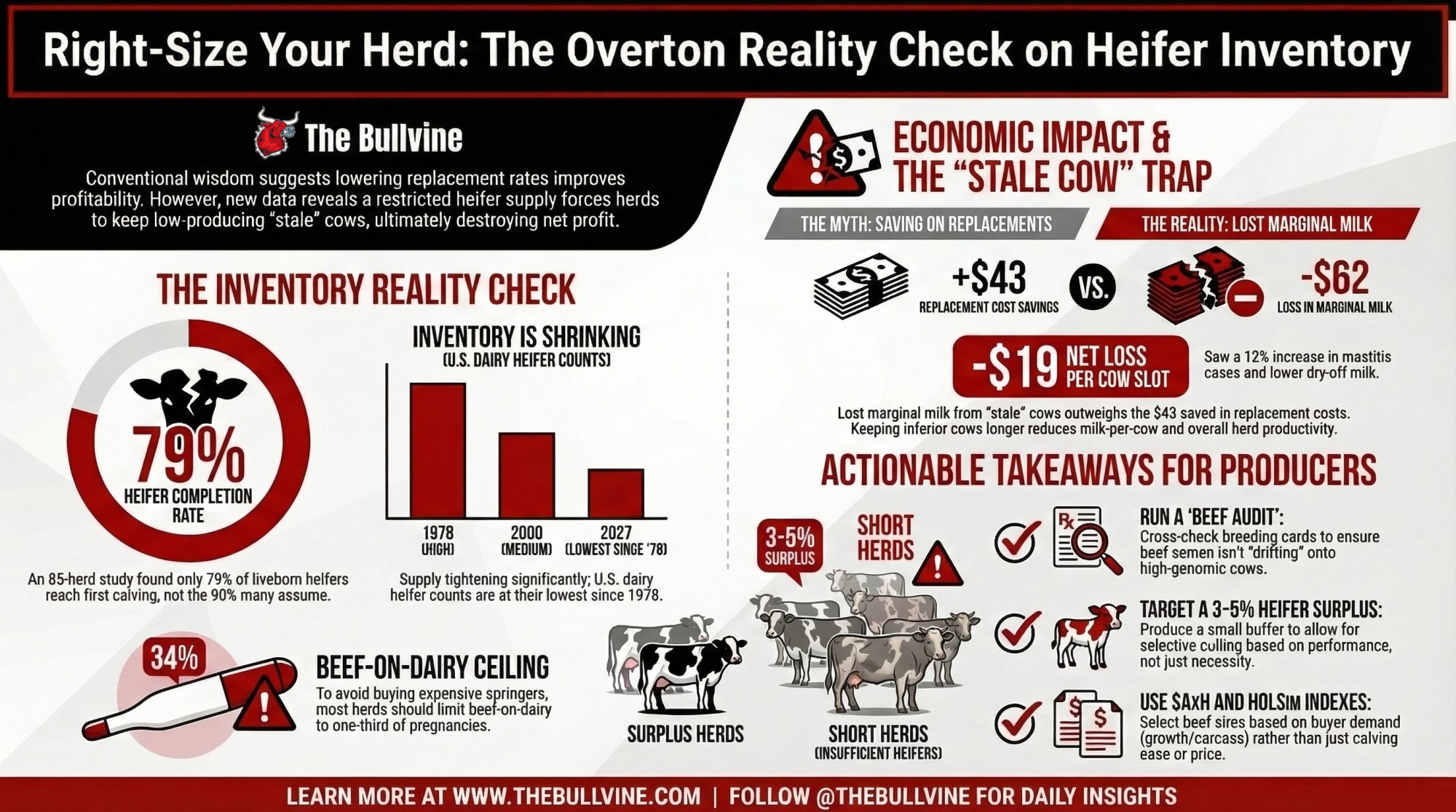
Veterinarian and dairy economist Mike Overton went looking for hard numbers on replacement risk when he analyzed data from 85 commercial U.S. herds and presented it at the High Plains Dairy Conference in Amarillo, Texas, on March 3–4, 2026.

Across those herds, the average heifer completion rate from liveborn heifer calf to first calving was about 79%, with most herds landing between 74 and 84%. Just over one in five heifer calves never make it into the milking string. Some are lost at, or shortly after birth, some in the calf and grow‑out phases, some to disease or injury, and some are culled before they ever freshen.

Overton’s point to the HPDC crowd was blunt: a lot of operations are still planning their replacement needs as if nearly every heifer calf eventually freshens. His datasets say those assumptions are quietly loading risk into every decision about sexed semen usage, beef‑on‑dairy percentage, and whether a herd will be forced to compete in a record‑high springer market a couple of years down the road.

The national backdrop doesn’t leave much margin for error. USDA’s January 1, 2025, cattle estimates put dairy heifers 500 pounds and over at 3.914 million head, the lowest count in that category since 1978. CoBank’s August 2025 Knowledge Exchange report projected dairy heifer inventories would shrink by roughly 800,000 head over the following two years before beginning to rebound in 2027, with heifer prices already at record highs and potentially moving well beyond ,000 per head in some markets as supply tightens. When $3,000‑plus springers are the new normal, pretending your herd runs at 90% heifer completion when the real number is closer to 79% is an expensive fantasy.

Parlor Drift: Is Your 4:00 a.m. Tech Killing Your Genetic Progress?

On paper, the breeding strategy in a lot of progressive herds already sounds sharp.

The binder in the office usually says something like: the top genomic tier and key cow families get sexed dairy semen; the middle third get conventional dairy; the true bottom third get beef from carefully chosen Angus or SimAngus sires; and obvious problem cows are DNB. That’s the clean terminal‑program diagram you walk through with your vet, nutritionist, and semen rep.

The decision about which straw goes in which cow doesn’t happen on that whiteboard, though. It happens at 4 a.m. in the parlor.

If today’s list says “breed these 14 cows” without telling the tech who gets sexed, who gets conventional, who gets beef, and who shouldn’t be bred at all, the plan starts to leak:

  • A high‑genomic heifer that missed first service on sexed gets conventional “just this once” so she’s not open again.
  • A third‑lactation cow, the crew is sick of treating, gets beef because she was open again, not because she’s truly bottom‑tier genetically.
  • A lame, stale cow that should be hard DNB gets a straw anyway because she’s already in the headlocks and the tank is right there.
  • A cow flagged for beef on the list gets conventional dairy because the tech grabbed the wrong tank canister, and nobody caught it until reconciliation — if reconciliation happens at all.

None of those calls look crazy in isolation. Stack them up over 52 weeks, and it’s easy for a beef target in the mid‑20s to creep into the low‑ or mid‑30s without anyone ever sitting down and saying, “Let’s change the plan.” Until someone reconciles pregnancies by semen type against the replacement math, that drift stays invisible.

If you haven’t done it recently, a simple 20‑minute “beef audit” on your breeding cards is eye‑opening. Grab a recent week, highlight every beef mating, and cross‑check those cows against your genomic or index‑based tier list and DNB list. When more than a handful of beef straws are landing on cows that aren’t truly bottom‑tier, the day‑to‑day realities in the parlor are quietly pulling the program off the plan.

The 500-Cow “Overton Reality Check.”

Overton’s 79% completion figure isn’t just an interesting stat to quote at meetings. It’s the anchor for a simple backward pipeline calculation you can run on your own herd to find your real beef‑on‑dairy ceiling.

Here’s how a hypothetical 500‑cow herd looks when you put the math side by side with typical planning assumptions:

MetricYour Value (Est.)The “Overton” Reality Check
Herd Size500500
Replacement Rate35% (what you’d like)37% (what many herds actually run)
Heifers Needed175185 (+15 buffer = 200)
Completion Rate90% (goal in your head)79% (85‑herd actual)
Heifer Calves Needed194253
Beef Ceiling~50% of pregnancies (on paper)~34% of pregnancies (with sexed + conventional mix)

Walking through the right‑hand column in barn‑math terms:

  • At a 37% annual cull/turnover rate, you need 185 replacements to stand still (0.37 × 500 = 185). 
  • Add a modest 3% buffer for flexibility — about 15 extra heifers — and you’re targeting 200 heifers calving in per year.
  • At a 79% heifer completion rate, those 200 heifers require roughly 253 heifer calves born alive (200 ÷ 0.79 ≈ 253).
  • If 60% of your dairy pregnancies use sexed semen (≈90% heifers) and 40% use conventional (≈50% heifers), the weighted average female fraction per dairy pregnancy is about 0.74. 
  • To get 253 heifer calves at 0.74 heifers per pregnancy, you need about 342 dairy‑sired pregnancies per year(253 ÷ 0.74 ≈ 342).

Total pregnancies per year in a 500‑cow herd vary with the reproduction program, but for illustration, say you generate around 520 pregnancies annually. In that scenario:

  • 520 total pregnancies − 342 dairy‑sired pregnancies needed = 178 pregnancies available for beef.
  • 178 ÷ 520 ≈ 34% of pregnancies.

That 34% isn’t a magic industry standard. It’s the ceiling in this particular example with these assumptions. If your actual completion rate is lower than 79%, your safe beef ceiling drops. Dial back sexed semen usage — or see weaker conception on sexed — and it drops again. Want more than a 3% heifer surplus to sell into a strong replacement market? It drops further still.

Overton showed how the math scales on a larger herd in that same HPDC talk. In one 2,500‑cow scenario from his presentation, he modeled using sexed dairy semen versus beef semen on the final 100 pregnancies. Once he included three‑year replacement costs, his model showed the sexed semen strategy generating about $216,000 more net value than the beef‑semen strategy on those same 100 pregnancies. Most of that difference came from not having to buy high‑priced springers into a market where $3,000‑plus per head isn’t rare.

The calf cheque from beef is visible right away. The springer cheque is delayed and much less fun to write. The arithmetic doesn’t care which one feels better.

DecisionBeef-on-Dairy PregnancySexed Dairy PregnancyDifference
Immediate Calf Value+$1,200 (beef calf)+$750 (dairy heifer calf)+$450 to beef
Heifer Raised01 @ $1,700 raising cost-$1,700 to beef
Springer Purchased Later-$3,200$0-$3,200 to beef
Net Present Value-$2,000+$850-$2,850 net loss for beef

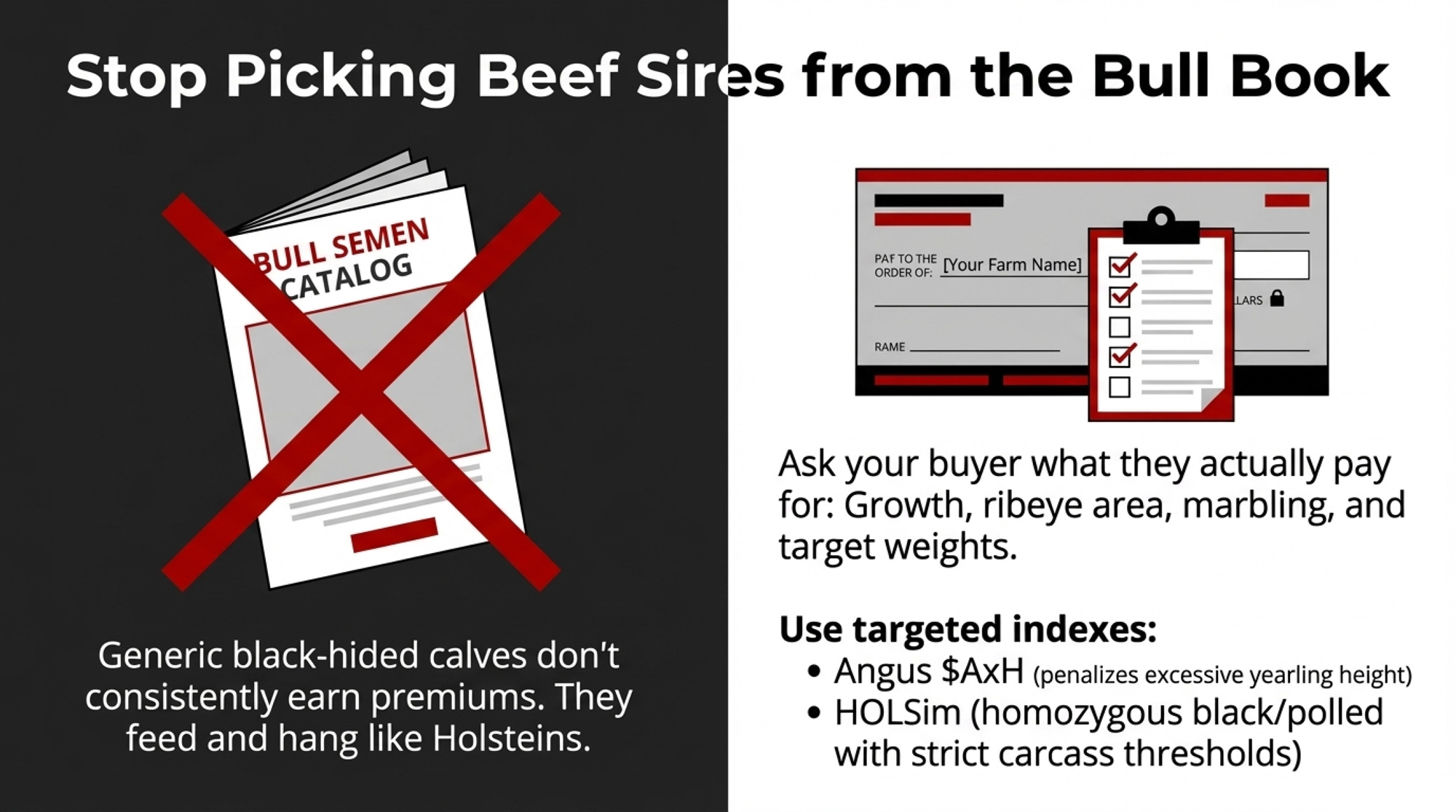
Are You Breeding for the Bull Book or the Buyer’s Cheque?

Once you’ve got a handle on how many pregnancies you can safely point at beef‑on‑dairy, the next question is uncomfortable and simple: are you picking beef bulls for your buyer, or for your semen catalog?

Plenty of herds still select beef semen on a mostly dairy‑centric checklist — calving ease, conception rate, semen price, and maybe coat color — instead of starting with the traits their calf buyer actually pays for. Meanwhile, calf buyers and feedlots are looking at a different checklist: calves that grow, hang a decent carcass, and are consistent enough they don’t need a spreadsheet to figure out what they’re feeding.

Extension and university work — including Kansas State’s analysis of Holstein and beef‑dairy cross calves in video auctions — shows that well‑bred beef‑on‑dairy calves often sell above straight Holstein steers on a per‑hundredweight basis, narrowing the gap to native‑beef calves in many sales. Generic black‑hided calves that still feed and hang like Holsteins don’t earn those premiums consistently.

Instead of guessing, start that conversation at the other end of the chain. Ask your buyer:

  • What breed or breed type do you actually want on these calves — straight Angus, or are SimAngus/HOLSim crosses on the table if they’re black and muscled?
  • Do you need predominantly black‑hided calves for your program?
  • Are you insisting on polled calves?
  • At what weight do you buy — day‑old, 250 pounds, 500 pounds, or heavier?
  • Are you paying primarily on live weight, or is there carcass/grid feedback that matters?

Those answers translate directly into trait priorities on the sire side: growth and feed efficiency to hit target weights, muscling and ribeye area to avoid “dairy‑type” carcasses, marbling to hit Choice or better, moderate frame consistently, and the calving ease you need on Holstein or Jersey dams. Color and horn status become hard filters, not catalog fluff.

On the genetics side, two indexes do a lot of heavy lifting:

  • The Angus $AxH index was developed specifically for Angus sires used on Holstein dams. It blends calving ease, growth, muscling, and marbling while penalizing excessive yearling height — directly addressing the carcass‑length and cut‑size issues common in straight Holstein steers. In one Angus Genetics Inc. summary from 2022, just 15 of 9,690 sires ranked over 150 on $AxH, which tells you how small the truly elite slice was at that point. 
  • The HOLSim program, a joint effort between Holstein Association USA and the American Simmental Association, launched in 2019 and designates SimAngus bulls that are homozygous black and homozygous polled and exceed a Holstein‑specific terminal index threshold, balancing calving ease and carcass traits. Eligible bulls must be SimAngus with a breed composition of 3/8 to 3/4 Simmental, with the balance Angus. 

Beef semen used in dairy herds has often been cheaper on average than top‑end terminal options, as Dairy Herd and Progressive Dairy have both noted. The real question isn’t whether you can save a few dollars per straw. It’s whether the sires you’re using actually work for the person writing the cheque.

For many 200‑ to 1,000‑cow herds, the practical move isn’t a 20‑bull lineup. It’s a small, consistent group — often three to five sires — that rank well on $AxH or HOLSim and match your buyer’s spec sheet. And then the discipline to stick with them. No off‑list bulls go in the tank “just this once.” No “cleaning out the tank” by throwing calves into the pipeline, your buyer didn’t ask for.

  • Don’t just take the cheque; demand the data. Ask for carcass or grid information back from your buyer, where possible. If your high‑index beef‑crosses aren’t consistently grading Choice or Prime, you’re giving away leverage on next year’s price discussion — and you won’t know it until you ask. 

📖 Recommended Reading:
Overton’s heifer inventory deep‑dive — “A new perspective on right-sizing your heifer inventory.”

Can You Get the Beef-on-Dairy Benefit Without Fancy Tech?

A lot of the breeding‑strategy case studies making the rounds right now feature fully integrated setups: automated sort gates, activity monitors feeding into DairyComp or BoviSync, cow‑level breeding reports, semen assignment protocols. If you’re there already, great.

Plenty of 200‑ to 800‑cow herds aren’t there yet. And they’re not going to install a six‑figure tech stack to straighten out beef usage.

You don’t need another app to remove most of the slop from your program. You do need a clear, written plan, a slightly smarter breeding sheet, and a ruthless 20 minutes once a week.

The minimum viable system looks something like this:

  • Write a one‑page breeding policy and hang it where cows actually get bred. Define top, middle, and bottom tiers using your genomic or index ranking. In one line per tier, spell out which semen types are allowed on which services. Then list your DNB criteria in plain language — chronic mastitis, chronic lameness, multiple failed services, stale lactation, whatever fits your herd.
  • Print a color‑coded cow list out of your genomic file or herd software. Sort by your chosen index (NM, or a custom ranking), then tag green for top, yellow for middle, red for bottom. Put a dot or symbol next to the cows you already know should be DNB. Keep that list beside the breeding cards, not in the office drawer.
  • Add one column to your breeding card or work list: “Tier + Allowed Semen.” When the tech goes to breed cow 4123, they don’t just see an ID. They see “green — sexed only” or “red — beef only.” If “Angus” gets written next to a green cow, that mismatch is easy to spot on Friday.
  • Block 20 minutes once a week for a three‑count audit:
    • Count how many beef straws went to green or yellow cows instead of red.
    • Count how many services were sexed, conventional, and beef — and compare that mix to the replacement plan you just ran with your own numbers.
    • Count how many cows marked as DNB on your list still got bred.

You won’t get a slick dashboard out of this. You will get a clear yes‑or‑no answer to a hard question: is your beef‑on‑dairy program being driven by your genetic and replacement plan, or by whoever happened to be standing in the parlor with an AI gun at 4 a.m.?

What This Means for Your Operation

Think of this as a set of reality checks, not a recap:

  • Within 30 days, run the breeding‑card beef audit. Pick a recent week, highlight every beef mating, and cross‑check each cow against your genomic tier list and DNB list. If more than a third of your beef straws are landing on cows that aren’t truly bottom‑tier, it’s a sign the day‑to‑day realities in the parlor are quietly pulling the program off the plan.
  • Calculate your own heifer completion rate instead of guessing. Take a recent calf crop, divide the number of heifers that actually calved in by the number of live heifer calves born in that group. If you’re near Overton’s ~79% average — or below — your safe beef‑on‑dairy percentage is tighter than it looks in your winter planning meeting. 
  • Run the backward pipeline math once a year. Start with herd size and actual replacement rate, add a small buffer, then work back through your real completion rate and sexed/conventional mix to find how many dairy pregnancies you need. Whatever’s left is your genuine beef ceiling. If your current beef percentage is higher than that, you’re pre‑loading a replacement deficit.
  • Sit down with your calf buyer or integrator before your next semen order and get their specs in writing: breed, color, horn status, target weight, and how they pay. Build your beef sire list backward from that conversation using $AxH or HOLSim bulls that fit, instead of forward from whichever bull picture looks best in the catalog. 
  • Make the breeding sheet match your plan. If you’re asking staff to remember which cows get what semen type in their heads, you’re almost guaranteeing drift. The moment you write “green — sexed only” and “red — beef only” on the card, you’ve given people a fair chance to hit the target.
  • Watch the opportunity cost, not just the calf cheque. In a market where replacement heifers can sell well above $3,000 per head, that extra $150–$200 on a beef‑cross calf can disappear fast if you later have to buy a heifer to replace the one you didn’t create. The gap is on the order of a couple of thousand dollars, not a rounding error. 

Key Takeaways

  • If you don’t know your own heifer completion rate, you’re guessing about how much beef‑on‑dairy your herd can afford — and Overton’s 85‑herd dataset suggests those guesses are often 10 points too optimistic. 
  • If your breeding cards and your genomic tier list don’t line up on where beef semen is actually going, you’ve got more of a beef‑on‑dairy storyline than a fully enforced strategy.
  • If your beef sire lineup came from the bull book forward instead of from the buyer’s cheque backward, you’re likely leaving premiums on the table — especially if you aren’t tracking whether those calves are actually grading Choice or Prime once they reach the packer. 
  • If you can’t explain — in one hallway conversation — how many dairy pregnancies you need each year to protect your replacement pipeline, it’s a sign you don’t yet have full control over how beef‑on‑dairy fits into your herd.

The Bottom Line

The heifer shortage isn’t going to disappear this year or next. Beef‑on‑dairy isn’t going away either. On Monday morning, before you do anything else with the next semen delivery, grab last week’s breeding cards, a highlighter, and your genomic list — and find out whether your beef‑on‑dairy program is protecting your 2028 milking string or just making it more expensive to buy back later.

Complete references and supporting documentation are available upon request by contacting the editorial team at editor@thebullvine.com.

Learn More

The Sunday Read Dairy Professionals Don’t Skip.

Every week, thousands of producers, breeders, and industry insiders open Bullvine Weekly for genetics insights, market shifts, and profit strategies they won’t find anywhere else. One email. Five minutes. Smarter decisions all week.

NewsSubscribe
First
Last
Consent

40% Muscle Loss in 60 Days: The Genetic Time Bomb Hiding in Your Fresh Pen

She’s milking 110 lbs. Ketones perfect. Appetite strong. She’s also lost 40% of her muscle and won’t breed back. You just can’t see it yet.

EXECUTIVE SUMMARY: While you’re watching ketones and body condition, your best cows are quietly losing up to 40% of their muscle—and you can’t see it happening. Fat bounces back by 90 days in milk. Muscle doesn’t recover until 240-270 days, if at all. That gap explains a lot: the silent ovaries, the infections that won’t clear, the early culls you blamed on bad luck. Worse, Purdue research shows your highest-genetic cows mobilize the hardest—we may have spent 40 years breeding cows programmed to destroy themselves for peak milk. Rumen-protected amino acids and late-lactation nutrition buffer the damage—but don’t fix the genetics. The real question: are we willing to weight DPR, Livability, and persistency heavily enough to breed cows that last 4-5 lactations instead of 2.5?

Dairy Cow Muscle Mobilization

New research reveals that high-producing cows can lose up to 40% of their muscle depth in early lactation. The uncomfortable question: have decades of selection created cows genetically programmed to cannibalize themselves?

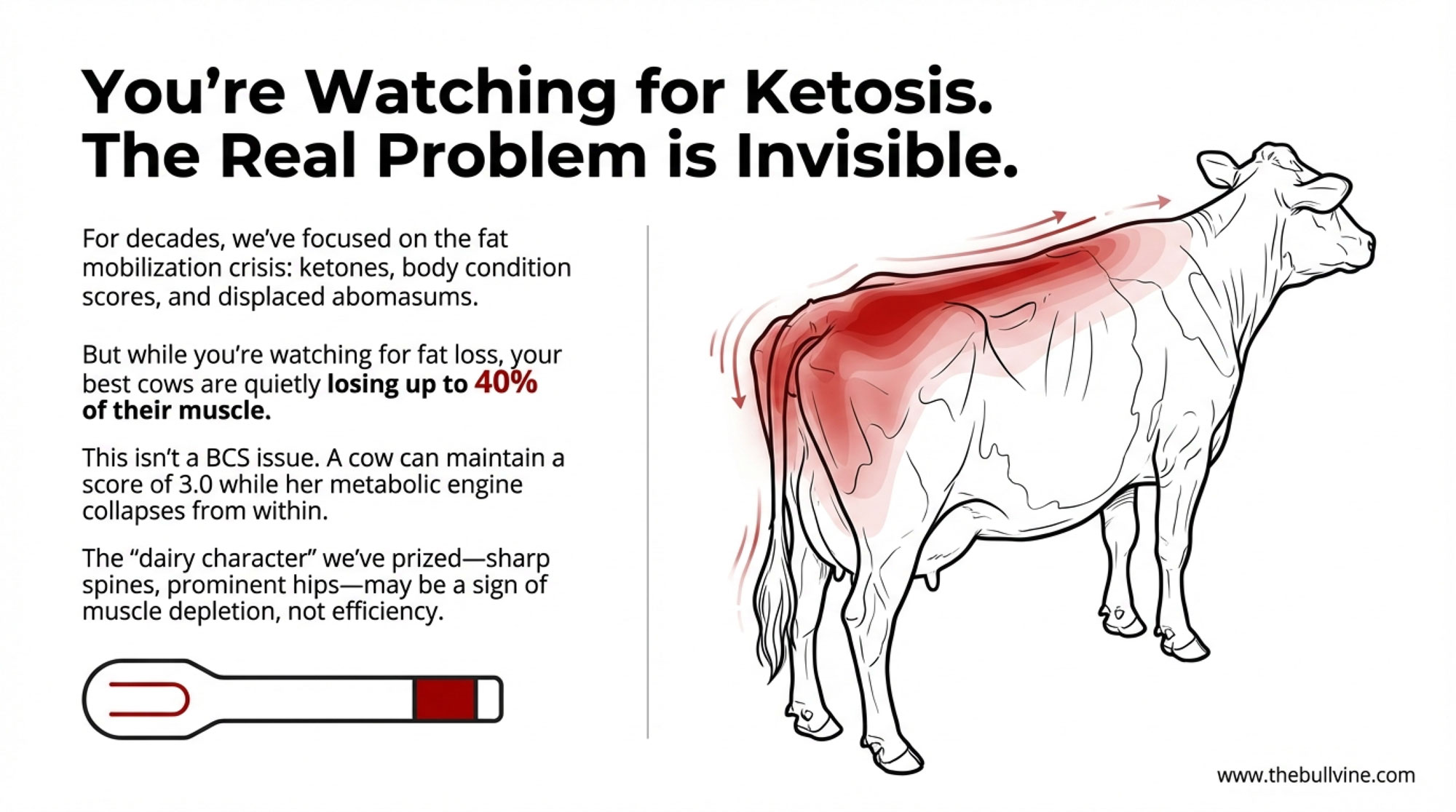
If you’ve spent any time around transition cows, you know the routine. Monitor ketones. Watch body condition. Keep an eye on feed intake. Over the past couple of decades, we’ve gotten pretty good at spotting the fat mobilization crisis—you know, the ketotic cow with acetone breath and a twisted stomach brewing.

But here’s what’s been hiding in plain sight: while we’ve been laser-focused on fat, our cows have been quietly drawing down something else entirely. Their muscle.

Recent work coming out of Purdue University, led by Dr. Jackie Boerman and her team, has documented something that should give us all pause. According to their research database, high-yielding cows routinely mobilize 30% to 35% of their longissimus dorsi muscle depth—that’s your ribeye area—within the first 60 days of lactation. And in some cases, cows can lose up to 40% of that muscle depth during this window.

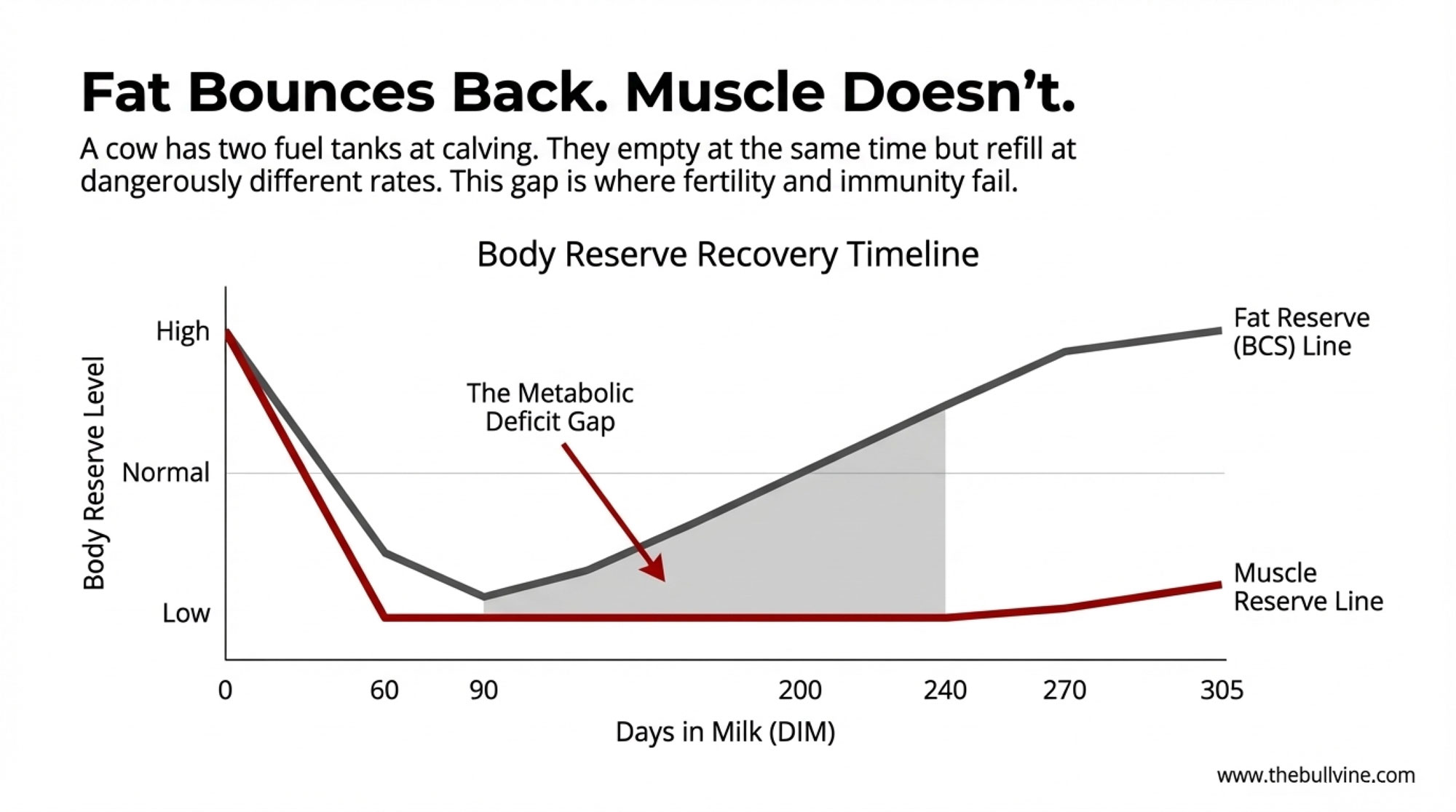
Here’s the part that should make every breeder uncomfortable: unlike fat, which starts coming back around 60-90 days in milk, muscle mass often doesn’t rebuild until 240-270 days in milk. Sometimes not at all.

And the cows doing this most aggressively? Your highest genetic merit animals.

Let that sink in for a minute.

The Breeding Question Nobody Wants to Ask

Let’s cut to the chase here. We’ve been selecting hard for peak milk yield and feed efficiency for decades—really since the early 1980s when the Holstein boom took off. Both traits have value. Nobody’s disputing that.

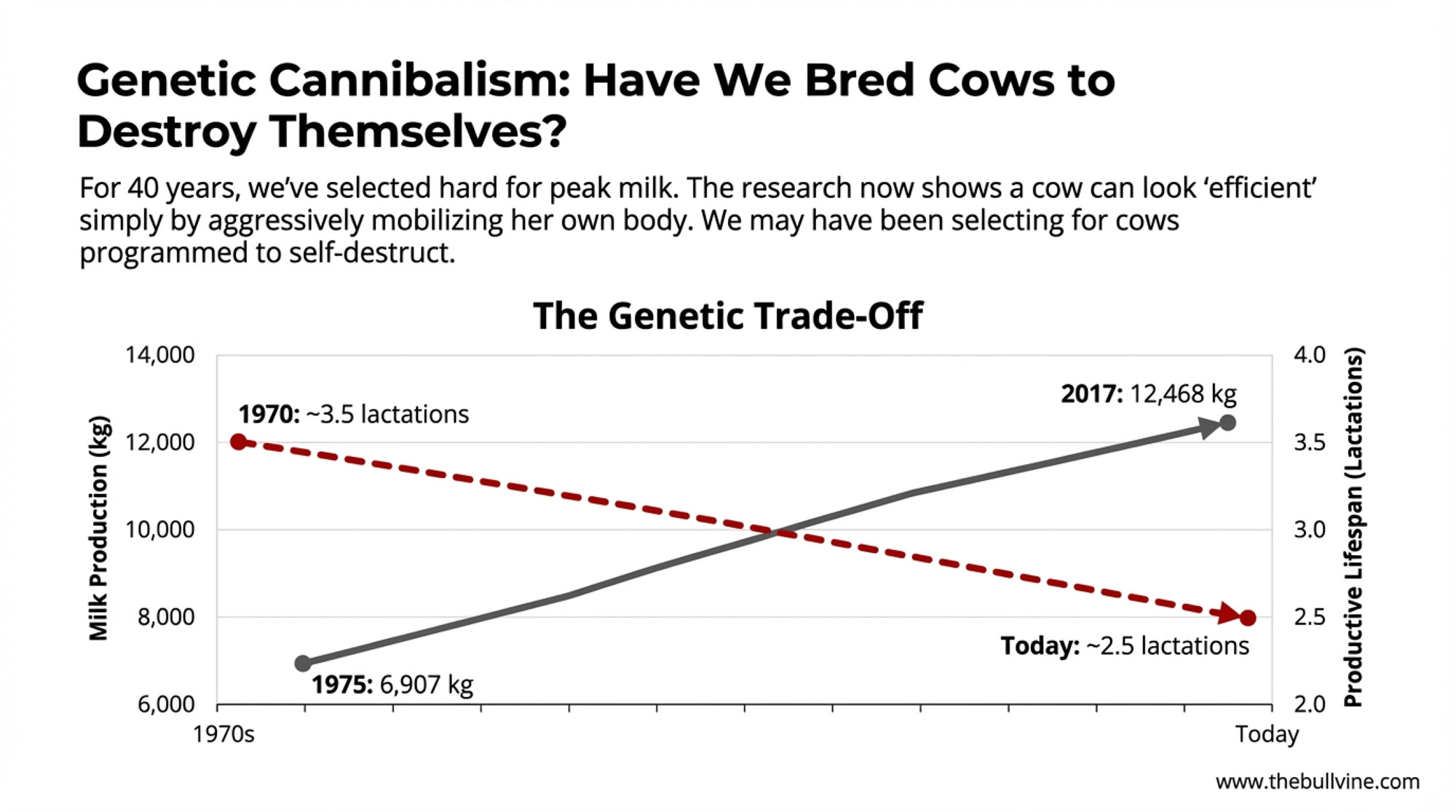
But here’s the uncomfortable reality the research is now exposing: a cow can score high on “efficiency” simply by aggressively mobilizing her own body tissue. She looks efficient on paper because her own reserves aren’t counted as an input.

Think about what that means. We may have spent 40 years selecting for cows willing to destroy themselves to make milk.

The data from Lactanet tells the story pretty clearly. The average Canadian Holstein cow born in 1975 produced 6,907 kg of milk. By 2017, that number had climbed to 12,468 kg. That’s remarkable genetic progress by any measure. But here’s the flip side—productive lifespan has moved in the opposite direction, declining from about 3.5 lactations in 1970 to somewhere between 2.5 and 3.0 today, according to research compiled by Lohmann Breeders.

Now, to be fair, some exceptional operations have achieved 4+ lactation averages even with high-production genetics—but they’re the exception rather than the rule, and they’ve typically invested heavily in the nutritional and management strategies we’ll discuss later. For most herds, the inverse relationship between genetic milk potential and productive lifespan remains stubbornly real.

Studies published in Animals comparing “high muscle” cows (greater than 5cm longissimus dorsi depth at calving) with “low muscle” cows found something that should stop breeders in their tracks. High-muscle cows—your genetically superior animals with the capacity for massive production—actually begin mobilizing before calving even happens. They lose more total muscle in absolute terms. They produce significantly more milk in early lactation. And then they crash harder reproductively.

The cows with lighter frames? More metabolically conservative. Lower peaks, but they hold together longer.

Dr. Kent Weigel, who chairs the Department of Animal & Dairy Sciences at the University of Wisconsin-Madison and has worked extensively on dairy cattle selection indexes, has noted that traits such as Daughter Pregnancy Rate and Livability serve as indirect proxies for metabolic robustness. A cow with high DPR maintained her reproductive function while producing milk. A cow with high Livability survived multiple lactations, which require maintaining body reserves over time.

It’s worth noting that Scandinavian breeding programs recognized this connection earlier than most. Countries like Sweden and Denmark have emphasized health, fertility, and longevity traits in their selection indexes for decades—and their herds show it in productive lifespan numbers that consistently exceed North American averages.

Here’s the call to action for those of us making breeding decisions: If you’re still selecting primarily on milk and type while treating DPR and Livability as afterthoughts, you may be actively breeding for metabolic fragility. Every 500 pounds of additional milk potential means nothing if that cow burns out after 2.5 lactations—which is exactly where the U.S. average sits.

The cow of 2030 needs to look different than the cow we’ve been chasing. A bit more substance. A bit less extreme “dairy character.” Flatter lactation curves. And 4-5 profitable lactations instead of a spectacular peak followed by an infertility cull.

It’s achievable. Some of the herds are already there. The question is whether the rest of us are willing to shift our thinking.

Why Muscle Matters More Than Most Realize

For a long time—and I was guilty of this too—we’ve thought about skeletal muscle as structural tissue. Important for getting the cow from the freestall to the feed bunk, sure, but not really central to the metabolic challenges of early lactation. That thinking is outdated.

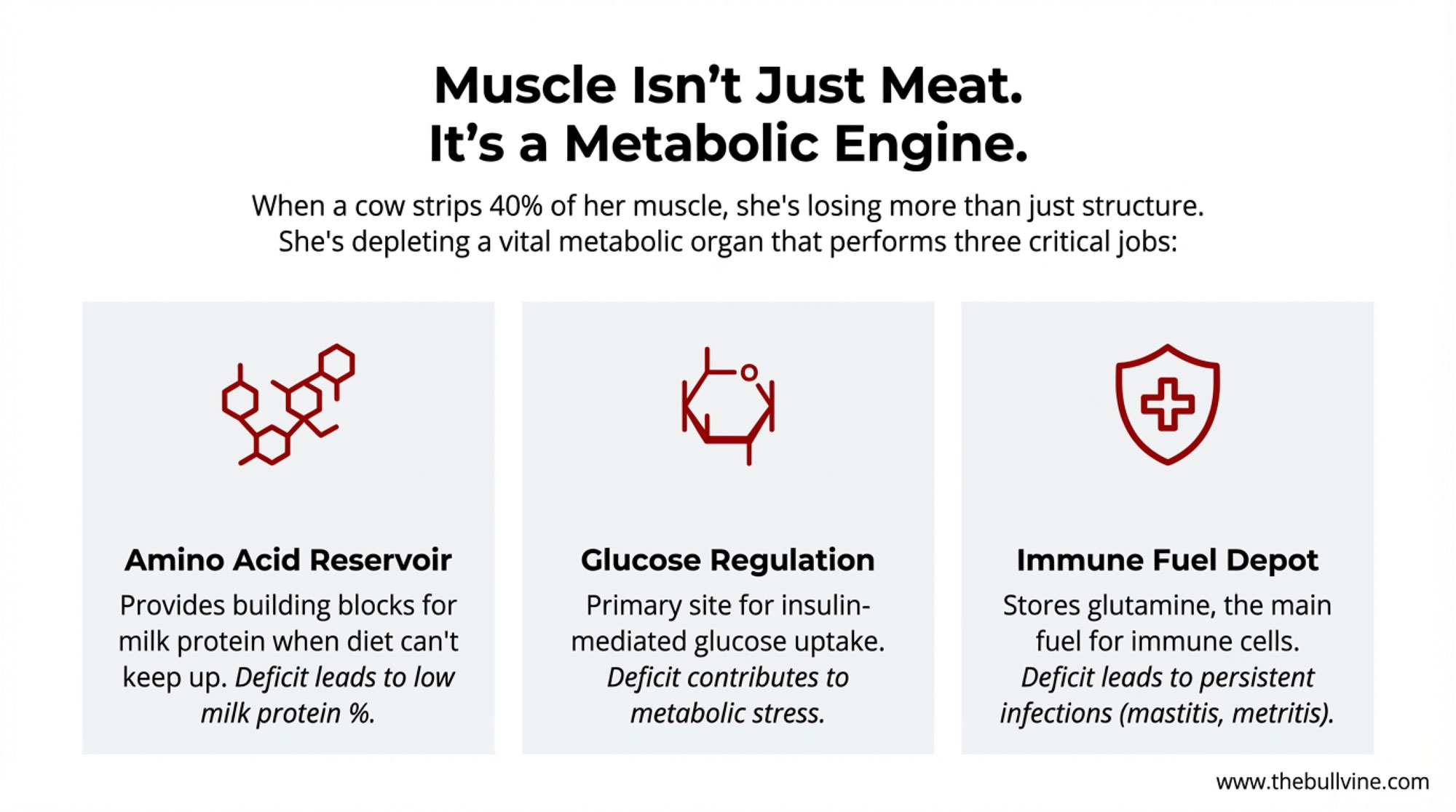
What’s becoming clear from recent research is that muscle tissue pulls triple duty during lactation. It serves as the cow’s amino acid reservoir, providing the building blocks for milk protein synthesis when dietary intake can’t keep pace with demand. It’s also the primary site for insulin-mediated glucose uptake, which matters enormously during that naturally insulin-resistant state after calving. And here’s something that often surprises people: muscle stores glutamine—the primary fuel source for immune cells fighting infection.

Dr. Boerman put it well in a recent presentation at the American Dairy Science Association annual meeting—she essentially said we need to stop thinking about muscle as “meat” and start thinking about it as a metabolic organ. It’s not just structural. It’s actively regulating the cow’s entire metabolic response to lactation.

When a cow strips 40% of that organ in 60 days, you can imagine what follows.

What Body Condition Scoring Actually Misses

Here’s something worth considering, and you may have noticed this yourself if you’ve been paying close attention: our standard monitoring tools weren’t designed to catch muscle loss.

Body Condition Scoring primarily measures subcutaneous fat cover. That’s what it was built to do, and it does that job reasonably well. But a cow can maintain an acceptable BCS of 3.0 while losing significant muscle mass underneath. The visual “dairy character” many of us associate with high production—those sharp spines, prominent hip bones, angular frames—may sometimes reflect muscle depletion rather than optimal metabolic efficiency.

I’ve been thinking about this a lot lately. We may have been confusing a coping mechanism with a desirable trait for decades.

Tools that actually measure muscle status:

Research teams are using ultrasound imaging of the longissimus dorsi at the 12th/13th ribs to track changes in muscle depth over time. Blood biomarkers like 3-methylhistidine indicate active muscle breakdown, while creatinine levels reflect total muscle mass. Even milk protein percentage—when it drops below 2.9-3.0% in early lactation—can signal amino acid deficiency and excessive tissue mobilization.

These tools remain primarily in research settings for now, though some veterinary practices are beginning to explore on-farm ultrasound protocols. That’s worth watching.

Two Cows, Two Outcomes: A Fresh Pen Scenario

Let me paint a picture that might feel familiar.

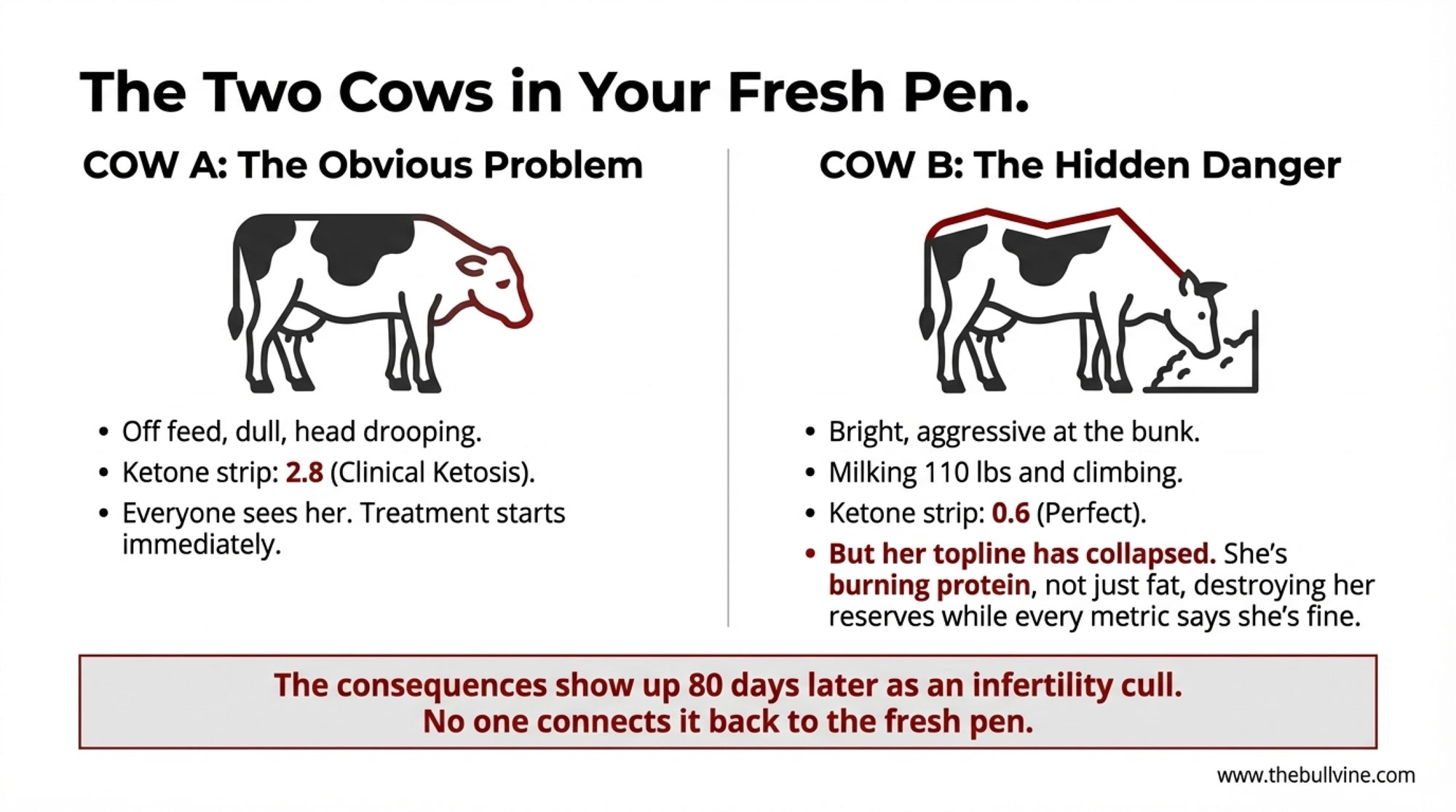
You walk into your fresh pen, 6 AM. Two cows calved about 20 days ago and are now penned side by side.

Cow A is obvious. She’s off feed, dull, and head drooping. Her ketone strip reads 2.8. Clinical ketosis, maybe a DA brewing. Everyone notices her. Treatment starts immediately. This cow is asking for help.

Cow B looks like your star. She’s bright, aggressive at the bunk, already milking 110 pounds, and climbing. Ketone strip reads 0.6, perfect. She appears to be crushing it.

But look closer at her topline. Three weeks ago, there was a firm shelf of muscle along her spine. Today, your fingers slide right down the side. The shelf has collapsed. Her ribs are more visible, her frame more angular.

She’s not showing ketosis because she’s burning protein, not just fat. Muscle catabolism produces glucose precursors that actually prevent ketone formation. She’s destroying her metabolic reserves while every standard metric says she’s fine.

Monitoring MetricCow A – Clinical Ketosis (Everyone Notices)Cow B – Hidden Muscle Crisis (Looks Perfect)
Ketones (mmol/L)2.8 (HIGH)0.6 (normal)
Body Condition Score2.53.0
Milk Yield (lbs/day)75110
Milk Protein %3.22.8 (red text)
Muscle Depth (cm)4.83.2 (40% loss) (red text)
Reproductive Status at 100 DIMNormal cycle expectedNo cycle – infertility cull (red text)

The consequences show up 80-100 days later when she fails to cycle and gets flagged as an infertility cull. And nobody connects it back to the fresh pen—or to the genetics that programmed her to spend herself this way.

Signs Worth Watching For in Fresh Cows

  • Milk protein percentage dropping below 2.9% in the first 30 DIM
  • Topline softening along the spine despite adequate body condition scores
  • High-producing cows failing to show heat by 80-100 DIM
  • Persistent low-grade infections (mastitis, metritis) that won’t fully clear
  • Angular appearance developing more rapidly than expected post-calving
  • Strong peak production followed by a steep, early decline

The Fertility and Immune Connection

This is where the research gets really practical, and honestly, it’s the part that convinced me this topic deserves more attention than it’s been getting.

Work published in the journal Animals back in 2022—a study by Schäff and colleagues that tracked 500 lactations across three commercial UK herds—found that cows experiencing excessive muscle tissue mobilization took significantly longer to resume ovarian cyclicity and had extended intervals to first service. Moderate muscle loss—around 1.5 to 5mm reduction in muscle diameter—was actually associated with optimal reproductive outcomes. It’s the excessive losses, more than 8mm reduction, that correlated with delayed return to fertility.

From a physiological standpoint, reproduction is what biologists call a “luxury” function. When a cow’s body is under severe metabolic stress, the signal is clear: conditions aren’t ideal for supporting a pregnancy.

The immune connection matters too. Immune cells are voracious consumers of glutamine—they use it as fuel to replicate and mount an immune response. Skeletal muscle is the body’s primary site for glutamine storage. When a fresh cow mobilizes muscle too aggressively, she may run short of glutamine for her immune system while the mammary gland simultaneously demands it for milk protein synthesis. Research published in the Journal of Dairy Science found that glutamine supplementation during the transition period improved immune cell function and reduced infection severity.

The practical takeaway: Cows leaving the herd for “infertility” may not have inherent reproductive problems at all. Their bodies have simply entered protein-conservation mode. And stubborn SCC problems or persistent metritis? The ration’s amino acid balance—and the cow’s genetic programming for tissue mobilization—may be part of the picture.

Every cow that fails to breed back at 100 DIM is a decision point—fix her nutrition, change her genetics, or make beef-on-dairy work for you. With week-old beef crosses commanding premium prices and replacement heifers running $2,600-3,000+, that infertility cull calculation has shifted. But here’s the thing: relying on beef-on-dairy to bail out your reproduction program isn’t a long-term strategy. It’s a symptom that something upstream needs fixing.

Financial Metric (500-Cow Dairy)Current Reality: 2.5 Avg LactationsAchievable: 4.0 Avg LactationsYour Farm’s Opportunity
Annual Replacement Rate40%25%-15 percentage points
Cows Replaced per Year200125-75 cows
Annual Replacement Cost$560,000$350,000-$210,000/year
5-Year Replacement Cost$2,800,000$1,750,000-$1,050,000
Reproduction Culls (5 years)250 cows100 cows-150 fewer culls
Lost/Gained Milk Revenue-$600,000 (lost)+$990,000 (gained)$1,590,000 swing
TOTAL 5-YEAR IMPACT$3,400,000 (total cost)$760,000 (net cost)$2,640,000 SAVED

The Recovery Timeline: Fat vs. Muscle

This is what keeps nutritionists up at night. At calving, your cow has both a fat reserve and a muscle reserve. Both start depleting immediately—but their recovery paths couldn’t be more different.

TimelineFat ReserveMuscle Reserve
Days 0-60Heavy mobilizationHeavy mobilization (30-40% loss)
Days 60-90Hits nadir, starts recoveringStill depleted, no recovery
Days 90-200Continues rebuilding; BCS improvesRemains at nadir; cow looks healthy, but chassis is stripped
Days 240-270Fully recoveredFinally begins meaningful recovery
Day 305NormalMany cows still haven’t returned to pre-calving depth

If a cow enters each successive dry period with less metabolic reserve than before, you’re looking at a cumulative deficit that compounds across lactations. That’s not just a nutrition problem. That may be a genetic trajectory toward early culling.

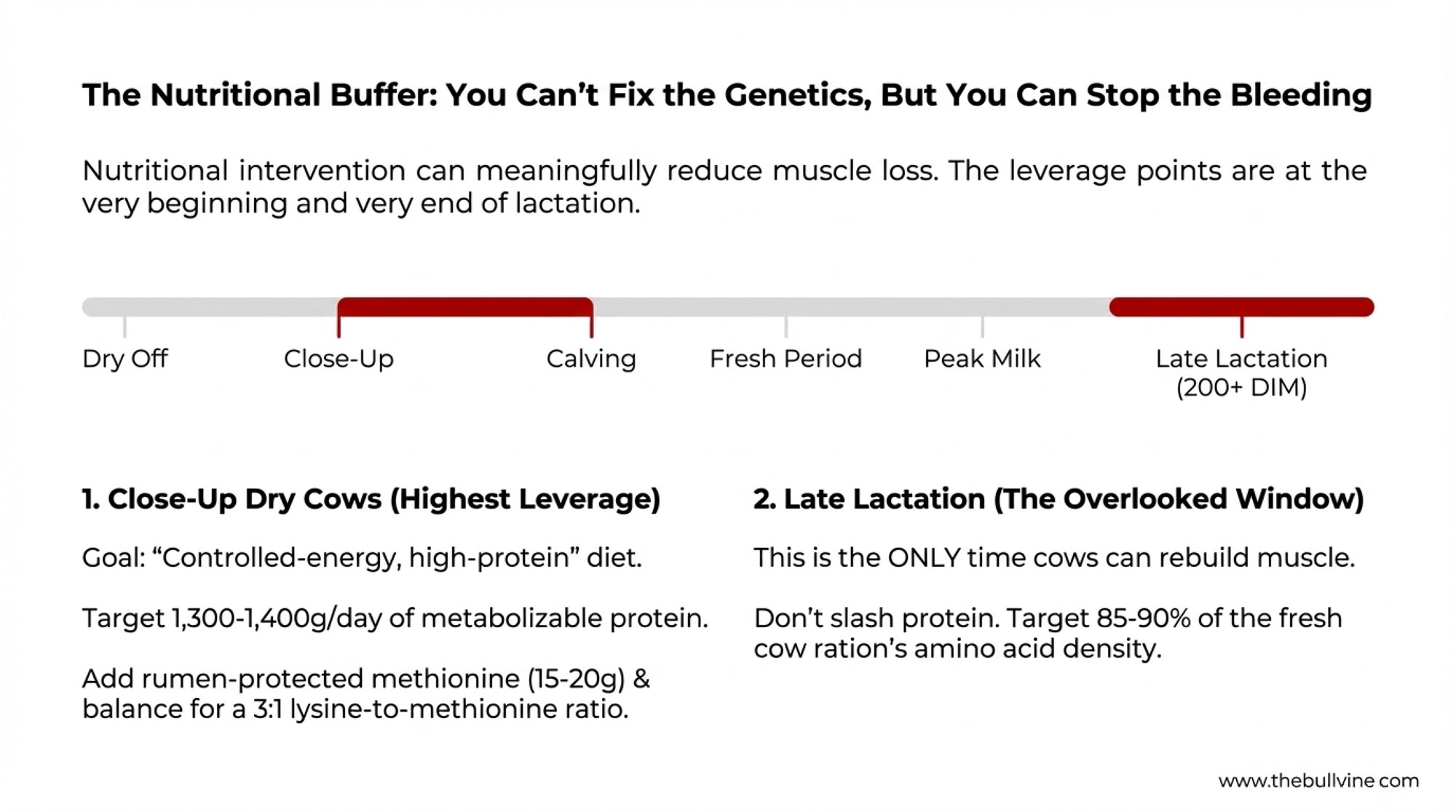
Nutritional Strategies That Buy Time

The encouraging news in all of this: nutritional intervention can meaningfully reduce muscle mobilization. It won’t change the underlying genetics, but it can buffer against the damage.

Close-Up Dry Cow Nutrition (21 Days Pre-Calving)

This is your highest-leverage intervention point. What happens in these three weeks before calving sets the trajectory for everything that follows.

The goal is a “controlled-energy, high-protein” approach. You want a high-fiber, high-bulk diet that keeps the rumen full and prevents over-conditioning. But—and this is critical—you also want a high metabolizable protein supply, not just crude protein.

Rumen-protected amino acids, particularly methionine and lysine at a 3:1 lysine-to-methionine ratio (a target well-established in the research literature, including foundational work by Dr. Chuck Schwab at the University of New Hampshire), give the cow a “labile protein reserve” she can draw on immediately post-calving. Think of it as preloading her checking account so she doesn’t have to raid her savings account.

ComponentTypical Close-UpMuscle-Supportive Close-Up
Crude Protein14%14%
Metabolizable Protein1,000-1,100g/day1,300-1,400g/day
Rumen-Protected Methionine0g15-20g
Rumen-Protected LysineVariableBalanced to a 3:1 ratio
Energy DensityOften too highControlled (0.65-0.68 Mcal/lb NEL)

Fresh Cow Adjustments

If you’re seeing signs of excessive muscle mobilization in your fresh pen, here are some starting points:

Add rumen-protected methionine. Target 15-20 grams per cow daily. This is typically the first-limiting amino acid and has a meaningful impact on reducing tissue mobilization.

Increase rumen-undegradable protein (RUP) sources. Blood meal, heat-treated soybean meal, or commercial bypass protein blends provide amino acids that reach the small intestine directly.

Include glucogenic precursors. Propylene glycol, calcium propionate, or well-processed corn provide glucose precursors that reduce the need for the cow to convert her own amino acids into glucose.

Late Lactation: The Overlooked Rebuilding Window

Here’s where many herds have an opportunity, and I’ll admit I’ve been guilty of overlooking this myself in the past.

The 200 DIM to dry-off window is really the only opportunity your cows have to rebuild muscle before the next lactation. If you’re putting late-lactation cows on minimal rations to reduce costs, you may be setting them up to fail next time around.

Target at least 85-90% of your fresh cow ration’s amino acid density in late lactation, even as energy drops. The cow doesn’t need as many calories at 250 DIM, but she still needs the building blocks to rebuild tissue.

Questions Worth Asking Your Nutritionist

  • “What’s our close-up ration’s metabolizable protein supply—not just crude protein percentage?”
  • “Are we meeting the 3:1 lysine-to-methionine ratio in our fresh cow diet?”
  • “What’s our fresh pen average milk protein percentage at 30 DIM?”
  • “What bypass protein sources are we using, and what’s our RUP percentage?”
  • “How does our late-lactation ration compare to our fresh cow ration on amino acid density?”

The Economics

Yes, this adds cost. Here’s the math.

The Investment (Fresh Period, 0-30 DIM):

  • Rumen-protected methionine: $0.30-0.36 per cow/day
  • Propylene glycol or glucose support: $0.40 per cow/day
  • Bypass protein premium: $0.15 per cow/day
  • Total: roughly $0.85 per cow/day ($25 per cow for 30 days)

The Potential Returns:

Fertility: University of Kentucky research indicates each day open beyond 100 DIM costs somewhere in the $2-5 range, though this varies significantly by herd. One fewer cycle open—21 days—often pays back the investment multiple times over.

Reduced culling: Replacement heifers are running $2,600-3,000+ according to USDA 2025 data, with premium animals fetching $4,000+ at auction. Preventing even a few infertility culls on a 500-cow dairy can dramatically change the economics.

Milk protein: Here’s where the market is shifting in ways that make this conversation even more relevant. With GLP-1 weight-loss drugs like Ozempic and Wegovy driving consumer demand toward high-protein dairy products, protein premiums are strengthening. Whey protein isolate hit record prices above $8.50 per pound in late 2024, and that demand is trickling back to the farm gate. In component-pricing markets, Wisconsin producers shipping 3.4% protein are capturing roughly $0.40-0.50 more per hundredweight than their 3.0% neighbors—and that gap adds up fast across a year’s production. Cows that can maintain milk protein above 3.0% while preserving body reserves become doubly valuable—they’re capturing today’s premiums while staying in the herd long enough to keep doing it.

With FMMO modernization now finalized—USDA’s January 2025 rule updates skim milk composition factors to 3.3% protein effective December 2025, up from the 3.1% standard that’s been in place since 2000—the cows that can maintain 3.2%+ protein while staying fertile become strategic assets. The new formula better reflects current milk composition and amplifies the protein’s relative value at the farm gate.

The Big Math: What 2.5 vs. 4.0 Lactations Actually Costs

Let’s run the numbers for a 500-cow dairy over five years. This is the calculation that changes how you think about breeding decisions.

Scenario A: 2.5 Average Lactations (Current U.S. Average)

  • Annual replacement rate: 40% (200 cows/year)
  • Replacement heifer cost: $2,800 average
  • Annual replacement cost: $560,000
  • 5-year replacement cost: $2,800,000
  • Cows culled for reproduction failure (est. 25% of culls): 250 cows over 5 years
  • Lost production from early exits: ~12,000 lbs/cow potential × 250 cows = 3 million lbs
  • At $20/cwt: $600,000 in lost milk revenue

Scenario B: 4.0 Average Lactations (Achievable with intervention)

  • Annual replacement rate: 25% (125 cows/year)
  • Replacement heifer cost: $2,800 average
  • Annual replacement cost: $350,000
  • 5-year replacement cost: $1,750,000
  • Reproduction culls reduced by 60%: 100 cows over 5 years
  • Additional lactations captured: 150 cows × 1.5 extra lactations × 22,000 lbs = 4.95 million lbs
  • At $20/cwt: $990,000 in additional milk revenue

The 5-Year Difference:

  • Replacement cost savings: $1,050,000
  • Additional milk revenue: $990,000 (conservative)
  • Total advantage: Over $2 million per 500 cows over 5 years

That’s $400,000 per year—or $800 per cow annually—that separates the 2.5-lactation herd from the 4.0-lactation herd. And this doesn’t include reduced veterinary costs, fewer fertility treatments, better genetic progress from keeping your best cows longer, or the component premiums from cows that maintain protein percentage.

The Breeder’s Dilemma

Here’s where we need to be honest with ourselves about what we’re doing with our mating decisions.

Nutrition can buffer against aggressive tissue mobilization. Good management can catch problems earlier. But neither changes the fundamental genetic programming that’s telling your highest-merit cows to destroy themselves for peak production.

Research from Dairy Global has documented this connection pretty clearly: “Long-term genetic selection for high-yielding cows with increased productivity and calving intervals showed to increase susceptibility to metabolic diseases, including mastitis and lameness.” And work from the University of Melbourne found a negative association between thermotolerance and production traits—another dimension of the same problem.

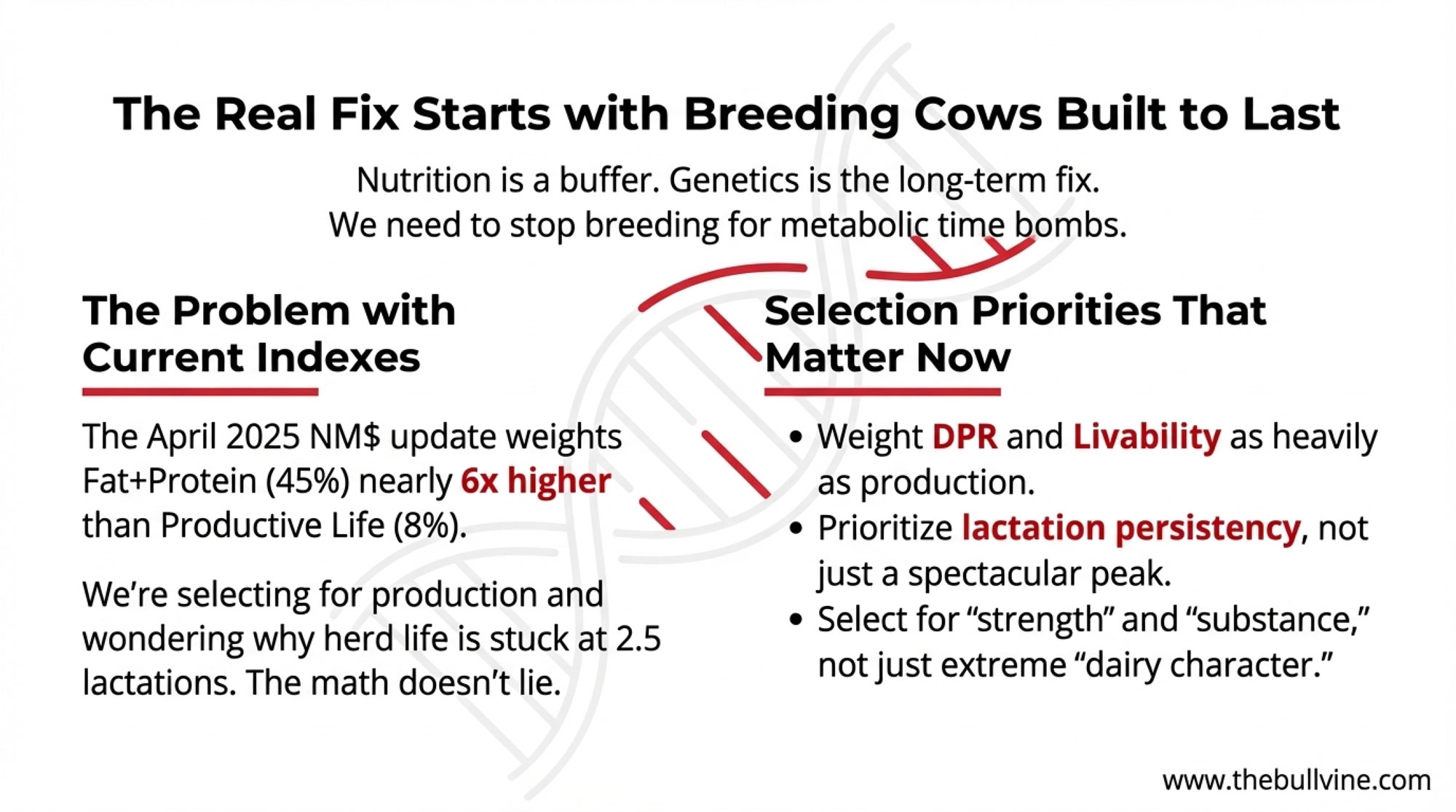
A hard look at current index construction:

The April 2025 Net Merit revision tells an interesting story about industry priorities. According to CDCB, the updated NM$ assigns 31.8% to fat and 13.0% to protein—roughly 45% to production components. Productive Life, meanwhile, dropped from 11.0% to just 8.0%. Feed Saved increased to 17.8%, which sounds good until you remember that “efficiency” can be achieved by aggressive tissue mobilization.

That ratio may need recalibration if research on muscle mobilization and genetic predisposition holds true. We’re weighting production nearly six times heavier than the cow’s ability to stay in the herd—and wondering why average herd life sits at 2.5 lactations. The math doesn’t lie.

Selection considerations that matter now:

  • Weight DPR and Livability heavily, even if it means accepting modestly lower predicted milk
  • Look at lactation persistency, not just peak yield—a cow that peaks at 110 and holds 95 beats one that peaks at 140 and crashes
  • Consider “strength” traits in type evaluation—chest width and loin strength reflect metabolic capacity, not just appearance
  • Question whether 2.5 lactations is acceptable when genetics exist for 4-5

The question isn’t whether we can keep propping up metabolically fragile cows with expensive interventions. The question is whether we should be breeding them in the first place.

The Bottom Line

None of this changes the fundamentals of transition cow management. Fat mobilization and ketosis prevention remain critically important. But addressing only half of the metabolic equation has contributed to the fertility challenges, cull rates, and shortened productive lives that frustrate operations everywhere.

The research is telling us something uncomfortable: we may have optimized for the wrong things. Peak milk and extreme dairy character came at a cost we’re only now measuring—in muscle depth, immune function, fertility, and herd life.

What’s encouraging is that the tools are available. Nutritional interventions exist. Better genetic selection criteria are documented. Some herds are already proving that 4+ lactation averages are achievable. The knowledge is in the literature and is increasingly being applied in the field.

The cows are telling us something with their disappearing toplines and their silent ovaries. The data is confirming what they’ve been communicating for years.

The genetics we choose next will determine whether we keep selecting for metabolic time bombs—or start breeding cows built to last.

That choice is ours.

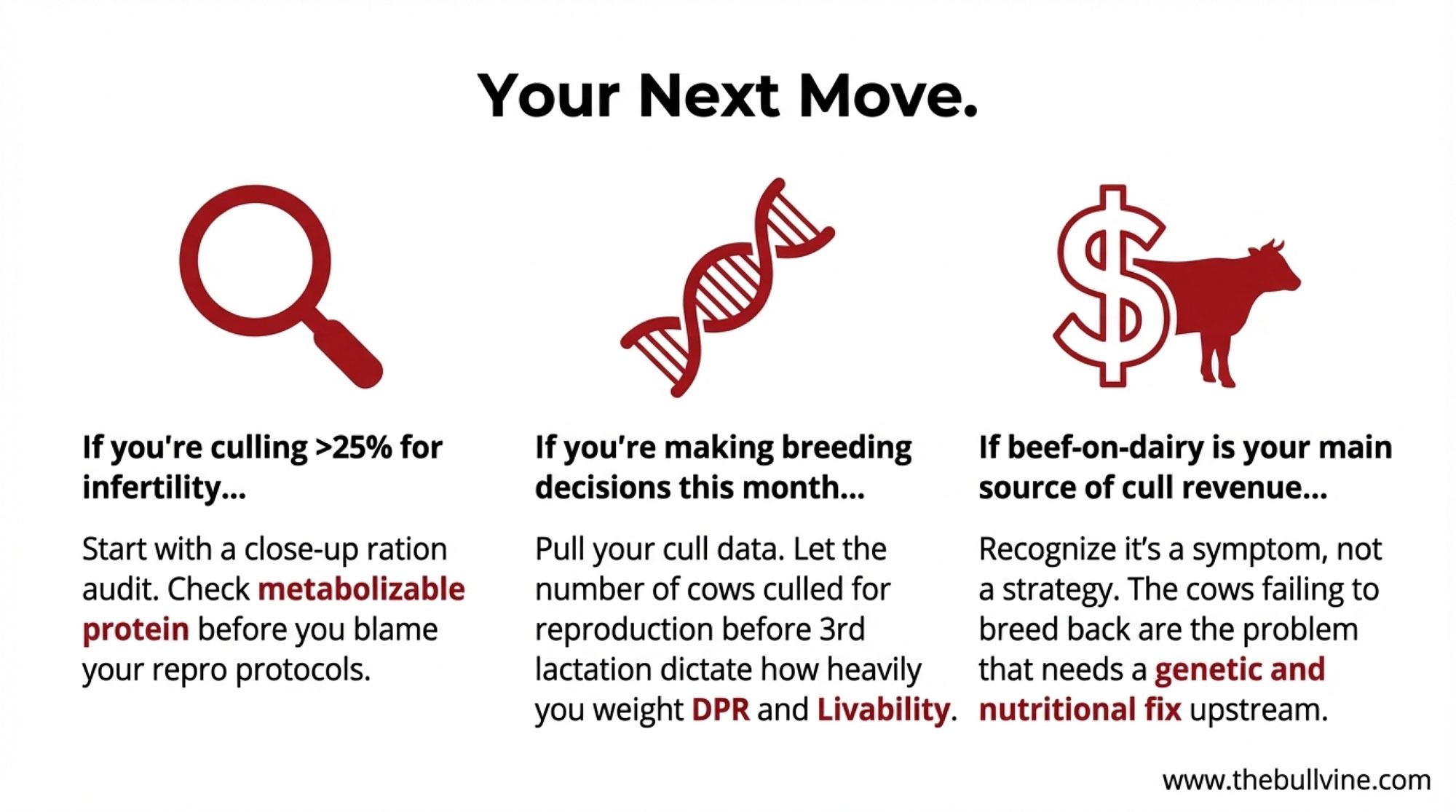
Where to Start Based on Your Situation

  • If you’re culling 25%+ for infertility, Start with a close-up ration protein audit. Check the metabolizable protein supply and amino acid balance before blaming reproduction protocols.
  • If you’re a 1,000+ cow operation: Consider piloting an ultrasound monitoring protocol with your vet on a subset of fresh cows. Track muscle depth at calving and 60 DIM to quantify what’s actually happening in your herd.
  • If you’re making breeding decisions this month: Pull your last 12 months of cull data. Calculate what percentage is left for reproduction failure before the third lactation. That number should inform how heavily you weight DPR and Livability going forward.
  • If beef-on-dairy is bailing out your cull revenue: That’s fine for now—but recognize it’s a symptom, not a solution. The cows generating those beef-cross premiums are the same ones failing to breed back. Fix the upstream problem.

For more information on transition cow protein metabolism, see Dr. Jackie Boerman’s research publications through Purdue University’s Department of Animal Sciences, or contact your regional dairy extension specialist.

KEY TAKEAWAYS

  • 40% muscle loss in 60 days—invisible to standard monitoring. Your fresh cows are cannibalizing muscle, while ketones and BCS read normal
  • Fat bounces back. Muscle doesn’t. Fat recovers by 90 DIM; muscle takes 240-270 days. That’s 8 months of hidden metabolic deficit
  • Your highest-genetic cows mobilize hardest. The same genetics driving 110-lb peaks are programming aggressive self-destruction
  • Nutrition buffers the damage but doesn’t fix it. Rumen-protected methionine (15-20g/day) and late-lactation amino acids buy time; genetics determines the trajectory
  • The real lever is breeding. Weight DPR, Livability, and persistency now—or keep replacing cows every 2.5 lactations

Complete references and supporting documentation are available upon request by contacting the editorial team at editor@thebullvine.com.

Learn More

The Sunday Read Dairy Professionals Don’t Skip.

Every week, thousands of producers, breeders, and industry insiders open Bullvine Weekly for genetics insights, market shifts, and profit strategies they won’t find anywhere else. One email. Five minutes. Smarter decisions all week.

NewsSubscribe
First
Last
Consent

One Farmer’s ‘No’ Built a Dynasty: How Plushanski Chief Faith’s Genetics Add $1,500 to Your Bottom Line

1973: Charlie refuses to sell Faith. 2025: Her genetics add $1,500/cow. Between those years? A breeding revolution nobody saw coming.

Plushanski Chief Faith, the cow whose genetics would add $1,500 per cow to your bottom line. This is the remarkable Holstein Charlie Plushanski refused to sell in 1973, setting in motion a breeding revolution that continues to save farms today. Just look at that presence—the deep body, the wide front end, and that incredible udder that defied the odds of her Chief lineage

I’ll never forget when I first heard this story—about a decision that seemed impossible at the time, yet somehow created $1,500 worth of hope for every cow in your barn today.

The moment that changed everything came on an ordinary morning in 1973. I can still picture it, the way it’s been told to me by those who remember—Charlie Plushanski standing in his Kutztown, Pennsylvania barn, watching the morning light catch the dust motes as his five-year-old Holstein, Faith, shifted her weight in the stall.

What happened next still gives me chills…

Charlie Backus had driven up from Maryland that morning with an offer that would’ve saved most farmers from their worst fears. We’re talking about enough money to buy a decent farm in Berks County—the kind of offer that makes your hands shake when you hear it. And Charlie Plushanski? He’d survived World War II as a Marine, built his farm from nothing with his boxing earnings, and knew what it meant to struggle. Family stories say he’d even sparred with champions during the war, though like many stories from that generation, the details have softened with time.

Standing there in that barn doorway, Backus was pressing hard. “Charlie, you need to let her go,” he said, watching Plushanski Chief Faith—that remarkable cow who seemed to know her own worth.

Earlier that same day—and this is what moves me most about this story—Pete Heffering had made the same journey from Ontario, trying to buy this same cow for his Hanover Hill program. Two of the biggest names in Holstein breeding, both turned away by a farmer who saw something nobody else could see.

The Pedigree That Changed Everything

For those who love breeding history, let me paint the complete picture of what made Faith so special:

Plushanski Chief Faith EX-94 4E GMD (EX-MS 96)

  • Born: November 1968
  • Sire: Pawnee Farm Arlinda Chief
  • Dam: Ady Whirlhill Frona VG-86 (Whirlhill Kingpin daughter)
  • Lifetime Production: 242,863 lbs milk, 11,353 lbs fat

What set Faith apart wasn’t just her individual achievement—it was how she transmitted. In an era before genomics, before EPDs, before any of the tools we rely on today, Faith proved that some cows simply have “it”—that indefinable ability to pass on greatness generation after generation.

The Courage It Took to Say No

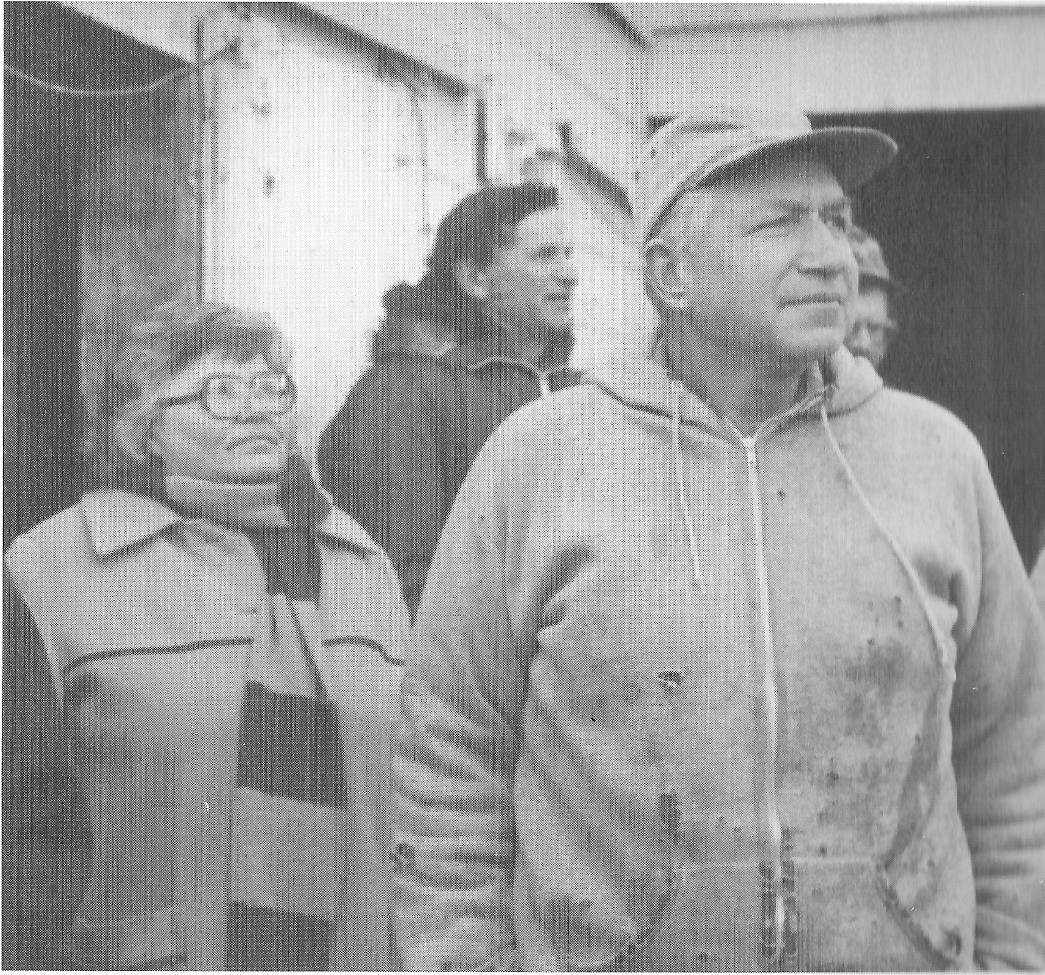
Mr. and Mrs. Charles Plushanski, the visionaries behind the Faith dynasty. Their partnership and shared conviction were the foundation of the courageous decision to keep Faith when the industry came calling. This photo captures the quiet strength of the couple who chose long-term legacy over a short-term sale, proving that the greatest breeding decisions are often family decisions.

What moved me most was understanding what Charlie was really facing that day. This wasn’t just about money. This was about believing in something when everyone thought you were crazy.

The breeding community of the early 1970s was divided. You were either breeding for Chief’s incredible production or Elevation’s balanced type and longevity. But here was Charlie, who had already taken the risk of combining Chief with Kingpin genetics—a corrective mating that most breeders wouldn’t have attempted.

Charlie looked at Faith and somehow knew—in that deep, gut-level way that real farmers understand—that she carried something special in her genetics. Something that couldn’t be bought or sold. Something that would outlive them all.

“It’s not about the money,” Charlie said, according to the stories that have been passed down through breeding records and family memories. And against all odds, he was right.

That Gold Medal Dam designation Faith would earn? In the 1970s, before genomics and computers, a GMD represented the pinnacle of breeding achievement—a cow whose offspring consistently exceeded expectations across multiple herds and breeding programs. It meant you had a cow that was one in ten thousand.

The Winter That Nearly Broke Everything

Here’s where the story gets even more remarkable for those who understand breeding history. In the fall of 1965, in one of those Pennsylvania winters when everything seemed impossible, Charlie’s brother Henry called about some yearling heifers down in Perry County. A dozen Whirlhill Kingpin daughters that most breeders wouldn’t touch because of their udder problems.

Charlie bought them all. Including one special heifer—Ady Whirlhill Frona.

Nobody could have prepared him for what came next. When it came time to breed Frona, Charlie made a choice that seemed almost reckless. He bred her to Pawnee Farm Arlinda Chief—a bull whose genetics would eventually influence almost 14% of all Holstein DNA today, according to UC Davis research. But Chief came with risks. His genetics carried a lethal mutation that would cause heartbreak across the industry—over half a million lost calves worldwide. (Read more: The $4,300 Gamble That Reshaped Global Dairy Industry: The Pawnee Farm Arlinda Chief Story and Bell’s Paradox: The Worst Best Bull in Holstein History)

Charlie didn’t know about the mutation then. He just knew that sometimes, to create something extraordinary, you have to risk everything.

The Four Daughters Who Carried the Dream Forward

But then something remarkable happened that even Charlie couldn’t have imagined. Faith didn’t just excel herself—she passed on her gifts through four extraordinary daughters that would reshape breeding programs worldwide:

Plushanski Valiant Fran EX-90 35* achieved something almost unheard of in the pre-embryo transfer era. The “star” designation meant her offspring significantly exceeded the breed average. Seven went on to score Excellent. Twenty-five scored Very Good. Her 365-day record of 36,920 pounds of milk proved you could have both beauty and production. Through Fran came the show line that would eventually produce Quality BC Frantisco—Grand Champion at the Royal Winter Fair in 2004 and 2005.

Quality B C Frantisco-ET EX-96-3E 18*, a daughter Plushanski Valiant Fran-ET. Frantisco’s multiple championships at the Royal Winter Fair and her recognition as International Cow of the Year highlight the continued influence of Faith’s bloodlines, even in subsequent generations.

Plushanski Job Fancy VG-88 GMD DOM became the commercial production matriarch. The DOM (Dam of Merit) designation meant she had sons entering AI service. Through her daughter, Plushanski Neil Flute VG-87, and granddaughter Plushanski Mark Fife VG-87, this branch would spread across the globe, with bulls like To-Mar D-Fortune carrying these genetics into thousands of herds.

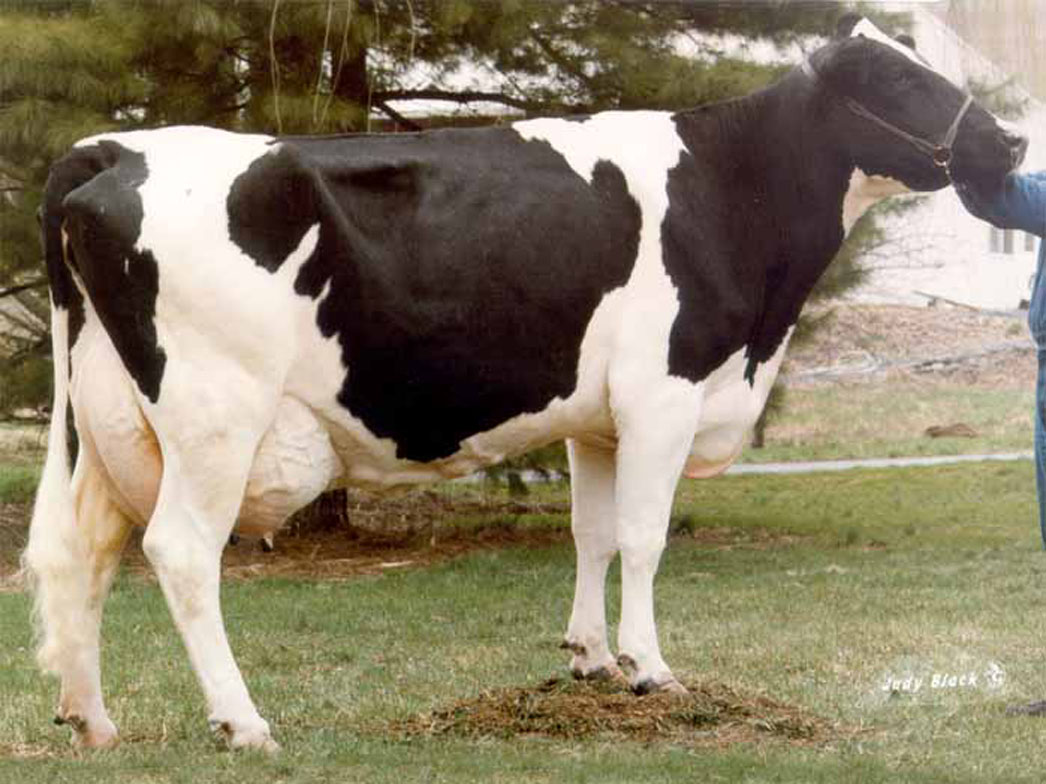
Plushanski Neil Flute (VG-87), the crucial link in the global dynasty. As the daughter of brood cow matriarch Job Fancy and the dam of the influential Mark Fife, Flute embodied the exceptional udder quality and commercial durability that this branch became famous for. It was through powerful transmitters like her that Faith’s genetics quietly infiltrated thousands of herds, building the foundation for the longevity advantage we see today.

Plushanski Dawn Fayne and Plushanski Star Faith rounded out this remarkable quartet, each contributing their own unique genetic gifts to the breed.

What pedigree enthusiasts will appreciate is that each daughter seemed to capture a different aspect of Faith’s genetic package—Fran got the show-ring presence, Fancy got the commercial reliability, Flute got the udder quality, and Fife got the longevity. It’s as if Faith parceled out her gifts, ensuring her influence would touch every aspect of Holstein breeding.

Contemporary Competition and Context

To understand the magnitude of Charlie’s decision, you need to know what else was happening in Holstein breeding in 1973. This was the era of legendary cow families like:

  • The Romandale Reflection Marquis family
  • The Hanoverhill lines that Pete Heffering was building
  • The emerging Elevation daughters that were revolutionizing the type

Yet Faith would outlast and out-influence many of these contemporary families. While other great cows of the era produced individual champions, Faith created entire dynasties that adapted to different breeding goals worldwide.

The Global Explosion Nobody Saw Coming

What’s fascinating for breeding historians is how Faith’s genetics adapted to completely different breeding goals around the world:

The European Production Revolution

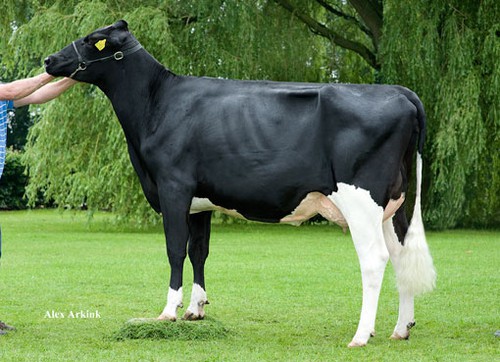
The modern embodiment of Faith’s commercial power: De Biesheuvel Javina 50 VG-87. She is the archetype of the Javina family, the European branch of the Faith dynasty that descended through Plushanski Job Fancy. While the Frantisco line chased show-ring glory, Dutch breeders selected this line with a relentless focus on what pays the bills: production, health, and efficiency. Today, her descendants like Willem’s Hoeve 3STAR Javina 2762 dominate European genomic indexes (gNVI and gRZG), producing the next generation of elite bulls for AI studs. This is the harvest of Charlie Plushanski’s vision, proving that Faith’s genetics could be adapted to create a profitable, index-topping powerhouse for the most demanding commercial systems in the world.

The Dutch breeders working with the Javina family (Faith’s European descendants through Job Fancy) focused intensively on commercial traits. De Biesheuvel Delta Javina and her daughters consistently top the Dutch NVI rankings. These aren’t just good cows—they’re the kind that define breeding programs for decades. When families consistently produce #1 NVI sons and daughters generation after generation, you’re witnessing genetic consistency that modern genomics still struggles to predict.

Canada’s Show Ring Dynasty

The show-ring culmination of the Faith dynasty: Quality B C Frantisco-ET EX-96-3E 18* A direct descendant of Faith through her daughter Plushanski Valiant Fran, Frantisco was the masterpiece developed by Paul Ekstein at Quality Holsteins. She dominated the Canadian show circuit, capturing Grand Champion honors at the Royal Winter Fair twice (2004 & 2005) and earning the title of 5-time All-Canadian. Her reign was so complete that one of the great “what ifs” in modern show history is how she would have fared against American champions at World Dairy Expo, a showdown prevented by BSE travel restrictions. Frantisco stands as the ultimate proof of the versatility of Faith’s genetics—creating a world-class show champion more than 30 years after her famous ancestor was born.

In Canada, Paul Ekstein’s work with the Frantisco line through Valiant Fran created a show dynasty. Quality BC Frantisco’s achievements—Grand Champion at the Royal Winter Fair in 2004 and 2005, five-time All-Canadian, International Cow of the Year 2005—prove that Faith genetics could compete at the highest levels decades after her death.

Australia’s Modern Application

Ray Kitchen at Carenda Holsteins demonstrates how Faith genetics remain relevant in 2025. Their Carenda Pemberton, with 606 daughters from 79 herds, shows how these genetics adapt to modern selection tools while maintaining their core strengths.

Why This Matters for Today’s Breeders

I recently talked with a producer in Wisconsin who discovered Faith genetics in his herd almost by accident while researching pedigrees. His Faith-line cows? They’re averaging 3.8 lactations compared to the industry’s 2.8. That extra lactation—worth an estimated $1,200 to $1,500 per cow in today’s market—is the difference between profitability and struggle.

With the nearly 800,000-heifer shortage CoBank reports, quality genetics have never been more valuable. When you see names like Big Gospell, Apina Fortune, or To-Mar D-Fortune in a pedigree, you’re looking at Faith’s legacy, refined through decades of selection.

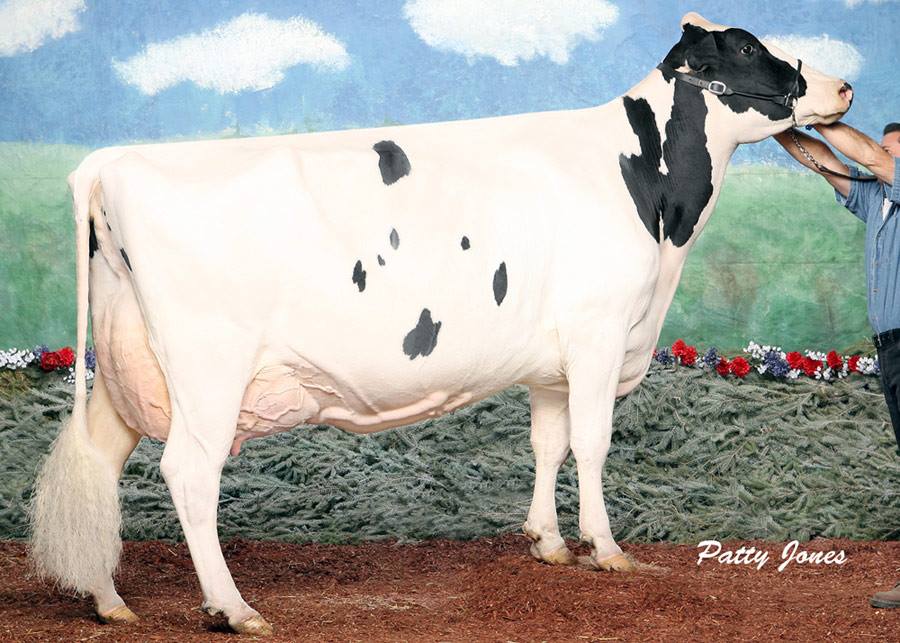
The modern face of the Faith legacy: Big Delta Anecy 1, dam of the influential AI sire Big Gospell. A direct descendant of Faith through the commercially-focused Javina family, Anecy is the proof in the pudding. She showcases the deep-ribbed, high-capacity frame and exceptional udder quality that the Faith line has transmitted for over 50 years. When you see bulls like Gospell in a catalog, you’re not just buying modern genomics; you’re investing in decades of proven, real-world durability that started with one farmer’s courageous ‘no’ back in 1973.

What Charlie Knew in His Heart

Standing there in my own barn sometimes, I think about Charlie Plushanski in that moment in 1973. The breeding community was watching. The pressure was immense. The money would have solved immediate problems.

Instead, he made the harder choice. The one that required patience, vision, and something more—faith in genetics that would prove their worth across decades and continents.

Charlie passed away in 1991, but his son Cary kept the dream alive at the Kutztown farm until his own passing just this September. Three generations of a family who understood that sometimes the best breeding decisions aren’t about today’s milk check or tomorrow’s bills. Sometimes they’re about creating genetic legacies that outlast us all.

The Echo That Still Saves Farms

Every time a Faith descendant helps a farm survive another year, navigate another crisis, or build another generation’s future, the echo of Charlie’s “no” from 1973 quietly puts hope back in someone’s barn.

For pedigree enthusiasts, Faith represents something profound—proof that individual breeding decisions can reshape an entire breed. For historians, she’s a reminder that the greatest genetic influences often come from unexpected places. For today’s breeders, she offers both practical genetics and philosophical guidance.

When you’re planning your breeding for next year, when you’re looking at those catalogs and wondering which direction to go, remember Charlie Plushanski. Remember that sometimes the hardest choice—the one that seems impossible at the time—is the one that creates miracles down the road.

That $1,500 per cow advantage from longevity? That’s not just a number. That’s the difference between surviving and thriving, between keeping the farm and losing it, between passing something on to the next generation and watching it slip away.

And somewhere, in barns across the world, Faith’s descendants are still quietly making that difference. Still carrying forward the gift of one farmer’s impossible choice.

It might as well be in your barn, creating your own harvest of hope.

Key Takeaways:

  • The Bottom Line: Faith genetics add 1+ lactation (3.8 vs 2.8 average), worth $1,200-$1,500 per cow in today’s market
  • Find Them Today: Search your pedigrees for “Javina” (commercial power), “Frantisco” (show quality), or Faith’s four daughters’ names
  • Why Now: In an 800,000-heifer shortage, cows that last five lactations instead of 3 are pure profit
  • The Lesson: Sometimes saying “no” to quick money creates generational wealth—Charlie proved it in 1973

Executive Summary:

 In 1973, Charlie Plushanski turned down enough money to buy a farm—refusing to sell a cow that would reshape dairy genetics forever. Plushanski Chief Faith (EX-94 4E GMD) didn’t just produce 242,863 pounds of milk; she founded dynasties through four daughters whose genetics now run through millions of cows worldwide. Today, Faith bloodlines deliver the industry’s most overlooked advantage: an extra lactation worth $1,200-$1,500 per cow, achieved through 3.8 lactations versus the 2.8 average. With an 800,000-heifer shortage threatening dairy’s future, these 50-year-old genetics offer what no genomic gamble can: proven longevity across every climate, every system, every market condition. The supreme irony? While the industry obsesses over the latest genomic rankings, Charlie’s half-century-old decision is quietly adding $1,500 to bottom lines worldwide. His refusal reminds us that true genetic wealth isn’t built in a sales ring—it’s built by saying “no” to quick money and “yes” to generational vision.

This narrative draws from breeding records, Holstein Association documentation, and the enduring impact of these genetics on farms worldwide. Some conversations and personal details have been reconstructed to honor the significance of these breeding decisions and the families who made them. The author extends deep gratitude to all who preserve these important agricultural stories.

Learn More:

The Sunday Read Dairy Professionals Don’t Skip.

Every week, thousands of producers, breeders, and industry insiders open Bullvine Weekly for genetics insights, market shifts, and profit strategies they won’t find anywhere else. One email. Five minutes. Smarter decisions all week.
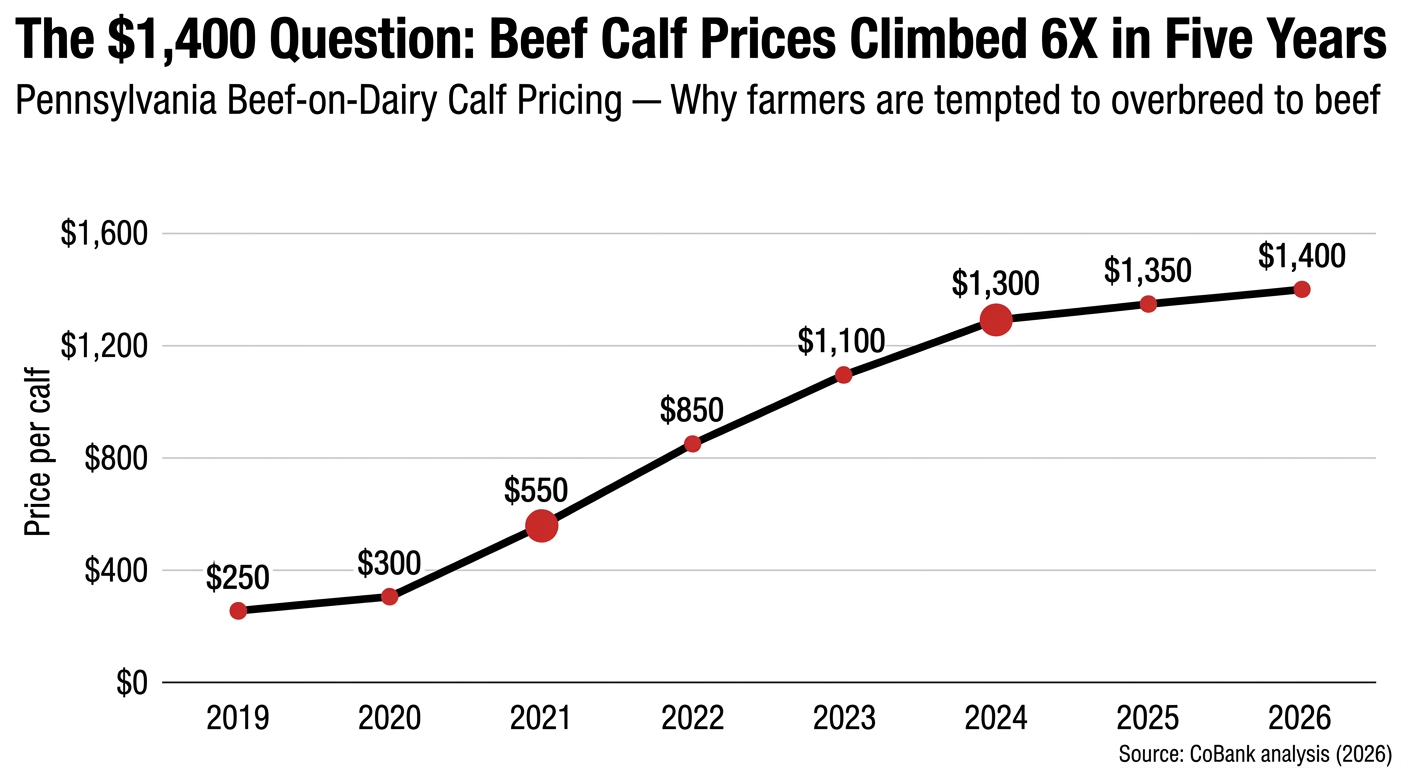
NewsSubscribe
First
Last
Consent

The $4,000 Heifer: Seven Strategies to Navigate the New Dairy Economy

4,000 for a single heifer? That’s not auction fever — that’s your new reality.

EXECUTIVE SUMMARY: Look, heifer prices aren’t just expensive anymore — they’ve gone completely bonkers. We’re talking $3,010 nationally, with top auctions reaching $ 4,000 and above. The farms still winging it on replacement costs are hemorrhaging money they don’t even realize they’re losing. Here’s what the data shows: raising your own animals can save you anywhere from $400 to $1,400 per animal compared to buying, but only if you do it right. The beef-on-dairy craze has driven inventories to 47-year lows, and with $8 billion in new processing capacity coming online, this isn’t a temporary spike. Smart producers are already switching gears — tracking real-time costs, partnering up, and treating their replacement program like the investment portfolio it really is. Don’t get caught flat-footed when everyone else is adapting.

KEY TAKEAWAYS

  • Get your numbers straight — Track both auction prices and your actual raising costs weekly. Farms doing this consistently save 15-20% on replacement decisions.
  • Talk money before you need it — Schedule that lender meeting now. With heifer inventories at historic lows, cash flow planning is no longer optional.
  • Genomics pays off big — Each percentage point of genetic improvement adds $40-50 lifetime profit per cow. That’s not theory, that’s Cornell research.
  • Team up or get left behind — cooperative buying and shared raising programs are helping savvy operators weather 70% price swings, as Wisconsin recently experienced.
  • Crunch the raise-vs-buy math — Current costs run $1,600-$2,400 to raise your own versus $3,000+ to buy. Do the math for your situation, but use 2025 numbers, not those from ancient history.
 replacement heifer costs, dairy farm profitability, heifer raising strategy, dairy herd management, beef on dairy trend

It’s enough to make any dairy farmer do a double-take: $4,000 for a single replacement heifer. That’s not just a number; it’s a signal that the ground is shifting beneath our feet. While it’s easy to get stuck on sticker shock, the producers who will thrive in the next decade are those who see this as more than a temporary market swing—it’s a fundamental change in dairy economics. Are you ready to adapt?## Stop guessing, Start Calculating your replacement decisions. Are they still based on what heifers cost two years ago? In today’s market, historical data can hinder your progress. According to the latest USDA Agricultural Prices report, replacement heifers averaged $3,010 nationally in July 2025—a 164% jump from 2019’s baseline of $1,100.

Dig into current auction reports and benchmark those prices against your farm’s true cost to raise a calf. If you don’t know what it really costs you to raise a heifer from birth to breeding age, you’re flying blind—and that’s a risk you can’t afford in this market.

Drive Down Your Input Costs

With feed costs climbing and milk prices stabilizing around $20-22 per hundredweight, managing your input costs can’t be an afterthought. Track feed efficiency and health metrics closely—these will significantly impact your cost of raising replacements.

Small improvements in feed conversion or reducing mortality rates can add significantly to your bottom line. When replacement heifers cost this much, every efficiency gain matters.

Talk to Your Lender Early

Don’t wait until cash flow gets tight before chatting with your lender. The USDA’s February 2025 cattle inventory report shows dairy heifer inventories at a 47-year low of 3.9 million head, suggesting these elevated prices aren’t going away anytime soon.

Schedule a meeting now to discuss more flexible lines of credit and your long-term plan. Show them you’re proactive about managing volatility, and they’ll be more likely to work with you when market pressures intensify.

Leverage Genomics and Technology

Modern genomic testing tools offer precision like never before. By identifying which animals possess the best genetics, you can make more informed breeding decisions and avoid costly missteps.

The 2024 NAAB semen sales report shows nearly 10 million beef semen units used on dairy cows last year, driven by $600-900 premiums on crossbred calves. But remember—those decisions create a 2.5-year lag before you see replacement heifers, so balance short-term gains with long-term herd needs.

Build Partnerships

The market shifts faster than most of us can handle alone. Consider forming cooperative agreements with neighboring farms or suppliers to share replacement risks and mitigate supply challenges.

Wisconsin saw replacement prices increase by 70% in one year, from $1,990 to $ 3,450. Having partners who can help balance demand and supply fluctuations isn’t just smart—it’s essential for managing this volatility.

Balance Raising vs. Buying

Raising replacement heifers on your farm can be less expensive in the long run, but it requires space, labor, and capital. Research from Cornell’s Pro-Dairy Program indicates that on-farm costs range from $1,600 to $2,400 per heifer, depending on management intensity and regional factors.

Analyze whether your operation can effectively manage this investment. Sometimes, strategic purchases align better with cash flow and risk tolerance, especially when you factor in facilities, labor, and opportunity costs.

Plan for the Long Haul

Market experts anticipate that replacement prices will remain elevated through at least 2027, given the biological timeline and current breeding patterns. Meanwhile, over $8 billion in new processing capacity is coming online by 2026, creating additional demand for milk.

Model your finances with extended high prices in mind, and keep your strategy flexible. It’s not just about surviving this cycle—it’s about positioning yourself to thrive in the next one.

What the Experts Say

Dr. Victor Cabrera, agricultural economist at the University of Wisconsin-Madison, emphasizes that producers must adapt their mindset: “These aren’t temporary price spikes—they represent structural changes in dairy economics. The operations that recognize this and adjust their strategies accordingly will have significant competitive advantages.”

CoBank’s Corey Geiger adds: “Reliable milk supply is the linchpin for new processing plants, and tight cow inventories are pushing replacement costs higher as processors compete for limited production capacity.”

So, how can you put these insights into action on your farm?

Your Strategic Roadmap

Regularly update your replacement costs using real-time auction data and your actual raising costs

Secure flexible financing by engaging lenders well before cash flow pressures hit

Improve operational ROI by tracking feed efficiency, herd health, and investing strategically in technology suited to your scale

Build risk-sharing partnerships with local suppliers and neighboring farms

Weighing raising your own heifers versus buying with a clear-eyed analysis of costs and resources

Maintain adaptable financial plans that account for 50-75% higher replacement costs through 2027

Analyze seasonal buying patterns to capitalize on lower prices, especially during fall auctions

Pro Tip: Many successful producers time their purchases for fall, when auction activity typically softens, providing strategic buying windows that can ease cash flow pressures during traditionally tight periods.

The Bottom Line

That $4,000 price tag isn’t just a challenge—it’s a filter. It will separate the farms that are reacting to the market from those building resilient businesses for the future.

By embracing data-driven approaches to genetics, finances, and partnerships, you won’t just survive this market transformation—you’ll be positioned to lead it. The producers who view this as a strategic inflection point rather than just another cost increase will define the industry’s next chapter.

The ground has shifted. The question is: will you shift with it?

Complete references and supporting documentation are available upon request by contacting the editorial team at editor@thebullvine.com.

Learn More:

  • The Real Cost of Raising Heifers: Are You Leaving Money on the Table? – This article provides a tactical framework for accurately calculating your farm’s true cost to raise a replacement. It offers practical strategies for identifying hidden expenses and optimizing inputs to drive down costs in a high-priced market.
  • Beef on Dairy: The Trend That’s Reshaping the Cattle Industry – For a strategic look at the market forces driving heifer shortages, this piece breaks down the economics of the beef-on-dairy boom. It reveals how to balance short-term calf premiums with long-term herd replacement needs.
  • Genomics: The Difference Between Guessing and Knowing – Explore the innovative power of genomics with this deep dive into maximizing your herd’s genetic potential. It demonstrates how to leverage genomic data to ensure every dollar spent on high-cost replacements delivers a measurable return on investment.

The Sunday Read Dairy Professionals Don’t Skip.

Every week, thousands of producers, breeders, and industry insiders open Bullvine Weekly for genetics insights, market shifts, and profit strategies they won’t find anywhere else. One email. Five minutes. Smarter decisions all week.
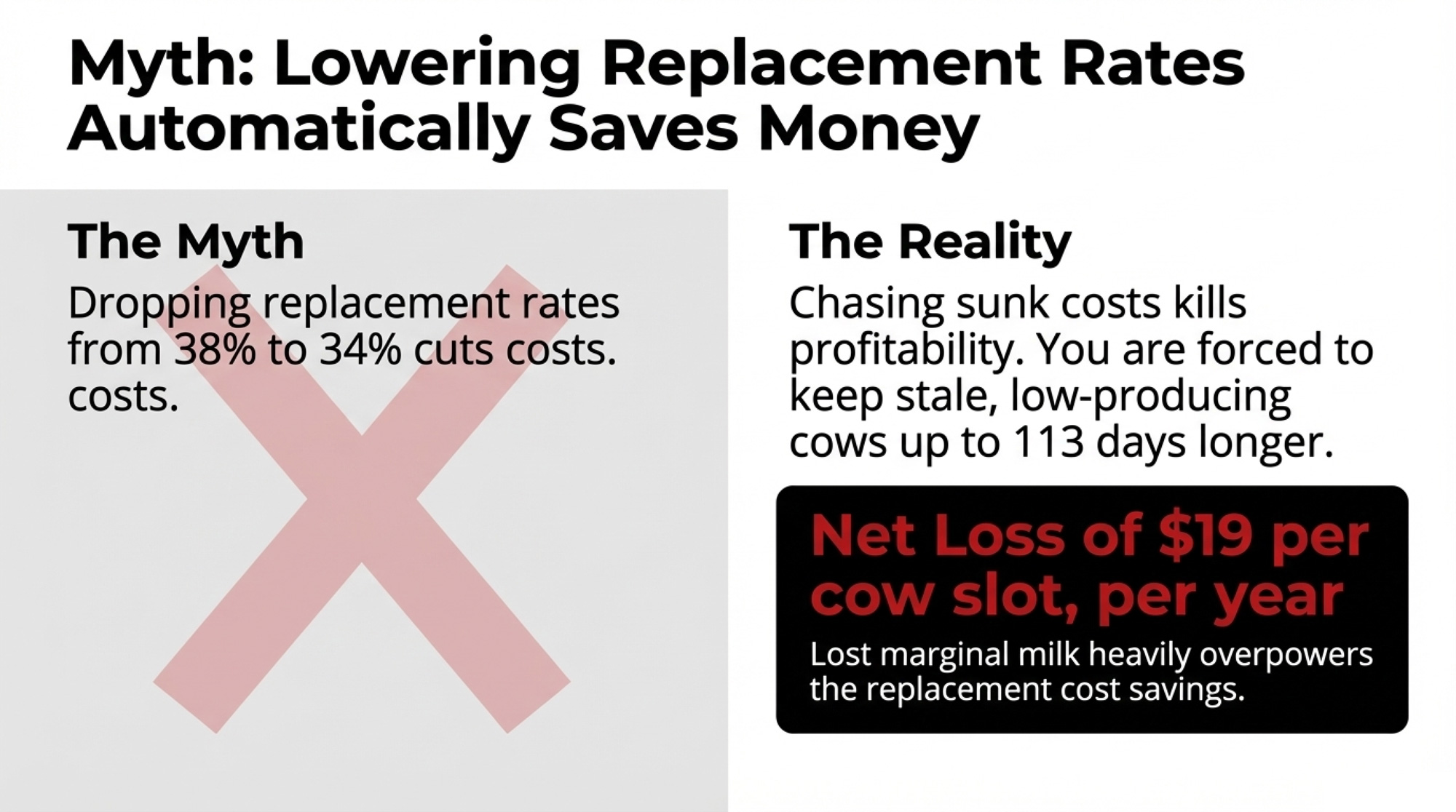
NewsSubscribe
First
Last
Consent

The $35 Calf Question: What Three Years of Digging Actually Shows

A sick calf costs $1,000+ over its lifetime. What if $35 up front could prevent that?

The thing about this “$35 per calf” ROI figure… I kept hearing it tossed around at industry meetups, and honestly? It made my skeptical farmer radar go off. So, I did what any good dairy person does—I dug into the actual numbers. Not the glossy marketing stuff, but real farm data.

Here is what I found.

Cost Distribution of a Sick Calf in Dairy Farming

Market Realities That Can’t Be Ignored

Let’s start with what we all know hurts: replacement heifers are stupid expensive right now. According to the USDA-AMS National Weekly Replacement Dairy Cattle Report from July 15, 2025, bred heifers are hitting $3,010 per head. That’s not a typo—that’s what it costs to replace a calf you lose.

Meanwhile, milk prices are sitting around $18.93 per cwt as of August 2025 (USDA-NASS Agricultural Prices). Not terrible, but there is no fat in these margins anymore.

Here is what really changes the game, though: since June 2023, the FDA has classified all medically important antimicrobials as prescription-only. The days of metaphylactic treatments as a management crutch? Those are done.

What the Research Actually Says (And Doesn’t)

That foundational Cornell work from Soberon and Van Amburgh (2013) still holds water—1,000 kg more milk in first lactation for every kilogram of extra pre-weaning ADG Solid science, but remember that was controlled university research. Your mileage will definitely vary.

Cornell University Research: Impact of Pre-weaning ADG on First Lactation Milk Production and Revenue

What hits closer to home is Dubrovsky’s 2020 work in the Journal of Dairy Science.  They found BRD treatment costs ranging from $42 to $395 per case, depending on the severity of the condition and the method of treatment. That is not a narrow range—that is the difference between “manageable expense” and “profit killer.”

The probiotic research? It is getting more nuanced. Most of the new data on biotics (probiotics/prebiotics) has shown advantages in daily gain and animal health, which is helping to position these additives as part of a good calf management system.

Crunching Numbers (With Honest Caveats)

ROI Analysis of Calf Nutrition Investment Strategies: Investment Costs, Net Benefits, and Return on Investment

If you are considering a $35 per calf nutrition investment, here is how the math might work:

Potential milk revenue gain: Around $485 (based on that Cornell research and current milk prices)

Disease cost reduction: Highly variable—could be zero on a well-managed farm, or $100+ if BRD’s been killing you.

Feed efficiency improvements: $15-20 over the pre-weaning period.

Total potential return? Looks impressive on paper. But—and this is crucial—I have seen operations where this pencils out beautifully, and others where it makes no difference.

Real Talk from Real Farms

I cannot give you specific farm names (producers value their privacy), but I will say this: the operations seeing consistent results are not just throwing supplements at problems. They are being systematic.

One mid-sized Wisconsin operation with which I am familiar implemented targeted nutrition, upgraded colostrum protocols, improved hutch ventilation, and began regularly tracking growth. Their ADG improved from around 1.4 to 1.8 lbs/day.

But here is their honest take: they cannot tell you exactly how much came from the $35 nutrition program versus the management improvements. And do you know what? They do not care. The entire system got better.

Sponsored Post

Implementation Is Everything

This is where many farms fall short. Quality matters. Strain specificity matters. Timing matters. I have seen operations spend good money on generic probiotics and wonder why they did not get research-trial results.

A calf nutritionist I respect puts it this way: “Supplements are fine-tuning tools, not foundation fixes. Get the basics right first—colostrum, housing, feeding consistency—then talk about additives.”

Geography and Scale Reality Check

What works in Vermont dairy country does not always translate to Texas. Disease pressure varies. Climate stress varies. Feed costs vary.

In the upper Midwest, respiratory challenges are prevalent, making pathogen-binding strategies a sensible approach to addressing these issues. Down south, heat stress and digestive efficiency become bigger factors. California’s Central Valley has different challenges than Wisconsin’s rolling hills.

Operations with fewer than three hundred cows face different economics than those with 1,000 or more cows. The big guys can justify automated feeding systems and precise protocols. Smaller operations require simpler, yet more robust, approaches.

Estimated Economic Returns per Calf from Nutrition Investment

Your Monday Morning Action List

Based on what works across different farm types:

  • Start tracking calf weights weekly—target 1.5-1.8 lbs/day ADG (NAHMS benchmark data shows this separates good from mediocre)
  • Document every BRD case and associated costs—you cannot improve what you do not measure.
  • Evaluate colostrum quality routinely—Brix refractometer, target ≥22%.
  • Improve ventilation and feeding consistency before investing in supplements.
  • Know your break-even point—calculate what disease reduction you need to justify program costs.

The Uncomfortable Truths

Some farms should not be spending extra on calf nutrition. If your mortality is high because of poor colostrum management or drafty housing, supplements will not fix that. You are treating symptoms, not causes.

Also, not every calf responds the same way. Genetics matter. Birth weight matters. Health status at birth matters. You won’t obtain uniform results across all animals.

Looking Forward

The trend toward precision nutrition is real, but we are still in early innings. Most farms are not ready for individual animal monitoring and adjustment. What I do see is better data discipline—operations getting smarter about connecting early investments to long-term performance.

Regulatory pressure is not easing up. Consumer preferences are not changing back. The economic incentives for proactive management are only getting stronger.

The Bottom Line

Is there a “$35 advantage” in calf nutrition? On some farms, absolutely. On others, that money generates better returns invested in basic management improvements.

The key is an honest assessment of where your operation stands. If you are already hitting 1.8+ lbs/day ADG with minimal health issues, nutrition supplements are not your highest priority. Fix labor efficiency or breeding instead.

But if you are struggling with respiratory disease or poor growth rates, targeted nutrition investments can pay off—if implemented as part of systematic improvement, not as a magic bullet.

The real value is not in any $35 supplement. It is in the time you take to analyze your own data and figure out what your calves need.

That is what separates the operations thriving in 2025 from those that will struggle to keep up.

This isn’t feel-good farming. It’s a dollars-and-cents strategy backed by solid science Your calves are either an investment or an expense—which camp are you in?

KEY TAKEAWAYS:

  • Track those weights religiously—calves gaining 1.8+ lbs daily before weaning set you up for an extra 1,100 lbs milk in first lactation. That’s $500 more revenue per cow.
  • Cut your treatment bills in half with strategic colostrum programs and targeted supplements. Less time treating sick calves means more time on profitable work.
  • Boost feed efficiency 10% using proven nutritional tools like probiotics and MOS—we’re talking $180+ savings per calf during the most critical growth phase.
  • Every calf you save matters more now—with replacement costs hitting $3,010 and labor scarce, preventing death loss isn’t just good animal care, it’s smart economics.
  • Adapt to the new reality—FDA restrictions on antibiotics and soaring labor costs mean proactive nutrition programs aren’t nice-to-have anymore. They’re survival tools for 2025 and beyond.

EXECUTIVE SUMMARY:

Here’s what caught my attention in this research: investing $35 per calf in targeted nutrition isn’t just feeding—it’s strategic profit planning. Cornell’s data shows calves hitting 1.8 lbs/day growth before weaning produce roughly 1,100 pounds more milk in first lactation. At today’s prices, that’s nearly $500 extra per cow. But here’s the kicker—with BRD treatment running anywhere from $42 to $395 per case and replacement heifers pushing $3,010, every sick calf you prevent saves serious money. The research breaks down how probiotics, MOS supplements, and better colostrum management can cut treatment costs by 50% while boosting feed efficiency by 10%. With antibiotics getting harder to use and labor costs climbing, this proactive approach isn’t optional anymore. Time to stop playing defense and start programming your calves for profit.

Complete references and supporting documentation are available upon request by contacting the editorial team at editor@thebullvine.com.

Learn More:

  • 4 Golden Rules for Optimal Colostrum Feeding – This article provides a tactical deep-dive into colostrum, a topic the main article identifies as a foundational priority. It offers practical, step-by-step protocols for producers to ensure their calves get the essential immunity needed for any nutritional program to succeed.
  • Replacement Economics: Why Raising Your Heifers Just Became Profitable Again – Expanding on the market realities, this piece details the strategic financial pressures behind the soaring replacement heifer costs. It reinforces the main article’s economic argument by showing readers the hard numbers and long-term market dynamics driving the need for proactive calf management.
  • The $500,000 Precision Dairy Gamble: Why Most Farms Are Being Sold a False Promise – This piece offers a critical, innovative perspective on technology that complements the main article’s forward-looking conclusion. It provides a reality check on high-tech investments, urging producers to focus on data and foundational management before adopting expensive new systems.

The Sunday Read Dairy Professionals Don’t Skip.

Every week, thousands of producers, breeders, and industry insiders open Bullvine Weekly for genetics insights, market shifts, and profit strategies they won’t find anywhere else. One email. Five minutes. Smarter decisions all week.

NewsSubscribe
First
Last
Consent
Send this to a friend