




Archive for dairy checkoff lawsuit

$110.5M to “Reputation”: Why 3 Farmers Are Suing USDA

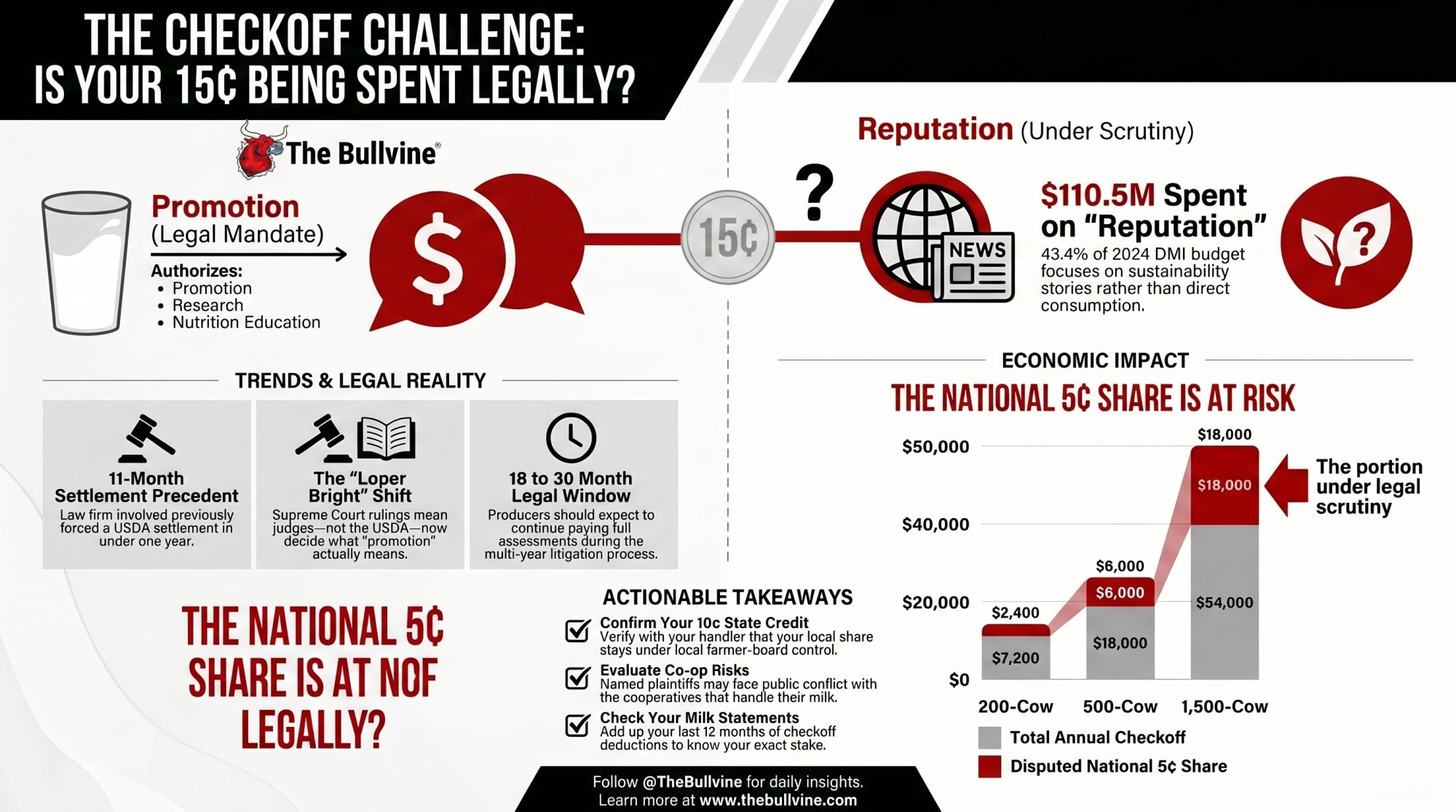
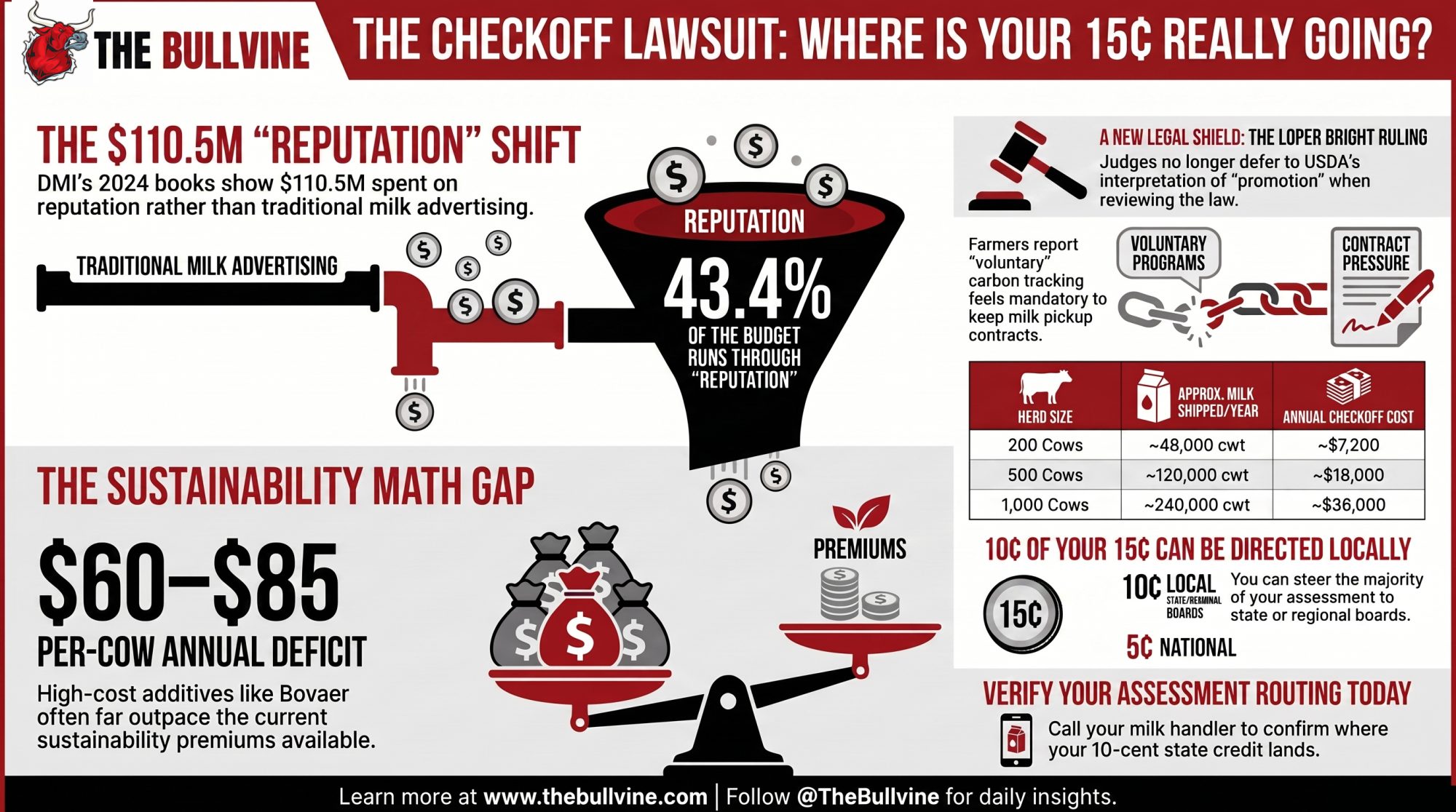
DMI’s own 2024 books show $110.5M — 43.4% of your checkoff — ran through “Reputation,” not milk ads. Three Wisconsin farmers just sued USDA to shut off the tap.

Executive Summary: DMI’s own 2024 audited books show that $110.5 million (43.4% of the checkoff budget) was routed through a category it labels “Reputation,” not ads that move product. A new federal lawsuit by three Wisconsin producers aims to block this pipeline.

Here’s what every dairy farmer needs to know before their next co-op meeting:

  • The Lawsuit: Filed June 9, 2026, against USDA, arguing that mandatory checkoff funds are being illegally used to build a “Net Zero” infrastructure the 1983 law never authorized.
  • The Real Cost: This isn’t just about the 15¢/cwt deduction (roughly $18,000/year on a 500-cow dairy). The real threat is the commercial squeeze — pressure to adopt sustainability practices like Bovaer, which in most current contracts carries an unfunded $60–$85 per-cow deficit.
  • The Legal Shift: Unlike 40 years of failed checkoff challenges, this suit leans on the Supreme Court’s 2024 Loper Bright ruling, meaning judges no longer have to defer to USDA’s interpretation of the law.
dairy checkoff lawsuit

Every farm shipping milk in America pays the same 15 cents per hundredweight. Nobody gets to opt out. And three Wisconsin producers now say a chunk of that mandatory money is being used for purposes they never signed up for — and they’ve taken USDA to federal court to prove it.

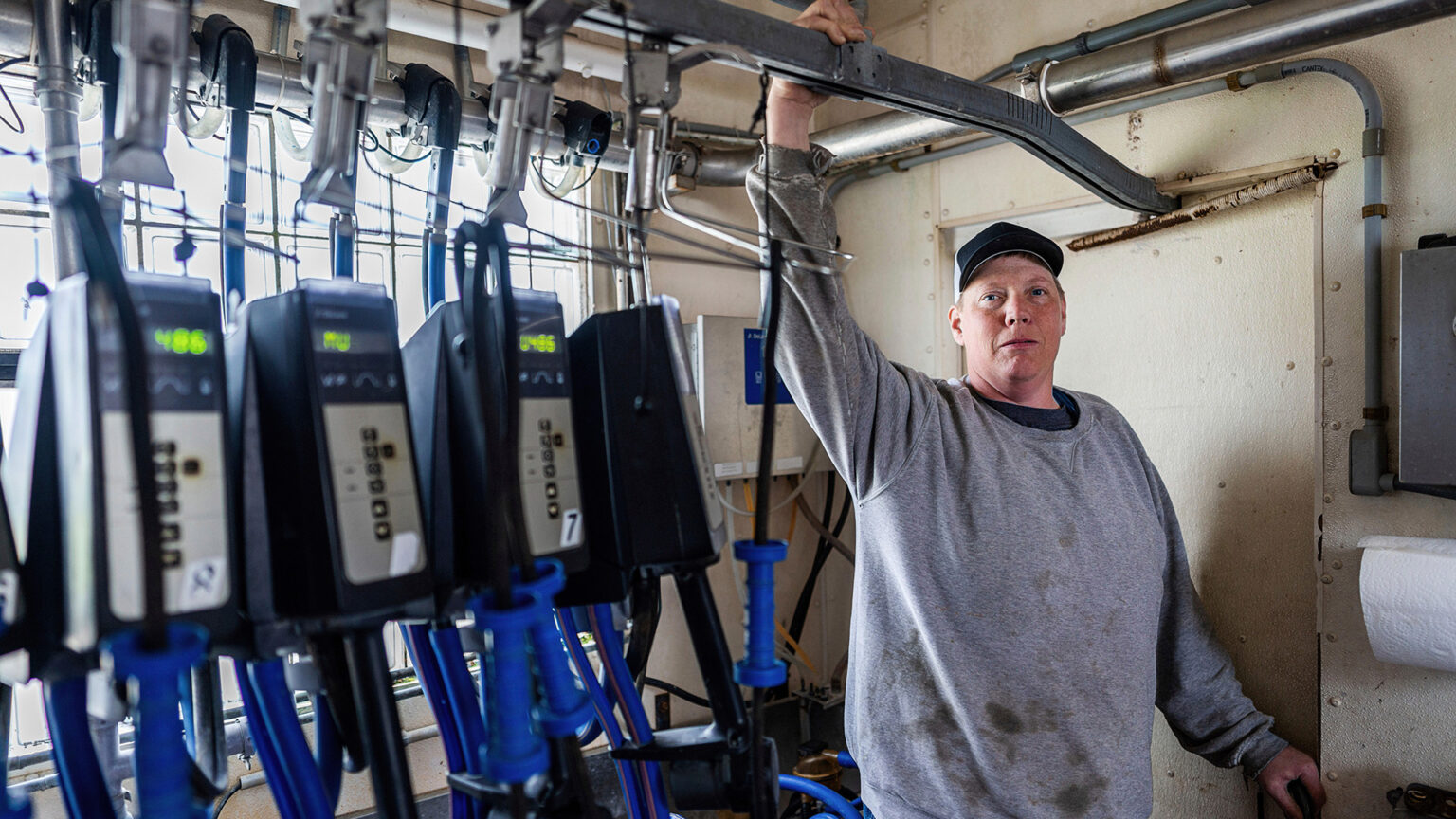
In February, Westfield, Wisconsin, dairy farmer Abby Swan told Fox Baltimore that her milk plant had sent a letter asking for a year’s records — natural gas, diesel, propane, electricity — to calculate her farm’s carbon footprint. The program was billed as “voluntary.” But as Swan tells it, participation didn’t feel optional when she believed her milk pickup was on the line. The processor’s side isn’t reflected in that account.

That tension — voluntary on paper, pressured in practice — is the whole fight, folded into one envelope.

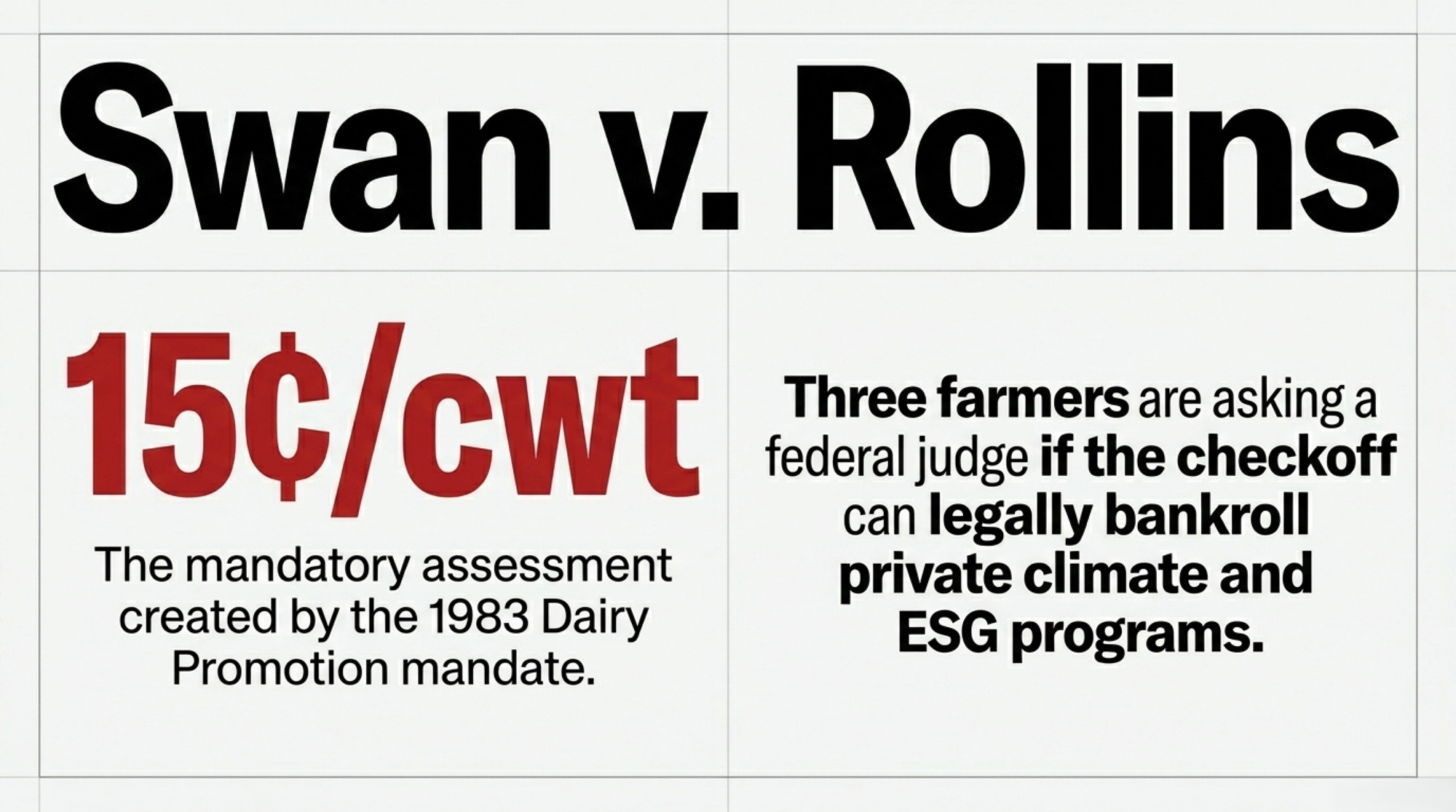
On June 9, 2026, Swan put her name on a federal lawsuit against USDA and the National Dairy Promotion and Research Board. So did Adam Faust of Chilton and Christopher Baird of Ferryville. Their claim: the mandatory 15-cent-per-hundredweight dairy checkoff every U.S. producer pays is being used for environmental and sustainability programs the plaintiffs allege fall outside what the 1983 law authorizes (WILL, June 9, 2026).
Dimension1983 Dairy Production Stabilization Act LanguageCurrent DMI SpendingPlaintiffs’ Argument
Authorized purpose“Promotion of the sale and use of dairy products”43.4% ($110.5M) to “Reputation” categorySustainability story ≠ product promotion
Secondary purpose“Research and nutrition education”$57.9M to “Innovation” (Net Zero, FARM ES)Net-zero infrastructure not authorized by law
Core promotionConsumer advertising and market development~$53.7M to consumer promoThis is the only spend plaintiffs consider legal
Oversight mechanismUSDA oversight under AMS Promotion OrderFarmer-elected board; no mandatory public auditOFF Act would add USDA Inspector General audits
Legal doctrine (pre-2024)Chevron deference — courts defer to USDA interpretationUSDA defined scope broadly over 40+ yearsChallengers consistently lost under deference
Legal doctrine (post-2024)Loper Bright — judges read statute independentlyUntested on checkoff programsOpens statutory challenge courts couldn’t take before

What’s Changing and Why

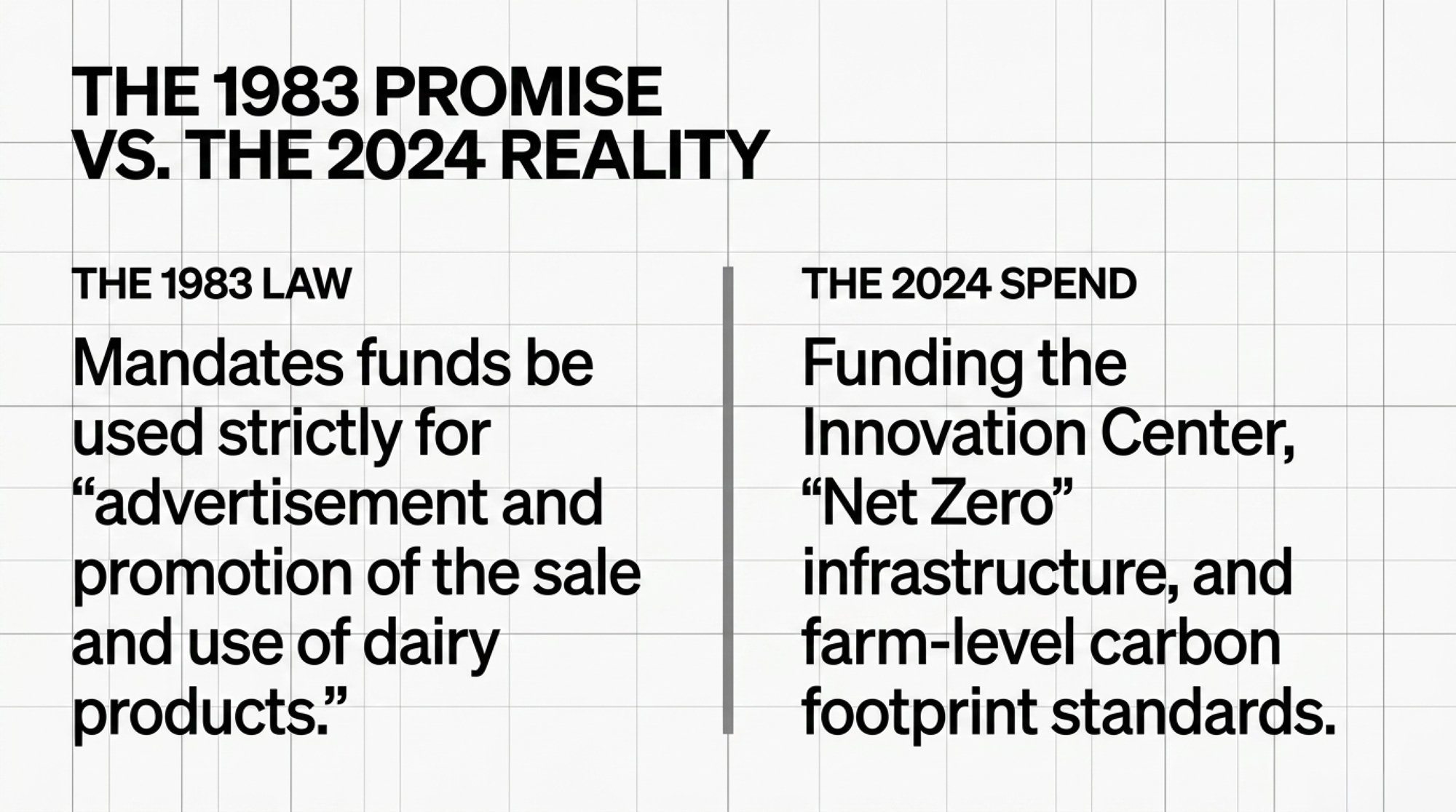
The checkoff isn’t new. Congress built it under the Dairy Production Stabilization Act of 1983, which says the funds “shall be used” for “advertisement and promotion of the sale and use of dairy products,” plus related research and nutrition education (7 U.S.C. ch. 76; Public Law 98-180). The 15-cent rate hasn’t moved in over 40 years. What’s moved, the plaintiffs argue, is the mission.

The lawsuit aims at the Innovation Center for U.S. Dairy — a forum initiated in 2008 by dairy farmers and run by Dairy Management Inc. (DMI) — and three programs under it: the U.S. Dairy Net Zero Initiative, Pathways to Dairy Net Zero, and FARM Environmental Stewardship (FARM ES). The funding link isn’t in dispute. The Innovation Center has said dairy farmers and importers have primarily funded its work through DMI and the national checkoff since its inception (Innovation Center for U.S. Dairy). What’s in dispute is whether building a sustainability story counts as “promotion of the sale and use” of dairy. The suit doesn’t try to kill the checkoff — it asks the court to block checkoff funding of the Innovation Center specifically.
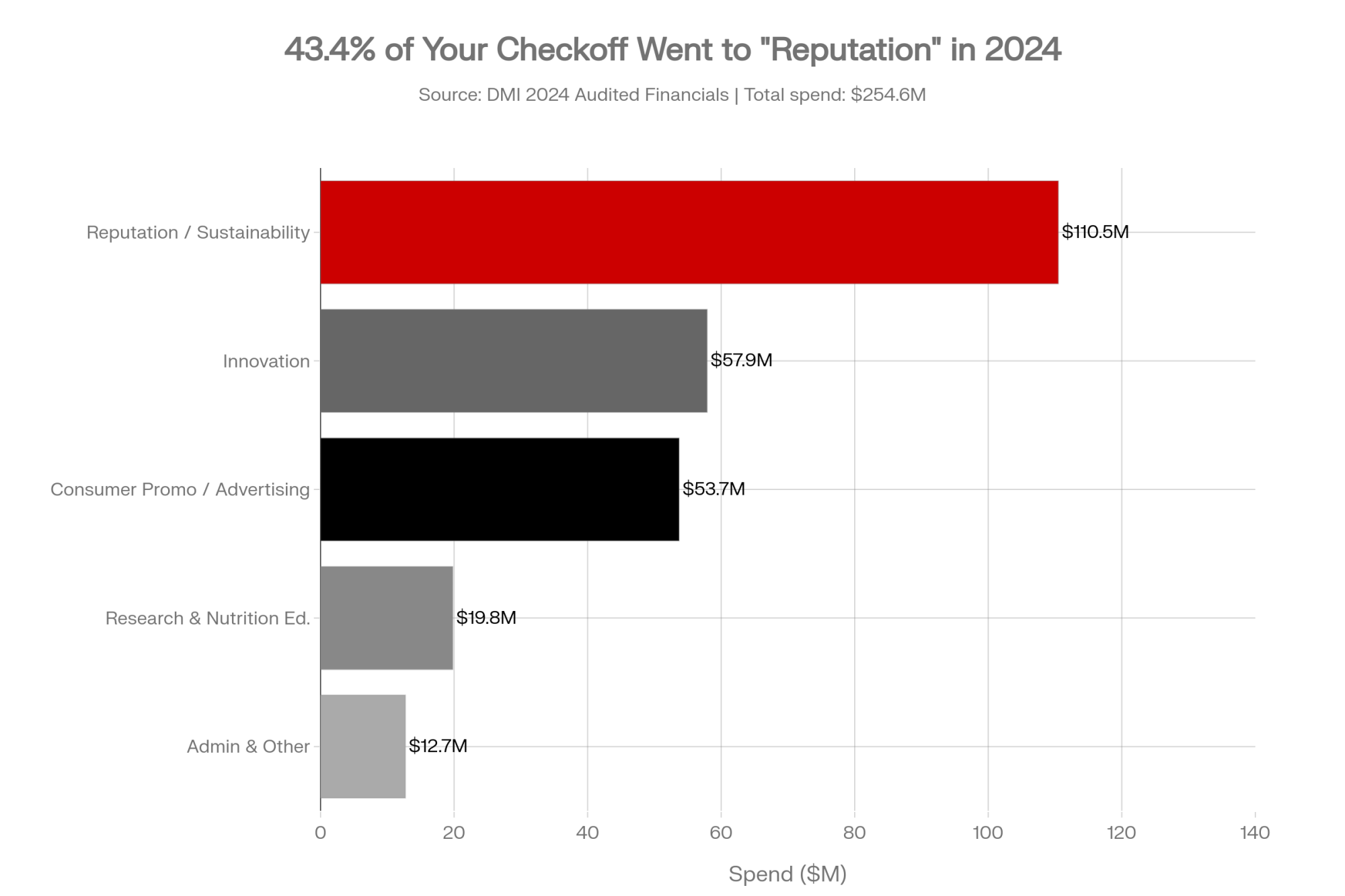
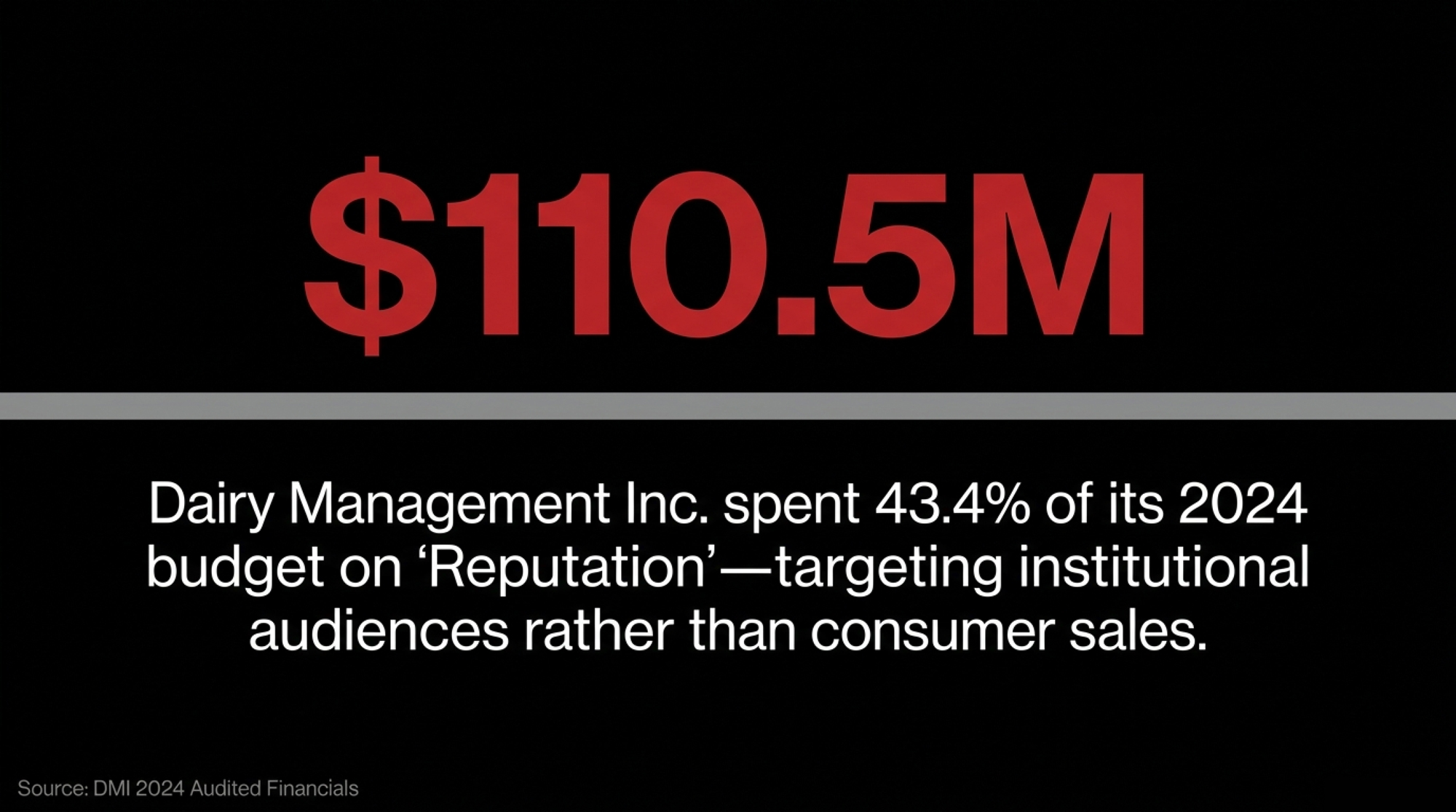
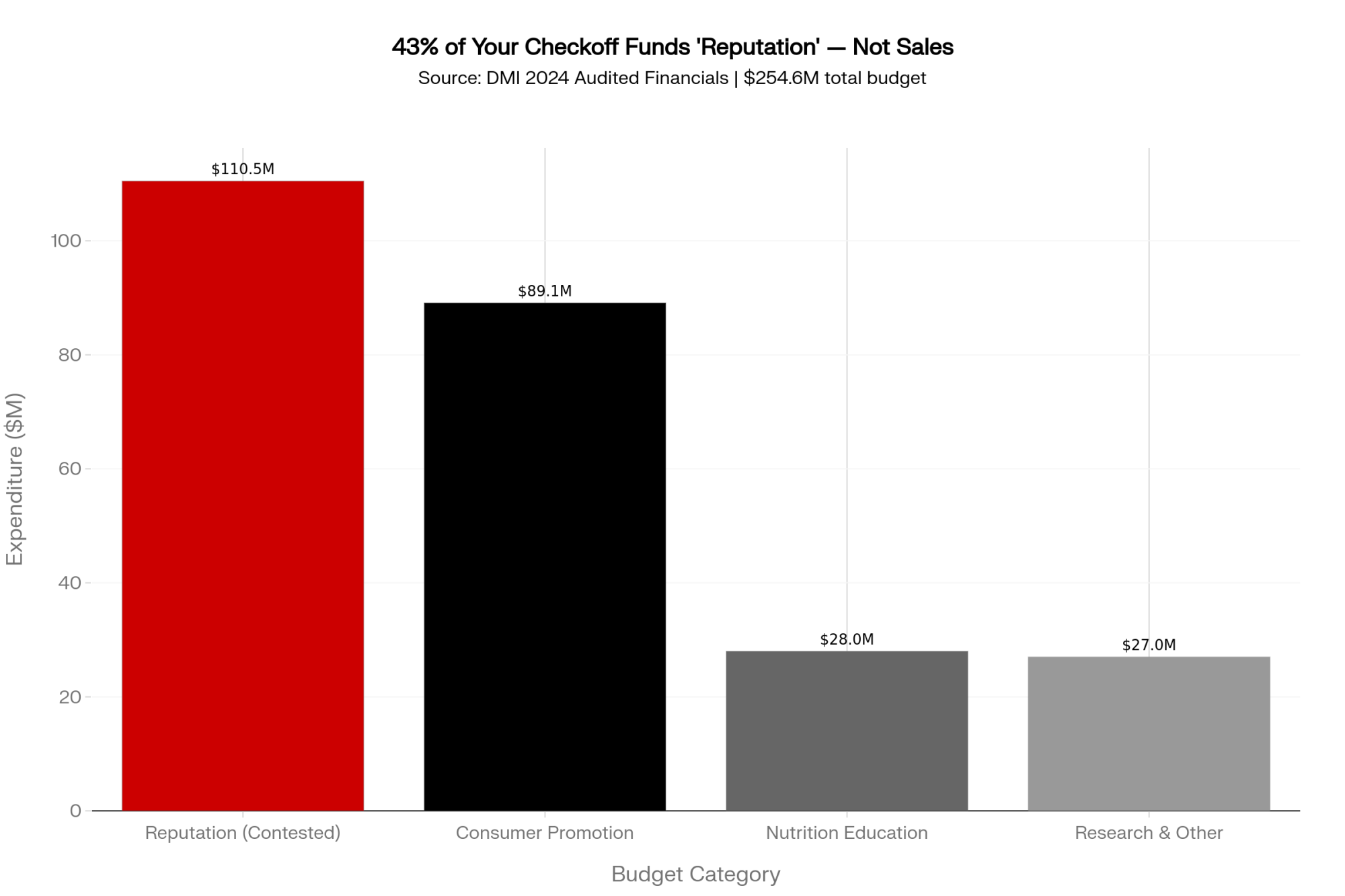
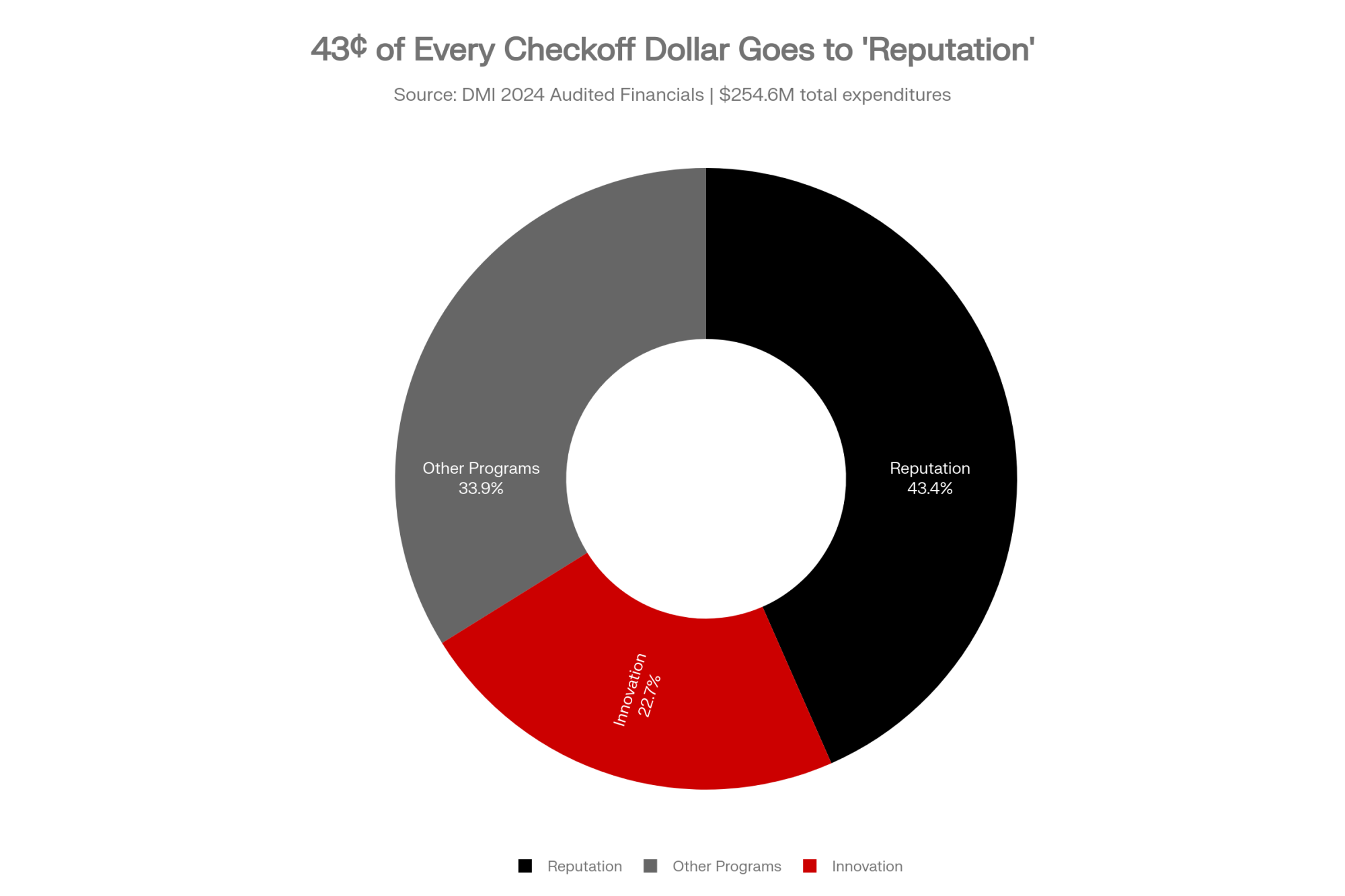
The dollars are real, and they’re big. The checkoff collects more than $350 million annually from producers and importers, per USDA figures cited in the June 2026 complaint. DMI’s 2024 audited financials show $254.6 million in total expenditures once state and regional pass-throughs are counted — and of that, $110.5 million, or 43.4% of the entire budget, ran through a category DMI itself labels “Reputation,” with another $57.9 million booked to “Innovation” (DMI 2024 Annual Report; The Bullvine, May 27, 2026). That’s not advertising milk. That’s work measured partly by whether the public believes dairy farmers are good for the environment.

To be fair to DMI, the organization sees that spending differently. Its position is that reputation and trust work protects long-term demand — that a consumer who trusts dairy’s environmental record keeps buying milk, cheese, and butter for decades. The plaintiffs argue spending in that category drifts from the checkoff’s promotional purpose. That’s the exact disagreement now headed to a federal judge.

How This Plays Out on Real Farms

For Swan, the friction started with that data request. She told Fox Baltimore the letter wanted “herd data, nutrition data, energy data, total terms of natural gas, total gallons of diesel” — “mind you, this is for a whole year,” she said — and that participation didn’t feel optional when she believed her pickup was on the line (Fox Baltimore, Feb. 19, 2026). USDA Secretary Brooke Rollins said publicly she’d investigate the new requirements. As of late June, there’s no public record of what that review turned up — a gap worth watching as the case moves.

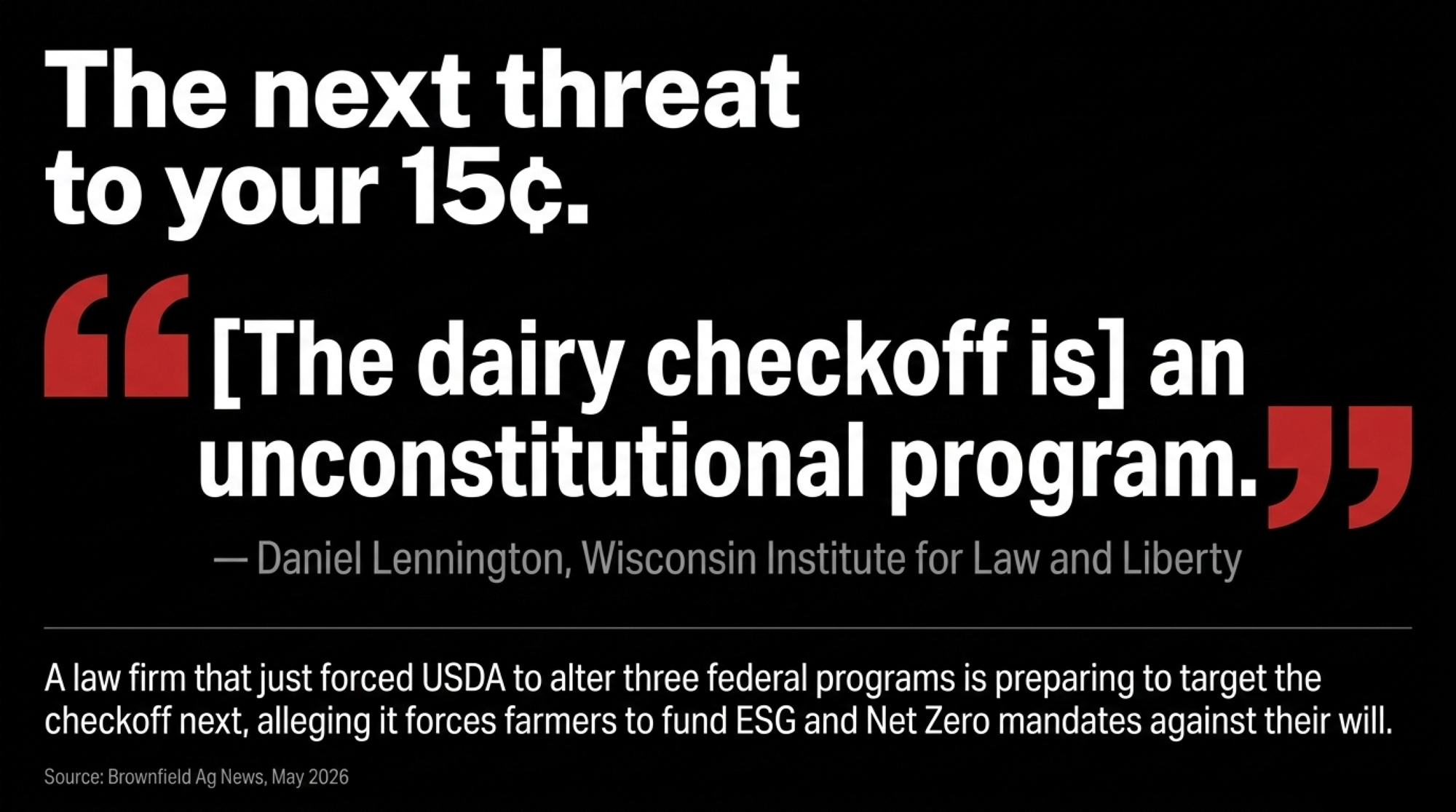
Faust isn’t a first-time litigant. He’s the Chilton farmer who, with the Wisconsin Institute for Law & Liberty (WILL), beat the agency in a separate discrimination case in roughly 11 months. Same legal shop. Same farmer. Now pointed at the checkoff. We tracked how that first win came together, and it’s the reason this filing reads differently from the usual coffee-shop grumbling — WILL deputy counsel Daniel Lennington told Brownfield Ag News on May 27, 2026, that the checkoff is “an unconstitutional” use of mandatory funds.

Baird, the third name on the filing, farms near Ferryville in the southwest corner of the state. The complaint describes all three as Wisconsin producers “subject to and harmed by” the mandatory assessment (Cheese Reporter, June 11, 2026) — not activists who went looking for a fight, but farmers who pay the levy every month and want to know what it’s being used for. That’s the thread worth holding onto: this isn’t a fringe case. It’s three working dairies questioning a deduction that automatically hits all of them.

Here’s where it gets concrete. The 15 cents scales straight with volume, so the bigger you milk, the bigger the bill. Run the numbers on a herd averaging about 24,000 lbs per cow per year — adjust up or down for your own rolling herd average — and the assessment lands like this:

Herd sizeApprox. milk shipped/yrAnnual checkoff at 15¢/cwt
200 cows~48,000 cwt~$7,200
500 cows~120,000 cwt~$18,000
1,000 cows~240,000 cwt~$36,000

(Figures assume a 24,000-lb rolling herd average; recalculate against your own production.)

And that’s before the second layer: the practices these sustainability programs are starting to expect.

The Real Cost Isn’t Just the Deduction

Take Bovaer, the methane-reducing feed additive moving through sustainability channels. Start with the cost. DSM-Firmenich pegs it at roughly $93–$105 per cow per year on a lactating-cow basis — call it about a quarter to thirty cents a head a day (DSM-Firmenich; The Bullvine, June 23, 2026). That’s the bill, and it’s fixed.
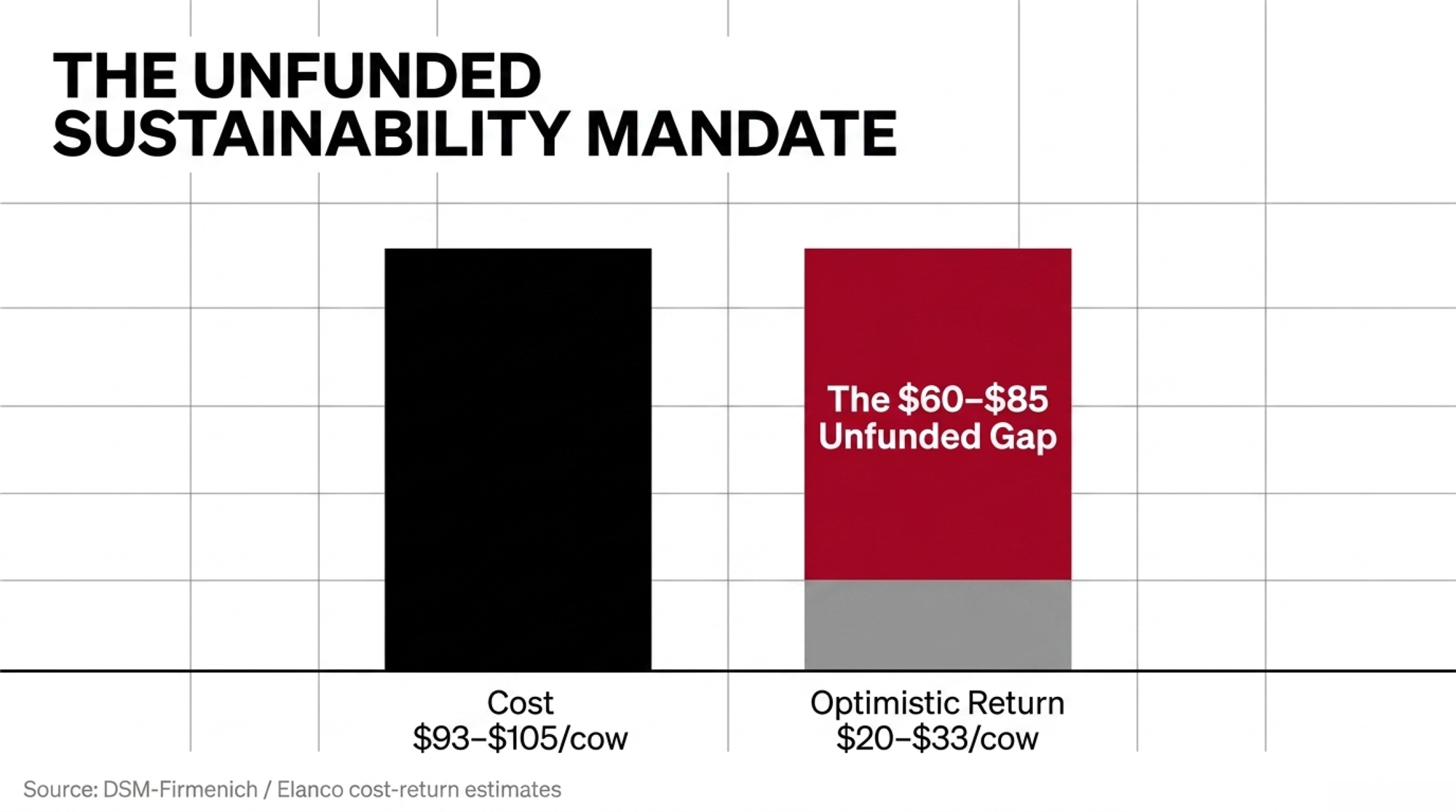
Now the return, run at its most optimistic. Elanco has estimated an annual return of $20 or more per lactating cow from feeding Bovaer, drawn from voluntary carbon markets, conservation-program funds, and processor incentives (Elanco, via Dairy Herd Management, Nov. 2024 — note this estimate is over a year old and may have shifted). Add an assumed 12¢/cwt sustainability premium on a cow milking 75 lbs a day and you’d claw back about $33. Even that’s generous, since most documented sustainability and component premiums today run higher per cwt but rarely attach to methane reduction specifically (The Bullvine, Oct. 2025). Call the total documented return $20–$33 per cow — and that’s the friendly read.

So line them up. Cost of $93–$105 against a return of $20–$33 leaves a $60–$85 per-cow gap the system doesn’t close. On a 300-cow herd, that’s an unfunded $18,000 to $25,500 a year. The climate story and the cash-flow story aren’t the same story. We ran the full methane-efficiency-breeding-versus-Bovaer comparison separately — worth a look before you sign anything.

The Mechanics Behind the Outcomes

Most producers treat the 15 cents and the data letter as two separate headaches. They’re not. They’re two ends of one pipe.

Checkoff dollars fund the Innovation Center and the Net Zero infrastructure. That infrastructure builds the measurement standards — FARM ES uses the Ruminant Farm Systems model to estimate a farm’s greenhouse gas footprint (National Dairy FARM Program, June 2025). Here’s how that turns into a letter in your mailbox:

The Leverage Pipeline — how “voluntary” becomes a condition of the sale

1. Your checkoff funds the Innovation Center and its Net Zero / FARM ES measurement standards. 2. Those standardsbecome the yardstick for a farm’s carbon footprint. 3. Your processor or co-op pools your farm-level data to show buyers the supply chain is cleaning up. 4. A buyer like Nestlé or Danone writes sustainability reporting into its purchase contracts. 5. To keep that account, your processor needs your numbers — so a “voluntary” program quietly becomes a practical condition of getting your milk hauled.

No regulation cited in the letter. No law forcing your hand. Just leverage running down the contract chain.

That reach is already wide, and it’s growing. By 2025, 39 cooperatives and processors representing about 77% of U.S. fluid milk had signed the U.S. Dairy Stewardship Commitment — up from 35 companies and 75% in 2022 (Innovation Center for U.S. Dairy, 2025, via Choices magazine). And the people approving how the checkoff spends? It’s a farmer-led board, funded by more than 23,000 dairy farmers plus importers (DMI 2024 Annual Report; Agri-Marketing, April 2026). As of its 2021 report, the board consisted of 41 dairy farmers, 12 importer representatives, and 2 non-voting cooperative seats, and it’s chaired by Pennsylvania dairy farmer Marilyn Hershey, re-elected to lead the checkoff for 2026 (Dairy Checkoff, April 27, 2026). Farmer-controlled on paper. If you want the full picture of where those dollars actually go, we broke down Hershey’s $121 million checkoff bet — and why 76% of it chases cheese and exports. The plaintiffs argue the spending has drifted beyond what farmers signed up for in 1983.

Why This Lawsuit Is Different From the Last 40 Years of Checkoff Fights

If you’ve tuned out every prior checkoff challenge — and there’s been a parade of them — here’s the one reason to look up this time.

Back in 2004, a federal appeals court struck down the dairy checkoff in Cochran v. Veneman, calling it unconstitutional compelled private speech. The win didn’t hold. In 2005, the Supreme Court upheld the beef checkoff in Johanns v. Livestock Marketing Association, ruling that checkoff advertising is “government speech” and therefore shielded from First Amendment attack (Cornell Law School case summary). That doctrine has protected the dairy program ever since. Every speech-based challenge since has run straight into the same wall.
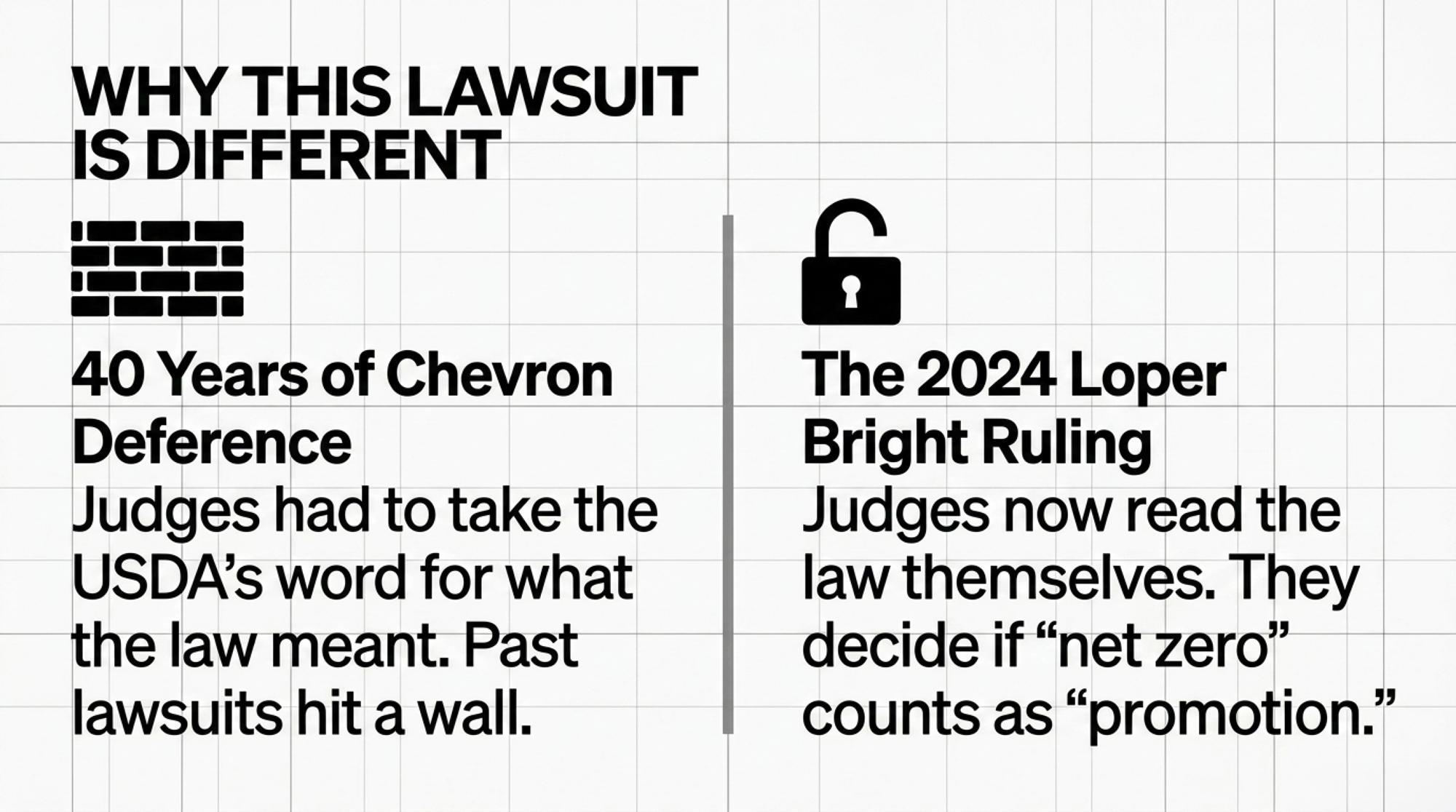
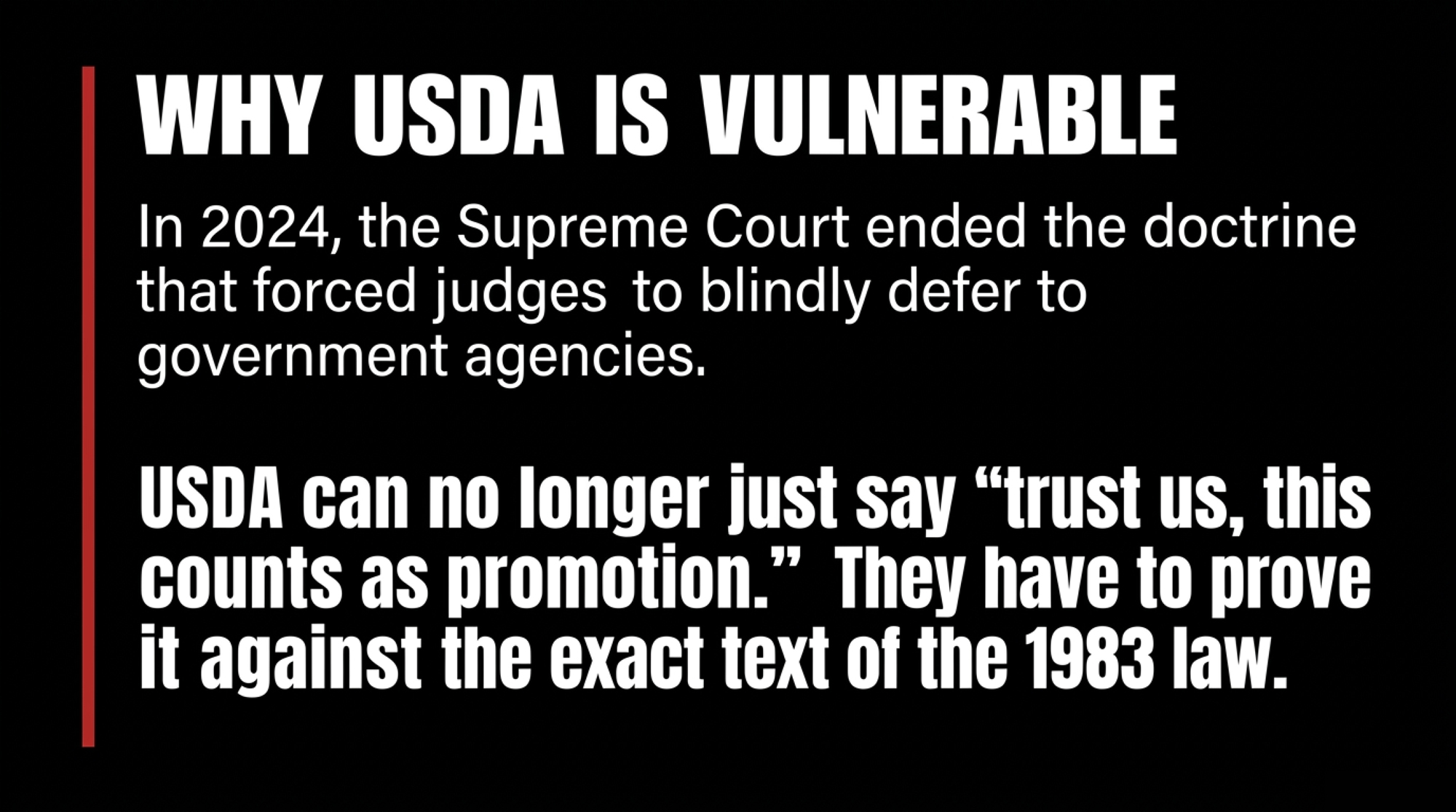
But this case isn’t only a speech case. In June 2024, the Supreme Court decided Loper Bright Enterprises v. Raimondoand overruled the 40-year-old Chevron doctrine (U.S. Supreme Court, 603 U.S. 369, 2024). Here’s the tractor-cab version: judges no longer have to take USDA’s word for what a statute means. They read it themselves. So a court can now look at the 1983 law’s actual language — “promotion of the sale and use of dairy products” — and ask whether funding net-zero infrastructure honestly fits, without deferring to the agency running the program. That’s a statutory question, not a speech question. It sidesteps the wall that stopped everyone before. No court has tested it on a checkoff yet. It’s an opening, not a verdict.

The Global Playbook: What U.S. Farmers Can Learn from Canada and the EU

DimensionUnited StatesCanadaEuropean Union
Funding mechanismMandatory 15¢/cwt federal checkoff (USDA order)Provincial levies via supply management marketing boardsEU Common Agricultural Policy (taxpayer-funded co-financing)
2024/25 budget~$350M+ collected annually (USDA, per complaint)DFC-administered; $7.5M+ federal top-up in 2023€160M co-financing for 2026 promotion budget
Sustainability commitmentNet Zero by 2050 — Innovation Center / FARM ESNet Zero by 2050 — “We’re In” campaignClimate-linked CAP payment conditions for farmers
GovernanceFarmer-elected board; 41 farmers + 12 importers (as of 2021)Producers hold direct provincial board seatsEuropean Commission approval; NGO/parliamentary pressure
Active legal challengeSwan v. Rollins — June 9, 2026 (Eastern District, Wisconsin)None equivalentNone equivalent; pressure runs opposite direction
Key legal leverLoper Bright (2024): courts read statute independentlySupply management consent structure differsRegulatory, not judicial
“Voluntary” pressure dynamicProcessor data requests tied to pickup contractsLess documented at farm levelNGOs and buyers push for more strings on CAP payments

To see where this “reputation-first” pipeline eventually leads, American producers only have to look across the border and over the Atlantic. Two mature systems, two very different answers on who controls the money — and both are instructive for what’s coming down the U.S. contract chain.

Canadian producers fund promotion too, but the structure is different enough that the same fight hasn’t erupted north of the border. Dairy Farmers of Canada (DFC) runs producer-funded promotion and has committed the Canadian sector to net-zero greenhouse gas emissions by 2050, backed by its “We’re In” sustainability campaign featuring real farmers (Dairy Farmers of Canada, 2023). Ottawa has chipped in too — over $7.5 million to DFC for sustainable dairy development in 2023 (Government of Canada, July 2023). (Canada-specific figures — don’t read these across to U.S. operations.)

The difference is governance. DFC’s levies flow through provincial marketing boards under supply management, where producers hold direct seats and the money is collected at the provincial level rather than through a single federally mandated USDA-style order. That’s why you haven’t seen a Canadian compelled-funds lawsuit mirroring Swan v. Rollins — the consent-and-control mechanics differ, even though the sustainability-spending direction looks strikingly similar.

Europe is almost the mirror image. The EU’s 2026 farm-promotion budget — €160 million in co-financing — isn’t a mandatory producer levy at all; it’s largely Common Agricultural Policy money, meaning taxpayers, not a milk-check deduction (European Commission call for proposals, Jan. 2026). And the pressure there comes from NGOs and parliamentarians who want more climate strings attached to the money, not from farmers suing to keep climate spending out. Mirror image of Wisconsin. Same global sustainability current, three very different fights over who controls the cash (European Commission, 2026; Regulation 1144/2014).

How Much Is This Really Costing Your Balance Sheet?

Start with what you can see. The 15-cent assessment is fixed and printed on every milk statement. What’s harder to see is the second layer — the practices and reporting the sustainability programs increasingly expect, with Bovaer just the most-quoted example. More buyer requirements are coming, and they don’t show up as line items until they’re already conditions of the sale.

The deeper problem is that the accountability runs one direction. The money is mandatory. Transparency is optional — you can request DMI’s budget breakdown, but no one pushes it to you (DMI Budget & Financials page). And there’s no rule anywhere requiring that a checkoff-funded obligation come with a documented, farm-level return that actually covers its cost. That’s the real gap. Not whether sustainability matters — but who’s on the hook when it costs more than your milk check can carry.

Is Your Co-op Routing Your Money Somewhere You Didn’t Choose?

Worth knowing, and most producers haven’t checked: of your 15 cents, you can direct up to 10 to a qualified state or regional program where farmer-elected boards steer the spending. The remaining nickel flows to DMI nationally (per the USDA AMS Dairy Promotion and Research Order). Do you know which path your dime takes — directed by people you can call, or dropped into the national pool by default?
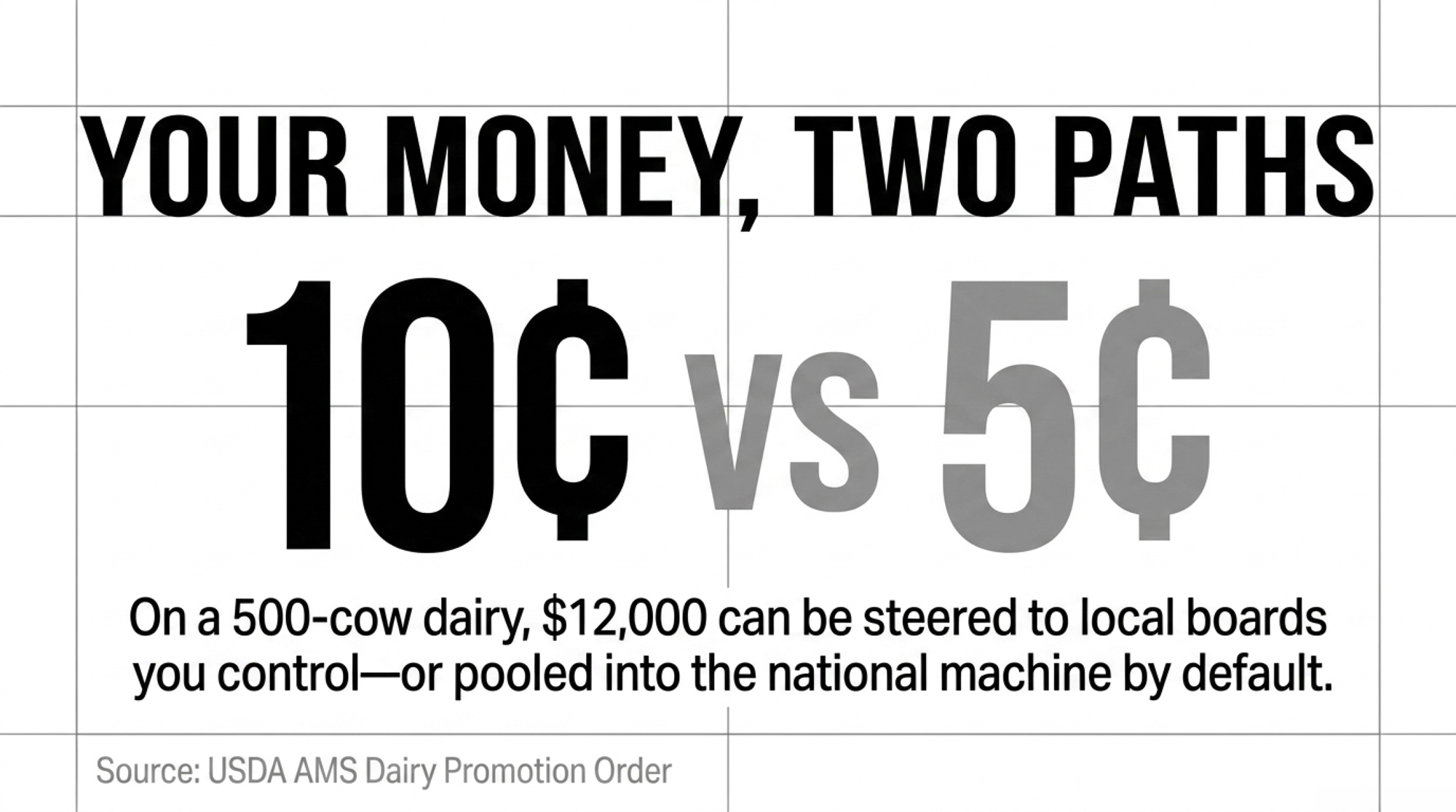
Put numbers on it. On a 500-cow dairy paying about $18,000 a year, the directable 10-cent share is roughly $12,000, with the national nickel running near $6,000. Scale that to 1,000 cows, and you’re looking at about $24,000 you could be steering locally versus $12,000 pooled nationally. One phone call to your milk handler settles where yours actually lands. That’s a this-month job, not a someday one.

Options and Trade-Offs for Farmers

There’s no single right move here. Some of this you can do this month with one phone call. Some of it is a longer game. Sort them that way.

Practice / ObligationAnnual Cost/CowDocumented Return/CowNet Gap/CowGap on 500-Cow HerdReturn Source Reliability
Bovaer (methane additive)$93–$105$20–$33$60–$85$30,000–$42,500Low — carbon markets volatile; premiums not broadly attached to methane reduction
FARM ES data collectionStaff time + audit cost (~$5–$15 est.)$0 documented farm-level premium~$5–$15~$2,500–$7,500None published at farm level
Annual checkoff assessment$18,000 (500 cows, 24k lb RHA)No direct farm-level return guaranteedFull amount$18,000Indirect only (market development)
Genetics for methane efficiency$0–$8/cow higher semen cost (est.)Compounding herd improvement; no direct premium yetNeutral to slight positiveNeutralEmerging — no contract premium attached as of 2026
Carbon footprint audit (1-yr records)~$500–$2,000 in time/records prep (est.)$0 guaranteed; possible future credit access$500–$2,000$250,000–$1,000,000Speculative; market access not guaranteed

Do this in the next 30 days:

  1. Verify your assessment routing. Pull your last three milk statements and ask your handler where your 10-cent state credit lands. Costs nothing, risks no relationship, takes one call. The limit: it tells you where the money goes, not what it buys.
  2. Request the budget breakdown. Ask your checkoff rep or co-op for the split between consumer promotion, “Reputation”/sustainability, and overhead. Makes sense if you want to judge ROI for your own herd type. The catch: the categories are self-reported, so read them with a skeptical eye.
  3. Make one policy call. The OFF Act (Opportunities for Fairness in Farming Act) would force USDA Inspector General audits and public budgets for the big checkoffs (Farm Action Fund). A call to your senator’s office costs nothing and spends zero co-op goodwill. The downside: it hasn’t passed, and Washington moves slowly.

Play the longer game:

  • Watch the lawsuit — and weigh involvement carefully. Swan et al. v. Rollins is filed in the U.S. District Court for the Eastern District of Wisconsin, and WILL has posted the full complaint publicly. Litigation like this realistically takes 18 to 30 months before any ruling changes how the program runs. Getting publicly involved means a visible disagreement with the organizations tied to your milk check. That’s a real cost, not a small one — and only you know your own relationships.
Key Takeaways

  • If you’ve never checked where your 10-cent state credit goes, call your milk handler this month — on a 500-cow herd that’s roughly $12,000 either steered locally or pooled nationally.
  • If a sustainability program asks for a year of farm data, ask straight out: is participation tied to whether my milk gets picked up, and who owns the data once I hand it over?
  • Before you adopt any checkoff-promoted practice, run the per-cow math first. If the cost (Bovaer’s ~$93–$105/cow) outruns the documented return (~$20–$33/cow), find out who’s covering the $60–$85 gap before you sign.
  • If you want the assessment’s spending audited, the OFF Act is the existing vehicle — a constituent call is the cheapest pressure you can apply.
  • Track the Swan v. Rollins timeline, but plan to keep paying the 15 cents regardless of how it lands for the next year and a half.

Abby Swan is still shipping milk. Still paying the 15 cents, same as you, while her name sits on a federal docket that won’t see a ruling for a year or more. So here’s the question worth carrying into your next co-op meeting: do you actually know what your mandatory 15 cents is buying — and whether the practices it’s nudging you toward still pencil out at the milk price you’re getting paid right now? Most producers have never run that number. Swan, Faust, and Baird did, didn’t like the answer, and handed it to a judge.

THE BULLVINE INTERACTIVE

Calculate Your Herd’s True Checkoff Cost & Sustainability Deficit

1. Enter Your Herd Metrics

2. Your Farm Financial Impact

Annual Checkoff Tax Total automatic 15¢/cwt deduction
$0
Funded to “Reputation” Your 43.4% non-advertising share
$0
Your Directable Local Dime Max up to 10¢ state/regional pool
$0
Unfunded Sustainability Deficit Bovaer gap ($60–$85/cow average)
$0

Calculations derived from DMI 2024 audited books & processor sustainability contract models.

Complete references and supporting documentation are available upon request by contacting the editorial team at editor@thebullvine.com.

Learn More

The Sunday Read Dairy Professionals Don’t Skip.
Every week, thousands of producers, breeders, and industry insiders open Bullvine Weekly for genetics insights, market shifts, and profit strategies they won’t find anywhere else. One email. Five minutes. Smarter decisions all week.
NewsSubscribe
First
Last
Consent

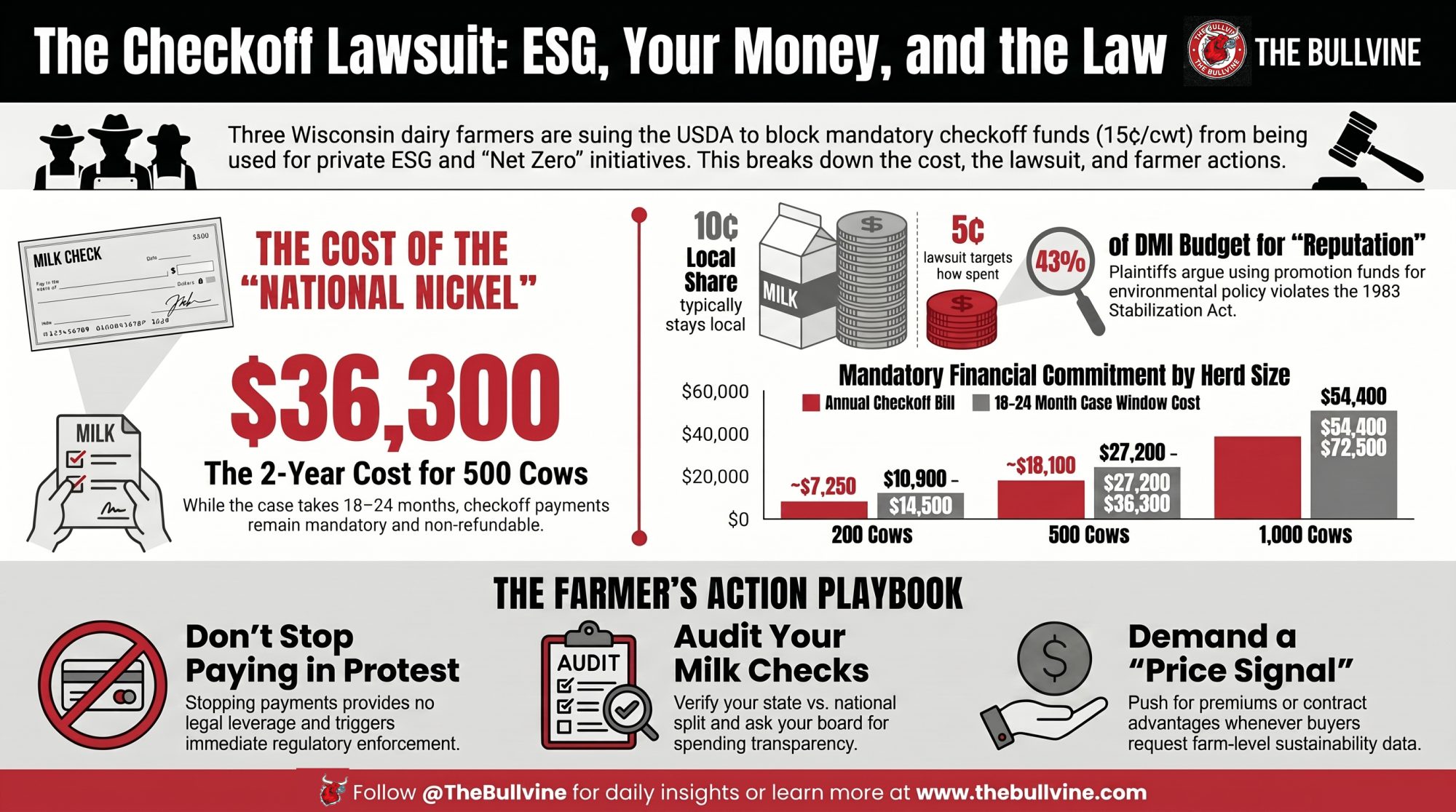
Your Checkoff Costs $36,300 a Year. Now Faust Is Suing Over What It Buys

Three Wisconsin farmers — led by the man who beat USDA in 11 months — just asked a federal judge whether your 15¢/cwt can bankroll dairy’s Net Zero machine. The bill runs either way.

This article is based on the complaint and public court records as of June 24, 2026. The allegations described have not been tested or proven in court.

On June 9, 2026, Abby Swan, a dairy farmer from Westfield, Wisconsin, put her name on a federal lawsuit that could reshape what every checkoff-paying producer in the country is funding. She’s the lead plaintiff in Swan et al. v. Rollins et al., filed in the U.S. District Court for the Eastern District of Wisconsin, Green Bay Division, against USDA and the National Dairy Promotion and Research Board, alongside two other Wisconsin dairy farmers — Adam Faust of Chilton and Christopher Baird of Ferryville. We told you in May this case was coming. Now it’s on the docket, and the argument fits on the back of a milk check: the dairy checkoff was sold to producers in 1983 as money for promoting and researching dairy, and the plaintiffs argue it shouldn’t be bankrolling a private group’s climate and ESG programs.

For a 500-cow dairy, this isn’t a debate for the lawyers to have in a vacuum. You’re paying roughly $18,000 a year into the checkoff, and not a nickel of it pauses while the case runs. Whatever the judge eventually decides, the real question beneath the dairy checkoff lawsuit is bigger than any single program: who gets to decide what your mandatory dollars are spent on?

What’s Actually Being Challenged Here

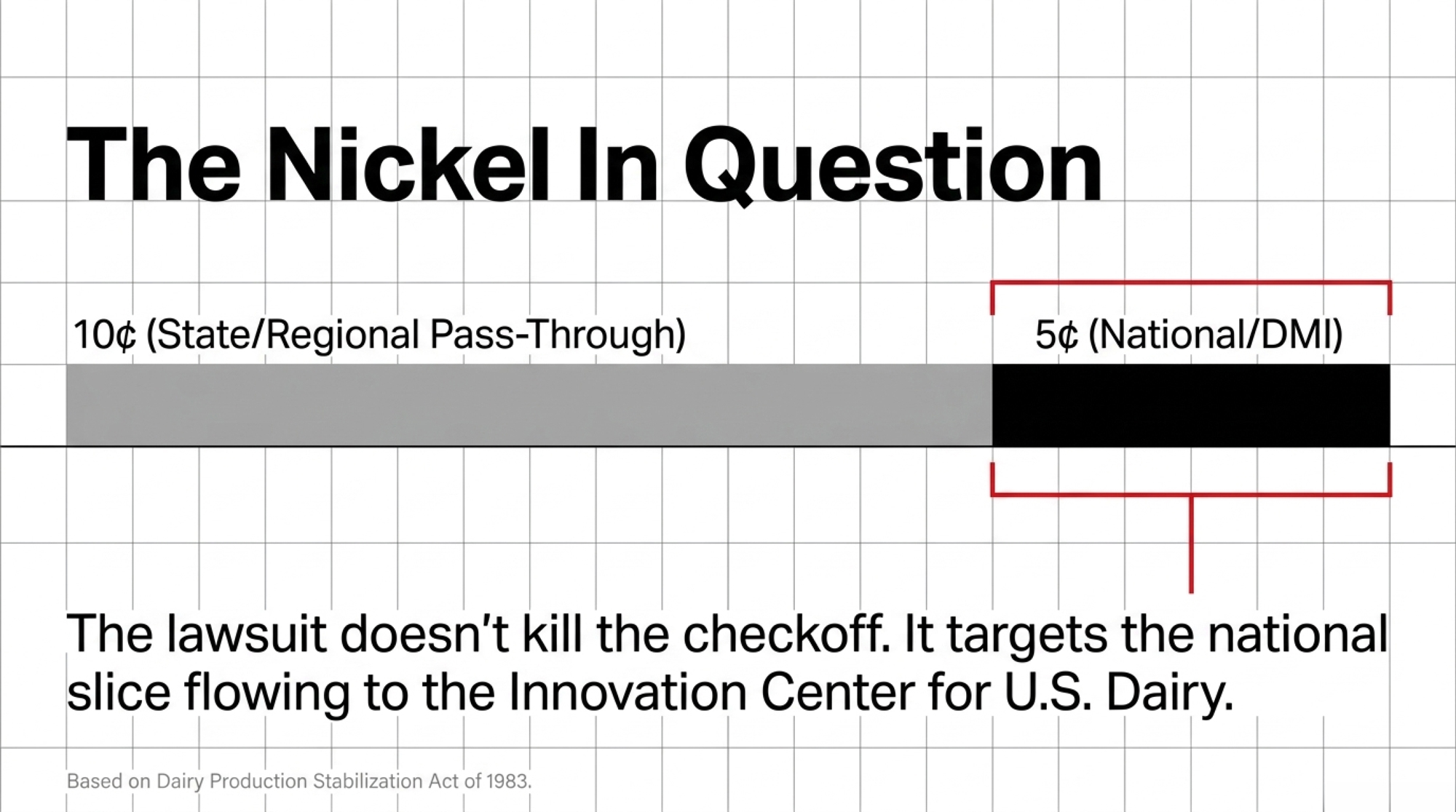
Start with the part nobody’s fighting over. Under the Dairy Production Stabilization Act of 1983, every U.S. farmer who markets milk commercially pays 15¢ per hundredweight into the checkoff, and importers pay 7.5¢. You can direct up to 10¢ to your state or regional program, and the rest — about 5¢ — goes to the national program run by Dairy Management Inc., or DMI. That structure built “Got Milk?” and forty years of generic dairy advertising.

What’s changed is where some of that money flows now. DMI’s 2025 program budget runs about $121.4 million, and its 2024 audited financials show total expenditures of $254.6 million once state and regional pass-throughs are folded in — with the largest slice, $110.5 million or 43.4%, booked to “Reputation” work and another $57.9 million to “Innovation.” DMI’s annual report doesn’t break out how much of that flows to the Innovation Center for U.S. Dairy. But the plaintiffs contend some of it underwrites the Center’s Net Zero work, which they argue looks less like advertising and more like environmental policy than the 1983 law allows. The Innovation Center is a private nonprofit founded in 2008 through the checkoff, and its U.S. Dairy Net Zero Initiative is aimed at the industry’s voluntary goal of greenhouse-gas neutrality by 2050.

The lawsuit doesn’t try to kill the checkoff. The plaintiffs are asking the court to declare that using checkoff funds to support the Innovation Center violates federal law and the Constitution, and to permanently prohibit future checkoff funding of the organization — leaving promotion, research, and nutrition education alone. So who’s exposed to the outcome? Every producer, because everyone pays the same nickel, whether you milk 80 cows in a tie-stall or 8,000 in a freestall.

How This Lands on Real Farms

Here’s where it gets concrete. The case will probably take 18 to 24 months to resolve. Over that window, a 500-cow operation sends $27,000 to $36,000 in checkoff payments out the door — with no refund mechanism, win or lose.  The assessment is mandatory, deducted automatically off your milk check, and not held in escrow while a judge thinks it over.

In the WILL release announcing the suit, Swan put it plainly. “Dairy farmers like me are being forced to subsidize private organizations pushing climate change research and ESG mandates for our farms, even though the Dairy Checkoff program is just supposed to market and promote our milk,” she said. “So not only are we funding a threat to our own existence, but these unrelated priorities increase my costs—and therefore yours.” That’s one camp. But it isn’t the whole barn, and pretending it is would miss the real story.

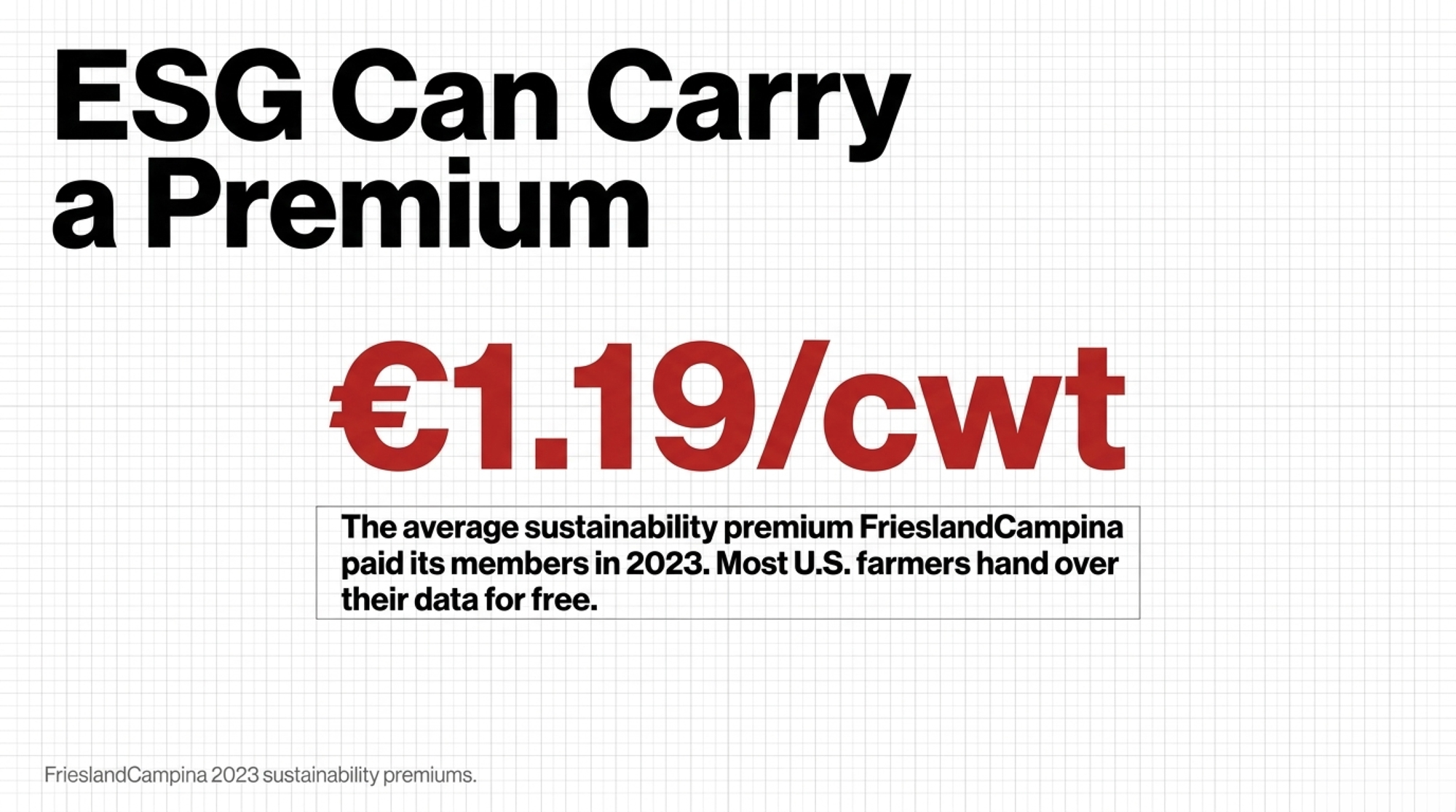
Plenty of producers engage with the Net Zero goals — not out of ideology, but because their buyers want them. Swan’s own complaints trace back to buyer-imposed ESG data demands: a processor letter asking for twelve months of natural gas, diesel, propane, biodiesel, and electricity use, with milk pickup hanging in the balance. So the tension usually isn’t the goal itself. It’s the structure — being compelled to fund a private ESG operation, hand over your farm-level data, and see no clear payback for it. Look across the Atlantic for the contrast: FrieslandCampina paid its members more than €245 million in sustainability premiums in 2023 — an average of €2.63 per 100 kg of milk, which works out to about €1.19/cwt — as a separate, results-based line on the milk check. That’s ESG with a price signal attached. Most U.S. farmers don’t get one.

FeatureU.S. Dairy Checkoff / Net Zero InitiativeFrieslandCampina (Netherlands)
Funding mechanismMandatory 15¢/cwt deducted from milk checkCooperative membership, voluntary programs
Sustainability premium paid to farmersNone — no direct payment to producers€245M+ paid in 2023 (~€2.63/100 kg avg)
Premium per cwt equivalent$0~€1.19/cwt (approx. $1.28 USD/cwt)
Top performer premium (Foqus planet)N/AUp to €3.50/100 kg for highest scores
Producer data requiredYes — energy, GHG, scope 1–3Yes — verified by independent auditors
Producer can opt outNoPartial — some programs are opt-in
Price signal attached to complianceNo✅ Yes — explicit per-cwt premium line
ESG governanceUSDA-supervised via DMI + Innovation CenterFrieslandCampina member board accountability

The Mechanics Behind the Case

Two legal levers make this more than the usual checkoff grumbling at the coffee shop. The first is the statute itself. The 1983 Act authorizes spending on the advertising, promotion, research, and nutrition education tied to selling dairy products. DMI’s honest, defensible position is that protecting dairy’s reputation and market access — including sustainability credibility — is just modern promotion. The plaintiffs counter that funding a private Net Zero and ESG framework stretches the word “promotion” past anything Congress signed off on.

The second lever is newer, and it’s the one that turns a long-shot into a live round. In Loper Bright Enterprises v. Raimondo (2024), the U.S. Supreme Court overruled the Chevron doctrine. For forty years, Chevron told courts to defer to a federal agency’s “reasonable” reading of an unclear statute. So before, USDA could essentially say “trust us, ESG counts as promotion,” and a judge would likely go along. Not anymore. Now the court in Green Bay has to decide for itself what the 1983 Act means, with USDA’s interpretation as just one voice in the room.

There’s a third wrinkle most coverage skips, and it may give the plaintiffs their strongest footing. WILL’s own argument leans on it: traditional checkoff campaigns were tightly controlled by USDA and generally treated as “government speech,” but funneling mandatory dollars to a private third party like the Innovation Center turns it into compelled funding of private speech. That matters because the Supreme Court upheld the beef checkoff back in 2005, in Johanns v. Livestock Marketing Association, largely on that government-speech rationale. Take away the government-speech shield, and the plaintiffs get a much cleaner First Amendment argument.

Why Adam Faust’s Name Carries Weight Here

You can’t read this case without reading the man sitting in the plaintiff lineup next to Swan. Faust and WILL beat USDA in 11 months on a separate fight over race- and sex-based preferences in federal farm programs — the Justice Department abandoned its defense and USDA settled on May 18, 2026. That’s the same farmer and the same law firm now running the playbook that worked before: a targeted constitutional challenge backed by plaintiffs willing to see it through, pushed hard before the government decides the fight is worth it. WILL frames the new case as protecting family dairy farms from being compelled to fund ideological speech they disagree with — and now Swan v. Rollins is on the docket as Case No. 1:2026cv01033.

Read more: Adam Faust Beat USDA in 11 Months. The Checkoff May Be Next

How Much Does This Lawsuit Cost You Before It’s Even Decided?

Run it on your own herd. The math is simple and it doesn’t move with the verdict. At 15¢/cwt and a U.S. average of 24,178 lb per cow in 2024, here’s what the checkoff pulls off your milk check — and what it adds up to across an 18-to-24-month case window.

Herd SizeAnnual Checkoff Bill18–24 Month Case Window CostNational (5¢) Share
80 cows$2,904$4,356 – $5,808~$968
200 cows$7,252$10,878 – $14,504~$2,417
500 cows$18,127$27,190 – $36,254~$6,042
1,000 cows$36,254$54,381 – $72,508~$12,085
2,500 cows$90,636$135,954 – $181,272~$30,212
5,000 cows$181,272$271,908 – $362,544~$60,424

Figures calculated at 15¢/cwt on the USDA NASS 2024 average of 24,178 lb/cow/year — about 120,900 cwt for a 500-cow herd. On the 500-cow line, roughly $6,000 goes to the national program and $12,100 is credited at the state level. None of it is refundable while the case is pending.

Read the table the right way: these are your total checkoff dollars. The lawsuit targets only how the national share — about 5¢ of the 15¢ — gets spent at the Innovation Center. Win or lose, it would not change the amount you pay; it would change where a slice of the national nickel is allowed to go.

Dynamic Checkoff Exposure Calculator

Evaluate your herd’s financial exposure while Swan v. Rollins runs its course in federal court.


Estimated Annual Volume: 120,890 cwt
Annual Total Checkoff (15¢): $18,133.50
↳ State/Regional Share (10¢): $12,089.00
↳ National Share Under Challenge (5¢): $6,044.50
Total Case-Window Exposure: $36,267.00

*Calculations are based on statutory checkoff deduction logic ($0.15/cwt gross assessment, split $0.05 national / $0.10 state credit). Funds are non-refundable during litigation.

That reframes the whole thing. This case won’t put money back in your account next quarter. So the practical question isn’t “will I get a refund?” — you won’t. It’s whether you keep treating those dollars like background static, or start treating them like an investment you’re allowed to interrogate. Where does your own checkoff bill sit right now, and could you say with a straight face what it buys?

Is the Cure Worse Than the Disease If the Checkoff Loses?

Here’s the trade-off nobody’s putting on the table. Right now, FARM Environmental Stewardship and the Innovation Center’s tools give U.S. dairy roughly one shared ESG framework — companies representing more than 77% of U.S. milk production have adopted the U.S. Dairy Stewardship Commitment. If a court cuts off checkoff funding, that work doesn’t vanish. Your buyers still want the data. The cost just shifts to co-ops and processors, who may each go build their own carbon calculator and their own audit standard.

That’s the fragmentation risk, and it’s real. One mandatory ESG machine you didn’t vote for is a governance problem. Five competing systems pulling on the same 500-cow barn — each with its own forms, data fields, and farm visit — is a different and possibly heavier burden. The viral “no data, no milk” letter that kicked off Swan’s fight is exactly that kind of demand: privatized reporting enforced by contract, not by law. So a narrow legal win could leave you doing more compliance, not less — unless the industry uses the moment to standardize and finally attach real money to the ask. That’s the part worth watching.

Read more: treat your sustainability data like cash, not confetti

Options and Trade-Offs for Farmers

You can’t opt out of the nickel today. But you’ve got real choices about how you handle it while this plays out.

  • Keep paying — and start asking. This is the do-it-this-month move. Skipping the checkoff just creates enforcement headaches with your handler and buys you nothing while the law stands. What changes is your posture. Pull three recent milk checks, confirm exactly how your 15¢ splits between state and national, and ask your co-op or board rep what share of the national dollars funds ESG work versus straight promotion. Low cost, fast clarity, and it puts your board on notice that someone’s actually reading the line items.
  • Treat your sustainability data like cash. If you’re enrolled in FARM Environmental Stewardship or a Net Zero pilot, keep copies of every report and the underlying data, and ask in writing who can see your farm-level numbers. This matters most the moment a buyer asks for more data on top of your money. The risk it manages is simple — handing over a valuable asset for free while someone downstream monetizes it.
  • Push for explicit value on any ESG ask. Where a buyer wants stewardship participation, press for a clear premium, contract advantage, or documented benefit. FrieslandCampina’s roughly €1.19/cwt sustainability line — and its maximum Foqus planet premium of €3.50 per 100 kg for top scores — shows ESG can carry a real per-cwt premium overseas. The limit: U.S. programs vary widely, and many don’t itemize a sustainability premium yet — so treat this as a negotiation target, not a promise.
  • Watch the docket without betting the farm on it. Track Swan v. Rollins (Case No. 1:2026cv01033) for two trigger events only — a preliminary injunction aimed at Innovation Center funding, and any final judgment or settlement. Faust’s last fight moved faster than anyone expected — the government folded before trial — so a mid-case settlement isn’t far-fetched here either. Until one of those triggers lands, nothing about your obligations changes. Keep your cash-flow decisions anchored to milk price, feed, and debt service, where the real risk on your place lives anyway.

Read more: where your checkoff dollars actually go

Key Takeaways: Your Checkoff Action Checklist

📋 Audit your checkoff split. Pull three recent milk checks this week. If you can’t see exactly how your 15¢/cwt splits between state and national funds, make your handler walk you through the line items.

🛑 Don’t stop paying in protest. The assessment remains completely mandatory. Halting payments buys you zero legal leverage and immediately exposes your operation to regulatory enforcement.

🔒 Protect your farm data. If you’re actively enrolled in FARM ES or a Net Zero pilot, download and save every report. Get a written agreement clarifying exactly who has access to your farm-level data before submitting the next round.

💰 Demand the price signal. If a buyer or co-op pressures you to join a new sustainability framework, ask one direct question: what specific premium, contract advantage, or risk reduction comes with it? 

👀 Watch only two triggers. Follow Swan v. Rollins for a preliminary injunction on Innovation Center funding or a final ruling — and tune out the noise in between.

🧮 Budget as if nothing changes. Plan the next two years as though the full checkoff bill for your herd size goes out the door regardless of outcome, because it will (see the cost table above).

What You Do After the Ruling Matters More Than the Ruling

The court opinion is the easy part. A judge will eventually answer, in plain English, what dairy’s mandatory nickels are legally for — and that alone makes this the most consequential checkoff question in forty years. The harder part comes after the gavel: whether producers use the decision as leverage at the co-op table, or just file it under “something I heard on the radio once.”

So before your next board meeting, sit with this one. Do you actually know what your checkoff dollars buy — and could you defend that spending to your own banker? If the answer is “not really,” that’s not a failing. It’s a starting point. We’re breaking down the full barn-math model by herd size — 200, 500, and 1,000 cows — plus the realistic range of outcomes for the case, in our deeper Bullvine analysis. That’s where the real numbers live.

Complete references and supporting documentation are available upon request by contacting the editorial team at editor@thebullvine.com.

Learn More

The Sunday Read Dairy Professionals Don’t Skip.

Every week, thousands of producers, breeders, and industry insiders open Bullvine Weekly for genetics insights, market shifts, and profit strategies they won’t find anywhere else. One email. Five minutes. Smarter decisions all week.
NewsSubscribe
First
Last
Consent

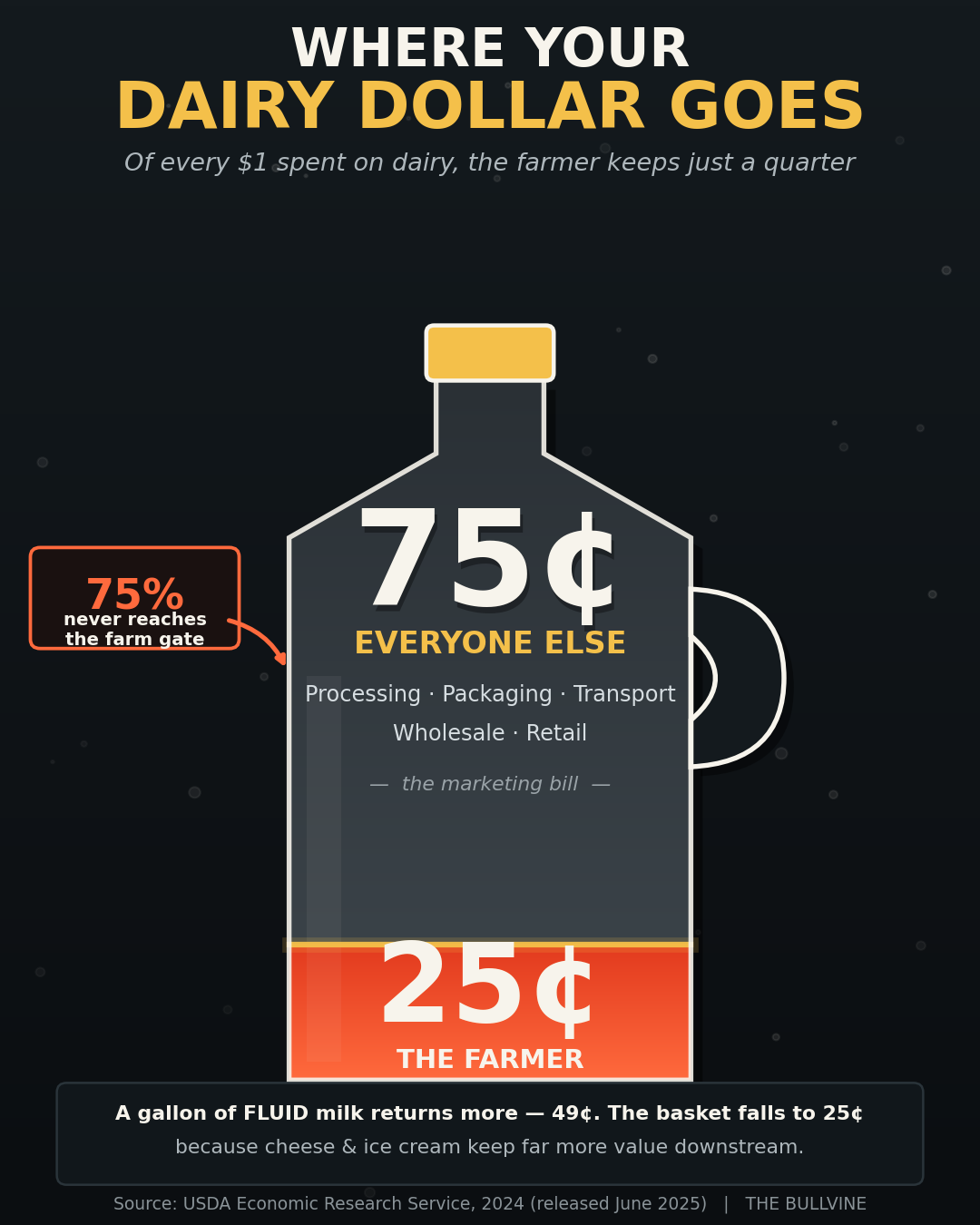
June Dairy Month Turns 89 — and Farmers Now Keep Just 25¢ of Every Dairy Dollar

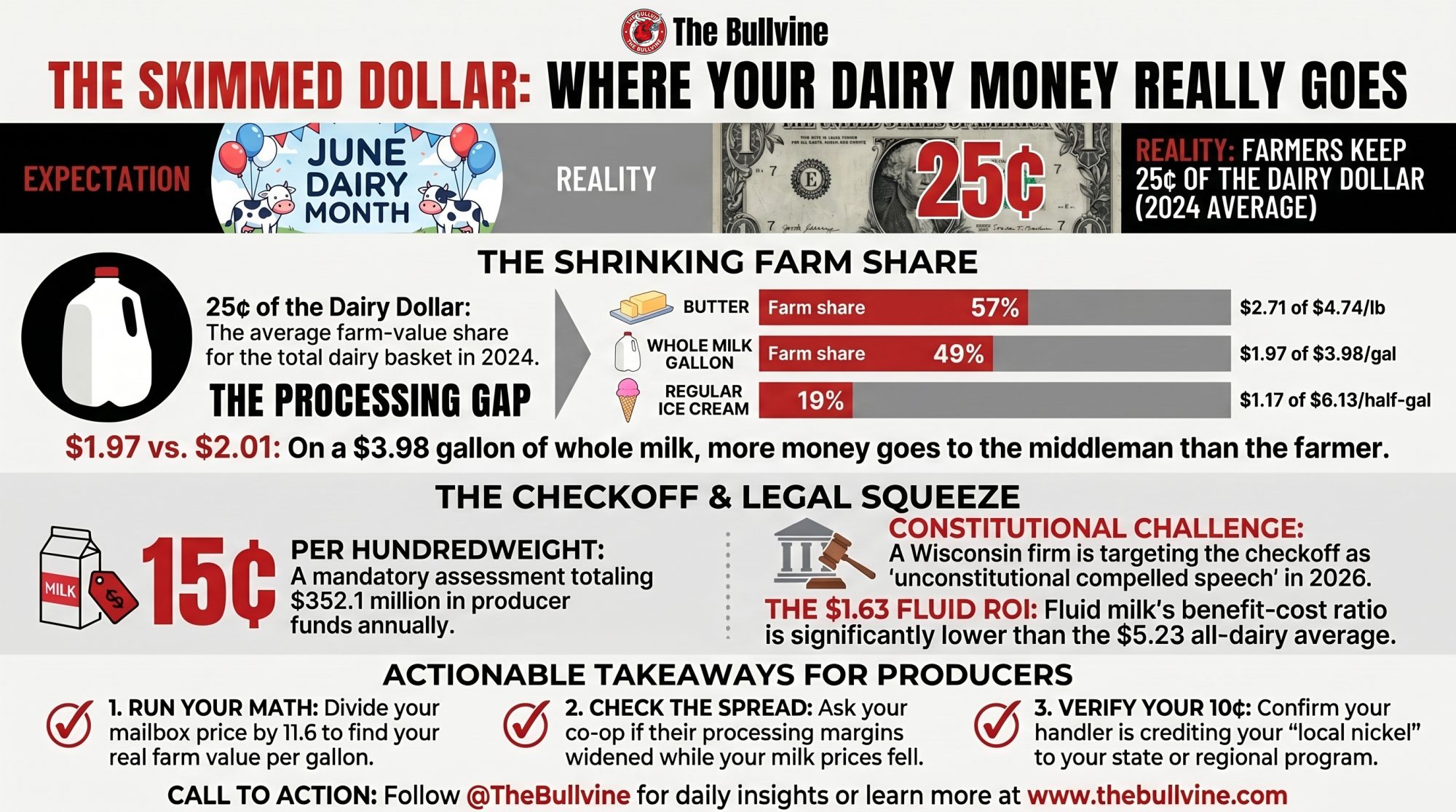
They’ll ask you to pose with a calf this June. Then you go home to the milk check: $1.97 of that $3.98 gallon is yours. The other $2.01 never reaches the tank — and a Wisconsin firm wants a say over your 15¢ next.

Editor’s note: “the Reillys” below is a composite scenario, modeled from public ERS price data and typical Northeast fluid-shipper economics — not a single real farm. Every number attached to them is sourced and real; the operation itself is illustrative, in the same way our $97,000 Breeding Meeting feature was framed.

Picture a 140-cow tie-stall in the St. Lawrence Valley — call them the Reillys, a stand-in for the fluid shippers across the Northeast doing exactly this math. June Dairy Month banners go up at the co-op, the FFA kids hand out string cheese at the county fair, and somebody asks the Reillys to pose with a calf for the local paper. They smile for it. Then they go home and look at the milk check.

Because here’s the question that’s been gnawing at operations like theirs: of the $3.98 a consumer paid for a gallon of whole milk in 2024, how much actually landed in their tank?

About $1.97. The other $2.01 went to everybody between the bulk tank and the dairy case.

That’s not a grievance — it’s USDA Economic Research Service data, the agency’s own farm-share series, released June 2025. And honestly, for fluid whole milk, 49% isn’t a bad number. It’s the rest of the dairy aisle where the floor fell out. This June, that number collides with a courtroom: a Wisconsin law firm that just settled an 11-month case against USDA says the checkoff every farmer like the Reillys funds is its next target.

The lawyers showed up to the party uninvited

On May 27, 2026, Wisconsin Institute for Law and Liberty deputy counsel Daniel Lennington told Brownfield Ag News the dairy checkoff is “an unconstitutional program.” The timing isn’t subtle. He’s raising the fight during the one month of the year the checkoff is most visible.

Lennington alleges checkoff dollars are flowing into “ESG, environmental social governance programs (including) the Dairy Net Zero program” — work that, in his words, goes “to basically blame dairy farmers and blame cows for global warming,” while requiring “even small farmers to fill out all sorts of disclosures.” The program’s legal mandate, he says, is to promote the purchase of dairy products, “and nothing more.” There’s a factual core under the claim: the Foundation for Food & Agriculture Research announced a $10 million grant supporting dairy’s Net Zero Initiative in 2021, a program co-created with the Innovation Center for U.S. Dairy. The industry casts that work as protecting market access and meeting its 2050 stewardship goals — not as an attack on farmers.

This isn’t an idle threat. The same firm just settled the Adam Faust case, in which USDA agreed to strip race- and sex-based “socially disadvantaged” designations from three federal programs — the Dairy Margin Coverage fee, the Loan Guarantee Program, and EQIP — after the U.S. Department of Justice announced on February 9, 2026 that it would abandon its defense of two of them as unconstitutional. They win cases. So when they say the checkoff is next, the Reillys’ co-op delegate is right to pay attention.

To be clear about what this is and isn’t: these are allegations and legal arguments, not court findings. No complaint against the checkoff has been filed yet. And the legal ground is genuinely contested history. A federal appeals court actually struck the dairy checkoff down once — in Cochran v. Veneman (2004), the Third Circuit ruled that compelling Pennsylvania dairy farmers to fund generic milk promotion violated the First Amendment. Then the Supreme Court changed the landscape a year later: its 2005 Johanns v. Livestock Marketing Association decision — a beef checkoff case — held that checkoff promotion is the government’s own speech, and therefore immune from compelled-subsidy challenge. That government-speech doctrine has shielded the dairy program ever since. WILL’s new theory tries to thread that needle: if checkoff dollars fund environmental messaging that falls outside “promotion of the sale and consumption of dairy products,” is it still the government speech Johanns protects? That’s the question no court has been asked in those exact terms.

It’s not the only mandatory dairy program in court this spring, either. In a separate and unrelated case, Organic Valley, Horizon, and Aurora filed constitutional challenges to the Federal Milk Marketing Order system in spring 2026, with a group of Organic Valley farmers adding a Fifth Amendment takings claim. Different program, different argument — but a sign that the legal machinery underneath dairy’s mandatory structures is being tested from several directions at once.

June Dairy Month was always a marketing play — and that’s the point, not the insult

Start with the origin story, because it explains everything that followed. June Dairy Month launched in the late 1930s as “National Milk Month,” a response to a seasonal milk surplus. The goal wasn’t sentiment. It was inventory.

Refrigeration had improved, cows were flush on spring grass, and the market was drowning in milk. The industry needed Americans to drink the surplus before it spoiled. So it built a celebration around the problem.

Nearly nine decades later, the machine is bigger and the surplus never left. USDA’s February 2026 WASDE pegged the 2026 all-milk price at $18.95 per hundredweight, down from a revised $21.17 in 2025. And January 2026’s announced Class III price came in at just $14.59. The cows are still flush. The market’s still long. And June still arrives like clockwork to remind everyone how wholesome it all is.

Here’s the part nobody prints on the banner: the Reillys are paying for the party.

You fund the celebration at 15¢ per hundredweight — and you don’t control most of it

Every hundredweight the Reillys ship carries a 15-cent checkoff assessment, mandated under the federal Dairy Production Stabilization Act of 1983 and the Dairy Promotion and Research Order. Here’s the split most farmers can’t recite from memory: producers can direct up to 10¢ of that 15¢ to a qualified state, regional, or local program — and the other 5¢ goes to the national checkoff, the National Dairy Promotion and Research Board, which funds Dairy Management Inc.

Checkoff TierAmount (¢/cwt)Who Controls SpendingBenefit-Cost Ratio (fluid milk context)
State/Regional ProgramsUp to 10¢Farmer-elected boards at state/regional levelVaries by program; farmer has direct delegate influence
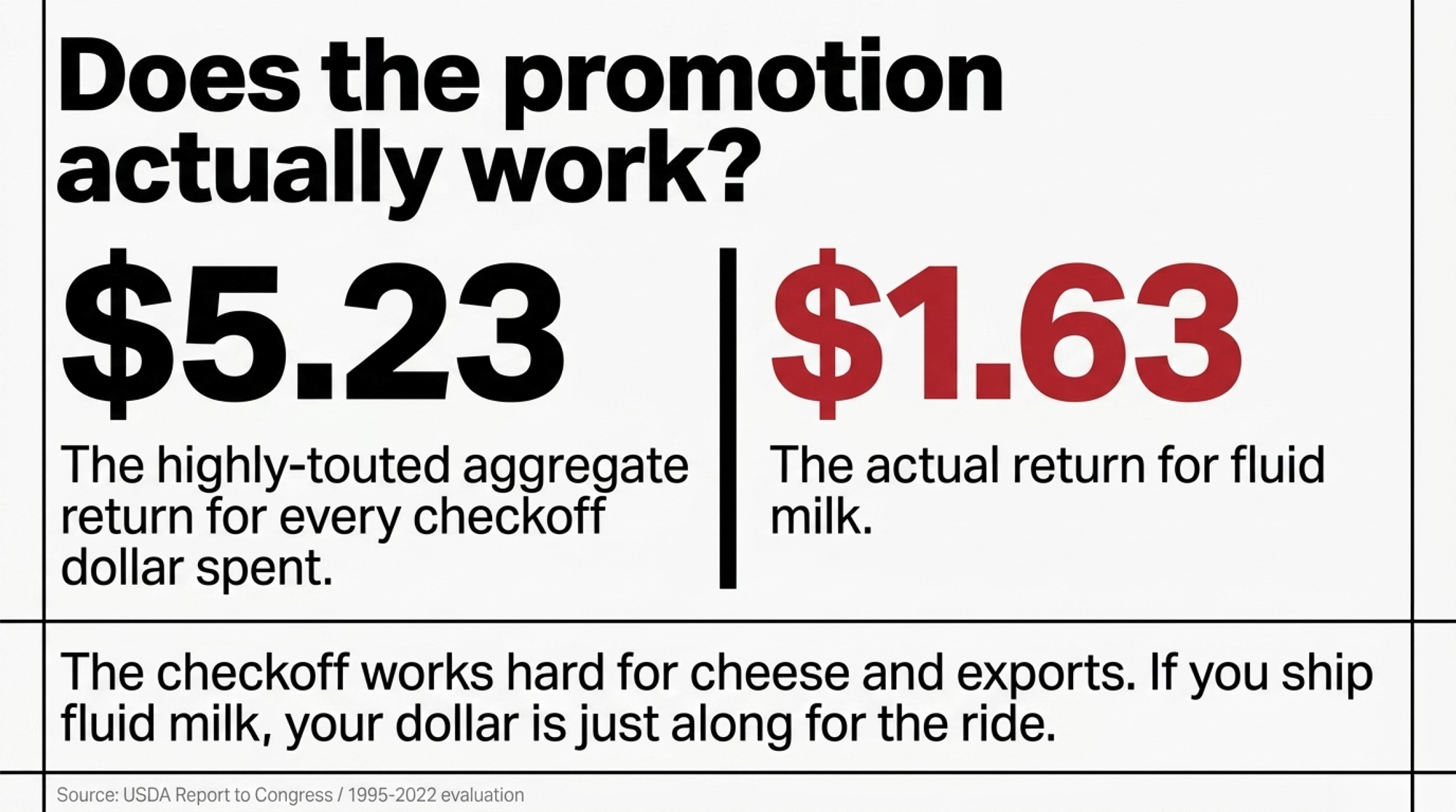
National (NDPRB → DMI)5¢ mandatoryDairy Management Inc. — not direct farmer vote$1.63 on fluid milk (1995–2022 eval) ⚠️
Total Producer Assessment15¢Split as above$5.23 aggregate all-dairy (most recent Report to Congress)
MilkPEP (processors)Separate: ~2¢/gal equivalentProcessor-governed; funds fluid milk campaignsFluid-specific; MilkPEP funds fluid promotion separately
2022 aggregate collected$352.1M producers + $79.7M MilkPEP$431.8M total checkoff pool

The dollars are real money in aggregate. In 2022, the most recent audited year in USDA’s September 2024 Report to Congress, the 15¢ producer assessment added up to $352.1 million, plus another $79.7 million from fluid milk processors through MilkPEP. DMI is the entity that turns the national share into demand campaigns — the “undeniably dairy” work, the pizza-chain partnerships, the sports tie-ins.

DMI’s own 2024 audited financials show total revenue of $165.7 million, down from $178.3 million in 2023. Domestic marketing ran $127.1 million; export programs took another $23.7 million. The catch for a fluid shipper: most of where that money lands isn’t something the Reillys vote on.

Does it work? Depends what you’re measuring. USDA’s congressionally mandated evaluation, authored by Texas A&M economist Oral Capps Jr., pegs the aggregate all-dairy benefit-cost ratio at $5.23 per dollar spent for the 1995–2022 period — meaning the model estimates $5.23 in economic value for every checkoff dollar. That’s a government-published number, and it’s the strongest case for the program.

But read the category breakdown in the same report, because not all dairy dollars perform alike. Butter returned $17.73 per dollar invested. Cheese returned $3.87. Exports, $8.63. And fluid milk — the product the Reillys anchor to — came in dead last at $2.68, the lowest-returning category of everything the checkoff promotes. Cheese, butter, and exports carry the program; the jug barely keeps pace. We laid that gap out in our recent breakdown of where the checkoff money actually goes. So when the checkoff celebrates June, the dollars are largely working for cheese and exports. The Reillys’ fluid-milk dollar is along for the ride.

Why do you keep half a fluid gallon but only a quarter of the basket?

Now the line that matters most. And it needs a careful read, because two different USDA numbers get mashed together constantly.

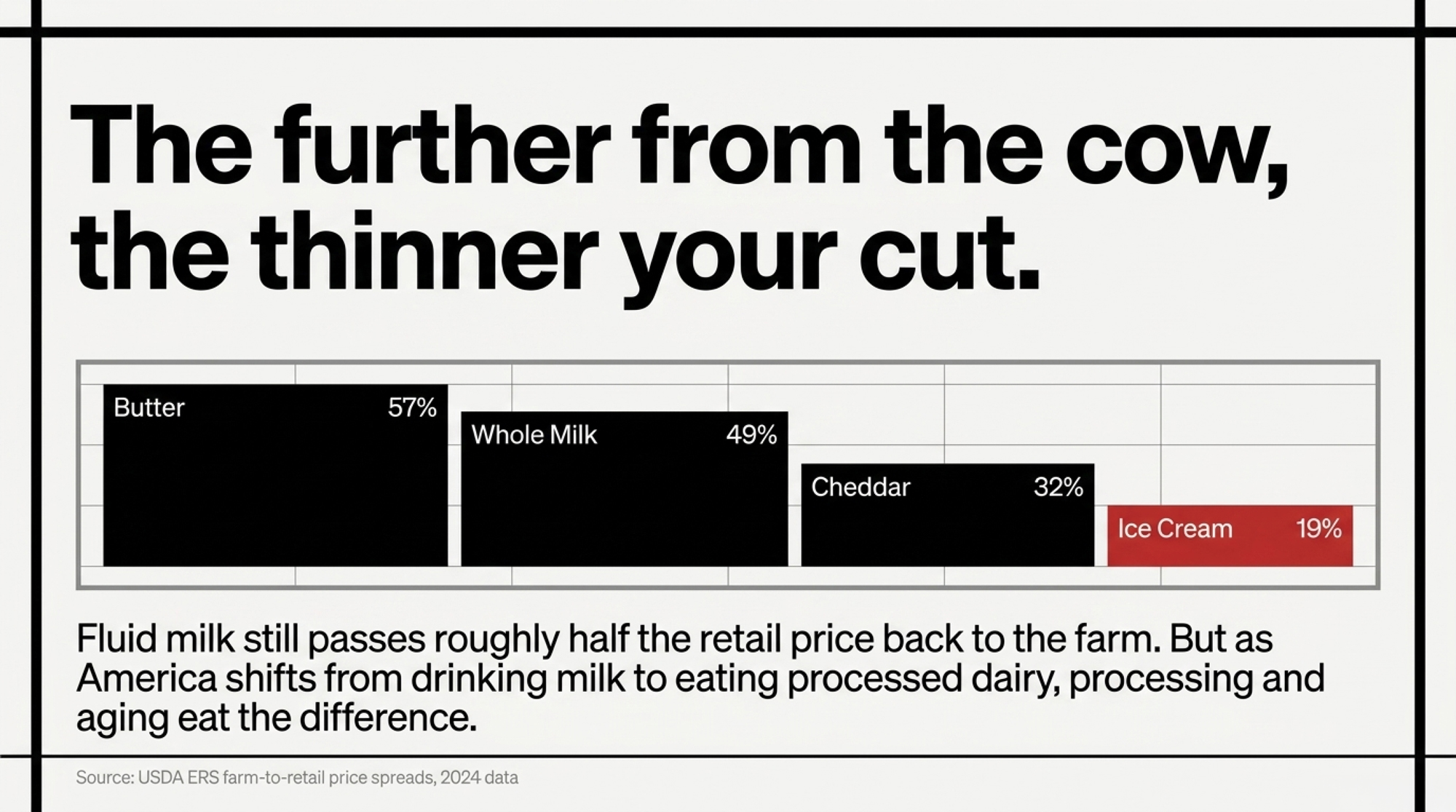
For a gallon of fluid whole milk, the farm share was 49% in 2024 — $1.97 of a $3.98 retail gallon, up from 47% the year before. The point figures move year to year, so treat any single year as a snapshot, not a trend line. Fluid milk still passes roughly half the retail price back to the farm.

For the total dairy basket — milk, cheese, butter, yogurt, ice cream, all of it — the farm-value share sat at 25% in 2024, up from 23% in 2023 but down from 28% in 2022. Here’s the contrast that should ruin the Reillys’ appetite:

What’s being measuredFarm share, 2024What it tells you
Butter57% ($2.71 of $4.74)Less processing, bigger farm slice
Whole milk gallon49% ($1.97 of $3.98)Half the retail price still gets back to you
Cheddar cheese32% ($1.80 of $5.66)Processing and aging eat the difference
Total dairy basket25%Processed product keeps three-quarters downstream
Regular ice cream19% ($1.17 of $6.13)The further from raw milk, the thinner your cut

Source: USDA Economic Research Service, farm-to-retail price spreads, released June 2025. Butter and ice cream prices are per pound and per half-gallon, respectively.

Why the gap between 49% and 25%? Because America stopped drinking milk and started eating processed dairy. Cheese, ice cream, and value-added products carry far more processing and marketing value downstream — and almost none of it flows back to the farm gate. The more the dairy case tilts toward processed product, the smaller the Reillys’ slice of the total basket, even when their fluid share holds steady. We traced that erosion in our piece on how the milk dollar collapsed to 25¢. It’s the part of the story the June Dairy Month banner has never centered on.

“But milk’s a bargain” — true, and that’s exactly the trap

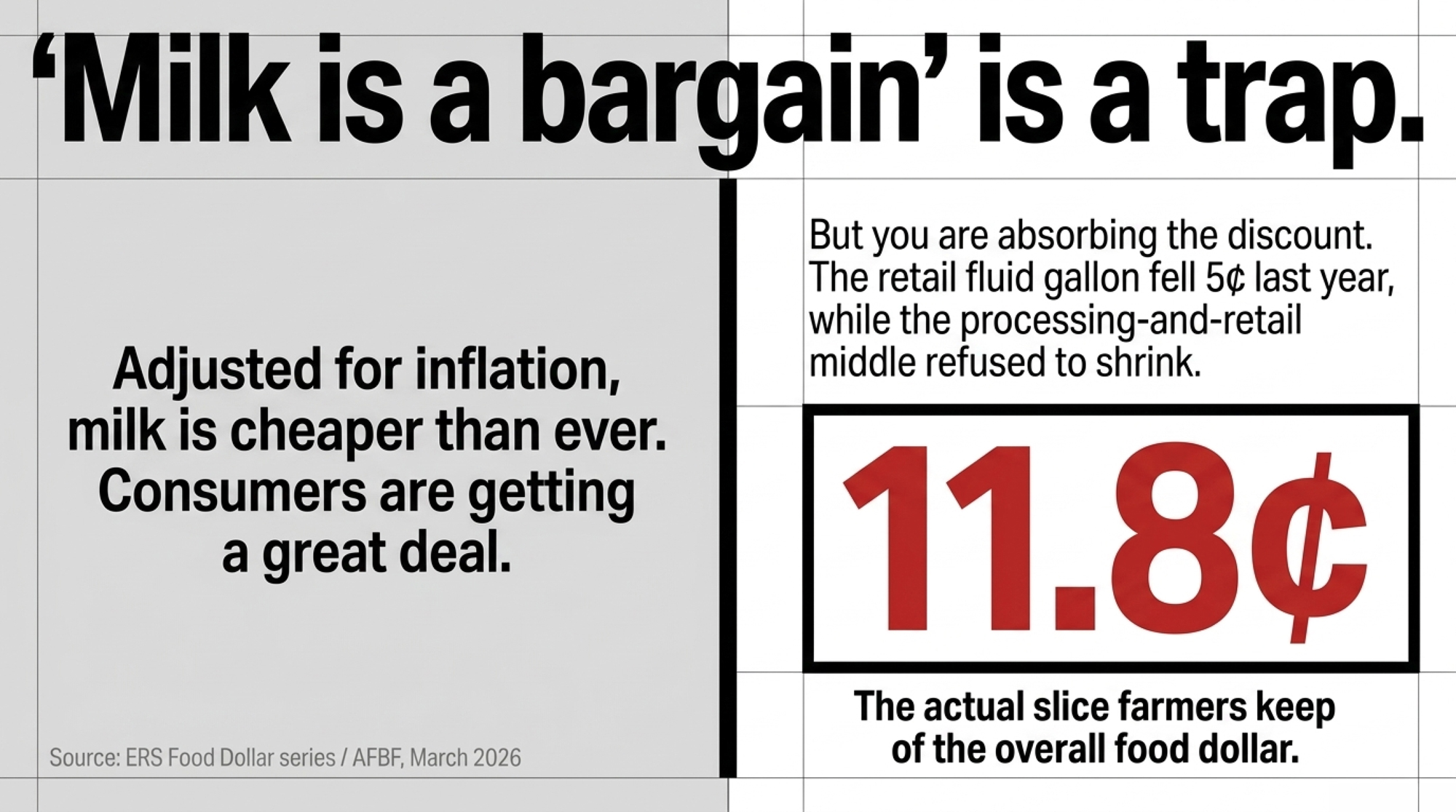
Here’s the defense you’ll hear, and it isn’t wrong. Adjusted for inflation, milk is cheaper than it was when the Reillys poured their last freestall. Consumers are getting a deal.

The problem is who’s absorbing the discount. The 2024 ERS data shows the moving parts: the retail whole-milk gallon actually fell five cents year over year, while the farm value rose nine cents — so that year, fluid milk’s farm share ticked up. But zoom out to all food and farmers kept just 11.8¢ of every dollar in 2024, down from 12.1¢ the year before, according to ERS’s Food Dollar series as summarized by the American Farm Bureau Federation in March 2026. After expenses, the same AFBF analysis puts farmers’ and ranchers’ combined net at 5.8¢ of the food dollar. The processing-and-retail middle is where the money sits, and it isn’t shrinking.

So “milk is a bargain” is true. The Reillys are just not the ones setting the price of the bargain.

How do you run the math on your own gallon — before the cake gets cut?

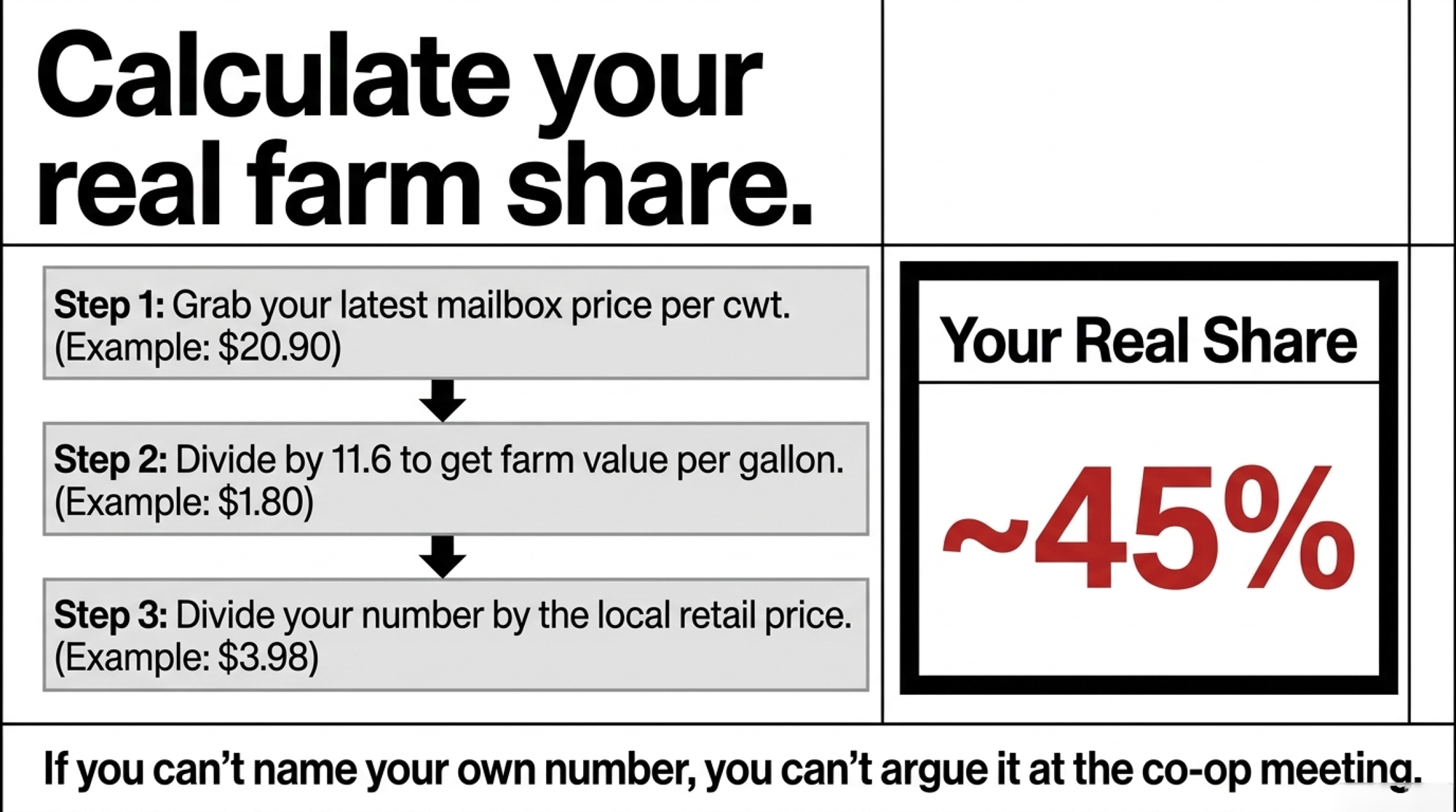
You don’t need a spreadsheet for this. Five minutes at the kitchen table turns a vague grievance into a number you can take to a lender or a co-op meeting. Here’s the four-step version the Reillys ran:

Step 1. Grab your latest mailbox price per hundredweight.

Step 2. Divide it by 11.6. (A gallon is about 8.6 lbs of milk, so a hundredweight covers roughly 11.6 gallons.) That’s your farm value per gallon.

Step 3. Stack it against the $3.98 retail gallon.

Step 4. Divide your number by $3.98. That’s your real farm share.

Run it at two prices and watch how exposed a fluid shipper is:

Milk priceFarm value per gallonShare of the $3.98 gallon
$20.90 mailbox~$1.80~45%
$14.59 Class III (Jan 2026)~$1.26~32%

That bottom row uses a raw Class III base, not a mailbox price — so it’s a floor, not what actually hits a check after premiums and producer price differential. Either way, the point holds: you keep somewhere between a third and a half of a fluid gallon, and a lot less once the milk turns into cheese or ice cream.

Now the checkoff side. Shipping roughly 38,000 hundredweight a year (see the methodology note for the assumption behind that), the Reillys’ 15¢/cwt assessment comes to about $5,700 leaving the tank annually — and up to 10¢ of it can be directed to a qualified state program, with the national nickel funding DMI regardless. A 200-cow herd at the same per-cow output crosses $8,000; a 500-cow dairy clears $20,000. Small money per cow. Real money in aggregate — and most of it spent without a direct vote.

What does your processor’s product mix do to your check?

Here’s the operational piece the farm-share average hides. Two farms can ship identical milk and bring home different money, depending on what their buyer makes with it. A co-op spinning your milk into private-label fluid and commodity cheddar passes back a thinner slice than one selling branded specialty product, because every processing step downstream eats into the share that can flow back to raw milk.

That’s why the Reillys’ real exposure isn’t the national 25% — it’s their own buyer’s spread. If their co-op’s processing margin widened last year while the farmgate price fell, the squeeze this article describes is happening inside their own supply chain, not just in an ERS chart.

Options and trade-offs for your operation

This isn’t a problem you fix with a better breeding decision or a tighter ration. It’s structural. But three moves sit inside the Reillys’ control — and yours.

Pull your co-op’s annual report and check the spread — within 30 days. Find the processing margin alongside the farmgate price they announced. Then ask one question: did that spread widen when milk prices fell last year? You’re a member-owner. You’re allowed to ask. Costs nothing but an afternoon. The catch: a co-op that won’t break out processing margins has told you something too.

Confirm where your 10¢ is going, and weigh the checkoff against your product mix. You can’t opt out — it’s mandatory, and that’s exactly the fight WILL is picking. But up to 10¢ of your 15¢ can be credited to a qualified state or regional program where farmer-elected boards direct the spending. Pull a milk settlement statement, find the checkoff line, and confirm with your handler. And if you ship into a fluid market like the Reillys, fluid’s $2.68 benefit-cost ratio — the lowest of any category the checkoff funds — says the national promotion is doing the least for you. A reason to lean on your delegates, loudly.

Watch the WILL case as a real variable, not background noise. If a constitutional challenge is filed and advances, the assessment and how it’s spent could come under pressure within a couple of years. That’s not a reason to build your budget around it. It is a reason to know where your producer organizations stand before the question reaches you. The risk: these cases move slowly, and nothing may change for a long time.

Key takeaways

  • If you ship into a fluid market, the checkoff has returned $2.68 per dollar on your product — the lowest of any category it funds, versus $17.73 for butter — so push your co-op delegates on spending priorities rather than assuming the promotion works for you.
  • If you can’t name your own farm-share number, you can’t argue it. Run the four-step gallon math before your next lender or co-op meeting.
  • If your 10¢ isn’t credited to a qualified state program, you’re losing local governance, not money — confirm with your handler this week.
  • If your co-op won’t show you its processing margin next to the farmgate price, treat that opacity as data — and ask louder.
  • If the WILL challenge is filed and advances, expect the checkoff’s structure and spending to come under pressure; know your producer org’s position now.

So what’s your real number?

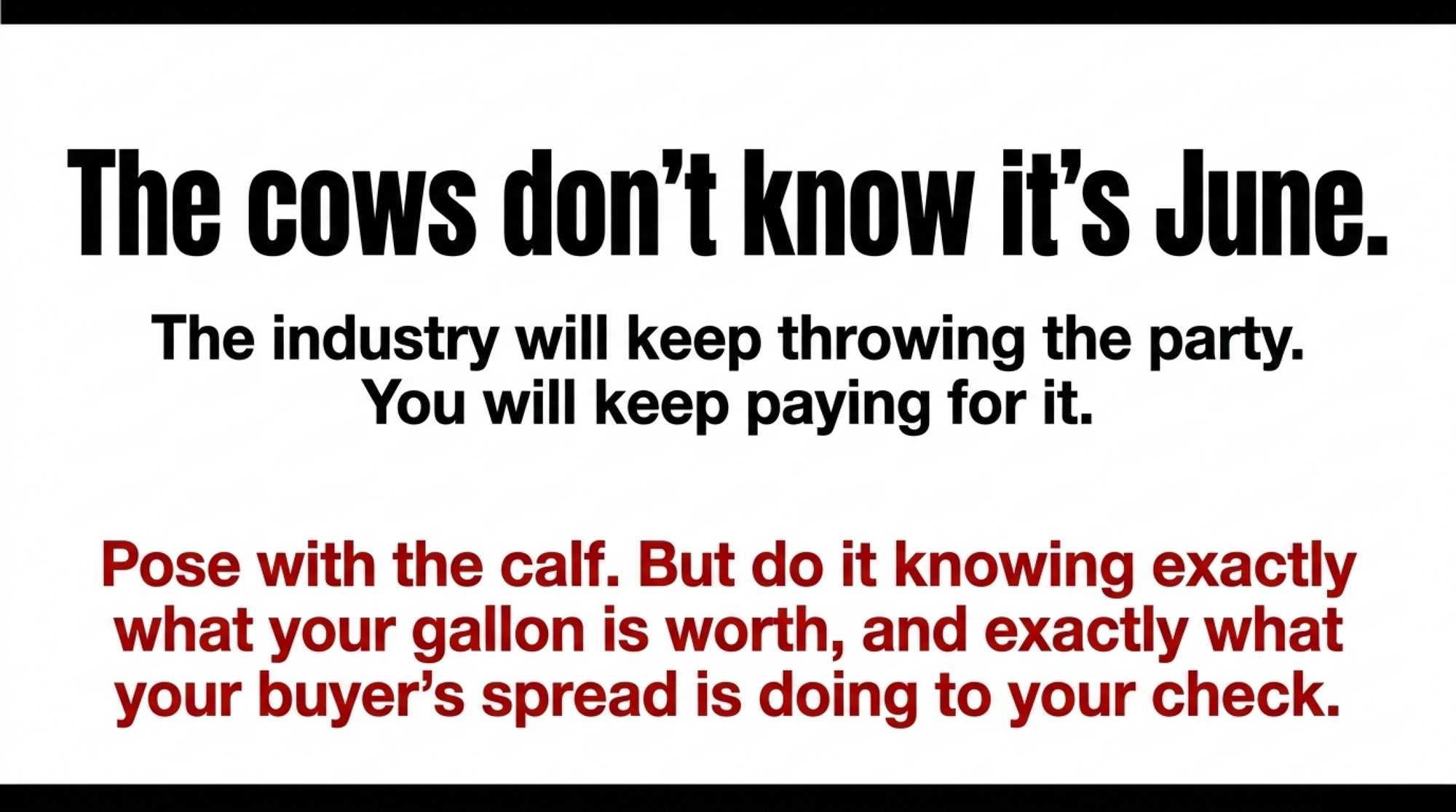
The cows don’t know it’s June. They’ll eat the same ration, fill the same tank, and somebody in a boardroom will still build a campaign around it. The party’s real. So is the 25¢. The Reillys will pose with the calf again next year, because that’s who they are — but they’ll do it knowing exactly what their gallon is worth and exactly what their 15¢ is buying.

Methodology note. Farm-share and price figures are from USDA Economic Research Service farm-to-retail price-spread data, released June 2025 (2024 reference year): whole milk farm share 49% ($1.97 farm value / $3.98 retail gallon, up from 47% in 2023); butter 57% ($2.71 / $4.74 per lb); cheddar 32% ($1.80 / $5.66 per lb); regular ice cream 19% ($1.17 / $6.13 per half-gallon); total dairy basket 25% (23% in 2023, 28% in 2022). The 11.8¢ all-food farm share and 5.8¢ net figure are from ERS’s Food Dollar series, 2024 reference year, as summarized by the American Farm Bureau Federation, March 2026. Checkoff structure: 15¢/cwt assessment under the Dairy Production Stabilization Act of 1983 and Dairy Promotion and Research Order; producers may direct up to 10¢ to qualified state/regional programs, with 5¢ going national to the National Dairy Promotion and Research Board, which funds Dairy Management Inc. (per USDA AMS). The 2022 assessment totals ($352.1M producer; $79.7M MilkPEP processor) and all benefit-cost ratios are from USDA’s 2022 Dairy Report to Congress (published September 2024; covering 1995–2022; quantitative evaluation by Texas A&M economist Oral Capps Jr.): aggregate all-dairy BCR 5.23; fluid milk 2.68; cheese 3.87; butter 17.73; export 8.63; DMI-specific spending 6.51. (The fluid-milk BCR had fallen across prior evaluations — 3.26, then 1.91, then 1.63 — before rising to 2.68 in the current report.) DMI revenue figures ($165.7M in 2024; $178.3M in 2023; $127.1M domestic marketing; $23.7M export) are from DMI’s 2024 audited financial statements. Milk prices are from USDA WASDE/ERS (February 2026 WASDE: 2026 all-milk $18.95/cwt; 2025 revised $21.17/cwt; January 2026 announced Class III $14.59/cwt). Legal matters: the checkoff challenge is attributed to Daniel Lennington of the Wisconsin Institute for Law and Liberty as reported by Brownfield Ag News (May 27–28, 2026); the Adam Faust settlement details are from WILL’s May 2026 release and reflect the DOJ’s February 9, 2026 announcement; the $10M FFAR grant to dairy’s Net Zero Initiative was announced in 2021. Cochran v. Veneman (3rd Cir. 2004) struck the dairy checkoff down on First Amendment compelled-speech grounds; Johanns v. Livestock Marketing Association (U.S. 2005), a beef-checkoff case, established the “government speech” doctrine that has shielded checkoff programs since. The Federal Milk Marketing Order challenges by Organic Valley, Horizon, and Aurora are separate from the checkoff and were filed in spring 2026. Barn math: the ~$5,700 figure assumes a 140-cow herd at approximately 75 lbs/cow/day over 365 days (~38,300 cwt) × $0.15/cwt; per-herd figures scale at the same per-cow output. Gallon conversion uses 1 gallon ≈ 8.6 lbs of milk. All figures are USD.

Limitations. National averages may not reflect your region, herd size, product mix, or operation. Single-year farm-share figures are snapshots, not trends. Benefit-cost ratios are model estimates from a single congressional evaluation, not farm-level guarantees.

Conflict of interest. The Bullvine has no business relationship with Dairy Management Inc., the Wisconsin Institute for Law and Liberty, the Foundation for Food & Agriculture Research, or any party named in this article.

Corrections. Spot an error? Tell us. We correct publicly, at the top of the article, dated.

This article is based on reporting and public records available as of June 1, 2026. The legal claims described are allegations, not court findings. “The Reillys” is a disclosed composite scenario, not a single real farm; all attached figures are sourced.

Learn More

The Sunday Read Dairy Professionals Don’t Skip.

Every week, thousands of producers, breeders, and industry insiders open Bullvine Weekly for genetics insights, market shifts, and profit strategies they won’t find anywhere else. One email. Five minutes. Smarter decisions all week.
NewsSubscribe
First
Last
Consent

Adam Faust Beat USDA in 11 Months. The Checkoff May Be Next.

A Wisconsin law firm walked USDA into a settlement in 11 months. Now they’re studying the $18,000-a-year checkoff bill on a 500-cow dairy. No complaint filed yet — but the math already is.

Executive Summary: A Wisconsin law firm just settled a federal case against USDA in eleven months, and on May 27 attorney Daniel Lennington told Brownfield Ag News he’s preparing the next one against the dairy checkoff. No complaint is filed yet — but the legal theory is already clear: the 1983 statute authorizes “promotion of dairy products,” while DMI’s 2024 audited financials show $110.5M of a $254.6M budget flowing into a “Reputation” category measured by environmental-perception shifts in Forbes and the LA Times. Every conventional U.S. dairy pays the 15¢/cwt assessment regardless — about $7,200 a year on 200 cows, $18,000 on 500, $54,000 on 1,500 — and the 5¢ national share is what’s actually at stake. Even if WILL files and wins, plan for an 18- to 30-month window before any operational change, which is roughly $27K–$45K more in assessments on a 500-cow dairy. The realistic remedy is prospective relief, not a refund check, and the under-discussed risk is co-op governance: a named plaintiff is announcing a public conflict with the body that signs the milk settlement check. The 30-day move for any producer reading this is smaller and cheaper — confirm with your handler that the 10¢ state share is being credited to a USDA-certified qualified program, not defaulting into DMI’s national pool.

In this photo released by The Wisconsin Institute for Law and Liberty, Faust’s attorneys, Wisconsin dairy farmer Adam Faust, who is suing the Trump administration alleging discrimination against white farmers like him, poses inside his dairy barn in Chilton, Wisconsin, in 2021. (The Wisconsin Institute for Law and Liberty via AP)

Adam Faust runs a dairy in Chilton, Wisconsin. In June 2025, he became the named plaintiff on a federal lawsuit filed by attorney Daniel Lennington at the Wisconsin Institute for Law & Liberty, challenging USDA program eligibility criteria. Within months, the Department of Justice walked back its defense of the challenged programs. By May 18, 2026, USDA settled — agreeing to remove the contested criteria from a wide range of programs nationwide. Eleven months from filing to settlement. 

Then on May 27, 2026 — yesterday, by this article’s publication clock — Lennington told Brownfield Ag News reporter Larry Lee something that should land on every conventional dairy producer’s desk this week: WILL “is preparing another case against the federal government related to the dairy check-off program.” One sentence. No complaint filed. No plaintiff was named publicly. But the same firm that just walked USDA into a settlement in under a year is now studying the 15¢/cwt mandatory assessment that every conventional dairy farm in the country pays — about $18,000 a year on a 500-cow operation, $54,000 on a 1,500-cow operation.

“WILL is preparing another case against the federal government related to the dairy check-off program.” — Daniel Lennington, attorney, Wisconsin Institute for Law & Liberty, to Brownfield Ag News, May 27, 2026

The fight isn’t about whether dairy promotion works. It’s about whether what the checkoff has quietly become — a $254 million program with $110.5 million flowing to “Reputation” work — still fits inside the narrow lane Congress drew in 1983. And whether you, as the farmer writing the check, have any say in it.

This is an analysis grounded in public filings, audited annual reports, and on-the-record statements. No new allegations are being made.

What’s Actually Being Challenged

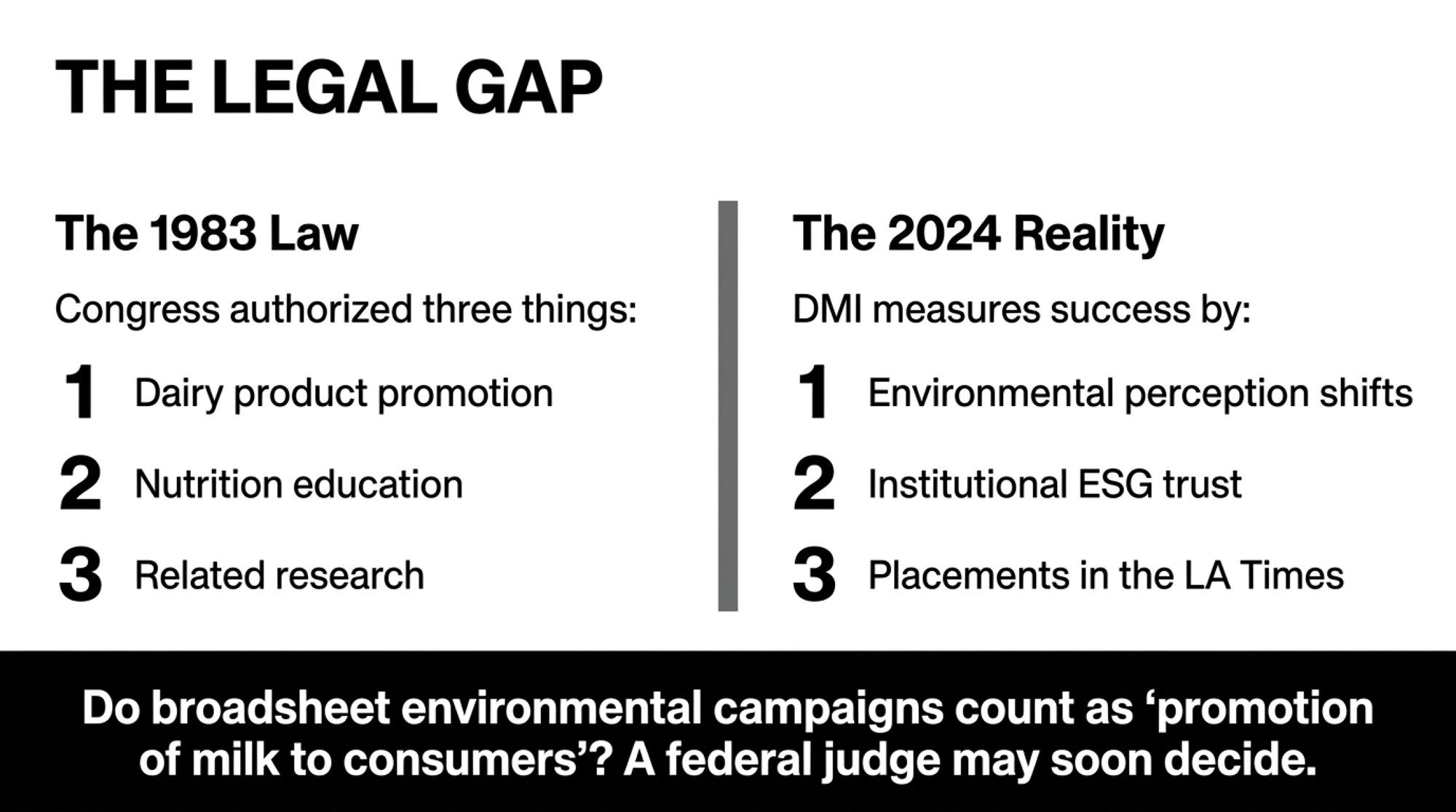
The Dairy Production Stabilization Act of 1983 authorizes three things, and only three. “Advertisement and promotion of the sale and consumption of dairy products.” “Research projects related thereto.” “Nutrition education projects.” That’s the lane. Producers ratified the program in a national referendum after the Act took effect.

The program looks different now. Dairy Management Inc.’s 2024 audited financials show $254.6 million in total expenditures, with $110.5 million — 43.4% of the entire budget — flowing into a category called “Reputation.” That category includes 46.8 million media impressions placed in Forbes, the New York Times, the Los Angeles Times, and USA Today, telling dairy’s “sustainability and nutrition story” to institutional audiences. One LA Times placement, according to DMI’s own annual report, produced an 8.3% lift in the belief that “dairy farmers are taking steps to help the environment.”

WILL’s likely argument is straightforward: a 1983 statute authorizing promotion of milk and cheese to consumers is now funding work that DMI itself measures by environmental perception shifts among urban readers of national broadsheets. The factual framing comes from DMI’s own reporting. The legal characterization — whether that fits inside “promotion of the sale and consumption of dairy products” — is the question no court has been asked in those exact terms, and the one WILL is preparing to put before one.

1983 Statute AuthorizesDMI 2024 Actual Program ActivityAlignment with Statute?
“Advertisement and promotion of the sale and consumption of dairy products”$110.5M “Reputation” category — measured by environmental-perception shifts in Forbes and LA Times among institutional readers🔴 Disputed — metric is perception, not consumption intent
“Research projects related thereto”Research allocated within overall $254.6M budget✅ Clearly within scope
“Nutrition education projects”Nutrition content included in DMI programming✅ Clearly within scope
(Not authorized)8.3% lift in belief “dairy farmers are taking steps to help the environment” — cited as campaign outcome in DMI 2024 annual report🔴 No statutory basis — environmental trust ≠ sale/consumption promotion
(Not authorized)46.8M media impressions in national broadsheets targeting ESG-adjacent institutional audiences⚠️ Contested — who is the intended consumer here?

What the Math Looks Like in Your Barn

The 15¢/cwt assessment is split into two components with very different governance structures. Run it at three common herd sizes, using a 24,000-lb/cow average — conservative relative to the 2024 U.S. national average of approximately 24,178 lb/cow.

OperationAnnual cwtTotal Checkoff (15¢)🔴 National 5¢ Share (disputed)🟢 State/Regional 10¢ Share (local control)
200-cow dairy48,000$7,200/year$2,400$4,800
500-cow dairy120,000$18,000/year$6,000$12,000
1,500-cow dairy360,000$54,000/year$18,000$36,000

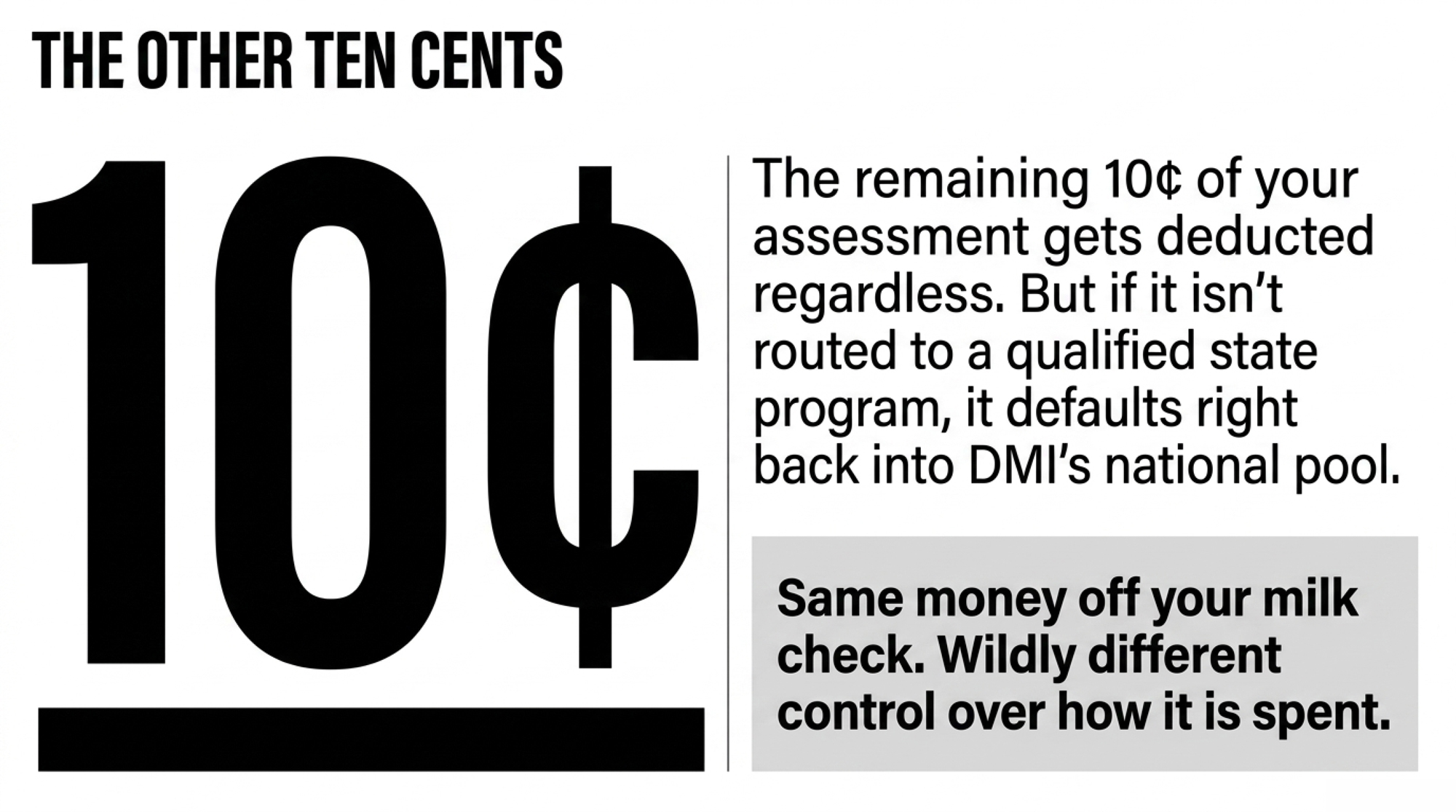
The red column is what’s at stake in any WILL lawsuit. That’s the national 5¢ flowing to DMI for the Reputation, sustainability, and institutional-trust work the legal theory is targeting. The green column gets deducted from your milk check, regardless — that part of the assessment isn’t going anywhere. The question with the 10¢ is governance: is it being credited to a USDA-certified, qualified state program where farmer-elected boards direct the spending, or is it defaulting to DMI’s national pool because no state program is properly receiving it?

That distinction matters. On a 500-cow dairy, $12,000 a year either gets directed by Midwest Dairy, Dairy Farmers of Wisconsin, or another state body whose board you can vote for and call, or it gets absorbed into the same national budget WILL is now scrutinizing. Same dollars off your milk check. Wildly different control over how they’re spent.

That gap is your first decision point this week. Pull your last three milk settlement statements, find the checkoff line, and confirm with your handler that the 10¢ is being routed to a qualified state program. It costs nothing to ask. It can be worth real money to know. For the broader picture of where the remaining 5¢ goes, our 76% of Your Dairy Checkoff Funds Cheese and Exports breakdown lays out the national pool category by category.

Brenda Cochran was the lead plaintiff in the 2004 challenge that briefly succeeded before Johanns reset the doctrine. The legal arguments she advanced then — that the assessment functions as compelled funding of speech farmers don’t choose — track closely with the theory WILL is now preparing. She’s still paying. Our profile, Brenda Cochran has been here before, gives the full timeline of how that 2004 case rose, won, and was vacated.

The Mechanics Behind the Legal Fight

To see why this case is harder to bring than it looks, you need the legal architecture in plain language.

In Johanns v. Livestock Marketing Association (2005), the Supreme Court upheld the beef checkoff under the government speech doctrine. The reasoning ran like this: because the Secretary of Agriculture has ultimate authority over checkoff messaging, the campaigns are government speech, immune from First Amendment challenge by private objectors. That ruling is what protects the dairy checkoff today, and it’s the structure WILL would have to work around.

Legal FrameworkJohnanns v. LMA (2005) — Status QuoPost-Loper Bright (2024) — New Landscape
Core DoctrineGovernment speech — USDA controls checkoff messaging, so no First Amendment challengeCourts now read statutes independently; no deference to USDA’s own interpretation of its authority
Who Decides What “Promotion” MeansUSDA/DMI define scope; courts deferFederal judge reads the 1983 statute text cold — without agency deference
Vulnerability in Current CheckoffLow — consumer promotion campaigns clearly government speechHigher — “Reputation” campaigns attributed to “U.S. dairy industry,” not USDA; measured by ESG metrics
Best-Case Defense for DMIInstitutional trust → consumer demand → “promotion of sale and consumption”Same argument, but a judge applying plain textual reading may reject it without Chevron cover
Likely Claim Type if WILL FilesFirst Amendment compelled speech (harder post-Johanns)Statutory ultra vires — USDA exceeding 1983 Congressional authorization
Precedent Needed to WinMust distinguish or overturn JohannsDoes not need to touch Johanns — textual argument runs independently

That’s the doctrinal architecture. Here’s the crack in it.

The vulnerability is real. Johanns assumed the government was the genuine author of the speech, not just the administrator of the fund paying for it. That assumption holds cleanly for “Got Milk?”-style consumer promotion. It gets harder to defend when the campaign is attributed to “U.S. dairy” as an industry brand, targets institutional ESG-adjacent audiences, and is measured by shifts in environmental perception rather than consumption intent.

There’s a parallel argument that doesn’t even need to win on First Amendment grounds. Call it the exceeding-authority claim — that USDA is spending checkoff money on activities Congress never authorized in the 1983 statute. After Loper Bright Enterprises v. Raimondo (2024) eliminated Chevron deference, courts now read statutes independently rather than deferring to agency interpretations. A federal judge reading “promotion of the sale and consumption of dairy products” without deference, against a factual record showing institutional sustainability reputation campaigns, has a real textual problem to grapple with. Our prior DMI’s $165M Checkoff Bet coverage walks through the audited 2024 spending breakdown line by line.

DMI’s defensible position is that institutional trust is instrumental to consumer demand — if processors, retailers, and media gatekeepers trust dairy’s environmental story, they stock more product and resist pressure from plant-based substitutes. That’s a real argument. It’s also a defense that has never been tested in court under Loper Bright. DMI’s 2024 annual report identifies environmental perception shift as the published outcome metric for the LA Times placement; whether a metric of that type satisfies the 1983 statute’s “promotion of the sale and consumption” language is precisely the question WILL would put before a federal judge. Requests for comment sent to Dairy Management Inc., USDA Agricultural Marketing Service, and the National Milk Producers Federation regarding whether the 2024 Reputation campaigns received messaging-level review by USDA or only budget-category approval were not returned by press time. The reporting record in the public domain — DMI’s own 2024 annual report and USDA AMS oversight documents — describes USDA’s authority over checkoff messaging in general terms without specifying the level of review.

How Much Does This Actually Cost a Farmer Who Wants to Push Back?

The short answer: between now and any court-ordered relief, you keep paying the assessment exactly as it stands today. Here’s what the realistic timeline looks like in seasons your operation actually plans around.

PhaseTiming from Today (May 28, 2026)What Changes for Your Operation
Pre-filingJune 2026 → late 2026 (3–9 months)Nothing. WILL builds the case and selects a plaintiff.
Complaint filedLate 2026 to Q1 2027Nothing operationally. Legal news cycle begins.
Preliminary injunction motion6–12 months after filingPossible — but unlikely — first moment the program could pause.
Earliest realistic operational shiftLate 2027 to mid-2028Roughly two breeding cycles and two crop years from now.

These phases reflect typical federal civil litigation timelines for agency action cases; the case-specific schedule will only firm up after a complaint is filed. For a 500-cow dairy at $18,000/year, the gap math runs roughly $27,000 to $45,000 in checkoff assessments collected during an 18- to 30-month window, regardless of how the litigation ultimately resolves. That’s the number a lender or financial advisor will ask about if the topic surfaces in a 2027 operating loan conversation.

The honest framing has to include this: the realistic remedy is prospective — an injunction, a structural change, or a forced congressional reauthorization — not a check in the mail for past assessments. Farmers chasing this for retroactive recovery will be disappointed. The litigation value is the injunction that stops future collection for unauthorized purposes. Or, in the strongest scenario, a referendum that puts the question — what should the checkoff fund? — back in front of the people writing the checks.

What Does Joining a Federal Lawsuit Mean for Your Co-Op Relationship?

This is the question most legal coverage skips. And it’s the one that probably matters most.

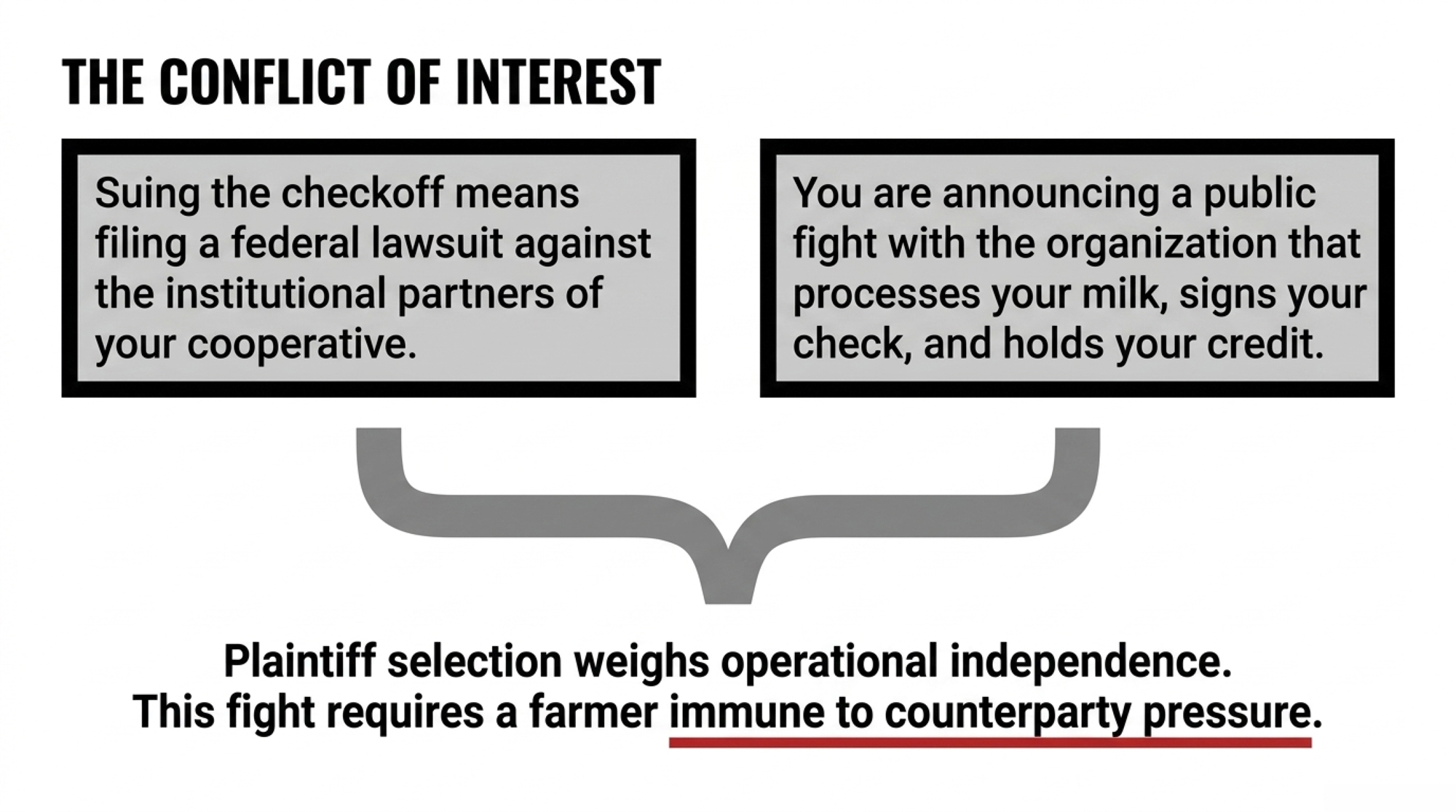
Most conventional dairy farmers sell through cooperatives. Cooperatives have institutional relationships with DMI and NMPF, and commercial incentives to maintain checkoff funding for programs that benefit their branded product portfolios. A member who becomes a named plaintiff in a federal constitutional challenge to that funding structure isn’t just filing a lawsuit. You’re announcing a public conflict of interest with the organization that processes your milk, signs your settlement check, and may hold your operating credit.

That’s not paranoia. It’s a realistic reading of how cooperative governance works in practice. In any constitutional challenge of this kind, plaintiff selection typically weighs operational independence alongside legal standing — particularly when the named plaintiff faces predictable counterparty pressure from milk handlers or co-op leadership. Cooperative structures, by design, prioritize collective decision-making over individual member dissent — which is why a referendum on current spending may never reach the floor through normal governance channels. Our case study on what happens when co-op governance breaks down traces that dynamic in detail.

Brenda Cochran’s position, twenty-two years after she first sued, is the only producer voice currently on the public record in this fight, and it’s a clarifying one: she paid the assessment in 2004, won at the Third Circuit, watched the doctrine reset under Johanns, and is still paying it today. That’s the practical answer to the “what happens to producers who challenge this” question. The check keeps going out. The argument doesn’t go away.

Options and Trade-Offs

Four practical paths are available to a producer who wants to engage with this issue. None of them is fast. None of them is free.

PathAction RequiredAnnual Cost ImpactTimeline to ResultCo-op Relationship RiskWho It’s For
1. Confirm State CreditOne call to milk handler$0 — but up to $12,000/yr redirected locallyImmediate (30 days)NoneEvery conventional producer
2. Engage Co-op BoardWritten request for DMI ROI audit; board access$0 direct6–18 months⚠️ Moderate — may be seen as dissentProducers with board standing
3. Support OFF ActCall your senator’s office (5 minutes)$01–3 years (legislative)NoneAny producer wanting reform without confrontation
4. Signal to WILL as PlaintiffSelf-assess co-op independence; contact WILL$0 direct — but $27K–$45K kept flowing during litigation18–30 months to earliest change🔴 High — named public conflict with milk handlerOperationally independent producers only

Path 1: Confirm your state credit. Do this within 30 days. The 10¢ portion comes off your milk check regardless — the question is whether it’s routed to a USDA-certified, qualified state program where you have governance access, or defaults to DMI’s national pool. Pull three milk settlement statements, find the checkoff line, and call your handler to confirm where the 10¢ is going. When it makes sense: always — this is about local control, not protest. Risk: minimal. What it requires: one phone call.

Path 2: Engage your co-op board on accountability. Most cooperatives bloc-vote member assessments and are institutionally aligned with DMI. A board member or active co-op participant can request audited farm-size ROI breakdowns from DMI and propose resolutions on automatic bloc-voting. When it makes sense: if you have standing on your co-op board or close access to those who do. Risk: you may appear out of step with co-op leadership. What it requires: a working relationship with directors and a willingness to make written requests.

Path 3: Support the OFF Act. The Opportunities for Fairness in Farming Act, reintroduced in the 119th Congress by Senators Mike Lee (R-UT) and Cory Booker (D-NJ), would prohibit checkoff programs collecting more than $20 million in annual assessments from contracting with policy-influencing groups, mandate USDA Inspector General audits, and require public budgets. When it makes sense: if you want reform without confrontation. Risk: legislative paths move slowly, and this bill has been introduced before without passing. What it requires: a phone call to your senator’s office. No litigation list. No co-op exposure.

Path 4: Signal interest to WILL as a potential plaintiff. The case hasn’t been filed. WILL is in the plaintiff selection phase. Adam Faust had the right profile in 2025 — a named, publicly visible producer with the operational independence to take on the lawsuit. WILL will be looking for that profile again. When it makes sense: if you’re a conventional producer with operational independence from co-op governance pressure and a willingness to be publicly named. Risk: the highest-cost path, with cost mostly relational. What it requires: honest self-assessment of your milk-marketing relationships before you make the call.

A forward-looking signal worth anchoring here: if DMI’s 2025 and 2026 program reporting begins narrowing the Reputation category back toward consumer promotion and away from institutional ESG framing, that’s a preemptive restructuring move — and probably the best outcome the industry can produce on its own without a court forcing the question. Watch the next two annual reports closely.

Key Takeaways

  • If your 10¢/cwt isn’t being credited to a qualified state program, you’re not losing money — but you are losing local governance over $12,000 a year on a 500-cow dairy. Confirm with your handler this week.
  • If you support sustainability work in principle but believe it should be voluntary or congressionally reauthorized, you’re closer to WILL’s likely legal theory than the ideological framing suggests.
  • If you’re modeling the financial impact, plan for an 18- to 30-month timeline from filing to any operational change. That’s roughly two breeding cycles. Treat any “this changes everything tomorrow” framing — from either side — with skepticism.
  • If you’d vote no on current spending in a farmer referendum but you depend on the co-op to stand behind your milk contract or operating loan, you’re in the position any plaintiff-selection process is built around — and you’re also the producer least able to engage publicly. Acknowledge that tension honestly before you pick up the phone.
  • If the OFF Act lands on your senator’s desk with a constituent call attached, that’s the lowest-cost lever you have. It doesn’t require a lawsuit, a co-op confrontation, or a checkbook. It does require five minutes.
  • If DMI’s 2025 annual report — due later this year — shows the Reputation category narrowing toward consumer-promotion metrics, that’s the industry signaling it sees legal exposure. If it doesn’t, the litigation pressure stays on.

What Now

Pull your last twelve milk settlement statements. Add up the checkoff line. Then ask yourself a harder question than “is this legal” — ask whether you can describe, in one sentence, what that money funded, and whether that’s the program you’d vote to authorize today if anyone asked you.

If your answer is yes, this fight isn’t yours, and the cost of joining it is real. If your answer is no, you have more options this month than you probably realized — most of which don’t require a lawsuit. We’re breaking down the full Reputation-category audit, the Loper Bright statutory mechanics, and what each of the four paths actually costs at five different herd sizes in next week’s Bullvine Weekly. That’s where the deeper math lives.

Run Your Numbers

Farm Benchmark Snap Check — Pull your last three milk settlement statements and run the 15¢/cwt assessment against your actual herd size. The tool translates the disputed 5¢ national share and the 10¢ state share into your annual exposure, so you walk into that handler call knowing exactly what’s on the line.

Complete references and supporting documentation are available upon request by contacting the editorial team at editor@thebullvine.com.

Learn More

The Sunday Read Dairy Professionals Don’t Skip.

Every week, thousands of producers, breeders, and industry insiders open Bullvine Weekly for genetics insights, market shifts, and profit strategies they won’t find anywhere else. One email. Five minutes. Smarter decisions all week.
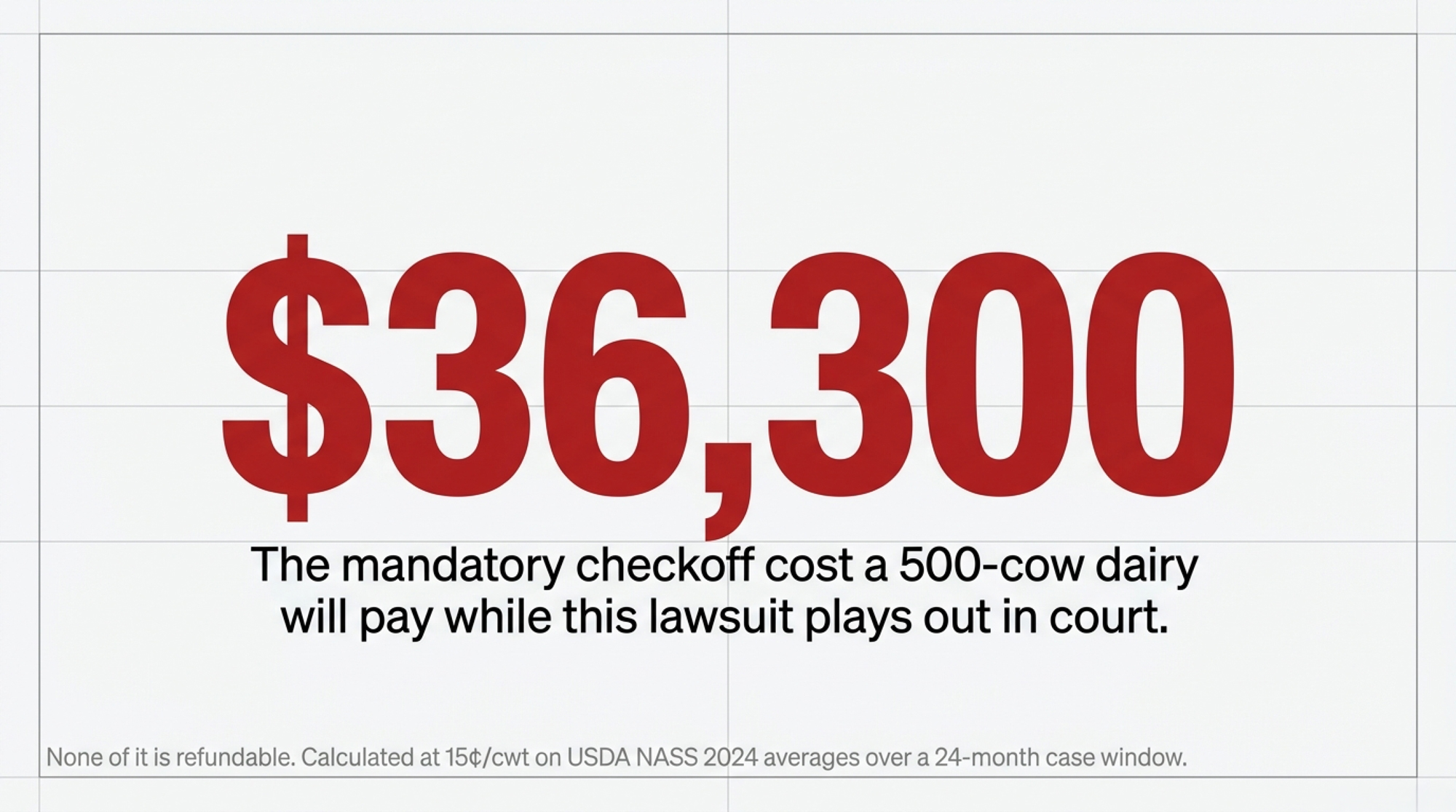
NewsSubscribe
First
Last
Consent
Send this to a friend