








Three Wisconsin farmers — led by the man who beat USDA in 11 months — just asked a federal judge whether your 15¢/cwt can bankroll dairy’s Net Zero machine. The bill runs either way.
This article is based on the complaint and public court records as of June 24, 2026. The allegations described have not been tested or proven in court.
On June 9, 2026, Abby Swan, a dairy farmer from Westfield, Wisconsin, put her name on a federal lawsuit that could reshape what every checkoff-paying producer in the country is funding. She’s the lead plaintiff in Swan et al. v. Rollins et al., filed in the U.S. District Court for the Eastern District of Wisconsin, Green Bay Division, against USDA and the National Dairy Promotion and Research Board, alongside two other Wisconsin dairy farmers — Adam Faust of Chilton and Christopher Baird of Ferryville. We told you in May this case was coming. Now it’s on the docket, and the argument fits on the back of a milk check: the dairy checkoff was sold to producers in 1983 as money for promoting and researching dairy, and the plaintiffs argue it shouldn’t be bankrolling a private group’s climate and ESG programs.
For a 500-cow dairy, this isn’t a debate for the lawyers to have in a vacuum. You’re paying roughly $18,000 a year into the checkoff, and not a nickel of it pauses while the case runs. Whatever the judge eventually decides, the real question beneath the dairy checkoff lawsuit is bigger than any single program: who gets to decide what your mandatory dollars are spent on?
What’s Actually Being Challenged Here
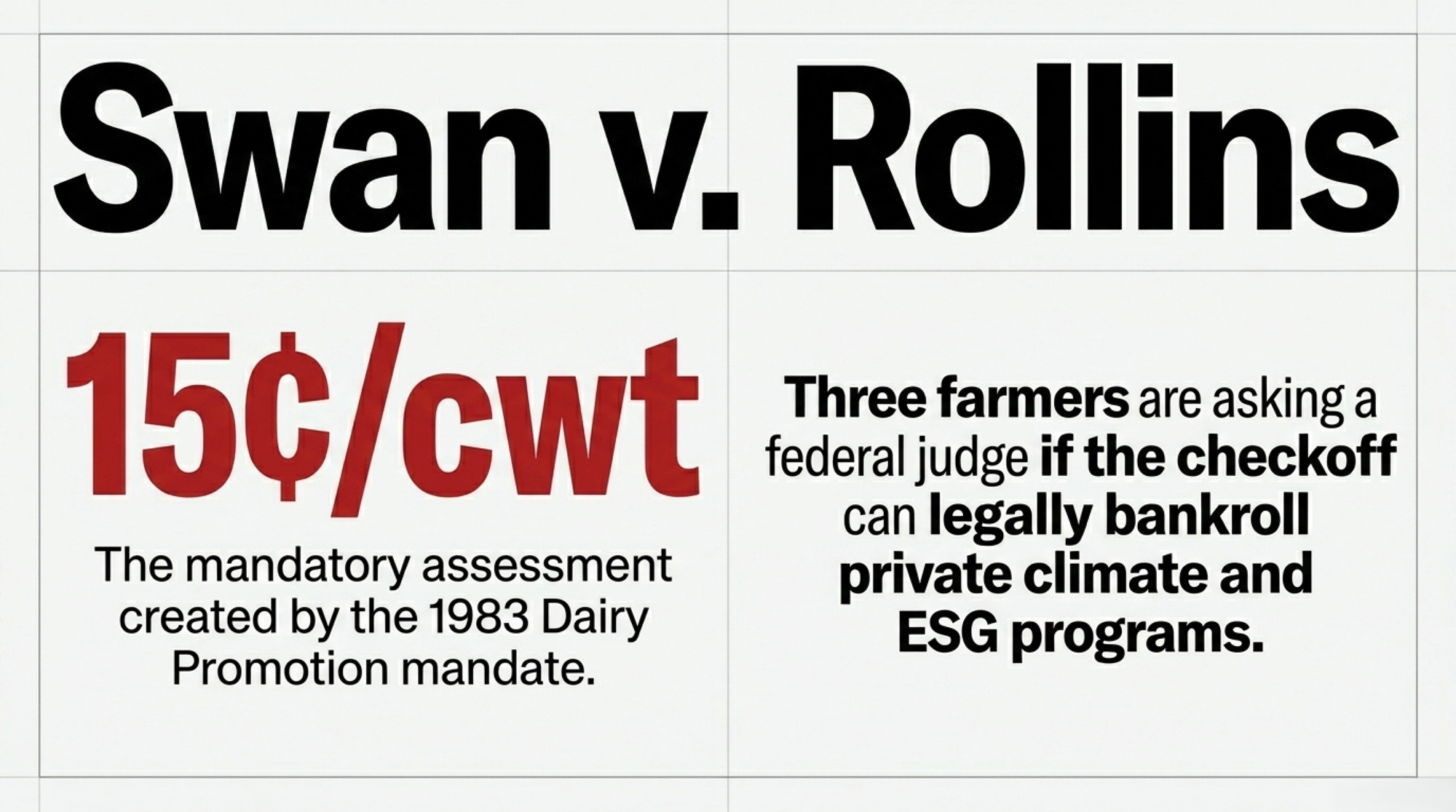
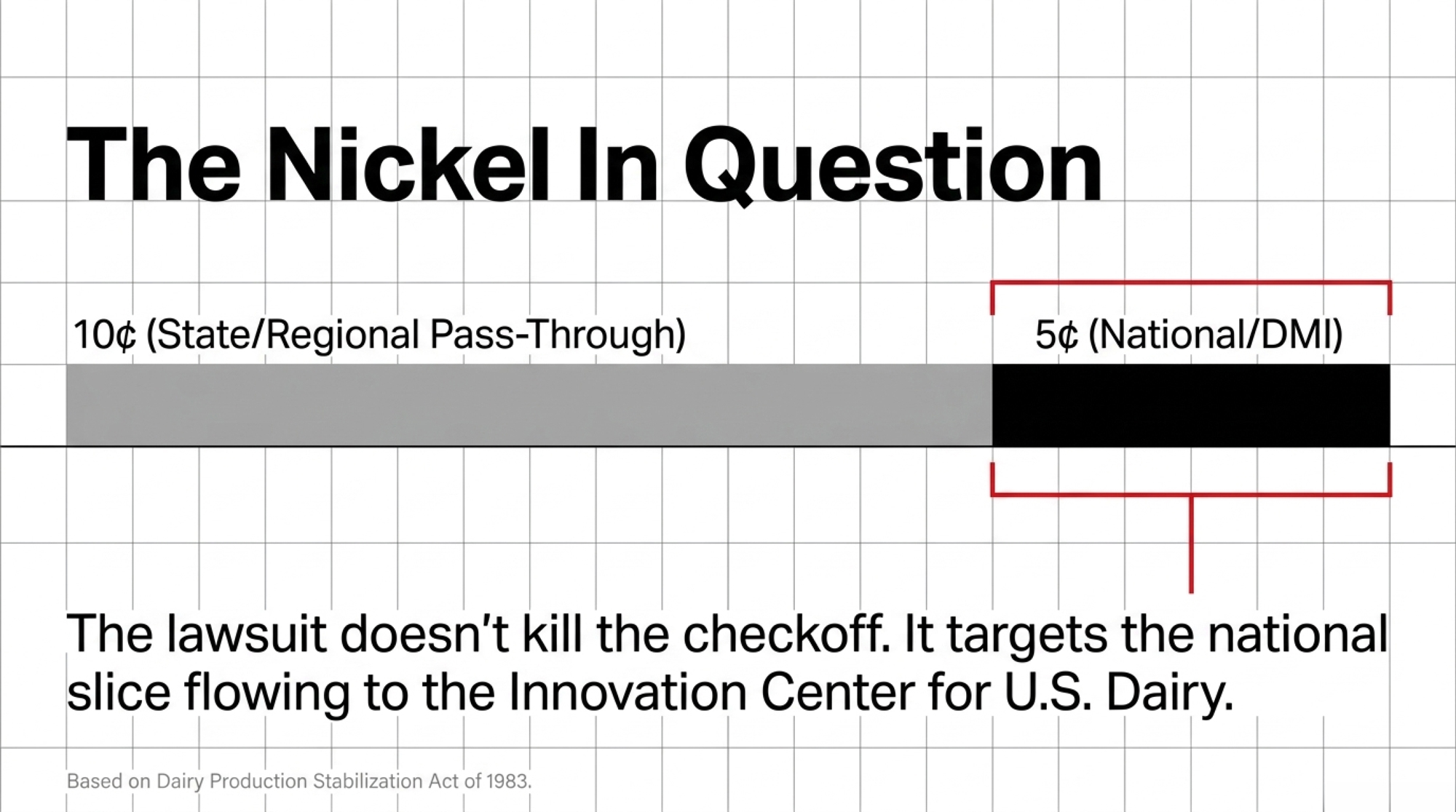
Start with the part nobody’s fighting over. Under the Dairy Production Stabilization Act of 1983, every U.S. farmer who markets milk commercially pays 15¢ per hundredweight into the checkoff, and importers pay 7.5¢. You can direct up to 10¢ to your state or regional program, and the rest — about 5¢ — goes to the national program run by Dairy Management Inc., or DMI. That structure built “Got Milk?” and forty years of generic dairy advertising.
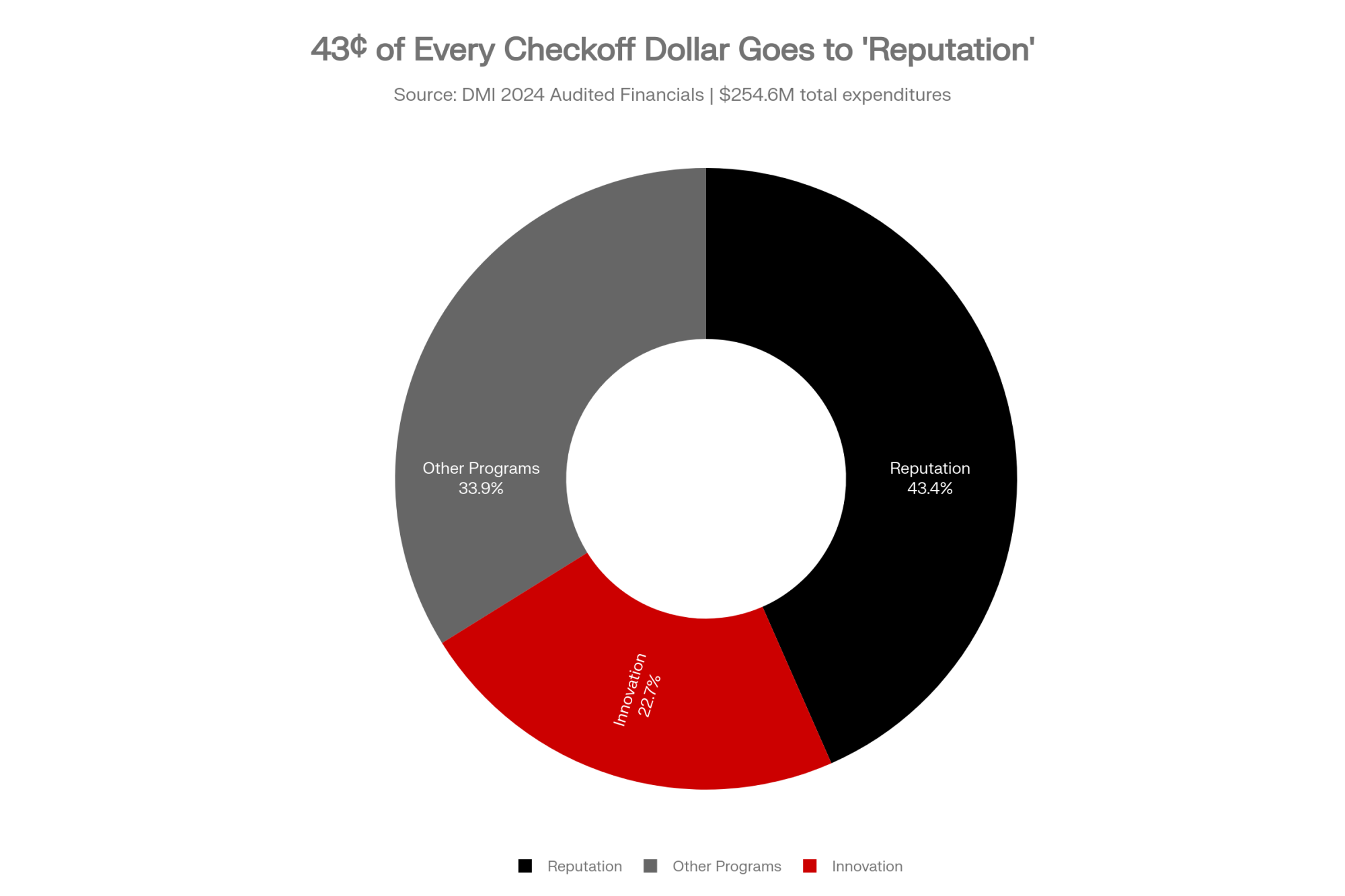
What’s changed is where some of that money flows now. DMI’s 2025 program budget runs about $121.4 million, and its 2024 audited financials show total expenditures of $254.6 million once state and regional pass-throughs are folded in — with the largest slice, $110.5 million or 43.4%, booked to “Reputation” work and another $57.9 million to “Innovation.” DMI’s annual report doesn’t break out how much of that flows to the Innovation Center for U.S. Dairy. But the plaintiffs contend some of it underwrites the Center’s Net Zero work, which they argue looks less like advertising and more like environmental policy than the 1983 law allows. The Innovation Center is a private nonprofit founded in 2008 through the checkoff, and its U.S. Dairy Net Zero Initiative is aimed at the industry’s voluntary goal of greenhouse-gas neutrality by 2050.
The lawsuit doesn’t try to kill the checkoff. The plaintiffs are asking the court to declare that using checkoff funds to support the Innovation Center violates federal law and the Constitution, and to permanently prohibit future checkoff funding of the organization — leaving promotion, research, and nutrition education alone. So who’s exposed to the outcome? Every producer, because everyone pays the same nickel, whether you milk 80 cows in a tie-stall or 8,000 in a freestall.
How This Lands on Real Farms
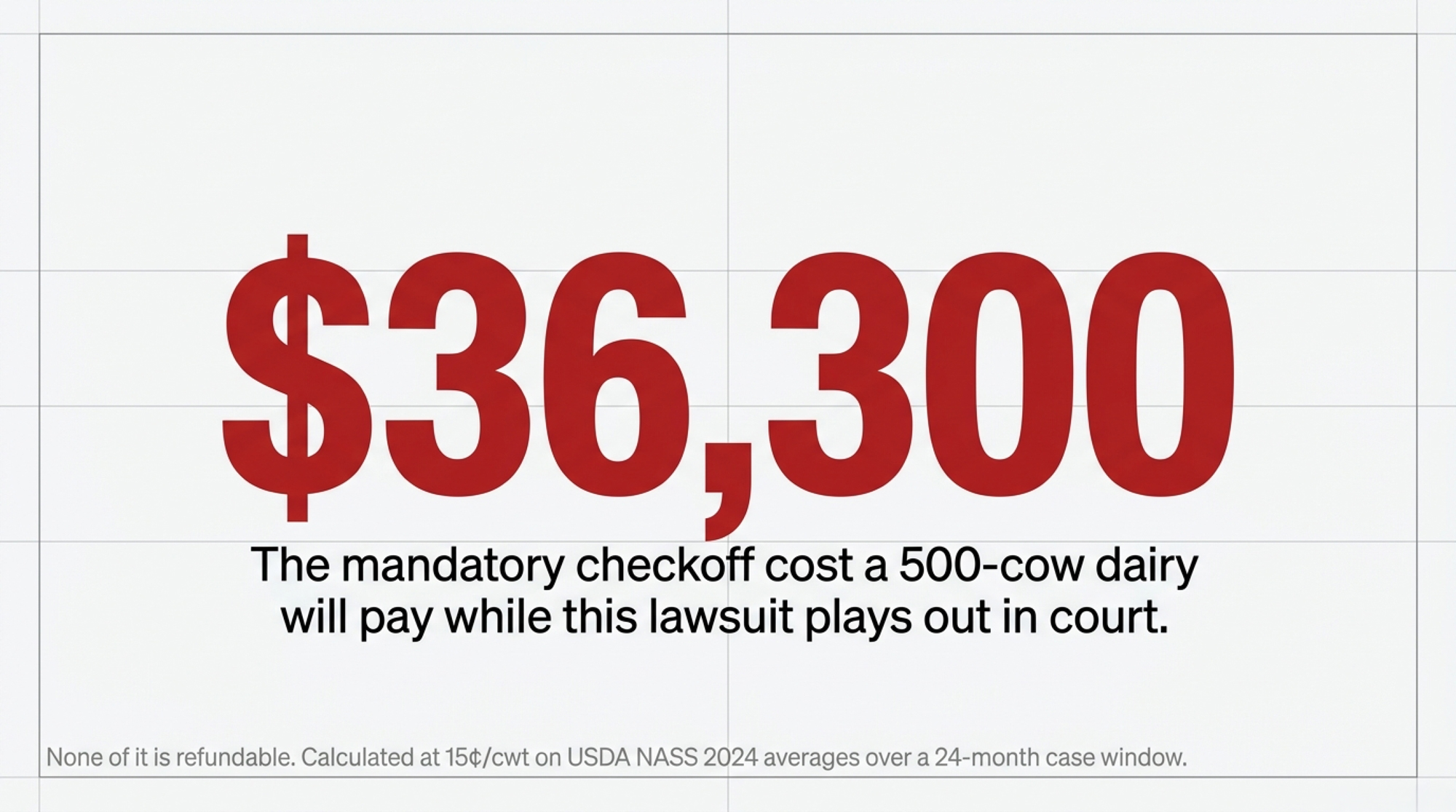
Here’s where it gets concrete. The case will probably take 18 to 24 months to resolve. Over that window, a 500-cow operation sends $27,000 to $36,000 in checkoff payments out the door — with no refund mechanism, win or lose. The assessment is mandatory, deducted automatically off your milk check, and not held in escrow while a judge thinks it over.
In the WILL release announcing the suit, Swan put it plainly. “Dairy farmers like me are being forced to subsidize private organizations pushing climate change research and ESG mandates for our farms, even though the Dairy Checkoff program is just supposed to market and promote our milk,” she said. “So not only are we funding a threat to our own existence, but these unrelated priorities increase my costs—and therefore yours.” That’s one camp. But it isn’t the whole barn, and pretending it is would miss the real story.
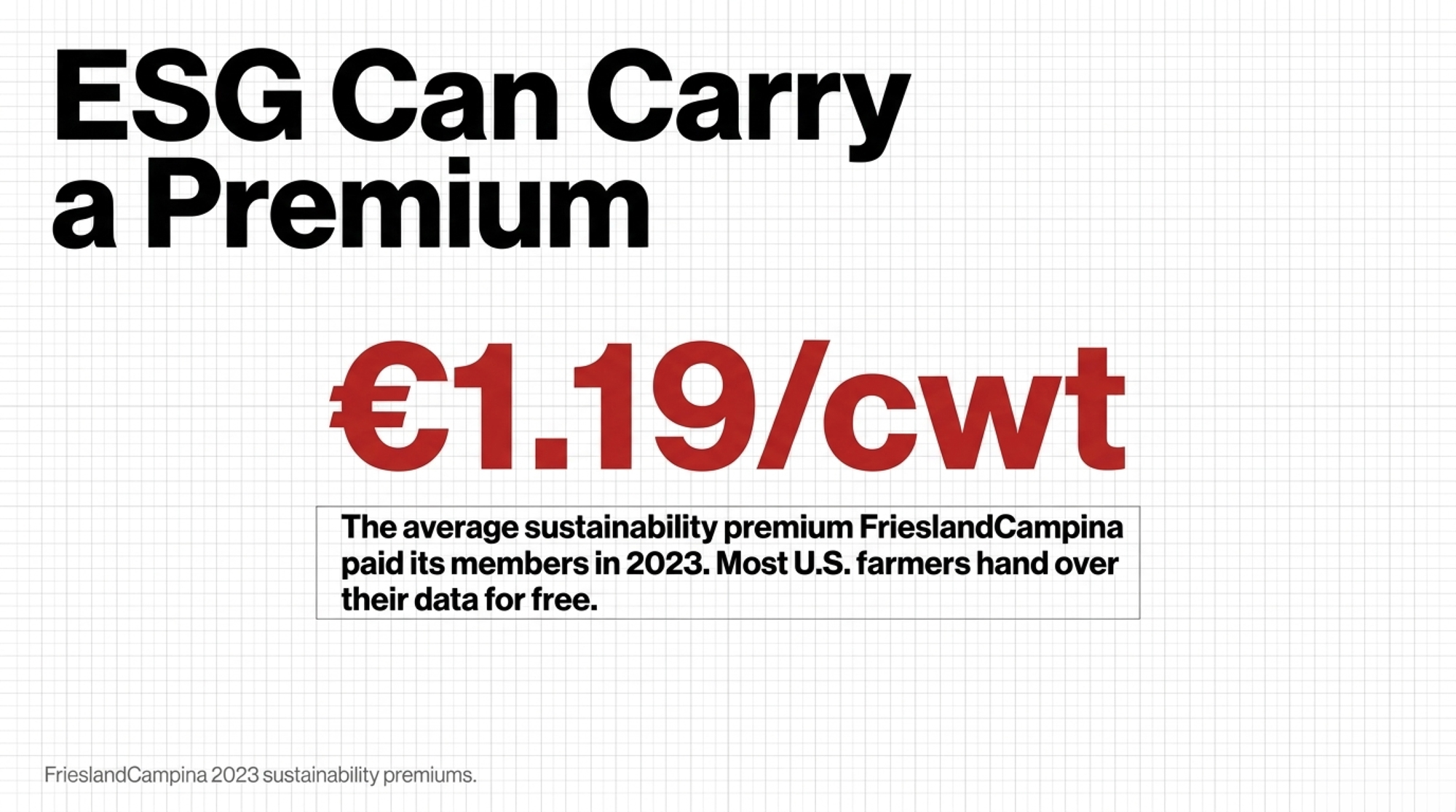
Plenty of producers engage with the Net Zero goals — not out of ideology, but because their buyers want them. Swan’s own complaints trace back to buyer-imposed ESG data demands: a processor letter asking for twelve months of natural gas, diesel, propane, biodiesel, and electricity use, with milk pickup hanging in the balance. So the tension usually isn’t the goal itself. It’s the structure — being compelled to fund a private ESG operation, hand over your farm-level data, and see no clear payback for it. Look across the Atlantic for the contrast: FrieslandCampina paid its members more than €245 million in sustainability premiums in 2023 — an average of €2.63 per 100 kg of milk, which works out to about €1.19/cwt — as a separate, results-based line on the milk check. That’s ESG with a price signal attached. Most U.S. farmers don’t get one.
| Feature | U.S. Dairy Checkoff / Net Zero Initiative | FrieslandCampina (Netherlands) |
|---|---|---|
| Funding mechanism | Mandatory 15¢/cwt deducted from milk check | Cooperative membership, voluntary programs |
| Sustainability premium paid to farmers | None — no direct payment to producers | €245M+ paid in 2023 (~€2.63/100 kg avg) |
| Premium per cwt equivalent | $0 | ~€1.19/cwt (approx. $1.28 USD/cwt) |
| Top performer premium (Foqus planet) | N/A | Up to €3.50/100 kg for highest scores |
| Producer data required | Yes — energy, GHG, scope 1–3 | Yes — verified by independent auditors |
| Producer can opt out | No | Partial — some programs are opt-in |
| Price signal attached to compliance | No | ✅ Yes — explicit per-cwt premium line |
| ESG governance | USDA-supervised via DMI + Innovation Center | FrieslandCampina member board accountability |
The Mechanics Behind the Case
Two legal levers make this more than the usual checkoff grumbling at the coffee shop. The first is the statute itself. The 1983 Act authorizes spending on the advertising, promotion, research, and nutrition education tied to selling dairy products. DMI’s honest, defensible position is that protecting dairy’s reputation and market access — including sustainability credibility — is just modern promotion. The plaintiffs counter that funding a private Net Zero and ESG framework stretches the word “promotion” past anything Congress signed off on.
The second lever is newer, and it’s the one that turns a long-shot into a live round. In Loper Bright Enterprises v. Raimondo (2024), the U.S. Supreme Court overruled the Chevron doctrine. For forty years, Chevron told courts to defer to a federal agency’s “reasonable” reading of an unclear statute. So before, USDA could essentially say “trust us, ESG counts as promotion,” and a judge would likely go along. Not anymore. Now the court in Green Bay has to decide for itself what the 1983 Act means, with USDA’s interpretation as just one voice in the room.
There’s a third wrinkle most coverage skips, and it may give the plaintiffs their strongest footing. WILL’s own argument leans on it: traditional checkoff campaigns were tightly controlled by USDA and generally treated as “government speech,” but funneling mandatory dollars to a private third party like the Innovation Center turns it into compelled funding of private speech. That matters because the Supreme Court upheld the beef checkoff back in 2005, in Johanns v. Livestock Marketing Association, largely on that government-speech rationale. Take away the government-speech shield, and the plaintiffs get a much cleaner First Amendment argument.
Why Adam Faust’s Name Carries Weight Here
You can’t read this case without reading the man sitting in the plaintiff lineup next to Swan. Faust and WILL beat USDA in 11 months on a separate fight over race- and sex-based preferences in federal farm programs — the Justice Department abandoned its defense and USDA settled on May 18, 2026. That’s the same farmer and the same law firm now running the playbook that worked before: a targeted constitutional challenge backed by plaintiffs willing to see it through, pushed hard before the government decides the fight is worth it. WILL frames the new case as protecting family dairy farms from being compelled to fund ideological speech they disagree with — and now Swan v. Rollins is on the docket as Case No. 1:2026cv01033.
Read more: Adam Faust Beat USDA in 11 Months. The Checkoff May Be Next
How Much Does This Lawsuit Cost You Before It’s Even Decided?
Run it on your own herd. The math is simple and it doesn’t move with the verdict. At 15¢/cwt and a U.S. average of 24,178 lb per cow in 2024, here’s what the checkoff pulls off your milk check — and what it adds up to across an 18-to-24-month case window.
| Herd Size | Annual Checkoff Bill | 18–24 Month Case Window Cost | National (5¢) Share |
|---|---|---|---|
| 80 cows | $2,904 | $4,356 – $5,808 | ~$968 |
| 200 cows | $7,252 | $10,878 – $14,504 | ~$2,417 |
| 500 cows | $18,127 | $27,190 – $36,254 | ~$6,042 |
| 1,000 cows | $36,254 | $54,381 – $72,508 | ~$12,085 |
| 2,500 cows | $90,636 | $135,954 – $181,272 | ~$30,212 |
| 5,000 cows | $181,272 | $271,908 – $362,544 | ~$60,424 |
Figures calculated at 15¢/cwt on the USDA NASS 2024 average of 24,178 lb/cow/year — about 120,900 cwt for a 500-cow herd. On the 500-cow line, roughly $6,000 goes to the national program and $12,100 is credited at the state level. None of it is refundable while the case is pending.
Read the table the right way: these are your total checkoff dollars. The lawsuit targets only how the national share — about 5¢ of the 15¢ — gets spent at the Innovation Center. Win or lose, it would not change the amount you pay; it would change where a slice of the national nickel is allowed to go.
Dynamic Checkoff Exposure Calculator
Evaluate your herd’s financial exposure while Swan v. Rollins runs its course in federal court.
*Calculations are based on statutory checkoff deduction logic ($0.15/cwt gross assessment, split $0.05 national / $0.10 state credit). Funds are non-refundable during litigation.
That reframes the whole thing. This case won’t put money back in your account next quarter. So the practical question isn’t “will I get a refund?” — you won’t. It’s whether you keep treating those dollars like background static, or start treating them like an investment you’re allowed to interrogate. Where does your own checkoff bill sit right now, and could you say with a straight face what it buys?
Is the Cure Worse Than the Disease If the Checkoff Loses?
Here’s the trade-off nobody’s putting on the table. Right now, FARM Environmental Stewardship and the Innovation Center’s tools give U.S. dairy roughly one shared ESG framework — companies representing more than 77% of U.S. milk production have adopted the U.S. Dairy Stewardship Commitment. If a court cuts off checkoff funding, that work doesn’t vanish. Your buyers still want the data. The cost just shifts to co-ops and processors, who may each go build their own carbon calculator and their own audit standard.
That’s the fragmentation risk, and it’s real. One mandatory ESG machine you didn’t vote for is a governance problem. Five competing systems pulling on the same 500-cow barn — each with its own forms, data fields, and farm visit — is a different and possibly heavier burden. The viral “no data, no milk” letter that kicked off Swan’s fight is exactly that kind of demand: privatized reporting enforced by contract, not by law. So a narrow legal win could leave you doing more compliance, not less — unless the industry uses the moment to standardize and finally attach real money to the ask. That’s the part worth watching.
Read more: treat your sustainability data like cash, not confetti
Options and Trade-Offs for Farmers
You can’t opt out of the nickel today. But you’ve got real choices about how you handle it while this plays out.
- Keep paying — and start asking. This is the do-it-this-month move. Skipping the checkoff just creates enforcement headaches with your handler and buys you nothing while the law stands. What changes is your posture. Pull three recent milk checks, confirm exactly how your 15¢ splits between state and national, and ask your co-op or board rep what share of the national dollars funds ESG work versus straight promotion. Low cost, fast clarity, and it puts your board on notice that someone’s actually reading the line items.
- Treat your sustainability data like cash. If you’re enrolled in FARM Environmental Stewardship or a Net Zero pilot, keep copies of every report and the underlying data, and ask in writing who can see your farm-level numbers. This matters most the moment a buyer asks for more data on top of your money. The risk it manages is simple — handing over a valuable asset for free while someone downstream monetizes it.
- Push for explicit value on any ESG ask. Where a buyer wants stewardship participation, press for a clear premium, contract advantage, or documented benefit. FrieslandCampina’s roughly €1.19/cwt sustainability line — and its maximum Foqus planet premium of €3.50 per 100 kg for top scores — shows ESG can carry a real per-cwt premium overseas. The limit: U.S. programs vary widely, and many don’t itemize a sustainability premium yet — so treat this as a negotiation target, not a promise.
- Watch the docket without betting the farm on it. Track Swan v. Rollins (Case No. 1:2026cv01033) for two trigger events only — a preliminary injunction aimed at Innovation Center funding, and any final judgment or settlement. Faust’s last fight moved faster than anyone expected — the government folded before trial — so a mid-case settlement isn’t far-fetched here either. Until one of those triggers lands, nothing about your obligations changes. Keep your cash-flow decisions anchored to milk price, feed, and debt service, where the real risk on your place lives anyway.
Read more: where your checkoff dollars actually go
Key Takeaways: Your Checkoff Action Checklist
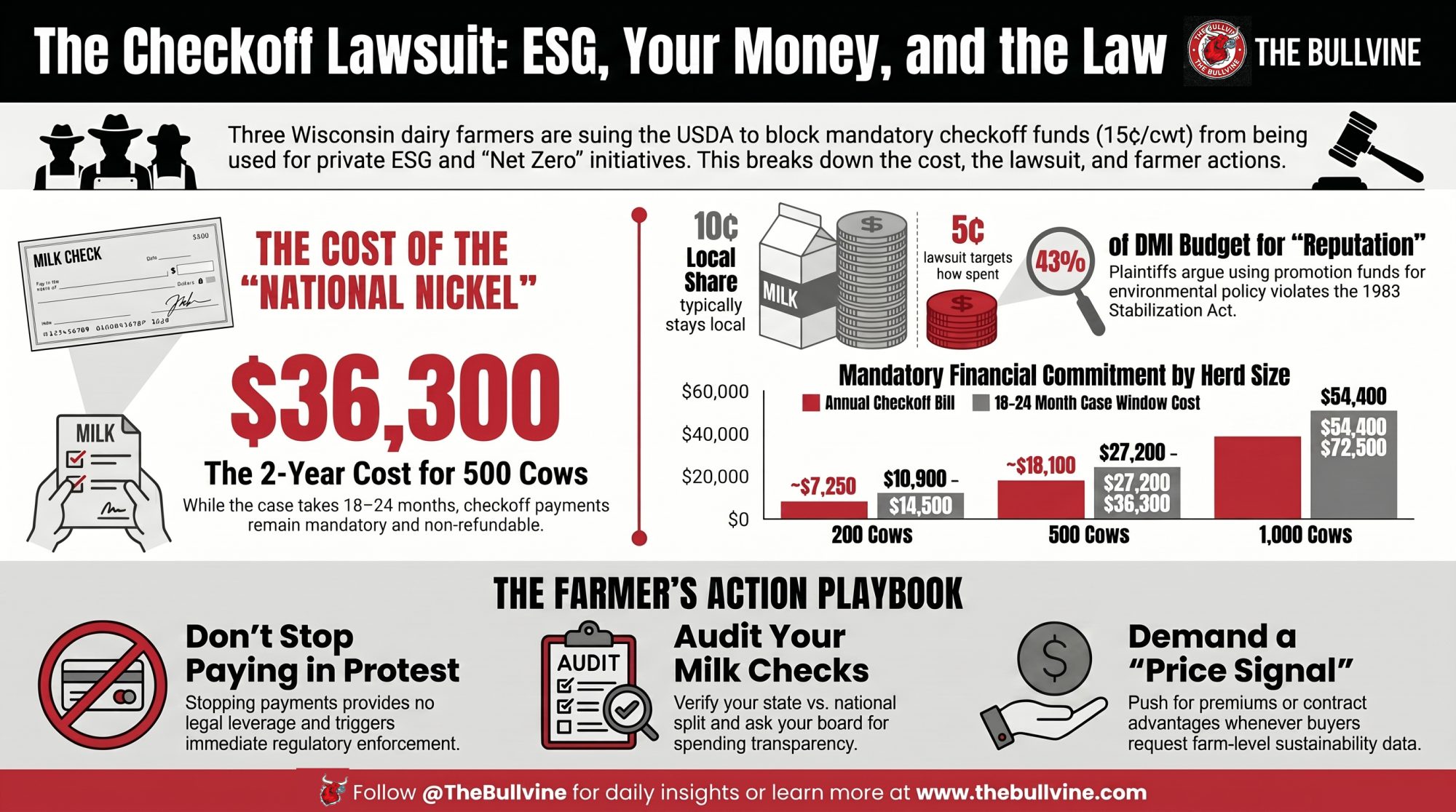
📋 Audit your checkoff split. Pull three recent milk checks this week. If you can’t see exactly how your 15¢/cwt splits between state and national funds, make your handler walk you through the line items.
🛑 Don’t stop paying in protest. The assessment remains completely mandatory. Halting payments buys you zero legal leverage and immediately exposes your operation to regulatory enforcement.
🔒 Protect your farm data. If you’re actively enrolled in FARM ES or a Net Zero pilot, download and save every report. Get a written agreement clarifying exactly who has access to your farm-level data before submitting the next round.
💰 Demand the price signal. If a buyer or co-op pressures you to join a new sustainability framework, ask one direct question: what specific premium, contract advantage, or risk reduction comes with it?
👀 Watch only two triggers. Follow Swan v. Rollins for a preliminary injunction on Innovation Center funding or a final ruling — and tune out the noise in between.
🧮 Budget as if nothing changes. Plan the next two years as though the full checkoff bill for your herd size goes out the door regardless of outcome, because it will (see the cost table above).
What You Do After the Ruling Matters More Than the Ruling
The court opinion is the easy part. A judge will eventually answer, in plain English, what dairy’s mandatory nickels are legally for — and that alone makes this the most consequential checkoff question in forty years. The harder part comes after the gavel: whether producers use the decision as leverage at the co-op table, or just file it under “something I heard on the radio once.”
So before your next board meeting, sit with this one. Do you actually know what your checkoff dollars buy — and could you defend that spending to your own banker? If the answer is “not really,” that’s not a failing. It’s a starting point. We’re breaking down the full barn-math model by herd size — 200, 500, and 1,000 cows — plus the realistic range of outcomes for the case, in our deeper Bullvine analysis. That’s where the real numbers live.
Complete references and supporting documentation are available upon request by contacting the editorial team at editor@thebullvine.com.
Learn More
- Adam Faust Beat USDA in 11 Months. The Checkoff May Be Next. — Arms you with immediate operational blueprints to audit your handler’s checkoff routing within 30 days, shielding your state-level 10¢ allocation from defaulting into DMI’s national pool.
- 76% of Your Dairy Checkoff Funds Cheese and Exports. How Much ROI Hits Your Fluid Milk Check? — Breaks down the stark structural imbalance in national checkoff spending, tracing why billions in marketing value continuously pool in corporate cheese and export lines while conventional fluid milk returns drop.
- Net Merit: The $100000 Cull Gate Your Index Misses — Exposes the strategic financial risk of breeding heifers today for a $0 regulatory methane market, contrasting current index limits against real-world sustainability premiums paid overseas.
 The Sunday Read Dairy Professionals Don’t Skip.
 The Sunday Read Dairy Professionals Don’t Skip.
Every week, thousands of producers, breeders, and industry insiders open Bullvine Weekly for genetics insights, market shifts, and profit strategies they won’t find anywhere else. One email. Five minutes. Smarter decisions all week.




