



Archive for Bovaer cost per cow

$110.5M to “Reputation”: Why 3 Farmers Are Suing USDA

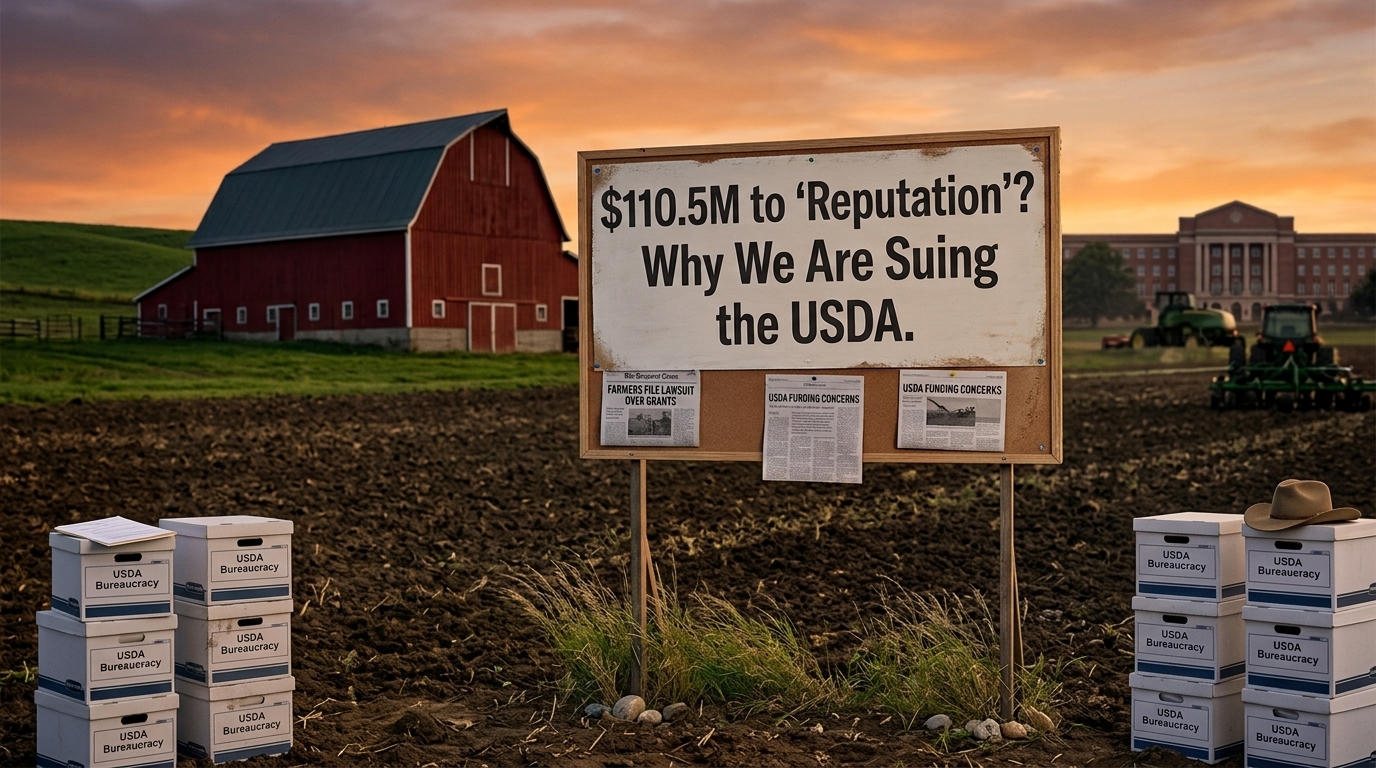
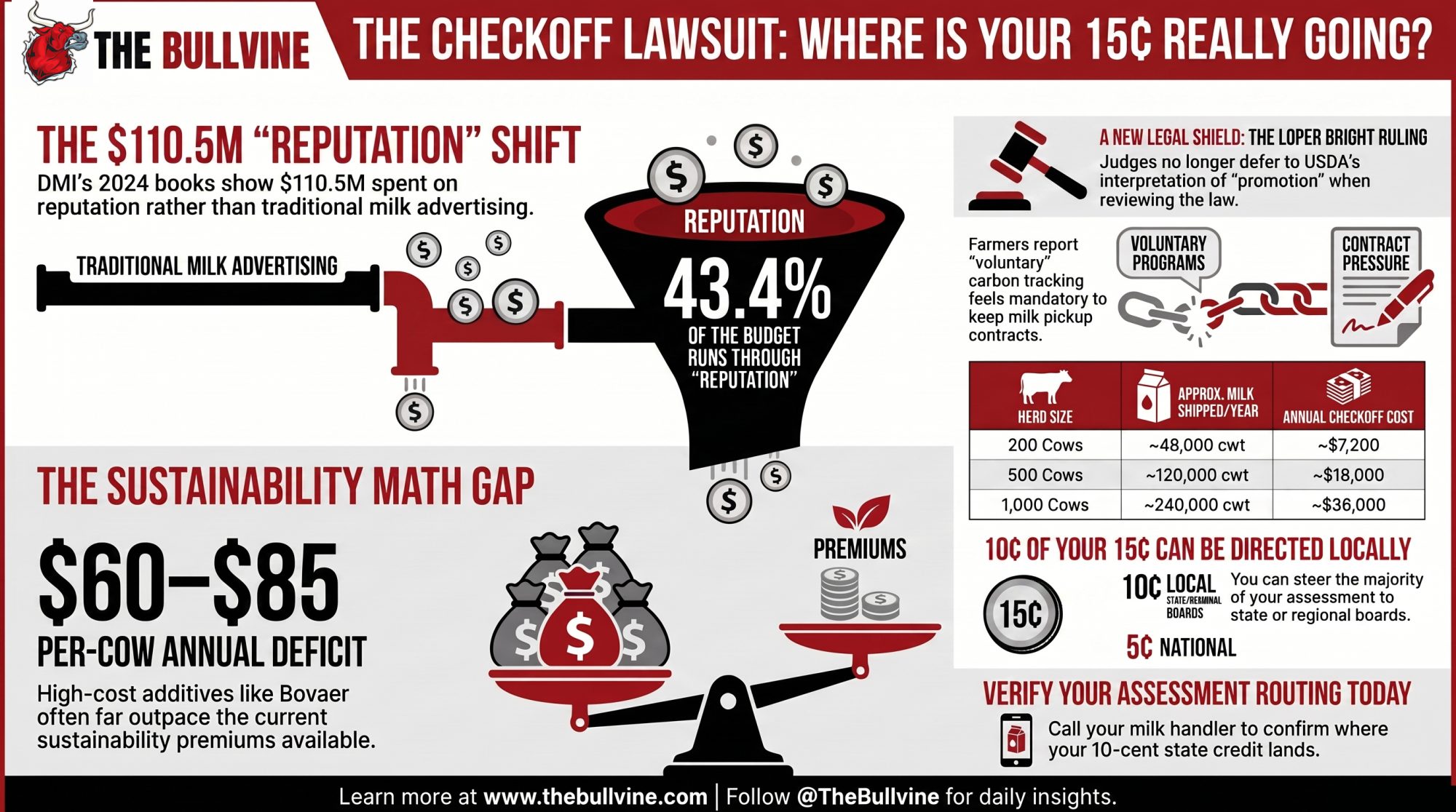
DMI’s own 2024 books show $110.5M — 43.4% of your checkoff — ran through “Reputation,” not milk ads. Three Wisconsin farmers just sued USDA to shut off the tap.

Executive Summary: DMI’s own 2024 audited books show that $110.5 million (43.4% of the checkoff budget) was routed through a category it labels “Reputation,” not ads that move product. A new federal lawsuit by three Wisconsin producers aims to block this pipeline.

Here’s what every dairy farmer needs to know before their next co-op meeting:

  • The Lawsuit: Filed June 9, 2026, against USDA, arguing that mandatory checkoff funds are being illegally used to build a “Net Zero” infrastructure the 1983 law never authorized.
  • The Real Cost: This isn’t just about the 15¢/cwt deduction (roughly $18,000/year on a 500-cow dairy). The real threat is the commercial squeeze — pressure to adopt sustainability practices like Bovaer, which in most current contracts carries an unfunded $60–$85 per-cow deficit.
  • The Legal Shift: Unlike 40 years of failed checkoff challenges, this suit leans on the Supreme Court’s 2024 Loper Bright ruling, meaning judges no longer have to defer to USDA’s interpretation of the law.
dairy checkoff lawsuit

Every farm shipping milk in America pays the same 15 cents per hundredweight. Nobody gets to opt out. And three Wisconsin producers now say a chunk of that mandatory money is being used for purposes they never signed up for — and they’ve taken USDA to federal court to prove it.

In February, Westfield, Wisconsin, dairy farmer Abby Swan told Fox Baltimore that her milk plant had sent a letter asking for a year’s records — natural gas, diesel, propane, electricity — to calculate her farm’s carbon footprint. The program was billed as “voluntary.” But as Swan tells it, participation didn’t feel optional when she believed her milk pickup was on the line. The processor’s side isn’t reflected in that account.

That tension — voluntary on paper, pressured in practice — is the whole fight, folded into one envelope.

On June 9, 2026, Swan put her name on a federal lawsuit against USDA and the National Dairy Promotion and Research Board. So did Adam Faust of Chilton and Christopher Baird of Ferryville. Their claim: the mandatory 15-cent-per-hundredweight dairy checkoff every U.S. producer pays is being used for environmental and sustainability programs the plaintiffs allege fall outside what the 1983 law authorizes (WILL, June 9, 2026).
Dimension1983 Dairy Production Stabilization Act LanguageCurrent DMI SpendingPlaintiffs’ Argument
Authorized purpose“Promotion of the sale and use of dairy products”43.4% ($110.5M) to “Reputation” categorySustainability story ≠ product promotion
Secondary purpose“Research and nutrition education”$57.9M to “Innovation” (Net Zero, FARM ES)Net-zero infrastructure not authorized by law
Core promotionConsumer advertising and market development~$53.7M to consumer promoThis is the only spend plaintiffs consider legal
Oversight mechanismUSDA oversight under AMS Promotion OrderFarmer-elected board; no mandatory public auditOFF Act would add USDA Inspector General audits
Legal doctrine (pre-2024)Chevron deference — courts defer to USDA interpretationUSDA defined scope broadly over 40+ yearsChallengers consistently lost under deference
Legal doctrine (post-2024)Loper Bright — judges read statute independentlyUntested on checkoff programsOpens statutory challenge courts couldn’t take before

What’s Changing and Why

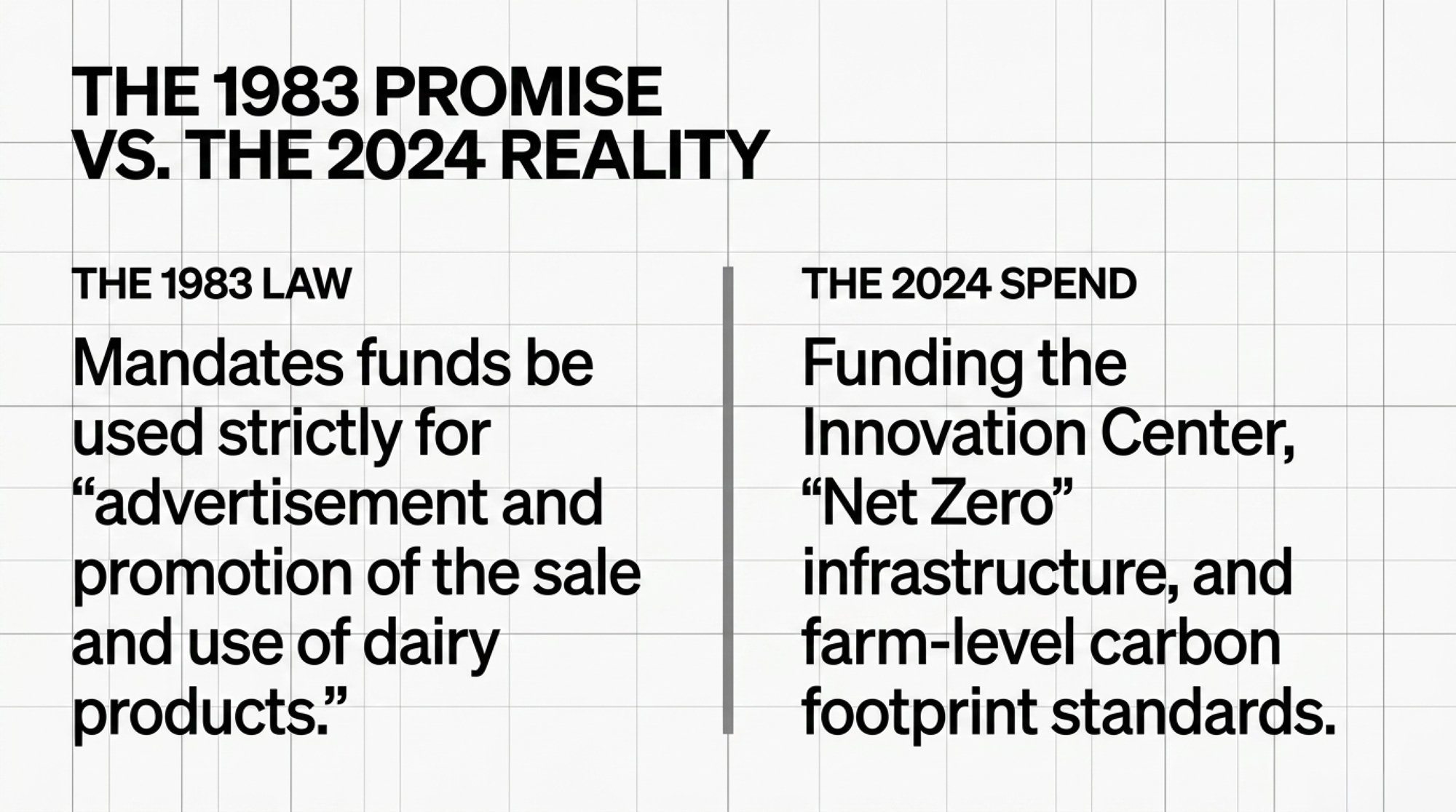
The checkoff isn’t new. Congress built it under the Dairy Production Stabilization Act of 1983, which says the funds “shall be used” for “advertisement and promotion of the sale and use of dairy products,” plus related research and nutrition education (7 U.S.C. ch. 76; Public Law 98-180). The 15-cent rate hasn’t moved in over 40 years. What’s moved, the plaintiffs argue, is the mission.

The lawsuit aims at the Innovation Center for U.S. Dairy — a forum initiated in 2008 by dairy farmers and run by Dairy Management Inc. (DMI) — and three programs under it: the U.S. Dairy Net Zero Initiative, Pathways to Dairy Net Zero, and FARM Environmental Stewardship (FARM ES). The funding link isn’t in dispute. The Innovation Center has said dairy farmers and importers have primarily funded its work through DMI and the national checkoff since its inception (Innovation Center for U.S. Dairy). What’s in dispute is whether building a sustainability story counts as “promotion of the sale and use” of dairy. The suit doesn’t try to kill the checkoff — it asks the court to block checkoff funding of the Innovation Center specifically.
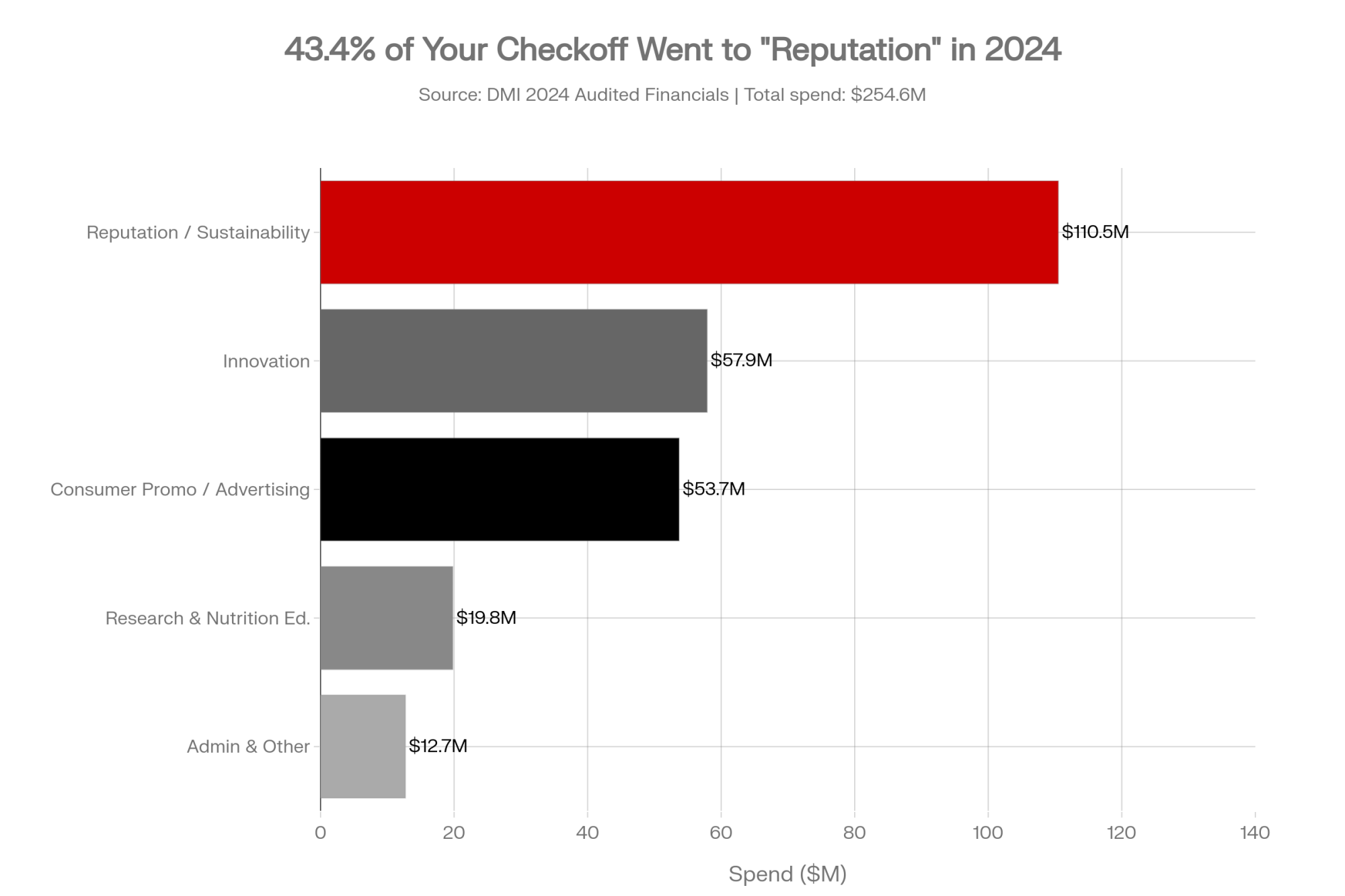
The dollars are real, and they’re big. The checkoff collects more than $350 million annually from producers and importers, per USDA figures cited in the June 2026 complaint. DMI’s 2024 audited financials show $254.6 million in total expenditures once state and regional pass-throughs are counted — and of that, $110.5 million, or 43.4% of the entire budget, ran through a category DMI itself labels “Reputation,” with another $57.9 million booked to “Innovation” (DMI 2024 Annual Report; The Bullvine, May 27, 2026). That’s not advertising milk. That’s work measured partly by whether the public believes dairy farmers are good for the environment.

To be fair to DMI, the organization sees that spending differently. Its position is that reputation and trust work protects long-term demand — that a consumer who trusts dairy’s environmental record keeps buying milk, cheese, and butter for decades. The plaintiffs argue spending in that category drifts from the checkoff’s promotional purpose. That’s the exact disagreement now headed to a federal judge.

How This Plays Out on Real Farms

For Swan, the friction started with that data request. She told Fox Baltimore the letter wanted “herd data, nutrition data, energy data, total terms of natural gas, total gallons of diesel” — “mind you, this is for a whole year,” she said — and that participation didn’t feel optional when she believed her pickup was on the line (Fox Baltimore, Feb. 19, 2026). USDA Secretary Brooke Rollins said publicly she’d investigate the new requirements. As of late June, there’s no public record of what that review turned up — a gap worth watching as the case moves.

Faust isn’t a first-time litigant. He’s the Chilton farmer who, with the Wisconsin Institute for Law & Liberty (WILL), beat the agency in a separate discrimination case in roughly 11 months. Same legal shop. Same farmer. Now pointed at the checkoff. We tracked how that first win came together, and it’s the reason this filing reads differently from the usual coffee-shop grumbling — WILL deputy counsel Daniel Lennington told Brownfield Ag News on May 27, 2026, that the checkoff is “an unconstitutional” use of mandatory funds.

Baird, the third name on the filing, farms near Ferryville in the southwest corner of the state. The complaint describes all three as Wisconsin producers “subject to and harmed by” the mandatory assessment (Cheese Reporter, June 11, 2026) — not activists who went looking for a fight, but farmers who pay the levy every month and want to know what it’s being used for. That’s the thread worth holding onto: this isn’t a fringe case. It’s three working dairies questioning a deduction that automatically hits all of them.

Here’s where it gets concrete. The 15 cents scales straight with volume, so the bigger you milk, the bigger the bill. Run the numbers on a herd averaging about 24,000 lbs per cow per year — adjust up or down for your own rolling herd average — and the assessment lands like this:

Herd sizeApprox. milk shipped/yrAnnual checkoff at 15¢/cwt
200 cows~48,000 cwt~$7,200
500 cows~120,000 cwt~$18,000
1,000 cows~240,000 cwt~$36,000

(Figures assume a 24,000-lb rolling herd average; recalculate against your own production.)

And that’s before the second layer: the practices these sustainability programs are starting to expect.

The Real Cost Isn’t Just the Deduction

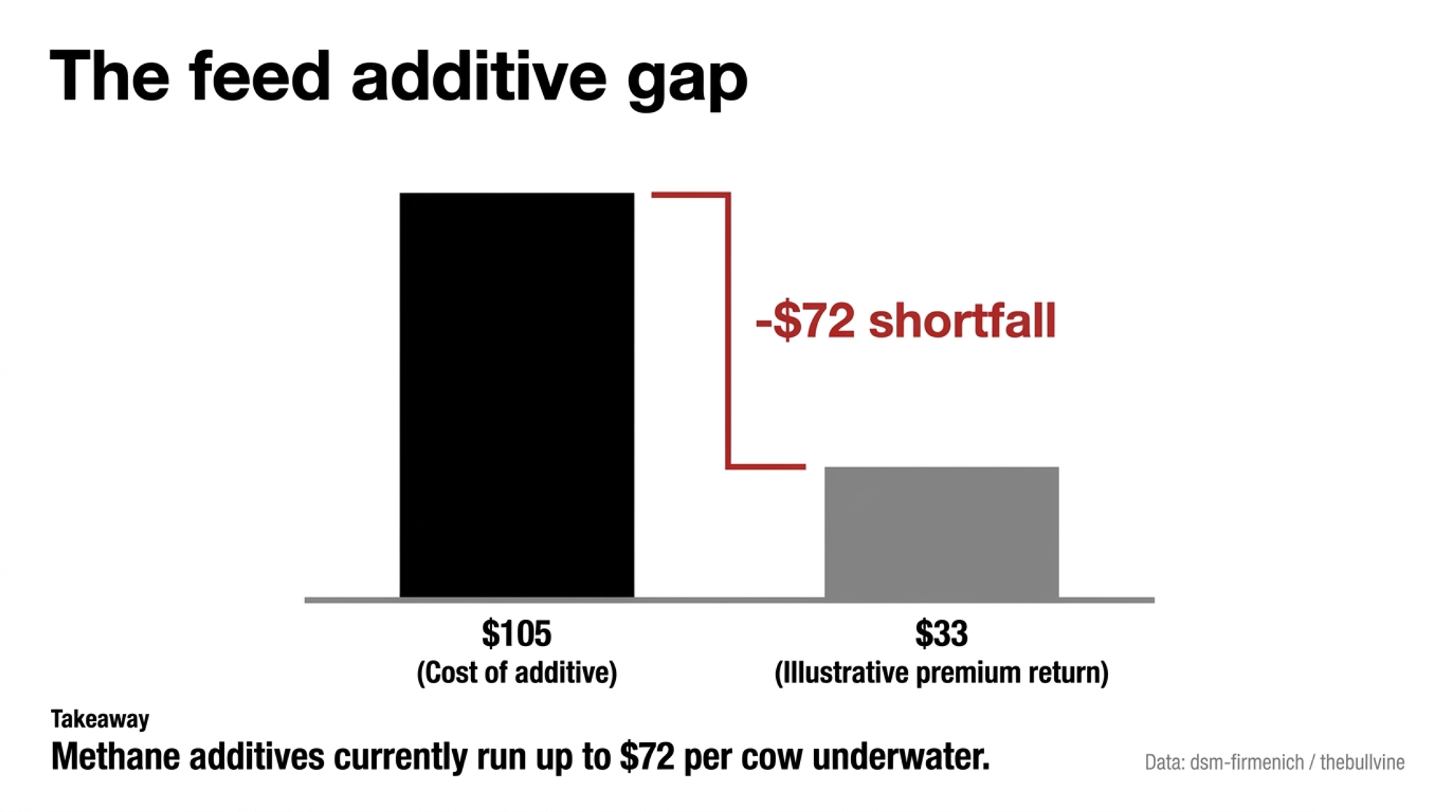
Take Bovaer, the methane-reducing feed additive moving through sustainability channels. Start with the cost. DSM-Firmenich pegs it at roughly $93–$105 per cow per year on a lactating-cow basis — call it about a quarter to thirty cents a head a day (DSM-Firmenich; The Bullvine, June 23, 2026). That’s the bill, and it’s fixed.
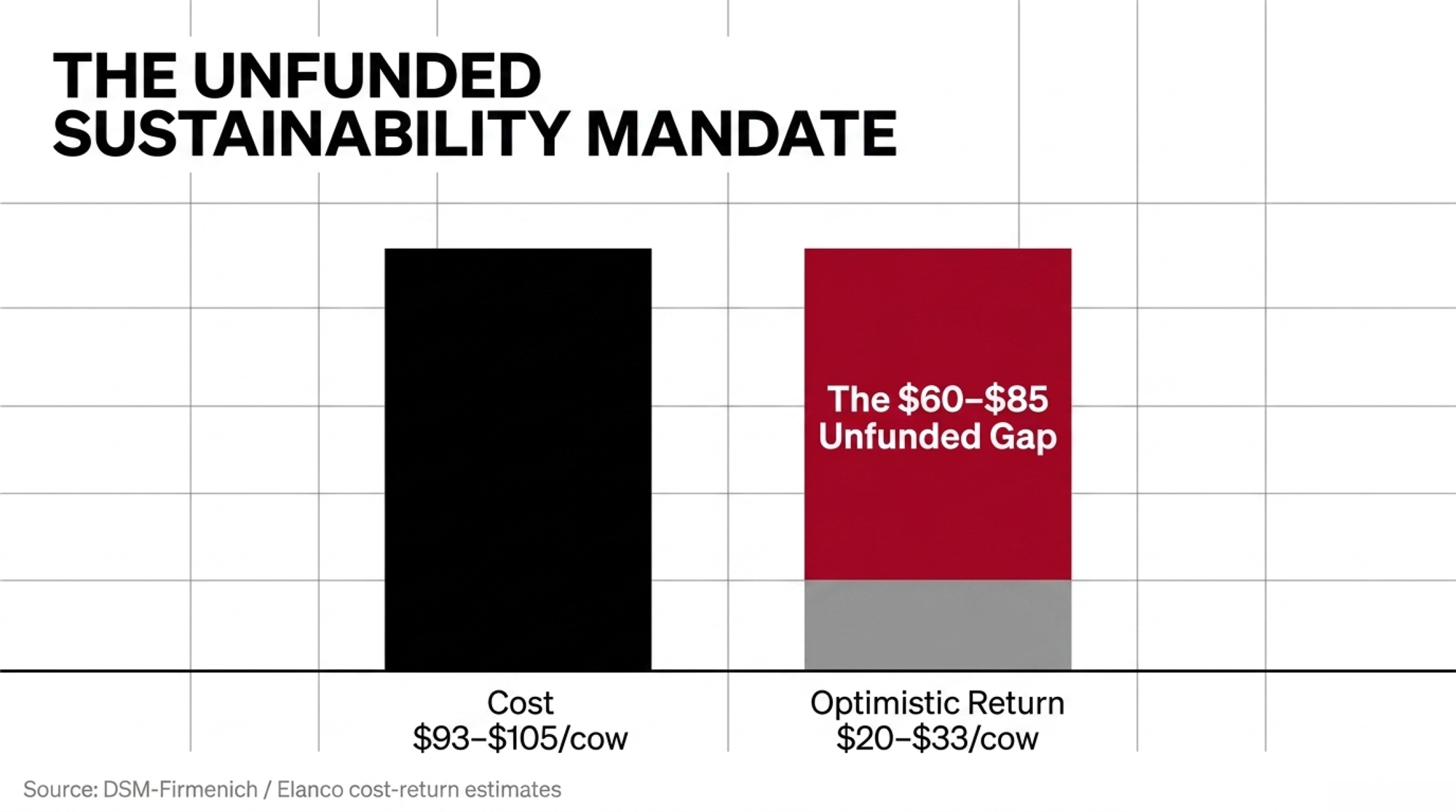
Now the return, run at its most optimistic. Elanco has estimated an annual return of $20 or more per lactating cow from feeding Bovaer, drawn from voluntary carbon markets, conservation-program funds, and processor incentives (Elanco, via Dairy Herd Management, Nov. 2024 — note this estimate is over a year old and may have shifted). Add an assumed 12¢/cwt sustainability premium on a cow milking 75 lbs a day and you’d claw back about $33. Even that’s generous, since most documented sustainability and component premiums today run higher per cwt but rarely attach to methane reduction specifically (The Bullvine, Oct. 2025). Call the total documented return $20–$33 per cow — and that’s the friendly read.

So line them up. Cost of $93–$105 against a return of $20–$33 leaves a $60–$85 per-cow gap the system doesn’t close. On a 300-cow herd, that’s an unfunded $18,000 to $25,500 a year. The climate story and the cash-flow story aren’t the same story. We ran the full methane-efficiency-breeding-versus-Bovaer comparison separately — worth a look before you sign anything.

The Mechanics Behind the Outcomes

Most producers treat the 15 cents and the data letter as two separate headaches. They’re not. They’re two ends of one pipe.

Checkoff dollars fund the Innovation Center and the Net Zero infrastructure. That infrastructure builds the measurement standards — FARM ES uses the Ruminant Farm Systems model to estimate a farm’s greenhouse gas footprint (National Dairy FARM Program, June 2025). Here’s how that turns into a letter in your mailbox:

The Leverage Pipeline — how “voluntary” becomes a condition of the sale

1. Your checkoff funds the Innovation Center and its Net Zero / FARM ES measurement standards. 2. Those standardsbecome the yardstick for a farm’s carbon footprint. 3. Your processor or co-op pools your farm-level data to show buyers the supply chain is cleaning up. 4. A buyer like Nestlé or Danone writes sustainability reporting into its purchase contracts. 5. To keep that account, your processor needs your numbers — so a “voluntary” program quietly becomes a practical condition of getting your milk hauled.

No regulation cited in the letter. No law forcing your hand. Just leverage running down the contract chain.

That reach is already wide, and it’s growing. By 2025, 39 cooperatives and processors representing about 77% of U.S. fluid milk had signed the U.S. Dairy Stewardship Commitment — up from 35 companies and 75% in 2022 (Innovation Center for U.S. Dairy, 2025, via Choices magazine). And the people approving how the checkoff spends? It’s a farmer-led board, funded by more than 23,000 dairy farmers plus importers (DMI 2024 Annual Report; Agri-Marketing, April 2026). As of its 2021 report, the board consisted of 41 dairy farmers, 12 importer representatives, and 2 non-voting cooperative seats, and it’s chaired by Pennsylvania dairy farmer Marilyn Hershey, re-elected to lead the checkoff for 2026 (Dairy Checkoff, April 27, 2026). Farmer-controlled on paper. If you want the full picture of where those dollars actually go, we broke down Hershey’s $121 million checkoff bet — and why 76% of it chases cheese and exports. The plaintiffs argue the spending has drifted beyond what farmers signed up for in 1983.

Why This Lawsuit Is Different From the Last 40 Years of Checkoff Fights

If you’ve tuned out every prior checkoff challenge — and there’s been a parade of them — here’s the one reason to look up this time.

Back in 2004, a federal appeals court struck down the dairy checkoff in Cochran v. Veneman, calling it unconstitutional compelled private speech. The win didn’t hold. In 2005, the Supreme Court upheld the beef checkoff in Johanns v. Livestock Marketing Association, ruling that checkoff advertising is “government speech” and therefore shielded from First Amendment attack (Cornell Law School case summary). That doctrine has protected the dairy program ever since. Every speech-based challenge since has run straight into the same wall.
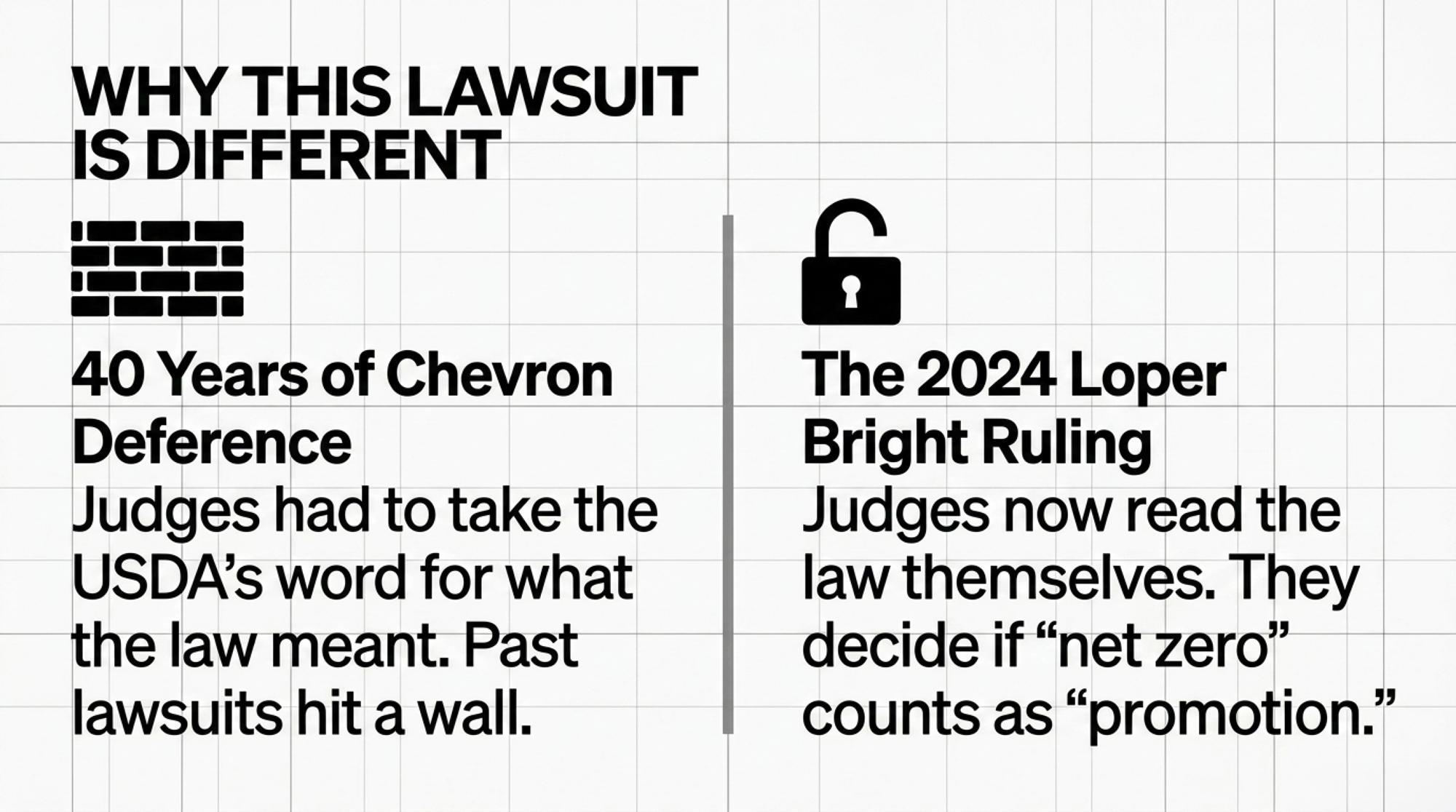
But this case isn’t only a speech case. In June 2024, the Supreme Court decided Loper Bright Enterprises v. Raimondoand overruled the 40-year-old Chevron doctrine (U.S. Supreme Court, 603 U.S. 369, 2024). Here’s the tractor-cab version: judges no longer have to take USDA’s word for what a statute means. They read it themselves. So a court can now look at the 1983 law’s actual language — “promotion of the sale and use of dairy products” — and ask whether funding net-zero infrastructure honestly fits, without deferring to the agency running the program. That’s a statutory question, not a speech question. It sidesteps the wall that stopped everyone before. No court has tested it on a checkoff yet. It’s an opening, not a verdict.

The Global Playbook: What U.S. Farmers Can Learn from Canada and the EU

DimensionUnited StatesCanadaEuropean Union
Funding mechanismMandatory 15¢/cwt federal checkoff (USDA order)Provincial levies via supply management marketing boardsEU Common Agricultural Policy (taxpayer-funded co-financing)
2024/25 budget~$350M+ collected annually (USDA, per complaint)DFC-administered; $7.5M+ federal top-up in 2023€160M co-financing for 2026 promotion budget
Sustainability commitmentNet Zero by 2050 — Innovation Center / FARM ESNet Zero by 2050 — “We’re In” campaignClimate-linked CAP payment conditions for farmers
GovernanceFarmer-elected board; 41 farmers + 12 importers (as of 2021)Producers hold direct provincial board seatsEuropean Commission approval; NGO/parliamentary pressure
Active legal challengeSwan v. Rollins — June 9, 2026 (Eastern District, Wisconsin)None equivalentNone equivalent; pressure runs opposite direction
Key legal leverLoper Bright (2024): courts read statute independentlySupply management consent structure differsRegulatory, not judicial
“Voluntary” pressure dynamicProcessor data requests tied to pickup contractsLess documented at farm levelNGOs and buyers push for more strings on CAP payments

To see where this “reputation-first” pipeline eventually leads, American producers only have to look across the border and over the Atlantic. Two mature systems, two very different answers on who controls the money — and both are instructive for what’s coming down the U.S. contract chain.

Canadian producers fund promotion too, but the structure is different enough that the same fight hasn’t erupted north of the border. Dairy Farmers of Canada (DFC) runs producer-funded promotion and has committed the Canadian sector to net-zero greenhouse gas emissions by 2050, backed by its “We’re In” sustainability campaign featuring real farmers (Dairy Farmers of Canada, 2023). Ottawa has chipped in too — over $7.5 million to DFC for sustainable dairy development in 2023 (Government of Canada, July 2023). (Canada-specific figures — don’t read these across to U.S. operations.)

The difference is governance. DFC’s levies flow through provincial marketing boards under supply management, where producers hold direct seats and the money is collected at the provincial level rather than through a single federally mandated USDA-style order. That’s why you haven’t seen a Canadian compelled-funds lawsuit mirroring Swan v. Rollins — the consent-and-control mechanics differ, even though the sustainability-spending direction looks strikingly similar.

Europe is almost the mirror image. The EU’s 2026 farm-promotion budget — €160 million in co-financing — isn’t a mandatory producer levy at all; it’s largely Common Agricultural Policy money, meaning taxpayers, not a milk-check deduction (European Commission call for proposals, Jan. 2026). And the pressure there comes from NGOs and parliamentarians who want more climate strings attached to the money, not from farmers suing to keep climate spending out. Mirror image of Wisconsin. Same global sustainability current, three very different fights over who controls the cash (European Commission, 2026; Regulation 1144/2014).

How Much Is This Really Costing Your Balance Sheet?

Start with what you can see. The 15-cent assessment is fixed and printed on every milk statement. What’s harder to see is the second layer — the practices and reporting the sustainability programs increasingly expect, with Bovaer just the most-quoted example. More buyer requirements are coming, and they don’t show up as line items until they’re already conditions of the sale.

The deeper problem is that the accountability runs one direction. The money is mandatory. Transparency is optional — you can request DMI’s budget breakdown, but no one pushes it to you (DMI Budget & Financials page). And there’s no rule anywhere requiring that a checkoff-funded obligation come with a documented, farm-level return that actually covers its cost. That’s the real gap. Not whether sustainability matters — but who’s on the hook when it costs more than your milk check can carry.

Is Your Co-op Routing Your Money Somewhere You Didn’t Choose?

Worth knowing, and most producers haven’t checked: of your 15 cents, you can direct up to 10 to a qualified state or regional program where farmer-elected boards steer the spending. The remaining nickel flows to DMI nationally (per the USDA AMS Dairy Promotion and Research Order). Do you know which path your dime takes — directed by people you can call, or dropped into the national pool by default?
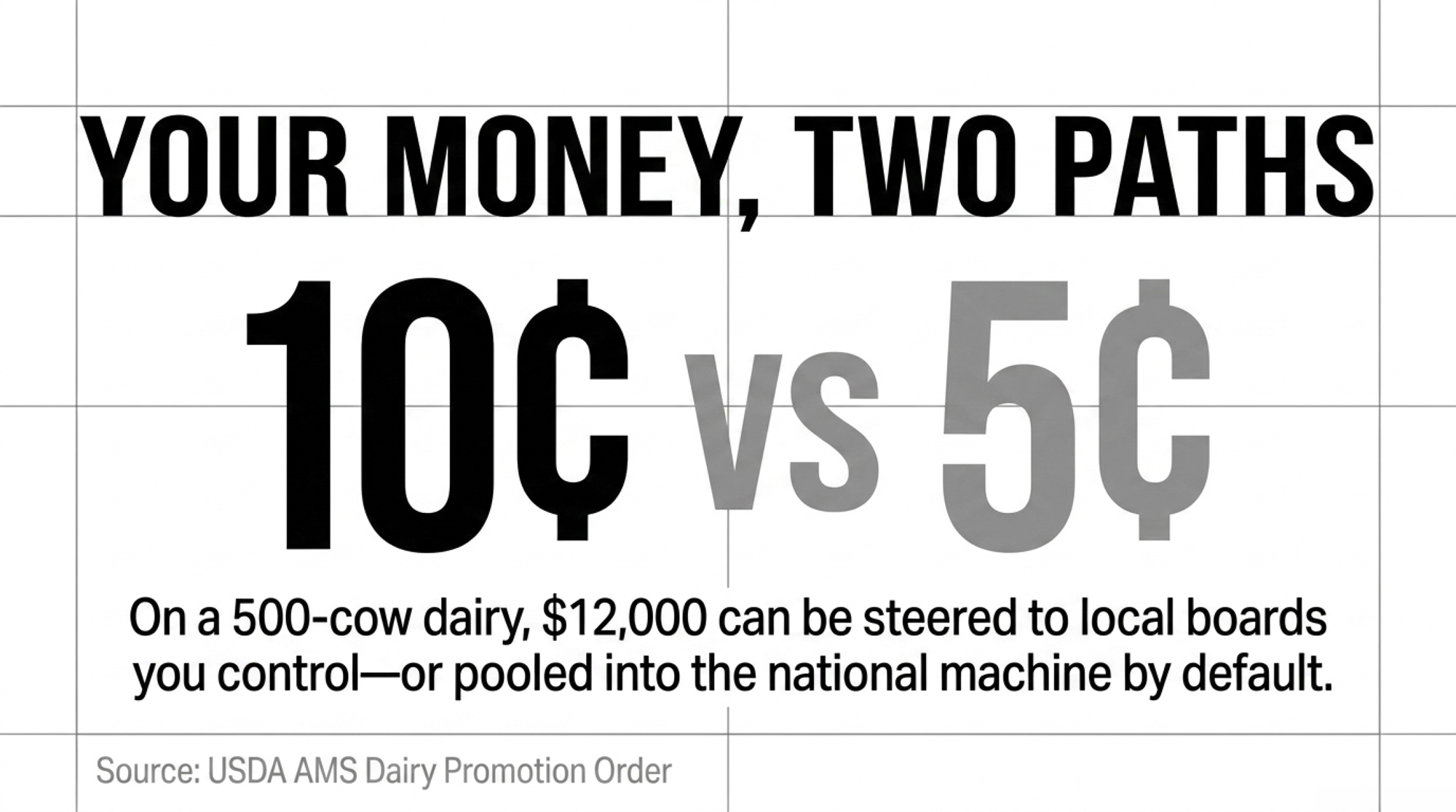
Put numbers on it. On a 500-cow dairy paying about $18,000 a year, the directable 10-cent share is roughly $12,000, with the national nickel running near $6,000. Scale that to 1,000 cows, and you’re looking at about $24,000 you could be steering locally versus $12,000 pooled nationally. One phone call to your milk handler settles where yours actually lands. That’s a this-month job, not a someday one.

Options and Trade-Offs for Farmers

There’s no single right move here. Some of this you can do this month with one phone call. Some of it is a longer game. Sort them that way.

Practice / ObligationAnnual Cost/CowDocumented Return/CowNet Gap/CowGap on 500-Cow HerdReturn Source Reliability
Bovaer (methane additive)$93–$105$20–$33$60–$85$30,000–$42,500Low — carbon markets volatile; premiums not broadly attached to methane reduction
FARM ES data collectionStaff time + audit cost (~$5–$15 est.)$0 documented farm-level premium~$5–$15~$2,500–$7,500None published at farm level
Annual checkoff assessment$18,000 (500 cows, 24k lb RHA)No direct farm-level return guaranteedFull amount$18,000Indirect only (market development)
Genetics for methane efficiency$0–$8/cow higher semen cost (est.)Compounding herd improvement; no direct premium yetNeutral to slight positiveNeutralEmerging — no contract premium attached as of 2026
Carbon footprint audit (1-yr records)~$500–$2,000 in time/records prep (est.)$0 guaranteed; possible future credit access$500–$2,000$250,000–$1,000,000Speculative; market access not guaranteed

Do this in the next 30 days:

  1. Verify your assessment routing. Pull your last three milk statements and ask your handler where your 10-cent state credit lands. Costs nothing, risks no relationship, takes one call. The limit: it tells you where the money goes, not what it buys.
  2. Request the budget breakdown. Ask your checkoff rep or co-op for the split between consumer promotion, “Reputation”/sustainability, and overhead. Makes sense if you want to judge ROI for your own herd type. The catch: the categories are self-reported, so read them with a skeptical eye.
  3. Make one policy call. The OFF Act (Opportunities for Fairness in Farming Act) would force USDA Inspector General audits and public budgets for the big checkoffs (Farm Action Fund). A call to your senator’s office costs nothing and spends zero co-op goodwill. The downside: it hasn’t passed, and Washington moves slowly.

Play the longer game:

  • Watch the lawsuit — and weigh involvement carefully. Swan et al. v. Rollins is filed in the U.S. District Court for the Eastern District of Wisconsin, and WILL has posted the full complaint publicly. Litigation like this realistically takes 18 to 30 months before any ruling changes how the program runs. Getting publicly involved means a visible disagreement with the organizations tied to your milk check. That’s a real cost, not a small one — and only you know your own relationships.
Key Takeaways

  • If you’ve never checked where your 10-cent state credit goes, call your milk handler this month — on a 500-cow herd that’s roughly $12,000 either steered locally or pooled nationally.
  • If a sustainability program asks for a year of farm data, ask straight out: is participation tied to whether my milk gets picked up, and who owns the data once I hand it over?
  • Before you adopt any checkoff-promoted practice, run the per-cow math first. If the cost (Bovaer’s ~$93–$105/cow) outruns the documented return (~$20–$33/cow), find out who’s covering the $60–$85 gap before you sign.
  • If you want the assessment’s spending audited, the OFF Act is the existing vehicle — a constituent call is the cheapest pressure you can apply.
  • Track the Swan v. Rollins timeline, but plan to keep paying the 15 cents regardless of how it lands for the next year and a half.

Abby Swan is still shipping milk. Still paying the 15 cents, same as you, while her name sits on a federal docket that won’t see a ruling for a year or more. So here’s the question worth carrying into your next co-op meeting: do you actually know what your mandatory 15 cents is buying — and whether the practices it’s nudging you toward still pencil out at the milk price you’re getting paid right now? Most producers have never run that number. Swan, Faust, and Baird did, didn’t like the answer, and handed it to a judge.

THE BULLVINE INTERACTIVE

Calculate Your Herd’s True Checkoff Cost & Sustainability Deficit

1. Enter Your Herd Metrics

2. Your Farm Financial Impact

Annual Checkoff Tax Total automatic 15¢/cwt deduction
$0
Funded to “Reputation” Your 43.4% non-advertising share
$0
Your Directable Local Dime Max up to 10¢ state/regional pool
$0
Unfunded Sustainability Deficit Bovaer gap ($60–$85/cow average)
$0

Calculations derived from DMI 2024 audited books & processor sustainability contract models.

Complete references and supporting documentation are available upon request by contacting the editorial team at editor@thebullvine.com.

Learn More

The Sunday Read Dairy Professionals Don’t Skip.

Every week, thousands of producers, breeders, and industry insiders open Bullvine Weekly for genetics insights, market shifts, and profit strategies they won’t find anywhere else. One email. Five minutes. Smarter decisions all week.

NewsSubscribe
First
Last
Consent

The Carbon Rule Everyone Misread: Britain Didn’t Vote a Cull, But Your Herd Is Still in the Crosshairs

MPs did vote on Britain’s carbon budget. The panic headline was wrong—but the 27% herd cut it quietly assumes can still land on your milk cheque.

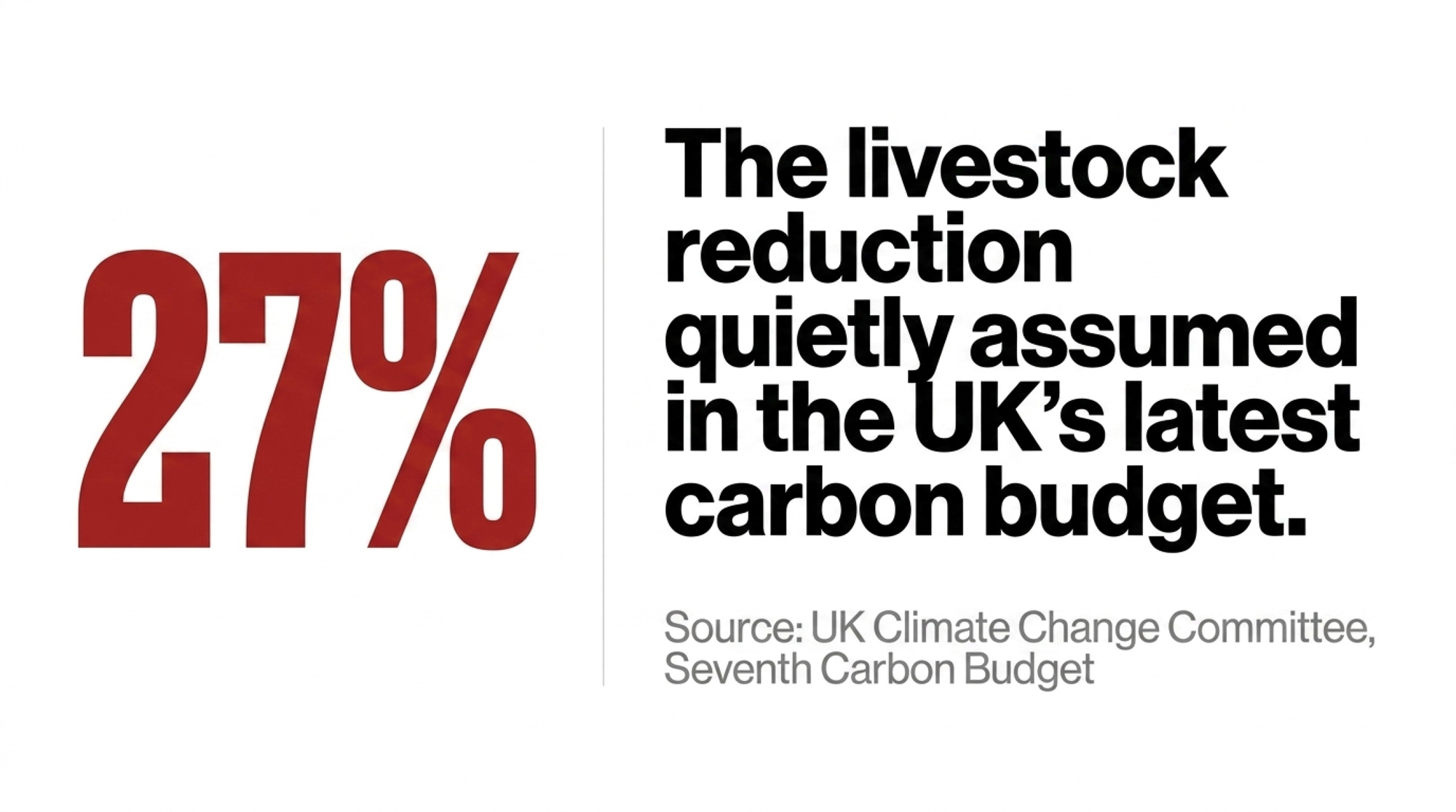
Executive Summary: Britain’s new carbon budget quietly assumes a 27% cut in cattle and sheep by 2040, and MPs just voted to legislate it, even though nobody voted to “cull 40% of cows.” That framework is already pushing toward North American barns through processor demands for farm‑level carbon footprints, not through tariffs first. On the feed side, chasing methane reduction with Bovaer currently runs about $93–$105/cow/year against an illustrative 12¢/cwt premium worth only ~$33/cow, leaving you roughly $60–$72/cow underwater unless someone else pays the difference. At the same time, genetic tools like Lactanet’s Environmental Impact Index and CDCB’s Net Merit revision now weight Feed Efficiency, Methane Efficiency, and Feed Saved heavily — a zero‑cost premium if you actually use those traits when you pick bulls. The opportunity is to lock in your own whole‑farm footprint number within the next 30 days using Holos, FARM ES/RuFaS, or COMET-Farm, and start shifting sire selection toward efficiency so you can argue for performance rather than headcount as buyers and regulators tighten rules. The risk is signing methane‑credit or additive contracts that look green on paper but quietly shave tens of dollars per cow off your margin every year while policymakers find it cheaper to cap animals than reward efficient milk.

dairy carbon footprint

Editor’s Note: The producer described in this article is a composite scenario modeled from typical mid-size Ontario and Upper-Midwest dairy operations, not a single named individual. All policy, economic, and genetic figures are real and sourced.

Picture a 250-cow operator somewhere between Listowel and Fond du Lac, sitting down this spring to book semen. The milk’s been shipping fine. Then the processor’s field rep asks a question that wasn’t on last year’s list: what’s the carbon footprint of your milk? No number ready. And no clear idea why the question suddenly matters. That’s the moment this story is really about — because the reason that question is landing in North American barns traces straight back to a document most producers have never read.

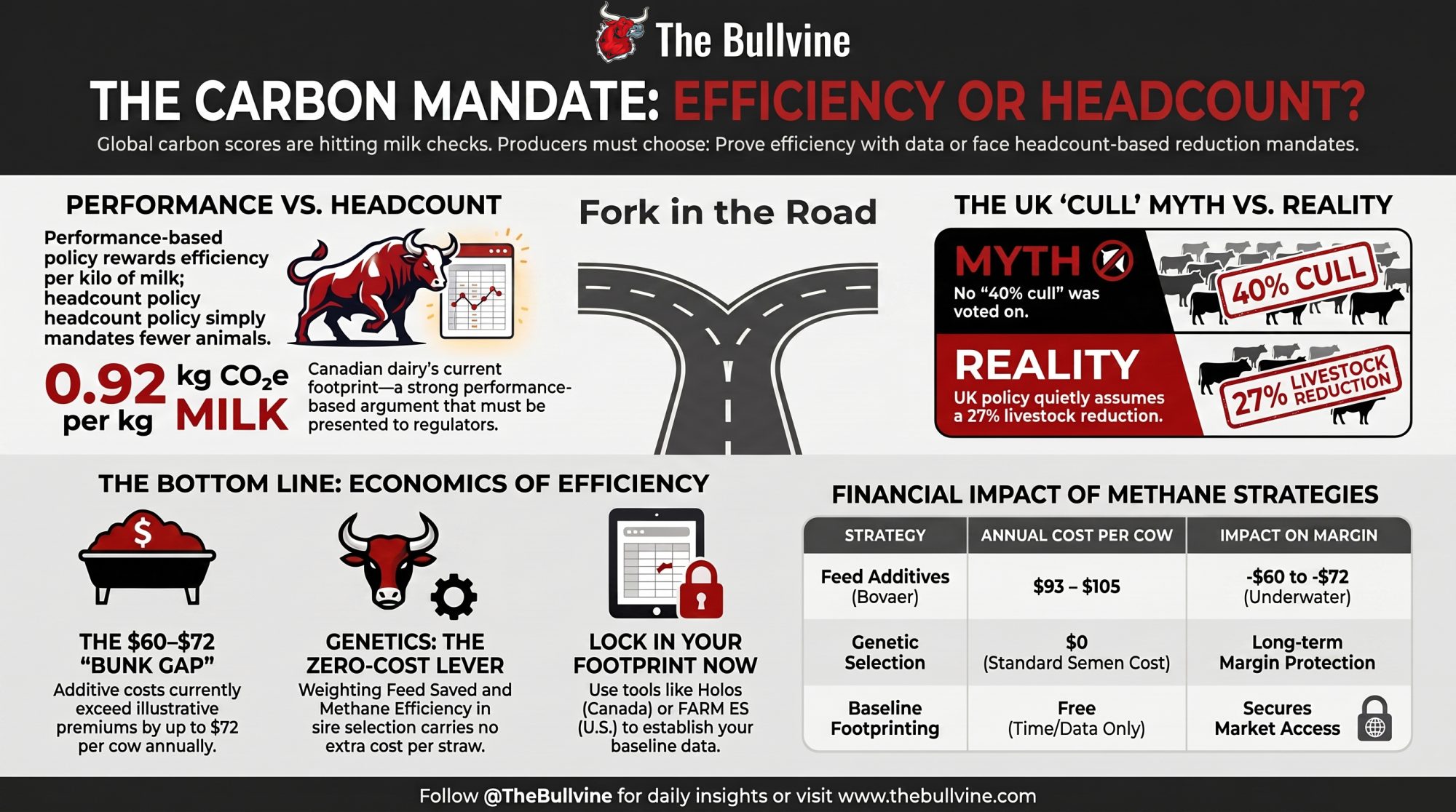
A screenshot circulated in the farm group chats claiming that UK MPs had voted to legislate a 40% cut in cattle by 2040. It traveled fast — that kind of number always does. Here’s the twist: MPs did vote on the carbon plan in late June, but nothing in it culls a cow. The “40% cull” part is invented. 

That document is the UK Climate Change Committee’s Seventh Carbon Budget — and what it actually says matters more to your milk cheque than any screenshot.

What the Document Actually Says

The Climate Change Committee — the CCC — is the UK government’s statutory climate advisor. Its Seventh Carbon Budget covers 2038 to 2042, and for the first time, it includes livestock reductions in the plan as a named tool, not a side effect.

The modeling assumes a 27% cut in cattle and sheep numbers between 2023 and 2040, which the CCC’s own math indicates would account for a 32% reduction in agricultural emissions. On the land side, the plan aims for 16% of the UK to be under woodland by 2040 and 12% of grassland to be released for other uses. Nobody’s culling a herd. The CCC handed government a spreadsheet, and the internet turned it into a herd-cull headline. 

The vote itself was real, though. In late June 2026, MPs moved to legislate the budget level — a 535 MtCO₂e cap for 2038–2042, about an 87% cut on 1990 levels — ahead of the statutory June 30 deadline. That’s almost certainly the event that got garbled into “they voted to cull.” The delivery plan, which spells out how the cuts happen, comes next. 

So where did “40% by 2040” come from? The CCC’s pathway also assumes a 20% drop in dairy consumption by 2035 sustainweb and a broader red-meat-and-dairy shift of roughly 260 grams per person per week — and in the retelling, those got mashed together and welded onto the 2040 date. Several different numbers, one scary headline. 

Why a British Spreadsheet Lands in a North American Barn

Britain is a first mover here, not an outlier. Once a G7 climate plan treats “fewer cattle” as legitimate policy and bolts a percentage to it, the idea stops being fringe and starts being precedent.

It’s already spreading in the UK before it crosses the ocean. Scotland’s climate plans target a 26% cut in livestock by 2035; Northern Ireland’s, 31% by 2040. Same logic, three jurisdictions. When the framework replicates that fast at home, betting it stops at the water’s edge is a bet, not a plan. 

Will This Reach You as a Tariff or as a Phone Call From Your Processor?

Probably the phone call — the same one our composite operator just got. And that’s the part most coverage misses.

Here’s the formal mechanism first. Britain launches a Carbon Border Adjustment Mechanism (CBAM), a levy on imports priced according to their embedded carbon, on January 1, 2027. Right now it covers aluminum, cement, fertilizers, hydrogen, and steel. Dairy isn’t in scope. But the government has said CBAM’s scope will remain under review beyond 2027, and the Country Land & Business Association has already floated a food CBAM in its response to Carbon Budget 7. So the door isn’t open. It’s just unlocked. 

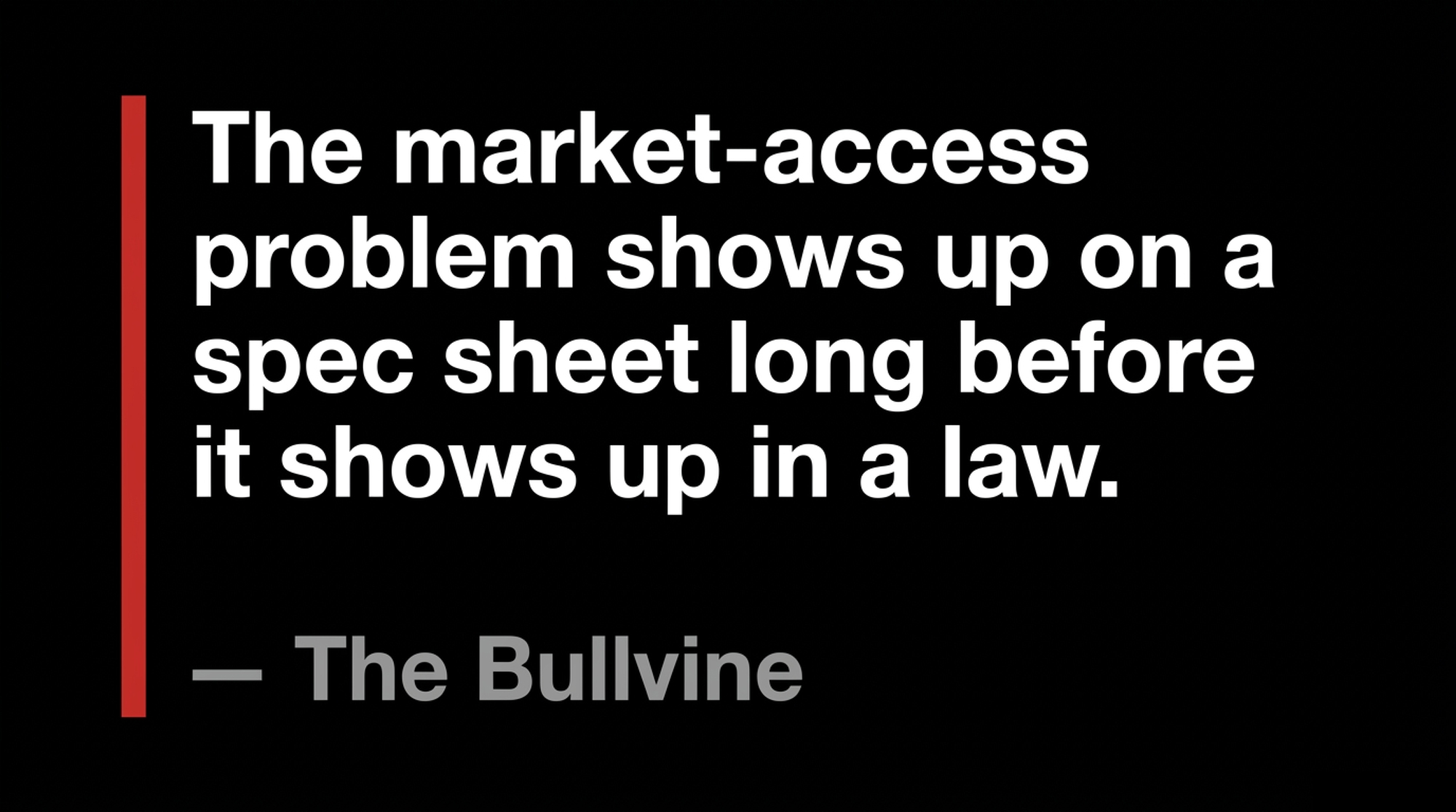
The quieter mechanism is the one that bites first. As British farmers absorb herd cuts and tighter standards, British retailers and processors are starting to treat carbon-verified milk as the floor, not the bonus. Anything above their intensity benchmark becomes a commercial liability. An Ontario processor shipping cheese or milk powder into that market wouldn’t get hit with a tariff — it’d get asked for farm-level emissions numbers, and lose the contract if it couldn’t produce a credible one. The market-access problem shows up on a spec sheet long before it shows up in a law.

What Does This Cost at the Feed Bunk Today?

The cleanest dollar math you can run right now isn’t on the trade side. It’s at the bunk — and it tells you exactly what a carbon-scored world rewards and what it doesn’t.

Take a methane-reducing feed additive like Bovaer. The math comes out lopsided fast:

LinePer cow/yearSource
Bovaer cost (lactating-cow basis)$93–$105dsm-firmenich 
12¢/cwt premium (illustrative)~$33thebullvine
Net gap (what you eat)–$60 to –$72

Two things to flag before you map that to your own barn. The 12¢/cwt premium is illustrative — real sustainability premiums vary by processor and aren’t a published standard yet. And that $33 return is the same per cow whether you milk 200 or 2,000, because the premium scales with milk shipped, not with herd size. At 75 lbs/day, every cow earns back about $33 and costs you up to $105 in additive. You’re roughly $60 to $72 a head underwater before moving a single carbon-verified load. The tools exist. The premium doesn’t cover them yet. 

Bovaer’s other wrinkles, quickly:

  • Cost may fall. A new dsm-firmenich plant in Dalry, Scotland, is projected to pull the price toward $58–$64/cow/year — shrinks the gap, doesn’t close it. 
  • Safety is under review. After Denmark’s late-2025 mandate, the Danish Dairy Farmers’ Association reported farms experiencing yield declines and digestive issues, and EFSA opened a fresh review in 2026 that remains ongoing. 
  • The maker disagrees. dsm-firmenich and the U.S. FDA maintain the additive is safe and effective. 

The takeaway isn’t “Bovaer is bad.” It’s that if a methane-credit contract you’re eyeing requires it, watch how that review lands before you sign.

Two Roads: Do They Count Your Efficiency or Just Your Cows?

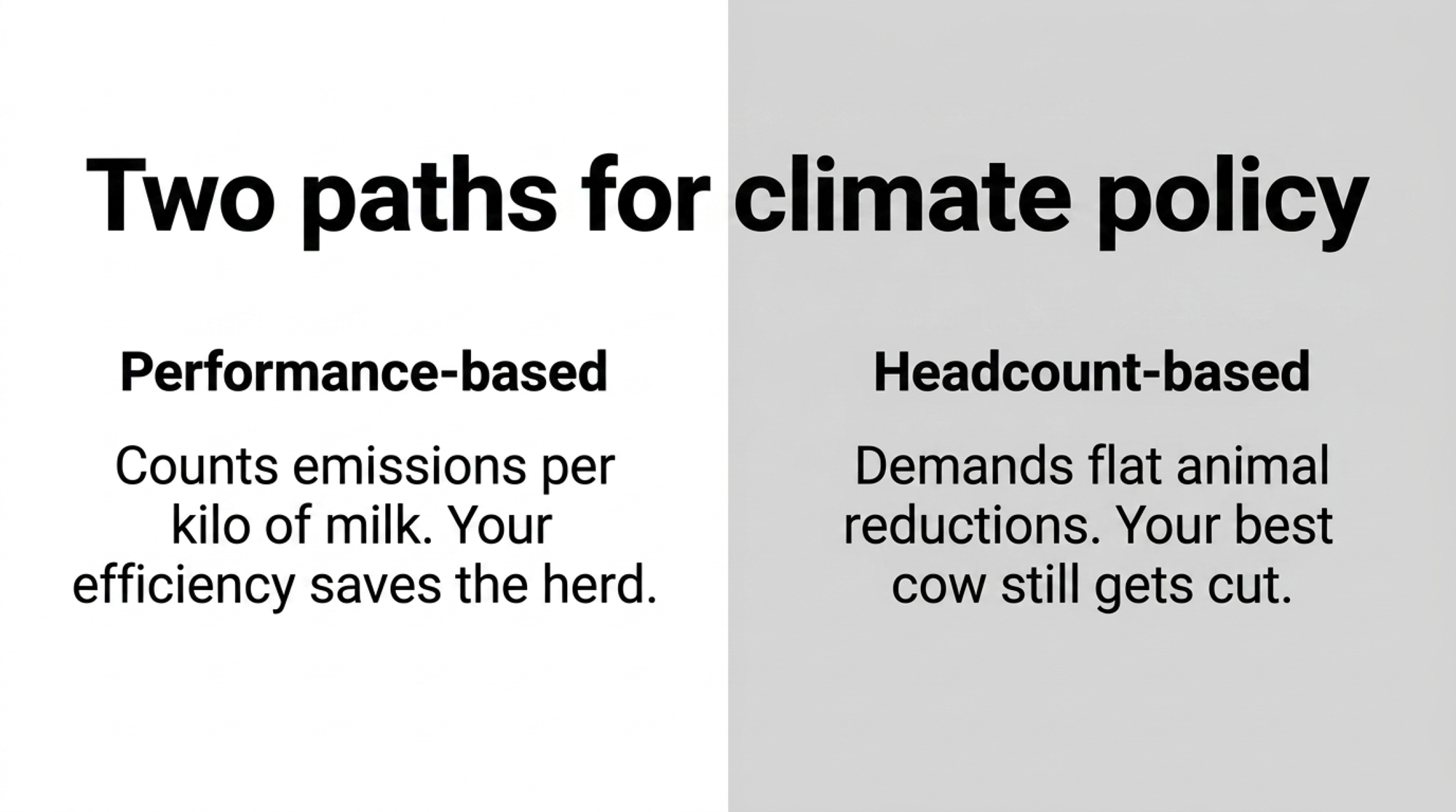
Underneath all of it sits one fork, and it decides everything. Climate policy splits into two roads, and which one your regulators walk decides whether an efficient farm keeps its herd or shrinks it.

Performance-based policy asks one question: how many kilos of CO₂-equivalent come off your farm per kilo of milk? Drive that number down with genetics, feed efficiency, and manure management, and your cows stay on the landscape. California’s SB 1383 goes this way — a 40% cut in dairy methane by 2030, pursued through digesters, manure management, and efficiency rather than mandated herd reductions. A UC Davis CLEAR Center and California Dairy Research Foundation analysis projects that the state’s dairies will hit that target and reach climate neutrality around 2030, as long as voluntary, incentive-based adoption holds. 

Headcount-Based PolicyPerformance-Based Policy
Core question askedHow many animals do you have?How many kg CO₂e per kg milk?
Best-known exampleNetherlands farm buyouts (€1.81B / 723 farms)California SB 1383 (40% methane cut by 2030)
UK Carbon Budget 7 alignment✅ 27% cattle & sheep cut assumed by 2040❌ Not the primary lever in CB7
Impact on efficient farmsYour best cow still gets cutEfficiency is the competitive moat
Policy cost tool usedHerd cap / buyoutDigester incentives, genetics, feed management
Risk to North American exportersBlanket intensity benchmarks on imported milkMust demonstrate verified farm-level footprint
Your counter-argumentHard to make — you’re just a numberStrong — if you have the verified data ready

Headcount-based policy skips the efficiency question entirely. It just says: fewer animals. The Netherlands is the hard version — the Dutch agriculture ministry spent €1.81 billion to buy out 723 farms, in which herd size, not emissions per liter, was the lever that mattered. Carbon Budget 7 leans the same direction. In a headcount world, your best cow still gets caught in a blanket cut. 

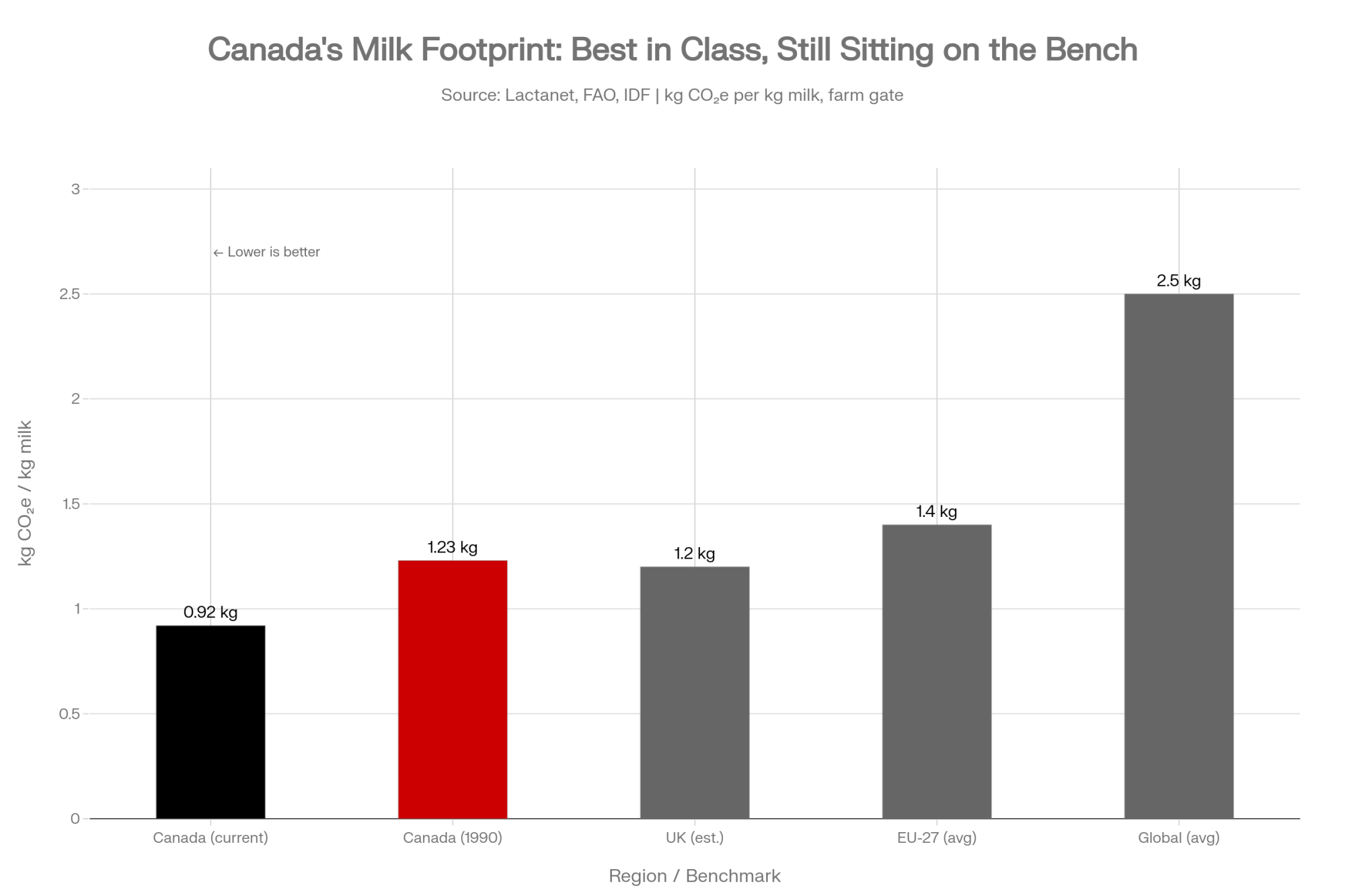
Here’s the irony that ought to sting. North American dairy already has the receipts to win the performance argument. Lactanet’s published figure puts the carbon footprint of Canadian milk at 0.92 kg CO₂-equivalent per kilogram at the farm gate — a 2016 analysis, down about 25% since 1990, with the whole sector under 1.3% of national emissions. That’s a Canadian number, though, built on a different life-cycle modeling approach than the U.S. uses — so don’t hand a U.S. buyer the Canadian stat and call it yours. The data’s sitting in PDFs while other people write the rules. 

Is the Performance Argument Actually Winnable?

On paper, yes. The Canadian footprint numbers, California’s methane trajectory, and the evidence on breeding efficiency give the sector a genuinely strong, data-backed case that efficient milk belongs on the land. 

But here’s the honest part. It’s only winnable if the industry shows up before the headcount framework hardens into law somewhere that matters to your exports. A 2024 Navius analysis for Canada found that capping emissions is the cheapest, most efficient way to cut farm climate impact, with a livestock cap as the next-cheapest option. Read that twice. The blunt instruments are already sitting on policymakers’ desks, scored as the cheap option. Receipts don’t argue for themselves. Somebody has to put them on the table. 

Is Your Bull Team Already Behind on Methane?

This is where the fork stops being a policy debate and lands in your sire selection — the exact decision our composite operator was sitting down to make. Lactanet’s modernized LPI now includes an Environmental Impact Index based on Feed Efficiency, Methane Efficiency, and Body Maintenance, initially released for Holsteins. And it’s not just a Canadian play: CDCB’s April 2025 Net Merit revision lifted Feed Saved to 17.8% of the index — up from 12% — while cutting Body Weight Composite, a shift The Bullvine has called a $57-per-point “weight tax” on big Holsteins. Both systems are actively refining these traits — Lactanet can now predict methane from milk spectral data at low cost across many cows. 

Here’s the part that should land with anyone staring at that $60–72/cow Bovaer gap: selecting for high-efficiency genetics carries a zero-cost premium. You’re already buying semen. Weighting Feed Saved and Methane Efficiency in your index costs nothing extra per straw, while the additive runs you up to $105 a cow every year it’s in the ration. One’s a recurring input cost. The other’s a free lever you’re either pulling or leaving on the floor. It won’t move your footprint this lactation — but the herd you breed this summer is the number you’ll hand a buyer in 2035.

Bovaer / Feed AdditiveGenetic Selection (Feed Saved / Methane Efficiency)
Annual cost per cow$93–$105 (current); ~$61 (future Dalry plant)$0 incremental over base semen cost
Index toolN/A — contract-basedLactanet EII, CDCB Net Merit (Feed Saved = 17.8%)
When benefit showsImmediately (current ration year)2030+ herd profile
ReversibilityEasy — stop the contractPermanent genetic change in herd
Regulatory statusEFSA review open (2026); Danish concerns on yield/healthNo regulatory risk; standard breeding practice
Stacks with each other?Yes — but gap must close firstYes — foundation layer regardless
Bottom lineOnly pencils if premium covers $60–72 gapFree lever — pull it now regardless of premium

Options and Trade-Offs for Your Operation

There’s no single right move here. A few clear paths, and which one fits depends on how exposed your milk is to export markets and tightening rules.

Get your own footprint number — start this month. Run a credible whole-farm emissions-intensity figure on a peer-reviewed tool, and pick the one built for your side of the border. In Canada, Agriculture and Agri-Food Canada’s Holosis a free whole-farm model that estimates your emissions and lets you test “what if I change feed or tillage” scenarios before you spend a dollar. In the U.S., the dairy-specific FARM Environmental Stewardship program — now running on the updated Ruminant Farm Systems model — gives a cradle-to-farmgate estimate that processors and co-ops already aggregate up the supply chain. For broader cropping and soil-carbon accounting, the USDA-backed COMET-Farm is the other free U.S. option. It costs you data you mostly already keep — milk records, ration, manure, energy — and the number is only as good as what you feed it. Do this one now; everything else sits on top of it. 

ToolGeographyWhat It CoversWho Uses ItCost
HolosCanadaWhole-farm: livestock, feed, manure, tillageSupply chain reporting, processor auditsFree (AAFC)
FARM ES / RuFaSU.S.Cradle-to-farmgate dairy; co-op aggregatedFARM-participating co-ops and processorsFree (NMPF)
COMET-FarmU.S.Soil carbon, cropping, some livestockMixed operations with significant row crop acresFree (USDA)
COMET-PlannerU.S.Conservation practice scenario modelingProducers evaluating cover crops, tillage changesFree (USDA)
⚠️ Cross-border warningCanadian 0.92 kg CO₂e stat uses different LCA methodology than U.S. toolsDo NOT use Canadian Lactanet figure for U.S. buyer claims

Breed for the efficiency traits — your slowest lever, so start early. Weight Feed Efficiency and Methane Efficiency in your sire selection this season. It fits every herd, carries no per-straw cost, and won’t dent production if you balance the index. The catch is time: you’re breeding for 2030 and beyond, not this year’s tank, so the longer you wait, the more ground you give up. 

Feed additives — a bet, not a margin play, until the premium moves. This one only pencils if a processor is actually paying enough to close that $60–72/cow gap, or a buyer’s spec sheet starts demanding it. You’d want the premium in writing — and, given the Danish reports and the open EFSA review, a hard look before you commit. Move early, and you’re wagering on where prices and premiums go, not banking a return today. 

The forward signal to watch sits on these paths, not in a crystal ball: if a food CBAM moves into “under review” with a date attached, or a major processor publishes an intensity benchmark with a number on it, the footprint path stops being optional and the additive path stops being a bet. 

Key Takeaways

  • If your milk touches an export market — directly or through your processor — get a credible whole-farm footprint number this quarter, because the first ask will be for data, not a tariff payment.
  • If you’re booking semen this season, weight Feed Efficiency and Methane Efficiency now; it’s a zero-cost lever, and the herd you breed today is the number you hand a buyer in 2035. 
  • If a processor offers you a sustainability premium, run it against the $60–72/cow gap before you sign — at an illustrative 12¢/cwt, the additive math still runs underwater. 
  • If you’re weighing a Bovaer-based methane-credit contract, watch how EFSA’s open 2026 review lands before committing; Danish farmer groups have raised yield and health concerns, while the maker and the FDA say it’s safe. 
  • If you operate in Canada, you’re sitting on a strong footprint number — 0.92 kg CO₂e/kg milk — but it only counts if the sector puts it on the table before the headcount framework hardens. 

Back to that semen order and the processor’s question nobody had a number for. Where does your own emissions-intensity figure sit right now — and could you produce it tomorrow if a buyer asked? Most operations couldn’t, and that’s the real exposure, not a viral screenshot about a vote that never happened the way the post claimed.

We ran the simple version of the barn math here. If you want the full model — additive cost curves, premium break-even by herd size, and what a food CBAM would actually do to Canadian and U.S. export margins — that’s the deeper Tier 3 economics piece, and the running numbers land in The Bullvine Weekly newsletter as Carbon Budget 7 moves from vote to delivery plan. 

Run Your Numbers

Component Value Tracker — Before you sign a sustainability premium against that $60–72/cow Bovaer gap, run the Component Value Tracker. Its nutrition break-even module pressure-tests whether an additive clears your real component prices, and the sire module prices fat and protein per daughter so your breeding lever earns its keep.

Complete references and supporting documentation are available upon request by contacting the editorial team at editor@thebullvine.com.

Learn More

The Sunday Read Dairy Professionals Don’t Skip.

Every week, thousands of producers, breeders, and industry insiders open Bullvine Weekly for genetics insights, market shifts, and profit strategies they won’t find anywhere else. One email. Five minutes. Smarter decisions all week.
NewsSubscribe
First
Last
Consent

Producers Fight Over Bovaer. The Cheaper Fix Is on the Breeding Sheet

Bovaer can leave $73 a cow uncovered once the carbon math clears. Meanwhile, a low-methane sire costs nothing extra and compounds every generation — and it’s already on your 2026 list.

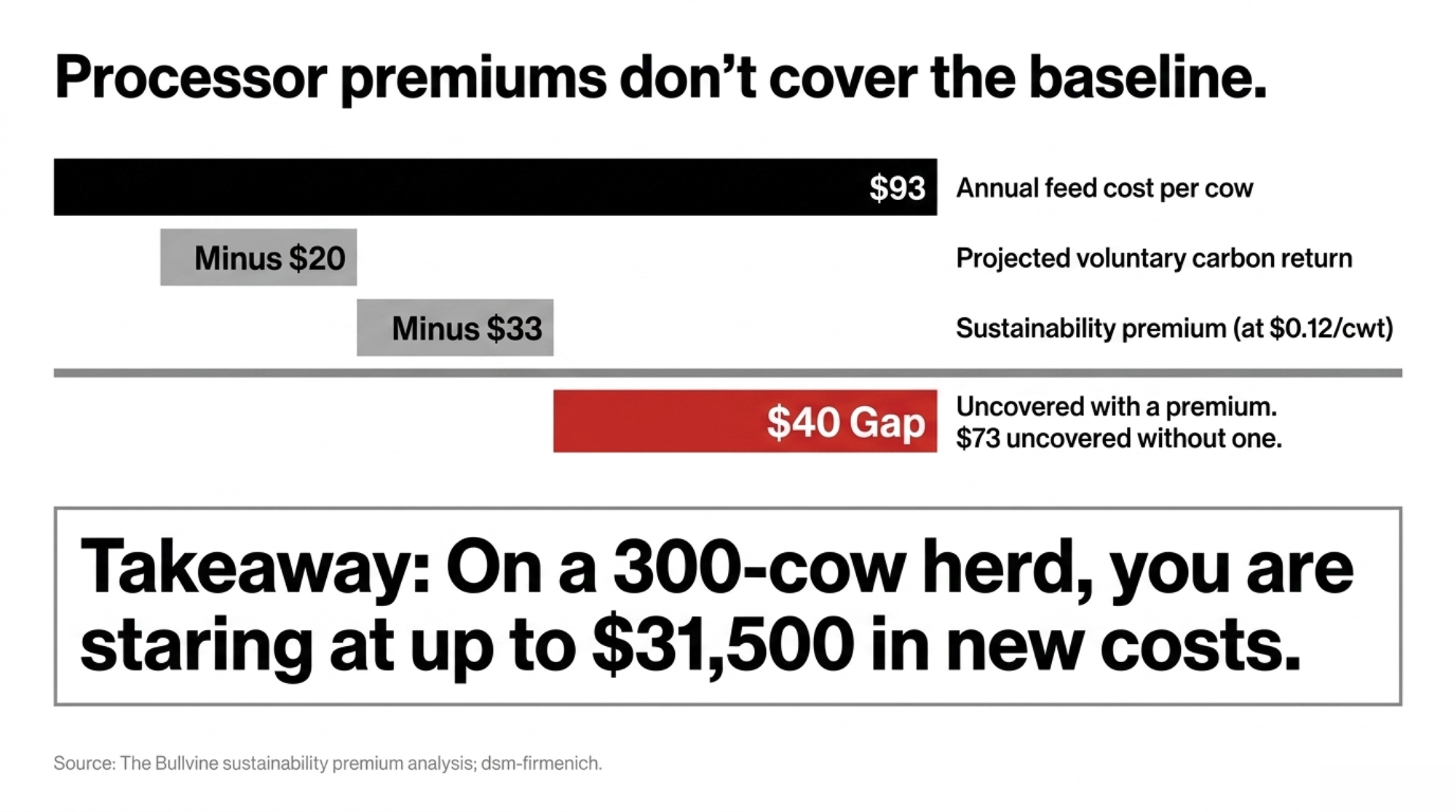
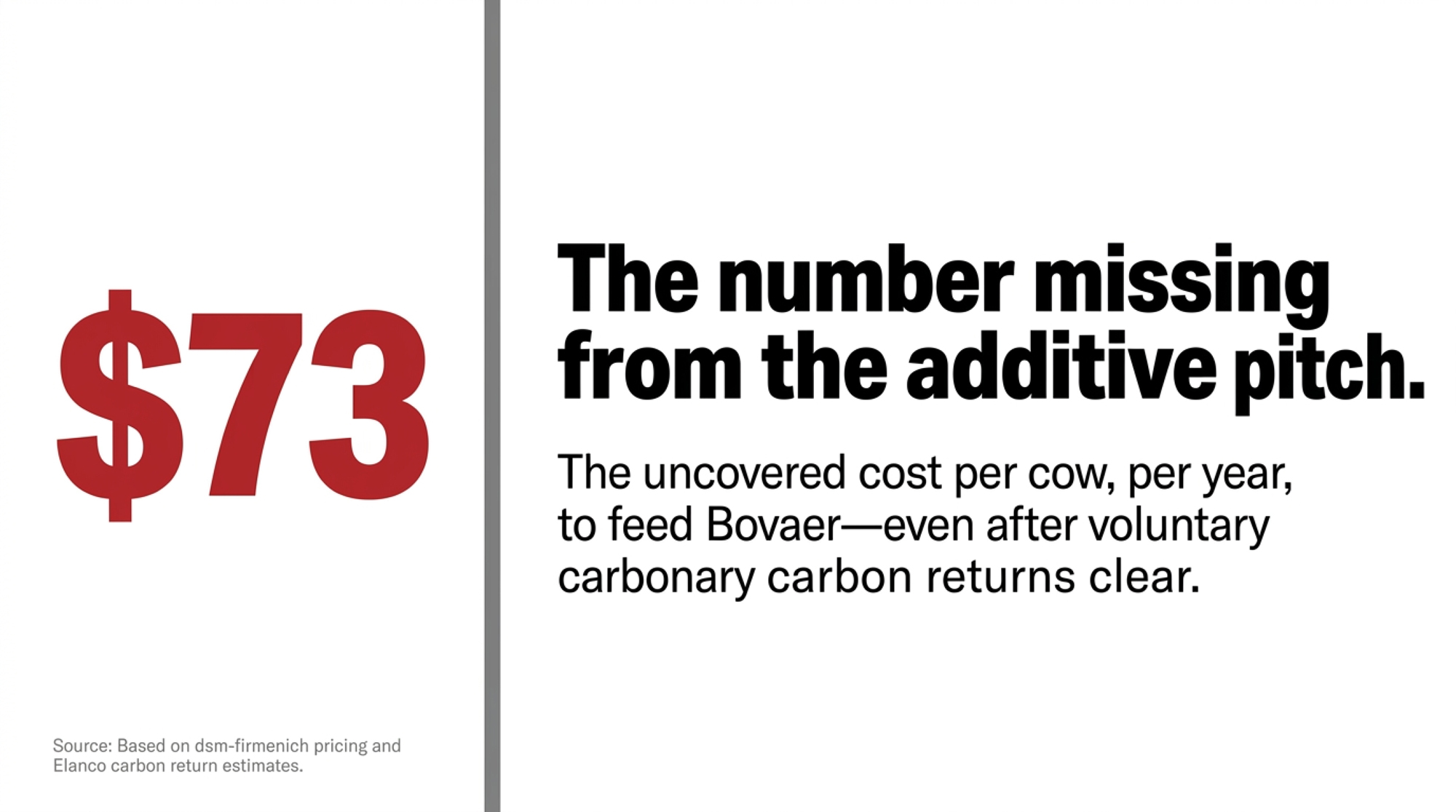
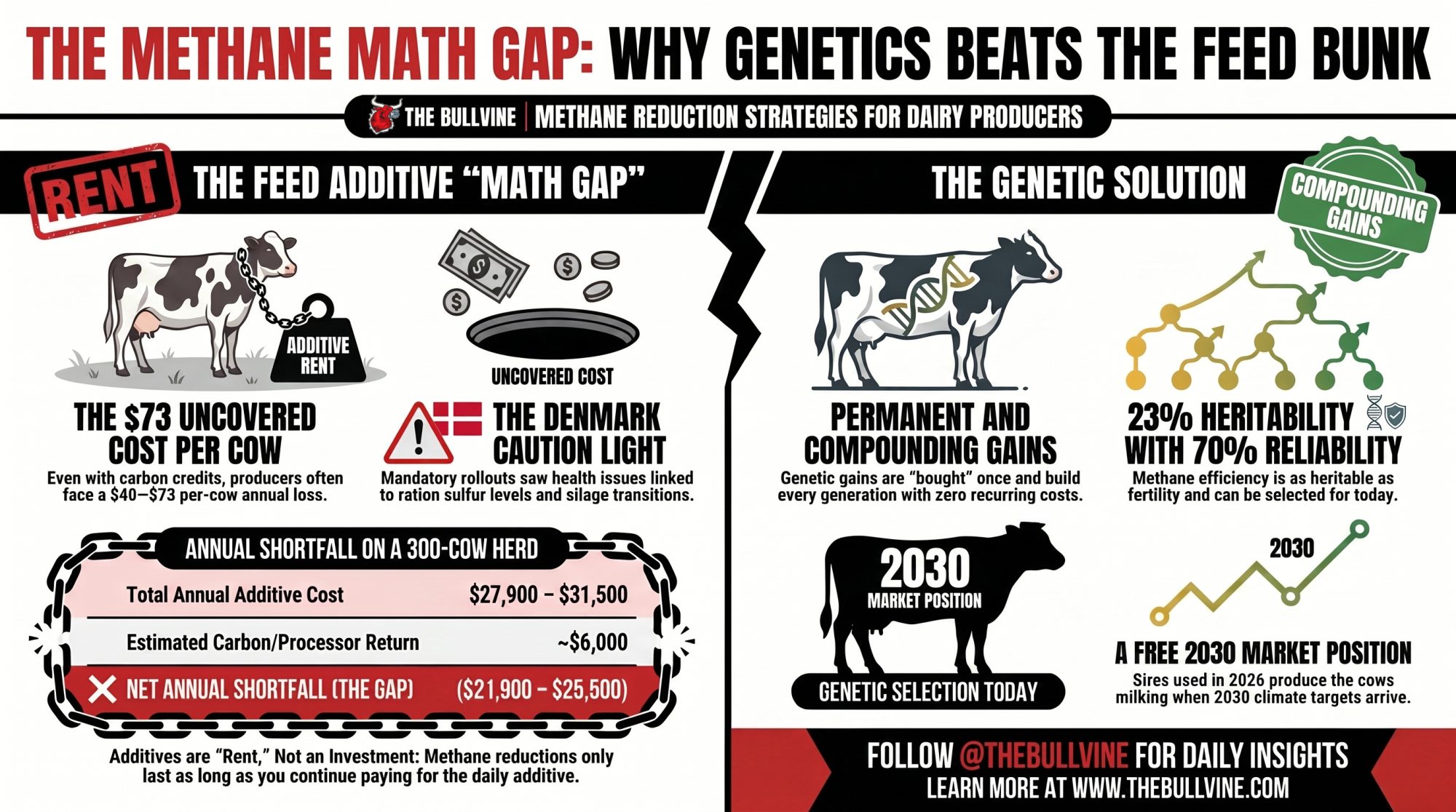
Executive Summary: A 300-cow herd feeding Bovaer is looking at $27,900 to $31,500 a year in new cost — and once the carbon return clears, the math can still leave roughly $73 a cow uncovered without a processor premium, or about $40 with one. That’s the gap nobody puts on the pitch slide, and it’s why the loud fight over feed additives is the wrong fight. The cheaper methane lever is already sitting on your 2026 sire list: Lactanet’s Methane Efficiency trait runs 23% heritability with 70%-plus reliability on genotyped young animals, costs nothing extra on DHI-enrolled females, and compounds every generation instead of renting you a cut for as long as you keep paying. The timing is the kicker — sires you use in 2026 throw heifers that milk into the early 2030s, right when 2030 buyer targets decide whether “low-methane milk” earns a premium or eats a penalty. Bovaer’s still a legitimate tool for stable TMR herds with a real premium behind it, but treat Denmark as a rollout warning: watch ration sulphur, silage timing, and transitions, because that’s where the trouble showed up. Do nothing, and you’re not playing it safe — you’re choosing to negotiate from a blank page when methane lands in your milk contract. Filter your next round of sires above 100 for Methane Efficiency without dropping your core index, and you’ve built a 2030 position for free.

methane efficiency breeding

In Denmark this past winter, farmers who’d been ordered to feed Bovaer started calling their vets about cows going off feed. One veterinarian told Farmers Forum that the additive “affected every herd” in her area. By November 2025, a SEGES Innovation survey of the country’s conventional dairy farms had drawn several hundred responses, and the majority reported a drop in milk yield — figures first surfaced in investigative reporting by Undark Magazine and Farmers Forum. That’s the methane headline scaring everybody.

Here’s the one nobody’s running. While the industry fights about a feed additive, the cheapest methane tool you own is already sitting on your 2026 sire list. And almost nobody’s calling it a methane decision.

What’s Really at Stake When the Processor Calls

When a processor rep starts talking methane commitments and premiums, the surface conversation is climate. The real conversation is risk, market access, and who ends up owning the carbon story.

The processor is trying to de-risk its Scope 3 footprint and hit a branded climate target. Danone committed in January 2023 to a 30% absolute cut in methane from its fresh milk supply by 2030, and its own Dairy Methane Action Plan reported a 25.3% reduction versus the 2020 baseline by 2024 — including a 13.9% drop in the single year from 2023 to 2024. A company moving that fast doesn’t get there without eventually sorting its suppliers. You’re on the other side of that table, working out whether the premium covers the cost — or whether you’re signing into someone else’s program economics.

One number reframes the whole exchange. The Innovation Center for U.S. Dairy’s national life cycle assessment puts U.S. dairy at roughly 2% of total U.S. greenhouse gas emissions, across every stage. Read it for what it is — a market signal, not an ecological emergency — and methane becomes something to time and negotiate, not panic over.

The Productivity Story Nobody Puts in the Pitch

Before anyone sells you the next reduction, remember how the first one happened. U.S. dairy already did the hard part, the unglamorous way.

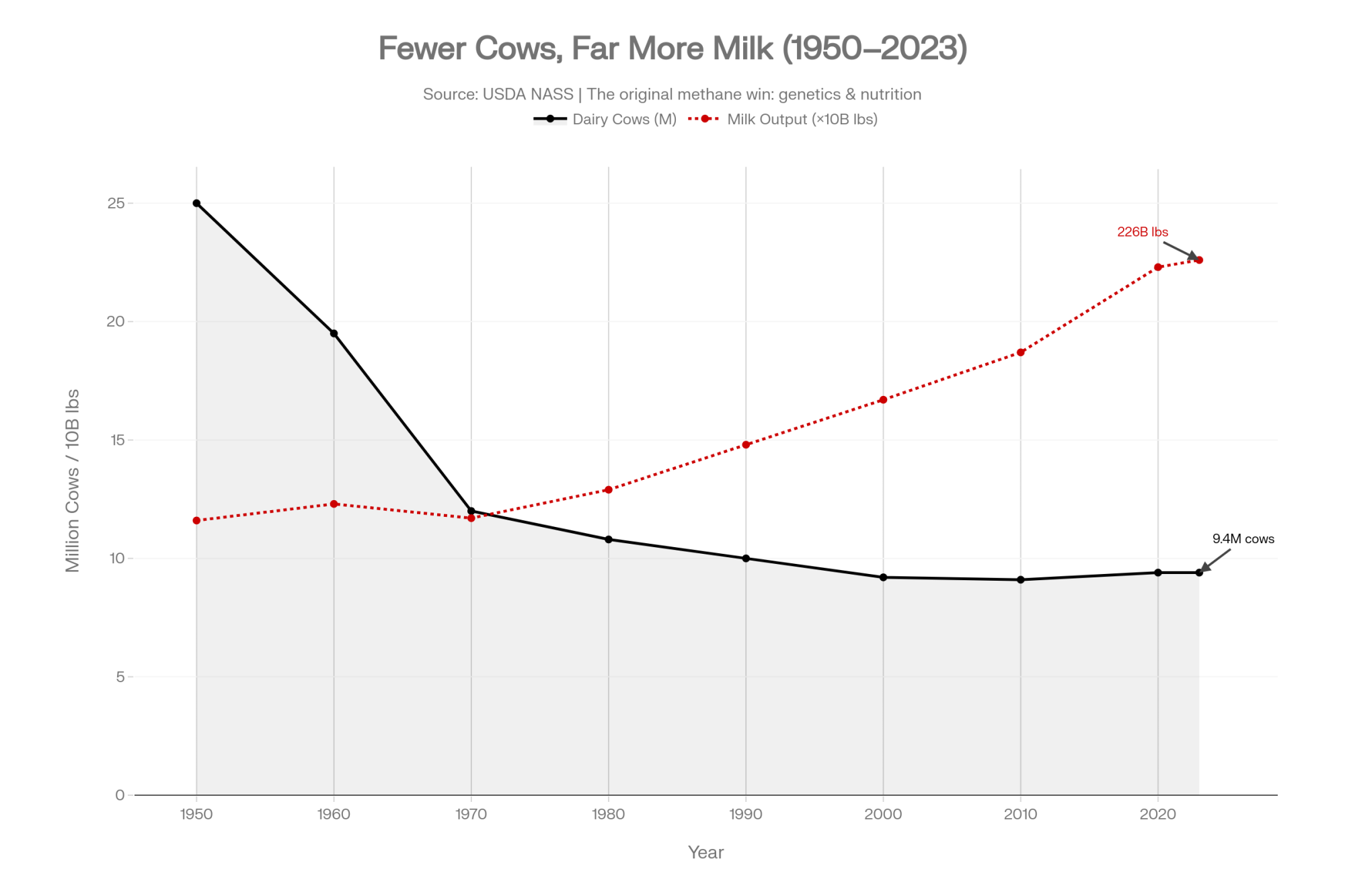
The national herd dropped from about 25 million cows in 1950 to roughly 9 million today, while total milk output climbed. Per kilogram of milk, the greenhouse gas footprint fell by roughly half over those seventy years. None of that came from a feed additive. It came from genetics, nutrition, reproduction, and culling — the same levers you’d pull in a rough milk-price year.

So here’s the first honest move. The work that lowers methane per hundredweight is the same work that protects your margin. It’s the bedrock under any methane score or premium that shows up later, and you’d be doing it anyway.

The Denmark Caution Light — and How to Read It Right

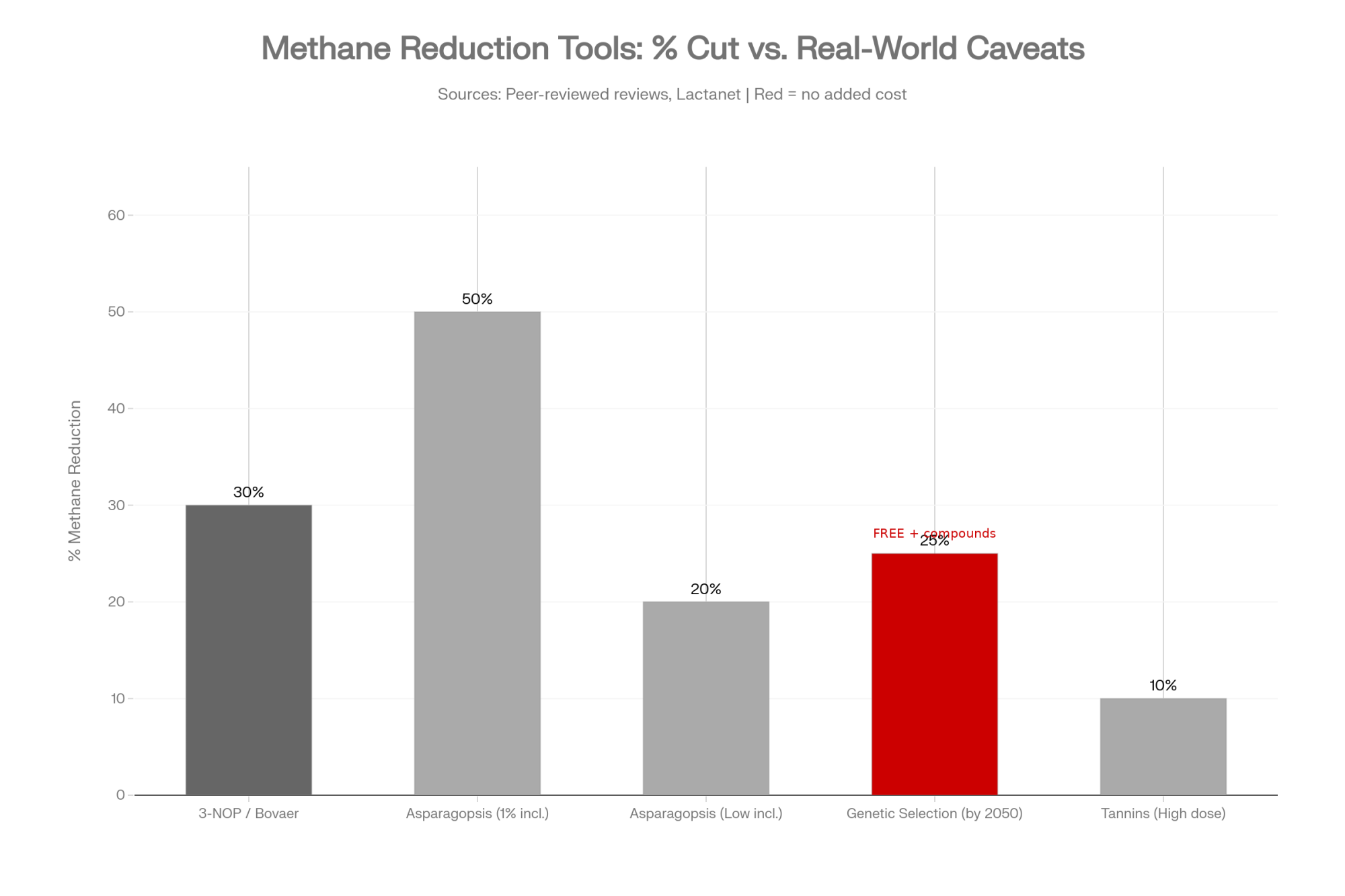
Back to the additive everyone’s actually asking about. The peer-reviewed record on 3-NOP — the active ingredient in Bovaer — is genuinely strong. A 2025 review found that 3-NOP cuts methane by roughly 30% in dairy cattle at an average dose of around 70 mg/kg of dry matter, with no effect on milk production. A full-lactation study in the Journal of Dairy Science (van Gastelen et al., 2024, Vol. 107) followed Holstein-Friesians over a full year and reported reductions of 21% in daily methane, 20% in methane yield, and 27% in methane intensity — with a positive effect on production characteristics.

So why the alarm bells out of Europe?

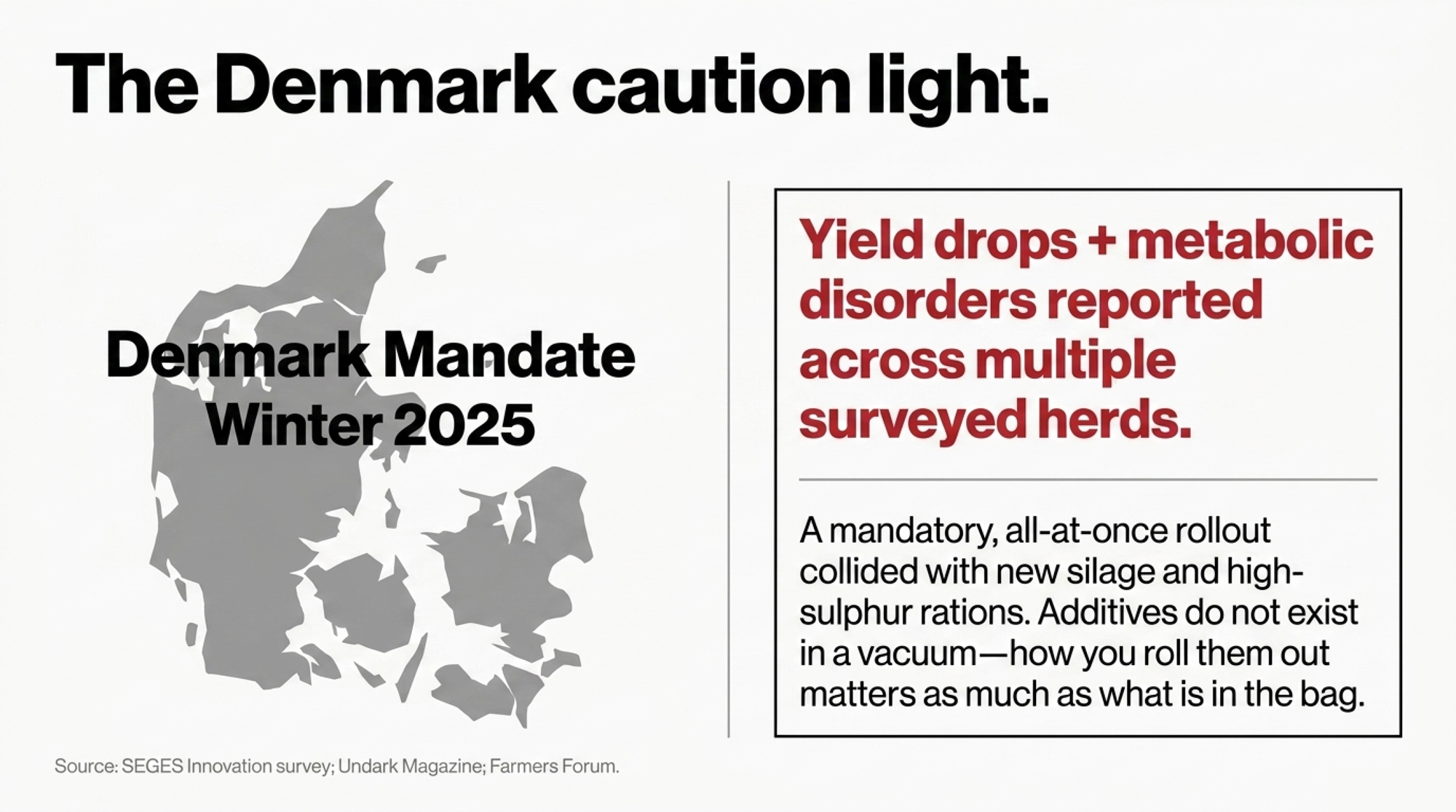
Denmark mandated methane-reducing feed changes, and most farms started Bovaer around October 1, 2025. The reports were serious enough that in February 2026, the European Commission directed EFSA to reopen its safety review of Bovaer in dairy cows. In that SEGES survey, alongside the herds reporting lower yield, a comparable share reported digestive and metabolic disorders. EFSA opened a public call for data with a March 31, 2026, deadline.

The manufacturer pushes back hard, and fairly. dsm-firmenich says there’s “absolutely no evidence that Bovaer is a cause of any problems,” that the additive is almost entirely metabolized in the rumen and doesn’t show up in milk or meat, and that Elanco hasn’t seen these issues in the more than 150,000 U.S. lactating cows fed Bovaer since launch. SEGES itself flagged a statistical link between the Danish health reports and high-sulphur rations — specifically rapeseed, far more common in Danish diets than in North American TMRs.

So the honest read isn’t “Bovaer is dangerous.” It’s that nobody had ever stress-tested it this way — mandatory, all at once, into rations where farms were opening new silage and running high-sulphur diets the same week. EFSA’s earlier opinion deemed it safe at the maximum recommended level; the U.S. FDA cleared it for lactating dairy cattle in 2024; and Aarhus University’s controlled trials “showed the desired methane-reducing effect without any signs of disease.” The product stays approved in more than 70 countries at recommended doses. The Danish data is real and worth respecting. It just landed in the messiest possible rollout conditions.

FactorControlled Trials (Peer-Reviewed)Denmark Rollout (Oct 2025)
Methane reduction21–30% (JDS 2024; 2025 review)Not measured systematically
Milk yield effectNo significant impactMajority of SEGES survey farms reported drop
Health incidentsNone in controlled conditionsDigestive/metabolic disorders widely reported
Ration contextControlled, optimized TMRHigh-sulphur rapeseed diets; new silage opening same week
Sulphur interactionNot studied at scaleSEGES flagged statistical link to high-sulphur rations
Animals affectedResearch herds, managed transition“Affected every herd” (vet report, Farmers Forum)
Regulatory responseApproved in 70+ countriesEFSA reopened safety review, Feb 2026
Manufacturer positionExtensive global safety data“No evidence Bovaer is the cause” — dsm-firmenich
North American relevanceFDA cleared for U.S. lactating cows (2024)Rapeseed diets rare; risk profile lower but not zero

The lesson for a North American TMR herd is blunt. Additives don’t exist in a vacuum, and how you roll one out can matter as much as what’s in the bag.

The Math That Actually Decides It

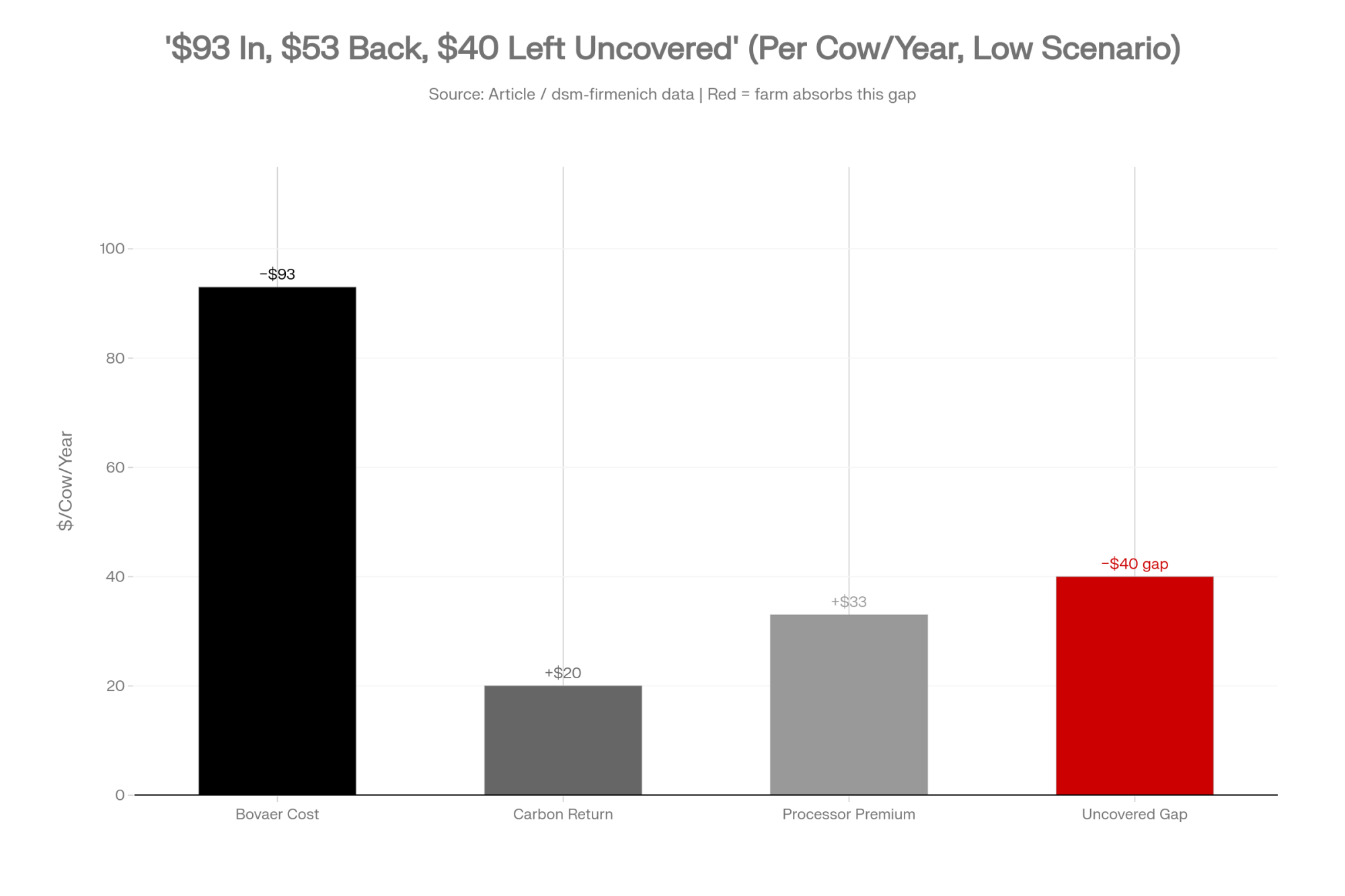
Strip away the safety drama, and 3-NOP comes down to barn math. Bovaer runs roughly $0.30–$0.40 per cow per day. dsm-firmenich pegs the cost at about $93–$105 per cow per year on a lactating-cow basis — close to a cent per litre. The two numbers don’t line up at a glance because the annual figure reflects a lactating-cow feeding window, not a flat 365 days. Confirm the feeding-day basis your supplier is quoting before you budget. On a 300-cow herd at that annual rate, you’re staring at roughly $27,900 to $31,500 in new costs. One caveat in your favor: a new manufacturing plant in Dalry, Scotland, is projected to bring the cost down over time, so this gap should narrow.

The return side is thinner than the pitch suggests. Elanco estimates Bovaer could return “$20 or more per lactating cow per year” through voluntary carbon markets, conservation funds, or processor incentives — call it roughly $6,000 back on those same 300 cows, and remember that’s a projection, not a guarantee. The Bullvine’s own analysis found a $0.12/cwt sustainability premium recovers only about $33 per cow per year on a 75-lb cow.

Now do the arithmetic, because nobody argues with their own arithmetic. With a premium stacked on carbon ($93 cost − $20 carbon − $33 premium), you’re leaving roughly $40 per cow uncovered. With no premium at all — just the carbon return against the cost — the hole runs from about $73 per cow at the low end of the cost range, and widens if you’re paying at the top of the range. That $73 floor is the number behind this story’s headline, and it’s the scenario many producers are actually facing.

That’s the figure for the farm-office wall. Before you sign anything, ask three questions. What does it cost per cow? What am I guaranteed per cow or per hundredweight in return? And how long does the contract lock? Everything else is marketing.

Can a Sire Decision Really Be a Methane Decision?

Here’s where the slow, cheap lever lives — the one almost nobody frames this way.

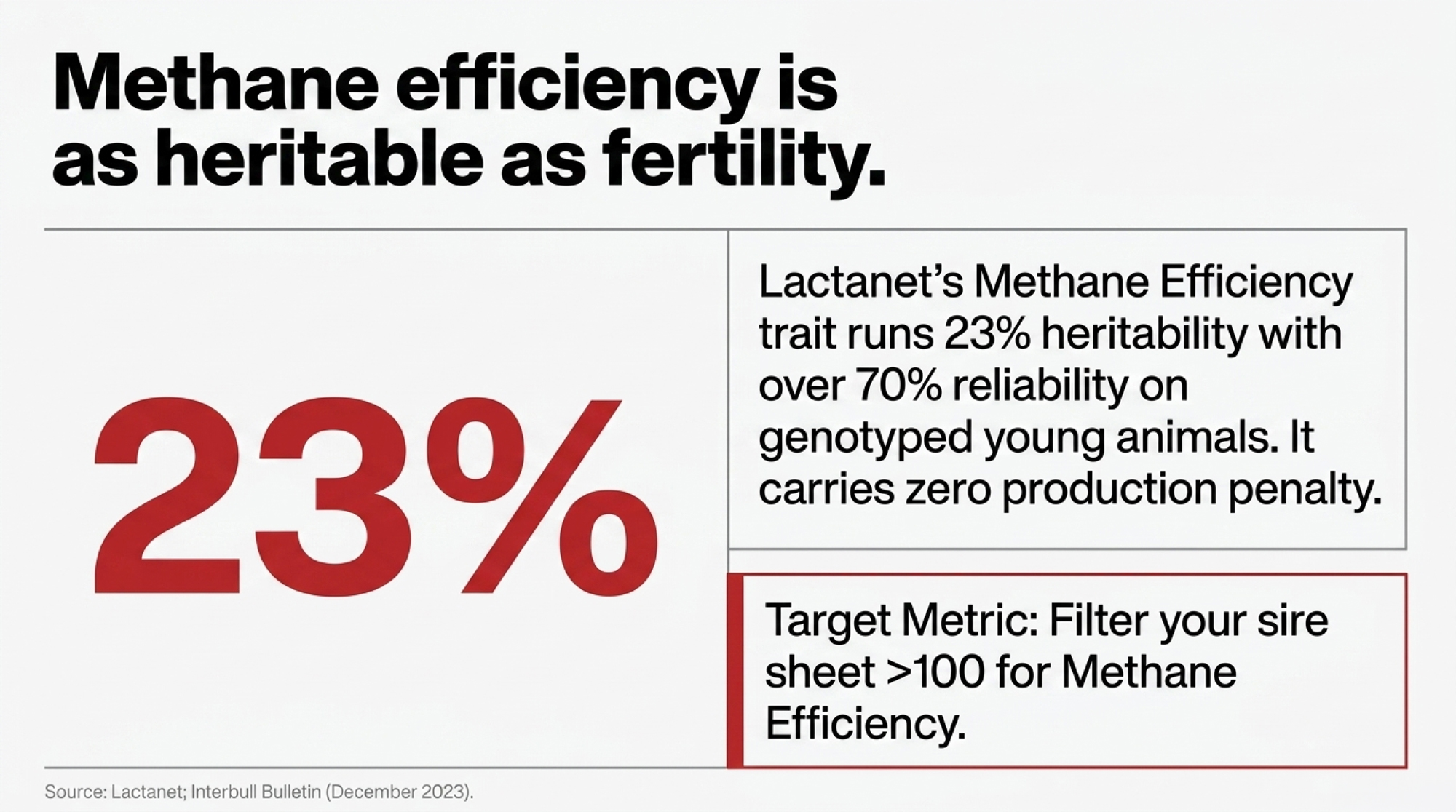
Methane is heritable. Lactanet pegs the heritability of its milk-MIR-predicted methane trait at 23% (0.23), with average reliability surpassing 70% for genotyped young bulls and heifers — figures published in Lactanet’s own trait documentation and the peer-reviewed implementation paper in the Interbull Bulletin (December 2023) and JDS Communications (2024). That’s right in the range of traits like fertility, and the genetic correlation with production is weak, so you can select for lower methane without giving up milk, fat, or protein. Lactanet has also reported a slight positive correlation between its Pro$ index and Methane Efficiency, suggesting that lifetime profit and a lower methane footprint aren’t at odds.

This isn’t theoretical anymore, and it’s exactly where Canadian breeders have an edge. In April 2023, Lactanet became the first organization in the world to publish official Methane Efficiency genetic evaluations for the Holstein breed, expressed as Relative Breeding Values (RBVs) built on milk mid-infrared spectroscopy data. The trait was then folded into the modernized LPI’s new Environmental Impact subindex in April 2025. Lactanet projects genetic selection can deliver a 20–30% methane reduction by 2050 with no production penalty, and calls it “a permanent and cumulative solution.” VikingGenetics has since followed with a Nordic Methane Index, and CRV in the Netherlands with Methane Saved. If you already read proofs and rank bulls by index, you can act on this today — while operations that only consider methane a feed-bunk problem are still waiting on the next additive trial. For how the trait slots into the indexes you already use, see our breakdown of the April 2025 LPI overhaul.

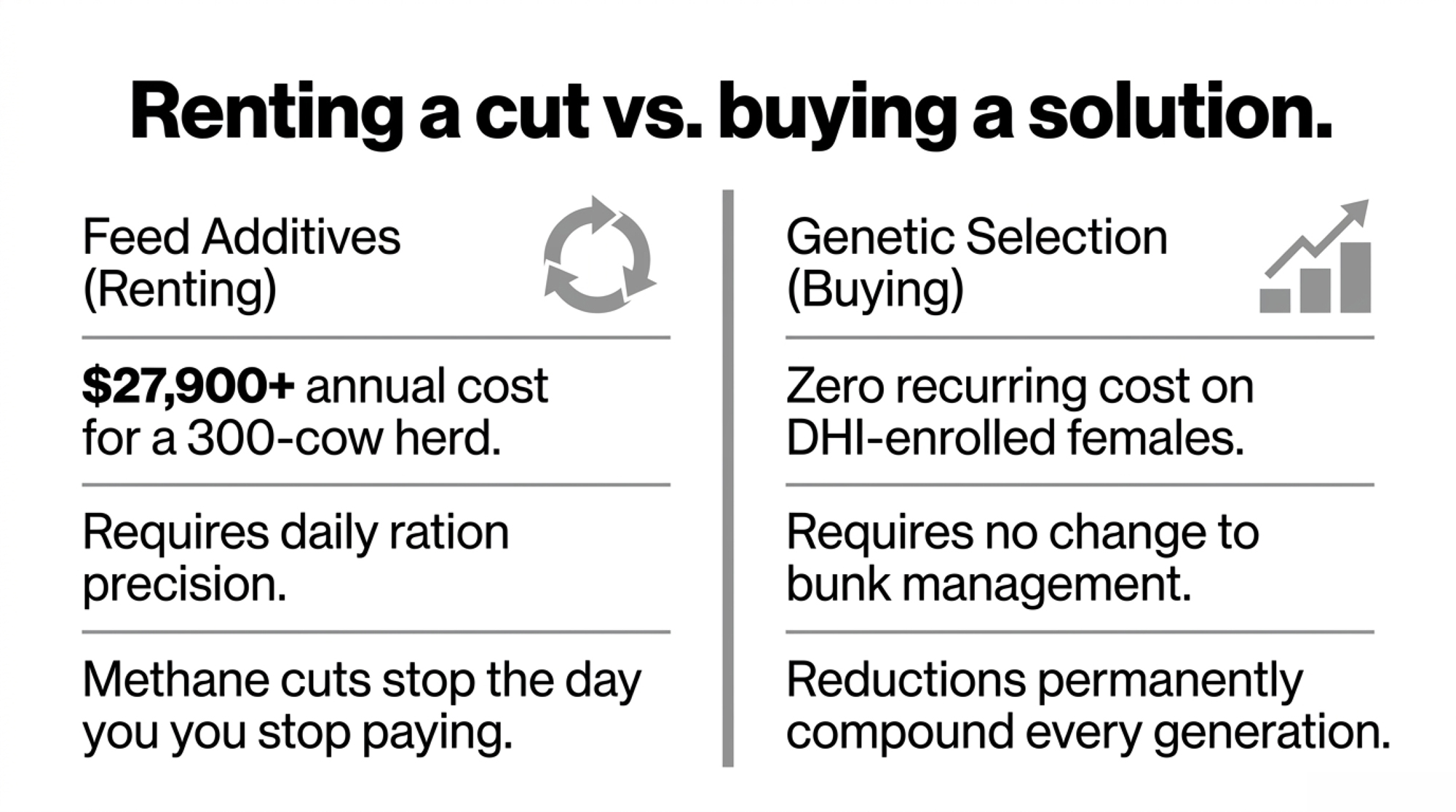
This is pay-now or pay-later in one decision. The additive is rent — you cut methane only as long as you keep paying. Genetics is a purchase. You build the reduction into the animal once, the recurring cost is zero, and the gain compounds every generation.

MetricBovaer (3-NOP)Genetic Selection (Methane Efficiency RBV)
Annual cost/cow$93–$105$0 (DHI-enrolled females)
Methane reduction~30% per peer-reviewed averageProjected 20–30% by 2050
HeritabilityN/A — not heritable23% (h²) — permanent in animal
Reliability on genotyped animalsN/A>70%
Effect durationLasts only while fedCompounds every generation
Production penalty?None in controlled trialsNone — weak genetic correlation with milk
Requires stable TMR?Yes — ration-sensitiveNo — works in grazing systems
Compounds over time?No — rent modelYes — purchase model
Cost if you stop payingReturns to baseline methaneGain is permanent in progeny
2030 market positioningReady now, ongoing cash outCalves of 2026 sires milk in early 2030s

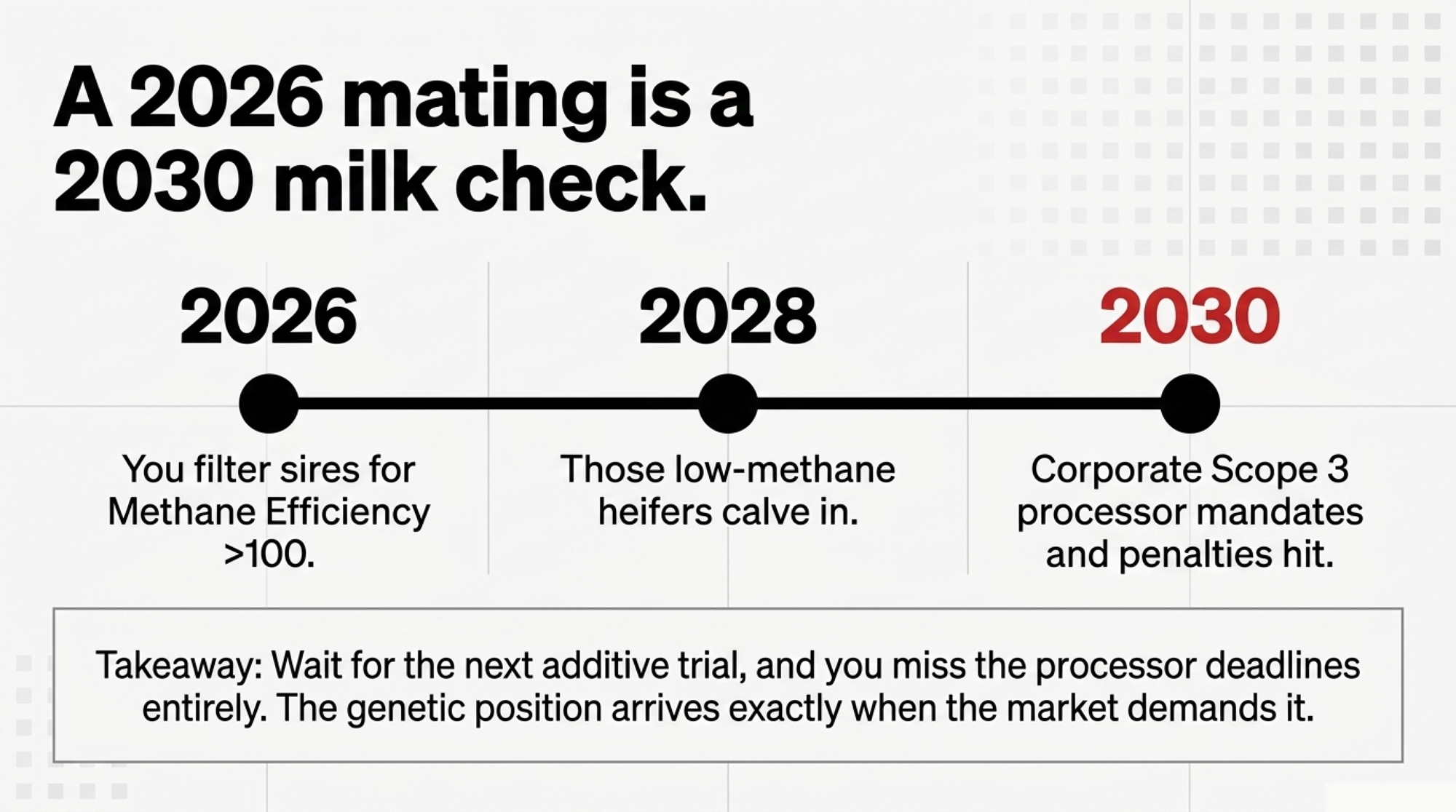
And the timeline is the part that should keep you up at night. A sire you use heavily in 2026 throws calves in 2027. Those heifers calve in 2028–2029 and milk into the early 2030s — right when 2030 buyer targets bite and “low-methane milk” is most likely to carry a premium or a penalty. Your 2026 sire decision is a 2030 market-positioning decision wearing a production hat. The calf check on the additive shows up now; the genetic position shows up exactly when the market starts paying for it.

Your next mating session, do this: pull up your genomic sheets and find the Methane Efficiency value (the RBV in Canada; watch for the equivalent line as U.S. and Nordic evaluations roll out). Screen out the high-methane tails and weight toward bulls sitting clearly above the breed average — above 100 — for Methane Efficiency, without dropping your core economic index, whether that’s Pro$, LPI, NM$, or TPI. In Canada, those values are already published free of charge for every Holstein female in your DHI herd inventory; for cows and heifers outside it, Lactanet sells the bundled Methane and Feed Efficiency evaluation at $8 per animal, with a $2 credit for type-classified herds.

Lab Coat or Barn Coat: Sorting the Rest of the Toolbox

The rest of the buzz sorts cleanly into what you can feed tomorrow, what you watch for two years out, and what you ignore until the science catches up.

ToolVerdictWhat the data showsThe catch
TanninsFeedable now, modestly2024 meta-analysis: ~10% cut in enteric methane and methane yieldOnly works at high effective doses (above ~8,000–10,000 mg/kg DM); sub-therapeutic doses do little; most robust data is from beef
Asparagopsis seaweedWatch, don’t bet~20% reduction at low inclusion, 50%+ at 1% inclusionThe biggest cut came with a milk-yield penalty (Roque et al., 2019); high cost, bromoform variability, supply and regulatory hurdles
Methane vaccineIgnore for budgetingNZ’s AgResearch targeting at least 20% reduction with no system changesOnly in-vitro antibody responses so far; no consistent live-animal methane drop; 5–10 years out

The seaweed and vaccine numbers that headline conference slides mostly come from short beef trials, in-vitro work, or aspiration — not from multi-lactation dairy data. Worth knowing. Not worth betting the barn on yet.

What This Means for Your Operation

Pick the path that fits your system, then run the check beside it before you commit a dollar.

Farm TypePrimary LeverSecondary LeverWatch Out ForMethane Cost (Year 1)
Stable TMR, processor premium3-NOP (Bovaer) + genetics filterCarbon program enrollment$40–$73/cow gap if premium doesn’t cover cost; ration sulphur$93–$105/cow
Stable TMR, no processor dealGenetics filter (Methane RBV >100)Efficiency + reproduction disciplineSigning for optics before math pencils$0 extra
Grazing / high-forage systemGenetics — only viable daily leverTannins at effective dose if set up for itDaily additives impractical without individual feeding$0 extra
All farm types — baselineCulling + reproduction + feed efficiencyMethane RBV filter on sire listDoing nothing = price taker when methane hits your contract$0 extra
  • Default path — efficiency plus genetics. Fits nearly every herd, any size. No new product spend, just discipline on reproduction, culling, and feed efficiency, plus a methane filter on the sire list. The gains are slow and won’t satisfy a processor wanting cuts this quarter — but they cost nothing extra and compound for a decade. Check: Does your mating program have a methane filter on it yet? If you’re in Canada, are you pulling the Methane Efficiency RBVs already sitting free on your DHI-enrolled females?
  • Conditional path — 3-NOP. Makes sense for stable TMR herds with a premium or carbon program that genuinely narrows the $40–$73 gap. Demands ration precision and careful transition timing. Where it backfires: signing for the optics, feeding it through silage changes, or believing in a flat 30% forever. Check: Have you run your own cost-per-cow against a guaranteed premium or credit, not a projected one? What’s written into your processor agreement, and how long does any premium lock last? If the rep pitches “30% forever,” ask for the 18-month data in a herd like yours. That dataset barely exists.
  • Stacking path — tannins, and a note for grazers. Sensible for high-forage or grazing systems already set up for tannin inputs, but only at effective doses. Check: If you graze, are you leaning on genetics? Daily additives aren’t practical for animals you don’t feed individually, which makes the sire list your main lever, not your backup.
  • The data question that cuts across all three. Are you capturing the production, intervention history, and methane intensity that a future premium will make you prove? Here’s how carbon insetting actually pays producers.

Key Takeaways

  • If you do nothing else, bank the free gains. Efficiency plus a light methane filter on your sire list costs nothing extra and compounds for a decade.
  • If a processor pitches a premium, run the gap math first — additive cost minus guaranteed return. If it leaves a $40–$73 gap per cow, or wider at the top of the cost range, don’t sign for the optics.
  • If you’re on a stable TMR and the numbers pencil, 3-NOP is a legitimate tool — but treat Denmark as a rollout warning, not a verdict: watch ration sulphur, silage timing, and transitions.
  • If you farm a grazing system, your methane plan is genetics, full stop — daily additives don’t fit animals you don’t feed individually.

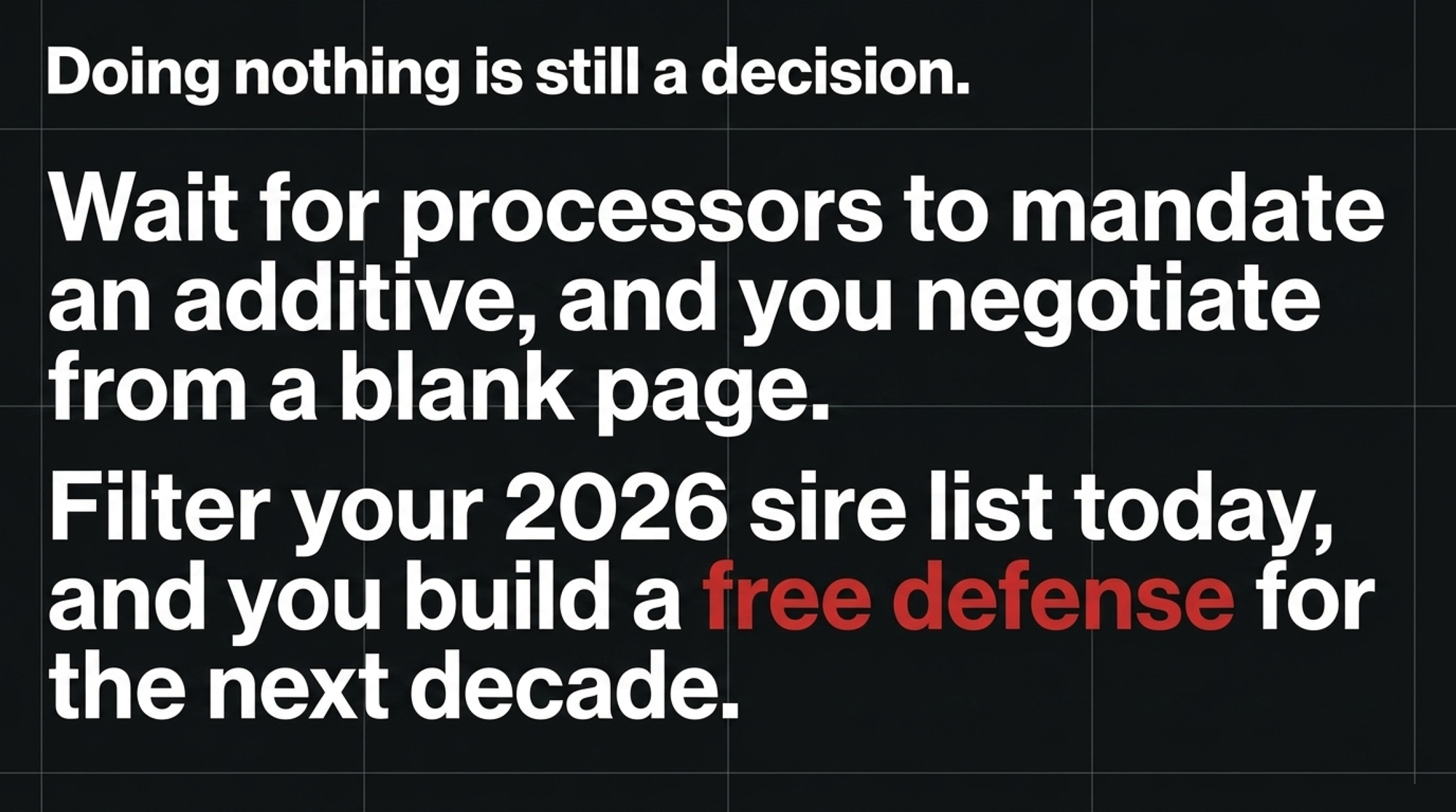
The Danish farmers calling their vets didn’t get a say in how that additive landed in their bunks — the mandate decided for them. You still get the say. Doing nothing feels safe at the kitchen table tonight, but it’s still a decision: you’re choosing to be a price taker when methane lands in your milk contract, negotiating from a blank page while the neighbor walks in with a genetic trajectory and verified numbers. The cheapest move on the board costs you nothing this year and builds for a decade. So the real question isn’t whether you trust the Bovaer rep. It’s whether you’ll let your 2026 sire list do the quiet work while everyone else argues about the additive.

Run Your Numbers

Genomic Testing ROI Calculator — Before you bank on Methane Efficiency as a free lever, run the genomic numbers. The calculator pressure-tests whether testing and sorting your heifers actually pays once raising cost, quartile value spread, and beef-on-dairy outs are counted — so you know the genetic play pencils before the additive rep ever calls.

Complete references and supporting documentation are available upon request by contacting the editorial team at editor@thebullvine.com.

Learn More

The Sunday Read Dairy Professionals Don’t Skip.

Every week, thousands of producers, breeders, and industry insiders open Bullvine Weekly for genetics insights, market shifts, and profit strategies they won’t find anywhere else. One email. Five minutes. Smarter decisions all week.
NewsSubscribe
First
Last
Consent
Send this to a friend