




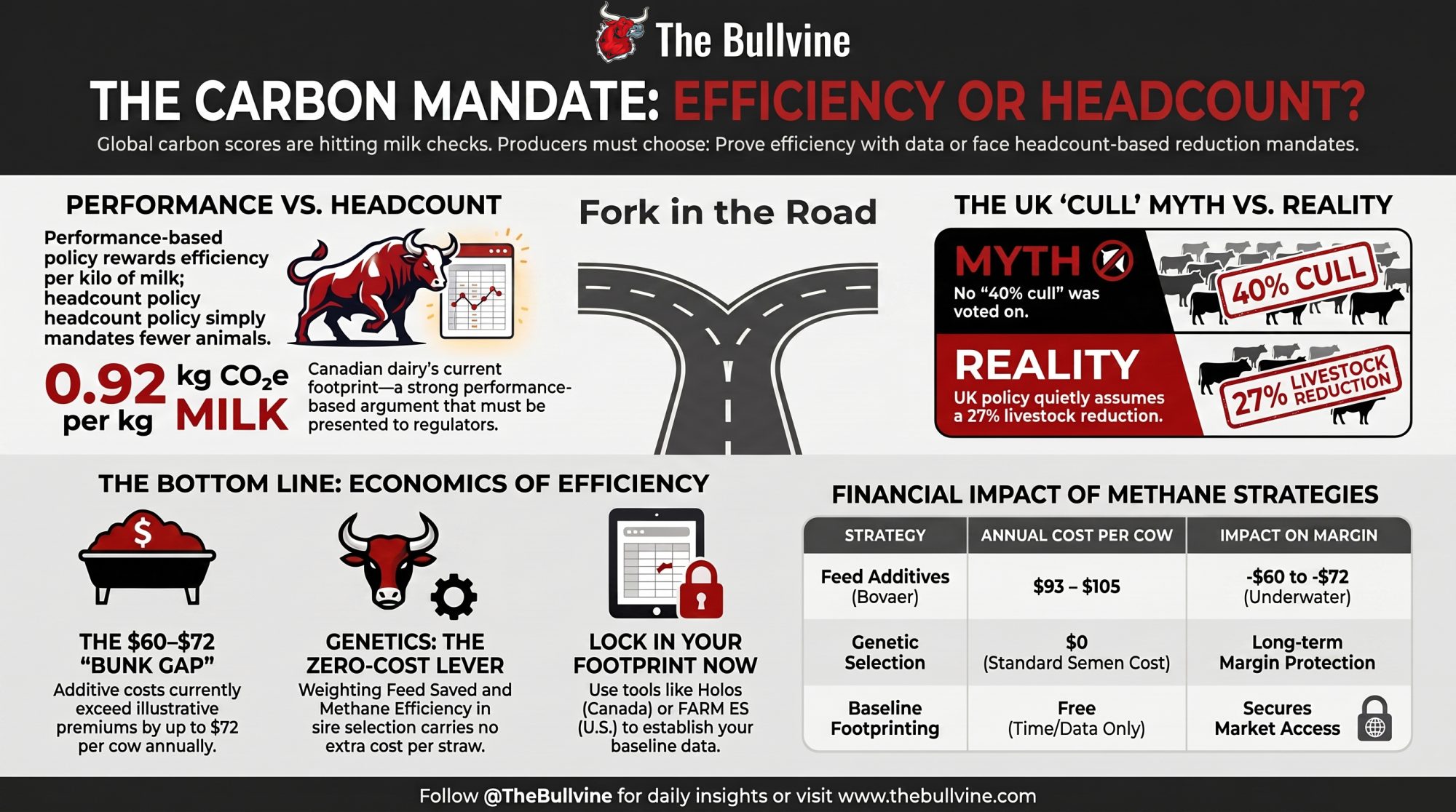
MPs did vote on Britain’s carbon budget. The panic headline was wrong—but the 27% herd cut it quietly assumes can still land on your milk cheque.
Executive Summary: Britain’s new carbon budget quietly assumes a 27% cut in cattle and sheep by 2040, and MPs just voted to legislate it, even though nobody voted to “cull 40% of cows.” That framework is already pushing toward North American barns through processor demands for farm‑level carbon footprints, not through tariffs first. On the feed side, chasing methane reduction with Bovaer currently runs about $93–$105/cow/year against an illustrative 12¢/cwt premium worth only ~$33/cow, leaving you roughly $60–$72/cow underwater unless someone else pays the difference. At the same time, genetic tools like Lactanet’s Environmental Impact Index and CDCB’s Net Merit revision now weight Feed Efficiency, Methane Efficiency, and Feed Saved heavily — a zero‑cost premium if you actually use those traits when you pick bulls. The opportunity is to lock in your own whole‑farm footprint number within the next 30 days using Holos, FARM ES/RuFaS, or COMET-Farm, and start shifting sire selection toward efficiency so you can argue for performance rather than headcount as buyers and regulators tighten rules. The risk is signing methane‑credit or additive contracts that look green on paper but quietly shave tens of dollars per cow off your margin every year while policymakers find it cheaper to cap animals than reward efficient milk.
Editor’s Note: The producer described in this article is a composite scenario modeled from typical mid-size Ontario and Upper-Midwest dairy operations, not a single named individual. All policy, economic, and genetic figures are real and sourced.
Picture a 250-cow operator somewhere between Listowel and Fond du Lac, sitting down this spring to book semen. The milk’s been shipping fine. Then the processor’s field rep asks a question that wasn’t on last year’s list: what’s the carbon footprint of your milk? No number ready. And no clear idea why the question suddenly matters. That’s the moment this story is really about — because the reason that question is landing in North American barns traces straight back to a document most producers have never read.

A screenshot circulated in the farm group chats claiming that UK MPs had voted to legislate a 40% cut in cattle by 2040. It traveled fast — that kind of number always does. Here’s the twist: MPs did vote on the carbon plan in late June, but nothing in it culls a cow. The “40% cull” part is invented.
That document is the UK Climate Change Committee’s Seventh Carbon Budget — and what it actually says matters more to your milk cheque than any screenshot.
What the Document Actually Says
The Climate Change Committee — the CCC — is the UK government’s statutory climate advisor. Its Seventh Carbon Budget covers 2038 to 2042, and for the first time, it includes livestock reductions in the plan as a named tool, not a side effect.
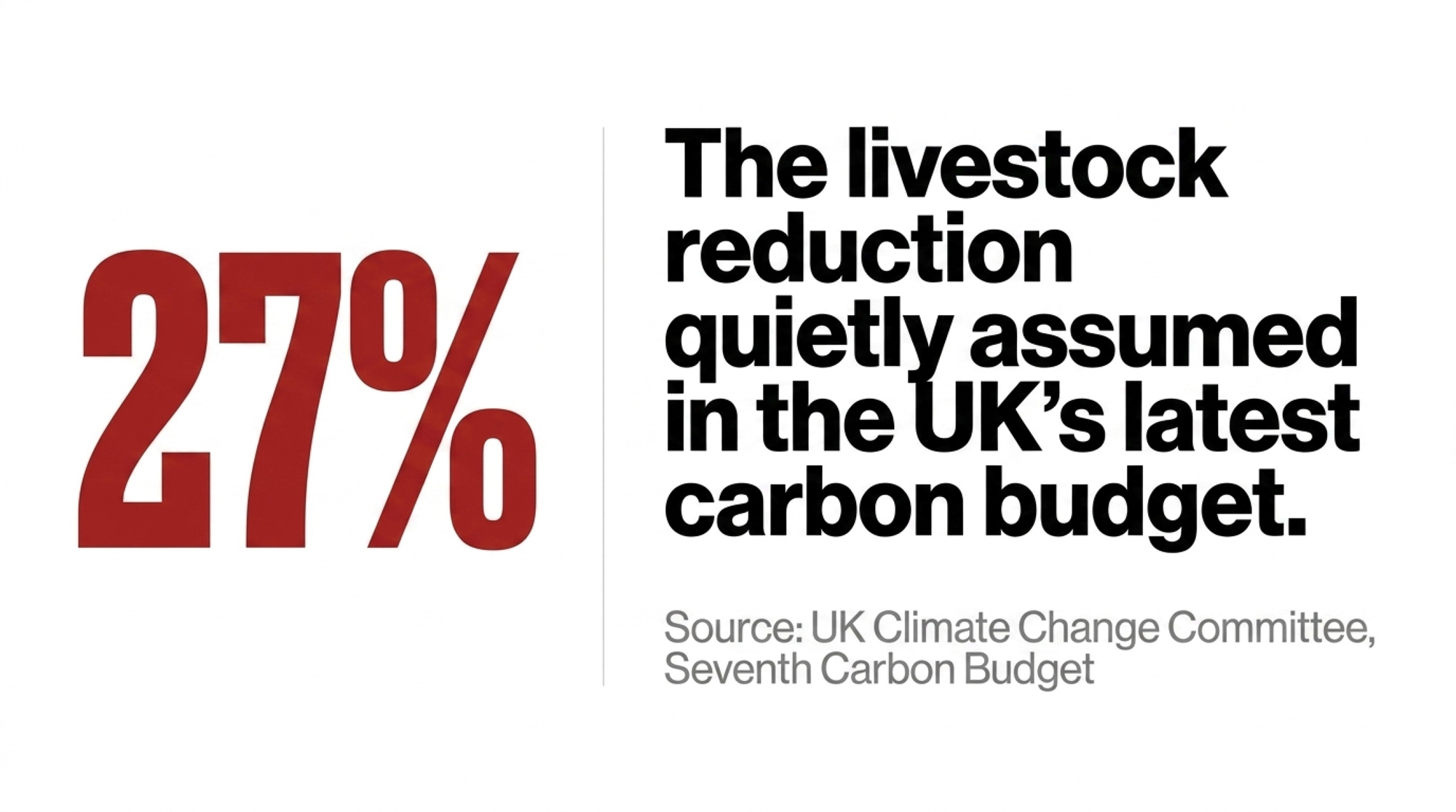
The modeling assumes a 27% cut in cattle and sheep numbers between 2023 and 2040, which the CCC’s own math indicates would account for a 32% reduction in agricultural emissions. On the land side, the plan aims for 16% of the UK to be under woodland by 2040 and 12% of grassland to be released for other uses. Nobody’s culling a herd. The CCC handed government a spreadsheet, and the internet turned it into a herd-cull headline.
The vote itself was real, though. In late June 2026, MPs moved to legislate the budget level — a 535 MtCO₂e cap for 2038–2042, about an 87% cut on 1990 levels — ahead of the statutory June 30 deadline. That’s almost certainly the event that got garbled into “they voted to cull.” The delivery plan, which spells out how the cuts happen, comes next.
So where did “40% by 2040” come from? The CCC’s pathway also assumes a 20% drop in dairy consumption by 2035 sustainweb and a broader red-meat-and-dairy shift of roughly 260 grams per person per week — and in the retelling, those got mashed together and welded onto the 2040 date. Several different numbers, one scary headline.
Why a British Spreadsheet Lands in a North American Barn
Britain is a first mover here, not an outlier. Once a G7 climate plan treats “fewer cattle” as legitimate policy and bolts a percentage to it, the idea stops being fringe and starts being precedent.
It’s already spreading in the UK before it crosses the ocean. Scotland’s climate plans target a 26% cut in livestock by 2035; Northern Ireland’s, 31% by 2040. Same logic, three jurisdictions. When the framework replicates that fast at home, betting it stops at the water’s edge is a bet, not a plan.
Will This Reach You as a Tariff or as a Phone Call From Your Processor?
Probably the phone call — the same one our composite operator just got. And that’s the part most coverage misses.
Here’s the formal mechanism first. Britain launches a Carbon Border Adjustment Mechanism (CBAM), a levy on imports priced according to their embedded carbon, on January 1, 2027. Right now it covers aluminum, cement, fertilizers, hydrogen, and steel. Dairy isn’t in scope. But the government has said CBAM’s scope will remain under review beyond 2027, and the Country Land & Business Association has already floated a food CBAM in its response to Carbon Budget 7. So the door isn’t open. It’s just unlocked.
The quieter mechanism is the one that bites first. As British farmers absorb herd cuts and tighter standards, British retailers and processors are starting to treat carbon-verified milk as the floor, not the bonus. Anything above their intensity benchmark becomes a commercial liability. An Ontario processor shipping cheese or milk powder into that market wouldn’t get hit with a tariff — it’d get asked for farm-level emissions numbers, and lose the contract if it couldn’t produce a credible one. The market-access problem shows up on a spec sheet long before it shows up in a law.
What Does This Cost at the Feed Bunk Today?
The cleanest dollar math you can run right now isn’t on the trade side. It’s at the bunk — and it tells you exactly what a carbon-scored world rewards and what it doesn’t.
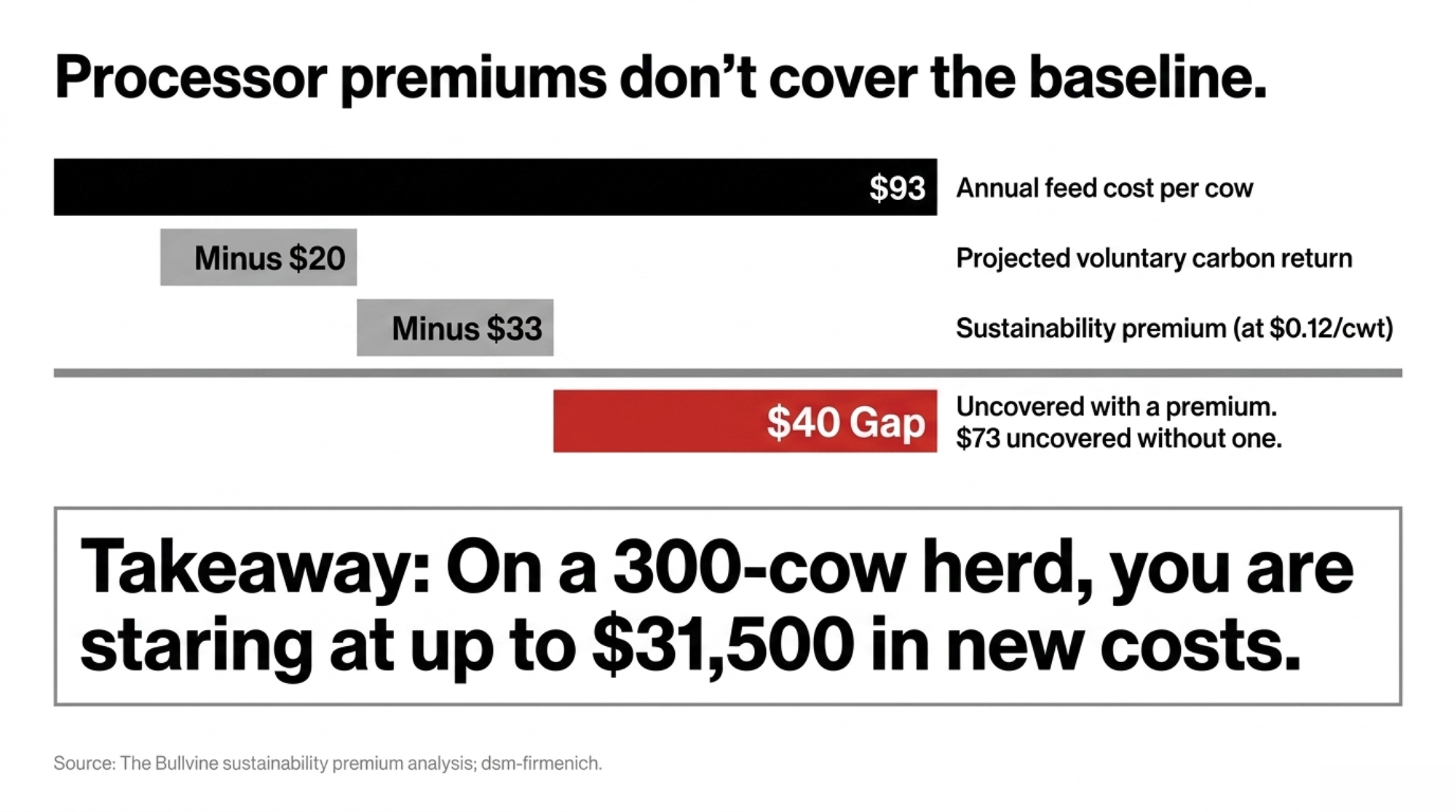
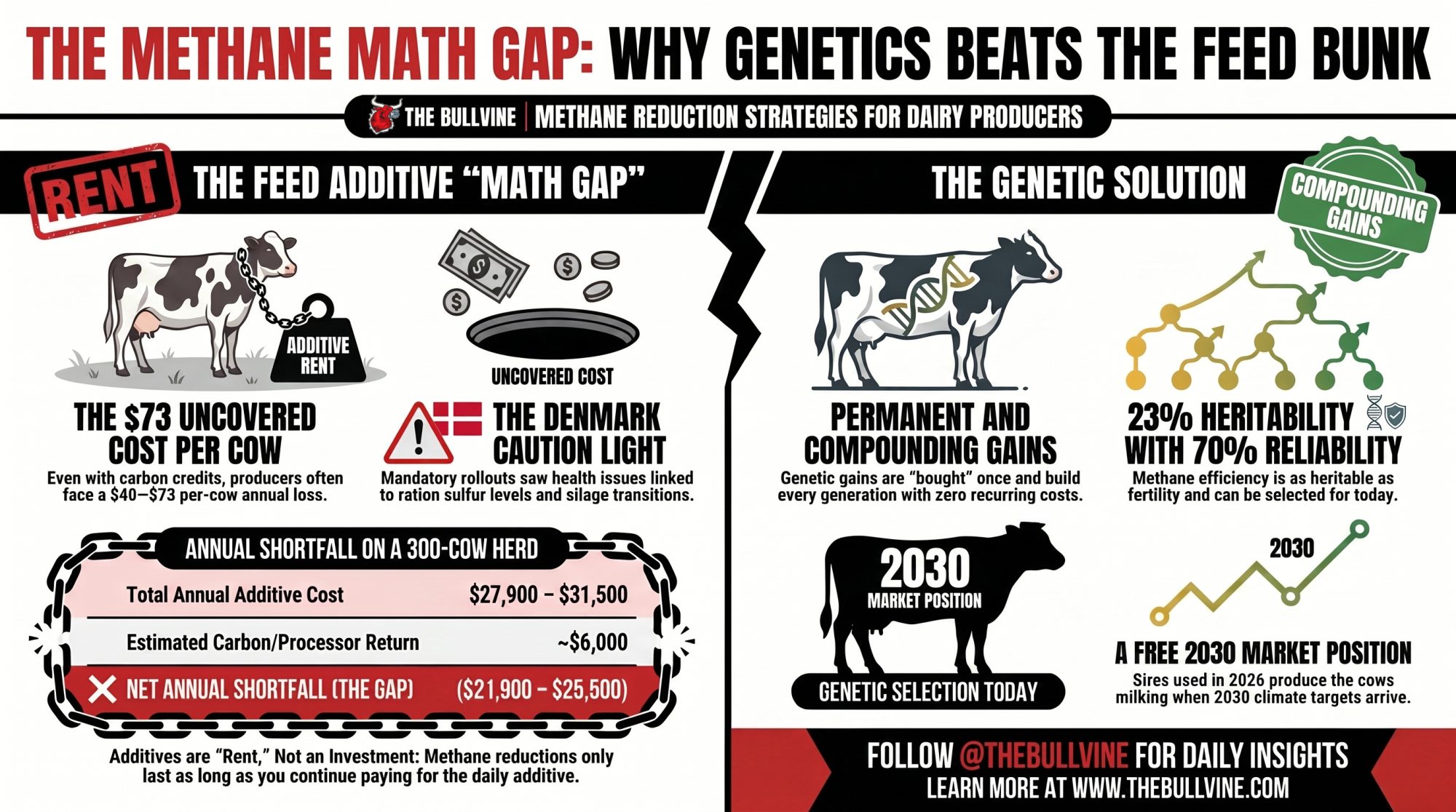
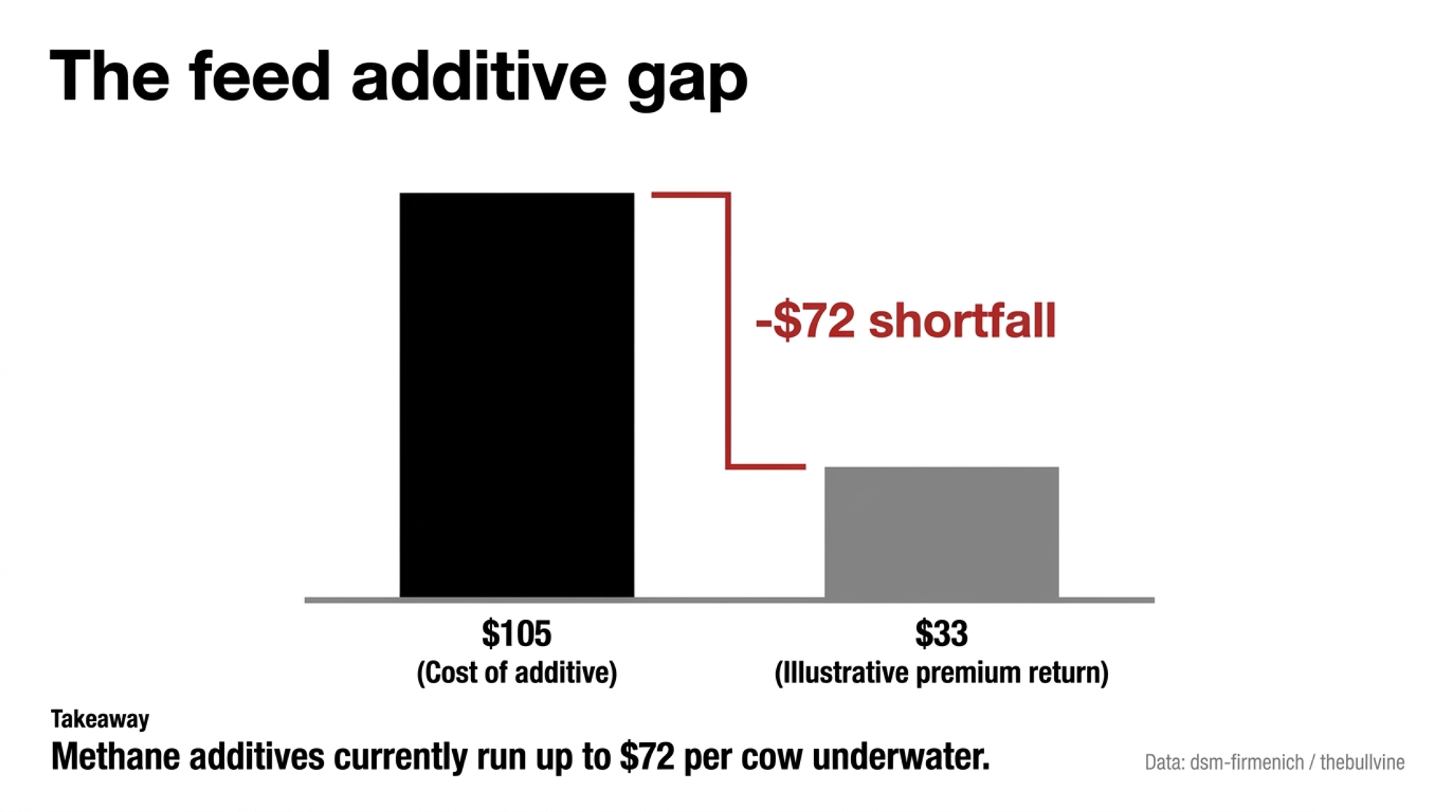
Take a methane-reducing feed additive like Bovaer. The math comes out lopsided fast:
| Line | Per cow/year | Source |
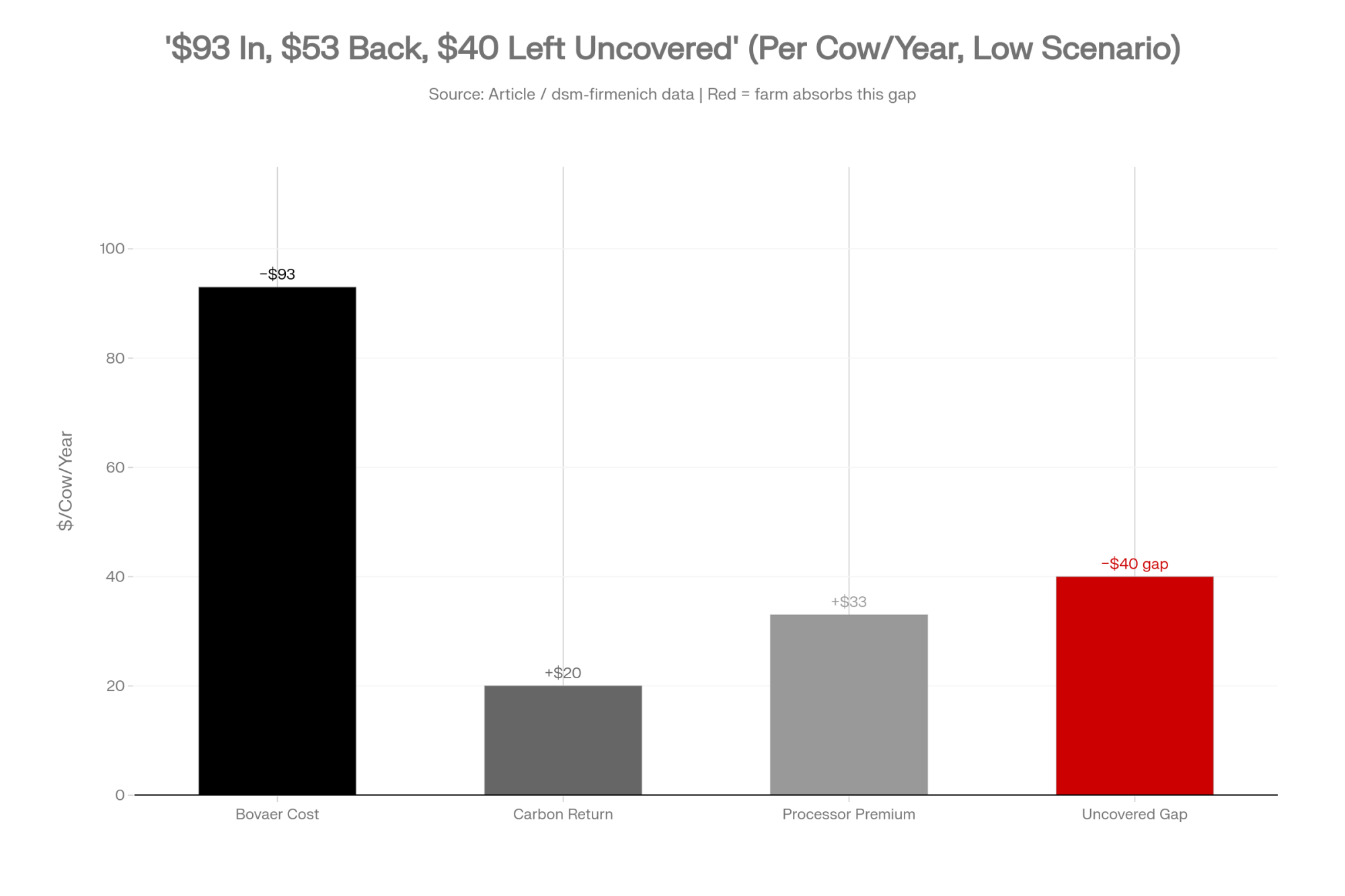
| Bovaer cost (lactating-cow basis) | $93–$105 | dsm-firmenich |
| 12¢/cwt premium (illustrative) | ~$33 | thebullvine |
| Net gap (what you eat) | –$60 to –$72 | — |
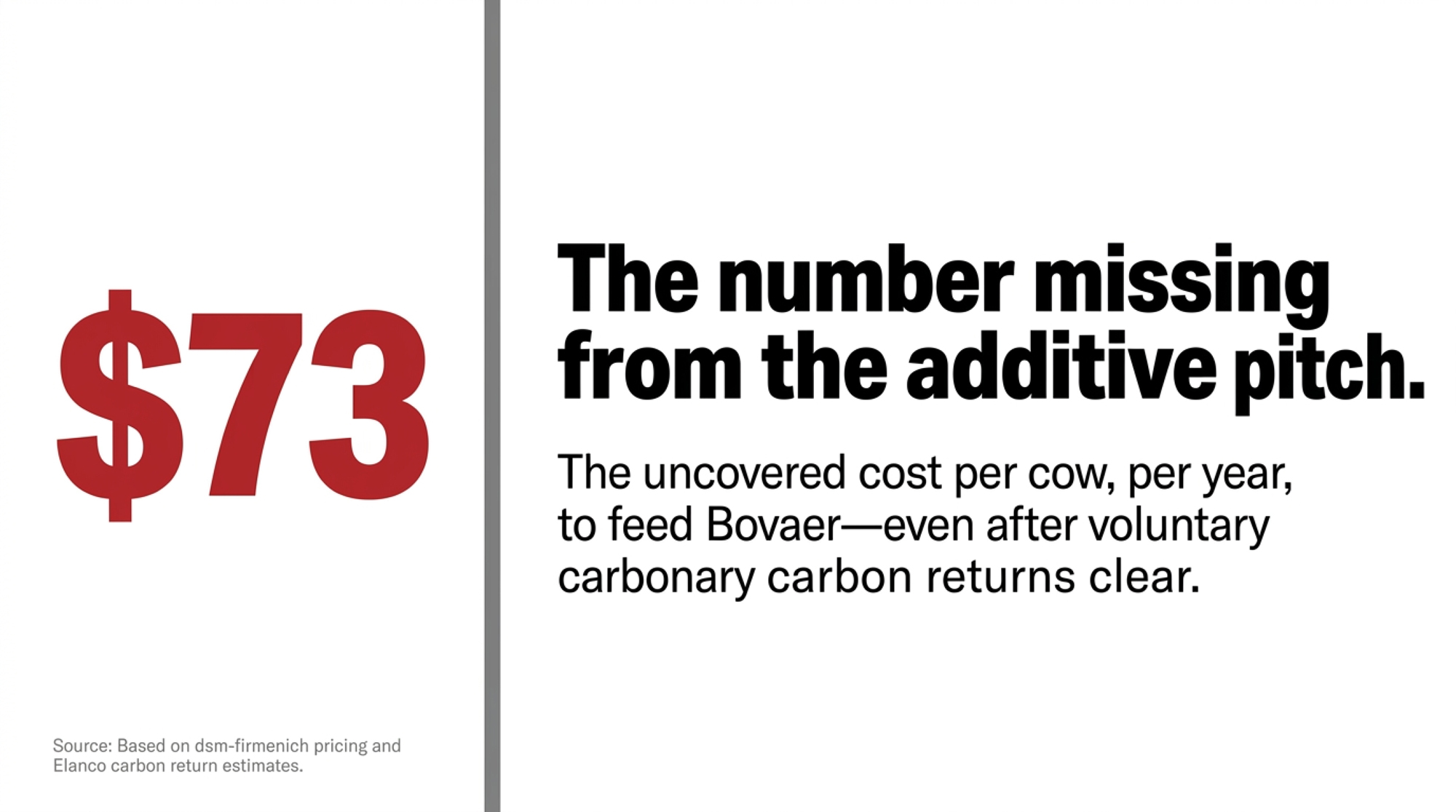
Two things to flag before you map that to your own barn. The 12¢/cwt premium is illustrative — real sustainability premiums vary by processor and aren’t a published standard yet. And that $33 return is the same per cow whether you milk 200 or 2,000, because the premium scales with milk shipped, not with herd size. At 75 lbs/day, every cow earns back about $33 and costs you up to $105 in additive. You’re roughly $60 to $72 a head underwater before moving a single carbon-verified load. The tools exist. The premium doesn’t cover them yet.
Bovaer’s other wrinkles, quickly:
- Cost may fall. A new dsm-firmenich plant in Dalry, Scotland, is projected to pull the price toward $58–$64/cow/year — shrinks the gap, doesn’t close it.
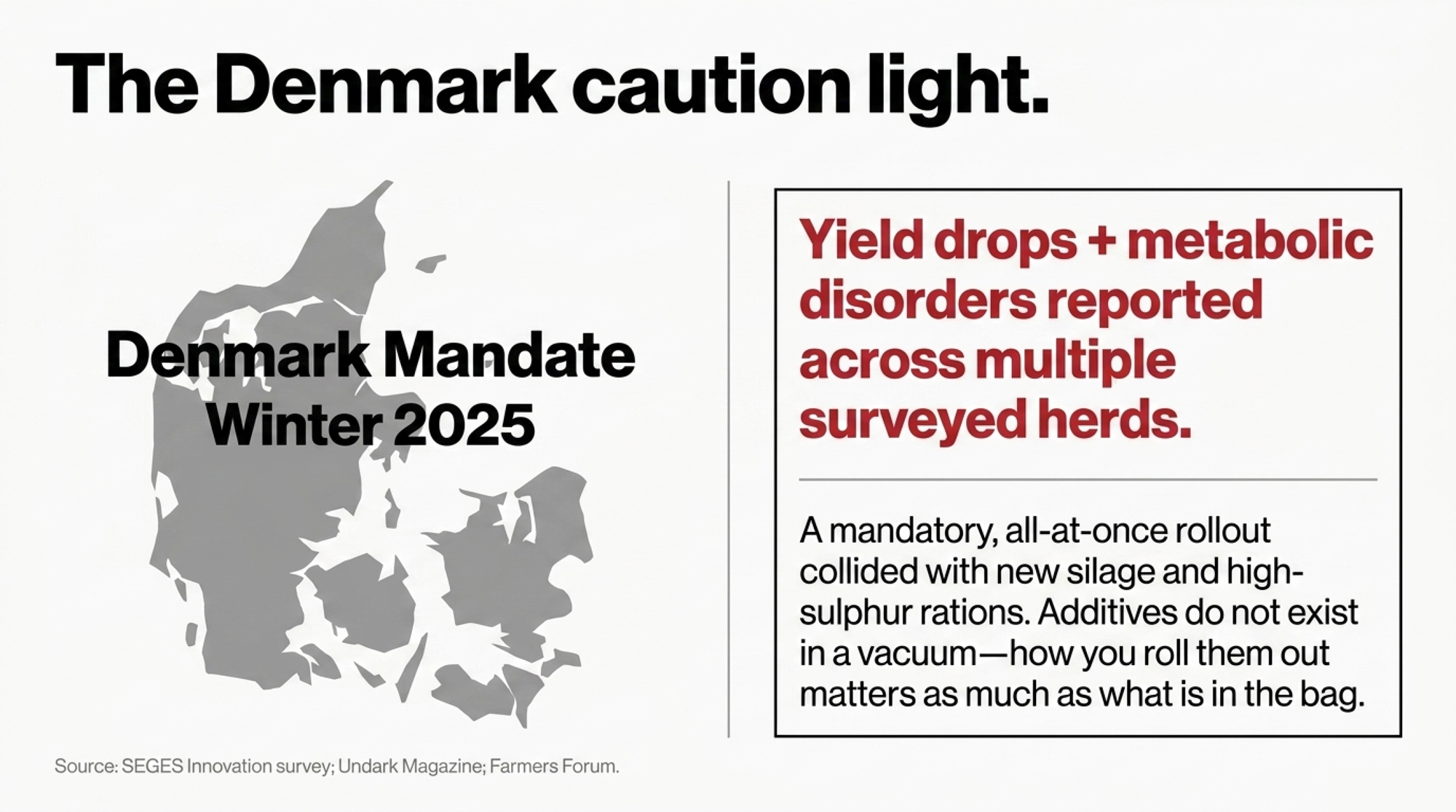
- Safety is under review. After Denmark’s late-2025 mandate, the Danish Dairy Farmers’ Association reported farms experiencing yield declines and digestive issues, and EFSA opened a fresh review in 2026 that remains ongoing.
- The maker disagrees. dsm-firmenich and the U.S. FDA maintain the additive is safe and effective.
The takeaway isn’t “Bovaer is bad.” It’s that if a methane-credit contract you’re eyeing requires it, watch how that review lands before you sign.
Two Roads: Do They Count Your Efficiency or Just Your Cows?
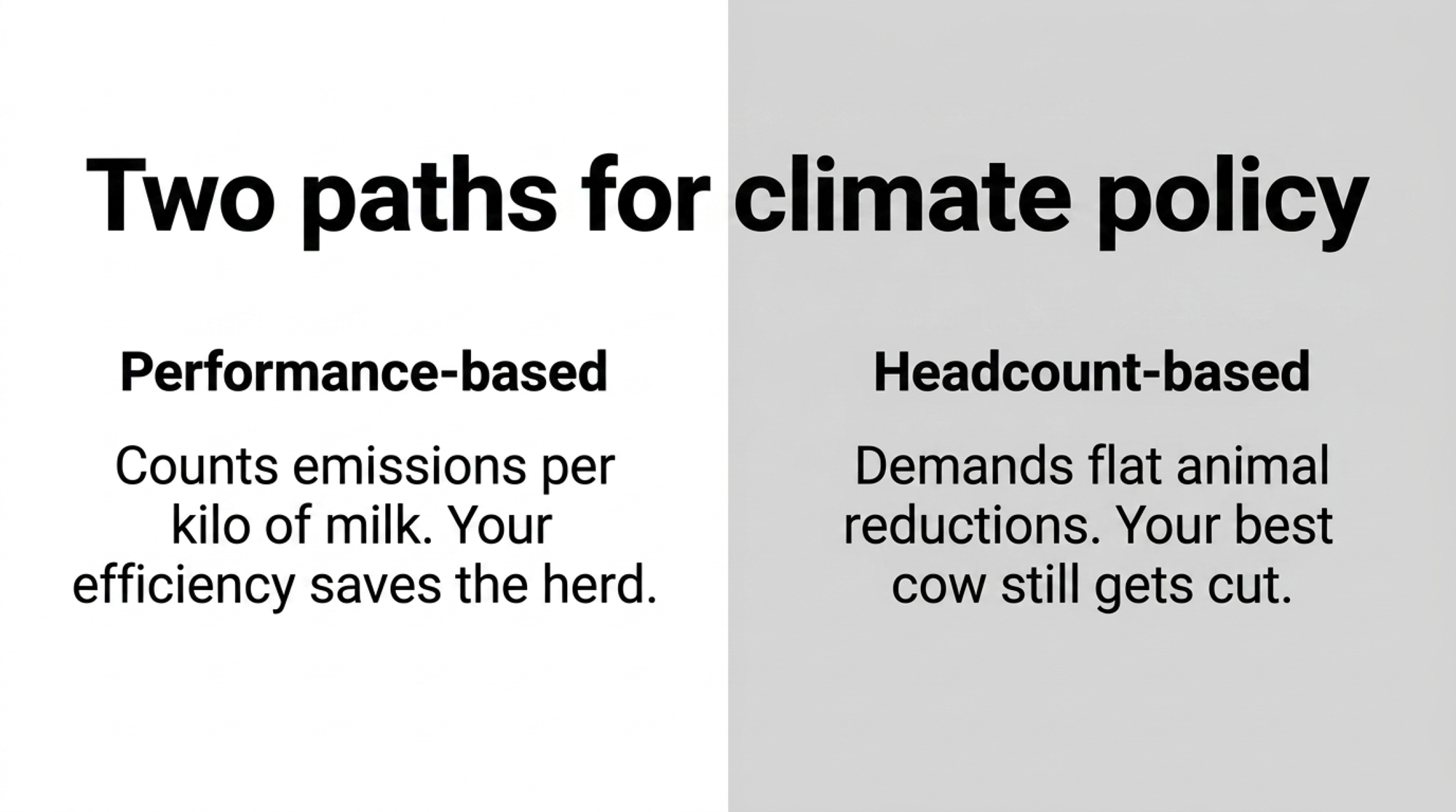
Underneath all of it sits one fork, and it decides everything. Climate policy splits into two roads, and which one your regulators walk decides whether an efficient farm keeps its herd or shrinks it.
Performance-based policy asks one question: how many kilos of CO₂-equivalent come off your farm per kilo of milk? Drive that number down with genetics, feed efficiency, and manure management, and your cows stay on the landscape. California’s SB 1383 goes this way — a 40% cut in dairy methane by 2030, pursued through digesters, manure management, and efficiency rather than mandated herd reductions. A UC Davis CLEAR Center and California Dairy Research Foundation analysis projects that the state’s dairies will hit that target and reach climate neutrality around 2030, as long as voluntary, incentive-based adoption holds.
| Headcount-Based Policy | Performance-Based Policy | |
|---|---|---|
| Core question asked | How many animals do you have? | How many kg CO₂e per kg milk? |
| Best-known example | Netherlands farm buyouts (€1.81B / 723 farms) | California SB 1383 (40% methane cut by 2030) |
| UK Carbon Budget 7 alignment | ✅ 27% cattle & sheep cut assumed by 2040 | ❌ Not the primary lever in CB7 |
| Impact on efficient farms | Your best cow still gets cut | Efficiency is the competitive moat |
| Policy cost tool used | Herd cap / buyout | Digester incentives, genetics, feed management |
| Risk to North American exporters | Blanket intensity benchmarks on imported milk | Must demonstrate verified farm-level footprint |
| Your counter-argument | Hard to make — you’re just a number | Strong — if you have the verified data ready |
Headcount-based policy skips the efficiency question entirely. It just says: fewer animals. The Netherlands is the hard version — the Dutch agriculture ministry spent €1.81 billion to buy out 723 farms, in which herd size, not emissions per liter, was the lever that mattered. Carbon Budget 7 leans the same direction. In a headcount world, your best cow still gets caught in a blanket cut.
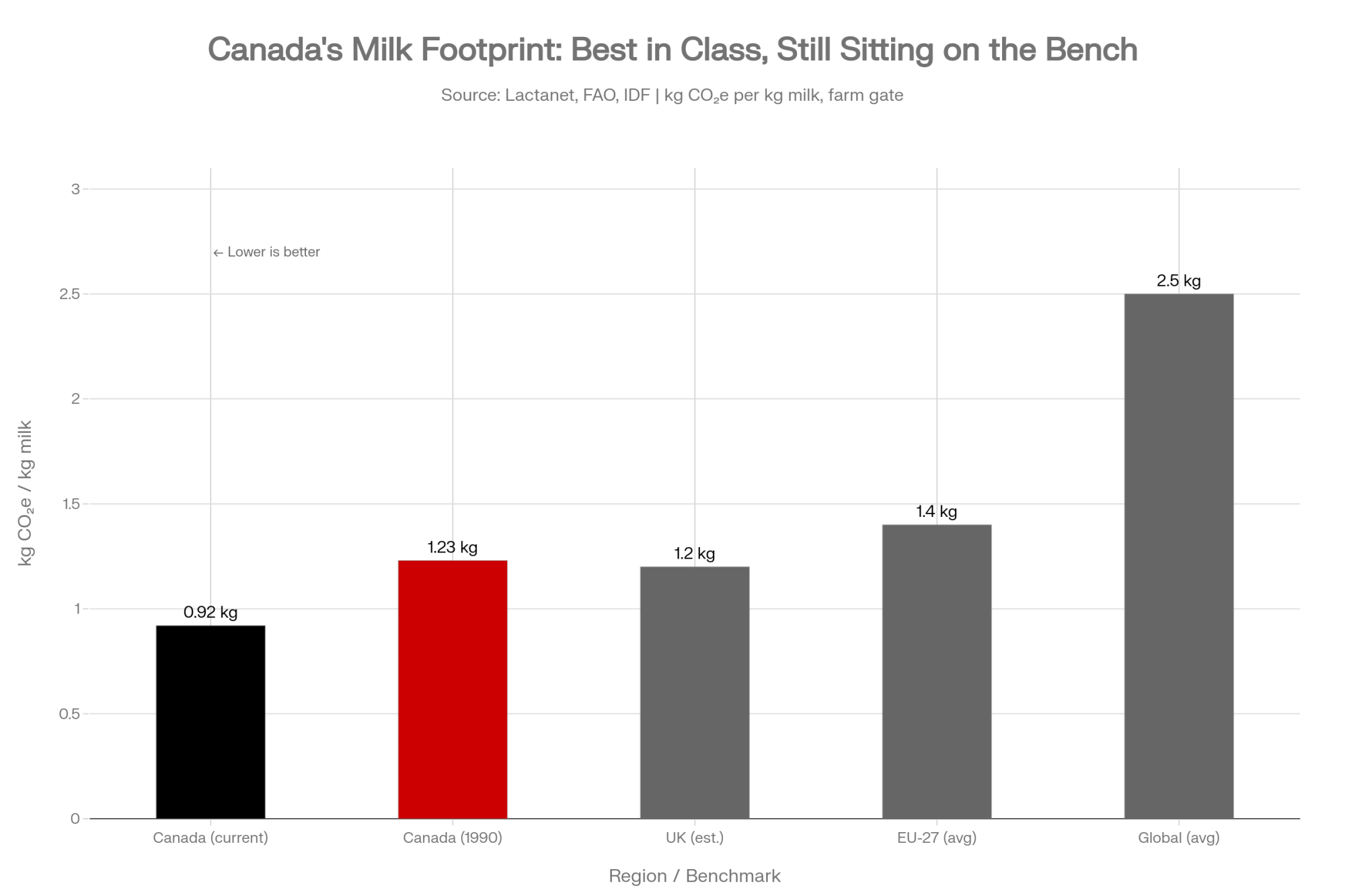
Here’s the irony that ought to sting. North American dairy already has the receipts to win the performance argument. Lactanet’s published figure puts the carbon footprint of Canadian milk at 0.92 kg CO₂-equivalent per kilogram at the farm gate — a 2016 analysis, down about 25% since 1990, with the whole sector under 1.3% of national emissions. That’s a Canadian number, though, built on a different life-cycle modeling approach than the U.S. uses — so don’t hand a U.S. buyer the Canadian stat and call it yours. The data’s sitting in PDFs while other people write the rules.
Is the Performance Argument Actually Winnable?
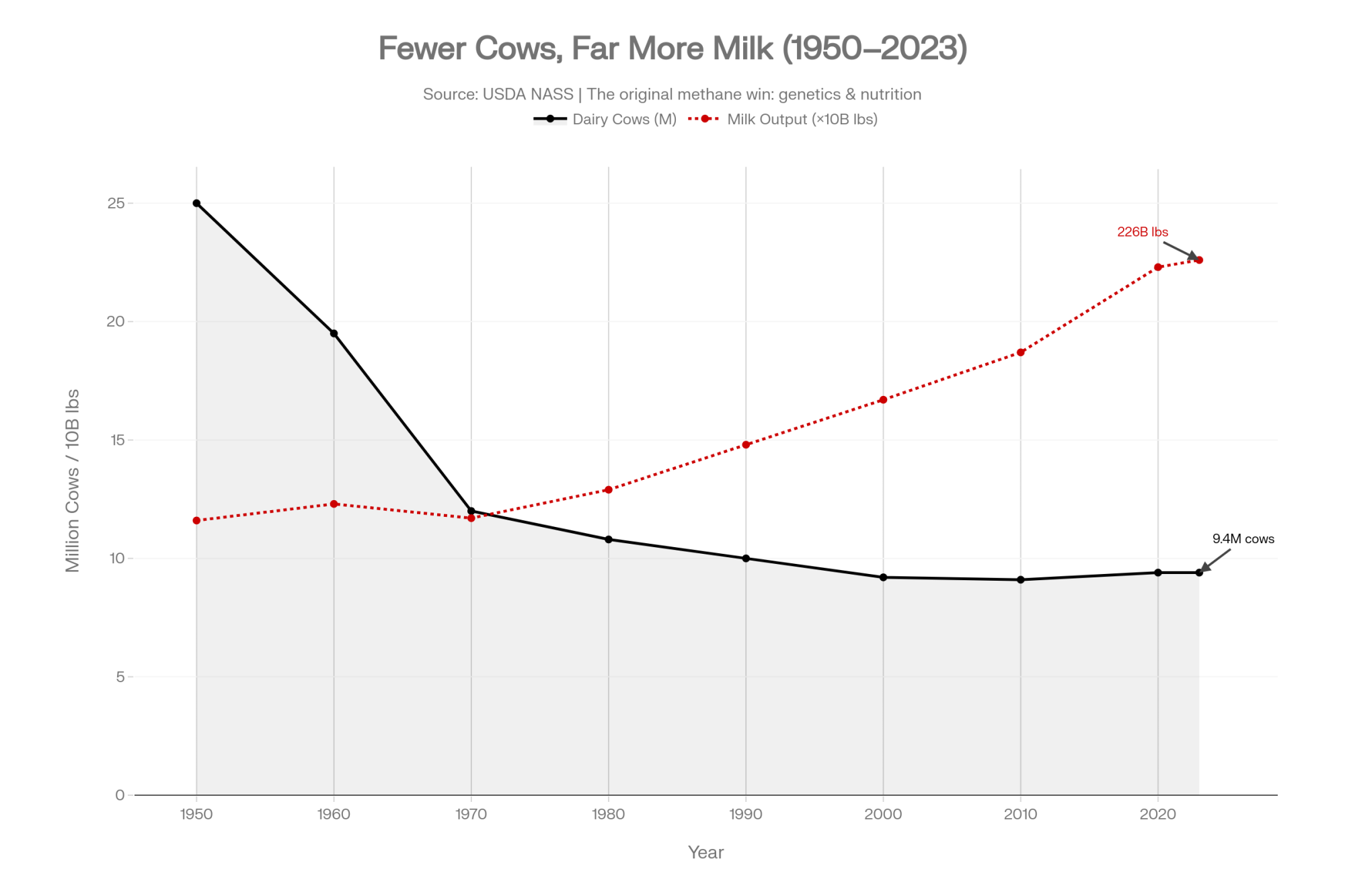
On paper, yes. The Canadian footprint numbers, California’s methane trajectory, and the evidence on breeding efficiency give the sector a genuinely strong, data-backed case that efficient milk belongs on the land.
But here’s the honest part. It’s only winnable if the industry shows up before the headcount framework hardens into law somewhere that matters to your exports. A 2024 Navius analysis for Canada found that capping emissions is the cheapest, most efficient way to cut farm climate impact, with a livestock cap as the next-cheapest option. Read that twice. The blunt instruments are already sitting on policymakers’ desks, scored as the cheap option. Receipts don’t argue for themselves. Somebody has to put them on the table.
Is Your Bull Team Already Behind on Methane?
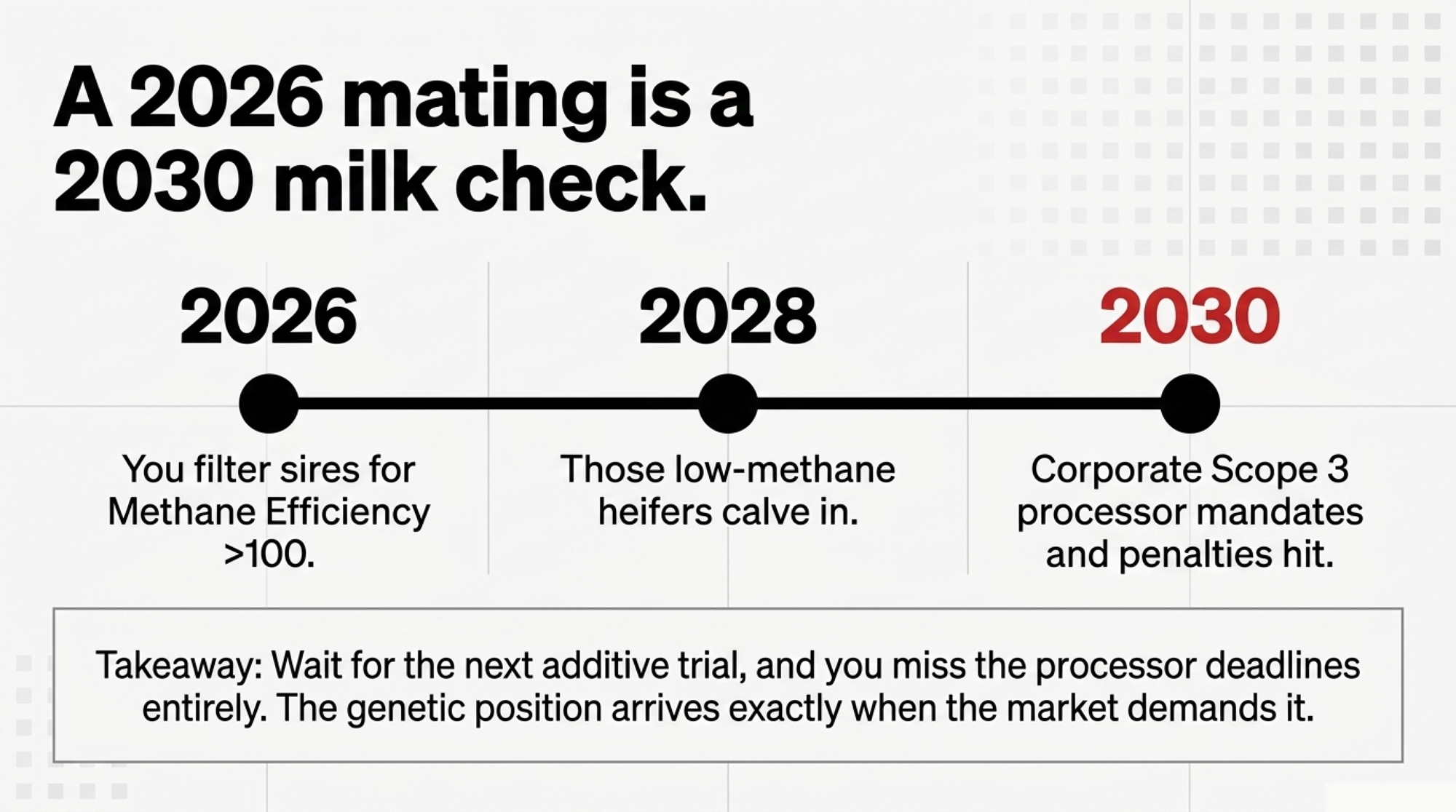
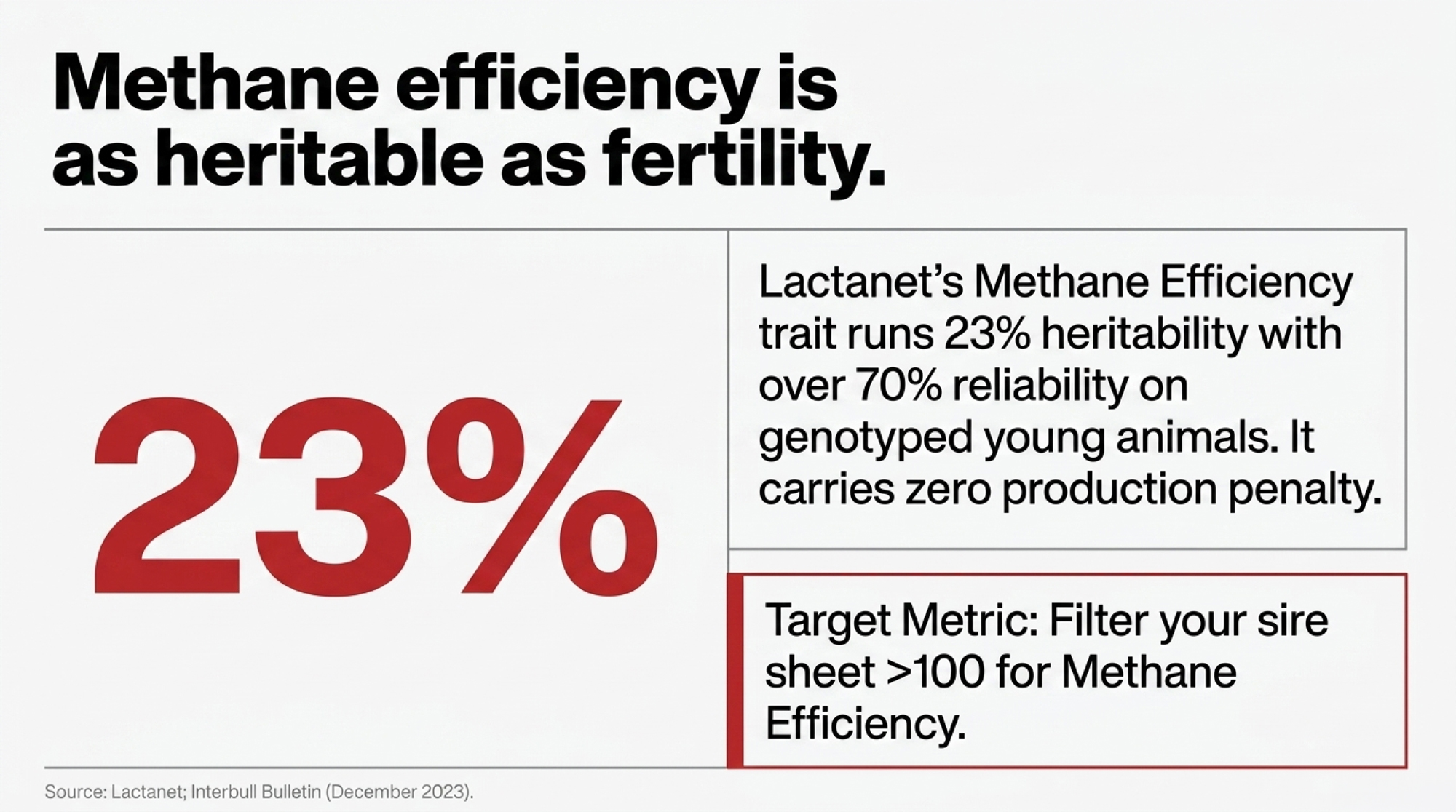
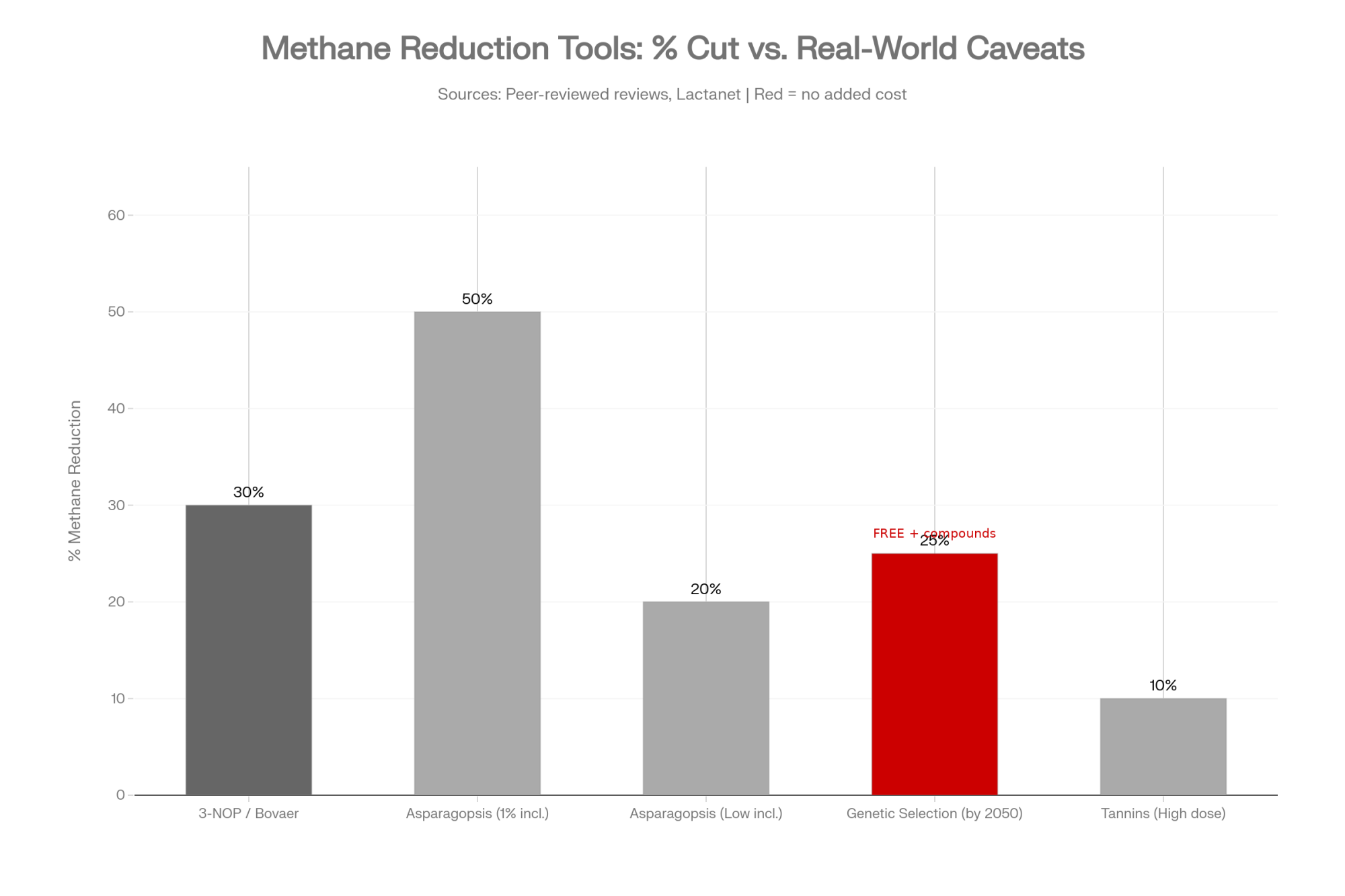
This is where the fork stops being a policy debate and lands in your sire selection — the exact decision our composite operator was sitting down to make. Lactanet’s modernized LPI now includes an Environmental Impact Index based on Feed Efficiency, Methane Efficiency, and Body Maintenance, initially released for Holsteins. And it’s not just a Canadian play: CDCB’s April 2025 Net Merit revision lifted Feed Saved to 17.8% of the index — up from 12% — while cutting Body Weight Composite, a shift The Bullvine has called a $57-per-point “weight tax” on big Holsteins. Both systems are actively refining these traits — Lactanet can now predict methane from milk spectral data at low cost across many cows.
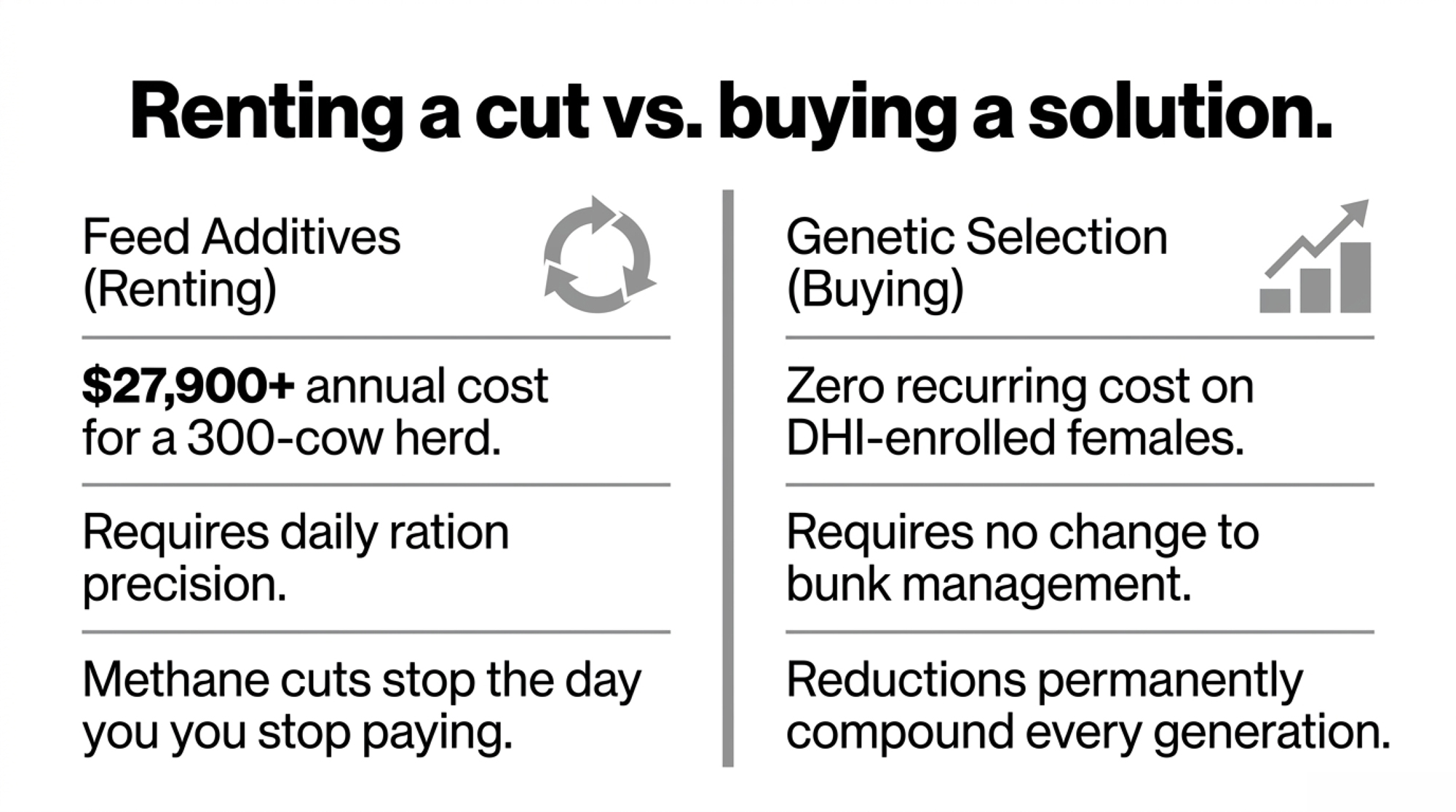
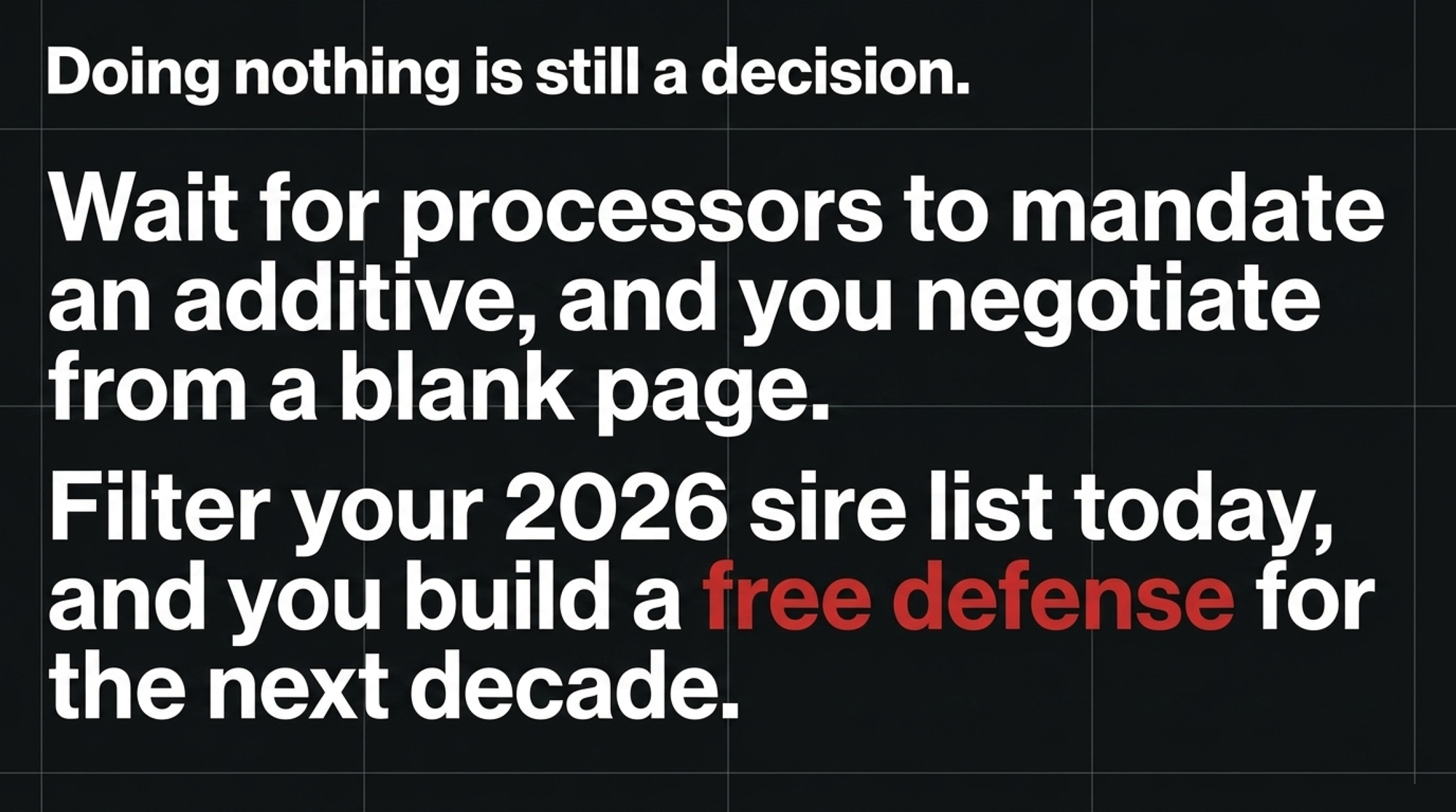
Here’s the part that should land with anyone staring at that $60–72/cow Bovaer gap: selecting for high-efficiency genetics carries a zero-cost premium. You’re already buying semen. Weighting Feed Saved and Methane Efficiency in your index costs nothing extra per straw, while the additive runs you up to $105 a cow every year it’s in the ration. One’s a recurring input cost. The other’s a free lever you’re either pulling or leaving on the floor. It won’t move your footprint this lactation — but the herd you breed this summer is the number you’ll hand a buyer in 2035.
| Bovaer / Feed Additive | Genetic Selection (Feed Saved / Methane Efficiency) | |
|---|---|---|
| Annual cost per cow | $93–$105 (current); ~$61 (future Dalry plant) | $0 incremental over base semen cost |
| Index tool | N/A — contract-based | Lactanet EII, CDCB Net Merit (Feed Saved = 17.8%) |
| When benefit shows | Immediately (current ration year) | 2030+ herd profile |
| Reversibility | Easy — stop the contract | Permanent genetic change in herd |
| Regulatory status | EFSA review open (2026); Danish concerns on yield/health | No regulatory risk; standard breeding practice |
| Stacks with each other? | Yes — but gap must close first | Yes — foundation layer regardless |
| Bottom line | Only pencils if premium covers $60–72 gap | Free lever — pull it now regardless of premium |
Options and Trade-Offs for Your Operation
There’s no single right move here. A few clear paths, and which one fits depends on how exposed your milk is to export markets and tightening rules.
Get your own footprint number — start this month. Run a credible whole-farm emissions-intensity figure on a peer-reviewed tool, and pick the one built for your side of the border. In Canada, Agriculture and Agri-Food Canada’s Holosis a free whole-farm model that estimates your emissions and lets you test “what if I change feed or tillage” scenarios before you spend a dollar. In the U.S., the dairy-specific FARM Environmental Stewardship program — now running on the updated Ruminant Farm Systems model — gives a cradle-to-farmgate estimate that processors and co-ops already aggregate up the supply chain. For broader cropping and soil-carbon accounting, the USDA-backed COMET-Farm is the other free U.S. option. It costs you data you mostly already keep — milk records, ration, manure, energy — and the number is only as good as what you feed it. Do this one now; everything else sits on top of it.
| Tool | Geography | What It Covers | Who Uses It | Cost |
|---|---|---|---|---|
| Holos | Canada | Whole-farm: livestock, feed, manure, tillage | Supply chain reporting, processor audits | Free (AAFC) |
| FARM ES / RuFaS | U.S. | Cradle-to-farmgate dairy; co-op aggregated | FARM-participating co-ops and processors | Free (NMPF) |
| COMET-Farm | U.S. | Soil carbon, cropping, some livestock | Mixed operations with significant row crop acres | Free (USDA) |
| COMET-Planner | U.S. | Conservation practice scenario modeling | Producers evaluating cover crops, tillage changes | Free (USDA) |
| ⚠️ Cross-border warning | — | Canadian 0.92 kg CO₂e stat uses different LCA methodology than U.S. tools | Do NOT use Canadian Lactanet figure for U.S. buyer claims | — |
Breed for the efficiency traits — your slowest lever, so start early. Weight Feed Efficiency and Methane Efficiency in your sire selection this season. It fits every herd, carries no per-straw cost, and won’t dent production if you balance the index. The catch is time: you’re breeding for 2030 and beyond, not this year’s tank, so the longer you wait, the more ground you give up.
Feed additives — a bet, not a margin play, until the premium moves. This one only pencils if a processor is actually paying enough to close that $60–72/cow gap, or a buyer’s spec sheet starts demanding it. You’d want the premium in writing — and, given the Danish reports and the open EFSA review, a hard look before you commit. Move early, and you’re wagering on where prices and premiums go, not banking a return today.
The forward signal to watch sits on these paths, not in a crystal ball: if a food CBAM moves into “under review” with a date attached, or a major processor publishes an intensity benchmark with a number on it, the footprint path stops being optional and the additive path stops being a bet.
Key Takeaways
- If your milk touches an export market — directly or through your processor — get a credible whole-farm footprint number this quarter, because the first ask will be for data, not a tariff payment.
- If you’re booking semen this season, weight Feed Efficiency and Methane Efficiency now; it’s a zero-cost lever, and the herd you breed today is the number you hand a buyer in 2035.
- If a processor offers you a sustainability premium, run it against the $60–72/cow gap before you sign — at an illustrative 12¢/cwt, the additive math still runs underwater.
- If you’re weighing a Bovaer-based methane-credit contract, watch how EFSA’s open 2026 review lands before committing; Danish farmer groups have raised yield and health concerns, while the maker and the FDA say it’s safe.
- If you operate in Canada, you’re sitting on a strong footprint number — 0.92 kg CO₂e/kg milk — but it only counts if the sector puts it on the table before the headcount framework hardens.
Back to that semen order and the processor’s question nobody had a number for. Where does your own emissions-intensity figure sit right now — and could you produce it tomorrow if a buyer asked? Most operations couldn’t, and that’s the real exposure, not a viral screenshot about a vote that never happened the way the post claimed.
We ran the simple version of the barn math here. If you want the full model — additive cost curves, premium break-even by herd size, and what a food CBAM would actually do to Canadian and U.S. export margins — that’s the deeper Tier 3 economics piece, and the running numbers land in The Bullvine Weekly newsletter as Carbon Budget 7 moves from vote to delivery plan.
Run Your Numbers
Component Value Tracker — Before you sign a sustainability premium against that $60–72/cow Bovaer gap, run the Component Value Tracker. Its nutrition break-even module pressure-tests whether an additive clears your real component prices, and the sire module prices fat and protein per daughter so your breeding lever earns its keep.
Complete references and supporting documentation are available upon request by contacting the editorial team at editor@thebullvine.com.
Learn More
- The $73-a-Cow Gap Hiding in Your 2027 Bovaer Contract — Arms you with the exact contract formulas, biological ceilings, and herd-size financial models needed to negotiate processor sustainability agreements without sacrificing your operating margin.
- Methane efficiency breeding beats Bovaer’s $73 gap — Exposes the long-term economics of utilizing free, national genomic indexes over recurring additive bills to structurally insulate your milking herd from incoming carbon constraints.
- Reducing Methane Emissions via Genetic Selection in Cattle — Delivers the biological blueprints and data-backed validation behind methane heritability, mapping out how the national evaluation index predicts enteric output to protect future market access.
The Sunday Read Dairy Professionals Don’t Skip.

Every week, thousands of producers, breeders, and industry insiders open Bullvine Weekly for genetics insights, market shifts, and profit strategies they won’t find anywhere else. One email. Five minutes. Smarter decisions all week.