




Archive for Lactanet Methane Efficiency

Producers Fight Over Bovaer. The Cheaper Fix Is on the Breeding Sheet

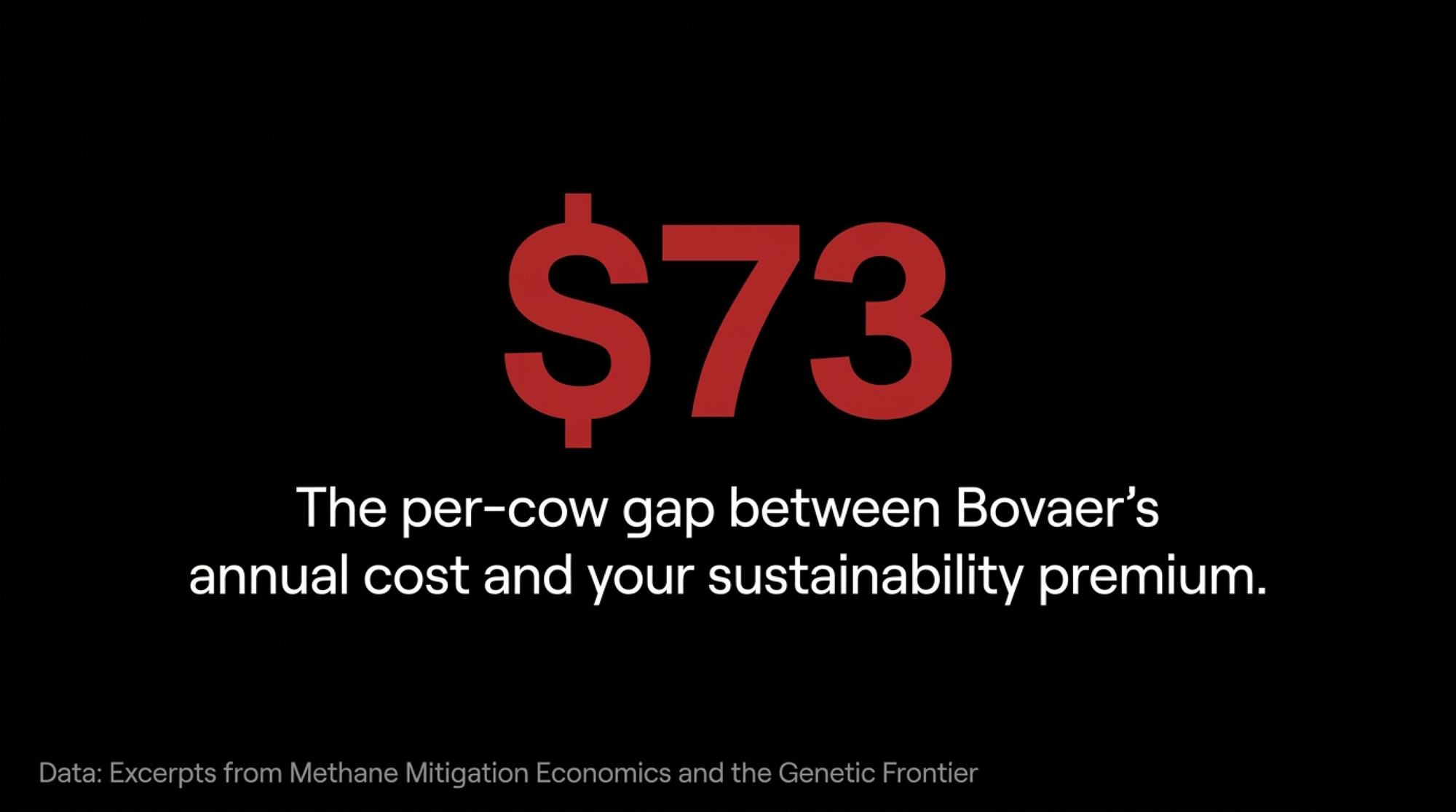
Bovaer can leave $73 a cow uncovered once the carbon math clears. Meanwhile, a low-methane sire costs nothing extra and compounds every generation — and it’s already on your 2026 list.

Executive Summary: A 300-cow herd feeding Bovaer is looking at $27,900 to $31,500 a year in new cost — and once the carbon return clears, the math can still leave roughly $73 a cow uncovered without a processor premium, or about $40 with one. That’s the gap nobody puts on the pitch slide, and it’s why the loud fight over feed additives is the wrong fight. The cheaper methane lever is already sitting on your 2026 sire list: Lactanet’s Methane Efficiency trait runs 23% heritability with 70%-plus reliability on genotyped young animals, costs nothing extra on DHI-enrolled females, and compounds every generation instead of renting you a cut for as long as you keep paying. The timing is the kicker — sires you use in 2026 throw heifers that milk into the early 2030s, right when 2030 buyer targets decide whether “low-methane milk” earns a premium or eats a penalty. Bovaer’s still a legitimate tool for stable TMR herds with a real premium behind it, but treat Denmark as a rollout warning: watch ration sulphur, silage timing, and transitions, because that’s where the trouble showed up. Do nothing, and you’re not playing it safe — you’re choosing to negotiate from a blank page when methane lands in your milk contract. Filter your next round of sires above 100 for Methane Efficiency without dropping your core index, and you’ve built a 2030 position for free.
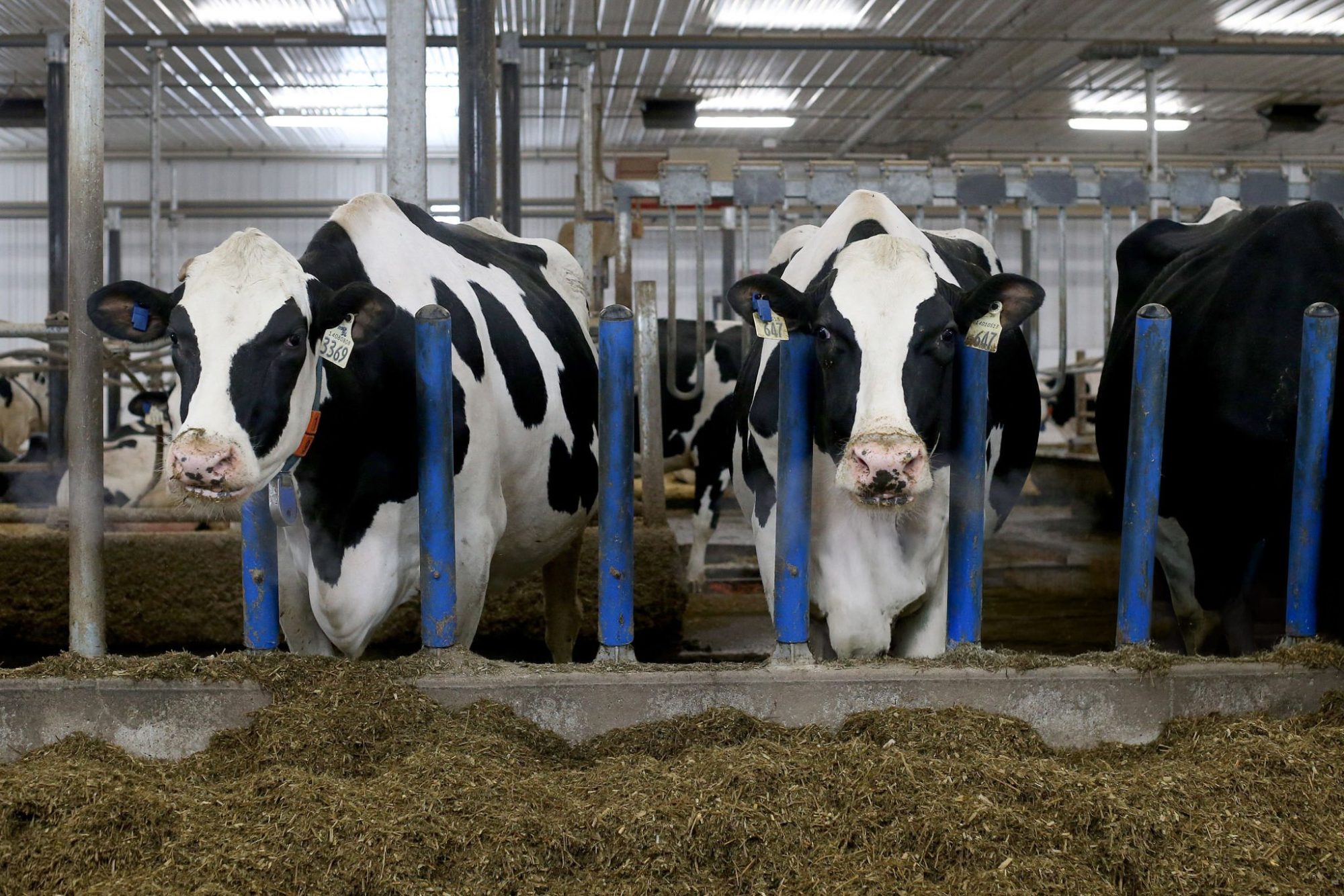
methane efficiency breeding

In Denmark this past winter, farmers who’d been ordered to feed Bovaer started calling their vets about cows going off feed. One veterinarian told Farmers Forum that the additive “affected every herd” in her area. By November 2025, a SEGES Innovation survey of the country’s conventional dairy farms had drawn several hundred responses, and the majority reported a drop in milk yield — figures first surfaced in investigative reporting by Undark Magazine and Farmers Forum. That’s the methane headline scaring everybody.

Here’s the one nobody’s running. While the industry fights about a feed additive, the cheapest methane tool you own is already sitting on your 2026 sire list. And almost nobody’s calling it a methane decision.

What’s Really at Stake When the Processor Calls

When a processor rep starts talking methane commitments and premiums, the surface conversation is climate. The real conversation is risk, market access, and who ends up owning the carbon story.
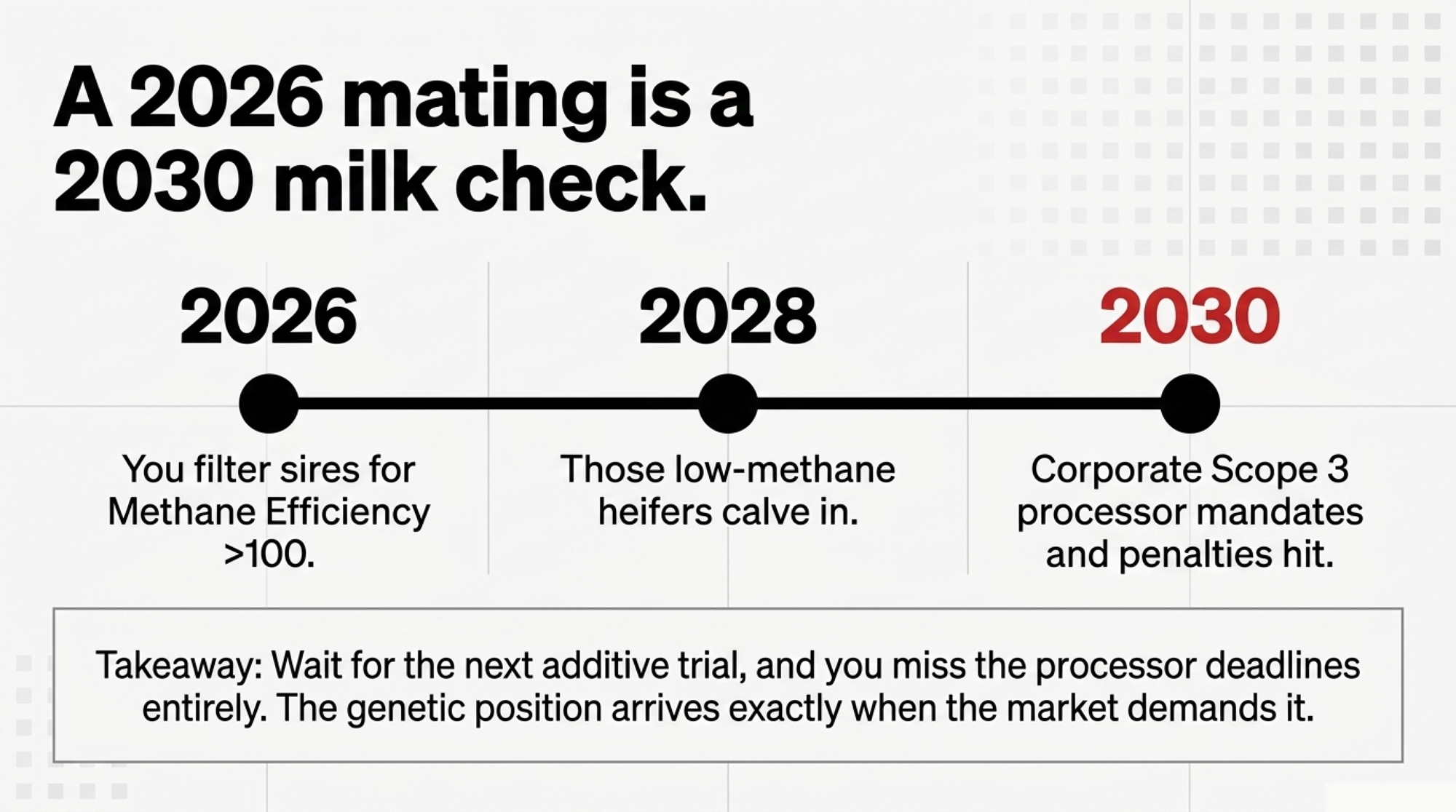
The processor is trying to de-risk its Scope 3 footprint and hit a branded climate target. Danone committed in January 2023 to a 30% absolute cut in methane from its fresh milk supply by 2030, and its own Dairy Methane Action Plan reported a 25.3% reduction versus the 2020 baseline by 2024 — including a 13.9% drop in the single year from 2023 to 2024. A company moving that fast doesn’t get there without eventually sorting its suppliers. You’re on the other side of that table, working out whether the premium covers the cost — or whether you’re signing into someone else’s program economics.

One number reframes the whole exchange. The Innovation Center for U.S. Dairy’s national life cycle assessment puts U.S. dairy at roughly 2% of total U.S. greenhouse gas emissions, across every stage. Read it for what it is — a market signal, not an ecological emergency — and methane becomes something to time and negotiate, not panic over.

The Productivity Story Nobody Puts in the Pitch

Before anyone sells you the next reduction, remember how the first one happened. U.S. dairy already did the hard part, the unglamorous way.

The national herd dropped from about 25 million cows in 1950 to roughly 9 million today, while total milk output climbed. Per kilogram of milk, the greenhouse gas footprint fell by roughly half over those seventy years. None of that came from a feed additive. It came from genetics, nutrition, reproduction, and culling — the same levers you’d pull in a rough milk-price year.
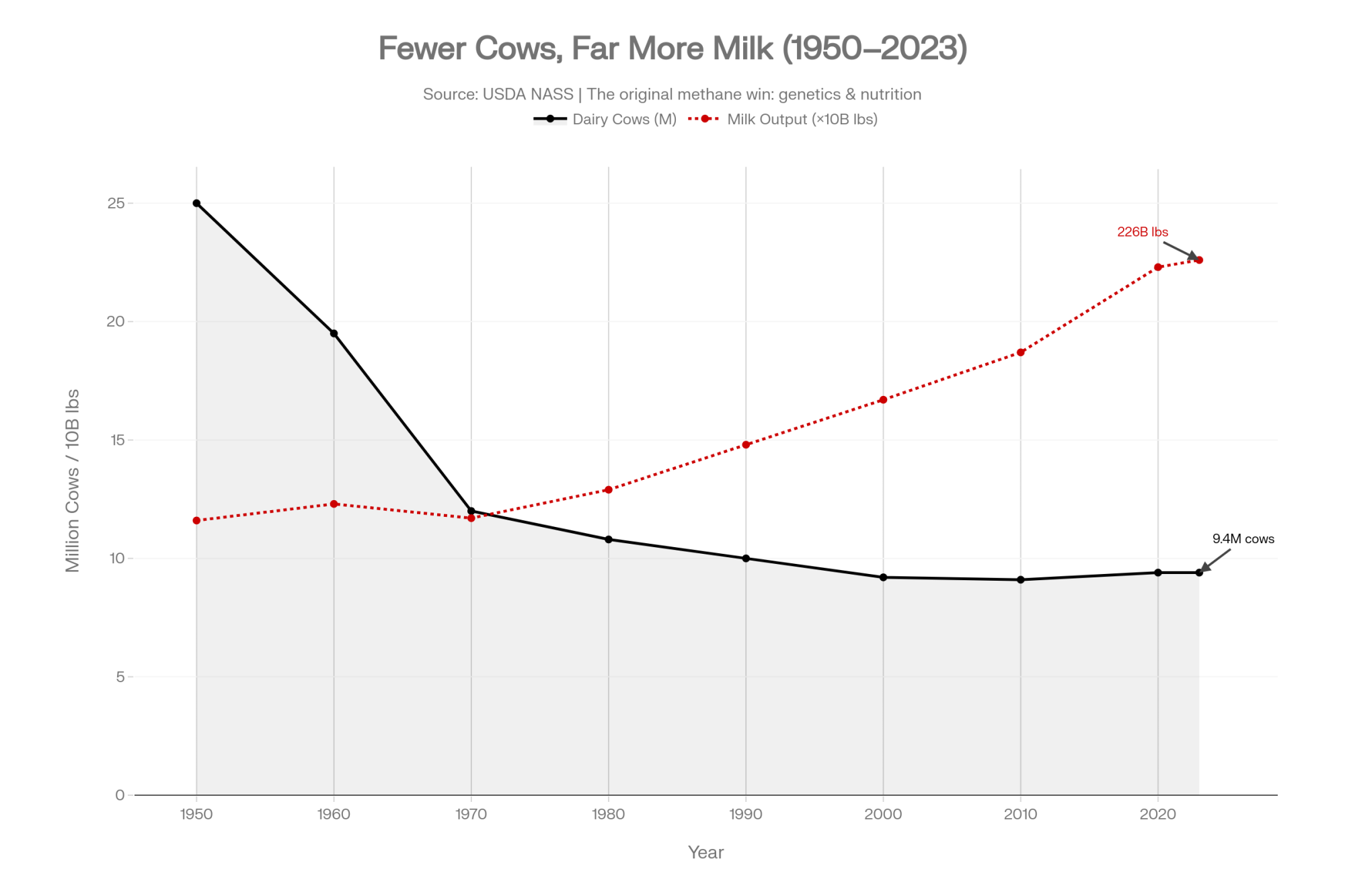
So here’s the first honest move. The work that lowers methane per hundredweight is the same work that protects your margin. It’s the bedrock under any methane score or premium that shows up later, and you’d be doing it anyway.

The Denmark Caution Light — and How to Read It Right

Back to the additive everyone’s actually asking about. The peer-reviewed record on 3-NOP — the active ingredient in Bovaer — is genuinely strong. A 2025 review found that 3-NOP cuts methane by roughly 30% in dairy cattle at an average dose of around 70 mg/kg of dry matter, with no effect on milk production. A full-lactation study in the Journal of Dairy Science (van Gastelen et al., 2024, Vol. 107) followed Holstein-Friesians over a full year and reported reductions of 21% in daily methane, 20% in methane yield, and 27% in methane intensity — with a positive effect on production characteristics.

So why the alarm bells out of Europe?

Denmark mandated methane-reducing feed changes, and most farms started Bovaer around October 1, 2025. The reports were serious enough that in February 2026, the European Commission directed EFSA to reopen its safety review of Bovaer in dairy cows. In that SEGES survey, alongside the herds reporting lower yield, a comparable share reported digestive and metabolic disorders. EFSA opened a public call for data with a March 31, 2026, deadline.

The manufacturer pushes back hard, and fairly. dsm-firmenich says there’s “absolutely no evidence that Bovaer is a cause of any problems,” that the additive is almost entirely metabolized in the rumen and doesn’t show up in milk or meat, and that Elanco hasn’t seen these issues in the more than 150,000 U.S. lactating cows fed Bovaer since launch. SEGES itself flagged a statistical link between the Danish health reports and high-sulphur rations — specifically rapeseed, far more common in Danish diets than in North American TMRs.
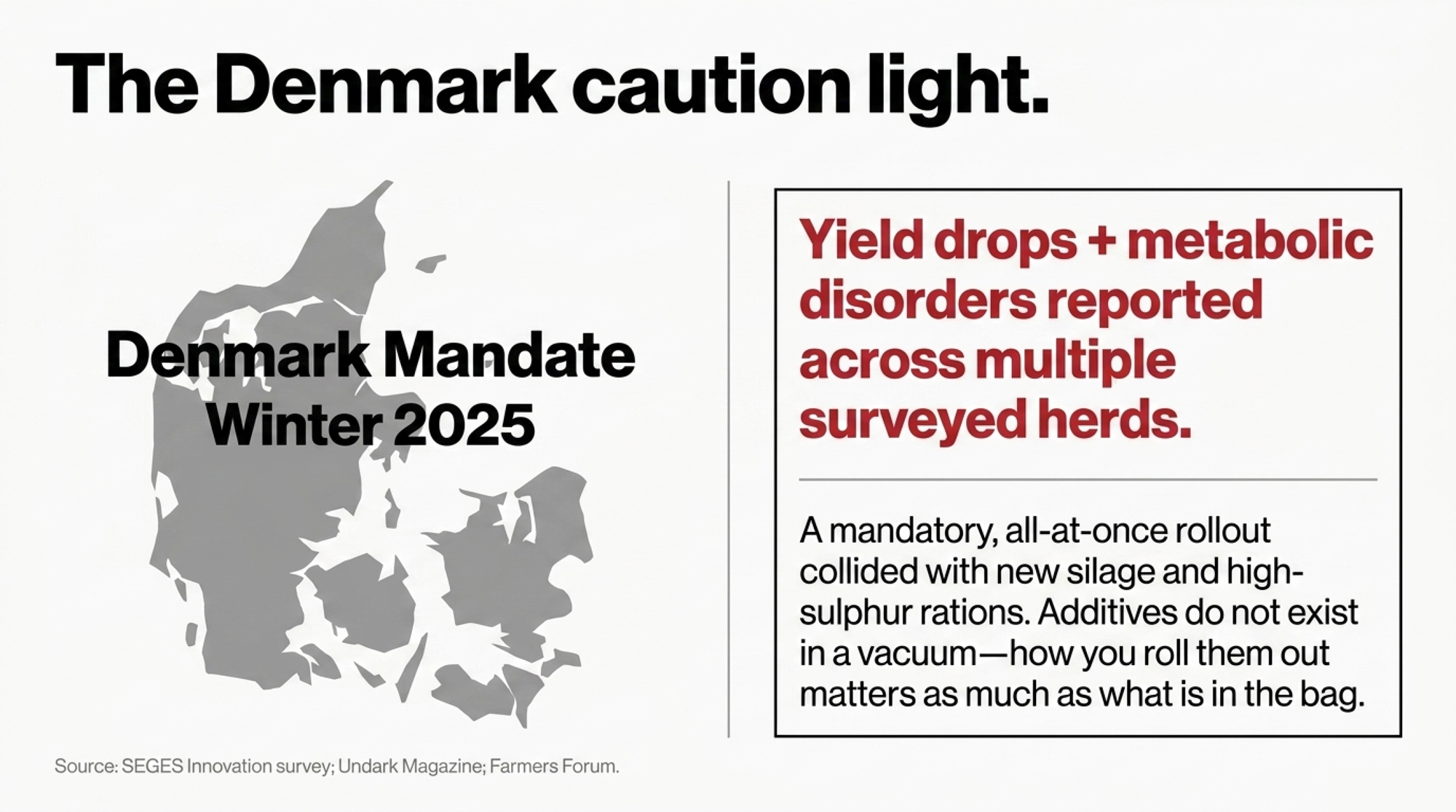
So the honest read isn’t “Bovaer is dangerous.” It’s that nobody had ever stress-tested it this way — mandatory, all at once, into rations where farms were opening new silage and running high-sulphur diets the same week. EFSA’s earlier opinion deemed it safe at the maximum recommended level; the U.S. FDA cleared it for lactating dairy cattle in 2024; and Aarhus University’s controlled trials “showed the desired methane-reducing effect without any signs of disease.” The product stays approved in more than 70 countries at recommended doses. The Danish data is real and worth respecting. It just landed in the messiest possible rollout conditions.

FactorControlled Trials (Peer-Reviewed)Denmark Rollout (Oct 2025)
Methane reduction21–30% (JDS 2024; 2025 review)Not measured systematically
Milk yield effectNo significant impactMajority of SEGES survey farms reported drop
Health incidentsNone in controlled conditionsDigestive/metabolic disorders widely reported
Ration contextControlled, optimized TMRHigh-sulphur rapeseed diets; new silage opening same week
Sulphur interactionNot studied at scaleSEGES flagged statistical link to high-sulphur rations
Animals affectedResearch herds, managed transition“Affected every herd” (vet report, Farmers Forum)
Regulatory responseApproved in 70+ countriesEFSA reopened safety review, Feb 2026
Manufacturer positionExtensive global safety data“No evidence Bovaer is the cause” — dsm-firmenich
North American relevanceFDA cleared for U.S. lactating cows (2024)Rapeseed diets rare; risk profile lower but not zero

The lesson for a North American TMR herd is blunt. Additives don’t exist in a vacuum, and how you roll one out can matter as much as what’s in the bag.

The Math That Actually Decides It
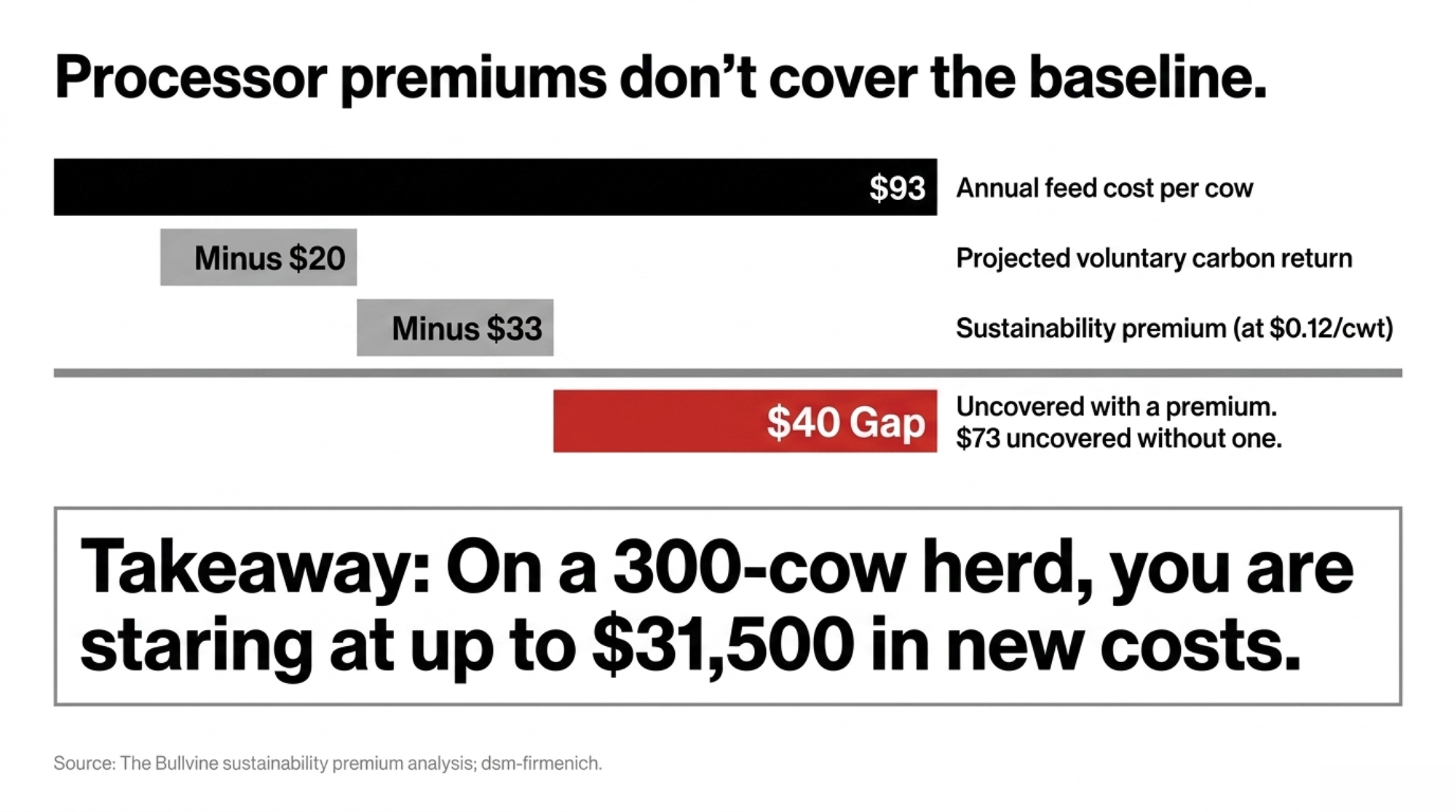
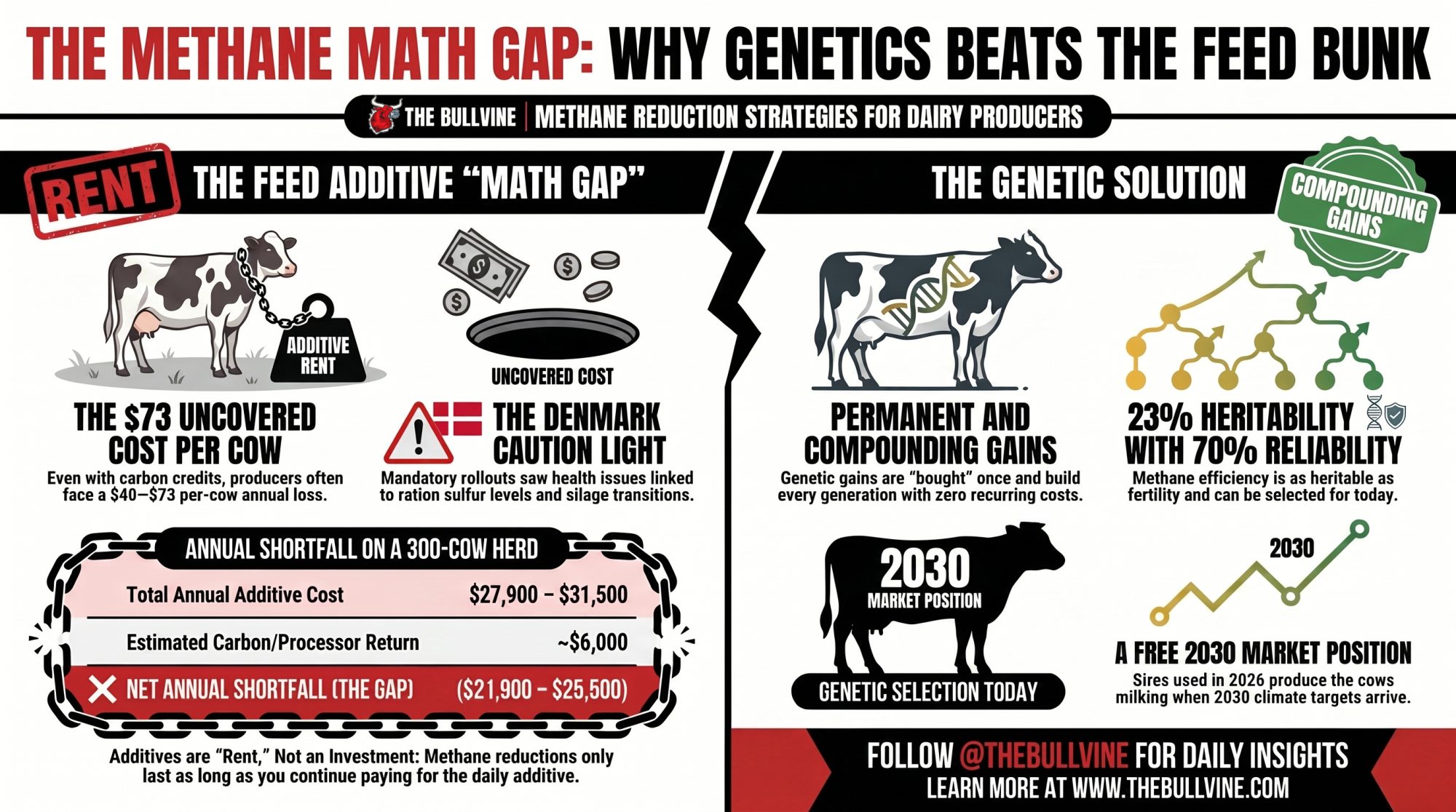
Strip away the safety drama, and 3-NOP comes down to barn math. Bovaer runs roughly $0.30–$0.40 per cow per day. dsm-firmenich pegs the cost at about $93–$105 per cow per year on a lactating-cow basis — close to a cent per litre. The two numbers don’t line up at a glance because the annual figure reflects a lactating-cow feeding window, not a flat 365 days. Confirm the feeding-day basis your supplier is quoting before you budget. On a 300-cow herd at that annual rate, you’re staring at roughly $27,900 to $31,500 in new costs. One caveat in your favor: a new manufacturing plant in Dalry, Scotland, is projected to bring the cost down over time, so this gap should narrow.

The return side is thinner than the pitch suggests. Elanco estimates Bovaer could return “$20 or more per lactating cow per year” through voluntary carbon markets, conservation funds, or processor incentives — call it roughly $6,000 back on those same 300 cows, and remember that’s a projection, not a guarantee. The Bullvine’s own analysis found a $0.12/cwt sustainability premium recovers only about $33 per cow per year on a 75-lb cow.
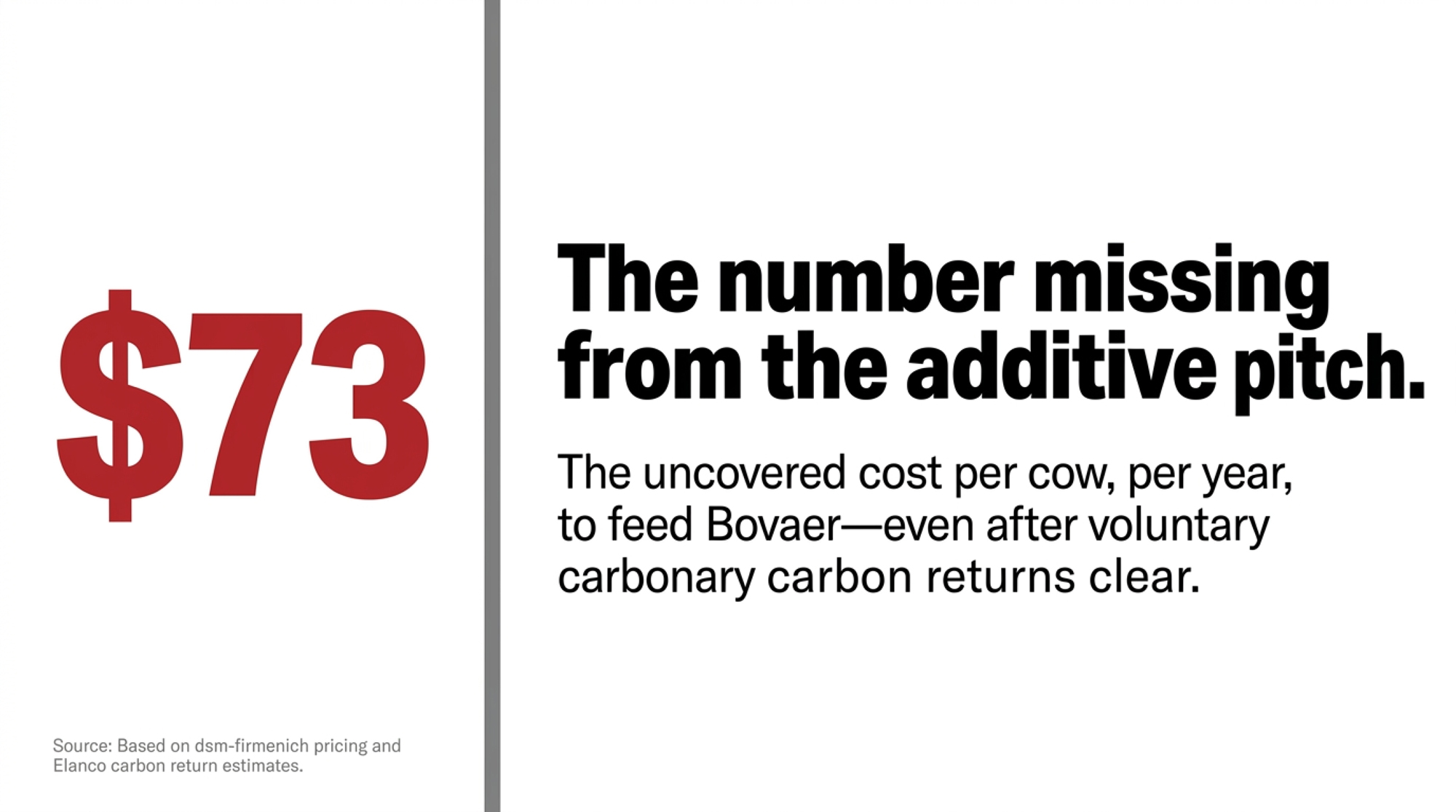
Now do the arithmetic, because nobody argues with their own arithmetic. With a premium stacked on carbon ($93 cost − $20 carbon − $33 premium), you’re leaving roughly $40 per cow uncovered. With no premium at all — just the carbon return against the cost — the hole runs from about $73 per cow at the low end of the cost range, and widens if you’re paying at the top of the range. That $73 floor is the number behind this story’s headline, and it’s the scenario many producers are actually facing.
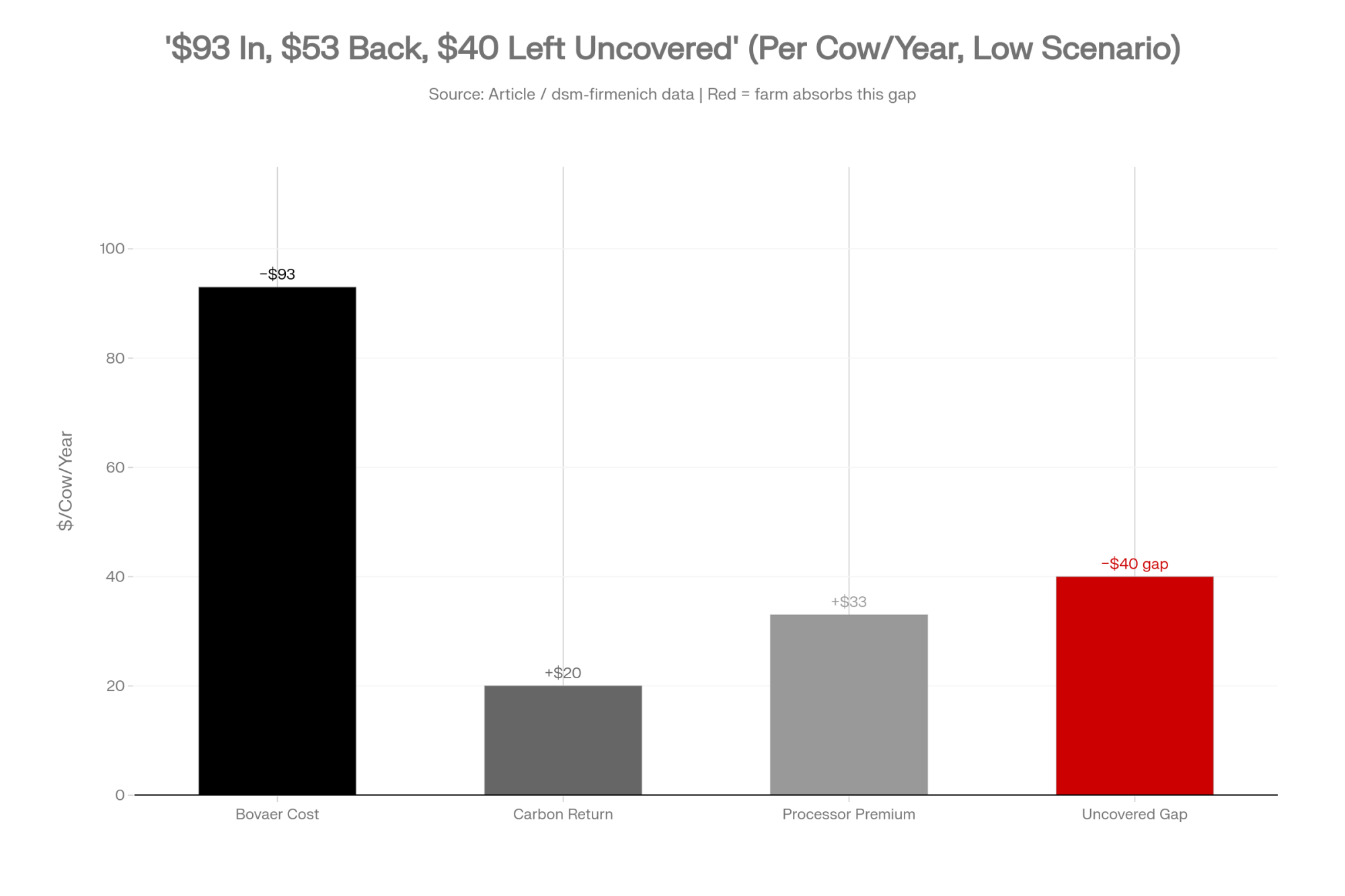
That’s the figure for the farm-office wall. Before you sign anything, ask three questions. What does it cost per cow? What am I guaranteed per cow or per hundredweight in return? And how long does the contract lock? Everything else is marketing.

Can a Sire Decision Really Be a Methane Decision?

Here’s where the slow, cheap lever lives — the one almost nobody frames this way.
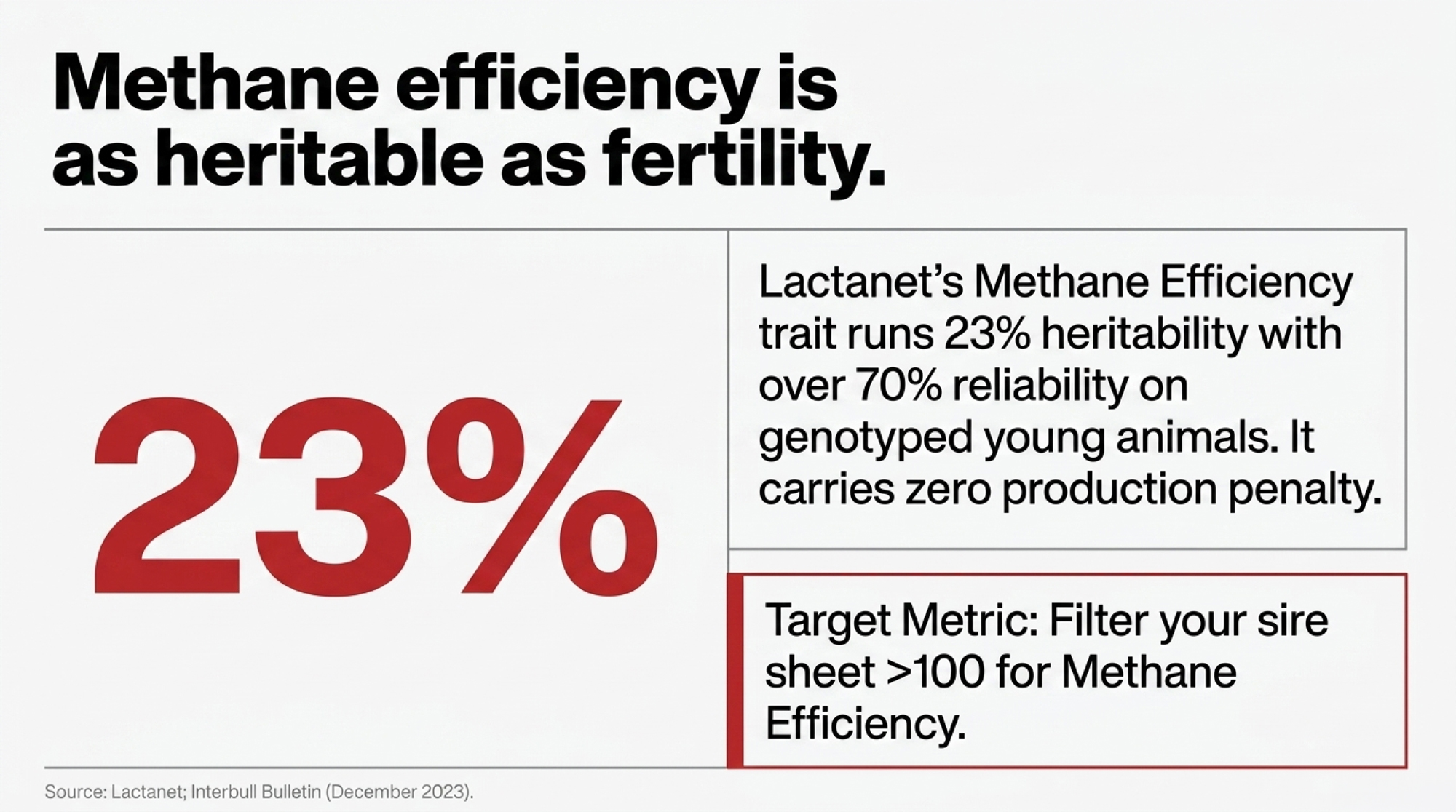
Methane is heritable. Lactanet pegs the heritability of its milk-MIR-predicted methane trait at 23% (0.23), with average reliability surpassing 70% for genotyped young bulls and heifers — figures published in Lactanet’s own trait documentation and the peer-reviewed implementation paper in the Interbull Bulletin (December 2023) and JDS Communications (2024). That’s right in the range of traits like fertility, and the genetic correlation with production is weak, so you can select for lower methane without giving up milk, fat, or protein. Lactanet has also reported a slight positive correlation between its Pro$ index and Methane Efficiency, suggesting that lifetime profit and a lower methane footprint aren’t at odds.

This isn’t theoretical anymore, and it’s exactly where Canadian breeders have an edge. In April 2023, Lactanet became the first organization in the world to publish official Methane Efficiency genetic evaluations for the Holstein breed, expressed as Relative Breeding Values (RBVs) built on milk mid-infrared spectroscopy data. The trait was then folded into the modernized LPI’s new Environmental Impact subindex in April 2025. Lactanet projects genetic selection can deliver a 20–30% methane reduction by 2050 with no production penalty, and calls it “a permanent and cumulative solution.” VikingGenetics has since followed with a Nordic Methane Index, and CRV in the Netherlands with Methane Saved. If you already read proofs and rank bulls by index, you can act on this today — while operations that only consider methane a feed-bunk problem are still waiting on the next additive trial. For how the trait slots into the indexes you already use, see our breakdown of the April 2025 LPI overhaul.
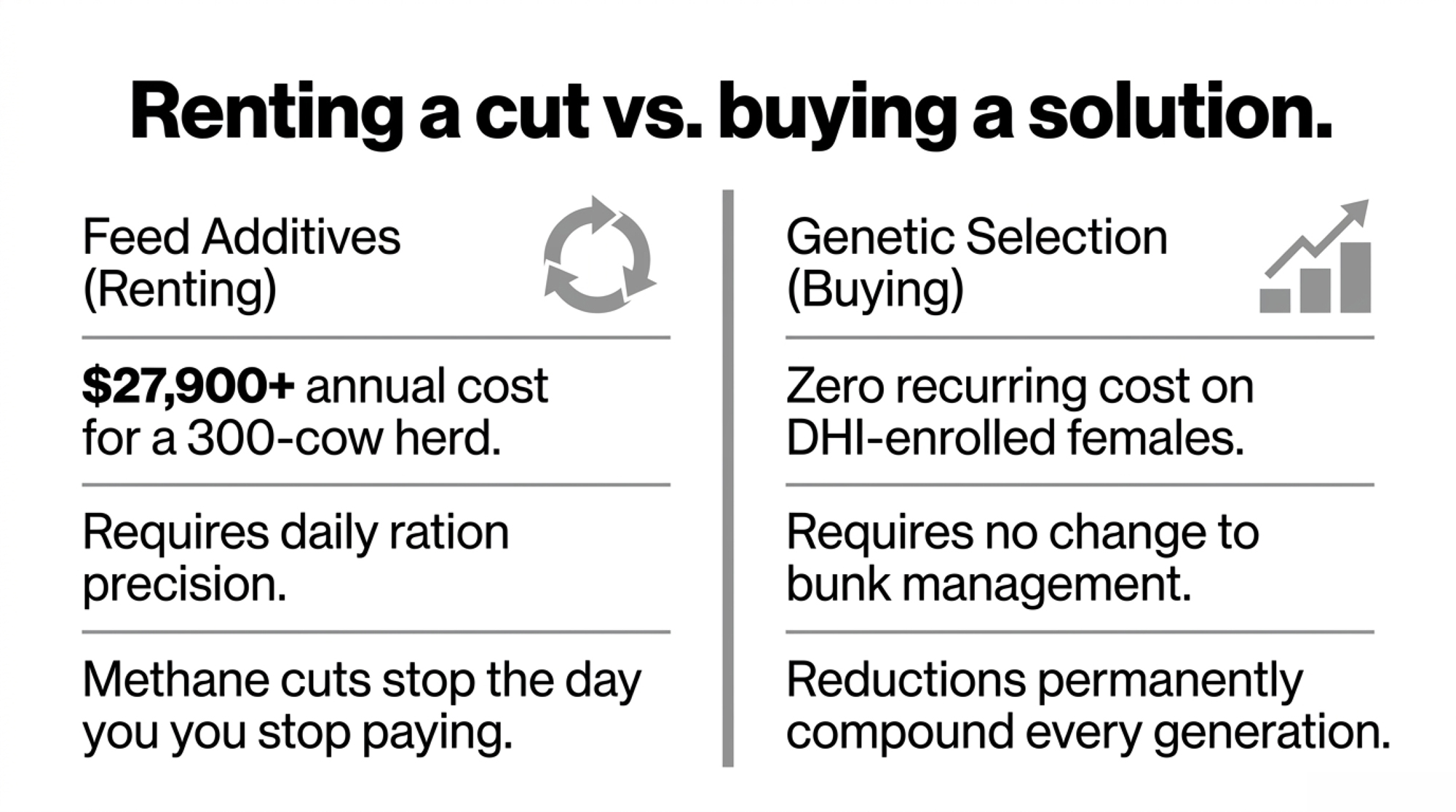
This is pay-now or pay-later in one decision. The additive is rent — you cut methane only as long as you keep paying. Genetics is a purchase. You build the reduction into the animal once, the recurring cost is zero, and the gain compounds every generation.

MetricBovaer (3-NOP)Genetic Selection (Methane Efficiency RBV)
Annual cost/cow$93–$105$0 (DHI-enrolled females)
Methane reduction~30% per peer-reviewed averageProjected 20–30% by 2050
HeritabilityN/A — not heritable23% (h²) — permanent in animal
Reliability on genotyped animalsN/A>70%
Effect durationLasts only while fedCompounds every generation
Production penalty?None in controlled trialsNone — weak genetic correlation with milk
Requires stable TMR?Yes — ration-sensitiveNo — works in grazing systems
Compounds over time?No — rent modelYes — purchase model
Cost if you stop payingReturns to baseline methaneGain is permanent in progeny
2030 market positioningReady now, ongoing cash outCalves of 2026 sires milk in early 2030s

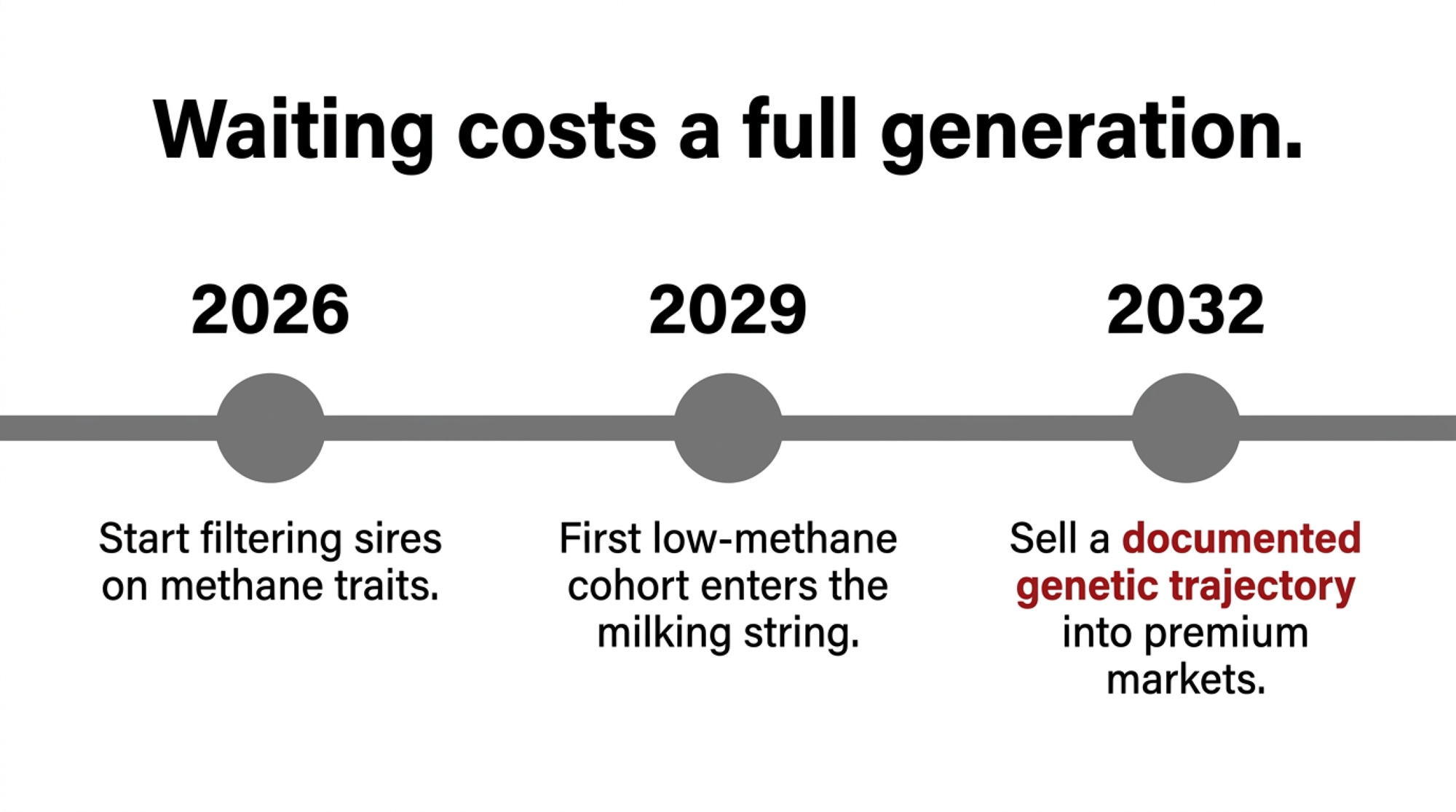
And the timeline is the part that should keep you up at night. A sire you use heavily in 2026 throws calves in 2027. Those heifers calve in 2028–2029 and milk into the early 2030s — right when 2030 buyer targets bite and “low-methane milk” is most likely to carry a premium or a penalty. Your 2026 sire decision is a 2030 market-positioning decision wearing a production hat. The calf check on the additive shows up now; the genetic position shows up exactly when the market starts paying for it.

Your next mating session, do this: pull up your genomic sheets and find the Methane Efficiency value (the RBV in Canada; watch for the equivalent line as U.S. and Nordic evaluations roll out). Screen out the high-methane tails and weight toward bulls sitting clearly above the breed average — above 100 — for Methane Efficiency, without dropping your core economic index, whether that’s Pro$, LPI, NM$, or TPI. In Canada, those values are already published free of charge for every Holstein female in your DHI herd inventory; for cows and heifers outside it, Lactanet sells the bundled Methane and Feed Efficiency evaluation at $8 per animal, with a $2 credit for type-classified herds.

Lab Coat or Barn Coat: Sorting the Rest of the Toolbox

The rest of the buzz sorts cleanly into what you can feed tomorrow, what you watch for two years out, and what you ignore until the science catches up.
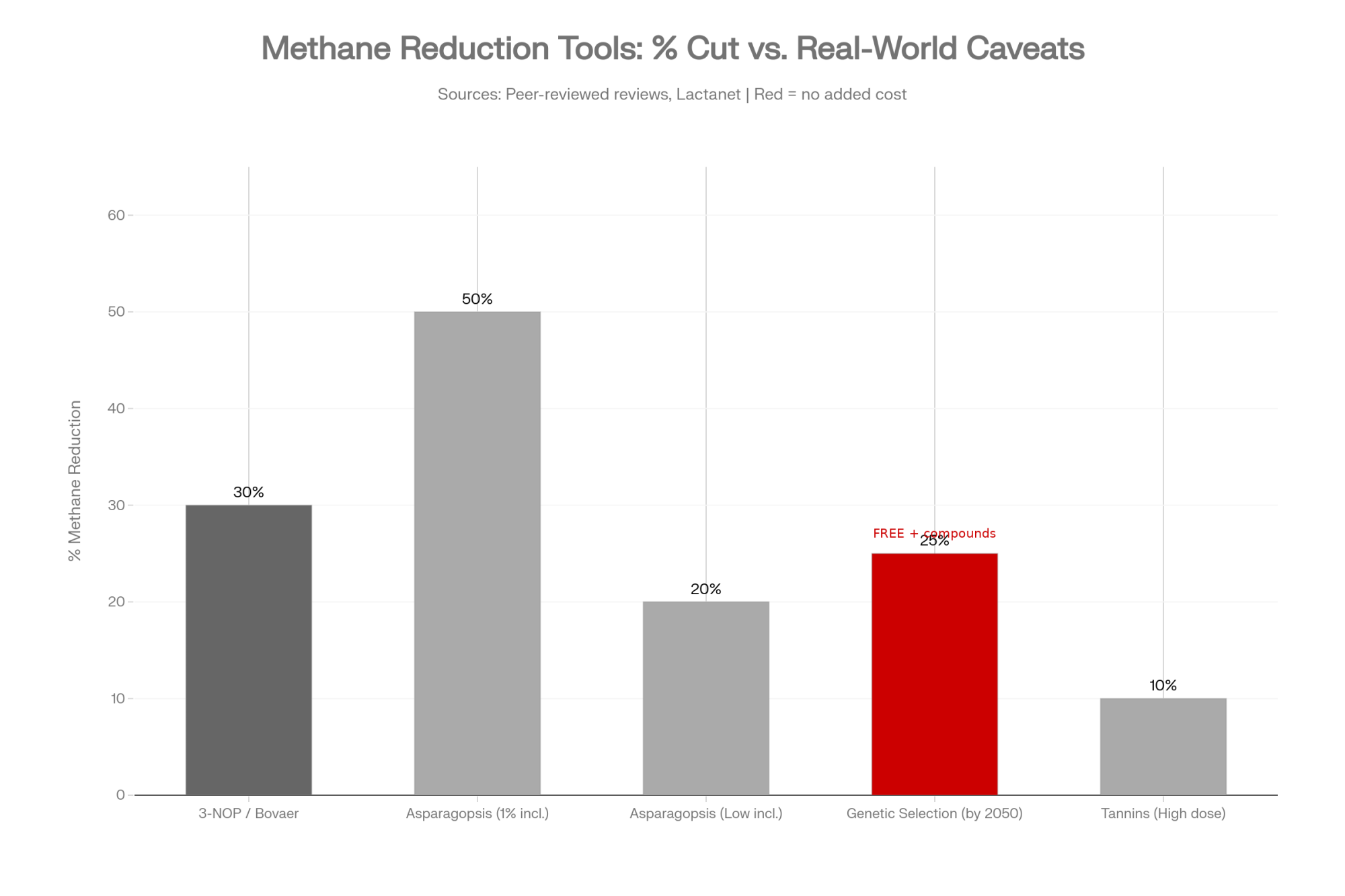
ToolVerdictWhat the data showsThe catch
TanninsFeedable now, modestly2024 meta-analysis: ~10% cut in enteric methane and methane yieldOnly works at high effective doses (above ~8,000–10,000 mg/kg DM); sub-therapeutic doses do little; most robust data is from beef
Asparagopsis seaweedWatch, don’t bet~20% reduction at low inclusion, 50%+ at 1% inclusionThe biggest cut came with a milk-yield penalty (Roque et al., 2019); high cost, bromoform variability, supply and regulatory hurdles
Methane vaccineIgnore for budgetingNZ’s AgResearch targeting at least 20% reduction with no system changesOnly in-vitro antibody responses so far; no consistent live-animal methane drop; 5–10 years out

The seaweed and vaccine numbers that headline conference slides mostly come from short beef trials, in-vitro work, or aspiration — not from multi-lactation dairy data. Worth knowing. Not worth betting the barn on yet.

What This Means for Your Operation

Pick the path that fits your system, then run the check beside it before you commit a dollar.

Farm TypePrimary LeverSecondary LeverWatch Out ForMethane Cost (Year 1)
Stable TMR, processor premium3-NOP (Bovaer) + genetics filterCarbon program enrollment$40–$73/cow gap if premium doesn’t cover cost; ration sulphur$93–$105/cow
Stable TMR, no processor dealGenetics filter (Methane RBV >100)Efficiency + reproduction disciplineSigning for optics before math pencils$0 extra
Grazing / high-forage systemGenetics — only viable daily leverTannins at effective dose if set up for itDaily additives impractical without individual feeding$0 extra
All farm types — baselineCulling + reproduction + feed efficiencyMethane RBV filter on sire listDoing nothing = price taker when methane hits your contract$0 extra
  • Default path — efficiency plus genetics. Fits nearly every herd, any size. No new product spend, just discipline on reproduction, culling, and feed efficiency, plus a methane filter on the sire list. The gains are slow and won’t satisfy a processor wanting cuts this quarter — but they cost nothing extra and compound for a decade. Check: Does your mating program have a methane filter on it yet? If you’re in Canada, are you pulling the Methane Efficiency RBVs already sitting free on your DHI-enrolled females?
  • Conditional path — 3-NOP. Makes sense for stable TMR herds with a premium or carbon program that genuinely narrows the $40–$73 gap. Demands ration precision and careful transition timing. Where it backfires: signing for the optics, feeding it through silage changes, or believing in a flat 30% forever. Check: Have you run your own cost-per-cow against a guaranteed premium or credit, not a projected one? What’s written into your processor agreement, and how long does any premium lock last? If the rep pitches “30% forever,” ask for the 18-month data in a herd like yours. That dataset barely exists.
  • Stacking path — tannins, and a note for grazers. Sensible for high-forage or grazing systems already set up for tannin inputs, but only at effective doses. Check: If you graze, are you leaning on genetics? Daily additives aren’t practical for animals you don’t feed individually, which makes the sire list your main lever, not your backup.
  • The data question that cuts across all three. Are you capturing the production, intervention history, and methane intensity that a future premium will make you prove? Here’s how carbon insetting actually pays producers.
Key Takeaways

  • If you do nothing else, bank the free gains. Efficiency plus a light methane filter on your sire list costs nothing extra and compounds for a decade.
  • If a processor pitches a premium, run the gap math first — additive cost minus guaranteed return. If it leaves a $40–$73 gap per cow, or wider at the top of the cost range, don’t sign for the optics.
  • If you’re on a stable TMR and the numbers pencil, 3-NOP is a legitimate tool — but treat Denmark as a rollout warning, not a verdict: watch ration sulphur, silage timing, and transitions.
  • If you farm a grazing system, your methane plan is genetics, full stop — daily additives don’t fit animals you don’t feed individually.

The Danish farmers calling their vets didn’t get a say in how that additive landed in their bunks — the mandate decided for them. You still get the say. Doing nothing feels safe at the kitchen table tonight, but it’s still a decision: you’re choosing to be a price taker when methane lands in your milk contract, negotiating from a blank page while the neighbor walks in with a genetic trajectory and verified numbers. The cheapest move on the board costs you nothing this year and builds for a decade. So the real question isn’t whether you trust the Bovaer rep. It’s whether you’ll let your 2026 sire list do the quiet work while everyone else argues about the additive.

Run Your Numbers

Genomic Testing ROI Calculator — Before you bank on Methane Efficiency as a free lever, run the genomic numbers. The calculator pressure-tests whether testing and sorting your heifers actually pays once raising cost, quartile value spread, and beef-on-dairy outs are counted — so you know the genetic play pencils before the additive rep ever calls.

Complete references and supporting documentation are available upon request by contacting the editorial team at editor@thebullvine.com.

Learn More

The Sunday Read Dairy Professionals Don’t Skip.

Every week, thousands of producers, breeders, and industry insiders open Bullvine Weekly for genetics insights, market shifts, and profit strategies they won’t find anywhere else. One email. Five minutes. Smarter decisions all week.
NewsSubscribe
First
Last
Consent

New Zealand Bred Years of Low-Methane Bulls. Their Daughters Didn’t Inherit a Thing.

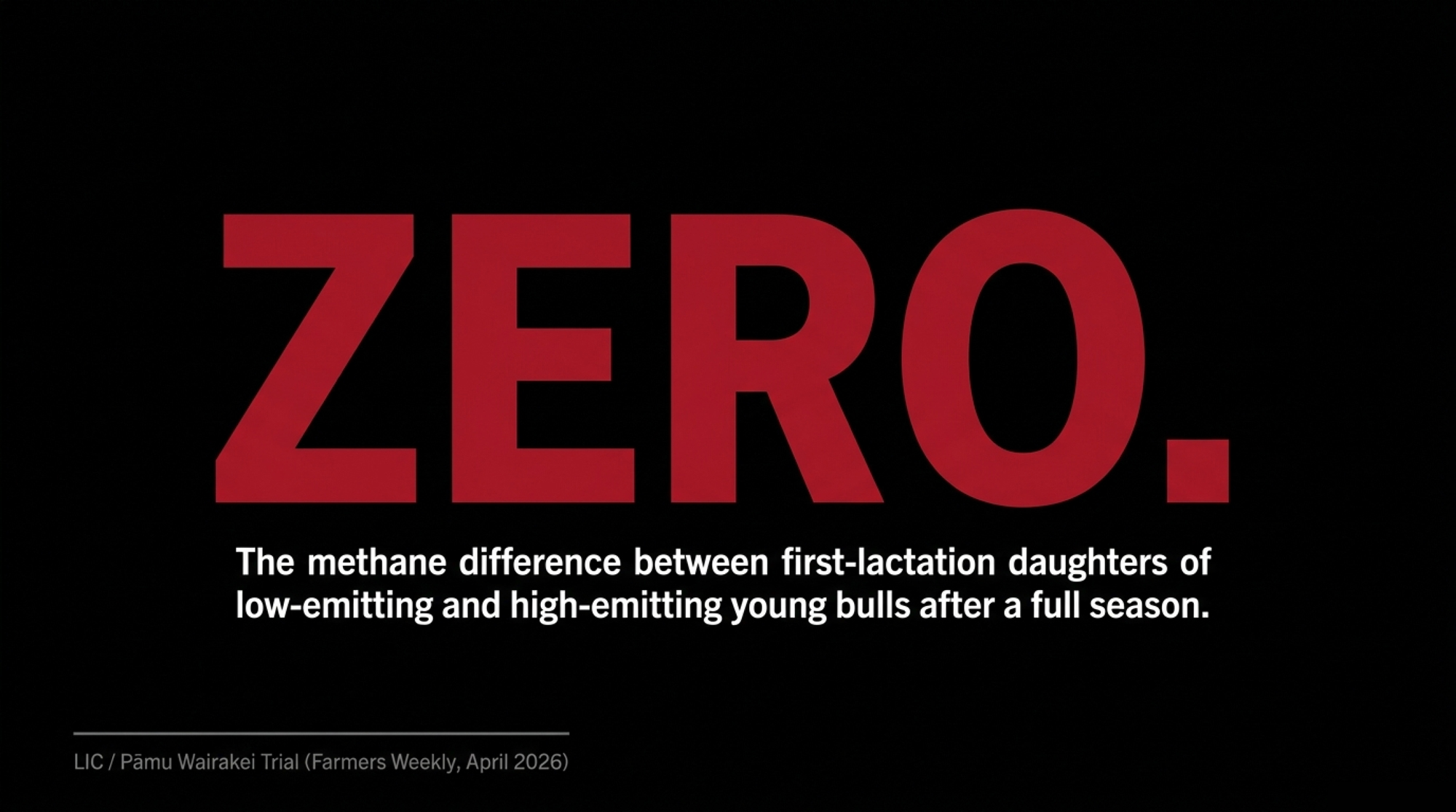
Several hundred first-lactation daughters at Pāmu Wairakei. One full season on GreenFeed. Zero significant difference between low- and high-methane sires. The bull-proxy shortcut is done.

Executive Summary: LIC and CRV’s flagship methane breeding programme just confirmed that low-methane young bulls in New Zealand don’t pass the trait to their lactating daughters — several hundred first-lactation daughters at Pāmu Wairakei, measured one full season on GreenFeed, showed no significant difference between high- and low-emitting sires. LIC Chief Scientist Dr. Richard Spelman told Farmers Weekly (NZ) on April 30, 2026 that the trait in young bulls isn’t the same trait in a lactating cow — and the planned late-2026 NZ methane BV rollout now has to be rebuilt on lactating-cow phenotypes. The Norwegian Heringstad and Bakke paper (JDS Communications, July 2025) had already pegged the genetic correlation between bull methane and cow methane at 0.63 ± 0.22 — meaning a /straw premium across 200 services was a ,000 bet on a coin flip with the downside in your own barn. Lactanet ME (h² ~0.23, 70%+ reliability on young animals), VikingGenetics NMI (h² ~0.20, 16,000+ commercial cows), and CRV NL’s Methane Saved aren’t tarred by the result — they were built on lactating cows from day one. TPI and NM$ users have a natural shield, but private “sustainability indexes” and processor climate composites are where bull-phase numbers still hide. The single question that now separates real methane genetics from expensive guesswork: at what life stage was the reference population measured?

Lactating Holstein at GreenFeed unit during methane breeding value trial measuring per-cow emissions in first lactation

LIC Chief Scientist Dr. Richard Spelman didn’t dress it up. Speaking to Farmers Weekly (NZ) on April 30, 2026, he framed the lactation-phase result of New Zealand’s flagship methane breeding trial as a setback. The trait measured in young bulls, he told the outlet, didn’t appear to be the same trait when measured in a lactating cow.

The first-lactation daughters of LIC and CRV’s lowest-emitting young bulls had finished their measurement season at Pāmu’s Wairakei Estate, and the methane signal that had looked clean in yearling heifers was gone. Several hundred daughters. One full lactation. No significant difference between daughters of high-emitting and low-emitting sires. For breeders who’ve watched methane labels appear on sire pages since 2023, that’s the moment the bull-proxy version of the assumption broke.

The 60-Second Breakdown

  • The Goal: Measure methane in young bulls to skip the cost of phenotyping millions of milking cows.
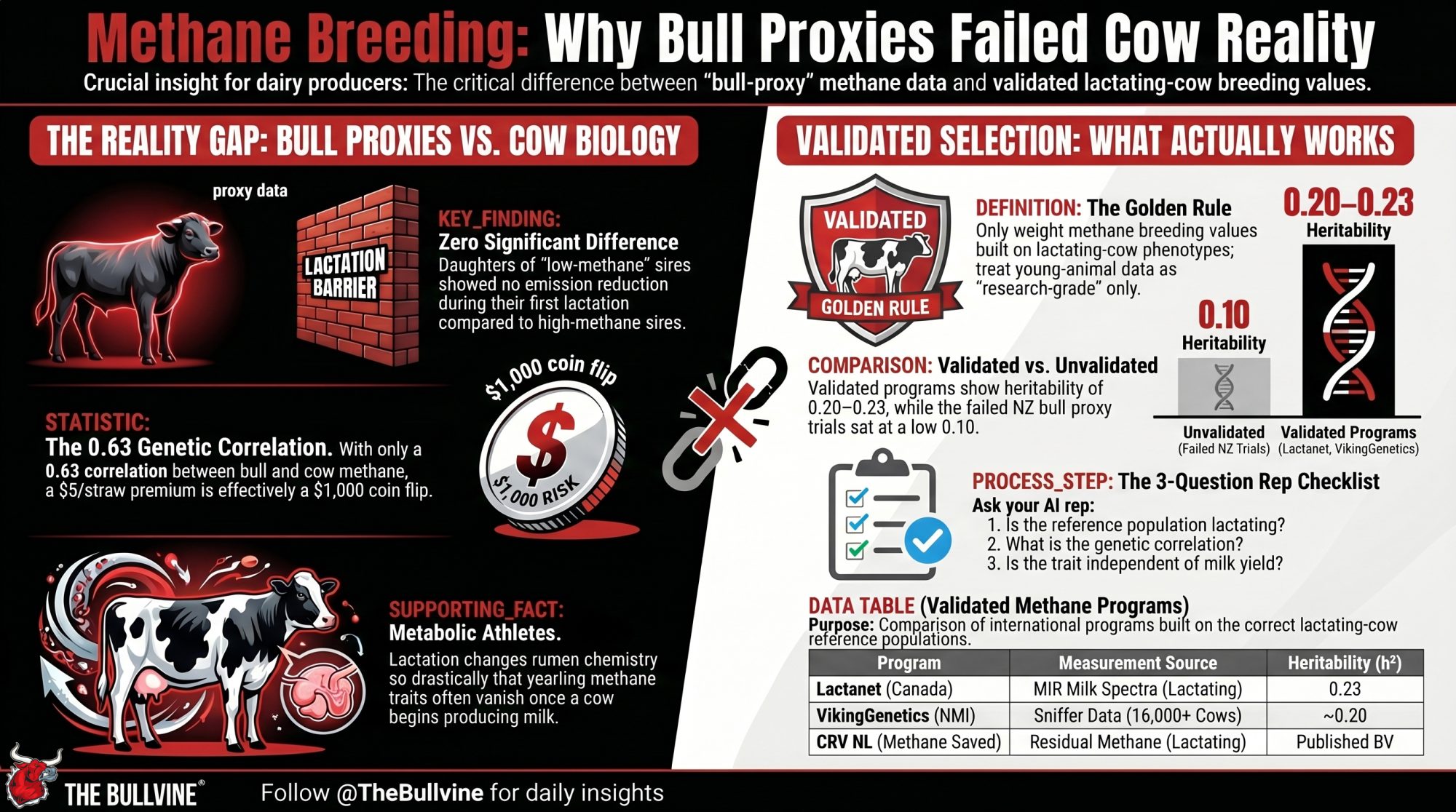
  • The Result: Bull data didn’t match cow reality. Daughters of low-methane sires emitted no less than daughters of high-methane sires.
  • The Action: Only weight methane breeding values built on lactating-cow phenotypes. Decline anything you can’t decompose.

Why a Multi-Year Bet on Bull Methane Failed in Lactation

The New Zealand programme wasn’t a marketing exercise. It was a serious, well-funded scientific bet, built on a hypothesis that looked airtight on paper. Measure methane in young bulls cheaply, identify the lowest emitters, and push their semen across a national herd through AI — and you’d skip the brutal cost of phenotyping millions of milking cows. Lactating-cow phenotyping is structurally more expensive than bull-phase screening, which is why national programmes have rationed it carefully.

The trial cohort tells you how seriously they took it. Several hundred daughters, sired by the highest- and lowest-emitting bulls from earlier screening rounds, were measured under controlled conditions using GreenFeed methodology so feed intake and emissions could be quantified precisely. The lactation phase alone represented years of controlled measurement work on a cohort of this scale — before counting the bull screening that came earlier.

What the trial proved is uncomfortable for anyone who’s already weighted a methane number in a mating decision: the trait expressed in growing animals is not the same trait expressed in lactating cows. Per LIC’s official update on April 29, 2026 and Spelman’s comments to Farmers Weekly the following day, the cow trait sits in a different physiological space than the bull trait. The cross-stage transfer the programme was built on didn’t hold.

One caveat worth keeping front of mind. As of press, the lactation-phase result has been communicated through LIC’s official April 2026 update, statements to Farmers Weekly and Rural News Group, and the Wellington presentation. A peer-reviewed manuscript hasn’t been published yet. Sire analysts should treat the result as official communication, not yet a published paper.

What Happened When the Daughters Freshened

The yearling phase had been genuinely encouraging. Daughters of the low-methane sires were lower emitters at 8–10 months. The trait looked heritable. Transferable. Ready to commercialise. By December 2024, Dr. Lorna McNaughton was presenting milestone data at the Wellington Agricultural Climate Change Conference, and LIC was publicly describing a planned methane breeding value rollout from late 2026.

Then the daughters freshened.

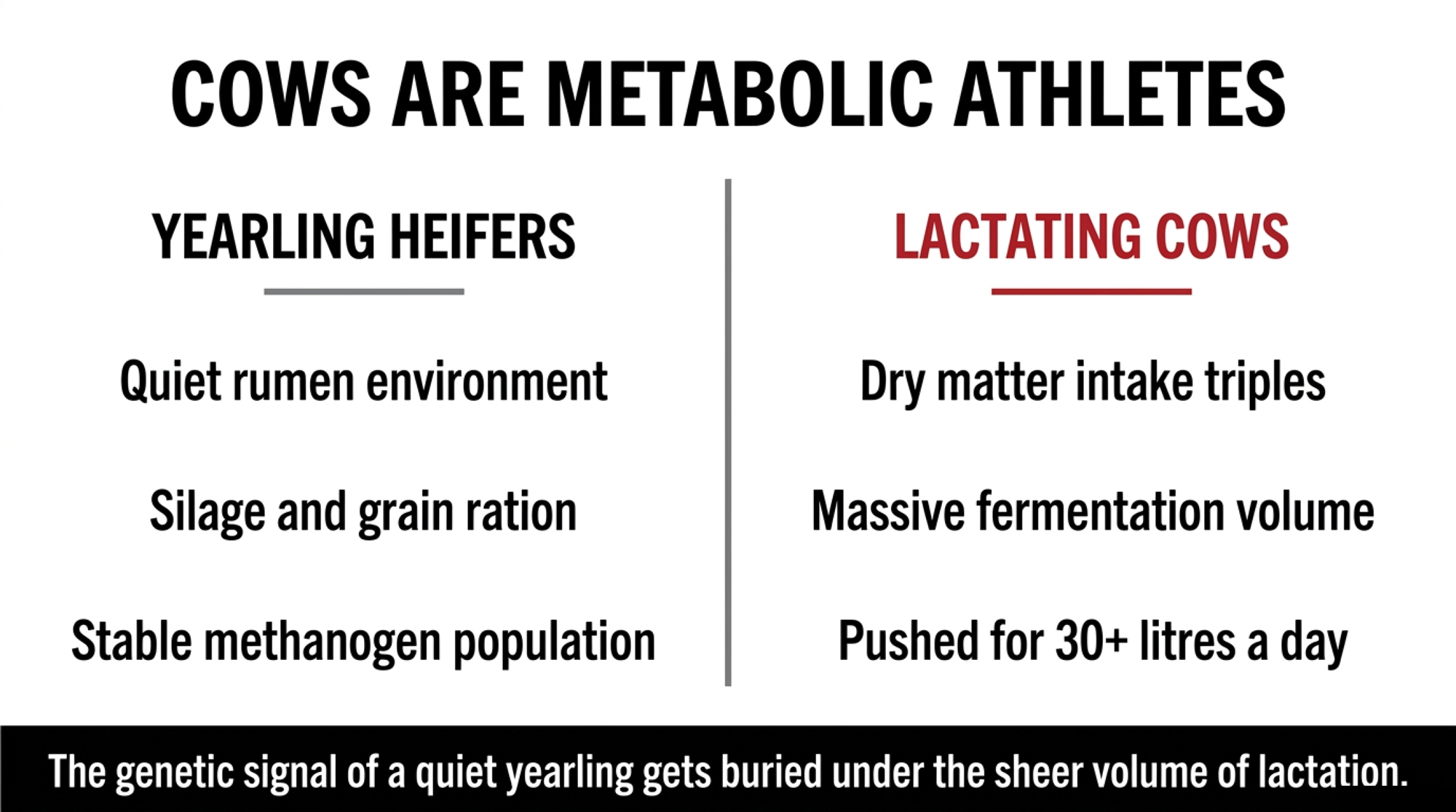
Lactating cows are metabolic athletes. Dry matter intake can triple within weeks of calving, and the rumen environment they’re working with at peak lactation barely resembles the one they ran as yearlings. Take a heifer on a silage-and-grain ration with a relatively stable methanogen population, then move her onto a high-energy lactating ration and push her to 30+ litres a day. Different fermentation substrates. Different passage rates. Different methanogen archaea dominance. The genetic differences in methanogen populations or rumen morphology that distinguished a quiet yearling from a noisy one get buried under the sheer volume of fermentation needed to make milk.

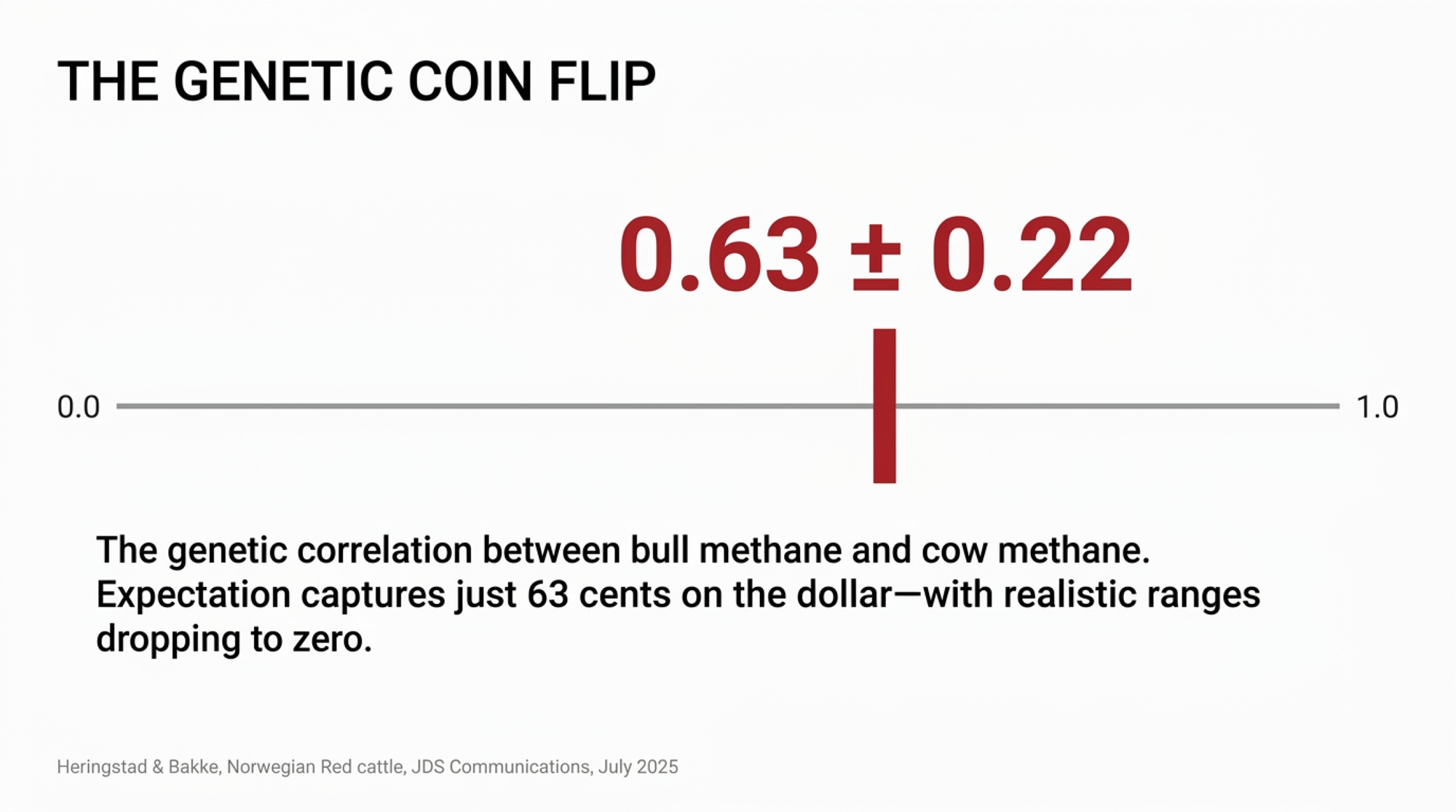
Norwegian researchers Bjørg Heringstad and Katrine A. Bakke quantified the underlying problem in a July 2025 JDS Communications paper that landed almost four years after the NZ programme committed to its design. In Norwegian Red cattle, the genetic correlation between methane in young bulls and methane in lactating cows came in at 0.63 with a standard error of 0.22. Related, but not the same trait.

That number matters in a way that’s easy to miss. A correlation of 0.63 means a breeder who selected a bull two years ago expecting full methane response in his daughters is, on the expectation, capturing maybe 63 cents of every promised dollar of reduction. Factor in the standard error and the realistic range runs from roughly zero up to that 63 cents — a coin flip with a skewed downside. The NZ daughter trial landed at the bottom end of that range.

So the question stops being theoretical. If the trait you’re paying for in a young bull doesn’t fully transfer to his daughters, what does a sire catalogue page actually need to show before you weight it?

How Does a Validated Methane BV Differ From a Bull-Proxy One?

The contrast with programmes built on lactating-cow phenotypes is the part of this story that should change how you read a sire catalogue tomorrow morning.

ProgrammeReference PopulationReliabilityStatusUse in Selection?
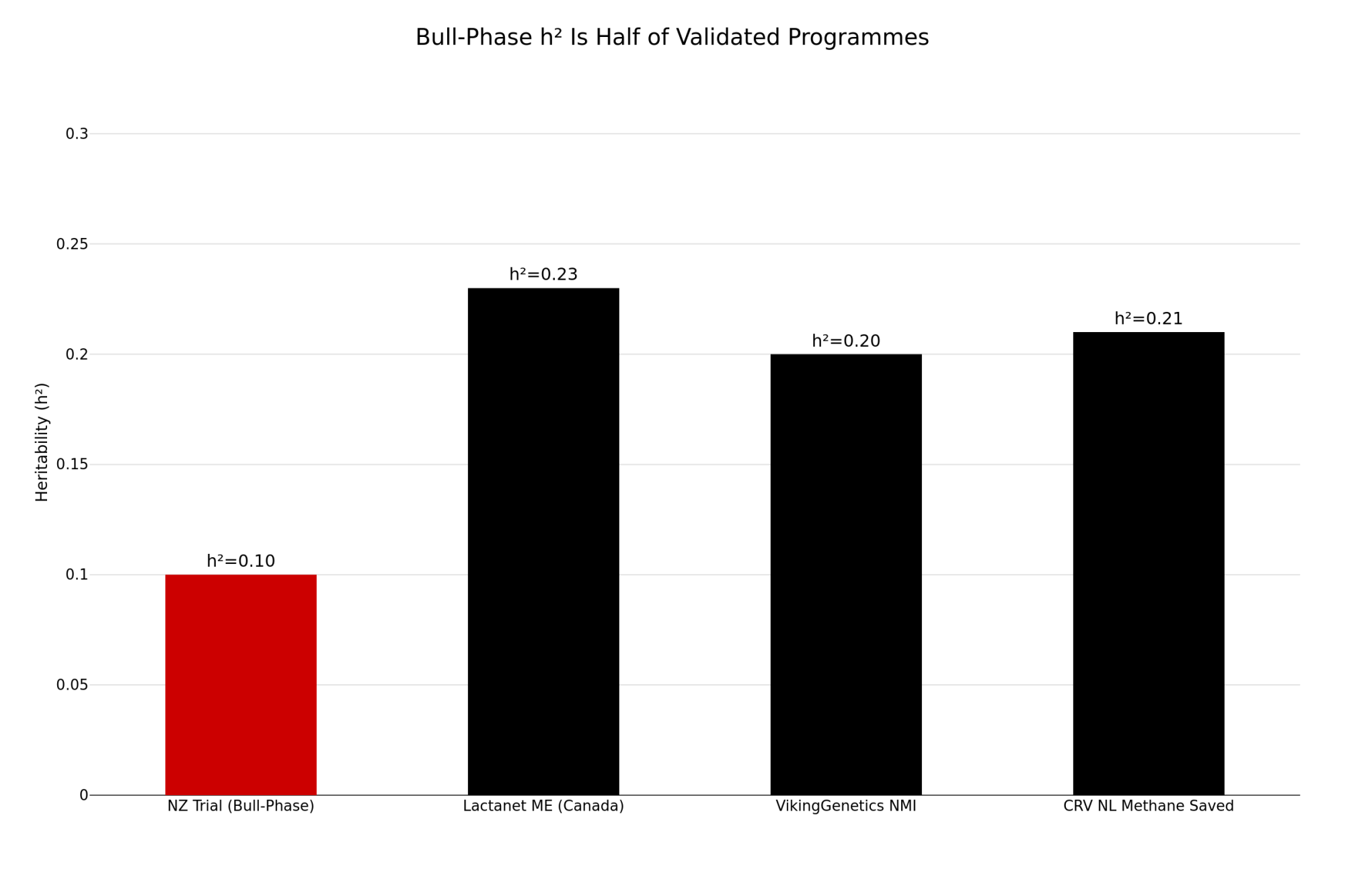
NZ Trial (LIC / CRV)Young bulls / yearling heifers0.10Low (proxy)Failed lactation validationNo — research-grade only
Lactanet ME (Canada)MIR spectra, lactating Holsteins 120–185 DIM0.2370%+ on young animals✅ In use since Apr 2023Yes — 5–10% weighting
VikingGenetics NMISniffer data, 16,000+ lactating cows~0.20High✅ Expanded May 2026Yes — 5–10% weighting
CRV NL (Methane Saved)Residualised, lactating cow recordsPublished as RBVModerate✅ Published Aug 2025Yes — 5–10% weighting
TPI / NM$ / LPI / Pro$No direct methane componentN/AN/A✅ Natural shieldYes — no hidden bull-proxy risk

Lactanet’s Methane Efficiency RBV — a Canadian evaluation launched in April 2023 — was built from MIR milk spectra on first-lactation Holsteins between 120 and 185 days in milk. Heritability of the underlying methane prediction came in at 0.23, with genomic reliabilities for young animals reported above 70%. Lactanet has projected modest but compounding herd-level methane reductions through sustained selection on the index, with no recurring feed cost.

VikingGenetics’ Nordic Methane Index draws on automated sniffer data from over 16,000 commercial lactating cows in Denmark, Sweden, and Finland. Heritability lands around 0.20, with a projected long-term reduction of roughly 20% as the trait works through the population. CRV Netherlands published its “Methane Saved” BV in August 2025 — daily methane per cow, residualised against production, expressed as a relative breeding value. Dutch herds enrolled in CRV recording can pull a sire’s Methane Saved figure from the same evaluation system that delivers their fertility and longevity numbers.

None of these programmes carry a multi-decade track record yet, and that’s worth saying out loud. Lactanet ME has been in commercial use since April 2023. The Nordic Methane Index expanded to VikingRed and VikingJersey only in May 2026. CRV NL’s Methane Saved is nine months old. What they have is the right reference population, the right life stage, and published heritability — not a long history of audited herd-level results.

The structural difference with the NZ bull-phase work isn’t subtle. Validated lactating-cow indexes carry h² of roughly 0.20–0.23 and reliabilities above 60–70%. The NZ bull-phase work reported an early-phase heritability around 0.10. Stack a 0.10 heritability against 0.20–0.23 in the validated programmes, then run the result through an imperfect cross-stage genetic correlation, and the realistic in-herd response from a young-bull methane BV is a fraction of what a lactating-cow-built BV delivers. The NZ daughter result suggests that fraction can collapse to zero in practice.

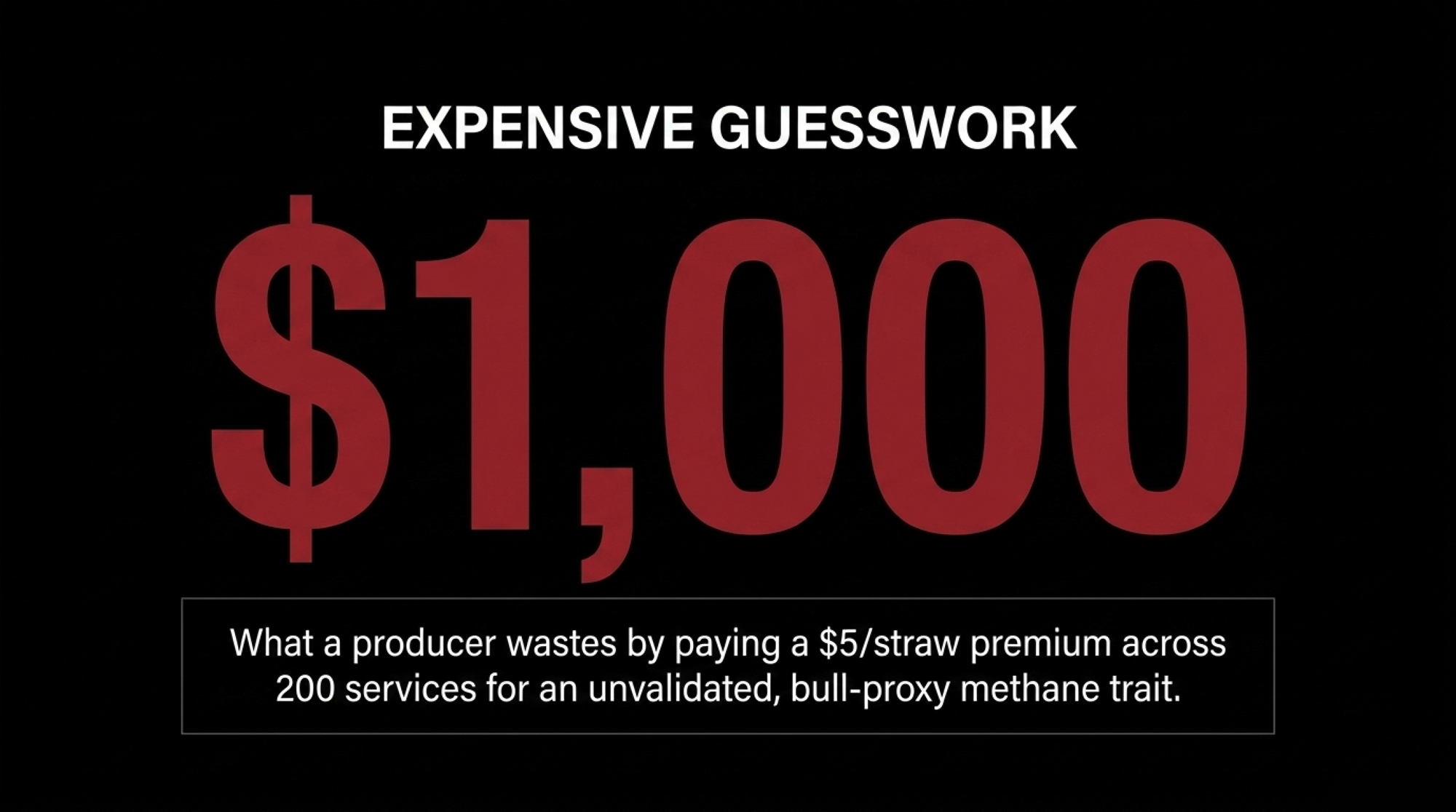
The barn math. A breeder who paid even a $5 per-straw premium for a “low methane” young-bull index across 200 services spent $1,000 on a trait whose realistic in-herd response — based on the NZ trial — sits between zero and a modest fraction of the catalogue claim. A Canadian breeder weighting Lactanet Methane Efficiency in their selection index, by contrast, is buying into a published, evaluated trait — and avoids the kind of contract-to-cow gap that’s already shown up elsewhere in the climate genetics economy. Same selection pressure, same cost. One response is built on a validated reference population. The other isn’t.

Checklist for Your AI Rep

Before you weight any methane number on a sire page, get written answers to these three:

QuestionAcceptable AnswerRed Flag
1. Reference population life stage?“Lactating cows” — with DIM window specified“Young bulls,” “yearling heifers,” “growing animals,” or no answer
2. Published genetic correlation (r_g) between measured and lactating population?Specific published number with SE (e.g., 0.63 ± 0.22 or 1.0 if built on cows)“We assume high correlation,” vague language, or no number provided
3. Is the trait residualised — independent of milk, fat, protein?Yes, with documented residualisation methodNo residualisation; BV correlates with lower production; no documentation

A Note on Sheep, Beef, and Why Dairy Is the Outlier

Worth saying briefly, because it underlines why dairy is the harder problem: low-methane breeding still works in sheep. The Beef + Lamb New Zealand Genetics programme has measured low-methane sheep for over a decade, and the trait expresses in adult animals because measurement and production stage line up — sheep are measured at roughly the same physiological state they’re selected on. AgResearch’s beef cattle work has reported similar reasons for confidence in adult-animal measurement, though dairy is the result with the published null.

Dairy is the outlier because lactation is the outlier. Nothing else in livestock production demands the metabolic intensity of a 30-litre cow at peak. That’s the biological fact the NZ trial just made unavoidable. Per LIC’s April 29, 2026 update and supporting comments from Ag Emissions Centre Executive Director Naomi Parker to Rural News Group on May 4, 2026, the dairy programme is signalling a pivot toward measuring lactating cows directly, rather than abandoning the work.

Which Methane Number Earns a Line in Your Selection Spreadsheet?

The selection question for 2026 isn’t whether climate genetics matter. It’s which climate numbers actually deserve weight in a real mating decision.

  • Stay on profit, fertility, and feed efficiency. Use validated methane indexes only as a tie-breaker. Best for most herds in most markets. You’re not missing real genetic progress, because the validated lactating-cow indexes are already correlated with feed efficiency. Backfire risk: low.
  • Weight a validated lactating-cow index (Lactanet ME, NMI, Methane Saved) at a defensible 5–10% of your internal index, depending on confidence in your own production system’s methane phenotype. Best for herds in Canada, the Nordics, or Holland with active recording in those systems and a processor relationship that recognises the metric. Demands: discipline to keep money traits ahead of climate traits.
  • Decline any methane or “climate score” you can’t decompose. Best for herds being pitched bulls with composite sustainability scores where the supplier can’t break the number into reference population, life stage, and heritability. Backfire: you might miss a marginal real signal, but you also won’t pay for one that doesn’t express.

The U.S. and Canadian Picture: A Natural Shield, With One Catch

North American breeders selecting on TPI or NM$ in the U.S., or LPI and Pro$ in Canada, have a structural advantage in this debate that’s easy to miss. Methane isn’t currently a heavy weight in any of those base indexes. CDCB’s NM$ doesn’t carry a methane component. Holstein Association USA’s TPI doesn’t either. Lactanet’s LPI and Pro$ formulas weight production, durability, health, and fertility — Methane Efficiency is published as a separate RBV that breeders choose to layer on top, not a hidden weighting inside the headline index.

That’s a natural shield against the bull-proxy failure. A producer mating on TPI or NM$ today isn’t accidentally buying NZ-style bull-phase methane assumptions through their main index. The trap sits one layer deeper: in private-company Sustainability Indexes and processor-branded composite “climate scores” that bundle methane alongside feed efficiency, polled, and other traits. Those composites are where a bull-phase or unvalidated methane number can hide, depending on how the index is constructed. If your AI partner offers a sustainability index, ask the same three questions in the AI Rep checklist above before you weight it. If the answer is opaque, treat the composite as marketing, not selection signal.

30-day action. Pull your last 12 months of semen invoices. Mark each sire that carried any methane, sustainability, or climate label in its marketing. For each, ask the AI company in writing — was the BV built from lactating cow phenotypes or growing animals? What’s the published heritability? What’s the reliability on this bull? If you don’t get clean answers within 30 days, that’s data you can use the next time a methane premium gets pitched. NZ readers should run the same query through LIC or CRV NZ technical sales. If 90 days pass with no written answer, treat the absence as the answer.

What This Means for Your Operation

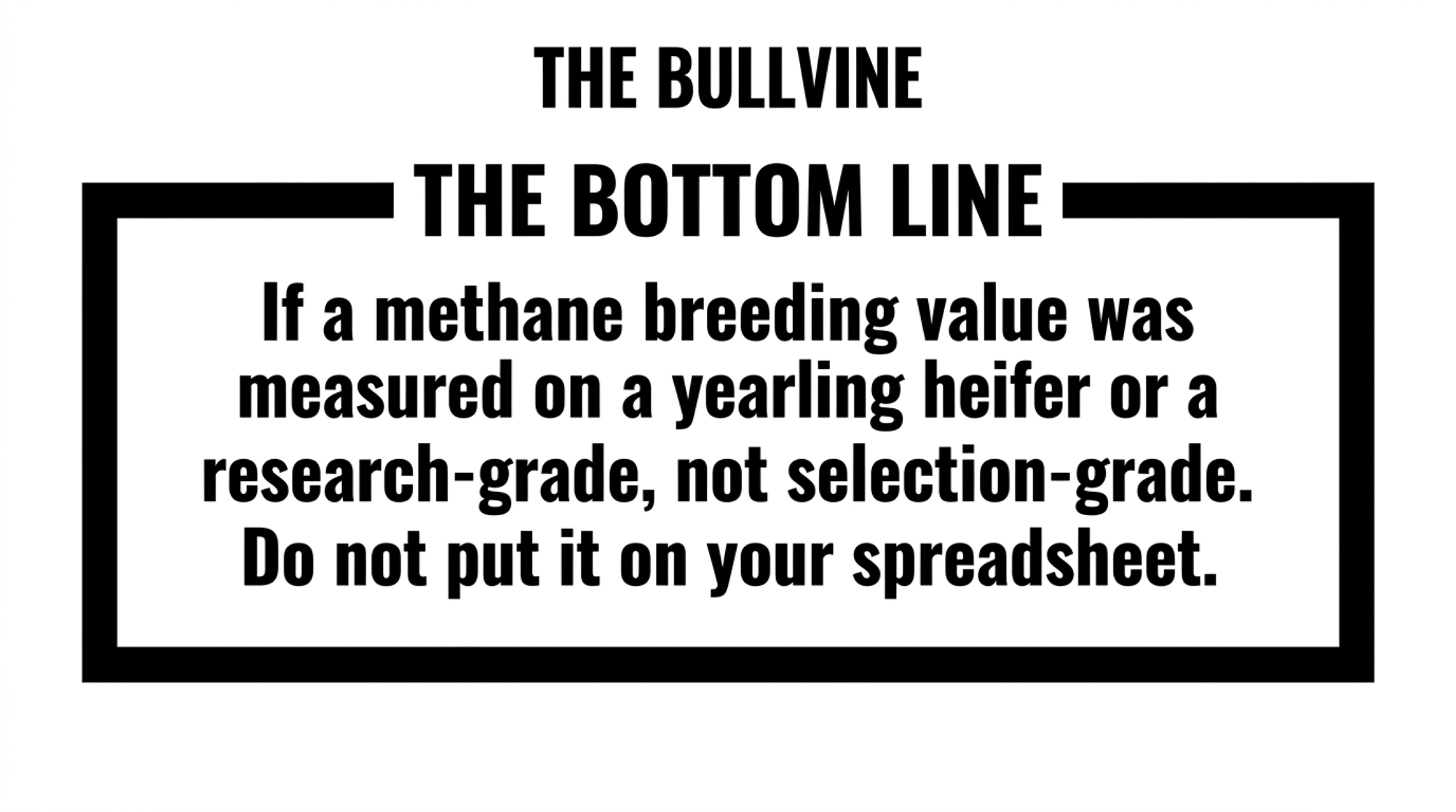
  • The single question that separates real methane genetics from expensive noise: at what life stage were the animals in the reference population measured? If the answer is young bulls or growing heifers, treat the trait as research-grade, not selection-grade.
  • Does the methane index you’re being shown have a published heritability and reliability? If not in writing, it doesn’t get a line in your selection spreadsheet.
  • Is the trait residual — independent of milk, fat, and protein? A “low methane” sire whose daughters just produce less milk isn’t solving the problem you think it’s solving.
  • If you’re entering a 2027+ carbon contract, can you point to validated lactating-cow genetics, or are you implicitly betting on the bull-based proxy approach the NZ trial just failed to validate?
  • Genetics moves at roughly 1–3% per cow per year on validated lactating-cow traits. Any contract treating a methane BV like a feed additive or digester is structuring genetics to fail an audit it was never designed to pass.
  • Feed efficiency and RFI are doing more measurable methane work in your herd today than most “climate scores.”
  • A credible NZ “version 2.0” methane BV — one built on lactating pasture cows — is several years away based on the measurement work the pivot will require. Plan accordingly.

Key Takeaways

  • If a methane BV’s reference population was measured in young bulls or yearling heifers, treat it as research-grade and don’t pay a premium. The NZ trial just spent years and a major effort proving the trait doesn’t transfer to lactation.
  • If a methane BV comes from a validated lactating-cow programme — Lactanet ME, VikingGenetics NMI, or CRV Methane Saved — it can reasonably hold a 5–10% weighting in your internal index, but only after profit, fertility, and health traits are locked in.
  • If your AI rep can’t tell you the life stage, heritability, and reliability of a methane number on a bull’s page, don’t put that number on your spreadsheet.
  • If a 2027+ carbon contract leans on genetic methane progress, ask the verifier which national evaluation system underpins the claim. Bull-phase or “composite climate score” answers are an audit risk you don’t want.
  • TPI and NM$ users have a natural shield — but private sustainability indexes are where the bull-proxy risk hides. Decompose every composite score before you weight it.

The hardest part of the New Zealand result isn’t the science. The science worked the way it’s supposed to — a plausible hypothesis, a well-designed trial, a clean negative outcome that nobody is trying to massage. The harder part is what’s still to come: a clear industry conversation with breeders who weighted those bull-phase methane numbers in mating decisions in 2023 and 2024.

So the question that lands in your barn this month isn’t whether to believe in climate genetics. It’s whether the methane number on the sire page in front of you was built from cows actually emitting methane the way your milking string emits it — or from a yearling in a research barn whose biology hadn’t yet been asked to make 30 litres a day. Which catalogue page are you about to weight?

This article draws on official LIC communications (December 2024 and April 2026), Ag Emissions Centre and DairyNZ public programme materials, peer-reviewed research from JDS Communications (July 2025), and trade-media reporting in Farmers Weekly (April 30, 2026) and Rural News Group (May 4–5, 2026). The Bullvine did not directly interview any named researcher for this piece.

Complete references and supporting documentation are available upon request by contacting the editorial team at editor@thebullvine.com.

Learn More

The Sunday Read Dairy Professionals Don’t Skip.

Every week, thousands of producers, breeders, and industry insiders open Bullvine Weekly for genetics insights, market shifts, and profit strategies they won’t find anywhere else. One email. Five minutes. Smarter decisions all week.
NewsSubscribe
First
Last
Consent

The $73-a-Cow Gap Hiding in Your 2027 Bovaer Contract

An April 2026 Science paper mapped why methanogen-targeting additives cap near 30% — and why the zero-cost lever is already sitting on a genomic report you paid for.

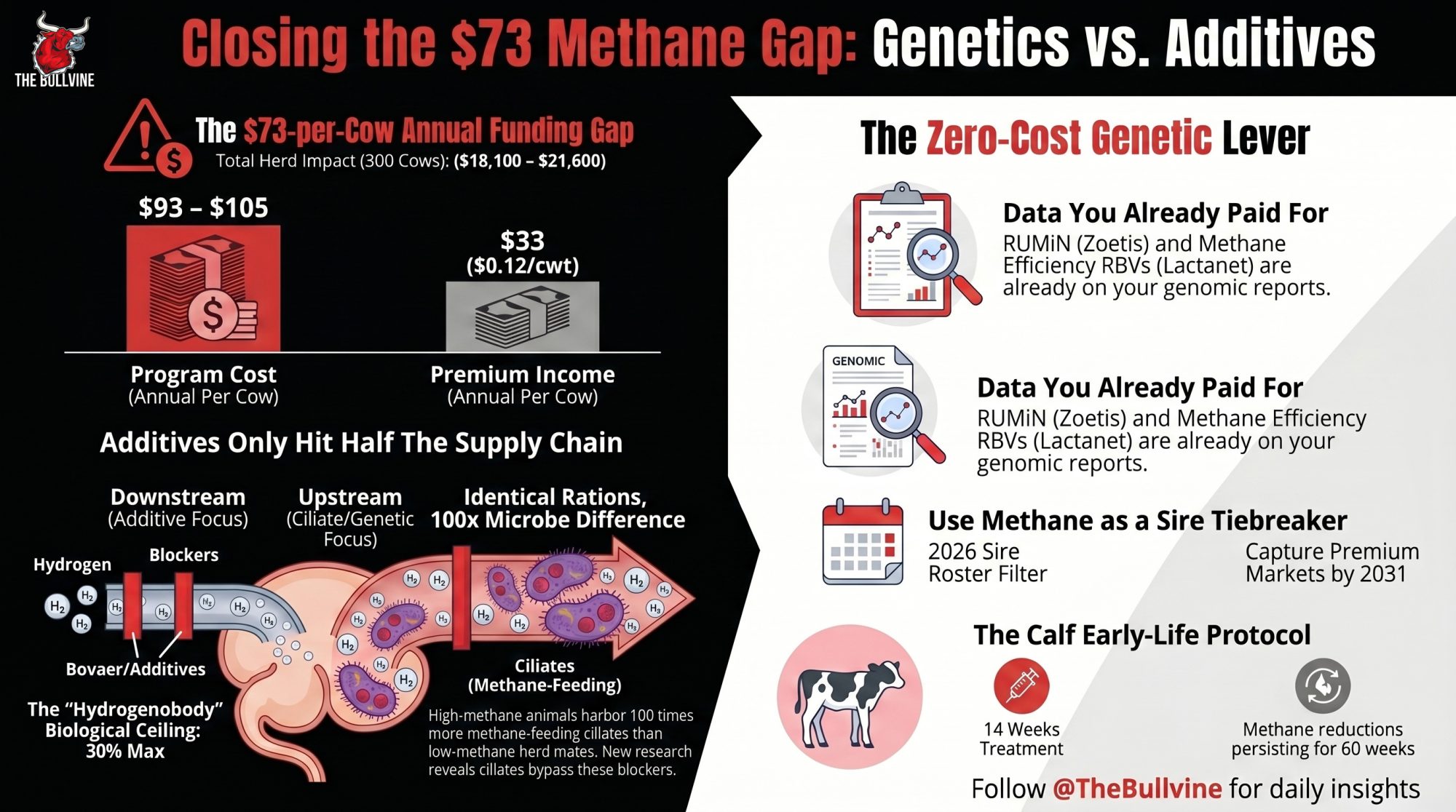
Executive Summary: Bovaer caps near 28–30% methane reduction because the April 30, 2026 Science paper just mapped a second hydrogen supply — the ciliate hydrogenobody — that 3-NOP can’t reach. On a 300-cow herd at 75 lbs/day, Bovaer runs $93–$105 per cow per year while a $0.12/cwt sustainability premium pays back only about $33, leaving a $40–$73 per cow per year gap that carbon credits or insetting have to fill. Sheep on identical rations produced 100 times more Dasytricha ciliates in high-methane animals than low-methane ones — same bunk, same feed, two orders of magnitude apart — which is why adding more additive won’t close the ceiling. The zero-cost lever is already sitting on the genomic reports you paid for: Zoetis dropped RUMiN into the April 2026 DWP$ update, and Lactanet has published Methane Efficiency RBVs on every Holstein female in eDHI since April 2023. Two 30-day moves earn their place before Monday — pull a recent CLARIFIDE Plus or Lactanet report and check whether methane traits ever broke a sire-selection tie, and if Bovaer’s already on farm, talk to your calf manager about adding it to the milk replacer for next-born heifers. Producers who filter sires on methane genetics in 2026 will be selling that genetic trajectory into a premium market by 2031–2032; producers who wait will be buying it back at markup. The full herd-size-tiered math and the two contract questions worth asking before 2027 renewal live in the next Bullvine Weekly.

Bovaer methane reduction

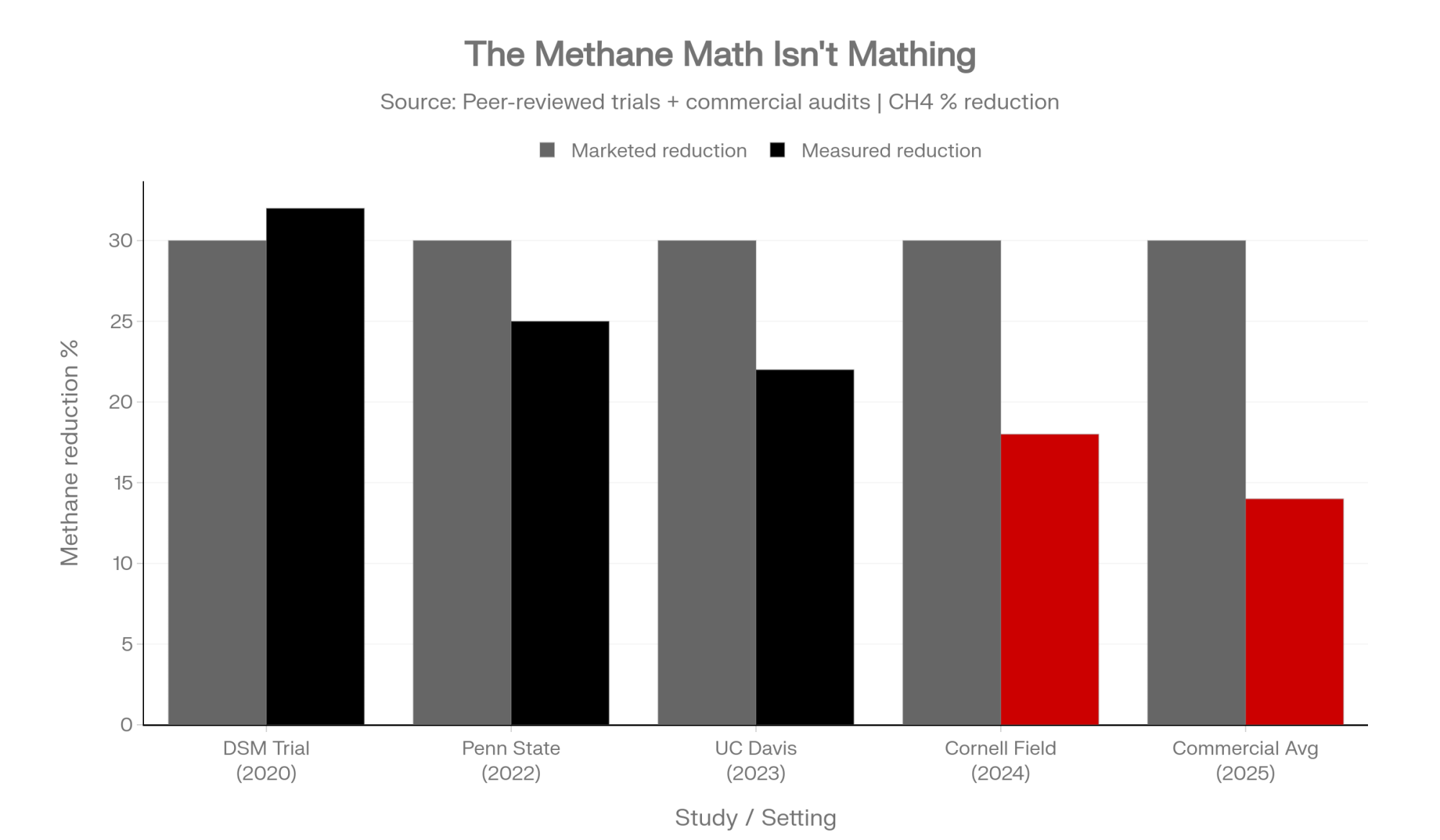
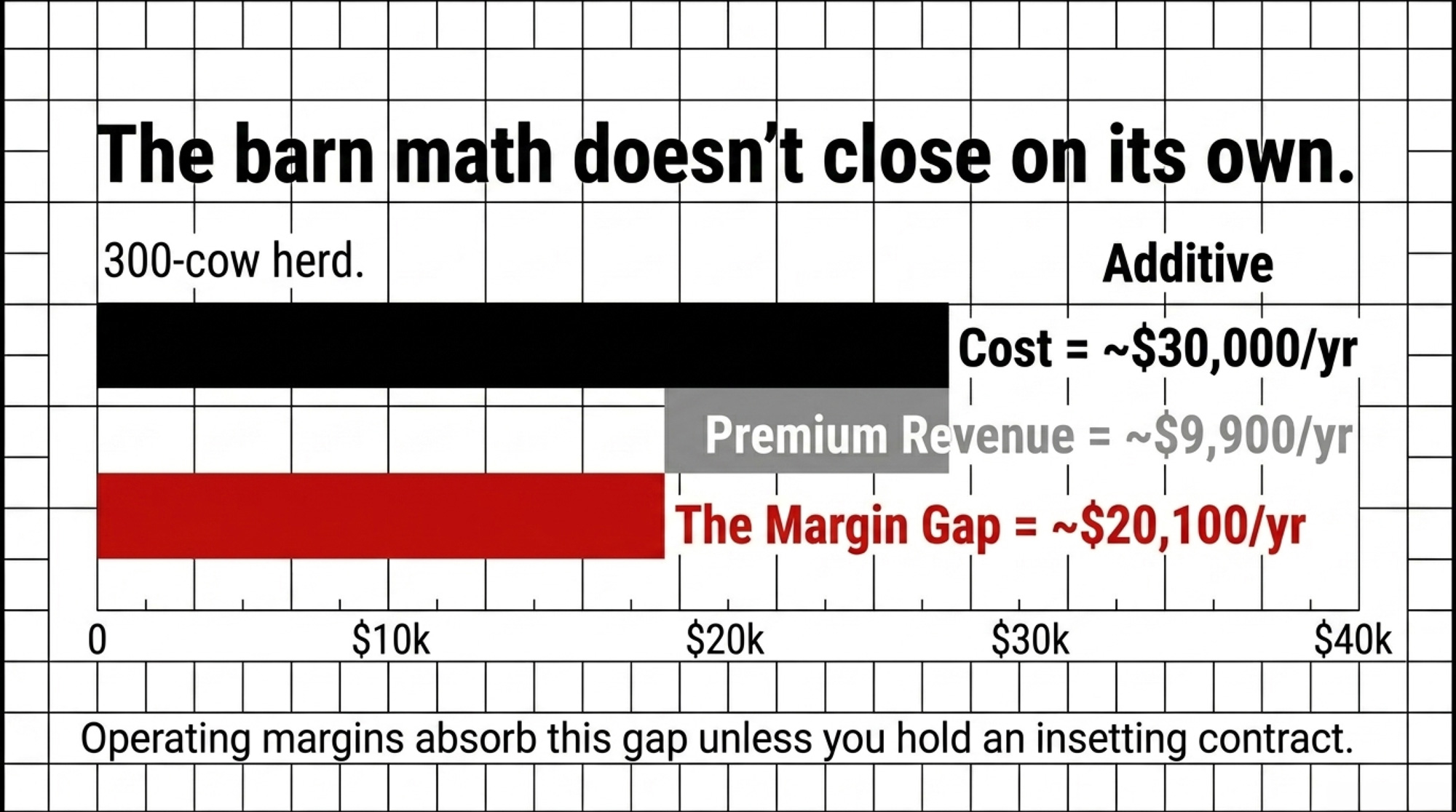
Run the numbers on a typical 300-cow herd shipping to a DFA-member plant at 75 lbs/day, on a contract up for renewal in 2027, collecting a $0.12/cwt sustainability premium. Eighteen months into a Bovaer (3-NOP) program, the methane reduction holds steady at 28%. The additive is doing what the label promised. But Bovaer has been reported in trade coverage at roughly $93–$105 per cow per year, while that $0.12/cwt premium on 75 lbs/day works out to only about $33 per cow per year — and Elanco has publicly projected carbon market returns in the range of $20 per cow per year on top of the premium, which still leaves a gap of $40–$73 per cow per year. The April 30, 2026 paper in Science just explained why closing that gap with more additive isn’t the play.

The gap closes fastest where a producer holds insetting access (defined below) or OFCAF cost-share. It widens fastest if carbon market revenue doesn’t materialize at renewal. That’s the variance band every 2027 conversation is running through right now.

The 30% Ceiling: Why the Rumen Resists Methanogen-Only Additives

Researchers at the Chinese Academy of Sciences assembled the most comprehensive rumen ciliate genome catalog ever produced — 450 genomes across cattle, sheep, goats, and deer. Inside those single-celled microbes, they found a tiny organelle nobody had described before. They named it the hydrogenobody. It does two jobs: produces hydrogen,

and scrubs oxygen from its immediate environment.

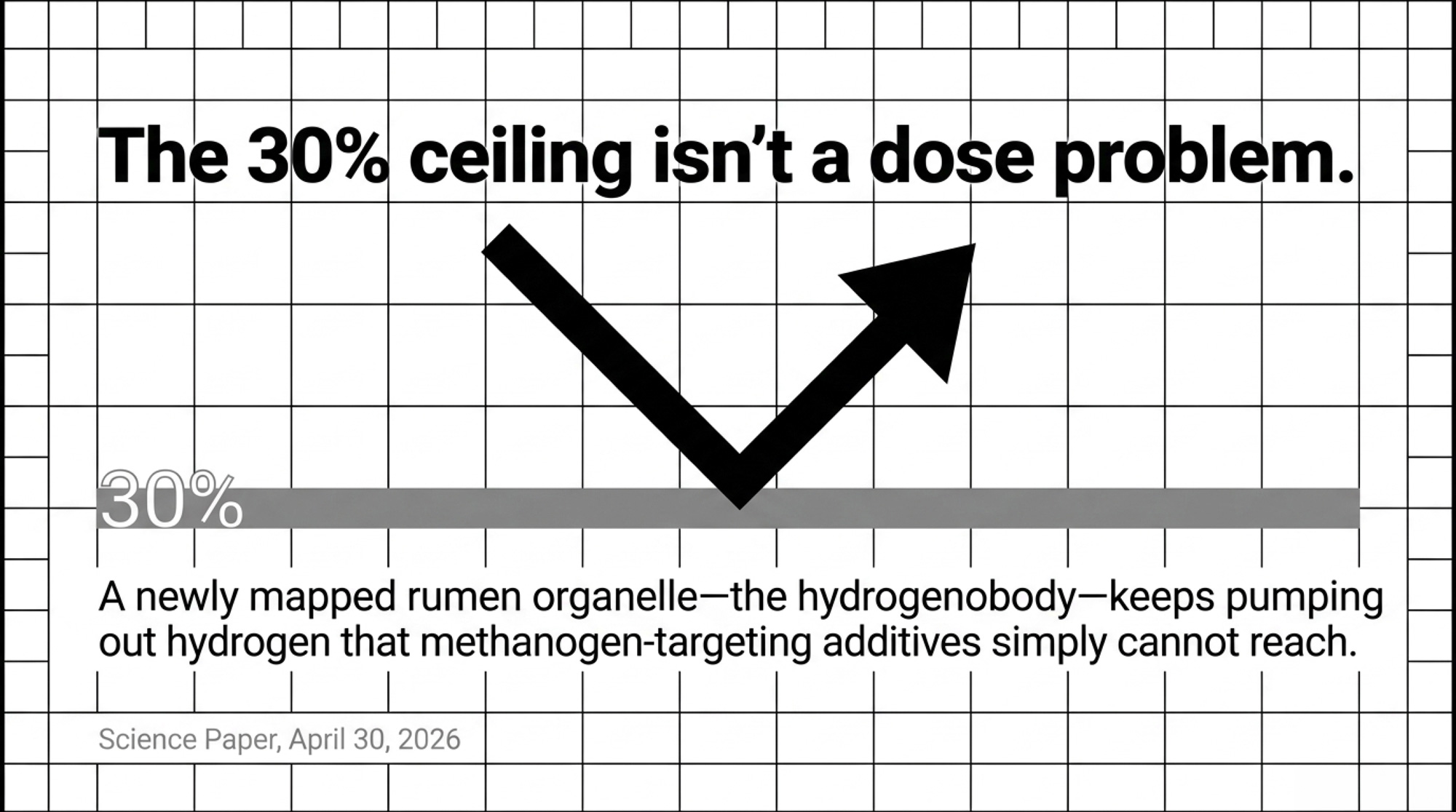
Those two jobs together build a near-perfect environment for the methanogens that convert hydrogen into methane. That’s the causal link the April paper nailed down. Bovaer blocks the downstream methanogens — but the hydrogenobody sitting one step upstream keeps pumping hydrogen the additive can’t reach. Your 28–30% reduction isn’t a dose problem. It’s the practical ceiling of a mechanism targeting only the downstream half of a two-part hydrogen supply chain.

The sheep data is where this lands hard. Animals fed identical rations — same feed, same management — but producing high methane had nearly 100 times more Dasytricha ciliates (a high-hydrogenobody genus) than low-methane sheep. Two animals. Same bunk. Same ration. Two orders of magnitude difference in the microbes most responsible for feeding the methane machine.

How This Shows Up in Real Herds

A Canadian producer 18 months into Bovaer watches the methane number hold steady near 28%. A US producer running the same program notices the reduction shrinks when forage composition shifts — consistent with the Dutch year-long trial’s finding that ration changes produced the biggest swings in the number. Both are experiencing the same biology: elevated rumen hydrogen partial pressure from methanogens being partially suppressed, while ciliates keep producing H₂ at the cell surface. Elanco has publicly maintained that Bovaer delivers consistent reductions under commercial conditions across validated trials, and within-mechanism that record is real. What the April paper raises is about the mechanism’s scope, not its integrity.

Penn State measured 3-NOP cutting methane 31% while simultaneously raising free rumen hydrogen from undetectable to 1.33 g/day. The Dutch year-long dairy trial found efficacy of 21–27% across a full lactation. Different herds. Different seasons. Same shape of result.

The barn math. On a 300-cow herd, Bovaer costs roughly $28,000–$31,500 per year in additive bills. That same herd earns about $9,900 per year from a $0.12/cwt premium on 75 lbs/day. The gap between cost and current premium revenue lands at $18,000–$21,500 per year that has to come from somewhere. Carbon credits. Cost-share. An insetting arrangement. Or your operating margin absorbing it as audit insurance.

Contract Line ItemMarketed ValueRealized Value (Yr 1)Gap
Sustainability premium$1.25/cwt$0.92/cwt–$0.33
Bovaer feed cost (DSM pricing)“offset by premium”$0.18/cow/day+$65.70/yr
Methane verification feeNot disclosed$12/cow/yr+$12.00
Labor/TMR mixing compliance“minimal”0.4 hr/day/100 cows+$18/cow/yr
Exit penalty (early termination)“standard”24-month clawbackLocked in
Net margin impact+$47/cow–$26/cow–$73/cow

Plug your own numbers in. Your herd size times about per cow per year lands you inside the variance band — closer to the low end if you hold an insetting contract, closer to the high end if you don’t. If that number is larger than you’re comfortable carrying into 2027 renegotiation, the four-lever choice below starts to matter.

Contract ClauseTypical LanguageHidden RiskNegotiation Ask
Premium duration“for the term of agreement”Reviewable annually by processorLock floor at $0.75/cwt for 36 months
Dosing compliance“per manufacturer protocol”Audit failure = full clawbackCap clawback at 6 months
Data ownership“processor retains herd data”Sold to CPG brands without share25% royalty on secondary data use
Methane floor“minimum 25% reduction”Below-threshold = unpaidTiered payment, no zero-out
Termination“24-month notice required”Blocks competing contracts90-day exit with cause

What’s Actually Happening in the Rumen

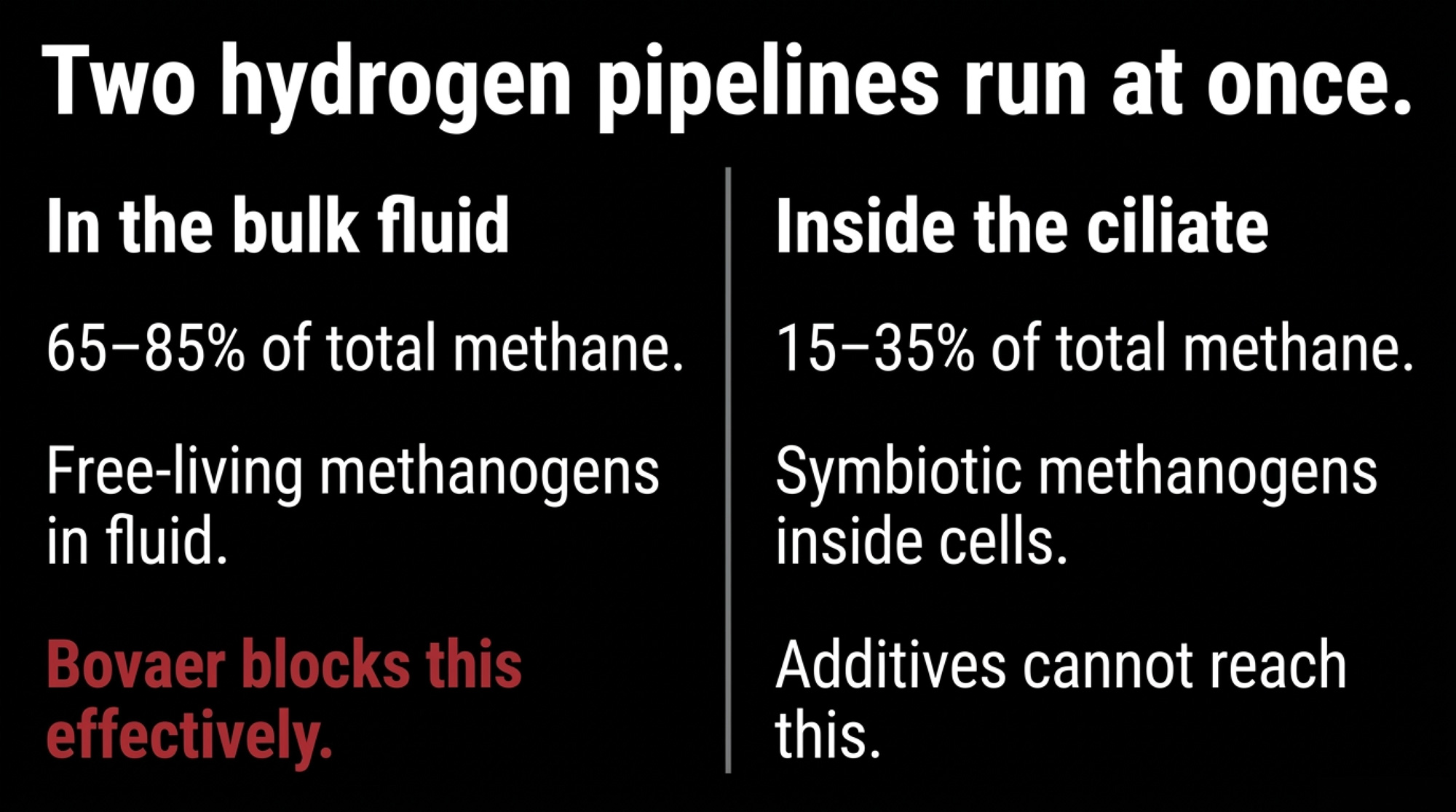
Two hydrogen pipelines run at the same time. Free-living methanogens in the bulk rumen fluid consume roughly 65–85% of total methane production. That’s where Bovaer operates — circulating in fluid, reaching those free-living archaea, blocking the enzyme that makes methane. That’s the real reduction you’re paying for.

But the other 15–35% of methane comes from methanogens that live directly on and inside ciliate cells as symbiotic partners, fed hydrogen at cell-surface proximity by the hydrogenobody organelles. That exchange happens in nanometres, not metres. An additive moving through rumen fluid has a much harder time reaching those methanogens at meaningful concentration — the hydrogen never enters the bulk fluid in the first place.

That upstream gap is why Asparagopsis seaweed routinely hits 80–99% in controlled trials, and why compounds that suppress ciliates directly — certain tannins, saponins, lingonberry-derived extracts — tend to produce more durable results than their mechanism descriptions suggest. They’re hitting the supply, not just the consumer. Worth noting: ambient dietary tannins from alfalfa-heavy rations or byproduct loads don’t reach the therapeutic threshold, so “I already feed high-tannin forage” doesn’t substitute for a targeted blend.

The concerning part for producers 18 months in: recent metagenomics work has documented measurable shifts in the rumen protozoal community under sustained Bovaer dosing, with incomplete reversal after withdrawal. What that work doesn’t answer — and what you should be asking — is whether those community changes affect the size or stability of the methane reduction over time. The long-term efficacy question stays open.

How Much Does Waiting 30 Days Actually Cost?

For the tannin-saponin layer, waiting 30 days costs effectively nothing. The protocols and contract structures aren’t ready to pay for it yet. Verra’s VM0041 methodology — the dominant global protocol for enteric methane feed additive credits — currently covers methanogen inhibition. The ciliate module Viresco Solutions submitted in 2024 was placed on hold December 19, 2024, and the public registry entry does not specify criteria required for it to advance. Stacking a ciliate mechanism onto your current credit path isn’t an option today.

Waiting on the genetic lever costs you a heifer cohort and a breeding cycle. Those compound. Every breeding season you delay adding RUMiN or Methane Efficiency RBV to your sire filter is a generation interval you hand to a competitor who moved first. Danone has publicly stated that genomic testing plays an important role in its global methane reduction strategy. That signals where methane traits may factor into supplier programs over time. Zoetis integrated RUMiN into the April 2026 Dairy Wellness Profit Index update, with company materials indicating that RUMiN-informed sire selection is expected to reduce lifetime methane intensity in daughter cohorts. When methane EBVs get priced into semen premiums — and the trajectory suggests that’s where 2029–2030 is heading — producers who started filtering in 2026 will be the ones selling genetics the late movers pay premium to access.

Value Chain PlayerRevenue/Cow/YrCost/Risk BorneNet Margin/Cow
Dairy farmer$95$88 (feed + labor + risk)$7
Milk processor$142$38 (logistics + admin)$104
CPG brand (Danone, Nestlé)$210$45 (marketing + audit)$165
Carbon credit aggregator$68$14 (verification)$54
Value capture ratioFarmer = 2.4%

Is Your Herd’s Genetic Strategy Already Behind?

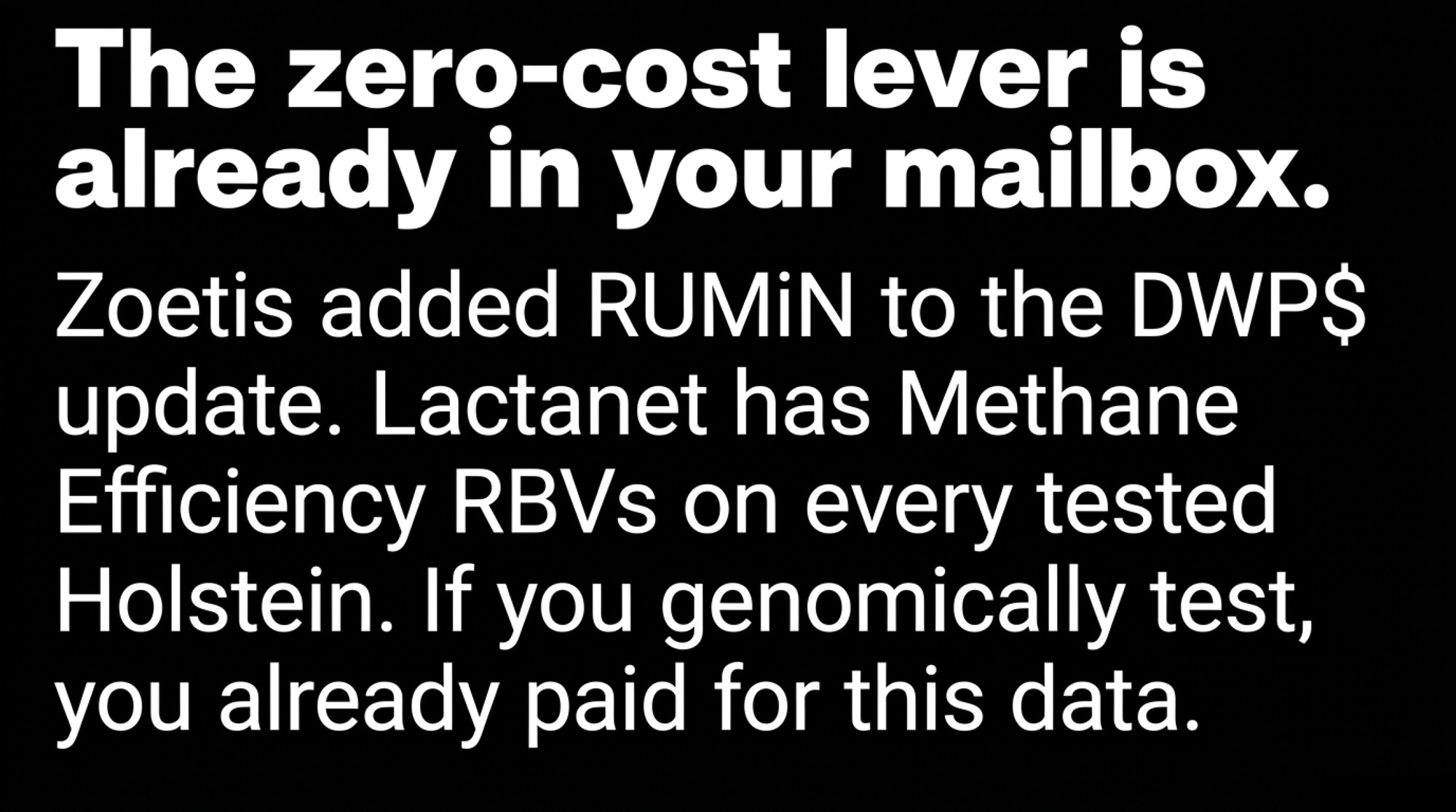
Pull a recent Zoetis CLARIFIDE Plus report or a Lactanet genomic summary on any heifer tested in the last six months. If you can’t immediately find the RUMiN value (Zoetis) or the Methane Efficiency RBV (Lactanet, published on every Holstein female in eDHI herds since April 2023), you’re not using data already in your mailbox.

Most selection indexes already weight methane traits implicitly through composites like Feed Efficiency or the Environmental Index inside LPI. That’s a reasonable starting point. When your processor or export buyer shifts toward outcome-based carbon verification in 2028–2030, the herds with a documented genetic trajectory — methane-filtered sires used consistently since 2026, with the genomic records to prove it — walk into that conversation with a structural story competitors can’t replicate on short notice.

Reliability on Lactanet’s methane genomic EBV for young genotyped bulls now exceeds 70%. The genetic correlation between MIR-predicted methane (the kind your eDHI milk sample is already generating) and directly measured methane is 0.85. You’re not selecting on noise. You’re selecting on data flowing through a pipeline that’s already running.

Options and Trade-Offs: The Four-Lever Comparison

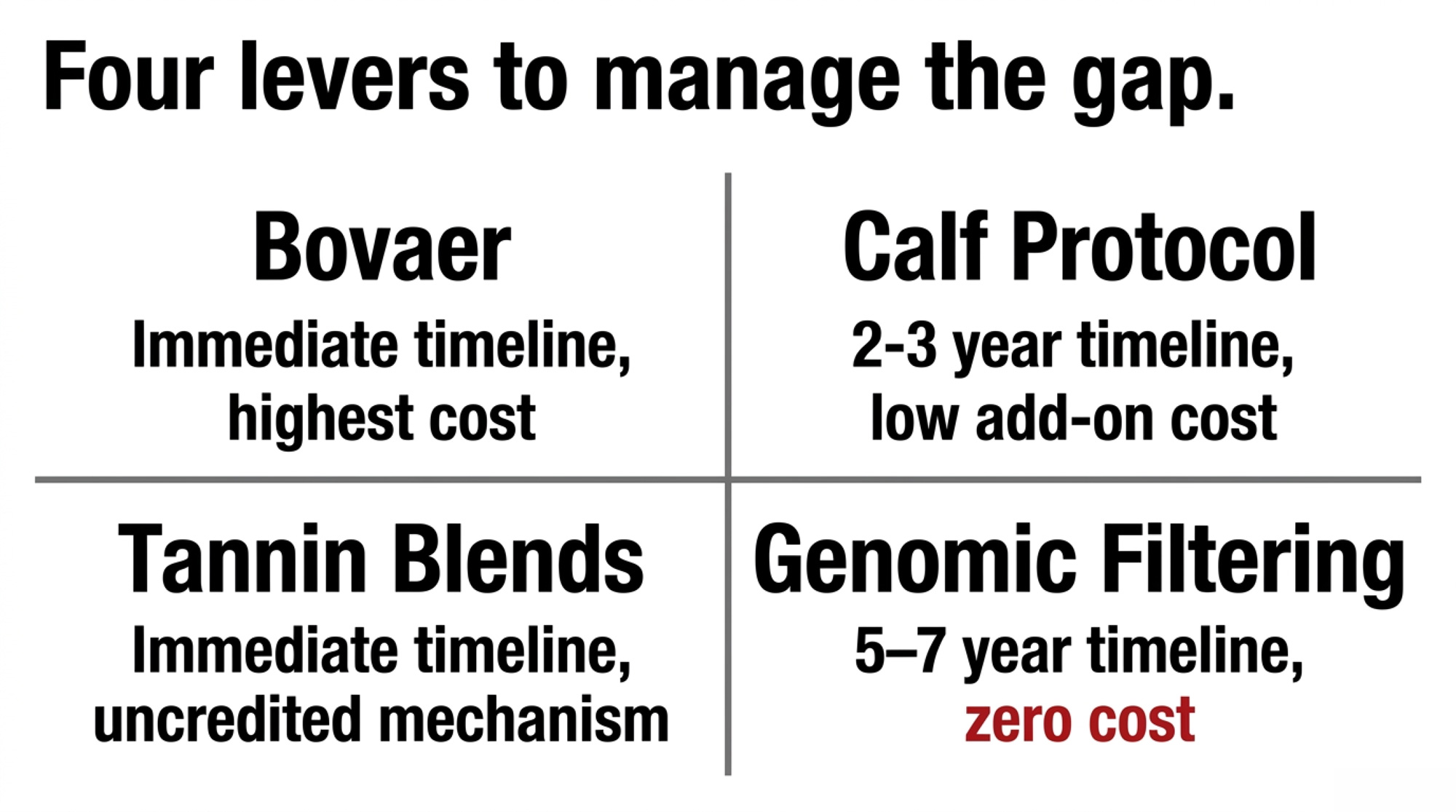
Four levers address different parts of the methane puzzle at different time horizons and cost points. Most producers shouldn’t run all four right now. Pick the combination that matches where your contract and your breeding program sit today.

A quick note on “insetting.” Unlike open-market carbon credits, an insetting arrangement keeps the reduction inside the processor’s own supply chain — it counts toward their Scope 3 footprint rather than being sold to an outside buyer. In an insetting model, your methane numbers feed your processor’s sustainability report. In an open-market model, you can sell the credit independently. The economics of your 2027 contract hinge on which model your processor runs.

StrategyCost (Est.)Methane ImpactTimelineKey Trigger
Bovaer (3-NOP)$93–$105/cow/year21–31% (practical ceiling)Immediate2027 contract renewal
Calf Early-Life ProtocolLow marginal add if Bovaer already on farmPersistent reduction to 60 weeks of age from 14-week treatment2–3 years to milking stringNext calving season
Tannin/Saponin Blend$0.10–$0.18/cow/daySupplemental (ciliate-targeting, no DMI penalty)Immediate$0.18/cwt dual-mechanism tier, OFCAF access, or VM0041 ciliate module restart
Genomic Sire Filtering$0 incremental if testingCumulative, heritable5–7 years to herd-level expressionThis breeding season

Continue Bovaer. Protocol-compliant under VM0041, registry-creditable today, defensible in a 2027 renegotiation. The net margin is thin at current premium levels, but it isn’t negative if you already hold a sustainability contract. Risk: the 28–30% reduction is the mechanism’s practical ceiling on this lever alone.

Add a tannin-saponin blend — but not yet. The 2025 J. Dairy Science trial on Silvafeed BX confirmed methane reduction without penalty to ECM, fat yield, protein yield, or DMI. The mechanism is real. But the economics don’t close in 2026 — commercial blends scaled from published beef cattle trial pricing land roughly $0.10–$0.18/cow/day on dairy DMI, and current protocols don’t credit the ciliate mechanism separately. Hold this layer until one of three triggers fires.

Start a calf early-life protocol within 30 days. Pre-weaning rumen microbiome colonisation shapes a substantial share of the adult animal’s rumen community, with published estimates clustering in the 60–70% range depending on methodology. A 2021 trial found 3-NOP given to calves in the first 14 weeks produced methane reductions persisting to 60 weeks of age — long after treatment ended. If Bovaer is already on farm, the marginal cost of adding it to the milk replacer program for next-born calves is low. Those calves enter the milking string in 2028–2029, right when outcome-based verification standards are projected to tighten.

Filter your sire roster on methane genetics — zero incremental cost. You’re not buying a new test. Lactanet publishes Methane Efficiency RBVs on every Holstein female in eDHI. Zoetis added RUMiN and Milk Methane Intensity (Z_MI) to every CLARIFIDE Plus report in April 2026. The trade-off: herd-level expression takes 5–7 years. A 2026 sire selection change shows up meaningfully in your herd’s methane number around 2031–2032.

The combination that closes both the near-term audit need and the long-term biological asset without absorbing an extra – per cow per year in negative margin: Bovaer + calf protocol + RUMiN sire filtering. Hold the tannin-saponin layer for the 2028 trigger.

Key Takeaways

  • If your net return on Bovaer is under $20/cow/year after premium, check whether your processor runs an insetting program (DFA, Danone, select others) or whether OFCAF cost-share applies in your region. Ask both questions before the 2027 renewal conversation — that’s where the economics turn positive or don’t.
  • If your Bovaer program has held at 28–30% for 18 months, monitor rumination time and component tests as leading indicators of rumen ecology shifting under sustained dosing. Neither shows up on a methane reduction number until the shift has already compounded.
  • If you’re genomically testing replacement heifers, the RUMiN and Methane Efficiency RBV data is already on the report you paid for. Start using it as a sire tiebreaker within your current economic index this breeding season.
  • If Bovaer is already on farm, talk to your veterinarian and calf manager this month about adding it to the milk replacer protocol for next-born calves. The 2029 heifer cohort is the one that carries this forward.

Where Does Your Operation Actually Sit?

The producers who’ll be selling low-methane genetics into a premium market in 2032 aren’t the ones currently spending the most on additives. They’re the ones who recognized in 2026 that the biology had changed category — from a compliance cost to a heritable asset — and adjusted their sire roster while everyone else was still optimizing additive spend. The April 2026 hydrogenobody paper made that shift explicit. The response window is now, not when methane EBVs get priced into semen premiums.

So where does your operation actually sit on that line? Pull your last genomic report before Monday. Check whether your methane trait values were ever used in a selection decision. If the answer is no, you’ve just identified the highest-leverage, lowest-cost change you can make this month. The full herd-size-tiered math — including the two contract questions worth asking your processor rep before 2027 renewal — runs in the next Bullvine Weekly.

Complete references and supporting documentation are available upon request by contacting the editorial team at editor@thebullvine.com.

Learn More

The Sunday Read Dairy Professionals Don’t Skip.

Every week, thousands of producers, breeders, and industry insiders open Bullvine Weekly for genetics insights, market shifts, and profit strategies they won’t find anywhere else. One email. Five minutes. Smarter decisions all week.
NewsSubscribe
First
Last
Consent
Send this to a friend