



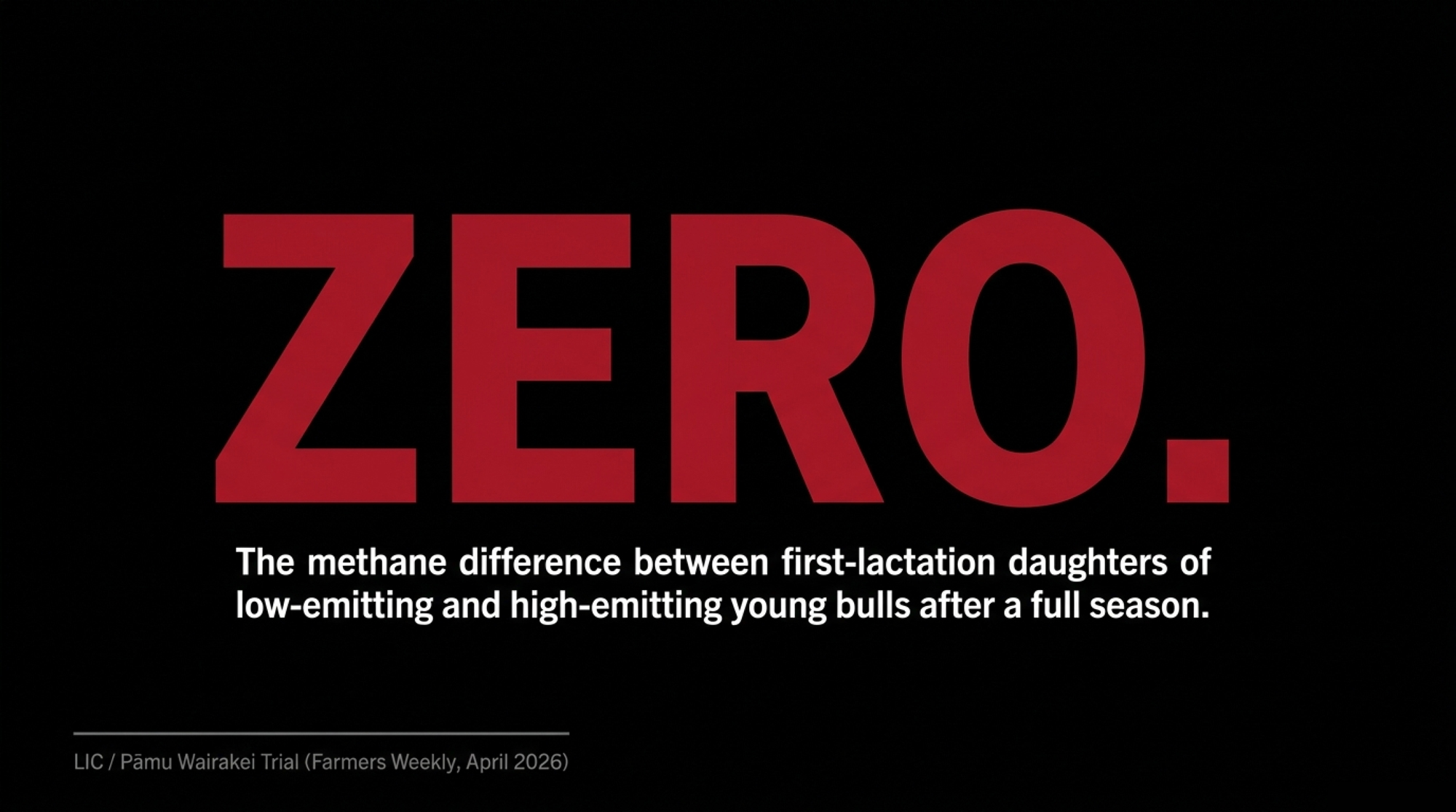
Several hundred first-lactation daughters at Pāmu Wairakei. One full season on GreenFeed. Zero significant difference between low- and high-methane sires. The bull-proxy shortcut is done.
Executive Summary: LIC and CRV’s flagship methane breeding programme just confirmed that low-methane young bulls in New Zealand don’t pass the trait to their lactating daughters — several hundred first-lactation daughters at Pāmu Wairakei, measured one full season on GreenFeed, showed no significant difference between high- and low-emitting sires. LIC Chief Scientist Dr. Richard Spelman told Farmers Weekly (NZ) on April 30, 2026 that the trait in young bulls isn’t the same trait in a lactating cow — and the planned late-2026 NZ methane BV rollout now has to be rebuilt on lactating-cow phenotypes. The Norwegian Heringstad and Bakke paper (JDS Communications, July 2025) had already pegged the genetic correlation between bull methane and cow methane at 0.63 ± 0.22 — meaning a /straw premium across 200 services was a ,000 bet on a coin flip with the downside in your own barn. Lactanet ME (h² ~0.23, 70%+ reliability on young animals), VikingGenetics NMI (h² ~0.20, 16,000+ commercial cows), and CRV NL’s Methane Saved aren’t tarred by the result — they were built on lactating cows from day one. TPI and NM$ users have a natural shield, but private “sustainability indexes” and processor climate composites are where bull-phase numbers still hide. The single question that now separates real methane genetics from expensive guesswork: at what life stage was the reference population measured?
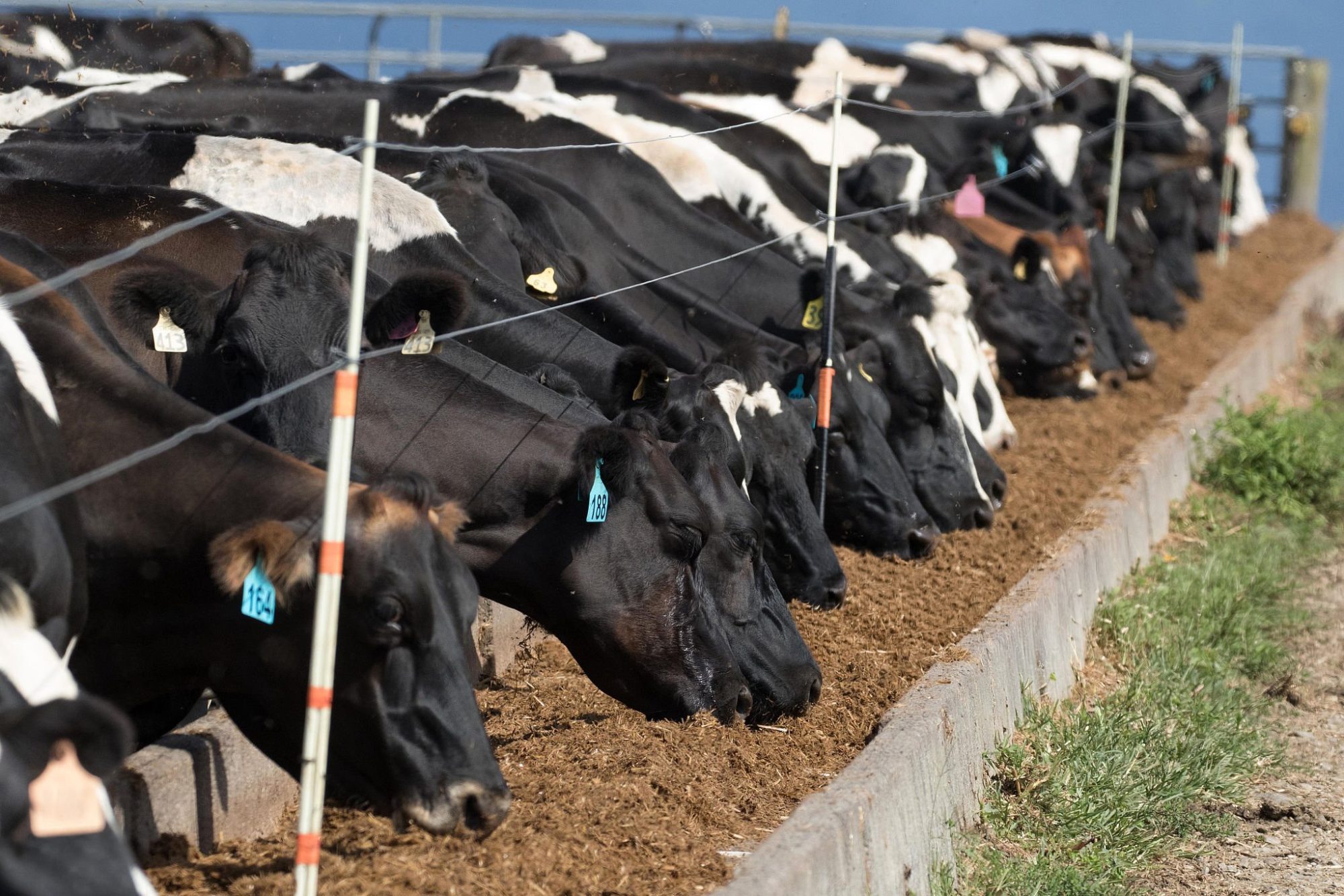
LIC Chief Scientist Dr. Richard Spelman didn’t dress it up. Speaking to Farmers Weekly (NZ) on April 30, 2026, he framed the lactation-phase result of New Zealand’s flagship methane breeding trial as a setback. The trait measured in young bulls, he told the outlet, didn’t appear to be the same trait when measured in a lactating cow.
The first-lactation daughters of LIC and CRV’s lowest-emitting young bulls had finished their measurement season at Pāmu’s Wairakei Estate, and the methane signal that had looked clean in yearling heifers was gone. Several hundred daughters. One full lactation. No significant difference between daughters of high-emitting and low-emitting sires. For breeders who’ve watched methane labels appear on sire pages since 2023, that’s the moment the bull-proxy version of the assumption broke.
The 60-Second Breakdown
- The Goal: Measure methane in young bulls to skip the cost of phenotyping millions of milking cows.
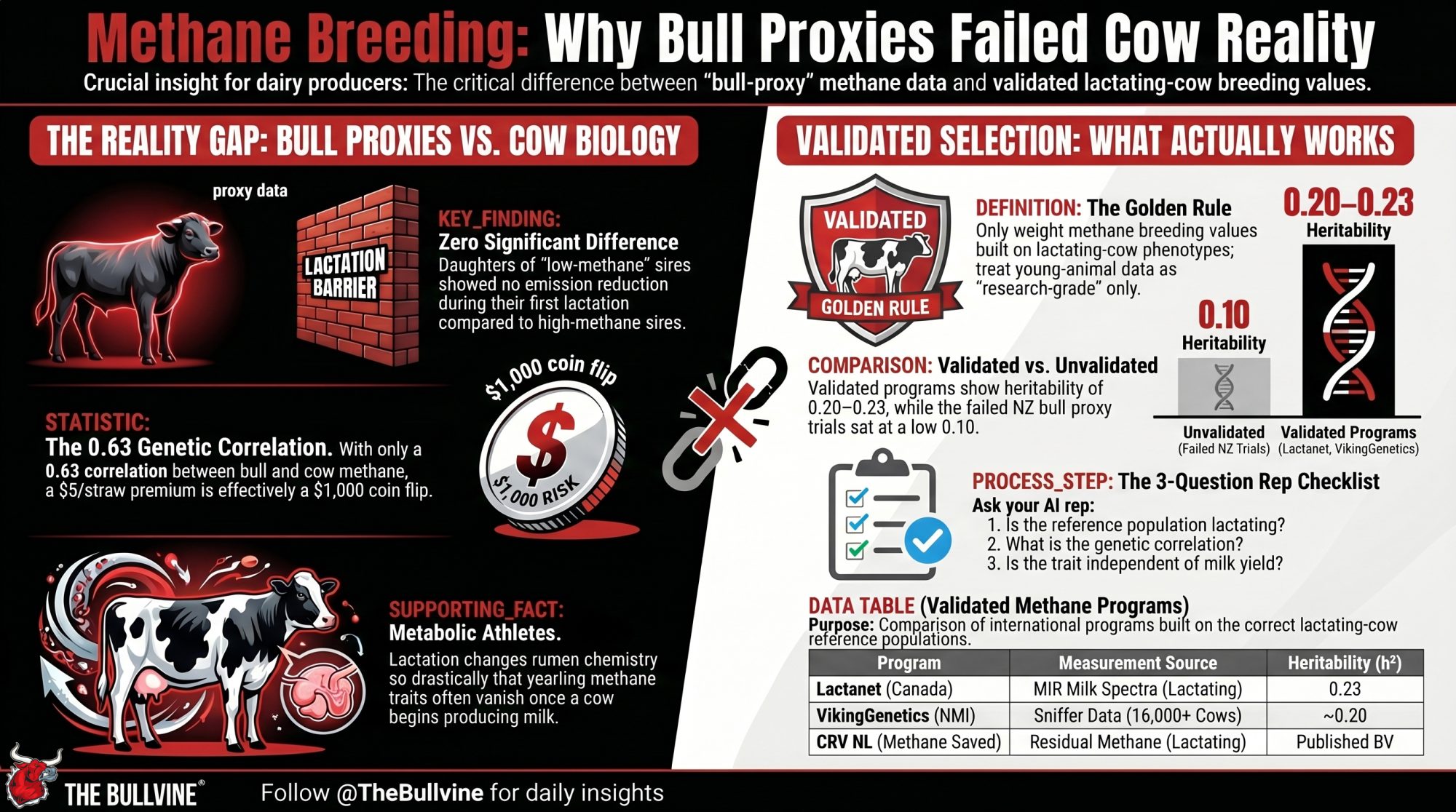
- The Result: Bull data didn’t match cow reality. Daughters of low-methane sires emitted no less than daughters of high-methane sires.
- The Action: Only weight methane breeding values built on lactating-cow phenotypes. Decline anything you can’t decompose.
Why a Multi-Year Bet on Bull Methane Failed in Lactation
The New Zealand programme wasn’t a marketing exercise. It was a serious, well-funded scientific bet, built on a hypothesis that looked airtight on paper. Measure methane in young bulls cheaply, identify the lowest emitters, and push their semen across a national herd through AI — and you’d skip the brutal cost of phenotyping millions of milking cows. Lactating-cow phenotyping is structurally more expensive than bull-phase screening, which is why national programmes have rationed it carefully.
The trial cohort tells you how seriously they took it. Several hundred daughters, sired by the highest- and lowest-emitting bulls from earlier screening rounds, were measured under controlled conditions using GreenFeed methodology so feed intake and emissions could be quantified precisely. The lactation phase alone represented years of controlled measurement work on a cohort of this scale — before counting the bull screening that came earlier.
What the trial proved is uncomfortable for anyone who’s already weighted a methane number in a mating decision: the trait expressed in growing animals is not the same trait expressed in lactating cows. Per LIC’s official update on April 29, 2026 and Spelman’s comments to Farmers Weekly the following day, the cow trait sits in a different physiological space than the bull trait. The cross-stage transfer the programme was built on didn’t hold.
One caveat worth keeping front of mind. As of press, the lactation-phase result has been communicated through LIC’s official April 2026 update, statements to Farmers Weekly and Rural News Group, and the Wellington presentation. A peer-reviewed manuscript hasn’t been published yet. Sire analysts should treat the result as official communication, not yet a published paper.
What Happened When the Daughters Freshened
The yearling phase had been genuinely encouraging. Daughters of the low-methane sires were lower emitters at 8–10 months. The trait looked heritable. Transferable. Ready to commercialise. By December 2024, Dr. Lorna McNaughton was presenting milestone data at the Wellington Agricultural Climate Change Conference, and LIC was publicly describing a planned methane breeding value rollout from late 2026.
Then the daughters freshened.
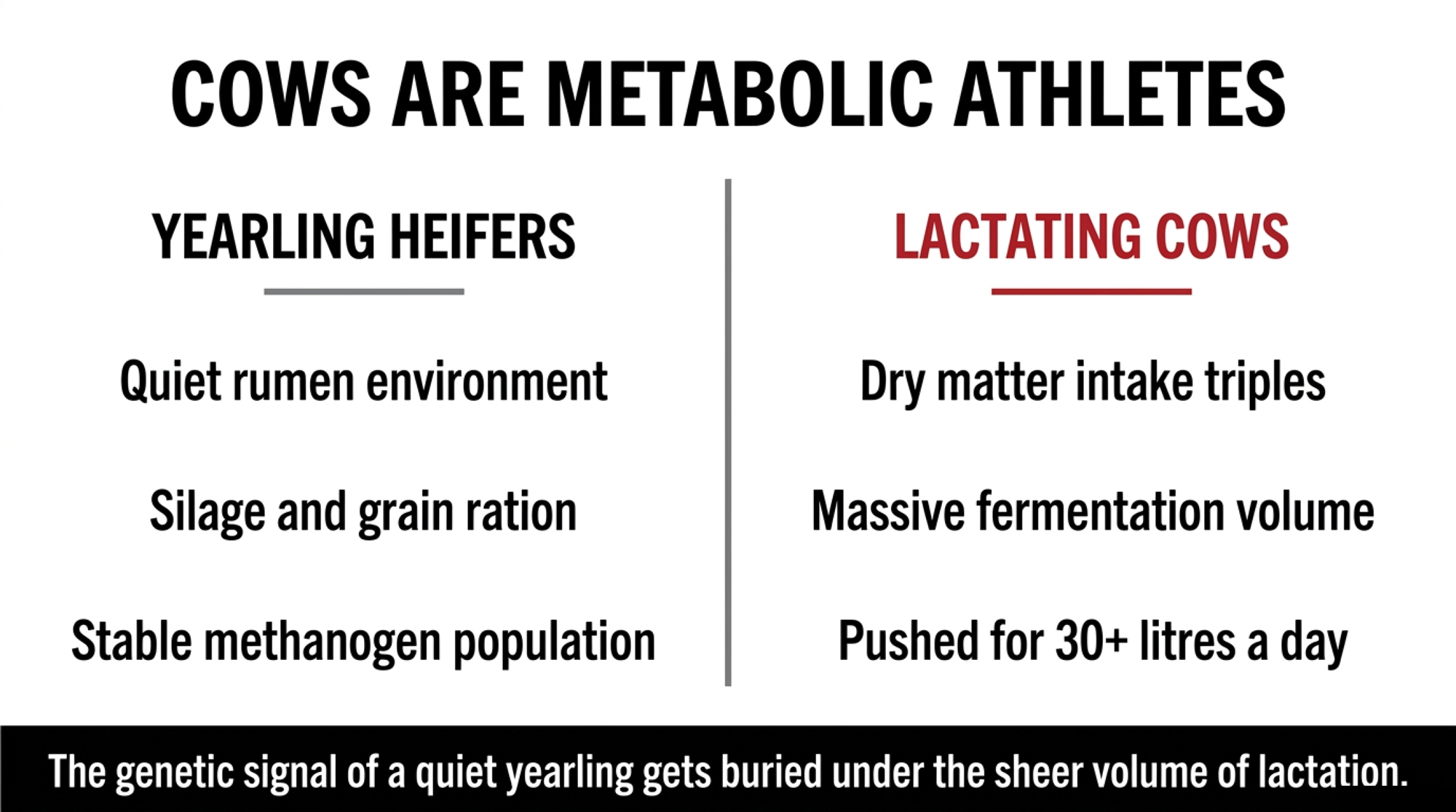
Lactating cows are metabolic athletes. Dry matter intake can triple within weeks of calving, and the rumen environment they’re working with at peak lactation barely resembles the one they ran as yearlings. Take a heifer on a silage-and-grain ration with a relatively stable methanogen population, then move her onto a high-energy lactating ration and push her to 30+ litres a day. Different fermentation substrates. Different passage rates. Different methanogen archaea dominance. The genetic differences in methanogen populations or rumen morphology that distinguished a quiet yearling from a noisy one get buried under the sheer volume of fermentation needed to make milk.
Norwegian researchers Bjørg Heringstad and Katrine A. Bakke quantified the underlying problem in a July 2025 JDS Communications paper that landed almost four years after the NZ programme committed to its design. In Norwegian Red cattle, the genetic correlation between methane in young bulls and methane in lactating cows came in at 0.63 with a standard error of 0.22. Related, but not the same trait.
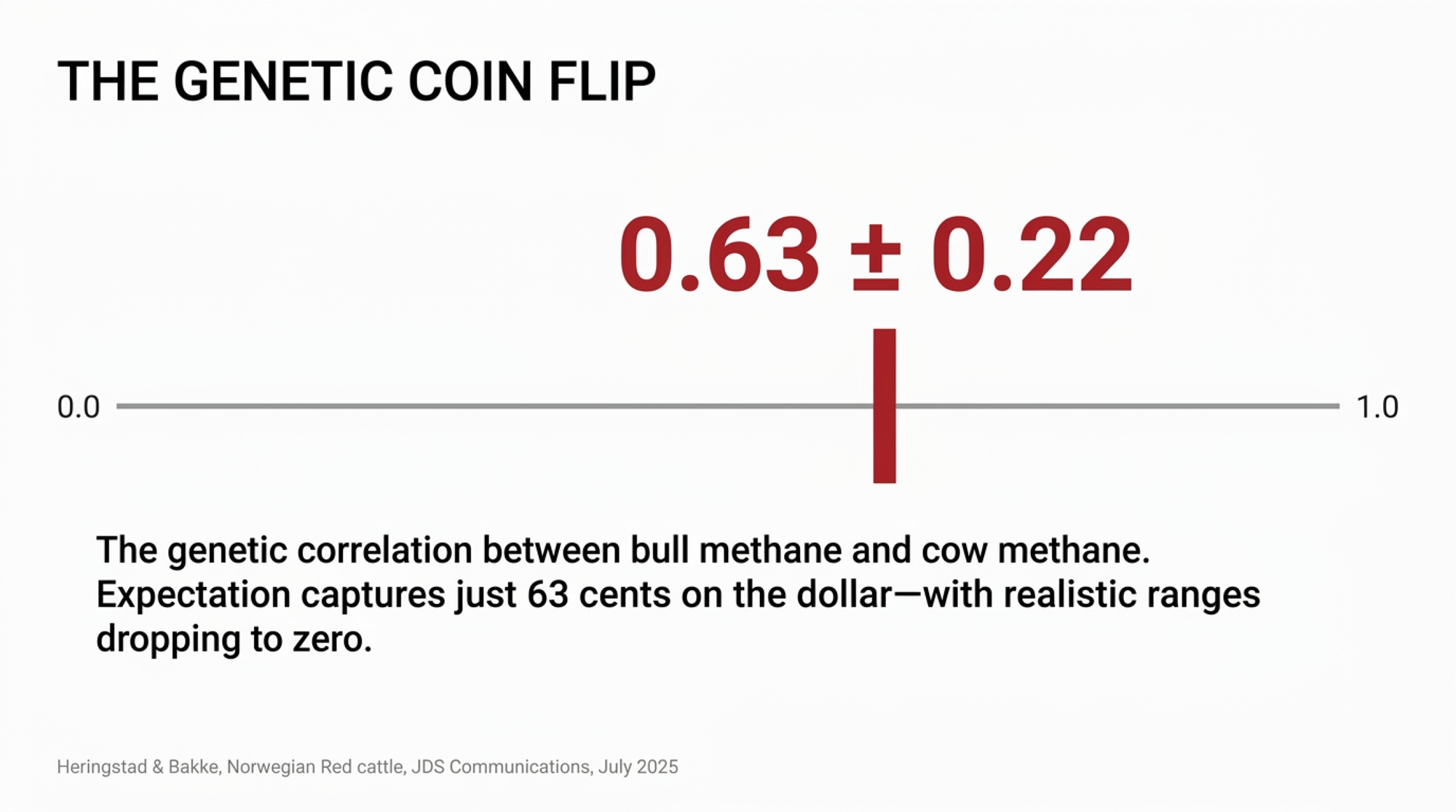
That number matters in a way that’s easy to miss. A correlation of 0.63 means a breeder who selected a bull two years ago expecting full methane response in his daughters is, on the expectation, capturing maybe 63 cents of every promised dollar of reduction. Factor in the standard error and the realistic range runs from roughly zero up to that 63 cents — a coin flip with a skewed downside. The NZ daughter trial landed at the bottom end of that range.
So the question stops being theoretical. If the trait you’re paying for in a young bull doesn’t fully transfer to his daughters, what does a sire catalogue page actually need to show before you weight it?
How Does a Validated Methane BV Differ From a Bull-Proxy One?
The contrast with programmes built on lactating-cow phenotypes is the part of this story that should change how you read a sire catalogue tomorrow morning.
| Programme | Reference Population | h² | Reliability | Status | Use in Selection? |
|---|---|---|---|---|---|
| NZ Trial (LIC / CRV) | Young bulls / yearling heifers | 0.10 | Low (proxy) | ❌ Failed lactation validation | No — research-grade only |
| Lactanet ME (Canada) | MIR spectra, lactating Holsteins 120–185 DIM | 0.23 | 70%+ on young animals | ✅ In use since Apr 2023 | Yes — 5–10% weighting |
| VikingGenetics NMI | Sniffer data, 16,000+ lactating cows | ~0.20 | High | ✅ Expanded May 2026 | Yes — 5–10% weighting |
| CRV NL (Methane Saved) | Residualised, lactating cow records | Published as RBV | Moderate | ✅ Published Aug 2025 | Yes — 5–10% weighting |
| TPI / NM$ / LPI / Pro$ | No direct methane component | N/A | N/A | ✅ Natural shield | Yes — no hidden bull-proxy risk |
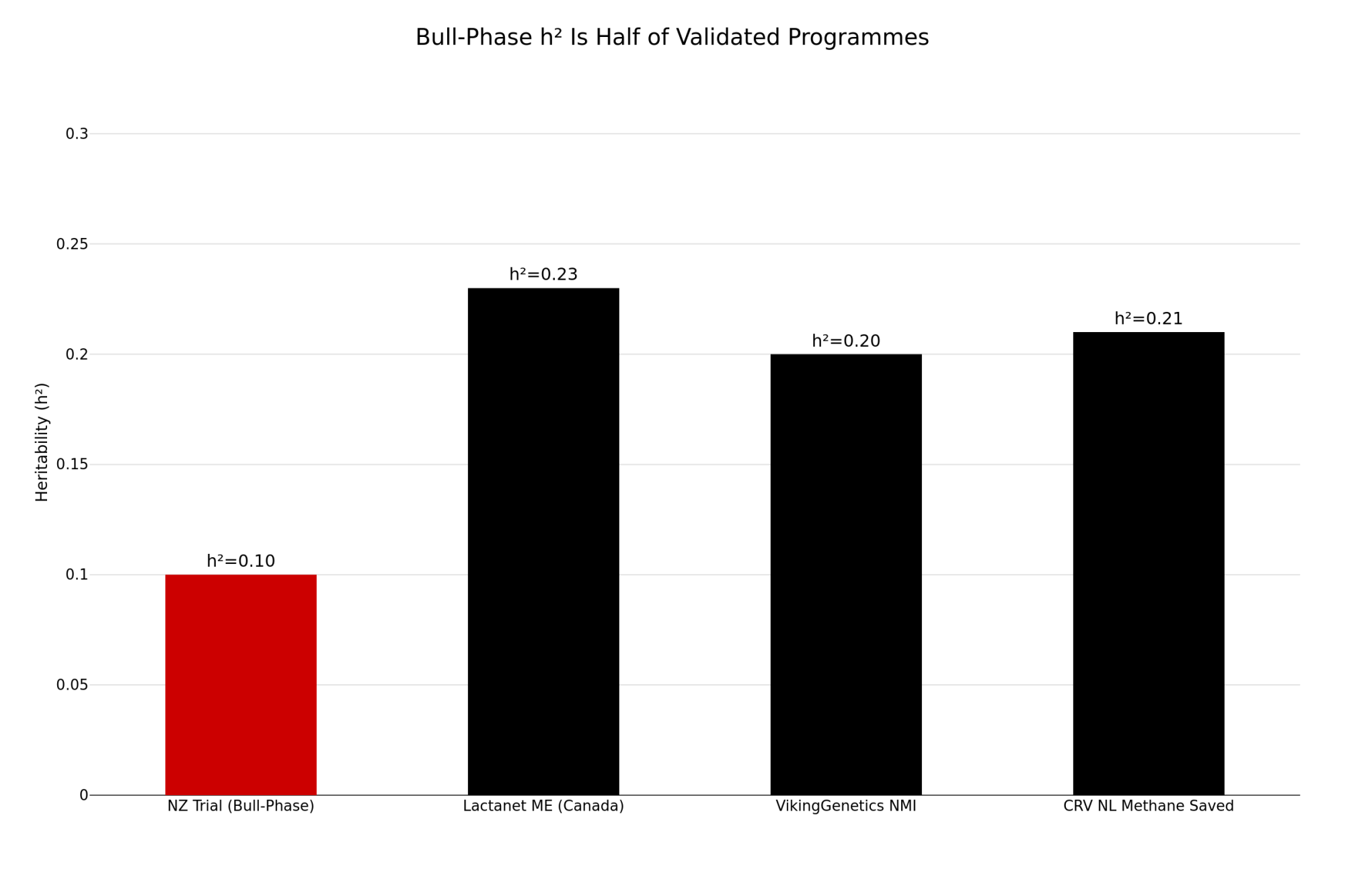
Lactanet’s Methane Efficiency RBV — a Canadian evaluation launched in April 2023 — was built from MIR milk spectra on first-lactation Holsteins between 120 and 185 days in milk. Heritability of the underlying methane prediction came in at 0.23, with genomic reliabilities for young animals reported above 70%. Lactanet has projected modest but compounding herd-level methane reductions through sustained selection on the index, with no recurring feed cost.
VikingGenetics’ Nordic Methane Index draws on automated sniffer data from over 16,000 commercial lactating cows in Denmark, Sweden, and Finland. Heritability lands around 0.20, with a projected long-term reduction of roughly 20% as the trait works through the population. CRV Netherlands published its “Methane Saved” BV in August 2025 — daily methane per cow, residualised against production, expressed as a relative breeding value. Dutch herds enrolled in CRV recording can pull a sire’s Methane Saved figure from the same evaluation system that delivers their fertility and longevity numbers.
None of these programmes carry a multi-decade track record yet, and that’s worth saying out loud. Lactanet ME has been in commercial use since April 2023. The Nordic Methane Index expanded to VikingRed and VikingJersey only in May 2026. CRV NL’s Methane Saved is nine months old. What they have is the right reference population, the right life stage, and published heritability — not a long history of audited herd-level results.
The structural difference with the NZ bull-phase work isn’t subtle. Validated lactating-cow indexes carry h² of roughly 0.20–0.23 and reliabilities above 60–70%. The NZ bull-phase work reported an early-phase heritability around 0.10. Stack a 0.10 heritability against 0.20–0.23 in the validated programmes, then run the result through an imperfect cross-stage genetic correlation, and the realistic in-herd response from a young-bull methane BV is a fraction of what a lactating-cow-built BV delivers. The NZ daughter result suggests that fraction can collapse to zero in practice.
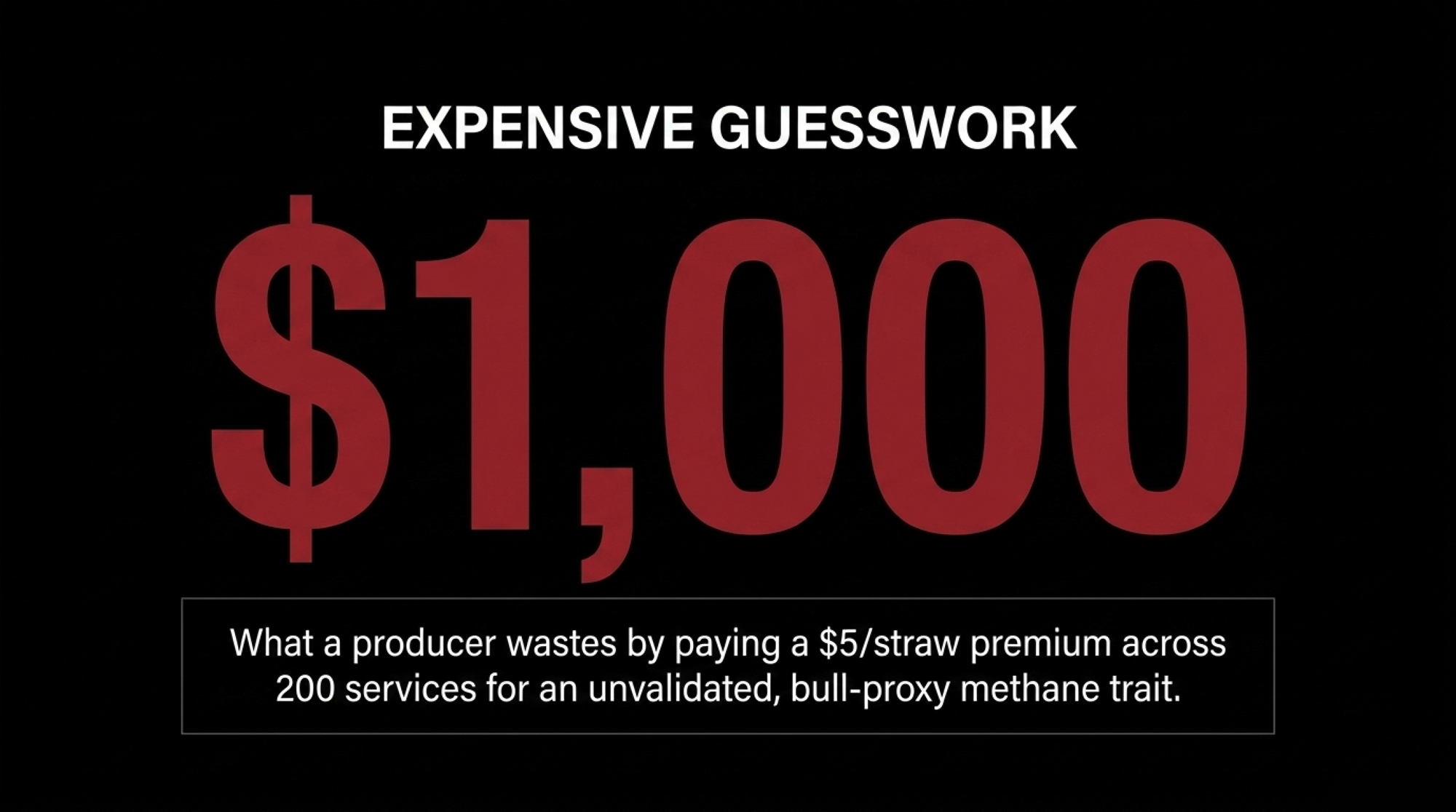
The barn math. A breeder who paid even a $5 per-straw premium for a “low methane” young-bull index across 200 services spent $1,000 on a trait whose realistic in-herd response — based on the NZ trial — sits between zero and a modest fraction of the catalogue claim. A Canadian breeder weighting Lactanet Methane Efficiency in their selection index, by contrast, is buying into a published, evaluated trait — and avoids the kind of contract-to-cow gap that’s already shown up elsewhere in the climate genetics economy. Same selection pressure, same cost. One response is built on a validated reference population. The other isn’t.
Checklist for Your AI Rep
Before you weight any methane number on a sire page, get written answers to these three:
| Question | Acceptable Answer | Red Flag |
|---|---|---|
| 1. Reference population life stage? | “Lactating cows” — with DIM window specified | “Young bulls,” “yearling heifers,” “growing animals,” or no answer |
| 2. Published genetic correlation (r_g) between measured and lactating population? | Specific published number with SE (e.g., 0.63 ± 0.22 or 1.0 if built on cows) | “We assume high correlation,” vague language, or no number provided |
| 3. Is the trait residualised — independent of milk, fat, protein? | Yes, with documented residualisation method | No residualisation; BV correlates with lower production; no documentation |
A Note on Sheep, Beef, and Why Dairy Is the Outlier
Worth saying briefly, because it underlines why dairy is the harder problem: low-methane breeding still works in sheep. The Beef + Lamb New Zealand Genetics programme has measured low-methane sheep for over a decade, and the trait expresses in adult animals because measurement and production stage line up — sheep are measured at roughly the same physiological state they’re selected on. AgResearch’s beef cattle work has reported similar reasons for confidence in adult-animal measurement, though dairy is the result with the published null.
Dairy is the outlier because lactation is the outlier. Nothing else in livestock production demands the metabolic intensity of a 30-litre cow at peak. That’s the biological fact the NZ trial just made unavoidable. Per LIC’s April 29, 2026 update and supporting comments from Ag Emissions Centre Executive Director Naomi Parker to Rural News Group on May 4, 2026, the dairy programme is signalling a pivot toward measuring lactating cows directly, rather than abandoning the work.
Which Methane Number Earns a Line in Your Selection Spreadsheet?
The selection question for 2026 isn’t whether climate genetics matter. It’s which climate numbers actually deserve weight in a real mating decision.
- Stay on profit, fertility, and feed efficiency. Use validated methane indexes only as a tie-breaker. Best for most herds in most markets. You’re not missing real genetic progress, because the validated lactating-cow indexes are already correlated with feed efficiency. Backfire risk: low.
- Weight a validated lactating-cow index (Lactanet ME, NMI, Methane Saved) at a defensible 5–10% of your internal index, depending on confidence in your own production system’s methane phenotype. Best for herds in Canada, the Nordics, or Holland with active recording in those systems and a processor relationship that recognises the metric. Demands: discipline to keep money traits ahead of climate traits.
- Decline any methane or “climate score” you can’t decompose. Best for herds being pitched bulls with composite sustainability scores where the supplier can’t break the number into reference population, life stage, and heritability. Backfire: you might miss a marginal real signal, but you also won’t pay for one that doesn’t express.
The U.S. and Canadian Picture: A Natural Shield, With One Catch
North American breeders selecting on TPI or NM$ in the U.S., or LPI and Pro$ in Canada, have a structural advantage in this debate that’s easy to miss. Methane isn’t currently a heavy weight in any of those base indexes. CDCB’s NM$ doesn’t carry a methane component. Holstein Association USA’s TPI doesn’t either. Lactanet’s LPI and Pro$ formulas weight production, durability, health, and fertility — Methane Efficiency is published as a separate RBV that breeders choose to layer on top, not a hidden weighting inside the headline index.
That’s a natural shield against the bull-proxy failure. A producer mating on TPI or NM$ today isn’t accidentally buying NZ-style bull-phase methane assumptions through their main index. The trap sits one layer deeper: in private-company Sustainability Indexes and processor-branded composite “climate scores” that bundle methane alongside feed efficiency, polled, and other traits. Those composites are where a bull-phase or unvalidated methane number can hide, depending on how the index is constructed. If your AI partner offers a sustainability index, ask the same three questions in the AI Rep checklist above before you weight it. If the answer is opaque, treat the composite as marketing, not selection signal.
30-day action. Pull your last 12 months of semen invoices. Mark each sire that carried any methane, sustainability, or climate label in its marketing. For each, ask the AI company in writing — was the BV built from lactating cow phenotypes or growing animals? What’s the published heritability? What’s the reliability on this bull? If you don’t get clean answers within 30 days, that’s data you can use the next time a methane premium gets pitched. NZ readers should run the same query through LIC or CRV NZ technical sales. If 90 days pass with no written answer, treat the absence as the answer.
What This Means for Your Operation
- The single question that separates real methane genetics from expensive noise: at what life stage were the animals in the reference population measured? If the answer is young bulls or growing heifers, treat the trait as research-grade, not selection-grade.
- Does the methane index you’re being shown have a published heritability and reliability? If not in writing, it doesn’t get a line in your selection spreadsheet.
- Is the trait residual — independent of milk, fat, and protein? A “low methane” sire whose daughters just produce less milk isn’t solving the problem you think it’s solving.
- If you’re entering a 2027+ carbon contract, can you point to validated lactating-cow genetics, or are you implicitly betting on the bull-based proxy approach the NZ trial just failed to validate?
- Genetics moves at roughly 1–3% per cow per year on validated lactating-cow traits. Any contract treating a methane BV like a feed additive or digester is structuring genetics to fail an audit it was never designed to pass.
- Feed efficiency and RFI are doing more measurable methane work in your herd today than most “climate scores.”
- A credible NZ “version 2.0” methane BV — one built on lactating pasture cows — is several years away based on the measurement work the pivot will require. Plan accordingly.
Key Takeaways
- If a methane BV’s reference population was measured in young bulls or yearling heifers, treat it as research-grade and don’t pay a premium. The NZ trial just spent years and a major effort proving the trait doesn’t transfer to lactation.
- If a methane BV comes from a validated lactating-cow programme — Lactanet ME, VikingGenetics NMI, or CRV Methane Saved — it can reasonably hold a 5–10% weighting in your internal index, but only after profit, fertility, and health traits are locked in.
- If your AI rep can’t tell you the life stage, heritability, and reliability of a methane number on a bull’s page, don’t put that number on your spreadsheet.
- If a 2027+ carbon contract leans on genetic methane progress, ask the verifier which national evaluation system underpins the claim. Bull-phase or “composite climate score” answers are an audit risk you don’t want.
- TPI and NM$ users have a natural shield — but private sustainability indexes are where the bull-proxy risk hides. Decompose every composite score before you weight it.
The hardest part of the New Zealand result isn’t the science. The science worked the way it’s supposed to — a plausible hypothesis, a well-designed trial, a clean negative outcome that nobody is trying to massage. The harder part is what’s still to come: a clear industry conversation with breeders who weighted those bull-phase methane numbers in mating decisions in 2023 and 2024.
So the question that lands in your barn this month isn’t whether to believe in climate genetics. It’s whether the methane number on the sire page in front of you was built from cows actually emitting methane the way your milking string emits it — or from a yearling in a research barn whose biology hadn’t yet been asked to make 30 litres a day. Which catalogue page are you about to weight?
This article draws on official LIC communications (December 2024 and April 2026), Ag Emissions Centre and DairyNZ public programme materials, peer-reviewed research from JDS Communications (July 2025), and trade-media reporting in Farmers Weekly (April 30, 2026) and Rural News Group (May 4–5, 2026). The Bullvine did not directly interview any named researcher for this piece.
Complete references and supporting documentation are available upon request by contacting the editorial team at editor@thebullvine.com.
Learn More
- The $73-a-Cow Gap Hiding in Your 2027 Bovaer Contract — Arms you with the math to navigate the structural $40–$73 per cow annual deficit found in current sustainability contracts. This briefing exposes how zero-cost genetic levers outperform expensive additives.
- Modernized LPI: How Canada’s New Genetic Selection Framework Will Transform Dairy Breeding in April 2025 — Secures your herd’s market position for the 2030s by explaining Canada’s new Environmental Impact index. This guide delivers the tactical blueprint to integrate methane and feed efficiency into your long-term plan.
- THE METHANE MISDIRECTION: Why The Industry’s Obsession with Feed Additives Is Costing You Money While Genetics Offers the Real Solution — Recovers the 4–12% of gross energy currently lost to methane burps by prioritizing permanent genetic traits. This analysis dismantles the reliance on recurring feed additive bills to protect your margins.
 The Sunday Read Dairy Professionals Don’t Skip.
 The Sunday Read Dairy Professionals Don’t Skip.
Every week, thousands of producers, breeders, and industry insiders open Bullvine Weekly for genetics insights, market shifts, and profit strategies they won’t find anywhere else. One email. Five minutes. Smarter decisions all week.