








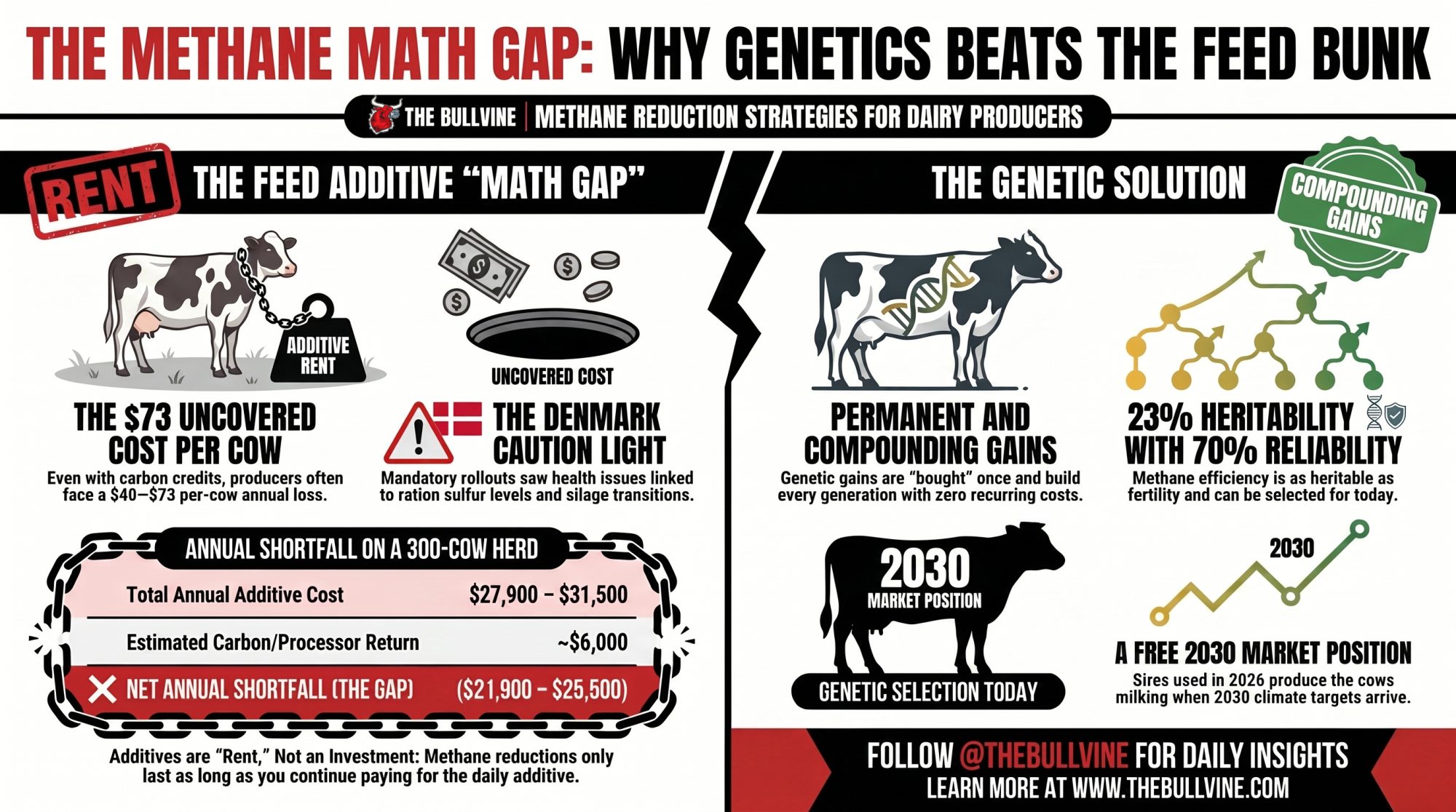
Bovaer can leave $73 a cow uncovered once the carbon math clears. Meanwhile, a low-methane sire costs nothing extra and compounds every generation — and it’s already on your 2026 list.
Executive Summary: A 300-cow herd feeding Bovaer is looking at $27,900 to $31,500 a year in new cost — and once the carbon return clears, the math can still leave roughly $73 a cow uncovered without a processor premium, or about $40 with one. That’s the gap nobody puts on the pitch slide, and it’s why the loud fight over feed additives is the wrong fight. The cheaper methane lever is already sitting on your 2026 sire list: Lactanet’s Methane Efficiency trait runs 23% heritability with 70%-plus reliability on genotyped young animals, costs nothing extra on DHI-enrolled females, and compounds every generation instead of renting you a cut for as long as you keep paying. The timing is the kicker — sires you use in 2026 throw heifers that milk into the early 2030s, right when 2030 buyer targets decide whether “low-methane milk” earns a premium or eats a penalty. Bovaer’s still a legitimate tool for stable TMR herds with a real premium behind it, but treat Denmark as a rollout warning: watch ration sulphur, silage timing, and transitions, because that’s where the trouble showed up. Do nothing, and you’re not playing it safe — you’re choosing to negotiate from a blank page when methane lands in your milk contract. Filter your next round of sires above 100 for Methane Efficiency without dropping your core index, and you’ve built a 2030 position for free.
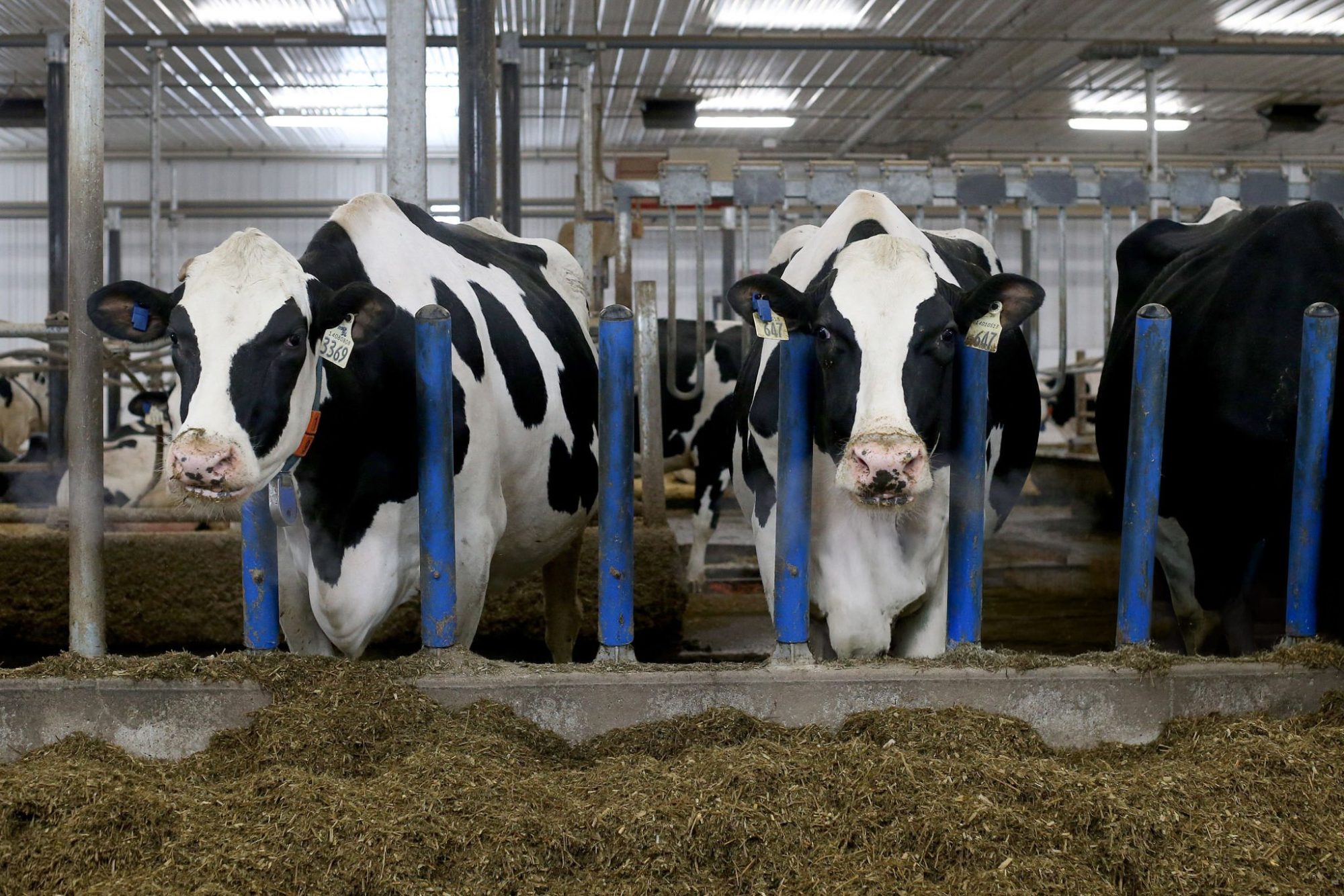
In Denmark this past winter, farmers who’d been ordered to feed Bovaer started calling their vets about cows going off feed. One veterinarian told Farmers Forum that the additive “affected every herd” in her area. By November 2025, a SEGES Innovation survey of the country’s conventional dairy farms had drawn several hundred responses, and the majority reported a drop in milk yield — figures first surfaced in investigative reporting by Undark Magazine and Farmers Forum. That’s the methane headline scaring everybody.
Here’s the one nobody’s running. While the industry fights about a feed additive, the cheapest methane tool you own is already sitting on your 2026 sire list. And almost nobody’s calling it a methane decision.
What’s Really at Stake When the Processor Calls
When a processor rep starts talking methane commitments and premiums, the surface conversation is climate. The real conversation is risk, market access, and who ends up owning the carbon story.
The processor is trying to de-risk its Scope 3 footprint and hit a branded climate target. Danone committed in January 2023 to a 30% absolute cut in methane from its fresh milk supply by 2030, and its own Dairy Methane Action Plan reported a 25.3% reduction versus the 2020 baseline by 2024 — including a 13.9% drop in the single year from 2023 to 2024. A company moving that fast doesn’t get there without eventually sorting its suppliers. You’re on the other side of that table, working out whether the premium covers the cost — or whether you’re signing into someone else’s program economics.
One number reframes the whole exchange. The Innovation Center for U.S. Dairy’s national life cycle assessment puts U.S. dairy at roughly 2% of total U.S. greenhouse gas emissions, across every stage. Read it for what it is — a market signal, not an ecological emergency — and methane becomes something to time and negotiate, not panic over.
The Productivity Story Nobody Puts in the Pitch
Before anyone sells you the next reduction, remember how the first one happened. U.S. dairy already did the hard part, the unglamorous way.
The national herd dropped from about 25 million cows in 1950 to roughly 9 million today, while total milk output climbed. Per kilogram of milk, the greenhouse gas footprint fell by roughly half over those seventy years. None of that came from a feed additive. It came from genetics, nutrition, reproduction, and culling — the same levers you’d pull in a rough milk-price year.
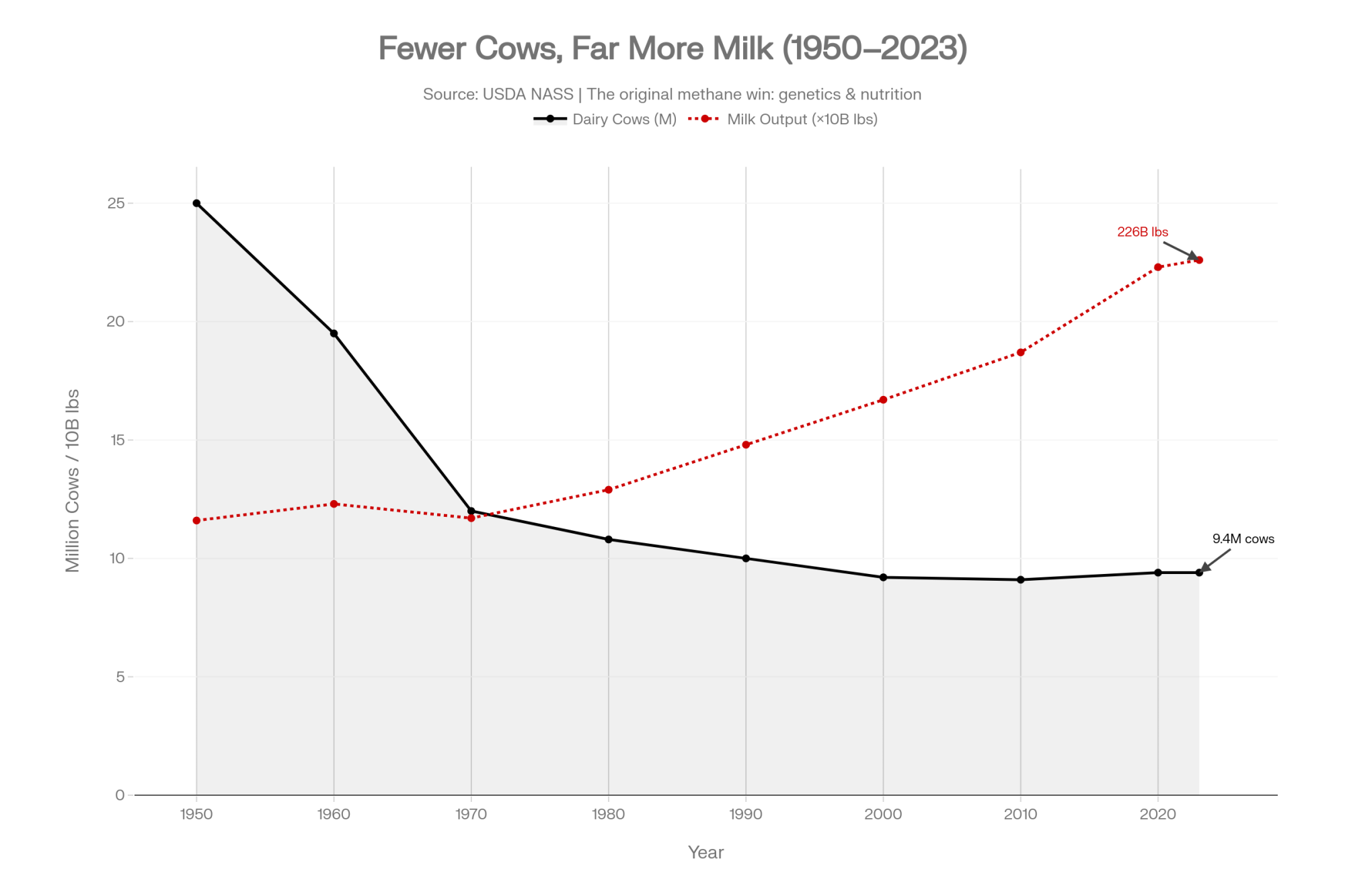
So here’s the first honest move. The work that lowers methane per hundredweight is the same work that protects your margin. It’s the bedrock under any methane score or premium that shows up later, and you’d be doing it anyway.
The Denmark Caution Light — and How to Read It Right
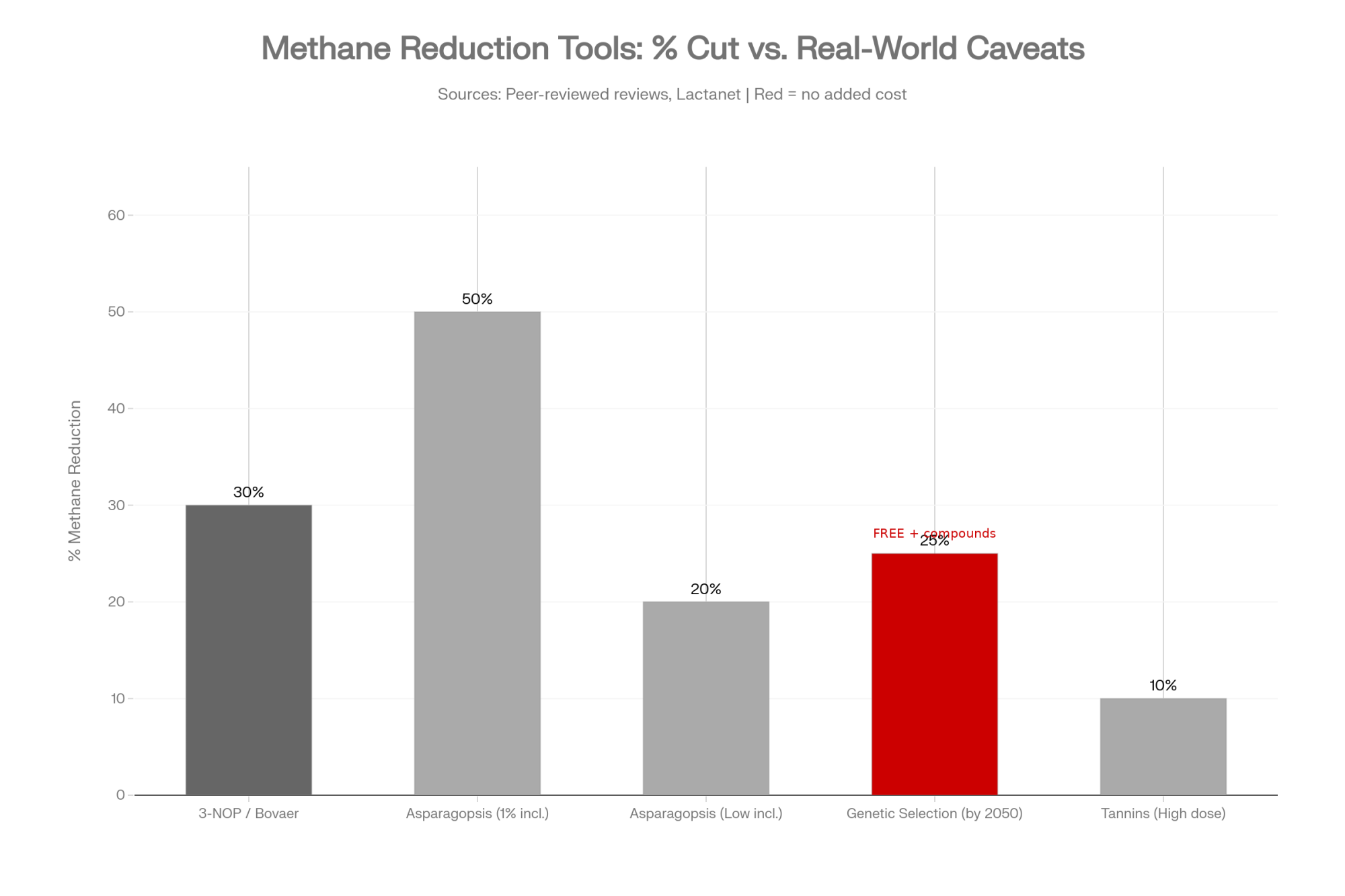
Back to the additive everyone’s actually asking about. The peer-reviewed record on 3-NOP — the active ingredient in Bovaer — is genuinely strong. A 2025 review found that 3-NOP cuts methane by roughly 30% in dairy cattle at an average dose of around 70 mg/kg of dry matter, with no effect on milk production. A full-lactation study in the Journal of Dairy Science (van Gastelen et al., 2024, Vol. 107) followed Holstein-Friesians over a full year and reported reductions of 21% in daily methane, 20% in methane yield, and 27% in methane intensity — with a positive effect on production characteristics.
So why the alarm bells out of Europe?
Denmark mandated methane-reducing feed changes, and most farms started Bovaer around October 1, 2025. The reports were serious enough that in February 2026, the European Commission directed EFSA to reopen its safety review of Bovaer in dairy cows. In that SEGES survey, alongside the herds reporting lower yield, a comparable share reported digestive and metabolic disorders. EFSA opened a public call for data with a March 31, 2026, deadline.
The manufacturer pushes back hard, and fairly. dsm-firmenich says there’s “absolutely no evidence that Bovaer is a cause of any problems,” that the additive is almost entirely metabolized in the rumen and doesn’t show up in milk or meat, and that Elanco hasn’t seen these issues in the more than 150,000 U.S. lactating cows fed Bovaer since launch. SEGES itself flagged a statistical link between the Danish health reports and high-sulphur rations — specifically rapeseed, far more common in Danish diets than in North American TMRs.
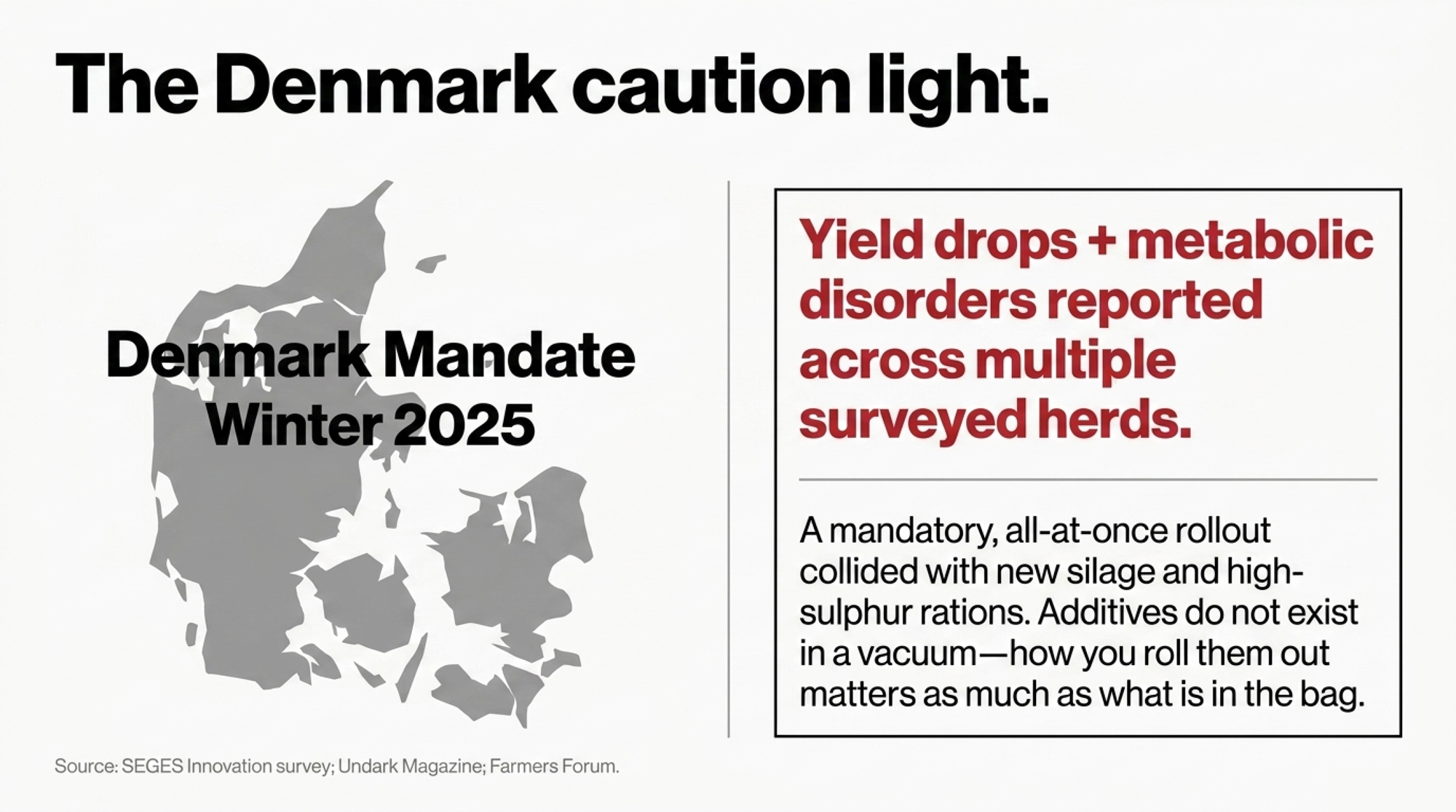
So the honest read isn’t “Bovaer is dangerous.” It’s that nobody had ever stress-tested it this way — mandatory, all at once, into rations where farms were opening new silage and running high-sulphur diets the same week. EFSA’s earlier opinion deemed it safe at the maximum recommended level; the U.S. FDA cleared it for lactating dairy cattle in 2024; and Aarhus University’s controlled trials “showed the desired methane-reducing effect without any signs of disease.” The product stays approved in more than 70 countries at recommended doses. The Danish data is real and worth respecting. It just landed in the messiest possible rollout conditions.
| Factor | Controlled Trials (Peer-Reviewed) | Denmark Rollout (Oct 2025) |
|---|---|---|
| Methane reduction | 21–30% (JDS 2024; 2025 review) | Not measured systematically |
| Milk yield effect | No significant impact | Majority of SEGES survey farms reported drop |
| Health incidents | None in controlled conditions | Digestive/metabolic disorders widely reported |
| Ration context | Controlled, optimized TMR | High-sulphur rapeseed diets; new silage opening same week |
| Sulphur interaction | Not studied at scale | SEGES flagged statistical link to high-sulphur rations |
| Animals affected | Research herds, managed transition | “Affected every herd” (vet report, Farmers Forum) |
| Regulatory response | Approved in 70+ countries | EFSA reopened safety review, Feb 2026 |
| Manufacturer position | Extensive global safety data | “No evidence Bovaer is the cause” — dsm-firmenich |
| North American relevance | FDA cleared for U.S. lactating cows (2024) | Rapeseed diets rare; risk profile lower but not zero |
The lesson for a North American TMR herd is blunt. Additives don’t exist in a vacuum, and how you roll one out can matter as much as what’s in the bag.
The Math That Actually Decides It
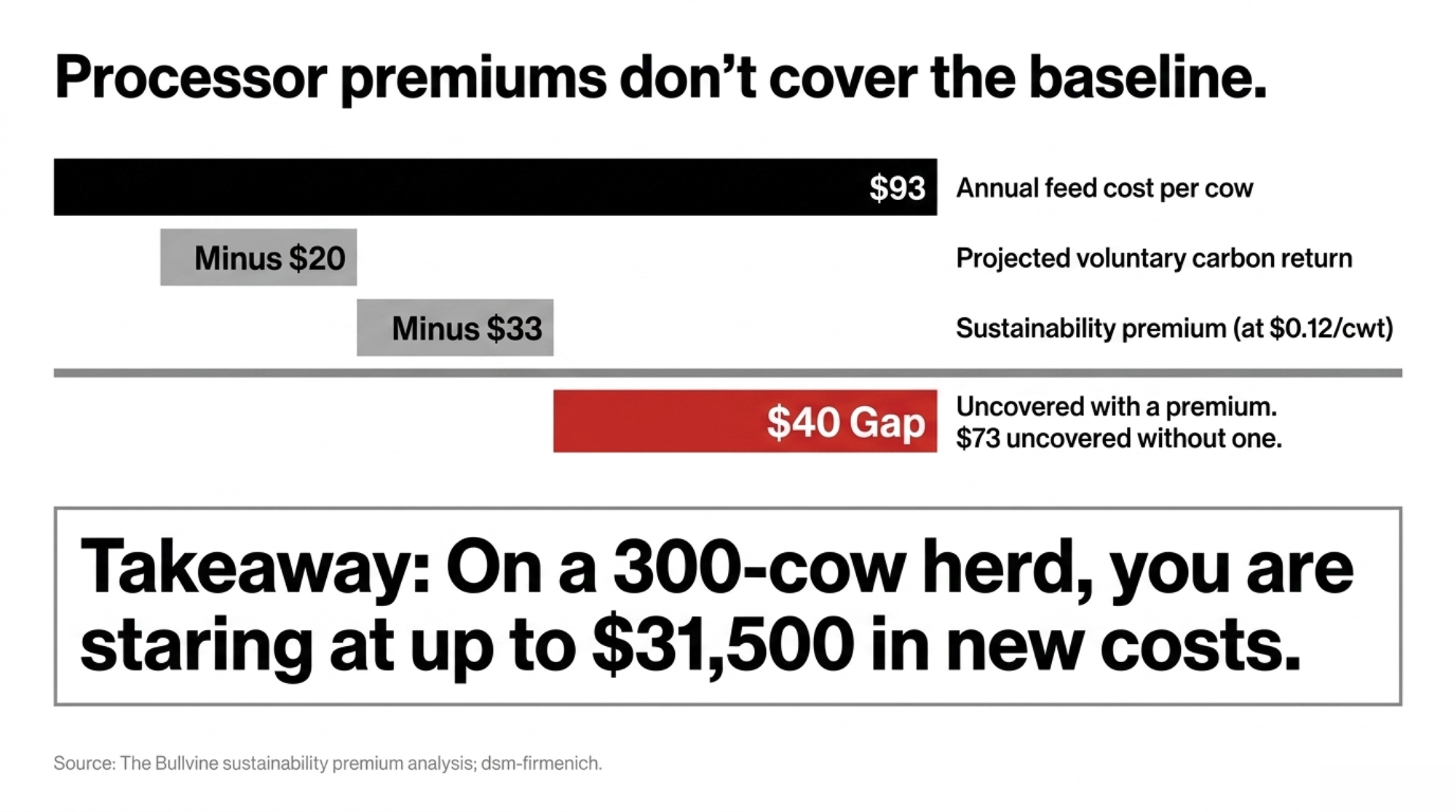
Strip away the safety drama, and 3-NOP comes down to barn math. Bovaer runs roughly $0.30–$0.40 per cow per day. dsm-firmenich pegs the cost at about $93–$105 per cow per year on a lactating-cow basis — close to a cent per litre. The two numbers don’t line up at a glance because the annual figure reflects a lactating-cow feeding window, not a flat 365 days. Confirm the feeding-day basis your supplier is quoting before you budget. On a 300-cow herd at that annual rate, you’re staring at roughly $27,900 to $31,500 in new costs. One caveat in your favor: a new manufacturing plant in Dalry, Scotland, is projected to bring the cost down over time, so this gap should narrow.
The return side is thinner than the pitch suggests. Elanco estimates Bovaer could return “$20 or more per lactating cow per year” through voluntary carbon markets, conservation funds, or processor incentives — call it roughly $6,000 back on those same 300 cows, and remember that’s a projection, not a guarantee. The Bullvine’s own analysis found a $0.12/cwt sustainability premium recovers only about $33 per cow per year on a 75-lb cow.
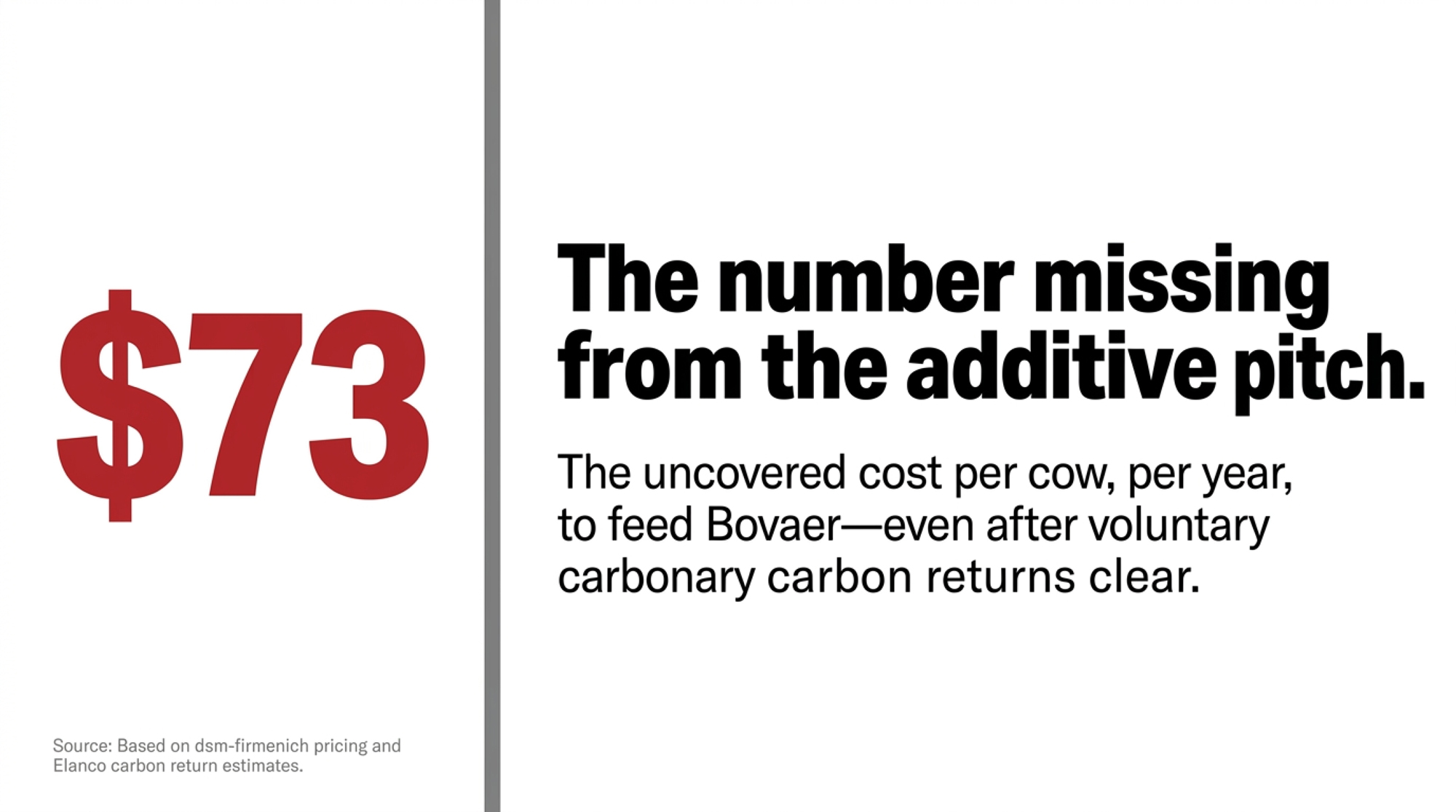
Now do the arithmetic, because nobody argues with their own arithmetic. With a premium stacked on carbon ($93 cost − $20 carbon − $33 premium), you’re leaving roughly $40 per cow uncovered. With no premium at all — just the carbon return against the cost — the hole runs from about $73 per cow at the low end of the cost range, and widens if you’re paying at the top of the range. That $73 floor is the number behind this story’s headline, and it’s the scenario many producers are actually facing.
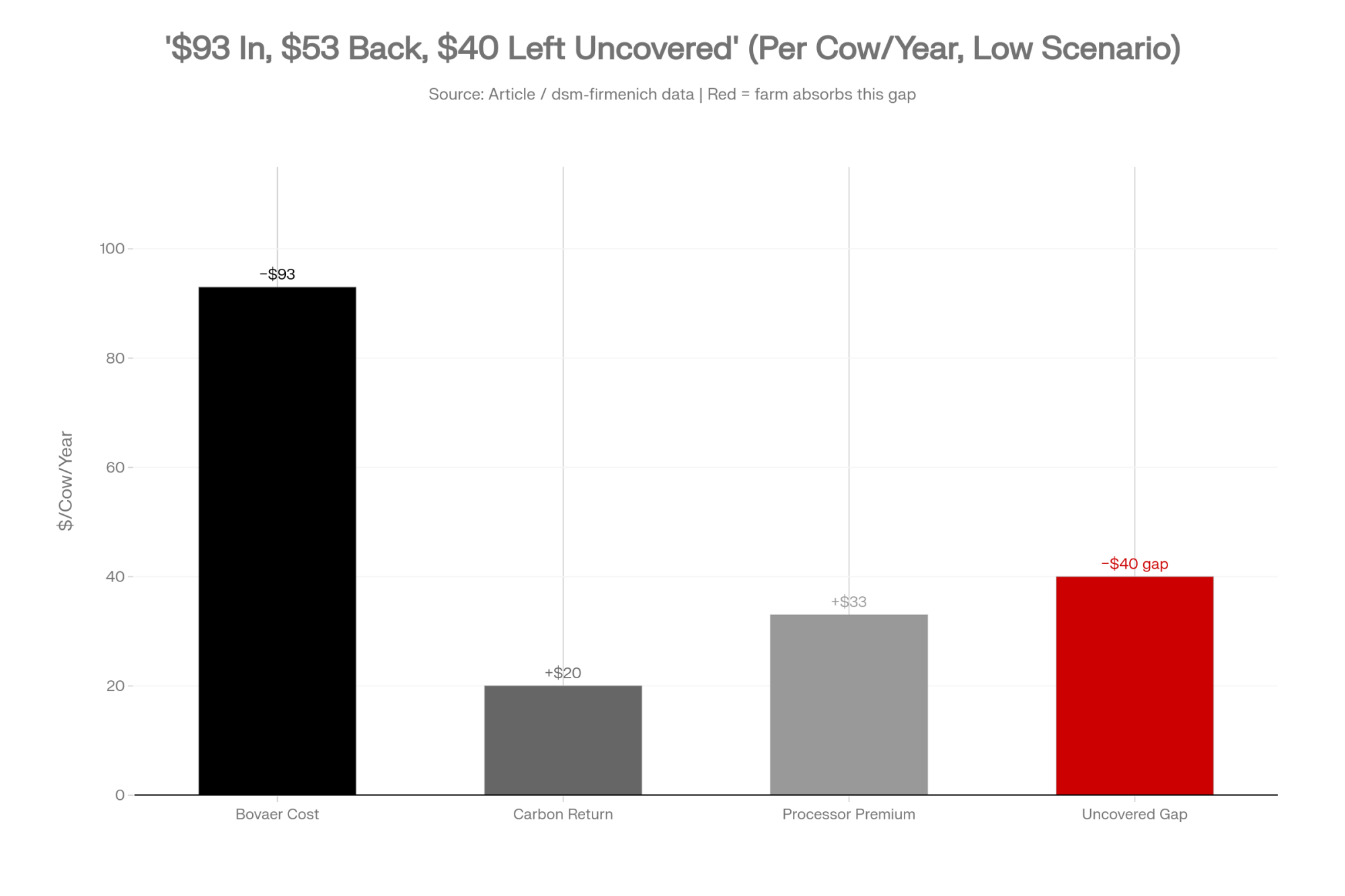
That’s the figure for the farm-office wall. Before you sign anything, ask three questions. What does it cost per cow? What am I guaranteed per cow or per hundredweight in return? And how long does the contract lock? Everything else is marketing.
Can a Sire Decision Really Be a Methane Decision?
Here’s where the slow, cheap lever lives — the one almost nobody frames this way.
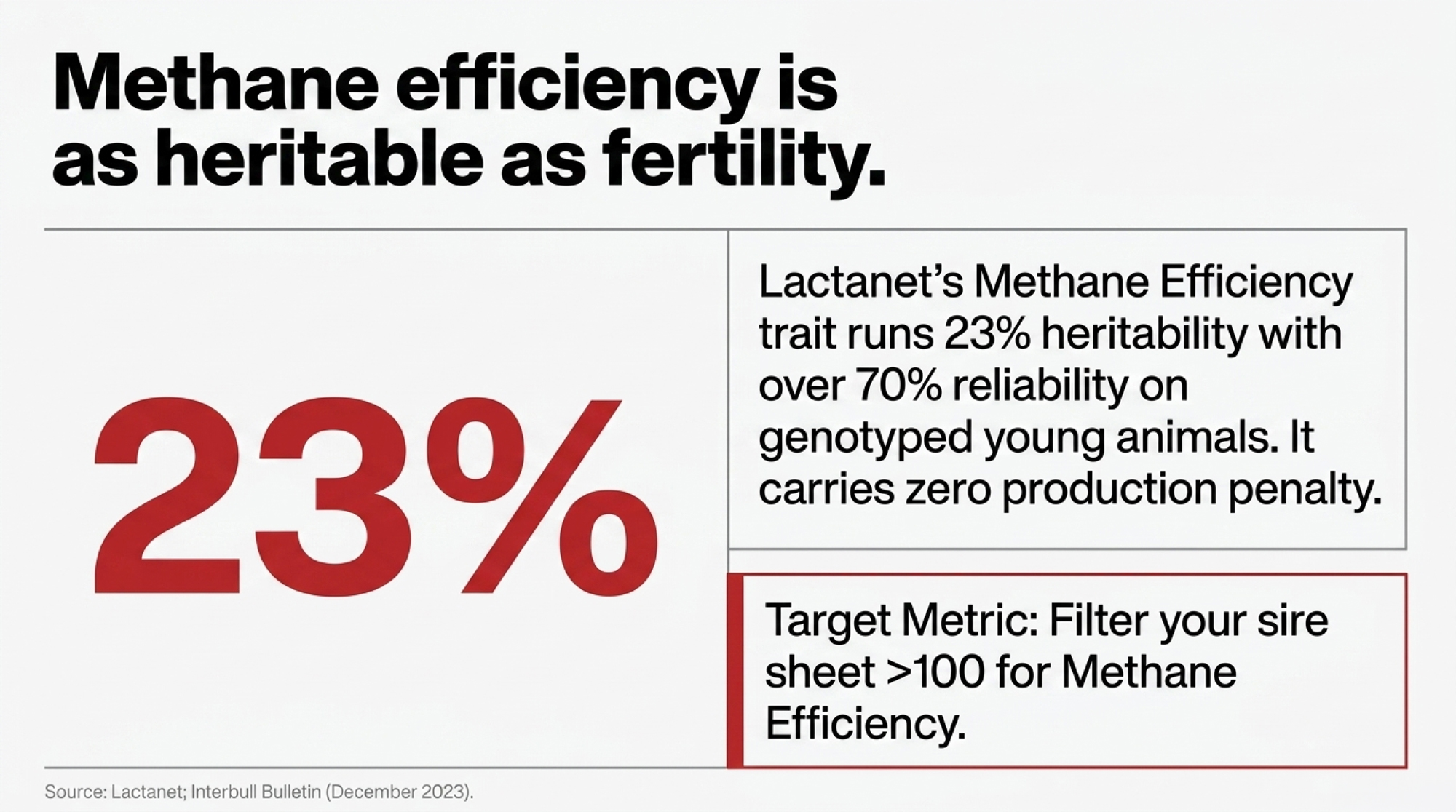
Methane is heritable. Lactanet pegs the heritability of its milk-MIR-predicted methane trait at 23% (0.23), with average reliability surpassing 70% for genotyped young bulls and heifers — figures published in Lactanet’s own trait documentation and the peer-reviewed implementation paper in the Interbull Bulletin (December 2023) and JDS Communications (2024). That’s right in the range of traits like fertility, and the genetic correlation with production is weak, so you can select for lower methane without giving up milk, fat, or protein. Lactanet has also reported a slight positive correlation between its Pro$ index and Methane Efficiency, suggesting that lifetime profit and a lower methane footprint aren’t at odds.
This isn’t theoretical anymore, and it’s exactly where Canadian breeders have an edge. In April 2023, Lactanet became the first organization in the world to publish official Methane Efficiency genetic evaluations for the Holstein breed, expressed as Relative Breeding Values (RBVs) built on milk mid-infrared spectroscopy data. The trait was then folded into the modernized LPI’s new Environmental Impact subindex in April 2025. Lactanet projects genetic selection can deliver a 20–30% methane reduction by 2050 with no production penalty, and calls it “a permanent and cumulative solution.” VikingGenetics has since followed with a Nordic Methane Index, and CRV in the Netherlands with Methane Saved. If you already read proofs and rank bulls by index, you can act on this today — while operations that only consider methane a feed-bunk problem are still waiting on the next additive trial. For how the trait slots into the indexes you already use, see our breakdown of the April 2025 LPI overhaul.
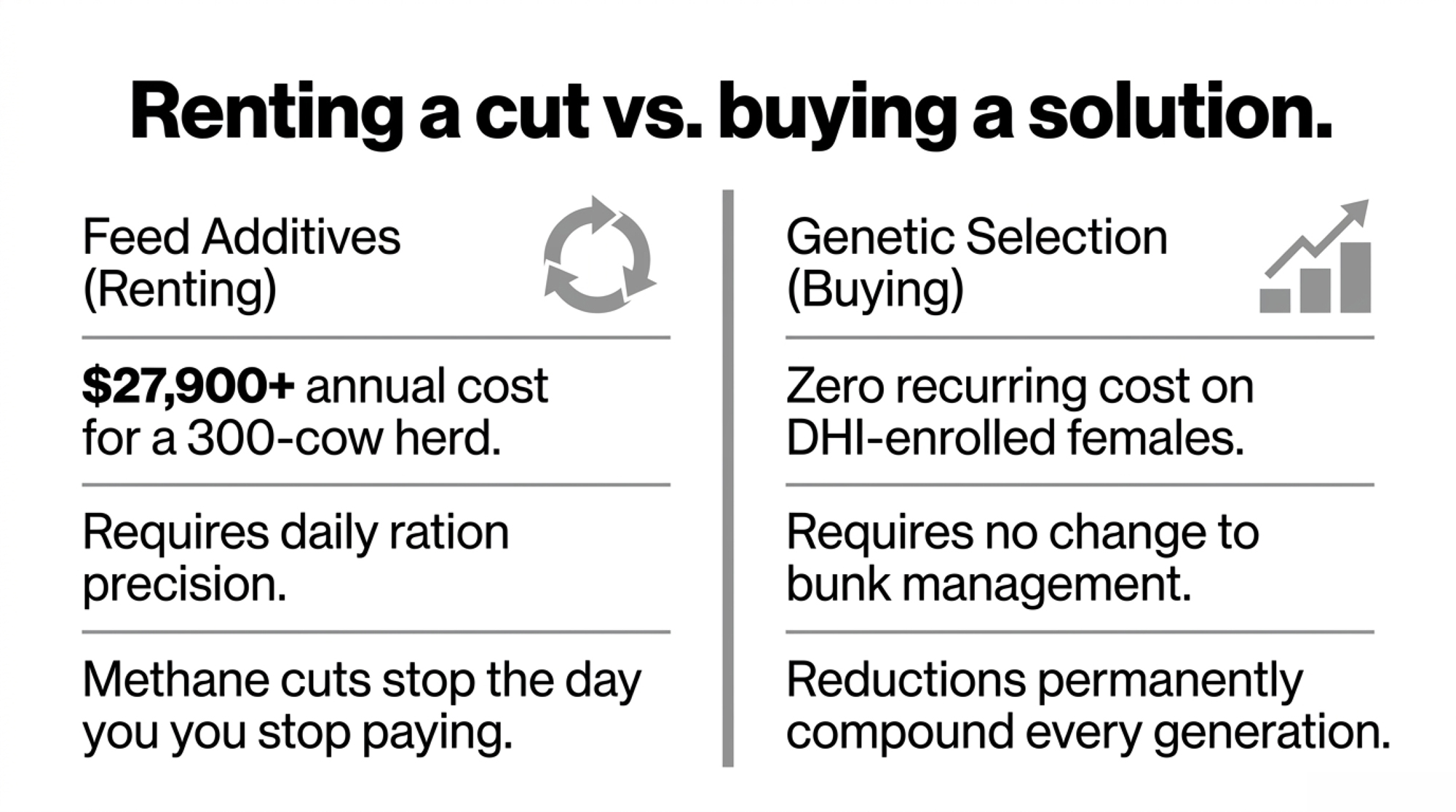
This is pay-now or pay-later in one decision. The additive is rent — you cut methane only as long as you keep paying. Genetics is a purchase. You build the reduction into the animal once, the recurring cost is zero, and the gain compounds every generation.
| Metric | Bovaer (3-NOP) | Genetic Selection (Methane Efficiency RBV) |
|---|---|---|
| Annual cost/cow | $93–$105 | $0 (DHI-enrolled females) |
| Methane reduction | ~30% per peer-reviewed average | Projected 20–30% by 2050 |
| Heritability | N/A — not heritable | 23% (h²) — permanent in animal |
| Reliability on genotyped animals | N/A | >70% |
| Effect duration | Lasts only while fed | Compounds every generation |
| Production penalty? | None in controlled trials | None — weak genetic correlation with milk |
| Requires stable TMR? | Yes — ration-sensitive | No — works in grazing systems |
| Compounds over time? | No — rent model | Yes — purchase model |
| Cost if you stop paying | Returns to baseline methane | Gain is permanent in progeny |
| 2030 market positioning | Ready now, ongoing cash out | Calves of 2026 sires milk in early 2030s |
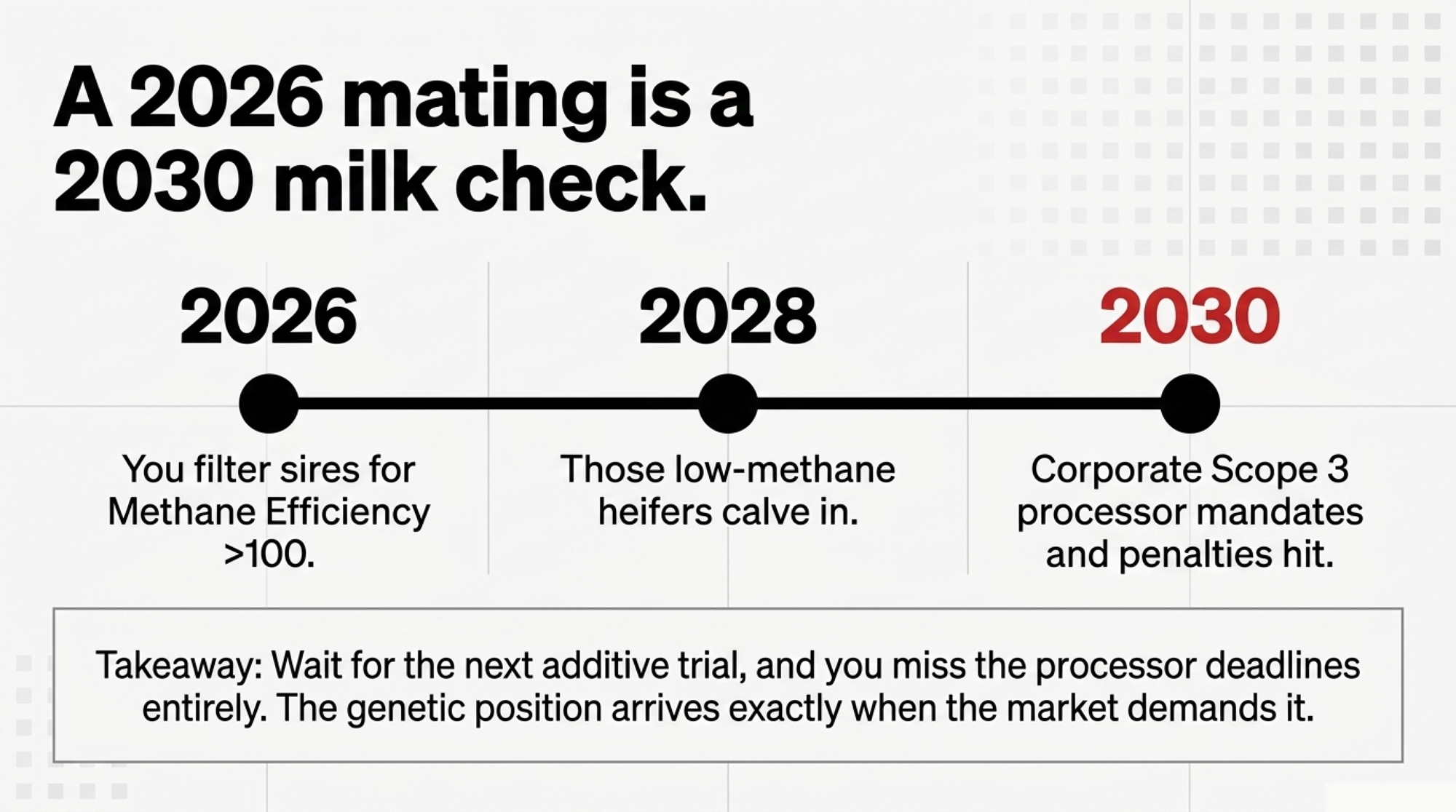
And the timeline is the part that should keep you up at night. A sire you use heavily in 2026 throws calves in 2027. Those heifers calve in 2028–2029 and milk into the early 2030s — right when 2030 buyer targets bite and “low-methane milk” is most likely to carry a premium or a penalty. Your 2026 sire decision is a 2030 market-positioning decision wearing a production hat. The calf check on the additive shows up now; the genetic position shows up exactly when the market starts paying for it.
Your next mating session, do this: pull up your genomic sheets and find the Methane Efficiency value (the RBV in Canada; watch for the equivalent line as U.S. and Nordic evaluations roll out). Screen out the high-methane tails and weight toward bulls sitting clearly above the breed average — above 100 — for Methane Efficiency, without dropping your core economic index, whether that’s Pro$, LPI, NM$, or TPI. In Canada, those values are already published free of charge for every Holstein female in your DHI herd inventory; for cows and heifers outside it, Lactanet sells the bundled Methane and Feed Efficiency evaluation at $8 per animal, with a $2 credit for type-classified herds.
Lab Coat or Barn Coat: Sorting the Rest of the Toolbox
The rest of the buzz sorts cleanly into what you can feed tomorrow, what you watch for two years out, and what you ignore until the science catches up.
| Tool | Verdict | What the data shows | The catch |
| Tannins | Feedable now, modestly | 2024 meta-analysis: ~10% cut in enteric methane and methane yield | Only works at high effective doses (above ~8,000–10,000 mg/kg DM); sub-therapeutic doses do little; most robust data is from beef |
| Asparagopsis seaweed | Watch, don’t bet | ~20% reduction at low inclusion, 50%+ at 1% inclusion | The biggest cut came with a milk-yield penalty (Roque et al., 2019); high cost, bromoform variability, supply and regulatory hurdles |
| Methane vaccine | Ignore for budgeting | NZ’s AgResearch targeting at least 20% reduction with no system changes | Only in-vitro antibody responses so far; no consistent live-animal methane drop; 5–10 years out |
The seaweed and vaccine numbers that headline conference slides mostly come from short beef trials, in-vitro work, or aspiration — not from multi-lactation dairy data. Worth knowing. Not worth betting the barn on yet.
What This Means for Your Operation
Pick the path that fits your system, then run the check beside it before you commit a dollar.
| Farm Type | Primary Lever | Secondary Lever | Watch Out For | Methane Cost (Year 1) |
|---|---|---|---|---|
| Stable TMR, processor premium | 3-NOP (Bovaer) + genetics filter | Carbon program enrollment | $40–$73/cow gap if premium doesn’t cover cost; ration sulphur | $93–$105/cow |
| Stable TMR, no processor deal | Genetics filter (Methane RBV >100) | Efficiency + reproduction discipline | Signing for optics before math pencils | $0 extra |
| Grazing / high-forage system | Genetics — only viable daily lever | Tannins at effective dose if set up for it | Daily additives impractical without individual feeding | $0 extra |
| All farm types — baseline | Culling + reproduction + feed efficiency | Methane RBV filter on sire list | Doing nothing = price taker when methane hits your contract | $0 extra |
- Default path — efficiency plus genetics. Fits nearly every herd, any size. No new product spend, just discipline on reproduction, culling, and feed efficiency, plus a methane filter on the sire list. The gains are slow and won’t satisfy a processor wanting cuts this quarter — but they cost nothing extra and compound for a decade. Check: Does your mating program have a methane filter on it yet? If you’re in Canada, are you pulling the Methane Efficiency RBVs already sitting free on your DHI-enrolled females?
- Conditional path — 3-NOP. Makes sense for stable TMR herds with a premium or carbon program that genuinely narrows the $40–$73 gap. Demands ration precision and careful transition timing. Where it backfires: signing for the optics, feeding it through silage changes, or believing in a flat 30% forever. Check: Have you run your own cost-per-cow against a guaranteed premium or credit, not a projected one? What’s written into your processor agreement, and how long does any premium lock last? If the rep pitches “30% forever,” ask for the 18-month data in a herd like yours. That dataset barely exists.
- Stacking path — tannins, and a note for grazers. Sensible for high-forage or grazing systems already set up for tannin inputs, but only at effective doses. Check: If you graze, are you leaning on genetics? Daily additives aren’t practical for animals you don’t feed individually, which makes the sire list your main lever, not your backup.
- The data question that cuts across all three. Are you capturing the production, intervention history, and methane intensity that a future premium will make you prove? Here’s how carbon insetting actually pays producers.
Key Takeaways
- If you do nothing else, bank the free gains. Efficiency plus a light methane filter on your sire list costs nothing extra and compounds for a decade.
- If a processor pitches a premium, run the gap math first — additive cost minus guaranteed return. If it leaves a $40–$73 gap per cow, or wider at the top of the cost range, don’t sign for the optics.
- If you’re on a stable TMR and the numbers pencil, 3-NOP is a legitimate tool — but treat Denmark as a rollout warning, not a verdict: watch ration sulphur, silage timing, and transitions.
- If you farm a grazing system, your methane plan is genetics, full stop — daily additives don’t fit animals you don’t feed individually.

The Danish farmers calling their vets didn’t get a say in how that additive landed in their bunks — the mandate decided for them. You still get the say. Doing nothing feels safe at the kitchen table tonight, but it’s still a decision: you’re choosing to be a price taker when methane lands in your milk contract, negotiating from a blank page while the neighbor walks in with a genetic trajectory and verified numbers. The cheapest move on the board costs you nothing this year and builds for a decade. So the real question isn’t whether you trust the Bovaer rep. It’s whether you’ll let your 2026 sire list do the quiet work while everyone else argues about the additive.
Run Your Numbers
Genomic Testing ROI Calculator — Before you bank on Methane Efficiency as a free lever, run the genomic numbers. The calculator pressure-tests whether testing and sorting your heifers actually pays once raising cost, quartile value spread, and beef-on-dairy outs are counted — so you know the genetic play pencils before the additive rep ever calls.
Complete references and supporting documentation are available upon request by contacting the editorial team at editor@thebullvine.com.
Learn More
- The Hydrogenobody Quietly Rewrote Your 2027 Methane Contract – Before You Even Signed It — Arms you with a critical biological reality check by exposing the newly discovered ciliate “hydrogenobody” pathway that standard 3-NOP additives cannot reach, presenting a major risk of contract underperformance.
- The $73-a-Cow Gap Hiding in Your 2027 Bovaer Contract — Follows the money on the fine print of commercial processor agreements, mapping out exactly how a $0.12/cwt premium leaves herds exposed to severe margin risk when paired against retail additive costs.
- Net Merit: The $100000 Cull Gate Your Index Misses — Delivers a strategic long-term warning by detailing how the major April 2025 Net Merit index updates priced butterfat and feed saved higher while leaving methane values flat at zero.
The Sunday Read Dairy Professionals Don’t Skip.

Every week, thousands of producers, breeders, and industry insiders open Bullvine Weekly for genetics insights, market shifts, and profit strategies they won’t find anywhere else. One email. Five minutes. Smarter decisions all week.




