



A contract driver died hauling dry ice in 2016. The $241M bill just landed on 500 farm families who never voted on the call — and a one-line board rule could’ve capped it.
Eric Johnson didn’t know what was filling the cab of his vehicle.
Johnson, 64, was a courier hauling frozen strawberries packed in dry ice from St. Charles, Missouri, toward Fayetteville, Arkansas, for PFD Supply, a distribution subsidiary of Prairie Farms Dairy. About 90 minutes into the August 5, 2016, drive, he was found unconscious at the wheel after the dry ice sublimated into carbon dioxide inside the vehicle; he died in the hospital three days later. Dry ice does that. It turns into CO2 gas, pools in an enclosed space, and can cause loss of consciousness without warning. By his family’s account, relayed through their attorneys, he left behind his wife, Paula, and five children — two of them disabled and in his care.
On February 27, 2026, a Madison County, Illinois, jury decided that Prairie Farms and PFD owed his family $241 million — $49.5 million compensatory and $191.5 million punitive. Here’s the part that should stop every member-owner cold. Prairie Farms is a farmer-owned cooperative, founded in 1938, owned by the families who ship it milk. That verdict didn’t hit a faceless corporation. It hit them.
And the member-families didn’t make the call that led to Johnson’s death. Most of them likely never knew the lawsuit was building. That’s exactly what makes this a governance story, not just a courtroom one — and why the smart question for your own co-op isn’t “could this happen to us,” but “would we even know in time.”
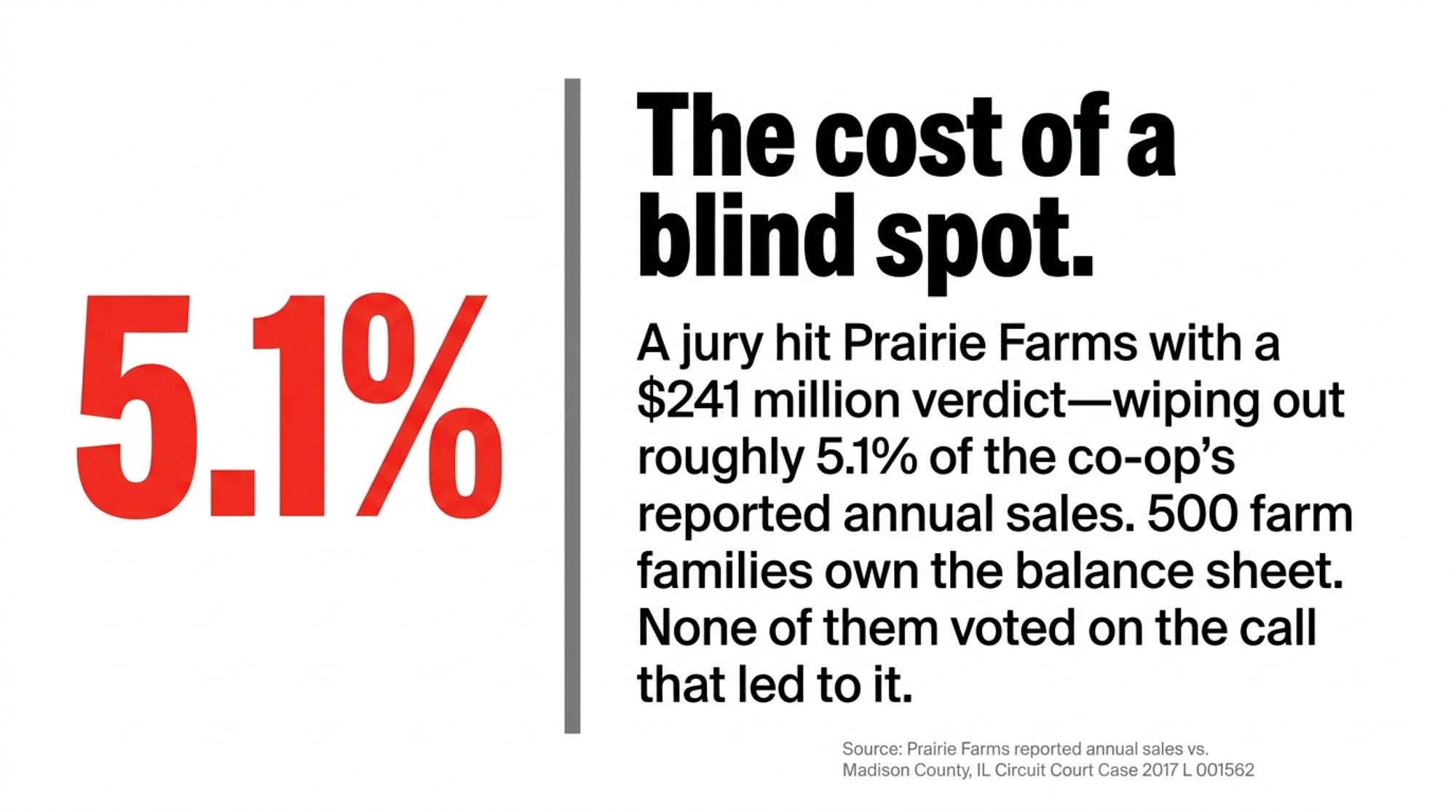
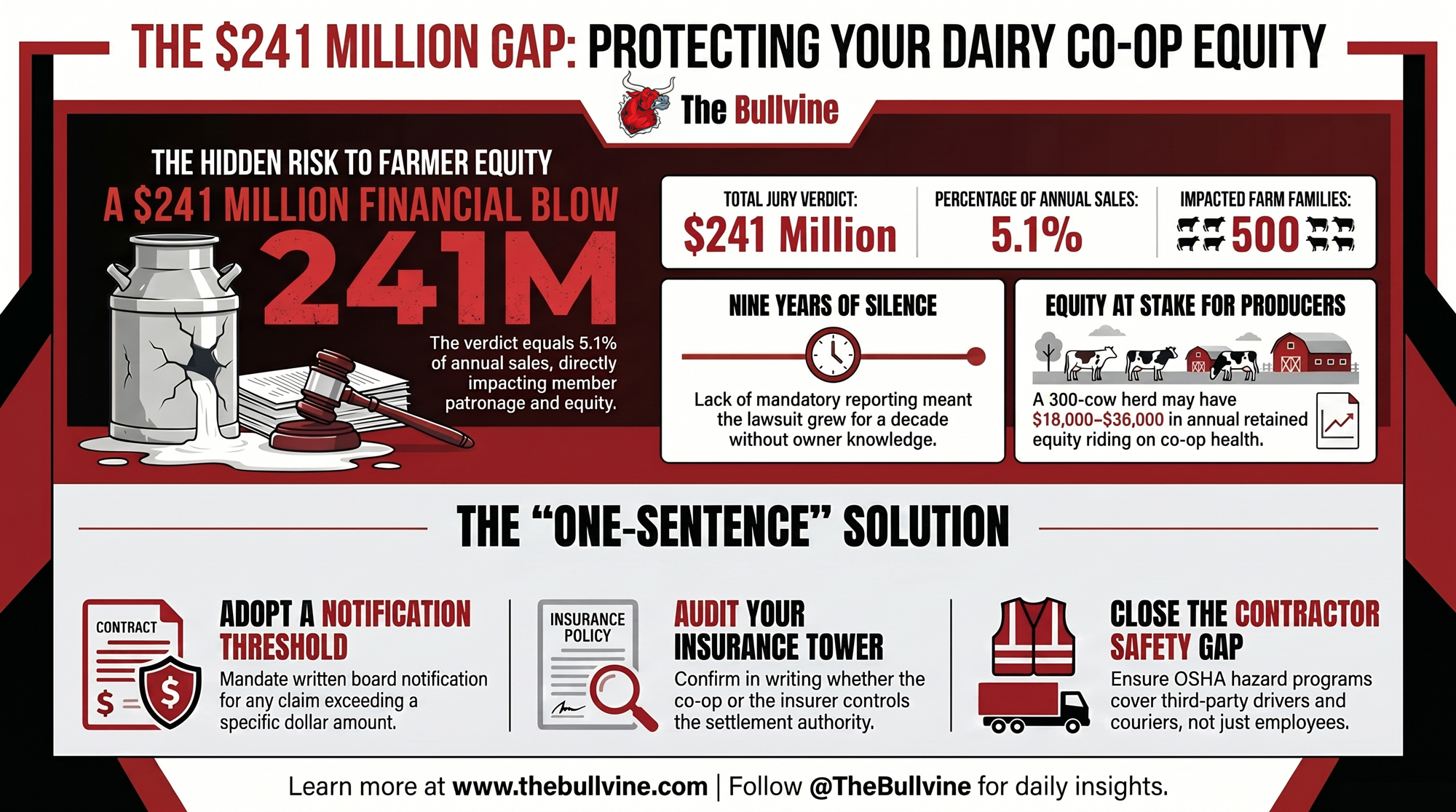
$241 million = about 5.1% of Prairie Farms’ reported annual sales. That’s not a line-item. That’s a structural event landing on 500 farm families who never saw it coming.
What’s Changing and Why
Prairie Farms isn’t small. The co-op reports more than 500 farm families as member-owners, roughly 7,000 employees, 48 manufacturing plants, and over $4.69 billion in annual sales. Those are self-reported figures — the co-op doesn’t publish audited financials — but even at face value, the verdict equals about 5.1% of a year’s sales.
The legal theory was almost mundane. Federal OSHA’s Hazard Communication Standard (29 C.F.R. 1910.1200) requires employers to identify chemical hazards, train workers, and warn people about foreseeable exposures. Dry ice in a sealed vehicle is a textbook foreseeable exposure — one pound produces roughly 250 liters of CO2 gas, and in an enclosed cab, a dangerous concentration can build quickly, with OSHA and safety literature describing hazardous levels developing within minutes, depending on volume and ventilation. It’s a hazard OSHA has cited elsewhere in nearly identical terms — its own records describe a worker rendered unconscious by open boxes of dry ice in a walk-in freezer. At trial, the plaintiffs argued — and the jury agreed — that PFD Supply failed to warn or train Johnson about that hazard, against a backdrop of OSHA citations involving the standard both before and after his death.
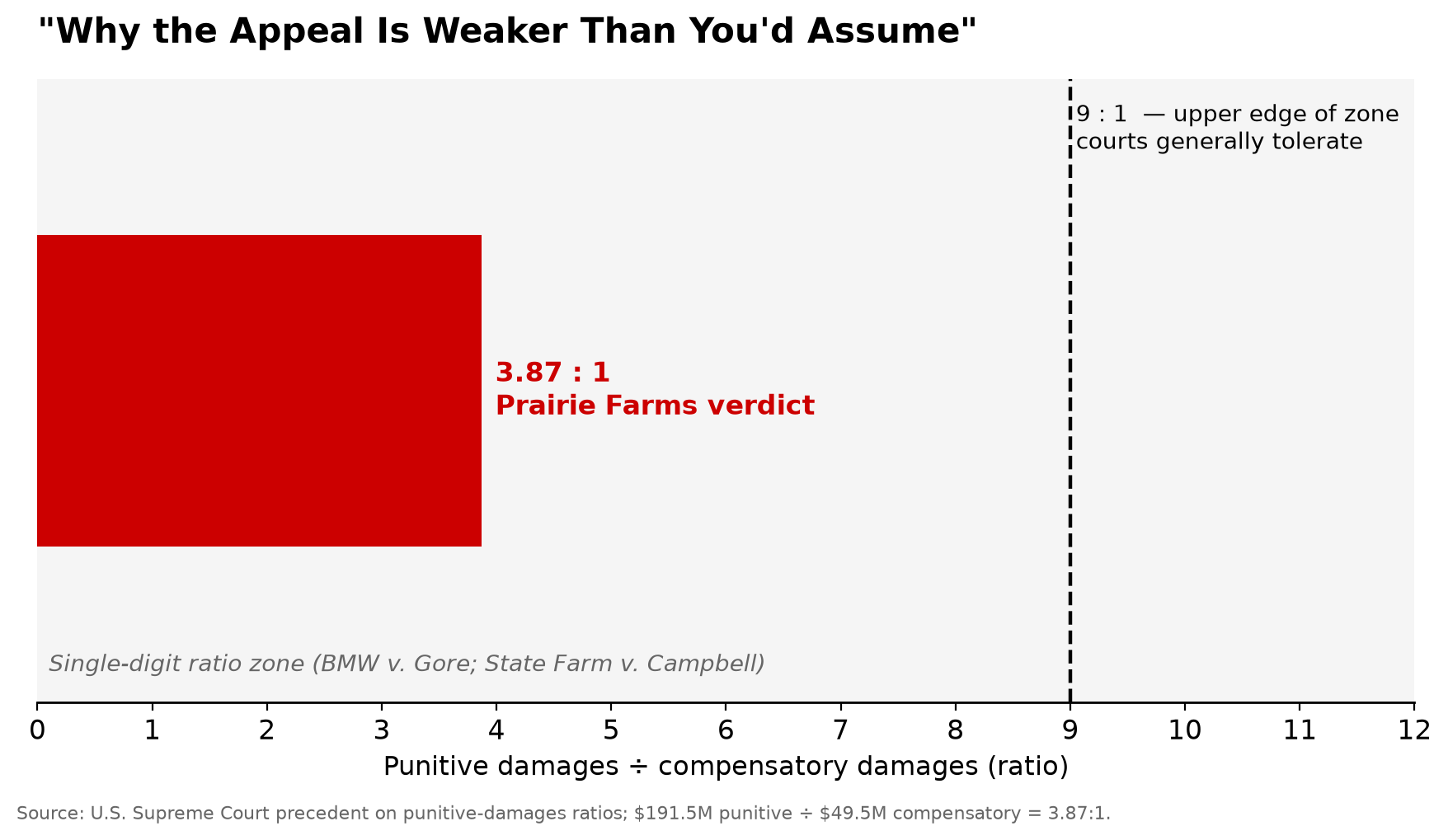
And the size of the punitive number isn’t random. The jury settled on a punitive-to-compensatory ratio of 3.87-to-1($191.5M to $49.5M). That matters because the U.S. Supreme Court, in BMW of North America, Inc. v. Gore and State Farm Mutual Automobile Insurance Co. v. Campbell, has signaled that single-digit ratios are generally constitutional. Translation for a board: Prairie Farms’ best hope of slashing this on appeal — arguing the punitive award is grossly excessive — is weaker than you’d assume, because 3.87:1 sits comfortably inside the range courts have tolerated.
The co-op most exposed to a story like this isn’t the 80-cow operation down your road. It’s any cooperative big enough to own subsidiaries and distribution arms, where the loading dock sits a long way from the boardroom.
Three Failures, One Group of Farm Families
This is more than a bad-luck verdict. Three separate fights are stacked on top of each other, and every one lands on the same 500 families. Here’s how the safety net is coming apart, layer by layer.
| The Failure | Where It Stands | What’s at Stake for Member-Owners |
| 1. The verdict | Madison County, IL Circuit Court, Case 2017 L 001562; PFD Supply found liable Feb. 27, 2026 | $241M judgment ($49.5M compensatory + $191.5M punitive) against the co-op |
| 2. Alleged insurance failure | U.S. District Court, S.D. Ill., Case 3:26-cv-00384 (Judge J. Phil Gilbert); alleges Travelers refused to settle within limits ~10 yrs | Co-op loses its first line of protection if primary coverage is compromised |
| 3. The coverage fight | U.S. District Court, N.D. Ill., Case 1:2026-cv-02816; excess insurers argue they owe nothing on punitive award | $191.5M punitive layer could drop straight onto the co-op’s balance sheet |
| Combined exposure | All three live and unresolved as of publication | A potential $191.5M uninsured punitive hit with the insurance tower collapsing underneath |
Stack those three, and you get a co-op potentially holding a $191.5 million punitive judgment with the insurance tower collapsing underneath it. None of the farm families voted on PFD Supply’s safety program, the settlement strategy, or the policy language. They just own the balance sheet it all flows into. That’s the trap — and it’s structural, not unique to Prairie Farms. Prairie Farms has not issued a public statement on the verdict, and neither the company nor Travelers responded to requests for comment as of this writing; this story will be updated if either responds.
How This Plays Out on Real Farms
Here’s the uncomfortable part for member-owners. Your personal assets aren’t on the hook — cooperative structure limits a member’s liability to their investment. But “limited liability” isn’t the same as “no impact.” A nine-figure judgment flows straight into the things you actually feel: patronage payments, equity redemption schedules, and the co-op’s room to pay a competitive milk price.
When a major loss lands, a co-op reaches for blunt tools. It can draw down retained earnings, write down members’ allocated equity accounts, or — worst case — assess patrons directly. None of that shows up as a dramatic line on your milk cheque. It shows up as the equity redemption that arrives late, the revolving-fund payment that gets pushed a year, or the capital retain that doesn’t come back on schedule. For an older member counting on equity redemption as part of a retirement or exit plan, that timing isn’t an abstraction — it’s the difference between a clean handoff and a delayed one.
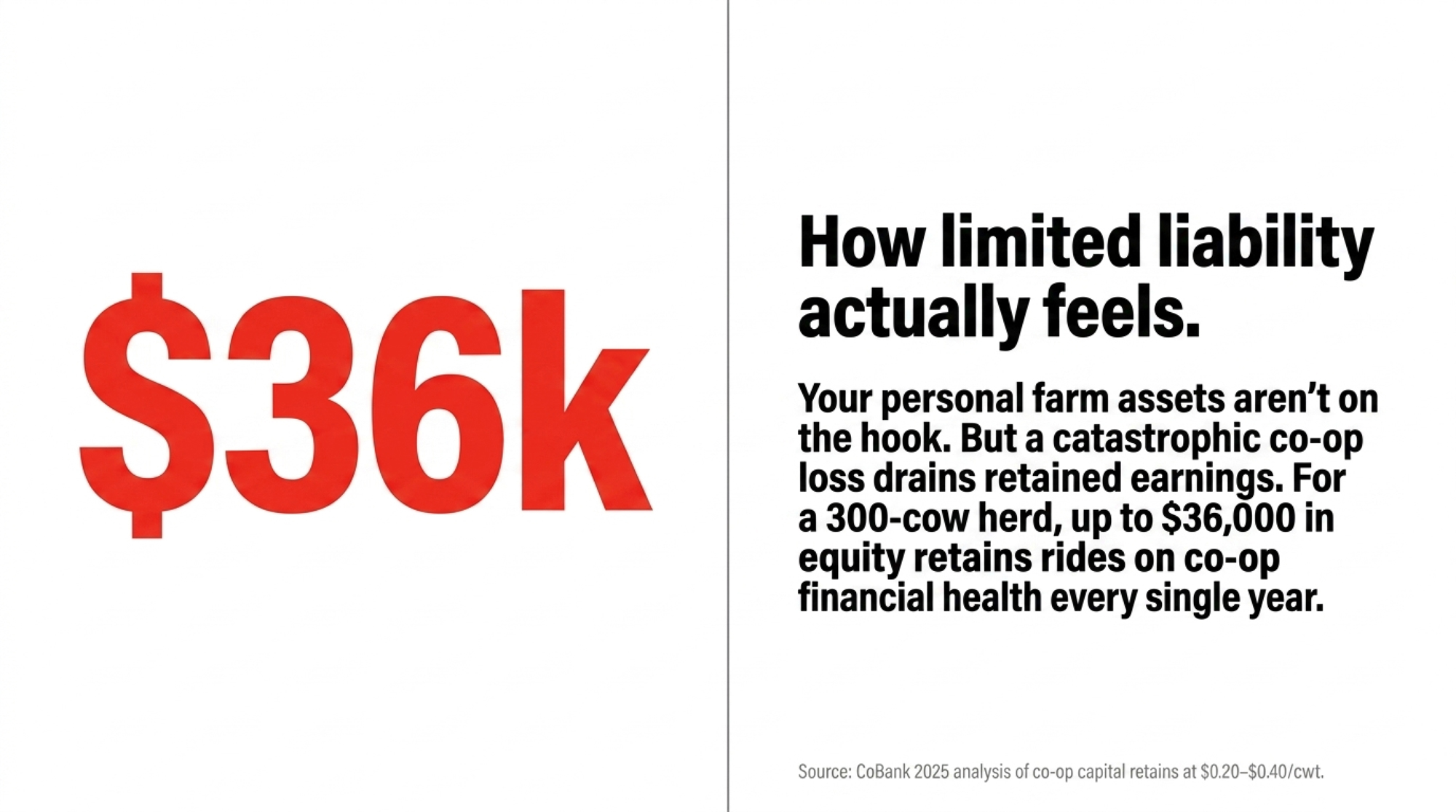
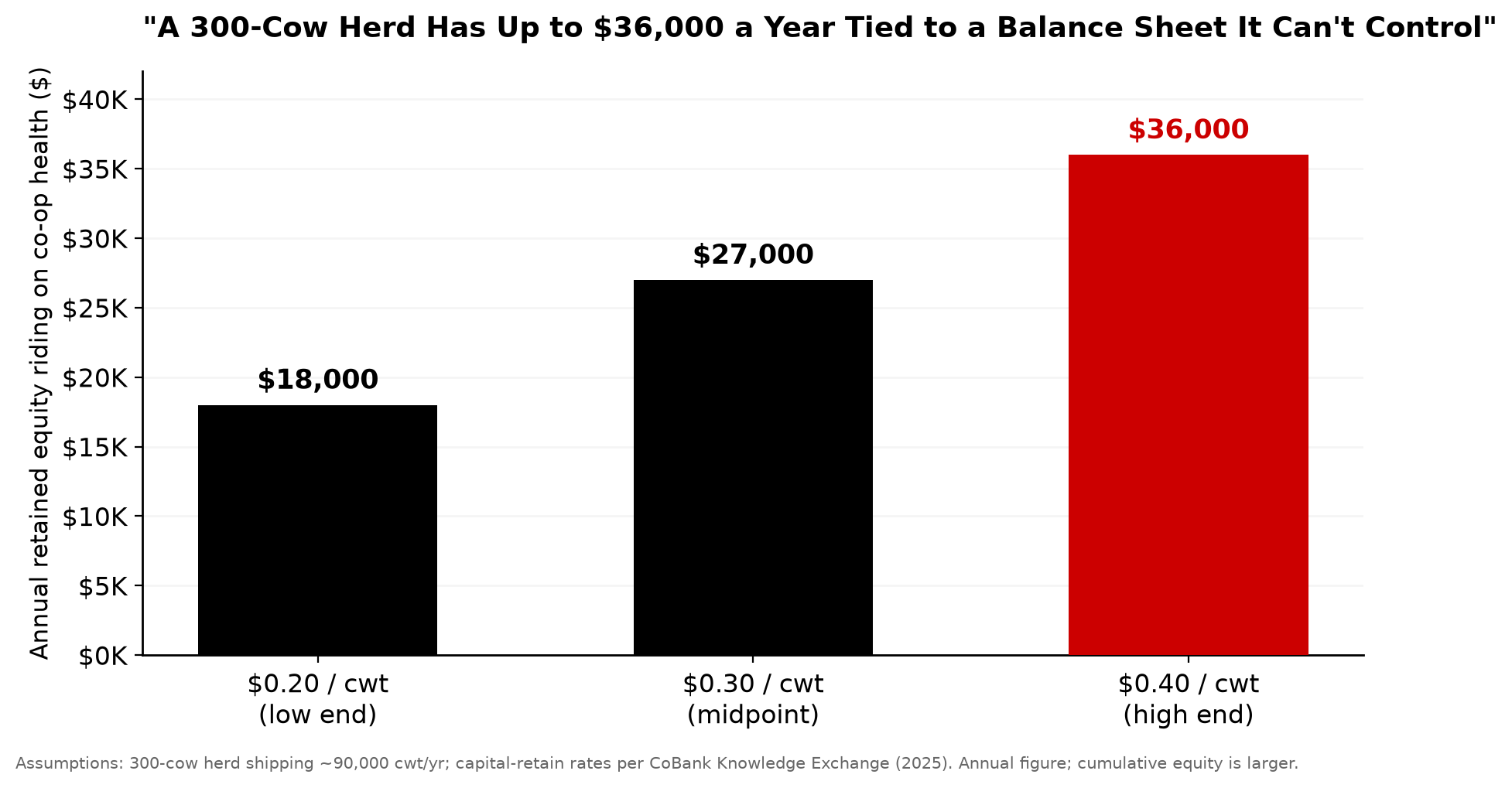
Put a number on it. The verdict equals about 5.1% of Prairie Farms’ reported annual sales — a hit larger than many processor cooperatives clear in net margin in a good year. As secondary context, CoBank’s Knowledge Exchange team, in a 2025 analysis, pegs co-op capital retains at $0.20 to $0.40 per cwt for large cooperatives. A 300-cow herd shipping around 90,000 cwt a year would have roughly $18,000 to $36,000 in retained equity riding on the co-op’s financial health. That’s the annual contribution — a member’s total equity on the co-op’s books builds up over the years, so the cumulative amount exposed to a catastrophic loss is larger. Real money, tied up in a balance sheet you don’t control.
The Mechanics: How a Loading-Dock Incident Becomes an Existential Threat
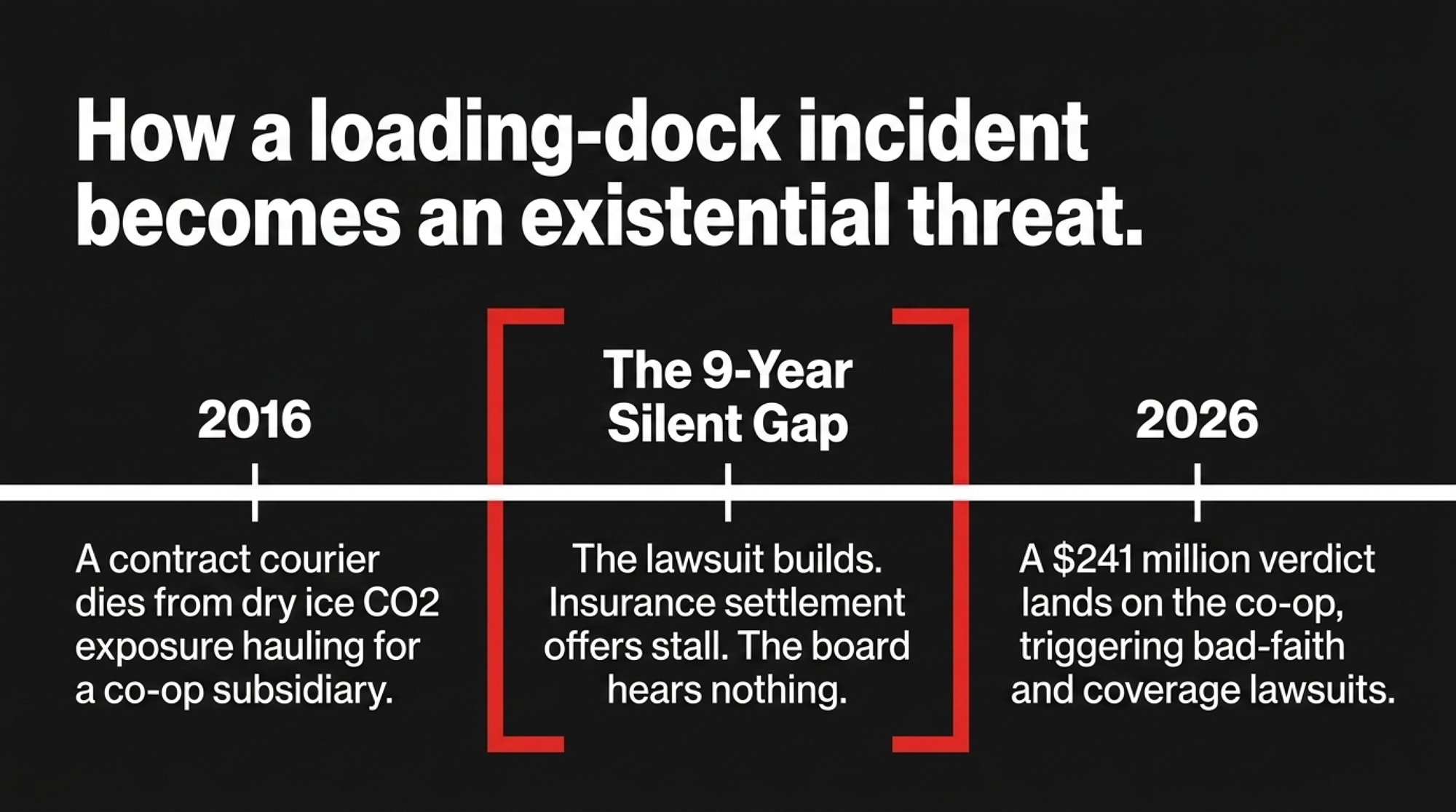
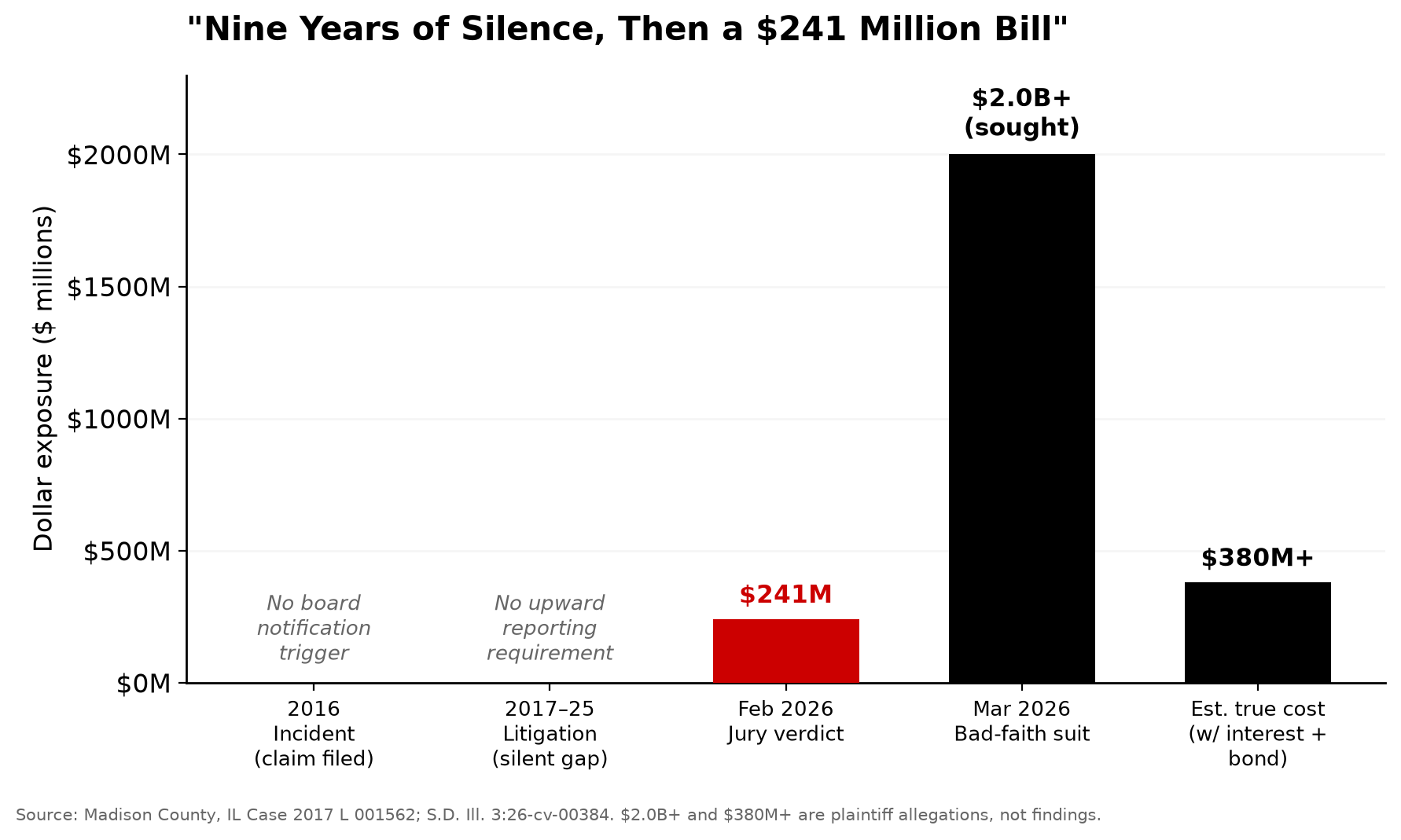
So how does a single lawsuit sit for nine years and grow into $241 million without the people who own the co-op ever hearing about it? That’s the real story — and it isn’t really about dry ice. Trace the climb:
- 2016 — The incident. A contract courier dies of CO2 exposure hauling dry ice for a co-op subsidiary several steps removed from the parent’s safety review.
- The years in between — The silent gap. The claim moves through litigation. The estate alleges that Travelers had repeated opportunities to settle within policy limits but didn’t, while Prairie Farms allegedly wanted to settle. No co-op governance rule requires that this exposure be reported up to the board at a set dollar threshold.
- Feb. 27, 2026 — The verdict. The Madison County jury returns a $241 million verdict, including $191.5 million in punitive damages at a 3.87:1 ratio, which falls within the range courts have upheld.
- March 31, 2026 — The bad-faith suit. Paula Johnson, now suing as Prairie Farms’ assignee, files in federal court, seeking more than $2 billion, alleging that Travelers’ decade of refusals exposed the co-op.
- After the verdict — The coverage fight. Prairie Farms’ own excess insurers go to federal court, arguing they don’t cover the punitive award at all.
Here’s the mechanism most boards miss. Most cooperatives set a dollar threshold for capital spending — spend more than $X on a new dryer, and the board has to sign off. But almost no co-op governance document sets a parallel threshold for litigation exposure: a written rule that says, “If a claim against us could exceed $X, the board must be told, in writing, within Y days.” USDA’s Co-ops 101 and Kansas State’s co-op board guide both describe directors’ fiduciary duty to protect members’ equity from major loss, yet neither sets a concrete litigation-reporting trigger. No widely adopted co-op governance standard requires one, which is exactly the gap this case exposes.
That gap has a quiet consequence. OSHA’s entire enforcement model assumes that a citation reaches someone with the authority and motivation to fix the hazard. In a subsidiary structure with no upward-reporting requirement, that assumption fails silently — until a jury makes it loud.
How Much Does One Missing Sentence Actually Cost?
Potentially, the difference between a manageable insurance claim and an existential one. The Travelers bad-faith suit makes that concrete. Paula Johnson, suing as Prairie Farms’ assignee, alleges in federal court (S.D. Ill. 3:26-cv-00384) that Travelers had numerous opportunities over nearly a decade to settle within policy limits — and that Prairie Farms wanted to settle but was allegedly blocked from doing so by its insurer. The suit seeks more than $2 billion.
Those are unproven allegations from plaintiff’s counsel, an advocacy source — read them as claims, not findings, and ones Travelers has not answered in court. The plaintiffs go further, citing an email they say pegs the verdict’s true cost above $380 million once Illinois prejudgment interest and an appeal bond are factored in — again, their characterization, not an established figure. But the decision logic for a board is plain. A written notification rule wouldn’t have prevented the death, but it might have given the board years to push for an early settlement while it was still cheap. The missing sentence didn’t cause Johnson’s death. It removed a brake.
Now layer on the coverage fight. After the verdict, Prairie Farms’ own excess insurers — Berkeley National and an Endurance American (Sompo) unit — went to federal court in the Northern District of Illinois (Case No. 1:2026-cv-02816), arguing in their complaint that their policies don’t cover the $191.5 million punitive award, on the position that they insure only vicariously-assessed punitive damages, not a company’s own conduct. Illinois holds a strong public policy against insuring directly-assessed punitive damages. If those insurers win, that $191.5 million drops straight onto Prairie Farms’ balance sheet. No coverage, no offset — just the co-op and the judgment.
Is Your Co-op’s Loading Dock Outside the Boardroom’s Line of Sight?
Worth sitting with this one. Prairie Farms’ exposure didn’t come from a dairy barn — it came from PFD Supply, a food-service distribution subsidiary several steps removed from the parent’s safety review. That distance is common in large cooperatives, and it’s exactly where hazards slip through unnoticed.
The regulatory warning every board should read twice: OSHA’s Hazard Communication Standard (29 C.F.R. 1910.1200) covers foreseeable non-employee exposures — couriers, contract truckers, seasonal help — not just your own payroll. A written program that trains employees but stays silent on the contractor backing a trailer up to your dock is exactly the gap the jury found at PFD Supply.
The practical move is a one-page inventory: every subsidiary and distribution facility, the OSHA-regulated hazards at each (dry ice, ammonia refrigerant, CO2 in confined spaces), and which are actually covered by the parent co-op’s hazard-communication program. If management can’t produce that page, you’ve found a blind spot before a jury does. The Bullvine has watched this subsidiary-to-parent pattern before — the ByHeart infant-formula recall followed the same architecture: a plant-level failure with consequences that cascaded up the chain.
Options and Trade-Offs for Farmers
You can’t fix OSHA from your kitchen table, and you can’t rewrite an insurer’s claim file. But there’s plenty a member-owner or director can actually do. Here are the paths producers and boards are weighing right now.
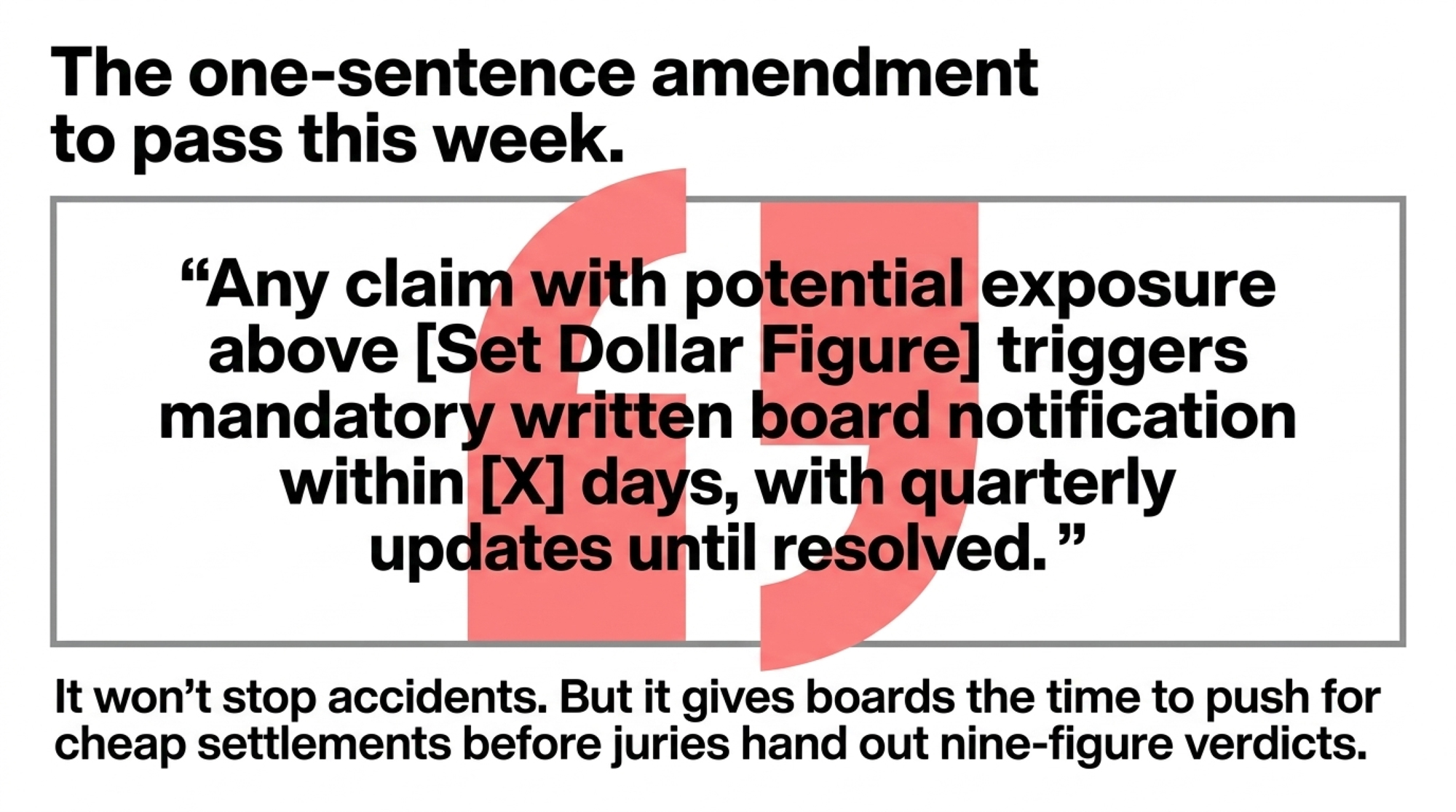
- Demand a written litigation-notification threshold (do this within 30 days). Adopt a one-sentence amendment: any claim with potential exposure above a set dollar figure triggers mandatory written board notification within a defined window, with quarterly updates until it’s resolved. When it makes sense: always, and especially for co-ops with subsidiaries. What it requires: a board motion at the next meeting. Where it fails: if nobody verifies it’s actually followed instead of just filed.
- Read the settlement-authority clause in your liability policy. Standard commercial policies hand settlement authority to the insurer. Most boards have never read that language. When it makes sense: before any large claim is pending — which means now. What it requires: pulling the policy and asking your CEO what happens if the co-op wants to settle and the insurer says no. Where it fails: you may not like the answer, but learning it now beats learning it at a verdict.
- Retain independent coverage counsel for big claims. The insurer’s defense attorney works for the insurer. When interests diverge — exactly what Prairie Farms now alleges happened with Travelers — the co-op needs its own lawyer. When it makes sense: any claim where primary limits are in play. What it requires: a relationship with a coverage attorney, not a standing retainer. Where it fails: it costs money — trivial money next to a nine-figure exposure, but a line item somebody has to approve.
- Audit hazard communication for third-party and contract workers. OSHA 1910.1200 covers foreseeable non-employee exposures — couriers, contract truckers, seasonal help. When it makes sense: any operation handling dry ice, ammonia, or confined-space hazards. What it requires: a written program that names those exposures, not just employee training. Where it fails: nowhere worth mentioning. This is the exact gap the jury found at PFD Supply.
| The Move | Board Action (holds the pen) | Member Action (holds the questions) | Where It Fails |
| Litigation-notification threshold | Adopt a 1-sentence amendment within 30 days: claims over $X trigger written board notice | Ask: “At what claim size are we guaranteed written notice?” | If nobody verifies it’s followed, not just filed |
| Settlement authority | Pull the policy; confirm in writing who controls settlement across the tower | Ask: “Can we force a settlement if the insurer says no?” | You may not like the answer — but learn it before a verdict |
| Independent coverage counsel | Build a relationship with a coverage attorney for big claims | Ask: “Do we have counsel separate from the insurer’s defense lawyer?” | Costs money — trivial next to nine-figure exposure |
| OSHA haz-comm audit | Demand a 1-page subsidiary hazard inventory under 29 C.F.R. 1910.1200 | Ask: “Does our program cover contractors, not just employees?” | The exact gap the jury found at PFD Supply |
| Equity-redemption stress test | Model how a catastrophic judgment moves through patronage accounts | Ask: “How would a big judgment change my redemption schedule?” | $18K–$36K/yr riding on co-op stability for a 300-cow herd |
The Board-Level Checklist
Take this into your next board or district meeting. If your leadership can’t answer all five on the spot, you’ve found your homework.
- Settlement authority: In our insurance tower, who actually decides whether a claim settles — the co-op or the carrier? Is it in writing?
- Notification threshold: At what dollar amount are directors guaranteed written notice of a lawsuit, and how often thereafter?
- Excess-layer coordination: If our primary carrier refuses to tender limits, what triggers our excess layers — and who’s watching that handoff?
- Coverage counsel: Do we have independent coverage counsel on retainer for large claims, separate from the insurer’s defense lawyer?
- OSHA haz-comm self-audit: Does our written hazard-communication program (29 C.F.R. 1910.1200) name every asphyxiant and confined-space hazard across all subsidiaries — and does it cover contractors, not just employees?
Two Roles, Two Different Jobs
This story splits cleanly into two audiences, and the work isn’t the same for each.
If you sit on the board, you hold the pen. You can change the policy at the next meeting — nobody else can. Three moves are yours to make:
- Move the one-sentence litigation-notification amendment at your next meeting and get it into the minutes.
- Pull the liability policy and confirm in writing who controls settlement authority across the entire insurance tower.
- Ask management for the one-page subsidiary hazard inventory under 29 C.F.R. 1910.1200 — and don’t accept “we’ll get to it.”
If you’re a member-owner, you hold the questions. You don’t set policy, but you can stand up at the annual district meeting and put the right ones on the record:
- “At what claim size are we guaranteed to hear about a lawsuit against our co-op — in writing?”
- “Do we carry independent coverage counsel for big claims, separate from the insurer’s own defense lawyer?”
- “How would a catastrophic judgment change our equity redemption schedule?”
If nobody on the board can answer those from the floor, you’ve just told 500 families where the blind spot is. That’s not a small thing to do with five minutes and a microphone.
Key Takeaways
- If your co-op’s governance documents don’t set a dollar threshold for mandatory board notification of lawsuits, that’s the directors’ single highest-priority fix — bring the one-sentence amendment to the next board meeting.
- If you’re a member-owner, ask at your next district meeting: “At what claim size are we guaranteed to hear about a lawsuit against our co-op, in writing?” If nobody can point to the page, you’ve found your job.
- If your board has never read its own liability policy, pull it and confirm who controls settlement authority — and whether the co-op can force a settlement when the insurer won’t.
- If your co-op leans on the insurer’s defense lawyer for big claims, ask whether it also retains independent coverage counsel. Those are not the same job.
- If your operation or co-op handles dry ice, ammonia, or other asphyxiants, confirm your written hazard-comm program names third-party drivers and contractors — not just employees.
- If you’re an older member counting on equity redemption, ask how a catastrophic judgment would affect the redemption schedule — because at $0.20-$0.40/cwt in retains, a mid-size herd can have $18,000 to $36,000 riding on co-op stability each year.
The Question to Carry In
Prairie Farms didn’t invent this governance gap. It just put a number on it — $241 million, and possibly more, depending on how three separate courtrooms land. The verdict isn’t final; post-trial motions and an appeal remain available, and the allegations against Travelers and the excess insurers are unproven.
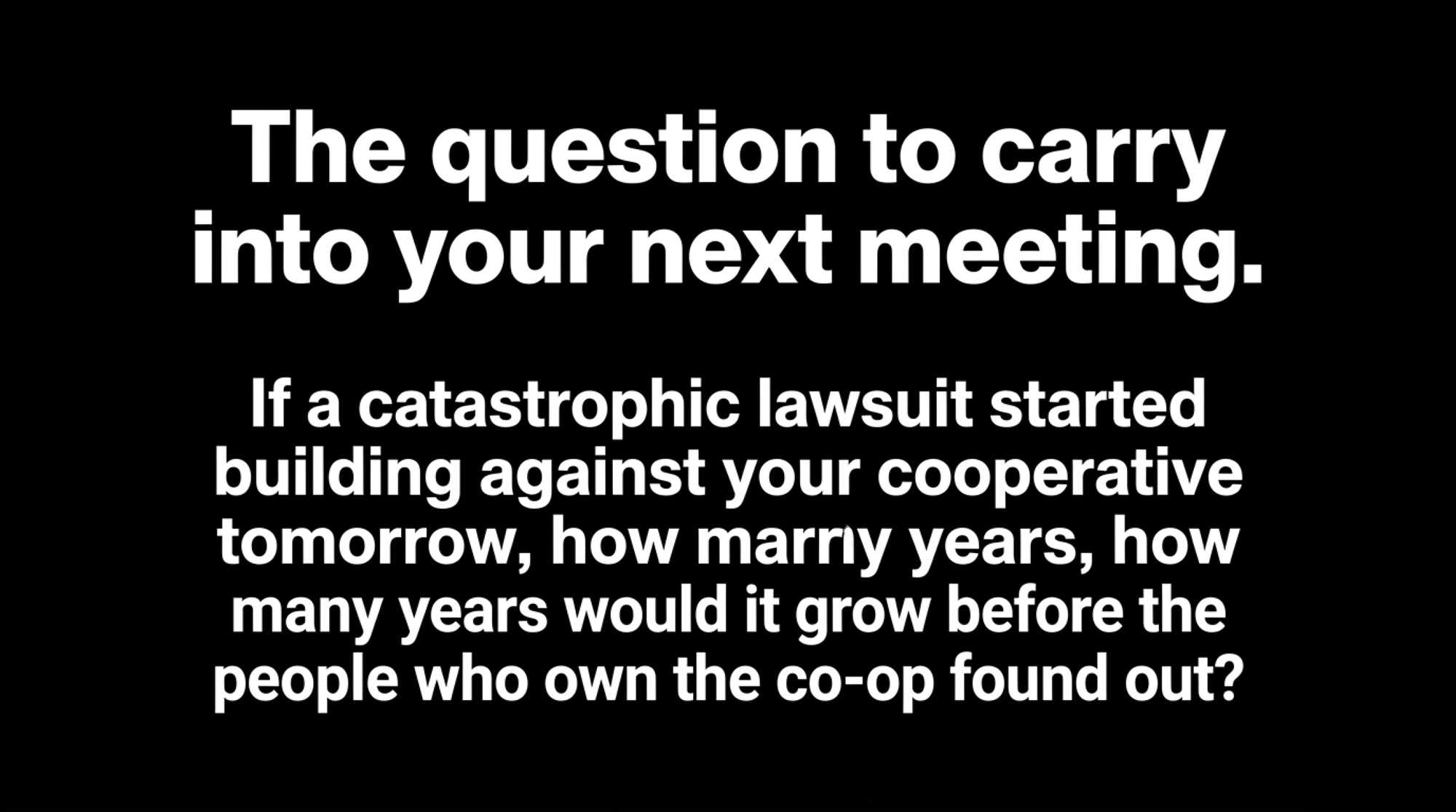
So carry one question into your next board or district meeting. If a lawsuit started building against your cooperative tomorrow, how many years could it grow before the people who own the co-op found out? If you can’t answer that, you already know where to start.
We’re breaking down the full member-equity exposure model — how a catastrophic judgment actually moves through patronage accounts and equity redemption, sized by co-op — in next week’s Bullvine Weekly. That’s where the deeper numbers live.
Complete references and supporting documentation are available upon request by contacting the editorial team at editor@thebullvine.com.
Learn More
- Fonterra Owners Found Out 2 Years Late. Your Co-op Bylaws Might Hide the Same Gap. — Delivers a 30-day strategy to audit hidden disclosure gaps in member agreements. Exposes how international co-op statutes leave producers blind to massive legal and lobbying liabilities until the financial damage hits their milk checks.
- The $300 Million Overrun You’re Paying For: Inside Dairy’s $11 Billion Labor Crisis — Arms you with a blueprint to confront over-expansion risk and unapproved capital overruns at district meetings. Reveals how structural governance failures permit boards to pass massive building liabilities down to individual patron equity accounts.
- 51 Sick Babies, 55 Organic Farms, One Powder Plant: What the ByHeart Botulism Outbreak Means for Your Dairy Contracts and Supply-Chain Risk — Breaks down the exact compliance documentation needed to shield your operation from processor-level safety failures. Dismantles the assumption that plant-level liability won’t cascade upstream to cancel contracts and erase farm equity.
The Sunday Read Dairy Professionals Don’t Skip.

Every week, thousands of producers, breeders, and industry insiders open Bullvine Weekly for genetics insights, market shifts, and profit strategies they won’t find anywhere else. One email. Five minutes. Smarter decisions all week.