Fonterra’s lawyers reached the PM’s adviser through a personal email. Its 8,300 owners learned it from the news, two years on. Does your bylaw even require the board to tell you?
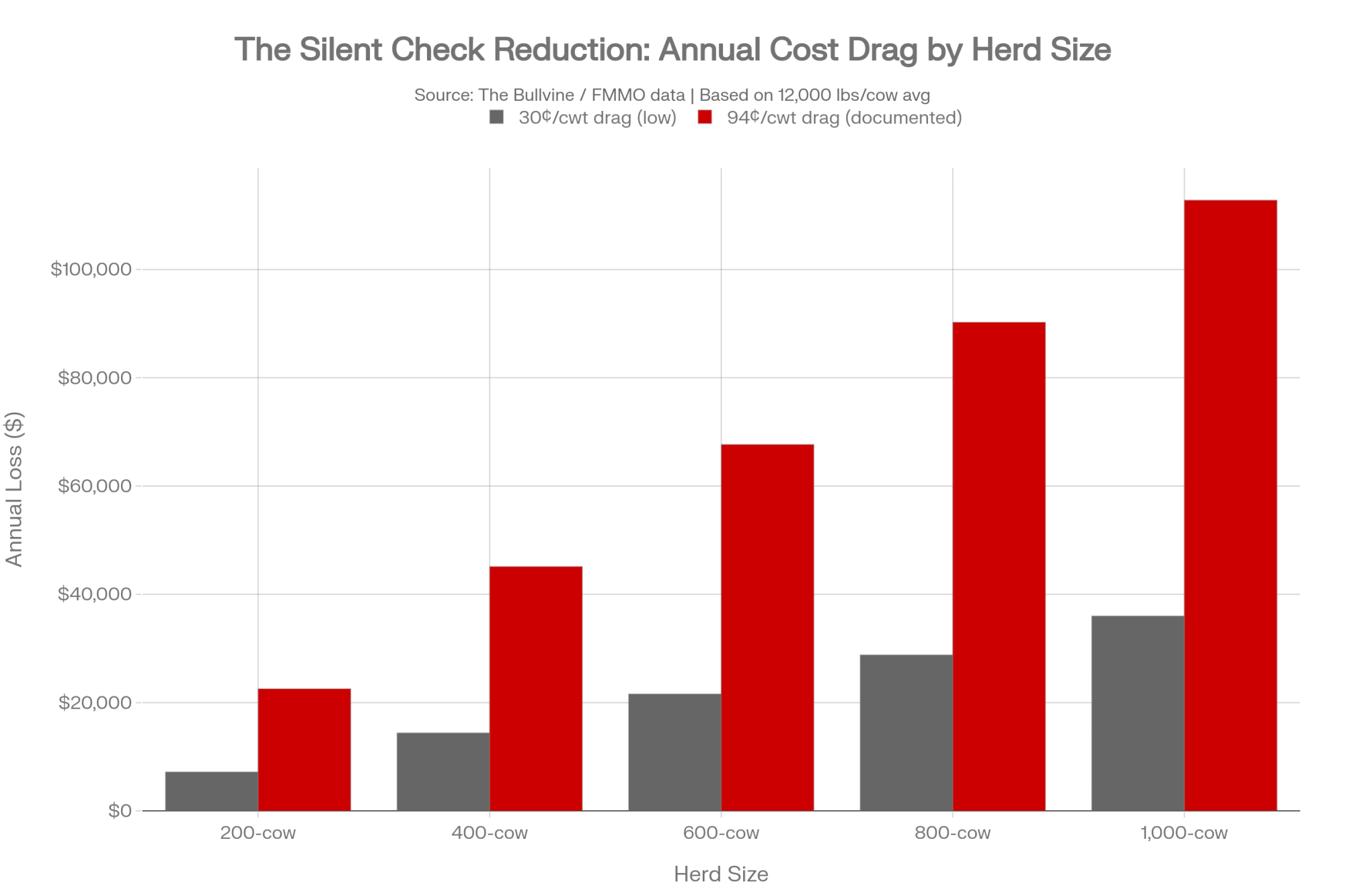
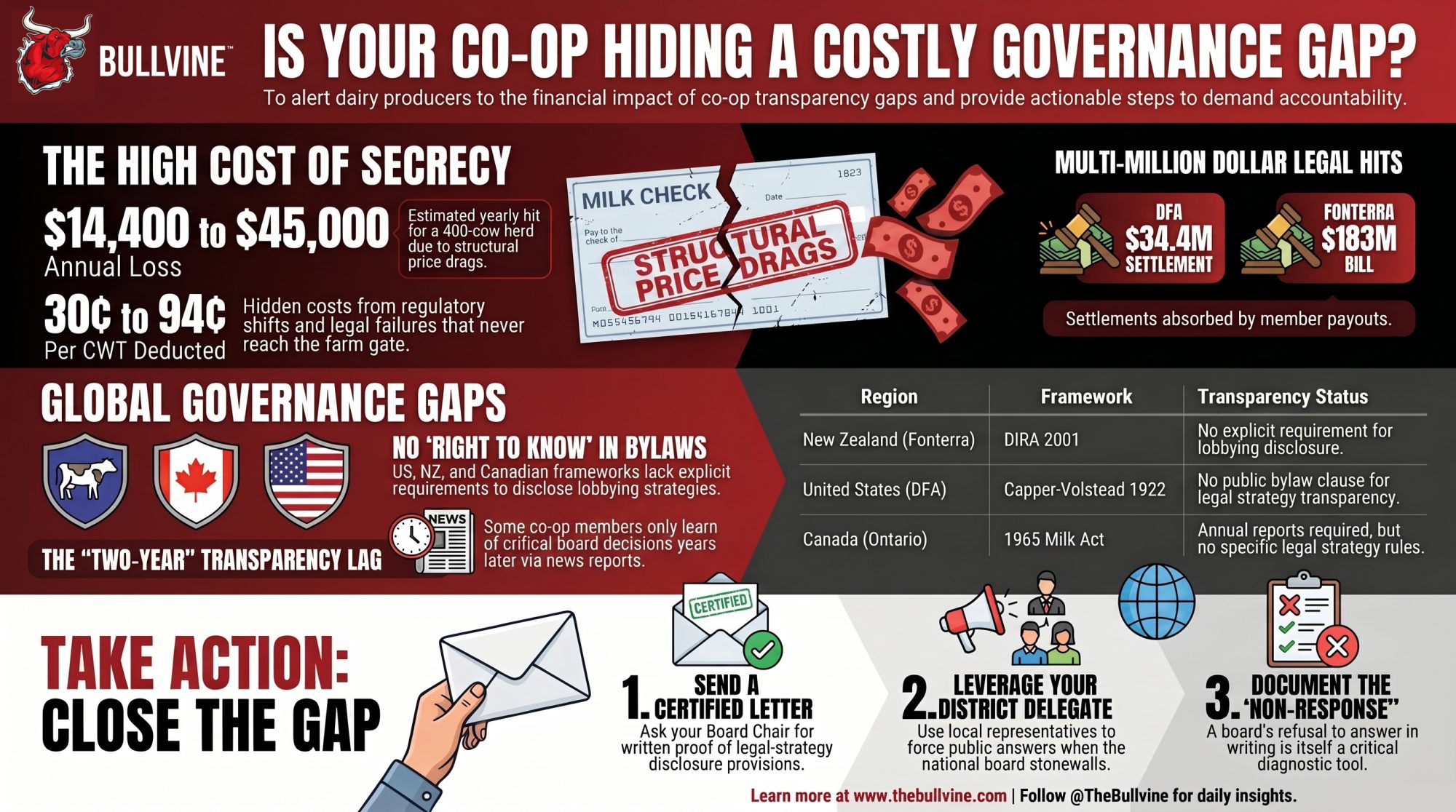
Executive Summary: Fonterra sent a confidential briefing — its legal strategy to kill the Smith v Fonterra climate case, complete with draft statutory wording — to the Prime Minister’s chief policy adviser through his personal email in mid-2024, and the co-op’s 8,300 farmer-owners didn’t find out until RNZ reported it two years later. New Zealand’s Ombudsman and Department of Internal Affairs are both investigating; nobody’s been found to have broken the law, and Fonterra concedes the private-email route wasn’t “consistent with its own policies”. But the real story isn’t NZ politics — it’s that no co-op bylaw, in NZ, the U.S., or Canada, forces a board to tell members about legal strategy before it lands on their milk check. That gap has a price: the 2025 FMMO make-allowance hike (cheddar up 25.8%) trimmed roughly $0.30/cwt off the all-milk price, and on a 400-cow herd shipping 48,000 cwt, even a 30¢ drag runs $14,400 a year — closer to $45,000 at the documented 94¢ total. Add co-op legal exposure like DFA’s $34.4M Othart settlement or Fonterra’s NZD $183M Danone bill, and you’re looking at owner money that quietly never reaches the farm gate. If you ship to a processing co-op, the move this week is a signed, dated letter to your board chair asking — in writing — for the exact bylaw provision covering legal-strategy disclosure.
The news broke this month. What it revealed happened in secret two years ago. In mid-2026, RNZ reported — and Prime Minister Christopher Luxon’s office confirmed — that back on or around June 26, 2024, a member of Fonterra’s government affairs team printed a briefing note and handed it to Luxon’s then chief policy adviser, Matt Burgess, and also sent it to his personal email account. Burgess himself hasn’t been accused of wrongdoing; the open questions concern disclosure and record-keeping, and the investigations are still ongoing. The document wasn’t a milk price update or a sustainability report. It was a briefing on Smith v Fonterra — the climate tort case the NZ Supreme Court had cleared for trial in February 2024 —, and it proposed a two-sentence amendment to the Climate Change Response Act that would shut the case down.
For two years, Fonterra’s farmer-owners had no idea. They weren’t in that room. They didn’t get a memo. They found out the way everyone else did — off a news report, in 2026. And here’s the detail that should stop any co-op member cold: that personal inbox sat outside the official systems an Official Information Act request would normally search. When the Environmental Law Initiative asked the PM’s office in March 2025 for records tied to the case, the reply — released in May 2025 — never mentioned the briefing note.
This reads like a New Zealand political story. It isn’t. Strip away the Beehive and the climate case, and you’re left with one question that lands on every farmer who’s ever signed a milk contract with a processing co-op: Does your bylaw give you the right to know what your board is doing before it shows up on your check?
What’s Actually Confirmed — and What Isn’t Yet
Let’s be careful here, because this is an accountability story and the details matter. Fonterra told RNZ the document was sent to the personal address “at the staff member’s request” and acknowledged that this was “not appropriate, nor consistent with its own policies”. Luxon said it “has definitely not met the high standard that I have of staffers in the Beehive” and that communicating through private email “doesn’t help build transparency or public trust”. Mike Smith, the iwi leader who won the right to sue in 2024, has accused the government of “a coordinated campaign of secret lobbying”.
One thing worth stating plainly: nobody’s been found to have broken the law. The Ombudsman is investigating the “apparent withholding” of official information, and the Department of Internal Affairs is reviewing the former staffer’s accounts to capture anything that should’ve been on the public record. Neither has reported back. We’re not getting ahead of it.
But here’s what doesn’t need a verdict to be true. The co-op’s own structure let this happen. No bylaw stopped it, and no member-disclosure rule flagged it. Fonterra has roughly 8,300 farmer-shareholders who own the co-op and elect its board. It also runs an elected Co-operative Council whose published job is to keep members informed about the co-op’s performance and strategy and to hold the board to account. None of that machinery surfaced in the lobbying before a reporter did.
What’s Changing and Why
The shift here isn’t Fonterra’s behavior. It’s visibility. Most farmers have never read the fine print on what their board can do without telling them — and this case dragged that gap into daylight for the whole industry.
The pattern shows up across continents and across completely different legal systems, which tells you it’s structural, not a one-off. The U.S. Capper-Volstead Act of 1922 handed dairy cooperatives an antitrust exemption so farmers — the little guys — could band together against powerful processors. New Zealand’s Dairy Industry Restructuring Act of 2001 put guardrails on Fonterra, preventing a dominant company from squeezing its suppliers. Good architecture for its moment. Both were built to protect the farmer from outside power.
Nobody rewrote those rules for the day the co-op became the power. And that’s not hypothetical. In April 2022, a group of New Mexico producers led by Othart Dairy Farms sued Dairy Farmers of America and Select Milk Producers, alleging that the two used a joint agency to underpay farmers for raw milk across New Mexico, Texas, and parts of three other states. A federal judge allowed the case to proceed in March 2024 — a procedural step, not a finding of wrongdoing — and the cooperatives later settled in 2025 for $34.4 million without admitting liability. That figure split $24.5 million from DFA and $9.9 million from Select, under a deal that dissolved the joint marketing agency at the center of the case. The loyalty scaled up. The accountability rules didn’t.
How This Plays Out on Real Farms
A governance gap doesn’t show up as a scandal on your farm. It shows up as a smaller number on your milk check, and you usually can’t trace it back to the room where the decision got made.
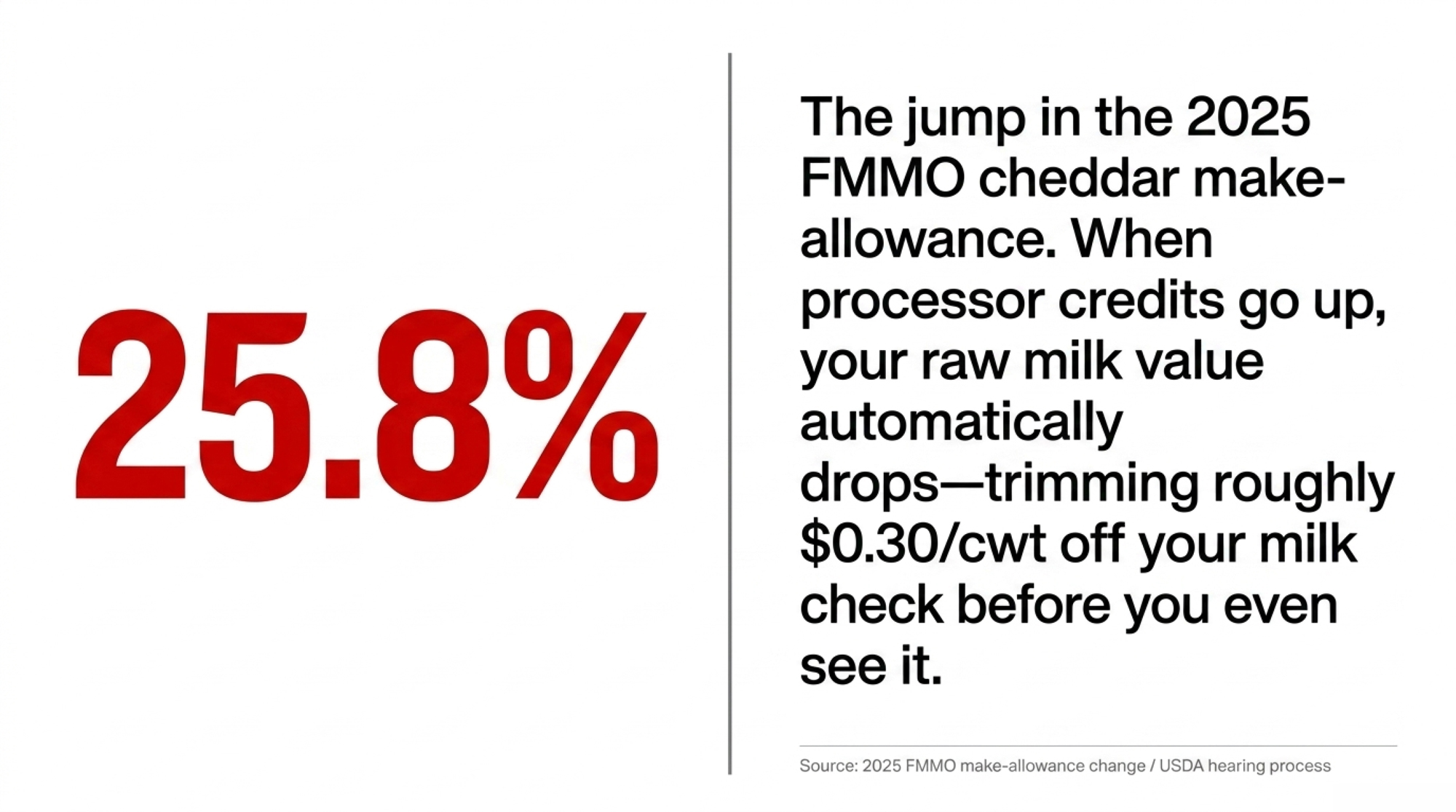
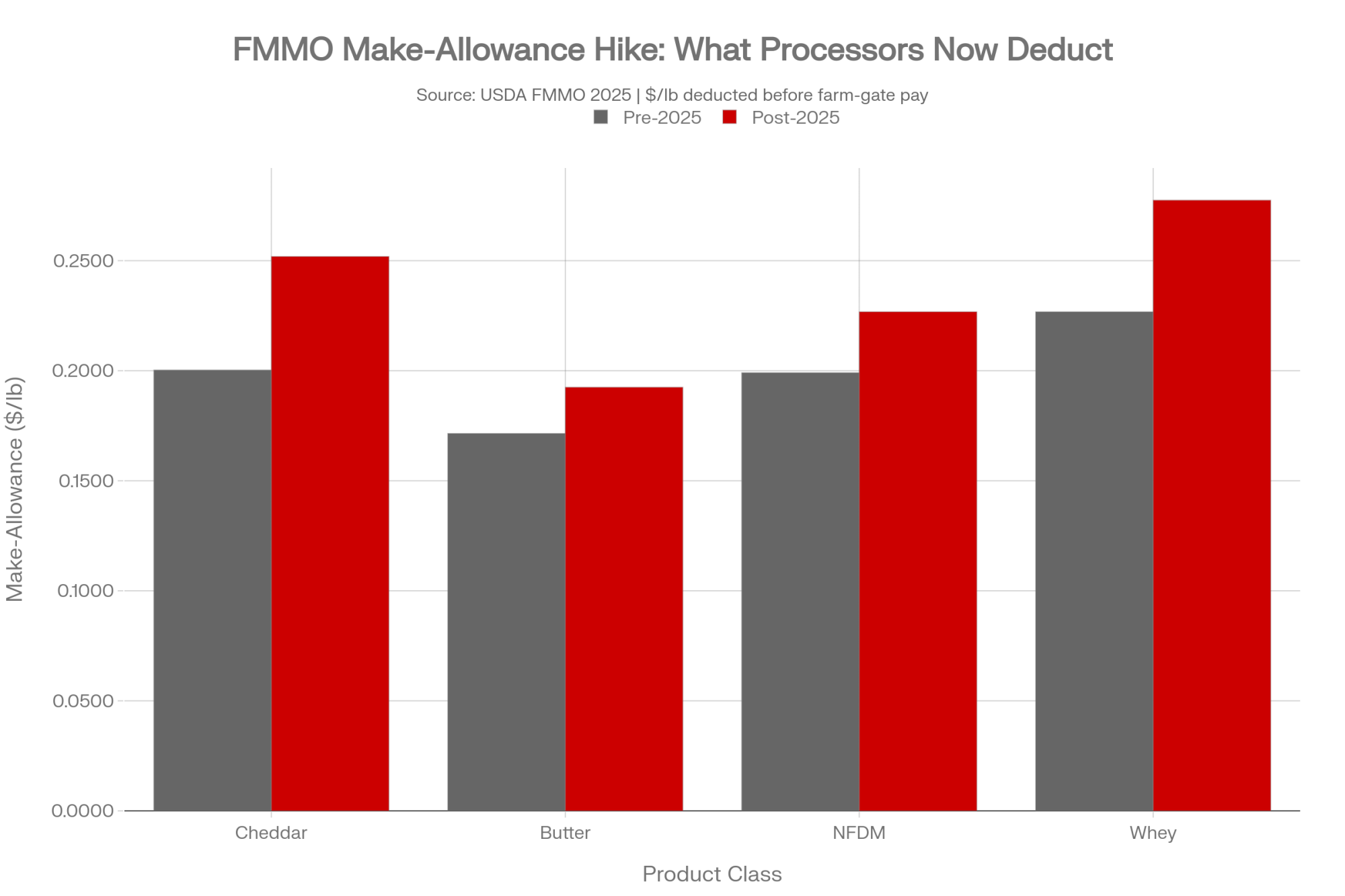
Look at the 2025 Federal Milk Marketing Order make-allowance change — the cost credits processors deduct before they calculate your pay. The cheddar make-allowance jumped from $0.2003 to $0.2519 a pound, a 25.8% increase. Here’s why that lands directly on you: Federal Order end-product pricing formulas calculate the raw milk component values by subtracting the manufacturing make allowance from wholesale commodity prices. So when the processor’s credit goes up, the raw milk value the formula spits out goes down — automatically, before anyone touches your contract. A higher make allowance is a direct deduction from your base pay. The adjustment had a real basis; processing costs had genuinely climbed. But the reforms cut the U.S. all-milk price by roughly $0.30/cwt at the outset, before later component updates clawed some of it back for high-component herds. The rulemaking played out in Washington, shaped by industry input through USDA’s hearing process. The farmers who paid for it found out at the mailbox.
Here’s the math you can run against your own operation. Take a 400-cow herd shipping about 48,000 hundredweight a year — that’s a deliberately conservative 12,000 lbs per cow, and a higher-producing herd would roughly double the numbers below. Hit that herd with even a 30-cent-per-cwt structural drag, the low end of what the FMMO change delivered, and you’re looking at about $14,400 a year. Push it to the 94-cent total drag. The Bullvine has documented after premiums and class moves, and it’s closer to $45,000 a year. That’s not a basis move you can hedge. So run your own version: your annual CWT times whatever shift you think is realistic, against your current pay price.
And this isn’t a U.S.-only problem. Fonterra’s 2013 contamination scare — later confirmed a false alarm — triggered the Danone arbitration. In November 2017, the Singapore tribunal ordered Fonterra to pay Danone NZD $183 million — about €105 million, or US$125 million at the time. Money that never reached the farm gate. No member voted on that legal exposure. They just absorbed it, one season’s payout at a time.
How Much Does Staying Silent Actually Cost You?
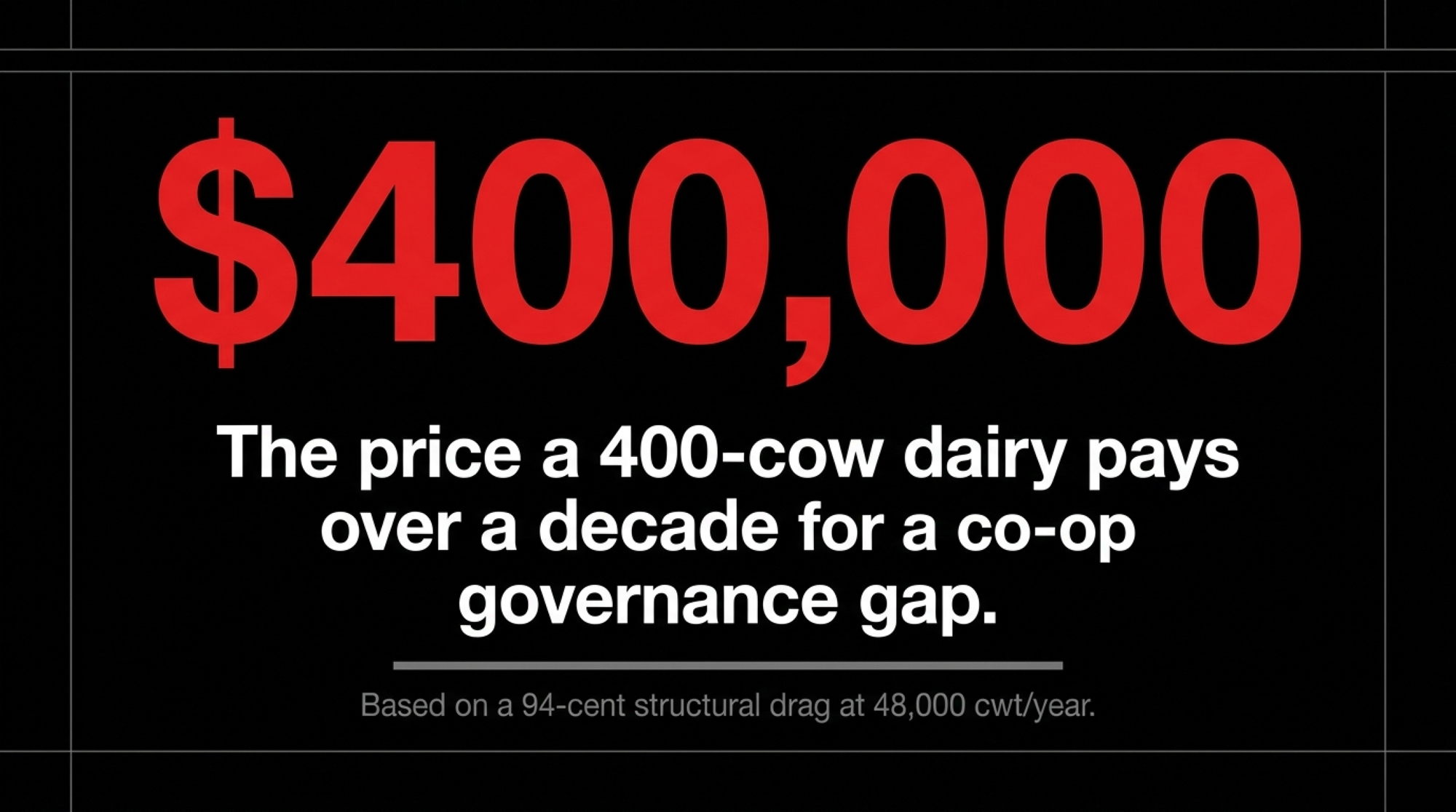
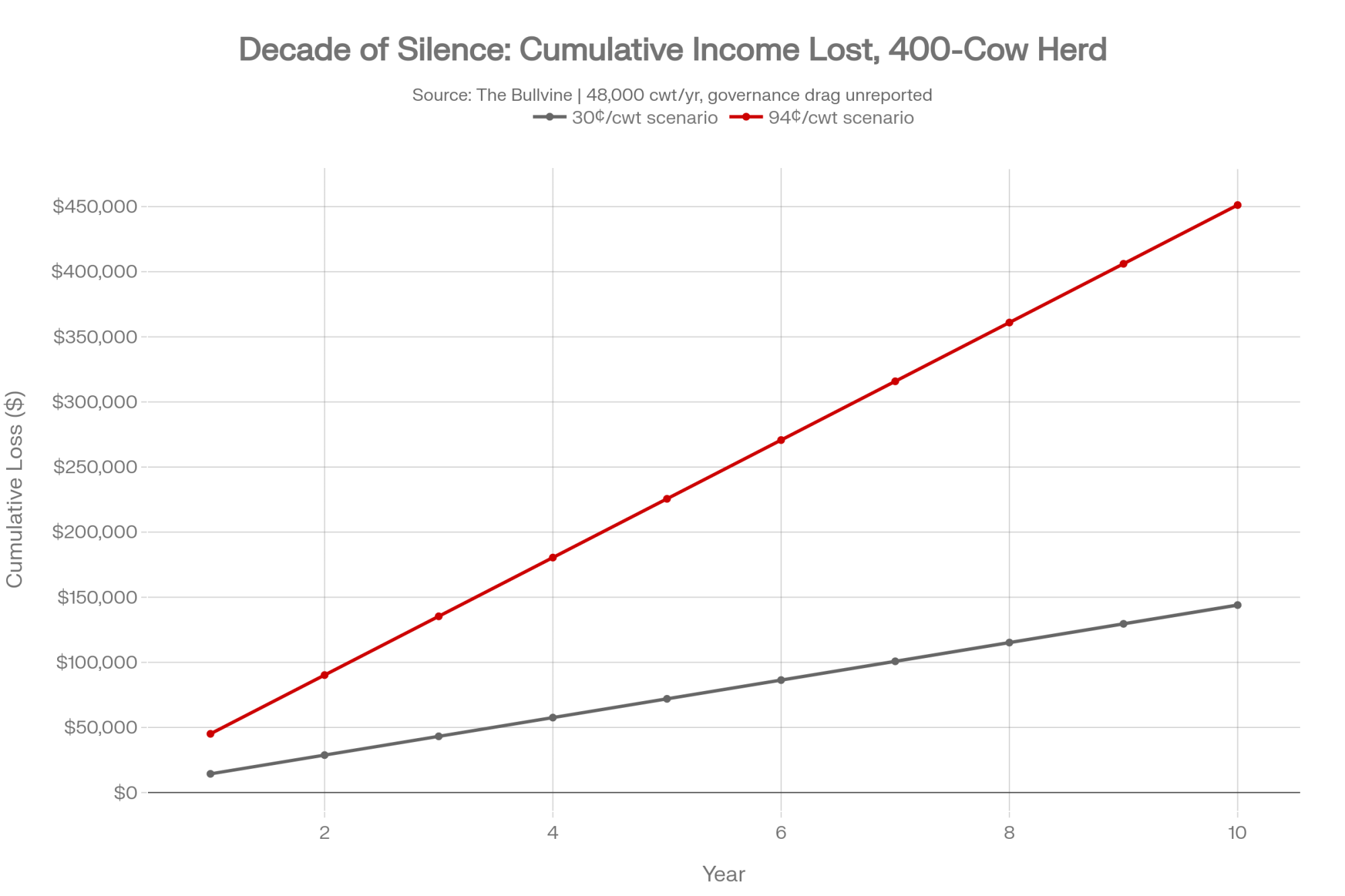
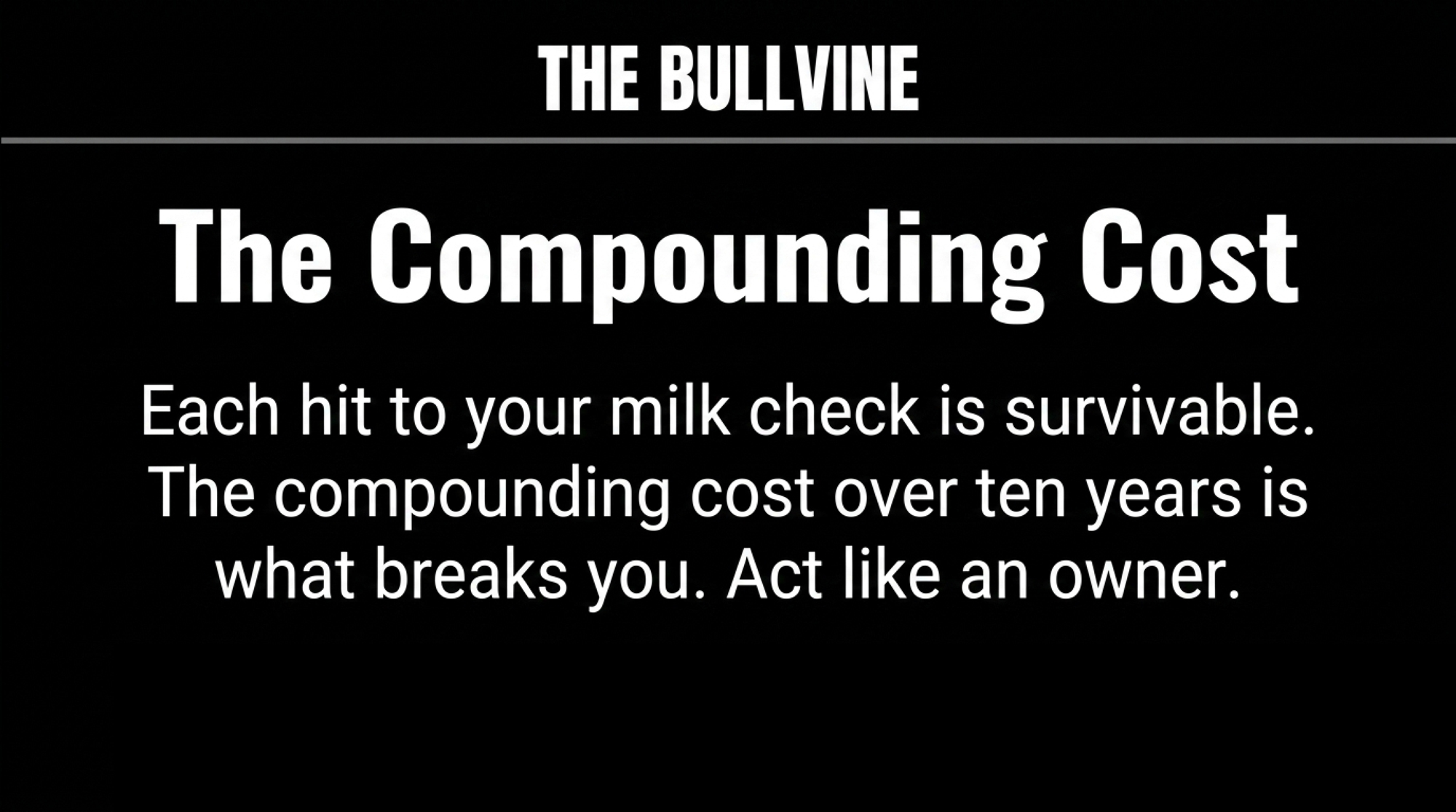
Stack it across a decade, and the picture sharpens fast. A 30-to-94-cent structural drag, held over ten years, runs from roughly $140,000 to well over $400,000 on that same 400-cow herd — and that’s only if you assume the pressure holds, which is a big if. Add a co-op legal failure on top, like the Danone bill or a $34.4 million settlement split across members, and you’re looking at earnings that quietly never make it to your account. Each hit is survivable. The compounding is what gets you.
But there’s a cost here that isn’t a number, and it’s the one worth sitting with. The farmer who never asks loses the standing to complain when the next failure surfaces. Three or four years from now, someone’s going to ask, “Did you send the letter?” Did you raise it at the annual meeting? If the answer’s no, then the co-op’s failure becomes partly a story about owners who didn’t act like owners — and you’ll know it. That’s harder to carry than a check reduction.
The Mechanics Behind the Outcomes
So why does the gap survive in co-op after co-op? Because the rulebooks were written when the co-op was the underdog, and nobody went back to update them when it stopped being one.
Dig into the statutes, and the pattern’s the same across three countries. Plenty about milk pricing transparency, financial reporting, and antitrust standing — almost nothing requiring the board to tell members about legal strategy or government lobbying before it lands on their payout. Here’s how the three big frameworks stack up side by side:
| Governance Lever | Fonterra — New Zealand | Dairy Farmers of America — U.S. | Dairy Farmers of Ontario — Canada |
| Founding framework | Dairy Industry Restructuring Act 2001 | Capper-Volstead Act 1922; FMMO system | 1965 Ontario Milk Act; O. Reg. 209/99 |
| Financial disclosure to members | Annual report to shareholders | Bylaws subordinate farmer payments to debt service | Audited annual statement within 4 months of year-end |
| Disclosure of legal strategy / lobbying | No explicit bylaw requirement | No public bylaw clause; separately enjoined from sharing sensitive data | No explicit rule beyond annual operations report |
| Accountability body | Elected Co-operative Council | Elected delegate / board structure | Local producer committees + DFO board |
| Recent flashpoint | RNZ lobbying disclosure case, 2024–26 | $34.4M Othart settlement, 2025 | Glengarry committee resigned in protest, 2020 |
The takeaway isn’t that one co-op is the villain. It’s that across three completely different systems, the disclosure rule that would’ve caught the Fonterra briefing doesn’t exist in any of them. Ontario at least forces an audited annual report into producers’ hands within four months — more than Fonterra’s or DFA’s documents promise on legal strategy. And the DFA settlement hints at where this is heading: the deal required the cooperatives to dissolve the joint agency and stop sharing certain non-public pricing information. Courts are starting to bolt on the disclosure rules that the bylaws never contained.
Options and Trade-Offs for Farmers
You can’t rewrite your bylaws by Friday. But you’re not stuck waiting for the next failure, either. Here’s what farmers are actually using.
- Send one written question this week — the 30-day move. Not an email. A signed letter, certified or hand-delivered with a date stamp, to your board chair or CEO, asking one thing: show me, in writing, the bylaw provision that gives me the right to know about material legal strategy or government lobbying before it affects my milk price. When it makes sense: always, any co-op, any herd size. What it takes: 20 minutes and about $6 for certified mail. The risk: you get a non-response — but a documented non-response is itself information, and it’s the start of your paper trail.
- Work with your district delegate. Big co-ops route governance through elected district or regional reps who answer to local members in a way the national board doesn’t. When the Glengarry County producer committee in Ontario hit a program it couldn’t stomach in 2020, the whole committee resigned in protest — and made the board answer for it publicly. When it makes sense: when you want leverage beyond one voice. What it takes: knowing who your delegate is. The limit: delegates vary a lot in how engaged they actually are.
- Push accountability to the body, not just the board. If your co-op has a Co-operative Council or equivalent, holding the board accountable is literally its job. When it makes sense: when the board stonewalls. What it takes:knowing the body’s real mandate. The risk: some of these look stronger on paper than they are in the room.
- Read what you actually signed. Pull your member agreement and bylaws and hunt for three things: any disclosure obligation on the board, the process for filing an annual-meeting question that requires a written response, and the threshold to propose a bylaw amendment. The catch: DFA’s bylaws aren’t posted publicly in full — outsiders mostly learn their terms through credit ratings and court filings — so if yours aren’t public either, document that fact and raise it in your letter.
The forward-looking signal sits inside that first path. The DFA settlement already forced new pricing-conduct obligations through the courts, and the Fonterra disclosure question is now out in the open in New Zealand. The pressure’s moving in one direction. Getting your question on record now means you’re ahead of it, not chasing it after the fact.
Is Asking Hard Questions Worth the Social Cost?
Let’s be honest about what really stops a farmer with a hand half-raised at the annual meeting. It’s rarely the bylaws. It’s the room. Your father shipped to this co-op. Your neighbor sits on the district committee. The field rep who walked you through that mastitis problem last February is standing by the coffee urn. You don’t interrogate the people who show up for you, and that loyalty is real and earned.
Here’s the reframe. A written governance question isn’t disloyalty — it’s the harder version of the same loyalty. It says you believe in the institution enough to make it work the way it promised. The Glengarry committee that walked out in 2020 wasn’t disloyal to Ontario dairy — they were the most invested people in the room. And if a board gets cagey when a member asks for a written disclosure policy? That discomfort is diagnostic. It’s telling you something the bylaws won’t.
Key Takeaways
- If you can’t find your co-op’s full bylaws posted publicly — and DFA members can’t — treat that as a flag worth documenting, then ask for them in writing.
- If your board hasn’t put a legal-strategy disclosure policy in front of its members, send a signed, dated letter this month requesting the exact provision. Verbal answers don’t count — get it in writing.
- If your next annual meeting is more than 60 days out, find your district delegate or committee rep now, before the agenda deadline closes.
- If you want your real exposure, take your annual CWT times a 30- to 94-cent drag against your current pay price — that’s your cost from regulatory and legal decisions you didn’t vote on.
- If the board answers verbally rather than in writing, send a follow-up letter noting that you asked for a written response. Build the paper trail before you need it, not after.
- If you’re the only one asking, find two or three other members in your district doing the same. Not a coalition — a conversation. It changes what a board can quietly manage.
The Fonterra matter will run its course, and New Zealand will sort out who knew what and when. But that’s not the question that should keep you up. The closer one is this: if your board made a decision tomorrow that reshaped your contract or your regulatory environment, would you hear about it before it hit your check, or two years later, off a news report?
You can start answering that this week, for the price of a certified letter. The deeper work — how a governance gap converts into real cost-per-cwt by herd size, and what enforceable disclosure language actually looks like inside a co-op bylaw — is where this gets operational.
Complete references and supporting documentation are available upon request by contacting the editorial team at editor@thebullvine.com.
Learn More
- $50K Gone: Von Ruden Reveals FMMO Make Allowance’s 300-Cow Dairy Gut Punch — Deliver an operational check on your milk statement using a 30-day calculation protocol that separates pure market volatility from structural cooperative and processing deductions that drain thousands from mid-sized herds.
- How 600 Irish Farmers Got Their Co-op to Finally Answer the Hard Questions — Arm yourself with a 3- to 5-year strategic blueprint that moves transparency from a special request to a standard baseline, utilizing targeted regional member coalitions to drive a 12% boost in bottom-line milk check returns.
- Hershey’s $121 Million Checkoff Bet: From TikTok Butter Boards to Your 15¢/cwt Milk Check — Dissect the mandatory commodity deductions that route producer capital into mega-budget marketing programs, and learn how a 0.1% protein test gain can pocket your herd an extra $17,900 annually to outrun structural margins.
 The Sunday Read Dairy Professionals Don’t Skip.
 The Sunday Read Dairy Professionals Don’t Skip.
Every week, thousands of producers, breeders, and industry insiders open Bullvine Weekly for genetics insights, market shifts, and profit strategies they won’t find anywhere else. One email. Five minutes. Smarter decisions all week.