










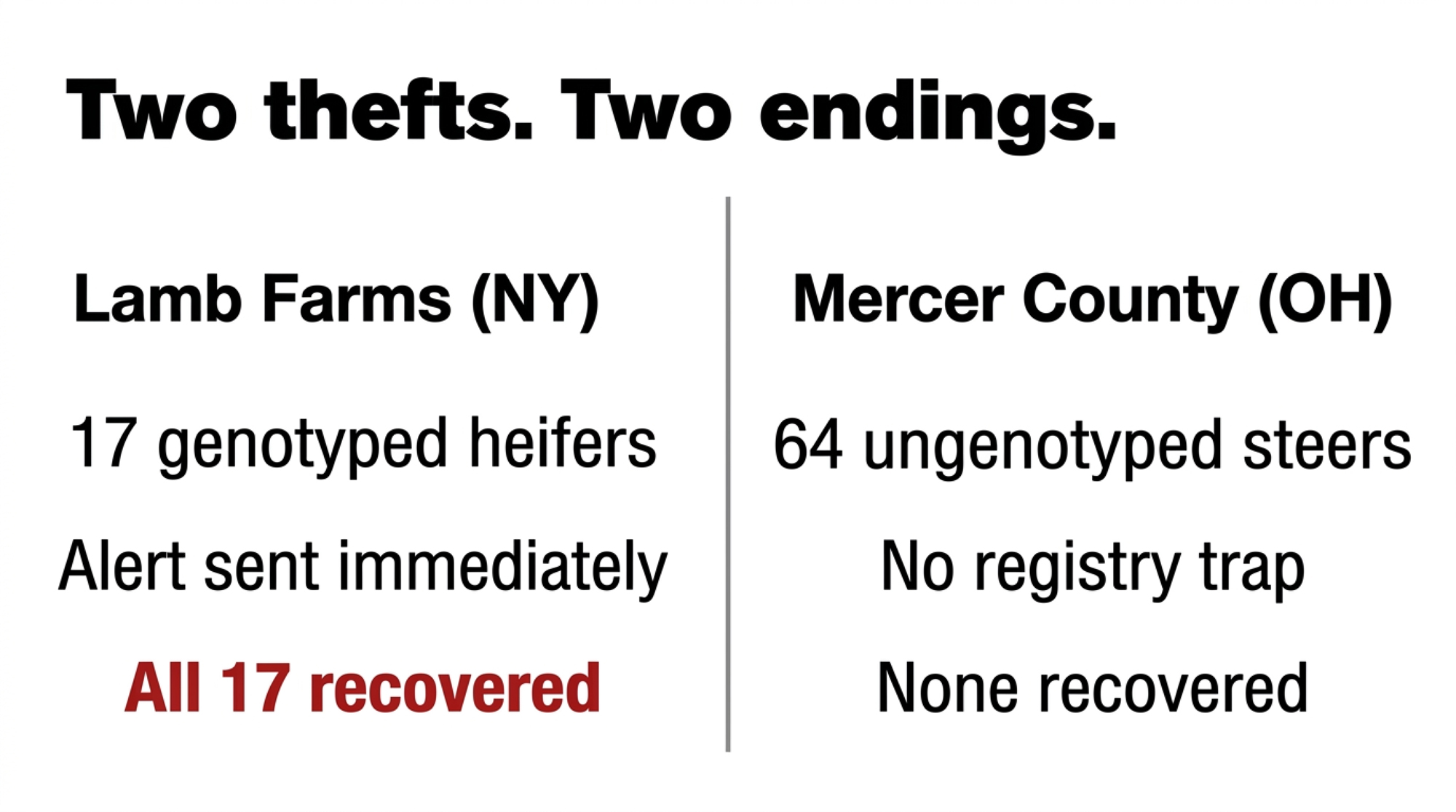
Seventeen genotyped Holstein heifers. Gone from a Bliss Road calf barn between 1 and 3 a.m., every ear tag cut out before the trailer reached the highway. They were home within days — and here’s the part nobody expects: the DNA didn’t find them. The dairy network did, one phone call at a time. But the genetics? That’s the reason a thief can’t sell them, can’t register them, and can’t ever make them disappear clean. Ask the Ohio farm still missing 64 calves what that’s worth.
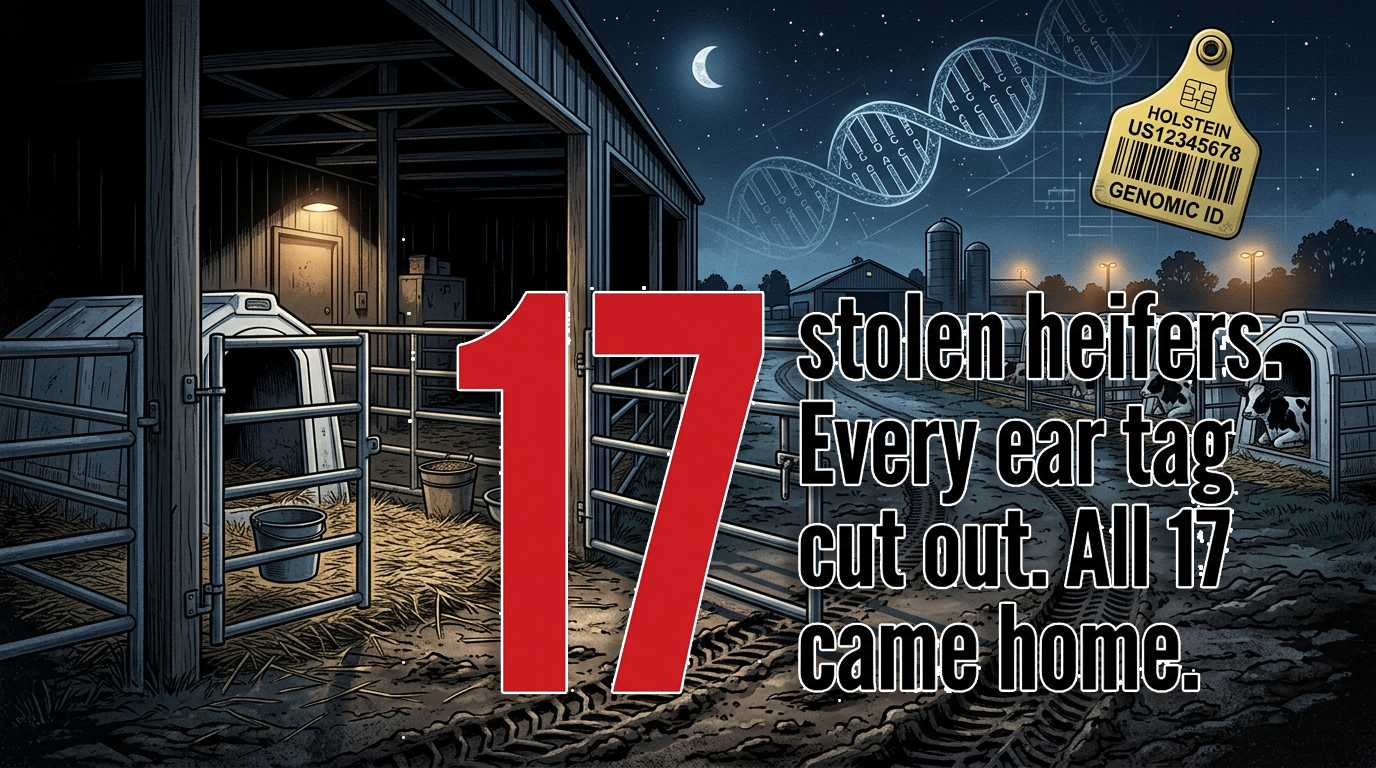
A dense community network got them back. A quiet genomic trap is why they were never going to disappear clean. The herds without either are the ones quietly paying for it.
Sometime between 1 and 3 a.m. on Sunday, May 24, 2026, 17 five-month-old Holstein heifers were hauled out of a pen at Lamb Farms in Oakfield, New York. Every one was genotyped. Every one was a registered replacement from Oakfield Corners Dairy’s elite herd. By the time the theft was discovered, they were already on their way to another state.
A neighbor’s camera on Lockport Road in Alabama, New York, caught it: a heavy-duty pickup pulling a cattle trailer around 1:21 a.m., a second vehicle following close behind. The Genesee County Sheriff’s Office put the loss at $41,000. And here’s the part that should stop you cold — three weeks earlier, a dairy near Coldwater, Ohio, lost 64 calves the same way. Oakfield got all 17 back within days. Ohio, as of early June, got nothing.
Same overnight method. Two completely different endings. The distance between them is the whole story.
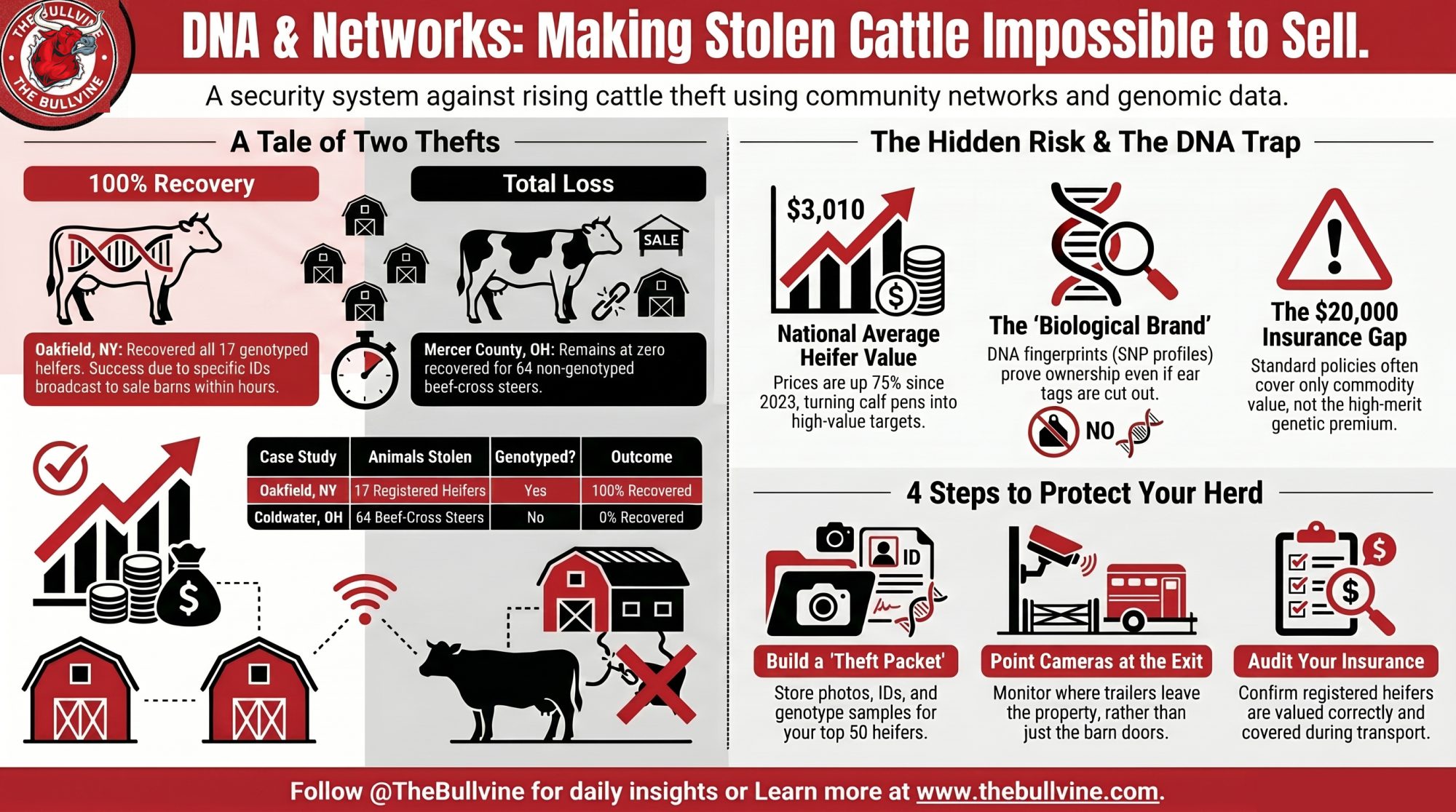
| Metric | Oakfield, NY (Lamb Farms) | Coldwater, OH (Mercer County) |
|---|---|---|
| Date of theft | May 24, 2026 | May 2–3, 2026 |
| Animals taken | 17 Holstein heifers | 64 Holstein steer calves |
| Reported value | $41,000 (~$2,400/head) | $128,000 (~$2,000/head) |
| Genotyped / registered | ✅ Yes — all 17 | ❌ No (beef-cross feeders) |
| Tags removed by thieves | 16 of 17 cut out | Unknown |
| Recovery | ✅ All 17, within 3 days | 🔴 None as of early June |
| Sale barn flagged | ✅ Lebanon Valley, PA | 🔴 None publicly reported |
| Arrests | ✅ 2 charged June 3, 2026 | 🔴 No suspects named |
| Genomic trap active | ✅ DNA still on file | 🔴 No genomic record |
Read more: Oakfield Corners Dairy Lost 17 Genotyped Heifers Overnight. The Dairy Community Brought Them Home
What Saved Oakfield Wasn’t Luck
Within hours of discovering the theft, Lamb Farms put out an alert. Not a vague “please share” post — a specific one that names the calves’ ages, weights, and the ID system in their ears, and asks anyone who’d seen cattle being moved to call it in.
That alert turned a regional theft into a multi-state watch. Sale barns, order buyers, haulers, and market staff from New York through Pennsylvania were suddenly looking for the same thing: a group of young Holsteins arriving without clean paperwork. On Wednesday, May 27, the calves were located at Lebanon Valley Livestock Market in Pennsylvania — a several-hour haul to the southeast — and were returned to Lamb Farms. The Genesee County Sheriff’s Office confirmed the recovery, kept the case open, and credited the ag community with the tips that moved it forward.
Think about how that actually worked. Stolen cattle have to go somewhere to become money, and for young Holsteins, that somewhere is a sale barn. The moment a detailed, specific alert reaches every market manager and buyer, that conversion point becomes a trap rather than an exit. The thieves needed the calves to look ordinary. The alert made them the most-watched animals in three states.
That tip network isn’t a feel-good footnote — it’s infrastructure, and it’s free. The same Facebook groups, breed pages, and text chains you use to chase a loose bull or find a used skid steer are the fastest recovery tool you’ve got. Oakfield’s alert worked because it was specific enough to act on and because the people who saw it actually picked up the phone. A vague post a day late doesn’t do that. A precise one within the hour does.
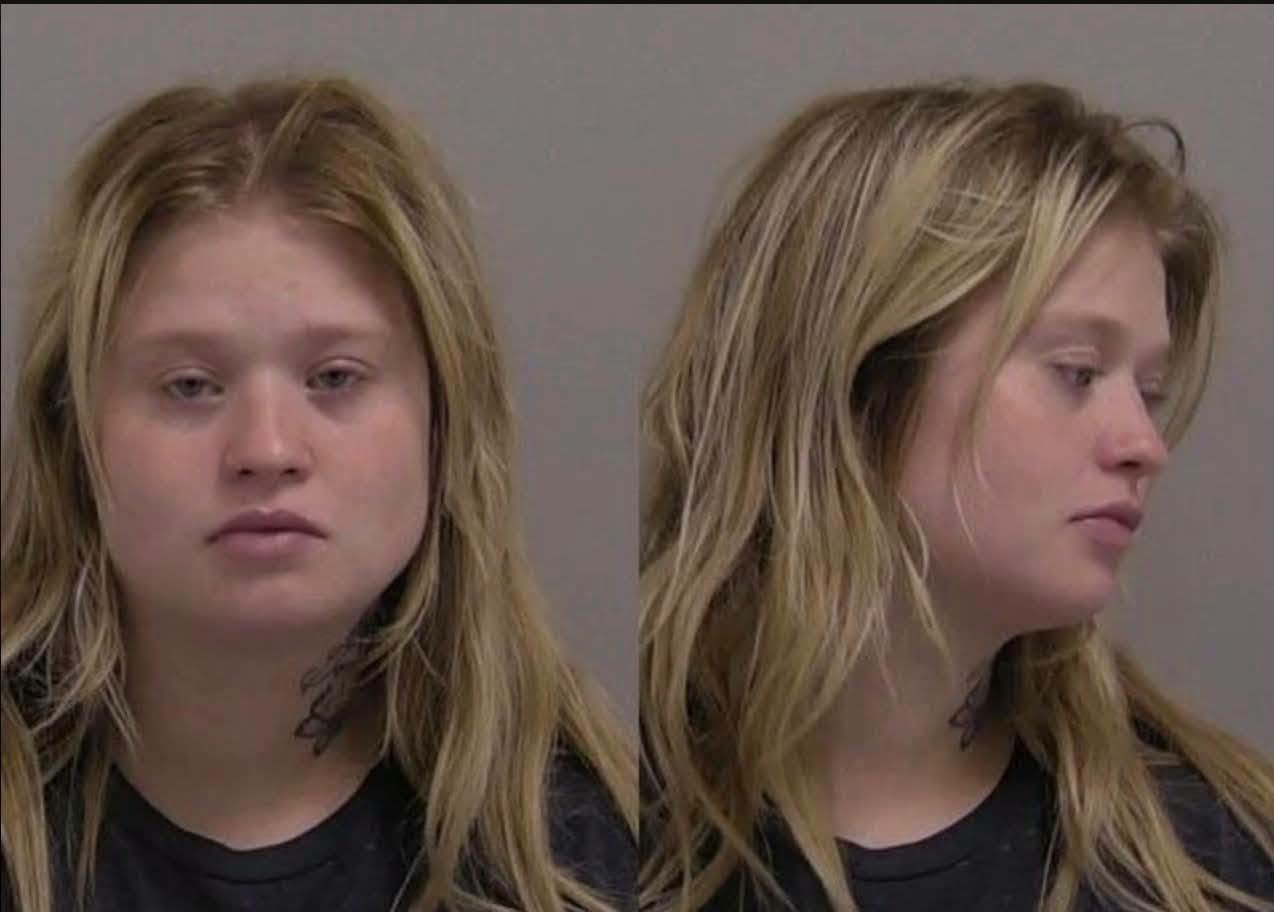
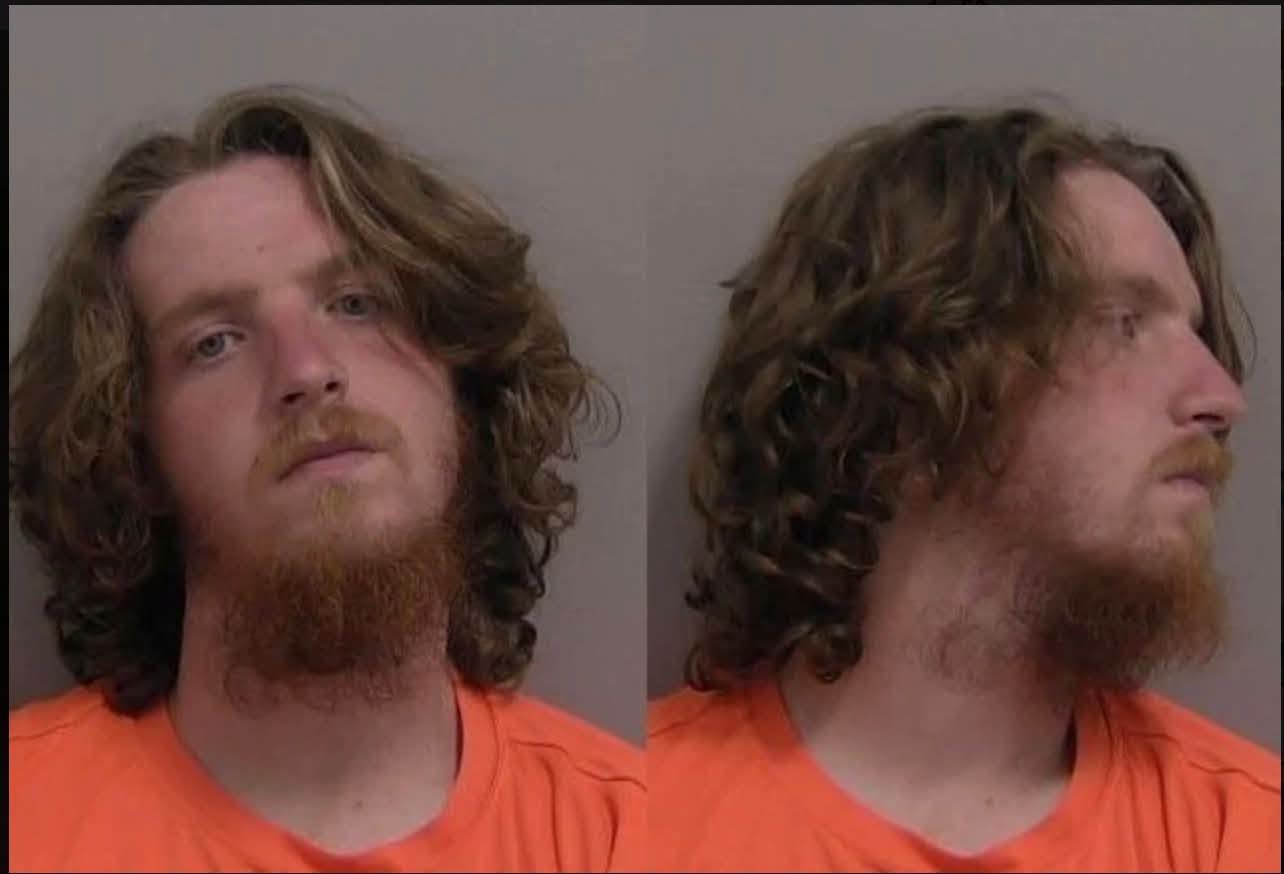
On June 3, deputies arrested Torrence A. Schmitt, 25, and Kerisa J. Schmitt, 26, both of Lockport, in Jamestown, New York, with help from Chautauqua County deputies. According to the Genesee County Sheriff’s Office, the charges are third-degree burglary, third-degree grand larceny, tampering with evidence, and falsifying business records. The Schmitts have been charged, not convicted; they’re due back in court at a later date, and the allegations haven’t been tested. But one detail in the case points straight at why this story should have your attention. Investigators say the tags on 16 of the calves had been removed before the animals reached the market — the very tags meant to make them traceable.
Cutting tags off 16 calves takes time and nerve. Nobody takes that risk for animals that aren’t worth it — and right now, replacement heifers are worth more than they’ve been in years. That’s the piece that turns a quiet calf pen into a target.
Why Your Heifers Are Worth Stealing Right Now
The timing isn’t random. The heifer side of the market has rarely been tighter, and that’s exactly what turns a calf pen into a target.
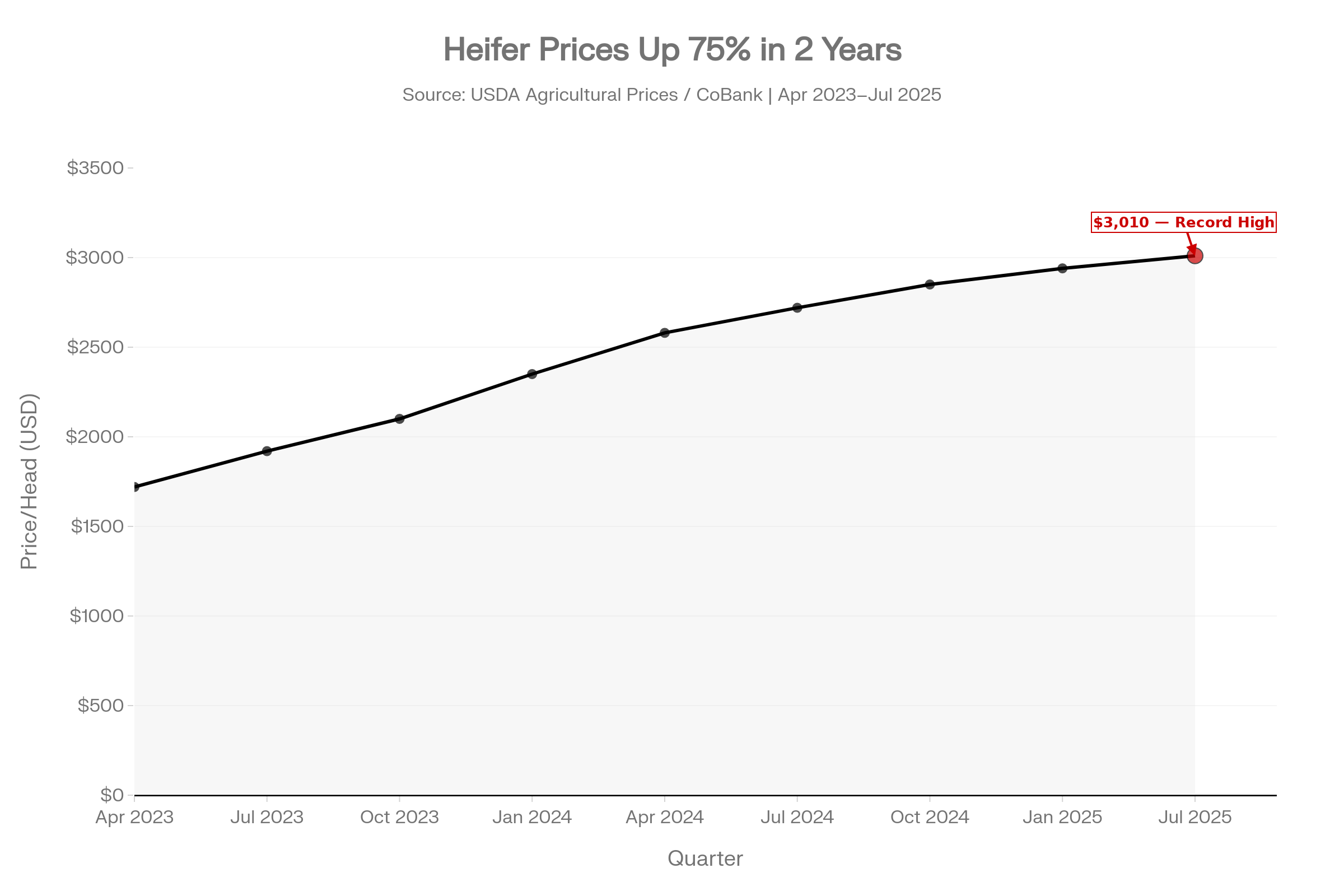
National average replacement prices hit $3,010 per head as of July 2025 — up 75% from $1,720 in April 2023, and near record highs, according to USDA Agricultural Prices data tracked by CoBank. When the pipeline gets that tight, stolen animals get that much harder to replace at any price. A pen of 17 registered, genotyped Holsteins stops looking like future milk and starts looking like a one-night payday.
There’s a wrinkle in the Oakfield numbers worth naming, though. The sheriff valued the 17 calves at $41,000 total — roughly $2,400 a head, the kind of figure that goes into a felony charge. The Bullvine’s own reporting on the herd’s genetics put elite registered heifers of this caliber at $3,500 to $5,000 per head. Both can be true. One is commodity replacement value; the other reflects genomic merit and cow-family pedigree. That gap will matter a lot when we get to insurance.
How One Night Plays Out on Two Different Farms
Now look at the Ohio case. A farm outside Coldwater in Mercer County was hit sometime between 10 p.m. Saturday, May 2, and the early hours of May 3. Sixty-four Holstein steer calves — about 13 weeks old, roughly 250 pounds each — gone in a single load-up from a converted calf barn on Coldwater Creek Road. Mercer County Sheriff Doug Timmerman called it “highly coordinated” and valued the group at up to $128,000. As of early June, the investigation was still active, with no recovery and no suspects publicly named.
Same playbook. Bigger haul. But no herd names the wider dairy world recognized from the colored shavings at World Dairy Expo, and no genotyping trap waiting downstream — these were beef-cross steers bound for feedlots, not registered Holsteins headed for a breed registry. Different animal, different escape route, different ending.
This isn’t a hypothetical for either farm — it’s two real losses, three weeks apart, with two very different checks at the end. Start with a real, sourced number before you model your own. Sheriff Timmerman put that Ohio group at up to $128,000 for 64 head — around $2,000 a calf at the top end, with no genetics premium attached. Call that the floor for what a stolen calf is worth. Now run it on your own barn, where the genetics premium is the whole point.
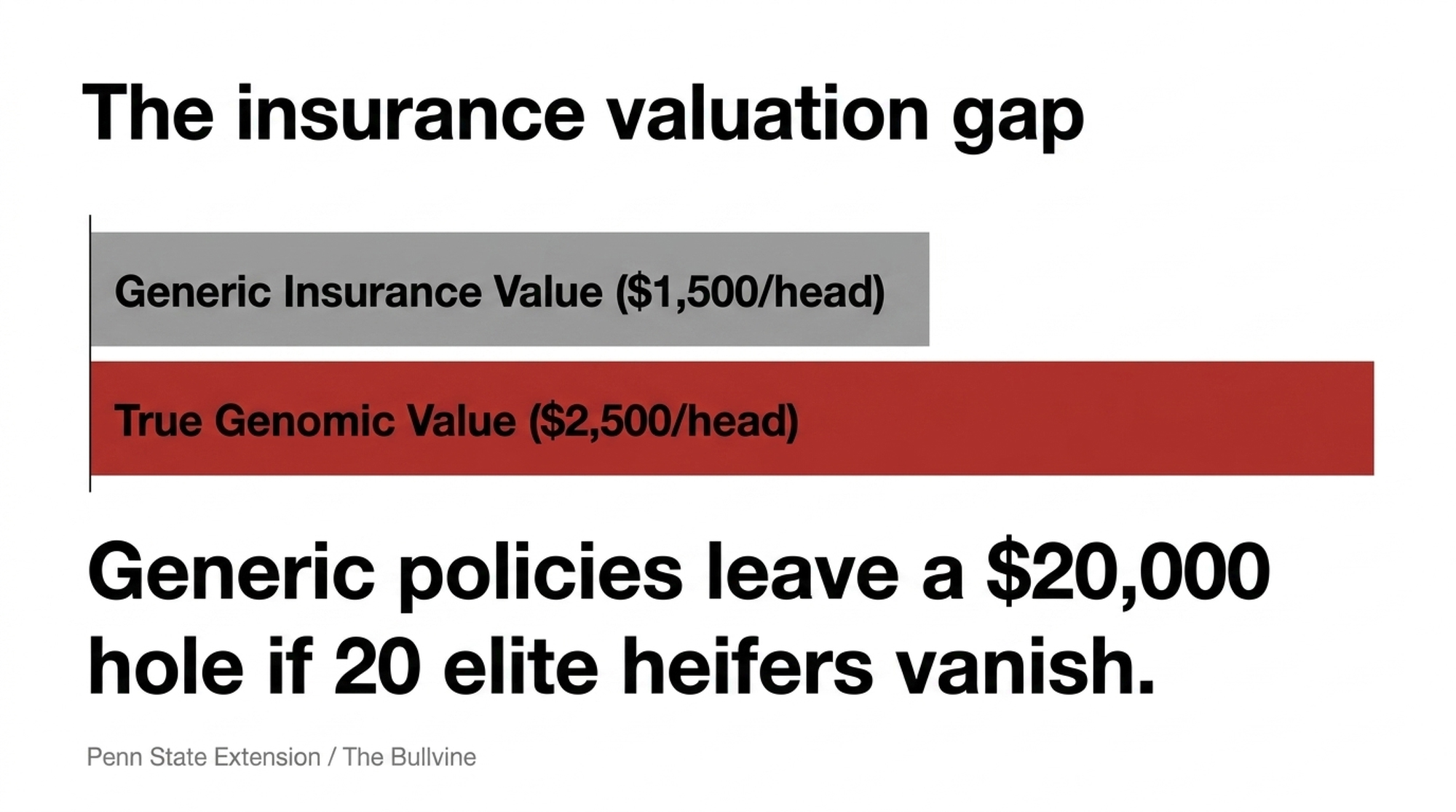
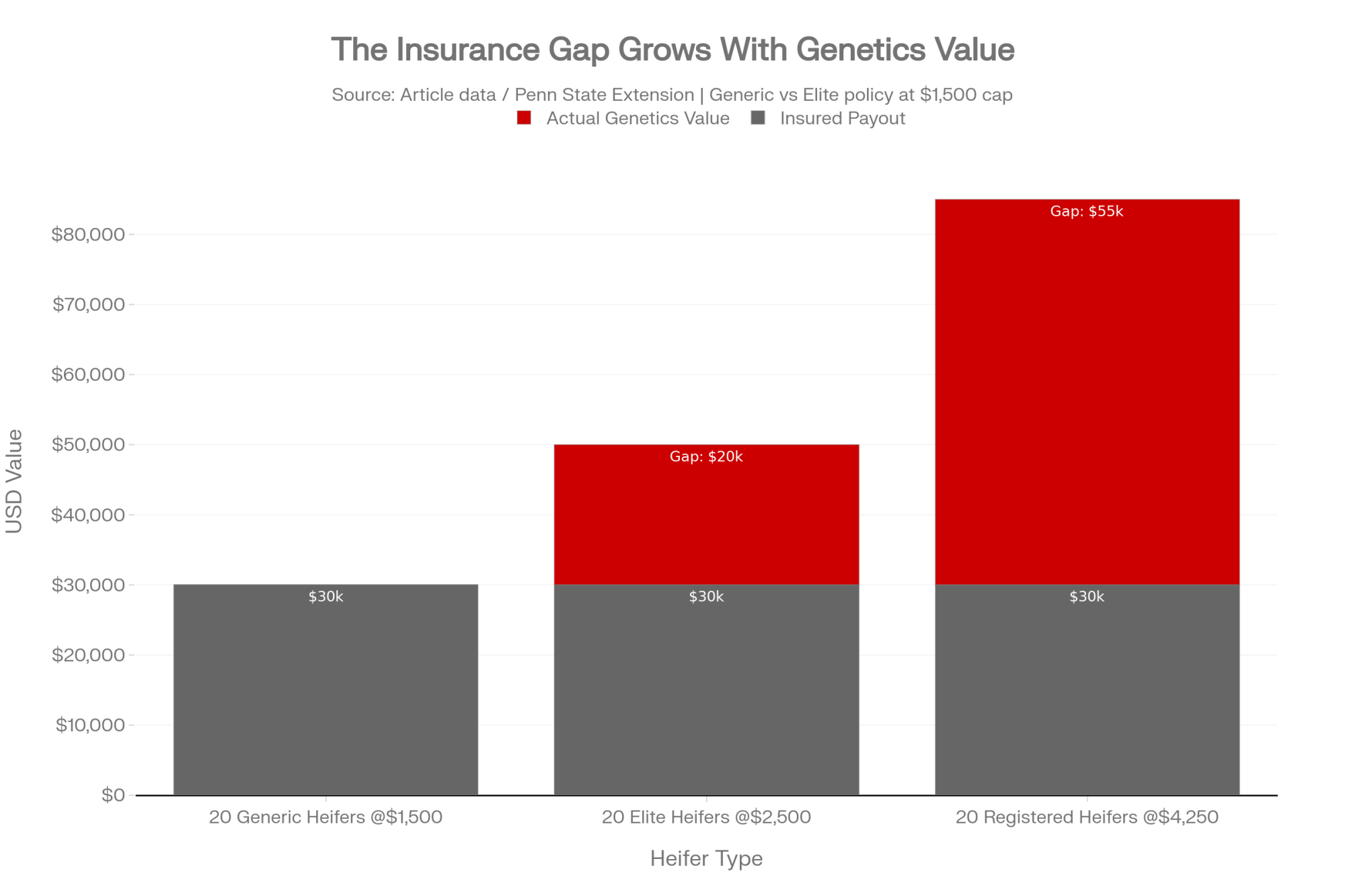
Take your 20 best heifers — the contract matings, the daughters of your best cows, the first calves out of a bull you’re excited about. Put a conservative $2,500 replacement value on each.
- That’s $50,000 standing in one or two pens.
- If your farm policy values them as generic replacements at $1,500 a head, your insurance check after a theft is $30,000.
- You eat the $20,000 gap. Plus the genetic momentum you can’t buy back at any price.
On a 200-cow farm, $20,000 isn’t a rounding error. It’s roughly a year of activity collars for a herd that size. It’s the difference between riding out a soft milk price and booking a meeting with your lender. A large operation with reserves and a sharp policy absorbs that. The mid-size family dairy already squeezed on feed, labor, and loan payments might not. That’s how a theft story quietly becomes a consolidation story — the risk reads the same on paper, but the recovery odds don’t.
| Farm Profile | Top 20 Heifers (Actual Value) | Typical Policy Payout | Uninsured Gap | Months of Feed Cost Lost | Recovery Resilience |
|---|---|---|---|---|---|
| 100-cow family dairy | $50,000 @ $2,500/head | $30,000 @ $1,500 cap | 🔴 $20,000 | ~4–5 months | Very low |
| 250-cow mid-size | $85,000 @ $4,250/head (registered) | $30,000 @ $1,500 cap | 🔴 $55,000 | ~6–8 months | Low |
| 600-cow regional | $85,000 @ $4,250/head | $60,000 (higher limits) | $25,000 | ~2–3 months | Moderate |
| 1,500+ cow large operation | $100,000+ @ elite genomics | $85,000+ (scheduled policy) | $15,000 or less | <1 month | High |
The Genomic Trap Most Producers Are Already Carrying
Here’s where the Oakfield ending gets interesting. When you genotype a calf, you pull a small tissue core from the ear, and that sample runs on a chip that reads tens of thousands of genetic markers — her SNP profile, her DNA fingerprint. Holstein Association USA stores that profile tied to her official ID and her parents, and lets you link the tissue-sample number to ID and test ordering through its Enlight system.
| Capability | Breeding Use (Current) | Security/Theft Recovery Use (Untapped) |
|---|---|---|
| SNP profile stored | ✅ Used for EBV calculations | ✅ Proves ownership from one hair/tissue sample |
| Parent verification | ✅ Confirms sire/dam match | ✅ Flags stolen animal registered under fake parents |
| Registry linkage (HAUSA Enlight) | ✅ Ties sample ID to EID | ✅ Creates untamperable chain of custody for law enforcement |
| Ear tag dependency | ❌ Tag links sample to animal | ✅ Tag not needed — DNA survives tag removal |
| Sale barn utility | ❌ Not visible at point of sale | ✅ One swab at market = proof of origin |
| Active theft deterrence | ❌ No | ✅ Makes elite Holsteins near-impossible to launder |
| Cost per calf | ~$20–$35 (routine) | $0 additional — already paid for |
You probably did it for breeding. To sharpen selection, rank your heifers, make better mating calls. But that same record quietly became one of the strongest theft-proof systems livestock has ever had. Cut every ear tag, and the DNA still ties her back to your herd — one hair or tissue sample at any sale can prove who she is. Try to register stolen genetics under fake parents, and the profile generally won’t line up with the recorded sire and dam — when those parents are on file, the registry can flag the mismatch. And for known cow families, the genotype is effectively a biological brand; selling them with fresh tag holes and no papers is practically an invitation to get caught.
In the Oakfield case, the tags were allegedly cut from 16 calves, which, intentional or not, would have stripped the animals’ visible ID. The DNA didn’t move. That’s the quiet reason a load of stolen elite Holsteins is so hard to turn into cash through any legitimate channel — and it’s a tool sitting unused in the herd software of thousands of farms that genotype for breeding and never think of it as security.
Is Your Herd’s Security Still Just a Padlock and a Prayer?
Be honest about what you’d actually do if a truck backed up to your calf barn at 2 a.m. tonight.
Could someone reach your most valuable pen without a neighbor, a night feeder, or a camera ever clocking them? If you woke up to an empty pen, could you send photos and ID numbers to your sheriff and the regional sale barns within an hour? Most operations can’t, and that’s not a character flaw — nobody’s ever made them sit down and answer it. The Oakfield recovery worked because the pieces were already in place: everything genotyped, the alert clean and fast, and a network that trusted the tip and moved on it. None of that is automatic. It’s a string of choices, some made years ago, some made that morning.
How Much Would Waiting Cost You If It Happened Next Week?
The uncomfortable version of the question is about money, not security. Penn State Extension’s farm-insurance guidance is blunt about it: property coverage may include theft, but policies vary by company, limits cap what you can collect, and losses get valued at actual cash value, replacement cost, or functional replacement cost depending on the policy. If you’ve never asked your agent specifically how stolen registered heifers get valued, you don’t actually know what check is coming.
And there’s a sharper trap stacked on top. Penn State warns that animals being hauled in a truck or trailer often aren’t covered by the vehicle policy unless they’re specifically listed, so farms that move stock regularly need to confirm they’re covered under the farm owner’s policy. Until somebody connects the security value of your genomics to the actual numbers on your declarations page, you’re carrying a powerful recovery tool and a quiet underinsurance problem at the same time.
Options and Trade-Offs: Where to Start
You can’t stop every thief. But you can decide how exposed your genetics are if one shows up. Here are four paths, ordered from fastest to slowest — start at the top and work down as far as your operation needs to go.
Path 1 — Start here, within 30 days: build a packet on your top 20 to 50 heifers.
- When it makes sense: if a handful of elite calves would genuinely hurt to lose.
- What it takes: for each calf — a recent photo, the official ID, the visual tag number, the genotype sample ID, registration, dam and sire, birth date, and ownership docs — stored where your team can pull them at 2 a.m. Holstein USA lets you tie tissue-sample numbers to ID and ordering through Enlight, which takes some of the grind out of it.
- The limit: it won’t stop a thief. It makes the animals far harder to launder and far easier to prove in court. The only real cost is an afternoon of admin, which is exactly why it keeps getting pushed to next month. Don’t.
Path 2 — This month or next: point your cameras at the exit.
- When it makes sense: if you’ve had near-misses, or local thefts are showing up in your county.
- What it takes: the footage that broke Oakfield open came from a road camera, not the front gate. Put your lenses where animals actually leave, add gates and load-out points that lock, and write a simple call list — who you phone, in what order, when a pen turns up empty.
- The limit: cameras only help if someone reviews the footage before it overwrites.
Path 3 — The default you’re probably already on: genotyping for breeding only.
- When it makes sense: if you’re testing for selection and mating and nothing else.
- What it takes: nothing new — you’ve already done it.
- The limit: you’ve built an ownership-proof system but aren’t using it. No current photos, no off-farm backup of IDs, no protocol for handing genomic data to law enforcement. The tool exists; nobody can find it at 2 a.m. Paths 1 and 2 are what close that gap.
Path 4 — The long game: push the registry and the sale barn to change.
- When it makes sense: if you’re active in your breed association and your regional markets.
- What it takes: tell your Holstein Association USA rep you want a simple consignment-integrity check for animals showing fresh tag holes. Tell your sale barn manager they won’t be hung out to dry for slowing a load down to make a call.
- The forward signal: the more Oakfield-style recoveries pile up, the more examples there are to point to. And the cattle-rustling law is catching up — the Combating Organized Retail Crime Act (CORCA), the federal cattle-theft and cargo-crime bill, passed the U.S. House in May 2026 and, as of early June 2026, is pending in the Senate, where a coalition of nearly 200 groups is pushing for a vote. It targets organized cargo-theft networks, not barn-level rustlers, but it signals that moving stolen freight is getting harder to do quietly.
Key Takeaways
- If you genotype for breeding but have no theft file, you’re carrying the tool, not the plan — build a digital packet for your top 20 heifers this month before you need it.
- If you’ve never asked your agent how stolen registered heifers are valued, assume it’s at a commodity rate and run the gap yourself; Penn State warns that hauled animals often aren’t covered unless they’re scheduled on the farm policy.
- If a stranger could back a trailer to your most valuable pen unseen, that’s the blind spot to fix first — one evening, drive in like a thief and look at where the cameras aren’t.
- If a pen ever comes up empty, the first hour decides everything; have the alert — ages, weights, IDs, photos — ready to fire to your sheriff and regional sale barns before you need it, the way Oakfield did.
- If your breed rep can’t tell you how your genomic records would help recover stolen animals, that’s feedback worth sending up the chain.
- If animals come back with cut or altered tags, ask law enforcement and your vet how to document DNA samples without breaking the chain of custody — that’s what turns “looks like ours” into proof.
The real question isn’t whether thieves are getting bolder — the heifer shortage and the Mercer County haul already answered that. It’s whether the genetics you’re investing in this year would have a way home, or whether they’d disappear into someone else’s inventory, as 64 calves did in Ohio. One of those farms had a system. The other had a padlock.
Run Your Numbers
Bullvine Pipeline Index Calculator — Score how exposed your herd really is if a trailer backs up to your calf barn. The BPI tool puts a number on your replacement pipeline, heifer value, and cull pressure so you can see what a “17‑head night” would cost your operation and where to shore up the weak spots before someone else finds them.
Learn More
- Heifer calf mortality: the $40,000 barn math — Reveals how to plug the structural cash leaks in your youngstock pipeline, using simple Brix and serum testing protocols to ensure a $3,010 heifer replacement actually makes it to the milking string.
- The $3000 Heifer Hangover: How Beef‑on‑Dairy Emptied Your Pipeline and Left the U.S. 800000 Head Short— Arms you with a blunt market reality check on national heifer scarcity, forcing producers to run cross-over pricing models before buying replacements or over-leveraging growth.
- The CTS Saw 58 Missing Calves Before APHA Reached the Cornwall Gate — Exposes how modern database tracking acts as a 24/7 surveillance network, demonstrating the massive regulatory and legal risks when on-farm physical realities mismatch your digital traceability records.
 The Sunday Read Dairy Professionals Don’t Skip.
 The Sunday Read Dairy Professionals Don’t Skip.
Every week, thousands of producers, breeders, and industry insiders open Bullvine Weekly for genetics insights, market shifts, and profit strategies they won’t find anywhere else. One email. Five minutes. Smarter decisions all week.




