





Archive for starter intake

1.38 vs 0.90: The Calf Number That Predicts Your Worst Heifers 

Same barn, same week: the poorest calves on one program held 1.38 lb/day. On the other, 0.90. That floor — not your average — is what shows up in the heifer pen two years later.

Picture the calf every feeder loves. Four weeks old, slick-haired, bright-eyed, draining the bottle and bawling for more. Nobody worries about her. She gets weaned around six weeks, moved to a group pen, and forgotten — because she never got sick and never gave anyone trouble.

Then somebody puts a scale under the group, and the calves split into two stories. That’s the shape of what one Midwestern dairy found when it ran a 39-calf comparison of two commercial calf programs, tracked on average daily gain (ADG). It was one farm’s report, not a controlled multi-herd trial — so read the size of the gap as directional, not gospel. But the point at which calves separate is the part of any calf-weaning program that almost nobody measures: right around week six.
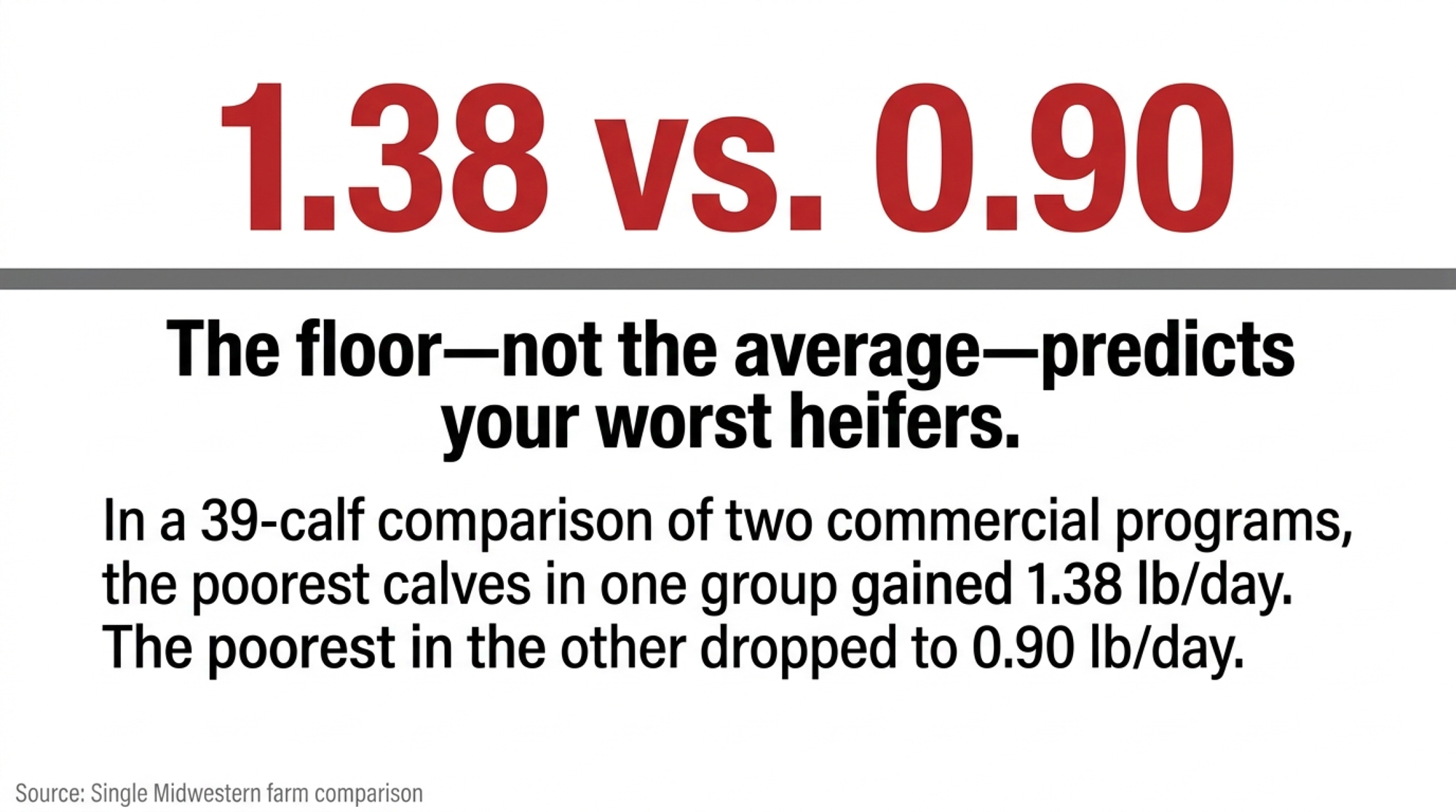
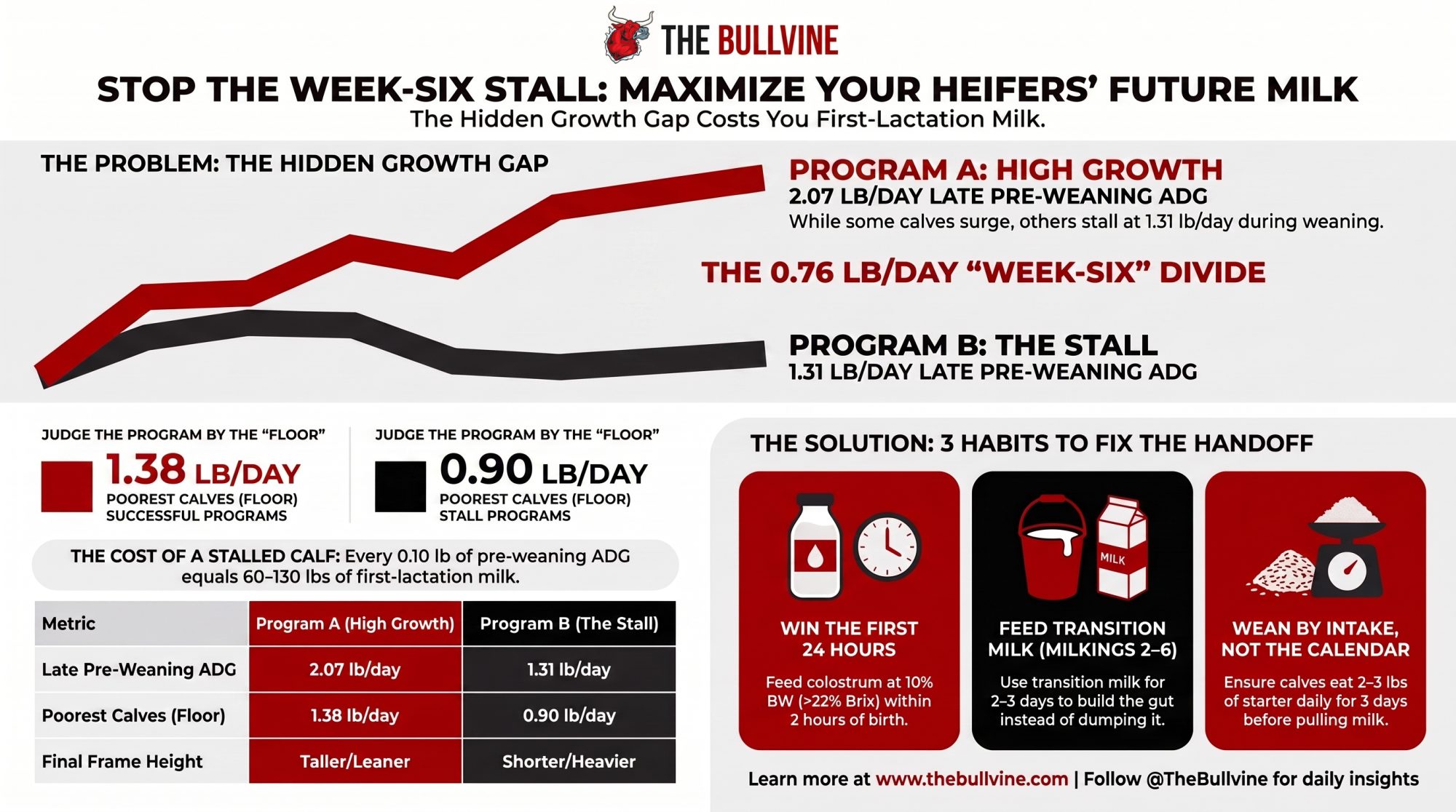
The three numbers that tell the story. Overall ADG: 1.73 vs 1.39 lb/day (+0.34). Late pre-weaning phase: 2.07 vs 1.31 lb/day. Poorest calves in each group: 1.38 vs 0.90 lb/day (Program A vs. Program B; single Midwestern farm, 39 calves).
What the Report Showed — and How to Read It

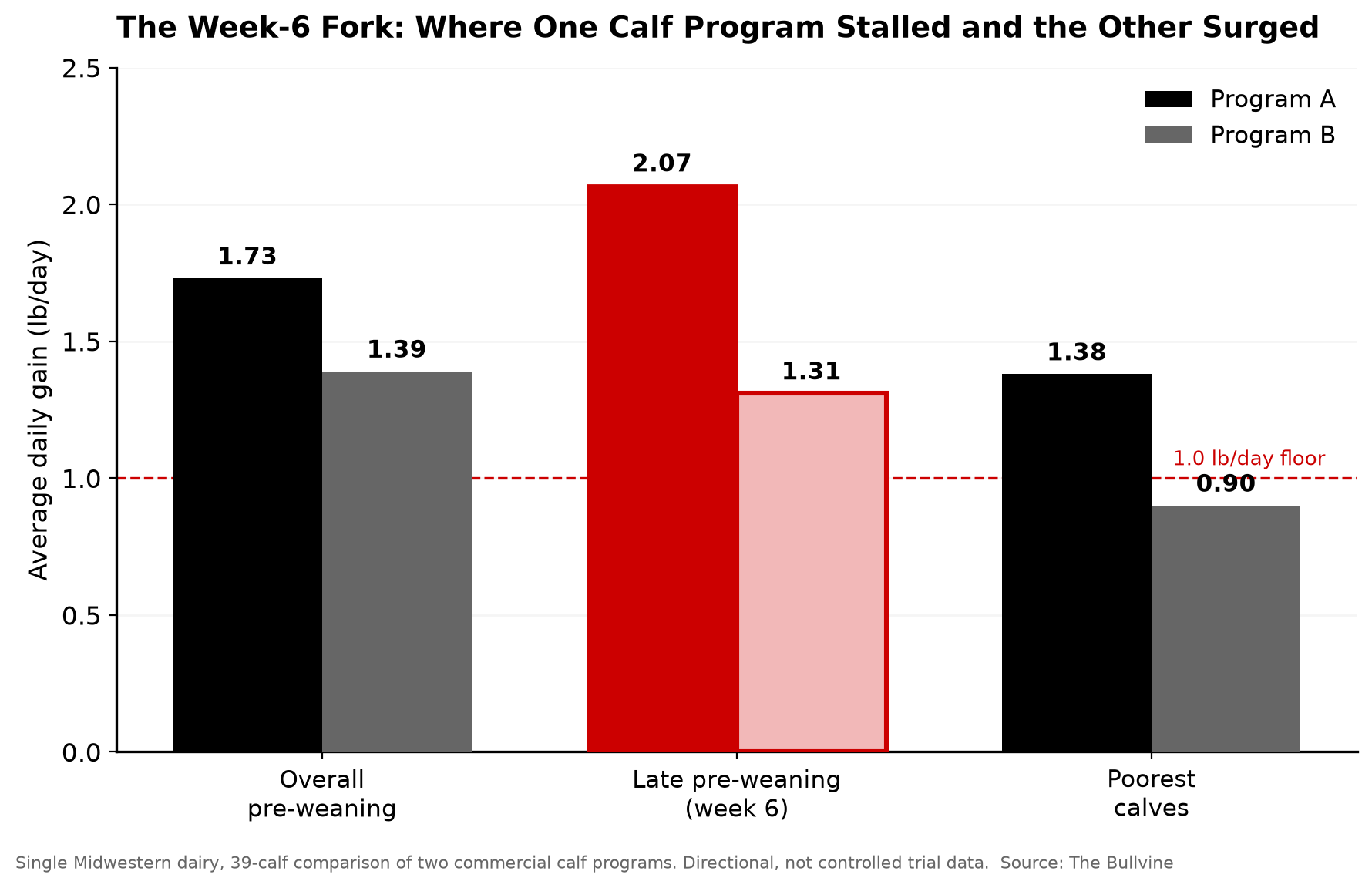
Across the full pre-weaning period, the calves on Program A gained 1.73 pounds per day, compared with 1.39 pounds per day for Program B — a 0.34-lb/day edge. Over a 56-day pre-weaning window, that’s about 19 extra pounds of calf, built during the weeks that matter most.

The more telling number is when the gap opened. Early on, the groups ran close. In the late pre-weaning phase — the week-six window — the Program A calves surged to 2.07 lb/day, while Program B stalled at 1.31 lb/day. One group accelerated into weaning; the other flattened. Same barn, same week, opposite direction.

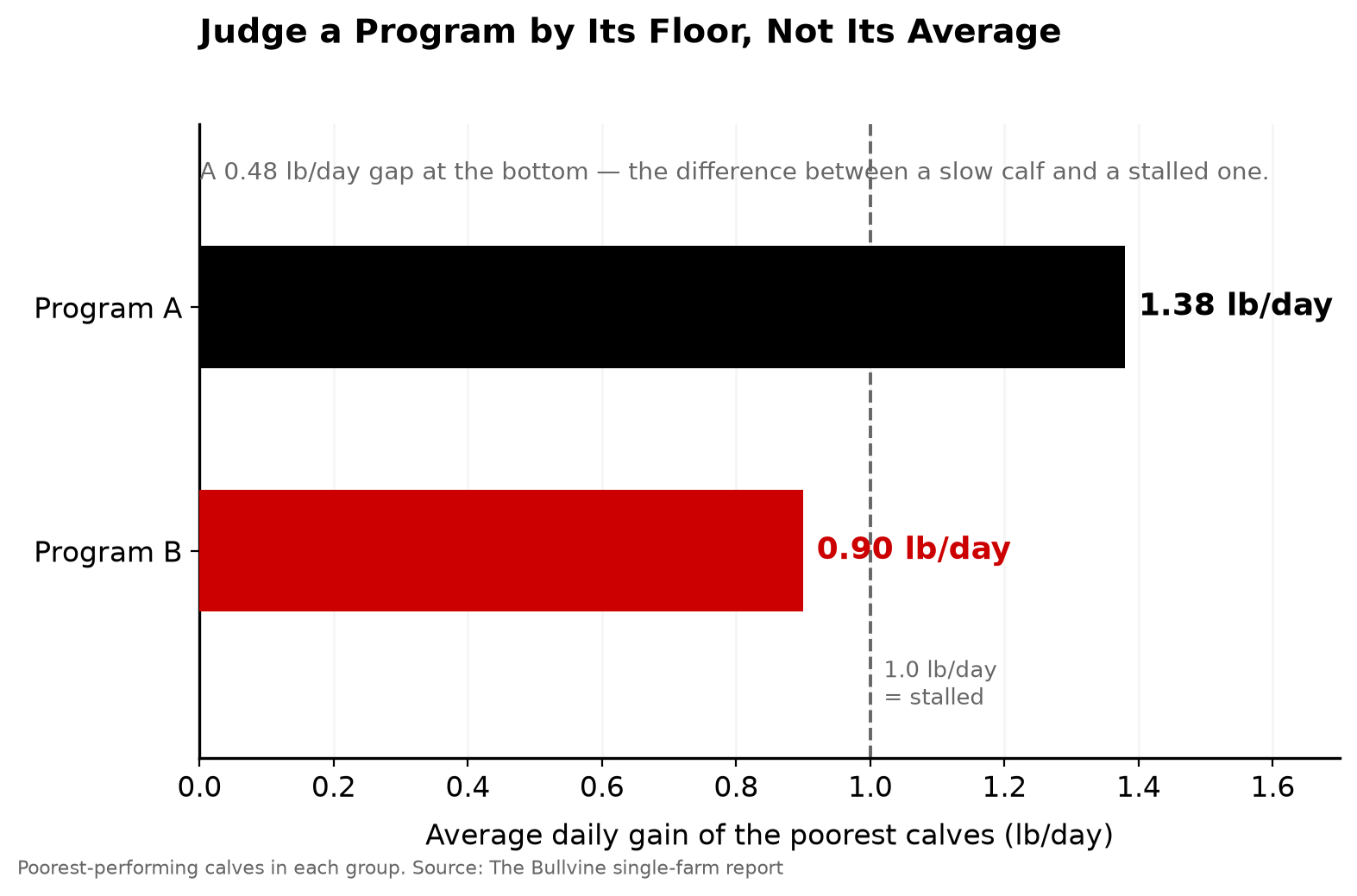
And look at the bottom of each group, because that’s where a program is really judged. The poorest-performing calves on Program A still gained 1.38 lb/day. The poorest on Program B dropped to 0.90. Your worst calves tell you whether a program protects the whole group or flatters the average — and a floor of 1.38 versus 0.90 is the difference between a slow calf and a stalled one.
The Program A calves also grew differently in frame — about 0.084 inches a day of height versus 0.061 — finishing taller and leaner rather than just heavier. One caveat worth saying out loud: this was a single farm, 39 calves. It’s a real result, not a guarantee your barn will see the same spread, and it isn’t repeatable trial data.

The Calf That Looks Fine and Still Falls Behind

The trap is that pre-weaning ADG doesn’t announce itself. A dead calf gets noticed. A calf gaining 1.31 pounds a day instead of 2.07 looks completely normal in the pen — she’s just a little smaller, and “small for her age” rarely earns a phone call.

That’s why the week-six stall survives on so many farms. Most herds answered a decade of calf research by feeding more milk; feeding 3 quarts twice a day is common now, where two quarts twice a day used to be the rule. Fewer changed how, or when, they wean. So the front half of the program improved, and the back half didn’t — and the seam between them is exactly where calves stall. The report didn’t just show a winner. It showed where and when the second program lost the calves.
The Stall Starts Before You Think — Day One, Actually

Here’s the part that catches good managers off guard: the week-six stall often gets set in motion in the first 24 hours of a calf’s life. Get colostrum wrong, and you’ve handicapped the calf before she’s ever offered a handful of starter.
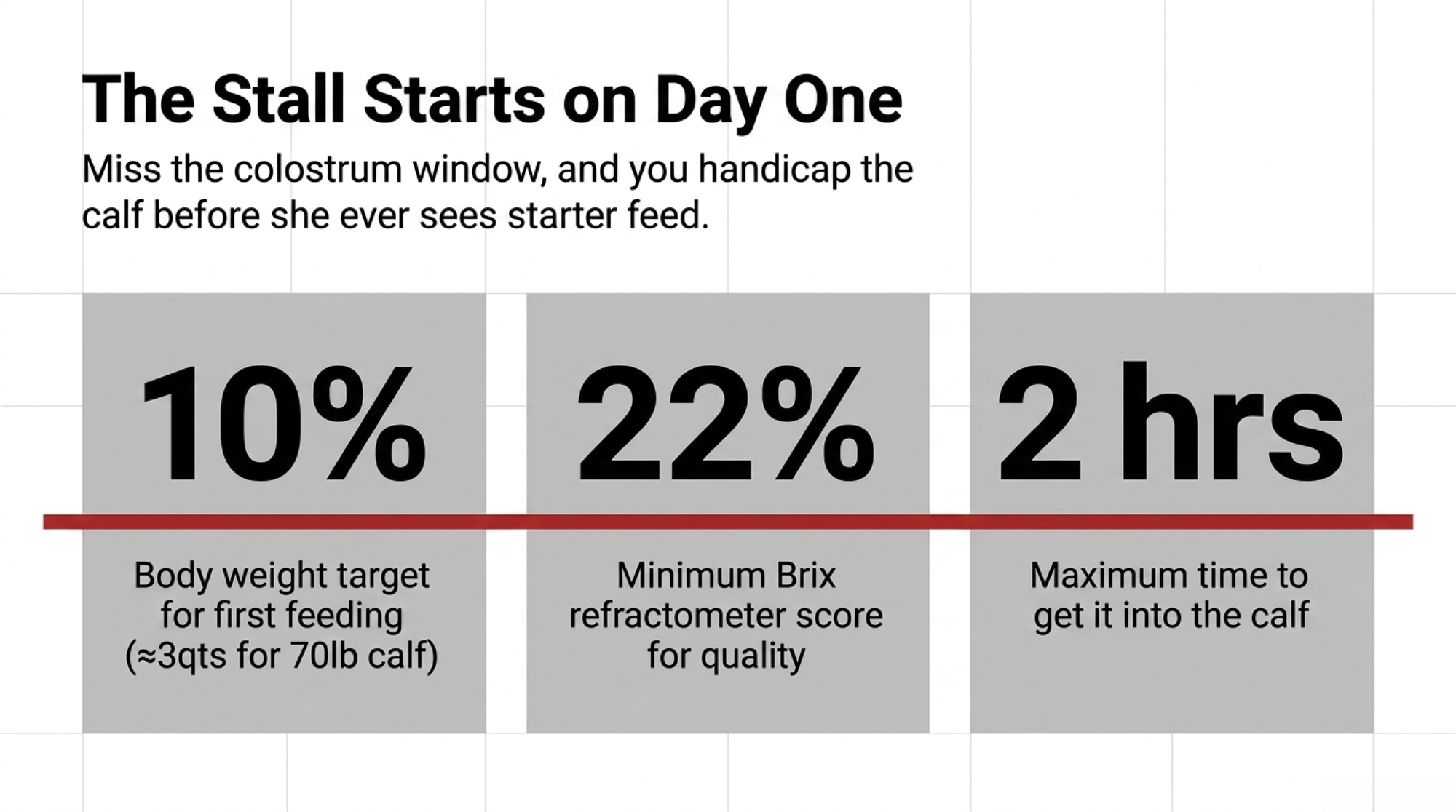
The target is well established, and it scales to the calf. Most extension programs feed colostrum at roughly 10% of body weight in the first feeding — so a 90 lb Holstein calf takes about a gallon, while a 70 lb calf needs closer to 3 quarts, not four. What matters is clean, high-quality colostrum testing above 22% on a Brix refractometer, fed within the first 2 hours, with passive transfer confirmed in the first few days. Calves that miss that window absorb fewer antibodies, get sicker more often, and — critically — eat less starter feed in weeks two and three. Less starter means a slower-developing rumen heading straight into weaning. The first feeding and the week-six gain are the same story, just told 40 days apart.

The day-one rule that shows up at week six: feed colostrum at about 10% of body weight (≈3 quarts for a 70 lb calf, a gallon for a 90 lb calf), testing above 22% Brix, in the first 2 hours. Then feed transition milk (milkings 2–6) for two to three days before switching to milk or replacer.

StepTargetTimingWhy it drives week-6 gain
Colostrum volume~10% of body weight (≈3 qt for a 70 lb calf; 1 gal for 90 lb)First feeding, within first 2 hoursAntibody absorption window closes fast; miss it and starter intake drops in weeks 2–3
Colostrum qualityAbove 22% BrixrefractometerFirst feedingBelow-22% colostrum = weaker passive transfer, more sickness, slower rumen
Transition milk (milkings 2–6)Feed 2–3 days before switchingDays 2–4 of lifeRicher in fat, protein, growth factors; most farms dump this down the drain
Passive transfer checkConfirmed adequateFirst few daysFailed transfer = sicker calf, lower early intake, stalled rumen into weaning

Transition milk — the second through sixth milkings after calving — is the bridge most farms still pour down the drain. It’s richer in fat, protein, and bioactive growth factors than the milk or replacer that follows, and feeding it for two or three days after colostrum has been associated with improved early gut development and higher early intakes. You’re not buying anything new. You’re just not throwing away something the cow already made.

Why Starter Beats Milk for Building Week-6 Calves

Two things run underneath all of this, and neither cares how your barn is laid out.

First, calves are born with a rumen that barely works. The papillae — the projections that absorb energy from fermented grain — only grow when there’s grain in the rumen producing volatile fatty acids. So starter intake, not milk, is what builds the rumen heading into weaning. Penn State Extension puts it bluntly: no matter how much milk you feed or what age you wean, calves whose rumens aren’t ready will struggle afterward. That’s the mechanism behind a 0.90 lb/day floor.

Second, that same window appears to shape the udder. Reviews from UF/IFAS and others suggest that nutrition and stress during the first six to eight weeks influence mammary development. You’re not just building a bigger calf — you may be shaping how much milk-making machinery she carries as a cow. That’s the working theory behind why early gain tracks with later milk.

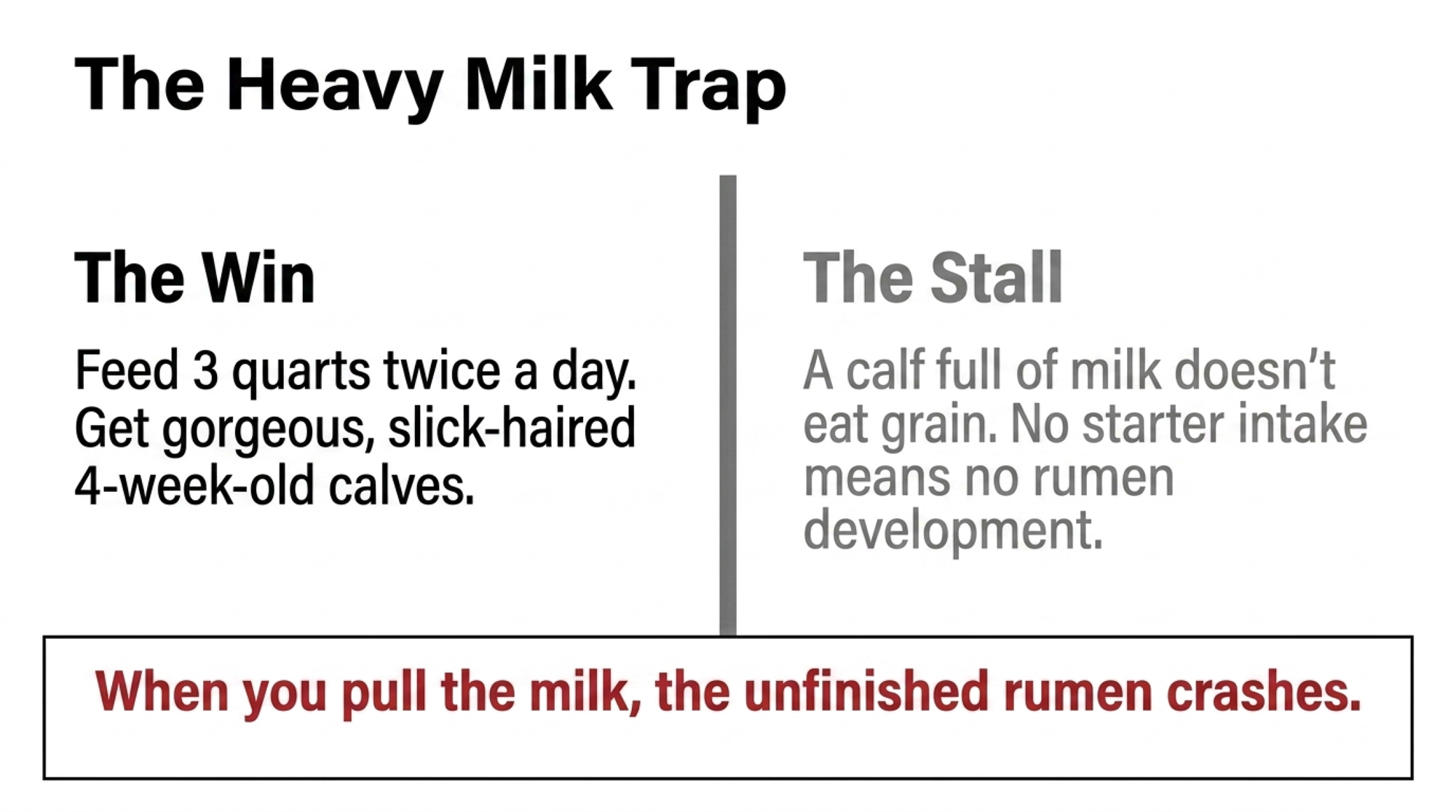
There’s a tension here worth naming, because it bites a lot of well-meaning farms. The same heavy milk feeding that drives those gorgeous four-week calves can suppress starter intake if you’re not careful — a calf full of milk doesn’t go looking for grain. That’s why the step-down matters so much. Pull the milk too fast, and the rumen isn’t ready; leave it high too long, and the calf never learns to eat. The herds that thread that needle are the ones whose calves don’t stall.

Now stack management on top. Wean by age and pen space, not starter intake. Cut milk over two or three days instead of stepping it down. Move, mix, and disbud in the same week. Push calves onto a forage-heavy grower ration before the rumen can handle it. Do enough of that at once, and you get the stall: rumens that never got enough grain, intake dropping just as the milk goes away. The calf survives. The growth curve flattens right when it counts.

Why That 0.34 Pounds Is a Lever You Actually Control

The skeptic’s question is fair: Does a third of a pound a day in the calf barn really show up in the tank two years later? The research says it’s linked — and it’s been quantified.
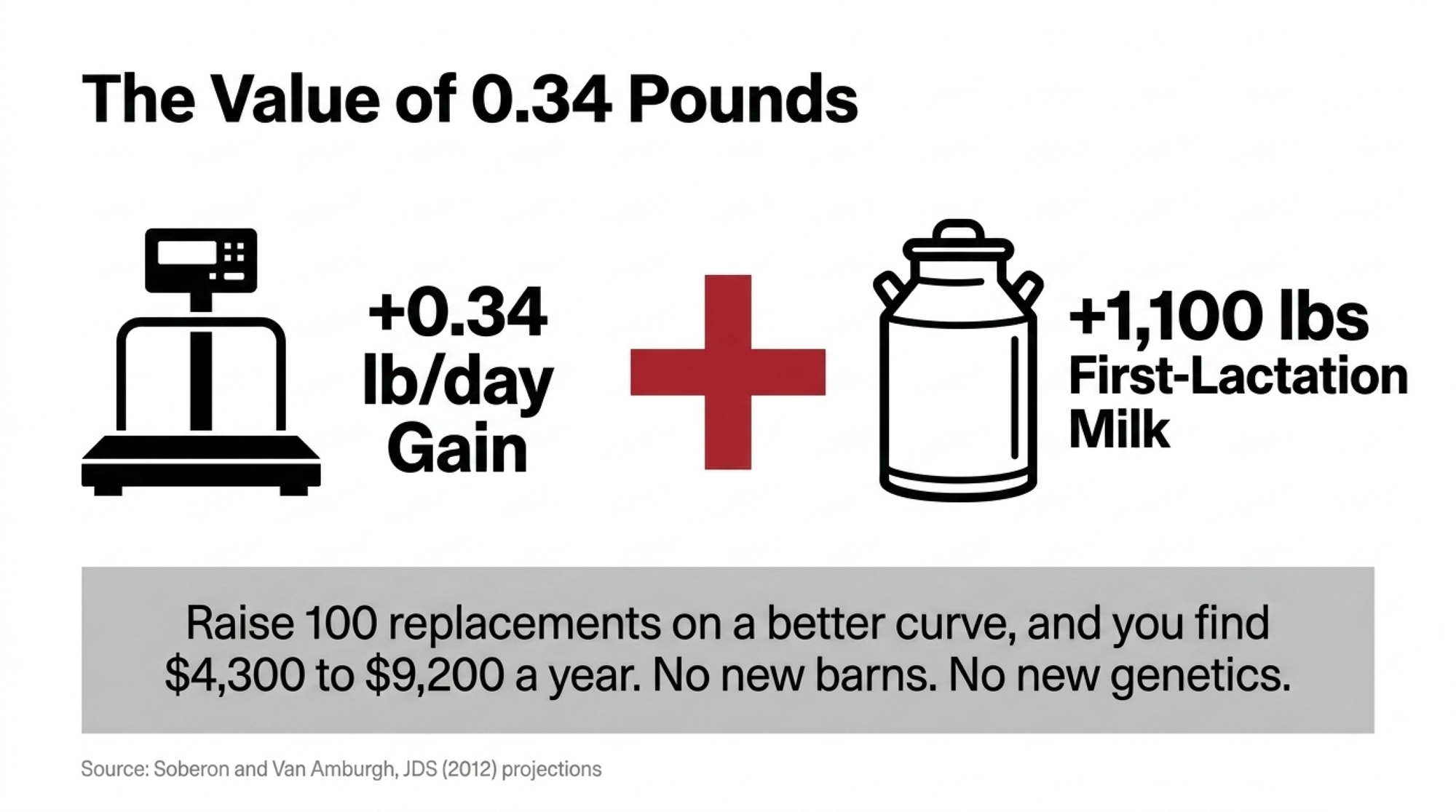
In the foundational Cornell work (Soberon and Van Amburgh, Journal of Dairy Science, 2012), every additional kilogram of pre-weaning ADG was associated with about 1,113 kilograms more milk in first lactation in the commercial herd, and across both herds studied, pre-weaning gain explained 22% of the variation in first-lactation yield. That slope works out to roughly 1,100 pounds of first-lactation milk per additional pound of daily gain at the high end; more conservative pooled analyses land lower, bracketing a working range of about 600 to 1,300 pounds per pound of gain (roughly 60–130 lb for every 0.10 lb/day).
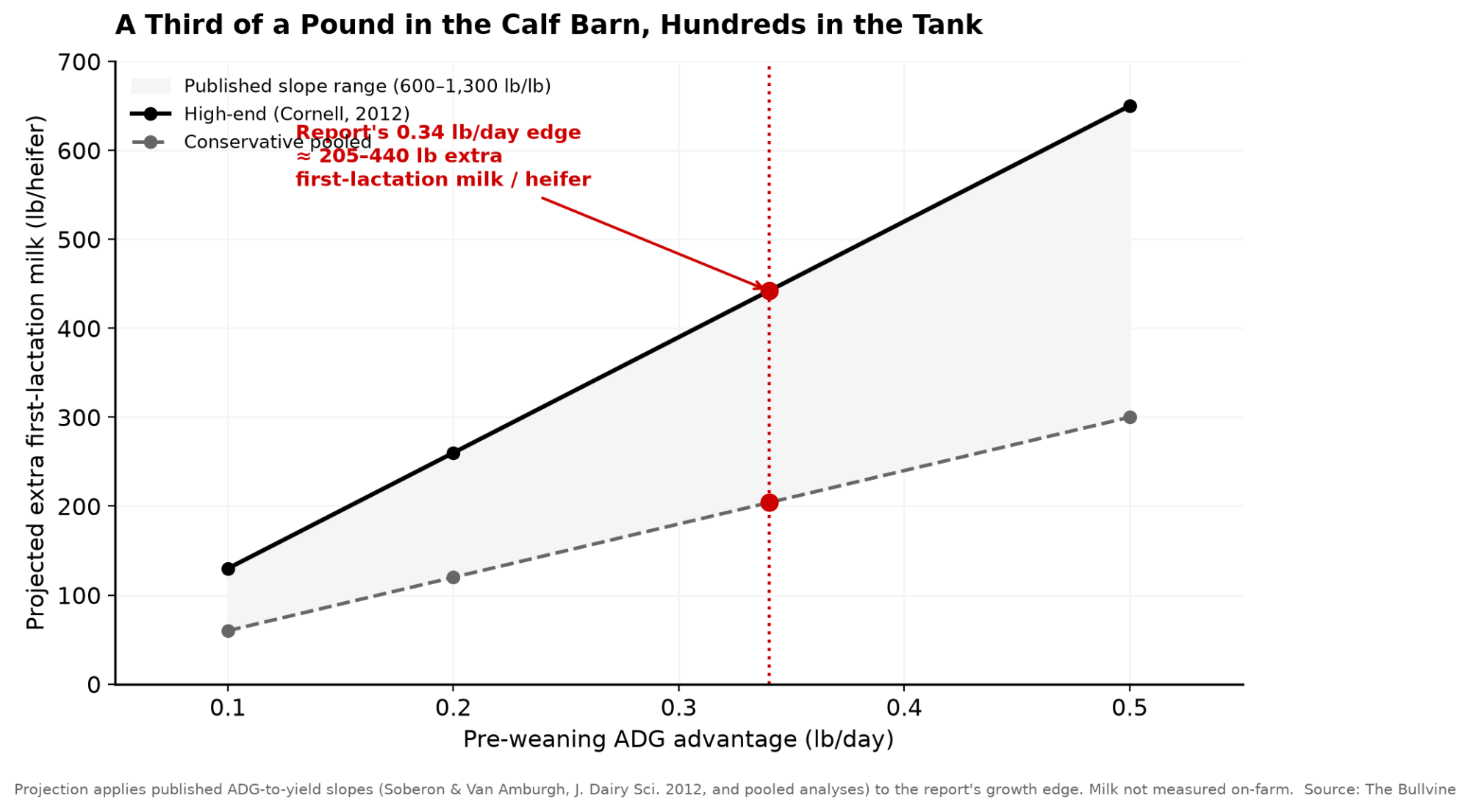
Run the report’s edge through that range. A 0.34 lb/day advantage projects to roughly 205 to 440 pounds of additional first-lactation milk per heifer, depending on which published slope you use. Raise 100 replacements a year on that better curve, and you’re looking at 20,000 to 44,000 pounds of milk — somewhere around $4,300 to $9,200 a year at $21/cwt, with no new barn and no new genetics.

One honest line on that number: the report measured calf growth, not these calves’ actual milk records. The milk figure is a projection from outside research, not something this farm has weighed in the tank. That’s still the right argument — genetics, transition, and breeding decisions all come later and cost more to move. Pre-weaning gain is one of the few levers you can pull before the heifer is even bred.

How Much Does the Week-6 Stall Actually Cost You?

Run the report’s spread through your own herd, and it stops being abstract. A 250-cow dairy raising 60 heifers a year, with a 0.34 lb/day gap, is projecting roughly 12,000 to 26,000 pounds of first-lactation milk left behind per cohort. A 600-cow herd raising 140 heifers? Roughly 29,000 to 64,000 pounds.
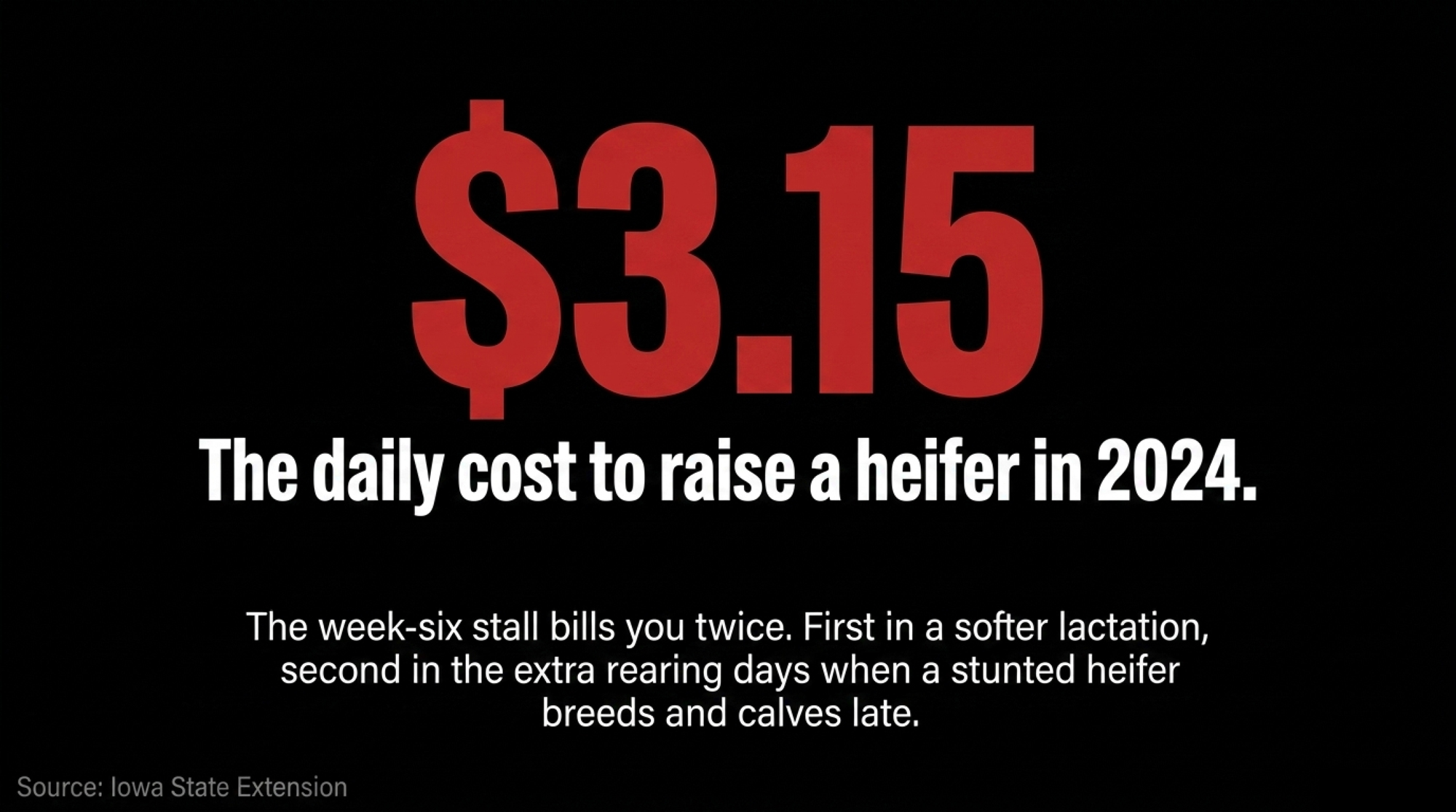
Then there’s the rearing bill. Iowa State Extension pegged the cost of raising a heifer in 2024 at about $2.65 a day for a good genetic heifer, or $3.15 with labor, and heifer raising is the second-largest expense on most U.S. dairies, behind only the milking herd’s feed. A stalled calf doesn’t just milk lighter; she tends to breed and calve late, stacking more of those $2.65-to-$3.15 days onto a heifer that isn’t earning yet. So the week-six stall bills you twice — once in a softer first lactation, once in the extra rearing days before she enters the parlor.

Herd sizeHeifers raised / yrProjected first-lactation milk left behind / cohortRearing cost exposure ($2.65–$3.15/day)
250 cows6012,000 – 26,000 lbStalled calves breed & calve late, stacking extra $2.65–$3.15 days
600 cows14029,000 – 64,000 lbHeifer raising = 2nd-largest dairy expense (Iowa State, 2024)
100 replacements10020,000 – 44,000 lb (≈ $4,300 – $9,200/yr at $21/cwt)No new barn, no new genetics — pure management lever
Per heifer1205 – 440 lbLate calving adds unearned rearing days on top

What the Report Doesn’t Tell You — and Why That Matters

Be honest about the limits of a single-farm comparison, because your own numbers will carry the same caveats. This report tracked growth — ADG and frame — not health events, not feed cost per pound of gain, not what these specific calves eventually milked. A program can post a great ADG and still cost more per pound, or run into a scours break the numbers don’t show.

It also can’t separate the feed from everything around it. Same barn, same crew, same season — but we don’t know how the two groups were split, whether one got slightly better hutches, or how the weather hit the trial window. Thirty-nine calves are enough to see a clear pattern and not enough to rule out luck. Treat the size of the gap as directional and the shape of it — a stall versus a surge right at week six — as the part worth trusting.

None of that sinks the story. It sharpens what you should take from it: not “switch feed and gain 0.34 pounds,” but “find out whether your own calves stall at week six, and if they do, fix the handoff.” The report is a prompt to measure your barn, not a promise about it.

Is Your Weaning Plan Ready for the Milk You’re Feeding?

You don’t need to recite papillae biology to answer this. You need four blunt answers about your own barn.

When do calves start eating starter, and are they really eating it before week three? How many days have they been on grain before you pull the milk? Are you weaning on age because that’s when the pen needs to turn — or do starter intake and ADG get a vote? And what else hits those calves that same week: disbudding, regrouping, a move somewhere colder?

Stack all of that around an unfinished rumen, and you’ve built a stall, not a handoff. The herds pulling ahead aren’t the ones with the fanciest sensors. They’re the ones where somebody can tell you, without opening a laptop, what their ADG to weaning is, what happens the week after, and what they changed last time the curve went flat.

How Do You Measure Starter Intake Without Losing Your Mind?

This is where most programs quit, because “measure intake” sounds like a research trial. It doesn’t have to be. You’re chasing a trend and a trigger, not a number to three decimals.

Pick a representative pen or a set of individual calves. Weigh the starter you put out, weigh back what’s left and wasted, and you’ve got daily intake per calf close enough to act on. Watch for the moment a calf reliably eats 2 to 3 pounds a day for three straight days — the practical green light that the rumen is doing real work. Pair that with a weigh tape or scale at a few fixed points, and you see both halves: is she eating, and is she growing? The herds that do this well don’t measure every calf every day. They sample, chart the trend, and let intake and ADG — not the calendar — decide when milk comes off.
Sponsored Post

Three Changes That Help Calves Power Through Week 6

You can close most of this gap without rebuilding the calf barn. But you have to decide what becomes a non-negotiable habit.

Earn the right to wean. Switch the trigger from age alone to starter intake plus age. Don’t fully wean before calves eat 2 to 3 pounds of starter a day for three straight days, and step milk down over 7 to 10 days rather than yanking it. USDA APHIS data on preweaned Holstein heifers show that higher planes of liquid feeding support the kind of gains — pushing toward 1.8 to 2 pounds a day — that Program A landed in. The trade-off is real: intake-based weaning disrupts tight pen-move schedules, and someone actually has to monitor intake.

Unstack the week-six pile-up. Keep dehorning, big group changes, and major pen moves out of the week before and after milk withdrawal. Hold calves on a starter-heavy diet for a week or two post-weaning before loading in forage. Headed to group housing? Move them before the step-down so they’re already eating well in the new pen. The limit is logistics — spreading jobs out feels inefficient until you price in the lost gain and the vet calls.

Make one person the owner of the curve. Name one person to record weights, review ADG by group monthly, and flag the slumps — then give that person a real slot in the herd meeting, next to somatic cell count and repro. The risk: with no backup, the whole system rides on one person and dies fast if leadership never acts on the numbers.

What This Means for Your Operation

  • If you can’t state your herd’s pre-weaning ADG off the top of your head, you don’t have a calf program — you have a calf routine. Measuring is the first decision.
  • If your late pre-weaning gain looks more like 1.31 than 2.07, the week-six handoff — not the calf — is probably the problem.
  • If you’re weaning strictly by calendar age, check starter intake first: under 2 to 3 pounds per day for three days likely means the rumen isn’t ready.
  • If you’re dumping transition milk, you’re throwing away the cheapest gut-development tool you’ve got — feed milkings two through six for a couple of days before you change anything else.
  • If you want to know whether a program protects every calf, look at your bottom tier, not your average — 1.38 versus 0.90 is the whole ballgame.
  • If a chunk of your heifers calve late, trace them back and ask whether they were the calves that stalled at six weeks — because at $2.65 to $3.15 a day, those extra rearing days aren’t free.
Key Takeaways

  • If you only change one thing this month, weigh 10 heifers at weaning and again a week later, calculate ADG, and find your week-six slope before you touch anything else.
  • If your colostrum isn’t testing above 22% Brix and going in within two hours — at about 10% of the calf’s body weight — fix the first feeding before you fuss over the weaning end. The stall often starts on day one.
  • If your bottom-tier calves gain under 1.0 lb/day, that floor — not the group average — is your real target, and it’s a feed-and-weaning problem before it’s a genetics problem.
  • If your weaning is age-triggered, switch to intake-plus-age: 2 to 3 pounds of starter for three straight days before milk comes off.
  • If you’re carrying heifers past 24 months at first calving, the calf barn is a likelier culprit than the breeding pen — start there.

The Midwestern dairy in that report didn’t find a magic calf. It found a 0.34-pound-a-day fork in the road, most of it opening in a single week — and it could see the fork only because it put a number on the part of the program everyone else eyeballs. So here’s the question worth chewing on at your next herd meeting: do you actually know what your calves gain between week four and week six, or are you trusting that the slick-haired ones are telling you the truth?

Complete references and supporting documentation are available upon request by contacting the editorial team at editor@thebullvine.com.

Learn More

The Sunday Read Dairy Professionals Don’t Skip.

Every week, thousands of producers, breeders, and industry insiders open Bullvine Weekly for genetics insights, market shifts, and profit strategies they won’t find anywhere else. One email. Five minutes. Smarter decisions all week.

NewsSubscribe
First
Last
Consent

Calf Weaning by Starter Intake: Jim Quigley’s 15 kg NFC Threshold

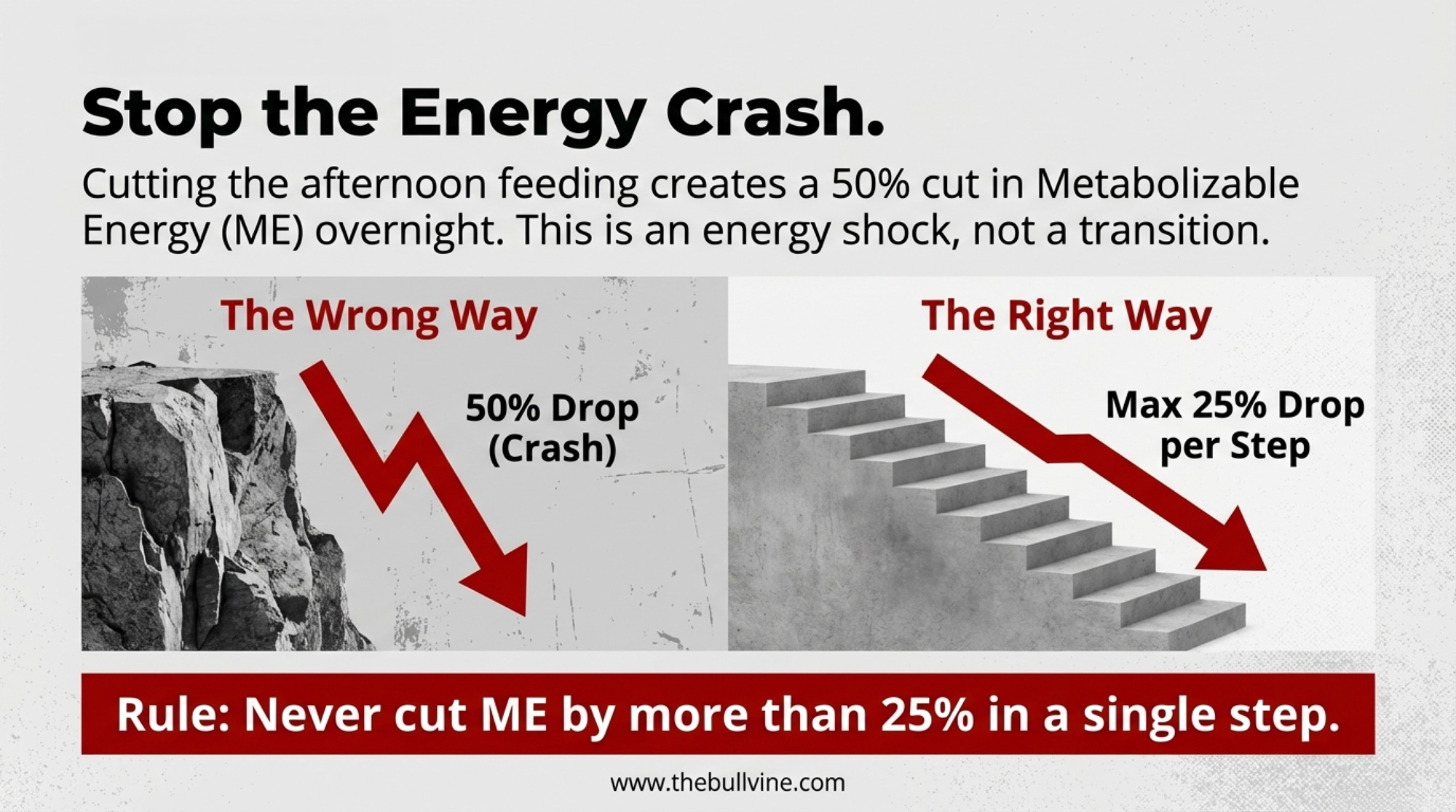
Drop the afternoon milk, and you’ve just cut a calf’s ME by 50%. Jim Quigley says that’s an energy crash, not a weaning strategy.

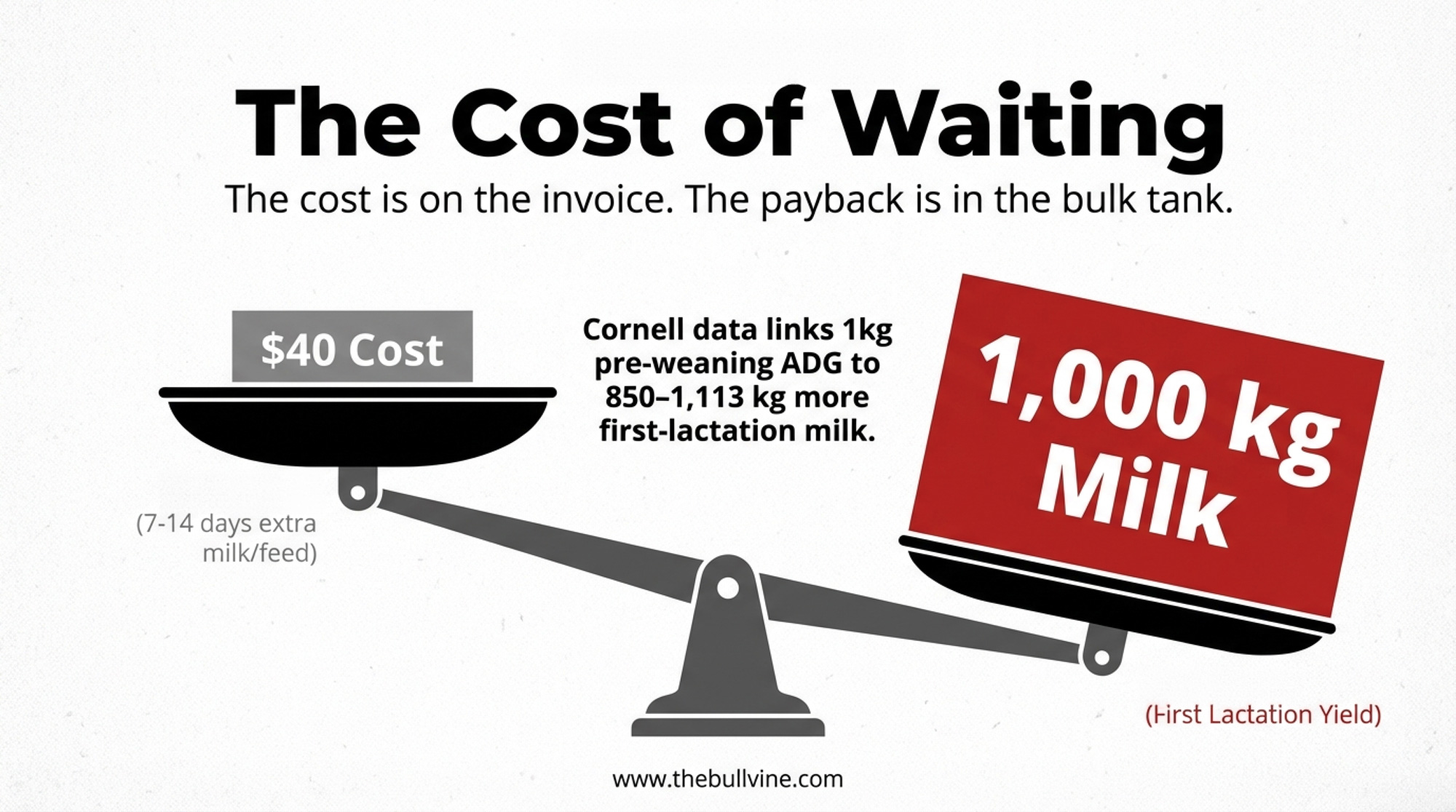
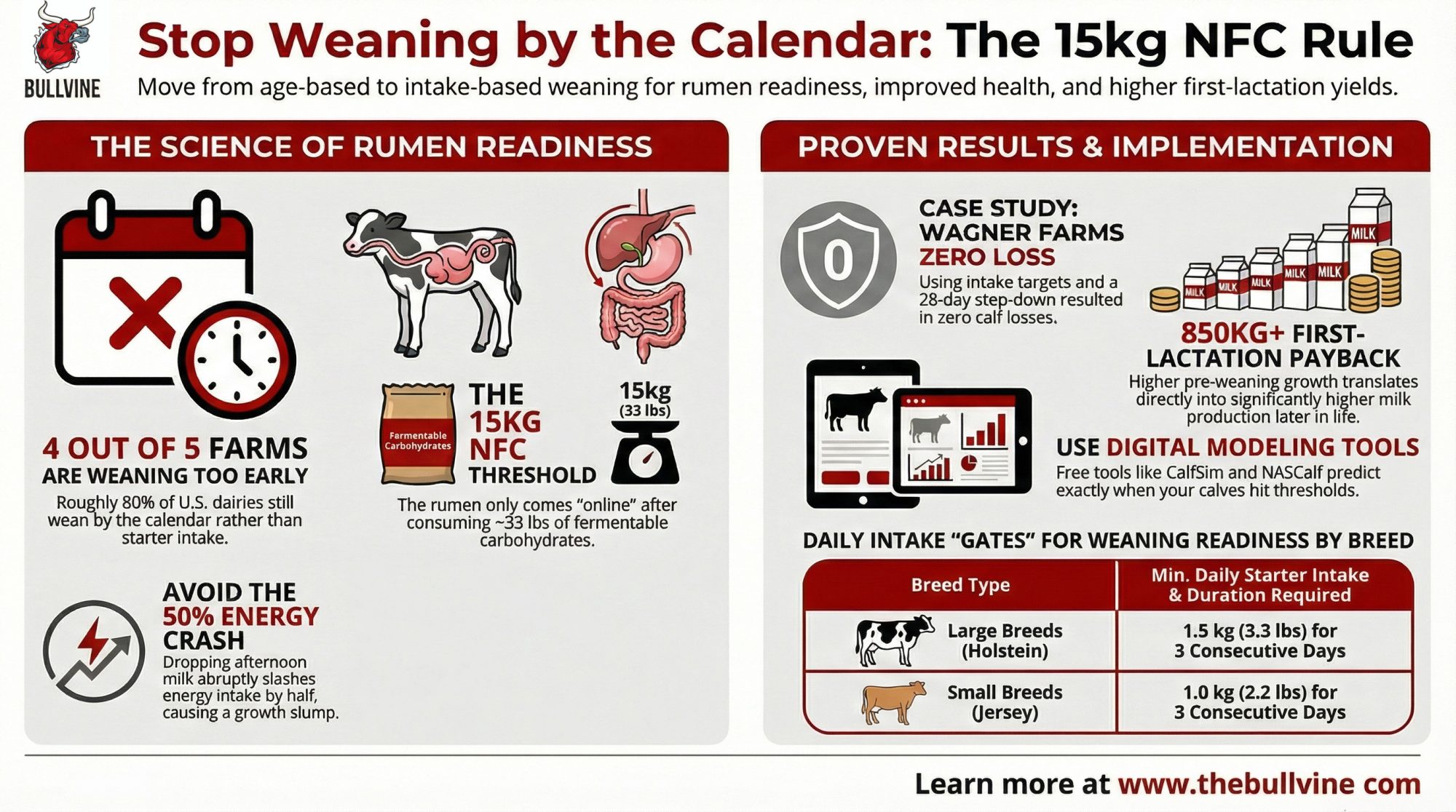
Executive Summary: Most dairies still wean calves by age, but Jim Quigley’s work shows the rumen isn’t truly ready until a calf has consumed about 15 kg of NFC from the starter — roughly 33 pounds of fermentable carbohydrate. Many 8‑week weaning programs, especially on higher milk intakes, never reach that mark, which helps explain the post‑weaning growth checks and treatment spikes producers see. Research from Quigley, NASEM 2021, and Jim Drackley’s 2025 weaning review all point in the same direction: later, intake‑based weaning with a gradual step‑down beats abrupt, calendar‑driven protocols on biological and performance outcomes. Wagner Farms in Wisconsin built their calf program around intake targets and a 28‑day weaning step‑down and recorded zero calf losses in the year. Free tools like CalfSim and NASCalf let you model when your own calves will reach the 15 kg NFC threshold and how different feeding plans affect intake, growth, and cost. The extra 7–14 days on milk might add $30–40 per calf, but the article walks through how smoother weaning, better growth, and higher first‑lactation yield can repay that investment — and gives a 30/90/365‑day plan to test it in your own calf barn.

intake-based weaning

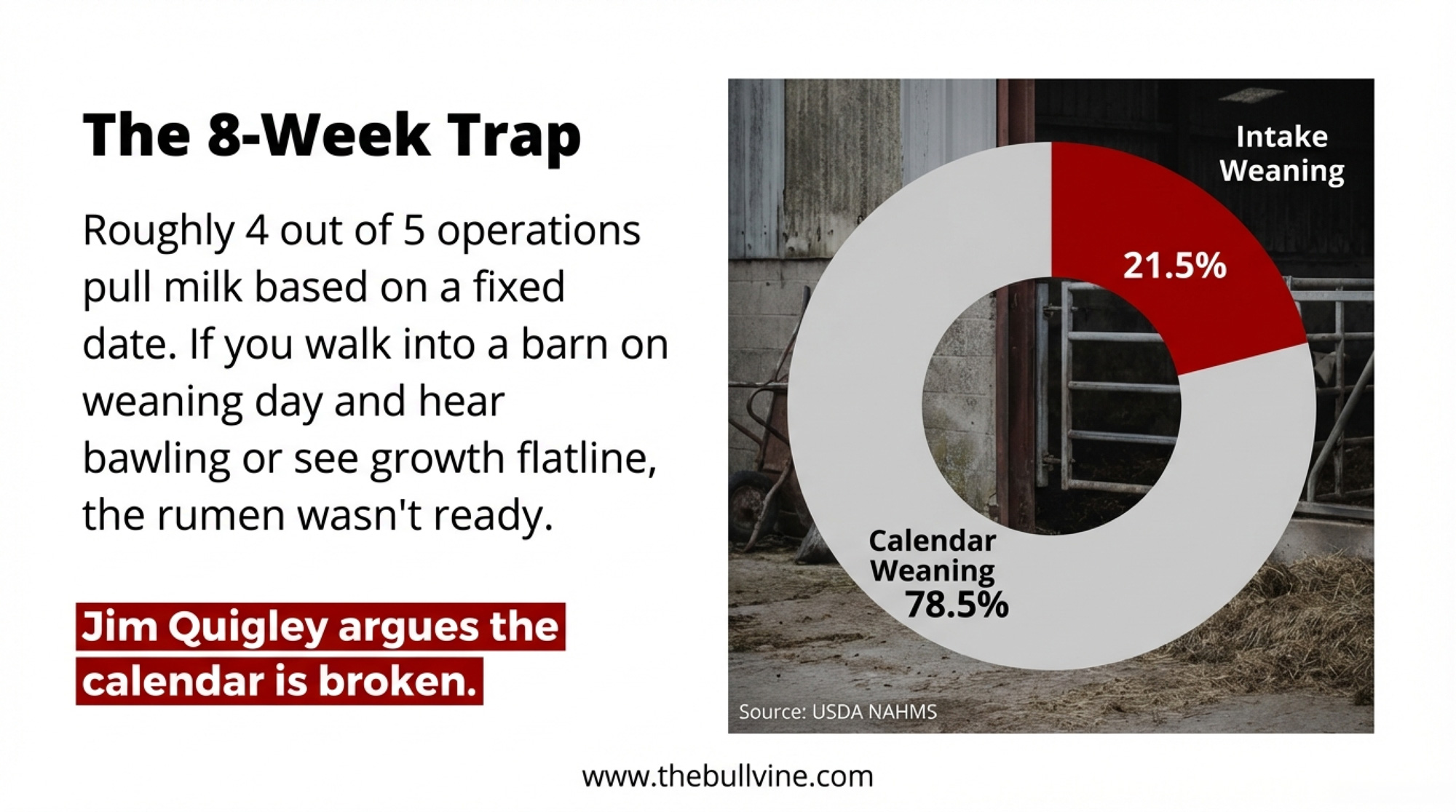
Only 21.5% of U.S. dairy farms wean calves based on starter intake rather than a fixed age. That’s the most recent national figure — USDA NAHMS Dairy 2014, now 12 years old and still the best we have. (The next NAHMS dairy study is anticipated in 2026, and anecdotal evidence suggests intake-based weaning has gained traction, but no national update exists yet.) What it means: roughly four out of five operations are pulling milk on a calendar. Jim Quigley thinks the calendar is broken.

Walk into a calf barn on weaning day, and you know the result. Bawling calves, scattered starter, a handful of 8-week-olds that clearly aren’t ready. Starter intake drops. A few get pulled for treatment. Growth flatlines, then slowly recovers.

Weaning ProtocolTypical Cumulative Starter Intake at Day 56Cumulative NFC ConsumedQuigley’s Readiness Threshold
Industry Standard (8 weeks, 6L milk/day)25–28 kg11.5–13 kg NFCSHORT by 1.5–3.5 kg
Accelerated Milk (8 weeks, 10L milk/day)18–22 kg8.3–10.1 kg NFCSHORT by 4.9–6.7 kg
Extended Intake-Based (9–10 weeks, 10L milk/day)31–34 kg14.3–15.7 kg NFC✓ Threshold met
Quigley’s Biological Threshold31 kg (55% NFC starter)15 kg NFCRumen functionally ready

The calf nutrition researcher behind Calf Notes (calfnotes.com) has spent years arguing that weaning by intake is the only approach that lines up with what’s actually happening inside the rumen. His benchmark is specific: roughly 15 kg of cumulative non-fiber carbohydrates from the starter. That’s about 33 pounds. And on a lot of North American dairies running accelerated milk programs, his modeling suggests calves don’t cross that line until week 9 or 10.

If you’re pulling milk at week 8, you’re asking the rumen to do a job it can’t yet handle. One Wisconsin operation already proved what happens when you stop asking.

Zero Calves Lost: What Wagner Farms Proved

Wagner Farms in Oconto Falls, Wisconsin, doesn’t wean by the calendar. Profiled in Hoard’s Dairyman in 2020, the operation feeds whole milk with a milk balancer, uses paired calf housing, and weans calves based on starter intake. Laura Raatz, the farm’s calf manager, shared the approach at the Purina Leading Dairy Producers Conference.

Protocol ElementIndustry Standard (Most U.S. Dairies)Wagner Farms (Intake-Based)
Weaning TriggerFixed age (8 weeks)Starter intake threshold: 8 lbs/day (summer), 10 lbs/day (winter)
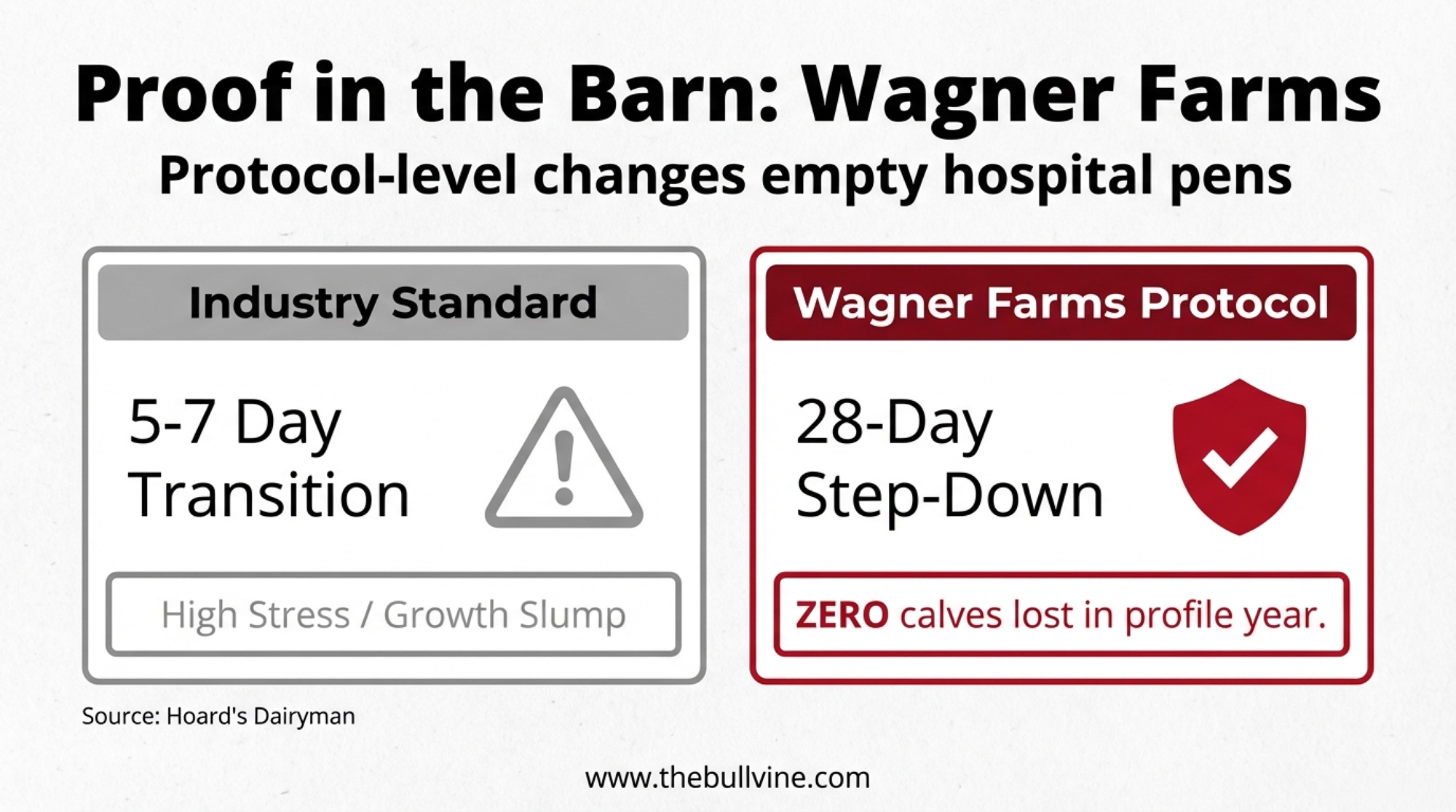
Step-Down Duration5–7 days28 days
ME Reduction per Step~50% (drop afternoon milk)<25% per step
Cumulative NFC at Weaning8–13 kg (typically SHORT)≥15 kg (threshold met)
Post-Weaning Treatment Rate10–15% (typical)Not disclosed; zero calves lost (profile year)
Calf Losses (Profile Year)5–8% (U.S. average, USDA NAHMS)0%

Their step-down stretches for a full 28 days — dramatically longer than the 5–7-day transitions common on most North American dairies. The targets are concrete: at least 8 pounds of starter per head per day in summer and 10 pounds in winter before calves finish weaning. “The more consistent the solids stay, the happier your calves will be,” Raatz told Hoard’s.

Their result for the profile year: zero calves lost.

That’s not just a health number. It’s a management statement. Wagner Farms wrapped nutrition, housing, social environment, and weaning timing into one coherent system — one where protocol-level changes empty hospital pensrather than fill them. Intake-based weaning didn’t work in isolation. It worked because the entire front end of the program was designed to get calves to eat grain early and consistently.

So what does biological readiness actually look like in numbers? That’s where Quigley’s research and Drackley’s review converge on a specific answer.

Why Higher Milk Programs Broke the 8-Week Rule

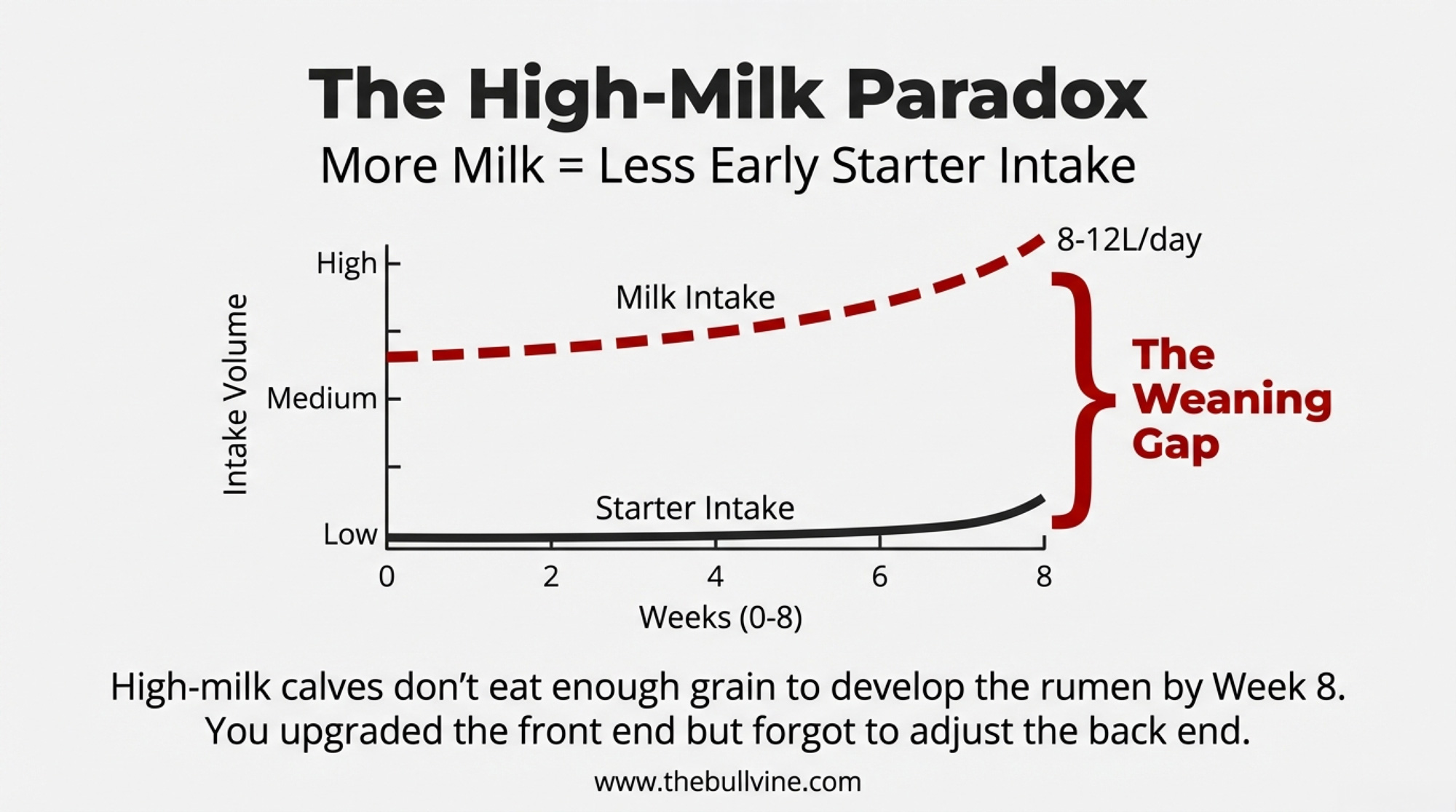
Here’s the paradox nobody planned for. Over the past decade, the industry moved hard toward feeding more milk — 8, 10, even 12 liters per day — because the data linking higher pre-weaning growth to first-lactation performance are strong. Soberon and Van Amburgh’s 2012 Journal of Dairy Science work at Cornell showed that for every 1 kg of preweaning ADG, heifers produced 850 kg more milk during first lactation in the university herd (1,244 animals) and 1,113 kg more in a commercial herd. Preweaning ADG accounted for 22% of the variation in first-lactation milk yield.

That was the right move. But higher milk intake suppresses early starter consumption.

The NASEM 2021 dairy nutrient requirements model confirms it: the more liquid energy a calf gets, the slower she ramps onto grain. Quigley sees the same thing in the field. When he looks at herds feeding 8–10 L/day and still weaning at 8 weeks, his verdict is blunt: more milk means less grain, so the rumen simply isn’t ready when the calendar says it’s time to quit milk.

The “glide path” to weaning has to be longer, or you drive calves into negative energy balance and ruminal acidosis during the transition — what he calls the “dark side” of feeding more milk. So we upgraded the front half of the feeding program without adjusting the back half.

James Drackley’s invited review in Applied Animal Science (Volume 41, Issue 3, June 2025) — “The Weaning Transition in Dairy Calves—Why So Traumatic?” — and Quigley in his ongoing Calf Notes work both point to this mismatch as the root of most post-weaning problems on well-managed dairies.

The Post-Weaning Slump You’re Probably Not Costing Out

NASEM 2021’s analysis of 64 studies found that solid-feed intake for weaned 8-week-old calves ranged from 2.16% to 4.45% of body weight — a wide range at the same age. Some of those calves are functioning as small ruminants. Others are essentially pre-ruminants with an underdeveloped fermentation vat.

When calves in that second group lose their milk, the energy math falls apart. Drackley’s review documents increased disease risk and depressed growth when weaning is too early or too abrupt, noting that “ruminal acidosis is likely more common than has been recognized and causes decreased intake, decreased growth, and diarrhea, especially in calves soon after weaning.”

Eckert et al. (2015, Journal of Dairy Science) showed this clearly: Holstein calves on an elevated plane of nutrition weaned at 8 weeks achieved 50% higher daily gains during the weaning transition than those weaned at 6 weeks. By three months of age, the later-weaned calves were 9 kg heavier and held that advantage through 150 days.

The 50% Energy Cut Nobody Talks About

Here’s a detail that doesn’t get enough attention. A lot of farms “step down” by simply cutting the afternoon milk feeding the week before weaning. Do the math on that. You just slashed ME intake by roughly 50% overnight.

Quigley’s take is direct — a reduction greater than about 25% of ME intake is probably excessive. He’s upfront that hard numbers on that threshold don’t exist in the published literature, but the biology lines up. At a 50% ME cut, the calf may be barely above maintenance. You can’t expect an animal to keep growing under that kind of energy shock.

Think about it from the calf’s perspective: in nature, the cow’s milk production tapers gradually along her lactation curve. Calves don’t just quit drinking on a Tuesday afternoon. Wagner Farms’ 28-day step-down mimics that natural taper. Most 5–7 day transitions don’t even come close.

The pattern holds across a much larger evidence base. Welk, Neave, and Jensen at Aarhus University reviewed 44 studies in a 2024 Journal of Dairy Science systematic review (Volume 107, Issue 8, pages 5237–5258) and found “consensus for positive effects (or at least no negative effects) on overall growth of calves weaned at later ages, over longer durations, based on starter intake.” They also found that “weaning based on starter intake had superior growth and feed intakes compared with calves weaned at a fixed earlier age.”

Wagner Farms’ 28-day step-down isn’t radical. It’s just what the science — and basic biology — supports when you actually follow it.

How Much Starter Before Dairy Calf Weaning? Quigley Put a Number on It

Quigley’s team went looking for the threshold in digestibility data. His 2019 Journal of Dairy Science symposium review compiled results from 83 calves and 24 pens across three published studies and back-calculated how much metabolizable energy calves actually extracted from the starter at different ages. Early in life, the real energy yield was well below what the NRC tables predicted. The rumen’s microbial community and papillae simply weren’t mature enough.

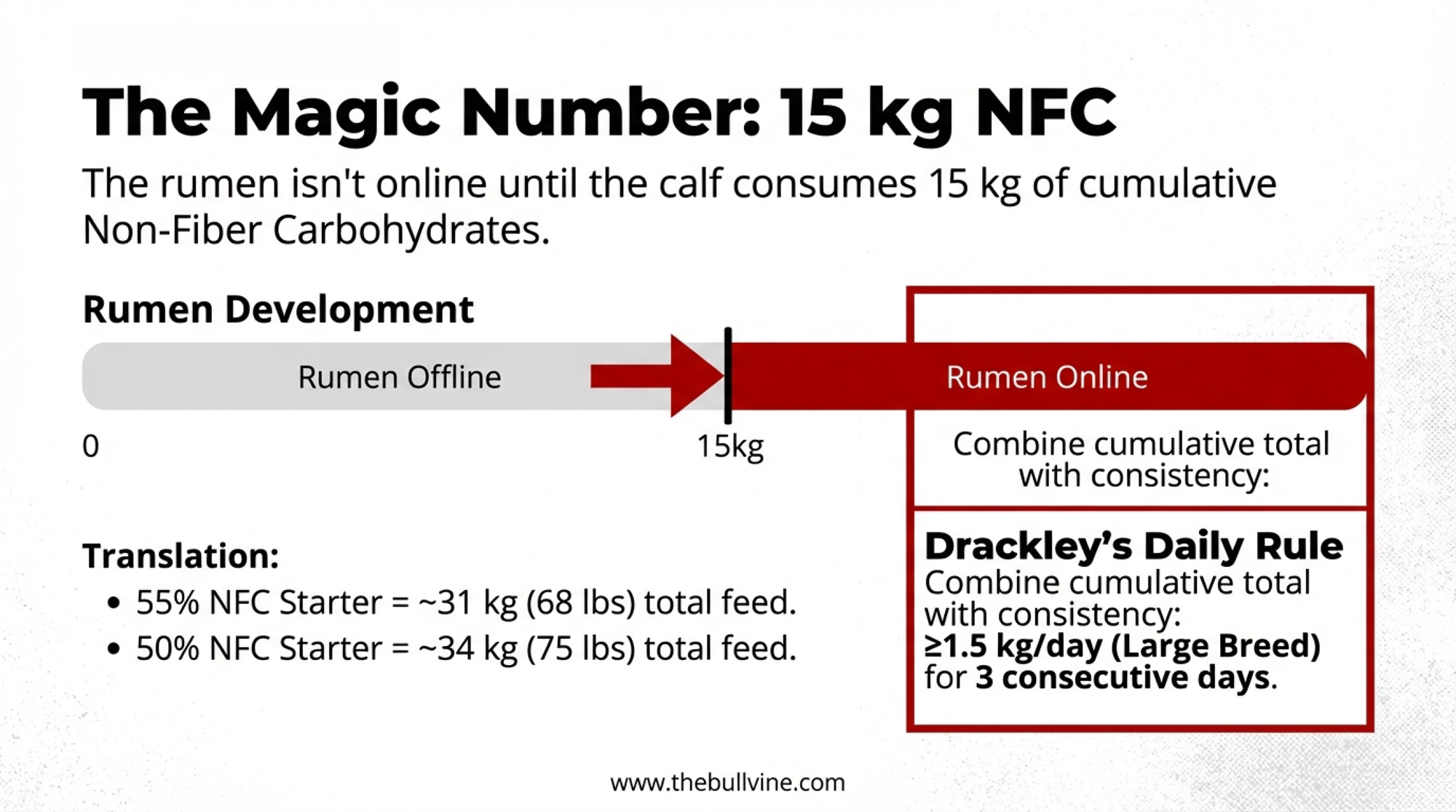
The tipping point: when calves consumed at least 15 kg of NFC, “ME calculated from digestibility measurements was similar to the ME calculated using NRC equations”—the rumen was finally “online.” Below it, your ration software is quietly overstating how much energy that grain is actually delivering.

When Quigley first shared that 15 kg cumulative NFC number, the research community’s reaction was basically, “Yes, biologically that makes sense.” The pushback wasn’t about the biology. It was the practical question every producer would ask next: how the heck do we know when a calf actually hits 15 kg?

For a typical calf starter at 55% NFC on a dry matter basis, that 15 kg of NFC works out to roughly 31 kg of total starter consumed as-fed. With a lower-NFC starter (50%), you’re looking at closer to 34 kg. The exact target depends on your starter’s composition.

Drackley’s daily intake gates pair with Quigley’s cumulative threshold. His Applied Animal Science review concluded that “calves should not be weaned until they are consuming an adequate amount of starter to allow the discontinuation of milk intake and should be weaned gradually rather than abruptly.” The Hoard’s Dairyman summary of his work raised the bar above the old rule of thumb: ≥1.5 kg/day starter DM for large-breed calves and ≥1.0 kg/day for small breeds, each for 3 consecutive days.

The old “1 kg/day for 3 days” isn’t enough for Holsteins. At that intake, NASEM modeling shows calves barely cover maintenance once milk disappears. Stack both gates — cumulative NFC near 15 kg and daily intake at the breed-appropriate threshold — and you’ve got a weaning signal grounded in physiology, not the calendar.

What Do CalfSim and NASCalf Tell You About Your Weaning Date?

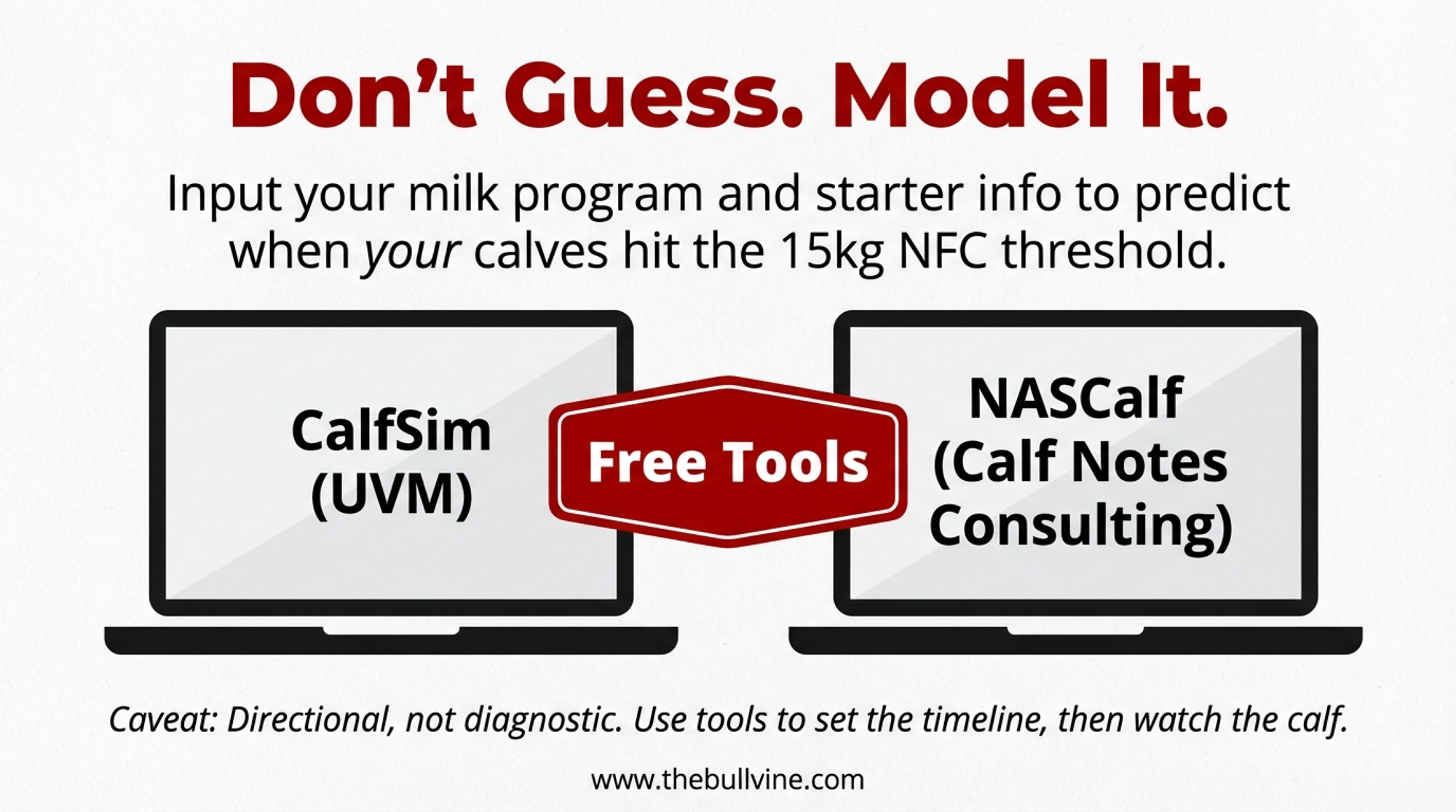
You don’t have to run this math on a whiteboard. Joao Costa’s group at the University of Vermont built CalfSim — a free, web-based decision-support tool that runs your feeding program using NASEM 2021 equations. Plug in breed, birth weight, milk program, starter composition, and environment. It gives you predicted daily and cumulative starter intake, NFC accumulation, ADG, bodyweight, and rearing costs.

Costa et al. (2025, JDS Communications) tested CalfSim against 27 studies covering 1,585 calves and 76 treatment groups. Bodyweight predictions hit an R² of 0.91 with an RMSE of 8.56 kg — meaning predictions can be off by about 19 lbs per calf.

Quigley’s own consulting work pushed the next step. Under Calf Notes Consulting, he launched NASCalf (tools.calfnotes.com), a more detailed intake and growth modeling tool built from the same biological logic. NASCalf goes deeper than CalfSim with a feed library, knowledge base, and more granular prediction of when calves accumulate enough NFC to support weaning.

A word of honest caution on both tools — and Quigley himself is the first to say it: don’t overpromise and underdeliver. CalfSim and NASCalf are models. They predict average performance. Your individual calves will scatter around that average, and farm-specific curveballs — a scours outbreak, a cold snap, poor-ventilation stress, a high-pathogen housing environment — can throw off even the best prediction. Think of the output as directional, not diagnostic. It tells you roughly when your program should get calves to the NFC threshold. It doesn’t tell you that calf #47 in hutch row B is ready today.

That said, directional beats are blind. Run your 6 L/day and 10 L/day programs side by side in either tool. You’ll see the high-milk calves reach the 15 kg cumulative NFC and 1.5 kg/day starter gates days or even weeks later. That gap is invisible until you model it.

What It Actually Costs — and What You Get Back

Let’s not pretend this is free. If calves need an extra 7–14 days on liquid feed, that’s real money. With U.S. Class III at just $14.59/cwt in January 2026 (USDA AMS, February 4, 2026) — and USDA’s own cost-of-production estimate showing expenses at $19.14/cwt against an $18.95 all-milk price — every input dollar has to earn its way back.

Cost or Return CategoryPer-Calf Impact150-Calf Herd (Annual)
Added Liquid Feed Cost (10 extra days @ $2/day)+$20+$3,000
Added Bedding & Labor+$10–20+$1,500–3,000
Total Added Rearing Cost per Calf+$30–40+$4,500–6,000
Reduced Treatment Costs (6% fewer treatments @ $25/treatment)+$1.50 (savings)+$225 (savings)
Faster Growth (15 kg heavier at 6 months)Value: ~$45 (3% lower age at first calving)+$6,750
First-Lactation Milk Gain (+850 kg @ $0.35/kg)+$297.50+$44,625
Net ROI per Calf (24-month payback)+$257.50–267.50+$38,625–40,125
Break-Even TimelineFirst lactation (month 24–26)First lactation cohort

Here’s the rough math on a 300-cow dairy raising 150 replacements per year. Extending weaning by 10 days, at roughly $2/day in added liquid feed costs, adds an extra $20 per head on the milk side alone. Factor in slower hutch turnover, additional bedding, and labor for intake monitoring, and the total added cost per head likely runs $3,0–40, depending on your system. On a tight-facility dairy, that 10-day extension could also require a temporary overflow solution or staggered starts for hutch turnover. Across 150 calves, that’s roughly $4,500–6,000 in added rearing expense.

A University of Wisconsin-Extension survey of 26 farms (published 2018) found autofeeder calves ran $6.35/day total vs. $5.84/day for individually housed, with liquid feed higher ($2.08 vs $1.60/day) but labor lower ($1.01 vs $1.39/day). Those costs have risen since, but the relative structure holds.

Against that, Soberon and Van Amburgh’s 2012 data showed 850–1,113 kg more first-lactation milk per 1 kg/day of preweaning ADG. Van Amburgh’s 2013 Journal of Animal Science meta-regression estimated roughly 1,551 kg of first-lactation milk per 1 kg/day of preweaning ADG. Even a conservative reading — say half the growth advantage holds — puts the first-lactation payback well ahead of the calf-barn cost.

But those returns arrive 24+ months later. That’s the tension: the expense hits now, the payoff compounds later. And the payoff only comes home if you’re keeping the heifer. If you’re raising beef-on-dairy calves headed for sale or feedlot, the NFC threshold still matters for health — but there’s no first-lactation payback. Run those numbers separately. 

Three Phases to Testing It in Your Barn

Nobody’s asking you to overhaul your calf program overnight. Quigley summed it up neatly: farms need simplicity and consistency, or the best protocol on paper will die in the barn. Variation is hard to manage. Intake-based weaning only works if your team can repeat it.

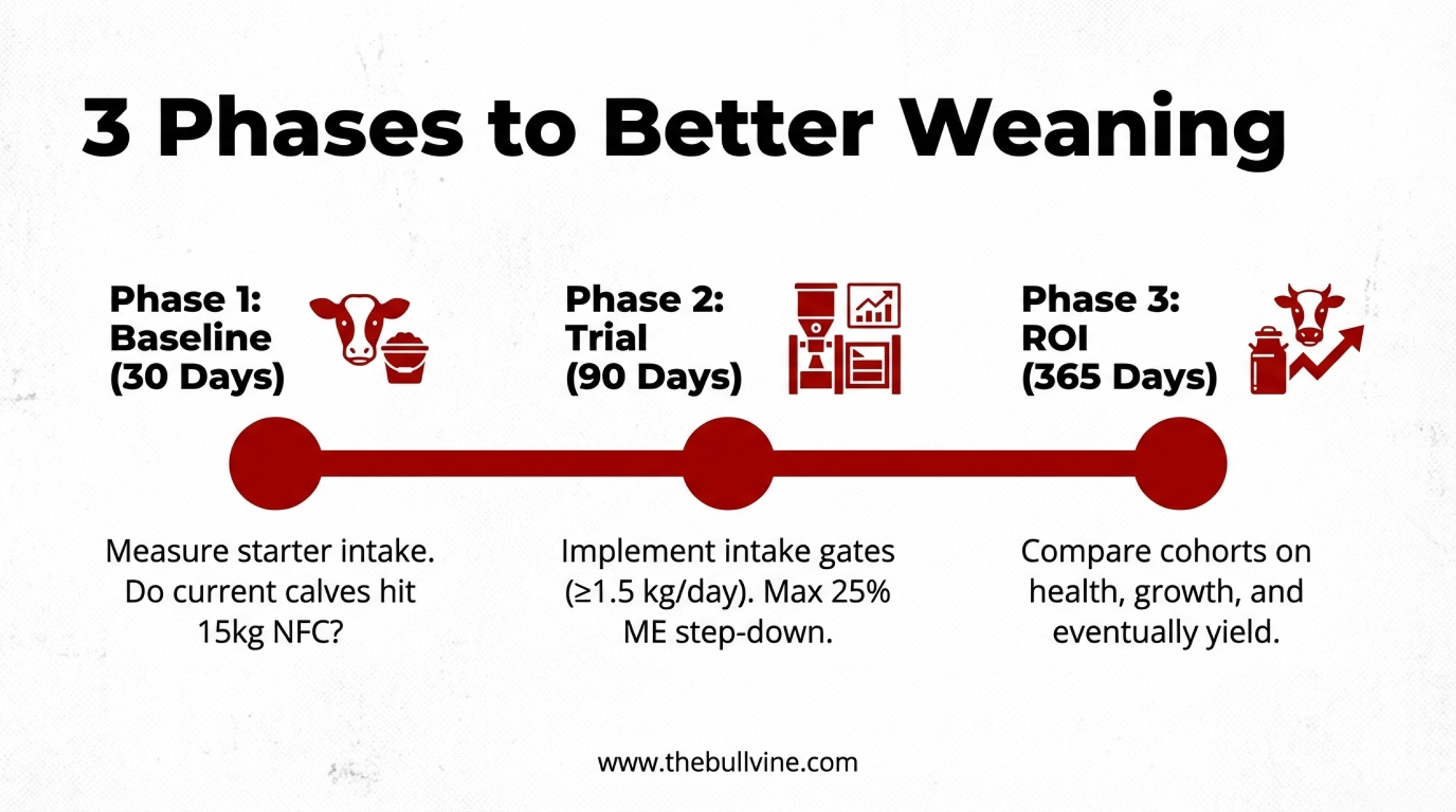
Phase 1 — 30-Day Baseline. Pick 15–20 calves approaching weaning. Measure starter intake with pre-weighed buckets and weigh-backs, even 2–3 times per week. Weigh calves before and after weaning. Run your current program through CalfSim or NASCalf. At the end of 30 days, answer one question: are your calves hitting the intake thresholds by the age you’re pulling milk?

Phase 2 — 90-Day Intake Gate Trial. Set a new rule: calves wean within an 8–10 week window, but only when they meet the daily starter gate. Stretch the step-down to 10–14 days minimum—and keep the ME reduction at any single step under 25%. Use CalfSim/NASCalf to predict when those gates should be reached, then compare that to what you see at the bunk. Track ADG and health events against your baseline.

Phase 3 — 365-Day Comparison. Run two cohorts for a full year — one on your old calendar, one on intake-based weaning informed by CalfSim or NASCalf. Track growth to 6 months, age at breeding, treatment costs, and first-lactation milk as records come in. This is where you build your own ROI case and decide how much complexity your crew can realistically manage every day.

Performance MetricAge-Based Weaning (8 weeks, calendar-driven)Intake-Based Weaning (9–10 weeks, gradual step-down)
Post-Weaning Treatment Rate (%)12–15%6–8%
ADG Post-Weaning (kg/day, weeks 9–12)0.52–0.680.75–0.88
Body Weight at 6 Months (kg)178–185193–201
Age at First Breeding (days)420–435405–415
First-Lactation Milk Yield (kg, 305d)10,200–10,80011,050–11,650 (estimated +850 kg)
Calf Losses (%)5–8% (U.S. average)2–4% (improved health)
Added Rearing Cost per CalfBaseline+$30–40 (extra milk days)

What This Means for Your Operation

If you’re feeding 4–6 L/day and weaning at 6–7 weeks, You likely need both more milk and a later weaning target. CalfSim or NASCalf can show which change moves the needle more.

If you’re feeding 8–10 L/day and weaning at 8 weeks: Your calves may be 1–2 weeks short of the NFC threshold. Run CalfSim or NASCalf with your actual starter analysis. If cumulative NFC at day 56 falls well below 15 kg, that’s your gap. And if your step-down protocol is “drop the afternoon feeding,” you’re probably cutting ME by 50% in one shot. That’s too much. Spread it out.

If you’re already weaning at 9–10 weeks with a gradual step-down, you may be closer than you think. A 30-day baseline will confirm it—and if your calves show no post-weaning ADG dip, don’t fix what’s working.

If you’re running an automated calf feeder that already tracks individual intake, you’ve solved the hardest part. Your feeder data tells you cumulative consumption. Map that to the NFC threshold using your starter’s NFC%, and you have an individualized weaning signal without any additional labor.

If you’re running a smaller herd raising 15–25 calves per year: Individual observation replaces modeling. You already know your calves. The value of CalfSim/NASCalf indicates whether your instincts align with the NFC math.

As a rough benchmark: if your current 8-week calves maintain an ADG above 0.75 kg/day for 2 weeks after weaning and your post-weaning treatment rate stays under 10%, you may not need to change anything. These aren’t published thresholds—they’re practical guideposts. Track your own data and let it tell you.

Quick NFC check for any program: Total starter consumed (kg as-fed) × 0.89 (DM factor) × your starter’s NFC%. For a 52% NFC starter, that’s roughly: total kg starter × 0.46. When that running total hits 15, you’re in the zone.

Key Takeaways

  • 15 kg cumulative NFC (roughly 31–34 kg starter as-fed depending on NFC content) is Quigley’s research-based threshold for rumen readiness at weaning (Quigley et al., 2019, JDS).
  • Daily intake gates: ≥1.5 kg/day for large-breed calves, ≥1.0 kg/day for small breeds, for at least 3 consecutive days before finishing weaning (Drackley, Applied Animal Science, Vol. 41, Issue 3, June 2025).
  • Don’t cut ME by more than 25% at any single step-down. Dropping the afternoon feeding slashes ME intake by roughly 50% — that’s a maintenance-level energy shock, not a weaning transition. Taper gradually, like the cow’s own lactation curve would.
  • Wagner Farms weans by intake with a 28-day step-down. The year Hoard’s profiled them, they lost zero calves. The calendar didn’t earn that result.
  • CalfSim and NASCalf are directional, not diagnostic. They predict average performance — your individual calves will scatter around that average, and farm-level curveballs will shift the timeline. But directional beats blind, and both tools finally answer the question producers have been asking: when should my calves be ready?
  • The extra milk days aren’t free — but the post-weaning slump isn’t free either, and only one of those costs shows up on your feed invoice.

The Bottom Line

Laura Raatz doesn’t check the calendar to decide when milk stops at Wagner Farms. She checks the bucket. And the science — from Quigley’s NFC threshold to Drackley’s Applied Animal Science review to Welk’s 44-study systematic review — says the bucket is right.

Pull your CalfSim or NASCalf report. Does cumulative NFC at your current weaning age hit 15 kg — or are you weaning calves that aren’t ready?

Learn More

The Sunday Read Dairy Professionals Don’t Skip.

Every week, thousands of producers, breeders, and industry insiders open Bullvine Weekly for genetics insights, market shifts, and profit strategies they won’t find anywhere else. One email. Five minutes. Smarter decisions all week.
NewsSubscribe
First
Last
Consent
Send this to a friend