






Archive for rumen development

The $6,600 6‑Week Weaning ‘Savings’ Trap: Why It Can Mean an $11,000 BRD and Calving Bill on a 300‑Cow Dairy

On a 300‑cow Wisconsin dairy, the milk‑replacer invoice said: “smart.” The heifer ledger quietly said the opposite.

Dave runs 300 Holsteins in central Wisconsin. For nearly a decade, he weaned every calf at 42 days and figured he was saving about $55 per head on milk replacer compared with an 8‑week program — roughly $6,600 a year across 120 heifers.
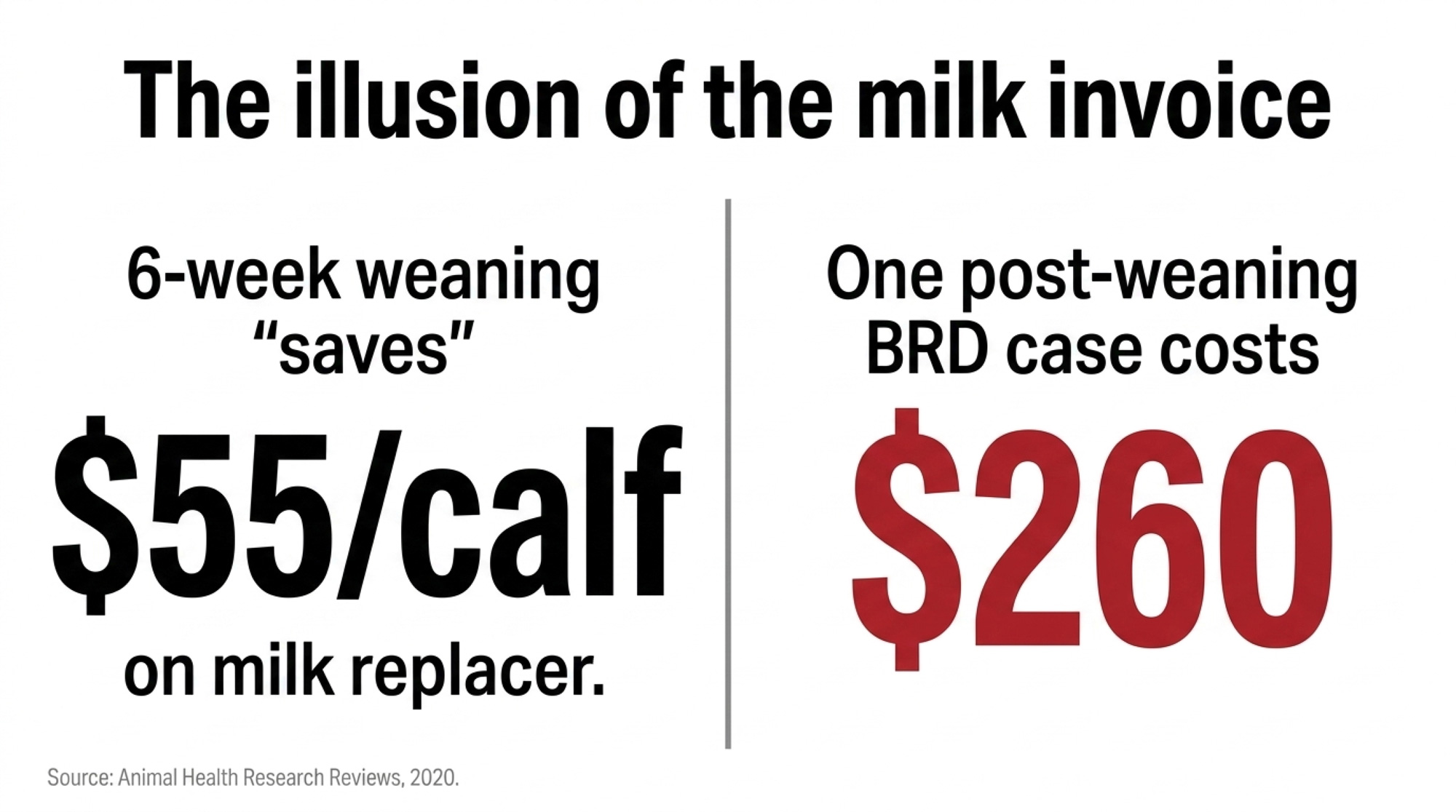
On the milk‑replacer invoice, that math looked good. When his vet put a $260 price tag on each pneumonia case, and they walked through what that did to age at first calving, the ledger flipped. The “cheap” 6‑week program looked a lot more like an $11,000 drag on the heifer enterprise.

Where Dave’s $6,600 Weaning “Savings” Actually Came From

Start with what Dave was paying for liquid feed.

He was on a 20/20 all‑milk replacer. His contracted price sat around $1.80 per pound — right in the middle of what many dairies are seeing, with 50‑lb bags often running from the mid‑$60s to the $120 range depending on formulation and brand.

His 6‑week program looked like this:

  • 1.25 lb/day of milk replacer powder
  • 42 days on milk
  • 1.25 × 42 = 52.5 lb of powder per calf

At $1.80/lb:

  • 52.5 lb × $1.80 = $94.50, call it $94 per calf

An 8‑week scenario at a slightly higher feeding rate:

  • 1.5 lb/day of powder
  • 56 days on milk
  • 1.5 × 56 = 84 lb of powder

At the same $1.80/lb:

  • 84 lb × $1.80 = $151.20, call it $151 per calf

On paper:

  • 6‑week: ≈ $94/head
  • 8‑week: ≈ $151/head

That’s a $55/head difference. Across 120 heifers a year:

  • 120 × $55 ≈ $6,600 per year

If you stop the spreadsheet at day 42 or 56 and never look past the bottle, you’d call that a win.

The trouble is, the costs don’t stop at the day you pull the nipple.

The BRD Ledger, the Milk Invoice, Never Shows

Dave’s vet didn’t start with rumen theory. He started with the sick sheet.

“How many calves are you actually treating for pneumonia after weaning?” he asked.

Over the previous couple of years, Dave’s records showed roughly 20% of his heifers — about one in five — were treated for BRD in the 30 days after weaning. Not every respiratory case hits right after the last bottle, but that’s where the spike was.

Like most producers, Dave guessed those cases cost him forty or fifty bucks each. A couple of drugs, a vet call, and some extra labor.

A 2020 paper in Animal Health Research Reviews priced it differently. Overton and colleagues looked at 104,100 U.S. dairy replacement heifers and compared animals with and without a BRD history in the first 120 days of life. They reported:

  • 36.6% of heifers had at least one BRD case in that early‑life window.
  • The estimated cost per incident BRD case was about $252 or $282 per heifer, depending on whether anticipated future milk differences were included. 

That cost rolled in:

  • Treatment drugs and vet time
  • Lost growth and delayed breeding
  • Higher culling risk as heifer and cow
  • Lower first‑lactation milk in affected animals

So the drugs are the cheapest part of the bill.

To keep the math grounded, Dave and his vet agreed on $260 per BRD case as a working number — basically the midpoint of the $252–282 range.
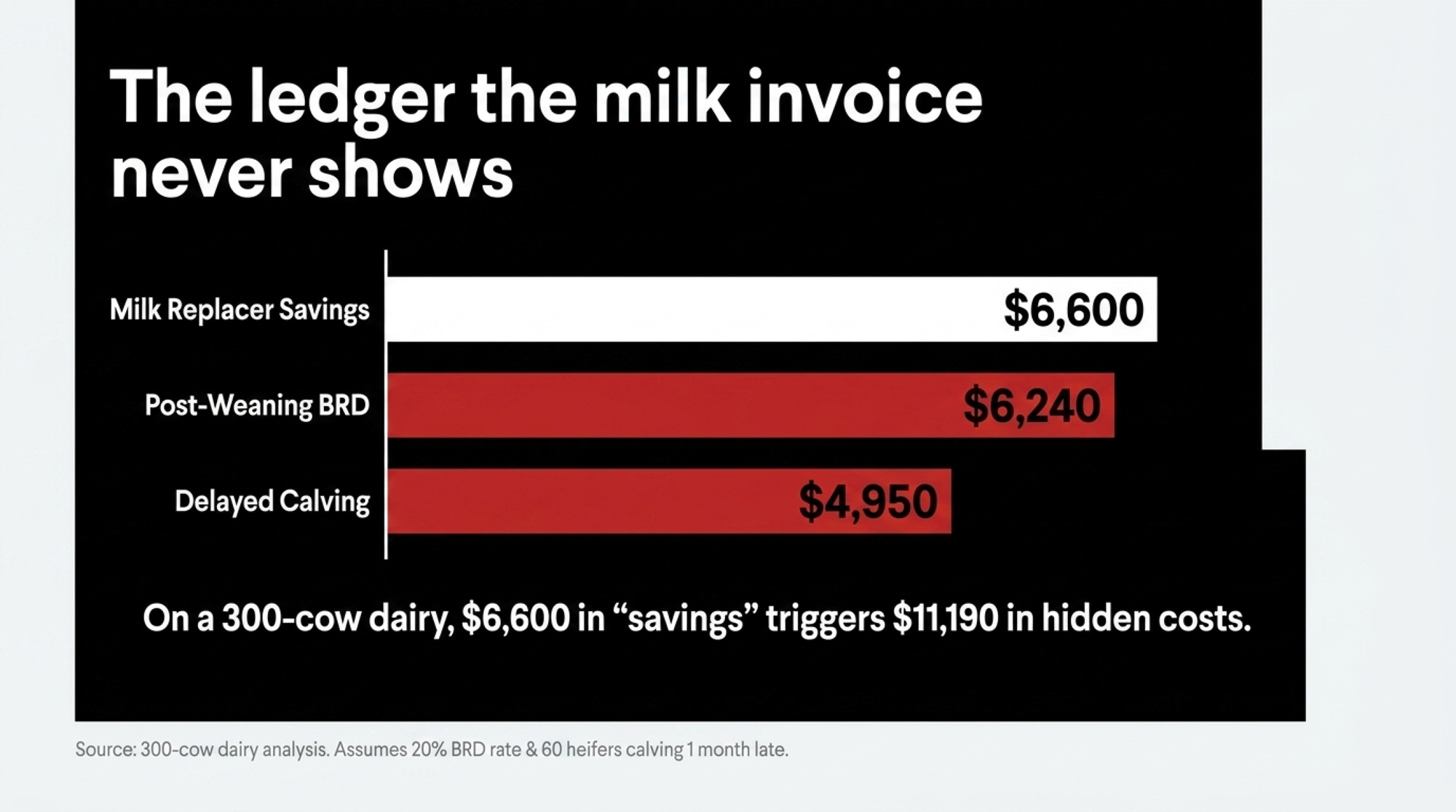
On 120 heifers a year, with a 20% post‑weaning BRD rate:

  • 20% of 120 = 24 cases
  • 24 × $260 = $6,240 per year in BRD cost

Compare that to the milk line:

  • Milk‑replacer “savings”: $6,600/year
  • BRD cost: $6,240/year

On Dave’s books, the money he “saved” on milk replacer was almost entirely eaten by pneumonia, before they even put a number on delayed calving.

Rumen Biology Doesn’t Care About Your Calendar

The next question was simple: “Why are so many calves getting sick after weaning?”

Dave’s nutritionist pulled out rumen‑development work from Jim Quigley and the latest weaning review from Aarhus University.

Quigley, through Calf Notes and a 2019 Journal of Dairy Science review, has pushed a specific biological threshold: a calf needs roughly 15 kg of cumulative non‑fiber carbohydrates (NFC) from starter — about 33 lb of fermentable carbohydrate — before the rumen is truly ready to take over.
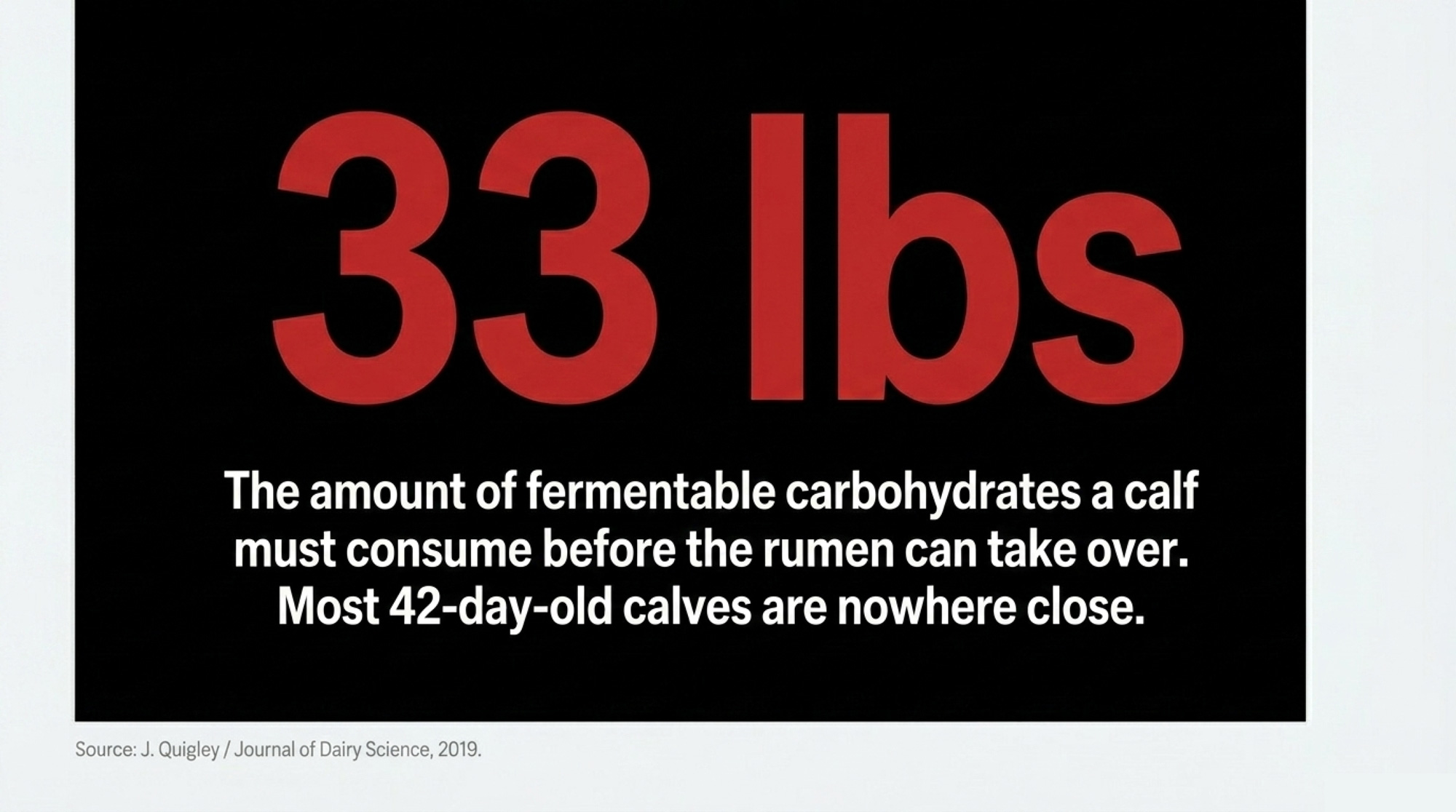
The Bullvine walked through his math earlier this year:

  • On a typical 8‑week program with 6 L of milk per day, many calves only get to around 11.5–13 kg of cumulative NFC from the starter by day 56 — 1.5–3.5 kg short of the 15 kg target. 
  • On higher‑milk programs, calves often don’t hit that 15 kg NFC mark until week 9 or 10, because liquid keeps them full and slows grain intake. 

That tracks with what you see in real barns: big, shiny 6‑week‑old calves that still hardly touch the starter bucket.

A 2024 systematic review in the Journal of Dairy Science by Welk, Neave, and Jensen compiled 44 studies on weaning practices. Their conclusions matched the barn experience:

  • Calves weaned later, over longer durationsbased on starter intake, or using step‑down milk removal, were more likely to show positive growth and intake responses
  • Weaning based on starter intake produced superior growth and feed intake compared with fixed‑age, earlier weaning.
  • When pre‑weaning milk allowances were adequate (over about 6 L/day), weaning after 8 weeks supported superior weight gain

At 42 days, when Dave pulled the last bottle, most of his calves were barely at a pound of starter a day. Some less. Nowhere near the 2+ lb/day that corresponds to Quigley’s 15 kg NFC target over time.

The milk disappeared anyway.

Extension recommendations from Penn State, Cornell, and the Canadian Dairy Code of Practice all push in the same direction: don’t fully wean Holstein‑size calves until they’re consistently eating roughly 2–3 lb of starter per day for several consecutive days. That’s just a practical way of making sure biology has caught up.

When you wean on a calendar date instead of an intake gate, you’re betting that rumen development is done just because the chart says “day 42.”

How a Rough Weaning Turns Into a 25‑Month Calving Problem

The pneumonia cases were obvious. The weaning slump was there too: calves coughing, sulking, backing off the starter for a week or ten days, then slowly coming around.

What wasn’t obvious was how those ten days of weaning showed up in the heifer yard.

The Welk review and several individual trials report that calves weaned later and more gradually not only eat more starter but also gain more weight per day around weaning and carry a bodyweight advantage through the post‑weaning period, especially when milk is generous pre‑weaning. Those gaps don’t magically close.

Now put heifer economics on top of that biology.

Iowa State University’s 2024 “What’s it Cost to Raise Your Dairy Best Heifer?” budget for a conventional 26,000‑lb herd shows:

  • Total cost to raise a heifer to 24 months: about $2,651
  • Daily heifer cost: roughly $2.65/head/day when you underload labor, up to about $3.15/head/day when labor is fully charged

The same ISU sheet runs the economics of tightening that up:

  • Cutting the heifer‑raising period from 24 to 23 months saves about $93 per heifer

Work it the other way:

  • Take a midpoint of $2.75 per day
  • One extra month ≈ 30 × $2.75 = $82.50 per heifer

When Dave’s team pulled his calving records, plenty of heifers were freshening closer to 25 months than 24. Many of those files carried simple notes like “small, waited.”

If half of his 120 heifers — 60 head — were calving just one month later than they needed to because they never quite caught up post‑weaning, that’s:

  • 60 × $82.50 ≈ $4,950 per year in extra heifer costs

Stack that on top of the BRD bill:

  • BRD: $6,240/year
  • Extra heifer month: $4,950/year
  • Total downstream cost: $11,190/year

Compare that to the weaning savings:

  • Milk‑replacer “savings”: $6,600/year
  • BRD + AFC cost: $11,190/year

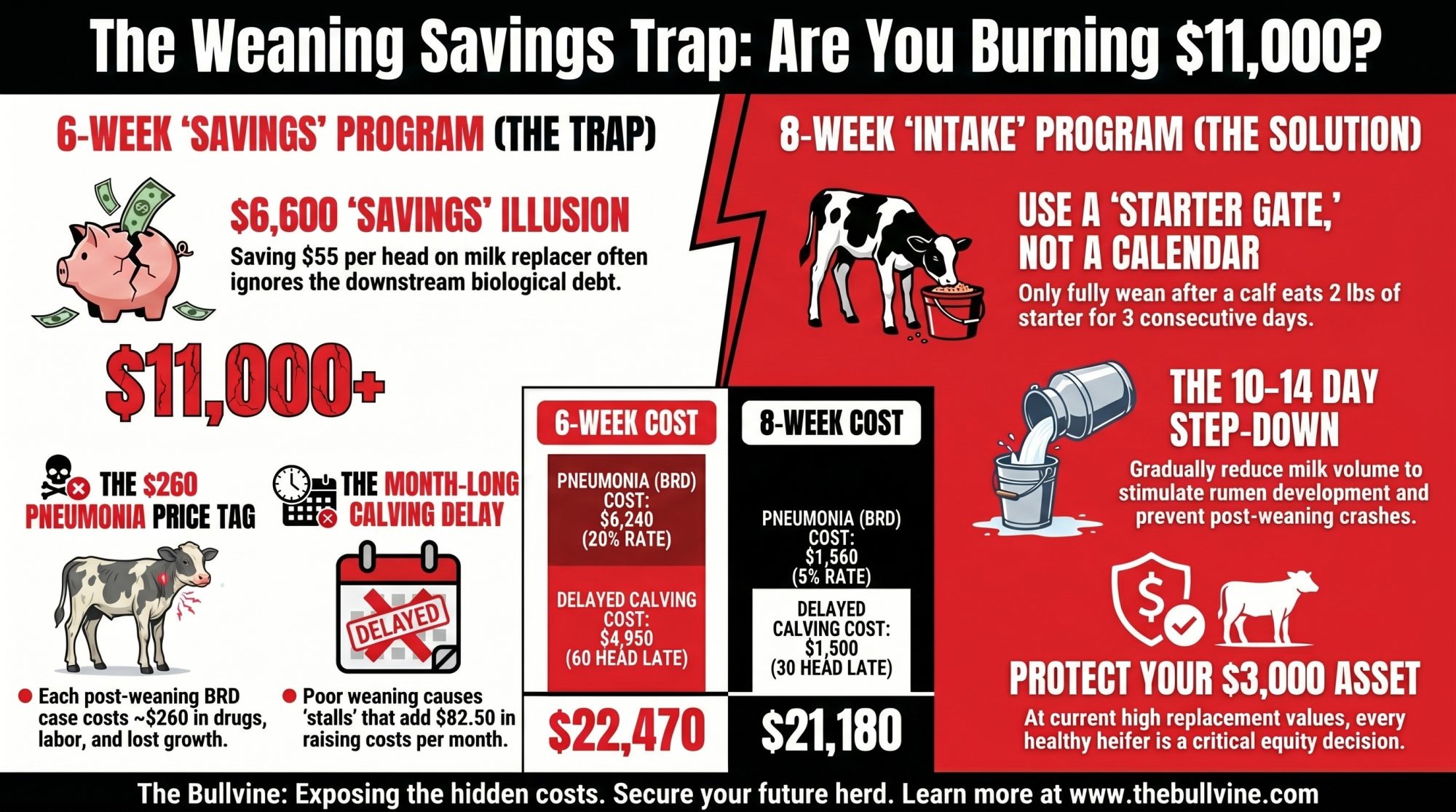
On Dave’s farm, the 6‑week calendar program wasn’t saving money. It was quietly burning about ,600 a year once the heifer and health costs were on the same page.

Cost Line6‑Week ‘Savings’ Program7–8 Week Intake‑Based Program
Milk replacer per year$11,280$18,120
BRD cost per year$6,240$1,560
Extra AFC/heifer‑day cost$4,950$1,500
Total annual heifer program cost$22,470$21,180

The Before‑and‑After Ledger on a 300‑Cow Herd

Once all three lines — milk replacer, BRD, and age at first calving — were in front of him, Dave could finally see what the weaning program was really doing.

Here’s how his example pencils out.

Assumptions (Dave’s Numbers)

  • Herd: 300 Holstein cows
  • Heifers raised/year: 120
  • Milk replacer price: $1.80/lb (contract)
  • BRD cost per case: $260, midpoint of the published $252–282 per case range. 
  • Post‑weaning BRD incidence (first 30 days):
    • Old 6‑week program: 20% (24 heifers)
    • New intake‑based program: 5% (6 heifers)
  • AFC drift:
    • Old: 60 heifers calving ~1 month late
    • New: 30 heifers calving ~10 days late on average

Old 6‑Week Calendar Program

Milk replacer:

  • 52.5 lb/calf × $1.80 ≈ $94.50 → $94 per calf
  • 120 × $94 ≈ $11,280 per year

BRD cost:

  • 20% of 120 = 24 BRD cases
  • 24 × $260 = $6,240 per year

AFC drift cost:

  • 60 heifers × $82.50 ≈ $4,950 per year

Total:

  • $11,280 + $6,240 + $4,950 ≈ $22,470 per year

New Intake‑Based 7–8‑Week Program

Milk replacer:

  • 84 lb/calf × $1.80 ≈ $151.20 → $151 per calf
  • 120 × $151 ≈ $18,120 per year

BRD cost:

  • 5% of 120 = 6 BRD cases
  • 6 × $260 = $1,560 per year

AFC drift cost:

  • 30 heifers drifting ~10 days: 10 × $2.75 ≈ $27.50/hd
  • 30 × $27.50 ≈ $825 per year
  • For simplicity, Dave’s team rounded this up to about $1,500 per year to stay close to ISU’s $93 per heifer‑month and acknowledge some extra variation. 

Total:

  • $18,120 + $1,560 + ~$1,500 ≈ $21,180 per year

Even with conservative rounding, the intake‑based 7–8‑week program came out roughly $1,300/year cheaper than the old 6‑week system on Dave’s farm.

Change the incidence rates or costs, and the gap will move. In some herds with very low BRD and tight AFC, 6‑week weaning might still hold its own on a full ledger.

The point is: until you put your own numbers into a similar layout, you’re guessing.

Why Those Dollars Matter More at $3,000 Heifer Values
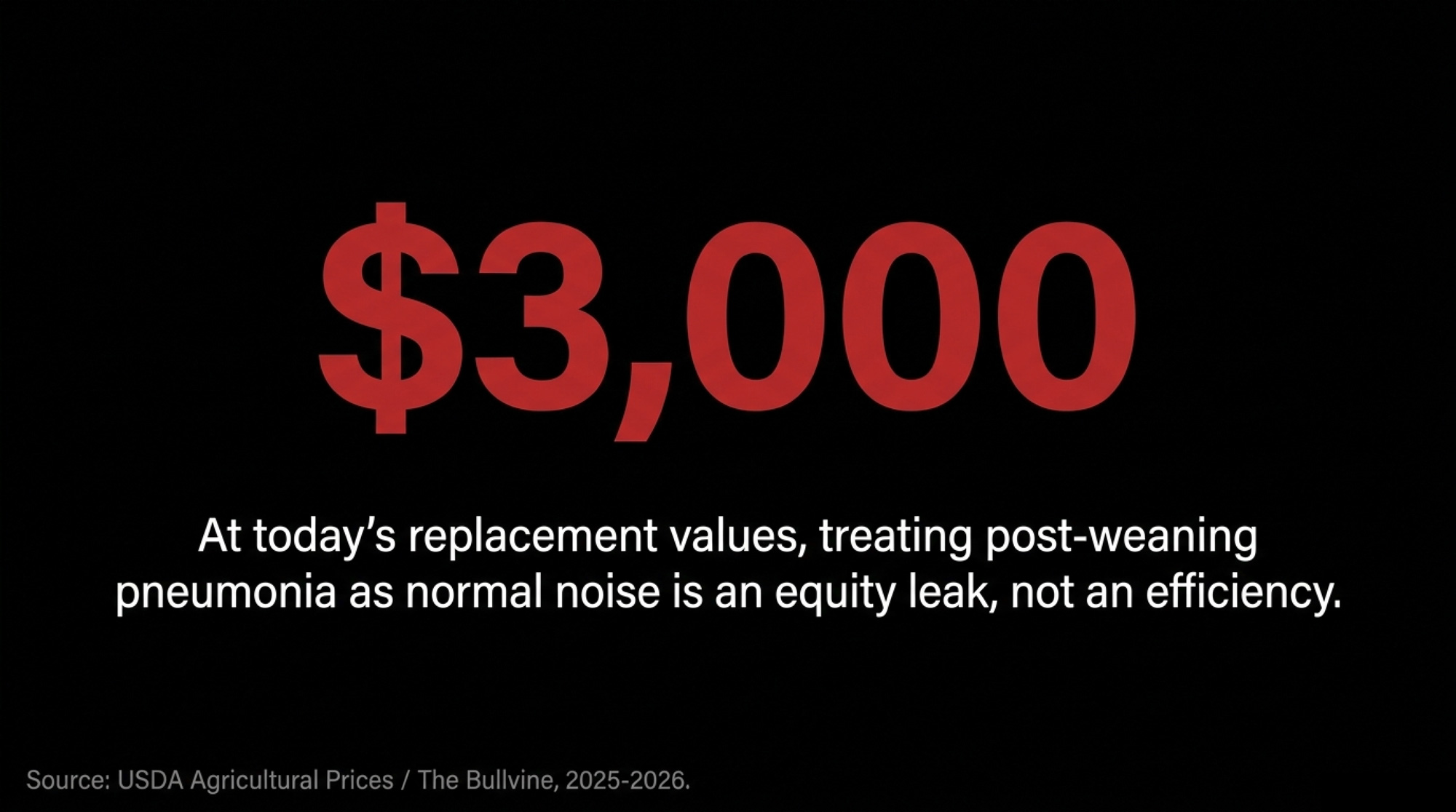
If replacements were cheap and plentiful, you might treat this like a nice‑to‑have improvement.

That’s not the market you’re in.

USDA’s Agricultural Prices reports and Ag Proud coverage show U.S. replacement cow prices averaging about $3,110 per head in October 2025, up roughly 3% from July and 16% from October 2024. By early 2026, averages had eased to around $2,860, but they were still high compared with prior years.

BRD Impact Line ItemConservative Cost per CaseCapital Context at ,000 Heifers
Drugs + vet timeSmall part of total loss
Lost early growth + delayed heat–0Pushes AFC toward 24.5–25+ months
Higher culling/poor first lact.0–0Lost future milk and genetics
Total economic hit per case≈2–28–9% of a ,000 heifer’s value

A Bullvine analysis across multiple datasets pegged average replacement heifers at about $3,010 per head in early 2026, with U.S. heifer inventories likely to tighten further before any meaningful rebuild around 2027.

At those values, every replacement in your place quietly carries a $2,800–$3,100 asset tag.

A BRD case that knocks a heifer out of your pipeline or drags down her first‑lactation performance is not just a sick‑calf problem. It’s an equity decision.

The same goes for age at first calving. If your heifers are freshening closer to 25 months than 22–24, you’re not just feeding a little extra grain. You’re tying up capital in animals that aren’t milking yet.

So the real question stops being, “How can I save $55 per calf on milk replacer?”

It becomes:

“At $3,000 per heifer, how much BRD and delayed calving am I willing to buy for a milk‑replacer ‘savings’ that only shows up if I ignore biology and time?”

What Changed in Dave’s Barn: From Calendar to Intake

Dave didn’t flip his program because somebody told him 6‑week weaning was “wrong.” He changed because his own numbers — and a few published ones — said the calendar was costing him.

The decision they made was simple:

  • The calendar no longer decides when a calf is weaned.
  • The calf’s starter intake does.

Three practical changes were made that are real.

1. Intake Became a Gate, Not a Guess

They added one line to the calf card:

“3 days at ~2 lb starter before full wean? Y/N”

Then they did a five‑minute exercise:

  • Weighed a full scoop of their calf starter and wrote on the wall: “1 scoop ≈ X lb.”

From that point forward:

  • No calf was fully weaned until she had eaten roughly 2 lb of starter per day for three consecutive days — verified with the scoop.
  • If she wasn’t there at day 42, she kept her last feeding until she hit that gate.

This lines up with Quigley’s 15 kg NFC concept — calves need to accumulate around 31–34 kg of starter at typical NFC levels to reach that threshold — and with Drackley’s extension‑level recommendation of ≥1.5 kg/day (3.3 lb) of starter dry matter for several days before full weaning.

It also mirrors what Penn State, Cornell, and the Canadian Code of Practice have been saying in plainer language: use starter intake as your weaning trigger, not age alone.

2. They Stretched Weaning Into a Planned 10–14‑Day Step‑Down

Under the old program, the milk schedule went from “full” to “none” at 6 weeks. No ramp.

Expense Category6-Week “Savings” Program8-Week “Intake” ProgramImpact of Change
Milk Replacer$11,280$18,120+$6,840 (Cost)
BRD/Pneumonia$6,240 (20% rate)$1,560 (5% rate)-$4,680 (Saving)
Delayed Calving (AFC)$4,950 (60 head late)$1,500 (30 head late)-$3,450 (Saving)
TOTAL ANNUAL COST$22,470$21,180-$1,290 (Net Gain)

Under the revised program, they:

  • Cut milk volume by about 50%, roughly two weeks before the earliest possible weaning window.
  • Held that reduced feeding while watching starter intake.
  • Pulled the last feeding only after the intake gate was met.

In practice, that meant:

  • Step‑down starting somewhere in week 6
  • Full weaning happens in week 7 or 8 for most calves, depending on their starter intake

That’s exactly the pattern the 2024 Welk review found supported smoother growth: calves weaned later, over longer durations, and based on intake had better performance through the transition, particularly when pre‑weaning milk allowances were higher.

For Dave, the visible payoff was fewer calves crashing when milk disappeared and fewer heifers falling behind by the time they hit breeding pens.

3. They Changed the Starter to Pay for the Program

The last piece was feed, not philosophy.

Dave and his nutritionist swapped out a fine, dusty pellet for a textured starter with visible grain and enough fermentable starch to actually drive rumen development. If you want calves to hit 2 lb/day before weaning, the starter has to be something they want to eat.

They also moved to a starter that included a Saccharomyces cerevisiae fermentation product (SCFP). A 2022 Journal of Dairy Science trial found that calves fed SCFP had better post‑weaning growth and feed efficiency and required fewer respiratory treatments through four months of age, even though pre‑weaning gains were similar between groups. A 2024 review on SCFP as a postbiotic outlined how these products may support immune and rumen function in calves and cows.

Weaning Feature6‑Week Calendar ProgramIntake‑Based 7–8 Week Program
Weaning triggerFixed age (42 days)Starter intake (~2 lb/day × 3 days)
Weaning durationAbrupt, <3 days step‑downPlanned 10–14 day step‑down
Post‑weaning BRD in first 30 days20% of heifers (24/120)5% of heifers (6/120)
Typical starter intake at full weanOften <1 lb/day2–3 lb/day
Heifers calving ≥1 month late (per yr)60 head30 head (about 10 days late)
Annual extra AFC + BRD cost≈$11,190≈$3,060

You can waste a lot of money on additives that don’t pay. In this case, the economics looked reasonable:

  • If better palatability and SCFP‑supported gut health pull starter intake forward and trim just a handful of $252–282 BRD cases per year.
  • The extra cost of a higher‑end starter becomes cheap insurance relative to $3,000 heifers.

Three Economic Paths for Your Weaning Program

Not every herd is Dave’s herd. Your BRD rates, milk replacer price, labor, and heifer inventory pressure will look different.

But the decision paths are similar.

Path 1: Defend 6‑Week Weaning With Your Own Data

Early weaning can still make economic sense in some herds.

When this path works:

  • Your post‑weaning BRD incidence in the first 30 days is consistently in the single digits.
  • Calves are reliably eating 2+ lb of starter per day by day 40–42.
  • Your heifers are calving around 22–24 months without a pattern of “small, waited” notes.

What it demands:

  • At least 12–24 months of calf treatment and AFC records you actually trust.
  • A simple intake check to avoid assuming calves are at 2+ lb when they aren’t.

If those numbers look good, your 6‑week program may genuinely be a savings strategy rather than a hidden cost.

If you don’t have the records, you’re not defending 6‑week weaning. You’re just hoping it’s fine.

Path 2: Triage High‑Risk Calves Into 7–8‑Week Intake‑Based Weaning

You don’t have to flip the whole calf barn at once.

Triage play:

  • Keep the 6‑week target as your default on paper.
  • Any calf that hasn’t hit your 2 lb/day intake gate by day 40–42 gets pushed into a 10–14‑day step‑down and weaned later, once she meets the gate.
  • Track BRD and 90‑day weights for this group separately.

Economics:

  • You spend more milk replacer only on calves that are biologically behind the curve.
  • These are often the same calves driving your post‑weaning BRD and extra heifer months, so improvements here have outsized ROI.

This path works well for herds that have:

  • Reasonable calf labor and discipline.
  • Chronic trouble with a specific band of high‑risk calves.

Path 3: Redesign Weaning Around Heifer ROI and $3,000 Replacements

If your post‑weaning BRD rate is in the teens or higher and your average AFC is drifting toward 24.5–25+ months, it may be time for a full reset.

What a redesign includes:

  • A standard intake gate (for example, “3 days at ~2 lb starter before full wean”).
  • A built‑in 10–14‑day step‑down that fits your chore rhythm.
  • A starter that calves actually consume, with formulation aimed at hitting Quigley’s 15 kg NFC before milk disappears.
  • Routine pricing of BRD and heifer days off your own numbers — not generic assumptions — at least once a year.

When this path pays fastest:

  • You’re raising your own replacements in a high heifer‑value environment ($2,800–3,100/head).
  • You have a clear pattern of post‑weaning disease and delayed calving.
  • You’re thinking about heifers as capital investments, not just “the young stock.”

What This Means for Your Operation

  • If your post‑weaning BRD incidence is above roughly 15–20% and you’re weaning at 6 weeks, assume your weaning program is a financial risk, not an efficiency. Once each case is priced around $252–282, and you add the cost of extra heifer days, the milk‑replacer “savings” look a lot like Dave’s — quickly eaten up by disease and delayed calving. 
  • If your average age at first calving is north of 24 months, treat that as a calf‑program red flag, not just a breeding issue. ISU’s 2024 budget puts the cost of an extra heifer month around $80–100, depending on labor. Until you understand why your heifers are late, your biggest heifer‑cost lever is probably in the calf barn. 
  • If you don’t have a simple starter‑intake gate built into your weaning protocol, you’re making a capital decision with no biological checkpoint. A weighed scoop and a “3 days at ~2 lb starter? Y/N” checkbox turn that into a gate you can manage and adjust.
  • If you’re valuing or buying heifers at $2,800–3,100 and still treating BRD as a $40 problem, you’re underpricing your own risk. Using the $252–282 per‑case economics for heifer BRD puts you in the right ballpark for capital‑level decisions, not just vet‑bill conversations. 
  • If you want a 30‑day move that doesn’t blow up your chores, start with a BRD + AFC audit. In the next month, pull 12–24 months of calf/heifer records, count your BRD cases in the first 120 days (especially the 30 days post‑weaning), calculate your own BRD cost (cases × ~$260), measure how much later BRD heifers calved, and put that next to your milk‑replacer “savings.” That one piece of paper will tell you whether your current weaning program is defensible or overdue for a redesign.
Key Takeaways

  • If your post‑weaning BRD rate is roughly 15–20% and you’re relying on a 6‑week calendar, the odds are high that you’re not actually saving money on milk replacer once you factor in BRD and delayed calving.The $6,600 that looks like savings in the calf‑feed column can be more than offset by $11,000‑plus in disease and extra heifer days on a 300‑cow herd. 
  • If your average age at first calving is over 24 months, each additional month quietly costs you about $80–100 per heifer. Until that distribution is under control, your fastest heifer‑cost improvement usually sits in intake‑based weaning and grower management, not just semen choice or breeding targets. 
  • If you’re not using starter intake as a weaning gate, your weaning program is a guess, not a strategy.Adding a simple intake trigger and a 10–14‑day step‑down is one of the cheapest, cleanest risk‑management moves you can make in the heifer enterprise.
  • If you’re handling $3,000 heifers in a tight inventory market, treating pneumonia and late calving as “normal noise” is an equity decision. The question isn’t just “Can we live with it?” It’s “Is this the risk position we want to own at today’s heifer values?”

The Bottom Line

Dave didn’t walk away from the 6‑week weaning because someone told him it was outdated. He walked away because, once he stacked his milk‑replacer spend, post‑weaning BRD cases, and ages at first calving on the same ledger, the numbers said the calendar was quietly burning cash.

If you pulled the same reports for your herd and laid them out side by side, would your weaning program look like a savings strategy — or like a risk position you haven’t really priced yet?

The numbers above are built on a 300-cow Wisconsin example with one contractor milk-replacer price and two BRD incidence scenarios. Your herd runs on different inputs — and the answer changes fast when you swap in your own BRD rate, your own replacer cost, and your own AFC. Use the calculator below to run the same ledger with your numbers.

Learn More

The Sunday Read Dairy Professionals Don’t Skip.

Every week, thousands of producers, breeders, and industry insiders open Bullvine Weekly for genetics insights, market shifts, and profit strategies they won’t find anywhere else. One email. Five minutes. Smarter decisions all week.

NewsSubscribe
First
Last
Consent

Calf Weaning by Starter Intake: Jim Quigley’s 15 kg NFC Threshold

Drop the afternoon milk, and you’ve just cut a calf’s ME by 50%. Jim Quigley says that’s an energy crash, not a weaning strategy.

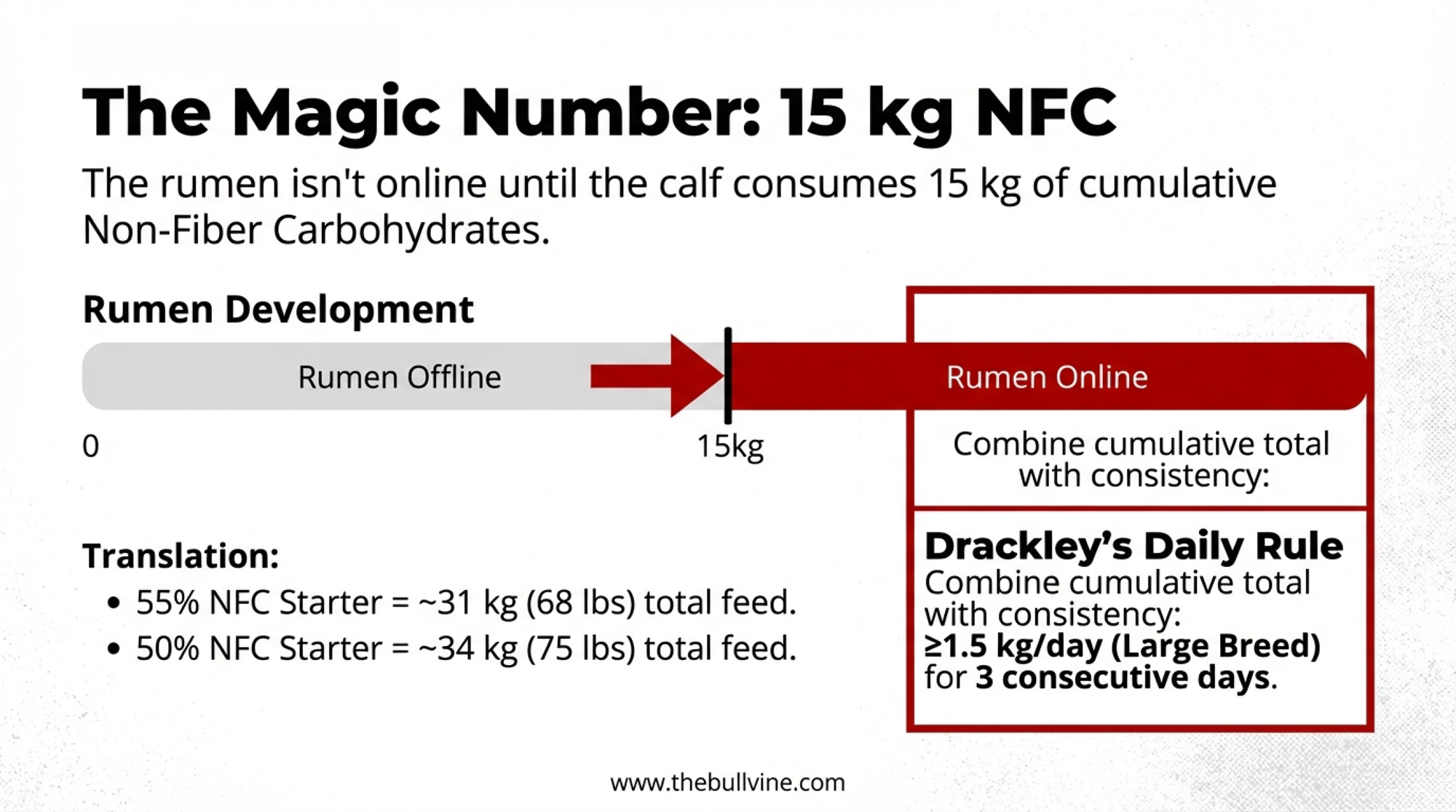
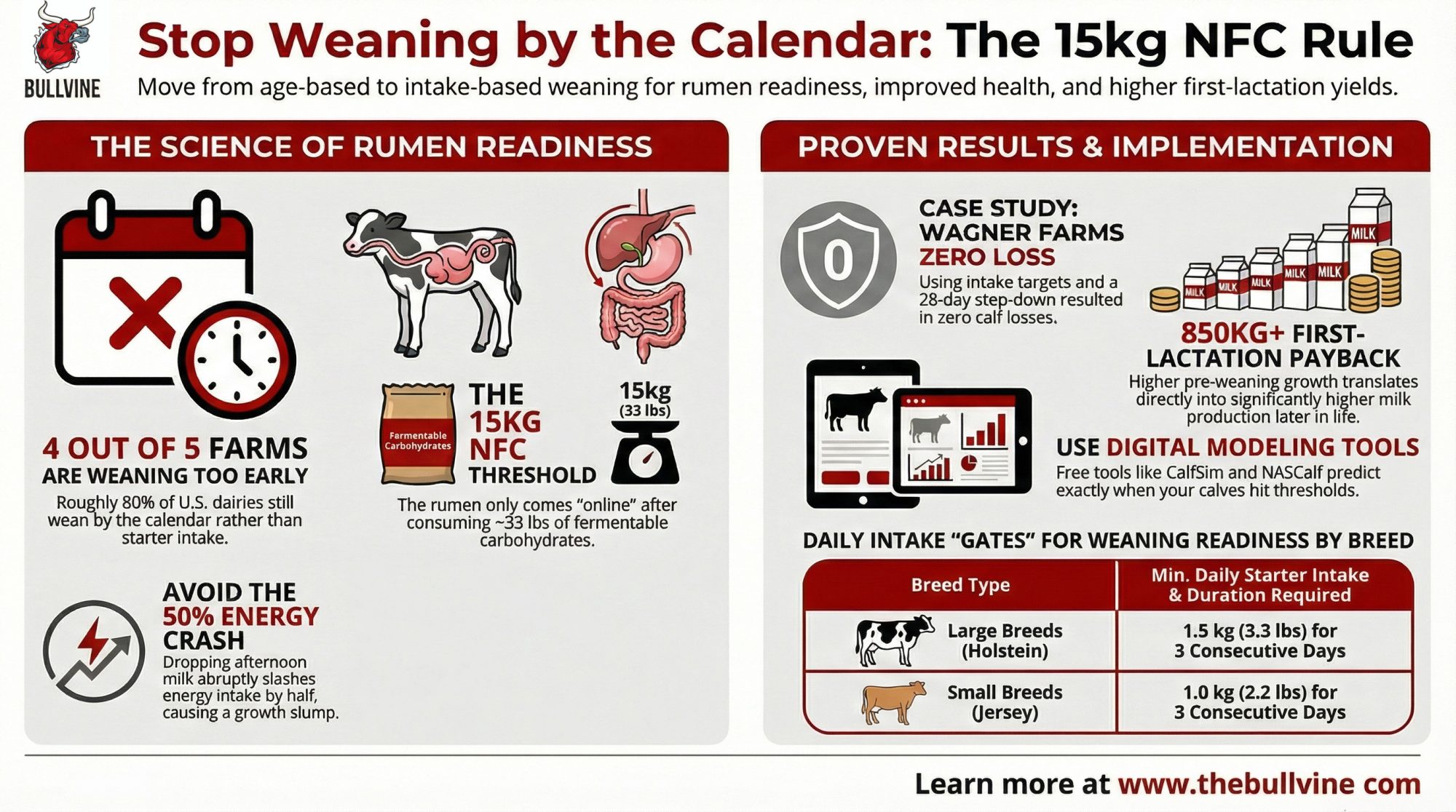
Executive Summary: Most dairies still wean calves by age, but Jim Quigley’s work shows the rumen isn’t truly ready until a calf has consumed about 15 kg of NFC from the starter — roughly 33 pounds of fermentable carbohydrate. Many 8‑week weaning programs, especially on higher milk intakes, never reach that mark, which helps explain the post‑weaning growth checks and treatment spikes producers see. Research from Quigley, NASEM 2021, and Jim Drackley’s 2025 weaning review all point in the same direction: later, intake‑based weaning with a gradual step‑down beats abrupt, calendar‑driven protocols on biological and performance outcomes. Wagner Farms in Wisconsin built their calf program around intake targets and a 28‑day weaning step‑down and recorded zero calf losses in the year. Free tools like CalfSim and NASCalf let you model when your own calves will reach the 15 kg NFC threshold and how different feeding plans affect intake, growth, and cost. The extra 7–14 days on milk might add $30–40 per calf, but the article walks through how smoother weaning, better growth, and higher first‑lactation yield can repay that investment — and gives a 30/90/365‑day plan to test it in your own calf barn.

intake-based weaning

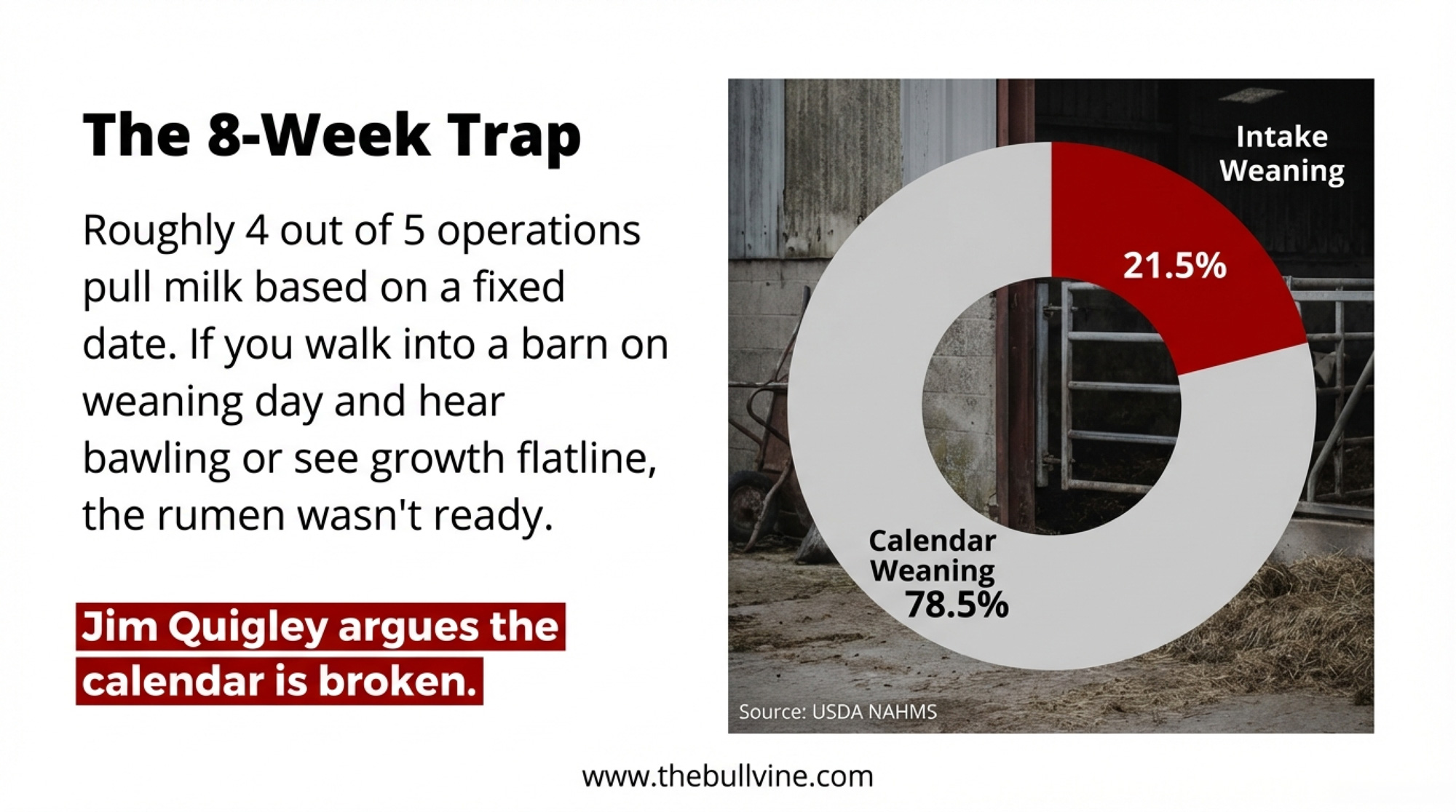
Only 21.5% of U.S. dairy farms wean calves based on starter intake rather than a fixed age. That’s the most recent national figure — USDA NAHMS Dairy 2014, now 12 years old and still the best we have. (The next NAHMS dairy study is anticipated in 2026, and anecdotal evidence suggests intake-based weaning has gained traction, but no national update exists yet.) What it means: roughly four out of five operations are pulling milk on a calendar. Jim Quigley thinks the calendar is broken.

Walk into a calf barn on weaning day, and you know the result. Bawling calves, scattered starter, a handful of 8-week-olds that clearly aren’t ready. Starter intake drops. A few get pulled for treatment. Growth flatlines, then slowly recovers.

Weaning ProtocolTypical Cumulative Starter Intake at Day 56Cumulative NFC ConsumedQuigley’s Readiness Threshold
Industry Standard (8 weeks, 6L milk/day)25–28 kg11.5–13 kg NFCSHORT by 1.5–3.5 kg
Accelerated Milk (8 weeks, 10L milk/day)18–22 kg8.3–10.1 kg NFCSHORT by 4.9–6.7 kg
Extended Intake-Based (9–10 weeks, 10L milk/day)31–34 kg14.3–15.7 kg NFC✓ Threshold met
Quigley’s Biological Threshold31 kg (55% NFC starter)15 kg NFCRumen functionally ready

The calf nutrition researcher behind Calf Notes (calfnotes.com) has spent years arguing that weaning by intake is the only approach that lines up with what’s actually happening inside the rumen. His benchmark is specific: roughly 15 kg of cumulative non-fiber carbohydrates from the starter. That’s about 33 pounds. And on a lot of North American dairies running accelerated milk programs, his modeling suggests calves don’t cross that line until week 9 or 10.

If you’re pulling milk at week 8, you’re asking the rumen to do a job it can’t yet handle. One Wisconsin operation already proved what happens when you stop asking.

Zero Calves Lost: What Wagner Farms Proved

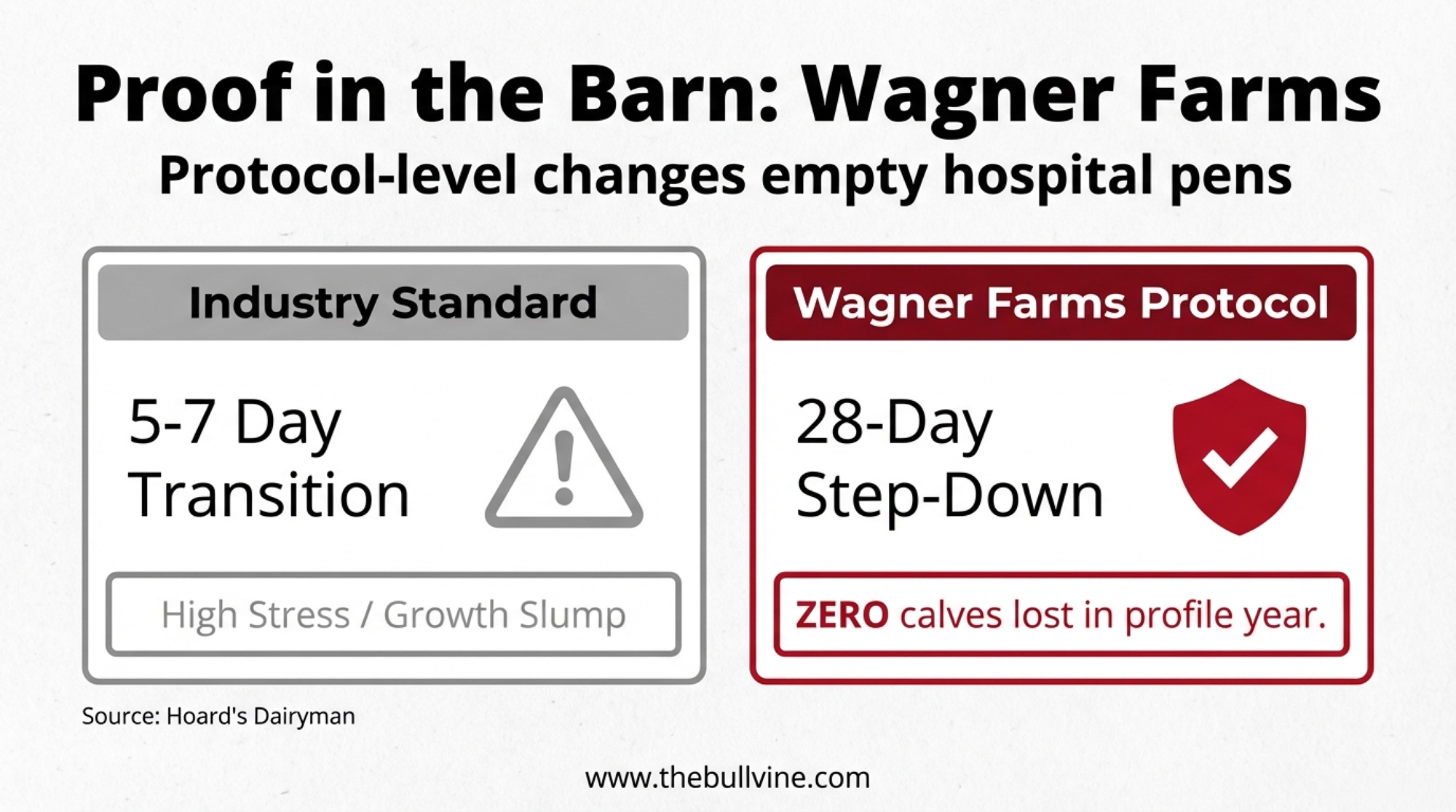
Wagner Farms in Oconto Falls, Wisconsin, doesn’t wean by the calendar. Profiled in Hoard’s Dairyman in 2020, the operation feeds whole milk with a milk balancer, uses paired calf housing, and weans calves based on starter intake. Laura Raatz, the farm’s calf manager, shared the approach at the Purina Leading Dairy Producers Conference.

Protocol ElementIndustry Standard (Most U.S. Dairies)Wagner Farms (Intake-Based)
Weaning TriggerFixed age (8 weeks)Starter intake threshold: 8 lbs/day (summer), 10 lbs/day (winter)
Step-Down Duration5–7 days28 days
ME Reduction per Step~50% (drop afternoon milk)<25% per step
Cumulative NFC at Weaning8–13 kg (typically SHORT)≥15 kg (threshold met)
Post-Weaning Treatment Rate10–15% (typical)Not disclosed; zero calves lost (profile year)
Calf Losses (Profile Year)5–8% (U.S. average, USDA NAHMS)0%

Their step-down stretches for a full 28 days — dramatically longer than the 5–7-day transitions common on most North American dairies. The targets are concrete: at least 8 pounds of starter per head per day in summer and 10 pounds in winter before calves finish weaning. “The more consistent the solids stay, the happier your calves will be,” Raatz told Hoard’s.

Their result for the profile year: zero calves lost.

That’s not just a health number. It’s a management statement. Wagner Farms wrapped nutrition, housing, social environment, and weaning timing into one coherent system — one where protocol-level changes empty hospital pensrather than fill them. Intake-based weaning didn’t work in isolation. It worked because the entire front end of the program was designed to get calves to eat grain early and consistently.

So what does biological readiness actually look like in numbers? That’s where Quigley’s research and Drackley’s review converge on a specific answer.

Why Higher Milk Programs Broke the 8-Week Rule

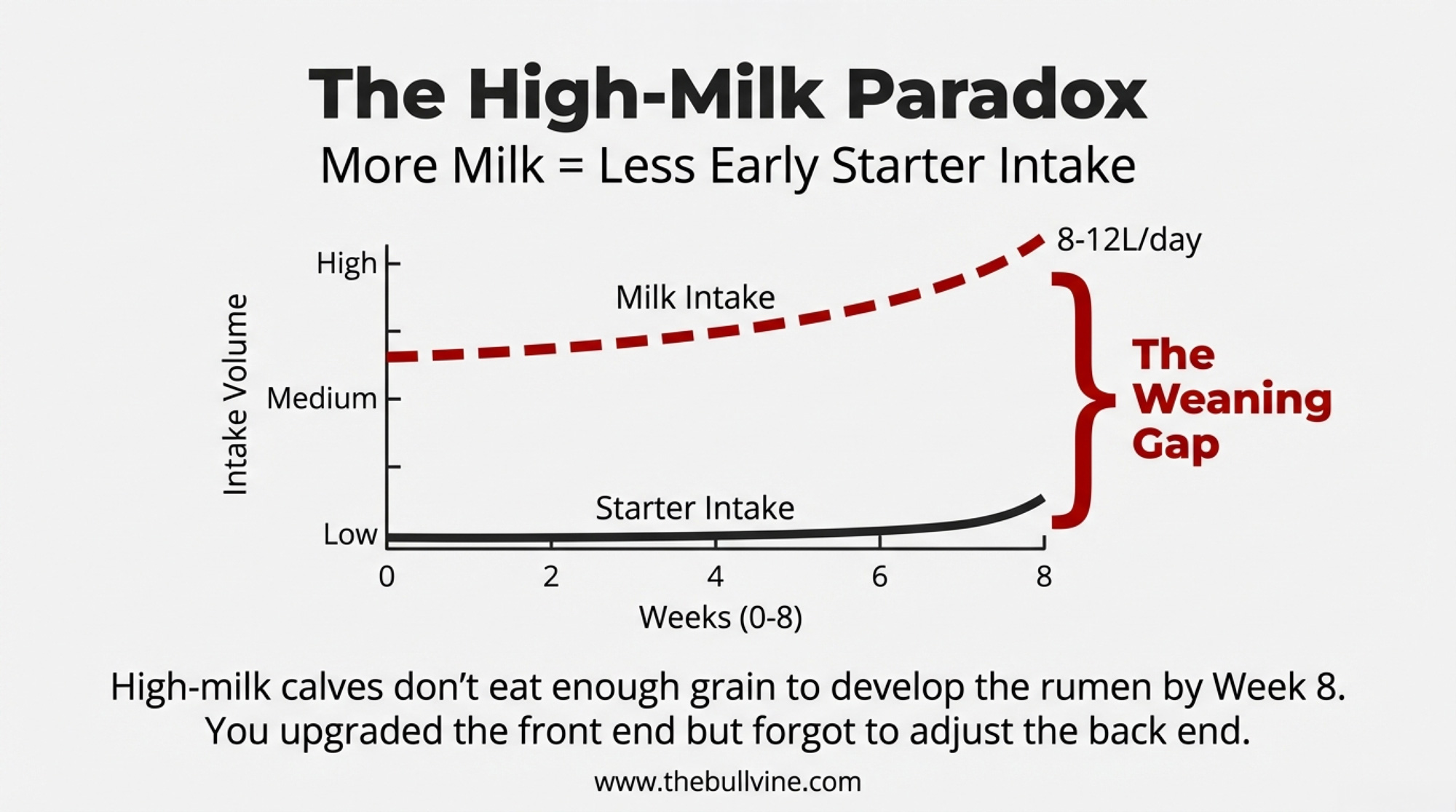
Here’s the paradox nobody planned for. Over the past decade, the industry moved hard toward feeding more milk — 8, 10, even 12 liters per day — because the data linking higher pre-weaning growth to first-lactation performance are strong. Soberon and Van Amburgh’s 2012 Journal of Dairy Science work at Cornell showed that for every 1 kg of preweaning ADG, heifers produced 850 kg more milk during first lactation in the university herd (1,244 animals) and 1,113 kg more in a commercial herd. Preweaning ADG accounted for 22% of the variation in first-lactation milk yield.

That was the right move. But higher milk intake suppresses early starter consumption.

The NASEM 2021 dairy nutrient requirements model confirms it: the more liquid energy a calf gets, the slower she ramps onto grain. Quigley sees the same thing in the field. When he looks at herds feeding 8–10 L/day and still weaning at 8 weeks, his verdict is blunt: more milk means less grain, so the rumen simply isn’t ready when the calendar says it’s time to quit milk.

The “glide path” to weaning has to be longer, or you drive calves into negative energy balance and ruminal acidosis during the transition — what he calls the “dark side” of feeding more milk. So we upgraded the front half of the feeding program without adjusting the back half.

James Drackley’s invited review in Applied Animal Science (Volume 41, Issue 3, June 2025) — “The Weaning Transition in Dairy Calves—Why So Traumatic?” — and Quigley in his ongoing Calf Notes work both point to this mismatch as the root of most post-weaning problems on well-managed dairies.

The Post-Weaning Slump You’re Probably Not Costing Out

NASEM 2021’s analysis of 64 studies found that solid-feed intake for weaned 8-week-old calves ranged from 2.16% to 4.45% of body weight — a wide range at the same age. Some of those calves are functioning as small ruminants. Others are essentially pre-ruminants with an underdeveloped fermentation vat.

When calves in that second group lose their milk, the energy math falls apart. Drackley’s review documents increased disease risk and depressed growth when weaning is too early or too abrupt, noting that “ruminal acidosis is likely more common than has been recognized and causes decreased intake, decreased growth, and diarrhea, especially in calves soon after weaning.”

Eckert et al. (2015, Journal of Dairy Science) showed this clearly: Holstein calves on an elevated plane of nutrition weaned at 8 weeks achieved 50% higher daily gains during the weaning transition than those weaned at 6 weeks. By three months of age, the later-weaned calves were 9 kg heavier and held that advantage through 150 days.

The 50% Energy Cut Nobody Talks About

Here’s a detail that doesn’t get enough attention. A lot of farms “step down” by simply cutting the afternoon milk feeding the week before weaning. Do the math on that. You just slashed ME intake by roughly 50% overnight.

Quigley’s take is direct — a reduction greater than about 25% of ME intake is probably excessive. He’s upfront that hard numbers on that threshold don’t exist in the published literature, but the biology lines up. At a 50% ME cut, the calf may be barely above maintenance. You can’t expect an animal to keep growing under that kind of energy shock.

Think about it from the calf’s perspective: in nature, the cow’s milk production tapers gradually along her lactation curve. Calves don’t just quit drinking on a Tuesday afternoon. Wagner Farms’ 28-day step-down mimics that natural taper. Most 5–7 day transitions don’t even come close.

The pattern holds across a much larger evidence base. Welk, Neave, and Jensen at Aarhus University reviewed 44 studies in a 2024 Journal of Dairy Science systematic review (Volume 107, Issue 8, pages 5237–5258) and found “consensus for positive effects (or at least no negative effects) on overall growth of calves weaned at later ages, over longer durations, based on starter intake.” They also found that “weaning based on starter intake had superior growth and feed intakes compared with calves weaned at a fixed earlier age.”

Wagner Farms’ 28-day step-down isn’t radical. It’s just what the science — and basic biology — supports when you actually follow it.

How Much Starter Before Dairy Calf Weaning? Quigley Put a Number on It

Quigley’s team went looking for the threshold in digestibility data. His 2019 Journal of Dairy Science symposium review compiled results from 83 calves and 24 pens across three published studies and back-calculated how much metabolizable energy calves actually extracted from the starter at different ages. Early in life, the real energy yield was well below what the NRC tables predicted. The rumen’s microbial community and papillae simply weren’t mature enough.

The tipping point: when calves consumed at least 15 kg of NFC, “ME calculated from digestibility measurements was similar to the ME calculated using NRC equations”—the rumen was finally “online.” Below it, your ration software is quietly overstating how much energy that grain is actually delivering.

When Quigley first shared that 15 kg cumulative NFC number, the research community’s reaction was basically, “Yes, biologically that makes sense.” The pushback wasn’t about the biology. It was the practical question every producer would ask next: how the heck do we know when a calf actually hits 15 kg?

For a typical calf starter at 55% NFC on a dry matter basis, that 15 kg of NFC works out to roughly 31 kg of total starter consumed as-fed. With a lower-NFC starter (50%), you’re looking at closer to 34 kg. The exact target depends on your starter’s composition.

Drackley’s daily intake gates pair with Quigley’s cumulative threshold. His Applied Animal Science review concluded that “calves should not be weaned until they are consuming an adequate amount of starter to allow the discontinuation of milk intake and should be weaned gradually rather than abruptly.” The Hoard’s Dairyman summary of his work raised the bar above the old rule of thumb: ≥1.5 kg/day starter DM for large-breed calves and ≥1.0 kg/day for small breeds, each for 3 consecutive days.

The old “1 kg/day for 3 days” isn’t enough for Holsteins. At that intake, NASEM modeling shows calves barely cover maintenance once milk disappears. Stack both gates — cumulative NFC near 15 kg and daily intake at the breed-appropriate threshold — and you’ve got a weaning signal grounded in physiology, not the calendar.

What Do CalfSim and NASCalf Tell You About Your Weaning Date?

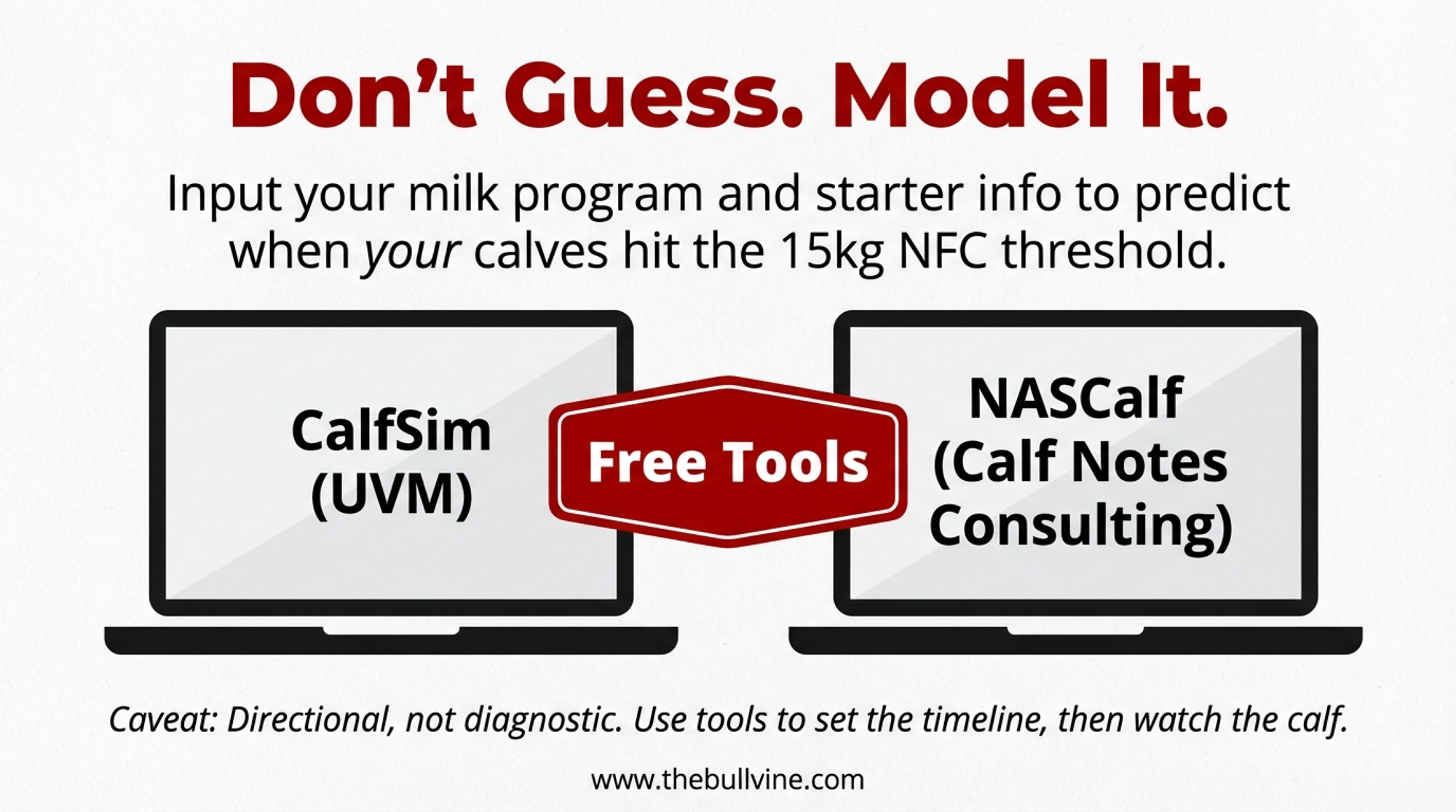
You don’t have to run this math on a whiteboard. Joao Costa’s group at the University of Vermont built CalfSim — a free, web-based decision-support tool that runs your feeding program using NASEM 2021 equations. Plug in breed, birth weight, milk program, starter composition, and environment. It gives you predicted daily and cumulative starter intake, NFC accumulation, ADG, bodyweight, and rearing costs.

Costa et al. (2025, JDS Communications) tested CalfSim against 27 studies covering 1,585 calves and 76 treatment groups. Bodyweight predictions hit an R² of 0.91 with an RMSE of 8.56 kg — meaning predictions can be off by about 19 lbs per calf.

Quigley’s own consulting work pushed the next step. Under Calf Notes Consulting, he launched NASCalf (tools.calfnotes.com), a more detailed intake and growth modeling tool built from the same biological logic. NASCalf goes deeper than CalfSim with a feed library, knowledge base, and more granular prediction of when calves accumulate enough NFC to support weaning.

A word of honest caution on both tools — and Quigley himself is the first to say it: don’t overpromise and underdeliver. CalfSim and NASCalf are models. They predict average performance. Your individual calves will scatter around that average, and farm-specific curveballs — a scours outbreak, a cold snap, poor-ventilation stress, a high-pathogen housing environment — can throw off even the best prediction. Think of the output as directional, not diagnostic. It tells you roughly when your program should get calves to the NFC threshold. It doesn’t tell you that calf #47 in hutch row B is ready today.

That said, directional beats are blind. Run your 6 L/day and 10 L/day programs side by side in either tool. You’ll see the high-milk calves reach the 15 kg cumulative NFC and 1.5 kg/day starter gates days or even weeks later. That gap is invisible until you model it.

What It Actually Costs — and What You Get Back

Let’s not pretend this is free. If calves need an extra 7–14 days on liquid feed, that’s real money. With U.S. Class III at just $14.59/cwt in January 2026 (USDA AMS, February 4, 2026) — and USDA’s own cost-of-production estimate showing expenses at $19.14/cwt against an $18.95 all-milk price — every input dollar has to earn its way back.

Cost or Return CategoryPer-Calf Impact150-Calf Herd (Annual)
Added Liquid Feed Cost (10 extra days @ $2/day)+$20+$3,000
Added Bedding & Labor+$10–20+$1,500–3,000
Total Added Rearing Cost per Calf+$30–40+$4,500–6,000
Reduced Treatment Costs (6% fewer treatments @ $25/treatment)+$1.50 (savings)+$225 (savings)
Faster Growth (15 kg heavier at 6 months)Value: ~$45 (3% lower age at first calving)+$6,750
First-Lactation Milk Gain (+850 kg @ $0.35/kg)+$297.50+$44,625
Net ROI per Calf (24-month payback)+$257.50–267.50+$38,625–40,125
Break-Even TimelineFirst lactation (month 24–26)First lactation cohort

Here’s the rough math on a 300-cow dairy raising 150 replacements per year. Extending weaning by 10 days, at roughly $2/day in added liquid feed costs, adds an extra $20 per head on the milk side alone. Factor in slower hutch turnover, additional bedding, and labor for intake monitoring, and the total added cost per head likely runs $3,0–40, depending on your system. On a tight-facility dairy, that 10-day extension could also require a temporary overflow solution or staggered starts for hutch turnover. Across 150 calves, that’s roughly $4,500–6,000 in added rearing expense.

A University of Wisconsin-Extension survey of 26 farms (published 2018) found autofeeder calves ran $6.35/day total vs. $5.84/day for individually housed, with liquid feed higher ($2.08 vs $1.60/day) but labor lower ($1.01 vs $1.39/day). Those costs have risen since, but the relative structure holds.

Against that, Soberon and Van Amburgh’s 2012 data showed 850–1,113 kg more first-lactation milk per 1 kg/day of preweaning ADG. Van Amburgh’s 2013 Journal of Animal Science meta-regression estimated roughly 1,551 kg of first-lactation milk per 1 kg/day of preweaning ADG. Even a conservative reading — say half the growth advantage holds — puts the first-lactation payback well ahead of the calf-barn cost.

But those returns arrive 24+ months later. That’s the tension: the expense hits now, the payoff compounds later. And the payoff only comes home if you’re keeping the heifer. If you’re raising beef-on-dairy calves headed for sale or feedlot, the NFC threshold still matters for health — but there’s no first-lactation payback. Run those numbers separately. 

Three Phases to Testing It in Your Barn

Nobody’s asking you to overhaul your calf program overnight. Quigley summed it up neatly: farms need simplicity and consistency, or the best protocol on paper will die in the barn. Variation is hard to manage. Intake-based weaning only works if your team can repeat it.

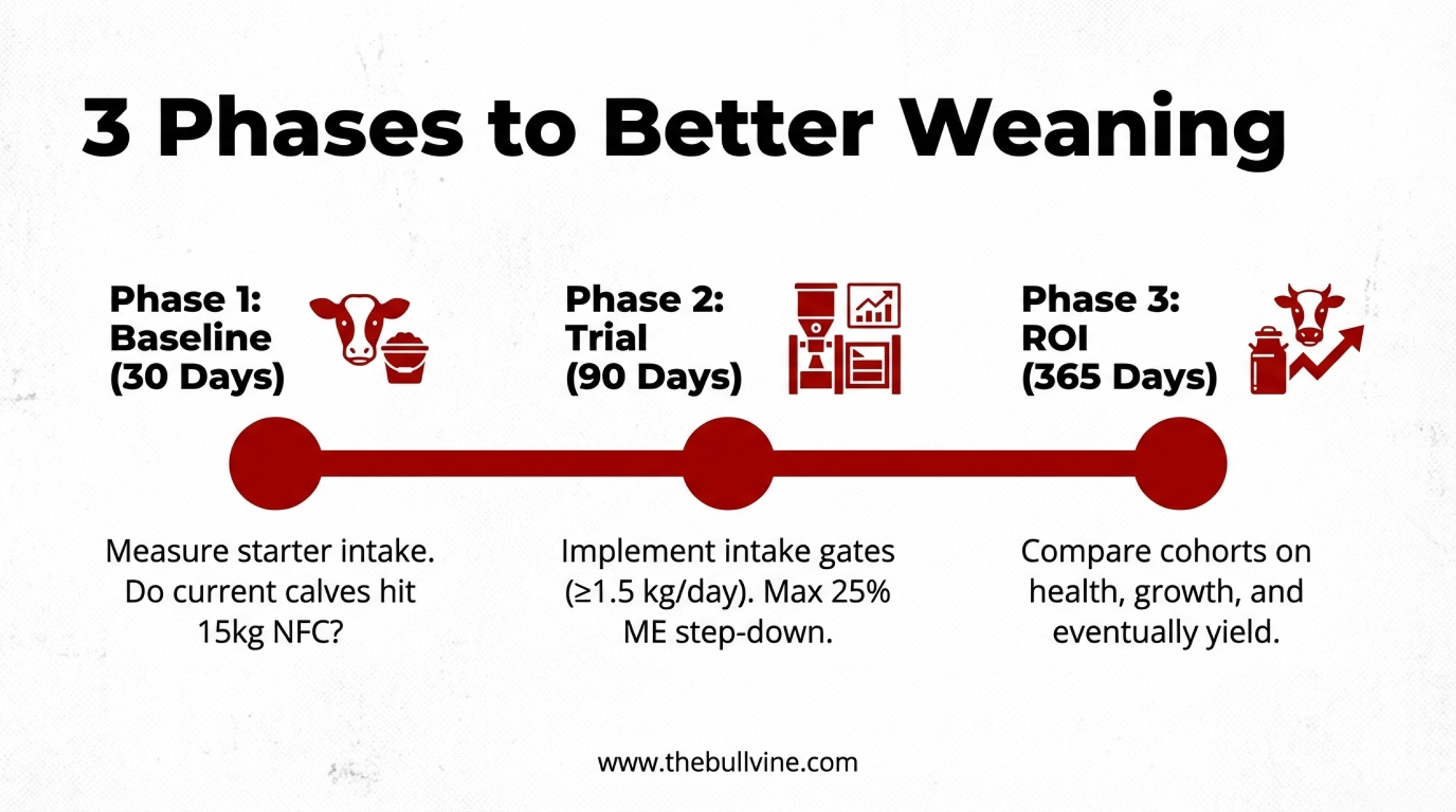
Phase 1 — 30-Day Baseline. Pick 15–20 calves approaching weaning. Measure starter intake with pre-weighed buckets and weigh-backs, even 2–3 times per week. Weigh calves before and after weaning. Run your current program through CalfSim or NASCalf. At the end of 30 days, answer one question: are your calves hitting the intake thresholds by the age you’re pulling milk?

Phase 2 — 90-Day Intake Gate Trial. Set a new rule: calves wean within an 8–10 week window, but only when they meet the daily starter gate. Stretch the step-down to 10–14 days minimum—and keep the ME reduction at any single step under 25%. Use CalfSim/NASCalf to predict when those gates should be reached, then compare that to what you see at the bunk. Track ADG and health events against your baseline.

Phase 3 — 365-Day Comparison. Run two cohorts for a full year — one on your old calendar, one on intake-based weaning informed by CalfSim or NASCalf. Track growth to 6 months, age at breeding, treatment costs, and first-lactation milk as records come in. This is where you build your own ROI case and decide how much complexity your crew can realistically manage every day.

Performance MetricAge-Based Weaning (8 weeks, calendar-driven)Intake-Based Weaning (9–10 weeks, gradual step-down)
Post-Weaning Treatment Rate (%)12–15%6–8%
ADG Post-Weaning (kg/day, weeks 9–12)0.52–0.680.75–0.88
Body Weight at 6 Months (kg)178–185193–201
Age at First Breeding (days)420–435405–415
First-Lactation Milk Yield (kg, 305d)10,200–10,80011,050–11,650 (estimated +850 kg)
Calf Losses (%)5–8% (U.S. average)2–4% (improved health)
Added Rearing Cost per CalfBaseline+$30–40 (extra milk days)

What This Means for Your Operation

If you’re feeding 4–6 L/day and weaning at 6–7 weeks, You likely need both more milk and a later weaning target. CalfSim or NASCalf can show which change moves the needle more.

If you’re feeding 8–10 L/day and weaning at 8 weeks: Your calves may be 1–2 weeks short of the NFC threshold. Run CalfSim or NASCalf with your actual starter analysis. If cumulative NFC at day 56 falls well below 15 kg, that’s your gap. And if your step-down protocol is “drop the afternoon feeding,” you’re probably cutting ME by 50% in one shot. That’s too much. Spread it out.

If you’re already weaning at 9–10 weeks with a gradual step-down, you may be closer than you think. A 30-day baseline will confirm it—and if your calves show no post-weaning ADG dip, don’t fix what’s working.

If you’re running an automated calf feeder that already tracks individual intake, you’ve solved the hardest part. Your feeder data tells you cumulative consumption. Map that to the NFC threshold using your starter’s NFC%, and you have an individualized weaning signal without any additional labor.

If you’re running a smaller herd raising 15–25 calves per year: Individual observation replaces modeling. You already know your calves. The value of CalfSim/NASCalf indicates whether your instincts align with the NFC math.

As a rough benchmark: if your current 8-week calves maintain an ADG above 0.75 kg/day for 2 weeks after weaning and your post-weaning treatment rate stays under 10%, you may not need to change anything. These aren’t published thresholds—they’re practical guideposts. Track your own data and let it tell you.

Quick NFC check for any program: Total starter consumed (kg as-fed) × 0.89 (DM factor) × your starter’s NFC%. For a 52% NFC starter, that’s roughly: total kg starter × 0.46. When that running total hits 15, you’re in the zone.

Key Takeaways

  • 15 kg cumulative NFC (roughly 31–34 kg starter as-fed depending on NFC content) is Quigley’s research-based threshold for rumen readiness at weaning (Quigley et al., 2019, JDS).
  • Daily intake gates: ≥1.5 kg/day for large-breed calves, ≥1.0 kg/day for small breeds, for at least 3 consecutive days before finishing weaning (Drackley, Applied Animal Science, Vol. 41, Issue 3, June 2025).
  • Don’t cut ME by more than 25% at any single step-down. Dropping the afternoon feeding slashes ME intake by roughly 50% — that’s a maintenance-level energy shock, not a weaning transition. Taper gradually, like the cow’s own lactation curve would.
  • Wagner Farms weans by intake with a 28-day step-down. The year Hoard’s profiled them, they lost zero calves. The calendar didn’t earn that result.
  • CalfSim and NASCalf are directional, not diagnostic. They predict average performance — your individual calves will scatter around that average, and farm-level curveballs will shift the timeline. But directional beats blind, and both tools finally answer the question producers have been asking: when should my calves be ready?
  • The extra milk days aren’t free — but the post-weaning slump isn’t free either, and only one of those costs shows up on your feed invoice.

The Bottom Line

Laura Raatz doesn’t check the calendar to decide when milk stops at Wagner Farms. She checks the bucket. And the science — from Quigley’s NFC threshold to Drackley’s Applied Animal Science review to Welk’s 44-study systematic review — says the bucket is right.

Pull your CalfSim or NASCalf report. Does cumulative NFC at your current weaning age hit 15 kg — or are you weaning calves that aren’t ready?

Learn More

The Sunday Read Dairy Professionals Don’t Skip.

Every week, thousands of producers, breeders, and industry insiders open Bullvine Weekly for genetics insights, market shifts, and profit strategies they won’t find anywhere else. One email. Five minutes. Smarter decisions all week.
NewsSubscribe
First
Last
Consent

The 1,113 kg Question: Does Dairy Calf Starter Consistency Really Affect Lifetime Production?

One kilogram of preweaning gain. 1,113 kilograms more milk. The real question is what your calf starter is doing with that opportunity.

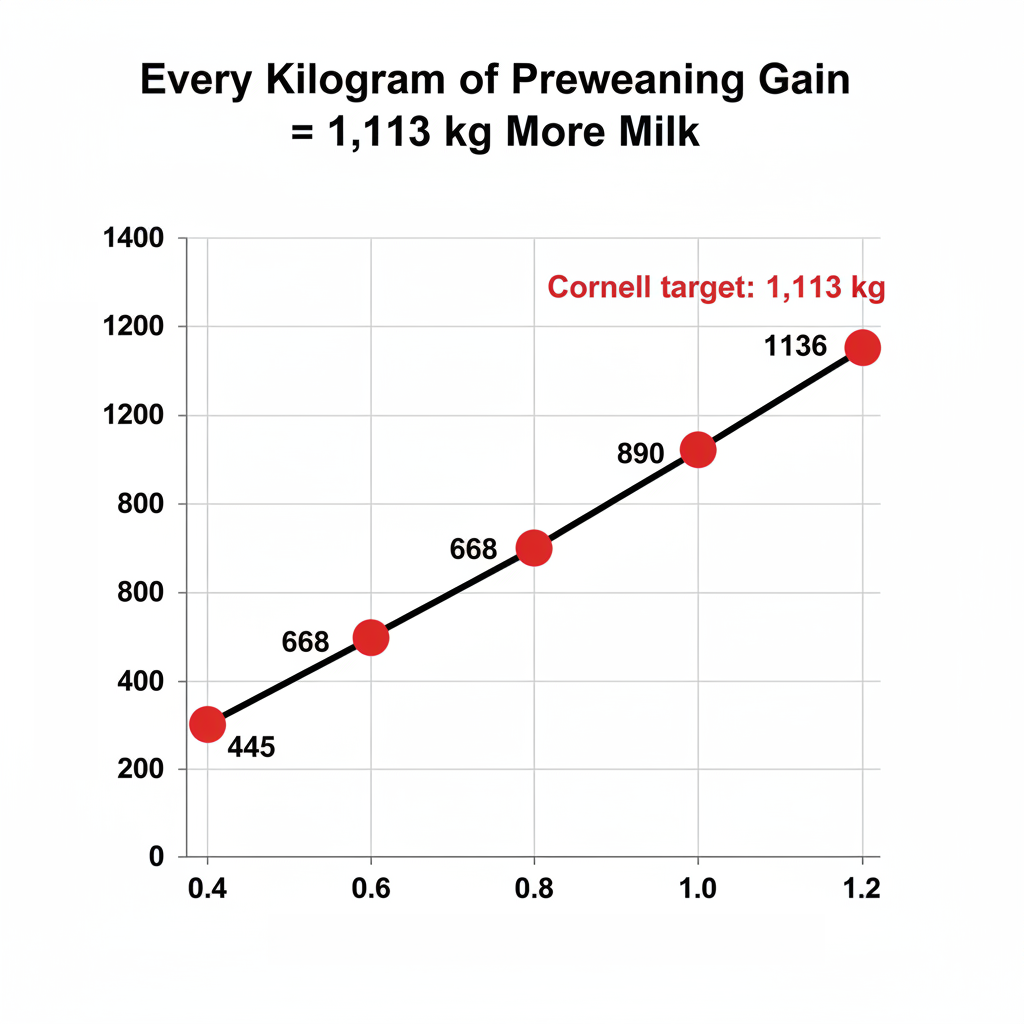
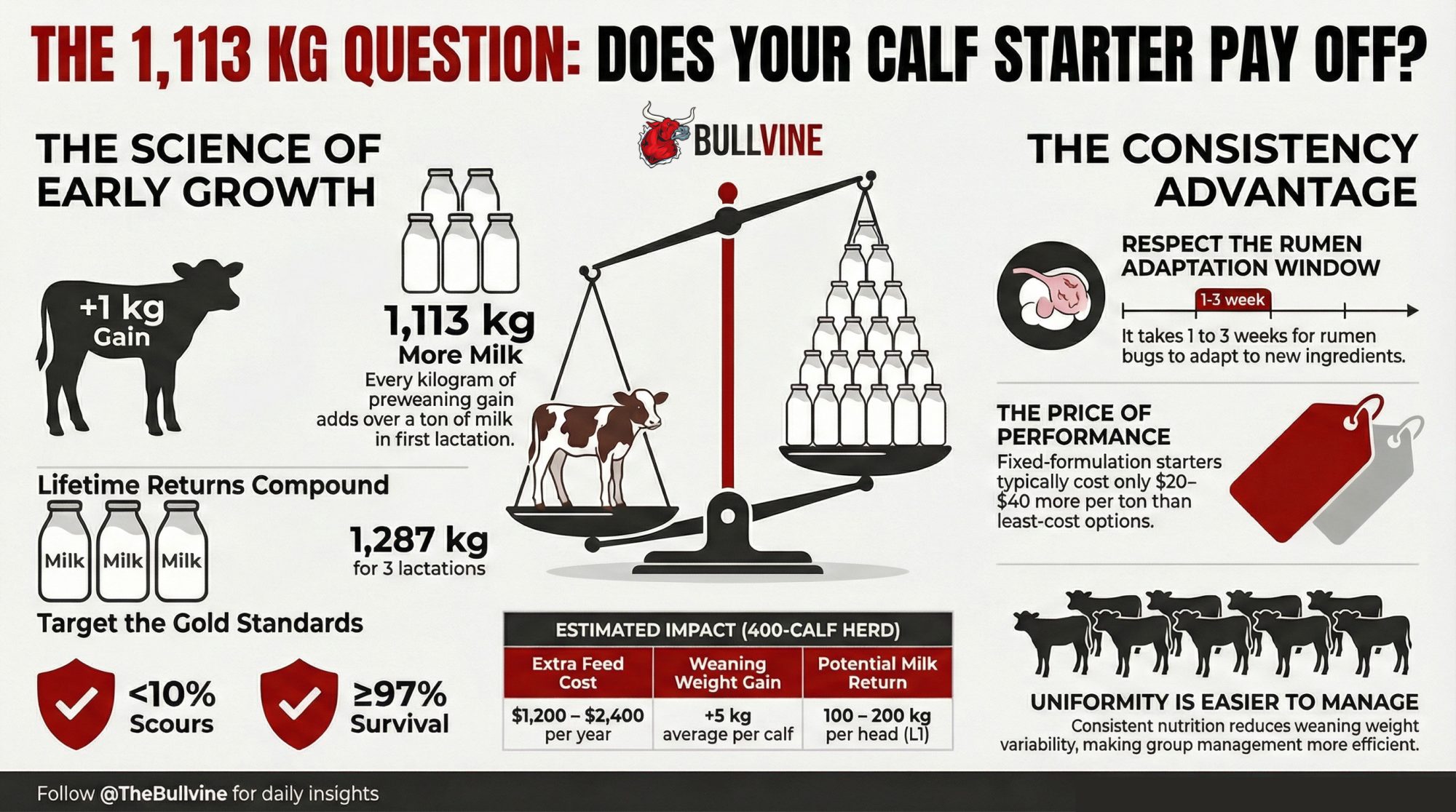
Here’s a number that stopped me cold when I first came across it: 1,113 kilograms of additional milk in first lactation for every single kilogram of preweaning average daily gain. And no, that’s not a typo. It comes from Cornell University work led by Fernando Soberon and Dr. Mike Van Amburgh, published in the Journal of Dairy Science back in 2012—and you know what? It’s held up remarkably well as more data have come in over the years.

I recently spoke with a Wisconsin producer who’d seen this research presented at a nutrition conference. His reaction was similar to mine: “I’ve been buying dairy calf starter feed the same way for twenty years. Maybe it’s time to ask some different questions.”

For most of my time covering this industry, dairy calf starter occupied that comfortable category of “necessary but unremarkable.” You bought it primarily for price, made sure it met the tag minimums, and moved on to the next item on your list. That thinking is starting to shift on a meaningful number of operations, and the reasons why are worth exploring.

A meta-analysis published this year in the Journal of Dairy Science combined 18 studies and confirmed what the Cornell team found over a decade ago—calves that grow faster before weaning consistently produce more milk in their first lactation. The exact response varies somewhat by study and herd, but the positive relationship appears again and again.

But here’s the question that’s really driving the current conversation: If early nutrition matters this much, does the consistency of that nutrition matter too?

Why Your Rumen Bugs Care About Consistency

Let me walk through the science here, because it’s genuinely fascinating once you dig into it—and it has real practical implications for how we think about calf feeding programs.

We’ve known for decades that the calf’s rumen microbiome undergoes rapid colonization during those first weeks of life. What’s newer, and what’s really caught my attention, is our understanding of just how diet-dependent that colonization process is.

The microbial foundation you establish in those hutches appears to influence how well these animals perform in the years ahead.

Think about what that means for your operation. The bugs establishing themselves in your calves’ rumens right now are being shaped by what those calves eat—and that foundation may well stick around through first calving and beyond.

It’s a bit like laying concrete: what you do in those early days sets up the structure for everything that follows.

Dr. Mike Van Amburgh over at Cornell—he’s a Professor of Animal Science there and leads the development of the Cornell Net Carbohydrate and Protein System (which, as many of you probably know, is used to formulate diets for roughly 70 percent of dairy cows in North America)—has been studying this connection for over two decades. Cornell’s calf nutrition program emphasizes a straightforward goal: double birth weight by weaning through adequate and consistent milk replacer and starter intake.

Why is this significant? The long-term numbers tell the story.

Industry technical summaries based on the Cornell data show just how much this matters over a cow’s productive life. In one commercial herd tracked by researchers, cows that made it to three lactations produced about 1,287 kilograms more milk across those lactations for every extra kilogram of preweaning gain. The Cornell research herd showed even larger responses.

LactationIf Benefit Stopped After L1Commercial Herd ActualResearch Herd (High Response)
L11,1131,1131,113
L21,1131,2001,350
L31,1131,2871,500

The early nutrition effect doesn’t just show up once and disappear—it builds on itself over time.

It’s worth noting that genetics also play a role here. Operations heavily focused on genomic selection for feed efficiency are seeing these early nutrition effects interact with genetic potential—calves with strong genetic merit for production seem to respond particularly well to optimized early nutrition. Nutrition and genetics work together rather than independently.

So what happens when feed formulations shift on your calves? The rumen microbiota need time to adapt to new feed ingredients. Research on rumen microbial dynamics, including work by Schären and colleagues published in Frontiers in Microbiology, shows that meaningful adaptation can take anywhere from a day or two to three weeks or more when diets change substantially.

During those adaptation periods, feed efficiency typically drops, and the risk of digestive upset increases. And when formulation changes occur frequently—as can happen with feeds optimized first for ingredient prices rather than consistency—the rumen may never fully stabilize.

That’s the biological argument. But biology, as we all know, is only part of the decision.

What the Treatment Data Actually Show

The USDA’s National Animal Health Monitoring System (NAHMS) provides solid benchmarks here. Their Dairy 2014 study collected data from 104 operations across 13 states, which is about as representative as you’re going to find for this kind of work.

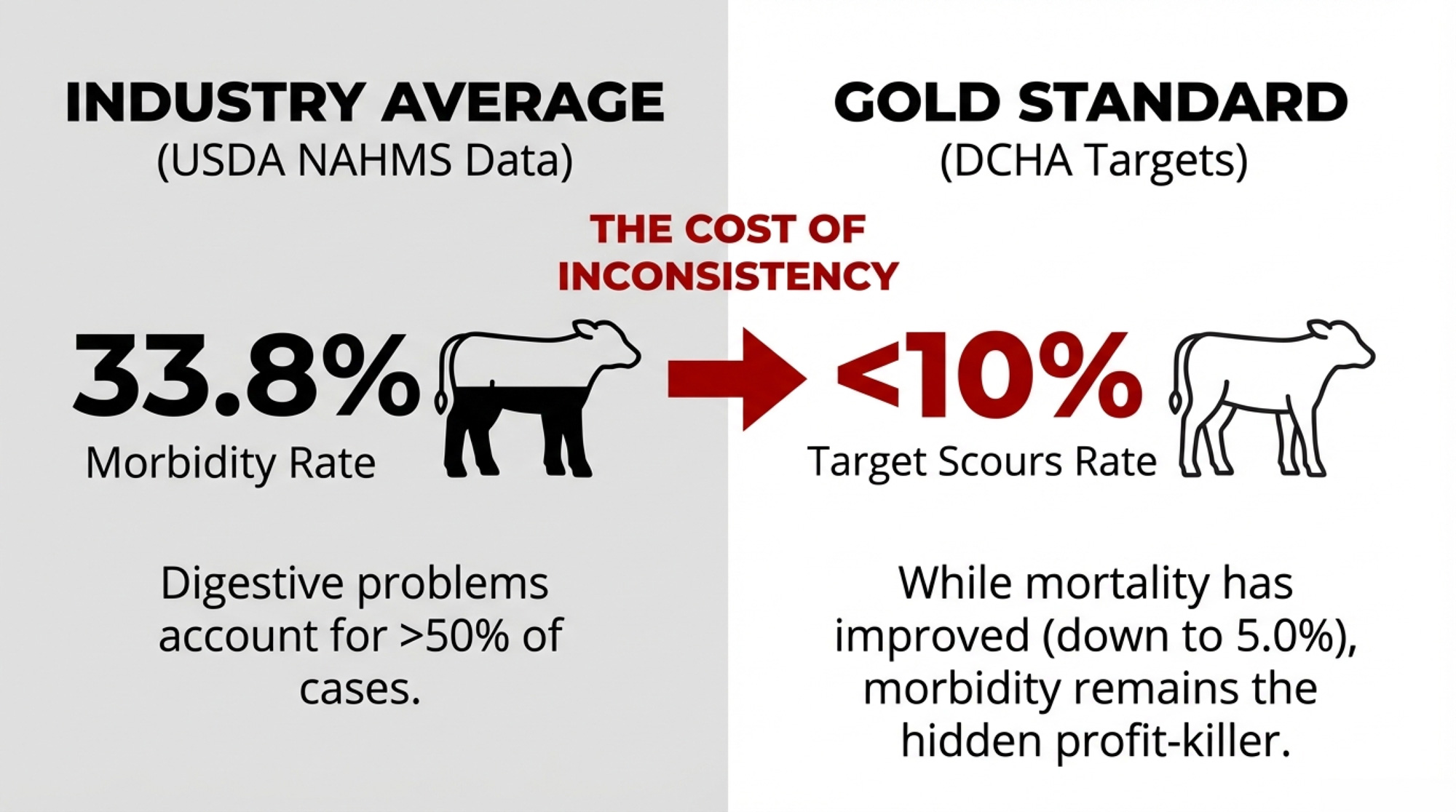
Here’s what they found: about 33.8 percent of preweaned heifers experienced at least one bout of illness, with digestive problems accounting for just over half of those cases—50.9 percent to be exact. Mortality stood at 5.0 percent overall.

Now, context matters here. These numbers actually represent real improvement from earlier surveys. NAHMS reported mortality rates of 8.4 percent back in 1992 and 7.8 percent in 2007. So the industry has improved significantly in keeping calves alive and healthy over the past few decades. That’s encouraging, and it reflects genuine progress in housing, colostrum management, and overall calf care protocols.

But the current numbers also suggest room for continued progress. The NAHMS study compared those results to Dairy Calf and Heifer Association (DCHA) targets at the time—25 percent morbidity and 5 percent mortality. It’s worth noting that the current DCHA Gold Standards are actually more stringent: scours incidence below 10 percent preweaning, pneumonia below 15 percent preweaning, and survival rates of at least 97 percent from 24 hours through 60 days of age. High-performing operations across the country are hitting these numbers. Some are doing even better.

Health MetricUSDA NAHMS National Avg (2014)DCHA Gold Standard TargetHigh-Performing OperationsEst. Cost Gap ($/calf)
Preweaning Scours Rate17.2% ⚠️<10%6–8%$8–12
Preweaning Pneumonia Rate16.2% ⚠️<15%8–10%$15–20
Preweaning Mortality5.0% ⚠️<3% (≥97% survival)2–2.5%$45–60
Overall Morbidity33.8% ⚠️<25%15–18%$25–35

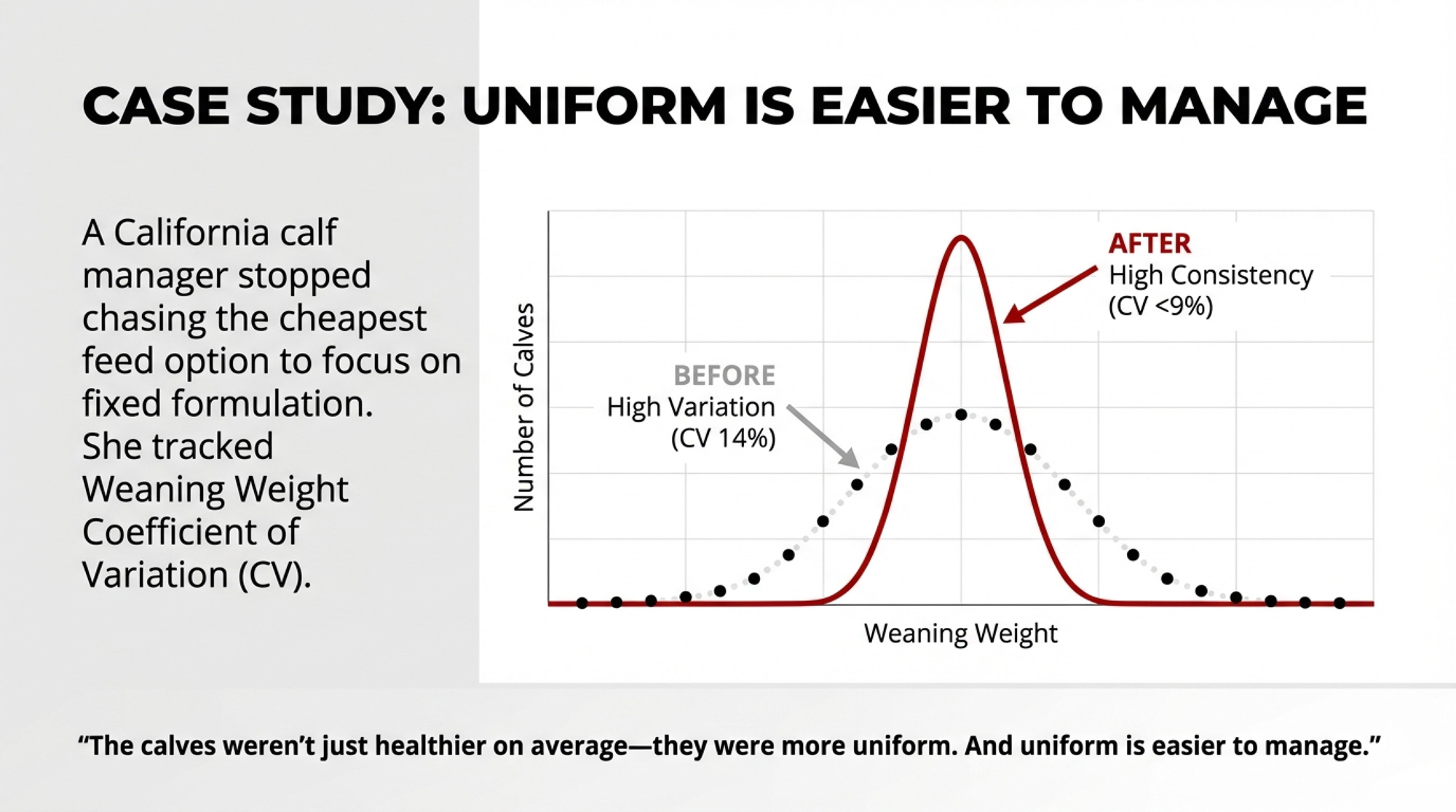
I spoke with a calf manager at a large California operation last spring who’d brought her scours rate down to around 6 percent—well under that DCHA target. When I asked what changed, she walked me through several factors, but consistent nutrition was near the top of her list. “We stopped chasing the cheapest option every delivery,” she told me. “Once we did that, we could actually see what else was going on.”

What I found particularly telling was her approach to tracking the change. She started measuring weaning weight coefficient of variation alongside her treatment records—something she hadn’t done systematically before. Within about four months, her CV had dropped from around 14 percent to just under 9 percent. “That’s when I knew the consistency piece was real,” she said. “The calves weren’t just healthier on average—they were more uniform. And uniform is easier to manage.”

That observation—about finally being able to see the other variables—comes up repeatedly in conversations with producers who’ve improved their numbers. Eliminating feed variability actually allowed them to troubleshoot the other factors. When feed was no longer confounding their analysis, they could isolate issues with housing, or ventilation, or colostrum protocols.

I should be honest with you here, though: controlled comparisons in the published literature remain limited. The evidence connecting feed consistency specifically to improved outcomes is suggestive rather than definitive at this point. Much of what we know comes from producer experience and biological reasoning. That’s valuable information, but it’s different from randomized trial data.

Quick Reference: Key Benchmarks

  • 1,113 kg additional first-lactation milk per 1 kg preweaning ADG (Soberon & Van Amburgh, Journal of Dairy Science, 2012)
  • ~1,287 kg additional milk across three lactations per 1 kg preweaning ADG in one tracked commercial herd (Cornell research technical summaries)
  • 33.8% average preweaned heifer morbidity (USDA NAHMS Dairy 2014)
  • <10% scours, <15% pneumonia, ≥97% survival current DCHA Gold Standards targets
  • Days to 3+ weeks, typical rumen microbiome adaptation period to diet changes (Schären et al., Frontiers in Microbiology, 2017)

Sponsored Post

The Economics: Running Your Own Numbers

The financial case for feed consistency depends heavily on individual operation parameters, which is why I get a little skeptical when I see generic ROI claims floating around. Your math isn’t my math, nor is it your neighbor’s math.

But the framework for calculating it is straightforward, and the research coefficients are reasonably solid at this point.

What the research tells us: the 2025 meta-analysis confirms that for meaningful increases in preweaning ADG, you’re looking at real gains in first-lactation milk yield—the positive relationship holds across diverse management systems and keeps showing up study after study. And as the Cornell data show, those effects appear to persist across multiple lactations, not just the first one.

The NAHMS data suggest that reducing morbidity from the 33.8 percent average toward those tighter DCHA Gold Standard targets would reduce treatment costs in ways that add up. When you factor in drugs, labor, and lost performance, the total cost of a treated calf can run into the tens of dollars per case—sometimes considerably more depending on your vet costs and how much growth gets set back. Across a calf crop, which accumulates quickly.

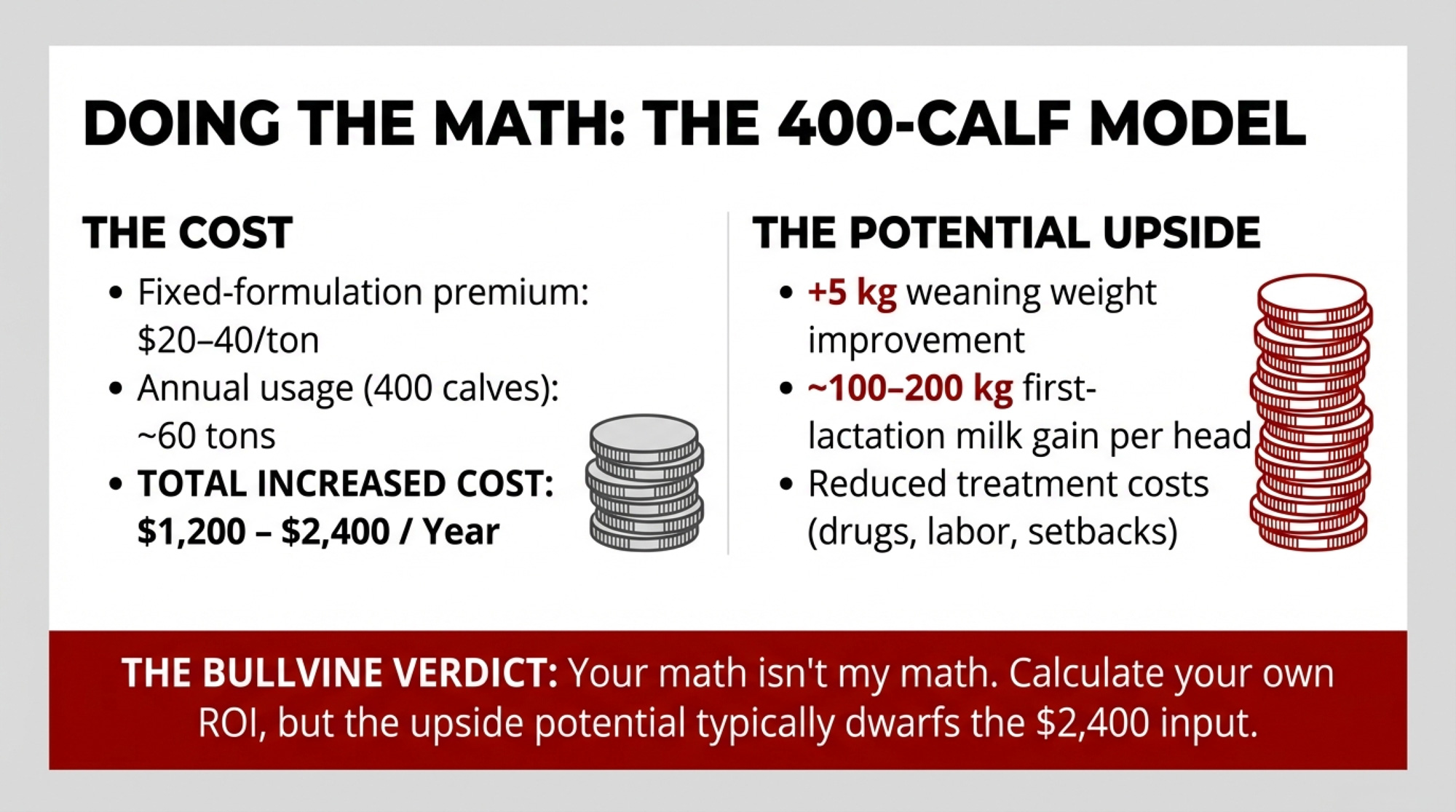
The Basic Math: A 400-Calf Operation

FactorEstimate
Annual starter usage~60 tons
Premium for fixed-formulation$20–40/ton
Additional annual feed cost$1,200–$2,400
  
Potential return per calf 
Plausible weaning weight improvement+5 kg average
First-lactation milk gain (using Cornell relationship as a guide)typically on the order of ~100–200 kg/head, depending on how much of that 5 kg reflects true ADG improvement and your current baseline
Multi-lactation compounding effectAdditional gains in L2, L3 are likely when those early gains carry through
Reduced treatment costsVariable by operation

The question isn’t whether the research is real—it is. The question is whether your specific operation’s baseline makes the investment worthwhile.

What this means for your operation depends explicitly on your current baseline. If you’re already achieving tight weaning weight distributions and low morbidity, the marginal benefit from changing feeds may be modest. If you’re seeing high variability and treatment rates above industry benchmarks, the potential benefits of a stronger nutrition and management program are considerably larger.

On the cost side: from conversations with nutritionists and producers across several regions, many report that fixed-formulation dairy calf starters often cost somewhere in the ballpark of $20–40 per ton more than strictly least-cost options. Some regions see higher premiums where supplier choices are limited. Because prices vary so much by company and freight, you’ll want to confirm this with your own quotes.

Run your own calculation. Pull your weaning weight data from the last three cohorts. Calculate your coefficient of variation—that’s your standard deviation divided by your mean, expressed as a percentage—as a measure of how much variability you’re seeing. Look at your treatment records. The math will tell you whether the potential upside justifies the definite cost increase—and that answer genuinely varies by operation.

Knowing When to Prioritize Other Investments First

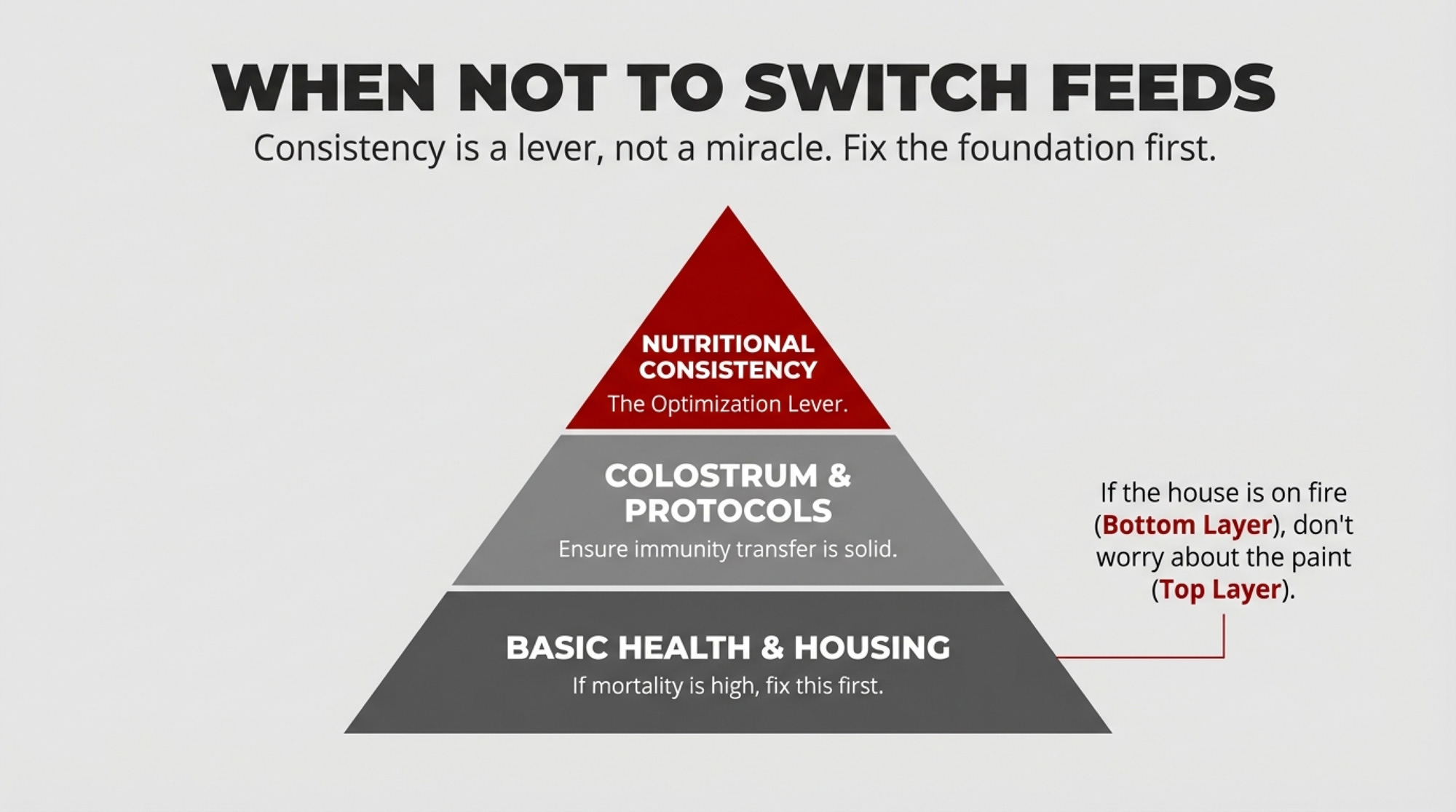
I’d be doing you a disservice if I presented this as a simple “switch feeds immediately” recommendation. Every operation has competing priorities, and feed consistency is one variable among many affecting calf performance.

On some farms, the bigger wins might come first from tightening up colostrum delivery, improving housing and ventilation, or addressing transition-cow bottlenecks before focusing on feed formulation details for calves. On others, especially where calf programs are already fairly sound, but weaning weights and health records still look noisy, dialing in nutrition consistency can be the logical next move.

One nutritionist I spoke with—who asked me not to use his name because he consults for suppliers using different formulation approaches—put it this way: “The right feeding strategy depends on the operation’s specific goals, constraints, and current performance baseline. What works exceptionally well for one farm might not be the highest-priority investment for another.”

That strikes me as exactly right. The consistency question isn’t about whether variable-formulation feeds meet regulatory requirements—they do. It’s about whether feed consistency represents the best next investment for your operation, given where you are today and where you want to go.

Evaluating Supplier Approaches

If you decide feed consistency is worth investigating for your operation, how do you actually figure out whether a supplier delivers it? I’ve found that a few direct questions reveal a lot—and most suppliers will give you straight answers if you ask clearly.

Questions that tend to cut through the marketing:

“Can you provide batch records showing our specific product’s formulation over the past year?” A supplier with consistency systems will generally have this readily available—it’s just how they operate. A supplier using a more flexible formulation will show ingredient variation that tracks commodity prices. Neither response is inherently wrong. What matters is that it tells you what you’re actually buying.

“What percentage of your ingredient sourcing uses fixed-supplier relationships versus spot-market commodity purchasing?” This gets at their underlying business model. There’s no single “right” answer—but you should know what you’re getting.

“Do you conduct incoming ingredient testing beyond supplier certifications?” Operations with NIR spectroscopy or proximate analysis on incoming loads can verify what they’re receiving. Those relying solely on supplier certificates are trusting their ingredient sources. Reputable companies in the marketplace use both approaches.

FactorFixed-Formulation ApproachVariable (Least-Cost) FormulationHidden Cost of Variability
Ingredient SourcingLong-term supplier contracts, consistent sourcesSpot-market purchasing, ingredients change batch-to-batchRumen adaptation stress every 2–4 weeks
Feed Price$20–40/ton premium over least-costLowest price per ton at time of purchaseFalse economy if growth/health suffer
Rumen Microbiome StabilityConsistent substrate = stable microbial communityFrequent substrate changes = constant re-adaptation3–21 days adaptation per change = chronic inefficiency
Weaning Weight CVTypically 8–10% (tighter distribution)Typically 12–16% (wider distribution)Harder to manage, delayed breeding, culling pressure
Treatment Rate PatternsConsistent baseline, easier to troubleshootMay spike after formulation changesDifficult to isolate non-feed variables
DocumentationBatch records, formulation history availableLimited transparency, formulas are “black box”Can’t analyze trends or root-cause issues
Best Use CaseOperations targeting DCHA Gold Standards, tight protocolsOperations prioritizing low upfront cost, high risk toleranceDepends on baseline performance and goals

What the responses typically reveal:

  • Detailed documentation with specific dates and formulations → you’re likely dealing with a consistency-focused supplier
  • General assurances about quality control without specific records → approach is unclear, and it’s worth following up
  • Acknowledgment that formulations adjust based on ingredient prices → that’s a more flexible formulation model, and there’s nothing inherently problematic about that if it fits your goals

The key is understanding which model you’re buying and whether it aligns with what you’re trying to accomplish.

The Transition Timeline: Setting Realistic Expectations

Operations that switch to a more consistent, fixed-formulation feeding program typically experience a transition period before realizing the anticipated benefits. Based on producer conversations and the biological literature on rumen adaptation, here’s roughly what to expect:

Weeks 1–3: Initial adjustment. Some producers report slight changes in fecal consistency as the rumen microbiome adapts to the new substrate—even though that substrate will now remain consistent. This is the period of highest uncertainty, and it’s easy to second-guess your decision. Stick with it unless you’re seeing serious problems.

Weeks 3–6: Early signals start to emerge. Starter intake patterns should smooth out. Fecal scores stabilize. Treatment incidence may begin declining in new calves entering the program—though calves already through the highest-risk period won’t show dramatic changes.

Weeks 6–8, around weaning: First measurable outcomes appear. Weaning weight distribution should tighten—look for your standard deviation narrowing—and cohort uniformity generally improves. This is when you can start to see whether the change is actually delivering for you.

Months 3–6: The pattern becomes clear. By this point, enough cohorts have moved through the system to distinguish signal from noise. If consistency delivers value on your operation, you should see it by now.

PhaseDurationKey Milestones
Weeks 1-3: Initial AdjustmentWeek 0-3Rumen microbiome adapting; possible fecal consistency changes; highest uncertainty
Weeks 3-6: Early SignalsWeek 3-6Starter intake patterns smooth out; fecal scores stabilize; treatment incidence begins declining in new calves
Weeks 6-8: First OutcomesWeek 6-8Weaning weight standard deviation narrows; cohort uniformity improves; first measurable confirmation
Months 3-6: Pattern ClearWeek 12-24Multiple cohorts processed; signal distinguished from noise; definitive performance data available

The timeline matters for setting expectations. Feed changes don’t produce overnight results. Operations that switch, see some initial variability during the adaptation window, and immediately switch back may never realize any potential benefit. Give it time to work—or not work—before drawing conclusions.

A Practical Assessment Framework

For producers considering whether feed consistency deserves attention alongside other calf management priorities—colostrum protocols, housing ventilation, transition feeding, fresh cow management—here’s a straightforward framework:

Step 1: Benchmark your current performance

  • Calculate the weaning weight coefficient of variation for your last three cohorts. If you’re already below 10 percent, you’re doing well.
  • Document treatment incidence rates against the NAHMS benchmarks and DCHA Gold Standards.
  • Note any patterns in timing—do problems tend to cluster after feed deliveries or lot changes?

Step 2: Understand your current supplier’s model

  • Ask the questions outlined above.
  • Request documentation if they claim consistency.
  • Pay attention to whether the answers satisfy you or leave you with more questions.

Step 3: Calculate your specific economics

  • Use your operation’s numbers, not industry averages.
  • Include both direct costs (treatment, mortality) and opportunity costs (production potential).
  • Factor in realistic switching costs and the transition period.

Step 4: Prioritize against other investments

  • How does this compare to other calf program improvements you could make?
  • Where’s your biggest current gap—nutrition, housing, health protocols, colostrum management?
  • Would the money deliver better returns somewhere else in your operation?

Step 5: Make a data-informed decision

  • Current performance is strong, and your supplier can demonstrate consistency? You may be well-positioned already.
  • Unexplained variability in weaning weights or treatment rates? The consistency question is worth investigating.
  • Economics don’t pencil out clearly? A pilot approach—one cohort on a new feed while maintaining your current program—can give you operation-specific data.

What It All Adds Up To

The research connection is real. Preweaning nutrition has measurable, long-term effects on lifetime milk production. The work from Cornell and the 2025 meta-analysis show consistent associations between early growth and first-lactation performance. This isn’t speculation—it’s well-documented science that keeps getting confirmed.

The consistency question is more nuanced. While the biological case for nutritional consistency is plausible—stable rumen microbiome, reduced adaptation stress, better feed efficiency—the controlled research comparing consistent versus variable formulations remains limited. Much of the evidence comes from producer experience and biological reasoning rather than randomized trials. I think being honest about that is important.

The economics are genuinely operation-specific. A 400-calf operation with high current variability might find substantial opportunity here. A smaller operation with already strong performance might find limited benefit. Run your own numbers rather than relying on anyone else’s projections—mine included.

Supplier models vary legitimately. Different formulation strategies correspond to distinct business approaches with distinct trade-offs. Understanding which model your supplier uses—and whether it aligns with your priorities—matters more than assuming one approach is universally superior.

Context always matters. Feed consistency is one of many variables affecting calf performance. Operations with excellent colostrum programs, well-designed calf housing, and strong health protocols may see less marginal benefit from feed consistency improvements than operations with gaps in those areas. Consider where your biggest opportunities actually lie.

The conversation around feed consistency reflects a broader shift in how progressive operations are thinking about calf-raising these days: as a foundational investment in lifetime productivity rather than a cost center to minimize. Whether that perspective applies to your operation depends on your specific circumstances—but it’s a question worth asking.

Key Takeaways

  • Early-life growth pays: Cornell work links each extra kilogram of preweaning gain to roughly 1,113 kg more milk in the first lactation, with multi-lactation benefits on top.
  • Consistent calf starter helps the rumen microbiome settle, reduces stress when calves hit diet changes, and can make weaning weights and health records a lot less “noisy.”
  • National data (NAHMS, DCHA) show calf health has improved, but many herds still sit above target levels for scours, pneumonia, or death loss—leaving money on the table.
  • For a 400-calf operation, paying about $20–40/ton more for a fixed-formulation starter means roughly $1,200–$2,400 extra feed cost per year, which can pencil out if it boosts growth and trims treatments.
  • There’s no one-size-fits-all answer; the article gives a simple checklist and supplier questions so each farm can decide whether calf starter consistency is the right next lever to pull.

Executive Summary: 

This article looks at a simple but powerful question: could the consistency of your dairy calf starter be quietly influencing lifetime milk production? Cornell research links each extra kilogram of preweaning gain to about 1,113 kilograms more milk in first lactation, with follow-up work and industry summaries showing those gains can carry into later lactations. It pairs that science with USDA NAHMS data and current DCHA Gold Standards to show where calf health has improved and where there’s still room to tighten things up. From there, the piece walks through how inconsistent formulations can disrupt rumen development and drive avoidable health bumps, while also being upfront that direct, controlled research on feed consistency itself is still limited. A practical “400-calf” example lays out the likely cost premium for more consistent starter versus the potential milk and health returns, then offers a step-by-step framework to run the numbers with your own data. Producers also get concrete questions to ask feed suppliers, a realistic transition timeline if they switch feeds, and guidance on when other investments—such as colostrum, housing, or fresh cow management—might warrant priority. The aim is to give dairy producers a clear, research-grounded context so they can decide whether dialing in calf starter consistency is the right next move for their own operation, not to sell a one-size-fits-all solution.

Complete references and supporting documentation are available upon request by contacting the editorial team at editor@thebullvine.com.

Learn More

The Sunday Read Dairy Professionals Don’t Skip.

Every week, thousands of producers, breeders, and industry insiders open Bullvine Weekly for genetics insights, market shifts, and profit strategies they won’t find anywhere else. One email. Five minutes. Smarter decisions all week.
NewsSubscribe
First
Last
Consent

Dairy Calf Nutrition for Healthier, Higher‑Producing Cows

“Reminder: every extra pound of pre‑weaning gain can mean 1,000+ lbs more milk later. Are your calves leaving money on the table?

You know that frustration when calves look fine one week and then crash the next? Weaning dip stretches into three weeks of depressed intake, respiratory disease clusters right around that vulnerable transition window, and it happens no matter what you try. Most of us have been there—whether you’re running 200 cows in Vermont or 2,000 in the Central Valley. It’s one of those persistent challengesc in calf nutrition and heifer development that never quite seems to get solved.

For decades, we’ve treated this as just the cost of doing business. Calves are fragile. Weaning is stressful. Budget for the treatments and move on.

But here’s what’s interesting—a growing body of research and a smaller group of producers willing to rethink their protocols suggest something different. The weaning dip may be less about inevitable stress and more about accumulated decisions made weeks earlier. And the solutions aren’t necessarily expensive or complicated. They’re just… different from how most of us learned to do things.

I want to walk through what the research actually shows, what some operations are finding when they apply it, and—just as importantly—why this approach doesn’t work for everyone.

The Economics Nobody Wants to Talk About

Let’s start with the numbers, because that’s ultimately what drives decisions.

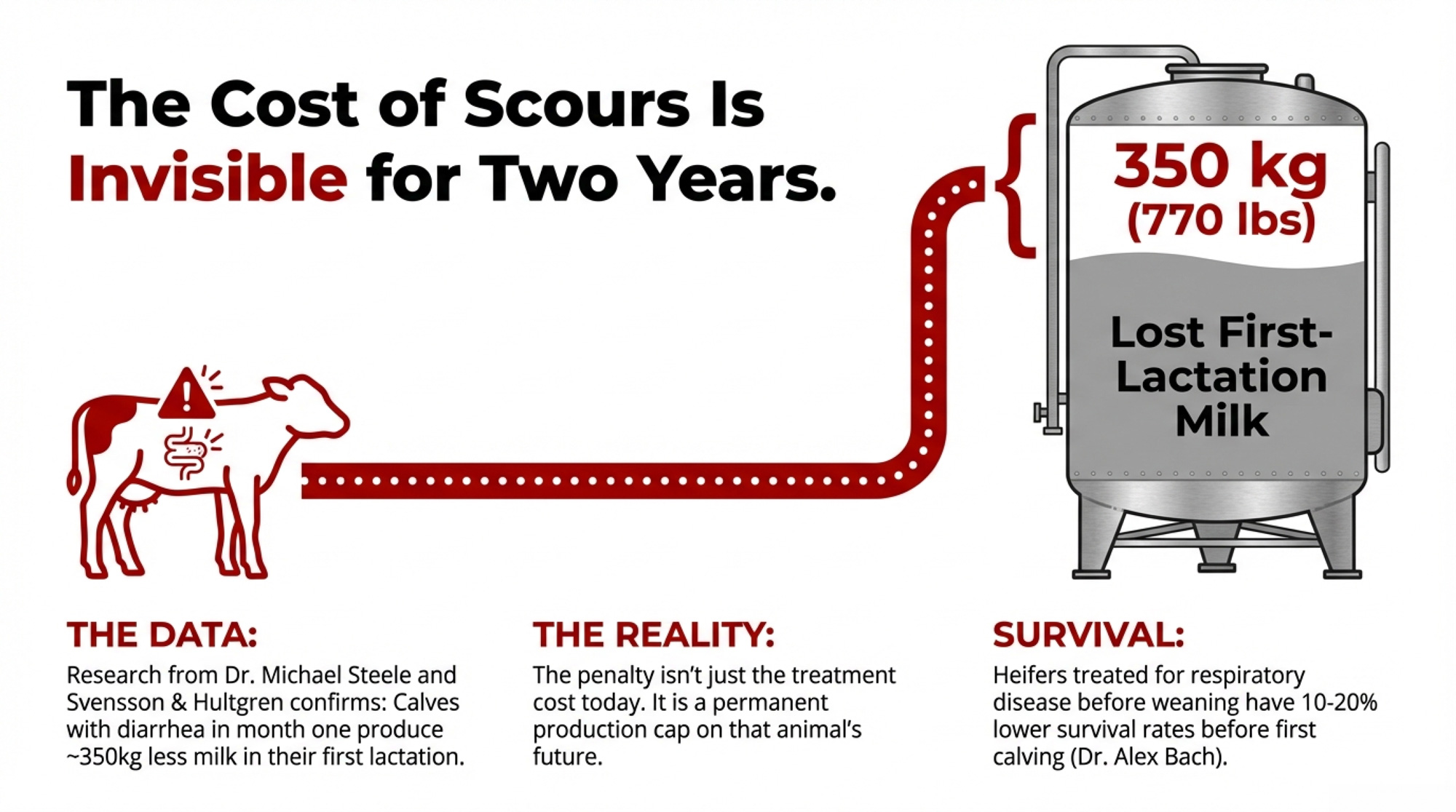
Dr. Michael Steele’s research group at the University of Guelph has been tracking the long-term consequences of early-life calf health for years. Their work, combined with Swedish research by Svensson and Hultgren, which has been widely cited in the Journal of Dairy Science, documents something that should give us pause: calves experiencing diarrhea in their first month of life produce roughly 340-350 kg (748 – 770 lbs) less milk in their first lactation than healthy calves.

That’s not a typo. We’re talking about nearly 350 kg (770 lbs) of milk—gone—because of a bout of scours in week two.

Dr. Alex Bach, an ICREA research professor working with IRTA in Spain, has been equally direct about respiratory disease. His research shows that heifers treated for bovine respiratory disease before weaning have significantly higher odds of dying or being culled before first calving—with survival rates often running 10-20 percentage points lower than healthy cohorts. The immune insult doesn’t resolve simply because the calf clinically recovers. It reverberates through her productive life.

This connection between early-life health and lifetime performance continues to be reinforced by ongoing research. A 2025 study by Leal and colleagues in the Journal of Dairy Science demonstrated that suboptimal preweaning nutrition creates measurable metabolic differences that persist through first lactation—effects visible in glucose metabolism and overall metabolic profiles well into the heifer’s productive life.

Now, here’s where I think our industry gets stuck. These are long-term consequences. The treatment costs are visible today—you see them on this month’s vet bill. The first-lactation milk penalty won’t appear for 2 years. Most operations—understandably—optimize for what they can see and measure right now.

The challenge, as multiple dairy economists have noted, is convincing producers to invest today for returns they won’t see until that heifer’s second lactation. It’s fundamentally different from evaluating the price of a bag of milk replacer.

And it’s worth sitting with that tension for a moment, because it explains why adoption of these practices has been slower than the research might predict.

What’s Actually Happening in the Calf’s Gut

To understand why certain interventions work, you need to understand what’s developing inside the calf during those first critical weeks. The science here has advanced dramatically in the past decade—and it’s reshaping how progressive operations think about their calf programs.

The Small Intestine Window

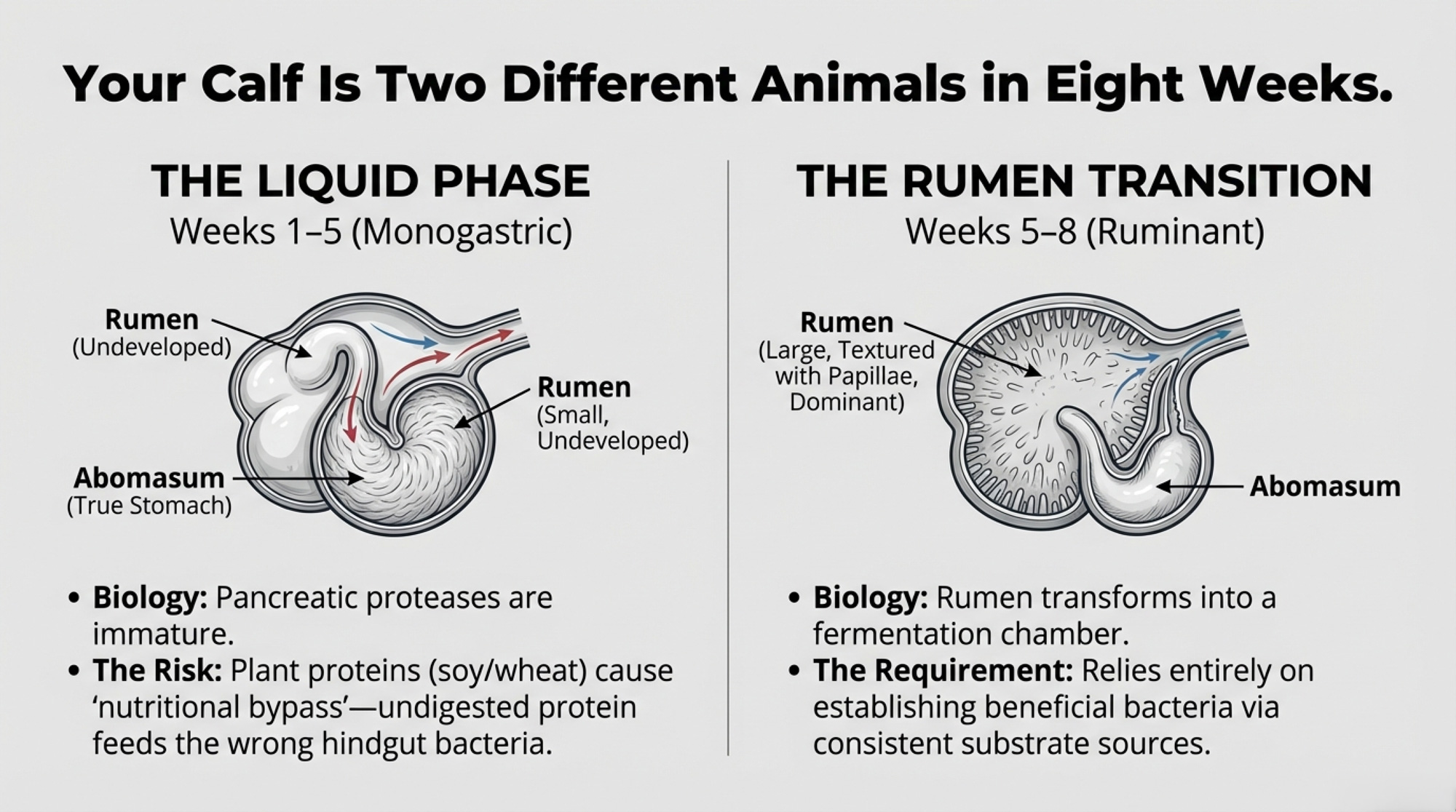
Before the rumen becomes functional—roughly weeks one through five—the calf is essentially a monogastric animal. The small intestine handles the heavy lifting for nutrient absorption, and it’s susceptible to early nutrition choices.

Research published in peer-reviewed nutrition journals has mapped digestive enzyme development in young calves, and what these studies have found matters for anyone making decisions about milk replacer formulation: pancreatic proteases operate at only a fraction of adult capacity at birth, gradually maturing over the first three to four weeks.

Why does this matter practically? The calf’s enzyme systems evolved to digest milk proteins, including casein and whey. When you substitute milk proteins by plant proteins like soybean meal or wheat gluten (often done to reduce costs), you’re asking an immature digestive system to handle substrates it’s not fully equipped to handle.

Work published in the Journal of Dairy Science by Ansia and colleagues compared nitrogen digestibility between all-milk protein replacers and those supplemented with enzyme-treated soybean meal. The pattern was clear: all-milk formulas showed notably better digestibility by week three compared to plant-supplemented formulas. That gap represents protein that isn’t nourishing the calf—it’s passing through to the hindgut, where it can feed the wrong bacteria.

Research presented at the 2024 Healthy Calf Conference in Ontario reinforced this point: early-life nutrition—specifically the first 60 days—affects digestive function throughout the animal’s productive life. That framing helps explain why the details matter so much during this critical window.

The Rumen Transition

As starter intake increases around weeks five through eight, something remarkable happens. The rumen transforms from a collapsed, non-functional organ into the calf’s primary fermentation chamber. This transition depends entirely on establishing stable populations of beneficial bacteria—and this is where substrate consistency becomes critical.

Dr. Phil Cardoso’s lab at the University of Illinois has done elegant work tracking how rumen microbial communities develop. Here’s the part that surprised me when I first dug into this literature: rumen bacteria are extraordinarily substrate-specific.

Different bacterial species have evolved enzymatic machinery optimized for specific fermentation substrates. When feed composition shifts—different molasses sources, varying grain suppliers, new protein ingredients—the microbial community has to reorganize around the new substrate profile.

A 2024 study published in Frontiers in Microbiology, which tracked fecal microbiota development in Holstein and Jersey heifer calves, found that the gut microbiome changes rapidly during early life. Instability during colonization leaves the microbial community vulnerable to dysbiosis, where pathogenic species can outcompete beneficial microbes, leading to suppressed immune function and inflammation.

The time required for microbial reorganization varies considerably depending on what you’re measuring and how dramatic the diet change is. Some studies suggest bacterial communities can shift within a week or two. Others indicate that full functional stabilization can take considerably longer, sometimes several weeks or more.

The practical takeaway? During that reorganization period, volatile fatty acid production becomes erratic. And VFAs—particularly butyrate—are what drive rumen papillae development. Inconsistent VFA production means inconsistent rumen development.

Sponsored Post

The Substrate Consistency Question

This is where things get practical, and also where opinions start to diverge among nutritionists.

Several nutritionists I’ve spoken with point to ingredient consistency as the single most overlooked variable in calf programs. The logic is straightforward: if rumen bacteria need stable substrates to establish and function, then constantly changing feed ingredients creates perpetual instability.

Research from the University of Minnesota and other institutions has documented this pattern: calves on fixed formulations show much more consistent day-to-day starter consumption than calves on least-cost programs where ingredients shift with commodity prices. The intake variability isn’t dramatic on any given day, but it compounds over the critical period of rumen development.

Industry estimates suggest the cost premium for specification-guaranteed, consistent-source ingredients is approximately 2-4%—typically $8-12 per calf over a 12-week rearing period. That number varies by region and current commodity markets, but it gives you a ballpark for planning purposes.

The Other Perspective

Now, I want to be fair here, because this isn’t settled science. Not every nutritionist is convinced that ingredient consistency matters as much as some of the research suggests.

“Look, rumen bacteria are adaptable,” argues one dairy nutritionist who asked not to be named because he works with several least-cost formulation systems. “They’ve evolved to handle dietary variation. A healthy calf can adjust to different molasses sources reasonably quickly.”

He has a point about adaptability—cattle wouldn’t have survived as a species without metabolic flexibility. And the research on substrate consistency, specifically in pre-weaned calves (as opposed to mature cattle), is still developing. Most of the microbial stabilization studies were conducted in older animals.

What we can say with confidence is that operations running fixed formulations generally report lower variability in calf performance. Whether that’s causation or correlation with other management factors—like the kind of attention to detail that leads someone to specify ingredients in the first place—is harder to untangle.

Stage-Matched Microbial Support

The growing interest in probiotic supplementation for calves has created what I’d call an implementation gap. Most operations using probiotics deploy the same blend in both milk replacer and starter feed, assuming gut health support works the same way throughout development.

The research suggests otherwise—and this is where things get interesting.

Different Ecosystems, Different Needs

The small intestine during liquid feeding operates in a microaerobic environment—there’s oxygen present. Effective probiotics for this phase include facultative anaerobes like Bacillus subtilisLactobacillus, and Bifidobacterium species that can survive stomach acid and establish quickly.

A 2024 study in ASM Spectrum demonstrated that compound probiotics containing multiple Lactobacillus and Bacillusstrains accelerated both immune function development and the establishment of a healthy gut microbiome in newborn Holstein calves—reducing the abundance of harmful bacteria while promoting beneficial populations.

Research published in Scientific Reports and the Journal of Animal Science has shown how certain Bacillus species secrete compounds that promote intestinal epithelial cell differentiation and help inhibit pathogenic biofilm formation. There’s good evidence for measurable improvements in gut barrier function when appropriate strains are delivered during the liquid feeding phase.

The developing rumen is a completely different environment—strictly anaerobic. Oxygen is toxic to the bacteria that should dominate there. Effective rumen probiotics include obligate anaerobes such as Megasphaera elsdenii and Butyrivibrio species, which would die immediately if exposed to the oxygen-rich environment of the small intestine.

“Using the same probiotic blend in milk and starter is like planting the same crops in two completely different climates,” explains Dr. Mike Flythe, a microbiologist with the USDA Agricultural Research Service in Lexington, Kentucky. “You might get something to grow, but you’re not optimizing for either environment.”

Gut EnvironmentOxygen LevelEffective Probiotic SpeciesPrimary MechanismWhat Happens If Mismatched
Small Intestine (liquid feeding phase)Microaerobic (oxygen present)Bacillus subtilis, Lactobacillus, BifidobacteriumEpithelial cell differentiation; pathogen inhibition; gut barrier functionAnaerobic rumen species die immediately upon exposure
Developing Rumen (starter feeding phase)Strictly anaerobic (no oxygen)Megasphaera elsdenii, Butyrivibrio speciesVFA production optimization; pH stabilization; fiber digestionOxygen toxic to obligate anaerobes
Industry Standard (single-blend approach)Both environments, same formulationMixed facultative speciesCompromise formulation attempting dual-useSuboptimal colonization in both environments
Stage-Matched ApproachEnvironment-specific formulationsOxygen-matched species for each developmental phaseOptimized for gut compartment and maturity stageMaximizes colonization success and functional support

That analogy stuck with me—it’s a useful way to think about what we’re trying to accomplish.

What the Market Offers

Several feed companies have developed stage-matched probiotic programs. Kalmbach Feeds’ LifeGuard and Opti-Ferm XL technologies represent one approach—different formulations designed for the liquid and solid feeding phases, respectively. Other companies offer similar stage-specific options, and the market continues to evolve as the research develops.

Stage-matched programs do represent a greater investment than basic single-probiotic approaches, though the actual cost differential varies considerably by program design, feeding rates, and supplier. For operations weighing this decision, it’s worth getting specific quotes based on your calf numbers and current protocols—the investment can range from modest to meaningful depending on how programs are structured.

Whether that investment makes sense depends heavily on your baseline performance. Operations already running tight calf programs with low disease incidence will see smaller marginal returns than operations struggling with persistent scours or respiratory challenges. This isn’t a universal solution—it’s a tool that works better in some contexts than others.

The Stress Calendar: Potentially Free Improvement

Here’s something that costs nothing but requires real management discipline—and it might be the most overlooked opportunity in calf management.

Research on weaning stress—particularly work from Dr. Jeff Carroll and colleagues at the USDA-ARS Livestock Issues Research Unit—shows that cortisol elevation from weaning alone is acute but manageable. Elevated for 3-5 days, then returning toward baseline as the calf adapts.

But when weaning coincides with vaccination, dehorning, regrouping, or housing changes, cortisol can remain elevated for 2 weeks or longer, resulting in sustained immune suppression. The calf never gets a chance to recover before the next challenge hits.

The mechanism isn’t additive—it’s multiplicative. Each stressor independently activates the hypothalamic-pituitary-adrenal axis. When stressors overlap, you’re compounding the immune suppression rather than just extending it.

What this means practically: the common approach of “we have the crew here anyway, let’s do everything at once” may be one of the most costly management decisions we make. It’s efficient from a labor standpoint. It’s terrible from a calf physiology standpoint.

Building a Stress Calendar

Operations that separate stressors generally report meaningful improvements. The specific timing depends on your operation, but here’s a general framework:

  • Disbudding/dehorning: Position 4-5 weeks before weaning, allowing full recovery before weaning stress begins
  • Weaning: Gradual over 5-7 days (the most recommended weaning is step down process for 10 – 14 days, even if it is not the most used), treated as a standalone event with no concurrent stressors
  • Vaccination: 7-14 days post-weaning, after acute stress resolves
  • Regrouping/housing changes: 2+ weeks post-weaning when possible

Research presented at the 2024 Healthy Calf Conference emphasized that gradual weaning has become non-negotiable for operations feeding today’s higher milk volumes. When calves consume eight to twelve liters of milk per day, abrupt weaning creates severe physiological stress. Comparing five-day versus ten-day weaning programs, longer-weaned calves performed better in both gain and grain intake, with fewer health issues during the transition.

I’ve spoken with producers in Wisconsin and across the Upper Midwest who’ve tried separating procedures, and the feedback has been generally positive—many report noticeable reductions in post-weaning respiratory cases. A producer in central Minnesota told me his post-weaning BRD treatments dropped by about a third after implementing a stress calendar. That’s anecdotal, but it’s consistent with the research’s predictions.

That said, I’ve also heard from smaller operations—particularly in the Northeast, where labor is especially tight—where this approach is genuinely impractical. The separated stress calendar requires scheduling flexibility that not every operation has.

And that’s okay. Not every intervention works for every farm.

What Implementation Actually Looks Like

The operations I’ve spoken with that have successfully adopted systems-based approaches share a common thread: they didn’t try to change everything at once. That seems to be the critical success factor.

A Phased Approach

Months 1-2: Establish measurement baseline and address substrate

  • Lock in ingredient specifications with your feed supplier
  • Begin rigorous daily measurement—fecal scores, intake tracking, treatment records
  • Expected outcome: Modest improvement in consistency; proof of concept that builds confidence for next steps

Months 3-4: Optimize milk program

  • Transition to all-milk protein if appropriate for your operation and budget
  • Evaluate milk allowance; the research increasingly favors higher volumes in early life
  • Expected outcome: Improved pre-weaning growth and intake stability

Months 5-6: Implement stress calendar

  • Separate management procedures where labor and facilities allow
  • This is the “free” intervention—no additional cost, just scheduling discipline
  • Expected outcome: Reduced weaning dip severity and faster recovery

Months 7+: Layer in stage-matched probiotics

  • Add appropriate formulations to milk replacer and starter
  • Expected outcome: Further optimization of gut development and immune function

Research consistently shows that sequencing matters when implementing these changes. Layering probiotics onto an unstable nutritional foundation often produces disappointing results. The operations seeing the best outcomes start by stabilizing their feed program, then build additional interventions on that foundation.

That’s advice worth taking seriously. The producers who struggle with this approach are usually the ones who tried to implement everything simultaneously and couldn’t tell what was working.

Honest Talk About Economics

Let me lay out the math as clearly as I can, with the caveat that these figures will vary based on your specific situation, region, and current market conditions.

Investment Breakdown (Per Calf Estimates)

ComponentEstimated RangeNotes
Substrate consistency premium (Calf Starter with fixed formulation)$8-12Quality-controlled, specification-guaranteed ingredients
Milk program optimization$5-12All-milk protein and/or increased volume
Stage-matched probioticsVaries by programIntestine-phase and rumen-phase formulations; get specific quotes based on your feeding rates
Stress calendar implementation$0Labor reallocation only
Total InvestmentVariesDepends on baseline program and scope of changes
Potential Long-term Return+350 kg first-lactation milkPer heifer kept healthy through weaning (Svensson & Hultgren research)

What the Research Suggests You Might Get Back

  • Reduced treatment costs: Often in the $15-25 per calf for operations with high baseline disease incidence
  • Labor savings from fewer sick calves: Variable but meaningful for operations currently spending significant time on treatments
  • Improved growth trajectory affecting age at first calving (AFC): This is the big variable, and honestly, the hardest to pin down precisely

The age-at-first-calving benefit is where the math gets compelling—or speculative, depending on your perspective. If improved early-life health allows you to gain 30 -60 days on AFC and you’re spending $2.50-3.00 per day to raise a heifer (a reasonable estimate for many operations), you’re looking at meaningful savings per animal.

The timing challenge: You invest in month one. You might see reduced treatments by month two. But the AFC benefit doesn’t materialize for 18-24 months. That requires patience and cash flow that not every operation has, especially in tight milk price environments.

As dairy economists frequently point out, the ROI is real, but the payback period tests most producers’ patience and cash flow.

Who This Works For—And Who It Doesn’t

Let me be direct about something the advocates for systems-based calf programs don’t always acknowledge: this approach isn’t right for every operation. Understanding that might save you time and money.

It likely makes sense if:

  • You’re experiencing persistent calf health challenges—say, diarrhea incidence above 25% or respiratory disease above 15%
  • You have the management bandwidth for more rigorous protocols and measurement
  • Your cash flow can absorb increased upfront costs for 6-12 months without strain
  • You’re tracking lifetime performance and can actually measure long-term returns
  • You’re raising your own replacements and capturing the downstream value

It may not make sense if:

  • Your current calf program is already performing reasonably well (if it ain’t broke…)
  • Labor constraints make separated stress events genuinely impractical
  • You’re operating on thin margins that can’t absorb any additional costs right now
  • You’re selling calves rather than raising replacements—someone else captures the long-term value

Paul Rapnicki, DVM, who has extensive experience consulting with dairies across the Midwest, puts it this way: “I’ve seen operations transform their calf programs with this approach. I’ve also seen operations spend money on premium ingredients and probiotics while ignoring basic management—clean water, dry bedding, adequate ventilation. The fancy stuff doesn’t fix the fundamentals.”

That’s worth remembering. Before you invest in stage-matched probiotics and specification-guaranteed molasses, make sure your calves have clean, dry housing and fresh water available at all times. Get the basics right first.

Practical Takeaways

For producers considering a more systematic approach to calf gut health, here’s what seems to matter most:

Start with measurement. You can’t improve what you don’t track. Daily fecal scoring, intake monitoring, and treatment records create the baseline you need to evaluate any intervention. Without data, you’re just guessing—and guessing gets expensive.

Fix one thing at a time. The phased implementation approach isn’t just about budget management—it lets you identify what’s actually working. Change everything at once, and you’ll never know what made the difference. You’ll also have nowhere to go if something doesn’t work.

Respect the stress calendar. Of all the interventions discussed here, separating management stressors has clear research support and zero additional cost. If you do nothing else, consider this. It’s the closest thing to a free lunch in calf management.

Be realistic about timelines. The full benefit of optimized early-life nutrition takes 18-24 months to materialize. Plan accordingly and ensure your operation can sustain the approach long enough to see results. Starting and stopping is worse than not starting at all.

Talk to your nutritionist. The research on substrate consistency and stage-matched probiotics is interesting, but the application depends on your specific operation. A good nutritionist can help evaluate whether changes make sense for your situation—and which changes to prioritize given your current performance and constraints.

The Bottom Line

Your calves don’t care about tradition, and they don’t care about how busy you are. They only reflect the system you build for them.

Stop treating the weaning dip as a mystery and start treating it as a management decision. The research is clear: early-life gut health programs and lifetime performance. The tools exist. The question is whether you’re willing to invest in month one for returns that show up in year two.

For some operations, the answer is yes—and they’re seeing the results. For others, the timing isn’t right, and that’s a legitimate business decision too.

But don’t let inertia make the choice for you. Run the numbers for your operation. Talk to your nutritionist. Look at your treatment records from last year.

Then decide deliberately.

KEY TAKEAWAYS

  • One week of scours = 350 kg less milk in first lactation — The cost is invisible for two years, but the research is clear: early-life gut health programs lifetime productivity
  • The weaning dip is a management decision, not inevitable — Outcomes trace back to nutrition and timing choices made weeks before weaning begins
  • Ingredient consistency may matter more than ingredient cost — Rumen bacteria are substrate-specific; least-cost formulations that shift with commodity markets create ongoing microbial disruption
  • Separate your stressors—it’s free — Spacing dehorning, weaning, and vaccination prevents compounding immune suppression; it’s the closest thing to a free lunch in calf management
  • This approach isn’t right for every operation — If your current program performs well or you’re selling calves rather than raising replacements, the investment may not pay back for your situation

EXECUTIVE SUMMARY

The weaning dip isn’t bad luck—it’s a management decision. Research confirms that calves experiencing diarrhea or respiratory disease in their first month lose 340-350 kg of milk production in the first lactation, a penalty that stays hidden for two years but compounds across your herd. This feature examines why some operations are rethinking calf nutrition entirely: stabilizing feed ingredients to support rumen microbial development, matching probiotic strategies to different gut environments, and separating management stressors from weaning. One intervention—the stress calendar—costs nothing beyond scheduling discipline, and producers report meaningful reductions in post-weaning respiratory disease. The full approach requires patience; ROI takes 18-24 months to materialize and depends on your baseline performance. For operations already running successful calf programs, the investment may not pencil out. But for those watching the same health patterns repeat season after season, this research offers something more valuable than another treatment protocol: a different set of decisions to make.

Complete references and supporting documentation are available upon request by contacting the editorial team at editor@thebullvine.com.

Learn More

The Sunday Read Dairy Professionals Don’t Skip.

Every week, thousands of producers, breeders, and industry insiders open Bullvine Weekly for genetics insights, market shifts, and profit strategies they won’t find anywhere else. One email. Five minutes. Smarter decisions all week.
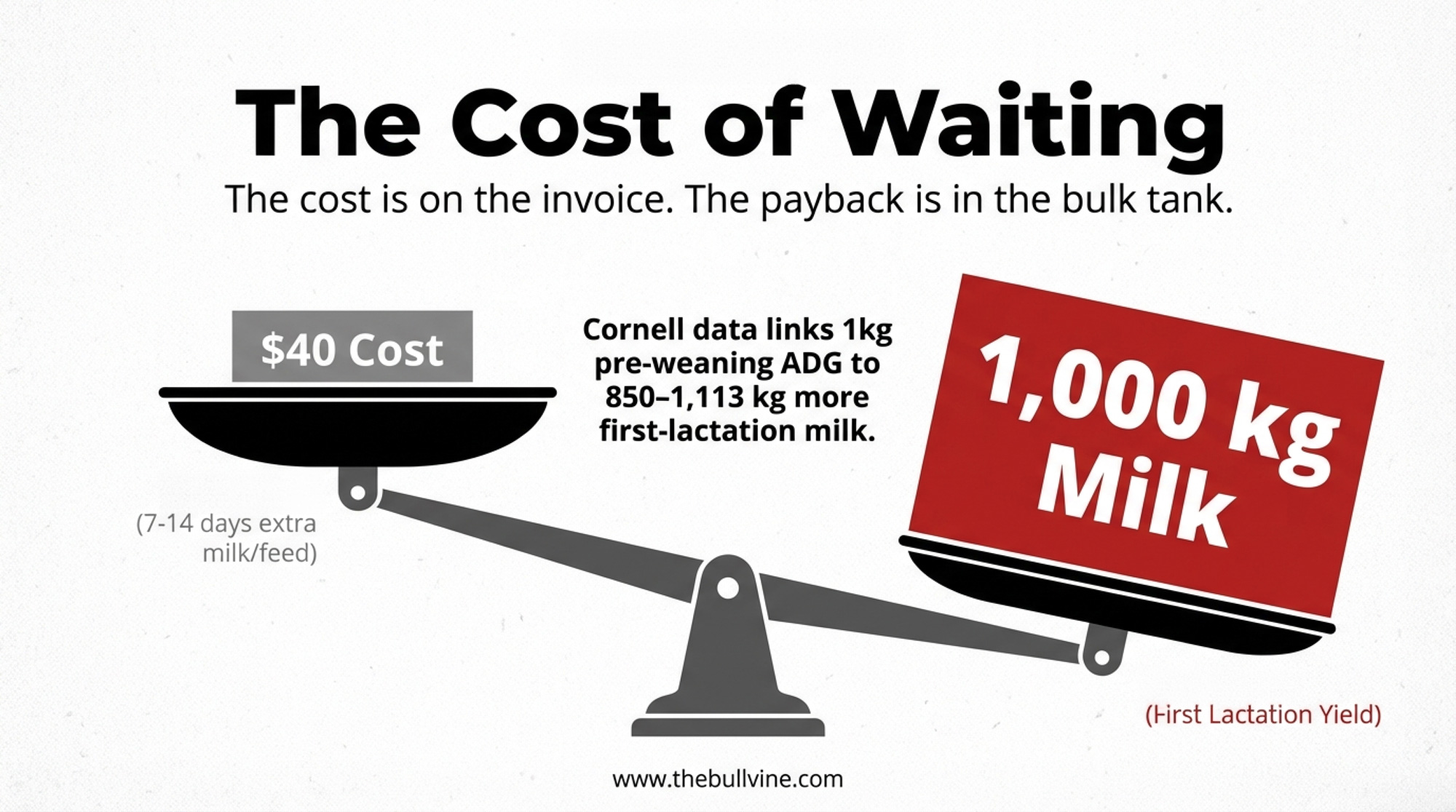
NewsSubscribe
First
Last
Consent

The Feed Room Decision That Defines a Heifer’s Lifetime Value

A textured calf starter can boost your calf’s growth by up to 35% — are you still grinding your feed?

You know that moment when the feed truck rolls up and you’re staring at invoices, wondering if that premium for textured calf starter is really worth it? Well, here’s something that might change how you look at those feed bills forever.

Across dairy farms of all sizes and regions, the message is consistent: the physical form of the starter feed isn’t just about convenience anymore. It’s about setting up heifers that will become profitable foundations of the herd.

Numbers That Get Your Attention

Here’s what caught my eye in the research: Cornell’s solid work (Soberon et al., 2012) found every extra pound of pre-weaning gain means 850 to 1,113 kilograms (1,875 to 2,450 pounds) more milk in first lactation alone. For example, even with milk prices in the $17-19/cwt range, that’s an extra $200 to $300 in your pocket — just in year one.

This chart visualizes how strategic investments in calf nutrition, particularly a premium starter, offer a substantial return. The data shows that while there is an initial added cost per calf (red bars), the net economic benefit (blue bars) from improved health, faster growth, and enhanced lifetime production significantly outweighs the investment.

But here’s the thing: it’s not about dumping more grain on calves. It’s about recognizing a newborn’s rumen as a construction site — and us, the contractors.

Building Something That Lasts

The calf comes equipped with stomach plumbing but only runs on one cylinder at first. Those tiny papillae inside her rumen start smaller than a pinky nail but can grow big — like enough to cover a pool table — by 70 days with the right feed.

Performance MetricTextured Starter AdvantageResearch SourceEconomic Impact
Dry Matter Intake (% increase)15-25%Jafari et al. 2018Higher feed conversion
Average Daily Gain (% increase)20-35%Multiple studiesFaster growth = earlier breeding
Rumination Time (% increase)140%Jafari et al. 2018Better rumen development
Days Earlier Weaning5-7 daysIndustry reportsReduced milk feeding costs
Feed Digestibility Improvement (%)7-13%Porter et al. 2007More efficient nutrient use
Rumen pH (textured vs pelleted)5.43 vs 5.03Porter et al. 2007Healthier rumen environment
Time to First Rumination (weeks)3.7 vs 6.0Porter et al. 2007Earlier functional rumen
VFA Absorption Improvement (%)15-20%Gelsinger et al. 2020Better long-term performance
Starter Intake at 5-8 weeks (% higher)19%Gelsinger et al. 2020Improved weaning transition
Body Weight Advantage at 17 weeks (lbs)72 lbsGelsinger et al. 2020Higher market weights

Research from Coverdale et al. (2004) was pivotal in demonstrating how textured starters increase dry matter intake and promote superior rumen development compared to other feed forms. Their work showed that physical feed characteristics aren’t just about palatability — they’re fundamental to proper digestive development.

Visual evidence of superior rumen development. Images (a) and (c) show the rumen lining of calves fed only milk (M), with smaller papillae and thinner epithelial layers. In contrast, images (b) and (d) display significantly longer, more numerous papillae and a more mature rumen epithelium in calves fed milk plus a starter diet (M+S), highlighting the critical role of solid feed in early rumen development.

I found biology fascinating: volatile fatty acids, especially butyrate, act as molecular messengers signaling the rumen lining to grow while reducing cell death. Texture matters because coarse particles make calves chew more and ruminate more — that ramps up saliva flow, and saliva brings bicarbonate that keeps rumen pH around 6.2 to 6.8, avoiding acid damage as the rumen builds its engine.

As Dr. Sarah Mills, a ruminant nutritionist at Midwestern University, says, “You only get one chance to build that rumen. Butyrate in a textured starter signals the rumen lining to grow and mature, setting the calf up for a lifetime of production. It’s a biological investment with compounding returns.”

This aligns with what veterinarians and nutritionists observe on farms: fewer digestive issues when calves consume textured starter.

Textured vs Pelleted: The Research Data

The facts are clear, and recent studies like Jafari et al. (2018) confirm what progressive producers have been seeing on-farm:

  • Calves on textured starters eat 15-25% more
  • They achieve 20-35% higher average daily gain
  • They spend over 140% more time ruminating
  • They wean about a week earlier
  • They digest feed 7-13% better
A side-by-side comparison of key performance metrics, demonstrating the measurable advantages of a textured starter. The data highlights significant gains in starter intake, average daily gain (ADG), rumination time, and overall digestibility, all of which contribute to a more robust and profitable calf.

That rumination difference — 20% for textured vs. 9% for pelleted — is big. Jafari’s work specifically linked this to more stable rumen pH and better overall digestion, which sets calves up for healthier transitions throughout their development.

Checking the Local Pulse

Premiums for textured starters vary widely by region and market conditions, typically ranging from $40 to $85 per ton, based on a compilation of regional feed market reports from the past year. However, producers should always check local pricing to understand their investment.

In Wisconsin and other traditional dairy regions, adoption is increasing because growers recognize the value, especially during tough winters. In newer dairy regions, progress is slower — a natural consequence of such a significant change.

Payback? Most farms see it in 6 to 8 months, thanks to better health and growth.

Sponsored Post

Making It Work on Your Farm

Here’s what successful farmers do:

  • Get colostrum fed on time
  • Start textured starter early — even just a taste
  • Keep water clean and free
  • Maintain robust milk feeding while pushing starter intake
  • Keep feed fresh — no stale piles
  • Look for rumination starting around 3-4 weeks
  • Push past 3 pounds of starter by 4-8 weeks
  • Add small, quality forage portions after that
  • Wean gradually, based on feed intake, not calendar

Dealing with Practical Stuff

Yes, textured feeding takes some attention:

  • Store feed in climate-controlled bins
  • Control dust when humid
  • Use a twice-daily feeding schedule

But the payback is real.

This graph illustrates the long-term financial impact of strategic heifer rearing. The lines show profitability over a heifer’s lifetime, demonstrating the initial cost of raising the animal (the negative curve) followed by the eventual positive return. The investment in superior early nutrition helps the heifer reach profitability sooner (as early as 38 months), demonstrating the long-term financial payoff of building a strong foundation. (Source: Lactanet)

Bottom Line

The window for building optimal rumen capacity closes between 8 and 10 weeks of age. Miss it, and you’re managing the consequences for that cow’s entire productive life. Get it right, and you’ve built yourself a money-maker.

KEY TAKEAWAYS:

  • Textured starters spark up to 25% higher intake — calves eat more willingly, grow stronger, and develop better digestive foundations from week one
  • Pre-weaning growth boosts up to 35% translate into hundreds of extra pounds of milk per cow over her lifetime — that’s real money in your pocket, not just better-looking calves
  • Coarser feed textures promote natural chewing and rumination, boosting saliva flow that buffers rumen pH to a healthy 6.2-6.8 range — preventing costly acidosis and digestive upsets
  • Farmers worldwide report smoother weaning transitions and healthier calves with textured feeds — especially crucial in today’s tight economic conditions, where every animal needs to perform
  • Research from Cornell, Purdue, and European universities backs this strategy with hard data linking texture-focused feeding to superior rumen development and lifetime productivity gains

EXECUTIVE SUMMARY:

At The Bullvine, we’re seeing that the old “grind-everything” approach to calf starters is quietly holding back performance across dairy operations. Textured starters improve intake by up to 25% and growth by up to 35%, delivering concrete ROI with long-term economic impact — including an extra $200-$300 per heifer in first-lactation earnings from better pre-weaning development. This isn’t just about feeding more grain; it’s about nurturing a robust rumen foundation from day one that pays dividends for years. Around the globe, progressive dairies from New Zealand to Europe are already making this switch, focusing on digestion quality that pairs perfectly with farm economics. With university studies from Cornell to Europe confirming these benefits — improved rumen health, more stable fermentation, and healthier calves with fewer digestive issues — the path forward is clear. It’s time to challenge assumptions and make textured starters a cornerstone of your 2025 calf program.

Complete references and supporting documentation are available upon request by contacting the editorial team at editor@thebullvine.com.

Learn More:

The Sunday Read Dairy Professionals Don’t Skip.

Every week, thousands of producers, breeders, and industry insiders open Bullvine Weekly for genetics insights, market shifts, and profit strategies they won’t find anywhere else. One email. Five minutes. Smarter decisions all week.

NewsSubscribe
First
Last
Consent

Discover How Once-a-Day Feeding Impacts Calf Growth and Your Bottom Line

Can once-a-day feeding transform your dairy farm? Discover its impact on calf growth and gut health. Read on for the details.

Summary: Are you tired of twice-a-day feeding hassles? Imagine saving time and money with once-a-day feeding! Recent research in the Journal of Dairy Science shows that feeding milk replacer to dairy calves once daily doesn’t compromise their gut health or growth. This simple change could transform your dairy farming routine, offering significant labor savings without affecting your calves’ development. Switching to once-a-day (OAD) feeding can save you over 40% of labor time while ensuring your calves’ health. Studies comparing OAD and twice-a-day (TAD) feeding found no harmful effects on calf growth or rumen development. Both groups grew at equal rates, and OAD feeding reduced labor by 39%, streamlining daily routines. To transition to OAD feeding, plan your schedule, monitor calves’ health and intake, adjust milk replacer concentration, ensure adequate water, and gradually reduce the second meal to help calves adjust.

  • Once-a-day (OAD) feeding can save over 40% of labor time per day.
  • Research shows no compromise in calf growth or gut health with OAD feeding.
  • Studies found no significant differences in growth rates or rumen development between OAD and twice-a-day (TAD) feeding.
  • OAD feeding reduced labor by 39%, offering significant labor savings.
  • To transition smoothly to OAD, plan your schedule, monitor calf health and intake, and adjust milk replacer concentration.
  • Ensure calves have adequate water and gradually reduce the second meal to help them adjust.

Consider a scenario in which feeding your dairy calves just once a day may save you over 40% of your labor time while having no detrimental effect on their development or health. It’s not fiction; it’s science-backed. Neighboring farmers have long questioned whether once-a-day (OAD) feeding might significantly decrease their burden while ensuring the health of their calves. Recent research suggests that this might be both doable and useful. Aside from the obvious labor savings, the prospective benefits for calf development and gut health are encouraging. Dairy producers acknowledge the vital developmental window from birth to weaning as a period when dietary practices may determine their herd’s future output. But does feeding frequency affect the microbiota and metabolic activity in the rumens of newborn calves? Let’s explore the most recent studies to discover the practical advantages and potential trade-offs of moving to once-a-day feeding.

Say Goodbye to Twice-A-Day Feeding Hassles: Why Once-A-Day Could Be Your Silver Bullet!

Caring for calves is no walk in the park, particularly when fed twice daily (TAD). While this strategy is beneficial, it frequently requires farmers to commit much time and work. Imagine the relief of not having to get up before dawn and set aside time in the late afternoon daily to guarantee the calves receive milk. The practice requires about 39% more labor time than less frequent feeding models.


But there is a light at the end of the tunnel: once-a-day feeding (OAD). This alternate approach is gaining popularity since it can considerably reduce labor expenses while providing the attention calves need for proper growth. Farmers can devote more time and money to other essential parts of farm management by feeding calves once a day, empowering them to make OAD a feasible and efficient choice in commercial dairy production systems.

The Study That Could Revolutionize Your Calf Feeding Routine

The Journal of Dairy Science research compared once-a-day (OAD) and twice-a-day (TAD) milk replacer feeding regimes for dairy calves from birth until weaning. Key results show that providing milk replacer OAD had no harmful influence on calf growth, rumen development, or microbial diversity. The study found no changes between OAD and TAD in microbial diversity in the calves’ rumen, growth performance, or health indices. This shows that OAD feeding may be a realistic and cost-effective alternative to TAD feeding that does not jeopardize the calves’ health and development.

Calf Growth: No Compromises with Once-A-Day Feeding 

Calf development was, without a doubt, a critical part of this investigation. Given the promise of reduced effort from once-a-day (OAD) feeding, you may worry whether it comes at the expense of your calves’ growth. Fortunately, the results are reassuring. The research carefully tracked sixteen male Holstein calves, split evenly between OAD and twice-a-day feeding groups. Calf development parameters did not change significantly across the two feeding regimens, giving you confidence in the benefits of OAD feeding.

Calves on both OAD and TAD feeding regimens grew at equal rates, with continuous body weight growth from birth until weaning (63 days). According to the research, “the feeding program did not affect calf growth metrics.” This is consistent with a prior study that found no difference in body weight increase between the OAD and TAD feeding regimens” [Journal of Dairy Science].

Furthermore, feeding OAD has little effect on other essential growth characteristics, such as starter intake or rumen development. Both calves followed conventional developmental trends, suggesting that feeding frequency may be reduced without impacting health or growth. This implies that OAD feeding may save labor without negatively impacting calf growth.

Gut Health: Unveil the True Impact of Once-A-Day Feeding on Calf Gut Microbiota 

You understand how vital gut health is to overall calf performance and growth. This research shows whether feeding calves one a day (OAD) damages their ruminal microbiota and metabolic profiles. And here’s a game-changing realization: it doesn’t.

When researchers compared OAD feeding to the standard twice-a-day (TAD) technique, they discovered no significant variations in microbial diversity or metabolic activity in calves’ rumens. According to ruminal fluid samples, the quantity, variety, and richness of bacterial communities were unaffected by feeding frequency. Age was a more important predictor than feeding frequency. As the calves developed, their gut microbiota spontaneously transitioned from a less diversified community at seven days to a more stable and varied ecosystem at 35 and 63 days. Both feeding regimens had comparable microbial compositions at these phases, dominated by essential bacteria such as Prevotella and Succinivibrionaceae.

Furthermore, the feeding regimen did not change metabolite profiles. Critical metabolite levels, such as acetate and propionate, were similar throughout the OAD and TAD groups, showing that the ruminal metabolome has matured and is resistant to feeding frequency fluctuations. To summarize, using an OAD feeding approach will not harm your calves’ gut health or metabolic activity. It’s a win-win situation for decreasing labor while maintaining the development and health of your young stock.

Unlock Major Labor Savings with Once-A-Day Feeding 

MetricOnce-A-Day (OAD) FeedingTwice-A-Day (TAD) FeedingDifference
Feeding FrequencyOne time/dayTwo times/day 
Labor Hours (per week)14 hours24 hours-10 hours (42% reduction)
Labor Cost (per week)$210$360-$150 (42% reduction)
Annual Labor Cost$10,920$18,720-$7,800 (42% reduction)

The most convincing reason to transition to once-a-day (OAD) feeding is the possibility of substantial labor savings. Reducing the amount of time spent feeding calves may benefit dairy farmers. Galton and Brakel (1976) found that OAD feeding reduced labor by 39% when compared to twice-a-day (TAD) feeding [source]. This is more than just lowering the number of feedings; it is also about streamlining your daily routine, freeing up crucial time for other essential farm chores.

Consider the practical side: fewer feeding sessions need less time to make milk replacers, clean equipment, and handle calves. When completed twice daily, these duties add to a significant portion of your daily routine. Reducing physical work may also reduce weariness, allowing for a greater emphasis on calf health and other vital farm tasks.

Furthermore, Ackerman et al. (1969) replicated these results, demonstrating comparable labor time savings without compromising calf development or general health. This implies that you may accomplish the same productive results in less time, making OAD feeding a very efficient and cost-effective technique.

Ready to Switch to Once-A-Day (OAD) Feeding? Follow These Tips for a Smooth Transition!

Are you thinking about switching to once-a-day (OAD) feeding? Here are some practical tips and considerations for a smooth transition: 

  • Plan Your Schedule: Align your OAD feeding schedule with your farming routine. An early morning or late afternoon feeding time is optimal, giving you the remainder of the day to do other duties.
  • Monitor Calf Health: Monitor your calves’ health and consumption closely. Any signs of underfeeding, sickness, or weight loss should be treated immediately. Regular health checks will allow you to adjust the food amount as necessary.
  • Adjust Milk Replacer Concentration: Because the calves will take their whole daily ration in one session, consider tweaking the milk replacer concentration to ensure they obtain all required nutrients while avoiding over- or underfeeding.
  • Ensure Adequate Water Supply: Always provide clean, fresh water. Calves need additional water to compensate for the transition to a single, larger milk meal.
  • Solid Feed Availability: Make sure substantial feed and hay are available from a young age. This promotes rumen growth and assists calves in meeting their nutritional requirements when transitioning from milk.
  • Gradual Transition: If you’re presently feeding twice a day (TAD), gradually reduce the second meal over a week or two to let the calves adjust to the new schedule.
  • Consistent Monitoring: Track growth rates, rumen development, and general behavior. Regularly weighing calves and keeping growth statistics may be helpful tools.
  • Staff Training: Ensure that your crew is well-informed on the new feeding regimen and the symptoms of calf health and nutrition demands.

Transitioning to OAD feeding may present some challenges, such as: 

  • Initial Disruption: Calves and maybe even your personnel may adapt. Maintain patience and constant care to help the transition go smoothly.
  • Potential Overfeeding: Observe the calves intently throughout their feeding. Overfeeding might cause intestinal difficulties. Calibrate the quantity of milk replacer according to your calf’s weight and development requirements.
  • Monitoring Labor Allocation: While OAD feeding may significantly save labor, the time saved should be appropriately reassigned to other essential farm chores.

Adopting an OAD feeding plan might be a game changer for your farm’s efficiency and calves’ development if you follow these practical guidelines and address possible problems.

Frequently Asked Questions About Once-A-Day (OAD) Feeding 

Will OAD feeding affect my calves’ growth? 

The study found no significant difference in growth rates between calves fed once a day (OAD) and twice a day (TAD). Both groups have similar body weight increases and overall health development.

Is OAD feeding a negative impact on calf health? 

There have been no adverse health effects associated with OAD feeding. According to the research, OAD has no negative impact on calves’ health or immunological responses. Proper beginning care and feeding procedures are essential for calf health, regardless of feeding frequency.

How will OAD feeding affect the development of my calves’ ruminal microbiota? 

The research observed no significant variations in ruminal microbiota or metabolite profiles between OAD and TAD calves. Microbial diversity and richness increased with age in both feeding regimes, demonstrating that OAD feeding does not impair the development of a healthy gut microbiota.

Can I expect labor savings by switching to OAD feeding? 

Absolutely! Switching to OAD feeding may drastically save labor time and expenditures. Studies have shown that this feeding approach may cut work by up to 39%, enabling you to spend time and resources on the farm better.

What should I consider before transitioning to OAD feeding? 

Before switching, confirm that the milk replacer formulation and feeding procedures suit OAD feeding. Keep a watchful eye on your calves throughout the transition phase to ensure they’re reacting well. Consulting with a veterinarian or a nutritionist may also give personalized advice for a seamless transition.

The Bottom Line

According to the study, giving calves a once-a-day (OAD) milk replacer had no harmful influence on growth, rumen development, or gut health. This demonstrates the ability to dramatically cut labor and expenditures while maintaining the well-being of your animals. As labor becomes more scarce and costly, transitioning to OAD feeding may be the game-changer your dairy company needs. 

Why not attempt OAD feeding? It might change how you manage your calves, saving time and effort while ensuring optimum health and development.

Consider this: Could a simple tweak in your feeding practice result in new efficiency and advantages for your dairy farm? The solution might only be one feeding away.

Learn more: 

How Early Forage in Diets Boosts Performance and Behavior in Dairy Calves: New Findings

Explore the transformative impact of introducing forage early in dairy calf diets on their performance and behavior. Eager to learn about the distinct advantages of various forage sources? Continue reading to uncover these insights.

A calf’s early diet in dairy farming is not just a routine, but a crucial step towards shaping its future health and productivity. Research illuminates that the type of forage in a calf’s diet can significantly impact its development. By adjusting feed, we can unlock the potential for enhanced growth and well-being. This study delves into how different forage sources in total mixed rations (TMR) can influence dairy calves, offering a glimpse into a future where performance, metabolism, and behavior are revolutionized by our understanding of early forage inclusion. 

The study , titled ‘Forage sources in total mixed rations early in life influence performance, metabolites, and behavior of dairy calves ‘, published in the Journal of Dairy Science, examines the effects of various forage types on young dairy calves. By studying forty-eight Holstein calves, the researchers meticulously evaluated the impact of different forage sources—like Tifton hay and corn silage—on performance, metabolic health, and behavior, ensuring the findings are robust and reliable.

The Power of Early Forage: Setting Calves Up for Success

This study unequivocally underscores the importance of introducing forage early in a calf’s diet. The integration of forage, often overshadowed by traditional feeding methods, yields promising results for growth performance and overall health. The method and timing of forage introduction are pivotal for how effectively dairy calves utilize these fibrous materials. 

Young calves start grazing naturally as early as the second week of life, showing an instinctual preference for forage. This early consumption significantly enhances rumen development and nutrient absorption. Research from the early 2000s highlights the benefits of lower levels of forage inclusion, setting the stage for optimizing calf diets. Studies consistently find that calves offered forage, especially in mixed rations, exhibit increased solid feed intake and improved metabolic responses. 

This study builds on that understanding, showing that calves receiving TMR with forage maintain solid feed intake and have elevated β-hydroxybutyrate concentrations, indicating efficient metabolic processes. Additionally, forage inclusion encourages longer rumination times, a sign of better digestive health and behavioral satisfaction. 

These insights call for a shift in calf-rearing practices. Traditional methods often use grain-heavy starters without forage, but evidence now supports the essential role of fiber. Calves consuming alfalfa hay, for example, show higher starter feed intake than those given other forage types, suggesting that fine-tuning forage sources can maximize benefits. 

On commercial dairy farms, where the norm often excludes forage pre-weaning, feeding protocols need an urgent reevaluation. The integration of quality forage could significantly enhance growth performance and metabolic health, providing a solid foundation for calves’ future productivity. As the industry pivots towards evidence-based feeding strategies, advocating for early forage inclusion becomes not just important, but imperative for optimal dairy calf performance.

Diverse Forage Sources and Their Unique Benefits

Forage SourceUnique Benefits
Tifton Hay (Medium Quality)Supports increased solid feed intake, improves rumination time, and provides fibers essential for digestion.
Tifton Hay (Low Quality)Encourages higher solid feed consumption and enhances rumination, despite lower digestibility compared to medium quality hay.
Corn SilageBoosts solid feed intake, provides a balanced nutrient profile, and enhances digestibility and palatability.

Both ensiled and dry sources showed distinct advantages among the forage options tested. Regardless of quality, Tifton hay significantly enhanced solid feed intake during crucial developmental periods. Corn silage also improved feeding behavior, underscoring the value of diverse forages in calf nutrition. 

These findings align with prior research, such as Castells et al., which highlighted that various forages could equally boost intake and gains without harming feed efficiency or nutrient digestibility. Quality is influential, but the presence of forage itself is vital for healthy development. 

The study noted higher β-hydroxybutyrate levels and increased rumination times in calves fed TMR with forage, indicating better rumen fermentation and metabolic activity. These markers illustrate how forages positively impact rumen development and digestive health, connecting metabolic outcomes with improved behavior. 

Furthermore, the methods of forage inclusion, like total mixed rations, significantly influence outcomes. Different forages interact uniquely with the diet, affecting particle size, physical form, and nutrient content. This complexity necessitates a nuanced approach to forage integration, considering the calf’s developmental stage and dietary goals. 

Ultimately, incorporating diverse forage sources offers benefits beyond nutrition. These forages promote metabolic health, efficient rumination, and proper eating behavior, supporting robust calf growth. Dairy producers should consider these benefits to optimize their feeding programs.

Understanding the Performance and Behavior of Dairy Calves

Incorporating various forage sources in Total Mixed Rations (TMR) enhances growth rates through improved feed efficiency and metabolic health. The study showed that while forages in TMR didn’t significantly change average daily gain or body weight, they did increase solid feed intake, laying a solid foundation for healthy growth. Additionally, higher β-hydroxybutyrate concentrations in calves receiving forage-inclusive diets signified enhanced metabolic health. 

Feed efficiency, a critical aspect of livestock management, improved significantly with diverse forage sources in TMR. This positive trend indicates more effective nutrient utilization, which is crucial for the economic viability of dairy farming. Calves on such TMR diets also exhibited prolonged rumination, a sign of good digestive health and fiber utilization. 

Forage inclusion also influenced behavioral patterns. Calves on forage-inclusive diets showed extended rumination periods associated with better digestive efficiency and general well-being. Despite no significant differences in time spent on various activities, the extended rumination time highlights the necessity of forage for optimal rumen development. 

In essence, including forage in early-life diets for dairy calves boosts growth rates, feed efficiency, and overall health. Strategic forage inclusion in pre- and postweaning diets fosters resilient, healthy, and high-performing dairy cattle. These insights are crucial as we optimize feeding regimens for the benefit of both livestock and dairy producers.

New Findings in Early Forage Inclusion 

ParameterForage Inclusion (MH, LH, CS)No Forage (CON)
Solid Feed Intake (wk 7 & 8)IncreasedLower
Postweaning Feed IntakeHigherLower
Average Daily Gain (ADG)No significant differenceNo significant difference
Body Weight (BW)No significant differenceNo significant difference
Feed Efficiency (FE)LowerHigher
β-Hydroxybutyrate ConcentrationHigherLower
Rumination TimeHigherLower
NDF Intake (Week 8)HigherLower

Recent research highlights the benefits of early forage inclusion in the diets of dairy calves. Studies and meta-analyses confirm that dietary fiber from forage positively influences pre- and post-weaned calf performance. 

Comparing calves fed forage with those on a forage-free diet shows significant behavior and feed efficiency improvements. Forage-fed calves have increased rumination and better nutrient digestion, as seen from a higher neutral detergent fiber intake from week 8. 

The implications for dairy calf management practices are evident. Including forage in the diet enhances feed intake and supports healthier growth. These findings advocate for early dietary forage to optimize metabolic and developmental outcomes.

The Bottom Line

Research highlights the critical role of early forage inclusion in dairy calf development. Adding forage to their diet meets immediate nutritional needs. It promotes beneficial behaviors like increased rumination time, which is essential for long-term health and productivity. Higher β-hydroxybutyrate levels indicate better metabolic adaptation, underscoring the importance of fiber for gut health and rumen development. 

Dairy farmers and nutritionists should reconsider including forage in early calf nutrition to boost feed intake, behavior, and growth. Implementing this requires tailored approaches considering forage quality and proportion in mixed rations. 

Future research should explore the long-term impacts of early forage inclusion on growth and health. It will be crucial to investigate the relationship between gut fill, average daily gain (ADG), and different forage types on metabolic indicators over time. Understanding sustained rumination from early forage can optimize calf nutrition, ensuring smooth transitions into high-yielding dairy cows.

Key Takeaways:

  • Introducing forage early in calves’ diets can significantly enhance rumen development and nutrient absorption.
  • Calves receiving TMR with included forage maintained higher solid feed intake compared to those without forage.
  • The diets containing medium quality hay (MH), low quality hay (LH), and corn silage (CS) all showed increased solid feed intake pre- and postweaning.
  • Despite no significant differences in average daily gain and body weight (BW), forage groups exhibited higher feed efficiency with the CON diet.
  • Calves on TMR-containing forage had elevated β-hydroxybutyrate concentrations, indicating efficient metabolic processes.
  • Supplemental forage led to longer rumination times, signifying better digestive health and behavioral satisfaction.

Summary: A study published in the Journal of Dairy Science suggests that introducing forage early in a calf’s diet can improve growth performance and overall health. Young calves start grazing naturally as early as the second week of life, showing an instinctual preference for forage. This early consumption significantly enhances rumen development and nutrient absorption. Research from the early 2000s has consistently found that calves offered forage, especially in mixed rations, exhibit increased solid feed intake and improved metabolic responses. This study builds on that understanding, showing that calves receiving total mixed rations (TMR) with forage maintain solid feed intake and have elevated β-hydroxybutyrate concentrations, indicating efficient metabolic processes. Forage inclusion encourages longer rumination times, a sign of better digestive health and behavioral satisfaction. The study calls for a shift in calf-rearing practices, as traditional methods often use grain-heavy starters without forage. Integrating quality forage could significantly enhance growth performance and metabolic health, providing a solid foundation for calves’ future productivity.

Send this to a friend