







Outlook had 55 on payroll at sunrise and 20 by sundown. The parlor didn’t blink. If your crew vanished tomorrow, who runs the next six milkings — and what’s it cost by dark?
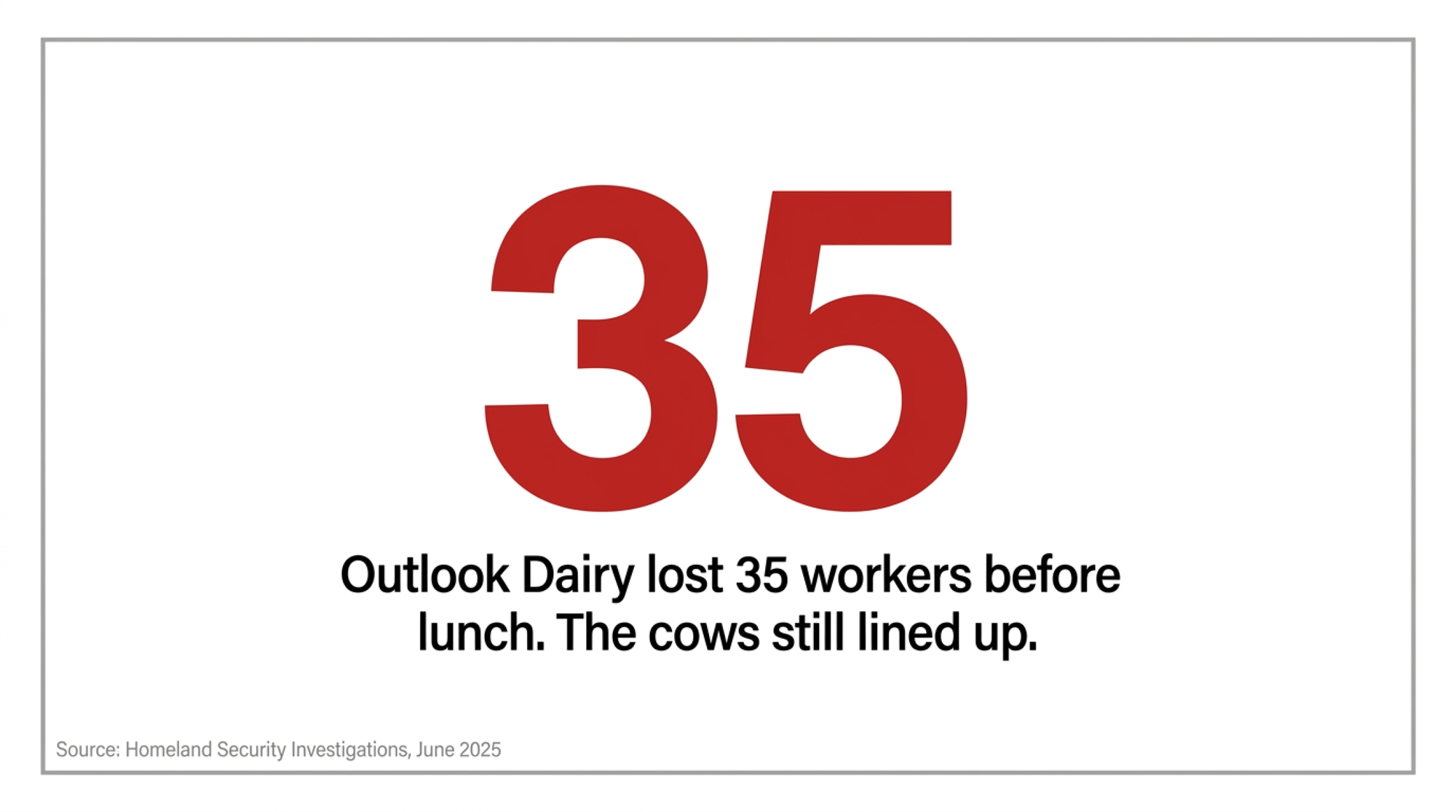
On June 4, 2025, Outlook Dairy outside Lovington, New Mexico, had 55 people on the payroll. By the time the dust settled, 35 of them were gone — Homeland Security Investigations agents arrested 11 workers while executing a search warrant, and the dairy terminated 24 more whose work-authorization documents could not be verified, according to the agency’s announcement and subsequent reporting. HSI said the arrested workers had used counterfeit documents to obtain work; as of this reporting, the public record does not indicate any charges against the dairy’s owners. Owner Isaak Bos didn’t soften the impact on the operation. Milk production, he told reporters, “didn’t just slow down, it effectively ceased.”
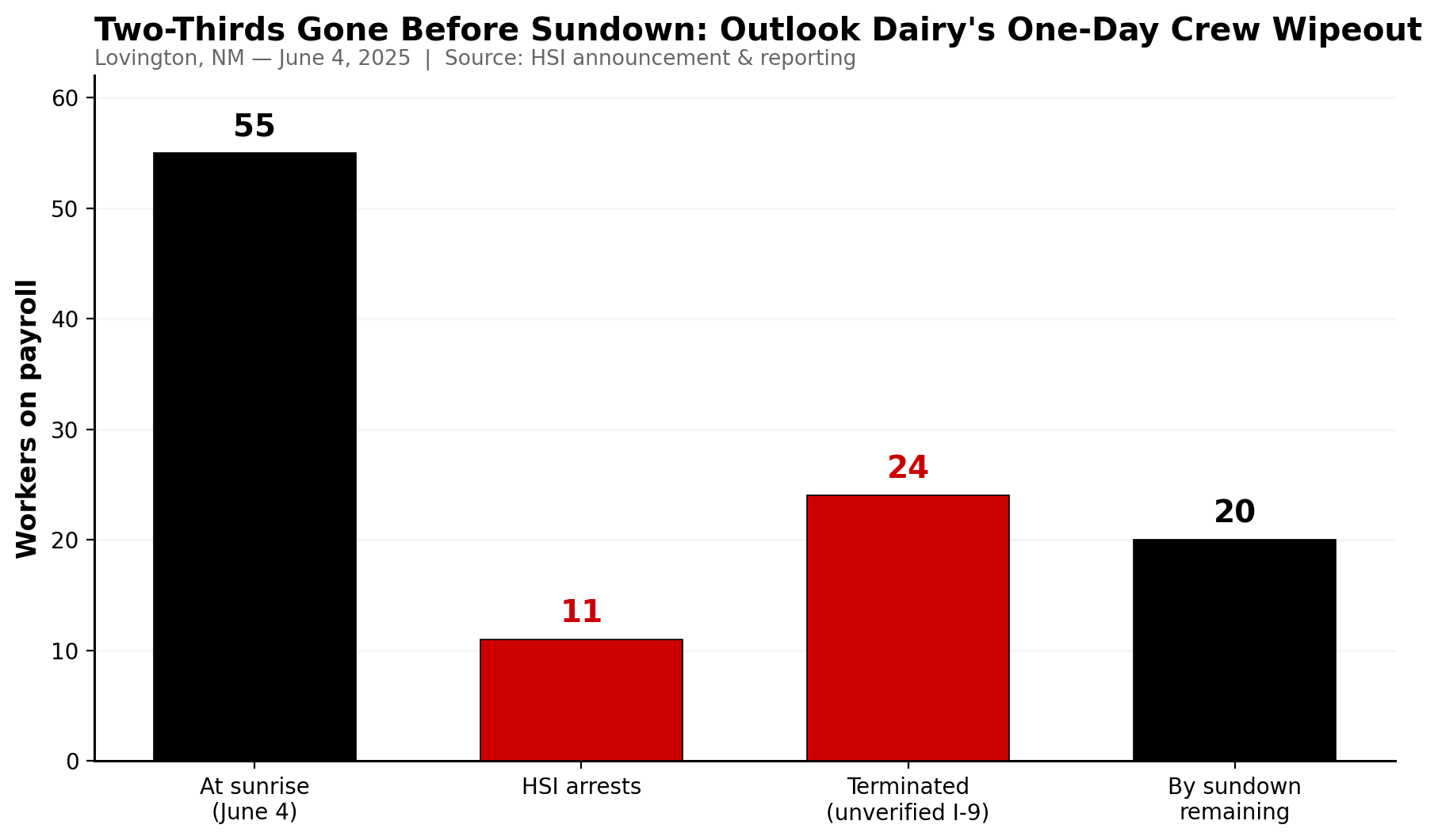
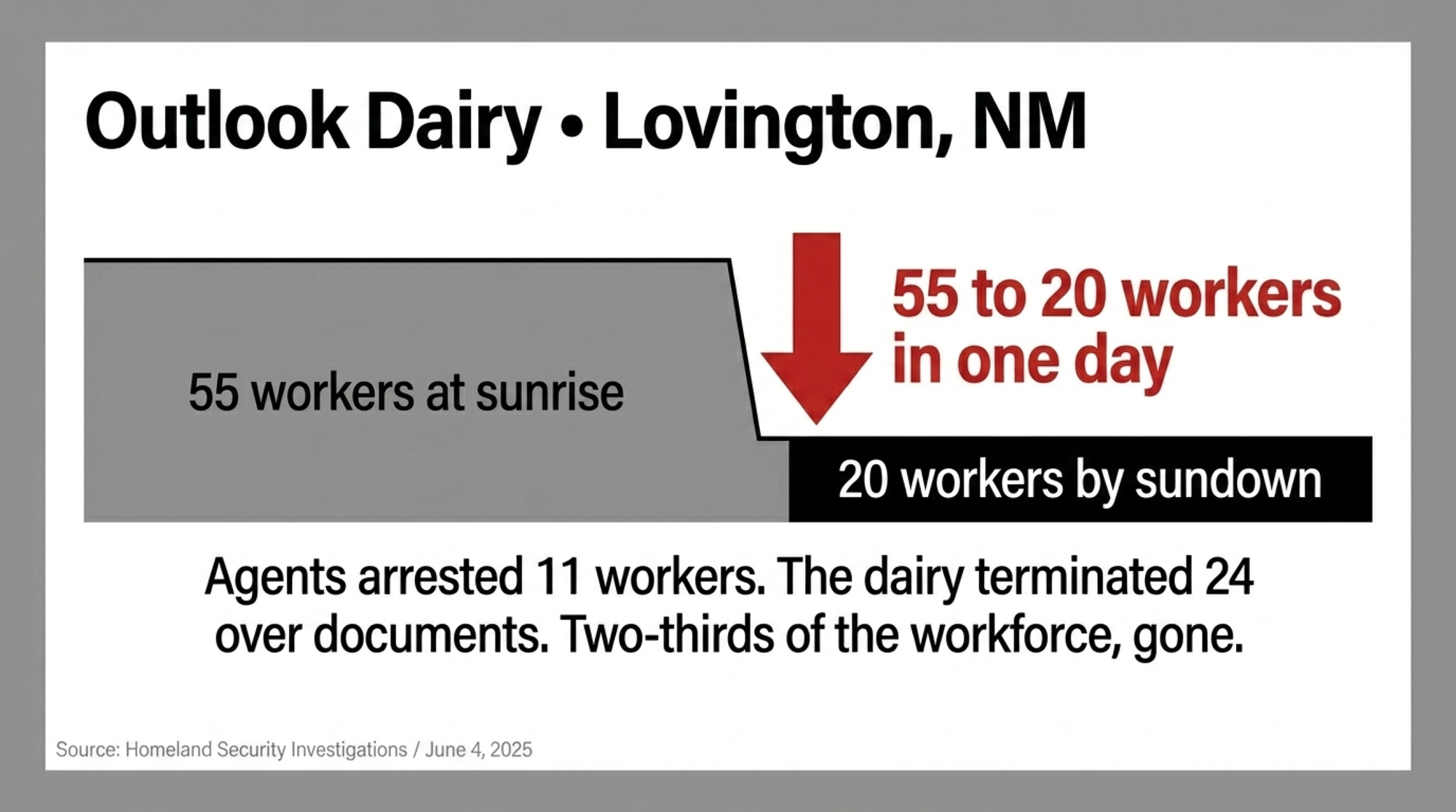
That’s two-thirds of a workforce, gone before the day was out. Family, office staff, and local high school kids on summer break kept the cows alive in the days after. The parlor didn’t care that immigration enforcement had just gutted the crew. Cows still lined up. Calves still needed feeding. Somebody had to show up at 4 a.m.
This is the sharp edge of a labor reality that touches nearly every hired-labor dairy in the country. About half of all hired dairy workers are immigrants, and the farms that employ them produce roughly 79% of the nation’s milk. When enforcement lands — or even when the rumor of it lands — your operation isn’t on a five-year labor trend anymore. It’s on a 72-hour clock. And most farms are only mentally prepared for half of what that clock measures.
What’s Changing and Why
For years, immigration enforcement mostly skipped dairy barns. Raids hit meatpacking plants and construction sites. That assumption broke in June 2025.
This wasn’t one farm having a bad week. It was a wave. Within weeks it had touched four states. New Mexico on June 4. Then Nebraska and California the same week — ICE arrested more than 70 at an Omaha plant, with farm operations hit out West. South Dakota came last, after a quieter Homeland Security audit landed at Drumgoon.
President Trump publicly acknowledged the bind: “We can’t take farmers and remove all their workers and send them back just because they might not have the necessary documentation,” he said on June 12. The directive paused, then reversed, inside a week. The cows didn’t.
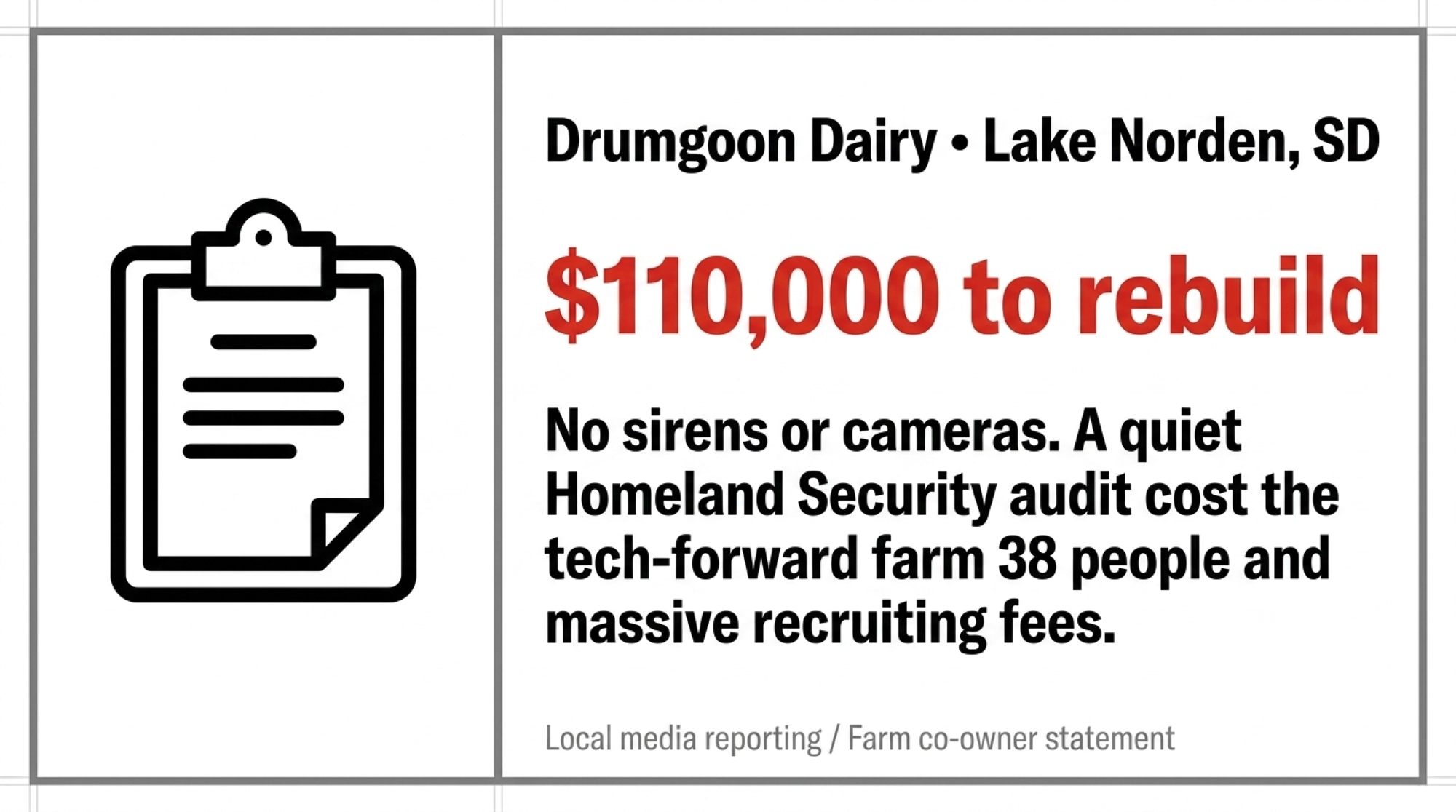
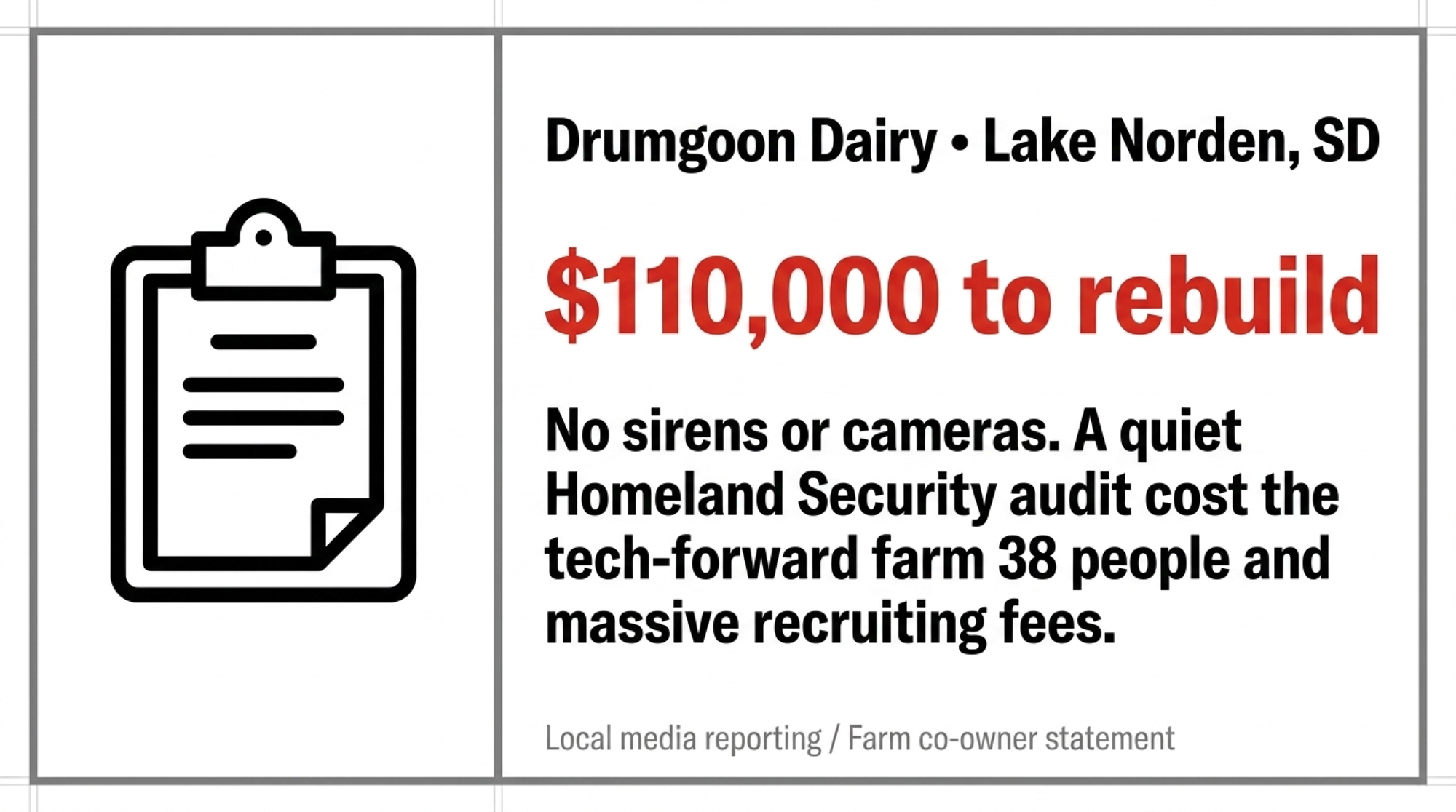
Drumgoon Dairy near Lake Norden, South Dakota, shows what the quieter version looks like. After a Homeland Security audit, the farm let 38 workers go — cutting staff from more than 50 down to 16, according to local reporting. Co-owner Dorothy Elliott told local media the farm spent more than $110,000 on recruiters and transportation trying to rebuild the crew. That’s a 6,500-cow operation with 20 robotic milking units already installed. Tech-forward, well-run, and still knocked sideways by a single paperwork action.
Stack that on the structural math, and you see why this isn’t a New Mexico problem or a South Dakota problem:
- A National Milk Producers Federation/Texas A&M study, published in 2015 and still the most-cited industry estimate on record, put immigrant workers at 51% of hired dairy labor on farms producing 79% of U.S. milk — and the industry still leans on those figures today.
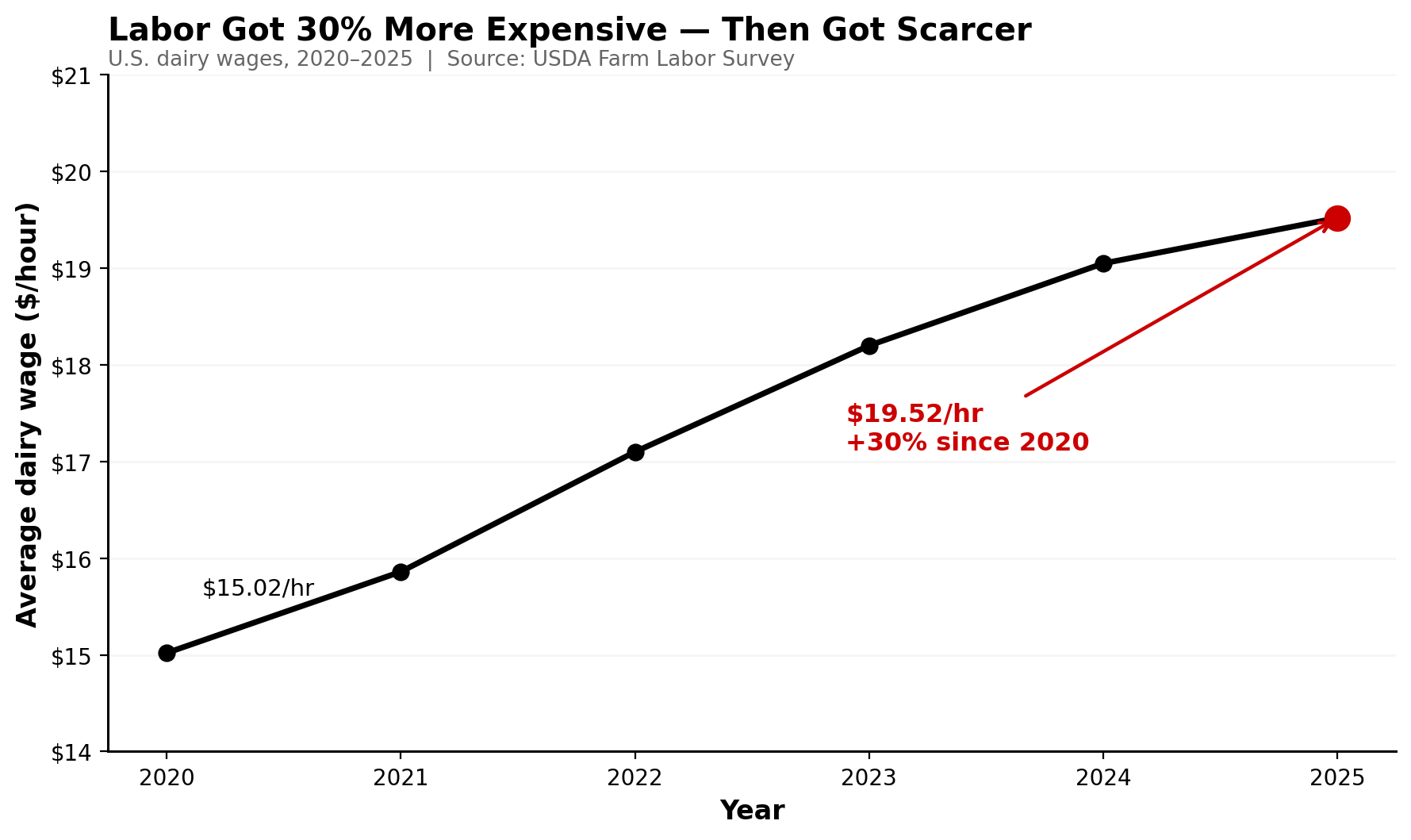
- Dairy wages have climbed to roughly $19.52/hour, up about 30% since 2020, per USDA Farm Labor Survey data.
- ICE and Border Patrol are slated for a $170 billion funding increase through 2029, with workplace enforcement explicitly named as a priority.
More pressure on the same workforce you already can’t easily replace. That’s the short version.
How This Plays Out on Real Farms
The Outlook and Drumgoon stories sound extreme because they are. But the mechanics showing up around them are quieter and more common.
In Idaho, one dairy reportedly lost about a third of its crew over three weeks. No raid. No warrant. No agents on the property. Workers stopped showing up after an enforcement action 50 miles away rattled the community, according to reporting on the incident. Fear became a labor event all by itself.
Beverly Idsinga, who works with New Mexico dairy producers, put the whole problem in five words after the Lovington raid: “You can’t turn off cows.” That’s the line every owner-operator already knows in their gut. The biology doesn’t pause while you sort out the paperwork.
Here’s the barn math that makes it real. Take a 500-cow herd:
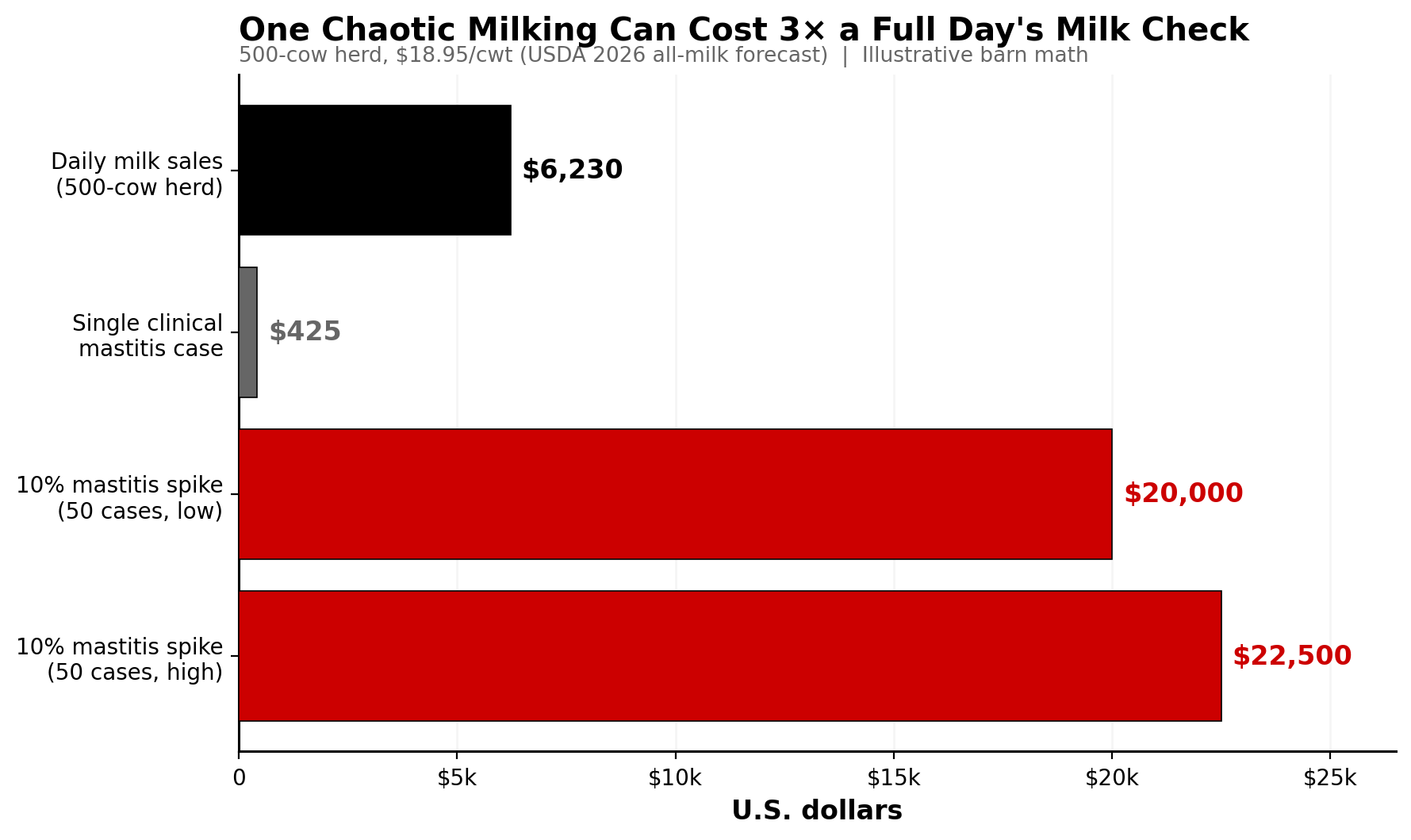
- At 24,000 lbs per cow per year, you’re shipping roughly 32,900 lbs a day.
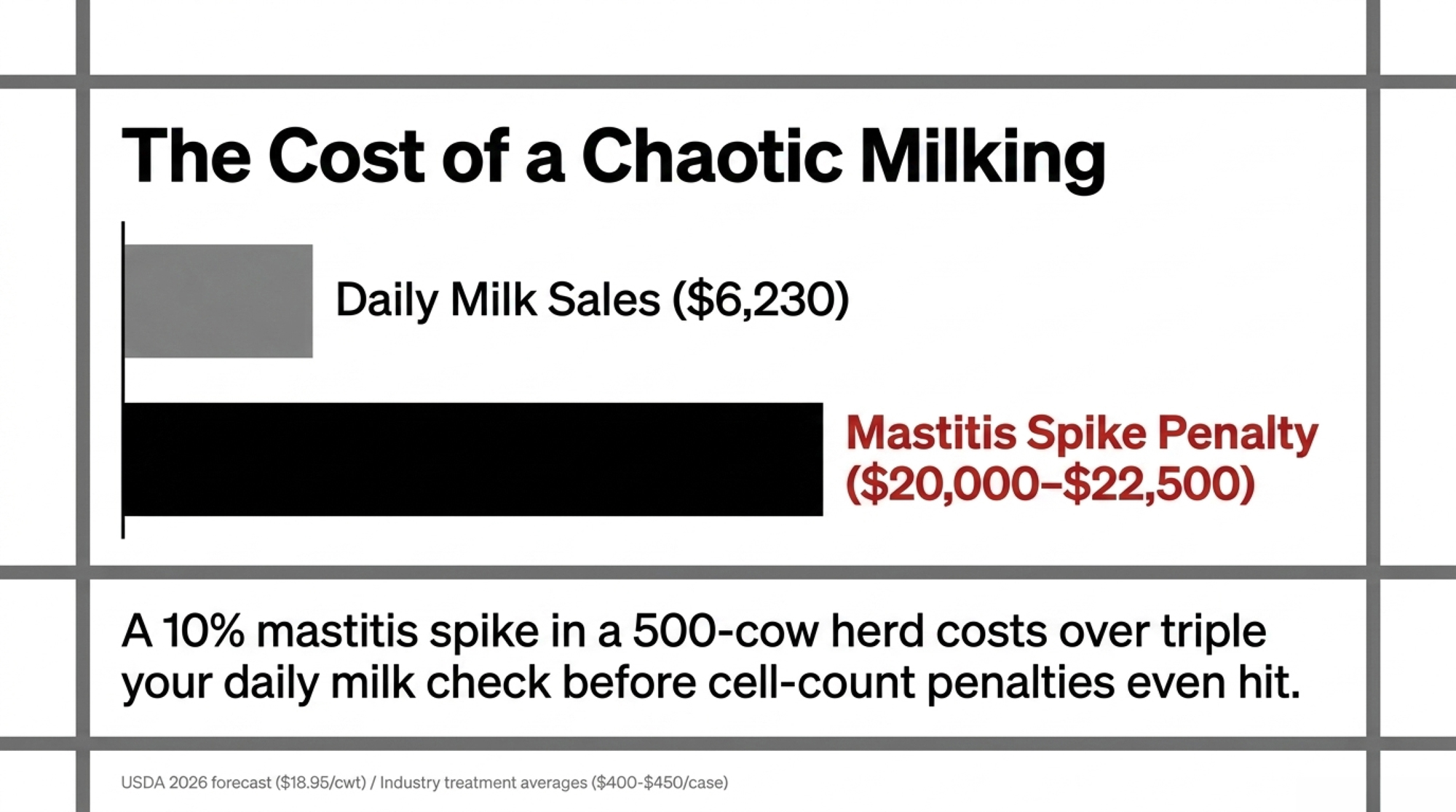
- At $18.95/cwt — USDA’s 2026 all-milk forecast — that’s about $6,230 in milk sales per day.
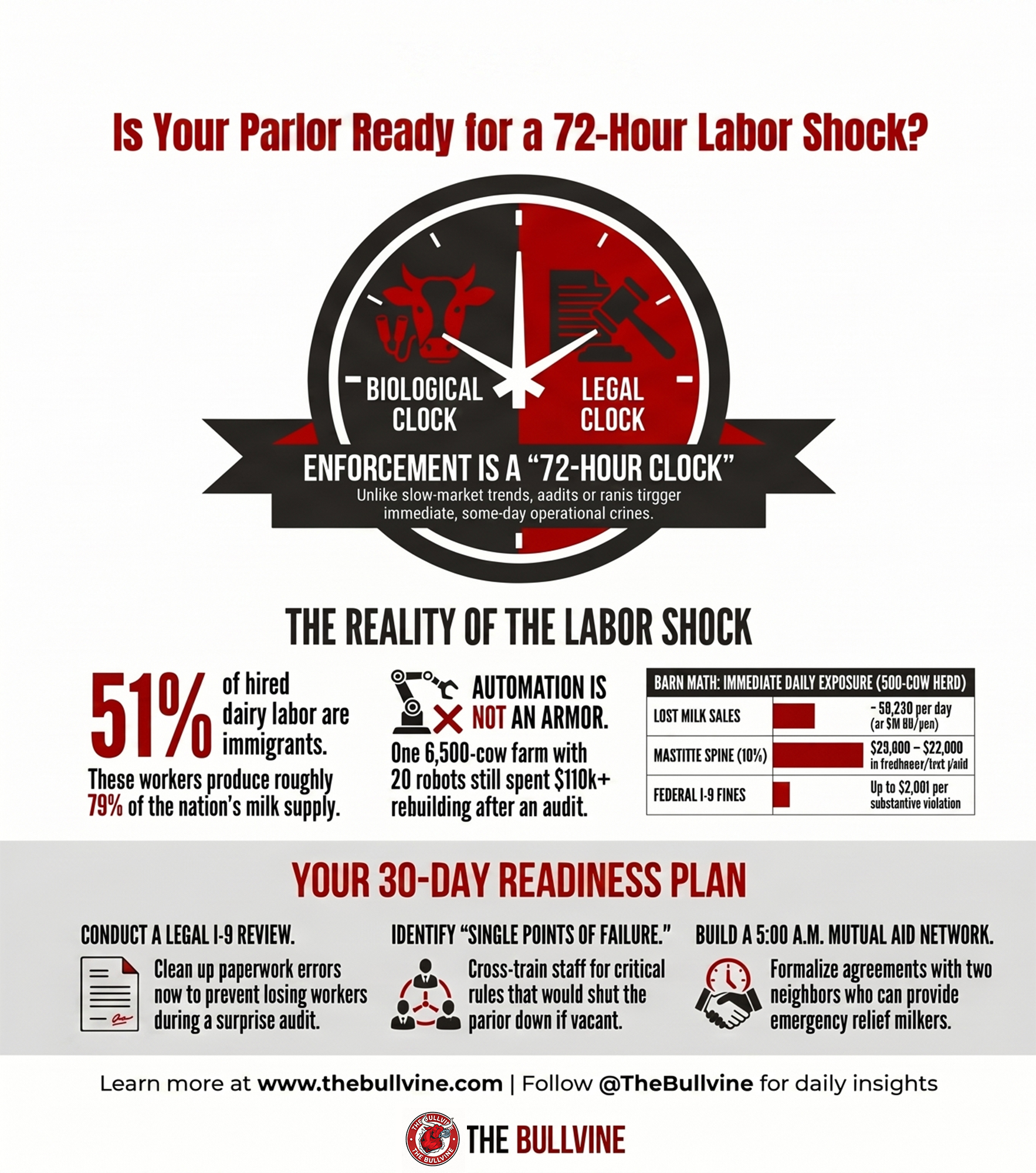
- Now say a chaotic milking, run by people who’ve never touched your parlor, spikes mastitis. A clinical case in early lactation runs in the $400–$450 range once you add treatment, dumped milk, and lost yield. A 10% spike on that herd is 50 cases — call it $20,000 to $22,500 at $400 to $450 a case — before you count somatic cell penalties on your next load.
Don’t take our 500-cow example. Run your own herd size and milk price through the interactive calculator on this page and you’ll get your own daily exposure in about ten seconds.
And the production hit doesn’t bounce back the next morning. DairyNZ research found that roughly a quarter of cows not milked for seven days will develop mastitis, and the lost yield drags on through the lactation. You don’t get a do-over on a missed milking.
The Mechanics Behind the Outcomes
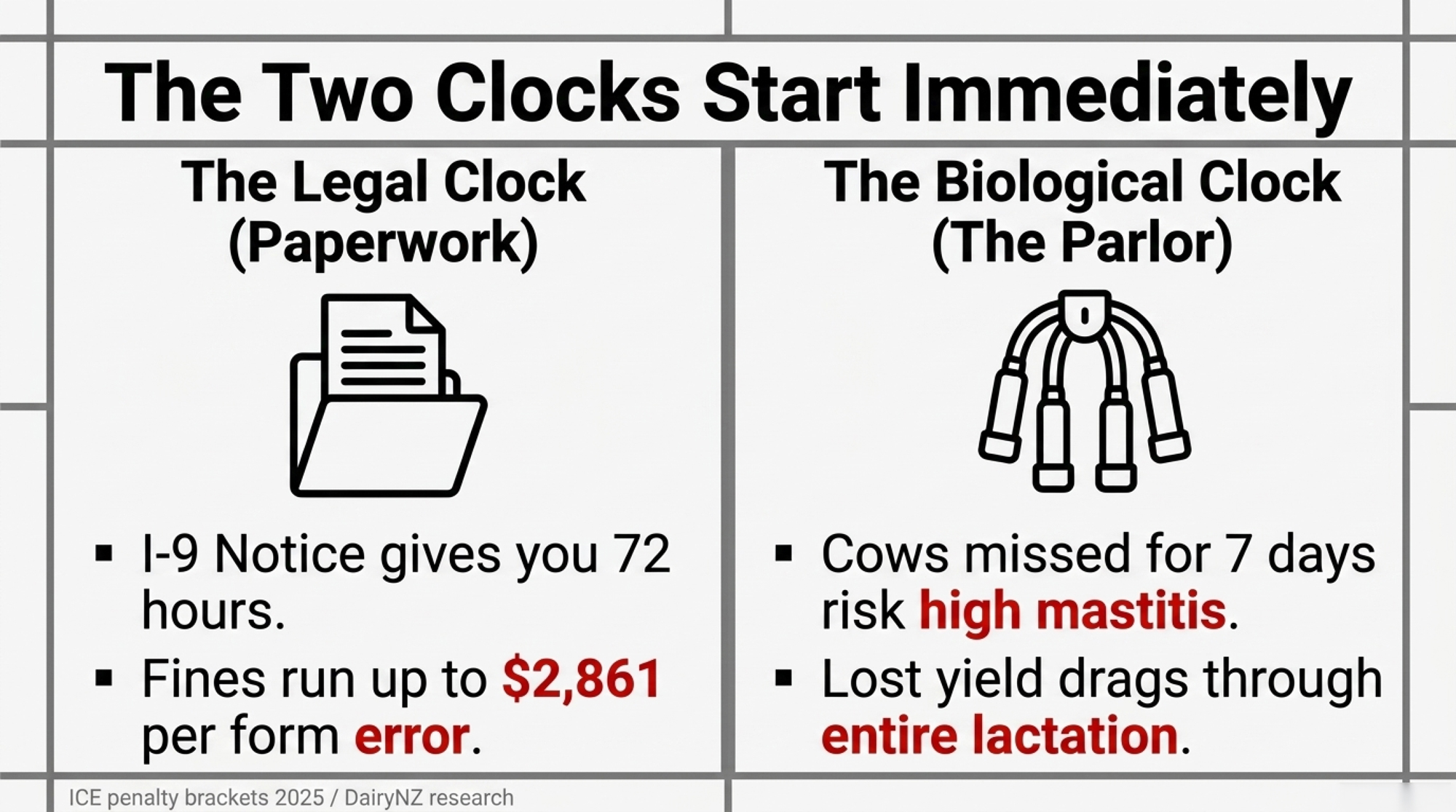
Two clocks start the moment enforcement touches your farm. The legal one is paperwork — an I-9 notice gives you 72 hours to produce documentation for every worker on the payroll, and ICE recently reclassified several I-9 error types as “substantive violations,” with fines running $288 to $2,861 per form (penalties current as of 2025; adjusted annually). The biological one is the parlor. It runs on schedule, or the cows pay for it — a few rough milkings push somatic cell counts high enough to trigger quality penalties or force you to dump milk you already paid to make.
And if agents show up with a warrant instead of a notice? Your morning comes down to one question: is it a judicial warrant signed by a judge, or an administrative one? Without a judicial warrant, agents can’t compel entry into the non-public areas of your operation — and knowing that difference buys you the minutes to get an attorney on the phone.
| Dimension | The Legal Clock (paperwork) | The Biological Clock (the parlor) |
| Trigger | I-9 Notice of Inspection | Missed or chaotic milking |
| Deadline | 72 hours to produce documents | Next milking, every ~8–12 hrs |
| Cost of failure | $288–$2,861 per form | ~25% of unmilked cows develop mastitis in 7 days |
| Who controls it | Your attorney + records | Nobody — “you can’t turn off cows” |
| Can automation help? | No | Partial — robots don’t cover crisis pens |
Here’s what most coverage misses: the raid isn’t the main event anymore. The audit is. In Texas, at least nine dairies received I-9 Notices of Inspection over a single weekend in 2025. Drumgoon’s audit arrived with no sirens and no TV cameras — just a notice that, per local reporting, cost the farm 38 people and more than $110,000.
Automation helps, but don’t mistake it for armor. Robotic milking can cut milking labor hours by up to 75% and lift net returns on the right farms. Drumgoon had 20 robots running when the audit hit. They still couldn’t keep the operation whole, because robots don’t feed calves, catch every sick cow, or cover a fresh-cow pen during a crisis.
How Much Does Waiting 30 Days Actually Cost?
This is the question most farms never run the numbers on.
Say you already know your I-9 system is messy. The files live in a drawer. You’re not sure every re-verification got done on time, and a couple of workers had documents that never quite matched on day one. You keep meaning to get counsel to review it. Something more urgent always wins — a forage test, a breakdown, a banker meeting.
Here’s the cost of waiting, built only on numbers we can source. If an audit forces out even five full-time workers at $19.52/hour — roughly $203,000 a year in labor capacity walking out the gate — that’s before recruiting costs, training time, or the elevated mastitis and injury risk that come with running thin. Drumgoon’s real-world rebuild topped $110,000 in recruiters and transport alone, by its co-owner’s account. Set that against the cost of a legal I-9 review now, and the “we’ll deal with it later” math stops looking cheap.
| Scenario | Trigger | Direct Cost | Source basis |
| Proactive I-9 legal review | Your choice, this month | Attorney review fee (modest) | 30-day move |
| 5 full-time workers lost | Audit forces exits | ~$203,000/yr labor capacity | $19.52/hr × 5 FTE |
| Drumgoon crew rebuild | Post-audit recruiting | $110,000+ | Co-owner, local reporting |
| Per-form I-9 penalty | “Substantive” violation | $288–$2,861 each | ICE, 2025 |
Is Your Parlor Ready for a 72-Hour Shock?
Labor isn’t a slow leak anymore. It’s a burst pipe. We’re trained to think of it as a slow grind — hard to hire, hard to keep, margins eroding over the years. Enforcement flips that into a same-day emergency. So ask three honest questions about your own parlor.
If you lost a quarter to a third of your crew tomorrow, who runs the next six milkings? Not who could in theory — names, shift by shift. Where does your I-9 paperwork live, and who could pull a complete, clean file set in under an hour? And if enforcement hit your county and workers 50 miles out started leaving, how many of your people would have enough reason to stay that they’d ride out the fear?
None of those questions asks you to take a side on national policy. They’re strictly operational. But the answers tell you exactly how exposed your herd really is.
Options and Trade-Offs for Farmers
There’s no single fix for a labor shock. But the farms that ride one out tend to have a few things in place before anything happens.
Cross-training and written SOPs. This works when you can lose 20–30% of your crew and still get cows milked without an immediate welfare problem. It takes written standard operating procedures for the critical jobs — milking, fresh-cow checks, treatment protocols — in language every employee can follow, plus enough rotation that more than one person can run each core task. The limit is honest: cross-training doesn’t create hours in the day. If your hit is Outlook-sized, you still need bodies. But it buys time and protects cow health while you find them.
Mutual aid and relief-milker networks. Best for short disruptions — illness, a small audit, fear-driven absenteeism — where you need one or two extra people for a week or two. It requires relationships built before the crisis. After Drumgoon’s audit, neighboring farms sent workers over in shifts to keep things moving, according to reporting on the operation. In Vermont, NOFA maintains a list of trained relief milkers who step in during emergencies. The catch: in a regional enforcement surge, everyone’s short at once.
A tightened I-9 and legal-response plan — this is your 30-day move. Don’t wait for a notice. In the next 30 days, pull a sample of your I-9s and have an immigration attorney review them. Designate one person to handle agents or auditors while everyone else stays with the cows, and post a simple protocol: where the warrant gets checked, who calls the lawyer, who documents what. It won’t fix a broad labor shortage, but it stops you from losing people over errors you could have caught.
Automation as a partial hedge. Makes sense when milking labor is your biggest bottleneck and you’ve got the scale and capital. It demands real money up front and several years before the efficiency shows up in the bank, and you still need skilled people to run it. Useful — just not a shield, as Drumgoon proved.
Key Takeaways
- If your plan for a labor raid starts with “we’ll see what happens,” you don’t have a plan — you have a hope. Build the shift-by-shift coverage map this week.
- If more than half your milk depends on immigrant labor, put that on paper. That’s not a political statement; it’s the starting line for any real contingency plan.
- If you haven’t had an immigration attorney review your I-9s in the past 12 months, that’s overdue. Book it before the month is out — cleanup now almost always beats rebuilding after an audit.
- If one person’s absence can shut down your parlor, that’s your highest-risk role. Cross-train it first, not eventually.
- If you can’t name at least two neighboring operations that would pick up the phone at 5 a.m., your mutual-aid network isn’t built yet. Make those calls while things are calm.
- If you’re pricing robots, price the people too. Automation cuts milking hours, but Drumgoon had 20 units and still got knocked down.
The Question Worth Sitting With
ICE and CBP have already touched agriculture, the funding to do more is on the books, and the fear effect doesn’t even require an agent in your driveway. So the question isn’t whether this reaches your county. It’s whether your operation can take the hit — an audit, a rumor, a Tuesday you didn’t see coming — and still get every cow milked on time without burning out the people who stay.
Pull your own numbers this week. Count your single points of failure in the parlor, then ask the neighbor down the road how many milkings they could cover if you called at 5 a.m. We’re breaking down the full 72-hour play-by-play — the I-9 fine brackets, the legal-response steps, and labor-cost benchmarks by herd size — in an upcoming Bullvine deep dive. That’s where the spreadsheets live.
So here’s the one to chew on, and we genuinely want your answer in the comments: if HSI knocked on your door tomorrow morning, how many milkings could you cover before you’d have to call for help — and who’s the first name on that list?
Methodology note: This account is based on Homeland Security Investigations’ public statements, contemporaneous news reporting, and the operators’ own public comments, as of June 2025. Production and cost figures for the 500-cow example are illustrative barn-math estimates drawn from cited industry data, not figures from the named farms.
Learn More
- 38% Turnover Is Bleeding You Dry. One Wisconsin Dairy Got It Under 1% – With a Waiting List. — Arms you with an operational blueprint to wipe out a devastating $13,000 replacement penalty per employee departure by revamping housing strategies and farm culture instead of simply raising starting hourly wages.
- The Myth of ‘Cheap’ Labor: H‑2A, Robots, and the Hard Math Dairies Need to Survive the Next 10 Years — Delivers critical multi-year financial positioning models by exposing hidden administrative and compliance costs that push seasonal contract expenses up to $29,500 per worker.
- Dairy Technology 2026: Robotics, Sensors, AI and Real-World ROI — Dismantles standard automation claims with concrete operating cost brackets, providing individual cow sensor data models and accurate box hardware evaluations required to hit a projected 6.4-year payback timeline.
 The Sunday Read Dairy Professionals Don’t Skip.
 The Sunday Read Dairy Professionals Don’t Skip.
Every week, thousands of producers, breeders, and industry insiders open Bullvine Weekly for genetics insights, market shifts, and profit strategies they won’t find anywhere else. One email. Five minutes. Smarter decisions all week.




