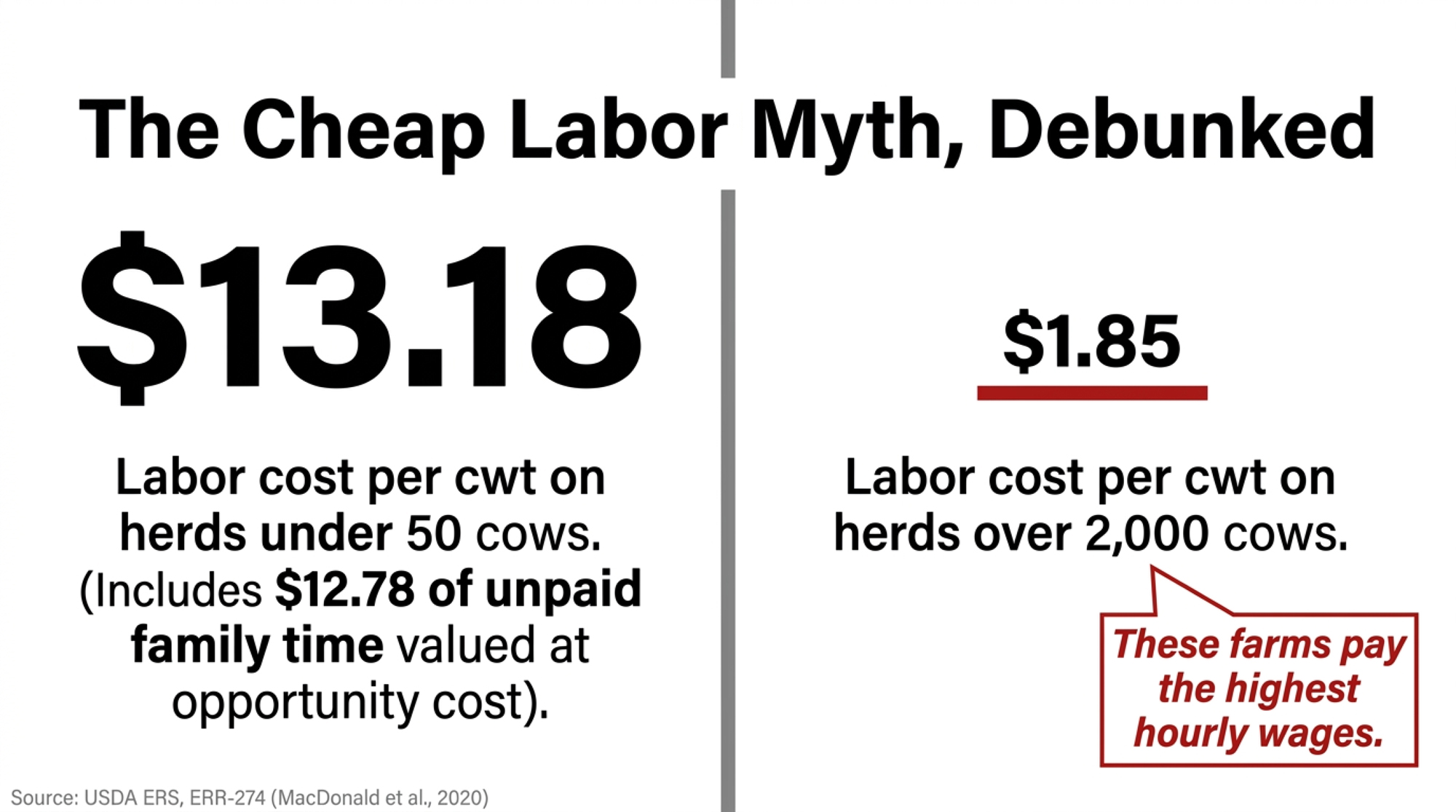
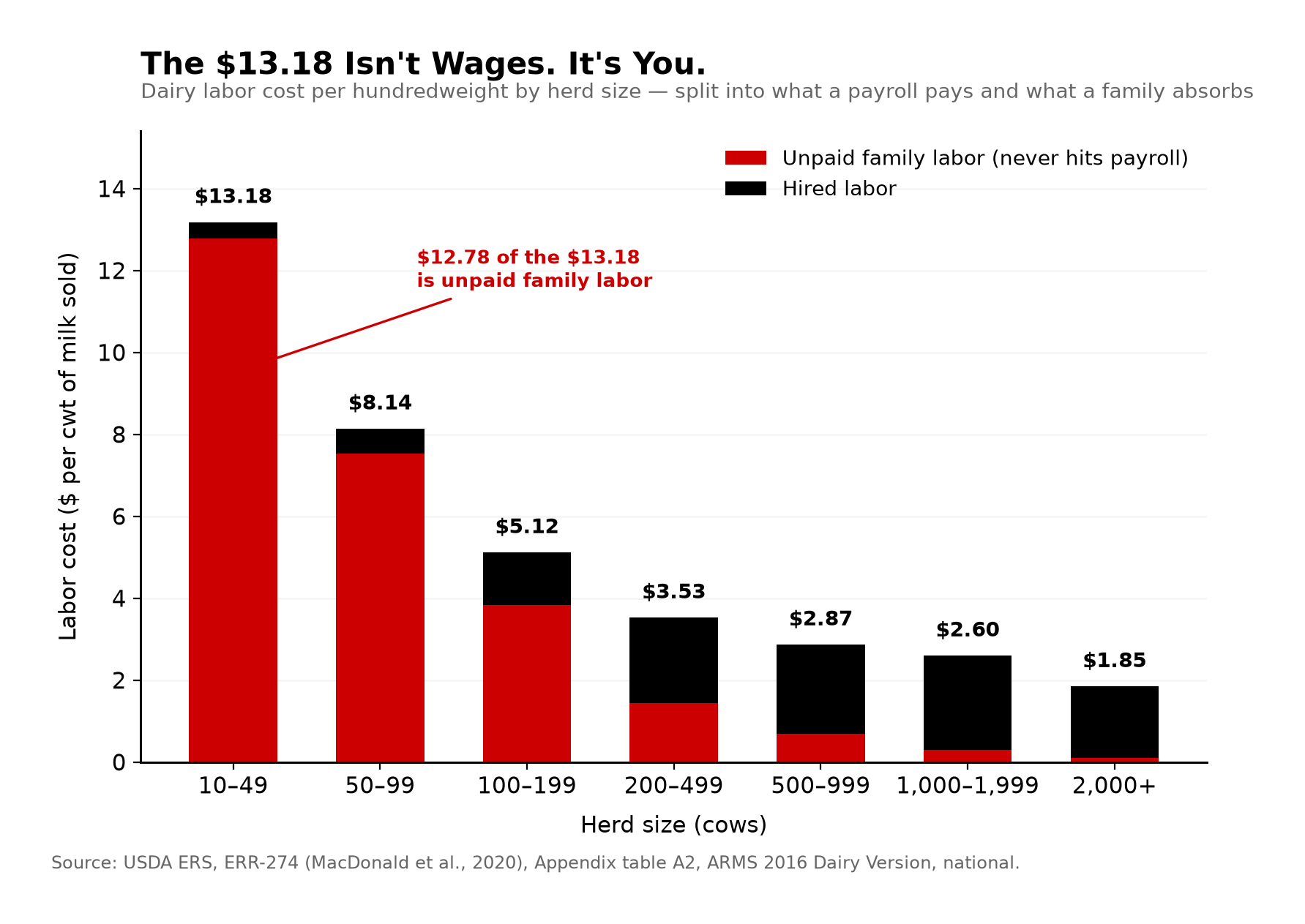
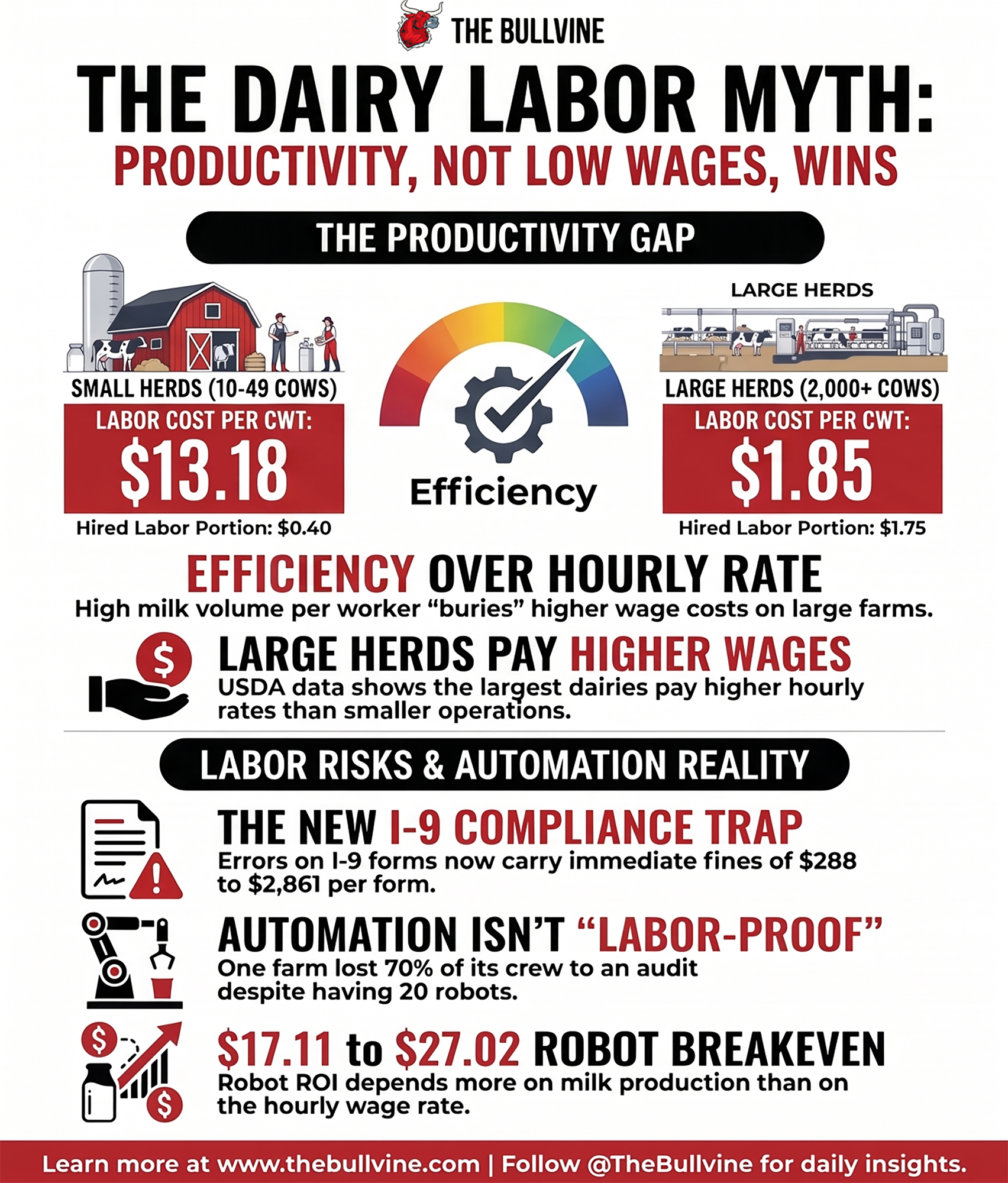
ERS puts labor at $1.85/cwt on farms above 2,000 cows and $13.18 on herds under 50 — while the big farms pay the higher wages. Almost none of the gap is pay. And $12.78 of it is you.
Rodney and Dorothy Elliott left a 140-cow farm in Northern Ireland to build Drumgoon Dairy near Lake Norden, South Dakota. Nearly two decades later, they were milking 6,500 cows with 20 robots and more than 50 employees. Some of those people had been with them since the earliest years.
In late May 2025, the Department of Homeland Security audited Drumgoon’s labor records. DHS determined that 38 workers had inaccurate, outdated, or incomplete citizenship or work-authorization documentation, according to South Dakota Searchlight’s October 2025 reporting. Elliott asked them for updated papers. Most couldn’t resolve the issues, and she had to let them go.
The crew went from more than 50 to 16 (South Dakota Searchlight, October 10, 2025; Northeast Radio SD, October 2025). Most of the 38 had worked at Drumgoon for years, the Searchlight reported, and some for nearly two decades — long enough to have had a hand in building the operation they were leaving. Elliott does not know where they went. Federal rules gave them ten business days from the audit finding to resolve their paperwork or be terminated.
Now the part that matters for anyone with a payroll. She didn’t post higher wages and wait for local applicants. She spent more than $110,000 on recruiters and transportation to bring 22 H-2A visa workers up from Mexico.
The Rebuild Nobody Talks About
This was an audit, not a raid. No agents in the yard, no arrests. Drumgoon had gone twenty years without one. Elliott told the Searchlight she reviewed applicants’ documents herself and had turned candidates away repeatedly over the years when the IDs looked questionable.
Metric
Before audit (May 2025)
After rebuild (Oct 2025)
What it cost
Crew size
50+ employees
38 workers
Still 10–15 short
Immediate post-audit crew
—
16 workers
6,500 cows on 16 people
Workforce composition
Local hires, some 20-year tenure
22 H-2A visa, 16 local/temp
Visa roles legally restricted
Workers terminated
—
38 (10 business days to cure)
Most had years of tenure
Recruitment and transport
$0
$110,000+
Recruiters and travel from Mexico
Wage increase posted
—
None reported
Money went to recruiting, not pay
Robot maintenance openings
Posted
Posted
Zero applicants
South Dakota Searchlight, October 10, 2025; Northeast Radio SD, October 2025. Elliott’s account describes recruitment and transportation spending; no wage increase was reported.
Note what the visa route couldn’t do. Those permits restricted which jobs the workers could legally perform, so Drumgoon still had to fill 16 positions locally. And she did all of this in mid-2025 — a full year before USCIS issued the memo that finally wrote down how dairy H-2A petitions get judged. The pathway existed. The clarity didn’t. Even rebuilt to 38, the farm sat short of where it started.
Sixteen people were now covering a 6,500-cow operation. Elliott told the Searchlight her remaining employees were making mistakes from the long hours, or because they were new to farm work — including backing a payloader into the manure pond. Some, she said, were getting only one or two days off in a 15-day period. Nearby farms sent workers over for a couple of days at a time through the summer.
“But what else do you do? Do you just let cows starve or calves die because there’s no one there to take care of them?”
— Dorothy Elliott, co-owner, Drumgoon Dairy, to South Dakota Searchlight, October 2025
Then the detail that should stop you cold. Drumgoon had 20 robots running before any of this happened, and posted maintenance positions aimed at graduates of the Lake Area Technical College program in the same county.
Twenty robots. A technical college down the road. Open skilled positions. And as of the October reporting, nobody had applied.
This wasn’t new either. Back in October 2023, two years before anyone audited anything, Drumgoon told a county zoning process it employed 22 people, 15 of them milkers and stall management operators, and that finding local workers was extremely difficult (Dakota Free Press, October 12, 2023). That’s on the record. The empty applicant pool isn’t a post-audit excuse — it’s a documented pre-existing condition.
Elliott put the question more directly than most operators would:
“We’ve achieved our goals we set out for ourselves: build a dairy, milk cows and grow the dairy industry in South Dakota. Is it a sustainable goal if there’s nobody to work on these dairies?”
Here’s the part that reframes all of it. ERS data says the largest dairies pay the highest wages in dairy — and still carry the lowest labor cost per hundredweight of any herd size class. A sub-50-cow herd shows $13.18/cwt. A 2,000-cow herd shows $1.85. If cheap labor built the big farms, that table should read the other way around.
Your $32 Billion Talking Point Is Older Than Your Replacement Heifers
Three numbers anchor nearly every dairy labor conversation in Washington and at every co-op annual meeting. Immigrant workers make up 51% of hired dairy labor. Farms employing them produce 79% of U.S. milk. Losing that workforce would cost the economy $32.1 billion.
The figure
Where it comes from
51% / 79% / $32.1B
Adcock, Anderson & Rosson, Texas A&M AgriLife Center for North American Studies
Published
September 2015
Data vintage
Survey fielded fall 2014; employment estimates for 2013
Funder
Commissioned by the National Milk Producers Federation
Independently replicated?
No — and the 2015 report was itself an update to a 2009 study by the same team for the same client
None of it is hidden. NMPF hosts the PDF and discloses the funding. But by 2024 and 2025, those numbers were circulating in trade coverage and House Agriculture Committee documents with no date attached.
Worth being precise about what “51%” actually measures, since this article is about dating your numbers. Researchers estimated 150,418 people worked on U.S. dairy farms in 2013, and that 76,968 of them — 51% — were immigrants. Thirteen-year-old employment data, restated in 2026 as though someone counted last week.
The same 2015 study found immigrant dairy employment rose 35%, nearly 20,000 people, over the six years since the 2009 survey — a number NMPF was still promoting in a December 2018 release. Funded by an industry association with a policy position, so weigh it accordingly. But it points up, not down.
If you cite 51/79 in a memo or at a hearing, attach the year. Costs nothing, and it makes you the most credible person in the room.
Why a Sub-50-Cow Herd Shows $13.18/cwt in Labor and a 2,000-Cow Herd Shows $1.85
USDA’s Economic Research Service breaks out dairy labor costs by herd size. Here’s the full table, including the column almost nobody quotes.
Herd size
Total labor/cwt
Unpaid family
Hired
Imputed wage for unpaid labor
10–49 cows
$13.18
$12.78
$0.40
$21.74/hr
50–99
$8.14
$7.53
$0.61
$22.18/hr
100–199
$5.12
$3.84
$1.28
$23.16/hr
200–499
$3.53
$1.45
$2.08
$23.71/hr
500–999
$2.87
$0.69
$2.18
$25.03/hr
1,000–1,999
$2.60
$0.30
$2.30
$25.09/hr
2,000+
$1.85
$0.10
$1.75
$25.81/hr
USDA ERS, ERR-274 (MacDonald et al., 2020), Appendix table A2, using ARMS 2016 Dairy Version, national. Hired column derived as total minus unpaid. The imputed-wage column values unpaid family labor at opportunity cost — it is not a hired pay rate.
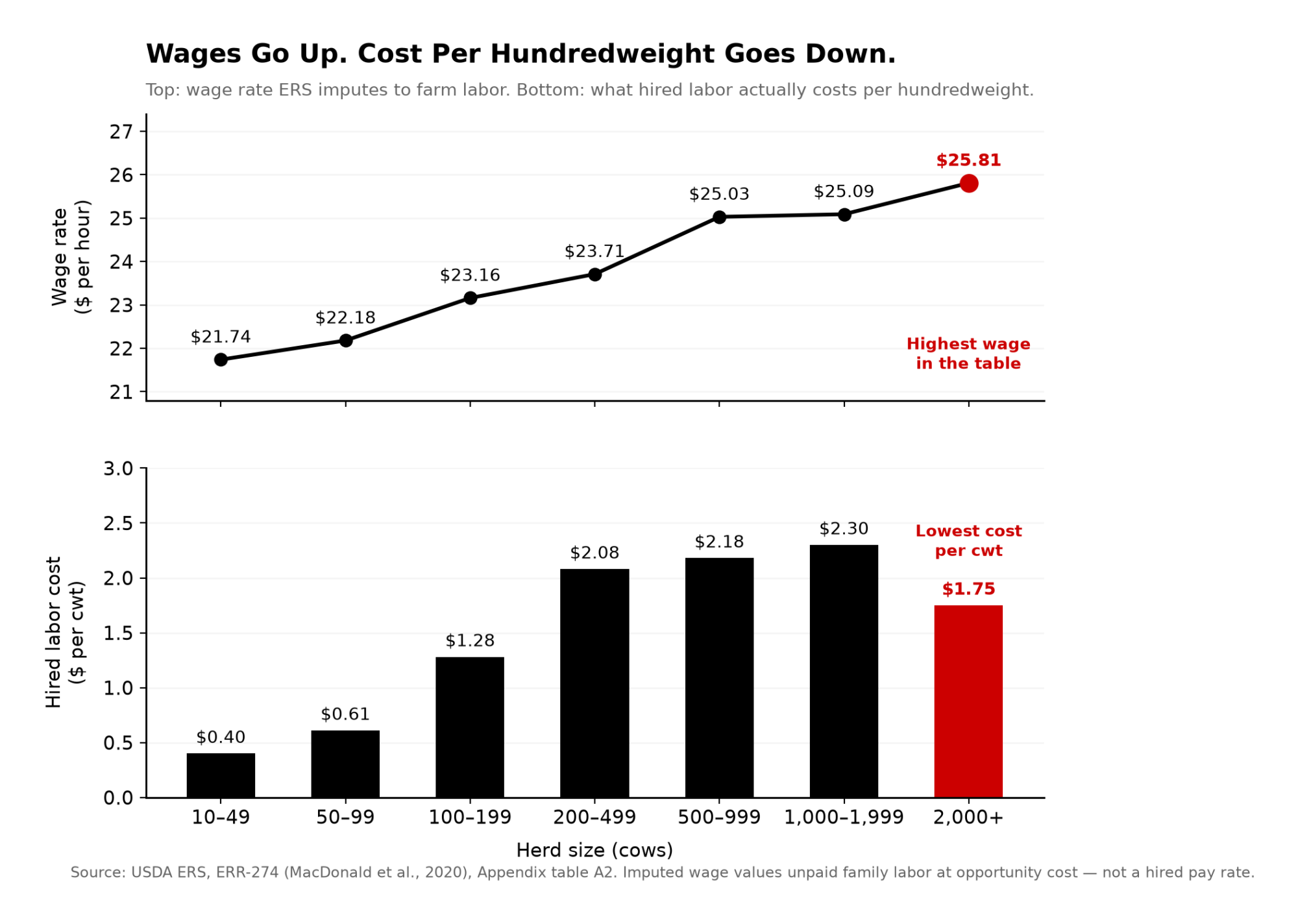
That last column is the argument. The imputed wage rises steadily with herd size — $21.74 on the smallest farms to $25.81 on the largest. Hired wages do the same. ERR-274 doesn’t publish the hired rate by herd class, but MacDonald reports the same direction of travel: hired wage rates, like imputed ones, run higher on larger farms. That’s the whole point — the biggest dairies pay more per hour and still land at $1.85/cwt.
MacDonald states it flatly: differences in labor costs “do not arise from differences in hourly wage rates,” because wages for both hired and unpaid labor are higher on larger farms.
So the herd that shows $13.18/cwt isn’t paying more per hour. It’s paying $21.74 an hour of opportunity cost for a lot of hours spread across very little milk, and $12.78 of that $13.18 never touches a payroll cheque. It’s your hours and your family’s. Elliott’s 6,500 cows put her in the bottom row of that table. If you’re in the top one, you’re the unpaid labor line.
Look at the hired column too. It climbs to $2.30 at 1,000–1,999 cows and then drops to $1.75 on farms above 2,000 — despite those farms paying the highest wages in the table. That’s not a wage effect. That’s enough milk per worker to bury the cost.
Productivity gap, not wage gap. Which flips the question entirely. The 51/79 framing asks who’s milking the cows. The ERS data asks how many cows one person can milk.
The Expansion Math Was Never About Cheap Wages
We went looking for the counter-argument — that cheap labor was the precondition for building operations like Drumgoon. The expansion literature doesn’t support it.
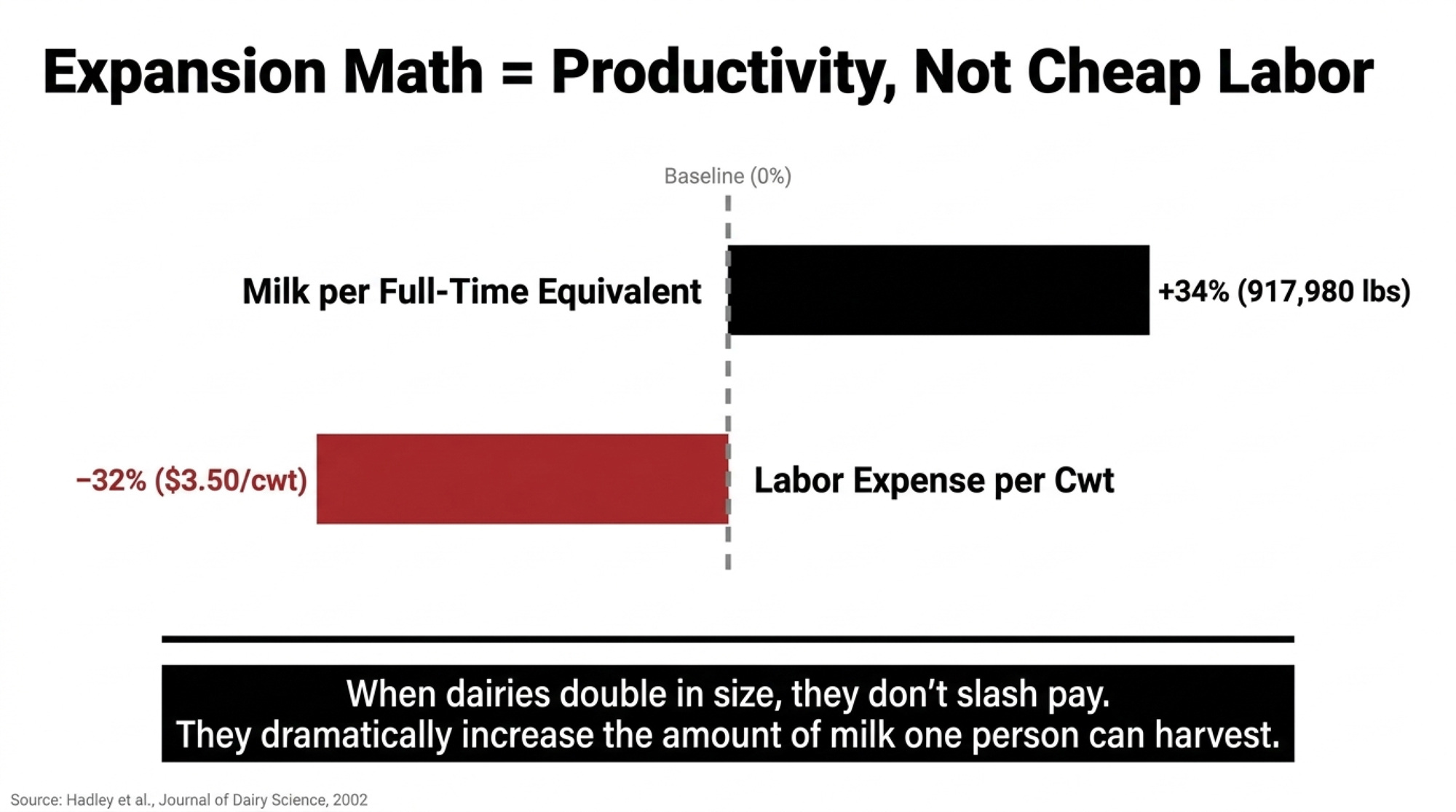
Hadley, Wolf, and Harsh at Michigan State tracked 20 dairy farms through one-time herd increases of at least 20% between 1988 and 1998, and published their findings in the Journal of Dairy Science in 2002.
Measure
Preexpansion
Postexpansion
Herd size
296 cows
569 cows (+92%)
Milk per full-time equivalent
686,656 lb
917,980 lb (+34%)
Labor expense
$5.14/cwt
$3.50/cwt (−32%)
Debt-to-asset ratio
31.3%
43.4%
Hadley et al., Journal of Dairy Science 85(8), 2002. Debt-to-asset ratio reported for 14 of the 20 farms.
They didn’t get there by paying less. A 34% gain in milk per worker produced a 32% drop in labor cost per hundredweight — the same mechanism the ERS table shows, caught in real time during the buildout decade.
It wasn’t free either. Leverage went from 31.3% to 43.4% across the 14 farms reporting it. Same strategy, different landings.
Bewley, Palmer, and Jackson-Smith surveyed Wisconsin producers who modernized between 1994 and 1998, also in the Journal of Dairy Science, and asked what actually made expansion hard. Labor management ranked high. Wage rates didn’t make the list — and their finding that larger herds relied more on nonfamily labor while finding labor management easier is the whole argument in one sentence.
When the Labor Vanished, Nobody Got a Raise
Drumgoon isn’t the only case. In July 2025, at least nine Texas dairies received Notices of Inspection over a single weekend, Tyne Morgan reported for Dairy Herd Management on July 15. An NOI is a records request, not a finding of wrongdoing.
One farm and a Texas weekend are confirming evidence, not proof. Better to say so than let a handful of cases carry weight they can’t hold.
The stronger evidence sits outside dairy, and it’s causal.
The Bracero termination. The Johnson administration ended the program on December 31, 1964, excluding almost half a million Mexican seasonal farm workers. Clemens, Lewis and Postel studied it in the American Economic Reviewin 2018 and found no meaningful rise in domestic farm wages or employment. Growers mechanized instead — tomato harvesters went from a handful of units to near-universal inside about a year. The finding has a published critic: Kaestner argued in Econ Journal Watch in 2020 that the identification is weaker than claimed. It still stands as the best natural experiment available.
California’s AB 1066. The farmworker overtime phase-in began in January 2019 for employers with 26 or more workers, stepping the weekly threshold down from 55 hours to 40 by 2022. Alexandra Hill at UC Berkeley used National Agricultural Workers Survey data for 2019 and 2020 and found employers cut hours rather than pay premiums. The share working 56–60 hours a week — just under the old threshold — fell by roughly half. The share working 46–50 hours rose by about a third. Workers earned $6 to $9 million less in weekly paychecks across those two years, and the share earning $600–$800 a week dropped by roughly a third, most shifting into the $400–$500 bracket.
Different decades, different crops, different researchers. Both pointing where Drumgoon pointed. When labor gets scarce or expensive, employers reach for visas, machines, or fewer hours before they reach for a raise.
What Would Domestic-Only Labor Actually Cost You Per Hundredweight?
Fair warning on our own math first. The $1.75/cwt hired-labor figure is ARMS 2016, and the production cost is 2021. Two vintages in one equation, against a 2026 price. We just spent a section criticizing undated numbers, so it would be cheap not to date our own.
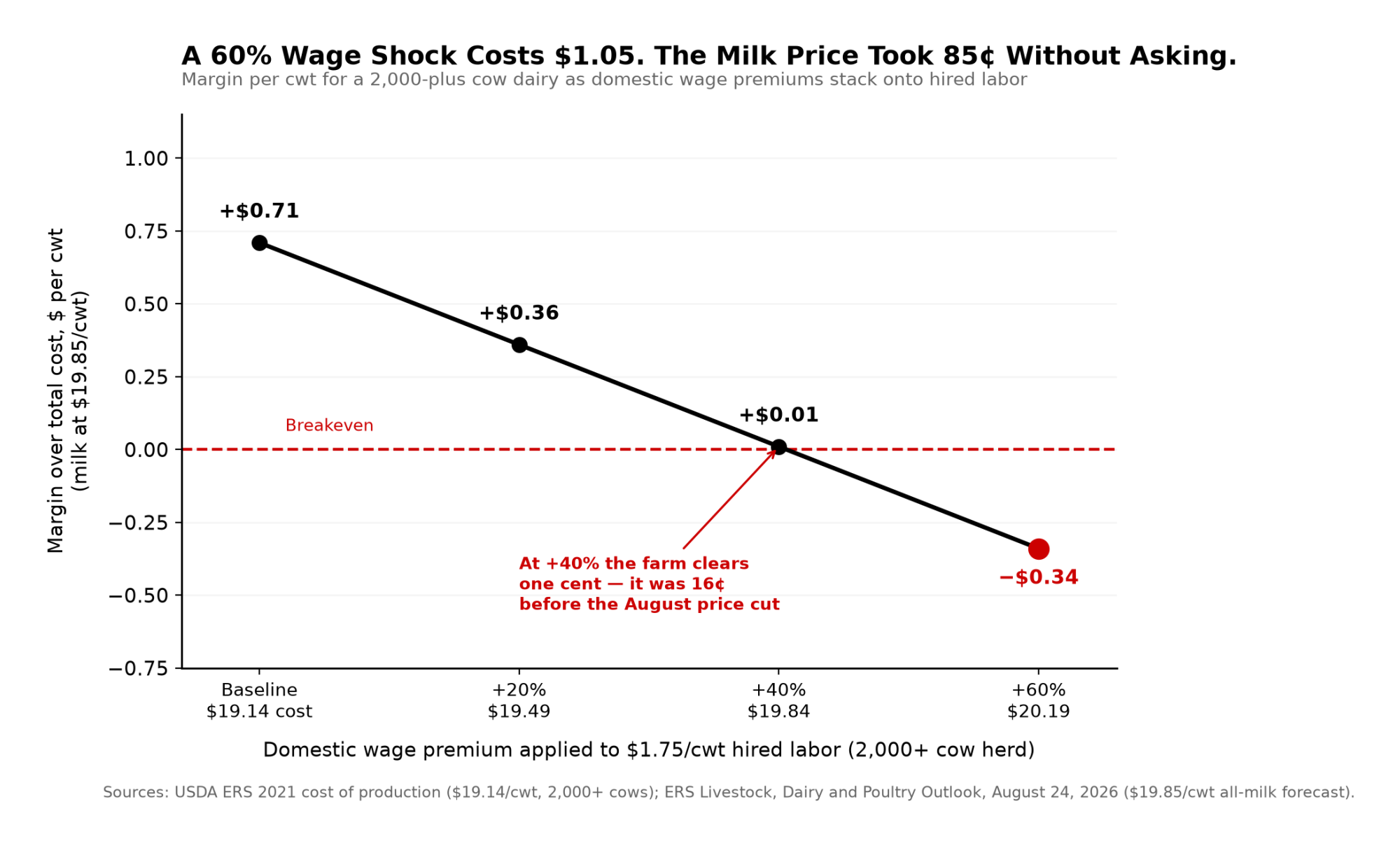
Here’s the calculation, and you can run the same shape of it on your own payroll in about four minutes. Take hired labor for 2,000-plus cow herds, $1.75/cwt, and apply a wage premium as though you’d replaced that workforce domestically.
Formula: $1.75 × your wage premium = added cost per cwt.
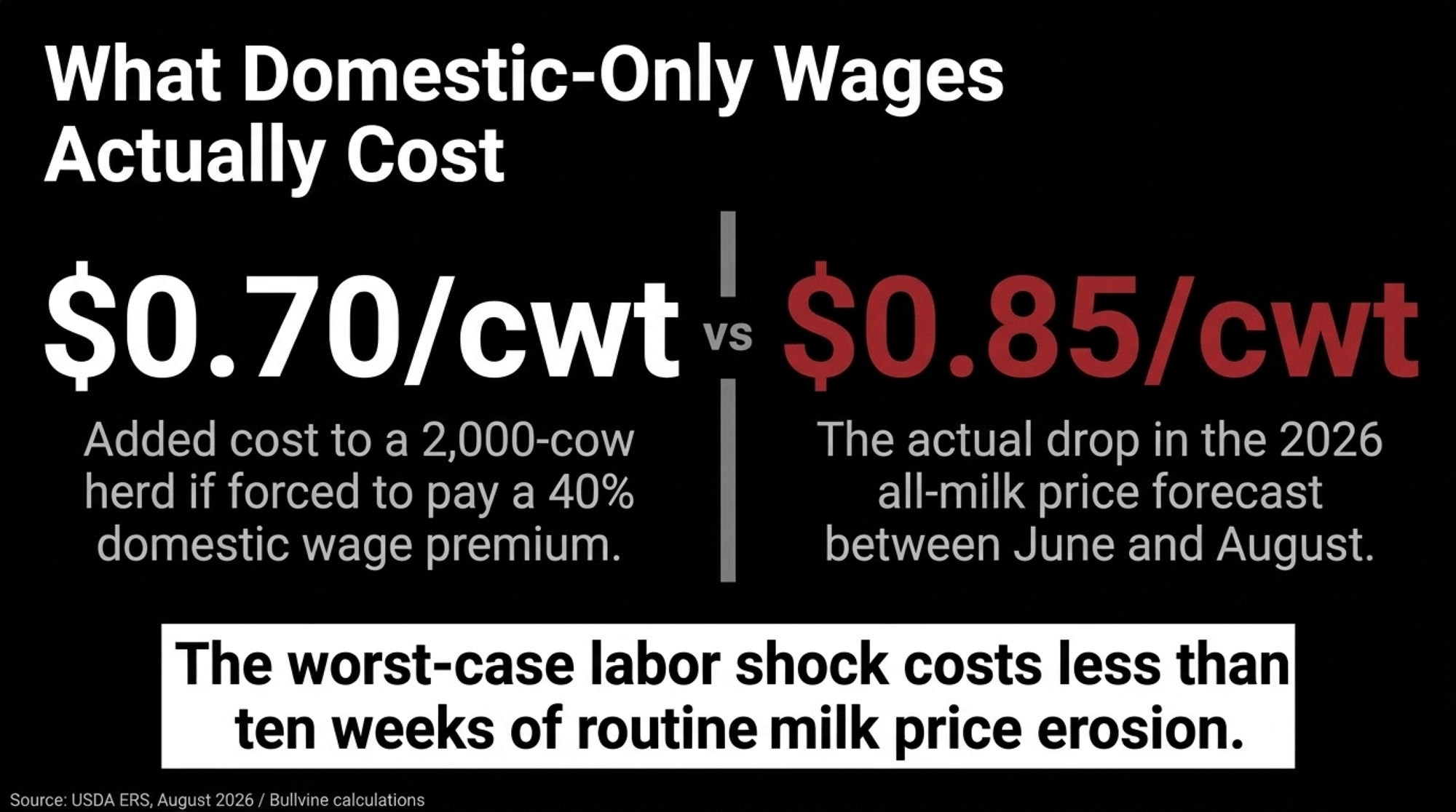
ERS puts 2021 total cost of production at $19.14/cwt for 2,000-plus cow herds. The 2026 all-milk price forecast has been sliding all summer: $20.70 in June, cut 70 cents to $20.00 on July 16, then cut another 15 cents in the August 24 outlook to $19.85/cwt.
Wage premium
Added cost/cwt
Total cost
Margin at $19.85
Baseline
—
$19.14
+$0.71
+20%
$0.35
$19.49
+$0.36
+40%
$0.70
$19.84
+$0.01
+60%
$1.05
$20.19
−$0.34
USDA ERS, Livestock, Dairy and Poultry Outlook, August 24, 2026. Every margin cell moves one-for-one with the milk price.
Watch what the August revision did. At a 40% wage premium, a 2,000-cow dairy now lands one cent above breakeven — it was sixteen cents in July. Thirty cents of forecast erosion did more damage to that row than a 20-point swing in the wage assumption.
Which is the actual finding. The worst-case labor shock costs a large herd about a dollar per hundredweight. The milk price moved 85 cents in ten weeks without anyone voting on it.
One more limit. We picked 20/40/60% as a sensitivity bracket because no study establishes what premium would actually pull domestic workers into dairy at scale. The model also assumes farms would pay it. Drumgoon, Bracero, and California all say they’d restructure or buy iron first. Elliott’s $110,000 went to recruiters, not a wage sheet.
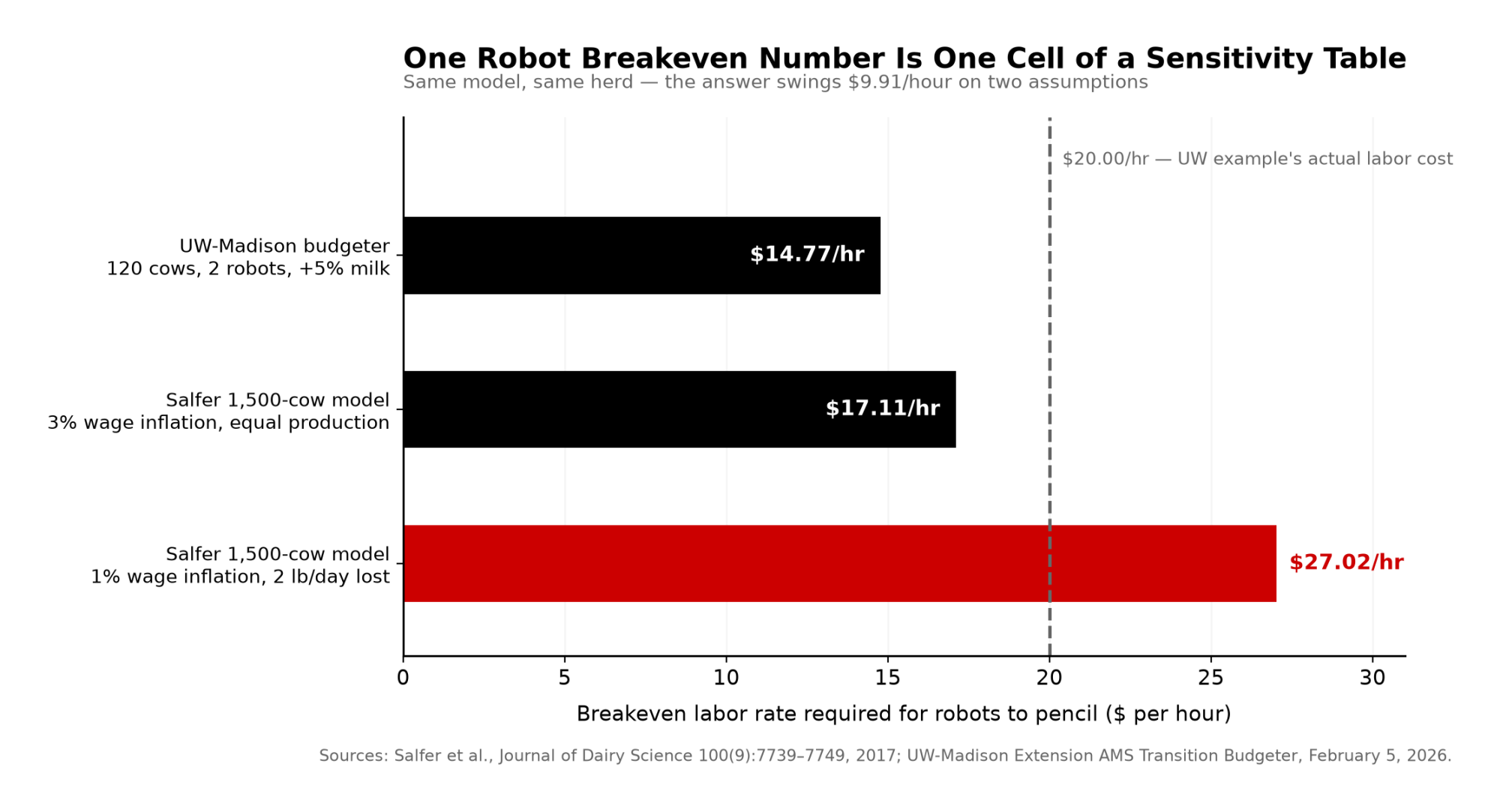
Your Robot Breakeven Isn’t One Number. Salfer’s Own Range Runs $17.11 to $27.02
Bullvine has published the $27.05/hour breakeven repeatedly — and dated it to 2018 on at least one page. We went back to the source; what we found changes how you should use it.
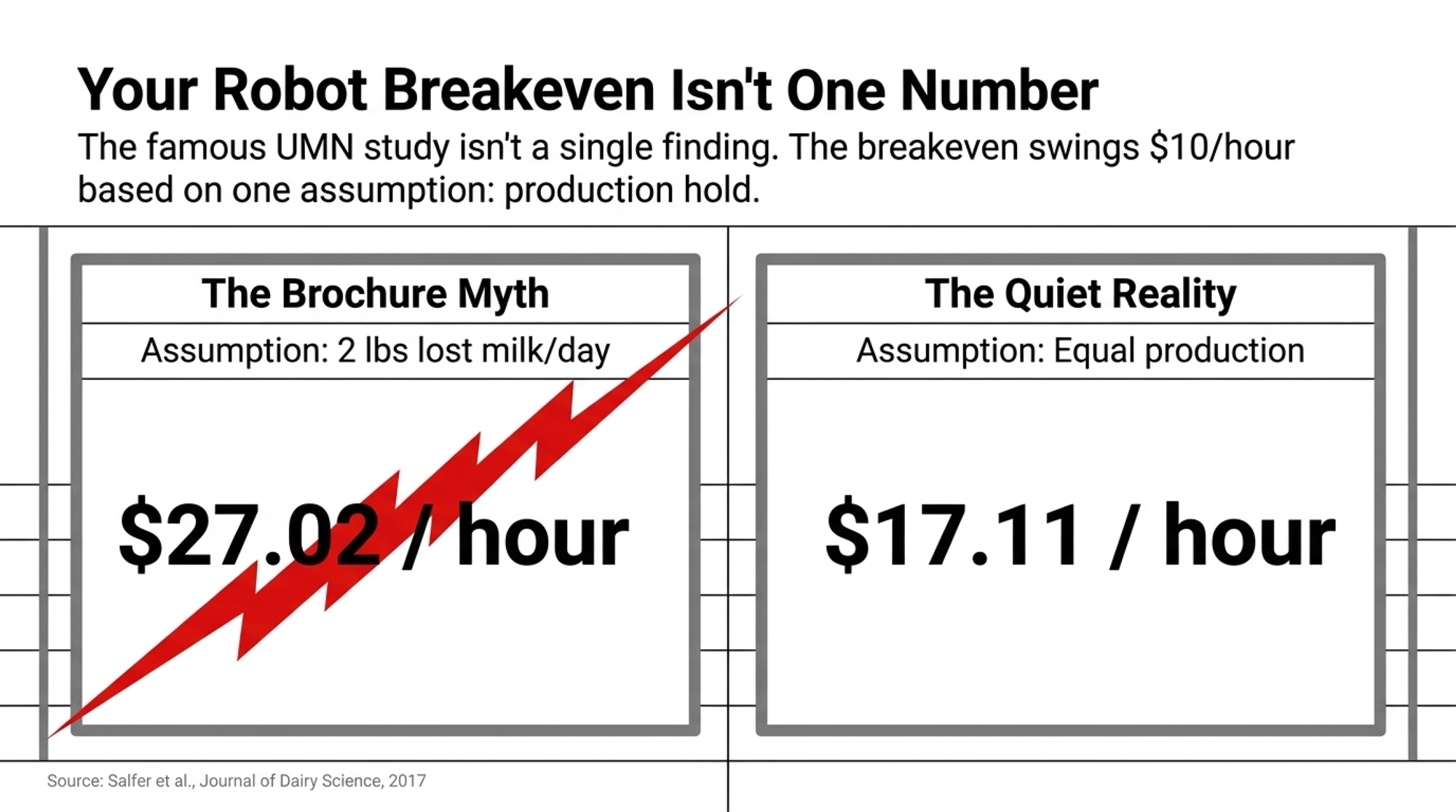
That number comes from Jim Salfer and colleagues at the University of Minnesota, published in the Journal of Dairy Science in 2017, modeling a 1,500-cow dairy with 25 robots against a double-24 parlor. And it isn’t a single finding. It’s one cell in a sensitivity analysis.
Salfer’s 1,500-cow model, by assumption
Breakeven labor rate
1% wage inflation, robots give up 0.91 kg/d (about 2 lb)
Salfer et al., Journal of Dairy Science 100(9):7739–7749, 2017.
Read that again. Same researcher, same herd, same model — and the answer swings ten dollars an hour on two assumptions: whether your robots hold production, and what wages do over three decades.
We’ve been quoting only the top of that range. So has most of the industry.
Now the second land-grant number. UW-Madison Extension released its AMS Transition Budgeter on February 5, 2026, and the worked example runs 120 cows, two robots, a 5% milk bump, labor at $20.00/hour, boxes near $200,000 each. Breakeven wage: $14.77/hour. Since that farm already pays $20.00, the transition pencils. The tool’s rule is simple — if your actual labor cost is higher than the breakeven number, it works.
Here’s what nobody has connected. UW’s example is a 120-cow herd. And Salfer’s paper found robots penciling at 120 and 240 cows, while the 1,500-cow parlor beat the robots. Two land-grants, nine years apart, converging on the same range — and both saying scale cuts against automation, not for it.
So the apparent chasm between $14.77 and $27.02 was never a disagreement about robots. It was a disagreement about herd size, and about whether you assume production holds.
Drumgoon is the sharper lesson anyway, and it isn’t the one in the brochures. Twenty robots didn’t stop that farm from losing 70% of its crew, and the skilled maintenance roles those robots created went unfilled. Automation changes what kind of labor you need — usually toward scarcer, better-paid labor. It doesn’t make you labor-proof.
Where the Evidence Still Runs Thin
Three honest gaps, because you’d spot them anyway.
Hadley’s cohort averaged 569 cows afterward — nowhere near Drumgoon’s 6,500. Whether the same productivity mechanism scales from 600 cows to 6,000 is an extrapolation, not a finding. And the debt-to-asset numbers come from 14 farms, not 20.
Salfer’s robot economics are from 2017, modeled on one 1,500-cow herd. Robot pricing, service contracts, and labor rates have all moved. The sensitivity logic holds; the dollar figures deserve a fresh run.
And nobody has done the direct study. No published work tests whether immigrant labor availability by region predicted where dairies expanded, holding feed cost, land price, and processing capacity constant. That’s the biggest hole in this entire debate, and it’s been sitting open for twenty years.
Options and Trade-Offs for Farmers
Path 1 — Run your own labor cost per hundredweight. Do this within 30 days.
When it makes sense: Any operation, any size; cheapest analysis here, and it tells you whether the rest of this applies to you.
What it requires: Annual payroll and annual hundredweight shipped. Divide one into the other. Work it on your own numbers — a 200-cow herd shipping 26,000 lb per cow moves 52,000 cwt a year, so a payroll of, say, $310,000 lands at $5.96/cwt. That example herd is deliberately labor-heavy. Swap in your two figures and see where you land against the $1.28 ERS reports for 100-to-199-cow herds and the $1.75 for 2,000-plus.
Risks and limits: Decide whether you’re valuing your own hours. ERS imputes $21.74/hour on sub-50-cow herds and $23.16 at 100–199. Skip that step, and you’re understating your real position — to yourself and to your lender.
Path 2 — Audit your I-9 files with counsel, also within 30 days.
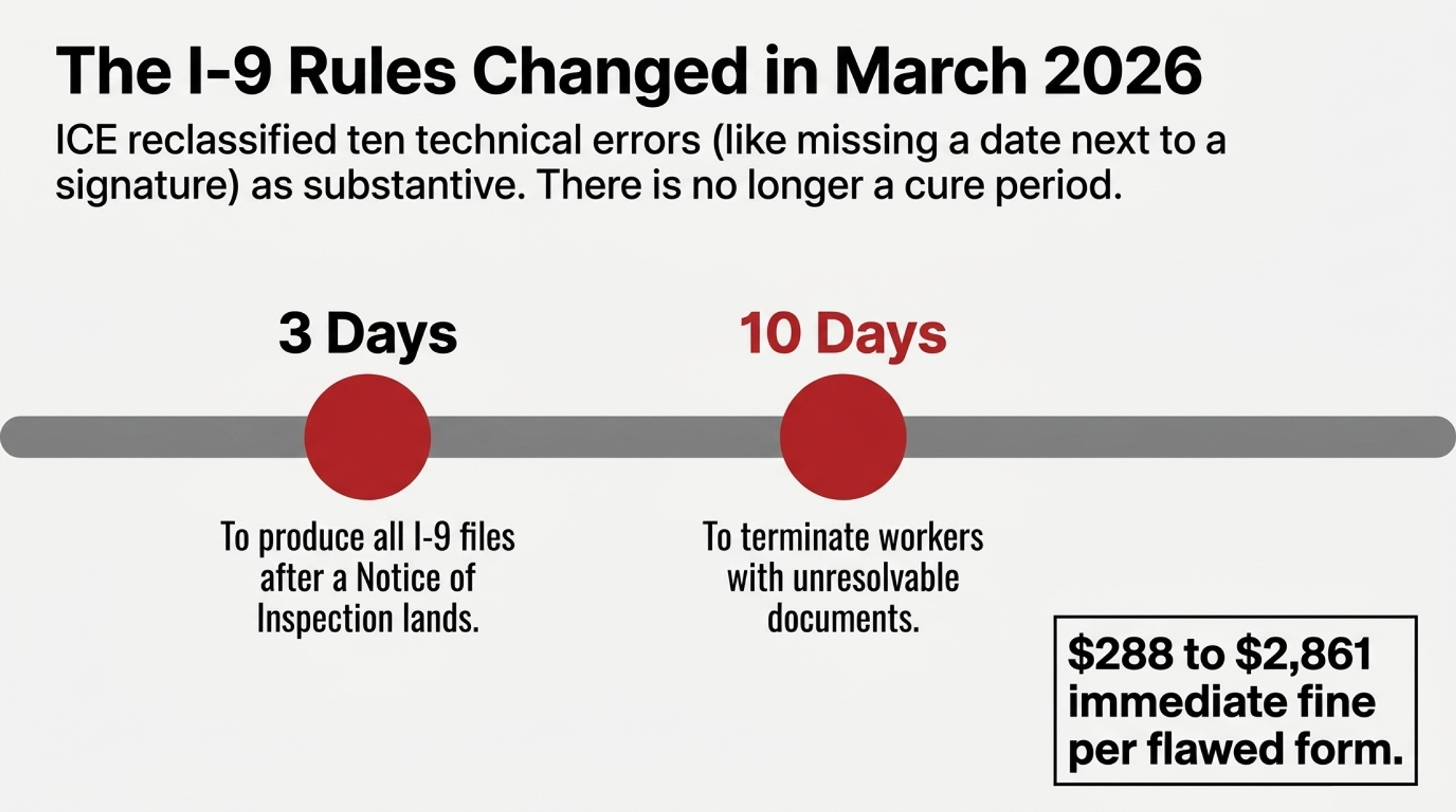
The rules changed on March 16, 2026. ICE quietly updated its Form I-9 Inspection fact sheet, moving more than ten error categories from “technical” to “substantive.” Missing date of birth in Section 1. Missing date next to the employee signature. Incomplete List A, B, or C data in Section 2 — even where you kept document copies. Incomplete preparer or translator data. Electronic audit-trail deficiencies. Each now carries an immediate fine of $288 to $2,861 per formwith no cure period.
When it makes sense: Every operation with hired labor. No exceptions, and this is the risk that hasn’t priced in yet.
What it requires: Work with immigration counsel rather than alone. Ballard Spahr’s February 2026 guidance is blunt on the point — internal audits are what demonstrate good-faith compliance if a government audit lands. The statutory good-faith exception has always applied only to technical violations; that hasn’t changed. What changed is which errors count as technical. The ten-business-day cure window still exists for a shorter list: wrong Form I-9 version, missing “other last names used,” missing employee address in Section 1, missing business address in Section 2. Our full breakdown of how a Notice of Inspection unfolds walks through the mechanics step by step.
Risks and limits: You have three business days to produce every I-9 once a Notice of Inspection lands, and you must terminate workers with unresolvable documents within ten business days. Do the arithmetic on your own file count: 40 employees with one substantive error each, at the midpoint of that penalty range, is roughly $63,000 before anyone argues about aggravating factors. Drumgoon had a clean twenty-year record and a co-owner who personally checked IDs, and still lost 38 people. This reduces exposure. It doesn’t eliminate it.
Path 3 — Price your automation breakeven against your own herd size, not the brochure’s.
When it makes sense: Both land-grant models point at the same window. Salfer’s paper found robots penciling at 120 and 240 cows, while the parlor won at 1,500. UW’s worked example is 120 cows with a 5% milk bump and a $14.77 breakeven against $20.00 labor. If you’re between roughly 100 and 500 cows paying above $17/hour loaded, the math is live.
What it requires: A current dealer quote run at 1.4× installed cost, an honest production assumption, and a real budget line for maintenance skill. Drumgoon posted those positions and got nobody.
Risks and limits: The single biggest swing factor is production, not wage rate — that’s what moves Salfer’s breakeven from $17.11 to $27.02. Ask for the production guarantee in writing. And if a scale argument is doing the work in your automation decision, check it against the papers: both models put the economics at 120 to 240 cows, and Salfer’s parlor beat the robots at 1,500.
Path 4 — H-2A got clearer in June. Read what the memo actually says.
When it makes sense: Wider than early coverage suggested. On June 17, 2026, USCIS issued Policy Memorandum PM-602-0200, “Guidance on Temporary or Seasonal Need for H-2A Petitions for Dairying” — nine pages, effective immediately, binding on adjudicators. USDA welcomed it the same day. Per July 6, 2026 analysis, even dairies without a discrete breeding season may qualify by documenting materially different herdsman duties across the year, even though milking itself never stops.
What it requires: Documentation of seasonal duty variation, not of a labor shortage. And more lead time than you’d think — the contract, the certification, and a housing inspection all have to clear before anyone arrives, which puts realistic planning several months out.
Risks and limits: It’s a policy memorandum, not a regulation. It creates no legally enforceable right; any administration can rescind it, and petitions are judged case by case. Your year-round milking crew is still ineligible on its own. Elliott’s experience is the cautionary version: she was working this pathway in 2025, before the standard was written down, with counsel and $110,000 to spend — and it still left her 16 positions short. The Farm Workforce Modernization Act would put a year-round fix in statute, not a memo. It has passed the House twice and stalled in the Senate twice.
Key Takeaways
Divide annual payroll by annual hundredweight shipped. Above 500 cows and well north of $1.75/cwt, your gap is labor efficiency, not your wage rate.
Under 100 cows, value your own hours at ERS’s $21.74/hour before you call your cost of production finished. Otherwise, you’re the cheapest employee on the place, and nobody’s tracking it.
If you audited your I-9 files before March 16, 2026, that audit is stale. Errors that were curable then now carry $288 to $2,861 per form with no correction window.
Anyone quoting you one robot breakeven wage is quoting one cell of a sensitivity table. Ask which production assumption it uses. Equal production puts the bar near $17/hour; two pounds a day lost puts it near $27.
Above 1,000 cows and weighing robots? Both Salfer and UW put the economics near 120 to 240 cows, and Salfer’s parlor beat the robots at 1,500.
Modeling expansion? Track milk per FTE, not wage rate. The Michigan State cohort cut labor cost per cwt by 32% on productivity alone — and carried leverage from 31.3% to 43.4% getting there.
Financing this year? Your lender’s labor-shock question has a bounded answer — $0.35 to $1.05/cwt on large herds. The milk price moved 85 cents against you in ten weeks. Know which one you’re actually exposed to.
So where does your labor cost per hundredweight actually sit — and how much of it are you paying versus quietly absorbing? Twenty minutes with your payroll file answers both, and it’s a better twenty minutes spent before an envelope arrives than after.
We’re running the complete scenario model — all seven ERS herd-size tiers, every premium cell, formula, and assumptions on the table — in an upcoming Bullvine deep dive. If you want the full math rather than the headline version, it’ll live there.
This article draws on reporting by South Dakota Searchlight (October 10, 2025), Northeast Radio SD (October 2025), and Dakota Free Press (October 12, 2023); on USDA ERS data and peer-reviewed research as cited; and on federal policy documents current as of September 2026. Drumgoon Dairy was not contacted for this article.
Learn More
H-2A Dairy Visa Cost — Arms you with line-by-line guest worker recruitment expense data before signing agency contracts. Reveals true all-in costs averaging $877 per cow, exposing hidden legal overhead, transportation fees, and housing inspection mandates that conventional wage comparisons routinely conceal.
Dairy Cost of Production: Small Herds — Dismantles the persistent myth that milk market consolidation is driven purely by feed volatility. Exposes how imputed family labor burdens of $12.78/cwt quietly suffocate sub-50-cow operations long before hired payroll changes impact the balance sheet.
Robotic Milking ROI: Cash Flow Valley — Follows the money through a seven-year automated milking conversion to protect working capital. Breaks down why realistic 1.4× capital expenditure multipliers and $11,500 annual maintenance costs create an $8,776 yearly deficit on 140-cow setups despite brochure promises.
The Sunday Read Dairy Professionals Don’t Skip.
Every week, thousands of producers, breeders, and industry insiders open Bullvine Weekly for genetics insights, market shifts, and profit strategies they won’t find anywhere else. One email. Five minutes. Smarter decisions all week.
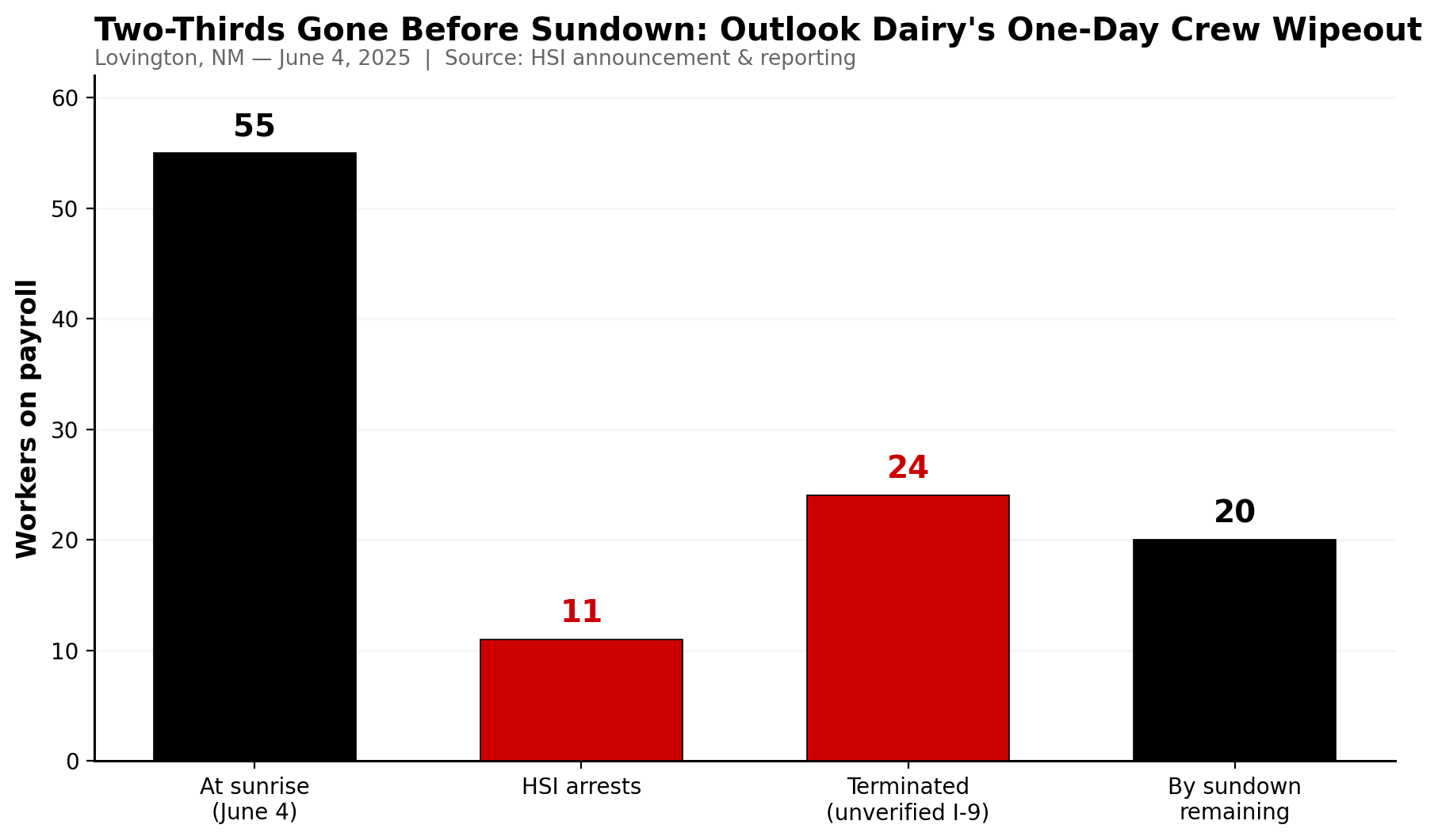
Outlook had 55 on payroll at sunrise and 20 by sundown. The parlor didn’t blink. If your crew vanished tomorrow, who runs the next six milkings — and what’s it cost by dark?
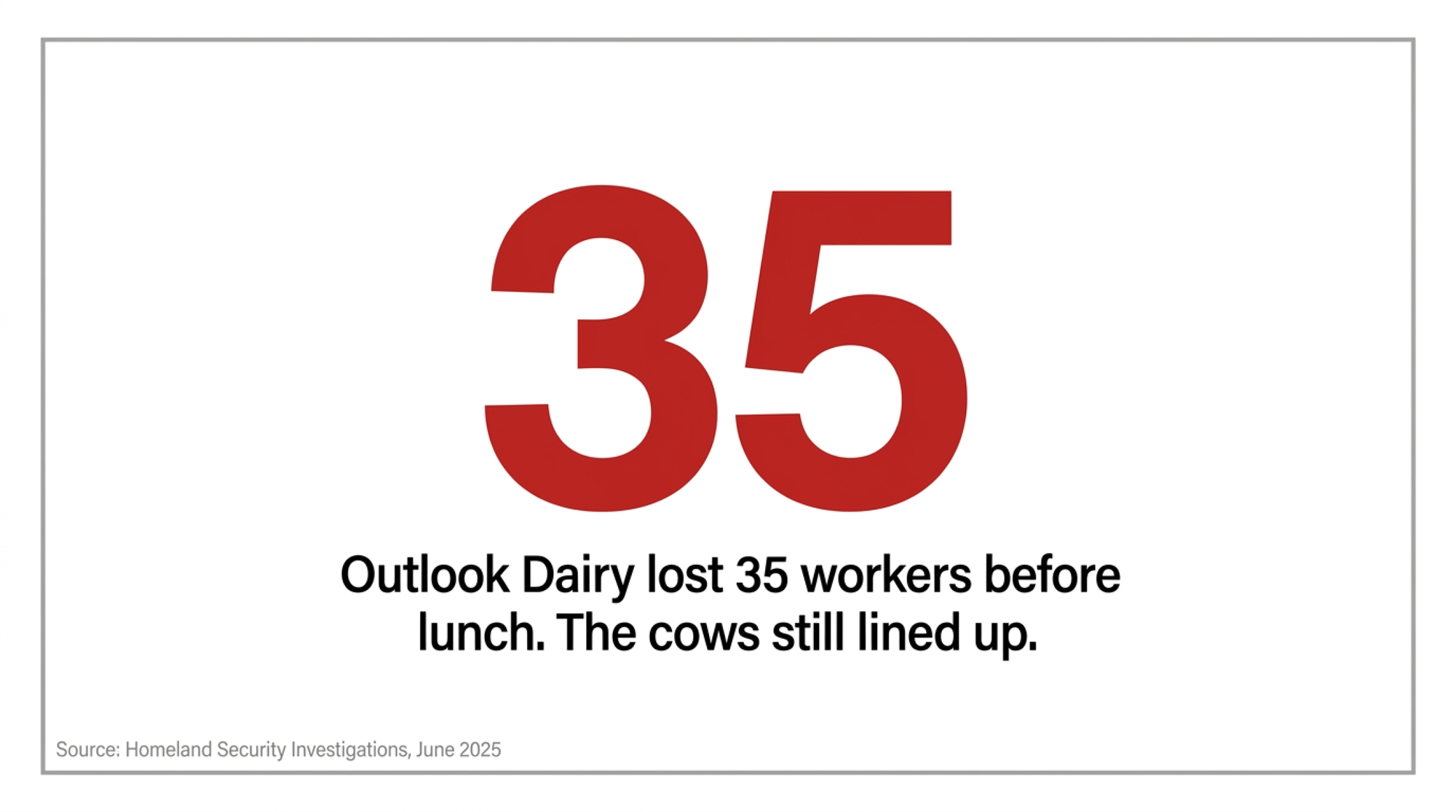
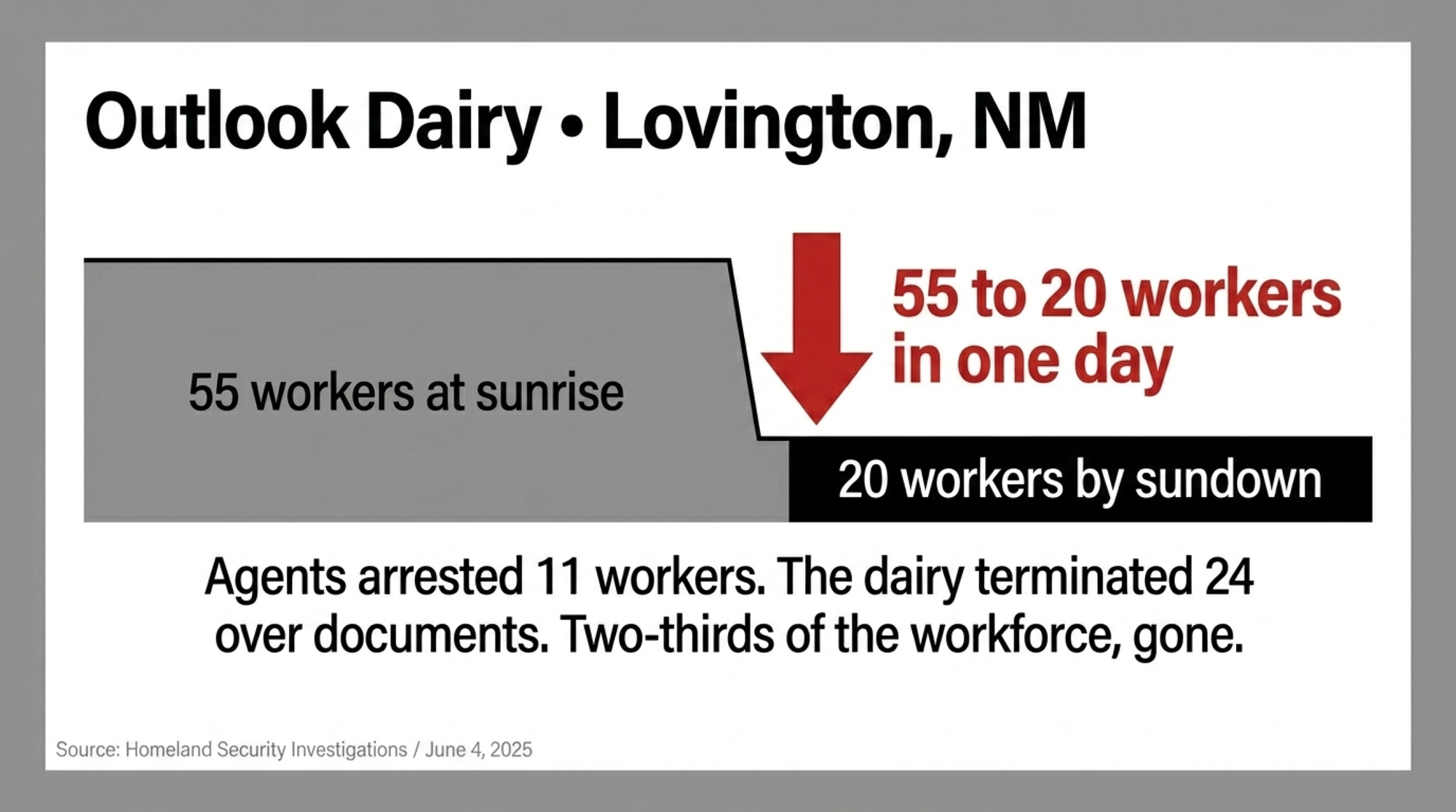
On June 4, 2025, Outlook Dairy outside Lovington, New Mexico, had 55 people on the payroll. By the time the dust settled, 35 of them were gone — Homeland Security Investigations agents arrested 11 workers while executing a search warrant, and the dairy terminated 24 more whose work-authorization documents could not be verified, according to the agency’s announcement and subsequent reporting. HSI said the arrested workers had used counterfeit documents to obtain work; as of this reporting, the public record does not indicate any charges against the dairy’s owners. Owner Isaak Bos didn’t soften the impact on the operation. Milk production, he told reporters, “didn’t just slow down, it effectively ceased.”
That’s two-thirds of a workforce, gone before the day was out. Family, office staff, and local high school kids on summer break kept the cows alive in the days after. The parlor didn’t care that immigration enforcement had just gutted the crew. Cows still lined up. Calves still needed feeding. Somebody had to show up at 4 a.m.
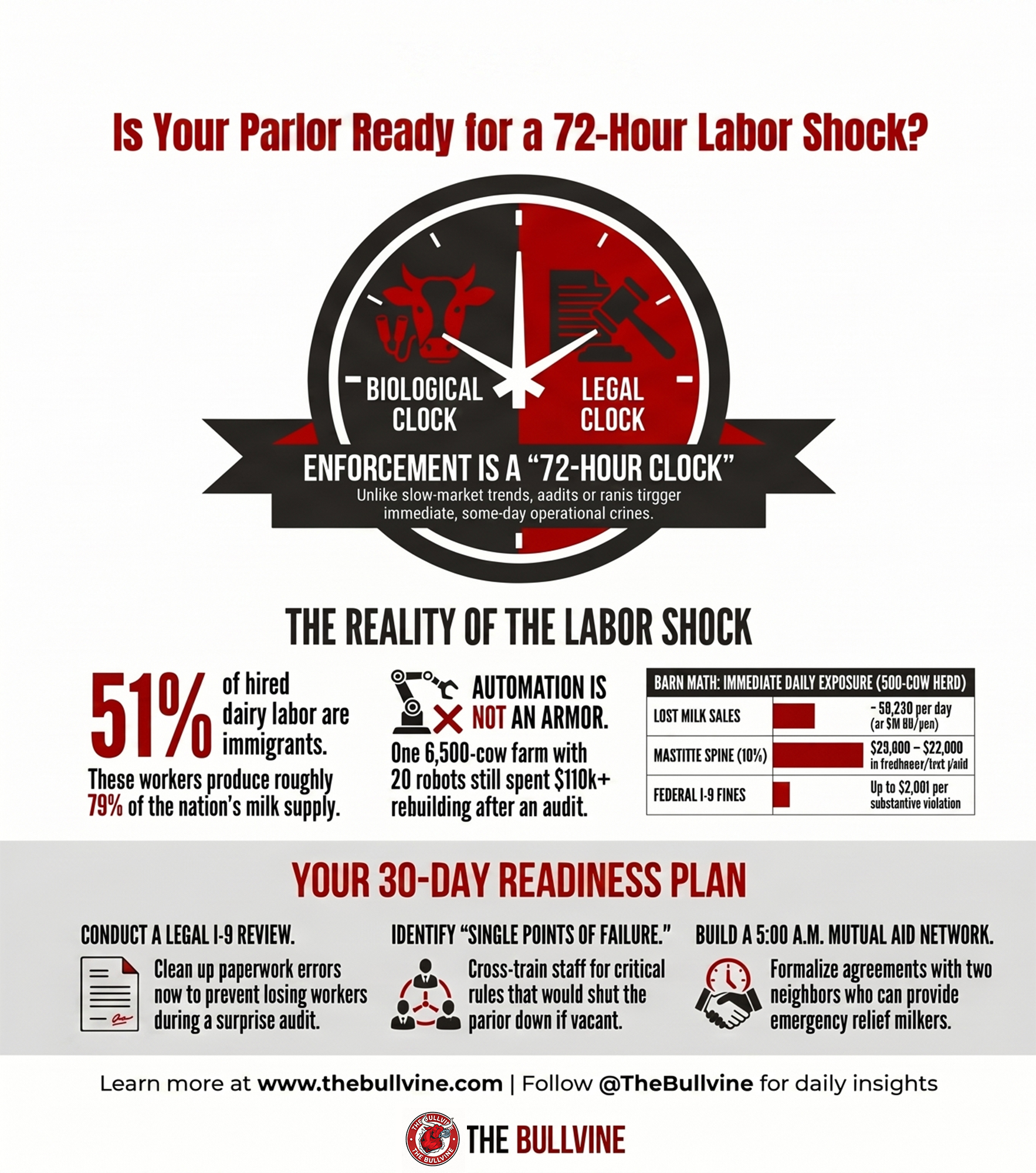
This is the sharp edge of a labor reality that touches nearly every hired-labor dairy in the country. About half of all hired dairy workers are immigrants, and the farms that employ them produce roughly 79% of the nation’s milk. When enforcement lands — or even when the rumor of it lands — your operation isn’t on a five-year labor trend anymore. It’s on a 72-hour clock. And most farms are only mentally prepared for half of what that clock measures.
What’s Changing and Why
For years, immigration enforcement mostly skipped dairy barns. Raids hit meatpacking plants and construction sites. That assumption broke in June 2025.
This wasn’t one farm having a bad week. It was a wave. Within weeks it had touched four states. New Mexico on June 4. Then Nebraska and California the same week — ICE arrested more than 70 at an Omaha plant, with farm operations hit out West. South Dakota came last, after a quieter Homeland Security audit landed at Drumgoon.
President Trump publicly acknowledged the bind: “We can’t take farmers and remove all their workers and send them back just because they might not have the necessary documentation,” he said on June 12. The directive paused, then reversed, inside a week. The cows didn’t.
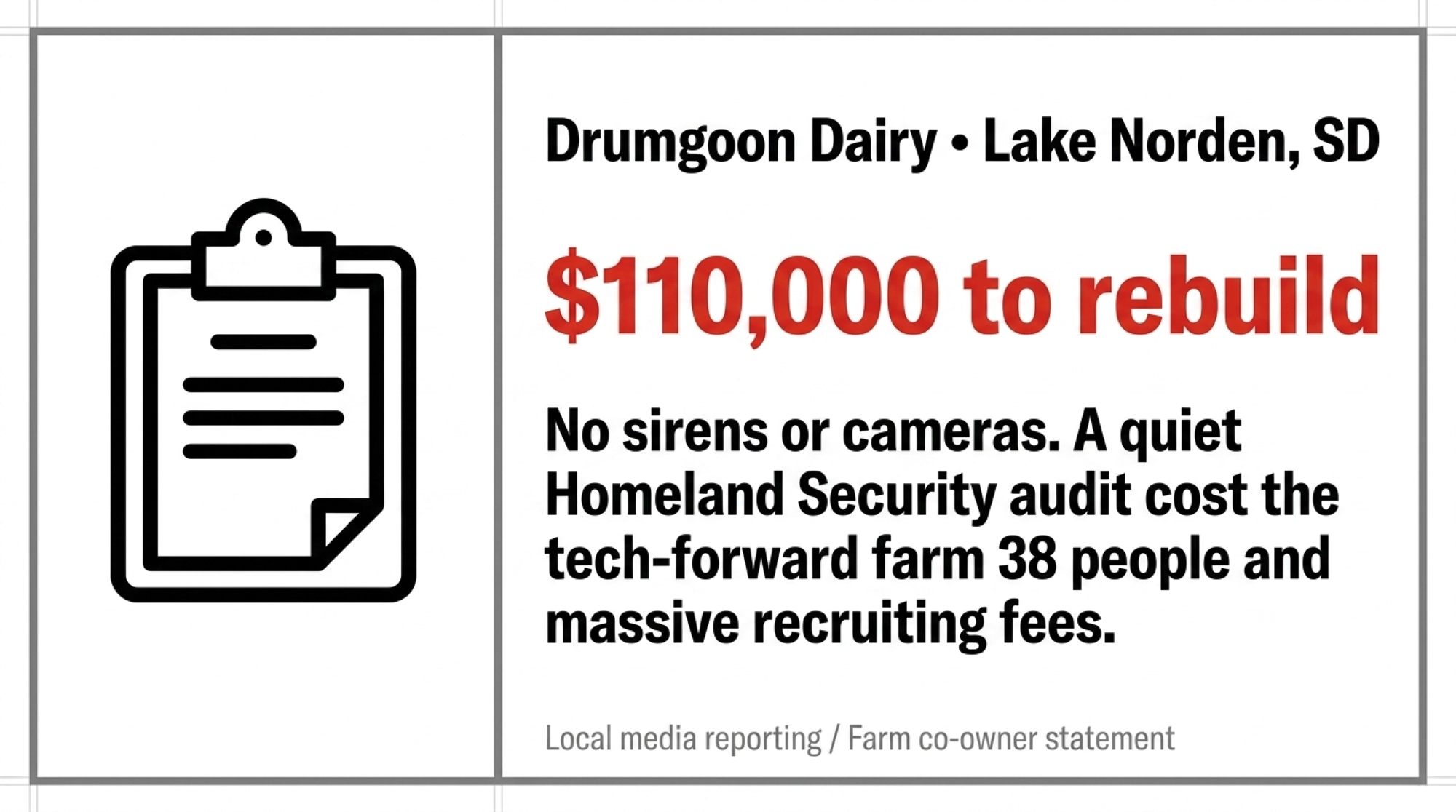
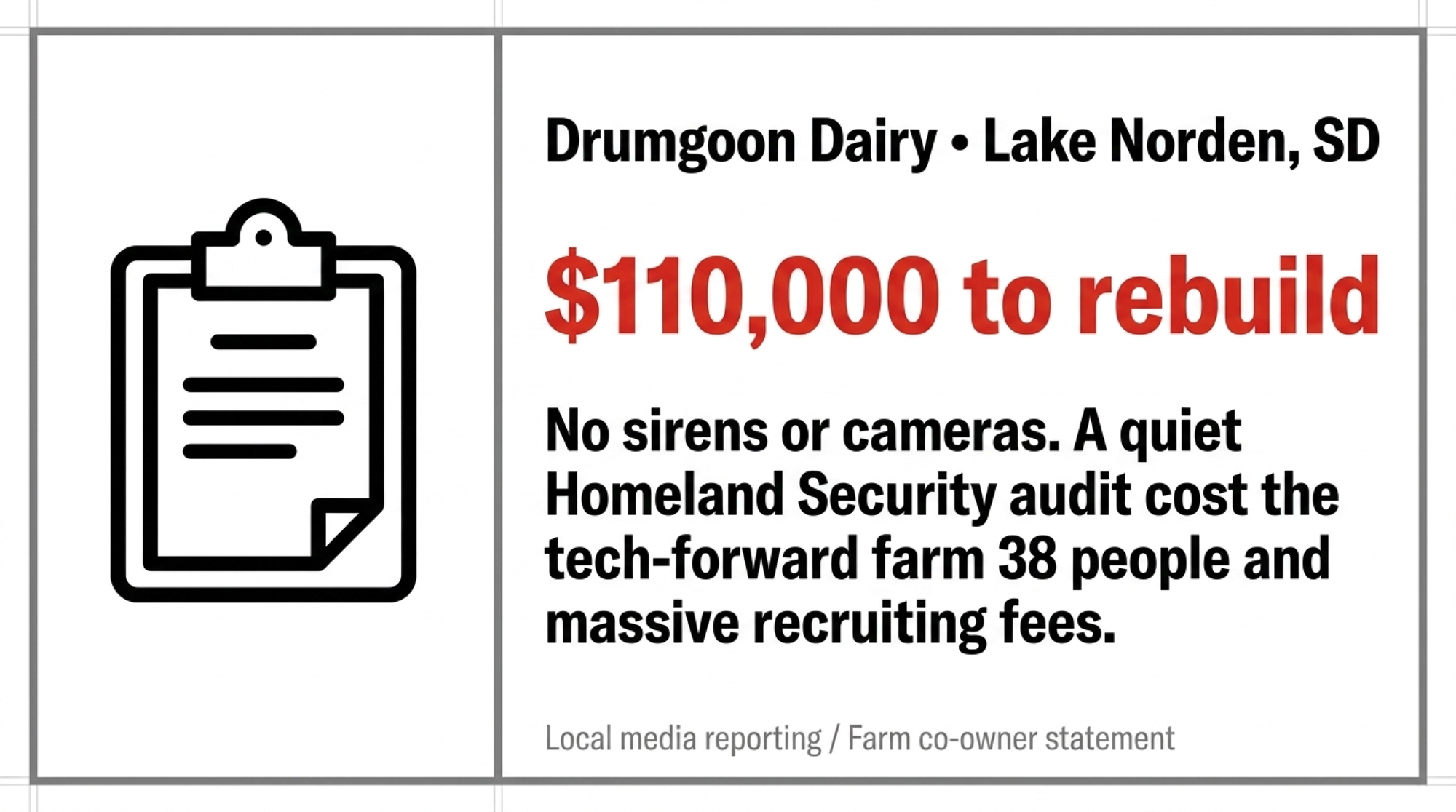
Drumgoon Dairy near Lake Norden, South Dakota, shows what the quieter version looks like. After a Homeland Security audit, the farm let 38 workers go — cutting staff from more than 50 down to 16, according to local reporting. Co-owner Dorothy Elliott told local media the farm spent more than $110,000 on recruiters and transportation trying to rebuild the crew. That’s a 6,500-cow operation with 20 robotic milking units already installed. Tech-forward, well-run, and still knocked sideways by a single paperwork action.
Stack that on the structural math, and you see why this isn’t a New Mexico problem or a South Dakota problem:
A National Milk Producers Federation/Texas A&M study, published in 2015 and still the most-cited industry estimate on record, put immigrant workers at 51% of hired dairy labor on farms producing 79% of U.S. milk — and the industry still leans on those figures today.
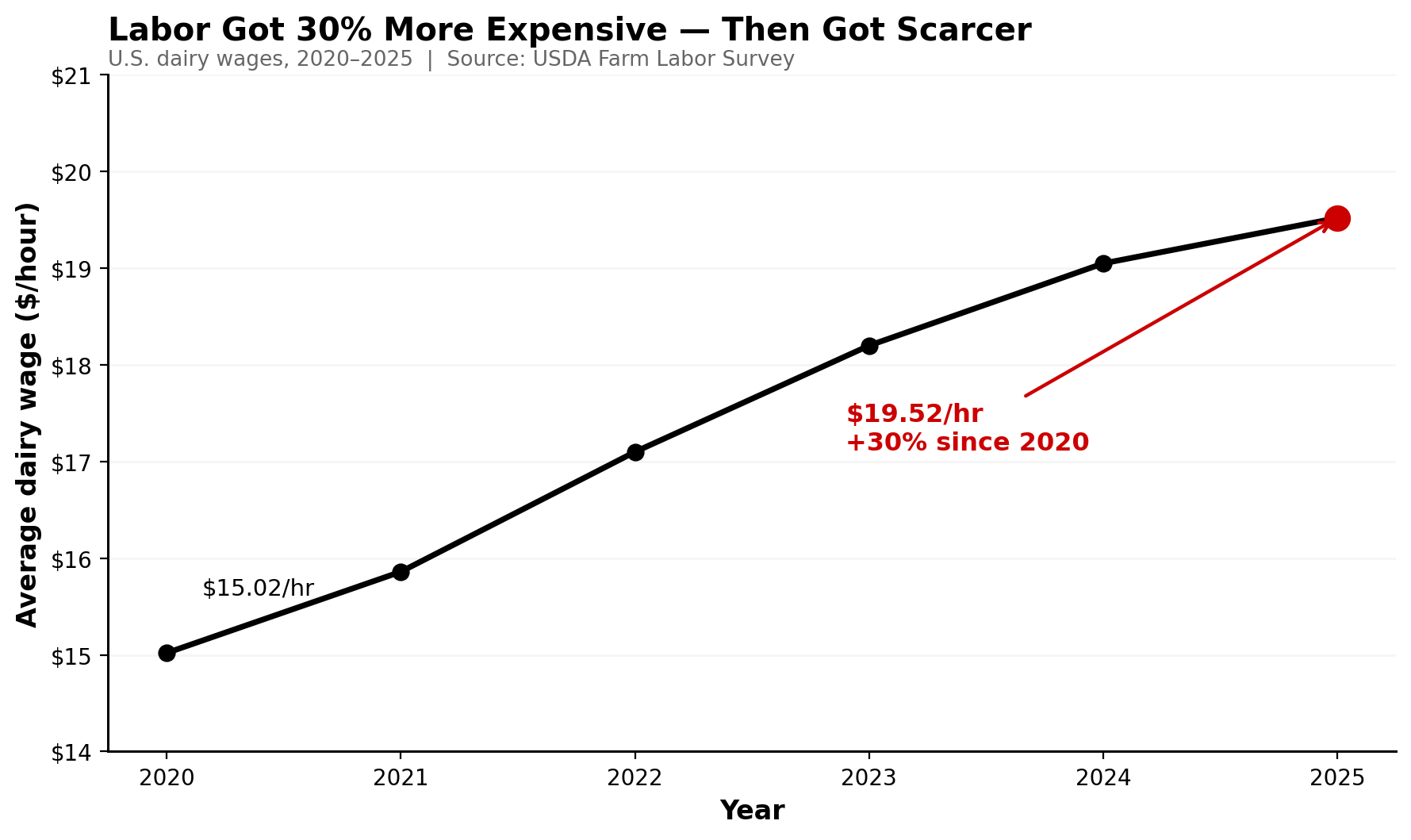
Dairy wages have climbed to roughly $19.52/hour, up about 30% since 2020, per USDA Farm Labor Survey data.
ICE and Border Patrol are slated for a $170 billion funding increase through 2029, with workplace enforcement explicitly named as a priority.
More pressure on the same workforce you already can’t easily replace. That’s the short version.
How This Plays Out on Real Farms
The Outlook and Drumgoon stories sound extreme because they are. But the mechanics showing up around them are quieter and more common.
In Idaho, one dairy reportedly lost about a third of its crew over three weeks. No raid. No warrant. No agents on the property. Workers stopped showing up after an enforcement action 50 miles away rattled the community, according to reporting on the incident. Fear became a labor event all by itself.
Beverly Idsinga, who works with New Mexico dairy producers, put the whole problem in five words after the Lovington raid: “You can’t turn off cows.” That’s the line every owner-operator already knows in their gut. The biology doesn’t pause while you sort out the paperwork.
Here’s the barn math that makes it real. Take a 500-cow herd:
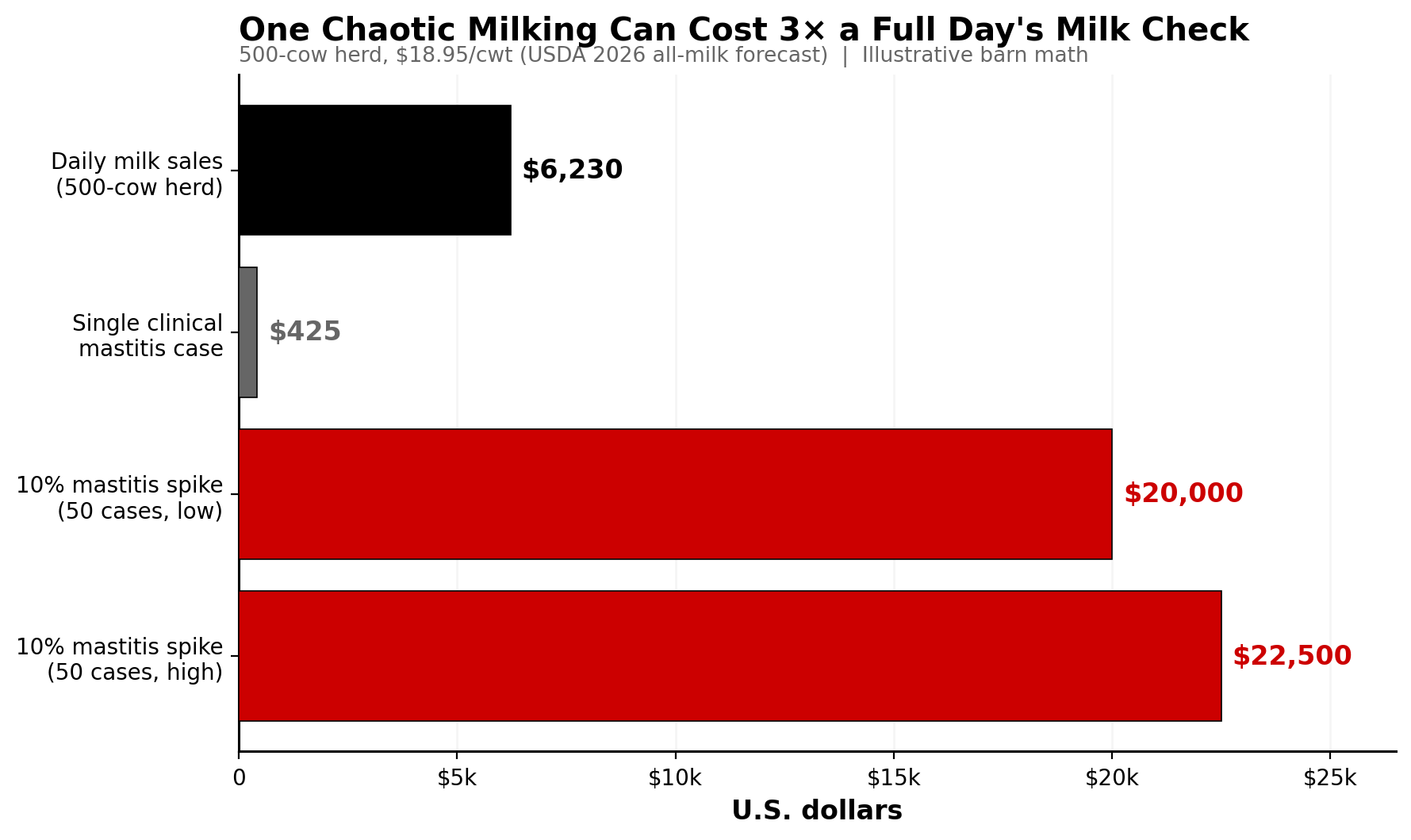
At 24,000 lbs per cow per year, you’re shipping roughly 32,900 lbs a day.
At $18.95/cwt — USDA’s 2026 all-milk forecast — that’s about $6,230 in milk sales per day.
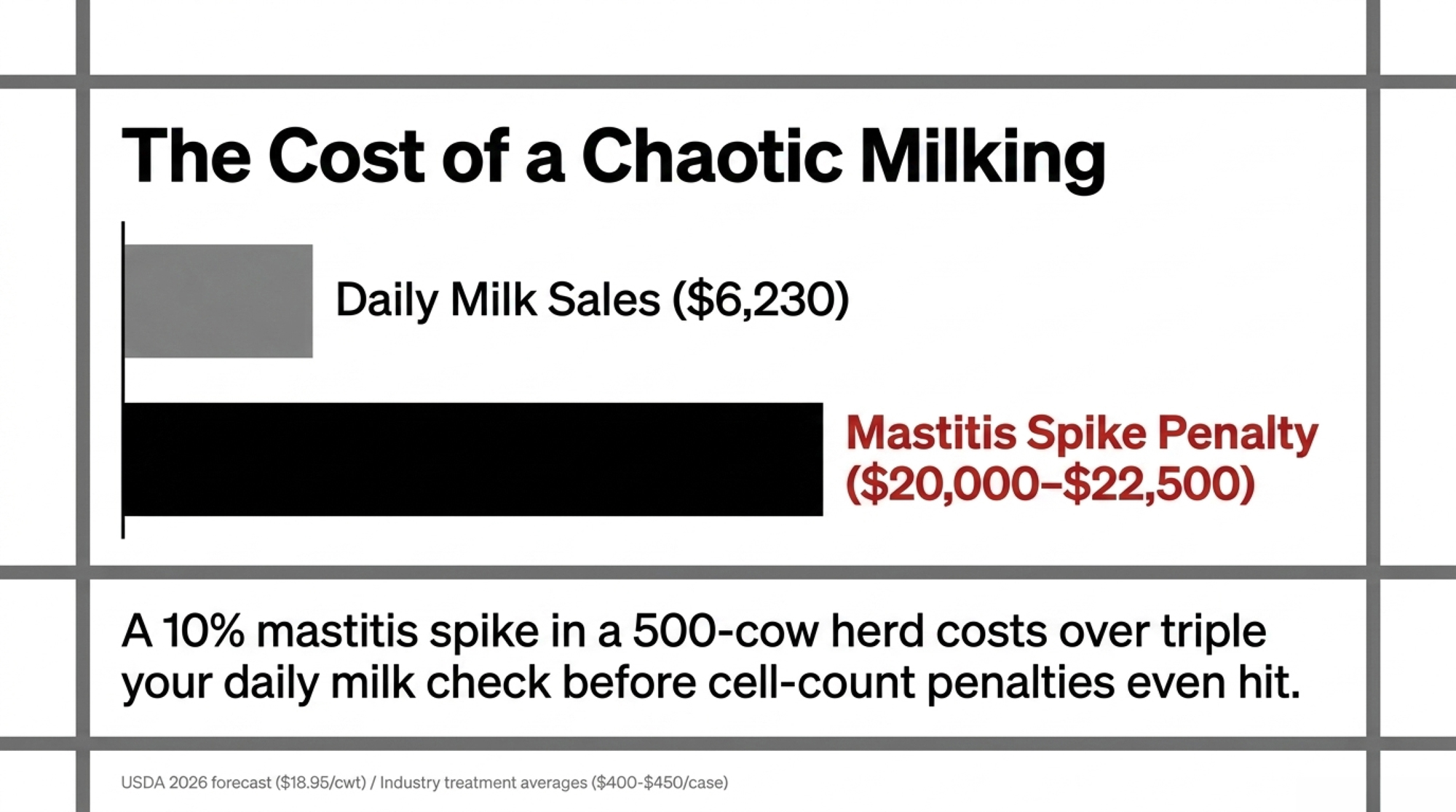
Now say a chaotic milking, run by people who’ve never touched your parlor, spikes mastitis. A clinical case in early lactation runs in the $400–$450 range once you add treatment, dumped milk, and lost yield. A 10% spike on that herd is 50 cases — call it $20,000 to $22,500 at $400 to $450 a case — before you count somatic cell penalties on your next load.
Don’t take our 500-cow example. Run your own herd size and milk price through the interactive calculator on this page and you’ll get your own daily exposure in about ten seconds.
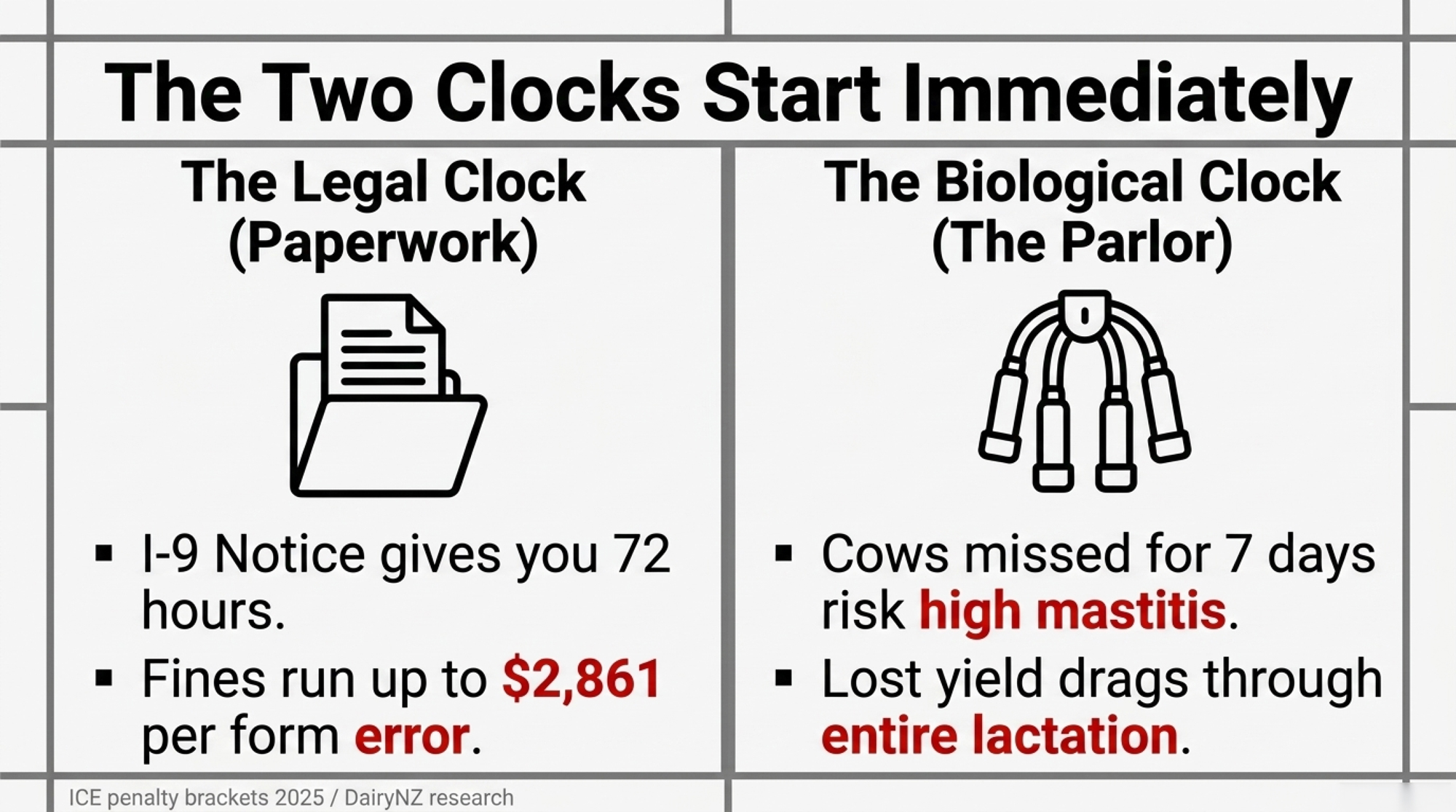
And the production hit doesn’t bounce back the next morning. DairyNZ research found that roughly a quarter of cows not milked for seven days will develop mastitis, and the lost yield drags on through the lactation. You don’t get a do-over on a missed milking.
The Mechanics Behind the Outcomes
Two clocks start the moment enforcement touches your farm. The legal one is paperwork — an I-9 notice gives you 72 hours to produce documentation for every worker on the payroll, and ICE recently reclassified several I-9 error types as “substantive violations,” with fines running $288 to $2,861 per form (penalties current as of 2025; adjusted annually). The biological one is the parlor. It runs on schedule, or the cows pay for it — a few rough milkings push somatic cell counts high enough to trigger quality penalties or force you to dump milk you already paid to make.
And if agents show up with a warrant instead of a notice? Your morning comes down to one question: is it a judicial warrant signed by a judge, or an administrative one? Without a judicial warrant, agents can’t compel entry into the non-public areas of your operation — and knowing that difference buys you the minutes to get an attorney on the phone.
Dimension
The Legal Clock (paperwork)
The Biological Clock (the parlor)
Trigger
I-9 Notice of Inspection
Missed or chaotic milking
Deadline
72 hours to produce documents
Next milking, every ~8–12 hrs
Cost of failure
$288–$2,861 per form
~25% of unmilked cows develop mastitis in 7 days
Who controls it
Your attorney + records
Nobody — “you can’t turn off cows”
Can automation help?
No
Partial — robots don’t cover crisis pens
Here’s what most coverage misses: the raid isn’t the main event anymore. The audit is. In Texas, at least nine dairies received I-9 Notices of Inspection over a single weekend in 2025. Drumgoon’s audit arrived with no sirens and no TV cameras — just a notice that, per local reporting, cost the farm 38 people and more than $110,000.
Automation helps, but don’t mistake it for armor. Robotic milking can cut milking labor hours by up to 75% and lift net returns on the right farms. Drumgoon had 20 robots running when the audit hit. They still couldn’t keep the operation whole, because robots don’t feed calves, catch every sick cow, or cover a fresh-cow pen during a crisis.
How Much Does Waiting 30 Days Actually Cost?
This is the question most farms never run the numbers on.
Say you already know your I-9 system is messy. The files live in a drawer. You’re not sure every re-verification got done on time, and a couple of workers had documents that never quite matched on day one. You keep meaning to get counsel to review it. Something more urgent always wins — a forage test, a breakdown, a banker meeting.
Here’s the cost of waiting, built only on numbers we can source. If an audit forces out even five full-time workers at $19.52/hour — roughly $203,000 a year in labor capacity walking out the gate — that’s before recruiting costs, training time, or the elevated mastitis and injury risk that come with running thin. Drumgoon’s real-world rebuild topped $110,000 in recruiters and transport alone, by its co-owner’s account. Set that against the cost of a legal I-9 review now, and the “we’ll deal with it later” math stops looking cheap.
Scenario
Trigger
Direct Cost
Source basis
Proactive I-9 legal review
Your choice, this month
Attorney review fee (modest)
30-day move
5 full-time workers lost
Audit forces exits
~$203,000/yr labor capacity
$19.52/hr × 5 FTE
Drumgoon crew rebuild
Post-audit recruiting
$110,000+
Co-owner, local reporting
Per-form I-9 penalty
“Substantive” violation
$288–$2,861 each
ICE, 2025
Is Your Parlor Ready for a 72-Hour Shock?
Labor isn’t a slow leak anymore. It’s a burst pipe. We’re trained to think of it as a slow grind — hard to hire, hard to keep, margins eroding over the years. Enforcement flips that into a same-day emergency. So ask three honest questions about your own parlor.
If you lost a quarter to a third of your crew tomorrow, who runs the next six milkings? Not who could in theory — names, shift by shift. Where does your I-9 paperwork live, and who could pull a complete, clean file set in under an hour? And if enforcement hit your county and workers 50 miles out started leaving, how many of your people would have enough reason to stay that they’d ride out the fear?
None of those questions asks you to take a side on national policy. They’re strictly operational. But the answers tell you exactly how exposed your herd really is.
Options and Trade-Offs for Farmers
There’s no single fix for a labor shock. But the farms that ride one out tend to have a few things in place before anything happens.
Cross-training and written SOPs. This works when you can lose 20–30% of your crew and still get cows milked without an immediate welfare problem. It takes written standard operating procedures for the critical jobs — milking, fresh-cow checks, treatment protocols — in language every employee can follow, plus enough rotation that more than one person can run each core task. The limit is honest: cross-training doesn’t create hours in the day. If your hit is Outlook-sized, you still need bodies. But it buys time and protects cow health while you find them.
Mutual aid and relief-milker networks. Best for short disruptions — illness, a small audit, fear-driven absenteeism — where you need one or two extra people for a week or two. It requires relationships built before the crisis. After Drumgoon’s audit, neighboring farms sent workers over in shifts to keep things moving, according to reporting on the operation. In Vermont, NOFA maintains a list of trained relief milkers who step in during emergencies. The catch: in a regional enforcement surge, everyone’s short at once.
A tightened I-9 and legal-response plan — this is your 30-day move. Don’t wait for a notice. In the next 30 days, pull a sample of your I-9s and have an immigration attorney review them. Designate one person to handle agents or auditors while everyone else stays with the cows, and post a simple protocol: where the warrant gets checked, who calls the lawyer, who documents what. It won’t fix a broad labor shortage, but it stops you from losing people over errors you could have caught.
Automation as a partial hedge. Makes sense when milking labor is your biggest bottleneck and you’ve got the scale and capital. It demands real money up front and several years before the efficiency shows up in the bank, and you still need skilled people to run it. Useful — just not a shield, as Drumgoon proved.
Key Takeaways
If your plan for a labor raid starts with “we’ll see what happens,” you don’t have a plan — you have a hope. Build the shift-by-shift coverage map this week.
If more than half your milk depends on immigrant labor, put that on paper. That’s not a political statement; it’s the starting line for any real contingency plan.
If you haven’t had an immigration attorney review your I-9s in the past 12 months, that’s overdue. Book it before the month is out — cleanup now almost always beats rebuilding after an audit.
If one person’s absence can shut down your parlor, that’s your highest-risk role. Cross-train it first, not eventually.
If you can’t name at least two neighboring operations that would pick up the phone at 5 a.m., your mutual-aid network isn’t built yet. Make those calls while things are calm.
If you’re pricing robots, price the people too. Automation cuts milking hours, but Drumgoon had 20 units and still got knocked down.
The Question Worth Sitting With
ICE and CBP have already touched agriculture, the funding to do more is on the books, and the fear effect doesn’t even require an agent in your driveway. So the question isn’t whether this reaches your county. It’s whether your operation can take the hit — an audit, a rumor, a Tuesday you didn’t see coming — and still get every cow milked on time without burning out the people who stay.
Pull your own numbers this week. Count your single points of failure in the parlor, then ask the neighbor down the road how many milkings they could cover if you called at 5 a.m. We’re breaking down the full 72-hour play-by-play — the I-9 fine brackets, the legal-response steps, and labor-cost benchmarks by herd size — in an upcoming Bullvine deep dive. That’s where the spreadsheets live.
So here’s the one to chew on, and we genuinely want your answer in the comments: if HSI knocked on your door tomorrow morning, how many milkings could you cover before you’d have to call for help — and who’s the first name on that list?
Methodology note: This account is based on Homeland Security Investigations’ public statements, contemporaneous news reporting, and the operators’ own public comments, as of June 2025. Production and cost figures for the 500-cow example are illustrative barn-math estimates drawn from cited industry data, not figures from the named farms.
Dairy Technology 2026: Robotics, Sensors, AI and Real-World ROI — Dismantles standard automation claims with concrete operating cost brackets, providing individual cow sensor data models and accurate box hardware evaluations required to hit a projected 6.4-year payback timeline.
The Sunday Read Dairy Professionals Don’t Skip.
Every week, thousands of producers, breeders, and industry insiders open Bullvine Weekly for genetics insights, market shifts, and profit strategies they won’t find anywhere else. One email. Five minutes. Smarter decisions all week.
To provide the best experiences, we use technologies like cookies to store and/or access device information. Consenting to these technologies will allow us to process data such as browsing behavior or unique IDs on this site. Not consenting or withdrawing consent, may adversely affect certain features and functions.
Functional
Always active
The technical storage or access is strictly necessary for the legitimate purpose of enabling the use of a specific service explicitly requested by the subscriber or user, or for the sole purpose of carrying out the transmission of a communication over an electronic communications network.
Preferences
The technical storage or access is necessary for the legitimate purpose of storing preferences that are not requested by the subscriber or user.
Statistics
The technical storage or access that is used exclusively for statistical purposes.The technical storage or access that is used exclusively for anonymous statistical purposes. Without a subpoena, voluntary compliance on the part of your Internet Service Provider, or additional records from a third party, information stored or retrieved for this purpose alone cannot usually be used to identify you.
Marketing
The technical storage or access is required to create user profiles to send advertising, or to track the user on a website or across several websites for similar marketing purposes.
To provide the best experiences, we and our partners use technologies like cookies to store and/or access device information. Consenting to these technologies will allow us and our partners to process personal data such as browsing behavior or unique IDs on this site and show (non-) personalized ads. Not consenting or withdrawing consent, may adversely affect certain features and functions.
Click below to consent to the above or make granular choices. Your choices will be applied to this site only. You can change your settings at any time, including withdrawing your consent, by using the toggles on the Cookie Policy, or by clicking on the manage consent button at the bottom of the screen.
Functional
Always active
The technical storage or access is strictly necessary for the legitimate purpose of enabling the use of a specific service explicitly requested by the subscriber or user, or for the sole purpose of carrying out the transmission of a communication over an electronic communications network.
Preferences
The technical storage or access is necessary for the legitimate purpose of storing preferences that are not requested by the subscriber or user.
Statistics
The technical storage or access that is used exclusively for statistical purposes.The technical storage or access that is used exclusively for anonymous statistical purposes. Without a subpoena, voluntary compliance on the part of your Internet Service Provider, or additional records from a third party, information stored or retrieved for this purpose alone cannot usually be used to identify you.
Marketing
The technical storage or access is required to create user profiles to send advertising, or to track the user on a website or across several websites for similar marketing purposes.





 The Sunday Read Dairy Professionals Don’t Skip.
 The Sunday Read Dairy Professionals Don’t Skip.