Archive for immigrant dairy labor

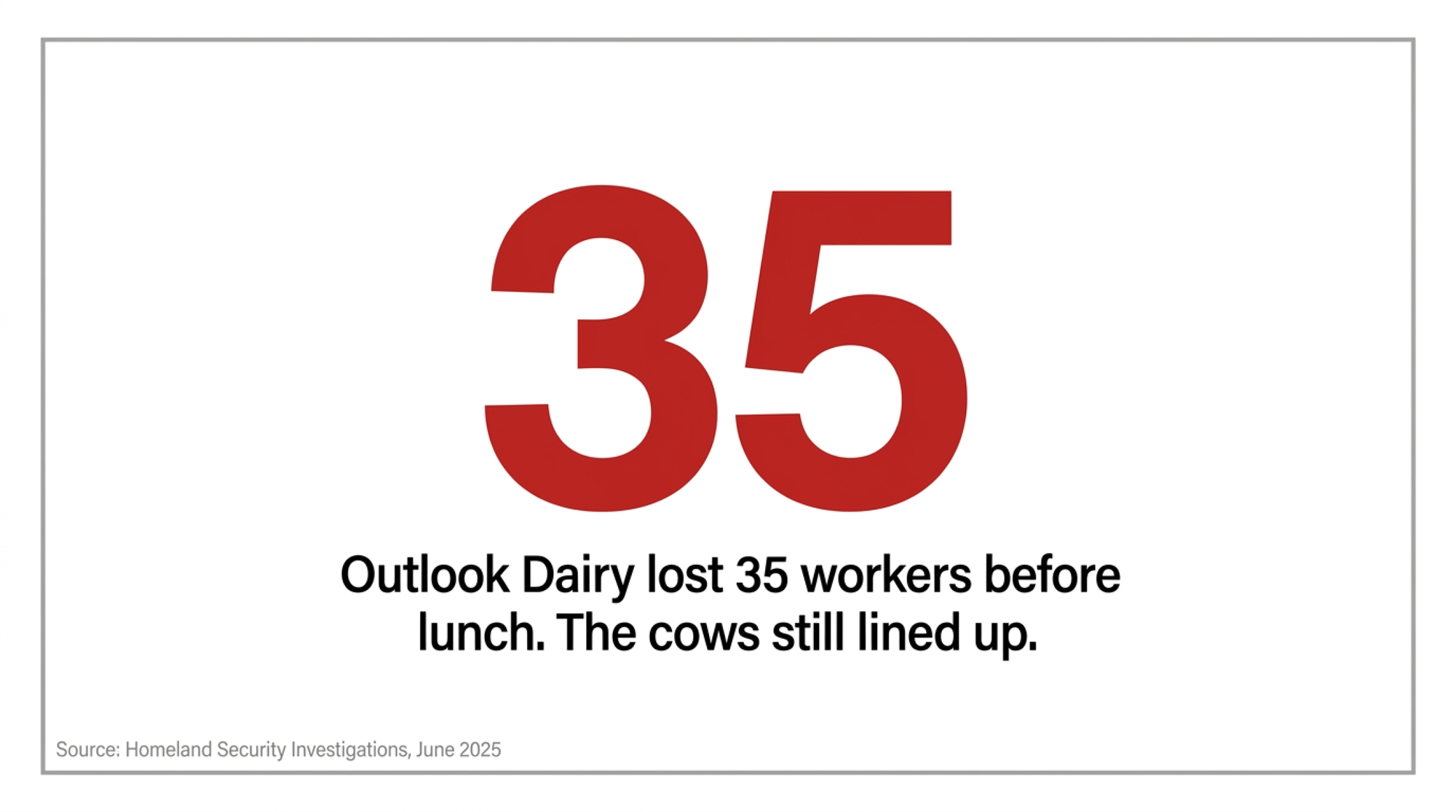
Outlook Dairy Lost 35 of 55 Workers Before Lunch. Then the Cows Lined Up. 

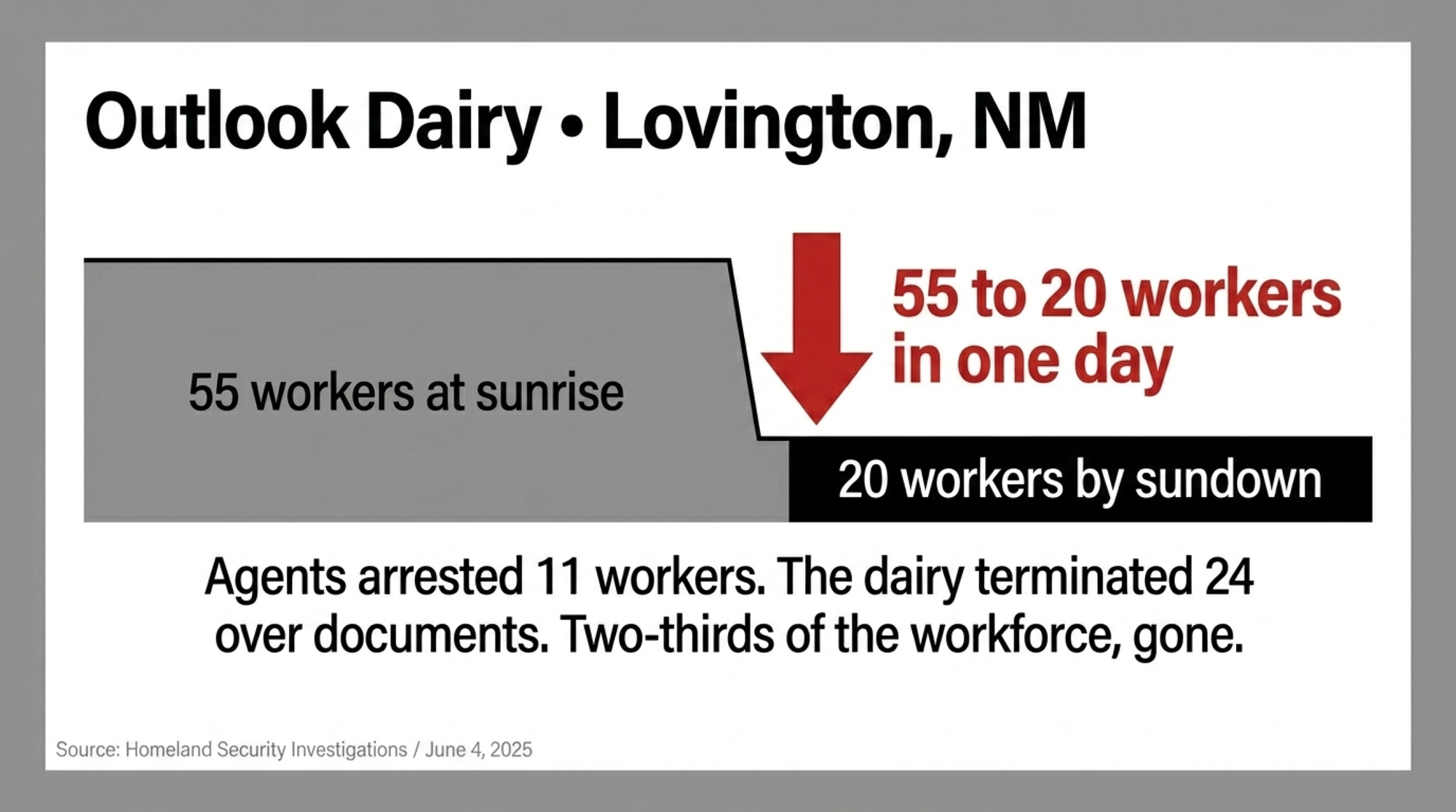
Outlook had 55 on payroll at sunrise and 20 by sundown. The parlor didn’t blink. If your crew vanished tomorrow, who runs the next six milkings — and what’s it cost by dark?
On June 4, 2025, Outlook Dairy outside Lovington, New Mexico, had 55 people on the payroll. By the time the dust settled, 35 of them were gone — Homeland Security Investigations agents arrested 11 workers while executing a search warrant, and the dairy terminated 24 more whose work-authorization documents could not be verified, according to the agency’s announcement and subsequent reporting. HSI said the arrested workers had used counterfeit documents to obtain work; as of this reporting, the public record does not indicate any charges against the dairy’s owners. Owner Isaak Bos didn’t soften the impact on the operation. Milk production, he told reporters, “didn’t just slow down, it effectively ceased.” 
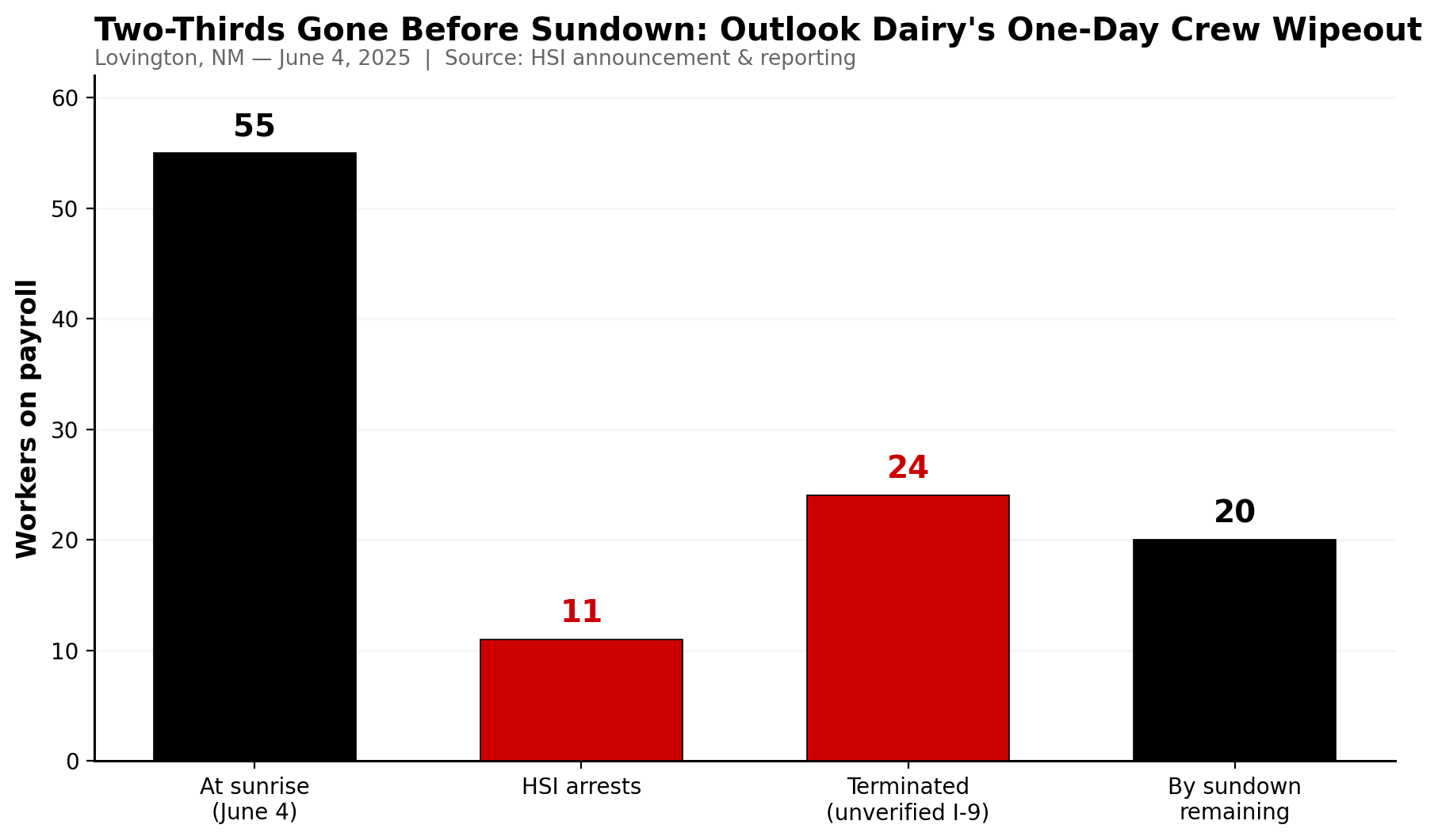
That’s two-thirds of a workforce, gone before the day was out. Family, office staff, and local high school kids on summer break kept the cows alive in the days after. The parlor didn’t care that immigration enforcement had just gutted the crew. Cows still lined up. Calves still needed feeding. Somebody had to show up at 4 a.m. 

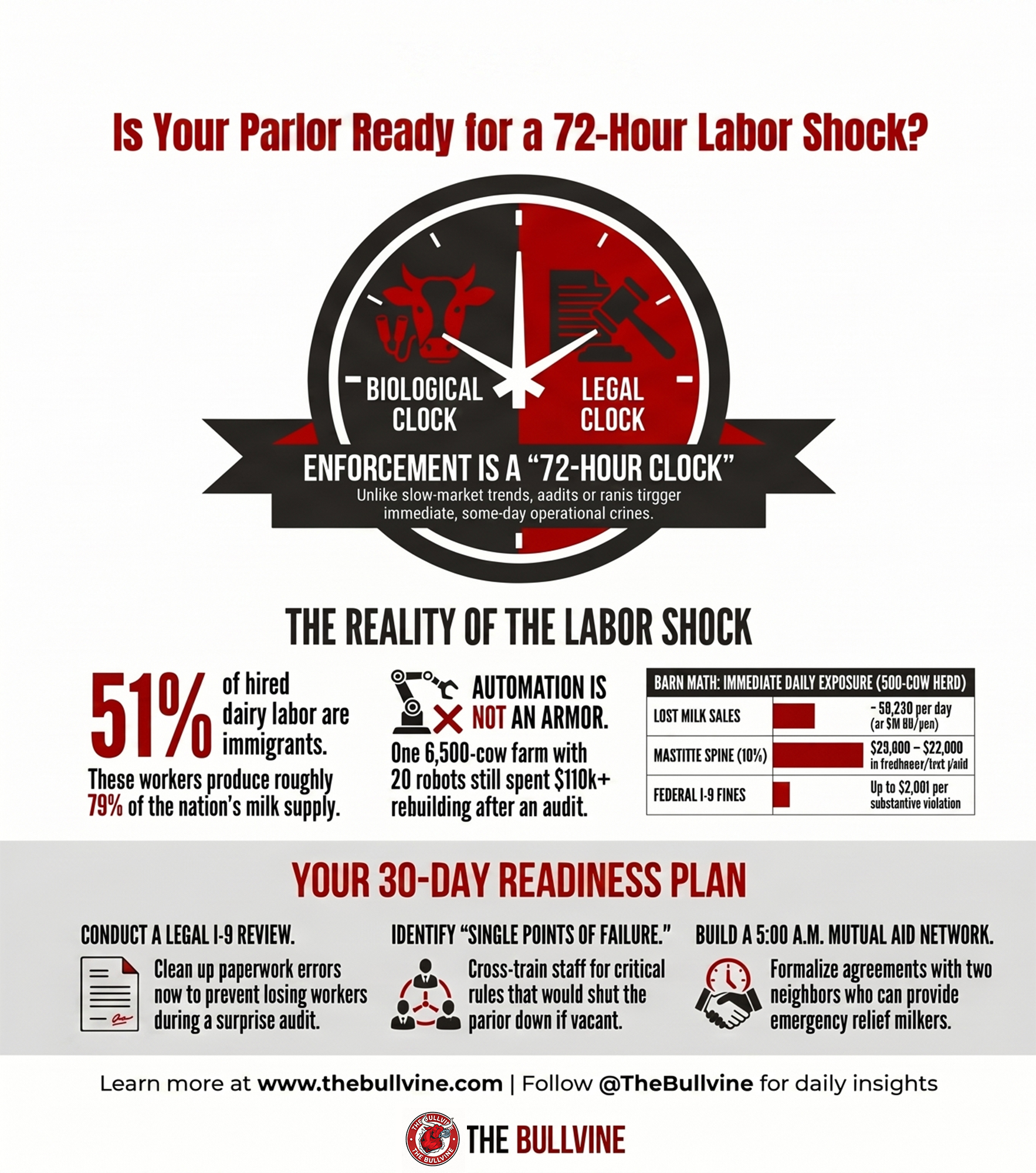
This is the sharp edge of a labor reality that touches nearly every hired-labor dairy in the country. About half of all hired dairy workers are immigrants, and the farms that employ them produce roughly 79% of the nation’s milk. When enforcement lands — or even when the rumor of it lands — your operation isn’t on a five-year labor trend anymore. It’s on a 72-hour clock. And most farms are only mentally prepared for half of what that clock measures. 

What’s Changing and Why

For years, immigration enforcement mostly skipped dairy barns. Raids hit meatpacking plants and construction sites. That assumption broke in June 2025.

This wasn’t one farm having a bad week. It was a wave. Within weeks it had touched four states. New Mexico on June 4. Then Nebraska and California the same week — ICE arrested more than 70 at an Omaha plant, with farm operations hit out West. South Dakota came last, after a quieter Homeland Security audit landed at Drumgoon. 

President Trump publicly acknowledged the bind: “We can’t take farmers and remove all their workers and send them back just because they might not have the necessary documentation,” he said on June 12. The directive paused, then reversed, inside a week. The cows didn’t. 
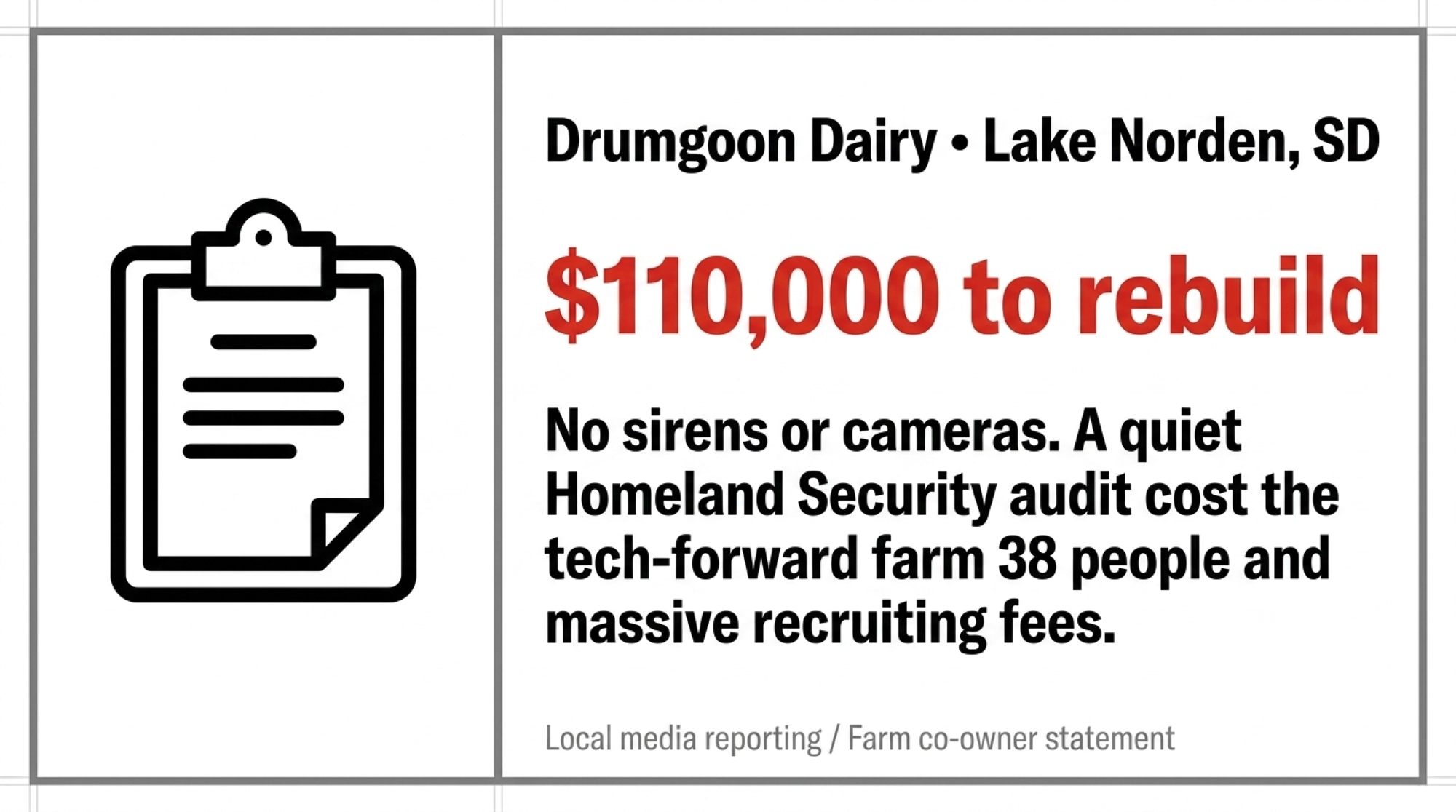
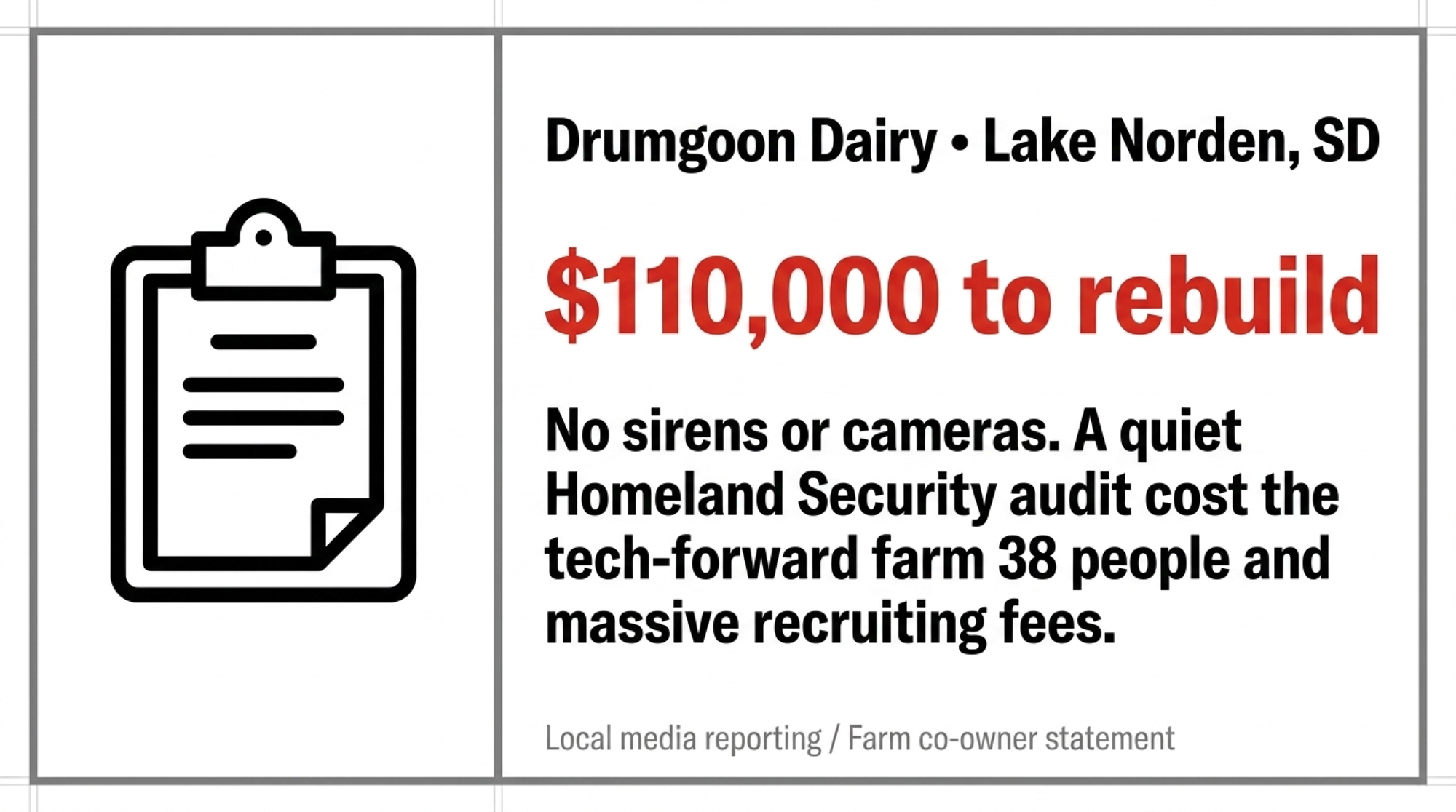
Drumgoon Dairy near Lake Norden, South Dakota, shows what the quieter version looks like. After a Homeland Security audit, the farm let 38 workers go — cutting staff from more than 50 down to 16, according to local reporting. Co-owner Dorothy Elliott told local media the farm spent more than $110,000 on recruiters and transportation trying to rebuild the crew. That’s a 6,500-cow operation with 20 robotic milking units already installed. Tech-forward, well-run, and still knocked sideways by a single paperwork action. 

Stack that on the structural math, and you see why this isn’t a New Mexico problem or a South Dakota problem:

  • A National Milk Producers Federation/Texas A&M study, published in 2015 and still the most-cited industry estimate on record, put immigrant workers at 51% of hired dairy labor on farms producing 79% of U.S. milk — and the industry still leans on those figures today. 
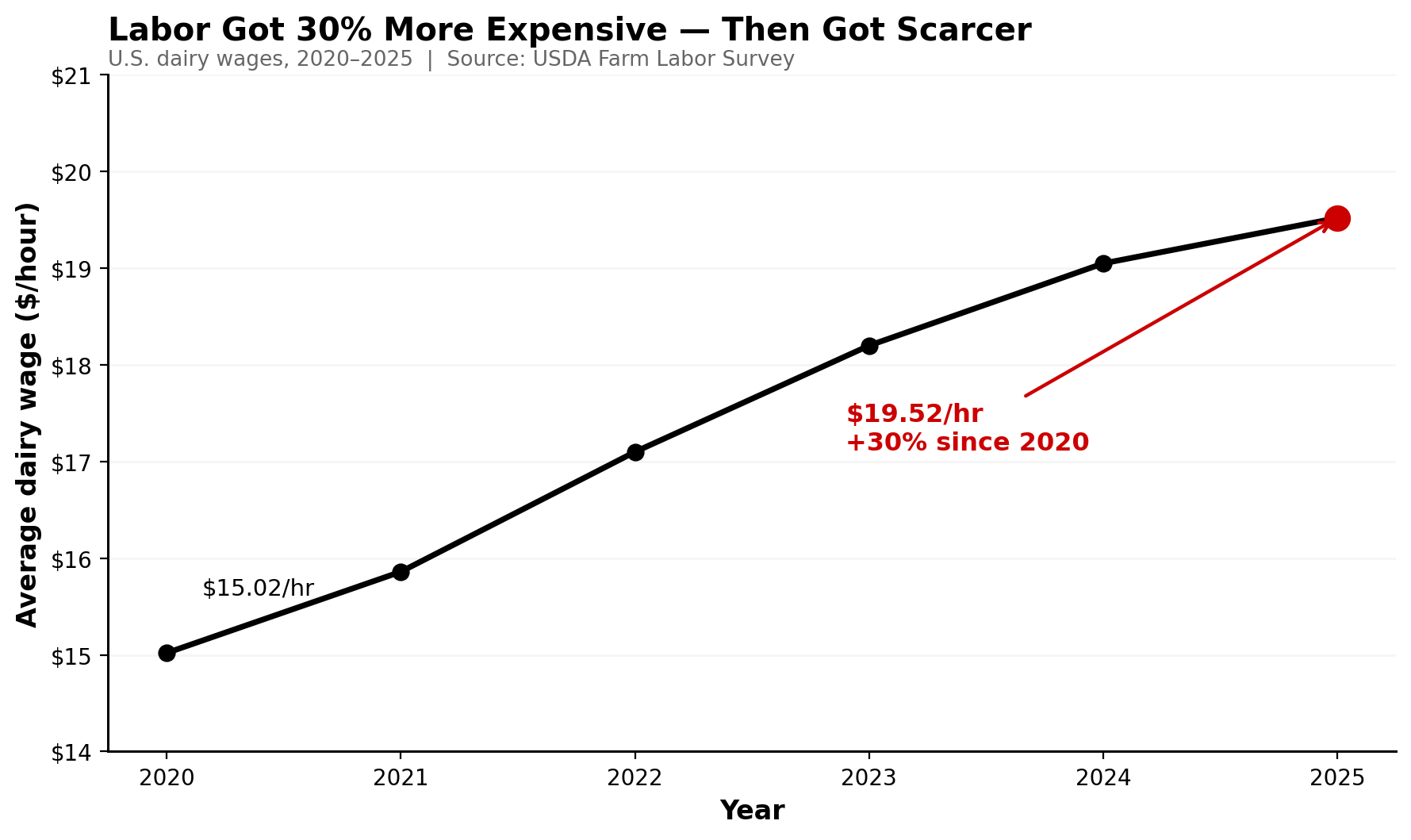
  • Dairy wages have climbed to roughly $19.52/hour, up about 30% since 2020, per USDA Farm Labor Survey data. 
  • ICE and Border Patrol are slated for a $170 billion funding increase through 2029, with workplace enforcement explicitly named as a priority. 
More pressure on the same workforce you already can’t easily replace. That’s the short version.

How This Plays Out on Real Farms

The Outlook and Drumgoon stories sound extreme because they are. But the mechanics showing up around them are quieter and more common.

In Idaho, one dairy reportedly lost about a third of its crew over three weeks. No raid. No warrant. No agents on the property. Workers stopped showing up after an enforcement action 50 miles away rattled the community, according to reporting on the incident. Fear became a labor event all by itself. 
Beverly Idsinga, who works with New Mexico dairy producers, put the whole problem in five words after the Lovington raid: “You can’t turn off cows.” That’s the line every owner-operator already knows in their gut. The biology doesn’t pause while you sort out the paperwork. 
Here’s the barn math that makes it real. Take a 500-cow herd:

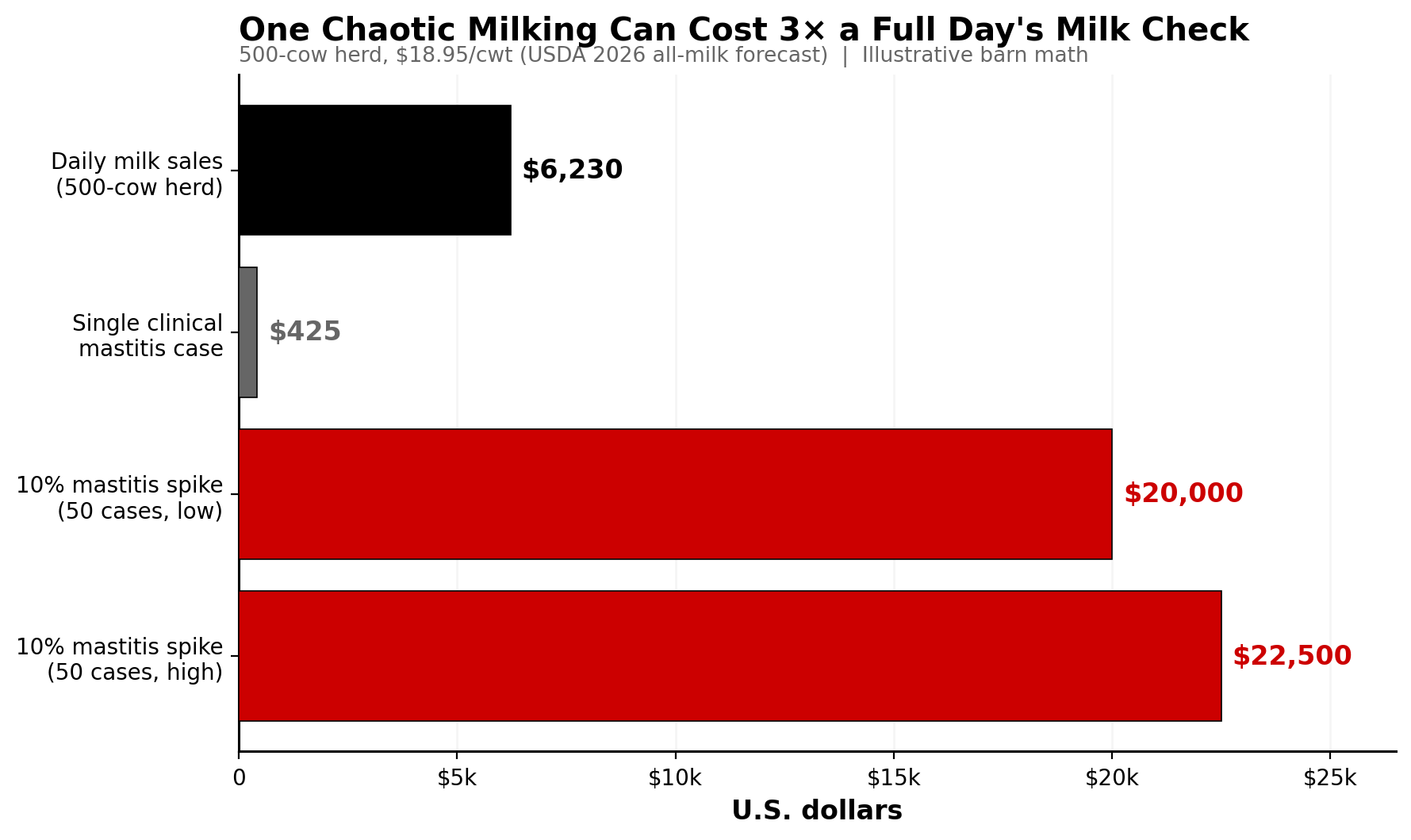
  • At 24,000 lbs per cow per year, you’re shipping roughly 32,900 lbs a day.
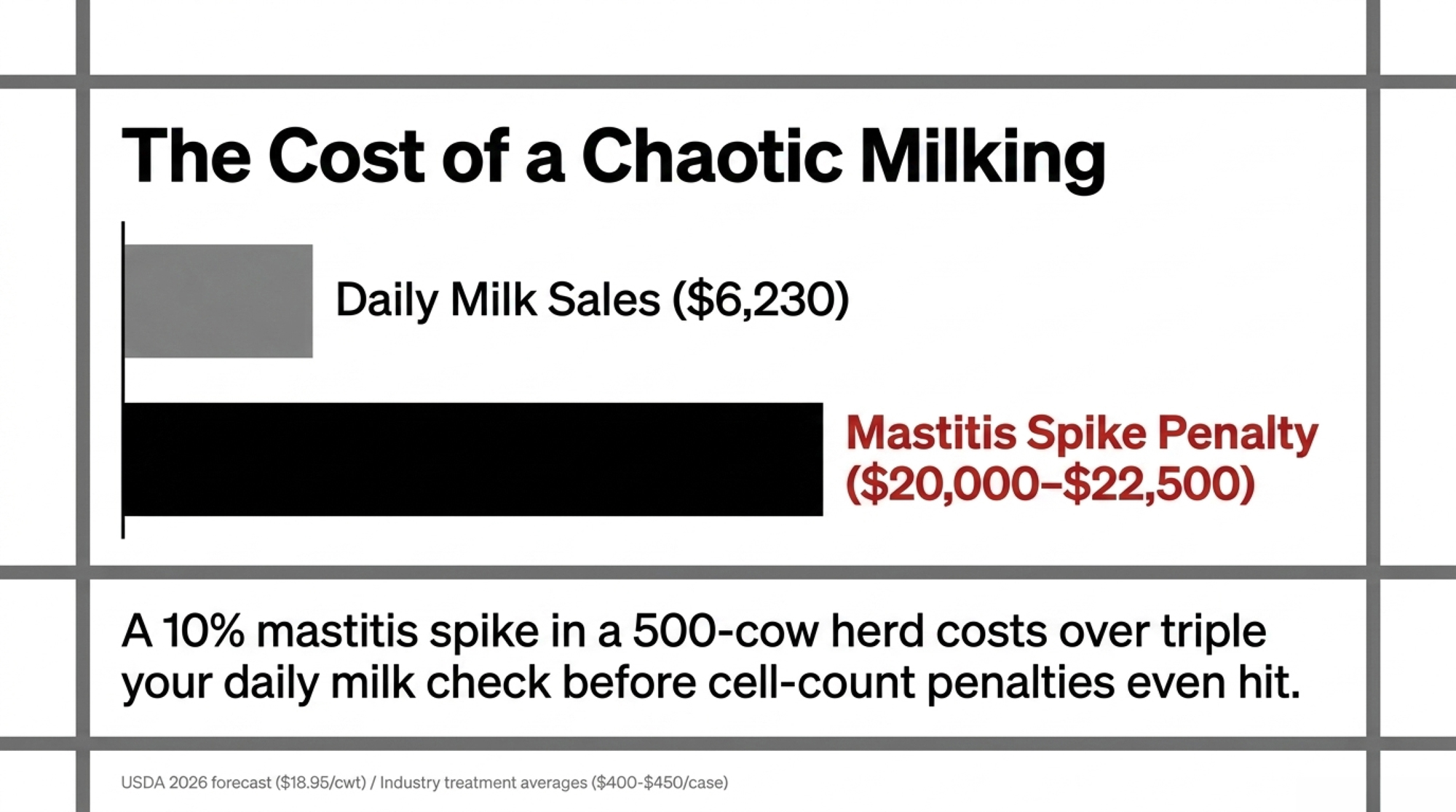
  • At $18.95/cwt — USDA’s 2026 all-milk forecast — that’s about $6,230 in milk sales per day
  • Now say a chaotic milking, run by people who’ve never touched your parlor, spikes mastitis. A clinical case in early lactation runs in the $400–$450 range once you add treatment, dumped milk, and lost yield. A 10% spike on that herd is 50 cases — call it $20,000 to $22,500 at $400 to $450 a case — before you count somatic cell penalties on your next load. 

Don’t take our 500-cow example. Run your own herd size and milk price through the interactive calculator on this page and you’ll get your own daily exposure in about ten seconds.
And the production hit doesn’t bounce back the next morning. DairyNZ research found that roughly a quarter of cows not milked for seven days will develop mastitis, and the lost yield drags on through the lactation. You don’t get a do-over on a missed milking.

The Mechanics Behind the Outcomes
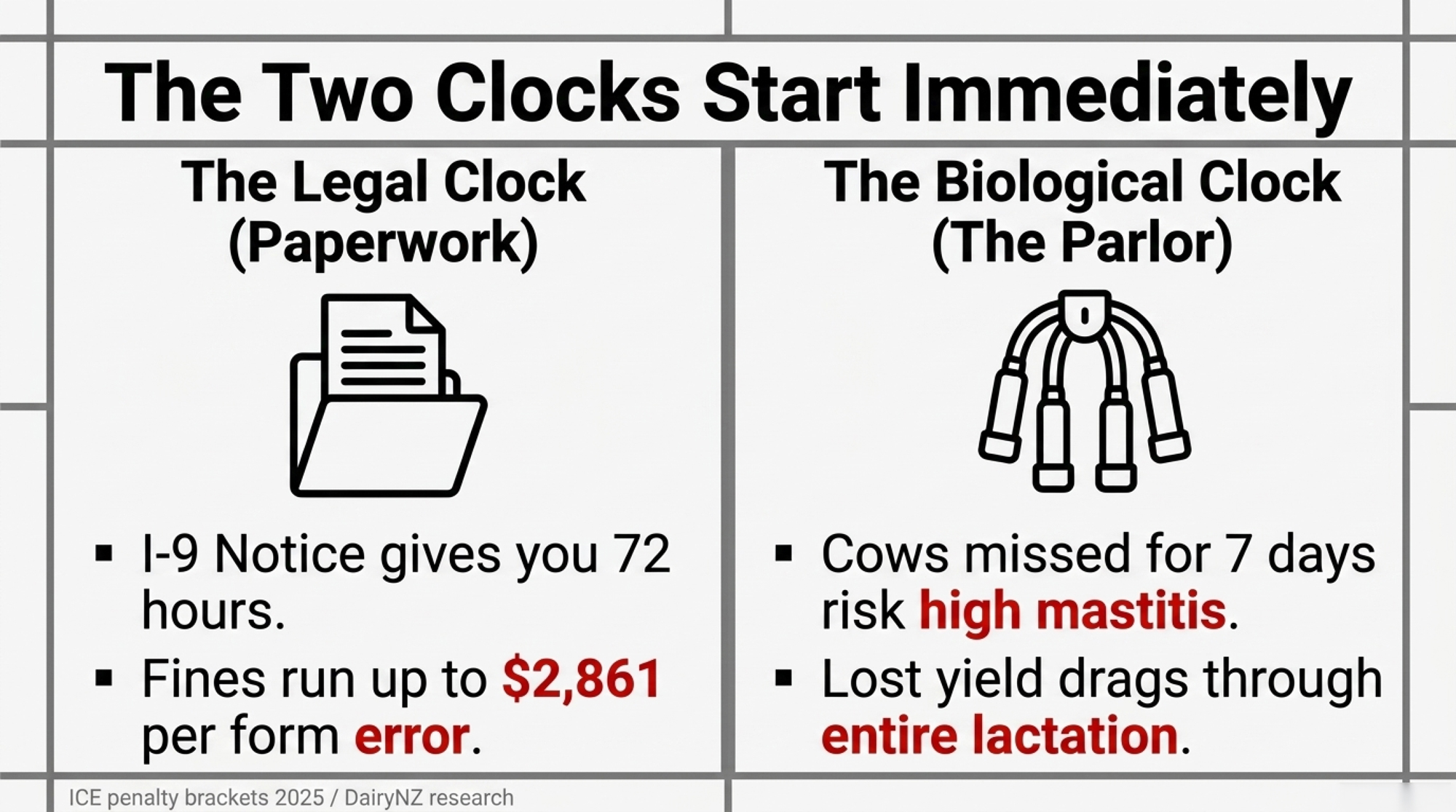
Two clocks start the moment enforcement touches your farm. The legal one is paperwork — an I-9 notice gives you 72 hours to produce documentation for every worker on the payroll, and ICE recently reclassified several I-9 error types as “substantive violations,” with fines running $288 to $2,861 per form (penalties current as of 2025; adjusted annually). The biological one is the parlor. It runs on schedule, or the cows pay for it — a few rough milkings push somatic cell counts high enough to trigger quality penalties or force you to dump milk you already paid to make. 

And if agents show up with a warrant instead of a notice? Your morning comes down to one question: is it a judicial warrant signed by a judge, or an administrative one? Without a judicial warrant, agents can’t compel entry into the non-public areas of your operation — and knowing that difference buys you the minutes to get an attorney on the phone. 

DimensionThe Legal Clock (paperwork)The Biological Clock (the parlor)
TriggerI-9 Notice of InspectionMissed or chaotic milking
Deadline72 hours to produce documentsNext milking, every ~8–12 hrs
Cost of failure$288–$2,861 per form~25% of unmilked cows develop mastitis in 7 days
Who controls itYour attorney + recordsNobody — “you can’t turn off cows”
Can automation help?NoPartial — robots don’t cover crisis pens

Here’s what most coverage misses: the raid isn’t the main event anymore. The audit is. In Texas, at least nine dairies received I-9 Notices of Inspection over a single weekend in 2025. Drumgoon’s audit arrived with no sirens and no TV cameras — just a notice that, per local reporting, cost the farm 38 people and more than $110,000. 

Automation helps, but don’t mistake it for armor. Robotic milking can cut milking labor hours by up to 75% and lift net returns on the right farms. Drumgoon had 20 robots running when the audit hit. They still couldn’t keep the operation whole, because robots don’t feed calves, catch every sick cow, or cover a fresh-cow pen during a crisis. 

How Much Does Waiting 30 Days Actually Cost?

This is the question most farms never run the numbers on.

Say you already know your I-9 system is messy. The files live in a drawer. You’re not sure every re-verification got done on time, and a couple of workers had documents that never quite matched on day one. You keep meaning to get counsel to review it. Something more urgent always wins — a forage test, a breakdown, a banker meeting.

Here’s the cost of waiting, built only on numbers we can source. If an audit forces out even five full-time workers at $19.52/hour — roughly $203,000 a year in labor capacity walking out the gate — that’s before recruiting costs, training time, or the elevated mastitis and injury risk that come with running thin. Drumgoon’s real-world rebuild topped $110,000 in recruiters and transport alone, by its co-owner’s account. Set that against the cost of a legal I-9 review now, and the “we’ll deal with it later” math stops looking cheap. 

ScenarioTriggerDirect CostSource basis
Proactive I-9 legal reviewYour choice, this monthAttorney review fee (modest)30-day move
5 full-time workers lostAudit forces exits~$203,000/yr labor capacity$19.52/hr × 5 FTE
Drumgoon crew rebuildPost-audit recruiting$110,000+Co-owner, local reporting
Per-form I-9 penalty“Substantive” violation$288–$2,861 eachICE, 2025

Is Your Parlor Ready for a 72-Hour Shock?

Labor isn’t a slow leak anymore. It’s a burst pipe. We’re trained to think of it as a slow grind — hard to hire, hard to keep, margins eroding over the years. Enforcement flips that into a same-day emergency. So ask three honest questions about your own parlor.

If you lost a quarter to a third of your crew tomorrow, who runs the next six milkings? Not who could in theory — names, shift by shift. Where does your I-9 paperwork live, and who could pull a complete, clean file set in under an hour? And if enforcement hit your county and workers 50 miles out started leaving, how many of your people would have enough reason to stay that they’d ride out the fear?

None of those questions asks you to take a side on national policy. They’re strictly operational. But the answers tell you exactly how exposed your herd really is.

Options and Trade-Offs for Farmers

There’s no single fix for a labor shock. But the farms that ride one out tend to have a few things in place before anything happens.

Cross-training and written SOPs. This works when you can lose 20–30% of your crew and still get cows milked without an immediate welfare problem. It takes written standard operating procedures for the critical jobs — milking, fresh-cow checks, treatment protocols — in language every employee can follow, plus enough rotation that more than one person can run each core task. The limit is honest: cross-training doesn’t create hours in the day. If your hit is Outlook-sized, you still need bodies. But it buys time and protects cow health while you find them. 

Mutual aid and relief-milker networks. Best for short disruptions — illness, a small audit, fear-driven absenteeism — where you need one or two extra people for a week or two. It requires relationships built before the crisis. After Drumgoon’s audit, neighboring farms sent workers over in shifts to keep things moving, according to reporting on the operation. In Vermont, NOFA maintains a list of trained relief milkers who step in during emergencies. The catch: in a regional enforcement surge, everyone’s short at once. 

A tightened I-9 and legal-response plan — this is your 30-day move. Don’t wait for a notice. In the next 30 days, pull a sample of your I-9s and have an immigration attorney review them. Designate one person to handle agents or auditors while everyone else stays with the cows, and post a simple protocol: where the warrant gets checked, who calls the lawyer, who documents what. It won’t fix a broad labor shortage, but it stops you from losing people over errors you could have caught. 

Automation as a partial hedge. Makes sense when milking labor is your biggest bottleneck and you’ve got the scale and capital. It demands real money up front and several years before the efficiency shows up in the bank, and you still need skilled people to run it. Useful — just not a shield, as Drumgoon proved. 
Key Takeaways

  • If your plan for a labor raid starts with “we’ll see what happens,” you don’t have a plan — you have a hope. Build the shift-by-shift coverage map this week.
  • If more than half your milk depends on immigrant labor, put that on paper. That’s not a political statement; it’s the starting line for any real contingency plan.
  • If you haven’t had an immigration attorney review your I-9s in the past 12 months, that’s overdue. Book it before the month is out — cleanup now almost always beats rebuilding after an audit.
  • If one person’s absence can shut down your parlor, that’s your highest-risk role. Cross-train it first, not eventually.
  • If you can’t name at least two neighboring operations that would pick up the phone at 5 a.m., your mutual-aid network isn’t built yet. Make those calls while things are calm.
  • If you’re pricing robots, price the people too. Automation cuts milking hours, but Drumgoon had 20 units and still got knocked down.
The Question Worth Sitting With

ICE and CBP have already touched agriculture, the funding to do more is on the books, and the fear effect doesn’t even require an agent in your driveway. So the question isn’t whether this reaches your county. It’s whether your operation can take the hit — an audit, a rumor, a Tuesday you didn’t see coming — and still get every cow milked on time without burning out the people who stay. 

Pull your own numbers this week. Count your single points of failure in the parlor, then ask the neighbor down the road how many milkings they could cover if you called at 5 a.m. We’re breaking down the full 72-hour play-by-play — the I-9 fine brackets, the legal-response steps, and labor-cost benchmarks by herd size — in an upcoming Bullvine deep dive. That’s where the spreadsheets live.

So here’s the one to chew on, and we genuinely want your answer in the comments: if HSI knocked on your door tomorrow morning, how many milkings could you cover before you’d have to call for help — and who’s the first name on that list?

Try It Yourself · Free Tool

Methodology note: This account is based on Homeland Security Investigations’ public statements, contemporaneous news reporting, and the operators’ own public comments, as of June 2025. Production and cost figures for the 500-cow example are illustrative barn-math estimates drawn from cited industry data, not figures from the named farms.

Learn More

The Sunday Read Dairy Professionals Don’t Skip.

Every week, thousands of producers, breeders, and industry insiders open Bullvine Weekly for genetics insights, market shifts, and profit strategies they won’t find anywhere else. One email. Five minutes. Smarter decisions all week.
NewsSubscribe
First
Last
Consent

A 1943 Land Girl Cost More Per CWT Than Your 2026 Crew. The H‑2A Math Explains Why.

 Inflation-adjusted, a 1943 6‑cow British dairy and hired labor lands in the mid‑single‑digit dollars per cwt. Your 2,000‑cow neighbor on H‑2A pays $2.20. Memorial Day is the receipt.

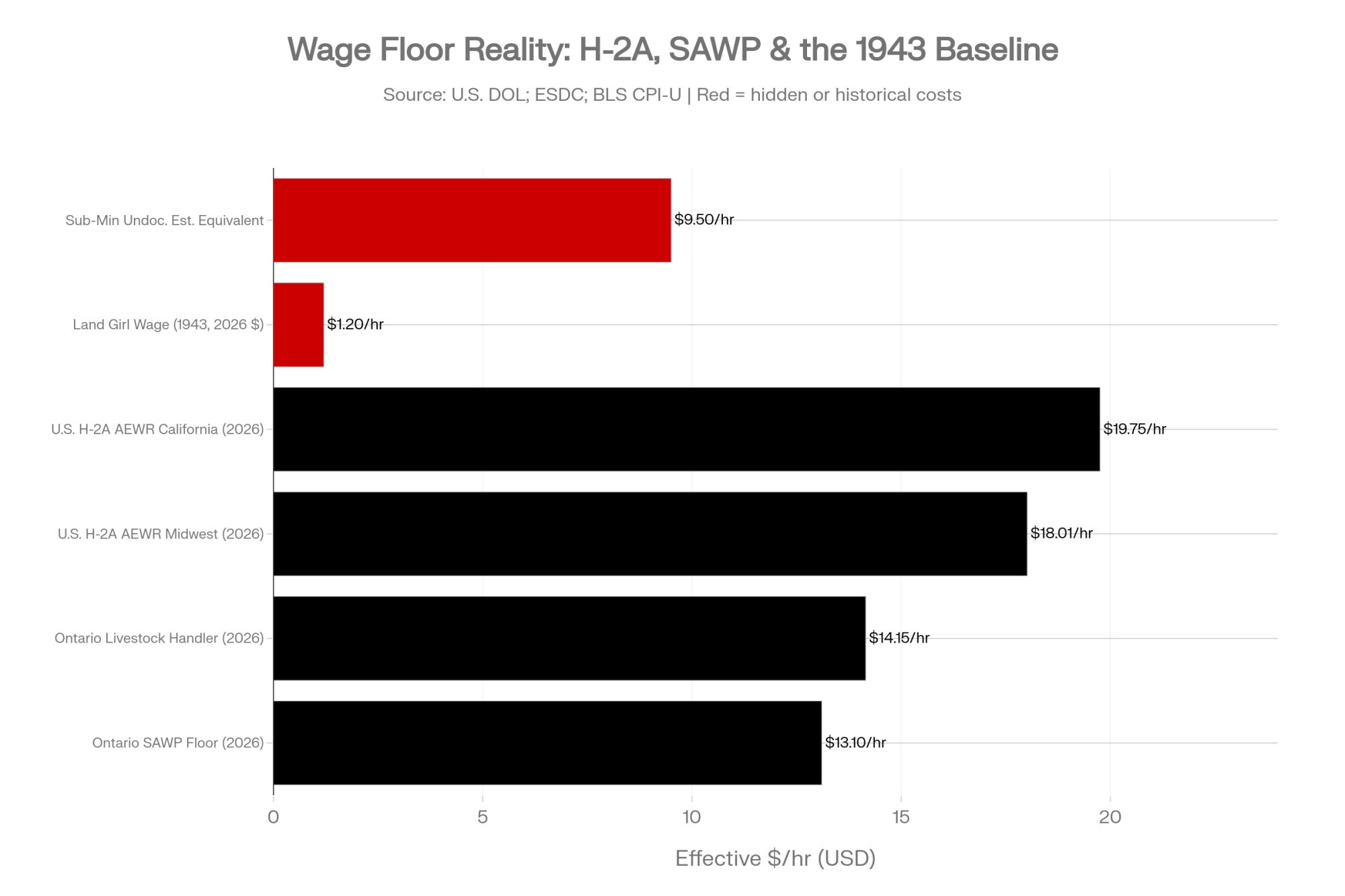
Executive Summary: A 1943 6‑cow British dairy spent more on hired labor per cwt — in 2026 dollars — than a modern 2,000‑cow U.S. operation does today. USDA ERS pegs hired labor at roughly $2.20/cwt for 2,000+ cow herds, $4.19/cwt total labor for the 200–499 cow band, and $15.99/cwt full economic cost for sub‑50 cow farms once you price family time honestly. The 2026 H‑2A AEWR sits in the upper teens across the Midwest and California, ESDC’s 2026 SAWP schedule lands in the upper‑$17 to mid‑$19 CAD/hr range, and the Canadian Dairy Commission lifted farmgate price 2.33% effective February 1, 2026 to recover producer labour cost. Texas A&M and NMPF research (Adcock, Anderson & Rosson, 2015) indicates immigrant labor is roughly half of hired U.S. dairy crews and produces a majority of the country’s milk — pull it out and the model loses thousands of farms with retail milk roughly doubling. A 50¢/cwt labor gap on a 300‑cow herd shipping 75 lbs/day is $3,125/month walking out the door while you’re “thinking about it.”

dairy labor cost per cwt

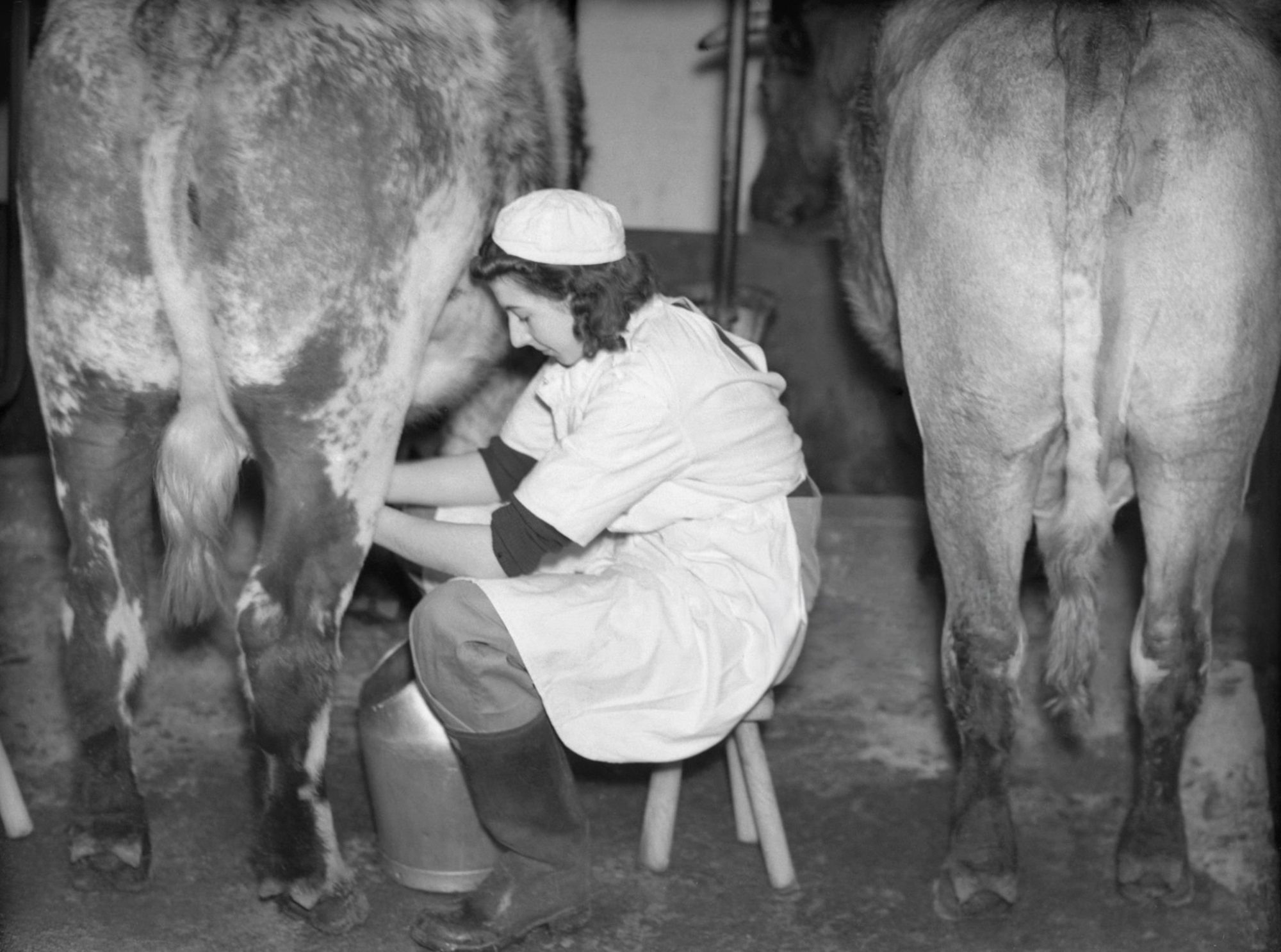
A nineteen‑year‑old Land Girl pushes through a damp British byre in 1943, lantern in one hand, dented milk pail in the other. The farm’s sons are gone — some buried in Italy, some still between boot camp and the front — and her job is to keep forty cows milking and the country fed. She earns 38 shillings a week, minus 14 for board. Run her 24‑shilling net through standard ONS inflation indexing across a 50‑hour Land Army workweek and you land near the equivalent of roughly a dollar and change an hour in 2026 money. For hand‑milking before sunrise.

Now picture a 500‑cow Wisconsin freestall this morning. Illustrative composite, not a named farm. The owner has compliance paperwork stacked on the desk, three milkers wondering whether to risk another season, and a recruiter on hold quoting an H‑2A Adverse Effect Wage Rate (AEWR) in the upper teens — the kind of number the U.S. Department of Labor’s 2026 schedule now puts in front of any Midwest dairy that goes through the program.

That’s where this Memorial Day piece sits. Your dairy labor cost per cwt has been quietly outsourced to “emergency” labor since 1942, and the people who keep your parlor running are still on the most fragile legal footing in the supply chain.

The Land Girls Were Real. So Are the Receipts.

Britain’s Women’s Land Army peaked at 80,000+ members in 1943, and the Imperial War Museums Sound Archive holds a public oral history collection of recorded interviews with Land Girls who served between 1939 and 1950 — including the dairy farm accounts preserved under IWM Archive Catalogue No. 11624. They are named, dated, and catalogued. They are the receipts.

That paper trail matters because the same architecture is still load‑bearing in your barn. Eighty‑four years on, the people doing essential dairy work in the U.S. and Canada are still the most fragile legal piece in the supply chain.

The Barn Math That Flips the Story

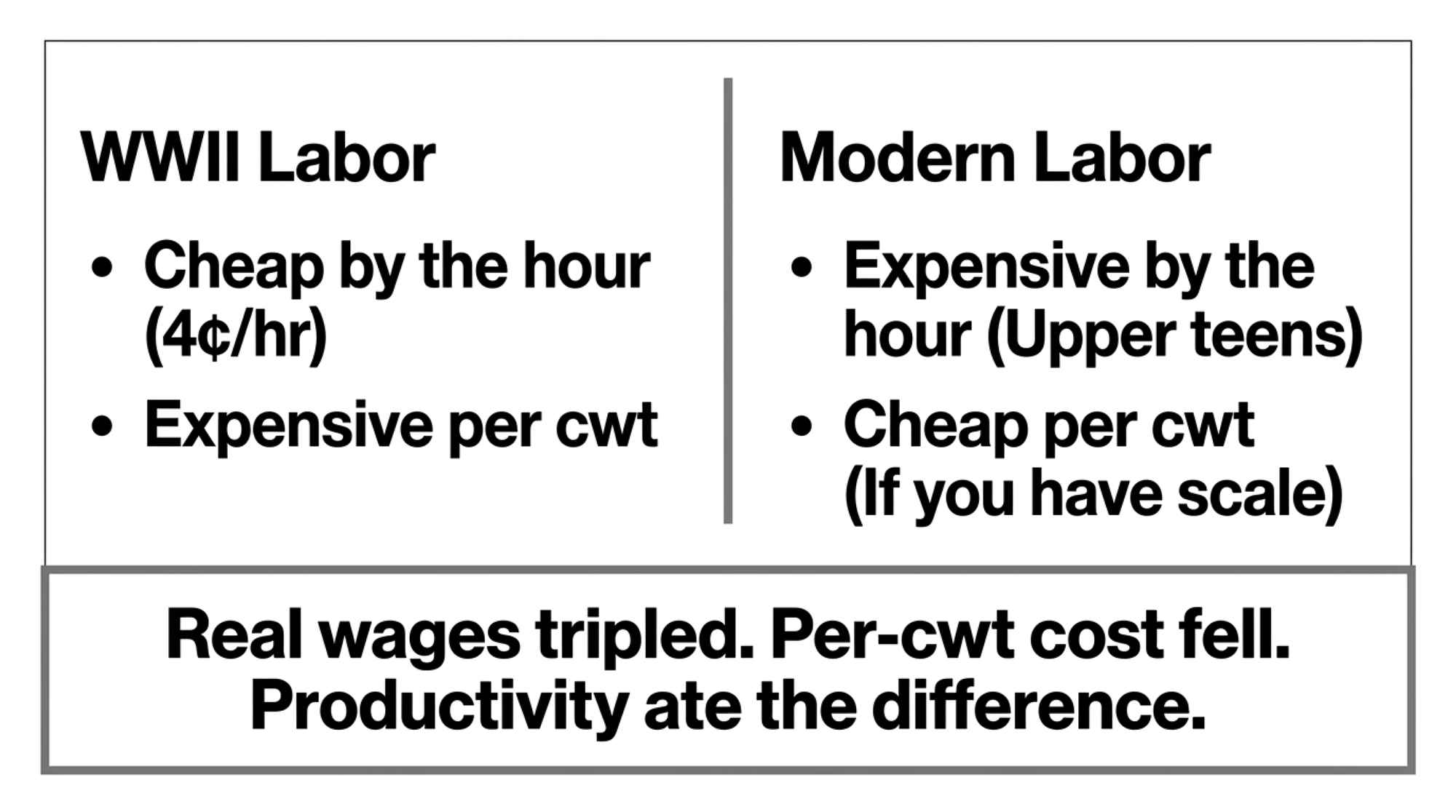
Here’s the part that throws people. WWII dairy labor was cheap by the hour and expensive per cwt. Today’s labor is expensive by the hour and cheap per cwt — but only if you’re big enough to spread it.

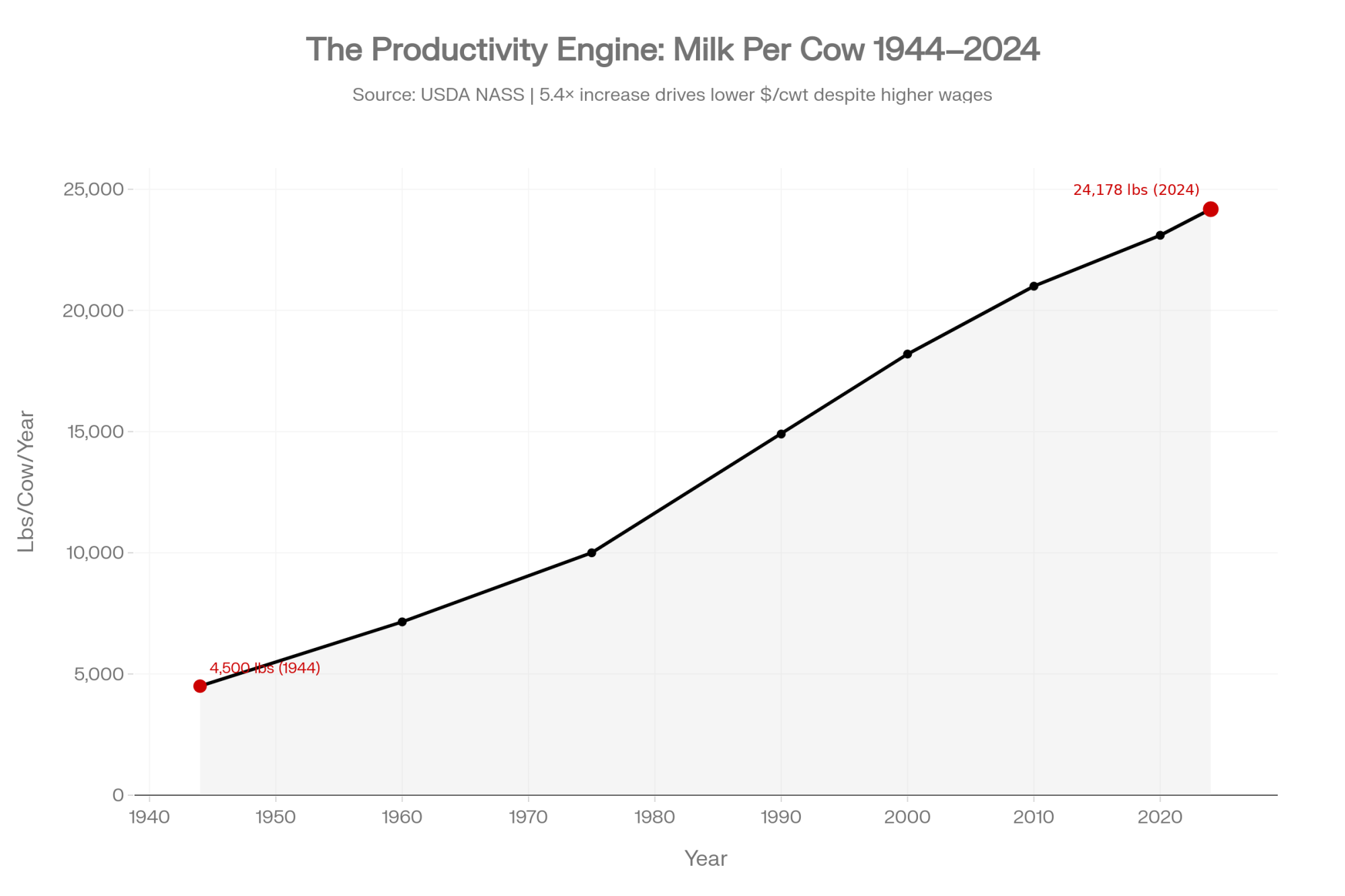
In 1944, the average U.S. cow produced about 4,500 lbs/year (USDA NASS historical). A 6‑cow family farm shipped roughly 270 cwt annually. The USDA Bureau of Agricultural Economics January 1942 Farm Labor Report pegged the national average hired farm wage without board at roughly $2.12/day — about 4¢/hour on a 50‑hour week. On a 6‑cow farm shipping 270 cwt, that translates to pennies per cwt in 1942 dollars.

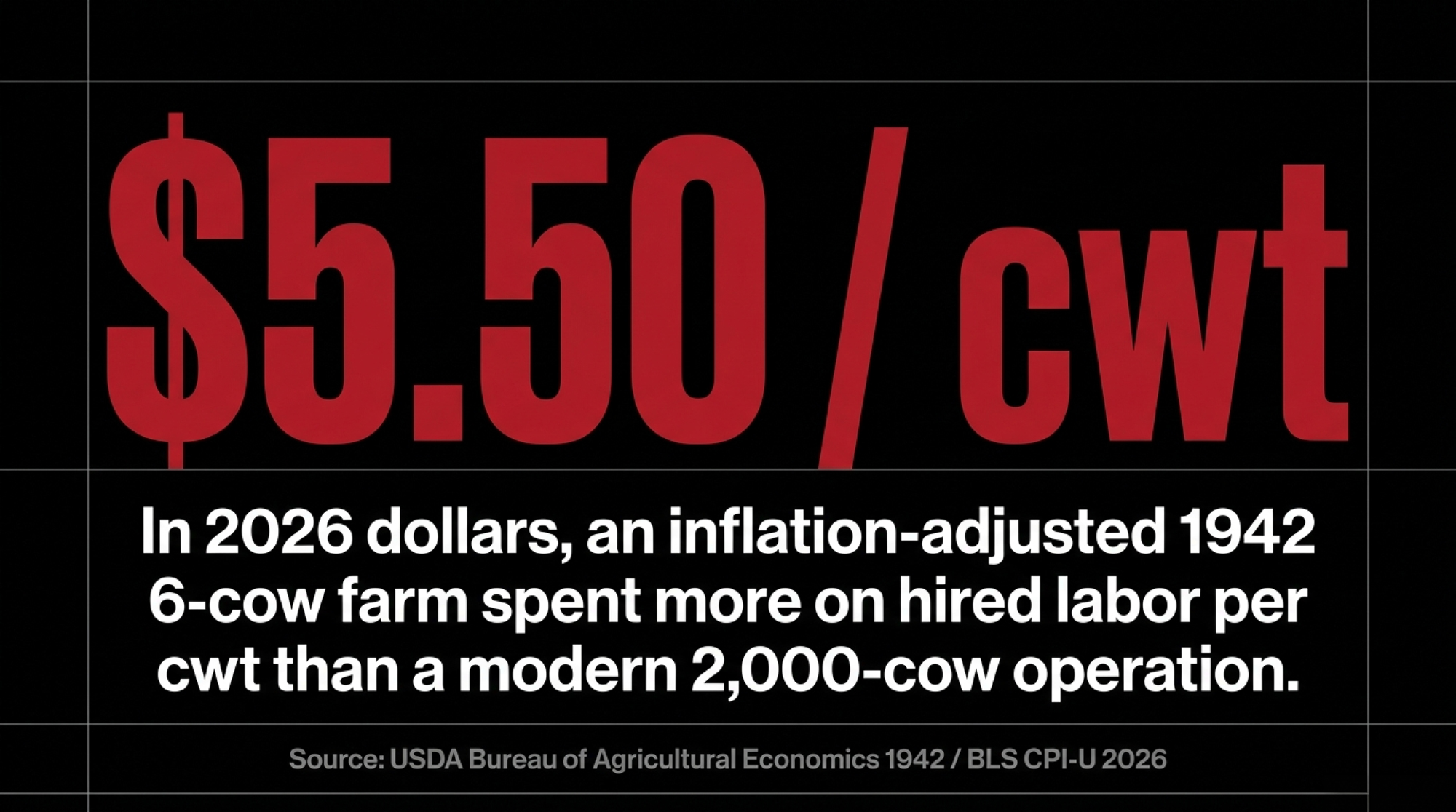
Run those pennies through the BLS CPI‑U series (January 1942 base to 2026), and a roughly 19.8× multiplier lifts the figure into the $5.00–$5.50/cwt range in 2026 money — hired labor only, on a 6‑cow farm. That’s the upper end of the per‑cwt math carrying the headline.

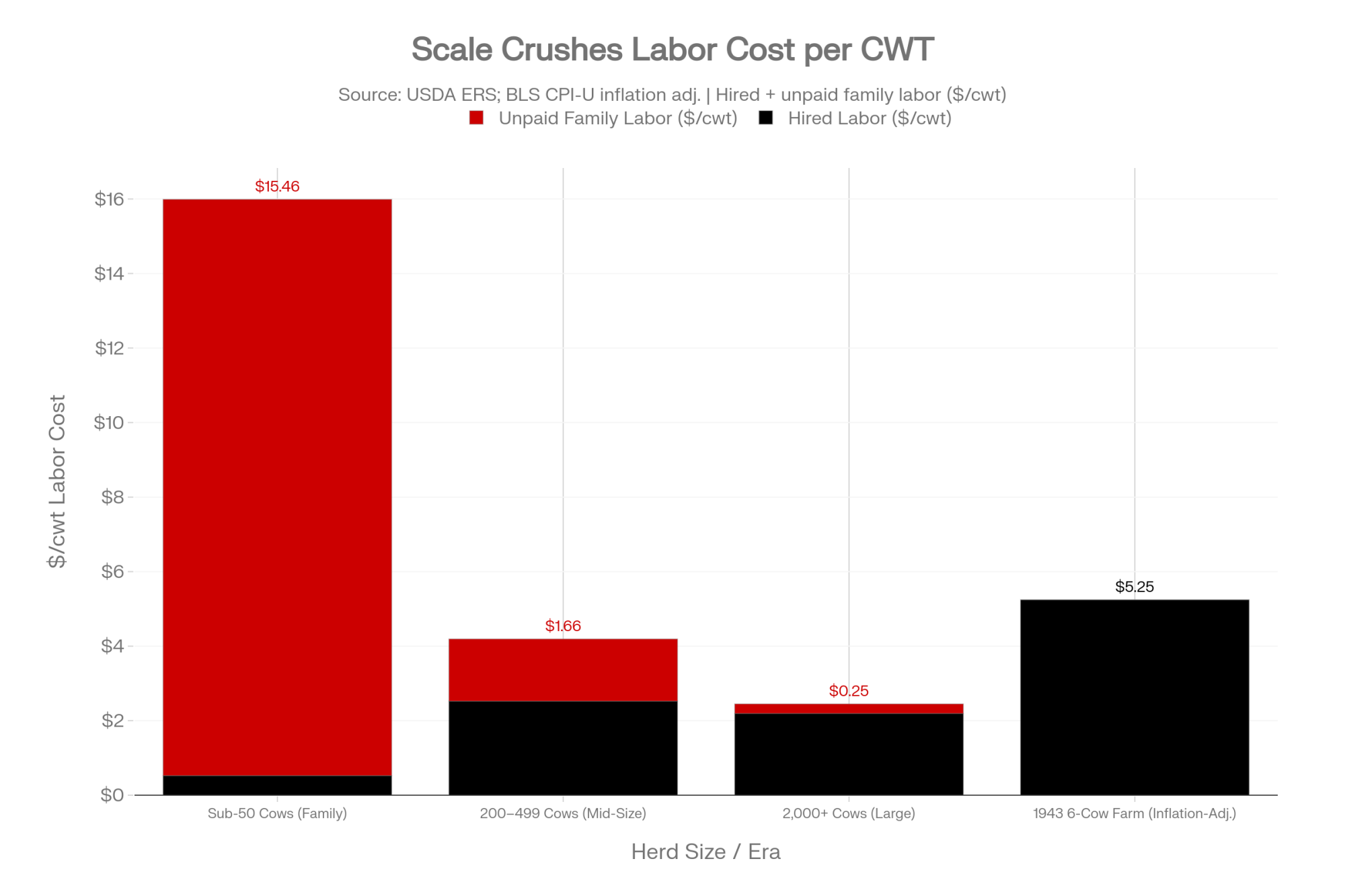
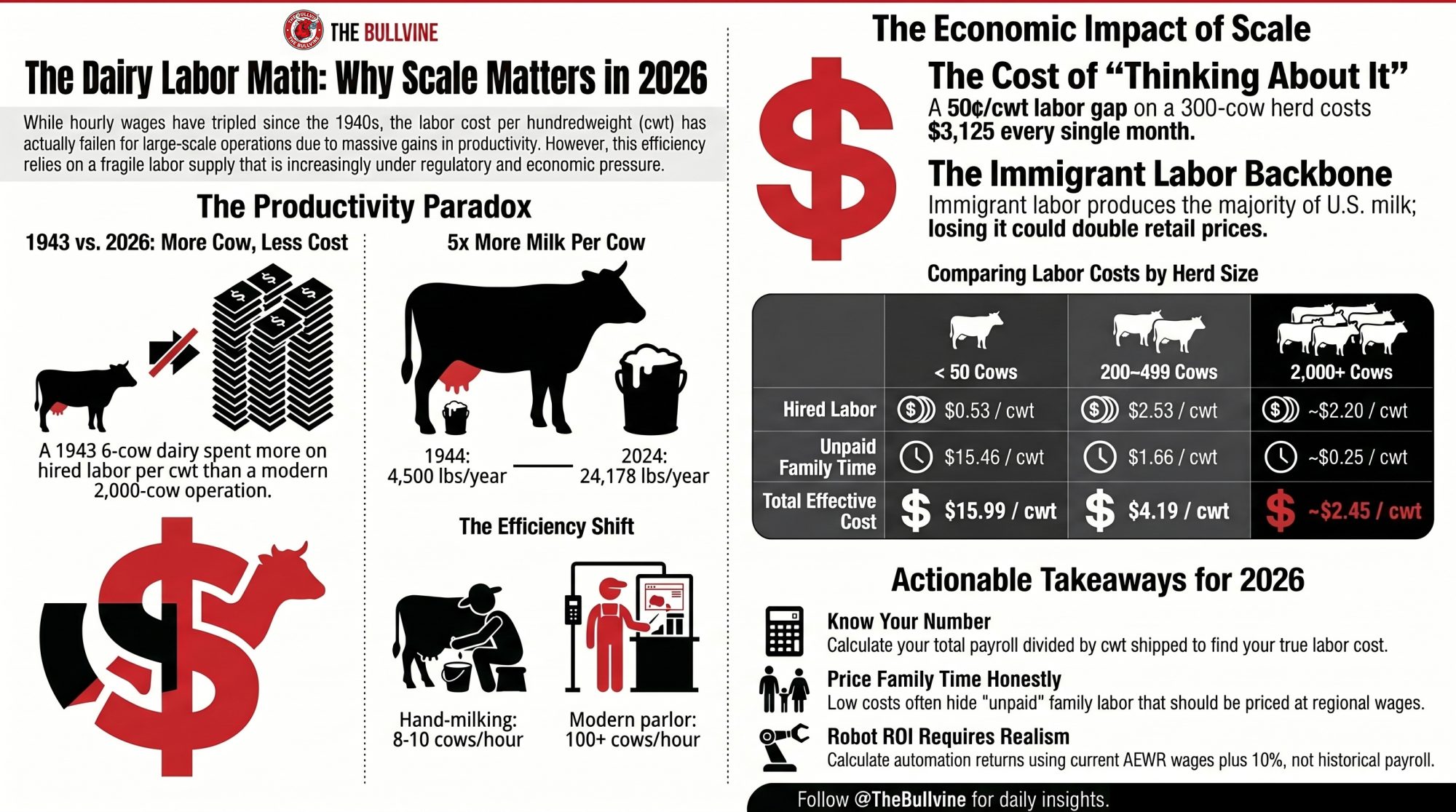
📊 Dairy Labor Cost vs. Economic Scale (USDA ERS Breakdown)

Herd Size CategoryHired Labor CostUnpaid Family TimeTotal Effective Labor Cost
Sub‑50 Cows$0.53 / cwt$15.46 / cwt$15.99 / cwt (Family Subsidy)
200–499 Cows$2.53 / cwt$1.66 / cwt$4.19 / cwt
2,000+ Cows~$2.20 / cwt~$0.25 / cwt~$2.45 / cwt (Scaled Minimum)

Methodology note: ERS prices unpaid family labor at the regional ag wage rate, which is why the sub‑50‑cow herd carries a $15.46/cwt unpaid line. If you don’t price your own time, you’ve quietly hidden it.

Read those side by side and the punchline lands. An inflation‑adjusted 1942 6‑cow farm spent more on hired labor per cwt than a modern 2,000‑cow operation does today. Real wages tripled. Per‑cwt cost fell. Productivity ate the difference — average milk per cow climbed from 4,500 lbs in 1944 to 24,178 lbs in 2024 (USDA NASS).

But that’s the easy half of the story.

The Vulnerability the Numbers Don’t Show

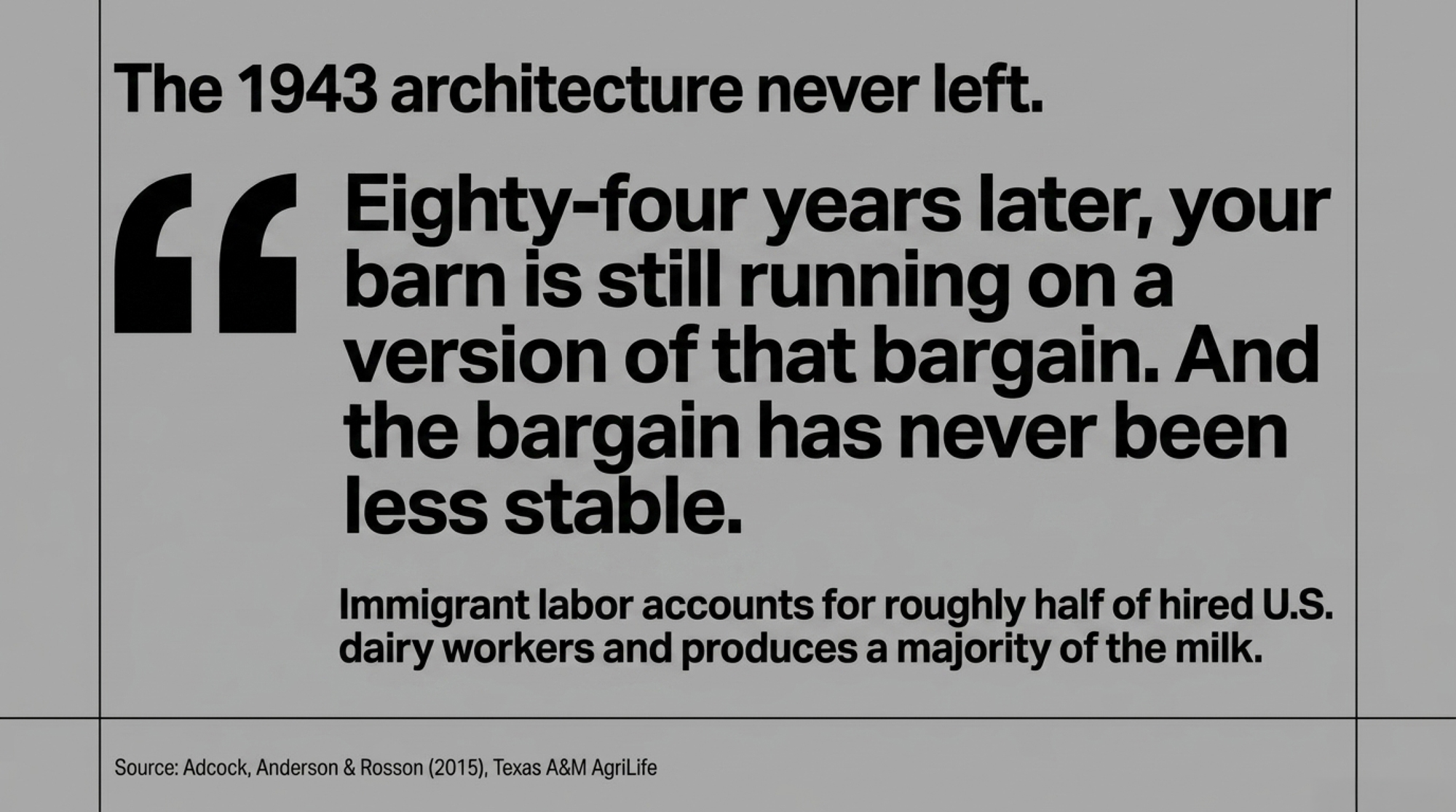
Industry research — specifically Adcock, Anderson & Rosson (2015), The Economic Impacts of Immigrant Labor on U.S. Dairy Farms, Center for North American Studies, Texas A&M AgriLife Research, CNAS Report 2015‑1 — has consistently found that immigrant labor accounts for roughly half of hired U.S. dairy workers and produces a majorityof America’s milk. Strip immigrant labor out of the model and the same study projects millions fewer cows, tens of billions fewer pounds of milk, thousands of farms gone, and retail milk prices roughly doubling.

That’s a peer‑reviewed shock model talking. Not a pundit.

Memorial Day usually pulls our heads toward crosses on foreign soil. It rarely lands on the people who stayed home and kept food moving — the 80,000+ Land Girls of 1943, the roughly 4.5 million Mexican laborers who passed through the Bracero Program between 1942 and 1964, Canada’s Farmerettes and “Soldiers of the Soil.” Different uniforms, different decades, same deal: do the work, accept the precarious legal status, disappear when the emergency is “over.”

Eighty‑four years later, your barn is still running on a version of that bargain. And the bargain has never been less stable.

How This Plays Out in Real Barns

The official numbers don’t care about your zip code. Your reality does.

Picture a 300‑cow Wisconsin freestall — illustrative composite, not a named farm. Three full‑time milkers at a current Midwest H‑2A wage rate — base wage in the low six figures, plus roughly 25% in payroll taxes, workers’ comp, and H‑2A housing and transportation obligations — works out to around $145,000/year. Spread that across 75,000 cwt(~75 lbs/cow/day) and you’re at about $1.93/cwt for those three positions alone. Add a herd manager, calf staff, and family time priced honestly at $25/hr, and you can land at or above the $4–$5/cwt total labor range ERS reports for 200–499 cow herds.

Now pull a thread. If federal enforcement intensifies in your region — a real possibility given the policy direction since 2025 — and a neighbor poaches your two best milkers for a higher‑paying crop operation that can legally use H‑2A while you can’t, because dairy is technically year‑round. Suddenly you’re staring at the same problem a 1943 farmer had when three sons shipped out. Cows still need milking at 4 a.m.

Canada looks calmer at a glance. Under the Seasonal Agricultural Worker Program (SAWP) and the Agricultural Stream, ESDC’s 2026 wage schedule sets the Ontario baseline agricultural minimum at $17.60 CAD/hr, with specialized livestock handlers sliding into the $19.00+ CAD/hr range under the updated National Commodity List. The Canadian Dairy Commission folds producer labour cost directly into its national pricing formula and implemented a 2.33% farmgate price increase effective February 1, 2026 to account for rising feed and on‑farm labour metrics.

Don’t read that as “Canada solved it.” The CDC mechanism makes labor more recoverable, not more available. CAHRC’s long‑range outlook forecasts the domestic dairy labour gap expanding to 5,000 vacant positions by 2030, with domestic worker supply dropping 17% and foreign workers expected to fill roughly 80% of that structural shortfall. Different policy architecture, same fragile pipeline.

The Mechanics Behind the Reversal

Three forces explain why higher real wages now produce lower per‑cwt cost.

Start with productivity. A Land Girl hand‑milked maybe 8–10 cows an hour. A modern parlor worker can run 100+ cows an hour in a double‑20, and one tech can keep 60–70 cows on robots. Pair that with a roughly  lift in milk per cow since the 1940s and the same crew is producing exponentially more cwt.

But scale is the quieter half of the answer. The 1940s dairy averaged about 6 cows. The 2022 USDA Census of Agriculture put the average U.S. herd at 283 cows, and the only herd‑size category still growing is 2,500+ cows. When you’ve got a herd manager, a mechanic, and an HR binder, more cwt means lower fixed labor per cwt.

Then there’s policy, which never caught up. H‑2A is the modern descendant of the WWII programs, and it still excludes year‑round livestock work from full eligibility, which is why dairy uses it awkwardly when it uses it at all. The U.S. Department of Labor’s H‑2A Interim Final Rule, published and enacted October 2, 2025, fundamentally reshaped wage floors by shifting exclusively to the BLS Occupational Employment and Wage Statistics (OEWS) survey — creating the two skill‑level AEWR categories dairies are wrestling with right now in 2026.

Cornell PRO‑DAIRY and Texas A&M AgriLife both publish regularly on dairy cost of production, and the labor share has trended up across recent industry analyses. It’s now the variable most likely to determine whether your business model survives the next policy cycle.

How Much Does Waiting 30 Days Actually Cost You?

A lot of farms treat labor changes like a someday project. The math disagrees.

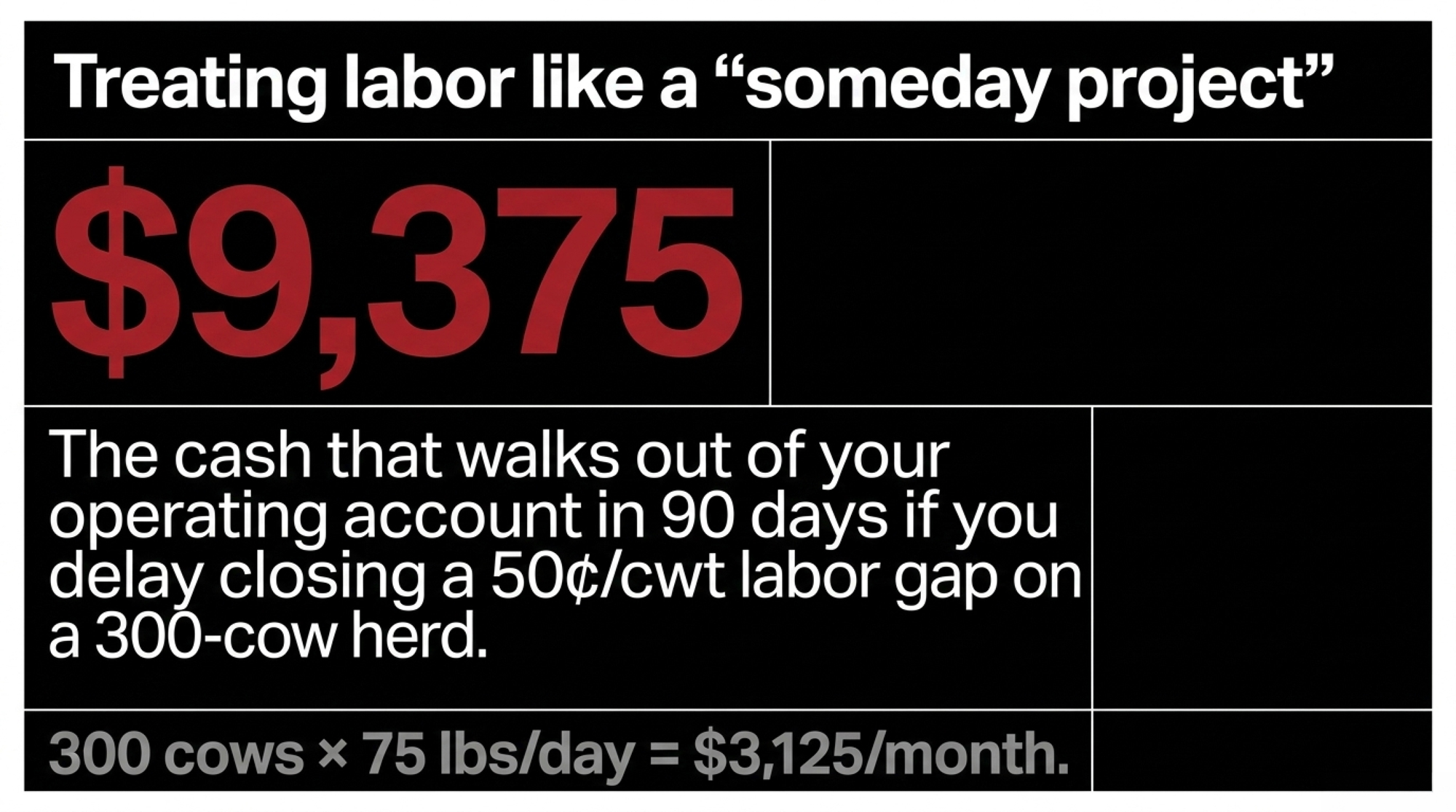
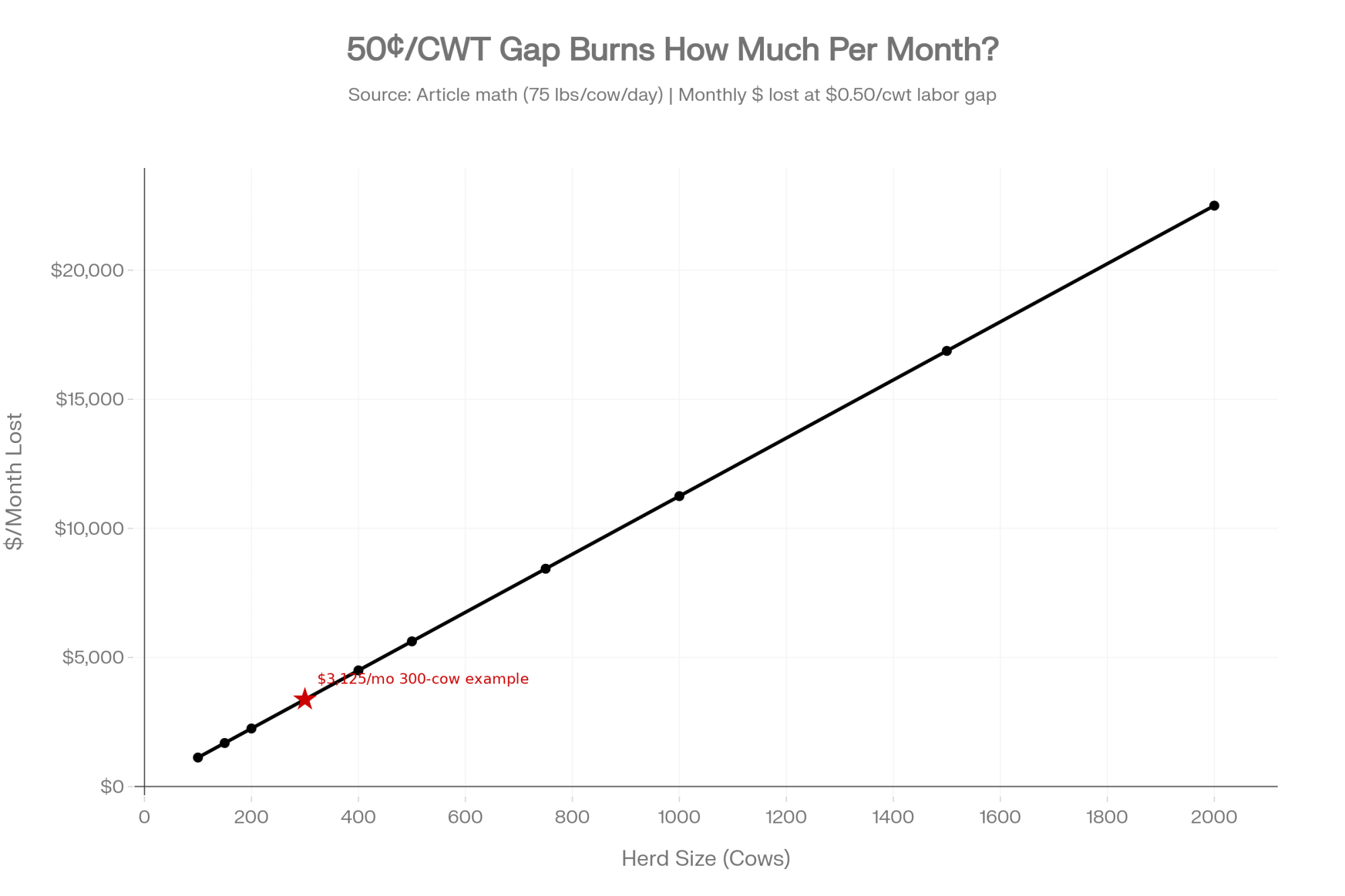
Say you’re running 300 cows, shipping ~75 lbs/cow/day — that’s about 6,250 cwt a month. If your current labor cost is $3.50/cwt and a tighter schedule, cross‑training, or one piece of automation could realistically drop you to $3.00/cwt, that 50¢ gap is $3,125/month. Wait three months to make the call and that’s nearly $9,400 that walked out of your operating account while you were “thinking about it.”

Now flip it the other way. If your regional AEWR is in the upper teens and your current crew is on undocumented or off‑program arrangements at lower wages, it’s tempting to wait. But the Adcock, Anderson & Rosson shock model puts the downside at thousands of farms closed and retail milk prices roughly doubling. Your real choice isn’t “cheap labor or expensive labor.” It’s “known higher cost now or unknown catastrophic loss later.” “We’ll deal with this next year” is itself a very expensive decision.

For the deeper read on what the October 2, 2025 Interim Final Rule actually changed for AEWR, including the OEWS shift and the new skill‑level categories, see our recent Tier 3 breakdown.

Is Your Crew Plan Still Running on 1942 Assumptions?

The instinct in any labor crunch is to reach for “temporary help.” That’s exactly what the Land Army and Bracero Program were — emergency patches, not architecture.

Dairy is a permanent, year‑round business. Cows don’t file demobilization papers. Three honest questions worth asking this week:

  • Do you know your labor cost per cwt and where it sits versus the ERS benchmark for your herd size?
  • If your foreign‑born crew vanished in 48 hours, what specifically breaks first — milking schedule, calf care, or breeding program?
  • Is your next major capital decision (robots, parlor upgrade, expansion, exit) penciled at today’s wages or at where AEWR/SAWP rates are clearly headed?

Two names worth bookmarking. Cornell’s Andrew Novakovic holds the E.V. Baker Professorship Emeritus of Agricultural Economics, and Texas A&M AgriLife’s Dr. David Anderson — co‑author of the Adcock, Anderson & Rosson CNAS report cited above — is a long‑tenured agricultural economist whose team’s cost‑of‑production work is where the deeper math lives.

Options and Trade‑Offs for Your Operation

You can’t rewrite immigration law from the office. You can change your exposure.

1. Double down on scale and efficiency. Works when you’re already 400+ cows with cow flow and access to capital. Needs parlor or robot investments and standardized workflows. The risk: you’re adding debt into a 2026 milk price USDA ERS expects to soften — the latest Livestock, Dairy and Poultry Outlook keeps all‑milk projections in the high‑teens to low‑$20s — while make‑allowance changes nibble the check. You also become more exposed to losing three workers at a 2,400‑cow scale than one at 80. For the operational side, see how scaled dairies are squeezing more cows per worker without burning people out.

2. Use automation selectively in the 150–400 cow band. Robots and automatic feeders can legitimately replace 2–3 FTEs without destroying cash flow — but only if your ROI math uses AEWR‑level wages, not what you wish you were paying. The trade is real: you swap milker risk for high‑skill technician risk, and you lock into a tech path that’s hard to unwind if interest rates stay sticky. We walk through the honest payback math on robots vs. high‑efficiency parlors in a separate piece worth a read before you sign a contract.

3. Tighten your labor mix and legal exposure (the 30‑day action). This is the one to start this month. Cross‑train one more family member or domestic part‑timer into the parlor. Audit your I‑9s and housing. Map which jobs could legitimately move onto H‑2A, TFWP, or SAWP and which can’t. You may raise your average wage in the short run; you definitely lower the chance of a Tuesday morning that empties your barn.

4. Optimize inside your scale. If you’re 60–180 cows and not chasing a multi‑million expansion, your biggest lever is measuring labor hours per cwt and trimming the drag. ERS pegs total labor on under‑50‑cow herds at $15.99/cwt on a full economic basis when family time is priced honestly. That’s not sustainable forever — but it’s manageable if you go in with eyes open about processor and lender preferences for larger, year‑round suppliers — and worth pairing with our coverage of the $3,010 heifer and 30% labor jump squeezing mid‑size herds.

That’s where the numbers stop being history and start being your 2027 budget planning. We’re mapping out the full ERS cost‑of‑production breakdown by herd size, regional data, and state‑by‑state AEWR maps in next week’s Bullvine Weekly and the Tier 3 dashboard.

Key Takeaways

  • If your total labor cost is above the ERS 200–499 cow benchmark of $4.19/cwt, you’re giving up margin scaled peers are capturing — run the comparison this month.
  • If you’re below $3/cwt only because unpaid family time isn’t priced, you’ve quietly recreated a 1942 Land Army model in your own kitchen — price it honestly before your next lender meeting.
  • If you depend on immigrant labor, model your wage bill at the full AEWR range published in the U.S. DOL’s 2026 schedule, or at the $17.60–$19.00+ CAD/hr Ontario SAWP floor.
  • If you operate in Canada, treat labor as a recoverable cost inside the CDC formula — but don’t assume the bodies will be there. CAHRC’s 5,000‑position gap by 2030 is the harder constraint.
  • If you’re weighing robots in the next 12 months, pencil the ROI at AEWR wages plus 10%, not last year’s payroll. Anything tighter is wishful thinking.
Herd BandHired Labor $/cwtUnpaid Family $/cwtTotal Effective $/cwt1943 Equivalent (2026$)Status Signal
Sub-50 Cows$0.53$15.46$15.99~$5.25 (hired only)🔴 Hidden family subsidy — price your time
50–199 Cows~$1.80~$3.50~$5.30~$5.25 (hired only)🟡 Narrow margin over 1943 baseline
200–499 Cows$2.53$1.66$4.19~$5.25 (hired only)🟡 Below 1943 on total; watch unpaid share
500–999 Cows~$2.75~$0.60~$3.35~$5.25 (hired only)🟢 Scaled advantage, but AEWR pressure building
2,000+ Cows~$2.20~$0.25~$2.45~$5.25 (hired only)🟢 Scaled minimum — H-2A exposure is the risk

What This Means For Your Operation

StrategyBest Fit (Herd Size)Capital RequiredLabor Cost ImpactKey RiskTimeline
1. Scale + Efficiency400+ cowsHigh ($500k–$2M+)Potential drop to ~$2.20–$2.50/cwtDebt load in softening milk price; 2,400-cow crew loss is catastrophic2–5 years
2. Selective Automation150–400 cowsMedium ($80k–$350k)Replaces 2–3 FTEs; net neutral to +$0.25/cwt short-termLocks into tech path; swaps milker risk for technician risk12–36 months
3. Tighten Legal MixAll sizesLow ($5k–$25k audit)Short-term wage rise; long-term compliance bufferRaises avg. wage in transition30–90 days
4. Optimize Within Scale60–180 cowsNone–LowMeasure & trim drag; ERS benchmark is $15.99/cwt at sub-50Not sustainable forever; lender/processor preference for larger suppliersImmediate

Three things to do before Memorial Day weekend ends:

  1. Pull last year’s payroll, divide by cwt shipped, and write your hired labor $/cwt on a sticky note.
  2. Compare it to the ERS bracket for your herd size in the table above.
  3. If the gap is more than $1/cwt, book one conversation this month — with your lender, your nutritionist, or a labor advisor — about which of the four paths above fits your balance sheet.

That’s it. No grand strategy. Just the same kind of small, specific decision every farm in this story has been forced to make for 84 years.

Memorial Day is built on the idea that some work is essential enough to be worth giving your life for. In 1942, that meant young men in uniform and young women in Land Army smocks, tied together by a brutal truth: somebody had to keep the milk, meat, and bread moving or the war was already lost.

If the people doing that essential work in your barn disappeared tomorrow, what would your cows, your community, and your own family story look like next Memorial Day?

Complete references and supporting documentation are available upon request by contacting the editorial team at editor@thebullvine.com.

Learn More

The Sunday Read Dairy Professionals Don’t Skip.

Every week, thousands of producers, breeders, and industry insiders open Bullvine Weekly for genetics insights, market shifts, and profit strategies they won’t find anywhere else. One email. Five minutes. Smarter decisions all week.
NewsSubscribe
First
Last
Consent
Send this to a friend