






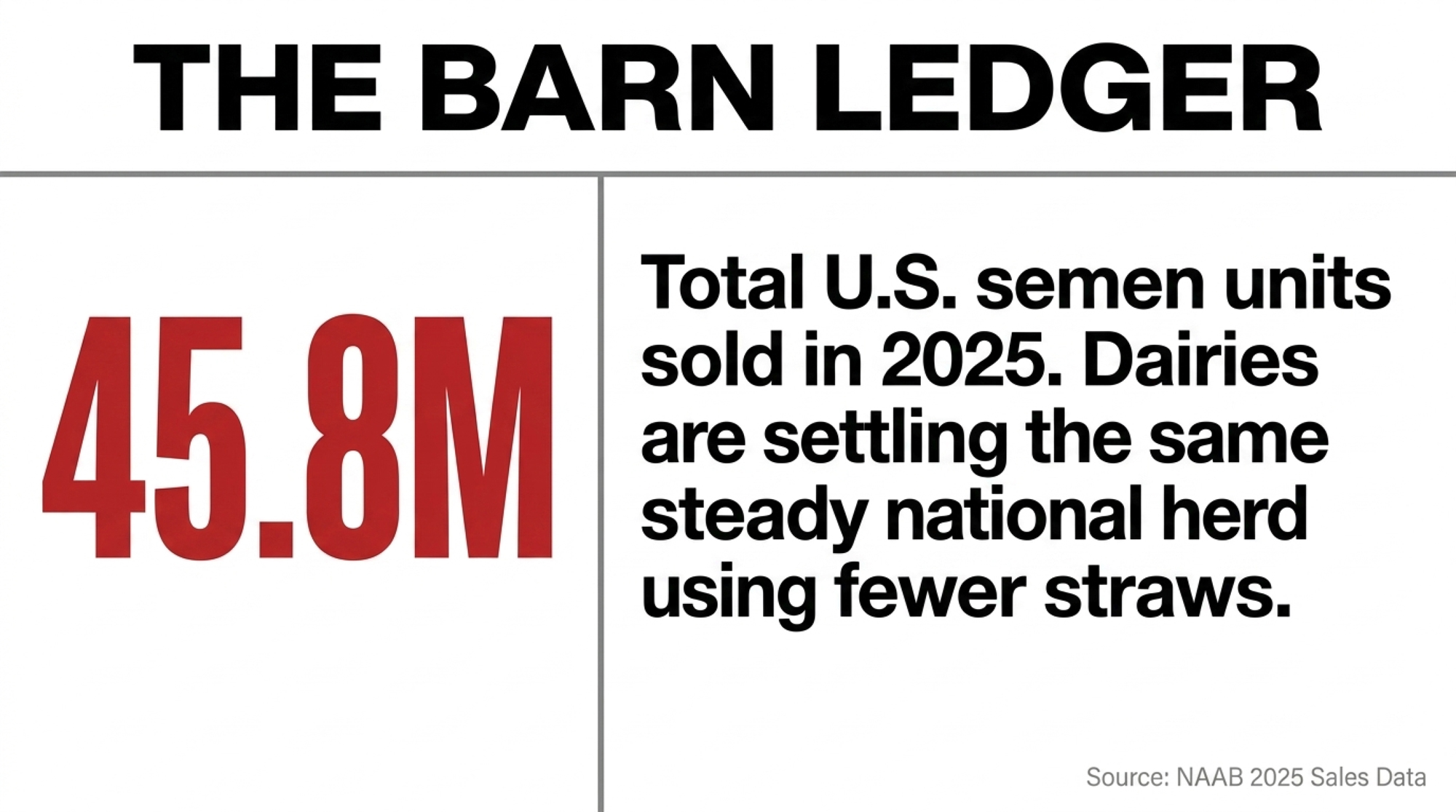
U.S. dairies bought 45.8M semen units in 2025, down 6% — and NAAB’s Jay Weiker says that’s a win. Fewer straws settled the same cows. Here’s what your breeding mix should do next.
Jay Weiker has spent 40 years watching how dairy farmers breed cows. So when the president of the National Association of Animal Breeders sat down with CDCB CowCast host Katie Schmidt and was asked what’s behind the latest sales figures, his answer cut counter to the usual gloom. Total U.S. semen sales fell about 6% in 2025, down to 45.8 million units, and Weiker’s read is that part of that drop is a win. Dairies are settling cows with fewer straws because they’ve gotten better at reproduction. “If you’re doing a better job, you’re actually losing some of your market if you’re an AI company,” Schmidt said on the episode. “Putting ourselves out of business,” Weiker agreed — “but keeping dairymen in business.”
There’s the tension worth your time. The same skill that tightens your conception rates is shrinking a supplier’s order book. And the mix underneath that 45.8 million — sexed, beef, conventional — tells you exactly how fast your breeding calls are reshaping the calves that hit your barn floor. Weiker’s organization isn’t guessing at these numbers, either. NAAB members produce about 95% of the semen used in the U.S. and roughly 99% of what’s exported, and they report units quarterly.
What’s Changing and Why
Start with the headline number. Weiker reported 2025 sales of 45.8 million units, down about 6% from 2024 — though 2024 itself ran roughly 4% ahead of 2023. So this isn’t a collapse. It’s a herd that held steady and is now getting bred more efficiently.
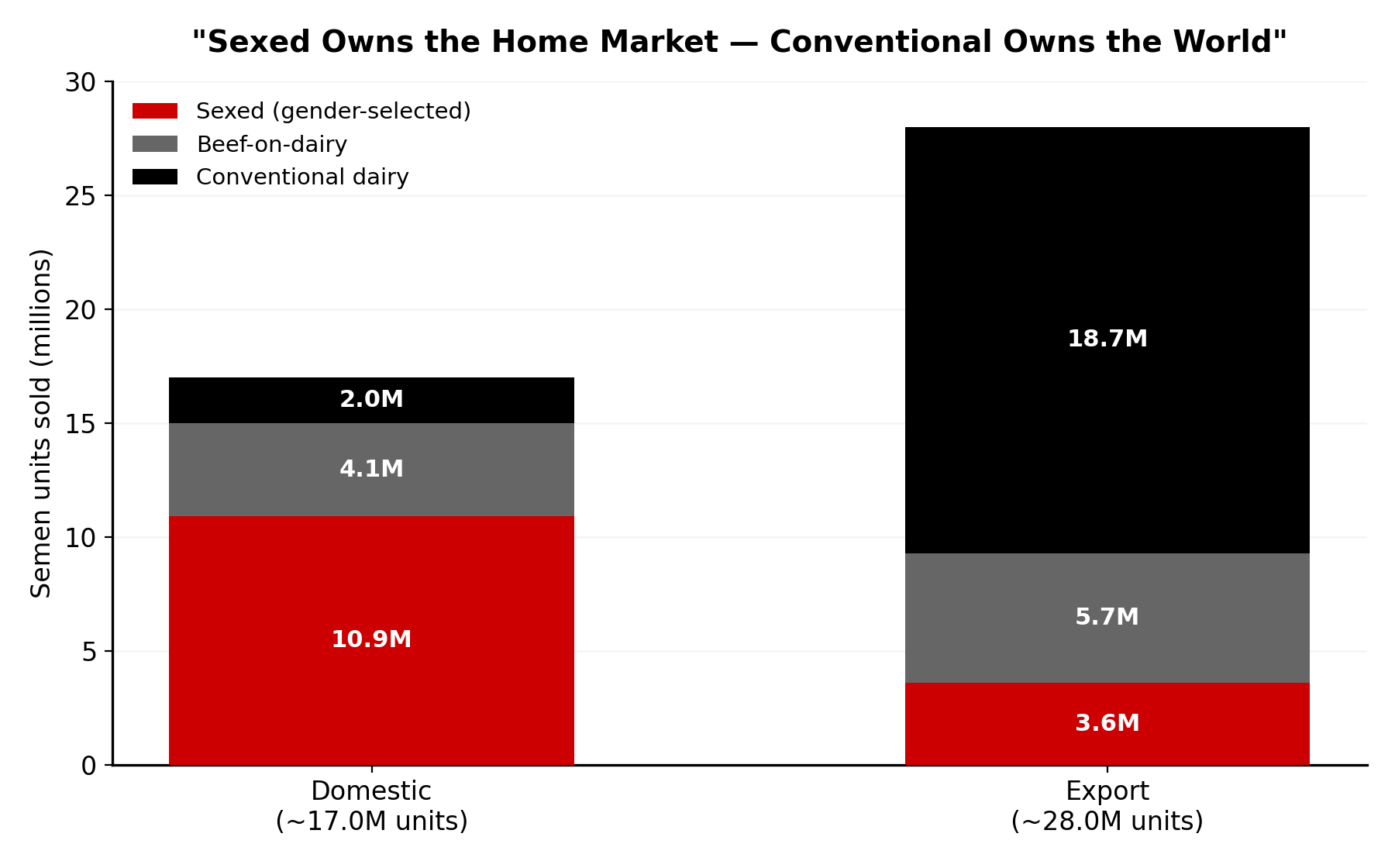
Split that 45.8 million three ways and it sharpens. Just under 17 million units sold domestically — about 37% of all dairy semen. Exports accounted for the bigger share, at roughly 28 million units, or 63%. The rest was custom collection for non-members. Here’s the part to sit up for: over the past four or five years, domestic dairy semen use has been declining, which is why exports keep climbing as a share of the total.
Who’s affected? Just about every U.S. dairy that’s sharpened its repro program — which is most of them. Weiker pointed to three forces pulling straws-per-pregnancy down: producers selecting harder for female fertility, AI companies leaning into bulls with positive daughter pregnancy rate, and steady work on semen quality through the lab and bull health. Stack those on a herd that isn’t expanding, and the result is blunt. Weiker’s phrase: “It’s just a mathematical fact.” Fewer units to settle the same cows.
How This Plays Out on Real Farms
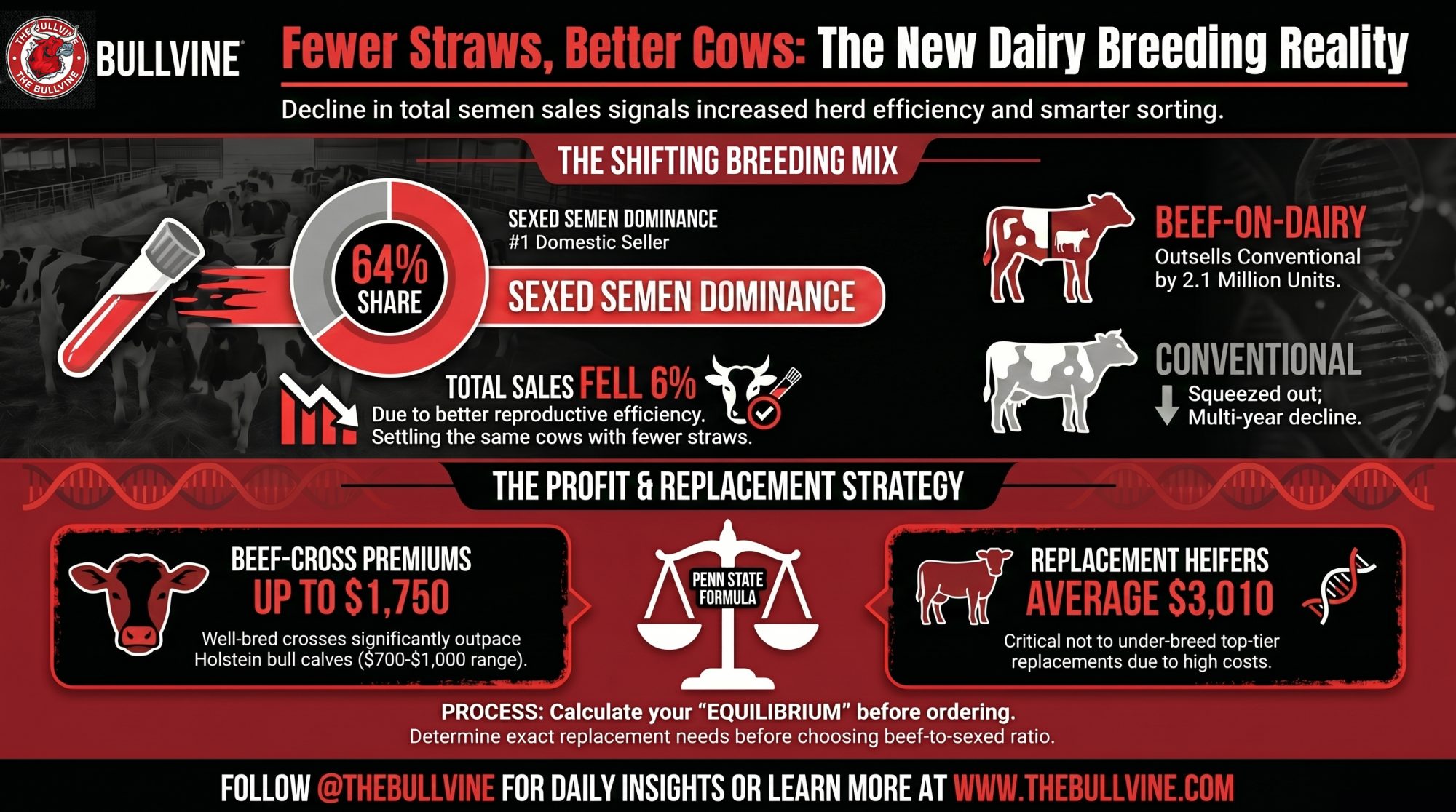
What producers are actually buying isn’t “less breeding” — it’s smarter sorting. Gender-selected (sexed) semen is now the top-selling dairy semen type in the country. It grew by about 6% last year and accounts for 64% of dairy units sold domestically. Producers genomic-test their cows and heifers, decide which females are worth raising replacements from, and put sexed semen on exactly those animals.
The flip side is the bottom of the herd. Beef-on-dairy held constant in 2025, Weiker said, but it’s still the number-two category — beating conventional dairy semen by 2.1 million units. Feedlots want a black-hided crossbred calf, not a purebred dairy steer. So conventional dairy semen erodes from both ends: sexed on the top cows, beef on the bottom.
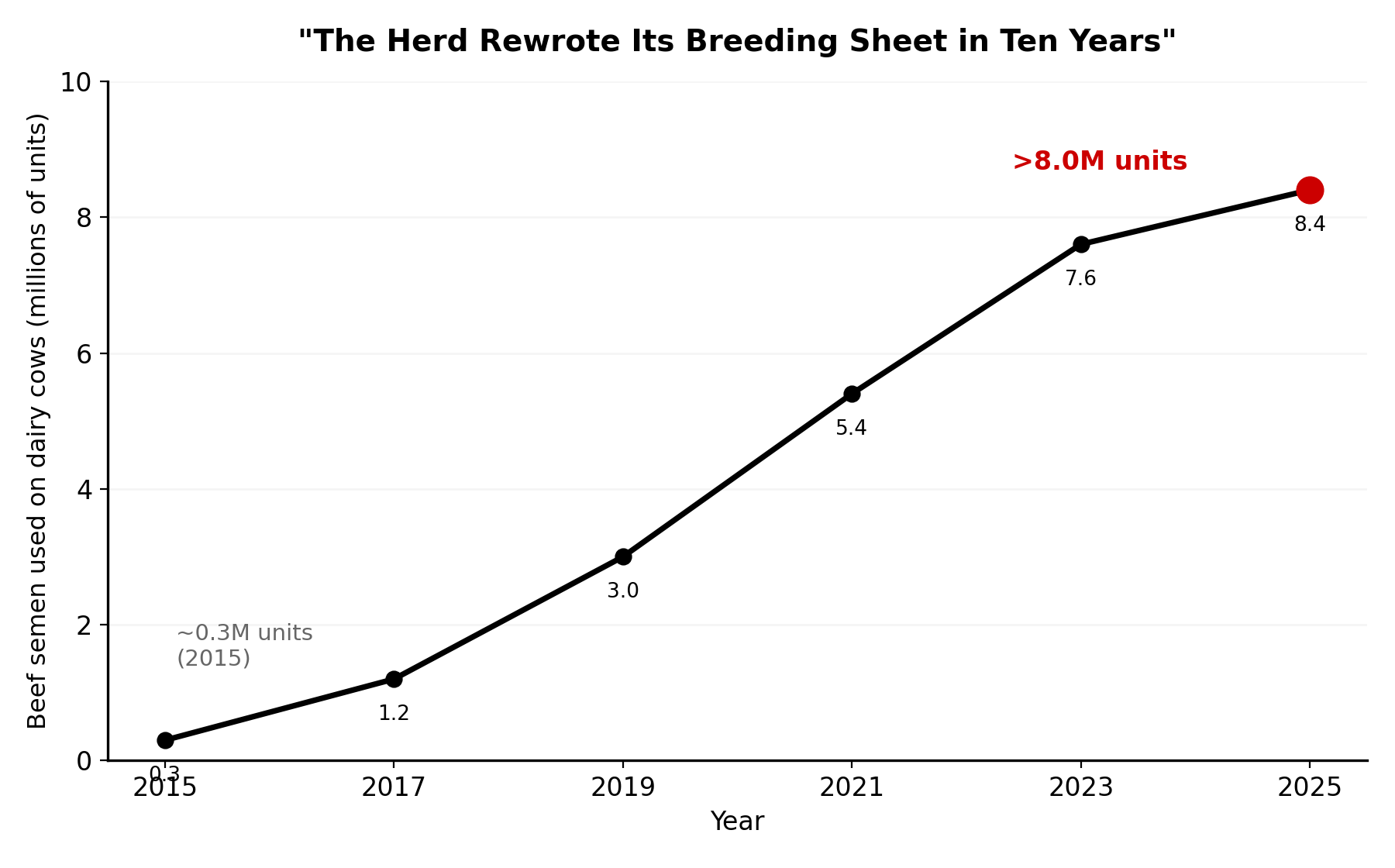
How fast did that shift happen? Look at the national breeding record. USDA’s data shows beef semen used on dairy cows climbed from essentially a rounding error a decade ago to more than 8 million units a year by the mid-2020s, while dairy-cow numbers barely moved. That’s not a few early adopters — that’s the herd at large rewriting its own breeding sheet inside ten years. Weiker’s “equilibrium” comment is the key tell here: producers are now backing off the gas, doing the replacement math first and only then deciding how many cows go to a beef bull.
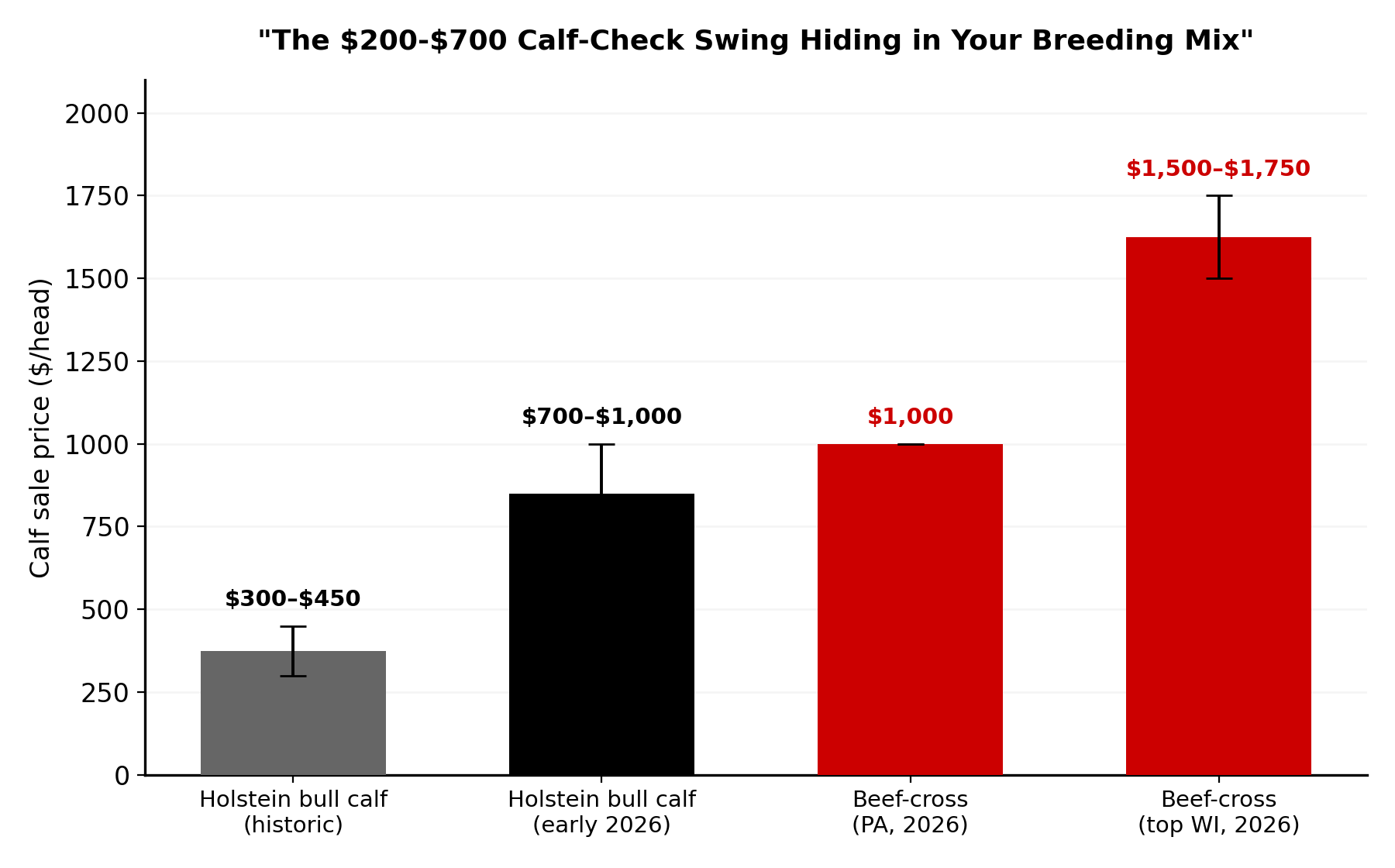
Here’s a barn-math moment you can map to your own parlor. Take a 100-cow herd that needs about 30 replacement heifers a year. If you can cover those 30 by aiming sexed semen at your top 35–40 genomic-tested cows over the breeding season — building in conception and the roughly 90% female skew sexed semen throws — every remaining breeding is freed up for beef. And that’s where the money moved. Through early 2026, Holstein bull calves that once brought $300–$450 have been running $700–$1,000 in stronger markets, while well-bred beef-cross calves topped $1,500–$1,750 in parts of Wisconsin and cleared $1,000 in Pennsylvania — a real premium spread of roughly $200 to $700 a head depending on quality and region. Push 30 to 40 crosses through in a year instead of dairy bull calves, and you’re swinging calf revenue well into five figures on a 100-cow herd.
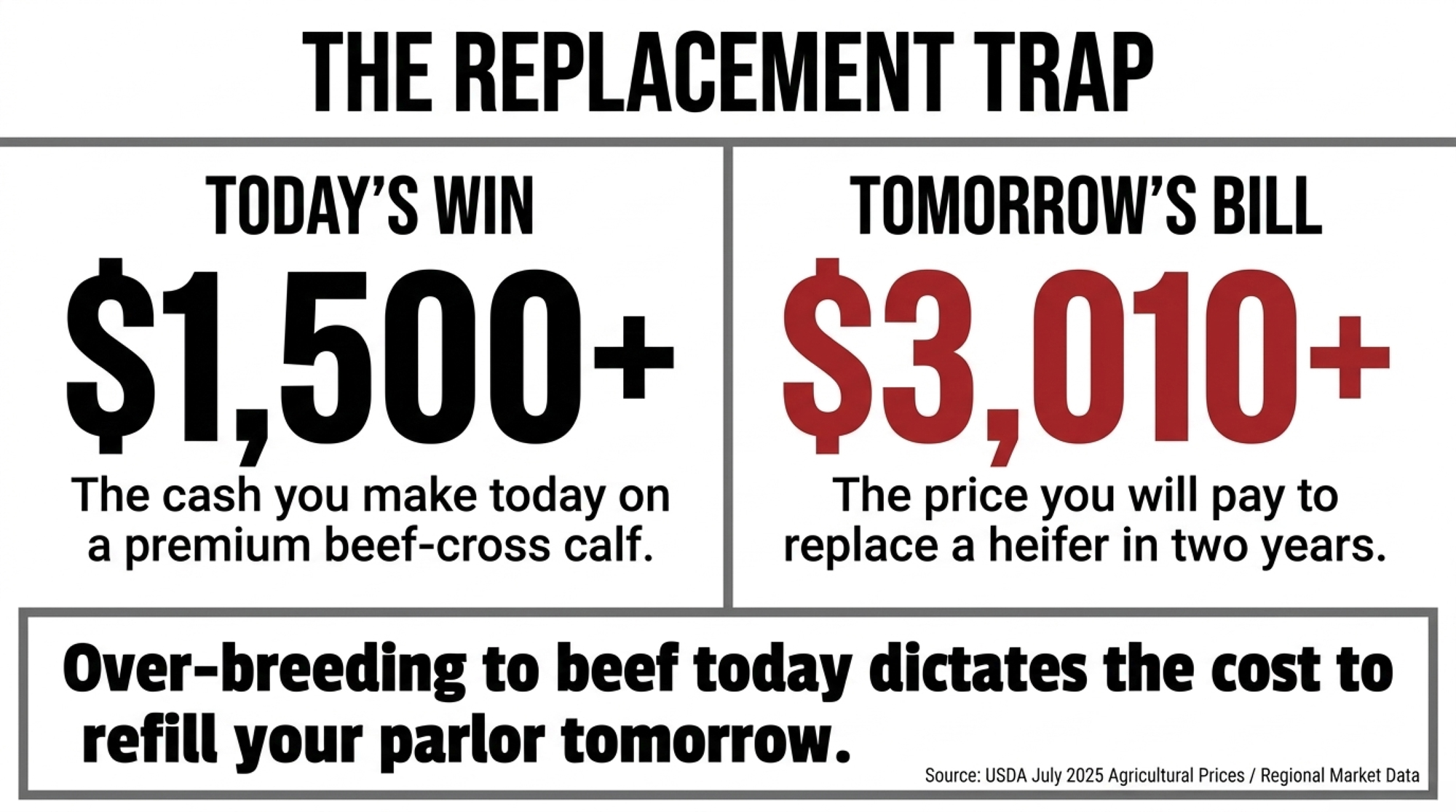
But the same call quietly raises the cost of the heifers you didn’t make. Replacement heifers averaged $3,010 a head in USDA’s July 2025 Agricultural Prices report — a national figure — and quality heifers have been commanding $2,500–$3,000-plus into 2026, with top genetics nearer $4,000. The calf check you cash today is also a bet on what it’ll cost to refill your parlor in two years. Weiker and Schmidt kept circling that point: the beef decision you make this month is really a replacement-pipeline decision down the road.
The Mechanics Behind the Outcomes
The whole system runs on a sorting logic that genomics has unlocked. Asked which technology surprised him most in four decades, Weiker didn’t hesitate: genomic selection. Sexed semen was “a game changer” on its own, he said, but genomics “moved the needle much more than anything else.” It’s what lets you decide, with real confidence, which females become the next generation and which get bred beef.
Keep one thing straight, because it’s easy to muddle. Genetics and immediate semen savings are two different levers. When Weiker points to AI companies pushing bulls with positive Daughter Pregnancy Rate (DPR), that’s a long-game genetic trait. It shows up years out in how your daughters settle. The drop in straws-per-pregnancy you’re seeing right now is mostly due to near-term factors: service sire fertility, semen quality, and sharper heat detection on your end. Schmidt made the same point on the episode, noting how low the heritability of female reproductive traits is — meaning management and environment drive most of what you see this season. DPR builds the herd you’ll milk in 2029. Your protocol and the bull’s fertility are what led to fewer straws in fewer cows this year.
That confidence is why conventional semen keeps sliding. Why gamble on a coin-flip Holstein calf when you can aim for a heifer from your best cow or a marketable cross from the rest? One wrinkle most producers never see: a lot of that beef semen now ships as heterospermic straws — semen from several bulls mixed in one dose. And there’s a reason it caught on specifically for beef-on-dairy. Beef-cross conception can lag your dairy semen, partly because a beef bull collected for the dairy market can have an off day — a fever weeks before collection that never shows under a microscope. Motility looks fine; conception doesn’t. Mix several bulls in one straw, and the others cover for him, pulling the group’s conception close to the best bull in the dose instead of dragging on the worst.
You give up knowing the exact sire. For a calf bound for a feedlot, most producers take that trade to claw the fertility back. There’s a real cost, though, and Schmidt named it: without a sire ID on a beef-cross calf, the industry can’t easily learn which beef bulls produce the most productive crosses. That gap doesn’t close until parent verification gets cheap enough to genomic-test calves routinely — and it isn’t there yet.
How Much Is the China Closure Costing the Export Side?
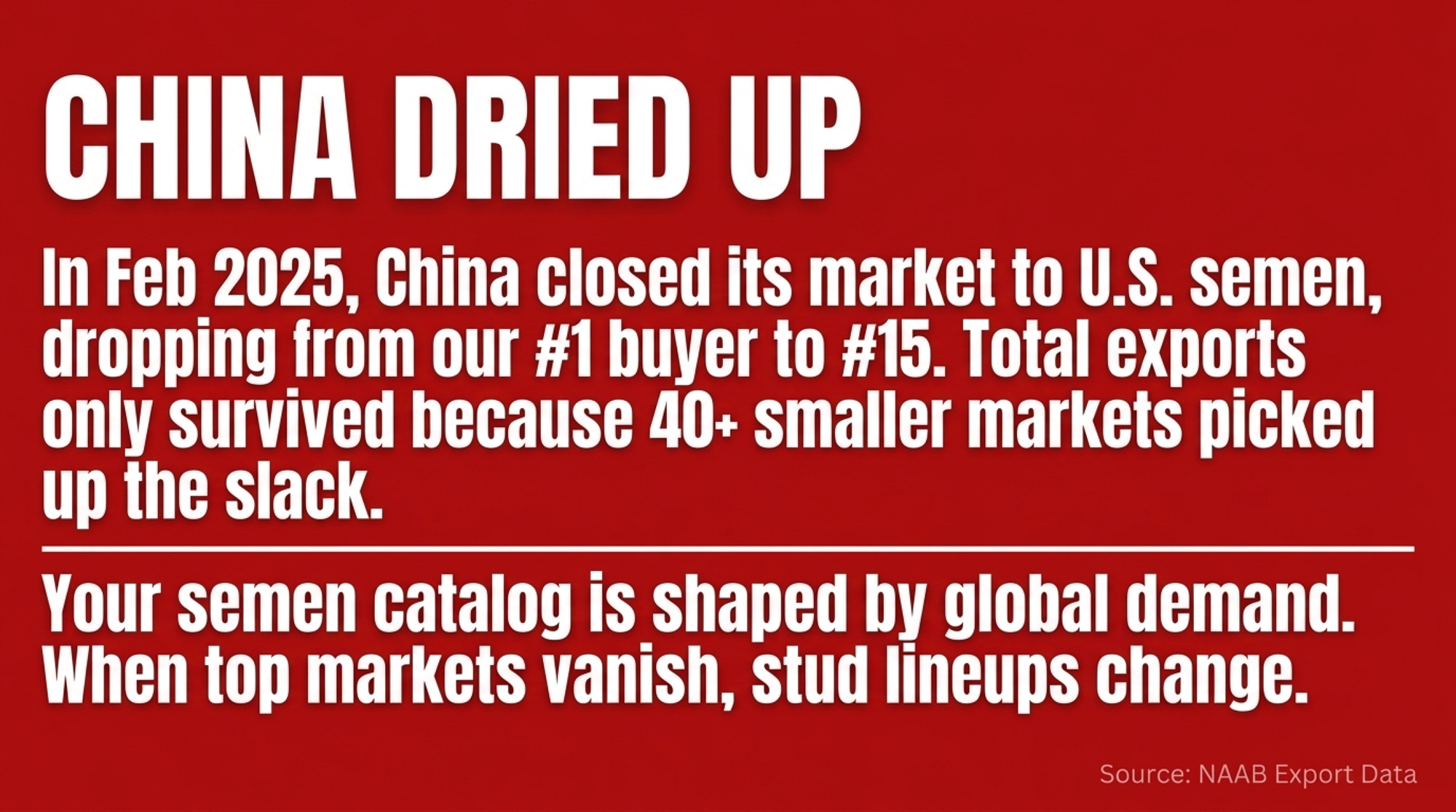
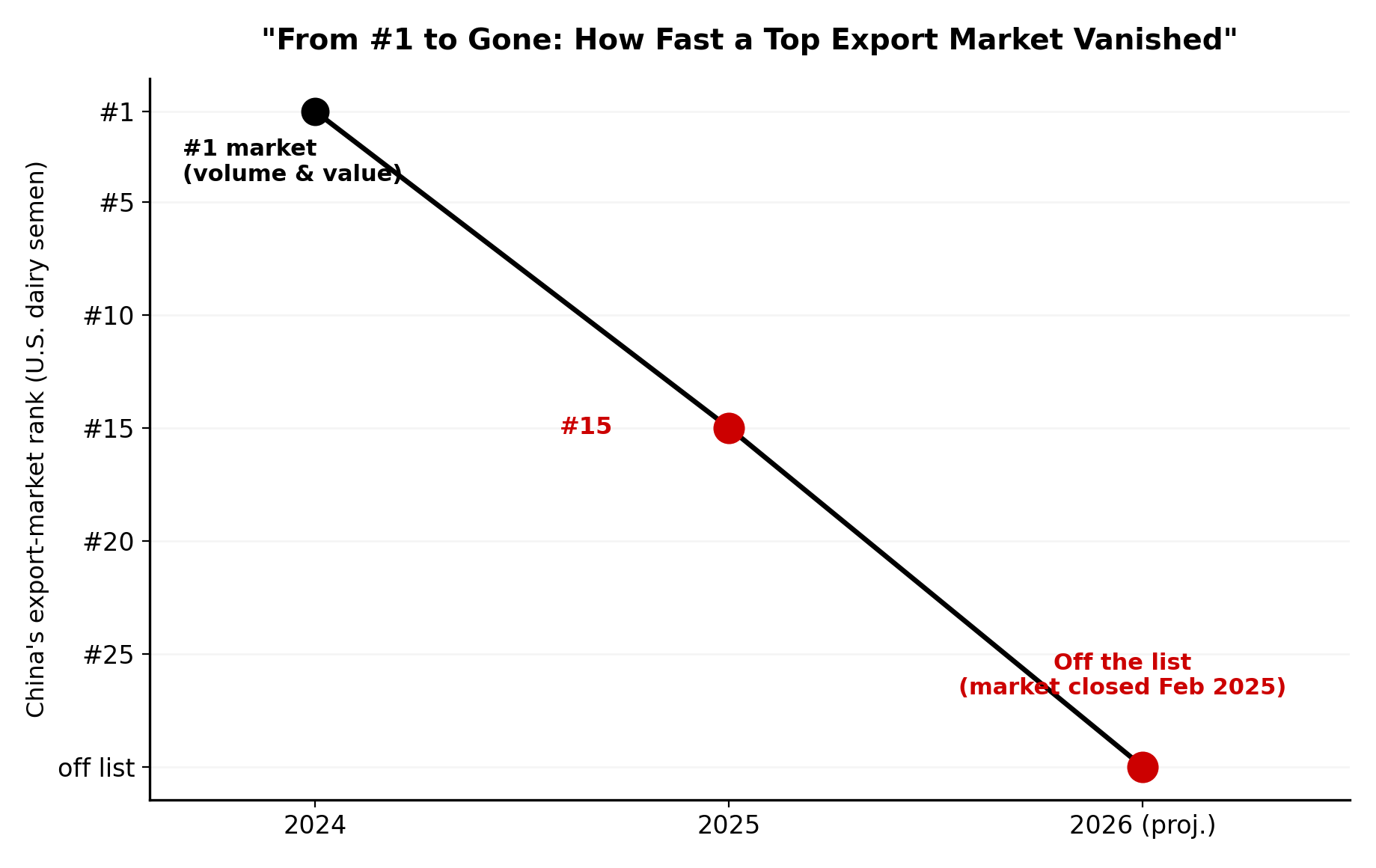
If you want the number that genuinely jolts this story, it’s not domestic — it’s China. In February 2025, China closed its market to U.S. semen. Members had shipped maybe two months’ worth, Weiker said, then nothing for the 15 months since. China had been the number-one export market by both volume and dollar value in 2024. By 2025, it dropped to number 15. If it doesn’t reopen — and there’s no sign it will — it likely won’t even make the export list in 2026.
So how did total exports hold flat anyway? The rest of the world picked up the slack. Members export to more than 120 countries, with over 40 markets each importing more than $1 million in product in 2025. The current top 10 by dollar value: the UK at number one, then Italy, Mexico, Russia, Brazil, Canada, France, Japan, Australia, and Poland. Not every China unit found a new home — but enough did to keep the total steady. That’s resourcefulness, not luck.
Why does that matter to a producer who never exports a straw? Because export demand is part of what keeps a deep bull lineup commercially viable for the studs you buy from. When a top market vanishes overnight, it changes which bulls get sampled, housed, and marketed — and Weiker noted that some members are already weighing where they physically house bulls to avoid trade barriers. The semen catalog you order from doesn’t exist in a vacuum. It’s shaped by demand from 120 countries, and right now, one big buyer just walked off the board.
Is Your Herd’s Breeding Mix Keeping Up With the Country?
Pull your breeding records and run a quick count. What share of last year’s services were sexed, beef, and conventional? Hold it against the national pattern Weiker laid out: sexed at 64% of domestic dairy units and climbing, beef holding strong and beating conventional by 2.1 million units, conventional fading. If you’re still running a heavy book of conventional dairy semen on cows you’d never raise a replacement from, you’re breeding against the grain of where the data says the value sits.
| Semen Type | Share of U.S. Domestic Dairy Units | 2025 Direction | What It Signals for Your Book |
| Sexed (gender-selected) | 64% | Rising (+6% in 2025) | Top genomic-tested cows — your replacement engine |
| Beef-on-dairy | ~24% (beats conventional by 2.1M units) | Holding steady | Bottom of the herd → marketable feedlot calves |
| Conventional dairy | ~12% | Declining (multi-year) | Needs a real outlet — “we’ve always done it” isn’t one |
| All dairy semen (total) | 45.8M units (down ~6%) | Down on better repro | Fewer straws settling the same cows |
That doesn’t make you wrong — your costs, your heifer needs, and your feedlot outlets all factor in. But it’s a question worth asking before your next semen order, not after. Weiker’s own read: conventional will likely continue to decline, sexed will likely continue to rise, and beef-on-dairy will settle into an equilibrium once producers finish calculating how many replacements they actually need versus how many cows they can hand to a beef bull. Worth noting one quirk he flagged — overseas, the mix runs backward, with roughly two-thirds of exported dairy units still conventional and only 13% sexed, mostly down to feedlot preferences and cheaper semen abroad.
| Metric | U.S. Domestic | Export | Takeaway |
| Sexed share | 64% | ~13% | Mirror image — home sorts hard, world doesn’t |
| Conventional share | ~12% | ~67% | Cheaper semen + feedlot preferences abroad |
| Share of total units | ~37% (~17.0M) | ~63% (~28.0M) | Export now carries the volume |
| Top market shift | n/a | China #1 (2024) → #15 (2025) | Demand from 120+ countries shapes your catalog |
Your 30-Day Playbook
Forget the long-range philosophizing. Here’s what to actually do this month and the trade-off for each move. Pull your breeding records and your last 12 months of calf-sale receipts before you read the table — you’ll need both.
| Move | Do this in 30 days | When it pays | The catch |
| Count your real replacement need first | Run Penn State Extension’s replacement formula: herd size (milking + dry) × cull rate × (age at first calving ÷ 24) × (1 + heifer non-completion rate). Lock that number before you reorder | Always — every move below depends on it, and Weiker says beef-on-dairy equilibrium is being set by farms doing exactly this math | Guess high and you over-make heifers you can’t afford to raise; guess low and you’re bidding $3,010-plus to refill your parlor |
| Sexed on top, beef on the bottom | Map your sexed-vs-beef split against that replacement number; sexed on your top genomic-tested cows, beef on the rest | When you’ve genomic-tested enough to know your top females cold; 64% of domestic dairy units are already sexed | Over-breeding beef on viable dams trades away replacement value at $3,000-plus heifer prices |
| Audit the conventional book | Pull what share of last year’s services were straight conventional dairy, and on which cows | Only where you’ve got a real outlet for purebred dairy bull calves or a genuine cost case | Nationally it’s a multi-year decline — “we’ve always done it” isn’t an outlet |
| Price heterospermic vs. single-sire beef straws | Ask your rep for both and check your beef-cross conception trend | When your beef-cross conception’s been streaky and the calves are feedlot-bound | You lose sire ID — a real cost only if you’re building beef-on-dairy performance data |
Key Takeaways
- If conventional dairy semen still fills a big share of your book, ask what real outlet justifies it — nationally, it’s losing ground to sexed on top and beef on the bottom, and habit isn’t an outlet.
- If you haven’t counted your exact annual replacement need lately, run the Penn State formula before your next order — the whole sexed-vs-beef ratio hangs on that one number.
- If your beef-cross conception’s been streaky, price heterospermic against single-sire — but only accept the lost sire ID if you’re not trying to build beef-on-dairy performance data.
- If any of your decisions touch your bull lineup or export marketing, watch China — a number-one market that went to number 15 in a year, with the rebound riding on 40-plus smaller markets, not one big buyer.
So here’s the question to carry into your next breeding meeting: does your sexed-beef-conventional split actually match the number of replacements your herd needs in 2027 — or are you breeding on last decade’s habits? Weiker’s been right about the direction for 40 years, and the direction is more sorting, not less. The farms that come out ahead are the ones that run their own ratios instead of guessing them.
Complete references and supporting documentation are available upon request by contacting the editorial team at editor@thebullvine.com.
Learn More
- Beef-on-Dairy Math: $25200 Rides on Your Semen Order — Delivers a strict spreadsheet audit that converts your 21-day pregnancy rate and semen allocation into verifiable cash flow, protecting your replacement pipeline from expensive heifer shortages.
- The $3,000 Heifer Hangover: How Beef‑on‑Dairy Emptied Your Pipeline and Left the U.S. 800,000 Head Short— Breaks down the macroeconomic supply crunch squeezing the national herd, arming you with three distinct risk strategies to shield your margins from historic replacement costs.
- Stop Breeding by Color: Genomics, Heat Stress and Beef‑on‑Dairy Math That Can Add Over $4/cwt to Holstein Margins — Dismantles traditional visual evaluation habits by pairing advanced chromosome mapping with real-world financial modeling, unlocking an extra $4.00/cwt in margin through data-driven triage.
 The Sunday Read Dairy Professionals Don’t Skip.
 The Sunday Read Dairy Professionals Don’t Skip.
Every week, thousands of producers, breeders, and industry insiders open Bullvine Weekly for genetics insights, market shifts, and profit strategies they won’t find anywhere else. One email. Five minutes. Smarter decisions all week.




