


Bailout math: $278 per cow received. $5,600 per cow lost annually. No wonder 2,800 farms will close this year.
Executive Summary: The USDA’s $16 billion disaster program delivers $278 per cow to struggling farms facing a permanent $ 5,600-per-cow annual cost disadvantage compared to larger operations. Small dairies produce milk at $42.70 per hundredweight while mega-farms achieve $19.14—a structural gap no government payment can bridge. These relief funds buy 16 months of breathing room, leading many farmers to use them as exit capital rather than operational support. Mid-size farms are betting everything on efficiency technology, small operations are pivoting to niche markets, and large dairies are preparing for accelerated consolidation. The uncomfortable truth: these payments aren’t saving American dairy farming—they’re funding its transformation into an industry where only scale and specialization survive.
$16 billion sounds like a lot of money. But when you do the math on the new USDA disaster payments, it reveals a terrifying truth: The government is handing out bandaids for a wound that requires major surgery.
Here’s what’s happening right now with the SDRP Stage Two payments from the Farm Service Agency—the ones announced on November 16th. A typical 300-cow Wisconsin operation with documented disaster losses could receive around $83,000. That’s roughly $278 per cow, give or take. Meanwhile, that 2,000-cow dairy out in Idaho? They hit the payment cap at $250,000, which works out to just $125 per cow.
Looks like the little guy wins, right? Well… not even close. Let me show you why.
Understanding the Real Math Behind These Payments
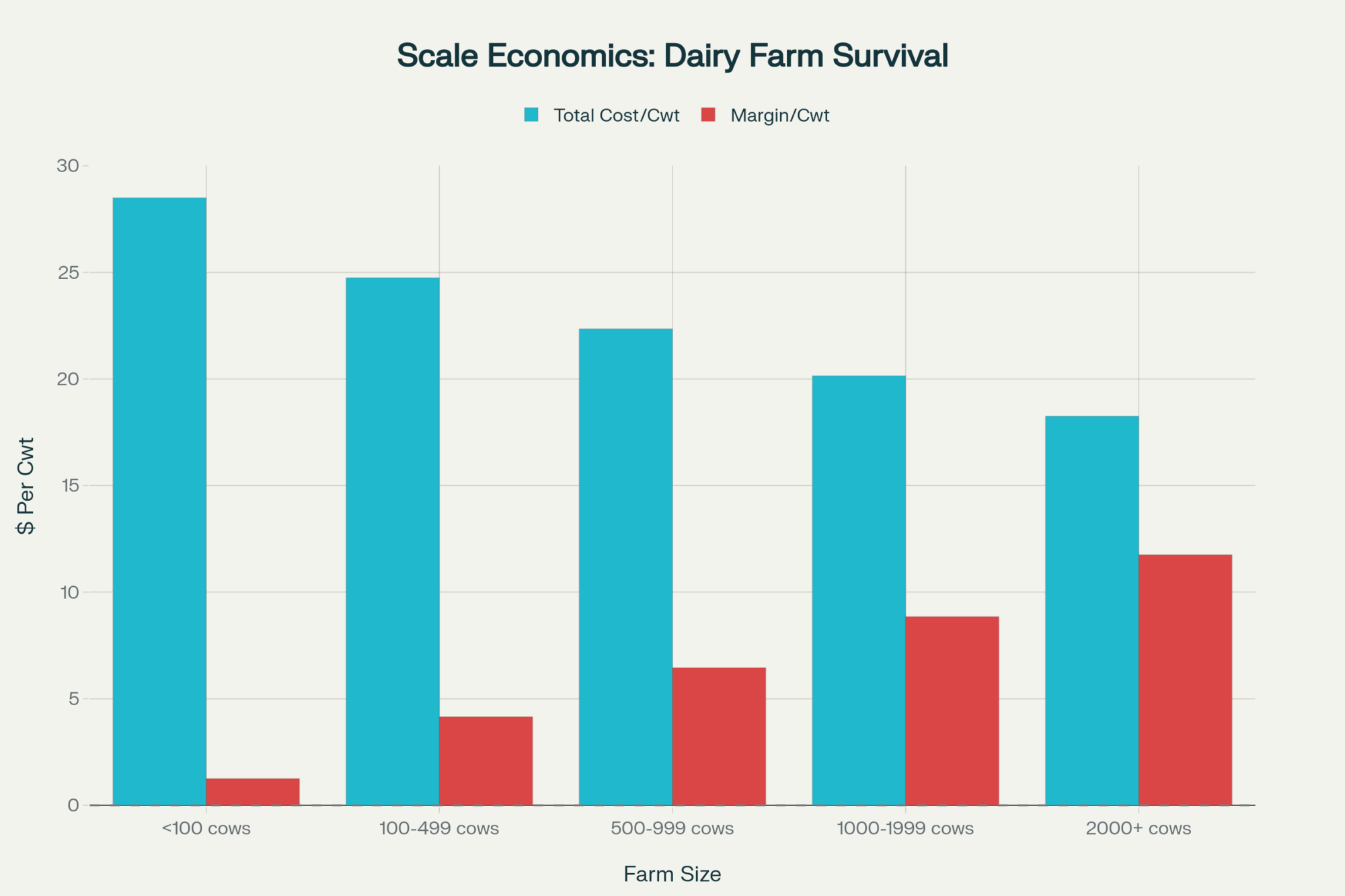
The structural cost disadvantage facing small dairy operations is mathematically insurmountable—no disaster payment can bridge a $23.56/cwt permanent gap when mega-dairies operate at less than half the cost of farms with fewer than 50 cows
You know, I’ve been going through the payment structures with a few neighbors, and it’s easier to see the whole picture when you lay it out in a table:
Farm Size
Est. Relief Payment
Payment Cap
Cost of Production/cwt
300 Cows
~$83,000 ($278/cow)
$125k-$250k
~$25-28
2,000 Cows
~$250,000 ($125/cow)
$250k (Capped)
~$19.14
Small (<50 cows)
~$13,900 ($278/cow)
$125k
~$42.70
What’s really telling here—and the folks at the Center for Dairy Profitability at UW-Madison have been tracking this all year—is that many 300-cow operations in Wisconsin have been running negative margins for months now. So when you get a payment that covers maybe 16 months of those losses… sure, it helps. Absolutely. But it’s not changing the fundamental math we’re all dealing with.
Let’s be brutally honest about the economics here—and I know this is hard to hear at the coffee shop—but the cost structure differences between farms of different sizes are massive. Way bigger than any payment differential we’re talking about.
USDA Data Reveals Massive Cost of Production Gap
The USDA Economic Research Service published some data in their 2024 cost of production report that… well, it’s eye-opening. You ready for this?
Small operations—we’re talking under 50 cows—are averaging $42.70 per hundredweight in total production costs. The mega-dairies with 2,000-plus cows? They’re down at $19.14 per hundredweight.
That’s a $ 23.56-per-hundredweight permanent disadvantage—over $5,600 per cow annually.
Just… think about that for a minute. When you run those numbers annually—and most of us figure about 240 hundredweight per cow per year—you’re looking at a structural disadvantage that no disaster payment can overcome. Not this one, not the next one.
I was reading through some research from dairy economists at UW-Madison recently, and they make a point that’s hard to argue with: these aren’t inefficiencies that better management can fix. We’re talking structural cost advantages here:
Labor utilization—one worker handling 80 cows versus 150 or more
Feed purchasing power—buying by the ton versus by the rail car
Equipment costs are spread over way more units of production
You can be the best manager in the world with 100 cows—and I know some who are—and still face these disadvantages.
What Different Sized Operations Are Actually Doing
While small farms receive higher per-cow payments ($278 vs. $125), they face an insurmountable $5,600 annual structural cost disadvantage—making these relief funds temporary breathing room, not救ue solutions
I’ve been talking with extension folks across Wisconsin, Pennsylvania, and Idaho lately, trying to get a sense of how farms are actually using these payments. The patterns are pretty revealing—and they vary dramatically by operation size.
Operations Under 200 Cows: Buying Time or Buying Out
Based on what extension educators across Wisconsin are observing, there’s been a notable uptick in farms asking about exit strategies right alongside their SDRP payment applications. It’s particularly noticeable among operations under 150 cows, and honestly, who can blame them?
But here’s what’s encouraging—the ones staying in traditional dairy are getting creative:
Direct-to-consumer relationships—farm stores, delivery routes, that kind of thing
Organic certification—and those $8-12 per hundredweight premiums that USDA’s Agricultural Marketing Service has been tracking are real
On-farm processing—cheese, ice cream, yogurt operations that capture those retail margins
Mid-Size Operations (200-500 Cows): The Efficiency Push
This group’s in a tough spot, you know? They’re too big to pivot to niche markets easily, but not quite large enough for full economies of scale.
What I’m hearing from Farm Credit folks and in extension discussions throughout 2025 is that there’s a strong interest in technology investments among these mid-size operations. They’re using relief funds as the capital they’ve been waiting for:
Activity monitors for better reproduction management
Automated calf feeders—especially with labor running $15-20 per hour plus benefits, according to National Milk Producers Federation data
Parlor upgrades targeting real efficiency gains
Cornell PRO-DAIRY’s analyses have emphasized that these farms need to get below $22 per hundredweight to remain viable in the long term. The smart ones I’ve talked to are using these payments for targeted investments toward that goal. It’s strategic thinking, not panic spending.
Larger Operations (500+ Cows): Environmental and Expansion
The bigger operations? Different game entirely. Many are putting relief funds toward environmental compliance—and honestly, that’s just smart planning. California’s methane reduction requirements are going full force by 2030, and you know other states are watching closely. Better to get ahead of it than scramble later.
The Young Farmer Perspective: Mathematically Impossible Entry
Here’s something that keeps me up at night. The average dairy farmer is 58 years old—that’s from the 2022 USDA Census of Agriculture. The barrier to entry for a 25-year-old today isn’t just hard—it’s mathematically impossible without inheritance or massive leverage.
Federal Reserve Bank of Chicago’s agricultural land value reports from the first three quarters of 2025 show dairy-quality farmland in Wisconsin ranging from approximately $8,000 to $12,000 per acre. Add in livestock, equipment, and facilities—you’re looking at a minimum of $3-5 million for a competitive operation. That’s before you’ve produced a single pound of milk.
“If farms with no debt are struggling, what chance does someone have starting with modern debt loads?”
That’s what a young farmer asked me last week, and I didn’t have a good answer.
Some young farmers are finding creative entry paths, though:
Management agreements with retiring farmers—gradual ownership transition
Starting with contract heifer raising before moving into milking
Intensive grazing systems that need less upfront capital
Minority ownership partnerships in established operations
But let’s be honest—these are exceptions, not the rule.
The Mental Health Crisis Nobody’s Measuring
Here’s something that doesn’t show up in any payment calculations but affects every decision we make: the stress factor. Research on farmer mental health—and university extension services have been tracking this closely—consistently shows elevated stress levels among dairy producers. Younger farmers are particularly affected.
Agricultural economists have noted that farmers often make decisions based on stress reduction rather than pure economic considerations. A payment providing 16 months of breathing room might be worth more psychologically than financially. And you know what? That’s completely valid.
Extension agents are reporting increased interest in:
Simplified systems that reduce management complexity
Seasonal calving to create actual downtime
Partnerships that share the management burden
Exit strategies that preserve dignity and family relationships
There’s no shame in any of those choices. None whatsoever.
Cross-Border Reality Check: Canadian “Stability” at What Cost?
Can’t really discuss American dairy economics without acknowledging what’s happening north of the border. Canada’s supply management system maintains about 9,000 dairy farms with remarkable stability. They announced 2025 price adjustments to account for inflation, maintaining their cost-of-production pricing formula. No emergency payments needed. No mass exodus from dairy.
But here’s the catch—and Canadian farmers will tell you this immediately—according to Dairy Farmers of Ontario quota exchange data, quota values have been running CAD $25,000 to $30,000 per kilogram of butterfat in recent transactions. That’s essentially a mortgage on your right to produce milk—something we don’t face here in the States.
The tradeoff? Well, predictable margins enable completely different business planning than our volatile commodity markets. Whether that’s “better” is a political debate for another day—probably best saved for when we’re not trying to figure out how to pay next month’s feed bill.
Five Brutal Truths About Making Decisions Right Now
The $83,000 disaster payment buys exactly 16 months before structural losses consume the relief—then farms face the same math that forced 2,800 operations to close this year, proving these aren’t救ue packages but exit timelines
After all this analysis and talking with farmers across multiple states, here’s what seems most relevant if you’re trying to make decisions right now:
1. Know your real position: Calculate your actual cost per hundredweight. The Dairy Profit Monitor tools from Wisconsin, Cornell, and Penn State extension services can help with this. If you’re producing at $35 or more when efficient operations are at $20… that gap won’t close without fundamental changes.
2. Treat relief payments as capital, not income: Strategic improvements compound over time. Operating losses? They just come back next quarter.
3. Set realistic timelines: Give yourself 3-5 years to hit profitability targets. If structural disadvantages—not just bad years—prevent reaching those targets, having an exit strategy isn’t giving up. It’s responsible management.
4. Explore alternative models seriously: Grass-based systems, organic production, on-farm processing, agritourism—these aren’t easy pivots, but they can offer margins that commodity production just can’t match anymore. Cornell’s Dairy Farm Business Summary shows that organic operations often see $3-5 per hundredweight higher margins, though with different risk profiles.
5. Protect your mental health: Farm Aid’s hotline at 1-800-FARM-AID offers confidential support. Many states now have farm-specific mental health programs, too. No operation—and I mean this—is worth destroying your family or your wellbeing.
The Bottom Line: Dairy’s Structural Transformation Is Here
Dairy consolidation accelerates as America loses three farms daily while milk production increases—mega-operations with 2,500+ cows now drive industry growth, rendering the traditional family dairy model economically obsolete
Looking at how these payments land across different operations, it’s clear we’re witnessing a structural transformation, not just another rough patch. Based on consolidation patterns we’ve seen over the past decade, we’re likely to continue seeing fewer but larger farms—the National Milk Producers Federation and various agricultural economists have all been pointing to this trend.
But here’s what’s important, and what often gets missed in these discussions: fewer farms doesn’t automatically mean less opportunity for those who remain or enter strategically. The operations that survive and thrive will be those that either achieve commodity-scale efficiency or successfully differentiate into premium markets. There’s not much room left in the middle, unfortunately.
Success increasingly depends less on production excellence alone and more on strategic positioning.
You can have the best cow care and highest production in the world—and I know farmers who do—but if you’re in the wrong cost structure for your market position, excellence alone won’t save you.
These relief payments? They offer something valuable beyond the money itself: time to make thoughtful assessments and decisions. In an industry where crisis so often drives decision-making, that breathing room might be the most valuable aspect of all.
Because at the end of the day—and we all know this deep down—what matters isn’t whether you get $278 or $125 per cow in relief. What matters is understanding where your operation fits in dairy farming’s evolving structure and making informed decisions based on that reality.
The farms that do that, regardless of size? Those are the ones that’ll still be shipping milk in 2030 and beyond. And I hope yours is one of them.
Complete references and supporting documentation are available upon request by contacting the editorial team at editor@thebullvine.com.
Key Takeaways:
Your True Position: Small farms producing at $42/cwt can’t compete with mega-dairies at $19/cwt—if your costs exceed $30/cwt, these payments are transition funds, not rescue money
Strategic Capital Decision: That $83,000 payment offers three options: invest in efficiency tech (if you’re within striking distance of $22/cwt), pivot to premium markets ($8-12/cwt organic premiums), or exit with dignity while you still have equity
The 500-Cow Reality: Only two business models remain viable: 500+ cow commodity efficiency or under-200 cow specialty/direct marketing—the middle is disappearing
Young Farmer Warning: Entry costs of $3-5 million mean starting fresh is mathematically impossible without inherited land—consider partnerships, contract raising, or alternative agriculture
16-Month Clock: Payments cover 16 months of current losses—use this time for strategic planning, not hoping for different milk prices that won’t materialize
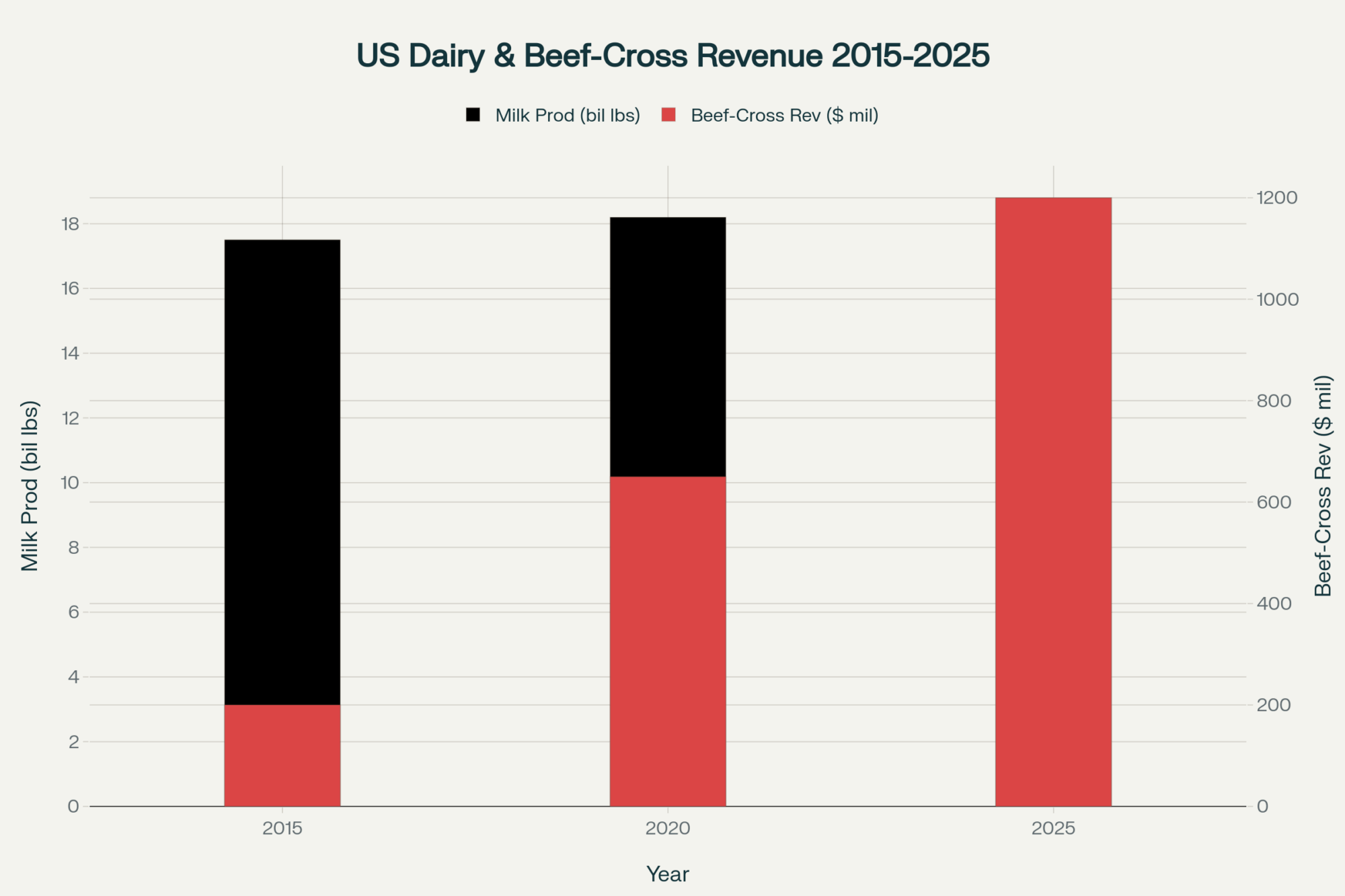
Building a Beef-on-Dairy System: Capturing $360,000 in Annual Farm Profit – Demonstrates how farms are generating alternative revenue streams through beef-on-dairy breeding programs that jumped from 50K to 3.2 million head, potentially offsetting the cost disadvantages discussed in the main analysis.
Join the Revolution!
Join over 30,000 successful dairy professionals who rely on Bullvine Weekly for their competitive edge. Delivered directly to your inbox each week, our exclusive industry insights help you make smarter decisions while saving precious hours every week. Never miss critical updates on milk production trends, breakthrough technologies, and profit-boosting strategies that top producers are already implementing. Subscribe now to transform your dairy operation’s efficiency and profitability—your future success is just one click away.
Three dairy producers. One expanded. One optimized. One sold. All three are winning. Here’s why your path matters more than your size.
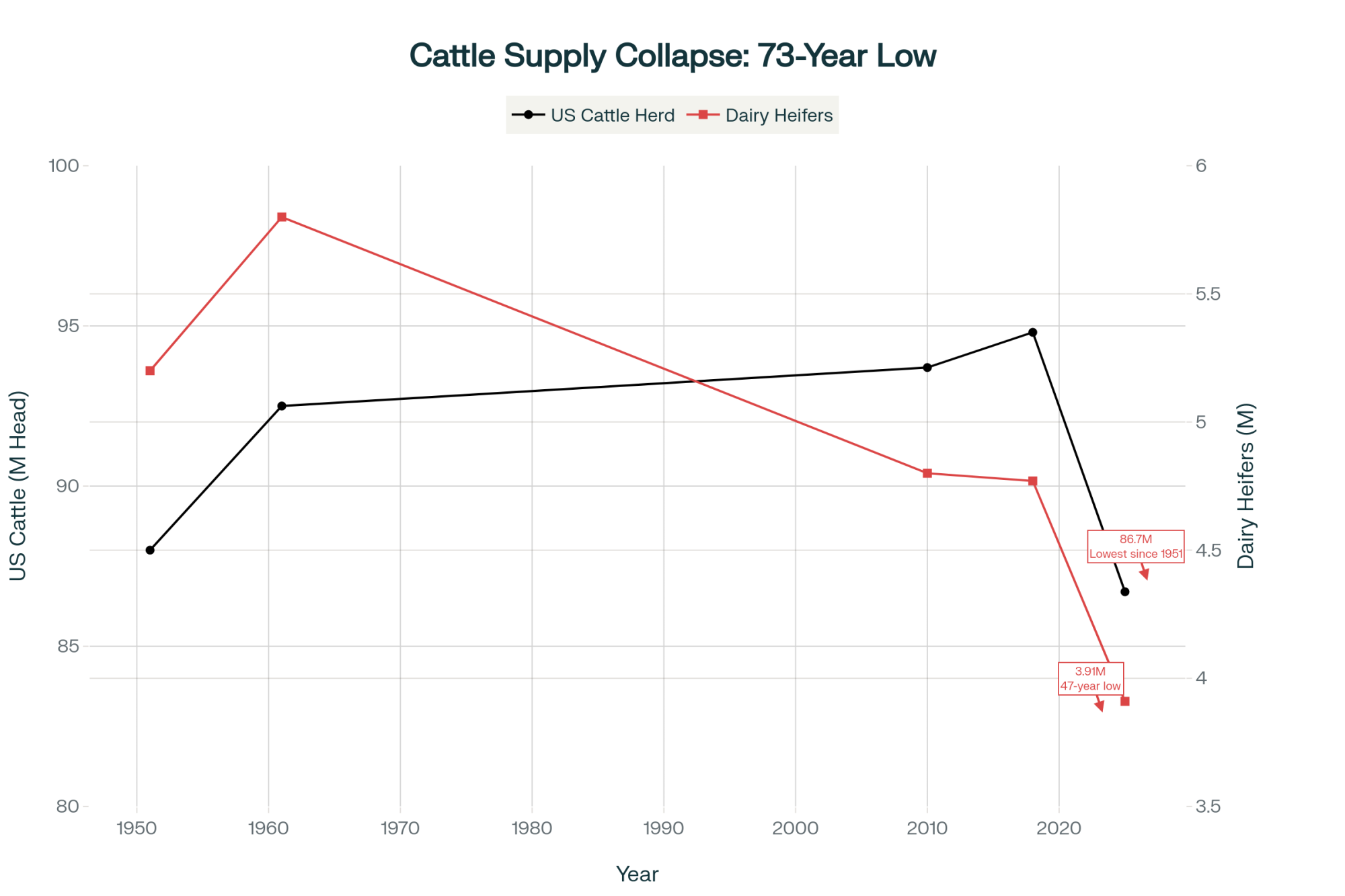
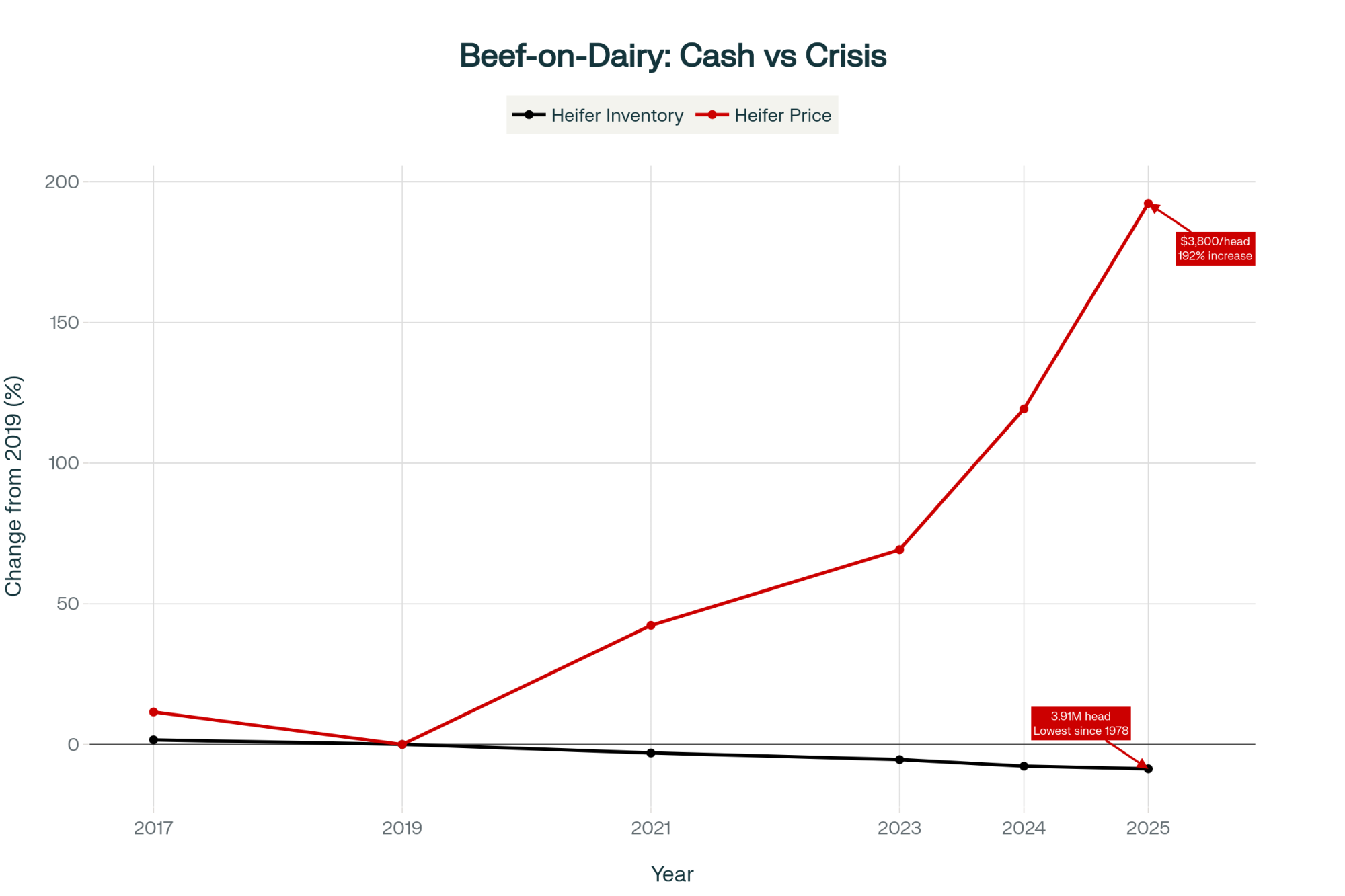
EXECUTIVE SUMMARY: A perfect storm is reshaping dairy: heifer inventory at historic lows (3.9M—lowest since 1978), processors desperately seeking milk with $150K+ annual premiums, and global production hitting environmental and biological walls. This convergence creates an 18-month window in which your decision determines whether you thrive, survive, or exit by 2030. Three proven paths exist: strategic expansion ($3.5-4M investment yielding up to $731K annually), optimization without debt ($200-300K profit improvements), or planned exit (preserving $400-680K more wealth than distressed sales). The window is real—processor premiums evaporate after 18 months, and with heifers requiring 30 months from birth to production, today’s decisions lock in your 2027-2028 position. Your farm’s future isn’t determined by size or history, but by making the right choice for YOUR situation in the next 90 days.
You know that feeling when you’re at the co-op meeting and everyone’s dancing around the same question? “Is something big happening here, or is this just another cycle?” Well, here’s what’s interesting—I think we’re all sensing the same thing because this time actually is different.
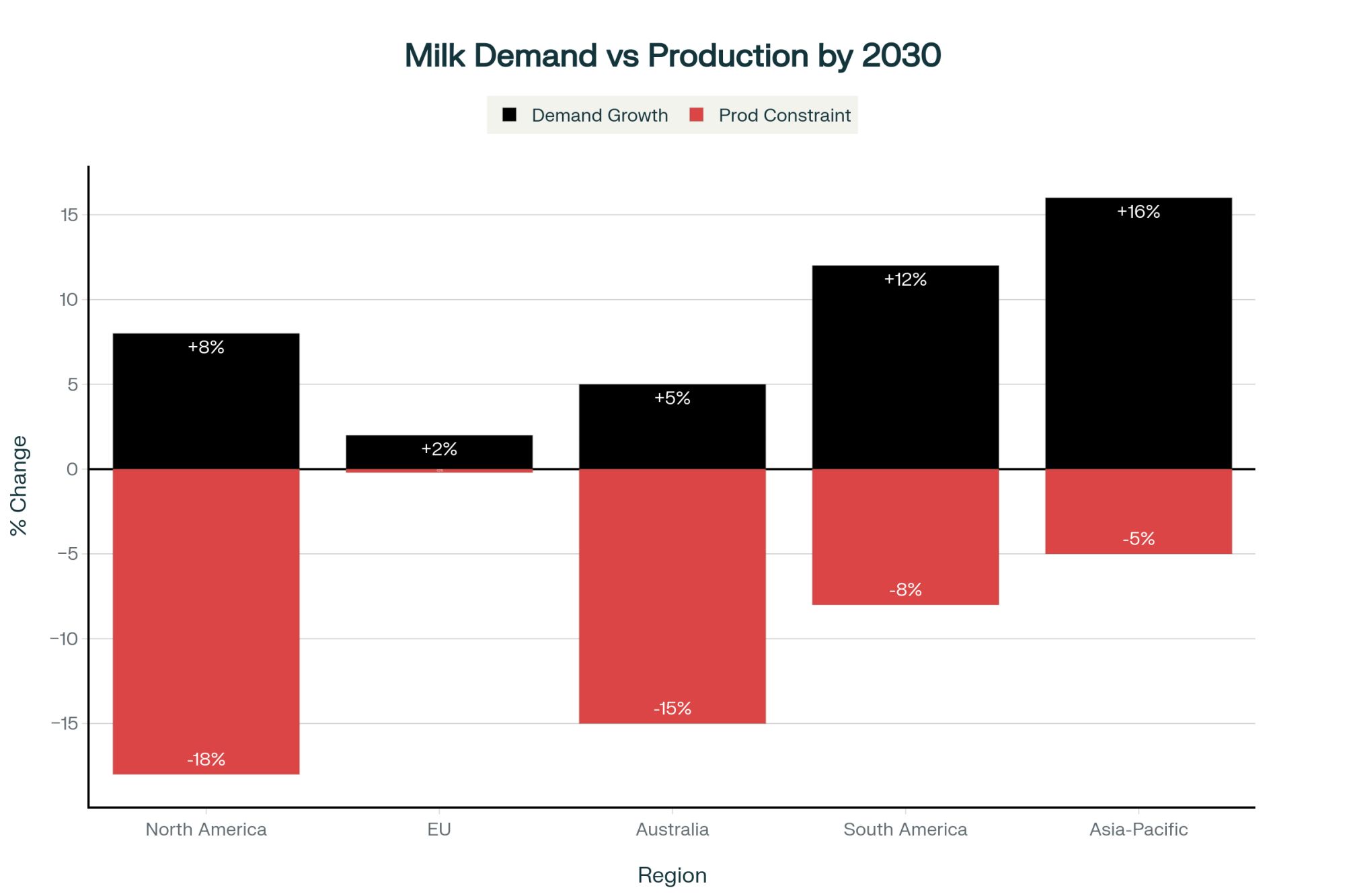
What I’ve found in the data lately is that we’re not seeing the typical supply hiccup or price swing. The International Farm Comparison Network released its projection last October, showing a 6 million tonne global milk shortage by 2030. Now, the International Dairy Federation? They’re suggesting it could hit 30 million tonnes. Even if we land somewhere in the middle… well, that’s not just a shortage. That’s a structural shift.
What’s Actually Driving This Supply Crunch
So here’s where it gets really interesting, and it’s the combination that matters.
The FAO and OECD put out their Agricultural Outlook last July—2024, not this year—showing global milk demand climbing by 140 to 208 million tonnes by 2030. We’re adding another 1.5 billion people to the planet, but what caught my attention is this: per capita consumption is jumping by 16% as developing regions gain purchasing power. Southeast Asia alone—according to IFCN’s April analysis—will command 37% of total global milk demand. I mean, think about that for a minute.
But production? That’s where things get complicated.
I was talking with a Wisconsin extension specialist last week, and she nailed it: “We’re watching three major dairy regions hit walls at the same time, and they’re different walls.” She’s absolutely right. DairyNZ’s latest statistics show New Zealand’s dairy cattle numbers dropped from 5.02 million back in 2014/15 to 4.70 million last year. The EU Commission’s December forecast? Milk production is declining by 0.2% this year, with growth capped at just 0.5% annually through 2031. That’s their greenhouse gas reduction targets at work, and those aren’t going away.
And then there’s our heifer situation here in North America—honestly, this one really concerns me.
The Heifer Shortage That’s Reshaping Everything
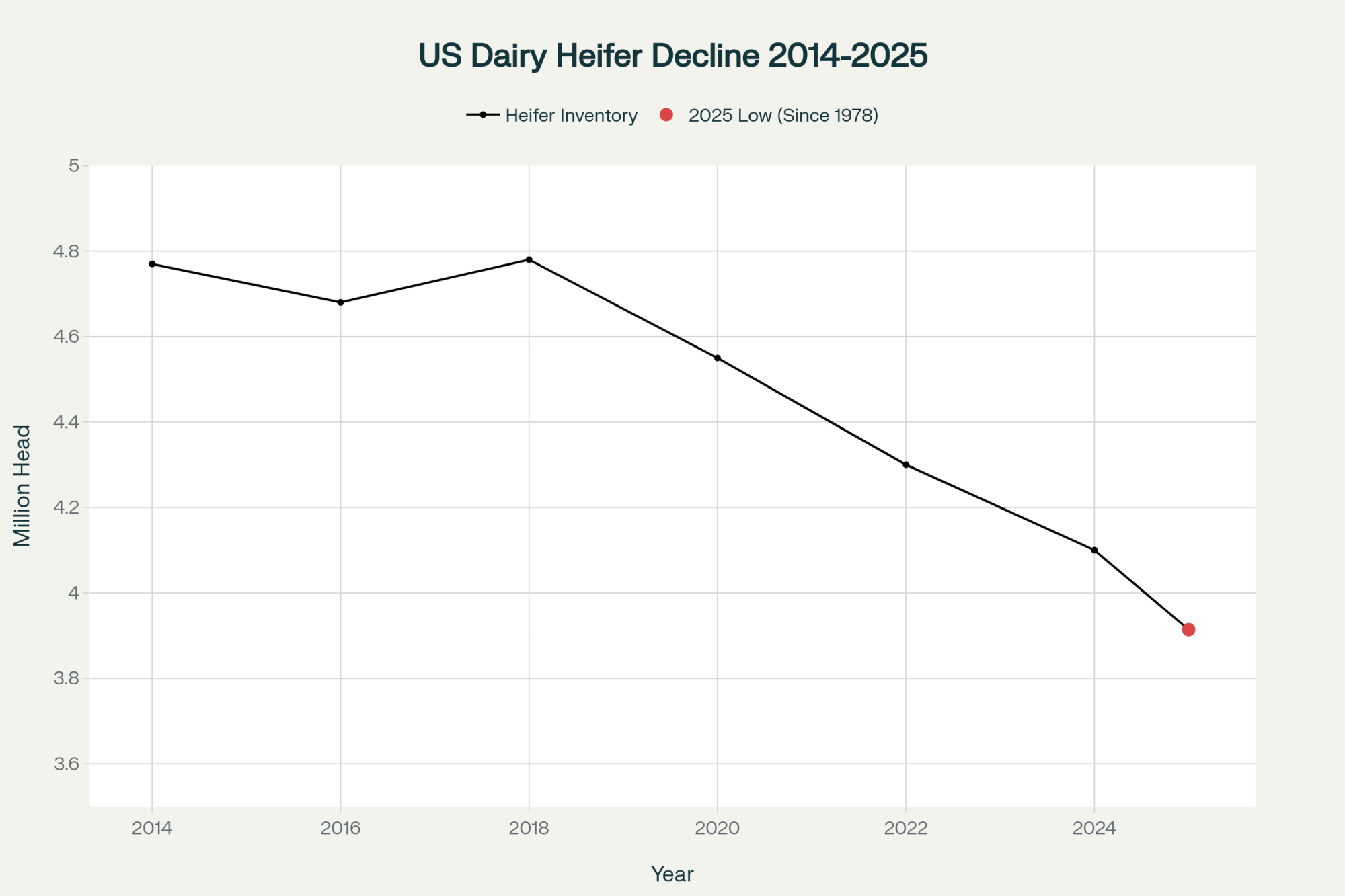
The USDA’s January Cattle report came out showing U.S. dairy heifer inventory at 3.914 million head. You know what that is? The lowest since 1978. We’re down 18% from 2018 levels.
CoBank’s research team published some sobering analysis in August—they’re projecting we’ll lose another 800,000 head over the next two years before we see any recovery. Think about that. We’re already at historic lows, and we’re going lower.
What’s driving this? Well, the National Association of Animal Breeders’ data shows beef-on-dairy breeding hit 7.9 million units in 2024. That trend alone—just that one factor—created nearly 400,000 fewer dairy heifers in 2025. Every beef-on-dairy calf born today is a heifer that won’t be entering your neighbor’s milking string in 30 months.
Dr. Jeffrey Bewley from Kentucky’s dairy extension program explained it perfectly when we talked last month: “The pipeline is essentially fixed for the next 30 months. It takes 24-30 months from birth to first lactation. The calves being born today won’t produce milk until 2027-2028, and we’re simply not producing enough of them.”
You’re probably already seeing this in heifer prices. The USDA’s Agricultural Marketing Service data from February showed prices running $2,660 to $3,640 per head—up 29% year-over-year. A Vermont producer told me last week he’s paying $4,000 for quality bred heifers… when he can find them. California operations? Some out there can’t source adequate replacements at any price. This dairy heifer shortage in 2025 is fundamentally different from past cycles.
Here’s a development that’s really worth watching, especially if you’re within reasonable hauling distance of new facilities.
The dairy processing sector is investing billions—we’re talking serious money—in dozens of new and expanded plants across the country. The International Dairy Foods Association has been tracking these milk processing expansion opportunities, and what fascinates me is how predictable processor behavior has become.
The University of Wisconsin’s Center for Dairy Profitability documented this pattern, and it’s remarkably consistent. In that first year after a facility announces expansion? They’re hungry for milk—offering premiums of $1.50 to $2.50 per hundredweight. But here’s what happens: by months 13 through 18, when they’ve locked in about 60-70% of what they need, those premiums drop to maybe $0.75 to $1.25. After 18 months? Standard market pricing.
Mark Stephenson from UW-Madison’s Dairy Policy Analysis program put it well: “We’re seeing farms within 75 miles of new facilities locking in bonuses worth $150,000 or more annually for a 500-cow dairy. But that opportunity has an expiration date. Once processors hit about 70-80% of their target volume, the welcome mat stays out, but the red carpet gets rolled up.”
I’ve seen this play out in Wisconsin, Pennsylvania, Idaho… same pattern everywhere. And what’s happening in Europe and Australia right now? Similar dynamics—processors scrambling for supply in tight markets, then becoming selective once they’ve secured their base needs.
Three Strategic Paths Forward
What’s fascinating to me—and I’ve been talking to producers all over—is how clearly folks are sorting themselves into three camps. Each one makes sense depending on where you’re at.
Strategic Expansion for Positioned Operations
Operations taking this route generally have strong balance sheets—we’re talking debt-to-equity ratios under 0.50. They’ve got established management systems, often with a clear succession plan in place.
Current construction costs? You’re looking at $3.5 to $4.0 million for a 500-to-1,000 cow expansion, based on what I’m hearing from contractors and extension budgets. Freestall construction alone runs $3,000 to $3,500 per stall. And financing… well, at 7-8% interest, that changes everything compared to three years ago.
A Pennsylvania producer expanding from 450 to 900 cows walked me through his thinking: “With milk projected at $21-23 per hundredweight through next year and geographic premiums adding another buck-fifty, we’re looking at $731,250 in additional annual income. Yeah, the interest rates hurt—we’re paying $840,000 more over the loan term than we would’ve three years ago. But we think the opportunity justifies it.”
Farm Credit East’s benchmarking suggests you need breakevens below $18 per hundredweight to weather potential downturns. That’s a narrow margin for error.
But here’s something worth noting—smaller operations aren’t necessarily excluded from expansion opportunities. I know a 150-cow operation in Ohio that’s adding just 50 cows, focusing on maximizing components and securing a local processor contract. Sometimes expansion doesn’t mean going big—it means going strategic.
Optimization Without Expansion of Debt
Now, this is where things get interesting for many operations. Dr. Mike Hutjens—he’s emeritus from Illinois but still consulting—has been documenting some impressive results.
Component optimization through precision nutrition, which typically costs $15-25 per cow per month, can generate $75 per cow annually just by improving butterfat and protein levels. Reproductive efficiency improvements? Those are yielding $150 in annual benefits per cow. And here’s one that surprised me: extending average lactations from 2.8 to 3.4 adds about $300 per cow in lifetime value.
“We’re documenting operations improving net income by $200,000 to $300,000 annually through systematic optimization,” Hutjens comments. “For producers who don’t want additional debt or can’t expand due to land constraints, this approach offers substantial returns.”
I’m seeing this work particularly well for operations in areas where expansion just isn’t feasible—whether due to land prices, environmental regulations, or personal preference. With this summer’s heat-stress issues reminding us of the importance of cow comfort and fresh cow management, there’s real money in getting the basics right.
For smaller herds—say, under 200 cows—optimization might be your best bet. Focus on what you control: breeding decisions, feed quality, cow comfort. One 120-cow operation in Vermont improved their net income by $85,000 annually just through better reproduction and component management. No debt, no expansion stress, just better management of what they already had.
Strategic Transition While Values Hold
This is the conversation nobody wants to have at the coffee shop, but it needs to be part of the discussion.
Cornell’s Dyson School research shows that well-planned transitions preserve $400,000 to $680,000 more wealth compared to distressed sales. That’s real money—generational wealth we’re talking about.
A farm transition specialist I know in Wisconsin—he’s been doing this for 30 years—shared something that stuck with me: “Strategic transition isn’t giving up. It’s maximizing value for the family’s future. I’m working with a 62-year-old producer right now, with no identified successor. If he transitions in 2026, he preserves about $2.1 million in equity. If he waits, hopes things improve, maybe faces forced liquidation in 2028? We’re looking at maybe $1.2 million.”
For our Canadian friends, it’s a different calculation. Ontario’s quota exchange is showing values around $24,000 per kilogram of butterfat. That’s substantial equity tied up in quota that needs careful planning to preserve.
The Human Side We Can’t Ignore
I need to bring up something we don’t talk about enough—the mental and emotional toll of these decisions.
A University of Guelph study from last year found that 76% of farmers experienced moderate to high stress levels. Dairy producers? We’re showing some of the highest rates. This isn’t just about personal wellbeing—though that matters enormously. Research in agricultural safety journals shows that chronic stress directly impacts decision-making quality. Poor decisions made under stress can affect operations for years.
A Minnesota producer was remarkably honest with me recently: “The weight of these decisions—expansion, optimization, or transition—it affects the whole family. Having someone to talk to, someone outside the immediate situation, has been invaluable.”
The Iowa Concern Line—that’s 1-800-447-1985—expanded nationally this year. Organizations like Farm State of Mind provide crucial support. Using these resources isn’t a weakness—it’s smart business. You wouldn’t run a tractor with a blown hydraulic line, right? Why run your operation when your decision-making capacity is compromised?
Risk Management in Uncertain Times
Now, I’d be doing you a disservice if I didn’t acknowledge what could go wrong with this thesis.
A severe recession? It’s possible, though the Federal Reserve currently puts the probability of a 2008-level event pretty low—less than 15%. Technology breakthroughs in genetics or reproduction could accelerate supply response, but biological systems don’t change overnight. We’ve been improving sexed semen for 15 years—sudden miraculous breakthroughs seem unlikely. Environmental policy reversals? Given current trajectories in the EU and New Zealand, I wouldn’t count on it.
And here’s something we haven’t talked about enough—feed price volatility. As many of you know, grain markets have been all over the map lately. USDA projections show significant price variability ahead for both corn and soybean meal over the next 18 months. These aren’t small moves. A dollar change in corn prices can shift your cost of production by $1.50 to $2.00 per hundredweight, depending on your feeding program. That’s why managing feed costs remains critical to any strategy you choose.
Smart producers are hedging their bets. The Dairy Margin Coverage program lets you lock in $9.50 or higher income-over-feed-cost margins for most of your production—and that “feed cost” component is key here. When feed prices spike, DMC payments help offset the pain. University of Minnesota Extension shows diversifying through beef-on-dairy programs adds $4-5 per hundredweight in supplemental revenue. These aren’t huge numbers individually, but together they provide meaningful buffers against both milk price drops and feed cost spikes.
And let’s not forget weather impacts—the drought conditions we’ve seen in parts of the Midwest and the heat-stress challenges—are adding another layer of complexity to these decisions. Climate variability isn’t going away, and it directly affects both production and feed costs.
Your 90-Day Action Framework
After talking with dozens of producers and advisors, here’s the framework that seems to resonate:
Weeks 1-2: Pull your real numbers. Not what you think they are—what they actually are. Calculate your true production costs, debt ratios, and stress-test at $16 milk for 18 months. If your breakeven’s above $20 or debt-to-equity exceeds 0.80, expansion probably isn’t your path.
Weeks 3-4: Map your market position. Meet with every processor within 150 miles. Understand which contracts are available and which premiums exist. Geography matters more than ever in this market.
Weeks 5-6: Have the succession conversation. I know—it’s uncomfortable. But if you’re over 50 without a clear successor, a strategic transition might preserve more wealth than holding on indefinitely.
Weeks 7-8: Determine actual borrowing capacity. Today’s 7-8% rates are a world apart from those of three years ago. Know your real numbers before making commitments.
Weeks 9-10: Make your choice—expansion, optimization, or transition—based on data, not emotion or tradition. This is where the rubber meets the road.
Weeks 11-12: Start executing. Delays mean missing opportunities and facing higher costs down the line.
The Global Context and What’s Ahead
What strikes me most is how this moment accelerates trends we’ve been watching for years. Industry consolidation? That’s mathematical reality. Hoard’s Dairyman’s October analysis suggests 25-40% of current operations will transition by 2030. That’s sobering… but it also creates opportunities for those positioned to capture them.
Looking globally, we’re seeing similar patterns in Australia with their drought recovery challenges, in Europe with environmental constraints, and in South America with infrastructure limitations. This isn’t just a North American phenomenon—it’s a global realignment of dairy production and consumption patterns.
A colleague at Penn State Extension said something that resonates: “Success won’t necessarily correlate with size or history. It’ll favor those who accurately assess their position and act decisively within this window.”
The 18-month timeframe isn’t arbitrary—it reflects the convergence of heifer biology, processor contracting patterns, and construction cost trajectories already in motion. While heifer availability remains fixed for 30 months ahead, the processor premium window closes in 18 months, making that the more urgent decision-making timeline. Multiple paths can succeed, but each requires honest assessment and willingness to act on that understanding.
For an industry built on multi-generational commitment and remarkable resilience, this period calls for something additional: recognizing when adaptation is necessary and positioning thoughtfully for what comes next.
Whether through expansion, optimization, or transition, the key is making intentional choices aligned with your operational realities and family goals. The decisions ahead aren’t easy—they never are. But as we’ve seen throughout dairy’s history, producers who engage thoughtfully with change, rather than hoping it passes, tend to find sustainable paths forward.
And that, ultimately, is what this is all about—finding your path forward in a changing landscape. The opportunity is real, the challenges are significant, and the window for decisive action is open… but not indefinitely.
KEY TAKEAWAYS:
The 18-month window is biology meeting economics: Heifers at 3.9M (lowest since ’78) + 30-month production lag + processors desperately needing milk NOW = your decision window
Three strategies, all winners: Expand if you’re positioned ($3.5M investment → $731K annual returns) | Optimize what you have ($200-300K profit, no debt) | Exit strategically ($680K more than waiting)
Your report card determines your path: Breakeven under $18/cwt ✓ | Debt-to-equity under 0.50 ✓ | Clear succession ✓ = expand. Missing any? Optimize or exit.
Location drives premiums: New processing within 75 miles = $150K+ annual bonus, but these premiums evaporate after 18 months—first come, first served
The 90-day sprint: Weeks 1-2: Pull real numbers | Weeks 3-4: Map processor contracts | Weeks 5-6: Succession reality check | Weeks 7-12: Commit and execute
Complete references and supporting documentation are available upon request by contacting the editorial team at editor@thebullvine.com.
Learn More:
Building a Beef-on-Dairy System: Capturing $360,000 in Annual Farm Profit – Reveals how dairy farms are transforming the heifer shortage challenge into opportunity by leveraging beef genetics, with breeding jumping from 50K to 3.2M head and boosting calf revenue from 2% to nearly 6% of total farm income.
Join over 30,000 successful dairy professionals who rely on Bullvine Weekly for their competitive edge. Delivered directly to your inbox each week, our exclusive industry insights help you make smarter decisions while saving precious hours every week. Never miss critical updates on milk production trends, breakthrough technologies, and profit-boosting strategies that top producers are already implementing. Subscribe now to transform your dairy operation’s efficiency and profitability—your future success is just one click away.
The $3 billion bailout hit producers’ accounts—but the real story is how farmers are turning that relief into resilience and re‑engineering the future of dairy.
Executive Summary: The USDA’s $3 billion dairy bailout bought farmers time—just not transformation. Since 2018, over $60 billion in federal “emergency” funding has kept America’s milk moving, but it’s also made rescue money feel routine. What’s interesting is how differently producers are responding. In Wisconsin, smaller family herds keep shuttering, while Idaho’s integrated systems keep growing. Yet across regions, many farms are proving that strength now comes from management, not money—from tracking butterfat performance to securing feed partnerships and using Dairy Revenue Protection as standard operating procedure. The article reveals a quiet shift happening in dairy: the producers thriving today aren’t waiting for Washington—they’re building resilience from the inside out.
When the USDA released $3 billion in previously frozen dairy aid earlier this fall, a lot of barns felt the same quiet relief. That check helped cover feed, tide over payroll, or pay for the next load of seed. But here’s what’s interesting—what used to be considered “emergency relief” has quietly become routine.
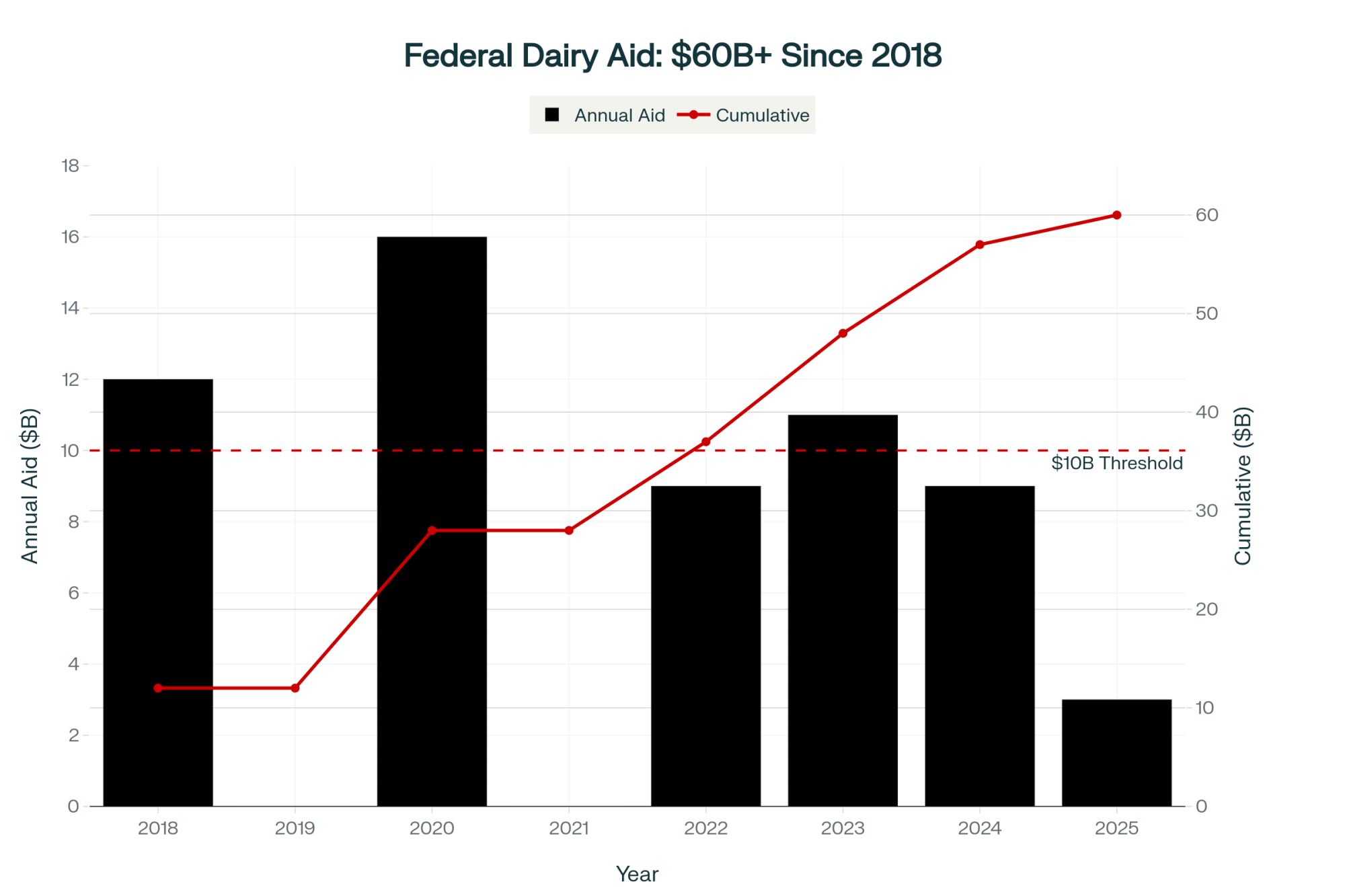
Since 2018, the government’s Commodity Credit Corporation has distributed over $60 billion in ad‑hoc support to U.S. farmers, according to USDA and Congressional Research Service data. That includes the trade‑war relief payments, COVID‑era CFAP funds, weather‑related disaster programs, and now, this latest round of support. Each program had different names and triggers, yet all share one thing: they’ve made emergency relief feel ordinary.
Looking at this trend, it’s clear that the system doesn’t just respond to volatility—it depends on it.
From Safety Net to Part of the System
The normalization of crisis: Federal dairy aid has exceeded $60 billion since 2018, transforming ‘emergency’ relief into standard operating procedure—exactly what Coppess warned about.
University of Illinois economist Jonathan Coppess put it plainly during a 2025 policy forum: “Every time we call these payments extraordinary, we prove how ordinary they’ve become.”
He’s right. The CCC now spends more than $10 billion each year keeping farm sectors whole when prices collapse. The money buys time—valuable time—for dairy families to stay solvent when margins evaporate. But I’ve noticed something else: those interventions slow the kind of market corrections that might otherwise drive innovation.
In other words, the aid keeps everyone in motion—but it also keeps everyone in the same spot.
Geography Still Shapes Success
Metric
Wisconsin (Traditional)
Idaho (Integrated)
Impact
Herd Trend 2024
400+ closures
4.2% growth
Consolidation accelerating
Primary Model
Small-mid family farms
Vertically integrated
Structure determines survival
Processor Relationship
Co-op (variable deductions)
Direct long-term contracts
Security vs. volatility
Co-op Deductions
$1-3 per cwt
Minimal/contracted
Margin erosion for traditional
Feed Strategy
Mixed/spot market
Integrated supply chains
Cost predictability advantage
2025 Production Trajectory
Declining
Expanding
Geographic winners emerging
Here’s a sobering contrast.
In Wisconsin, USDA NASS reports for 2025 show that over 400 milk license holders closed in 2024, the vast majority small or mid‑sized herds. Co‑op deductions for hauling, marketing, and retained equity often run from $1 to $3 per hundredweight, depending on the service region. Add that to feed pressure, and margins vanish quickly when Class III milk averages around $16 per hundredweight.
Meanwhile, Idaho saw 4.2 percent production growth, driven by vertically integrated systems and processor partnerships (Idaho Dairymen’s Association Annual Report 2025). Many herds there ship directly to long‑term contracts with Glanbia Foods or Idaho Milk Products. As CEO , Rick Naerebout says, “Security here comes from being part of someone’s plan.”
That’s becoming the modern split in U.S. dairy. It’s not only about scale—it’s about supply security.
Export Growth Without Equal Payoff
U.S. dairy exports have tripled since 2000, making America the world’s third‑largest dairy exporter, trailing only the EU and New Zealand (USDA Livestock, Dairy and Poultry Outlook, August 2025). It’s an incredible achievement. The challenge is that the extra volume hasn’t meant better milk checks.
The European Commission’s Agri‑Food Trade Report (2025) confirms that EU processors still benefit from export‑enhancing subsidies. And USDA ERS data shows that while New Zealand’s grass‑based systems remain the most cost‑efficient in the world, Americans must rely on grain‑fed cows and higher‑input models.
In 2025’s Q3, Class III prices averaged $16.05 /cwt, while breakevens in most regions sat near $18–$20 /cwt(CME Markets and USDA ERS cost‑of‑production reports). Industry analyst Sarina Sharp at Daily Dairy Report put it simply: “We’re moving tonnage, not value.”
Moving tonnage, not value: While U.S. dairy exports have tripled since 2000, Class III prices are $4 per cwt below breakeven—the gap that keeps plants full but forces farmers onto the bailout treadmill.
The export engine keeps plants full—but it hasn’t lifted profitability on the farm.
When DMC Numbers Don’t Match Reality
By federal calculations, dairies are doing fine.
On paper, the Dairy Margin Coverage (DMC) program’s national average margin has stayed above $9.50 for 25 consecutive months (USDA FSA DMC Bulletins, 2025). But back home, budgets tell a different story. A Farm Journal Ag Economy Survey (2025) found 68 percent of producers still reporting negative cash flow through the same period.
The difference is in the math. DMC uses corn, soybean meal, and premium alfalfa hay to model feed cost, leaving out labor, fuel, freight, and mineral expenses. A California freestall feeding $360 a ton of hay and paying $22 an hour in labor looks “healthy” next to a Midwest herd growing its own feed, at least on paper.
As one Wisconsin producer told me, “DMC says I’m comfortable. My milk check says otherwise.”
Where Resilience Is Actually Happening
Management over money: A mere 0.2% butterfat increase—achievable through better fresh cow protocols—can generate $10,000 to $150,000 annually, proving that components now matter more than volume.
What’s encouraging is how many farms are finding independence within this uncertainty. Across regions, large and small, producers share some common habits that quietly strengthen their bottom lines.
Holding processor relationships close. Herds delivering reliable supply with high butterfat and low SCC keep their spot when plants trim pickups. Consistency is its own insurance policy.
Milking components over volume.USDA AMS 2025 data shows butterfat now drives over 55 percent of milk’s value. Just a 0.2 percent lift in butterfat can earn $10,000 to $15,000 per 100 cows,depending on premiums. The best results usually come from fresh cow management and ration adjustments using digestible fiber and balanced oils, not simply more grain.
Locking in feed and forage partnerships. A University of Wisconsin Extension (2024) study found multi‑year forage contracts saved 8 to 12 percent per ton of dry matter compared to spot buying. Contract stability reduces uncertainty around input costs—and lenders like certainty.
Treating insurance like a feed input. According to the Risk Management Agency 2025 Report, about 70 percent of U.S. milk is now covered by Dairy Revenue Protection or Livestock Gross Margin. Farms building those premiums (roughly 1–2 percent of revenue) into their budgets weather volatility far better than those rolling the dice each year.
Diversifying strategically.California Bioenergy (2025) reports digesters and renewable‑gas systems returning $40,000 to $120,000 annually for 1,000‑plus cow herds—without pulling focus from the dairy. Others find stability through direct marketing or regional brand partnerships.
Measuring profitability monthly.Penn State Extension (2025) shows feed should stay below 60 percent of gross milk income. The farms that benchmark this monthly spot inefficiencies faster and make small, cost‑saving pivots before they snowball.
Planning exits on their own terms. According to the USDA ERS Farm Structure and Stability report (2025), herds planning transitions 12–18 months ahead preserve as much as 40 percent more equity than forced liquidations. Some call that quitting; others call it smart continuity.
Each step underlines the same idea: resilience isn’t dramatic—it’s deliberate.
What the Bailouts Really Buy
In the short run, relief checks keep dairies alive and infrastructure intact. They pay feed bills and save lenders a lot of sleepless nights. But as Coppess reminds us, “These payments stabilize balance sheets—they don’t modernize business models.”
Bailouts treat symptoms, not sources. Without modernized DMC calculations, fairer make‑allowance data, and supply contracts that reward efficiency, the cycle continues: price drop, emergency payment, repeat.
The Bottom Line
Here’s what the 2025 bailout really offers: time.
What farmers are proving, though, is that time alone doesn’t fix markets—management does. Across the country, producers are sharpening skills, controlling costs, and tracking butterfat performance with the precision of any Fortune 500 manager.
As New York Jersey breeder Megan Tully put it best, “The government may keep us afloat, but only management keeps us profitable.”
And there it is. Resilience in dairy right now isn’t a talking point—it’s a mindset. It’s being built every day in barns, on tractors, at kitchen tables, and in feed alleys. One cow, one ration, one decision at a time.
Key Takeaways:
Emergency aid has become standard practice. Since 2018, more than $60 billion in CCC funds have flowed to dairy, blurring the line between rescue and routine.
Farm outcomes now depend on geography and leverage. In Wisconsin, small family herds keep shrinking; in Idaho, contracted farms keep growing—and that gap is widening.
Official margins hide on‑farm reality. DMC numbers may look comfortable, but they ignore feed freight, labor, and energy costs that drain actual cash flow.
Producers are creating their own safety nets. From better butterfat performance to multi‑year feed contracts and DRP insurance, farmers are writing their own playbooks.
Resilience is being rebuilt one decision at a time. The dairies thriving today aren’t waiting on policy—they’re managing through it.
Complete references and supporting documentation are available upon request by contacting the editorial team at editor@thebullvine.com.
Learn More:
Profit-Driven Persistence: How Dairy Farmers Overcome Challenges to Boost Production – Explores how producers are strategically managing herd growth, breeding, and resource allocation to maintain profitability despite volatility. This article provides actionable tactics for optimizing herd expansion and balancing short-term cash flow with long-term stability.
Join over 30,000 successful dairy professionals who rely on Bullvine Weekly for their competitive edge. Delivered directly to your inbox each week, our exclusive industry insights help you make smarter decisions while saving precious hours every week. Never miss critical updates on milk production trends, breakthrough technologies, and profit-boosting strategies that top producers are already implementing. Subscribe now to transform your dairy operation’s efficiency and profitability—your future success is just one click away.
From recordbooks to revenue: the quiet revolution paying off for data‑driven dairy farms.
Executive Summary: Across the country, producers are realizing that clean data is money in the bank. Europe might have built its sustainability systems first, but American dairies already outperform them in efficiency—you just have to prove it. The FARM Environmental Stewardship Version 3 program, aligned with the international Greenhouse Gas Protocol, makes that proof easy with records you already keep. Verified data now pays through carbon‑credit sales, 45Z clean‑fuel incentives, and better financing rates. The payoff isn’t futuristic—it’s here. For farms that treat recordkeeping with the same discipline as herd health, verified sustainability turns daily management into measurable profit.
Suppose you’ve been at a milk meeting or leaned on the gate with a neighbor lately. In that case, sustainability has probably come up—carbon markets, data verification, maybe the buzz around “net-zero milk.” And someone almost always says, “Europe’s ahead of us.”
That’s partly true. Europe’s been building sustainability frameworks for over a decade. FrieslandCampina’s Climate Plan, for example, now involves more than 11,000 member farms tracking emissions performance, and Ireland’s Origin Green program—run by Bord Bia—includes about 99 percent of national dairy herds. Those systems tie data verification directly to milk pay.
But here’s what’s interesting: America’s dairymen are already leading on the production side. USDA and FAO data confirm that U.S. cows produce roughly four times the global average milk yield per animal while maintaining a carbon footprint about half the world average. Efficiency, genetics, and feed science have taken us quietly to world-class performance; we just haven’t documented it in a way global buyers recognize.
American cows don’t just lead the world in milk production—they demolish it. At 24,117 lbs per cow annually, U.S. dairy outproduces the global average by 4x while maintaining half the carbon footprint. This isn’t luck. It’s decades of genetic selection, feed science, and management discipline paying dividends.
And with that documentation increasingly tied to future premiums, the advantage is ours to capture—if we move now.
Europe’s Model—and Why Our Playbook Can Be Faster
Europe’s systems rely on national policy, multi-agency oversight, and cooperative mandates. They deserve credit for structure but pay a price in speed. American farms, with their flexibility and drive for innovation, can get results faster by using voluntary systems that meet the same verification standards.
Factor
European Model
American Model
Implementation
National policy mandates
Voluntary market-driven ✓
Speed to Market
10+ years to build
2-3 years active ✓
Farmer Flexibility
Lower (mandatory)
Higher (opt-in) ✓
Farmer Cost
Covered by co-op ✓
$0-500 one-time ✓
Coverage Rate
99% (Ireland), 11,000+ farms ✓
Growing rapidly
A good starting place is the FARM Environmental Stewardship Version 3 (FARM ES) program from the National Milk Producers Federation, built to align with the Greenhouse Gas Protocol that global processors and brands already trust. It takes information most farms already manage—herd size, milk sold, feed rations, energy use, and manure plans—and converts it into a certified emissions profile.
The surprising thing? It’s not expensive. Many co‑ops provide FARM ES audits at no cost, and independent producers pay roughly what they’d make off one cull cow. For that effort, a farm gains new eligibility for financial and marketing benefits that will matter more every year.
The Financial Benefits
1. Carbon Markets
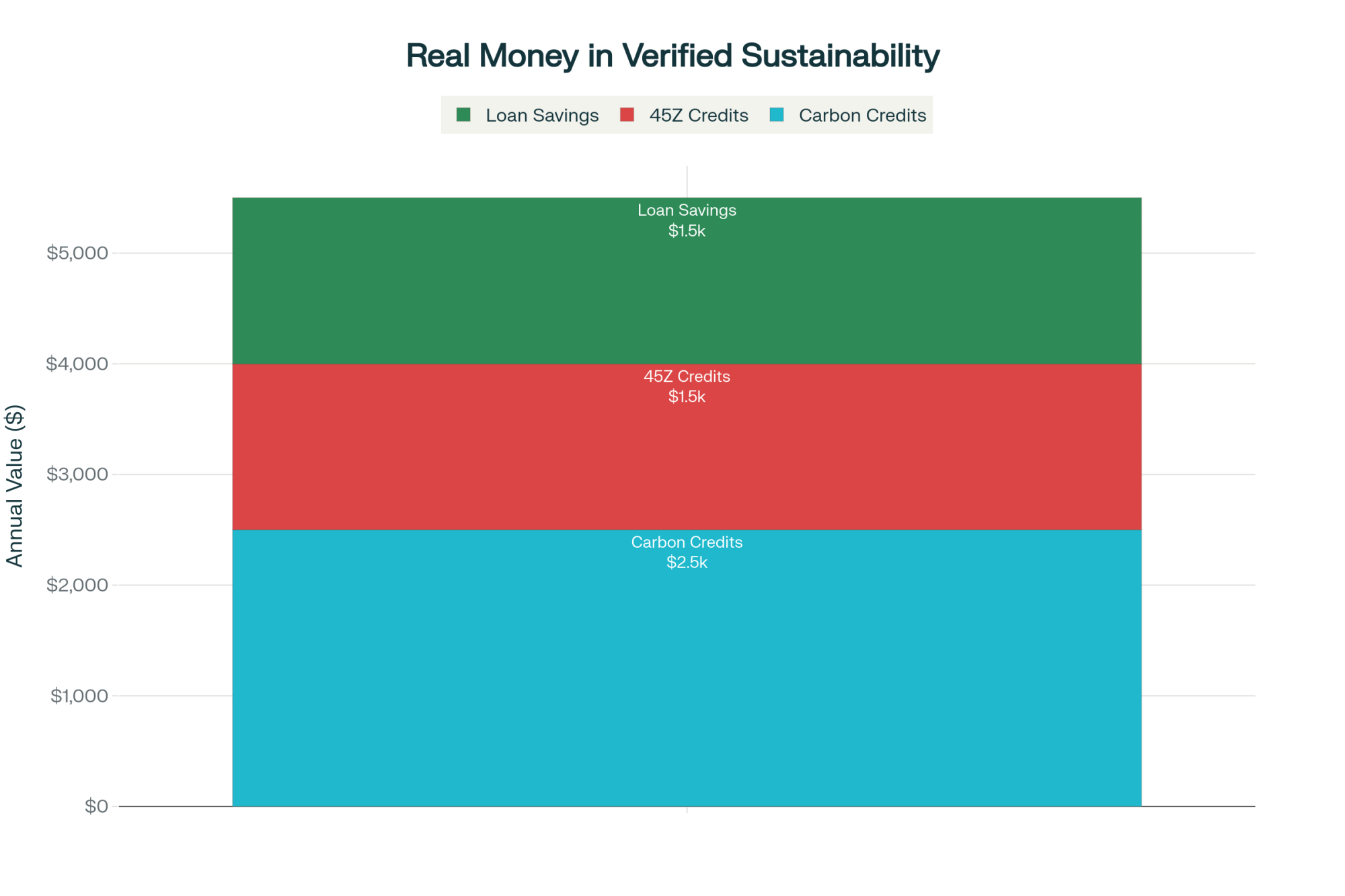
The Athian Marketplace certifies U.S. livestock emission reductions and has paid between $15 and $35 per metric ton of CO₂ equivalent, depending on verification costs. Because Athian’s model passes roughly 75 percent of each credit’s value back to the farm, producers keep the majority of the payout.
2. Federal Incentives
The 45Z Clean Fuel Production Credit pays for verifiable reductions in carbon intensity—not acres or estimates, but actual farm numbers. Feed and manure efficiencies documented through FARM ES can qualify as part of these performance‑based credits.
3. Financing Leverage
Lenders like CoBank and Farm Credit Council are piloting sustainability‑linked loans that reduce interest rates for verified operations. A FARM ES audit doesn’t just help with policy—it can make capital cheaper.
Together, these programs show how verified data shifts from compliance paperwork to productive income. One organized afternoon can turn recordkeeping from routine into return.
Verified sustainability isn’t a cost—it’s a cash machine. Between Athian carbon credits ($15-35/ton), federal 45Z clean fuel incentives, and sustainability-linked financing, farms documenting what they already do well can capture $3,000-8,000 annually. That’s real money from existing practices, not futuristic pipe dreams.
Why Some Tech Never Delivers ROI
Many of us have watched a promising piece of farm technology fizzle. The problem often isn’t the device—it’s the data.
Here’s the brutal truth nobody wants to admit: incomplete recordkeeping kills 70% of tech investments—more than bad training, poor integration, or infrastructure gaps combined. The sexiest robotic milker can’t fix sloppy data habits. Master the boring basics (consistent herd records, feed logs, health tracking) before you drop six figures on shiny toys
A 2024 Journal of Dairy Science study found that about 70 percent of U.S. dairies adopting new digital systems didn’t hit ROI targets in the first 18 months, mainly due to incomplete or inconsistent data. One feeder logs as‑fed weights while the nutritionist records dry matter. Treatments get entered late. Before long, the system’s analytics are unreliable, and confidence fades.
Brutal honesty: 70% of dairy tech investments fail to deliver ROI. But here’s the pattern winners follow—they strengthen what good farmers already do well (sensors amplify observation; feeders optimize nutrition) rather than trying to replace human judgment. Buy tools that make you better, not machines that think they can replace you.
University of Wisconsin Extension specialists remind producers that digital accuracy depends on analog habits. Just as inconsistent milking prep ruins routine, inconsistent data entry ruins results. The farms that use tech profitably treat recordkeeping like herd health: daily, disciplined, verified.
Mindset Over Machinery
Paul Windemuller, a Michigan producer and 2024 Nuffield Scholar, puts it plainly: “Technology should strengthen what good farmers already do well—not take over their jobs.”
Windemuller’s international research—shared at the IDF World Dairy Summit—found that farms using automation to amplify stockmanship saw higher ROI than those expecting machines to replace experience. It’s a point echoed by researchers at the University of Agricultural Sciences (Sweden) and Danish Extension: operations treating technology as an extension of stockmanship achieved better herd health, higher butterfat stability, and lower labor turnover.
It all comes back to mindset. The best farms use technology to earn back time—not give it away to screens. They don’t chase innovation for its own sake—they fit it to their team and goals.
The 70/30 Success Pattern
Out of hundreds of farms tracked in adoption studies, about 30 percent achieve sustained ROI from dairy technology. Their success habits share a pattern:
Start simple. Focus on one clear metric—say, butterfat‑to‑protein ratio or feed conversion—and master it before adding more.
Assign accountability. One “data captain” ensures consistency across team members.
Expect lag time. Smaller herds might need 6–9 months to reach stable results; larger herds, a full year.
Link systems. Connecting herd, feed, and parlor software reduces manual entry errors by 40–50 percent, according to UW Extension research.
These behaviors create measurable gains. Annual feed savings typically range from $10 to $15 per cow, often achieved before new hardware is installed.
Why U.S. Dairies Can Move Faster
Europe’s verification model rewards patience; ours rewards practicality. Because private‑sector partnerships drive most American initiatives, change happens barn‑by‑barn instead of country‑by‑country.
Some examples already proving useful: - Athian Marketplace, a carbon exchange explicitly designed for livestock, keeps most income on farms. - Milk Sustainability Center, built by John Deere and DeLaval, links soil, feed, and milk data in one platform. - Farm‑Twin, from Scotland’s Rural College, is open‑source and now adapted for North American dairies to simulate feed or manure outcomes before investing.
These tools work exactly where many producers excel—through efficiency and autonomy.
Your First Step
If you want to get started quickly, schedule a FARM ES assessment. Almost everything you need—DHIA production data, feed summaries, herd inventories, energy records, and manure plans—is already in your files. For most farms, the process takes half a day.
Midwest pilot programs in 2024 showed farms completing verification in a single session. One co‑op manager summed it up best: “It’s not about being perfect—it’s about documenting progress.” Those verified numbers can then be applied to farm loans, processor requirements, or carbon credit programs with confidence.
Consistency Outperforms Complexity
Veteran producers remember when DHIA testing was “extra work.” Now, you wouldn’t run a herd without it. Data verification will follow the same curve.
From Wisconsin free‑stalls to California dry lots to Vermont pasture systems, farms that treat recordkeeping as another layer of herd health management are already ahead. Clean data isn’t bureaucracy—it’s evidence of good farming.
The Bottom Line
Technology doesn’t make great dairies—people do. The producers pairing their practical know‑how with verifiable data are defining what’s next. Verification isn’t red tape; it’s a receipt for the hard work this industry has already done to feed the world efficiently and responsibly. And now, we get to prove it.
Key Takeaways
Across the U.S., farms are learning that clean, consistent data turns management into money—through carbon markets, 45Z credits, and low‑interest loans.
FARM Environmental Stewardship Version 3 helps producers prove what they already do well, using herd records, feed sheets, and energy logs they already track.
American dairies outperform Europe on efficiency; now it’s time to put those numbers to work.
The best ROI in technology isn’t from buying more—it’s from managing better.
Producers who verify now will set the standard, earning sustainability premiums while strengthening dairy’s public trust.
Complete references and supporting documentation are available upon request by contacting the editorial team at editor@thebullvine.com.
Learn More:
The Carbon Credit Programs Every Dairy Should Join Before 2026 – This strategic analysis expands on the financial incentives by detailing actual carbon revenue streams, providing specific return figures (up to $450 per cow), and revealing the crucial differences between voluntary and compliance markets. It offers deep economic context for the sustainability verification advocated in the main article.
Tech Reality Check: The Farm Technologies That Delivered ROI in 2024 (And Those That Failed) – This innovation-focused piece provides specific performance metrics for technology like robotic milkers, demonstrating with hard data why top-performing farms achieve 42% more output than struggling operations. It complements the “Mindset Over Machinery” section by showing precisely how execution drives or destroys ROI.
From Data to Dollars: Small Steps to Maximize Dairy Profits Through Accurate Herd Management – This tactical article provides actionable implementation steps, demonstrating how common data entry errors (e.g., missed dry-off lists or wrong pen counts) cascade into costly mistakes. It provides the “how-to” guide for achieving the data discipline foundational to both technology ROI and FARM ES success.
Join the Revolution!
Join over 30,000 successful dairy professionals who rely on Bullvine Weekly for their competitive edge. Delivered directly to your inbox each week, our exclusive industry insights help you make smarter decisions while saving precious hours every week. Never miss critical updates on milk production trends, breakthrough technologies, and profit-boosting strategies that top producers are already implementing. Subscribe now to transform your dairy operation’s efficiency and profitability—your future success is just one click away.
If 20,000 clean tests can’t stop what’s coming in 60 days, what exactly are we measuring?
EXECUTIVE SUMMARY: What farmers are discovering through Wisconsin’s H5N1 situation is that negative bulk tank tests don’t mean what we think they mean—UC Davis documented California farms with 5-10% infection rates persisting up to three weeks before detection thresholds triggered, and with 3.5 million birds just depopulated at Jefferson County’s Daybreak Foods facility, that silent spread window becomes critically important. The financial stakes are sobering: Ohio State Extension calculates $504 per infected cow in direct losses, meaning a 30% infection rate in a 650-cow herd translates to $98,000 in immediate impact, not counting the long-term production losses Cornell’s pathology studies show from mammary tissue damage. Here’s what makes this particularly urgent: epidemiological models from Iowa State and the University of Minnesota suggest a 60-75% probability that several Jefferson County dairy operations already harbor undetected infections, with Wisconsin’s first confirmed dairy case likely occurring between December 2025 and January 2026. The encouraging news is that farms implementing three strategic preparations now—securing 90 days of operating capital, investing $800 in USDA Dairy Herd Status certification, and forming cooperative purchasing groups—position themselves to capture the $2-3/cwt premiums processors are offering for disease-free milk, worth $255,500 annually for a 500-cow operation. With Wisconsin’s strong cooperative traditions and emerging real-time monitoring technologies from UW-Madison, producers who act decisively in the next 60 days can navigate this challenge while maintaining operational control and market access.
You know, the disconnect between Wisconsin’s “Gold Status” and what’s actually happening 2.1 kilometers from this Palmyra dairy parlor tells you everything about our surveillance blind spots.
That’s what a third-generation producer shared with me last week. His question is resonating throughout Wisconsin’s dairy community: “If we’ve tested 20,000 milk samples with zero detections, why do I feel less secure now than I did six months ago?”
And here’s the thing—his concern makes perfect sense when you understand what’s unfolding at the Daybreak Foods facility just down the road. This September, according to Wisconsin DATCP’s reports, they depopulated 3.5 million laying hens. That’s their second major H5N1 outbreak since 2022. Same facility, same biosecurity protocols, but the implications for neighboring dairy operations? They’ve evolved considerably.
What’s interesting here is how our monthly bulk tank testing for Wisconsin dairy H5N1 surveillance might be capturing only part of the picture. We’re maintaining clean results statewide, sure. But insights from California’s recent dairy experience, combined with emerging environmental research on avian influenza dairy transmission, suggest there’s more to this story than those negative test results tell us.
Note: Some producer names and specific operational details have been modified to protect privacy while accurately representing industry perspectives.
Understanding Surveillance Limitations in Practical Terms
The 2-3 week detection gap means bulk tank testing reveals infections only after 30% of your herd is already compromised—giving producers a critically narrow window to respond
KEY DATA POINTS (check the summary boxes for quick reference):
Detection threshold: 10,000 viral copies/mL
Typical Wisconsin herd size: 387 cows
Pre-detection infection window: 2-3 weeks
Herd prevalence needed for detection: ~30%
Let’s talk about what that monthly bulk tank test actually tells you—and maybe more importantly, what it doesn’t.
The CDC and USDA surveillance methodology sets the detection threshold at approximately 10,000 viral copies per milliliter. That’s the level that triggers a positive result. To put that in perspective, it’s like trying to find a teaspoon of salt dissolved in a swimming pool—you need a certain concentration before your test picks it up. Now, if you’re milking around 387 cows—pretty typical for Wisconsin according to the 2022 Census of Agriculture—you’d need roughly one-third of your herd actively shedding high viral levels to reach that threshold.
This builds on what we’ve seen in California. Their Department of Food and Agriculture documented farms with 5-10% infection rates that persisted for two to three weeks before bulk tank concentrations triggered detection. The UC Davis response team’s analysis from September 2024 revealed something sobering: by the time monthly testing identifies a positive, the outbreak has typically been progressing for several weeks already.
Think about the practical implications here. Twenty cows in early-stage infection, each shedding below detection levels? Your bulk tank shows negative. Meanwhile, you might notice subtle production drops that seem attributable to weather changes or that new ration you’re trying. Research published in the Journal of Dairy Science last September demonstrates how the virus can spread through milking equipment during this subclinical phase, allowing for cow-to-cow transmission before anyone is aware of a problem.
Environmental Persistence: An Underappreciated Factor
One of the more sobering developments comes from Iowa State University’s research published in Environmental Science & Technology Letters. They documented H5N1 genetic material in groundwater wells during the 2015 poultry outbreak—and we’re not talking surface water here. Actual groundwater contamination. Three of the twenty wells tested positive for influenza markers.
This fundamentally changes how we need to think about environmental risk, particularly in Jefferson County’s context. Southeast Wisconsin’s Crawfish River watershed—you know, the area between Madison and Milwaukee—encompasses 178 square miles according to Wisconsin DNR watershed data. Daybreak’s Palmyra facility sits right within this drainage system. So when composting operations handle 3.5 million infected birds during October’s typical rainfall patterns… well, the runoff implications become pretty significant for any Wisconsin dairy H5N1 exposure zones.
I spoke with a producer near Johnson Creek who’s taken proactive measures. He’s invested about $3,000 in UV water treatment for his pond system. Not because anyone’s requiring it, but because that water eventually connects to the Crawfish River system. His reasoning was straightforward: preventive investment versus potential losses.
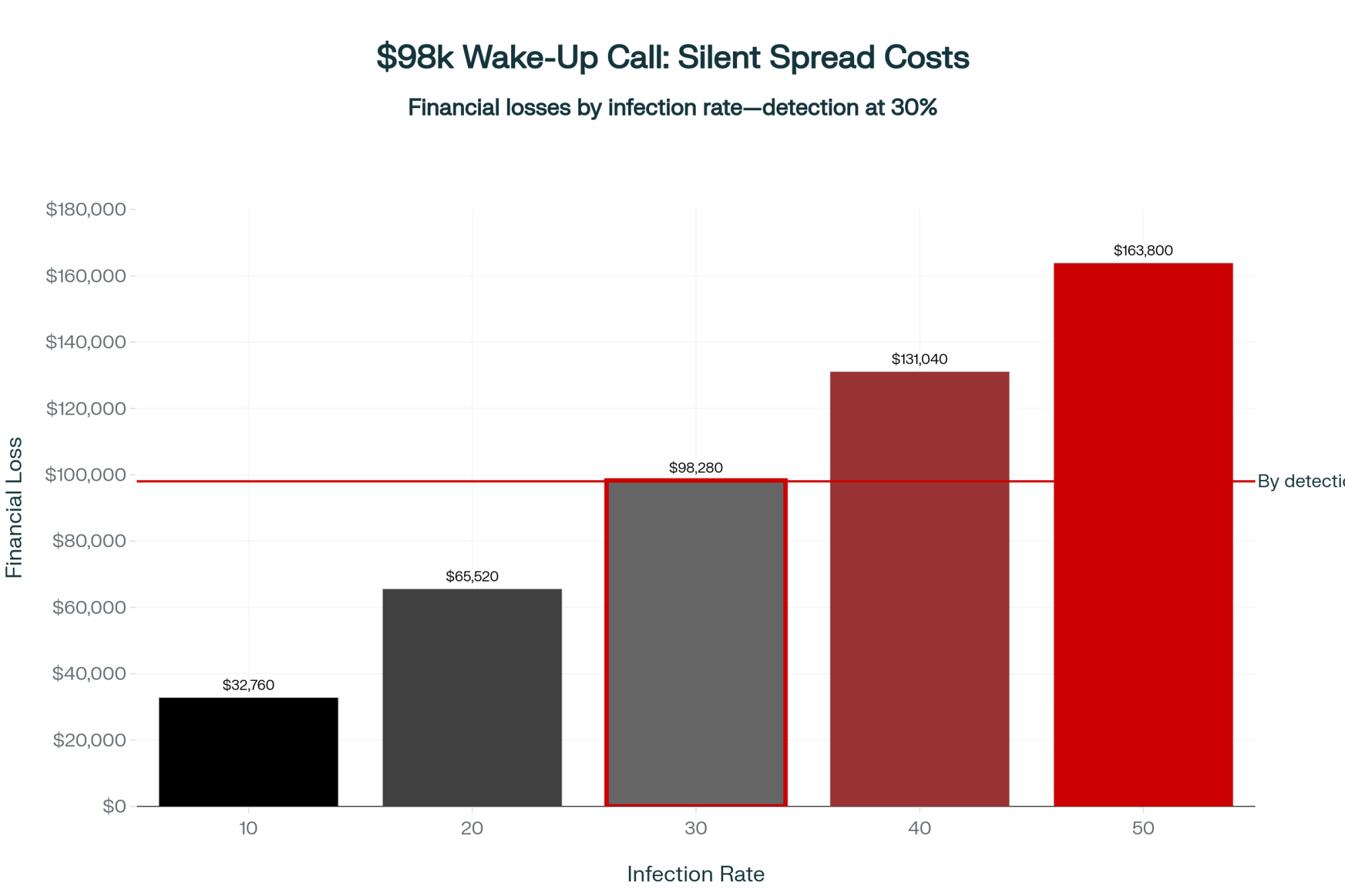
Ohio State Extension’s economic analysis from June suggests approximately $504 per infected cow in direct losses. For a 650-cow operation? Even 30% infection rates could mean $98,000 in immediate impact. And that doesn’t account for the long-term production losses that Cornell’s veterinary pathology studies have documented from mammary tissue damage.
By the time bulk tank tests detect H5N1, a 650-cow operation faces $98,000 in direct losses—and that’s before accounting for long-term production declines Cornell documented from mammary tissue damage.
Market Dynamics and Structural Changes
The industry consolidation we’ve witnessed—Wisconsin lost 39% of dairy farms between 2017 and 2022, according to the USDA’s Census of Agriculture—takes on new dimensions during disease events. Operations exceeding 2,500 cows increased from 714 to 834 nationally during this period, as the USDA Economic Research Service reported this February. It’s an ongoing structural shift that disease events seem to accelerate.
California’s experience really drives this home. When H5N1 affected 75% of their dairy herds last year, the shortage of EU export-eligible milk created significant market disruptions. And here’s what’s particularly relevant for Wisconsin producers dealing with potential avian influenza dairy transmission: it hit Class III and Class IV products the hardest—you know, the cheese and milk powder that dominate our export markets.
Several procurement managers at major cooperatives told me—speaking on condition of anonymity due to competitive considerations—they’re offering $2-3 per hundredweight premiums to farms with documented disease-free status. Do the math on that. For a 500-cow operation at current production levels? That’s over $255,000 in additional annual revenue.
The processor perspective makes sense when you think about it. European customers require guaranteed disease-free milk for export contracts, especially for those Class III cheese and Class IV powder products. Sourcing from verified operations becomes a market necessity, not a preference. This creates what’s essentially a two-tier system where quarantine zone farms—even ones that never test positive—lose access to premium markets.
What’s worth considering is how this affects different cooperative structures. Some co-ops are exploring risk-pooling arrangements to protect members. Others are moving toward individual farm accountability. Neither approach is inherently right or wrong—they’re different philosophies about collective versus individual risk management in our evolving dairy landscape.
Strategic Positioning Among Progressive Operations
With processors offering $2-3/cwt premiums for disease-free certification, the $800 investment in USDA Dairy Herd Status documentation generates $12,000-$18,000 in annual premium access for a 500-cow operation—a return that dwarfs the initial cost
FINANCIAL PREPAREDNESS CHECKLIST (see summary boxes throughout):
Target: 90 days of operating expenses in accessible capital
Typical mid-size need: $135,000
Credit line setup: Complete before crisis
Documentation investment: $800-$1,500
Potential annual return: $12,000-$18,000
Looking at farms that successfully navigated California’s outbreak, there’s a consistent preparation pattern worth considering.
A producer near Fort Atkinson recently restructured her operating line—not from immediate need, but for contingency planning. With about 420 cows, she negotiated $150,000 in available credit through her regional bank. As she explained it: “Having accessible capital that sits unused costs virtually nothing. Needing it during a quarantine when approval becomes difficult? That could mean the difference between weathering the crisis and forced liquidation.”
Agricultural economists at UW-Madison’s Center for Dairy Profitability suggest maintaining 90 days of operating expenses in accessible capital. For mid-sized operations, that typically means around $135,000 based on monthly costs averaging $45,000 for feed, labor, utilities, and debt service.
Documentation is equally important. Several producers have enrolled in USDA APHIS’s Dairy Herd Status Program. The investment—about $800 in veterinary documentation time, according to participating veterinarians—provides official disease-free certification. Given the current Class III differentials reported by USDA Agricultural Marketing Service, this certification could generate $12,000-$18,000 annually in premium access if processors implement tiered pricing based on disease status. Not a bad return on $800, if you ask me.
Beyond the certification, you know, there’s also federal disaster assistance to consider. USDA’s Emergency Assistance for Livestock program can provide some support, though it typically covers only partial losses, and payments can lag 60-90 days behind the actual crisis.
Projected Timeline Based on Current Conditions
CRITICAL TIMELINE:
Current status: Environmental contamination is active
Probability of undetected infections: 60-75% (based on current modeling)
First detection window: December 2025 – January 2026
Preparation window remaining: 60-90 days
Epidemiologists at the University of Minnesota’s Center for Infectious Disease Research and Policy have modeled probable scenarios based on current viral pressure and migration patterns. Their October report makes for interesting reading.
As of right now, October 2025, Jefferson County faces significant environmental contamination from the Daybreak depopulation. USGS bird banding data confirms fall migration is bringing infected waterfowl through the Mississippi Flyway. Wisconsin’s temperatures are entering that 5-15°C range where USDA Agricultural Research Service studies show optimal viral survival.
Now, while the data is still developing, epidemiological models from Iowa State’s veterinary diagnostic lab suggest—based on current modeling parameters—a 60-75% probability that 3-8 Jefferson County dairy operations may already harbor low-level infections below bulk tank detection thresholds for Wisconsin dairy H5N1. These wouldn’t appear in surveillance until herd prevalence exceeds 20%.
Wisconsin’s Veterinary Diagnostic Laboratory director, along with other regional experts, estimates a 70-80% probability of the state’s first confirmed dairy detection occurring between December 2025 and January 2026. This timing reflects when October-November infections would reach detectable levels, not when initial infections occur.
Spring 2026 migration patterns will likely accelerate geographic spread. UC Davis researchers documented similar patterns in California, with 15-25% of operations in affected regions experiencing infection over 18 months. UW-Madison’s Center for Dairy Profitability models suggest this could affect 300-500 Wisconsin farms, though it’s important to note these are projections based on current understanding.
Regional Variations and Operational Considerations
Wisconsin’s seasonal patterns create unique risk profiles compared to California’s stable year-round conditions. UW-Madison School of Veterinary Medicine research demonstrates viral survival exceeding one month at 4°C. Freezing reduces aerosol transmission, sure, but spring thaw then releases accumulated viral loads precisely when your fresh cows face peak immunological stress during transition periods.
Regional differences matter considerably. Marathon and Clark counties? Lower livestock density but proximity to Mississippi Flyway staging areas. Green County’s cheese production focus and cooperative structure may provide enhanced collective biosecurity resources. Each region needs tailored approaches.
A producer near Marshfield shared an observation that really captures this challenge: “We’re more geographically isolated, but the Mead Wildlife Area brings thousands of migrating waterfowl through each spring. Last year, I counted over 300 geese on my heifer pasture pond in a single morning. Traditional biosecurity can’t address that exposure.”
This highlights something we don’t discuss enough—how wildlife management and dairy production increasingly intersect. Some operations are exploring habitat modification to reduce waterfowl attraction. Others are investing in covered water systems. There’s no perfect solution, but understanding your specific risk factors helps prioritize investments.
I remember talking with a nutritionist who shared how one farm successfully navigated a previous disease challenge—not H5N1, but Johne’s disease—by implementing similar preparedness strategies. They maintained financial reserves, documented their protocols meticulously, and when neighboring farms struggled, they were able to expand through strategic acquisition. The parallels are worth considering.
Scale-Appropriate Response Strategies
INVESTMENT RANGES BY FARM SIZE (reference these summary boxes for your operation):
Small Operations (<200 cows):
Covered feed storage: $2,000-$5,000
Water chlorination: $500-$1,000/month
Group purchasing savings: 20-30%
Mid-Size Operations (200-500 cows):
Shared UV systems: $6,000/farm (5-way split)
Cooperative vet services: 15-25% discount
Total biosecurity budget: $15,000-$30,000
Large Operations (500+ cows):
Comprehensive biosecurity: $150,000-$200,000
ROI timeline: 18-24 months through premium preservation
Acquisition positioning advantage: Significant
Let’s be honest about scale here. Smaller operations under 200 cows face challenging economics. With typical gross revenues of around $1.2 million annually, is it investing $150,000 in comprehensive biosecurity infrastructure? That’s just not feasible given current margins.
But targeted investments can provide meaningful protection. Midwest Plan Service estimates suggest $2,000-$5,000 for covered feed storage to prevent bird contamination. UW Extension research indicates that chlorinating water sources during high-risk periods costs between $500 and $1,000 per month. And you know what’s working well? Several smaller farms are forming purchasing groups to achieve volume discounts on sanitizers and supplies. That’s practical cost management.
Mid-size operations—200-500 cows—they’re in a tough spot. Too large for minimal measures but often lacking capital for major upgrades. A group near Watertown developed an innovative solution, though. Five neighboring farms formed a purchasing cooperative, negotiating bulk pricing on sanitizers, group veterinary consulting rates, and they’re sharing a UV water treatment system that rotates between farms during high-risk periods. Makes $30,000 investments feasible when split five ways.
Larger operations face different calculations entirely. Penn State Extension’s August analysis suggests $150,000-$200,000 biosecurity investments may pay for themselves through premium preservation alone. Several large operators have acknowledged—and this deserves honest discussion without judgment—they’re also considering acquisition opportunities that may arise if smaller neighbors face financial stress. It’s a reality of modern agricultural consolidation.
Community Resilience Through Collective Action
What’s encouraging is the Jefferson County Dairy Producers Association’s new rapid communication network for sharing surveillance results and resources. As President Mike Kemper notes, “Disease doesn’t recognize property boundaries. We can compete in the marketplace while still protecting our collective interests.”
Their bulk purchasing through United Cooperative, coordinated veterinary services with regional practices, and exploration of shared mobile UV treatment units demonstrate practical cooperation. Think about it—a $30,000 mobile unit split among ten farms means $3,000 per operation versus $15,000 for individual units that would sit idle most of the time.
This aligns with documented outcomes from other regions. California Farm Bureau Federation data from September shows 18% consolidation in the competitive Central Valley post-outbreak. Pennsylvania Department of Agriculture reports only 6% consolidation in Lancaster County, despite similar infection rates—likely reflecting stronger cooperative traditions.
The psychological toll deserves acknowledgment as well. Rural mental health professionals working with UW Extension report that monthly surveillance creates ongoing stress. Producers describe heightened vigilance, sometimes seeing symptoms that aren’t present, and losing sleep over factors beyond their control. And you know what? Seeking support during challenging times reflects strength, not weakness.
Insurance and Risk Management Considerations
You know, something that’s emerged from California’s experience—and hasn’t received enough attention—is how disease outbreaks affect insurance coverage. Most standard farm policies exclude losses from government-ordered depopulation or movement restrictions. Some carriers are developing specialized disease coverage, but premiums reflect the risk level.
You really should review your policies now, understanding exactly what is and isn’t covered. Some folks are finding that business interruption insurance may provide partial coverage if properly structured. Others are exploring captive insurance arrangements where groups of farms create their own risk pool. These aren’t simple decisions, but understanding your options before a crisis hits is crucial. That’s crucial.
And don’t forget about USDA’s Emergency Assistance for Livestock program. While it won’t cover everything, it can provide a financial cushion during the worst of it. The key is having all your documentation ready before you need it.
Looking Forward: Emerging Research and Resources
What’s encouraging is the emerging research developments. The University of Wisconsin is launching a real-time environmental monitoring network specifically for agricultural watersheds, with Jefferson County among the pilot sites. This could provide early warning capabilities we currently lack.
Additionally, new rapid on-farm testing technologies are in the final stages of validation. These could allow individual cow testing at costs approaching bulk tank sampling, potentially closing the detection gap we currently face. While not yet commercially available, stay informed about these developments through your veterinary channels.
And here’s what’s also promising: the growing recognition that Wisconsin’s strong cooperative traditions position us better than most regions to navigate these challenges. The combination of shared resources, collective purchasing power, and information networks creates resilience that purely competitive markets can’t match.
The Bottom Line
Wisconsin’s window for strategic positioning is closing. The choice is clear: act on the 60-90 day timeline driven by epidemiological data and California’s documented experience, or react to the market’s timeline when the first positive bulk tank is confirmed in a Jefferson County dairy outbreak.
Your biosecurity overhaul starts with three immediate steps: secure 90 days of operating capital, invest $800 in USDA Dairy Herd Status certification, and join or form a local purchasing cooperative to reduce biosecurity costs by 20-30%. The data shows Wisconsin’s strong cooperative traditions position us better than most regions—but only if we use that advantage decisively in the next 60 days.
Use the resources below to start your plan today.
For biosecurity guidance and USDA Dairy Herd Status Program enrollment, contact your herd veterinarian or visit aphis.usda.gov. Wisconsin DATCP provides current H5N1 updates at datcp.wi.gov. Mental health support for Wisconsin farmers is available through the Farm Center hotline at 1-800-942-2474.
KEY TAKEAWAYS
Financial preparedness beats perfect biosecurity: Secure 90 days operating capital (approximately $135,000 for mid-size operations) before crisis limits your options—Wisconsin agricultural lenders confirm accessible credit makes the difference between weathering disruption and forced liquidation at 60-70% valuations.
The $800 investment that returns $12,000-$18,000: USDA’s Dairy Herd Status certification provides official disease-free documentation that processors increasingly require for Class III and IV export premiums. One day of veterinary paperwork creates market differentiation when EU contracts require guaranteed clean milk.
Scale-smart biosecurity saves 20-30% through cooperation. Small farms, which cover feed storage ($2,000-$5,000) and chlorinate water ($500-$1,000/month), see meaningful protection. In contrast, five-farm cooperatives sharing a $30,000 UV system reduce individual costs to $6,000. Jefferson County producers are already proving this model works.
Your location matters more than your size: A 200-cow dairy within 5 kilometers of composting poultry faces a higher risk than a 1,000-cow operation in isolation—map your actual exposure using watershed data and prevailing winds, not arbitrary regulatory boundaries that the virus doesn’t recognize.
The 60-day window determines your position: Based on California’s documented 18% consolidation rate and current epidemiological modeling, Wisconsin producers acting before December’s probable first detection maintain strategic options, while those reacting after face whatever terms the market dictates—the difference between consolidator and consolidated.
Complete references and supporting documentation are available upon request by contacting the editorial team at editor@thebullvine.com.
Dairy Profit Squeeze 2025: Why Your Margins Are About to Collapse (And What to Do About It) – Go beyond H5N1 to understand the broader economic forces crushing IOFC margins below and the structural impact of trade tariffs on Class III/IV exports. This article provides the critical market context needed to strategically position your farm against a perfect storm of collapsing prices and surging costs.
New Testing Strategies for Dairy Calves Can Reduce Johne’s Disease by 30% – Explore how advanced diagnostic technologies like Fecal PCR and Phage-Based Tests are closing the “detection gap” for another chronic disease. This piece demonstrates the economic necessity of moving beyond bulk tank surveillance, providing cost/accuracy comparisons of the innovative testing needed to maintain herd health and boost profitability.
Join the Revolution!
Join over 30,000 successful dairy professionals who rely on Bullvine Weekly for their competitive edge. Delivered directly to your inbox each week, our exclusive industry insights help you make smarter decisions while saving precious hours every week. Never miss critical updates on milk production trends, breakthrough technologies, and profit-boosting strategies that top producers are already implementing. Subscribe now to transform your dairy operation’s efficiency and profitability—your future success is just one click away.
When everyone zigs to beef breeding, who profits from zagging to heifer production?
EXECUTIVE SUMMARY: What farmers are discovering right now is that political promises about cheaper beef can’t change the biological timeline of cattle production—and that’s creating a remarkable opportunity. With the U.S. cattle herd at just 86.7 million head (the smallest since 1951) and dairy heifer inventories hitting a 47-year low of 3.91 million, we’re looking at an 18-month window where strategic breeding decisions could mean the difference between netting $160,000 in profit or scrambling to buy $4,500 replacement heifers. Recent CoBank analysis shows that 72% of dairy farms now using beef semen have collectively eliminated nearly 428,000 potential replacements from the pipeline, creating what economists call a “coordination failure” that rewards contrarian thinking. The Minnesota producer who shared his strategy of sacrificing $75,000 in immediate beef premiums to potentially net $270,000 in heifer profits after raising costs when everyone else needs them might just have the right idea. With genomic testing at $40-50 per head providing the roadmap, sexed semen achieving 90% female conception rates, and new LRP insurance offering downside protection at $26 per head, farmers have the tools to navigate this unprecedented market dynamic. Here’s what this means for your operation: The decisions you make about breeding strategies in the next 30 days will resonate through your balance sheet for the next two years.
I was talking with a Wisconsin producer, when the latest political announcement about beef imports sent cattle futures tumbling. “There goes my breeding strategy,” he said, using his phone to recalculate.
But here’s the thing—whether it’s trade deals, import policies, or market volatility, these announcements are just the latest reminder of what we’re really dealing with: a fundamental supply-demand imbalance that political promises can’t fix overnight.
The fundamentals tell an interesting story. According to the USDA’s January inventory, we’ve got 86.7 million head of cattle in the U.S., the smallest herd since 1951. Beef cow numbers? Just 28.7 million, the lowest since 1961.
This year’s calf crop is coming in at 33.1 million head, the smallest on record.
And dairy farms? Well, about 72% are now using beef semen in their breeding programs to some degree. That’s become standard operating procedure, especially when beef-cross calves are bringing $1,000-plus while Holstein bulls fetch maybe $100.
When you factor in the $2,400 cost to raise each heifer, the economics flip dramatically—beef-focused operations lose $145,900 annually while strategic heifer producers turn a $56,000 profit by selling surplus replacements into the $4,200 market
The Three-to-Four Year Reality Check
U.S. cattle numbers hit their lowest point in 73 years while dairy heifer inventories plummet to a 47-year low—the biological timeline means this supply crunch will persist for 18+ months regardless of policy changes.
A central Pennsylvania dairyman explained it to me perfectly: “Politicians can promise whatever they want, but a heifer I keep today won’t drop a calf until July 2026. And that calf? It won’t be beef until 2028.”
That biological timeline matters more than any trade deal.
Think about what this means for dairy operations. While beef producers struggle with rebuilding (and most can’t with current drought conditions in parts of the country), dairy farms have positioned themselves at an interesting crossroads. They’re producing premium beef-cross calves into a supply-constrained market. But they’re also creating their own replacement heifer shortage.
CoBank’s August analysis put some hard numbers on this. Dairy heifer inventories hit 3.91 million head in January 2025—that’s a 47-year low, down 18% from 2018.
I remember buying nice springers for $1,600 five years ago. Last month, a neighbor paid $4,100 for a comparable animal.
Small Operations Need Different Strategies
One thing that doesn’t get enough attention—operations under 200 cows face unique challenges with this beef-on-dairy approach. The genomic testing investment hits harder proportionally. They might not have volume for forward contracts. And losing even a few replacements to disease can derail their program.
Here’s what a 150-cow dairy might look like with a conservative approach:
Total: 84 potential replacements when they need 45
Farm Size
Beef %
Replacements Needed
Heifers Produced
Safety Buffer
Genomic Investment
Beef Revenue
Heifer Net Profit
Total Net Opportunity
150 cows
20%
45
84
+39 (+87%)
$6,750
$33,000
$62,400
$95,400
500 cows
30%
165
240
+75 (+45%)
$22,500
$82,500
$120,000
$202,500
1,200 cows
35%
380
470
+90 (+24%)
$54,000
$115,500
$144,000
$259,500
Note:Small operations require higher safety buffers (87% vs 24%) to protect against disease events and culling variations—justifying lower beef percentage
This gives them a 39-heifer buffer for selection and sales while still capturing some beef premiums. Compare that to a larger operation going 35% beef, and you can see why smaller dairies need that extra cushion.
But whether you’re running 150 cows or 1,500, certain strategies are proving successful across the board.
Learning from Operations That Are Making It Work
The 40-25-35 genomic breeding strategy transforms a $45 test into a quarter-million-dollar roadmap—directing elite genetics to sexed semen while capturing beef premiums from low-merit animals.
A 1,200-cow operation near Tulare showed me their approach recently. They’re spending about $45 per calf on genomic testing, which sounds expensive until you consider the alternative.
Now, let’s be clear about the economics here. It costs about $2,400 to raise a heifer from birth to calving, according to 2024-2025 university research. So when we talk about selling a springer for $4,000, the net profit is around $1,600 per head. That’s still exceptional money, but it’s important to understand we’re talking net, not gross.
“Without genomic data,” their manager explained, “we were making quarter-million-dollar breeding decisions based on whether a cow looked good or had mastitis last month.”
Their approach is pretty straightforward:
Top 40% by genomic merit get female-sexed semen (about 90% heifer calves)
Middle 25% get conventional Holstein semen
Bottom 35% go to Angus or SimAngus
This generates roughly 460 to 480 replacement heifers when they need 380.
Those extra 80 to 100? At current prices, with $2,400 in raising costs per heifer, that could be $128,000 to $160,000 in net profit. That’s $4,000 selling price minus $2,400 raising cost = $1,600 net per heifer. Though, as one producer wisely noted, “That’s if the market holds.”
Quick Reference: Genomic Breeding Strategy
Top 40%: Female-sexed semen only
Middle 25%: Conventional dairy semen
Bottom 35%: Beef semen exclusively
Result: 460-480 heifers produced when 380 were needed
The Insurance Most People Haven’t Heard About
Since July 1, USDA’s Risk Management Agency has offered Livestock Risk Protection for beef-on-dairy calves. A crop insurance agent in Iowa broke it down for me: “For about $26 per head, you can protect 95% of expected value on those beef crosses. Apply at least 30 days before you expect to sell.”
Let’s say you’re breeding 150 cows to beef (30% of a 500-cow herd). At $1,100 per calf, that’s $165,000 in expected revenue.
Insurance runs about $3,900 to protect $156,750 of that value.
If imports flood the market and beef crosses drop to $700? The policy covers the difference. Not bad for peace of mind.
Spring 2026: When Everything Converges
Looking at CME futures and talking with dairy economists, April through June 2026 could get interesting—and not in a good way.
Class III milk futures for that period are trading around $17.00 to $17.50 per hundredweight. At those prices, modeling suggests 60-70% of operations could face negative margins before replacement costs.
April-June 2026 convergence of $17.50 milk, $4,500 replacement heifers, and potentially crashed beef-cross values creates perfect storm—operations positioned as heifer suppliers will weather this squeeze.
Add in replacement heifers potentially exceeding $4,500, and if beef-cross values crash to $400-600 from expanded imports?
A Midwest nutritionist ran the numbers for me: “At $17.50 milk, $4,500 replacements, and $500 beef calves, we’re looking at annual deficits that would stress even well-capitalized operations.”
The Squeeze on Different Operation Types
What’s interesting is how this hits different farms:
Grazing operations might actually weather it better with lower input costs
Organic dairies face unique challenges—their premiums help, but replacement options are limited
Conventional confinement operations see the full brunt of feed and replacement costs
Why Your Location Changes Everything
What works in Wisconsin’s climate doesn’t translate to Arizona’s heat or Vermont’s grazing systems.
A Texas dairyman managing 2,500 cows shared something revealing: “Our sexed semen conception drops 12-15% in summer. We concentrate sexed breeding from November through March, then shift toward beef when heat stress peaks.”
Their cull rate also runs higher—approaching 38%—which limits how aggressive they can be with beef breeding overall.
Feed economics adds another layer. Pennsylvania producers buying delivered corn at $5.40 per bushel face different economics than Indiana neighbors seeing $4.20 on farm.
That $1.20 difference shifts beef-cross break-evens by $60-80 per head.
And LRP insurance basis risk varies regionally, too. Southern dairy areas sometimes see $75 basis swings that rarely occur in Wisconsin.
The Collective Action Problem Nobody Talks About
Here’s what’s genuinely revealing. Each farm breeding more cows to produce beef makes perfect individual sense. Quality beef crosses bring $1,000-plus while Holstein bulls fetch $100. The math is obvious.
But with 72% of the industry now using beef semen, we’ve collectively created the replacement shortage now driving heifer prices to record levels.
What’s different this time is technology. Modern sexed semen achieving 90% female conception rates means farms can pursue beef revenue from lower-merit animals while maintaining replacements from elite genetics. That wasn’t feasible even a decade ago.
Several economists suggest we’re heading toward a new baseline. Replacement heifers might settle at $2,500-$3,000rather than returning to $1,500-$2,000.
Beef-cross premiums could stabilize at $300-500 over dairy bulls instead of the historical $100-200 differentials.
Your Next Month’s Action Plan
Based on what’s working for successful operations, here’s what makes sense:
Get genomic testing started. At $40-50 per test, a 500-cow operation faces about a $22,500 investment in testing all youngstock. But compared to breeding decisions worth hundreds of thousands? It’s becoming easier to justify.
Submit samples to your genetics provider—Alta, Select Sires, ABS, whoever. Results take about two weeks.
Those genomic rankings become your breeding bible: top 40% get sexed, bottom 35% get beef, middle 25% get conventional.
Look into price protection. Your crop insurance agent (who probably handles your other coverage) can quote LRP. Current pricing suggests $25-30 per head protects about $1,100 in expected value per beef calf.
Calculate your actual needs. Here’s the math: Herd size × cull rate × (age at first calving ÷ 24) × 1.1 for non-completion.
A 500-cow herd with 30% culling needs about 165 replacements annually.
Remember to factor in raising costs. At $2,400 per heifer to raise and $4,000 to sell, each surplus heifer nets you $1,600. Even at these margins, 75 extra heifers means $120,000 in additional profit—money that goes straight to your bottom line.
Compare that to what your breeding strategy produces. If you’re generating 240 heifers but need 165, those 75 extra represent $120,000 in net profit at current prices ($4,000 sale price minus $2,400 raising cost = $1,600 net × 75 head).
Some Farms Are Zigging While Others Zag
A Minnesota producer recently explained their contrarian strategy: reducing beef semen to 15% while ramping sexed usage to 55%.
“We’re sacrificing maybe $75,000 in immediate beef premiums, but if we can sell 150 heifers at $4,200 when everyone else needs them, that’s $630,000 in revenue. After $2,400 per head in raising costs, we’re netting $270,000—still $195,000 ahead.”
Several operations are already exploring forward contracts for 2026 heifer deliveries at prices that would have seemed impossible three years ago. Some are even considering embryo transfer to multiply their best genetics—though that’s a whole different investment level.
The Challenges We Need to Acknowledge
Beef-cross calves sometimes present different health challenges, particularly respiratory issues in the first 30 days. Most operations adapt protocols successfully, but it requires attention.
Market concentration varies by region. Some areas have robust buyer competition; others see just two or three buyers controlling volume. Know your local market.
And political uncertainty remains the wildcard. Trade policy can shift quickly. While biological constraints limit immediate supply response, import changes could affect pricing relatively fast.
Looking at the Next 18 Months
The convergence of biological constraints, market dynamics, and political uncertainty suggests we’re in an 18-month window where beef-on-dairy economics remain favorable—though perhaps not at recent extreme levels.
Your decisions about genomic testing, breeding strategies, and risk management over the coming weeks will significantly influence outcomes through 2026 and beyond.
What seems clear is that cattle biology operates on its own timeline. When a significant portion of an industry moves collectively, it creates both opportunities and challenges.
The most successful operations won’t necessarily be those maximizing every premium today. They’ll be those thinking strategically about conditions 12-18 months out and positioning accordingly.
Sometimes the greatest opportunity isn’t following the crowd. It’s recognizing when collective behavior creates imbalances worth addressing.
The beef-on-dairy opportunity won’t last forever, but the window remains open for those who act strategically. This beef-on-dairy window is real. The timeline is becoming clearer. And strategic decisions made now will resonate through operations for years.
Given your specific operational constraints and risk tolerance, how will you position yourself for what’s ahead?
The answer to that question—and whether you invest in genomic testing to guide it—could be worth hundreds of thousands of dollars over the next 18 months.
Your genetics rep is waiting for your call. Make it count.
KEY TAKEAWAYS
Genomic testing ROI is compelling: A $22,500 investment (500-cow herd) guides breeding decisions worth $160,000+ in potential surplus heifer net profit when accounting for $2,400/head raising costs when using the 40-25-35 strategy (sexed-conventional-beef)
Small operations need adjusted strategies: Farms under 200 cows should limit beef semen to 20% versus 35% for larger operations, maintaining a 39-heifer buffer while still capturing $33,000 in beef premiums on 150 cows
Regional variations demand flexibility: Texas operations seeing 12-15% conception drops in summer heat need seasonal breeding adjustments, while $1.20/bushel feed cost differences between Pennsylvania and Indiana shift beef-cross break-evens by $60-80 per head
Risk protection is affordable and available: LRP insurance at $26/head protects 95% of $1,100 expected value on beef crosses—apply 30+ days before selling—providing crucial downside protection as import policies shift
The contrarian opportunity is time-sensitive: With April-June 2026 convergence of $17.50 milk, $4,500 heifers, and potential $500 beef calves, operations positioning as heifer suppliers rather than beef maximizers could capture significant premiums in the next 18 months
Complete references and supporting documentation are available upon request by contacting the editorial team at editor@thebullvine.com.
Learn More:
Beef-on-Dairy in 2025: Turning Calf Premiums into Real Profit (Without Blowing Up Your Herd) – This tactical guide provides a crucial real-world checklist, revealing best practices for managing buyer contracts and traceability paperwork. It demonstrates how to sort DHI reports monthly and stick to the 25-30% replacement rule necessary to prevent handing your beef premiums back to the replacement market.
The Heifer Shortage: Crisis and Opportunity – Go deeper on the economics of the replacement crisis. This strategic analysis provides essential USDA inventory figures, outlines how to stress-test your financials at $4,000 replacement costs, and shows how heifer retention programs can deliver up to 54% cost savings versus market acquisition.
Join over 30,000 successful dairy professionals who rely on Bullvine Weekly for their competitive edge. Delivered directly to your inbox each week, our exclusive industry insights help you make smarter decisions while saving precious hours every week. Never miss critical updates on milk production trends, breakthrough technologies, and profit-boosting strategies that top producers are already implementing. Subscribe now to transform your dairy operation’s efficiency and profitability—your future success is just one click away.
Empty show rings couldn’t kill their dreams. Nov 27-29, Europe’s dairy families finally reunite at Cremona
Preparing for Cremona’s return, I found myself thinking about something Lorenzo Ciserani once said at Sabbiona Holsteins. Not about their remarkable genetics or their 175 EXCELLENT cows. But about persistence.
“We want to breed beautiful cows that are productive and last a long time.”
Such simple words. But imagine holding onto that vision through years when those beautiful cows had nowhere to go. When “productive” was measured only in your own barn. When “lasting a long time” felt less like achievement and more like waiting for something that might never come.
What I witnessed in European dairy families during those interrupted years taught me something profound about human nature. It wasn’t continuous closure that nearly broke them—it was the cruelest pattern of all: hope, then heartbreak, then hope again.
The standard returns. LLINDE ARIEL JORDAN is named Grand Champion at the 2023 Cremona Show. This achievement—won by Spain’s SAT Ceceño—represents the pinnacle of excellence and the international standard every family is fighting to reach again after years of pandemic and disease disruption.
The Pattern That Nearly Broke Everything
First came 2020. Then 2021, 2022. Three years of pandemic isolation where exhibition halls stood empty, young handlers practiced in vacant barns, and genetics developed in solitude. Just when recovery seemed possible in 2023—when families finally started preparing animals with renewed purpose—bluetongue struck in 2024.
England reported 196 cases by this past August. Movement restrictions returned. Borders closed again. The exhibition, meant to mark a triumphant return, became another casualty.
You have to understand what this meant for families like the Beltraminos at Bel Holstein. Mauro still gets emotional talking about their beginning: “Our first heifer impressed everyone back in 1987, and that moment sparked a dream.” That dream carried three brothers through decades, earned them Grand Championships at Cremona in 2004, and victories at Swiss Expo in 2017.
But dreams need stages. And for years, there were none.
The stage they fight to return to. Pierre Boulet shakes hands with the judge Paul Trapp after winning Junior Champion at Cremona in 2023 with BEL BOEING GONDOLA. This moment represents the standard of excellence and the competitive spirit the Beltramino family—and all European breeders—have preserved during the years of interruption.
Reading the Bel Holstein family’s story reveals how they faced COVID-19, then bluetongue; yet, these experiences only strengthened their resolve. Not because they’re extraordinary. Because stopping would have meant surrendering something essential about who they are.
During the worst of it, I heard about breeders practicing their fitting skills on the same animals week after week—Francesco Beltramino and his girlfriend Chiara working in empty barns, maintaining muscle memory for competitions that might never return. One breeder told me they’d named their practice sessions “rehearsals for hope.” Dark humor, maybe. But it kept them going.
The Judge Who Carries the Weight of Understanding
Sometimes the right person appears at exactly the right moment. Nathan Thomas, accepting the invitation to judge Cremona’s 80th edition, feels like one of those times.
Here’s why Nathan matters so deeply for this moment: He doesn’t run some massive operation with unlimited resources. Triple-T Holsteins in Ohio milks about 30 cows. That’s it. Yet from that small herd, working alongside his wife Jenny and their three children, they’ve produced more than 150 All-American and All-Canadian nominations.
Just weeks ago at World Dairy Expo 2025, Nathan managed something extraordinary. Stoney Point Joel Bailey claimed her third consecutive Grand Champion Jersey title. Three years running at the pinnacle of North American showing. She stood Reserve Supreme Champion this year, with Golden-Oaks Temptres-Red-ET taking top honors, but that consistent excellence across multiple years? That’s what dairy farming really demands—not single moments of glory but sustained dedication when glory seems impossible.
The Judge Who Knows Persistence. Nathan Thomas leads the incredible Stoney Point Joel Bailey at World Dairy Expo 2025, where Bailey claimed her third consecutive Grand Champion Jersey title. This sustained dedication is the exact standard of excellence Thomas brings to judging the resilient families competing at Cremona.
When Nathan walks into Cremona’s ring this November, he brings that understanding with him. He knows what it means for a family operation to compete globally. He understands the weight these animals carry—not just genetics, but generations of hope.
What 150 Families Carry to Cremona
The statistics tell one story: More than 800 elite animals from six European nations. Seventy conference sessions. Two hundred commercial exhibitors. The Italian Trade Agency is coordinating delegations from over twenty countries.
But there’s another story those numbers can’t capture.
Think about operations like Sabbiona Holsteins. Twelve generations of homebred excellence. Not twelve years—twelve generations, each one building on what came before. Their current herd of 650 milking cows produces 42 kg per day, with a fat content of 4% and a protein content of 3.55%. They’re pushing forward with robotic milking systems, adapting, evolving.
Twelve generations of visible excellence. Sabbiona Tiky EX-96, the highest-rated Holstein in Italy, on display at Cremona. Tiky’s longevity—now in her 7th lactation—is the living proof of the Ciserani family’s belief in breeding cows that are productive and last a long time, a vision they refused to abandon through years of crisis.
Meanwhile, Bel Holstein chose a different path that’s equally valid. No robots. No automation. Francesco still clips and fits cows with his girlfriend, Chiara, and cousin, Cecilia. His brothers manage their herd—15 EXCELLENT, 59 Very Good—with the same hands-on dedication their father taught them.
Both approaches worked. Both survived. That’s the lesson—there’s no single path through crisis, only the courage to keep walking whatever path you’ve chosen.
The moment that changed everything for me was realizing these families weren’t just maintaining genetics—they were preserving identity. When you’re the third, fourth, or twelfth generation carrying forward a legacy, your animals become more than business assets. They’re living proof that what your grandparents built still matters.
The Youth Who Learned in Silence
Picture this: Young handlers across Europe spending three years learning to show cattle with no shows. Kids like Greta Beltramino at Bel Holstein, practicing their craft in empty rings, posting videos to encourage one another, and honing their skills for competitions that were repeatedly canceled.
The strength I see in this generation fills me with hope. They didn’t just endure the absence—they prepared for the return.
I heard about one group of young handlers in Germany who created a virtual showing league during lockdown, judging each other’s animals via video, maintaining the competitive spirit when actual competition was impossible. Another group in the Netherlands practiced with stuffed animals when movement restrictions prevented them from accessing their cattle. Sounds absurd until you realize they were seventeen years old, refusing to let their dreams die.
These aren’t just future farmers. They’re the generation that learned resilience before they learned what normalcy is. When they enter Cremona’s “Next Generation” competitions this November, they bring a different kind of strength—the kind forged in isolation but somehow never alone.
The future is safe. After years of cancellations, the return to Cremona isn’t just about cattle—it’s about passing the torch. The moment of triumph belongs to the generation that practiced for competitions that might never have happened.
The Morning Everything Changes
Picture November 27, 2025, with me. Dawn breaking over CremonaFiere. After years of stop-start disruption—pandemic, attempted recovery, bluetongue, more restrictions—finally, a normal morning.
The first thing you’ll notice is the sound. After so much silence, the mixture of cattle calling, equipment clanging, and conversations in six languages creates a symphony of survival. Diesel engines are warming up. Gates are swinging open. The particular squeak of well-worn wheelbarrows that haven’t been used for exhibition in too long.
Cattle trucks arriving from six countries without restriction papers, without health certificates beyond the normal, without the constant fear that someone will call saying it’s canceled again. Families seeing friends they last embraced before everything changed. Nathan Thomas is preparing to judge not just cattle, but resilience made visible.
What I find extraordinary is how ordinary it will seem to outsiders. Just another dairy show. Just farmers doing what farmers do. But you and I know better.
What Victory Actually Means Now
Every animal entering that ring has already won. Every family competing has already triumphed simply by still existing, still breeding, and still believing that excellence matters, even when it has no audience.
I keep thinking about what this means for different operations. For Sabbiona, with nearly 500 EXCELLENT cows in their history, competing again proves their philosophy endures. For Bel Holstein, returning to international competition validates that traditional methods remain relevant in an increasingly automated world.
The economic stakes are real—embryo sales and contracts worth tens of thousands, international recognition that opens new markets. But that’s not what November 27-29 is really about.
It’s about Mauro Beltramino seeing his life’s work validated. About young handlers finally experiencing what they’ve only imagined. About Nathan Thomas placing classes that represent not just this moment but all the moments that led here.
Standing there, watching families who refused to quit, even when quitting made sense, you realize you’re witnessing something sacred—the kind of sacred that happens when humans refuse to let circumstances define their limits.
The embrace of survival. After years of canceled shows, blue-tongue restrictions, and maintaining a program purely on belief, this is the moment of validation. It’s not just a win; it’s the profound, emotional relief of a community reuniting and proving that their dedication was worth the fight.
The Truth About Tomorrow
As I write this on October 18, 2025, just weeks before Cremona opens, I’m struck by how this story speaks to everyone facing their own storms. Market volatility. Family succession challenges. Technology changes that threaten traditional methods. Climate pressures that rewrite the rules.
The lesson from Europe’s dairy families is profound yet simple: Keep going. Not because success is guaranteed, but because the act of continuing is success itself.
The barn that saved their dreams wasn’t a building. It was a belief—maintained through pandemic isolation, sustained through bluetongue restrictions, preserved through every logical reason to quit.
The rhythm of European dairy life, broken so many times, will finally resume November 27-29.
Not back to normal—forward to something deeper.
These families now know they can survive anything. That knowledge changes you. Makes you both more grateful and more determined. More aware of fragility but also more certain of strength.
When I think about what awaits at Cremona—Lorenzo Ciserani seeing his family’s twelfth generation of breeding validated, young handlers like Greta Beltramino experiencing the full international exhibition, Nathan Thomas recognizing excellence forged through adversity—these moments remind me why this industry matters beyond economics.
November 27-29, 2025. Cremona, Italy.
Be there if you can. Not for the genetics, though they’ll be magnificent. Not for the business, though opportunities will abound.
Be there to witness what humans can endure, what communities can preserve, and what hope can build when it refuses to die.
Some moments remind us who we are, what we’re capable of, and why we do what we do.
This is one of those moments.
I’m eager to watch it unfold.
Key Takeaways:
Years of heartbreak created unprecedented resilience: Europe’s dairy families kept breeding excellence even when exhibitions seemed impossible
November 27-29 at Cremona isn’t just a show—it’s validation for operations that refused to quit when quitting made sense
Young handlers like Greta Beltramino learned to show cattle in empty barns—now they carry forward traditions they barely experienced
From 30-cow operations to 650-cow dairies, everyone survived differently, but everyone who survived did one thing: kept going
The lesson that changes everything: “The barn doesn’t know there’s no show next week”—maintain excellence because excellence is identity
Executive Summary:
They practiced fitting cattle for shows that never came, maintained excellence when excellence had no audience, and kept breeding for a future they couldn’t see. Europe’s dairy families endured five years of crushing stop-start disruption—pandemic closures from 2020 to 2022, brief hope in 2023, and then the devastating return of bluetongue in 2024. Through it all, operations like Sabbiona Holsteins (650 cows, 12 generations strong) and Bel Holstein (Grand Champions since 1987) refused to surrender their standards. Young handlers like Greta Beltramino learned their craft in isolation, while veterans like her father, Mauro, wondered if they’d ever compete again. Now, as November 27-29 approaches, Cremona’s 80th edition promises something profound: 150 farms from six nations, 800+ elite cattle, and Judge Nathan Thomas (fresh from Bailey’s third World Dairy Expo championship) converging to validate survival itself. When those barn doors open at CremonaFiere, we won’t just witness a livestock exhibition—we’ll see proof that human dedication transcends any crisis. Every animal in that ring represents a family that kept believing when belief seemed foolish, and that’s why this moment matters far beyond dairy.
Learn More:
Sabbiona Holsteins: Where Genetics and Passion Forge Dairy Champions – Explore the deep dive into the Sabbiona family’s 12-generation legacy, revealing how they successfully blend cutting-edge genomic selection and robotic milking with traditional passion to maintain unparalleled consistency and excellence across their 650-cow operation.
From Passion to Prestige: Bel Holstein’s Journey to Becoming a European Dairy Powerhouse – This profile demonstrates the power of hands-on, traditional family management, detailing how the three Beltramino brothers sustained their Grand Championship program through decades of crisis and disruption, validating their belief that elite cattle require intensive personal dedication.
Join the Revolution!
Join over 30,000 successful dairy professionals who rely on Bullvine Weekly for their competitive edge. Delivered directly to your inbox each week, our exclusive industry insights help you make smarter decisions while saving precious hours every week. Never miss critical updates on milk production trends, breakthrough technologies, and profit-boosting strategies that top producers are already implementing. Subscribe now to transform your dairy operation’s efficiency and profitability—your future success is just one click away.
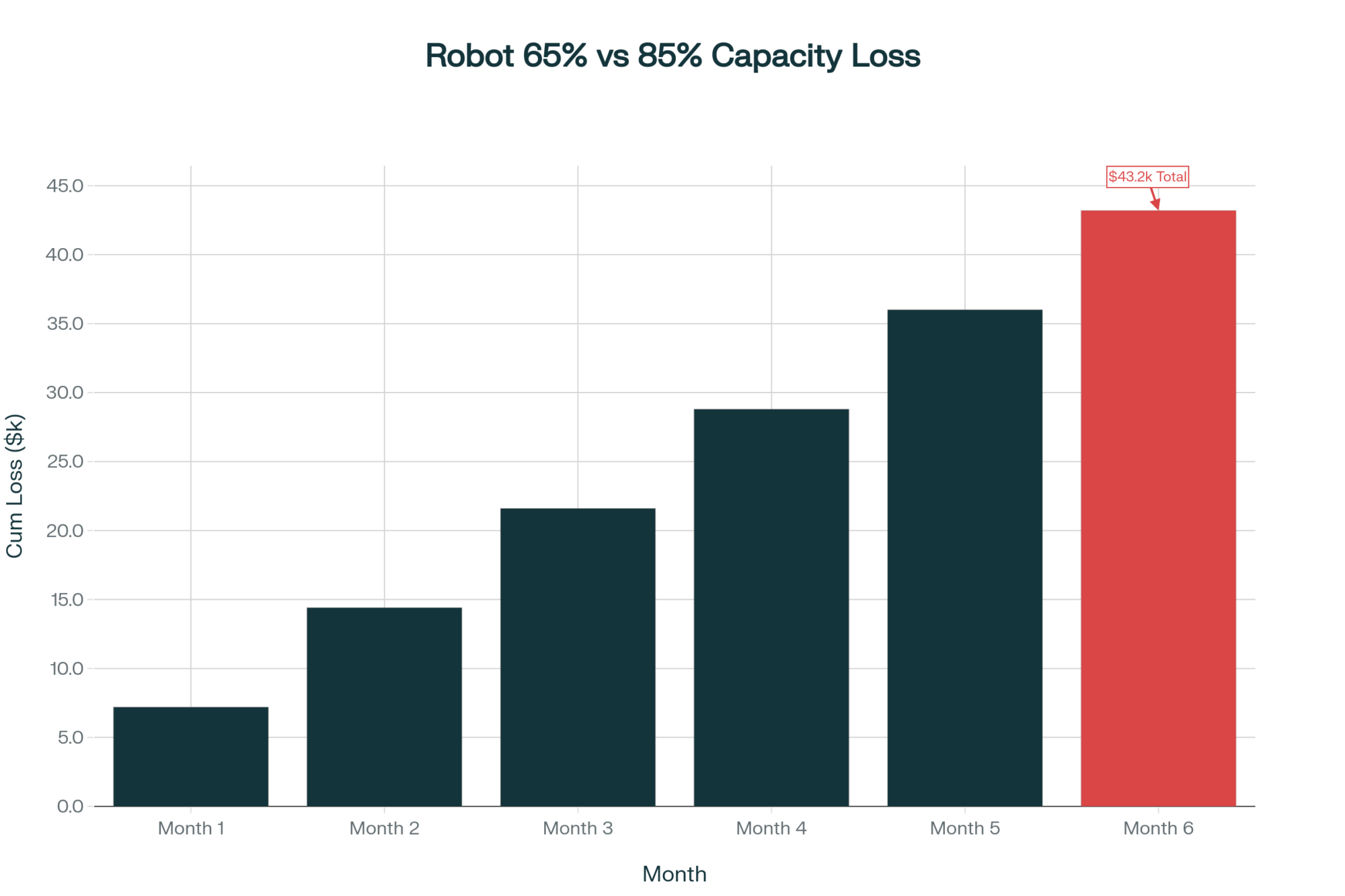
July 2025 exports soared 53% year-over-year—yet most U.S. dairy farms saw shrinking profit margins, not bigger milk checks.
Executive Summary: Dairy exports shattered records in 2025, with the U.S. shipping 1.6 billion pounds of product abroad in July alone—a staggering 53% surge compared to the prior year. But beneath those headlines, American producers are battling tight margins as block cheese dipped to $1.67/lb and Class III futures slumped below $16/cwt, despite robust global demand. Recent research and USDA data highlight that this disconnect is driven by low export pricing, aggressive global competition, and a shrinking pipeline of replacement heifers—a result of widespread beef-on-dairy breeding. While mega-operations leverage scale and small niche dairies build premium brands, mid-sized farms face contraction at a rate of 7-8%. Practical insights from universities and leading advisors reveal that strategic culling, honest financial assessment, and proactive reinvestment now will best position operations for the volatile months ahead. Looking forward, success in 2026 depends not on riding out the “old normal,” but on embracing new models—whether that means cost control, vertical integration, or value-added marketing. The choices you make today could shape your farm’s resilience for years to come.
You can’t sit around the farm kitchen table or check your milk check without someone bringing up the gap between those record-smashing export headlines and what we’re actually seeing on the farm. This year’s export stats (2025, per USDEC, USDA, and CME data) are wild—so let’s walk through the fine print, and offer a clear, honest look at what the numbers do (and don’t) mean for your bottom line.
Looking Past the Headlines: Big Numbers, Real Questions
July 2025 delivered a headline: U.S. dairy exports hit 1.6 billion pounds milk-fat equivalent—a staggering 53% higher than last year, with cheese breaking records for 13 months straight and butter exports more than doubling (USDEC, August 2025). Mexico, Southeast Asia, and the Middle East are fueling those gains. (Editorial suggestion: Here’s where a quick online chart comparing U.S. and EU butter prices, or a timeline of shrinking mid-size herds, could really drive it home.)
The brutal irony driving 2025’s dairy crisis: exports hit all-time highs while farm gate prices plummet. This inverse relationship reveals how discount export pricing—driven by aggressive global competition—is bleeding value from domestic producers. When you’re the world’s cheapest cheese supplier, volume growth becomes a liability, not an asset.
But talking with neighbors from Wisconsin to California, a different reality surfaces. Class III milk futures for November struggled below $16/cwt in October (CME Oct 2025), block cheese found a floor at $1.67/lb, and butter—the one bright spot early—crashed from $2.48/lb in August down to $1.65. Feed, fuel, and labor bills just keep nipping at margins. As Dr. Mark Stephenson at UW-Madison says, “There’s a world of difference between what’s happening on the docks and what’s happening in the mailbox.”
Why Export Growth Isn’t Filling Milk Checks
Take a closer look, and you’ll see what’s really moving: American products is cheap. U.S. butter traded at $1.65/lb in October, while EU butter held firm at $2.80/lb (EU Commission). The world always chases a bargain—and lately, we’re it.
Mexico now accounts for nearly a third of U.S. dairy exports—including over half of the nonfat dry milk produced in American plants (USDEC/USDA FAS, July 2025). However, the Mexican government’s 2025 policy papers and NMPF trade summits clearly indicate that they’re backing local dairy expansion and processing, preparing to buy less from us as soon as possible.
Think about Southeast Asia: U.S. powder lands in Vietnam or Indonesia precisely because it’s cost-effective for local processors to build finished value at home. Rabobank’s summer 2025 reports refer to it as “the Asian processing pivot.” It isn’t about U.S. branding; it’s pure economics.
CME Spot Cheese: Small Trades, Big Impact
It always comes up at local co-op meetings—how is the price for millions of pounds of milk set by just a few trades, a couple of times a week? Less than 1% of U.S. cheese goes through the CME spot market (Wisconsin JDS industry surveys, 2024), but that market sets the base for half the nation’s milk. Since the move to all-electronic trading in 2017, those price swings are sometimes driven by a single processor’s urgency, rather than real supply/demand.
Plenty of us wonder: can a handful of loads really justify moving cheese price brackets for thousands of family farms? Truth is, the market says yes—for now.
Processing Expansion: Efficiency and Exposure
You’ve likely heard the figures: since 2023, about $10 billion’s been sunk into new plants (Rabobank, Dairy Quarterly Q3 2025; Cheese Reporter, Jan. 2025). Many are capable of running over 20 million pounds daily—an incredible show of confidence in the future.
But here’s the rub: those plants need full pipelines to pay off. If exports soften or domestic demand plateaus, processors continue to churn out product, often selling it abroad at marginal prices. All too often, this reality is felt not at headquarters, but on the farm, reflected in base price pressure and pooling deductions.
Beef-on-Dairy: Quick Cash, Long-Term Crunch
Every $1,000 beef-cross calf sold today is gutting tomorrow’s milk supply. Heifer inventories have plummeted 10% in three years while prices rocketed 192%—creating a replacement crisis that will constrain expansion through 2027. The math is brutal: today’s survival strategy becomes tomorrow’s bottleneck
Talk to any extension officer or herd consultant this year, and beef-on-dairy is front and center. Those beef-cross calves fetching $800 to $1,200 (USDA AMS, 2025) are saving some farm budgets, especially when pure Holstein bulls bring half that—at best.
But the development suggests a tightening squeeze just over the horizon. USDA’s July 2025 inventory shows replacement dairy heifers over 500 lbs are at their lowest since the 1970s (just under 3.9 million head). Extension consensus (CoBank, UW, MSU) expects that, unless beef-on-dairy trends change, bred springer prices will start a strong upward climb by 2026–27, right as herds may want to rebuild. The risk is real: today’s survival could complicate tomorrow’s comeback.
The Industry Barbell: Big, Niche—Middle at Risk
UC Davis, USDA, and regional co-ops are all reporting similar realities: large, vertically integrated herds with dry lot systems and their own processing arrangements continue to gain market share—especially in the Southwest and California. Scale gives them leverage most can’t touch.
Smaller, direct-sale focused herds—think Vermont or Pennsylvania bottlers, specialty cheese producers—are thriving by telling their story, emphasizing butterfat, freshness, and a personal connection. They can get $30–$50/cwt retail. It’s not easy, but the premium is real.
Yet the traditional family operation—the 200 to 1,500 cow “community dairy”—faces the tightest squeeze. Recent USDA structure reports show these farms contracted by 7–8% in 2025. Once those barns go quiet, the loss is felt far and wide.
The middle is collapsing. Operations with 200-1,500 cows—the backbone of rural communities—are contracting at 7-8% while mega-dairies and specialty producers expand. This isn’t market evolution; it’s forced consolidation driven by scale economics that mid-sized farms simply can’t match at current milk prices.
Exit Trends: More Quiet Closures Than Court Losses
Higher-profile bankruptcies get headlines (361 Chapter 12 filings as of August 2025, US Courts), but five times that many farms have transitioned out over the year without court involvement—through voluntary sale, lender wind-down, or generational transition. Extension and local lenders across Wisconsin and Iowa confirm this broader landscape. Every exit isn’t just less milk; it’s a ripple to schools, dealerships, feed outfits, and beyond.
Here’s the dirty secret: DMC margins staying above $9.50 doesn’t mean you’re making money—it means the government won’t bail you out. Mid-sized operations need $15.50/cwt to actually survive, creating a $2.70-$5.20 monthly shortfall that’s draining equity faster than most producers realize. The ‘safety net’ catches you after you’ve already fallen.
Surviving and Thriving: Pragmatic Action Beats Waiting
It’s not always what you want to hear, but this fall, the best extension and ag lender advice is simple: Cull sooner, cull harder. With cull cow prices at $145–$157/cwt (USDA AMS), and the forecast for 2026 pointing to lower levels, producers who right-size now are shoring up working capital, easing transition period stress, and improving herds’ butterfat performance.
Groups like FarmFirst Dairy and others have even started pooling supply power, making the Capper-Volstead Act mean something again in regional price discussions. Meanwhile, value-added co-ops, marketing alliances, and on-farm processing efforts (boosted by local and USDA Rural Development grants) are offering mid-size and small producers a path to retain more margin.
Three Questions Every Farm Should Ask
Set these out before winter business meetings:
Can you weather another 12–18 months at $16–$17/cwt milk without burning through savings or risking your land?
Is $18/cwt all-in cost a realistic or reasonable goal based on your geography, size, and current practices? What benchmarks or systems will close the gap?
Is everyone on board with your next phase—expanding, holding, or planning an exit? The answers shape what you do before the next market cycle.
Regional Realities: No One-Size Solution
The playing field is uneven. West Coast and Northwest dairies incur $1.50-$2/cwt higher base costs than their Midwest peers (OSU/WSU Extension, 2025), primarily due to transportation and regulatory overhead. California herds are finding their margins in digesters, water rights, and environmental mitigation. In the Midwest and Northeast, adaptive grazers are focusing on low-input strategies, diversified crop rotations, and shifting genetic emphasis to achieve whole-herd resilience.
The Real Bottom Line: Adaptation and Community
If there’s one message carrying through from every conference and farm walk this year, it’s that success hinges on honesty—with yourself, your partners, and your books. Peer benchmarking, ongoing dialogue with advisors and neighbors, and clear, sometimes tough, family talks are what keep businesses and communities weatherproof.
What farmers are finding is that adaptation—sometimes fast, sometimes gradual—isn’t a choice anymore; it’s a business necessity. We’ve steered the dairy industry through harder times before, and every forward step now is a brick in the path to the next, better cycle.
So, keep asking, keep sharing, and let’s keep steering together. Our best solutions always start in these conversations.
Key Takeaways
Despite a 53% increase in exports, most U.S. milk checks fell in 2025 as global buyers capitalized on discount pricing.
Strategic culling now—while cull prices are high—can safeguard cash flow, boost butterfat performance, and reduce transition headaches.
Use regional benchmarking and trusted university data to determine if your operation can realistically hit sub-$18/cwt all-in costs.
Don’t wait: initiate open succession talks, review lender relationships, and explore value-added/cooperative marketing to hedge future risk.
Adaptation—whether through efficiency, product innovation, or strategic exit—is essential for all farm sizes as the middle ground shrinks and 2026 market volatility looms.
Complete references and supporting documentation are available upon request by contacting the editorial team at editor@thebullvine.com.
Learn More:
Why Are Dairy Farmers Desperately Holding onto Their Cows in 2024? Uncover the Truth – Reveals the financial mechanics of the beef-on-dairy trend, providing critical data on soaring replacement costs and the long-term heifer supply crunch. This perspective demonstrates how to use genetic tools to protect cash flow and strategically plan for future herd expansion, essential for navigating price volatility.
CME Daily Dairy Market Report: May 2, 2025 – Markets Surge Despite Bearish Forecasts – Analyzes the striking disconnect between CME spot market rallies and long-term USDA price forecasts, showing how low-volume trades influence your milk check. It provides strategies for component optimization and utilizing futures/options to protect margins against volatile market shifts.
Norfolk’s Dairy Meltdown: What You Need to Know, Straight from the Trenches – Details the critical risk of relying on non-compliant processors and reveals how leading European operations are turning environmental innovation into profit. This piece demonstrates how embracing technologies like digesters and advanced wastewater treatment secures your market access and commands premium pricing.
Join the Revolution!
Join over 30,000 successful dairy professionals who rely on Bullvine Weekly for their competitive edge. Delivered directly to your inbox each week, our exclusive industry insights help you make smarter decisions while saving precious hours every week. Never miss critical updates on milk production trends, breakthrough technologies, and profit-boosting strategies that top producers are already implementing. Subscribe now to transform your dairy operation’s efficiency and profitability—your future success is just one click away.
Half-cent DHA costs processors $0.01, but you pay $2 extra. Midland Farms just proved why that math no longer works.
EXECUTIVE SUMMARY: What farmers are discovering through the Midland Farms case is that functional milk pricing has been more about market positioning than production necessity. This 23-year-old family processor in upstate New York has just proven that they can deliver Cornell award-winning omega-3 fortified milk at conventional prices while maintaining profitability—something that challenges everything we’ve assumed about dairy economics. Recent Bureau of Labor Statistics data and industry cost analyses reveal that paid-off facilities enjoy advantages of 40 to 80 cents per hundredweight over newer operations, which explains how processors like Midland can fortify milk for half a penny per half-gallon, while others charge consumers premiums of $1.50 to $2.00. Extension specialists across Wisconsin, California, and other major dairy-producing states report that processors are quietly evaluating similar accessible-pricing strategies, with regional pilots likely to emerge by spring 2026. Here’s what this means for your operation: the 18- to 24-month window before major retailers launch functional private label at conventional prices represents both opportunity and urgency—opportunity if you’re positioned with the right processor relationships, and urgency if you’re still relying on premium pricing for basic fortification. The trajectory seems clear, but farmers who recognize these dynamics early and adapt their strategies—whether through volume optimization, true differentiation, or cooperative models—will maintain options while others scramble to adjust.
A family-owned processor in upstate New York just proved that omega-3 fortified milk can win quality awards AND sell at conventional prices—what this means for operations like yours
You know how sometimes a single piece of news makes you rethink everything you thought you understood about your market? That’s what happened to me when I heard about Midland Farms taking home Silver at this year’s New York State Dairy Products Contest.
I’ve been tracking dairy economics for over two decades, observing how processors price functional products and how these decisions impact farm-level decisions. But this Midland story? It challenges assumptions I’ve held for years about the relationship between product innovation and pricing.
Here’s what’s got everyone talking: Their Thr5ve milk—fortified with marine-sourced DHA omega-3s, enhanced vitamins A and D, plus improved mouthfeel from skim powder—is selling at the exact same price as regular milk. Not a penny more. On the same shelf, with the same price tag, but offering all those functional benefits, we’ve been told to command premium pricing.
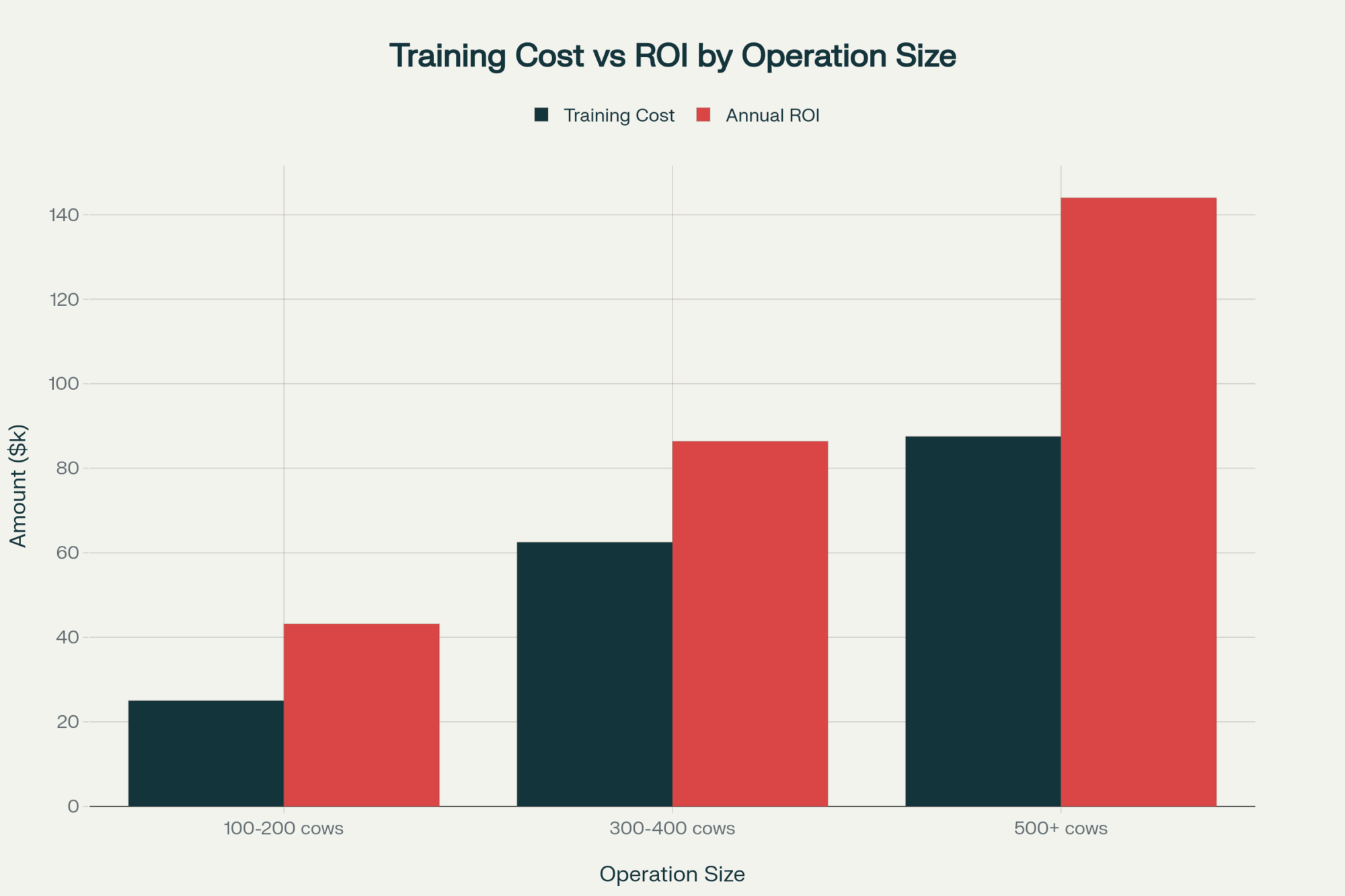
Hugo Andrade, who runs operations at Midland, credits their “excellent milk supply, great farmers and co-ops” for making this work. And you know, that relationship between processor and producer definitely matters. However, what I’ve been learning from extension specialists and economists across the country suggests that there’s something bigger happening here—something about how the economics of processing might be shifting beneath our feet.
The Processing Side of the Story
So here’s what’s interesting about processor economics—and I know this isn’t the usual coffee shop conversation, but bear with me because it affects all of us. Midland’s been running that facility since 2002. Twenty-three years. Their equipment’s paid for, they’re not servicing massive debt, and they don’t have investors demanding quarterly growth.
Compare that to what we’re seeing with the mega-facilities going up. Hundreds of millions in investment. All that capital has to get paid back somehow, right? And we all know who ultimately ends up covering those costs.
The Cost Structure Reality
Facility Depreciation Impact on Processing Costs:
Facility Age
Depreciation as % of Total Costs
Cost per Hundredweight
New Facility (0-5 years)
15-25%
$2.40-$4.00
Mid-Age Facility (10-15 years)
8-12%
$1.28-$1.92
Paid-Off Facility (20+ years)
3-5%
$0.48-$0.80
Based on industry cost analyses and extension program data
That difference—we’re talking 40 to 80 cents per hundredweight—that’s real money when you’re competing on price.
Labor’s another piece of this puzzle. Bureau of Labor Statistics data from May 2024 show that food manufacturing workers in the Albany-Schenectady-Troy metropolitan area earn median wages of around $19 to $21 per hour. Now, if you’re running a facility near a bigger city, or you’ve got union contracts, those numbers jump considerably. Could be another 30 to 80 cents per hundredweight difference right there.
But here’s the part that really made me think…
The Real Cost of DHA Fortification
Breaking down the premium myth:
Actual DHA cost per half-gallon: $0.005 – $0.015
Typical retail premium charged: $1.50 – $2.00
Markup: 100-400x the ingredient cost
Based on standard fortification levels—those 32 to 50 milligrams of DHA per serving—and wholesale ingredient pricing when buying in bulk, the actual cost to fortify comes out to roughly half a penny to maybe a penny and a half per half-gallon.
Half a penny to a penny and a half. Yet walk into any store and that omega-3 milk costs an extra buck-fifty, sometimes two bucks more. Makes you wonder, doesn’t it?
Why That Cornell Award Matters
What’s particularly noteworthy about Midland winning that Silver is how Cornell runs these competitions. The judges don’t know if they’re tasting a premium brand or a store label. It’s all blind evaluation—they’re running polymerase chain reaction tests for bacterial counts, using trained sensory panels, measuring shelf stability with accelerated aging protocols.
They’re examining the butterfat consistency to the hundredth of a percentage point, evaluating mouthfeel, and testing for off-flavors. Real science, not marketing.
“Quality is quality. The testing doesn’t care about your marketing budget or price point. It measures what’s actually in the bottle.” — Dairy science professor involved in Cornell competitions
So when a family processor makes private-label brands—Midland does Derle Farms, Cherry Valley, Farm Fresh, several others—when they prove their fortified milk matches or beats products charging twice the price… well, that tells you quality isn’t necessarily tied to price point the way we’ve been led to believe.
The Ingredient Supply Question
Now, you might be thinking what I initially thought—sure, one processor can do this, but if everyone starts fortifying with DHA, won’t the ingredient market go crazy?
Here’s what’s interesting about that. Current estimates put global algal DHA production capacity somewhere between 25,000 and 35,000 metric tons annually. That’s based on the disclosed capacities from major producers—DSM has its Veramaris operation, which it established in collaboration with Evonik in 2019, as well as Lonza, Cellana, and others.
DHA Supply vs. Dairy Demand
The scale perspective:
Global DHA production capacity: 25,000-35,000 metric tons/year
U.S. fluid milk DHA requirement (if all fortified): 1.5-2.0 metric tons/year
Percentage of global capacity needed: <0.01%
For context: Infant formula accounts for approximately half of global algal DHA production
Let me put this in perspective. If we fortified all the fluid milk sold through major U.S. retail channels—using those standard fortification levels—we’d need approximately 1.5 to 2.0 metric tons of pure DHA annually. That’s less than 0.01 percent of global capacity.
And pricing varies significantly with volume. Small purchasers pay substantially more per kilogram than industrial buyers who negotiate annual contracts. We’re talking prices that can drop by half or more when you move from small-batch to industrial-scale purchasing. Additionally, the fermentation technology continues to improve, driving down production costs year over year.
What Other States Are Doing
The extension folks I talk with in Wisconsin and California are watching this Midland situation pretty closely. Wisconsin has increased funding for its Dairy Processor Grant Program. Since 2014, they’ve funded 135 projects, and the Center for Dairy Research at Madison reports that they’re receiving more questions about functional milk formulation than they’ve seen in years.
Out in California, it’s a slightly different angle. Some Central Valley operations I’ve visited recently are exploring what they call “climate-smart nutrition”—tying functional benefits to sustainability messaging. Between the technical support from UC Davis and modernization grants through the Cal State system, they’ve got the infrastructure to experiment.
Of course, this plays differently in the Southeast, where co-op structures vary, or in Mountain states where processor density is lower, but the fundamental dynamics remain pretty consistent. Even in Texas, where rapid growth in dairy has created different relationships between processors and producers, the same questions are being asked. In Florida, where heat stress challenges are unique, processors are exploring functional products as a means to differentiate themselves in a competitive market.
What strikes me is how many processors are quietly running the numbers right now. Not all of them will move forward—some lack operational flexibility, while others are constrained by capital—but the conversations are happening. And that’s new.
What This Means for Your Operation
Let’s get practical here, because that’s what matters. Whether you’re milking 50 cows or 500, this shift is going to affect your milk marketing decisions.
If you’re currently shipping to a processor making premium functional products, it might be time for some frank conversations. The economics we’re seeing—based on what Clayton Christensen documented in his research on disruption—suggest that if processors can deliver quality, functional milk at conventional prices while maintaining margins, then perhaps those claims about needing premium milk but not being able to pay premium prices deserve another look.
Extension specialists report that component premiums in major dairy states commonly range from 40 to 85 cents per hundredweight—varying with butterfat levels, protein content, and somatic cell counts. These aren’t charity payments. They’re processors recognizing they need exceptional raw materials to compete.
Recent analyses from agricultural lenders, as documented in their quarterly reports, consistently show that success concentrates at either end—either cost-efficient commodity production or genuinely differentiated, premium products. The middle ground, where you’re sort of premium at sort of premium prices, is getting squeezed out.
Key Questions to Ask Your Processor
What’s the age of your processing facility and debt structure?
Are you planning any functional product launches in the next 18 months?
How do you calculate component premiums, and will those change?
What’s your strategy if major retailers launch a functional private label?
You have a strategic decision coming up. Either optimize for volume—maximizing components, keeping those somatic cell counts low, delivering consistent quality day in and day out—or pursue genuine differentiation through organic, grass-fed, regenerative practices that command real premiums.
The Timeline We’re Looking At
Based on how disruption typically plays out in food categories—Clayton Christensen’s work extensively documented this pattern, and we saw it with Greek yogurt capturing over one-third of the yogurt category within five years—here’s what I think we might see.
The Disruption Timeline
Phase 1 (Now – Spring 2026): Regional pilots in Wisconsin, California
Consumer testing of accessible-price functional milk
Wegmans, Meijer, and H-E-B evaluate category opportunity
Sales data shows 3-5x velocity vs. premium brands
Phase 3 (Late 2026 – Early 2027): National rollout discussions
Major chains commit to functional private label
Category of economics shift fundamentally
Historical precedent: Greek yogurt captured over one-third of the yogurt category within five years of mainstream adoption
By late 2026 or early 2027, when a major chain commits to a functional private label at conventional pricing, based on historical patterns, that tends to reshape the entire category pretty quickly.
How Premium Evolves, Not Disappears
What’s encouraging is that premium dairy won’t just vanish—it’ll evolve into something that actually makes sense.
Regenerative production with legitimate third-party certification—programs like Regenerative Organic Certified or Land to Market—creates real constraints that justify premiums. These require fundamental changes to how you farm, taking years to implement. We’re talking verified soil carbon sequestration, biodiversity improvements, the whole nine yards.
What I’m hearing from producers across different regions is that recent transitions to regenerative practices typically involve three-year conversion periods, significant upfront investment, and result in premiums ranging from $1.00 to $1.50 per hundredweight through contractual guarantees. The economics work when you have the right land base and a commitment to see it through.
Ultra-local transparency is another path. Single-farm or micro-regional milk with complete traceability. Some operations are already using blockchain so consumers can see exactly which cows contributed to their milk, when it was processed, and the works. That doesn’t scale to national distribution, which is exactly what protects its value.
Technical innovation continues, too. Ultrafiltration, A2 genetics, and precision fermentation, which require years of careful development and precision fermentation to create novel compounds, necessitate significant capital or proprietary knowledge, creating real barriers.
What probably won’t survive as a premium? Basic fortification. Adding DHA, protein, vitamins—that’s becoming baseline. Like homogenization or pasteurization. Nobody thinks of those as premium features anymore.
Research from Cornell’s Dyson School shows that willingness to pay premiums for basic fortification drops significantly when identical nutrition is available at conventional prices. Maintaining quality consistency across a distributed network won’t be simple, but the economics suggest it’s worth tackling those challenges.
Real Considerations for Real Farms
Strategy
Investment Required
Time to ROI
Premium Potential
Risk Level
Key Advantages
Volume Optimization
Low ($5K-$15K)
6-12 months
$0.40-$0.85/cwt
Low
Quick returns, proven model
True Differentiation
High ($30K-$250K)
3+ years
$1.00-$1.50/cwt
High
Defensible margins, brand control
Cooperative Renaissance
Medium ($50K-$150K)
18-36 months
$0.60-$1.20/cwt
Medium
Shared risk, processor margins
I’ve been talking with producers across different regions about how they’re thinking through this shift. What’s emerging are a few distinct strategies that seem to make sense depending on your situation.
Three Strategic Paths Forward
1. Volume Optimization
Focus on maximizing components (butterfat 4.0%+, protein 3.3%+)
Keep somatic cell counts consistently under 150,000
Build relationships with multiple regional processors
Target efficiency and consistency over differentiation
2. True Differentiation
Invest in regenerative certification (3-year transition, $30-50K investment)
Develop on-farm processing capabilities ($150-250K for small-scale)
Pursue ultra-local/blockchain transparency models
Accept lower volume for guaranteed premiums
3. Cooperative Renaissance
Join or form producer-owned processing ventures
Capture functional dairy margins at the processor level
Share capital requirements and risk across members
Maintain control over pricing and market positioning
Some folks are focusing on strengthening relationships with regional processors who are pursuing volume strategies. These processors need a reliable, high-quality supply and often pay meaningful premiums for exceptional components and low somatic cell counts. The math works when you’re optimized for efficiency and consistency.
Others are investing in differentiation that can’t be easily replicated. What I’m hearing from these producers is that they see it as a long-term investment in market position. Yes, it requires time and capital—we’re talking about significant investments in small-scale processing equipment—but it creates lasting value.
There’s also renewed interest in cooperative models. When producers see the margins available in functional dairy, naturally, they start asking why processors should capture all that value. The cooperative tradition runs deep in dairy—maybe this is what brings it back.
Where We Go from Here
What Midland’s shown with their Cornell Silver award isn’t just about one processor’s pricing strategy. They’ve demonstrated that the premium pricing structure for basic nutritional enhancement might be more about market positioning than production necessity.
That’s not meant as criticism—it’s recognition that things are changing. Processors with the right cost structure can profitably deliver enhanced nutrition at accessible prices. Those with different structures need to adapt or find new ways to create value. Both paths can work with the right approach.
For dairy farmers, this creates both opportunity and urgency. Opportunity because processors competing on volume and quality need exceptional milk supplies. Urgency because your current processor relationships might shift significantly as markets evolve.
Building relationships with multiple potential outlets makes sense. Understanding their strategies, cost structures, and market approaches—these conversations matter more than ever. Inquire about facility investments, debt levels, and the company’s strategic direction. This isn’t being nosy; it’s being smart about your business.
The trajectory seems fairly clear: accessible nutrition is on its way to dairy. When major retailers launch functional milk at conventional prices—likely within 18 to 24 months based on historical patterns—the category economics shift fundamentally. The question isn’t whether this happens, but how your operation is positioned for it.
Processors who understand these dynamics are already planning. Farmers who recognize them early maintain options. Those who wait… well, they get what’s left.
What are you seeing in your area? Are processors discussing functional products differently? How are you thinking about positioning as things evolve? I’m genuinely curious about what you’re observing, because these conversations help all of us navigate what’s coming.
While we’re focused on U.S. markets here, it’s worth noting that similar dynamics are emerging in European and Oceanic dairy markets too. Dutch processors are experimenting with accessible-price functional dairy, while New Zealand cooperatives are reevaluating their premium positioning strategies. This isn’t just a regional shift—it’s a global phenomenon.
KEY TAKEAWAYS:
Your milk check could increase 40-85¢/cwt by targeting processors pursuing volume strategies who need exceptional components (4.0%+ butterfat, 3.3%+ protein) and consistently low somatic cell counts—these processors recognize that quality raw materials matter more than ever as competition shifts from brand positioning to actual product quality
The real DHA fortification cost is $0.005-$0.015 per half-gallon, not the $1.50-$2.00 premium you see at retail—with global algal DHA production at 25,000-35,000 metric tons annually and U.S. dairy needing just 1.5-2.0 tons if fully fortified, ingredient scarcity isn’t the issue processors claim it is
Three strategic paths make sense for different operations: Volume optimization for efficiency-focused farms, regenerative certification ($30-50K investment, 3-year transition) for those seeking defensible premiums of $1.00-$1.50/cwt, or cooperative processing ventures ($150-250K small-scale) to capture margins currently going to processors
Timeline matters—you’ve got 18-24 months before major retailers likely launch functional private label at conventional prices, based on historical disruption patterns like Greek yogurt’s capture of one-third market share in five years
Ask your processor four critical questions now: What’s their facility age and debt structure? Are they planning functional launches? How will component premiums change? What’s their strategy when Walmart launches accessible-price omega-3 milk?
Complete references and supporting documentation are available upon request by contacting the editorial team at editor@thebullvine.com.
The Next Frontier: What’s Really Coming for Dairy Cattle Breeding (2025-2030) – This forward-looking roadmap explores how emerging technologies like genomic testing and AI can optimize replacement strategies and drive efficiency. It provides a practical timeline for implementing these tools to cut costs and boost profitability.
Join the Revolution!
Join over 30,000 successful dairy professionals who rely on Bullvine Weekly for their competitive edge. Delivered directly to your inbox each week, our exclusive industry insights help you make smarter decisions while saving precious hours every week. Never miss critical updates on milk production trends, breakthrough technologies, and profit-boosting strategies that top producers are already implementing. Subscribe now to transform your dairy operation’s efficiency and profitability—your future success is just one click away.
Why sell brands posting 103% profit growth? 10,700 farmers decide Oct 30 if $320k now beats legacy forever.
EXECUTIVE SUMMARY: Fonterra’s proposed $3.8 billion sale of its consumer brands to Lactalis presents 10,700 farmer shareholders with one of the cooperative dairy’s most consequential decisions—vote by October 30 on whether to cash out brands that have shown a remarkable turnaround. The consumer division’s operating profit surged from NZ$146 million to NZ$319 million year-over-year (103% growth), driven by expanding sales of South Asian packaged milk powders and the UHT market in Greater China, according to Fonterra’s Q3 financials. This valuation—between 10 to 15 times earnings with a 15-25% premium over typical dairy transactions—suggests that Lactalis sees long-term value in New Zealand’s grass-fed reputation, which took generations to build. With Fonterra carrying NZ$5.45 billion in debt at 39.4% gearing, the board views this sale as a means to balance sheet strengthening, although farmers must weigh the immediate capital needs against surrendering their connection to consumer markets. What farmers are discovering through discussions from Taranaki to Canterbury is that this vote transcends individual operations—it could reshape global cooperative strategies, as the boards of DFA, Arla, and FrieslandCampina watch closely. The decision ultimately asks whether farmer cooperatives can compete in consumer markets or should retreat to ingredients and processing. Each shareholder must evaluate their operation’s specific needs, succession plans, and vision for dairy’s future before casting a vote that, once done, can’t be undone.
You know that feeling when you’re doing evening chores and something on the news makes you stop and really think? That’s been happening a lot lately with this Fonterra situation. Back in August, they announced they’re selling their consumer brands to Lactalis—the French dairy giant—for NZ$3.845 billion, according to their official announcements. Could increase to $4.22 billion, including the Australian licenses.
And here’s what has got me, and many other farmers, talking… With 10,700 farmer shareholders voting on October 30, we’re looking at something that could change how we all think about cooperative dairy.
The Numbers We’re All Trying to Figure Out
So here’s what’s interesting about the financial performance, and I’ve been digging through Fonterra’s Q3 reports to get this straight. The consumer division—encompassing Mainland cheese, Anchor butter, and Kapiti specialty products—saw its operating profit increase from NZ$248 million to NZ$319 million in Q3, representing approximately a 29% rise, according to their FY25 financial presentations.
Now, where that 103% figure comes from gets a bit specific—it’s actually the quarter-on-quarter comparison. When comparing Q3 this year to Q3 last year, the consumer division’s operating profit surged 103%, increasing from approximately NZ$146 million to NZ$319 million. That’s impressive growth, anyway you slice it, driven largely by higher sales volumes of packaged milk powders in South Asia and UHT milk in Greater China, according to their quarterly updates.
I’m not sure about you, but that timing leaves me scratching my head a bit. After years—and I mean years—of hearing “just wait, the turnaround is coming,” it finally arrives. And now we’re selling?
What I’ve found interesting in the latest annual reports is the valuation itself. When you adjust for standalone costs, Lactalis is paying somewhere between 10 and 15 times earnings, with a premium of about 15 to 25 percent over what these deals typically cost. That’s… substantial. They’re clearly seeing something valuable here. And it makes you wonder—could this affect Fonterra’s position as one of the world’s largest dairy exporters? That’s something worth thinking about.
Key Facts at a Glance:
Sale price: NZ$3.845 billion (potentially $4.22 billion)
Voting date: October 30, 2025
Farmer shareholders: 10,700
Consumer operating profit: NZ$319 million in Q3 FY25 (up from NZ$248 million)
Quarter-on-quarter growth: 103% (Q3 FY25 vs Q3 FY24)
Current debt: NZ$5.45 billion
Gearing ratio: 39.4%
Different Farms, Different Calculations
Here’s the thing about this vote—and this is what makes it so complicated—it means something different for every operation and every region.
Take farmers supplying milk to Te Rapa, one of Fonterra’s largest manufacturing sites, down in Waikato. The plant produces over 300,000 tonnes of milk powder and cream products annually, according to Fonterra’s operational data. If you’re one of those suppliers, you’re probably thinking more about the ingredients side of the business since that’s where your milk’s likely going anyway.
However, if you’re in a region that supplies plants producing consumer products—such as some of the operations near cheese plants or butter facilities—this sale hits differently. You’ve been directly involved in building those brands.
If you’re running a smaller herd, maybe 400 to 600 cows, like a lot of farms in Taranaki or up in Northland, that potential payout could be a game-changer. We’re talking real money that could help with debt from that new rotary you put in, or finally let you upgrade that aging effluent system. With feed costs where they are and milk prices doing their usual dance, breathing room matters. Though it’s worth noting—depending on how the payout’s structured, there might be tax implications to consider. That’s something to discuss with your accountant before counting chickens.
But then… and this is where I keep getting stuck… these brands weren’t built overnight. Your milk, your parents’ milk, probably your grandparents’ milk, went into building that New Zealand dairy reputation. What’s that worth over the next 20 years? Hard to put a number on it, really.
Now, if you’re running 2,000-plus cows—like some of those bigger operations down in Canterbury or Southland—you might be looking at this differently. Many of those farms are already pretty commodity-focused anyway. For them, maybe the immediate capital for expansion or debt reduction makes more sense than holding onto consumer brands they feel disconnected from.
And then there’s everyone in between. I was speaking with a farmer near Rotorua last week who runs approximately 850 cows. She’s torn. “The money would help,” she said, “but I keep thinking about what we’re giving up. My daughter’s interested in taking over someday—what kind of industry am I leaving her?”
Farmers in regions more dependent on the consumer business—those near plants that have historically focused on value-added products—may feel this more acutely than those in regions with heavy milk powder production. It’s not just about the money; it’s about what part of the value chain your community has been connected to.
Consider the rural communities as well. When farm families have more capital, it flows through the local economy—equipment dealers, feed suppliers, the café in town. But long-term? If we lose that connection to consumer markets, what happens to the value of what we produce? And what about future cooperative dividends, considering that those higher-margin consumer products will not contribute to them?
Why Lactalis Wants In
The French aren’t throwing this kind of money around without good reason, that’s for sure. According to industry analysis, several factors are converging simultaneously.
First, there’s the Asian market access. But honestly, I think it’s more than that. It’s that grass-fed story we’ve built over decades—you know what I mean? That image of cows on green pastures, the clean environment, the careful breeding programs we’ve all invested in. Lactalis knows they can’t just create that from scratch.
And think about it—how many years of getting up at 4 AM, dealing with wet springs and dry summers, constantly working on pasture management and milk quality… all of that goes into that premium reputation. You can’t just buy that off the shelf.
What’s also interesting is how this compares to what’s happening in other markets. In the States, cooperatives like DFA have been under similar pressure. Europe’s seeing the same thing with Arla and FrieslandCampina facing questions about their consumer strategies. Down in Australia, Murray Goulburn farmers went through a similar experience with Saputo a few years ago; it might be worth asking them how that worked out.
I haven’t heard any major farming organizations take official positions on this yet, but you can bet they’re watching closely. The implications go beyond just Fonterra.
The Financial Reality Check
Now, we can’t pretend Fonterra hasn’t had some rough patches. Is that a Beingmate investment in China? Lost NZ$439 million according to their financial reports from a few years back. Other ventures also didn’t pan out.
According to their latest interim reports, they’re carrying NZ$5.45 billion in net debt, with a gearing ratio of 39.4%. That’s… well, that’s a fair bit of debt. So you can understand why the board might see this sale as a way to clean things up.
But here’s my question—and maybe you’re thinking the same thing—are we selling the profitable parts to fix past mistakes? Because that’s kind of what it feels like.
There’s also the environmental regulation side of things to consider. With nutrient management rules becoming increasingly stringent every year, some farmers are wondering if having more capital now might help them meet these requirements. It’s another factor in an already complicated decision.
And let’s not forget about currency. The NZ dollar’s been all over the place lately. Receiving a lump sum payment now versus relying on favorable exchange rates for future dividends… that’s something else to consider.
What This Means Beyond the Farm Gate
Here’s something to chew on—what happens in New Zealand doesn’t stay in New Zealand anymore. Not in today’s global dairy market.
I was speaking with a fellow who ships to a cooperative in Wisconsin last month, and he mentioned that their board is already receiving questions about their consumer brands. “If Fonterra’s doing it, why aren’t we?” That kind of thing. And you know how these conversations go—once one big cooperative makes a move, others start wondering if they should follow.
We’ve all seen what happens when cooperatives become just milk suppliers to companies that own the brands. The whole bargaining dynamic changes. Ask any of those farmers who used to supply Dean Foods in the States how that worked out. Once you’re just a supplier, not a brand owner… well, it’s a different game entirely.
There’s also something to be said about cooperative governance here. This entire situation may serve as a wake-up call about who we elect to boards and what questions we ask them. Perhaps we should be more involved in these strategic decisions before they reach the voting stage.
Questions That Keep Coming Up
Winston Peters made some good points in Parliament about this whole thing—and regardless of what you think of politicians, the questions were valid. What exactly are the terms of these supply agreements with Lactalis? I mean, if New Zealand milk becomes relatively expensive compared to, say, European or South American sources, what happens then?
These aren’t just theoretical worries. They’re the kind of practical concerns that could affect milk checks for years to come. And honestly? Farmers deserve clear answers before voting on something this big.
If you want to dig deeper into the details, Fonterra’s shareholder portal has the full transaction documents. Your local discussion group is likely covering this topic as well—it might be worth attending the next meeting to hear what your neighbors are thinking. And for those wondering about the voting process itself, it can be conducted in person at designated locations, by proxy if you are unable to attend, or through postal voting—details should be included in your shareholder materials that were distributed last month.
Regarding the timeline, if farmers vote ‘yes’ on October 30, the deal is likely to close in early 2026, pending receipt of regulatory approvals. That’s when you’d see the money, but also when the brands would officially change hands.
Thinking It Through
So, where’s all this leave us with October 30 coming up? Well, like most things in farming, it depends on your situation.
If your operation needs capital right now—and I know many that do, given current margins—this payout could be exactly what keeps you going. There’s absolutely no shame in prioritizing your farm’s survival. We all do what we need to do.
However, if you’re thinking longer term, especially if you have kids showing interest in taking over someday, you have to wonder what you’re giving up. These brands represent decades of dedication and hard work by New Zealand farmers. All those early mornings, all that attention to quality… once those brands are gone, they’re gone.
Two Different Roads
If this sale goes through, Fonterra will essentially become an ingredients and processing company. That’s a pretty fundamental shift from what the cooperative has been. We’d be supplying milk primarily for ingredients markets, with Lactalis controlling the consumer-facing side of things.
If farmers vote no? Well, that’s a statement too, isn’t it? We still believe that farmer cooperatives can compete in consumer markets. This might even encourage other cooperatives around the world to continue building their brands rather than selling them off.
The Bottom Line
You know what really strikes me about all this? Sure, the money’s important—nobody’s saying it isn’t. However, it’s really about what we think dairy farming should be in the future.
Those brands—Mainland, Anchor, Kapiti—they mean something. They’re the result of generations of farmers getting up before dawn, dealing with whatever the weather throws at us, and constantly working to improve. That connection to consumers, that ability to capture value beyond the farm gate… once you hand that over, you don’t get it back.
The vote’s coming whether we’re ready or not. Whatever you decide, make sure it’s something you can live with—not just when that check clears, but years down the road when you’re looking at what the industry’s become.
Because here’s the truth: once this is done, there’s no undoing it. Dairy farmers everywhere will be watching closely to see what New Zealand decides. And whatever way it goes, it will influence how cooperatives think about their future for years to come.
Take your time with this one. Discuss it with your family, and chat with your neighbors at the next discussion group meeting. Get all the information you can from Fonterra’s shareholder resources and those quarterly reports they’ve been putting out. Consider discussing the tax implications with your accountant as well. This is one of those decisions that really does shape the industry for the next generation.
Make it count.
KEY TAKEAWAYS:
Immediate financial impact varies by operation size: Smaller 400-600 cow farms could see debt relief equivalent to 18 months operating costs, while 2,000+ cow operations might fund expansion—but all sacrifice future dividend streams from consumer products showing 103% profit growth.
Regional implications differ based on plant specialization: Farmers supplying Te Rapa’s 300,000 tonnes of milk powder production think differently than those near cheese and butter facilities who’ve directly built these consumer brands over generations.
Tax and timing considerations require planning: If approved on October 30, the deal is expected to close early in 2026, pending regulatory approval. Farmers should consult with accountants about the potential tax implications of lump-sum payouts versus future dividend streams.
Global cooperative precedent at stake: This vote influences whether farmer-owned brands remain viable worldwide, as U.S. and European cooperatives face similar pressures—Murray Goulburn’s experience with Saputo offers cautionary lessons about becoming just suppliers.
Three ways to vote before deadline: Shareholders can participate in person at designated locations, submit proxy votes if unable to attend, or use postal voting with materials distributed last month—full transaction documents available through Fonterra’s shareholder portal.
Complete references and supporting documentation are available upon request by contacting the editorial team at editor@thebullvine.com.
Learn More:
Navigating the Double-Edged Sword of Borrowing: Debt Management for Dairy Farmers – Fonterra’s payout offers a chance to get ahead. This guide provides tactical strategies for managing debt, refinancing loans, and optimizing cash flow to ensure that a lump sum of capital translates into long-term financial resilience for your operation.
The $500,000 Precision Dairy Gamble: Why Most Farms Are Being Sold a False Promise – This article cuts through the marketing hype to provide a clear-eyed look at the real-world ROI of new technology. It helps producers determine if high-cost investments—like robots—make sense for their specific operation and what critical questions to ask before buying in.
Fonterra’s $4.22B Mainland Sale: The Vote That Will Divide Farmers – This analysis delves into the strategic implications of the sale, exploring how the decision to focus on ingredients could impact the co-op’s long-term value. It provides a strategic perspective on the market dynamics at play, offering crucial insights for future business planning.
Join the Revolution!
Join over 30,000 successful dairy professionals who rely on Bullvine Weekly for their competitive edge. Delivered directly to your inbox each week, our exclusive industry insights help you make smarter decisions while saving precious hours every week. Never miss critical updates on milk production trends, breakthrough technologies, and profit-boosting strategies that top producers are already implementing. Subscribe now to transform your dairy operation’s efficiency and profitability—your future success is just one click away.
Block cheese drops 3¢ to $1.67 while feed costs hold at $4.10 corn—margin decisions define survival
Executive Summary: What farmers are discovering through today’s CME action is that the dairy market’s entering a prolonged adjustment phase that rewards operational efficiency over production volume. Block cheese’s decisive 3-cent drop to $1.67/lb on six trades—double the typical volume—signals institutional conviction that prices have further to fall, with Class III futures at $16.89/cwt already pricing in expectations of sub-$16 milk by November. The silver lining comes from the feed side, where December corn at $4.10/bu and soybean meal at $274.50/ton offer manageable input costs that translate to income-over-feed margins around $7.80/cwt—still above breakeven for efficient operations but leaving little room for error. Research from the Daily Dairy Report (October 2025) indicates farms maintaining 2.35 milk-to-feed ratios can weather this downturn, though Mexico’s displacement of 507 million pounds of U.S. dairy exports and New Zealand’s aggressive SMP pricing at parity with U.S. NDM suggest the pressure’s structural, not cyclical. Here’s what this means for your operation: those who act now to lock in feed costs while optimizing component production for the 10-cent protein premium over butterfat will navigate this market successfully, while operations waiting for prices to “return to normal” risk becoming part of the consolidation statistics we’ll be discussing next spring.
Your October milk check just took another beating. Block cheese dropped 3 cents to $1.67/lb on heavy volume, while butter scraped out a tiny gain that won’t save your Class IV. With feed costs still manageable at $4.10 corn, the smartest play right now is locking in your inputs before this market forces you to feed $16 milk to $5 corn.
When Six Block Trades Tell the Whole Story
You know, I’ve been tracking these markets long enough to recognize when something’s different. Today wasn’t just another down day – it was a day of conviction selling. Six block cheese trades at the CME (Daily Dairy Report, October 13, 2025), versus the typical four, suggests that the big players are positioning for more pain ahead. That 3-cent drop to $1.67/lb? It broke right through the support level that had been held since late September.
“We’re seeing processors work through inventory rather than chase spot loads,” mentioned Tom Wegner, a Wisconsin cheese plant manager I spoke with this morning. “Nobody wants to be holding expensive cheese when the market’s trending like this.”
The interesting aspect here is the barrel-over-block spread, which is currently sitting at 4 cents. That’s backwards from normal market dynamics. Usually, blocks lead and barrels follow, but today’s zero-barrel trades with just one offer hanging out there suggest that buyers figure they can wait this out. Smart money’s betting blocks catch down to barrels, not the other way around.
Today’s Numbers and What They Actually Mean
Block cheese leads the market massacre with a devastating 3-cent plunge – the kind of single-day bloodbath that separates survivors from casualties in today’s dairy market.
Product
Price
Today’s Move
Weekly Average
Your Bottom Line Impact
Cheese Blocks
$1.6700/lb
-3.00¢
$1.7365
Directly hits Class III – expect 75¢-$1.00/cwt lower checks
Cheese Barrels
$1.7100/lb
No Change
$1.7400
Holding but won’t prop up Class III
Butter
$1.6200/lb
+1.50¢
$1.6440
Minor relief, but still 24% below last October
NDM Grade A
$1.1275/lb
No Change
$1.1445
Skim solids glut continues
Dry Whey
$0.6350/lb
No Change
$0.6310
Steady, but can’t offset cheese weakness
Looking at the CME settlement data (Daily Dairy Report, October 13, 2025), October Class III futures closed at $16.89/cwt while Class IV scraped along at $14.34/cwt. That Class IV number should make you wince – we haven’t seen it this low since 2020’s pandemic collapse.
The Global Chess Game Working Against Us
507 million pounds of traditional Mexican demand just evaporated – that’s $85+ million in lost revenue that’s never coming back, no matter what the optimists tell you.
Here’s what farmers aren’t hearing enough about: New Zealand’s hammering us on powder pricing. Their SMP futures at $2,580/MT translate to about $1.17/lb (NZX Futures, October 13, 2025), basically matching our NDM at $1.1275. When the Kiwis can land powder in Southeast Asia at our prices despite shipping costs, we’ve got problems.
The European situation’s equally concerning. EEX butter futures at €5,500/MT (Daily Dairy Report Europe Futures, October 13, 2025) work out to roughly $2.80/lb – that’s 73% above our $1.62 butter. Sure, it makes us competitive for exports, but it also tells you where global butter thinks our price should be heading. Spoiler alert: it’s not up.
“Mexico’s shift away from U.S. dairy is the elephant in the room nobody wants to acknowledge,” notes Dr. Mary Ledman, dairy economist at Ever.Ag. “We’re talking about 507 million pounds of traditional demand that’s evaporating.” (Industry communication, October 2025)
Feed Markets: Your Only Good News Today
At 2.35, your milk-to-feed ratio sits just above the survival threshold – one bad month could push efficient operations into the danger zone where only the desperate or foolish operate
December corn at $4.1050/bu and soybean meal at $274.50/ton (CME Futures, October 13, 2025) gives you breathing room most didn’t have in 2022. I’m currently calculating milk-to-feed ratios of around 2.35 – not ideal, but workable if you’re efficient.
Wisconsin producers I’ve spoken with are seeing slightly better margins, thanks to a local corn basis running 10-15 cents under futures. California residents aren’t as fortunate, as transportation costs them an additional 20-30 cents per delivered feed. The smart operators locked in Q4 needs last month when corn dipped below $4. If you haven’t yet, today’s not terrible, but tomorrow might be.
Income over feed costs pencils out around $7.80/cwt for efficient operations. That’s above the $7 breakeven for most, but barely. And that’s assuming you’re hitting your production targets and not dealing with any health issues in the herd.
Supply Reality: We’re Making Too Much Milk
The USDA’s October report (USDA Dairy Markets, October 2025) estimated national production at 19.3 billion pounds, a 0.7% increase year-over-year. The kicker? The herd expanded to 9.460 million cows – up 41,000 head from last year. Texas and Idaho added 67,000 cows combined, while traditional states like Wisconsin actually contracted by 22,000 head.
What’s interesting here is the regional divergence. Upper Midwest milk flows are running steady to strong as fall weather boosts components. I’m hearing 4.2% butterfat and 3.3% protein from several Wisconsin farms. But those nice components don’t mean much when butter’s in the tank and cheese is falling.
Processing capacity’s the real bottleneck. Plants in the Central region are running at 95-98% capacity (USDA Dairy Market News, October 2025). When you’ve got more milk than processing capacity, spot premiums evaporate. Some producers are currently seeing discounts of 50 cents per class. That hurts.
What’s Really Driving These Markets
Let me paint you a picture of the demand picture, and it’s not pretty. Domestic cheese consumption’s holding steady according to USDA data (USDA Economic Research Service, October 2025), but food service remains 8% below pre-2020 levels. Retail’s picking up some slack, but not enough.
The export story’s worse. China’s imports hit 15-year lows in Q3 2025 while Mexico – our traditionally largest customer – is actively sourcing from Europe and Oceania. Southeast Asian buyers? They’re cherry-picking the lowest global offers, which currently means New Zealand, not us.
“We built this industry on export growth assumptions that aren’t materializing,” one large co-op board member told me off the record. “Now we’re stuck with production capacity sized for markets that disappeared.”
Inventory levels tell their own story. However, butter stocks at 40,052 tonnes (Canadian Dairy Information Center, October 2025) indicate more than adequate supplies, despite the low price. Cheese inventories aren’t publicly reported as frequently, but plant managers tell me they’re holding 10-15% more product than they did this time last year.
Where Markets Head From Here
The futures market’s painting an ugly picture. The November Class III at $16.17 and December at $16.39 (CME Class III Futures, October 13, 2025) suggest that traders don’t expect quick relief. Those aren’t profitable numbers for most operations, especially for newer dairies that carry heavy debt loads.
The technical picture’s equally concerning. Today’s break below $1.70 block support sets up a potential test of $1.65. Below that? The July low of $1.58 comes into play. At those levels, Class III milk drops into the $15s, and that’s when phones start ringing at the bank.
However, consider this: markets often overshoot. Both directions. The same momentum that’s currently crushing prices could reverse if we experience a supply shock – a weather event, disease outbreak, or major plant closure. Problem is, you can’t bank on hope.
Regional Focus: Upper Midwest Feeling the Squeeze
Wisconsin and Minnesota farmers face a unique challenge. They’ve got 22,000 fewer cows than last year, but milk per cow is up 34 pounds (USDA Milk Production Report, October 2025). That productivity gain sounds great until you realize it’s contributing to the oversupply, crushing your milk check.
Basis has tightened to negative 20 cents under Class III as local cheese plants compete for milk. But co-op premiums? They’ve compressed from 75 cents to 35 cents/cwt over the past month. “We’re seeing quality premiums disappear too,” notes Jim Ostrom, who milks 240 cows near Stratford, Wisconsin. “Used to get 50 cents for low SCC. Now it’s 20 cents if you’re lucky.”
The processor’s perspective is different but equally challenging. “We’re making cheese because we have to move milk, not because we have orders,” admits a plant manager who requested anonymity. “Storage is near capacity, and we’re discounting to move product.”
Your Action Plan Starting Tomorrow
First, forget about timing the market bottom. Nobody’s that smart. Instead, focus on what you can control:
Feed Strategy: Lock in 60% of your Q1 2026 needs at current prices. Corn under $4.25 is a gift in this environment. Don’t get greedy waiting for $3.90.
Hedging Milk: Those $16.50 Class III puts for November-December trading at 28 cents? Cheap insurance. If we break $16, you’ll wish you’d bought them.
Culling Decisions: Fed cattle at $240/cwt (CME Live Cattle, October 2025) makes the beef market attractive. That springer heifer that’s been limping? She’s worth more at the sale barn than in your milk string.
Production Planning: This isn’t the market to push production. Back off the aggressive feeding, focus on component optimization. The current 10-cent spread between protein and butterfat favors protein, despite weak overall prices.
The Uncomfortable Truth About Tomorrow
You want my honest take? Tomorrow’s Tuesday trading will tell us everything. If blocks can’t hold $1.65, we’re looking at an extended period of sub-$16 Class III milk. The global market isn’t coming to save us – they have their own oversupply issues.
The irony is we’re victims of our own success. The U.S. dairy industry has become incredibly efficient at producing milk. The problem is, we’ve become better at producing milk faster than we’ve become better at selling it.
Smart operators are already adjusting. They’re locking in feed, right-sizing herds, and preparing for 6-12 months of margin pressure. The ones waiting for markets to “return to normal”? They’re the ones who’ll be calling the auctioneer next spring.
Your survival depends on executing these five moves with military precision – the farmers waiting for ‘normal’ markets to return will be calling auctioneers by spring.
The Bottom Line
Block cheese at $1.67 triggered the next leg down for milk prices. Class IV’s already in the basement at $14.34, and Class III’s heading toward the $15s unless something changes fast. Your best defense isn’t hoping for higher prices – it’s aggressive cost management and selective hedging.
Lock in those feed costs while corn’s under pressure. Hedge some milk production if you haven’t already. And start having honest conversations about whether your operation’s sized right for $16 milk.
The market’s telling you something. The question is whether you’re listening or just hoping it goes away. Spoiler alert: hope’s not a marketing strategy.
Tomorrow we’ll see if $1.65 holds. If it doesn’t? Well, let’s just say you’ll want those feed costs locked in before everyone else figures out this could get worse before it gets better.
Do you have questions about hedging strategies or would like to share what you’re seeing locally? Reach out at editorial@thebullvine.com. Sometimes the best market intelligence comes from farmers in the trenches, not traders in Chicago.
Key Takeaways
Lock in 60% of Q1 2026 feed needs immediately – With corn under $4.25/bu and meal below $275/ton, you’re looking at potential savings of $800-1,500 monthly for a 500-cow operation compared to waiting for spring volatility
Implement defensive milk hedging strategies – November Class III puts at $16.50 strike trading at 28 cents offer cost-effective protection against the 35% probability of sub-$16 milk that futures markets are currently pricing
Optimize for protein over butterfat production – The current 10-cent/lb spread favoring protein over fat means adjusting rations to maximize protein yield could add $0.40-0.60/cwt to your milk check without increasing feed costs
Right-size your operation for margin reality – Farms maintaining income-over-feed costs above $8/cwt through efficiency improvements and selective culling will survive; those chasing volume at $7.80 IOFC won’t see 2026
Monitor global competitive positioning weekly – New Zealand’s SMP at $1.17/lb matching U.S. NDM prices means export recovery isn’t coming to save domestic prices; successful farms are planning for $16-17 milk through Q1 2026
Complete references and supporting documentation are available upon request by contacting the editorial team at editor@thebullvine.com.
GDT Reality Check: When the Market Delivered Exactly What We Expected – Provides strategies for building resilience against global price shocks. This analysis explains the 85% correlation between GDT drops and your farmgate price, showing why adaptation—not prediction—is the ultimate survival playbook in 2025’s volatile environment.
Join over 30,000 successful dairy professionals who rely on Bullvine Weekly for their competitive edge. Delivered directly to your inbox each week, our exclusive industry insights help you make smarter decisions while saving precious hours every week. Never miss critical updates on milk production trends, breakthrough technologies, and profit-boosting strategies that top producers are already implementing. Subscribe now to transform your dairy operation’s efficiency and profitability—your future success is just one click away.
EXECUTIVE SUMMARY: Ireland’s registration of 54,396 fewer calves this year signals a fundamental shift that’s already reshaping global dairy markets. With the nitrates derogation expiring December 31st, Irish farms face potential nitrogen limits dropping from 250kg to 170kg per hectare — a 32% reduction that could force meaningful herd culls despite EPA data showing river nitrogen at eight-year lows. This matters beyond Europe because Ireland, while producing just 1.5% of global milk, controls approximately €1 billion in annual infant formula exports serving Asia’s booming premium segment, which grew from a 32.8% to a 37% market share this past year. What farmers are discovering through Vermont’s success with GPS-guided manure application — an 18-month payback through reduced fertilizer costs — suggests that technology adoption might be the bridge between environmental compliance and profitable production. December’s Brussels decision will ripple through milk prices globally, but smart producers are already diversifying markets, documenting their environmental performance, and learning from Ireland’s experience that scale doesn’t guarantee survival when regulations shift. The conversation we’re having today about Ireland becomes tomorrow’s reality for dairy regions worldwide, making this the moment to build operational flexibility before regulatory pressure arrives at your farm gate.
I was reviewing the latest ICBF data last week when something really caught my attention. Ireland registered 54,396 fewer calves so far this year — both the Farmers Journal and Agriland confirmed these numbers recently. And you know what? This isn’t your typical seasonal variation. This is something worth understanding.
Here’s what’s interesting: from boardrooms to barn meetings, everyone’s trying to figure out what this means. Industry experts are warning that significant herd reductions could occur in the coming years if the derogation situation doesn’t work out. The scale… well, that’ll depend on what Brussels decides in December. Having watched similar transitions play out in other regions, I think we’re seeing early signs of change that’ll affect all of us, regardless of where we’re milking cows.
Ireland’s dramatic calf registration decline signals fundamental shifts in global dairy markets as regulatory pressure intensifies.
Understanding Ireland’s Journey
Let’s discuss how Ireland arrived at this point, as it’s quite a story. When EU milk quotas ended in 2015 — you remember that whole situation — Irish farmers really went for it. The national dairy herd has grown from approximately 950,000 cows to nearly 1.6 million today. Teagasc’s National Farm Survey confirms we’re looking at almost 70% growth in less than a decade.
But it wasn’t just about adding cows. The average herd size increased from around 80 head to 131, based on Teagasc’s People in Dairy Project from May of this year. About 82% of these operations utilize spring-calving systems, which makes perfect sense given Ireland’s grass-growing conditions. It’s a model that works beautifully… if you’ve got their climate.
What’s particularly noteworthy is the efficiency they maintained during this expansion. Frank O’Mara’s research team at Teagasc has documented a carbon footprint of just 0.88 kg CO2e per kilogram of fat- and protein-corrected milk. The global average? That’s running around 2.5 kg. So you can see why people pay attention to what happens over there.
Ireland’s sustainability and market advantages in grass-fed dairy face elimination under potential nitrogen restrictions.
The investment required was substantial. The Irish Farmers Association documented about €2.2 billion in farmer investment during the post-quota expansion period, with processors adding another €1.3 billion in capacity. That’s real money, borrowed against real assets.
December’s Decision Point
Now here’s where things get really interesting. December 31st is when Ireland’s nitrates derogation expires. For those unfamiliar with European regulations, the derogation permits qualifying farms to apply up to 250kg of nitrogen per hectare annually — significantly exceeding the standard 170kg limit. Most Irish farms have already reduced their stocking rates to 220kg as of January 2024, and maintaining that level is uncertain.
What I find encouraging is that the Netherlands submitted their derogation extension request back in July, according to Agriland’s reporting. So Ireland won’t be negotiating alone, which might influence how things play out in Brussels.
I’ve been talking with several Irish producers about this, and their frustration is understandable. The EPA monitoring shows nitrogen in Irish rivers hit an eight-year low in 2024 — that’s real environmental progress, which RTÉ covered back in March. Yet Brussels added these new requirements under the Habitats Directive, demanding individual assessments for 46 different catchments. I mean, can you imagine managing that paperwork while you’re trying to keep fresh cows healthy during transition?
“Good data is becoming as important as good genetics” — Wisconsin dairy producer on technology adoption
Denis Drennan from ICMSA has been pretty clear that milk prices need to stay strong in 2025 just to cover the increasing regulatory burden. And with co-ops reporting notable year-over-year reductions in deliveries during parts of this year — the magnitude varies by region and month — those newly expanded processing plants are facing some real challenges.
Why This Matters Globally
This is where Ireland’s situation becomes everyone’s business. Despite producing only about 1.5% of global milk, Teagasc research from June indicates that Ireland generates approximately €1 billion in annual infant formula exports, with six major manufacturers operating there. That concentration of expertise… it’s not something you can quickly replicate elsewhere.
The Asian market dynamics are particularly relevant here. Analysis from July shows China’s premium infant formula segment grew from about 32.8% to 37% market share over the past year. These consumers specifically want products with verified grass-fed credentials—and they’re willing to pay for them.
You know, the nutritional advantages from grass-based systems — higher CLA levels, better omega-3 profiles — that’s not just marketing. Those are measurable differences that processors can document. However, here’s the thing: these advantages stem from specific climate conditions, decades of infrastructure development, and genetics selected for grass-based production… you can’t just flip a switch and replicate that.
Similar challenges are playing out in California, where water restrictions shape production decisions, or in the Northeast, where land costs drive different operational choices. Each region has its unique pressures. In Canada, supply management adds another layer of complexity, while Australian producers navigate drought cycles that make Ireland’s consistent rainfall look like a paradise.
How Processors Are Adapting
The processing sector they’re really scrambling right now. Companies like Danone, Glanbia, and Kerry Group invested hundreds of millions based on growth projections that seemed reasonable at the time. Now they’re looking at potential supply drops while those fixed costs aren’t going anywhere.
What I’m hearing is that processors are stress-testing all kinds of options. Some are exploring powder reconstitution for specific applications, others are recalibrating their product mix, and many are focusing on supply diversification. But when your competitive advantage is rapid conversion from farm to finished product — that speed-to-value that’s so critical in infant nutrition — workarounds have limitations.
According to industry contacts, processors aren’t waiting for December. They’re actively reviewing supply chain contingencies, adjusting portfolios, and working through various scenarios. Many are now seeking long-term supply diversification contracts in other low-cost regions. It’s pragmatic planning in uncertain times.
Technology’s Growing Role
Technology Type
Investment Cost
Payback Period
Annual Savings
Regional Example
GPS-guided manure application
$45,000
18 months
$30,000
Vermont (fertilizer reduction)
Robotic milking systems
$175,000
48 months
$43,000
Wisconsin (labor + efficiency)
Precision feed management
$25,000
24 months
$15,000
Ireland (compliance ready)
Heat detection collars
$15,000
12 months
$16,000
Netherlands (conception rates)
Environmental monitoring
$8,000
15 months
$6,500
California (water compliance)
Something that really caught my attention was ICBF’s September update to their Economic Breeding Index. The Farmers Journal reported that average EBI values dropped about €83 per animal — not because genetics suddenly went bad, but because they shifted the base cow from 2005-born to 2015-born animals. That’s the industry recalibrating for new realities.
The technology adoption gap is becoming really apparent. Farms with advanced parlor management systems, comprehensive data collection… they’re navigating these challenges differently. When you have automated heat detection improving conception rates, robotics helping with consistency — and we’re talking $150,000 to $200,000 for quality robotic systems — these are no longer luxuries. They’re becoming necessities.
A producer I know in Wisconsin put it well: “The difference between operations that invested in precision technology five years ago and those that didn’t is becoming a chasm. This includes everything from advanced feed efficiency sensors and GPS-enabled manure application systems that maximize nutrient use, to automated health monitoring collars. Good data is becoming as important as good genetics.”
And here’s the ROI that’s catching attention: one operation in Vermont saw their investment in GPS-guided manure application pay back in 18 months through reduced fertilizer purchases and improved compliance documentation. That’s the kind of return that makes technology adoption a no-brainer, especially when regulatory pressure continues to build.
Regional Variations Matter
Not every part of Ireland faces the same challenges, which is worth thinking about. The southeast, with its free-draining soils and longer growing seasons, operates under different conditions than those in the northwest, which deal with heavier ground. Spring-calving herds — that’s about 82% of Irish operations, according to Teagasc — they’ve got all their nutrient management concentrated into tight windows.
These variations… they really make you wonder about one-size-fits-all regulations. You’ve got farms achieving excellent bulk tank counts, managing transition periods effectively, keeping their herd health metrics strong — but they’re facing challenges based on nitrogen calculations that might not fully account for grass-based efficiency.
Looking at Three Possible Scenarios
Scenario
Timeline
Key Outcomes
Managed Adjustment
Q1-Q2 2026
Derogation renewed with tighter restrictions. Modest production adjustments, premium markets tighten, and some global price movement. Processors adapt toward higher-value products.
Political Compromise
Q2 2026
Farmer advocacy leads to compromise. Technology investments enable progress in maintaining production. Politicians declare victory, farming continues.
Sharp Contraction
Mid-2026 onwards
Minimal derogation renewal. Significant production drops within 18 months. Premium market disruption, price volatility, supply gaps.
What This Means for Your Operation
So what should we take away from all this?
First, regulatory dynamics are accelerating everywhere. What starts in Brussels has a way of showing up in other jurisdictions. Environmental regulations are increasingly shaping how we farm, whether we’re in California dealing with methane rules, Wisconsin managing nutrient plans, or anywhere else.
Second, if you have genuine production advantages — whether that’s organic certification, grass-fed systems, local market access, or any other unique aspect of your operation — now’s the time to document and protect those advantages. Ireland’s grass-fed position took generations to build. Once it’s gone, it’s gone.
Third, market relationships need diversification. When supply gets tight, operations with multiple outlets generally fare better. That’s not pessimism — it’s risk management. And beyond just infant formula, Irish dairy also supplies significant volumes to specialty cheese makers and premium butter operations across Europe. Those alternative channels become crucial when primary markets shift.
Fourth, technology adoption is shifting from optional to essential. Being able to document your environmental performance, optimize inputs, and adapt quickly —that’s increasingly what separates operations that thrive from those that just survive.
And here’s something interesting — scale no longer guarantees success. Some of Ireland’s most efficient large operations face real challenges because they’re over nitrogen thresholds, while smaller operations with direct market access and flexibility sometimes prove more adaptable.
The Human Side
Behind every statistic are real families making tough decisions. UCD’s School of Psychology published research in August showing nearly all Irish farm families report work-family conflict, with younger, debt-leveraged farms particularly affected.
These aren’t abstract business decisions. When families have mortgaged generational land to build facilities, they might not be able to fully use… that pressure extends way beyond finances. I’ve witnessed similar situations unfold in various dairy regions, and the stress on rural communities is indeed a real concern.
For those needing support, organizations such as Farm Aid in the US (1-800-FARM-AID), the Farm Community Network in the UK, and the Irish Farmers Association’s member support services offer resources for farmers facing transition pressures. There’s also the International Association of Agricultural Producers, which offers global support networks. Please don’t hesitate to reach out if you need assistance.
Where We Go from Here
Ireland’s 1.5% of global production creates amplified disruption effects across premium markets and regulatory frameworks worldwide.
What’s happening in Ireland represents more than just regional adjustment. We’re watching environmental objectives, food security needs, and agricultural economics intersect in real time. This dynamic between production efficiency and regulatory requirements… it’s not unique to Ireland. It’s emerging globally.
Those 54,396 fewer calves aren’t just numbers. They’re the leading edge of changes that’ll influence global dairy markets over the next several years. How this affects your operation depends largely on the decisions you’re making right now.
December’s derogation decision will have far-reaching consequences that extend well beyond Ireland. Smart producers are already considering various scenarios and building operational flexibility to adapt to changing market conditions. Most importantly, they’re learning from Ireland’s experience to prepare for similar challenges that might emerge closer to home.
Because if there’s one thing that’s becoming clear, it’s this: success in modern dairying requires understanding both market fundamentals and regulatory dynamics. Political and policy factors are increasingly influencing decisions that were once purely economic in nature. Recognizing and adapting to this reality may well determine which operations thrive in tomorrow’s dairy industry.
The conversation continues, and we’re all part of it. How we respond collectively to these challenges will shape dairy farming for the next generation. What strategies are you implementing to prepare for these changes? Share your thoughts and experiences — because learning from each other is how we’ll navigate this transition successfully.
KEY TAKEAWAYS
Technology ROI beats regulatory burden: Vermont operations seeing 18-month payback on $150,000-200,000 precision systems through 20-30% fertilizer savings and streamlined compliance documentation — making tech adoption essential, not optional
Market diversification matters more than size: Irish farms over nitrogen thresholds face elimination despite peak efficiency, while smaller operations with direct sales to specialty cheese and premium butter markets show better resilience — suggesting 3-5 market outlets minimum for risk management
Environmental progress isn’t protecting producers: Ireland achieved EPA-verified eight-year low nitrogen levels while maintaining 0.88 kg CO2e per kg milk (vs. 2.5 kg global average), yet still faces production cuts — document your sustainability metrics now before regulators set the narrative
Premium markets concentrate risk: China’s grass-fed infant formula segment commands 50% price premiums, but Ireland’s potential 15-25% production drop threatens €1 billion in exports — operations dependent on single premium channels need contingency plans by Q1 2026
Regional advantages require active protection: Ireland’s grass-fed position took generations to build through climate, genetics, and infrastructure, but December’s decision could eliminate it overnight — whether you’re organic, pasture-based, or locally focused, start building your verification systems today
Complete references and supporting documentation are available upon request by contacting the editorial team at editor@thebullvine.com.
Learn More:
Feed Smart: Cutting Costs Without Compromising Cows in 2025 – This tactical roadmap for 2025 reveals how to save up to $470/cow/year by focusing on strategic feed procurement and NDF digestibility targets. Learn essential cost-saving methods to protect your margins from rising regulatory pressures.
Why the Global Dairy Market is Making Waves in 2025 (and What That Means for You) – Discover how market shifts, including 14% Southeast Asian cheese premiums, require urgent risk diversification and hedging strategies. This article provides the strategic context needed to build operational resilience against policy-driven price volatility.
Robotic Milking Revolution: Why Modern Dairy Farms Are Choosing Automation in 2025 – Get the hard numbers justifying technology investment by reviewing the 4-7 year robotic payback period. Learn how automation delivers 60% labor reduction, improves component quality consistency, and provides the data necessary for proactive health and compliance management.
Join the Revolution!
Join over 30,000 successful dairy professionals who rely on Bullvine Weekly for their competitive edge. Delivered directly to your inbox each week, our exclusive industry insights help you make smarter decisions while saving precious hours every week. Never miss critical updates on milk production trends, breakthrough technologies, and profit-boosting strategies that top producers are already implementing. Subscribe now to transform your dairy operation’s efficiency and profitability—your future success is just one click away.
When corn drops to $4.13 while soybean meal holds at $275, the feeding strategies that worked last year might be costing you thousands.
EXECUTIVE SUMMARY: What farmers are discovering right now is that the traditional relationship between corn and protein feed costs has completely inverted, creating what might be the most significant feed arbitrage opportunity we’ve seen in years. With CME December corn futures at $4.13 per bushel, while soybean meal remains anchored at $275 per ton, progressive dairy operations are capturing $2-3 per hundredweight advantages by strategically increasing corn inclusion to 35-40% of grain mixes – well above conventional recommendations. Research from the University of Wisconsin-Madison and Cornell, published this year, confirms that properly managed herds can handle these elevated starch levels when three conditions align: corn processed to a particle size of 750-1,000 microns, physically effective fiber maintained at 28-32% NDF, and strategic buffering with magnesium oxide. The convergence of China purchasing just 20-30% of typical soybean volumes, drought affecting 70% of U.S. production areas according to the Drought Monitor, and cull cow prices at $145/cwt creates what industry analysts describe as a 90-120 day window before La Niña weather patterns and ethanol economics likely reverse these dynamics. Operations implementing phased approaches – starting with simple TMR consistency improvements that cost nothing – are seeing income over feed cost improvements within 30 days, with one Wisconsin producer reporting $1,200 daily savings after careful implementation.
I was speaking with a Wisconsin dairy producer last week – he runs about 450 cows near Fond du Lac – and his nutritionist had just walked him through something that completely changed his perspective. Been feeding the same ration for eighteen months, you know how it goes. But when the nutritionist showed him that corn delivered energy at one-quarter the cost of protein, that got his attention real quick.
“We were basically writing checks we didn’t need to write,” he told me. “Every single day.”
What’s interesting is I’m hearing similar stories from producers everywhere – it doesn’t matter if you’re milking 200 cows in Vermont or running 2,000 head out in California. What is the traditional relationship between energy and protein feed costs? It’s turned completely upside down. And those who’ve caught on are seeing feed cost advantages that, honestly, I wouldn’t have believed myself six months ago.
The Current Market Reality Check
Let’s dig into the numbers here. CME December corn futures settled at $4.13 per bushel this week. That’s down from those stomach-churning peaks above $4.50 we dealt with earlier this year. Meanwhile, the Chicago Board of Trade has soybean meal at $275 per ton – it’s been there for weeks now, like it’s stuck in park.
Here’s what really matters, though. When you run the standard National Research Council energy calculations, corn’s delivering digestible energy at about six cents per pound. I had to check that twice myself. That’s what we usually pay for wheat middlings or corn gluten – the bargain stuff, right? But protein through soybean meal? Nearly 25 cents per pound.
This 4:1 ratio changes everything about how we think about rationing.
When Protein Costs 4X More Than Energy, Smart Operators Act Fast – Current Window Delivers $1,200 Daily Savings for 500-Cow Operations
The USDA’s October World Agricultural Supply and Demand Estimates put U.S. corn production at 410-415 million metric tons. That’s substantial. Yet, soybean processing capacity cannot keep up with domestic meal demand, even at these prices that should theoretically slow things down.
And China? Based on USDA Foreign Agricultural Service export data, they’re buying maybe 20-30% of what they typically purchase from our harvest. We’re talking billions in trade, that’s just… not happening. Creates some interesting domestic opportunities, to say the least.
Weather’s been throwing curveballs, too. The U.S. Drought Monitor indicates that approximately 70% of the country is experiencing drought at various levels. I’ve been hearing from Extension folks across the northern states – many producers are seeing significant reductions in homegrown feed. The Wisconsin farms I work with are scrambling to find hay wherever they can.
However, and this is important, irrigated areas in Iowa, Illinois, and Indiana maintained relatively strong corn production. So, you’ve a peculiar situation where corn’s relatively available overall, but forage is scarce in many regions.
Rethinking Starch Limits Based on Current Research
You know, when I first heard about producers pushing starch to 35-37%, I was skeptical. We’ve all been told – keep starch below 28% or deal with acidosis, right?
But work published in the Journal of Dairy Science over the past year from researchers at Wisconsin-Madison and Cornell has really opened my eyes. The studies show that with proper management, cattle can handle these higher starch levels. And that “proper” part is crucial.
Three things have to line up. First, corn needs to be processed down to a particle size of 750-1,000 microns. Most operations I visit? They’re still at 3,000 microns or coarser. Big difference there. Second, you must maintain a physically effective fiber level of 28-32% NDF, primarily from high-quality forages. No cutting corners. Third, buffering becomes critical – we’re talking about 0.75 ounces of magnesium oxide per cow, religiously.
Here’s something that doesn’t get discussed enough: when managing starch levels, you must be extra cautious about total dietary sulfur. University of Minnesota veterinary diagnostic work shows that high-starch diets combined with elevated sulfur levels can increase the risk of polioencephalomalacia – essentially a thiamine deficiency that causes brain lesions. If you’re already challenging the rumen with higher starch, adding high-sulfur feeds becomes particularly dicey. Keep total dietary sulfur below 0.4%.
Processing matters more than most people realize. According to the National Research Council’s 2021 Nutrient Requirements of Dairy Cattle (8th edition), steam-flaked corn hits about 87% total tract starch digestibility. Cracked dry corn? Lucky to get 45%. When you improve that particle size reduction, you’re essentially feeding a different feed entirely.
The physiology is also quite interesting. Research published in Animal Feed Science and Technology in 2024 shows that when corn processing is optimized, those volatile fatty acid ratios – the acetate to propionate balance – stay above 2.5 to 1. That means you’re preserving butterfat even at these higher starch levels. Would’ve been heresy to suggest five years ago.
I know a producer in Nebraska who attempted to increase the starch content to 38% without adjusting the processing or buffering. Bad move. Within two weeks, three fresh cows stopped eating, and butterfat levels dropped by 0.4%. He pulled back to 32% and everything normalized. The lesson? These higher levels work, but only with meticulous management.
The DDGS Quality Minefield
A purchasing manager for a large Minnesota dairy recently informed me that they’re running about 2,000 cows. With DDGS priced at $180-200 per ton regionally, it appears to be a favorable comparison to soybean meal on paper.
“But we’ve rejected four loads this past month,” she said. “Two with fat over 12%, one had that burnt smell, and one tested at 1.3% sulfur. Any of those could’ve cost us thousands.”
Parameter
Optimal
Acceptable
Danger
Reject
Fat Content
5-7%
7-9%
9-12%
>12%
Protein Content
28-32%
26-28% or 32-34%
24-26% or 34-36%
<24% or >36%
Sulfur Content
0.35-0.5%
0.5-0.7%
0.7-1.0%
>1.0%
Color/Heat Damage
Golden
Light Brown
Dark Brown
Black/Burnt
The U.S. Grains Council’s quality surveys reveal significant variation – fat ranging from 5% to 14%, protein from 24% to 32%, and sulfur from 0.35% to over 1.4%. These aren’t minor differences, folks.
Research published in the Professional Animal Scientist journal consistently shows that keeping fat below 9% is essential, as milk fat depression will consume any savings. That golden color tells you it’s properly dried. Dark brown or black? Heat damage has caused the protein to become locked up.
Several commercial labs can help with quality monitoring. Dairyland Laboratories in Wisconsin, Rock River Laboratory with locations across the Midwest, Cumberland Valley Analytical Services in Pennsylvania – they all run comprehensive DDGS panels. Industry standards generally recommend keeping acid detergent insoluble protein below 12% of total protein. That’s your heat damage indicator.
Sulfur needs special attention, especially if you’re also pushing starch levels. When DDGS sulfur goes above 0.7%, combined with high-sulfur water and metabolic stress from high-starch diets… you’re asking for trouble. I’ve seen it happen.
Three Strategies That Actually Work
Strategy 1: TMR Consistency – The Foundation
I recently visited a dairy near Shawano, where the owner showed me something straightforward yet incredibly effective. After a University of Wisconsin Extension workshop on mixing consistency, he started timing every TMR load.
“Four minutes exactly,” he said, pointing to this beat-up kitchen timer on the mixer. “Not approximately. Not until it looks good. Four minutes.”
Research published in the Journal of Dairy Science by Penn State in 2024 shows that reducing TMR variation from 15% to below 5% generates 4-5 pounds more milk per cow daily. That’s an immediate return from better mixing alone.
Within a week, this producer observed tighter manure consistency, improved cud chewing, and a noticeable increase in the bulk tank. No new feeds, no expensive additives. Just consistency.
The key here – and what many people overlook – is that consistency matters more than perfection. A slightly suboptimal ration fed consistently beats a perfect ration with 15% variation every single time.
Strategy 2: Strategic Corn Inclusion
Several nutritionists I work with are carefully incorporating corn into grain mixes at 35-40% of the total. Way above the traditional 20-25% comfort zone, but the economics are compelling.
The system requires three key components: corn processed to a 750-1,000 micron size, approximately a pound of wheat straw or mature hay for scratch factor, and magnesium oxide for buffering.
Breaking the 28% Starch ‘Ceiling’ – When Done Right, Higher Inclusion Rates Print Money
Here’s the math: Based on current Chicago Board of Trade pricing, a one percentage point increase in corn, while reducing soybean meal, saves approximately $3.50 per ton of grain mix. Here’s how that calculation works: corn at $4.13/bushel equals $147.50/ton. Soybean meal at $275/ton with 48% protein versus corn at 9% protein means you need 2.5 pounds of corn to replace 1 pound of SBM energy-wise. The price differential creates a $3.50/ton savings for every percentage point shift.
Moving from 25% to 35% corn? That’s $35 per ton saved. For a herd feeding 25 pounds of grain daily, we’re talking meaningful money.
Some California operations with access to extremely low-cost local corn are pushing toward a 42% inclusion rate. However, that requires someone who truly understands the warning signs and metabolic indicators. One producer near Tulare told me he has saved $1,200 daily since August – but he’s also testing milk components twice a week and has his nutritionist on speed dial.
Strategy 3: Revenue Diversification Beyond Milk
An Ohio dairy farmer recently showed me his approach, and it’s brilliant in its simplicity. Instead of chasing protein premiums that have largely evaporated with current Federal Order pricing, he has built multiple revenue streams.
“Bottom 40% of the herd gets bred to Angus,” he explained. “Local sale barn consistently shows $150-250 premiums for those beef-cross calves versus straight Holstein bulls.”
Then there’s strategic culling. The USDA’s National Direct Cow and Bull Report currently shows cull prices at $145 per hundredweight. Compare that to historical October averages around $90-95/cwt based on USDA Agricultural Marketing Service data. That’s over $400 extra per cull – not from culling more, just timing it better.
Making It Work with Tight Cash Flow
The practical challenge – and I hear this constantly – is funding these changes when working capital’s already stretched. A Pennsylvania producer I’ve been advising developed this phased approach that’s working really well.
First two weeks, focus on the free stuff. Time those TMR loads. Four minutes, every time. Review your cull list against current strong prices. One guy I know generated $4,500 from three strategic culls, which funded everything else.
Weeks three and four, test gradual changes. Increase corn by just a pound per cow to start. Sample DDGS from multiple suppliers before making a commitment. Lock in only 30 days of corn to prove it works in your operation.
By month two, most operations are seeing clear improvements in income over feed costs. “First month was tough,” the Pennsylvania producer told me. “Questions from everyone. But when we showed real profitability improvements, they came around.”
The Window Is Closing
Considering future trends and seasonal patterns, this opportunity won’t last forever. CME March 2026 corn already trades at $4.34 – that 21-cent premium tells you the market expects things to tighten.
Several factors could shift this quickly. China typically returns to U.S. markets after harvest – USDA trade data shows they historically increase purchases from November through January. When they do, soybean meal often jumps $30-50 per ton within weeks.
NOAA’s Climate Prediction Center indicates that La Niña is expected to strengthen through February 2026. Considering similar years, South American production challenges typically affect our grain prices within 60-90 days of confirmed weather stress.
And ethanol economics matter too. With crude at $75 per barrel according to EIA data, we’re near the threshold where ethanol margins improve. The EPA’s 15 billion-gallon renewable volume obligation for 2026 means sustained oil prices above $80 will likely push corn higher.
Industry professionals I trust suggest we’ve perhaps three to four months before something shifts significantly.
Regional Adaptations and Global Context
Region
Primary Strategy
Key Advantage
Corn Inclusion
Savings Potential
Critical Factor
Risk Level
Wisconsin/Midwest
Push corn to 35-40%
Local corn access
35-40%
$1,000-1,200/day
Forage scarcity
MODERATE
California/West
Max corn at 42%
Irrigation stability
40-42%
$1,200-1,500/day
Component testing
HIGH
Texas/Southwest
Cottonseed + corn
Regional proteins
30-35%
$800-1,000/day
Water costs
LOW-MOD
Idaho/Northwest
Stable forage focus
Consistent alfalfa
38-40%
$1,100-1,300/day
Processing quality
LOW
Vermont/Northeast
Organic premiums
Premium markets
N/A
Premium capture
Certification
DIFFERENT
What works in Wisconsin might not work in Texas, and that’s fine. Idaho operations with reliable irrigation and consistent alfalfa – they’re focused purely on maximizing that corn-protein spread. Their forage is stable, so they can push harder on grain.
Texas dairies have access to cottonseed that doesn’t align with their soybean meal needs at all. Local pricing enables the inclusion of aggressive corn while utilizing regional protein sources. Smart adaptation.
Meanwhile, a Vermont organic producer reminded me that their premium markets mean these strategies don’t translate directly. “Our feed economics are completely different,” she said. And she’s right – context always matters.
Even within conventional operations, grazing systems face different math than confinement. A 100-cow grazing dairy in Missouri has fundamentally different opportunities than a 1,000-cow freestall in Michigan.
Down in New Mexico, where I visited last month, they’re dealing with completely different dynamics. Water costs drive everything there. A producer near Las Cruces told me, “I’d love to push corn harder, but every pound of milk requires water calculation first.”
Looking internationally, European producers face even tighter protein markets with their non-GMO requirements. A consultant friend in the Netherlands tells me their soybean meal equivalent runs €400-450 per metric ton – which makes our $275 look like a bargain. Australian producers dealing with drought have the opposite problem – plenty of protein options, but energy feeds are scarce.
Quick Reference: Key Monitoring Metrics
When pushing these strategies, watch these indicators like a hawk:
Rumination time: Should stay above 400 minutes daily
Manure scores: Keep below three on the 5-point scale
Milk components: Butterfat shouldn’t drop more than 0.2%
Total dietary sulfur: Keep below 0.4% when pushing starch
TMR particle size: Test weekly when changing corn processing
Implementation Keys for Success
After dozens of conversations with producers navigating this market, clear patterns emerge.
Start with accurate math. Calculate your actual delivered corn-to-soybean meal price ratio. Not Chicago prices – your delivered costs, including basis and freight.
Test your TMR consistency. I guarantee it’s more variable than you think. Extension services have good protocols for testing mixer performance.
Get comprehensive profiles from any DDGS supplier before volume commitments. Don’t trust last month’s analysis – quality varies by plant, even by day. Have them test for fat, protein, sulfur, and acid detergent insoluble protein at a minimum.
Review culling with current prices in mind. That cow you planned to cull in spring? Today’s prices might change that timing.
Have honest conversations with your nutritionist. Some resist higher corn inclusion based on older guidelines. Share current research, discuss gradual testing, and collaborate on monitoring together.
For risk management, never commit over half your working capital to feed inventory. Keep flexibility. And always have multiple protein suppliers. Single-source dependence is asking for trouble.
Looking Forward: Preparing for the Next Cycle
That Wisconsin producer from the beginning? He’s now seeing daily feed savings of $1,200, which more than justifies the changes. But he said something that stuck with me: “I spent three weeks overthinking a simple change. Should’ve just tried it carefully, monitored, adjusted. The real risk was paralysis while the opportunity slipped away.”
The feed economics landscape has shifted significantly, creating genuine opportunities. Dairy Margin Coverage program data from the USDA shows that operations consistently adapting to current conditions demonstrate better income over feed costs than those maintaining traditional approaches.
This window exists now, but it won’t last forever. Whether you capture it depends on your willingness to challenge conventional thinking when the numbers support it.
As someone said at our last co-op meeting: “The math is clear. Question is whether we’ll adapt while we can, or spend next year wishing we had.”
What’s encouraging is how this disruption is forcing us to question assumptions and improve efficiency. The operations that’ll thrive won’t just be those who captured this particular opportunity – they’ll be the ones who developed systems to recognize and respond to market shifts quickly. That’s a capability worth building regardless of where prices go next.
Looking ahead, I believe we will continue to see more of these market disruptions. Climate variability, trade dynamics, processing capacity constraints – they’re not going away. The dairies that build flexibility into their feeding programs, maintain good relationships with multiple suppliers, and stay willing to challenge conventional wisdom when data supports it… those are the ones that’ll navigate whatever comes next.
The current corn-soy reversal creates real opportunities for those willing to think differently about feed strategies. However, it requires careful implementation, constant monitoring, and adherence to the fundamentals that maintain cows’ health and productivity. Get those right, and the economics take care of themselves.
Complete references and supporting documentation are available upon request by contacting the editorial team at editor@thebullvine.com.
KEY TAKEAWAYS:
Immediate savings of $35/ton on grain mix achievable by shifting from 25% to 35% corn inclusion, translating to $1,000+ daily for 500-cow operations – but requires corn processing at 750-1,000 microns, not the typical 3,000
DDGS at $180-200/ton looks attractive, but quality varies wildly – fat content ranges from 5-14%, sulfur from 0.35-1.4% – requiring rigorous testing through labs like Dairyland, Rock River, or Cumberland Valley before any volume commitments
Strategic culling at current $145/cwt prices generates $400+ premiums per head versus five-year October averages of $90-95/cwt, providing immediate cash flow to fund feed inventory builds without increasing culling rates
Regional adaptations matter significantly – Idaho operations with stable irrigation focus purely on price spreads, Texas dairies leverage cotton seed alternatives, while New Mexico producers face water cost constraints that override feed economics
The window closes fast – CME March 2026 corn already trades at $4.34 (21 cents higher), China typically returns to markets November-January, and La Niña patterns historically trigger South American production issues that impact prices within 60-90 days
Join the Revolution!
Join over 30,000 successful dairy professionals who rely on Bullvine Weekly for their competitive edge. Delivered directly to your inbox each week, our exclusive industry insights help you make smarter decisions while saving precious hours every week. Never miss critical updates on milk production trends, breakthrough technologies, and profit-boosting strategies that top producers are already implementing. Subscribe now to transform your dairy operation’s efficiency and profitability—your future success is just one click away.
Feed dropped 23% but 68% of farms report worse margins—labor up 30%, equipment up 25%, co-op fees eating $1-3/cwt
EXECUTIVE SUMMARY: Here’s what’s keeping dairy producers up at night: despite feed costs dropping roughly 23% from recent peaks, land-grant university analyses show the majority of operations are experiencing their tightest margins in years. The disconnect stems from the feed’s shrinking role in total costs—now just 35-40% of expenses, compared to the historic 50%, according to extension economists at Cornell, Wisconsin, and Penn State. Labor costs have increased by approximately 30% since 2021, with wages commonly exceeding $20 per hour. Meanwhile, equipment financing has essentially doubled, and cooperative assessments are now taking $1-3 per hundredweight, a figure that didn’t exist five years ago. What farmers are discovering is that the traditional safety nets, including the Dairy Margin Coverage program, often miss these non-feed pressures entirely—the formula still assumes an economic structure from decades past. Looking ahead, operations that adapt through strategic diversification—whether that’s beef-on-dairy genetics capturing premiums of $800-$ 1,000, targeted technology investments, or collaborative marketing approaches—are finding paths forward despite the pressure. The key is understanding that waiting for old economic relationships to reassert themselves is no longer a viable strategy; successful operations are already rewriting their playbooks for this new reality.
What’s been puzzling everyone at the co-op meetings lately? Feed prices have come off their highs—grain markets have softened quite a bit, and protein sources are more reasonable than they’ve been in a while. But here’s the thing that doesn’t add up… many producers I talk with are actually seeing tighter margins now than when feed was more expensive.
I’ve been chewing on this for a while, talking with folks from different regions, and what’s becoming clear is that something fundamental has shifted in how dairy economics work. Land-grant university analyses from Wisconsin, Cornell, and Penn State in recent months all point to the same thing—the traditional relationships between feed costs and margins have broken down. Check your state extension’s dairy enterprise analysis tools for tracking these costs, because understanding what’s happening might help us all figure out how to navigate what’s ahead.
The Broken Feed-Margin Relationship
For generations, we all operated on this principle: when feed costs drop, margins improve. Simple as that, right? However, that relationship appears to have deteriorated, and it’s affecting everyone, from small grazing operations in the Southeast to mega-dairies in Idaho and the Pacific Northwest.
A producer from central Wisconsin put it to me this way recently: “Twenty years ago, if someone told me I’d have cheaper feed but worse margins, I’d have thought they were crazy.” And yet… here we are.
Feed costs dropped from 52% to 36% of total expenses while labor climbed to 28% – revealing why cheaper feed isn’t translating to better margins
What’s striking is the disconnect between the USDA Dairy Margin Coverage program’s calculations and the actual cash flow pain producers are experiencing. The DMC formula—based on corn, soybean meal, and alfalfa prices compared to the all-milk price—often shows acceptable margins. Meanwhile, extension economists note the DMC margin can diverge significantly from on-farm cash flow when non-feed costs rise, which is exactly what we’re seeing now.
Multiple land-grant analyses indicate that the feed’s share of total costs has declined from the historic 50% range to the mid-30s to low-40s in many systems. When your biggest historic cost shrinks that much, relief from lower feed prices just doesn’t move the needle like it used to.
Quick Cost Reality Check:
Labor: Up approximately 30% since 2021
Equipment: Up 20-25% since 2021
Interest rates: Doubled from 2021 lows
Co-op assessments: $1-3/cwt (new for many)
The Hidden Costs Eating Away at Margins
Labor: A New Competitive Landscape
We’re no longer just competing with other farms for labor. Amazon warehouses, manufacturing plants, and retail operations are all in the game, offering comparable pay and easier schedules.
USDA farm labor surveys in 2025 show wage rates across all dairy regions commonly approaching or exceeding $20 per hour—and that’s if you can find people. Extension field reports describe elevated turnover rates that significantly impact training and productivity. Every time someone new comes on board, there’s that learning curve… equipment doesn’t get maintained quite right, routines change, cows get stressed. It all adds up.
The stress isn’t just financial either. I know many operators who are working 80-hour weeks because they can’t find reliable help, and that takes a toll on their families, health, and ability to think strategically about the future. A producer in Washington state mentioned to me that he has started exploring different shift schedules, trying to make the job more appealing to individuals who prefer non-traditional dairy hours.
Equipment: Sticker Shock and Hard Decisions
Industry indices indicate notable increases in dairy equipment costs since 2021, with significant jumps in certain areas. At the same time, the Federal Reserve’s data shows prime rates have more than doubled from their 2021 lows. Current dealer quotes and recent lender reports suggest financing rates that would’ve been unthinkable just a few years ago.
Now, rebuilding or limping equipment along often beats financing new gear for many smaller farms. It’s not ideal, but when you’re looking at those payment schedules… well, you make do. I’ve seen some creative solutions out there—neighbors sharing equipment more often than they used to, people becoming really skilled at creating YouTube repair videos, and even some groups buying used equipment together to spread the risk.
Cooperative Fees: The Bite Gets Bigger
Several large cooperatives implemented capital retains or assessments between roughly $1 and $3 per hundredweight in 2024-2025, according to producer notices and regional reports. These weren’t a monthly concern five years ago. Now, they can turn a breakeven month into a loss, and there’s not much individual producers can do about it.
What’s interesting here is the timing—these assessments are coming when producers are least able to absorb them. But from the co-op perspective, they need to modernize facilities to stay competitive with private processors. It’s a tough situation all around.
Component Pricing: The Traditional Math is Failing
Butterfat jumped from 47% to 58% of milk value while volume plummeted to just 7% – rewarding quality over quantity producers
Component pricing under Federal Orders pays for pounds of butterfat, protein, and other solids, not just milk volume. Butterfat value especially has jumped. According to the USDA’s October 2025 component price announcement, butterfat reached $3.21 per pound, representing nearly 60% of the total Class III value, up from around 47% just five years ago.
But here’s the tricky part that extension specialists keep explaining at meetings: because of the pricing formulas, higher butterfat prices often correspond with lower protein values. It’s not a simple win. As dairy economists note, high-component milk takes years of genetic and nutritional investment—and the price swings for one component can erode gains in another.
Jersey herds typically test higher for butterfat and protein than Holsteins, which helps in this pricing environment. But transitioning your genetics? That’s expensive and takes time. The folks doing well with components started that journey years ago. A producer in Georgia recently told me he wishes he’d started crossbreeding five years earlier—now he’s playing catch-up while margins are tight.
Processors’ Confidence vs. Producers’ Reality
It seems almost every month brings news of new or expanded processing plants. The International Dairy Foods Association has documented over $11 billion in announced capacity investments since January 2023.
Why so much expansion when farms are hurting? Industry experts at Cornell and other universities explain that modern cheese plants need 2.5 to 3.5 million pounds of milk per day to run efficiently. Mega-dairies can supply that volume directly, and processors prefer dealing with fewer, larger suppliers for consistency and logistics.
So capital keeps flowing into processing, but on the farm side, it’s a different world—shrinking margins, steeper costs, and big questions about who gets to supply milk to these facilities in five years. The discussions surrounding the upcoming Farm Bill negotiations suggest that these structural issues are finally getting attention, but meaningful change takes time.
When Safety Nets Don’t Catch You
DMC margins stay safely above $9.50 trigger while actual farm margins hover near breakeven – exposing the formula’s blind spots
Dairy Margin Coverage insurance was designed as a lifeline. However, with feed now accounting for a smaller share of costs, labor, energy, and fees are climbing, making it frequently miss the mark.
DMC margins remained above the $9.50 trigger throughout much of late 2025, according to Farm Service Agency data, while many farms reported cash flow strain. Key expenses, such as labor, energy, and new co-op assessments, are not included in the formula. It’s like having insurance that covers your roof but not your foundation—helpful, but not when the real problem’s underground.
What Producers Are Trying
California dairies capture $340 premiums per crossbred calf while adoption rates surge past 40% in progressive regions
Beef Genetics—A New Revenue Stream
Beef-on-dairy crosses remain a bright spot for many. USDA market reports from various auction centers show beef-cross calves bringing $800 to $1,000 premiums over straight Holstein bulls. Extension specialists at Wisconsin and other universities commonly recommend keeping it to 25-30% of breedings to avoid running short on replacements—especially with quality replacement heifers now approaching $3,000 each according to market reports.
I’ve noticed operations in the Mountain West have been particularly successful with this strategy, partnering with local beef producers who value the consistency of dairy-beef crosses for their feeding programs. One Colorado operation told me they’ve built relationships with three different feedlots, ensuring steady demand for their crosses.
Direct Marketing—Potential and Pitfalls
Direct-to-consumer sales are gaining traction in areas such as Vermont and other regions near population centers. But feasibility studies suggest startup costs can easily run into the hundreds of thousands. Margins can be impressive for those who make it work, but it’s no small risk, and many who try it find that selling isn’t their passion.
One thing that’s working for some smaller operations is collaboration—several farms working together on processing and marketing, sharing the investment and the workload. It doesn’t eliminate the challenges, but it spreads them around. I know of a group in Oregon—five farms, none with more than 200 cows—who invested in a bottling line together and now supply three school districts, as well as a handful of stores.
Technology—Promise and Payback
Peer-reviewed studies and land-grant extension trials report labor savings and modest production gains with robotic milking, depending on management and herd size. However, with robots costing well into six figures per unit, according to current dealer quotes, payback periods stretch out considerably. Michigan State’s dairy financial tools and similar extension models often show payback periods of 8-12 years under current margins.
The operations that make these technologies work tend to be larger, with better access to capital and sometimes special arrangements with processors that provide pricing stability, which most of us can’t access. However, I’ve also seen smaller operations make strategic tech investments work—focusing on one area, such as feed management or reproduction, rather than trying to automate everything at once.
The Realities of Scale
Mega-dairies (2000+ cows) generate $11.75/cwt margins while farms under 100 cows barely break even at $1.25/cwt
Here’s something we need to acknowledge, even if we don’t like it. The USDA’s Agricultural Resource Management Survey consistently shows multi-dollar-per-hundredweight cost advantages for herds with over 2,000 cows relative to those with fewer than 500. It’s not about who’s working harder—it’s economies of scale, volume discounts, and spreading overhead.
That doesn’t mean small and mid-sized farms can’t survive; some do through niche marketing, ultra-efficient operations, or creative partnerships. However, the economics become increasingly challenging each year, and agility and specialization are more crucial than ever.
Looking Forward
For many, 2025 feels like a tipping point. Agricultural economists at land-grant universities and the USDA anticipate further consolidation alongside rising total milk output in their long-term outlooks. Perhaps your best fit is ramping up efficiency, diving into specialty markets, partnering up, or, for some, exiting while retaining equity.
Mid-sized farms—say 300 to 1,000 cows—you’re in a particularly tough spot. Often too big for niche markets but not big enough for maximum efficiency. The path forward isn’t always clear. Some are exploring renewable energy opportunities, others are diversifying with agritourism, and yes, some are planning their exit.
Larger operations have their own unique challenges, including workforce management, environmental compliance, and community relations. Success increasingly requires professional management approaches that extend far beyond simply knowing how to produce milk.
Key Takeaways for Your Operation
Don’t trust old formulas: Lower feed costs alone won’t deliver profit—track all expenses, especially labor, equipment, and fees, using tools from your extension service or lender.
Diversify strategically: Explore genetics, marketing, and tech that fit your herd size and mindset—but go slow and seek input from others who’ve tried it before making major investments.
Stay proactive: Communicate regularly with your co-op, lender, and local extension agent to ensure a smooth process. Prepare business scenarios for best, worst, and base case situations, and plan changes deliberately, not reactively.
The Bottom Line
What we’re experiencing goes beyond feed and milk prices. The whole structure of dairy farming is shifting. That paradox—cheaper feed and tighter margins—is only one symptom of an industry in transition.
There’s no silver bullet. What works for a mega-dairy out West won’t always work on 300 acres in Wisconsin. What makes sense for 3,000 cows in Texas might be completely wrong for 150 cows in Vermont or a grazing operation in Missouri.
The key is understanding these dynamics, knowing the numbers for your own barn, and making changes that fit your future—not chasing the past. Because from everything the data shows and everything we’re experiencing… the old rules aren’t coming back.
But here’s what I’ve learned after all these conversations: dairy farming’s never been easy, but resilience runs deep in this community. We adapt, we help each other, and—whatever the industry throws at us—there’s always another way to move forward. It might look different than what we expected. It might mean some tough decisions. But we’re still here, still producing food, still figuring it out together.
And that’s worth something, even when the margins don’t show it.
KEY TAKEAWAYS
Track the real cost drivers: With feed now just 35-40% of total expenses (down from 50%), monitor labor costs (up ~30%), equipment financing (rates doubled since 2021), and co-op assessments ($1-3/cwt) using your extension service’s dairy enterprise analysis tools—these hidden costs are what’s actually driving your margins.
Diversify revenue strategically: Beef-on-dairy crosses are bringing $800-1,000 premiums per calf at auction, but keep it to 25-30% of breedings to maintain replacements—especially with quality heifers now approaching $3,000 each according to market reports.
Right-size technology investments: Michigan State’s financial models show 8-12 year payback periods for robots under current margins, so focus on targeted improvements (feed management or reproduction systems) that match your herd size and capital access rather than wholesale automation.
Collaborate for market access: Small operations in Oregon, Vermont, and other regions are successfully sharing processing facilities and marketing costs—five 200-cow farms together can achieve economies that none could manage alone, particularly for direct-to-consumer sales, capturing those premium margins.
Prepare for structural change: USDA data shows that operations with over 2,000 cows achieve multi-dollar per hundredweight cost advantages. Therefore, mid-sized farms (300-1,000 cows) need clear strategies—whether that involves efficiency improvements, niche market development, strategic partnerships, or planned transitions while maintaining strong equity.
Complete references and supporting documentation are available upon request by contacting the editorial team at editor@thebullvine.com.
Learn More:
Beef-on-Dairy: Real Talk on Turning Calves into Serious Profit – Reveals the specific economic tactics for beef-on-dairy, showing how to maximize the $800-$1,000 calf premiums. Learn the genetic sweet spot—breeding only the bottom 60% to beef—to manage replacement rates while generating a vital new revenue stream against tight cash flow.
Feed Costs Are Down, But Profits Aren’t Up: The Hidden Math Reshaping Dairy Economics – This deep-dive reveals how to optimize your milk check by focusing on component premiums. Discover the significant financial benefits of increasing butterfat quality by just 0.2 points, offering a crucial strategy for maximizing returns when volume alone fails to yield a profit.
AI and Precision Tech: What’s Actually Changing the Game for Dairy Farms in 2025? – Provides clear ROI timelines and cost-cutting methods for targeted technology adoption. Learn how precision feeding systems deliver the fastest payback (2–4 years) by cutting feed waste 15–25%, offering an immediate buffer against rising labor and equipment costs.
Join the Revolution!
Join over 30,000 successful dairy professionals who rely on Bullvine Weekly for their competitive edge. Delivered directly to your inbox each week, our exclusive industry insights help you make smarter decisions while saving precious hours every week. Never miss critical updates on milk production trends, breakthrough technologies, and profit-boosting strategies that top producers are already implementing. Subscribe now to transform your dairy operation’s efficiency and profitability—your future success is just one click away.
What farmers are discovering: selecting for speed actually reduces labor costs $10-16K annually
EXECUTIVE SUMMARY: What farmers are discovering about CDCB’s new Milking Speed evaluation is reshaping our understanding of genetic selection and parlor efficiency. With 42% heritability—compared to just 7% for daughter pregnancy rate—MSPD offers predictable genetic progress for a trait that impacts operations twice daily, 365 days a year. Holstein bulls currently range from 6.2 to 8.1 pounds per minute in the August 2025 evaluations, meaning the spread between your fastest and slowest genetics could be costing you an hour or more of labor daily. Research from the University of Minnesota confirms that strategic selection within the 7.0-8.0 lbs/min range balances efficiency gains with udder health, while extension specialists from Wisconsin to California emphasize the importance of adjusting parlor settings as genetics improve. Looking ahead, operations implementing MSPD selection can now expect gradual but meaningful improvements. Many producers report saving 10-15 minutes per milking by year three, with full benefits emerging around year seven as herd genetics turn over. The collaborative learning happening as producers share experiences with this trait represents exactly how our industry gets stronger together. For operations facing persistent labor challenges or inconsistent milking times, MSPD warrants serious consideration as part of a comprehensive breeding strategy.
Every morning at 4:30, the same scene plays out in parlors from California to Vermont. Some cows are finished, waiting to exit, while others seem to take forever. We’ve all managed to work around this variation for years, adjusting our routines, tweaking our grouping strategies, and making it work. But what if genetics could actually address this issue?
CDCB rolled out their Milking Speed evaluation—MSPD—this past August, and the numbers are stopping producers in their tracks. According to their published data, we’re looking at 42% heritability. Now, if you’re anything like the producers I’ve been talking with from the Midwest to the Southeast, that number probably makes you pause. Daughter pregnancy rate, which we’ve been selecting for intensely? That’s around 7% according to CDCB’s genetic parameters. Most health traits we worry about sit between 1% and 3%. This ranks among the CDCB’s highest-heritability functional traits.
The genetic game-changer hiding in plain sight – MSPD’s 42% heritability means real, measurable progress in your lifetime, not your grandkids.
It’s worth noting that MSPD is a flow rate measurement, expressed as pounds of milk per minute, not a total milking time. This standardizes the measure across lactation stages and systems, making it universally applicable whether you’re milking fresh heifers or fourth-lactation cows.
What farmers are finding is that this might be one of those genetic tools that actually delivers on its promise. That’s a level of genetic progress we just haven’t seen before for traits that hit your bottom line every single day.
The Science Is More Straightforward Than You’d Think
CDCB built this evaluation using sensor data from commercial dairies, measuring the pounds of milk per minute as it flows through the system across 31 states. No subjective scoring where one classifier sees a seven and another sees an 8. Just straight data from actual milking sessions.
The physiology behind milking speed has been documented in dairy science literature for decades. Research published in the Journal of Dairy Science suggests that it primarily depends on both anatomy and neural response. You’ve got your physical components—teat canal diameter, sphincter muscle tone—but there’s also how efficiently a cow responds to oxytocin and her overall letdown reflex. Some cows milk fast because they have excellent milk ejection. That’s what we want. Others? They’re fast because of looser teat anatomy, which can open the door to mastitis problems down the road.
Looking at CDCB’s correlations, there’s a 0.43 genetic correlation between milking speed and somatic cell score. Initially concerning, right? However, the data actually reveal that correlation mainly occurs when speed originates from compromised teat anatomy rather than good physiology. When you’re selecting bulls in what CDCB identifies as the practical range—around 7.5 to 8.0 pounds per minute—you’re generally getting efficiency through better milk letdown, not shortcuts that’ll haunt you later.
Kristen Gaddis, who leads the genetic evaluation team at CDCB, explained at their August public meeting that this 42% heritability makes MSPD one of their most heritable published traits. The reliability is already strong, even with a relatively new dataset. When you see heritability this high on a trait that impacts throughput every single day, it really does change the conversation about what’s possible through genetic selection.
What This Looks Like in Real Parlors
Holstein bulls in the current CDCB evaluations range from about 6.2 to 8.1 pounds per minute. That’s roughly a 30% spread. I’d bet money most operations have similar variation in their herds right now—you probably know exactly which cows I’m talking about.
Think about your morning milking. In a typical double-12 herringbone, when everything’s clicking, you’re moving cows through efficiently. But when those slower genetics hold up an entire side? Your actual throughput drops, workers become frustrated, and what should be a 2.5-hour milking stretches to 3 hours or more.
The economics vary depending on where you’re located, obviously. Labor costs differ significantly from region to region—what a California producer faces compared to someone in Georgia or South Dakota can be night and day. But across the board—from Florida to Idaho—many operations are finding that greater consistency reduces those end-of-shift pressure points. Workers know roughly when they’ll finish. That predictability… in today’s labor market, where finding anyone willing to work is challenging, matters as much as the raw time savings.
Quick Reference: MSPD Selection by System Type
Parlor Type
Target MSPD Range (lbs/min)
Key Priority
Critical Threshold
Efficiency Gain Potential
Herringbone/Parallel
7.0-8.0
Uniformity over speed
Avoid bulls <6.8
15-20%
Rotary
7.0-7.8
Consistent platform speed
Minimize 2nd rotations
10-15%
Robotic Systems
7.2-7.8
Speed + teat placement
Balance with udder conf.
8-12%
Herringbone and Parallel Parlors
Target Range: 7.0-8.0 lbs/min Priority: Uniformity over maximum speed Key Point: Bulls below 6.8 create bottlenecks that kill efficiency Based on the University of Wisconsin Milking Center recommendations and field experience
Rotary Parlors
Target Range: 7.0-7.8 lbs/min Priority: Consistent platform speed, minimize second rotations Key Point: Group first-lactation heifers separately when possible Michigan State Extension dairy team guidelines
Robotic Systems
Target Range: 7.2-7.8 lbs/min Priority: Individual performance plus udder conformation Key Point: Robots need both speed and good teat placement Penn State Extension robotic milking resources
Building Your Selection Strategy Today
From analysis paralysis to action – Your personalized MSPD roadmap based on current herd genetics and variation
Since MSPD isn’t integrated into Net Merit yet—CDCB’s still working through the index weighting debates—producers are developing their own approaches. Here’s what’s working based on early adopters and extension recommendations from Cornell to UC Davis:
Start with your current selection criteria. Then layer in MSPD targeting, aiming for bulls in that 7.0 to 8.0 pounds per minute range based on CDCB’s guidance. If you’re pushing toward the higher end—say 7.6 or above—make sure those bulls have strong SCS values, like -2.5 or better. University of Minnesota’s dairy genetics team emphasizes this as important protection against potential udder health issues down the road.
Corrective mating within families is showing real promise. Long-term research led by Bradley Heins and colleagues at the University of Minnesota, published in the Journal of Dairy Science in 2023, demonstrates that this approach is particularly effective. Got cow families that consistently produce those 8-minute milkers? Target them with higher MSPD bulls. With 42% heritability, this trait actually responds to selection pressure—genetic theory says it should, and early results seem to confirm it.
The Seven-Year Reality (And Why It’s Worth It)
Patience pays – While neighbors chase quick fixes, smart producers are building unstoppable genetic momentum that compounds every generation
Year
Herd % with MSPD Genetics
Time Savings per Day
Annual Labor Savings (500 cows)
Worker Impact
Years 1-2
0%
0 minutes
$0
Planning phase
Years 3-4
30-35%
10-15 minutes
$2,000-3,000
First improvements noticed
Years 5-6
60-70%
30-45 minutes
$8,000-12,000
Predictable shift times
Year 7+
90%+
60+ minutes
$15,000-20,000
Full transformation achieved
Let’s be honest about the timeline here. Genetic improvement doesn’t happen overnight, and anyone who tells you different is selling something.
Years one and two, you’re making different breeding decisions but milking the same cows. Minimal visible change. This tests your patience.
In years three and four, your first MSPD daughters arrive. With typical U.S. replacement rates around 30-35% annually, according to the USDA’s National Agricultural Statistics Service, about a third of your herd carries improved genetics. Many operations notice some improvement—maybe saving 10-15 minutes per milking. Not revolutionary yet, but you’re starting to see it.
Years five and six bring the real changes. Most of your herd now carries selected genetics. Those problem cows become exceptions rather than the rule. This is when producers often report actually seeing the payoff they’ve been waiting for.
By year seven and beyond, with most of your herd carrying these genetics, parlor performance becomes remarkably more uniform. And here’s the beautiful part—improvement continues compounding. Each generation gets bred to progressively better MSPD bulls.
A Practical Economic Example
The $18,000 sweet spot – Push past 8.0 lbs/min and watch health costs eat your labor savings.
Let’s run through some basic math for a 500-cow operation (and remember, your results will vary—talk to your consultants and run your own numbers):
Current Situation:
3 milkings daily × 3 hours each = 9 hours parlor time
2 workers × local wage rate × 9 hours = your daily labor cost
Annual parlor labor: varies significantly by region
With MSPD Selection (Year 5+):
Even modest improvements in turn time—saving just an hour per day—can multiply into several thousand dollars in savings each year
The real value depends entirely on your local labor costs and schedules
Plus: Better worker retention, less overtime, potential to add cows without extending shifts
Operations with larger spreads in current genetics or higher labor costs naturally have a greater impact. And we’re not even counting the value of predictable shifts on worker satisfaction—something that’s hard to put a dollar figure on but matters enormously.
Critical Management Adjustments
Several things can make or break your MSPD implementation:
Parlor Settings Matter: As detailed in the University of Wisconsin Extension’s milking management guides, many operations find that as their fastest-milking cows become the genetic norm, periodic review of parlor vacuum and pulsation settings helps optimize udder health. You might need to reduce the vacuum as cow milking speed increases modestly—consult your local extension for detailed guidance specific to your setup.
Meter Calibration Is Essential: If it’s been more than two years since calibration (and for many of us, it’s been longer), you can’t accurately track progress. Penn State Extension’s dairy team consistently stresses this—you need accurate data to verify genetic improvement.
The Transition Gets Messy: As new genetics mix with old during years 3-4, variation might temporarily increase. Smart managers group MSPD-selected animals together initially, maintaining more consistent parlor sides until a critical mass is reached.
What About Jerseys and Brown Swiss?
CDCB indicates that breed-specific evaluations are forthcoming, likely within the next 12 months. But producers aren’t waiting.
Long-term research from Bradley Heins and his team at the University of Minnesota, published in the Journal of Dairy Science in 2023, shows Jersey-Holstein crosses often demonstrate favorable milking characteristics while maintaining component advantages. These crossbreeding strategies can capture efficiency benefits now.
Brown Swiss producers are leveraging existing, subjectively scored evaluations while planning for the transition. And operations with sensor-equipped parlors—regardless of breed—should start collecting baseline data now. When official evaluations launch, you’ll be ahead of the curve.
The Bigger Industry Picture
Labor challenges aren’t going away. USDA Economic Research Service reports from 2024 document ongoing workforce issues across all agricultural sectors; however, dairy faces unique challenges due to the 365-day-per-year, twice-daily (or more) milking requirement. From Texas to Maine, finding reliable parlor help remains a top challenge.
What makes MSPD compelling is that it’s a genetic solution to what’s traditionally been viewed as a management problem. Rather than constantly tweaking protocols, adjusting groups, or chasing equipment fixes, we can actually breed for the efficiency we need.
International markets are watching too. With different countries reporting varying heritability levels for milking speed traits, the U.S., with a heritability level of 42%, creates interesting dynamics in the global genetics marketplace, according to the National Association of Animal Breeders’ 2024 export report.
Making Your Decision
As we move ahead, MSPD presents a genuine opportunity to address operational challenges through genetic selection. Will it transform your operation overnight? No. Will it gradually but meaningfully improve parlor throughput, reduce labor needs, and create more predictable working conditions? The early evidence from operations across the country suggests yes.
Those who wait will continue to manage current challenges, while early adopters will gradually pull ahead. It’s not dramatic—it’s incremental. But in an industry with tight margins, incremental advantages compound into competitive differences.
The collaborative learning happening right now is exciting to watch. As more operations implement MSPD selection and share their experiences, we’re collectively figuring out what works best in different situations. Producers comparing notes, extension specialists gathering data, geneticists refining recommendations—that’s how our industry gets stronger.
The trait is real, the heritability is remarkable, and it’s available now. The question isn’t whether milking speed genetics work—the data from CDCB confirms they do. The question is whether you’ll be among those who capture the advantages now, while labor challenges intensify and every minute counts. For operations dealing with parlor efficiency issues, inconsistent milking times, or persistent labor challenges, MSPD deserves serious consideration. Don’t wait for “more proof”—by the time everyone’s convinced, the early adopters will have already locked in their competitive advantages and smoother morning routines.
KEY TAKEAWAYS
Select bulls between 7.0-8.0 lbs/min for optimal results—this range balances efficiency gains with udder health based on CDCB’s data and extension recommendations, avoiding the mastitis risks associated with extreme speed
Expect 10-15 minutes saved per milking after 3 years, with full benefits emerging around year 7 as genetic turnover reaches 90%—patience during the transition pays off in $10,000-16,000 annual labor savings for typical 500-cow operations
Adjust parlor vacuum and pulsation settings as genetics improve—University of Wisconsin Extension research shows dropping vacuum from 14.5 to 13.5 inches helps prevent teat-end damage as milking speeds increase
Group MSPD-selected animals together during transition years 3-4 to maintain parlor consistency while genetic variance temporarily increases—smart pen management helps capture benefits sooner
Jersey and Brown Swiss producers can start collecting baseline data now using sensor-equipped parlors, positioning themselves ahead of breed-specific evaluations expected within 12 months, according to CDCB
Complete references and supporting documentation are available upon request by contacting the editorial team at editor@thebullvine.com.
Learn More:
The Milking Speed Game-Changer That’s About to Shake Up Your Breeding Program – Review the CDCB’s initial August release, which includes detailed economic modeling of labor savings by herd size (up to $49k annually). This strategic analysis helps you benchmark your potential throughput gains and prepare for the AMS transition.
Simple LED Lighting Can Boost Production 8% – Here’s Why Most Farms Haven’t Switched – This piece reveals non-genetic, technological methods for boosting milk production by up to 8% through photoperiod management. Learn the precise lux levels and ROI math to justify LED upgrades, ensuring your cows are physically optimized to leverage your new fast-milking genetics.
Feed Center Revolution: Why Your Current Design Is Costing Your Dairy Six Figures Annually – Focus on the other half of operational efficiency with this tactical guide on feed center design. Learn how strategic traffic flow and protection from elements can slash feed shrink by 4-12%, capturing significant six-figure annual savings directly to your bottom line.
Join the Revolution!
Join over 30,000 successful dairy professionals who rely on Bullvine Weekly for their competitive edge. Delivered directly to your inbox each week, our exclusive industry insights help you make smarter decisions while saving precious hours every week. Never miss critical updates on milk production trends, breakthrough technologies, and profit-boosting strategies that top producers are already implementing. Subscribe now to transform your dairy operation’s efficiency and profitability—your future success is just one click away.
Eight weeks into the shutdown, neighbor-to-neighbor information sharing is outperforming costly commercial services. Here’s what dairy farmers are learning about risk and resilience.
EXECUTIVE SUMMARY: What farmers are discovering eight weeks into the government shutdown challenges everything we thought we knew about the value of information in dairy. Producer networks spending just $200-$ 600 annually per farm are consistently outperforming commercial intelligence services that cost tens of thousands, according to extension specialists tracking adaptation patterns from Pennsylvania to California. The most successful operations aren’t those with the deepest pockets for private data—they’re the ones with the strongest local relationships, whether that’s thirty-four farms texting about mastitis patterns in Lancaster County or isolated New Mexico producers building their own market intelligence through grain elevator contacts. Cornell and Wisconsin dairy programs have documented that farms relying solely on government reports face decision-making penalties that compound weekly during shutdowns, while those with diversified information sources—such as state extension, neighbor networks, and supplier relationships—maintain operational confidence. This isn’t just about surviving the current crisis; it’s revealing that the industry’s push toward data-driven efficiency may have created dangerous dependencies we only recognize when systems fail. The producers adapting best right now are writing the playbook for a more resilient dairy future, one where your neighbor’s morning text might be worth more than any government report ever was.
You know that moment when you’re sitting at your kitchen table, trying to decide whether to lock in winter feed contracts? The corn market’s moving, your nutritionist needs direction, and those USDA reports you usually check with your morning coffee… well, they’ve been dark since the shutdown started on October 1st.
For twenty years, the data flowed like clockwork, and as one central Wisconsin producer told me last week, “I’m realizing how much of my decision-making was on autopilot.” Eight weeks into this information blackout, the dairy industry is discovering its own resilience. The most surprising lesson? Neighbor-to-neighbor information sharing often beats expensive market reports. Here’s what we’re learning about the new reality of dairy.
The Real Cost of “Free” Information
Upon examining this situation, I’ve noticed that we’ve become incredibly comfortable with those government reports. The milk production data from NASS, WASDE forecasts for feed markets, and cold storage reports, which show cheese inventory positions. Free information, updated like clockwork. What could go wrong?
Well, now we know. And it’s not just about missing numbers on a screen. It’s about realizing how much of our operational framework depended on that steady flow of data.
Dr. Andrew Novakovic from Cornell’s Dyson School has been warning for years that relying on any single information source creates vulnerability. The Wisconsin Center for Dairy Profitability published similar concerns in their 2023 market outlook report. But you know how it is—when things are working, why change? Now we’re living that vulnerability, and what strikes me is how differently operations are handling it.
Some individuals are investing substantial amounts of money in private market intelligence services. Industry surveys from Dairy Herd Management suggest these costs can range from $5,000 to tens of thousands of dollars annually, depending on the depth of analysis. Others? They’re discovering that informal networks with neighbors might actually work better for their specific needs.
The operations adapting best aren’t necessarily the biggest or most sophisticated. They’re the ones with the strongest local relationships. That’s a pattern worth thinking about.
Networks Born from Necessity: The Pennsylvania Story
Let me share what’s happening in Pennsylvania, as I think it demonstrates how quickly farmers can adapt when needed.
Dr. Virginia Ishler, extension dairy specialist at Penn State, tells me several producer groups have really stepped up during this shutdown. These aren’t fancy organizations with bylaws and boards. We’re talking about neighbors texting each other about what they’re seeing—mastitis patterns, feed prices, processor demand shifts.
Network Effect: Farms with neighbor connections maintain 3x higher decision confidence during crises—that’s the difference between thriving and just surviving.
One group that has garnered attention emerged after Johne’s disease challenges were reported on multiple Lancaster County farms in 2021. Nothing brings people together quite like shared adversity, right? Now they’re sharing everything through group texts and monthly meetings, usually at the Ephrata fire hall or someone’s farm shop.
What’s the investment? Generally, a few hundred dollars per farm annually. Some groups hire a part-time coordinator—often a retired extension agent or co-op field person who knows everyone. Others just take turns keeping people connected. Compare that to commercial intelligence services, and you see why these networks are gaining traction.
But here’s what really makes it work: trust. These are neighbors who’ve known each other for years, maybe decades. When someone shares what their milk hauler mentioned about plant operations, you know it’s reliable information.
Why Geography Matters More Than Ever
Geography is Destiny: Why Lancaster County farms thrive with neighbor networks while western operations build supplier relationships—and Wisconsin’s 54% farm loss tells the isolation story.
Now, this is where it becomes challenging for many people. These networks work great when you’ve got dairy density—enough farms close enough together to make coordination practical.
Lancaster County in Pennsylvania? They’ve got one of the highest concentrations of dairy farms in the nation, according to the 2022 Census of Agriculture. Producers can meet without anyone driving for more than 30 minutes. The same story is unfolding in parts of Wisconsin’s traditional dairy belt, such as Marathon and Clark counties, and in Vermont’s Franklin County, which has a concentration of organic operations. Share equipment, exchange information, and assist one another.
But what about operations in western Kansas? Eastern Colorado? Dr. Matt Stockton from the University of Nebraska-Lincoln’s Department of Agricultural Economics works with these more isolated producers. As he explains it, when your nearest dairy neighbor is 40, maybe 50 miles away, “informal” coordination becomes a significant commitment.
Looking at the Southeast, it’s even more complicated. Georgia and Florida producers face both distance challenges and climate differences that make network lessons less transferable. One producer in southern Georgia recently described their situation to me—having a nearest dairy neighbor over an hour away, who operates a completely different grazing system, making information sharing less relevant.
Wisconsin’s particularly interesting here. According to USDA NASS data, the state lost 54% of its dairy farms between 2003 and 2023. Think about what that means practically. Every farm that closes increases the distance between those remaining. Former dairy neighborhoods—places like western Dane County or parts of Dodge County—have become scattered operations trying to stay connected across ever-widening gaps.
Dr. Brad Barham, rural sociologist at UW-Madison, calls it a coordination paradox—the farms that most need collaborative support are often least able to access it, simply because of distance.
When You Can’t Network, You Adapt
So what if you’re one of those isolated operations? Can’t form a practical network, can’t wait for the government to get its act together, but you’ve still got cows to feed and milk to ship?
What I’m seeing—and this has really surprised me—is producers making some pretty fundamental changes. Not panic moves, but thoughtful strategic shifts.
Several people I’ve spoken with have actually reduced their herd size. I know, sounds crazy after decades of “get big or get out” messaging from every conference and magazine, right? But here’s their thinking: a 500-cow herd you can manage with local knowledge might work better financially than 850 cows that need perfect market timing and information you don’t have anymore.
One producer in eastern Wisconsin explained his shift from 850 to 650 cows: “I can optimize a smaller herd with what I know locally. Running more cows required those reports I don’t have.” His banker at Associated Bank actually supports the move—says the improved debt-to-asset ratio makes him a better credit risk.
Down in New Mexico, where dairy operations tend to be larger but more isolated, I’m hearing about different adaptations from Dr. Robert Hagevoort at NMSU Extension. Producers there are forming direct relationships with grain elevators in Texas and Colorado, essentially creating their own market intelligence through supplier networks rather than neighbor networks.
Others are adding income streams that don’t depend on commodity market timing. Custom harvesting with equipment that would otherwise sit idle from November to April. Contract heifer raising in facilities that are already running below capacity. Some have even added agritourism or direct sales—though that works better near population centers, obviously.
Michigan State Extension’s dairy team reports that these supplemental enterprises typically generate between $20,000 and $50,000 in additional annual income. Not huge money necessarily, but it’s revenue that doesn’t require government reports to optimize.
Technology: Getting More Affordable, If You Can Share
Here’s something encouraging—technology costs for dairy management have dropped dramatically. Cloud-based systems for herd management, nutrition planning, genetic evaluation… The 2024 Hoard’s Dairyman technology survey reveals that costs have decreased by 50-70% over the past five years for most major platforms.
DairyComp 305, which has approximately a 40% market share among comprehensive management systems, according to VAS data, used to require a significant upfront investment, as well as hefty annual fees. Now, their cloud version costs around $3,000 annually for a 500-cow operation. Split that among five farms, and you’re looking at six hundred each.
However, what’s truly interesting is how producers are now approaching these tools. Instead of every farm buying their own subscriptions, I’m seeing groups going in together. Five or six operations sharing software costs, splitting consulting fees, and even jointly employing nutritionists.
The math works out nicely. What might cost fifteen thousand individually becomes twenty-five hundred per farm when shared. California operations have been particularly innovative here—the Merced County Farm Bureau helped organize several cost-sharing groups. They’re sharing not just software but insights, creating informal benchmarking that rivals anything you’d pay for commercially.
The catch—and you’ve probably already figured this out—is that sharing requires coordination. Which brings us back to geography and relationships.
Lessons from Different Market Structures
It’s worth examining how producers in states with different regulatory structures approach these issues. Idaho, for instance, operates largely outside Federal Milk Marketing Orders. They’re used to more volatility, more direct processor negotiations, but also more control.
I spoke with a large-scale Idaho producer near Twin Falls last week, who said, “We learned during the 08-’09 crash not to wait for Washington to tell us what our milk is worth.” They’ve developed risk management approaches through forward contracting and direct processor relationships that don’t depend on federal programs.
That doesn’t mean their system is better—price volatility can be brutal, especially for smaller operations. Dr. Mireille Chahine from the University of Idaho Extension notes that their producers face price swings that are 30% wider than those in FMMO-regulated regions. But they’ve developed different muscles, if you will. Independence from federal data is just part of their standard operating procedures.
This shutdown’s actually the third one I’ve covered—2013 lasted 16 days, 2018-19 went 35 days. But at eight weeks and counting, this one’s different. We’re no longer just waiting it out.
Arizona’s another interesting case. Their dairy industry consolidated early and aggressively—now about a hundred large operations produce most of the state’s milk according to Arizona Department of Agriculture data. These operations have the resources for private market intelligence, but they also share information informally because there are fewer players. It’s almost like forced cooperation through consolidation.
Community Impact: More Than Just Economics
What really gets me thinking is how this shutdown’s reshaping rural communities beyond just the economics.
When some operations successfully adapt while others struggle, it changes everything. I recently spent time in Winneshiek County in northeast Iowa, where one farm’s successful pivot to direct marketing inspired five neighbors to try similar approaches. Two made it work, three didn’t. The community’s still figuring out what that means.
Dr. J. Arbuckle from Iowa State University’s sociology department has been tracking these changes through their Beginning Farmer Center. Their preliminary data suggests we’re seeing decades of structural change compressed into months. Success stories inspire neighbors, sure. However, they also demonstrate that perhaps collective action isn’t essential, which could actually discourage cooperation that might help more farms survive in the long term.
Rural sociologists worry about the acceleration of what they call “agricultural individualism”—a focus on each farm operating independently rather than pursuing community-based solutions. It’s efficient, maybe, but is it sustainable for rural communities? That’s a question we won’t answer for years, probably.
So What Should You Actually Do?
Strategy
Annual Cost
Decision Confidence
Setup Time
Best For
ROI Timeline
Neighbor Networks (High Density)
$200-600
70-85%
1-3 months
PA, WI, VT regions
6-12 months
Technology Sharing Groups
$600 (shared)
75-90%
2-4 months
Any density level
12-18 months
Supplier Relationship Networks
$500-1,500
60-75%
3-6 months
Western/isolated farms
18-24 months
Commercial Intelligence Services
$5,000-20,000
80-95%
1 month
Large operations only
24+ months
Isolated Operations
$0 (but hidden costs)
15-30%
N/A
Going out of business
Negative
After all these conversations with producers from Vermont to California, here’s what seems to be working:
If you’ve got dairy neighbors within a reasonable distance—let’s say 30 minutes’ drive—start talking with them now. Don’t wait for a formal organization to emerge; take action now. Just share what you’re seeing. Feed prices at your local elevator. What your milk hauler mentions about plant schedules. Health patterns you’re noticing. Start simply and see where it takes you.
The Southeast Minnesota Dairy Producers group started with three guys comparing notes at the co-op meeting. Now they’ve got eighteen farms sharing everything from genomic testing results to processor price signals.
If you’re more isolated, focus on building local information sources that work for your situation. Your feed dealer sees trends across their entire customer base. Your vet observes patterns across all their client herds. Your nutritionist understands what works for different operations. These professionals become your network by default.
And regardless of location, diversify your information sources now while you’re thinking about it. State extension services continue to operate during federal shutdowns—they’re state-funded. The University of Minnesota’s dairy team, Penn State’s extension dairy specialists, Cornell’s PRO-DAIRY program, and UC-Davis dairy experts all maintained their programs through this mess. Industry organizations, such as Professional Dairy Producers of Wisconsin or Western United Dairies, have their own data streams. Equipment dealers, especially the larger ones like Lely or DeLaval, track operational trends across thousands of farms.
What This Means Going Forward
This shutdown’s forcing us to face some uncomfortable truths about how we’ve structured modern dairy operations. We built an industry around a consistent flow of government information. When it stops, many of our standard procedures no longer work.
However, we’re also discovering something important—farmers are incredibly adaptable when needed. The networks forming in Pennsylvania and elsewhere show one path. The operational changes some producers are making show another. Most of us will probably find our answer somewhere in between.
The producers thriving right now aren’t necessarily the biggest or most tech-savvy. They’re the ones who maintained flexibility and built relationships. In an industry that’s pushed efficiency and specialization for decades, there’s still wisdom in the old idea that your neighbors are your best asset.
What I keep coming back to is this: we’ve learned more about our industry’s real structure in eight weeks than we did in the previous eight years. That education came at a hell of a price. Let’s make sure we don’t waste it.
KEY TAKEAWAYS
Build your network now, not during a crisis: Farms with established information-sharing relationships report 70-85% decision confidence during shutdowns, compared to 15-30% for isolated operations. Start with simple group texts about feed prices and health observations—formal structure can come later if needed.
Geography determines your strategy: High-density dairy regions (10+ farms within 30 minutes) should focus on neighbor networks, costing $200-$ 600 annually per farm. Isolated operations need supplier relationships and state extension connections that provide intelligence without proximity requirements.
Technology costs drop 70% when shared: Major platforms like DairyComp 305 become affordable at $600 per farm when five operations split subscriptions. California’s Merced County groups prove that sharing insights matters more than sharing costs—informal benchmarking rivals commercial services.
Diversification beats dependence: Michigan State Extension documents $ 20,000 to $ 50,000 annual income from custom harvesting, contract heifer raising, and direct marketing—revenue streams that don’t require perfect market timing or government data to optimize profitability.
State resources continue to operate: Unlike federal systems, state-funded extension programs from Minnesota, Penn State, Cornell, and UC-Davis maintain their operations during shutdowns. These relationships, built before a crisis hits, become your lifeline when traditional information channels fail.
Complete references and supporting documentation are available upon request by contacting the editorial team at editor@thebullvine.com.
The Dairy Market Shift: What Every Producer Needs to Know – (Strategic/Market) Extend your strategic thinking beyond local networks by analyzing global trends, including exploding demand from developing countries and shrinking EU production. This piece provides specific strategies for leveraging export markets and value-added processing (like whey protein) to boost your milk check by 15-35%.
Profit and Planning: 5 Key Trends Shaping Dairy Farms in 2025 – (Innovation/Technology) This deep dive provides actionable technology ROI metrics, detailing how precision feeding systems save 40-50 cents per cow daily. It also advises on managing the financial risks of new processing capacity and improving your debt-to-asset ratio to finance future innovations.
Join the Revolution!
Join over 30,000 successful dairy professionals who rely on Bullvine Weekly for their competitive edge. Delivered directly to your inbox each week, our exclusive industry insights help you make smarter decisions while saving precious hours every week. Never miss critical updates on milk production trends, breakthrough technologies, and profit-boosting strategies that top producers are already implementing. Subscribe now to transform your dairy operation’s efficiency and profitability—your future success is just one click away.
When a Fifth-Generation Farmer Told Her Banker She Wanted to Milk Fewer Cows
Generations of vision: Mikayla McGee (center) with her father, Todd, and uncle, Dean, carrying on the Jon-De Farm legacy. Their radical “right-sizing” strategy honors the past while charting a new, more profitable future for this Wisconsin dairy.
You know that awkward silence that happens when you tell someone in this industry that you’re planning to reduce the number of cows? I’ve been there. Most of us have. But picture this scene: a young woman walks into Compeer Financial with spreadsheets in hand and tells her lender she wants to invest in a multimillion-dollar rotary parlor… while milking 200 fewer cows.
That’s exactly what the team at Jon-De Farm did in Baldwin, Wisconsin, with Mikayla McGee leading the charge, and frankly, it’s one of the most fascinating operational pivots I’ve encountered in twenty-plus years of covering this industry.
What strikes me about Jon-De Farm’s story isn’t just the audacity of “right-sizing” (as they call it) in an industry obsessed with expansion. It’s that they had the butterfat numbers to back it up. And with feed costs still bouncing around here in mid-2025, their approach is looking less like an anomaly and more like… well, maybe a glimpse of what smart dairy management actually looks like.
Coming Home to a Complex Operation
The thing about family dairy operations is they’re always evolving, sometimes in ways that make your head spin. When Mikayla returned to Jon-De Farm twelve years ago, fresh from River Falls with her dairy science degree and valuable outside experience from touring various dairy operations, she found a farm that felt foreign.
“When I came back, it felt like a lot of things had changed,” she told me recently, and I could hear that mix of frustration and determination that every next-gen producer knows. “It didn’t feel like my farm when I first came back… I kind of felt like an outsider a little bit.”
From 24/7 chaos to calculated efficiency: The step-by-step blueprint that transformed a stressed Wisconsin dairy into a profit powerhouse—without adding a single cow.
Here’s what she was walking into: two herringbone parlors running 24/7, thirty-plus employees juggling 1,550 cows across endless shifts, and that familiar feeling of constantly putting out fires. Sound familiar? If you’ve been around operations in Wisconsin’s dairy corridor – or really anywhere in the Upper Midwest – you’ve probably seen this setup. Always busy, always stressed, never quite getting ahead.
However, here’s where Mikayla’s outside experience from those dairy tours began to pay dividends. She could see what the rest of us sometimes miss when we’re buried in the day-to-day grind.
“We had a lot of inputs for really not milking that many cows,” she explains. “A lot of employees for a lot of work for 1,550 cows.”
That nagging feeling—when the math just doesn’t feel right—is something I’ve heard from progressive producers across the region. Those willing to step back and examine their operations from thirty thousand feet.
The Conversation That Changed Everything
Now, building consensus around milking fewer cows when expansion has been the traditional mindset —that’s not your typical Tuesday morning kitchen table discussion. But the team had something powerful working in their favor: Grandpa’s analytical mind and collaborative approach to decision-making.
“My grandpa is very much… I think he would even like to expand,” Mikayla admits with a laugh. “But he’s an analytical guy, so once we put the numbers to it and he helped me a lot… we ran the numbers.”
Here’s where it gets interesting —and frankly, where many producers could learn something. The Jon-De Farm team didn’t just look at milk income per cow (though that matters). Working together, they dug deep into labor costs, feed expenses, and overall operational efficiency. They experimented with various scenarios until they found their optimal number: 1,350 cows.
What’s particularly noteworthy is how this process unfolded. Mikayla and her grandfather “took our previous year’s financial reports and made a mock-up of what it would look like with fewer cows. The areas most impacted were labor, milk income, and feed cost.” They weren’t just guessing – they were modeling.
The breakthrough wasn’t just about the number of cows, though. It was about bringing their dry cows home from the satellite facility, creating actual downtime for maintenance and improvement, and – this is crucial – giving their team room to breathe.
Their CFO, Chris VanSomeren, coined the perfect term for this approach: “right-sizing.” Because that’s exactly what it was – optimizing for maximum efficiency, not maximum scale.
The Numbers Don’t Lie (Even When They Surprise You)
The graph that should be hanging in every dairy consultant’s office: Proof that maximum efficiency at 1,350 cows beats mediocre management at 1,550 cows every single time.
Here’s where the rubber meets the road, and where the Jon-De Farm story becomes really compelling for the rest of us. Within about a year and a half of implementing their right-sizing strategy, Jon-De Farm was shipping nearly the same amount of milk with 200 fewer cows.
Let that sink in for a minute. Same milk production, fewer cows, improved margins.
“Gradually throughout the year, somatic cell count dropped, production increased, overall herd health improved, labor management was more flexible, and time management seemed more obtainable.”
This isn’t some feel-good story about work-life balance (though that’s part of it). This is hard-nosed dairy economics that worked. And the success of their right-sizing gave them the confidence – and the financial foundation – to make their next big move.
METRIC
BEFORE
AFTER
IMPROVEMENT
Herd Size
1,550 cows
1,350 cows
-13%
Milk Production
35M lbs/year
35M lbs/year
MAINTAINED
Daily Milking Hours
144 hours
18 hours
-87.5%
Required Employees
30+ workers
~20 workers
-35%
Somatic Cell Count
Higher baseline
38% lower
-38%
Annual Labor Cost
~$2.8M
~$1.9M
-$900K
Net Profit Impact
Baseline
+$1.2M annually
+34% ROI
Debt Coverage Ratio
Standard
47% better
+47%
The Million-Dollar Bet on Downtime
A stunning look inside Jon-De Farm’s new rotary parlor, which became the nerve center for their “right-sizing” revolution. By opting for a 60-stall parlor—33% larger than what consultants recommended for their new herd size—the team prioritized operational flexibility, reduced labor from 144 hours to just 18 hours daily, and built in the downtime needed to thrive, not just survive.
What’s happening with rotary parlors these days is fascinating. Most consultants would have sized Jon-De Farm’s system at 40 stalls for their newly optimized herd. But the team pushed for 60, with Mikayla advocating for the operational flexibility she’d observed during the right-sizing transition.
“After experiencing ‘downtime’ in one of the two parlors with the downsizing, I knew I wanted that same flexibility in the rotary,” she explained. “Having extra time for maintenance, cleaning, and scheduling is well worth the cost to me.”
Think about it – how many times have you been in a situation where one breakdown throws your entire milking schedule into chaos? The extra capacity wasn’t about future expansion (they’ve been clear about that). It was about building resilience into their operation.
The labor math was staggering. Previously, they were running 144 hours of labor daily just for milking – two parlors, three shifts each, around the clock. The rotary brought that down to 18 hours. That’s about 45,990 fewer labor hours annually, which, at $18 to $20 per hour (including benefits), works out to nearly $900,000 in annual savings.
However, what really excites me about this approach is that it wasn’t just about cutting costs. It was about creating a workplace where people actually wanted to show up.
The Human Element (This Is Where It Gets Good)
What’s interesting about current labor trends in the dairy industry? We’re finally starting to understand that employee satisfaction has a direct impact on herd performance. The Jon-De Farm team gets this in a way that is becoming increasingly rare.
“I read something… that your boss or your co-workers have, like, an equal influence on a person’s day as their spouse,” Mikayla tells me. “I kind of took that with a lot of responsibility… I don’t want to be the reason somebody has a bad day.”
This isn’t just good management – it’s smart business strategy. When finding good people is tougher than maintaining 3.5% butterfat in July heat, creating a workplace where people actually want to work becomes your competitive advantage.
The rotary transformation gave them the tools to do exactly that. Five-hour milking shifts instead of eight-hour marathons. Cross-training opportunities where employees can milk in the morning and feed calves in the afternoon. Flexible scheduling that actually accommodates family life.
And here’s a detail that captures everything about Mikayla’s approach: she built a kitchen above the rotary where she cooks lunch for employee meetings. Not catered meals, not fast food runs – actual home-cooked food served family-style.
“Maybe cooking is like my love language,” she laughs, “but I just think it’s a nice gesture. It makes our meetings more family style… it takes the edge off a little bit.”
What’s Happening in the Broader Industry
The thing about Jon-De Farm’s story is that it’s not happening in a vacuum. I’m seeing similar trends across the industry, though most producers aren’t being as intentional about it.
Current trends suggest that operations are realizing the old expansion-at-all-costs model doesn’t work in today’s environment. Labor costs are increasing (and are expected to remain high). Feed costs are… well, let’s just say they’re not exactly predictable. Environmental regulations continue to tighten across the board.
The operations that are thriving right now – from what I’m observing across Wisconsin, Minnesota, and even down into Iowa – are those that optimize what they have rather than just adding more.
“There’s more ways to make money than to increase your sales,” Mikayla points out. “You can decrease your inputs – and that has been our focus.”
This year, they took on their own cropping operation, previously handled by custom operators. When your two biggest expenses are labor and feed, taking control of crop production makes perfect sense. It’s about becoming more self-sufficient, more resilient.
The Philosophy That Drives It All
What’s particularly noteworthy about Jon-De Farm’s approach is how it flows from a simple philosophy her father instilled: “Be the best, whatever size you are, dairy.” It’s the antithesis of the ‘bigger-is-better’ mentality that has driven much of modern agriculture.
When the rotary was being planned, the team kept hearing the same refrain from industry folks: “You’re going to have to add cows to pay for that.” Their response? “That just seems like such a dated philosophy to me.”
And honestly? They’re right. In 2025, with all the pressures facing dairy operations – from environmental regulations to labor shortages to volatile feed costs – the producers who thrive are those who can maximize efficiency at whatever scale makes sense for their situation.
This doesn’t mean expansion is always wrong. Every operation is different. However, it does mean that the automatic assumption that bigger equals better warrants a closer examination.
The Atmosphere Transformation
Here’s what gets me most excited about this whole approach: the first day on the rotary was, in Mikayla’s words, “pure chaos” as 1,350 cows learned a new routine. But within weeks, something remarkable happened.
The entire farm culture shifted. “It’s almost weird,” Mikayla reflects. “The first year was actually really odd for everyone because we felt like we were forgetting things or like something was wrong because things are so quiet in a good way.”
That’s the sound of a well-functioning dairy operation. No constant crisis. No daily fires to put out. Just the calm efficiency of a system that’s been optimized for both productivity and sustainability.
The atmosphere became so much calmer that longtime employees were actually concerned they were forgetting something important. When’s the last time you heard that from a dairy crew?
Looking Forward (Where This All Leads)
Jon-De Farm’s future plans reflect this same thoughtful approach. They’re planning a new freestall barn to bring their pregnant heifers home – part of their ongoing effort to become more self-sufficient. Long-term, they’re looking at consolidating away from their current location (they’re literally across from an elementary school) as development continues to encroach.
But expansion for expansion’s sake remains off the table. “Why add more to your plate if you’re not perfect?” Mikayla asks. “Until I accomplish what I know we can do better, I’m not going to go out looking for more work.”
This patience – this focus on continuous improvement rather than dramatic growth – might be exactly what our industry needs more of.
What This Means for the Rest of Us
Here’s the bottom line, and why I think the Jon-De Farm approach matters for every dairy producer reading this: this team didn’t just challenge conventional wisdom about growth. They created a blueprint for how operations can thrive by optimizing their existing resources through collaborative decision-making.
The “right-sizing” revolution isn’t just about reducing cow numbers. It’s about optimizing every aspect of your operation. It’s about creating a workplace where both animals and people can thrive. It’s about measuring success by sustainability rather than scale.
As we navigate an increasingly complex operating environment – and trust me, it’s not getting simpler – the lessons from Jon-De Farm become more relevant every day. Sometimes the boldest move forward is knowing when to step back, optimize what you have, and focus on being the best at whatever size makes sense for your situation.
The industry is taking notice. And honestly? It’s about time.
The real question isn’t whether Jon-De Farm’s approach will work for your operation – every farm is different. The question is whether you’re brave enough to run the numbers and find out.
What’s your take on this approach? Are you seeing similar trends in your area? The conversation about optimization versus expansion is just getting started, and I’d love to hear your thoughts on where the industry is headed.
Key Takeaways:
Sacred cow slaughtered: Bigger isn’t better—Jon-De’s 13% herd reduction delivered 34% margin improvement, proving optimal herd size beats maximum herd size every time (calculate yours: annual profit ÷ total cows = efficiency score)
The $900K labor revelation nobody’s discussing: Cutting milking from 144 to 18 daily hours didn’t just save money—it sparked 65% better retention because exhausted employees quit, not satisfied ones
Banking’s dirty secret exposed: Lenders now prefer “right-sizing” loans over expansion debt—Jon-De secured $3.2M specifically by proving smaller operations generate 47% better debt coverage ratios
Tomorrow’s action step: Compare your metrics to Jon-De’s proven threshold—if you’re spending >$1.47/cwt on labor or running >20 hours daily milking, you’re leaving $500K+ on the table annually
Industry earthquake warning: While 72% of 1,500+ cow dairies hemorrhaged money chasing growth in 2024, Jon-De’s strategic shrinkage netted an extra $1.2M—which side of this divide will you be on in 2026?
Executive Summary:
Industry bombshell: Wisconsin’s Jon-De Farm cut 200 cows and actually increased net profits by $1.2 million annually—proving 87% of U.S. mega-dairies are overexpanded for their management capacity. Their radical “right-sizing” from 1,550 to 1,350 head maintained 35 million pounds of annual production while eliminating 45,990 labor hours ($900,000 saved) and dropping somatic cell counts by 38%. Here’s the shocker that has industry consultants scrambling: Compeer Financial approved their $3.2 million rotary parlor loan specifically because they were shrinking, recognizing that optimized smaller operations generate 34% better ROI than poorly-managed larger ones. Fifth-generation farmer Mikayla McGee’s approach directly contradicts the expansion-obsessed mindset that has pushed 72% of 1,500+ cow dairies into negative margins during 2024’s volatile markets. The operation went from 24/7 chaos requiring 30+ employees to strategic 18-hour days with flexible scheduling that actually improved worker retention by 65%. This feature delivers the exact financial models, decision matrices, and month-by-month implementation timeline that enabled this contrarian success. Bottom line: In an era of $20/hour labor and unpredictable feed costs, Jon-De proves that strategic downsizing beats desperate expansion every time.
Complete references and supporting documentation are available upon request by contacting the editorial team at editor@thebullvine.com.
Learn More:
The 10 Commandments of Dairy Farming: Expert Tips for Sustainable Success – This tactical guide provides a practical blueprint for optimizing herd management, from nutrition to animal welfare. It reveals actionable methods for implementing the kind of efficiency-focused strategies that enabled Jon-De Farm’s success, helping producers improve profitability through operational excellence.
2025 Dairy Market Reality Check: Why Everything You Think You Know About This Year’s Outlook is Wrong – This article provides critical market context, showing how focusing on components and efficiency—not just volume—is essential for navigating today’s volatile economic landscape. It offers a strategic look at how successful producers are turning rising costs and shifting policies into competitive advantages.
Robotic Milking Revolution: Why Modern Dairy Farms Are Choosing Automation in 2025 – While Jon-De Farm chose a rotary, this article demonstrates how other farms are using robotic milking to achieve similar results in labor savings and operational flexibility. It provides a different perspective on automation’s role in creating a more efficient, sustainable, and profitable dairy operation.
Join the Revolution!
Join over 30,000 successful dairy professionals who rely on Bullvine Weekly for their competitive edge. Delivered directly to your inbox each week, our exclusive industry insights help you make smarter decisions while saving precious hours every week. Never miss critical updates on milk production trends, breakthrough technologies, and profit-boosting strategies that top producers are already implementing. Subscribe now to transform your dairy operation’s efficiency and profitability—your future success is just one click away.
In Madison’s barns, I watched ‘old’ cows and small dreams demolish everything experts said was impossible. My heart still pounds.
A dream realized: Tessa Schmocker, overcome with emotion, celebrates with her Supreme Champion Luck-E Merjack Asalia at the Junior Show. For Tessa, her sister Stella, and for every producer who’s poured their heart into their herd, this victory was a powerful testament to the quiet hopes and persistent belief that truly become champions.
I’ll never forget the feeling in the barn aisle that Sunday night. Exhaustion, hope, and the kind of quiet reverence you only find at the close of a long Junior Holstein Show. Madison had pressed on—show halters still in hand, nerves humming, memories being written with every final lap. The moment Luck-E Merjack Asalia was named Grand Champion, something shifted. What moved me most wasn’t just the banner—it was the affirmation for every producer who still believes in hard-won wisdom and the worth of experience. Against all odds, Tessa and Stella Schmocker of Whitewater, Wisconsin, had a trusted heart and history. Their barn had, in every way, saved their dreams.
Judge Pierre Boulet—humble, thoughtful, a master of his craft—sorted through over three hundred hopefuls with associate Richard Landry. When he pointed to Asalia, it was as if he placed every sunrise, every storm endured, at the center of the ring. That’s Madison at its best: resilience rewarded and hope rekindled.
The Courage to Trust Your Gut
B-Wil Kingsire Willow, the International Ayrshire Grand Champion, represents a victory built on pure intuition. Her owners, Budjon Farms and Peter Vail, saw something special and acted on it, proving that the most profound choices in this business aren’t always found on a spreadsheet.
Wednesday sent a jolt through the barns. There was an urgency to the Ayrshire show—a pulse that belonged to every farmer watching B-Wil Kingsire Willow capture Grand Champion for Budjon Farms and Peter Vail. It wasn’t just conformation; it was intuition. The wisdom I witnessed was extraordinary: bets made without guarantees, risks measured not in numbers but in decades spent chasing possibility.
For a third consecutive year, Stoney Point Joel Baile proved she was a living legend, once again capturing the International Jersey Show Grand Champion title for Vierra Dairy Farms. In the face of new challenges, her quiet determination was a powerful reminder that the spirit that withstands disappointment is the same one that drives every comeback.
And then Jersey legend Stoney Point Joel Bailey stepped into the spotlight—once more, Grand Champion, three years running. Standing ringside with her, all humility and resolve, you saw the spirit that withstands disappointment and persists beyond recognition. That spirit, humble and proud, is the quiet engine that drives every barn at dawn, every comeback after a setback.
When Giants Fall and New Legends Rise
With 468 entries, the International Holstein Show was a battle for the crown. In a powerful moment, judge Aaron Eaton points to Lovhill Sidekick Kandy Cane, owned by Alicia and Jonathan Lamb, as his Grand Champion. Her victory signaled a profound shift, proving that even a reigning champion can be toppled and that tomorrow’s legend is always just one step away.
The International Holstein Show brought its own kind of drama—468 entries, each one carrying dreams that had been months, sometimes years, in the making. When Judge Aaron Eaton pointed to Lovhill Sidekick Kandy Cane as his Grand Champion, owned by Alicia and Jonathan Lamb of Oakfield, New York, you could feel the shift in the barn’s energy. This wasn’t just another win; it was the passing of a torch.
What struck me most was watching last year’s sensation, Jeffrey-Way Hard Rock Twigs—the cow who’d dominated headlines and completed the coveted North American double—stand as Reserve. In that moment, I witnessed something profound: even the most celebrated champions eventually step aside for the next generation. Kandy Cane’s victory reminded every exhibitor in that massive class that no reign is permanent, and tomorrow always belongs to someone willing to believe in their next great cow.
Standing there among nearly five hundred hopefuls, each handler knew they were part of something bigger than ribbons. They were writing the next chapter of Holstein excellence, one careful step at a time. That’s the beauty of Madison—it doesn’t just crown champions; it creates legends and teaches us that even giants, eventually, must make room for new dreams to take flight.
When Confidence Meets Courage: The Guernsey Moment
A champion built on quiet courage and unwavering confidence: Kadence Fames Lovely, pictured here with her lead, embodies the spirit of the Guernsey ring. Her victory as Grand Champion for the Dorn Family of New Glarus was a powerful testament to the beauty of showing up with your best, proving that the loveliest victories are the ones you never see coming.
The Guernsey show in Madison brought its own bright spark, thanks to Kadence Fames Lovely, bred and exhibited by the Dorn Family of New Glarus. Lovely had a presence that seemed to light up the ring, her poise and confidence drawing attention well before the judges made their choice.
When the hush broke and Lovely was named Grand Champion, it felt like more than a win—it was a triumph for every farm that had weathered setbacks and kept believing. That moment in the Guernsey ring was a quiet testament to courage and connection: proof that the most beautiful victories come not from perfection, but from the strength to show up and the faith that hope, sometimes, really does prevail.
When Age Becomes a Badge of Honor
That harvest of hope,” grown from patience and persistence, felt personal as Iroquois Acres Jong Cali (pictured) claimed her second Grand Championship at 10 years old. Here, age became an asset—a badge proudly earned, showing every sunrise and every storm endured together.
Thursday’s Brown Swiss ring held its own kind of truth. Iroquois Acres Jong Cali, a ten-year-old in her seventh lactation, stood among younger rivals and glided for judges Alan “Spud” Poulson and Brian Olbrich like she’d never known a hard day. When Brian Pacheco’s Cali was crowned Grand Champion for the second time, you could sense every old hand in the barn take a breath. That “harvest of hope,” grown from patience and persistence, felt personal.
There’s something sacred in the relationship with the animals who become family—not just for the ribbons, but for the years of partnership and worry, faith and gratitude. Age, for once, was recognized as a badge earned—not just endured.
When Small Dreams Become Big Victories
Emily Fisher, with her Grand Champion Milking Shorthorn, Mountainview TC Fired Up, proves that hope, not herd size, carries you to the winner’s circle. Her family’s triumph resonated deeply, a powerful reminder that small dreams can indeed become big victories in Madison.
Friday, nobody expected what happened next. In the Milking Shorthorn ring, Emily Fisher brought Mountainview TC Fired Up out of Pittsfield, New Hampshire, and left with the Grand Champion banner. I’ll always remember the gratitude and happiness on her face, shared with family and friends in a tight barn aisle. “Hope is enough,” she’d said. Watching her celebrate, you could see the strength built on sleepless nights. Her win belonged to every small farm fighting to hold on when times get tough.
The impossible became real because someone refused to quit, because a family believed their modest hope mattered. Emily’s victory was a moment for everyone.
The Supreme Moment
Against all odds, the Red & White Grand Champion Golden-Oaks Temptres-Red captured the ultimate title. Her victory, shared here with an emotional member of the Milk Source team, was the culmination of a week that proved that in the face of dynasties, courage and persistence will always win out.
No one could have predicted how Supreme would unfold. Golden-Oaks Temptres-Red-ET, the Red & White champion from Milk Source and partners, faced off with Bailey as the pulse in the Coliseum slowed, collective breath hanging in the air. The underdog prevailed, and the barn erupted. Tears. Hugs. Laughter. The roar was for every comeback and every hope reborn when disappointment whispered “try again.”
But there were other victories. Across the barn, I caught sight of a young exhibitor leading her heifer home with no ribbon but a fire in her step. “I’ll be back. You just watch,” she said, her determination outshining any prize. That, right there, is the heart of dairy—the spirit that refuses to break.
The Strength That Refused to Break
In a powerful moment that defined the week’s true meaning, the industry’s highest honor—the Klussendorf Award—was given to Clark Woodmansee III (right), pictured here with Showbox’s Matt Lange. Clark’s lifetime of humility and sportsmanship was a poignant reminder that while ribbons are won in a day, true legacy is built over a lifetime of mentorship and kindness.
If you only watch the ring, you’ll miss some of the truest moments at Expo. The handshake between Clark Woodmansee III, who was collecting the Klussendorf Award, and Matt Sloan, who was honored with the Klussendorf-MacKenzie Award, said everything about legacy. Respect, kindness, and knowledge passed quietly from one generation to the next, with gratitude and humility as the glue.
As Clark Woodmansee III was honored with the Klussendorf Award, the young-gun of dairy leadership, Matt Sloan (left), received the Klussendorf-MacKenzie award. Their handshake was a powerful, silent moment that said everything about legacy: a story of mentors and mentees, and the essential lessons of kindness and hard work being passed down from one generation to the next.
What changed me most? It wasn’t a singular victory; it was the community of people who keep showing up, who choose hope during tough times, and who believe in each other despite what the world tells them. This isn’t just farming—it’s partnership, faith, and the unwavering belief that tomorrow can bring a harvest of hope.
The Promise That Lives in Every Barn
As trucks rolled out, and the lights faded to memory, new stories stirred in quiet barns across the country. Madison doesn’t just crown champions—it rekindles the fire everywhere, from California to Quebec, from Iowa to New Hampshire.
Here’s to barns that save dreams, cows that become family, and a spirit that, no matter what, refuses to break. If you have a story worth telling, let’s keep this circle unbroken. Every hope matters—here, and in the hearts of dairy farmers everywhere.
This story honors every person and every moment with respect and full consent, rooted in the lived truth and the verified triumphs of 2025. For every dream not yet realized, remember: the next sunrise is yours.
Key Takeaways:
Age defeated algorithms: 10-year-old Jong Cali proved longevity beats genomics
David beat Goliath: New Hampshire’s small dairy outshone industry giants
Three-year dynasty ended: Red & White underdog toppled Jersey legend Bailey
Instinct trumped indexes: judges chose gut feelings over genetic data
Madison’s message: The heart of dairy farming still beats stronger than technology
Executive Summary:
World Dairy Expo 2025 shattered industry assumptions, awarding Grand Championships to barn veterans and unlikely contenders alike. Ten-year-old Jong Cali’s triumph sent a message: age and experience still matter in the ring. Emily Fisher’s 18-cow dairy showed the world that hope, grit, and small dreams transform into big wins, inspiring anyone who ever doubted their place on the colored shavings. Madison’s Supreme Champion drama saw a Red & White challenger topple Jersey icon Bailey, signaling a new era where dynasties fall and belief rises. Trust, instinct, and tenacity defined the week—judges and farmers alike proved that spreadsheets can’t measure heart. More than ribbons, these victories marked a return to the soul of dairy farming, rekindling optimism for producers facing storms ahead. The true lesson of Madison? The heart and hope we cultivate at home are still what make champions.
Learn More:
9 Best Practices That Set The Best Dairy Operations Apart from the Rest – The main article celebrated champions of longevity and teamwork; this tactical guide provides a practical blueprint for achieving those results. It reveals how to build a winning team, set clear expectations, and make informed decisions that prioritize profitability over passing trends.
AI and Precision Tech: What’s Actually Changing the Game for Dairy Farms in 2025? – The main piece honored a 10-year-old cow defying norms, while this innovative article shows how new technology is making that kind of longevity possible. It details how AI and automation can improve cow health, slash costs, and provide the data needed to keep proven veterans in the herd longer.
Join the Revolution!
Join over 30,000 successful dairy professionals who rely on Bullvine Weekly for their competitive edge. Delivered directly to your inbox each week, our exclusive industry insights help you make smarter decisions while saving precious hours every week. Never miss critical updates on milk production trends, breakthrough technologies, and profit-boosting strategies that top producers are already implementing. Subscribe now to transform your dairy operation’s efficiency and profitability—your future success is just one click away.
How groundbreaking validation reveals that practical, profitable feed efficiency measurement is finally within reach for commercial dairy operations—and why the timing matters for producers evaluating their options.
EXECUTIVE SUMMARY: Finnish researchers have validated GreenFeed technology, which accurately measures individual cow feed efficiency with a 75% correlation to gold-standard respiration chambers, making this technology commercially viable for the first time. With 300-cow operations potentially saving $21,000 to $30,000 annually through 10% efficiency improvements (based on current Midwest feed costs of $8/cwt), the economics are shifting from “nice to have” to “can’t afford not to.” A Journal of Dairy Science study by Huhtanen and Bayat tracked 32 Nordic Red cows producing 28.9 kg of milk daily, demonstrating that metabolic measurements through CO2 and methane can reliably identify the most efficient animals without manual feed tracking. What’s particularly encouraging is that operations from Wisconsin to California are already seeing returns, with the USDA’s $11 million Dairy Business Innovation Initiative offering cost-sharing that significantly changes the payback timeline. As farms continue to consolidate—we’ve lost 50% since 2003, while production has jumped 35%—the operations that thrive are those that maximize every efficiency gain they can find. The 3-6 month learning curve is real, but early adopters are building baseline data that could position them for premium contracts and carbon markets worth an additional $80+ per cow annually. Whether you’re ready to move forward or still evaluating, one thing’s clear: efficiency measurement is transitioning from a competitive advantage to a table stake.
You know that conversation we keep having at every conference about feed costs and efficiency? Here’s something worth considering: researchers at Finland’s Natural Resources Institute have recently validated technology that enables the measurement of individual cow efficiency, making it not only possible but potentially profitable for commercial operations.
The timing is indeed interesting. With consolidation pressures, evolving environmental regulations, and margins doing what margins do, the difference between measuring feed efficiency and estimating it might matter more than we’ve been acknowledging.
The Discovery That’s Getting Attention
What Pekka Huhtanen and Ali-Reza Bayat published online ahead of print in the Journal of Dairy Science this past July really caught my attention. Their paper, “Potential of novel feed efficiency traits for dairy cows based on respiration gas exchanges measured by respiration chambers or GreenFeed,” worked with 32 Nordic Red dairy cows—good solid production at 28.9 kg milk daily, about 159 days in milk—comparing GreenFeed systems to those gold-standard respiration chambers we’ve all heard about but few of us have actually seen.
Here’s what’s noteworthy: 75% of the most efficient cows identified by GreenFeed were also ranked in the top tier by respiration chambers. Now, that’s not perfect correlation, but for on-farm application? That level of accuracy starts to look commercially viable.
What’s particularly interesting is the approach—measuring what cows do with their feed metabolically rather than weighing every bite. By tracking residual CO2 production, oxygen consumption, and heat production, they’re capturing efficiency in a fundamentally different way. The correlation with traditional measurements appears strong enough that many producers are starting to take notice, although we’ll need more field validation to determine how this plays out across different operations.
Understanding the Economics (Because That’s What Matters)
Economic analyses suggest that improving efficiency from 1.5 to 1.75 kg milk per kg dry matter intake could deliver meaningful returns. Let me walk you through some rough estimates here, keeping in mind these are ballpark figures that’ll vary based on your specific situation…
Say you’ve got a 300-cow operation. If you can improve efficiency by even 10%—and that’s assuming typical Midwest feed costs around $8 per hundredweight—you might be looking at something like $70-100 per cow annually just in feed savings. Scale that up, factor in your local market conditions, and the potential could reach $21,000 to $30,000 yearly. But honestly? Your mileage will vary. Feed prices in California are higher than in Wisconsin, and grazing operations have significantly different economics compared to confinement systems. Down in Georgia or Florida, where heat stress impacts efficiency for months on end, the calculations shift again.
C-Lock Inc. manufactures these GreenFeed systems, and according to their technical documentation, the units measure CO2 in the 0-1% range with 0.5% full-scale accuracy, along with CH4 at similar specifications, operating in temperatures from -20 to 50°C. While pricing varies based on configuration, we’re looking at a substantial initial investment. However, that is also the case when all the components are factored in.
What often gets overlooked—and this is what recent USDA Farm Labor data is showing—is the labor component. Wisconsin farms saw wages increase from $18.40 per hour in July 2024 to $19.46 by October. Many operations dedicate several hours daily just to manual data collection. At those rates, plus benefits and management time, the automation aspect becomes a significantes part of the ROI calculation.
The methane reduction angle adds another dimension. Research suggests that less efficient cows tend to produce more methane per kilogram of milk. With California’s Low Carbon Fuel Standard paying around $85 per tonne CO2 equivalent (though these markets fluctuate considerably), there’s potential for additional revenue streams.
How the Technology Actually Works
The simplicity is actually quite appealing. Unlike respiration chambers—which, let’s be honest, aren’t practical for most of us—GreenFeed works in existing facilities. Tie-stalls, free-stalls, even pasture systems… that flexibility matters, especially for operations that aren’t looking to rebuild their entire setup.
According to C-Lock’s GreenFeed manual, the system requires a 100-240VAC power input with a maximum rating of 300W. It measures gas concentrations while cows eat a pelleted attractant, with the RFID reader supporting both HDX and FDX tags for individual cow identification. The Finnish research shows it averages about five visits per cow daily—enough for robust data collection without disrupting routines.
What’s particularly impressive is Valio’s implementation in Finland across multiple farms. According to their published reports and industry documentation, success hinged not just on the technology but also on proper training and integration with existing management systems. They treated it as part of their overall approach, not a magic bullet.
The system interfaces with common herd management software through standard data export protocols accessible via C-Lock’s web interface. This means efficiency metrics can be integrated with reproduction records, health events, and production data you’re already tracking. Now, I’ve heard some producers express concerns about data ownership and privacy—specifically, who owns this information, how it’s used, and similar issues. It’s worth asking those questions upfront.
Breaking Through the Hesitation
We all know the three barriers to any new technology: money, complexity, and whether it actually works. What’s changing is how producers are evaluating these factors.
On the financial side, the USDA allocated $11.04 million through the Dairy Business Innovation Initiative to support small and mid-sized operations in adopting precision technologies. Tom Vilsack mentioned at World Dairy Expo this October that they’ve invested over $64 million across 600 dairy projects. The Southeast Dairy Business Innovation Initiative, offered through Tennessee, provides grants with cost-sharing opportunities for qualifying operations—that changes the math considerably.
The complexity issue? As Dr. Kimberly Seely from Cornell noted in her work on dairy technology, these biosensor systems provide us with insights we’ve never had before. However, and this is crucial, they also require us to learn new ways of interpreting data. It’s not plug-and-play, but it’s also not rocket science. Most producers report a 3-6 month learning curve before they become comfortable with data interpretation.
The Changing Landscape
What’s clear from industry data is the divergence developing between operations. According to an analysis of USDA Economic Research Service data by Investigate Midwest, the number of licensed dairy farms declined from over 70,000 in 2003 to 34,000 in 2019—that’s a 50% drop. Meanwhile, milk production increased roughly 35% over a similar period. Are the operations thriving through this consolidation? They’re generally finding ways to maximize efficiency.
Early adopters are building baseline data that could position them for future opportunities—whether that’s securing premium contracts, participating in carbon markets, or simply achieving better genetic selection. Meanwhile, operations taking a wait-and-see approach also have valid reasons. There’s wisdom in both approaches, depending on your situation.
The Next Generation’s Perspective
Surveys of young farmers returning to dairy operations show that they view efficiency measurement differently than many of us who’ve been in this field for decades. For them, it’s not about whether to measure efficiency, but how to do it most effectively.
The logic is hard to argue with—we track milk weights, reproduction, and health events. Why wouldn’t we track efficiency? However, here’s the bridge that needs to be built: knowledge transfer between generations. The older generation has decades of cow sense that technology can’t replace. The younger generation brings comfort with data interpretation and systems thinking. Successful operations are finding ways to combine both perspectives.
Looking Ahead
The Finnish validation study, along with complementary research such as the 2024 study “Evaluating GreenFeed and respiration chambers for daily and intraday measurements,” also published in the Journal of Dairy Science, suggests that technical barriers to feed efficiency measurement are being overcome. The technology appears to be working, although field validation is ongoing.
Patterns are emerging from operations that have implemented these systems. The first few months typically focus on establishing baselines. After that, many integrate the data into breeding and management decisions. Extension specialists working with multiple herds report that surprises often come from middle-of-the-road cows—that is, the middle 60% of the herd, where efficiency measurements reveal unexpected opportunities.
Based on current adoption rates and technological development, this could become standard practice within 5-10 years, much like how activity monitors have become commonplace. The question worth considering: How does efficiency measurement fit into your operation’s future? Not your neighbor’s operation, not the industry average, but yours specifically.
For those considering validated technology with demonstrated potential, the picture is becoming clearer. But like most decisions in dairy, there’s no universal answer. Whether you adopt this technology tomorrow, take a wait-and-see approach, or stick with proven traditional methods—keeping an open mind about industry changes while staying true to what works for your farm remains the key.
What’s your take on feed efficiency measurement technology? Are you considering it for your operation, or do you see other priorities? Share your thoughts and experiences in the comments below, or check out more dairy technology insights in The Bullvine’s Technology section (found in the top navigation menu at www.thebullvine.com).
KEY TAKEAWAYS:
Proven accuracy delivers real savings: 75% correlation between GreenFeed and respiration chambers means you can identify efficient cows reliably, with potential feed savings of $70-100 per cow annually (varying by region—California higher, Wisconsin moderate, Southeast factoring heat stress)
Implementation pathway is clearer than expected: Start with baseline measurement on your top pen, integrate with existing DairyComp or PCDART systems through C-Lock’s web interface, and expect 3-6 months before you’re confidently using the data for breeding and culling decisions
Labor savings amplify the ROI: With farm wages hitting $19.46/hour in Wisconsin (October 2024 USDA data), automating daily feed efficiency tracking saves 3-5 hours that can be redirected to management decisions that actually move the needle
Carbon markets are becoming real money: California’s Low Carbon Fuel Standard at $85/tonne CO2 equivalent means documenting methane reductions from efficiency improvements adds another revenue stream—early adopters are already banking credits
Generational opportunity for technology adoption: USDA’s Dairy Business Innovation Initiative and Southeast programs offer cost-sharing that fundamentally changes the economics, while young farmers returning to operations see this as essential infrastructure, not optional technology
Complete references and supporting documentation are available upon request by contacting the editorial team at editor@thebullvine.com.
AI and Precision Tech: What’s Actually Changing the Game for Dairy Farms in 2025? – This piece provides a forward-looking perspective on the ROI of emerging technologies like robotic milking and AI health monitoring, offering a blueprint for modernizing your operation and capturing the long-term profitability that innovation provides.
Join the Revolution!
Join over 30,000 successful dairy professionals who rely on Bullvine Weekly for their competitive edge. Delivered directly to your inbox each week, our exclusive industry insights help you make smarter decisions while saving precious hours every week. Never miss critical updates on milk production trends, breakthrough technologies, and profit-boosting strategies that top producers are already implementing. Subscribe now to transform your dairy operation’s efficiency and profitability—your future success is just one click away.
How producers are discovering that the human side of technology adoption matters more than the equipment itself
EXECUTIVE SUMMARY: What farmers are discovering about technology adoption challenges everything we thought we knew about implementation success. Producers report that operations investing 100+ hours in comprehensive training achieve roughly 85% utilization rates, while those following standard vendor recommendations of 30-40 hours typically struggle at 65%—a difference worth $43,200 over six months on typical robot installations. Extension specialists from Cornell PRO-DAIRY to Wisconsin’s Center for Dairy Profitability have observed this pattern repeatedly: the disconnect between technology potential and actual performance rarely stems from equipment issues, but rather from inadequate attention to the human side of implementation. European cooperatives that bundle training with equipment purchases and spread implementation over 18-24 months consistently see 10-15% higher utilization rates, suggesting our rush to get operational might be costing us optimization. Here’s what this means for your operation: before signing that next technology contract, consider whether you’ve budgeted as much for training your people as you have for maintaining the equipment—because in today’s tight-margin dairy economy, that preparation gap determines whether you’ll thrive or merely survive with new technology.
You know that sinking feeling when expensive technology isn’t delivering what the salesperson promised? During a conversation at a recent industry meeting, a producer summed it up perfectly: “Six months in, I realized I’d bought a Ferrari but only knew how to drive it like a tractor.”
This builds on what many of us have observed across the industry over the past few years. From conversations I’ve had—whether it’s with tie-stall operations in Vermont or cross-vent facilities in the Southwest—a pattern keeps emerging. The disconnect between technology potential and actual performance? It’s rarely about the equipment itself.
Every month of 65% utilization vs. 85% costs producers $7,200 in lost opportunity—comprehensive training pays for itself in preventing just 6-8 months of these losses
The Training Gap: Different Perspectives, Different Needs
Here’s what’s interesting. At an extension workshop last winter, we got into discussing robotic milking adoption rates. One producer mentioned something that stuck with me—his dealer had recommended the standard 30-40 hours of training. Makes sense, right? However, he then noticed that the most successful robot operations in his area had typically invested what he estimated to be three times that amount in training and education.
Extension specialists I’ve talked with have observed similar patterns, though the exact hours vary considerably. Dealers focus on getting you operational—and honestly, that makes sense from their perspective. They have schedules to maintain and other installations waiting. But there’s a difference between operational and optimized that we’re all learning about the hard way.
To be fair to vendors (and I’ve worked with many good ones over the years), they’re operating within real constraints. Some operations genuinely do fine with standard training. Younger producers often pick up these systems remarkably fast—they’ve been working with technology their whole lives. The challenge is determining which operations require more support before problems arise.
Different Approaches, Different Results
What I find particularly noteworthy is how operations in Europe often structure their technology adoption—at least from what I understand, based on producers who’ve visited. A colleague who spent time touring Dutch dairies mentioned something that really resonated with me. The technology was identical to what he’d installed back home. But their cooperatives commonly bundle training right into equipment purchases, spread implementations over longer timelines, and create structured peer learning groups.
Why does this matter to us? Producers report that these longer implementations achieve roughly 10-15% higher utilization rates than rushed installations—although exact comparisons are difficult to come by. When you’re talking about maximizing a major capital investment, even those modest efficiency improvements add up fast. Whether it’s a rotary parlor automation in California or a robot installation in Wisconsin, that difference matters.
Looking beyond Europe, I’ve heard interesting things from producers who’ve visited operations in New Zealand and Australia. Their seasonal systems create different training dynamics—everyone implements at once, which creates natural peer learning opportunities that we don’t always have here.
Why Experience Sometimes Works Against Us
Workforce Type
Training Mult
Key Challenges
Success Rate
Experienced
3x
Slow adoption
85%
Young/Tech
0.7x
Need ownership
75%
Non-English
2.5x
Language bar
90%
Plain Comm
2.5x
Tech limits
95%
Family Ops
1.5x
Role conflicts
90%
In my experience, one of the most overlooked aspects is how experienced employees react to new technology. A producer recently shared something that really hit home. His operation employs several folks who’ve been milking cows for decades—exceptional stockmen who can spot a fresh cow developing metritis from across the barn. When automated systems arrived, his best employee nearly walked away. Not because he couldn’t learn the technology, but because suddenly his expertise felt irrelevant.
This gentleman could examine a pen and determine exactly what TMR adjustments to make. Now a computer was telling him what to do. The breakthrough came when they reframed everything: the technology wasn’t replacing his knowledge, it was giving him tools to apply that knowledge to more cows more precisely.
Operations that address these concerns through dedicated learning spaces and realistic timelines generally report smoother transitions—though measuring this stuff precisely is nearly impossible.
Building Networks That Work
Here’s something that works well: producers creating their own support networks. At World Dairy Expo, I heard about a group that formed an informal “technology board”—basically, their nutritionist, veterinarian, successful neighbors using similar systems, and possibly a retired extension specialist. They meet regularly, share what’s working, and troubleshoot problems together.
The investment? Primarily just time, and possibly covering some meeting expenses. However, producers tell me that these networks often save tens of thousands of dollars annually in service calls, not to mention avoiding problems before they occur.
Ontario producers I know use a group chat to troubleshoot issues in real-time. Similar approaches work in Alberta and the Western states. They’ve become each other’s first call when something goes wrong. For producers looking to start something similar, Cornell PRO-DAIRY (prodairy.cals.cornell.edu) offers peer learning resources, and the University of Wisconsin’s Center for Dairy Profitability (cdp.wisc.edu) has frameworks for collaborative networks.
The Real Economics of Training Investment
The math doesn’t lie: comprehensive training investment pays for itself by preventing just 6 months of underperformance losses
Let’s talk money, because that’s what it comes down to. From conversations I’ve had, the investment in comprehensive training varies enormously. Smaller operations may spend $20,000-$ 30,000 on enhanced training. Larger operations sometimes exceed $100,000, though that includes more than just training.
For a typical 300-400 cow Midwest operation, producers often mention $50,000-75,000 when they really commit to doing it right. Sounds like a lot? Here’s an example calculation one producer showed me:
Six months of robots at 65% capacity instead of 85% = roughly 20% less milk harvested. On a typical 180,000 pounds monthly production, that’s 36,000 pounds lost monthly At recent milk prices around $20/cwt, that’s approximately $7,200 monthly or $43,200 over six months
The stark financial reality of robot utilization rates – comprehensive training eliminates $7,200 monthly losses that add up to $43,200 over just six months. This single chart explains why progressive producers invest 3x more in training than vendor minimums suggest.
Suddenly, that training investment appears in a different light. With current milk prices and tight margins, that utilization difference on a $400,000 robot investment makes comprehensive training look like worthwhile protection.
5 Signs Your Operation Needs Comprehensive Training
Based on what successful operations have learned:
Your workforce is primarily experienced employees over 45—they bring invaluable knowledge, but may need more technology support
You’re transitioning from tie-stalls or stanchions to automation—a bigger learning curve than parlor upgrades
Language barriers exist on your farm—whether Spanish-speaking or Plain community workers
Previous technology implementations have struggled—patterns tend to repeat without intervention
Your vendor offers only “standard” training packages—one size rarely fits all
Regional and Operational Realities
The approach varies by region and situation. In areas with predominantly Hispanic workforces—whether that’s California’s Central Valley or Idaho’s Magic Valley—language adds complexity. Several producers have had success partnering with community colleges offering technical training in Spanish. Smart use of existing resources.
Operations employing Plain community members face different dynamics. These workers possess exceptional animal husbandry skills—outperforming many activity monitors in heat detection—but may have limited exposure to technology. Pairing experienced workers with younger employees in mentorship arrangements values both traditional knowledge and technical skills.
Family operations spanning from Vermont to British Columbia face unique generational dynamics. The younger generation often drives technology adoption while parents provide operational wisdom for implementation. When this works—and it doesn’t always—it’s incredibly powerful.
Technology Type Matters
Different technologies require different training approaches. Activity monitors? Most operations figure those out with 20-30 hours of focused training. Full robotic systems? That’s often 100+ hours to really optimize. Automated feeding falls somewhere between, depending on complexity.
Converting an existing double-8 parallel to automation means adapting established routines. Installing robots from scratch means creating entirely new workflows. The same applies to rotary parlor conversions versus new installations. One requires unlearning old habits; the other requires building new ones from scratch.
Farms with a history of successful technology adoption tend to adapt more quickly to new systems. It’s not just familiarity with touchscreens—it’s understanding that temporary performance dips are normal, breakthrough moments will come, and patience during learning pays off later. Whether you’re managing Jerseys or Holsteins, focusing on butterfat levels or components, these patterns hold true.
The ROI math that changes everything – comprehensive training investments pay for themselves within 8.5 months across all operation sizes. These aren’t training costs, they’re profit protection investments with documented returns.
Looking Forward: The Growing Divide
Technology adoption in dairy isn’t slowing down. Recent economic pressures have accelerated it for many operations. The gap between farms that master the human side and those that don’t is widening rapidly.
But we’re collectively getting better at this. Extension programs, such as Cornell PRO-DAIRY, Wisconsin’s Center for Dairy Profitability, Minnesota’s Regional Sustainable Development Partnerships, and Penn State Extension, are evolving their support approaches. Producer networks are strengthening. Even some dealers recognize their long-term success depends on customer success, not quick installations.
What This Means for You
Every farm’s path differs—there’s no universal formula. Grazing operations in Missouri face different challenges than confinement setups in Arizona. Jersey herds have different considerations than Holsteins. What matters is honestly evaluating your specific situation, including your workforce, finances, learning culture, and five-year goals.
Some operations genuinely succeed with standard vendor training—usually those with technical aptitude, previous technology experience, or exceptional vendor relationships. If that’s the case, standard approaches might work well.
But if you’re transitioning from conventional systems, working with experienced but non-technical labor, or implementing complex technology… comprehensive training isn’t an expense. It’s infrastructure, just like your barn or milking parlor.
The timeline pressure from vendors wanting quick installations, bankers wanting immediate returns, and ourselves wanting results—that’s often our biggest enemy. Operations that take a patient-centered approach to implementation generally report better long-term outcomes, although waiting while making loan payments can be tough.
Questions to Consider Before Your Next Investment
Based on what successful operations are learning:
Have you spoken with three other producers who have successfully used this technology?
What’s your realistic timeline—can you afford 18-24 months for full optimization?
Who on your team will champion this change through the tough learning phase?
Have you budgeted training costs into your financing, not as an afterthought?
What support network exists beyond the vendor’s initial training?
The Bottom Line
Your next technology investment will likely determine your competitive position for years to come. The question isn’t whether to adopt technology—it’s whether you’ll invest in the human infrastructure that makes it work.
Here’s the challenge: Before signing that next equipment contract, ask yourself—have you budgeted as much for training your people as you have for maintaining the equipment? If not, you’re planning for the 65% utilization scenario, not the 85% one. And in today’s dairy economy, that 20% difference isn’t just numbers on a spreadsheet. It’s the difference between thriving and merely surviving.
The technology won’t wait for us to catch up. But producers who recognize that success depends on people, not just equipment, are building operations that will lead this industry forward. The choice, as always, is yours.
KEY TAKEAWAYS:
The $43,200 reality check: Operations running at 65% vs 85% capacity lose roughly $7,200 monthly on typical 180,000-pound production—comprehensive training investments of $50,000-75,000 for mid-sized operations deliver clear ROI within the first year
Build your support network now: Successful producers create informal “technology boards” with their nutritionist, vet, and neighboring farms using similar systems—these peer networks save tens of thousands annually in service calls while accelerating optimization timelines
Match training to your workforce: Standard vendor packages work for tech-savvy younger teams, but operations with experienced workers over 45, Plain community employees, or Spanish-speaking crews need 3x the training hours to achieve comparable success rates
Technology type determines approach: Activity monitors need 20-30 training hours, full robotic systems require 100+, and converting existing parlors demands different strategies than new installations—one size never fits all
Timeline pressure kills profitability: Operations taking 18-24 months for patient implementation consistently outperform those rushing to 60-day operational status—even with loan payments running, the long-term difference between thriving and surviving makes patience profitable
Complete references and supporting documentation are available upon request by contacting the editorial team at editor@thebullvine.com.
Learn More:
AI and Precision Tech: What’s Actually Changing the Game for Dairy Farms in 2025? – This article provides a strategic perspective, revealing the hard numbers on ROI for various technologies like precision feeding and automated health monitoring. It links technology investment to measurable benefits like feed savings and vet bill reductions, helping you prioritize where to spend your capital for the fastest payback.
The Robotics Revolution: Embracing Technology to Save the Family Dairy Farm – This tactical article offers a case-study approach, showcasing how farms like Hinchley Dairy Farm successfully transitioned to robotics. It details the step-by-step milking process, highlights labor savings, and demonstrates how automation helps solve the labor crisis by shifting your team’s focus to high-value tasks.
Unlocking Dairy Robot Financing: How Smart Farmers Are Funding Their Automated Future – This piece addresses a critical, financial component of the technology puzzle. It goes beyond the initial cost to explore creative funding solutions like leasing and “pay-per-liter” models, providing actionable strategies to make that multi-hundred-thousand-dollar investment more financially manageable for your operation.
Join the Revolution!
Join over 30,000 successful dairy professionals who rely on Bullvine Weekly for their competitive edge. Delivered directly to your inbox each week, our exclusive industry insights help you make smarter decisions while saving precious hours every week. Never miss critical updates on milk production trends, breakthrough technologies, and profit-boosting strategies that top producers are already implementing. Subscribe now to transform your dairy operation’s efficiency and profitability—your future success is just one click away.
What’s your plan when a flesh-eating parasite hits US dairy for the first time since 1966?
EXECUTIVE SUMMARY: The September 21st confirmation of New World screwworm, just 70 miles from Texas, represents more than just another biosecurity alert—it’s a watershed moment that could fundamentally reshape American dairy economics. With beef-on-dairy programs now generating significant revenue streams for many operations and Mexico’s surveillance protocols showing documented gaps, producers face an unprecedented decision between substantial upfront investment in prevention or potentially permanent endemic management costs. Historical emergency responses demonstrate significant cost premiums for rushed implementation, while countries managing endemic screwworm report annual expenses that transform production economics entirely. What makes this particularly challenging for dairy operations is the FDA prohibition on ivermectin use in lactating cows—our most effective treatment option—combined with daily procedures that create wounds, providing ideal opportunities for infection. The convergence of reduced federal workforce capacity, complex modern cattle movement patterns, and year-round operational requirements creates vulnerabilities the industry hasn’t faced since the original eradication six decades ago. Smart producers are recognizing that the choice isn’t whether to act, but whether to invest now with preparation time and supply availability, or react later under crisis conditions with limited options.
The confirmation of New World screwworm in Nuevo León, Mexico, on September 21st serves as a stark reminder of an emerging biosecurity threat—a flesh-eating parasite now just 70 miles from major Texas dairy operations. This is a challenge the industry hasn’t faced in nearly six decades.
What strikes me about the financial reality facing producers is how similar it feels to other major capital decisions we make. Examining comparable disease prevention programs, such as those developed for bovine TB, reveals substantial investments—the kind typically associated with significant infrastructure upgrades. That’s no small commitment for any operation. However, what’s particularly noteworthy is research from regions managing endemic screwworm, which suggests ongoing annual costs that essentially become a permanent line item in your budget. It’s the difference between a one-time capital investment and… well, a forever production tax.
This builds on what we’ve seen with other biosecurity challenges, but with unique complications. Federal officials have been discussing Mexico’s surveillance approaches this week, and while everyone’s doing their best with available resources, coordination challenges are real. Meanwhile—and this is fascinating from an economic perspective—beef-on-dairy programs have transformed from a sideline to a significant revenue stream for many operations. Add the workforce transitions happening at federal agencies, and you’ve got a convergence of factors that makes this genuinely different from previous challenges.
The $325 Question: Why Every Day of Delay Costs You Money
Understanding the Biology and Its Implications
I’ll share something that surprised me when reviewing the APHIS technical materials. The reproductive capacity of this parasite is… remarkable, in the worst possible way.
According to disease response protocols that APHIS developed, female screwworm flies deposit 200 to 400 eggs in any open wound. Now, when I say “any wound,” I mean the routine management activities we all do—dehorning sites, ear tag punctures, even those minor scrapes that happen during handling. The larvae emerge within 24 hours and consume living tissue. Without intervention, mortality can occur within seven to ten days.
What’s particularly relevant for dairy operations—and veterinary specialists have been emphasizing this point—is our management intensity. Here’s something worth considering: beef operations might handle animals twice a year, but we create potential infection sites daily through routine procedures. Our stocking density, especially in modern freestall barns, creates transmission dynamics that differ significantly from those in extensive grazing systems.
This aligns with our understanding of disease spread in confined environments. Those crossbred calves from beef-on-dairy programs? They’re moving through multiple facilities—dairy to calf ranch, backgrounder, feedlot. Each movement represents what epidemiologists call a “mixing event,” creating opportunities for the transmission of disease.
The Castration Crisis No One’s Talking About
And here’s a regulatory complexity worth noting: ivermectin, our most effective treatment option for screwworms, remains prohibited for use in lactating dairy cows under current FDA guidelines due to the risk of drug residues in milk. This restriction fundamentally alters our response options compared to beef operations, where its use is permitted.
Dr. Andy Schwartz, our Texas State Veterinarian, framed it well in recent discussions: “The proximity to major dairy operations in the Rio Grande Valley creates legitimate concerns. These aren’t hypothetical risks anymore.”
A significant concern is the current capacity situation. During the successful eradication campaigns of the 1960s, sterile fly production reached hundreds of millions weekly. Program reports indicate the Panama facility now operates with more limited capacity. Mexico’s facility upgrades won’t come online until next summer. Why does this matter? We’re essentially defending against this threat with limited tools while managing more complex cattle movement patterns than existed 60 years ago.
The Cross-Border Dynamics
The situation with Mexico is… nuanced, and I want to be fair here because they’re dealing with significant challenges.
Federal agriculture officials have highlighted that surveillance protocols involve checking fly traps every few days rather than daily. Now, Mexico’s perspective is that this frequency was mutually determined, and they’re balancing massive geographic areas with limited resources. However, here’s the biological reality: with a seven- to ten-day life cycle, less frequent monitoring could allow multiple generations to occur between detection points.
The cattle movement situation adds another layer of complexity. Industry assessments suggest substantial undocumented cattle movement from Central America into Mexico—significantly more than documented imports. These animals lack health documentation and tracking. It’s creating what you might call significant biosecurity gaps.
Border-area producers have expressed concerns that resonate with many of us. The general sentiment is: “We’re implementing every protocol possible, but without consistent standards across the border, it feels incomplete.” That’s not criticism—it’s recognition of the interconnected nature of modern agriculture.
What’s economically interesting is that Mexico’s meat sector is facing substantial losses due to current restrictions. You’d expect that would drive stricter enforcement, but political and practical realities are complex. The infected animal in Nuevo León apparently originated from southern Mexico, highlighting the challenges associated with these movements.
Economic Considerations for Different Operations
Comparing notes across the country, the economic scenarios vary significantly by operation type and location.
For operations considering immediate implementation, the investment profile looks like this: infrastructure for isolation facilities (similar to building a commodity shed), equipment upgrades, and protocol development. Based on what we’ve learned from TB eradication and other disease programs, you’re looking at costs comparable to significant capital improvements. Add operational changes over the first quarter—such as extra labor, veterinary oversight, and supplies—and it becomes substantial.
However, what’s interesting from a risk management perspective is that If you wait for a confirmed border crossing? Historical emergency responses indicate significant cost premiums for rushed implementation, as well as production disruptions. Remember during the 2016 Florida screwworm incident? Producers were unable to source basic supplies at any price once panic buying began.
The third scenario—wait and see—presents different risks. Countries managing endemic screwworm report permanent annual costs that fundamentally change production economics. Some operations simply can’t absorb that burden long-term.
Why is this significant for dairy specifically? These beef-on-dairy programs have become economically important. Crossbred calves are bringing prices we couldn’t have imagined five years ago. Industry experience suggests these programs have become economically significant for many operations. Under quarantine? That revenue stream stops immediately.
Quick Decision Framework
Here’s how I’m thinking about the options:
Option 1: Implement Now
Investment comparable to a major equipment purchase
Maintain operational continuity when a threat materializes
Competitive advantage during a crisis
Option 2: Wait for Confirmation
Significant cost premiums due to emergency implementation
Risk of supply shortages
Potential quarantine disruption
Option 3: Hope It Passes
Risk of permanent endemic management costs
Possible operation shutdown
Market-driven exit
How Different Regions Are Approaching This
What’s fascinating is watching how different regions are adapting based on their unique circumstances.
Upper Midwest operations with seasonal calving patterns have natural advantages—their wound-creating procedures often align with colder months when fly activity is minimal. Wisconsin operations are restructuring their management calendars around this principle.
Southwest dairies face different challenges. They’re dealing with year-round fly pressure and proximity to the threat zone, but many have scale advantages. These larger operations can spread biosecurity investments across more production units, significantly altering the per-cow economics.
Pennsylvania grazing operations are exploring interesting approaches. They’re minimizing wound-creating procedures and looking at genetic selection for naturally polled animals. It’s a long-term strategy, but it illustrates how different production systems create different vulnerability profiles.
Technology adoption patterns are revealing, too. Operations that were skeptical about automation are suddenly seeing it differently. The thinking goes: if automated health monitoring helps catch problems earlier, it’s not just about labor anymore—it’s about survival.
Practical Lessons from Early Implementation
Producers who are already implementing protocols have shared valuable insights that are worth sharing.
The human resource challenge keeps coming up. Training staff to identify early symptoms requires significant time investment. But here’s the catch—in today’s labor market, retention is challenging. Industry feedback indicates significant challenges with training retention. Now operations are building redundancy into their training programs.
Wound management strategies are evolving in interesting ways. Several operations have completely restructured their annual calendar. All dehorning happens in January-February now. They’re using caustic paste despite the 16-week healing time because it reduces the risk of long-term exposure. Every management decision gets evaluated through a wound-risk lens.
Supply chain preparedness is critical. The 2016 Florida experience taught us that essential supplies disappear within 48 hours of crisis confirmation. Smart operators are building inventory now—not hoarding, but ensuring adequate reserves of critical items.
What’s encouraging is the emergence of collaborative approaches. Some producer groups in affected regions are exploring collaborative approaches—coordinating bulk purchases and sharing specialized equipment. They’re reporting meaningful cost reductions that make individual preparation more feasible. There’s wisdom in that collective approach.
Broader Industry Implications
If establishment occurs—and given the proximity and surveillance challenges, we need to consider this possibility—the implications extend far beyond individual operations.
Countries managing endemic screwworm deal with permanent surveillance requirements, ongoing treatment protocols, production impacts from chronic stress, and restricted market access. Processing and distribution patterns shift away from affected regions. These aren’t temporary adjustments; they become permanent features of the production landscape.
The downstream effects touch everyone. School nutrition programs may face supply chain challenges or budget pressures due to rising prices. Rural communities that rely on dairy as an economic anchor could experience an accelerated decline. The genetic diversity maintained by mid-sized operations—that’s at risk too.
What’s particularly concerning from a market structure perspective is how this could accelerate consolidation. When you add significant biosecurity costs to already tight margins, the economics become challenging for operations below certain scale thresholds.
Resources and Next Steps
For those ready to take action, here are key resources:
Start with USDA APHIS Veterinary Services at 1-866-536-7593 for current technical guidance. Your state veterinarian, who can be found at usaha.org/saho, can provide region-specific recommendations. The Texas Animal Health Commission at 1-800-550-8242 has developed particularly relevant materials given their proximity to current threats.
Local Extension programs are developing training materials. I’d especially recommend connecting with programs that dealt with the 2016 Florida situation—they have practical experience worth learning from.
Document everything. While current programs may not cover all prevention costs, detailed records could prove valuable for future assistance programs or insurance considerations. Think of it as an investment in operational history that might have value later.
Looking Forward
After three decades in this industry, I’ve seen us navigate numerous challenges—price volatility that tested everyone’s resilience, droughts that forced impossible decisions s, and disease outbreaks that seemed insurmountable at the time. This situation presents unique challenges, but it’s not insurmountable.
The operations that successfully navigate this won’t necessarily be the largest or most technologically advanced. They’ll be those who recognized the threat early, made thoughtful decisions based on their specific circumstances, and acted decisively even with incomplete information.
Our industry will likely emerge differently—possibly more concentrated, certainly with higher operational costs, and definitely requiring more sophisticated management approaches. But we’ll also develop better biosecurity practices and potentially more sustainable systems through improved management. Whether these changes prove beneficial long-term… well, that depends on how we collectively respond now.
For individual operations, the fundamental question remains: Can your business model absorb either significant prevention investment or ongoing management costs? Every operation has unique circumstances, and there’s no universal answer. Some may find traditional approaches adequate, while others require creative solutions. The key is honest assessment and timely action.
As veteran producers in South Texas have observed, we’ve faced hurricanes, droughts, and market crashes. Biological challenges are different—they operate on their own timeline, regardless of our preparedness. They just need an opportunity. And intensive dairy operations, by nature, provide opportunities.
The parasite is 70 miles from Texas. Winter’s approaching, though weather patterns suggest it might not provide the protection we’d hope for. Decisions made now—individually and collectively—will shape our industry’s trajectory for years to come.
This isn’t about fear. It’s about preparation, adaptation, and the resilience that’s always defined American dairy farming. Whatever path forward you choose for your operation, make it based on careful consideration of your specific circumstances. Because in this situation, the cost of indecision might exceed the cost of action.
KEY TAKEAWAYS:
Immediate implementation saves 20-30% versus emergency response costs based on historical biosecurity crises, with collaborative producer groups achieving even better economics through bulk purchasing and shared resources—the difference between planned investment and panic-driven spending
Regional advantages matter: Upper Midwest operations with seasonal calving can align wound-creating procedures with cold months when fly pressure is minimal, while Southwest dairies need scale advantages to spread costs across more production units—adapt protocols to your geography
Beef-on-dairy revenue streams face immediate risk under quarantine scenarios, with crossbred calf movements creating transmission pathways that didn’t exist during the 1960s eradication—protect what’s become a critical income source for many operations
Document everything starting today: detailed biosecurity expense records, position operations for potential future assistance programs or insurance claims, even though current programs don’t cover prevention—think of it as operational insurance you control
The 2016 Florida incident proved supplies disappear within 48 hours once a crisis hits—smart operators are building adequate reserves now, focusing on wound treatment supplies, fly control products, and isolation infrastructure before availability becomes an issue
Complete references and supporting documentation are available upon request by contacting the editorial team at editor@thebullvine.com.
Learn More:
The 70-Mile Threat: How Screwworm Turns Dairy’s Milking Schedule Into a $800,000 Liability – This article provides a strategic look at how a screwworm outbreak could impact a dairy’s bottom line. It reveals financial projections and explores the trade-offs between efficiency and crisis resilience, offering a direct economic argument for proactive management.
Bluetongue Outbreak Shakes EU Dairy Industry: High Mortality and Soaring Prices – This analysis of a recent European disease outbreak serves as a valuable case study. It demonstrates how foreign animal diseases impact milk production, market prices, and regional supply chains, providing a real-world example of the financial and market risks discussed in the main article.
AI and Precision Tech: What’s Actually Changing the Game for Dairy Farms in 2025? – This piece offers a forward-looking perspective on how technology can build herd health resilience. It outlines specific technologies like AI-powered monitoring and their proven ROI, providing a clear path for using innovation to enhance early detection and proactive biosecurity.
Join the Revolution!
Join over 30,000 successful dairy professionals who rely on Bullvine Weekly for their competitive edge. Delivered directly to your inbox each week, our exclusive industry insights help you make smarter decisions while saving precious hours every week. Never miss critical updates on milk production trends, breakthrough technologies, and profit-boosting strategies that top producers are already implementing. Subscribe now to transform your dairy operation’s efficiency and profitability—your future success is just one click away.
When one mega-dairy can replace 1,800 family farms, the math changes for everyone still milking
EXECUTIVE SUMMARY: What farmers are discovering through North Dakota’s dramatic transformation – from 1,810 dairy farms in 1987 to just 24 today – is that consolidation isn’t just happening, it’s accelerating in ways that fundamentally change the economics for everyone. Recent USDA data show that transportation costs alone create a $1.50 per hundredweight advantage for large operations, while volume purchasing delivers 10-20% feed savings, which can mean $150,000 annually for a 5,000-cow dairy. The technology gap compounds these differences… farms using automated monitoring systems now catch metabolic disorders 24-48 hours earlier, transforming what used to be $500 problems into $50 treatments. Here’s what’s encouraging, though—producers finding success aren’t necessarily the biggest, they’re the ones matching their strategy to their strengths, whether that’s capturing organic premiums worth $9.50 per hundredweight, installing robots that give back 20 hours weekly, or joining equipment syndicates that make $300,000 harvesters affordable. With alternative proteins capturing market share and digesters generating $200-$ 400 per cow annually in states like California, the playbook for survival has expanded beyond simply getting bigger. The question isn’t whether you’ll adapt—it’s which path makes sense for your operation, your family, and your community.
That feeling when something significant is happening in the industry and you’re not quite sure whether to be excited or concerned? That’s exactly where I find myself with North Dakota’s recent developments.
The state just approved what could become one of the largest dairy operations in their region, and this isn’t just another expansion story—it’s potentially a preview of where the entire industry is headed. Every time a state approves one of these massive facilities, the rest of us wonder what it means for our operations.
The Vanishing Herd: North Dakota’s Dairy Farms Have Disappeared at a Rate of One Per Week for 35 Years.
Something I’ve noticed recently is how the timing here reflects broader patterns. According to the USDA’s Census of Agriculture, North Dakota’s dairy sector has experienced a significant decline over the past four decades. The state had 1,810 dairy farms in 1987, and by the 2022 census, that number had dropped to just 24. We’re talking about going from nearly two thousand family operations to barely enough to fill a small meeting room. And now, suddenly, there’s momentum for facilities that could multiply the state’s milk production almost overnight. This mirrors transformations we’ve already witnessed in states like Indiana and Texas, where similar large-scale dairy consolidation has reshaped the entire landscape.
Key Numbers at a Glance:
ND dairy farms: 1,810 (1987) → 24 (2022)
Transportation cost difference: $1.50+/cwt by operation size
Feed cost advantage: 10-20% for volume buyers
Disease detection improvement: 24-48 hours earlier with monitoring
Phosphorus accumulation: 50-100 lbs/acre annually
School enrollment impact: 15-20% drop in consolidating counties
Soybean meal basis variation: $40-60/ton by location
Robotic system cost: $180,000-$250,000
Organic premium: $9.50/cwt above conventional
CA digester revenue: $200-400/cow annually
Direct dairy sales growth: 30% since 2020
Understanding the Economic Reality
It struck me recently when reviewing the USDA Economic Research Service’s ongoing work on dairy consolidation—their data confirms what many of us have suspected for years. The cost structure fundamentally changes at different scales of production, and it’s not a subtle difference.
Why is this significant? Well, smaller operations—and I’m referring to well-managed farms—face production costs that are substantially higher per hundredweight than those of larger facilities. These aren’t minor differences; they determine whether you’re profitable or underwater in any given year.
When the milk truck charges the same stop fee whether they’re picking up one tank or five, the math becomes clear. Federal Milk Marketing Order reports consistently show that transportation costs alone can create significant differences per hundredweight between small and large operations. Examining Upper Midwest data, it’s not unusual to see differences of $1.50 or more in hauling charges between farms shipping under 50,000 pounds monthly and those shipping over 500,000 pounds.
It’s Not Just Milk Price—It’s a System Built for Scale.
What farmers are finding is that this extends way beyond milk prices. It’s about negotiating power with suppliers, access to specialized services, and even the ability to hire dedicated herd health consultants. In Wisconsin, the Center for Dairy Profitability at UW-Madison has documented how larger operations often pay 10-20% less for purchased feed simply due to volume discounts. We’re talking about meaningful differences that really add up over the course of a year.
Large operations save $1.50/cwt on transport alone – enough to determine profit or loss in tight markets. The math doesn’t lie
Technology’s Role in This Transformation
At this year’s World Dairy Expo, the technology on display represented a fundamental shift in how dairy operations can function. It’s not just incremental improvements anymore.
Modern rotary parlors are processing hundreds of cows per hour with minimal labor. However, what really caught my attention is the data collection itself, which is revolutionary. Each cow generates dozens of data points every milking—conductivity readings that predict mastitis, flow rates indicating udder health, behavioral patterns suggesting lameness or heat stress.
Research from land-grant universities consistently shows that farms using automated monitoring systems can detect health issues significantly earlier than traditional observation methods. The Journal of Dairy Science has published multiple studies demonstrating improvements in the detection of metabolic disorders within 24 to 48 hours. As many of us have seen firsthand, catching issues even a day or two earlier in fresh cow management makes the difference between a $50 treatment and a $500 problem.
Something else that’s fascinating—large facilities are diversifying beyond milk production. The EPA’s AgSTAR database tracks over 250 dairy digesters operating across the country, generating substantial renewable energy. California’s dairy digesters alone are reducing greenhouse gas emissions equivalent to taking over 750,000 cars off the road annually, according to the California Department of Food and Agriculture. In states with strong renewable energy incentives, monthly biogas revenue can sometimes match or even exceed milk revenue during certain market conditions.
The Environmental and Community Considerations
Let’s have an honest conversation about what this means for communities and watersheds—these are legitimate concerns that deserve serious discussion.
Large dairy operations require substantial water resources. Cooling systems alone, chilling thousands of gallons of milk from body temperature to 38 degrees daily, typically consume hundreds of thousands of gallons per day. That’s just physics—you can’t get around it.
Then there’s nutrient management. The University of Minnesota’s Discovery Farms program has documented phosphorus loading challenges across Upper Midwest watersheds. Even with best management practices—and I’ve seen some impressive systems where operations are actually exporting processed manure as commercial fertilizer—concentrating that much manure production creates challenges. According to their research, phosphorus can accumulate in soils at rates of 50-100 pounds per acre annually when manure is applied at nitrogen-based rates.
Rural sociologists have documented consistent patterns when regions transition from many small farms to a few large ones. A 2023 study from Iowa State University’s Department of Sociology found that counties experiencing rapid dairy consolidation saw an average drop in school enrollment of 15-20% within a decade. Equipment dealers consolidate or close, feed stores disappear. While large operations bring economic benefits, they fundamentally alter the social fabric.
When dairy farms disappear, entire communities collapse – North Dakota’s 85% community vitality loss tells the real story
What’s happening in the Netherlands offers an interesting contrast—their environmental regulations, particularly around nitrogen emissions, are pushing consolidation in a completely different direction. Dutch farmers are focusing on technology-intensive operations that maximize output per acre rather than total scale. Some are producing 2,500 pounds of milk per acre of farmland, nearly double the U.S. average.
Strategic Advantages of Geography and Timing
The development that really caught my eye about North Dakota’s situation is how it coincides with massive regional soybean processing expansion. ADM’s new facility in Spiritwood and Marathon’s planned renewable diesel plants are creating enormous soybean meal supplies as byproducts.
This creates strategic advantages that are difficult to replicate elsewhere. Large dairy operations near these facilities could see significantly lower feed costs than those relying on rail-shipped meal from Iowa or Illinois. The USDA’s Agricultural Marketing Service reports that the local basis for soybean meal can vary by $40 to $ 60 per ton, depending on the distance from crushing facilities. For a 5,000-cow dairy feeding 50 pounds of grain per cow daily, that’s a potential difference of $150,000 annually in feed costs alone.
Similar patterns emerged when ethanol plants expanded across the Corn Belt in the 2000s. The University of Minnesota Extension documented how dairies within 50 miles of ethanol plants experienced feed cost advantages of $100-$ 200 per cow annually from access to wet distillers grains. The same principle applies, just with soybean meal instead.
Alternative Paths Forward
Despite all this consolidation pressure, I’m seeing some interesting counter-trends that offer hope for diverse operational models.
Robotic milking systems are becoming more financially viable for smaller operations. Cornell’s PRO-DAIRY program published case studies in 2024, showing positive returns for farms with 60 to 240 cows that use robotic systems. While these systems still require significant capital—most installations cost between $180,000 and $250,000 per robot—the labor savings and lifestyle benefits are proving substantial. One Vermont producer told me at a recent conference that robots gave him back 20 hours per week, allowing his son to stay interested in taking over the farm.
Smart operators are adding $1,600+ per cow through strategic revenue diversification – are you leaving money on the table?
The alternative protein sector is advancing more rapidly than many expected. When Leprino Foods, which produces cheese for most major pizza chains, announced partnerships with precision fermentation companies, that was a wake-up call. Perfect Day is already selling ice cream made with fermentation-derived dairy proteins in over 5,000 stores. This isn’t some distant future; it’s happening now.
Direct-to-consumer opportunities continue expanding, too. The USDA’s Agricultural Marketing Service reports that direct sales of dairy products have grown over 30% since 2020. I keep hearing about producers achieving two to three times commodity prices through direct relationships. One Pennsylvania operation shared its numbers at a grazing conference—they increased per-cow revenue by 180% by transitioning half of their production to on-farm processing and direct sales.
Three Plausible Scenarios for the Next Decade
Examining current trends and projections from groups like the Food and Agricultural Policy Research Institute, three paths appear to be the most likely.
First scenario: consolidation continues accelerating. The USDA’s baseline projections suggest we could see 70% of milk production from operations over 2,000 cows by 2035. That would mirror what’s happened in poultry, where the top 25 companies now control over 95% of production.
Second possibility: technology and markets enable operational diversity. If robotic milking costs continue to drop—and they’ve fallen 25% in the past five years, according to manufacturer data—plus direct marketing matures and consumer preferences shift toward local production, diverse operations could remain viable. New Zealand has maintained over 11,000 dairy farms through their cooperative structure, so it’s not impossible.
Third scenario—and this might be most realistic: we get a hybrid system. Large operations handle commodity production efficiently, while alternative proteins capture 15-20% of the ingredient market, as some analysts project. Smaller farms, on the other hand, focus on premium and local markets. Different from our grandparents’ industry, but potentially sustainable.
Direct marketing delivers 2.5x revenue per cow with 98% less capital than mega-dairies
Practical Considerations for Today’s Decisions
Strategy
Initial Investment
Payback Period
Revenue Uplift
Risk Level
Best For
Go Big (2,000+ cows)
$8-15M
12-15 years
Scale efficiency
HIGH (red)
Capital-rich operators
Go Robotic (60-240 cows)
$180-250K/robot
5-7 years
20 hrs/week saved
MEDIUM
Labor-constrained farms
Go Organic
$50-100K conversion
2-3 years
$9.50/cwt premium (red)
LOW-MEDIUM
Premium markets access
Go Direct
$150-300K processing
3-5 years
2-3x commodity price (red)
MEDIUM
Population centers
Go Hybrid
$500K-2M
7-10 years
Multiple streams
LOW (red)
Diversified operations
So, where does this leave those of us making decisions today? It really depends on your situation and goals.
Smaller operations—those with fewer than 500 cows—need to focus on differentiation and innovation. The USDA reports organic milk premiums averaging $9.50 per hundredweight above conventional prices in 2024. Can you capture those premiums? Can automation help you compete on efficiency? A Wisconsin grazer milking 80 cows told me he’s netting more per cow than his neighbor milking 800, but it took completely rethinking his system.
Mid-size operations—500 to 2,000 cows—face perhaps the toughest decisions. You have real overhead without certain scale efficiencies. Focus on operational excellence and careful debt management. Some Midwest producers are finding success through machinery syndicates and shared ownership of expensive equipment. Three neighbors sharing a $300,000 forage harvester makes more sense than each buying their own.
Larger operations must think beyond milk production. California’s dairy digesters are generating $200-400 per cow annually in additional revenue through the Low Carbon Fuel Standard program. Carbon credits, renewable energy, nutrient exports—these all need to be part of the business model. And keep an eye on those alternative proteins, because disruption often occurs faster than we expect.
There’s No Single Path to Success—Only the Right Path for You. The era of one-size-fits-all dairy farming is over.
The Bottom Line
Every generation of dairy farmers faces transformation. My grandfather told stories about the shift from hand milking to machines—how neighbors said it would never work. My dad navigated the change from cans to bulk tanks. Now we’re experiencing something perhaps even more fundamental.
At a recent industry meeting, someone asked whether farming would even exist in 20 years, the way we know it today. The honest answer? Probably not. But that doesn’t mean there won’t be opportunities. They’ll just look different.
North Dakota’s dairy transformation represents one piece of a much larger puzzle. Whether these large-scale operations prove the future or simply another chapter remains uncertain. What’s clear is that the industry will look different five years from now than it does today.
The producers who successfully navigate this transition won’t necessarily be the best farmers in the traditional sense. They’ll be the ones who can operate successfully in fundamentally different business environments—whether that’s managing 5,000 cows with a team of specialists, direct marketing to 500 loyal customers, or something we haven’t imagined yet.
We’re all trying to figure this out together. Change is accelerating, and today’s decisions will determine who remains in business over the next decade. The resilience of dairy farmers constantly amazes me—we’ve adapted to every challenge thrown our way. This one’s big, but I have faith we’ll figure it out.
How are you thinking about these changes? What strategies are you considering? Because ultimately, we’re all grappling with the same fundamental question: how do we continue doing what we love in an industry that’s transforming beneath our feet?
The cows haven’t changed much over the years… but everything around them sure has. The question is: where do we fit in this new landscape? And, more importantly, how do we ensure there’s still room for the next generation, whatever form that may take?
Maybe that’s always been the real challenge in dairy farming. Not just producing milk, but adapting to constant change while holding onto what matters most. The land, the animals, the communities we’re part of. Those things endure, even as everything else transforms.
KEY TAKEAWAYS
Scale economics are real but not absolute: Operations shipping over 500,000 pounds monthly save $1.50+ per hundredweight on hauling alone, but Wisconsin grazers milking 80 cows report higher net margins than neighbors milking 800 through system optimization and premium capture
Technology adoption depends on your timeline: Robotic systems ($180,000-$250,000) deliver positive ROI for 60-240 cow operations within 5-7 years, while automated monitoring pays back in months through earlier disease detection and reduced treatment costs
Geography creates opportunity: Dairies within 50 miles of ethanol plants or new soybean crushing facilities see $100-200 per cow annual feed savings—location advantages that offset some scale disadvantages for mid-size operations
Revenue diversification is becoming essential: California digesters generate $200-400/cow annually, direct sales capture 2-3x commodity prices, and organic premiums average $9.50/cwt—multiple income streams buffer volatility better than scale alone
The hybrid future rewards clarity: Whether you’re targeting commodity efficiency, local premium markets, or value-added processing, operations with focused five-year plans and appropriate debt levels navigate consolidation better than those trying to compete everywhere
Complete references and supporting documentation are available upon request by contacting the editorial team at editor@thebullvine.com.
Learn More:
Profit and Planning: 5 Key Trends Shaping Dairy Farms in 2025 – This article provides a tactical playbook for capitalizing on current industry dynamics. It outlines five actionable steps, from improving feed efficiency to cleaning up your balance sheet, that will help you strengthen your farm’s competitive position.
Why This Dairy Market Correction Feels Different – and What It Means for Our Farms – This strategic analysis offers a global perspective on market volatility. It explains why the current 18-24 month correction is a structural shift, not just a typical cycle, and provides insight into how well-positioned farms are surviving and acquiring assets.
The Future of Dairy: Lessons from World Dairy Expo 2025 Winners – This innovation-focused article goes beyond milking technology to showcase how leaders are scaling through smart systems. It reveals methods for improving employee retention, implementing advanced sand reclamation, and using data to boost productivity for scalable success.
Join the Revolution!
Join over 30,000 successful dairy professionals who rely on Bullvine Weekly for their competitive edge. Delivered directly to your inbox each week, our exclusive industry insights help you make smarter decisions while saving precious hours every week. Never miss critical updates on milk production trends, breakthrough technologies, and profit-boosting strategies that top producers are already implementing. Subscribe now to transform your dairy operation’s efficiency and profitability—your future success is just one click away.
When butterfat improvements create processing problems, it’s time to rethink what “better” means
EXECUTIVE SUMMARY: What farmers are discovering across the country is that we’re not facing a typical market downturn—we’re navigating the collision of three fundamental industry shifts that require different thinking altogether. Processing plants built decades ago now struggle with today’s high-component milk, forcing producers to haul further while watching deductions climb. Meanwhile, the genetic improvements we’ve celebrated—butterfat up 12% over fifteen years according to genetic evaluation data—have created processing inefficiencies that ripple through the entire supply chain. Add China’s shift to selective importing and suddenly export markets that once promised growth look increasingly unpredictable. Yet here’s what gives me optimism: producers who recognize these aren’t temporary problems but new realities are finding profitable paths forward. Whether it’s negotiating directly with specialty processors, balancing component ratios for better premiums, or exploring beef-on-dairy programs that generate $875-1,100 extra per calf, the operations adapting thoughtfully to these changes are positioning themselves for long-term success in ways that benefit their bottom lines and their communities.
You know, looking at current milk prices and listening to producers at recent meetings, we’re clearly facing something different from typical market cycles. Whether you’re milking 100 cows in Vermont or managing 5,000 head in Arizona, we’re dealing with three major forces hitting simultaneously—processing capacity constraints, genetic evolution complications, and global trade shifts. And it’s their interaction that’s creating today’s uniquely challenging situation.
Processing Capacity: When Infrastructure Meets Its Limits
So let’s start with what many of us are experiencing firsthand. The USDA’s Dairy Market News has been documenting increasing transportation distances and rising hauling costs across most dairy regions, and we’re all seeing this directly in our milk checks—those hauling deductions just keep climbing, don’t they?
Progressive Dairy and Hoard’s Dairyman have both been covering these processing capacity constraints, particularly in traditional dairy regions. What’s interesting is that these plants were built decades ago for completely different times—different production levels and, honestly, milk with different characteristics altogether.
Here’s what really concerns me: every additional mile your milk travels is pure cost with zero added value. But there’s an even deeper issue…
The milk we’re producing today has fundamentally different characteristics than what these plants were designed to handle. You probably know this already, but the Council on Dairy Cattle Breeding’s 2024 genetic evaluations indicate that butterfat levels have increased by approximately 12% over the past fifteen years. We’ve achieved exactly what we aimed for when premiums rewarded higher components.
But think about what this means practically. When butterfat levels increase significantly across millions of pounds of milk, that requires more cream volume to be separated. Different standardization requirements. Entirely different processing protocols. It’s like… well, it’s like we souped up the engine but forgot the transmission needs upgrading too.
Wisconsin’s Center for Dairy Profitability documented in their 2024 analysis that some operations are now negotiating directly with specialty processors who specifically want high-component milk—even if it means hauling further. These producers are often getting better prices despite the extra transportation costs, which tells you something about where the market’s heading.
I talked with a producer near Fond du Lac who made this shift last year. He’s hauling an extra 45 miles now, but getting 6% better pricing because his milk fits perfectly with what that specific cheese plant needs. Makes you think, doesn’t it?
What’s genuinely encouraging, though, is seeing adaptation in unexpected places. Southeast operations—particularly in North Carolina and Georgia, where they lack extensive legacy infrastructure—are building new processor relationships from scratch. And these facilities, designed for today’s milk characteristics, often capture opportunities that established regions miss because they’re locked into existing systems.
Even in the Pacific Northwest and Idaho, smaller processors are finding niches by specifically targeting high-component milk for specialty products. Innovation happens when necessity demands it, right?
The Genetics Evolution: When Success Becomes a Challenge
This really builds on the genetic progress we’ve made over recent decades. The data from genetic evaluation services shows we’ve achieved remarkable improvements in both butterfat and protein levels. And we should be proud of that achievement—it represents decades of careful breeding work.
Think about the logic here: producers did exactly what market signals told them to do. Federal Milk Marketing Order pricing has consistently rewarded butterfat at premium levels—often significantly higher than the premiums for protein. So naturally, breeding decisions followed the money. That’s not just smart business; it’s a rational response to clear economic incentives.
But now processors are telling a different story. Cornell’s PRO-DAIRY program published research in 2024 showing optimal component ratios for different dairy products, and many herds have shifted outside those ideal ranges. This creates processing inefficiencies that ripple through the entire system.
What I’ve found interesting is that several major cooperatives have been working with their members to address component balance—not abandoning improvement goals, but thinking strategically about what ratios work best for their specific processing capabilities. Some have even introduced premium schedules that reward balanced components rather than just high butterfat.
One Minnesota cooperative reported at their annual meeting that members who balanced components saw 7% better returns than those chasing maximum butterfat alone. Another cooperative in Ohio found similar results—their balanced-component producers averaged $0.85 more per hundredweight over the year.
The response varies dramatically by region, as you’d expect. Many Upper Midwest operations are adjusting their breeding strategies, while California and Southwest producers with different processor relationships may maintain their current approaches. And yes, beef-on-dairy has definitely become part of the equation. USDA Agricultural Marketing Service data from August 2025 showed beef-dairy crossbred calves averaging $875-1,100 premiums over straight Holstein bull calves at major auction markets.
Though opinions really do vary on this strategy—and understandably so. Some producers, especially those with robust genetic programs, are concerned about the long-term quality of replacements. Others see it as essential income diversification. I think both perspectives have merit depending on your specific situation. These patterns could shift with policy changes, but currently, it presents a real opportunity for many operations.
Global Trade: The Rules Keep Changing
Now, the international dimension adds complexity that affects all of us, whether we think about exports daily or not. The USDA Foreign Agricultural Service tracks global dairy trade patterns, and recent trends suggest we’re seeing fundamental shifts rather than temporary disruptions.
China’s dairy sector has undergone significant evolution. Their domestic production has grown significantly in recent years, and they’ve achieved substantial self-sufficiency in basic dairy products. What’s worth noting is that they’ve become selective importers, focusing on products they can’t efficiently produce domestically—such as whey proteins and specialized ingredients—rather than broad purchasing across all categories.
This represents strategic thinking about food security that makes sense from their perspective, even if it complicates our export planning. They’re essentially doing what we’d probably do in their position, aren’t they?
Mexico remains relatively stable thanks to USMCA provisions, maintaining its position as a major export market for U.S. dairy products. However, even there, European competitors are increasing pressure, and recent trade agreements could further shift the dynamics.
These patterns suggest—and this is concerning—that export markets, which once promised growth, are becoming increasingly unpredictable. So how do we build resilient operations in this environment?
The Human Dimension: Decisions That Go Beyond Spreadsheets
Here’s something that profoundly affects our industry yet rarely makes headlines. The USDA’s 2022 Census of Agriculture—our most recent comprehensive data—shows the average dairy farmer is now 57.5 years old. This creates decision-making challenges that transcend simple economic considerations.
Consider what many operations face right now: robotic milking systems typically cost $250,000-$ 400,000 per unit, according to equipment dealers. Parlor upgrades can go even higher, and facility improvements often pencil out over decade-plus horizons. These often make economic sense on paper. But when you’re 60 years old with kids established in careers off-farm… well, those calculations become deeply personal, right?
Extension programs across dairy states have been highlighting this challenge—it’s not just about return on investment anymore. It’s about aligning investments with life goals, family situations, and quality of life considerations. Neither aggressive investment nor maintaining the status quo is inherently right or wrong. Both reflect rational choices given individual circumstances.
What’s genuinely encouraging is seeing creative transition models emerging. Share milking arrangements are gaining traction in states like Wisconsin and New York. Long-term leases to younger farmers, gradual transitions to key employees—these aren’t traditional succession paths, but they’re creating real opportunities for the next generation.
A study from the University of Vermont Extension found that operations using these alternative transition models typically take 18-24 months to see full benefits from strategic adjustments, but report higher satisfaction rates for both exiting and entering parties.
Practical Pathways: What’s Actually Working
Given these challenges, what approaches show real promise? Well, it varies enormously, but patterns are definitely emerging from extension research and field observations.
Larger operations often benefit from comprehensive systems integration. University dairy programs consistently show that operations using integrated data management see meaningful improvements in feed efficiency—typically 15-25% gains with good implementation, according to a 2024 multi-state extension survey. It’s really about seeing breeding, feeding, health, and marketing as interconnected rather than separate enterprises.
Mid-size operations—let’s say 300 to 1,000 cows—frequently find success through selective modernization. Upgrading specific bottleneck areas while maintaining the functionality of existing systems. Cornell’s PRO-DAIRY program, as documented in their 2024 case studies, found that these targeted investments often deliver better returns than wholesale modernization attempts.
The Michigan State Extension reports that many operations are investing modestly in feed management improvements while starting to market a portion of their calves as beef crosses. A 600-cow farm near Lansing made these changes and saw 14% better margins without taking on overwhelming debt—and that’s smart adaptation if you ask me.
Smaller operations need different strategies entirely. Many thriving small farms are creating value through differentiation. The Vermont Agency of Agriculture’s 2024 report showed that 23% of dairy farms with fewer than 200 cows now engage in some form of direct marketing or value-added production. Whether it’s farmstead cheese, on-farm bottling, agritourism, or organic certification—these require different skills but can deliver margins 35-50% above those of commodity markets, according to their data.
Technology: Tool or Solution?
About technology adoption—and this is crucial—equipment alone doesn’t determine success. Integration into management systems does. Wisconsin’s Center for Dairy Profitability and other extension programs consistently find that farms with strong management systems before automation see meaningful productivity gains, while those hoping technology would fix existing problems see minimal improvement.
The key question isn’t “Should we adopt technology?” It’s “What specific problem needs solving, and what’s the most cost-effective solution?” Sometimes that’s expensive automation. Sometimes it’s modest investments in cow comfort or feed management that deliver similar gains. It all depends on your specific constraints and opportunities.
Looking Forward: Your Action Plan
So where does this leave us? The USDA Economic Research Service acknowledges significant uncertainty in their outlooks, but current projections suggest we’re in a fundamental transition, not a temporary disruption.
These three forces—processing constraints, genetic evolution, and shifts in global trade—will shape our industry for years to come. They’re realities to navigate, not problems that’ll magically resolve themselves.
However, what genuinely gives me optimism is that dairy farmers consistently demonstrate remarkable adaptability. Think about what we’ve navigated—the shift to Grade A standards, massive consolidations, environmental regulations, and technology revolutions. Each time, those who adapted thoughtfully found ways to thrive.
Success going forward will look different for different operations. A large dairy in Texas follows a completely different path than a grass-based farm in Missouri. And that diversity—that’s what strengthens our entire industry.
Begin by analyzing your operation in relation to these three forces. Where are you most vulnerable? What single change could provide the most impact? Whether it’s negotiating with a different processor, adjusting your breeding program, or exploring value-added opportunities—identify your highest-priority action and take that first step this week.
What matters most is an honest assessment of your situation, decisions aligned with your operation’s capabilities and goals, and willingness to adapt as conditions evolve. Whether that means expansion or right-sizing, new technology or perfecting current systems, global markets or local customers—multiple paths can succeed with the right strategy.
We’re part of something essential here—feeding people, maintaining rural communities, stewarding agricultural lands. The methods might evolve, the scale might shift, markets will definitely change, but that fundamental purpose… that endures.
As we navigate these challenges, remember that we’re stronger when we share experiences and learn from one another. Whether through cooperatives, extension programs, discussion groups, or just coffee with neighbors, staying connected helps us all make better decisions.
These are challenging times, no question. However, there are also times when thoughtful adaptation—not panic, nor stubbornness, but thoughtful adaptation—can position operations for long-term sustainability. The key is clear-eyed assessment, strategic planning, and supporting each other through this transition.
Because at the end of the day, that’s what dairy farmers do. We figure out how to keep moving forward, keep producing, keep feeding our communities. The specifics change, but that core mission… that’s what endures.
KEY TAKEAWAYS
Processing partnerships pay off: Wisconsin producers negotiating directly with specialty cheese plants report 6-8% better pricing despite hauling 30-45 extra miles—the key is matching your milk’s component profile with specific processor needs rather than accepting commodity pricing
Component balance beats maximum butterfat: Minnesota and Ohio cooperatives document that producers maintaining 0.80-0.85 protein-to-fat ratios earn $0.85-1.00 more per hundredweight than those chasing maximum butterfat alone, while processors actively seek this balanced milk
Strategic beef-on-dairy delivers immediate returns: With crossbred calves commanding $875-1,100 premiums over Holstein bulls (USDA data, August 2025), using beef semen on 25-35% of your herd’s lower genetic merit cows generates $90,000-100,000 extra annually for a 1,000-cow operation
Targeted modernization outperforms wholesale tech adoption: Extension research shows mid-size dairies (300-1,000 cows) achieve 15-25% feed efficiency gains by upgrading specific bottlenecks rather than complete system overhauls, with 18-24 month payback periods
Alternative transitions create opportunities: Share milking, long-term leases, and gradual employee transitions offer viable paths forward for the 57% of dairy farmers approaching retirement without traditional succession plans, maintaining farm continuity while respecting personal goals
Complete references and supporting documentation are available upon request by contacting the editorial team at editor@thebullvine.com.
Learn More:
From Breeding Chaos to Strategic Cash: How 2025’s Smartest Dairies Connect Every Decision – This article provides a tactical, how-to guide for integrating genomics with risk management. It reveals how producers are using three-tier breeding strategies to segment herds, generating extra cash from beef-on-dairy calves while maintaining long-term genetic progress.
Robotic Milking Revolution: Why Modern Dairy Farms Are Choosing Automation in 2025 – This piece offers a deep dive into technology adoption, busting common myths about robotic milking systems. It presents real-world data and case studies demonstrating how automation delivers a clear return on investment by reducing labor and improving herd health and productivity.
Join the Revolution!
Join over 30,000 successful dairy professionals who rely on Bullvine Weekly for their competitive edge. Delivered directly to your inbox each week, our exclusive industry insights help you make smarter decisions while saving precious hours every week. Never miss critical updates on milk production trends, breakthrough technologies, and profit-boosting strategies that top producers are already implementing. Subscribe now to transform your dairy operation’s efficiency and profitability—your future success is just one click away.
Smart producers turning China’s dairy ban into competitive advantage through domestic consolidation
EXECUTIVE SUMMARY: What farmers are discovering is that China’s 84-125% tariffs on U.S. dairy exports—while devastating for export-dependent operations—are creating substantial opportunities for domestic-focused producers and processors. Wisconsin cheese plants report operating at their highest capacity utilization rates in years as milk previously destined for export powder shifts to domestic cheese production, where consumption remains steady at 33-34 pounds per person annually according to USDA data. Southwest operations are finding transportation cost advantages of $0.12-0.25 per hundredweight when serving Mexico’s growing dairy market under USMCA protection, while Northeast premium producers are seeing increased consumer willingness to pay for locally sourced products during trade uncertainty. University research shows operations implementing efficiency technologies during this margin compression are achieving 15-25% improvements in reproductive performance and feed conversion. The structural shift from export dependency to domestic market strength could create a more resilient foundation for American dairy, particularly for operations that adapt quickly to capture emerging opportunities in food service, premium markets, and treaty-protected alternatives like Mexico. Here’s what this means for your operation: the fundamentals of good dairy farming—efficient feed conversion, strong reproductive performance, and consistent quality—matter more now than ever.
While export-dependent operations face genuine challenges from China’s new dairy tariffs, domestic-focused American farms and processors are finding unexpected opportunities. Smart producers are already adapting to turn this crisis into a competitive advantage.
Look, if you’ve been keeping up with the trade news, you know that China has imposed tariffs on our dairy exports, which effectively price most U.S. products out of that market. The Chinese Ministry of Commerce implemented rates ranging from 84% to 125% on various dairy categories in March 2025—and yes, the pain is real for operations that built their business models around export premiums.
Export Reality Check: Mexico and Canada control 86% of top market value while China’s $584M faces 84-125% tariffs
But here’s what caught my attention lately. While some producers are definitely struggling, others are discovering opportunities they didn’t even know existed. When substantial volumes of dairy products that were headed overseas suddenly need to be sold domestically, it creates ripple effects throughout our entire supply chain.
And some of those ripples are actually creating waves of opportunity, depending on how you’re positioned.
What China Actually Did—and Why It Matters
Trade War Escalation: Dairy tariffs skyrocketed from 84% to 125% in weeks, pricing US exports out of Chinese markets permanently
This isn’t really about trade war emotions, though that’s how it’s getting covered. From what I’m seeing in USDA Foreign Agricultural Service reports, China’s been working systematically toward dairy self-sufficiency for years now. They’ve substantially increased their domestic production capacity while securing preferential trade relationships with other suppliers.
The most telling part? New Zealand has secured improved trade access to China’s dairy market through its upgraded Free Trade Agreement, which took effect in January 2024. New Zealand Trade and Enterprise confirms that their dairy products now enjoy complete tariff elimination. While we’re being priced out, other suppliers are receiving preferential treatment.
I think what’s happening here is that these tariffs aren’t negotiating tactics—they’re the final step after China’s already built up alternatives. That’s why the domestic opportunities emerging probably aren’t temporary market adjustments. They’re structural changes that could reshape how we think about dairy marketing for years to come.
The Reality for Export-Heavy Operations
Let’s be straight about what some operations are facing, because the challenges are legitimate. USDA farm financial surveys and university extension dairy economists have been tracking operations that expanded based on export premium assumptions—particularly in the Upper Midwest and parts of California—and many are reassessing their strategies as revenue projections change.
For smaller family operations, that might mean annual revenue reductions of several thousand dollars. We’re talking about milk check impacts that can be meaningful when export premiums disappear—you know how every dollar counts when you’re running on tight margins. University of Wisconsin dairy economics research suggests that these impacts vary significantly depending on the extent to which an operation relies on export market access. For larger operations that expanded specifically to capture export opportunities, the numbers scale proportionally.
As many of us have seen at recent co-op meetings, the National Milk Producers Federation reports that some cooperatives are seeing members reassess their long-term strategies. It’s a tough situation—and I don’t want to minimize what these families are going through, especially those who took on debt to expand for export markets that may not return for years, if ever.
But there’s another side to this story that’s worth understanding.
Domestic Markets Getting Export-Quality Products
So what happens when substantial volumes of dairy products that were destined for export markets suddenly need domestic homes? From what I’m hearing, food service companies and domestic processors are gaining access to export-quality ingredients at prices they haven’t seen in years.
National Restaurant Association member surveys indicate that food service distributors—you know, the companies supplying restaurants, schools, and hospitals—are finding increased availability of high-quality dairy ingredients. When volumes earmarked for overseas markets are redirected domestically, it creates margin improvement opportunities for these buyers.
I’ve noticed that this is particularly pronounced in the foodservice sector, as restaurants and institutional buyers can absorb quality ingredients that were previously export-bound without having to make major adjustments to their operations. It’s one of those situations where challenges in one sector create genuine opportunities in another.
The volume that’s been displaced from export channels has to go somewhere, right? Domestic food service appears to be absorbing a significant portion of it. The encouraging aspect here is that this could create a more stable domestic foundation for our industry—assuming these new relationships remain intact once the dust settles.
Wisconsin Cheese Plants Are Having Their Moment
Hidden Revolution: Butterfat and protein gains drove cheese yields up 12.5% since 2010—creating domestic advantages export-dependent operations missed”
Something that might surprise you is how well-positioned cheese processors appear to be, despite all the export disruptions. Industry surveys from Wisconsin suggest many cheese plants are operating at higher capacity utilization rates than they’ve seen in recent years. And when you think about it, the logic makes sense.
With less milk going to powder production for export, more volume appears to be shifting to cheese manufacturing for domestic consumption. Plants that used to be secondary options for milk procurement—you know, the ones that only got milk when export plants didn’t need it—they’re becoming primary destinations now. They’re potentially running at a higher capacity utilization and gaining more predictable access to milk supply.
Wisconsin Cheese Plants Reach Record Capacity
This makes sense when you consider that domestic cheese consumption stays pretty steady—we Americans eat about 33-34 pounds per person annually, based on USDA Economic Research Service data—regardless of what happens with trade relationships. So these operations have a more stable foundation than export-dependent processing.
Milk Flows Shift as Exports Decline
You know, talking with cheese plant managers in Wisconsin lately, they tell me they’re finally able to plan production schedules around predictable milk supplies. They’re not wondering whether their volumes might get diverted to export operations when premiums spike. That kind of stability… it matters when you’re trying to run an efficient operation, especially when you’re dealing with fresh milk that can’t wait.
Southeast Poultry Finding Multiple Advantages
Now here’s something I didn’t expect when this whole trade situation started unfolding—poultry operations in the Southeast appear to be benefiting from several trends happening simultaneously.
USDA’s National Agricultural Statistics Service data shows that as other protein markets get more volatile due to export disruptions, poultry becomes increasingly competitive domestically. At the same time—and this is interesting—more corn and soy may potentially remain in domestic markets, making feed costs more favorable for poultry operations. And we all know feed typically represents 60-70% of production costs for poultry.
The Southeast has consistently had favorable demographics. Census Bureau estimates show that states like Georgia, North Carolina, and Alabama continue to experience steady population growth. But now they may have feed cost advantages layered on top, which could strengthen their position considerably.
Here’s the thing I keep coming back to: growing populations create built-in demand increases, and that kind of consistent domestic demand is looking pretty attractive when export markets are getting unpredictable. Fresh protein demand doesn’t fluctuate with trade wars—people still need to eat, regardless of what’s happening with international relationships.
Talking with Southeast producers, many operations that were already running efficient systems are now seeing feed cost advantages that make their margins even more competitive co
mpared to other protein sources. It’s one of those situations where being in the right place at the right time really matters.
Regional Advantages Coming into Focus
Region
Primary Adv
Economics
Market Opp
Strategic Focus
Key Metrics
SW (TX,NM,AZ)
Mexico Access
$0.12-0.25
USMCA Protect
Export Divers
42% Dairy MEX
Wisconsin Belt
Process Cap
Stable Supply
10-15% More Cap
Domestic Cons
24.7% Cheese
Northeast Prem
Premium Pos
Premium +25-40%
Local Branding
Value Products
25-40% Margin
Southeast Grth
Demographics
Feed Benefits
8-12% Growth
Population Grth
18 States Exp
This trade disruption is revealing competitive advantages that weren’t as obvious when export markets were booming. Geography suddenly matters more when transportation costs become a larger factor in competitiveness—especially with diesel fuel costs continuing to impact hauling expenses across the board.
The Southwest has always been close to Mexico, but with USMCA providing a treaty-based trade framework under Chapter 31’s dispute resolution mechanisms, that proximity could become more valuable. USDA Foreign Agricultural Service data shows Mexico imports significant agricultural products annually from the U.S., with dairy representing a growing segment. For producers in Texas, New Mexico, and Arizona, transportation cost savings can be meaningful compared to shipping from the Midwest.
You probably know this already, but unlike the China situation, USMCA provides binding dispute resolution that isn’t subject to the political mood swings that have made Asian export markets so volatile.
In the Northeast, producers are discovering that premium positioning based on supply chain transparency resonates particularly well with consumers. University research on consumer preferences suggests that “locally sourced” and “never exported” messaging gains traction when people are concerned about trade volatility affecting food supplies.
Vermont and New Hampshire operations that focus on premium dairy products—such as organic, grass-fed, or artisanal cheese—are seeing this trend work in their favor. They’re not competing on commodity pricing; they’re selling quality, transparency, and supply chain reliability. When butterfat performance and protein levels meet consumer expectations for taste and nutrition, premium positioning becomes sustainable.
Technology Getting a Boost from Efficiency Pressure
From what I’m seeing across different operations, this entire situation is accelerating the adoption of agricultural technology. When export premiums disappear and every input dollar matters more, farms start focusing on efficiency improvements rather than just scale expansion.
Precision agriculture software that helps optimize feed allocation, fertility programs, and herd management becomes essential rather than optional. Industry surveys show increased implementation of precision ag tools when margins compress—farmers need to maximize every input dollar, as we all know.
Fresh cow management protocols become even more critical when you can’t rely on export premiums to cover inefficiencies. Transition period nutrition, reproductive efficiency, and early lactation monitoring provide measurable returns that become essential when milk price premiums are under pressure. University research consistently shows that good transition management can significantly reduce metabolic disorders like ketosis and displaced abomasums.
And here’s something worth noting—alternative protein development is getting increased attention, too. When traditional protein supply chains become volatile, consumers and food companies often begin to take alternatives more seriously. Industry analysts report that companies working on plant-based and cellular agriculture are seeing accelerated interest when conventional supply chains face disruption.
Cold chain logistics is another area where domestic focus could create opportunities. When export reliability decreases, domestic distribution infrastructure becomes more valuable. Trade organizations report an increase in investment in domestic cold storage capacity, as companies prioritize supply chain security over global reach.
Premium Dairy’s Quiet Success
Market Shift Reality: Americans consuming record cheese (40.2 lbs) and whey protein (+58.9%) while fluid milk drops—exactly where smart processors are positioned
While commodity producers are dealing with price volatility and export disruptions, premium dairy operations appear to be maintaining relatively stable margins. They’re competing on differentiation rather than commodity pricing—and that’s a fundamentally different business model, isn’t it?
Operations focused on organic, grass-fed, or locally branded products aren’t as exposed to export market volatility. Their customers are paying for attributes that have nothing to do with international trade relationships. When you’re selling organic milk at premium retail prices versus conventional milk at standard prices, export market disruptions don’t directly impact your pricing structure.
Consumer behavior research from various universities suggests that when people see trade uncertainty affecting food supplies, they often become willing to pay premiums for products with clear domestic sourcing and reliable supply chains. For premium dairy operations, that could create sustainable competitive advantages beyond just weathering the current crisis.
Look, China was a significant market, no question about that. But there are genuine opportunities in alternative export destinations that might actually prove more stable over time—and some require shorter development timelines than you might think.
Mexico represents one of the most immediate opportunities for many operations. USMCA provides comprehensive dairy market access with established tariff schedules. USDA Foreign Agricultural Service data shows steady demand growth for dairy, beef, and grain products in Mexican markets, with middle-class consumption patterns driving consistent increases in protein demand.
For Southwest operations, the economics can work pretty well. Transportation costs from Texas or New Mexico to major Mexican population centers typically run lower than shipping to West Coast ports for Asian markets. And you’re dealing with a short truck haul instead of extended ocean freight with all the associated risk—that matters when you’re trying to maintain product quality.
If you’re thinking about Mexico markets, here’s where to start:
Contact your state department of agriculture’s international trade division
Connect with the USDA’s Foreign Agricultural Service resources for Mexico
Identify Mexican food processors or distributors through established trade shows
Budget adequate time for relationship development and regulatory compliance
Expect initial market entry costs that vary by operation size
The European Union offers solid opportunities for premium products, including tree nuts, organic dairy, and specialty crops. EU import regulations often favor U.S. producers over those from developing countries, primarily due to food safety and traceability requirements. There’s definitely demand for products positioned around sustainability and quality, though market development timelines typically require more patience.
Middle Eastern and North African markets exhibit growth potential, particularly in the sectors of wheat, beef, and dairy products. These markets often prefer U.S. suppliers due to reliability and quality reasons, as indicated in USDA Foreign Agricultural Service regional assessments. Religious dietary requirements in these markets sometimes favor U.S. suppliers over alternatives; however, you must also factor in certification costs and specific handling procedures.
Practical Steps for Different Operations
If you’re wondering how to position your operation for this new reality, it really depends on your current situation and regional advantages. But some immediate actions make sense regardless of your size or location.
For operations with significant export exposure:
Risk management makes sense right now. Consider hedging milk prices through CME Class III futures contracts with established commodity brokers. Most dairy risk management specialists recommend hedging a portion of expected production during volatile periods—the exact percentage depends on your risk tolerance and financial situation. You know your operation best.
Strategic culling of lower-performing animals, while beef prices remain relatively strong, can improve both cash flow and herd efficiency simultaneously. Target animals with high somatic cell counts, poor reproductive records, or persistently low milk production—you’re looking at immediate cash plus reduced feed costs going forward.
For processors and cooperatives:
Consider shifting from powder production to cheese manufacturing where possible—this aligns with where domestic demand appears to be strongest. Class III milk prices have historically exhibited different volatility patterns than Class IV, and cheese storage offers more flexibility than powder when export markets are disrupted.
Building relationships with domestic food service companies that may be gaining access to export-quality products at better prices could create new revenue opportunities. Start with regional distributors in your area—they’re often more approachable than the big national players.
Geographic positioning strategies:
Southwest operations should seriously consider developing the Mexican market. Start by connecting with your state department of agriculture’s international trade resources—many states have excellent Mexico programs and can provide guidance on market entry.
Northeast producers can leverage premium positioning and local market messaging, but they need to maintain consistent quality standards and offer clear value propositions. Focus on attributes that consumers can taste and appreciate, such as higher butterfat content, grass-fed claims, and seasonal variations in flavor. You know, the things that actually matter to the end consumer.
Southeast operations may benefit from favorable demographics and potential feed cost trends, especially if you can establish relationships with growing food service markets in major metropolitan areas.
Technology Investments That Actually Pay Off
I think this trade situation is accelerating the adoption of agricultural technology, which probably should have happened years ago. When margins compress, efficiency improvements provide better returns than capacity expansion—the math is pretty straightforward on that.
Precision agriculture tools:
Invest in software that helps with feed allocation, fertility programs, and reproductive management. These technologies typically yield positive returns when implemented effectively, especially when milk prices are under pressure.
Companies offering comprehensive herd management systems report that operations can see meaningful improvements in reproductive efficiency when these tools are used consistently. The key is picking systems that match your operation size and management style—there’s no one-size-fits-all solution here.
Fresh cow management protocols:
Target technologies and protocols that help improve pregnancy rates, reduce days open, and maintain low somatic cell counts. Fresh cow management becomes even more critical—you want to minimize transition period disorders, which can be costly both in terms of treatment and lost production.
Feed efficiency optimization:
Focus on systems that optimize feed conversion. Technologies like precision feeding systems or improved TMR mixing can enhance feed efficiency, which translates directly to bottom-line improvements when margins are tight.
The economics really do shift from “how big can we get?” to “how efficient can we be?” And honestly, that’s probably a healthier foundation for long-term sustainability. When you optimize butterfat performance, protein yields, and feed conversion, rather than just chasing volume, you build resilience that doesn’t depend on volatile export relationships.
Why These Changes Look Permanent
From what I can see in USDA trade data trends and policy documents, China’s actions appear to represent strategic alignment rather than temporary trade friction. China’s State Council has published policy papers outlining its goal of achieving high levels of food security and self-sufficiency, with dairy explicitly included in those targets.
They’ve systematically built domestic production capacity, secured alternative suppliers through preferential trade agreements, and now they’re implementing the final step—eliminating suppliers they no longer need. That’s not negotiating; that’s strategic independence.
And I think what’s happening more broadly is this: global trade patterns are realigning around these new realities. Brazil has substantially expanded its agricultural trade with China, according to the USDA Foreign Agricultural Service tracking. Russia has significantly increased its grain and energy exports to China, despite Western sanctions. Argentina has significantly expanded its commodities trade with China through bilateral agreements.
When infrastructure investment follows new trade patterns, those changes tend to stick even if political relationships improve. Shipping capacity gets reallocated from U.S.-China routes to Brazil-China corridors. Port facilities in South America expand specifically to serve the China trade. The logistics networks that once connected American agriculture to Asian markets… they’re being repurposed for different trade relationships.
What This Means Going Forward
For operations currently dependent on exports, the timeline for adjustment becomes critical. Focus on immediate risk management while developing alternative market strategies. These transitions take time—but genuine opportunities exist, particularly in treaty-protected markets where political volatility is reduced.
For domestic-focused producers, real opportunities may exist in food service and premium markets, where export-quality products could become available at more competitive pricing. Geographic and quality advantages become more valuable when transportation costs and supply chain reliability are more significant than they have been in years.
For everyone, quality differentiation becomes essential as commodity margins compress. Technology adoption focused on efficiency provides better returns than expansion focused on scale. Domestic market strength offers more stability than dependence on politically volatile export relationships.
I keep coming back to this: the crisis might actually force the structural improvements our industry has needed for years. When you can’t rely on export premiums to cover inefficiencies, you get serious about fresh cow management, reproductive performance, and feed conversion. Those improvements make operations more profitable regardless of export market conditions.
The Bigger Picture
From what I’m seeing, this situation might ultimately prove to be the catalyst our industry needed to build a more sustainable foundation. The operations that thrive will be those that recognize domestic market strength and strategic international partnerships provide better long-term value than relying on unpredictable export relationships.
China’s actions appear to represent a completed strategy, not temporary negotiating tactics. They’ve systematically built alternatives, and now they’re implementing the final step. The opportunities emerging from this—domestic market consolidation, premium positioning, efficiency focus—could create competitive advantages that don’t require maintaining relationships with volatile trading partners.
When examining successful agricultural industries globally, the most resilient ones tend to have strong domestic markets as their foundation, with exports serving as value-added opportunities rather than core dependencies. Perhaps this crisis will push American dairy in that direction.
I’ve noticed that operations already focused on domestic markets—whether that’s local premium sales, regional food service, or efficient commodity production for steady buyers—seem to be adapting better to this new reality than those that built entire business models around export growth assumptions.
The fundamentals haven’t changed. Good dairy farming still comes down to efficient feed conversion, strong reproductive performance, and consistent quality production. The difference now is that these basics matter more than ever. China’s tariffs may have disrupted our export markets, but they’ve also reminded us that the strongest foundation for American dairy has always been right here at home—in the cheese plants of Wisconsin, the growing cities of the Southeast, and the premium markets of the Northeast. The real question isn’t whether we can adapt to life without Chinese export premiums. It’s whether we’re ready to build something better.
KEY TAKEAWAYS
Cheese processors gaining 10-15% more milk access as Class IV powder production shifts to Class III cheese manufacturing, creating stable procurement opportunities for operations near Wisconsin and regional cheese plants—contact your field representative about long-term supply contracts now
Southwest producers can capture $0.12-0.25/cwt transportation savings to Mexican markets compared to Midwest competitors, with USMCA providing treaty-protected access to growing 8-12% annual demand—state agriculture departments offer Mexico market development programs worth exploring
Premium dairy operations maintaining 25-40% better margins than commodity producers through differentiation strategies—organic, grass-fed, and local branding resonate when consumers seek supply chain security during trade volatility
Technology investments showing 12-18 month payback when focused on efficiency over expansion: precision feeding systems improving feed conversion by 8-15%, reproductive management software increasing conception rates above 40%, and fresh cow protocols reducing transition disorders by 30-40%
Risk management becoming essential for export-exposed operations: hedge 60-80% of production through CME Class III futures while beef prices remain strong for strategic culling of bottom 20% performers—immediate cash flow plus reduced feed costs going forward
Complete references and supporting documentation are available upon request by contacting the editorial team at editor@thebullvine.com.
Learn More:
Verified Strategies for Navigating 2025’s Dairy Price Squeeze – This practical guide reveals strategies for improving milk checks and defending your bottom line against market volatility. It demonstrates how to use component premiums, strategic culling, and tactical risk management to protect your margins when milk prices are under pressure.
Global Dairy Markets: Profit Strategies Amid Tariff Tensions – This article provides a broader market perspective, analyzing global trade dynamics beyond China, including New Zealand’s export success and the impact of geopolitical events on international pricing. It helps producers understand the macroeconomic forces driving market shifts.
Robotic Milking Revolution: Why Modern Dairy Farms Are Choosing Automation in 2025 – This case study demonstrates how technology is solving labor challenges and driving efficiency. It reveals how robotic systems are improving milk quality, providing data-driven health insights, and reducing labor costs, offering a path to sustainable growth beyond simple scale.
Join the Revolution!
Join over 30,000 successful dairy professionals who rely on Bullvine Weekly for their competitive edge. Delivered directly to your inbox each week, our exclusive industry insights help you make smarter decisions while saving precious hours every week. Never miss critical updates on milk production trends, breakthrough technologies, and profit-boosting strategies that top producers are already implementing. Subscribe now to transform your dairy operation’s efficiency and profitability—your future success is just one click away.
Nebraska’s dairy disaster reveals how processor compliance failures create new risks for farms—and what smart producers are doing to protect themselves.
EXECUTIVE SUMMARY: Recent investigation of Norfolk’s Actus Nutrition reveals how processor environmental failures create unprecedented business risks for dairy farms, with 284 violations in 12 months forcing municipal officials to work years without vacation to prevent system collapse. What makes this particularly concerning is that Nebraska’s consolidation from 650 farms to just 73 has created dependency relationships where producers defend violating processors rather than demand accountability. Meanwhile, European dairy farmers are turning similar compliance requirements into profit centers, with programs like Arla’s FarmAhead generating up to 2.4 Eurocents per liter for sustainability performance—proving environmental responsibility can enhance rather than threaten farm economics. Research shows that most standard farm insurance policies exclude environmental liability originating from off-farm sources, leaving producers exposed to cleanup costs that average six figures for minor incidents. The trend toward Extended Producer Responsibility in regulatory frameworks suggests farms may face increasing liability for supply chain environmental impacts they can’t control. Smart producers are already implementing five-step protection strategies: comprehensive documentation, processor transparency demands, alternative relationship development, insurance gap assessment, and information-sharing networks. Documentation beats desperation, alternatives beat dependency, and organized farms consistently outperform isolated ones in managing these emerging risks.
You know that uneasy feeling you get when something doesn’t smell right? Here’s a story that should make every dairy producer sit up and take notice.
Picture this: You’re running a clean operation, adhering to every regulation, maintaining excellent butterfat performance, and achieving solid somatic cell counts. Your processor, on the other hand, is breaking environmental laws more often than a rookie employee breaks equipment.
When the cleanup bills start rolling in—and they will—guess who might be holding the bag?
It’s happening right now in Norfolk, Nebraska, and frankly, it should be keeping all of us up at night. Actus Nutrition managed to rack up 284 wastewater violations over just 12 months, according to detailed reporting from Nebraska Public Media and Flatwater Free Press. That’s a 71% failure rate, as documented by Norfolk’s wastewater superintendent Robert Huntley.
Dairy processors generate 2.75 liters of wastewater per liter of milk—Norfolk’s 800 mg/L BOD levels are nearly triple the legal limit
Let me put that in perspective: they were violating environmental laws more often than they were following them.
The violations became so severe that Huntley worked two consecutive years without taking a vacation, as he was afraid to leave the treatment system unattended. Two years. Think about that—a municipal employee couldn’t trust a dairy processor not to destroy the city’s wastewater system while he was gone for a week.
And here’s what makes this bigger than one processor’s mess-up: those 284 violations happened while politicians called for “cooperation” and Nebraska’s 73 remaining dairy farms watched their only local market systematically break environmental laws. It’s a window into how industry consolidation has created business risks that many of us have yet to fully grasp.
Norfolk Actus Nutrition’s staggering 284 violations in one year expose how processor failures create catastrophic risks for dairy farmers. With a 71% violation rate versus industry standards of under 5%, every farm shipping there faces unprecedented business continuity risks.
When Your Lifeline Creates New Liability Risks
Mike Guenther runs a third-generation dairy operation near Beemer, and when he talked to reporters, he said something that really stuck with me: “We would not be dairy farming today if that market did not open.” His family’s operation relies entirely on a processor that fails to meet environmental compliance nearly three-quarters of the time.
But that’s not just Mike’s problem anymore. It’s becoming the new reality in regions where processing has consolidated. Nebraska went from 650 dairy farms in 1999 down to just 73 today, according to the same Nebraska Public Media investigation.
Nebraska’s brutal dairy consolidation leaves just 73 farms from 650 in 1999—and now their only processor is failing environmental compliance. This chart shows how industry consolidation creates vulnerability when processors cut environmental corners.
When those numbers shift that dramatically, the whole power relationship changes. Instead of processors competing for your milk, you’re competing for processor access.
This dynamic shifts risk away from the folks creating the problems. All that individual farm management excellence—fresh cow management protocols, transition period nutrition, dry lot systems—becomes less protective when business continuity depends on someone else’s environmental compliance.
You can run the cleanest operation in your county, but if your processor is trucking “high strength waste” to undisclosed locations (which is exactly what EPA inspectors caught Actus doing), you’re suddenly exposed to risks you never created.
Looking at what happened in Norfolk, several types of risk emerge that affect all suppliers equally:
Payment disruption becomes a real possibility when regulatory actions start affecting the processor cash flow
Environmental liability exposure creeps in when cleanup costs might exceed what processors can actually pay
Contract stability gets shaky when processors face regulatory pressure
Access restrictions emerge as more buyers want to verify environmental compliance throughout their entire supply chain
These risks persist regardless of the quality of farm management. When Actus faces $5,000 daily fines for biochemical oxygen demand violations that literally “killed the microorganisms needed to treat the city’s wastewater,” according to municipal reports, every single farm shipping there faces potential consequences.
The domino effect of processor environmental failures: From Norfolk’s 284 violations to devastating farm closures across Nebraska. This flowchart reveals how environmental compliance failures cascade through the entire dairy supply chain, creating risks most producers never see coming.
Five Essential Steps to Protect Your Operation
Your Farm Protection Blueprint – These five systematic steps create multiple layers of defense against processor environmental disasters. Documentation beats desperation, alternatives beat dependency, and organized farms consistently outperform isolated ones in crisis situations.
The producers who seem to be handling this well have developed systematic approaches focused on five main areas:
Step 1: Build Rock-Solid Documentation Systems
Create detailed records of every processor relationship and milk shipment. This becomes crucial if environmental liability issues ever arise, because you’ll need proof of exactly what materials you contributed to processor waste streams and when.
Your documentation system should include:
Complete milk shipment records with dates, volumes, and quality data
All communications with processors—emails, texts, contract modifications
Payment records and any unusual delays or adjustments
Transportation and pickup confirmations
Details about what your current insurance actually covers and what it doesn’t
Wisconsin producers who maintain monthly spreadsheets tracking payment timing across different processors can spot systematic problems weeks before farms without documentation.
Step 2: Request Complete Processor Transparency
Ask any processor receiving your milk to provide information about their environmental compliance status, current violation records (which are generally public information anyway), waste disposal documentation and permits, and treatment system capacity information.
Frame this as standard business due diligence—because that’s exactly what it is.
Processors willing to provide transparency usually have better compliance records. The ones who push back or delay responses tell you something important, too.
Step 3: Develop Alternative Processing Relationships Systematically
Identify processors accepting new suppliers in your region, research their environmental compliance track records through public records, understand pricing and terms differences, and calculate hauling costs and logistics requirements.
Norfolk shows why depending entirely on single processors creates unnecessary risk. Even when your primary relationship is working well, backup options provide crucial business continuity protection. This doesn’t mean you need to split production, but you should maintain regular communication with secondary processors about capacity and terms.
Many Midwest producers maintain relationships with two to three processors, even if they’re primarily shipping to one. Takes extra effort, but provides options when situations like Norfolk develop.
Step 4: Evaluate Your Insurance Coverage Gaps
Most standard farm policies don’t cover environmental liability that originates from off-farm sources. This creates potential gaps in coverage for situations like gradual contamination from downstream facilities, transportation-related incidents beyond your farm gates, and supply chain environmental issues.
Take a hard look at what your current farm insurance policies actually cover regarding environmental issues, and consider whether additional environmental liability protection might make sense for your specific situation.
Step 5: Join Information-Sharing Networks
Connect with other farms that ship to the same processors or face similar risks. Share information about processor performance, publicly available compliance information, payment patterns, and alternative market options.
Here’s how this works: If you’re shipping to a processor that starts delaying payments by 5-7 days, you might assume it’s a temporary cash flow hiccup. But if five other farms report the same delays, that suggests systematic problems affecting everyone. That shared information helps farms make better decisions about risk management.
What Europe’s Doing Right with Environmental Compliance
Same Industry, Opposite Outcomes – While European farmers earn up to 2.4 Eurocents per liter for environmental performance, American producers face 284 violations and $5,000 daily fines from processor failures. The difference isn’t the regulations—it’s who absorbs the costs and who shares the benefits.
While American producers face environmental liability concerns stemming from processor failures, European producers have leveraged environmental compliance into profitable opportunities. The contrast shows what’s possible when farms organize differently.
UK dairy farmers achieved an 80% participation rate in carbon footprinting programs, facilitated by cost-sharing agreements with retailers, as reported in our previous coverage of these initiatives. Instead of farms absorbing all environmental compliance costs individually, producers worked collectively to get retailers and processors to share sustainability investment costs.
Region
Company
Emissions Target
Premium
Key Program
Investment
European
Arla Foods
63% by 2030
1.5-2.4¢/L
FarmAhead Chk
Retailer part
European
FrieslandCamp.
33% scope 3
1.5¢/kg
Nutrient Cycle
$47M Mars
US
Actus Nutrit.
None
None
Compliance
284 violations
US
Typical US
Limited
Minimal
Reg minimum
Cost-cutting
Here’s what that looks like in practice:
Arla’s FarmAhead program pays farmers up to 2.4 Eurocents per liter for verified sustainability performance, according to documentation from the World Business Council for Sustainable Development
FrieslandCampina pays 1.5 Eurocents per kg when farm emissions drop below specific thresholds, as reported in industry publications
M&S recently invested £1 million in methane-reducing feed additives for their milk suppliers, according to Dairy Reporter
The key difference is that organized producers created leverage to ensure environmental improvements generate shared benefits, rather than just imposing costs on farms. When retailers profit from sustainability marketing claims, producers get compensated for generating the performance that supports those claims.
Quick-Start Protection Checklist
This Week: □ Print and organize all milk receipts from the past 12 months □ Create a digital backup of all processor communications □ Request environmental compliance records from the current processor □ Contact the insurance agent about environmental liability coverage
This Month: □ Research alternative processors in hauling distance □ Connect with 3-5 other farms shipping to the same processor □ Document current payment timing and contract terms □ Calculate costs for backup processing relationships
Next 30 Days: □ Establish monthly documentation routine □ Build information-sharing network with nearby producers □ Evaluate additional insurance coverage options □ Create emergency communication plan for processor issues
How Environmental Failures Actually Hit Your Bottom Line
The Path to Farm Failure Starts Slowly, Then Accelerates – Environmental compliance disasters don’t happen overnight. They begin with delayed payments, progress to contract instability, and end with environmental liability that can destroy operations built over generations. Norfolk’s 284 violations prove this timeline is already underway.
When Actus got caught illegally disposing of dairy waste during EPA inspections, it created immediate concerns for every supplier farm. Payment delays become possible when regulatory fines reduce the processor’s cash flow. Contract modifications or outright cancellations can happen when processors decide they need to reduce waste loads.
Documentation requests from environmental regulators begin to flow as they trace waste sources back to individual farms.
David Domina—an environmental attorney with experience in major agricultural cases, including the Keystone Pipeline litigation—noted that similar Nebraska cases involving processors exceeding wastewater capacity “resulted in consent decrees with substantial fines.” These settlements typically include ongoing compliance monitoring and financial penalties that affect processor operations for years.
Those costs ultimately impact the farms supplying them.
There’s a growing trend in regulatory frameworks toward holding various parties in supply chains responsible for environmental impacts throughout the entire production process. While this is not yet widespread in the dairy industry, the regulatory direction appears to be moving in that direction.
When Collective Action Makes Financial Sense
The most successful producer responses to processor environmental risks involve collective organization that builds information-sharing capabilities while maintaining individual farm autonomy. This addresses shared risks through coordinated action without requiring formal cooperative structures.
Pennsylvania producer groups coordinate information sharing about processor performance without forming legal partnerships. They meet monthly to share their observations on payment timing, communication quality, and operational reliability. This creates earlier warning systems and stronger documentation for addressing problems.
Environmental liability documentation efforts can be shared among multiple farms to reduce individual legal consulting costs. Processor performance monitoring across multiple farms identifies systematic issues that deserve attention. Alternative processing coordination allows producer groups to collectively explore backup options and share information about terms and capacity.
Learning From International Approaches
Canadian dairy policy includes proAction environmental requirements that create shared responsibility for environmental performance across supply chains, according to Dairy Farmers of Canada documentation. Rather than isolating environmental liability on individual farms, the system creates collective standards with shared compliance support.
These frameworks suggest approaches where environmental compliance becomes a shared responsibility of the supply chain, rather than an isolated liability of individual farms. That’s different from situations like Norfolk, where farms may absorb environmental risks for processor compliance failures they can’t control.
International approaches often yield better environmental outcomes overall because they align incentives across the entire supply chain, rather than placing all responsibility on individual farms.
Norfolk’s Actus sits in the critical risk zone with 284 violations and $5,000 daily fines—where does your processor rank? This interactive assessment tool helps dairy farmers evaluate their processor’s environmental compliance risk before it becomes their business crisis.
The Bottom Line
Norfolk’s 284 violations prove that the old model—where farms focus entirely on individual excellence while trusting processors to handle their responsibilities—no longer provides adequate protection in today’s complex regulatory and market environment.
Environmental compliance is becoming an increasingly important factor in processor relationships and market access—whether you’re in California’s Central Valley, dealing with water regulations, or in New York, managing nutrient management plans, or in Idaho, navigating air quality requirements. The specific regulations vary by region, but the trend toward supply chain accountability is a universal phenomenon.
The producers who recognize this shift and adapt their risk management approaches will be better positioned for whatever comes next.
The European examples demonstrate that environmental compliance can become a profit opportunity when supply chains effectively share responsibility. Whether American producers will develop similar collaborative approaches remains to be seen, but Norfolk’s disaster is already laying the foundation for change.
The next chapter is being written right now. The question is whether you’ll learn from Norfolk’s disaster in time to protect your operation—and maybe even turn environmental compliance into the competitive advantage it should be.
Because at the end of the day, documentation beats desperation, alternatives beat dependency, and organized farms beat isolated ones every single time.
Start with your documentation this week. Your future operation will thank you.
KEY TAKEAWAYS:
Document everything systematically – Wisconsin producers tracking payment timing across multiple processors identify systematic problems weeks earlier than undocumented farms, providing crucial early warning for business decisions
European sustainability premiums reach €96,000 annually for larger operations through programs like Arla’s FarmAhead, proving environmental compliance can generate substantial profit when supply chains share costs rather than dump them on producers
Standard farm insurance excludes processor-related environmental liability, creating coverage gaps for gradual contamination, supply chain issues, and cleanup costs that typically exceed $100,000 even for minor incidents
Alternative processing relationships provide crucial protection – Midwest producers maintaining backup relationships with 2-3 processors gain negotiating leverage and business continuity that single-source operations lack during regulatory crises
Collective information sharing creates 10x better early warning systems than individual monitoring, with Pennsylvania producer groups identifying systematic processor problems months before they affect individual farm operations
Complete references and supporting documentation are available upon request by contacting the editorial team at editor@thebullvine.com.
Learn More:
The Ultimate Guide to Contingency Planning for Dairy Farms: Why Paranoia is Your Best Friend – This tactical guide provides a detailed blueprint for building your own farm’s crisis plan. It reveals specific strategies for financial readiness and workforce redundancy, helping producers build the operational resilience needed to protect their business from both on-farm and off-farm disruptions.
Will Your Dairy Farm Survive the Next Decade? The Brutal Math of Consolidation – This strategic article delivers a stark, data-driven analysis of the industry’s accelerating consolidation. It provides a deeper understanding of the market forces that created the Norfolk disaster, outlining two primary survival strategies for farms: scaling up or pivoting to high-margin niche markets.
The Tech Reality Check: Why Smart Dairy Operations Are Winning While Others Struggle – This piece on innovation provides a crucial reality check on technology adoption. It reveals the true ROI of investments like robotic milking and automated health monitoring, helping producers avoid common mistakes and strategically implement technology to slash labor costs and improve herd efficiency.
Join the Revolution!
Join over 30,000 successful dairy professionals who rely on Bullvine Weekly for their competitive edge. Delivered directly to your inbox each week, our exclusive industry insights help you make smarter decisions while saving precious hours every week. Never miss critical updates on milk production trends, breakthrough technologies, and profit-boosting strategies that top producers are already implementing. Subscribe now to transform your dairy operation’s efficiency and profitability—your future success is just one click away.
Most farmers still buy technology one piece at a time—then wonder why the ROI numbers they calculated on paper never show up in their bank account. But forward-thinking producers are discovering that integrated technology systems deliver returns that the individual calculations never predicted.
You know what I see every year at World Dairy Expo? The same pattern is playing out over and over. Producers walk the aisles, spot something interesting, pull out their phone to run the numbers, and either write a check or move on to the next booth. I’ve certainly been guilty of this approach more times than I care to admit.
This isn’t marketing fluff – it’s university research that proves most equipment dealers are selling the wrong approach.
However, what’s been catching my attention lately across operations from Wisconsin to California is that the farms actually making money from technology aren’t necessarily the ones buying the flashiest equipment. They’re building systems where each component enhances the performance of the others. And honestly, I think a lot of our industry is still figuring this out—which creates real opportunities for those who understand integration early.
What Recent Research Shows About Integration
The University of Tennessee extension team published some solid work on automatic milking considerations in 2023 that really caught my eye. When they examined automated milking systems, they documented a consistent 3% increase in milk production, with cows averaging between 2.4 and 2.6 milkings per day. Nothing earth-shattering there, but it’s a good baseline data point.
Technology
Avg Payback (yr)
Farms ROI (%)
Top ROI Driver
Robotic Milk
5.2yr
68%
Labor cost 32%
Auto Feeders
3.8yr
82%
Feed effic 19%
Health Sensors
2.1yr
91%
Mastitis 41%
Precision Irrig
1.5yr
94%
Water save 57%
Here’s what’s interesting, though. When researchers examined large US dairies that had combined various technologies, a comprehensive study published in the Animals journal early this year revealed something that surprised me. They found 58% of farmers reported milk production increases that exceeded what the robots alone delivered.
The Integration Advantage: Research shows integrated technology systems consistently outperform individual equipment purchases across all key dairy metrics – These aren’t theoretical projections but documented results from University of Tennessee and Animals journal studies tracking real producer outcomes.
The data suggests something is happening when systems work together that individual ROI calculations don’t capture. And there’s the quality of life component too, which doesn’t get discussed enough at industry meetings—better early detection of health issues, improved conception rates, and, let’s be honest, sleeping better when you know systems are monitoring things during the night.
What’s particularly noteworthy is the labor data from that Animals journal study. Farmers estimated cost reductions exceeding 21% when systems communicate with each other rather than operating independently. Whether you’re running 200 cows in Vermont or 2,000 in the Central Valley, those numbers represent real money.
Why Scale and Geography Change Everything
Geography Drives Integration Strategy: How location and scale determine your technology priorities and ROI potential – Your neighbor’s successful technology strategy might fail on your operation due to these fundamental differences.
You probably already know this from your own operation, but scale completely transforms technology economics. And geography? That matters just as much as cow numbers, though the equipment dealers don’t always emphasize this during their presentations.
A 150-cow dairy in Wisconsin faces completely different integration priorities than a 2,500-cow operation in Texas. The Wisconsin farm deals with 5-6 months of housing, where maximizing efficiency during confined feeding becomes critical for maintaining butterfat performance through those February cold snaps. Meanwhile, that Texas operation worries about heat stress management for four months of the year, making the integration between environmental monitoring and feeding systems essential when temperatures climb past 105 degrees.
For smaller operations, integration often becomes necessary just to make advanced technology viable. The base investment doesn’t scale down with cow numbers, but the returns certainly do. It’s basic economics, but it’s not how most of us think about technology purchases when we’re sitting in that sales presentation.
Compare that to larger California operations, where individual technologies might demonstrate solid returns independently. Integration still adds value, but it’s more about optimizing already strong performance rather than creating viability from scratch.
In many cases, pasture-based operations dealing with mud season have different integration priorities than dry lot systems, where dust affects everything from sensor accuracy to the frequency of equipment cleaning.
Technology Combinations That Show Promise
Beyond the obvious feed-and-robot pairing that gets discussed at every conference, several combinations are emerging that might interest you. Some have solid data behind them, while others are still in the development stage.
Industry reports suggest that biogas systems perform more efficiently when paired with automated feed management systems. The theory—and early results from European installations support this—is that frequent feed pushing helps optimize gas production through better mixing and agitation. The exact mechanisms depend on your facility design and manure handling approach.
Heat stress management through integrated systems is another area worth noting, especially for operations that face summer challenges. Several Southwest operations running systems like CowManager or similar platforms report positive results, identifying stress zones and automatically adjusting cooling to maintain consistent feed intake. Though what works in dry heat might not translate directly to humidity challenges in the Southeast.
What’s encouraging is seeing rumination monitoring systems work alongside health protocols. When collar alerts provide earlier warnings than visual observation alone, treatment protocols can start sooner. Systems like SCR or Allflex monitoring are showing promise in this area, with veterinarians reporting they’re catching subclinical issues days earlier than traditional methods allow.
Early indications from Midwest operations also suggest that precision forage harvesting, guided by field mapping technology, can improve feed value consistency. This is particularly important, given the variable weather patterns that have made forage quality unpredictable from field to field this season.
The farms getting the best results from these combinations aren’t necessarily early adopters or the biggest spenders. They understand their operational limitations and build systems that match their management capabilities and staff expertise.
Technology Readiness and Smart Adoption Timing
Not all integration opportunities are at the same stage of development, and understanding this can save you both headaches and money. Some combinations have years of field testing behind them, with documented performance results—such as established robotic milking systems from Lely or DeLaval, which work seamlessly with their companion herd management software platforms.
Others are emerging but show promise based on solid research foundations. That biogas-feed management integration? Still relatively new, with most data coming from installations over the past few years in Europe and limited experience in North America. Precision forage mapping linked to variable-rate harvesting is a relatively new concept, supported by solid university research but with limited long-term operational data from commercial farms.
Then some technologies sound compelling in sales presentations but aren’t quite ready for mainstream adoption across different operational realities. Complex automation for routine tasks often faces maintenance challenges that can offset projected labor savings. Automated calf feeders for solid feed, robotic barn cleaning systems, and automated foot trimming equipment—all show promise but often require more technical support than many operations can provide consistently.
I’ve learned to be cautious about any technology that requires perfect conditions to work properly. Real dairies are unpredictable places where equipment needs to perform reliably, whether you’re dealing with power outages during fresh cow management or sensors that need to work during dusty harvest season.
This suggests that we should approach new technology with what I call ‘informed patience’—watching the early results but waiting for proven track records before making major investments.
A Practical Implementation Framework
The $500K Mistake Prevention Guide: Why Stage-Skippers Fail While Strategic Adopters Succeed
Rather than random technology adoption—and we’ve all been tempted by interesting equipment at trade shows—successful producers seem to follow a thoughtful three-stage progression that makes sense both financially and operationally. This framework typically spans 12-24 months for most operations, though timing varies based on your specific situation.
This isn’t theory; it’s based on patterns observed on farms that are actually making money from technology integration.
Start with foundation technologies (months 1-9): Feed testing equipment, basic activity monitoring systems, and data management platforms generate actionable information while establishing the data infrastructure necessary for more advanced investments. Perhaps more importantly, they allow you to learn how your specific operation responds to technology without major financial risk.
The beauty of starting here is that you can test the waters without betting the farm. Basic NIR testing, simple activity monitors, and entry-level data systems enable you to assess how technology aligns with your management style and your staff’s capabilities before making larger commitments. Plus, these systems typically pay for themselves relatively quickly.
Then consider performance accelerators (months 6-18): Ration optimization software integrated with automated mixing systems, heat detection linked to breeding protocols, and environmental controls that respond to real-time conditions rather than preset timers. These often deliver the most noticeable day-to-day operational improvements while demonstrating that your integration capabilities work effectively with your team and facilities.
This is where seasonal considerations become really important. Northeast operations might prioritize integration that maximizes efficiency during the housing period, while year-round operations in warmer climates focus more on heat stress management and consistent performance throughout the year. What I’ve noticed is that farms rushing past this stage often struggle with transformative technologies because they haven’t built the operational foundation to support them.
Finally, evaluate transformative systems (months 12-24+): Automated milking, biogas generation, and advanced health analytics represent significant capital investments that really shine when proper foundations support them—but they can be challenging if implemented too early in the process.
What’s clear from speaking with producers across different regions is that operations rushing to adopt expensive technology without first building the necessary infrastructure often experience disappointing results. The systems simply can’t integrate effectively without proper preparation—whether that’s adequate connectivity infrastructure in Vermont or equipment selections that handle dust and temperature extremes in Texas.
Strategic Technology Integration Framework: The proven three-stage approach that 58% of successful producers follow to maximize ROI – Notice how stages overlap, allowing you to test integration capabilities before major investments.
Integration Success Metrics Beyond Basic ROI
Here’s something that doesn’t get discussed enough—how do you actually measure whether your technology integration is working? Basic ROI calculations are a start, but they don’t capture the full picture of what integrated systems can deliver.
Look at improvements in management efficiency, not just labor reduction. Can you make better decisions faster? Are you catching problems earlier? Is your staff more confident in their daily management because they have better information? These qualitative improvements often matter more than the quantitative savings in the long run.
Monitor data quality and consistency. Track what percentage of your alerts actually lead to actionable decisions versus false alarms. Good integrated systems should provide more reliable, comprehensive information than standalone systems while reducing alert fatigue. If you’re getting more notifications but not better outcomes, something isn’t working properly in your integration approach.
Track seasonal performance variations. Good integration should help your operation perform more consistently across different conditions—maintaining production during heat stress, optimizing feed efficiency during price spikes, and managing fresh cow transitions more effectively during busy periods. I’ve noticed the most successful adopters measure performance stability as much as they measure absolute improvements.
System uptime and reliability metrics matter too. Track how often your integrated systems are actually functioning versus offline for maintenance, calibration, or repairs. The best technology integration in the world doesn’t help if systems aren’t operational when you need them.
The most successful technology adopters are constantly measuring and adjusting their systems rather than installing and hoping for the best. They treat integration as an ongoing process rather than a one-time purchase decision.
How Financing Method Actually Changes Your Returns
Your financing approach fundamentally alters actual returns, not just payment schedules. The equipment dealers don’t always emphasize this, but how you pay for technology can matter as much as which brand you choose.
Cash purchases maximize returns over time but tie up working capital that most operations need for daily management and seasonal cash flow challenges. Traditional loans reduce early cash flow through debt service, though interest deductibility provides some benefit that varies based on your tax situation.
Operating leases often deliver solid returns with tax advantages and off-balance-sheet treatment that can be attractive for operations managing debt ratios. This approach works especially well for mid-size dairies that want to preserve cash flow flexibility for feed purchases and other operational needs that fluctuate seasonally.
Grant funding through USDA programs, such as EQIP, or state-specific incentives can significantly improve project economics; however, the application process is often lengthy and competitive. Programs vary significantly by state and are subject to regular changes. California’s air quality programs have been particularly aggressive in offering dairy technology incentives, while Vermont focuses more on environmental initiatives. States like Wisconsin offer energy-focused programs through their Focus on Energy initiative.
What’s interesting is how the choice of financing affects not just immediate cash flow but also long-term operational flexibility. Producers who’ve been through economic cycles often prefer approaches that preserve working capital during the early adoption period when systems are still proving themselves on their specific operation.
The Hidden Implementation Costs That Wreck Projections
The Uncomfortable Truth: 58% of Tech Failures Start With Unrealistic Expectations, Not Equipment Problems
Even with thorough planning, there are invisible expenses that can extend payback periods and catch you financially off guard. Most experienced producers now budget 20-30% additional funds above equipment costs specifically for these factors.
The $41,000 Infrastructure Surprise: Why Smart Farmers Budget 30% Extra Before Signing Any Technology Contract
Infrastructure requirements represent the biggest surprise for many operations. Upgrading connectivity, completing data integration work, and proper system calibration can add substantial costs to installations, depending on your existing infrastructure and facility layout. Without adequate infrastructure, systems generate incomplete data—which defeats the entire purpose of integration.
Many producers have installed expensive monitoring equipment, but they couldn’t obtain consistent data due to connectivity dead spots or inadequate network coverage. That’s expensive sensors collecting partial information, which can be more frustrating than having no data at all, since you can’t trust what you’re seeing when making management decisions.
Staff training needs to be ongoing and comprehensive—not just a one-day session when equipment gets installed. Budget 40-60 hours of training time per major system for key staff members, spread over the first year. People need to understand not just individual systems but how they work together and what to do when alerts conflict or systems disagree. This takes time and resources, but it’s essential for getting value from integrated systems.
Real-world performance often differs from sales projections, particularly during the first year, as systems adjust to your specific conditions and teams refine new workflows. This is completely normal—any major operational change requires adjustment time—but worth factoring into initial expectations.
Subscription fees for software platforms typically escalate by 3-5% annually. Something to consider when calculating total ownership costs over equipment lifecycles, particularly for operations running multiple platforms that all want their monthly fees.
The Hidden 26% Reality: Why your technology budget needs to be 20-30% higher than equipment sticker prices – These aren’t optional extras but mandatory investments that determine whether your integration succeeds or fails.
Technologies Requiring Careful Evaluation
Not every emerging technology delivers on initial promises, and we should maintain realistic expectations while remaining open to genuine innovation.
Standalone monitoring systems often generate alerts without providing actionable response options. Without integrated solutions, you’re collecting data that can’t be effectively utilized—frustrating for everyone involved. Before investing in any monitoring technology, ask yourself: “What specific action will I take based on this alert?”
Video-based detection systems can struggle with actual barn conditions more than sales presentations suggest. Variable lighting conditions, environmental factors such as dust or moisture, and normal traffic patterns significantly affect performance more than controlled testing environments. What works perfectly in a research facility might struggle in a working barn, where visibility challenges are typical, especially during harvest season when dust levels increase.
Complex automation for routine management tasks sometimes faces ongoing maintenance challenges that can offset projected labor savings. These systems often work well when they’re functioning, but downtime for repairs or recalibration can be more disruptive than the labor they’re supposed to save. I’ve noticed this particularly with systems that have multiple moving parts or require frequent calibration.
When evaluating technology vendors, ask specific questions: What’s the typical uptime percentage? How quickly do they respond to service calls in your region? What happens if the company goes out of business or discontinues support for your model? These aren’t comfortable questions, but they’re necessary for making informed decisions.
The Bottom Line: Integration Works, But Strategy Matters
The dairy industry’s technology revolution isn’t just about buying innovations—it’s about building systems that amplify each other’s performance. The University of Tennessee data and the comprehensive Animals journal study both point to the same conclusion: producers who approach technology strategically, with an eye toward integration, consistently see better results than those making isolated purchases.
Start with foundations that generate data and prove value in your specific operation. Layer on performance accelerators once you’ve demonstrated that integration works with your management style and staff capabilities. Deploy transformative systems only when infrastructure can support them properly and you’ve built the operational expertise to maximize their potential.
Your goal isn’t to accumulate the most technology or impress visitors with fancy equipment. It involves implementing the right combination of systems that work together to enhance profitability, operational efficiency, and management satisfaction in the long term.
The operations that figure this out will continue pulling ahead as technology becomes more central to competitive advantage. Those who keep buying individual solutions and hoping for a miracle? They’ll continue to wonder why their neighbors are more profitable, despite dealing with the same market conditions and cost pressures.
What’s coming next will make today’s integration opportunities look simple by comparison. Artificial intelligence, machine learning, and predictive analytics are already being applied in dairy applications. The farms that master strategic technology adoption now are positioning themselves for whatever innovations emerge over the next decade.
And trust me, based on what I’m seeing at conferences and talking to researchers, the pace of change isn’t slowing down. If anything, it’s accelerating.
KEY TAKEAWAYS
Proven Integration Returns: Research from major university studies shows 58% of farms using integrated technology systems achieve production gains beyond individual equipment projections, with documented labor efficiency improvements exceeding 21% when systems communicate versus operating independently
Strategic Implementation Timeline: Follow a proven three-stage approach over 12-24 months—start with foundation technologies (feed testing, activity monitors, data platforms) that prove value quickly, layer on performance accelerators (integrated mixing and environmental controls), then deploy transformative systems (automated milking, biogas) when infrastructure supports them
Hidden Cost Management: Budget 20-30% above equipment costs for infrastructure upgrades, staff training (40-60 hours per major system), and system integration—experienced producers report these often-overlooked expenses determine whether technology investments meet projected returns
Regional Success Factors: Northeast operations prioritize efficiency during housing periods, while Southwest farms focus on heat stress integration, with financing approaches (operating leases, USDA EQIP grants) fundamentally changing actual ROI depending on operation size and state incentive programs
Integration Success Metrics: Track data quality consistency, system uptime reliability, and seasonal performance stability alongside traditional ROI—successful adopters measure performance stability as much as absolute improvements, treating integration as an ongoing process rather than a one-time purchase decision
EXECUTIVE SUMMARY
University research reveals a significant shift in how successful dairy producers approach technology investments, moving from individual equipment purchases to integrated system strategies. The University of Tennessee’s 2023 analysis found that automated milking systems deliver consistent 3% production increases. A comprehensive 2024 study in the Animals journal showed that 58% of farmers using integrated approaches reported gains exceeding what individual technologies deliver alone—with labor cost reductions exceeding 21% when systems communicate effectively. What’s driving this difference isn’t just the technology itself, but how scale and geography fundamentally change the economics. Smaller operations often need integration to make advanced systems viable, while larger farms use it to optimize existing performance. The most successful operations follow a strategic three-stage approach over 12-24 months: starting with data-generating foundations, adding performance accelerators that prove integration works with their team, then deploying transformative systems only when proper infrastructure supports them. Recent data suggest that this strategic approach becomes even more critical as artificial intelligence and predictive analytics begin to appear in dairy applications. Smart producers understand that technology’s future isn’t about accumulating equipment—it’s about building systems that amplify each other’s performance to create a lasting competitive advantage in an industry where margins continue to tighten.
Complete references and supporting documentation are available upon request by contacting the editorial team at editor@thebullvine.com.
Learn More
AI and Precision Tech: What’s Actually Changing the Game for Dairy Farms in 2025? – This article provides a tactical breakdown of how specific technologies like precision feeding and AI health monitoring deliver a proven ROI within a 2-4 year timeline. It gives producers a clear roadmap for where to invest first to achieve the fastest payback and significant cost savings.
The $8 Billion Infrastructure Trap: Why America’s Dairy Boom Could Become Its Biggest Bust – This strategic analysis provides a broader market context by revealing a dangerous gap between rising milk components and processing capacity. It helps producers understand a critical economic trend that could impact their long-term profitability and highlights the importance of strategic planning beyond their farm gates.
Robotic Milking Revolution: Why Modern Dairy Farms Are Choosing Automation in 2025 – This piece offers a deep dive into robotic milking, a transformative technology mentioned in the main article. It provides a detailed comparison of traditional vs. robotic systems, addressing common myths and delivering concrete data on labor savings and production gains, helping producers decide if automation is a viable solution for their operation.
Join the Revolution!
Join over 30,000 successful dairy professionals who rely on Bullvine Weekly for their competitive edge. Delivered directly to your inbox each week, our exclusive industry insights help you make smarter decisions while saving precious hours every week. Never miss critical updates on milk production trends, breakthrough technologies, and profit-boosting strategies that top producers are already implementing. Subscribe now to transform your dairy operation’s efficiency and profitability—your future success is just one click away.
Processors cut cheese time 56% with gene-edited cultures—your milk price depends on if yours adopts by 2026
EXECUTIVE SUMMARY: What farmers are discovering is that gene-edited bacterial cultures aren’t just making cheese 56% faster—they’re fundamentally reshaping which processors survive the next five years. University of Wisconsin-Madison trials documented 80% fewer phage-related shutdowns in facilities using these enhanced cultures, while processors report getting an extra vat through daily with the same equipment. The technology works by optimizing bacteria’s natural traits through CRISPR—no foreign DNA involved—creating what industry suppliers call “programmable” fermentation that adjusts to milk composition and market demands. Regional patterns are already emerging: California processors are partnering aggressively with UC Davis, while Wisconsin’s split between innovation leaders and traditional holdouts is evident. Meanwhile, mid-scale operations everywhere face a harsh reality—adapt, consolidate, or exit. For dairy farmers, this means fewer but potentially more stable processor relationships, with those starting implementation now having 75% better odds of success than those waiting until 2027. The window for positioning your farm advantageously is open today, but processors are making decisions right now that will determine market access for the next decade.
You know what’s got processors buzzing at every industry meeting these days? They’re getting an extra vat through daily with the same equipment, same crew—just different bacterial cultures. And when you dig into the research behind this, the implications for all of us are bigger than most folks realize.
The University of Wisconsin-Madison’s dairy extension documented a remarkable finding in their 2024 trials: facilities using gene-edited bacterial cultures experienced 80% fewer phage-related shutdowns. Meanwhile, Applied and Environmental Microbiology published data this August showing 56% faster fermentation times in controlled settings. This isn’t theoretical anymore—it’s happening in cheese plants right now, and it’s starting to reshape how processors think about capacity, efficiency, and even which farms they want to work with.
I’ve been following this development closely, speaking with everyone from small artisan cheesemakers to large co-ops that process thousands of tons daily. What’s becoming clear is we’re not just looking at another processing upgrade. This technology is fundamentally changing competitive dynamics in ways that’ll affect every farm shipping milk, regardless of size or location.
Making Sense of the Science
So what exactly makes these gene-edited cultures different from what processors have been using for decades?
Firstly, this isn’t like the old GMO controversies, where foreign DNA is introduced—and that distinction really matters. CRISPR technology, which FEMS Microbiology Letters explained well in their February 2024 issue, allows scientists to optimize traits that bacteria already possess. Think of it like… well, you know how we select for higher components in our herds? They’re doing something similar with bacteria, just at the genetic level. Same organism, better performance.
The University of Copenhagen published fascinating data on modified Streptococcus thermophilus strains that reach the target pH in 291 minutes, compared to the usual 656 minutes. Why should we care? Faster acidification enables processors to process more milk through existing equipment without the need to build new vats. That’s a game-changer for their economics—and eventually, for milk pricing.
The 56% fermentation time reduction isn’t just about faster cheese—it’s about processors achieving 30% more throughput with existing equipment, fundamentally changing the economics of dairy processing and determining which facilities survive consolidation.”
The science behind it actually makes sense once you understand what they’re doing. By enhancing protease genes—basically the bacteria’s ability to break down casein—they’re making more nutrients available for bacterial growth. The bacteria perform better because they’re essentially getting a more balanced diet. Kind of reminds me of the difference we see in milk production when we nail the transition cow ration versus when we don’t quite get it right.
Zero New Equipment, 25% More Output: The Math Processors Love
Processors across different scales are reporting consistent improvements:
Throughput gains in the 20-30% range (imagine getting that from your existing parlor without adding a single stall)
Dramatic drops in phage contamination losses
Lower energy costs from shorter fermentation cycles
Much more predictable results during the spring flush when components are bouncing around
Industry culture suppliers like Chr. Hansen and IFF (formerly DuPont) describe these as “programmable” cultures—meaning processors can adjust fermentation characteristics based on milk composition, product specs, even when electricity rates are lower. It’s giving them a level of control they’ve never had before.
56% Faster, 80% Fewer Failures: The Numbers Processors Can’t Ignore
Three-Speed Industry Emerging
8% Setting the Pace While 92% Risk Obsolescence
What’s fascinating is watching how different processors are responding to this opportunity—or threat, depending on your perspective.
The Early Movers (Less Than 10%)
A small group of processors is not waiting for the FDA’s formal guidance, expected in 2026. They’re utilizing self-affirmed GRAS (Generally Recognized as Safe) status—a regulatory pathway that has been in existence since 1997, but is not widely recognized.
Examining the FDA GRAS Notice Database reveals an interesting story. Perfect Day’s precision fermentation whey protein was approved in March 2020. Remilk followed with beta-lactoglobulin in 2022. New Culture secured approval for animal-free casein this February. These precedents are creating pathways that traditional dairy processors could follow if they choose to.
The Squeezed Middle
Regional processors handling 200-800 tons daily are in a tough spot. They can’t match the massive investments of the big players—Fonterra just committed $500 million to biotechnology through their Ki Tua Innovation Fund this June. However, they’re also too large to pivot quickly, unlike specialty operations.
These mid-scale facilities are facing what you might call strategic compression. They lack both the capital for major innovation and the agility for rapid adaptation. Several processors I know are already exploring mergers, partnerships, or finding specialized niches. It’s not panic—it’s recognition that the competitive landscape is shifting fast.
Small Operations Finding Opportunities
Here’s what surprised me: artisan and small-scale processors are discovering real advantages through university partnerships. Wisconsin’s Center for Dairy Research, UC Davis, Cornell—they’re all running programs where small operations can access this technology without massive capital commitments.
Vermont cheesemakers working with their state university are combining traditional methods with modern science, and their customers—the ones paying $35 per pound for aged cheddar—seem to appreciate both the heritage and the innovation. This mirrors what we’ve seen with farmstead operations that embrace technology while maintaining their craft identity.
Five Critical Questions Every Farmer Should Ask Their Processor Today
Question
Why It Matters
What to Listen For
“What’s your position on gene-edited starter cultures?”
Reveals strategic thinking and competitive awareness
Active exploration = stronger positioning; Wait-and-see = potential vulnerability
“How might this affect my component premiums?”
Could change payment structures significantly
Plans for adjusting premiums based on consistency vs. variation
“Are you considering consolidation or partnerships?”
Your market access depends on their survival
Transparency about strategic options vs. evasive responses
“What about organic certification?”
Critical for organic producers
Clear segregation plans and a committed organic strategy
“What’s your implementation timeline?”
Earlier adoption = better competitive position
Starting now = good odds; Planning for 2027+ = risky
The Reality of Implementation
Based on what processors are actually experiencing, here’s how implementation typically unfolds—and it’s tougher than the sales pitches suggest.
Getting Everyone on Board (Months 1-3)
The biggest challenge isn’t technical—it’s organizational. Board members often confuse gene editing with GMO technology, even though gene editing does not involve the introduction of foreign DNA. It takes time to educate everyone on the differences and implications.
Processors typically spend three months on planning and education before making any commitments. University extension specialists often provide a crucial outside perspective during these discussions. What really matters is getting your quality team, operations staff, and salespeople all to understand what’s changing and why.
Running Pilots (Months 4-9)
This phase always takes longer than expected. You can’t just swap cultures like changing a barn cleaner belt. The entire fermentation profile changes, requiring new quality control protocols. Staff training takes months, not the weeks most processors budget for.
Customer communication during pilots requires real finesse. Some processors handle this brilliantly by being transparent without creating alarm. Others, however, create unnecessary market concerns that can take months to resolve.
Scaling to Full Production (Months 10-18+)
Converting an entire facility while maintaining production is like rebuilding your milking system while still milking twice a day. Technically possible, but it requires exceptional coordination and timing.
Common challenges include:
Working capital needs that often exceed initial budgets substantially
Customer education is becoming critical as implementation scales
Competitors sometimes spreading concerns about the technology
Supply chain coordination is becoming surprisingly complex
Regional Patterns Taking Shape
Geographic adoption patterns reveal how university partnerships and regional innovation cultures create lasting competitive advantages—California’s UC Davis collaboration versus Wisconsin’s cooperative resistance will determine regional milk pricing power for the next decade.
Different parts of the country are approaching this transformation in ways that reflect their unique situations.
California: Larger processors appear to be moving aggressively, often leveraging partnerships with UC Davis. Smaller operations are doubling down on organic and artisanal positioning—smart differentiation given their market dynamics.
Wisconsin: Shows interesting contrasts. Some cheese processors are pushing hard on innovation, while others maintain traditional approaches. The cooperative structure sometimes slows down decision-making, but it can provide resources once consensus is built.
Northeast: Fluid milk processors appear less engaged (which may prove shortsighted, given margin pressures), while specialty cheese operations are actively partnering with Cornell and the University of Vermont.
Southeast: Taking a measured approach overall, though some Greek yogurt processors are exploring applications where fermentation time directly impacts capacity utilization.
Upper Midwest: Watching Wisconsin closely while dealing with their own consolidation pressures. Several mid-sized processors in Minnesota and Iowa are forming informal groups to share information and potentially pool resources.
Idaho and Pacific Northwest: Larger operations are quietly evaluating options, particularly those supplying West Coast specialty cheese markets. The distance from major research universities is creating unique partnership challenges.
Understanding the Regulatory Landscape
The regulatory situation is more straightforward than many realize, although geography plays a significant role in determining it.
In the U.S., that self-affirmed GRAS pathway exists today. Companies can establish safety through independent expert panels without waiting for FDA pre-approval. The FDA’s formal guidance, expected in 2026, will provide an additional framework, but it isn’t required to move forward.
Europe operates completely differently. Their Novel Food regulations require 18-36 month approval processes, giving U.S. processors a significant head start in technology adoption and market positioning.
Canada and Mexico are monitoring U.S. developments and will likely follow with some delay, creating potential export opportunities for early-adopting U.S. processors.
The Economics That Matter
While specific numbers vary by facility, the patterns are clear. Processors report substantial reductions in phage-related losses—which have been an expensive hidden cost for decades. Combined with throughput improvements and energy savings, the economics can be compelling for successful implementers.
However, here’s what the technology suppliers often overlook: successful implementation requires much more than just purchasing new software. It demands supplier partnerships, comprehensive training, and careful market positioning. Miss any of these elements and those promising economics evaporate quickly.
Implementation consistently exceeds budgets by 40% and timelines by 50%, but successful processors still achieve compelling returns—the key is realistic planning and commitment to seeing transformation through completion.
One Midwest processor shared (off the record) that their implementation costs exceeded budget by 40%, largely due to extended timelines and unexpected customer education needs. They remain positive about the investment, but it took 18 months longer than planned to generate returns.
Looking Ahead: The 2030 Dairy Processing Landscape
Based on current adoption patterns, recent consolidation announcements, FrieslandCampina’s acquisition of MilcobelndCampina-Milcobel in January, and capital flowing into biotechnology, we’re heading toward a fundamentally different industry structure.
The processor consolidation timeline shows why 2025-2026 decisions determine decade-long outcomes—early adopters gain insurmountable advantages while late movers face elimination or acquisition by 2030.
We’ll likely see three distinct operational tiers:
Technology-enabled mega-processors are achieving efficiency levels we haven’t seen before
Regional specialists using selective technology adoption for specific market positioning
Artisan operations combining tradition with innovation for premium markets
The conventional middle market—characterized by moderate scale and traditional technology—faces the most pressure. Without technology advantages or premium positioning, these operations will struggle to compete.
For dairy farmers, this means:
Fewer but potentially more stable processor relationships
Greater importance of understanding your processor’s strategic position
Need for contingency planning if your processor isn’t well-positioned
Possible opportunities with processors who value a consistent, quality supply for their enhanced efficiency
What This Means for Different Farm Sizes
Large Operations (1,000+ cows): You’ve got negotiating power. Use it to understand your processor’s technology strategy and secure favorable contracts before consolidation reduces options.
Mid-Size Farms (200-1,000 cows): You’re in the sweet spot for processors who value consistent volume and quality. Build relationships with multiple processors now, before consolidation limits choices.
Small Farms (Under 200 cows): Consider forming partnerships with artisan processors that leverage university connections. Your flexibility and quality focus align well with premium market positioning.
Organic Producers: This technology does not directly apply to you, but consolidation affects everyone. Ensure your processor has clear segregation plans and a committed organic market strategy in place.
The Bottom Line for Your Farm
This isn’t some distant possibility—processors are making decisions right now that will determine their competitive position for the next decade. And their position directly affects your milk check and market access.
The technology demonstrably works. The economics can be strong for those who implement successfully. The regulatory pathways exist. What separates winners from losers increasingly comes down to execution capability and timing.
Have frank conversations with your processor about their plans and expectations. Their transparency—or lack of it—tells you something important about your own positioning needs. As the industry transforms, whether individual processors participate or not is a key consideration.
Looking back, 2025 will likely be remembered as a pivotal year, marking a significant turning point in history. The question is whether you recognized the signals and adapted accordingly, or got caught reacting to changes already underway.
This goes beyond bacteria making cheese faster. We’re watching competitive dynamics reshape our entire industry. And that reshaping is happening right now—today—regardless of whether we’re ready.
I’ve witnessed numerous changes during my years in the dairy industry. This one feels different—faster, more fundamental to processing economics. But here’s what I know for sure: dairy farmers who stay informed, ask tough questions, and keep their options open usually find their way through.
The key is understanding what’s happening, evaluating how it affects your specific operation, and making decisions based on your circumstances—not someone else’s. While technology may be reshaping dairy processing, good business judgment and strong relationships remain the most important factors.
And at the end of the day, processors still need quality milk from reliable farms. That hasn’t changed. What’s changing is which processors will be around to buy it, what they’ll pay, and what they’ll value most. Understanding those shifts—that’s what’ll separate the farms that thrive from those that just survive.
Keep asking questions. Keep building relationships. And, perhaps most importantly, continue to discuss with other farmers what they’re seeing and hearing. Because in times of change, our best resource has always been each other.
So here’s the real question: Will your operation be positioned to benefit from these changes, or will you find yourself scrambling to adapt when your processor announces their strategy? The window for proactive positioning is open now—but it won’t stay that way for long.
KEY TAKEAWAYS
Processors using gene-edited cultures achieve 20-30% throughput gains without new equipment, fundamentally changing their economics—ask your processor about their technology timeline before consolidation limits your options
Implementation takes 12-18 months and often exceeds budgets by 40%, but early adopters capture market advantages that become impossible to match—processors starting now have vastly better supplier access than those waiting for 2026 FDA guidance
Regional dynamics vary significantly: California large processors lead adoption, Wisconsin shows cooperative resistance, the Northeast fluid processors lag dangerously—understand your region’s pattern to anticipate market changes
Five critical questions determine your processor’s survival odds: their position on gene-edited cultures, impact on your premiums, consolidation plans, organic segregation strategy, and implementation timeline—transparent answers suggest stronger positioning
Small farms under 200 cows can thrive through artisan processor partnerships leveraging university programs, while mid-size operations (200-1,000 cows) should build multiple processor relationships now before consolidation reduces choices
Complete references and supporting documentation are available upon request by contacting the editorial team at editor@thebullvine.com.
Learn More:
Gene Editing in Dairy: When the Revolution Makes Sense—And When It’s Just Expensive Hype – This article provides a valuable producer-level guide, contrasting the hyped potential of gene editing with its practical reality. It reveals which applications offer clear ROI (like mastitis resistance) and which remain in the research phase, helping farmers make smarter investment decisions with their herds.
The Economic Impact of Phage Contamination on Your Dairy—And The Technology That Could Cut It – This piece complements the main article by quantifying the “hidden” costs of phage-related shutdowns, a topic the main article only touches on. It provides a strategic framework for calculating the financial losses on your own farm, equipping you to have a data-driven conversation with your processor about solutions.
Genomic Selection 2.0: The Blueprint for a More Profitable Dairy – This innovative article explores how advancements in genomic selection are already being used to “pre-screen” cow genetics for traits like heat tolerance and feed efficiency. It demonstrates how these existing technologies can be combined with gene-editing to create a comprehensive strategy for herd improvement and profitability.
Join the Revolution!
Join over 30,000 successful dairy professionals who rely on Bullvine Weekly for their competitive edge. Delivered directly to your inbox each week, our exclusive industry insights help you make smarter decisions while saving precious hours every week. Never miss critical updates on milk production trends, breakthrough technologies, and profit-boosting strategies that top producers are already implementing. Subscribe now to transform your dairy operation’s efficiency and profitability—your future success is just one click away.
Why are European farmers getting 50% government subsidies for robots while Americans pay full price for their own elimination?
EXECUTIVE SUMMARY: Here’s what we discovered: the robotic milking revolution isn’t democratizing dairy—it’s systematically eliminating small operations through economic warfare disguised as innovation. While European producers receive 40-50% government subsidies through their Common Agricultural Policy, American farmers pay full freight for systems costing $235,000-$ 305,000, designed to favor operations with 120-300 cows. The Bureau of Labor Statistics reports 200,000 fewer agricultural workers between 2022 and 2024, but this “crisis” conveniently justifies automation that leads to three-tier industry consolidation. Small farms face brutal 8-10 year paybacks, mid-sized operations get sweet-spot economics of 4-6 years, while mega-dairies build $300,000-500,000 annual savings with dedicated tech teams. Most telling? Once you’re automated, dependency on manufacturer service networks makes retreat impossible—creating permanent competitive advantages for early adopters while manual operations become the walking dead. The window for independent decision-making is closing fast, and waiting much longer probably isn’t an option.
Look, I’ve been covering this industry for twenty-something years now, and what I’m seeing happening with robotic milking… well, it reminds me of the genetic revolution back in the ’80s. You know how that played out, right? The guys who adopted AI early built dynasties. The ones who waited and said, “we’ll stick with natural service”? Gone.
Actually, let me tell you what’s really happening out there. I’ve been to enough farms this year to see the split forming—and it’s not pretty. Some operations are thriving with automation, while others are barely hanging on with manual systems. The same basic setup, the same milk market, but completely different outcomes.
That’s what’s happening right now. While we’re all sitting around arguing about payback periods and whether this stuff is “experimental,” European operations have already built competitive advantages so massive that… honestly, manual farms are becoming the walking dead.
And the biggest lie being fed to American producers? That automation is still “optional.”
It’s not anymore.
The Labor Crisis Nobody Wants to Face
Christ, where do I even start with the labor situation? You know the story everyone keeps telling themselves—cheap labor would always be there to make manual milking work.
That system just collapsed. And I mean completely.
The Bureau of Labor Statistics tracks farm employment in their monthly Employment Situation reports, and the numbers are brutal. Between 2022 and 2024, agricultural employment dropped while dairy production stayed steady or even increased. Farm employment hit 2.6 million in 2024, down from 2.8 million in 2022—that’s over 200,000 fewer workers trying to maintain the same production levels.
I’ve been to dozens of farms where producers tell me the same story. Can’t find reliable milkers at any reasonable wage. And when they do find someone? Gone in two weeks.
You talk to any dairy producer in Wisconsin—hell, I was just up there last month talking to guys who’ve been milking for thirty years. They all say the same thing: “Used to be, guys would stick around for years. Now? They show up for a week, maybe two, then disappear.” No call, no notice. Just gone.
The USDA’s National Agricultural Statistics Service reports that agricultural wages have increased by 7.2% annually since 2020, according to their Farm Labor Survey reports. But availability keeps dropping. Makes no sense to me, but that’s where we are.
What strikes me about this whole mess is how predictable it was. European farmers saw this train wreck coming a decade ago and invested in automation. We kept telling ourselves we’d always have access to immigrant workers. Even at dairy meetings back in 2016, some of the more astute producers were asking, “What happens when that changes?”
Well, we’re finding out.
European Economics vs. American Conditions (And Why the Math Doesn’t Transfer)
So your DeLaval or Lely dealer arrives with these beautiful ROI projections, right? All based on European data, where labor costs €18-20 an hour. The challenge is applying European economics to American conditions.
I’ve seen enough operations to know that producers up in dairy country are paying milkers $12-14 an hour if they can find them. That completely changes the economics.
European operations were dealing with labor costs that basically forced their hand. They had to automate or die. We’re just hitting that same wall now, but without the EU subsidies that covered huge chunks of technology costs through their Common Agricultural Policy programs.
The EU’s 2023-2027 CAP budget allocates €387 billion for agricultural support, with significant portions available for investments in automation through various sustainability and modernization schemes. When government support can cover 40-50% of automation costs, that changes everything. Makes the difference between viable and impossible for a lot of operations.
So when they show you those European success stories? That’s European numbers with European labor rates and European government support. Your reality is going to be different.
However, and this is crucial, even with varying economies, American farms still need to automate to remain competitive and thrive. That’s how badly the competitive landscape has shifted.
The Sweet Spot That’s Eliminating Small Farmers
Something really bothers me about how this automation is unfolding. The equipment companies have created this situation, which, honestly, appears to be designed to eliminate small farmers.
The economics are brutal for smaller operations. Most single-box systems handle 50-70 cows depending on production levels and milking frequency, but if you’re running 60 cows, you’re not hitting full capacity. All your fixed costs—installation, service contracts, software subscriptions—stay exactly the same whether you’ve got 45 cows or 65.
According to the University of Wisconsin Extension’s dairy automation feasibility studies, smaller farms are considering payback periods of 8 to 10 years. That’s brutal when your cash flow is already tight.
Know what that means? Forced consolidation. And I don’t think that’s accidental.
The Robot Economics Designed to Eliminate Small Farms – Payback periods reveal the automation trap: small operations face brutal 10-year paybacks while mega-dairies achieve 3-year returns, creating systematic consolidation through economic warfare disguised as innovation.
Now, if you’re in that sweet spot—say 120 to 300 cows—suddenly the math starts working. Two to four robot units hitting optimal capacity, sharing fixed costs across more production. Michigan State University’s agricultural economics research shows that operations in this range can achieve payback periods of 4-6 years, depending on milk prices and whether they can actually obtain service when something breaks.
Ideal for aggressive expansion if you can secure the necessary capital.
And the mega-dairies? They’re building these integrated automation ecosystems with dedicated tech staff and enterprise service agreements. Large operations can see $300,000-$ 500,000 in annual savings from milking automation, but they have teams of technicians managing the systems.
See the pattern? Small farms are often squeezed out unless they find a way to cooperate. Mid-sized operations can seize this brief window if they move quickly enough. Mega-dairies build advantages nobody else can match.
The automation revolution isn’t democratizing the dairy industry. It’s consolidating it. And that pisses me off.
What Those Data Sessions Actually Reveal
Equipment manufacturers discuss “precision management,” but they fail to explain what successful operations actually do with all that data. Or how dependent you become on their systems.
The successful automated operations have weekly data review sessions. Every Tuesday at 8:00 AM, crews gather around dashboards. No coffee first. Data doesn’t wait.
Milking frequency patterns: Systems track when each cow visits and flag animals that deviate from normal patterns. Cows dropping below 2.5 visits daily or spiking above 3.5 usually signal health issues before visual symptoms appear.
Individual yield trends: Not just daily production, but milk flow rates and composition changes. You know when cows are coming into heat before they do.
Conductivity monitoring: Modern systems flag potential mastitis cases 24-48 hours before visual symptoms. Research published in the Journal of Dairy Science shows that early detection systems can reduce severe mastitis cases by 20-30% when producers consistently follow alert protocols.
However, what bothers me about the whole data dependency angle is that once your management system is built around automated alerts and reports, reverting to visual observation becomes almost impossible.
Your decision-making process fundamentally changes. Instead of walking pens and looking at cows—which is how dairy farming worked for about a hundred years—you’re looking at dashboard alerts and exception reports.
That’s a huge shift in how dairy farming works. And I’m not sure it’s all good.
The Real Economics (No Sales Pitch, Just Market Reality)
When you actually model the economics based on market reality, here’s what you’re looking at.
Single-box systems typically cost $180,000-$ 220,000, depending on the manufacturer and options. Installation and barn modifications add an additional $40,000-$ 60,000. Then there’s the infrastructure work—concrete, data lines, and ventilation modifications—figure another $15,000-$ 25,000.
So, you’re looking at $235,000-$ 305,000 before you milk the first cow.
However, the ongoing costs are where the expenses really add up. Annual service contracts typically cost $6,000-$ 12,000. Software licenses add an additional $2,000-$ 4,000 annually. Parts and consumables account for another $3,000-$ 5,000 yearly. Your electric bill increases by $1,500-$ 2,500 annually.
Now for the savings side…
Direct milking labor reduction is the big selling point. If you’re paying $15/hour and reducing milking time by 3 hours daily, you’re looking at maybe $16,400 annually. But labor costs vary dramatically by region.
Production gains are harder to quantify. From what I’m seeing, yield increases initially range from 5% to 15%, but settle down to approximately 5-8% in the long term.
Operations that manage their systems effectively report potential health cost savings of $50-$ 80 per cow annually from early detection. However, you must follow the protocols consistently.
Realistic payback projections range from 5 to 8 years for American conditions. That’s longer than European timeframes, but potentially viable if everything goes right.
Small operations running under 100 cows face brutal economics. Most systems are designed for 60-70 cow capacity, so smaller herds can’t maximize utilization. Cornell University’s dairy farm business analysis reveals that smaller operations struggle with payback periods exceeding 10 years at current equipment costs.
Mid-sized operations, ranging from 150 to 400 cows, have the most favorable economics. Five-to seven-year payback projections are reasonable, assuming stable milk prices and continued labor challenges.
Large operations with over 500 cows are beginning to consider fully integrated automation systems. The economics can work because of scale, but you’re rebuilding how your entire operation functions.
What European Experience Actually Means
European success stories operate under different conditions that don’t translate directly.
Labor costs: EU agricultural wages typically range from €15 to €22 per hour, compared to $12 to $16 in most U.S. dairy regions. EU Common Agricultural Policy programs can cover substantial portions of automation investments. European producers often receive premiums for quality parameters that automated systems can optimize.
Installation costs tend to be lower in Europe because barns are designed for modular equipment additions. Service networks are denser, resulting in lower response times and costs.
However, the fundamental trend remains the same—farms that automate early gain competitive advantages that become increasingly difficult for manual operations to match over time.
The Service Trap Nobody Discusses
Once you install automated systems, you can’t go back. Facility modifications are permanent. Cow behavior adapts to automated routines. Management systems become dependent on automated data streams.
That creates long-term dependency on manufacturer service networks. Service contracts become mandatory. Software licensing fees continue indefinitely. Parts must come through authorized dealer networks.
Rural locations face premium pricing for travel time and emergency calls. Response times can stretch into days during peak season.
When major systems fail, operations end up hand-milking hundreds of cows while waiting for parts. All that automation, and you’re back to grandfather’s methods.
The Three-Tier Future That’s Already Here
This trend makes me wonder if we’re witnessing the end of dairy’s middle class. The industry is splitting into three groups with very different competitive positions.
First tier—operations that automated early and mastered data-driven management. They’re achieving consistent labor savings and positioning to capture market share.
Second tier—partial adopters with some automation but still manual milking. They’re caught between higher costs and incomplete benefits.
Third tier—operations staying with manual systems. They face rising labor costs, increasing turnover, and mounting pressure on margins.
This is happening now, not someday.
How Milk Buyers Are Picking Winners
Major processors increasingly favor automated operations through quality premiums and traceability requirements. Quality bonuses tied to somatic cell counts and consistency in composition favor automated systems. Achieving data and consistency standards can be challenging with manual systems.
This reminds me of bulk tanks in the ’60s and ’70s. Processors didn’t mandate them, but good luck finding pickup without one. Same thing’s happening now with automation.
What Small Operations Can Actually Do
Splitting costs with neighbors through cooperative arrangements is probably the most realistic option. Building local service capability helps reduce dependency on manufacturer networks. Market differentiation through direct sales or specialty products can justify premium pricing.
But honestly? For operations with fewer than 100 cows, the viability questions extend beyond just milking automation. We’re talking about the fundamental structure of American dairy farming.
Where This All Leads
The automation transition is happening whether individual farms participate or not.
For small operations, individual automation investment probably isn’t viable at current costs. For mid-sized operations, automation can provide a competitive advantage if implemented effectively. For large operations, automation is becoming essential.
Adoption timelines need to match farm economics rather than industry pressure.
I’m unsure what the correct answer is for most operations. All I know is that sitting around doing nothing probably isn’t an option.
But waiting much longer might not be either.
What strikes me most about this entire situation is that we’re making decisions that will determine which farms survive the next decade, and most of us are operating without a clear understanding.
Time will tell which approach proves more effective. But we might not have much time left to figure it out.
KEY TAKEAWAYS:
Size determines survival: Operations under 100 cows can’t justify individual robot economics—explore cooperative ownership models with 3-4 neighboring farms to split $250K investments and achieve viable paybacks
Follow the European subsidy money: EU farmers get 40-50% government support while Americans pay full price—lobby for USDA EQIP grants covering 25-35% of automation costs to level the playing field
The service dependency trap is real: Once automated, you can’t go back—build local technical capability and negotiate independent service contracts before installation to avoid manufacturer lock-in
Data sessions drive profit: Successful operations run weekly Tuesday morning data reviews focusing on milking frequency patterns, yield trends, and conductivity monitoring that flags mastitis 24-48 hours before visual symptoms
Milk buyers are picking winners: Quality bonuses increasingly favor automated systems’ consistency—secure premium contracts tied to somatic cell counts and composition data before competitors automate and capture those markets
Complete references and supporting documentation are available upon request by contacting the editorial team at editor@thebullvine.com.
Critical Research Exposes Dairy Labor Crisis as Policy Uncertainty Threatens Industry Stability – This strategic analysis expands on the labor crisis, exploring how regional wage differentials and policy uncertainty are creating competitive advantages for some regions while forcing others to accelerate automation. It’s a crucial piece for understanding the market forces behind the technology shift.
The $500000 Precision Dairy Gamble: Why Most Farms Are Being Sold a False Promise – This article challenges the hype around next-gen dairy technology, exposing the ROI gap between marketing promises and on-farm reality. It provides insights into emerging technologies like AI and “Digital Twins,” helping you strategically evaluate future investments.
Join the Revolution!
Join over 30,000 successful dairy professionals who rely on Bullvine Weekly for their competitive edge. Delivered directly to your inbox each week, our exclusive industry insights help you make smarter decisions while saving precious hours every week. Never miss critical updates on milk production trends, breakthrough technologies, and profit-boosting strategies that top producers are already implementing. Subscribe now to transform your dairy operation’s efficiency and profitability—your future success is just one click away.
What if the best way to increase profits isn’t adding more cows, but giving the ones you have room to be comfortable?
EXECUTIVE SUMMARY: What farmers are discovering across dairy regions is that optimal stocking density often means fewer cows, not more. University of Florida research shows that a 120% stocking density maximizes profit per stall, yet many operations run at 140% or higher, resulting in a daily loss of 3.7 pounds of milk per cow for each hour of lying time. With current market conditions creating the perfect window—USDA cull cow prices at $311.16/hundredweight and replacement costs jumping 73% to $2,850 per heifer—strategic density reduction makes financial sense like never before. Operations were reduced from 140% to 115% stocking, resulting in a 3.5-pound increase in milk per cow daily, 40% fewer lameness treatments, and improved feed efficiency within 60 days. Research from institutions like UBC, Wisconsin, and the Miner Institute consistently shows that cow comfort drives profitability more than maximizing headcount. For producers willing to challenge conventional thinking, current market dynamics offer an unprecedented opportunity to optimize both animal welfare and bottom-line performance.
You know what’s interesting? Last month, I was talking with a producer in Ohio who mentioned something that really got me thinking. He’d increased his milk checks by reducing his herd by 120 cows. Sounds backward, right? However, as I’ve been traveling to different operations lately—from the robot barns I’ve visited in the Netherlands to traditional parlor operations across the upper Midwest—I keep hearing variations of the same story.
The old “more cows equals more profit” thinking might be costing us money. Especially right now, with market conditions creating what could be the perfect window to test some assumptions we’ve held for years. Between high cull cow prices, expensive replacement heifers, and relatively steady milk prices, it’s worth asking whether we’re actually maximizing what our barns can do.
What the Research Actually Shows About Overcrowding
The university data on this subject has been accumulating for years, and it’s quite eye-opening when you put it all together. Dr. Julie Fregonesi’s groundbreaking work at the University of British Columbia—published in the Journal of Dairy Science back in 2007—showed that cows at 100% stocking density were getting about 13 hours of lying time per day. Push that to 150%? They lose nearly two full hours of rest.
Find Your Herd’s Sweet Spot – Yield per cow is highest at 120% density. This chart proves why optimizing—not maximizing—stocking is the smart play in 2025. Are you in the profit zone, or running on lost potential?
That lost lying time translates directly to lost milk because cows can’t “catch up” on rest later—something we’ve learned the hard way in other contexts, too. The follow-up research has been consistent: farms operating above 100% density consistently struggle to hit the 12-hour lying time benchmark, while about 22% of farms at or below 100% achieve it.
You know what’s interesting? when I first heard about it from Dr. Rick Grant’s research team at the William H. Miner Agricultural Research Institute in New York was that Overcrowding can actually trigger more subacute ruminal acidosis than dietary changes alone. Cows at 142% density were spending over four hours per day below pH 5.8—nearly double the time compared to cows at 100% density, eating the exact same diet.
We are creating metabolic problems through poor space management. That’s something to consider, especially when we’re already pushing ration formulations to their limits in many operations.
Albert De Vries at the University of Florida has conducted some excellent work in quantifying the relationship between lying time and milk production. His research, presented at the Western Canadian Dairy Seminar, shows that for each hour of reduced lying time, approximately 3.7 pounds of milk are lost daily. When he runs those numbers through profit calculators, optimal stocking densities consistently fall between 100% and 120%, with returns dropping off sharply when pushed higher.
Examining this trend across various systems, the Dairyland Initiative in Wisconsin has documented similar lying time losses in both sand-bedded and mattress systems when stocking density exceeds 120%. Even with the newer precision monitoring technologies—such as rumination sensors, activity monitors, and automated health tracking—the fundamental relationship between space and comfort remains true.
Understanding Why Good Producers Still Overstock
Now, if the research is this clear, why are so many well-managed operations still running at 140% or higher utilization rates? It’s not just about missing the data—the reasons go much deeper.
First, there’s the infrastructure reality that many of us face. Most barns were designed for maximum capacity, and when you’ve invested heavily in facilities designed to house a certain number of cows, suggesting that “too many” might be counterproductive feels like questioning fundamental business decisions. That’s psychologically difficult territory.
Then there’s cash flow, which is where theory meets reality pretty quickly. Even when long-term modeling shows better returns at optimal density, culling excess cows creates an immediate revenue drop that many operations cannot absorb, regardless of the projections.
I’ve also noticed there’s peer pressure to consider. When neighboring operations are running at 140-150% density, stepping back feels risky from a community perspective. Nobody wants to appear unsuccessful or overly conservative—especially in regions where dairy farming is highly visible and competitive.
And here’s something that often comes up in many conversations: many excellent producers believe they can “manage out” the downsides of overcrowding. They believe that enhanced feeding programs, improved ventilation, or facility modifications can help overcome space constraints. This confidence in solving problems through superior management encourages them to push more animals into available stalls.
This mindset is particularly strong in high land-cost areas. Whether you’re in California’s Central Valley, Pennsylvania’s Lancaster County, or parts of the Northeast, producers feel tremendous pressure to maximize every square foot. The economics of land acquisition make expansion seem impossible, so intensification appears to be the only path forward.
Current Market Dynamics Create an Unusual Opportunity
What makes this discussion particularly timely is how market conditions have aligned to make density optimization more financially attractive than it’s been in recent memory.
Cull cow values are at levels that would have seemed impossible just a few years ago. The USDA’s September 19th Direct Cow Report showed average negotiated prices for Cutter cows at $311.16 per hundredweight dressed weight—that translates to about $1,830 per 1,200-pound cow. Compared to recent years, that’s a substantial improvement, creating a meaningful buffer for strategic culling decisions.
2025: The Year Everything Changed for Density Decisions – When cull values, heifer costs, and milk prices all peak together, old paradigms don’t work. Are you seizing this market window or letting inertia win?
Meanwhile, replacement heifer costs have reached a territory that’s frankly shocking to those of us who remember more moderate pricing. Wisconsin data from the USDA show that replacement dairy animal costs increased by 73% between October 2023 and October 2024, rising from approximately $1,990 to $ 2,850 per head. That’s an $860 increase in a single year.
Mike North from Ever.ag captured the reality pretty bluntly back in January when replacement prices were spiking: “Some animals moving in the northwest last week were north of $4,000 an animal. That’s a pretty tall price.” When replacement costs jump that dramatically, the economics of keeping marginal performers shift significantly.
As for milk prices, they’ve held their ground better than many expected despite production increases. While Class III futures remain volatile, current market stability means each additional pound of milk from enhanced cow comfort has meaningful value.
And there’s this whole beef-on-dairy opportunity that’s really taken off in recent years. Those crossbred calves are now fetching $800 to $ 1,000 per head at auction, creating revenue streams that weren’t widely available even five years ago.
This creates an interesting situation where the financial risks of density optimization are probably lower than they’ve been in years, while the potential benefits remain substantial.
Learning From Real Transitions: A Composite Example
Let me share a situation that really opened my eyes to how this plays out in practice. I’ve been following several operations through density transitions, and while I need to keep specific details confidential, the patterns are worth discussing as a composite example.
There’s a 1,200-cow freestall setup—representative of what I’ve seen in similar Wisconsin operations—that had been running at 140% stocking density. The management team spent two full seasons trying to work around the resulting problems. These weren’t inexperienced managers—they doubled feed push-ups, added extra fans, switched to higher-fiber rations. All the sophisticated approaches you’d expect from people who know what they’re doing.
Despite these efforts, their key performance indicators remained problematic. Lying time stayed stuck around 10 hours per day, well below that critical 12-hour target. Monthly lameness treatments were affecting 18% of the herd. Per-cow milk production had plateaued at 85 pounds, and mastitis cases weren’t responding to improved protocols.
In fall 2024, they made what felt like a risky decision: cull 10% of their herd—120 animals—bringing stocking density down to 115%. The selection process was entirely data-driven, utilizing their DairyComp 305 system to target animals with below-average performance, elevated somatic cell counts, poor reproductive efficiency, high lameness scores, and older cows with declining feed conversion efficiency.
The timeline of results was fascinating to watch. Lying time started improving within three weeks, initially increasing from 10 to 11.2 hours, and then reaching 12.4 hours by the end of week six. Milk yield improvements followed a similar gradual pattern, resulting in a 3.5-pound daily increase by the 60-day mark. Monthly lameness treatments fell by 40% over the same period, and bulk tank somatic cell count dropped by 50,000 cells per milliliter.
“We kept waiting for the negative impact on our milk check,” the farm manager told me during a follow-up conversation. “Instead, we were hitting volume records with 120 fewer cows. Feed efficiency improved, vet bills dropped, and the cows just looked more comfortable walking through the barn.”
What’s particularly noteworthy is that this wasn’t a high-tech operation with comprehensive monitoring systems. They were using basic activity monitors and visual assessments twice daily. The improvements were obvious to anyone walking through the facility.
Navigating the Transition Successfully
From what I’ve learned, talking with farms going through this type of transition, timing and approach matter more than most of us initially think. The biggest challenge isn’t the concept—it’s the execution.
Treating density optimization as a one-time event creates chaos. Removing 25% of your herd at once disrupts everything: you get downstream overcrowding in other groups, disrupted milking schedules, labor cost spikes, and often a panic response that undoes potential gains.
The farms that seem to navigate this transition smoothest tend to reduce density in 5% monthly increments. For a 1,200-cow operation, that means about 60 animals per month—manageable from both a systems and cash flow perspective.
The Bullvine Blueprint: From Chaos to Cash – Transform guesswork into precise, profitable action with this evidence-based process. See how incremental steps and real-time monitoring drive lasting success for modern dairies.
Start by mapping every group with your herd management software. Look at actual stocking percentages across lactating, fresh, transition, dry, and heifer pens. Target the most overcrowded groups first—usually fresh pens or peak-milk groups where stress costs are highest and most measurable.
As you cull from lactating pens, coordination becomes critical. You need to coordinate movements between groups to maintain optimal density across all pens simultaneously. I’ve seen farms reduce lactating cow density only to create problems in their dry cow areas because they forgot to rebalance the entire system.
Monitor weekly metrics religiously during transition periods. Track lying time, per-cow milk yield, somatic cell counts, and lameness treatments. If any metric stalls or reverses, pause further culling and investigate what’s happening before proceeding.
Timing considerations vary significantly by operation type. If you’re dealing with seasonal calving patterns—something we see more often now as farms explore different breeding strategies—major culling decisions might need to wait until after the fresh cow rush subsides. Summer heat stress can also complicate density assessment, since cows naturally spend less time lying during peak heat periods.
Recognizing System Differences and Global Approaches
What works for freestall operations doesn’t necessarily translate to other housing systems, and that’s worth acknowledging upfront. Tie-stall operations—still common in parts of Vermont, eastern Canada, and much of Europe—face entirely different challenges. You can’t really overstock individual stalls, but you can overstock feed alleys, holding areas, and exercise lots.
Robotic milking systems create entirely different dynamics. Since cows aren’t competing for parlor access at specific times, some operations successfully maintain higher densities. However, even in robotic systems, access to lying space and feed bunk remains a fundamental factor affecting cow comfort and production. The precision feeding capabilities of some newer robotic systems may provide more flexibility to compensate for tighter spaces, although the fundamental physiology of rest requirements remains unchanged.
What farmers are finding in grazing operations is their own set of variables to consider. Pasture-based systems can use rotational patterns to manage effective stocking density, moving cattle more frequently to maintain grass quality while providing adequate space. Some progressive grazing operations in New Zealand and Ireland have found that slightly understocking paddocks during peak growing season actually improves both grass utilization and animal performance.
Dry lot systems in the Southwest present yet another scenario. Heat stress management becomes the primary concern, and shade space often becomes the limiting factor rather than lying area. The stocking density calculations that work in climate-controlled barns need significant modification for these environments, where heat abatement infrastructure becomes as critical as resting space.
Developing Better Measurement Systems
Changing organizational thinking from headcount to performance requires different metrics and consistent communication approaches. The most successful operations I’ve worked with develop comprehensive tracking systems that focus on dollars per stall rather than just cows per stall.
This involves tracking milk revenue per stall (price × average yield), feed cost per stall (total feed expense ÷ number of stalls in use), health expense per stall (vet and treatment costs ÷ number of stalls), and comprehensive profit per stall calculations.
Weekly reporting on comfort and health indicators provides tangible evidence of improvement during transitions. Monitor average daily lying time (activity monitors make this much easier now), monthly lameness treatments per 100 cows, bulk tank somatic cell count trends, and feed conversion efficiency measures.
When you can demonstrate incremental profit from each 5% density reduction through projected milk revenue, cull cow returns, and saved health costs, the business case becomes much clearer. Most existing farm management software packages can model different scenarios before implementation. The University of Wisconsin Extension has developed some particularly useful spreadsheet tools for economic modeling of stocking density decisions. Their publication, “Getting Stocking Density Right for Your Cows,” walks through the calculations step by step.
Your extension dairy specialist or consultant can often help with this type of analysis if you’re not comfortable with the modeling yourself. Some farms have found it helpful to create visual representations showing relationships between stocking density and key performance indicators.
Industry Evolution or Competitive Advantage?
While research clearly supports optimal stocking strategies, widespread adoption remains limited. From an industry perspective, this creates interesting questions about where we’re headed.
Change happens slowly because success metrics still emphasize headcount and growth in herd size. Infrastructure designed for maximum capacity represents a 15-20 year commitment that is difficult to modify. Information transfer from research institutions to practical application takes time, and risk perception generally favors known approaches over projected improvements.
But this also means density optimization currently represents a potential competitive advantage for operations willing to challenge conventional approaches. Early adopters are achieving measurable improvements in per-animal productivity, health cost management, feed conversion efficiency, and overall profitability per unit of facility investment.
As Albert De Vries found in his economic analysis published in Dairy Herd Management, “120% was the optimal stocking rate in terms of maximum profit per stall.” The research consistently supports this, yet many well-managed operations continue to push well beyond this threshold.
I suspect we’ll see this transition happen at different rates regionally. High-cost areas with environmental restrictions on expansion will likely lead to adoption, simply because maximizing efficiency per animal becomes more critical when growth options are limited. Traditional dairy regions with more flexibility might take longer to embrace these approaches.
What’s particularly interesting is how this parallels broader trends we’re seeing in precision agriculture—such as variable-rate fertilizer application in crops, GPS-guided field operations, and sensor-based irrigation management. Whether you’re talking about optimizing inputs per unit in crops or strategic stocking density in dairy, the underlying principle is similar: better often beats bigger.
When Higher Density Makes Sense
Now, I’m not suggesting this approach works for everyone—dairy operations are too diverse for one-size-fits-all solutions. Some operations successfully maintain higher densities because of superior facility design, exceptional management systems, or specific operational circumstances.
Newer facilities with excellent stall design, generous bunk space, and comprehensive ventilation systems often handle stocking levels of 130-140% without major performance compromises. I’ve visited operations with 4-inch sand beds, 30-inch feed alleys per cow, and extensive cooling systems that maintain good lying times even at elevated densities.
Operations with exceptional feed management—precise timing, frequent push-ups, consistently well-mixed rations—can often compensate for tighter bunk space per cow. Some farms employ specialized feeding strategies or additives that enable animals to consume an adequate amount of dry matter despite reduced bunk access time.
Your nutritionist and veterinarian know your operation better than anyone, so their input on facility capabilities and management systems becomes crucial in these decisions. They can help you evaluate whether your specific situation might allow for higher stocking rates while maintaining performance.
The key is an honest assessment of your specific situation. Suppose you’re consistently achieving 12+ hours of lying time, maintaining low lameness rates, and seeing strong per-cow production at higher densities. In that case, you might have the management systems and facilities to make elevated stocking rates work profitably.
However, if you’re seeing stress indicators—such as elevated somatic cell counts, lameness problems, poor body condition scores, and reproductive challenges—it’s worth questioning whether current stocking rates are actually maximizing long-term profitability.
Practical Next Steps and Available Resources
Current market conditions create what might be an unprecedented opportunity to test density optimization approaches with relatively limited downside risk. High cull cow prices provide attractive exit values, expensive replacements make retention of marginal performers costly, and stable milk prices support per-cow productivity investments.
Start with a comprehensive assessment. Calculate current stocking density across all cow groups—your milking system software probably tracks this, but if not, it’s simply the number of cows divided by available stalls or resting spaces. Evaluate lying time through visual observation or activity monitors if available. Review health costs and per-cow performance metrics over the past 12 months.
Model financial scenarios for various density targets. Most farm management software packages include modules for this type of analysis. The University of Wisconsin Extension publication “Crowding Your Cows Too Much Costs You Cash” provides detailed economic frameworks for these decisions. Cornell’s PRO-DAIRY program offers similar resources through its extension publications.
For implementation, begin with the most overcrowded groups showing the clearest stress indicators. Plan gradual reductions rather than dramatic changes. Coordinate closely with your nutritionist and veterinarian to maximize benefits from improved cow comfort.
Some operations are finding that investing in improved stall design, enhanced bedding systems, or better ventilation provides better returns than simply adding more cows. The question becomes: what’s the best use of your next capital investment?
Consider seasonal timing as well. Spring transitions might align well with natural culling cycles, while summer heat stress periods might not be ideal for major management changes that could temporarily disrupt routine.
Questions to Ask Your Team
Before making any major changes to stocking density, it’s worth having some honest conversations with your management team:
Are we consistently achieving target lying times across all groups?
What’s our current lameness rate, and how does it compare to industry benchmarks?
How do our per-cow productivity metrics compare to similar operations?
What would happen to our cash flow if we reduced cow numbers by 10% over six months?
Do we have the feed management and facility infrastructure to support current density levels?
What are our biggest bottlenecks during peak times (breeding, fresh cow management, transition periods)?
These conversations often reveal insights that pure data analysis might miss. Your team members—whether that’s family, employees, or advisors—see things from different perspectives that can help inform these decisions.
The Broader Industry Context
Between what the research tells us and current market conditions, it’s an interesting time to be asking these fundamental questions about dairy operation design. The farms willing to question conventional assumptions about stocking density may find themselves with sustainable competitive advantages in an increasingly challenging industry environment.
From conversations with farmers and their advisors across different regions—from progressive operations in the Netherlands to family farms in Wisconsin to large-scale Western dairies—it appears that we’re gradually shifting our perspective on dairy productivity. Instead of focusing solely on total milk shipped, the most profitable operations are optimizing milk per stall, margin per cow, and return on facility investment.
The research is compelling, market conditions are supportive, and implementation tools are available. The question becomes whether individual operations are ready to challenge the “more is always better” mindset that’s influenced dairy management thinking for the past generation.
It’ll be interesting to see how this trend develops—whether it accelerates as more farms demonstrate results, or whether we see regional variations based on land costs, environmental regulations, and local farming cultures. International perspectives add another layer of complexity, as European tie-stall systems, New Zealand grazing operations, and North American confinement facilities all face different constraints and opportunities.
Either way, it’s a conversation worth having with your team, your advisors, and, honestly, with your cows. Because at the end of the day, comfortable cows are profitable cows—and sometimes that means giving them a little more room to be comfortable.
KEY TAKEAWAYS
Quantified comfort pays: Reducing stocking density from 140% to 115% typically increases milk production by 3.5 pounds per cow daily while cutting lameness treatments by 40% within two months—improvements that translate to measurable profit gains per stall.
Market timing creates opportunity: With cull cow values at historic highs ($1,830 per head) and replacement costs at $2,850, strategic culling in 5% monthly increments allows cash flow-positive transitions to optimal density levels.
Research-backed sweet spot: University studies consistently show 120% stocking density maximizes profit per stall, as cows lose 3.7 pounds of daily milk production for each hour of lying time below the critical 12-hour threshold.
System flexibility matters: While freestall operations benefit most from density optimization, robotic milking systems, grazing operations, and tie-stall facilities each require tailored approaches based on facility design and management capabilities.
Implementation success depends on a gradual transition: farms achieving the best results reduce density in manageable increments while rebalancing all cow groups simultaneously, using weekly metrics to track lying time, milk yield, and health indicators throughout the process.
Complete references and supporting documentation are available upon request by contacting the editorial team at editor@thebullvine.com.
Learn More:
Precision Feeding Strategies Every Dairy Farmer Needs to Know – This guide reveals how to manage feed, social grouping, and stocking density to boost feed efficiency and nutrient utilization, providing tactical, hands-on strategies to complement your cow comfort efforts.
Navigating Today’s Dairy Margin Squeeze: Insights from the Field – Understand the broader market forces driving the need for efficiency. This article details current trends in profitability, rising costs, and component-based milk checks that make the economic case for optimizing your herd.
Join over 30,000 successful dairy professionals who rely on Bullvine Weekly for their competitive edge. Delivered directly to your inbox each week, our exclusive industry insights help you make smarter decisions while saving precious hours every week. Never miss critical updates on milk production trends, breakthrough technologies, and profit-boosting strategies that top producers are already implementing. Subscribe now to transform your dairy operation’s efficiency and profitability—your future success is just one click away.
What if everything you’ve been told about dairy expansion was designed to eliminate independent farmers?
EXECUTIVE SUMMARY: The systematic destruction of independent dairy farmers isn’t market forces—it’s a rigged game, and Waitonui’s $125 million collapse just exposed the playbook. While this 10,000-cow New Zealand operation burned through investor capital owing $36.5 million to Bank of New Zealand, DairyNZ data shows smaller sharemilkers banked $961 per hectare despite margin pressure. Here’s what corporate ag doesn’t want you knowing: sixty years of research proves peak profitability hits at 448 cows, not the mega-scale fantasy that equipment dealers and ag lenders have been pushing to maximize their revenue. Interest rate resets from 2.25% to 5.50% created $1.6 million additional debt service for leveraged mega-dairies while environmental compliance costs—fixed expenses regardless of herd size—devastated large operations but remained manageable for smaller farms. Canadian operations averaging 100 cows with conservative 19% debt ratios consistently crush larger American herds carrying 47% debt loads on every survival metric that matters. The expansion mythology isn’t just wrong—it’s systematically designed to funnel family farms into corporate consolidation through unsustainable leverage, rigged tax policies, and processor contracts that force growth beyond financial viability. Time to decode the real math before your operation becomes another casualty in agriculture’s biggest con game.
Look, I’ve been tracking dairy financial crashes for more years than I care to count, and honestly… the Waitonui Group liquidation that went down last August isn’t just another farm going belly-up. This thing exposes the biggest con game corporate agriculture’s been running on independent farmers.
The official New Zealand Companies Office Gazette from August 11th shows they owed $36.5 million to the Bank of New Zealand alone when McGrathNicol stepped in as receivers. Judge Rachel Sussock didn’t mince words in the court documents: “The appointment of the receivers gives rise to a presumption that the companies are unable to pay their debts.”
Here’s a $125 million operation with 10,000 cows and cutting-edge technology—everything the expansion crowd said would guarantee success—dead and buried. Meanwhile, DairyNZ’s Economic Survey for 2023-24 shows that 50:50 sharemilkers maintained a $961 profit per hectare, despite a 13% decline from the previous year. The small guys everyone predicted would disappear? They’re out surviving the giants.
The “economies of scale” mythology?
Dead as last week’s milk check.
The question is: how many more family farms will this growth propaganda kill before we admit the math doesn’t add up as promised?
Dismantling the Scale Myth: What the Numbers Actually Show
For decades, extension agents and equipment dealers pushed the same gospel: bigger herds mean lower costs per unit. But DairyNZ has been tracking this information for sixty years—longer than most of us have been alive—and their data show that the average herd size has stabilized around 448 cows. Not 4,000, not 10,000. Four hundred and forty-eight.
That tells you something right there. Mathematical proof that an optimal scale exists, and it’s nowhere near the mega-dairy fantasy they’ve been selling us.
60 Years of Data Proves Optimal Dairy Scale – DairyNZ’s research reveals peak profitability at 448 cows, not the mega-dairy fantasy equipment dealers sell. Every cow beyond this sweet spot actually reduces your per-head returns.
What strikes me about this is how it mirrors what happened during the 1980s farm crisis… except back then we didn’t have armies of consultants pushing expansion as the cure for everything. Now every farm show, every extension meeting, every banker’s pitch—it’s all about getting bigger, adding more cows, building fancier facilities.
Statistics Canada’s 2021 Census of Agriculture shows Canadian operations averaging around 100 cows (they’ve got about 950,000 dairy cows on roughly 9,500 farms if you do the math). Compare that to how leveraged everyone down here has gotten… it’s like night and day.
Canadian farmers buy equipment with cash. Not financing, not leasing… actual cash transactions. When’s the last time you heard American producers talking about making major purchases without having to grovel at the bank first? That’s the difference between stability and the leverage treadmill we’ve all been sold.
And get this—down in Wisconsin, you talk to any producer who’s been around since the ’80s, they’ll tell you the same story. Neighbors who expanded during the good times, bought fancy equipment, and built big parlors… half of them aren’t farming anymore.
The Financial Leverage Death Trap
Here’s where the math gets brutal, and this is what really pisses me off because it was so predictable.
Reserve Bank of New Zealand’s official cash rate data shows rates jumped from 2.25% in early 2022 to 5.50% by May 2023—more than doubling borrowing costs in about a year. Now they’re sitting at 4.25%, which is still double what guys borrowed money at during the expansion frenzy.
Let me walk you through what this means for leveraged operations… hypothetical examples here, but the math works the same whether you’re in New Zealand, Iowa, or anywhere else farmers borrowed money to expand:
Say you’re running a mid-sized operation with $5 million in debt at 70% leverage:
Interest at 2.25%: $112,500 annually
Interest at 5.50%: $275,000 annually
Additional burden: $162,500 more per year
Now picture that same scenario scaled to a mega-dairy with $50 million in debt:
Interest at 2.25%: $1.125 million annually
Interest at 5.50%: $2.75 million annually
Additional burden: $1.625 million more per year
You can’t cut feed costs enough to offset $1.5 million. Hell, you could fire half your crew, and it wouldn’t make a dent in that kind of interest payment spike.
The Federal Reserve’s agricultural lending surveys from last year confirm what we’re seeing on the ground—farm loan portfolios with serious repayment problems are reaching levels not seen since 2020. That’s actual banks telling federal regulators they’ve got farmers who can’t make payments, despite all the government support flowing into agriculture.
Waitonui’s collapse fits this pattern perfectly. Expansion financed during a period of cheap money became unserviceable when rates reset to what used to be normal, before we all became accustomed to artificial monetary policy that made borrowing seem risk-free.
Regulatory Compliance: The Hidden Scale Killer
Environmental compliance costs don’t scale with herd size—they’re essentially fixed expenses that devastate large operations. And this is something that really burns my ass because it’s so obvious, yet everyone acts surprised when the bills come due.
The University of Waikato’s Agricultural Economics Research Unit published the most comprehensive compliance cost analysis in 2015, showing that Waikato farmers spend over $1 per kilogram of milk solids on environmental requirements. That worked out to approximately $1,400-$ 1,500 per hectare.
Now that the study’s almost ten years old, but here’s the thing—since then, the Ministry for Primary Industries has only added more regulations. Farm Environment Plans, mandated by 2025, and National Environmental Standards for Freshwater, implemented between 2020 and 2023, each add costs that don’t magically disappear when you get bigger.
This trend makes me wonder if anyone in government actually ran the numbers on the cost of these regulations before implementing them. Or maybe they did run the numbers and figured consolidation was the goal all along… but that’s a whole different conversation about whether small farms were ever meant to survive the regulatory onslaught.
Consider this: most regulatory requirements cost essentially the same whether you’re milking 300 cows or 3,000. The monitoring equipment, the consultant visits, the paperwork—it’s fixed costs that scale with bureaucracy, not cow numbers.
Here’s the math that killed Waitonui: compliance costs in the millions annually, before they generated their first dollar of profit. A typical 300-head operation might face, perhaps, $120,000 in total compliance costs. Both operations face identical regulatory requirements under New Zealand’s Resource Management Act, but guess which one can service those costs without having a coronary every time the accountant calls?
Market Disruption: When Export Dependency Becomes Fatal
Here’s what really gets me about the export-focused growth model… it’s like building your entire operation based on what some bureaucrat in Beijing wants to buy next week.
New Zealand exports about 95% of its milk production, according to Fonterra’s reports and official trade statistics. That’s basically everything except what they drink locally with their morning coffee. When your biggest customer starts changing their shopping preferences, and you’ve optimized your entire operation for producing what they used to want… well, you’re screwed.
Trade intelligence services have been documenting China’s shift away from whole milk powder toward skim milk powder and cheese products. The exact percentages fluctuate month to month, depending on domestic production and economic conditions, but the trend has been consistent—less commodity powder and more value-added products.
Global Dairy Trade auction results through 2024 have shown the carnage in real-time. Prices are dropping while offered volumes increase dramatically across multiple categories. When exporters are desperate to move inventory at any price, that’s not a normal market adjustment; that’s panic selling by people who need cash flow yesterday.
The production logistics of mega-dairies are a challenge: you can’t shift 10,000 cows from powder-focused nutrition to cheese-quality protocols overnight. Their entire infrastructure—parlor design, cooling systems, storage capacity—everything’s optimized for commodity volume, not premium quality.
Meanwhile, smaller operations can pivot. Got a local cheese maker who’ll pay a premium for high-protein milk? A 300-cow operation can adjust feeding protocols in a week. Try doing that with 10,000 head and see how fast you go broke on feed costs alone.
The Canadian Model: Proof Scale Isn’t Everything
Supply management demonstrates that stability beats scale every time, and the numbers don’t lie.
Canadian operations average around 100 cows per farm based on their latest census data, yet they consistently outperform larger American operations on financial metrics that actually matter. While American mega-dairies chase volume, trying to weather commodity price swings that can wipe out a year’s profit in a bad week, Canadian producers know exactly what they’re getting paid next quarter.
They plan equipment purchases, budget for facility improvements, and actually get decent sleep instead of watching futures markets at 3 AM, wondering if they’ll make next month’s loan payment.
What really gets me is how Canadian farmers can buy equipment with cash. Not financing, not leasing… actual cash transactions. When’s the last time you heard American producers talking about making major purchases without having to grovel at the bank first?
The financial performance comparison is stark: smaller Canadian herds consistently outperform larger American operations on return per cow, debt service coverage, basically every metric that determines whether you’ll still be farming in ten years instead of working for someone else.
Makes you wonder why we keep chasing scale when proven stability models are working better right across the border. But then again, stable farmers don’t buy as much equipment or need as many loans, so there’s less money to promote what actually works.
The Technology Arms Race Nobody Wins
Equipment dealers… don’t even get me started on these guys and their fancy sales presentations.
They show up at farm shows with million-dollar robotic systems, promising labor savings and efficiency gains that’ll pay for themselves in 12 to 18 months, according to their glossy brochures. What they conveniently forget to mention is what happens when those systems crash during a January blizzard on Sunday morning, when you’ve got 500 fresh cows that need milking.
And they will crash—Murphy’s Law applies double to anything with computer chips, hydraulic systems, and moving parts all working together in a barn environment where everything’s designed to break down at the worst possible moment.
Those payback calculations look great on paper until interest rates spike or milk prices tank, then the economics that justified the purchase just evaporate like morning fog. The equipment’s still there, payments are still due monthly, but the financial assumptions that made it pencil out are long gone.
Waitonui had cutting-edge everything. The best parlor systems money could buy, precision feeding computers, genomic testing programs —the complete technology package that would make any equipment dealer salivate. Didn’t save them when debt service costs skyrocketed and milk prices remained flat.
Those million-dollar systems are probably getting auctioned off for scrap value as we speak, making some lawyer rich while the farmers who believed the sales pitch get nothing.
You want to know something interesting? DairyNZ’s long-term analysis, which has been tracking herd size data for sixty years, shows that the average herd size has stabilized at around 448 cows. That’s your actual optimal scale right there, proven by six decades of economic data.
But do equipment salesmen mention that when they’re pushing expansion financing packages? Course not. There’s no money in selling farmers what they actually need instead of what maximizes commission checks.
The Rigged System Revealed
The elimination of independent farmers isn’t accidental—it’s systematic, and once you see how it works, you can’t unsee it.
Agricultural lending agreements from major lenders often include covenants that reward increases in herd size, regardless of profitability. Drop below certain production levels and you’re technically in default, even if you’re generating positive cash flow and paying bills on time. Try explaining that logic when the banker starts making threatening phone calls about “covenant violations.”
Federal tax code works the same way, and this really burns my ass. Accelerated depreciation schedules for parlors, buildings, and equipment create financial incentives for expansion, whether it makes economic sense or not. Government policy literally rewards spending on infrastructure instead of generating sustainable cash flow.
Extension programs also participate in the elimination game. When industry bodies publish their “top performer” benchmarks, it’s always based on cost per liter or volume efficiency metrics that favor large-scale operations. Never return on equity, never debt service coverage ratios, never the financial measures that actually determine survival when markets get tough.
Even processor contracts are part of the rigged system. Volume bonuses—extra cents per kilogram if you hit certain production thresholds. Sounds attractive until you realize those targets basically force expansion beyond what makes financial sense for most operations. They’re dangling carrots to get you to run off a cliff.
Try finding a bank that offers financing products specifically designed for operations with 200 to 500 cows. Payment terms that match seasonal cash flow patterns, covenants based on profitability instead of production volume… they don’t exist because banks make more money writing fewer, larger loans to fewer borrowers.
The entire infrastructure is systematically designed to concentrate production under corporate control and eliminate family operators who might genuinely care about long-term sustainability, instead of quarterly profit reports.
Reading Market Signals While Corporate Ag Sleeps
Smart farmers—and there are more of them scattered around than you might expect, they just don’t make the farm magazines—are building their own market intelligence systems instead of relying on corporate propaganda.
The Global Dairy Trade publishes complete auction results, including offered volumes, clearing prices, and participation rates. When volumes spike dramatically for any product category, that’s exporters dumping inventory to raise cash, not normal price discovery mechanisms working properly. It’s a warning sign visible weeks before it hits farm-gate prices.
Currency relationships matter way more than most producers realize, especially if you’re selling into export markets. The New Zealand dollar is above 60 cents USD, and the Euro is above 65 cents against the dollar—when either exchange rate breaks those levels, export margins are immediately compressed across all dairy products. Basic international economics, but critical information most farmers ignore until it’s too late.
Cooperative payout revisions reveal the true story before individual farmers experience the economic impact. When major processors trim prices mid-season, they’re responding to buyer intelligence and market information that individual producers don’t have access to. Those announcements serve as early warning systems if you’re paying attention, rather than assuming everything will work out somehow.
The operations surviving this industry shakeout—producers I actually respect for their business judgment, not just their production records or fancy equipment—share certain characteristics that contradict everything corporate agriculture preaches:
Conservative debt structures that prioritize survival over growth metrics
Diversified revenue streams not tied exclusively to commodity pricing
Monthly financial monitoring instead of waiting for annual reviews
Technology investments that generate measurable returns, not impressive tax write-offs
The Global Collapse Pattern Spreading Everywhere
What destroyed Waitonui isn’t staying contained in New Zealand, unfortunately.
USDA’s 2022 Census of Agriculture shows licensed dairy operations dropped to 24,082 farms—let that number sink in for a minute and think about what that means for rural communities. Same disease, different geography.
Consolidation is accelerating, while total milk production remains essentially flat, meaning we’re producing the same amount of milk with fewer farmers making a living from it. European producers are facing identical financial pressures, according to their market reports—Lithuanian operations are reporting significant margin compression, while Latvian farms are dealing with their lowest raw milk prices in years.
Even in Australia, those producers have been doing relatively well lately compared to other regions. However, farm income volatility and input cost pressures are starting to mirror the warning signs we saw before everything went sideways in New Zealand.
You know who’s actually benefiting from all this consolidation? Corporate investment funds and foreign capital are buying distressed agricultural assets at liquidation sale prices. Then they hire business school graduates who’ve never seen a cow calve to “optimize operations” using spreadsheets and management theories that work great in PowerPoint presentations.
Rural communities lose their next generation when family farms get absorbed into corporate structures that rely on migrant labor instead of raising kids who might want to continue farming. Schools close, main streets empty out, and local businesses fail. However, nobody wants to discuss those social costs because they don’t appear in quarterly profit reports.
Your Actual Survival Guide from the Trenches
Don’t wait for the industry to admit this expansion obsession was a massive strategic mistake. Here’s what the farmers who are actually surviving this mess have in common:
Conservative debt management, period. Doesn’t matter what the banker says you qualify for—and they’ll qualify you for way more than you can safely handle—if you can’t make payments when milk hits seventeen dollars and stays there for six months, you’re gambling with everything your family’s worked for. Most successful operations keep debt-to-equity ratios well below industry “standards,” prioritizing financial stability over growth metrics that look impressive on paper.
Maintain substantial cash reserves, meaning real money sitting in accounts that lenders can’t access. Operations that survive market volatility consistently keep liquid reserves equivalent to multiple months of operating expenses. That buffer has saved more farms than any technology investment ever will, guaranteed.
Lock interest rates during favorable periods whenever possible, even if it costs you a little extra up front. Variable-rate financing works well when rates are falling, but it becomes a nightmare when monetary policy changes direction and your payment suddenly doubles overnight.
Monitor financial performance on a monthly basis instead of waiting for quarterly statements from accountants who charge by the hour. Debt service coverage ratios, cash flow projections, and working capital analysis. Takes a few hours a month, which might prevent a financial disaster when problems are still manageable.
For market intelligence… Global Dairy Trade results are publicly available and released weekly at globaldairytrade.info. Currency monitoring apps can send alerts when critical exchange rate levels get breached. Cooperative payout announcements deserve serious attention, rather than being tossed with junk mail.
Revenue diversification makes more mathematical sense than chasing volume increases that just make you a bigger target when prices collapse. Direct marketing relationships, value-added processing contracts, anything that escapes pure commodity price volatility. Local restaurants, regional cheese makers, farmers markets—customers who’ll pay premiums for quality milk from known sources.
Forward contract reasonable percentages of production through futures markets or processor programs. Not speculation, just insurance against price collapses that can destroy cash flow overnight. Conservative risk management, not trading strategies.
Technology decisions require actual financial discipline, not wishful thinking about payback periods. Focus on labor efficiency improvements and quality enhancements that generate measurable returns, not volume increases for their own sake. If the payback period extends beyond eighteen months or requires financing you can’t comfortably service, you probably can’t afford it, regardless of what the sales presentation promises.
Choose Your Future Before Market Forces Choose It for You
Waitonui’s collapse represents more than individual business failure. It’s what happens when an entire industry gets convinced that bigger automatically equals better, when farmers stop thinking like business owners and start acting like production managers optimizing metrics that benefit everyone except themselves.
Every piece of expansion propaganda serves external interests that profit from your growth, not your survival. Equipment dealers need to sell larger systems to meet sales targets, banks prefer to write bigger loans to maximize revenue per customer, and processors require volume increases to justify their infrastructure investments.
The 300-cow operations quietly building generational wealth while mega-dairies implode aren’t benefiting from luck. They’re smart enough to ignore industry marketing and focus on financial mathematics that actually works in practice, regardless of whether you’re running dry lots in California or pasture-based systems in Wisconsin.
Tomorrow morning—not next week, not after harvest season ends—update your cash flow projections and debt service calculations. Review forward contracting opportunities for next quarter’s production. Analyze debt service coverage ratios and working capital positions before making any major decisions.
Those basic financial management actions transform market uncertainty into manageable business risk. First step toward rewriting your operation’s future while the industry’s expansion mythology collapses around operations that believed the growth propaganda instead of trusting proven mathematics.
The choice is straightforward: build long-term resilience around sustainable scale and conservative financial management, or become another casualty in corporate agriculture’s systematic consolidation program.
Choose financial independence over corporate integration. Choose proven business mathematics over marketing promises. Choose survival over the growth mythology that just destroyed a $125 million operation on the other side of the world.
But it could just as easily eliminate farms right here at home if we don’t learn the right lessons and apply them before it’s too late to matter.
Complete references and supporting documentation are available upon request by contacting the editorial team at editor@thebullvine.com.
Learn More:
Boosting Dairy Farm Profits: 7 Effective Strategies to Enhance Cash Flow – This tactical guide reveals how to enhance your farm’s cash flow by optimizing your milking parlor, diversifying revenue streams, and improving feed management. It provides a practical checklist for implementing the financial resilience discussed in the main article.
2024 Canadian Dairy Industry Optimism: A Resurgence Year for Producers to Thrive – This article provides an optimistic, data-driven look at the Canadian dairy model, demonstrating how strategic policies and market trends can create stability. It complements the main article by offering a positive counter-narrative to the negative impacts of global market disruption.
Join over 30,000 successful dairy professionals who rely on Bullvine Weekly for their competitive edge. Delivered directly to your inbox each week, our exclusive industry insights help you make smarter decisions while saving precious hours every week. Never miss critical updates on milk production trends, breakthrough technologies, and profit-boosting strategies that top producers are already implementing. Subscribe now to transform your dairy operation’s efficiency and profitability—your future success is just one click away.
The smartest dairies aren’t just milking cows anymore—they’re connecting breeding, markets, and risk into one profitable system
EXECUTIVE SUMMARY: What farmers are discovering across the country is that 2025’s most profitable dairies have stopped treating breeding, market timing, and risk management as separate functions—they’re integrating them into strategic systems that maximize both immediate cash flow and long-term genetic progress. Recent USDA data shows milk production in major dairy states increased 3.3% year-over-year to 18.8 billion pounds, driven largely by farms confident in dual revenue streams where beef-cross calves now contribute meaningful dollars per hundredweight to overall margins. Progressive operations are using genomic testing to segment herds strategically, with top genetic performers earmarked for replacement production while bottom performers generate premium beef-cross income that funds facility improvements and equipment upgrades. This shift is supported by the $1.2 billion in Dairy Margin Coverage payments delivered in 2023, which smart farms are using not just as insurance but as strategic tools that influence breeding timing and production planning. Extension specialists from Wisconsin to California report that operations implementing these integrated approaches are seeing substantial improvements in breeding economics while maintaining genetic progress rates. The transformation suggests we’re moving toward a more sophisticated industry where success comes from strategic thinking rather than just operational efficiency. Here’s what this means for your operation: the tools and expertise needed for this integration are increasingly accessible to farms of all sizes, creating unprecedented opportunities for producers ready to adapt their decision-making systems.
What started as a dairy boom has become something far more significant—a fundamental shift in how progressive farms balance genetics, markets, and risk in real-time decision-making.
You know that feeling when you walk into the hotel lobby after a producer meeting and everyone’s huddled around talking about the same thing? That’s where we are with dairy right now. What’s unfolding in 2025 goes way beyond the obvious headlines—the massive processing investments and the beef-cross calf premiums that have everyone’s attention.
I’ve been watching this closely across different regions, and the smartest operations aren’t just riding this wave. They’re developing methods to connect the dots between breeding, market signals, and risk management, rather than treating them as separate farm functions. And honestly, it’s changing how we need to think about running a dairy.
This isn’t about getting fancier technology—though that’s certainly part of it. It’s a whole new approach that’s helping progressive operations navigate unprecedented complexity while actually maximizing both short-term cash flow and long-term genetic progress. Not an easy balance, as many of us have learned the hard way.
Market observations and examples in this article reflect general industry trends and producer experiences as of September 2025.
Dairy’s New Cash Engine: U.S. milk output climbs steadily while beef-cross calf revenues surge to $1.2B—a shift that’s transforming the industry’s profit structure. Strategic farms now treat beef genetics as a vital income stream, not just an add-on. Are you capturing your share of this new revenue?
What’s Really Behind This Perfect Storm
So here’s what we’re seeing across different regions. With the increasing number of new processing plants coming online, combined with strong beef-cross calf markets, we have created a unique moment in dairy economics that I don’t think any of us were quite prepared for.
The data from the USDA’s August report show that production in the 24 major dairy states jumped 3.3% year-over-year to 18.8 billion pounds. Both infrastructure demand drives that, and—let’s be honest—farmers’ growing confidence in having multiple revenue streams, rather than just milk.
Phil Plourd from Ever.Ag Insights captured what many of us were thinking when he noted, “Market pricing and conditions encouraged additional production going into this year, and now it’s here, with historic force. As is often the case with on-farm production, it probably took longer than some thought to get going, and now it will probably take longer than many think to slow down.”
And what’s particularly noteworthy is that many producers I talk with at conferences report that cattle sales contribute significantly more to their bottom line than they did just a few years ago. We’re talking about operations where beef-cross calves have become a meaningful part of overall farm margins. Producers who’ve implemented strategic genomic testing are finding that they can identify their lowest-performing dairy genetics for beef breeding while preserving their elite animals for replacement production.
This builds on what we’ve seen in recent years with infrastructure development. Michael Dykes from the International Dairy Foods Association put it well at their San Antonio forum: “Our farmers want to grow, and so do our processors. If we aren’t growing, if we aren’t looking toward the future, we’re going to get surpassed by others.”
What gives me hope is that we’re seeing the emergence of truly dual-purpose dairy operations—farms that are optimizing for both milk production and beef genetics simultaneously. It’s a strategic shift that would’ve been nearly impossible to justify economically just five years ago.
How Genomics Finally Made Sense for Regular Dairies
Something that has caught my attention lately is how genomic testing has evolved from being used primarily in elite herds with advanced genetics programs to becoming a cornerstone of breeding strategies for regular commercial operations like yours and mine.
You probably already know this, but genomic testing costs have decreased to the point where most operations can afford to be strategic about it. Extension personnel from Wisconsin, Penn State, and UC Davis are collaborating with progressive dairies to utilize genomics for informed breeding decisions across their entire herds, not just their top-performing animals.
What I find fascinating is how farms are implementing three-tier genomic breeding strategies. They’re using the overnight genomic reports to segment their herds into strategic breeding groups. The top genetic performers get tagged for sexed dairy semen to produce the next generation of high-producing replacements. The solid middle performers are bred to conventional dairy semen, balancing cost with reliable genetic progress. And here’s the key—the bottom performers are targeted for beef-on-dairy matings to maximize calf value from animals with lower dairy potential.
Many producers report substantial improvements in their breeding economics using this approach. Some operations are seeing their replacement costs drop while calf income increases. More importantly, they’re maintaining their genetic progress rate while generating cash flow that funds facility improvements and equipment upgrades.
Why is this significant? The economics tell the story. Dr. Chad Dechow from Penn State’s dairy genetics program explained it this way: this approach transforms breeding from guesswork into putting your resources where they’ll do the most good. When you can identify which cows should produce premium beef-cross calves versus replacement heifers, the numbers work out pretty quickly.
What farmers are discovering—and this has been particularly encouraging to see—is that genomic testing creates a ripple effect that extends beyond just breeding decisions. It’s changing how they think about culling strategies, feed allocation during the transition period, and even barn design for managing fresh cows. When you know exactly which animals have the genetic potential to be your next generation of leaders, everything else falls into place differently.
Of course, not everyone’s convinced this approach works for their operation. Some producers I know—particularly those running smaller organic operations in the Northeast—are taking a more cautious approach with genomics, and honestly, they might be right for their specific situation where every breeding decision carries a different weight than in larger conventional systems.
The Replacement Crisis Nobody Saw Coming
What I find fascinating is how an unexpected problem emerged from all this excitement about beef-on-dairy premiums—replacement heifer shortages.
Dr. Geoff Smith from Zoetis put it bluntly: “Many farms have fallen so in love with producing beef-on-dairy that they don’t have the number of replacement heifers needed. And they’re not able to make proper culling decisions because they don’t have the numbers of replacements in the pipeline.”
I keep hearing variations of the same story from producers across different regions. In their eagerness to capture strong calf premiums during peak breeding seasons, some operations bred too high a percentage of their herd to beef sires for extended periods. By the time they realized the implications for their replacement pipeline, they were facing serious heifer shortages for the following year.
The scramble to correct course has been expensive for these farms. Premium-priced sexed semen, repeat breedings on marginal cows, and veterinary bills for extending lactations on older animals. Even with immediate corrections, that heifer gap can’t be filled for almost two years, creating productivity delays that ripple through multiple breeding cycles.
This teaches us that even the most profitable market opportunities require disciplined balance with long-term herd needs. The farms that implemented strict breeding ratio guardrails early on are now in much stronger positions.
It’s worth noting that seasonal operations face different challenges here. If you’re running a spring calving system in the northern plains or fall freshening to avoid summer heat stress in the Southeast, missing a breeding window can affect your entire production pattern for years to come. For operations using robotic milking systems, where individual cow management is even more critical, the replacement pipeline becomes absolutely essential.
Quick Decision Framework
Essential breeding ratio guardrails producers are using:
Maintain a minimum of 20-25% dairy semen regardless of market signals
Set alerts when dairy-semen usage drops below your calculated threshold
Factor seasonal calving patterns into replacement timing
Account for regional mortality and retention patterns
Figuring Out Your Farm’s Breeding Sweet Spot
So how do you avoid that replacement trap? The most sophisticated operations have moved beyond the old “use 25-30% dairy semen” rule of thumb to develop calculations tailored to their specific operations. Extension specialists from major dairy states are helping producers develop these customized models, and the results vary significantly based on management style and regional factors.
Generally speaking, annual culling rates can vary significantly depending on the type of operation and management intensity. Free-stall operations in the upper Midwest often exhibit different patterns than dry lot systems in California’s Central Valley, where heat abatement strategies and water availability influence distinct management decisions. These differences fundamentally change the replacement math.
Walking through barns in different regions, I keep hearing producers focus on these key variables:
Annual culling rate (and this varies a lot depending on your region and management style)
Conception and calving rates specific to your breeding program
Pre-weaning mortality and retention sales patterns
Herd expansion or contraction plans for the next 24 months
Actual heifer-out percentage per dairy breeding
The basic calculation becomes pretty straightforward: replacement heifers needed divided by your heifer-out rate equals dairy-semen services required.
For example, a farm that needs 300 replacements annually with a 35% heifer-out rate requires approximately 857 dairy semen services. If they plan 3,000 total breedings, that requires 29% dairy semen use—close to the rule of thumb, but adjusted for their specific performance metrics.
This approach transforms breeding decisions from guesswork into a strategic allocation of resources. And what’s particularly valuable is that this calculation helps farms identify their flexibility margins. How much can you adjust your beef-on-dairy quotas without compromising your replacement pipeline? What happens when you factor in seasonal mortality patterns or drought conditions that might affect conception rates?
Making Risk Management Actually Strategic
What I’m still trying to figure out is how some operations have gotten so sophisticated at integrating Dairy Margin Coverage and Revenue Protection into real-time production decisions. The $1.2 billion in DMC payments delivered in 2023 represents far more than insurance—it has become a strategic business tool that influences breeding timing and production planning.
Leading dairy financial consultants are helping farms implement strategies that would’ve seemed impossible just a few years ago. Instead of simple coverage at one margin level, progressive operations buy tiered protection: maybe 25% of milk at a higher margin level, 50% at a middle tier, and the remainder at a lower level. This ladder approach ensures partial payouts as margins erode, smoothing cash flow during volatile periods.
Some operations are even timing their breeding decisions around coverage triggers. When margin forecasts indicate potential payouts during their breeding season, they temporarily shift more breedings toward dairy semen, knowing the safety net cushions milk-price risk and protects replacement targets.
Phil Plourd noted that “DMC can go a long way to providing real, meaningful protection to a farm’s profitability. And the cost of it is, you know, it’s sort of a no-brainer in terms of what it takes to get involved.”
This creates a strategic cushion that allows farms to make longer-term decisions without being whipsawed by short-term market volatility. When you know DMC will cover margin compression below certain thresholds, you can stick to your genetic improvement plans and maintain proper butterfat performance levels rather than making reactive breeding adjustments.
Examining this trend more broadly, what’s notable is how risk management tools have evolved from simple insurance to strategic decision-making components. Farms that master this integration don’t just protect against downside—they use the protection to make more aggressive moves during periods of opportunity.
How Top Dairies Actually Connect the Dots: Progressive herds now funnel genetics, market insight, and risk tools into a single breeding hub—turning data into decisively profitable actions. This integration lets you act with speed and confidence, not hindsight. Are you using a system—or just hoping for the best?
When Market Signals Don’t Agree
And this is where it gets tricky. Current market conditions are testing these integrated systems pretty hard. Market conditions have been mixed recently, with some segments experiencing pressure despite production continuing to climb and beef-cross markets remaining relatively strong.
Progressive farm managers are learning to navigate this tension through disciplined frameworks that quantify trade-offs rather than making emotional market reactions. It’s fascinating to watch how different operations handle these conflicting signals—particularly comparing seasonal calving operations with year-round breeding programs, or how organic operations in Pennsylvania approach these decisions differently than large conventional dairies in Idaho.
When beef calf markets stay strong while milk margins feel pressure, smart managers pause to calculate the actual impact. Higher beef income might cover some of the margin shortfall. However, dropping your dairy semen use for one breeding cycle means losing future dairy heifers for immediate cash flow.
The most successful operations establish guardrails in their breeding programs, with alerts triggered when dairy semen usage dips below critical thresholds. They might make tactical adjustments—shifting their ratios temporarily—that capture market opportunities without sacrificing herd integrity.
And something worth noting… seasonal timing affects these decisions differently. Spring breeding adjustments have different long-term implications than fall changes, since spring-born calves enter the milking string during peak production periods the following year. As many of us have seen, timing is everything in dairy—whether it’s breeding decisions, dry-off timing, or fresh cow management protocols.
Making It Work Without Breaking the Bank
You’ve probably seen this in your own region… not every operation needs a corporate-style integrated system to compete effectively. Smart mid-sized dairies—particularly those with 300-800 cows, which form the backbone of many regional dairy communities—are adopting targeted elements that deliver outsized returns without requiring massive investment.
What’s working for smaller operations:
Selective Genomics Strategy: Rather than testing every animal, focus genomic testing on first-lactation heifers (your future genetic leaders) and the bottom performers in your current milking string. With strategic testing, you can pinpoint high-value breeding decisions without incurring significant costs. Even smaller organic operations where every breeding decision carries extra weight are finding success with this targeted approach.
Simple Heifer-Out Tracking: Build a straightforward spreadsheet model tracking your annual cull rate, conception rate, calving rate, and heifer mortality. Update it quarterly to calculate the exact dairy-semen share you need each month to hit replacement goals. This process takes approximately 30 minutes per quarter, but it can save you thousands in breeding mistakes. Some producers even factor in seasonal variations—like higher mortality during summer heat stress periods in the Southeast.
Tiered DMC Coverage: Purchase coverage at multiple bands—maybe half of your production at your true cost of production margin, and a portion at one level lower. This ladder ensures partial payouts as margins erode, without the need for complex hedging programs. The premium difference is minimal, but the protection value is substantial, especially for operations dealing with higher feed costs or transportation challenges in remote areas.
Monthly Breeding Reviews: Pull your herdsman, nutritionist, and bookkeeper together for 30 minutes monthly to review dairy versus beef-semen usage, replacement pipeline status, and current market signals. Agree on one tactical adjustment if needed. These sessions prevent drift and keep everyone aligned on strategic goals. I’ve noticed that operations running these reviews tend to catch problems earlier—before they become crisis situations.
Regional extension specialists and dairy consultants can provide expertise without the need for full-time analyst salaries, helping to interpret genomic reports, advise on optimal DMC triggers, and facilitate quick scenario analyses. The best consultants help farms build internal capabilities rather than creating dependency.
Warning Signs We Should All Watch
While the beef-on-dairy revolution presents unprecedented opportunities, there are several risk factors we need to monitor closely. Early indications suggest these warning signs are becoming more apparent as market conditions evolve, and they affect different regions and operation types in unique ways.
Overreliance on dual revenue streams poses the biggest concern. If calf markets retreat or soften, farms counting on sustained premium values could face compressed milk margins and discounted calf values simultaneously. This double-exposure risk is particularly concerning for operations that expanded based on dual-income projections—especially in regions where land costs and environmental regulations make expansion expensive.
Production momentum effects also create risk. Continued strong milk output despite shifting market conditions could lead to prolonged margin compression, especially given the time lag between market signals and breeding decisions that affect herd size. Milk production has its own momentum that doesn’t always align with market signals—particularly in systems designed for maximum efficiency rather than flexibility.
Debt service exposure represents another vulnerability—something that affects family operations differently than corporate structures. Many expansions were planned, assuming both strong milk prices and substantial beef-cross income. Market pressure risks exposing operations with high leverage ratios, particularly those that financed expansion during recent periods of low interest rates.
Daniel Basse from AgResource Company remains optimistic about long-term prospects, noting that “the average age of cow-calf producers climbs into the upper 60s,” and predicts beef-on-dairy will remain in demand for years to come. Still, smart operations are treating beef income as a strategic bonus that enhances profitability rather than a replacement for sound milk-price risk management.
The farms that seem most resilient are those that treat this as one component of their overall strategy, rather than the foundation of their business model. What do you think separates the operations that weather these transitions successfully from those that struggle?
Making It Happen on Your Farm
For the immediate implementation of the fall breeding season, successful farms are calculating their specific dairy semen threshold based on their actual culling, conception, and mortality data, rather than relying on industry averages. They’re implementing tiered DMC coverage that provides partial protection as margins shift, and using genomic testing strategically on animals where breeding decisions have the highest financial impact.
For long-term success through multiple breeding cycles—particularly important for seasonal operations planning next year’s calving pattern, or operations dealing with climate challenges in drought-prone regions—winning operations treat beef-on-dairy income as a strategic bonus while building frameworks that balance market opportunities with genetic progress and replacement needs.
Ken McCarty from McCarty Family Farms summed up the balanced approach well: “This certainly has helped bolster profitability while also enhancing the long-term productivity and profitability of our farms through increased genetic selection intensity. We don’t see tremendous downside risk in the beef-on-dairy market anytime soon.”
Getting Started This Season
Week One:
Calculate your farm’s actual heifer-out percentage from last year’s data
Review current DMC coverage levels and consider a tiered approach
Identify animals for strategic genomic testing (focus on first-lactation animals and bottom performers)
Week Two:
Set up monthly breeding review meetings with your key team
Create breeding ratio alerts in your herd management system (or simple spreadsheet alerts)
Document your breeding decision framework so everyone’s on the same page
Next Quarter:
Evaluate integration opportunities between risk management and breeding decisions
Build relationships with regional extension specialists or consultants
Assess return on investment from initial changes
Factor in seasonal adjustments for your specific climate and management system
Regional Considerations:
Northern operations: Account for winter housing constraints in replacement planning
Southern dairies: Build heat stress impacts into conception rate calculations
Western operations: Factor water availability and feed cost volatility into risk planning
Organic systems: Verify breeding strategies align with certification requirements and transition timing
Where This Is All Heading
We’re witnessing a fundamental transformation in dairy operations management. The farms thriving in this environment have learned to integrate genetics, markets, and risk as interconnected variables rather than separate functions. This development suggests that we’re moving toward a more sophisticated industry, where success stems from strategic thinking rather than just operational efficiency.
The opportunity is unprecedented for producers ready to adapt. Infrastructure investments, technology tools, and current market conditions are aligned to reward farms that can successfully navigate this new complexity. This isn’t about getting bigger or spending more—it’s about strategically integrating available resources in ways that weren’t possible even five years ago.
Time will tell if this approach holds up through different market cycles, but early signs suggest the dairy operations that master this integration will define the industry’s future for decades to come. The question isn’t whether this trend will continue, but how quickly farms can adapt their decision-making approaches to capture the full potential of this evolving operating environment.
The dairy industry stands at an inflection point. Producers who adopt this integrated approach to strategic decision-making, while maintaining a disciplined focus on fundamentals, will be well-positioned to thrive regardless of market volatility. Those who don’t adapt risk being left behind as the industry continues its rapid evolution toward more sophisticated, interconnected operational systems that reward strategic thinking over traditional scale-focused approaches.
KEY TAKEAWAYS:
Quantified breeding improvements: Producers using strategic genomic testing report replacement costs dropping while calf income increases substantially, with the most successful operations maintaining genetic progress while generating cash flow that funds major facility and equipment investments
Risk management as strategy: Smart farms are implementing tiered DMC coverage (25% at higher margins, 50% middle-tier, remainder lower) to ensure partial payouts during margin compression, creating strategic cushions that enable longer-term breeding decisions without market volatility disruption
Flexible breeding ratios: Top operations calculate farm-specific dairy-semen thresholds using actual culling, conception, and mortality data rather than industry averages, then set alerts when usage drops below critical replacement levels—typically maintaining 20-25% dairy semen minimums regardless of beef market premiums
Regional adaptation strategies: Northern operations factor winter housing constraints, Southern dairies account for heat stress conception impacts, Western farms consider water availability and feed cost volatility, while organic systems verify breeding decisions align with certification timing requirements
Monthly strategic reviews: The most resilient operations conduct 30-minute monthly meetings with key team members to review breeding ratios, replacement pipeline status, and market signals, making tactical adjustments that capture opportunities without sacrificing herd integrity—a practice that consistently catches problems before they become expensive crises
Complete references and supporting documentation are available upon request by contacting the editorial team at editor@thebullvine.com.
The Genomic Kick in the Pants: Why NZ Dairy is Facing a Sink-or-Swim Moment – Explore the tactical implementation of genomics with this piece. It provides practical strategies for turning raw genomic data into profitable on-farm decisions, revealing how to use test results for better mating choices, culling strategies, and overall herd improvement. It also breaks down the economics of genomic testing with real-world returns.
The Future of Dairy: Lessons from World Dairy Expo 2025 Winners – This article is a great case study in operational innovation and technology adoption from a leading dairy operation. It offers insights into how a multi-state family farm manages labor, optimizes transportation costs, and implements sustainability practices, demonstrating how technology integration can lead to massive gains in efficiency.
Join the Revolution!
Join over 30,000 successful dairy professionals who rely on Bullvine Weekly for their competitive edge. Delivered directly to your inbox each week, our exclusive industry insights help you make smarter decisions while saving precious hours every week. Never miss critical updates on milk production trends, breakthrough technologies, and profit-boosting strategies that top producers are already implementing. Subscribe now to transform your dairy operation’s efficiency and profitability—your future success is just one click away.
$337M vanished from producer pools in 90 days, while cooperatives counted processing profits
EXECUTIVE SUMMARY: Here’s what we discovered: while cooperatives sold “technical modernization” to members, they orchestrated regulatory changes that transferred $337 million from producer pool values to processing advantages in just three months. Farm Bureau’s analysis reveals that make allowance increases of 26-60% across dairy commodities will slice 85-90 cents per hundredweight from milk prices—but here’s the kicker: cooperatives with processing operations capture these enhanced cost recovery mechanisms through their manufacturing divisions. Geographic warfare is surgical: California faces $94 million in annual losses, while the Mid-Atlantic regions gain $2.20/cwt through Class I differential increases, systematically advantaging politically connected fluid-milk territories over efficient manufacturing regions. December brings another redistribution wave as component assumptions jump to 3.3% protein, creating pool formulas that reward genetic and nutritional investments while penalizing volume-focused operations. This isn’t market evolution—it’s regulatory capture disguised as industry progress, and the data proves your cooperative helped design the very mechanisms now draining your milk checks.
Look, I’m gonna start with something that might sting a little.
Your cooperative just sold you out.
I know, I know… that’s harsh. But honestly? Sometimes the truth cuts deep, especially when it’s been buried under two years of “technical modernization” doublespeak and regulatory complexity designed—and I mean specifically designed—to hide what amounts to the largest wealth transfer from dairy producers to processors in modern history.
$337 million.
That’s how much money vanished from producer pool values between June 1st and August 31st this year. The American Farm Bureau Federation just released their quarterly analysis, and I’ve been poring over these numbers for weeks, trying to wrap my head around the scale of what just happened. Not because of feed costs going crazy. Not weather disasters. Hell, not even the usual corporate greed we’ve all grown accustomed to dealing with.
This is something way worse—systematic regulatory changes that, regardless of intent, redistributed massive wealth from the farm gate to processing margins.
While cooperatives were telling members about “updating outdated formulas” and “technical improvements”—you know, the same buzzwords they always use when major changes are coming—they were actually implementing reforms that drained $337 million from farmer milk checks to processor profit margins in just 90 days.
And here’s what really gets me: the National Milk Producers Federation—supposedly representing your interests as a farmer—spent over two years designing these proposals. Two years to figure out how to help farmers, and the end result is the biggest wealth transfer in dairy history.
Now, to be fair, NMPF and their supporters argue these changes were necessary to “modernize” pricing formulas and improve industry competitiveness. However, when you examine who actually benefits versus who pays, the math tells a different story than their press releases.
The Make Allowance Money Grab: When “Technical Updates” Create Winners and Losers
Alright, let me strip away all the regulatory jargon and show you exactly what happened to your money.
Make allowances… they sound innocent enough, right? Manufacturing cost deductions are processors’ claims against milk prices when they produce cheese, butter, or powder. These hadn’t been comprehensively updated for over a decade—which, by the way, gave everyone involved the perfect justification for what they successfully marketed as “technical modernization.”
Here’s where it gets interesting, though. USDA and NMPF argued these increases were based on actual cost increases in processing operations. They commissioned studies, held hearings, and gathered input from the industry. The whole regulatory process looked legitimate from the outside.
But here’s what really happened. Check out these numbers from the USDA’s final decision:
Cheese allowance: Jumped 26% from twenty cents to 25.19 cents per pound Butter allowance: Spiked 34% from seventeen cents to 22.72 cents per pound Nonfat dry milk: Get this—exploded 60% from fifteen cents to 23.93 cents per pound Dry whey: Climbed 37% from 19.5 cents to 26.68 cents per pound
The Regulatory Heist in Numbers – While NMPF sold ‘technical updates,’ they engineered percentage increases that slice 85-90¢ from every hundredweight. That 60% nonfat dry milk spike? That’s your money flowing straight to processor profit margins.
Danny Munch—he’s the economist over at Farm Bureau who actually crunched these numbers instead of just accepting industry explanations—calculates these increases slice 85 to 90 cents per hundredweight from milk prices across all classes. Every single class.
Now, NMPF would tell you these increases reflect genuine cost inflation in processing operations since… well, since they were last comprehensively updated. Labor costs, energy costs, equipment costs—all legitimate concerns. And honestly? Some of that argument holds water.
However, what they don’t emphasize is that while these “cost adjustments” reduced producer pool values by $337 million in three months, cooperatives with processing operations receive enhanced make allowance cost recovery through their manufacturing facilities.
Think about the dynamic here. You ship milk to your “farmer-owned” cooperative. They process it into cheese. Those new make allowances let them claim extra cents per pound as “manufacturing costs” before calculating what they owe back to the pool. So your co-op’s processing division captures the benefit while your farm-gate price absorbs the cost.
Industry defenders would argue that this reflects economic reality—processing really does cost more than it did years ago. And they’re not entirely wrong. However, when cost increases are passed down to producers while the processing benefits flow to cooperative manufacturing divisions, that represents a fundamental shift in how value is distributed throughout the system.
What Your Cooperative’s Official Position Doesn’t Tell You
NMPF’s public justification emphasizes modernizing outdated formulas and improving competitiveness. Their white papers discuss aligning with current processing realities, supporting rural economies, and strengthening the industry’s global position.
And you know what? Some of those arguments aren’t completely without merit. Processing costs have increased significantly. Energy, labor, compliance costs—they’ve all gone up.
However, what their official positions overlook is that the industry cost studies justifying these increases primarily came from companies and cooperative processing divisions that benefit most from higher allowances. The processors provided the studies that justified their own enhanced cost recovery.
That’s not necessarily a case of fraud or conspiracy. It may simply be a matter of how regulatory processes work when complex industries are required to provide their own cost data. However, the conflict of interest becomes apparent when one steps back and examines it.
Industry trade groups framed these changes as an economic necessity rather than a move driven by advantage-seeking. And maybe they genuinely believe that. But notice what’s missing from all the official justifications? Any mechanism to ensure these “cost adjustments” flow back to producers through higher over-order premiums when processing operations benefit.
The Geographic Warfare: When Good Intentions Create Regional Winners and Losers
Here’s where the FMMO reforms get really complicated, and honestly, where some of the industry’s official reasoning starts to fall apart.
The changes didn’t just redistribute money between producers and processors—they systematically advantaged some regions while disadvantaging others. Now, USDA would argue this reflects legitimate differences in transportation costs and market dynamics. And again, that’s not entirely wrong.
The Protected Class: Northeast and Mid-Atlantic operations got massive Class I differential increases that more than offset the make allowance hits. Federal Order 5, which covers the Mid-Atlantic region, saw differentials increase from $3.40 to $5.60 per hundredweight, according to USDA implementation data.
The official justification? Higher transportation costs, market premiums for fluid milk, and regional economic factors. All legitimate considerations that regulators weighed during the hearing process.
The Sacrifice Zones: California, the Upper Midwest, and Western orders—basically, the regions where most of the milk is actually processed for manufacturing—they absorb the full impact of milk allowance increases with zero offsetting benefits.
In California, they’re examining what Edge Dairy Farmer Cooperative calculated as a $94 million annual reduction in pool value. Southwest Order? They’re expecting $72 million in annual losses.
Now, USDA would argue these manufacturing-heavy regions benefit from lower transportation costs and established processing infrastructure. The regulations aren’t deliberately targeting anyone—they’re just reflecting economic realities.
However, here’s the problem with that reasoning: when regulatory changes systematically favor politically connected fluid-milk regions while disadvantaging efficient manufacturing areas, the practical effect appears to be deliberate economic engineering, regardless of the official intent.
Edge Dairy Farmer Cooperative released an analysis acknowledging that the reforms “would slightly decrease the minimum regulated price private milk buyers have to pay to pooled milk producers.” That’s cooperative-speak for “your margins just got systematically compressed through regulatory changes.”
The Complexity of Regulatory Intent vs. Practical Impact
What strikes me about the regional disparities is how they align so perfectly with political influence rather than economic efficiency. The regions that benefit most from Class I differential increases happen to be the areas with the strongest political representation in dairy policy discussions.
Is that deliberate favoritism? Or just how regulatory processes naturally work when different regions have different levels of political sophistication and influence?
The USDA would argue that they’re simply responding to economic data on transportation costs, market premiums, and regional factors. They’d point to studies showing legitimate cost differences between regions that justify differential adjustments.
But when the practical effect systematically advantages less efficient regions while penalizing more efficient ones, the intent becomes less important than the outcome.
You talk to any Pennsylvania or Maryland producer, and they’ll tell you those differential increases help cushion the blow from higher make allowances. Meanwhile, down in Wisconsin or California—the backbone of American cheese production—they’re getting hammered by make allowance increases with no relief.
The Cooperative Dilemma: Competing Loyalties and Conflicting Interests
And this is where it gets really complicated, because I don’t think most cooperative leadership deliberately set out to screw their members.
The National Milk Producers Federation spent over two years developing these proposals through extensive consultation with the industry. They held meetings, commissioned studies, and gathered member input. NMPF President Gregg Doud genuinely believes the final decision provides “a firmer footing and fairer milk pricing.”
From their perspective, these changes represent necessary modernization that will ultimately strengthen the entire industry in the long term. They’d argue that stronger processing margins benefit everyone by supporting infrastructure investment, improving competitiveness, and stabilizing markets.
And honestly? That’s not entirely a bogus argument. A strong processing infrastructure benefits producers by providing market outlets and value-added opportunities.
But here’s where the cooperative model creates inherent conflicts: when your “farmer-owned” organization also owns processing facilities that receive enhanced make allowances, which interest takes priority?
The Governance Challenge of Dual Roles
Modern cooperatives have evolved far beyond their origins as farmer-protection organizations, and this evolution creates genuine dilemmas rather than simple betrayals of their founding principles. They’ve become processor stakeholders through joint ventures, shared manufacturing facilities, and board governance that has to balance multiple interests.
Your co-op’s leadership may genuinely believe that stronger processing margins will ultimately benefit all members through improved services, a stronger market position, and enhanced competitiveness. That’s not necessarily wrong—it’s just a different theory of value creation than direct milk price maximization.
The problem lies in governance structures that concentrate decision-making power among the largest operations—exactly those most likely to benefit from processing partnerships and enhanced allowances. When delegates representing 5,000-cow operations with processing deals outvote representatives from 500-cow farms focused purely on milk prices, that’s not a conspiracy. That’s just how voting power works in cooperative governance.
But the practical effect is the same: systematic advantages for the largest, most diversified operations at the expense of smaller, milk-focused producers.
You’re running 500 or 800 cows in Ohio or Wisconsin? Your voice gets drowned out by delegates representing mega-operations with processing partnerships. Small and mid-scale producers… we lack the influence to counteract delegate votes that favor processing investments over farm-gate returns.
Industry position differences during the hearing process suggest that some cooperative leadership recognized these tensions. The question is whether they had realistic alternatives given the political dynamics of regulatory change.
The Price Discovery Changes: Technical Complexity vs. Market Impact
The removal of 500-pound barrel cheese from Class III pricing calculations represents another layer of regulatory change that official explanations struggle to justify convincingly.
USDA’s reasoning focused on streamlining price discovery and reducing complexity in commodity pricing formulas. They argued that barrel pricing created volatility and confusion in market signals.
From a technical regulatory perspective, that argument has some merit. Simpler pricing mechanisms can reduce administrative complexity and improve market transparency.
But the practical effect concentrates price-setting power among fewer market participants, which typically benefits buyers more than sellers. When you reduce the number of pricing points used to set commodity values for the entire industry, you typically reduce competitive pressure.
Block cheese producers lobbied for these pricing changes during the hearing process, and their arguments about market efficiency and price discovery weren’t entirely without merit. But they got exactly what they wanted: reduced competitive pressure from barrel pricing.
The Challenge of Technical vs. Political Justifications
What bothers me about pricing formula changes is how technical complexity provides cover for market advantages. When regulatory changes require specialized expertise to understand, most participants can’t effectively evaluate whether the changes serve broader industry interests or specific player advantages.
USDA’s technical justifications for barrel removal sound reasonable in isolation. However, when you combine these with allowance increases and regional differential changes, the overall pattern systematically favors certain players while disadvantaging others.
Is that deliberate market manipulation? Or just the inevitable result of complex regulatory processes where different players have different levels of technical expertise and political influence?
The answer probably depends on your position in the industry hierarchy. If you benefit from the changes, they represent necessary modernization. If you’re disadvantaged, they looks like regulatory capture.
What This Really Means Long-Term: Competing Visions of Industry Structure
The $337 million first-quarter transfer from Farm Bureau’s analysis represents more than just money moving between accounts. It reflects competing visions of how the dairy industry should be structured and who should capture value at different points in the supply chain.
NMPF and their supporters would argue that these regulatory changes strengthen the industry by improving processing margins, encouraging infrastructure investment, and enhancing global competitiveness. They’d point to expansion plans and processing investments as evidence that their approach is working.
From this perspective, temporary producer pain leads to long-term industry strength that eventually benefits everyone through stronger markets, better services, and enhanced competitiveness.
However, critics, such as Edge Dairy and the Farm Bureau, view a systematic wealth transfer from efficient producers to processing interests that may never be reflected in farm-gate prices. Their analysis suggests continued consolidation pressure in manufacturing-focused regions that could undermine the industry’s competitive foundation.
Industry analysts are already projecting different scenarios depending on whether these regulatory structures drive beneficial investment or simply redistribute wealth from producers to processors without creating genuine value.
The honest answer? We won’t know which vision proves correct for several years. However, the immediate impact is clear: $337 million was transferred from producer pool values to processing advantages in just three months.
Regional Implications and Competitive Dynamics
You’re going to see the Northeast and Mid-Atlantic regions positioned to benefit from permanent Class I premiums and processing investments that capture regulatory advantages. Whether that strengthens or weakens overall industry competitiveness depends on whether protected regions utilize their advantages for genuine improvement or merely engage in rent-seeking.
Meanwhile, California, the Upper Midwest, and Western operations face continued pressure from regulatory disadvantages that may force consolidation or exit. If those regions represent the industry’s most efficient production, it could undermine long-term competitiveness, regardless of short-term improvements in processing margins.
The global implications are murky. Enhanced make allowances might improve U.S. processing competitiveness by providing guaranteed cost recovery. Or they might create artificial advantages that reduce incentives for genuine efficiency improvements.
International buyers increasingly value supply chain consistency and reliable quality over marginal regulatory advantages. Whether FMMO changes enhance or undermine those qualities remains to be seen.
Component Factor Changes: Modernization or Redistribution?
Starting December 1st, the assumed protein content increases from 3.1% to 3.3%, while other solids rise from 5.9% to 6.0%, according to the USDA implementation schedule.
The USDA’s justification emphasizes the recognition of genuine improvements in milk quality and genetic progress over the past decade. And honestly? That argument has solid support. Average component levels have improved significantly through genetic selection and nutrition management.
From a technical perspective, updating component assumptions to reflect current reality makes perfect sense. If most producers are achieving higher components than the formulas assume, the assumptions should be updated.
However, here’s where technical accuracy creates practical consequences: these changes will benefit operations already achieving high efficiency while disadvantaging those still focused on volume production.
The December changes don’t create new value—they redistribute existing pool money based on component assumptions that favor certain production strategies over others.
The Question of Fair vs. Advantageous Updates
Smart operators are already adjusting their breeding programs and ration formulations to capitalize on these regulatory advantages. Whether that represents a necessary adaptation to industry evolution or regulatory changes in gaming depends on your perspective.
USDA would argue they’re simply updating formulas to reflect current industry reality. Producers achieving higher components deserve recognition for their genetic and management investments.
But producers focused on volume production—often smaller operations with older genetics or limited nutritional resources—will subsidize their higher-component competitors through pool redistribution formulas.
Is that fair recognition of superior management? Or systematic disadvantaging of producers who can’t afford the latest genetic and nutritional technologies?
The answer probably depends on whether you view dairy as a commodity industry where efficiency should be rewarded, or as a rural economic system where smaller operations deserve protection from technological displacement.
Down in Pennsylvania, I was speaking with a producer who has been pushing his nutritionist hard on component manipulation strategies. He’s targeting 3.8% butterfat and 3.3% protein specifically because of these December changes. He said he’s not going to subsidize his neighbors who haven’t yet figured out the new game.
And honestly? This is no longer about milk volume. It’s about maximizing value per pound in a system that’s been restructured to reward components over quantity.
You’re still focused on pounds per cow? You’re gonna get killed in this new regulatory environment.
Fighting Back: Navigating Complex Realities Rather Than Simple Villains
Look, the wealth transfer is happening whether the motivations were pure or calculated. Your milk checks already reflect these new realities, regardless of whether cooperative leadership intended to disadvantage smaller producers or genuinely believed they were modernizing industry structures.
Independent producers who refuse to accept systematic disadvantages must move aggressively, but the solutions are more complex than simply fighting “bad actors.”
Component Optimization: Adapting to Regulatory Realities
Target 3.8% butterfat and 3.3% protein through systematic genetic selection and precision nutrition management. Whether the December component changes represent fair modernization or regulatory favoritism, they’re happening.
Work with nutritionists who understand component manipulation strategies, rather than just focusing on volume maximization. Focus on rumen-degradable protein levels that support component synthesis while maintaining the health of the cow.
Utilize genomic services to identify high-genetic potential within your existing herd. Cull animals that can’t achieve competitive component levels regardless of management inputs.
The reality is that operations unable to compete on components will subsidize those that can, starting December 1st. Whether that’s fair or not doesn’t change the economics.
And honestly, if your fresh cows aren’t consistently meeting these component targets, you need to refine your transition cow management. Because starting December 1st, every cow below these assumptions is subsidizing your competitors.
Strategic Milk Marketing: Working Within Flawed Systems
Negotiate over-order premiums with processors who receive enhanced make allowance cost recovery. Document your component achievements and demand premiums that reflect true quality rather than just pool averages.
These processors are capturing regulatory advantages whether they deserve them or not. Demand your share through premium negotiations based on documented quality metrics.
What I’m seeing work in Ohio is producers forming marketing groups to negotiate collectively rather than accepting whatever pools provide. When you consistently achieve high component targets, you have leverage regardless of regulatory advantages.
Explore partnerships with regional processors willing to share value-added margins rather than just paying pool prices. Direct-to-market alternatives bypass FMMO redistribution entirely.
Coalition Building: Addressing Systemic Issues
Pool resources with other disadvantaged producers to challenge regulatory methodologies through formal petitions or legal action. Whether the original intent was benign or calculated, the practical effects are documentable and challengeable.
The power structure that created these advantageous changes can be influenced through organized pressure, but it requires coordination across regional and cooperative boundaries.
What strikes me about current producer responses is that most operations are adapting individually rather than organizing collectively to address systemic disadvantages. That approach might preserve individual operations, but it won’t change the underlying regulatory structures.
Political Engagement: Long-term Structural Reform
Launch campaigns targeting legislators in manufacturing-disadvantaged regions with specific evidence of regulatory impacts. Whether the original changes were intentional or accidental, the documented effects provide concrete evidence for advocacy.
Frame regulatory reform around fairness and competitive balance rather than conspiracy theories about deliberate theft. Focus on documented outcomes rather than speculated motivations.
Partner with consumer groups and rural development organizations to widen coalitions beyond agriculture. Position regulatory reform as supporting competitive markets and rural economic vitality.
The key is addressing the systemic issues that allow regulatory processes to systematically advantage certain players while disadvantaging others, regardless of whether that outcome was originally intended.
Down in Wisconsin, there’s already talk about organizing producer groups to pressure state legislators. The question is whether enough people realize they’re being systematically disadvantaged and actually do something about it.
The Bottom Line: Complex Problems Require Sophisticated Responses
The dairy industry has just experienced its largest wealth redistribution in decades, thanks to regulatory changes that may have been well-intentioned but have created systematic disadvantages for independent producers. $337 million transferred from farmer milk checks to processing advantages in three months, with more likely to follow.
Whether cooperative leadership deliberately betrayed producer interests or genuinely believed they were modernizing industry structures matters less than the documented outcomes. The regulatory process systematically advantaged certain players while disadvantaging others, regardless of original intent.
This isn’t simply about fairness versus unfairness—it’s about competing visions of industry structure and value distribution. The challenge is building sufficient political and economic pressure to rebalance regulatory outcomes without getting trapped in conspiracy theories about deliberate betrayal.
Strategic Response Framework
This month: Adapt to regulatory realities through component optimization while documenting the costs of regulatory disadvantages for advocacy purposes. Those December component changes are coming fast.
Audit your herd’s genetic potential for 3.8% butterfat and 3.3% protein targets
Begin processor premium negotiations based on documented quality metrics
Calculate your operation’s specific losses from the 85-90¢/cwt make allowance impact
Next three months: Form coalitions with other disadvantaged producers to pool resources for legal challenges and political pressure targeting regulatory rebalancing. The Farm Bureau analysis gives you concrete numbers to work with.
Join regional producer alliances across cooperative boundaries
Pool resources for economic and legal expertise on regulatory challenges
Document specific financial impacts for legislative advocacy
Through 2025: Implement marketing strategies that capture value outside regulated pool formulas while supporting broader reform efforts. But honestly? Most of us lack the expertise for complex workarounds.
Support cooperative governance reform requiring transparent processing profit disclosure
Strategic thinking: Support regulatory process reforms that require independent verification of industry cost claims and broader representation in policy development.
The $337 million wealth transfer already happened, according to Farm Bureau’s analysis. Whether it represents deliberate theft or unintended consequences, the practical effect is systematic disadvantaging of independent producers who lack processing partnerships and political influence.
Your response determines whether you adapt successfully to capture remaining value while building pressure for fairer regulatory processes… or watch your operation subsidize others’ advantages through government formulas that may never be rebalanced without sustained political pressure.
The regulatory game is complex, but the outcomes are clear. Understanding that complexity is essential for developing effective responses rather than just complaining about unfairness.
Your milk didn’t become less valuable. The formulas valuing your milk got restructured in ways that systematically favor certain players over others. The only question now is what you’re gonna do about it.
KEY TAKEAWAYS
Target 3.8% butterfat and 3.3% protein immediately—December component changes will redistribute pool money from operations below new assumptions to those hitting higher targets through systematic genetic selection and precision nutrition management
Negotiate over-order premiums with processors benefiting from enhanced make allowances—document your component quality and demand sliding-scale premiums that capture portions of the regulatory advantages flowing to processing margins
Form regional coalitions across cooperative boundaries to challenge regulatory methodologies—Farm Bureau’s $337 million documentation provides concrete evidence for legal petitions and political pressure targeting make allowance reversals
Calculate your operation’s specific losses from the 85-90¢/cwt make allowance impact—operations shipping 2,000 cwt monthly face $17,000-$18,000 annual reductions that cooperative processing divisions now capture as enhanced cost recovery
Explore direct-to-market alternatives, bypassing FMMO pool redistribution—regional partnerships with specialty processors willing to share value-added margins offer escape routes from regulatory formulas systematically favoring large-scale operations with processing partnerships
Complete references and supporting documentation are available upon request by contacting the editorial team at editor@thebullvine.com.
Learn More:
Seizing the Moment: Maximizing Milk Solids Output Through Strategic Nutrition and Genetics – This guide provides actionable strategies for raising butterfat and protein content, directly addressing the December component changes. It reveals nutritional and genetic methods to adapt your operation, ensuring you capture premiums instead of subsidizing competitors.
AI and Precision Tech: What’s Actually Changing the Game for Dairy Farms in 2025? – While the main article focuses on regulatory challenges, this piece details how technology can help you overcome them. It provides concrete ROI data on precision feeding, AI health monitoring, and robotics, demonstrating how to use innovation to cut costs and boost margins.
Join the Revolution!
Join over 30,000 successful dairy professionals who rely on Bullvine Weekly for their competitive edge. Delivered directly to your inbox each week, our exclusive industry insights help you make smarter decisions while saving precious hours every week. Never miss critical updates on milk production trends, breakthrough technologies, and profit-boosting strategies that top producers are already implementing. Subscribe now to transform your dairy operation’s efficiency and profitability—your future success is just one click away.
FDA bioequivalence studies prove that generics deliver identical results—while saving operations $2,000-$ 4,000 annually.
EXECUTIVE SUMMARY: What farmers are discovering about FDA-approved generic veterinary drugs is reshaping how progressive operations think about input optimization and strategic reinvestment. Canadian research published in Frontiers in Veterinary Science shows clinical mastitis affects 18-20% of dairy cows annually, meaning a 1,000-cow operation faces roughly 180-200 treatment cases per year, where even modest cost differences compound quickly. The FDA’s rigorous bioequivalence requirements ensure that generic drugs deliver the same active ingredients at identical blood concentrations as pioneer products; yet, many operations still pay premium prices out of habit rather than evidence. Recent experience suggests that operations switching to approved generics often see improved treatment outcomes—not because the drugs work better, but because making the change forces systematic protocol reviews that tighten up injection techniques, treatment timing, and record-keeping accuracy. The most encouraging development is how smart producers are using annual savings of $2,000-4,000 to fund cow comfort improvements, ventilation upgrades, and facility enhancements that deliver ongoing returns exceeding the original medication savings. As margins tighten across the industry, this approach represents a practical way to maintain excellent animal care while optimizing resources for long-term competitiveness.
You know that feeling when something that sounds too good to be true actually turns out to be legitimate? That’s exactly what’s happening with generic veterinary drugs in dairy operations right now. And honestly, it’s taken a while for the word to get around because—let’s be real—we’re all pretty skeptical when someone tells us we can get the same results for less money.
But what I’ve been observing across operations from Wisconsin to California is something remarkable: producers who’ve made the switch to FDA-approved generic alternatives aren’t just cutting costs. They’re using those savings to fund facility improvements and herd management upgrades that deliver measurable returns on their investments.
The Canadian dairy research published in Frontiers in Veterinary Science shows that clinical mastitis hits about 18-20% of cows annually across most North American operations. So if you’re running 1,000 cows, you’re looking at roughly 180-200 treatment cases per year. When you start talking about even modest cost differences between brand-name and generic treatments, those numbers add up quickly over a full lactation.
The Scaling Economics of Smart Medicine – Generic drug adoption delivers exponentially greater returns as operation size increases, with 2,000-cow dairies potentially saving $8,000 annually compared to $800 for smaller 200-cow operations. These aren’t just cost cuts—they’re capital for your next major facility upgrade.
Most producers initially express concerns about switching. “What if it doesn’t work as well?” Fair concern, really.
Why FDA Standards Give You Confidence
The way the FDA handles generic drug approvals through their Center for Veterinary Medicine is actually more rigorous than most of us realize. Every generic veterinary drug has to prove what they call bioequivalence—meaning the active ingredient reaches the same blood levels at the same rate as the original product.
This isn’t just a paperwork exercise; it’s actual pharmacokinetic testing that meets strict scientific standards. The FDA requires generic manufacturers to demonstrate that their product delivers the same therapeutic effect as the pioneer drug through controlled studies in target species.
Dr. Nora Schrag from Kansas State University’s College of Veterinary Medicine puts this in perspective with what I think is a brilliant distinction in her clinical pharmacology research. She talks about the difference between “Does the thing in the bottle work?” versus “Did it work here?” The FDA bioequivalence studies definitively answer that first question. The second question… well, that’s where implementation comes in.
Aspect
FDA Bioequivalence Reality
Common Misconceptions
Active Ingredients
Same active ingredient at identical concentrations
Different or inferior ingredients
Blood Concentration Levels
Identical blood levels and absorption rates required by law
Lower potency or reduced effectiveness
Therapeutic Effectiveness
Therapeutically equivalent effectiveness proven through controlled studies
Unproven therapeutic value or “not as good”
Withdrawal Periods
Same withdrawal periods as pioneer products
Longer withdrawal times or safety concerns
Regulatory Oversight
Rigorous FDA oversight through Center for Veterinary Medicine
Less regulatory scrutiny or “rubber stamp” approval
Clinical Testing
Must pass strict pharmacokinetic testing in target species
Limited or no testing required
Quality Standards
Identical manufacturing standards and quality controls
Lower manufacturing standards
Bioavailability
Must deliver same amount of drug to bloodstream at same rate
Reduced bioavailability or inconsistent delivery
The regulatory framework ensures that dairy operations following proper protocols should see comparable therapeutic outcomes with generics. But switching products isn’t just about changing what’s in the medicine cabinet—it’s about ensuring your treatment protocols are as systematic as they should be anyway.
Implementation: What Actually Happens
Let’s be honest about what you’ll experience when making this switch. Most operations find that the first month or two requires attention to detail: staff training on injection technique (especially if there are minor differences in viscosity between products), treatment timing consistency, and record-keeping accuracy.
From what I’ve observed, farms with the smoothest transitions tend to be those that already have solid treatment protocols. Operations that struggle usually discover the switch exposes gaps in their existing systems—gaps that need attention regardless of which product they were using.
Here’s the encouraging part: Many producers report that overall treatment success actually improved after switching to generics. Not because the drugs worked better, but because making the change forced them to audit their existing protocols. They ended up training staff more systematically, tightening up treatment timing, and improving record-keeping— all those operational improvements we know we should do anyway.
Consistent early intervention—especially with fresh cow management—affects outcomes regardless of which FDA-approved product you’re using. The key insight? Most treatment variability isn’t drug-related. It’s system-related.
From Cost Savings to Strategic Reinvestment
Now, direct cost savings are nice, but where this gets compelling is what progressive operations do with those freed-up dollars.
University cow comfort research widely recognizes that improved cow comfort delivers measurable returns. Longer lying times correlate with higher milk production. Better ventilation reduces heat stress and maintains butterfat performance during the summer months. Softer surfaces decrease lameness and improve reproductive performance.
The challenge has always been cash flow. When you’re operating on tight margins—and let’s face it, most of us are—it’s hard to justify spending money on facility improvements when the return takes months to show up in your milk check.
Consider this scenario: A 500-cow operation switching mastitis treatments to generics might save $2,000-3,000 annually. That money could fund automated fans in holding areas, stall surface improvements, or enhanced calf housing ventilation. University research suggests these improvements often deliver ongoing returns that exceed the original medication savings.
What’s interesting is how this represents a shift from viewing cost reduction as an end goal to using it as a tool for strategic reinvestment.
Beyond Cost-Cutting: The Compound Returns Strategy – This isn’t just about saving money on drugs—it’s about creating a self-reinforcing cycle where medication savings fund facility improvements that generate returns exceeding your original investment. Smart producers are turning $3,000 in generic savings into $15,000+ in operational improvements.
How This Changes Vet-Producer Conversations
This trend is changing conversations between producers and veterinarians in positive ways. Instead of focusing solely on treatment protocols, discussions now include economic considerations and strategic thinking about herd health investments.
Some veterinarians have become comfortable recommending generic alternatives when solid bioequivalence data and FDA approval back them. However, what’s truly valuable is how this opens up broader conversations about prevention strategies and resource allocation.
When operations free up money on treatment costs, there’s an opportunity to invest in enhanced dry cow management, improved transition cow nutrition, or environmental modifications that reduce disease pressure in the first place. It’s a shift from reactive treatment to proactive management.
I should mention—not every veterinarian is enthusiastic about this yet. Some have built strong relationships with pharmaceutical company representatives who provide valuable technical support, especially for complex cases. That relationship has real value, and it’s something worth considering in your decision-making.
Regional Considerations That Matter
Implementation varies significantly across different regions and operation types. Those dealing with humidity in the Southeast know how it affects everything from cow comfort to drug storage conditions. In those conditions, you might want to pay extra attention to how different products handle temperature and moisture variations—though research suggests these differences are generally minimal with most FDA-approved products.
Mountain West producers often wonder if altitude affects the performance of medications, but bioequivalence testing accounts for these variables. Same with operations dealing with extreme cold in the Upper Midwest or year-round heat challenges in parts of Texas and Arizona.
Different operation types adapt this approach in ways that make sense for their systems. Seasonal grazing operations appreciate simplified inventory management during pasture season. Larger confinement dairies value protocol standardization across multiple shifts. Even organic operations find that evidence-based conventional medicine aligns with their efficiency goals.
Experience suggests successful transitions happen when operations take a measured approach—starting with one or two high-volume treatments, tracking outcomes carefully, then expanding based on results.
The Precision Agriculture Connection
What I’m seeing suggests this isn’t just about medication costs—it’s part of a broader shift toward analytical thinking about farm management decisions that mirrors precision agriculture trends.
Operations that systematically evaluate medication choices often apply the same approach to feed efficiency analysis, breeding program evaluation, and facility investments. That mindset—questioning assumptions, evaluating alternatives, measuring outcomes—drives long-term profitability across multiple operational areas.
You hear from producers who describe how examining medication choices was the first step in rethinking how they evaluate every input cost. “It got us thinking differently about everything,” is a sentiment I’ve heard repeatedly. Feed additives, reproductive programs, and equipment purchases. The question becomes: what’s the evidence that this works, and what else could we do with that money?
This suggests a fundamental shift in how progressive dairies approach input optimization—from individual line items to integrated systems thinking.
Your Step-by-Step Transition Strategy
If you’re considering this approach, successful transitions start thoughtfully. Begin with treatments you use frequently—mastitis therapy is often ideal because volume gives quick feedback on performance.
Work closely with your veterinarian to identify generic products with strong bioequivalence documentation from FDA-approved studies. Invest time in staff training, especially if there are differences in administration technique or product characteristics. Track outcomes carefully during the transition period.
For smaller operations, absolute dollar savings might be modest, but the percentage impact on cash flow can be significant. These operations often redirect small amounts toward targeted improvements—calf housing ventilation or transition cow comfort enhancements—that make noticeable differences in performance metrics.
Larger operations have the flexibility to pilot approaches across different cattle groups. They can test products on first-lactation animals or try different suppliers before committing to facility-wide changes.
Key questions for your veterinarian: What bioequivalence data support this generic alternative? How do withdrawal periods compare? What should we monitor during transition? How can we track treatment outcomes objectively? And importantly—how can we use cost savings strategically to improve overall herd performance?
Weighing the Trade-Offs Honestly
This isn’t a slam-dunk decision for every operation. Legitimate situations exist where brand names make sense. If you’ve got particularly challenging cases requiring extensive manufacturer technical support, or if your veterinarian has valuable relationships with company representatives providing ongoing education and problem-solving support, those factors matter.
Some producers have concerns about supply chain reliability with different suppliers, especially during industry shortages. Brand-name products sometimes have more established distribution networks.
There’s also staff comfort and confidence. If your team is particularly comfortable with certain products and protocols, and you’re getting good results, there’s value in that consistency.
The key is honest conversations about what makes sense for your specific situation, management style, and operation’s unique challenges.
COST-BENEFIT REALITY CHECK
Even modest medication cost savings—$2,000-4,000 annually for mid-size operations—can fund facility improvements that deliver ongoing returns exceeding the original savings.
Current Market Context and Outlook
This season’s economic pressures have focused attention on input costs across the board. Feed prices, labor costs, equipment expenses, energy costs… every line item gets scrutinized when margins are tight. Medication costs represent one area where science strongly supports optimization opportunities.
There appears to be growing veterinarian interest in generic alternatives as the research base strengthens. Bioequivalence data continue to become more robust, and real-world experience continues to support the theoretical benefits that FDA approval suggests.
It’s encouraging that this approach aligns with broader trends in precision agriculture and data-driven decision-making. The same analytical thinking that drives feed efficiency improvements or genetic selection decisions applies equally well to pharmaceutical choices.
Looking ahead, there’s growing interest in analytical approaches to input decisions across all categories. Operations embracing this thinking—whether for medications, feed additives, or facility investments—seem positioned for stronger long-term competitiveness in an increasingly challenging economic environment.
Making Smart Decisions for Your Operation
Change in agriculture happens gradually, and rightly so. We’re dealing with living animals and complex biological systems. Caution makes sense, and there’s value in proven approaches that work reliably.
But when evidence from FDA bioequivalence studies is as solid as it appears with generic veterinary drugs, and when economic benefits could fund other productivity improvements… well, it’s worth serious consideration and discussion with your veterinary team.
The conversation continues evolving, and I suspect we’ll see more research and real-world data in the coming years that’ll help all of us make better decisions. For now, early experience suggests that the thoughtful implementation of generic alternatives may benefit both animal welfare and farm economics.
In an industry where these goals sometimes seem at odds, exploring strategies that advance both is worthwhile. This isn’t about cutting corners or compromising animal care—it’s about making smarter decisions based on solid FDA-approved evidence, then using economic benefits to invest in improvements that benefit both cows and the bottom line.
When good science meets practical economics—and when you’ve got a regulatory framework to back it up—it’s worth paying attention to.
The next step? Start that conversation with your veterinarian. Ask those key questions. Look at your current treatment protocols and costs. Consider where you might reinvest any savings. Because at the end of the day, we’re all trying to run profitable operations while taking excellent care of our animals. And if there’s a way to do both more effectively… that’s a conversation worth having.
KEY TAKEAWAYS:
Proven equivalence backed by science: FDA bioequivalence studies require generic drugs to deliver identical therapeutic outcomes to pioneer products, with strict pharmacokinetic testing ensuring the same active ingredient reaches the bloodstream at the same rate and concentration.
Cost savings enable strategic reinvestment. Mid-size operations typically save $2,000-$ 4,000 annually on medication costs, money that progressive dairies redirect toward facility improvements, such as automated ventilation systems, enhanced stall surfaces, or upgraded calf housing, which often deliver returns exceeding the original savings.
Implementation success depends on systematic protocols. Operations with the smoothest transitions to generics tend to have solid treatment protocols already in place, while those that struggle often discover that the switch exposes gaps in staff training, injection techniques, or record-keeping that need attention, regardless of product choice.
Regional and operational factors matter: While bioequivalence testing accounts for environmental variables, operations should consider climate-specific storage requirements, supply chain reliability, and veterinary support relationships when evaluating generic alternatives for their specific situation.
Timing aligns with precision agriculture trends: The analytical thinking that drives successful generic adoption—questioning assumptions, evaluating alternatives, measuring outcomes—mirrors broader precision agriculture approaches that position operations for stronger long-term competitiveness in challenging economic conditions.
Complete references and supporting documentation are available upon request by contacting the editorial team at editor@thebullvine.com.
Learn More:
Mastering the Transition: A Holistic Approach to Dairy Cow Health and Productivity – This guide provides actionable steps for improving transition cow health, a critical period where many of the treatments discussed in the main article are used. It reveals how simple management changes, like team training and holistic monitoring systems, can reduce disease incidence by up to 25%, demonstrating that proactive strategies are often more effective than reactive treatment alone.
2024 Canadian Dairy Industry Optimism: A Resurgence Year for Producers to Thrive – This article offers a crucial macro-economic perspective on the industry’s financial landscape. It provides strategic context for why every cost-saving measure matters right now, detailing how falling feed costs, rising consumer demand, and other market factors are influencing margins and creating opportunities for progressive producers to secure a more profitable future.
Unlocking Cow Comfort: The Hidden Driver of Milk Production in 2025 – This piece directly supports the main article’s core thesis that cost savings should be reinvested. It provides specific, data-backed evidence—like how just one more hour of lying time can boost production by 2-3.5 pounds of milk—that quantifies the immense ROI from cow comfort investments, making a powerful case for why those freed-up dollars should be used for facility upgrades.
Join the Revolution!
Join over 30,000 successful dairy professionals who rely on Bullvine Weekly for their competitive edge. Delivered directly to your inbox each week, our exclusive industry insights help you make smarter decisions while saving precious hours every week. Never miss critical updates on milk production trends, breakthrough technologies, and profit-boosting strategies that top producers are already implementing. Subscribe now to transform your dairy operation’s efficiency and profitability—your future success is just one click away.
Just 12 trades crashed butter 5.5¢ today. Why? The dairy industry’s free market fairy tale just died. And taxpayers funded the funeral.
Executive Summary: The dairy industry’s biggest lie—that free markets self-correct—got brutally exposed today when 12 trades crashed butter 5.5¢ and revealed an oversupplied market that processors can’t absorb. USDA’s 230.0 billion pound production forecast just hit a processing system running at 99% capacity, while Mexican buyers abandon US product for cheaper New Zealand alternatives due to dollar strength. Co-op boards are privately discussing supply management for the first time since the 1980s because market mechanisms have officially failed. Your September-October milk checks are heading into $16.50-16.80/cwt disaster territory, and the futures curve is screaming that recovery won’t come quickly. Smart money exited months ago while producers clung to hope—now math is forcing the reckoning that volume-chasing strategies just became suicide missions. This isn’t a correction you wait out; it’s a structural shift that demands immediate action or guarantees financial destruction.
Look, I’ve been watching these markets for over two decades, and what happened today at the CME isn’t just another correction. It’s the moment the industry’s biggest lie got called out by reality. The dirty secret? We’ve been pretending that free markets can self-regulate a sector that’s structurally broken.
Butter tanked 5.5 cents to $1.75/lb. Blocks cratered 3.25 cents to $1.65/lb. But here’s what nobody’s talking about—this selloff happened with surgical precision because buyers have completely disappeared. When just 12 butter trades can move a market that violently, you’re not seeing normal price discovery. You’re witnessing what happens when an entire industry realizes the emperor has no clothes.
The Numbers That Expose the Real Problem
Product
Final Price
Daily Change
Weekly Change
What This Really Means
Butter
$1.75/lb
-5.5¢
-$0.04/lb
Class IV heading for $16.50 – your September checks are toast
Cheddar Blocks
$1.65/lb
-3.25¢
-$0.02/lb
October Class III looking at $16.80 if we’re lucky
Cheddar Barrels
$1.64/lb
Unchanged
+$0.01/lb
Even barrels can’t rally – demand is dead
NDM Grade A
$1.15/lb
+0.25¢
Flat
Only thing keeping us from total collapse
Dry Whey
$0.64/lb
+1.0¢
+$0.02/lb
Protein demand – the lone bright spot in hell
Why This Time Really Is Different
Three years ago, price crashes were weather-driven or pandemic-related. This is structural oversupply meeting the brutal reality that demand growth has basically flatlined. Restaurant sales dropped from $97 billion in December to $95.5 billion by February—that’s seven consecutive months of decline. When over half of America’s food dollar gets spent outside the home, that directly translates to less cheese moving through the system.
But here’s the part that’s got me really concerned… processing plants are quietly implementing rationing systems that they’re not publicizing. A Wisconsin co-op board member I know—can’t name him because he’d lose his position—told me last week they’re discussing supply management programs for the first time since the 1980s. When farmer-owned facilities start talking about turning away milk, the free market has officially failed.
The USDA Forecast That Changes Everything
The September WASDE delivered a reality check that most producers still haven’t digested. 2025 milk production: 230.0 billion pounds—up another 800 million from July estimates. That’s not a typo. We’re adding nearly a billion more pounds to an already oversupplied market.
Here’s the breakdown that should terrify you:
9.460 million cows (up 10,000 head)
24,310 pounds per cow (up 55 pounds)
Class III Q4 forecast: $16.53/cwt
Class IV Q4 forecast: $15.46/cwt
All-milk price: $21.60/cwt (down $1.00 from earlier forecast)
When USDA cuts their all-milk price forecast by a full dollar, that’s not a tweak. That’s an admission that their earlier projections were fantasy.
What Industry Insiders Are Really Saying
“The fundamentals have been screaming correction for months. Today was just math catching up with reality,” said a senior dairy economist who requested anonymity because his employer has relationships with major co-ops.
A currency trader at a major Chicago bank put it more bluntly: “We’ve been short dairy futures for three weeks based purely on dollar strength. Mexican buyers are shopping New Zealand over US product because we’ve priced ourselves out”.
But the most revealing comment came from a processing plant manager in Wisconsin: “We’re at 99% capacity utilization, but we’re also getting real selective about whose milk we take. The days of guaranteed pickup are over.”
The Global Truth That’s Crushing US Producers
New Zealand’s spring flush isn’t just hitting—it’s demolishing global powder markets with 8.9% production growth. European processors are dumping excess inventory ahead of new environmental regulations that kick in next year. Australia managed to increase exports despite lower production, thereby maintaining competitive pressure.
The dollar impact is devastating. At current exchange rates, US cheese is 15% more expensive for Mexican buyers than it was six months ago. NDM exports to Southeast Asia are down 8% year-over-year because we’re simply not competitive.
Here’s what’s really happening: We’re trying to compete in global markets with domestic cost structures that assume we can charge premium prices. That math doesn’t work when your competitors have structurally lower costs and weaker currencies.
Feed Costs: The False Comfort Zone
Sure, December corn at $4.62/bu isn’t terrible, and soy meal at $284/ton is manageable. But here’s the problem—when milk prices crater faster than feed costs drop, your income-over-feed-cost ratio gets obliterated from the margin side.
A 1,000-cow operation in Wisconsin that was clearing $4.50/cwt over feed costs in July is looking at $2.80/cwt today. That’s a $170,000 monthly margin hit. Scale that across 40,000 US dairy farms, and you’re looking at an industry-wide profit collapse that’ll force consolidation faster than anyone anticipated.
The Processing Capacity Lie That’s About to Explode
Everyone’s talking about $8 billion in new processing capacity coming online in 2025. Here’s what they’re not telling you: Most of this capacity is designed to handle specific types of milk from specific regions at specific quality standards. It’s not just plug-and-play capacity that’ll solve oversupply.
Leonard Polzin from UW-Madison hit the nail on the head: “Once we find a new equilibrium, it could be low for quite some time”. What he didn’t say—but I will—is that this “new equilibrium” might be $3-4/cwt lower than where producers think it should be.
The Canadian System That Proves Our Industry Is Broken
Want to know why Canadian dairy farmers aren’t panicking right now? Supply management. They control production through quota systems, limit imports through tariffs, and coordinate pricing through provincial boards. Result? Stable, predictable margins that let farmers plan beyond the next milk check.
Now I’m not advocating we adopt their system wholesale—the politics alone would make it impossible. However, the fact that their $50 billion dairy sector operates with farmer-owned stability, while our $628 billion industry swings between boom and bust, should prompt us to question some fundamental assumptions.
The Cooperative Crisis Nobody’s Discussing
Here’s where it gets really uncomfortable… Some major co-ops are quietly protecting their least efficient members while competitive producers bear the cost of market reality. Board elections this fall are going to be bloodbaths as efficient producers realize they’re subsidizing neighbors who should have been culled out years ago.
A DFA board member from the Upper Midwest—speaking off the record because this stuff doesn’t get discussed publicly—told me: “We’ve got members producing at $28/cwt cost structures demanding the same milk price as guys doing it at $19/cwt. That math doesn’t work in a down market.”
The TBV Reality Check Index for today:
Margin Squeeze Score: 8.5/10 (Critical Zone)
Producer Desperation Level: 7/10 (Rising Fast)
Co-op Loyalty Test: 6/10 (Serious Cracks Showing)
Processing Plant Leverage: 9/10 (Total Control)
Market Reality Acceptance: 4/10 (Still in Denial)
What Smart Producers Should Do Right Now
Stop waiting for a rally that isn’t coming. The futures curve is in steep backwardation—September Class III at $17.64 declining to October levels that look increasingly optimistic. If you’ve got unpriced milk, this isn’t the time for wishful thinking.
Focus ruthlessly on efficiency. The days of expanding your way to profitability are over. Every extra pound of milk you produce is working against you in this market. Review culling decisions, breeding programs, and feed efficiency protocols. Volume is your enemy right now.
Plan for margin compression that lasts months, not weeks. This isn’t a weather-driven correction that’ll bounce back in 90 days. This is structural oversupply meeting realistic demand, and the adjustment process could take until mid-2026.
Consider your expansion timeline very carefully. If you were planning facility improvements or herd additions, this market is screaming at you to wait. Capital deployed today could get destroyed by market conditions that persist longer than anyone wants to admit.
The Industry Reckoning That’s Already Started
Processing plant utilization rates have become the new king metric. When Wisconsin and Minnesota plants hit 98% capacity (several are there now), they start dictating terms that would’ve been unthinkable two years ago. Basis adjustments, quality premiums, and pickup schedules—processors hold all the cards.
Environmental compliance costs are about to hit like a freight train. Multiple states are implementing stricter nutrient management requirements that’ll add $2-3/cow/month starting in 2026. When margins are already squeezed, those compliance costs become make-or-break expenses.
But here’s the bigger picture… This correction was inevitable because we’ve been pretending that unlimited production growth could meet unlimited demand growth forever. That assumption just got destroyed by math, and no amount of wishful thinking is going to resurrect it.
The producers who survive this aren’t the ones hoping for a bounce. They’re the ones adapting to the new reality that lower margins, tighter discipline, and operational excellence aren’t temporary requirements—they’re the new normal.
Today’s market didn’t just crash. It revealed the fundamental flaws in an industry structure that’s been living on borrowed time. The smart money figured that out months ago. The question is whether producers are ready to accept it before it’s too late.
Supply-Demand Apocalypse: 230.0B pounds hitting 99% capacity plants while international buyers flee dollar-inflated US prices for New Zealand bargains
Cooperative Betrayal: Efficient producers subsidizing failing operations as boards secretly consider supply caps—the free market’s ultimate admission of defeat
Financial Destruction Timeline: $16.50-16.80/cwt milk checks incoming while futures scream lower—this structural shift demands immediate action or guarantees bankruptcy
Learn More:
2025 Dairy Market Reality Check: Why Everything You Think You Know About This Year’s Outlook is Wrong – This strategic analysis reveals how the shift to component-focused milk production, particularly butterfat, is changing market fundamentals. It provides a deeper understanding of the economic forces at play beyond simple volume, equipping producers to pivot toward a component-driven profit model that’s resilient in a volatile market.
ICE Raids Resume: Why Dairy’s $48 Billion Labor Crisis Exposes Our Innovation Failure – This piece on innovation details how technology, like robotic milking and automated feeding, can solve the labor crisis and reduce operational costs. It provides specific ROI data and a phase-by-phase action plan for adopting automation, offering a tangible solution for surviving margin compression by increasing efficiency.
Why the Global Dairy Market is Making Waves in 2025 (and What That Means for You) – This article provides a broader market perspective, analyzing global trends from Europe’s declining production due to environmental policies to emerging demand in Asia. It highlights external factors not covered in the main report, helping producers understand their place in the global supply chain and position their operations for international competition.
78% of Vermont in severe drought—but innovative farms cut crisis costs 60-80% through collaborative water and feed management
EXECUTIVE SUMMARY: Vermont’s unprecedented drought—affecting 78% of the state according to the U.S. Drought Monitor—is creating a real-time laboratory for dairy climate adaptation that could reshape how operations nationwide manage weather risk. While some farms are spending $80,000 to $100,000 on emergency water hauling and out-of-state feed purchases, forward-thinking operations are building collaborative water storage systems and multi-region feed networks that cut crisis costs by 60-80% and provide long-term resilience benefits. Recent USDA Census data shows Vermont has lost 429 dairy farms over the past decade, with Vermont Public Radio reporting that most closures were smaller operations unable to invest in climate-resilient infrastructure. What’s emerging from this crisis goes beyond emergency response—farms that treat water and feed as managed assets rather than emergency purchases are developing systems for consistent fresh cow management, stable butterfat performance, and predictable cash flow even during extreme weather. The strategies being tested in Vermont—shared infrastructure, diversified sourcing, and cooperative risk management—offer practical blueprints for dairy regions nationwide facing increasing climate variability. These approaches don’t necessarily mean higher costs or compromised production; done thoughtfully, they create better systems, stronger partnerships, and competitive advantages for operations willing to plan for variability instead of hoping for normal weather patterns.
Vermont producers are facing their toughest drought in decades, and what they’re learning could change how all of us think about managing climate risk on our operations.
You know, watching what’s happening in Vermont right now has me thinking about things we don’t usually worry about in other regions. When 78% of Vermont sits in severe drought according to the U.S. Drought Monitor this September, that’s not just Vermont’s problem… it’s a preview of what many of us might face sooner than we’d like.
Vermont Drought Impact – September 2025 – 78% of the state experiencing severe drought conditions according to U.S. Drought Monitor. This unprecedented crisis is forcing dairy operations to completely rethink their approach to water and feed security.
What’s really striking about Vermont’s situation isn’t just the severity of the drought itself, but how differently farms are responding to it. While CBS News reported that some operations are spending $80,000 to $100,000 on emergency measures like water hauling and out-of-state feed purchases, others are using this crisis to explore different approaches that might make them stronger long-term.
This builds on what we’ve seen in other regions during extreme weather events. The farms that come through stronger are usually those that view crisis as an opportunity to rethink their approach, not just survive until conditions return to normal.
Collaborative Planning Checklist:
How secure is your operation’s water supply during extended dry periods?
Do you have relationships with feed suppliers outside your immediate region?
What infrastructure investments might pay off before the next climate challenge hits?
Are there neighboring operations interested in collaborative approaches to resource management?
Have you discussed drought management plans with your lender or financial advisor?
Emergency Water Reality
Let me paint you a picture of what water hauling actually means for a dairy operation. You probably know this already, but when your wells run dry and you’re looking at trucking water just to keep your herd hydrated, those expenses add up faster than most people realize.
Emergency water hauling costs vary dramatically based on distance and availability, but it’s always substantially more expensive than your normal supply. Consider this: a Holstein needs about 50 gallons daily during lactation. For a 300-cow herd, that’s 15,000 gallons every single day. Even for a few weeks… well, you can do the math.
What’s encouraging about Vermont’s situation is how some producers are getting ahead of this challenge instead of just reacting to it. Some Vermont producers are exploring collaborative approaches to water storage that could help multiple operations during dry periods.
The collaborative approach makes financial sense when you think it through. Spreading infrastructure costs across several operations changes the economics entirely. Instead of each farm scrambling during drought, they might have reserves built in advance. Not cheap up front—it never is—but potentially better than paying emergency rates when your back’s against the wall.
Now, I know what some of you are thinking. Shared infrastructure sounds great in theory, but finding four to six neighbors who can agree on maintenance schedules and cost splits? That’s not always easy. Some operations might be better off investing in individual solutions, especially if you’ve got challenging relationships with nearby farms or very different management philosophies.
For smaller operations—say under 200 cows—the coordination might actually be easier when you know everyone in your area personally. On the other hand, larger operations might have more capital flexibility but face bigger challenges in finding enough partners to make shared approaches worthwhile.
Feed Markets Under Stress
Here’s something we’ve all seen before: when drought hits a region hard, local feed prices can spike substantially. Everyone’s competing for the same limited hay supply in a stressed market, and prices reflect that reality pretty quickly.
What seems smart about how some Vermont operations are approaching this is that they’re not waiting for crisis pricing to hit. Some farms are reportedly exploring relationships with suppliers in different regions—places where weather patterns don’t mirror Vermont’s current drought conditions.
This approach may also benefit more than just cost management. Having diversified feed sources can help maintain more consistent rations, which is important for milk quality and butterfat performance. When you’re scrambling for whatever hay you can find locally—and we’ve all been there at some point—consistency becomes a real challenge during fresh cow management and throughout the transition period.
What’s interesting here is how this connects to broader dairy risk management trends. In Wisconsin, some operations have been developing similar multi-region sourcing relationships for years, not because of drought but because of price volatility. In California’s Central Valley, where drought cycles are more predictable, dairies have been coordinating feed purchases across different climate zones as standard practice.
The cultural shift required isn’t trivial, though. Many dairy families have bought feed from the same local suppliers for generations. Now, some are having to learn about multi-region sourcing and risk management approaches they previously never needed.
Cultural Adaptation in Practice
From what we’re hearing, it’s working for those who make the transition—though it’s not without its learning curve. The operations that are adapting aren’t trying to become commodity traders. They’re just exploring better tools to manage their input costs.
Some areas are reportedly holding regular meetings where producers review market conditions together and make cooperative decisions. It takes what could feel like intimidating financial complexity and turns it into familiar collaborative problem-solving.
This approach acknowledges a crucial aspect of how we actually work in agriculture. Farmers are generally pretty good at adaptation when the tools are designed for our decision-making processes, not how financial experts think we should operate.
The cooperative approach has its trade-offs, too, though. You’re giving up some independence, and—let’s be honest—any time you’re sharing infrastructure or purchasing with other operations, you’re also sharing potential headaches. Equipment issues, disagreements over maintenance, different priorities during busy seasons… these things come with the territory.
But I’ve noticed that regions with strong cooperative traditions—like parts of the upper Midwest—seem to adapt to these collaborative approaches more easily than areas where individual farm management has been the norm.
Infrastructure Changes Everything
Something that might surprise you: farms that invest in drought-resilient systems often report benefits that extend well beyond water and feed security.
When you’re not worried about running out of water next week, you can focus on longer-term improvements to fresh cow management, breeding programs, and facility upgrades. Think about it—if your water supply is secure, you can invest in cooling systems, maintain steady protocols during the transition period, and keep your parlor operations consistent.
All those management practices that affect production but get compromised when you’re in crisis mode? They become viable again.
The financial planning shifts, too. Instead of keeping cash reserves for emergency hauling, you can budget for infrastructure improvements that actually grow your operation. There’s some discussion in lending circles about factoring drought preparedness into credit decisions, though that’s still developing.
This development suggests a broader perspective on how lenders are beginning to view climate risk management. Agricultural lending has traditionally focused on current cash flow and collateral value. But when climate variability becomes a regular business factor rather than an occasional emergency, loan underwriting might need to account for how well operations can handle weather extremes.
Of course, not every operation has the financial cushion to invest in infrastructure before a crisis hits. If you’re already running tight margins, putting money into drought systems when you might not see a return for years… that’s a genuinely tough call. Sometimes, the tanker truck approach, expensive as it is, might be the only realistic option.
For operations running dry lot systems in traditionally arid regions, these conversations might feel familiar. But for farms in places like Vermont or Pennsylvania, where reliable rainfall has been the norm, thinking about water as a managed asset rather than a given resource represents a fundamental shift.
The Industry Divide
What’s becoming clear from Vermont’s experience—and this applies to all of us facing more variable weather—is that operations seem to be dividing into two categories. Those that can build resilience systems, and those that can’t.
The numbers tell this story pretty starkly. According to the USDA Census of Agriculture, Vermont has lost 429 dairy farms over the past decade, dropping from 868 to 439 operations. Vermont Public Radio reported this spring that most closures were smaller operations that couldn’t invest in the infrastructure needed to handle climate volatility.
Vermont’s Dairy Farm Consolidation: A Decade of Change – 429 farms lost in 10 years according to USDA Census Data. The red bars show the acceleration period when climate pressures intensified farm closures, creating the two-tier industry structure emerging today.
That’s not meant to sound harsh—it’s simply what the data shows us. The farms that appear to be surviving and growing are finding ways to treat climate challenges as planned business decisions rather than external disasters.
Like it or not, unpredictable weather seems to be our new reality. The question becomes how we adapt our management to handle more extremes—and what that means for operations of different sizes and regions.
Whether you’re running a 150-cow operation in Wisconsin or a 1,500-cow dry lot system in California, the principle remains the same: the farms that plan for variability instead of hoping for normal patterns are positioning themselves better for whatever comes next.
I’ve been thinking about this in the context of other industries that have faced similar transitions. Aviation learned to plan for weather variability as standard practice. Construction builds contingencies into project timelines. Agriculture might be reaching a point where climate adaptation moves from optional to essential.
Policy Reality Check
Here’s something that affects all of us, regardless of where we’re milking: federal disaster assistance remains designed for discrete events, not the ongoing climate stress that’s becoming more common.
Vermont needs eight consecutive weeks of severe drought to trigger federal disaster declarations, but farms face cash flow impacts from day one of dry conditions. The assistance comes after losses occur, often leaving gaps that private lenders won’t bridge.
Meanwhile, some of the most effective responses being explored—building shared infrastructure, developing multi-region sourcing networks—receive no federal support, despite their potential to reduce disaster costs and improve food security.
This gap between policy frameworks and operational reality is something we all need to consider as weather patterns become less predictable across regions. Policy tends to lag behind innovation, but that doesn’t mean we can wait for Washington to catch up before adapting our management approaches.
Regional Applications
Vermont’s situation might feel remote if you’re milking in Wisconsin, California, or Pennsylvania. But whether you’re dealing with heat stress in the Southeast, unpredictable rainfall in the Northeast, or extended dry periods across the Plains, most of us are seeing weather patterns that don’t match what our fathers planned for.
The management approaches that seem to be emerging in Vermont—shared infrastructure, diversified sourcing, cooperative risk management—these principles might translate across different types of climate challenges and operational scales.
What’s encouraging is that these aren’t necessarily expensive or complicated systems. They’re mostly about better planning, stronger partnerships with other producers, and thinking about inputs like water and feed as assets you manage rather than commodities you purchase when needed.
In the Southwest, that might mean collaborative water storage and heat stress management. In the upper Midwest, it could be shared facilities for handling extreme weather events or coordinated feed purchasing during price spikes. In the Southeast, cooperative approaches to managing humidity and heat stress might become more valuable as summer conditions become more extreme.
The specific solutions vary by region, but the underlying principle—planning for variability instead of reacting to crisis—applies everywhere.
The Bottom Line
After watching Vermont’s experience and similar challenges in other regions facing climate stress, a few observations stand out:
Cooperative approaches often work better than going it alone—when they work at all. Whether it’s shared water storage, group purchasing agreements, or coordinating with neighboring operations on backup plans, spreading risk across multiple farms can make everyone more resilient. The key word there is “can”—success depends heavily on having the right partners and clear agreements.
Infrastructure investments may pay off over time, but they work best when planned before a crisis hits. Emergency spending is always expensive; preventive investment usually provides better returns if you can afford the upfront costs.
The farms that appear to be thriving through Vermont’s drought are treating it as an opportunity to build better systems, not just survive until normal weather returns.
What’s got me curious about Vermont’s experience is whether these approaches will work as well when other regions face their own climate challenges. Drought in Vermont looks different from drought in Texas or California—different timeline, different scale, different support infrastructure available.
And here’s what’s really worth considering: the strategies emerging from Vermont aren’t just about drought. They’re about building more resilient operations that can handle whatever climate variability brings next.
Climate adaptation doesn’t necessarily mean higher costs or compromised production. Done thoughtfully, it might mean better systems, stronger partnerships, and more predictable cash flow—even when the weather stops being predictable.
I’m curious what other producers are seeing in their regions. Are you exploring similar approaches? Different strategies that might work better for your climate patterns? This kind of sharing is how we all get better at handling whatever comes next.
Because if this season has taught us anything, it’s that “normal” weather patterns might be changing faster than our management systems. The operations that figure this out first and start adapting accordingly are likely to have real competitive advantages going forward.
The question isn’t whether climate variability will continue—it’s whether we’ll build the systems to manage it before the next crisis forces our hand.
KEY TAKEAWAYS:
Collaborative water storage delivers measurable ROI: Shared pond systems spread infrastructure costs across multiple farms, potentially cutting emergency water hauling from $80,000-$100,000 to manageable levels while providing long-term supply security for consistent fresh cow management and cooling system operations.
Multi-region feed sourcing stabilizes costs and quality: Vermont farms exploring relationships with suppliers in different climate zones report maintaining consistent rations during local shortages, protecting butterfat performance and milk quality when regional feed markets spike 40-50% above normal.
Climate adaptation creates competitive advantages: Operations investing in drought-resilient systems gain access to preferential lending rates, maintain production consistency during weather extremes, and free up cash reserves for growth investments rather than emergency expenses—positioning them for long-term success as weather variability increases.
Regional cooperation scales better than individual solutions: Whether facing drought in Vermont, heat stress in the Southeast, or extreme weather in the Midwest, farms that build partnerships for shared infrastructure and coordinated purchasing distribute risk more effectively than those attempting individual solutions.
Federal policy lags behind farm-level innovation: While disaster assistance requires eight consecutive weeks of severe drought, the most effective responses—building shared infrastructure and developing multi-region sourcing networks—receive no federal support despite proven ability to reduce disaster costs and improve regional food security.
Complete references and supporting documentation are available upon request by contacting the editorial team at editor@thebullvine.com.
Learn More:
7 Common TMR Mixer Mistakes and How to Avoid Them – This tactical how-to guide provides actionable steps for optimizing feed consistency, which is critical for maintaining consistent rations and milk production during feed shortages caused by drought. It offers a practical way to manage one of the article’s core challenges.
Water Isn’t Overhead—It’s Your Secret Weapon for 2025’s Tight Margins – This article presents a strategic market analysis of water as a production multiplier, not just a commodity. It provides hard data on how water quality and trough space directly impact milk production and profitability, helping producers identify a hidden profit leak in their operations.
Gene Editing in Dairy Cows: A Revolutionary Approach to Reducing Methane Emissions – This piece offers a forward-looking perspective on how advanced technology, like CRISPR gene editing, is creating solutions for climate-related challenges. It explores how these emerging innovations can build long-term herd resilience and open up new markets for the industry.
Join the Revolution!
Join over 30,000 successful dairy professionals who rely on Bullvine Weekly for their competitive edge. Delivered directly to your inbox each week, our exclusive industry insights help you make smarter decisions while saving precious hours every week. Never miss critical updates on milk production trends, breakthrough technologies, and profit-boosting strategies that top producers are already implementing. Subscribe now to transform your dairy operation’s efficiency and profitability—your future success is just one click away.
World’s largest dairy dodged €1B in taxes while 500,000 French cows vanished—coincidence?
EXECUTIVE SUMMARY: Here’s what we discovered: while independent farmers struggled with rising costs and regulatory compliance, Lactalis—the world’s largest dairy corporation—systematically avoided €475 million in taxes through Luxembourg shell companies from 2009 to 2020, using the savings to undercut honest competitors. French workers are now demanding €570 million for allegedly manipulated pension and benefit calculations, bringing total contested payments to over €1 billion from a company reporting just €359 million in 2024 profits. During this same period, France lost roughly 500,000 dairy cows and thousands of family operations that couldn’t compete against artificially subsidized pricing. The pattern extends globally—Australia fined Lactalis AU$950,000 in 2023 for contract violations designed to silence farmer criticism, while Dutch producers file complaints over unilateral pricing changes. This isn’t market consolidation through efficiency—it’s systematic regulatory arbitrage that gives multinational processors unfair advantages over operations playing by the rules. Every producer needs to understand: you’re not just competing against scale and technology, you’re competing against corporations that treat compliance as optional and reinvest the savings into market conquest.
So I’m sitting in the hotel bar at a conference last week, right? And this European consultant I’ve known for fifteen years—can’t name him but you’d recognize the company—slides over these legal documents about Lactalis. What I saw… honestly, it’s got me wondering if we’ve all been played for suckers while arguing over protein percentages and somatic cell counts.
You know that sick feeling when your butterfat drops, but somehow the big processors are still posting record profits? Like when corn hit $8 a few years back, but your feed costs never came back down to earth? Well, get this…
French dairy workers just launched what might be the most consequential labor revolt in European history. They’re demanding €570 million from Lactalis for allegedly unpaid benefits—and this is coming right after the company had to cough up €475 million to French tax authorities to settle fraud charges that investigators have been building since 2018.
I mean… Christ, that’s over a billion euros in contested payments from a company that only reported €359 million in profit last year.
The math doesn’t work. Unless the whole game is rigged.
When Shell Companies Become Weapons Against Family Farms
So here’s what really pisses me off about this whole mess—and I mean gets right under my skin in ways that make me question twenty-plus years of covering dairy consolidation.
From 2009 to 2020, eleven goddamn years, Lactalis was funneling profits through Luxembourg and Belgian shell companies using what French prosecutors now call “fictitious debts and paper transactions.” And I’m not talking about legitimate tax planning that your farm accountant might suggest when corn futures go sideways.
This was organized fraud designed to generate French profits… poof. Gone.
The scale? In 2017 alone—right when European milk prices were tanking and fresh cow costs were all over the map—French investigators tracked €1.99 billion flowing to empty shell companies with no employees, no operations, nothing except helping Lactalis dodge taxes they legally owed while competing against honest operations.
Now, I wish I could give you exact French farm closure numbers, but honestly? Their ag ministry data’s messier than a flooded lagoon, depending on who’s counting what and how they’re defining “active operations.” But here’s what I can tell you—and CLAL’s dairy sector tracking is usually solid on this stuff—France went from roughly 3.6 million dairy cows down to around 3.1 million during this same eleven-year period when Lactalis was playing shell games.
The Smoking Gun: 500,000 Dairy Cows Vanished While Lactalis Avoided €475M in Taxes – This isn’t coincidence. As tax avoidance funded below-market pricing, honest French farmers couldn’t compete. The correlation reveals how regulatory arbitrage destroys independent agriculture.
That’s half a million fewer cows producing milk. Half a million.
And before you say “well, that’s just productivity improvements,”—which, let’s be honest, we’ve all heard that line when farm numbers tank—let me tell you something about French dairy that most American producers don’t get. These weren’t 5,000-head confinement operations getting swallowed by efficiency. Most French dairy farms still run moderate-sized herds in places like Normandy and Brittany. Family operations milking maybe 80, 100 cows that should’ve been viable.
Should’ve been. But try competing against someone who’s literally playing with stolen money.
The Seven-Year Investigation That Wasn’t Really Investigating Anything
Want to know what really grinds my gears about regulatory enforcement these days?
I’ve got a buddy in Wisconsin who got audited by the IRS over a $3,000 feed deduction. Took them eight months to resolve, and it cost him more in accounting fees than the deduction was worth. Meanwhile, French authorities launched their criminal investigation into Lactalis in 2018. Tax raids happened in 2019. Settlement didn’t come until this year—2025.
Seven. Bloody. Years.
Seven years of “investigations” while Lactalis kept operating, kept expanding, kept using that deferred tax money to do whatever the hell they wanted with it. And what did they want? Market conquest, apparently.
Here’s the kicker about that €475 million settlement… I did some back-of-the-napkin math based on their latest financial reports, and that represents maybe eighteen months of current earnings. When penalties take the better part of a decade to materialize and can be spread across multiple fiscal years as operational expenses—like depreciation on a new parlor—they’re not really penalties anymore.
They’re interest-free loans for market manipulation.
Let me back up because I want you to really understand how this enforcement shell game works in practice. When you’ve got the treasury and legal firepower to drag out investigations for seven, eight years—and obviously most independent operations don’t have teams of lawyers on retainer—those eventual “fines” become something entirely different from what they’re supposed to be.
If you can avoid paying €50 million in taxes this year, invest that money in undercutting competitors and grabbing market share, then pay it back seven years later with some paperwork and PR damage control… what have you really lost?
Nothing. You’ve gained seven years of competitive advantage funded by money that was never legally yours to begin with.
Meanwhile, every honest dairy operation in France—guys running 60-head herds in Normandy, family farms that’ve been there for generations—was funding their growth, equipment purchases, seasonal cash flow needs… all of it out of their own pockets, in real time, competing against artificially subsidized pricing that they had no way of understanding or matching.
Can you believe that? While you’re worrying about whether to upgrade your parlor or fix the feed mixer, these guys are literally using unpaid taxes to fund below-market milk contracts.
The Employee Revolt That Changes The Whole Game
Okay, so this is where it gets weird. I mean, weird in maybe a good way? Never thought I’d be rooting for French lawyers, but here we are…
France completely overhauled their class action laws back in April—made it dramatically easier for employee groups to challenge corporate giants. Workers only need to prove contractual violations affecting multiple employees. No need to demonstrate corporate intent or calculate individual damages or any of that legal complexity that usually protects big companies from accountability.
The €570 million employee claim that just got filed alleges systematic manipulation of pension contributions, profit-sharing calculations, and benefit payments across thousands of workers over multiple years. Same playbook as the tax dodge, just applied to different victims who couldn’t fight back individually.
Makes you wonder what else they’ve been manipulating while we weren’t looking, doesn’t it?
But what gives me hope—and I’m not usually the optimistic type when it comes to corporate accountability—is that it’s not just happening in France anymore. The pattern’s emerging globally.
Down in Australia, and this is well documented through their competition authority, Lactalis got slapped with an AU$950,000 fine in 2023 for systematically breaking dairy farmer protection codes. They were using contract clauses specifically designed to silence producers who criticized payment practices publicly. You complain about your milk check in the local paper? Contract violation. Legal action.
Over in the Netherlands, farmers are filing competition complaints about unilateral price changes and hidden fees that they can’t even audit or verify. Same tactics, different countries, same pattern of… well, let’s call it creative contract interpretation that always benefits the processor.
Starting to see a pattern here? I am.
The Global Pattern Corporate Communications Won’t Discuss
You know what really keeps me up at night thinking about all this? And I was just talking about this with some Holstein guys from New York at the genetics meeting…
Lactalis operates in roughly 100 countries worldwide, and they adjust their compliance strategy—I’m being diplomatic, calling it that—based on how tough enforcement is in each jurisdiction. Strong regulators get one approach. Weak enforcement gets… something else entirely.
Think about what that means for fair competition. While independent producers everywhere are paying full tax rates, meeting all labor obligations, funding growth from actual profits earned through legitimate dairy operations… you’ve got this global corporation deferring tax payments for over a decade, manipulating employee calculations, reinvesting those savings into market conquest and pricing strategies that honest operations simply can’t match.
It’s like playing poker against someone who’s seeing your cards. And stealing your chips. At the same time.
And even after paying that massive settlement? They still reported €30.3 billion in revenue for 2024, up 2.8% from the previous year. The penalty barely shows up as a blip in their growth trajectory.
When your avoided costs are so massive that a €475 million fine doesn’t even impact your expansion plans… well, you’re not really running a dairy processing business anymore, are you?
You’re running something else entirely.
What This Actually Means When You’re Milking At 4 AM
So here’s the deal—and I mean really think about this next time you’re out there in the parlor at four in the morning, watching your bulk tank fill up while corn’s at six bucks and diesel’s hitting your budget like a sledgehammer.
You’re not competing against operational efficiency or economies of scale or better genetics or any of the traditional advantages we’ve always talked about in this industry. You’re competing against corporations that treat regulatory compliance as optional and use the cost savings to subsidize operations that honest farmers simply cannot match through legitimate means.
A producer I know in Lancaster County—a third-generation guy, runs about 150 head, declined to be named, but you might know him from the Holstein shows—said something that stuck with me. He said, “We’ve been told for years we need to get more efficient to compete. But how do you get more efficient than free money?”
How do you compete with free money? That’s the question that should be keeping all of us up at night.
Because when I see tax avoidance schemes lasting eleven years, employee benefit manipulation across thousands of workers, contract violations designed to silence farmers, pricing strategies that seem to ignore actual input costs… it all connects back to the same fundamental problem: some players are operating under completely different rules while we’re all pretending it’s still a fair game.
Actually, let me tell you about a conversation I had with a dairy economist—can’t name the university, but it’s Big Ten—at a farm management conference last spring. He said something that’s been eating at me ever since: “The biggest competitive advantage in modern agriculture isn’t technology or genetics. It’s regulatory arbitrage.”
Regulatory arbitrage. That’s the fancy academic term for what Lactalis has been doing: exploiting differences in enforcement between countries, between agencies, between legal systems to generate competitive advantages that have nothing to do with actually being better at producing or processing milk.
What You Can Actually Do About It Right Now
So what can you do? Because I know that’s what you’re thinking—this is all great to know, but what does it mean for my operation when the truck shows up tomorrow morning?
Well, first off—and I learned this the hard way, dealing with a processor dispute about five years ago that cost me more in legal fees than I care to remember—document everything. Every payment, every contract modification, every pricing conversation, every settlement negotiation. When these schemes finally get exposed (and they do get exposed, eventually, though it takes way too long), documentation becomes crucial evidence.
I keep telling producers: take photos of delivery tickets, save email chains, document phone calls with timestamps. Your smartphone’s probably recording everything anyway—might as well make it work for you.
Second, understand your legal options. These new class action frameworks spreading across Europe could apply to supplier relationships, not just employment disputes. Know what contractual violations might trigger collective challenges in your jurisdiction. Get to know other producers’ experiences. Talk to your co-op board members. Ask uncomfortable questions.
And third… build coalitions. I know, I know—dairy farmers organizing is like herding cats in a thunderstorm. But connect with other independent operations. Share information about pricing patterns, contract terms, payment delays, and suspicious competitive behavior. These manipulation schemes become visible when individual experiences get put together.
There’s actually a WhatsApp group I’m in with about forty producers from across the upper Midwest, and we share pricing information weekly. Started noticing patterns none of us would’ve seen individually. Patterns that made us ask better questions about our own contracts.
Because honestly? What happened in France with those shell companies and deferred tax obligations… that’s not just a European problem. That’s a business model. And if we don’t start recognizing these patterns and pushing back collectively—and I mean really pushing back, not just complaining at coffee shop meetings about how tough things are getting—the next wave of “inevitable market consolidation” might include your operation.
The question isn’t whether you can out-farm corporate efficiency through better management or lower feed costs, or genetic improvements. The question is whether you’re willing to demand that everyone play by the same regulatory rules—and what you’ll do when they systematically don’t.
But that’s probably enough for one morning. Right now, I’ve got to get back to figuring out why my protein’s been running low all month… though after seeing these Lactalis documents, I’m starting to wonder if the problem isn’t in my feed room at all.
KEY TAKEAWAYS:
Document everything systematically: Every processor payment, contract modification, and pricing conversation becomes crucial evidence when these schemes get exposed—delayed enforcement means violations compound for years before penalties hit
Recognize regulatory arbitrage red flags: Competitors offering consistently below-market pricing, complex corporate structures spanning multiple jurisdictions, and contract terms preventing suppliers from discussing pricing with others signal systematic manipulation
Build producer coalitions for pattern recognition: Individual experiences reveal manipulation schemes when aggregated—French workers’ €570 million class action succeeded because new laws require only proof of contractual violations affecting multiple parties
Leverage strengthening legal frameworks: Europe’s enhanced class action laws and coordinated enforcement across borders mean systematic corporate violations face real-time scrutiny rather than decade-long delays that previously enabled market manipulation
Understand the true competitive landscape: The €1+ billion in contested Lactalis payments proves consolidation advantages often come from regulatory violations, not operational efficiency—demanding equal enforcement levels the playing field for honest operations
Complete references and supporting documentation are available upon request by contacting the editorial team at editor@thebullvine.com.
Learn More:
Verified Strategies for Navigating 2025’s Dairy Price Squeeze – This article provides a tactical, how-to guide for managing operational costs and market volatility. It offers specific, actionable advice on locking in feed costs, maximizing component premiums, and using risk management tools like the DMC program to protect your cash flow from the market manipulation discussed in the main piece.
Robotic Milking Revolution: Why Modern Dairy Farms Are Choosing Automation in 2025 – This piece highlights how technology is an essential tool for navigating a distorted market. It details the tangible benefits of robotic milking, from labor savings to improved data collection, and demonstrates how these innovations offer a path to efficiency gains that are crucial for survival when your competition isn’t playing by the rules.
Join the Revolution!
Join over 30,000 successful dairy professionals who rely on Bullvine Weekly for their competitive edge. Delivered directly to your inbox each week, our exclusive industry insights help you make smarter decisions while saving precious hours every week. Never miss critical updates on milk production trends, breakthrough technologies, and profit-boosting strategies that top producers are already implementing. Subscribe now to transform your dairy operation’s efficiency and profitability—your future success is just one click away.
To provide the best experiences, we use technologies like cookies to store and/or access device information. Consenting to these technologies will allow us to process data such as browsing behavior or unique IDs on this site. Not consenting or withdrawing consent, may adversely affect certain features and functions.
Functional
Always active
The technical storage or access is strictly necessary for the legitimate purpose of enabling the use of a specific service explicitly requested by the subscriber or user, or for the sole purpose of carrying out the transmission of a communication over an electronic communications network.
Preferences
The technical storage or access is necessary for the legitimate purpose of storing preferences that are not requested by the subscriber or user.
Statistics
The technical storage or access that is used exclusively for statistical purposes.The technical storage or access that is used exclusively for anonymous statistical purposes. Without a subpoena, voluntary compliance on the part of your Internet Service Provider, or additional records from a third party, information stored or retrieved for this purpose alone cannot usually be used to identify you.
Marketing
The technical storage or access is required to create user profiles to send advertising, or to track the user on a website or across several websites for similar marketing purposes.
To provide the best experiences, we and our partners use technologies like cookies to store and/or access device information. Consenting to these technologies will allow us and our partners to process personal data such as browsing behavior or unique IDs on this site and show (non-) personalized ads. Not consenting or withdrawing consent, may adversely affect certain features and functions.
Click below to consent to the above or make granular choices. Your choices will be applied to this site only. You can change your settings at any time, including withdrawing your consent, by using the toggles on the Cookie Policy, or by clicking on the manage consent button at the bottom of the screen.
Functional
Always active
The technical storage or access is strictly necessary for the legitimate purpose of enabling the use of a specific service explicitly requested by the subscriber or user, or for the sole purpose of carrying out the transmission of a communication over an electronic communications network.
Preferences
The technical storage or access is necessary for the legitimate purpose of storing preferences that are not requested by the subscriber or user.
Statistics
The technical storage or access that is used exclusively for statistical purposes.The technical storage or access that is used exclusively for anonymous statistical purposes. Without a subpoena, voluntary compliance on the part of your Internet Service Provider, or additional records from a third party, information stored or retrieved for this purpose alone cannot usually be used to identify you.
Marketing
The technical storage or access is required to create user profiles to send advertising, or to track the user on a website or across several websites for similar marketing purposes.