








When everyone zigs to beef breeding, who profits from zagging to heifer production?
EXECUTIVE SUMMARY: What farmers are discovering right now is that political promises about cheaper beef can’t change the biological timeline of cattle production—and that’s creating a remarkable opportunity. With the U.S. cattle herd at just 86.7 million head (the smallest since 1951) and dairy heifer inventories hitting a 47-year low of 3.91 million, we’re looking at an 18-month window where strategic breeding decisions could mean the difference between netting $160,000 in profit or scrambling to buy $4,500 replacement heifers. Recent CoBank analysis shows that 72% of dairy farms now using beef semen have collectively eliminated nearly 428,000 potential replacements from the pipeline, creating what economists call a “coordination failure” that rewards contrarian thinking. The Minnesota producer who shared his strategy of sacrificing $75,000 in immediate beef premiums to potentially net $270,000 in heifer profits after raising costs when everyone else needs them might just have the right idea. With genomic testing at $40-50 per head providing the roadmap, sexed semen achieving 90% female conception rates, and new LRP insurance offering downside protection at $26 per head, farmers have the tools to navigate this unprecedented market dynamic. Here’s what this means for your operation: The decisions you make about breeding strategies in the next 30 days will resonate through your balance sheet for the next two years.

I was talking with a Wisconsin producer, when the latest political announcement about beef imports sent cattle futures tumbling. “There goes my breeding strategy,” he said, using his phone to recalculate.
But here’s the thing—whether it’s trade deals, import policies, or market volatility, these announcements are just the latest reminder of what we’re really dealing with: a fundamental supply-demand imbalance that political promises can’t fix overnight.
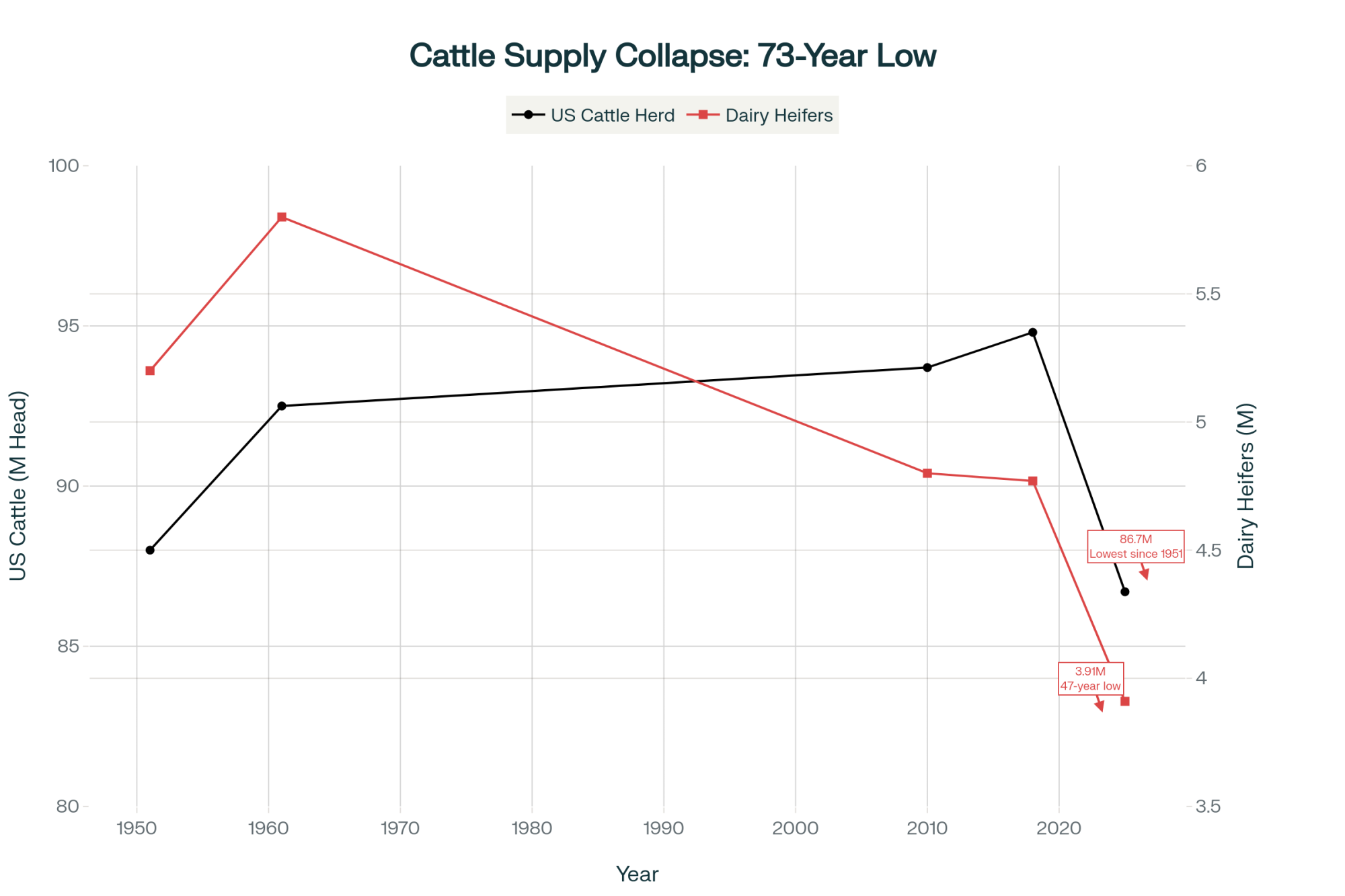
The fundamentals tell an interesting story. According to the USDA’s January inventory, we’ve got 86.7 million head of cattle in the U.S., the smallest herd since 1951. Beef cow numbers? Just 28.7 million, the lowest since 1961.
This year’s calf crop is coming in at 33.1 million head, the smallest on record.
And dairy farms? Well, about 72% are now using beef semen in their breeding programs to some degree. That’s become standard operating procedure, especially when beef-cross calves are bringing $1,000-plus while Holstein bulls fetch maybe $100.

The Three-to-Four Year Reality Check
A central Pennsylvania dairyman explained it to me perfectly: “Politicians can promise whatever they want, but a heifer I keep today won’t drop a calf until July 2026. And that calf? It won’t be beef until 2028.”
That biological timeline matters more than any trade deal.
Think about what this means for dairy operations. While beef producers struggle with rebuilding (and most can’t with current drought conditions in parts of the country), dairy farms have positioned themselves at an interesting crossroads. They’re producing premium beef-cross calves into a supply-constrained market. But they’re also creating their own replacement heifer shortage.
CoBank’s August analysis put some hard numbers on this. Dairy heifer inventories hit 3.91 million head in January 2025—that’s a 47-year low, down 18% from 2018.
I remember buying nice springers for $1,600 five years ago. Last month, a neighbor paid $4,100 for a comparable animal.
Small Operations Need Different Strategies
One thing that doesn’t get enough attention—operations under 200 cows face unique challenges with this beef-on-dairy approach. The genomic testing investment hits harder proportionally. They might not have volume for forward contracts. And losing even a few replacements to disease can derail their program.
Here’s what a 150-cow dairy might look like with a conservative approach:
Annual breeding breakdown (150-cow herd):
- 30 cows (20%) to beef semen = 30 beef-cross calves worth $33,000
- 60 cows (40%) to conventional dairy = 30 heifer replacements
- 60 cows (40%) to sexed semen = 54 elite heifer calves
- Total: 84 potential replacements when they need 45
| Farm Size | Beef % | Replacements Needed | Heifers Produced | Safety Buffer | Genomic Investment | Beef Revenue | Heifer Net Profit | Total Net Opportunity |
|---|---|---|---|---|---|---|---|---|
| 150 cows | 20% | 45 | 84 | +39 (+87%) | $6,750 | $33,000 | $62,400 | $95,400 |
| 500 cows | 30% | 165 | 240 | +75 (+45%) | $22,500 | $82,500 | $120,000 | $202,500 |
| 1,200 cows | 35% | 380 | 470 | +90 (+24%) | $54,000 | $115,500 | $144,000 | $259,500 |
Note: Small operations require higher safety buffers (87% vs 24%) to protect against disease events and culling variations—justifying lower beef percentage
This gives them a 39-heifer buffer for selection and sales while still capturing some beef premiums. Compare that to a larger operation going 35% beef, and you can see why smaller dairies need that extra cushion.
But whether you’re running 150 cows or 1,500, certain strategies are proving successful across the board.
Learning from Operations That Are Making It Work
A 1,200-cow operation near Tulare showed me their approach recently. They’re spending about $45 per calf on genomic testing, which sounds expensive until you consider the alternative.
Now, let’s be clear about the economics here. It costs about $2,400 to raise a heifer from birth to calving, according to 2024-2025 university research. So when we talk about selling a springer for $4,000, the net profit is around $1,600 per head. That’s still exceptional money, but it’s important to understand we’re talking net, not gross.
“Without genomic data,” their manager explained, “we were making quarter-million-dollar breeding decisions based on whether a cow looked good or had mastitis last month.”
Their approach is pretty straightforward:
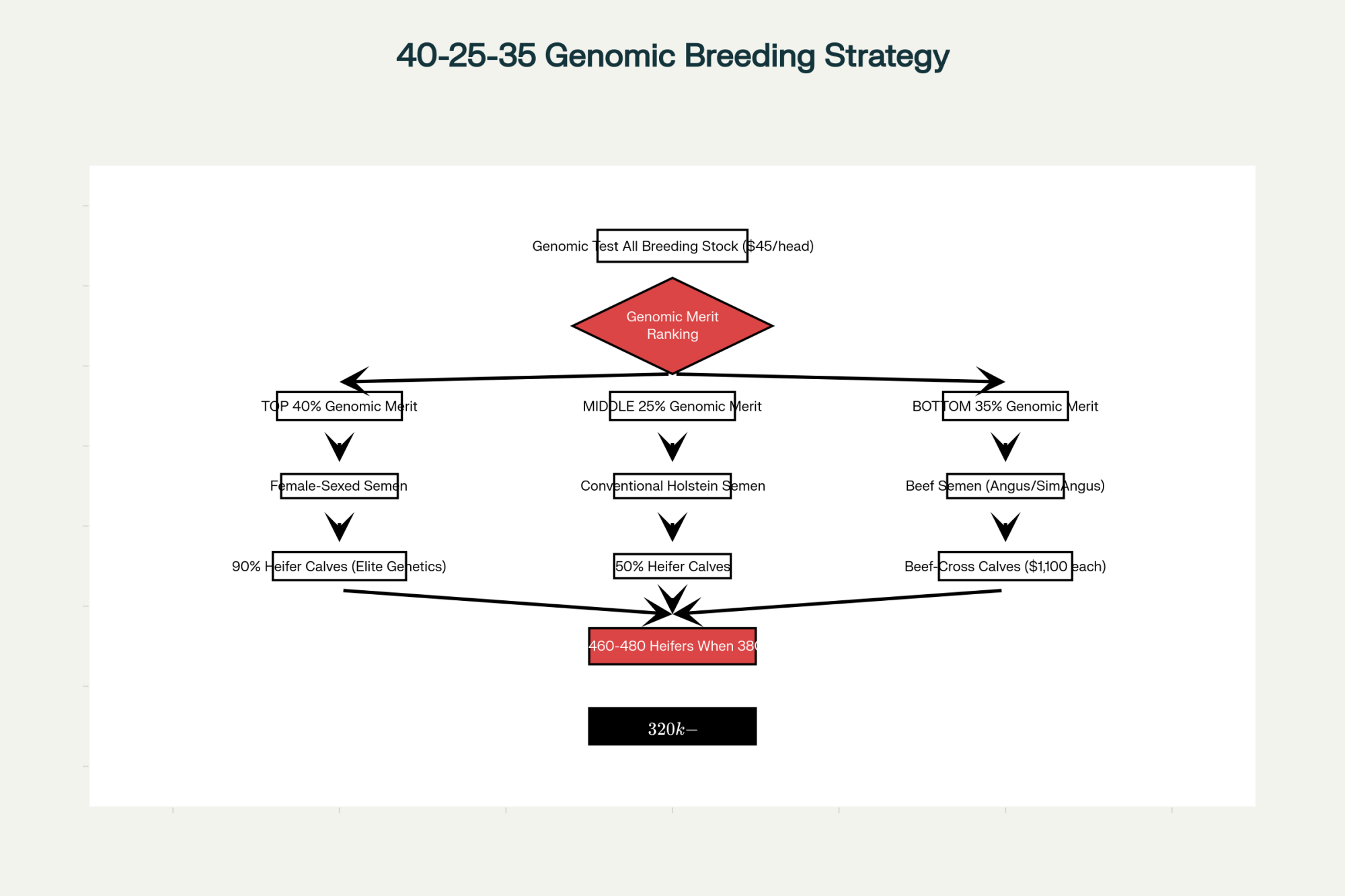
- Top 40% by genomic merit get female-sexed semen (about 90% heifer calves)
- Middle 25% get conventional Holstein semen
- Bottom 35% go to Angus or SimAngus
This generates roughly 460 to 480 replacement heifers when they need 380.
Those extra 80 to 100? At current prices, with $2,400 in raising costs per heifer, that could be $128,000 to $160,000 in net profit. That’s $4,000 selling price minus $2,400 raising cost = $1,600 net per heifer. Though, as one producer wisely noted, “That’s if the market holds.”
Quick Reference: Genomic Breeding Strategy
- Top 40%: Female-sexed semen only
- Middle 25%: Conventional dairy semen
- Bottom 35%: Beef semen exclusively
- Result: 460-480 heifers produced when 380 were needed
The Insurance Most People Haven’t Heard About
Since July 1, USDA’s Risk Management Agency has offered Livestock Risk Protection for beef-on-dairy calves. A crop insurance agent in Iowa broke it down for me: “For about $26 per head, you can protect 95% of expected value on those beef crosses. Apply at least 30 days before you expect to sell.”
Let’s say you’re breeding 150 cows to beef (30% of a 500-cow herd). At $1,100 per calf, that’s $165,000 in expected revenue.
Insurance runs about $3,900 to protect $156,750 of that value.
If imports flood the market and beef crosses drop to $700? The policy covers the difference. Not bad for peace of mind.
Spring 2026: When Everything Converges
Looking at CME futures and talking with dairy economists, April through June 2026 could get interesting—and not in a good way.
Class III milk futures for that period are trading around $17.00 to $17.50 per hundredweight. At those prices, modeling suggests 60-70% of operations could face negative margins before replacement costs.
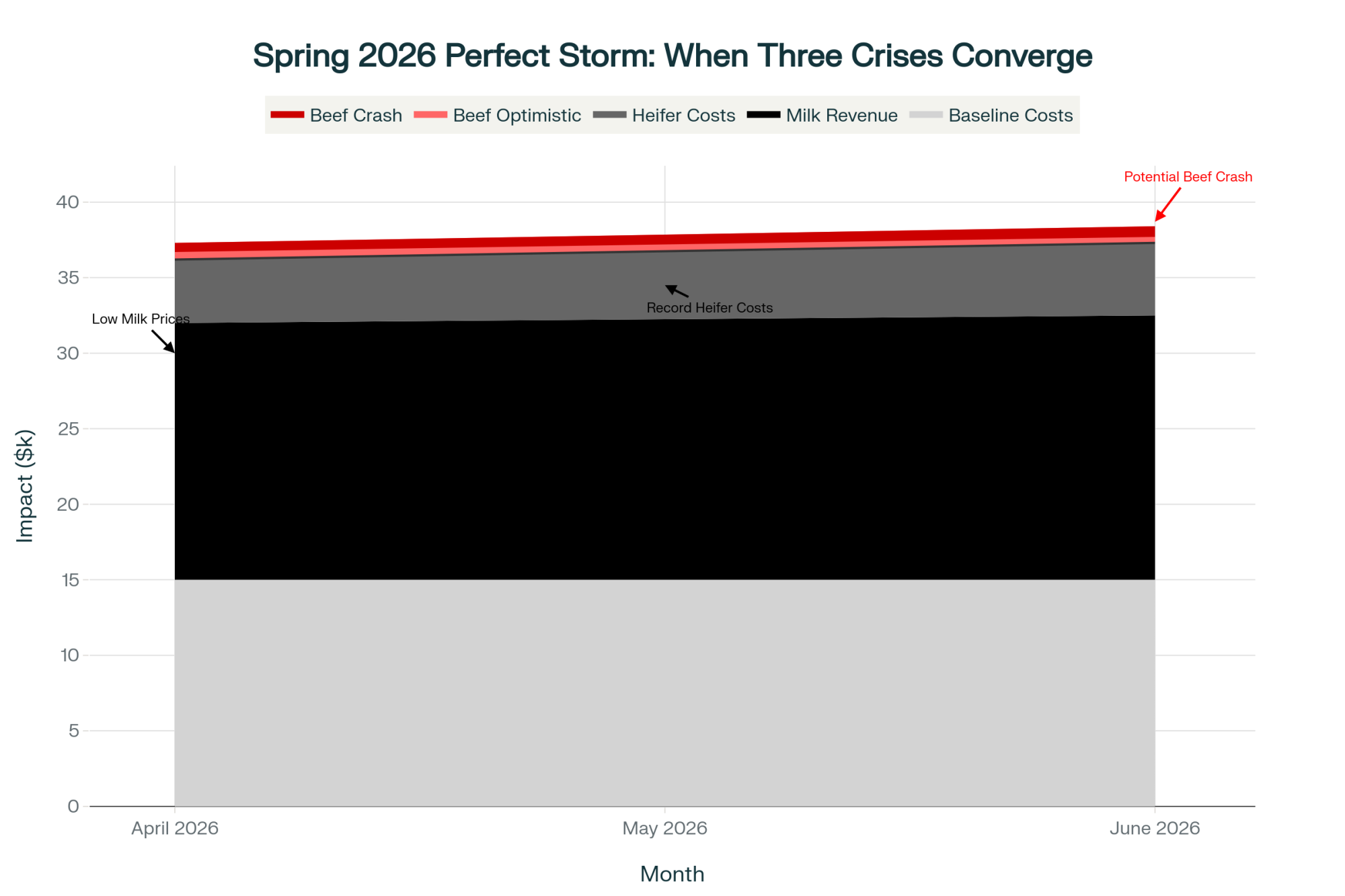
Add in replacement heifers potentially exceeding $4,500, and if beef-cross values crash to $400-600 from expanded imports?
A Midwest nutritionist ran the numbers for me: “At $17.50 milk, $4,500 replacements, and $500 beef calves, we’re looking at annual deficits that would stress even well-capitalized operations.”
The Squeeze on Different Operation Types
What’s interesting is how this hits different farms:
- Grazing operations might actually weather it better with lower input costs
- Organic dairies face unique challenges—their premiums help, but replacement options are limited
- Conventional confinement operations see the full brunt of feed and replacement costs
Why Your Location Changes Everything
What works in Wisconsin’s climate doesn’t translate to Arizona’s heat or Vermont’s grazing systems.
A Texas dairyman managing 2,500 cows shared something revealing: “Our sexed semen conception drops 12-15% in summer. We concentrate sexed breeding from November through March, then shift toward beef when heat stress peaks.”
Their cull rate also runs higher—approaching 38%—which limits how aggressive they can be with beef breeding overall.
Feed economics adds another layer. Pennsylvania producers buying delivered corn at $5.40 per bushel face different economics than Indiana neighbors seeing $4.20 on farm.
That $1.20 difference shifts beef-cross break-evens by $60-80 per head.
And LRP insurance basis risk varies regionally, too. Southern dairy areas sometimes see $75 basis swings that rarely occur in Wisconsin.
The Collective Action Problem Nobody Talks About
Here’s what’s genuinely revealing. Each farm breeding more cows to produce beef makes perfect individual sense. Quality beef crosses bring $1,000-plus while Holstein bulls fetch $100. The math is obvious.
But with 72% of the industry now using beef semen, we’ve collectively created the replacement shortage now driving heifer prices to record levels.
It’s rational individual behavior producing challenging collective outcomes.
What’s different this time is technology. Modern sexed semen achieving 90% female conception rates means farms can pursue beef revenue from lower-merit animals while maintaining replacements from elite genetics. That wasn’t feasible even a decade ago.
Several economists suggest we’re heading toward a new baseline. Replacement heifers might settle at $2,500-$3,000rather than returning to $1,500-$2,000.
Beef-cross premiums could stabilize at $300-500 over dairy bulls instead of the historical $100-200 differentials.
Your Next Month’s Action Plan
Based on what’s working for successful operations, here’s what makes sense:
Get genomic testing started. At $40-50 per test, a 500-cow operation faces about a $22,500 investment in testing all youngstock. But compared to breeding decisions worth hundreds of thousands? It’s becoming easier to justify.
Submit samples to your genetics provider—Alta, Select Sires, ABS, whoever. Results take about two weeks.
Those genomic rankings become your breeding bible: top 40% get sexed, bottom 35% get beef, middle 25% get conventional.
Look into price protection. Your crop insurance agent (who probably handles your other coverage) can quote LRP. Current pricing suggests $25-30 per head protects about $1,100 in expected value per beef calf.
Calculate your actual needs. Here’s the math: Herd size × cull rate × (age at first calving ÷ 24) × 1.1 for non-completion.
A 500-cow herd with 30% culling needs about 165 replacements annually.
Remember to factor in raising costs. At $2,400 per heifer to raise and $4,000 to sell, each surplus heifer nets you $1,600. Even at these margins, 75 extra heifers means $120,000 in additional profit—money that goes straight to your bottom line.
Compare that to what your breeding strategy produces. If you’re generating 240 heifers but need 165, those 75 extra represent $120,000 in net profit at current prices ($4,000 sale price minus $2,400 raising cost = $1,600 net × 75 head).
Some Farms Are Zigging While Others Zag
A Minnesota producer recently explained their contrarian strategy: reducing beef semen to 15% while ramping sexed usage to 55%.
“We’re sacrificing maybe $75,000 in immediate beef premiums, but if we can sell 150 heifers at $4,200 when everyone else needs them, that’s $630,000 in revenue. After $2,400 per head in raising costs, we’re netting $270,000—still $195,000 ahead.”
Several operations are already exploring forward contracts for 2026 heifer deliveries at prices that would have seemed impossible three years ago. Some are even considering embryo transfer to multiply their best genetics—though that’s a whole different investment level.
The Challenges We Need to Acknowledge
Beef-cross calves sometimes present different health challenges, particularly respiratory issues in the first 30 days. Most operations adapt protocols successfully, but it requires attention.
Market concentration varies by region. Some areas have robust buyer competition; others see just two or three buyers controlling volume. Know your local market.
And political uncertainty remains the wildcard. Trade policy can shift quickly. While biological constraints limit immediate supply response, import changes could affect pricing relatively fast.
Looking at the Next 18 Months
The convergence of biological constraints, market dynamics, and political uncertainty suggests we’re in an 18-month window where beef-on-dairy economics remain favorable—though perhaps not at recent extreme levels.
Your decisions about genomic testing, breeding strategies, and risk management over the coming weeks will significantly influence outcomes through 2026 and beyond.
What seems clear is that cattle biology operates on its own timeline. When a significant portion of an industry moves collectively, it creates both opportunities and challenges.
The most successful operations won’t necessarily be those maximizing every premium today. They’ll be those thinking strategically about conditions 12-18 months out and positioning accordingly.
Sometimes the greatest opportunity isn’t following the crowd. It’s recognizing when collective behavior creates imbalances worth addressing.
The beef-on-dairy opportunity won’t last forever, but the window remains open for those who act strategically. This beef-on-dairy window is real. The timeline is becoming clearer. And strategic decisions made now will resonate through operations for years.
Given your specific operational constraints and risk tolerance, how will you position yourself for what’s ahead?
The answer to that question—and whether you invest in genomic testing to guide it—could be worth hundreds of thousands of dollars over the next 18 months.
Your genetics rep is waiting for your call. Make it count.
KEY TAKEAWAYS
- Genomic testing ROI is compelling: A $22,500 investment (500-cow herd) guides breeding decisions worth $160,000+ in potential surplus heifer net profit when accounting for $2,400/head raising costs when using the 40-25-35 strategy (sexed-conventional-beef)
- Small operations need adjusted strategies: Farms under 200 cows should limit beef semen to 20% versus 35% for larger operations, maintaining a 39-heifer buffer while still capturing $33,000 in beef premiums on 150 cows
- Regional variations demand flexibility: Texas operations seeing 12-15% conception drops in summer heat need seasonal breeding adjustments, while $1.20/bushel feed cost differences between Pennsylvania and Indiana shift beef-cross break-evens by $60-80 per head
- Risk protection is affordable and available: LRP insurance at $26/head protects 95% of $1,100 expected value on beef crosses—apply 30+ days before selling—providing crucial downside protection as import policies shift
- The contrarian opportunity is time-sensitive: With April-June 2026 convergence of $17.50 milk, $4,500 heifers, and potential $500 beef calves, operations positioning as heifer suppliers rather than beef maximizers could capture significant premiums in the next 18 months
Complete references and supporting documentation are available upon request by contacting the editorial team at editor@thebullvine.com.
Learn More:
- Beef-on-Dairy in 2025: Turning Calf Premiums into Real Profit (Without Blowing Up Your Herd) – This tactical guide provides a crucial real-world checklist, revealing best practices for managing buyer contracts and traceability paperwork. It demonstrates how to sort DHI reports monthly and stick to the 25-30% replacement rule necessary to prevent handing your beef premiums back to the replacement market.
- The Heifer Shortage: Crisis and Opportunity – Go deeper on the economics of the replacement crisis. This strategic analysis provides essential USDA inventory figures, outlines how to stress-test your financials at $4,000 replacement costs, and shows how heifer retention programs can deliver up to 54% cost savings versus market acquisition.
- Revolutionary Sperm Testing Exposes Hidden Bull Fertility Crisis Draining Dairy Profits by $8,000+ Per Operation – Explore the innovative technology behind maximizing your “zag” strategy. This article details Time-Dependent Semen Analysis (TDSA) and the Sustained Motility Lifetime (SML) metric, which can deliver 8-10% conception rate improvements, ensuring your expensive sexed semen investment pays off.
The Sunday Read Dairy Professionals Don’t Skip.

Every week, thousands of producers, breeders, and industry insiders open Bullvine Weekly for genetics insights, market shifts, and profit strategies they won’t find anywhere else. One email. Five minutes. Smarter decisions all week.




