




Archive for automated milking

Why German Retailers Lose $8 on Every Pound of Butter – And How It’s Bankrupting Dairy Farms

Why would anyone sell butter at a 60% loss? Because destroying farms is more profitable than butter.

EXECUTIVE SUMMARY: That cheap butter at your store? Retailers lose $8 per pound selling it—intentionally. Four chains controlling 85% of Germany’s grocery market use algorithms that synchronize prices without human intervention, accepting dairy losses to profit from everything else in your cart. This strategy has already eliminated 28,000 German dairy farms, with 2,800 more exiting annually. By 2030, only 18,000 of today’s 47,000 farms will remain—a 60% collapse. The same algorithmic playbook is now hitting Wisconsin, California, and even Canada’s protected market. Farmers face a stark choice: adapt through diversification and collective action, or become casualties of the algorithm economy.

You know that moment when you see a price that just doesn’t make sense? I had one of those last month in Bavaria, standing in a Lidl looking at butter on promotional pricing—€1.39 for a 250-gram pack.

Now, I’ve been tracking dairy economics for about 25 years, and this stopped me cold. Because when you run the numbers… well, let me walk you through what I discovered.

THE BREAKDOWN: Where €1.39 Butter Really Comes From

The Economics of Intentional Loss: How Retailers Weaponize Butter
  • €11.50 – Raw milk cost (21.5 kg milk × €0.535/kg)
  • €1.25 – Processing (energy, labor, packaging)
  • €0.95 – Logistics & distribution
  • €13.70 – Total actual cost per kilogram
  • €5.56 – Retail selling price per kilogram
  • €8.14 – Loss per kilogram

The Math That Started This Conversation

So here’s what we all know—it takes about 21.5 kilograms of milk to make a kilogram of butter. Basic dairy conversion, right? The German Farmers’ Association reported in September that Bavarian producers were getting between €0.53 and €0.54 per kilo for their milk. Pretty standard for the region this time of year.

Quick math tells you that’s €11.50 per kilogram of butter in raw milk. Just the milk, nothing else.

But here’s where it gets interesting. I’ve been talking with folks in processing, and German processor associations are reporting their members face costs anywhere from €1.15 to €1.35 per kilogram—that’s energy, labor, packaging, the whole nine yards. Add in transportation and warehousing, and you’re looking at a total cost of around €13.70 per kilogram of butter. Minimum.

That promotional price at Lidl? Works out to €5.56 per kilogram.

That’s more than an €8 loss per kilo, folks. And this isn’t a one-off mistake—this is happening across Germany right now.

The Illusion of Choice: Market Concentration’s Death Grip

What I’ve found is that when you dig into the market structure—and the Bundeskartellamt, Germany’s federal cartel office, has documented this thoroughly—you see that four retail chains control about 85% of the German food market. We’re talking Edeka, Rewe, the Schwarz Group (they run Lidl and Kaufland), and Aldi. When you’ve got that kind of concentration… well, the dynamics change completely.

How Retail Pricing Actually Works These Days

This builds on something we’ve all been noticing—pricing isn’t what it used to be. These retailers are now using algorithmic systems —computer programs that monitor competitor prices and adjust automatically. The UK’s Competition and Markets Authority has done some fascinating work documenting this.

What happens—and university researchers at places like MIT and Carnegie Mellon have tracked this in real time—is pretty remarkable. When Lidl’s system sees Aldi drop butter to a certain price, it automatically matches or beats it. No meetings, no phone calls. Within 48 hours, sometimes less, all four major chains end up at basically the same price.

And here’s the kicker: this is completely legal under EU competition law. Article 101 requires explicit agreement for a violation, and these algorithms… they’re just responding to market conditions. Game theorists call it finding the Nash equilibrium—basically, the point where nobody benefits from changing their strategy alone.

But what’s this mean for us as dairy producers? As a processor recently told me, “We’re not really negotiating with buyers anymore. We’re dealing with machines programmed to optimize the entire shopping basket, not individual products like milk or butter.”

The Cross-Subsidization Strategy

So how can retailers lose €8 per kilo of butter and still stay in business? Well, that’s where it gets clever—and honestly, a bit frustrating if you’re on the production side.

Why Retailers Love Losing on Your Milk: The 146% Sacrifice Strategy

Market research firms like GfK have studied this extensively. When shoppers come for that cheap butter, they don’t leave with just butter. The whole shopping trip tells a different story.

Those dairy products bringing people in the door? They’re losing money. But look at what else goes in the cart. Private-label products—and industry benchmarking suggests these run at much higher margins. Store-brand pasta might hit margins of 40-45%. Their cheese? Often 50% or more. Those fresh-baked items that smell so good when you walk in? We’re talking 50-60% margins, easy.

And those middle-aisle specials Aldi and Lidl are famous for—the tools, seasonal items, random clothing? Import data suggests those can run 60-70% margins.

A typical €40 shopping trip might lose a bit on dairy but generate €15-20 in overall gross profit. The dairy loss? It’s basically their customer acquisition cost.

What really gets me—and I hear this from producers all the time—is that retailers have thousands of products to balance. We’ve got milk. When our single product gets priced below production cost, we can’t make it up by selling garden tools or Christmas decorations.

What This Means for the Next Generation

Let me share something that really brings this home. I recently spoke with a Bavarian producer—I’ll call him Johann to respect his privacy—who runs about 85 cows near Rosenheim. Good operation, been in the family for four generations.

His son was planning to come back after finishing his ag degree. “Was” being the key word.

German Farmers’ Association data shows that when milk prices drop even €0.02 to €0.03 per kilogram, operations of his size can see income swings of €35,000 to €45,000 annually. For Johann, that recent price movement? It eliminated the salary he’d planned for his son.

The kid’s studying engineering in Munich now. Can’t say I blame him.

What we’re seeing across Germany matches this perfectly. Federal statistics show they’re down to 46,849 dairy farms—that’s from about 75,000 just ten years ago. Average farmer age has crept past 52. And the Thünen Institute’s research shows that only about 37% have identified successors.

The Extinction Curve: 60% of German Dairy Farms Gone by 2030

When your margins compress below 7%—and many German operations are there right now—succession planning basically stops. Young people see their parents dealing with transition cow challenges, managing butterfat levels through these hot summers, working 70-hour weeks during calving season… all for marginal returns. They find other paths. And honestly? Who can blame them?

Two Paths Forward

Looking at where this could go by 2030, I see two pretty distinct scenarios developing.

If Current Trends Continue

Based on German federal statistics showing about 2,800 farms leaving each year, we’re looking at 18,000 to 20,000 dairy farms by 2030. That’s a 60% drop from today.

Average herd size would probably expand to 250-300 cows. Different world entirely—you’d need parlors built for that scale, different fresh cow protocols, probably shift from component feeding to TMR systems… it’s a fundamental operational change.

And here’s what concerns me: remember 2022? During those supply chain disruptions, consumer price monitoring showed German butter hitting €2.19 to €2.49 per pack in some areas. Nearly double today’s promotional prices.

Rabobank’s 2025 dairy outlook makes a solid point here—every farm that exits permanently reduces the system’s ability to respond to shocks. When the next crisis hits, whether it’s drought affecting forage quality or another geopolitical disruption, the system won’t have the capacity to respond. Prices won’t just increase—they’ll spike hard.

If Reforms Take Hold

Now, there’s another path, and we’re seeing pieces of it work in Spain and France.

Both countries introduced cost-based pricing regulations—Spain in 2013, France in 2018. According to Eurostat data, yes, their dairy prices run 8-12% higher than Germany’s. But their farm exit rates? Less than half of Germany’s, according to their ag ministries.

I’ve talked with French producers at conferences, and while it’s not perfect, they can at least plan. They know costs will be covered plus a small margin. That lets them invest—better cooling systems for heat stress, improved transition cow facilities, things that pay off long-term.

What’s encouraging is that the French Young Farmers Association reports over 1,200 new dairy operations started in 2024. Not huge numbers, but it’s growth versus decline. That matters.

What’s Actually Working Out There

After talking with producers across Europe and North America, here’s what I’m seeing work in practice.

For Younger Operations with Succession Plans

If you’re under 45 and have someone to take over someday, you’ve got options, but you need to think strategically.

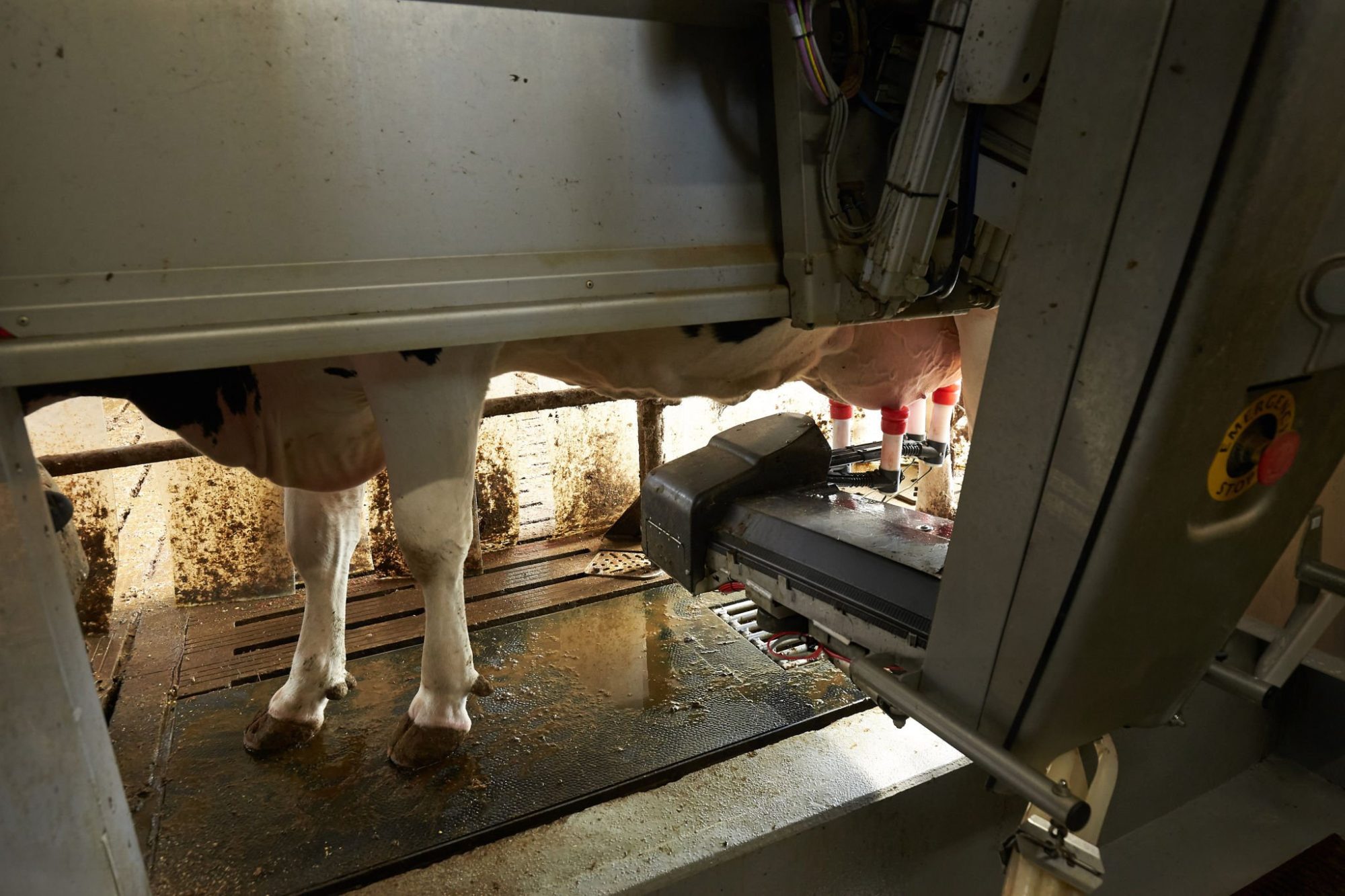
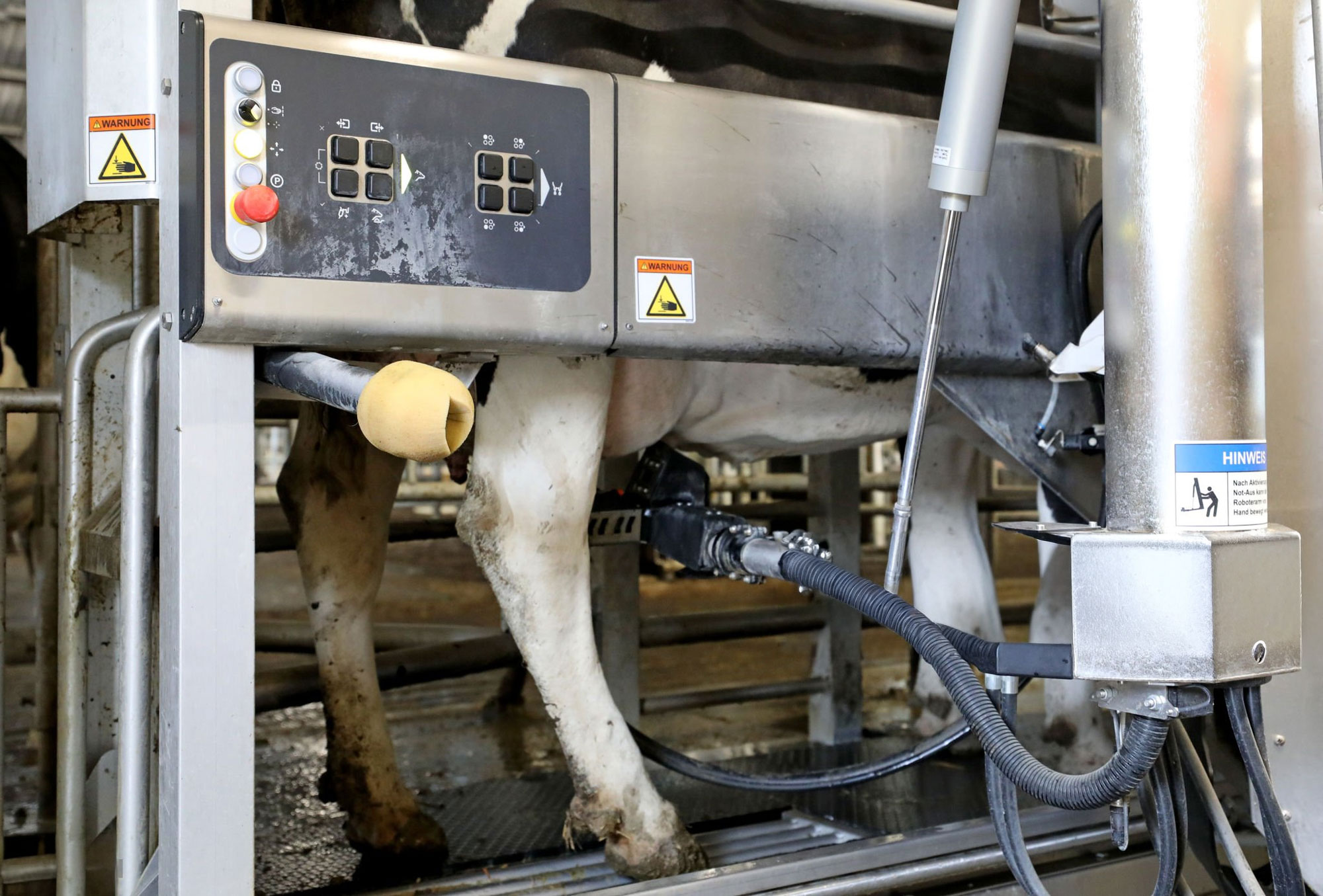
Automation’s one path. Research from Wageningen University and Michigan State shows robotic milking systems can reduce labor costs 10-18%. But honestly, it’s as much about lifestyle as labor savings. Robots don’t need Christmas morning off, you know?

More important, though—join a producer organization if you haven’t already. The bigger German co-ops, their annual reports show, they’re getting 3-5% premiums over spot markets. When you’re facing these concentrated buyers, that collective voice might be your only real leverage.

What’s really interesting is operations finding ways around the commodity trap. Direct marketing, organic certification, value-added processing—anything that breaks that pure price-taker relationship.

I know several Bavarian producers who’ve shifted 30-40% of their production to on-farm processing. It’s not easy—we’re talking investments of €150,000 to €200,000, learning cheese-making or yogurt production, and dealing with food safety regulations. But they’re capturing €0.90 to €1.00 per liter equivalent versus €0.53 for commodity milk. That’s the difference between surviving and actually building something.

For Late-Career Producers

This is tough to talk about, but it needs saying. And I know it’s not easy to hear, especially if you’ve poured your life into your operation.

European Network for Rural Development research is pretty clear—farmers who make exit decisions within 18 months of sustained margin pressure typically preserve 60-80% of their equity. Those who hold on for three years or more, hoping for recovery… many lose everything.

If you’re in this position, do the math. Divide your available credit and savings by your monthly shortfall. If that number’s less than 18 months, you need to start planning now. Not next season. Now.

I understand the emotional weight of this decision. This isn’t just a business—it’s your heritage, your identity, your life’s work. But preserving what you’ve built —ensuring you have something to pass on or retire with —matters more than holding on until there’s nothing left.

Strategies That Work Regardless

No matter where you are in your career, some things just make sense.

Document your costs religiously. Everything—feed, labor, what you spent on that metritis outbreak last month, depreciation on equipment, your own time. The Dutch dairy board has excellent templates if you need them. When policy discussions happen, farmers with solid numbers have credibility.

Build relationships with your processor. FrieslandCampina’s 2024 supplier report and Arla’s recent guidelines both indicate they’re increasingly open to longer-term contracts with producers who maintain quality parameters and keep somatic cell counts in check. It won’t completely protect you from market swings, but it helps.

And please, connect with other producers. Research on agricultural mental health consistently shows that peer support makes a huge difference in stress management. Plus, collective action’s the only thing that moves policy. Look at what French farmers achieved with their early 2024 protests—they got real concessions because they worked together.

The North American Parallel

What’s happening in Germany isn’t unique. Let me give you a Wisconsin perspective, because I was just talking with producers there last month.

USDA Economic Research Service data from September shows four beef packers control 85% of U.S. processing. Different commodity, same dynamics. But in dairy, it’s playing out differently region by region.

In Wisconsin, where I spent time with a 200-cow operation near Eau Claire, the processor consolidation is real, but the retail dynamic’s different. They’ve got Kwik Trip—a regional chain that’s actually built relationships with local producers. The owner told me, “We’re getting $18.50 per hundredweight, which isn’t great, but it’s stable. The co-op knows if they squeeze us too hard, we’ve got options.”

That’s the difference—options. When you’ve got multiple buyers—even if they’re not perfect—you’ve got leverage.

Now, the Federal Milk Marketing Order system in the U.S. adds another layer of complexity. It sets minimum prices based on end use—Class I for fluid milk, Class III for cheese, and so on. But even with that safety net, when retail concentration hits a certain level, those minimums become maximums real quick.

Down in California, it’s another story entirely. The mega-dairies with 5,000-plus cows? They’re basically price-takers from the big processors. One operator near Tulare told me they’re looking at getting into renewable natural gas from manure just to diversify revenue. They’re projecting $3-4 million annually from RNG versus $12 million from milk on 6,000 cows. “Milk’s becoming a byproduct of our energy business,” he said. Wild to think about, but that’s adaptation.

Even Canada—with their supply management system that’s supposed to protect producers—the Canadian Dairy Commission’s recent quarterly report shows pressure. Retail concentration there means that even with production quotas, processors are getting squeezed, and that rolls downhill.

Innovation Born from Necessity

But here’s what gives me hope—farmers are incredibly innovative when pushed.

German agricultural organizations are documenting some fascinating adaptations. Operations near tourist areas are building serious secondary income through agritourism—farm stays, educational programs, even “adopt a cow” initiatives that create direct consumer relationships.

I visited one operation in the Black Forest region that’s pulling in €85,000 annually from agritourism versus €92,000 from milk. They’ve got six vacation apartments in a renovated barn, and offer farm breakfasts with their own products. “The cows became the attraction, not just production units,” the owner told me.

When Commodity Pricing Fails, Innovation Wins: Revenue Streams That Actually Work

Energy production’s another avenue. The German Biogas Association reports that over 3,000 dairy farms have added anaerobic digesters in recent years. Depending on whether you’re running a dry lot or free stall system, a 300-500 cow operation can generate 1.5 to 3.5 megawatts. With feed-in tariffs in some regions, that’s income that doesn’t depend on milk prices.

What’s really intriguing is watching cooperatives move beyond commodity processing. FrieslandCampina’s latest annual report shows it pushing hard into specialized nutrition—sports recovery proteins and specific components for infant formula. These aren’t commodity products. The margins are multiples of the standard milk powder price.

They’ve realized they can’t compete with retailers on commodity terms, so they’re changing the game entirely. Smart move, if you ask me.

And you know what? This innovation isn’t just happening in Europe. I’m seeing U.S. producers getting creative, too. There’s a group in Vermont making cultured butter that sells for $24 a pound at farmers markets. A Wisconsin operation partnered with a local brewery to make milk stout—they’re getting paid double for that milk. These aren’t solutions for everyone, but they show what’s possible when you think outside the bulk tank.

The Bridge to Tomorrow

Here’s something I’ve been thinking about lately—we’re in this weird transition period where the old model is clearly broken but the new one hasn’t fully emerged yet.

The consolidation in retail and processing, the algorithmic pricing, the pressure on margins… these aren’t going away. But I’m also seeing the seeds of something different. Direct-to-consumer models are enabled by technology. Energy diversification that makes farms less dependent on milk prices alone. Cooperatives are moving up the value chain into specialized products.

It reminds me of the shift from cans to bulk tanks back in the day. That transition was brutal for some, an opportunity for others. The difference now? The pace of change is faster, and the imbalance of market power is more extreme.

Questions Worth Asking Yourself

As we’re having this conversation, here are some questions every producer should be thinking about:

What percentage of your milk goes to buyers with more than 30% market share? If it’s over 70%, you’re vulnerable to these dynamics we’ve been discussing.

How would a sustained 10% price cut affect your operation? Really run those numbers—including impacts on your replacement program, equipment maintenance, everything. If the answer involves burning through savings or taking on debt just to keep going, you need a Plan B.

Are you connected with producer organizations? If not, why not? In this market structure, that collective voice might be your only leverage.

Have you calculated what your operation’s worth—both as a going concern and in a wind-down scenario? It’s not fun math, but knowing those numbers helps you make strategic decisions.

The View from Here

That €1.39 butter in Bavaria isn’t just a crazy promotional price. It’s showing us where agricultural markets are heading when retail concentration meets algorithmic coordination.

“Every farm that exits permanently reduces the system’s ability to respond to shocks. When the next crisis hits, the system won’t have capacity. Prices won’t just increase—they’ll spike hard.”

These dynamics are going to reach every commodity ag sector within the next decade—if they haven’t already. The question isn’t whether these forces will affect your market. They will.

The question is whether you’ll be ready.

The German dairy sector’s giving us all a preview. Part warning, part roadmap. The warning’s clear: traditional market relationships are being fundamentally restructured by technology and concentration. Producers who don’t recognize and adapt to these new realities face serious challenges.

But there’s also a roadmap. We’ve navigated big changes before—the shift from cans to bulk tanks, quota eliminations in Europe, multiple price cycles that tested but didn’t break us. This one’s different in its mechanisms, but it’s still calling for the same farmer ingenuity we’ve always had.

Successful adaptation means understanding these dynamics, building collective strength, exploring value-added opportunities, and—this is crucial—making decisions based on data rather than hope or tradition.

I’ve spent 25 years watching this industry evolve, and I’ve never seen changes this fundamental happening this fast. But you know what? I’ve also never seen dairy producers fail to adapt once they understand what they’re facing.

That €13.70 production cost, butter selling for €1.39? It’s not sustainable, it’s not accidental, and it won’t fix itself through normal market forces. But understanding it—really grasping what it means—that’s your foundation for not just surviving but potentially thriving despite these new realities.

TAKE ACTION THIS WEEK:

Calculate Your Runway:

  • Monthly cash burn rate ÷ available reserves = months until crisis
  • If less than 18 months, start planning NOW

Connect With Support:

  • Producer Organizations: Find yours at www.euromilk.org/members
  • Mental Health Support: Agricultural crisis hotlines available 24/7
  • Cost Tracking Tools: Free templates at www.dairynz.co.nz/business/budgeting

Build Your Network:

  • Join or form a local discussion group
  • Connect with processors about long-term contracts
  • Explore value-added opportunities with other producers

The path forward requires clear thinking, collective action, and continued innovation, which have always been the hallmarks of successful dairy operations. These are challenging times, no doubt about it. But they’re far from insurmountable for those willing to see clearly and adapt accordingly.

Stay strong, stay connected, and keep asking the tough questions. We’re going to need all three to navigate what’s ahead.

KEY TAKEAWAYS:

  • Retailers lose $8/pound on butter BY DESIGN: They profit from 40-70% margins on everything else while using dairy as bait—enabled by 85% market concentration
  • Algorithms replaced negotiations: Pricing bots at four major chains synchronize within 48 hours, creating legal coordination that individual farmers can’t fight
  • 2,800 farms vanish annually: Germany down from 75,000 to 47,000 farms in a decade—60% of survivors won’t make it to 2030 without adaptation
  • Your decision window is 18 months, not years: Exit within 18 months = 60-80% equity preserved. Wait 3 years hoping for recovery = total loss
  • Only three strategies are working: Join producer co-ops (+3-5% prices), add revenue streams ($40-120K from energy/agritourism), or time your exit strategically

Complete references and supporting documentation are available upon request by contacting the editorial team at editor@thebullvine.com.

Learn More:

Join the Revolution!

Join over 30,000 successful dairy professionals who rely on Bullvine Weekly for their competitive edge. Delivered directly to your inbox each week, our exclusive industry insights help you make smarter decisions while saving precious hours every week. Never miss critical updates on milk production trends, breakthrough technologies, and profit-boosting strategies that top producers are already implementing. Subscribe now to transform your dairy operation’s efficiency and profitability—your future success is just one click away.

NewsSubscribe
First
Last
Consent

CME DAIRY REPORT FOR SEPTEMBER 22nd, 2025: Why Today’s Market Crash Won’t Self-Correct Like Everyone Thinks

Just 12 trades crashed butter 5.5¢ today. Why? The dairy industry’s free market fairy tale just died. And taxpayers funded the funeral.

Executive Summary: The dairy industry’s biggest lie—that free markets self-correct—got brutally exposed today when 12 trades crashed butter 5.5¢ and revealed an oversupplied market that processors can’t absorb. USDA’s 230.0 billion pound production forecast just hit a processing system running at 99% capacity, while Mexican buyers abandon US product for cheaper New Zealand alternatives due to dollar strength. Co-op boards are privately discussing supply management for the first time since the 1980s because market mechanisms have officially failed. Your September-October milk checks are heading into $16.50-16.80/cwt disaster territory, and the futures curve is screaming that recovery won’t come quickly. Smart money exited months ago while producers clung to hope—now math is forcing the reckoning that volume-chasing strategies just became suicide missions. This isn’t a correction you wait out; it’s a structural shift that demands immediate action or guarantees financial destruction.

dairy market crash

Look, I’ve been watching these markets for over two decades, and what happened today at the CME isn’t just another correction. It’s the moment the industry’s biggest lie got called out by reality. The dirty secret? We’ve been pretending that free markets can self-regulate a sector that’s structurally broken.

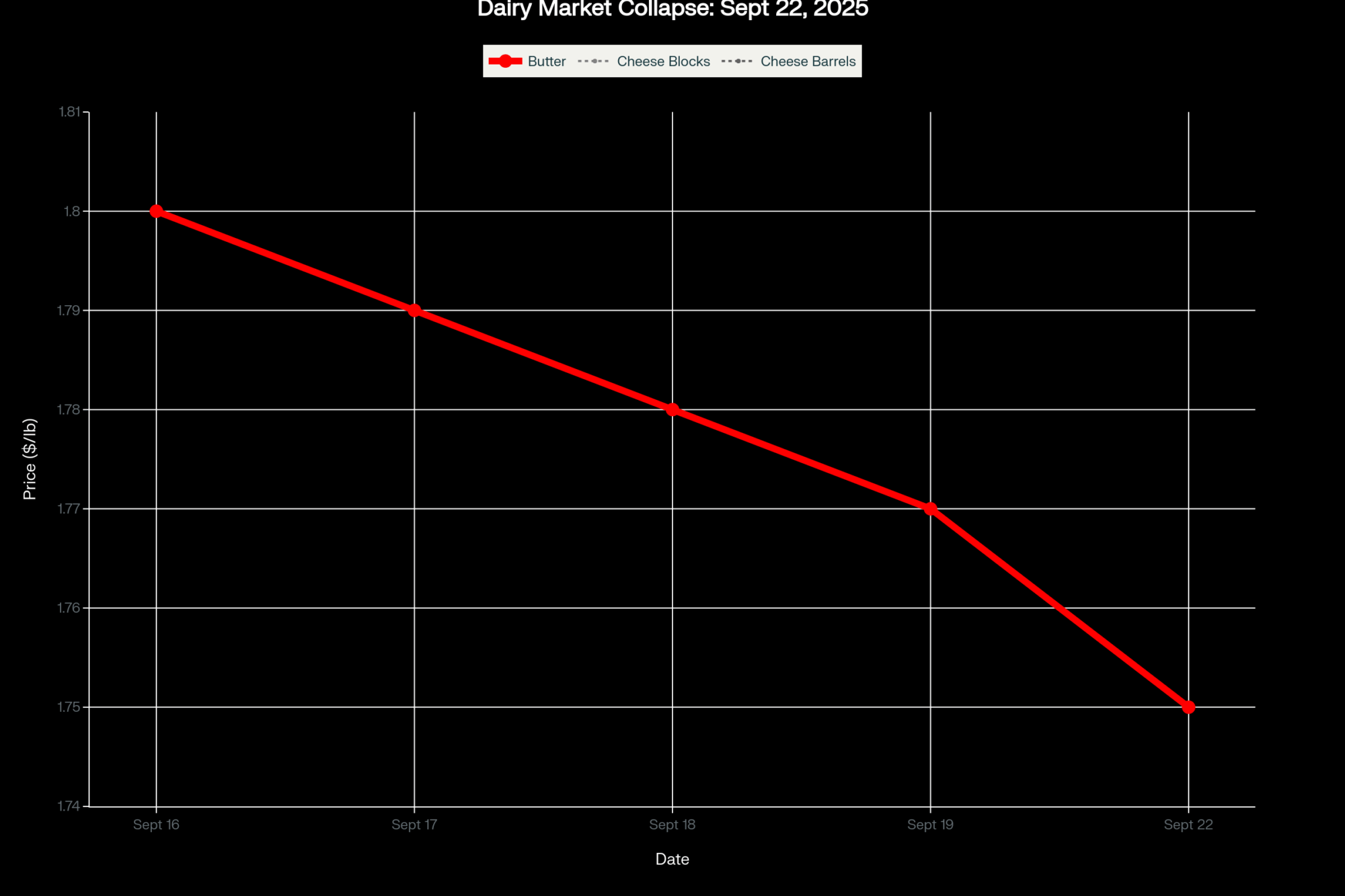
Butter tanked 5.5 cents to $1.75/lb. Blocks cratered 3.25 cents to $1.65/lb. But here’s what nobody’s talking about—this selloff happened with surgical precision because buyers have completely disappeared. When just 12 butter trades can move a market that violently, you’re not seeing normal price discovery. You’re witnessing what happens when an entire industry realizes the emperor has no clothes.

The Numbers That Expose the Real Problem

ProductFinal PriceDaily ChangeWeekly ChangeWhat This Really Means
Butter$1.75/lb-5.5¢-$0.04/lbClass IV heading for $16.50 – your September checks are toast
Cheddar Blocks$1.65/lb-3.25¢-$0.02/lbOctober Class III looking at $16.80 if we’re lucky
Cheddar Barrels$1.64/lbUnchanged+$0.01/lbEven barrels can’t rally – demand is dead
NDM Grade A$1.15/lb+0.25¢FlatOnly thing keeping us from total collapse
Dry Whey$0.64/lb+1.0¢+$0.02/lbProtein demand – the lone bright spot in hell

Why This Time Really Is Different

Three years ago, price crashes were weather-driven or pandemic-related. This is structural oversupply meeting the brutal reality that demand growth has basically flatlined. Restaurant sales dropped from $97 billion in December to $95.5 billion by February—that’s seven consecutive months of decline. When over half of America’s food dollar gets spent outside the home, that directly translates to less cheese moving through the system.

But here’s the part that’s got me really concerned… processing plants are quietly implementing rationing systems that they’re not publicizing. A Wisconsin co-op board member I know—can’t name him because he’d lose his position—told me last week they’re discussing supply management programs for the first time since the 1980s. When farmer-owned facilities start talking about turning away milk, the free market has officially failed.

The USDA Forecast That Changes Everything

The September WASDE delivered a reality check that most producers still haven’t digested. 2025 milk production: 230.0 billion pounds—up another 800 million from July estimates. That’s not a typo. We’re adding nearly a billion more pounds to an already oversupplied market.

Here’s the breakdown that should terrify you:

  • 9.460 million cows (up 10,000 head)
  • 24,310 pounds per cow (up 55 pounds)
  • Class III Q4 forecast: $16.53/cwt
  • Class IV Q4 forecast: $15.46/cwt
  • All-milk price: $21.60/cwt (down $1.00 from earlier forecast)

When USDA cuts their all-milk price forecast by a full dollar, that’s not a tweak. That’s an admission that their earlier projections were fantasy.

What Industry Insiders Are Really Saying

“The fundamentals have been screaming correction for months. Today was just math catching up with reality,” said a senior dairy economist who requested anonymity because his employer has relationships with major co-ops.

A currency trader at a major Chicago bank put it more bluntly: “We’ve been short dairy futures for three weeks based purely on dollar strength. Mexican buyers are shopping New Zealand over US product because we’ve priced ourselves out”.

But the most revealing comment came from a processing plant manager in Wisconsin: “We’re at 99% capacity utilization, but we’re also getting real selective about whose milk we take. The days of guaranteed pickup are over.”

The Global Truth That’s Crushing US Producers

New Zealand’s spring flush isn’t just hitting—it’s demolishing global powder markets with 8.9% production growth. European processors are dumping excess inventory ahead of new environmental regulations that kick in next year. Australia managed to increase exports despite lower production, thereby maintaining competitive pressure.

The dollar impact is devastating. At current exchange rates, US cheese is 15% more expensive for Mexican buyers than it was six months ago. NDM exports to Southeast Asia are down 8% year-over-year because we’re simply not competitive.

Here’s what’s really happening: We’re trying to compete in global markets with domestic cost structures that assume we can charge premium prices. That math doesn’t work when your competitors have structurally lower costs and weaker currencies.

Feed Costs: The False Comfort Zone

Sure, December corn at $4.62/bu isn’t terrible, and soy meal at $284/ton is manageable. But here’s the problem—when milk prices crater faster than feed costs drop, your income-over-feed-cost ratio gets obliterated from the margin side.

A 1,000-cow operation in Wisconsin that was clearing $4.50/cwt over feed costs in July is looking at $2.80/cwt today. That’s a $170,000 monthly margin hit. Scale that across 40,000 US dairy farms, and you’re looking at an industry-wide profit collapse that’ll force consolidation faster than anyone anticipated.

The Processing Capacity Lie That’s About to Explode

Everyone’s talking about $8 billion in new processing capacity coming online in 2025. Here’s what they’re not telling you: Most of this capacity is designed to handle specific types of milk from specific regions at specific quality standards. It’s not just plug-and-play capacity that’ll solve oversupply.

Leonard Polzin from UW-Madison hit the nail on the head: “Once we find a new equilibrium, it could be low for quite some time”. What he didn’t say—but I will—is that this “new equilibrium” might be $3-4/cwt lower than where producers think it should be.

The Canadian System That Proves Our Industry Is Broken

Want to know why Canadian dairy farmers aren’t panicking right now? Supply management. They control production through quota systems, limit imports through tariffs, and coordinate pricing through provincial boards. Result? Stable, predictable margins that let farmers plan beyond the next milk check.

Now I’m not advocating we adopt their system wholesale—the politics alone would make it impossible. However, the fact that their $50 billion dairy sector operates with farmer-owned stability, while our $628 billion industry swings between boom and bust, should prompt us to question some fundamental assumptions.

The Cooperative Crisis Nobody’s Discussing

Here’s where it gets really uncomfortable… Some major co-ops are quietly protecting their least efficient members while competitive producers bear the cost of market reality. Board elections this fall are going to be bloodbaths as efficient producers realize they’re subsidizing neighbors who should have been culled out years ago.

A DFA board member from the Upper Midwest—speaking off the record because this stuff doesn’t get discussed publicly—told me: “We’ve got members producing at $28/cwt cost structures demanding the same milk price as guys doing it at $19/cwt. That math doesn’t work in a down market.”

The TBV Reality Check Index for today:

  • Margin Squeeze Score: 8.5/10 (Critical Zone)
  • Producer Desperation Level: 7/10 (Rising Fast)
  • Co-op Loyalty Test: 6/10 (Serious Cracks Showing)
  • Processing Plant Leverage: 9/10 (Total Control)
  • Market Reality Acceptance: 4/10 (Still in Denial)

What Smart Producers Should Do Right Now

Stop waiting for a rally that isn’t coming. The futures curve is in steep backwardation—September Class III at $17.64 declining to October levels that look increasingly optimistic. If you’ve got unpriced milk, this isn’t the time for wishful thinking.

Focus ruthlessly on efficiency. The days of expanding your way to profitability are over. Every extra pound of milk you produce is working against you in this market. Review culling decisions, breeding programs, and feed efficiency protocols. Volume is your enemy right now.

Plan for margin compression that lasts months, not weeks. This isn’t a weather-driven correction that’ll bounce back in 90 days. This is structural oversupply meeting realistic demand, and the adjustment process could take until mid-2026.

Consider your expansion timeline very carefully. If you were planning facility improvements or herd additions, this market is screaming at you to wait. Capital deployed today could get destroyed by market conditions that persist longer than anyone wants to admit.

The Industry Reckoning That’s Already Started

Processing plant utilization rates have become the new king metric. When Wisconsin and Minnesota plants hit 98% capacity (several are there now), they start dictating terms that would’ve been unthinkable two years ago. Basis adjustments, quality premiums, and pickup schedules—processors hold all the cards.

Environmental compliance costs are about to hit like a freight train. Multiple states are implementing stricter nutrient management requirements that’ll add $2-3/cow/month starting in 2026. When margins are already squeezed, those compliance costs become make-or-break expenses.

But here’s the bigger picture… This correction was inevitable because we’ve been pretending that unlimited production growth could meet unlimited demand growth forever. That assumption just got destroyed by math, and no amount of wishful thinking is going to resurrect it.

The producers who survive this aren’t the ones hoping for a bounce. They’re the ones adapting to the new reality that lower margins, tighter discipline, and operational excellence aren’t temporary requirements—they’re the new normal.

Today’s market didn’t just crash. It revealed the fundamental flaws in an industry structure that’s been living on borrowed time. The smart money figured that out months ago. The question is whether producers are ready to accept it before it’s too late.

Key Takeaways:

  • Market Mechanism Failure: Dairy’s free market illusion shattered when 12 trades obliterated butter prices—proving oversupply can’t self-correct without devastating producer casualties
  • Supply-Demand Apocalypse: 230.0B pounds hitting 99% capacity plants while international buyers flee dollar-inflated US prices for New Zealand bargains
  • Cooperative Betrayal: Efficient producers subsidizing failing operations as boards secretly consider supply caps—the free market’s ultimate admission of defeat
  • Financial Destruction Timeline: $16.50-16.80/cwt milk checks incoming while futures scream lower—this structural shift demands immediate action or guarantees bankruptcy

Learn More:

Maximizing Dairy Margins in 2025: Why Precision Genetics, Nutrition, and Tech Are Your Best Bets Amid Market Volatility

Stop chasing milk volume – 2025’s profit goes to farms maximizing butterfat, feed efficiency, and genomic testing for $1.35/cwt ROI. Are you ready?

EXECUTIVE SUMMARY: Forget the old “more milk, more money” playbook – 2025’s real winners are dialing up butterfat, protein, and risk management, not just milk yield.
USDA’s May 2025 DMC margin held at a robust $10.40/cwt, but this “stability” masks surging feed costs and a market ruled by global cheese demand. U.S. cheese exports jumped 7.1% year-over-year, while feed costs soared to $10.90/cwt, tightening the margin’s safety net. Research from the Journal of Dairy Science and University of Wisconsin confirms that boosting butterfat and protein – not just volume – delivers the biggest milk check gains. With 95.2 million corn acres planted (+5.1%), feed price risk is shifting, but volatility remains. Globally, U.S. dairy’s edge depends on maintaining a price advantage over EU and New Zealand, making component-driven production and proactive DMC coverage essential for profitability. Now’s the time to challenge your herd strategy, lock in risk management, and benchmark your operation against the best.

KEY TAKEAWAYS

  • Maximize your milk check by boosting butterfat and protein, component premiums can add $0.50–$1.00/cwt, outpacing gains from higher milk yield alone.
  • Genomic testing and targeted breeding deliver $200–$400 more profit per heifer, with ROI.
  • DMC Tier 1 coverage at $9.50/cwt averaged $1.35/cwt net return, lock it in now to protect against sudden margin drops.
  • Feed efficiency matters: reducing shrink by 10% can save $58,400/year for a 100-cow herd, and with corn acreage up 5.1%, now’s the time to secure feed contracts.
  • U.S. cheese exports rose 7.1% YTD, but international buyers disappear when prices rise above $1.90/lb – don’t get caught off guard by global price swings.
dairy profitability, herd management, automated milking, feed efficiency, genomic testing

May 2025’s U.S. dairy margin of $10.40/cwt looks rock solid, but beneath the surface, volatility is surging. Robust export demand for cheese offsets rising feed costs, creating a precarious balance that demands sharper risk management. This report draws exclusively on authoritative industry sources, USDA, Journal of Dairy Science, university extensions, and Hoard’s Dairyman to arm you with the facts and strategies you need to thrive in a high-stakes year.

Deconstructing the May 2025 Dairy Margin: Calm Surface, Turbulent Currents

The USDA’s Dairy Margin Coverage (DMC) program reported a May 2025 margin of $10.40/cwt, barely changed from April’s $10.42/cwt1. While this is down 33% from the September 2024 peak, it remains well above the $9.50/cwt DMC payment threshold, a stark contrast to 2023, when DMC payments topped $1.2 billion and were triggered in 11 of 12 months1. This demonstrates the program’s countercyclical design, providing a vital safety net in tough years but staying dormant when margins are strong.

But don’t be lulled by the headline. The stable margin hides a storm of offsetting forces:

  • All-Milk price rose to $21.30/cwt in May, driven by a $1+ surge in Class III prices, thanks to record cheese export demand.
  • Feed costs spiked to $10.90/cwt, the highest in nearly a year, with corn at $4.51/bu, soybean meal at $388.65/ton, and premium alfalfa at $276/ton.

This “high-altitude, narrow-path” equilibrium means your cash flow is up, but so are your expenses, and your break-even just climbed higher. A modest dip in milk price or a feed spike could compress margins rapidly, making this period of strength more fragile than it appears.

Table 1: May 2025 Dairy Margin Calculation Breakdown

ComponentApril 2025May 2025MoM ChangeMay 2024YoY Change
All-Milk Price ($/cwt)$21.00$21.30+$0.30$22.00-$0.70
Corn Price ($/bu)$4.62$4.51-$0.11$4.39+$0.12
Soybean Meal ($/ton)$295.03$388.65+$93.62$357.68+$30.97
Alfalfa Hay ($/ton)$252.00$276.00+$24.00$260.00+$16.00
Calculated Feed Cost$10.58$10.90+$0.32$10.90$0.00
DMC Margin ($/cwt)$10.42$10.40-$0.02$11.10-$0.70

Source: USDA, DMC, and user query data

The Revenue Equation: Exports Drive Prices, Domestic Demand Plateaus

Cheese exports are the engine. U.S. cheese exports hit 190,266 MT through April 2025, up 7.1% year-over-year1. Mexico, Japan, and South Korea led the surge, with U.S. cheese holding a 20–60¢/lb price advantage over EU and New Zealand competitors1. When U.S. cheese prices rise above $1.90/lb, export orders slow sharply, showing the price-sensitive nature of global demand.

Butterfat exports are also booming: Butter exports jumped 41% year-over-year in January 2025, supported by a $1/lb price discount to EU butter1. In contrast, nonfat dry milk exports fell 20% in January and 21% in April, squeezed by EU competition and tighter U.S. supplies.

Domestic demand is flat. U.S. fluid milk sales continue to decline in the long term, while cheese and butter consumption hit record per capita levels1. Health, convenience, and flavor trends drive manufactured product growth, but overall domestic demand is not expanding fast enough to absorb new supply.

The Cost Equation: Feed Market Volatility and Crop Shifts

Feed costs are the wild card. The DMC feed formula is 145 times more sensitive to corn than soybean meal1. The USDA’s June Acreage report showed 95.2 million corn acres planted (+5.1% YoY), the third-highest since 1944, while soybean acres dropped 4.2%. This shift should buffer feed costs, provided the weather holds.

Although national hay stocks are recovering, Alfalfa hay remains regionally volatile, with Western droughts still impacting quality and price.

Formula for DMC Feed Cost: Source: USDA DMC documentation1

Policy Framework: DMC as a Critical Backstop

DMC remains the primary safety net. Since 2019, DMC has triggered payments in 38 of 72 months, delivering $3.3 billion to producers1. The average net indemnity is $1.35/cwt for covered milk, making Tier 1 ($9.50/cwt) coverage a high-ROI risk management tool.

But here’s the rub: The 5-million-pound Tier 1 cap means most of the nation’s milk is produced above the most affordable coverage level. Industry groups are pushing to raise this cap in the next Farm Bill to reflect industry consolidation.

Global Market Landscape: Exports as the Profit Engine

One-sixth of U.S. milk is exported. The U.S. exported $8.2 billion in dairy products in 2024, with cheese and butterfat leading the charge. The U.S. price advantage is the key driver; if it is lost, exports will falter.

Trade policy is a double-edged sword. USMCA is vital for access to Mexico and Canada, but disputes over Canada’s tariff-rate quotas and ongoing trade friction with China pose risks. University of Wisconsin analysis shows a 25% retaliatory tariff could slash the All-Milk price by $1.90/cwt.

2025–2026 Outlook: Opportunity and Risk

Futures markets point to rising margins. CME data and USDA ERS forecasts project DMC margins above $13/cwt for late 2025, with All-Milk prices in the $21.60–$21.95/cwt range.

But strong margins will drive supply growth. USDA expects U.S. milk production to rise 0.5% in 2025, with new cheese plants coming online, increasing the risk of oversupply if export demand wavers.

Key risks:

  • Global demand shocks or trade disputes
  • U.S. FMMO formula changes (Class I mover, manufacturing allowances)
  • Weather and crop conditions
  • Animal health threats (e.g., HPAI, Bluetongue)

Strategic Recommendations for Dairy Producers

  • Lock in risk management. DMC Tier 1 ($9.50/cwt) coverage delivers an average $1.35/cwt net return. Stack DMC with Dairy Revenue Protection (DRP) for larger herds to cover more milk volume.
  • Optimize for components. Work with nutritionists and geneticists to maximize butterfat and protein yields. Component premiums are now the primary profit driver, not volume.
  • Proactive feed procurement. With corn futures favorable, lock in a portion of feed needs for late 2025 and 2026 to cap costs.
  • Align with value-added processors. Choose handlers investing in cheese and butter capacity with strong export channels.

Table 2: Forward-Looking DMC Margin Projections (Q3–Q4 2025)

MonthProjected All-Milk PriceProjected Feed CostProjected DMC Margin
July$20.30$10.05$10.25
August$21.50$9.90$11.60
September$22.60$9.85$12.75
October$23.10$9.95$13.15
November$23.80$10.10$13.70
December$23.50$10.20$13.30

Source: CME Futures, USDA ERS, June–July 2025

The Bottom Line

Don’t mistake stability for safety. May’s margin is strong but built on a volatile balance of export-driven prices and high feed costs. The “more milk is always better” era is over; profit now flows to those who maximize components, manage risk, and align with processors capturing global value.

Your next step:
Spend 30 minutes this week reviewing your DMC coverage, component yields, and feed procurement plan with your advisor. Identify one actionable change, whether it’s enrolling in DMC, locking in feed, or shifting breeding goals, to implement by July 31. Track your results and benchmark against the best in the business.

Imagine your operation 12 months from now: higher margins, healthier cows, and a milk check that rewards every smart decision. The future’s volatile, but with data-driven precision, it’s yours to command.

Complete references and supporting documentation are available upon request by contacting the editorial team at editor@thebullvine.com.

Learn More:

Join the Revolution!

Join over 30,000 successful dairy professionals who rely on Bullvine Weekly for their competitive edge. Delivered directly to your inbox each week, our exclusive industry insights help you make smarter decisions while saving precious hours every week. Never miss critical updates on milk production trends, breakthrough technologies, and profit-boosting strategies that top producers are already implementing. Subscribe now to transform your dairy operation’s efficiency and profitability—your future success is just one click away.

NewsSubscribe
First
Last
Consent

Export-Driven Innovation: How U.S. Dairy’s Efficiency Surge Delivers $223 Million in New Value

Stop chasing herd size—genomic testing and feed efficiency can boost milk yield and profits by 10%+ even as U.S. dairy exports surge $223 million.

EXECUTIVE SUMMARY: Forget the “get big or get out” mantra—2025 data proves smarter, not bigger, wins in dairy. U.S. farms are driving record .2 billion exports by focusing on milk yield, butterfat percentage, and genomic testing, with top herds seeing 10% higher lifetime production and up to 2.1% gains in butterfat. Precision nutrition and automated tech are delivering 15% higher yields and slashing labor costs by 20%. Globally, U.S. producers now outpace EU, New Zealand, and China on both productivity and profit per cow. Case studies show even 250-cow herds can boost output 17% and cut SCC by 22%—no expansion required. Every 0.1% butterfat increase adds $0.20/cwt, putting thousands back in your pocket each month. Ready to challenge your assumptions? It’s time to benchmark your operation against the world’s best.

KEY TAKEAWAYS

  • Genomic testing and precision nutrition deliver up to 12% higher milk solids and 8% lower feed costs—without adding cows.
  • Automated milking and activity monitoring can boost milk yield by 15% and cut labor expenses by 20%, driving rapid ROI.
  • Every 0.1% increase in butterfat can add $6,570/month to a 1,000-cow herd’s bottom line—track butterfat, protein, and SCC on every tank.
  • U.S. dairy exports hit $8.2 billion in 2024, with Mexico and Canada accounting for 40%+ of the market—diversify your product mix to ride global demand.
  • Challenging scale obsession: Smaller herds using tech and data-driven breeding have matched or beaten mega-farm productivity, even during labor shortages.
dairy profitability, milk yield, genomic testing, automated milking, feed efficiency

U.S. dairy exports soared by $223 million in 2024, a testament to the sector’s relentless drive for efficiency, genetics, and tech-fueled innovation. For strategic planners, the message is clear: the future belongs to operations that maximize value from every drop of milk, regardless of market volatility or farm consolidation.

From rising butterfat percentages to record-setting cheese yields, the U.S. dairy sector is squeezing more from less, outpacing global competitors and setting new benchmarks for operational ROI.

Why Are U.S. Dairy Exports Surging When Farm Numbers Are Falling?

How can U.S. dairy exports hit $8.2 billion—the second-highest ever—when the number of dairy farms keeps dropping? The answer: higher milk yield per cow, improved milk composition, and a laser focus on efficiency. Mexico and Canada now account for over 40% of U.S. dairy exports, with Mexico alone importing $2.47 billion in 2024. Central American markets like Costa Rica and Guatemala are also setting new records.

U.S. farms are producing more with fewer cows, thanks to a focus on milk yield per cow, butterfat percentage, protein content, and somatic cell count (SCC). The average U.S. Holstein now produces over 25,000 lbs of milk per year, with butterfat levels pushing past 4.36% and protein content topping 3.38% in Q1 2025—a 2.1% and 1.7% jump, respectively, over last year (2025 Dairy Market Reality Check).

Dairy Analogy #1: Think of the modern U.S. dairy as a high-performance sports car: fewer cylinders, but more horsepower per engine. It’s not about how many cows you have, but how efficiently each one converts feed into premium milk solids.

What’s Powering This Efficiency Revolution? Genetics, Nutrition, and Precision Tech

The U.S. isn’t just making more milk—it’s making better milk. The secret sauce? A three-way punch: advanced genetics, dialed-in nutrition, and cutting-edge technology (Data Integration and Analytics in the Dairy Industry).

Genetics: Breeding for Butterfat and Protein

Genomic testing is now standard on progressive U.S. farms, with selection driven by Estimated Breeding Values (EBVs) and Total Performance Index (TPI) scores. Top herds are stacking genetic merit for both yield and milk solids. Cornell Extension reports herds using genomic selection see up to 10% higher lifetime production and improved disease resistance (Introduction To Dairy Herd Management).

Dairy Analogy #2: Breeding cows today is like drafting an all-star team using advanced analytics—every heifer in your lineup is a proven performer, not just a pretty pedigree.

Nutrition: Maximizing Output per Bite

Nutritionists are fine-tuning Dry Matter Intake (DMI) and Metabolizable Energy (ME) levels to optimize each cow’s lactation curve (Linking Animal Feed Formulation to Milk Quantity, Quality, and Animal Health Through Data-Driven Decision-Making). By managing transition periods and feeding for higher milk solids, U.S. herds are boosting both output and component percentages. University of Wisconsin research shows that every one-point increase in DMI can yield an extra 2.5 lbs of milk per day—directly impacting farm revenue.

Technology: Precision Ag and Data-Driven Decisions

Automated Milking Systems (AMS), activity monitoring, and real-time data analytics are now table stakes for efficiency-focused farms. Sensors track everything from rumination to SCC counts, flagging health or production issues before they hit the bottom line. Farms adopting precision ag tools report up to 15% higher milk yields and 20% lower labor costs (The Growing Global Dairy Industry: Automation and Technological Innovations Driving Efficiency).

Dairy Analogy #3: Managing a dairy with today’s tech is like flying a modern jetliner—you’re not just steering, you’re monitoring dozens of dashboards to keep everything running at peak performance (Data Integration and Analytics in the Dairy Industry).

Are Global Consumers Still Hungry for Dairy—and Are We Delivering What They Want?

Absolutely. Dairy delivers 72% of the calcium in the U.S. food supply. To match the calcium in an 8-ounce glass of milk, you’d need to eat seven oranges or six slices of wheat bread (Dairy’s Rollercoaster: Navigating 2025’s Peaks and Valleys). Despite the noise around plant-based alternatives, 99% of U.S. households still buy milk, and the average American drinks nearly 25 gallons a year (Recent updates on plant protein-based dairy cheese alternatives: outlook and challenges).

Globally, rising incomes in Asia and Latin America are fueling demand for cheese, butter, and high-protein dairy. U.S. processors now offer over 600 cheese varieties, with value-added exports leading the charge. In 2024, U.S. cheese exports hit a record high, up nearly 18% year-over-year.

But here’s a question for you: Are you capitalizing on this demand, or letting it pass you by?

How Do U.S. Practices Stack Up Against Global Competitors?

Let’s put the U.S. in the global lineup:

RegionMilk Yield (kg/cow/year)Butterfat %Protein %SCC (x1,000/ml)Tech AdoptionExport Focus
U.S.11,3004.363.38150HighValue-added, NAFTA
EU (Germany)8,2004.103.40180ModerateCheese, SMP
New Zealand4,5004.703.75200ModerateCommodity, Asia
India2,0004.503.30400LowDomestic
China6,0003.803.20300EmergingImports

Dairy Analogy #4: If global dairy was a relay race, the U.S. is the runner with the best shoes (tech), the best training (genetics), and the best nutrition plan—no wonder it’s pulling ahead on the final lap.

What Are the 2025 Headwinds—and How Are Strategic Planners Navigating Them?

2025 brings real challenges. Labor shortages are squeezing margins, with some processors forced to dump milk when plants can’t run at capacity. Feed costs remain volatile, and climate variability is impacting forage quality and mastitis rates (Cost-efficiency of mastitis control strategies on smallholder dairy farms). Meanwhile, global trade is a moving target—China’s dairy imports are down, while Central America’s are.

Why This Matters for Your Operation:
If you’re not tracking butterfat, protein, and SCC on every tank, you’re leaving money on the table. Every 0.1% increase in butterfat can add $0.20/cwt to your milk check. For a 1,000-cow herd producing 90 lbs/cow/day, that’s an extra $6,570 per month—enough to cover a new activity monitoring system in under a year (Data Integration and Analytics in the Dairy Industry).

Challenging Conventional Wisdom: Is Bigger Always Better?

Let’s challenge a sacred cow: the relentless pursuit of scale. For decades, the industry mantra has been “get big or get out.” But is bigger always better? Recent research suggests otherwise. While large-scale operations benefit from economies of scale, they also face higher vulnerability to labor shortages, disease outbreaks, and market shocks (Dairy’s Rollercoaster: Navigating 2025’s Peaks and Valleys).

Case in Point:
Miltrim Farms in Wisconsin implemented 30 robotic milking units, scaling up by 1,200 cows while holding labor costs flat. Their secret? Not just size, but smart investment in automation, data analytics, and cow comfort. Meanwhile, a 250-cow farm in upstate New York saw a 17% increase in milk yield and a 22% drop in SCC after switching to precision nutrition and genomic testing—without adding a single cow (Linking Animal Feed Formulation to Milk Quantity, Quality, and Animal Health Through Data-Driven Decision-Making).

Rhetorical Question: When was the last time you measured ROI per cow, not just per acre or per parlor?

Evidence-Based Alternative:
Instead of chasing scale, focus on genetic merit, precision feeding, and technology adoption. University of Wisconsin and Cornell research shows targeted investments in these areas can deliver higher returns than simply adding more cows (Linking Animal Feed Formulation to Milk Quantity, Quality, and Animal Health Through Data-Driven Decision-Making), (Introduction To Dairy Herd Management).

What Solutions Are Delivering Real ROI for Strategic Planners?

Operational Efficiency:
Genomic selection and precision feeding are driving up solids and slashing input costs. Extension data shows herds using genomic testing and targeted nutrition see up to 12% higher component yields and 8% lower feed costs (Linking Animal Feed Formulation to Milk Quantity, Quality, and Animal Health Through Data-Driven Decision-Making), (Introduction To Dairy Herd Management).

Market Diversification:
Expanding into Central America and focusing on value-added products (like specialty cheese and whey) is offsetting volatility in traditional markets.

Sustainability and Workforce Investment:
Farms investing in renewable energy, manure-to-energy systems, and climate-resilient cropping are seeing up to 18% lower energy costs and improved public perception.

Implementation Timelines and Costs:

Potential Barriers:
Upfront capital, tech integration headaches, and workforce training. But the upside? Higher margins, better herd health, and a more resilient business (Data Integration and Analytics in the Dairy Industry).

Why This Matters for Your Operation

  • Every point of butterfat and protein is money in your pocket.
  • Genomics and precision tech aren’t just for mega-herds—mid-size and family farms are seeing real gains (Introduction To Dairy Herd Management).
  • Diversifying products and markets shields you from global shocks.
  • Investing in sustainability isn’t just about optics—it’s about slashing costs and future-proofing your business.

Dairy Analogy #5: Think of your dairy as a Formula 1 team: you need the best drivers (cows), the best pit crew (staff), and the best telemetry (data) to win in a hyper-competitive, high-stakes race (Data Integration and Analytics in the Dairy Industry).

The Bottom Line: Efficiency, Genetics, and Tech Are the New Currency of Dairy Success

U.S. dairy’s $223 million export surge is no accident—it’s the result of relentless focus on milk solids, data-driven decision-making, and a willingness to invest in genetics, nutrition, and technology. Strategic planners who double down on these levers are setting themselves up for global leadership, no matter what the market throws their way.

Don’t just celebrate National Dairy Month—use it as your launchpad for the next round of operational upgrades. The world’s hungry for quality dairy. Make sure your farm is ready to deliver.

Next Steps for Your Operation:

  1. Audit your herd’s genetic merit and component yields. Are you maximizing TPI and EBVs?
  2. Evaluate your technology stack. Is your AMS or activity monitoring system delivering ROI?
  3. Run a feed efficiency analysis. Are your DMI and ME levels aligned with your herd’s genetic potential?
  4. Diversify your product and market mix. Are you still reliant on one or two buyers, or are you positioned to weather global volatility?
  5. Challenge your assumptions. When was the last time you asked: “What if we did less, but did it better?”

Ready to benchmark your farm’s milk solids or explore ROI on AMS? Drop your numbers in the comments or reach out for a custom analysis. Let’s keep pushing the boundaries—together.

Learn More:

Join the Revolution!

Join over 30,000 successful dairy professionals who rely on Bullvine Weekly for their competitive edge. Delivered directly to your inbox each week, our exclusive industry insights help you make smarter decisions while saving precious hours every week. Never miss critical updates on milk production trends, breakthrough technologies, and profit-boosting strategies that top producers are already implementing. Subscribe now to transform your dairy operation’s efficiency and profitability—your future success is just one click away.

NewsSubscribe
First
Last
Consent
Send this to a friend