Archive for dairy labor

Outlook Dairy Lost 35 Workers Before Milking. The 30‑Day Barn Math Your Lender Can’t Ignore.

35 of 55 workers gone before afternoon milking. If that happened in your parlor tomorrow, how many days of profit would your 400 cows burn through?

Executive Summary: Outlook Dairy in New Mexico lost 35 of 55 workers before afternoon milking in a single enforcement action, and milk production “effectively ceased” overnight. The article shows how that kind of hit translates into a 30‑day loss of roughly ,620 in milk from a 10 lb/cow/day drop on 400 cows, plus another ~,000 in quality penalties, emergency wages, and repro/vet lag. It explains why 51% of U.S. hired dairy labor and 79% of the milk now depend on immigrant workers, with states like Wisconsin at ~70% undocumented labor and parts of Idaho near 90%. You’ll see why H‑2A still doesn’t fit year‑round dairying, what happens when enforcement touches your county (including the “chilling effect” on neighboring farms), and why robots are a long‑payback strategy, not an emergency exit. Then it walks you through a simple 30‑day “Table of Doom” you can run on your own herd and a 72‑hour backup‑crew checklist that forces you to answer who actually shows up if three key people don’t. If you’ve never put hard numbers on a labor shock for your own cows — or asked your lender to stress‑test one — this is worth ten minutes and a notepad.

dairy labor risk management

Biosecurity signs don’t stop rifles.

Masked Homeland Security agents armed with rifles swept onto Outlook Dairy in Lovington, New Mexico, on the morning of June 4, 2025, brushing past biosecurity signs — posted for H5 bird flu, asking all visitors to check in — without stopping. By the time they left, 11 workers were in custody, and owner Isaak Bos had been ordered to fire 24 more after federal agents conducted an employment document review, according to AP reporting — 35 of his 55 employees gone before the afternoon milking.
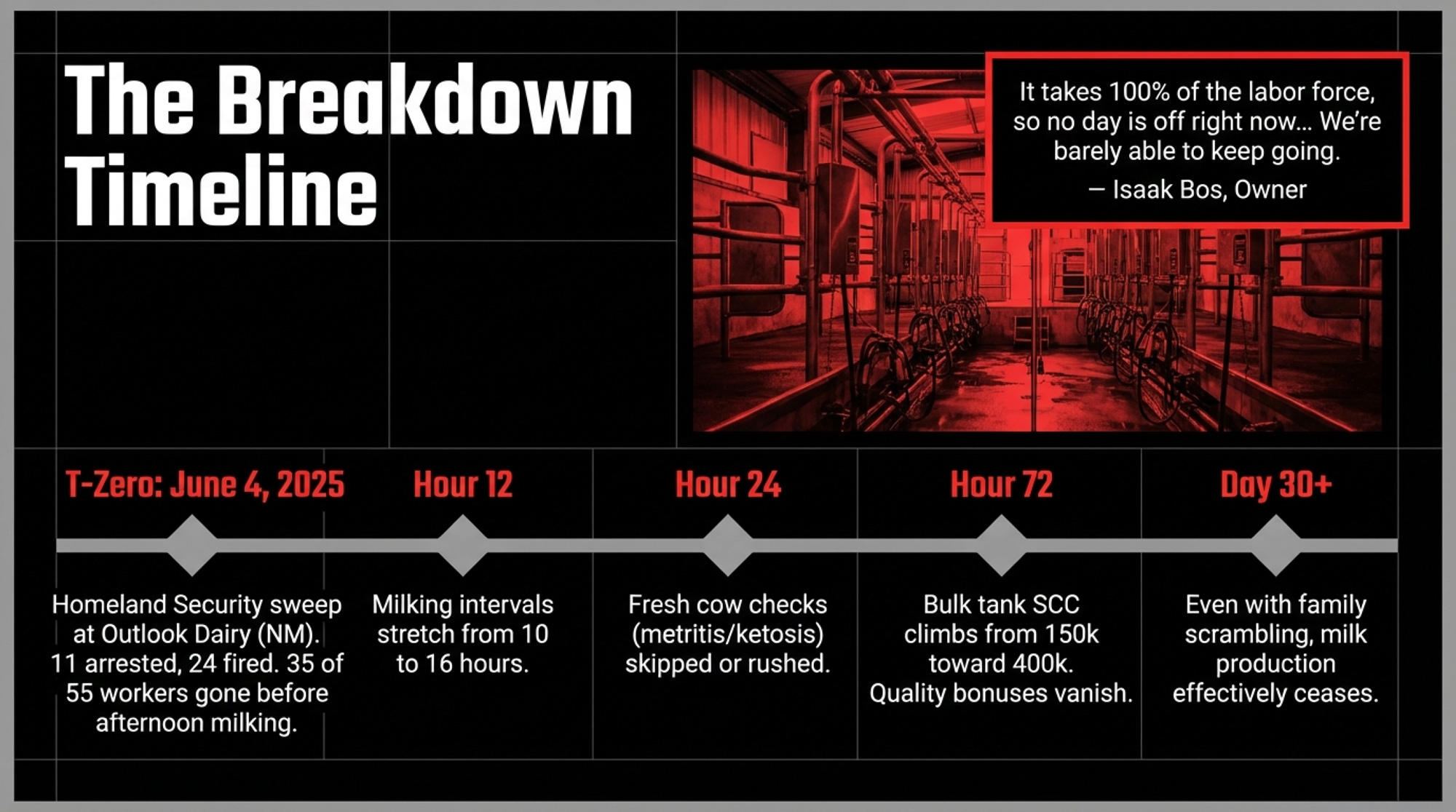
“It takes 100% of the labor force, so no day is off right now,” Bos told reporters as his wife, relatives, and local high‑school kids scrambled into the parlor. “It’s detrimental for our cattle. We’re barely able to keep going.”

“You can’t turn off cows. They need to be milked twice a day, fed twice a day.”
— Beverly Idsinga, Dairy Producers of New Mexico

As of January 2026, Outlook Dairy was still working to rebuild and get back to something resembling normal, months after that June morning tore the operation apart.

If you think your I‑9 binder is a bulletproof vest, you’re already bleeding.

When Two-Thirds of Your Crew Disappears Before Lunch

Outlook runs roughly 5000 Holsteins. At a typical Holstein average of around 70 lb/cow/day and the 2025 U.S. all‑milk price forecast of $21.35/cwt, daily gross milk revenue sat near $7,470 before the raid. Losing 35 workers didn’t trim that number. It broke the system.

Within hours, milking intervals that should’ve been 10–12 hours stretched to 14, then 16. Bulk tank SCC starts climbing almost immediately when intervals get that far apart — from a well‑managed 150,000 cells/mL toward the 300,000–400,000 range where quality bonuses vanish, and deductions kick in at most co‑ops. Fresh cows that need twice‑daily monitoring for metritis and ketosis? Those checks got skipped or rushed.

You know how that story ends. Cows you miss in the fresh pen don’t just hit you with a vet bill. They take peak milk you never see.

The community around Lovington responded. Teenagers showed up. Neighbors climbed into the parlor. Family members who hadn’t worked a shift in years were back on the line. But good intentions don’t replace the guy who’s been reading that holding pen for a decade. Bos himself confirmed that milk production at Outlook “had effectively ceased.”

If you think that’s “a New Mexico problem,” you’re exactly who this piece is for.

The Math Behind 79% of Your Milk

Outlook made the news for the rifles. It matters for the arithmetic.

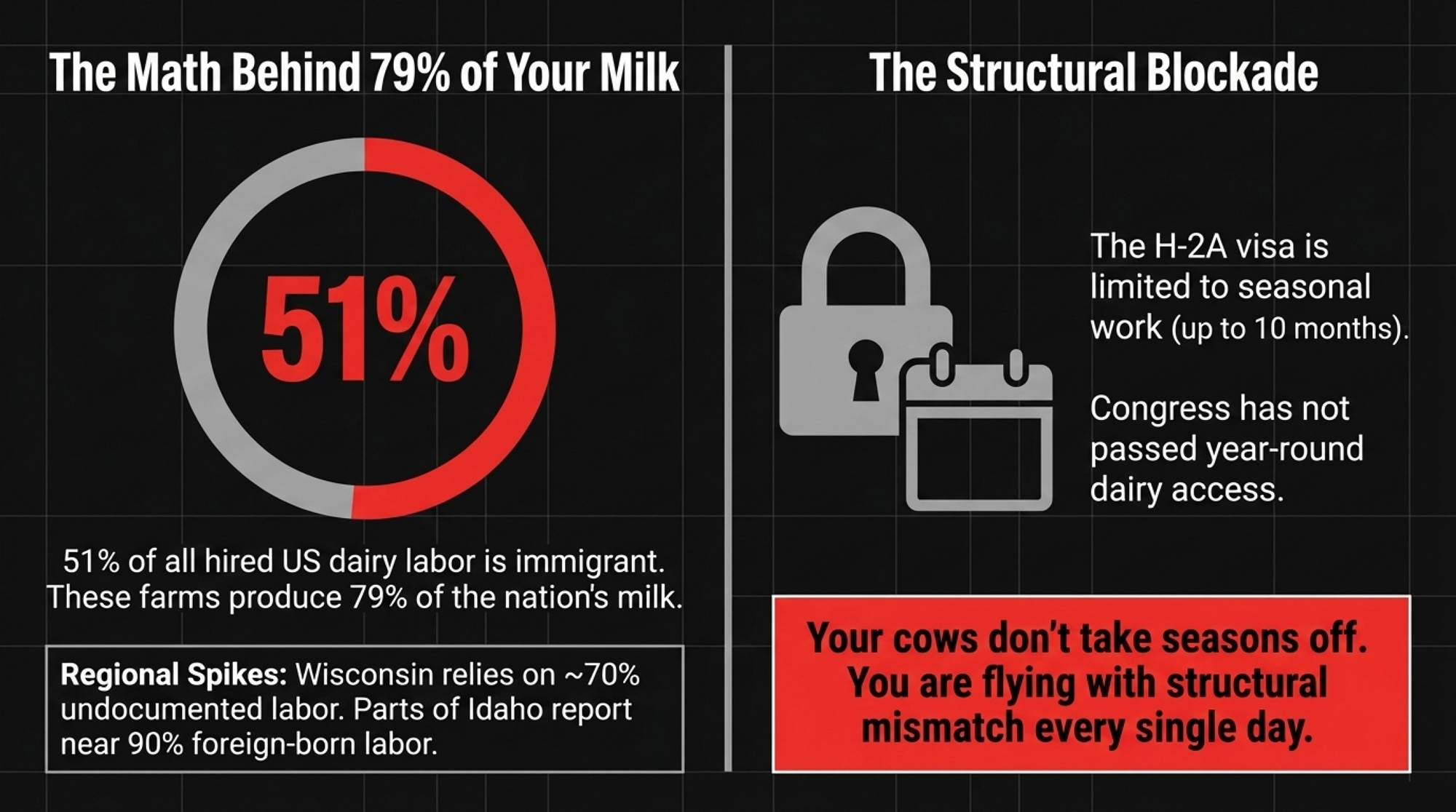
A Texas A&M AgriLife Center for North American Studies survey, conducted for the National Milk Producers Federation, collected data from 973 dairy farms of all sizes and regions in fall 2014. The results: immigrant workers account for 51% of all hired dairy labor, and the farms employing them produce 79% of the nation’s milk supply.
NMPF’s modeling went one step further. It estimated that a sudden loss of immigrant labor would eliminate over 7,000 dairies, cut 48.4 billion pounds of milk, and nearly double retail prices. That’s a national barn‑burn, not an isolated fire.

The dependency hasn’t shrunk since 2015. A 2023 UW–Madison School for Workers survey estimated that more than 10,000 undocumented workers perform about 70% of Wisconsin’s dairy labor, and the authors warned that without them, the state’s dairy industry “would collapse overnight.” In parts of Idaho, the University of Idaho’s McClure Center has documented dairies where roughly 9 out of 10 workers are foreign‑born.
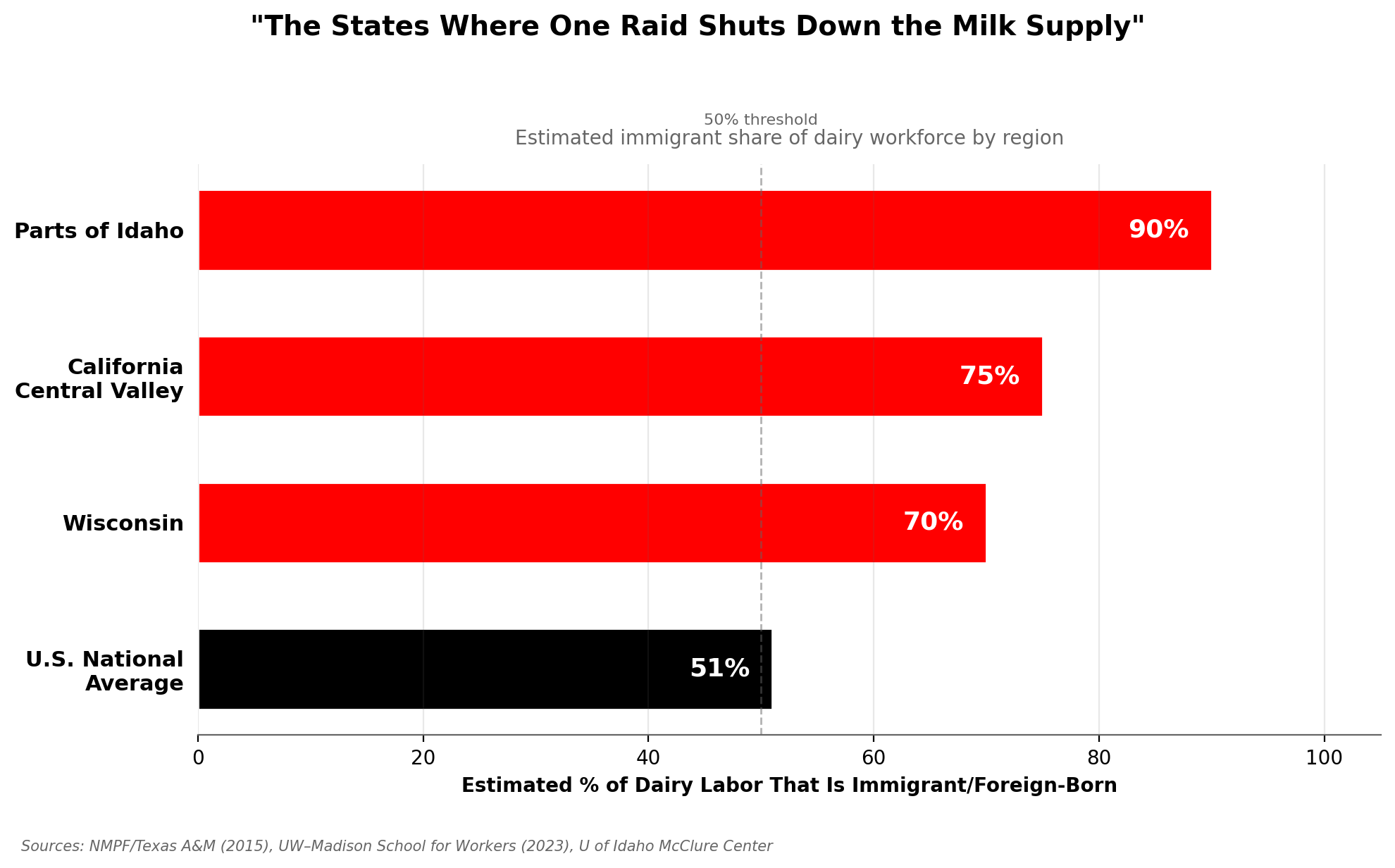
Here’s the structural mismatch you live with every day: the H‑2A visa program — the main legal guest‑worker channel for agriculture — is limited to temporary or seasonal employment, up to 10 months per year. Your cows don’t take seasons off. The Trump administration and multiple agricultural groups have pushed Congress to expand H‑2A to year‑round positions, but that change still needs a congressional vote that hasn’t come. A House Homeland Security appropriations rider would allow year‑round dairy, and the Economic Policy Institute projects that, combined with wage cuts, the program could hit 900,000 workers by 2034.

Right now, that’s theory, not help. As of spring 2026, you’re still dealing with processing delays and uncertainty in H‑2A access, not a smooth year‑round dairy program.

Then the USDA pulled one more rug. On August 29, 2025, the USDA announced it was discontinuing the Farm Labor Survey effective immediately. That’s the main tool Washington used to track farm wages. So, at the exact moment dairy’s labor dependence is under political and economic pressure, the official wage data just went dark.

You’re flying with less information in more turbulence.

How Much Does a 30-Day Labor Shock Really Cost a 400-Cow Herd?

Talking about raids in another state is easy. The only way this gets real is if you run the numbers on your own herd.

Take a 400‑cow herd shipping a typical 70 lb/cow/day at the 2025 all‑milk price of $21.35/cwt. That’s 28,000 lb/day — roughly $5,978 in daily gross milk. Over 30 days, you’re looking at $179,340 in gross milk revenue.

Now imagine a disruption like Outlook’s. It doesn’t have to be ICE. Two experienced milkers get into a car accident.. A family emergency in a three‑person crew. Or enforcement activity one county over that sends half your workforce home to pack a bag.

Here’s the snapshot you should be staring at on your phone in the parlor.

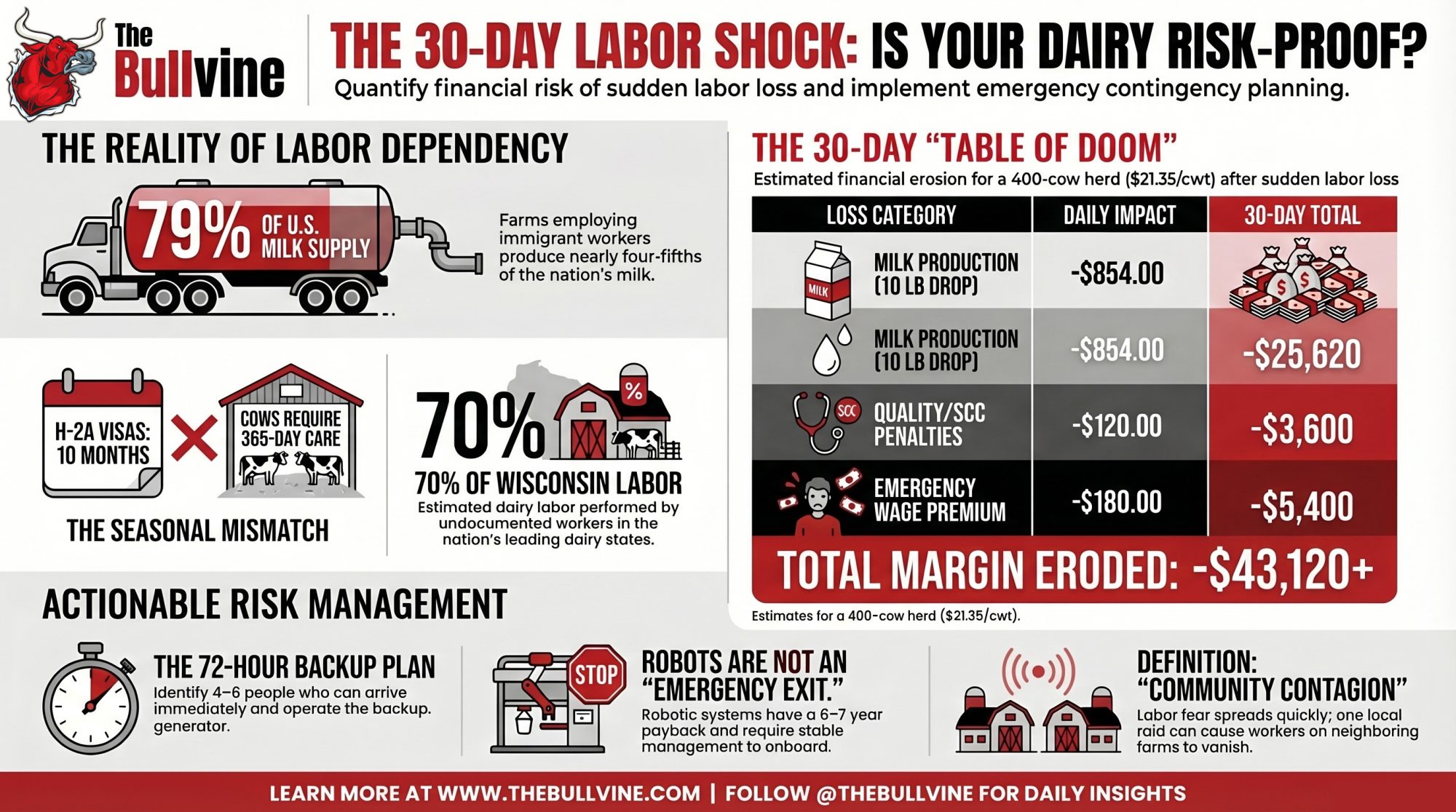
The 30-Day Table of Doom: 400-Cow Herd at $21.35/cwt
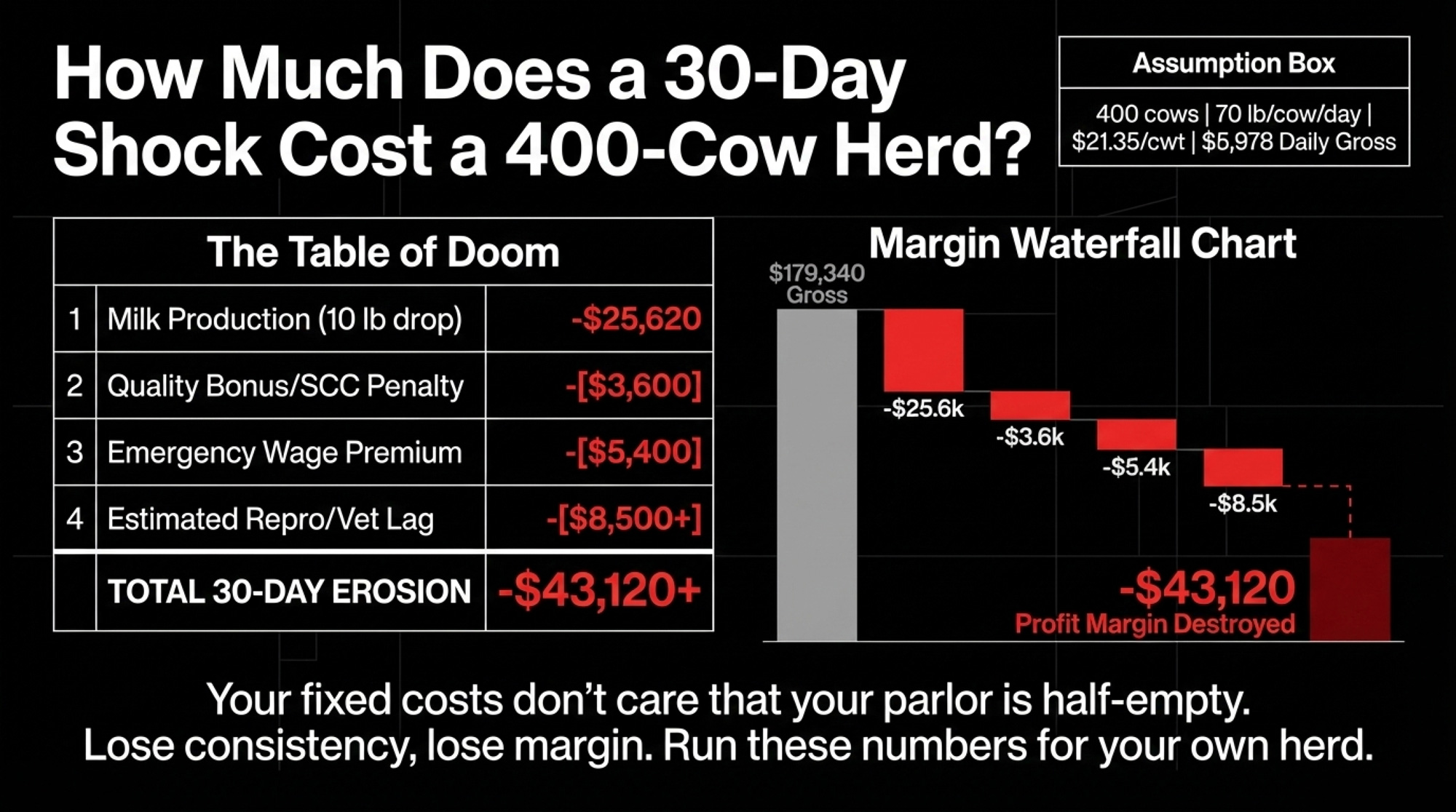
Loss CategoryDaily Impact30‑Day Total
Milk Production (10 lb drop)‑$854.00‑$25,620
Quality Bonus/SCC Penalty‑[$120.00]‑[$3,600]
Emergency Wage Premium‑[$180.00]‑[$5,400]
Estimated Reproductive/Vet Lag‑[$8,500+]
TOTAL MARGIN ERODED‑$43,120+

Brackets on the last three lines mean this is illustrative, not a quote from your co‑op or your vet. The first line isn’t up for debate: 10 lb/cow/day × 400 cows × 30 days = 120,000 lb. At $21.35/cwt, that’s $25,620 in gross revenue gone.

You know what SCC penalties look like on your milk cheque. You know what you’d have to pay to get neighbors, teenagers, and extended family in for an emergency month of milking. You know what happens to repro when fresh cows get missed. Plug your own numbers into those second and third lines. You won’t hit exactly $43,120. You’ll land unpleasantly close.

This isn’t just about gross revenue; it’s about the fact that your fixed costs — debt service, insurance, taxes — don’t care that your parlor is half‑empty. Your break‑even just climbed while you were looking for a milker.

USDA’s January 2026 ERS report (ERR‑356) using 20 years of ARMS data confirmed what you see in the fresh pen every day: milking frequency and consistency are key drivers of net returns. Lose people, lose consistency. Lose consistency, lose margin.

Run that 30‑day cascade with your own herd size and pay price. If the answer makes your stomach drop, that’s not fear‑mongering. That’s your exposure in black and white.

Can Robots Actually Close the Gap When Workers Disappear?

When you hear the Outlook story, the instinct is obvious: “This is why we need robots.” Honestly, that reaction makes sense. It just doesn’t close the gap the way the sales pitch says it will.

Bullvine readers already know the headline numbers: 86% of robotic milking adopters say they’re satisfied, but only 28% say their systems are profitable. A January 2026 USDA Economic Research Service report (ERR‑356) put harder national numbers behind it — robotic milking increases U.S. dairy net returns by about 13% on average, based on five waves of ARMS data from 2000 through 2021. That’s not fluff. That’s the actual margin.

But Iowa State dairy economist Larry Tranel’s cash‑flow work tells the other half of the story. A typical two‑robot installation on surveyed Iowa herds has a payback in the 6.1 to 7.2‑year range, depending on useful‑life assumptions. You get labor relief and management flexibility, but you tie up a lot of capital for a long time.

And robots only touch one slice of your labor picture. AMS units can pull many hours out of the parlor. They don’t push feed, mix colostrum, walk calf pens, fix a frozen waterer, or catch a fresh cow going off feed.

A labor crisis is the worst time to transition to robots. When your barn is in chaos, you’re in no shape to onboard an AMS. Automation is a strategy, not an emergency exit.

If Outlook had been a robot barn, those agents still would’ve walked out the people who feed, scrape, and watch cows. You’d be left with a line of shiny stainless steel and a crew that doesn’t yet know the software, the fetching patterns, or the exceptions. That’s not a hedge. That’s a new failure mode.

If you’re pricing automation as a labor hedge, the sharper question isn’t “should I buy robots?” It’s “which specific jobs on my farm can a machine realistically take over, and what’s the payback on that task?” For many 300–500 cow herds, the first automation dollar probably belongs on a feed pusher, calf feeder, or alley scraper — not on the most expensive box in the catalog.

Could This Happen at Your Place? Look at the Map
Lovington is a small town in the New Mexico oil patch near the Texas border. It’s easy to shrug and say, “That’s down there. We’re fine up here.”

Then you look at Vermont.

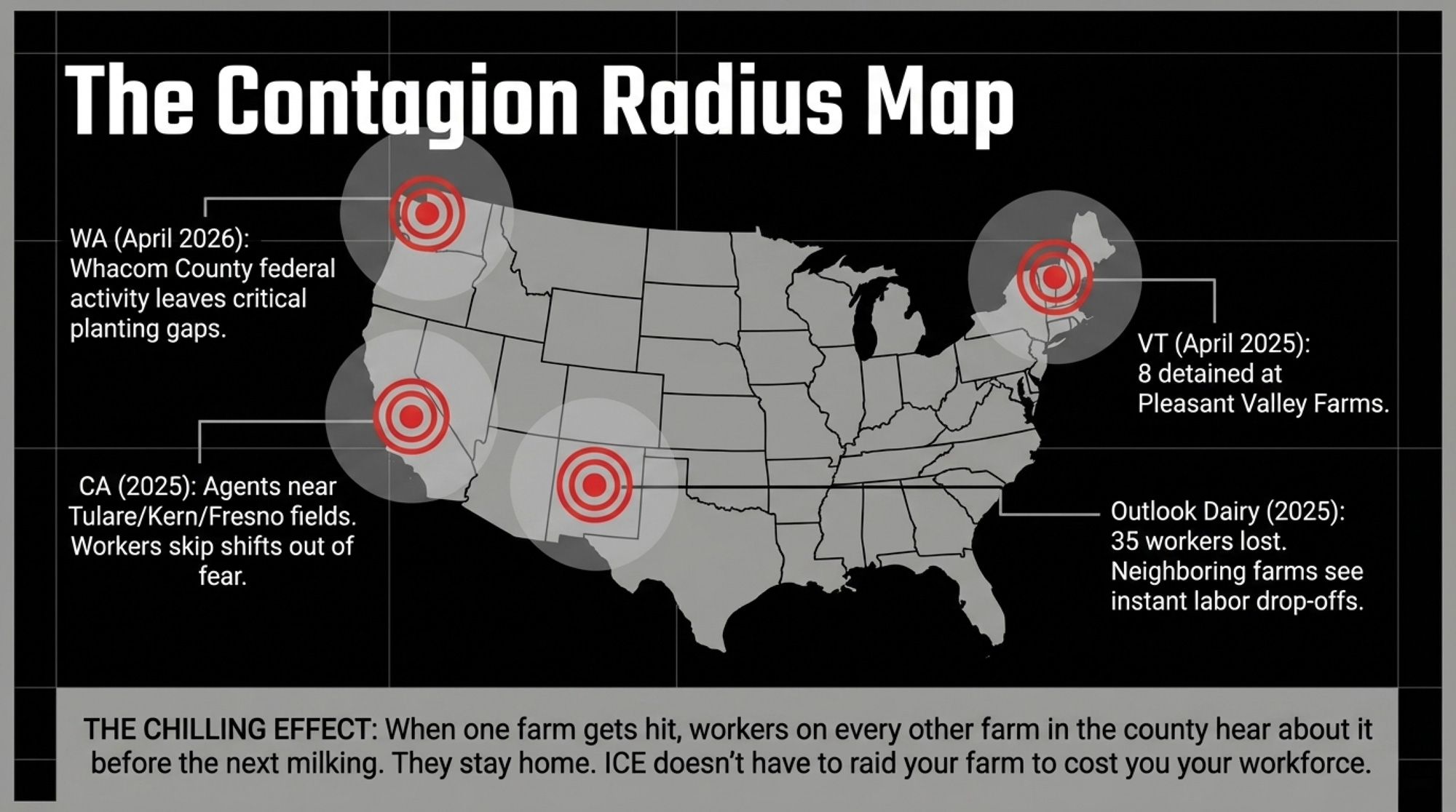
On April 21, 2025, U.S. Customs and Border Protection agents arrested eight migrant workers at Pleasant Valley Farms in Berkshire, Vermont’s largest dairy, a roughly 10,000‑acre operation running more than 3,000 cows, owned by Mark and Amanda St. Pierre. The farm itself was not the target of the operation, and the St. Pierres weren’t accused of wrongdoing. Agents said they were responding to a citizen report of “two individuals carrying backpacks exiting a wooded area” near the Canadian border, and the eight workers were detained during the search that followed. State officials and Migrant Justice called it the largest migrant worker enforcement action in Vermont in recent memory.

Same year, different coast. In California’s Central Valley, ICE and other federal agents were reported near fields and packinghouses in Tulare, Kern, Fresno, and Ventura counties, with workers fleeing fields when agents appeared. Farm bureau leaders for Tulare, Kern, and Fresno counties told reporters they couldn’t confirm specific raids on member farms. But the fear alone was enough to blow holes in crews — workers staying home, skipping shifts, turning off their phones.

By April 2026, a Whatcom County, Washington producer told local TV that federal activity in the area was leaving critical gaps during planting season. He wouldn’t allow his name to be used for fear of making things worse for his workers.

New Mexico. Vermont. California. Washington. The enforcement corridor isn’t one state. It’s a moving target across multiple regions and milk sheds.

And here’s the part you’ll never see in any official statistic: when one farm in a county gets hit, workers on every other farm in that county hear about it before the next milking. Some don’t show up. Not because anyone told them not to — because they’re afraid they’ll be next. Reports from southeastern New Mexico described a chilling effect across dairies after the Outlook raid — Idsinga among those saying labor was disappearing not just from the raided farm but from neighbors’ farms, too.

That “community contagion” isn’t on any spreadsheet in Washington. It absolutely shows up on your bulk tank.
How Should You Price a 72-Hour Labor Shock?

This is where the kitchen‑table math meets your actual risk tolerance.

You don’t need a consultant to start. You need an honest look at what 72 hours without your core crew would really cost — and what you’d do about it.
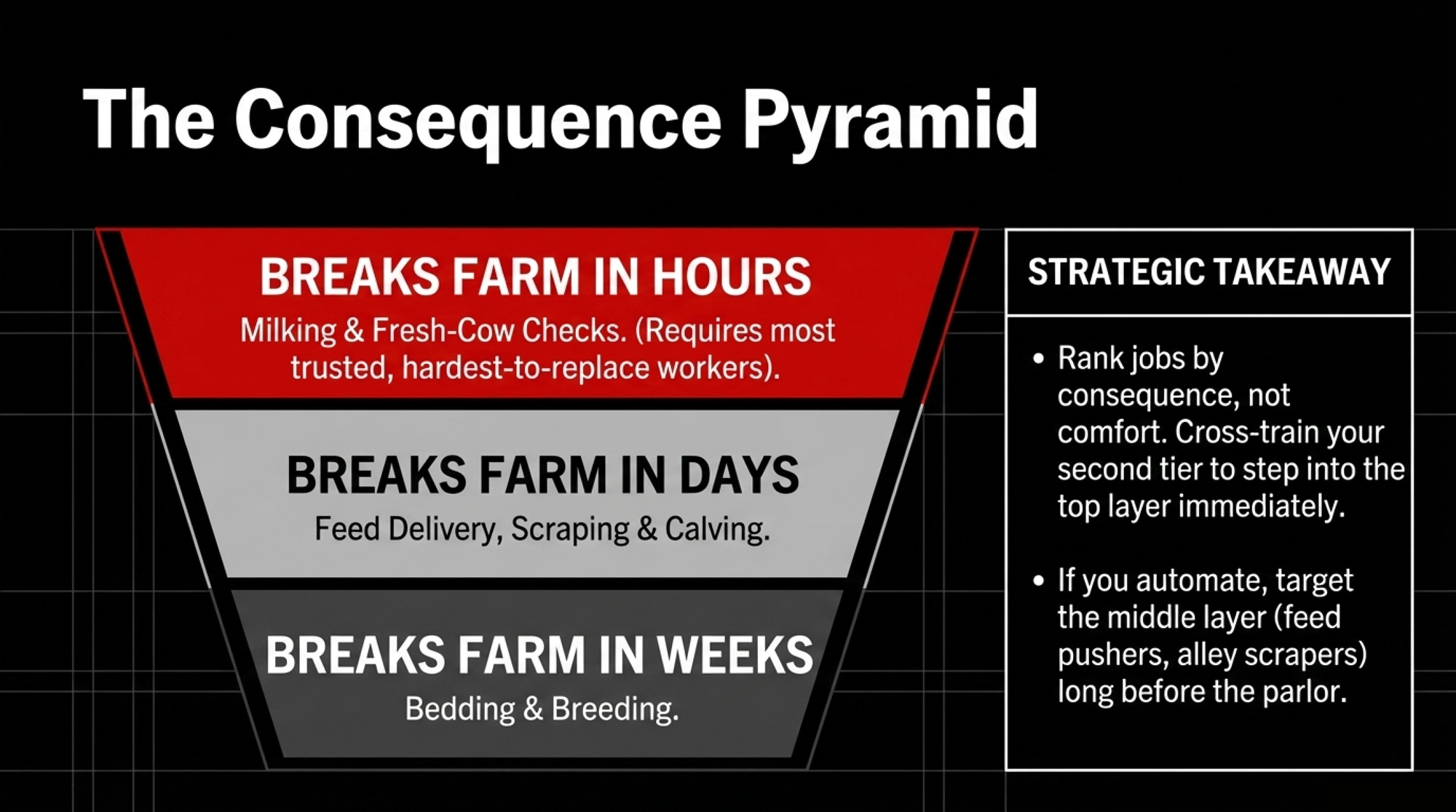
First question: on your farm, which jobs break things the fastest if they don’t get done for 24–72 hours? Milking is obvious. Fresh‑cow checks, calvings, and feed delivery aren’t far behind. Scraping, bedding, and breeding probably slot in after that.

Now ask yourself: do you know exactly who you’d call and what they’d do if three key people didn’t walk in at 4:30 a.m.?

If that question makes your stomach flip, that’s the point.

Are You Counting on Robots or People When Things Go Sideways?

When you start plugging your own herd into the Table of Doom, it’s tempting to jump straight to capital solutions. “If I had robots, this wouldn’t be as bad.”

Sometimes that’s true. A well‑run, dialed‑in robot herd with strong management can absolutely ride out a milker loss better than a parlor operation. The ERS data shows real return. So do many farm case studies.

But look at your own barn honestly. Ask: if your current crew disappeared and a truck delivered robots tomorrow, would your operation smoothly transition to a totally different management system while you’re also scrambling to hire, train, and keep cows healthy?

A farm in chaos is the worst possible candidate for a major technology transition. You need your best management IQ for those first six to twelve months on AMS. You need time to learn exceptions, software quirks, and how specific cows behave on robots. You need your best people focused on onboarding, not plugging holes.

So yes, robots can be part of a labor strategy. They’re not an emergency exit. They don’t remove the need for a 72‑hour plan, cross‑training, or hard conversations with your lender and your lawyer.

Options and Trade-Offs for Farmers

You can’t control when or where the next enforcement action happens. You can absolutely control how exposed your operation is when it does.

Path 1: Run Your Own 30-Day Cascade — This Month

This is your 30‑day action.

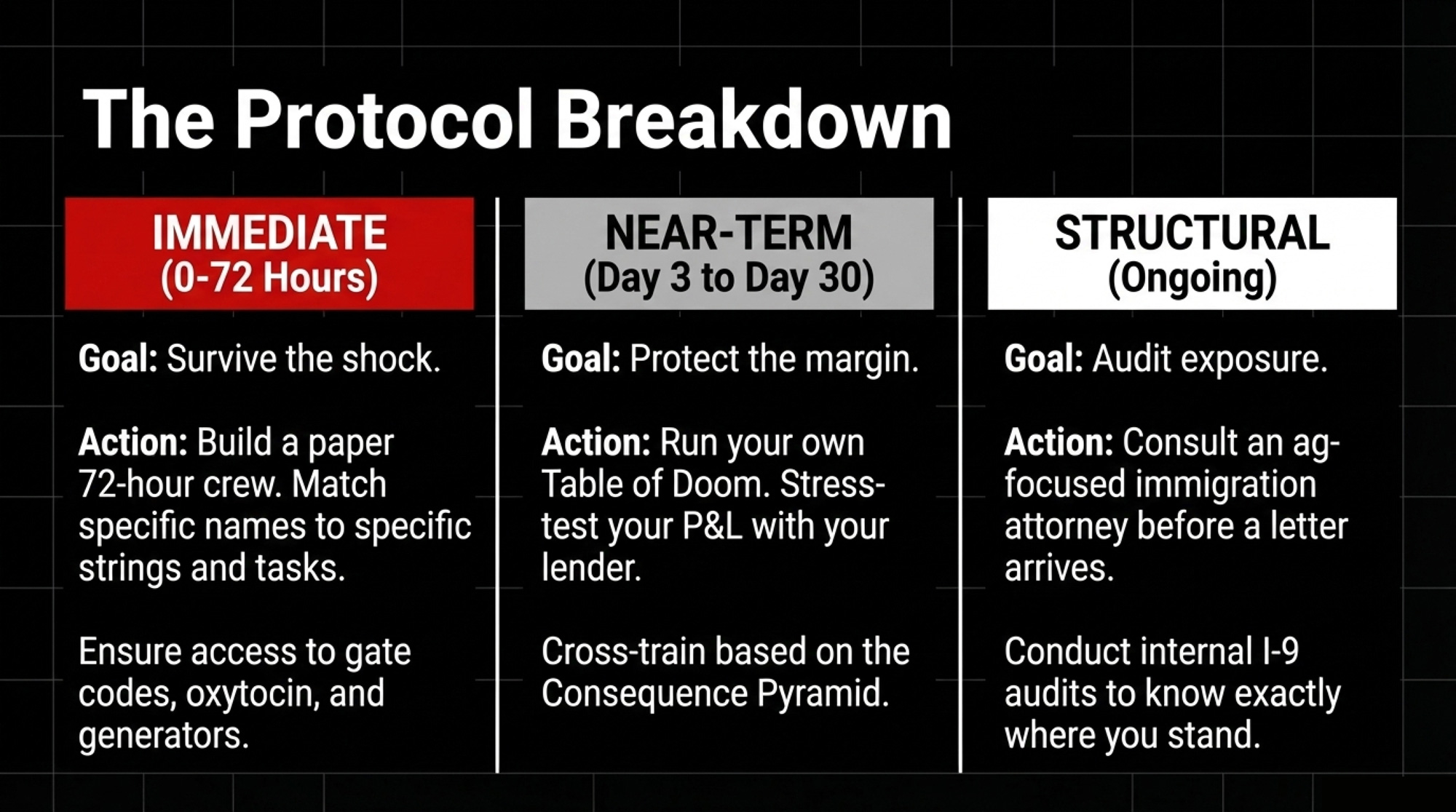
Sit down with your milk cheque and a notepad. Write down three things: herd size, lb/cow/day, and current pay price. Model a 10 lb/cow/day drop for 30 days. Then add:

  • A realistic estimate for lost quality bonuses or SCC penalties.
  • A bump in wages for emergency help.
  • A number for extra vet and repro costs if fresh cows get missed.

You’re not building a thesis. You’re answering one question: how many months of profit would that 30‑day shock erase for your operation?

If the answer is more than two, your risk isn’t “some policy debate in Washington.” It’s a very specific amount of money on your own P&L.

Path 2: Build a 72-Hour Crew on Paper

Picture 4:30 tomorrow morning. Your three most experienced workers don’t walk in. Any reason.

Grab a piece of paper and make this checklist real:

  • [ ] Name the 4–6 people who show up if you call.
  • [ ] Make sure they have the gate codes.
  • [ ] Make sure they know where the oxytocin is kept.
  • [ ] Make sure they can start the backup generator and keep it running.
  • [ ] Assign each one specific strings, pens, or tasks for those 72 hours.
CategoryPrepared FarmAverage FarmExposed Farm
Backup crew identified4–6 named, trained contacts2–3 people “who might help”No list exists
Cross-training status2nd-tier staff trained on milking + fresh cowsSome informal exposureSingle-person dependencies
Gate codes / accessAll backups have codes + keysOwner holds all access“I’ll let them in when they call”
Critical supply locationsDocumented: oxytocin, colostrum, generatorKnown to 1–2 peopleOwner’s head only
Milking interval riskMaintains 10–12 hr intervals for 72 hrsStretches to 14–16 hrs within 24 hrsMisses milkings within 12 hrs
Fresh cow monitoringAssigned to specific backup person“Somebody will check”Skipped entirely
Estimated 72-hr milk loss< 3 lb/cow/day5–8 lb/cow/day10+ lb/cow/day
SCC impactStays under 200K cells/mLClimbs toward 300K+Blows past 400K — penalties hit

If you can’t fill in those blanks without guessing, you don’t have a backup plan. You have a schedule.

Path 3: Rank Jobs by Consequence, Not Comfort

Not all jobs fail at the same speed.

Your most trusted, best‑documented, hardest‑to‑replace workers should sit where a missed shift hurts fastest — milking and fresh cows. Cross‑train your second tier in feeding, scraping, and calf chores so they can step in when someone is out.

Then look at automation through that same lens: where does a missed job hurt fastest, and which of those jobs can a machine actually cover? That might mean a feed pusher, calf feeder, or manure scraper long before it means AMS.

Path 4: Talk to an Immigration Attorney Before a Letter Shows Up

You probably already know where your workforce realities sit. Hoping your paperwork never gets tested isn’t a plan.

An ag‑focused immigration attorney can help you answer three uncomfortable but critical questions:

  • What would a real internal I‑9 audit show?
  • Which workers have strong documentation, and which don’t?
  • What kind of timeline and exposure would you face if enforcement turned your way?

Uncomfortable conversation. A lot less uncomfortable than having it for the first time in your driveway with a government vehicle idling.

And if Congress finally does open H‑2A year‑round for dairy, the farms with attorneys already in their corner will be first in line to file. If it doesn’t, you’ll still know where you stand — and what your realistic options are.
Key Takeaways

  • If your 30‑day cascade shows a 10 lb/cow/day drop that would erase more than two months of profit, your margin of safety is thinner than your balance sheet suggests. That’s your cue to either build a buffer or rethink exposure.
  • If you can’t name a 72‑hour backup crew and match each person to specific jobs, what you’ve got is a schedule, not a contingency plan. The Outlook raid showed how fast “we’ll figure it out” turns into “we’ve effectively ceased milking.”
  • If your labor strategy is “we’ll add robots when it gets bad,” you’re betting on a technology transition at the exact moment your barn is least able to handle one. Robots can add margin over time — they don’t magic away a crisis.
  • If your lender has never stress‑tested your operation for a labor disruption, that risk isn’t priced into your financing. You don’t need their permission to run the Table of Doom with your own numbers — but you should bring it to the next meeting.
You can look at Lovington, Berkshire, Tulare, or Whatcom County and tell yourself the map is somebody else’s problem. Different state. Different politics. Different co‑op.

Your cows don’t care about state lines. Neither do your vet bills, your wage premiums, or the peak milk that never hits your bulk tank.

So here’s the only question that really matters right now: if three people in your barn didn’t show up at 4:30 tomorrow morning, would you have a plan — or just a hope that it works out?

Complete references and supporting documentation are available upon request by contacting the editorial team at editor@thebullvine.com.

Learn More

The Sunday Read Dairy Professionals Don’t Skip.
Every week, thousands of producers, breeders, and industry insiders open Bullvine Weekly for genetics insights, market shifts, and profit strategies they won’t find anywhere else. One email. Five minutes. Smarter decisions all week.
NewsSubscribe
First
Last
Consent

Robots Won’t Save Your Dairy If You’re Alone: 5 Hard Truths About Labor and Robotic Milking ROI Under 500 Cows

Under 500 cows and eyeing robots? Before you sign a $1M note, answer this: Who shows up your lane when the barn goes dark?

Executive Summary: If you milk under 500 cows and you’re eyeing robots, this piece shows why a USD $1 million AMS note won’t automatically fix your labor problem—and might bury you if the math and the people aren’t there. It breaks down current immigrant‑labor dependence, Wisconsin’s drop from 16,000+ herds to just over 5,300, and what real AMS budgets and labor‑savings studies say about when robotic milking ROI actually pencils out. You’ll see a side‑by‑side look at parlor‑only, hybrid “parlor + tech,” and full AMS paths, with clear thresholds—like whether you can truly staff milking for around USD $200,000 a year—that help you decide if you should upgrade, automate, or plan a clean exit. The article also ties genomics and proofs straight to robot performance, showing why milking speed, udder traits, health, and beef‑on‑dairy decisions are now core to your AMS payback, not just nice extras. Alongside the math, it tackles storms, backup power, mental health, and the 4‑H kid with a calf who might be your next key employee or successor. You’ll walk away with a 30‑day checklist, practical questions to take to your lender and family, and one blunt test that matters more than any sales pitch: when the barn goes dark, who actually turns up your lane? ​

Robotic milking ROI

The trucks in the lane usually tell the truth before any robot ever will.

They’re strung along the driveway at a small robot barn in central Wisconsin—feed company pickups, a neighbor’s welding rig, the vet’s SUV, a church friend’s minivan. Inside, the old parlor is half‑gutted, and three new robotic milking systems sit on concrete that still looks damp. If you’re running a small or mid‑sized herd in 2024–2026 and even thinking about robots, this is your world: broken labor, big capital decisions, and a hard choice between AMS, a hybrid setup, or an exit while you’re still ahead.

This piece walks straight through that choice—the math, the decision rules, and the people around you who decide whether you’re still milking in five years or reading your own dispersal catalog.

Editor’s note: This is a composite story built from real 2023–2025 data and patterns on robot herds across Wisconsin and the Midwest—not a blow‑by‑blow profile of one specific farm. The economics and pressures are real; the names and scenes are representative.

The Labor Bomb Under a 200‑Cow Dairy

Let’s start where you actually live—at the kitchen table with a calculator and a coffee that went cold an hour ago.

By late 2023, a typical 180‑cow herd in central Wisconsin looked a lot like yours might. Margins tight. Kids in school. Parents still doing more 4 a.m. milkings than they’ll admit. And a labor situation that quietly shifted from “hard” to “not sustainable.”

A lot of herds have walked this path:

  • Starting milkers at USD $16/hour with housing.
  • Bumping to $18, then $20–22 with more flexible hours.
  • Edging toward $24 with a decent bunkhouse and still watching people leave for climate‑controlled warehouse jobs with weekends off and no risk of a frozen yard.

That’s not just bad luck. A National Milk Producers Federation study with Texas A&M found that immigrant workers make up about 51% of all hired U.S. dairy labor, and that farms employing them produce roughly 79% of the nation’s milk. In that same modeling work, if that immigrant workforce disappeared, more than 7,000 dairies would shut down, and retail milk prices would jump nearly 90%

In Wisconsin, a UW–Madison School for Workers analysis—summarized in recent industry coverage—estimated more than 10,000 undocumented workers doing around 70% of the state’s dairy labor, with researchers warning that without them, Wisconsin’s dairy industry would be at serious risk of rapid collapse. 

Lay that on top of herd numbers. USDA‑NASS and state data show:

  • 16,264 licensed dairy herds in Wisconsin in 2003. 
  • Around 6,140 herds by late 2022. 
  • Just over 5,300 by early 2025, with cow numbers and total milk roughly holding. 

Same or more milk. Fewer families. More ground to cover with fewer people.

At some point, you’re down to three real options: pay legal labor what it actually costs and design your system around that, automate the hardest work, or plan a clean exit while you still have equity and energy.

Everything else is creative stalling.

The Night You Finally Say “We Can’t Keep Going Like This”

On the farms that are still breathing a few years later, the turning point is almost never a glossy robot brochure.

It’s the night someone at the table finally says, “We can’t keep going like this.”

On too many farms, that sentence dies in the kitchen. On the ones that make it, it doesn’t stay inside the house.

The smarter move we’re seeing more often now is simple but not easy: before signing an automatic milking system contract, you call the people who’ll actually be in your lane when things go sideways.

Picture a scene you’ve probably lived:

  • One neighbor has toured a robot barn a county over.
  • Another has a cousin on AMS in Ontario.
  • A younger dairyman down the road is “robot‑curious” but still in a double‑8.
  • The 4‑H leader knows half your heifers by name.

They pile into your kitchen with chili, kids, and opinions.

“We’re not sure we can do this,” you admit. “But we’re sure we can’t keep doing what we’re doing.”

On the barns that survive, that’s the moment it stops being your problem and becomes our barn.

You hear real commitments, not just sympathy:

  • “I’ll cover morning feeding if construction runs long.”
  • “We’ll shuffle concrete work so your robot pad gets poured before frost.”
  • “When it’s time to train cows, I’ll bring the 4‑H kids—they’re not going to forget it.”

Robots stop being a lonely, high‑risk hardware purchase. They become a community project.

You’ll hear some version of this line:

“What keeps us going isn’t just the cows—it’s the people around us.”

And that’s before a single robot milks a single cow.

The $1.2 Million Question

Now we get to the part most sales pitches slide past: the actual ROI of robotic milking.

The Bullvine’s own robotics position is blunt: every robot sold under 500 cows in the U.S. is at best a dangerous luxury and at worst malpractice—unless your labor cost is insane or you literally can’t hire. That doesn’t mean no herd under 500 cows should ever go robotic. It means the automatic “yes” is gone. The default answer is “no” until your local numbers force you to “maybe.” 

Here’s what typical AMS budgets look like when you strip away the sales pitch.

Capital and service costs

On small and mid‑sized herds in the Upper Midwest, 2023–2025 manufacturer quotes and independent budgets commonly put a three‑box install covering roughly 180–210 cows in the following ballpark:

  • Robotic milking systems + installation: roughly USD $180,000–250,000 per box, including software and accessories. 
  • Barn modifications: often another USD $100,000–300,000, depending on how “robot‑ready” your layout is. 

Put that together, and many 3‑box projects end up somewhere in the USD $800,000–1,200,000 range once the dust settles. Analysis notes that each automatic milking system can reasonably be assumed to cost about USD $200,000, including USD $15,000–20,000 in facility renovation per unit, numbers that align with these ranges. 

Service doesn’t disappear either:

  • On many farms, service contracts, parts, and callouts can cost tens of thousands of dollars per box per yearover the life of the system, totaling hundreds of thousands of dollars over a decade. 

Labor savings and milk flow

On the other side of the ledger:

  • University of Wisconsin–Madison Extension reports AMS herds in their sample saving around 0.06 hr/cow/day, which worked out to about a 38% drop in labor per cow and 43% per cwt—roughly USD $1.50 per cwt in labor savings at a USD $15/hour wage, with some farms reporting savings closer to USD $2.40 per cwt
  • A Cornell‑led multi‑state study, cited in Bullvine’s own AMS analysis, found AMS herds cutting overall labor costs by about 21%, raising milk output 3–5 lb/cow/day, and improving milk quality metrics in roughly 32% of barns surveyed. Results weren’t universal: some herds did very well, some were neutral, and a minority struggled. 

This is where your robotic milking ROI either holds or falls apart.

Here’s the hard truth on that:

  • If you’re paying USD $15–18/hour, and you can still hire decent milkers, robots are a tough sell on dollars alone.
  • Once your real, legal, fully loaded milking labor cost creeps toward USD $28–35/hour, and you’re burning out trying to keep staff, AMS stops being a toy and starts looking like a survival tool. 
  • If you’re under 250–300 cows, and you haven’t squeezed the cheap levers—activity monitors, sort gates, and feed pushers—you should be very nervous about skipping straight to robots. 

A simple comparison looks like this:

Option10‑Year Capital Outlook (typical)Labor ImpactManagement StressBest Fit
Keep parlor, no techLowest capital, rising repair costHigh, fixed shiftsHigh physical, high mentalAreas with relatively cheap, reliable labor
Parlor + sensors + sort gates + feed pusherMedium capital (tens of thousands for ~180 cows, not hundreds of thousands) 20–40% labor efficiency gainMedium (more tech, same cows)Herds <300 cows, labor ~USD $18–25/hr
Full AMS (3 boxes, 180–210 cows)Very high capital (USD $800,000–1,200,000 + ongoing service) 30–40% labor savings, more flexibility Less physical, more tech and mental loadLabor USD $28+/hr or no reliable hire pool; strong management bench

That hybrid package matters. For a lot of herds in older parlors, a mix of activity monitors, a sort gate, and a feed pusher is a tens‑of‑thousands‑of‑dollars investment instead of a million‑dollar note. On herds that actually use the data and gates, that kind of setup can free up substantial milking‑related labor and tighten up heat detection and health monitoring. It won’t take you out of the pit, but it can move your labor efficiency significantly closer to AMS levels at a fraction of the capital cost—and it buys you time to decide whether you truly need robots or just a better‑designed system. 

If you’re in Canada under quota with component pricing and a more stable milk cheque, the AMS payback can look different than on a volatile U.S. Class III cheque. The same basic math still applies, but your revenue line won’t whip around as hard. You still need to plug your own numbers into a milk board or advisory cost‑of‑production sheet before you buy anybody’s ROI pitch.

Here’s a test worth running quietly with your lender and accountant:

  • Can you hire and keep three reliable people to cover milking for USD $200,000/year or less total cost?
    • If the honest answer is yes, humans probably still beat robots on pure economics for most sub‑500‑cow herds.
    • If the answer is “no chance” and you’ve already tried, then you’re in the “AMS or exit” conversation, whether you like it or not.

And for some small or heavily leveraged herds, the most profitable move might still be an orderly dispersal while there’s equity left—not taking on a million‑dollar note because a dealer says “everyone is going robotic.”

Mentorship, Genomics, and Cow Sense in a Robot Barn

Robotic milking doesn’t change the fact that fresh cow management still makes or breaks your month, SCC still hits your milk cheque, and components still pay the bills.

It does change who is watching what.

On the best AMS herds, you see a familiar pattern with new tools:

  • An older generation walks pens and spots the fresh cow whose eyes are a bit dull or whose cud is slow.
  • The next generation pulls up the robot dashboard and shows that same cow’s milk visitsmilking speedconductivity, and rumination trend.
  • They argue a little, walk out together, and usually both end up half right.

A 2024 U.S. AMS study reported that many owners reported labor cost reductions of 20% or more, and many reported better control of mastitis, lameness, and reproductive problems on their farms. Many of those same farmers also said robots improved their quality of life by changing when, not just how much, they worked. 

This is where genomic proofs and sire lists quietly make or break your AMS ROI.

In a robot barn, you suddenly care a lot more about:

  • Milking speed and temperament—slow, jumpy cows choke box capacity.
  • Udder attachment and teat placement—functional PTAT, not just show‑ring pretty.
  • Health and hoof traits that keep cows sound and productive long enough to pay off your capital.
Genomic TraitImportance in Parlor HerdImportance in AMS HerdWhy It Matters for Robots
Milking SpeedMediumCRITICALSlow cows choke box throughput; every extra minute per cow = fewer total milkings per box per day
Udder Attachment & DepthMedium (mostly cosmetic)CRITICALPoor attachment = missed teats, failed preps, and wasted robot cycles
Teat PlacementLowCRITICALWide, uneven, or rear teats = laser failures and manual fetch trips
Temperament / DocilityMediumHIGHJumpy, nervous cows won’t enter box willingly; training failure = labor nightmare
Feet & Legs / MobilityHighCRITICALLame cows don’t visit robots voluntarily; mobility = voluntary milking frequency
SCC / Mastitis ResistanceHighHIGHStill critical in AMS, but conductivity sensors catch problems faster than twice-a-day visual checks
Components (Fat/Protein %)High (market pays you)HIGH (market still pays you)Higher frequency can dilute components slightly; select bulls that hold % under 3x milking

If your sire list doesn’t reflect that, you’re breeding for the wrong barn.

Practical steps:

  • Screen bulls for robot‑relevant traits—milking speed, udder depth, teat position, daughter behavior—alongside Net Merit, Pro$, or LPI, depending on where you ship.
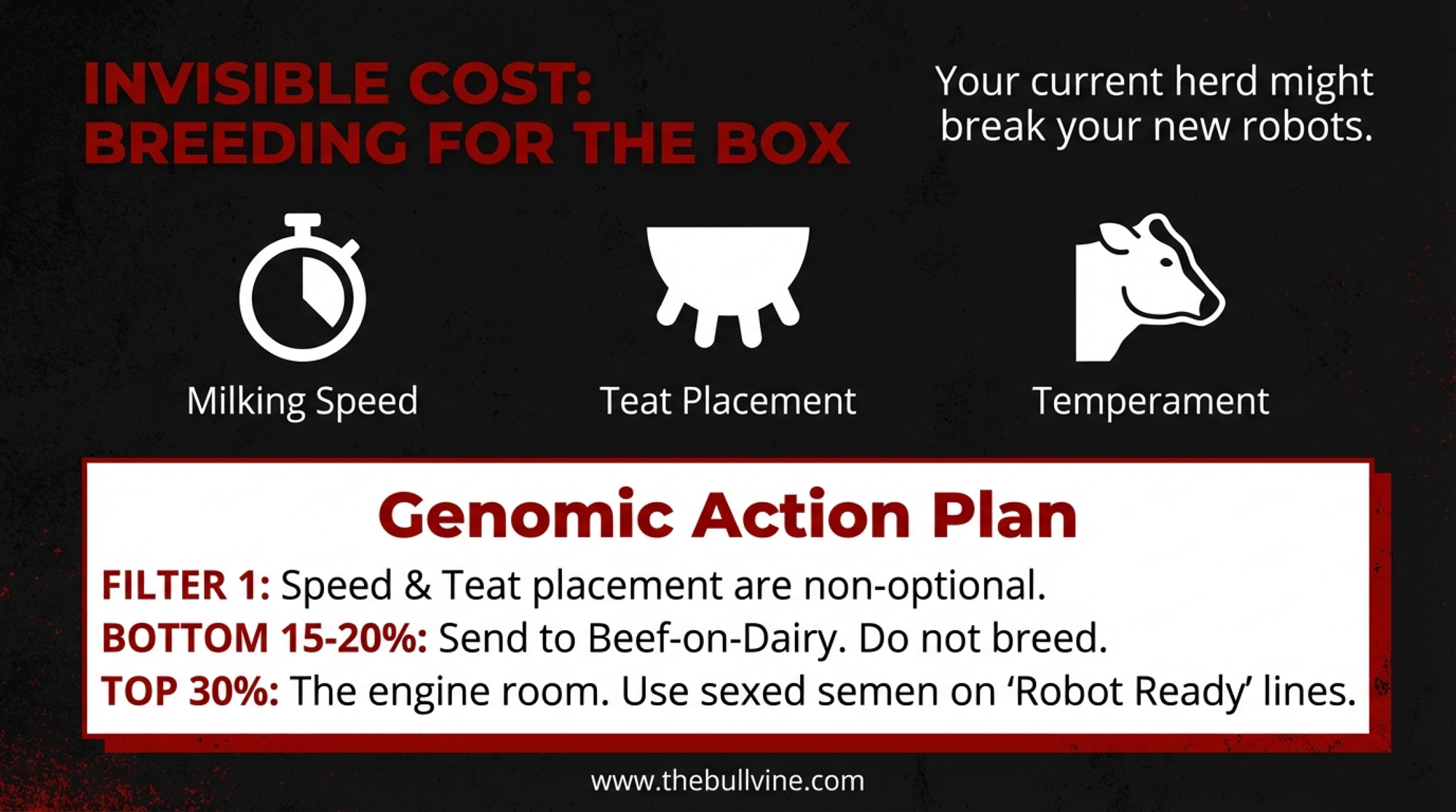
  • Use genomic testing to push the bottom 15–20% of heifers straight into beef‑on‑dairy or terminal matings, not into your replacement pool. 
  • Treat your top 30% as the engine room: sexed semen, targeted embryo work, and matings that stack components and longevity with robot‑friendly udders.
  • When you look at proof sheets, treat milking speed and udder traits as non‑optional filters for AMS herds, not “nice extras.”

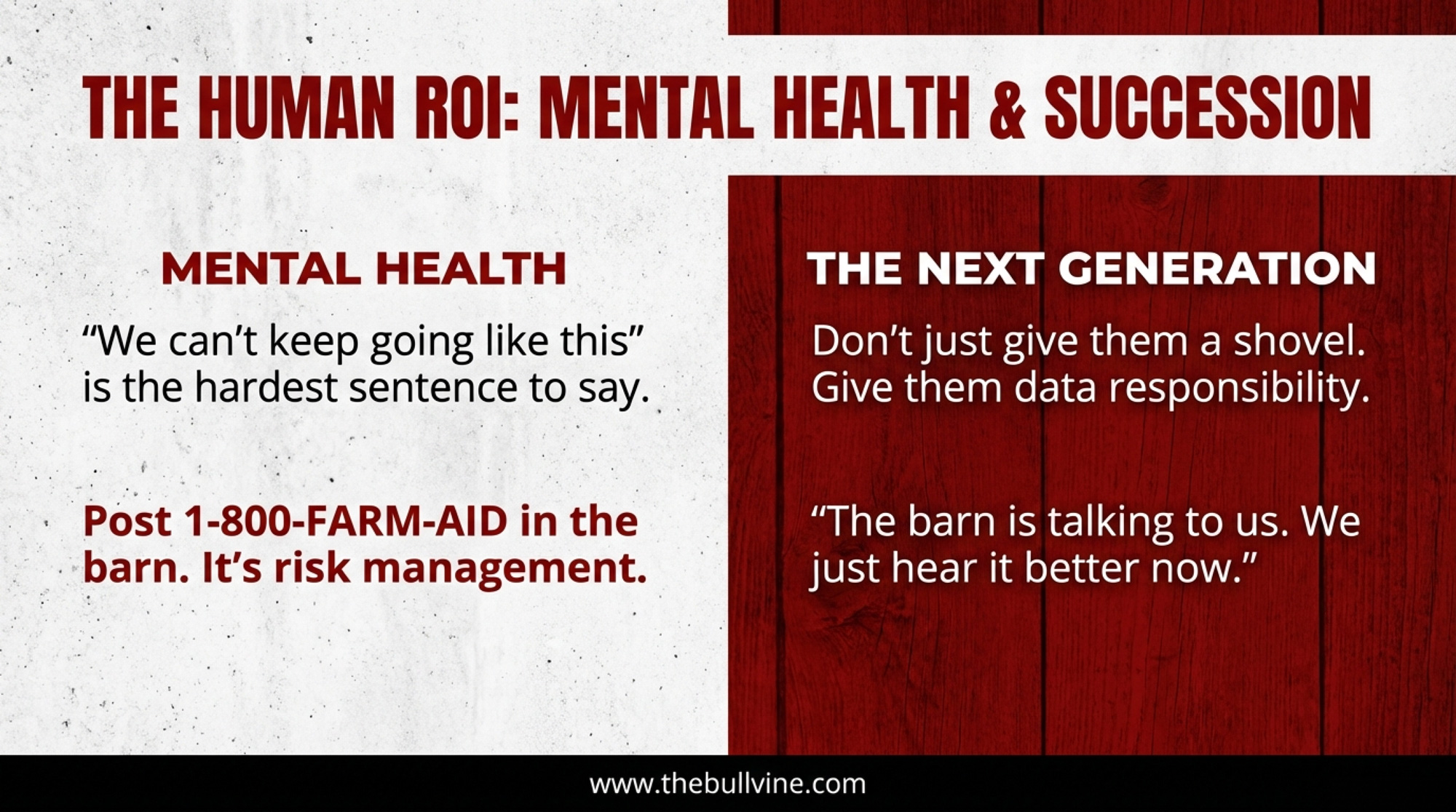
If you want the next generation actually to want the keys one day, they need more than a shovel in their hands.

Give them real responsibility:

  • Make a teenager or young adult responsible for one metric on the AMS or herd‑management software—SCC alerts, “red cows,” abnormal visits.
  • Let them sit in on breeding and culling meetings where AMS performance, genomic proofs, and fat/protein kilos actually shape decisions.
  • Ask what they see in the data that you’ve been feeling in the barn.

One young producer on an AMS herd put it this way to her grandfather: “The barn’s talking to us all day now.” His reply was simple: “It always was. We just hear it better now.”

Storms, Blackouts, and Who Backs a Tractor Up to Your Panel

Six months after startup, the real test on a lot of robot barns isn’t software.

It’s a thunderstorm.

A fast‑moving cell rips across the township. Trees down. Lines down. One minute, the robot room hums; the next, it’s dead. Vent fans are silent. Lights gone. Cows are mid‑cycle and starting to wonder what’s wrong.

This is where you find out if you bought machines or built a support system.

On the barns that get through nights like this without permanent damage to cows, people, or cashflow, you see the same pattern:

  • Within fifteen minutes, headlights swing into the yard.
  • One neighbor backs a tractor‑driven generator up to the panel like he’s done it twenty times.
  • Another shows up with portable lights and coffee.
  • A cousin‑electrician arrives with a headlamp and a coil of wire.

By the time the power company truck finally grinds in, the robots are already milking again. Cows are agitated but under control. Everyone is wiped. But nobody is arguing about whether automation “was the right call” anymore—because the real question was never robots vs parlor.

It was: “When the barn goes dark, who turns up your lane?”

If you can’t answer, right now, whose tractor is backing up to your panel, who milks if you land in the hospital, and who you call first in a disease outbreak or barn fire, that’s not a theoretical risk.

That’s a hole in your survival plan.

The Hardest Sentence in the Barn: “We Can’t Keep Going Like This”

We’ve all seen the mental‑health headlines. Too many of us know the families behind them.

Farmer stress and mental health aren’t side topics anymore. They sit right in the middle of whether your barn is still lit five years from now.

It’s bad enough that national and regional groups have put serious resources behind it. The Farm Aid Hotline (1‑800‑FARM‑AID) provides confidential assistance to farmers in distress or crisis, connecting them to financial, legal, and mental‑health resources. States and provinces now maintain ag‑specific counsellor lists and crisis lines. Farm organizations quietly slip those numbers into meetings and newsletters. 

Robots don’t fix that. A USD $1 million AMS note and a constant stream of alerts can make your head even louder.

On the farms that actually get healthier, there’s almost always a moment before anyone signs a contract when someone finally says:

“We can’t keep going like this.”

Short‑staffed. Watching neighbors sell out. Lying awake, wondering whether your kids will resent you more for selling now or handing them a mess in ten years. Afraid that saying it out loud means you’ve failed.

On the barns that make it through, people around them don’t accept “we’re fine” as an answer.

Common patterns:

  • A neighbor couple shows up most Sunday evenings during the transition, not to critique cows but to ask, “What went a little better this week? What’s still chewing on you?”
  • Vets and nutritionists leave mental‑health resource cards by the computer and say plainly, “These are here for anyone on this farm. Including you.”
  • Pastors, teachers, and coaches with farm roots stop by during chores, not to preach, just to sit at the table and listen.

When those farmers look back, the line that sticks isn’t about robots.

It’s some version of:

“The moment that changed everything wasn’t when the robots started. It was when we realized we didn’t have to pretend we were fine anymore.”

If you’re serious about staying in dairy, this isn’t fluff. It’s risk management. Cows don’t care how tough you are. Your family and your lenders care very much that you’re still here.

The 4‑H Calf That Keeps a Kid – and a Farm – Connected to Dairy

Every county has a story that quietly explains why community still matters.

A quiet kid drifts into a 4‑H dairy club meeting. No farm background. New boots, still clean. Home life? Let’s just call it complicated.

A local dairyman offers him a calf from his herd for the summer. Nothing out of the World Dairy Expo showstring. Just a decent heifer with a kind eye and a shot at VG down the road if things line up.

All summer, that calf gives him a reason to get up and go somewhere safe twice a day. He learns to halter, to brush, to read her moods. When she walks into the robot for the first time, he’s there with a hand on her flank, talking her through the new noise and the spray.

At the fair, they land squarely in the middle of the class. You’d think they’d just won the Supreme.

Fast‑forward a couple of years, and that “quiet kid” shows up as:

  • A part‑time worker at a dairy down the road.
  • A student in an ag or ag‑tech program.
  • The older 4‑H’er is clipping calves and teaching younger kids how to lead a heifer without panicking.

Ask what changed his path, and he’s not going to say “robot model numbers” or “Net Merit.”

He’ll tell you, “Somebody trusted me with something that mattered.”

If you want to talk long‑term herd strategy and genetics, that’s it in one sentence. Your best cow families and proofs don’t mean much if there’s nobody young who wants to be under those cows when they calve, milk, and show.

Robots and genomics might keep your herd competitive.

Kids and the community keep it alive.

What This Means for Your Operation

This isn’t a feel‑good Hallmark story. It’s a survival checklist.

If you’re reading this with a knot in your stomach, you’re exactly who this section is for.

Run Your Robot vs Human vs Hybrid Math in $/cwt

Sit down with your lender and accountant and write it out:

  • Calculate your real milking labor cost per hour—wages, housing, benefits, turnover, and your own unpaid time. Convert that to $/cwt using your shipped volume.
  • Get a real AMS quote: equipment, barn modifications, and at least 10 years of service contracts.
  • Price out a serious hybrid package—activity monitors, sort gates, and a feed pusher. For many 180‑cow herds, that’s a tens‑of‑thousands‑of‑dollars investment, not a million‑dollar note. 
  • Work out your projected $/cwt labor cost for “keep the parlor,” “parlor + tech,” and “full AMS” at five and ten years. If you’re not sure how to do that, ask your lender or extension adviser to walk you through it.

Then ask yourself:

  • Can I hire and retain three reliable people to cover milking for a total cost of USD $200,000/year or less?
    • If yes, humans still likely beat robots on pure economics for most sub‑500‑cow herds.
    • If no, you’re in AMS‑or‑exit territory and need to treat this like the survival decision it is—not a gadget purchase.

If AMS debt would push your total farm debt service well beyond your historic cashflow comfort zone, a clean, profitable exit or a smaller hybrid investment deserves a serious look.

Build a Three‑Farm Emergency Ring

Before the next storm, disease outbreak, or health crisis:

  • Sit down with two or three nearby dairies.
  • Agree on who brings the tractor‑driven generator, who understands your panel, and who will show up if you’re suddenly out of commission.
  • Swap cell numbers, gate codes, and panel details now, not at midnight in a blizzard.
  • Write it down and post it in the office and on at least one truck.

If you don’t know whose tractor is backing up to your panel, that’s the first hole to patch.

Put Mental Health on the Wall

Take ten minutes and:

  • Print the Farm Aid hotline (1‑800‑FARM‑AID) and any state/provincial ag mental‑health numbers you can find. 
  • Tape them where people actually look—office fridge, milk house door, robot room.
  • Tell your family and crew once, “If you ever feel like you can’t keep going, you can talk to us—or you can call these numbers. Both are okay.”

It’ll feel awkward. Do it anyway.

Make Youth Part of Real Decisions, Not Just Photo Ops

If you want someone to care about your herd in 2035, give them work that matters in 2026.

  • Hand a teenager or young adult a login to your robot or herd‑management software and make them responsible for one metric—SCC alerts, irregular visits, “problem cows.”
  • Let them sit in on some breeding and culling discussions where AMS performance, genomic proofs, Net Merit/Pro$/LPI, and component performance actually shape the choices.
  • Put a 4‑H calf or a small project in the hands of one non‑family youth and let them earn your trust.

You’re not just filling labor gaps. You’re building your successor pool.

Tie Genetics Directly to the System You Actually Run

Your sire list should match the barn and milking routine you have now, not the one you had ten years ago.

  • On AMS herds, prioritize bulls with milking speed, balanced udders, good teat placement, and sound feet and legs alongside components and fertility.
  • Use genomic tests to push the bottom 15–20% of heifers toward beef‑on‑dairy or terminal matings, protecting your replacement slots for daughters who fit your system. 
  • Treat your top 30% as the cow families that will carry your prefix forward: stack them with sires that fit your milking system, labor realities, and market.
  • If you’re paid on butterfat and protein, give extra weight to sires whose daughters hold components under higher milking frequency.

If you’re still using bulls that made sense for a twice‑a‑day tie stall in 2008, you’re breeding for nostalgia, not for the farm you’re trying to keep alive.

Key Takeaways

  • Robots don’t replace neighbors. They raise the stakes on having the right people in your corner when things go sideways.
  • Under 500 cows, AMS isn’t an automatic yes. If you can still hire and keep good milkers at an honest wage, a hybrid “parlor + tech” setup often delivers most of the benefits at a fraction of the cost. 
  • Your labor market decides more than your dealer does. If you genuinely can’t staff your barn, robots may be the lesser risk—but only with a strong community and management bench behind them. 
  • Genetics has to match your system. Milking speed, udder design, health, and hoof traits become expensive blind spots in a robot barn if you ignore them.
  • Mental health isn’t soft. It’s a leading indicator of whether your family and business will still be here when the next price cycle turns. 
  • Youth and 4‑H aren’t side projects. They’re your succession plan, your future labor, and the bridge that keeps your best cow families relevant in 20 years.

The Bottom Line

In a world where Wisconsin has dropped from over 16,000 herds to just above 5,300, and immigrant labor holds up half of the hired workforce that keeps the milk flowing, the real question on your farm isn’t “robots or parlor.” 

It’s a lot simpler, and a lot harder:

If things go sideways tonight, who is actually turning up your lane?

If you don’t have a clear answer, that’s your real project this year.

Robots might help you milk.

Your people are the reason you’ll still be here to push “start” tomorrow.

Complete references and supporting documentation are available upon request by contacting the editorial team at editor@thebullvine.com.

Learn More

The Sunday Read Dairy Professionals Don’t Skip.

Every week, thousands of producers, breeders, and industry insiders open Bullvine Weekly for genetics insights, market shifts, and profit strategies they won’t find anywhere else. One email. Five minutes. Smarter decisions all week.

NewsSubscribe
First
Last
Consent

The Hidden Costs of Turnover: Why Your Dairy’s Biggest Crisis Isn’t What You Think

What if I told you the biggest threat to your dairy isn’t feed costs—it’s walking out your barn door daily?

What I find most frustrating about this industry is… Everyone’s obsessing over milk prices and feed costs while the real crisis is happening right in your barn, twice a day, every day.

Here’s what the numbers actually show: immigrant workers make up about 51% of the dairy workforce, and farms employing them produce roughly 79% of America’s milk. This isn’t just a staffing challenge—it has become the foundation our entire industry quietly depends on, and most producers have no idea how exposed that makes them.

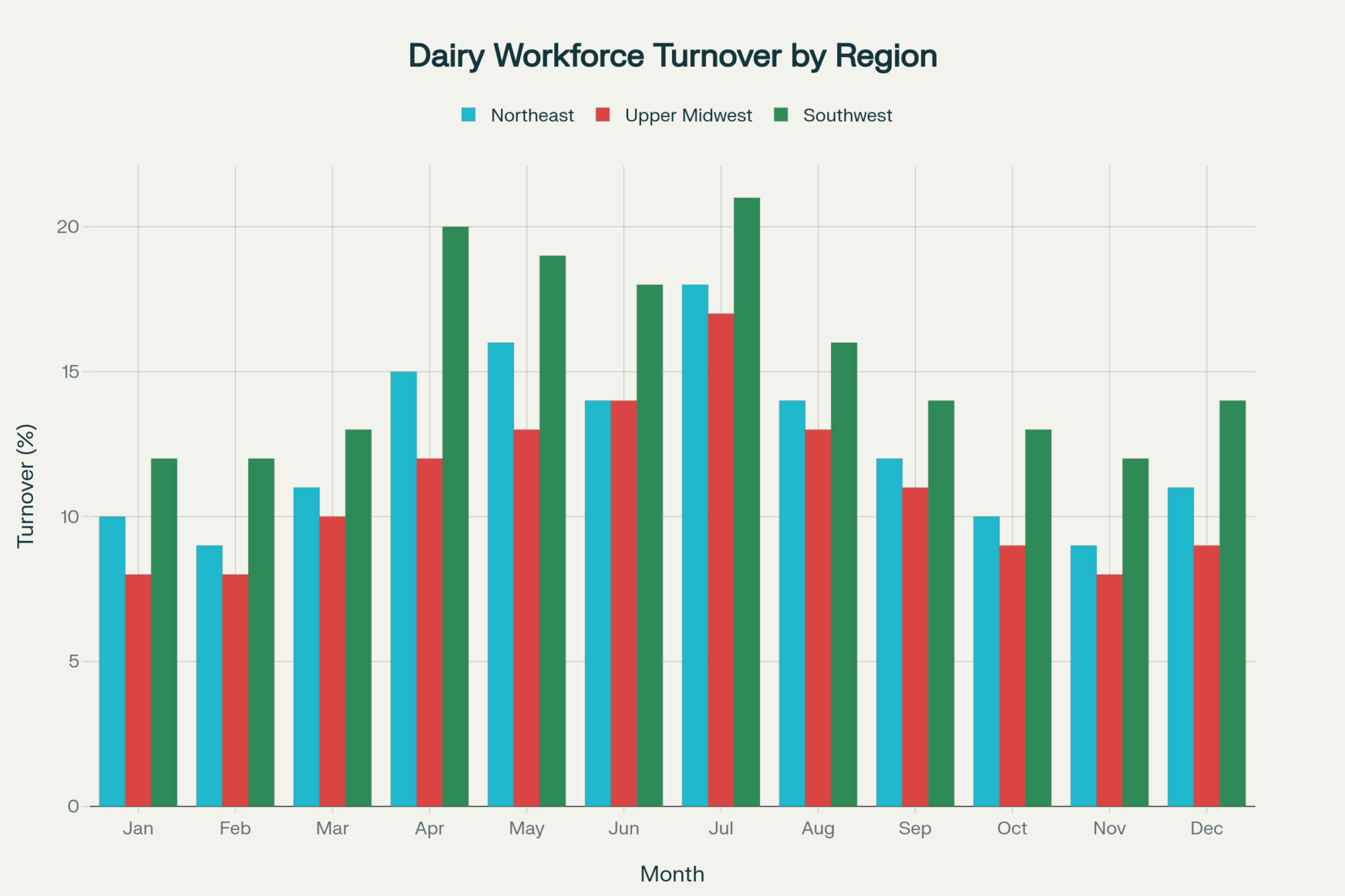
Seasonal Workforce Turnover Rates in Dairy Regions

The Real Cost of Churn That Nobody Wants to Discuss

Look, I get it. Turnover feels like just another headache when you’re already juggling feed bills, equipment breakdowns, and everything else that goes sideways on a dairy. But here’s the thing—workforce churn has become a productivity killer that’s bleeding operations dry.

The latest FARM survey data indicate that annual turnover is approximately 39% across participating dairies. That means nearly 4 out of 10 workers walk out your door every year, leaving chaos in their wake.

What’s particularly eye-opening is the emerging research from Cornell’s agricultural workforce program, which suggests significant ripple effects. Studies indicate that even modest turnover correlates with 1-2% drops in milk production and measurable impacts on animal health—more sick calves and higher cow mortality. Those aren’t just statistics; they show up in your butterfat tests and vet bills, whether you’re tracking them or not.

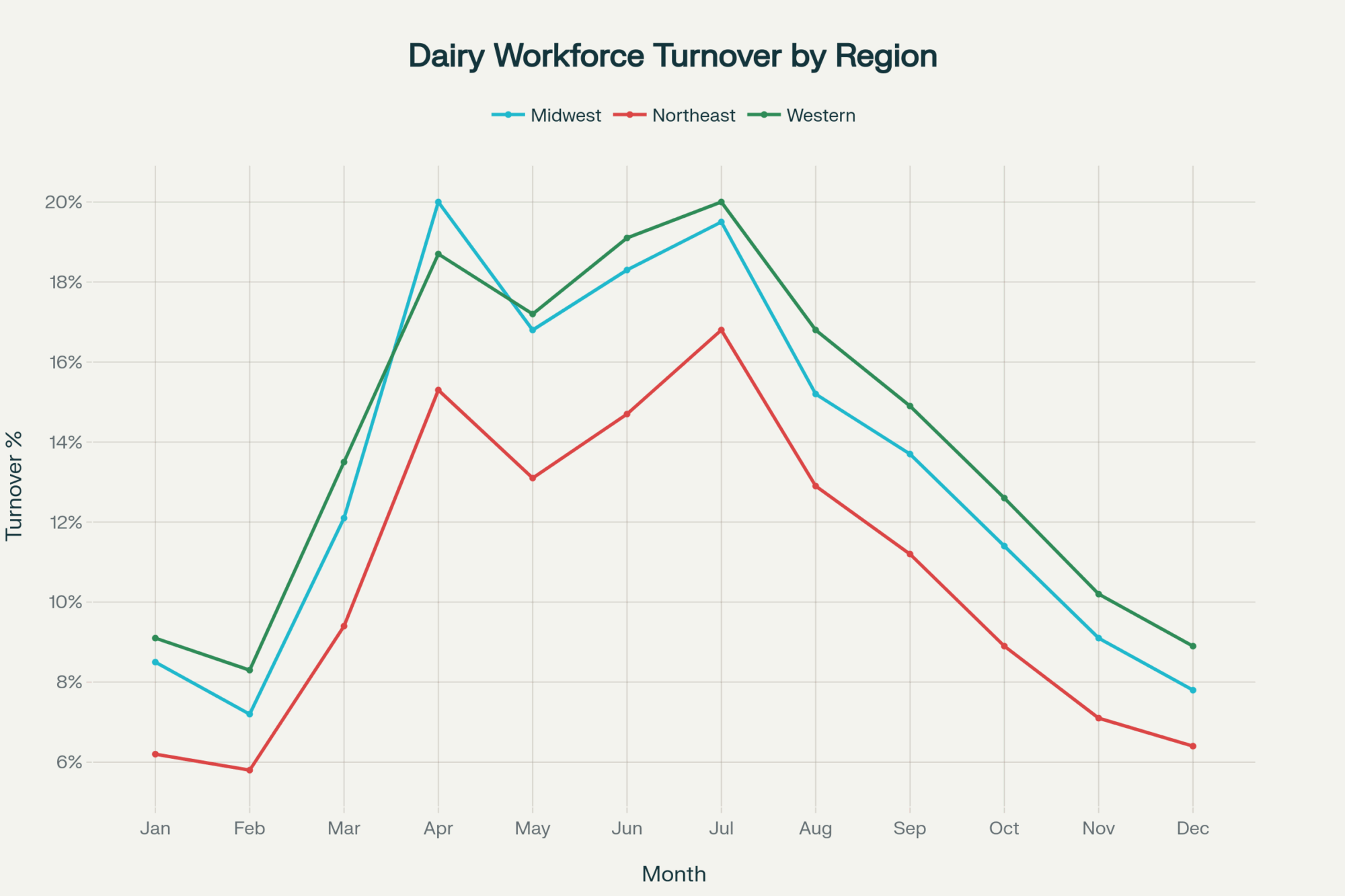
Monthly Dairy Workforce Turnover Rates by Region (Estimated, 2025)

And the seasonal swings? That’s where it gets really painful. Some regions report monthly turnover spiking to 20% during peak stress periods—April, when everyone’s scrambling for field work, and July, when the heat becomes unbearable. Try running efficient operations when one in five workers might disappear any given month.

Here’s what really gets expensive, though: new hires take 3 to 6 months to reach full productivity. During that extended learning curve, your experienced workers spend up to 30% of their time training newcomers, rather than focusing on their actual jobs.

Cornell Extension’s cost analysis framework estimates the total cost at $15,000 to $25,000 per departed worker, factoring in recruiting, training, lost productivity, equipment damage, and quality issues. Multiply that by your annual turnover rate, and you’re looking at potentially six-figure annual losses.

Practical Guide to Calculating and Managing Dairy Workforce Turnover Costs

Dairy Turnover Loss Calculator

  • Number of full-time-equivalent (FTE) workers: ______
  • Annual turnover rate (%): ______
  • Estimated cost per departing worker ($15,000–$25,000): ______

Estimated Annual Turnover Cost:

FTE workers x turnover rate (as a decimal) x cost per departed worker = total turnover cost

Example:
20 workers x 0.39 x $18,000 = $140,400 per year

Don’t forget to include training time, lower early productivity, and possible vet or quality losses!

 Where You Farm Determines Everything

What strikes me about this workforce crisis is how differently it plays out depending on your location. And I’m not just talking about obvious stuff like wages or cost of living.

In traditional dairy states like Wisconsin and New York, USDA data shows immigrant workers typically make up 50-70% of the workforce. However, head west to the large confined operations in Idaho or California’s Central Valley, and University of Minnesota extension research indicates that those percentages climb to 70-90%.

The concentration becomes even more pronounced on larger operations. Those 1,000+ cow dairies that dominate production? They’ve built their entire labor model around experienced immigrant workers who often bring generational dairy knowledge from their home countries.

Climate adds another layer of complexity that most analyses ignore entirely. Summer heat in Arizona and Southern California creates working conditions that drive seasonal workforce migration toward indoor jobs. Meanwhile, brutal winters in the northern tier trigger departures when farm housing isn’t adequate.

The result? American dairy’s geographic footprint is quietly reshaping itself around workforce availability—operations are expanding where labor is accessible and consolidating where it’s not.

Robots: Let’s Talk Real ROI, Not Marketing Hype

Every conversation about dairy labor eventually comes around to automation, and there’s definitely momentum building. The global robotic milking market reached approximately $2.5 billion in 2025, with North America accounting for about 30% of that total.

But here’s where I need to be brutally honest about the economics. Those glossy equipment brochures promising 2-3 year paybacks? Joint analyses from Minnesota and Wisconsin dairy extension programs consistently show more realistic timelines of 5-7 years under typical operating conditions.

The shorter paybacks only happen under very specific circumstances—extremely high labor costs, perfect cow adaptation, and exceptional management. Most operations face a much bumpier road.

Multiple case studies from 2022 to 2024 document initial production volatility, with some farms experiencing drops of 8-15% during the first year as both cows and operators adapt to new routines. One producer described it to me as “like teaching calculus to cows while learning it yourself.”

However, what’s truly interesting is that successful automation doesn’t eliminate labor needs—it fundamentally transforms them. You go from needing experienced milkers who understand cow behavior to needing technical specialists who can troubleshoot sensors, interpret data analytics, and manage complex automated systems.

Policy Paralysis and What’s Actually Working

Let’s address the elephant in the room: federal immigration policy remains completely disconnected from the operational reality of dairy.

The H-2A program certified nearly 385,000 positions in 2024, but it’s virtually useless for year-round dairy operations. Designed decades ago for seasonal crop work, it can’t accommodate our biological requirements—cows don’t take vacations.

Processing delays make an already inadequate system actively harmful. Workers often arrive weeks after they’re needed, if they arrive at all. When you’re milking twice daily regardless of staffing problems, these delays aren’t just inconvenient; they’re operationally catastrophic.

What’s actually working? State-level innovation that ignores federal paralysis. Vermont’s Milk with Dignity Program—a worker-driven, advocacy-supported initiative—now covers 20% of the state’s dairy production. The program succeeds because workers helped write the standards, participate in monitoring, and farms receive economic premiums for participation.

Smart producers are investing in comprehensive retention strategies that show measurable results. Quality housing investments of $50,000 to $100,000 per unit demonstrate clear returns through reduced turnover. Operations implementing structured career development, language training, and genuine advancement opportunities report a drop in turnover from over 45% to under 15% within two years.

Key Components of Effective Dairy Workforce Retention

Your Monday Morning Action Plan

Here’s what successful operations are doing while others are still debating policy:

  • Start with brutal honesty about your vulnerabilities. Document your current workforce composition, identify critical positions, and develop emergency protocols for various disruption scenarios. Most operations have no idea how exposed they really are.
  • Plan technology adoption in phases alongside investments in retention. Don’t put all your resources into either automation or workforce development—you need both strategies working together.
  • Build community partnerships before you need them. Establish relationships with neighboring operations for labor sharing, connect with community colleges for training programs, and develop agreements with reliable staffing services.
  • Two low-cost moves you can implement this week: First, standardize your onboarding process with written protocols and milestone reviews. Second, train supervisors in basic coaching techniques—many turnover decisions occur within the first 90 days, often based on management relationships.
  • Use extension data to benchmark and track progress. Stop making workforce decisions based on gut feelings when objective data is available through university extension programs.

The Bottom Line That Changes Everything

Here’s the question that should reshape your planning: if you lost 40% of your workforce tomorrow—not gradually over months, but suddenly—could you still milk your cows and maintain animal welfare standards?

That scenario isn’t theoretical anymore. Agricultural regions across the country have experienced similar workforce reductions following enforcement actions, economic disruptions, and changes in the competitive labor market.

I’ve watched dairy operations that seemed bulletproof suddenly scramble to find emergency staffing solutions that often don’t exist. The difference between survival and bankruptcy comes down to preparation and strategic thinking.

The workforce foundation supporting American dairy is fundamentally unstable, and that instability is accelerating whether we acknowledge it or not. The operations that survive and thrive will be those that acknowledge current realities, invest strategically in both technology and people, and build operational resilience before crisis forces their hand.

Your response to this workforce challenge—starting right now—will determine whether you’re leading the dairy industry’s next evolution or becoming a statistic in its ongoing consolidation. Because at the end of the day, those cows are still waiting twice daily, and they’re not negotiating schedules based on workforce availability.

Your cows don’t negotiate milking schedules based on who shows up. Time to get serious about the people who make it all happen.

KEY TAKEAWAYS

  • Save $15,000-$25,000 per worker by investing in decent housing and career pathways—some Vermont farms cut turnover from 45% to 15% in two years using this approach
  • Budget 3-6 months for new hire productivity, while your veterans spend 30% of their time training instead of milking—streamline onboarding to cut this waste
  • Prepare staffing around seasonal peaks that can hit 20% monthly turnover in April and July—schedule accordingly, or watch your operation spiral
  • Don’t believe robotic milking paybacks under 5 years—Minnesota and Wisconsin extension data shows 5-7 years is realistic, and you’ll still need tech-savvy workers
  • Leverage proven retention programs like Vermont’s Milk with Dignity, which covers 20% of state production and demonstrates measurable improvements in workforce stability

EXECUTIVE SUMMARY

Here’s what kept me up last night after diving into the latest workforce data: farms employing immigrant workers now produce 79% of America’s milk, while those workers make up just over half of our entire workforce. But there’s a gut punch coming—turnover is hitting nearly 40% annually, and that’s not just an HR headache, it’s shaving 1-2% right off your production. Even worse, seasonal spikes can push monthly churn above 20% during spring and summer—try running efficient operations when one in five workers might leave at any given time. The global dairy industry is scrambling toward automation, but realistic robotic paybacks take 5-7 years, not the fairy tale 2-3 years vendors promise. Smart money says fix your people problems first, then layer in the tech—because at $25,000 per departed worker, you can’t afford to keep bleeding talent.

Complete references and supporting documentation are available upon request by contacting the editorial team at editor@thebullvine.com.

Learn More:

The Sunday Read Dairy Professionals Don’t Skip.

Every week, thousands of producers, breeders, and industry insiders open Bullvine Weekly for genetics insights, market shifts, and profit strategies they won’t find anywhere else. One email. Five minutes. Smarter decisions all week.

NewsSubscribe
First
Last
Consent
Send this to a friend