





Archive for sexed semen ROI

The Panhandle Springer Tax: One 500-Cow Breeding Sheet and a $116,600 Liability for 2028

A Panhandle dairy is 200 beef services deep on viable dams and $116,600 short on 2028 replacement value. The straw’s in the gun this week. The $3,500 springer check comes later.

Executive Summary

  • The gap is real: 4.29M projected milking-herd entries for 2027 against a 9.57M-cow U.S. herd, with USDA’s most recent Cattle Inventory at 3.91M replacement heifers — the lowest in nearly five decades.
  • The per-straw math isn’t close: Every beef service on a viable dairy dam trades away ~$583 in expected replacement value. On a 500-cow Panhandle herd running 35% beef-on-dairy, that’s ~$116,600 a year walking off the breeding sheet.
  • Retention has masked the hole: Weekly slaughter ran below year-earlier levels in 86 of 88 weeks through mid-May 2025, but Class III at $14.59, $14.94, and $16.16 across Jan–Mar 2026 is changing the retention math fast — into the same shortage that $11B in new processing capacity is landing on top of.
  • The lender question: If your 12-month heifer-calf count × 0.79 doesn’t clear herd size × replacement rate, you’re already buying someone else’s springers at $3,500-plus in 2028 — the question is whether that’s on your budget or a working-capital covenant breach.
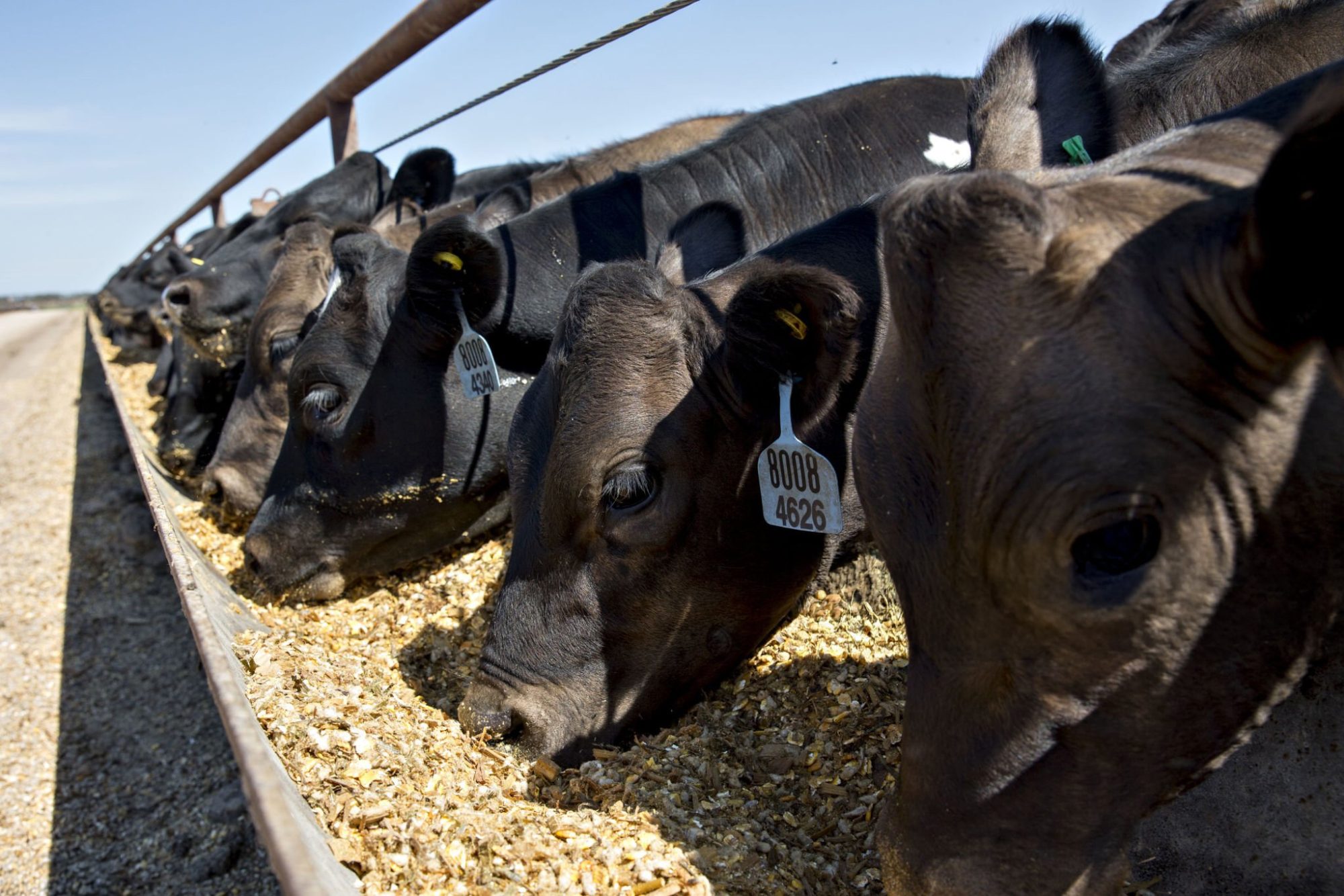
dairy heifer shortage

A 500-cow Panhandle dairy needs 135 replacement heifers a year at a 27% turnover rate. At the July 2025 U.S. replacement-heifer average of $3,010 per head (USDA Agricultural Prices), that’s a $406,350 annual replacement line — closer to $500,000 once California and West Texas premium bands kick in. The breeding decisions on that farm’s clipboard this week decide whether those 135 head come out of the home barn in 2028 or go under the hammer at $3,500-plus.

That Panhandle herd is a composite built from Bullvine Pipeline Tracker inputs. The pressure it’s under is not.

HOW TO READ THE PIPELINE TRACKER The Tracker converts NAAB’s semen-unit totals into projected milking-herd entries using published commercial-Holstein conversion rates (conception, pregnancy survival, heifer sex ratio, calf-to-milking-cow completion). Every Tracker number in this piece traces back to those two inputs: units sold and what they become by first lactation.

What the Pipeline Tracker Actually Shows

The Bullvine Replacement Pipeline Tracker applies commercial-Holstein conversion rates to NAAB’s 2025 Year-End Report, released March 2026. Domestic units only: 10.6 million sexed dairy, 6.0 million conventional dairy, 8.1 million beef-on-dairy. Sexed now accounts for 64% of domestic dairy units, up from roughly 58% a year earlier.
Run those volumes through the published conversion rates from Dr. Michael Overton’s Zoetis field dataset of 85 commercial Holstein herds — 42% sexed conception, 57% conventional, 95% pregnancy survival, 90% heifer sex ratio on sexed, and a 79% calf-to-milking-cow completion rate. The arithmetic lands at 4.29 million milking-herd entries projected for 2027. (Derivation applies a 50% heifer sex ratio to conventional services; sexed services carry the stated 90% ratio. The Overton dataset reflects U.S. commercial-Holstein average conditions across 85 herds, not top-third management benchmarks.)

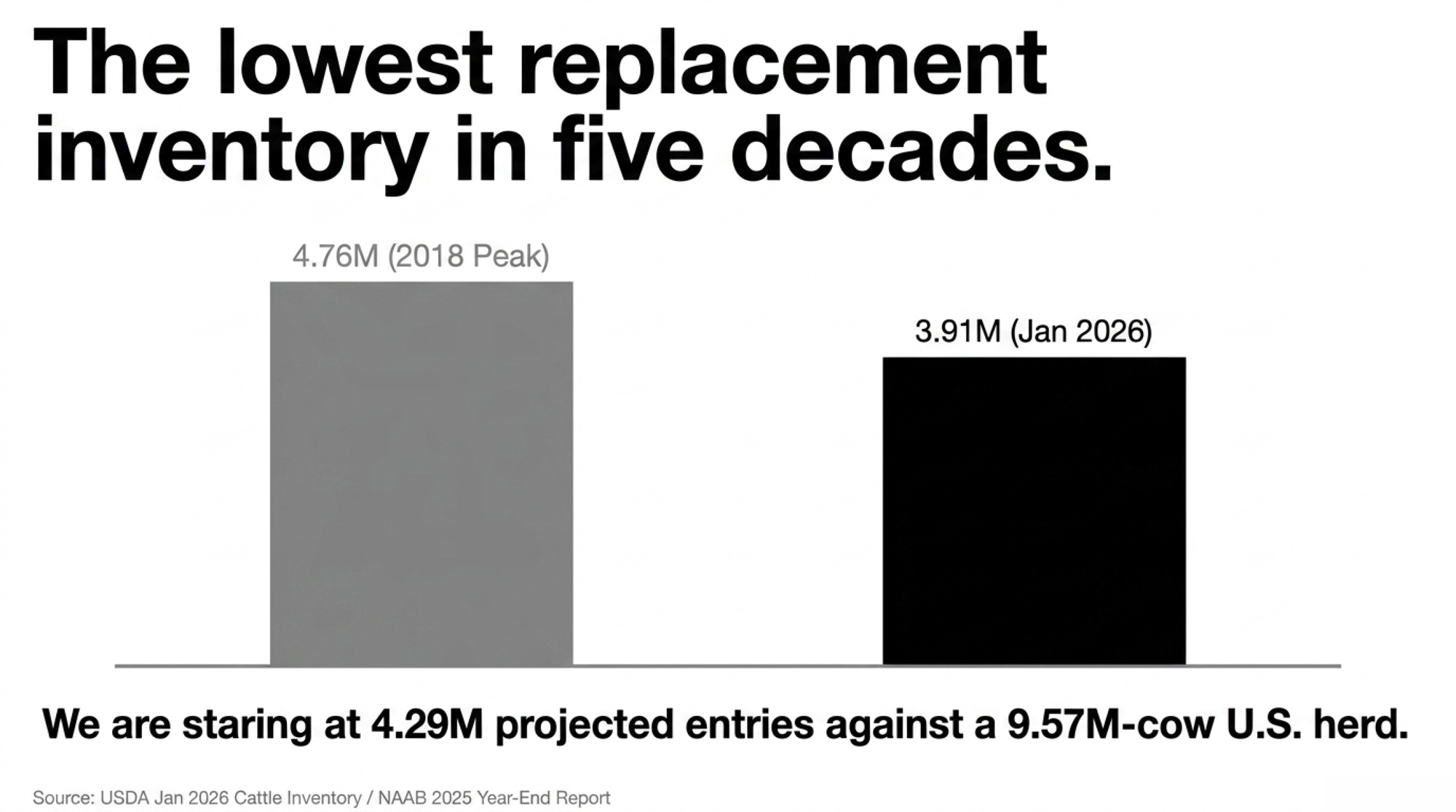
Line that up against a 9.57-million-cow U.S. dairy herd — the largest since the early 1990s — and roughly $11 billion in new processing capacity committed across 50-plus projects in 19 states (CoBank Knowledge Exchange, August 2025). USDA’s January 2026 Cattle Inventory counted 3.91 million replacement heifers on U.S. farms, the lowest in nearly five decades and 18% below the 2018 peak.

That’s the hole. It’s not rhetoric. It’s arithmetic.

The 4.29 million number assumes current conversion rates hold. Real pipeline outcomes will move with protocol quality, pre-weaning calf mortality, and economic conditions that shift culling behavior. But the direction isn’t in dispute.

Why 79% Is the Number Producers Underestimate

Twenty-one out of every 100 heifer calves born alive never make it to the milking string. That’s a fifth of the rearing investment walking out the door, baked into every pipeline projection that matters.
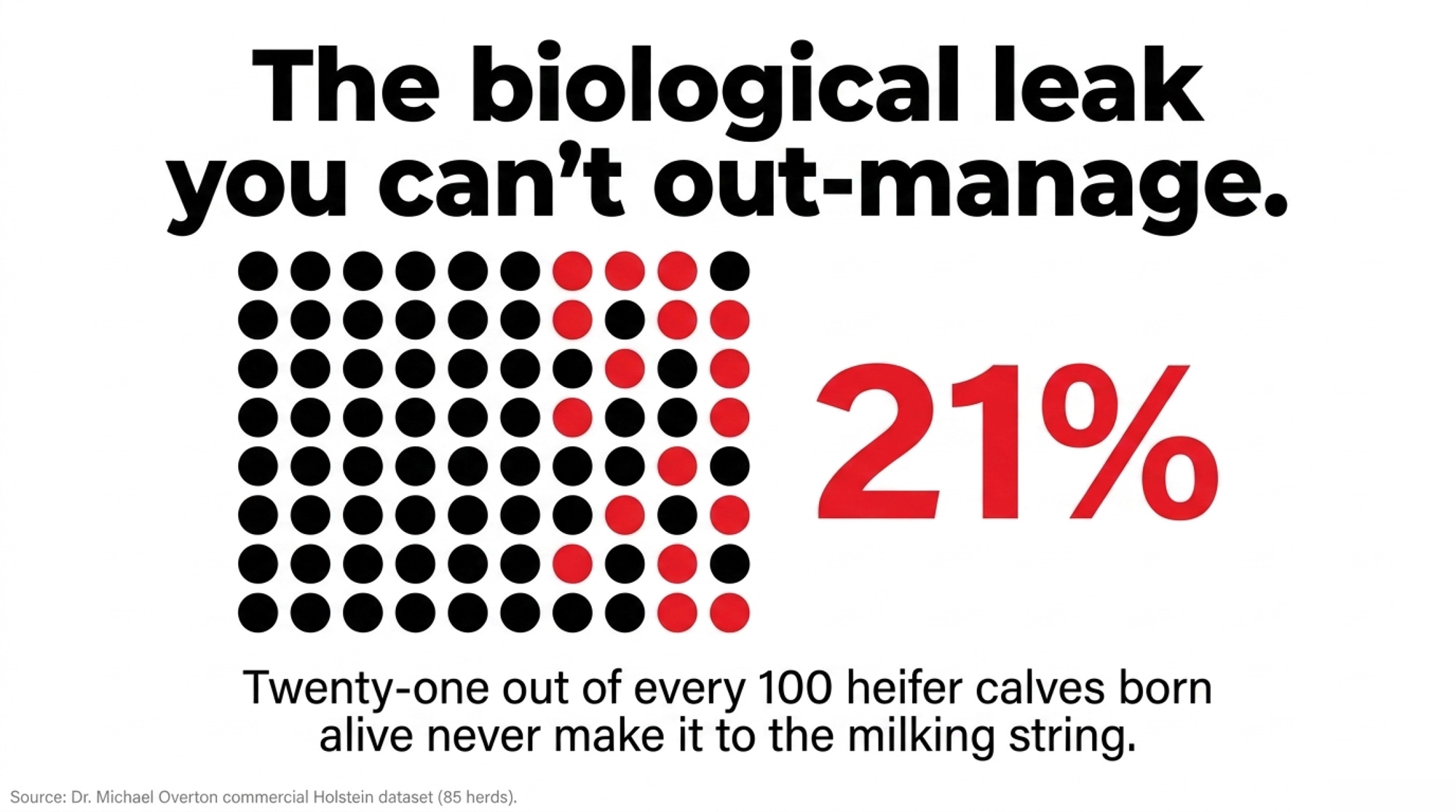
Where the 21% leaks out — audit your own barn against each of these checkpoints:

  • Pre-weaning mortality: calf scours, pneumonia, failure of passive transfer.
  • Post-weaning to breeding age: respiratory disease, lameness, chronic poor-doers.
  • Failed breeding: heifers that don’t conceive in the breeding window your SOPs allow.
  • Pregnancy loss: abortions and twins lost between confirmed preg check and calving.
  • Stillbirth and dystocia loss at calving.
  • Did-not-complete-first-lactation culls: fresh-cow disease, chronic mastitis, repeat breeder, classifier-flagged conformation issues shipped before 305 DIM.

Plug it into a 500-cow herd: pull the last 12 months of heifer-calf births, multiply by 0.79, and compare against herd size × replacement rate. If the number lands at 110 or 115 against a 135-heifer need, the future herd is already under-built. No market rally generates animals that aren’t in your pipeline.

The $583 Gap — Where Your Breeding Sheet Is Writing Checks
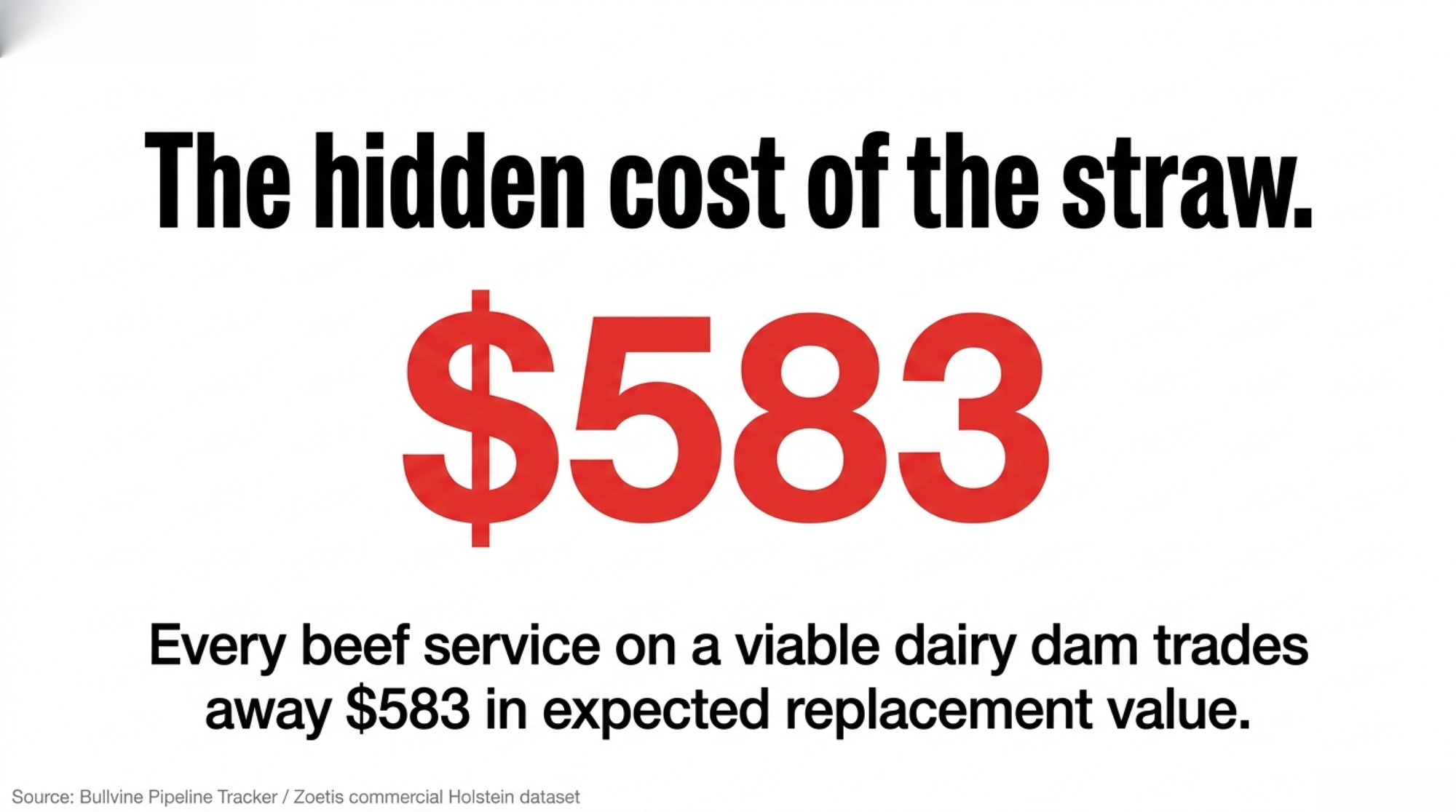
Here’s the expected value at the straw level, using the Tracker’s inputs.

  • Sexed dairy EV per straw: $3,010 × 0.42 × 0.95 × 0.90 × 0.79 ≈ $854.
  • Beef EV per straw at a $500 calf: $500 × 0.57 × 0.95 ≈ $271.
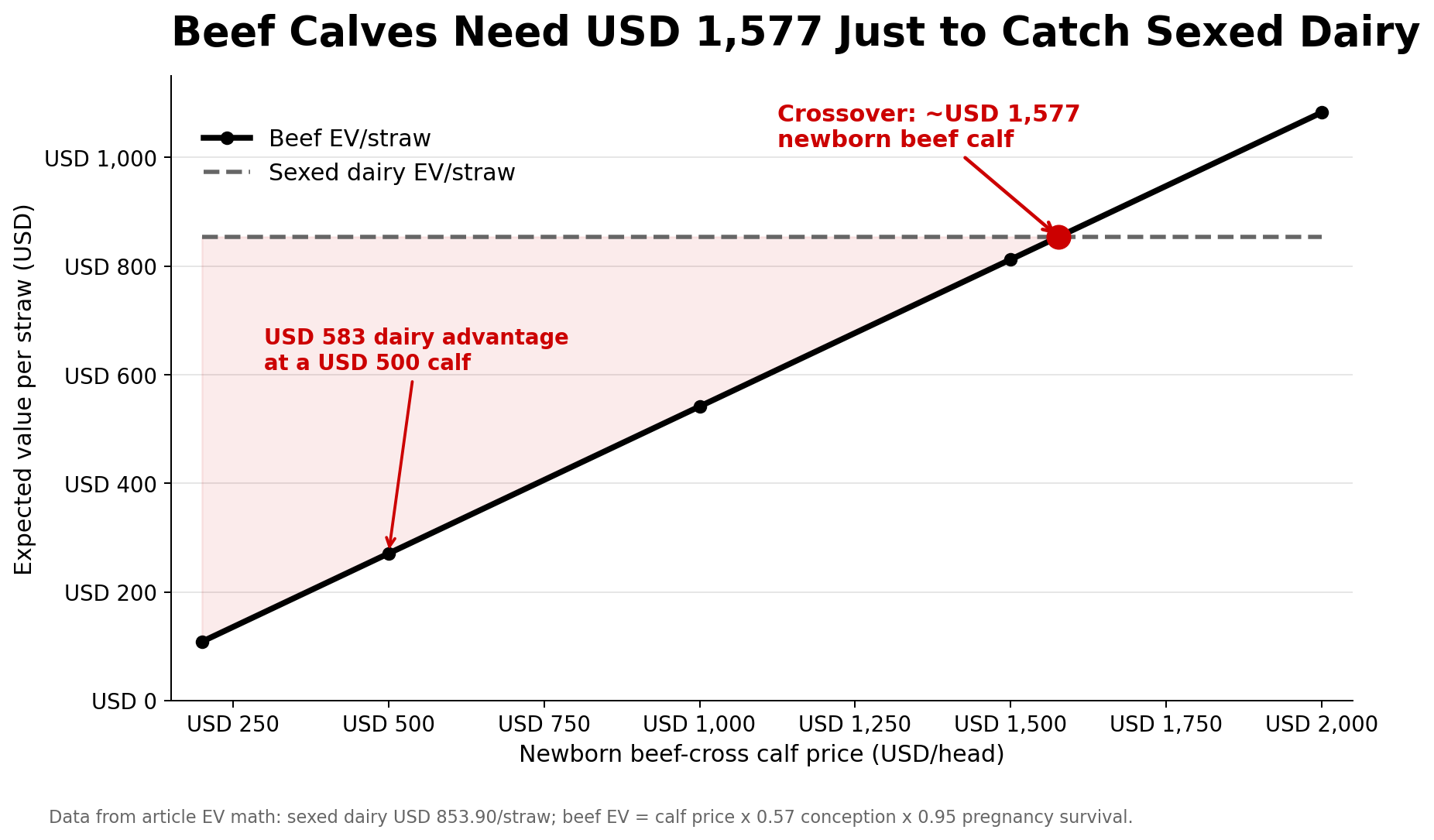
Three times the expected value for dairy. Every beef service on a cow that could carry a viable dairy pregnancy is roughly a 3 gap in expected replacement value — the hidden cost of rearing replacements few breeding sheets actually price in.
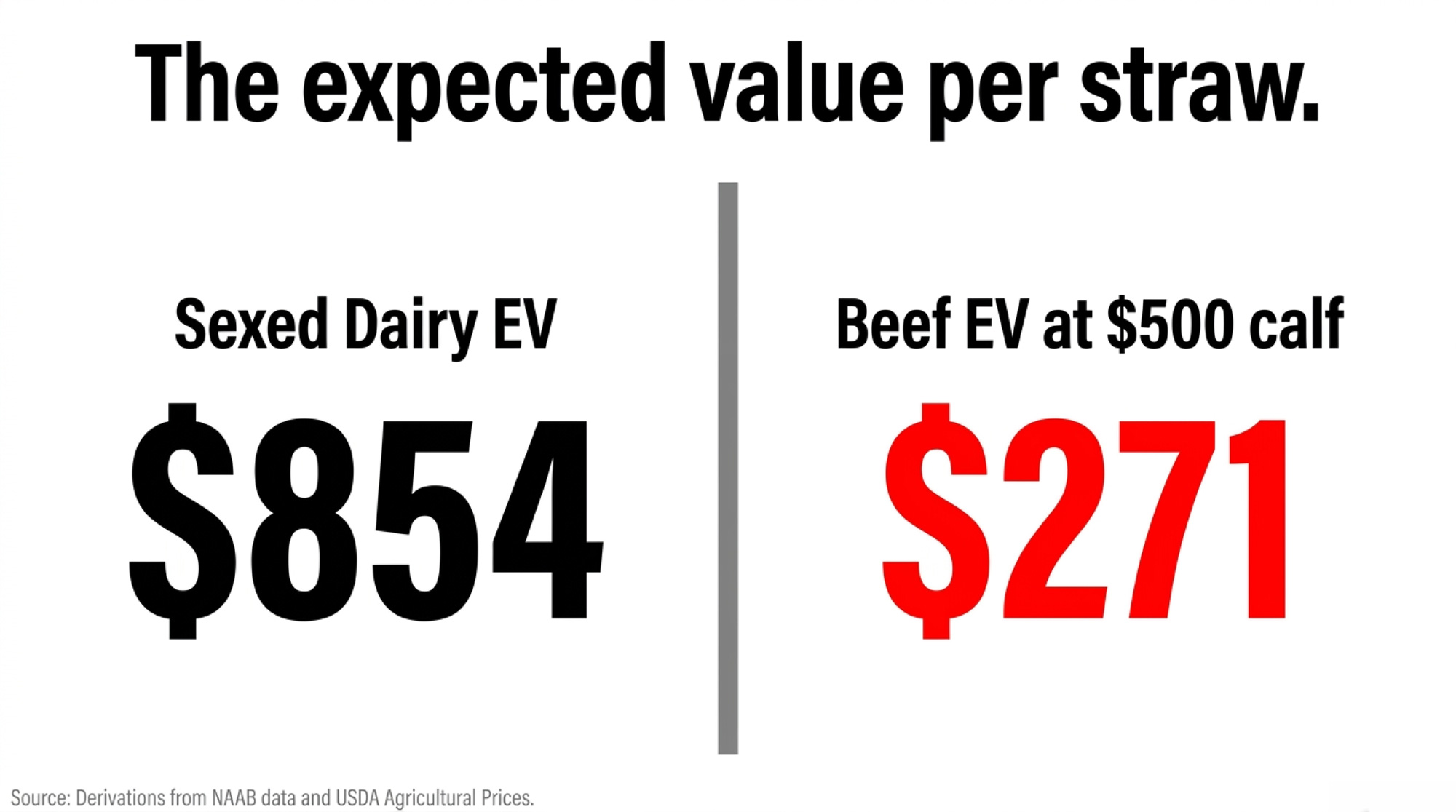
The scenario table shows the crossover plainly.

Beef Calf PriceBeef EV/StrawSexed Dairy EVDairy AdvantageVerdict
$200$108$854$746Dairy dominates
$500$271$854$583Dairy wins
$1,000$542$854$312Dairy still ahead
$1,500$812$854$42Near breakeven
~$1,577$854$854$0Crossover
$2,000$1,083$854-$229Beef wins

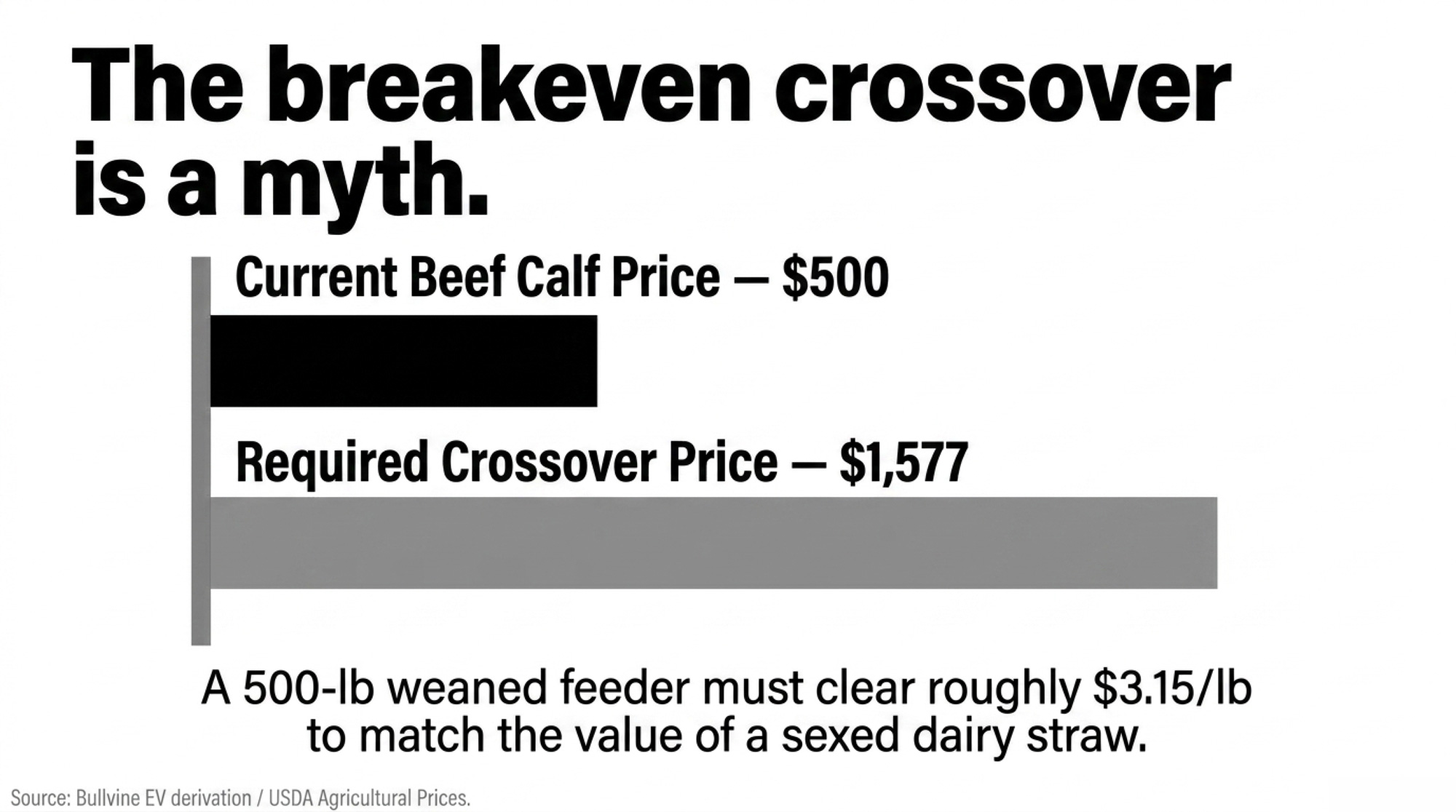
Beef calves have to clear roughly $1,577 per newborn to match sexed dairy at a $3,010 heifer. To put that in barn terms: a 500-lb weaned feeder would need to clear roughly $3.15/lb to land there — a number that assumes a high-demand year and ignores the feed and yardage cost of carrying the calf from newborn to that weight. Current beef-cross calf prices from dairy herds run $200 to $500-plus depending on genetics and region. Weaned feeders in program and video sales push higher, but at the breeding-decision level — the straw going in the gun — the math isn’t close.

Can One Panhandle Herd Really Be Leaving $117,000 on the Table?

Yes. And the arithmetic is boring.

Say that 500-cow Panhandle operation runs 35% beef-on-dairy across its total annual services — roughly 200 beef services a year on animals that could carry a dairy pregnancy, targeted at bottom-third cows. At the $583 per-service gap, the hidden math is:
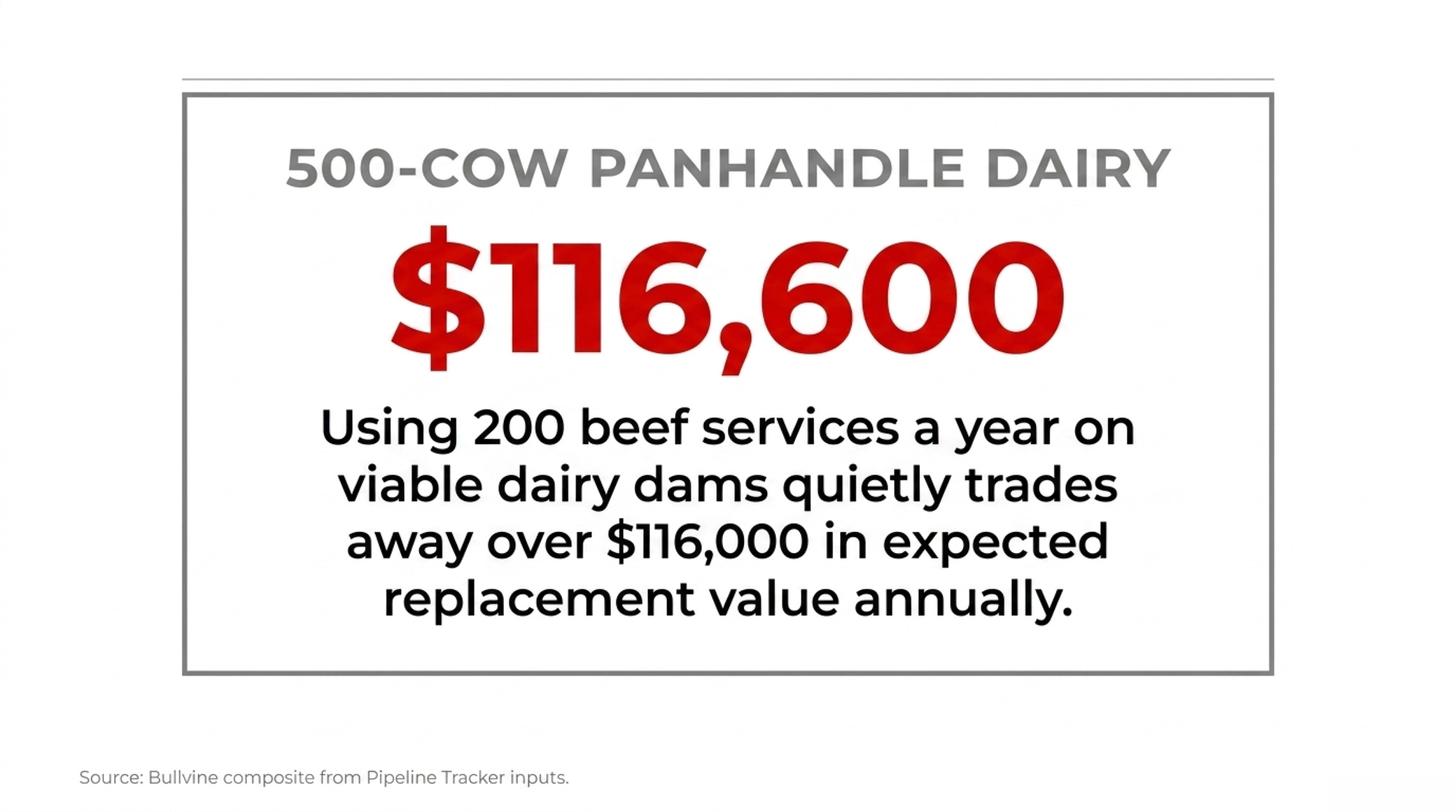
200 × $583 ≈ $116,600 in expected replacement value traded away, every year. Rounded to $117,000 in headline framing for scan value.
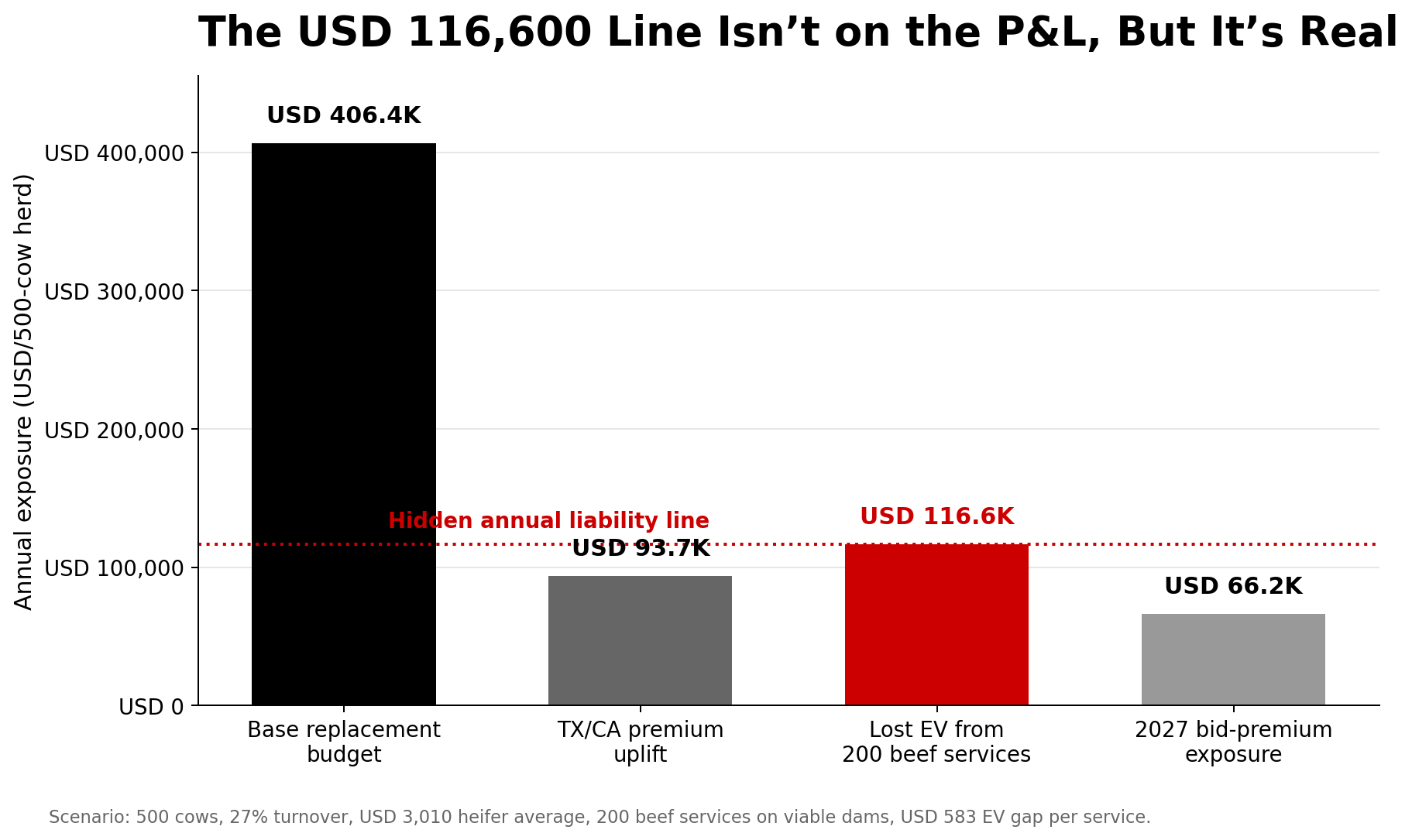
Cost DriverAnnual $ ExposureCategory
Base replacement budget (27% × $3,010)$406,350Base budget
TX/CA premium band uplift~$93,650Direct cost premium
Lost EV: 200 beef services × $583~$116,600Hidden risk
2027 bid-premium exposure, 135-heifer purchase at $3,500 vs. $3,010 ($490 premium)~$66,150Future risk (single-year)

That $116,600 isn’t a P&L line. It’s future cow inventory the herd is choosing not to create — and then buying back at ,010-plus when the auction ring gets to it. Your exact number moves with your calf price and your local heifer cost. The direction doesn’t. That Panhandle breeding sheet is quietly writing checks the pipeline can’t cash in 2027.

Why Behavior Hasn’t Caught Up

Three reasons. None of them irrational. All of them expensive.

Cash flow timing: a beef calf brings a check in weeks, a heifer generates milk in about 24 months. Strategy inertia: programs built when dairy-beef cross calves pulled stronger prices in 2023–2024 haven’t been rewritten for today’s 0–0 market. The biological lag itself: any heifer you want calving in 2028 has to be conceived now, and that feels like forever when feed bills hit monthly.

None of that makes the choice crazy in the moment. It just explains why the pipeline keeps bleeding. The vets running dairy-repro programs across the Panhandle and Central Valley are saying the quiet part out loud at producer meetings this spring: the breeding sheets still look like 2023, and the cash-flow math that justified them doesn’t.

The Retention Overhang Masking the Gap

Cow retention has been quietly covering the pipeline hole. Iowa State Extension’s NW Iowa Dairy Outlook (May and December 2025) documented the pattern: from September 2023 through mid-May 2025, weekly dairy cow slaughter ran behind year-earlier levels in 86 of 88 weeks. January–April 2025 slaughter came in at roughly 889,900 head — the lowest start to a year since 2008.

The Bullvine estimate extends that documented deficit through late 2025 at roughly 600,000–611,600 extra cows retained versus normal culling pace — an extrapolation from ISU’s weekly data, not a USDA statistic. Those cows carry the milk volume today.

When Class III compressed to $14.59 in January 2026, $14.94 in February, and $16.16 in March (USDA Class and Component Prices), the math on keeping marginal animals turned fast.

Month (2026)Class III Price
January$14.59/cwt
February$14.94/cwt
March$16.16/cwt

Source: USDA Class and Component Prices, Jan–Mar 2026.
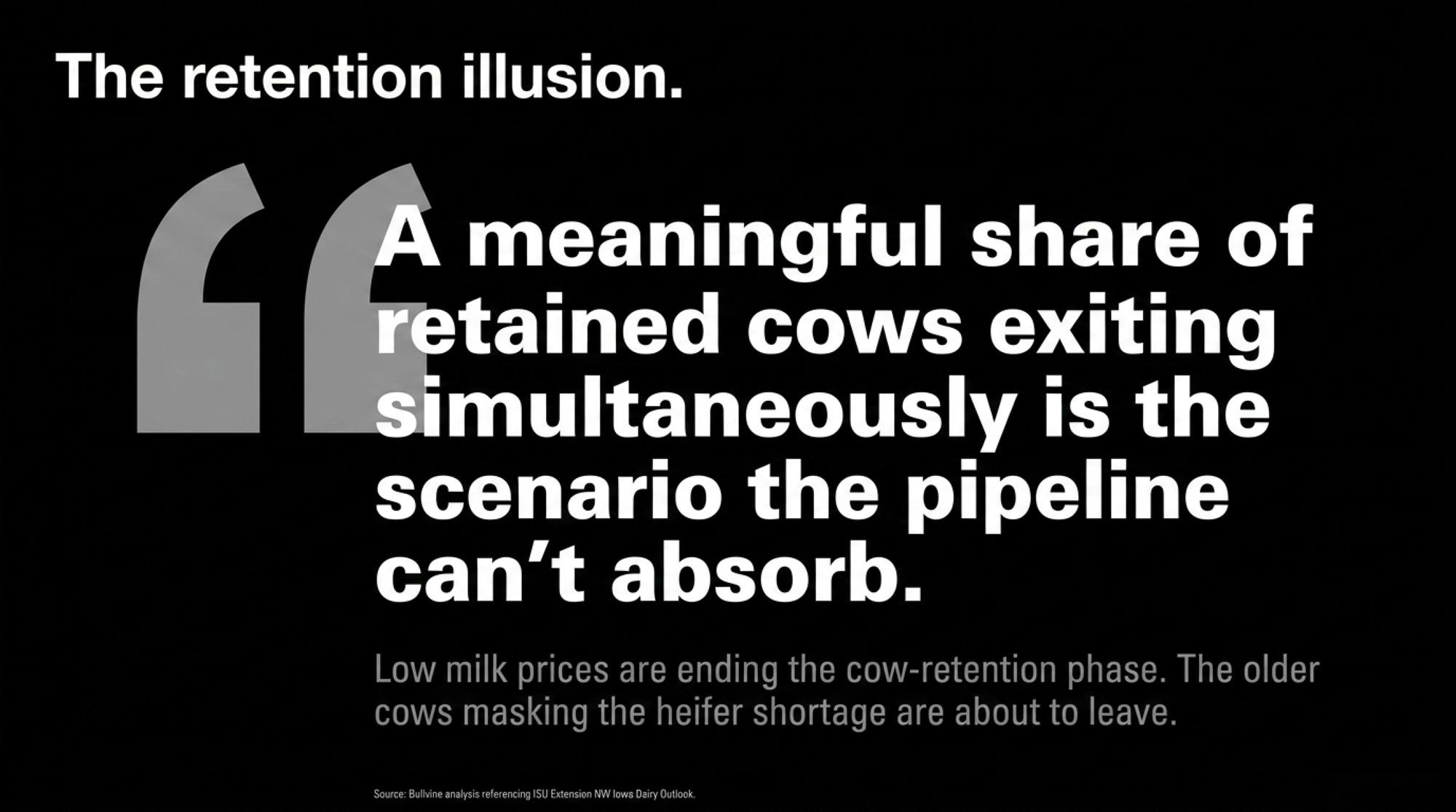
A meaningful share of those retained cows exiting simultaneously is the scenario the pipeline can’t absorb. The cows being held to supply $11 billion in new processing capacity are, by definition, the least productive animals in the herd.

Branch 1: Buying Your Way Out Is a Covenant Breach Risk

For many 500-cow herds sitting on the edge of their credit lines after Q1 2026 Class III in the $14s, buying your way through a pipeline shortfall isn’t just “expensive.” It’s a working-capital covenant question.
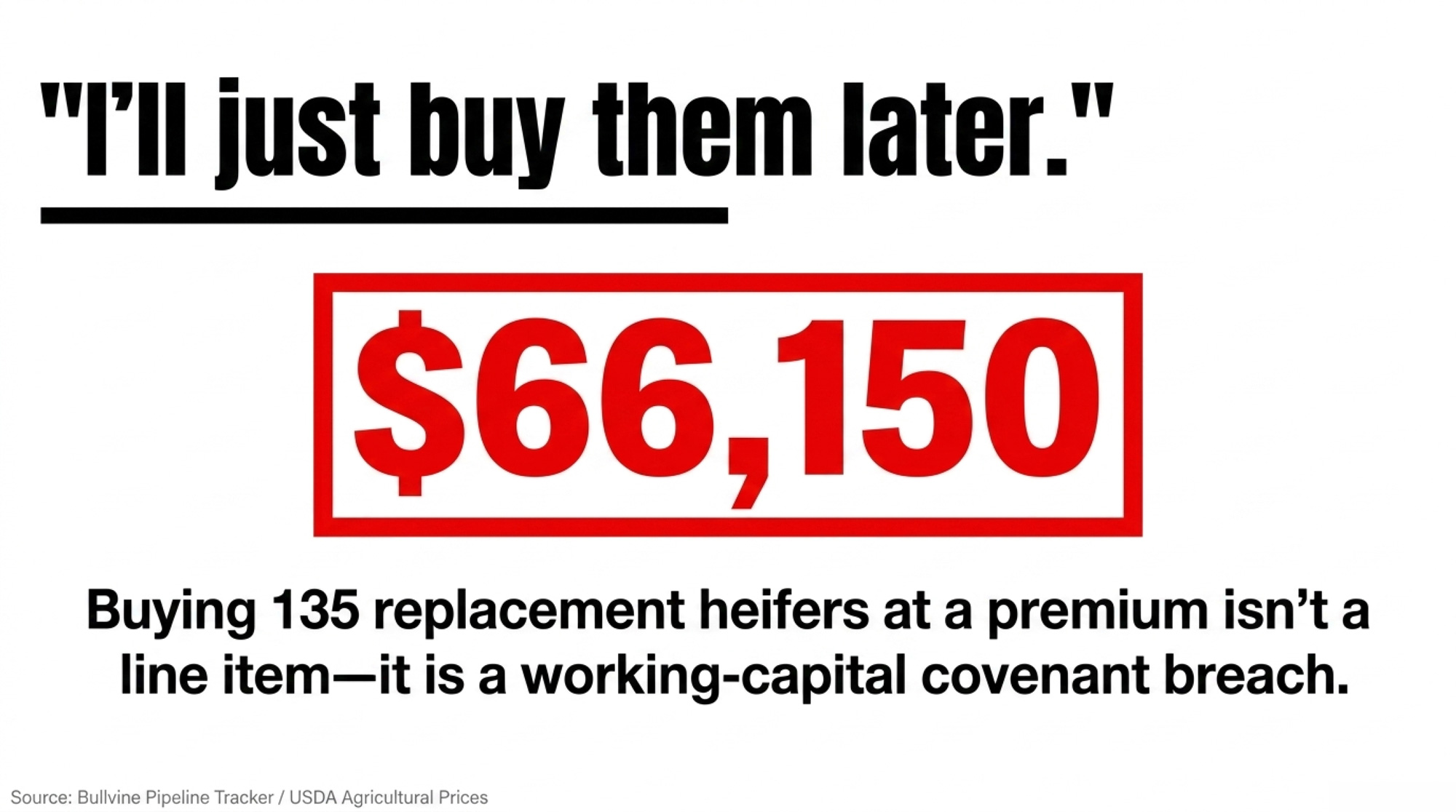
Run the arithmetic at the kitchen table. A 40–60 head single-year purchase at a $490 premium ($3,500 vs. $3,010) adds $19,600 to $29,400 of unplanned capital outlay. A full 135-heifer purchase year at the same premium is $66,150. Neither is catastrophic on its own, but neither is free working capital either — and both land on top of depressed Q1 revenue, feed carry, and whatever springer timing the auction ring actually gives you.

Before your next lender review, know two numbers cold: your current working-capital-to-revenue ratio and the specific covenant thresholds in your operating note. If a $66,000-plus unplanned heifer draw trips a covenant or forces a term-out, “I’ll buy later” stops being a strategy and starts being a restructuring conversation.

The Pipeline Index: 43.5, and 4.5 Points From Red
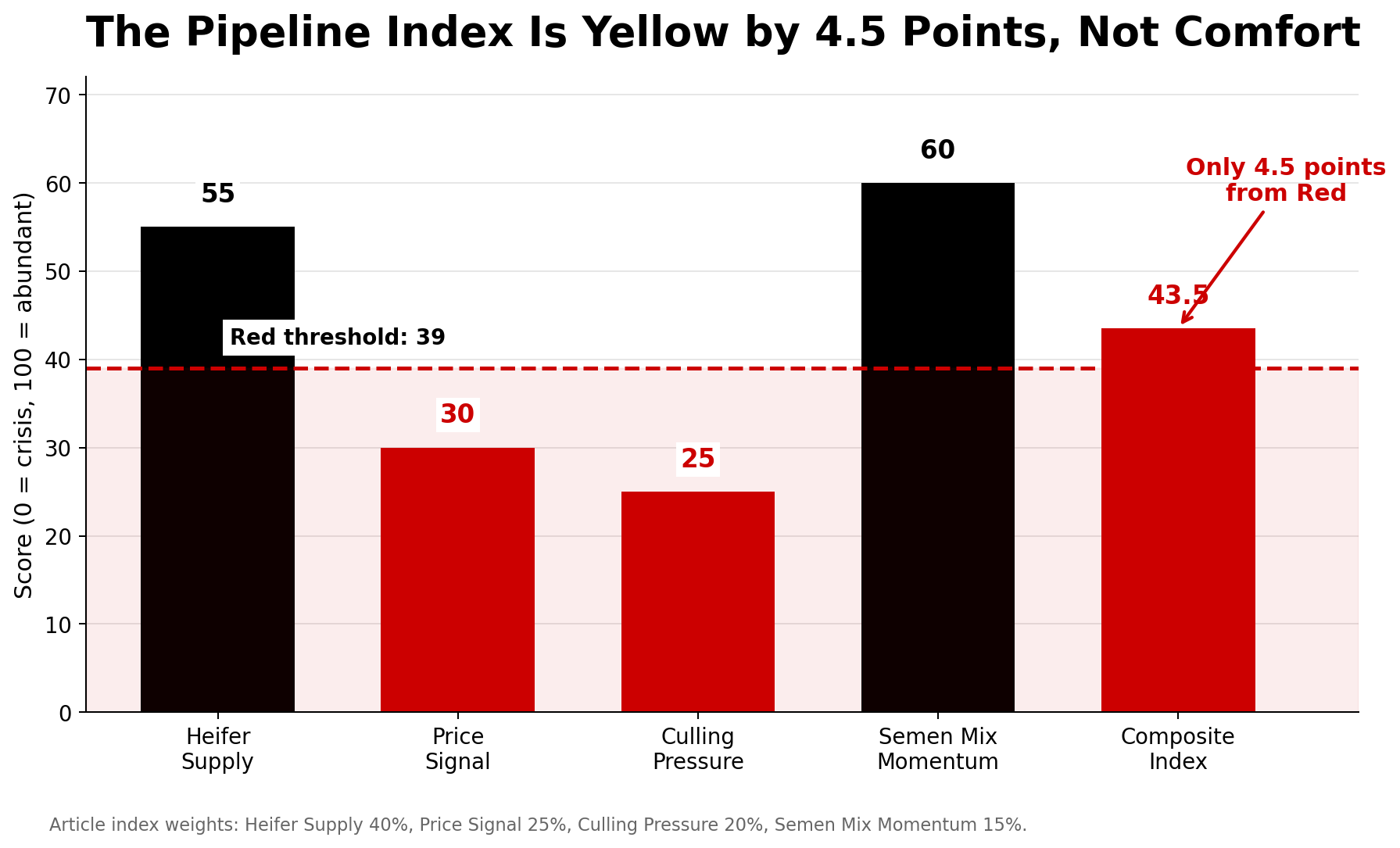
The Bullvine Pipeline Index runs 0 (crisis) to 100 (abundant) across four weighted components.

Component (weight)What it measuresCurrent scoreStatus
Heifer Supply (40%)Replacement ratio — ~27 per 100 cows55Marginal
Price Signal (25%)Inverse of heifer price — $3,010/head30Red-zone range
Culling Pressure (20%)Deviation from normal culling pace25Red-zone range
Semen Mix Momentum (15%)Sexed dairy share — 64% and rising60Adequate
Composite 43.5Yellow Zone

Red threshold: 39. Yellow: 40–69. The Index is riding on one component — semen mix momentum — and that’s a behavior change that takes 24 months to become a milking cow.

If slaughter normalizes and the Culling Pressure Score climbs from 25 to 15 (a −10 × 0.20 weight hit), the Index slides to 41.5. Layer in sexed-semen adoption stalling — Semen Mix Momentum dropping from 60 to the high-30s as cash-strapped herds revert to cheaper conventional — and the composite lands near 38. Red Zone. No catastrophe needed. Just normal economics catching up.

The back-trend tells the same story. Mid-2024 the Index sat at 49.4. It bottomed at 40.0 in mid-2025 — exactly on the Yellow/Red boundary — and has recovered 3.5 points since. That’s not a rebound. That’s a bounce off the floor, and the entire recovery is riding on sexed-semen adoption that won’t show up in the milking string until 2027.

Where the Shortage Bites First

StateShare of herdEst. 2027 pipeline*Replacement ratioHeifer price rangeStatus
California~18%~772,000~25 per 100$4,000–$4,500+Critical
Wisconsin~14%~600,000~28 per 100$2,800–$3,750Tight
Texas~7.5%~322,000~24 per 100$3,200–$4,000Critical
Idaho~7.5%~322,000~26 per 100$3,100–$3,900Tight
New York~6.5%~279,000~28 per 100$3,000–$3,600Tight
Minnesota~4.7%~202,000~27 per 100$2,800–$3,850Tight

*Est. 2027 pipeline reflects each state’s projected share of national milking-herd entries (4.29M × state herd share), not in-state replacement-heifer inventory. State herd shares derived from USDA NASS Milk Cows: State (2025).
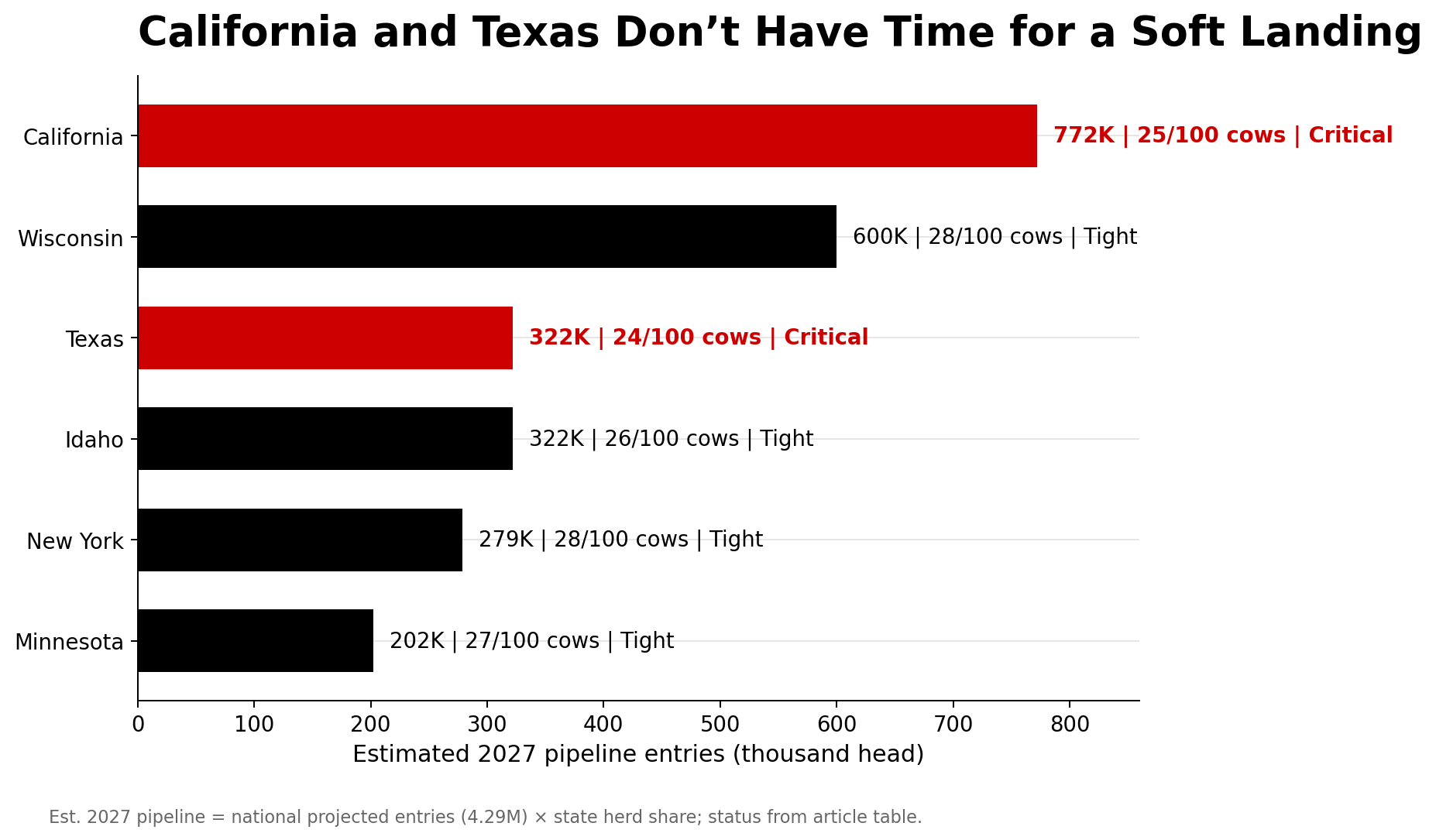
California sits at a 25-per-100 ratio, with HPAI reproductive fallout layered on top — more than 750 affected dairies and field reports of roughly 7% conception drops in the August 2024–March 2025 window. Premium Central Valley springers routinely clear $4,500. Texas added close to 40,000 cows in 2025, and the bulk of the state’s milking herd sits on a small fraction of its dairies concentrated in the Panhandle — so when one 4,000-cow dairy needs ~1,200 heifers to cover normal turnover, the regional market feels it fast. Traditional overflow from the Upper Midwest shrinks as small operations exit, and the broader replacement-price squeeze rolls downhill.

A pattern showing up across the herds feeding the Tracker: beef straws drifting onto cows that aren’t truly terminal — second-lactation animals with one bad quarter, heifers that got one rough breeding. Those are the animals that carry next year’s best daughters, and they’re getting bred to terminal sires because the protocol never got rewritten.

What This Means for Your Operation

In the next 30 days:

  • Run your pipeline math. Pull 12 months of heifer-calf births, multiply by 0.79, and compare to herd size × replacement rate. Any gap is baked into 2027–2028, regardless of what prices do.
  • Audit beef-on-dairy with your own numbers. EV_beef = your calf price × 0.57 × 0.95. EV_dairy = your local heifer cost × 0.42 × 0.95 × 0.90 × 0.79. If the dairy advantage looks anything like $583, decide how many beef services stay on viable dairy dams.
  • Pull your operating-note covenant language. Know the working-capital ratio that triggers a review, and model what a $66,000-plus unplanned heifer draw does to it.
  • Call your heifer suppliers this week. Ask how far they’re booked and whether they’ll lock numbers 12–18 months out. If “I’ll buy later” is the plan, find out whether the supply actually supports that.

In the next 90 days:

  • Tier your herd and put it into SOPs with a concrete genomic game plan. Top genetics to sexed dairy. Middle tier mixed. True terminal cows only get beef. Don’t let beef creep back onto viable dams because the straw is cheaper that day.
  • Cull on profit, not habit. Keep productive older cows if SCC and repro allow; ship chronic mastitis, repeat breeders, and low-index animals. A retained cow buys time, not margin.

Over the next 365 days:

  • Align your herd plan to your plant. If new processing steel is landing within your hauling radius, decide whether you’re growing, holding, or shrinking. Your pipeline, beef percentage, and culling strategy have to match that call.
  • Set hard floors and ceilings. Floor: the minimum beef-calf price where beef services still make cash-flow sense. Ceiling: the maximum share of breedings to beef on viable dairy dams. The ~$1,577 crossover is your north star.
Key Takeaways

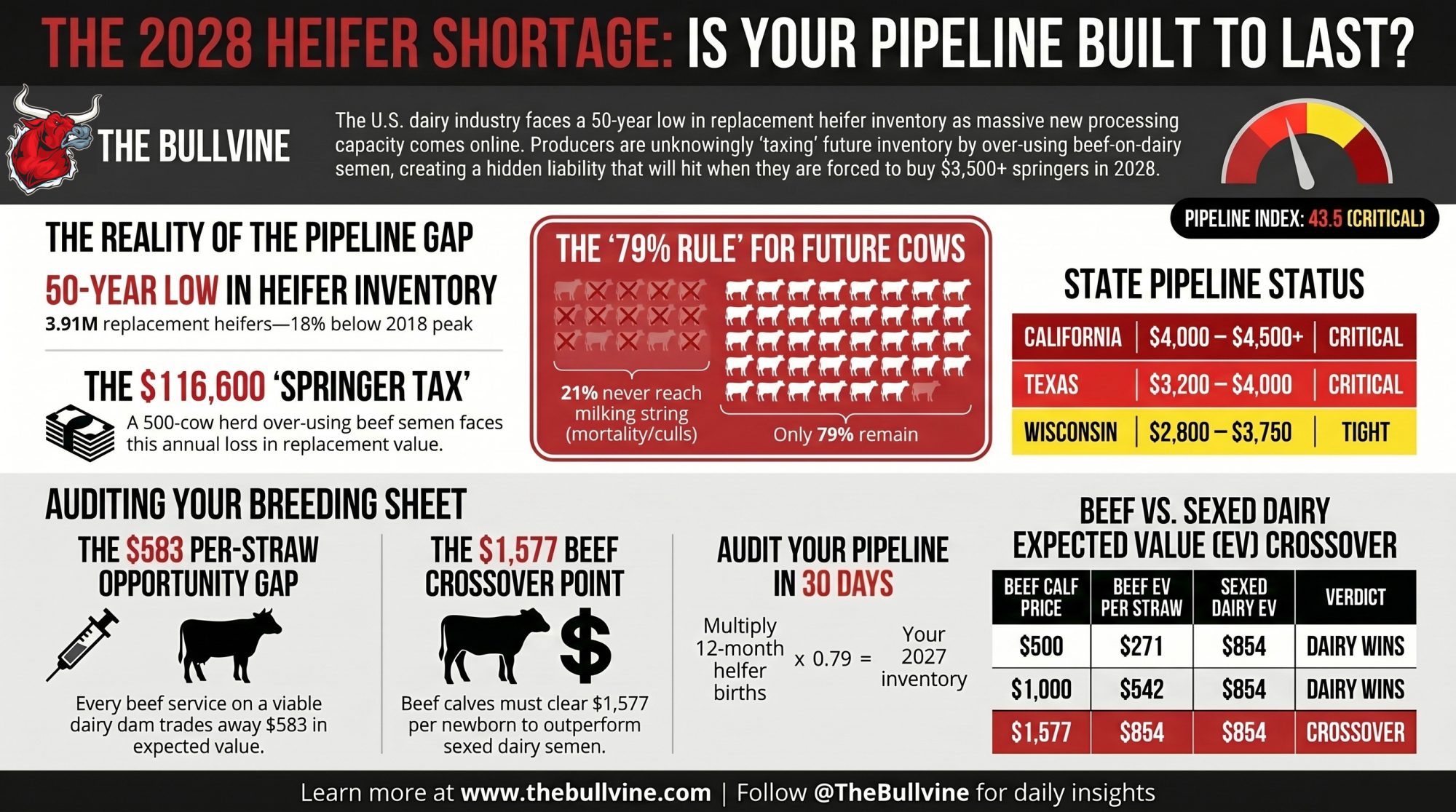
  • If your 12-month heifer-calf count × 0.79 doesn’t cover herd size × replacement rate, you’re already short on future cows — and that shortfall is locked into 2027–2028, regardless of how market prices move.
  • Every beef service on a viable dairy dam trades away roughly $583 in expected replacement value at a $3,010 heifer and a $500 calf. Crossover is ~$1,577 per newborn beef calf — roughly $3.15/lb on a 500-lb feeder in a high-demand year, before feed carry. Most markets aren’t close.
  • The Pipeline Index sits at 43.5 — Yellow Zone, 4.5 points from Red. Semen mix momentum is the only component holding the score up, and it takes 24 months to turn a straw into a milking cow. One rough culling quarter pushes the national pipeline into critical territory.
  • A $66,000-plus unplanned heifer draw is a working-capital covenant question, not a line item. The $116,600 on one 500-cow Panhandle breeding sheet is the local shape of a national number. Scale it to your herd, your calf price, and your heifer cost, and the call is yours — but it’s getting made right now, whether or not it’s written down.

Before your next lender review or processor supply meeting, print the EV table and your own pipeline math side by side. One question decides the rest: does your current breeding program produce the cows your operation will need in 2028, or are you planning to compete for someone else’s heifers at $3,500-plus — and does your operating note have room for that check?

The breeding decisions locking in that answer are being made this week. Biology won’t wait for the market to make them comfortable.

Pipeline and economic data: NAAB 2025 Year-End Report (March 2026), USDA Cattle Inventory (January 2026 release), USDA Agricultural Prices (July 2025), USDA Class and Component Prices (January–March 2026), CoBank Knowledge Exchange (August 2025) as a secondary reference, and ISU Extension NW Iowa Dairy Outlook (May and December 2025). State herd shares derived from USDA NASS Milk Cows: State (2025). Biological conversion rates reference Dr. Michael Overton’s Zoetis field dataset of 85 commercial Holstein herds. The 600,000–611,600 retained-cow estimate is The Bullvine’s extrapolation from ISU’s documented weekly deficit data, not a USDA statistic. EV figures rounded from precise derivation: $853.90 sexed and $270.75 beef at a $500 calf. The ~$3.15/lb feeder-equivalent is derived from dividing the $1,577 crossover by a 500-lb weaned weight, not from a published market series; it is illustrative only. State-level HPAI and Texas herd-concentration figures reflect Bullvine reporting aggregated from USDA APHIS and state extension sources. National averages may not reflect your specific region, herd size, or management system. All figures USD.

Learn More

The Sunday Read Dairy Professionals Don’t Skip.

Every week, thousands of producers, breeders, and industry insiders open Bullvine Weekly for genetics insights, market shifts, and profit strategies they won’t find anywhere else. One email. Five minutes. Smarter decisions all week.
NewsSubscribe
First
Last
Consent

The Hidden Cost of Every $1,200 Beef Calf: A $4,000 Heifer Bill

The 60-day pregnancy check is becoming the most terrifying day on the dairy calendar.

EXECUTIVE SUMMARY: You’ve been breeding 35% to beef, banking $1,200 per calf while dairy bulls bring just $200—the math seemed obvious until June’s pregnancy check reveals you’re 150 heifers short. With dairy heifer inventory at its lowest since 1978 and replacements costing ,000 each, this “profitable” strategy has just created a 0,000 problem that will take two years to fix. The culprit: not tracking what percentage of pregnancies are dairy versus beef, the single metric that predicts replacement availability 18 months out. Successful operations monitor this number weekly—when it drops below 45%, they immediately increase sexed dairy semen usage, trading $520 in monthly semen costs to avoid a six-figure crisis. The entire monitoring system takes 30 minutes weekly, yet most producers don’t discover the problem until it’s biologically impossible to fix. The difference between thriving and crisis isn’t luck—it’s whether you’re tracking one number that takes five minutes to calculate.

beef on dairy strategy

You look at the ultrasound monitor as the technician calls out the results. Bull. Bull. Bull. Heifer. Bull. Your stomach drops. You’ve been breeding 35% to beef, following the plan you set in January. The math was perfect on paper—$1,200 beef calves versus $200 dairy bulls. But now you’re staring at a 120-heifer shortage for next year, and replacement heifers are selling for $3,500 to $4,000 each.

How did this happen? You followed your breeding plan to the letter.

Here’s what’s interesting—the answer lies in a calculation that deserves more attention: the forward-looking replacement inventory formula. The beef-on-dairy movement has certainly delivered valuable calf revenue when we’ve needed it most. Lord knows, those $1,200 beef calves have kept many of us afloat. At the same time, it’s creating what CoBank economists describe as a significant structural adjustment period for operations whose monitoring systems haven’t evolved alongside their breeding strategies.

The New Economics Reshaping Dairy Breeding

You know, the numbers tell a compelling story about where we are as an industry. The National Association of Animal Breeders reports that beef semen sales to dairy operations climbed from 2.5 million units in 2017 to 7.9 million units in 2024—a 216% increase that reflects fundamental changes in how we think about calf value.

Day-old beef-cross calves now command $1,000 to $1,400. Dairy bull calves? You’re lucky to get $100 to $200, and that’s if you can find a buyer. For a 1,000-cow operation breeding 35% to beef, that’s approximately $210,000 to $245,000 in additional annual calf revenue. That’s real money when you’re dealing with volatile milk prices and input costs that just won’t quit.

But here’s what’s particularly concerning—and what many of us are just starting to realize. The Holstein Association has documented that each percentage-point shift toward beef breeding removes approximately 95,000 dairy heifers from the national pipeline each year. The USDA’s January cattle inventory report reveals our dairy heifer inventory has declined to 3.914 million head. That’s a level we haven’t seen since 1978, when we were milking very different cows in very different systems.

CoBank’s dairy quarterly analysis from August makes this clear: we’re facing an 800,000-head decline in dairy heifer inventory before any meaningful recovery begins in 2027. This replacement shortage is becoming increasingly apparent to anyone who’s tried to buy heifers lately. They’re simply not available—at any price in some regions.

What’s worth noting is how this plays out differently across borders. Canadian producers navigating supply management face unique constraints when beef revenue opportunities conflict with quota requirements. European operations are balancing beef-on-dairy opportunities with stricter environmental regulations and different subsidy structures. Australian and New Zealand producers, with their seasonal calving systems, face entirely different timing pressures. But the fundamental challenge—balancing today’s revenue with tomorrow’s replacements—that’s universal.

The Critical Calculation Most Operations Miss

Let me share something that I’ve found most operations overlook:

The Forward Replacement Inventory Formula:

Herd Size × (Age at First Calving ÷ 24) × Cull Rate × (1 + Heifer Non-Completion Rate) = Annual Replacements Needed

ScenarioDairy Pregnancies %Annual Heifer ShortageReplacement CostCrisis Total
Unmonitored Herd (No Weekly Tracking)35%-150$3,500-$4,000$525,000-$600,000
Target Range (Disciplined Monitoring)45-55%On targetN/A$0 (Averted)
Early Warning (April Detection)42-45%-50$3,500-$4,000$175,000-$200,000
Sexed Semen Response50%+ recovery-25$520/month semen$6,240
annual
Late Detection (June Preg Check)35%-120+$3,800-$4,200$456,000-$504,000

Based on conversations with producers across the country—and I talk to a lot of them—most operations make at least one of three common miscalculations that can really bite you later:

First, we tend to be optimistic about heifer completion rates. Many of us plan with the assumption that 90-95% of heifer calves will eventually enter the milking herd. But research from folks at Elanco, based on extensive herd monitoring, shows actual rates are 75-80% on well-managed operations. That 15-20 point gap? It compounds annually, and suddenly you’re wondering where your heifers went.

Second: Age at first calving matters more than we think. Penn State Extension research shows that each month beyond 24 months increases replacement needs by approximately 4%. Push from 24 to 26 months—maybe because your heifer grower had a tough winter or you had some respiratory issues—and a 1,000-cow operation needs 33 additional heifers annually just to maintain herd size.

Third: And this is the one that really catches people—not tracking dairy versus beef pregnancy percentages. Research from UW-Madison identifies this as a critical predictive metric for future replacement availability. You probably know your overall pregnancy rate, but do you know what percentage of those pregnancies are dairy versus beef?

When Reality Hits: The 60-Day Moment of Truth

Here’s how it typically unfolds. You set your breeding plan in January, usually over coffee at the kitchen table or during that annual meeting with your nutritionist and vet. Execute it faithfully through spring. Everything looks fine on paper. Then June arrives with 60-day pregnancy checks and fetal sexing capability.

The ultrasound technician begins: “Heifer, bull, bull, bull, heifer, bull…”

Your expression changes as you realize the sex ratio isn’t what you expected. And here’s the kicker—five months of breeding decisions are now locked into 280-day gestations. A shortage of 120 to 150 replacement heifers is mathematically inevitable. You can’t unbred those cows.

What happens next? Well, I’ve watched this play out too many times:

  • July: You’re calling every heifer dealer in 200 miles
  • August: Prices climb from $3,000 to $3,600 per head
  • September-October: Crisis pricing hits—$3,800 to $4,200
  • November: You either write massive checks or keep those arthritic fifth-lactation cows another year

The Weekly Metric That Changes Everything

What successful operations are doing differently—and this really surprised me when I first learned about it—is monitoring dairy pregnancies as a percentage of total pregnancies weekly. Not monthly. Not quarterly. Weekly.

Your Decision Tree:

  • Dairy % between 45-55%: ✓ Continue current strategy
  • Dairy % at 42-45%: ⚠ CAUTION – Monitor closely next week
  • Dairy % below 42% or declining 3 weeks straight: 🔴 ACTION – Adjust immediately

This 5-minute habit can save you six figures. Think about that for a second. Identifying trends in April or May allows correction before June’s breedings lock in. Waiting for a 60-day pregnancy confirmation means the opportunity has passed. The biology is already set.

The Sexed Semen Solution That Surprises Producers

When dairy pregnancy percentages decline, here’s what seems counterintuitive: increase sexed semen usage despite lower conception rates. But look at the math:

Semen TypeConception RateFemale %Result per 100 Breedings
Conventional40%50%20 female calves
Sexed33%90%30 female calves

Despite an 18% conception penalty, sexed semen generates 50% more females. The cost difference? About $520 monthly in additional semen cost versus $3,500-4,000 per replacement heifer. That’s a no-brainer when you run the numbers.

The 30-Minute Weekly System That Works

Here’s what you need—and you probably already have most of it:

  • Your existing herd management software
  • A basic spreadsheet (or, honestly, even a notebook works)
  • 30 minutes weekly

Track five simple data points:

  1. Week number
  2. Total pregnancies confirmed
  3. Dairy pregnancies
  4. Beef pregnancies
  5. Dairy percentage (calculated)

Veterinarians I work with report that producers have avoided $400,000 replacement crises with nothing more than disciplined weekly monitoring. That’s it. Thirty minutes that could save you from financial disaster.

What Successful Producers Do Differently

They adjust breeding strategies based on real-time data rather than annual projections. When dairy pregnancy percentages drift, they respond within weeks, not quarters. No committee meetings, no analysis paralysis—just adjustments based on data.

They monitor conception rates by semen type. One California producer who asked not to be named noticed a problem when dairy conception was running at 38% while beef was at 44%. Overall, it looked fine at 41%, but the divergence signaled specific dairy bull fertility issues that needed to be addressed immediately.

They plan realistic completion rates. A Pennsylvania producer shared this experience: “We assumed 90% of heifer calves would reach the milking parlor. Reality was 76%. That 14% gap over three years? 180-heifer shortage.” That’s a lesson learned the hard way.

And perhaps most importantly, they resist market timing. When beef prices surge—and they will again, markets are cyclical—disciplined operations maintain their breeding allocation rather than chase short-term revenue.

The Industry Dynamics Creating This Challenge

Several factors are converging that make this more complex than it was even five years ago.

Rabobank identifies $10 billion in new processing capacity requiring 2-3% annual production growth. That milk has to come from somewhere—either more cows or higher production per cow, both requiring careful replacement planning.

Research from UW-Madison shows that keeping older, lower-genetic cows costs several hundred dollars per lactation in unrealized genetic potential. It’s a hidden cost that adds up quickly when you’re holding onto cows past their prime.

CME data confirms we’re seeing unprecedented spreads between beef-cross and dairy bull values. That economic pressure to breed beef is real and it’s intense.

And here’s what makes it tough—once beef-on-dairy revenue reaches a significant portion of farm income, as industry analysis suggests is happening for many operations, returning to previous breeding strategies becomes financially challenging, even when replacement needs suggest you should.

These industry pressures aren’t just numbers on a spreadsheet—they’re reshaping how we make decisions every single day on our farms.

Practical Lessons from the Field

Looking at how these dynamics play out in real operations, the patterns become clear.

One California producer managing 1,500 cows, who preferred to remain anonymous, shared this sobering experience: “We bred 40% to beef without weekly monitoring. By July, we were 180 heifers short. Cost us $650,000 in purchased replacements plus another $80,000 in health and adaptation challenges. Now we monitor weekly—takes 20 minutes, prevents million-dollar mistakes.”

A Pennsylvania operation with 800 cows reported better results: “When our dairy percentage dropped to 43% in April, we immediately increased sexed semen usage. That early adjustment means we’re actually ahead on replacements now.”

And from the other side of the equation, a Minnesota custom heifer raiser tells me: “Three years ago, I had excess capacity. Today, I’m declining inquiries weekly. The offers I’m getting—$500 per head premiums just to accept calves, before any feeding costs—show how desperate the situation has become. But biological realities mean these animals require two years regardless of how urgent the need.”

Looking Ahead: What This Means for Your Operation

The beef-on-dairy opportunity has provided crucial revenue during challenging economic periods—I’m not arguing against it. As replacement availability tightens and prices reach historic levels, though, success will belong to operations that balance opportunity with disciplined management.

This isn’t really about choosing between beef revenue and dairy replacements. It’s about implementing systems that enable real-time response rather than hoping annual projections prove accurate. These principles apply whether you’re managing 3,000 cows in an Arizona dry lot or 200 cows on a Missouri pasture—the mathematics remain consistent, only the scale varies.

So here’s the question that matters: Are you monitoring the right metrics weekly, or are you waiting for problems to become crises?

Tracking dairy pregnancies as a percentage of total pregnancies requires just 30 minutes weekly. The cost of not monitoring? Producers nationwide are discovering it can easily exceed $400,000 when replacement shortages force them to make desperate purchasing decisions.

The beef-on-dairy opportunity remains valuable—genuinely so. But like all agricultural opportunities, it rewards those who measure, monitor, and adjust based on data—not those who set plans in January and hope for the best.

As we approach 2026, your dairy pregnancy percentage might be the most critical metric on your farm. The encouraging news? The tools and knowledge exist to navigate this successfully. It simply requires discipline and perhaps a shift in how we think about breeding management—from annual planning to continuous optimization.

Don’t know your current Dairy Pregnancy %? Go check your herd management software right now. If it’s below 42%, call your breeding advisor today.

KEY TAKEAWAYS

  • Your dairy pregnancy percentage predicts your future: Below 45% means you’re heading for a 150-heifer shortage worth $600,000—monitor it weekly, not annually
  • Timing is everything: Problems discovered in April can be fixed with breeding adjustments; problems discovered at June’s 60-day check are locked in for two years
  • Sexed semen is cheaper than panic: $520/month extra for sexed semen generates 50% more heifers and beats paying $3,500-4,000 per replacement
  • The 30-minute solution: Weekly monitoring of one metric (dairy pregnancies ÷ total pregnancies) has prevented $400,000 crises for disciplined producers
  • Action required today: Check your dairy pregnancy percentage now—if it’s below 42%, increase sexed dairy semen usage immediately

Complete references and supporting documentation are available upon request by contacting the editorial team at editor@thebullvine.com.

Learn More:

The Sunday Read Dairy Professionals Don’t Skip.

Every week, thousands of producers, breeders, and industry insiders open Bullvine Weekly for genetics insights, market shifts, and profit strategies they won’t find anywhere else. One email. Five minutes. Smarter decisions all week.

NewsSubscribe
First
Last
Consent

Trump Promised Cheaper Beef – Here’s Your $160,000 Counter-Move

When everyone zigs to beef breeding, who profits from zagging to heifer production?

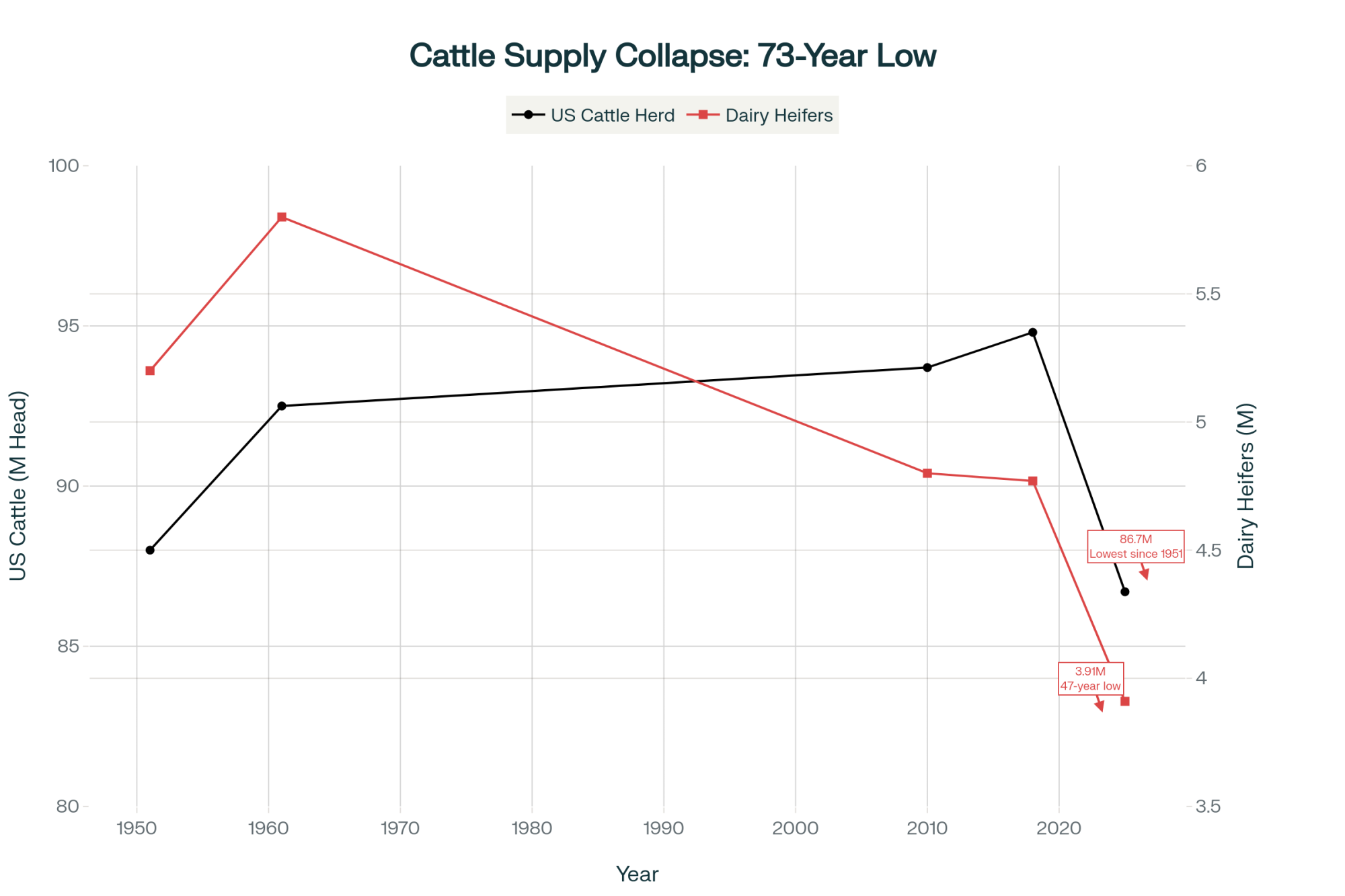
EXECUTIVE SUMMARY: What farmers are discovering right now is that political promises about cheaper beef can’t change the biological timeline of cattle production—and that’s creating a remarkable opportunity. With the U.S. cattle herd at just 86.7 million head (the smallest since 1951) and dairy heifer inventories hitting a 47-year low of 3.91 million, we’re looking at an 18-month window where strategic breeding decisions could mean the difference between netting $160,000 in profit or scrambling to buy $4,500 replacement heifers. Recent CoBank analysis shows that 72% of dairy farms now using beef semen have collectively eliminated nearly 428,000 potential replacements from the pipeline, creating what economists call a “coordination failure” that rewards contrarian thinking. The Minnesota producer who shared his strategy of sacrificing $75,000 in immediate beef premiums to potentially net $270,000 in heifer profits after raising costs when everyone else needs them might just have the right idea. With genomic testing at $40-50 per head providing the roadmap, sexed semen achieving 90% female conception rates, and new LRP insurance offering downside protection at $26 per head, farmers have the tools to navigate this unprecedented market dynamic. Here’s what this means for your operation: The decisions you make about breeding strategies in the next 30 days will resonate through your balance sheet for the next two years.

heifer replacement strategy

I was talking with a Wisconsin producer, when the latest political announcement about beef imports sent cattle futures tumbling. “There goes my breeding strategy,” he said, using his phone to recalculate.

But here’s the thing—whether it’s trade deals, import policies, or market volatility, these announcements are just the latest reminder of what we’re really dealing with: a fundamental supply-demand imbalance that political promises can’t fix overnight.

The fundamentals tell an interesting story. According to the USDA’s January inventory, we’ve got 86.7 million head of cattle in the U.S., the smallest herd since 1951. Beef cow numbers? Just 28.7 million, the lowest since 1961.

This year’s calf crop is coming in at 33.1 million head, the smallest on record.

And dairy farms? Well, about 72% are now using beef semen in their breeding programs to some degree. That’s become standard operating procedure, especially when beef-cross calves are bringing $1,000-plus while Holstein bulls fetch maybe $100.

When you factor in the $2,400 cost to raise each heifer, the economics flip dramatically—beef-focused operations lose $145,900 annually while strategic heifer producers turn a $56,000 profit by selling surplus replacements into the $4,200 market

The Three-to-Four Year Reality Check

U.S. cattle numbers hit their lowest point in 73 years while dairy heifer inventories plummet to a 47-year low—the biological timeline means this supply crunch will persist for 18+ months regardless of policy changes.

A central Pennsylvania dairyman explained it to me perfectly: “Politicians can promise whatever they want, but a heifer I keep today won’t drop a calf until July 2026. And that calf? It won’t be beef until 2028.”

That biological timeline matters more than any trade deal.

Think about what this means for dairy operations. While beef producers struggle with rebuilding (and most can’t with current drought conditions in parts of the country), dairy farms have positioned themselves at an interesting crossroads. They’re producing premium beef-cross calves into a supply-constrained market. But they’re also creating their own replacement heifer shortage.

CoBank’s August analysis put some hard numbers on this. Dairy heifer inventories hit 3.91 million head in January 2025—that’s a 47-year low, down 18% from 2018.

I remember buying nice springers for $1,600 five years ago. Last month, a neighbor paid $4,100 for a comparable animal.

Small Operations Need Different Strategies

One thing that doesn’t get enough attention—operations under 200 cows face unique challenges with this beef-on-dairy approach. The genomic testing investment hits harder proportionally. They might not have volume for forward contracts. And losing even a few replacements to disease can derail their program.

Here’s what a 150-cow dairy might look like with a conservative approach:

Annual breeding breakdown (150-cow herd):

  • 30 cows (20%) to beef semen = 30 beef-cross calves worth $33,000
  • 60 cows (40%) to conventional dairy = 30 heifer replacements
  • 60 cows (40%) to sexed semen = 54 elite heifer calves
  • Total: 84 potential replacements when they need 45
Farm SizeBeef %Replacements NeededHeifers ProducedSafety BufferGenomic InvestmentBeef RevenueHeifer Net ProfitTotal Net Opportunity
150 cows20%4584+39 (+87%)$6,750$33,000$62,400$95,400
500 cows30%165240+75 (+45%)$22,500$82,500$120,000$202,500
1,200 cows35%380470+90 (+24%)$54,000$115,500$144,000$259,500

Note: Small operations require higher safety buffers (87% vs 24%) to protect against disease events and culling variations—justifying lower beef percentage

This gives them a 39-heifer buffer for selection and sales while still capturing some beef premiums. Compare that to a larger operation going 35% beef, and you can see why smaller dairies need that extra cushion.

But whether you’re running 150 cows or 1,500, certain strategies are proving successful across the board.

Learning from Operations That Are Making It Work

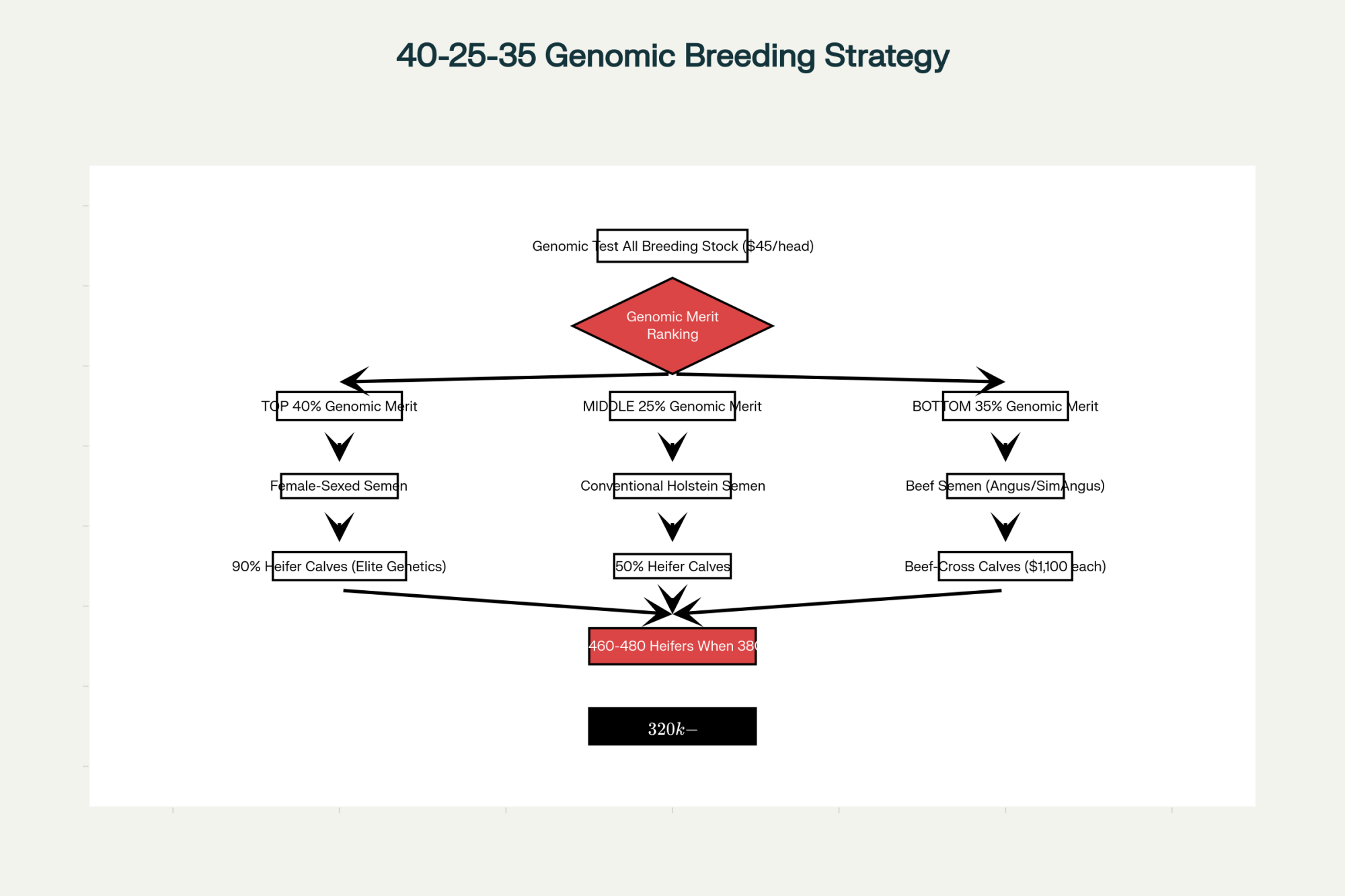
The 40-25-35 genomic breeding strategy transforms a $45 test into a quarter-million-dollar roadmap—directing elite genetics to sexed semen while capturing beef premiums from low-merit animals.

A 1,200-cow operation near Tulare showed me their approach recently. They’re spending about $45 per calf on genomic testing, which sounds expensive until you consider the alternative.

Now, let’s be clear about the economics here. It costs about $2,400 to raise a heifer from birth to calving, according to 2024-2025 university research. So when we talk about selling a springer for $4,000, the net profit is around $1,600 per head. That’s still exceptional money, but it’s important to understand we’re talking net, not gross.

“Without genomic data,” their manager explained, “we were making quarter-million-dollar breeding decisions based on whether a cow looked good or had mastitis last month.”

Their approach is pretty straightforward:

  • Top 40% by genomic merit get female-sexed semen (about 90% heifer calves)
  • Middle 25% get conventional Holstein semen
  • Bottom 35% go to Angus or SimAngus

This generates roughly 460 to 480 replacement heifers when they need 380.

Those extra 80 to 100? At current prices, with $2,400 in raising costs per heifer, that could be $128,000 to $160,000 in net profit. That’s $4,000 selling price minus $2,400 raising cost = $1,600 net per heifer. Though, as one producer wisely noted, “That’s if the market holds.”

Quick Reference: Genomic Breeding Strategy

  • Top 40%: Female-sexed semen only
  • Middle 25%: Conventional dairy semen
  • Bottom 35%: Beef semen exclusively
  • Result: 460-480 heifers produced when 380 were needed

The Insurance Most People Haven’t Heard About

Since July 1, USDA’s Risk Management Agency has offered Livestock Risk Protection for beef-on-dairy calves. A crop insurance agent in Iowa broke it down for me: “For about $26 per head, you can protect 95% of expected value on those beef crosses. Apply at least 30 days before you expect to sell.”

Let’s say you’re breeding 150 cows to beef (30% of a 500-cow herd). At $1,100 per calf, that’s $165,000 in expected revenue.

Insurance runs about $3,900 to protect $156,750 of that value.

If imports flood the market and beef crosses drop to $700? The policy covers the difference. Not bad for peace of mind.

Spring 2026: When Everything Converges

Looking at CME futures and talking with dairy economists, April through June 2026 could get interesting—and not in a good way.

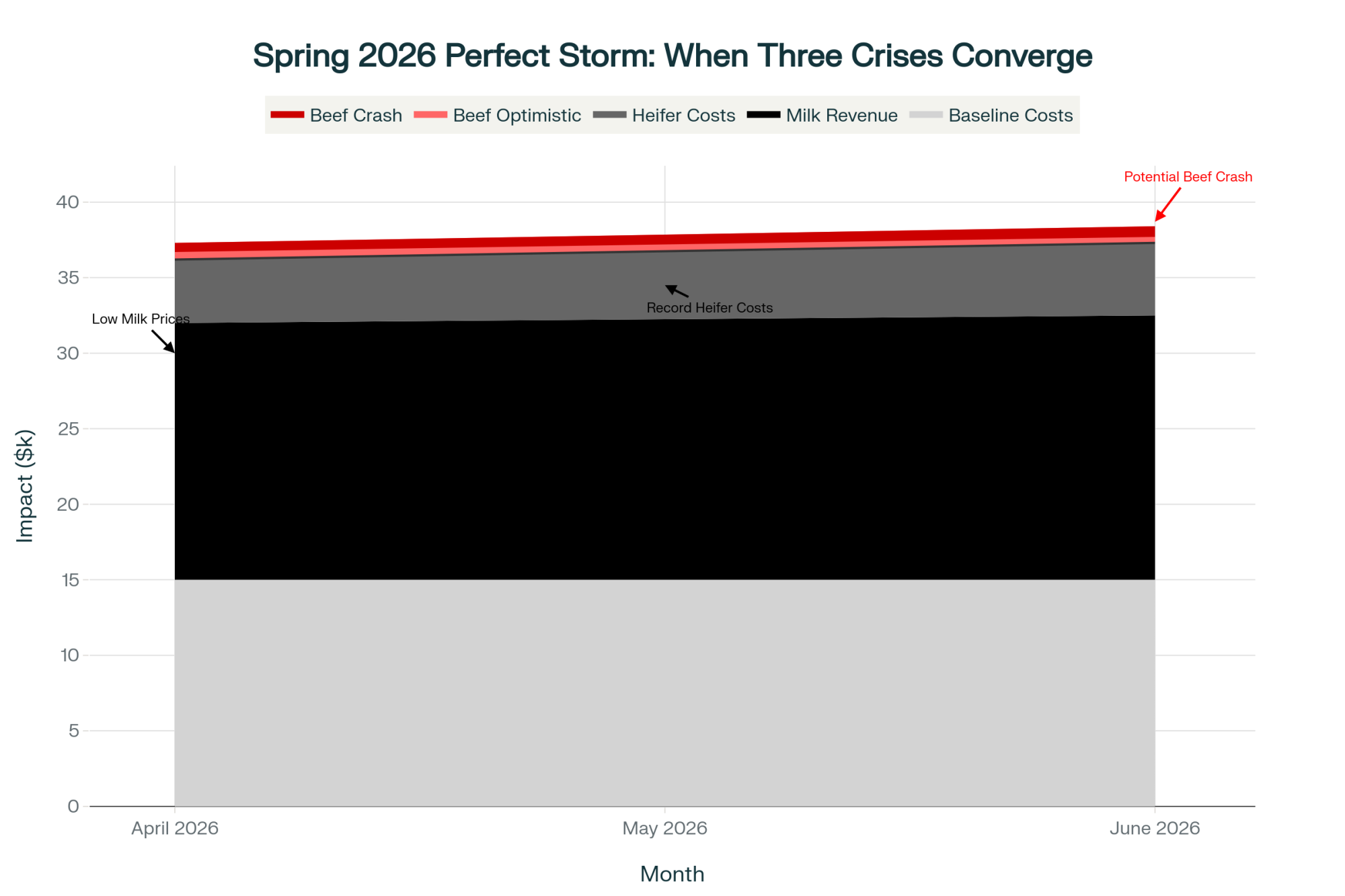
Class III milk futures for that period are trading around $17.00 to $17.50 per hundredweight. At those prices, modeling suggests 60-70% of operations could face negative margins before replacement costs.

April-June 2026 convergence of $17.50 milk, $4,500 replacement heifers, and potentially crashed beef-cross values creates perfect storm—operations positioned as heifer suppliers will weather this squeeze.

Add in replacement heifers potentially exceeding $4,500, and if beef-cross values crash to $400-600 from expanded imports?

A Midwest nutritionist ran the numbers for me: “At $17.50 milk, $4,500 replacements, and $500 beef calves, we’re looking at annual deficits that would stress even well-capitalized operations.”

The Squeeze on Different Operation Types

What’s interesting is how this hits different farms:

  • Grazing operations might actually weather it better with lower input costs
  • Organic dairies face unique challenges—their premiums help, but replacement options are limited
  • Conventional confinement operations see the full brunt of feed and replacement costs

Why Your Location Changes Everything

What works in Wisconsin’s climate doesn’t translate to Arizona’s heat or Vermont’s grazing systems.

A Texas dairyman managing 2,500 cows shared something revealing: “Our sexed semen conception drops 12-15% in summer. We concentrate sexed breeding from November through March, then shift toward beef when heat stress peaks.”

Their cull rate also runs higher—approaching 38%—which limits how aggressive they can be with beef breeding overall.

Feed economics adds another layer. Pennsylvania producers buying delivered corn at $5.40 per bushel face different economics than Indiana neighbors seeing $4.20 on farm.

That $1.20 difference shifts beef-cross break-evens by $60-80 per head.

And LRP insurance basis risk varies regionally, too. Southern dairy areas sometimes see $75 basis swings that rarely occur in Wisconsin.

The Collective Action Problem Nobody Talks About

Here’s what’s genuinely revealing. Each farm breeding more cows to produce beef makes perfect individual sense. Quality beef crosses bring $1,000-plus while Holstein bulls fetch $100. The math is obvious.

But with 72% of the industry now using beef semen, we’ve collectively created the replacement shortage now driving heifer prices to record levels.

It’s rational individual behavior producing challenging collective outcomes.

What’s different this time is technology. Modern sexed semen achieving 90% female conception rates means farms can pursue beef revenue from lower-merit animals while maintaining replacements from elite genetics. That wasn’t feasible even a decade ago.

Several economists suggest we’re heading toward a new baseline. Replacement heifers might settle at $2,500-$3,000rather than returning to $1,500-$2,000.

Beef-cross premiums could stabilize at $300-500 over dairy bulls instead of the historical $100-200 differentials.

Your Next Month’s Action Plan

Based on what’s working for successful operations, here’s what makes sense:

Get genomic testing started. At $40-50 per test, a 500-cow operation faces about a $22,500 investment in testing all youngstock. But compared to breeding decisions worth hundreds of thousands? It’s becoming easier to justify.

Submit samples to your genetics provider—Alta, Select Sires, ABS, whoever. Results take about two weeks.

Those genomic rankings become your breeding bible: top 40% get sexed, bottom 35% get beef, middle 25% get conventional.

Look into price protection. Your crop insurance agent (who probably handles your other coverage) can quote LRP. Current pricing suggests $25-30 per head protects about $1,100 in expected value per beef calf.

Calculate your actual needs. Here’s the math: Herd size × cull rate × (age at first calving ÷ 24) × 1.1 for non-completion.

A 500-cow herd with 30% culling needs about 165 replacements annually.

Remember to factor in raising costs. At $2,400 per heifer to raise and $4,000 to sell, each surplus heifer nets you $1,600. Even at these margins, 75 extra heifers means $120,000 in additional profit—money that goes straight to your bottom line.

Compare that to what your breeding strategy produces. If you’re generating 240 heifers but need 165, those 75 extra represent $120,000 in net profit at current prices ($4,000 sale price minus $2,400 raising cost = $1,600 net × 75 head).

Some Farms Are Zigging While Others Zag

A Minnesota producer recently explained their contrarian strategy: reducing beef semen to 15% while ramping sexed usage to 55%.

We’re sacrificing maybe $75,000 in immediate beef premiums, but if we can sell 150 heifers at $4,200 when everyone else needs them, that’s $630,000 in revenue. After $2,400 per head in raising costs, we’re netting $270,000—still $195,000 ahead.”

Several operations are already exploring forward contracts for 2026 heifer deliveries at prices that would have seemed impossible three years ago. Some are even considering embryo transfer to multiply their best genetics—though that’s a whole different investment level.

The Challenges We Need to Acknowledge

Beef-cross calves sometimes present different health challenges, particularly respiratory issues in the first 30 days. Most operations adapt protocols successfully, but it requires attention.

Market concentration varies by region. Some areas have robust buyer competition; others see just two or three buyers controlling volume. Know your local market.

And political uncertainty remains the wildcard. Trade policy can shift quickly. While biological constraints limit immediate supply response, import changes could affect pricing relatively fast.

Looking at the Next 18 Months

The convergence of biological constraints, market dynamics, and political uncertainty suggests we’re in an 18-month window where beef-on-dairy economics remain favorable—though perhaps not at recent extreme levels.

Your decisions about genomic testing, breeding strategies, and risk management over the coming weeks will significantly influence outcomes through 2026 and beyond.

What seems clear is that cattle biology operates on its own timeline. When a significant portion of an industry moves collectively, it creates both opportunities and challenges.

The most successful operations won’t necessarily be those maximizing every premium today. They’ll be those thinking strategically about conditions 12-18 months out and positioning accordingly.

Sometimes the greatest opportunity isn’t following the crowd. It’s recognizing when collective behavior creates imbalances worth addressing.

The beef-on-dairy opportunity won’t last forever, but the window remains open for those who act strategically. This beef-on-dairy window is real. The timeline is becoming clearer. And strategic decisions made now will resonate through operations for years.

Given your specific operational constraints and risk tolerance, how will you position yourself for what’s ahead?

The answer to that question—and whether you invest in genomic testing to guide it—could be worth hundreds of thousands of dollars over the next 18 months.

Your genetics rep is waiting for your call. Make it count.

KEY TAKEAWAYS

  • Genomic testing ROI is compelling: A $22,500 investment (500-cow herd) guides breeding decisions worth $160,000+ in potential surplus heifer net profit when accounting for $2,400/head raising costs when using the 40-25-35 strategy (sexed-conventional-beef)
  • Small operations need adjusted strategies: Farms under 200 cows should limit beef semen to 20% versus 35% for larger operations, maintaining a 39-heifer buffer while still capturing $33,000 in beef premiums on 150 cows
  • Regional variations demand flexibility: Texas operations seeing 12-15% conception drops in summer heat need seasonal breeding adjustments, while $1.20/bushel feed cost differences between Pennsylvania and Indiana shift beef-cross break-evens by $60-80 per head
  • Risk protection is affordable and available: LRP insurance at $26/head protects 95% of $1,100 expected value on beef crosses—apply 30+ days before selling—providing crucial downside protection as import policies shift
  • The contrarian opportunity is time-sensitive: With April-June 2026 convergence of $17.50 milk, $4,500 heifers, and potential $500 beef calves, operations positioning as heifer suppliers rather than beef maximizers could capture significant premiums in the next 18 months

Complete references and supporting documentation are available upon request by contacting the editorial team at editor@thebullvine.com.

Learn More:

The Sunday Read Dairy Professionals Don’t Skip.

Every week, thousands of producers, breeders, and industry insiders open Bullvine Weekly for genetics insights, market shifts, and profit strategies they won’t find anywhere else. One email. Five minutes. Smarter decisions all week.

NewsSubscribe
First
Last
Consent
Send this to a friend