










What farmers are discovering: selecting for speed actually reduces labor costs $10-16K annually
EXECUTIVE SUMMARY: What farmers are discovering about CDCB’s new Milking Speed evaluation is reshaping our understanding of genetic selection and parlor efficiency. With 42% heritability—compared to just 7% for daughter pregnancy rate—MSPD offers predictable genetic progress for a trait that impacts operations twice daily, 365 days a year. Holstein bulls currently range from 6.2 to 8.1 pounds per minute in the August 2025 evaluations, meaning the spread between your fastest and slowest genetics could be costing you an hour or more of labor daily. Research from the University of Minnesota confirms that strategic selection within the 7.0-8.0 lbs/min range balances efficiency gains with udder health, while extension specialists from Wisconsin to California emphasize the importance of adjusting parlor settings as genetics improve. Looking ahead, operations implementing MSPD selection can now expect gradual but meaningful improvements. Many producers report saving 10-15 minutes per milking by year three, with full benefits emerging around year seven as herd genetics turn over. The collaborative learning happening as producers share experiences with this trait represents exactly how our industry gets stronger together. For operations facing persistent labor challenges or inconsistent milking times, MSPD warrants serious consideration as part of a comprehensive breeding strategy.
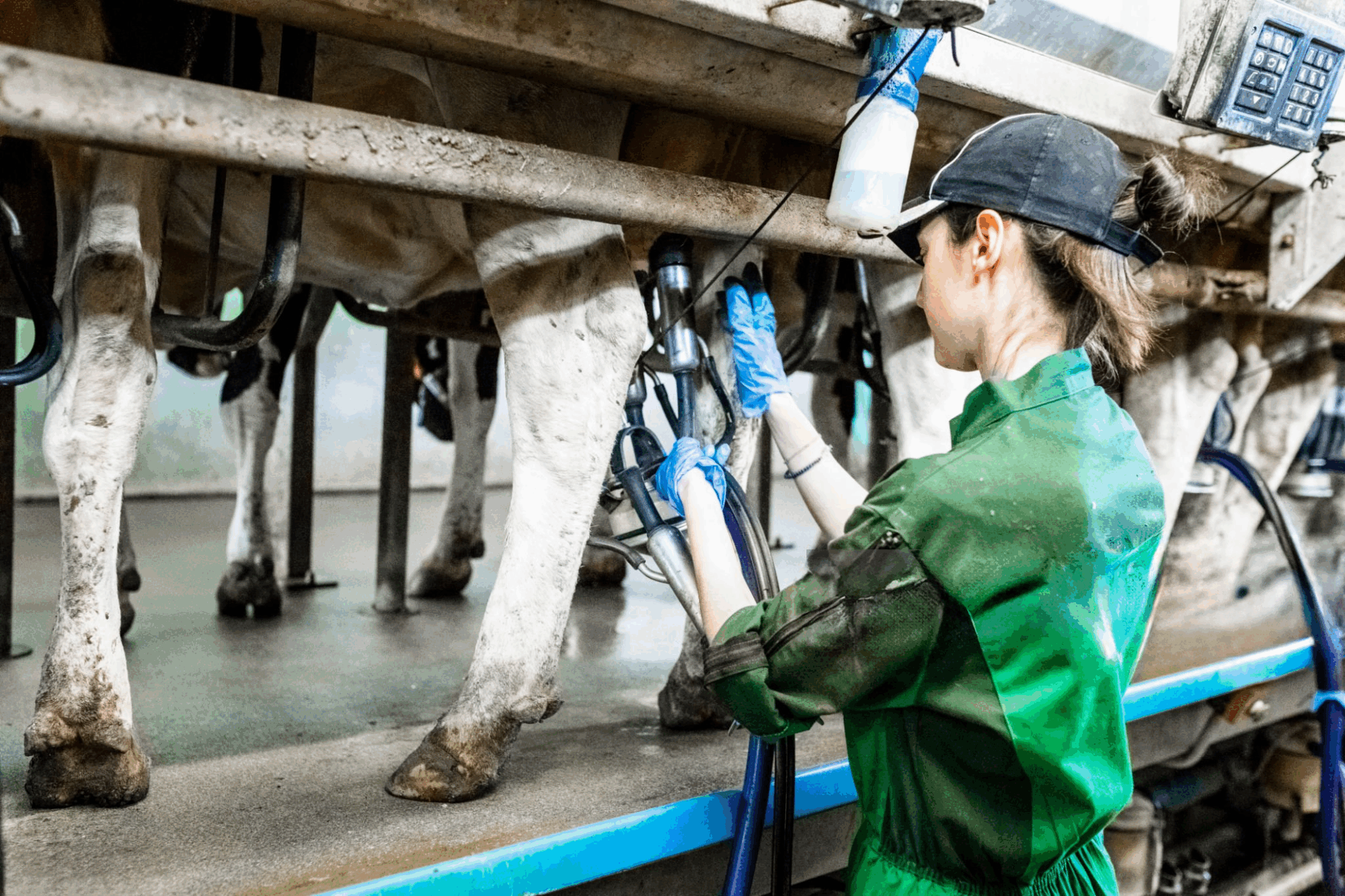
Every morning at 4:30, the same scene plays out in parlors from California to Vermont. Some cows are finished, waiting to exit, while others seem to take forever. We’ve all managed to work around this variation for years, adjusting our routines, tweaking our grouping strategies, and making it work. But what if genetics could actually address this issue?
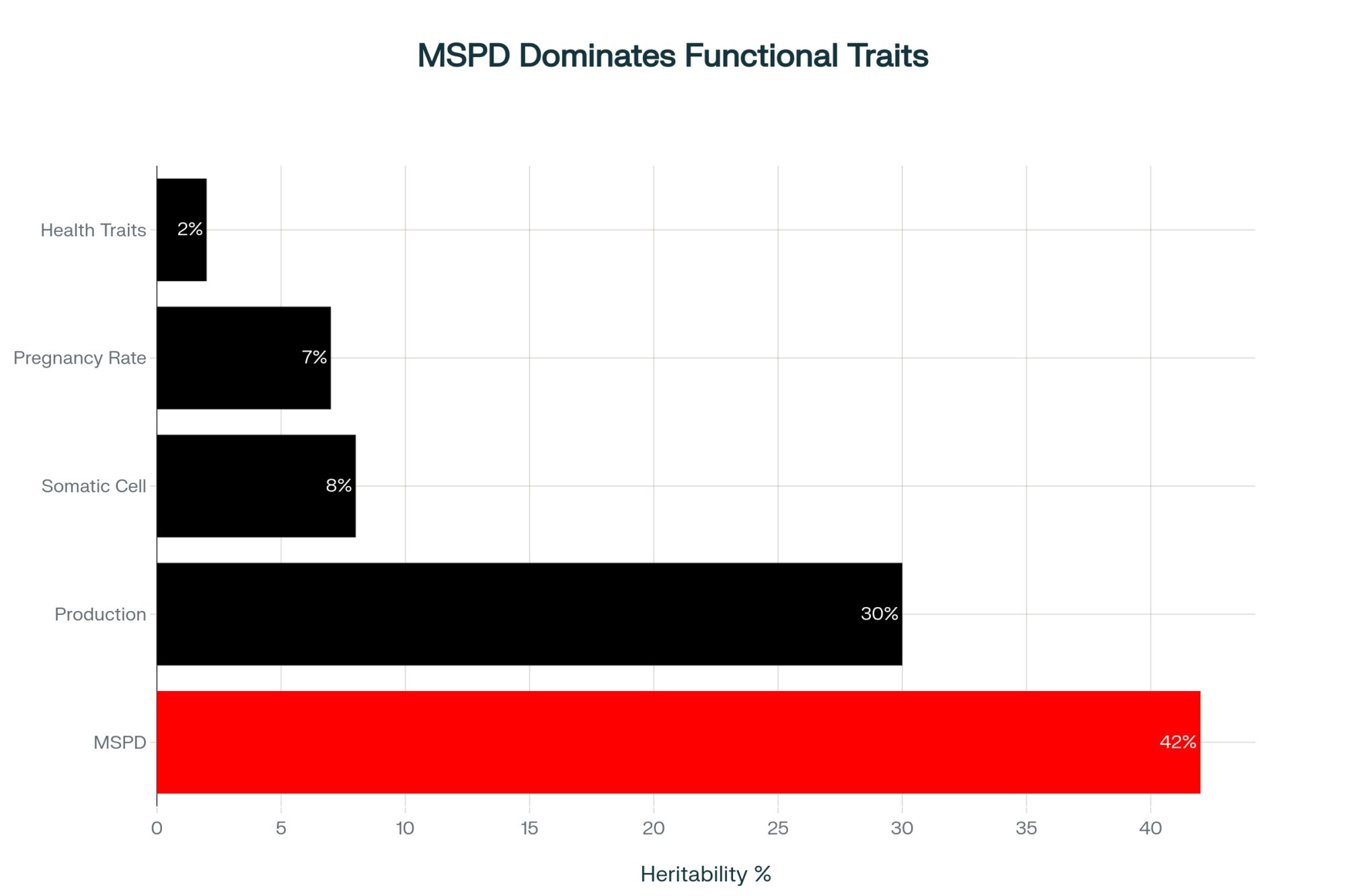
CDCB rolled out their Milking Speed evaluation—MSPD—this past August, and the numbers are stopping producers in their tracks. According to their published data, we’re looking at 42% heritability. Now, if you’re anything like the producers I’ve been talking with from the Midwest to the Southeast, that number probably makes you pause. Daughter pregnancy rate, which we’ve been selecting for intensely? That’s around 7% according to CDCB’s genetic parameters. Most health traits we worry about sit between 1% and 3%. This ranks among the CDCB’s highest-heritability functional traits.
It’s worth noting that MSPD is a flow rate measurement, expressed as pounds of milk per minute, not a total milking time. This standardizes the measure across lactation stages and systems, making it universally applicable whether you’re milking fresh heifers or fourth-lactation cows.
What farmers are finding is that this might be one of those genetic tools that actually delivers on its promise. That’s a level of genetic progress we just haven’t seen before for traits that hit your bottom line every single day.
The Science Is More Straightforward Than You’d Think
CDCB built this evaluation using sensor data from commercial dairies, measuring the pounds of milk per minute as it flows through the system across 31 states. No subjective scoring where one classifier sees a seven and another sees an 8. Just straight data from actual milking sessions.
The physiology behind milking speed has been documented in dairy science literature for decades. Research published in the Journal of Dairy Science suggests that it primarily depends on both anatomy and neural response. You’ve got your physical components—teat canal diameter, sphincter muscle tone—but there’s also how efficiently a cow responds to oxytocin and her overall letdown reflex. Some cows milk fast because they have excellent milk ejection. That’s what we want. Others? They’re fast because of looser teat anatomy, which can open the door to mastitis problems down the road.
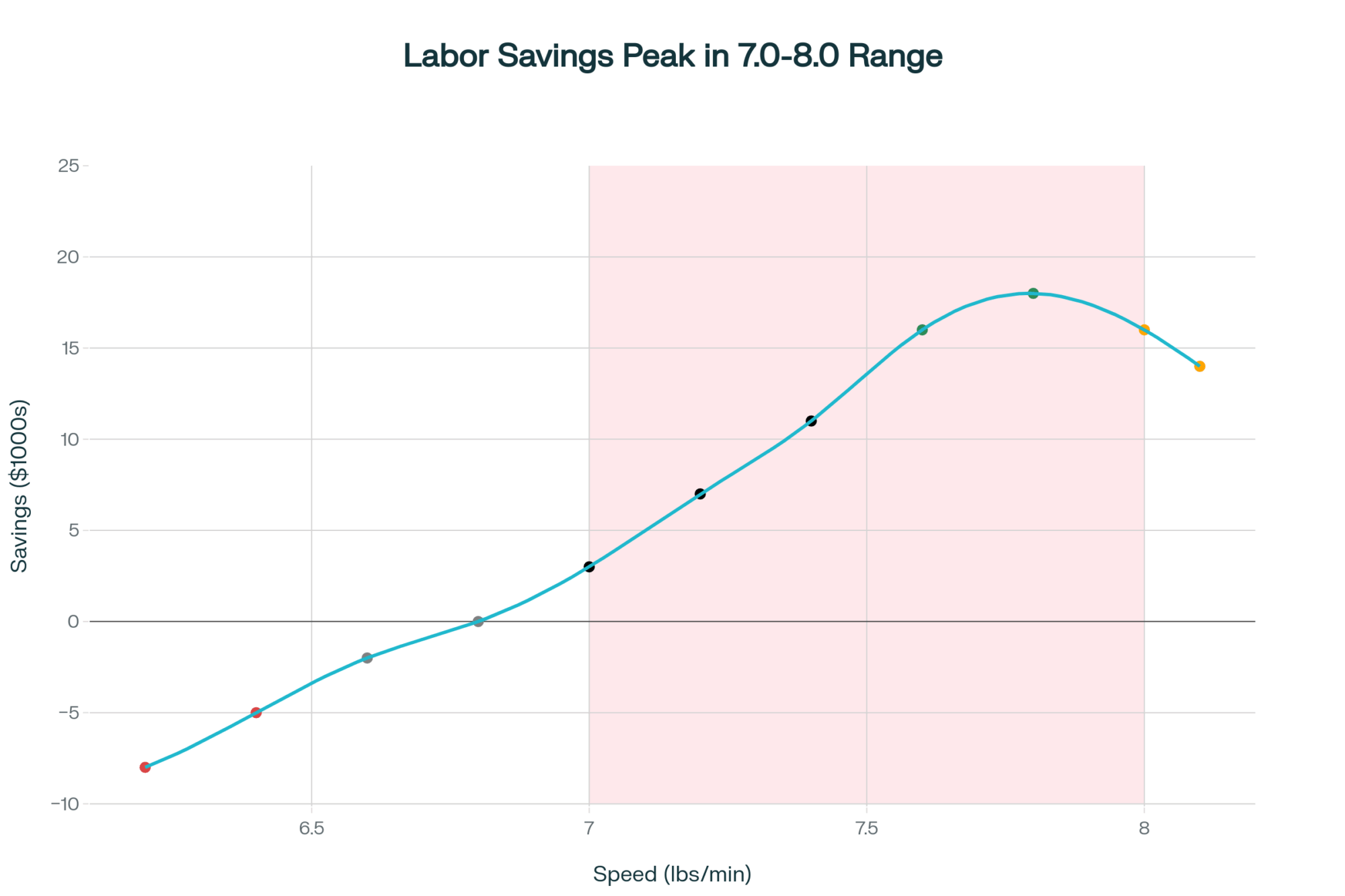
Looking at CDCB’s correlations, there’s a 0.43 genetic correlation between milking speed and somatic cell score. Initially concerning, right? However, the data actually reveal that correlation mainly occurs when speed originates from compromised teat anatomy rather than good physiology. When you’re selecting bulls in what CDCB identifies as the practical range—around 7.5 to 8.0 pounds per minute—you’re generally getting efficiency through better milk letdown, not shortcuts that’ll haunt you later.
Kristen Gaddis, who leads the genetic evaluation team at CDCB, explained at their August public meeting that this 42% heritability makes MSPD one of their most heritable published traits. The reliability is already strong, even with a relatively new dataset. When you see heritability this high on a trait that impacts throughput every single day, it really does change the conversation about what’s possible through genetic selection.
What This Looks Like in Real Parlors
Holstein bulls in the current CDCB evaluations range from about 6.2 to 8.1 pounds per minute. That’s roughly a 30% spread. I’d bet money most operations have similar variation in their herds right now—you probably know exactly which cows I’m talking about.
Think about your morning milking. In a typical double-12 herringbone, when everything’s clicking, you’re moving cows through efficiently. But when those slower genetics hold up an entire side? Your actual throughput drops, workers become frustrated, and what should be a 2.5-hour milking stretches to 3 hours or more.
The economics vary depending on where you’re located, obviously. Labor costs differ significantly from region to region—what a California producer faces compared to someone in Georgia or South Dakota can be night and day. But across the board—from Florida to Idaho—many operations are finding that greater consistency reduces those end-of-shift pressure points. Workers know roughly when they’ll finish. That predictability… in today’s labor market, where finding anyone willing to work is challenging, matters as much as the raw time savings.
Quick Reference: MSPD Selection by System Type
| Parlor Type | Target MSPD Range (lbs/min) | Key Priority | Critical Threshold | Efficiency Gain Potential |
|---|---|---|---|---|
| Herringbone/Parallel | 7.0-8.0 | Uniformity over speed | Avoid bulls <6.8 | 15-20% |
| Rotary | 7.0-7.8 | Consistent platform speed | Minimize 2nd rotations | 10-15% |
| Robotic Systems | 7.2-7.8 | Speed + teat placement | Balance with udder conf. | 8-12% |
Herringbone and Parallel Parlors
Target Range: 7.0-8.0 lbs/min
Priority: Uniformity over maximum speed
Key Point: Bulls below 6.8 create bottlenecks that kill efficiency
Based on the University of Wisconsin Milking Center recommendations and field experience
Rotary Parlors
Target Range: 7.0-7.8 lbs/min
Priority: Consistent platform speed, minimize second rotations
Key Point: Group first-lactation heifers separately when possible
Michigan State Extension dairy team guidelines
Robotic Systems
Target Range: 7.2-7.8 lbs/min
Priority: Individual performance plus udder conformation
Key Point: Robots need both speed and good teat placement
Penn State Extension robotic milking resources
Building Your Selection Strategy Today
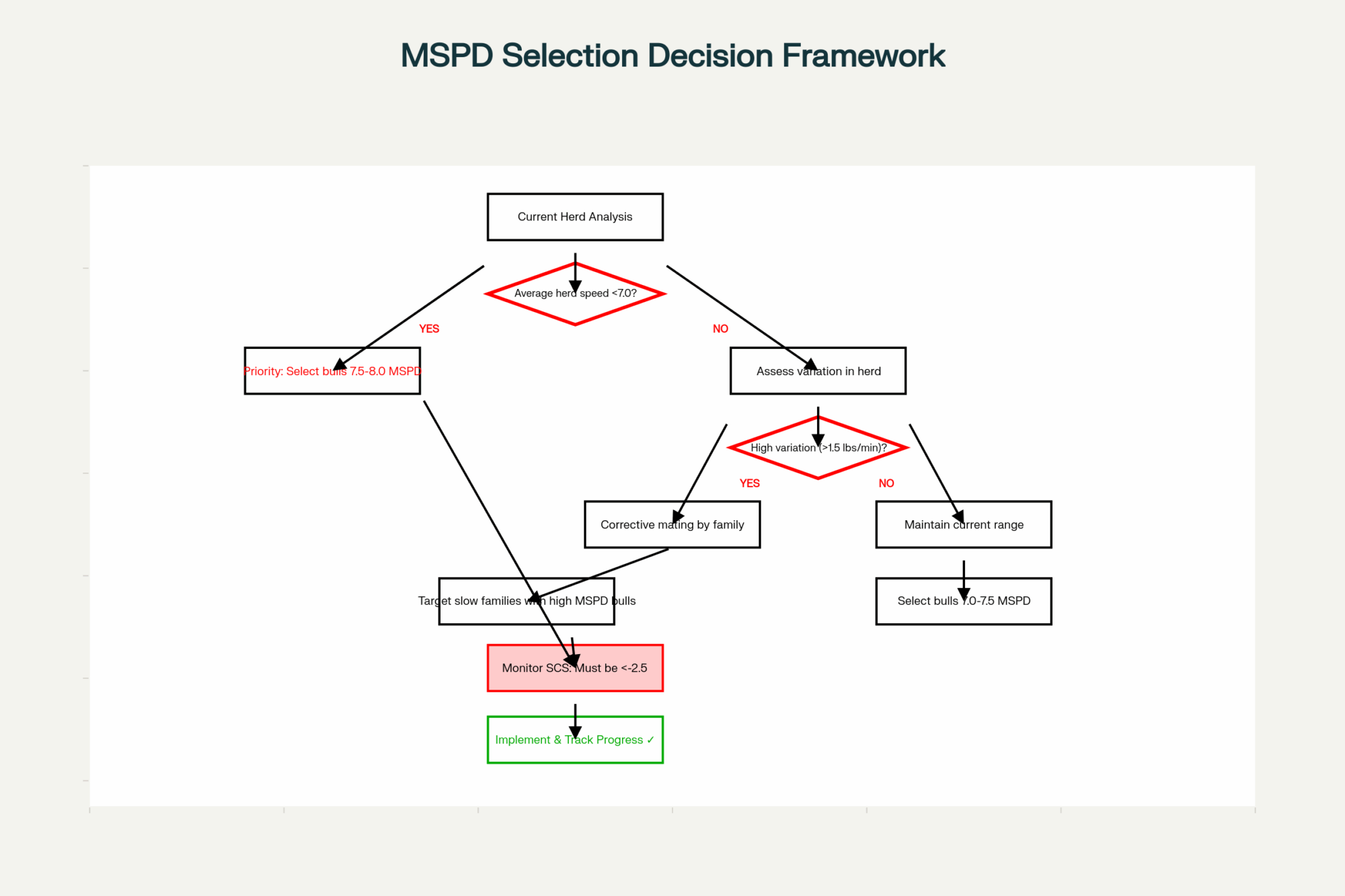
Since MSPD isn’t integrated into Net Merit yet—CDCB’s still working through the index weighting debates—producers are developing their own approaches. Here’s what’s working based on early adopters and extension recommendations from Cornell to UC Davis:
Start with your current selection criteria. Then layer in MSPD targeting, aiming for bulls in that 7.0 to 8.0 pounds per minute range based on CDCB’s guidance. If you’re pushing toward the higher end—say 7.6 or above—make sure those bulls have strong SCS values, like -2.5 or better. University of Minnesota’s dairy genetics team emphasizes this as important protection against potential udder health issues down the road.
Corrective mating within families is showing real promise. Long-term research led by Bradley Heins and colleagues at the University of Minnesota, published in the Journal of Dairy Science in 2023, demonstrates that this approach is particularly effective. Got cow families that consistently produce those 8-minute milkers? Target them with higher MSPD bulls. With 42% heritability, this trait actually responds to selection pressure—genetic theory says it should, and early results seem to confirm it.
The Seven-Year Reality (And Why It’s Worth It)
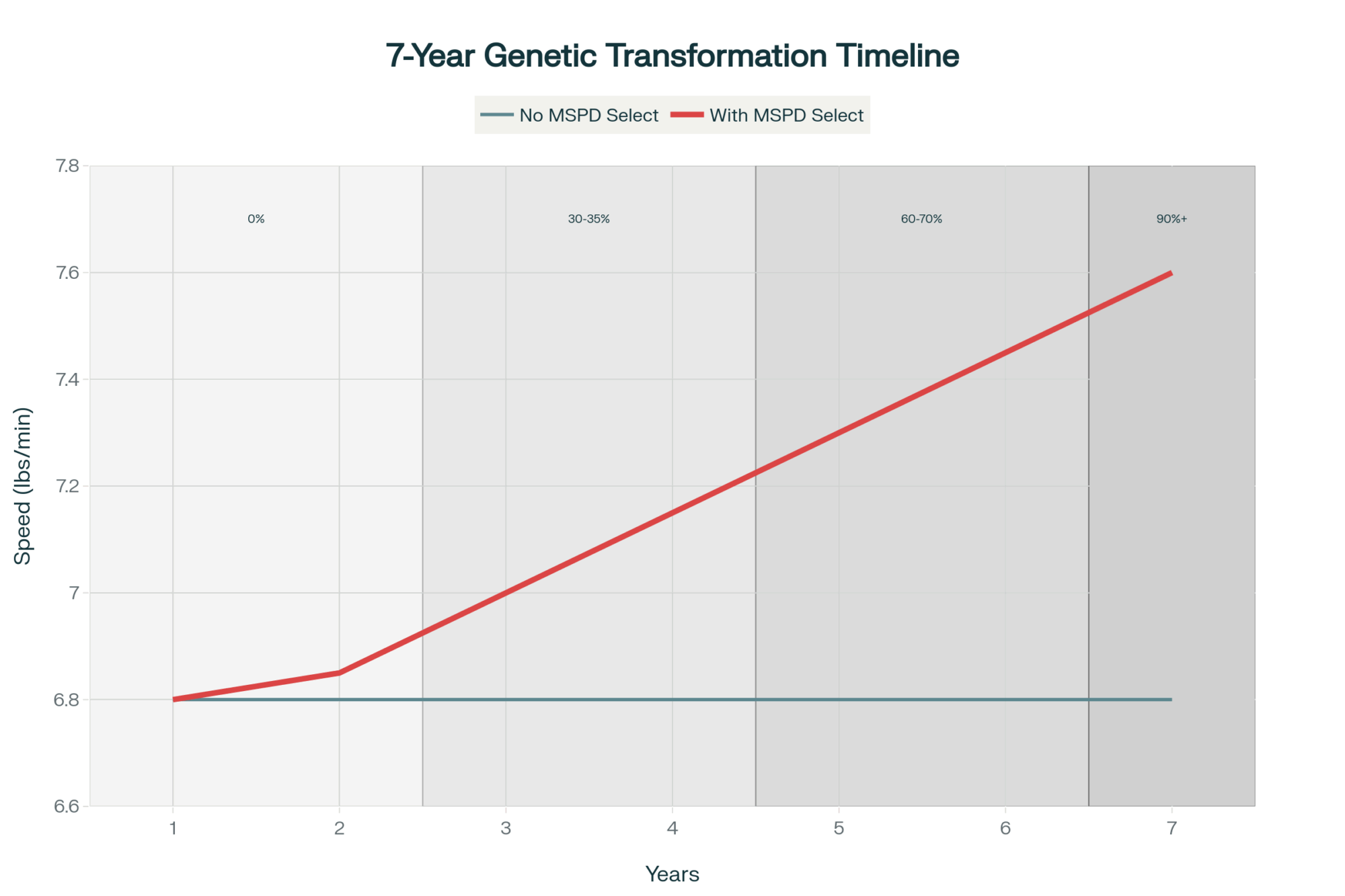
| Year | Herd % with MSPD Genetics | Time Savings per Day | Annual Labor Savings (500 cows) | Worker Impact |
|---|---|---|---|---|
| Years 1-2 | 0% | 0 minutes | $0 | Planning phase |
| Years 3-4 | 30-35% | 10-15 minutes | $2,000-3,000 | First improvements noticed |
| Years 5-6 | 60-70% | 30-45 minutes | $8,000-12,000 | Predictable shift times |
| Year 7+ | 90%+ | 60+ minutes | $15,000-20,000 | Full transformation achieved |
Let’s be honest about the timeline here. Genetic improvement doesn’t happen overnight, and anyone who tells you different is selling something.
Years one and two, you’re making different breeding decisions but milking the same cows. Minimal visible change. This tests your patience.
In years three and four, your first MSPD daughters arrive. With typical U.S. replacement rates around 30-35% annually, according to the USDA’s National Agricultural Statistics Service, about a third of your herd carries improved genetics. Many operations notice some improvement—maybe saving 10-15 minutes per milking. Not revolutionary yet, but you’re starting to see it.
Years five and six bring the real changes. Most of your herd now carries selected genetics. Those problem cows become exceptions rather than the rule. This is when producers often report actually seeing the payoff they’ve been waiting for.
By year seven and beyond, with most of your herd carrying these genetics, parlor performance becomes remarkably more uniform. And here’s the beautiful part—improvement continues compounding. Each generation gets bred to progressively better MSPD bulls.
A Practical Economic Example
Let’s run through some basic math for a 500-cow operation (and remember, your results will vary—talk to your consultants and run your own numbers):
Current Situation:
- 3 milkings daily × 3 hours each = 9 hours parlor time
- 2 workers × local wage rate × 9 hours = your daily labor cost
- Annual parlor labor: varies significantly by region
With MSPD Selection (Year 5+):
- Even modest improvements in turn time—saving just an hour per day—can multiply into several thousand dollars in savings each year
- The real value depends entirely on your local labor costs and schedules
- Plus: Better worker retention, less overtime, potential to add cows without extending shifts
Operations with larger spreads in current genetics or higher labor costs naturally have a greater impact. And we’re not even counting the value of predictable shifts on worker satisfaction—something that’s hard to put a dollar figure on but matters enormously.
Critical Management Adjustments
Several things can make or break your MSPD implementation:
Parlor Settings Matter: As detailed in the University of Wisconsin Extension’s milking management guides, many operations find that as their fastest-milking cows become the genetic norm, periodic review of parlor vacuum and pulsation settings helps optimize udder health. You might need to reduce the vacuum as cow milking speed increases modestly—consult your local extension for detailed guidance specific to your setup.
Meter Calibration Is Essential: If it’s been more than two years since calibration (and for many of us, it’s been longer), you can’t accurately track progress. Penn State Extension’s dairy team consistently stresses this—you need accurate data to verify genetic improvement.
The Transition Gets Messy: As new genetics mix with old during years 3-4, variation might temporarily increase. Smart managers group MSPD-selected animals together initially, maintaining more consistent parlor sides until a critical mass is reached.
What About Jerseys and Brown Swiss?
CDCB indicates that breed-specific evaluations are forthcoming, likely within the next 12 months. But producers aren’t waiting.
Long-term research from Bradley Heins and his team at the University of Minnesota, published in the Journal of Dairy Science in 2023, shows Jersey-Holstein crosses often demonstrate favorable milking characteristics while maintaining component advantages. These crossbreeding strategies can capture efficiency benefits now.
Brown Swiss producers are leveraging existing, subjectively scored evaluations while planning for the transition. And operations with sensor-equipped parlors—regardless of breed—should start collecting baseline data now. When official evaluations launch, you’ll be ahead of the curve.
The Bigger Industry Picture
Labor challenges aren’t going away. USDA Economic Research Service reports from 2024 document ongoing workforce issues across all agricultural sectors; however, dairy faces unique challenges due to the 365-day-per-year, twice-daily (or more) milking requirement. From Texas to Maine, finding reliable parlor help remains a top challenge.
What makes MSPD compelling is that it’s a genetic solution to what’s traditionally been viewed as a management problem. Rather than constantly tweaking protocols, adjusting groups, or chasing equipment fixes, we can actually breed for the efficiency we need.
International markets are watching too. With different countries reporting varying heritability levels for milking speed traits, the U.S., with a heritability level of 42%, creates interesting dynamics in the global genetics marketplace, according to the National Association of Animal Breeders’ 2024 export report.
Making Your Decision
As we move ahead, MSPD presents a genuine opportunity to address operational challenges through genetic selection. Will it transform your operation overnight? No. Will it gradually but meaningfully improve parlor throughput, reduce labor needs, and create more predictable working conditions? The early evidence from operations across the country suggests yes.
Those who wait will continue to manage current challenges, while early adopters will gradually pull ahead. It’s not dramatic—it’s incremental. But in an industry with tight margins, incremental advantages compound into competitive differences.
The collaborative learning happening right now is exciting to watch. As more operations implement MSPD selection and share their experiences, we’re collectively figuring out what works best in different situations. Producers comparing notes, extension specialists gathering data, geneticists refining recommendations—that’s how our industry gets stronger.
The trait is real, the heritability is remarkable, and it’s available now. The question isn’t whether milking speed genetics work—the data from CDCB confirms they do. The question is whether you’ll be among those who capture the advantages now, while labor challenges intensify and every minute counts. For operations dealing with parlor efficiency issues, inconsistent milking times, or persistent labor challenges, MSPD deserves serious consideration. Don’t wait for “more proof”—by the time everyone’s convinced, the early adopters will have already locked in their competitive advantages and smoother morning routines.
KEY TAKEAWAYS
- Select bulls between 7.0-8.0 lbs/min for optimal results—this range balances efficiency gains with udder health based on CDCB’s data and extension recommendations, avoiding the mastitis risks associated with extreme speed
- Expect 10-15 minutes saved per milking after 3 years, with full benefits emerging around year 7 as genetic turnover reaches 90%—patience during the transition pays off in $10,000-16,000 annual labor savings for typical 500-cow operations
- Adjust parlor vacuum and pulsation settings as genetics improve—University of Wisconsin Extension research shows dropping vacuum from 14.5 to 13.5 inches helps prevent teat-end damage as milking speeds increase
- Group MSPD-selected animals together during transition years 3-4 to maintain parlor consistency while genetic variance temporarily increases—smart pen management helps capture benefits sooner
- Jersey and Brown Swiss producers can start collecting baseline data now using sensor-equipped parlors, positioning themselves ahead of breed-specific evaluations expected within 12 months, according to CDCB
Complete references and supporting documentation are available upon request by contacting the editorial team at editor@thebullvine.com.
Learn More:
- The Milking Speed Game-Changer That’s About to Shake Up Your Breeding Program – Review the CDCB’s initial August release, which includes detailed economic modeling of labor savings by herd size (up to $49k annually). This strategic analysis helps you benchmark your potential throughput gains and prepare for the AMS transition.
- Simple LED Lighting Can Boost Production 8% – Here’s Why Most Farms Haven’t Switched – This piece reveals non-genetic, technological methods for boosting milk production by up to 8% through photoperiod management. Learn the precise lux levels and ROI math to justify LED upgrades, ensuring your cows are physically optimized to leverage your new fast-milking genetics.
- Feed Center Revolution: Why Your Current Design Is Costing Your Dairy Six Figures Annually – Focus on the other half of operational efficiency with this tactical guide on feed center design. Learn how strategic traffic flow and protection from elements can slash feed shrink by 4-12%, capturing significant six-figure annual savings directly to your bottom line.
The Sunday Read Dairy Professionals Don’t Skip.

Every week, thousands of producers, breeders, and industry insiders open Bullvine Weekly for genetics insights, market shifts, and profit strategies they won’t find anywhere else. One email. Five minutes. Smarter decisions all week.




