








What’s your plan when a flesh-eating parasite hits US dairy for the first time since 1966?
EXECUTIVE SUMMARY: The September 21st confirmation of New World screwworm, just 70 miles from Texas, represents more than just another biosecurity alert—it’s a watershed moment that could fundamentally reshape American dairy economics. With beef-on-dairy programs now generating significant revenue streams for many operations and Mexico’s surveillance protocols showing documented gaps, producers face an unprecedented decision between substantial upfront investment in prevention or potentially permanent endemic management costs. Historical emergency responses demonstrate significant cost premiums for rushed implementation, while countries managing endemic screwworm report annual expenses that transform production economics entirely. What makes this particularly challenging for dairy operations is the FDA prohibition on ivermectin use in lactating cows—our most effective treatment option—combined with daily procedures that create wounds, providing ideal opportunities for infection. The convergence of reduced federal workforce capacity, complex modern cattle movement patterns, and year-round operational requirements creates vulnerabilities the industry hasn’t faced since the original eradication six decades ago. Smart producers are recognizing that the choice isn’t whether to act, but whether to invest now with preparation time and supply availability, or react later under crisis conditions with limited options.

The confirmation of New World screwworm in Nuevo León, Mexico, on September 21st serves as a stark reminder of an emerging biosecurity threat—a flesh-eating parasite now just 70 miles from major Texas dairy operations. This is a challenge the industry hasn’t faced in nearly six decades.
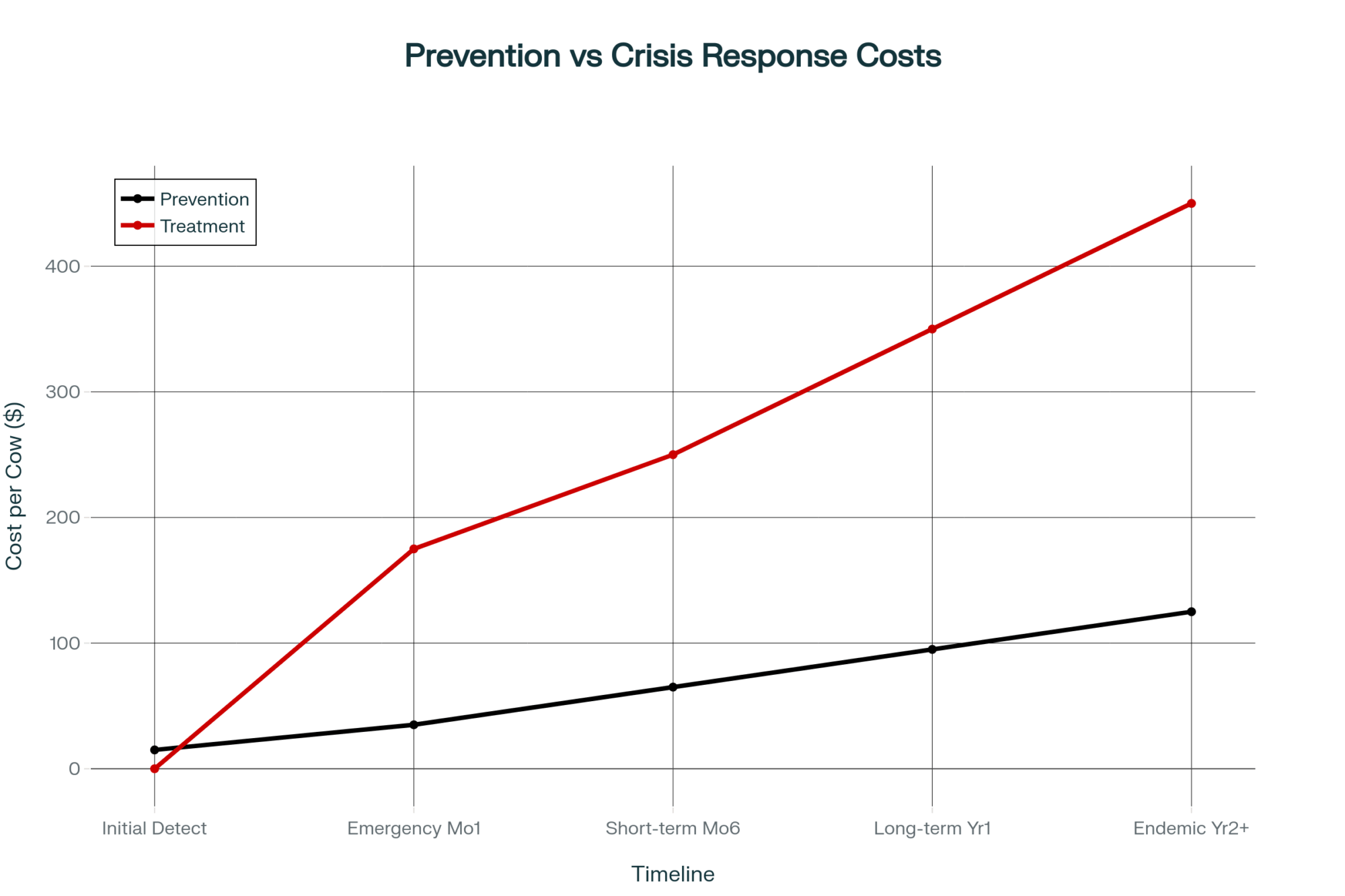
What strikes me about the financial reality facing producers is how similar it feels to other major capital decisions we make. Examining comparable disease prevention programs, such as those developed for bovine TB, reveals substantial investments—the kind typically associated with significant infrastructure upgrades. That’s no small commitment for any operation. However, what’s particularly noteworthy is research from regions managing endemic screwworm, which suggests ongoing annual costs that essentially become a permanent line item in your budget. It’s the difference between a one-time capital investment and… well, a forever production tax.
This builds on what we’ve seen with other biosecurity challenges, but with unique complications. Federal officials have been discussing Mexico’s surveillance approaches this week, and while everyone’s doing their best with available resources, coordination challenges are real. Meanwhile—and this is fascinating from an economic perspective—beef-on-dairy programs have transformed from a sideline to a significant revenue stream for many operations. Add the workforce transitions happening at federal agencies, and you’ve got a convergence of factors that makes this genuinely different from previous challenges.
Understanding the Biology and Its Implications
I’ll share something that surprised me when reviewing the APHIS technical materials. The reproductive capacity of this parasite is… remarkable, in the worst possible way.
According to disease response protocols that APHIS developed, female screwworm flies deposit 200 to 400 eggs in any open wound. Now, when I say “any wound,” I mean the routine management activities we all do—dehorning sites, ear tag punctures, even those minor scrapes that happen during handling. The larvae emerge within 24 hours and consume living tissue. Without intervention, mortality can occur within seven to ten days.
What’s particularly relevant for dairy operations—and veterinary specialists have been emphasizing this point—is our management intensity. Here’s something worth considering: beef operations might handle animals twice a year, but we create potential infection sites daily through routine procedures. Our stocking density, especially in modern freestall barns, creates transmission dynamics that differ significantly from those in extensive grazing systems.
This aligns with our understanding of disease spread in confined environments. Those crossbred calves from beef-on-dairy programs? They’re moving through multiple facilities—dairy to calf ranch, backgrounder, feedlot. Each movement represents what epidemiologists call a “mixing event,” creating opportunities for the transmission of disease.

And here’s a regulatory complexity worth noting: ivermectin, our most effective treatment option for screwworms, remains prohibited for use in lactating dairy cows under current FDA guidelines due to the risk of drug residues in milk. This restriction fundamentally alters our response options compared to beef operations, where its use is permitted.
Dr. Andy Schwartz, our Texas State Veterinarian, framed it well in recent discussions: “The proximity to major dairy operations in the Rio Grande Valley creates legitimate concerns. These aren’t hypothetical risks anymore.”
A significant concern is the current capacity situation. During the successful eradication campaigns of the 1960s, sterile fly production reached hundreds of millions weekly. Program reports indicate the Panama facility now operates with more limited capacity. Mexico’s facility upgrades won’t come online until next summer. Why does this matter? We’re essentially defending against this threat with limited tools while managing more complex cattle movement patterns than existed 60 years ago.
The Cross-Border Dynamics
The situation with Mexico is… nuanced, and I want to be fair here because they’re dealing with significant challenges.
Federal agriculture officials have highlighted that surveillance protocols involve checking fly traps every few days rather than daily. Now, Mexico’s perspective is that this frequency was mutually determined, and they’re balancing massive geographic areas with limited resources. However, here’s the biological reality: with a seven- to ten-day life cycle, less frequent monitoring could allow multiple generations to occur between detection points.
The cattle movement situation adds another layer of complexity. Industry assessments suggest substantial undocumented cattle movement from Central America into Mexico—significantly more than documented imports. These animals lack health documentation and tracking. It’s creating what you might call significant biosecurity gaps.
Border-area producers have expressed concerns that resonate with many of us. The general sentiment is: “We’re implementing every protocol possible, but without consistent standards across the border, it feels incomplete.” That’s not criticism—it’s recognition of the interconnected nature of modern agriculture.
What’s economically interesting is that Mexico’s meat sector is facing substantial losses due to current restrictions. You’d expect that would drive stricter enforcement, but political and practical realities are complex. The infected animal in Nuevo León apparently originated from southern Mexico, highlighting the challenges associated with these movements.
Economic Considerations for Different Operations
Comparing notes across the country, the economic scenarios vary significantly by operation type and location.
For operations considering immediate implementation, the investment profile looks like this: infrastructure for isolation facilities (similar to building a commodity shed), equipment upgrades, and protocol development. Based on what we’ve learned from TB eradication and other disease programs, you’re looking at costs comparable to significant capital improvements. Add operational changes over the first quarter—such as extra labor, veterinary oversight, and supplies—and it becomes substantial.
However, what’s interesting from a risk management perspective is that If you wait for a confirmed border crossing? Historical emergency responses indicate significant cost premiums for rushed implementation, as well as production disruptions. Remember during the 2016 Florida screwworm incident? Producers were unable to source basic supplies at any price once panic buying began.
The third scenario—wait and see—presents different risks. Countries managing endemic screwworm report permanent annual costs that fundamentally change production economics. Some operations simply can’t absorb that burden long-term.
Why is this significant for dairy specifically? These beef-on-dairy programs have become economically important. Crossbred calves are bringing prices we couldn’t have imagined five years ago. Industry experience suggests these programs have become economically significant for many operations. Under quarantine? That revenue stream stops immediately.
Quick Decision Framework

Here’s how I’m thinking about the options:
Option 1: Implement Now
- Investment comparable to a major equipment purchase
- Maintain operational continuity when a threat materializes
- Competitive advantage during a crisis
Option 2: Wait for Confirmation
- Significant cost premiums due to emergency implementation
- Risk of supply shortages
- Potential quarantine disruption
Option 3: Hope It Passes
- Risk of permanent endemic management costs
- Possible operation shutdown
- Market-driven exit
How Different Regions Are Approaching This
What’s fascinating is watching how different regions are adapting based on their unique circumstances.
Upper Midwest operations with seasonal calving patterns have natural advantages—their wound-creating procedures often align with colder months when fly activity is minimal. Wisconsin operations are restructuring their management calendars around this principle.
Southwest dairies face different challenges. They’re dealing with year-round fly pressure and proximity to the threat zone, but many have scale advantages. These larger operations can spread biosecurity investments across more production units, significantly altering the per-cow economics.
Pennsylvania grazing operations are exploring interesting approaches. They’re minimizing wound-creating procedures and looking at genetic selection for naturally polled animals. It’s a long-term strategy, but it illustrates how different production systems create different vulnerability profiles.
Technology adoption patterns are revealing, too. Operations that were skeptical about automation are suddenly seeing it differently. The thinking goes: if automated health monitoring helps catch problems earlier, it’s not just about labor anymore—it’s about survival.
Practical Lessons from Early Implementation
Producers who are already implementing protocols have shared valuable insights that are worth sharing.
The human resource challenge keeps coming up. Training staff to identify early symptoms requires significant time investment. But here’s the catch—in today’s labor market, retention is challenging. Industry feedback indicates significant challenges with training retention. Now operations are building redundancy into their training programs.
Wound management strategies are evolving in interesting ways. Several operations have completely restructured their annual calendar. All dehorning happens in January-February now. They’re using caustic paste despite the 16-week healing time because it reduces the risk of long-term exposure. Every management decision gets evaluated through a wound-risk lens.
Supply chain preparedness is critical. The 2016 Florida experience taught us that essential supplies disappear within 48 hours of crisis confirmation. Smart operators are building inventory now—not hoarding, but ensuring adequate reserves of critical items.
What’s encouraging is the emergence of collaborative approaches. Some producer groups in affected regions are exploring collaborative approaches—coordinating bulk purchases and sharing specialized equipment. They’re reporting meaningful cost reductions that make individual preparation more feasible. There’s wisdom in that collective approach.
Broader Industry Implications
If establishment occurs—and given the proximity and surveillance challenges, we need to consider this possibility—the implications extend far beyond individual operations.
Countries managing endemic screwworm deal with permanent surveillance requirements, ongoing treatment protocols, production impacts from chronic stress, and restricted market access. Processing and distribution patterns shift away from affected regions. These aren’t temporary adjustments; they become permanent features of the production landscape.
The downstream effects touch everyone. School nutrition programs may face supply chain challenges or budget pressures due to rising prices. Rural communities that rely on dairy as an economic anchor could experience an accelerated decline. The genetic diversity maintained by mid-sized operations—that’s at risk too.
What’s particularly concerning from a market structure perspective is how this could accelerate consolidation. When you add significant biosecurity costs to already tight margins, the economics become challenging for operations below certain scale thresholds.
Resources and Next Steps
For those ready to take action, here are key resources:
Start with USDA APHIS Veterinary Services at 1-866-536-7593 for current technical guidance. Your state veterinarian, who can be found at usaha.org/saho, can provide region-specific recommendations. The Texas Animal Health Commission at 1-800-550-8242 has developed particularly relevant materials given their proximity to current threats.
Local Extension programs are developing training materials. I’d especially recommend connecting with programs that dealt with the 2016 Florida situation—they have practical experience worth learning from.
Document everything. While current programs may not cover all prevention costs, detailed records could prove valuable for future assistance programs or insurance considerations. Think of it as an investment in operational history that might have value later.
Looking Forward
After three decades in this industry, I’ve seen us navigate numerous challenges—price volatility that tested everyone’s resilience, droughts that forced impossible decisions s, and disease outbreaks that seemed insurmountable at the time. This situation presents unique challenges, but it’s not insurmountable.
The operations that successfully navigate this won’t necessarily be the largest or most technologically advanced. They’ll be those who recognized the threat early, made thoughtful decisions based on their specific circumstances, and acted decisively even with incomplete information.
Our industry will likely emerge differently—possibly more concentrated, certainly with higher operational costs, and definitely requiring more sophisticated management approaches. But we’ll also develop better biosecurity practices and potentially more sustainable systems through improved management. Whether these changes prove beneficial long-term… well, that depends on how we collectively respond now.
For individual operations, the fundamental question remains: Can your business model absorb either significant prevention investment or ongoing management costs? Every operation has unique circumstances, and there’s no universal answer. Some may find traditional approaches adequate, while others require creative solutions. The key is honest assessment and timely action.
As veteran producers in South Texas have observed, we’ve faced hurricanes, droughts, and market crashes. Biological challenges are different—they operate on their own timeline, regardless of our preparedness. They just need an opportunity. And intensive dairy operations, by nature, provide opportunities.
The parasite is 70 miles from Texas. Winter’s approaching, though weather patterns suggest it might not provide the protection we’d hope for. Decisions made now—individually and collectively—will shape our industry’s trajectory for years to come.
This isn’t about fear. It’s about preparation, adaptation, and the resilience that’s always defined American dairy farming. Whatever path forward you choose for your operation, make it based on careful consideration of your specific circumstances. Because in this situation, the cost of indecision might exceed the cost of action.
KEY TAKEAWAYS:
- Immediate implementation saves 20-30% versus emergency response costs based on historical biosecurity crises, with collaborative producer groups achieving even better economics through bulk purchasing and shared resources—the difference between planned investment and panic-driven spending
- Regional advantages matter: Upper Midwest operations with seasonal calving can align wound-creating procedures with cold months when fly pressure is minimal, while Southwest dairies need scale advantages to spread costs across more production units—adapt protocols to your geography
- Beef-on-dairy revenue streams face immediate risk under quarantine scenarios, with crossbred calf movements creating transmission pathways that didn’t exist during the 1960s eradication—protect what’s become a critical income source for many operations
- Document everything starting today: detailed biosecurity expense records, position operations for potential future assistance programs or insurance claims, even though current programs don’t cover prevention—think of it as operational insurance you control
- The 2016 Florida incident proved supplies disappear within 48 hours once a crisis hits—smart operators are building adequate reserves now, focusing on wound treatment supplies, fly control products, and isolation infrastructure before availability becomes an issue
Complete references and supporting documentation are available upon request by contacting the editorial team at editor@thebullvine.com.
Learn More:
- The 70-Mile Threat: How Screwworm Turns Dairy’s Milking Schedule Into a $800,000 Liability – This article provides a strategic look at how a screwworm outbreak could impact a dairy’s bottom line. It reveals financial projections and explores the trade-offs between efficiency and crisis resilience, offering a direct economic argument for proactive management.
- Bluetongue Outbreak Shakes EU Dairy Industry: High Mortality and Soaring Prices – This analysis of a recent European disease outbreak serves as a valuable case study. It demonstrates how foreign animal diseases impact milk production, market prices, and regional supply chains, providing a real-world example of the financial and market risks discussed in the main article.
- AI and Precision Tech: What’s Actually Changing the Game for Dairy Farms in 2025? – This piece offers a forward-looking perspective on how technology can build herd health resilience. It outlines specific technologies like AI-powered monitoring and their proven ROI, providing a clear path for using innovation to enhance early detection and proactive biosecurity.
The Sunday Read Dairy Professionals Don’t Skip.

Every week, thousands of producers, breeders, and industry insiders open Bullvine Weekly for genetics insights, market shifts, and profit strategies they won’t find anywhere else. One email. Five minutes. Smarter decisions all week.




