








Milk prices drop 4.1% but your feed bill’s the same—here’s how smart producers are still making money
EXECUTIVE SUMMARY: Look, here’s what’s really happening out there—the old “more cows, more money” playbook is broken. I’m talking to producers from Ontario to Idaho, and the ones still making decent money aren’t the guys with the biggest herds. They’re the ones pushing butterfat above 4.1% and protein over 3.3%, which can mean an extra $2 per hundredweight when milk prices are getting hammered.The Global Dairy Trade took a 4.1% hit in July, and powder prices dropped 5.1% to $3,859 per metric ton—but here’s the thing. Feed costs are actually holding steady around $4.50 for corn and $350 for soybean meal, so if you’re smart about efficiency, your margins don’t have to tank.China’s cutting back on imports by 12-15%, Europe’s drowning in €850 per cow compliance costs, and everyone’s scrambling to figure out what’s next. Meanwhile, the producers who maintain 60-90 days of operating cash and hedge 40-60% of their production are sleeping soundly at night. Stop chasing volume and start chasing components—that’s where the money is in 2025.
KEY TAKEAWAYS
- Lock in Feed Cost Savings: Target feed costs under $9.50/cwt by tracking your receipts against USDA data on a monthly basis. Every dollar you save here goes straight to your bottom line when milk prices are soft.
- Component Premium Strategy: Push for butterfat over 4.1% and protein above 3.3%—this can net you an extra $2/cwt in premiums. Pull your latest DHIA report and see where you stand right now.
- Smart Risk Management: Hedge 40-60% of your milk production through DMC or forward contracts. With China backing out and market volatility hitting hard, unprotected milk is a gamble you can’t afford to take.
- Cash Flow Defense: Build and maintain 60-90 days of operating cash reserves. Call your lender this week and ask for their benchmark data on what successful operations are keeping liquid.
- Strategic Market Timing: Use 2025’s feed cost stability (corn near $4.50/bu) to improve feed conversion ratios. Wisconsin Extension trials show 4-6% improvements are realistic with better TMR protocols.
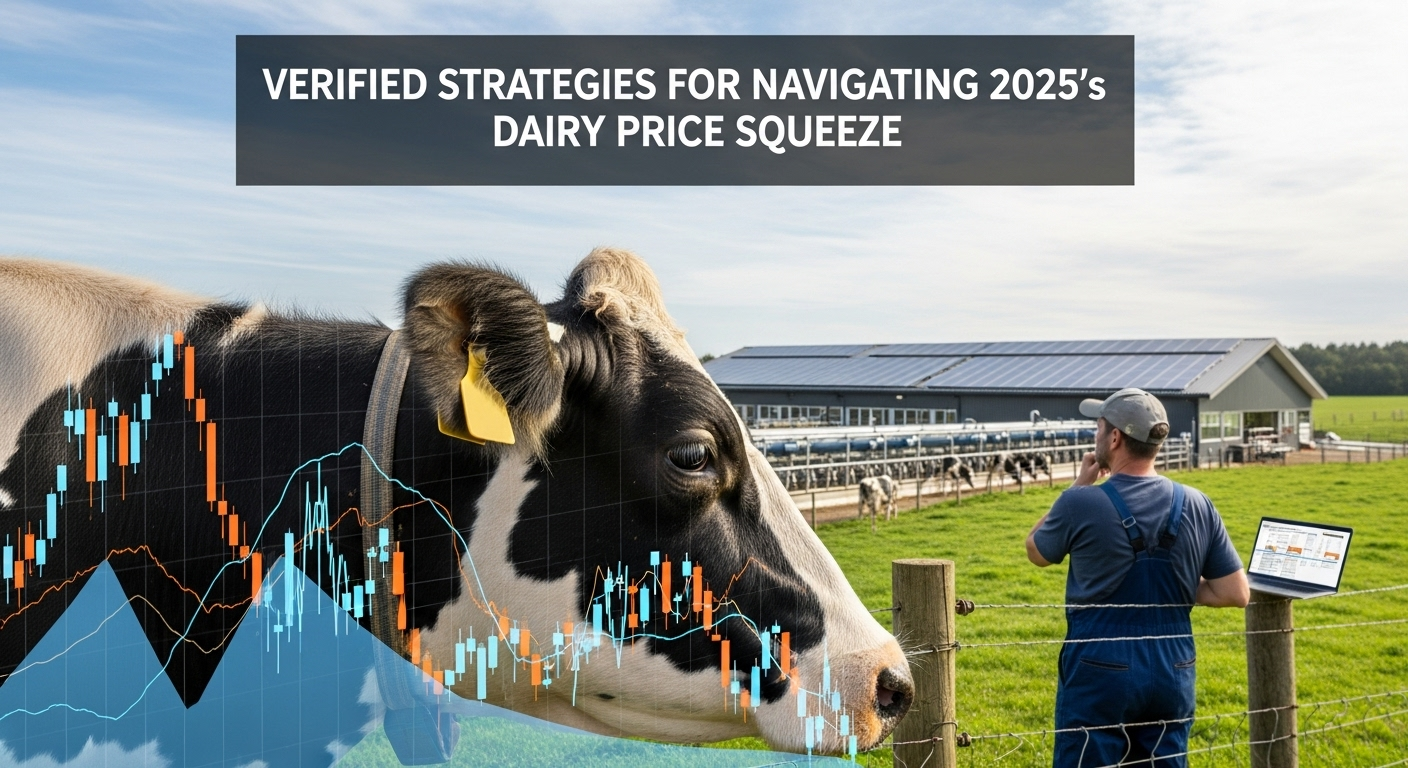
The thing about this market? It feels like watching fresh cows trickling into a dry lot on a chilly morning—uneasy, unpredictable, and every farmer feeling it a bit differently. I’ve received quite a few calls lately from folks in Ontario to Idaho, and the question is always the same: how do we handle falling milk prices amid rising input costs?
Those Global Dairy Trade index numbers aren’t just stats—they land right in your bank account.
Global Prices Are Sending a Clear Message
At the July 15, 2025, Global Dairy Trade event, the index slid 4.1%, with whole milk powder easing 5.1% to $3,859 per metric ton. For those of you in cooler climes like the northern U.S. or Canada, this slump echoes in your contracts too—European futures have their own skirmishes with skim milk powder and butter prices wavering, though sometimes not as sharply as headlines might suggest.
However, here’s the thing—if your nutritionist isn’t providing you with data, ask for it. Wisconsin Extension trials showed that herds implementing TMR protocols saw a 4–6% improvement in feed conversion ratio. That’s real fuel for boosting milk production without breaking the bank. With feed costs holding steady—corn is hovering near $4.50 per bushel and soybean meal is under $350 per ton, according to the USDA’s June 2025 Feed Grains Outlook—your margins depend heavily on capturing these efficiencies.
Herd Growth: More Cows, But Are We Making More Money?
However, let’s be clear about what the headlines often overlook: more milk doesn’t automatically translate to higher margins. Yes, U.S. dairies increased cow numbers by more than 45,000 head since July 2024, with rolling averages inching up—some hitting 24,000 pounds per cow or better. However, sharp operators I know keep a close eye on component checks, pushing to keep butterfat above 4.1% and proteins above 3.3%. That’s becoming a critical tactic, especially as risk management becomes a staple, not an option.
And what about the Australians and Kiwis? While Fonterra reports a 1.5% increase in collections, places like Gippsland in Australia actually saw a 2% drop in production year-over-year, due to dry weather. The growth we’re seeing isn’t universal—it’s pockets of efficiency, careful grazing, and smart tech upgrades keeping some farms afloat.
China’s Changing Game—Buying Less Powder, Investing More at Home
One of the game-changers in this market is China. Market analysts project a 12-15% decline in China’s whole milk powder imports for the latter half of 2025, driven by an estimated $5 billion state-backed investment in domestic processing capacity—including robotics, new plants, and larger herds—which is reshaping global trade.
This is why you’re hearing about hedging at every co-op meeting. If your risk advisor suggests hedging half of your production, don’t just nod—ask them for the Rabobank or USDA FAS data they’re using. Tools like the Dairy Margin Coverage (DMC) program are experiencing unprecedented use.
Europe’s Compliance Crunch and Margin Squeeze
For European producers, the mountain to climb looks steeper. The European Agricultural Fund for Rural Development recently estimated that environmental compliance costs could reach as high as €850 per cow, and the European Dairy Farmers’ Association confirms that margins have dipped below 3%. The price per hundred kilos may hover near EUR53, but when you factor in growing paperwork and strict audits, chasing component premiums is the real strategy to keep things running.
Herd managers across northern Europe are doubling down on ration tweaks just to eke out extra euro per tank, especially on butterfat numbers, which remain the shining stars in this squeeze.
The Bottom Line: Managing Break-Even and Cash Flow in Bumpy Markets
Farm finances are front and center. With feed costs workable near $9.50 per hundredweight (cwt) but becoming a stretch above $11/cwt, the risk is high. Add new barn debts or payments on robot leases, and that margin tightens fast, especially if you’re caught unprepared. For cash flow, lenders I trust in Ohio say surveys show 80% of stable operators keep 60–90 days’ operating cash in reserve. Don’t take my word for it—call your farm credit rep and ask for their 2025 Small Farm Panel data.
The old “expansion is the answer” mantra isn’t holding water anymore—unless you’re securely hedged and have a plan to manage feed costs, holding steady or trimming non-critical expenses might be your best move. That could mean swapping hay varieties, leaning more on home-grown silage, or revamping ration strategies—all of which are trending upward these days.
Tactics That Survive (According to Real Data)
So, what separates the survivors from the rest in 2025? It comes down to executing these data-driven best practices:
- Target Key Feed Cost Metrics: Aim for a rolling average under $9.75/cwt, verifying your monthly receipts against USDA and CME records.
- Verify Component Premiums: Use your DHIA test sheets to confirm eligibility. An average butterfat content of over 4.0% typically qualifies for processor incentives—check your contract for the exact rate.
- Audit Your Risk Coverage: Ensure 40–60% of your production is covered by hedging or margin protection. Use the report from your processor’s portal, not just a broker’s pitch.
- Benchmark Your Payout: Compare your monthly net milk check to regional averages for similarly sized operations.
Monday Morning Actions
Pull your July DHIA test sheet. Log your herd’s butterfat, protein, and SCC in your farm software. Know your numbers cold.
Calculate your current feed cost/cwt using your latest invoice data. Compare it directly with the USDA’s monthly outlook.
Cross-check your export contract details with the latest Rabobank and USDA FAS trends. Confirm your risk coverage is adequate for the current market.
Schedule a 30-minute call with your ag lender. Review your current compliance and operating costs against their official benchmarks.
What’s the takeaway? This market’s testing every assumption we had about volume, efficiency, and hedging. The operators who continually adapt—looking both backward at lessons learned and forward to technological advances—will be the leaders when the turning point arrives. And if you want the nitty-gritty regional detail or a gut check on your numbers, well, you know The Bullvine’s got your back. This ride? We’re all in it together.
Complete references and supporting documentation are available upon request by contacting the editorial team at editor@thebullvine.com.
Learn More:
- Everything Dairy Farmers Need to Know About Residual Feed Intake – This article provides a tactical deep-dive into feed efficiency, revealing practical strategies for measuring and improving Residual Feed Intake (RFI). It’s a perfect complement for producers wanting to execute on the main article’s advice about managing feed costs.
- Profit and Planning: 5 Key Trends Shaping Dairy Farms in 2025 – For a strategic, market-focused view, this piece explores the long-term trends in processing capacity, component values, and technology adoption. It expands on the main article’s market analysis, helping you position your operation for future profitability and stability.
- How Health, Product Science, and Technology Will Drive the Future of Dairy Farming and Boost Your Profits – Looking toward innovation, this article showcases how automation, AI, and data analytics are revolutionizing day-to-day operations. It demonstrates how to implement cutting-edge technology to improve cow health, optimize inputs, and create new revenue streams.
The Sunday Read Dairy Professionals Don’t Skip.

Every week, thousands of producers, breeders, and industry insiders open Bullvine Weekly for genetics insights, market shifts, and profit strategies they won’t find anywhere else. One email. Five minutes. Smarter decisions all week.




