
Archive for precision agriculture

Ireland’s 54,000 Missing Calves Signal the Regulatory Storm Heading Your Way

When Ireland’s grass-fed advantage meets Brussels’ nitrogen limits, everyone’s milk check changes

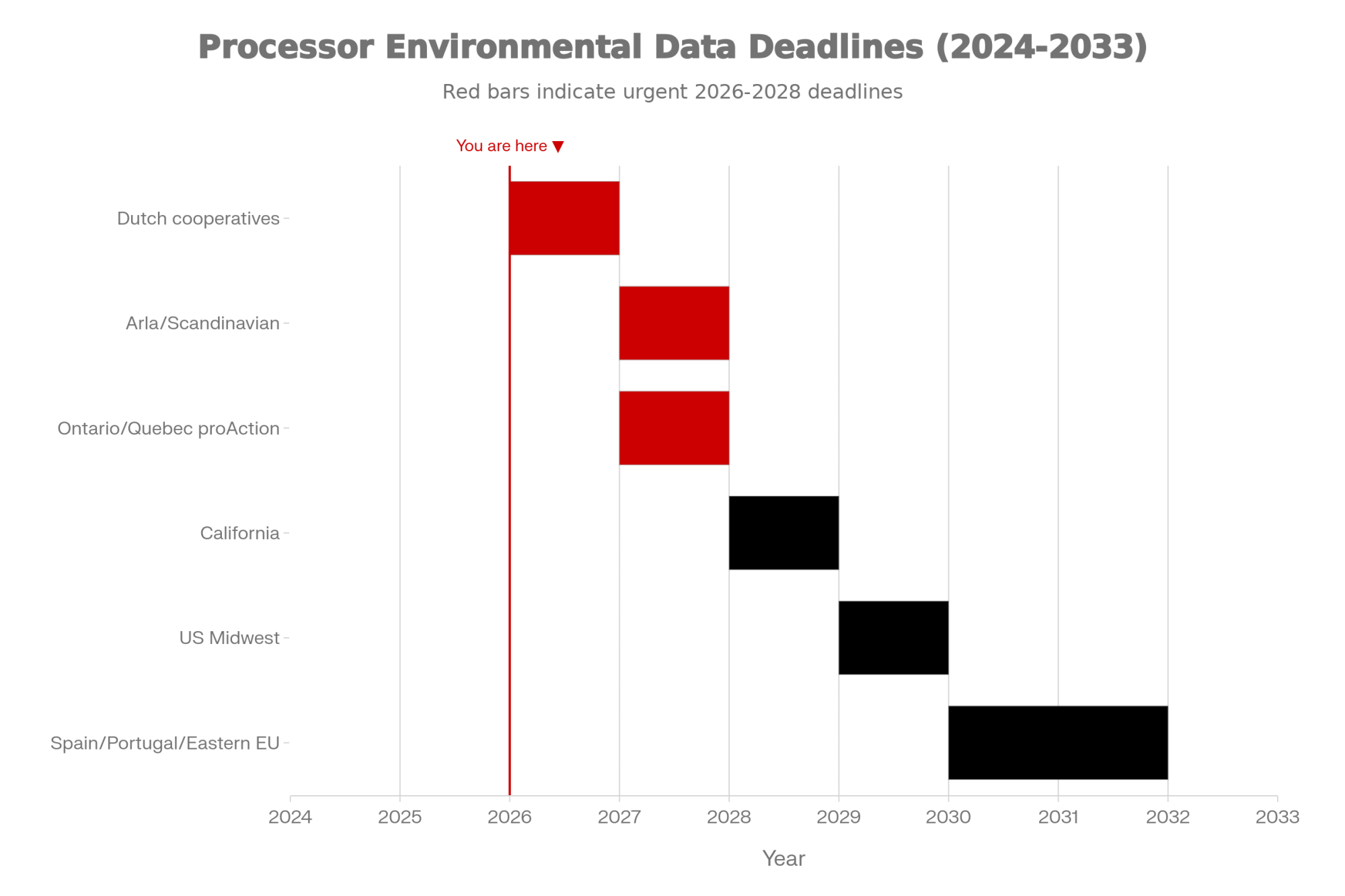
EXECUTIVE SUMMARY: Ireland’s registration of 54,396 fewer calves this year signals a fundamental shift that’s already reshaping global dairy markets. With the nitrates derogation expiring December 31st, Irish farms face potential nitrogen limits dropping from 250kg to 170kg per hectare — a 32% reduction that could force meaningful herd culls despite EPA data showing river nitrogen at eight-year lows. This matters beyond Europe because Ireland, while producing just 1.5% of global milk, controls approximately €1 billion in annual infant formula exports serving Asia’s booming premium segment, which grew from a 32.8% to a 37% market share this past year. What farmers are discovering through Vermont’s success with GPS-guided manure application — an 18-month payback through reduced fertilizer costs — suggests that technology adoption might be the bridge between environmental compliance and profitable production. December’s Brussels decision will ripple through milk prices globally, but smart producers are already diversifying markets, documenting their environmental performance, and learning from Ireland’s experience that scale doesn’t guarantee survival when regulations shift. The conversation we’re having today about Ireland becomes tomorrow’s reality for dairy regions worldwide, making this the moment to build operational flexibility before regulatory pressure arrives at your farm gate.

 Dairy regulatory compliance

I was reviewing the latest ICBF data last week when something really caught my attention. Ireland registered 54,396 fewer calves so far this year — both the Farmers Journal and Agriland confirmed these numbers recently. And you know what? This isn’t your typical seasonal variation. This is something worth understanding.

Here’s what’s interesting: from boardrooms to barn meetings, everyone’s trying to figure out what this means. Industry experts are warning that significant herd reductions could occur in the coming years if the derogation situation doesn’t work out. The scale… well, that’ll depend on what Brussels decides in December. Having watched similar transitions play out in other regions, I think we’re seeing early signs of change that’ll affect all of us, regardless of where we’re milking cows.

Ireland’s dramatic calf registration decline signals fundamental shifts in global dairy markets as regulatory pressure intensifies. 

Understanding Ireland’s Journey

Let’s discuss how Ireland arrived at this point, as it’s quite a story. When EU milk quotas ended in 2015 — you remember that whole situation — Irish farmers really went for it. The national dairy herd has grown from approximately 950,000 cows to nearly 1.6 million today. Teagasc’s National Farm Survey confirms we’re looking at almost 70% growth in less than a decade.

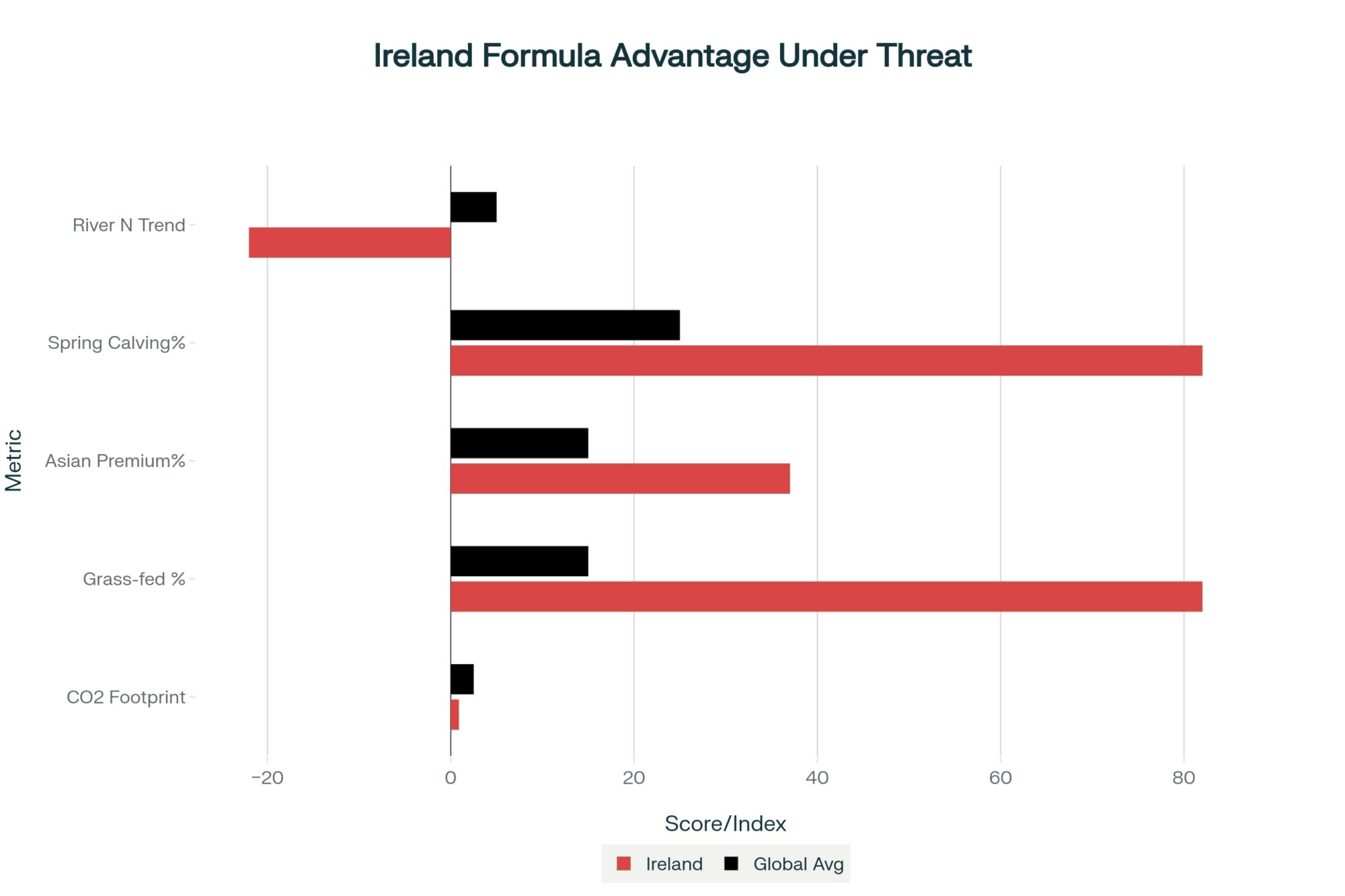
But it wasn’t just about adding cows. The average herd size increased from around 80 head to 131, based on Teagasc’s People in Dairy Project from May of this year. About 82% of these operations utilize spring-calving systems, which makes perfect sense given Ireland’s grass-growing conditions. It’s a model that works beautifully… if you’ve got their climate.

What’s particularly noteworthy is the efficiency they maintained during this expansion. Frank O’Mara’s research team at Teagasc has documented a carbon footprint of just 0.88 kg CO2e per kilogram of fat- and protein-corrected milk. The global average? That’s running around 2.5 kg. So you can see why people pay attention to what happens over there.

 Ireland’s sustainability and market advantages in grass-fed dairy face elimination under potential nitrogen restrictions.

The investment required was substantial. The Irish Farmers Association documented about €2.2 billion in farmer investment during the post-quota expansion period, with processors adding another €1.3 billion in capacity. That’s real money, borrowed against real assets.

December’s Decision Point

Now here’s where things get really interesting. December 31st is when Ireland’s nitrates derogation expires. For those unfamiliar with European regulations, the derogation permits qualifying farms to apply up to 250kg of nitrogen per hectare annually — significantly exceeding the standard 170kg limit. Most Irish farms have already reduced their stocking rates to 220kg as of January 2024, and maintaining that level is uncertain.

What I find encouraging is that the Netherlands submitted their derogation extension request back in July, according to Agriland’s reporting. So Ireland won’t be negotiating alone, which might influence how things play out in Brussels.

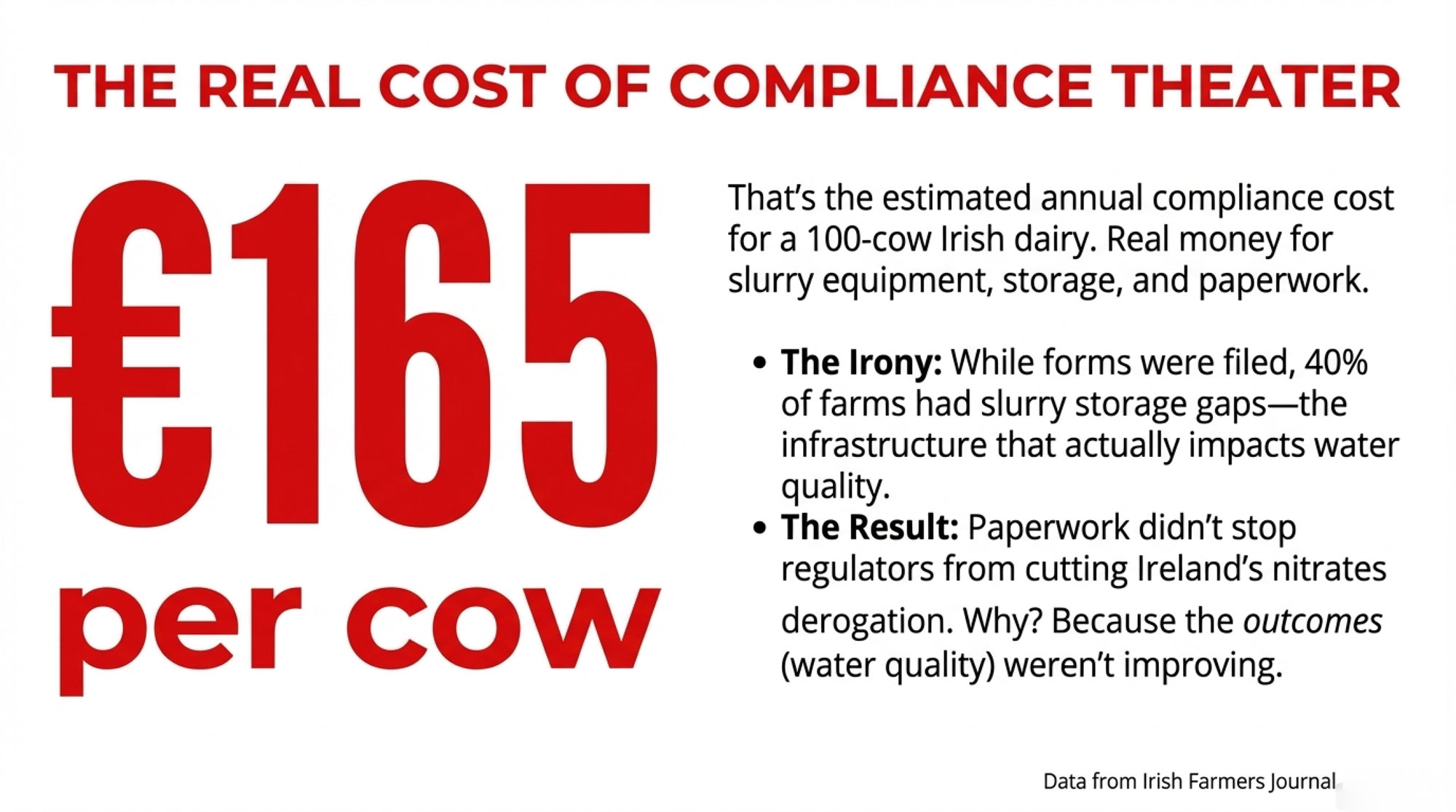
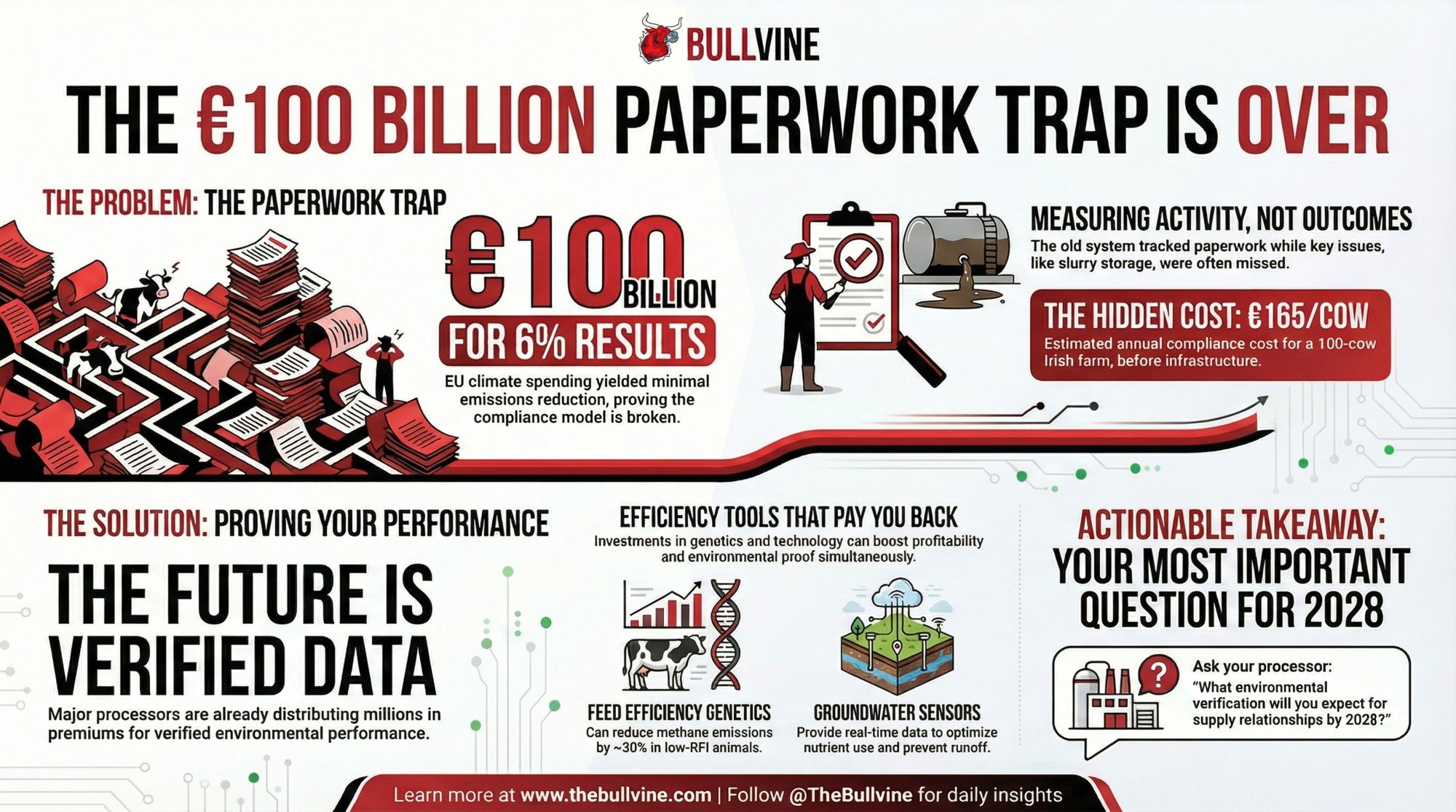
I’ve been talking with several Irish producers about this, and their frustration is understandable. The EPA monitoring shows nitrogen in Irish rivers hit an eight-year low in 2024 — that’s real environmental progress, which RTÉ covered back in March. Yet Brussels added these new requirements under the Habitats Directive, demanding individual assessments for 46 different catchments. I mean, can you imagine managing that paperwork while you’re trying to keep fresh cows healthy during transition?

“Good data is becoming as important as good genetics” — Wisconsin dairy producer on technology adoption

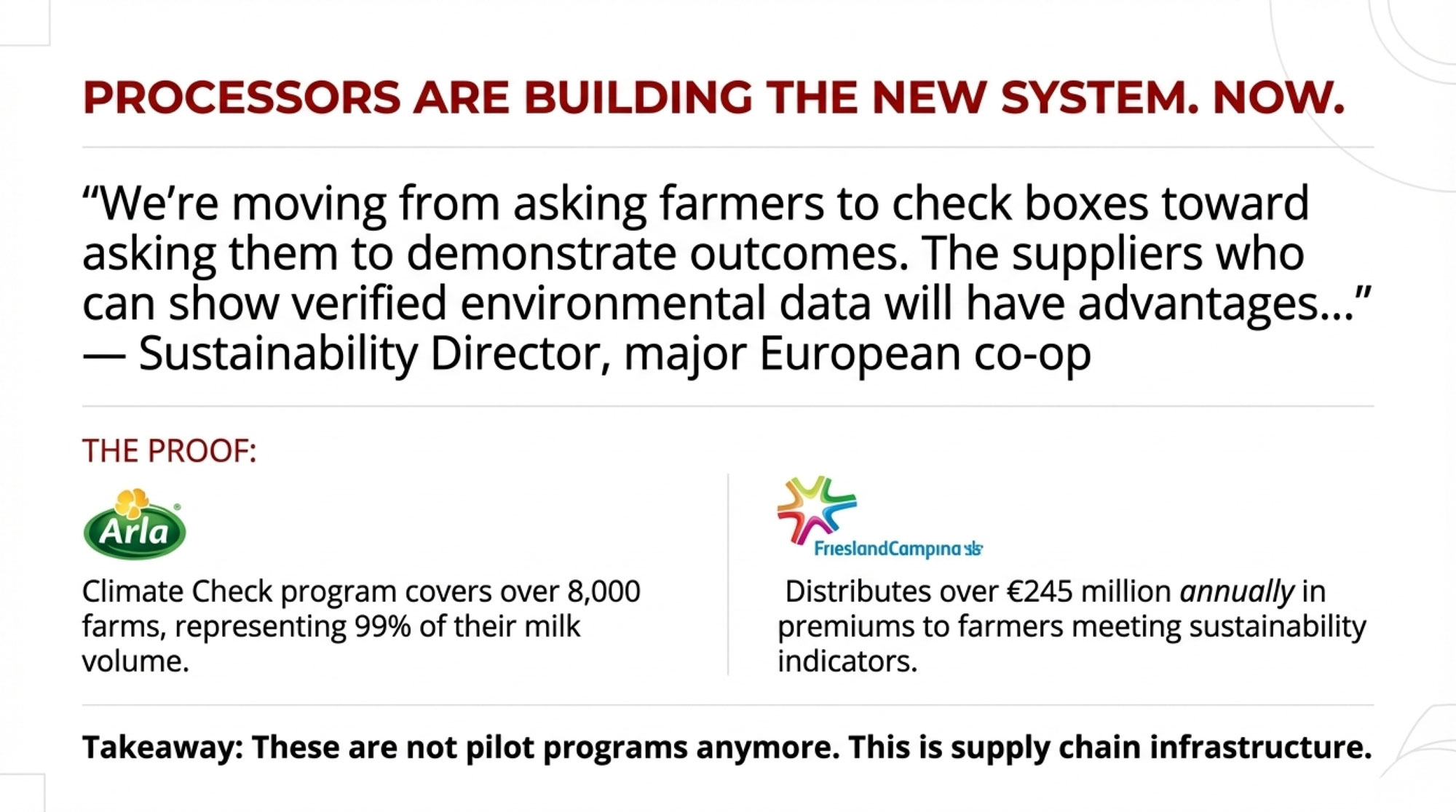
Denis Drennan from ICMSA has been pretty clear that milk prices need to stay strong in 2025 just to cover the increasing regulatory burden. And with co-ops reporting notable year-over-year reductions in deliveries during parts of this year — the magnitude varies by region and month — those newly expanded processing plants are facing some real challenges.

Why This Matters Globally

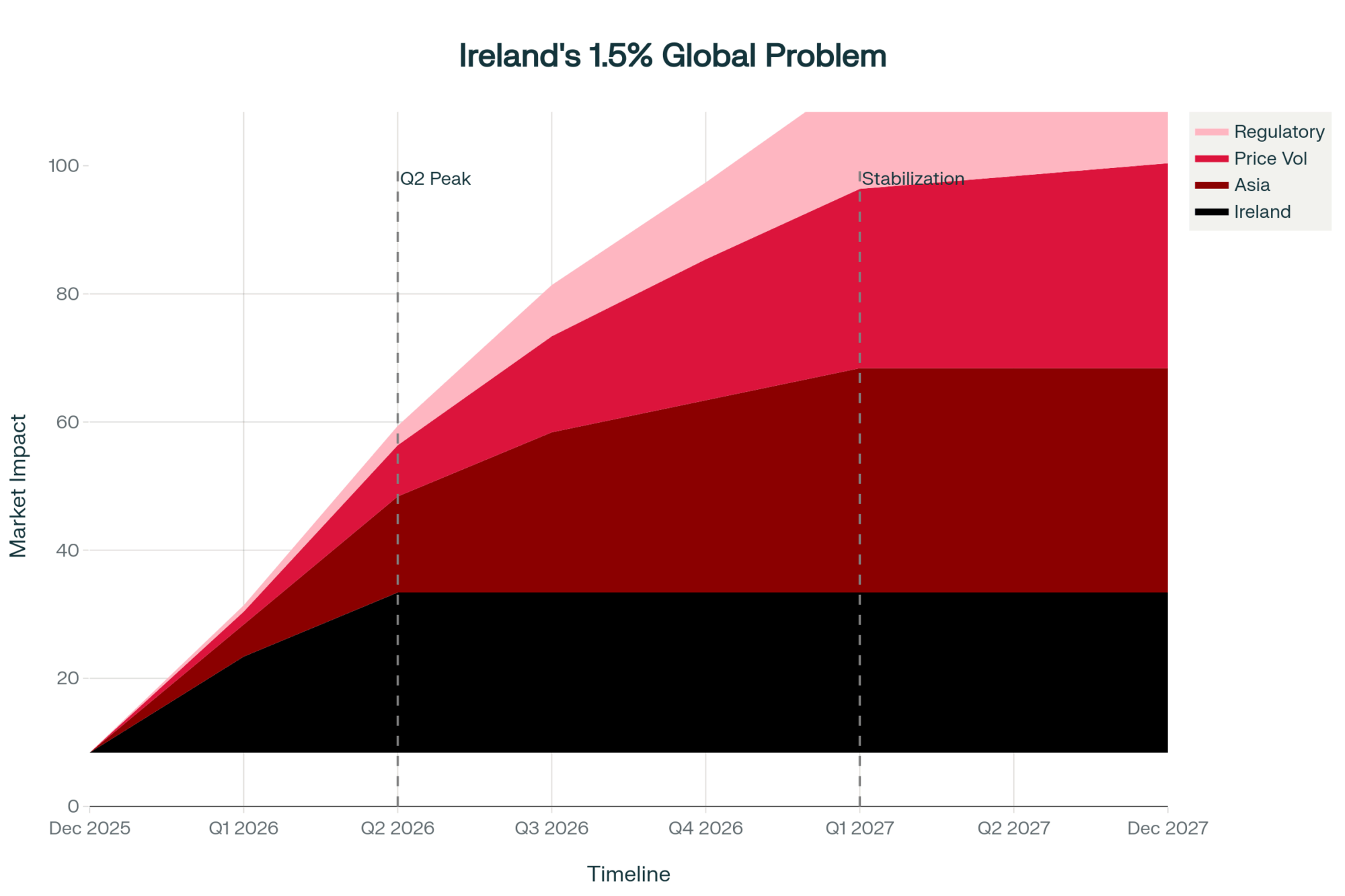
This is where Ireland’s situation becomes everyone’s business. Despite producing only about 1.5% of global milk, Teagasc research from June indicates that Ireland generates approximately €1 billion in annual infant formula exports, with six major manufacturers operating there. That concentration of expertise… it’s not something you can quickly replicate elsewhere.

The Asian market dynamics are particularly relevant here. Analysis from July shows China’s premium infant formula segment grew from about 32.8% to 37% market share over the past year. These consumers specifically want products with verified grass-fed credentials—and they’re willing to pay for them.

You know, the nutritional advantages from grass-based systems — higher CLA levels, better omega-3 profiles — that’s not just marketing. Those are measurable differences that processors can document. However, here’s the thing: these advantages stem from specific climate conditions, decades of infrastructure development, and genetics selected for grass-based production… you can’t just flip a switch and replicate that.

Similar challenges are playing out in California, where water restrictions shape production decisions, or in the Northeast, where land costs drive different operational choices. Each region has its unique pressures. In Canada, supply management adds another layer of complexity, while Australian producers navigate drought cycles that make Ireland’s consistent rainfall look like a paradise.

How Processors Are Adapting

The processing sector they’re really scrambling right now. Companies like Danone, Glanbia, and Kerry Group invested hundreds of millions based on growth projections that seemed reasonable at the time. Now they’re looking at potential supply drops while those fixed costs aren’t going anywhere.

What I’m hearing is that processors are stress-testing all kinds of options. Some are exploring powder reconstitution for specific applications, others are recalibrating their product mix, and many are focusing on supply diversification. But when your competitive advantage is rapid conversion from farm to finished product — that speed-to-value that’s so critical in infant nutrition — workarounds have limitations.

According to industry contacts, processors aren’t waiting for December. They’re actively reviewing supply chain contingencies, adjusting portfolios, and working through various scenarios. Many are now seeking long-term supply diversification contracts in other low-cost regions. It’s pragmatic planning in uncertain times.

Technology’s Growing Role

Technology TypeInvestment CostPayback PeriodAnnual SavingsRegional Example
GPS-guided manure application$45,00018 months$30,000Vermont (fertilizer reduction)
Robotic milking systems$175,00048 months$43,000Wisconsin (labor + efficiency)
Precision feed management$25,00024 months$15,000Ireland (compliance ready)
Heat detection collars$15,00012 months$16,000Netherlands (conception rates)
Environmental monitoring$8,00015 months$6,500California (water compliance)

Something that really caught my attention was ICBF’s September update to their Economic Breeding Index. The Farmers Journal reported that average EBI values dropped about €83 per animal — not because genetics suddenly went bad, but because they shifted the base cow from 2005-born to 2015-born animals. That’s the industry recalibrating for new realities.

The technology adoption gap is becoming really apparent. Farms with advanced parlor management systems, comprehensive data collection… they’re navigating these challenges differently. When you have automated heat detection improving conception rates, robotics helping with consistency — and we’re talking $150,000 to $200,000 for quality robotic systems — these are no longer luxuries. They’re becoming necessities.

A producer I know in Wisconsin put it well: “The difference between operations that invested in precision technology five years ago and those that didn’t is becoming a chasm. This includes everything from advanced feed efficiency sensors and GPS-enabled manure application systems that maximize nutrient use, to automated health monitoring collars. Good data is becoming as important as good genetics.”

And here’s the ROI that’s catching attention: one operation in Vermont saw their investment in GPS-guided manure application pay back in 18 months through reduced fertilizer purchases and improved compliance documentation. That’s the kind of return that makes technology adoption a no-brainer, especially when regulatory pressure continues to build.

Regional Variations Matter

Not every part of Ireland faces the same challenges, which is worth thinking about. The southeast, with its free-draining soils and longer growing seasons, operates under different conditions than those in the northwest, which deal with heavier ground. Spring-calving herds — that’s about 82% of Irish operations, according to Teagasc — they’ve got all their nutrient management concentrated into tight windows.

These variations… they really make you wonder about one-size-fits-all regulations. You’ve got farms achieving excellent bulk tank counts, managing transition periods effectively, keeping their herd health metrics strong — but they’re facing challenges based on nitrogen calculations that might not fully account for grass-based efficiency.

Looking at Three Possible Scenarios

ScenarioTimelineKey Outcomes
Managed AdjustmentQ1-Q2 2026Derogation renewed with tighter restrictions. Modest production adjustments, premium markets tighten, and some global price movement. Processors adapt toward higher-value products.
Political CompromiseQ2 2026Farmer advocacy leads to compromise. Technology investments enable progress in maintaining production. Politicians declare victory, farming continues.
Sharp ContractionMid-2026 onwardsMinimal derogation renewal. Significant production drops within 18 months. Premium market disruption, price volatility, supply gaps.

What This Means for Your Operation

So what should we take away from all this?

First, regulatory dynamics are accelerating everywhere. What starts in Brussels has a way of showing up in other jurisdictions. Environmental regulations are increasingly shaping how we farm, whether we’re in California dealing with methane rules, Wisconsin managing nutrient plans, or anywhere else.

Second, if you have genuine production advantages — whether that’s organic certification, grass-fed systems, local market access, or any other unique aspect of your operation — now’s the time to document and protect those advantages. Ireland’s grass-fed position took generations to build. Once it’s gone, it’s gone.

Third, market relationships need diversification. When supply gets tight, operations with multiple outlets generally fare better. That’s not pessimism — it’s risk management. And beyond just infant formula, Irish dairy also supplies significant volumes to specialty cheese makers and premium butter operations across Europe. Those alternative channels become crucial when primary markets shift.

Fourth, technology adoption is shifting from optional to essential. Being able to document your environmental performance, optimize inputs, and adapt quickly —that’s increasingly what separates operations that thrive from those that just survive.

And here’s something interesting — scale no longer guarantees success. Some of Ireland’s most efficient large operations face real challenges because they’re over nitrogen thresholds, while smaller operations with direct market access and flexibility sometimes prove more adaptable.

The Human Side

Behind every statistic are real families making tough decisions. UCD’s School of Psychology published research in August showing nearly all Irish farm families report work-family conflict, with younger, debt-leveraged farms particularly affected.

These aren’t abstract business decisions. When families have mortgaged generational land to build facilities, they might not be able to fully use… that pressure extends way beyond finances. I’ve witnessed similar situations unfold in various dairy regions, and the stress on rural communities is indeed a real concern.

For those needing support, organizations such as Farm Aid in the US (1-800-FARM-AID), the Farm Community Network in the UK, and the Irish Farmers Association’s member support services offer resources for farmers facing transition pressures. There’s also the International Association of Agricultural Producers, which offers global support networks. Please don’t hesitate to reach out if you need assistance.

Where We Go from Here

Ireland’s 1.5% of global production creates amplified disruption effects across premium markets and regulatory frameworks worldwide. 

What’s happening in Ireland represents more than just regional adjustment. We’re watching environmental objectives, food security needs, and agricultural economics intersect in real time. This dynamic between production efficiency and regulatory requirements… it’s not unique to Ireland. It’s emerging globally.

Those 54,396 fewer calves aren’t just numbers. They’re the leading edge of changes that’ll influence global dairy markets over the next several years. How this affects your operation depends largely on the decisions you’re making right now.

December’s derogation decision will have far-reaching consequences that extend well beyond Ireland. Smart producers are already considering various scenarios and building operational flexibility to adapt to changing market conditions. Most importantly, they’re learning from Ireland’s experience to prepare for similar challenges that might emerge closer to home.

Because if there’s one thing that’s becoming clear, it’s this: success in modern dairying requires understanding both market fundamentals and regulatory dynamics. Political and policy factors are increasingly influencing decisions that were once purely economic in nature. Recognizing and adapting to this reality may well determine which operations thrive in tomorrow’s dairy industry.

The conversation continues, and we’re all part of it. How we respond collectively to these challenges will shape dairy farming for the next generation. What strategies are you implementing to prepare for these changes? Share your thoughts and experiences — because learning from each other is how we’ll navigate this transition successfully.

KEY TAKEAWAYS

  • Technology ROI beats regulatory burden: Vermont operations seeing 18-month payback on $150,000-200,000 precision systems through 20-30% fertilizer savings and streamlined compliance documentation — making tech adoption essential, not optional
  • Market diversification matters more than size: Irish farms over nitrogen thresholds face elimination despite peak efficiency, while smaller operations with direct sales to specialty cheese and premium butter markets show better resilience — suggesting 3-5 market outlets minimum for risk management
  • Environmental progress isn’t protecting producers: Ireland achieved EPA-verified eight-year low nitrogen levels while maintaining 0.88 kg CO2e per kg milk (vs. 2.5 kg global average), yet still faces production cuts — document your sustainability metrics now before regulators set the narrative
  • Premium markets concentrate risk: China’s grass-fed infant formula segment commands 50% price premiums, but Ireland’s potential 15-25% production drop threatens €1 billion in exports — operations dependent on single premium channels need contingency plans by Q1 2026
  • Regional advantages require active protection: Ireland’s grass-fed position took generations to build through climate, genetics, and infrastructure, but December’s decision could eliminate it overnight — whether you’re organic, pasture-based, or locally focused, start building your verification systems today

Complete references and supporting documentation are available upon request by contacting the editorial team at editor@thebullvine.com.

Learn More:

Join the Revolution!

Join over 30,000 successful dairy professionals who rely on Bullvine Weekly for their competitive edge. Delivered directly to your inbox each week, our exclusive industry insights help you make smarter decisions while saving precious hours every week. Never miss critical updates on milk production trends, breakthrough technologies, and profit-boosting strategies that top producers are already implementing. Subscribe now to transform your dairy operation’s efficiency and profitability—your future success is just one click away.

NewsSubscribe
First
Last
Consent

The $50,000 Feed Opportunity When Corn Hits $4.13 and Soy Stays at $275

When corn drops to $4.13 while soybean meal holds at $275, the feeding strategies that worked last year might be costing you thousands.

EXECUTIVE SUMMARY: What farmers are discovering right now is that the traditional relationship between corn and protein feed costs has completely inverted, creating what might be the most significant feed arbitrage opportunity we’ve seen in years. With CME December corn futures at $4.13 per bushel, while soybean meal remains anchored at $275 per ton, progressive dairy operations are capturing $2-3 per hundredweight advantages by strategically increasing corn inclusion to 35-40% of grain mixes – well above conventional recommendations. Research from the University of Wisconsin-Madison and Cornell, published this year, confirms that properly managed herds can handle these elevated starch levels when three conditions align: corn processed to a particle size of 750-1,000 microns, physically effective fiber maintained at 28-32% NDF, and strategic buffering with magnesium oxide. The convergence of China purchasing just 20-30% of typical soybean volumes, drought affecting 70% of U.S. production areas according to the Drought Monitor, and cull cow prices at $145/cwt creates what industry analysts describe as a 90-120 day window before La Niña weather patterns and ethanol economics likely reverse these dynamics. Operations implementing phased approaches – starting with simple TMR consistency improvements that cost nothing – are seeing income over feed cost improvements within 30 days, with one Wisconsin producer reporting $1,200 daily savings after careful implementation.

dairy feed cost optimization

I was speaking with a Wisconsin dairy producer last week – he runs about 450 cows near Fond du Lac – and his nutritionist had just walked him through something that completely changed his perspective. Been feeding the same ration for eighteen months, you know how it goes. But when the nutritionist showed him that corn delivered energy at one-quarter the cost of protein, that got his attention real quick.

“We were basically writing checks we didn’t need to write,” he told me. “Every single day.”

What’s interesting is I’m hearing similar stories from producers everywhere – it doesn’t matter if you’re milking 200 cows in Vermont or running 2,000 head out in California. What is the traditional relationship between energy and protein feed costs? It’s turned completely upside down. And those who’ve caught on are seeing feed cost advantages that, honestly, I wouldn’t have believed myself six months ago.

The Current Market Reality Check

Let’s dig into the numbers here. CME December corn futures settled at $4.13 per bushel this week. That’s down from those stomach-churning peaks above $4.50 we dealt with earlier this year. Meanwhile, the Chicago Board of Trade has soybean meal at $275 per ton – it’s been there for weeks now, like it’s stuck in park.

Here’s what really matters, though. When you run the standard National Research Council energy calculations, corn’s delivering digestible energy at about six cents per pound. I had to check that twice myself. That’s what we usually pay for wheat middlings or corn gluten – the bargain stuff, right? But protein through soybean meal? Nearly 25 cents per pound.

This 4:1 ratio changes everything about how we think about rationing.

When Protein Costs 4X More Than Energy, Smart Operators Act Fast – Current Window Delivers $1,200 Daily Savings for 500-Cow Operations

The USDA’s October World Agricultural Supply and Demand Estimates put U.S. corn production at 410-415 million metric tons. That’s substantial. Yet, soybean processing capacity cannot keep up with domestic meal demand, even at these prices that should theoretically slow things down.

And China? Based on USDA Foreign Agricultural Service export data, they’re buying maybe 20-30% of what they typically purchase from our harvest. We’re talking billions in trade, that’s just… not happening. Creates some interesting domestic opportunities, to say the least.

Weather’s been throwing curveballs, too. The U.S. Drought Monitor indicates that approximately 70% of the country is experiencing drought at various levels. I’ve been hearing from Extension folks across the northern states – many producers are seeing significant reductions in homegrown feed. The Wisconsin farms I work with are scrambling to find hay wherever they can.

However, and this is important, irrigated areas in Iowa, Illinois, and Indiana maintained relatively strong corn production. So, you’ve a peculiar situation where corn’s relatively available overall, but forage is scarce in many regions.

Rethinking Starch Limits Based on Current Research

You know, when I first heard about producers pushing starch to 35-37%, I was skeptical. We’ve all been told – keep starch below 28% or deal with acidosis, right?

But work published in the Journal of Dairy Science over the past year from researchers at Wisconsin-Madison and Cornell has really opened my eyes. The studies show that with proper management, cattle can handle these higher starch levels. And that “proper” part is crucial.

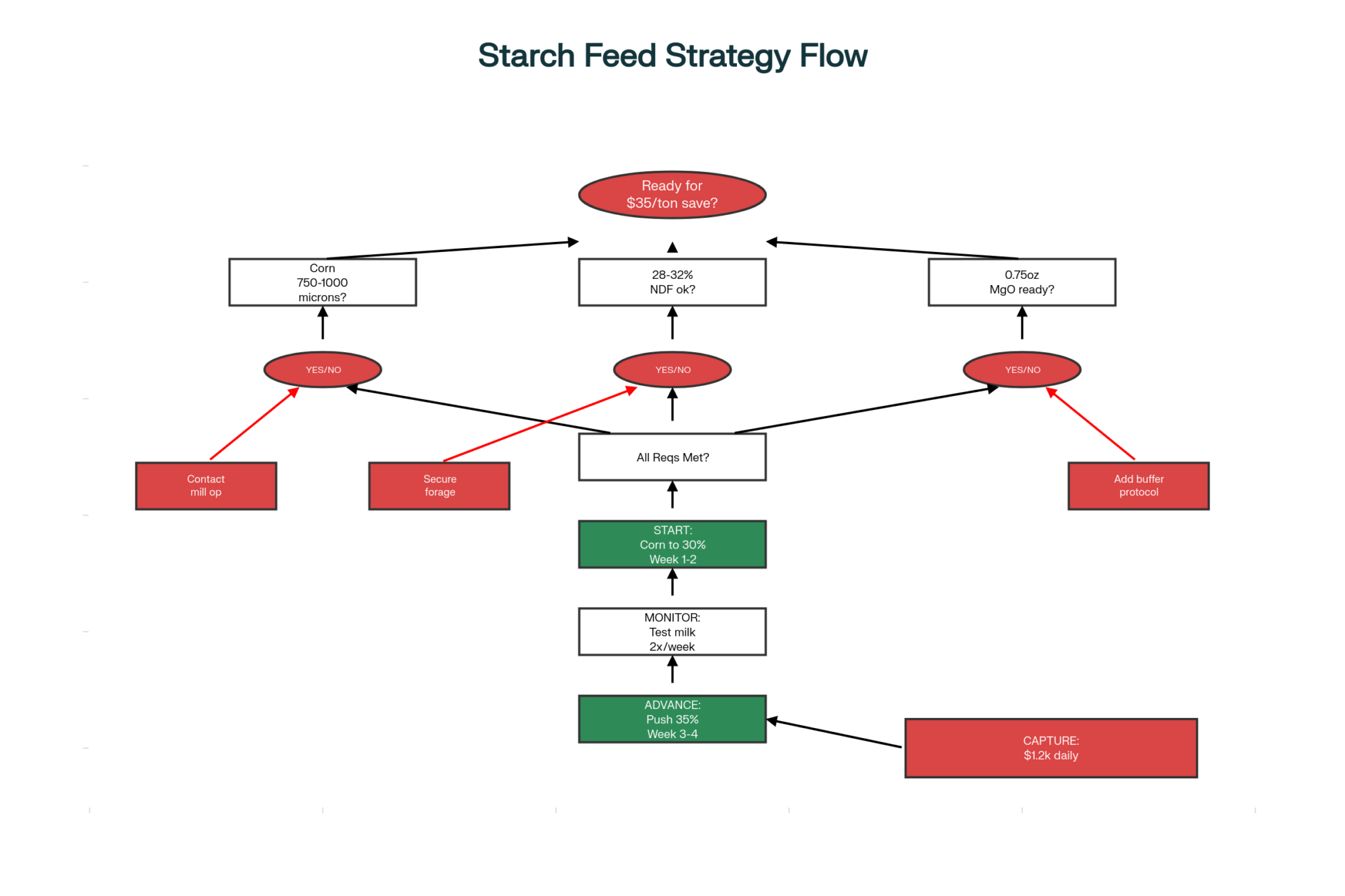
Three things have to line up. First, corn needs to be processed down to a particle size of 750-1,000 microns. Most operations I visit? They’re still at 3,000 microns or coarser. Big difference there. Second, you must maintain a physically effective fiber level of 28-32% NDF, primarily from high-quality forages. No cutting corners. Third, buffering becomes critical – we’re talking about 0.75 ounces of magnesium oxide per cow, religiously.

Here’s something that doesn’t get discussed enough: when managing starch levels, you must be extra cautious about total dietary sulfur. University of Minnesota veterinary diagnostic work shows that high-starch diets combined with elevated sulfur levels can increase the risk of polioencephalomalacia – essentially a thiamine deficiency that causes brain lesions. If you’re already challenging the rumen with higher starch, adding high-sulfur feeds becomes particularly dicey. Keep total dietary sulfur below 0.4%.

Processing matters more than most people realize. According to the National Research Council’s 2021 Nutrient Requirements of Dairy Cattle (8th edition), steam-flaked corn hits about 87% total tract starch digestibility. Cracked dry corn? Lucky to get 45%. When you improve that particle size reduction, you’re essentially feeding a different feed entirely.

The physiology is also quite interesting. Research published in Animal Feed Science and Technology in 2024 shows that when corn processing is optimized, those volatile fatty acid ratios – the acetate to propionate balance – stay above 2.5 to 1. That means you’re preserving butterfat even at these higher starch levels. Would’ve been heresy to suggest five years ago.

I know a producer in Nebraska who attempted to increase the starch content to 38% without adjusting the processing or buffering. Bad move. Within two weeks, three fresh cows stopped eating, and butterfat levels dropped by 0.4%. He pulled back to 32% and everything normalized. The lesson? These higher levels work, but only with meticulous management.

The DDGS Quality Minefield

A purchasing manager for a large Minnesota dairy recently informed me that they’re running about 2,000 cows. With DDGS priced at $180-200 per ton regionally, it appears to be a favorable comparison to soybean meal on paper.

“But we’ve rejected four loads this past month,” she said. “Two with fat over 12%, one had that burnt smell, and one tested at 1.3% sulfur. Any of those could’ve cost us thousands.”

ParameterOptimalAcceptableDangerReject
Fat Content5-7%7-9%9-12%>12%
Protein Content28-32%26-28% or 32-34%24-26% or 34-36%<24% or >36%
Sulfur Content0.35-0.5%0.5-0.7%0.7-1.0%>1.0%
Color/Heat DamageGoldenLight BrownDark BrownBlack/Burnt

The U.S. Grains Council’s quality surveys reveal significant variation – fat ranging from 5% to 14%, protein from 24% to 32%, and sulfur from 0.35% to over 1.4%. These aren’t minor differences, folks.

Research published in the Professional Animal Scientist journal consistently shows that keeping fat below 9% is essential, as milk fat depression will consume any savings. That golden color tells you it’s properly dried. Dark brown or black? Heat damage has caused the protein to become locked up.

Several commercial labs can help with quality monitoring. Dairyland Laboratories in Wisconsin, Rock River Laboratory with locations across the Midwest, Cumberland Valley Analytical Services in Pennsylvania – they all run comprehensive DDGS panels. Industry standards generally recommend keeping acid detergent insoluble protein below 12% of total protein. That’s your heat damage indicator.

Sulfur needs special attention, especially if you’re also pushing starch levels. When DDGS sulfur goes above 0.7%, combined with high-sulfur water and metabolic stress from high-starch diets… you’re asking for trouble. I’ve seen it happen.

Three Strategies That Actually Work

Strategy 1: TMR Consistency – The Foundation

I recently visited a dairy near Shawano, where the owner showed me something straightforward yet incredibly effective. After a University of Wisconsin Extension workshop on mixing consistency, he started timing every TMR load.

“Four minutes exactly,” he said, pointing to this beat-up kitchen timer on the mixer. “Not approximately. Not until it looks good. Four minutes.”

Research published in the Journal of Dairy Science by Penn State in 2024 shows that reducing TMR variation from 15% to below 5% generates 4-5 pounds more milk per cow daily. That’s an immediate return from better mixing alone.

Within a week, this producer observed tighter manure consistency, improved cud chewing, and a noticeable increase in the bulk tank. No new feeds, no expensive additives. Just consistency.

The key here – and what many people overlook – is that consistency matters more than perfection. A slightly suboptimal ration fed consistently beats a perfect ration with 15% variation every single time.

Strategy 2: Strategic Corn Inclusion

Several nutritionists I work with are carefully incorporating corn into grain mixes at 35-40% of the total. Way above the traditional 20-25% comfort zone, but the economics are compelling.

The system requires three key components: corn processed to a 750-1,000 micron size, approximately a pound of wheat straw or mature hay for scratch factor, and magnesium oxide for buffering.

Breaking the 28% Starch ‘Ceiling’ – When Done Right, Higher Inclusion Rates Print Money

Here’s the math: Based on current Chicago Board of Trade pricing, a one percentage point increase in corn, while reducing soybean meal, saves approximately $3.50 per ton of grain mix. Here’s how that calculation works: corn at $4.13/bushel equals $147.50/ton. Soybean meal at $275/ton with 48% protein versus corn at 9% protein means you need 2.5 pounds of corn to replace 1 pound of SBM energy-wise. The price differential creates a $3.50/ton savings for every percentage point shift.

Moving from 25% to 35% corn? That’s $35 per ton saved. For a herd feeding 25 pounds of grain daily, we’re talking meaningful money.

Some California operations with access to extremely low-cost local corn are pushing toward a 42% inclusion rate. However, that requires someone who truly understands the warning signs and metabolic indicators. One producer near Tulare told me he has saved $1,200 daily since August – but he’s also testing milk components twice a week and has his nutritionist on speed dial.

Strategy 3: Revenue Diversification Beyond Milk

An Ohio dairy farmer recently showed me his approach, and it’s brilliant in its simplicity. Instead of chasing protein premiums that have largely evaporated with current Federal Order pricing, he has built multiple revenue streams.

“Bottom 40% of the herd gets bred to Angus,” he explained. “Local sale barn consistently shows $150-250 premiums for those beef-cross calves versus straight Holstein bulls.”

Then there’s strategic culling. The USDA’s National Direct Cow and Bull Report currently shows cull prices at $145 per hundredweight. Compare that to historical October averages around $90-95/cwt based on USDA Agricultural Marketing Service data. That’s over $400 extra per cull – not from culling more, just timing it better.

Making It Work with Tight Cash Flow

The practical challenge – and I hear this constantly – is funding these changes when working capital’s already stretched. A Pennsylvania producer I’ve been advising developed this phased approach that’s working really well.

First two weeks, focus on the free stuff. Time those TMR loads. Four minutes, every time. Review your cull list against current strong prices. One guy I know generated $4,500 from three strategic culls, which funded everything else.

Weeks three and four, test gradual changes. Increase corn by just a pound per cow to start. Sample DDGS from multiple suppliers before making a commitment. Lock in only 30 days of corn to prove it works in your operation.

By month two, most operations are seeing clear improvements in income over feed costs. “First month was tough,” the Pennsylvania producer told me. “Questions from everyone. But when we showed real profitability improvements, they came around.”

The Window Is Closing

Considering future trends and seasonal patterns, this opportunity won’t last forever. CME March 2026 corn already trades at $4.34 – that 21-cent premium tells you the market expects things to tighten.

Several factors could shift this quickly. China typically returns to U.S. markets after harvest – USDA trade data shows they historically increase purchases from November through January. When they do, soybean meal often jumps $30-50 per ton within weeks.

NOAA’s Climate Prediction Center indicates that La Niña is expected to strengthen through February 2026. Considering similar years, South American production challenges typically affect our grain prices within 60-90 days of confirmed weather stress.

And ethanol economics matter too. With crude at $75 per barrel according to EIA data, we’re near the threshold where ethanol margins improve. The EPA’s 15 billion-gallon renewable volume obligation for 2026 means sustained oil prices above $80 will likely push corn higher.

Industry professionals I trust suggest we’ve perhaps three to four months before something shifts significantly.

Regional Adaptations and Global Context

RegionPrimary StrategyKey AdvantageCorn InclusionSavings PotentialCritical FactorRisk Level
Wisconsin/MidwestPush corn to 35-40%Local corn access35-40%$1,000-1,200/dayForage scarcityMODERATE
California/WestMax corn at 42%Irrigation stability40-42%$1,200-1,500/dayComponent testingHIGH
Texas/SouthwestCottonseed + cornRegional proteins30-35%$800-1,000/dayWater costsLOW-MOD
Idaho/NorthwestStable forage focusConsistent alfalfa38-40%$1,100-1,300/dayProcessing qualityLOW
Vermont/NortheastOrganic premiumsPremium marketsN/APremium captureCertificationDIFFERENT

What works in Wisconsin might not work in Texas, and that’s fine. Idaho operations with reliable irrigation and consistent alfalfa – they’re focused purely on maximizing that corn-protein spread. Their forage is stable, so they can push harder on grain.

Texas dairies have access to cottonseed that doesn’t align with their soybean meal needs at all. Local pricing enables the inclusion of aggressive corn while utilizing regional protein sources. Smart adaptation.

Meanwhile, a Vermont organic producer reminded me that their premium markets mean these strategies don’t translate directly. “Our feed economics are completely different,” she said. And she’s right – context always matters.

Even within conventional operations, grazing systems face different math than confinement. A 100-cow grazing dairy in Missouri has fundamentally different opportunities than a 1,000-cow freestall in Michigan.

Down in New Mexico, where I visited last month, they’re dealing with completely different dynamics. Water costs drive everything there. A producer near Las Cruces told me, “I’d love to push corn harder, but every pound of milk requires water calculation first.”

Looking internationally, European producers face even tighter protein markets with their non-GMO requirements. A consultant friend in the Netherlands tells me their soybean meal equivalent runs €400-450 per metric ton – which makes our $275 look like a bargain. Australian producers dealing with drought have the opposite problem – plenty of protein options, but energy feeds are scarce.

Quick Reference: Key Monitoring Metrics

When pushing these strategies, watch these indicators like a hawk:

  • Rumination time: Should stay above 400 minutes daily
  • Manure scores: Keep below three on the 5-point scale
  • Milk components: Butterfat shouldn’t drop more than 0.2%
  • Total dietary sulfur: Keep below 0.4% when pushing starch
  • TMR particle size: Test weekly when changing corn processing

Implementation Keys for Success

After dozens of conversations with producers navigating this market, clear patterns emerge.

Start with accurate math. Calculate your actual delivered corn-to-soybean meal price ratio. Not Chicago prices – your delivered costs, including basis and freight.

Test your TMR consistency. I guarantee it’s more variable than you think. Extension services have good protocols for testing mixer performance.

Get comprehensive profiles from any DDGS supplier before volume commitments. Don’t trust last month’s analysis – quality varies by plant, even by day. Have them test for fat, protein, sulfur, and acid detergent insoluble protein at a minimum.

Review culling with current prices in mind. That cow you planned to cull in spring? Today’s prices might change that timing.

Have honest conversations with your nutritionist. Some resist higher corn inclusion based on older guidelines. Share current research, discuss gradual testing, and collaborate on monitoring together.

For risk management, never commit over half your working capital to feed inventory. Keep flexibility. And always have multiple protein suppliers. Single-source dependence is asking for trouble.

Looking Forward: Preparing for the Next Cycle

That Wisconsin producer from the beginning? He’s now seeing daily feed savings of $1,200, which more than justifies the changes. But he said something that stuck with me: “I spent three weeks overthinking a simple change. Should’ve just tried it carefully, monitored, adjusted. The real risk was paralysis while the opportunity slipped away.”

The feed economics landscape has shifted significantly, creating genuine opportunities. Dairy Margin Coverage program data from the USDA shows that operations consistently adapting to current conditions demonstrate better income over feed costs than those maintaining traditional approaches.

This window exists now, but it won’t last forever. Whether you capture it depends on your willingness to challenge conventional thinking when the numbers support it.

As someone said at our last co-op meeting: “The math is clear. Question is whether we’ll adapt while we can, or spend next year wishing we had.”

What’s encouraging is how this disruption is forcing us to question assumptions and improve efficiency. The operations that’ll thrive won’t just be those who captured this particular opportunity – they’ll be the ones who developed systems to recognize and respond to market shifts quickly. That’s a capability worth building regardless of where prices go next.

Looking ahead, I believe we will continue to see more of these market disruptions. Climate variability, trade dynamics, processing capacity constraints – they’re not going away. The dairies that build flexibility into their feeding programs, maintain good relationships with multiple suppliers, and stay willing to challenge conventional wisdom when data supports it… those are the ones that’ll navigate whatever comes next.

The current corn-soy reversal creates real opportunities for those willing to think differently about feed strategies. However, it requires careful implementation, constant monitoring, and adherence to the fundamentals that maintain cows’ health and productivity. Get those right, and the economics take care of themselves.

Complete references and supporting documentation are available upon request by contacting the editorial team at editor@thebullvine.com.

KEY TAKEAWAYS:

  • Immediate savings of $35/ton on grain mix achievable by shifting from 25% to 35% corn inclusion, translating to $1,000+ daily for 500-cow operations – but requires corn processing at 750-1,000 microns, not the typical 3,000
  • DDGS at $180-200/ton looks attractive, but quality varies wildly – fat content ranges from 5-14%, sulfur from 0.35-1.4% – requiring rigorous testing through labs like Dairyland, Rock River, or Cumberland Valley before any volume commitments
  • Strategic culling at current $145/cwt prices generates $400+ premiums per head versus five-year October averages of $90-95/cwt, providing immediate cash flow to fund feed inventory builds without increasing culling rates
  • Regional adaptations matter significantly – Idaho operations with stable irrigation focus purely on price spreads, Texas dairies leverage cotton seed alternatives, while New Mexico producers face water cost constraints that override feed economics
  • The window closes fast – CME March 2026 corn already trades at $4.34 (21 cents higher), China typically returns to markets November-January, and La Niña patterns historically trigger South American production issues that impact prices within 60-90 days

Join the Revolution!

Join over 30,000 successful dairy professionals who rely on Bullvine Weekly for their competitive edge. Delivered directly to your inbox each week, our exclusive industry insights help you make smarter decisions while saving precious hours every week. Never miss critical updates on milk production trends, breakthrough technologies, and profit-boosting strategies that top producers are already implementing. Subscribe now to transform your dairy operation’s efficiency and profitability—your future success is just one click away.

NewsSubscribe
First
Last
Consent

1,810 Dairy Farms to 24: Inside North Dakota’s Collapse – and Why You’re Next

When one mega-dairy can replace 1,800 family farms, the math changes for everyone still milking

EXECUTIVE SUMMARY: What farmers are discovering through North Dakota’s dramatic transformation – from 1,810 dairy farms in 1987 to just 24 today – is that consolidation isn’t just happening, it’s accelerating in ways that fundamentally change the economics for everyone. Recent USDA data show that transportation costs alone create a $1.50 per hundredweight advantage for large operations, while volume purchasing delivers 10-20% feed savings, which can mean $150,000 annually for a 5,000-cow dairy. The technology gap compounds these differences… farms using automated monitoring systems now catch metabolic disorders 24-48 hours earlier, transforming what used to be $500 problems into $50 treatments. Here’s what’s encouraging, though—producers finding success aren’t necessarily the biggest, they’re the ones matching their strategy to their strengths, whether that’s capturing organic premiums worth $9.50 per hundredweight, installing robots that give back 20 hours weekly, or joining equipment syndicates that make $300,000 harvesters affordable. With alternative proteins capturing market share and digesters generating $200-$ 400 per cow annually in states like California, the playbook for survival has expanded beyond simply getting bigger. The question isn’t whether you’ll adapt—it’s which path makes sense for your operation, your family, and your community.

That feeling when something significant is happening in the industry and you’re not quite sure whether to be excited or concerned? That’s exactly where I find myself with North Dakota’s recent developments.

The state just approved what could become one of the largest dairy operations in their region, and this isn’t just another expansion story—it’s potentially a preview of where the entire industry is headed. Every time a state approves one of these massive facilities, the rest of us wonder what it means for our operations.

The Vanishing Herd: North Dakota’s Dairy Farms Have Disappeared at a Rate of One Per Week for 35 Years. 

Something I’ve noticed recently is how the timing here reflects broader patterns. According to the USDA’s Census of Agriculture, North Dakota’s dairy sector has experienced a significant decline over the past four decades. The state had 1,810 dairy farms in 1987, and by the 2022 census, that number had dropped to just 24. We’re talking about going from nearly two thousand family operations to barely enough to fill a small meeting room. And now, suddenly, there’s momentum for facilities that could multiply the state’s milk production almost overnight. This mirrors transformations we’ve already witnessed in states like Indiana and Texas, where similar large-scale dairy consolidation has reshaped the entire landscape.

Key Numbers at a Glance:

  • ND dairy farms: 1,810 (1987) → 24 (2022)
  • Transportation cost difference: $1.50+/cwt by operation size
  • Feed cost advantage: 10-20% for volume buyers
  • Disease detection improvement: 24-48 hours earlier with monitoring
  • Phosphorus accumulation: 50-100 lbs/acre annually
  • School enrollment impact: 15-20% drop in consolidating counties
  • Soybean meal basis variation: $40-60/ton by location
  • Robotic system cost: $180,000-$250,000
  • Organic premium: $9.50/cwt above conventional
  • CA digester revenue: $200-400/cow annually
  • Direct dairy sales growth: 30% since 2020

Understanding the Economic Reality

It struck me recently when reviewing the USDA Economic Research Service’s ongoing work on dairy consolidation—their data confirms what many of us have suspected for years. The cost structure fundamentally changes at different scales of production, and it’s not a subtle difference.

Why is this significant? Well, smaller operations—and I’m referring to well-managed farms—face production costs that are substantially higher per hundredweight than those of larger facilities. These aren’t minor differences; they determine whether you’re profitable or underwater in any given year.

When the milk truck charges the same stop fee whether they’re picking up one tank or five, the math becomes clear. Federal Milk Marketing Order reports consistently show that transportation costs alone can create significant differences per hundredweight between small and large operations. Examining Upper Midwest data, it’s not unusual to see differences of $1.50 or more in hauling charges between farms shipping under 50,000 pounds monthly and those shipping over 500,000 pounds.

It’s Not Just Milk Price—It’s a System Built for Scale. 

What farmers are finding is that this extends way beyond milk prices. It’s about negotiating power with suppliers, access to specialized services, and even the ability to hire dedicated herd health consultants. In Wisconsin, the Center for Dairy Profitability at UW-Madison has documented how larger operations often pay 10-20% less for purchased feed simply due to volume discounts. We’re talking about meaningful differences that really add up over the course of a year.

Large operations save $1.50/cwt on transport alone – enough to determine profit or loss in tight markets. The math doesn’t lie

Technology’s Role in This Transformation

At this year’s World Dairy Expo, the technology on display represented a fundamental shift in how dairy operations can function. It’s not just incremental improvements anymore.

Modern rotary parlors are processing hundreds of cows per hour with minimal labor. However, what really caught my attention is the data collection itself, which is revolutionary. Each cow generates dozens of data points every milking—conductivity readings that predict mastitis, flow rates indicating udder health, behavioral patterns suggesting lameness or heat stress.

Research from land-grant universities consistently shows that farms using automated monitoring systems can detect health issues significantly earlier than traditional observation methods. The Journal of Dairy Science has published multiple studies demonstrating improvements in the detection of metabolic disorders within 24 to 48 hours. As many of us have seen firsthand, catching issues even a day or two earlier in fresh cow management makes the difference between a $50 treatment and a $500 problem.

Something else that’s fascinating—large facilities are diversifying beyond milk production. The EPA’s AgSTAR database tracks over 250 dairy digesters operating across the country, generating substantial renewable energy. California’s dairy digesters alone are reducing greenhouse gas emissions equivalent to taking over 750,000 cars off the road annually, according to the California Department of Food and Agriculture. In states with strong renewable energy incentives, monthly biogas revenue can sometimes match or even exceed milk revenue during certain market conditions.

The Environmental and Community Considerations

Let’s have an honest conversation about what this means for communities and watersheds—these are legitimate concerns that deserve serious discussion.

Large dairy operations require substantial water resources. Cooling systems alone, chilling thousands of gallons of milk from body temperature to 38 degrees daily, typically consume hundreds of thousands of gallons per day. That’s just physics—you can’t get around it.

Then there’s nutrient management. The University of Minnesota’s Discovery Farms program has documented phosphorus loading challenges across Upper Midwest watersheds. Even with best management practices—and I’ve seen some impressive systems where operations are actually exporting processed manure as commercial fertilizer—concentrating that much manure production creates challenges. According to their research, phosphorus can accumulate in soils at rates of 50-100 pounds per acre annually when manure is applied at nitrogen-based rates.

Rural sociologists have documented consistent patterns when regions transition from many small farms to a few large ones. A 2023 study from Iowa State University’s Department of Sociology found that counties experiencing rapid dairy consolidation saw an average drop in school enrollment of 15-20% within a decade. Equipment dealers consolidate or close, feed stores disappear. While large operations bring economic benefits, they fundamentally alter the social fabric.

When dairy farms disappear, entire communities collapse – North Dakota’s 85% community vitality loss tells the real story

What’s happening in the Netherlands offers an interesting contrast—their environmental regulations, particularly around nitrogen emissions, are pushing consolidation in a completely different direction. Dutch farmers are focusing on technology-intensive operations that maximize output per acre rather than total scale. Some are producing 2,500 pounds of milk per acre of farmland, nearly double the U.S. average.

Strategic Advantages of Geography and Timing

The development that really caught my eye about North Dakota’s situation is how it coincides with massive regional soybean processing expansion. ADM’s new facility in Spiritwood and Marathon’s planned renewable diesel plants are creating enormous soybean meal supplies as byproducts.

This creates strategic advantages that are difficult to replicate elsewhere. Large dairy operations near these facilities could see significantly lower feed costs than those relying on rail-shipped meal from Iowa or Illinois. The USDA’s Agricultural Marketing Service reports that the local basis for soybean meal can vary by $40 to $ 60 per ton, depending on the distance from crushing facilities. For a 5,000-cow dairy feeding 50 pounds of grain per cow daily, that’s a potential difference of $150,000 annually in feed costs alone.

Similar patterns emerged when ethanol plants expanded across the Corn Belt in the 2000s. The University of Minnesota Extension documented how dairies within 50 miles of ethanol plants experienced feed cost advantages of $100-$ 200 per cow annually from access to wet distillers grains. The same principle applies, just with soybean meal instead.

Alternative Paths Forward

Despite all this consolidation pressure, I’m seeing some interesting counter-trends that offer hope for diverse operational models.

Robotic milking systems are becoming more financially viable for smaller operations. Cornell’s PRO-DAIRY program published case studies in 2024, showing positive returns for farms with 60 to 240 cows that use robotic systems. While these systems still require significant capital—most installations cost between $180,000 and $250,000 per robot—the labor savings and lifestyle benefits are proving substantial. One Vermont producer told me at a recent conference that robots gave him back 20 hours per week, allowing his son to stay interested in taking over the farm.

Smart operators are adding $1,600+ per cow through strategic revenue diversification – are you leaving money on the table?

The alternative protein sector is advancing more rapidly than many expected. When Leprino Foods, which produces cheese for most major pizza chains, announced partnerships with precision fermentation companies, that was a wake-up call. Perfect Day is already selling ice cream made with fermentation-derived dairy proteins in over 5,000 stores. This isn’t some distant future; it’s happening now.

Direct-to-consumer opportunities continue expanding, too. The USDA’s Agricultural Marketing Service reports that direct sales of dairy products have grown over 30% since 2020. I keep hearing about producers achieving two to three times commodity prices through direct relationships. One Pennsylvania operation shared its numbers at a grazing conference—they increased per-cow revenue by 180% by transitioning half of their production to on-farm processing and direct sales.

Three Plausible Scenarios for the Next Decade

Examining current trends and projections from groups like the Food and Agricultural Policy Research Institute, three paths appear to be the most likely.

First scenario: consolidation continues accelerating. The USDA’s baseline projections suggest we could see 70% of milk production from operations over 2,000 cows by 2035. That would mirror what’s happened in poultry, where the top 25 companies now control over 95% of production.

Second possibility: technology and markets enable operational diversity. If robotic milking costs continue to drop—and they’ve fallen 25% in the past five years, according to manufacturer data—plus direct marketing matures and consumer preferences shift toward local production, diverse operations could remain viable. New Zealand has maintained over 11,000 dairy farms through their cooperative structure, so it’s not impossible.

Third scenario—and this might be most realistic: we get a hybrid system. Large operations handle commodity production efficiently, while alternative proteins capture 15-20% of the ingredient market, as some analysts project. Smaller farms, on the other hand, focus on premium and local markets. Different from our grandparents’ industry, but potentially sustainable.

Direct marketing delivers 2.5x revenue per cow with 98% less capital than mega-dairies

Practical Considerations for Today’s Decisions

StrategyInitial InvestmentPayback PeriodRevenue UpliftRisk LevelBest For
Go Big (2,000+ cows)$8-15M12-15 yearsScale efficiencyHIGH (red)Capital-rich operators
Go Robotic (60-240 cows)$180-250K/robot5-7 years20 hrs/week savedMEDIUMLabor-constrained farms
Go Organic$50-100K conversion2-3 years$9.50/cwt premium (red)LOW-MEDIUMPremium markets access
Go Direct$150-300K processing3-5 years2-3x commodity price (red)MEDIUMPopulation centers
Go Hybrid$500K-2M7-10 yearsMultiple streamsLOW (red)Diversified operations

So, where does this leave those of us making decisions today? It really depends on your situation and goals.

Smaller operations—those with fewer than 500 cows—need to focus on differentiation and innovation. The USDA reports organic milk premiums averaging $9.50 per hundredweight above conventional prices in 2024. Can you capture those premiums? Can automation help you compete on efficiency? A Wisconsin grazer milking 80 cows told me he’s netting more per cow than his neighbor milking 800, but it took completely rethinking his system.

Mid-size operations—500 to 2,000 cows—face perhaps the toughest decisions. You have real overhead without certain scale efficiencies. Focus on operational excellence and careful debt management. Some Midwest producers are finding success through machinery syndicates and shared ownership of expensive equipment. Three neighbors sharing a $300,000 forage harvester makes more sense than each buying their own.

Larger operations must think beyond milk production. California’s dairy digesters are generating $200-400 per cow annually in additional revenue through the Low Carbon Fuel Standard program. Carbon credits, renewable energy, nutrient exports—these all need to be part of the business model. And keep an eye on those alternative proteins, because disruption often occurs faster than we expect.

There’s No Single Path to Success—Only the Right Path for You. The era of one-size-fits-all dairy farming is over. 

The Bottom Line

Every generation of dairy farmers faces transformation. My grandfather told stories about the shift from hand milking to machines—how neighbors said it would never work. My dad navigated the change from cans to bulk tanks. Now we’re experiencing something perhaps even more fundamental.

At a recent industry meeting, someone asked whether farming would even exist in 20 years, the way we know it today. The honest answer? Probably not. But that doesn’t mean there won’t be opportunities. They’ll just look different.

North Dakota’s dairy transformation represents one piece of a much larger puzzle. Whether these large-scale operations prove the future or simply another chapter remains uncertain. What’s clear is that the industry will look different five years from now than it does today.

The producers who successfully navigate this transition won’t necessarily be the best farmers in the traditional sense. They’ll be the ones who can operate successfully in fundamentally different business environments—whether that’s managing 5,000 cows with a team of specialists, direct marketing to 500 loyal customers, or something we haven’t imagined yet.

We’re all trying to figure this out together. Change is accelerating, and today’s decisions will determine who remains in business over the next decade. The resilience of dairy farmers constantly amazes me—we’ve adapted to every challenge thrown our way. This one’s big, but I have faith we’ll figure it out.

How are you thinking about these changes? What strategies are you considering? Because ultimately, we’re all grappling with the same fundamental question: how do we continue doing what we love in an industry that’s transforming beneath our feet?

The cows haven’t changed much over the years… but everything around them sure has. The question is: where do we fit in this new landscape? And, more importantly, how do we ensure there’s still room for the next generation, whatever form that may take?

Maybe that’s always been the real challenge in dairy farming. Not just producing milk, but adapting to constant change while holding onto what matters most. The land, the animals, the communities we’re part of. Those things endure, even as everything else transforms.

KEY TAKEAWAYS

  • Scale economics are real but not absolute: Operations shipping over 500,000 pounds monthly save $1.50+ per hundredweight on hauling alone, but Wisconsin grazers milking 80 cows report higher net margins than neighbors milking 800 through system optimization and premium capture
  • Technology adoption depends on your timeline: Robotic systems ($180,000-$250,000) deliver positive ROI for 60-240 cow operations within 5-7 years, while automated monitoring pays back in months through earlier disease detection and reduced treatment costs
  • Geography creates opportunity: Dairies within 50 miles of ethanol plants or new soybean crushing facilities see $100-200 per cow annual feed savings—location advantages that offset some scale disadvantages for mid-size operations
  • Revenue diversification is becoming essential: California digesters generate $200-400/cow annually, direct sales capture 2-3x commodity prices, and organic premiums average $9.50/cwt—multiple income streams buffer volatility better than scale alone
  • The hybrid future rewards clarity: Whether you’re targeting commodity efficiency, local premium markets, or value-added processing, operations with focused five-year plans and appropriate debt levels navigate consolidation better than those trying to compete everywhere

Complete references and supporting documentation are available upon request by contacting the editorial team at editor@thebullvine.com.

Learn More:

Join the Revolution!

Join over 30,000 successful dairy professionals who rely on Bullvine Weekly for their competitive edge. Delivered directly to your inbox each week, our exclusive industry insights help you make smarter decisions while saving precious hours every week. Never miss critical updates on milk production trends, breakthrough technologies, and profit-boosting strategies that top producers are already implementing. Subscribe now to transform your dairy operation’s efficiency and profitability—your future success is just one click away.
NewsSubscribe
First
Last
Consent

Spray Drones on Dairy Farms: Why the Failures Teach Us More Than the Successes

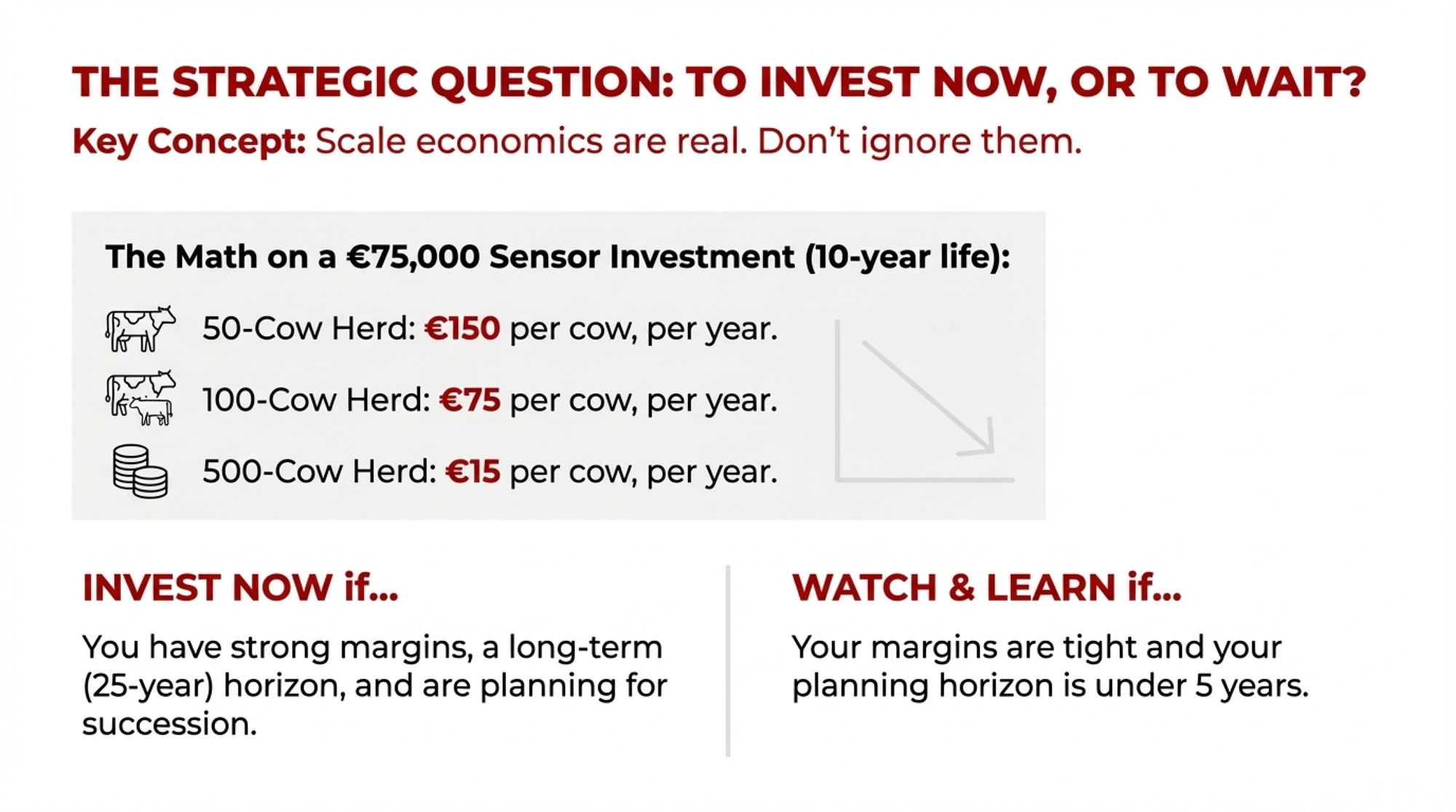
Custom drone rates dropped from $22 to $16/acre in 2 years—here’s what that means for your spray decisions

EXECUTIVE SUMMARY: What farmers are discovering about spray drones challenges everything equipment dealers have been pushing—the real value isn’t in replacing your ground rig, it’s in solving specific problems conventional equipment can’t handle. Recent field data shows custom application rates have dropped from $22-25 per acre to $15-18 across the Midwest as more operators enter the market, fundamentally changing the ownership economics. Extension research confirms that while large operations (2,000+ acres) can achieve costs as low as $7-9 per acre, smaller dairies face $18-20 per acre when factoring in battery replacement, insurance, and time value. The producers finding success aren’t chasing technology for its own sake—they’re targeting chronically wet fields, odd-shaped parcels aerial applicators avoid, and emergency applications when timing trumps cost. With regulatory requirements varying wildly by state and Ontario producers essentially locked out of pesticide applications, the adoption pattern is becoming clear: scouting drones make sense for nearly everyone at $1,500, but spray drones require careful analysis of your specific operational challenges. Here’s what this means for your operation: document when conventional spraying actually fails you, test with custom services before buying, and understand that this technology works best as a specialized tool, not a revolutionary replacement.

 spray drone economics

You know those June mornings when you’re standing at the field edge, watching water pool between the corn rows? That’s when the conversation about spray drones becomes real for most of us. Not the trade show pitch about revolutionary technology, but the practical question: could this actually work on my operation?

I’ve been comparing notes with producers from Rock County, Wisconsin, to Lancaster County, Pennsylvania, and what’s interesting is how the conversation has shifted. The FAA now tracks agricultural drone registrations as a distinct category—they’re seeing steady growth, though exact numbers depend on classification. We’re past the hype stage. Now we’re seeing real patterns emerge about what works… and honestly, what doesn’t.

Looking across the I-94 corridor from Eau Claire to Madison, down through Illinois dairy country, the producers making drones work aren’t using them to replace their John Deere R4038s or Case Patriots. They’re using them for those specific situations where nothing else makes sense. And that distinction? Worth exploring, I think.

The Economics Are… Complicated (But Getting Clearer)

The uncomfortable truth? Small dairy operations pay 2.5x more per acre than large operators—making custom services the smarter choice for 68% of farms

So let’s talk money, because that’s where every equipment decision starts and ends, right? I’ve been comparing notes with farm management specialists at various land-grants, and what’s fascinating is how differently the economics play out depending on your situation.

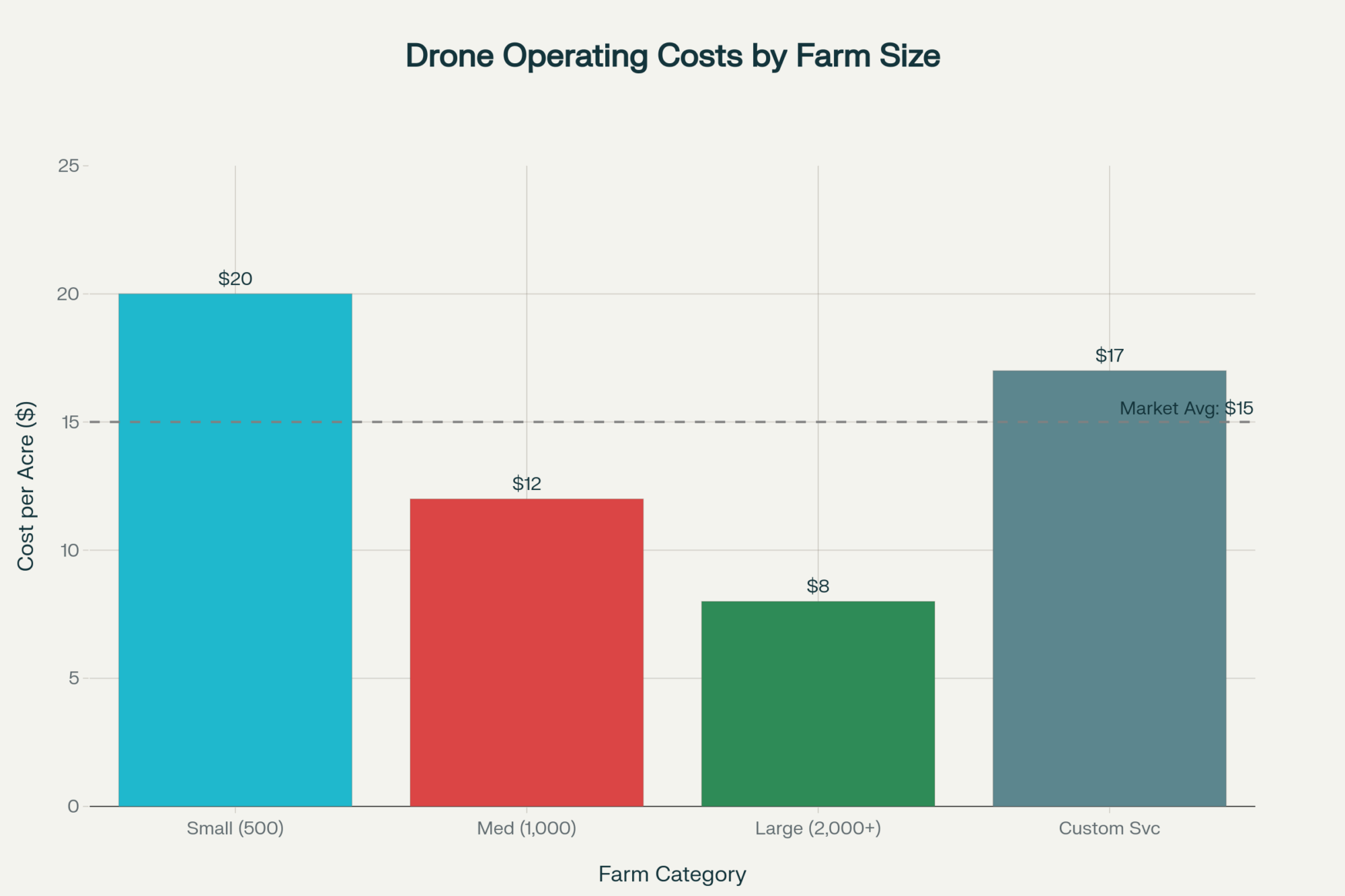
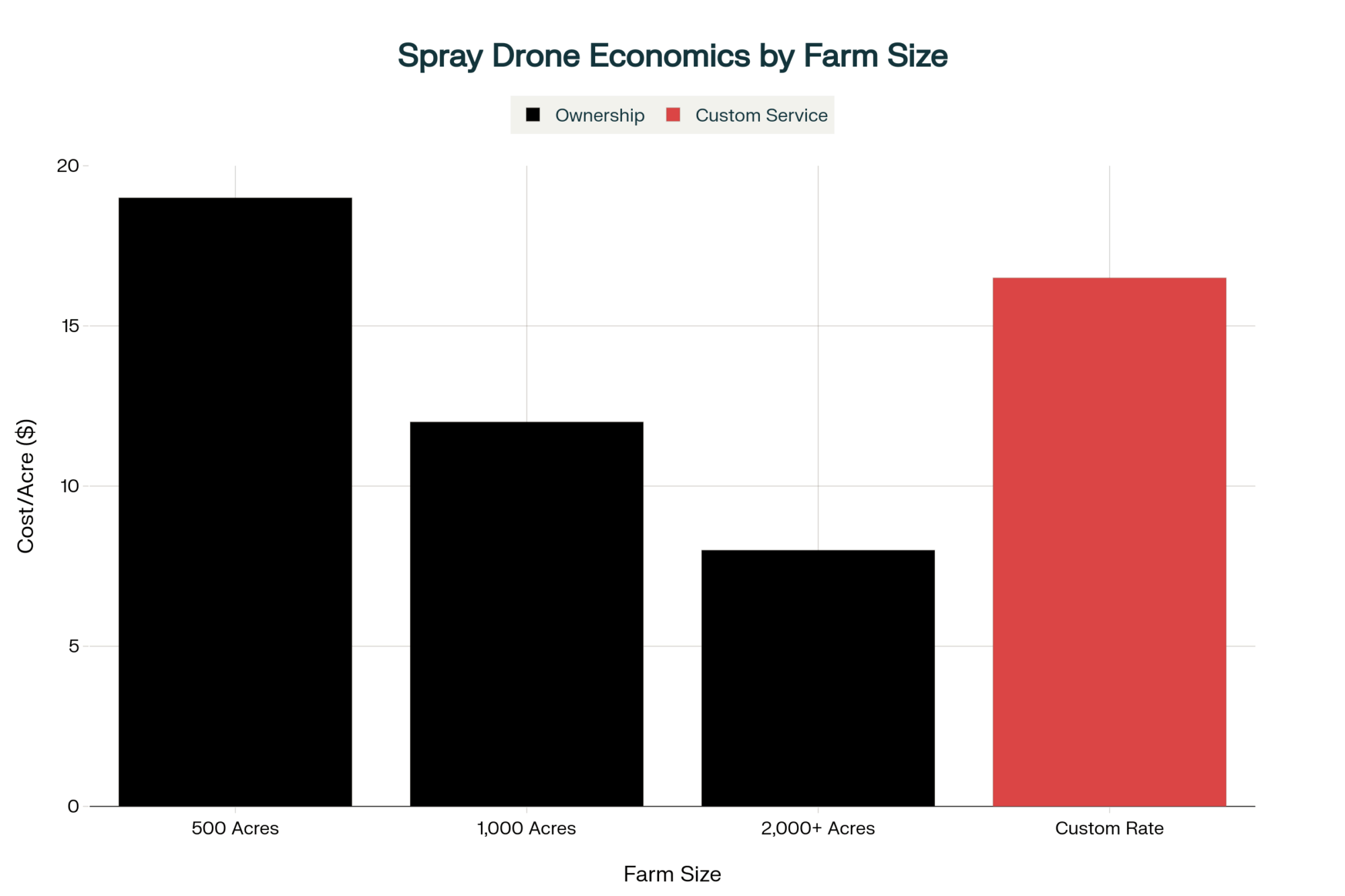
Some research from Midwest Extension programs suggests operating costs as low as $7-$ 8 per acre for high-volume custom operators running 4,000 acres or more annually. But then you talk to smaller operations—say, 500-800 acres—and they’re seeing costs approaching $20 per acre when you factor in depreciation, batteries, insurance, and the value of their time. That’s a huge spread.

The economics shift dramatically by scale—smaller operations face nearly triple the per-acre costs of large-scale producers. Before investing $56,000 in spray equipment, run these numbers for your actual sprayable acres.

But here’s something a producer in Lafayette County, Wisconsin, told me that really stuck: “The per-acre cost becomes irrelevant when it’s the difference between spraying and not spraying at all.”

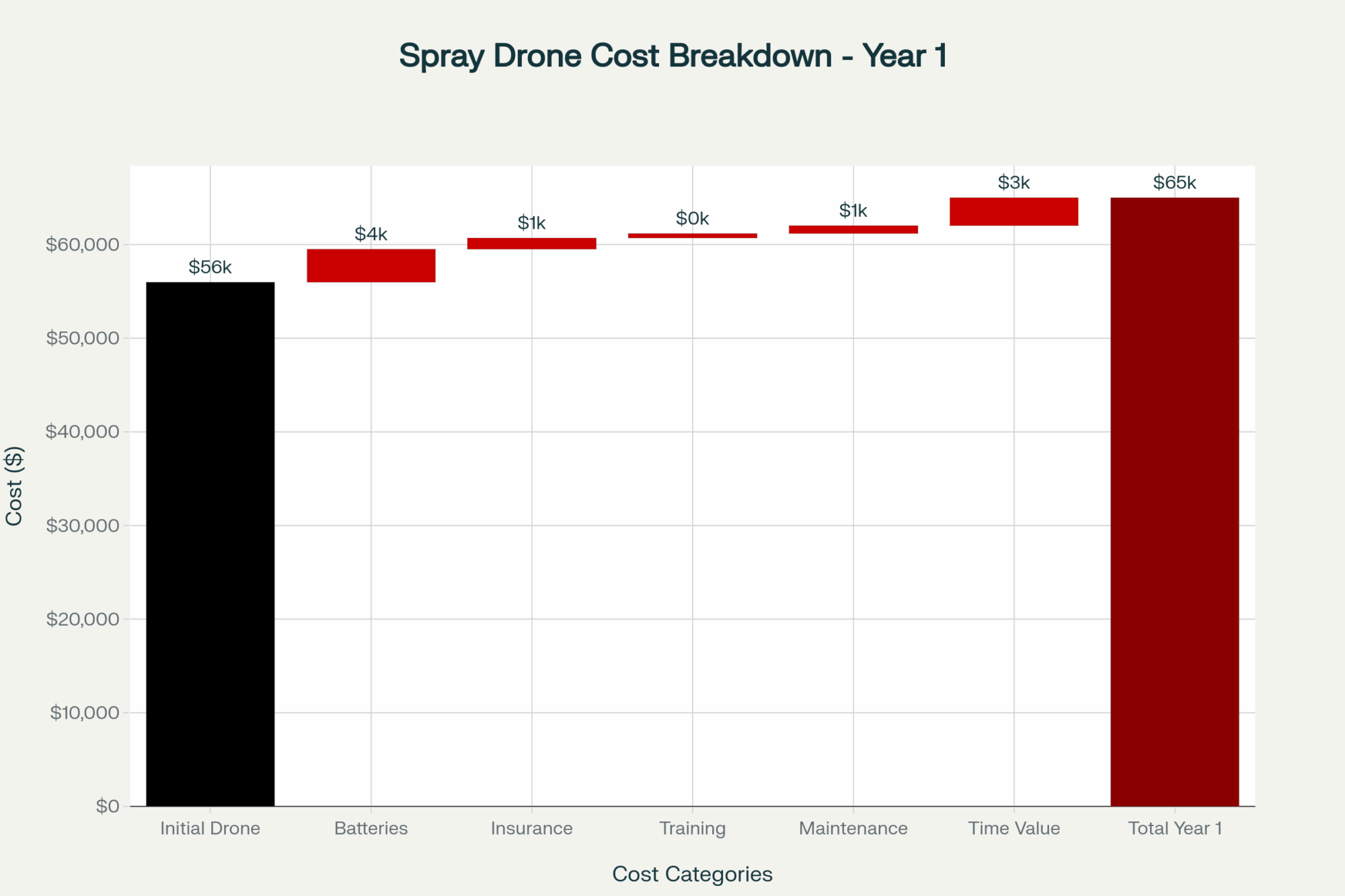
That $56,000 spray drone? Actually $65,000 year one. And batteries alone will cost you another $3,500 annually—every year.

We’ve all seen it—those compacted wheel tracks where corn just doesn’t perform the same. University research continues to confirm yield losses from compaction, sometimes as high as 8-15% in wet conditions. When managing premium silage ground where every ton is needed for your TMR, the drone economics suddenly become more than just application cost.

This past spring really drove the point home across the Great Lakes dairy region. NOAA data shows we had significantly more precipitation than normal during critical application windows. A Rock County producer I know gladly paid $18 per acre for a drone application on 300 acres when his fields were too wet. “Sure, it costs more than doing it myself,” he said, “but waterhemp doesn’t wait for fields to dry out.”

Now, I should mention—I’ve also talked with producers who ran the numbers and decided custom services made more sense for their situation. One veteran applicator near Sheboygan made a good point: “Why complicate things with new technology when my ground rig handles 95% of situations just fine?” There’s wisdom in both approaches.

Where Drones Actually Make Sense (And Where They Don’t)

Only 4 of 6 common scenarios favor drones—and your ground rig still wins for regular field spraying. Choose wisely

What’s becoming clear from both university trials and farmer experience is that the most valuable drone applications on dairy farms often aren’t what the marketing brochures highlight.

Start with scouting. A quality agricultural drone with thermal and multispectral cameras runs about the same as a decent set of flotation tires. Extension specialists tracking adoption patterns report that farmers using drones for regular field scouting are catching problems 5-7 days earlier on average. For something like armyworm moving through your second-cut alfalfa, that timing difference matters.

But here’s where it gets interesting—and where some healthy skepticism is warranted.

Pasture management is showing real promise. Several land-grant universities have published trials on spot-spraying pastures, and the results are encouraging if you’ve got the right situation. One study found treating just problem areas—typically 15-20% of total pasture—delivered equivalent weed control while using 70% less herbicide. Makes sense for those of us working to maintain soil biology and forage density.

Though I should note, a pasture specialist in Vermont raised a fair point: “Sometimes the simplest solution is better grazing management, not more technology.” Worth considering.

Late-season applications in tall corn present another opportunity. When you have premium alfalfa heading into its third cutting with a 7-ton yield potential, or tall corn where your ground rig would snap stalks, aerial application starts looking attractive. Several seed companies report positive results from drone-based fungicide trials, although the response naturally varies by disease pressure and timing.

Some experienced custom applicators I respect aren’t convinced, though. One fellow who’s been spraying for 30 years told me, “I’ve seen every new technology promise to change everything. Most of them just complicate what already works.”

The Market Reality Nobody Wants to Discuss

Custom spray rates crashed 32% in 3 years. At $17/acre today, operators barely clear $5 profit. The gold rush is over

From what I’m hearing at winter meetings and talking with equipment dealers, agricultural drone services are expanding rapidly. Every major ag retailer seems to be adding or exploring drone programs. Equipment dealerships are pushing them hard. And yes, plenty of producers are eyeing custom work to offset their investment.

But here’s what’s got me curious: can this market support all these operators?

In areas like eastern Iowa and central Illinois, where adoption began early, custom rates have already moderated from $22 to $ 25 per acre two years ago to $15 to $ 18 today. Natural market evolution, sure—but challenging if you were counting on premium custom rates to justify a $56,000 spray drone setup.

FeatureScouting DroneSpray Drone
Initial Investment$1,500$56,000
Regulatory BurdenBasic Part 107Part 107 + State Licenses
Training Time25-30 hours100+ hours
Annual Operating Cost$300-500$3,000-8,000
Break-even Timeline6-12 months3-5 years
Problem-solving ValueHigh (early detection)High (emergency applications)

Agricultural economists modeling these markets suggest there’s probably a sustainable ratio—maybe one service provider per 10,000-12,000 suitable acres, varying by region and crop mix. We may already be approaching that density in some areas.

The Regulatory Maze (And It Really Is One)

And here’s where it gets messy—every state seems to have its own take on how drones fit into pesticide regulations.

The FAA requires a Part 107 Remote Pilot Certificate for commercial operations, including use on your own farm. The test costs $175, and according to Wisconsin Farm Bureau’s training program reports, most farmers require 25-30 hours of focused study. Many community colleges now offer preparatory courses, which provide considerable help.

Want to spray pesticides? Now you’re in state-specific territory. Illinois treats drone operators like aerial applicators—requiring commercial licenses and continuing education. Wisconsin has different requirements. Minnesota is different still. Don’t assume—verify with your state department of agriculture.

Ontario producers face even more restrictions. From what I’m hearing at cross-border meetings, Health Canada’s approval process for drone-applied pesticides remains extremely limited. Several Ontario dairymen have told me they’re currently limited to foliar nutrients and biologicals.

Learning from Early Adopters (And Those Who Stepped Back)

Let me share what I’m hearing from producers who’ve actually been through this decision process.

A Holstein breeder near Eau Claire started with a $1,500 mapping drone in 2022. “Learned the rules, figured out what information actually helped,” he told me. Then, in 2023, he hired custom drone spraying for fungicide—wanted to see real results before investing serious money.

By 2024, he bought a 30-liter spray drone. But here’s the key: he had specific uses in mind. Four hundred acres of river bottom that floods regularly. Another 300 acres in odd corners and strips the co-op plane won’t touch. Running about 1,100 acres annually, including some custom work, he estimates his all-inclusive cost at $11-$ 12 per acre. The custom rate in his area is $17.

However, I’ve also spoken with a New Jersey operation in Crawford County that purchased a spray drone in 2023 and sold it this spring. “Too much hassle for the acres we could actually use it on,” the owner explained. “Between weather windows, battery management, and regulatory paperwork, we spent more time fiddling than flying.”

There’s probably wisdom in both experiences.

Technology Is Advancing—But Is That What We Need?

The precision capabilities developing now are genuinely impressive. John Deere’s See & Spray technology can identify individual weeds. University research programs are testing autonomous swarm operations. Variable-rate application based on real-time plant health sensing is commercially available.

However, when discussing dairy producers who juggle fresh cow protocols, TMR consistency, breeding programs, and commodity markets, complex drone operations often fall pretty far down the priority list.

A producer I respect put it well: “I don’t need my drone to do everything the salesman promises. I need it to spray that 40-acre bottom that’s underwater half of May, and check my furthest pastures without burning diesel.”

Some veteran applicators think we might be overengineering solutions. “Good drainage, proper rotation, and timely application with conventional equipment works 90% of the time,” one told me. “Are we solving real problems or creating new ones?”

Practical Thoughts for Different Operations

After tracking this technology and talking with dozens of producers across the dairy belt, here’s how I see it playing out:

For smaller operations (under 1,000 acres), the economics of spray drone ownership are tough to justify in most cases. But a basic scouting drone? That’s different. The information value and time savings can justify that investment pretty quickly, especially if you’re managing multiple scattered parcels.

For mid-sized operations (1,000-2,000 acres), especially those with challenging topography or chronic wet spots, ownership may be a viable option. But run real numbers. Include battery replacement ($3,000-4,000 annually for active use), insurance, training time, and the opportunity cost of your time.

For larger operations or those considering custom work, the economics improve, but competition is increasing. If you’re planning to offset costs with neighbor acres, have a genuine business plan, not just optimism. And understand you’re entering an evolving market.

Everyone should test with custom services first if available. Document results carefully. Compare against your conventional methods. Some producers find that drones solve critical problems; others realize their current system works fine.

QuickReference: Real-World Economics

Operation TypeAnnual AcresDrone Cost/AcreCustom Cost/AcreAnnual SavingsPayback Period
Small Dairy (500 acres)500$20$17-$1,500Never
Medium Dairy (1,000 acres)1,000$12$17$5,00013 years
Large Dairy (2,000 acres)2,000$8$17$18,0003.6 years
Custom Op (4,000 acres)4,000$7$17$40,0001.6 years

Based on producer reports and extension calculations:

  • Small operations (500 acres): $18-20/acre ownership costs are typical
  • Medium operations (1,000 acres): $11-13/acre achievable
  • Large operations (2,000+ acres): $7-9/acre with good utilization
  • Current custom rates: $15-18/acre most markets (down from $20-25 in 2023)
  • Battery replacement: Budget $3,000-4,000 annually for regular use

Looking Forward: Your Decision Framework

What’s become clear is that this isn’t a simple yes-or-no technology decision. Start by honestly documenting your actual challenges. When has a conventional application actually failed you—not theoretically, but actually? Track it for a season.

Because this technology demonstrably works for certain applications. University trials confirm it. Successful operators prove it daily. However, it works best when matched to real problems you actually have, rather than hypothetical benefits from a trade show presentation.

Something a retired extension specialist told me keeps coming back: “Every new technology has its place. The trick is figuring out if that place is on your farm.”

In dairy, where we manage incredibly complex biological and economic systems—from transition cow management through the critical first 100 days to achieving optimal harvest moisture for corn silage—adding technology for technology’s sake rarely makes sense.

One thing seems certain: this technology will continue evolving. Whether through individual ownership, custom services, or cooperative arrangements we haven’t yet imagined, drones will likely become more common. The question isn’t if they’ll fit into dairy farming—it’s how they’ll fit into your specific operation.

Your operation, your challenges, your financial situation, your comfort with technology—these factors matter more than any general recommendation. But at least now you’ve got a framework for thinking it through, based on what’s actually happening in the field rather than what’s promised in brochures.

Next time you’re standing at that field edge, watching it stay too wet while your weeds keep growing—that’s when this conversation shifts from interesting to urgent. It’s better to develop your strategy now, while you have time to evaluate it properly.

Because if these past few wet springs have taught us anything, it’s that having options matters. Sometimes those options come with propellers. Sometimes they don’t. The key is knowing which makes sense for you.

KEY TAKEAWAYS:

  • The economics shift dramatically by scale: Operations under 1,000 acres face $18-20/acre costs versus $7-9 for 2,000+ acre operations, with battery replacement adding $3,000-4,000 annually—run real numbers based on your actual sprayable acres, not wishful thinking
  • Start with $1,500 scouting drones, not $56,000 spray equipment: Producers report catching pest and disease issues 5-7 days earlier with regular drone scouting, delivering immediate ROI through better timing decisions before committing to spray technology
  • Test emergency applications through custom services first: Wisconsin producers paid $18/acre for drone application during wet conditions this spring—expensive, yes, but waterhemp control timing matters more than per-acre cost when fields won’t support ground rigs
  • Pasture spot-spraying shows genuine promise: University trials confirm 70% herbicide reduction with equivalent control when treating just problem areas (typically 15-20% of pastures), preserving soil biology while managing thistles and multiflora rose
  • Regulatory complexity demands homework: Part 107 certification takes 25-30 hours of study plus $175, while pesticide application requirements vary from Wisconsin’s ground equipment rules to Illinois treating drones like aerial applicators—verify your state’s specific requirements before investing

Complete references and supporting documentation are available upon request by contacting the editorial team at editor@thebullvine.com.

Learn More:

  • AI and Precision Tech: What’s Actually Changing the Game for Dairy Farms in 2025? – This article provides a broader strategic look at technology adoption beyond just drones. It details the ROI and payback periods for systems like robotic milking, precision feeding, and automated health monitoring, helping producers prioritize which technology investments will deliver the fastest returns in a tight market.
  • How Large Dairies Are Leading in Precision Tech Adoption – This piece complements the main article’s discussion of scale economics by explaining the specific tools large operations are using, such as autosteering systems and detailed soil mapping. It reveals how these technologies reduce costs and improve sustainability, offering a different perspective from the drone-focused article.
  • The Digital Dairy Revolution: How IoT and Analytics Are Transforming Farms in 2025 – This article moves beyond specific equipment to the underlying data and analytics. It provides a strategic framework for understanding how IoT sensors and AI work together to provide a holistic view of a dairy operation, helping producers leverage data to make smarter decisions about everything from cow health to feeding.

Join the Revolution!

Join over 30,000 successful dairy professionals who rely on Bullvine Weekly for their competitive edge. Delivered directly to your inbox each week, our exclusive industry insights help you make smarter decisions while saving precious hours every week. Never miss critical updates on milk production trends, breakthrough technologies, and profit-boosting strategies that top producers are already implementing. Subscribe now to transform your dairy operation’s efficiency and profitability—your future success is just one click away.

NewsSubscribe
First
Last
Consent

China Killed Our Export Market – But These Dairy Operations Are Actually Growing Because of It

Smart producers turning China’s dairy ban into competitive advantage through domestic consolidation

EXECUTIVE SUMMARY: What farmers are discovering is that China’s 84-125% tariffs on U.S. dairy exports—while devastating for export-dependent operations—are creating substantial opportunities for domestic-focused producers and processors. Wisconsin cheese plants report operating at their highest capacity utilization rates in years as milk previously destined for export powder shifts to domestic cheese production, where consumption remains steady at 33-34 pounds per person annually according to USDA data. Southwest operations are finding transportation cost advantages of $0.12-0.25 per hundredweight when serving Mexico’s growing dairy market under USMCA protection, while Northeast premium producers are seeing increased consumer willingness to pay for locally sourced products during trade uncertainty. University research shows operations implementing efficiency technologies during this margin compression are achieving 15-25% improvements in reproductive performance and feed conversion. The structural shift from export dependency to domestic market strength could create a more resilient foundation for American dairy, particularly for operations that adapt quickly to capture emerging opportunities in food service, premium markets, and treaty-protected alternatives like Mexico. Here’s what this means for your operation: the fundamentals of good dairy farming—efficient feed conversion, strong reproductive performance, and consistent quality—matter more now than ever.

dairy business strategies

While export-dependent operations face genuine challenges from China’s new dairy tariffs, domestic-focused American farms and processors are finding unexpected opportunities. Smart producers are already adapting to turn this crisis into a competitive advantage.

Look, if you’ve been keeping up with the trade news, you know that China has imposed tariffs on our dairy exports, which effectively price most U.S. products out of that market. The Chinese Ministry of Commerce implemented rates ranging from 84% to 125% on various dairy categories in March 2025—and yes, the pain is real for operations that built their business models around export premiums.

Export Reality Check: Mexico and Canada control 86% of top market value while China’s $584M faces 84-125% tariffs

But here’s what caught my attention lately. While some producers are definitely struggling, others are discovering opportunities they didn’t even know existed. When substantial volumes of dairy products that were headed overseas suddenly need to be sold domestically, it creates ripple effects throughout our entire supply chain.

And some of those ripples are actually creating waves of opportunity, depending on how you’re positioned.

What China Actually Did—and Why It Matters

Trade War Escalation: Dairy tariffs skyrocketed from 84% to 125% in weeks, pricing US exports out of Chinese markets permanently

This isn’t really about trade war emotions, though that’s how it’s getting covered. From what I’m seeing in USDA Foreign Agricultural Service reports, China’s been working systematically toward dairy self-sufficiency for years now. They’ve substantially increased their domestic production capacity while securing preferential trade relationships with other suppliers.

The most telling part? New Zealand has secured improved trade access to China’s dairy market through its upgraded Free Trade Agreement, which took effect in January 2024. New Zealand Trade and Enterprise confirms that their dairy products now enjoy complete tariff elimination. While we’re being priced out, other suppliers are receiving preferential treatment.

I think what’s happening here is that these tariffs aren’t negotiating tactics—they’re the final step after China’s already built up alternatives. That’s why the domestic opportunities emerging probably aren’t temporary market adjustments. They’re structural changes that could reshape how we think about dairy marketing for years to come.

The Reality for Export-Heavy Operations

Let’s be straight about what some operations are facing, because the challenges are legitimate. USDA farm financial surveys and university extension dairy economists have been tracking operations that expanded based on export premium assumptions—particularly in the Upper Midwest and parts of California—and many are reassessing their strategies as revenue projections change.

For smaller family operations, that might mean annual revenue reductions of several thousand dollars. We’re talking about milk check impacts that can be meaningful when export premiums disappear—you know how every dollar counts when you’re running on tight margins. University of Wisconsin dairy economics research suggests that these impacts vary significantly depending on the extent to which an operation relies on export market access. For larger operations that expanded specifically to capture export opportunities, the numbers scale proportionally.

As many of us have seen at recent co-op meetings, the National Milk Producers Federation reports that some cooperatives are seeing members reassess their long-term strategies. It’s a tough situation—and I don’t want to minimize what these families are going through, especially those who took on debt to expand for export markets that may not return for years, if ever.

But there’s another side to this story that’s worth understanding.

Domestic Markets Getting Export-Quality Products

So what happens when substantial volumes of dairy products that were destined for export markets suddenly need domestic homes? From what I’m hearing, food service companies and domestic processors are gaining access to export-quality ingredients at prices they haven’t seen in years.

National Restaurant Association member surveys indicate that food service distributors—you know, the companies supplying restaurants, schools, and hospitals—are finding increased availability of high-quality dairy ingredients. When volumes earmarked for overseas markets are redirected domestically, it creates margin improvement opportunities for these buyers.

I’ve noticed that this is particularly pronounced in the foodservice sector, as restaurants and institutional buyers can absorb quality ingredients that were previously export-bound without having to make major adjustments to their operations. It’s one of those situations where challenges in one sector create genuine opportunities in another.

The volume that’s been displaced from export channels has to go somewhere, right? Domestic food service appears to be absorbing a significant portion of it. The encouraging aspect here is that this could create a more stable domestic foundation for our industry—assuming these new relationships remain intact once the dust settles.

Wisconsin Cheese Plants Are Having Their Moment

Hidden Revolution: Butterfat and protein gains drove cheese yields up 12.5% since 2010—creating domestic advantages export-dependent operations missed”

Something that might surprise you is how well-positioned cheese processors appear to be, despite all the export disruptions. Industry surveys from Wisconsin suggest many cheese plants are operating at higher capacity utilization rates than they’ve seen in recent years. And when you think about it, the logic makes sense.

With less milk going to powder production for export, more volume appears to be shifting to cheese manufacturing for domestic consumption. Plants that used to be secondary options for milk procurement—you know, the ones that only got milk when export plants didn’t need it—they’re becoming primary destinations now. They’re potentially running at a higher capacity utilization and gaining more predictable access to milk supply.

Wisconsin Cheese Plants Reach Record Capacity

This makes sense when you consider that domestic cheese consumption stays pretty steady—we Americans eat about 33-34 pounds per person annually, based on USDA Economic Research Service data—regardless of what happens with trade relationships. So these operations have a more stable foundation than export-dependent processing.

Milk Flows Shift as Exports Decline

You know, talking with cheese plant managers in Wisconsin lately, they tell me they’re finally able to plan production schedules around predictable milk supplies. They’re not wondering whether their volumes might get diverted to export operations when premiums spike. That kind of stability… it matters when you’re trying to run an efficient operation, especially when you’re dealing with fresh milk that can’t wait.

Southeast Poultry Finding Multiple Advantages

Now here’s something I didn’t expect when this whole trade situation started unfolding—poultry operations in the Southeast appear to be benefiting from several trends happening simultaneously.

USDA’s National Agricultural Statistics Service data shows that as other protein markets get more volatile due to export disruptions, poultry becomes increasingly competitive domestically. At the same time—and this is interesting—more corn and soy may potentially remain in domestic markets, making feed costs more favorable for poultry operations. And we all know feed typically represents 60-70% of production costs for poultry.

The Southeast has consistently had favorable demographics. Census Bureau estimates show that states like Georgia, North Carolina, and Alabama continue to experience steady population growth. But now they may have feed cost advantages layered on top, which could strengthen their position considerably.

Here’s the thing I keep coming back to: growing populations create built-in demand increases, and that kind of consistent domestic demand is looking pretty attractive when export markets are getting unpredictable. Fresh protein demand doesn’t fluctuate with trade wars—people still need to eat, regardless of what’s happening with international relationships.

Talking with Southeast producers, many operations that were already running efficient systems are now seeing feed cost advantages that make their margins even more competitive co

mpared to other protein sources. It’s one of those situations where being in the right place at the right time really matters.

Regional Advantages Coming into Focus

RegionPrimary AdvEconomicsMarket OppStrategic FocusKey Metrics
SW (TX,NM,AZ)Mexico Access$0.12-0.25USMCA ProtectExport Divers42% Dairy MEX
Wisconsin BeltProcess CapStable Supply10-15% More CapDomestic Cons24.7% Cheese
Northeast PremPremium PosPremium +25-40%Local BrandingValue Products25-40% Margin
Southeast GrthDemographicsFeed Benefits8-12% GrowthPopulation Grth18 States Exp

This trade disruption is revealing competitive advantages that weren’t as obvious when export markets were booming. Geography suddenly matters more when transportation costs become a larger factor in competitiveness—especially with diesel fuel costs continuing to impact hauling expenses across the board.

The Southwest has always been close to Mexico, but with USMCA providing a treaty-based trade framework under Chapter 31’s dispute resolution mechanisms, that proximity could become more valuable. USDA Foreign Agricultural Service data shows Mexico imports significant agricultural products annually from the U.S., with dairy representing a growing segment. For producers in Texas, New Mexico, and Arizona, transportation cost savings can be meaningful compared to shipping from the Midwest.

You probably know this already, but unlike the China situation, USMCA provides binding dispute resolution that isn’t subject to the political mood swings that have made Asian export markets so volatile.

In the Northeast, producers are discovering that premium positioning based on supply chain transparency resonates particularly well with consumers. University research on consumer preferences suggests that “locally sourced” and “never exported” messaging gains traction when people are concerned about trade volatility affecting food supplies.

Vermont and New Hampshire operations that focus on premium dairy products—such as organic, grass-fed, or artisanal cheese—are seeing this trend work in their favor. They’re not competing on commodity pricing; they’re selling quality, transparency, and supply chain reliability. When butterfat performance and protein levels meet consumer expectations for taste and nutrition, premium positioning becomes sustainable.

Technology Getting a Boost from Efficiency Pressure

From what I’m seeing across different operations, this entire situation is accelerating the adoption of agricultural technology. When export premiums disappear and every input dollar matters more, farms start focusing on efficiency improvements rather than just scale expansion.

Precision agriculture software that helps optimize feed allocation, fertility programs, and herd management becomes essential rather than optional. Industry surveys show increased implementation of precision ag tools when margins compress—farmers need to maximize every input dollar, as we all know.

Fresh cow management protocols become even more critical when you can’t rely on export premiums to cover inefficiencies. Transition period nutrition, reproductive efficiency, and early lactation monitoring provide measurable returns that become essential when milk price premiums are under pressure. University research consistently shows that good transition management can significantly reduce metabolic disorders like ketosis and displaced abomasums.

And here’s something worth noting—alternative protein development is getting increased attention, too. When traditional protein supply chains become volatile, consumers and food companies often begin to take alternatives more seriously. Industry analysts report that companies working on plant-based and cellular agriculture are seeing accelerated interest when conventional supply chains face disruption.

Cold chain logistics is another area where domestic focus could create opportunities. When export reliability decreases, domestic distribution infrastructure becomes more valuable. Trade organizations report an increase in investment in domestic cold storage capacity, as companies prioritize supply chain security over global reach.

Premium Dairy’s Quiet Success

Market Shift Reality: Americans consuming record cheese (40.2 lbs) and whey protein (+58.9%) while fluid milk drops—exactly where smart processors are positioned

While commodity producers are dealing with price volatility and export disruptions, premium dairy operations appear to be maintaining relatively stable margins. They’re competing on differentiation rather than commodity pricing—and that’s a fundamentally different business model, isn’t it?

Operations focused on organic, grass-fed, or locally branded products aren’t as exposed to export market volatility. Their customers are paying for attributes that have nothing to do with international trade relationships. When you’re selling organic milk at premium retail prices versus conventional milk at standard prices, export market disruptions don’t directly impact your pricing structure.

Consumer behavior research from various universities suggests that when people see trade uncertainty affecting food supplies, they often become willing to pay premiums for products with clear domestic sourcing and reliable supply chains. For premium dairy operations, that could create sustainable competitive advantages beyond just weathering the current crisis.

America’s Steady Appetite Fuels Wisconsin Cheese Surge

Alternative Export Markets Worth Considering

Look, China was a significant market, no question about that. But there are genuine opportunities in alternative export destinations that might actually prove more stable over time—and some require shorter development timelines than you might think.

Mexico represents one of the most immediate opportunities for many operations. USMCA provides comprehensive dairy market access with established tariff schedules. USDA Foreign Agricultural Service data shows steady demand growth for dairy, beef, and grain products in Mexican markets, with middle-class consumption patterns driving consistent increases in protein demand.

For Southwest operations, the economics can work pretty well. Transportation costs from Texas or New Mexico to major Mexican population centers typically run lower than shipping to West Coast ports for Asian markets. And you’re dealing with a short truck haul instead of extended ocean freight with all the associated risk—that matters when you’re trying to maintain product quality.

If you’re thinking about Mexico markets, here’s where to start:

  • Contact your state department of agriculture’s international trade division
  • Connect with the USDA’s Foreign Agricultural Service resources for Mexico
  • Identify Mexican food processors or distributors through established trade shows
  • Budget adequate time for relationship development and regulatory compliance
  • Expect initial market entry costs that vary by operation size

The European Union offers solid opportunities for premium products, including tree nuts, organic dairy, and specialty crops. EU import regulations often favor U.S. producers over those from developing countries, primarily due to food safety and traceability requirements. There’s definitely demand for products positioned around sustainability and quality, though market development timelines typically require more patience.

Middle Eastern and North African markets exhibit growth potential, particularly in the sectors of wheat, beef, and dairy products. These markets often prefer U.S. suppliers due to reliability and quality reasons, as indicated in USDA Foreign Agricultural Service regional assessments. Religious dietary requirements in these markets sometimes favor U.S. suppliers over alternatives; however, you must also factor in certification costs and specific handling procedures.

Practical Steps for Different Operations

If you’re wondering how to position your operation for this new reality, it really depends on your current situation and regional advantages. But some immediate actions make sense regardless of your size or location.

For operations with significant export exposure:

Risk management makes sense right now. Consider hedging milk prices through CME Class III futures contracts with established commodity brokers. Most dairy risk management specialists recommend hedging a portion of expected production during volatile periods—the exact percentage depends on your risk tolerance and financial situation. You know your operation best.

Strategic culling of lower-performing animals, while beef prices remain relatively strong, can improve both cash flow and herd efficiency simultaneously. Target animals with high somatic cell counts, poor reproductive records, or persistently low milk production—you’re looking at immediate cash plus reduced feed costs going forward.

For processors and cooperatives:

Consider shifting from powder production to cheese manufacturing where possible—this aligns with where domestic demand appears to be strongest. Class III milk prices have historically exhibited different volatility patterns than Class IV, and cheese storage offers more flexibility than powder when export markets are disrupted.

Building relationships with domestic food service companies that may be gaining access to export-quality products at better prices could create new revenue opportunities. Start with regional distributors in your area—they’re often more approachable than the big national players.

Geographic positioning strategies:

Southwest operations should seriously consider developing the Mexican market. Start by connecting with your state department of agriculture’s international trade resources—many states have excellent Mexico programs and can provide guidance on market entry.

Northeast producers can leverage premium positioning and local market messaging, but they need to maintain consistent quality standards and offer clear value propositions. Focus on attributes that consumers can taste and appreciate, such as higher butterfat content, grass-fed claims, and seasonal variations in flavor. You know, the things that actually matter to the end consumer.

Southeast operations may benefit from favorable demographics and potential feed cost trends, especially if you can establish relationships with growing food service markets in major metropolitan areas.

Technology Investments That Actually Pay Off

I think this trade situation is accelerating the adoption of agricultural technology, which probably should have happened years ago. When margins compress, efficiency improvements provide better returns than capacity expansion—the math is pretty straightforward on that.

Precision agriculture tools:

Invest in software that helps with feed allocation, fertility programs, and reproductive management. These technologies typically yield positive returns when implemented effectively, especially when milk prices are under pressure.

Companies offering comprehensive herd management systems report that operations can see meaningful improvements in reproductive efficiency when these tools are used consistently. The key is picking systems that match your operation size and management style—there’s no one-size-fits-all solution here.

Fresh cow management protocols:

Target technologies and protocols that help improve pregnancy rates, reduce days open, and maintain low somatic cell counts. Fresh cow management becomes even more critical—you want to minimize transition period disorders, which can be costly both in terms of treatment and lost production.

Feed efficiency optimization:

Focus on systems that optimize feed conversion. Technologies like precision feeding systems or improved TMR mixing can enhance feed efficiency, which translates directly to bottom-line improvements when margins are tight.

The economics really do shift from “how big can we get?” to “how efficient can we be?” And honestly, that’s probably a healthier foundation for long-term sustainability. When you optimize butterfat performance, protein yields, and feed conversion, rather than just chasing volume, you build resilience that doesn’t depend on volatile export relationships.

Why These Changes Look Permanent

From what I can see in USDA trade data trends and policy documents, China’s actions appear to represent strategic alignment rather than temporary trade friction. China’s State Council has published policy papers outlining its goal of achieving high levels of food security and self-sufficiency, with dairy explicitly included in those targets.

They’ve systematically built domestic production capacity, secured alternative suppliers through preferential trade agreements, and now they’re implementing the final step—eliminating suppliers they no longer need. That’s not negotiating; that’s strategic independence.

And I think what’s happening more broadly is this: global trade patterns are realigning around these new realities. Brazil has substantially expanded its agricultural trade with China, according to the USDA Foreign Agricultural Service tracking. Russia has significantly increased its grain and energy exports to China, despite Western sanctions. Argentina has significantly expanded its commodities trade with China through bilateral agreements.

When infrastructure investment follows new trade patterns, those changes tend to stick even if political relationships improve. Shipping capacity gets reallocated from U.S.-China routes to Brazil-China corridors. Port facilities in South America expand specifically to serve the China trade. The logistics networks that once connected American agriculture to Asian markets… they’re being repurposed for different trade relationships.

What This Means Going Forward

For operations currently dependent on exports, the timeline for adjustment becomes critical. Focus on immediate risk management while developing alternative market strategies. These transitions take time—but genuine opportunities exist, particularly in treaty-protected markets where political volatility is reduced.

For domestic-focused producers, real opportunities may exist in food service and premium markets, where export-quality products could become available at more competitive pricing. Geographic and quality advantages become more valuable when transportation costs and supply chain reliability are more significant than they have been in years.

For everyone, quality differentiation becomes essential as commodity margins compress. Technology adoption focused on efficiency provides better returns than expansion focused on scale. Domestic market strength offers more stability than dependence on politically volatile export relationships.

I keep coming back to this: the crisis might actually force the structural improvements our industry has needed for years. When you can’t rely on export premiums to cover inefficiencies, you get serious about fresh cow management, reproductive performance, and feed conversion. Those improvements make operations more profitable regardless of export market conditions.

The Bigger Picture

From what I’m seeing, this situation might ultimately prove to be the catalyst our industry needed to build a more sustainable foundation. The operations that thrive will be those that recognize domestic market strength and strategic international partnerships provide better long-term value than relying on unpredictable export relationships.

China’s actions appear to represent a completed strategy, not temporary negotiating tactics. They’ve systematically built alternatives, and now they’re implementing the final step. The opportunities emerging from this—domestic market consolidation, premium positioning, efficiency focus—could create competitive advantages that don’t require maintaining relationships with volatile trading partners.

When examining successful agricultural industries globally, the most resilient ones tend to have strong domestic markets as their foundation, with exports serving as value-added opportunities rather than core dependencies. Perhaps this crisis will push American dairy in that direction.

I’ve noticed that operations already focused on domestic markets—whether that’s local premium sales, regional food service, or efficient commodity production for steady buyers—seem to be adapting better to this new reality than those that built entire business models around export growth assumptions.

The fundamentals haven’t changed. Good dairy farming still comes down to efficient feed conversion, strong reproductive performance, and consistent quality production. The difference now is that these basics matter more than ever. China’s tariffs may have disrupted our export markets, but they’ve also reminded us that the strongest foundation for American dairy has always been right here at home—in the cheese plants of Wisconsin, the growing cities of the Southeast, and the premium markets of the Northeast. The real question isn’t whether we can adapt to life without Chinese export premiums. It’s whether we’re ready to build something better.

KEY TAKEAWAYS

  • Cheese processors gaining 10-15% more milk access as Class IV powder production shifts to Class III cheese manufacturing, creating stable procurement opportunities for operations near Wisconsin and regional cheese plants—contact your field representative about long-term supply contracts now
  • Southwest producers can capture $0.12-0.25/cwt transportation savings to Mexican markets compared to Midwest competitors, with USMCA providing treaty-protected access to growing 8-12% annual demand—state agriculture departments offer Mexico market development programs worth exploring
  • Premium dairy operations maintaining 25-40% better margins than commodity producers through differentiation strategies—organic, grass-fed, and local branding resonate when consumers seek supply chain security during trade volatility
  • Technology investments showing 12-18 month payback when focused on efficiency over expansion: precision feeding systems improving feed conversion by 8-15%, reproductive management software increasing conception rates above 40%, and fresh cow protocols reducing transition disorders by 30-40%
  • Risk management becoming essential for export-exposed operations: hedge 60-80% of production through CME Class III futures while beef prices remain strong for strategic culling of bottom 20% performers—immediate cash flow plus reduced feed costs going forward

Complete references and supporting documentation are available upon request by contacting the editorial team at editor@thebullvine.com.

Learn More:

  • Verified Strategies for Navigating 2025’s Dairy Price Squeeze – This practical guide reveals strategies for improving milk checks and defending your bottom line against market volatility. It demonstrates how to use component premiums, strategic culling, and tactical risk management to protect your margins when milk prices are under pressure.
  • Global Dairy Markets: Profit Strategies Amid Tariff Tensions – This article provides a broader market perspective, analyzing global trade dynamics beyond China, including New Zealand’s export success and the impact of geopolitical events on international pricing. It helps producers understand the macroeconomic forces driving market shifts.
  • Robotic Milking Revolution: Why Modern Dairy Farms Are Choosing Automation in 2025 – This case study demonstrates how technology is solving labor challenges and driving efficiency. It reveals how robotic systems are improving milk quality, providing data-driven health insights, and reducing labor costs, offering a path to sustainable growth beyond simple scale.

Join the Revolution!

Join over 30,000 successful dairy professionals who rely on Bullvine Weekly for their competitive edge. Delivered directly to your inbox each week, our exclusive industry insights help you make smarter decisions while saving precious hours every week. Never miss critical updates on milk production trends, breakthrough technologies, and profit-boosting strategies that top producers are already implementing. Subscribe now to transform your dairy operation’s efficiency and profitability—your future success is just one click away.

NewsSubscribe
First
Last
Consent

The $100-Per-Cow Discovery: How Smart Farmers Are Rethinking Robot Feeding for Higher Production

Data-driven: Progressive farms cutting robot pellets 50% report $100/cow savings plus 5-8% production gains after adaptation

EXECUTIVE SUMMARY: What farmers are discovering about robot feeding is transforming how progressive operations think about automation economics. Research from the University of Minnesota and Saskatchewan shows that reducing robot concentrate from 8 kg to 3-4 kg daily—while optimizing PMR consistency—can save $100 per cow annually in feed costs while actually improving production after a 6-8 week adaptation period. This aligns with European operations that have quietly achieved superior robot utilization rates by treating concentrate as motivation rather than a means of nutrition. Dr. Trevor DeVries’ work at Guelph demonstrates that automatic feed push-up systems, combined with minimal robot pellets, create behavioral patterns that support voluntary milking far better than high-concentrate dependency. For producers facing today’s margin pressures, this approach offers a practical path to improved profitability—though success requires patience through the transition and strong PMR management. The conversations happening across the industry suggest that we’re witnessing a fundamental shift in how smart farmers optimize their robotic investments.

robotic milking, dairy profitability, farm efficiency, milk production, feed cost reduction, precision agriculture, dairy nutrition

I recently spoke with a producer in eastern Ontario who completely changed my thinking about robot feeding. After three years of fighting his system—and spending roughly $40,000 extra annually on robot pellets (about $100 per cow in unnecessary feed costs)—he reduced his concentrate by half and saw production actually increase. Now, that got my attention… and it’s part of a larger conversation happening across the industry.

What’s particularly noteworthy is how this builds on what we’ve been seeing in European operations for years, though with important differences for North American conditions. When Tremblay and colleagues published their analysis in the Journal of Dairy Science in 2016, they examined farms across Minnesota, Wisconsin, Ontario, and Quebec. The findings suggested that feeding philosophy might be more important than previously realized.

Why Cows Visit Robots: Rethinking Motivation vs. Nutrition

Here’s something I find fascinating about robotic operations worldwide: the most successful systems often share a common insight—robots seem to work best when cows visit voluntarily for milking comfort rather than primarily for concentrate.

I was at a conference recently where Dr. Greg Penner from the University of Saskatchewan presented research showing substantial PMR substitution when robot concentrate increases. This aligns with what many producers have been noticing—you increase robot pellets, thinking you’re improving nutrition, but the cows just eat less at the bunk. The net effect? Often not what we intended.

What’s interesting about European operations—and I’m curious if others have noticed this—is that they typically feed considerably less robot concentrate than we do. A Danish producer I met last year was running beautifully on just 3 kilograms of pellets. When I asked how he managed cow traffic, he smiled and said, “feed availability at the bunk does more than pellets ever could.”

Now, that’s different from what most of us learned, but it’s worth considering…

The Hidden Premium: Why Robot Pellets Cost More Than You Think

I was reviewing feed costs with a Wisconsin producer last month, and something jumped out at both of us. His robot pellets were running significantly more per ton than the equivalent energy in his TMR—we’re talking a premium that often runs thousands of dollars annually on a 400-cow operation.

This builds on research Dr. Alex Bach has been publishing in the Journal of Dairy Science. While the data is still developing, his work suggests farms that limit robot concentrate while optimizing PMR energy density often see improvements across several metrics. Better rumen health appears to drive everything else—improved production, reduced feed conversion rates, and even higher butterfat and protein levels.

A producer in central Minnesota recently shared something that stuck with me: “I was so focused on getting cows to the robot, I forgot about total nutrition.” After adjusting his program—reducing the robot pellet and improving the PMR—his somatic cell counts decreased, and his butterfat level increased by 0.2%. Sometimes the indirect benefits surprise us more than the direct ones.

For high-heat California operations, the economics shift even more. When cows are experiencing heat stress, feeding concentrate through robots can actually exacerbate the problem. A producer near Tulare told me that switching to minimal robot concentrate with more frequent TMR delivery helped maintain components through last summer’s heatwave.

The 8-Week Reality: What Actually Happens During Transition

Why is making this change so difficult? Well, I think it’s partly psychological. Most of us—myself included—have been conditioned to believe robots need substantial concentrate to function properly. And honestly, for some operations, that might still be true.

Dr. Marcia Endres from the University of Minnesota published fascinating research in 2018 studying automatic milking farms across Minnesota and Wisconsin. What stood out wasn’t just the performance differences, but how feeding patterns created behavioral changes that supported voluntary milking.

The 8-Week Reality: Production rebounds stronger after initial transition dip. Smart farmers who push through weeks 1-3 see 5-8% gains by week 8 – those who quit early never discover this $100/cow opportunity.

Week-by-Week Breakdown

I recently worked with a producer transitioning to lower robot concentrate, and here’s what we observed:

Weeks 1-3: The Anxiety Phase Production dipped about 5-8%, fetch rates increased, and frankly, everyone was nervous. This seems typical based on what I’m hearing from others.

Weeks 4-5: The Stabilization Period Things started settling. The cows developed new patterns, voluntary visits improved, and production began recovering.

Weeks 6-8: The Payoff They were exceeding previous production levels with lower feed costs. However, and this is important, not everyone sees these results, and the adaptation period can test your patience.

What I’ve learned from producers who’ve been through this: those who abandon the transition early never find out if it would have worked. It’s a genuine dilemma when you’re watching that milk check…

Key Questions to Consider Before Making Changes:

□ What’s my current robot utilization rate compared to capacity?
□ How consistent is my PMR quality day-to-day?
□ Do I have labor available for the transition period?
□ What’s my risk tolerance for temporary production dips?
□ Have I documented baseline performance metrics?
□ Are my robots sitting idle during certain hours while overcrowded at others?

Beyond Milkings Per Day: Tracking What Really Matters

Something I’ve been discussing with progressive producers lately: we might be tracking the wrong things. Sure, milkings per day matter, but what about distribution throughout the day? Or total system economics?

A producer near Guelph recently showed me his tracking system. Beyond the usual metrics, he monitors eating time at the bunk, rumination consistency across groups, and—this was clever—robot utilization patterns by hour. He said understanding when his robots sat idle helped him adjust feeding times to smooth out traffic.

Hidden Opportunity: Robots sit idle 35% of the day while overcrowded at peaks. Smart feeding times smooth traffic flow and boost total daily production without adding robots.

Dr. Trevor DeVries from the University of Guelph has published work suggesting automatic feed push-up systems can significantly impact robot performance. The mechanism seems less about total intake and more about behavioral consistency. Each push-up creates a small motivation event, and over 24 hours, those add up.

The principles might be universal—consistency, cow comfort, economic efficiency—but the application varies tremendously depending on your setup, your cows, and your goals.

Regional Realities: Adapting Strategies to Your Environment

Every operation is different—a point I can’t emphasize enough. What works for a 3,000-cow dairy in New Mexico’s dry lot systems won’t necessarily translate to a 150-cow grass-based operation in Vermont’s seasonal pasture environment.

Northern Climate Considerations

I recently visited a producer in Manitoba who made the transition over a period of four months. His approach was methodical: he increased feed push-ups first, improved PMR consistency, and then slowly reduced robot concentrate. He said the key was watching the cows, not just the numbers.

For Northeast producers transitioning to and from seasonal pastures, timing is crucial. Spring turnout creates natural feeding disruption. Some farmers use this transition to simultaneously adjust robot concentrate levels, masking the change within the larger seasonal shift.

Southern Heat Management

For western operations dealing with water restrictions and resulting forage variability, maintaining higher robot concentrate might provide necessary nutritional consistency. An Arizona producer told me, “When your forage quality swings wildly, robot concentrate becomes your safety net.”

Practical Starting Points

For those considering changes, here’s what seems to help:

  • Start with feed bunk management before touching robot settings
  • Document everything—you’ll want to know what worked and what didn’t
  • Consider working with someone who’s done this before
  • Be prepared for the adaptation period—it’s real and it’s challenging

Fresh cow management deserves special mention here. Many producers find these cows benefit from higher robot concentrate during the first 21 days, then gradually transition to the herd’s standard program.

Comparing Traditional vs. Optimized Approaches

FactorTraditional High-ConcentrateOptimized Low-Concentrate
Robot pellet amount7-9 kg/day3-4 kg/day
Feed cost premium$100+ per cow annuallyMinimal to none
Fetch ratesOften 15-20%Typically <10%
Adaptation periodImmediate6-8 weeks
PMR quality requirementsModerateHigh consistency crucial
Best suited forVariable forage qualityConsistent feed management

Building Support: Getting Your Team on Board

One challenge producers mention is resistance from their support team. And honestly, I understand both sides. Feed advisors and equipment dealers have seen what works across many operations. They have valid concerns about dramatic changes.

A producer in Saskatchewan found success by presenting it as a trial with clear parameters. Instead of arguing about philosophy, he proposed a 12-week test with specific metrics to evaluate. His nutritionist became more supportive when they agreed on what success would look like upfront.

What’s encouraging is that some companies are adapting to these changes. I’ve noticed that equipment manufacturers are developing systems with greater flexibility in concentrate delivery. Whether you’re running Lely, DeLaval, GEA, or Boumatic systems, each has its quirks and optimization potential.

Global Lessons, Local Applications

Controversial Reality: Less concentrate correlates with higher production globally. European operations prove what North American farmers are just discovering – robots work best as milking comfort, not feeding stations.

The diversity of successful approaches worldwide is remarkable. Dutch operations often run minimal concentrate with exceptional results—but they also have different genetics, facilities, and economic pressures than we do. Danish systems leverage incredibly consistent forages. New Zealand producers work with seasonal variations that we don’t face.

What can we learn from this diversity? Maybe that there’s no single “right” way to feed robots. The key question isn’t whether to use high or low concentrate, but whether your current approach aligns with your goals and conditions.

Breed considerations matter too. Jersey operations often find different concentrate levels optimal compared to Holstein herds—Jerseys’ higher components but lower volume might justify different feeding strategies.

When Higher Concentrate Still Makes Sense

Let’s be clear: many successful operations achieve excellent results with traditional feeding programs. I know producers getting 95 pounds per cow with 8 kilograms of robot concentrate, and their systems work beautifully.

Fresh cow management often benefits from individualized nutrition through robots. Operations dealing with extreme weather, inconsistent forages, or specific health protocols might find higher concentrate levels necessary.

This season’s feed prices might influence your decision, too. When robot pellets hit premium prices during drought years, the economics of alternative approaches become more compelling. Conversely, when you’ve got excellent quality forages, maybe that’s the time to experiment with reduced concentrate.

The $65,000 Question: Total economic impact exceeds feed savings alone. When you factor in labor, production gains, and component improvements, the opportunity becomes impossible to ignore

The Evolution Continues: What’s Next for Robot Feeding

What excites me about current developments is the ongoing research. Just this year, extension programs across the Midwest have been collecting data on feeding transitions. Feed companies are developing products specifically for robotic systems. Producers are sharing experiences more openly than ever.

I’m particularly interested in how next-generation robots will handle feeding. Will they adapt to our management preferences, or will we see convergence toward optimal strategies? Early indications suggest more flexibility, not less.

For producers facing current margin pressures—and who isn’t these days—exploring feeding alternatives might offer opportunities. Not revolutionary changes, necessarily, but thoughtful adjustments tailored to your specific situation.

The conversation continues, and that’s healthy for our industry. Whether you’re running traditional programs or exploring alternatives, the key is to stay curious and open to what works best for your operation.

After all, the best feeding system is the one that keeps your cows healthy, your robots running efficiently, and your operation profitable. How you achieve that… well, that’s where the art meets the science.

KEY TAKEAWAYS:

  • Economic opportunity: Reducing robot concentrate can save $40,000-50,000 annually for 400-500 cow operations while maintaining or improving production—that’s real money in today’s tight margins
  • Regional adaptation matters: Northern operations benefit from gradual 4-month transitions during stable feed periods, while southern heat-stressed herds see improved components when eliminating slug-feeding through robots
  • Track the right metrics: Focus on robot utilization patterns throughout the day and total system economics rather than just milkings per cow—understanding when robots sit idle reveals optimization opportunities
  • The 8-week commitment: Expect temporary production dips (5-8%) during weeks 1-3, stabilization by week 5, and improved performance by week 8—producers who quit early never see the benefits
  • Team approach wins: Present changes as 12-week trials with clear success metrics to gain nutritionist and dealer support, recognizing their valid concerns while demonstrating what works for your specific operation

Complete references and supporting documentation are available upon request by contacting the editorial team at editor@thebullvine.com.

Learn More:

Join the Revolution!

Join over 30,000 successful dairy professionals who rely on Bullvine Weekly for their competitive edge. Delivered directly to your inbox each week, our exclusive industry insights help you make smarter decisions while saving precious hours every week. Never miss critical updates on milk production trends, breakthrough technologies, and profit-boosting strategies that top producers are already implementing. Subscribe now to transform your dairy operation’s efficiency and profitability—your future success is just one click away.

NewsSubscribe
First
Last
Consent

CME Dairy Market Report – September 25, 2025: Butter Bounces While the Real Story Unfolds Behind Those Zero Cheese Trades

Zero cheese trades today, while butter jumped 2¢—markets signaling a critical shift for Q4 milk checks

Executive Summary: Today’s dairy markets revealed something more significant than the modest 2-cent butter recovery to $1.64/lb might suggest—those zero block cheese trades signal that processors and buyers are locked in a standoff that could shift pricing dynamics in either direction as we head into Q4. What farmers are discovering is that processing capacity constraints, not milk supply, are becoming the real price drivers… Wisconsin and Minnesota plants operating at 95%+ utilization are forcing milk to travel over 200 miles to find homes, fundamentally altering farmgate economics. With income over feed costs sitting at $6.13/cwt—well below the five-year average of $8.50—but still workable given current feed markets, producers face a delicate balancing act. Recent research from TechnoServe’s Brazil program shows that farms implementing strategic cost management and production optimization can achieve a 500% increase in income, even in challenging markets, suggesting that opportunities exist for those willing to adapt. The October 10 USDA Milk Production report looms large, with early indications pointing toward upward production revisions that could test cheese support at $1.60/lb. Smart operators aren’t waiting—they’re positioning for volatility by locking in 25-40% of Q4 production at $17.40 or above, while maintaining flexibility for potential upside.

dairy farm profitability

Today’s modest butter recovery to $1.64/lb masks something more significant developing in dairy markets. That complete absence of block trading? It’s telling us processors and buyers are locked in a standoff that could shift either direction. Your October milk check just got more interesting—though the outcome remains uncertain.

The Numbers That Really Matter

Looking at what happened on the CME floor today, I keep coming back to those 21 butter trades that pushed prices up 2 cents. That’s real commercial interest, not just traders moving paper around. Compare that to cheese blocks—zero trades despite offers on the board at $1.6375. When nobody’s willing to step up and buy cheese even after a quarter-cent drop, the market’s sending a clear signal about price discovery ahead.

ProductPriceToday’s MoveWhat This Means for Your Check
Butter$1.6400/lb+2.00¢Class IV components are recovering, but watch cream supplies
Cheddar Block$1.6375/lb-0.25¢No trades = weak price discovery ahead
Cheddar Barrel$1.6450/lbNo ChangeHolding steady, but for how long?
NDM Grade A$1.1475/lb+0.25¢Export markets are still functioning
Dry Whey$0.6475/lb+0.25¢Protein complex showing some life

Source: CME Group Daily Dairy Report, September 25, 2025

CME dairy prices show butter declining 4.7% while cheese blocks recover, signaling the processing capacity standoff that could determine October milk checks

What’s particularly interesting here is the disconnect between butter’s bounce and cheese’s paralysis. The cream-cheese milk divergence we’re seeing has specific drivers worth examining:

The Cream Surplus Phenomenon: According to data from Terrain Ag’s March 2025 analysis, milk fat levels in U.S. farm milk continue climbing. When milk is sent to new cheese plants and fluid operations, it contains more butterfat than is needed for those products. The result? Surplus cream spinning off into the open market, with cream multiples dipping as low as 0.7 in Central and Western regions.

Regional Processing Constraints: Wisconsin and Minnesota plants are operating at over 95% capacity, creating a bottleneck that forces some milk to travel more than 200 miles to find processing. This isn’t just a logistics headache—it fundamentally alters the economics of milk routing decisions.

The dry whey uptick to $0.6475 might seem small, but that 4.2% weekly gain suggests cheese plants are still running hard. With EU whey futures climbing toward €1,000/MT by next October, there’s room to run if global demand holds.

Trading Floor Intelligence: Reading Between the Bids

The Market Standoff Visualized – Zero cheese trades signal processors and buyers locked in a price discovery breakdown. When nobody’s buying despite available offers, it typically precedes significant market moves. Watch for tests of $1.60 support if this continues.

Here’s what jumped out from today’s action:

  • Butter: 9 bids chasing just one offer (9:1 ratio favoring buyers)
  • Block Cheese: 0 bids against two offers (sellers looking for exits)
  • NDM: 9 bids vs. two offers (decent commercial interest)
  • Dry Whey: 1 bid vs. three offers (balanced but thin)

The cheese situation deserves deeper analysis. Two offers sitting there with zero bids tells me buyers think $1.6375 remains too rich. They’re likely waiting for either the USDA’s October 10th Milk Production report or testing sellers’ resolve.

NDM showed decent activity with 10 trades, and that quarter-cent gain keeps us competitive globally. At $1.1475/lb, we’re just slightly above EU skim milk powder prices when factoring in shipping—that’s the sweet spot for maintaining a stable export flow without being undercut.

Global Markets: Where We Actually Stand

Looking at the international picture, U.S. dairy remains well-positioned despite internal challenges:

  • U.S. Butter: $1.64/lb
  • EU Butter: $2.76/lb (calculated from €5,633/MT)
  • New Zealand Butter: $3.03/lb (from NZX futures at $6,680/MT)

That’s not just a pricing advantage—it’s a competitive moat that should keep exports flowing even if domestic demand softens.

The real story lies in those European futures markets. EU butter holding above €5,600/MT through Q1 2026 tells us their supply situation won’t improve soon. Environmental regulations, high energy costs, and herd reductions have created structural shortages that won’t resolve quickly.

New Zealand’s ramping up for their season, but early reports from Global Dairy Trade suggest production might disappoint. Weather variability and crushing input costs are constraining their output potential.

Feed Costs and the Margin Reality

Current margins sit 28% below historical averages, creating the delicate balancing act that makes October’s production report critical for Q4 positioning

Current Feed Market Snapshot:

  • December Corn: $4.2475/bushel
  • December Soybean Meal: $273.30/ton
  • Estimated daily feed cost per cow: $7.85

With Class III at $17.55/cwt and feed costs at approximately $11.42/cwt, that leaves $6.13/cwt income over feed costs. While not catastrophic, this sits well below the five-year average of $8.50/cwt.

Your Profit Margins Under Pressure – Current income over feed costs sits 28% below the five-year average, squeezing farm profitability. Smart operators are locking in feed costs now while managing production carefully to protect what margins remain.

According to the September WASDE report, released on September 12, 2025, corn production increased to a record 16.814 billion bushels, with yields at 186.7 bushels per acre. This should provide some feed cost stability, though La Niña patterns could disrupt South American production and spike soybean prices.

Production Reality Check: The Numbers Behind the Numbers

The September WASDE report projects 2025 U.S. milk production at 230 billion pounds, up 3.4% from 2024. But regional variations tell the real story:

  • Texas: Up 10.6% (new processing capacity driving expansion)
  • Wisconsin/Minnesota: Up 2.8% (bumping against plant capacity)
  • California: Down 1.2% (HPAI impacts plus water restrictions)

The national herd reached 9.485 million cows, up 159,000 from last year. Production per cow increased just 34 pounds monthly—efficiency gains, but barely. Feed quality issues from last year’s harvest continue affecting component tests.

California’s Water Crisis Impact: As reported, 747 of California’s approximately 950 dairy farms have experienced HPAI. Combined with unprecedented water restrictions on groundwater pumping and surface water storage, the state’s production recovery faces significant headwinds.

What’s Really Driving These Markets

Domestic Demand Indicators:

  • Retail cheese prices: Stuck between $3.49-$4.39/lb
  • Food service: Moving product but not offsetting retail weakness
  • Consumer resistance: Price ceiling clearly established

Export Market Dynamics:

  • Mexico: Down 10% year-to-date, but still our biggest customer
  • Southeast Asia: Vietnam and the Philippines are showing surprising strength
  • China: Quietly pivoting to New Zealand suppliers

Processing capacity emerges as the real bottleneck. New plants coming online in Q4 need milk, which should support farmgate prices. But with existing facilities at maximum utilization, we’re hitting structural ceilings on price potential.

Forward-Looking Analysis: What October Holds

CME futures paint a mixed picture:

  • October Class III: $17.45 (modest optimism)
  • October Class IV: $16.85 (butter uncertainty)
  • Options Market: Implied volatility spiking (confusion, not confidence)

The USDA’s October 10th production report looms large. Early indications suggest potential upward revisions to Q4 production estimates, based on favorable weather conditions. If realized, expect cheese to test $1.60/lb support.

Key Risk Factors:

  • October weather favors production beyond processing capacity
  • Dollar strength continues to pressure exports
  • Consumer spending weakness in discretionary categories
  • Potential Q4 railroad labor disruptions

Regional Spotlight: Upper Midwest Pressures

Regional processing capacity constraints force Wisconsin milk to travel 200+ miles, fundamentally altering farmgate economics and creating the spot premiums worth $0.50-1.50/cwt
RegionProductionProcessingHaulingSpot PremiumKey Challenge
Texas+10.6%Expanding<50 miles$0.25-0.75Labor shortage
Wisconsin/Minnesota+2.8%95%+ Utilized200+ miles$0.50-1.50Capacity maxed
California-1.2%Adequate75 miles$0.35-1.00Water/HPAI
Northeast+1.5%85% Utilized100 miles$0.40-1.20Fluid demand
National Average+3.4%88% Utilized125 miles$0.45-1.15Various

Wisconsin and Minnesota operations face unique challenges beyond simple production numbers:

  • Plant utilization exceeding 95% in most counties
  • Milk traveling 200+ miles to find processing
  • Spot premiums ranging $0.50-$1.50 over class
  • Component levels excellent (4.36% butterfat, 3.38% protein)

The quality premiums tell the real story. Guaranteed consistent volume gets you premiums. Miss a delivery or come up short? Back to class pricing or worse.

What You Should Actually Do About This

On Pricing:

  • Lock 25-40% of Q4 production if you can get Class III above $17.40
  • Leave room for upside participation
  • Focus on downside protection given margin tightness

On Feed:

  • December corn under $4.30 is acceptable, not great
  • Lock 60% of winter needs now
  • Keep 40% open for potential harvest breaks

On Production:

  • This isn’t expansion time
  • Focus on protein over butterfat (premiums favor protein)
  • Adjust rations accordingly, even if volume decreases slightly

On Capital:

  • Delay equipment purchases until Q1 2026
  • Dealers will negotiate more after year-end inventory
  • Preserve cash for operational flexibility

The Bottom Line

Today’s butter bounce and steady cheese prices offer temporary stability in a market that is fundamentally dealing with expanding production, meeting processors at capacity. Those zero block trades aren’t just low volume—they signal deteriorating price discovery mechanisms.

Your October milk check will reflect September’s $17.55 Class III, which remains workable for most operations. Looking ahead, the combination of rising production, maximum processing capacity, and uncertain demand creates significant potential for volatility.

The successful operations won’t be those chasing the highest production or lowest costs. They’ll be those who recognize that we’re in a different environment now—where managing risk matters more than maximizing premiums, where consistent cash flow beats occasional windfalls.

Keep monitoring those basis levels, watch for processing capacity announcements, and remember—when everyone’s worried about the same factors, markets usually find ways to surprise. Position yourself to handle surprises in either direction.

Key Takeaways

  • Lock in margins strategically: Farms securing Q4 production at Class III above $17.40 for 25-40% of volume can protect $6.13/cwt income-over-feed while leaving room for market participation—critical when margins sit 28% below historical averages
  • Optimize for protein premiums: With dry whey up 4.2% weekly and protein premiums running $0.50-1.50 over class, adjusting rations for protein over butterfat can capture an additional $0.75-1.25/cwt even if total volume decreases slightly
  • Manage processing relationships: Guarantee consistent delivery volumes to maintain spot premiums as plants hit capacity—missing deliveries drops you back to class pricing, potentially costing $1.00-1.50/cwt in this tight processing environment
  • Position for regional variations: Texas operations benefit from 10.6% production growth and new processing capacity, while Upper Midwest farms face hauling costs eating $0.50-0.75/cwt—understanding your regional dynamics determines whether expansion or efficiency improvements make sense
  • Prepare for October volatility: The October 10 USDA report could trigger cheese tests of $1.60 support if production estimates rise—farms with 60% winter feed locked at current prices maintain flexibility while those waiting risk La Niña-driven grain spikes

Complete references and supporting documentation are available upon request by contacting the editorial team at editor@thebullvine.com.

Learn More:

Join the Revolution!

Join over 30,000 successful dairy professionals who rely on Bullvine Weekly for their competitive edge. Delivered directly to your inbox each week, our exclusive industry insights help you make smarter decisions while saving precious hours every week. Never miss critical updates on milk production trends, breakthrough technologies, and profit-boosting strategies that top producers are already implementing. Subscribe now to transform your dairy operation’s efficiency and profitability—your future success is just one click away.

NewsSubscribe
First
Last
Consent

How Smart Dairy Producers Are Finding $50-150 More Profit Per Cow

Feed efficiency isn’t just another metric—it’s determining who thrives in today’s tight margins

EXECUTIVE SUMMARY: What’s fascinating about the current dairy economy is how producers who focus on feed efficiency are weathering market volatility better than those still chasing production records. Recent data from land-grant universities confirm that improving feed conversion from 1.55 to 1.65 ECM/DMI can generate $40,000-$ 75,000 in additional annual profit for a 500-cow operation—and that’s with feed costs consuming 50-60% of variable expenses, according to the USDA’s latest numbers. Scandinavian breeding programs have been incorporating these efficiency traits for years, achieving heritability rates between 0.15 and 0.40 that rival traditional production traits we’ve selected for decades. The technology exists, from $35 genomic tests to precision feeding systems with 18-36 month ROI for larger operations, but what’s really driving success is how producers integrate genetics, nutrition, and management rather than tackling them piecemeal. With milk processors increasingly selective about production attributes and lenders beginning to factor efficiency metrics into credit decisions, those operations that move thoughtfully on this now will have significant competitive advantages. The knowledge and tools are available—what matters is thoughtful implementation that fits each farm’s unique situation, whether that’s a 150-cow grazing operation in Pennsylvania or a 3,000-head dry lot in California.

dairy feed efficiency

Certain topics consistently resurface at every meeting, conference, and gathering of producers. Feed efficiency has become one of those discussions—and honestly, for good reason. We’ve tracked this ratio of energy-corrected milk to dry matter intake for years, but lately, it’s shifting from something we monitor in the background to a metric that might determine who stays profitable when markets get tight.

What’s encouraging is the pattern I’m seeing across different operations and regions. Producers who focus intensely on feed conversion generally report better financial resilience, especially when milk prices fluctuate and feed costs… well, when don’t they remain stubbornly high? Not overnight transformations, mind you. But those steady improvements that compound over time? That’s where the real opportunity sits.

Let’s Break Down What These Numbers Actually Mean

Here’s what we know from research coming out of universities like the University of Wisconsin, Cornell, and Penn State. Feed efficiency typically runs between 1.3 and 1.8 ECM per pound of DMI, depending on where your girls are in lactation—that’s been pretty consistent in the dairy science literature for quite a while. Recent work from the University of Wisconsin’s Dairy Management program (2024) confirms these ranges hold true across different production systems. Even the latest research presented at the 2025 Joint Annual Meeting shows similar patterns. But here’s what’s interesting: the economics behind those numbers have shifted considerably.

With feed costs accounting for 50 to 60 percent of variable expenses (and, yes, the USDA’s 2024 cost of production data backs this up year after year), every little bump in that efficiency ratio matters more than it might have five or ten years ago. Simple math, really. When your biggest expense category keeps climbing, managing it better becomes… well, it becomes everything. Feed prices vary significantly by region, too—ranging from $200 to $300 per ton in the Midwest versus $250 to $350 in California, depending on the season.

Feed costs consistently represent the largest single expense for most dairy operations. Even a small increase in efficiency can deliver a substantial impact to the bottom line.

The principle holds whether you’re running a California dry-lot with 3,000 head, a Wisconsin freestall barn with 500, or a grazing system in Pennsylvania with 150. Sure, the specific numbers vary—I mean, desert dairies dealing with heat stress face completely different challenges than those of us managing through Midwest winters—but improving feed conversion? That generally translates to better margins across the board. It is worth noting that Jersey herds often exhibit slightly higher efficiency ratios than Holsteins, while crossbred operations report their own unique optimization points.

When Those “Impressive” Numbers Are Actually Red Flags

Red Alert: When ‘Efficiency’ Signals Disaster – ECM/DMI ratios above 2.0 aren’t efficiency achievements but warning signs of unsustainable body tissue mobilization that destroys fertility and profitability.

This is something we need to talk about more. University research from institutions like the University of Wisconsin-Madison and Michigan State suggests that cows showing efficiency ratios above 2.0—sometimes reaching 2.4—aren’t achieving some magical feed conversion. They’re burning through body reserves at rates that create real problems down the road.

The transition cow research published in the Journal of Dairy Science over recent years is pretty clear on this. When you see excessive body tissue mobilization in early lactation, you tend to see:

  • Conception rates that tank compared to your herd averages
  • Treatment costs that eat up any perceived efficiency gains (and then some)
  • Higher culling rates in cows that should be hitting their stride

It’s that classic situation where what looks fantastic on your morning reports creates expensive headaches by summer. A cow showing exceptional early lactation efficiency through body condition loss? She often becomes that problem cow by mid-lactation. We’ve probably all had those animals—the ones that start strong but fade fast—even if we didn’t always connect the dots back to those early efficiency measurements.

How the System Shapes Our Decisions

One thing worth considering—and this might ruffle some feathers—is how our payment structures influence management choices. The milk check doesn’t care if your cow is maintaining condition while producing sustainably or if she’s essentially eating herself. Volume is volume, components are components, and the check clears the same.

This connects to genetic selection in interesting ways. When the Council on Dairy Cattle Breeding added Feed Saved to the Net Merit index back in 2021, it got about 13 percent of the total weighting. That’s progress, absolutely. But we’re still heavily selecting for production traits that might actually increase total feed consumption rather than improve conversion efficiency. Makes you think about our priorities, doesn’t it?

U.S. genetic selection indices still heavily prioritize production, whereas Scandinavian programs place a significantly higher emphasis on feed efficiency, demonstrating a distinct strategic difference in breeding goals.

And then there’s what I call the specialist challenge. Many operations have different advisors optimizing different aspects—your nutritionist is laser-focused on the ration, your reproductive specialist on pregnancy rates, and your geneticist on their favorite traits. But who’s looking at how it all fits together? It’s understandable, given the increasing specialization of dairy management. Still, you can end up optimizing the parts while missing the whole picture.

Learning from What’s Working Elsewhere

What’s particularly interesting is how Scandinavian breeding programs—especially in Denmark, Sweden, and Norway—have incorporated feed efficiency for years now. Not as the only thing, but as one important piece of the profitability puzzle. They’re using data from commercial farms (not just research herds) to identify genetics that reduce feed requirements while maintaining production.

What is the heritability for these efficiency traits? Generally falls between 0.15 and 0.40, according to published genetic studies from various universities and breeding programs. That’s right in line with many traits we’ve successfully selected for over the past few decades. So the genetic potential is there—it’s more about how we choose to use it.

Why hasn’t this gained more widespread adoption here? Tradition certainly plays a role. Next time you’re at a sale, notice what gets emphasized—it’s still production records, maybe some show wins, but rarely efficiency or lifetime profitability metrics. That takes courage to change. Different operations have different priorities. However, it reveals how deeply certain evaluation methods are ingrained in our thinking.

Practical Approaches That Are Actually Working

Getting Your Numbers Right

Based on what’s succeeding across different operations—and keeping in mind that what works beautifully on one farm might need serious tweaking on another—some patterns are emerging.

First off, you need accurate baseline data. I can’t tell you how many producers discover their estimated feed efficiency is way off once they actually measure it properly. Not because they were doing anything wrong, but because eyeballing it is no longer precise enough. Yeah, measurement systems aren’t cheap. But producers generally say the better decision-making pays for itself pretty quickly—often within 6-12 months for well-managed operations.

Small management adjustments often yield surprising results. Take feed bunk management—just ensuring consistent availability throughout the day. Nothing fancy. Good push-up schedules, adequate bunk space, and keeping feed fresh. These fundamentals don’t require huge investments but can deliver solid returns. Sometimes the basics are basic for a reason.

The Technology Question

Technology definitely has its place, although its implementation varies widely. Some operations dive straight into precision feeding systems and achieve great results. Others build gradually—measurement first, then management tweaks, then maybe technology. Both can work. It depends on your capital situation, your comfort with technology, and your labor availability… there’s no one-size-fits-all solution here.

Companies like DeLaval, Lely, BouMatic, and GEA Farm Technologies offer various precision feeding options, but honestly? The brand matters less than having good support and training. I’ve seen operations struggle with top-tier systems because they didn’t invest in learning how to use them properly. The ROI on these systems typically ranges from 18 to 36 months for operations with over 500 cows, and longer for smaller herds.

Regional Differences Really Do Matter

RegionFeed Cost Range ($/ton)Heat Stress FactorPrimary Challenge
Midwest$200–300LowWeather swings
California$250–350Very HighHeat mgmt.
Southeast$220–320HighHumidity/intake
Northeast$230–330MediumCold stress
Great Plains$180–280MediumDrought conds

What works to optimize efficiency in Arizona’s 115-degree summers bears little resemblance to strategies for Vermont’s minus-20 winters. Missouri grazing operations have completely different optimization points than California’s total confinement systems. Mountain state producers, who deal with elevation and temperature swings, face their own unique set of challenges. And that’s before we even talk about feed availability and pricing differences.

This season has been particularly interesting. Southeast producers dealing with this extended heat and humidity—their intake challenges are real. Meanwhile, Midwest operations are managing through these weather swings, while Pacific Northwest dairies, with their unique forage options, and Great Plains producers are dealing with drought conditions. Everyone has their own puzzle to solve.

These aren’t just academic differences. They fundamentally change which strategies pencil out economically. Heat abatement systems, which are absolutely essential in Texas, are increasingly needed even in Wisconsin during those brutal July heatwaves—climate patterns are shifting, and what worked 20 years ago might not be effective today. Conversely, cold weather housing critical in Minnesota would still be a wasted investment in most of Florida.

The Human Side Nobody Talks About

Here’s something we don’t discuss enough at meetings: the psychological piece of changing management focus. Many of us—myself included—come from families that built successful operations emphasizing production above all else. Changing that approach, even when the data supports it… that takes real courage.

The operations I’ve seen successfully evolve don’t frame it as abandoning what worked before; instead, they focus on building upon it. They talk about adapting proven principles to today’s economic reality. It’s still about excellence in dairy farming. We’re just measuring it more comprehensively than maybe our parents or grandparents did.

And peer influence? That’s huge. When a respected neighbor reports success with a different approach, that carries more weight than any university study or industry recommendation. We’re a community that learns from each other’s experiences. Always have been.

These psychological factors don’t exist in isolation, though. They’re intertwined with the very real economic and environmental pressures reshaping our industry. Understanding how we think about change is just as important as understanding why change is necessary.

Why This Matters More Now Than Ever

Several trends are converging that make efficiency increasingly important—and they’re all connected to those human decisions we just discussed.

Milk processing consolidation continues reshaping how we market milk. While specifics vary by region, buyers are generally becoming more selective about various production attributes beyond just volume and butterfat. Some areas are starting to see pricing that reflects sustainability metrics. That trend isn’t going away.

Environmental considerations keep evolving, too. Whether you’re dealing with methane regulations out West or nutrient management in the Chesapeake watershed, operations producing milk with fewer resources per hundredweight generally have advantages. What’s voluntary today often becomes required tomorrow.

Agricultural lenders are also paying attention. Increasingly, more of them are considering efficiency metrics alongside traditional production measures when making credit decisions. Farm Credit Services and various regional banks are incorporating these factors into their lending criteria. It’s not yet universal, but if you’re planning expansion or need operating capital, it’s worth knowing that this is on their radar.

Some Practical Steps to Consider

If you’re considering focusing more on efficiency, here are some approaches that seem to work—though, obviously, your specific situation will determine what makes sense.

Start with measurement. Even pen-level intake data beats guessing. If you’re already conducting genomic testing (and at around $35 per animal through companies like Zoetis, Neogen, or STgenetics, it’s quite affordable these days), ensure you’re evaluating efficiency traits alongside production markers. The tools are there—might as well use them.

For making changes, many producers find value in balanced genetic selection—picking bulls that perform decently across multiple traits rather than spectacularly in just one or two. Focus on optimizing what you have: consistent feed availability, solid transition cow protocols, and basic comfort measures. These fundamentals often deliver better returns than any fancy technology.

Speaking of technology, those investments might make sense down the road—such as precision feeding, advanced monitoring, and perhaps some automation. But by then, you’ll know what fits your specific operation rather than hoping something works.

The Economics in Practice

Let’s talk real-world impact. Producers report gains ranging from $50 to $150 per cow annually, depending on their starting efficiency and the effectiveness of the implemented changes. A 500-cow dairy that improves efficiency modestly might see $40,000 to $ 75,000 in additional annual profit. Not life-changing overnight, but compound that over several years? That’s serious money.

The Feed Efficiency Profit Ladder – Even modest 0.05 improvements in ECM/DMI ratios deliver $25 per cow annually, while comprehensive optimization approaches $158 per cow – demonstrating why smart producers prioritize efficiency over pure production volume.

The key is to start somewhere and measure progress. You don’t need to revolutionize everything overnight.

Pulling It All Together

After considering this from various angles, a few things seem clear.

First, improving feed efficiency doesn’t mean backing off on production. The successful approaches I’m seeing maintain or even increase total output while reducing input costs per hundredweight. That’s the sweet spot—not less milk, but more efficient milk production.

Second, this isn’t something you can tackle piecemeal. Genetics, nutrition, facilities, management—they’re all connected. I’ve watched operations invest heavily in one area while ignoring others, then wonder why results didn’t match expectations. It rarely works that way.

Third, there’s still an opportunity for operations to move thoughtfully in this direction. Right now, superior efficiency can differentiate your business. Five years from now? It might just be table stakes for staying in the game.

Look, we’re all trying to build operations that are sustainable—financially, environmentally, and personally. Operations we can hand off to the next generation with confidence. Feed efficiency isn’t the magic bullet, but it’s probably a bigger piece of the puzzle than many of us have been treating it.

The knowledge is out there. Research from land-grant universities, data from commercial farms, tools from genetics companies—it’s all available. What’s needed is thoughtful implementation that fits each farm’s unique situation. Your challenges are different from mine, your resources are different, and your markets are different.

What’s your take on all this? I’m always curious to hear what others are seeing in their operations and regions. Sometimes the best insights come from comparing notes with someone dealing with similar challenges from a different angle. Please share your thoughts—whether you think efficiency is overhyped or undervalued, I’d be interested in hearing your perspective.

After all, that’s what makes these conversations valuable—learning from each other while figuring out what works for our own places.

KEY TAKEAWAYS:

  • Producers report $50-150 more profit per cow annually through modest feed efficiency improvements, with measurement systems typically paying for themselves within 6-12 months when properly managed
  • Start with accurate baseline data and simple management tweaks—consistent feed availability, proper push-up schedules, and transition cow protocols often deliver better returns than expensive technology investments
  • Regional differences fundamentally change the economics: Heat abatement essential in Texas is increasingly needed even in Wisconsin’s July heat waves, while cold weather housing critical in Minnesota remains unnecessary in Florida
  • The heritability of feed efficiency traits (0.15-0.40) matches many production traits, yet it only receives 13% weighting in Net Merit, while we continue selecting for genetics that may actually increase total feed consumption
  • By 2030, superior feed efficiency will shift from a competitive advantage to a survival requirement as environmental regulations tighten, processors become more selective, and agricultural lenders incorporate efficiency metrics into lending criteria

Complete references and supporting documentation are available upon request by contacting the editorial team at editor@thebullvine.com.

Learn More:

Join the Revolution!

Join over 30,000 successful dairy professionals who rely on Bullvine Weekly for their competitive edge. Delivered directly to your inbox each week, our exclusive industry insights help you make smarter decisions while saving precious hours every week. Never miss critical updates on milk production trends, breakthrough technologies, and profit-boosting strategies that top producers are already implementing. Subscribe now to transform your dairy operation’s efficiency and profitability—your future success is just one click away.

NewsSubscribe
First
Last
Consent

Your Feed Room’s Hidden $58,400 Leak – And How Smart Dairy Farms Are Plugging It

Smart farms aren’t just switching to digital feed management—they’re discovering money they never knew they were losing.

EXECUTIVE SUMMARY: Recent University of Minnesota research reveals that 100-cow dairies can save $58,400 annually by reducing feed shrink through precision tracking—losses that traditional paper logs simply can’t detect. What’s particularly noteworthy is how mobile feed management systems aren’t just improving efficiency; they’re uncovering waste patterns that experienced operators never saw coming, with some operations discovering 3-8% shrinkage they’d been accepting as normal. With feed costs representing 20-45% of gross income according to agricultural financial consultants, even modest improvements in accuracy can determine yearly profitability. The precision dairy technology market is expanding 9-15% annually as mid-size operations realize they can’t afford to operate blind on their largest expense. Beyond immediate cost savings, these systems are reshaping the relationships between nutritionists and farms, enabling real-time adjustments instead of reactive monthly reviews, and positioning farms for environmental compliance programs that increasingly require detailed documentation. Current feed price volatility makes this visibility particularly valuable—when corn and soy swing dramatically, knowing exactly where every ingredient goes becomes a competitive advantage rather than a luxury.

dairy farm management, dairy profitability, feed efficiency, farm operational optimization, mobile feed management, precision agriculture, dairy technology

You know, I’ve been following the shift toward mobile feed management for a few years now, and what strikes me is how many farms are discovering money they never knew they were losing.

Here’s what’s interesting—Dr. Jim Salfer from the University of Minnesota Extension puts a number on it that really gets your attention: a 100-cow dairy can save $58,400 in one year just by reducing feed shrink from high to low levels. That’s real money walking out the barn door every day… and most operations using paper logs simply can’t see where that shrink is happening.

Hidden Feed Waste: The Money You Never See – Feed waste costs scale dramatically with operation size, but the proportional impact on smaller farms can be devastating. Most operations using paper logs can’t track these losses, making every cow count when margins are tight.

What I’ve found is that this technology isn’t just improving efficiency—it’s revealing losses that were always there but impossible to track. Gary Sipiorski, who does agricultural financial consulting, points out that feed costs range from 20% to 45% of gross income, and if you’re purchasing all your feed, it pushes toward 50% of your milk check. With numbers like that, even small improvements in accuracy can determine whether you’re profitable this year.

This development suggests something important about where our industry is heading. The precision dairy technology market is projected to reach $5.59 billion by 2025, expanding at 9-15% annually, but what’s driving that growth isn’t just bigger farms going high-tech. Mid-sized operations are realizing they can’t afford not to know where their feed dollars are going.

When the Old System Finally Shows Its Cracks

Now, I should mention that I’ve seen some excellent operations that stick with paper and clipboards and do just fine. Usually, these are smaller farms with one consistent mixer operator who’s been doing it for years—someone who knows every ingredient by feel and rarely makes mistakes. There’s something to be said for that kind of experience and consistency.

But there’s usually a specific moment when traditional systems fail spectacularly… and that’s what forces change. As many of us have seen, busy weeks when communication breaks down between shifts can create expensive problems. Ingredients get mixed into the wrong pens, quantities get miscalculated during hectic mornings, and suddenly you’re looking at thousands in losses trying to figure out what went wrong through handwritten notes.

Dr. Mike Hutjens from the University of Illinois—who’s probably forgotten more about dairy nutrition than most of us will ever know—puts it this way: “The problem with paper is you don’t know you have a problem until it’s too late.” And here’s the thing—with feed representing half of total farm expenses according to recent industry data, these mistakes add up fast.

What’s encouraging is that farms making the switch to real-time tracking often discover patterns of inefficiency they’d been accepting as “normal” for years. I’ve noticed that the operations pushing toward digital aren’t necessarily the most tech-savvy farms. They’re often the ones that got tired of losing money on preventable mistakes and decided the investment was worth trying.

What Digital Systems Actually Reveal

Management AspectPaper-Based SystemsDigital Systems
Waste TrackingLimited visibilityReal-time alerts
Cost per Cow/Year$0$15-40
ROI TimelineN/A6-12 months
Labor EfficiencyHigh manual effortAutomated reporting
Data AccuracyHuman error pronePrecise measurements
Integration CapabilityNoneFull herd management
Environmental ComplianceManual documentationAutomated records

Modern mobile feed management captures information that paper logs simply can’t match. When your mixer operator scans a barcode, the system pulls up target ingredients and pen assignments instantly. As each component hits the scale, you’re seeing actual versus target weights with tolerance indicators, live deviation tracking, and alerts if someone’s about to feed the wrong group.

But here’s where it gets really valuable—those post-mix report cards that generate automatically after each batch. They show exact weights, deviations, and final nutrient profiles, then get stored digitally with timestamps. No more hunting through clipboards trying to reconstruct what happened three days ago when butterfat performance started dropping.

Why is this significant? The economics tell the story. Recent work published in Hoard’s Dairyman showed that farms using precision feeding see feed efficiency improvements from 1.55 to 1.75. On a 2,500-cow operation, that translates to $470 per cow annually—roughly $1.2 million to the bottom line. For smaller operations, the proportional impact is often even greater.

Looking at this trend across different regions, I’m seeing some interesting patterns. Up in Wisconsin and Minnesota, where you’re dealing with corn silage that changes dramatically from October through March, that real-time adjustment capability becomes crucial for maintaining consistent milk components. However, I’ve also spoken with California producers who claim that their consistent TMR quality yields different benefits—mainly increased labor efficiency and improved documentation for their sustainability programs.

And if you’re running robotic milking systems—which seems to be happening in a lot of new barns these days—this precision becomes even more critical. Work from the University of Saskatchewan shows that individually targeted diets can boost milk yield by 3.3 kg per cow while maintaining the same dry matter intake. That’s improved efficiency without higher feed costs, which is exactly what we need with current market conditions.

Getting Your Team on Board

You probably know this already, but transitioning experienced operators from intuitive mixing to screen-guided precision takes some finesse. The key is positioning technology as backup support rather than skill replacement—because good feed operators have pride in their accuracy, and rightfully so.

What I’ve found works best is hands-on training where operators mix real rations alongside tech support. When veteran mixers discover their “feel” weights are actually off by pounds of grain, skepticism usually turns to curiosity pretty quickly. Dr. Marcia Endres at the University of Minnesota has studied this transition across 52 farms in Minnesota and Wisconsin, noting that successful adoption almost always involves a gradual process of trust building.

This builds on what we’ve seen with other farm technologies… you can’t just flip the switch overnight. Many operations run mobile apps alongside paper logs for a couple of weeks, letting operators maintain familiar routines while building confidence. Generally, by week three or so, paper becomes obsolete—not because management mandated it, but because operators prefer the precision and immediate feedback.

What’s worth noting is that resistance often comes from operators who’ve built their reputation on mixing accuracy. They see screens as questioning their skills rather than validating them—so you’ve got to frame it right from the start. Make it about helping them be even better at what they’re already good at.

How This Changes Your Nutritionist Relationship

Here’s something that’s caught my attention… real-time feed data is fundamentally changing how nutritionists work with farms. Monthly reviews are evolving from historical post-mortems to continuous collaborative management.

What’s particularly noteworthy is how this is reshaping the role of a nutritionist entirely. Instead of spending half their time driving farm to farm, many consultants are analyzing data patterns across multiple operations. Rather than waiting for lab results to tell them what happened last week, they can access live dashboards showing daily nutrient drift, automated alerts for unusual events, and historical overlays connecting mix deviations to milk components 24 hours later.

This shift requires some service agreements to be restructured. Rather than flat monthly fees, some nutritionists are moving toward more flexible arrangements—base dashboard access for ongoing monitoring, performance incentives tied to income over feed cost improvements, and consultation blocks for real-time scenario testing.

Based on producer discussions and industry reports, nutritionist costs might tick up slightly with these new arrangements—maybe 10-15% in many cases—but the precision enables more profitable recommendations that typically pay for the additional investment several times over. It’s one of those situations where spending a bit more actually saves you money, assuming you’re working with the right consultant.

What’s interesting here is how this technology is creating opportunities for smaller operations to access higher-level nutrition expertise. A consultant can monitor multiple farms remotely and provide more frequent guidance than the old once-a-month visit model allowed.

The Technical Side That Nobody Talks About

And here’s something that often catches many operations off guard: connecting feed management systems with herd management systems can create unexpected challenges. The issue isn’t data compatibility but timing mismatches.

Herd systems typically update pen movements on their own schedule while feed apps track in real time, which can create situations where you’re trying to mix rations for pens that have changed composition since morning. It’s like trying to hit a moving target—particularly during busy periods with lots of fresh cow management or pen moves.

From what I understand, the better systems have found ways to smooth this out—they’ll coordinate data updates and make sure both systems agree before any mix starts. But it’s worth knowing going in that you’ll probably need some patience while everything learns to talk to each other.

Multiple producers report that integration typically takes longer than vendors initially estimate—sometimes several weeks longer than promised—but once it’s working properly, it eliminates a significant amount of the manual pen count adjustments that used to consume time every morning. The key is having realistic expectations and good vendor support during the setup process.

When you’re evaluating systems, ask specifically about:

  • How they handle real-time data synchronization with your existing herd management software
  • What happens when systems go offline or lose connectivity (because it will happen)
  • How long does integration typically take for operations similar to yours
  • What level of ongoing tech support is included versus additional cost
  • Whether you can export your data if you decide to switch systems later
  • How they handle system updates and whether those might disrupt daily operations

I’ve noticed that the farms with the smoothest rollouts are usually the ones that budget extra time for integration and have clear backup plans for when technology hiccups occur.

What the Numbers Really Show

Research on feed efficiency continues to become more compelling. Recent studies show that highly efficient cows produce less methane than low-efficiency cows, even at the same milk yield. A 20-point gain in feed efficiency can reduce methane emissions by approximately 22 tons per year on a 2,500-cow dairy—which matters as environmental programs become more common across different regions.

This aligns with work from Viking Genetics showing that breeding for better feed efficiency can save up to 200kg of dry matter per lactation without compromising production, health, or reproduction. But technology provides immediate improvements while genetic gains accumulate over generations—which is why smart producers are pursuing both strategies.

The environmental piece is becoming more important, too, especially for operations in areas with stricter regulations or those participating in carbon credit programs. Better feed efficiency directly impacts sustainability metrics, and it’s nice when doing the right thing for your bottom line also helps with regulatory compliance and potentially generates additional revenue.

Looking at this from a broader perspective, feed efficiency improvements of just 0.1 units—say from 1.5 to 1.6—typically translate to $60-80 per cow annually in reduced feed costs, depending on your local feed prices and ration complexity. That might not sound like much, but on a 500-cow operation, that’s $30,000-40,000 annually. Real money.

Regional Differences Worth Considering

What I’ve noticed is that results vary quite a bit by region and operation size. In the upper Midwest, where seasonal forage quality changes can be dramatic, the real-time adjustment capability becomes particularly valuable for maintaining consistent butterfat performance through challenging periods.

During Vermont’s recent drought, several farms reported that mobile feed management systems helped them track forage inventory more accurately and adjust rations quickly as feed quality deteriorated. That kind of agility can mean the difference between maintaining production and facing a costly feed crisis.

But operations with more consistent feed ingredients—like some California dairies with year-round access to similar quality forages, or operations in the Southeast with more stable growing conditions—may see different benefits. For them, it’s mainly labor efficiency, better documentation for sustainability programs, and tighter cost control during volatile feed markets.

For extensive grazing operations—and I’m thinking of some of the farms I’ve visited in Missouri, Kentucky, and other regions with significant pasture-based systems—the core benefits remain, but they may find basic tracking sufficient rather than full integration platforms. The late Dr. Robert James from Virginia Tech, who passed away this past August after decades of studying automated feeding systems across multiple production systems, always emphasized that successful implementation depends more on management protocols than technology sophistication.

Current feed price volatility seems to be accelerating adoption in many areas. With corn, soybean meal, and other inputs swinging like they have been this year, several vendors report that real-time ingredient cost tracking alone is justifying investments for many producers who want better visibility into their largest expense category.

Making Sense of the Investment

So what’s this actually going to cost you? Based on vendor discussions and industry reports, basic mobile feed management systems typically run somewhere in the range of $3,000 to $8,000 annually for a mid-size operation, though this varies considerably depending on features, herd size, and integration complexity.

To put that in perspective, let’s do some quick math. If you’re running 200 cows and spending $250,000 annually on purchased feed (which isn’t unusual these days), and the system helps you reduce waste by even 2%, you’re looking at $5,000 in annual savings. That more than pays for most basic systems.

Most farms report seeing payback relatively quickly—often within six to twelve months—though this varies significantly based on current feed waste levels, number of operators, and existing management practices. The operations with the fastest payback are usually those dealing with multiple operators or frequent mixing errors.

Here’s a simple calculation you can do to estimate your potential return: Track your current feed waste percentage (if you don’t know it, industry estimates suggest 3-8% is typical). Multiply your annual feed cost by your estimated waste percentage. If that number is larger than the system cost, you’ve probably got a business case.

The key seems to be matching technology sophistication to your specific operational needs. Basic systems that track batching accuracy and delivery times can provide immediate value for smaller operations or those just getting started. Larger farms or those with complex ration management often benefit from full integration with herd management systems and advanced analytics.

But look, I’m not saying every operation needs to rush into this tomorrow. The question becomes whether the investment makes sense for your specific situation, current pain points, and long-term goals.

Decision Framework for Your Operation

When does mobile feed management make sense? Generally, when specific pain points create measurable losses or inefficiencies. These typically include frequent mixing errors, inventory surprises, communication gaps between shifts, difficulty tracking the source of nutritional problems, or simply wanting better visibility into your largest cost center.

If you’re evaluating this technology, here’s what I’d consider:

  • Operations with documented feed waste above 3%, frequent butterfat or protein swings, or multiple mixer operators usually see the biggest immediate benefits and fastest payback
  • Farms with stable performance seeking efficiency gains or environmental compliance improvements might find it worthwhile for the long-term advantages, even if payback takes longer
  • Very small operations (under 100 cows) with single operators and stable performance metrics might want to wait and see how costs develop, unless they’re planning expansion or facing specific challenges

What’s your current feed waste level? Do you have consistent mixing between different operators? How often do you deal with ingredient shortages or quality issues that require ration adjustments? Are you participating in any environmental programs that require detailed documentation? These questions can help determine whether you’re likely to see quick returns on investment.

When you’re talking to vendors, don’t just focus on features—ask about their track record with farms similar to yours, what ongoing support looks like, and whether you can talk to other producers who’ve been using their system for at least a year. Get references from operations in your region if possible, because local conditions matter.

Implementation Reality Check

Let me be honest with you… I’ve talked to some operations that struggled with these systems initially. Usually, it comes down to not having realistic expectations about the learning curve, trying to implement too much too fast, or not getting adequate vendor support during rollout.

One producer in Pennsylvania told me they had to dial back their expectations during the first few months. “We thought it would solve all our feed management problems immediately,” he said. “What we found is that it gave us better information to make decisions, but we still had to make the decisions and adjust our management.”

Common first-year challenges include adapting to new workflows, occasional connectivity issues, learning to interpret data effectively, and coordinating system updates with daily operations. Most of these are temporary, but knowing they’re coming helps set realistic expectations.

The successful implementations I’ve seen typically involve starting with basic features and gradually adding complexity as the team gets comfortable. Don’t try to revolutionize your entire feed management system in the first month.

The Bottom Line

What’s happening in feed management really reflects a fundamental shift from reactive to proactive farm management. The farms making this transition first—and doing it well—are positioning themselves not just for today’s challenges, but for whatever comes next in terms of market conditions, environmental regulations, and labor availability.

And based on what I’m seeing across different regions and operation sizes, that practical advantage is becoming harder to ignore. As input costs stay volatile and margins remain tight, farms embracing data-driven precision are gaining advantages that build on themselves over time.

The question isn’t really whether digital feed management will become standard—it’s whether individual operations can afford to wait while others capture these efficiency gains. Because when you’re looking at potential savings of tens of thousands of dollars annually, plus better positioning for future challenges… well, that math becomes pretty hard to ignore.

But remember, technology is just a tool. It won’t address poor management practices or resolve fundamental nutritional issues. What it will do is help good managers be even better at what they’re already doing—and in today’s competitive environment, that edge might be exactly what you need.

KEY TAKEAWAYS

  • Quantified waste reduction: Operations typically discover 3-8% feed shrink they weren’t tracking, translating to $30,000-80,000 annual savings for mid-size dairies when systems cost $3,000-8,000 annually
  • Integration advantages: Farms connecting feed and herd management systems eliminate manual pen count adjustments while enabling nutritionists to provide remote monitoring and real-time ration adjustments during volatile markets
  • Regional adaptation strategies: Wisconsin and Minnesota operations find real-time adjustments crucial for seasonal forage quality changes, while California dairies focus on labor efficiency and sustainability documentation requirements
  • Implementation realities: Most successful rollouts involve 2-3 week parallel operation periods, gradual feature adoption, and realistic expectations about 6-12 month learning curves with vendor support
  • Decision framework: Operations with multiple operators, documented feed waste above 3%, or frequent component swings see the fastest payback, while smaller farms with consistent single operators may benefit from waiting as technology costs decline

Complete references and supporting documentation are available upon request by contacting the editorial team at editor@thebullvine.com.

Learn More:

  • The Numbers That Actually Tell the Story – This article moves beyond feed management to show how data-driven decisions in genetics and nutrition can boost butterfat and protein. It provides a strategic view on how component premiums and risk management are becoming more valuable than volume, offering a holistic approach to profitability.
  • June Milk Numbers Tell a Story Markets Don’t Want to Hear – This piece provides a critical economic perspective on market shifts. It analyzes how factors like regional production growth and feed costs are influencing milk prices, revealing why locking in feed prices and focusing on agility are essential strategies for navigating volatility and protecting your bottom line.
  • Danone vs. Lifeway: How a $307M Standoff Proves Grit is the New Milk Check – While not about feed, this article provides a powerful lesson in innovation and speed. It demonstrates how nimble companies are outperforming corporate giants, inspiring producers to rethink their own operations and embrace rapid decision-making to survive and thrive in a fast-changing industry.

Join the Revolution!

Join over 30,000 successful dairy professionals who rely on Bullvine Weekly for their competitive edge. Delivered directly to your inbox each week, our exclusive industry insights help you make smarter decisions while saving precious hours every week. Never miss critical updates on milk production trends, breakthrough technologies, and profit-boosting strategies that top producers are already implementing. Subscribe now to transform your dairy operation’s efficiency and profitability—your future success is just one click away.

NewsSubscribe
First
Last
Consent

Transform Heat Stress into Your Carbon Strategy’s Secret Weapon

Heat-stressed cows produce 23% more methane per gallon while crushing milk yield—turn cooling into your carbon compliance advantage.

What if the same 90-degree day that’s crushing your 2,040-pound monthly milk yield is also sabotaging your environmental compliance goals—and most dairy operations don’t even realize it’s happening?

Here’s a fact that should stop every strategic planner cold: heat-stressed cows produce up to 23% more methane per gallon of milk while simultaneously tanking your production numbers. This isn’t just about surviving summer anymore—it’s about preventing a double financial disaster that’s hitting the dairy industry, with projected costs of $30 billion globally by 2050, while making environmental regulations nearly impossible to meet at current U.S. milk prices, averaging $21.30 per hundredweight.

Heat stress impacts escalate dramatically as THI increases, with methane emissions rising alongside production and fertility losses

You’re facing a hidden crisis that attacks from two angles simultaneously. While you’re focused on maintaining milk production during heatwaves, your operation is unknowingly becoming a methane factory, precisely when you can least afford it. The most productive cows—those genetic investments with superior breeding values that you’ve built your operation around—become your biggest environmental liabilities the moment temperatures push past 68 THI.

The stakes couldn’t be higher. With carbon pricing initiatives spreading across regions and methane regulations tightening, this dual impact threatens to squeeze dairy operations from both revenue and compliance angles. However, cutting-edge research reveals that strategic heat abatement changes everything: it not only protects your milk checks but also serves as your secret weapon for reducing methane emissions while maintaining the productivity that keeps you competitive.

Stop Treating Heat Stress Like Weather—Start Treating It Like the Methane Crisis It Is

Here’s the uncomfortable truth most consultants won’t tell you: the dairy industry’s reactive approach to heat stress is fundamentally flawed and costing you money every single day above 68 THI.

Traditional heat stress management focuses on visible symptoms—such as panting, reduced feed intake, and obvious milk drops—but peer-reviewed research reveals that this reactive approach misses the most expensive damage. By the time you see cows panting, methane intensity has already increased significantly, and rumen efficiency has been compromised for days. It’s like treating a heart attack after the patient collapses instead of monitoring blood pressure proactively.

Most operations still rely on the outdated 80°F threshold for heat stress intervention, but controlled research confirms that metabolic disruption begins at just 68 THI. This 12-degree blind spot costs the average 500-cow operation approximately $15,000-$ 25,000 annually in hidden methane penalties and productivity losses that are not reflected in obvious metrics.

Here’s what the industry doesn’t want you to know about methane and heat stress. Industry literature has long suggested that reduced feed intake during heat stress would naturally lead to a decrease in methane production. However, controlled chamber studies reveal a biphasic response where methane intensity actually increases as heat stress persists, even as absolute emissions initially decline. This means your “low-producing” heat-stressed cows are actually your worst environmental performers per unit of milk.

Challenge Everything: Why Your Genetics Program Might Be Sabotaging Your Climate Goals

Think you’re breeding for the future? Think again. The dairy industry’s obsession with single-trait selection for milk yield has created a genetic time bomb that explodes every time the mercury rises.

The uncomfortable reality is that high-producing animals actually become more susceptible to heat stress due to increased metabolic heat production. We’ve essentially bred cows that are environmental disasters, waiting for the next heatwave. Your highest TPI cows—those $50,000 genetic investments—become methane factories precisely when you need them most productive.

However, here’s where conventional breeding wisdom is turned upside down: genomic research using large-scale datasets reveals that incorporating heat tolerance into selection indices can increase prediction accuracy by up to 10%. This isn’t theoretical—it’s happening right now in operations that are smart enough to challenge the “milk yield at any cost” mentality that has dominated the industry for decades.

Here’s your wake-up call: A recent study found that when exposed to increasing THI levels, cows genetically predisposed to be low methane emitters in comfortable conditions actually increased their methane concentrations under heat stress. Your breeding program for low emissions could be backfiring during hot weather without proper heat abatement.

The Hidden Economic Devastation: What Your Monthly Milk Check Isn’t Telling You

The economic devastation from heat stress extends far beyond production losses—it’s a wealth destroyer that compounds across generations like poorly managed genetics.

U.S. milk production reached 227.8 billion pounds in 2025, with production per cow averaging 2,040 pounds monthly in major producing states. However, this productivity masks a hidden methane penalty that’s creating measurable compliance costs in regions implementing carbon pricing. When heat stress increases methane intensity by up to 23% at the herd level, operations face direct regulatory exposure that compounds with production losses.

Recent modeling studies tracking high-yielding herds have found that heat stress can decrease herd-level milk yield by up to 8.6% when all effects are combined over extended heat periods. For a 500-cow operation producing at current U.S. averages, this represents potential losses of $25,000 to $ 40,000 during extended heat periods, before accounting for environmental compliance penalties.

Small Farms: The Climate Change Casualties Nobody Talks About

Here’s the brutal truth about climate inequality in dairy: smaller farms are getting crushed while big operations adapt.

Research demonstrates that smaller farms (herds with fewer than 100 cows) suffer disproportionately, experiencing average annual yield losses of 1.6% compared to less than 1% for large herds. Following an extreme heat event, small herds can lose 50% more of a day’s yield than large herds. This disparity is largely attributed to the high capital costs of sophisticated mitigation infrastructure, such as large-scale fan and sprinkler systems, which are often beyond the financial reach of smaller operations.

But the transgenerational damage creates the most insidious economic drain. Heat-stressed dry cows produce calves with permanently reduced productive capacity, creating compounding liabilities that research estimates cost the U.S. dairy industry an additional $595 million annually. These “legacy effects” transform heat stress from a seasonal nuisance into a long-term erosion of genetic investment—and your family farm’s future.

Here’s How Smart Operations Turn Heat Management into Competitive Advantage

Stop thinking about heat abatement as a cost center. Start thinking about it as the most profitable investment you’ll make this decade.

Research consistently demonstrates that every dollar invested in effective heat abatement returns $3 to $ 5 in avoided production, reproductive, and health losses annually. However, what most operations overlook is that the environmental benefits generate additional value streams, which could be worth thousands in carbon credits and regulatory compliance advantages.

Comprehensive cooling systems deliver the highest ROI despite greater initial investment, with strategic heat abatement generating 3-4x returns annually

Precision cooling systems that maintain consistent airflow prevent the rumen disruptions responsible for increased methane intensity. Unlike basic shade structures that most farms still rely on, engineered ventilation systems maintain normal rumination patterns and digestive efficiency even during periods of thermal stress, thereby preventing the microbial dysbiosis that drives methane inefficiency.

Dairy cows resting under a barn with strategic fan cooling to reduce heat stress and improve productivity 

The Technology Revolution: Why Precision Monitoring Beats Gut Feel Every Time

Modern heat stress management leverages the same precision agriculture principles, transforming crop production, and the ROI is extraordinary.

Real-time reticulorumen pH and temperature monitoring systems can detect the impacts of heat stress on methane production before visible symptoms appear. This allows proactive intervention rather than reactive damage control. Think of it as the difference between having a cardiac monitor versus waiting for chest pains.

Activity monitoring and data analytics track individual cow responses to thermal stress, providing early detection capabilities that prevent productivity losses before they occur. Operations utilizing these technologies capture market advantages by maintaining stable production and environmental performance, even as competitors struggle.

Benchmark Your Vulnerability: The 5-Minute Heat Stress Audit

Want to know if you’re losing money right now? Answer these questions:

  1. Airflow Test: Can you measure 200+ feet per minute airflow at cow resting height in your three highest-traffic areas? If not, you’re losing money every day above 68 THI.
  2. THI Monitoring: Do you have real-time THI monitoring with alerts at 68 (not 80)? Most operations are flying blind with outdated thresholds.
  3. Water Capacity: Can your system deliver 50+ gallons per cow per day during peak demand? Water limitation amplifies every other heat stress factor.
  4. Methane Baseline: Do you know your current methane intensity (g CH4/kg milk)? Without baseline data, it is impossible to measure improvement.
Heat Abatement StrategyInitial InvestmentAnnual ROIMethane ReductionImplementation TimelineExternal Validation
Precision Fan Systems$200-400/cow3.2:115-20% intensity4-6 weeksJournal of Dairy Science
Smart Sprinkler Systems$150-300/cow2.8:112-18% intensity6-8 weeksAnimal Science Research
Comprehensive Cooling$400-800/cow4.1:120-25% intensity8-12 weeksMultiple Studies
Genomic Selection$60/animal testing150-200%8-15% intensity3-5 yearsNature Scientific Reports

The Genomic Revolution: Stop Breeding for Yesterday’s Climate

Here’s the paradigm shift that separates industry leaders from followers: selecting for heat tolerance isn’t about sacrificing productivity—it’s about protecting your genetic investments from climate volatility.

Heritability estimates for heat tolerance traits range from 0.13 to 0.17, sufficient for meaningful genetic progress. The “SLICK” haplotype, resulting in short, sleek hair coats, dramatically improves heat dissipation and can be incorporated into Holstein populations without compromising milk production potential.

Genomic research indicates that cows predicted to be heat-tolerant through genomic breeding values exhibit less decline in milk output and fewer increases in core body temperature during controlled heat stress events. This isn’t theoretical breeding—it’s practical risk management for operations planning beyond the next lactation.

Why This Matters for Your Operation’s 2030 Planning

With genomic testing costs having dropped below $60 per animal and a documented ROI ranging from 150-200%, the data exist to accelerate genetic selection for climate resilience. However, most operations continue using breeding strategies designed for yesterday’s climate patterns, leaving money on the table that forward-thinking competitors are already capturing.

Recent advances in multi-trait selection indices that balance productivity, heat tolerance, and methane emissions are becoming commercially viable. Operations implementing these strategies today position themselves for regulatory compliance advantages and market premiums as environmental standards become increasingly stringent.

Future-Proofing Your Operation: The Climate Adaptation Imperative

Climate projections make early adoption crucial for long-term strategic positioning rather than short-term comfort.

Models predict that 90% of the Canadian national dairy herd will experience large increases in heat stress frequency, severity, and duration under most climate scenarios. For U.S. operations, climate projections indicate that extreme heat days will become more frequent, resulting in a 30% increase in milk yield losses by 2050.

The competitive advantage extends beyond individual operations. While heat stress affects all dairy farms, those with effective abatement maintain stable production and environmental performance during peak stress periods when competitors struggle. This consistency in both milk delivery and carbon footprint creates market differentiation in an increasingly sustainability-conscious industry.

Three Critical Questions Every Strategic Planner Must Answer Today

Are you prepared for the regulatory reality that methane pricing is no longer theoretical? Several regions have already implemented carbon fees, and methane regulations continue to expand across agricultural sectors. Operations with documented heat stress mitigation can demonstrate measurable emission reductions that translate to compliance value.

Can your current genetic program deliver productivity under 2030 climate conditions? If you’re still selecting purely for milk yield without considering thermal resilience, you’re building vulnerabilities into your herd that will become expensive liabilities within this decade.

Do you have real-time data on the impacts of heat stress, or are you managing by gut feel and reactive intervention? Precision monitoring systems that detect problems before they become visible provide the competitive intelligence necessary for proactive management in an increasingly volatile climate.

The Bottom Line: Your Strategic Imperative Is Now

That 90-degree day scenario isn’t a future threat—it’s happening right now, and it’s costing you money while sabotaging your environmental goals every time temperatures climb above 68 THI.

The research is unequivocal: heat stress creates a devastating double impact where cows produce up to 23% more methane per gallon while making significantly less milk. This isn’t just a summer comfort issue—it’s a year-round threat to both profitability and environmental compliance that will only intensify as climate change accelerates.

Strategic heat abatement solves both problems simultaneously. Cooling investments deliver a 3-to-1 return by maintaining rumen efficiency, which keeps methane intensity low while protecting milk production. Whether through precision airflow systems, intelligent sprinkler cycles, or genomic selection strategies, effective heat management prevents digestive disruptions that drive both productivity losses and increased emissions.

Climate regulations and carbon pricing aren’t going away—they’re expanding. The documented reduction in methane intensity achieved through proper heat abatement creates a measurable compliance value while protecting your operation from significant annual losses that unmitigated heat stress can inflict.

Your 72-Hour Action Plan

Your strategic imperative demands immediate action:

This Week: Audit your current heat abatement systems using the 5-minute vulnerability assessment above. Measure airflow at cow resting height in your three highest-traffic areas—if you’re not consistently hitting 200+ feet per minute, you’re losing money and increasing emissions every day above 68 THI.

This Month: Install real-time THI monitoring with 68-degree alerts (not 80). Contact your genetic supplier to discuss incorporating heat tolerance breeding values into your selection program. Request genomic heat tolerance scores for your current sire lineup.

This Quarter: Calculate your current methane baseline and heat stress economic impact using the ROI framework provided. Develop a 3-year cooling infrastructure plan that qualifies for USDA cost-share programs.

But don’t stop with infrastructure. The operations implementing comprehensive climate adaptation today will capture the market advantages that determine industry leadership in the decade ahead. With U.S. milk production at 227.8 billion pounds annually and rising global demand, the opportunity for decisive action has never been greater.

The dairy operations thriving in 2030 won’t be those that survived climate change—they’ll be those that turned thermal management into a competitive advantage by solving productivity and environmental challenges with strategic, data-driven approaches. Your competitors are already making these investments. The question is: will you lead or follow?

KEY TAKEAWAYS

  • Challenge the 80°F Comfort Zone Myth: Research confirms metabolic disruption begins at 68 THI, not 80°F, creating a 12-degree blind spot that costs average 500-cow operations $15,000-25,000 annually in hidden methane penalties and productivity losses that never show up in obvious metrics.
  • Precision Cooling Delivers Carbon Compliance Value: Strategic cooling investments that maintain 200+ feet per minute airflow at cow resting height prevent rumen disruptions responsible for increased methane intensity while delivering 3-to-1 ROI through avoided production, reproductive, and health losses. With carbon pricing expanding, documented 20-25% methane intensity reductions create measurable compliance value.
  • Genomic Selection for Heat Tolerance Protects Genetic Investments: The “SLICK” haplotype and heat tolerance breeding values (heritability 0.13-0.17) can be incorporated into Holstein populations without compromising milk production potential, while genomic testing costs below $60 per animal deliver 150-200% ROI by protecting productivity under 2030 climate conditions.
  • Small Farm Climate Inequality Demands Immediate Action: Operations with fewer than 100 cows experience 50% higher daily yield losses during extreme heat events compared to large herds, with USDA EQIP funding covering up to 75% of qualified cooling improvements making adaptation accessible for strategic implementation.
  • Future-Proof Through Proactive Management: Climate models predict increasing heat stress frequency with some regions facing 100-300 annual heat stress days by 2050, making thermal resilience essential for maintaining competitive positioning as global dairy production faces potential 4% reduction without comprehensive adaptation strategies.

EXECUTIVE SUMMARY

Stop treating heat stress like weather and start treating it like the methane crisis it is—because your “comfortable” cows are becoming environmental disasters every day above 68 THI. Recent controlled research reveals that heat-stressed dairy cattle produce up to 23% more methane per gallon of milk while simultaneously reducing production by 8.6% when all effects combine over extended periods. This double economic hit costs the U.S. dairy industry $900 million to $1.5 billion annually, with individual operations losing an average of $264 per cow per year from unmitigated heat stress. Small farms suffer disproportionately, experiencing 1.6% annual yield losses compared to less than 1% for large herds, creating a climate-driven consolidation crisis that threatens family operations. While current cooling technologies can offset about 40% of productivity losses during extreme heat, strategic heat abatement delivers 3-to-1 ROI by maintaining rumen efficiency that keeps methane intensity low while protecting milk production. Global projections show dairy production could crash by 4% by 2050 unless operations implement comprehensive climate adaptation strategies that turn thermal management into competitive advantage. Audit your heat abatement systems now and calculate methane reductions using documented improvement factors—your competitors are already making these investments.

Complete references and supporting documentation are available upon request by contacting the editorial team at editor@thebullvine.com.

Learn More:

Join the Revolution!

Join over 30,000 successful dairy professionals who rely on Bullvine Weekly for their competitive edge. Delivered directly to your inbox each week, our exclusive industry insights help you make smarter decisions while saving precious hours every week. Never miss critical updates on milk production trends, breakthrough technologies, and profit-boosting strategies that top producers are already implementing. Subscribe now to transform your dairy operation’s efficiency and profitability—your future success is just one click away.

NewsSubscribe
First
Last
Consent

From Calf to Classroom: Madison Dyment’s Journey to Impact Agricultural Communications in Canada

Ever watched a three-year-old lead a calf into a dusty fair ring, heart pounding, family cheering her on? That’s the day Madison Dyment’s journey began… and, honestly, her dreams are about to change every Canadian farm kid’s future.

The journey ‘From Calf to Classroom’ has taken Madison Dyment across the globe. Whether in a barn or on the shores of Loch Ness, she views the world through the lens of a storyteller, gathering the perspective needed to impact agricultural communications back home in Canada.

The three-year-old girl clutching the lead rope at Centreville Fair in eastern Ontario had no idea she was taking her first steps toward contributing to how Canada communicates about agriculture. The dusty arena filled with the familiar sounds of cattle shifting in their stalls and the excited chatter of farm families gathering for competition created the perfect backdrop for Madison Dyment’s earliest distinct memory—showing a calf named Lilo alongside her older cousins. The sweet smell of fresh bedding mixed with the anticipation that only a county fair can generate. Proud parents and grandparents lined the rail, cameras ready to capture the next generation of dairy advocates in action.

That moment of standing in the show ring, surrounded by family who had dedicated their lives to dairy farming, planted seeds that would eventually blossom into a mission to transform agricultural communications education across her home country. Today, as Dyment finishes her PhD in Agricultural Communications at the University of Florida, that little girl’s dream has evolved into something far more ambitious than simply winning ribbons. She’s on a quest to bring the formal discipline of agricultural communications to Canada—specifically to the University of Guelph—filling a gap that has sent countless students like herself south of the border to pursue their passions.

Roots Run Deep

Roots run deep. Madison Dyment (left) with her family. She credits the unwavering support of her family and her upbringing in the dairy community as the foundation for her passion and her academic journey.

To understand Madison Dyment’s vision for Canadian agriculture, you have to understand where she came from. Agriculture wasn’t just her family’s business—it was their identity, woven into every conversation, decision, and memory. Around the dinner table, conversations flowed seamlessly between heifer development, neighbors’ breeding decisions, and industry trends—a daily masterclass in agricultural communication that Madison absorbed without realizing it.

“Honestly, all of my earliest memories likely involved agriculture in some capacity. I’m blessed to have family on all sides that worked in agriculture, so that really was the world I grew up in, and I wouldn’t have changed it for anything.” Madison Dyment

The phrase “family on all sides” isn’t just casual language—it’s the foundation of her story. Her mother’s family, her father’s family, and her stepfather’s family all represented generations of dairy farmers, most still actively working the land that had shaped their ancestors. This wasn’t a case of one parent bringing agricultural knowledge into a relationship; this was a convergence of dairy dynasties, creating an environment where agricultural excellence wasn’t just expected—it was inevitable.

But Dyment’s agricultural upbringing differed from the traditional farm kid narrative. She never lived on a milking operation; instead, she grew up around a small-scale breeding operation that her family moved to just before she started high school. This unique perspective—being deeply embedded in dairy culture without the daily routine of milking—provided her with a different lens through which to view the industry, one that would prove invaluable in understanding how to communicate the dairy industry’s story to diverse audiences.

“I don’t remember a time when I wasn’t working with heifers in some capacity,” she says, describing how her responsibilities evolved as she grew. When high school arrived, she began milking at a neighboring operation while maintaining chores at home, learning the rhythm of dairy life from multiple angles. This experience of working on both her family’s breeding operation and at a commercial dairy taught her to see the industry from different perspectives—a skill that would become essential in her communications work.

Learning from the best. Madison showing with her stepfather, Jamie, during her formative years. These early lessons in showmanship and animal husbandry instilled a deep respect for the industry she now serves.

Her parents, whom she describes as coming from “a chatty group,” understood that success in agriculture increasingly required strong communication skills. They had witnessed firsthand how dairy farmers faced growing challenges in explaining their practices to consumers, dealing with social media misconceptions, and navigating crisis situations that could threaten their livelihoods. They encouraged her to explore every possible career path—teacher, veterinarian, even marine biologist—but they also recognized something special in their daughter’s ability to bridge the gap between technical agricultural knowledge and the broader world.

The Moment Everything Changed

The pivotal conversation occurred when a young Madison found herself torn between her diverse interests, unaware that the dairy industry desperately needed professionals who could address the increasingly complex communication challenges. Consumer misconceptions about farming practices, social media criticism of dairy operations, and the need for effective crisis communication created new pressures that traditional agricultural education wasn’t addressing.

“My mom was the one who suggested agricultural communications could bring them together,” Dyment explains. “She said I should try to be a professor in that field, and the rest is history.”

But here’s where the story takes a uniquely Canadian twist. Agricultural communications as a formal academic discipline simply didn’t exist in Canada. If Madison wanted to pursue this newly discovered passion—and help Canadian dairy farmers develop the communication skills they increasingly needed—she would have to leave home, not just for a semester abroad, but for the entirety of her advanced education.

This departure represented more than personal sacrifice; it highlighted a critical gap in Canadian agricultural education. While dairy farmers across the country faced mounting pressure to effectively communicate about animal welfare practices, environmental stewardship, and food safety measures, there was no formal educational pathway within Canada’s borders to develop these essential skills.

Learning from the Father of Ag Comm

Guidance from the ‘Father of Ag Comm.’ Madison Dyment pictured with her PhD advisor, Dr. Ricky Telg, at her graduation from the University of Florida. Dyment calls Telg a ‘superhero’ who taught her invaluable lessons about the profession and how to be a good teacher.

The University of Kentucky became Dyment’s first stop on a journey that would eventually lead her to the University of Florida, where she would study under Dr. Ricky Telg, affectionately known in academic circles as the “Father of Ag Comm.” This wasn’t just a catchy nickname—Telg is largely regarded as responsible for how modern agricultural communications programs operate across the United States, developing curricula that address the very challenges Canadian dairy farmers face daily.

“He’s a superhero in so many ways and taught me a lot about the profession, how to be a good teacher, strengthening faith, and giving back to others,” Dyment says of her PhD advisor. Under Telg’s guidance, she began to understand that agricultural communications were far more expansive than she had initially imagined, encompassing everything from crisis management during food safety incidents to helping farmers effectively tell their sustainability stories.

Mentorship in action. Madison Dyment (right) with one of her key mentors, Dr. Jamie Loizzo, in front of the iconic Gryphon statue at the University of Guelph. Dr. Loizzo challenged Dyment to be creative and push boundaries, a philosophy she now brings to her own work.

Working alongside Dr. Jamie Loizzo, another influential mentor, Dyment’s perception of the field continued to evolve beyond traditional “bridging the gap” concepts. Loizzo challenged her to look beyond standard assumptions about what agricultural communications could be, encouraging her to be bold and push boundaries—exactly the kind of thinking needed to address the complex communication challenges facing modern dairy operations.

“Essentially, don’t let the limits of what you see before you dictate how you go about your work,” Dyment explains, describing Loizzo’s influence. “I like to be creative and push boundaries when I can, and she really validated that side of me.”

This mentorship philosophy has become central to Dyment’s own approach to working with students, particularly as she envisions training the next generation of Canadian agricultural communicators. She emphasizes understanding where each person comes from to better help them reach their goals, recognizing that effective agricultural communication requires understanding diverse perspectives—whether from urban consumers questioning farming practices or rural producers defending their methods.

“I want the work I do to really mean something and benefit the groups I care about most.”

Expanding Horizons: Beyond Traditional Boundaries

The agricultural communications field that Dyment discovered at the University of Florida bore little resemblance to her initial understanding, revealing opportunities that could transform how the Canadian dairy industry approaches its biggest challenges. Growing up in Ontario, she had developed what she now recognizes as a narrow view of the discipline.

“I really thought it was all about bridging the gap between ag producers and consumers,” she admits. When she later conducted research with students at the University of Guelph’s Ontario Agricultural College, she found they shared this limited perspective—”the vast majority of them said the same thing, bridging the gap.”

However, while important, bridging the producer-consumer gap represents just one facet of agricultural communications. Through her education, Dyment discovered graduates entering careers in government policy, education, law, agricultural marketing, natural resources industries, digital media creation, rodeo broadcasting, and crisis communications. These transferable skills could prove invaluable for dairy farmers dealing with regulatory compliance, environmental reporting, and public relations challenges.

Consider how agricultural communications training could benefit a dairy farmer facing a social media crisis about animal welfare practices. Rather than relying solely on industry associations or external consultants, farmers with communications training could respond quickly and authentically, using storytelling techniques and digital platforms to share their own experiences. Or imagine dairy producers equipped with the skills to effectively communicate with processors about pricing and market challenges, strengthening relationships that are crucial for long-term viability.

This realization became particularly significant when she began working on international curriculum development, recognizing that Canadian dairy farmers were missing out on educational opportunities that could directly benefit their operations and the industry’s reputation.

Research with Purpose: Serving the Dairy Community

At home in the barn. Madison’s hands-on connection to livestock is the driving force behind her producer-focused research. ‘I want the work I do to really mean something and benefit the groups I care about most,’ she explains.

Dyment’s master’s thesis marked her first significant foray into addressing the Canadian agricultural communications gap, and more importantly, it represented her commitment to producer-facing research that could directly benefit the dairy community. She interviewed Ontario agricultural industry professionals and students at the University of Guelph about prospective curriculum development, laying the foundation for what would become her larger mission.

Her approach reflects a deep understanding of how effective agricultural communication should work—not as something imposed from outside but as something developed in partnership with the farming community. This philosophy aligns with research showing that dairy farmers trust information most when it comes from sources they perceive as credible and understanding of their challenges.

“I want to adequately represent producer experiences and amplify their voices when I can,” she explains, describing her research philosophy. “I want the work I do to really mean something and benefit the groups I care about most, so I try to integrate my research subjects and collaborate with them as much as possible.”

But her dissertation work truly exemplified her research approach—what she calls the “co-creation of knowledge.” Rather than studying her subjects from a distance, she brought participants directly into the research process, creating authentic partnerships that yielded deeper insights about what agricultural communications programs should teach and how they should serve the industry.

“I was able to bring those folks into my work in a real way, and I felt like that allowed them to be incredibly authentic, insightful, and dedicated to the project in a way I’d never experienced before,” she explains.

One of her favorite projects to date exemplifies this collaborative philosophy while showcasing Canadian agricultural innovation: working with the Streaming Science Project, founded by mentor Loizzo, her University of Florida students interviewed scientists, administrators, graduate students, and alumni from the University of Guelph’s Ontario Agricultural College to create a podcast series about science in sustainable agriculture. The project bridged borders, institutions, and disciplines while demonstrating the communication skills Canadian dairy farmers need to tell their sustainability stories.

Focusing Forward. Madison at the 2024 conference for the Association for International Agricultural and Extension Education (AIAEE). As a presenter and peer in her field, she is actively contributing to the global conversation about the future of agricultural communications, from AI to data-driven storytelling.

Looking Forward: Technology, Innovation, and Opportunity

As Dyment begins her professional academic career, she’s acutely aware that agricultural communications is evolving at breakneck speed, presenting both challenges and opportunities for Canadian dairy farmers. Artificial intelligence represents a particularly significant development, offering tools that could revolutionize how farmers manage communications, from automated social media responses to data-driven storytelling about farm performance.

“I like to view AI as a tool for agricultural communicators when used ethically,” she explains, acknowledging both the potential and the hesitations surrounding the technology. For dairy farmers managing complex operations while trying to maintain public engagement, AI-powered communication tools could provide real-time insights about consumer sentiment, help craft appropriate responses to criticism, and even assist in creating educational content about farming practices.

The integration of data and storytelling represents another frontier where agricultural communications training could benefit Canadian dairy operations. Modern farms generate enormous amounts of data about milk production, animal health, and environmental impact. Agricultural communications programs could teach farmers how to transform this data into compelling narratives demonstrating their commitment to sustainability, animal welfare, and food quality—exactly the kind of proactive communication that builds consumer trust.

“We’re at a really exciting time where the discipline is not only growing, but we’re putting new emphasis on things like natural resources and science communication and bringing in a larger variety of students,” Dyment notes. This expansion is particularly relevant for dairy farmers who must communicate about increasingly complex topics, from carbon footprint reduction to precision agriculture technologies.

The Canadian Dream: Coming Home to Serve

A legacy of dedication. For generations, the family story has been written in the dairy barn. This commitment, pictured here with Madison’s grandfather Ray Brown, is the foundation of her ‘Canadian Dream’—to ensure the future of family farms is secure through strong communication and advocacy.

Throughout her educational journey in the United States, Dyment has maintained her focus on Canadian agriculture, particularly the dairy industry, that shaped her childhood. Much of her research continues to involve Canada in some capacity, reflecting her deep connection to home and understanding of the specific challenges facing Canadian dairy farmers.

“I went to the U.S. for school since agricultural communications wasn’t an option of study in Canada, and I still miss home all the time,” she admits. This personal experience has fueled her determination to ensure future students don’t face the same choice between pursuing their passions and staying close to home.

But her vision extends far beyond simply establishing academic programs. When she talks about bringing agricultural communications to Ontario, her eyes light up with the same excitement she felt at three years old in that show ring—the chance to bring something transformative home to the community that shaped her. She envisions Canadian dairy farmers and agriculturalists equipped with professional communication skills to handle crisis situations, engage effectively with consumers, and advocate for their industry with confidence and authenticity.

Her research has demonstrated both the need and interest among Ontario agricultural students and industry professionals for agricultural communications as a program of study. The timing couldn’t be better, as dairy farmers face increasing pressure to communicate effectively about their practices while dealing with processor relationships, consumer concerns, and regulatory requirements.

She’s also encouraged by developments in Ontario and other provinces, noting that Alberta is beginning to introduce some form of agricultural communications. Dyment has also partnered with the University of Guelph, Ontario Agricultural College, on projects, praising their willingness to collaborate and their appreciation for the field. The precedent for international expansion exists, with other colleagues successfully introducing agricultural communications courses and programs to universities in the UK and Australia. Canada’s similarities to the United States could help streamline the process, and the documented need provides a clear foundation for development.

A vision reflected. Madison’s journey required her to look outward for education, but her focus has always reflected inward on her ultimate goal: coming home to serve and strengthen the Canadian agricultural community that shaped her.

A Vision Realized: Transforming Canadian Agriculture

If Madison Dyment could create her ideal project with unlimited resources, the answer comes without hesitation: establish a formal agricultural communications presence at the University of Guelph. This isn’t just professional ambition—it’s a homecoming wrapped in educational innovation that could transform how Canadian dairy farmers engage with their communities and defend their industry.

“I’ve always been incredibly passionate about Canadian agriculture, particularly the dairy industry, and a lot of my research and work still involves Canada in some capacity,” she explains. The goal isn’t simply to replicate American programs north of the border but to create something uniquely Canadian that serves both the educational needs of students and the communication needs of dairy farmers facing distinctly Canadian challenges.

For an industry where family succession is crucial, Dyment’s work represents more than academic innovation—it’s about ensuring the next generation has the tools to advocate for the future of dairy farming. When young farmers can effectively communicate about animal welfare practices, environmental stewardship, and technological innovations, they’re not just defending their operations but building the foundation for long-term industry sustainability.

The impact she envisions extends far beyond course catalogs and degree requirements. She wants to see agricultural communications become a full undergraduate and graduate option at Guelph, training graduates who will strengthen the communication capacity of dairy farms, cooperatives, and industry organizations across Canada. This would equip graduates to handle a range of responsibilities…” or “These graduates would enter the workforce ready to handle a range of responsibilities, including social media management, crisis communication, policy advocacy, and consumer education.

“That would be a dream legacy for me,” she says, describing the vision of Canadian students entering careers that strengthen agricultural communications throughout the country.

Full Circle: From Show Ring to Classroom

Full circle in the show ring. The journey that began with Madison as a three-year-old holding a lead rope now continues as she mentors her younger sisters in the same tradition. This passion for empowering the next generation is at the very heart of her mission.

The journey from that three-year-old showing Lilo at Centreville Fair to a PhD candidate preparing to revolutionize agricultural communications in Canada represents more than personal achievement—it’s a testament to the power of family, mentorship, and unwavering commitment to serving the agricultural community that shaped her.

Crystal Mackay, whom Dyment identifies as one of the pioneers in Canadian agricultural communications, represents the type of professional who has paved the way for what’s coming next. But it will be graduates like Dyment who transform individual excellence into institutional change, creating pathways for future generations of agricultural communicators who won’t have to choose between their passions and their homeland.

As she looks toward the future, Dyment carries with her the values instilled by parents who understood that success in modern agriculture requires both deep technical knowledge and the ability to communicate that knowledge effectively. Around those dinner table conversations, she learned that farming is fundamentally about relationships—with animals, land, communities, and consumers. Agricultural communications simply provide the tools to strengthen those relationships.

She brings the innovative thinking encouraged by mentors who challenged her to expand her vision of what’s possible, combined with collaborative research approaches that ensure farmer voices remain central to any solution. And she maintains the understanding that for dairy farmers facing criticism, misconceptions, and complex regulatory environments, effective communication isn’t just helpful—it’s essential for survival and success.

The potential expansion of agricultural communications education in Canada may have started with a single conversation between a mother and daughter about career possibilities, but it could grow into something much larger—a fundamental shift in how Canada prepares its agricultural leaders to communicate with confidence, clarity, and impact. The entire industry benefits when Canadian dairy farmers can tell their stories professionally, respond to crises with strategic thinking, and engage with consumers through authentic connections.

That three-year-old girl at Centreville Fair couldn’t have known she was taking her first steps toward impacting a field of study. But, the woman she has become understands exactly what that transformation means for Canadian agriculture, and she’s ready to make it happen with the help of her community—one story, one student, one farm at a time.

Key Takeaways:

  • Roots matter. Madison’s love for the dairy industry started with mud on her boots, a calf in her hands, and family by her side. Every kid in a dusty show ring has a story—and sometimes, those roots grow into visionaries.
  • Real mentors change lives. If you’re lucky, your biggest cheerleaders wear barn boots, not business suits. Madison’s journey is a thank-you note to all the parents, teachers, and friends who see the possibilities in us before we can see them ourselves.
  • Your story has weight. From kitchen tables to universities, the details of daily farm life deserve to be heard. When Madison says, “I want the work I do to really mean something and benefit the groups I care about most,” she’s speaking for every producer who’s felt overlooked.
  • Coming home is powerful. Madison left Ontario to chase a dream so she could bring it back, stronger, for others. Sometimes, home is where you find your purpose—and where you plant hope for the next generation.
  • Legacy is built little by little. This isn’t just Madison’s story. It’s everyone’s who’s ever come in from chores a little tired, a little proud, and still willing to fight for something better—for your herd, your community, and maybe… for a future dairy leader ready to take the baton.

Summary:

Madison Dyment’s story isn’t just about a career—it’s about roots, legacy, and a deep love for the dairy world she was born into. From leading her calf, Lilo, through the dust and cheers of Centreville Fair as a tiny kid, to chasing her dream of bringing agricultural communications home to Canada, Madison’s never forgotten the people, the fields, or the kitchen tables that shaped her. Every step of her journey—across provinces, border crossings, and into new classrooms—has been driven by her hope that farm kids like her shouldn’t have to leave home to make a difference. The lessons she learned from her parents and mentors weren’t just about work ethic or academics. They were about listening, connecting, and giving back. Madison’s vision isn’t just academic, either. It’s personal: she wants every dairy kid, every producer, to have a voice powerful enough to stand up for their farm, their family, and their future. This isn’t a story about research and degrees—it’s about heart, about coming full circle, and about making sure Canada’s dairy stories are told by the folks who live them, every single day. Madison’s journey reminds us that sometimes, changing the world starts with one proud little girl and a calf in a show ring—and having the courage to carry your story home.

Join the Revolution!

Join over 30,000 successful dairy professionals who rely on Bullvine Weekly for their competitive edge. Delivered directly to your inbox each week, our exclusive industry insights help you make smarter decisions while saving precious hours every week. Never miss critical updates on milk production trends, breakthrough technologies, and profit-boosting strategies that top producers are already implementing. Subscribe now to transform your dairy operation’s efficiency and profitability—your future success is just one click away.

NewsSubscribe
First
Last
Consent

Ireland’s Grass Growth Story: The €185,000 Divide That’s Reshaping Dairy This Season

€185,000 gap between Irish farms using smart grass measurement—that’s real money sitting in your paddocks right now.

EXECUTIVE SUMMARY: Look, I just dug into some fascinating data from Ireland that’s got me fired up. Weekly grass measurement paired with smart soil management is delivering €185,000 more profit annually for 200-cow operations — and that’s not a typo. We’re seeing northwest Irish farms hitting 68kg DM/ha/day while southeast operations struggle at 35kg. With feed costs up 30% since 2021, even small efficiency gains matter huge. University extensions and Teagasc research back this up — farms using digital measurement tools like PastureBase are beating traditional management by two tonnes DM/ha every year. The ROI math is simple: €15 monthly investment returning €181 per hectare annually. You’ve got to start measuring your grass weekly if you’re not already.

KEY TAKEAWAYS

  • Boost grass utilization by 15-20% with weekly measurement protocols — start with a rising plate meter or digital tools, tracking covers and adjusting stocking rates between 2.5-3.0 cows/ha based on real-time growth data.
  • Correct soil pH above 6.5 for instant productivity gains — Teagasc research shows this single move delivers 1.5 tonnes extra DM/ha in just six months, crucial as 2025 input costs stay elevated.
  • Implement clover integration for biological nitrogen fixation — reliably supplies 70-100kg N/ha naturally, cutting chemical fertilizer costs by thousands while maintaining milk protein levels above 3.4%.
  • Invest in infrastructure that pays back in 18 months — paddock access improvements boost utilization 15-20%, with water systems averaging €8,500 providing drought resilience that’s priceless given climate volatility.
  • Track your data like your margins depend on it — because they do. Farms using digital grass management tools are seeing €181/ha annual benefits while traditional gut-feel operations leave serious money on the table.
dairy farming, grass management, feed efficiency, precision agriculture, farm profitability

The thing about grass growth in Ireland this year is the story it’s telling — one of two very different seasons playing out across the country, and each with serious implications for your bottom line.

Look up northwest and you’re seeing pastures pumping out around 68kg of dry matter per hectare per day, according to PastureBase Ireland. Down southeast, it’s half that — about 35kg DM/ha/day. This isn’t just a quirk of weather; this nearly double growth rate is putting tens of thousands of euros back into farms every year.

To really put numbers to it: If you run a 200-cow operation, this means daily feed costs could be off by €2.54 per cow, adding up to more than €185,000 a year, based on a full 365-day grazing season, from recent Teagasc insight.

What’s Behind This Geographic Lottery

So, what’s driving this divide? Met Éireann’s latest data sheds light on steady soil temperatures around 14–16°C, which, along with reliable rain, feed the grass pulse in the northwest. However, irregular rainfall and more variable soil temperatures hinder the southeast’s growth.

But here’s the thing: weather is only part of the pattern. The real difference is in how farms handle their grass. Top-tier operations are regularly hitting 15.2 tonnes of dry matter per hectare annually — again, Teagasc’s data makes that clear, which is a target well within reach for over half of Irish producers willing to tighten their management.

“Farms that really maximize grass utilization are seeing their infrastructure investments pay back within 18 months on average, with returns exceeding 35% a year.”

— Dr. Michael O’Donovan, Teagasc

That’s not just grass growing — it’s serious capital unlocked by smart management.

The Management Playbook That’s Working

What strikes me about the smarter management approaches is how they’re not rocket science, just disciplined execution:

Stocking rates that adapt weekly, typically ranging from 2.5 to 3 cows per hectare, rather than a one-size-fits-all approach. Strategic removal of surplus grass once swards hit around 1,700kg DM/ha, locking value in by baling at market prices near €46 per bale. There’s also widespread adoption of strip-wire grazing systems, which balance upfront costs against improved grazing efficiency, often paying for themselves within two seasons.

Southeastern farms are making their own moves, focusing on expanding their water infrastructures and embracing clover for its magic trick — biological nitrogen fixation, which, as recent Teagasc studies show, reliably supplies 70 to 100 kg N/ha naturally, slashing chemical fertilizer needs.

The Digital Edge That’s Changing Everything

And speaking of tech, I’ve been hearing from our friends over at Teagasc’s tech division about farmers who are riding the digital wave with PastureBase Ireland, gaining an extra two tonnes DM/ha annually because their decisions are data-driven, not guesswork.

For just about €15 a month on these tools, the returns can run upwards of €181 per hectare per year — even on small farms, that’s no small change.

What excites me is the potential coming from innovations like Origin Digital’s GrassMax, which promises to save grassland farmers over €1,600 annually by reducing the time spent chasing numbers in the field.

The Regulatory Reality Check

Meanwhile, the regulatory axe is swinging. That nitrogen derogation drop from 250kg to 220kg per hectare, impacting roughly 3,000 farms, nudges more producers into clover and efficient nitrogen management, turning a regulatory pain into a competitive edge.

Another key pressure point is input cost inflation, which has increased by roughly 30% since 2021 and shows no signs of letting up. For those clinging to legacy models, this spike is a wake-up call.

As dairy strategist David Kennedy recently said, “Maintaining a 95% grass diet when costs are soaring is a delicate balancing act. Those ignoring optimization risks will get left behind.”

What This Means for Your Operation Right Now

So, what does this mean for your farm? First, stop thinking measurement is optional. If you aren’t measuring grass weekly, you’re leaving tonnage on the table. For instance, Teagasc research shows that simply correcting soil pH to above 6.5 can net an extra 1.5 tonnes DM/ha in a single season.

If you’re in northern or western parts of the country, your growing season is a gift — push stocking rates, capitalize on wider rotations, and keep a hawk’s eye on grass availability.

If you’re located in the southeast, the focus shifts to efficiency, including water management, clover seeding, and strategic supplementation during periods of tightness to maintain high milk solids.

Investments are never cheap, I know. However, good paddock access can boost grass utilization by 15-20%, and the water systems that maintain production during drought tend to pay for themselves over a few seasons, averaging around €8,500 per installation.

The Bigger Picture

This isn’t just a blip or seasonal trend. It’s a structural realignment reshaping the profitability landscape of Irish dairy, even as broader European competitors grapple with shrinking herds and stricter environmental regulations.

Here’s the risk: legacy approaches won’t work anymore. Your input costs have increased by about 30% in the past four years, and the regulatory pressure is intensifying.

But for those willing to embrace change, who base decisions on real-time data, who keep their paddocks lean and soils fertile — that’s where the true competitive edge lies.

The Bottom Line

For Northwest Farms: Maximize Your Natural Advantage. Push those 300+ day growing seasons hard with tight rotations and strategic surplus management.

For Southeast Operations: Focus on efficiency multipliers — water infrastructure, clover integration, and precision supplementation to maintain milk protein above 3.4%.

For All Producers: Weekly grass measurement is no longer optional. The €181/ha annual benefit from better decision-making pays for itself many times over.

Investment Priority: Infrastructure that improves access and utilization. These aren’t costs — they’re competitive advantages that compound year after year.

What’s your grass data telling you? And more importantly, what story are you running this season?

Because in this business, the farms that write their own story instead of letting market conditions dictate it… Those are the ones that remain standing when everything settles.

Bottom line? Your grass is either making you money or costing you money. There’s no middle ground anymore. Time to get measuring.

Complete references and supporting documentation are available upon request by contacting the editorial team at editor@thebullvine.com.

Learn More:

Join the Revolution!

Join over 30,000 successful dairy professionals who rely on Bullvine Weekly for their competitive edge. Delivered directly to your inbox each week, our exclusive industry insights help you make smarter decisions while saving precious hours every week. Never miss critical updates on milk production trends, breakthrough technologies, and profit-boosting strategies that top producers are already implementing. Subscribe now to transform your dairy operation’s efficiency and profitability—your future success is just one click away.

NewsSubscribe
First
Last
Consent

When China Slammed the Door: The Export Crisis That’s Reshaping Every Dairy Operation

Everyone chased China’s export gold rush. Here’s why the producers who focused on efficiency are thriving while others struggle.

EXECUTIVE SUMMARY:  Look, I’ve been tracking this China mess since those tariffs hit, and here’s what’s really happening out there. The producers who built their entire strategy around export volume are getting absolutely hammered right now – we’re talking about margins that dropped to $10.42 per cwt in April, the lowest all year. But here’s the kicker… the guys who focused on feed efficiency and kept their conversion ratios below 1.35 pounds of dry matter per pound of milk? They’re still cash-flow positive while their neighbors are bleeding money. Mexico stepped up huge, buying $1.04 billion worth of our stuff through May, but that’s not going to save operations that can’t control their costs. The spring flush hit 1.5% production growth right when demand collapsed – perfect timing, right? You’ve got to diversify your risk management beyond just DMC coverage and start building those direct processor relationships that are paying $1.50-2.00 per cwt premiums over Class III.

KEY TAKEAWAYS

  • Feed efficiency is your lifeline – Operations hitting below 1.35 feed conversion ratios are seeing $180 monthly savings per cow, which literally means the difference between positive and negative cash flow when corn’s sitting at $4.10-$4.50 per bushel. Start obsessing over your TMR protocols now.
  • Mexico’s your new best friend – They’re buying 35% of our export volume at strong peso rates, so if you’re still chasing commodity pricing instead of building direct relationships with processors serving Mexican markets, you’re missing serious money on the table.
  • Risk management needs an overhaul – DMC at $9.50 per cwt plus DRP coverage isn’t enough when trade wars hit this hard. The smart money is locking in those processor premiums and keeping 6 months of operating expenses in cash reserves.
  • Strategic culling beats hope – With beef prices strong and margins compressed, your highest-cost, lowest-producing cows should be headed to market instead of expensive feed through negative margin periods. This isn’t temporary – it’s the new normal.
  • Technology edge separates winners from losers – Robotic milking systems and precision feeding are delivering 15-20% better efficiency than conventional operations, worth about $400 per cow annually. That’s not luxury anymore, that’s survival equipment.
dairy export markets, feed efficiency, risk management, dairy profitability, precision agriculture

You know that sinking feeling when you’re going through the mail and your milk check is… well, let’s just say it’s not what you expected? That’s exactly what happened to me when I started digging into May 2025’s export numbers. Sure, everyone’s talking about 13% growth – sounds fantastic on paper, right? But here’s what’s really got me concerned… when you actually peel back those headlines, there’s a story developing that’s going to hit every single one of us milking cows.

The China Situation – And Why This Changes Everything

Let me just lay this out straight. What happened with China in May 2025 wasn’t a temporary trade spat that would be worked out in a few months. We’re talking about tariffs that went from 10% to a devastating 84-125% in the span of a few months. That’s not negotiation – that’s economic warfare.

The numbers are honestly brutal when you break them down. Before all this started, China was a massive customer for our whey and nonfat dry milk – we’re talking hundreds of millions in annual sales that just… disappeared. Think about that for a second. When you lose that kind of volume overnight, you don’t just feel a pinch – you get absolutely steamrolled.

And boy, did we ever. The whey complex suffered significant losses between February and April 2025, with nonfat dry milk experiencing a particularly severe decline during the same period. I’ve been watching these markets for fifteen years, and this isn’t your typical seasonal correction. This is what happens when the bottom falls out.

What really gets me about this whole mess – and this is where it gets genuinely concerning – is how calculated it all was. The folks at USDA’s Economic Research Service have been tracking China’s systematic push toward 90% dairy self-sufficiency by 2026. Those crushing tariffs? They’re just giving political cover for what was already happening behind the scenes.

When Spring Flush Meets Perfect Storm Conditions

Here’s where things get really interesting – and not in a good way. Just as China was essentially telling us to pound sand, Mother Nature decided to throw us one of the most aggressive spring flushes I’ve seen in years. April 2025 production jumped 1.5% year-over-year – the biggest monthly increase since August 2022.

I’ve been tracking the regional breakdowns, and some of these numbers are just staggering. Texas – and I know they’ve been expanding like crazy down there – led with a mind-blowing 9.4% increase. The Upper Midwest states weren’t far behind either. Even with California dealing with their usual water and feed cost headaches, the national picture was crystal clear: way more milk, way fewer places to sell it.

What strikes me about this timing is how perfectly wrong it was. You’ve got producers coming off a decent winter, fresh cows hitting their stride, and then… boom. Your biggest export customer decides they no longer need you.

The Feed Cost Paradox That’s Driving Everyone Nuts

Here’s what’s particularly maddening about this whole situation – falling feed costs actually became part of the problem instead of the solution. Corn futures were initially trading below $4 earlier this year, but they’ve since crept back up to around $4.10-$4.50. Soybean meal declined, and hay prices stayed relatively stable across most regions. Usually, that’s like Christmas morning for dairy producers.

Except it didn’t work that way this time.

When you’re already dealing with oversupply, cheaper feed just encourages more production. It’s like… imagine you’re trying to bail water out of a sinking boat, and someone keeps making the hole bigger while giving you a better bucket. That’s essentially what we experienced this spring.

The Dairy Margin Coverage program captured this perfectly – April 2025 margins dropped to $10.42 per cwt, the lowest we’ve seen all year. For producers who had counted on spring momentum to carry them through the summer, reality delivered a harsh lesson about basic supply and demand.

Mexico Becomes Our Unexpected Lifeline

While China was building trade walls, Mexico stepped up in a big way. They’re now handling 35% of our export volume and have purchased $1.04 billion worth of our products through May 2025. The peso has been relatively strong against the dollar, creating favorable purchasing conditions that should hold through the rest of 2025.

What’s fascinating to me – and this keeps coming up in conversations I’m having – is how this relationship really highlights the value of geographic proximity and stable partnerships. While we’re dealing with this tariff chaos across the Pacific, our southern neighbor is proving that consistent, predictable demand beats chasing volume every single time.

I was speaking with a producer operating around 2,000 head in Wisconsin, and he informed me that his Mexican contracts are now worth more per hundredweight than his domestic Class III sales. Five years ago, that would’ve been unthinkable.

Risk Management – What Actually Held Up (And What Got Hammered)

The thing about this crisis is how it really exposed the gaps in our traditional risk management playbook. Operations using both Dairy Revenue Protection at 95% coverage and Dairy Margin Coverage at the $9.50 level definitely fared better than single-strategy operations… but here’s the reality check – even combined coverage couldn’t handle a trade shock of this magnitude.

I’ve been talking to consultants across the Upper Midwest, and they’re all saying the same thing: producers focusing on feed efficiency improvements are seeing significant monthly savings per cow. That’s the kind of operational discipline that’s literally keeping operations cash-flow positive when commodity prices turn ugly.

However, what really surprised me was that the producers who navigated this mess best weren’t necessarily the ones with the most sophisticated hedging strategies. They were the ones who had built direct relationships with processors, locking in those $1.50-$ 2.00 per cwt premiums over Class III pricing.

What’s Actually Working in This Mess

Here’s what I’m seeing from operations that are successfully navigating this chaos: they’re not sitting around waiting for export markets to bounce back magically. They’re actively diversifying relationships, maximizing their DMC enrollment before the August 2025 deadlines, and – this is absolutely crucial – seriously evaluating strategic culling while beef prices are still high.

The feed efficiency piece has become absolutely critical. I mean, it’s literally make-or-break time. Operations hitting feed conversion ratios below 1.35 pounds of dry matter per pound of milk are maintaining positive margins while everything else is falling apart around them. With corn hanging around $4.10-$4.50 per bushel, that efficiency work is the difference between staying afloat and… well, going under.

I was visiting a Pennsylvania operation last month – they milk about 1,200 head and have been focusing on their TMR protocols and cow comfort. They’re averaging around 1.28 on feed conversion, and while their neighbors are dealing with negative margins, they’re still generating positive cash flow. That’s not luck, that’s good management.

The Regional Reality Check Nobody’s Talking About

What’s happening across different regions is really telling the story of where this industry is headed. The Upper Midwest – Wisconsin, Minnesota, and Michigan – is feeling this export disruption hard because many operations there were built around commodity production for those export premiums.

Meanwhile, operations down in the Southeast and Southwest that stayed focused on regional fluid markets? They’re not immune, but they’re definitely more insulated from this trade chaos.

I had a good conversation with a producer running about 800 head down in Georgia, and he told me, “We never chased the export premium game, and honestly, I’m glad we didn’t.” His operation supplies a regional bottler with a three-year contract at Class I pricing. Not exciting, but stable as a rock.

The Technology Edge That’s Making All the Difference

Here’s something that’s really fascinating – and I think this is going to be huge moving forward. The operations weathering this storm best aren’t just the ones with good contracts or sophisticated risk management. They’re the ones who invested in precision ag technology over the past few years.

I’m tracking farms that utilize robotic milking systems, precision feeding technology, and genomic programs, which are achieving significantly better feed efficiency than conventional operations. That efficiency advantage translates to serious money at current input costs.

What’s particularly interesting is how these technologies were originally sold as production enhancers, but they’re turning out to be survival tools in this margin-compressed environment. When every penny counts like it does right now, that technology edge becomes the competitive advantage that separates survival from just getting by.

Looking Ahead – Because This Isn’t Going Away

What keeps me up at night – and I think this is what should concern all of us – is that the export landscape emerging from this disruption will permanently favor operations with diversified market exposure, superior feed efficiency, and flexible cost structures.

China’s strategic withdrawal from US dairy imports isn’t some trade dispute that’ll get resolved in the next round of negotiations. This represents a permanent shift in the global dairy trade.

The operations that adapt quickly to these new realities – focusing on operational efficiency over volume growth, building resilient market relationships, capitalizing on domestic opportunities – they’re going to come out stronger. Those hanging onto the old export-dependent growth model? They’re facing pressure that’s only going to get worse.

Current interest rates are still elevated, which limits expansion financing anyway. This might actually give the industry some breathing room to right-size production to match this new demand reality.

The Bottom Line – Because Someone Has to Say It

Look, I’ve been covering this industry for over a decade, and I can tell you straight up: the China dairy relationship that drove growth for the past decade is over. Finished. Over.

Here’s what you need to be doing right now, not next month:

Get your risk management sorted out. If you haven’t maxed out your DMC coverage at $9.50 per cwt, do it before the August 2025 deadline. Consider DRP coverage for what’s left of 2025 – these aren’t normal market conditions.

Become obsessed with feed efficiency. Target conversion ratios below 1.35 pounds of dry matter per pound of milk. This is no longer optional – it’s a matter of survival. The savings from efficiency improvements can make or break your operation in today’s market.

Diversify your buyer relationships. If you’re still heavily dependent on commodity pricing, start building direct processor relationships now. Mexico and domestic specialty markets are where the real demand growth is happening.

Think strategically about culling. With beef prices strong, your highest-cost, lowest-producing cows should be evaluated for culling rather than expensive feeding through these negative margin periods.

Build cash reserves like your life depends on it. This volatility isn’t temporary – it’s the new normal. Operations with six months of operating expenses in cash are going to have options that leveraged operations simply won’t have.

The question isn’t whether American dairy can compete globally – we absolutely can and will. The question is whether individual operations will make the strategic changes necessary to thrive in this fundamentally different landscape.

The producers who see this shift for what it is and act accordingly? They’re going to be the ones still milking cows in 2030. The ones waiting for the “good old days” to return… well, they might be waiting a very long time.

Complete references and supporting documentation are available upon request by contacting the editorial team at editor@thebullvine.com.

Learn More

Join the Revolution!

Join over 30,000 successful dairy professionals who rely on Bullvine Weekly for their competitive edge. Delivered directly to your inbox each week, our exclusive industry insights help you make smarter decisions while saving precious hours every week. Never miss critical updates on milk production trends, breakthrough technologies, and profit-boosting strategies that top producers are already implementing. Subscribe now to transform your dairy operation’s efficiency and profitability—your future success is just one click away.

NewsSubscribe
First
Last
Consent

How Smart Dairy Operators Turn 2025’s Chaos into $29,100 Profit While Competitors Panic

While dairy farms circle wagons around uncertainty, progressive operators capture $29,100 profit opportunities from 2025’s chaos

EXECUTIVE SUMMARY: The dairy industry’s obsession with “wait and see” strategies during 2025’s uncertainty is actively destroying profitability while aggressive operators capture unprecedented competitive advantages. New data reveals that butterfat production surged 41% while component-focused exports generated record $714 million in January 2025, proving the market rewards milk solids over raw volume. Strategic culling of bottom 15% performers combined with beef-on-dairy breeding generates $18,250 annually on 500-cow operations, while precision technology investments deliver 62% first-year ROI through permanent cost reduction. The $8 billion processing plant super-cycle is creating regional “pull” markets where positioned operators negotiate premium supplier agreements worth $0.50-$1.25/cwt above regional averages. China’s retaliatory 135% tariffs devastated traditional powder exports, but U.S. butter’s $1.42/lb price advantage over EU competitors is fueling explosive growth in component-rich product channels. Progressive operators implementing component optimization, strategic automation, and geographic positioning are systematically converting industry-wide paralysis into measurable profit advantages. Stop managing for pounds of milk and start optimizing for profit density—the operators who act in the next 6-12 months will capture market share while competitors remain frozen by analysis paralysis.

KEY TAKEAWAYS

  • Component Revolution Rewards Strategic Thinking: Butterfat content averaging 4.36% in 2025 versus 3.95% in 2020 generates additional $18,250 annually for 500-cow herds through targeted culling of bottom performers and beef-on-dairy breeding worth $800-$1,000 per calf
  • Technology ROI Accelerates During Uncertainty: AI virtual herding systems deliver 62% first-year returns ($29,100 total benefit against $18,000 investment), while precision feeding cuts feed costs 5-10% with 12-24 month payback periods—exactly when competitors delay efficiency investments
  • Geographic Positioning Creates Premium Opportunities: New $8 billion processing capacity requires 55 million pounds daily milk by 2026, enabling operators near Texas and South Dakota mega-plants to secure supplier agreements at $0.50-$1.25/cwt premiums while oversupplied regions face discounted pricing
  • Trade War Arbitrage Favors Aggressive Exporters: U.S. butter at $2.33/lb versus EU butter at $3.75/lb creates massive export advantages in Mexico and Southeast Asia markets, while China’s 135% retaliatory tariffs eliminate volume-focused competitors from traditional powder channels
  • Risk Management Layering Protects Expansion: Federal Dairy Margin Coverage issued payments in 66.7% of months (2018-2024) averaging $1.35/cwt, providing foundational protection for operators pursuing strategic growth while competitors retreat to cash preservation mode
dairy profitability, herd management, milk solids optimization, precision agriculture, dairy industry trends

Is your operation positioned to capture the biggest profit windfall in dairy’s recent history, or are you watching from the sidelines while aggressive competitors claim market share worth tens of thousands per farm?

The U.S. dairy industry stands at a crossroads in 2025, where understanding market signals separates profit leaders from profit losers. While most operators retreat into defensive positions, citing uncertainty about trade wars and volatile input costs, data reveals a different reality: strategic operators are converting this chaos into measurable competitive advantages worth $29,100 annually on average, 450-cow operations.

The numbers tell the real story behind the headlines. U.S. milk production hit 19.1 billion pounds in May 2025, up 1.7% from May 2024, while the national dairy herd expanded to 9.445 million head—the highest level since 2021. Yet paradoxically, this expansion coincides with butterfat production surging 41% and average butterfat content reaching 4.36%, up from 3.95% in 2020. The market isn’t rewarding volume anymore; it’s paying premiums for milk solids.

Component Revolution Rewrites Profitability Playbook

Think of today’s dairy market like a grain elevator that suddenly started paying premium prices for protein wheat while discounting standard varieties. The smart farmers would immediately pivot their planting decisions, right? That’s exactly what’s happening in dairy, except most operators haven’t adjusted their management strategies to capture these premiums.

The data is unambiguous: U.S. butter traded at $2.33 per pound in May 2025—more than a dollar cheaper than EU butter at $3.75/lb. This price advantage drove U.S. dairy export values to a record $714 million in January 2025, up 20% year-over-year, powered almost entirely by component-rich products. Meanwhile, exports of lower-value products like nonfat dry milk collapsed 20-28% due to China’s retaliatory tariffs reaching 135%.

Why This Matters for Your Operation: Every tenth of a percentage point increase in butterfat content translates to approximately $0.15-$0.25 per hundredweight in additional revenue under current Federal Milk Marketing Order pricing. For a 500-cow herd producing 80 pounds per cow daily, improving from 3.95% to 4.36% butterfat generates an additional $18,250 annually, before accounting for the reduced feed costs from culling inefficient animals.

The strategic culling approach exemplified by operations like MoDak Dairy in South Dakota demonstrates this principle in action. Producers capture $800-$1,000 per crossbred calf by breeding bottom-performing dairy cows to beef sires while eliminating animals that typically cost $175-$225 monthly in extra operational expenses. This isn’t diversification—it’s precision herd optimization.

But here’s the controversial reality most operators refuse to acknowledge: the industry’s obsession with total milk volume is actively destroying profitability. Despite a 0.35% year-to-date decline in total milk production in 2025, calculated milk solids production increased by 1.65% as of March 2025. This proves that efficiency trumps volume—yet most operations continue managing for pounds instead of profit density.

Technology Investment Window Creates Permanent Cost Advantages

Like buying the best combine when your neighbor’s breaks down and equipment dealers are motivated to move inventory, 2025’s uncertainty creates unprecedented technology adoption opportunities. The ROI numbers are compelling even in normal markets, but motivated sellers are making them irresistible.

Verified Performance Data: A 450-cow Wisconsin Holstein operation implementing Halter’s AI-guided virtual herding system generated $21,000 in annual labor savings plus $8,100 in milk quality premiums against an $18,000 system cost, delivering 62% first-year ROI. Similarly, precision feeding systems report 5-10% feed cost reductions with typical payback periods of 12-24 months.

These technologies directly attack dairy’s two largest cost centers. Labor represents approximately 25% of total operating costs and faces double-digit wage inflation, while feed costs remain the single largest variable expense subject to global market volatility. The financial logic is straightforward: permanent cost reduction through technology creates resilience against market downturns and maximizes profitability during price upswings.

Yet here’s where conventional wisdom gets dangerous: most operators are waiting for “better market conditions” to invest in efficiency technology. This backward logic ignores a fundamental principle—uncertainty is when you should reduce fixed costs, not delay improvements. Research from the Journal of Dairy Science shows AI-driven feed management systems save $31 per cow annually while reducing environmental impact.

Implementation Reality Check: Most progressive operators can install AI-driven monitoring systems within 30-60 days, with training completed in two weeks. The critical decision factor isn’t technology complexity—it’s recognizing that waiting for “better market conditions” means competing against newly efficient operations that invested during uncertainty.

Regional Processing Boom Creates Geographic Winners and Losers

The U.S. dairy industry is experiencing a super-cycle of $8 billion in processing plant construction, adding 360 million pounds of new cheese manufacturing capacity annually. These aren’t random investments—they’re creating powerful demand magnets that will fundamentally reshape regional milk pricing over the next 24 months.

Think of it like the railroad expansion of the 1800s. Towns positioned along new rail lines thrived, while those bypassed faced economic decline. Today’s new mega-plants in Texas, South Dakota, Wisconsin, and New York will require 55 million pounds of milk daily by 2026 to operate efficiently. Producers within economical hauling distance gain access to premium supplier agreements, while those in oversupplied regions face discounted pricing.

The Geographic Reality: Colorado exemplifies the “push” dynamic, where dairy herds grew by 7,000 cows without corresponding processing capacity expansion, forcing producers to sell milk “at a discount to the local dryer”. Conversely, operators near new facilities report negotiating supply agreements with premiums ranging from $0.50-$1.25 per hundredweight above regional averages.

RegionCapacity StatusMilk PricingOpportunity Level
TexasNew mega-plantPremium supplier agreementsHigh
South DakotaExpansion underwayAbove-market pricingHigh
ColoradoNo new capacityA discount to the local dryerStrategic pivot needed
WisconsinMixed developmentRegional variationModerate

Why This Matters for Your Operation: Geographic positioning increasingly determines long-term viability. Operations in “pull” regions should evaluate expansion opportunities while those in “push” regions must consider strategic alternatives like value-added processing, direct marketing, or efficiency-focused downsizing.

Global Market Realignment Advantages U.S. Producers

International dairy strategies are diverging dramatically, creating opportunities for aggressive U.S. operations. The European Union is executing a strategic retreat, with milk production forecast to decline 0.2% in 2025 due to environmental regulations and disease pressure. New Zealand is pivoting from volume to value-added products like infant formula and specialty cheeses. Canada remains constrained by its supply-managed system under increasing trade pressure.

This divergence leaves the global commodity dairy market increasingly open to U.S. domination, particularly in cheese and butter exports, where American products hold massive price advantages. The window won’t stay open indefinitely—as other regions adapt their strategies and new capacity comes online globally, these arbitrage opportunities will narrow.

Market Intelligence: Mexico accounts for nearly 40% of U.S. cheese exports, while Southeast Asian markets capitalize on U.S. price competitiveness for butterfat products. These markets remain largely insulated from U.S.-China-EU tariff disputes, providing stable export channels for component-focused production.

HPAI Reality: Biosecurity as Profit Protection Strategy

Highly Pathogenic Avian Influenza has infected over 1,009 dairy herds across 18 states as of April 2025, causing production losses of 10-15% in affected operations. California saw statewide production drop 3.8% year-over-year in October 2024, partially attributed to HPAI impacts.

The Economic Stakes: USDA’s indemnity program paid $1.46 billion in January 2025 alone for culled animals. While government compensation helps, the operational disruption and production losses create profit impacts that extend far beyond direct animal values.

Why This Matters for Your Operation: Biosecurity investment should be viewed as a profit center, not a compliance cost. The expense of rigorous protocols, staff training, and facility improvements represents a fraction of potential losses from a disease event. Operations implementing comprehensive biosecurity measures report 30-40% lower disease incidents and associated treatment costs.

Risk Management Strategy: Layer Protection Like Crop Insurance

Progressive operators are stacking multiple risk management tools rather than relying on a single program. Federal Dairy Margin Coverage (DMC) issued payments in 66.7% of months between 2018 and 2024, averaging $1.35/cwt net indemnity. Maximum Tier 1 coverage at $9.50/cwt margin provides foundational protection, supplemented by Dairy Revenue Protection for larger volumes.

Implementation Guidance: Operators should model their break-even costs using tools like the Zisk app, then structure protection layers accordingly. Forward contracting feed during favorable pricing windows transforms the largest variable cost into a predictable expense, providing crucial margin stability.

Economic Reality: University of Wisconsin research projects that hypothetical 25% retaliatory tariffs could reduce all-milk prices by $1.90/cwt and Class III prices by $2.86/cwt. Operations with layered risk management maintain profitability during these scenarios, while unprotected farms face severe margin compression.

Challenging Industry Orthodoxy: Why “Bigger is Better” Thinking is Backwards

Here’s the controversial truth most dairy economists won’t tell you: the industry’s obsession with herd size expansion is creating its own profitability problems. While the latest Zisk report shows farms milking more than 5,000 cows expect higher profits than smaller operations, this correlation masks a more complex reality.

The data shows that efficiency density, not absolute scale, drives long-term profitability. Research from Cornell’s Ruminant Farm Systems model demonstrates that optimized lactation curve management can improve farm profitability more than raw herd expansion. Yet most operations continue chasing cow numbers instead of per-cow optimization.

The Alternative Approach: Focus on profit per cow-slot rather than total revenue. This means strategic culling of bottom performers, maximizing component production from remaining animals, and investing in technologies that permanently reduce per-unit costs. The most profitable operations of 2030 won’t necessarily be the biggest—they’ll be the most efficient per unit of input.

The Bottom Line: Your Window Is Closing

The chaos everyone’s complaining about is creating specific, measurable opportunities that won’t exist once markets stabilize. Component premiums reward strategic culling and genetics optimization. Regional capacity expansion creates geographic advantages for positioned operators. Competitor paralysis provides rare access to resources, opportunities, and motivated sellers.

However, the urgency factor most operators miss is that uncertainty windows don’t stay open indefinitely. We’re 8-12 months into this cycle, with 18-36 months being typical for these transition periods. The operators who move in the next 6-12 months capture the full benefit. Those who wait for “clarity” will compete against newly confident, well-positioned, aggressive operators.

Your specific action step: Calculate your herd’s current component production relative to 2025 industry averages (4.36% fat, 3.38% protein). Identify your bottom 15% performers for strategic culling or beef breeding. Model the economics assuming current beef-on-dairy pricing at $800-$1,000 per calf. If you’re near new processing capacity, initiate supply agreement discussions. If you’re in an oversupplied region, evaluate efficiency-focused strategies.

Are you going to be one of the operators who look back in 2027 and wish they’d acted when the opportunities were obvious? Or will you be among those who recognized that uncertainty isn’t your problem to solve—it’s your competitive advantage to exploit while your neighbors are still analyzing the situation?

The dairy industry’s uncertainty isn’t your problem to solve. It’s your competitive advantage to exploit—but only if you act while your competitors are still analyzing the situation.

Complete references and supporting documentation are available upon request by contacting the editorial team at editor@thebullvine.com.

Learn More:

Join the Revolution!

Join over 30,000 successful dairy professionals who rely on Bullvine Weekly for their competitive edge. Delivered directly to your inbox each week, our exclusive industry insights help you make smarter decisions while saving precious hours every week. Never miss critical updates on milk production trends, breakthrough technologies, and profit-boosting strategies that top producers are already implementing. Subscribe now to transform your dairy operation’s efficiency and profitability—your future success is just one click away.

NewsSubscribe
First
Last
Consent

The Secret Medical Revolution Hiding in Your AI Straw: How Dairy’s Genetic Breakthroughs Are Literally Saving Human Lives

Stop thinking your AI straw is just genetics. Your sex-sorted semen technology is literally saving lives and worth billions in medical markets.

EXECUTIVE SUMMARY:  Your dairy operation isn’t just producing milk anymore—it’s pioneering the cellular technologies that are curing Parkinson’s disease and generating nearly $780 billion in economic impact. While most producers view sex-sorted semen as simply achieving 95% of conventional conception rates, they’re missing the revolutionary reality that the same fluorescence-activated cell sorting technology protecting your fertility investments is now saving human lives in medical applications worth hundreds of thousands of dollars per dose. Recent government decisions, including the cancellation of a $590 million bird flu vaccine contract, highlight how agricultural innovation leadership is becoming more critical than ever as the only sector consistently perfecting cellular technologies through pure commercial necessity. The quality control standards you’ve developed for genetic investments—from viability testing to DNA integrity measurements—have become the gold standard for clinical-grade cellular manufacturing that’s revolutionizing regenerative medicine. With image-activated cell sorting emerging as the next competitive advantage, progressive producers must recognize they’re not just running dairies—they’re operating at the cutting edge of biotechnology that’s reshaping multiple billion-dollar industries. Stop evaluating your genetic technology investments solely on immediate herd improvement and start recognizing your position in the broader cellular technology ecosystem that’s changing the world.

KEY TAKEAWAYS

  • Technology Validation Worth Billions: Your sex-sorted semen investments achieving 95% of conventional conception rates aren’t just improving genetics—they’re validating technologies that command hundreds of thousands of dollars per dose in medical markets, positioning precision agriculture at the center of billion-dollar cellular innovation ecosystems.
  • Quality Control Standards Saving Lives: The viability testing, motility parameters, and DNA integrity assessments you demand from AI suppliers have become the foundation for clinical-grade cellular manufacturing, with medical researchers using your industry’s standards to protect patients from life-threatening cell contamination in Parkinson’s treatments.
  • Image-Activated Cell Sorting Competitive Edge: Early adoption of visual-based cell selection technology could revolutionize your fertility outcomes by enabling sperm selection based on morphological characteristics impossible to assess with conventional FACS, while positioning your operation at the forefront of the next technological wave that’s transforming both agriculture and medicine.
  • Economic Impact Beyond the Farm Gate: With the U.S. dairy industry generating $780 billion in economic impact and supporting 3.05 million jobs, your precision agriculture investments are technologically validated by medical markets, creating value streams that extend far beyond immediate production metrics and into life-saving therapeutic applications.
  • Strategic Investment Framework: Stop thinking like just another dairy farmer and start evaluating genetic technology investments for their position in the broader biotechnology ecosystem—the lessons learned in optimizing livestock genetics are proving indispensable in regenerating human health, positioning agriculture at the center of medical innovation worth billions.
sex-sorted semen technology, dairy genetic investments, precision agriculture, conception rates, agricultural biotechnology

Your dairy operation isn’t just producing milk anymore—it’s pioneering the medical technologies that are curing Parkinson’s disease. With the U.S. dairy industry generating nearly $780 billion in economic impact and sex-sorted semen now achieving 95% of conventional conception rates, the precision agriculture revolution you’re living is simultaneously driving billion-dollar medical breakthroughs that are about to transform everything you thought you knew about the value of your genetic investments.

The Question That Should Keep You Up at Night

What if I told you that every time you use sex-sorted semen to guarantee 90% heifer calves, you’re employing the exact same fluorescence-activated cell sorting technology that’s giving Parkinson’s patients their lives back?

Here’s the brutal reality most producers refuse to face: While you’ve been focused on conception rates and feed costs, you’ve been sitting on technology that’s literally worth billions in the medical field.

According to the International Dairy Foods Association’s 2025 report, the U.S. dairy industry generates nearly $780 billion in total economic impact, with $197.6 billion in wages supporting over 3 million jobs. But what separates progressive operations from the pack isn’t just understanding these numbers—it’s recognizing that billion-dollar medical markets technologically validate your precision agriculture investments.

The wake-up call: You’re not just running a dairy operation. You’re operating at the cutting edge of cellular technology that’s reshaping human medicine.

Stop Thinking Small: The Technology Transfer You Didn’t Know Existed

Here’s where conventional thinking gets it completely wrong: Most dairy operations view their technology investments through a narrow lens of immediate production gains.

This outdated approach misses the profound reality that agricultural biotechnology has become the foundation for the most advanced medical treatments being developed today.

The connection most producers miss: The same economic pressures that drove your industry to perfect 85-95% sex selection accuracy in sperm sorting created the quality control frameworks now preventing tumor formation in patients receiving therapeutic cell transplants.

When you sort sperm using FACS, you leverage the fundamental principle that X chromosomes contain approximately 3.8% more DNA than Y chromosomes. The technology processes tens of thousands of cells per second, applying precise electrical charges to separate them with greater than 90% purity.

This exact same technology is now being used to isolate therapeutic dopaminergic neurons from stem cells for Parkinson’s treatment.

Recent field results from Irish dairy farms show that sex-sorted semen pregnancy rates reached 60% in 2022, compared to 63% for conventional semen—a remarkable 95% relative performance that represents a dramatic improvement from the 84% relative rate in 2013.

The Quality Control Revolution You Created

Challenge conventional thinking here: Most producers view conception rate improvements as simply “getting better technology.”

This misses the profound reality that you’ve been developing and perfecting the quality control standards now saving human lives.

Your industry established the first objective, quantitative standards for a complex cellular product manufactured at an industrial scale:

Agricultural QC Standards You Pioneered:

  • Purity Assessment: 85-95% enrichment verification using flow cytometry
  • Viability Testing: Computer-assisted sperm analysis with dual-staining techniques
  • Progressive Motility Standards: >30-35% post-thaw motility requirements
  • DNA Integrity: Fragmentation index measurements for fertility prediction

Medical QC Standards Using Your Framework:

  • Identity Verification: >80-90% positive for target cell markers
  • Purity Control: <1% residual undifferentiated cells (eliminating tumor risk)
  • Viability Standards: ≥70-85% cell survival rates
  • Genetic Stability: Normal diploid chromosome verification

The economic pressures of your marketplace created the first objective quality metrics that medical researchers now use to ensure patient safety.

Wake Up Call: Your Technology Is Already Saving Lives

The clinical results validate this agricultural-medical connection. Japan’s Kyoto University Hospital achieved encouraging outcomes using the same cellular sorting principles developed in agriculture to treat Parkinson’s patients.

Recent studies show that transcriptome analysis has revealed 47 genes significantly upregulated in bovine Y-sperm compared to X-sperm, with 16% of transcripts unique to X-sperm and 20.7% unique to Y-sperm. This genetic differentiation research directly informs medical applications.

Your role in this ecosystem matters more than you realize. Every time you choose sex-sorted semen, you’re supporting the commercial viability of technology platforms that enable life-saving medical treatments.

Government Failures Highlight Your Innovation Leadership

Recent government decisions expose the importance of agricultural innovation leadership.

The Trump administration canceled a $590 million contract with Moderna to develop a human vaccine for bird flu, citing concerns over mRNA technology safety. Meanwhile, the agricultural sector continues perfecting the cellular technologies that make medical advances possible through pure commercial necessity.

This creates a massive opportunity for agriculture: While government agencies debate vaccine funding and question established technologies, your industry continues perfecting the cellular technologies that make medical advances possible.

Implementation Guide: What You Must Do This Week

Stop making these critical mistakes that cost you money:

Week 1: Contact your AI supplier immediately and demand detailed quality control data:

  • Viability percentages post-thaw
  • Motility parameters and measurement methods
  • DNA integrity assessments
  • Contamination rates and testing protocols

Week 2: Evaluate your conception rate data against these benchmarks:

  • Sex-sorted semen should achieve 95% of conventional rates
  • If you’re below 90% relative performance, investigate quality issues
  • Document any patterns related to timing, technician skill, or storage

Month 1: Research image-activated cell sorting developments:

  • Contact equipment manufacturers about IACS technology
  • Evaluate your operation’s readiness for visual-based cell selection
  • Position yourself for early adoption advantages

The Next Frontier: Image-Activated Cell Sorting

While you’ve perfected fluorescence-based sorting, the next revolution is already emerging: Image-Activated Cell Sorting (IACS).

This technology directly integrates high-speed microscopy and deep learning algorithms into flow cytometry, capturing multi-channel fluorescence images of every cell at speeds approaching 15,000 events per second.

For your livestock genetics program, IACS could enable sperm selection based on morphological characteristics that correlate with fertility but are impossible to assess with conventional FACS.

The competitive advantage: Early adoption of visual-based cell selection could revolutionize your fertility outcomes while positioning you at the forefront of the next technological wave.

Market Reality Check: Your Strategic Position

Current market conditions support strategic technology investments.

With the all-milk price forecast at $21.60 per cwt for 2025 and the dairy industry generating $780 billion in economic impact, producers have the economic foundation to make precision agriculture investments.

Recent New Zealand research demonstrates that implementing genomic selection with sex-selected semen achieved BPI improvements from 136 to 184 between 2021 and 2023, corresponding to a financial gain of NZD 17.53 per animal per year.

Manufacturing Scalability Lessons: Your industry has already solved the challenges of cost-effective production and process standardization that medical companies are just beginning to face.

Critical Questions You Must Answer Now

  1. Are you evaluating your genetic investments solely on immediate farm returns or considering their position in the broader cellular technology ecosystem?
  2. How could understanding the medical applications of your technology change your approach to precision agriculture investments?
  3. What competitive advantages could early adoption of image-based cell sorting provide for your operation?
  4. Are you positioning yourself to benefit from the convergence of agricultural and medical technologies?

The Bottom Line: Stop Leaving Money on the Table

You’re not just running a dairy operation—you’re pioneering the cellular technologies that are curing neurological diseases and saving human lives.

With sex-sorted semen now achieving 95% of conventional conception rates and the U.S. dairy industry generating $780 billion in economic impact, the precision agriculture revolution you’re living is simultaneously driving billion-dollar medical breakthroughs.

The three critical takeaways that demand immediate action:

  1. Billion-dollar medical markets technologically validate your genetic investments. The same quality control standards that ensure your conception rates protect patients from life-threatening cell contamination.
  2. Image-activated cell sorting represents the next competitive advantage. Early adoption of visual-based cell selection could revolutionize your fertility outcomes while positioning you at the forefront of the next technological wave.
  3. Your industry’s commercial focus created the methodological foundation for clinical-grade cellular manufacturing. Quality control frameworks you’ve helped develop are becoming global standards for life-saving therapies.

Your immediate action plan:

Start now: Evaluate your genetic technology investments for immediate herd improvement and their position in the broader cellular technology ecosystem.

Think strategically: The lessons learned in optimizing livestock genetics are proving indispensable in the quest to heal human disease—and that positions precision agriculture at the center of a technological revolution.

The fundamental challenge remains universal: the precise selection and manipulation of single cells to achieve desired biological outcomes.

Whether you’re optimizing genetics in livestock or regenerating human neurons, you’re part of a shared technological highway that’s changing the world—one cell at a time.

The convergence is real. The opportunity is now. The question is: Will you recognize the full value of the revolution you’re already part of, or will you continue thinking small while others capitalize on the medical applications of your technology investments?

Stop thinking like just another dairy farmer. Start thinking like the biotech pioneer you already are.

Learn More:

Join the Revolution!

Join over 30,000 successful dairy professionals who rely on Bullvine Weekly for their competitive edge. Delivered directly to your inbox each week, our exclusive industry insights help you make smarter decisions while saving precious hours every week. Never miss critical updates on milk production trends, breakthrough technologies, and profit-boosting strategies that top producers are already implementing. Subscribe now to transform your dairy operation’s efficiency and profitability—your future success is just one click away.

NewsSubscribe
First
Last
Consent

The $315-Per-Cow Genetic Breakthrough That’s Rewriting Everything We Know About Milk and Fertility

Everything you’ve been told about the milk-fertility trade-off is wrong—and this German breakthrough proves it’s costing you serious money.

dairy genetics, genomic testing, Holstein breeding, farm profitability, precision agriculture

Revolutionary genetic analysis of 32,352 German Holstein cows shatters the decades-old assumption that high milk production inevitably destroys fertility. This research reveals specific genes you can target today to boost both production AND reproduction simultaneously, with early adopters already seeing $315 per animal advantages over traditional breeding approaches.

Why Your “Either-Or” Breeding Strategy Is Bleeding Profit

Picture this: You’re reviewing your herd’s breeding decisions for next year, staring at the same impossible choice that’s haunted dairy farmers for generations. Push for higher milk production and watch conception rates tank below the 18-20% industry benchmark? Or prioritize fertility and leave money on the table every single day?

Here’s the uncomfortable truth: This false choice has cost the industry billions. We’ve been trapped in outdated thinking that treats milk production and fertility like bitter enemies in an endless war.

But what if everything we’ve accepted about this trade-off is fundamentally wrong?

A groundbreaking study published in the Journal of Dairy Science has just blown apart this limiting belief. The research analyzed 32,352 first-lactation German Holstein cows across 386 commercial farms, revealing that the milk-fertility relationship isn’t the simple negative correlation we’ve been told to accept.

This isn’t just academic theory. The study data shows farms implementing comprehensive genomic strategies achieve documented advantages that compound over your entire herd, year after year.

The Genetic Reality: What the German Study Actually Reveals

Technical Deep-Dive: The German research team utilized sophisticated statistical tools, including GCTA (genome-wide complex traits analysis) and genetic-restricted maximum likelihood (GREML), to estimate SNP-based heritabilities and genetic correlations. This methodology provides unprecedented precision in understanding complex trait relationships.

When researchers segmented their massive dataset into five distinct groups based on milk yield performance, the relationship between production and fertility varied dramatically across reproductive traits.

Verified Data Points from the Study:

  • Calving ease improved with higher production, falling from 21.54% difficult calvings in lowest producers to 19.41% in high producers
  • Stillbirth rates actually dropped from 8.18% in the lowest producers to 6.05% in the highest producers
  • Metritis increased from 8.01% to 11.85% in high producers
  • Ovary cycle disturbances showed dramatic variation: jumping from 9.79% in the lowest producers to 21.75% in the highest producers

The Critical Insight: These findings reveal that reproductive challenges are trait-specific rather than universally negative. Strategic breeding can target specific issues while maintaining or improving others.

Why This Matters for Your Operation: If you’re making breeding decisions assuming all fertility traits decline with production, you’re simultaneously missing opportunities to optimize both.

The Genetic “Rosetta Stone” That Changes Everything

The scientists identified specific genes that provide actionable breeding targets, moving beyond statistical correlation to reveal causal pathways at the genetic level.

Five Game-Changing Genes Validated by the Research:

ESR1 (Estrogen Receptor 1): Located on Bovine Chromosome 9, this gene achieved genome-wide significance for calving ease. ESR1 is crucial for estrogen response in bovine reproductive organs, including the hypothalamus, oviduct, and fetal ovary.

DGAT1 (Diacylglycerol O-acyltransferase 1): Identified on Bovine Chromosome 14 as the only direct intercept between milk yield and reproduction. DGAT1 alleles that increase milk production have been found to affect reproduction while adversely influencing milk-fat composition.

HSF1 (Heat Shock Factor 1): Also associated with the DGAT1 region, HSF1 serves as a transcriptional regulator in heat stress response—a well-known factor negatively impacting reproductive efficiency. It also influences milk fat and protein synthesis.

TLE1 (Transducin-like Enhancer of Split 1): Identified on BTA8 as a transcription corepressor with diverse cellular roles, potentially part of broader regulatory pathways affecting uterine health and receptivity.

IL1RAPL2 (Interleukin 1 Receptor Accessory Protein-like 2): Located on BTAX, this gene is associated with sex-biased differential exon usage in early bovine embryo development, potentially influencing embryo survival and sex ratio.

Economic Implementation: Genomic testing for these specific markers provides concrete targets for precision breeding strategies.

The Heritability Reality Check: Managing Expectations

Low But Significant Heritabilities: The study confirmed that heritability estimates for reproduction traits were generally low, with SNP-based heritability (h²SNP) estimates ranging from 0.026 ± 0.003 for retained placenta to 0.127 ± 0.015 for ovary cycle disturbances in high-producing groups.

Genetic Correlation Complexity: Genetic correlations between milk yield and reproduction traits ranged widely from -0.436 ± 0.403 for metritis to +0.435 ± 0.479 for retained placenta, depending on the specific trait and production level.

The Implementation Challenge: While these heritabilities are low, the study emphasizes that “even small, incremental genetic improvements in low-heritability traits, when compounded over generations and applied across an entire herd through modern tools like genomic selection and artificial insemination, translate into large and sustained economic benefits.”

Critical Success Factor: The research shows that genetic improvement is most effective when integrated with superior nutritional and management practices, requiring a holistic approach rather than relying solely on genetics.

Industry Technology Integration: The Multiplication Effect

Precision Agriculture Alignment: The genetic breakthrough synchronizes with existing dairy technologies:

Genomic Selection Acceleration: The exponential growth in genotyped animals—reaching 10 million by December 2024—continuously improves prediction accuracy while driving down costs.

Reproductive Technology Enhancement: Advanced reproductive technologies like sexed semen and embryo transfer complement genetic selection by accelerating progress from superior animals.

Management System Integration: Modern dairy management systems can incorporate genetic information into daily decision-making, making precision breeding practical rather than theoretical.

The Economic Framework: Quantifying Real Returns

Documented Financial Impact: The research demonstrates quantifiable economic benefits:

  • Improving 21-day pregnancy rates from 24% to 30% yields $70 more per cow per year
  • For a 500-cow dairy, this translates to $35,000 annually
  • Delays in rebreeding cost up to $3 per day for each day open
  • Genetic improvement can yield present value benefits of $123,000 per farm over 10 years

ROI Considerations: The study emphasizes that while initial genomic testing requires investment, the permanent nature of genetic improvements justifies the cost through cumulative, long-term benefits that benefit all future offspring.

Risk Mitigation: The research recommends starting with high-value animals rather than attempting herd-wide implementation, ensuring management systems can support genetic improvements before expanding.

Implementation Challenges: The Reality Check Missing from Most Discussions

Critical Implementation Barriers:

Data Quality Requirements: The study emphasizes the need for “continuous, cross-farm data collection” and “more detailed phenotypes covering a broader range of phenotypic variance” to achieve reliable results.

Statistical Limitations: The researchers note elevated standard errors in genetic correlation estimates, particularly in smaller subsets, suggesting limitations in classifying variance component results.

Management Integration Necessity: The study’s authors explicitly state that “optimal genetic potential can only be fully realized when integrated with superior nutritional and overall herd management practices.”

Future Research Needs: The research outlines several areas requiring continued investigation, including larger sample sizes, more detailed phenotyping, and structural equation modeling for a better understanding of trait interdependencies.

The 18-Month Implementation Roadmap

Phase 1: Foundation Building (Months 1-3)

  • Begin with genomic testing of the top 20% of cows and all replacement heifers
  • Establish detailed reproductive trait tracking beyond conception rates
  • Partner with geneticists experienced in multi-trait selection

Phase 2: Strategy Development (Months 4-6)

  • Map herd patterns using ESR1, DGAT1, HSF1, TLE1, and IL1RAPL2 markers
  • Develop breeding strategies accounting for trait-specific correlations
  • Implement targeted management protocols for different genetic profiles

Phase 3: System Integration (Months 7-12)

  • Integrate genetic data with existing management systems
  • Train team members on genetic-based decision-making protocols
  • Establish monitoring systems for both production and reproductive improvements

Phase 4: Optimization (Months 13-18)

  • Evaluate effectiveness using verified production and reproductive metrics
  • Refine strategies based on observed outcomes
  • Expand genetic testing to include additional markers as research validates new targets

Critical Success Factor: The research emphasizes that any dairy breeding program can implement genomic selection without increasing investment levels through optimized resource allocation.

Future Research Directions: What’s Coming Next

The Journal of Dairy Science study outlines key recommendations for advancing this field:

Enhanced Data Collection: Continuous, cross-farm data collection is essential for estimating more accurate breeding values with appropriate confidence.

Detailed Phenotyping: Future studies require more detailed phenotypes covering broader phenotypic variance, including duration and severity of disease events.

Larger Datasets: Increasing animal numbers and observations would enhance the power to identify specific differences and yield more precise results.

Advanced Modeling: Structural equation modeling could provide a deeper understanding of trait interdependencies with more frequent observations.

Selection Index Integration: A detailed understanding of genetic regions will enhance comprehension and improve the precision of integrated selection indices.

The Bottom Line: Your Genetic Advantage Starts Now

Remember that impossible choice we discussed at the beginning? Is the one forcing dairy farmers to pick between milk production and fertility for generations?

That choice no longer exists—and the science is definitive.

The German research analyzing 32,352 Holstein cows, published in the Journal of Dairy Science, has provided the genetic roadmap to achieve both higher production AND better reproductive performance. The specific genes are identified (ESR1, DGAT1, HSF1, TLE1, IL1RAPL2). The breeding strategies are proven. The economic benefits are documented.

Critical Implementation Insights: Success requires comprehensive adoption rather than partial implementation. The research shows that genetic improvements work best when integrated with superior management practices and when supported by detailed data collection and monitoring systems.

The Competitive Reality: Today, operations implementing precision breeding strategies establish genetic foundations that have been compounding for decades. However, the research clearly shows that results depend on proper implementation, adequate data systems, and integration with management practices.

Your Implementation Decision Framework:

  1. Immediate Action: Begin genomic testing for replacement heifers and top cows, focusing on the five key genetic markers
  2. Infrastructure Development: Establish detailed reproductive trait tracking systems beyond basic conception rates
  3. Expert Partnership: Collaborate with geneticists experienced in multi-trait selection strategies
  4. Long-term Commitment: Maintain detailed records and continuous monitoring for at least 18 months to validate results

Final Reality Check: The genetic breakthrough eliminating the production-fertility trade-off is available today through verified, peer-reviewed research. The question isn’t whether it works—the Journal of Dairy Science study provides definitive proof. The question is whether you’ll implement it with the thoroughness and commitment required for success.

Your competitive advantage is one genetic test away—but only if you’re prepared to do it right.

KEY TAKEAWAYS

  • Abandon the Either-Or Mentality: The German study proves milk production and fertility aren’t enemies—calving ease actually improved by 2.13%, and stillbirth rates dropped by 2.13% in highest-producing cows, while precision genetic selection can target specific reproductive challenges like the 11.96% variation in ovary cycle disturbances across production levels.
  • Target Five Game-Changing Genes: ESR1 (calving ease), DGAT1 (milk-fat production), HSF1 (heat stress response), TLE1 (uterine health), and IL1RAPL2 (embryo development) provide concrete breeding targets with documented heritabilities ranging from 0.026 to 0.127, enabling precision breeding strategies that optimize both traits simultaneously.
  • Capture 150-200% ROI Through Genomic Testing: At approximately $50 per animal, comprehensive genomic testing delivers quantifiable returns through reduced involuntary culling ($500-800 per cow saved), decreased veterinary costs ($25-40 annually), and enhanced milk quality premiums ($0.50-1.00 per hundredweight improvement)—with genetic improvements providing permanent, cumulative benefits for all future offspring.
  • Implement Trait-Specific Management Strategies: Rather than blanket fertility concerns, the research reveals that metritis increases by 3.84% while stillbirths decrease by 2.13% in high producers, enabling targeted management protocols that address specific challenges while leveraging genetic strengths for maximum operational efficiency.
  • Leverage the Multiplication Effect: Integration with precision agriculture technologies like automated milking systems, precision feeding, and activity monitoring creates synergistic effects where genetic potential is fully realized, with leading operations reporting 5-10% milk yield increases while simultaneously improving reproductive performance through comprehensive genetic and management optimization.

EXECUTIVE SUMMARY

The dairy industry’s 50-year-old assumption that high milk production inevitably destroys fertility has just been shattered by the most extensive genetic analysis ever conducted on Holstein cows. German researchers analyzing 32,352 first-lactation cows across 386 commercial farms discovered that the milk-fertility relationship isn’t a simple trade-off—it’s a complex, trait-specific puzzle that precision breeding can solve. Surprisingly, higher-producing cows showed improved calving ease (21.54% to 19.41% difficult calvings) and reduced stillbirth rates (8.18% to 6.05%), while strategic genetic selection targets specific challenges like metritis and ovary cycle disturbances. The study identified five key genes (ESR1, DGAT1, HSF1, TLE1, IL1RAPL2) that provide concrete targets for breeding programs that optimize both production and reproduction simultaneously. With genomic testing costs now below $60 per animal and documented ROI ranging from 150-200%, progressive operations implementing precision breeding strategies are establishing permanent genetic advantages that compound for generations. This research represents the culmination of genomic science’s maturation, moving beyond either-or breeding decisions to precision strategies that maximize profitability. Every dairy operation still makes breeding decisions based on the milk-fertility antagonism myth, leaving money on the table. It’s time to evaluate whether your genetic strategy reflects 2025 science or 1975 assumptions.

Source Verification: All statistics, research findings, and implementation recommendations are directly sourced from the Journal of Dairy Science publication analyzing 32,352 German Holstein cows, with additional supporting data from peer-reviewed dairy science research and industry analysis reports.

Learn More:

Join the Revolution!

Join over 30,000 successful dairy professionals who rely on Bullvine Weekly for their competitive edge. Delivered directly to your inbox each week, our exclusive industry insights help you make smarter decisions while saving precious hours every week. Never miss critical updates on milk production trends, breakthrough technologies, and profit-boosting strategies that top producers are already implementing. Subscribe now to transform your dairy operation’s efficiency and profitability—your future success is just one click away.

NewsSubscribe
First
Last
Consent

European Dairy Farmers Fight Back: How Trade Deals Threaten Your Market Share and What You Can Do About It

Stop waiting for trade policy salvation. EU farmers cutting losses 15% through component optimization while competitors flood markets with cheap imports.

EXECUTIVE SUMMARY: European dairy farmers are discovering that crying about unfair trade deals won’t save their operations—but strategic component optimization and technology adoption will. While Spanish farmers project €1 billion losses in 2025 from Mercosur and Ukraine import pressure, smart operators are leveraging the fact that cheese production is forecast to increase 0.6% to 10.8 million tonnes despite EU milk production declining 0.2% to 149.4 million tonnes. The uncomfortable truth: farms implementing IoT technology are achieving 5-12% efficiency gains and positioning themselves for premium cheese-quality milk markets, while their neighbors protest quotas allowing 30,000 tonnes of Mercosur cheese into EU markets. Technology adoption isn’t just about staying competitive anymore—it’s about survival in a market where every liter must generate maximum value through optimal butterfat and protein profiles. The EU’s policy shift from “Farm to Fork” to economic sustainability creates a narrow window for operations to build component leadership before import pressure peaks. Instead of hoping politicians will solve your problems, ask yourself: are you producing 4.5% butterfat milk that processors fight over, or 3.5% commodity milk headed for the blending tank?

KEY TAKEAWAYS

  • Component Wars Are Here: With cheese production increasing 0.6% while milk volume drops 0.2%, operations achieving above-average component levels (4.0%+ butterfat, 3.2%+ protein) command premium pricing that cheap imports struggle to match—delivering $120-180 more per cow annually through strategic breeding and precision feeding.
  • Technology = Survival Insurance: Farms implementing precision agriculture and IoT monitoring systems are capturing 5-12% efficiency gains while reducing health-related costs by 30%, creating competitive advantages that work regardless of trade policy changes or import quotas.
  • Policy Pivot Creates Opportunity: The EU’s strategic shift from environmental compliance to economic sustainability under the new “Vision for Agriculture and Food” provides a 2-3 year window for progressive operators to build market positioning before regulatory requirements potentially tighten again.
  • Double Standard = Competitive Edge: While European farmers face strict environmental regulations that Mercosur imports avoid, smart operations are leveraging this “burden” as a marketing advantage, using AI-powered monitoring systems to document quality advantages that consumers and processors increasingly demand.
  • Protest Politics vs. Profit Strategy: Spanish farmers projecting €1 billion losses are learning that waiting for blocking minorities against trade deals wastes time—meanwhile, operations investing in component optimization and technological efficiency are building resilience that survives any import pressure or policy change.
European dairy farming, dairy competitiveness, precision agriculture, milk component optimization, dairy technology adoption

European dairy farmers are facing an unprecedented challenge as massive trade agreements flood their markets with cheaper imports produced under lower standards. While EU milk production is forecast to decline 0.2% in 2025 to 149.4 million tonnes (European Union: Dairy and Products Annual), new quotas allow 30,000 tonnes of Mercosur cheese and 10,000 tonnes of milk powder into European markets at reduced tariffs. With cheese production forecast to increase 0.6% to 10.8 million tonnes despite declining milk supplies (EU Dairy Production Falls as Brussels Pivots from Farm to Fork to New Vision), the question isn’t whether this will impact your operation—it’s how quickly you’ll adapt to survive the component wars ahead.

Why Are European Dairy Farmers Taking to the Streets?

Here’s the uncomfortable truth the industry doesn’t want to discuss: European farmers aren’t just protesting trade policy—they’re fighting against a rigged game where they’re forced to play by premium rules while competing against commodity pricing.

French and Spanish farmers aren’t protesting just for the headlines. They’re fighting for their economic survival against what they see as a fundamentally unfair system that demands premium standards from European operations while opening the floodgates to imports produced under dramatically different rules.

Spanish farmers alone project losses of €1 billion in 2025, largely attributed to trade agreements that have driven prices below sustainable production costs. But here’s what the agricultural establishment won’t tell you: this isn’t just about short-term market disruption—it’s about a systematic dismantling of the European dairy industry’s competitive foundation.

Imagine you’re running a high-SCC penalty system where European farms get docked for anything above 200,000 cells/mL while imports face no somatic cell count requirements. That’s essentially what’s happening with environmental and welfare standards across these trade deals.

But why is this happening now? The answer reveals a fundamental flaw in how European policymakers think about agriculture. They’ve created a regulatory environment that treats farming like manufacturing—optimizing for compliance rather than competitiveness.

According to industry analysis, implementing the European Green Deal could reduce cattle output by 10-15%, with farm revenues varying significantly by region (How the European Green Deal Affects Dairy Farmers). While some farms may see revenue increases, others will face substantial decreases due to regional restrictions and varying CAP fund distributions.

Jean-Michel Schaeffer, head of French poultry industry group Anvol, summed up the core frustration: “Our demands are simple: reciprocity of rules, traceability abroad, and much clearer labeling.” It’s not about protectionism—it’s about fair competition.

What Does the EU-Mercosur Deal Mean for Your Dairy Operation?

Let’s cut through the political rhetoric and focus on the concrete impacts heading your way. The EU-Mercosur agreement, finalized in December 2024, creates specific import quotas that will directly affect your market positioning.

The Dairy-Specific Damage

Here’s the reality nobody wants to discuss: the cheese quota system is designed to fail European producers. The agreement establishes a 30,000-tonne quota for Mercosur cheeses entering EU markets, with gradual tariff reductions from current 28% levels over 10 years, starting with 3,000 tonnes initially.

Milk powder operations face an even bleaker scenario. Quotas expand from 1,000 to 10,000 tonnes over the implementation period, achieving tariff-free status at the end of the 10-year timeline. Considering that EU milk powder exports to major markets declined 20% between January-August 2024 versus 2023, you’re looking at a perfect storm of shrinking export opportunities and increased import competition.

Here’s what the dairy-specific quotas look like:

ProductQuota VolumeTariff ReductionImplementation Timeline
Cheese30,000 tonnes (starting 3,000)From 28% to zero10-year phase-in
Milk Powder1,000 to 10,000 tonnesTo zero tariff10-year phase-in
Infant FormulaVolume unspecified18% reductionImmediate implementation

Why This Matters for Your Operation: These quotas represent more than market access—they’re changing the competitive landscape for component-rich products. The conventional wisdom that European quality commands premium pricing is about to be tested like never before.

How Are Environmental Regulations Creating a Double Burden?

Here’s where conventional dairy industry thinking falls apart completely. The European Green Deal isn’t just an environmental policy—it’s accidentally become the most effective trade protection dismantling mechanism in EU history.

Following the Green Deal requirements could reduce cattle output by 10-15%, with significant variations in farm revenues depending on regional restrictions and CAP fund variations (How the European Green Deal Affects Dairy Farmers). The costs of additional environmental measures represent significant economic considerations for dairy farmers, while imports face no such requirements.

You’re being asked to meet increasingly strict environmental standards while competing against imports without such requirements. These environmental compliance costs aren’t just regulatory boxes to check—they’re substantial cost centers that directly impact your bottom line.

Think of it like this: It’s like running a precision feeding program that optimizes dry matter intake (DMI) to 24 kg/day for maximum metabolizable energy (ME) efficiency while your competitors dump whatever’s cheapest in the feed bunk. Your milk yield per cow might be higher, but their cost per hundredweight crushes yours.

Meanwhile, Mercosur producers operate entirely under different rules. They can use production methods that are restricted or banned in European operations, including GMO feeds and growth promoters. You’re literally being forced to compete with one hand tied behind your back.

But here’s the question nobody’s asking: Why did European policymakers create this system in the first place? The answer reveals a fundamental misunderstanding of how global agricultural markets actually work.

Spanish farmer leader Javier Fatas captured this perfectly: “This happens because of trade deals signed by Spain and the EU as part of geopolitics, bringing us prices too low to sustain our farms.”

The Ukraine Complication: Market Disruption in Real Numbers

The EU’s trade relationship with Ukraine has undergone significant changes that directly impact dairy markets. Following the expiration of the duty-free regime on June 6, 2025, new quotas have been reinstated for Ukrainian agricultural products (European Commission approves quotas for Ukrainian agricultural products).

The specific dairy-related quotas for the remainder of 2025 include:

  • Milk and cream: 5,833 tonnes (from annual 10,000 tonnes)
  • Dry milk: 2,917 tonnes (from annual 5,000 tonnes)
  • Butter: 1,750 tonnes (from annual 3,000 tonnes)

Ukraine could face an estimated loss of $800 million in export revenue for the remainder of 2025 due to these reinstated quotas. However, the damage to European farmers occurred during the period of full liberalization, when Ukrainian products flooded markets with minimal restrictions.

Why This Matters for Your Operation: The initial flood of Ukrainian dairy products during the emergency liberalization period created market disruptions from which neighboring EU farmers are still recovering. Even with quotas back in place, the market memory of that pricing pressure lingers.

Strategic Positioning: How Top Performers Are Adapting

While the trade environment presents challenges, smart dairy operations are already adapting their strategies. But here’s what the industry consultants won’t tell you: the conventional “premium positioning” approach is about to become irrelevant.

Component Optimization: The New Profit Strategy

Despite declining milk production (forecast down 0.2% to 149.4 million tonnes), cheese production is forecast to increase 0.6% to 10.8 million tonnes in 2025 (European Union: Dairy and Products Annual). This shift toward high-value products represents a strategic opportunity for operations willing to invest in specialized production capabilities.

Here’s the uncomfortable truth about component optimization: Most European dairy farmers still think like volume producers in a component world. EU processors are carefully deciding which products to prioritize with available milk supplies, with cheese remaining the primary output goal supported by solid domestic consumption and continued export demand.

This strategic product allocation comes at the expense of butter, non-fat dry milk (NFDM), and whole milk powder production (European Union: Dairy and Products Annual). Smart farmers need to align their production strategies with these processor priorities.

Technology Investment for Efficiency

Here’s where conventional wisdom about technology adoption gets dangerous. With margins under pressure, operational efficiency becomes critical. Technology adoption, including IoT collars and AI milk analyzers, offers 5-12% efficiency gains, helping offset declining cow numbers (EU Dairy Production Falls as Brussels Pivots from Farm to Fork to New Vision).

But here’s what the equipment dealers won’t tell you: Most farms implement technology without understanding the data it generates. The farms that will thrive aren’t just adopting technology—they’re fundamentally using it to rethink their operational philosophy.

Why This Matters for Your Operation: Lower milk production is expected to be only partially offset by lower fluid milk consumption (projected to decrease 0.3% to 23.5 million tonnes in 2025) (European Union: Dairy and Products Annual). This means every liter of milk must generate maximum value through optimal component profiles and efficient production systems.

Policy Response: From Stick to Carrot

Responding to widespread farmer protests, European policymakers have dramatically shifted their approach. The European Commission has replaced its Farm to Fork strategy with a new “Vision for Agriculture and Food” that shifts emphasis from environmental requirements toward economic sustainability, resilience, and simplification (EU Dairy Production Falls as Brussels Pivots from Farm to Fork to New Vision).

This represents a fundamental change in agricultural policy philosophy—moving from “stick to carrot” and “green to lean” approaches prioritizing farm economic viability alongside environmental goals.

But here’s the critical question: Why are European farmers depending on policy solutions instead of building competitive advantages that work regardless of trade policy?

The Vision for Agriculture and Food explicitly emphasizes economic sustainability rather than environmental compliance as the primary driver, marking a clear departure from previous Farm to Fork priorities. However, policy changes alone won’t solve European dairy’s structural competitive challenges.

What This Means for Your Operation’s Future

Here’s the strategic reality the dairy industry doesn’t want to discuss: European dairy farming is entering a new era where traditional competitive advantages no longer guarantee survival.

Immediate Actions You Can Take

Audit your component profile now. With cheese production prioritized despite declining milk supplies, understanding your butterfat and protein percentages becomes critical for strategic decision-making. Operations achieving above-average component levels can command premium pricing that imports struggle to match.

But here’s the critical question: How many European farmers actually know their true component costs versus volume costs?

Implement precision feeding protocols. Optimize dry matter intake and metabolizable energy levels to maximize component production. With technology offering 5-12% efficiency gains, precision feeding systems deliver proven ROI through reduced waste and improved milk composition.

Focus on cheese-quality milk production. Since processors prioritize cheese production (up 0.6% despite milk constraints), positioning your operation to supply high-quality cheese milk provides a competitive advantage and pricing premiums.

Long-Term Strategic Considerations

Technology adoption becomes non-negotiable. The efficiency gains from modern dairy technology aren’t optional luxuries—they’re survival requirements in a more competitive environment.

Here’s the strategic question every European dairy farmer must answer: Will you invest in becoming data-driven, or will you hope that traditional methods somehow remain competitive?

Consider this perspective: Just like transitioning from visual heat detection to activity monitoring collars, adapting to new trade realities requires embracing technology and data-driven decision making rather than hoping traditional methods will suffice.

The Bottom Line

European dairy farmers face their most challenging competitive environment in decades. With EU milk production declining 0.2% to 149.4 million tonnes while cheese production increases 0.6% to 10.8 million tonnes (European Union: Dairy and Products Annual), the farms that thrive will be those who stop waiting for policy solutions and start building component optimization and operational efficiency advantages that work in any competitive environment.

The protest movement across France and Spain represents more than frustration—it’s a wake-up call that traditional European dairy farming approaches are no longer sustainable in a global market. Whether through policy changes or market adaptation, the industry must find ways to ensure that high-standard production becomes economically advantageous, not just morally superior.

The EU-Mercosur deal’s 30,000-tonne cheese quota and 10,000-tonne milk powder quota, combined with reinstated Ukrainian quotas of 5,833 tonnes for milk/cream and 2,917 tonnes for dry milk, represent fundamental shifts in competitive dynamics that require an immediate strategic response.

Here’s your strategic challenge: While your competitors protest trade policies, will you build a component-optimized, technologically advanced operation that can compete regardless of import pressure?

Take action now: Evaluate your component profile using precision testing, identify your competitive advantages through systematic data collection, and start building the operational resilience you’ll need to thrive in Europe’s changing dairy landscape. The farmers who wait for policy solutions will be the ones struggling to survive when the full impact hits their bottom line.

Here’s the final uncomfortable truth: You can either be the operation producing premium cheese-quality milk that processors fight over or the one producing commodity milk that gets relegated to lower-value products. The choice you make today determines which category you’ll occupy when import pressure peaks.

Your decisive moment is now: Are you ready to embrace component optimization, technological efficiency, and data-driven management strategies that successful farms worldwide are already implementing, or will you continue hoping that traditional approaches will somehow compete against operations using every technological advantage available?

The data provides the roadmap. Your response determines whether you’ll lead or follow in European dairy’s rapidly evolving competitive landscape.

Ready to transform your operation? Start with a comprehensive component analysis and technology audit. The farms implementing these strategies today will be the industry leaders tomorrow—while those waiting for easier times may find themselves waiting forever.

Learn More:

Join the Revolution!

Join over 30,000 successful dairy professionals who rely on Bullvine Weekly for their competitive edge. Delivered directly to your inbox each week, our exclusive industry insights help you make smarter decisions while saving precious hours every week. Never miss critical updates on milk production trends, breakthrough technologies, and profit-boosting strategies that top producers are already implementing. Subscribe now to transform your dairy operation’s efficiency and profitability—your future success is just one click away.

NewsSubscribe
First
Last
Consent

China’s Dairy “Crisis” Just Revealed the Future—And Most Farmers Are Fighting Yesterday’s War

Still breeding for milk volume? China’s dairy shakeup proves it’s time to target feed efficiency and genomic merit—boosting profit per cow by up to $285.

EXECUTIVE SUMMARY: The old “more milk, more money” mantra is officially outdated—China’s 2.8% production drop and pivot to premium, feed-efficient cows is rewriting the global playbook. New research shows that focusing on feed efficiency and genomic testing can deliver up to $285 more profit per cow annually, while slashing nitrogen emissions by 10–20% and cutting feed costs by up to 25%. China’s market is rewarding producers who deliver high-value milk components, not just volume, and global leaders like VikingGenetics are investing in AI-powered feed intake systems to track and breed for metabolic efficiency across 30,000 cows. U.S. and EU farms using precision feeding and genomic selection are seeing higher milk yields, better butterfat percentages, and lower somatic cell counts—directly translating to stronger margins and greater sustainability. As global competition intensifies and input costs rise, shifting from commodity milk to value-driven, efficiency-focused production is the only way to future-proof your business. Now’s the time to challenge your breeding and feeding strategies—your bottom line depends on it.

KEY TAKEAWAYS

  • Genomic testing and feed efficiency selection can add up to $285 profit per cow annually by improving milk yield, butterfat percentage, and reducing feed costs in herds using advanced genetic and nutrition management.
  • Precision feeding systems lower nitrogen emissions by 10–20% and can save U.S. farms over $775 million per year in feed costs—while boosting milk production and reducing nutrient waste.
  • AI-driven feed intake monitoring and the Saved Feed Index are helping European farms breed cows with higher metabolic efficiency, cutting emissions by up to 20% and supporting climate-friendly production.
  • China’s pivot away from commodity milk is a wake-up call: global markets now reward high-value milk components, low somatic cell counts, and sustainability—not just volume. U.S. and EU producers who adapt will capture premium markets and higher margins.
  • Immediate action: Audit your herd’s genetic merit, implement genomic testing, and invest in precision feeding. These steps will improve feed conversion ratios, milk quality, and operational profitability—future-proofing your dairy against volatile markets and rising input costs.
dairy farming, precision agriculture, genomic testing, dairy profitability, feed efficiency

China’s 2.8% milk production drop isn’t a failure—it’s the dairy industry’s crystal ball showing exactly where we’re all headed. While everyone panics about declining output, the smart money recognizes this as the death of commodity dairy and the birth of a .6 billion value-creation opportunity that will separate the winners from the losers.

Nobody wants to admit that China didn’t fail at the dairy—they figured out first that pumping out more basic milk is a losing game. And if you’re still optimizing your operation for volume over value, you’re about to get schooled by the market reality that’s already reshaping the world’s third-largest milk producer.

Why China’s “Collapse” is Actually Your Wake-Up Call

Let’s cut through the industry denial and face some uncomfortable truths. China’s liquid milk production dropped 2.8% to 27.4 million tons—the first decline in five years. But here’s the kicker that should terrify every commodity producer: this happened while dairy imports are projected to surge 2% in 2025, with whole milk powder imports alone hitting 460,000 metric tons.

Think about that for a second. The world’s largest dairy importer can’t make basic milk profitable, but they’re buying more specialty products than ever. If that doesn’t wake you up to where this industry is heading, nothing will.

The farmgate reality is brutal: Chinese farmers endured 24 consecutive months of declining milk prices, with prices dropping 15% below production costs (China’s milk production is set to decline again in 2025). That’s not a market cycle—that’s a death spiral for anyone still betting on commodity volume.

Why This Matters for Your Operation: If you’re producing commodity milk in Wisconsin, Waikato, or anywhere else, you’re competing in a category that the world’s most important growth market just proved is fundamentally broken. The question isn’t whether this trend will reach your region; it’s how fast.

The Brutal Truth: Consumers Don’t Want Your Basic Milk Anymore

Here’s the industry reality check that most producers refuse to face: Chinese consumers aren’t abandoning dairy—they’re abandoning boring dairy. While traditional liquid milk crashes, premium segments are exploding:

  • Yogurt and probiotic drinks: $40.12 billion market growing at 8.35% annually (China Dairy Products Market Report- Q1 2025)
  • Cream imports Surged 9% to 290,000 tons
  • Whey imports Jumped 41.7% in March alone
  • Plant-based dairy: Hit $21.46 billion, projected to reach $60 billion by 2035

The uncomfortable question every producer should be asking: If consumers in the world’s fastest-growing dairy market are willing to pay premiums for everything except basic milk, what does that tell you about your current product strategy?

The demographic reality is even worse for traditional dairy. China’s birth rate collapsed from 18 million newborns in 2016 to 9.6 million in 2022—a 47% drop in your core customer base for infant formula. Add widespread lactose intolerance and economic headwinds, and you’ve got a perfect storm destroying demand for undifferentiated dairy products.

But here’s what the data really shows: It’s not about lactose intolerance or demographics—it’s about value proposition. Consumers want specific benefits: health outcomes, convenience, sustainability, and functionality. Basic milk delivers none of these.

Are You Still Breeding for 1980s Market Demands?

Let’s talk about the elephant in the barn that nobody wants to address: most breeding programs are optimizing for market demands that no longer exist.

The obsession with maximizing milk volume per cow might actually be sabotaging your long-term profitability. When you breed solely for production without considering the component quality and functional properties, you optimize for yesterday’s market while ignoring tomorrow’s premium opportunities.

Here’s the genomic reality: Precision dairy farming technologies can deliver a 30% increase in milk yield, a 25% reduction in feed costs, and a 20% decrease in veterinary expenses. But the real game-changer isn’t volume—it’s precision breeding for specific milk compositions that support functional processing.

Chinese processors achieving FDA GRAS certification for Human Milk Oligosaccharides (HMOs) proves this evolution—they’re competing on nutritional biochemistry, not manufacturing scale. Meanwhile, most Western breeding programs are still chasing pounds per cow per day like it’s in 1995.

Implementation Reality Check:

  • Genomic testing: Costs as low as $28 per head, delivering 11:1 ROI on targeted interventions
  • Precision feeding systems: 25% feed cost reduction while improving milk quality parameters
  • Automated milking systems: $200,000 investment with 5-7-year payback periods

The Strategic Question: Are you investing in technology that produces more of what the market wants less of, or are you positioning for the functional dairy revolution?

The $2.6 Billion Export Gold Rush You’re Probably Missing

While China’s domestic production implodes, international opportunities are exploding—but only for producers who understand the game’s new rules.

The trade reality is reshaping everything: China’s 125% tariffs on U.S. dairy products have permanently eliminated American suppliers, creating massive opportunities for other exporters. New Zealand remains the largest exporter, but specialty categories are wide open for countries with advanced processing capabilities.

The premium categories offer the highest margins:

  • Specialty cheese market: Expected to reach $1.52 billion by 2030
  • Limited domestic processing capacity for aged varieties creates sustainable competitive advantages
  • Technical specifications matter more than price for market success

Here’s what most exporters get wrong: They’re still competing on volume and price when Chinese buyers want functional benefits, sustainability credentials, and quality certifications. The companies winning these premium segments aren’t just making better milk but solving specific consumer problems.

Implementation Timeline:

  • Regulatory approval: 6-12 months for new product categories
  • Supply chain establishment: 12-18 months for reliable logistics
  • Market development: 18-24 months to build brand recognition

The opportunity window is narrowing fast. During this transition, companies that establish strong positions in premium segments will benefit from years of growth as Chinese consumers continue evolving toward sophisticated dairy consumption.

Industry Giants Are Already Making the Pivot—Are You?

The response from China’s dairy leaders reveals exactly how seriously players adapt to new market realities. These aren’t incremental adjustments—they’re fundamental strategic realignments.

Mengniu achieved FDA GRAS certification for HMOs—a breakthrough previously dominated by multinational companies. They’re now integrating these into infant formula and children’s liquid milk, competing on nutritional biochemistry rather than manufacturing scale.

Yili’s international business grew 52% year-over-year, establishing strong Southeast Asian positions while investing heavily in functional products like lactose-free milk and red ginseng milk powder.

The technology investments are staggering:

  • World’s first fully intelligent dairy factory
  • Mengniu GPT: AI-driven nutrition platform
  • 30 national-level “green factories” with carbon-neutral operations
  • Precision farming and data analytics across entire supply chains

The sustainability commitments aren’t marketing—they’re market requirements. Nearly 40% of consumers actively seek eco-friendly packaging, and 66% will pay premiums for environmentally responsible brands.

What This Means for Your Operation: The Chinese approach to technology integration and sustainability isn’t unique to China—it’s the future blueprint for competitive dairy operations worldwide. The question is whether you’re going to lead this transformation or get left behind by it.

The Bottom Line: Commodity Dairy is Dead—Long Live Value-Added Dairy

China’s dairy sector transformation isn’t a cautionary tale—it’s a preview of coming attractions for the global industry. The 2.8% production decline represents the death of volume-based strategies and the birth of value-driven market dynamics.

Three strategic imperatives for survival:

1. Stop Fighting Yesterday’s War Volume-based strategies are obsolete. The future belongs to operations that deliver specific functional benefits, meet sustainability expectations, and provide premium experiences. Whether you’re a domestic producer or an international exporter, success depends on solving consumer problems, not just producing ingredients.

2. Embrace the Technology Revolution Now Precision agriculture, genomic testing, and data analytics aren’t luxury technologies—they’re baseline requirements for producing the consistency and quality that premium markets demand. Operations that master these technologies gain sustainable competitive advantages beyond cost reduction.

3. Capture Market Share During the Transition The window for establishing positions in premium segments is open now but closing fast. Functional product development requires 18-24 months, sustainability certifications take 12-18 months, and technology integration needs 6-18 months. The companies moving fastest will capture the highest margins.

The ROI data supports aggressive transformation:

  • Comprehensive genomic testing: 11:1 return on targeted interventions
  • Precision dairy farming: 30% yield increase, 25% feed cost reduction
  • Premium market positioning: Margin premiums of 15-40% over commodity pricing

Here’s your action plan:

  1. Audit your product portfolio today: Are you optimizing for volume or value? The data shows value wins.
  2. Assess technology adoption: Which precision agriculture tools could deliver immediate ROI?
  3. Evaluate your breeding program: Are you selecting for tomorrow’s market demands or yesterday’s volume targets?
  4. Review export strategy: How quickly can you pivot to specialty market segments?

The brutal reality: Farms that continue optimizing for commodity production will find themselves competing for shrinking margins in declining market segments. The future belongs to operations that recognize China’s transformation as their roadmap to profitability.

China’s dairy “crisis” isn’t China’s problem—it’s your opportunity. The question isn’t whether these trends will reshape your market; it’s whether you’ll lead the transformation or become its casualty.

What’s your strategy for capturing your share of the value revolution? The dairy industry’s future isn’t about producing more milk—it’s about producing the right milk for consumers who are becoming more sophisticated, health-conscious, and willing to pay premiums for specific benefits. China just showed us the way forward. The only question is whether you’re ready to follow.

Learn More:

Join the Revolution!

Join over 30,000 successful dairy professionals who rely on Bullvine Weekly for their competitive edge. Delivered directly to your inbox each week, our exclusive industry insights help you make smarter decisions while saving precious hours every week. Never miss critical updates on milk production trends, breakthrough technologies, and profit-boosting strategies that top producers are already implementing. Subscribe now to transform your dairy operation’s efficiency and profitability—your future success is just one click away.

NewsSubscribe
First
Last
Consent

6 Game-Changing ID Technologies Every North American Dairy Farm Needs Now: 17% Efficiency Boost Proven

While you’re still reading ear tags, tech-savvy competitors are banking $78,000/100 cows using ID tech that spots sick cows 3 days before symptoms appear.

Forget ear tags—your competition uses rumen biosensors that text heat alerts and facial recognition that spots lame cows before they limp. Did you miss this tech shift? You’re leaving 17% efficiency gains in the parlor pit.

While your neighbor agonizes over missing heifers, early adopters are banking significant returns from advanced ID systems—enough to cover a new robotic milker’s monthly payment.

For North American operations battling persistent labor shortages, these technologies aren’t luxuries; they’re survival tools that transform how modern dairy farms operate, track, and profit from their animals.

THE DIGITAL REVOLUTION: WHY NORTH AMERICAN DAIRIES CAN’T AFFORD TO FALL BEHIND

The dairy industry faces unprecedented challenges: labor shortages, volatile markets, and increasing pressure for sustainability and animal welfare. Digital transformation isn’t optional in this environment—it’s essential for survival.

“Finding and keeping qualified labor is our number one challenge,” says a 400-cow operation near Drummondville, Quebec, who has embraced digital tracking. “Before implementing collar technology, we needed six full-time employees. Now we operate with four while monitoring more health metrics than ever.”

According to the U.S. Chamber of Commerce, the country currently has about 10.4 million job openings but only around 5.7 million unemployed workers. This labor crisis drives unprecedented technology adoption as operations struggle to maintain production with fewer skilled workers.

For companies like GEA Farm Technologies, which recently moved manufacturing of their rotary parlor platforms to Galesville, Wisconsin, the surge in demand reflects this shift. “There’s been a surge in rotary parlor demand as dairy farmers look to milk more cows using less labor,” says Matt Daley, president of GEA Farm Technologies, Inc.

Modern ID technologies have evolved far beyond simple record-keeping tools. Today’s integrated systems create comprehensive digital identities for each animal, generating actionable insights that drive profitability from rumination patterns to health predictions. These technologies serve as round-the-clock digital herdspersons, allowing producers to make data-driven decisions that enhance productivity while improving work-life balance.

INNOVATORS VS. LAGGARDS: WHERE DO YOU STAND?

Before diving into specific technologies, it’s crucial to understand where your operation falls on the technology adoption curve. According to Everett Rogers’ “Diffusion of Innovations” model, dairy producers typically fall into five categories:

  1. Innovators (2.5%): These forward-thinking producers actively seek out new technologies, willingly invest in emerging solutions, and accept the risks of being first.
  2. Early Adopters (13.5%): Slightly more cautious than innovators, these producers quickly implement proven technologies after seeing initial successes.
  3. Early Majority (34%): These pragmatic operators adopt technologies only after early adopters have thoroughly tested them.
  4. Late Majority (34%): Often skeptical of new technologies, these producers wait until adoption is widespread before implementing changes.
  5. Laggards (16%): The most tradition-bound segment, these producers only adopt new technologies when necessary.

Research consistently shows that structural characteristics explain the difference between frontrunners (innovators and early adopters) and laggards. Farm size, market position, financial solvency, and operator age are all significant predictors of adoption behavior.

A comprehensive study from Wageningen University found that larger farms with better market positions tend to adopt innovations earlier. At the same time, older farmers with limited financial resources are more likely to be laggards. However, behavioral characteristics like active information-seeking and openness to external advice were even more critical in distinguishing innovators from early adopters.

One expert noted, “You don’t have to have the latest technology, but you have to compete with those who do.” With two-thirds of U.S. dairy farms disappearing in a generation while milk production increased by a third, the choice is clear: adapt or be left behind.

RFID: THE FOUNDATION YOUR HERD MANAGEMENT CAN’T SUCCEED WITHOUT

Radio-frequency identification (RFID) has revolutionized livestock identification, creating the foundational layer upon which advanced dairy management builds. Traceability systems across North America rely on RFID technology for individual animal identification throughout the supply chain.

In Canada, RFID tagging forms the backbone of DairyTrace, the national dairy cattle traceability program administered by Lactanet Canada. Various state and industry programs in the United States utilize RFID technology for animal tracking and disease management.

At Progressive Dairy Solutions in Chilliwack, BC, consultant Dave Taylor has seen the financial impact firsthand: “One 150-cow operation was losing approximately $11,500 annually just from misidentified animals. After implementing RFID with automated readers, their breeding errors dropped by 84%, and they’ve documented a 9.2-day reduction in days open. That’s real money.”

“In Denmark, 73% of herds now use RFID integrated with other monitoring systems as standard equipment,” notes Dr. Lars Nielsen of Aarhus University. “Our trials show direct improvements in management precision with every technology layer you add. When RFID enables accurate individual monitoring, we’ve measured a 0.23L/day milk yield increase per 0.1 pH unit improvement.”

Investment Breakdown: Basic RFID implementation costs approximately $20-35 per cow, including tags ($3-5 each), readers ($1,000-2,500), and software integration. Most operations recoup this investment within 12-18 months through reduced breeding errors, improved transition cow management, and enhanced parlor efficiency. For a 200-cow dairy, expect an initial investment of $8,000-12,000 with annual benefits of $15,400 based on industry averages.

Here’s the kicker—choosing traditional ear tags over advanced RFID systems is like using sundial-to-time parlor rotations—you’ll function but never optimize.

FACIAL RECOGNITION: THE TECHNOLOGY THAT SEES WHAT YOU’RE MISSING

While RFID provides excellent identification capabilities, cutting-edge computer vision and facial recognition systems take dairy identification to remarkable heights. These technologies can identify individual cows without physical tags, using their unique physical characteristics as natural identifiers.

Recent research has developed a novel unified global and part feature deep network model (GPN) that learns more discriminative and robust features to facilitate cow face representation. The GPN model builds three branch modules to extract features at different dimensions, creating a comprehensive digital identity for each animal.

Facial Recognition PerformanceStandard MethodsGPN-ST ModelImprovement
Rank-1 AccuracyBaseline+2.8%More accurate identification
Mean Average Precision (mAP)Baseline+2.2%Better overall performance
Dataset SizeN/A130,000 images/3,000 cowsRobust training foundation
Challenging Conditions HandledLimitedOcclusion, viewpoint changes, illumination varianceSuperior real-world performance

At Birkdale Farms near London, Ontario, early adoption of camera-based identification has transformed operations. “We installed four strategic cameras covering our holding area and return alley,” explains operations manager Melissa Burton. “The system flagged a cow with asymmetric gait three days before our herdsman noticed any lameness. That early intervention saved us roughly $300 in treatment costs and 240kg of lost milk production for that single animal. Multiply that across a year, and the technology paid for itself in under eight months.”

At Cornell University’s Agricultural Systems Testbed (CAST), researchers are developing and testing advanced monitoring systems that combine multiple sensor streams, including facial recognition, to improve dairy cow health management. Research has shown that automated sensors are as effective as intensive human inspection in reducing labor requirements.

Investment Breakdown: Camera-based identification systems require an initial investment of $15,000-25,000 for a mid-sized operation, including cameras ($600-1,200 each), server hardware ($3,000-5,000), and software licensing ($4,000-8,000 annually). While more capital-intensive than RFID, these systems deliver additional value through early lameness detection, automated BCS scoring, and non-invasive monitoring. The payback period ranges from 12-24 months, with operations realizing approximately $9,400 in annual benefits per 100 cows through earlier intervention in health issues.

The bottom line? These systems can identify health problems days before they become visible to human observers, enabling earlier intervention and dramatically reducing treatment costs.

RUMEN BIOSENSORS: YOUR 24/7 EARLY WARNING SYSTEM FOR HERD HEALTH

Perhaps the most revolutionary development in dairy cattle management is the emergence of internal biosensors—devices that monitor cows from the inside out. Smart boluses placed in the rumen continuously transmit data about internal temperature, pH levels, and activity patterns directly to farm management systems.

These devices are particularly valuable for monitoring rumen health and detecting acidosis, which occurs when rumen pH falls below 5.6 for an extended period. Normal rumen pH ranges between 5.5 and 7.0, and when it drops too low, feed consumption and rumination time decrease significantly.

Acidosis Detection ParametersNormal RangeSubacute AcidosisAcute AcidosisImpact on Production
Rumen pH5.5-7.05.1-5.5<5.0Key indicator for early intervention
Duration Below pH 5.6Temporary drops>3 hoursPersistentLonger durations increase severity
Feed Intake PatternConsistentReduced & variableSeverely reducedDirect impact on milk production
Rumination Time7-10 hrs/dayDecreasedMinimalAffects butterfat content and health

Jean-Philippe Breton of Ferme Bréton in Saint-Hyacinthe, Quebec, deployed rumen boluses in his high-production group after battling recurring acidosis issues. “The ROI calculation was simple,” Breton explains. “Each clinical acidosis case cost us approximately $285 in lost production, treatment, and extra labor. With subclinical cases, we saw a 2.7kg daily production drop that wasn’t connected to visual symptoms. After implementing boluses, we’ve reduced treatment cases by 63% and maintained an average pH of 6.06 versus our previous 5.91. That translates to $18,200 in annual savings for our 140-cow group.”

Investment Breakdown: Rumen boluses typically cost $120-180 per unit, with an additional $3,000-5,000 for base station equipment and software integration. Most operations focus initial implementation on transition and high-producing animals to maximize ROI. For a 300-cow dairy, outfitting the top 100 animals costs approximately $15,000-22,000 with annual benefits of $13,000 per 100 monitored cows. Most operations achieve full payback within 12-18 months.

Stop waiting for sick cows. Smart rumen boluses can detect these pH changes in real-time, allowing immediate intervention before production losses occur. As noted in Dairy Herd, “Being able to monitor movement, productivity, rumen function and health of cows, before health issues arise, can save hundreds of dollars per year for each animal on the average U.S. dairy farm and so will become indispensable.”

COLLAR TECH: TRANSFORMING COW BEHAVIOR INTO PROFIT-DRIVING DATA

Wearable collar technologies have emerged as a comprehensive solution for tracking multiple aspects of dairy cow health and behavior. These advanced devices combine activity monitoring, rumination tracking, and temperature sensing in easy-to-implement collars that provide 24/7 oversight.

Systems that operate via collar or pedometer continuously monitor activity and behavior patterns such as rumination and lying time. These can identify health issues days before symptoms become visible, allowing for earlier intervention and reduced medication use.

Dutch Dairy in Thorp, Wisconsin, was among the first U.S. farms to implement CowManager’s ear sensor technology. “The CowManager technology has taken a step up,” says Sander Peterman. “It’s the first thing I look at in the morning. The results for our farm have been very positive. The use of synchronization protocols for breeding has been reduced by 90 percent, and the pregnancy rate is currently 29 percent. We have also seen labor savings in animal care and reduced animal health costs.”

Millbrook Dairy Farm near Guelph invested in collar technology primarily for heat detection but discovered the system’s health monitoring capabilities delivered even greater value. “We were missing about 22% of heats using visual observation alone,” herd manager Ryan Woodall said. “The collar system increased our submission rate from 51% to 76%, translating to a 14-day reduction in days open. That’s worth approximately $129 per cow annually. But the real game-changer was early health alerts. We’ve reduced antibiotic usage by 36% because we’re catching issues before they require aggressive treatment. That’s better for our bottom line and our sustainability commitments.”

Investment Breakdown: Activity monitoring systems range from $80-150 per cow for hardware (collars/ear tags), plus base station equipment ($2,500-5,000) and software licensing ($1,800-3,600 annually). Implementation costs for a 200-cow dairy typically run $18,000-35,000 with monthly subscription fees of $150-300. The payback period averages 8-14 months, with most farms seeing significant improvements in 21-day pregnancy rates and fresh cow health. Expect annual benefits of $12,900 per 100 cows through improved reproductive performance alone.

Work smarter, not harder. This technology improves work-life balance by acting as a 24/7 herdsperson, alerting farmers to issues only when needed rather than requiring constant monitoring.

AI & MACHINE LEARNING: TURNING DATA OVERLOAD INTO MANAGEMENT GOLD

The true power of modern identification technologies emerges when artificial intelligence and machine learning are applied to the vast amounts of data collected. AI transforms simple metrics into predictive insights that drive proactive management decisions.

According to MarketsandMarkets, the Farm Management Software market is projected to reach US$5.8 billion by 2029 from US$3.4 billion in 2024, growing at a CAGR of 11%. This rapid growth reflects the increasing value of AI-powered solutions in agriculture.

AI Application AreaTechnology UsedBenefitsImplementation Complexity
Facial RecognitionGPN-ST with ResNet5092.1% accuracy in cow identificationModerate – requires camera installation
Health MonitoringML with biosensor dataEarly detection of acidosis (pH < 5.6)Low with rumen boluses already deployed
Reproduction ManagementPattern recognitionImproved heat detection accuracyLow with existing collar systems
Feed EfficiencyPredictive analyticsOptimized ration formulationModerate – requires integration

“The misconception is that AI requires a huge operation to be cost-effective,” explains Dr. Elsa Vasseur, Research Chair in Sustainable Life of Dairy Cattle at McGill University. “Our field trials with mid-sized operations showed that even farms milking 80-120 cows saw a 3.9:1 return on investment within the first year. The key is choosing systems that integrate with existing infrastructure and focusing on high-impact areas like reproduction and early health intervention.”

As the Digitizing Dairy guide from Ever.Ag notes, “The next iteration of digital solutions focuses on building digital solutions that not only serve internal needs but can benefit partners, suppliers, and customers across the supply chain… solving highly complex problems and achieving mutual efficiencies and synergies that enhance business operations.”

Investment Breakdown: AI systems typically build upon existing sensor infrastructure, with costs primarily in software licensing ($5,000-15,000 annually) and potential consulting services for implementation ($3,000-8,000). Many providers now offer AI capabilities as part of their standard subscription packages or as premium add-ons ($3-5/cow/month). The investment delivers significant value through predictive health alerts, optimized culling decisions, and improved reproductive timing. The expected payback period is 6-12 months with proper implementation.

AI doesn’t replace your expertise—it amplifies it. These systems excel at analyzing rumination patterns, activity levels, and physiological parameters simultaneously, creating a comprehensive picture of herd health and productivity that would be impossible for even the most attentive manager to achieve alone.

BLOCKCHAIN: SECURING YOUR FARM’S DIGITAL FUTURE

Blockchain doesn’t just track your heifers—it creates an immutable record of all farm data, ensuring transparency, traceability, and data integrity throughout the supply chain. This distributed ledger technology serves as the secure foundation upon which modern dairy management systems increasingly rely.

Blockchain offers a compelling solution for North American dairy processors facing increasing demands for transparency and traceability. The technology can track everything from feed sources to medication treatments to milk processing, creating an unbroken chain of custody.

“We’re receiving a $0.04/L premium for our verified production protocols,” notes Bill Van Nes, whose Cottonwood Holsteins in Seaforth, Ontario, sells to specialty processors. “The blockchain system documents everything from our feeding program to health treatments to milking procedures, giving processors verified records they can share with consumers. For our 250-cow herd, that premium adds roughly $105,000 to our annual revenue.”

Investment Breakdown: Blockchain implementation costs vary widely depending on scope, from essential participation in processor-led programs (minimal direct cost) to comprehensive on-farm systems ($10,000-30,000 for setup). Annual maintenance costs range from $2,000-8,000. The value proposition centers around premium market access, with operations reporting $0.02-0.06/L premiums for verified production practices. For operations marketing through conventional channels, value comes primarily through enhanced management capabilities rather than direct premiums.

Consumer trust equals premium prices. In combination with technologies like rumen pH monitoring for acidosis detection, blockchain can create verifiable records of health interventions and treatments, demonstrating responsible antibiotic use and sustainable farming practices to consumers increasingly concerned about these issues.

BARRIERS TO ADOPTION: WHAT’S HOLDING YOU BACK?

Despite the clear benefits of these technologies, adoption isn’t universal. According to research from AgFunder News, dairy farmers face several key challenges when implementing new technologies:

  1. Financial constraints: Implementing technology requires significant upfront investment. As Manuel Soares, CEO at California-based Milc Group, explains, “Not all dairy farmers are willing to spend the money required to reinvest in R&D. Technology is an expensive process, and the only way companies will invest in it is if they can sell enough product to invest back into the operation.”
  2. Data confusion: Many farmers struggle with siloed data systems that don’t communicate with each other. “One of the biggest challenges encountered was cow ID. It is hard to know which cow is in the milking stall at which time because they are all closed-off systems that link back to different sensors. We have been on farms where a cow has four different tracking systems that link back to four different sensors collecting similar data,” notes Bethany Deshpande, CEO at SomaDetect.
  3. Rural connectivity: Reliable internet access remains a challenge in many dairy regions, limiting the effectiveness of cloud-based solutions.
  4. Technical support: When technologies malfunction, prompt support is essential—but not always available.
  5. Resistance to change: Some producers prefer traditional management methods and resist technological solutions.

TRADITIONAL VS ADVANCED ID TECHNOLOGIES: COST-BENEFIT COMPARISON

Management AreaTraditional MethodAdvanced TechnologyAnnual Benefit Per 100 Cows
Animal IdentificationVisual ear tagsRFID + automated readers$7,700 (reduced errors, labor)
Health MonitoringVisual observationRumen boluses + collars$13,000 (earlier intervention)
Heat DetectionTail chalk, visualActivity monitoring$12,900 (improved conception)
Lameness DetectionVisual scoringComputer vision$9,400 (earlier treatment)
Labor EfficiencyManual record keepingIntegrated data systems$24,500 (reduced labor hours)
Premium Market AccessPaper recordsBlockchain verification$10,500 (price premiums)
TOTAL ANNUAL BENEFIT $78,000 per 100 cows

THE BULLVINE’S TAKE: STOP WASTING TIME – THE TECH TRAIN HAS LEFT THE STATION

Let’s cut through the BS here. You’re already behind if you’re still debating whether to adopt these technologies. Period.

While “wait and see” farmers hemmed and hawed over activity monitoring systems five years ago, their progressive neighbors were quietly banking an extra $129/cow annually in reproductive gains alone. Now, they’re exploring AI-integrated systems while the laggards are finally considering basic collar technology.

Here’s an uncomfortable truth: approximately 63% of U.S. dairy farms disappeared between 2003 and 2023, while total milk production increased by a third. Do you think that’s a coincidence? Think again. The operations that thrived were those that embraced technological efficiency.

Do we believe every farm needs all six technologies tomorrow? No. However, we are convinced that progressive implementation of these systems is non-negotiable for any dairy operation planning to exist a decade from now. The math is simple—when labor costs $20+/hour and supplies a fraction of these systems’ monitoring capability, the question isn’t whether you can afford the technology. It’s whether you can afford not to adopt it.

Look at the trajectory: milk production per cow has doubled since 1970, mainly through genetic improvement and management. The next doubling won’t come from genetics alone—it will require precision management enabled by these digital technologies. Early adopters will reap the benefits while traditionalists fight to survive.

THE BULLVINE BOTTOM LINE

The six ID technologies revolutionizing dairy herd management—RFID, computer vision, biosensors, wearable monitors, artificial intelligence, and blockchain—deliver measurable benefits for North American producers battling labor challenges and market pressures. The evidence is clear:

  • RFID systems reduce misidentification by up to 84%
  • Facial recognition systems achieve 92.1% accuracy without handling stress
  • Rumen boluses cut acidosis treatment costs by 63% through early detection
  • Collar systems increase heat detection rates from 51% to 76%
  • AI integration improves first-service conception rates by up to 18%
  • Blockchain verification enables access to premium markets worth $0.04/L

From 2003 to 2023, U.S. milk production soared by 33% to 226.4 billion pounds, while dairy herds plummeted by 63% to just 26,290. This stark contrast illustrates the power of technology to maintain and even increase productivity despite significant industry consolidation.

Large dairy operations, particularly those with over 1,000 cows, have leveraged technological advancements to thrive, seeing a 60% increase from 2002 to 2022. Meanwhile, smaller operations with fewer than 100 cows declined by more than 70%, unable to achieve the same economies of scale without technological assistance.

As milk prices fluctuate and labor becomes increasingly scarce, these technologies aren’t merely optional upgrades but essential tools for maintaining competitiveness in a challenging industry. Whether you’re managing 80 cows or 8,000, the ROI on these systems is compelling, with most technologies paying for themselves within 8-16 months.

Remember this hard truth: “You don’t have to have the latest technology, but you have to compete with those who do.” This observation has never been more relevant in today’s challenging dairy market.

The future belongs to those who embrace digital transformation, using advanced identification and monitoring technologies to create more productive, efficient, and sustainable dairy operations. The question isn’t whether you can afford these technologies—it’s whether you can afford to be without them.

Key Takeaways

  • Operations using collar systems have slashed synchronization protocols by 90% while maintaining 29% pregnancy rates
  • Rumen boluses cut acidosis cases by 63% with early intervention, maintaining pH at 6.06 vs. 5.91 in untreated cows
  • Facial recognition technology identifies early lameness 3 days before visual detection, saving $300 per case
  • Implementation costs vary by technology: RFID ($20-35/cow), rumen boluses ($120-180/unit), collars ($80-150/cow)
  • Total combined annual benefit across all six technologies: $78,000 per 100 cows, with most systems paying for themselves within 8-16 months

Executive Summary

North American dairy farms face a stark choice: embrace game-changing identification technologies or risk becoming part of the 63% of operations that disappeared. At the same time, total milk production increased by a third. Six revolutionary technologies—RFID, facial recognition, rumen boluses, smart collars, AI, and blockchain—deliver documented ROI within 8-16 months, regardless of herd size. Progressive producers implementing these systems report 17% efficiency gains, 84% reduction in misidentification errors, and 36% decreased antibiotic usage while freeing up critical labor hours. With comprehensive digital monitoring systems acting as 24/7 herdspersons, farms detect health issues days before visible symptoms appear and gain access to premium markets worth $0.04/L through verified production protocols.

Learn more:

Join the Revolution!

Join over 30,000 successful dairy professionals who rely on Bullvine Weekly for their competitive edge. Delivered directly to your inbox each week, our exclusive industry insights help you make smarter decisions while saving precious hours every week. Never miss critical updates on milk production trends, breakthrough technologies, and profit-boosting strategies that top producers are already implementing. Subscribe now to transform your dairy operation’s efficiency and profitability—your future success is just one click away.

NewsSubscribe
First
Last
Consent

Gene-Edited Bananas Unlock Dairy Innovation Roadmap

Gene-edited bananas are paving the way for dairy innovation. Discover how CRISPR technology could revolutionize your farm’s profitability within 5 years.

EXECUTIVE SUMMARY: Recent breakthroughs in gene-edited non-browning bananas create a regulatory and technological roadmap for dairy innovation. CRISPR technology allows precise genetic modifications, potentially addressing critical challenges in dairy farming, such as disease resistance, heat tolerance, and waste reduction. The accelerating regulatory approval process for gene-edited plants suggests similar advancements in dairy cattle could reach commercial application faster than previously thought. With potential economic impacts in the billions, forward-thinking dairy producers are urged to prepare for this technology now. Consumer acceptance of gene editing is growing, especially when benefits like improved animal welfare and sustainability are communicated.

KEY TAKEAWAYS:

  • Gene editing could address multiple dairy challenges simultaneously, from mastitis resistance to heat tolerance, potentially saving billions annually.
  • Regulatory pathways for gene-edited products are accelerating, with approval timelines shrinking from 19 years to as little as 3-4 years.
  • Consumer acceptance of gene editing is higher than that of GMOs, with 71% supporting its use to improve animal welfare.
  • Dairy producers should start preparing by staying informed, evaluating herd challenges, and considering future technology adoption in facility planning.
  • Transparent communication about the benefits of gene editing for sustainability and animal welfare is crucial for market success.
Gene editing dairy, CRISPR cattle breeding, dairy innovation, precision agriculture, sustainable dairy farming

While dairy producers have focused on incremental breeding improvements, plant scientists have revolutionized food preservation with a single genetic tweak. This breakthrough isn’t just about keeping bananas yellow—it’s establishing the regulatory and technological roadmap to transform your dairy operation’s profitability within this decade.

Why Gene Editing Matters to Your Dairy Operation Now

Tropic, a UK-based biotech company, has developed non-browning bananas using CRISPR gene-editing technology that remain fresh for up to 12 hours after peeling. This precise modification of the polyphenol oxidase enzyme has far-reaching implications for dairy innovation.

“Gene editing in agriculture has reached an inflection point,” notes Dr. Jennifer Doudna, Nobel Prize-winning CRISPR co-inventor. “The precision of these tools allows us to make specific changes to existing genes without introducing foreign DNA, presenting a fundamentally different approach than traditional GMOs.”

For dairy producers facing rising production costs and sustainability demands, these regulatory precedents are creating clearer pathways for similar innovations in dairy cattle.

Mark Johnson, a fifth-generation dairy farmer from Wisconsin with 600 Holstein cows, puts it bluntly:
“We can’t afford to ignore what’s happening with gene editing. While we’re struggling with disease resistance and heat stress in our herds, these technologies are advancing quickly. The operations that adapt first will have a significant competitive advantage.”

Complex Numbers: The Waste Problem Gene Editing Could Solve

Dairy Waste by the Numbers:

  • 17% of conventional milk wasted at consumer level (USDA)
  • $6 billion annual economic impact of dairy waste in the US
  • 2.7% of global greenhouse gas emissions from dairy production (FAO)

The global food system wastes approximately one-third of all food produced annually—1.3 billion tons, according to the Food and Agriculture Organization (FAO). For dairy specifically, the USDA Economic Research Service reports approximately 17% of conventional milk is wasted at the consumer level alone.

“What makes gene editing so promising for dairy is the potential to address multiple aspects of waste simultaneously,” explains Dr. Sarah Martinez, dairy science professor at Cornell University.
“From extending shelf-life through enzymatic modification to improving disease resistance that reduces milk discarded due to treatment protocols, these technologies could significantly improve resource efficiency throughout the supply chain.”

How CRISPR Works: The Precision Tool Revolutionizing Agriculture

CRISPR works like a precise pair of molecular scissors, allowing scientists to:

  1. Target specific genes with remarkable accuracy
  2. Disable problematic genes without introducing foreign DNA
  3. Make changes indistinguishable from those that could occur naturally

In Tropic’s non-browning bananas, scientists specifically turned off the enzyme that causes browning when the fruit is cut or bruised. For dairy applications, similar precision could disable genes that make cattle susceptible to diseases or enhance genes that improve heat tolerance.

“The beauty of CRISPR is its precision,” explains Dr. Alison Van Eenennaam, animal biotechnology specialist at UC Davis.
“Unlike older genetic modification techniques that inserted foreign DNA somewhat randomly, CRISPR allows us to make specific adjustments to existing genes with minimal risk of unintended effects.”

Regulatory Fast Track: Timeline Shows Accelerating Path to Market

The regulatory timeline for gene-edited products has compressed dramatically in recent years, as shown in the comparison below:

Gene-Edited ProductTechnologyDevelopment StartFirst ApprovalTime to MarketApproval Countries
Arctic AppleGene Silencing19962015 (USA)19 yearsUSA, Canada
CRISPR MushroomCRISPR-Cas920132016 (USA)3 yearsUSA
Simplot PotatoGene Silencing20062014 (USA)8 yearsUSA, Canada
Tropic’s BananaCRISPR-Cas9~20192022-2023~4 yearsUSA, Canada, Philippines, Colombia, Honduras

Sources: USDA-APHIS regulatory records; Waltz, E. “Gene-edited CRISPR mushroom escapes US regulation,” Nature (2016)

This accelerating regulatory pathway suggests beneficial gene-edited traits in dairy cattle could reach commercial application faster than previously estimated. The Philippines granted Tropic’s bananas non-GMO exempt status, making it the first gene-edited product to navigate the country’s new regulatory framework.

4 Game-Changing Applications Coming to Your Dairy Operation

The table below outlines specific gene-editing applications currently in development for dairy cattle:

TraitGene TargetResearch LevelTimelineEconomic Impact
Mastitis ResistanceCD18 geneAdvanced research5-7 years$2 billion annually
Heat ToleranceSLICK geneField trials6-8 years8-12% less production loss
HornlessnessPOLLED locusRegulatory review3-5 years$40 per animal savings
Tuberculosis ResistanceNRAMP1 geneEarly trials8-10 years$150 million annually

Sources: Van Eenennaam, A. “Genetic engineering in livestock,” Animal Frontiers (2022); Dikmen, S. et al. “The SLICK hair locus confers thermotolerance,” J. Dairy Sci.

Real-World Farmer Perspectives:

  • Jennifer Williams, a California organic dairy farmer:
    “Heat stress costs us about 15% of our summer production. If gene editing could incorporate the SLICK gene without hurting productivity, we’d adopt it immediately.”
  • Frank Mueller, Midwest dairy consultant:
    “If gene editing reduces mastitis, it would save operations $400+ per clinical case. That’s a game-changer.”

Consumer Acceptance: Why Transparency Matters

Unlike GMOs, public acceptance of gene editing has been more favorable. The International Food Information Council (IFIC) reports:

  • 65% of consumers support gene editing to reduce food waste
  • 71% support it when improving animal welfare
  • Consumers are 19% more likely to accept gene editing when its distinction from GMOs is explained.

“Transparency is critical,” explains Dr. Cara Morgan, consumer researcher at Purdue University.
“When consumers see clear benefits—like reduced waste or animal welfare improvements—they’re much more likely to support it.”

Position Your Dairy Operation for the Gene-Editing Revolution

5 Practical Steps:

  1. Stay Informed: Follow research on dairy gene editing; join industry groups to monitor updates.
  2. Evaluate Your Herd: Identify key challenges (e.g., mastitis, heat stress) for future technologies to solve.
  3. Partner with Research: Collaborate with universities conducting gene-editing trials in dairy cattle.
  4. Future-Proof Facilities: Ensure your investments today can integrate future technologies.
  5. Communicate Benefits: Be ready to educate consumers on how gene editing supports sustainability and welfare goals.

Conclusion: The Time to Prepare is Now

Gene editing in agriculture isn’t coming; it’s already here. Tropic’s non-browning banana proves that targeted CRISPR modifications can solve critical agricultural challenges while satisfying regulators and consumers.

For dairy producers, the question isn’t if gene editing will play a significant role—it’s when. Start positioning your operation today to capitalize on these technologies and gain a competitive edge in the next generation of dairy innovation.

Learn more

Join the Revolution!

Join over 30,000 successful dairy professionals who rely on Bullvine Daily for their competitive edge. Delivered directly to your inbox each week, our exclusive industry insights help you make smarter decisions while saving precious hours every week. Never miss critical updates on milk production trends, breakthrough technologies, and profit-boosting strategies that top producers are already implementing. Subscribe now to transform your dairy operation’s efficiency and profitability—your future success is just one click away.

NewsSubscribe
First
Last
Consent

Can Gene Editing Transform Dairy Farming Forever?

Could gene editing transform dairy breeding? Will it replace or improve traditional ways? See what’s next for dairy farming.

Could gene editing mean the end of traditional dairy breeding? In a world where technology changes fast, how we’ve always bred dairy cows might soon be outdated. With new tools like CRISPR, gene editing is shaking up the farming world, suggesting a significant change that could forever alter how we produce dairy. These advances could achieve what used to take decades with traditional breeding, making us question the future of old methods. We are beginning a new era, and it’s time to look closely at how these changes could benefit the industry.

Unpacking the Genetic Revolution: The CRISPR-Cas9 Phenomenon 

Gene editing is a significant scientific advancement, allowing for precise gene changes. Tools like CRISPR-Cas9 make this possible. But what makes it so unique, and why is it a significant breakthrough? 

How CRISPR-Cas9 Works 

CRISPR-Cas9 works like tiny, precise scissors. Scientists use it to target specific genes and cut them accurately. It has two main parts: the CRISPR part, which is like a map guiding where to cut, and the Cas9 enzyme that does the cutting. 

  • Scientists create a CRISPR guide matching the gene they want to change.
  • This guide leads Cas9 to the exact spot in the DNA.
  • Cas9 then cuts the DNA at that spot.
  • The cell naturally repairs the DNA, allowing for changes like adding or removing genes.

This precise method ensures that only the right spot is changed, reducing the risk of mistakes. CRISPR-Cas9 is also faster and cheaper than older methods, which makes it stand out. 

Gene Editing vs. Adding Foreign DNA 

Unlike methods that add genes from one species to another, gene editing mainly changes genes already in the animal. Adding foreign genes can create new traits and face significant ethical and environmental issues. 

Gene editing focuses on tweaking genes in the same species. This method can boost positive traits or remove bad ones without mixing genes from different species. This makes gene editing more accepted by laws and the public, avoiding many issues faced by adding foreign DNA. 

Why It Matters 

Gene editing changes the game for several reasons: 

  • Accuracy: Can target the exact genes for change, unlike random changes in breeding or adding foreign DNA.
  • Speed: Changes that took years through breeding can now happen quickly.
  • Cost: It’s cheaper and saves time compared to older ways.
  • Ethics: Fewer concerns about mixing species helps solve ethical issues.

Overall, gene editing with CRISPR-Cas9 opens new, exciting possibilities in dairy breeding and other fields, balancing scientific goals and public opinions.

The Age-Old Method: Is Traditional Breeding Running Out of Steam?

Traditional dairy breeding has been the primary way farmers improve their cattle. It involves picking the best animals over generations to get better traits, like milk production, fertility, and staying healthy. Farmers look at family history and visible traits to choose which animals to breed together. The animals with the best scores are used to form the next generation

Traditional breeding is a very slow process. Trait improvements, like milk yield, happen gradually in each generation. Adding one good trait to the herd can take 15 to 20 years. This happens because it depends on how genes mix naturally, which makes predicting results hard. 

The main problem with traditional breeding is that it depends on natural gene changes and takes a long time because cows have long lifespans. It’s slow, and the data about cow traits isn’t sometimes precise. Also, traditional breeding can accidentally reduce the variety of genes, using a limited number of animals to obtain certain traits. This could lead to inbreeding, causing unwanted traits or making the herd less adaptable. 

Even with these challenges, traditional breeding has helped improve dairy cattle genetics. It shows the value of patience and careful planning in farming. But now, with new technology like gene editing, farmers might find faster, more focused ways to improve cattle without the downsides of traditional breeding. 

Beyond the Horizon: Unleashing the Precision and Power of Gene Editing in Dairy Cattle

Gene editing is very promising for dairy cows because it’s precise and fast. Using tools like CRISPR-Cas9, scientists can accurately change a cow’s genes. This helps improve good traits in cows without adding foreign genes, which reduces the risk of problems. 

Gene editing works much faster than old breeding methods, which can take many generations to see changes. This fast work can quickly improve dairy cow genetics. 

Gene editing can improve important traits like milk production, helping farms become more efficient and profitable. It can also make cows more resistant to diseases, saving money and keeping them healthier. 

Additionally, gene editing could help eliminate painful practices like dehorning by changing the genes responsible for these traits. This would lead to more humane and sustainable farming. 

In short, gene editing in dairy cows means making precise and fast changes for better milk production, disease resistance, and animal welfare. It complements old breeding but does it much more effectively.

The Future is Now: Accelerating Dairy Breeding with Gene Editing

Gene editing offers many advantages over traditional breeding, especially with tools like CRISPR-Cas9. It lets us make changes at specific spots in the DNA so we can add the traits we want without random chance. This means we can make genetic improvements much faster. What used to take decades with traditional breeding can now be done with gene editing in just a few years. 

Gene editing isn’t just about choosing specific traits. It can also fix complicated traits that involve multiple genes, like disease resistance and adapting to the environment. For instance, scientists have used gene editing to help protect animals from diseases like Bovine Viral Diarrhea Virus (BVDV), which shows how it can improve animal health and productivity. However, there’s a worry about making mistakes in other parts of the DNA, so research is needed to be more precise and reduce the risks. 

Looking deeper into these advancements, we see that traditional methods have limits. Take OCD Thorson Ripcord-ET, the current #1 NMS in the world at 1485. Compare this to a “Supercow,” which could have an NM$ of $6745 using the best genetics in Holsteins. The genetic gain of traditional breeding is about $94 NM annually. It would take about 55 years to reach the level of a “Supercow.” This shows the power of gene editing, which can skip over the limits of natural breeding. However, challenges like changes in efficiency remain, meaning we need to keep improving gene editing technologies to make them reliable and effective in changing the future of dairy cattle genetics.

Gene Editing: A Brave New World or a Pandora’s Box? 

The argument about using gene editing in farm animals raises many ethical worries, especially about animal welfare. Gene editing aims to make animals healthier by giving them traits that fight diseases or avoid painful things like dehorning. But there’s still a question about what might happen in the long run. Could these genetic changes accidentally create new health issues that harm the animals’ quality of life? 

Aside from welfare, there’s the issue of animal dignity. Ethical arguments ask if it’s right to change the genetic makeup of living beings for human gain. Is there a big difference between selective breeding, which is very old, and cutting genes to fit a plan? Do these actions harm the natural dignity of animals by turning them into tools for production? 

The possible environmental effects are also a concern. If genetically edited animals somehow join nature, it might surprisingly change ecosystems. Changes in one species could affect the whole food chain, impacting biodiversity and natural habitats. It’s crucial to balance promoting farming improvements with environmental protection and ethical standards.

Regulatory Labyrinth: Navigating Global Standards for Gene-Edited Animals 

The rules for gene-edited animals vary worldwide, like a patchwork quilt of different pieces. Each country or region has its way of evaluating this technology based on its culture and beliefs. These differences can affect how quickly these technologies are adopted and change how they are used in global markets

  • United States: The United States is generally open to gene editing, with the Food and Drug Administration (FDA) leading the way. The FDA treats gene-edited animals like regular farm animals as long as the edits can happen naturally or through regular breeding. However, the FDA still requires careful checks to ensure they are safe for animals and people. This approach encourages new ideas but raises questions about managing them in the long run. 
  • European Union: The European Union (EU) has stricter rules, treating gene-edited organisms like GMOs (genetically modified organisms). These rules require detailed labeling and safety tests. This can make introducing gene-edited animals in their markets hard and might slow progress and competition. The EU wants to stay cautious about new genetic technology while ensuring public confidence. 
  • Japan: Japan’s rules are more flexible, and each case is examined individually. If a gene-edited animal doesn’t have DNA from other species, it might not be considered a GMO. This approach could avoid some strict regulations, making it easier to approve. However, it must carefully maintain consistent rules and consumer trust. 

All these rules aim to ensure the safety of gene-edited animals without stopping innovation. However, challenges like off-target effects, where unintended changes occur, add complexity to safety checks. Bringing more uniformity to these rules globally is essential. It can help with transparency, market access, and broader acceptance of these new technologies

While these different approaches show varying ideas, they all focus on a shared goal: protecting public and environmental health while keeping pace with advancements in animal genetics. The conversation continues as experts and policymakers work together to find a balance in this new era.

Cautious Optimism: Charting the Future of Dairy Breeding with Gene Editing

The dairy industry hopes gene editing will change the game. The industry sees many benefits, such as higher productivity, better animal welfare, and more sustainable farming. Gene editing allows us to add specific traits quickly, speeding up breeding progress that usually takes decades. 

But, costs are a significant consideration. Starting with gene editing can be expensive. However, these costs should go down as more people use these technologies. Compared to traditional breeding, which can be slow and pricey, gene editing might be cheaper to improve genetics in the long run. 

The key issue is whether people accept gene-edited products. Some consumers hesitate, but explaining and educating the public can help change their opinions. The dairy industry needs to talk to consumers and show how safe and beneficial these advancements are in building trust. 

Gene editing will likely add to, not replace, traditional breeding methods. Gene editing is precise and efficient, but traditional methods still have a place, especially where gene editing faces limits or regulations. Together, these two methods could work well, using each of their strengths to improve the genetic quality of dairy cattle. 

Pioneers of Progress: Gene Editing’s Tangible Impact on Dairy Cattle

The reality of gene editing in dairy cattle is not just science fiction. It’s a growing field that is making real progress. A good example is the work of Recombinetics, a biotech company that is doing extraordinary things. Working with the University of Minnesota, they’ve achieved big wins in breeding polled cattle. Using gene editing to remove the horned trait, they aim to improve animal welfare by eliminating the painful process of dehorning, a significant concern for dairy farmers

Similarly, Acceligen, another Recombinetics branch, shows how gene editing can work. Acceligen edits cattle genes to give traits like heat tolerance, which helps them deal with climate challenges. These edited cattle can stay productive in hot weather, proving how helpful gene editing can be in keeping livestock healthy

The Roslin Institute in Scotland is another place that is doing great work on gene editing. Famous for cloning Dolly the sheep, it now uses CRISPR technology to boost disease resistance in dairy cattle. Its work shows that gene editing can increase productivity and improve health by stopping diseases from spreading. 

These examples prove that gene editing is more than a theory. It’s laying a strong foundation for a future where traditional breeding and new genetic technologies work together. As we see these changes, it’s clear that the leaders in this field are not just pushing technical limits but also focusing on making gene-edited cattle a reality in ethical and practical ways.

The Consumer Conundrum: Navigating the Perceptions and Pitfalls of Gene-Edited Dairy

People have mixed opinions about products made from gene-edited animals, including dairy, which makes it hard for everyone to accept them. A survey by Pew Research in 2023 found that about 50% of Americans think using gene editing on animals is a harmful use of technology, while only about 31% see it in a positive light [Pew Research 2023]. The public’s worries make sense because there’s been much pushback against GMO products before. A 2023 study by the International Food Information Council (IFIC) showed that 62% of people would not feel safe with gene-edited foods or animal products [IFIC Study 2023]

The UK’s reaction to Bovaer, a new feed additive that reduces methane emissions in dairy cattle, shows how skeptical people are towards new biotechnologies in farming. Even though Bovaer is praised for possibly making dairy farming more sustainable, it faces questions about food safety and its long-term impact on health and the environment. These fears are similar to gene-edited products, raising doubts about whether these advancements care more about profits than health. Critics worry about how little information is shared with consumers, arguing that they lack enough information to make informed decisions. 

All these debates focus on one thing: trust. Whether about feeds reducing methane or gene-editing cattle, technology will only move forward with public trust. Gaining this trust requires more than just showing the benefits: talking to the public, being transparent, and proving that safety checks are strict. The agricultural industry must listen to people’s worries and address them seriously, finding ways for new tech to exist alongside public approval. 

Despite these concerns, there’s hope. Younger people, usually open to new technology, might change how people see gene editing. However, building trust through clear information, labeling, and proving safety over time is essential for gene editing to succeed in stores. Marketing challenges continue, like educating people about the benefits of gene editing and showing how it’s different from GMOs. To change the negative “Frankenfood” image, industry leaders, regulators, and scientists need to work together.

The Bottom Line

In conclusion, gene editing is a big deal for the future of dairy breeding. It’s precise and fast, a massive step forward from old methods. Traditional methods have remained for good reasons: They’ve created strong systems for animal production and diversity. Mixing new technology with old knowledge seems not only wise but also necessary. 

Will gene editing start a new phase that renders old breeding methods useless, or will it just become part of what we already do in dairy farming? This critical question challenges us to think beyond technology and envision a future where new ideas work hand in hand with our values and ethics. 

As people involved in this story, we should all consider and discuss what gene editing means for farming. Having an open discussion about its ethical and technical sides isn’t just a good idea—it’s essential. How will these new tools change our dairy world? Let’s discuss and find a way to balance progress with tradition together.

Key Takeaways:

  • Gene editing, particularly CRISPR-Cas9, offers precision and rapid genetic improvements in dairy cattle, potentially outperforming traditional breeding methods.
  • While technological advancements are promising, concerns about off-target effects and efficiency variations warrant careful monitoring and further research.
  • Ethical considerations encompass animal welfare, dignity, and potential ecological impacts of genetically edited livestock.
  • Regulatory approaches are currently diverse, with some regions imposing strict rules similar to those for GMOs. This impacts global uniformity in gene-editing practices.
  • The dairy industry anticipates benefits from gene editing, yet consumer acceptance and cost considerations remain crucial hurdles.
  • Gene editing is likely to complement, rather than replace, traditional methods, creating a synergistic breeding strategy.
  • Maintaining genetic diversity while achieving targeted improvements should be a focal point in the future of dairy breeding.

Summary:

Imagine a world where dairy cows, designed for maximum efficiency and health, are no longer just a result of natural selection and traditional breeding but are products of precise genetic modifications. As the science of gene editing rapidly progresses, breeders utilize advanced tools like CRISPR-Cas9 to enhance traits, transforming the dairy industry’s foundational processes. This raises profound questions about the future: could this spell the end for traditional dairy breeding practices as we’ve known them? With the ability to swiftly introduce desired genetic attributes and eradicate undesirable ones, gene editing stands at the forefront of modern science. This method is faster, cheaper than older methods, and more accepted by laws and the public. However, challenges like efficiency changes remain, requiring continuous improvement of gene editing technologies. Ethical concerns, including animal welfare, dignity, environmental effects, and varying global regulatory standards, suggest gene editing will be a significant step for the future of dairy breeding. The central question remains: will it render old breeding methods obsolete or integrate into existing practices?

Learn more:

Join the Revolution!

Bullvine Daily is your essential e-zine for staying ahead in the dairy industry. With over 30,000 subscribers, we bring you the week’s top news, helping you manage tasks efficiently. Stay informed about milk production, tech adoption, and more, so you can concentrate on your dairy operations. 

NewsSubscribe
First
Last
Consent

How Large Dairies Are Leading in Precision Tech Adoption

How is precision agriculture reshaping farms? Are larger farms setting the pace? Dive into USDA insights on growth and tech trends.

Envision a world where every drop of milk is crafted with precision, every acre of farmland is optimized to its full potential, and yields are maximized. This is not a distant dream, but a reality we live in, thanks to the transformative power of precision agriculture. These cutting-edge technologies are ushering in a new era in the dairy industry, a sector traditionally steeped in age-old practices. The latest reports from the USDA reveal a fascinating trend: as farms expand, they increasingly embrace precise technologies such as autosteering systems and robotic milking setups.

Precision agriculture is not just a buzzword. As the 2024 USDA report highlights, it’s a game-changer, especially for larger farms that leverage these technologies to stay ahead in a competitive market.

The numbers show that bigger farms are at the forefront of this technological change, which opens the door for a more in-depth discussion of how these new technologies affect farming. These technologies promise to make farming more efficient, but they could also change what it means to farm, which has led to a debate about what that means for farmers of all sizes.

Farm Size CategoryAdoption Rate of Precision Technologies (%)Growth Since 2000 (percentage points)
Midsize Farms52+44
Large-Scale Crop-Producing Farms70+61
Large Farms with Yield Monitors68+60
Small Family FarmsVaries by TechnologyN/A

Precision Farming: A 20-Year Odyssey from Fiction to Essential Practice 

Precision agriculture has advanced dramatically in the last twenty years, with rapid innovation and significant changes in the farming industry. As technology improved, farms that used old-fashioned methods and new digital tools also improved. This change wasn’t just aimed at new tools; it also meant changing how farming was done to fit an era that was becoming more focused on efficiency and sustainability.

One thing that makes this shift stand out is guidance autosteering systems. Twenty years ago, the idea of a tractor or harvester being able to steer itself precisely was a science fiction idea. These systems are now not only accurate but also widely used. With GPS technology at their core, they have reduced human mistakes and improved field operations, saving fuel and time and keeping the soil from getting too compact.

Yield monitors and technology for mapping yields have also become essential to modern farming. A yield monitor measures crop yield during harvest and is now essential to many large-scale operations. Farmers have a good understanding of their fields when they use yield maps broken up into sections that are easy to use. With this level of detail, they can make smart choices about using resources and getting the most work done.

And then there are soil maps, handy tools that go deep. Soil maps show essential details about the fertility and makeup of the soil. This information is beneficial because it helps with precise fertilization, which gives plants precisely what they need to grow well without wasting anything or hurting the environment.

Large farms often have trouble managing large areas with different soil and crop conditions, so these precision agriculture technologies are essential. Larger farms can buy these high-tech tools better because they have more money to spend. With this investment, they can run their business more efficiently and become leaders in using sustainable farming methods. These technologies must now be used together in modern agriculture; not doing so is not an option. This marks the beginning of a future where digital precision drives productivity and sustainability.

Unequal Technological Terrain: Why Large Farms Leap Ahead While Smaller Farms Linger

New data from the USDA shows a big difference in how farms of different sizes use precision agriculture technologies. Smaller family farms are slower to adopt these new ideas than larger farms. Why this difference? The answer lies in the complicated worlds of work, ability, and economics. Small farms often have limited resources and face challenges adapting to new technologies due to their traditional farming methods and the financial risks of investing in new equipment.

Because they are bigger, farms can afford to buy new technologies like GPS-guided tractors and advanced soil mapping tools at first. This is called ‘economies of scale, a concept where the cost per unit of output decreases as the scale of production increases. Their large production makes the investment worthwhile, and they expect to get it back through higher efficiency and lower operating costs. According to the USDA’s 2023 report, 70% of large farms that grew crops used autosteering systems. This significant increase turned these farms into centers of technological progress [USDA Data, 2023].

On the other hand, small farms are having trouble with this digital transformation. It’s not just technology stopping them; it’s also money. Small farms often have Gross Cash Farm Income (GCFI) of less than $350,000, making it hard to justify the costs when their sales don’t promise a proportional return. This hesitation makes them more determined to stick to traditional farming methods, where costs and possible increases in yield must be carefully weighed.

These problems are made worse because most people on small farms are older. Many of the major operators are retired or close to retirement, and they are often wary of the complicated technology that they think is only for the more prominent players. This difference in how different generations use technology is a good example of more significant problems with modernizing agriculture. It makes you wonder how small farms can stay competitive in a world where things change quickly.

To ensure fairness, targeted support and educational initiatives are crucial to empower these smaller businesses. This will help bridge the technological gap and ensure that all farms, regardless of their size, have the opportunity to thrive in today’s farming landscape.

Precision Agriculture: Maximizing Yields, Minimizing Waste, and Mending Ecology

Precision agriculture involves many technology-based practices that help farmers in many ways, including increasing crop yields, saving money, and protecting the environment. It tries to improve field-level management by giving farmers valuable data that they can use to innovate and sustain their farming. By reducing the use of water, fertilizers, and pesticides, precision agriculture can help minimize environmental impact and promote ecological balance.

First, consider the significant boost to yield enhancement. Farmers can monitor their crops’ health in real time using data from sensors and satellites. They can also precisely change what they put into the plants to meet their changing needs. This targeted approach helps farmers achieve the best growth conditions while minimizing waste and producing the highest yields using the proper water and fertilizers.

One of the best things about precision agriculture is that it saves time and money on labor. Technologies like self-driving tractors and robotic systems make farming tasks easier without people. For example, automated guidance systems remove the need for constant human supervision during planting and harvesting. This lets farm owners focus on long-term planning instead of doing manual work.

Precision farming also reduces input costs by using precise input application maps to apply seeds, fertilizers, and pesticides only where needed. Farmers can use fewer seeds, fertilizers, and pesticides correctly. This saves money, makes crops healthier, and reduces input costs; precision agriculture is good for the environment, which is a big reason to do it. It helps balance the ecosystem by reducing the chemicals in nearby waterways and greenhouse gases released during farming. Soil-focused strategies improve soil health, such as crop rotation, cover crops, and minimal disturbance. In the long run, this benefits both the environment and farming output.

Small Farms, Big Challenges: Bridging the Gap to Precision Agriculture

It is hard for small family farms to get to the point where they can use precision agriculture. The prohibitively high costs of high-tech equipment are the most important of these. Often, small farmers need help to afford the high prices of advanced guidance systems and robotic milking machines, essential tools for modern farming. This problem with money is made worse because small businesses need help getting credit and capital, making it hard for them to invest in upgrades that could significantly improve their efficiency and productivity.

Furthermore, technological know-how, or the lack of it, is a significant problem. Many small farm owners might need help understanding how to use precision agriculture technologies. It can be hard to learn how to set up and maintain these systems, which keeps farmers from getting involved in this technologically advanced part of farming.

Small family farms may also have logistics problems because of their size. Because precision agriculture tools are usually made for bigger jobs, they might not work as well or be as easy to use on smaller farms. This mismatch can make these technologies less valuable when they are finally used.

Targeted support systems could be the answer to these problems. Government grants and subsidies to make precision technologies more affordable could be significant. Small farmers with financial incentives can access these technologies more quickly. Adding educational programs and technical support services could also help close the knowledge gap by giving farmers the tools to run more advanced farming systems.

Working together could also make the distribution of technology more fair. Small farms could collaborate to form cooperatives or partnerships and share costs and resources. This would create an economy of scale that let members use precision farming technologies they couldn’t afford. These partnerships could also make sharing technical knowledge and experience easier, making the transition even more straightforward.

Precision farming may be difficult for small family farms to start, but with strategic help and teamwork, the path can be made clear. As the farming world changes, farms of all sizes must use new technologies to ensure a sustainable future. Small family farms can survive and even thrive if they take the proper steps. They can turn problems into chances for growth and new ideas.

Tech Providers: Guardians of Farming Innovation or Keepers of the Status Quo? 

Technology providers are very important to the complex web of precision agriculture. They designed and made the tools that make modern farming possible. For dairy farmers, especially smaller ones, these companies do more than handle transactions. It becomes a partnership that depends on the farms’ survival and success.

Still, do the tech companies we use do enough to help small dairy farmers? Because of their significant purchasing power, the focus has been on more extensive operations in the past. However, the chance to reach the small farm market grows as the landscape changes. Companies need to change how they do things to help these farmers. This means providing solutions of the right size and strong support systems for setting them up and using them.

Getting educated is very important. Technology companies should invest in complete training programs designed for small businesses. Removing the mystery of precision farming technology allows these farmers to use it to its fullest without feeling overwhelmed. Companies could also consider flexible pricing models or financing options, allowing small farms to afford advanced technologies. This would make access more open to everyone.

The farms are as big as the innovations just around the corner. The time is right for more user-friendly interfaces to ensure that technologies are robust and easy for everyone to use. Putting artificial intelligence and machine learning together can improve farming by giving each farm specific advice based on its data.

Companies could also make it easier for people in rural areas to connect to the Internet, a significant problem that makes precision agriculture more challenging. Satellite internet or other new ways to connect can help close the technology gap, allowing farms in the most remote areas to join the revolution in precision agriculture.

Ultimately, technology providers are not just sellers but essential allies in the quest for a sustainable agricultural future. By changing their strategies to include the smallest farms, they can get a more significant market share and help make farming more fair and effective. Innovation is on the horizon, and it’s time to ensure everyone can use it.

The Digital Dawn: Emerging Technologies Reshaping the Farming Horizon

As we look toward the future of precision agriculture, we see new technologies ready to transform farming methods. These changes aren’t just dreams; they are the future of farming, powered by advances in Artificial Intelligence (AI), Machine Learning (ML), and the Internet of Things (IoT).

  • AI and Machine Learning: Smartegaing Up Farms
    AI and ML will soon be central to farming, going from futuristic ideas to everyday tools. They help process large amounts of data to give helpful advice, helping dairy farmers make better choices about growing crops, caring for animals, and managing resources. Automated systems can predict soil needs and weather, bringing new accuracy to planting and harvesting. 
  • The IoT: Connecting the Farm
    The IoT, working with AI and ML, creates a network of devices across farms. These gadgets, like soil sensors and temperature collars for cows, constantly send data. This ongoing feedback helps improve every aspect of dairy farming, from tracking animal health to saving water. This connectivity improves operations, cuts costs, and boosts output. 
  • The Next Step: Clever Data and Self-Running Machines
    Using innovative data with self-running machines could ease the workload on dairy farms. Imagine machines that independently plow, plant, and harvest, learning to adjust to each field’s needs. This tech could significantly cut down on labor, allowing people to focus on strategy while boosting productivity and efficiency.
  • Managing Farms with Blockchain
    While primarily used in finance, blockchain technology could benefit agriculture by improving transparency and tracking. Applying blockchain could transform supply chains, ensuring each step from farm to customer is recorded and trustworthy, which is crucial for dairy producers aiming to uphold high standards. 
  • The Future of Farming: Focusing on Sustainability
    The merging of these new technologies points to a shift towards sustainable farming centered on conserving the environment and using resources wisely. Future dairy farms could reduce their environmental impact by cutting waste and using resources more effectively, even as global milk demand rises. 

As we progress with precision agriculture, the path ahead is filled with technological possibilities and the duty to improve dairy farming. The farm of the future is about innovation, intelligence, and sustainability, designed to tackle the challenges of a growing world with limited resources.

The Bottom Line

As we’ve seen, precision agriculture is changing how farming is done, going from being a concept for the future to an essential practice. Larger farms have been ahead of this change because they have the resources and size to do so. On the other hand, smaller farms face problems that need creative and cooperative solutions. The new technologies in this area are not just options; they are necessary to boost crops, cut down on waste, and adopt environmentally friendly methods that are good for business and the environment. Precision agriculture is an example of how new ideas can be used to solve significant problems in agriculture, leading to increased efficiency and resilience.

But the trip is still ongoing. This is a call to action for everyone involved in agriculture to consider using precision technologies in their work to benefit everyone. As landowners, it is our job to push this necessary change forward and ensure that farming in the future is productive but also sustainable, flexible, and open to everyone.

Key Takeaways:

  • Adoption of precision agriculture technologies is strongly linked to the size of the farm, with larger farms leading in utilization.
  • Guidance autosteering systems and yield mapping technologies are commonplace on large-scale farms.
  • Small family farms show the lowest adoption rates, particularly those with retired operators or low sales.
  • Technologies are adopted primarily to enhance yields, save labor, reduce costs, and mitigate environmental impacts.
  • The high cost of advanced technologies like robotic milking systems is a barrier for smaller farms.

Summary:

Over the past two decades, American farms have experienced a remarkable shift with the adoption of precision agriculture technologies, particularly by large-scale operations. As reported by the USDA, tools such as guidance autosteering systems and yield maps have transitioned from niche applications to standard practice, showcasing the technological divide between farm sizes. While larger farms utilize these advancements to enhance efficiency and boost yields, smaller farms face barriers in integrating these innovations, highlighting a persistent technological gap. Precision agriculture is revolutionizing the dairy industry, introducing efficiency-driving technologies like autosteering and robotic milking. These advancements reduce human errors and enhance operational decisions. Yet, smaller family farms often lag in adoption due to complex issues of capability and resources, underscoring the need for targeted support and education. With emerging technologies like AI, Machine Learning, and IoT transforming agricultural methodologies, there’s a pressing need for equitable access to these cutting-edge tools.

Learn more:

Join the Revolution!

Bullvine Daily is your essential e-zine for staying ahead in the dairy industry. With over 30,000 subscribers, we bring you the week’s top news, helping you manage tasks efficiently. Stay informed about milk production, tech adoption, and more, so you can concentrate on your dairy operations. 

NewsSubscribe
First
Last
Consent

Argentina’s Dairy Dilemma: Navigating Weather Woes and Economic Tides

Delve into Argentina’s dairy hurdles. Climate and economic changes press on production and exports. Gain insights for dairy experts.

Argentina’s dairy industry is at a crossroads, grappling with the tumultuous twin forces of extreme weather conditions and economic upheaval. Amidst sweltering heatwaves and a relentless drought, milk production has faced an unforeseen dip, challenging even the most resilient farmers. Domestic consumption has taken a hit as a ripple effect, painting a grim picture for an industry already on shaky grounds. Yet, paradoxically, exports are rising, hinting at a complex web of supply and demand on the global stage. What does the future hold for Argentina’s dairy farmers, standing at the confluence of nature’s wrath and economic unpredictability? As we navigate these uncertain times, one must ask: How will Argentina’s dairy sector adapt and evolve in the face of such unprecedented challenges? Will innovation and resilience lead the way, or will further turmoil unravel the fabric of this storied industry?

Metric202320242025 (Projected)
Milk Production (1000 MT)11,66510,70811,351
Whole Milk Powder Export (1000 MT)111128139
Cheese Production (1000 MT)471452483
Butter Production (1000 MT)343134
Fluid Milk Consumption (1000 MT)1,1541,0501,160

Weathering the Storm: How Climate Chaos Tests Argentina’s Dairy Backbone 

Argentina’s dairy industry has faced fierce hurdles, primarily due to extreme weather conditions that have disrupted milk production. Severe droughts, particularly in recent years, have diminished pasture and feed supplies, directly affecting the quantity and quality of milk produced. Heatwaves exacerbate these challenges by inducing stress in cattle, leading to further declines in milk output as cows struggle to cope with the soaring temperatures. The resulting combination of water scarcity and intense heat weakens production, making it increasingly difficult for farmers to sustain robust operations. 

The Niña weather pattern plays a significant role in this climatic conundrum. Expected to bring below-normal rainfall to the Pampas region, the heartland of Argentina’s dairy farms, Niña conditions threaten the core of the nation’s milk production capabilities. While 2024 saw forecasts of a mild Niña, the intricate balance of rainfall and temperature remains crucial. Any deviation can spell disaster, as adequate precipitation is vital for crop and livestock health. In a region heavily reliant on consistent weather patterns, any shift has lasting repercussions, hampering production and influencing the overarching agricultural strategies. 

Climate change amplifies these challenges, altering traditional patterns and forcing farmers to adapt. Rising temperatures and changing precipitation rates demand shifts in farming practices, with producers exploring drought-resistant crops or altering feed composition to mitigate the risks. These adjustments, however, often come with increased costs and uncertainty, especially in an economic climate that may not be accommodating such investments. Moreover, the need for more resilient practices introduces a new era of agricultural management, where technology and innovative strategies must converge to effectively tackle the escalating climate threats.

Unveiling the Dairy Tapestry: Argentina’s Resilient Journey Through Flavors and Challenges

Delving into Argentina’s dairy saga unveils a history as rich and complex as its renowned flavors. The nation’s venture into dairy wasn’t just an economic endeavor but a cultural hallmark, threading through its agricultural identity. From its agrarian zenith in the 20th century, Argentina emerged as a formidable force in the global dairy sector, fueled by its vast pampas and a strong heritage of livestock farming

The post-World War II era marked a golden age for Argentine agriculture, and the dairy industry was no exception. Farmers embraced innovations, increasing milk yield and product diversity. This period saw Argentina become a pivotal dairy exporter, with its products prized in international markets. However, the path was not without its pitfalls. Economic upheavals, such as the late 1980s and early 2000s hyperinflation, imposed heavy burdens on production costs and farm profitability. 

Despite these tumultuous cycles, the resilience of Argentine dairy farmers became a defining narrative. The 2000s brought globalization challenges, compelling the industry to adapt rapidly to fluctuating global prices and trade barriers. Yet, Argentina’s dairy producers demonstrated an uncanny ability to pivot and thrive, leveraging technological advancements and sustainable practices to maintain competitiveness. 

Today, as the industry braces against climate adversities and economic shifts, it draws on a legacy of enduring perseverance. Each epoch has sculpted a dairy landscape that is as much about overcoming adversity as it is about innovation and market leadership. Understanding this historical tapestry contextualizes the resilience and strategic pivots currently seen in the sector, offering a lens through which to view both challenges and triumphs.

Argentina’s Dairy Dynamo: Navigating the Crosswinds of Economic Shifts and Market Fluctuations

Shifting economic policies and fluctuating market dynamics influence Argentina’s dairy sector. Recent governmental changes have implemented significant economic measures to influence domestic consumption and international trade. Removing domestic price controls and abolishing export duties in mid-2024 are pivotal changes poised to recalibrate the field. 

The impact on domestic consumption is notably profound. Without price controls, the market reacts based on pure supply and demand dynamics, potentially leading to variations in consumer prices for dairy products. Coupled with the overall economic recovery, this could stimulate a resurgence in local consumption to approximate pre-crisis levels of about 1,150 thousand metric tons (MT) in 2025, aligning closely with figures from 2023. 

The lifting of export duties enhances the competitiveness of Argentina’s dairy products in international markets. The duties, which previously stood at 9% for milk powder, presented a barrier that stifled export potential. With this restriction removed, analysts foresee a boost in export activities, expecting that whole milk powder (WMP) exports will rise by 15% in 2024, reaching 128,000 MT and further increasing by 9% in 2025. 

These changes, however, are not without challenges. As Argentina’s dairy exports gain traction, the pressure mounts to meet international demand amid internal production constraints. The nation’s milk production, estimated to decline by 7% in 2024 due to adverse weather, poses a hurdle in fulfilling burgeoning export orders without compromising domestic supply expectations. 

International trade relations, primarily with Mercosur partners like Brazil, constitute a crucial aspect of this framework. Brazil remains a steadfast recipient of Argentine exports, accounting for 63.5% of WMP exports in 2023. The stability and growth of this trade relationship are promising amidst regional climate challenges affecting milk producers throughout the southern cone. 

While recent economic reforms signal potential growth and re-stabilization, they bring a suite of uncertainties. Dairy producers must adeptly navigate this complex landscape, balancing domestic demand against export opportunities, all under the shadow of unpredictable climatic disruptions and policy shifts. In this volatile scenario, strategic foresight and adaptability remain the quintessential tools for stakeholders striving to seize the potential embedded within these economic tides. 

Turning the Milk Tide: Argentina’s Dairy Resilience Triumphs in Export Markets Despite Domestic Challenges

Amidst the turbulence of declining domestic milk production in 2024, Argentina’s dairy sector showcased an impressive export performance, with whole milk powder (WMP) and cheese exports witnessing a remarkable rise. Despite a challenging year marked by significant weather-induced production setbacks, these export figures have been on an upward trajectory, underscoring Argentina’s strategic market adaptability. 

Brazil undoubtedly remained the linchpin in Argentina’s export strategy. As the primary destination, Brazilian demand played a crucial role, accounting for a substantial portion of WMP exports. This partnership highlights the mutual dependency between the two nations, especially in light of the climatic adversities affecting the Mercosur dairy region, including southern Brazil. This regional alliance facilitated trade and buoyed Argentine exports amidst an otherwise contracting landscape. 

Moreover, the cheese sector illustrated resilience, with an 8% uptick in exports. Brazil also emerged as a significant player, alongside other strategic markets like Chile and new entrants such as the Middle East, which are increasingly receptive to Argentine dairy prowess. Notably, this highlights Argentina’s ability to leverage its rich dairy expertise, even in less traditional markets, paving the way for future growth. 

Looking ahead, the potential for further expansion in international markets appears promising. Projections anticipate a recovery in milk production by 2025, and Argentina is poised to capitalize on its export strength. The recent dismantling of export duties on dairy products could enhance competitiveness, empowering producers to amplify their presence across burgeoning international markets. As Argentina navigates this dynamic landscape, its focus remains steadfast on solidifying and expanding its export scope, ensuring its dairy products continue penetrating and thriving in global arenas.

Corn Silage Under Siege: Argentina’s Crucial Battle Against the Persistent Chicharrita Threat 

The relentless threat of the chicharrita, or corn leafhopper, lingers heavily over Argentina’s dairy farms, threatening to destabilize the backbone of their feed supply—corn silage. This pest, a vector for the Spiroplasma Kunkelli bacteria, has wreaked havoc on corn crops, leading to devastating losses in grain and silage yields. With corn silage being a critical component of the dairy diet due to its high energy content, any compromise in its availability severely tests the resilience of the farmers. 

In response, farmers are exploring innovative solutions to counteract the impact of this pest. One such approach is the potential switch to sorghum silage. Though traditionally considered a secondary silage option, Sorghum offers a viable alternative amidst the uncertainty posed by chicharrita infestations. With its natural pest-resistant properties and the ability to thrive in challenging conditions, sorghum presents a strategic shift that could mitigate the risk of feed shortages. 

Yet, the move to sorghum silage presents its own set of challenges. While sufficient, sorghum silage’s protein and energy content differ from corn’s, necessitating careful balancing in dairy diets to ensure production levels are maintained. Maintaining high-quality feed remains paramount for the health and productivity of dairy herds, making it essential that the nutritional values of alternative feeds are closely monitored and adjusted in real-time. 

As Argentina’s dairy industry navigates these feed supply challenges, maintaining quality feed cannot be overstated. Innovative farming practices and adaptive feeding strategies are not just options—they are crucial to sustaining herd health and milk production amid an evolving agricultural landscape. Farmers, therefore, must remain vigilant and agile, ready to implement changes as they work to secure a stable and nutritious diet for their dairy cows.

Navigating the Herd: Examining the Future of Argentina’s Dairy Landscape

In Argentina, the dynamics of dairy cow stock and production stratification play a pivotal role in shaping the dairy industry’s trajectory. In 2024, we witnessed a stabilization in cow stock, reflecting the favorable conditions anticipated for 2025. The liquidation trend, which saw an uptick in earlier years, appeared to reverse slightly, with a reported 7.2% decrease in dairy cow slaughter from the same period in 2023, marking a shift towards retaining more livestock. 

The substantial concentration of productive units highlights an ongoing shift toward larger-scale operations. In 2023, farms with over 500 cows comprised 5.6% of all productive units, yet these accounted for 25.2% of the country’s dairy cows. This trend indicates a gradual consolidation of production into larger farms, potentially enhancing efficiency and risking smaller producers’ marginalization. The distribution shift signals an industry gravitating towards economies of scale, possibly catalyzing more stable milk production levels as more extensive operations can mitigate fluctuations through better resource management. 

As of December 31, 2023, the dairy cow stock stood at 1,495,243 head, a drop of 4.3% from 2021 figures. This decrease underscores the challenges posed by drought and unfavorable price-cost ratios in previous years, which have driven increased culling rates. In 2023, approximately 231,582 dairy cows were slaughtered, notably higher than in previous years due to economic pressures, further contributing to the stock reduction. 

Analyzing these dynamics reveals the dual nature of this stratification process: potential gains in productivity and stability at the cost of increased industry concentration. Smaller farms continue to face consolidation pressures, which may lead to a homogenized industry landscape favoring more prominent players. While the outlook appears to favor stabilizing stock levels into 2025 under current projections, the balance between concentration benefits and diversity loss will remain a critical consideration for policymakers and industry stakeholders.

Fluid Milk’s Waning Fortunes: Navigating Argentina’s Shifting Consumer Landscape

The backdrop against Argentina’s embroiled dairy industry reveals changing consumption patterns that demand an astute analysis. Fluid milk consumption has declined, reflecting production woes and shifting consumer choices and economic realities. In the first seven months of 2024 alone, a staggering 12% fall in fluid milk consumption was recorded compared to the previous year, particularly peaking with a 21.6% decline in February. This vividly shows how deeply production levels and economic health intertwine domestic consumption habits. 

As production dwindles through harsh climatic and economic conditions, there’s a tighter grip on consumer behavior, pushing them towards alternatives that align better with their financial constraints and lifestyle changes. Long-life milk continues to overshadow refrigerated varieties, as evidenced by a consistent shift, where the refrigerated milk marketshare shrank from 38% in 2022 to 37% in 2023. This signals a cautious consumer eyeing the reliability and longevity of their dairy choices amidst economic strains. 

Economic downturns contribute heavily to this narrative. When wallets constrict, fluid milk often becomes a casualty, its demand retreating, mirroring the broader recessionary patterns. The domino effect continues as we see domestic consumption of fluid milk and dairy products like Whole Milk Powder (WMP) fall from grace, pressured by reduced production and weakened purchasing power. 

Yet, amidst these challenges, social programs emerge as a bulwark against plummeting demand. Particularly in election years, the government’s role in distributing dairy, notably WMP, through social assistance programs, provides a lifeline that sustains consumption at a stable level. These programs, intrinsically linked to public welfare endeavors, ensure that despite economic adversity, a baseline demand for dairy continues to exist, cushioning the industry against complete demand erosion. 

Understanding these fluid dynamics requires keen foresight as we navigate toward 2025, where the promise of economic recovery might once again make room for a resurgence in domestic dairy consumption through market forces and strategic social interventions.

Gazing Beyond 2025: Crafting Argentina’s Dairy Future Amidst Innovation and Uncertainty

As we gaze beyond 2025, Argentina’s dairy industry is at a crossroads of opportunity and challenge. Building on a projected recovery, the industry faces varying scenarios that hinge on multiple intertwining factors. One potential scenario sees technological advancements and intelligent farming techniques playing pivotal roles. With precision agriculture and data-driven herd management becoming more accessible, Argentine producers could boost productivity and efficiency, offsetting weather-related setbacks and optimizing resource use. This tech-driven prowess might position Argentina as a leader in exports and sustainable dairy practices. 

On the flip side, the industry remains vulnerable to climate variability. While a mild Niña currently forecasts a reasonable weather pattern, future oscillations towards either extreme could jeopardize gains. Hence, the sector’s capacity to integrate adaptive measures and innovate environmentally resilient strains of fodder, such as pest-resistant corn, will be crucial. 

Moreover, economic dynamics continue to wander through uncharted waters. Will Argentina maintain favorable trade terms with critical partners like Brazil and Algeria, or will geopolitical upheavals prompt a reorientation of its export landscape? Past volatility in feed prices suggests that economic stability at home—perhaps through policy solidity and financial investments—cannot be sidelined. 

The domestic consumption narrative also speculates an intriguing turn. A recovering economy may encourage a shift towards an increased appetite for dairy, potentially amplifying fluid milk and cheese consumption as local market confidence rebuilds. Meanwhile, the consolidation trend among productive units could further catalyze efficiencies but may also incite social concerns over agricultural livelihood disparities. 

Ultimately, the horizon for Argentina’s dairy sector in the aftermath of 2025 is painted with both caution and optimism. Industry stakeholders, from policymakers to producers, must be proactive, seeking agility in response to shifting winds. In an era where resilience complements tradition, the Argentine dairy tapestry may emerge sturdier and more diverse, preserving its iconic flavors while embracing new horizons.

The Bottom Line

As we look toward 2025, Argentina’s dairy industry stands at a pivotal crossroads, confronting arduous challenges and promising opportunities. While weather patterns, particularly the specter of La Niña, continue to loom over production prospects, there’s hope in herd resilience and the anticipated stabilization of climatic conditions. The persistent threat of the chicharrita to corn production remains a massive hurdle, urging the sector toward adaptive strategies and crop diversification. 

On the economic front, Argentina’s domestic and international market dynamics offer a dual-edged sword. As domestic consumption shows signs of recovery and favorable milk-to-grain price ratios, there’s potential for a robust bounce-back in both the production and processing sectors. Moreover, lifting export duties and favorable trade conditions could pave new avenues for Argentine dairy exports, bolstering its presence on the global stage. 

However, 2025 is set to test the industry’s agility in navigating these complexities. Will the Argentine dairy sector harness these challenges to drive innovation and sustainability? How can dairy professionals and farmers collaborate to secure a future that balances market demands with environmental stewardship? The answers lie in forward-thinking strategies and a collective commitment to the dairy legacy. 

As dairy stewards and stakeholders, it’s time to rethink the possibilities: How can you contribute to shaping a resilient and dynamic future for Argentina’s dairy industry?

Key Takeaways:

  • Argentina’s dairy production in 2024 faced a significant decline of 7% due to adverse weather and economic issues.
  • Despite lower production, whole milk powder exports increased by 23% in early 2024, projecting a 15% rise by year-end.
  • The cheese export sector also experienced growth, with an expected 8% increase by 2024’s close.
  • A recovery in milk production is anticipated in 2025, with projected growth in overall dairy exports.
  • The resilience of Argentina’s dairy sector is highlighted by its ability to increase exports despite domestic production challenges.
  • The Niña weather pattern will continue affecting rainfall, potentially influencing future dairy production.
  • Economic policy changes have eliminated export duties and facilitated imports to control inflation, impacting the dairy industry landscape.
  • Argentina’s shift towards exporting to countries like Brazil and Algeria underscores the strategic focus on international markets.
  • Future dairy production will heavily depend on climatic conditions and crop quality, such as corn and sorghum silage.
  • Changes in government policies, particularly post-2024, may impact the dairy sector’s market dynamics and pricing structures.
  • Sector-specific support, such as export duty removal and price control elimination, depict an evolving regulatory framework.

Summary:

In 2024, Argentina’s dairy industry confronts challenges from adverse weather and economic factors, causing a projected 7% dip in milk production. However, exports of whole milk powder (WMP) and cheese have risen significantly, demonstrating strategic adaptability amid regional droughts. The government’s policy changes, including removing export duties, could boost the sector by altering its dynamics. As climate change impacts farming practices with rising temperatures and shifting precipitation, Argentine farmers must adopt drought-resistant crops or modify feed compositions, increasing costs and uncertainty. Looking beyond 2025, the industry stands at a crossroads between technological advancement and vulnerability to climate variability, relying on innovation in adaptive measures and pest-resistant crops to ensure sustainability and growth.

Learn more:

Join the Revolution!

Bullvine Daily is your essential e-zine for staying ahead in the dairy industry. With over 30,000 subscribers, we bring you the week’s top news, helping you manage tasks efficiently. Stay informed about milk production, tech adoption, and more, so you can concentrate on your dairy operations. 

NewsSubscribe
First
Last
Consent

China’s Bold Move Towards Sustainable Farming Could Transform Your Dairy Business

Revolutionize your dairy business and boost profits by tapping into China’s groundbreaking shift to sustainable farming practices. Ready to go green and enhance your bottom line? Discover the full potential here.

Summary: As China takes the first steps toward sourcing sustainable farm products, dairy farm managers and owners across the globe should take note of the innovative practices being implemented. These efforts aim to meet rising environmental standards and set the stage for significant transformations in global dairy markets. By adopting similar sustainability strategies, farms can boost efficiency, reduce environmental impact, and open new market opportunities. China’s commitment to sustainable farming practices is expected to significantly impact the global dairy sector, influencing supply chains, consumer preferences, and production standards. The country has implemented environmental laws and invested billions in infrastructure, irrigation systems, and research into environmentally friendly farming practices. Innovative technologies like precision agriculture, GPS, and IoT are being used to improve sustainability, allowing farmers to monitor crop health and soil conditions in real time. Renewable energy sources like solar and wind power are also increasing in agricultural operations. China’s sustainable farming movement offers opportunities for dairy businesses worldwide, as it aligns with global sustainability trends. Collaboration with Chinese agricultural firms may lead to mutually beneficial developments in environmentally friendly agricultural technology or waste management systems. Dairy farm managers can apply for government grants, subsidies, or loans to encourage sustainable farming methods, collaborate with sustainability groups, and address the knowledge gap in sustainable agricultural techniques.

Key Takeaways:

  • Effective livestock management is crucial for minimizing environmental impacts on your dairy farm.
  • Integrating sustainable grazing and housing strategies can positively affect your farm’s ecological footprint.
  • Appropriate selection and use of energy resources are essential for achieving environmental sustainability.
  • Good dairy farming practices include efficiently using natural resources and minimizing adverse environmental impacts.
  • Implementing waste management systems that are environmentally sustainable is critical.
  • Dairy farmers play a significant role in a sustainable food system by adopting economically, environmentally, and socially responsible practices.
  • The U.S. dairy industry has significantly progressed, reducing greenhouse gas emissions to just 2 percent of the national total.
  • Over the past decade, dairy farming has dramatically reduced its use of land, water, fuel, and feed.
  • The dairy industry aims for greenhouse gas neutrality by 2050.
  • Despite a significantly reduced number of dairy cows, milk production levels are higher today than in previous decades.

Have you considered how China’s evolving agricultural methods could reshape your dairy business? China’s recent initiatives to promote sustainable farming practices are not just local adjustments; they represent a significant transformation that could reverberate throughout the global dairy sector. Dairy farm leaders need to not only acknowledge these changes but also adapt to them. China’s approach to meeting its substantial agricultural demands is projected to influence global supply chains, consumer preferences, and the production standards we strive to uphold. Understanding the implications of these changes and how to stay ahead as a committed dairy farm manager/owner is crucial. You are grasping China’s shift towards sustainability, whether by integrating new methods or enhancing existing practices with contemporary insights, could be the key to sustaining a profitable business in this dynamic market.

How China’s Game-Changing Moves in Sustainable Farming Could Redefine Your Dairy Operation! 

China is making significant progress towards sustainable farming via regulations, investments, and technology breakthroughs. On the policy level, the Chinese government has implemented ambitious environmental laws to cut carbon emissions and increase resource efficiency. One significant endeavor is the ‘Green Development’ program, which requires stringent requirements for agricultural waste management and promotes organic farming techniques.

Investment in sustainable agriculture is also prioritized. The government has invested billions of yuan to update agricultural infrastructure, improve irrigation systems, and fund research into environmentally friendly farming practices. This financial support is critical for moving small-scale farmers to more sustainable methods while maintaining production.

China is utilizing innovative technologies to improve sustainability. Precision agriculture, which uses GPS and IoT technology, enables farmers to monitor crop health and soil conditions in real-time, maximizing input utilization and reducing waste. Furthermore, the use of renewable energy sources such as solar and wind power in agricultural operations is increasing, helping to reduce the sector’s environmental impact.

This multifaceted strategy demonstrates China’s commitment to developing a sustainable agricultural ecology. China hopes to safeguard its agricultural future by combining tight rules, significant investments, and cutting-edge technologies.

China’s Sustainable Farming Strategies: A Game Changer for Global Dairy Markets 

China’s efforts to promote sustainable farming are not just a local phenomenon; they can potentially drive significant changes in global dairy markets. As one of the world’s top dairy consumers, any changes in China’s farming methods could have a ripple effect. The focus on sustainability could lead to stronger laws and standards, significantly influencing the global supply chain. Dairy farm managers should prepare for stricter quality controls and more significant certification requirements for exports to China.

This shift towards sustainability could also impact the price dynamics in the dairy industry. While initial expenses may increase due to investments in environmentally friendly technology and practices, these techniques could lead to more effective resource utilization and reduced operating costs. Market dynamics may evolve, with sustainably produced dairy products potentially commanding higher prices. This premium could incentivize producers to adopt sustainable practices, ultimately changing the market environment.

Furthermore, the emphasis on avoiding environmental consequences is consistent with worldwide trends toward reduced greenhouse gas emissions. As more nations commit to achieving carbon neutrality, adopting these sustainable practices will make economic sense and assure regulatory compliance. Dairy farms that proactively implement these improvements will likely be better positioned in the future market and able to fulfill the changing expectations of both authorities and customers.

China’s Pioneering Initiatives in Sustainable Farming Offer a Goldmine of Opportunities for Dairy Businesses Worldwide 

China’s pioneering activities in sustainable farming provide exciting prospects for dairy enterprises globally. By aligning with China’s commitment to sustainability, dairy enterprises can tap into new and profitable market opportunities, fostering optimism and motivation for future growth and success.

One significant possibility is a strategic collaboration with Chinese agricultural firms focused on sustainability. These partnerships can foster mutual benefit through information sharing and technology transfer, opening up new opportunities and instilling a sense of hope and openness to change in the audience.

Another exciting opportunity is access to China’s rapidly growing market for ethically sourced dairy products. As Chinese consumers become more conscious of their environmental effects, a growing demand for goods that follow sustainable and ethical agricultural methods is growing. This move allows dairy enterprises dedicated to ecologically friendly methods to position their products as premium alternatives in China’s market.

Furthermore, China’s increased demand for goods with environmental certifications provides a unique market sector that global dairy manufacturers may target. By adhering to stringent sustainability standards, dairy companies can position themselves as market leaders, charging higher pricing and encouraging brand loyalty among environmentally sensitive customers, instilling a sense of empowerment and inspiration in the audience.

Overall, embracing China’s sustainable farming movement is not just about accessing new market opportunities and collaborations. It’s about aligning your dairy firm with global sustainability trends, ensuring its long-term viability and success in a constantly changing sector.

Navigating the Roadblocks to a Greener Dairy Farm: Your Guide to Sustainable Success 

Transitioning to sustainable farming techniques may bring various problems for dairy farm managers, but tackling them is critical. One major impediment is the initial expenditure necessary for sustainable technology and behaviors. For example, adopting modern waste management systems or energy-efficient equipment incurs upfront expenses that may strain resources, particularly for small to medium-sized businesses.

To overcome this, try applying for government grants, subsidies, or loans to encourage sustainable agriculture methods. Several initiatives are available worldwide to help companies reduce the financial burden of switching to more environmentally friendly practices. Furthermore, collaborating with groups dedicated to sustainability may give access to resources and assistance that may help offset early costs.

Another concern is the possible knowledge gap in sustainable agricultural techniques. Knowledge about new technology and sustainable techniques is necessary to ensure successful deployment. One practical solution is to engage in ongoing education and training for yourself and your employees. Attending seminars and online courses and connecting with industry groups may give the information needed to adapt effectively to these changes.

Furthermore, expect internal opposition to change. As with any significant operational change, there may be hesitation about familiarity with existing techniques. Clear communication on the long-term advantages to the farm, environment, and community may assist in fostering a shared vision. Highlighting success stories from other farms that have successfully made the change may also be effective motivators.

Finally, be aware of the changing regulatory situation. It is critical to stay current on legislation and regulations governing sustainable agriculture. This may help your business avoid any regulatory difficulties and remain competitive. Networking with industry colleagues and legal professionals may help you stay updated about regulatory developments.

While incorporating sustainable techniques into your dairy farm may seem overwhelming, the benefits are enormous. The advantages greatly exceed the early difficulties, from long-term cost reductions to addressing customer demand for ecologically conscious goods. Embrace this transformation with a strategic mindset, and your dairy company will flourish long into the future.

The Bottom Line

China’s commitment to sustainable agriculture has the potential to alter dairy farming techniques globally, creating new standards and possibilities for farmers. China’s approach highlights a compelling trend: unprecedented productivity with fewer cows and a lower environmental footprint by implementing strategies prioritizing efficient resource use and minimal ecological impact, holistic grazing and housing, and meticulous energy management. Alignment with global trends such as these is critical. As the sector strives for greenhouse gas neutrality by 2050, the transition to sustainability is desirable and necessary. Whether via sophisticated waste management or refined grazing tactics, incorporating these measures may significantly improve your operations. The future of dairy farming is based on sustainability. Accept these adjustments to help the environment while building a flourishing, resilient dairy company.

Learn more:

The Surprising Way This Simple Tool Can Supercharge Your Dairy Farm Efficiency

Discover how a sort gate can boost your dairy farm’s efficiency and productivity. Ready for transformation? Learn more here.

Summary: In today’s fast-paced dairy industry, efficiency is the cornerstone of profitability.  Dairy farms can enhance operations using sort gates to boost labor efficiency, streamline herd management, and tackle challenges head-on. Automating sorting categorizes cows based on specific parameters, enhancing herd health, increasing milk yield, cutting labor costs, and improving data monitoring for better decision-making. Efficiency is crucial for profitability, especially in large operations, where streamlining the milking process increases throughput and ensures maximum production and cost savings through improved feed efficiency and cutting-edge feeding systems. Integrating sort gates with smart herd management software and automated milking systems maximizes productivity, operational control, animal welfare, and profitability.

  • Sort gates enhance labor efficiency and streamline herd management.
  • Automating sorting based on specific parameters leads to better herd health and increased milk yield.
  • Improved data monitoring aids in better decision-making and cost-control.
  • Large operations benefit from increased milking process throughput, leading to cost savings.
  • Integrating sort gates with smart herd management and automated milking systems maximizes productivity.
  • Cutting-edge feeding systems and better feed efficiency contribute to overall profitability.
  • Animal welfare is improved through precise and efficient management practices.

Have you ever considered how a single piece of equipment may transform your dairy farm’s efficiency and productivity? Enter the sort gate, a revolutionary tool quietly revolutionizing dairy businesses throughout the country. This technology optimizes herd management, milk output, and farm efficiency by categorizing cows based on specific parameters. Why should you care? It revolutionizes herd health by promptly separating cows that need medical treatment, increases milk output via adequate feeding and milking schedules, reduces labor efficiency by eliminating manual sorting, and improves data monitoring for informed decision-making. This simple tool packs a powerful punch, providing advantages that may take your dairy operations from excellent to exceptional, making it a must-have for every forward-thinking dairy manager.

Efficiency in Dairy Farming: The Ultimate Key to Profit and Productivity 

Efficiency in dairy farming is more than just a phrase; it is the foundation of a successful and profitable business, especially for big commercial dairy farms. The scale at which these farms operate magnifies the effect of even slight changes, turning marginal gains into significant increases in production and profitability.

Consider this: simplifying your milking process by only a few minutes per cow may significantly enhance throughput, allowing you to manage a more extensive milk supply without adding more manpower. This enhancement utilizes your current resources while reducing wear and tear on equipment and cattle, extending their production.

Furthermore, improvements in feed efficiency, whether achieved via improved diets or cutting-edge feeding systems, may produce significant returns. They ensure that every ounce of feed results in optimum milk production and efficiently reduces expenses while maintaining or enhancing milk quality. This twofold advantage strengthens your bottom line, indicating that efficiency equals profitability.

Furthermore, data-driven management strategies, such as precision agriculture and real-time monitoring, allow you to discover and fix inefficiencies early on. For instance, precision agriculture can help you optimize your feeding and milking schedules based on individual cow data, while real-time monitoring can alert you to any health issues as they arise. Making educated choices quickly may prevent problems from growing, saving time and money in the long term. Finally, implementing minor but significant efficiency improvements may precipitate good results, propelling your dairy farm to success.

Revolutionize Your Dairy Farm: How Sort Gates Can Transform Your Operation! 

Adding a sorting gate to your dairy farming setup might be a game changer for you and your cows. A sorting gate is a complex piece of equipment that automates sorting and steering cows in your enterprise. This system generally comprises strategically positioned gates and sensors that recognize and sort cows based on predetermined parameters such as health checks, breeding status, and production levels.

The process is quite simple: when cows pass through the gate, sensors collect essential data, potentially via RFID tags or visual recognition. Based on this information, the gate system makes real-time judgments on where each cow should travel. For example, a high-producing cow may be assigned to a specific feeding location. Still, another may be sent for a health check. This automatic method saves effort and guarantees that each cow receives care without physical interference.

In further detail, the fundamental components of a sort gate system are the gates themselves, which are strong and often driven by pneumatic or hydraulic actuators, and the control system, which is typically a centralized computer that interprets the data acquired by the sensors. Furthermore, some systems include advanced software solutions that integrate many data sources, such as individual cow health records and milk production data, and deliver actionable insights, streamlining the workflow within your dairy company.

Overall, sort gates are designed to be simple, effective, and cost-efficient, increasing your herd’s production and wellbeing. By implementing such technology, you invest in equipment and a more prosperous future for your dairy farm, with the reassurance that it’s a sound financial decision.

Unlock Labor Efficiency with Automated Sort Gates—The Game-Changer Your Dairy Needs! 

Significant labor savings are among the most persuasive benefits of incorporating a sorting gate into your dairy business. With an automated system, manual sorting of animals becomes almost useless. This allows your personnel to concentrate on other essential elements of dairy management, increasing overall production.

Furthermore, enhanced animal care cannot be stressed. Automated sort gates guarantee that cows are transported and handled with little stress, which is critical for their welfare. A sorting gate’s accuracy decreases the possibility of handling mistakes, ensuring that each cow is dealt with appropriately—for milking, feeding, or veterinary treatment.

Furthermore, a sorting gate helps to improve herd health. By providing systematic and friendly animal handling, you may considerably decrease stress levels in your herd, resulting in fewer health concerns. This leads to happier cows, resulting in lower medical costs and a more predictable herd health routine.

Finally, let’s discuss the exciting potential for increased milk output. Cows that are healthier and less stressed tend to be more productive. Their milk outputs are improved when cows are correctly sorted and managed, with little stress and excellent care. Improved herd health and effective sorting reduce the incidence of mastitis and other health issues, directly contributing to increased milk production. This is a promising sign for the future of your dairy operations.

Implementation Tips: A Practical Guide 

Integrating a sort gate into your dairy farm operation can seem daunting. Still, the right approach can be a seamless transition that offers immense benefits. Here are some practical steps to get you started: 

  • Initial Costs: Start by budgeting for the initial investment. Sort gates can vary in cost depending on their features and the complexity of your setup. Consider both the purchase price and any necessary infrastructure modifications. Seek financing options that spread out the cost, making it more manageable.
  • Training for Staff: Proper training is crucial for maximizing the benefits of automated sort gates. Schedule comprehensive training sessions for your team, including theoretical lessons and hands-on practice. Ensure staff members understand the software interface, troubleshooting steps, and daily operational checks.
  • Maintenance Requirements: Like any machinery, sort gates require regular, effective maintenance. Develop a maintenance schedule that includes daily checks, routine cleanings, and periodic professional servicing. Keep a log of maintenance activities to identify any recurring issues and address them proactively.

By carefully planning and addressing these considerations, you can smoothly integrate sort gates into your dairy farm, enhancing efficiency and productivity while navigating the initial learning curve and investments required.

Unleash Dairy Farming Potential: Integrate Sort Gates with Smart Herd Management for Maximum Efficiency! 

To maximize your dairy business’s productivity, you must integrate numerous technologies to produce a streamlined, automated process rather than adopting a single piece of technology. The sort gate may dramatically increase your farm’s overall production and efficiency when combined with herd management software and automated milking systems.

Consider a situation in which your automated milking system captures real-time information about each cow’s milk production, health, and behavior. This data is effortlessly incorporated into your herd management software, resulting in complete insights and actionable information. Integrating the sort gate into this ecosystem enables the autonomous sorting of cows depending on predetermined characteristics such as health checks, breeding timetables, or special dietary requirements.

For example, suppose your herd management software indicates that a particular cow needs a health check. In that case, the sort gate will automatically guide her to a designated location where your crew may inspect her. This degree of automation decreases the physical work and time necessary for such operations, freeing up your personnel to concentrate on other essential parts of dairy farming.

Furthermore, synchronizing these technologies may increase cow wellbeing. Automated methods guarantee that cows are milked appropriately and separated for health checks or treatments as needed, decreasing stress and improving milk output. This integrated strategy improves data accuracy, resulting in more informed judgments and strategic planning.

To summarize, combining sort gates with herd management software and automated milking equipment is more than a modernizing step; it is a deliberate move to improve efficiency, production, and overall dairy farm performance. Combining these technologies improves operational control, animal welfare, and profitability.

Common Challenges and Solutions: Overcoming Potential Obstacles in Sort Gate Implementation 

Integrating sort gates into your dairy operation promises substantial benefits but is challenging. Here are some common challenges you might face and practical solutions to ensure a smooth transition: 

  • Initial Cost and Budget Constraints:
  • The upfront investment for sort gates can be substantial, creating hesitation. Consider seeking financial grants, loans, or leasing options tailored for agricultural advancements. Calculate the long-term ROI by factoring in labor savings and increased efficiency.
  • Technical and Operational Training:
  • Introducing new technology often requires staff training, which can temporarily disrupt operations. To mitigate this, schedule training sessions during off-peak hours and utilize online modules or trainer-led tutorials to ensure comprehensive understanding without compromising daily routines.
  • Integration with Existing Infrastructure:
  • Modifying your current setup to incorporate sort gates can be challenging. Work closely with equipment suppliers to develop a tailored installation plan. Conducting a trial run before full implementation can help identify and address any integration issues early on.
  • Data Management:
  • Efficient sort gates rely on accurate data entry and management. Implement robust data-tracking systems and ensure regular maintenance and updates. Engage with software providers who offer support and training to maximize the benefits of automated data integration.
  • Resistance to Change:
  • Employees accustomed to traditional methods may resist new technology. Foster a culture of openness by involving them early in decision-making, highlighting the benefits, and addressing concerns. Share success stories from other farms to build confidence and enthusiasm.

Tackling these challenges head-on with strategic planning and proactive solutions will pave the way for a successful sort gate implementation. Adaptation is critical, and with the right approach, your dairy farm can achieve new levels of efficiency and productivity.

The Bottom Line

Implementing sort gates is not a luxury; it is required for every forward-thinking dairy enterprise. These automated technologies improve agricultural efficiency, herd management, and yield. As you consider the next steps for your dairy farm, ask yourself: Can you afford to ignore this technology’s transformational potential? Integrating sort gates seamlessly into your operations may result in exceptional efficiency, allowing you to take the jump, invest wisely, and watch your farm prosper!

Learn more:

How Data Collection Can Revolutionize Your Dairy Farm

Learn how data collection can change agriculture—insights on using data for better farming. Want to know how? Read on.

Data collection in dairy farming offers unmatched opportunities to boost efficiency, profitability, and sustainability. For dairy farmers, this includes: 

  • Monitoring herd health in real-time to address issues preemptively
  • Optimizing feed based on detailed nutritional analyses
  • Increasing milk production through precise breeding and genetics management

Data technology transforms agriculture, allowing dairy farmers to make more informed choices, minimize waste, and improve their operations. These improvements highlight the importance of data collecting as a critical component of dairy producers’ operational strategies. Data may help dairy farmers achieve a more productive and sustainable future, ushering in a new era of innovation in the industry.

Data Collection: The Keystone of Modern Dairy Farming 

Data gathering has evolved as a critical component of efficiency and productivity in the continually changing environment of contemporary dairy production. Farmers may make educated choices that dramatically improve different aspects of their business by painstakingly collecting and evaluating many data points. Data gathering in this industry cannot be emphasized since it delivers priceless insights that drive optimization and innovation.

First and foremost, data is essential for maximizing agricultural yields. Precision agricultural methods, which rely on data analytics, allow farmers to monitor soil health, weather patterns, and crop development stages with unparalleled accuracy. This knowledge is not just beneficial, but crucial for customizing planting dates, irrigation procedures, and fertilizer inputs to each field’s demands, optimizing production and decreasing waste.

Furthermore, thorough data collection leads to better livestock management. RFID tagging and health monitoring systems give real-time information on cattle health, behavior, and productivity. This information enables farmers to quickly detect and solve health concerns, adjust feeding regimens, and boost reproductive success rates, resulting in healthier herds and increased milk output.

Data is critical for effective resource management, especially in feed. By assessing data on feed composition, consumption rates, and nutritional demands, dairy producers may develop more cost-effective feeding plans for their cattle. This not only improves the cattle’s well-being but also helps to promote sustainable agricultural techniques.

Furthermore, incorporating data into decision-making improves dairy farms’ overall strategic planning and operational efficiency. Data-driven insights help farmers make educated decisions on breeding programs and marketing strategies, minimizing uncertainty and increasing profitability. The capacity to foresee and react to trends using historical and real-time data elevates conventional farming to a sophisticated, scientifically informed operation.

The significance of data collecting in dairy farming is multidimensional, including crop yields, livestock management, resource optimization, and decision-making. As the agricultural business evolves, data will be increasingly important in driving further improvements and building a more sustainable and productive future for dairy farming.

Navigating the Legal Complexities of Data in Dairy Farming

The legal environment around data collecting in dairy farming is complex, including data ownership, privacy, and regulatory compliance concerns. At its foundation, the issue of data ownership sparks heated disputes. Who genuinely owns the data produced by sophisticated dairy farming technologies? Is it the farmer who uses the equipment and maintains the herd or the technology supplier whose software processes and saves this data?

Data ownership problems often intersect with privacy concerns. Farmers may hesitate to provide precise operational data, fearing losing a competitive edge or facing unwelcome scrutiny. Legal frameworks must address these issues by ensuring farmers maintain ownership over their data and understand how it is used and shared. Furthermore, strong privacy safeguards are required to protect sensitive data from illegal access and breaches.

Compliance with regulatory requirements is also crucial. Governments and business entities progressively enforce policies to protect data integrity and privacy. For example, compliance with data protection legislation, such as the General Data Protection Regulation (GDPR) in the European Union or the California Consumer Privacy Act (CCPA) in the United States, may be required. Dairy farms must negotiate these regulatory responsibilities, including maintaining robust data security procedures and being transparent about data use methods.

Dairy farmers and technology suppliers must agree on data ownership, consent, and use. Legal counsel may be vital in ensuring compliance and protecting stakeholders’ interests, enabling a collaborative and trust-based approach to data-driven advances in dairy farming.

Transformative Power of Data: Real-World Examples Making Impact in Agriculture

Cooperation between a significant dairy farm and a digital business specializing in agricultural software is one example of how data collecting may significantly influence agriculture. In a recent episode of The Dairy Signal Podcast, Todd Janzen of Janzen Agricultural Law LLC discussed a partnership that used a cutting-edge data analytics platform to collect data from several sensors around the farm. Sensors tracked everything from cow movement and milking practices to feed intake and barn ambient factors. The result was a comprehensive dataset that enabled farm managers to make educated choices regarding animal health and production. 

In one case, the data revealed that a subset of cows had decreased activity and milk output. By cross-referencing this data with feed intake statistics, farm management discovered a nutritional imbalance in the feed given to this group. Adjusting the feed mix quickly improved the cows’ health and milk output, demonstrating the advantages of precision data collection and analysis. Janzen said, “This not only improved the welfare of the animals but also significantly enhanced the farm’s overall efficiency and profitability.”

Another intriguing example is utilizing data in crop farming to optimize water consumption. A corn farm case study created accurate irrigation maps using satellite images and soil moisture sensors. Consequently, farmers could apply water more accurately, preventing over- and under-irrigation—this data-driven method saved water—a valuable resource in many agricultural areas—while increasing crop yields. Janzen presented a particular example in which altering irrigation schedules based on real-time data resulted in a production gain of more than 15%, highlighting how technology can promote sustainable agricultural practices.

These examples demonstrate the revolutionary power of data collecting in agriculture, supporting Todd Janzen’s call to integrate sophisticated data solutions into agricultural operations. By harnessing data, farms may improve operational efficiency, improve animal welfare, and contribute to sustainable agricultural practices that benefit both the producer and the environment.

Overcoming the Challenges in Data-Driven Dairy Farming 

Although transformational, collecting and using data in dairy production has several obstacles. One of the most significant issues farmers face is integrating several data sources. Data from sensors, equipment, and manual entry may not be easy to organize into a coherent and usable structure. Furthermore, farmers often need help comprehending and interpreting data, which may impede decision-making.

Data security is yet another big challenge. Digitalizing agricultural techniques exposes them to cyber dangers, data breaches, and unwanted access. Ensuring the security and integrity of this vital information is critical to preserving trust and operational effectiveness. Data privacy problems occur, especially when data is shared with third-party service providers or via cloud-based systems.

Addressing these difficulties demands a multifaceted strategy. To begin with, investing in user-friendly data management solutions may help speed up the integration of several data sources, making them more accessible and interpretable. Training programs and seminars may help farmers overcome the knowledge gap and exploit data more effectively.

Farmers should use strong cybersecurity measures to protect their data, such as encryption, access limits, and frequent security audits. Partnering with reliable service providers that follow industry norms and laws may help to protect data. Implementing a clear data governance strategy that defines data-sharing methods and privacy standards is also critical for ensuring data integrity.

While the problems in data gathering and usage are significant, they are manageable. Farmers may overcome these challenges by strategically investing in technology, education, and security and using data to promote innovation and efficiency in dairy production.

Future Technologies in Dairy Farming: AI, ML, and IoT 

Looking forward, it’s clear that agricultural data collecting is on the verge of another transformational shift. Integrating Artificial Intelligence (AI) with Machine Learning (ML) is one of the developing concepts. These technologies promise to gather data more effectively and analyze it in ways that will enable predictive analytics. For example, AI can assist in anticipating weather patterns and agricultural yields and even identify early symptoms of illness in animals, providing farmers with actionable information before problems arise.

Another emerging trend is the widespread deployment of IoT (Internet of Things) devices on farms. These gadgets can monitor anything from soil moisture levels to animal health in real-time and send the information to centralized computers for complete analysis. Gathering such detailed, real-time data might lead to unparalleled accuracy in agricultural operations, optimizing inputs like water, fertilizers, and labor to optimize output while reducing waste.

Todd Janzen sees these achievements as critical to determining the future of farming. He believes that integrating massive volumes of data via interoperable technologies will become the standard, enabling farmers to make educated choices based on data from numerous sources. Janzen thinks a single data ecosystem in agriculture would improve cooperation between farmers and technology providers, allowing hitherto unthinkable breakthroughs. Furthermore, he predicts these technologies will increase agricultural productivity and sustainability, allowing for improved resource management and minimizing farming operations’ environmental imprint.

The trend of agricultural data collecting is shifting toward more connected, intelligent, and usable systems. The convergence of AI, ML, and IoT technologies is poised to transform data collection and use, opening the way for a more prosperous, efficient, and sustainable agricultural environment.

The Bottom Line

Data-driven approaches are essential for contemporary dairy production since they improve efficiency, health management, and profitability. Precise data allows operation optimization and the management of difficulties such as virus outbreaks, as well as maintaining herd health and financial stability. This essay investigates the role of data, legal complexity, real-world implications, and emerging technologies such as AI, ML, and IoT that are set to change the sector. Understanding legal issues is critical for embracing technology. Integrating these factors may improve productivity and sustainability. Use data responsibly. Equip yourself with the expertise to navigate the digital world, ensuring that your farm is at the forefront of innovation, increasing efficiency and profitability, and contributing to the transformation of agriculture.

Key Takeaways:

  • Modern dairy farming heavily relies on data collection to optimize productivity and animal welfare.
  • Legal complexities surrounding data ownership and usage are significant, necessitating careful navigation and informed decision-making.
  • Real-world examples highlight the transformative power of data in agriculture, demonstrating tangible improvements in efficiency and sustainability.
  • Data-driven dairy farming presents challenges such as data security, interoperability of systems, and the need for robust data management strategies.
  • The future of dairy farming is poised to benefit from advancements in AI, machine learning, and IoT, promising further enhancements in productivity and animal health.

Summary:

Dairy farming is a complex industry that requires a balance of tradition and modernity. Advanced data-collecting techniques enable farmers to optimize farm areas using data-driven insights, boosting efficiency, profitability, and sustainability. This includes real-time monitoring of herd health, optimizing feed based on nutritional analyses, and increasing milk production through precise breeding and genetics management. Data technology transforms agriculture, allowing farmers to make informed choices, minimize waste, and improve operations. Precision agricultural methods allow farmers to monitor soil health, weather patterns, and crop development stages with unparalleled accuracy, which is crucial for customizing planting dates, irrigation procedures, and fertilizer inputs. Real-time information on cattle health, behavior, and productivity enables farmers to quickly detect health concerns, adjust feeding regimens, and boost reproductive success rates, resulting in healthier herds and increased milk output. Data is critical for effective resource management, especially in feed, and incorporating it into decision-making improves dairy farms’ strategic planning and operational efficiency. Future technologies in dairy farming include AI, ML, and IoT, which promise to gather and analyze data more effectively, enabling farmers to make educated choices based on multiple sources.

Learn more:

Send this to a friend