








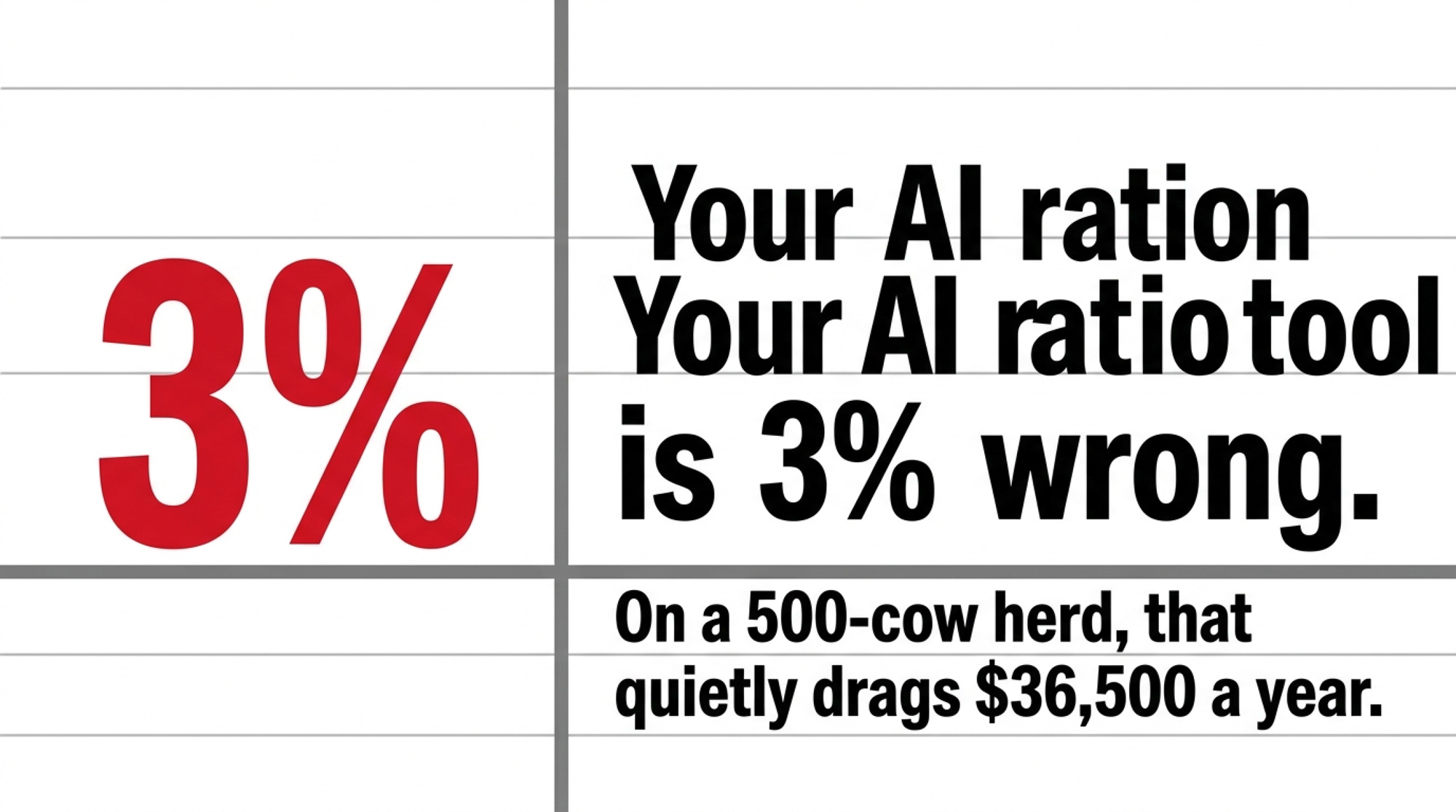
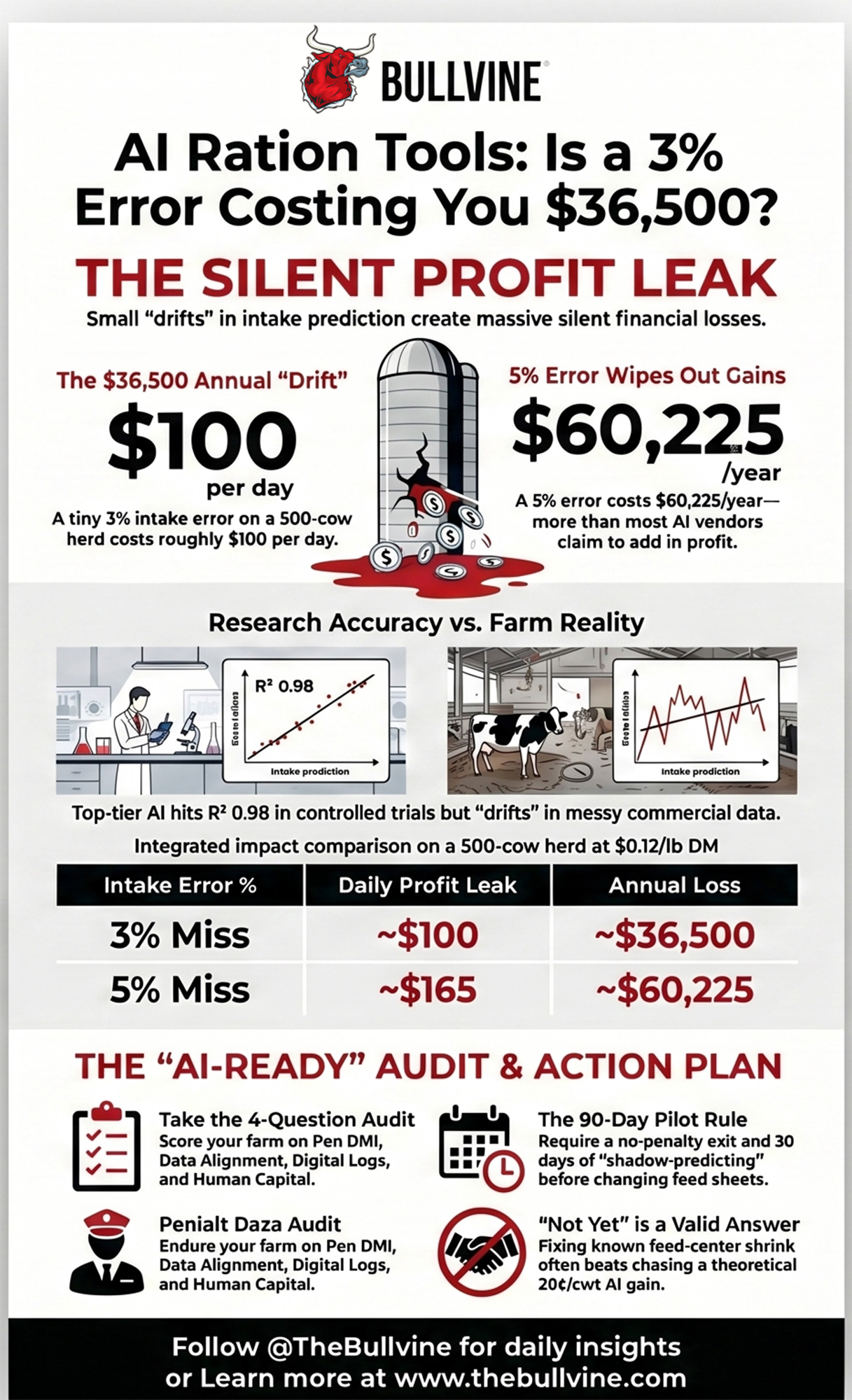
A peer‑reviewed 2026 trial on 2,073 cow‑days showed AI rations can lift IOFC — but a 3% intake miss on a 500‑cow high group quietly drags $100/day, about $36,500 a year. Is yours drifting?
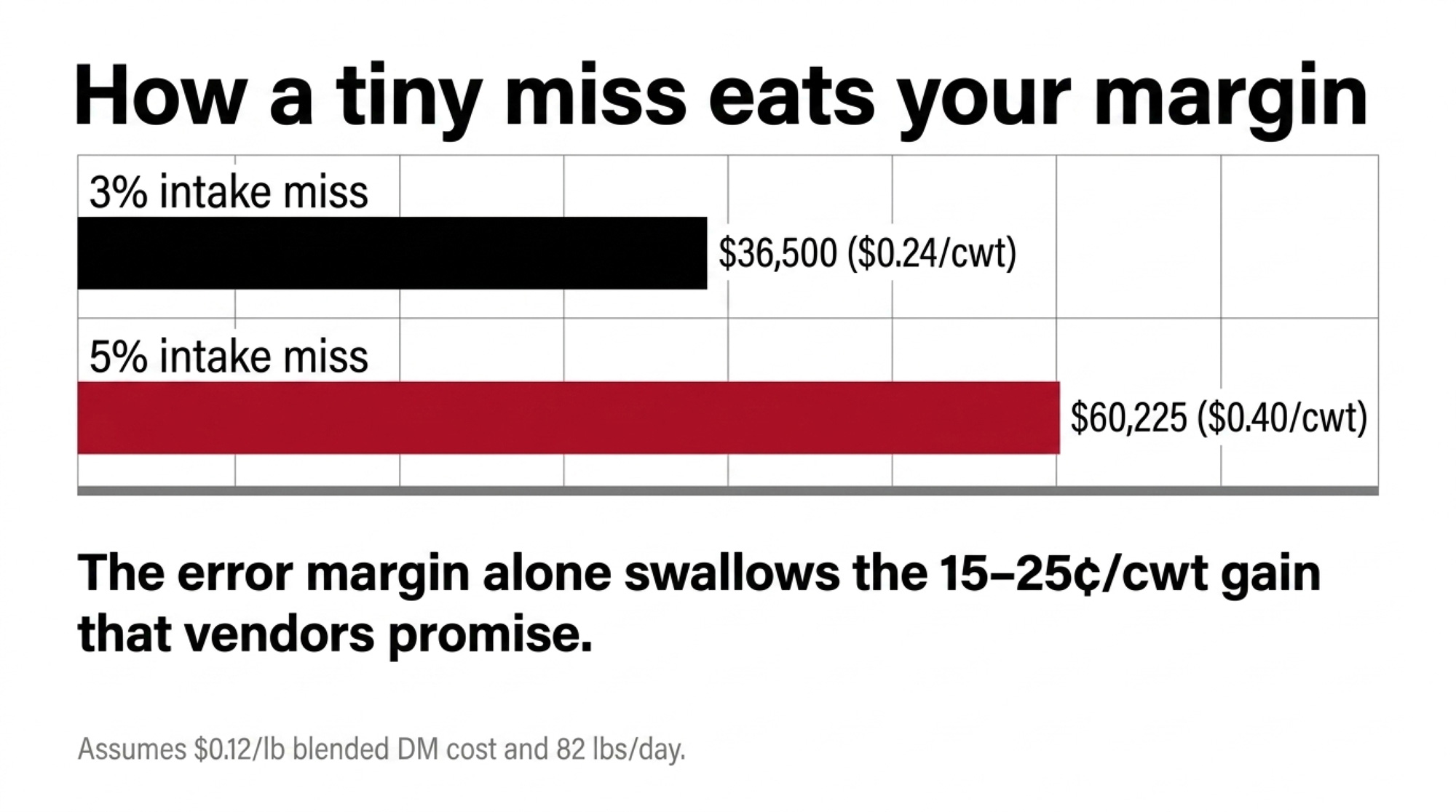
Executive Summary: A peer‑reviewed 2026 Animal Frontiers study from Alex Bach’s group at the University of Lleida trained a machine‑learning model on 2,073 cow‑days and hit R² 0.98 on income over feed cost — roughly 12 percentage points better than standard regression, with RMSE dropping from €1.45 to €0.59 per cow per day. The catch: that accuracy came from a tightly controlled research pen, and on a commercial 500‑cow high group, a 3% intake miss at $0.12/lb DM quietly drags about $100/day, or roughly $36,500 a year. Push the error to 5% and you’re looking at $60,225 — more than what most vendors claim their tools can add in IOFC. Cabrera’s Dairy Brain work and the Barrientos‑Blanco 2020 JDS paper confirm the upside is real (about $31/cow/year in feed cost and 5.5 kg less N excretion), but only when data streams actually line up; a 2022 survey in Animals found 69% of farmers weren’t familiar with data standards and 66% felt they didn’t control their own chain of custody. The practical call is to run a four‑question “AI Ready” audit first, hold any pilot to a 90‑day window with a no‑penalty exit and a 30‑day data‑export clause, and refuse to let the software change your feed sheet until it can shadow‑predict last week’s intake within 3%. For herds with tight DSCR and messy records, “not yet” is a legitimate answer — fixing known feed‑center shrink usually beats chasing a theoretical 20¢/cwt AI gain.
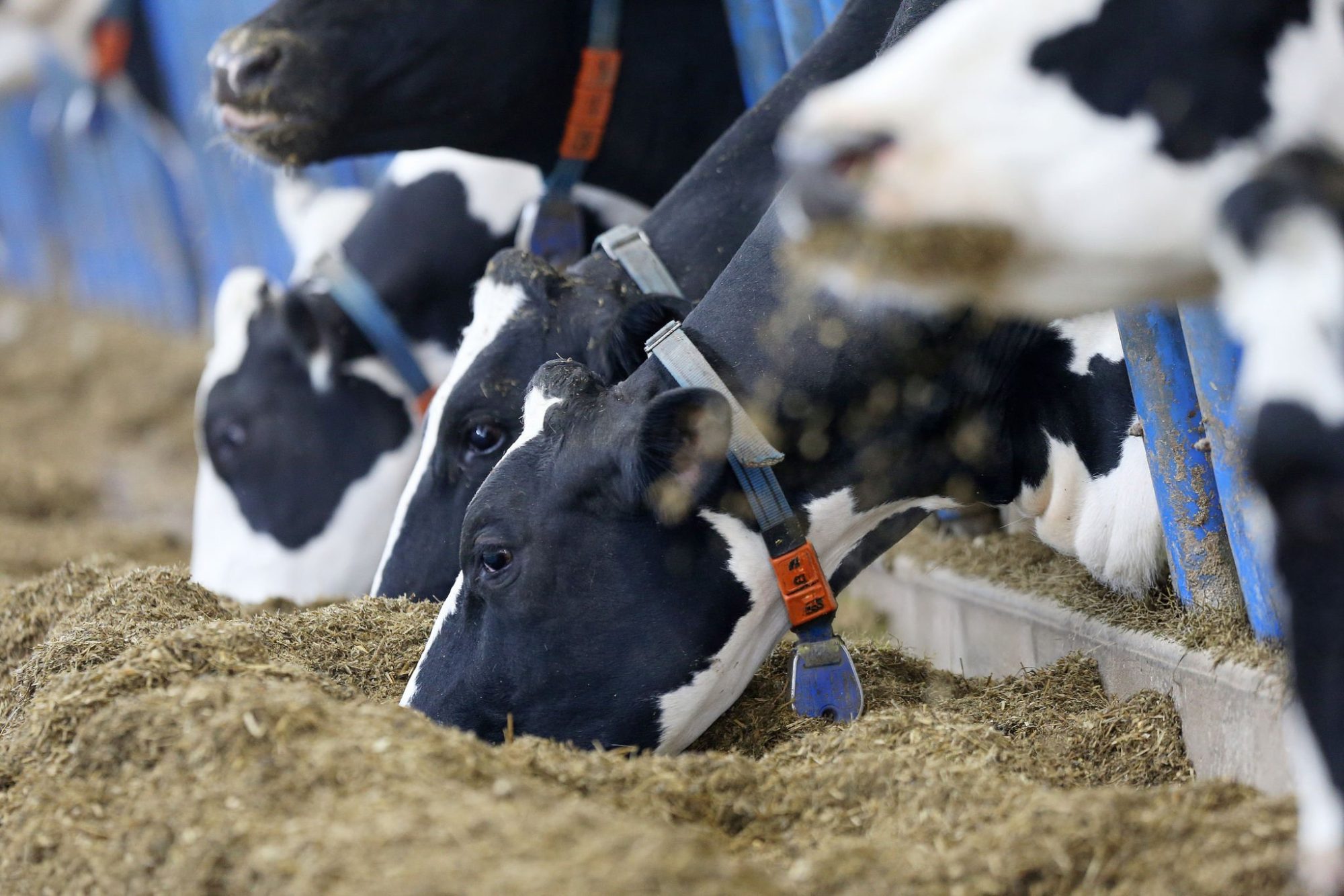
You’re sitting in a ration review and the AI tool on the laptop says your high group is fine at 55 pounds of dry matter. If that prediction is off by just 3%, the barn math on a 500‑cow herd works out to roughly ,500 a year at risk — in feed cost or missed milk. That’s the gap Alex Bach’s team exposed when they trained a machine‑learning model on 2,073 cow‑days and showed the “optimal” ration looks very different once the intake numbers are actually right.
The Bach study — published in Animal Frontiers in January 2026 — is one of the strongest recent peer‑reviewed data points showing AI can squeeze real dollars out of a dairy ration when the data underneath it is clean. The uncomfortable part is what happens on your farm, when the data isn’t that clean and the model’s intake guess wanders by a couple of pounds for weeks on end.
What the 2,073‑Cow AI Trial Actually Proved
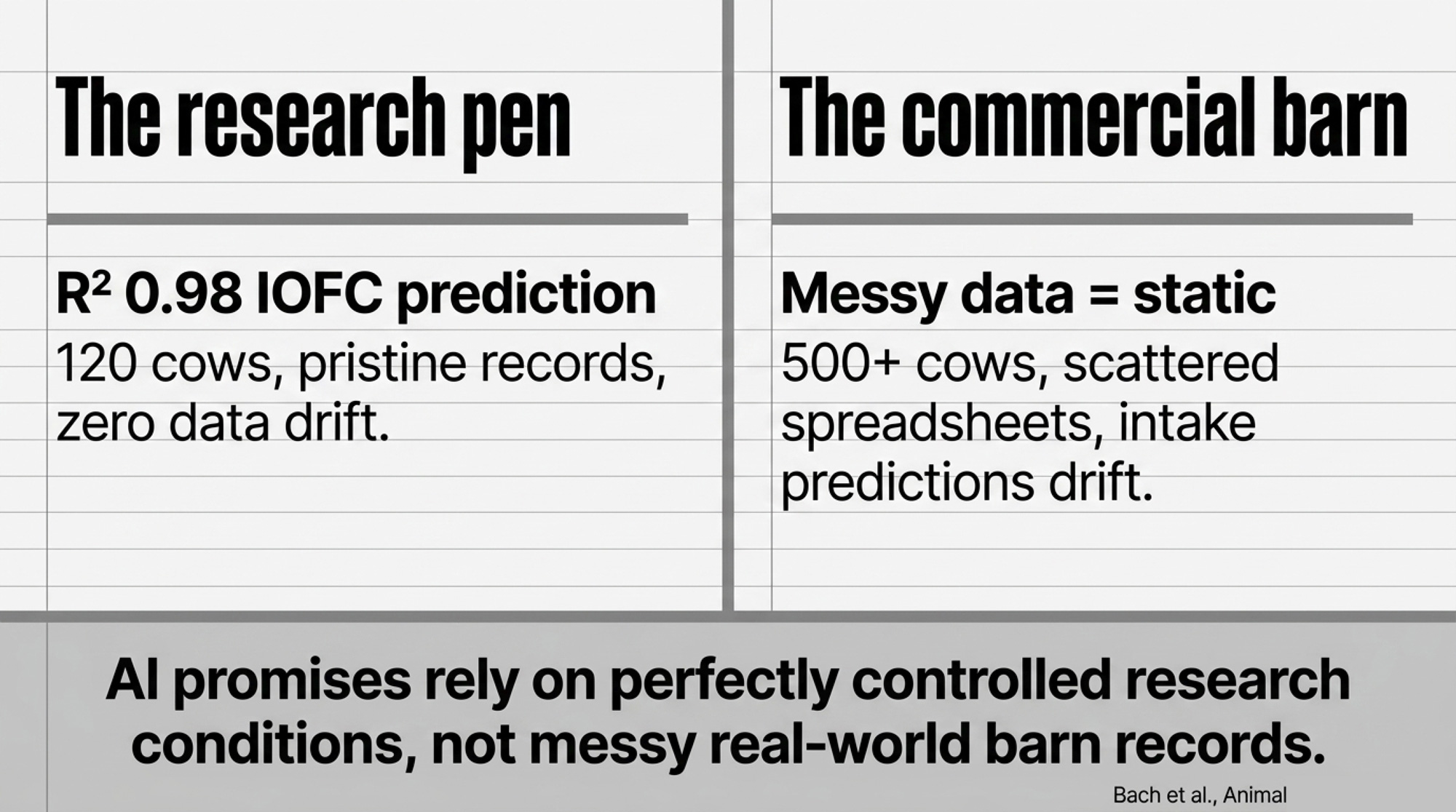
According to Bach’s 2026 Animal Frontiers paper, the University of Lleida team followed a single pen of around 120 cows and logged far more than milk weights. Ingredient intakes, nutrient profiles, weather, stocking density, bodyweights, days in milk, yields, components, and economic returns — 2,073 daily observations in total, fed into a platform called algoMilk that has been running since 2020.
Two prediction engines were built on top of that dataset. A classic multiple regression — the math that’s quietly run ration software for decades — hit an R² of 0.86 (meaning it explained about 86% of the variation in income over feed cost), with a root mean square error of 1.45 €/cow/day (roughly $1.57/cow/day at an exchange rate near 1.08 USD/EUR in early May 2026). The gradient‑boosting machine‑learning model reached an R² of 0.98 (near‑perfect correlation) and cut RMSE to 0.59 €/cow/day (about $0.64/cow/day) on the same cows.
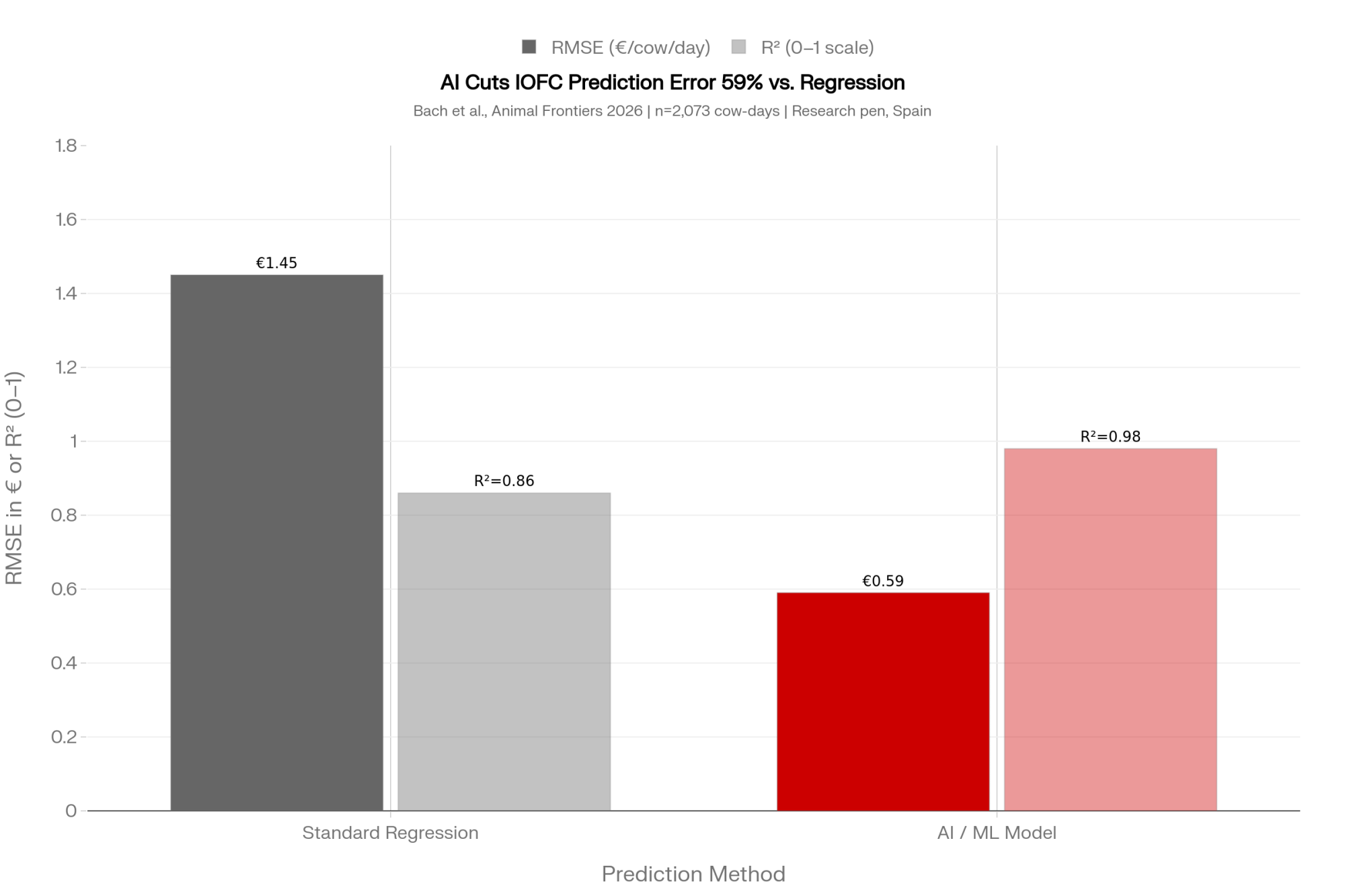
A small reality check before you get carried away: R² 0.98 reflects a tightly controlled research pen in Spain, not a typical commercial herd with messy real‑world records. Bach’s numbers are excellent on his cows, under his conditions — not an out‑of‑the‑box promise for yours.
Then the paper did the part every producer actually cares about. The ML model was plugged into an optimizer and asked to redesign the ration. The AI diet shifted ingredients gently — a bit more corn silage and canola meal, a bit less alfalfa and corn flakes — and lowered predicted dry‑matter intake by 0.2 kg (about 0.44 lb) and milk yield by 0.166 kg (about 0.37 lb) per cow per day. IOFC rose by about 0.015 €/cow/day (roughly $0.016/cow/day). Less milk. Tighter diet. Slightly more profit.
That result bruises a habit the industry has leaned on for a generation. According to the paper, chasing more milk at all costs isn’t always the most profitable move, because feed efficiency flattens and a chunk of cows in any group simply won’t pay you back for a richer ration.
How Dairy Brain Shows the Upside — When Data Is Clean
Bach’s work is one proof point. The bigger system for making AI useful at herd scale is being wired together in Wisconsin.
Victor Cabrera’s Dairy Brain project at UW–Madison has been stitching fragmented dairy data — genetics, milking systems, feed software, DHI, health records — into a single real‑time “brain” since 2016. The team’s 2024 Animal Frontiers paper describes using precision tools, big‑data analytics, and connected sensors to feed integrated models for everything from mastitis risk to culling and feeding decisions. Cabrera’s group publishes with Wisconsin cooperator herds, and the published outcomes line up with what the academic record shows — a pattern worth watching as more U.S. cooperators bring real barn numbers to the table.
An earlier applied study from the Cabrera group, led by Barrientos‑Blanco and published in the Journal of Dairy Science in 2020, put dollars on better diet accuracy. By tightening grouping and fine‑tuning rations with integrated data, they cut feed cost by about per cow per year and dropped nitrogen excretion by 5.5 kg (roughly 12.1 lb) per cow annually. On a 400‑cow herd, that’s roughly ,400 a year — off cows you already own, eating feed you’re already buying.
When data streams line up, AI‑style tools can tighten rations, improve nitrogen efficiency, and bump IOFC without a new ingredient truck ever rolling into the yard. The published work is also clear about the flip side: most herds aren’t close to that level of continuous, integrated data. That’s where the risk creeps in when you plug an AI ration engine into the noise.
Is Your Data Good Enough to Let AI Touch Your Ration?
Here’s where farm reality smashes into the AI sales deck.
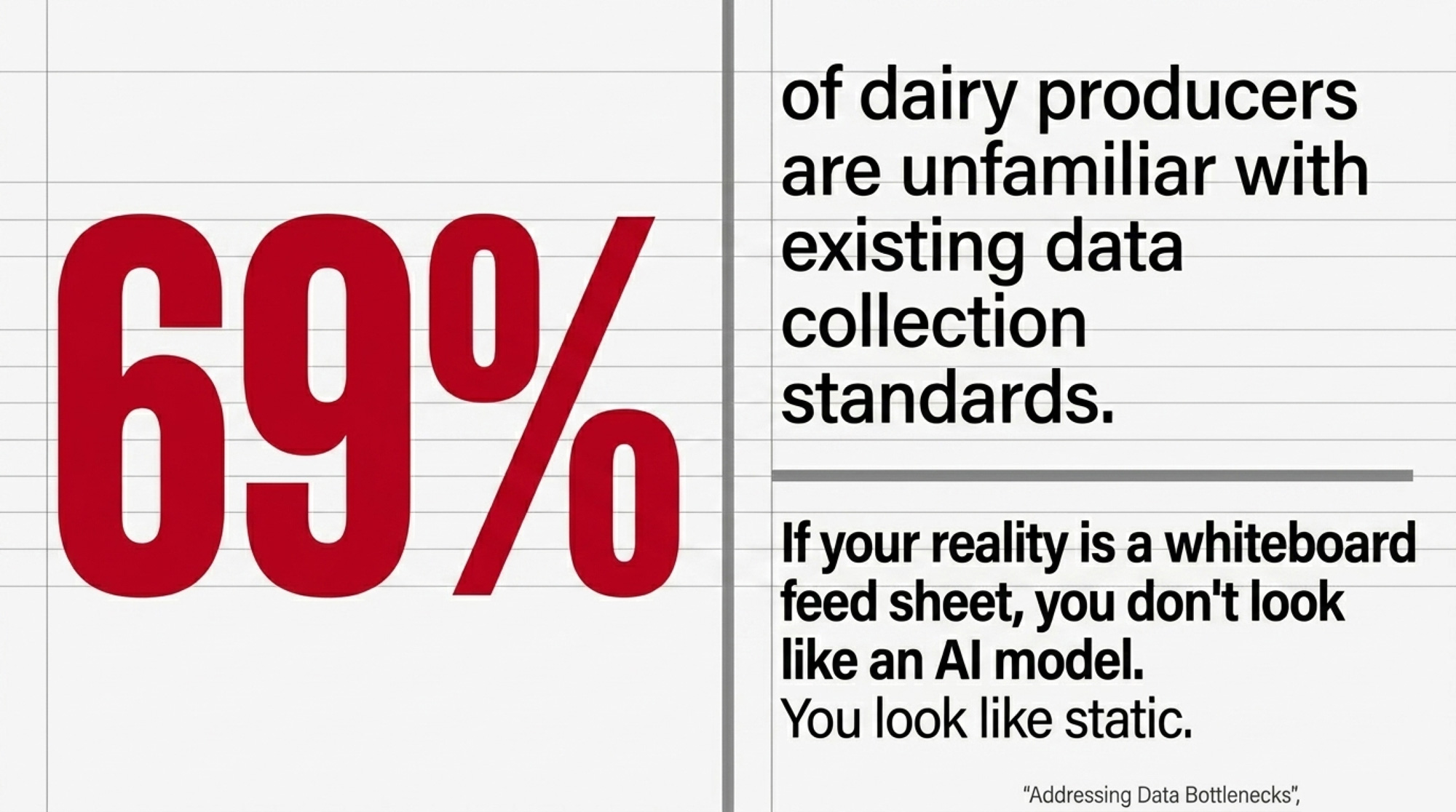
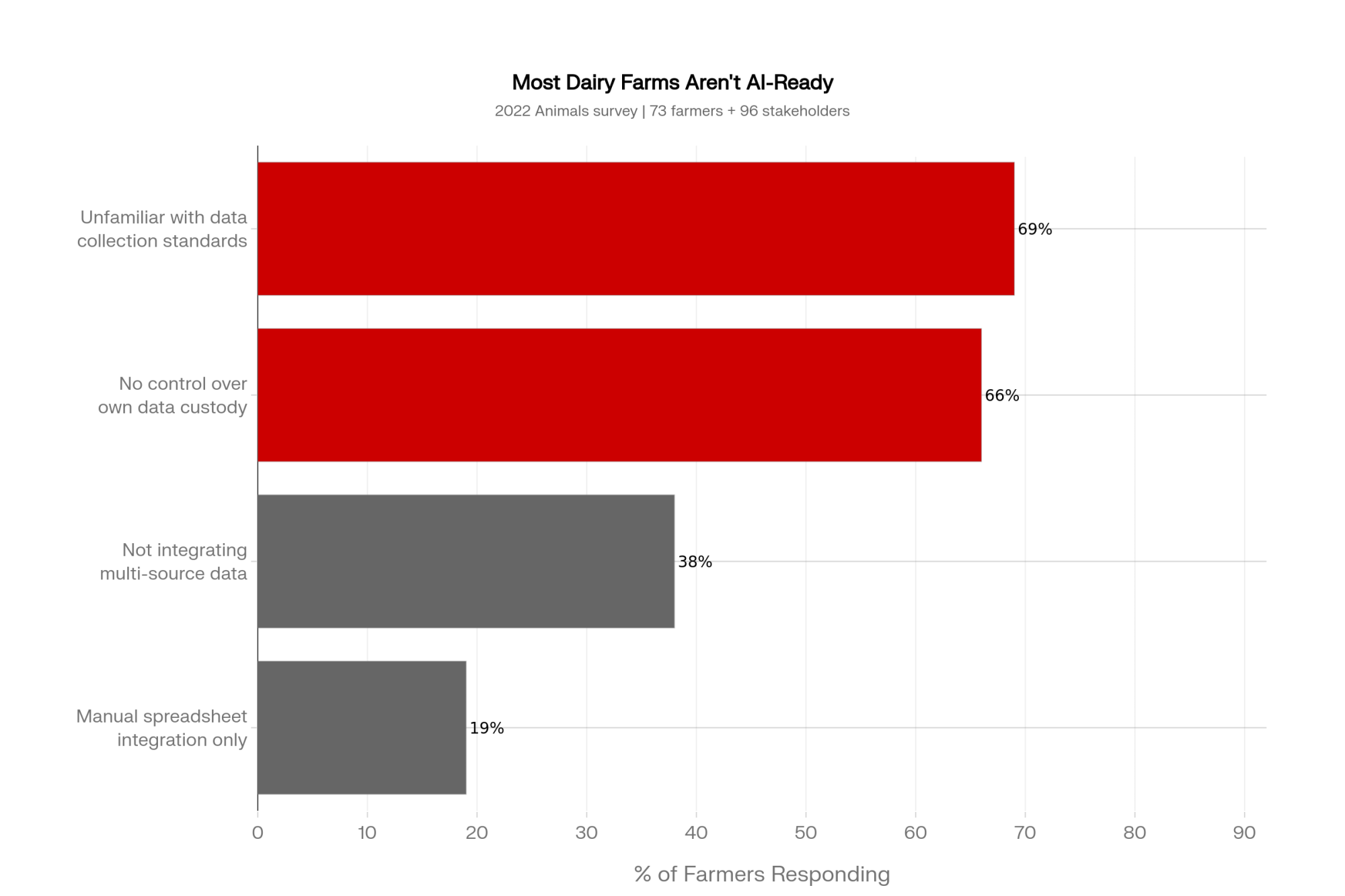
A 2022 paper in Animals called “Addressing Data Bottlenecks in the Dairy Farm Industry” surveyed 73 farmers and 96 non‑farm stakeholders. About 69% said they were unfamiliar with existing data collection standards, and 66% of farmers felt they had no control over the chain of custody for their own data. Only 62% of farms were integrating data from multiple sources at all — and nearly half of those were still doing it manually in spreadsheets.
If your reality is a whiteboard feed sheet, DHIA once a month, and treatment notes scribbled in a spiral notebook, you don’t look like the 120‑cow Spanish research pen to an AI model. You look like static. And static makes intake predictions drift.
Before you download a trial of an “AI dairy nutrition” app, grab your nutritionist and run this readiness check:
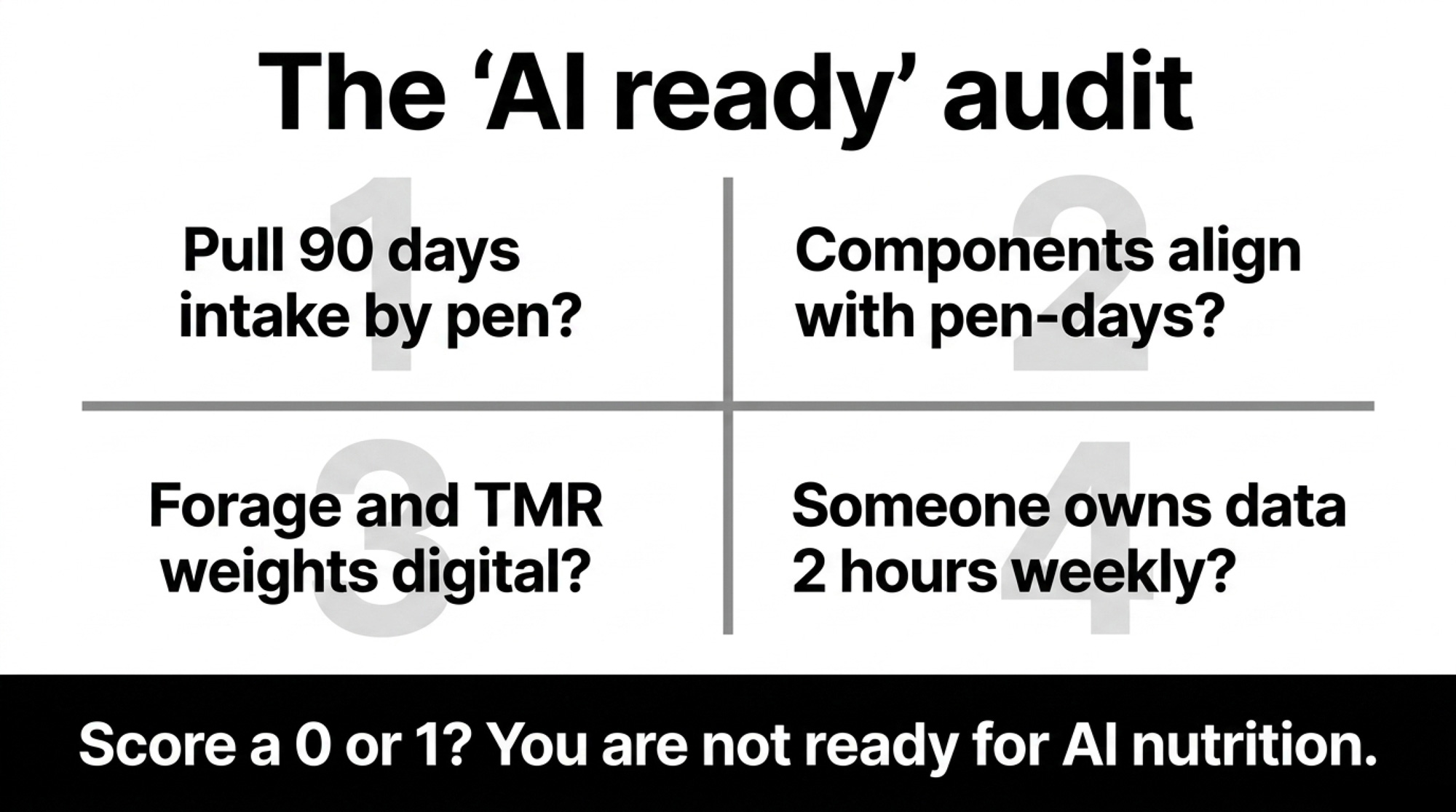
The “AI Ready” Audit
- Pen‑Level DMI: Can you pull 90 days of DM‑adjusted intake by pen?
- Data Alignment: Do milk and components line up with those same pen‑days?
- Digital Logs: Are forage DMs and TMR weights logged daily — not on paper?
- Human Capital: Does someone on your team “own” data quality for at least 2 hours a week?
Zero or one out of four? You’re in good company. At that level, an AI ration tool is far more likely to become an expensive experiment than a profit center. Three or four out of four, and you’re close to the kind of herds where Bach and the Cabrera group have actually shown real gains.
How a 3% Intake Miss Eats $36,500 on a 500‑Cow Herd
Now the arithmetic you can run on the back of a feed tag.
Most high‑producing Holsteins in North America sit in a 52–58 lb dry matter range, depending on bodyweight and stage of lactation. With today’s mix of corn silage, haylage, grain, and by‑products, a realistic blended dry matter cost across many U.S. dairy regions lands in the $0.11–$0.13/lb band.
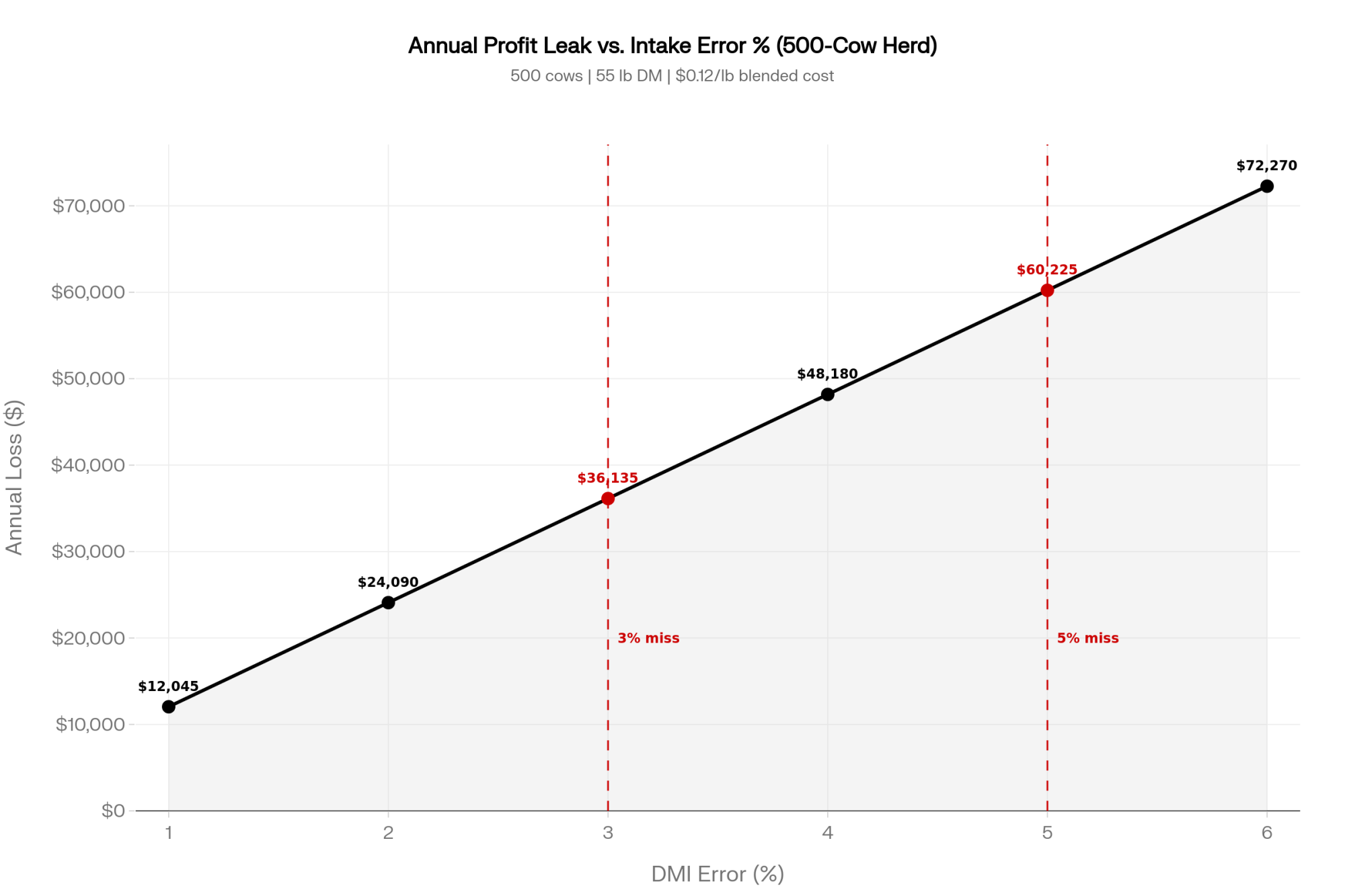
Say your AI tool claims your high group is eating 55 lbs of DM. In reality they’re closer to 53.35 — or 56.65. That’s about 1.65 lbs off, roughly 3%. Push that gap to 5% and you’re 2.75 lbs off, every cow, every day. Here’s how it lands on a 500‑cow high group at $0.12/lb DM:
| Intake Error | Daily Loss (500 cows) | Annual Profit Leak | Impact on Cost/cwt |
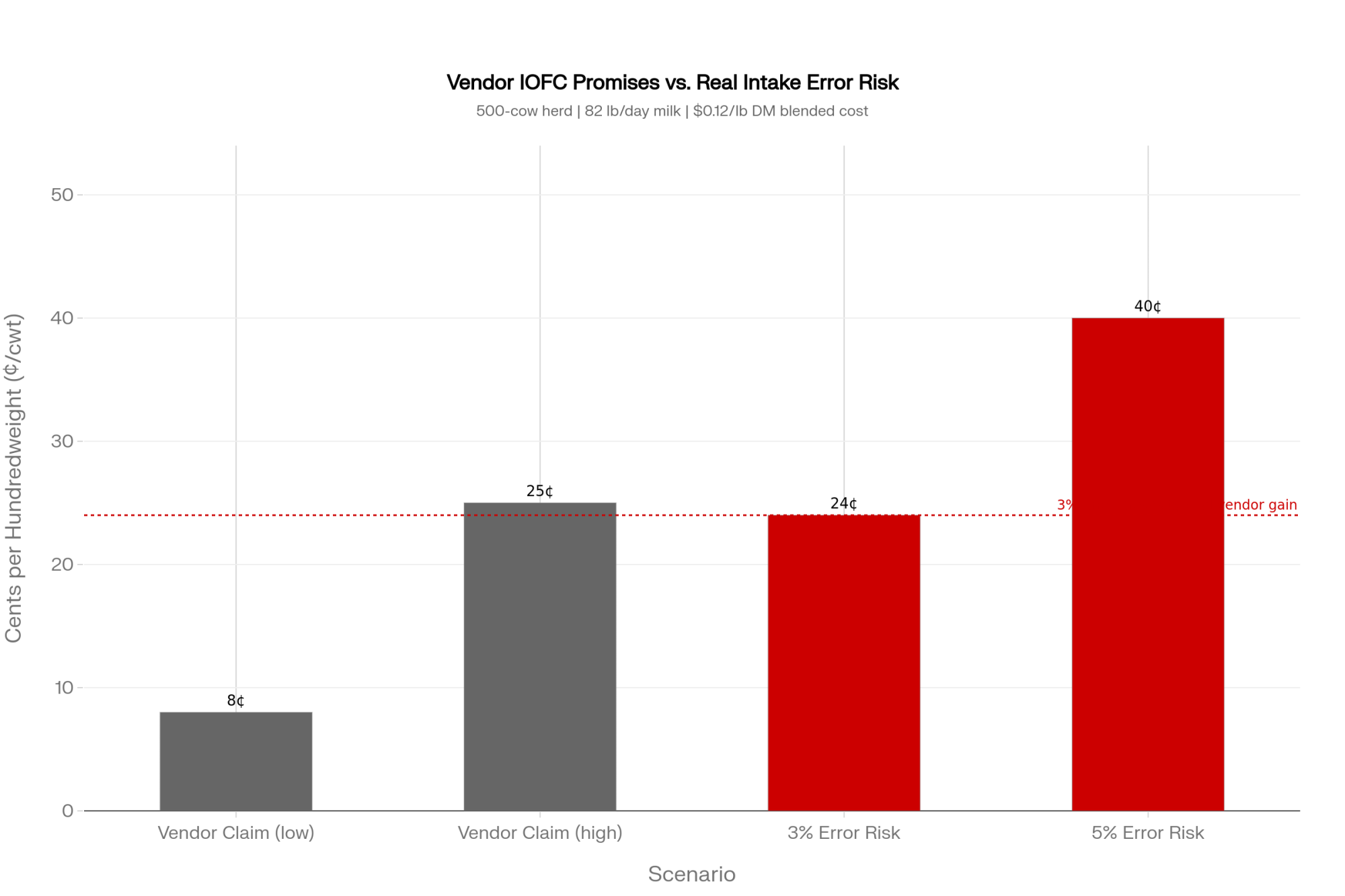
| 3% miss | ~$100 | ~$36,500 | $0.24 |
| 5% miss | $165 | $60,225 | $0.40 |
Assumes $0.12/lb blended DM cost and cows shipping ~82 lbs/day / 0.82 cwt. Figures rounded; unrounded 3%‑miss values land at about $99/day and $36,135/year.
| Herd Size | 1% Error/Year | 3% Error/Year | 5% Error/Year | ¢/cwt at 3% | ¢/cwt at 5% |
|---|---|---|---|---|---|
| 250 cows | $1,815 | $5,456 | $9,094 | 12¢ | 20¢ |
| 500 cows | $3,630 | $10,890 | $18,150 | 12¢ | 20¢ |
| 500 cows (high group only) | $3,630 | $36,500 | $60,225 | 24¢ | 40¢ |
| 1,000 cows | $7,260 | $21,780 | $36,300 | 12¢ | 20¢ |
| 2,000 cows | $14,520 | $43,560 | $72,600 | 12¢ | 20¢ |
Assumes $0.12/lb DM, 55 lb/day baseline intake, 82 lb/day milk shipped. High-group row reflects Bach/article scenario. Red = at or above vendor-claimed IOFC gain.
Vendors pitch these tools on IOFC gains in the single‑digit cent‑per‑cwt range. Marketing decks often stretch to 15–25¢/cwt. If the intake prediction the whole thing rides on is drifting 3%, the risk band alone can swallow the promised gain — before you even look at components, health, or labour.
Then the second‑order hits stack up. Butterfat slips a couple of hundredths because the model squeezes forage harder than your cows tolerate. Fresh cows throw a few extra DAs or ketosis cases because energy density moved faster than anybody noticed. Feeders chase bunk calls that don’t match the software. It isn’t scare‑tactic framing — it’s just what the math does when the model’s picture of intake and your actual bunks sit a couple of pounds apart for too long.
What Happens in Your Barn When the Algorithm Misses Intake by 5%?
Push the error band to 5% and you’re in lender‑conversation territory. That $60,225 annual leak sits well past the vet bill — right alongside the squeeze your banker runs DSCR against, like the $18.95 milk / $19.14 cost trap.
At 5%, the operational story gets ugly fast. Bunk calls get noisier because refusals don’t match predicted DMI. Cows swing between too‑full and too‑empty bunks. Health events cluster in patterns you don’t recognize. Feeders start “adjusting around the tool” off the record. If you’re using AI in advisory mode — building shadow rations and comparing — that 5% miss is a discussion point. If you’re letting it write the feed sheet, it’s physical, in front of your cows, every day.
The Bach model hit R² 0.98 on IOFC in that Spanish trial. Nobody has published that kind of accuracy on a typical North American commercial herd with messy real‑world records. The precision‑feeding upside is real. Your data quality decides whether you see Bach‑style gains or a 3–5% error bill.
Options and Trade‑Offs for Farmers
| Contract Clause | What Farmers Need | Typical Vendor Default | Who Carries Downside |
|---|---|---|---|
| Pilot duration | 90 days, hard stop | Rolling month-to-month | Farmer |
| Exit penalty | No-penalty exit at day 90 | Early-termination fee | Farmer |
| Data export | Full export within 30 days | Proprietary lock-in | Farmer |
| Shadow mode | Days 1–7 predict only, no feed changes | Live optimization from day 1 | Farmer |
| Performance threshold | <3% intake error before scaling | Vendor discretion | Farmer |
| IOFC benchmark | Must beat subscription fee in at least 1 pen by day 30 | No contractual benchmark | Farmer |
Red = clause absent in most standard vendor agreements. Based on article’s recommended audit framework.
1. Fix Your Data First — Your 30‑Day Action
When it makes sense: You’re at zero or one on the readiness check. Records are scattered, DMI isn’t tracked by pen, and nobody owns data quality.
What it requires: Treat data like an ingredient for the next 30 days. Check DM on your main forages daily. Log every TMR load with actual weights and which pens it went to. Enter fresh, moved, and sick cows within 24 hours. At month’s end, sit with your nutritionist and pull 90 days of DMI by pen, milk and components by pen or tank, and a simple IOFC‑per‑cwt trend built on your real milk and feed prices.
Risks and limits: You won’t have an AI dashboard at the next meeting. You will have a baseline that tells you whether you’re already leaving money on the table with the software you own today.
2. Run a Small, Hard‑Bound 90‑Day Pilot
When it makes sense: You’re at three or four on readiness. Data’s relatively clean, the team is willing, and your nutritionist isn’t afraid of a spreadsheet.
What it requires: On paper — a written 90‑day pilot, a no‑penalty exit at day 90, and a guaranteed full data export (rations, predictions, actuals) within 30 days if you walk. In the barn — Days 1–7 in shadow mode only, the AI predicts but doesn’t change anything. Days 7–30, one stable pen gets one AI‑driven ration change with clear targets. Days 31–90, expand to a second pen only if pen one shows intake error under ~3% and IOFC improving after subscription fees.
Risks and limits: You’ll spend more time checking predicted versus actual than you’d like. By day 90, you’ll know — in your own dollars per cwt — whether the tool earns more than it costs.
3. Keep AI Advisory — Second Opinion, Not Driver
When it makes sense: You see value in pattern‑spotting but you’re not ready to let software write the feed sheet.
What it requires: Turn off auto‑optimization. Use the AI to generate shadow rations, flag outlier pens, and highlight where intake and milk don’t line up with history. Rule of the house: nothing new goes into the mixer without a human sign‑off.
Risks and limits: You give up some “easy” IOFC gains a fully optimized system might find on pristine data. You gain control, cut the odds of a silent 3–5% intake miss, and still get a second set of eyes.
4. “Not Yet” Is a Valid Answer
When it makes sense: DSCR is tight, you’re behind on higher‑ROI basics, and your data is, frankly, a mess.
What it requires: Sit down with your nutritionist and lender and mark the leaks you already know about. Are you happy with grouping and stocking? Have you tackled obvious feed shrink or mixing‑consistency issues? The Feed Center Revolution work shows many herds leak five figures a year before they ever touch software. Do you have a clear component strategy when the 2026 Class III–IV spread pulls $382,000 off a 500‑cow milk check?
Risks and limits: You might feel sidelined while neighbors talk about AI. You also avoid adding a subscription and one more variable to a cost structure that’s already stressed. Fixing a known six‑figure leak beats chasing a theoretical 20¢/cwt AI gain.
Key Takeaways
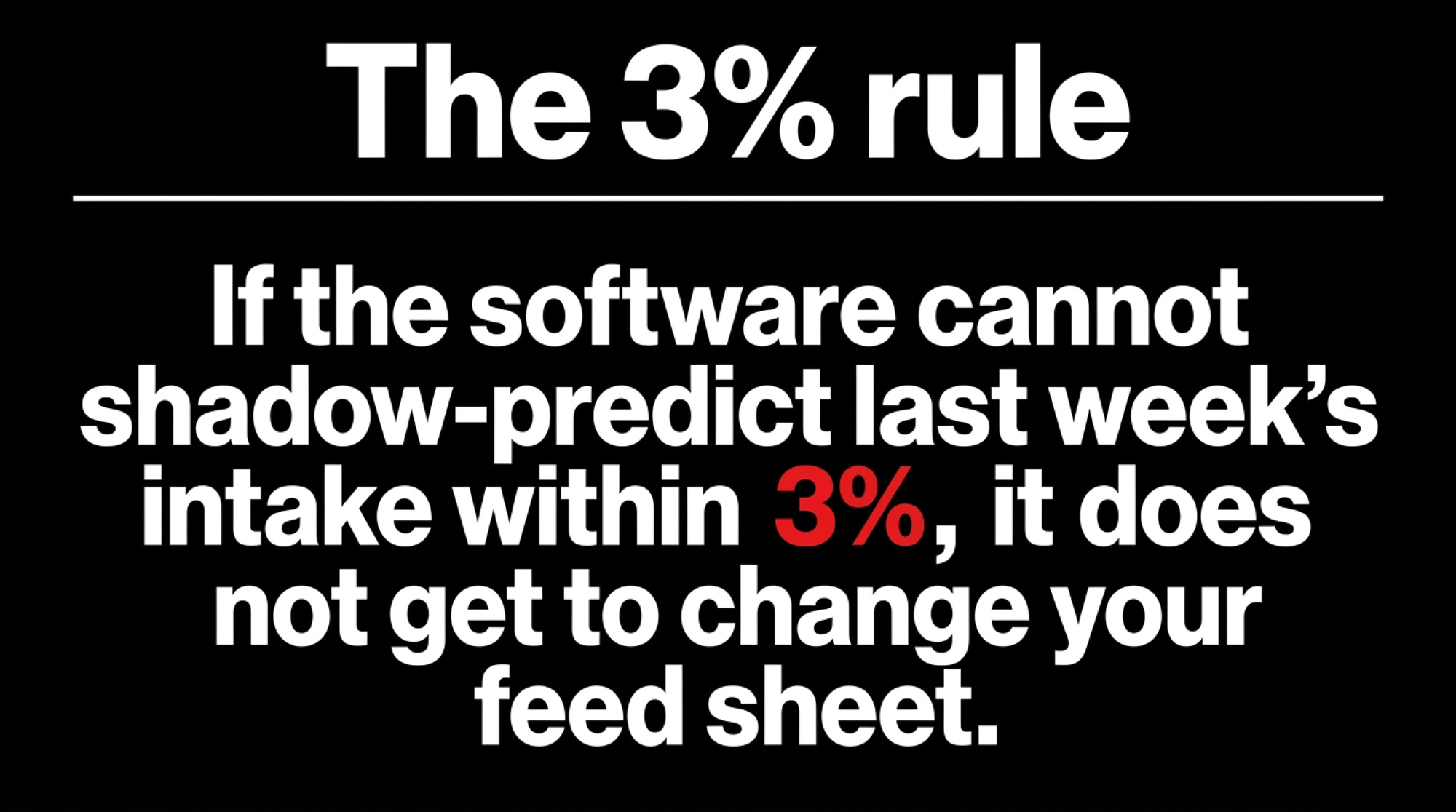
- If an AI ration tool can’t shadow‑predict your last week of intake within roughly 3%, it doesn’t get to change the feed sheet. That gap is about $36,500/year on a 500‑cow herd — enough to erase the whole promised IOFC lift.
- If you’re at zero or one out of four on the readiness audit, your next 30 days belong to tightening your own numbers before you pay for any AI prediction.
- If a vendor won’t put a 90‑day pilot, a no‑penalty exit, and a 30‑day data‑export clause in writing, assume you’re carrying effectively all of the downside. Keep any AI tool in advisory mode until the paper and your milk check both say otherwise.
- If the first 30 days of a pilot don’t show intake error under 3% and IOFC improving after fees in at least one pen, don’t scale it. Pause, diagnose, and make it earn more time.
What to do tomorrow morning: Before milking, pull last month’s feed invoices, your DHIA component report, and your TMR software log. Lay them on the same table. If you can’t line those three up by pen for the last 30 days in under an hour, that’s your AI answer for now — fix the data, then talk to the vendor.
So here’s the real question: if you laid out last year’s IOFC and feed‑cost reports, could you point to a single tool — AI or not — and say, “This clearly adds more than it costs, and here’s the proof in dollars per cwt”? If the answer is still no, any tool that comes next should have to prove itself on your cows, under your conditions, before it earns a seat at your feed table.
Complete references and supporting documentation are available upon request by contacting the editorial team at editor@thebullvine.com.
Learn More
- AI Slashes Feed Costs $31 Per Cow While Your Competitors Pull Further Ahead: The Data-Driven Revolution Reshaping Dairy’s Future — Secure a verified $31 per-cow feed savings by mastering the precise implementation timelines behind automated nutrition systems. This breakdown exposes hidden integration costs and delivers the exact ROI calculations needed to evaluate vendor contracts ruthlessly.
- Data Centers, Water Rights, and Your Dairy’s Future: The 18-Month Window That Changes Everything — Tracking the impending collision between Big Tech and agriculture reveals a narrow 18-month decision window for mid-sized dairies. Follow the money to see how operations leverage existing water rights into $400-per-head renewable energy partnerships or historic exit premiums.
- Unlocking the Power of Data: How AI is Revolutionizing Dairy Farming and Why You Should Own Your Data— Corporate overreach threatens your operation when you surrender herd metrics to third-party algorithms. Dismantle these data-ownership risks immediately to discover how maintaining total control over your digital footprint actively protects your margins and farm autonomy.
The Sunday Read Dairy Professionals Don’t Skip.

Every week, thousands of producers, breeders, and industry insiders open Bullvine Weekly for genetics insights, market shifts, and profit strategies they won’t find anywhere else. One email. Five minutes. Smarter decisions all week.





